
Grade 7 Worksheets
8,459 grade resources
Grade 7 Hispanic Heritage Month Celebrating Diversity Worksheet
 Created byShaNova Worksheets
Learning Objectives
- Explain the purpose of Hispanic Heritage Month and describe key ideas from the passage.
- Determine whether statements about Hispanic Heritage Month are true or false using text-based evidence.
- Use context clues to complete sentences about cultural diversity, contributions, and traditions.
Instant download

Grade 7 Math – Integer Addition Worksheet (PDF) – Ontario Standards
 Created byClear Sky Classroom
Learning Objectives
- Understand how to add positive and negative integers in various contexts.
- Apply integer addition to real-world scenarios like budgeting and temperature changes.
- Develop reasoning skills to evaluate the reasonableness of integer sums in practical situations.
Also included in: Grade 7 Number Math Lesson Bundle | Ontario Standards +1 more
Instant download

7th Grade Social Studies | Renaissance Innovation Worksheet (PDF)
 Created bySunny Desk Resources
Learning Objectives
- Explain how Renaissance innovations in art, science, and print technology spread new ideas in Europe
- Identify key Renaissance techniques inspired by classical antiquity (such as perspective and chiaroscuro)
- Describe how the printing press increased literacy and access to knowledge
Also included in: Grade 7 Renaissance Social Studies Lesson Bundle | California Framework +1 more
Instant download

Earth Resources Assessment | TEKS Grade 7 Science Printable Worksheet
 Created byPrism Point Learning
Learning Objectives
- Understand the distribution and significance of natural resources in Earth systems.
- Describe the processes of groundwater flow, aquifer recharge, and soil formation.
- Differentiate between renewable and nonrenewable resources in various geologic settings.
Also included in: Grade 7 Earth and Space Systems Science Lesson Bundle TEKS Worksheets
Instant download

Health Risk Factors Worksheet | Grade 7 NHES Health Education Activity
Created byPrism Point LearningLearning Objectives
- Identify common risk factors that can increase the likelihood of health problems
- Distinguish between behavior, environment, and genetic factors
- Explain how prevention choices can reduce risk over time
Instant download

Grade 7 ELA Presenting Knowledge Worksheet (CCSS) – Reading & Speaking Skills
 Created byGolden Apple Studio
Learning Objectives
- Organize claims and findings into a clear, focused presentation with a logical progression of ideas.
- Connect each major claim to relevant evidence and explain how the evidence supports the claim.
- Strengthen presentations by choosing purposeful visuals and multimedia and using appropriate transitions and structure.
Also included in: Grade 7 ELA Speaking & Listening Lesson Bundle | Common Core CCSS +1 more
Instant download

Grade 7 Energy Flow Worksheet | NGSS Practice PDF
Created byClear Sky ClassroomLearning Objectives
- Explain the transfer of energy through trophic levels in ecosystems.
- Identify the roles of producers, consumers, and decomposers in energy pyramids.
- Describe how photosynthesis and cellular respiration are mechanisms for energy capture and release.
Also included in: Grade 7 Ecosystems Interactions Energy Dynamics Science Lesson Bundle: NGSS +1 more
Instant download

Grade 7 Science | Model-Based Predictions Worksheet | General Standard
 Created byLumora Learning
Learning Objectives
- Explain how models help scientists make predictions from observations
- Differentiate physical, diagrammatic, and computational models and give an example of each
- Use a diagram of lunar phases to predict what the Moon will look like from Earth
Instant download

Purposeful Revision Worksheet | CCSS Aligned Grade 7 ELA Practice
JCreated byJ.S SheetsLearning Objectives
- Revise writing to better match purpose and intended audience by strengthening development, organization, and evidence
- Improve sentence-level clarity by refining language for coherence, style, and readability
- Edit drafts for grammar, usage, punctuation, and spelling so meaning stays clear
Instant download

Grade 7 Human Impacts on the Environment Worksheet | NGSS Science Activity
 Created byBRIGHT PATH RESOURCES
Learning Objectives
- Understand the causes of deforestation and its impact on ecosystems.
- Identify human activities that contribute to environmental degradation.
- Analyze the consequences of deforestation for biodiversity and climate.
Also included in: Earth Systems Grade 7 Science Daily Reading Worksheets Lesson Bundle | NGSS +2 more
Instant download

Grade 7 Physical Properties Worksheet | BC Practice & PDF
Created byClear Sky ClassroomLearning Objectives
- Define physical properties and explain how they help identify and sort substances
- Describe density and solubility and connect each property to measurable observations
- Use evidence from measurements to separate mixtures and make material choices
Instant download

Grade 7 ELA – Understanding Comma Rules for Clarity | Daily Reading Worksheet
 Created byQuiet Forest Education
Learning Objectives
- Identify when to use commas in lists
- Apply comma placement in sentences with multiple items
- Recognize correct comma usage in introductory phrases
Also included in: Sentence Skills Grade 7 ELA Daily Reading Worksheets Lesson Bundle | TEKS +1 more
Instant download

Trophic Efficiency Practice Worksheet | Grade 7 Science Review
Created byPrism Point LearningLearning Objectives
- Explain what trophic efficiency means and how energy changes between trophic levels
- Describe why energy pyramids shrink toward higher trophic levels
- Use the ideas of losses (heat, respiration, waste) to predict how many consumer levels can exist
Also included in: Ecosystems & Interactions Lesson Bundle – Grade 7 Science BC Framework +1 more
Instant download

Grade 7 ELA – Locating Text Features Daily Reading Worksheet | Alberta Standards
Created byQuiet Forest EducationLearning Objectives
- Identify headings and subheadings in a text
- Understand how text features help organize information
- Distinguish between main content and text features
Also included in: Grade 7 Reading and Viewing ELA Daily Reading Worksheets lesson bundle | Alberta +1 more
Instant download
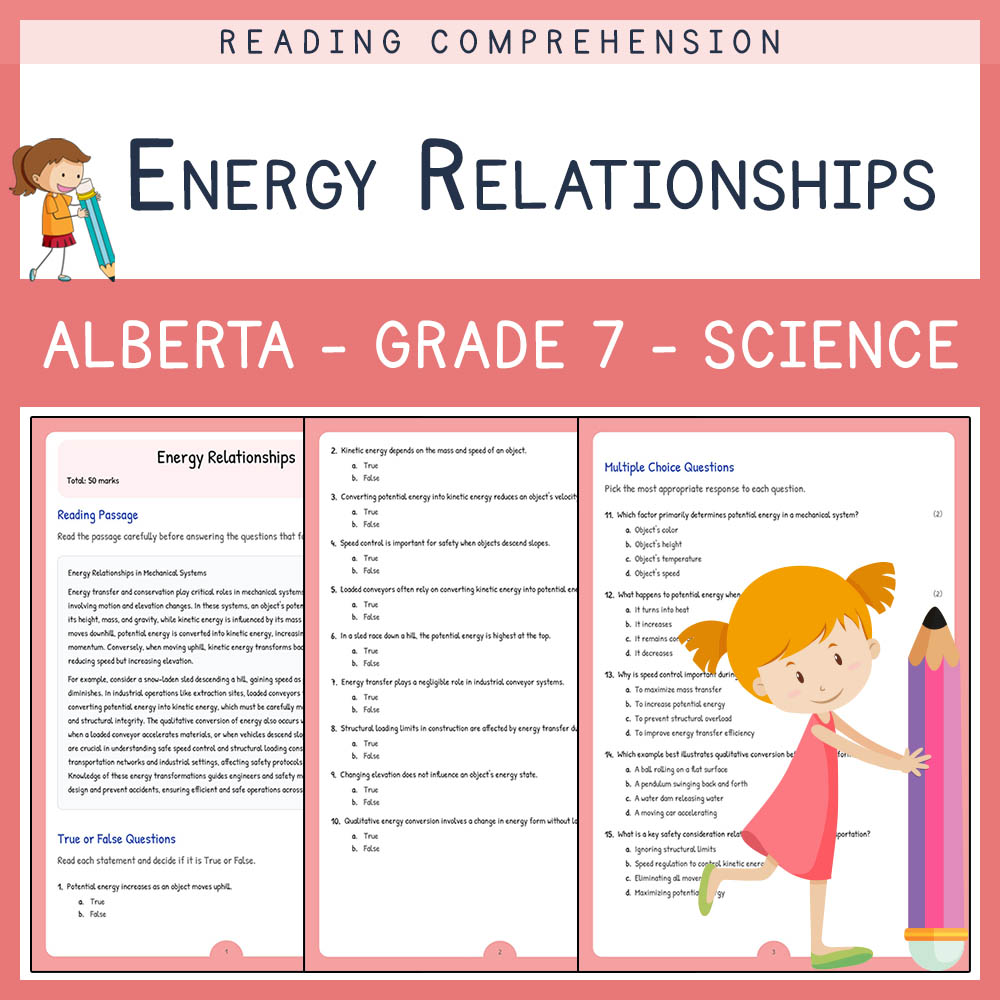
Grade 7 Science | Energy Relationships Worksheet | Alberta Standard
Created byLumora LearningLearning Objectives
- Explain the concepts of kinetic and potential energy and how they relate to forces and motion.
- Describe how elevation, mass, and speed influence mechanical energy in systems like sled descents and conveyors.
- Illustrate qualitative conversion between potential and kinetic energy in mechanical systems.
Instant download

Grade 7 Science | Wave Energy Transfer Worksheet | General Standards
Created byLumora LearningLearning Objectives
- Explain how waves transfer energy without permanently moving matter
- Distinguish transverse waves from longitudinal waves using particle motion
- Identify how amplitude and wavelength relate to energy and spacing in a wave pattern
Instant download

Meiosis Variation Worksheet | Genetics & Heredity Grade 7 Science
Created byPrism Point LearningLearning Objectives
- Explain how chromosome segregation and independent assortment during meiosis create genetic variation.
- Describe how genetic differences among siblings arise even when parents are the same.
- Connect genetic variation to possible differences in survival and reproduction over generations.
Also included in: Grade 7 Evolution, Genetics & Ecosystems Lesson Bundle | Florida NGSSS
Instant download

Grades 6, 7 & 8 Holiday Writing Reflections Worksheet | Assessment
Learning Objectives
- Explain how family roles and emotional bonds shape family values during a holiday or celebration.
- Use evidence from a text to describe how cultural traditions influence what families believe and practice.
- Write a reflective response that connects personal meaning to respectful understanding of others’ family experiences.
Also included in: Grades 6 - 8 Holiday Family Values & Structures Custom Bundle +2 more
Instant download

Grade 7 Science | Plate Mechanisms Worksheet | BC Aligned
Created byLumora LearningLearning Objectives
- Understand the various force systems driving Earth's plate motion, including mantle convection, slab pull, and ridge push.
- Explain how mantle convection creates convection cells that transfer momentum to the lithosphere.
- Identify the roles of slab pull and ridge push in tectonic plate movements.
Instant download

Grade 7 Insulation Principles Worksheet | Ontario Science PDF & Key
Created byClear Sky ClassroomLearning Objectives
- Explain how insulation reduces heat transfer by addressing conduction, convection, and radiation
- Compare insulating materials (fibreglass, foam, and reflective foils) in terms of how they slow heat flow
- Describe how air leakage, thermal bridging, and continuous insulation affect overall heat loss
Instant download

Grade 7 | National Aviation Day Worksheet for Flight History | PDF + Answer Key
Created byShaNova WorksheetsLearning Objectives
- Explain how early experiments and inventions contributed to the development of powered flight
- Describe key aviation innovations (such as engines, safety systems, and aircraft design) and their purposes
- Evaluate how aviation has changed transportation, commerce, and humanitarian efforts over time
Instant download

Grade 7 ELA – Coherent Paragraphs & Transitions Daily Reading Worksheet
Created byQuiet Forest EducationLearning Objectives
- Understand the importance of topic sentences in paragraphs.
- Identify supporting details that relate to the main idea.
- Recognize how transitions improve paragraph cohesion.
Also included in: Grade 7 Writing ELA Lesson Bundle Daily Reading Worksheets – Ontario +1 more
Instant download

Grade 7 ELA – Daily Worksheet & Practice with Cause and Effect | TEKS-Aligned
Created byQuiet Forest EducationLearning Objectives
- Understand key concepts related to ELA
- Apply knowledge through practice questions
- Demonstrate comprehension of the material
Also included in: Narrative Writing Grade 7 ELA Daily Reading Worksheets Lesson Bundle | TEKS +1 more
Instant download

Science Worksheet Matter Properties Grade 7 | Standards-Aligned Practice
JCreated byJ.S SheetsLearning Objectives
- Describe how physical properties of matter (including state, color, texture, and density) can be observed or measured.
- Explain how chemical properties describe how substances behave during chemical reactions.
- Use properties to classify substances and justify grouping with evidence from observations or data.
Also included in: Grade 7 Matter, Energy & Forces Science Lesson Bundle – Florida NGSSS +1 more
Instant download
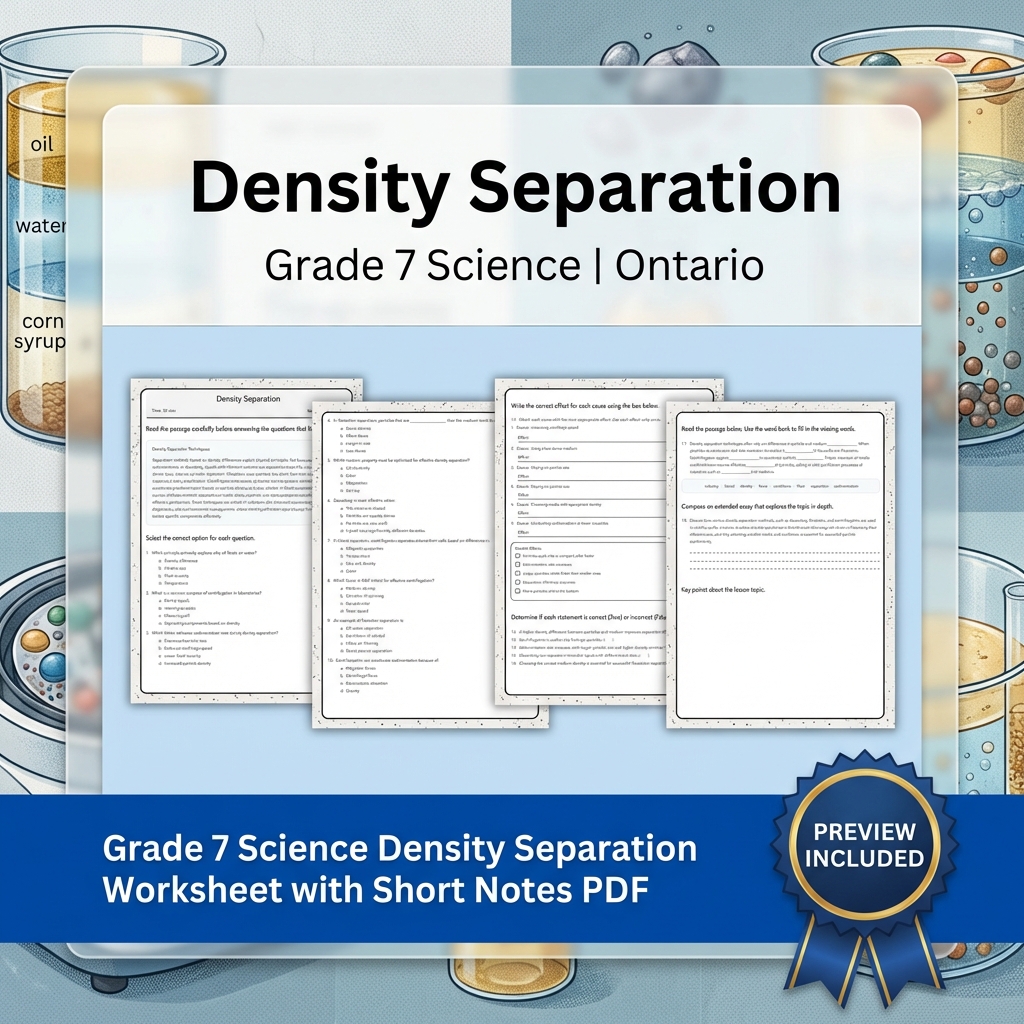
Grade 7 Science Density Separation Worksheet with Short Notes PDF
 Created byMeadowlark Worksheets
Learning Objectives
- Understand the principles of density-driven separation techniques such as decanting, floatation, and centrifugation.
- Identify examples of density separation in real-world applications like oil-water separation and blood fractionation.
- Explain how buoyant force, sedimentation rate, and centrifugal acceleration influence particle separation based on density and size.
Also included in: Grade 7 Science Lesson Group Bundle – Ontario Curriculum Worksheets +1 more
Instant download

Grade 7 Science | Thermal Expansion Worksheet | California Standards
Created byLumora LearningLearning Objectives
- Explain how heating and cooling affect the spacing and motion of particles in solids, liquids, and gases.
- Describe how thermal expansion leads to changes in length, volume, and pressure in real-world situations.
- Use the particle model to predict contraction and expansion when temperature changes.
Instant download

Grade 7 Science | Weather & Climate - Daily Reading Comprehension
 Created byCoral Reef Learning
Learning Objectives
- Understand the difference between weather and climate.
- Identify key weather variables such as temperature, precipitation, humidity, and wind.
- Describe how climate involves long-term patterns and averages of weather variables.
Instant download

Grade 7 Math – Comparing Methods Worksheet (Ontario Standards) (PDF)
Created byClear Sky ClassroomLearning Objectives
- Identify different representations of linear relationships using algebraic and numerical methods.
- Calculate and interpret linear equations and data points in real-world contexts.
- Analyze the advantages and limitations of algebraic and numerical approaches in problem solving.
Also included in: Grade 7 Algebra Bundle: Coding, Modelling, and Linear Equations for Ontario +1 more
Instant download

Grade 7 Science | Understanding Heat Capacity - Daily Reading Comprehension
Created byCoral Reef LearningLearning Objectives
- Define heat capacity and specific heat capacity.
- Explain how heat capacity affects heating processes.
- Calculate energy needed to heat a substance using specific heat capacity data.
Also included in: Energy, Heat and Thermal Processes Lesson Bundle: Grade 7 Science Alberta +1 more
Instant download
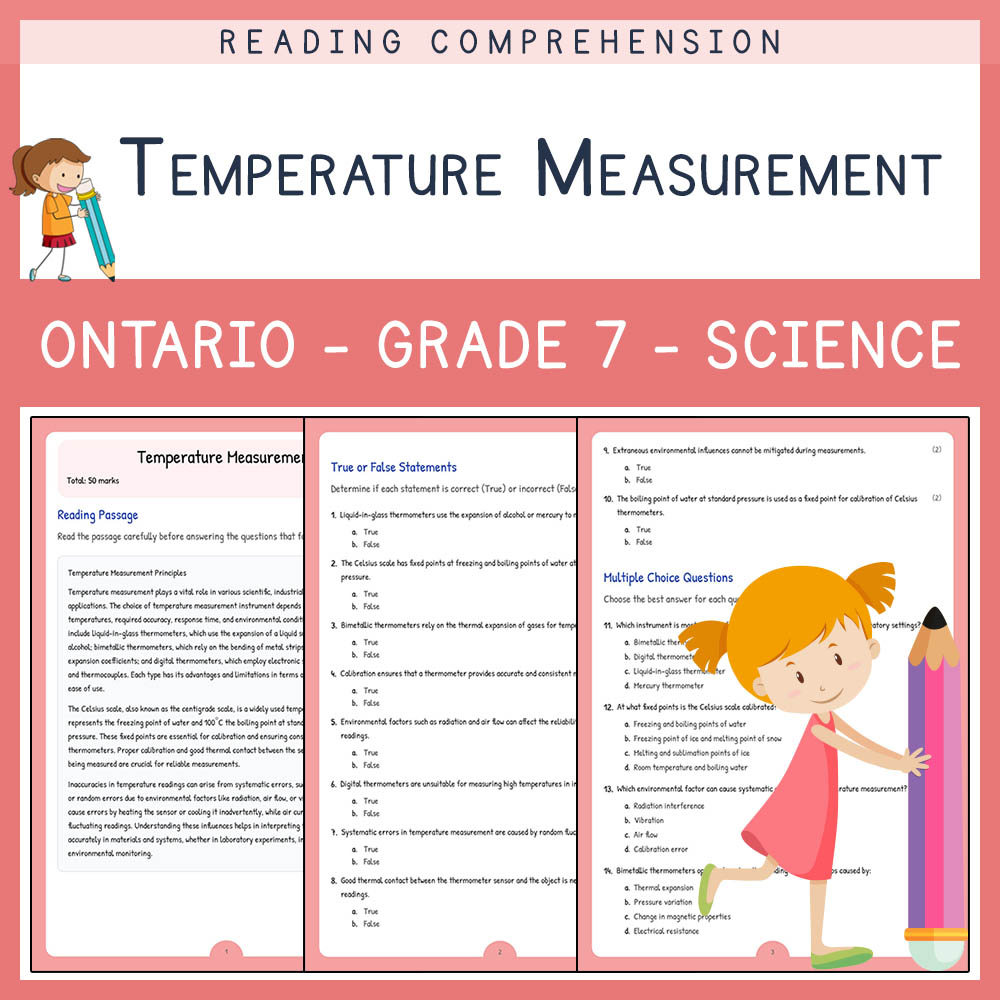
Grade 7 Science | Temperature Measurement Worksheet Elena | Ontario
Created byLumora LearningLearning Objectives
- Understand different types of thermometers and their appropriate ranges and uses.
- Explain the principles behind Celsius scale conventions and fixed points.
- Recognize factors affecting temperature measurement accuracy and reliability.
Instant download

Grade 7 Science – Matter & Energy Flow in Ecosystems Daily Reading Worksheet
 Created byBright Mind Resources
Learning Objectives
- Understand how producers capture sunlight and convert it into chemical energy.
- Identify the roles of consumers and decomposers in ecosystems.
- Explain the flow of energy through food chains and webs.
Also included in: Grade 7 Energy Transfer Science Daily Reading: Lesson Bundle | California Std. +1 more
Instant download
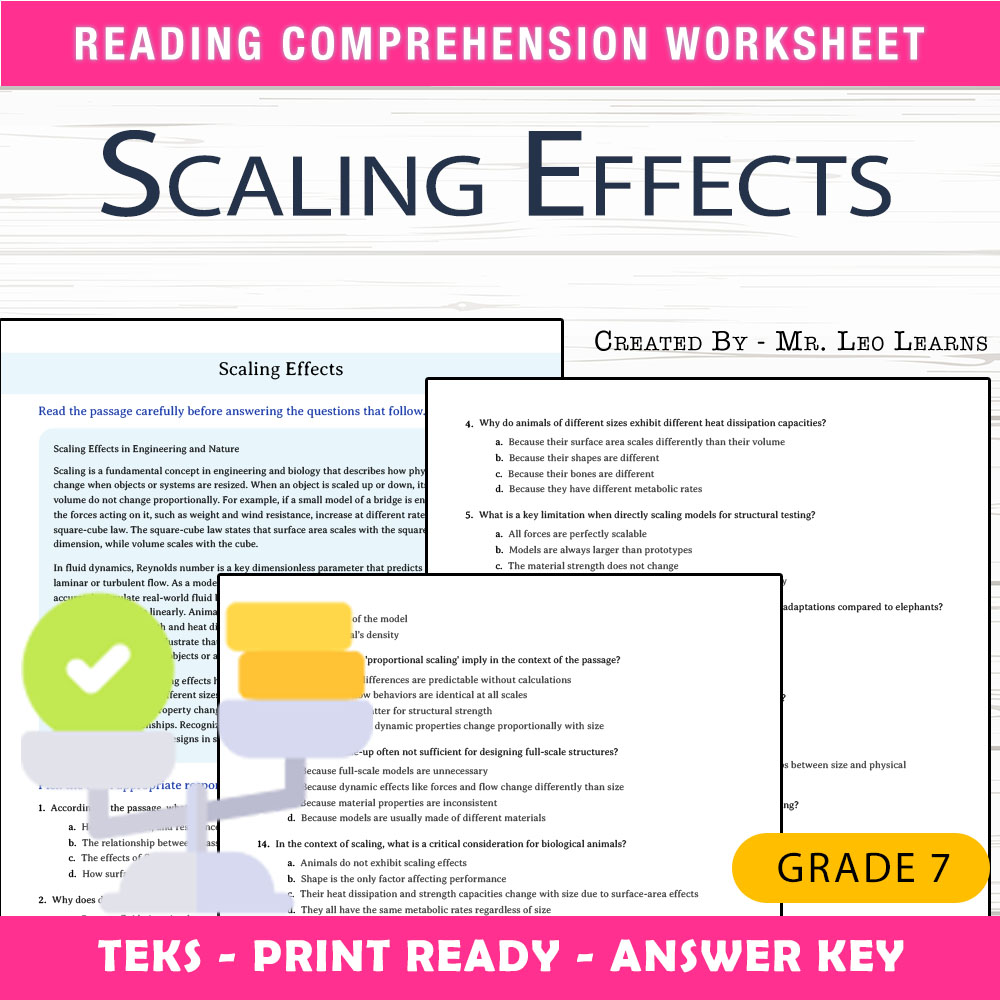
Grade 7 Science — Scaling Effects Worksheet for Mastery
 Created byThe Resource Hub
Learning Objectives
- Understand how scaling impacts the physical properties of structures and objects.
- Analyze the relationships between surface area, volume, and forces in different scales.
- Explain how fluid flow behaviors such as Reynolds number change with scale.
Also included in: Grade 7 Science Unit | Engineering, Technology & Innovation Worksheet Bundle +1 more
Instant download

Science Grade 7: Statistical Reasoning Worksheet | Ontario Standards
JCreated byJ.S SheetsLearning Objectives
- Identify and interpret measures of center (mean, median, mode) and spread (IQR, variance) in data about natural phenomena.
- Choose appropriate visual summaries (histograms and box plots) to describe distribution and outliers.
- Explain how sample size and outliers affect uncertainty and confidence in statistical conclusions.
Instant download
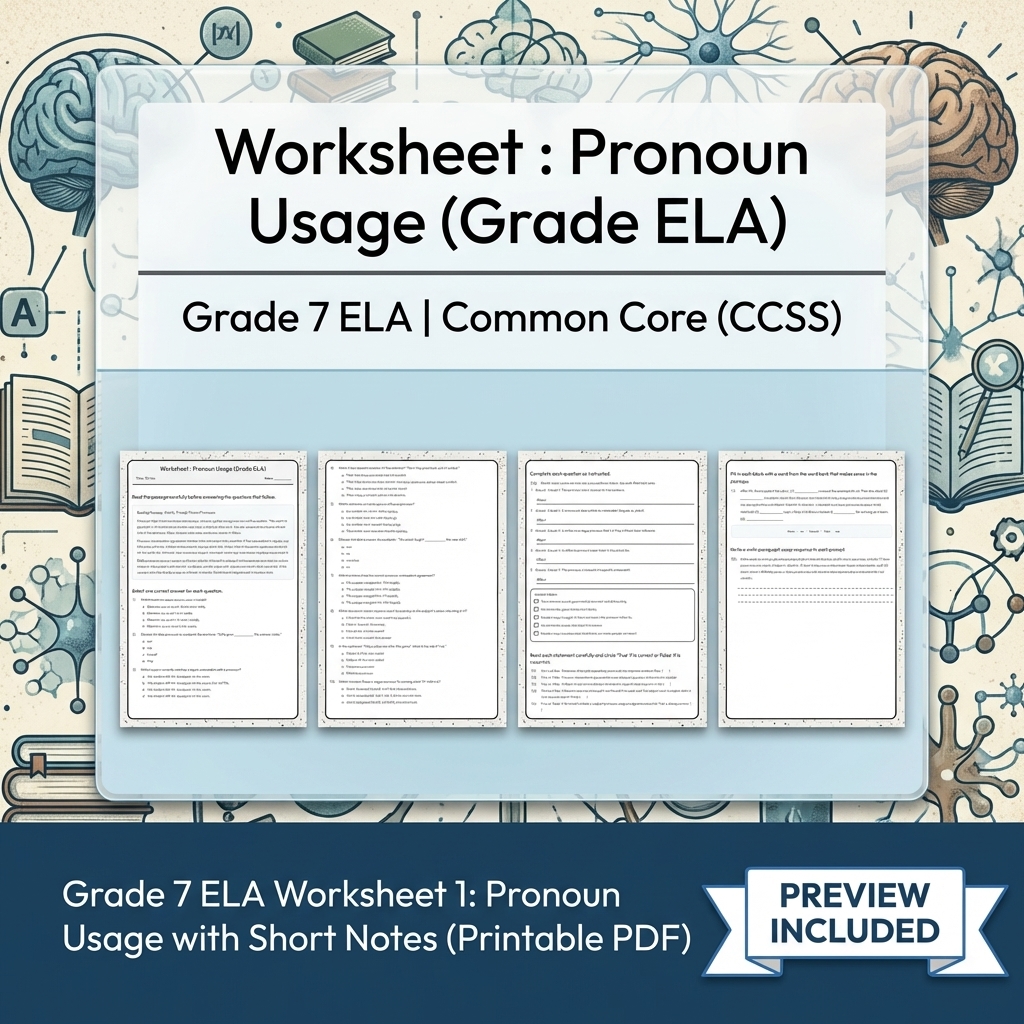
Grade 7 ELA Worksheet 1: Pronoun Usage with Short Notes (Printable PDF)
Created byMeadowlark WorksheetsLearning Objectives
- Use correct pronoun case (subject vs. object) to make sentences clear.
- Apply pronoun-antecedent agreement to match pronouns with their referents.
- Choose appropriate reflexive and personal pronouns for precise meaning.
Also included in: Grade 7 ELA Language Conventions & Vocabulary Lesson Bundle: Common Core (CCSS) +1 more
Instant download

Science Worksheet Convection Dynamics Heat Transfer Fluids | Grade 7
JCreated byJ.S SheetsLearning Objectives
- Explain how buoyancy and density variations cause convective circulation in air and water
- Describe how temperature gradients influence the strength and heat-transport rate of convection
- Connect convection to real-world phenomena such as sea and land breezes, thermals, and lake overturning
Instant download

Environmental Influences Worksheet | Practice & Master Grade 7 Social Studies
JCreated byJ.S SheetsLearning Objectives
- Explain how geographic features and environmental resources shape where communities settle.
- Describe how people and ecosystems influence each other through resource management and daily life.
- Evaluate how ecological and social interdependence supports long-term sustainability.
Instant download

Grade 7 Empirical Knowledge Science Worksheet | NGSSS Inquiry Practice
 Created byEvergreen Desk Education
Learning Objectives
- Explain how empirical investigations (observations and measurements) help build scientific knowledge.
- Describe how evidence and peer community evaluation can support, refine, or replace scientific explanations.
- Use the idea of uncertainty to explain why scientific models can change when new data appear.
Instant download
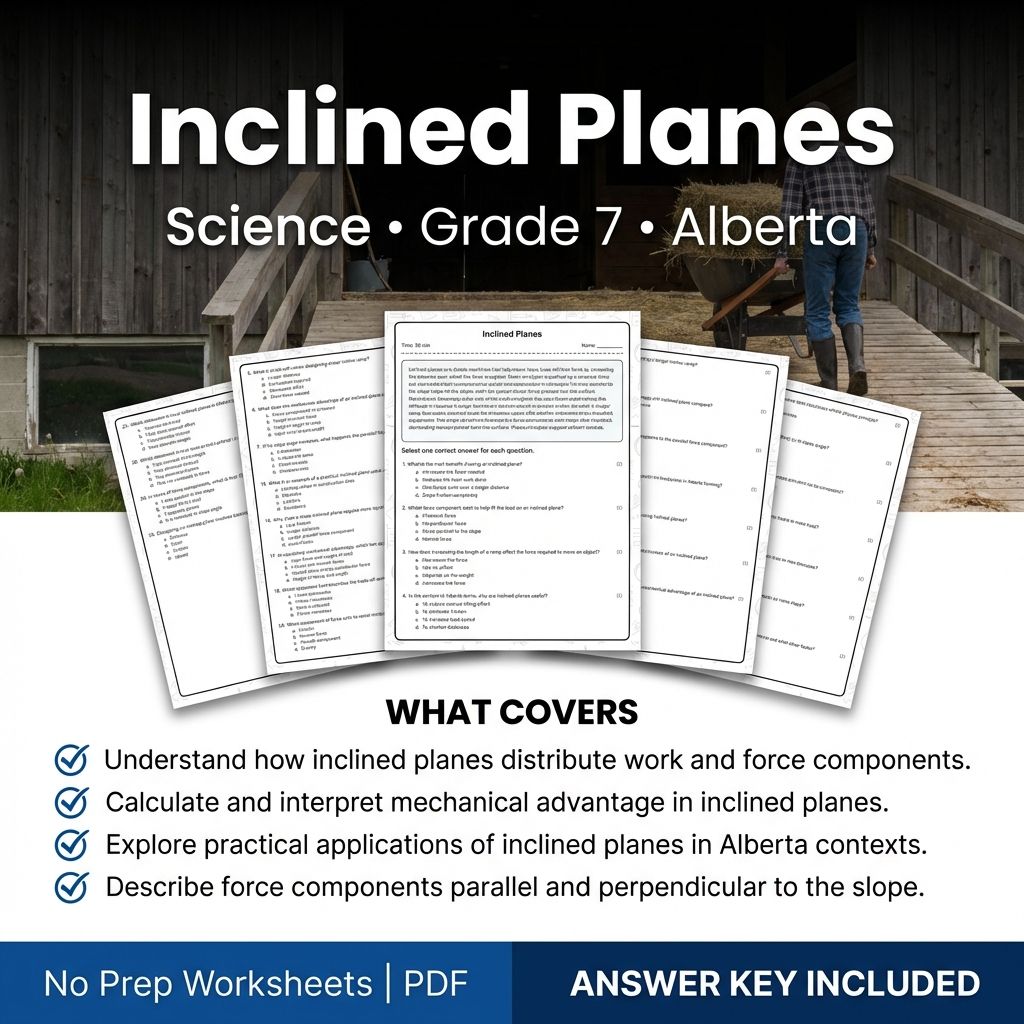
Grade 7 Science Worksheet on Inclined Planes | Alberta Standards
Created byCoral Reef LearningLearning Objectives
- Understand how inclined planes distribute work and force components.
- Calculate and interpret mechanical advantage in inclined planes.
- Explore practical applications of inclined planes in Alberta contexts.
Instant download

Grade 7 Science | States Of Matter - Daily Reading Comprehension
Created byCoral Reef LearningLearning Objectives
- Understand the properties of solids, liquids, and gases.
- Explain why particles in solids are tightly packed and how this affects their shape.
- Identify characteristics that distinguish solids from liquids and gases.
Instant download

Equation Modeling Grade 7 Maths Worksheet | Common Core CCSS
Created byBRIGHT PATH RESOURCESLearning Objectives
- Translate a real-world situation into an equation by defining variables and writing equivalent modeled expressions
- Solve equations to find the variable value that satisfies the modeled relationship
- Interpret the solution in context and check that it makes sense
Also included in: Equations & Inequalities with Distributive Expansion Bundle | Grade 7 Maths +1 more
Instant download
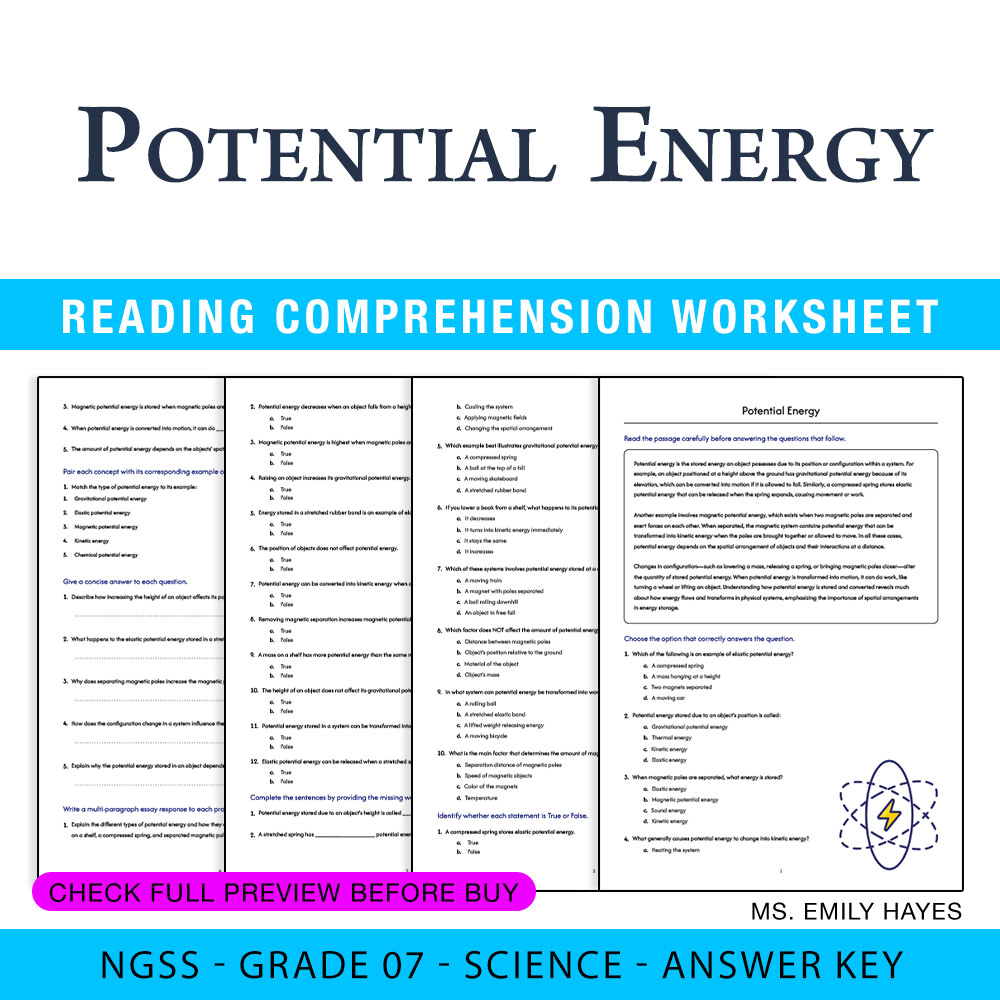
7th Grade Science | Potential Energy Worksheet (PDF+ Answer Key)
 Created byCopper Leaf Classroom
Learning Objectives
- Explain the concept of potential energy and how it is stored in different systems.
- Identify and describe examples of gravitational, elastic, and magnetic potential energy.
- Analyze how changes in the arrangement of objects affect stored potential energy.
Instant download

Grade 7 Conservation Status Worksheet | Alberta Practice PDF
Created byClear Sky ClassroomLearning Objectives
- Explain how conservation status is determined using population trends, threats, and recovery potential
- Interpret evidence about species vulnerability by connecting land use, genetic diversity, and habitat connectivity
- Use conservation-status concepts to describe how assessments support regional conservation priorities
Instant download

Making Meaning Worksheet Pack | Grade 7 ELA Practice
Created bySunny Desk ResourcesLearning Objectives
- Use active comprehension strategies to build meaning while reading
- Monitor understanding by noticing connections and confusion and adjusting strategies
- Use context clues and prior knowledge to interpret unfamiliar words and maintain the gist
Also included in: Reading and Viewing Lesson Bundle | Grade 7 ELA BC Framework +1 more
Instant download

Human System Feedbacks Assessment for Grade 7 Science | Standard General
Created byPrism Point LearningLearning Objectives
- Understand how human activities impact Earth's spheres and create feedback loops.
- Identify examples of human activities that influence the atmosphere, biosphere, and geosphere.
- Explain how feedback mechanisms can amplify or reduce environmental changes.
Also included in: Grade 7 Earth & Space Science Lesson Bundle: General Science Framework
Instant download

Community Implications Worksheet | BC Standards Grade 7 Social Studies
JCreated byJ.S SheetsLearning Objectives
- Explain how recognizing multiple perspectives can affect community relationships and decision-making
- Analyze how different cultural values and experiences may shape views on reconciliation projects and land disputes
- Evaluate ethical reasoning in civic participation when communities disagree
Instant download

Conservation of Energy Assessment for Grade 7 Science | Standards-Aligned
Created byPrism Point LearningLearning Objectives
- Explain how energy transfers during physical processes such as heating and motion.
- Describe how energy conservation applies in real-world phenomena like friction.
- Identify different forms of energy and how they can be redistributed without being lost.
Also included in: Grade 7 Physical Science Science Lesson Bundle: General Framework
Instant download
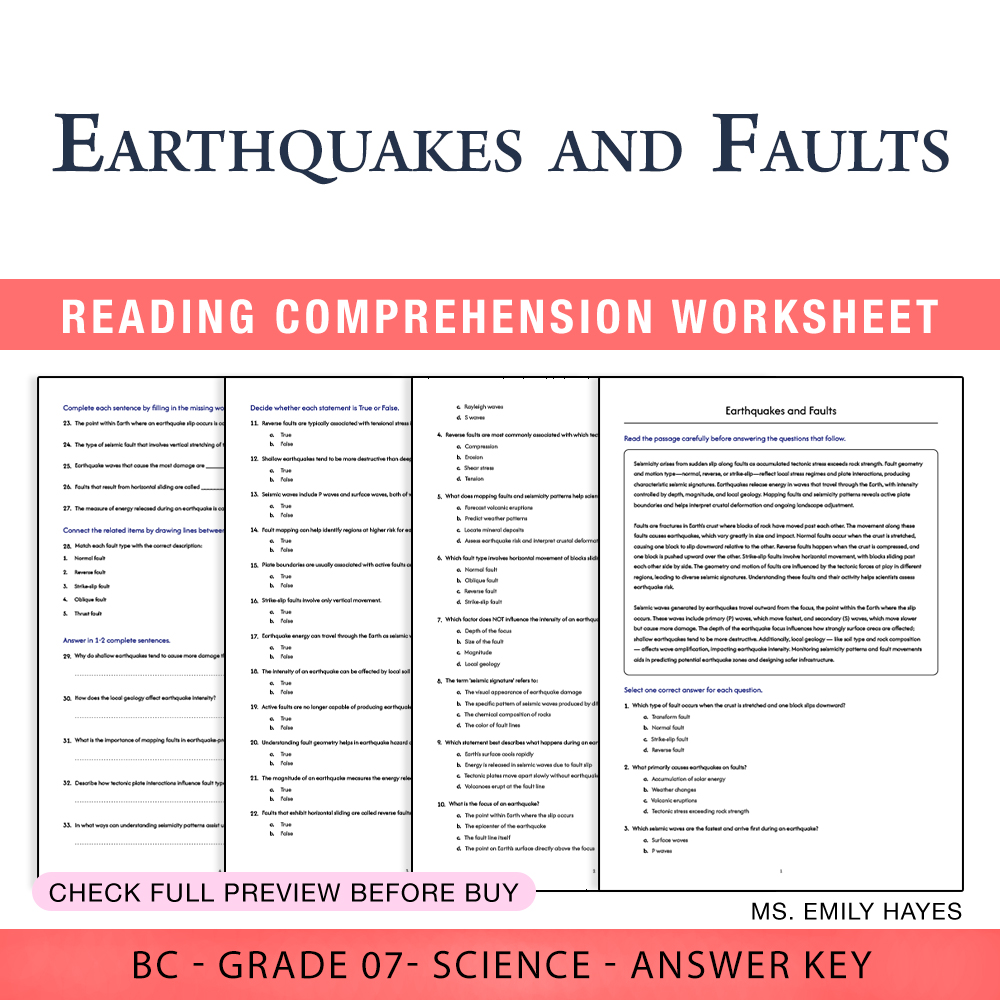
Grade 7 Science | Earthquakes and Faults Worksheet (PDF+ Answer Key)
Created byCopper Leaf ClassroomLearning Objectives
- Describe how seismic activity is related to fault movement and tectonic stress.
- Identify the different types of faults and their seismic signatures.
- Explain how earthquake energy propagates through the Earth and factors influencing earthquake intensity.
Also included in: Grade 7 Science | Earth Systems & Geology Unit (PDF+ Answer Keys) +1 more
Instant download

Grade 7 Science – Thermal Effects & Materials | Daily Reading Worksheet
Created byBright Mind ResourcesLearning Objectives
- Understand how materials expand and contract when heated or cooled
- Identify examples of phase changes due to temperature variations
- Explain how microscopic particle motion influences macroscopic properties
Also included in: Heat Transfer Grade 7 Science Daily Reading Worksheets Lesson Bundle | Ontario +1 more
Instant download
Browse more categories
About Grade 7 Worksheets
Find Grade 7 worksheets covering math, ELA, science, and social studies. All 8,459 resources download instantly as PDFs for classwork, homework, or review.
MyTeachingSheets worksheets are made by real teacher-authors and checked before they go live. Download any as a print-ready PDF for lessons, homework, or independent practice — most include answer keys, and previews are always free.