
Grade 7 Worksheets
8,459 grade resources
Synthetic Materials Test Prep Worksheet | Grade 7 Science NGSS Review
 Created byPrism Point Learning
Learning Objectives
- Explain how synthetic materials are made from natural resources through feedstock selection, polymerization, and refining steps.
- Compare how chemical composition and processing choices affect material properties like durability and flexibility.
- Evaluate trade-offs between recyclability and environmental impacts for common synthetic materials in real products.
Also included in: Grade 7 Matter & Atomic Models Science Lesson Bundle Review | NGSS
Instant download

Decomposition Cycles Practice Worksheet | Grade 7 Science Review
Created byPrism Point LearningLearning Objectives
- Explain how detritivores, fungi, and bacteria break down organic matter during decomposition
- Describe how carbon and nitrogen move through detrital pools and primary producers over time
- Analyze how abiotic conditions (like moisture, temperature, and oxygen) affect decomposition rates and soil fertility
Also included in: Grade 7 Ecosystem Science Lesson Bundle | Ontario Test Prep Worksheets
Instant download

Stoichiometry Review Worksheet | Grade 7 Science NGSS Practice and Assessment
Created byPrism Point LearningLearning Objectives
- Use balanced chemical equations to determine mole ratios between reactants and products.
- Convert between amounts of substances (moles and masses) using consistent units and proportional reasoning.
- Predict how changes in reactant quantities affect product yield using conservation of atoms.
Also included in: Grade 7 Matter & Atomic Models Science Lesson Bundle Review | NGSS
Instant download

Recoil and Thrust Worksheet Grade 7 Science | Forces and Motion
Created byPrism Point LearningLearning Objectives
- Explain recoil and thrust using Newton’s third law (action-reaction forces).
- Describe how equal and opposite forces cause different accelerations for different masses.
- Connect action-reaction force pairs to momentum changes in real situations.
Instant download

Representations Test Prep Practice Worksheet | Grade 7 Science NGSS
Created byPrism Point LearningLearning Objectives
- Explain how chemical equations, graphs, and tables represent measurable matter interactions.
- Interpret quantitative relationships using reaction-rate graphs, stoichiometric ratios, and phase diagrams.
- Choose an appropriate representation to compare values (mass, temperature, time) without assuming microscopic mechanisms.
Also included in: Grade 7 Matter & Atomic Models Science Lesson Bundle Review | NGSS
Instant download

Atomic Models Practice Worksheet | Grade 7 Science NGSS Review
Created byPrism Point LearningLearning Objectives
- Describe how particle, ball-and-stick, and lattice models represent atoms in different kinds of substances
- Connect subatomic particles and atomic number to element identity and formula notation
- Distinguish molecular structures from extended network structures and predict basic property differences
Also included in: Grade 7 Matter & Atomic Models Science Lesson Bundle Review | NGSS
Instant download

Gravity Shaping Orbits Worksheet Grade 7 Science | Space Science Activity
Created byPrism Point LearningLearning Objectives
- Explain how gravity provides the centripetal force that keeps bodies in orbit
- Describe why orbital paths are curved and often elliptical due to changing gravitational direction
- Connect gravity and inertia to predict why objects do not move in straight lines
Instant download

Biodiversity & Ecosystem Stability Worksheet | Grade 7 Science NGSSS
Created byPrism Point LearningLearning Objectives
- Distinguish between biotic factors (living) and abiotic factors (nonliving) in an ecosystem.
- Explain how abiotic conditions affect which organisms can survive and reproduce.
- Describe how changes in abiotic factors can shift biotic interactions and population sizes.
Also included in: Grade 7 Evolution, Genetics & Ecosystems Lesson Bundle | Florida NGSSS
Instant download

Graphical Representation Practice Worksheet | Grade 7 Science Ontario
Created byPrism Point LearningLearning Objectives
- Choose appropriate graph types for different kinds of data (categorical and continuous).
- Use correct axis scaling and proportional representation to avoid misleading graphs.
- Interpret patterns, slopes, correlation, and trends without claiming causation.
Instant download

Ethics And Communication Test Prep Worksheet | Grade 7 Science
Created byPrism Point LearningLearning Objectives
- Explain how data integrity, attribution, and intellectual property relate to ethical STEM communication
- Use appropriate conventions for reporting methods, results, and uncertainty in technical writing
- Describe responsible data sharing and equitable access considerations when presenting scientific findings
Instant download

Data Organization Test Prep Printable | Grade 7 Science
Created byPrism Point LearningLearning Objectives
- Explain how scientists organize categorical and numerical data using tables with consistent headings and units.
- Describe how metadata and observational logs help preserve data provenance and support later validation.
- Use timestamp conventions and sampling/replication documentation to improve the credibility of scientific records.
Instant download

Gravity on Objects Worksheet Grade 7 Science | Forces, Weight & Motion
Created byPrism Point LearningLearning Objectives
- Explain how gravitational force relates to an object's mass and how it affects motion near Earth.
- Describe how support forces (normal forces) balance weight for objects at rest, and predict what happens when support changes.
- Use evidence and vocabulary such as weight, gravitational force, normal force, and acceleration correctly.
Instant download

Density Separation Test Prep Printable | Grade 7 Science
Created byPrism Point LearningLearning Objectives
- Explain how buoyant force, sedimentation rate, and centrifugal acceleration help separate mixtures by density differences.
- Compare decanting, floatation, and centrifugation and identify when each method works best.
- Use density concepts to predict which particles move to the top, bottom, or separate into layers in a separation process.
Also included in: Grade 7 Substance & Mixture Properties Science Lesson Bundle (Ontario)
Instant download

Thermal Effects Test Prep Printables | Grade 7 Science
Created byPrism Point LearningLearning Objectives
- Explain how temperature changes affect material properties such as size, density, and viscosity.
- Describe how microscopic particle motion leads to macroscopic changes like expansion, contraction, and pressure changes.
- Predict how thermal cycling and phase changes can influence the performance and safety of real systems.
Instant download

Heating Curve Phases Worksheet Grade 7 Science | States of Matter
Created byPrism Point LearningLearning Objectives
- Describe the temperature-time behavior during heating and link it to changes of state.
- Explain why phase changes create plateaus on a heating curve.
- Use heating curve stages to interpret particle motion and energy transfer.
Instant download

Quantitative Heat Assessment Worksheet | Grade 7 Science Ontario
Created byPrism Point LearningLearning Objectives
- Use Q = mcΔT to estimate thermal energy needed to change temperature of a substance.
- Identify common heat and power units (joules and watts) and relate power to energy over time.
- Explain how surface area, temperature gradient, and time affect heat-transfer rate.
Instant download

Instrumentation Accuracy Test Prep Worksheet | Grade 7 Science
Created byPrism Point LearningLearning Objectives
- Explain how calibration and traceable reference points improve temperature measurement accuracy in environmental settings.
- Identify common sources of temperature-measurement error, including response time, spatial placement, radiation effects, and thermal contact.
- Interpret temperature readings using uncertainty, resolution limits, and sensor specifications to make fair comparisons.
Instant download

Convection Dynamics Worksheet | Grade 7 Science Review and Practice
Created byPrism Point LearningLearning Objectives
- Explain how buoyancy and density differences drive convective motion in fluids.
- Describe how temperature gradients affect the strength of convection and heat transfer rates.
- Connect convection to real-world phenomena such as sea and land breezes, thermals, and lake overturning.
Instant download

Material Properties Test Prep Worksheet | Grade 7 Science Ontario
Created byPrism Point LearningLearning Objectives
- Define and explain key material properties: density, tensile strength, compressive strength, stiffness (modulus), ductility, toughness, and thermal expansion.
- Describe how material properties affect structural performance, including deformation and likely failure modes.
- Compare wood, steel, and reinforced concrete in terms of strength-to-weight, stiffness, and typical behavior under load.
Instant download

Connection Design Worksheet | Grade 7 Science Practice and Review
Created byPrism Point LearningLearning Objectives
- Explain how joints and connections help create continuous load paths in structures.
- Compare bolted, welded, and bearing connections in terms of load transfer and possible failure modes.
- Describe shear, bearing, and slip at connections and how detailing (e.g., gusset plates and base plates) affects capacity.
Instant download

Succession Patterns Test Prep Printable | Grade 7 Science
Created byPrism Point LearningLearning Objectives
- Explain ecological succession as directional change in community composition after disturbance.
- Distinguish primary succession from secondary succession and identify typical successional stages.
- Describe how abiotic changes and biotic interactions (competition and facilitation) drive species turnover.
Also included in: Grade 7 Ecosystem Science Lesson Bundle | Ontario Test Prep Worksheets
Instant download

Freshwater Dynamics Test Prep Printable Worksheet | Grade 7 Science
Created byPrism Point LearningLearning Objectives
- Describe how light penetration, stratification, and oxygen gradients create vertical zones in ponds and lakes
- Explain how seasonal changes (warming, cooling, turnover) affect dissolved oxygen, nutrient mixing, and habitat suitability
- Use pond and lake examples to predict where different organisms are likely to live based on abiotic conditions
Also included in: Grade 7 Ecosystem Science Lesson Bundle | Ontario Test Prep Worksheets
Instant download

Ecosystem Basics Test Prep Worksheet | Grade 7 Science Ontario
Created byPrism Point LearningLearning Objectives
- Distinguish biotic and abiotic components of an ecosystem and describe their roles.
- Identify trophic categories (producers, consumers, decomposers) and explain general energy flow.
- Use food chains from pond and forest settings to describe how matter cycles through ecosystems.
Also included in: Grade 7 Ecosystem Science Lesson Bundle | Ontario Test Prep Worksheets
Instant download

Ecosystem Resilience Worksheet | Grade 7 Science Practice
Created byPrism Point LearningLearning Objectives
- Explain what ecosystem resilience means and how disturbances can change an ecosystem’s structure.
- Describe how population sizes and community relationships can shift after habitat or resource changes.
- Use evidence from population growth and decline to make predictions about ecosystem stability.
Instant download

Accuracy and Uncertainty Worksheet Pack | Grade 7 Science Activities
Created byPrism Point LearningLearning Objectives
- Explain how tool resolution affects measurement accuracy
- Describe how repeated measurements help estimate uncertainty
- Use error ranges to judge whether two results are meaningfully different
Instant download

Climate Drivers Assessment | NGSSS Standards Grade 7 Science
Created byPrism Point LearningLearning Objectives
- Explain how latitude affects the angle of incoming sunlight and leads to regional temperature differences
- Describe how elevation, distance from water, and ocean currents influence climate and precipitation
- Use climate driver concepts to interpret how deserts, rain forests, and seasonal weather patterns form
Also included in: Grade 7 Earth and Climate Systems Science Lesson Bundle: Florida NGSSS
Instant download
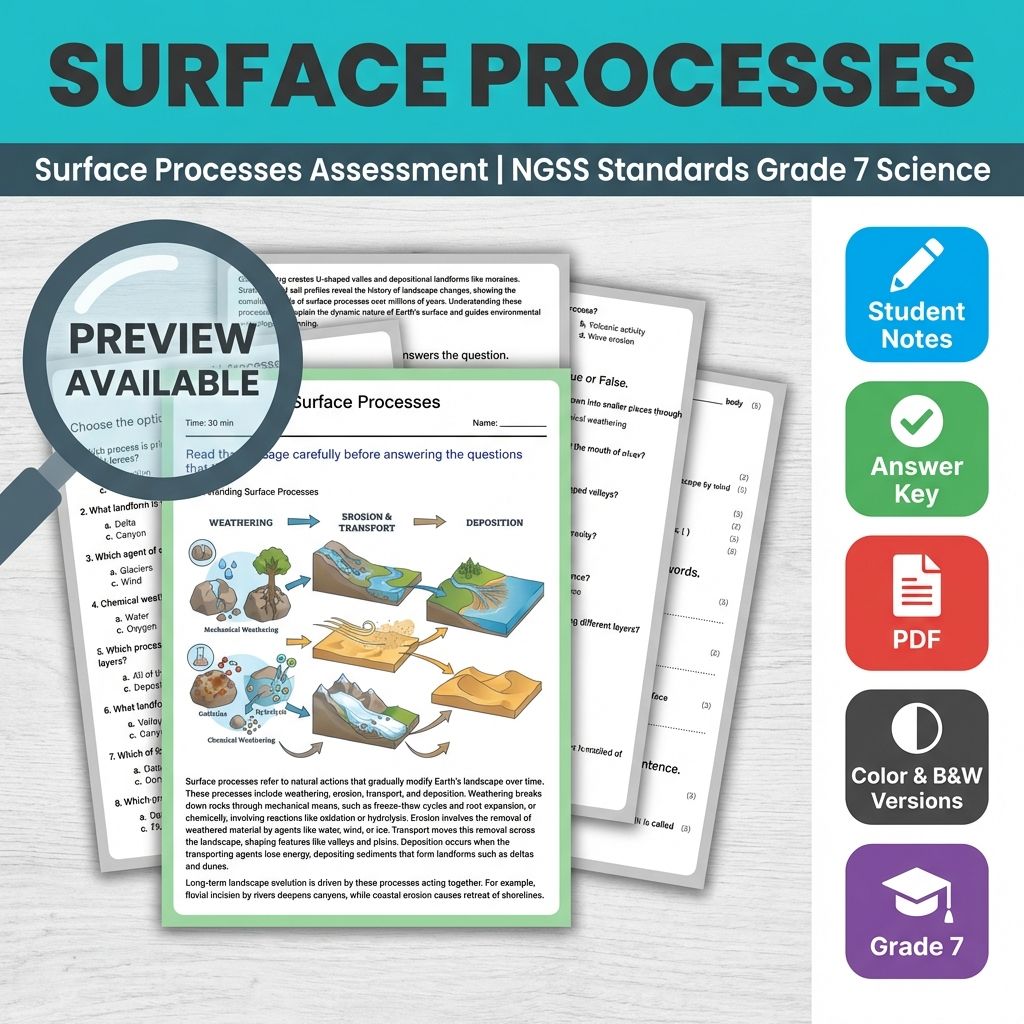
Surface Processes Assessment | NGSS Standards Grade 7 Science
Created byPrism Point LearningLearning Objectives
- Describe key surface geological processes such as weathering, erosion, transport, and deposition.
- Differentiate between mechanical and chemical weathering mechanisms.
- Explain how landforms like canyons, deltas, and moraines are formed by these processes.
Also included in: Grade 7 Science Lesson | Earth's Systems NGSS Not specified Unit +1 more
Instant download
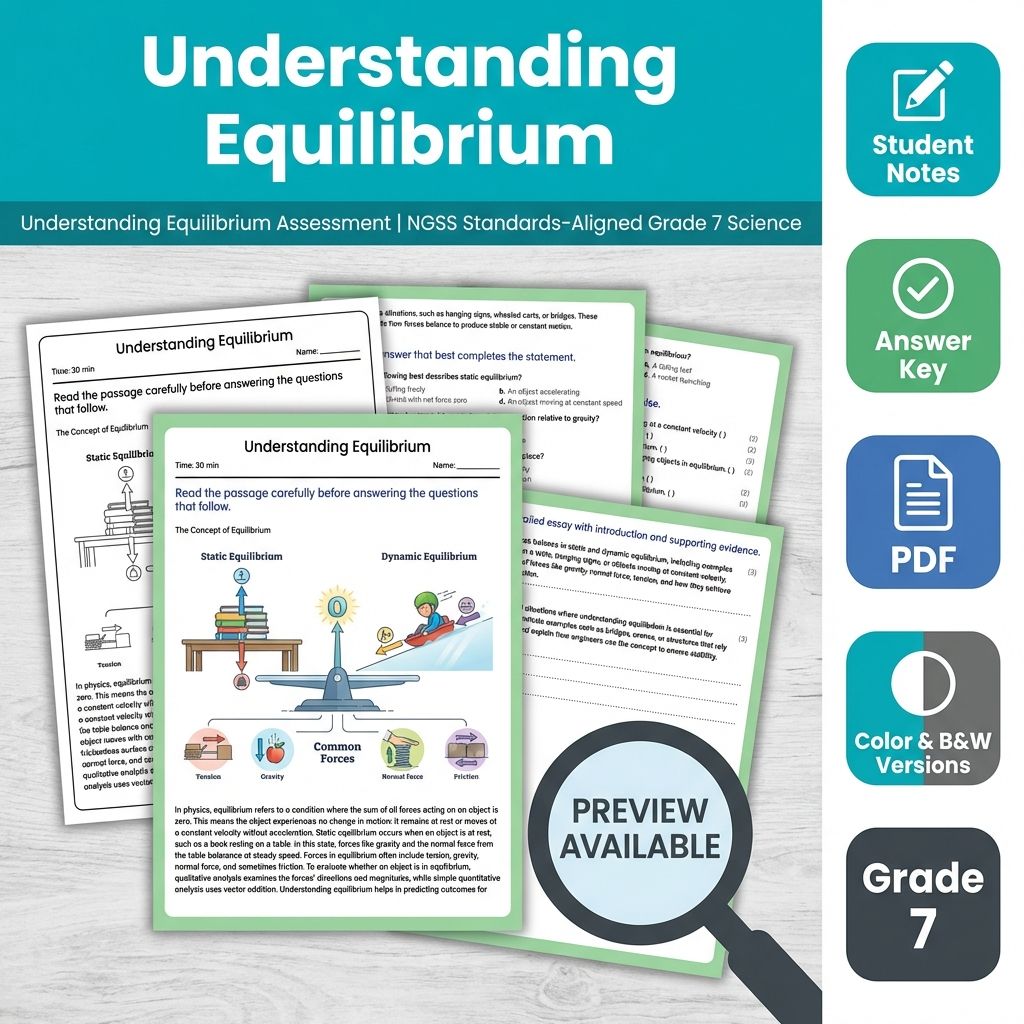
Understanding Equilibrium Assessment | NGSS Standards-Aligned Grade 7 Science
Created byPrism Point LearningLearning Objectives
- Explain the concept of equilibrium as the balance of forces in an object.
- Differentiate between static and dynamic equilibrium in real-world scenarios.
- Apply qualitative and simple quantitative analyses to predict objects' behavior at rest or moving with constant velocity.
Also included in: Grade 7 Science Mini Bundle – Forces & Interactions NGSS Unit (Printable) +1 more
Instant download
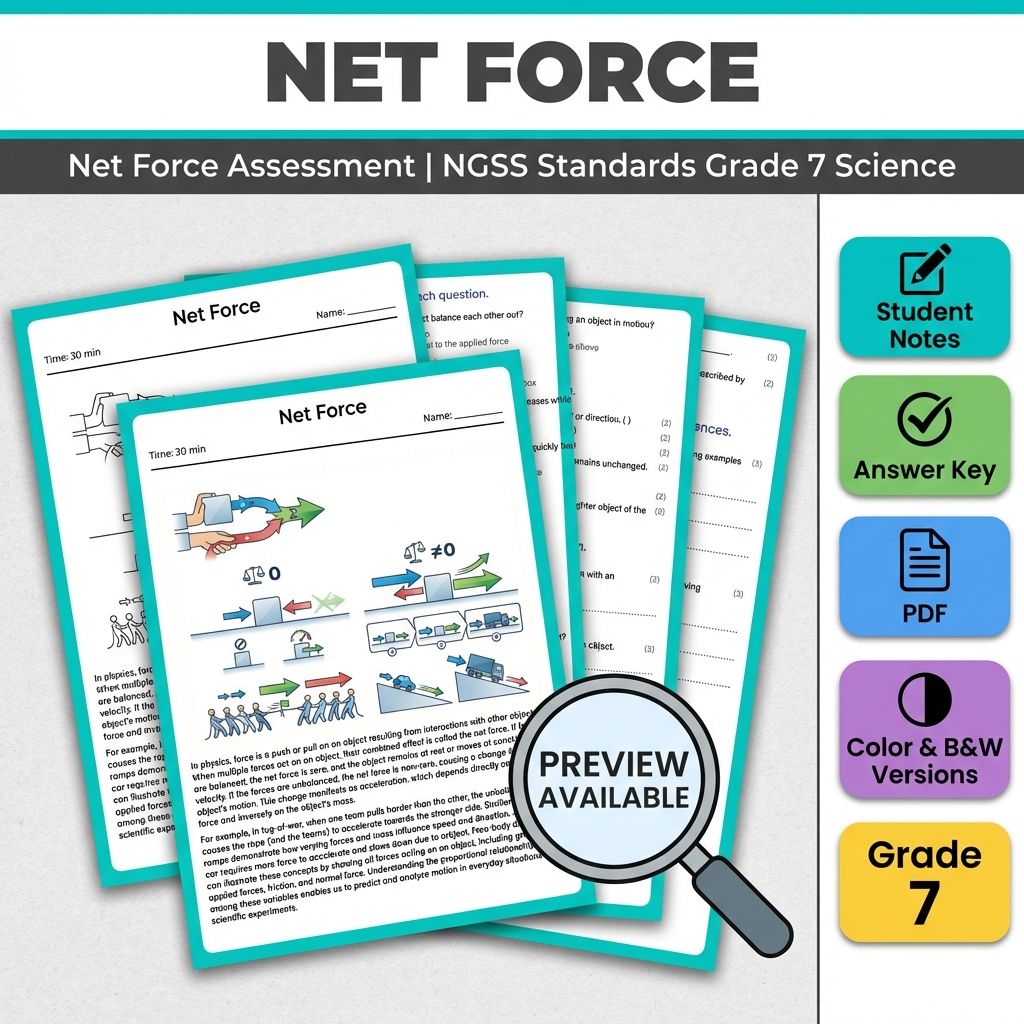
Net Force Assessment | NGSS Standards Grade 7 Science
Created byPrism Point LearningLearning Objectives
- Define net force as the vector sum of forces acting on an object.
- Explain how unbalanced forces cause changes in motion using free-body diagrams.
- Relate net force, mass, and acceleration proportionally through quantitative reasoning.
Also included in: Grade 7 Science Mini Bundle – Forces & Interactions NGSS Unit (Printable) +1 more
Instant download
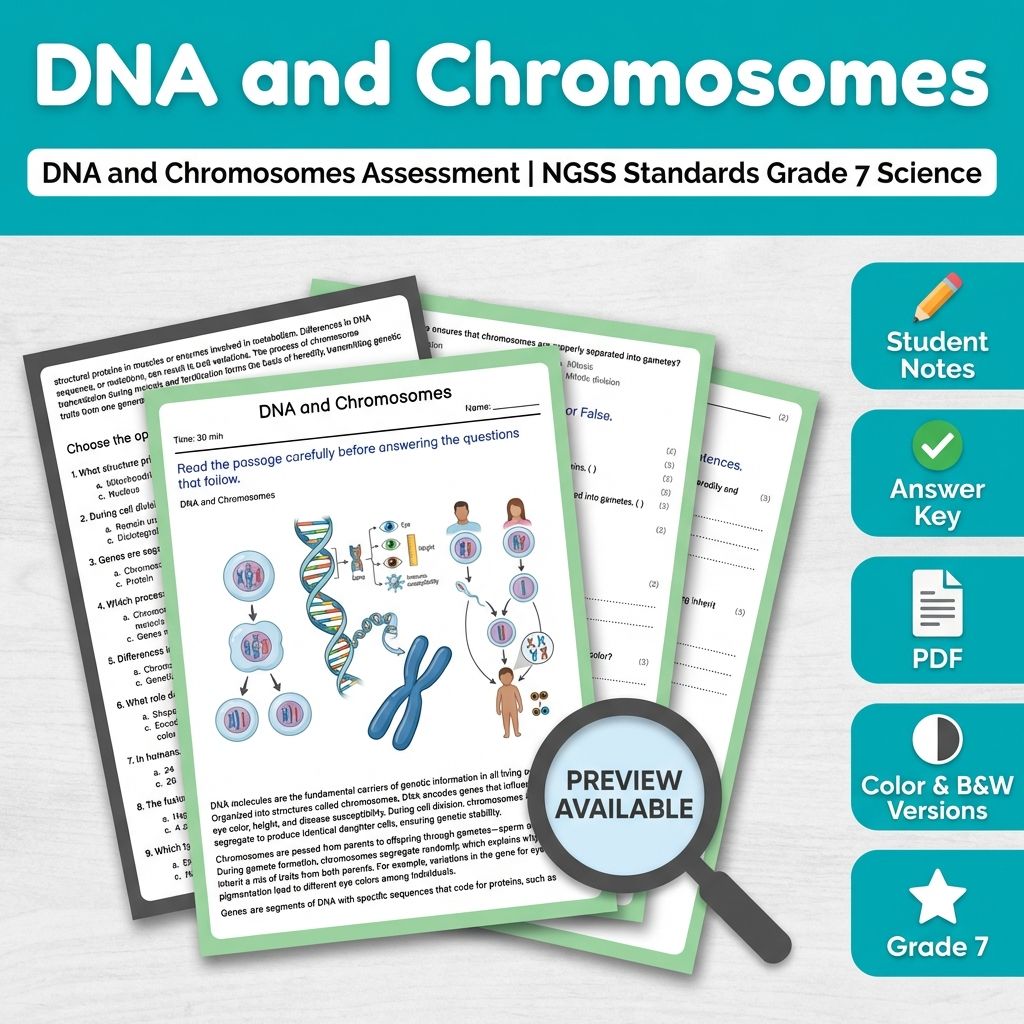
DNA and Chromosomes Assessment | NGSS Standards Grade 7 Science
Created byPrism Point LearningLearning Objectives
- Explain the role of DNA molecules in encoding genetic traits.
- Describe how chromosomes organize and transmit genetic information during cell division.
- Illustrate the process of chromosome segregation during gamete formation and fusion.
Also included in: Grade 7 Science Mini Bundle – Heredity: Inheritance and Variation of Traits +1 more
Instant download
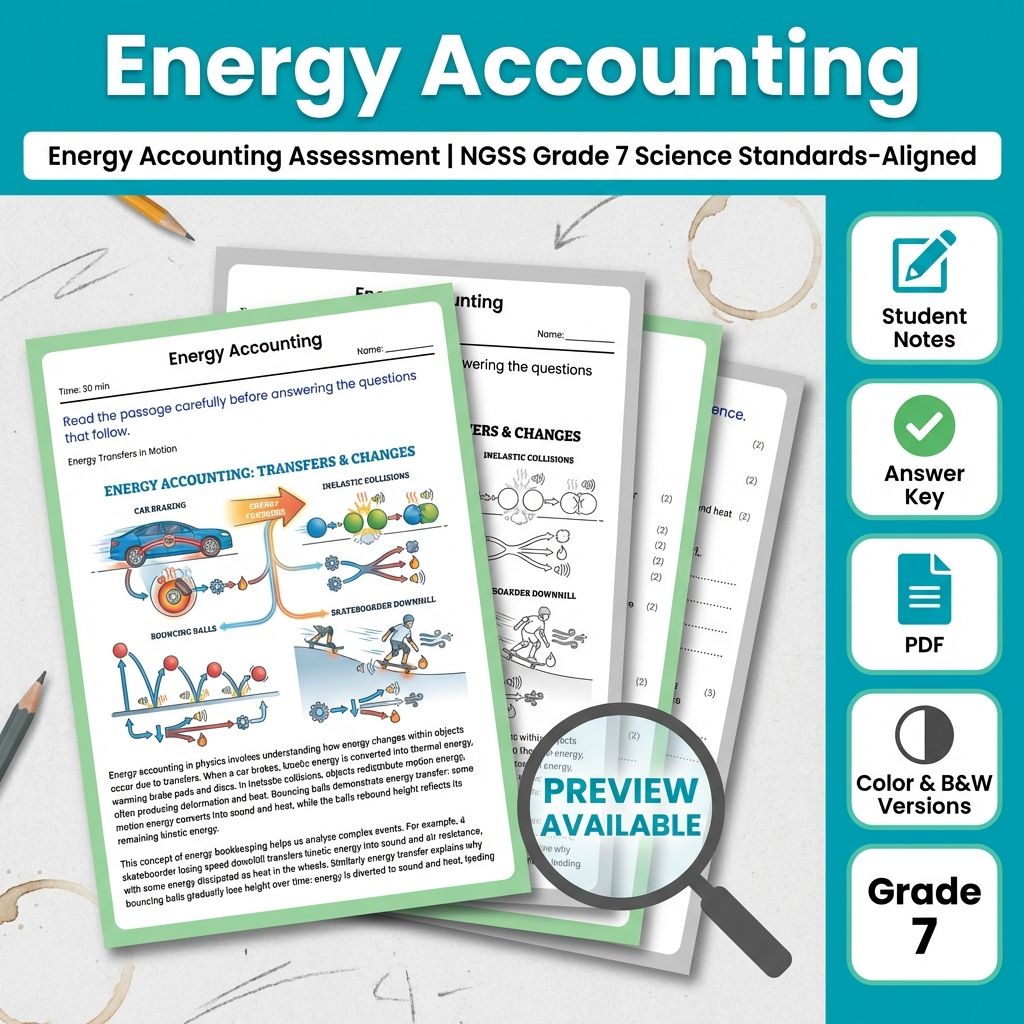
Energy Accounting Assessment | NGSS Grade 7 Science Standards-Aligned
Created byPrism Point LearningLearning Objectives
- Explain how changes in an object's motion energy are linked to energy transfers into or out of the object.
- Identify real-world scenarios where energy transformation occurs, such as braking a car or bouncing a ball.
- Quantitatively and qualitatively analyze energy transfers during different physical events.
Also included in: Grade 7 Science Mini Bundle | Energy Unit & NGSS Standards-Aligned Resources +1 more
Instant download

Surface Process Evidence Assessment | General Grade 7 Science
Created byPrism Point LearningLearning Objectives
- Understand how Earth's surface is shaped by internal and external processes.
- Identify evidence of surface processes in landform patterns and rock formations.
- Explain how landforms such as deltas and floodplains are formed through external processes.
Also included in: Grade 7 Earth & Space Science Lesson Bundle: General Science Framework
Instant download

Climate Drivers Over Time Assessment | General Grade 7 Science
Created byPrism Point LearningLearning Objectives
- Understand how natural records and measurements are used to assess past and present climate conditions.
- Identify key climate drivers that influence long-term climate change.
- Explain how factors like greenhouse gases, ocean currents, and volcanic activity affect Earth's energy balance.
Also included in: Grade 7 Earth & Space Science Lesson Bundle: General Science Framework
Instant download

Investigation Variables Assessment | General Standards Grade 7 Science
Created byPrism Point LearningLearning Objectives
- Identify the different types of variables in scientific investigations.
- Understand how to design investigation plans with clear variables and evidence.
- Distinguish between independent, dependent, and controlled variables in experiments.
Also included in: Grade 7 Scientific Inquiry Practices Science Lesson Bundle: General
Instant download
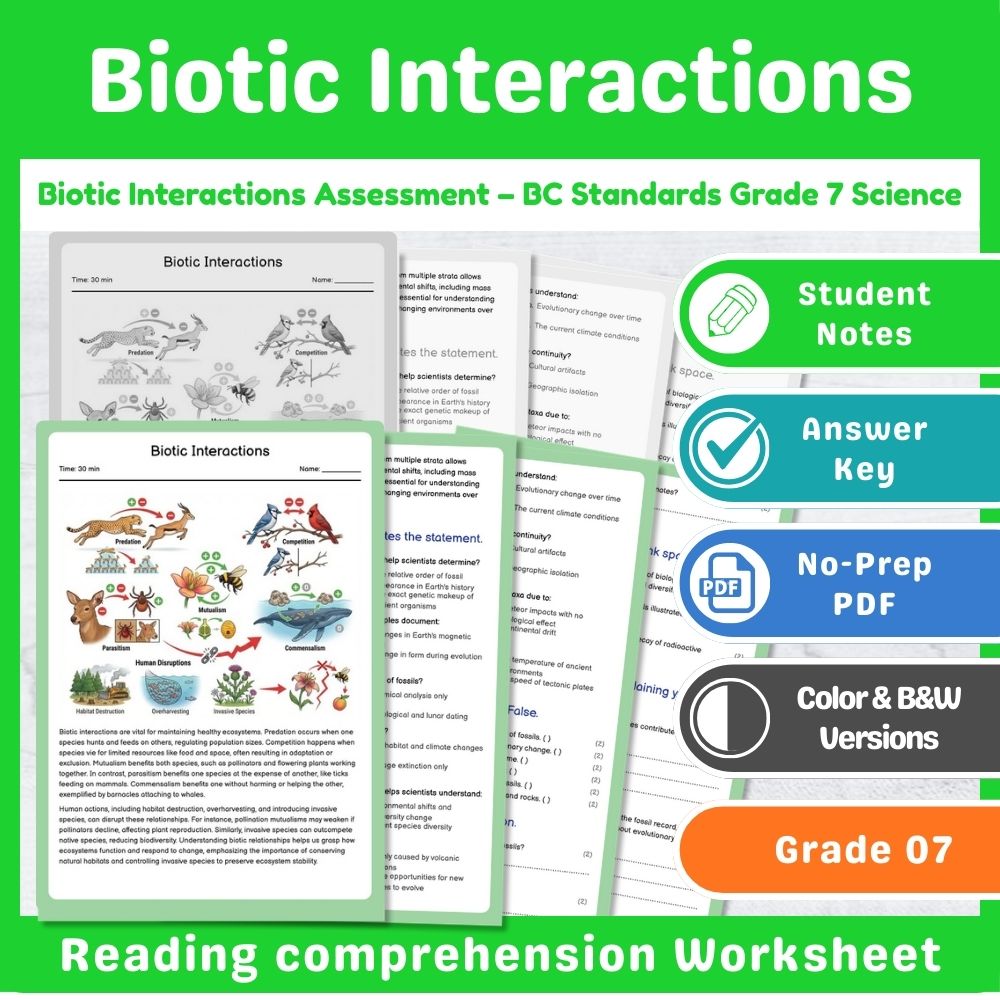
Biotic Interactions Assessment – BC Standards Grade 7 Science
Created byPrism Point LearningLearning Objectives
- Understand the different types of biotic interactions such as predation, competition, mutualism, commensalism, and parasitism.
- Explain how human activities can disrupt biotic relationships and affect ecosystems.
- Describe how changes in one species can influence community structure and biodiversity.
Instant download
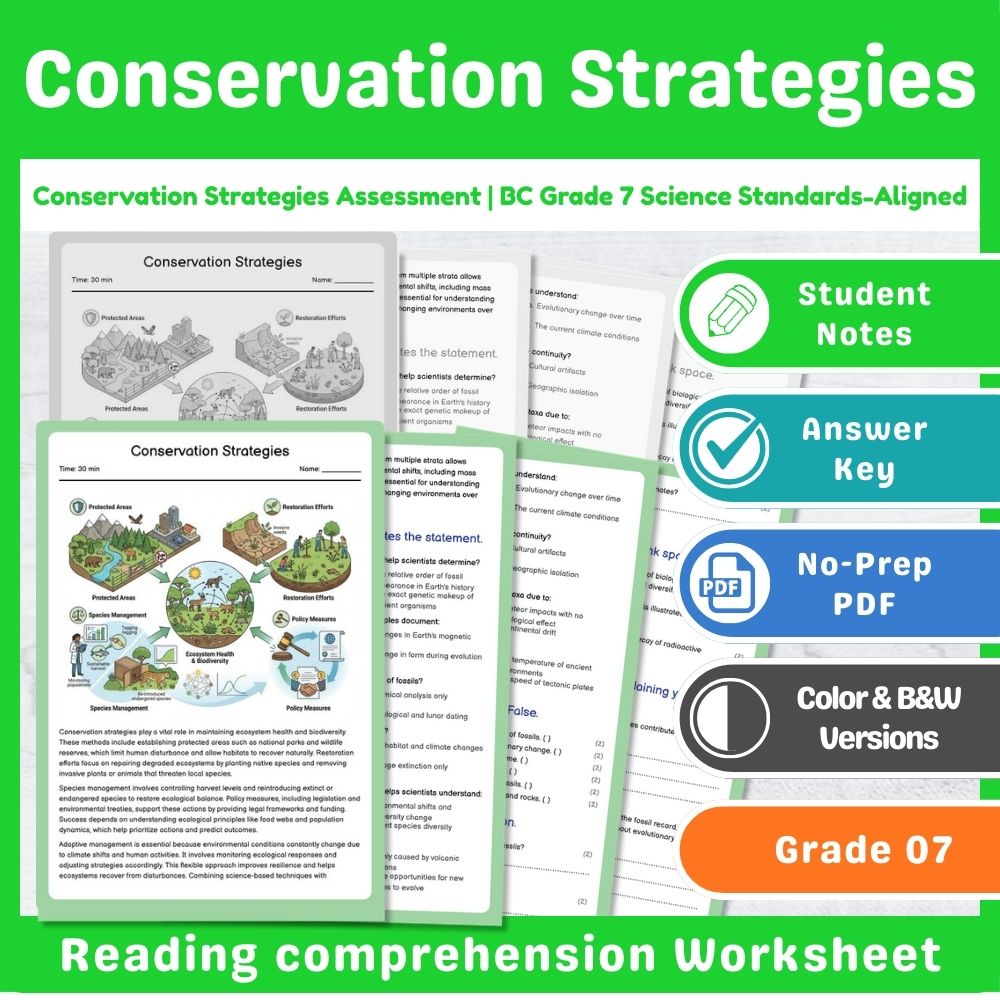
Conservation Strategies Assessment for Grade 7 Science | BC Standards
Created byPrism Point LearningLearning Objectives
- Understand various conservation strategies used to protect ecosystems.
- Identify key actions involved in habitat restoration and management.
- Explain how adaptive approaches help sustain biodiversity.
Instant download
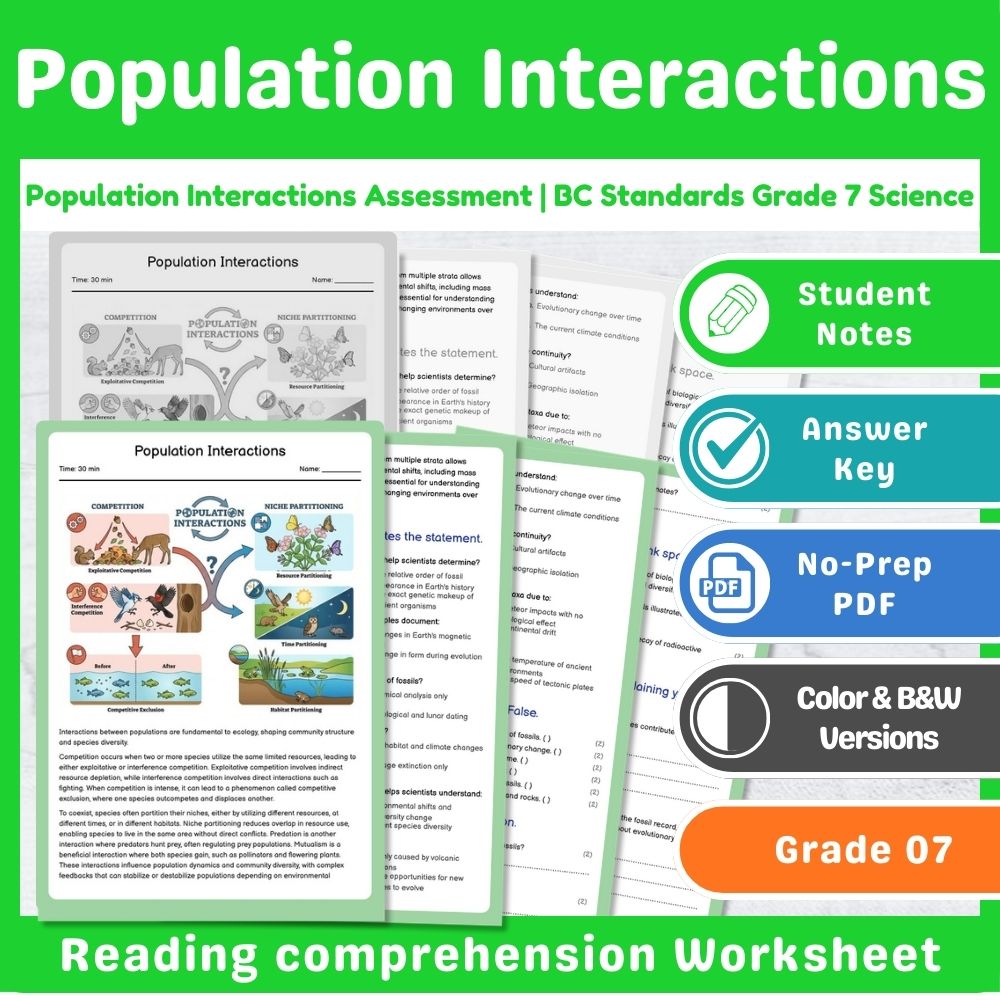
Population Interactions Assessment | BC Standards Grade 7 Science
Created byPrism Point LearningLearning Objectives
- Understand different types of population interactions including competition, predation, and mutualism.
- Identify mechanisms that allow species to coexist despite competition.
- Explain how interactions influence community composition and diversity.
Instant download
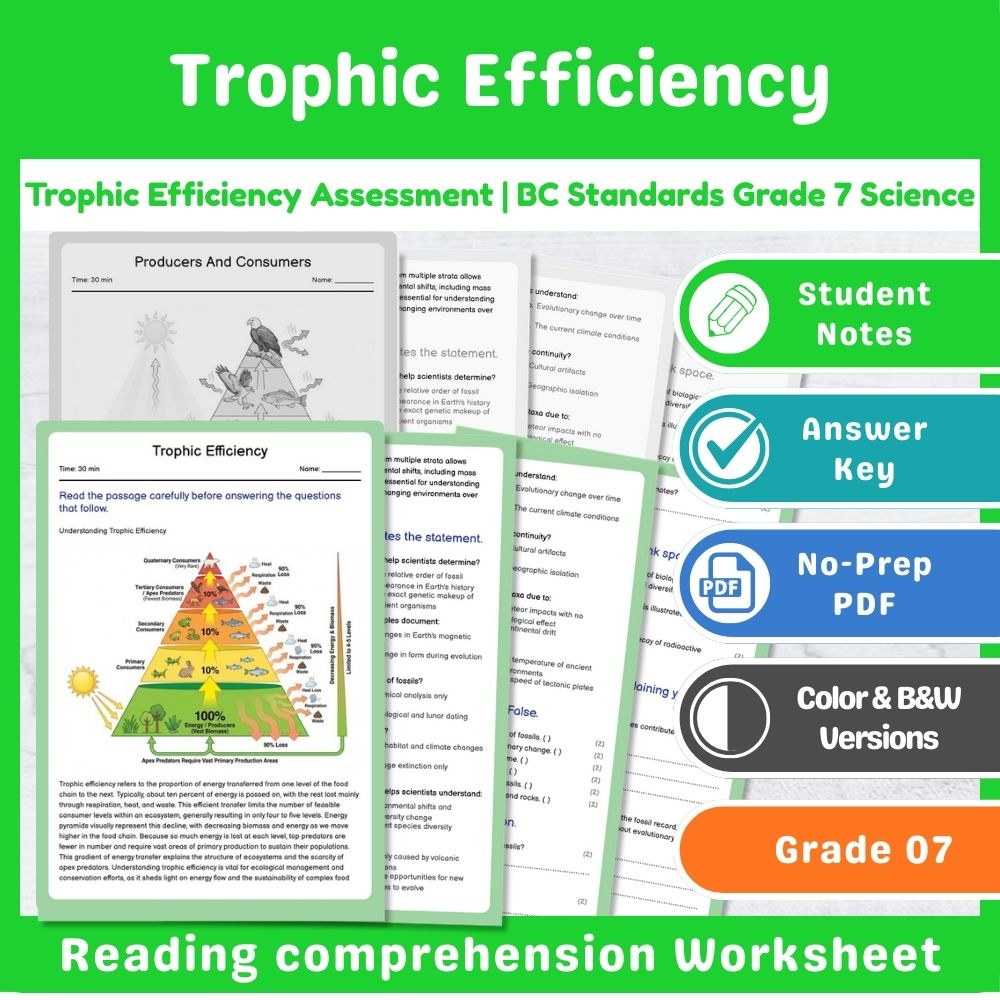
Trophic Efficiency Assessment | BC Standards Grade 7 Science
Created byPrism Point LearningLearning Objectives
- Explain the concept of trophic efficiency and its role in energy transfer within ecosystems.
- Describe how energy pyramids illustrate energy loss at each trophic level.
- Understand the factors limiting the number of trophic levels in ecological communities.
Instant download
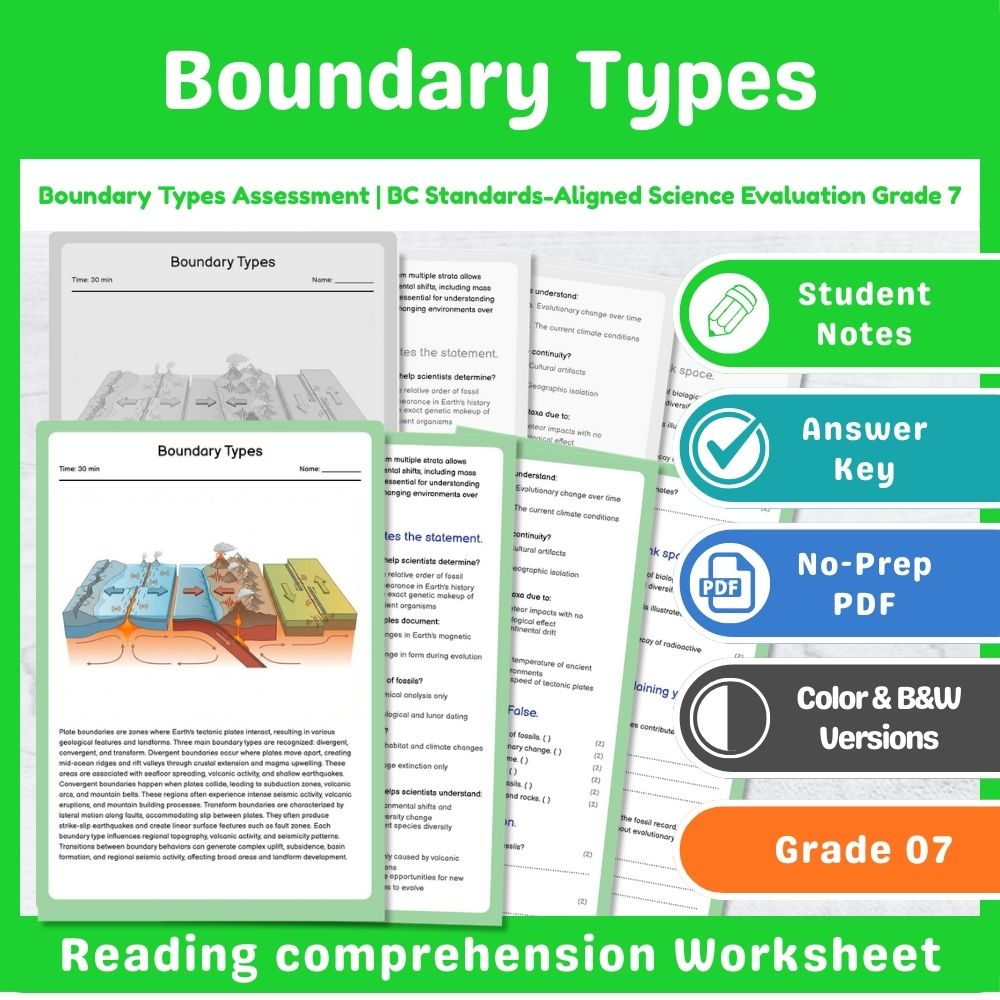
Boundary Types Assessment | BC Standards-Aligned Science Evaluation Grade 7
Created byPrism Point LearningLearning Objectives
- Understand the three principal boundary types and their characteristic landforms.
- Identify the processes and landforms associated with divergent, convergent, and transform boundaries.
- Explain how boundary transitions can produce complex regional geological patterns.
Also included in: Grade 7 Science Lesson – Earth Processes Assessment & Landforms Bundle
Instant download
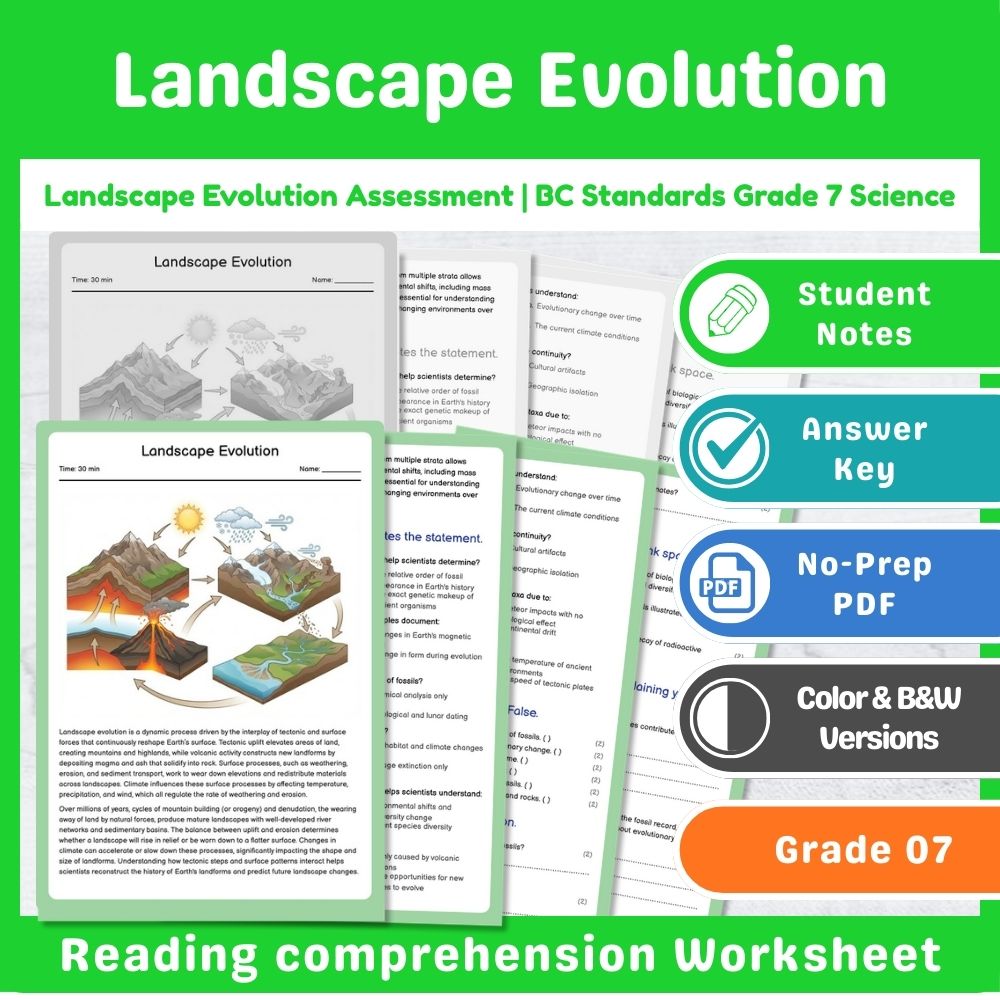
Landscape Evolution Assessment | BC Standards Grade 7 Science
Created byPrism Point LearningLearning Objectives
- Explain how tectonic uplift, volcanic construction, and surface processes influence landscape change.
- Analyze the balance between uplift and erosion in shaping landforms over time.
- Describe how climate variations affect weathering and material transport in landscapes.
Also included in: Grade 7 Science Lesson – Earth Processes Assessment & Landforms Bundle
Instant download
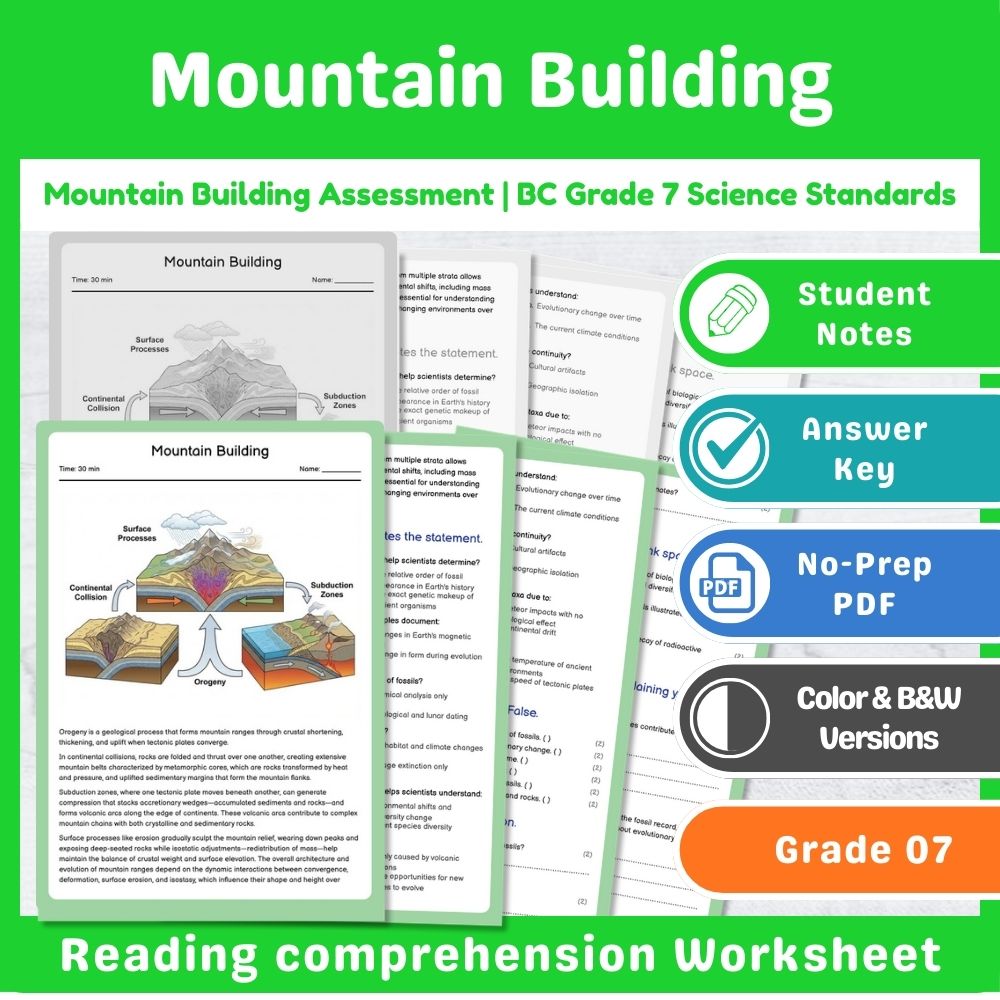
Mountain Building Assessment | BC Grade 7 Science Standards
Created byPrism Point LearningLearning Objectives
- Understand the processes involved in orogeny and mountain formation.
- Identify key geological features associated with mountain belts and subduction zones.
- Explain how surface processes shape mountain regions over time.
Also included in: Grade 7 Science Lesson – Earth Processes Assessment & Landforms Bundle
Instant download
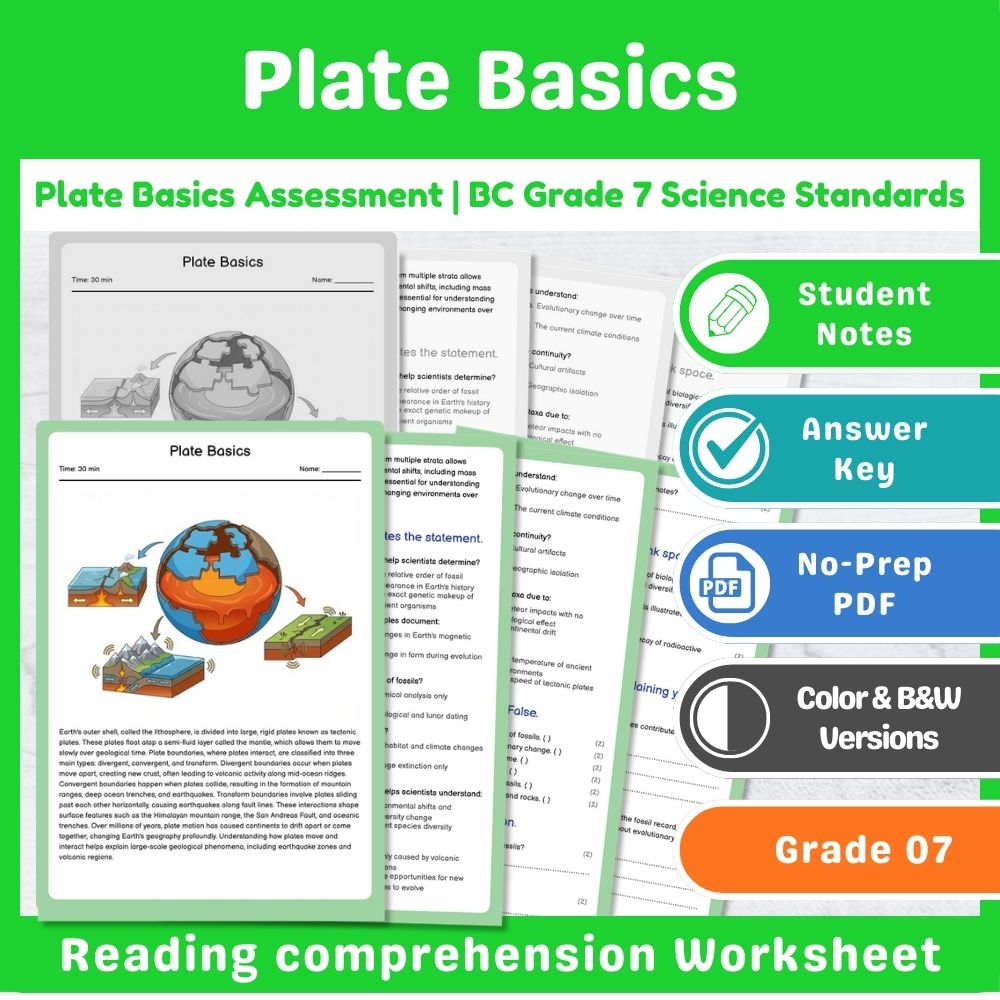
Plate Basics Assessment | BC Grade 7 Science Standards
Created byPrism Point LearningLearning Objectives
- Understand the structure and movement of Earth's lithospheric plates.
- Identify different types of plate boundaries and their effects on surface features.
- Explain how plate interactions influence geological activity such as earthquakes and volcanoes.
Also included in: Grade 7 Science Lesson – Earth Processes Assessment & Landforms Bundle
Instant download
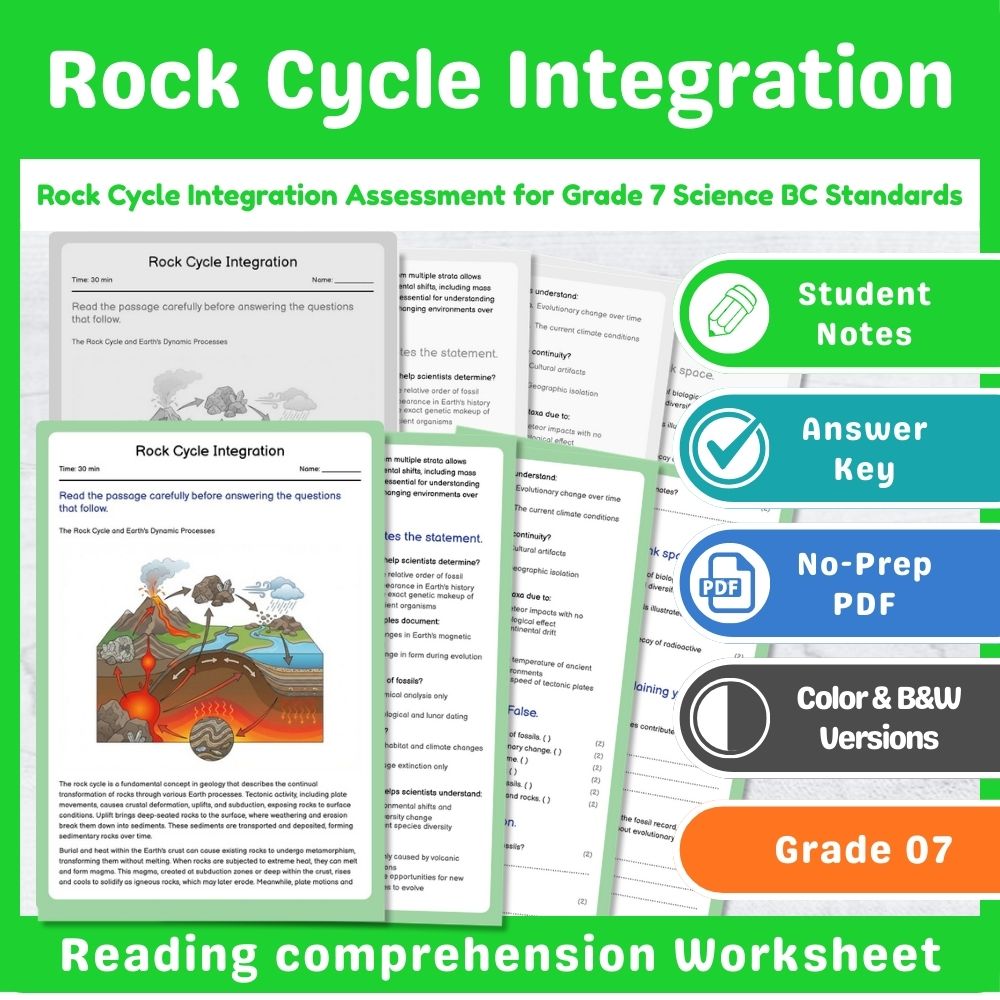
Rock Cycle Integration Assessment for Grade 7 Science BC Standards
Created byPrism Point LearningLearning Objectives
- Understand how the rock cycle links tectonics, magmatism, and surface processes.
- Identify the pathways of material transformation in the rock cycle.
- Explain how uplift, erosion, burial, and heat contribute to different rock types.
Also included in: Grade 7 Science Lesson – Earth Processes Assessment & Landforms Bundle
Instant download

Adaptation Evidence Assessment | Florida NGSSS Grade 7 Science
Created byPrism Point LearningLearning Objectives
- Explain what adaptations are and how they can improve survival or reproduction in specific environments
- Identify evidence for adaptation using observations of trait differences among populations, fossil records, and documented environmental changes
- Use examples (such as peppered moth coloration) to connect environmental pressures to changes in traits
Instant download

Biotic and Abiotic Factors Assessment | Florida NGSSS Grade 7 Science
Created byPrism Point LearningLearning Objectives
- Differentiate between biotic factors and abiotic factors in an ecosystem.
- Explain how abiotic changes can affect biotic interactions and population sizes.
- Use evidence from an ecosystem scenario to predict changes in community composition.
Instant download

Inherited Traits Assessment | NGSSS Florida Grade 7 Science Standards
Created byPrism Point LearningLearning Objectives
- Explain how inherited traits are passed from parents to offspring through genetic information in reproductive cells
- Identify how alleles influence traits and why offspring may differ from their parents
- Use observations to make predictions about inheritance patterns
Instant download

Population Dynamics Assessment for Grade 7 Science – NGSSS Standards
Created byPrism Point LearningLearning Objectives
- Explain how births, deaths, immigration, and emigration affect population size over time
- Identify limiting factors and predict how they influence population growth
- Use predator–prey relationships to describe how populations can fluctuate (oscillate)
Instant download
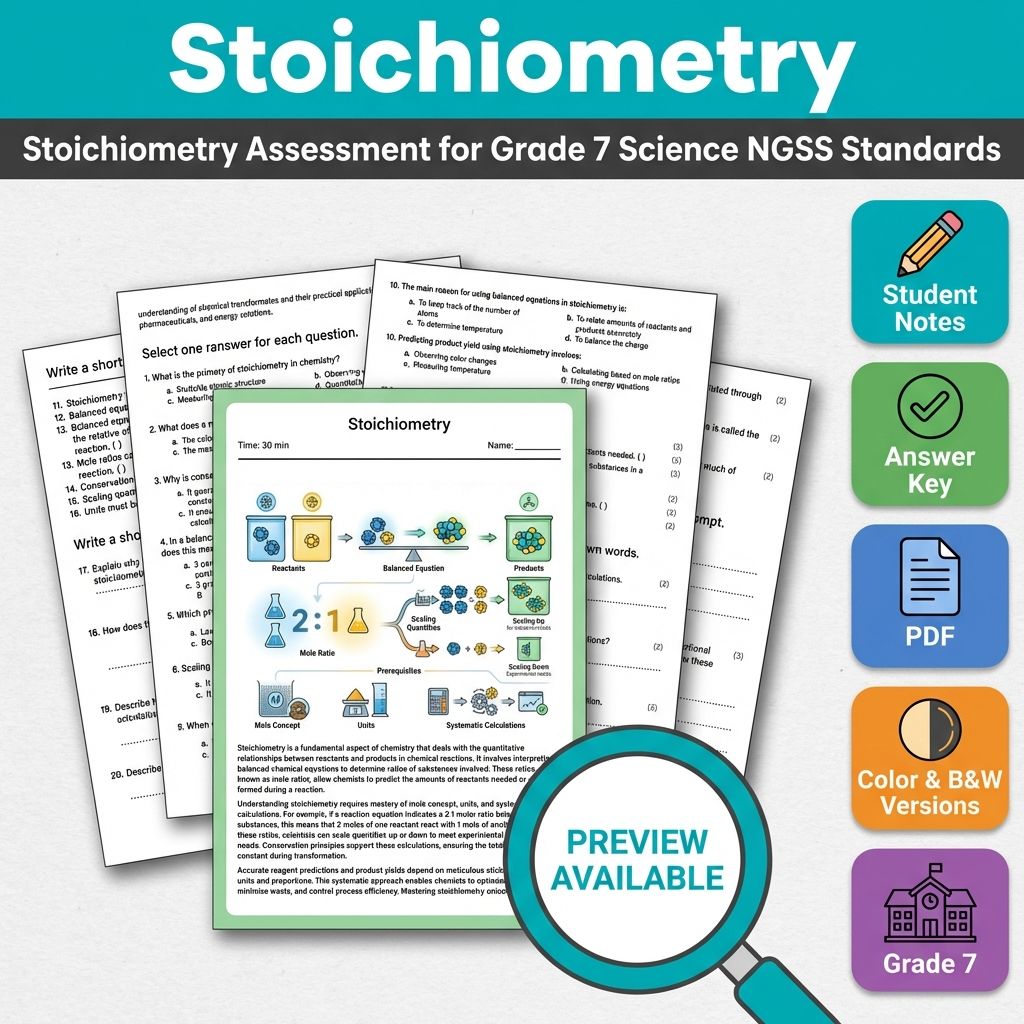
Stoichiometry Assessment for Grade 7 Science NGSS Standards
Created byPrism Point LearningLearning Objectives
- Describe how balanced chemical equations depict the quantitative relationships between reactants and products.
- Understand and apply mole ratios to calculate amounts of substances involved in chemical reactions.
- Use conservation of mass principles to predict reagent requirements and product yields in chemical transformations.
Also included in: Grade 7 Science Lesson | Matter and Its Interactions Standards +1 more
Instant download
Browse more categories
About Grade 7 Worksheets
Find Grade 7 worksheets covering math, ELA, science, and social studies. All 8,459 resources download instantly as PDFs for classwork, homework, or review.
MyTeachingSheets worksheets are made by real teacher-authors and checked before they go live. Download any as a print-ready PDF for lessons, homework, or independent practice — most include answer keys, and previews are always free.