
Grade 8 Worksheets
8,326 grade resources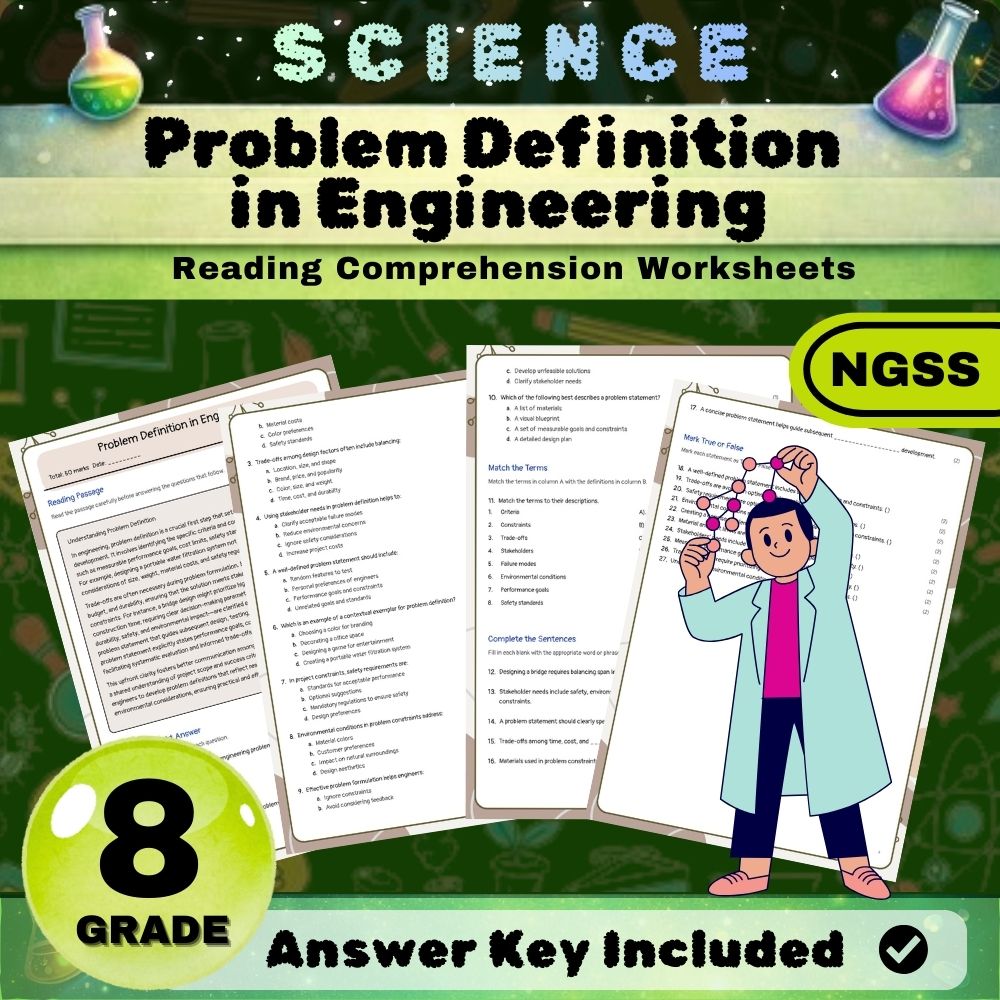
Grade 8 Science | Problem Definition in Engineering (NGSS Worksheet +Answer Key)
 Created byMaple Path Learning
Learning Objectives
- Understand how to define criteria and constraints for engineering problems.
- Identify measurable performance goals, safety requirements, and environmental considerations.
- Apply trade-off analysis between time, cost, and durability in problem statements.
Also included in: Grade 8 Science | Engineering Design Unit Bundle – NGSS Practice & Worksheets +1 more
Instant download
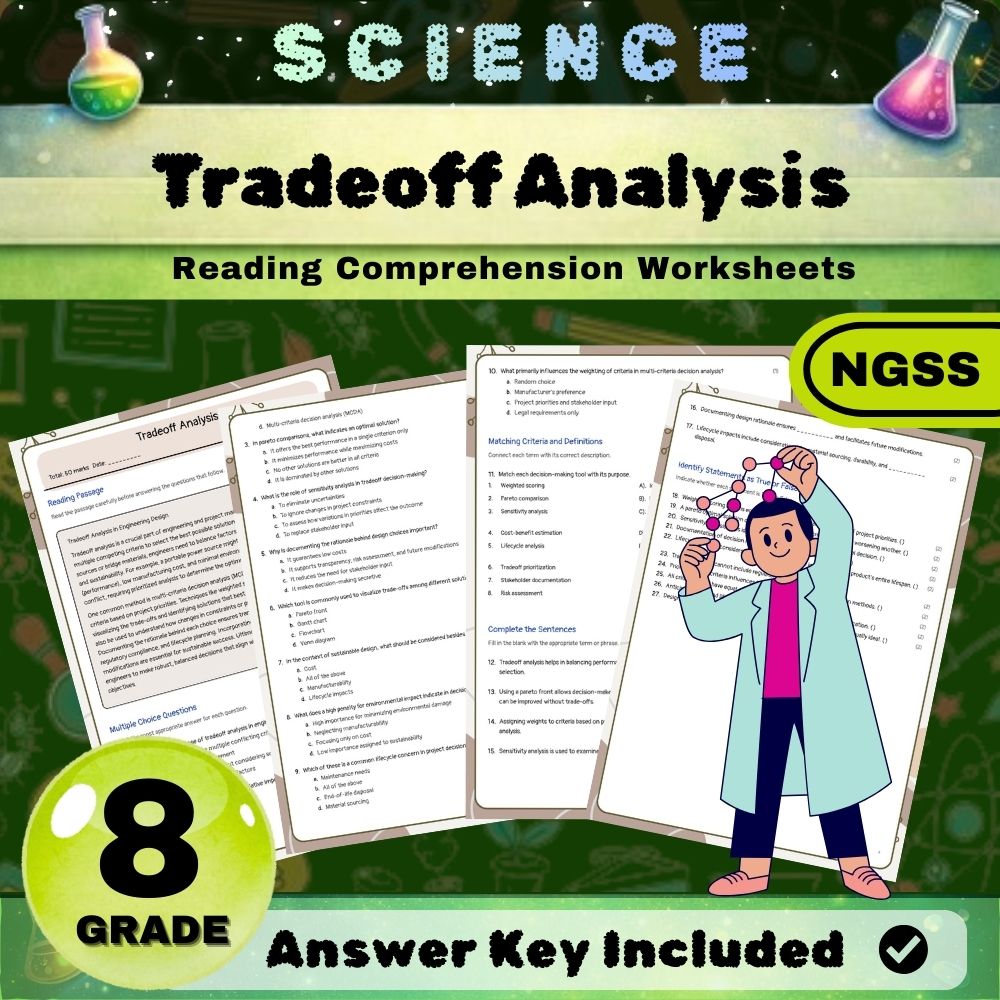
Grade 8 Science NGSS Tradeoff Analysis Worksheet (PDF) – Engineering Decision
Created byMaple Path LearningLearning Objectives
- Understand methods for prioritizing competing constraints in project design.
- Apply multi-criteria decision-making tools such as weighted scoring and pareto analysis.
- Evaluate trade-offs involving performance, manufacturability, and sustainability concerns.
Also included in: Grade 8 Science | Engineering Design Unit Bundle – NGSS Practice & Worksheets +1 more
Instant download
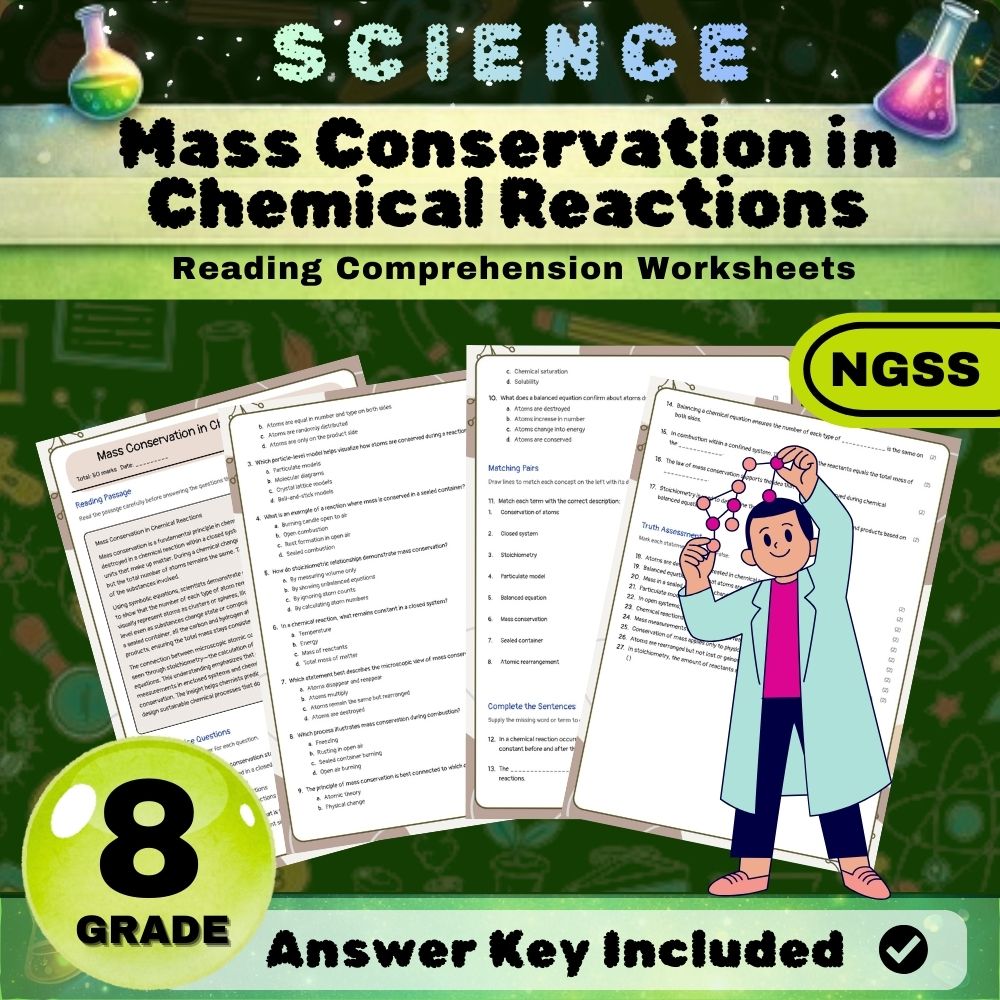
Grade 8 Science Worksheet | Mass Conservation in Chemical Reactions (NGSS PDF)
Created byMaple Path LearningLearning Objectives
- Explain the principle of mass conservation at the microscopic and macroscopic levels in chemical reactions.
- Identify and interpret symbols, particulate models, and equations that demonstrate mass conservation.
- Connect observations of mass in closed systems to the conservation of atoms during chemical change.
Also included in: Grade 8 Science | Matter and Its Interactions NGSS Unit Bundle (Worksheet Pack) +1 more
Instant download
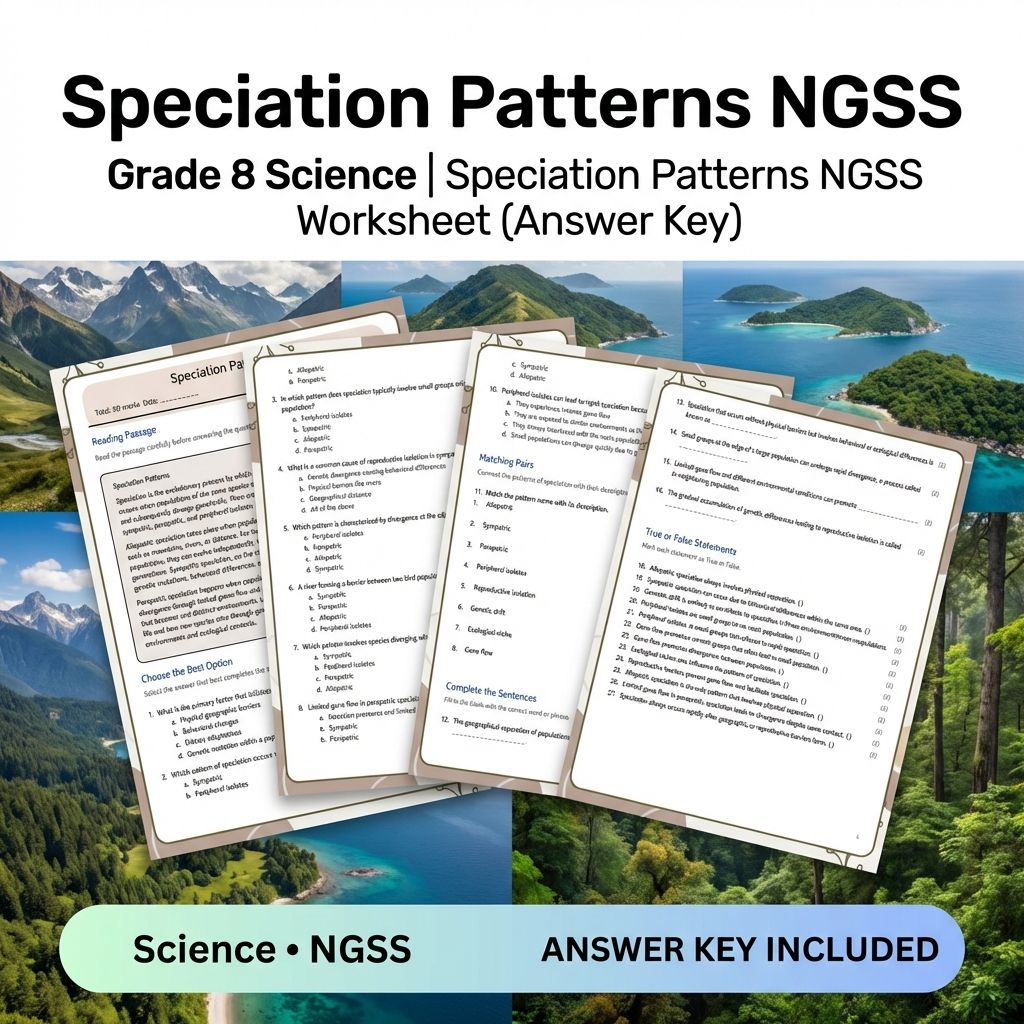
Grade 8 Science | Speciation Patterns NGSS Worksheet (Answer Key)
Created byMaple Path LearningLearning Objectives
- Understand the concept of biological speciation and how different patterns contribute to biodiversity.
- Identify various types of speciation events and their characteristics.
- Analyze the role of geographic and reproductive barriers in speciation.
Also included in: Grade 8 Science NGSS | Biological Evolution: Unity & Diversity Worksheet Bundle +1 more
Instant download
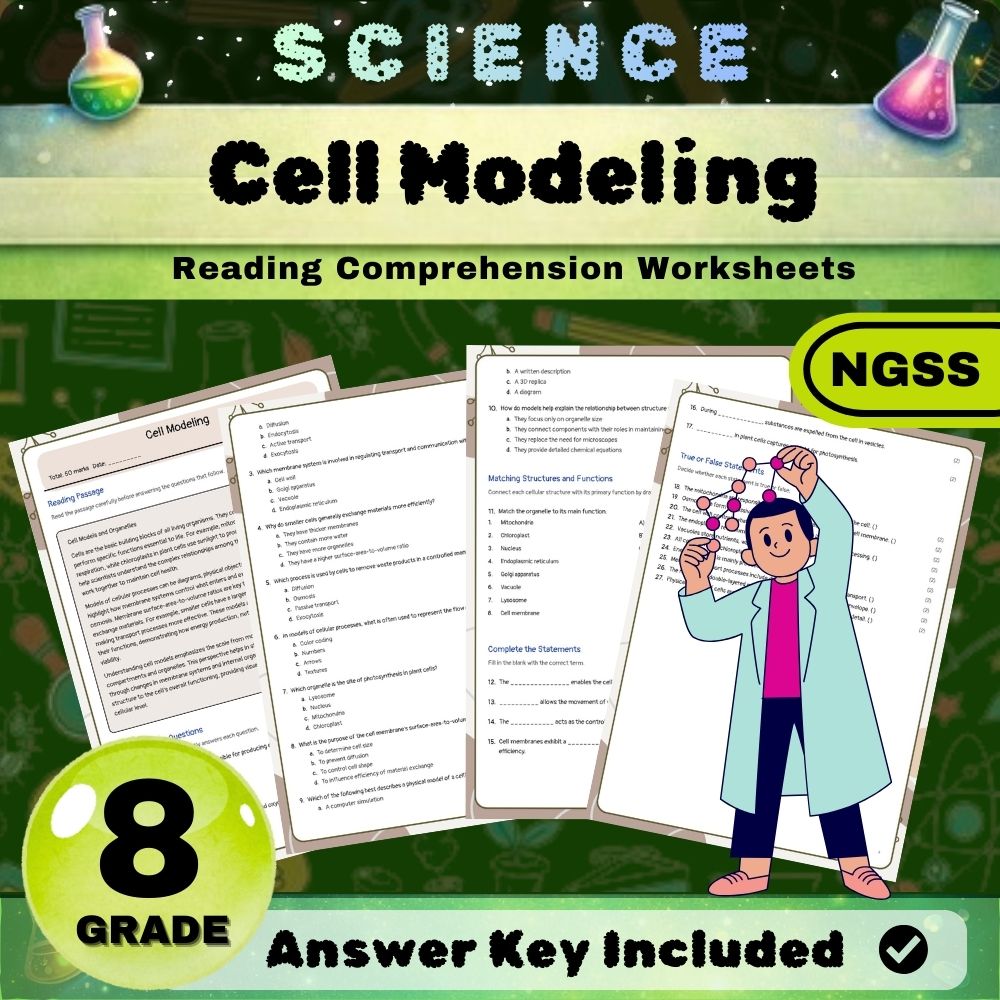
Grade 8 Science | Cell Modeling Worksheet (NGSS) PDF
Created byMaple Path LearningLearning Objectives
- Describe the structure and function of organelles within a cell.
- Explain how models represent cellular processes like membrane transport and energy pathways.
- Interpret how cellular structures relate to overall cell viability and scale from molecules to compartments.
Also included in: Grade 8 Science | From Molecules to Organisms Unit Bundle NGSS-Aligned +1 more
Instant download
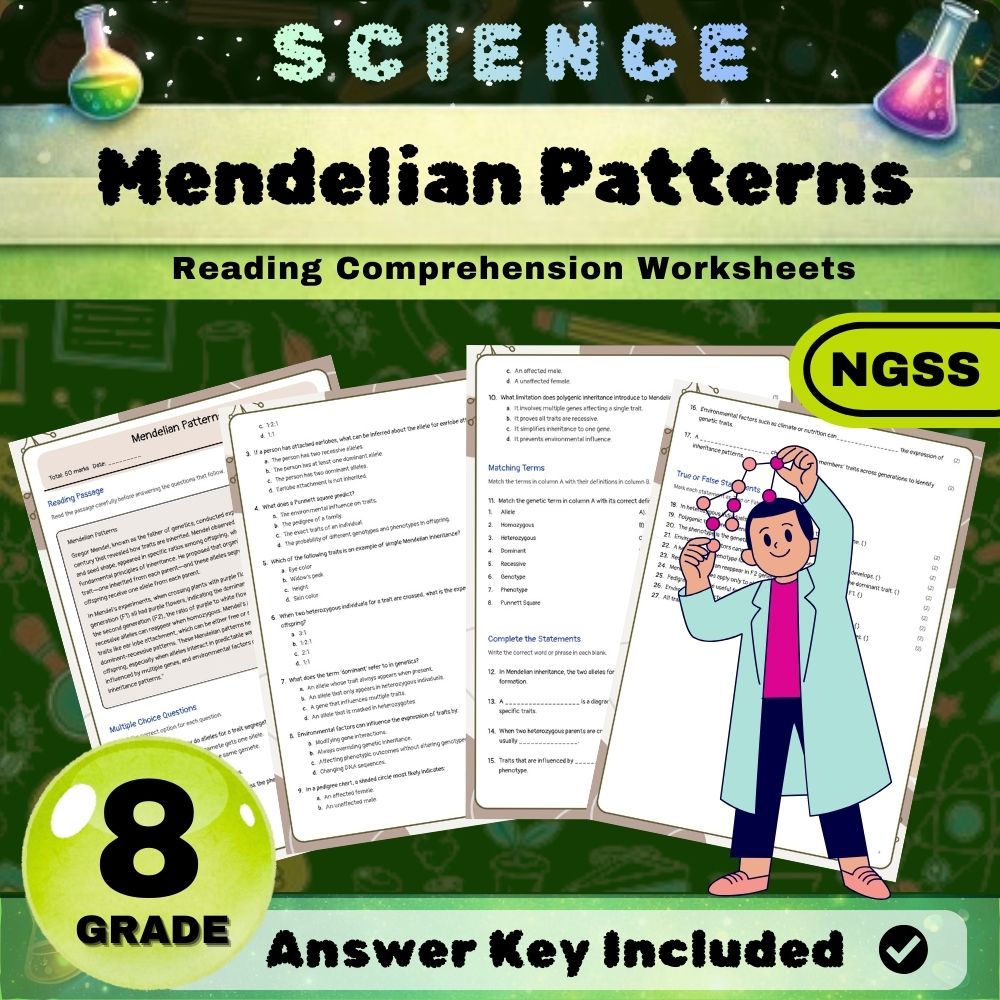
Grade 8 Science | Mendelian Patterns Worksheet (NGSS) PDF
Created byMaple Path LearningLearning Objectives
- Explain how allele combinations determine observable traits through Mendelian inheritance.
- Describe dominant and recessive allele interactions and predict phenotypic ratios using Punnett squares.
- Understand how allele segregation and probability influence genetics.
Also included in: Grade 8 Science | Heredity Unit Bundle – Inheritance & Trait Variation NGSS +1 more
Instant download
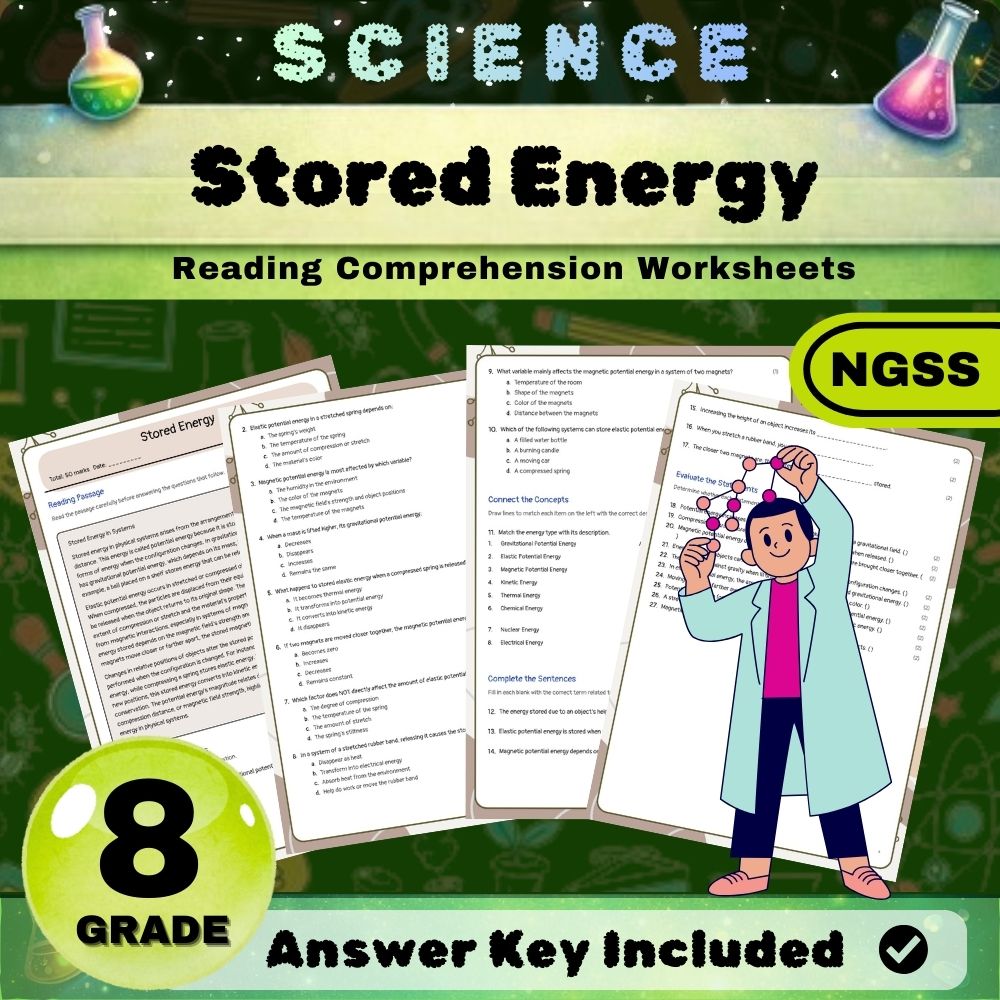
Grade 8 Science – Stored Energy Worksheet (NGSS) | Science NGSS Practices (PDF)
Created byMaple Path LearningLearning Objectives
- Explain the concept of potential energy stored in systems due to position or configuration.
- Identify and compare gravitational, elastic, and magnetic potential energy in different systems.
- Describe how changes in relative positions of objects alter stored energy and the work done during these changes.
Also included in: Grade 8 Science NGSS Energy Unit Bundle for Classroom or Distance Learning +1 more
Instant download
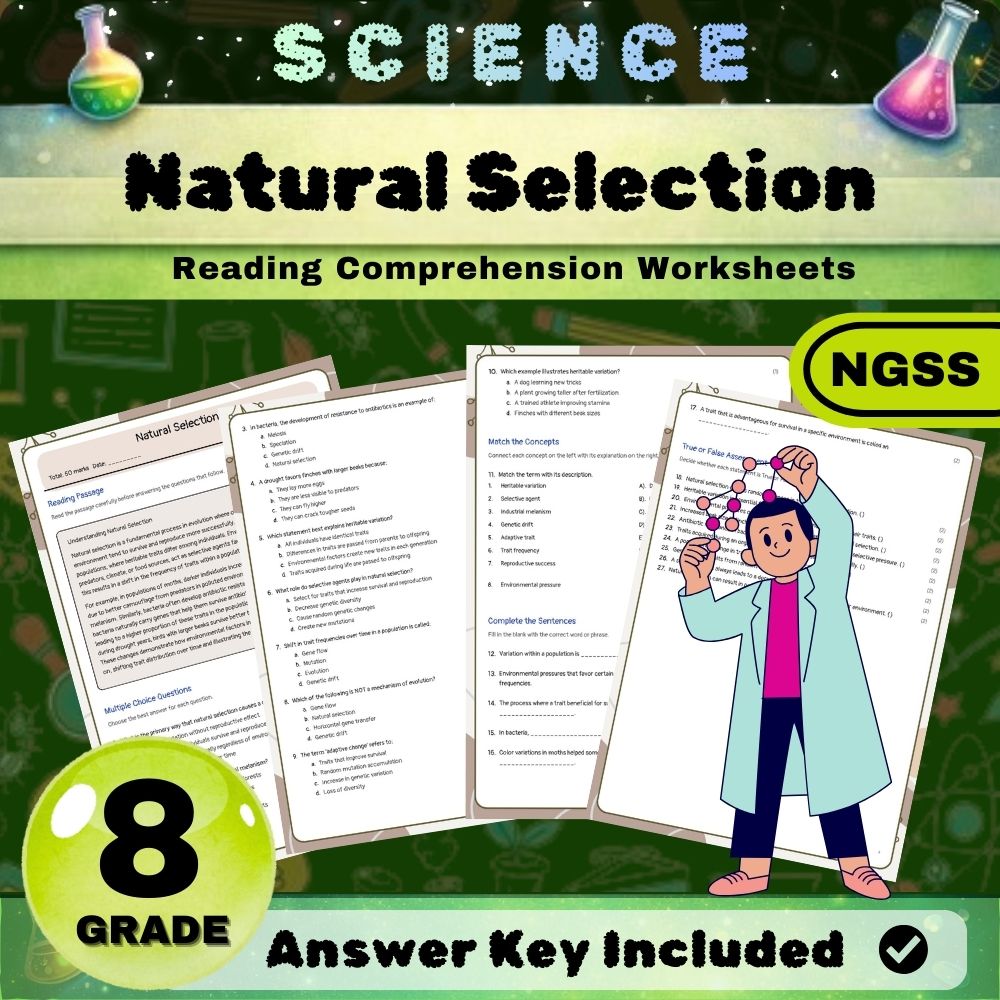
Grade 8 Science | Natural Selection Worksheet (NGSS PDF)
Created byMaple Path LearningLearning Objectives
- Understand how heritable variation and environmental pressures lead to natural selection.
- Identify examples of adaptive change in populations over generations.
- Explain the roles of selective agents and trait frequency shifts in evolution.
Also included in: Grade 8 Science NGSS | Biological Evolution: Unity & Diversity Worksheet Bundle +1 more
Instant download
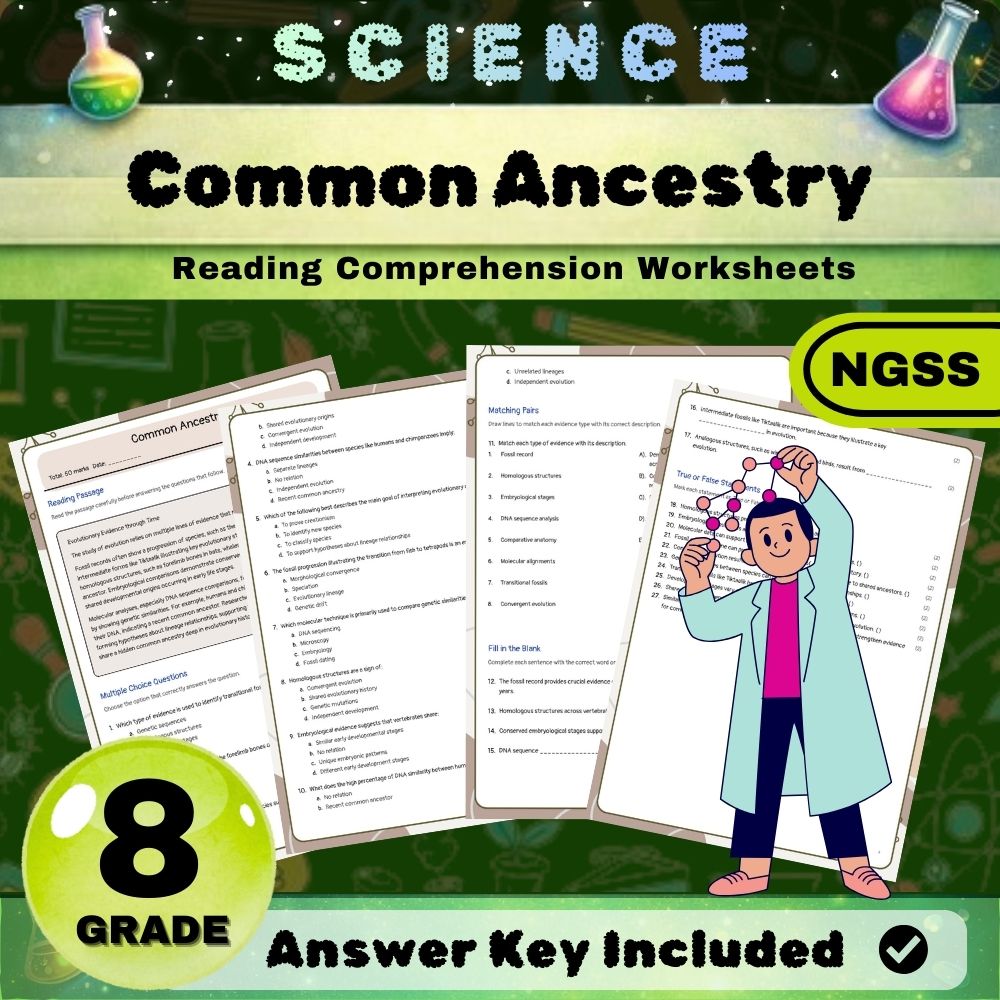
Grade 8 Science | Common Ancestry Worksheet (NGSS) – PDF
Created byMaple Path LearningLearning Objectives
- Analyze fossil, anatomical, embryological, and molecular evidence to interpret evolutionary relationships.
- Identify patterns of unity and diversity across different data types over deep time.
- Evaluate the significance of transitional fossils, homologous structures, conserved developmental stages, and DNA sequence similarities.
Also included in: Grade 8 Science NGSS | Biological Evolution: Unity & Diversity Worksheet Bundle +1 more
Instant download
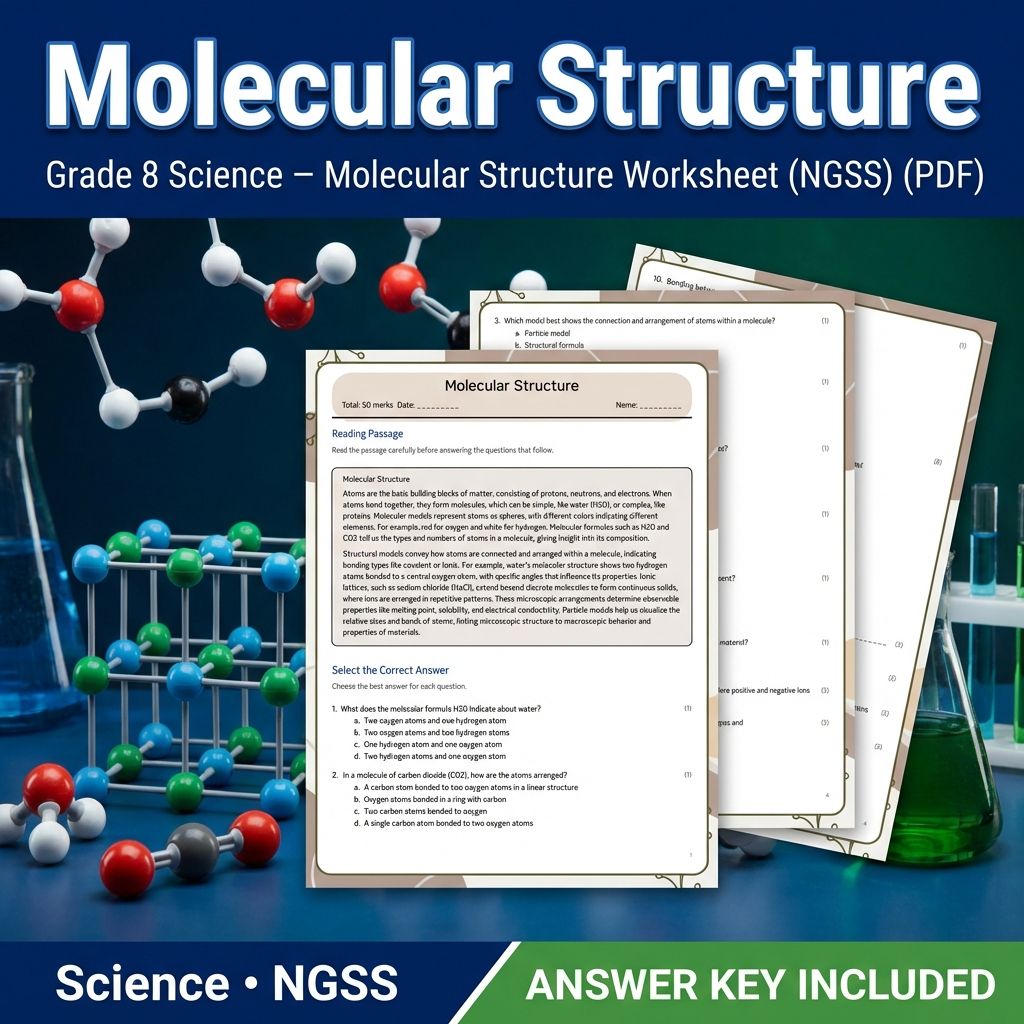
Grade 8 Science – Molecular Structure Worksheet (NGSS) (PDF)
Created byMaple Path LearningLearning Objectives
- Describe the atomic composition of simple molecules using particle models and symbolic formulas.
- Interpret molecule diagrams and structural models to understand atom types, numbers, and bonding arrangements.
- Differentiate between discrete molecules and extended solids based on microscopic arrangements and observable properties.
Also included in: Grade 8 Science | Matter and Its Interactions NGSS Unit Bundle (Worksheet Pack) +1 more
Instant download

8th Grade Health | Overcoming Barriers Printable Worksheet (Answer Key Included)
 Created bySkylark Worksheets
Learning Objectives
- Identify common barriers that hinder health goals, such as time constraints, lack of motivation, and environmental challenges.
- Explain strategies like problem-solving, social support, and environment modification to overcome obstacles.
- Develop skills to navigate barriers for sustained health behavior change.
Instant download
8th Grade Health | Nonverbal Cues Worksheet (Answer Key) for Student Mastery
Created bySkylark WorksheetsLearning Objectives
- Identify various nonverbal cues such as facial expressions, gestures, posture, and eye contact.
- Understand how nonverbal communication influences perceptions and interactions.
- Recognize the importance of being aware of one's own nonverbal behaviors.
Instant download

Grade 8 Science | Data Quality Controls Worksheet | General Standard
 Created byLumora Learning
Learning Objectives
- Explain how calibration and consistent measurement practices improve accuracy and precision.
- Describe how replication and proper handling of outliers help distinguish random variation from real effects.
- Identify how documentation of variable definitions and measurement units supports fair comparisons and valid interpretation of data.
Instant download

Grade 8 Science | Rock Cycle Worksheet | California Standards
Created byLumora LearningLearning Objectives
- Describe how rock changes between igneous, sedimentary, and metamorphic forms in the rock cycle
- Explain how weathering, transport, deposition, burial, heat, and pressure drive the rock cycle
- Connect the rock cycle to energy transfer and Earth’s spheres (lithosphere, hydrosphere, atmosphere)
Instant download

Grade 8 Science | Plate Tectonics Worksheet Elena | NGSSS Aligned
Created byLumora LearningLearning Objectives
- Explain how tectonic plates move and how those movements reshape Earth’s landforms over geologic time
- Differentiate divergent, convergent, and transform plate boundaries and predict what each boundary can produce
- Use evidence such as matching coastlines, seafloor features, and earthquake/volcano locations to support the idea of plate interactions
Instant download

Grade 8 Science | Species Interactions Worksheet | NGSSS Aligned
Created byLumora LearningLearning Objectives
- Explain how competition, predation, mutualism, commensalism, and parasitism affect organisms’ survival and reproduction.
- Describe how species interactions can change population sizes and influence ecosystem stability.
- Use evidence from an ecosystem scenario to identify the type of species interaction.
Instant download
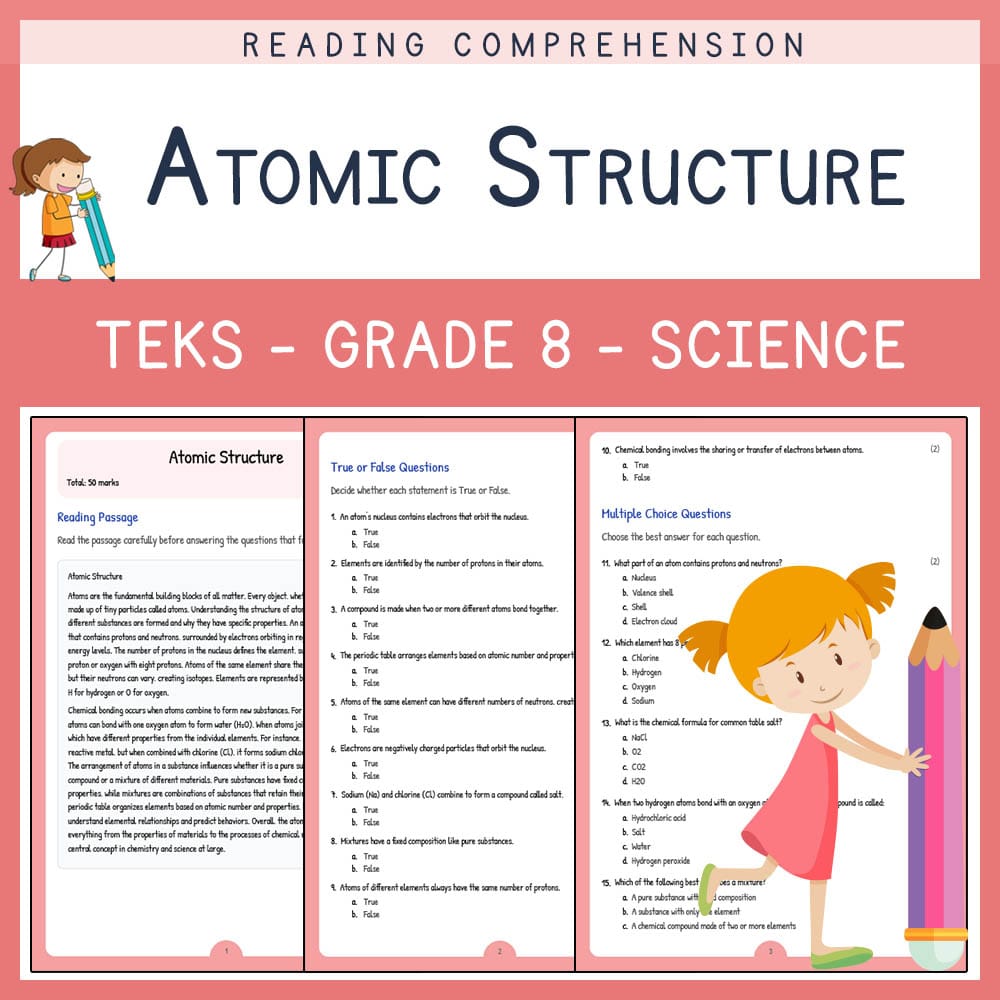
Grade 8 Science | Atomic Structure Worksheet | TEKS-Aligned
Created byLumora LearningLearning Objectives
- Describe the basic components of an atom and their functions.
- Differentiate between elements, compounds, and mixtures.
- Explain how atomic arrangement influences the properties of substances.
Also included in: Grade 8 Science | Matter and Energy Lesson Bundle | TEKS Aligned
Instant download

Grade 8 Science | Balanced Forces Worksheet | BC Aligned
Created byLumora LearningLearning Objectives
- Understand the concept of balanced and unbalanced forces acting on objects.
- Identify the conditions that result in static and dynamic equilibrium.
- Explain how balanced forces affect the motion of objects at rest and in motion.
Also included in: Grade 8 Science | Forces and Motion Custom Bundle | BC Standards
Instant download

Grade 8 Science | Molecules and States Worksheet | General Standards
Created byLumora LearningLearning Objectives
- Explain solids, liquids, and gases using particle (molecular) ideas
- Relate temperature to particle motion and describe how motion changes with state changes
- Use particle spacing and movement to predict changes in shape and volume
Instant download
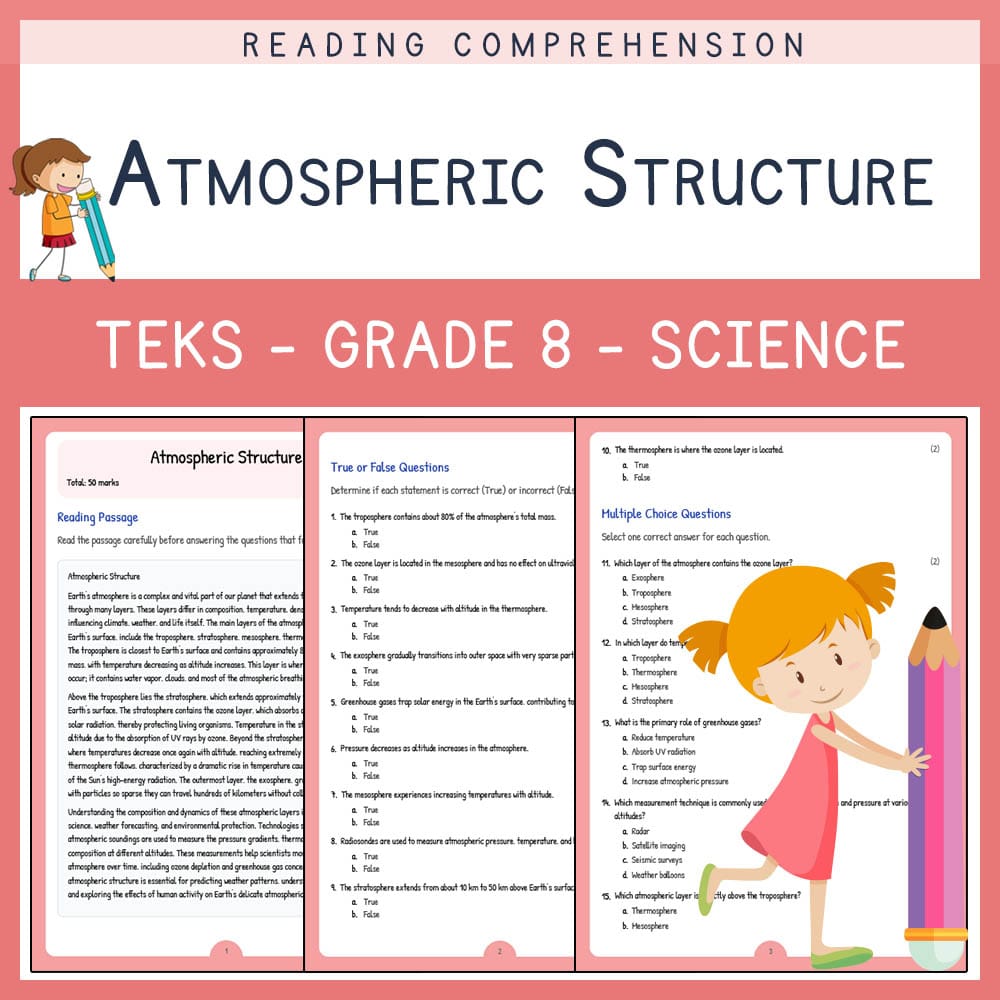
Grade 8 Science | Atmospheric Structure Worksheet | TEKS Aligned
Created byLumora LearningLearning Objectives
- Describe the main layers of Earth's atmosphere and their characteristics.
- Explain the roles of ozone and greenhouse gases in Earth's atmosphere.
- Understand how pressure, temperature, and density change with altitude.
Also included in: Grade 8 Science | Earth and Space Systems Lesson Bundle | TEKS Aligned
Instant download
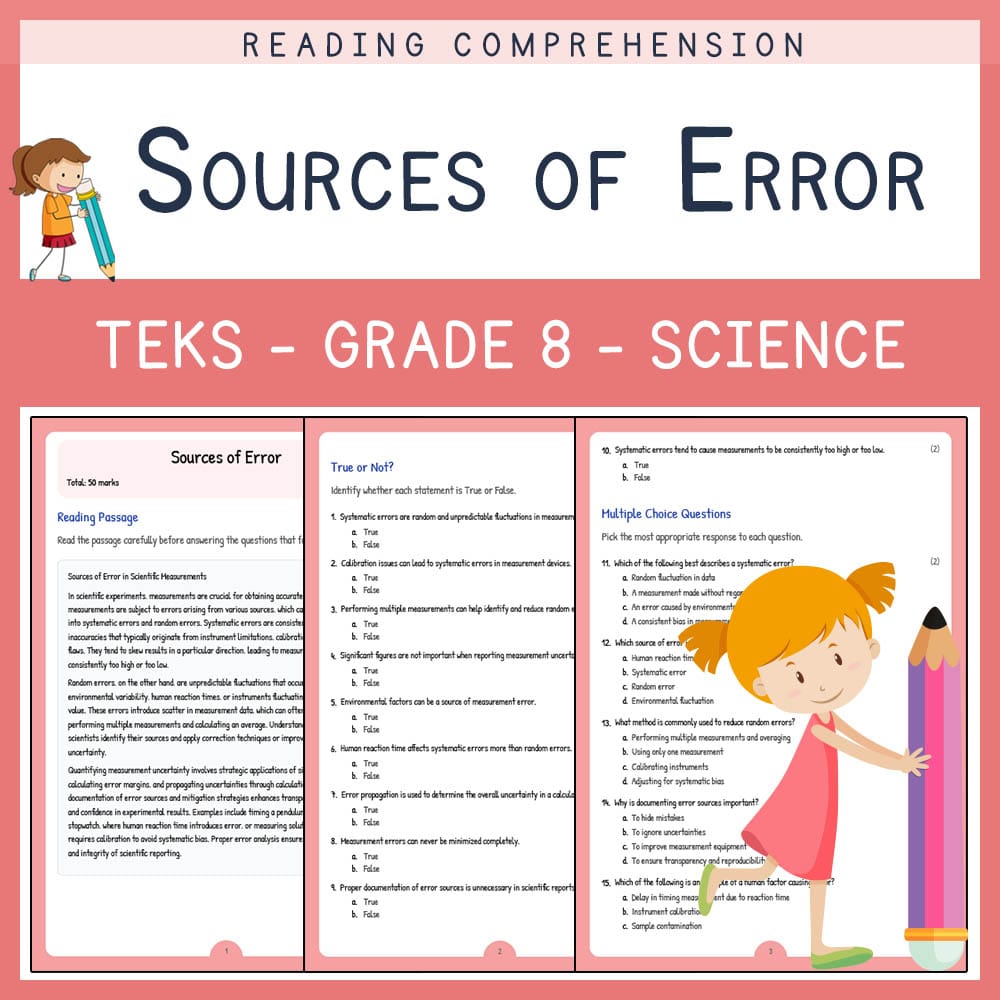
Grade 8 Science | Sources of Error Worksheet | TEKS-Aligned
Created byLumora LearningLearning Objectives
- Identify and understand different types of errors in scientific measurements.
- Distinguish between systematic and random errors arising from various sources.
- Apply quantification methods such as significant figures, error margins, and propagation to assess uncertainty.
Also included in: Grade 8 Science | Science Concepts/Skills Lesson Bundle | TEKS Aligned
Instant download

Grade 8 Science | Circuit Analysis Worksheet | Alberta Standards
Created byLumora LearningLearning Objectives
- Understand the principles of voltage, current, and power in electrical circuits.
- Apply conservation laws to analyze complex electrical networks.
- Interpret schematic diagrams and perform systematic calculations of circuit parameters.
Instant download
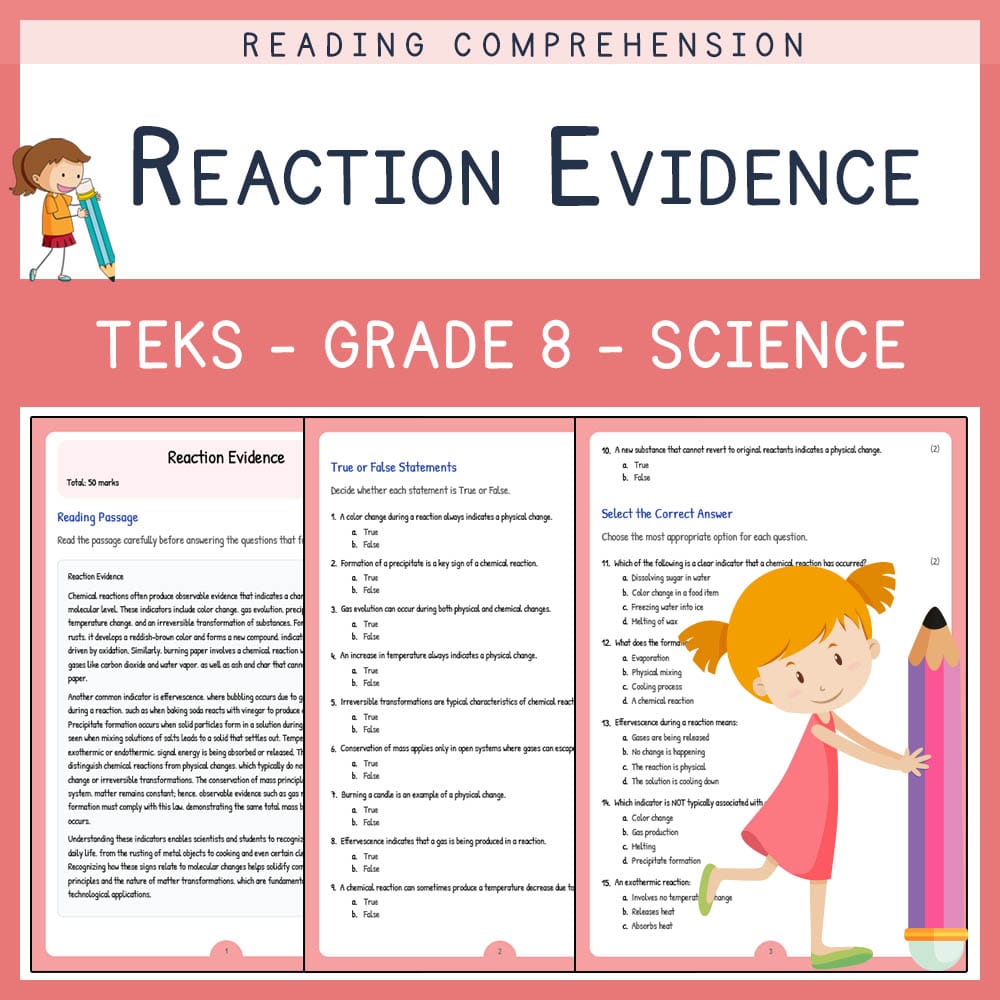
Grade 8 Science | Reaction Evidence Worksheet Elena | TEKS Aligned
Created byLumora LearningLearning Objectives
- Identify observable indicators of chemical reactions such as color change, gas evolution, and precipitate formation.
- Distinguish between chemical and physical changes based on evidence and indicators.
- Explain how conservation of mass applies in closed systems during chemical reactions.
Also included in: Grade 8 Science | Matter and Energy Lesson Bundle | TEKS Aligned
Instant download
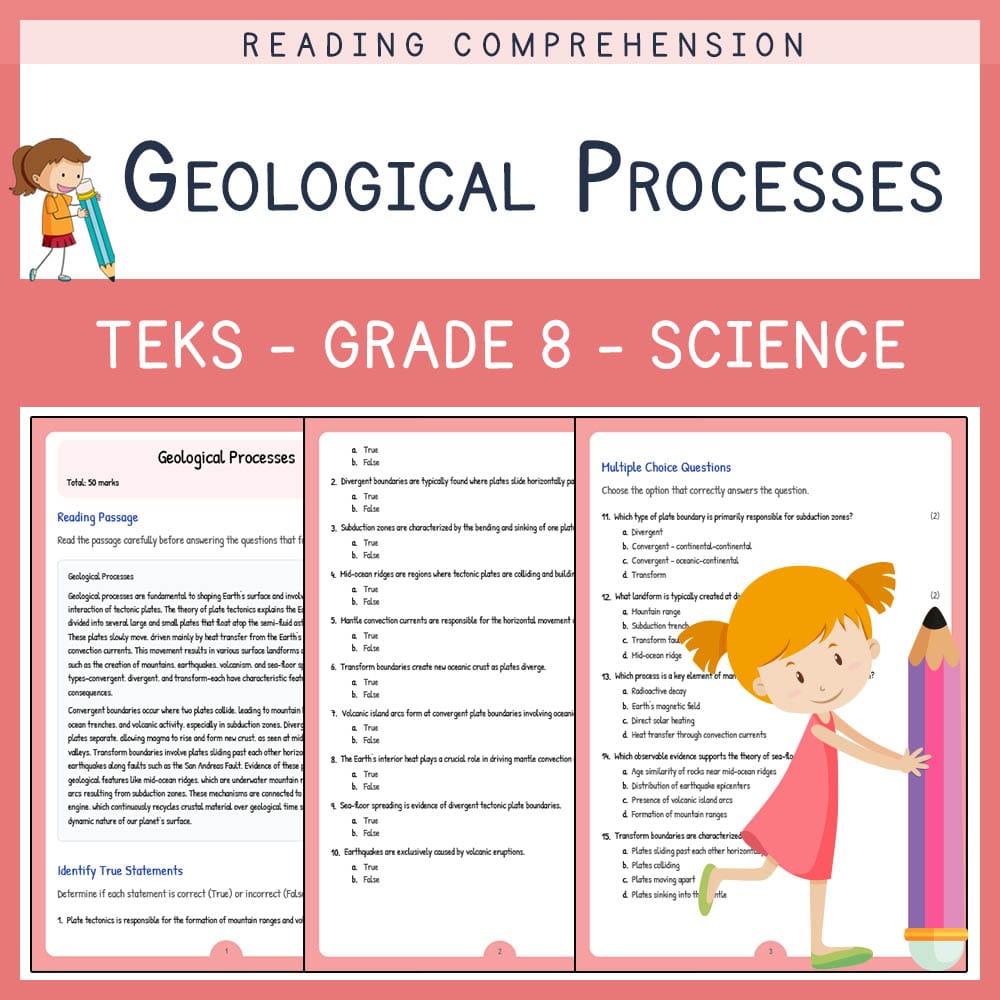
Grade 8 Science | Geological Processes Worksheet | TEKS Aligned
Created byLumora LearningLearning Objectives
- Understand the main mechanisms of plate tectonics and their surface expressions.
- Identify the different types of plate boundaries and related landforms.
- Explain the role of mantle convection, heat transfer, and subduction in shaping Earth's crust.
Also included in: Grade 8 Science | Earth and Space Systems Lesson Bundle | TEKS Aligned
Instant download

Grade 8 Science | Conservation Principle Worksheet | BC Standards
Created byLumora LearningLearning Objectives
- Understand the law of conservation of mass and its importance in chemical reactions.
- Identify how balanced equations illustrate mass conservation.
- Explain the relationship between mole concepts and mass in chemical processes.
Instant download

Grade 8 Science | Speciation and Change Worksheet | NGSSS Aligned
Created byLumora LearningLearning Objectives
- Explain how reproductive isolation leads to speciation
- Describe how genetic variation and natural selection can differ between separated populations
- Identify common barriers (geographic, habitat, and behavioral) that reduce gene flow
Instant download

Grade 8 Science | Observational Clues Worksheet | BC Aligned
Created byLumora LearningLearning Objectives
- Identify various indicators of chemical and physical changes through observation.
- Differentiate between physical and chemical change based on observable clues.
- Understand properties affected by chemical reactions such as melting point, solubility, and conductivity.
Instant download

Grade 8 Science | Indicator Properties Worksheet | BC Aligned
Created byLumora LearningLearning Objectives
- Understand how property shifts such as pH, conductivity, density, and refractive index indicate chemical changes.
- Distinguish between physical and chemical transformations using property measurements.
- Recognize examples of property changes that suggest formation of new substances.
Instant download

Grade 8 Science | Land Use Effects Worksheet | BC Aligned
Created byLumora LearningLearning Objectives
- Understand how human land use alters natural habitats and ecological connectivity.
- Identify the impacts of land fragmentation on biodiversity and species survival.
- Evaluate how different land uses like agriculture and urban development affect ecosystems.
Instant download

Grade 8 Science | Conservation Applications Worksheet | BC Alignment
Created byLumora LearningLearning Objectives
- Understand how conservation of mass applies to chemical reactions in different systems.
- Differentiate between open and closed systems in mass transfer.
- Apply quantitative methods to track reactant and product masses, converting to moles and using balanced equations.
Instant download

Grade 8 Science | Plate Motion Evidence Worksheet | California Standards
Created byLumora LearningLearning Objectives
- Identify multiple types of geological evidence that support plate movement over long time periods
- Explain how rock age, rock type, mountain belt alignment, and seafloor features help reconstruct past plate positions
- Use fossil and mineral information to evaluate whether regions could have been once-adjacent
Instant download

Grade 8 Science | Complex Systems Worksheet | BC Standard
Created byLumora LearningLearning Objectives
- Understand the principles of complex chemical reaction networks and their properties.
- Apply conservation of mass concepts across interconnected chemical reactions.
- Explain equilibrium in multi-step reactions and how it affects observable properties.
Instant download

Grade 8 Science | Population Growth Worksheet | BC Aligned
Created byLumora LearningLearning Objectives
- Understand the factors influencing population change, including birth rates, death rates, immigration, and emigration.
- Identify patterns of population growth, stability, and decline.
- Explore how reproductive strategies, age structure, and resource availability affect growth rates.
Instant download

Grade 8 Science | Fossil Record Clues Worksheet | California Standards
Created byLumora LearningLearning Objectives
- Explain how fossils in sedimentary layers provide evidence for Earth’s past environments and conditions
- Use fossil correlations to infer that distant regions may have had similar organisms when tectonic plates were arranged differently
- Describe how rock characteristics and layer ages strengthen interpretations of geologic history and plate movement
Instant download

Grade 8 Science | Earthquake Patterns Worksheet | California Standards
Created byLumora LearningLearning Objectives
- Explain how earthquake locations relate to plate boundaries and fault belts
- Describe how seismic timing and wave behavior provide clues about tectonic motion and Earth’s interior
- Use simple models and evidence to connect seismic observations to Earth structure
Instant download

Grade 8 Science | Thermal Transfer Modes Worksheet | California Standards
Created byLumora LearningLearning Objectives
- Explain how conduction, convection, and radiation transfer thermal energy from warmer to cooler regions
- Identify evidence of each thermal transfer mode in everyday situations
- Use basic particle and fluid-motion ideas to justify temperature changes across a system
Instant download

Grade 8 Science | Gravity Attraction Worksheet | California Standards
Created byLumora LearningLearning Objectives
- Explain how gravitational attraction depends on mass and distance
- Describe gravity as a force that acts at a distance and changes an object’s motion
- Use gravity concepts to interpret everyday examples (weight, orbits, and weaker gravity far from Earth)
Instant download

Grade 8 Science | Reversible Versus Chemical Changes | California Standards
Created byLumora LearningLearning Objectives
- Differentiate physical (reversible) changes from chemical (usually not reversible) changes using evidence
- Identify signs of chemical changes such as new substances, permanent color change, and gas production
- Use particle/atomic ideas to explain why reversing conditions may not restore the original substance
Instant download

Grade 8 Science | Energy in Motion Worksheet | California Standards
Created byLumora LearningLearning Objectives
- Explain how gravitational potential energy and kinetic energy change when an object moves up or down in a gravitational field
- Use conservation reasoning to predict how an object’s speed changes in a simplified (energy-conserving) system
- Describe how a roller coaster model represents energy transfers between potential and kinetic energy
Instant download

Grade 8 Assessment | Particle Representations Worksheet | BC Aligned
Created byLumora LearningLearning Objectives
- Explain the concept of particle-level representations in describing chemical reactions.
- Identify how particles are depicted in diagrams to show breaking and forming bonds.
- Describe the relationship between microscopic particle models and macroscopic observations.
Instant download

Grade 8 Science | Abiotic Influences Worksheet | BC Standards
Created byLumora LearningLearning Objectives
- Understand how light availability influences species distribution and growth.
- Identify the effects of temperature and water on ecosystems and organisms.
- Describe how soil composition and nutrient levels shape community structure.
Instant download

Grade 8 Science | Gas Exchange Worksheet | BC Standard
Created byLumora LearningLearning Objectives
- Understand the structure and function of alveoli, stomata, and mesophyll in gas exchange.
- Identify adaptations that facilitate efficient diffusion of gases in organisms.
- Explain how cellular structures support rapid gas transfer in different tissues.
Also included in: Grade 8 Science | Cell Organization & Systems Custom Bundle | BC Aligned
Instant download
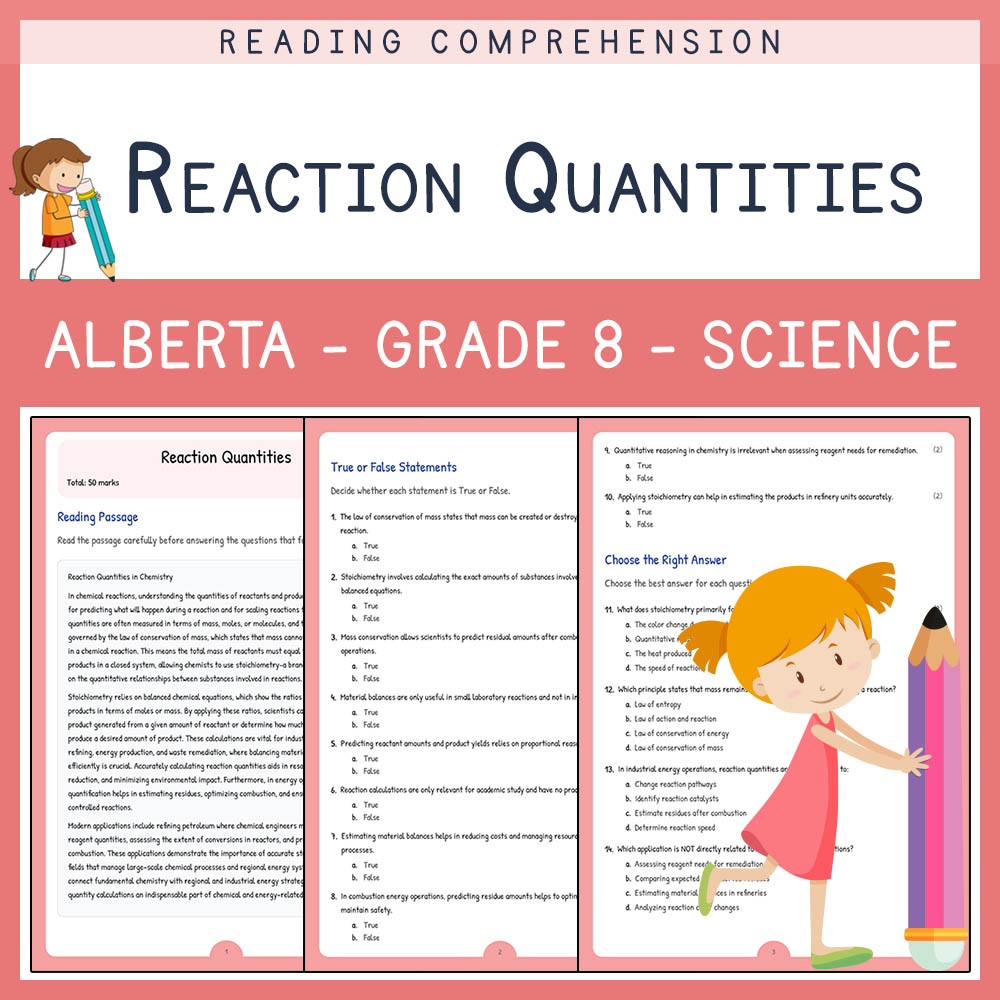
Grade 8 Science | Reaction Quantities Worksheet | Alberta Standard
Created byLumora LearningLearning Objectives
- Understand the concept of stoichiometric relationships in chemical reactions.
- Use proportional reasoning to predict the amounts of reactants and products.
- Apply mass conservation principles to interpret chemical data.
Instant download

Grade 8 Science | Atoms and Molecules Worksheet | BC Aligned
Created byLumora LearningLearning Objectives
- Understand the basic structure of atoms and how they form molecules.
- Describe how atoms bond to create different substances.
- Explain the process of chemical reactions involving atoms and molecules.
Instant download
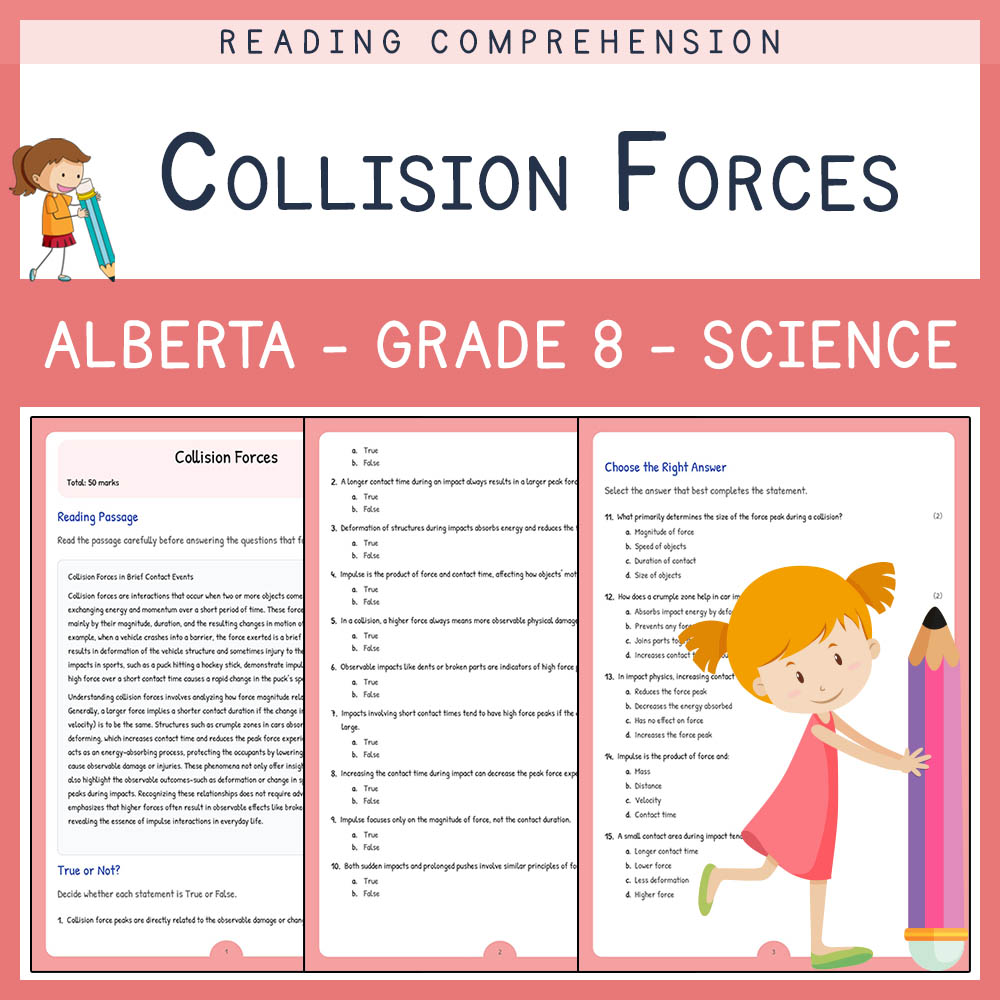
Grade 8 Science | Collision Forces Worksheet Elena | Alberta Standard
Created byLumora LearningLearning Objectives
- Understand how forces exchanged during brief contact events affect the motion of objects.
- Describe the relationship between force magnitude and contact time in collisions.
- Explain how structural deformation absorbs energy during impacts.
Instant download
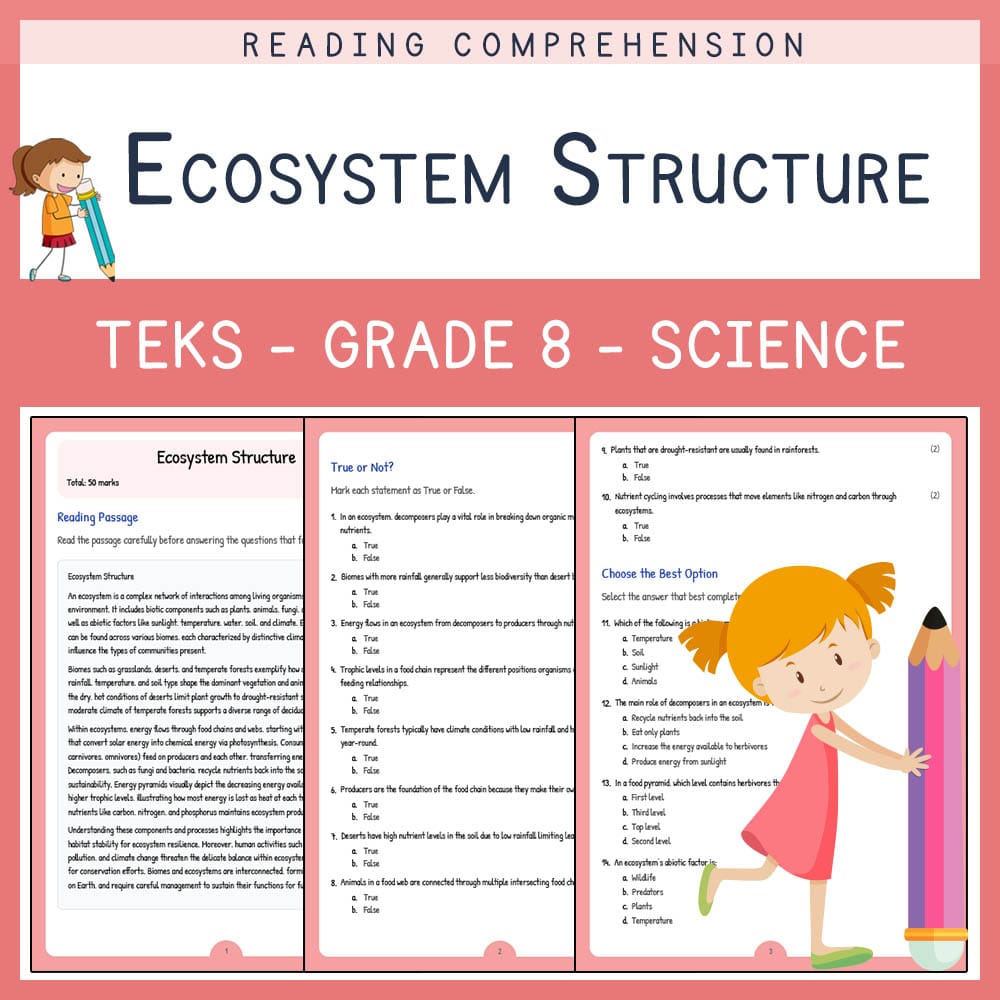
Grade 8 Science | Ecosystem Structure Worksheet Elena | TEKS-Aligned
Created byLumora LearningLearning Objectives
- Identify the key components and features of different ecosystems and biomes.
- Explain the roles of producers, consumers, and decomposers in energy flow and nutrient cycling.
- Describe how abiotic factors influence community composition in various biomes.
Also included in: Grade 8 Science | Organisms and Environments Unit Bundle | TEKS Aligned
Instant download
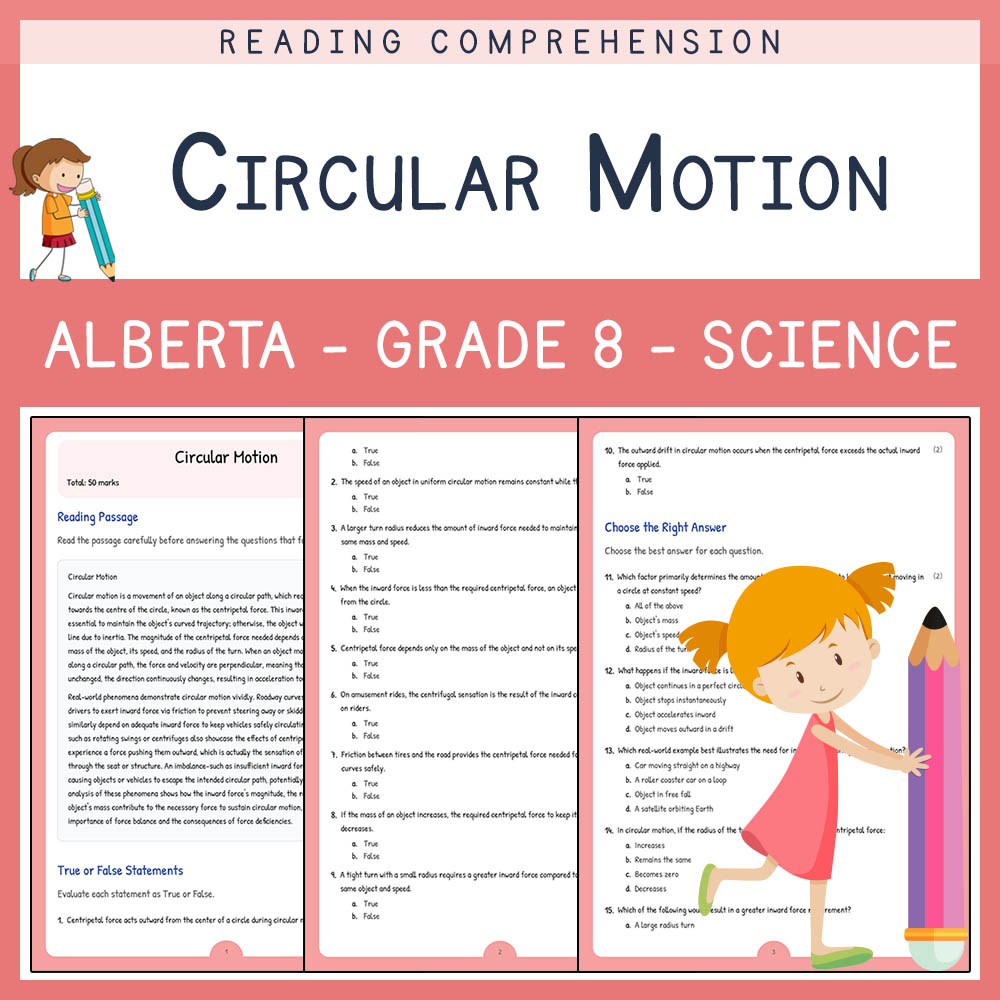
Grade 8 Science | Circular Motion Worksheet Elena | Alberta
Created byLumora LearningLearning Objectives
- Explain the concept of centripetal force and its role in circular motion.
- Analyze how turn radius, mass, and force affect the required centripetal force.
- Describe real-world examples of circular motion such as road curves, roundabouts, and amusement rides.
Instant download
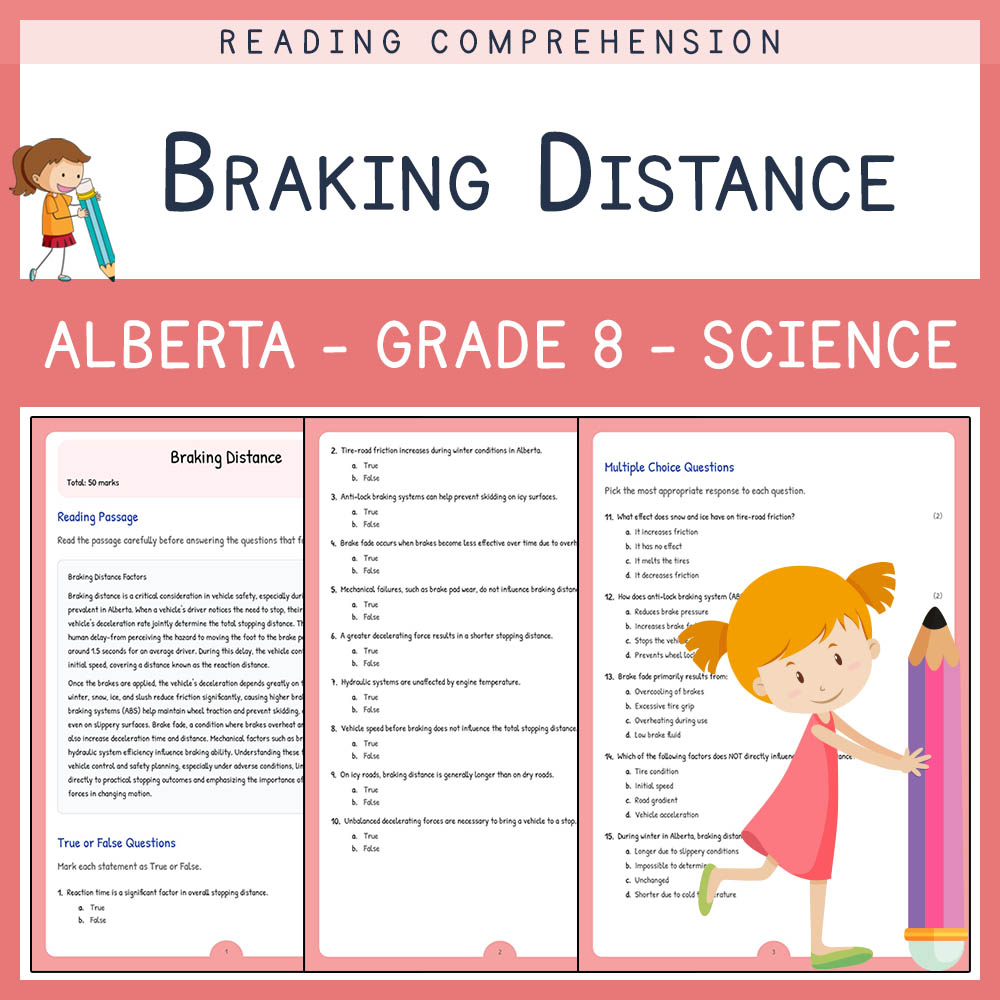
Grade 8 Science | Braking Distance Worksheet Elena | Alberta Standard
Created byLumora LearningLearning Objectives
- Understand how decelerating forces and tire-road friction affect stopping distance.
- Explore how environmental conditions like winter roads influence braking effectiveness.
- Learn about mechanical systems such as anti-lock braking systems and brake fade.
Instant download
Browse more categories
About Grade 8 Worksheets
Explore Grade 8 worksheets in math, ELA, science, and social studies. Our 8,326 Grade 8 printables print straight from PDF, answer keys included.
Each resource here is built by an independent educator and reviewed for quality. Worksheets print straight from PDF and suit classroom use, homework, or extra practice; most come with answer keys, and you can preview before purchasing.