
Grade 9 Worksheets
9,322 grade resources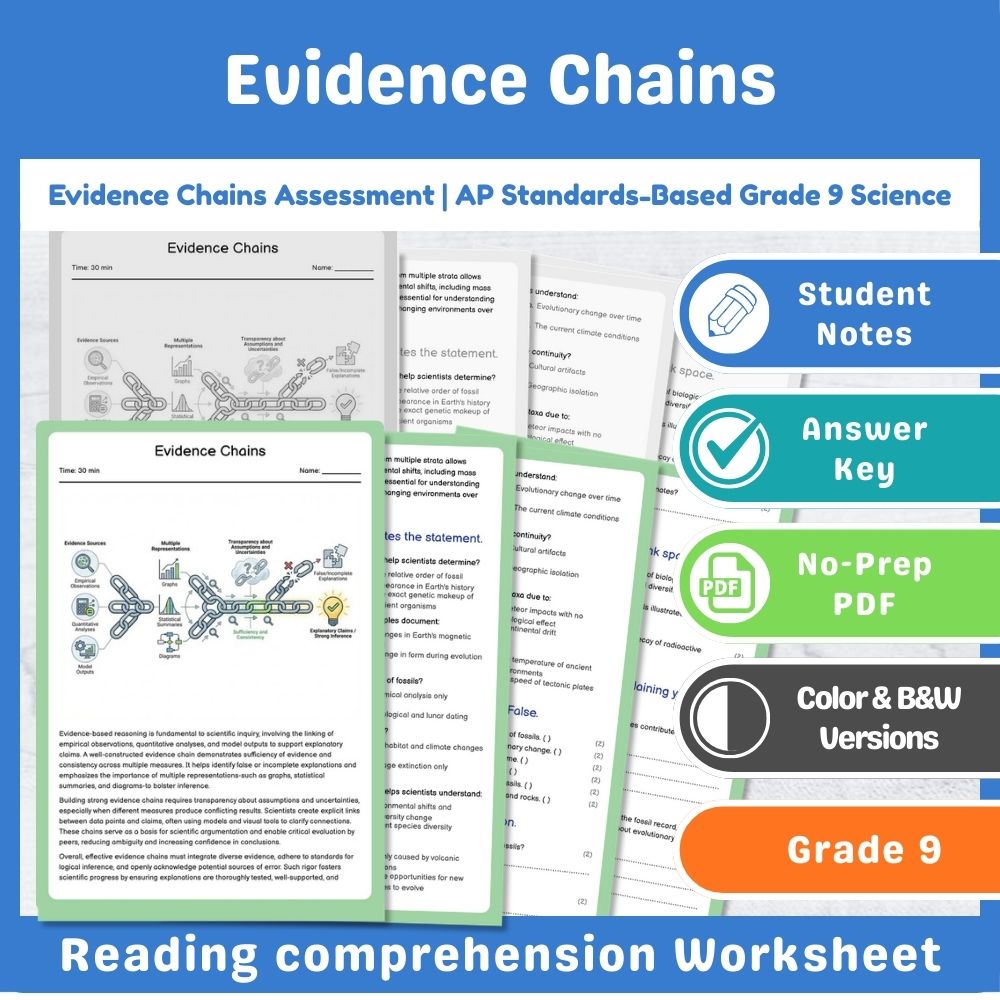
Evidence Chains Assessment | AP Standards-Based Grade 9 Science
 Created byPrism Point Learning
Learning Objectives
- Understand the structure of evidence-based reasoning linking observations, analyses, and claims.
- Identify criteria for sufficiency, consistency, and alternative explanations in scientific reasoning.
- Use multiple representations—graphs, summaries, diagrams—to support inferences.
Instant download
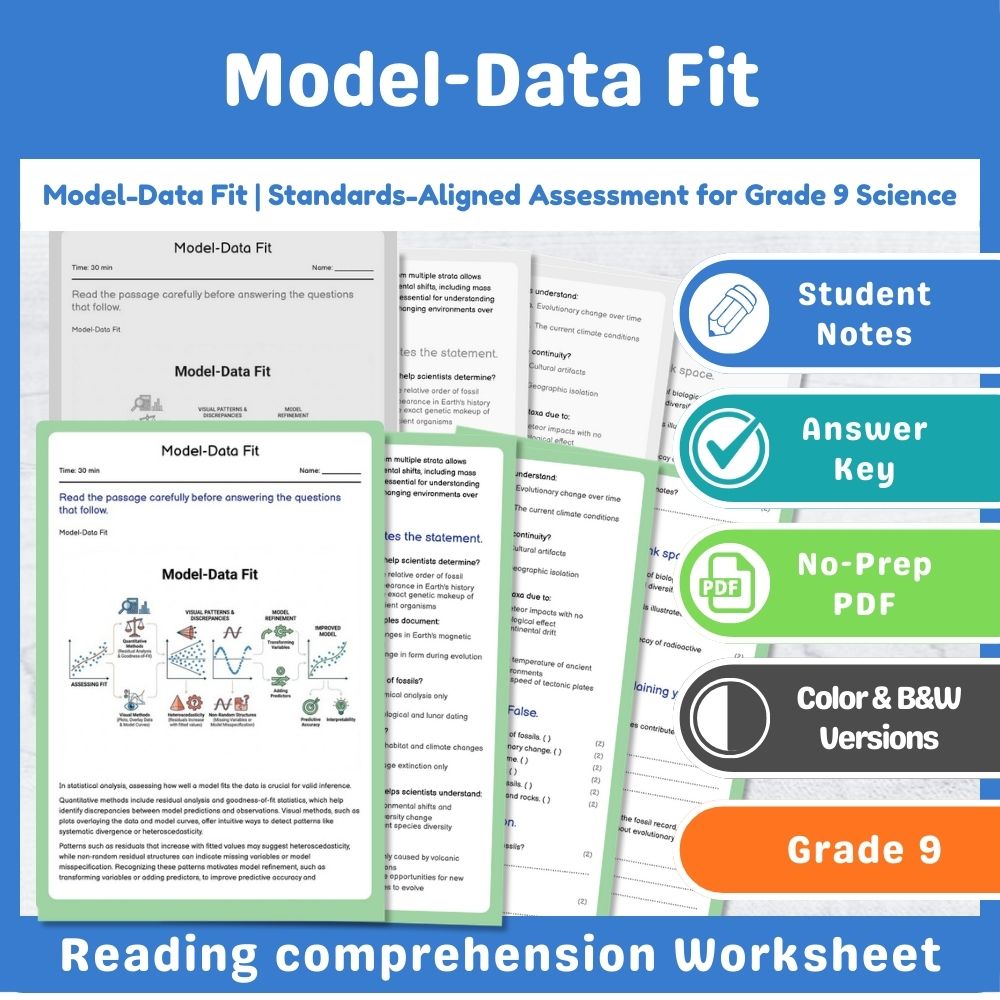
Model-Data Fit Assessment | Standards-Aligned Assessment for Grade 9 Science
Created byPrism Point LearningLearning Objectives
- Understand methods for assessing the fit between models and empirical data.
- Identify diagnostic patterns indicating systematic divergence, heteroscedasticity, or missing variables.
- Explain the significance of residual analysis and goodness-of-fit measures in model validation.
Instant download
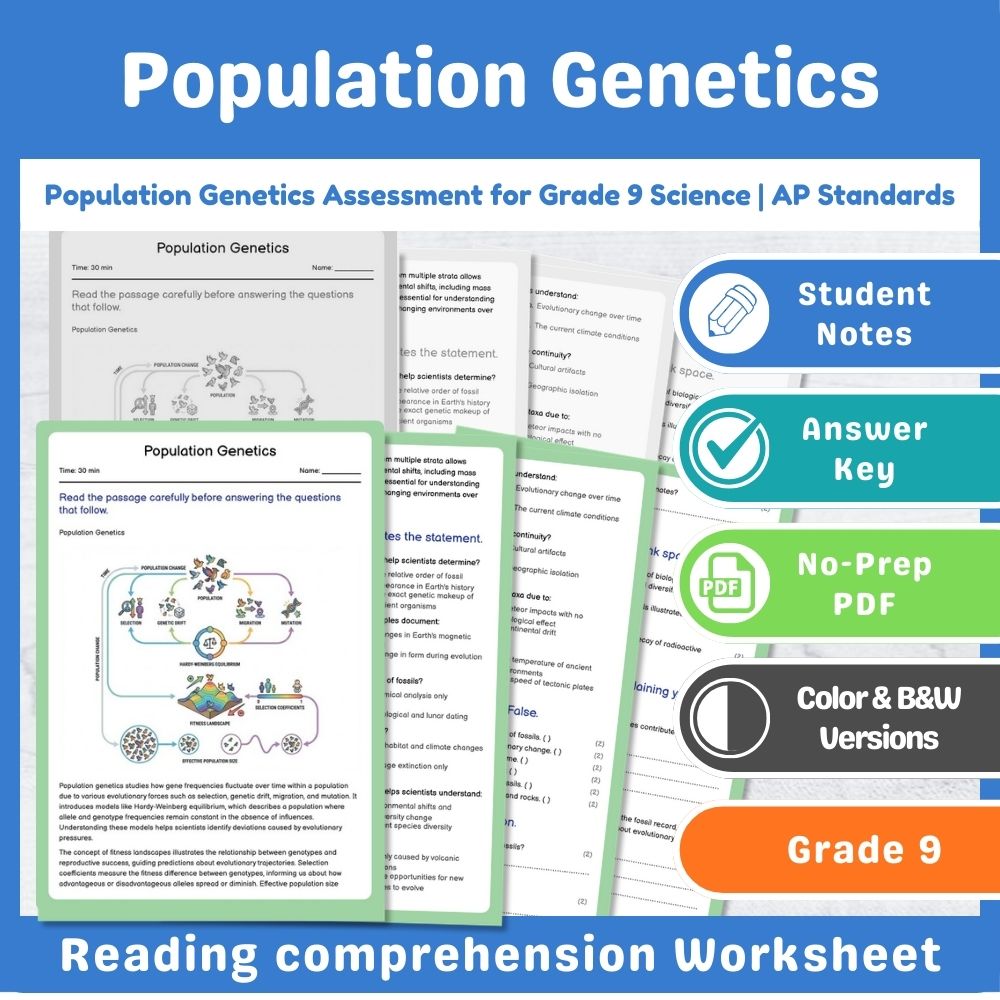
Population Genetics Assessment for Grade 9 Science | AP Standards
Created byPrism Point LearningLearning Objectives
- Understand the mechanisms that cause allele frequencies to change in populations such as selection, drift, migration, and mutation.
- Explain the Hardy-Weinberg equilibrium as a null model for population genetics.
- Describe how fitness landscapes, selection coefficients, and effective population size influence evolution.
Also included in: Grade 9 Science Mini Bundle | Biology & Ecosystems Unit AP Standards
Instant download
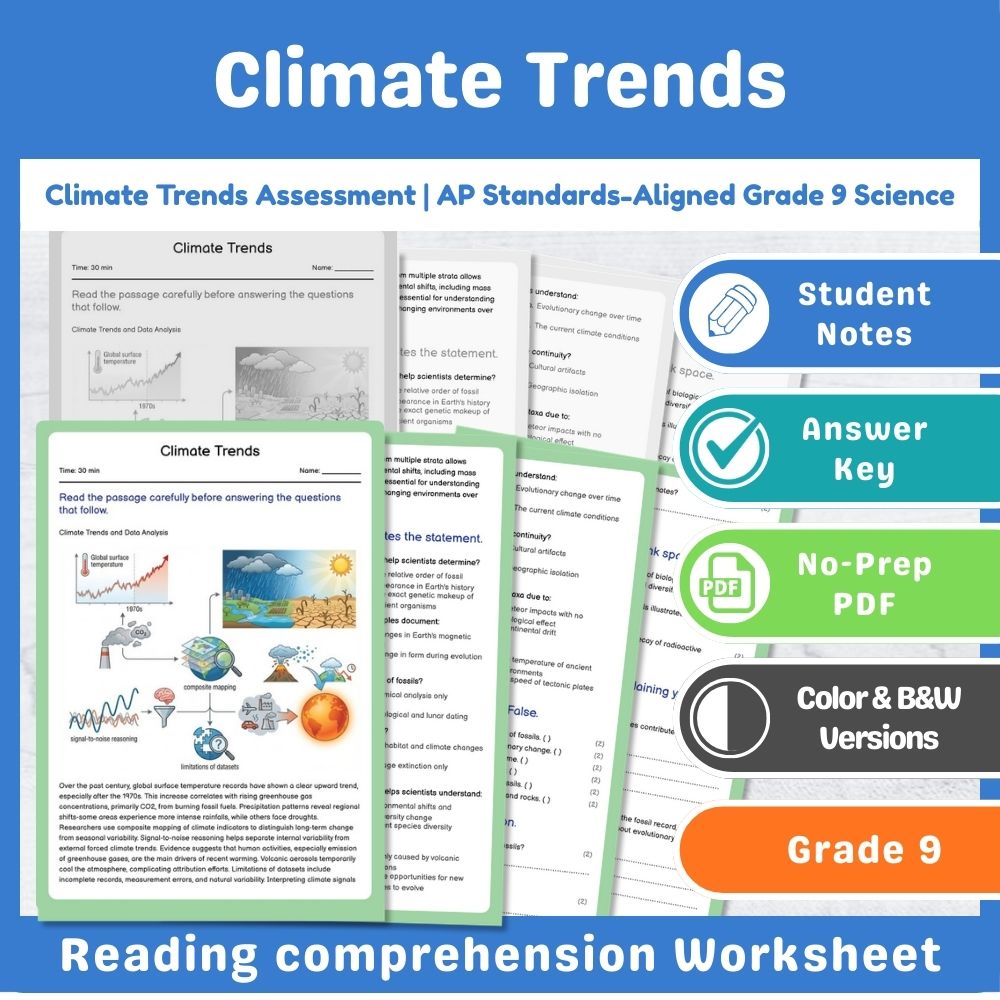
Climate Trends Assessment | AP Standards-Aligned Grade 9 Science
Created byPrism Point LearningLearning Objectives
- Analyze spatial and temporal climate datasets to identify trends and anomalies.
- Apply statistical trend analysis and composite mapping techniques.
- Interpret potential climate drivers by comparing datasets with external forcings.
Also included in: Grade 9 Science Mini Bundle | Earth and Space Sciences AP Standards
Instant download
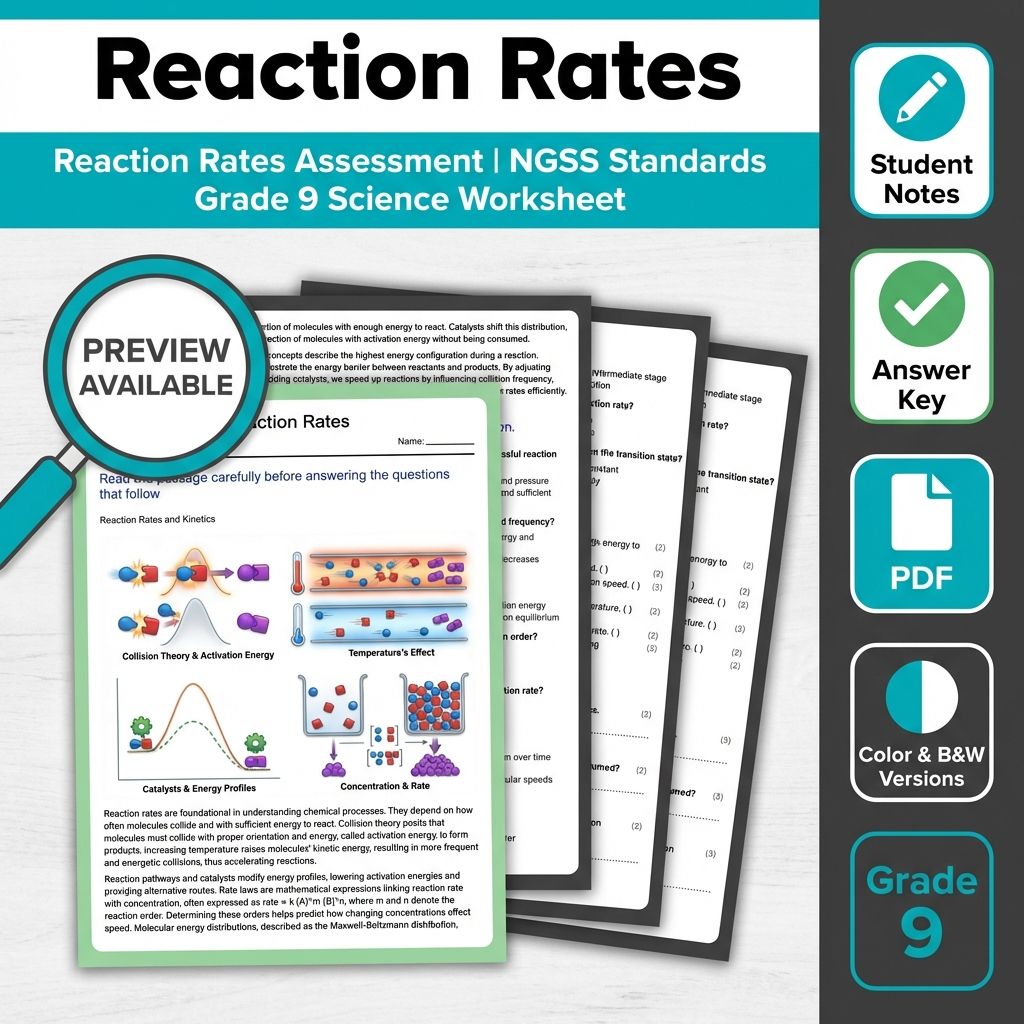
Reaction Rates Assessment | NGSS Standards Grade 9 Science Worksheet
Created byPrism Point LearningLearning Objectives
- Explain how collision frequency, activation energy, and reaction pathways influence reaction rates.
- Describe how temperature, concentration, and catalysts alter energy distributions and affect reaction speeds.
- Interpret rate laws and determine reaction order from experimental data.
Instant download
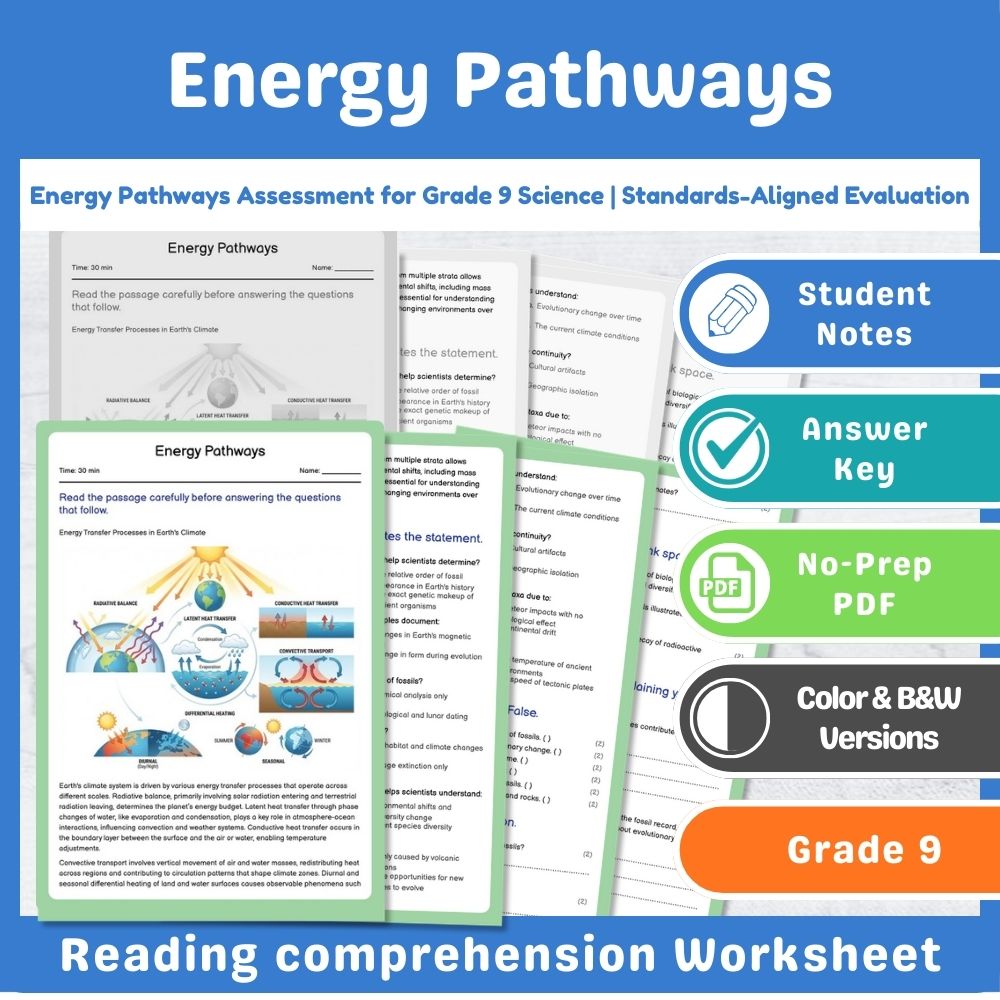
Energy Pathways Assessment for Grade 9 Science | Standards-Aligned Evaluation
Created byPrism Point LearningLearning Objectives
- Describe the processes involved in energy transfer within the atmosphere and ocean.
- Interpret how differential heating influences circulation patterns and weather.
- Identify various energy fluxes using diagrams and tables, and relate them to climate indicators.
Also included in: Grade 9 Science Mini Bundle | Earth and Space Sciences AP Standards
Instant download
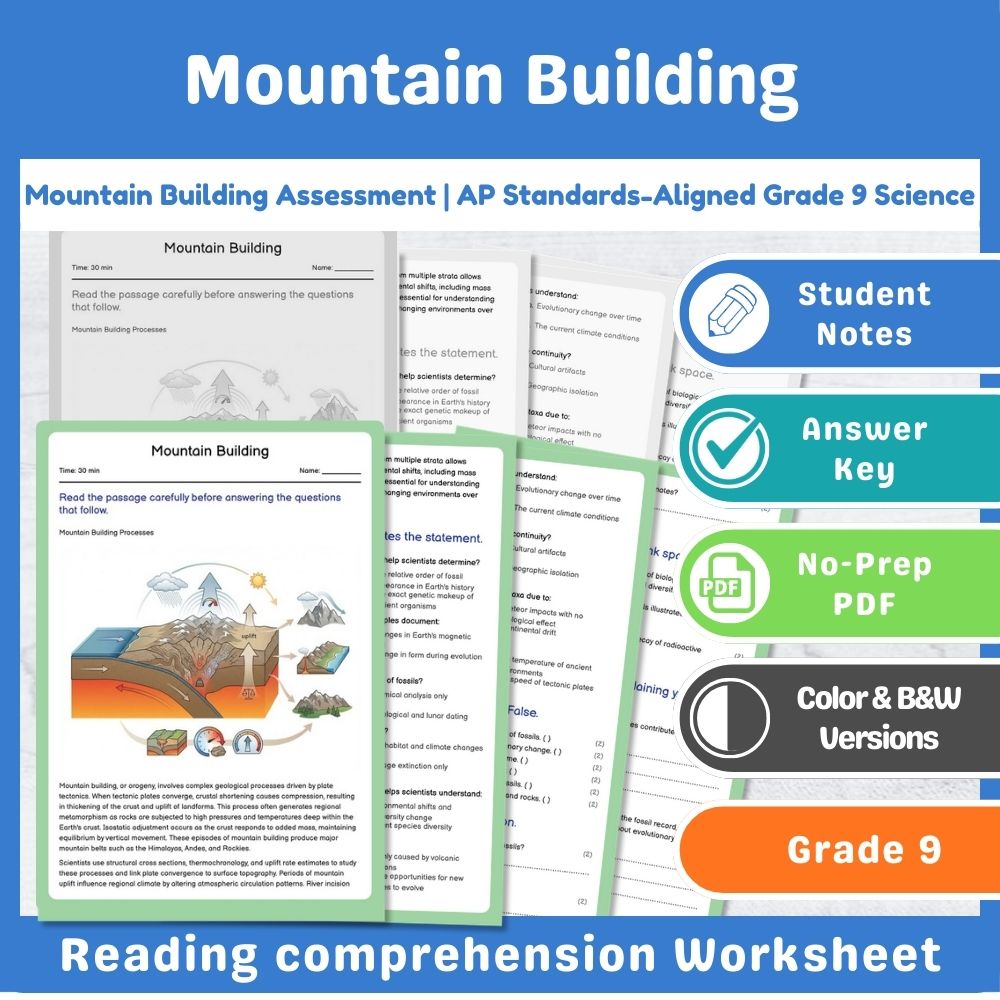
Mountain Building Assessment | AP Standards-Aligned Grade 9 Science
Created byPrism Point LearningLearning Objectives
- Understand the geological processes involved in mountain formation, including crustal shortening, thickening, and metamorphism.
- Explain how isostatic adjustment influences mountain uplift and erosion patterns.
- Link plate convergence to changes in surface topography and regional climate effects.
Also included in: Grade 9 Science Mini Bundle | Earth and Space Sciences AP Standards
Instant download
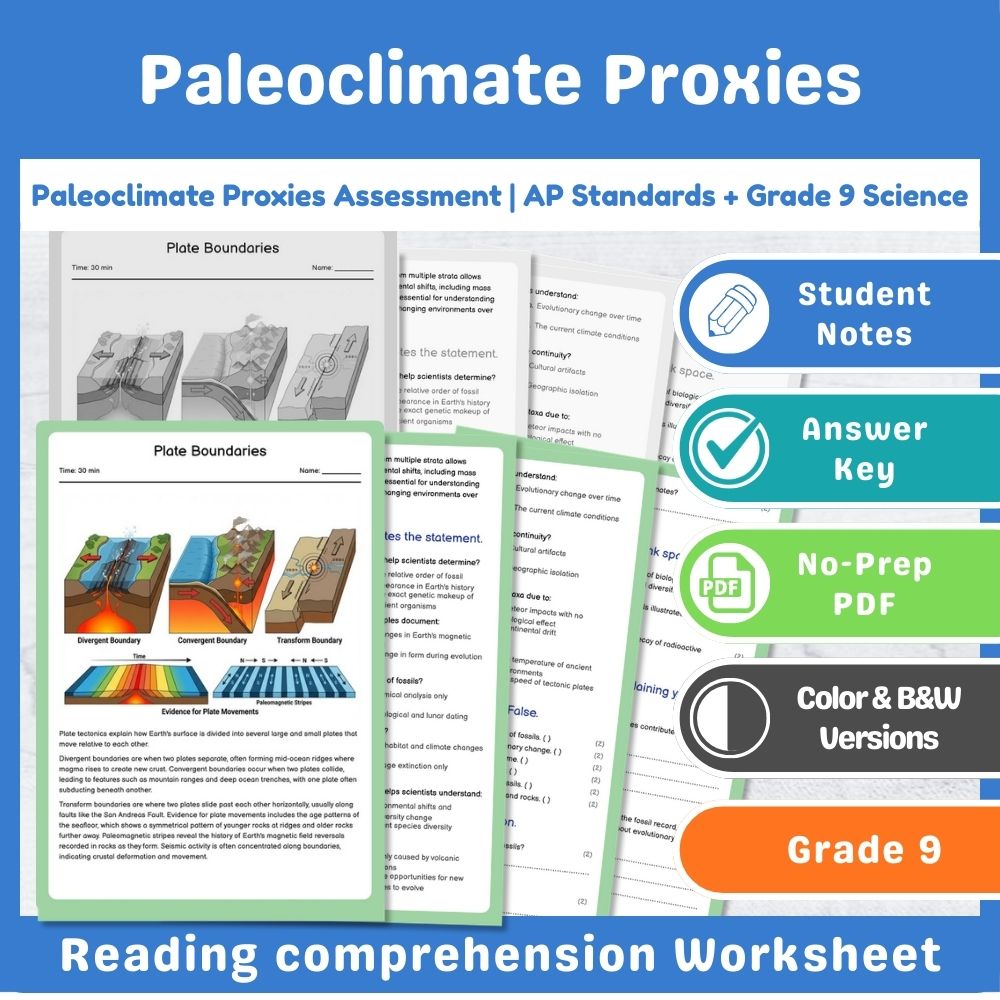
Paleoclimate Proxies Assessment | AP Standards + Grade 9 Science
Created byPrism Point LearningLearning Objectives
- Interpret paleoclimate evidence from ice cores, tree rings, marine sediments, and speleothems using proxy indicators.
- Relate proxy records to past climate variability including glacial-interglacial cycles and abrupt events.
- Employ age models and quantify uncertainties to link proxy signals to climate forcing mechanisms.
Also included in: Grade 9 Science Mini Bundle | Earth and Space Sciences AP Standards
Instant download
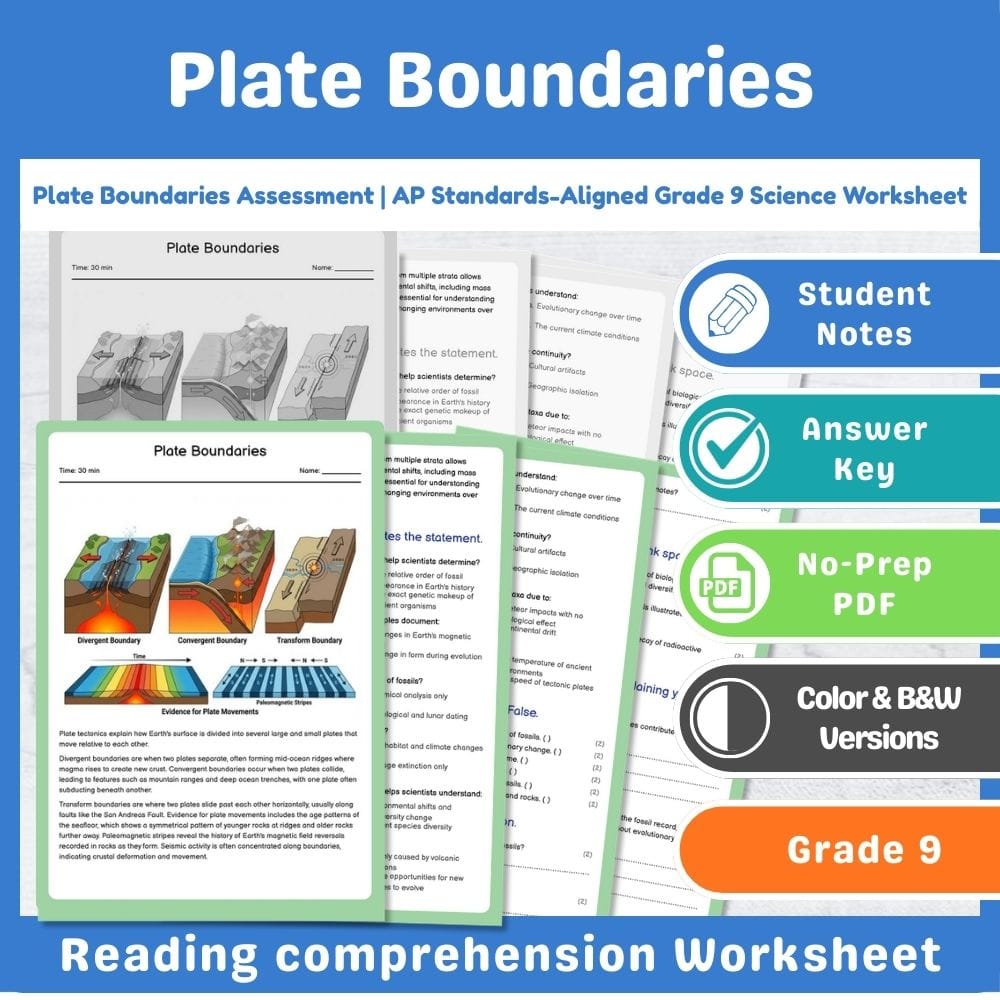
Plate Boundaries Assessment | AP Standards-Aligned Grade 9 Science Worksheet
Created byPrism Point LearningLearning Objectives
- Describe the mechanisms that drive different types of plate boundaries.
- Identify surface expressions associated with divergent, convergent, and transform margins.
- Analyze geologic evidence such as seafloor age patterns, paleomagnetic stripes, and seismic distributions to interpret plate motions.
Also included in: Grade 9 Science Mini Bundle | Earth and Space Sciences AP Standards
Instant download
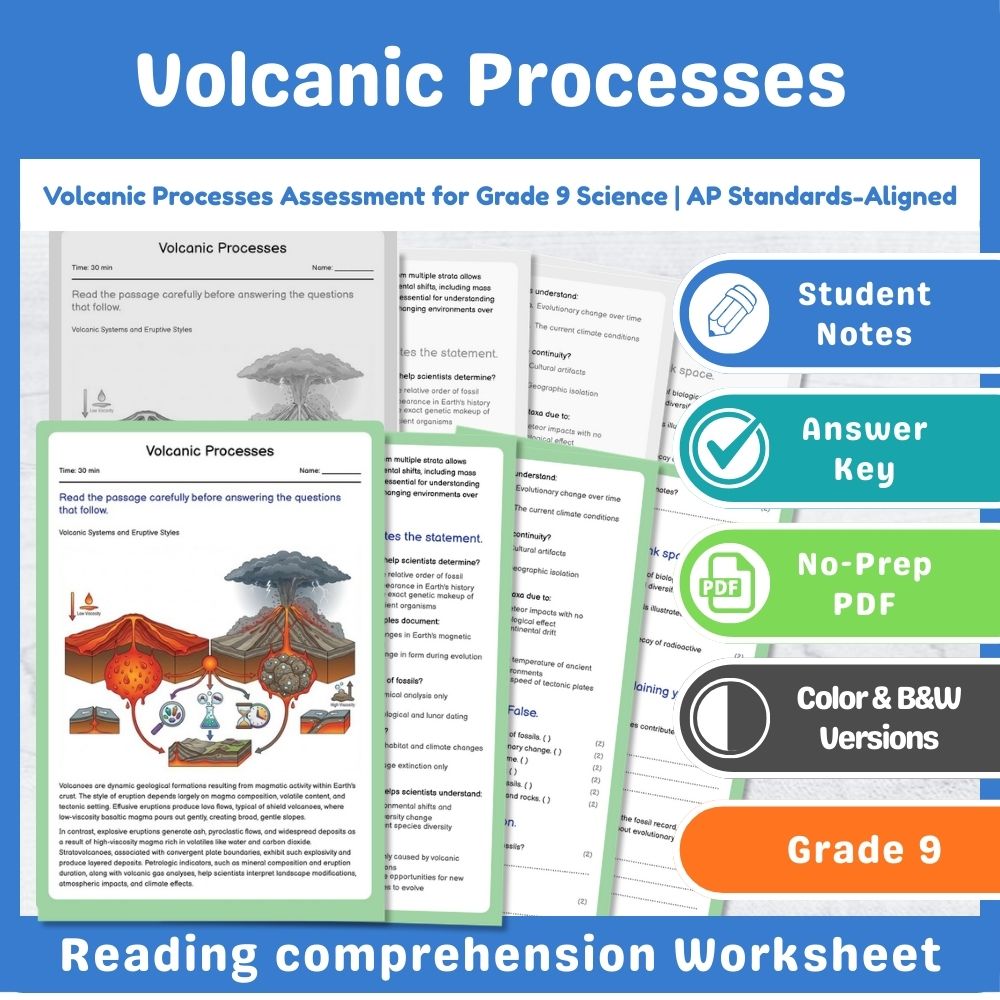
Volcanic Processes Assessment for Grade 9 Science | AP Standards-Aligned
Created byPrism Point LearningLearning Objectives
- Describe magmatic systems and eruptive styles linked to compositional and tectonic factors.
- Compare effusive shield volcanism and explosive stratovolcano behavior based on magma viscosity and volatile content.
- Explain how petrologic indicators, eruption chronologies, and volcanic gases influence landscape, climate, and biogeochemical cycles.
Also included in: Grade 9 Science Mini Bundle | Earth and Space Sciences AP Standards
Instant download
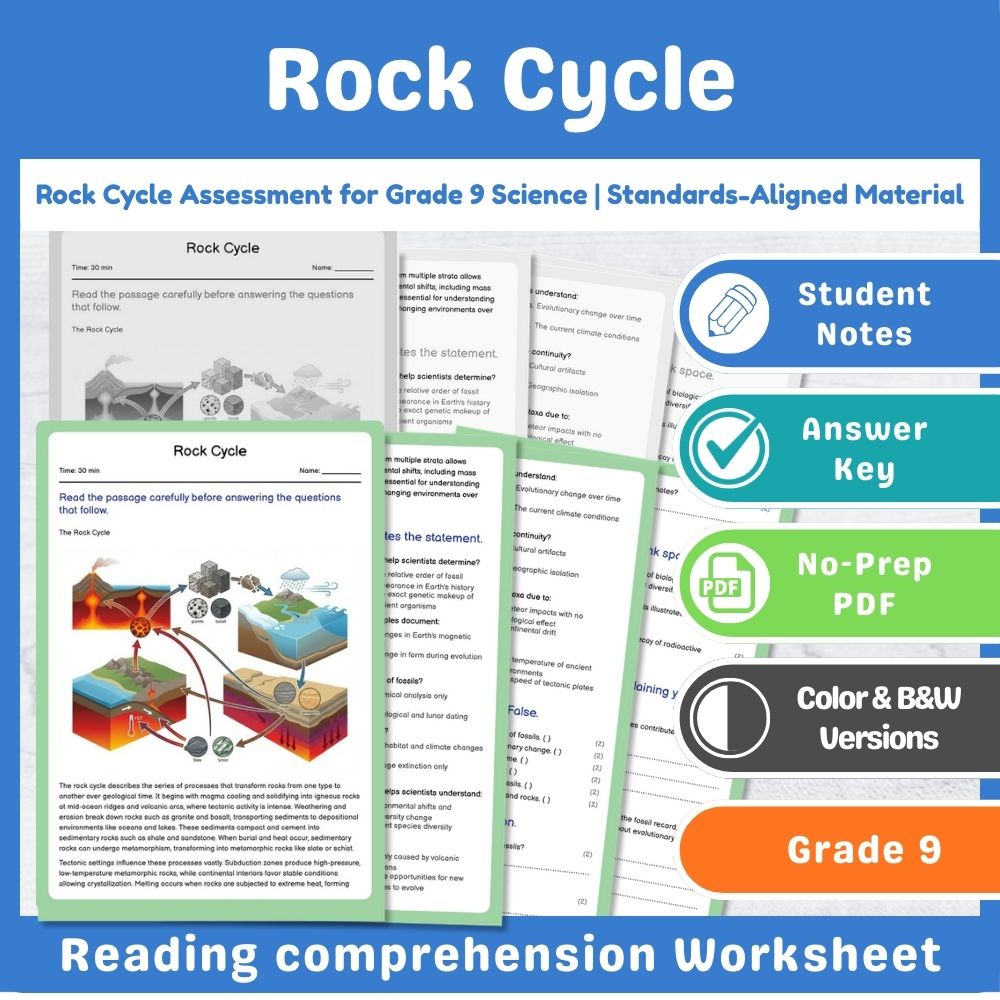
Rock Cycle Assessment for Grade 9 Science | Standards-Aligned Material
Created byPrism Point LearningLearning Objectives
- Describe the processes involved in the rock cycle and how different rocks transform through geological mechanisms.
- Explain the role of tectonic settings such as mid-ocean ridges, subduction zones, and continental interiors in rock formation.
- Identify the physical and chemical processes that drive changes in rocks and their link to landscape evolution.
Also included in: Grade 9 Science Mini Bundle | Earth and Space Sciences AP Standards
Instant download
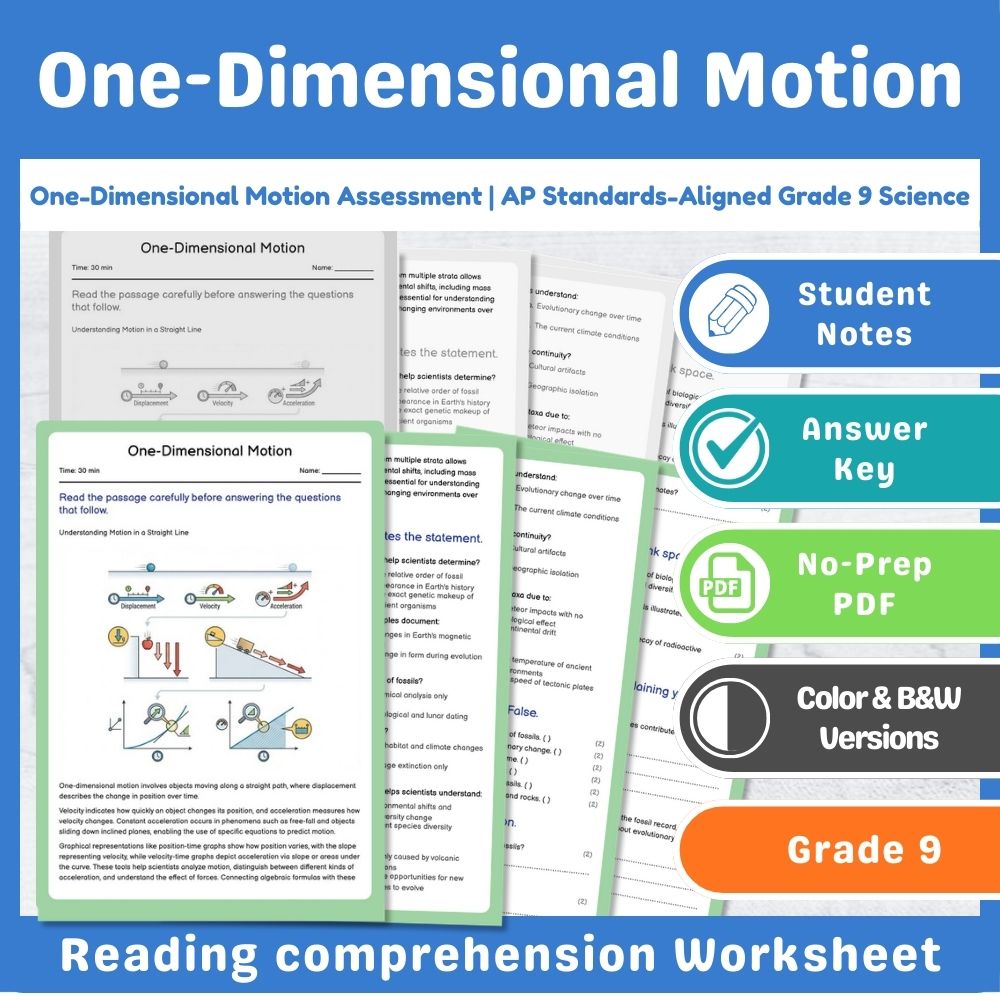
One-Dimensional Motion Assessment | AP Standards-Aligned Grade 9 Science
Created byPrism Point LearningLearning Objectives
- Understand and interpret position–time and velocity–time diagrams for motion along a straight line.
- Apply constant-acceleration equations to solve for displacement, velocity, and time.
- Connect algebraic models with graphical representations of motion such as slopes and areas under curves.
Also included in: Lesson Bundle | Grade 9 Science Assessment for Motion and Forces
Instant download

Trophic Transfers And Efficiency Assessment Grade 9 Science Printable
Created byPrism Point LearningLearning Objectives
- Explain how energy is transferred among organisms in a food chain.
- Describe the concept of energy transfer efficiency and its impact on biomass.
- Interpret evidence like population sizes, biomass trends, and nutrient concentrations to analyze trophic levels.
Also included in: Grade 9 Ecology, Genetics, and Cells Science Lesson Bundle – General
Instant download

Wave Property Links Assessment | General Grade 9 Science Standards-Aligned
Created byPrism Point LearningLearning Objectives
- Understand how changes in wave parameters affect wave signatures.
- Relate wave frequency, wavelength, and amplitude to energy and pattern spacing.
- Interpret different wave representations and how a single source can produce varied signatures.
Instant download
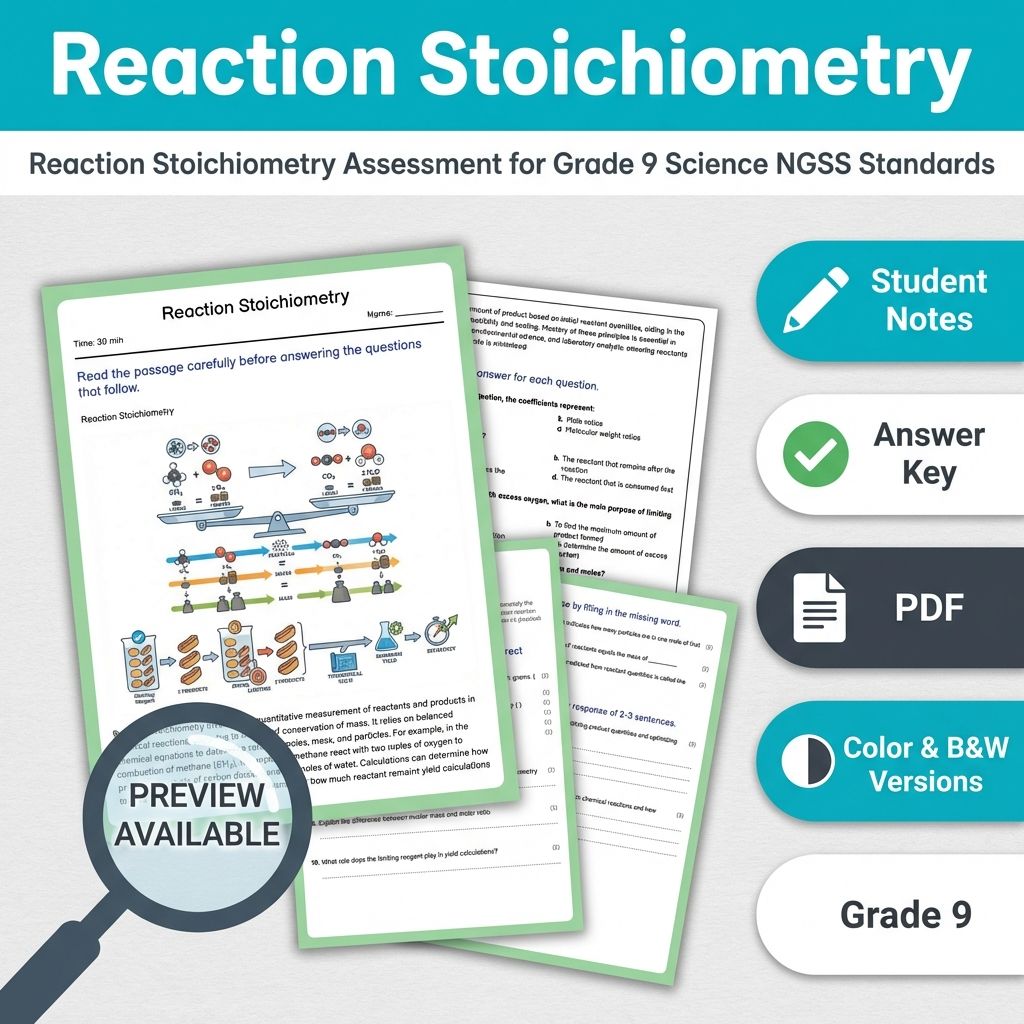
Reaction Stoichiometry Assessment for Grade 9 Science NGSS Standards
Created byPrism Point LearningLearning Objectives
- Understand the principles of mole ratios in balanced chemical equations.
- Apply molar mass conversions to relate mass and moles in reactions.
- Analyze limiting reagents and determine theoretical yields in chemical reactions.
Instant download

Organ Systems Assessment | TEKS Grade 9 Science Standards
Created byPrism Point LearningLearning Objectives
- Understand the roles of different organ systems in maintaining homeostasis.
- Identify the functions of the circulatory, respiratory, digestive, renal, nervous, and endocrine systems.
- Explain how organ systems communicate and regulate physiological processes.
Also included in: Grade 9 Regulation & Communication Science Assessment Lesson Bundle TEKS
Instant download

Glycolysis Overview Assessment | TEKS Grade 9 Science Standards
Created byPrism Point LearningLearning Objectives
- Describe the main steps involved in glycolysis.
- Identify key enzymes and intermediates in glycolysis.
- Explain the energy investment and payoff phases of glycolysis.
Instant download

Nucleic Acid Structure Assessment for Grade 9 Science | TEKS
Created byPrism Point LearningLearning Objectives
- Describe the chemical structures of DNA and RNA and the role of nucleotides.
- Explain the significance of double helix formation, antiparallel strands, and base pairing in DNA.
- Differentiate between DNA and RNA in terms of structure and function.
Instant download
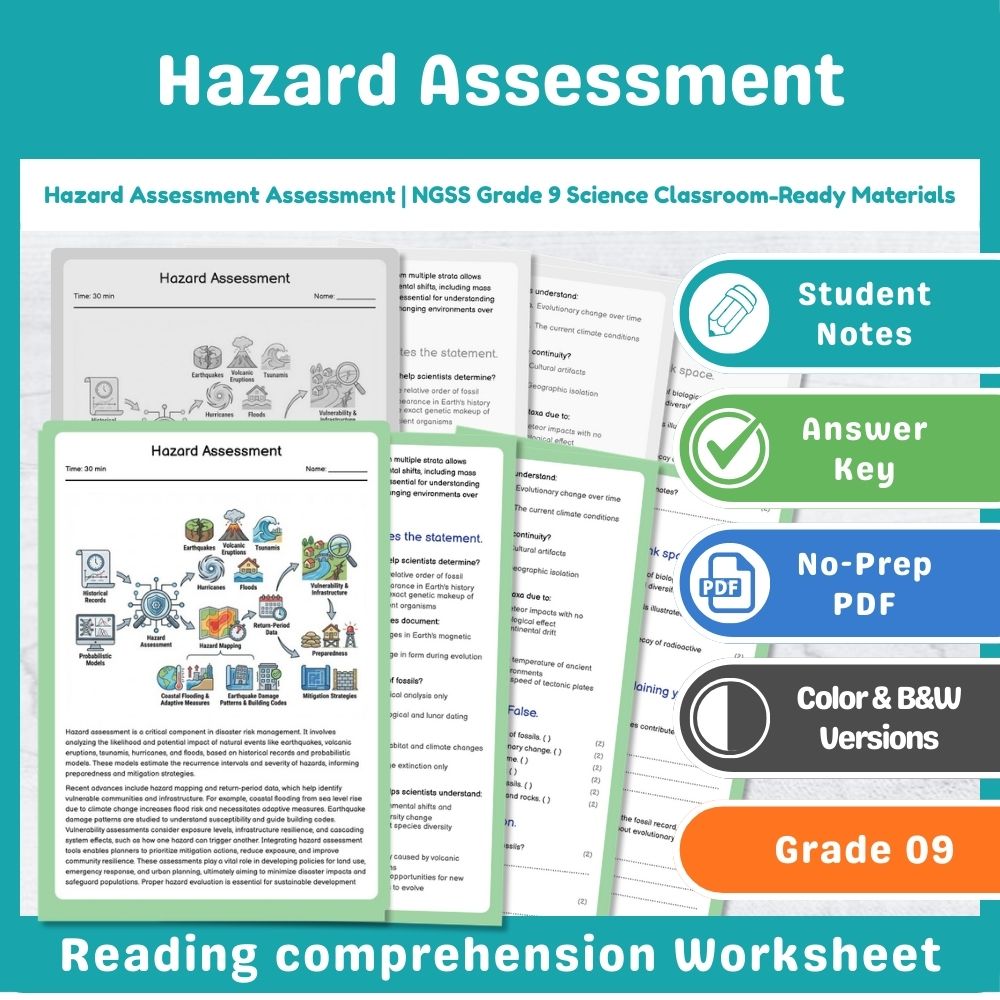
Hazard Assessment Assessment | NGSS Grade 9 Science Classroom-Ready Materials
Created byPrism Point LearningLearning Objectives
- Understand the methods used to evaluate hazard risks such as earthquakes, volcanoes, tsunamis, hurricanes, and floods.
- Analyze hazard occurrence, frequency, and consequences using historical data and probabilistic models.
- Recognize the importance of hazard mapping, return-period data, and mitigation strategies in assessing community susceptibility.
Instant download
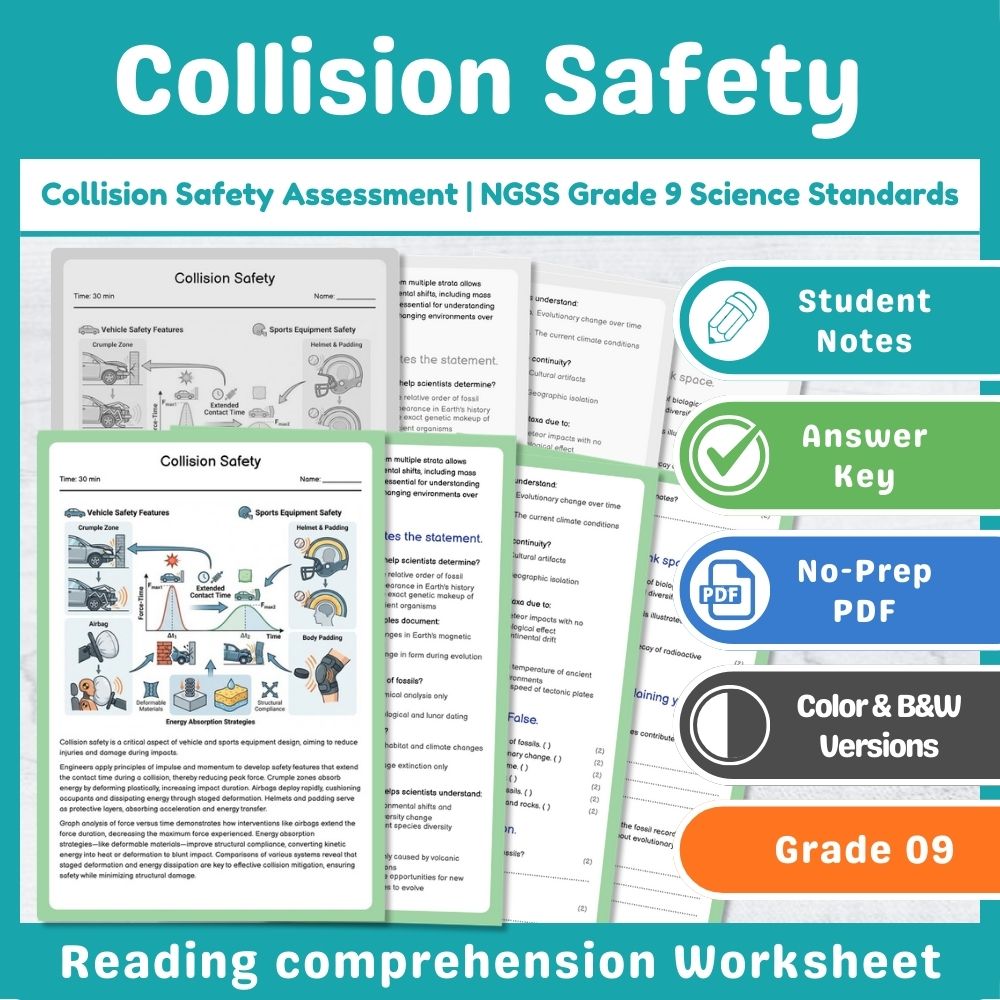
Collision Safety Assessment | NGSS Grade 9 Science Standards
Created byPrism Point LearningLearning Objectives
- Understand how impulse and force-time tradeoffs influence collision mitigation strategies.
- Identify engineering design features such as crumple zones, airbags, and helmets for safer high-impact interactions.
- Analyze force-time graphs and energy absorption techniques to evaluate shock absorption effectiveness.
Instant download
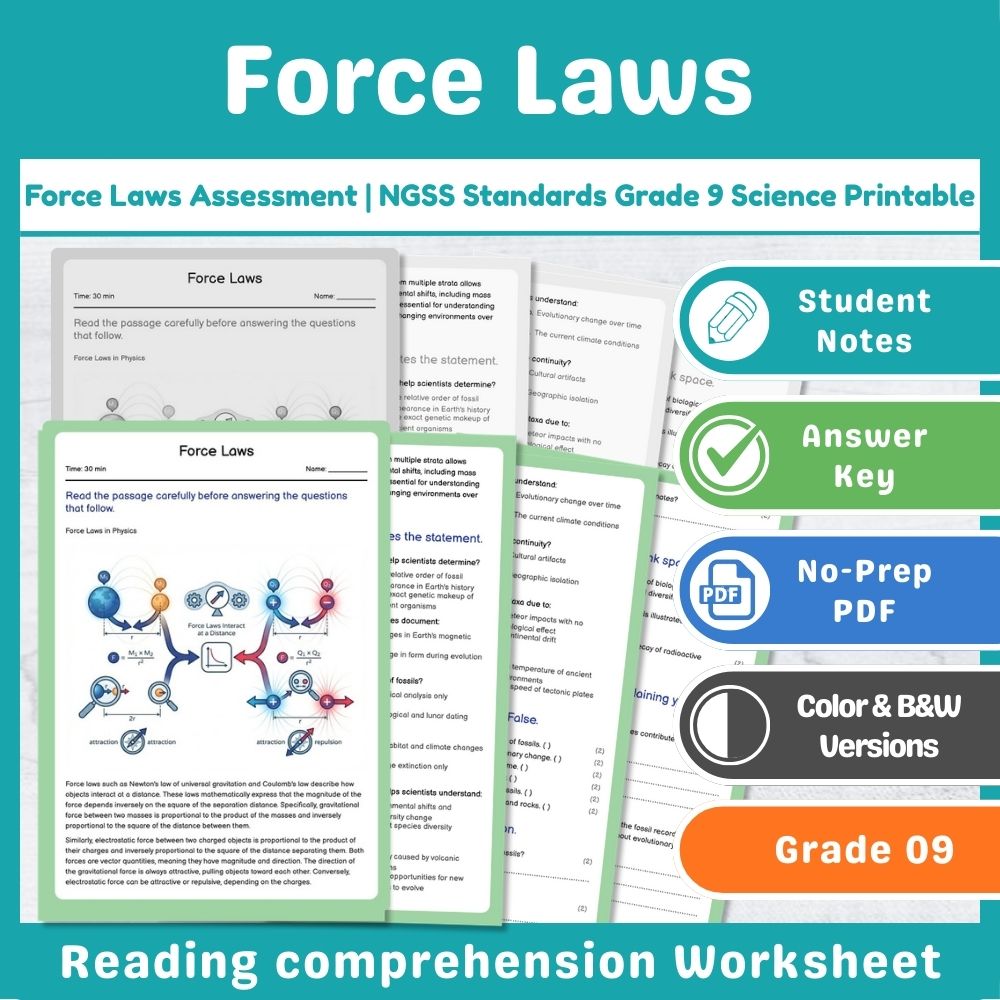
Field Dynamics Assessment | NGSS Standards Grade 9 Science
Created byPrism Point LearningLearning Objectives
- Understand the concepts of electric and magnetic fields and how they influence forces on charges and currents.
- Interpret field vectors and maps, and utilize field lines to represent direction and magnitude.
- Apply principles of superposition, forces, and motion curvature in uniform magnetic fields.
Instant download
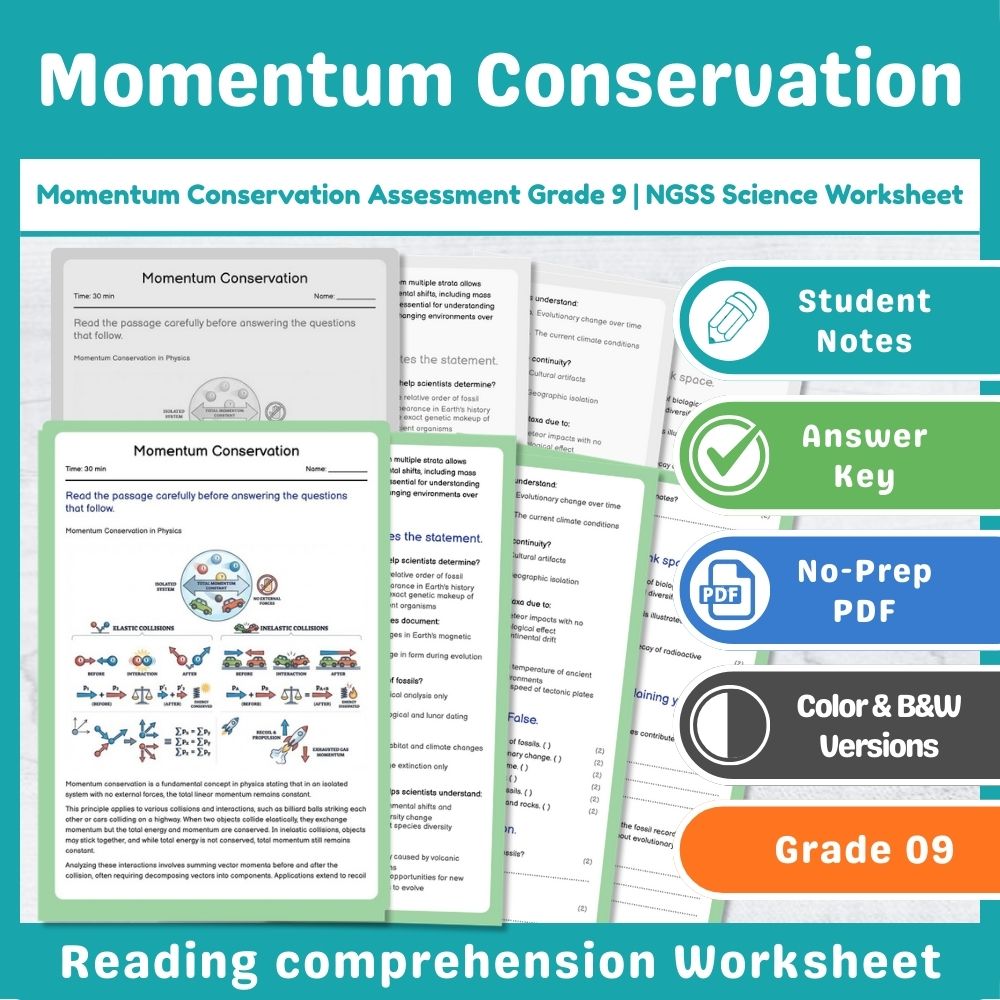
Momentum Conservation Assessment Grade 9 | NGSS Science Worksheet
Created byPrism Point LearningLearning Objectives
- Understand the principle of conservation of linear momentum in isolated systems.
- Differentiate between elastic and inelastic collisions using vector sums.
- Calculate total momentum before and after interactions in various scenarios.
Instant download
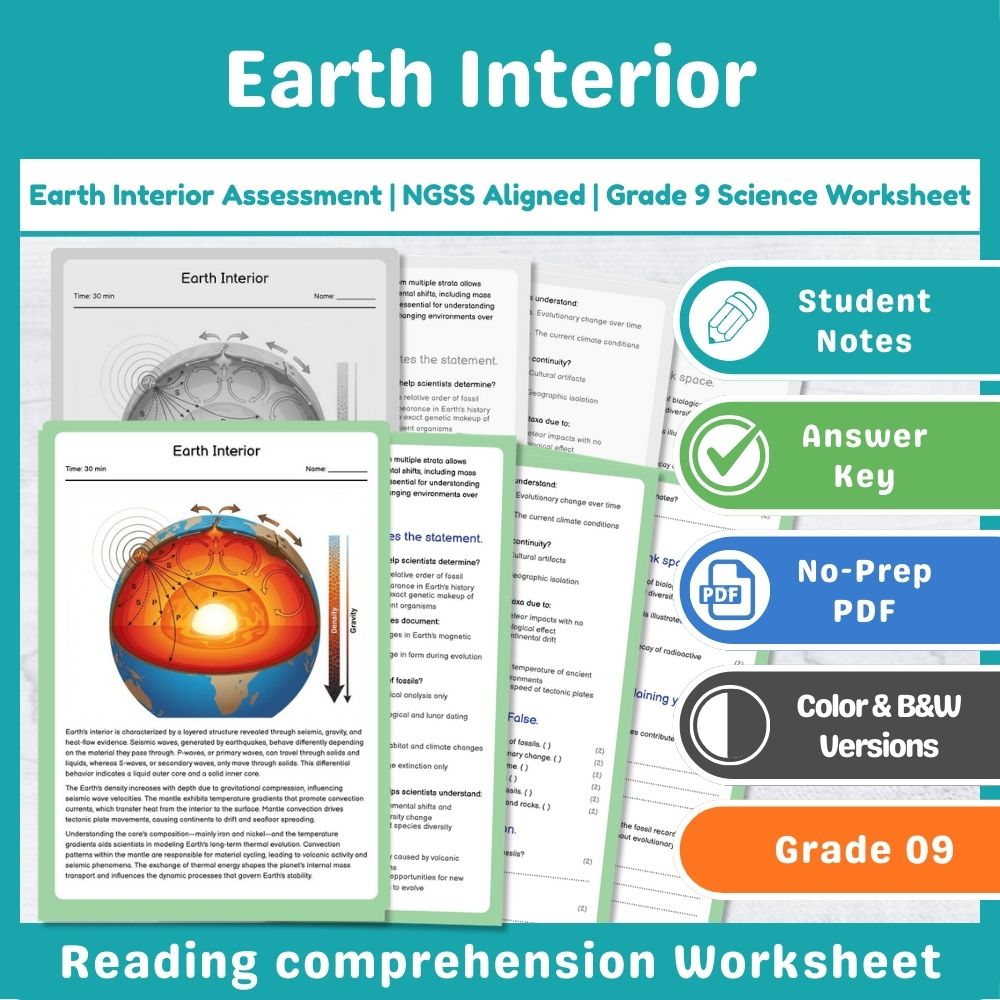
Earth Interior Assessment | NGSS Aligned | Grade 9 Science Worksheet
Created byPrism Point LearningLearning Objectives
- Describe the layered structure of Earth's interior based on seismic evidence.
- Interpret the behaviors of P-waves and S-waves to understand Earth's composition.
- Explain the transfer of thermal energy within Earth and its impact on planetary processes.
Instant download
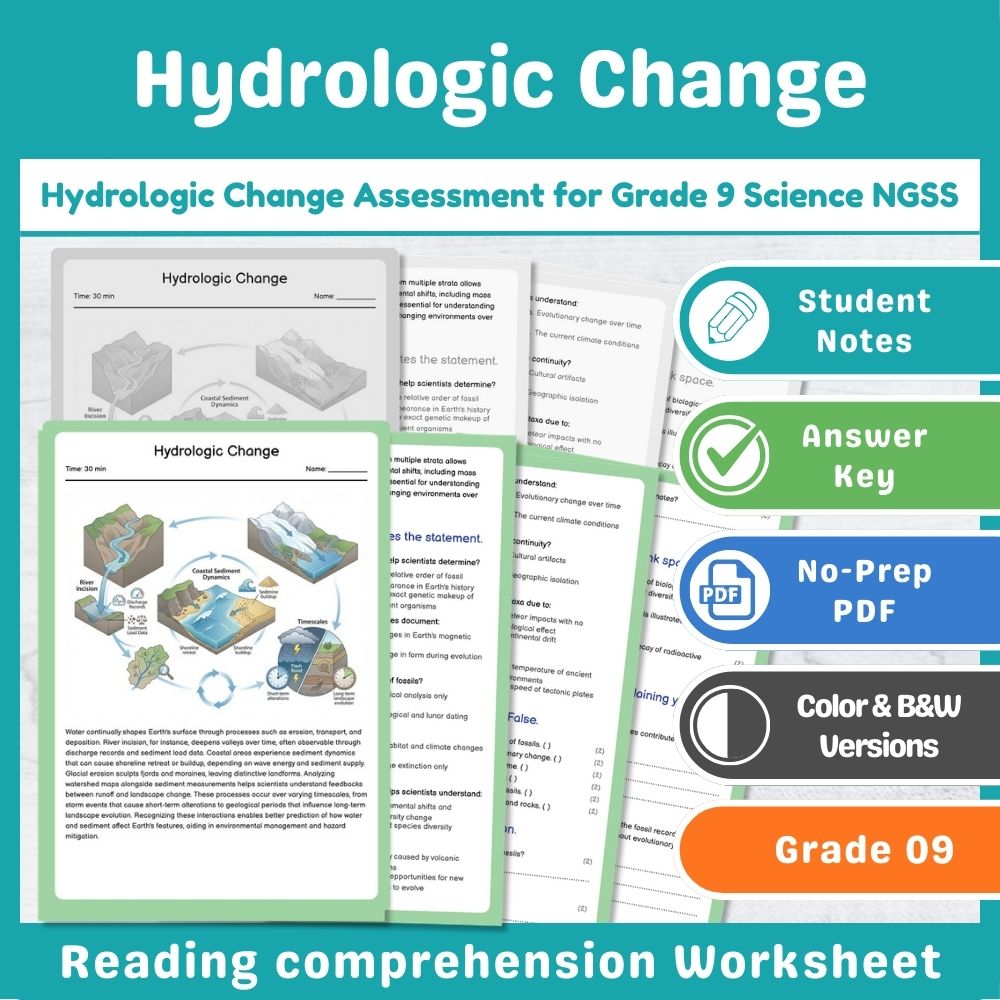
Hydrologic Change Assessment for Grade 9 Science NGSS
Created byPrism Point LearningLearning Objectives
- Analyze and interpret hydrologic data related to erosion, transport, and deposition.
- Identify how river incision, coastal sediment dynamics, and glacial erosion shape landscapes.
- Understand how discharge records, sediment load measurements, and watershed maps support hydrologic studies.
Instant download

Physical Changes Assessment Grade 9 | Alberta Science Standards-Aligned
Created byPrism Point LearningLearning Objectives
- Define and distinguish between physical and chemical changes.
- Identify everyday examples of physical changes in various environments.
- Explain the reversibility of physical changes and how they conserve the identity of substances.
Also included in: Grade 9 Matter and Chemical Change Science Lesson Bundle | Alberta +1 more
Instant download

Rock Transformations Assessment for Grade 9 Science | NGSS Standards
Created byPrism Point LearningLearning Objectives
- Describe the processes involved in the rock cycle, including melting, crystallization, erosion, and metamorphism.
- Identify examples of rock cycle processes, such as basalt formation, sandstone deposition, and metamorphic rocks.
- Explain how temperature, pressure, and fluid flow influence rock transformation and geologic timescales.
Instant download
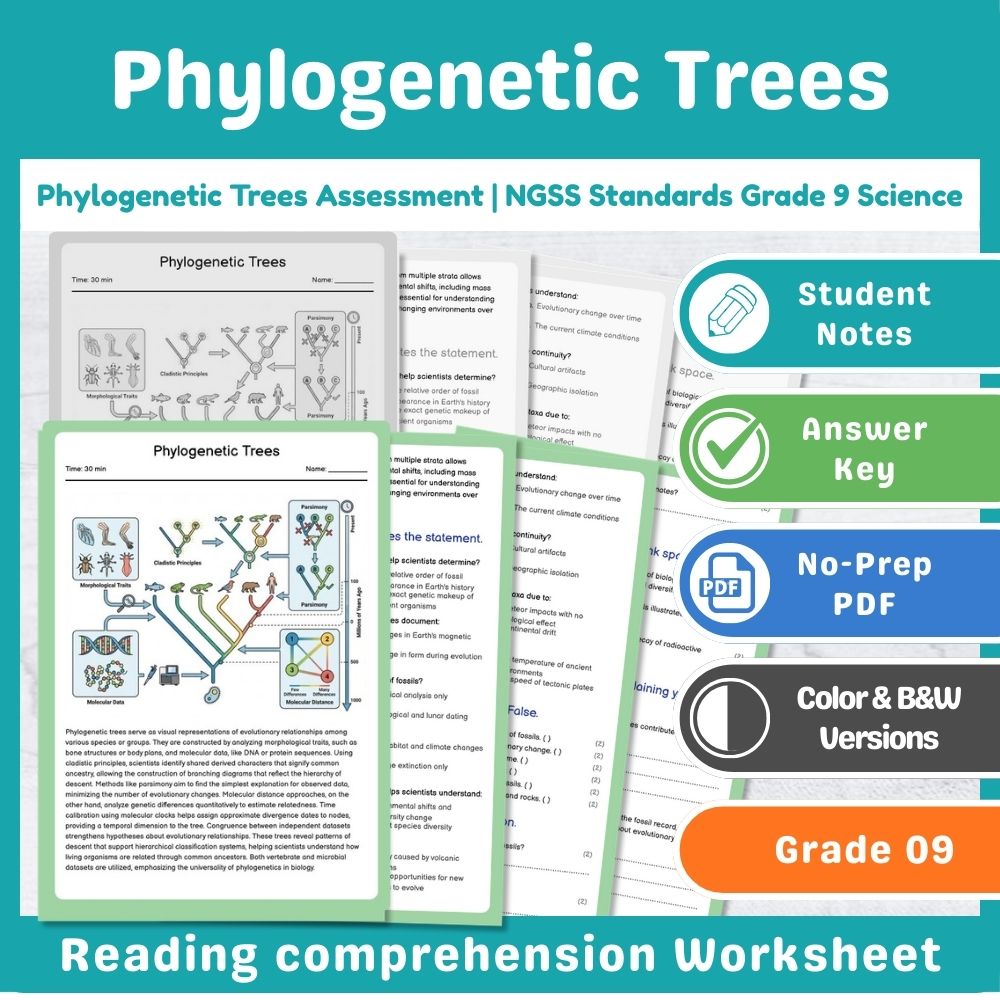
Phylogenetic Trees Assessment | NGSS Standards Grade 9 Science
Created byPrism Point LearningLearning Objectives
- Understand the construction principles of phylogenetic trees and their significance in evolutionary biology.
- Interpret branching diagrams to identify common ancestors and shared derived characters.
- Learn different methods of tree-building such as parsimony and molecular distance analyses.
Instant download
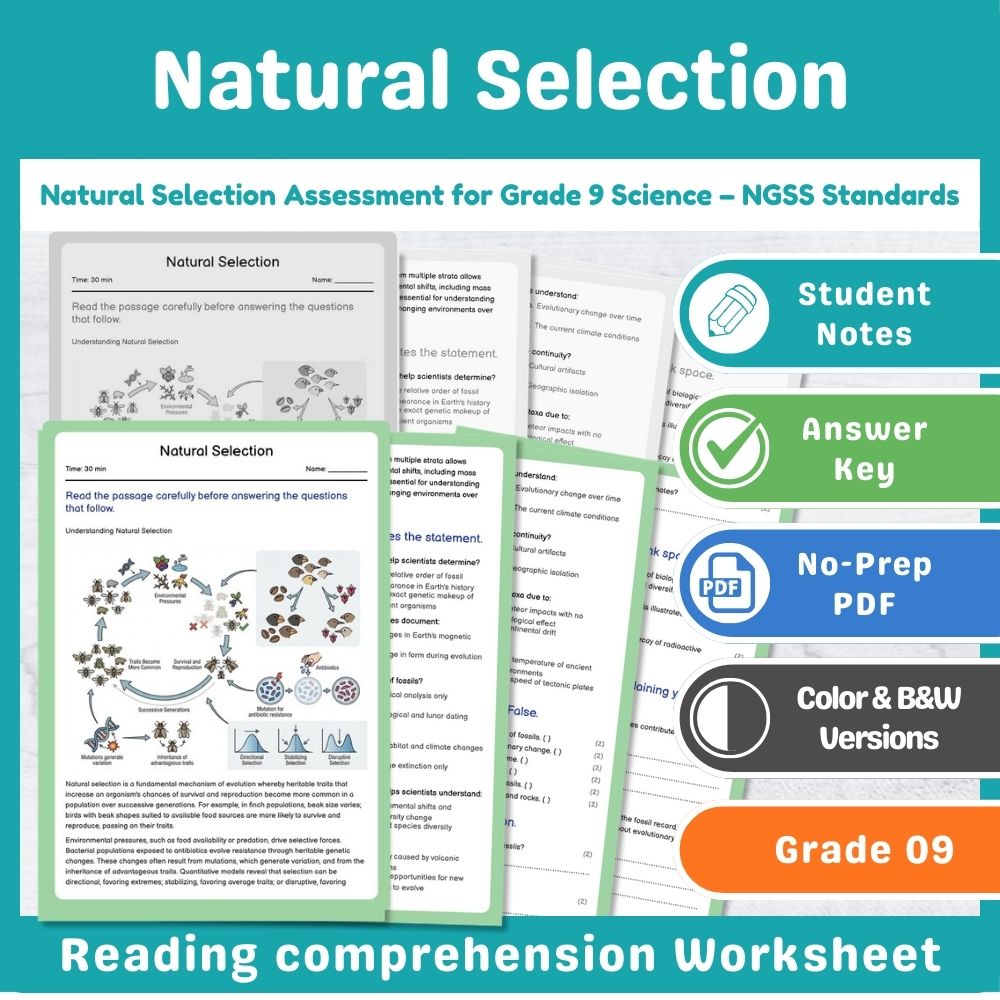
Natural Selection Assessment for Grade 9 Science – NGSS Standards
Created byPrism Point LearningLearning Objectives
- Explain the mechanisms of natural selection, including variation, inheritance, and selection pressures.
- Identify classic examples of natural selection, such as finch beak morphology and bacterial resistance.
- Describe how models of fitness and allele frequency determine different types of selection.
Instant download

Energy Conservation Assessment | NGSS Standards Grade 9 Science
Created byPrism Point LearningLearning Objectives
- Explain the principles of energy conservation in closed and open systems.
- Identify system boundaries and perform energy bookkeeping calculations.
- Use energy flow diagrams to analyze energy transfer within systems.
Instant download
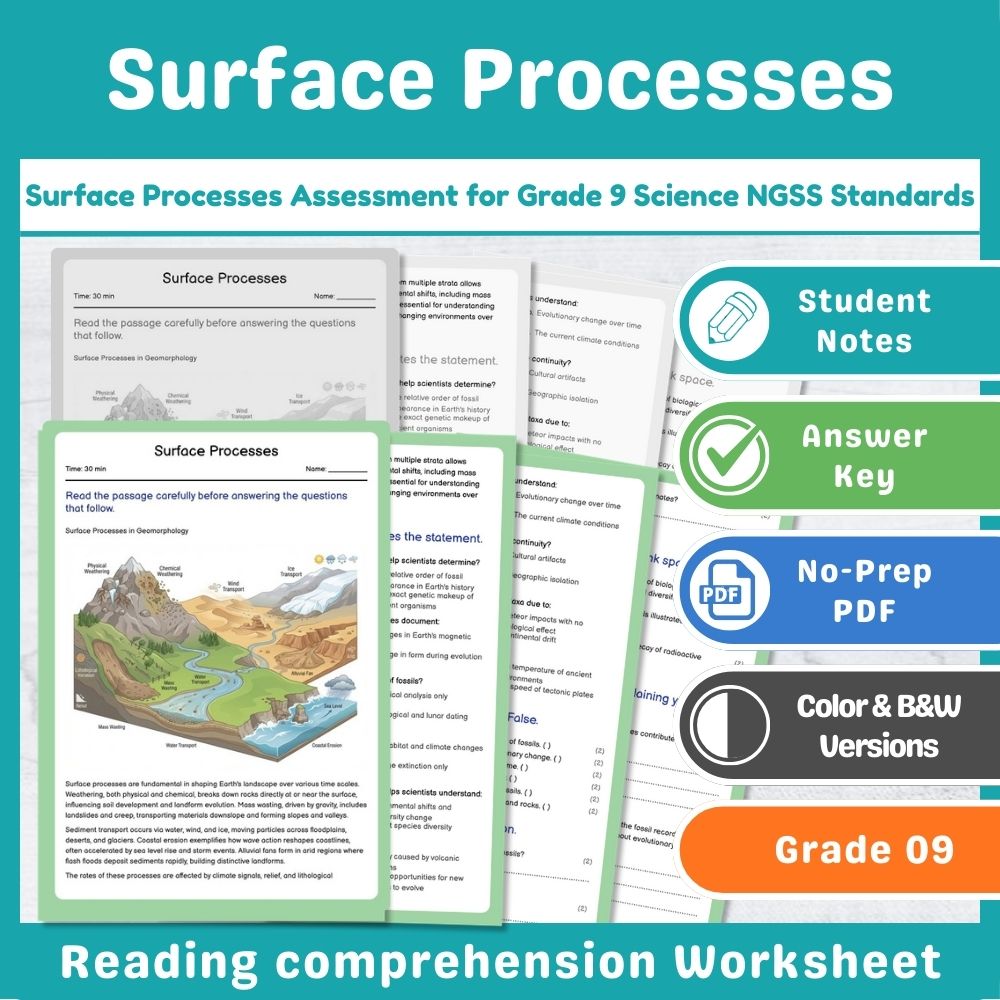
Surface Processes Assessment for Grade 9 Science NGSS Standards
Created byPrism Point LearningLearning Objectives
- Understand the different types of surface processes that shape landscapes.
- Analyze the factors influencing the rates and patterns of weathering, erosion, and sediment transport.
- Evaluate examples of geomorphic change like coastal erosion and alluvial fan formation.
Instant download
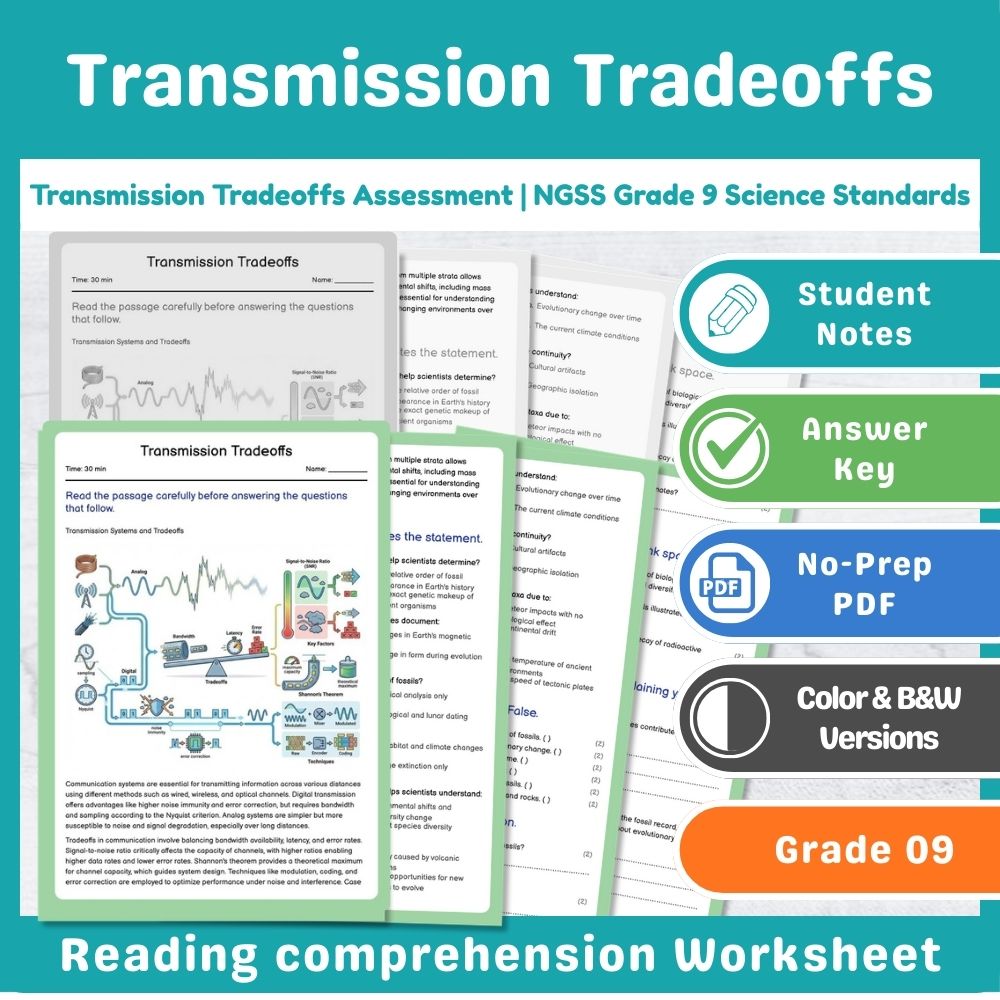
Transmission Tradeoffs Assessment | NGSS Grade 9 Science Standards
Created byPrism Point LearningLearning Objectives
- Understand the tradeoffs involved in digital and analog communication systems.
- Analyze the impact of bandwidth constraints, signal-to-noise ratio, and sampling criteria on transmission quality.
- Evaluate error-correcting techniques and their effect on data integrity in noisy environments.
Instant download

Comparative Evaluation Assessment for Grade 9 Science | NGSS Standards
Created byPrism Point LearningLearning Objectives
- Understand the principles of comparative evaluation in engineering design.
- Identify quantitative and qualitative performance metrics for system assessment.
- Apply decision frameworks and matrices to evaluate design trade-offs.
Instant download

Force Fundamentals Assessment for Grade 9 Science | Alberta Standards
Created byPrism Point LearningLearning Objectives
- Understand the basic concepts of forces, including contact and non-contact forces.
- Identify and describe real-world examples of forces in Alberta settings.
- Apply qualitative reasoning to analyze opposing forces before numerical calculation.
Also included in: Grade 9 Forces and Motion Science Lesson Bundle Alberta Framework +1 more
Instant download
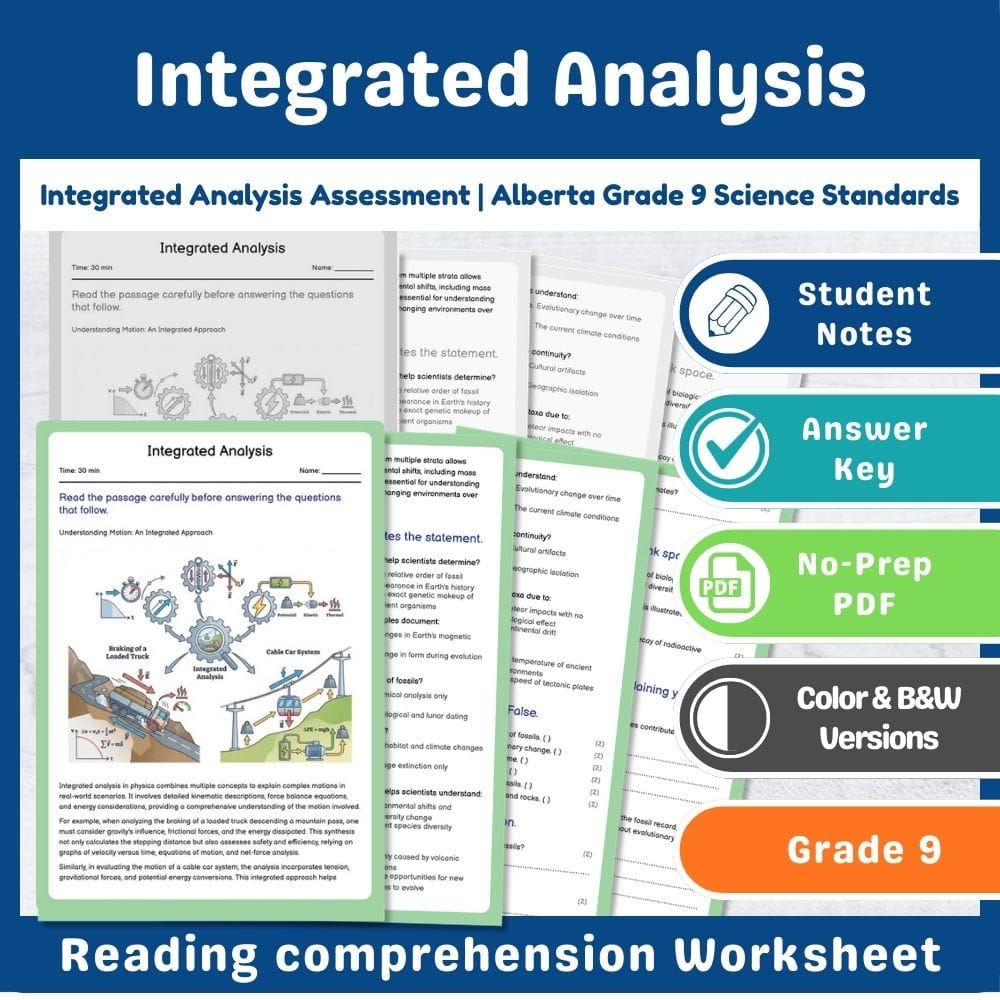
Integrated Analysis Assessment | Alberta Grade 9 Science Standards
Created byPrism Point LearningLearning Objectives
- Explain how kinematic descriptions, force balances, and energy considerations integrate to analyze complex motion scenarios.
- Apply graphs, equations, and net-force reasoning to predict motion outcomes in transport contexts.
- Interpret combined physical principles in real-world Alberta transportation and recreational situations.
Also included in: Grade 9 Forces and Motion Science Lesson Bundle Alberta Framework +1 more
Instant download

Kinematic Concepts Assessment | Alberta Standards Grade 9 Science
Created byPrism Point LearningLearning Objectives
- Describe how objects move using scalar and vector measures such as speed, velocity, and acceleration.
- Explain the differences between speed, velocity, and acceleration with real-world examples.
- Apply unit conversions and sign conventions to analyze and compare motion in different regional contexts.
Also included in: Grade 9 Forces and Motion Science Lesson Bundle Alberta Framework +1 more
Instant download

Graphing Motion Assessment for Grade 9 Science | Alberta Standards
Created byPrism Point LearningLearning Objectives
- Understand how to interpret displacement–time, velocity–time, and acceleration–time graphs.
- Learn how to determine physical quantities such as speed, acceleration, and displacement from graph slopes and areas.
- Identify curved segments in graphs that indicate changing acceleration.
Also included in: Grade 9 Forces and Motion Science Lesson Bundle Alberta Framework +1 more
Instant download

Net Force Analysis Assessment for Grade 9 Science | Alberta Standards
Created byPrism Point LearningLearning Objectives
- Understand the concept of net force as the vector sum of forces acting on an object.
- Apply principles of vector addition to analyze forces in practical scenarios.
- Evaluate the effects of opposing forces such as friction and air resistance on motion.
Also included in: Grade 9 Forces and Motion Science Lesson Bundle Alberta Framework +1 more
Instant download
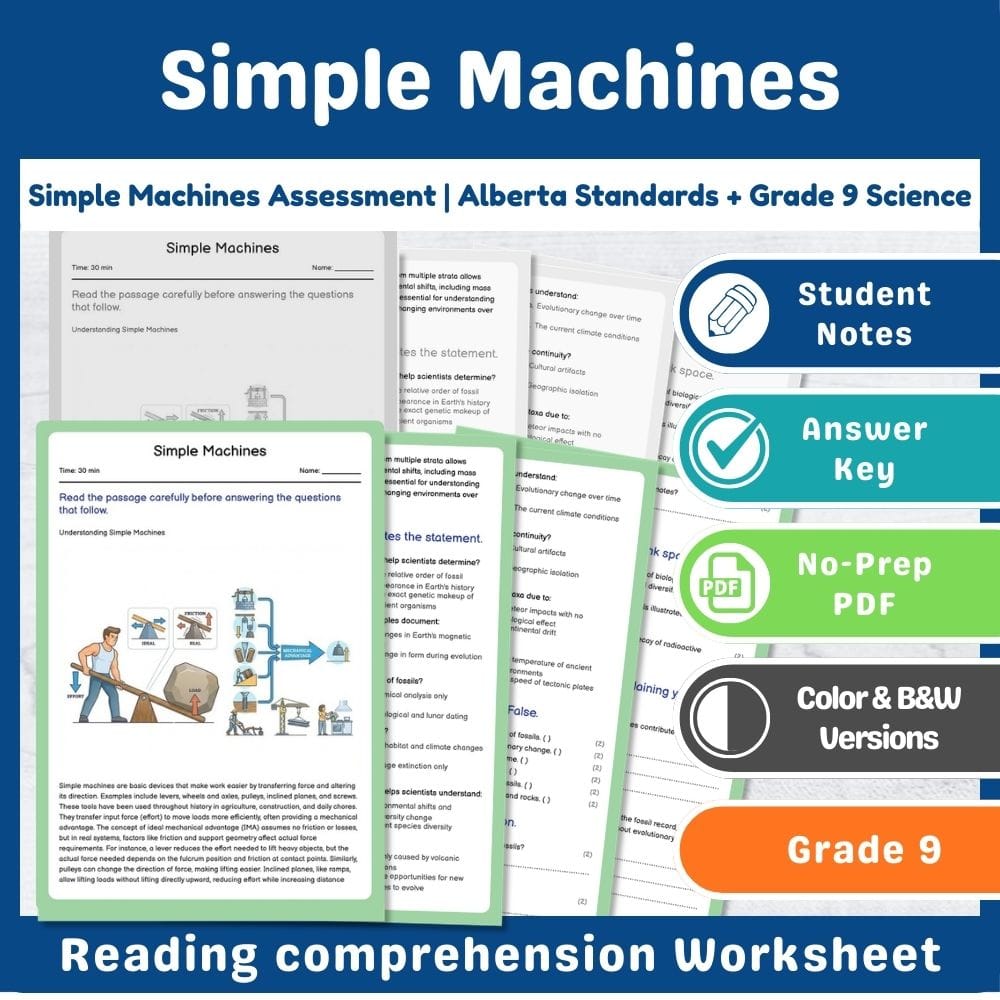
Simple Machines Assessment | Alberta Standards + Grade 9 Science
Created byPrism Point LearningLearning Objectives
- Describe the different types of simple machines and their functions.
- Explain how simple machines reduce effort and change the direction of force.
- Differentiate between ideal and actual mechanical advantage in systems involving simple machines.
Also included in: Grade 9 Forces and Motion Science Lesson Bundle Alberta Framework +1 more
Instant download
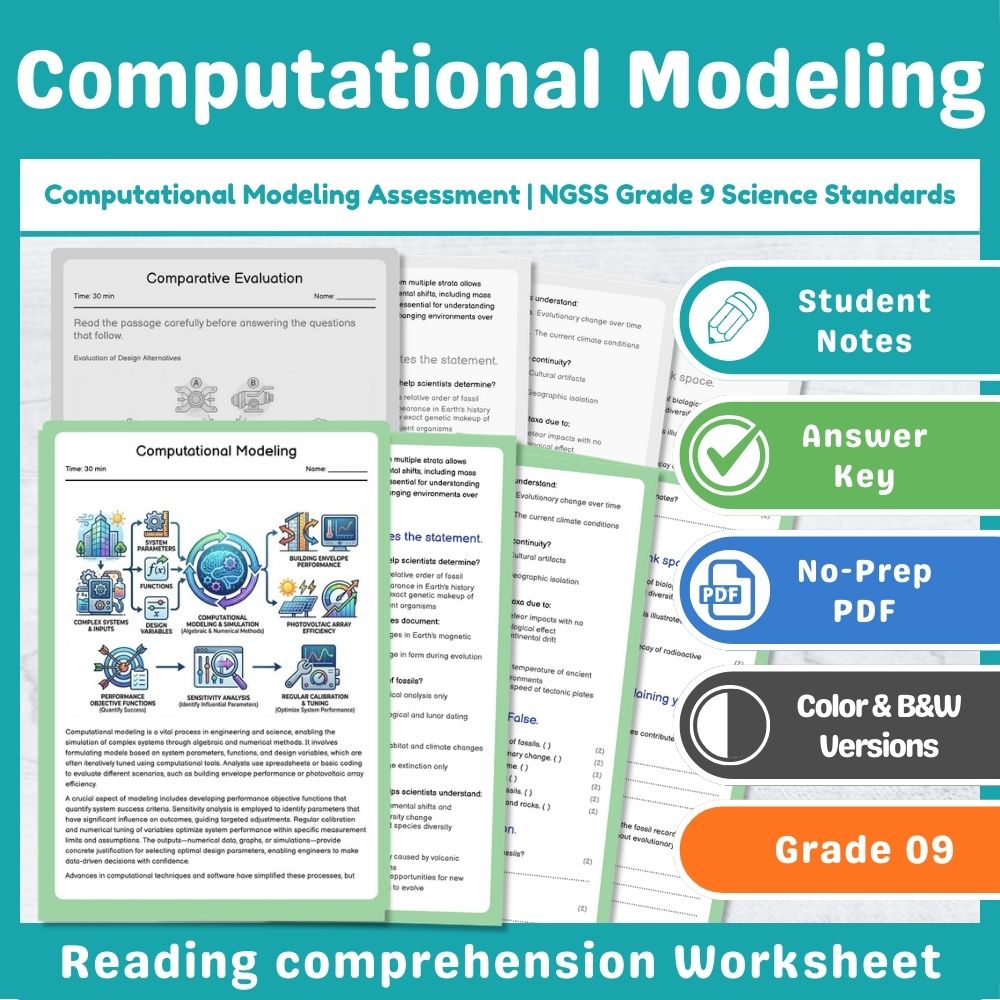
Computational Modeling Assessment | NGSS Grade 9 Science Standards
Created byPrism Point LearningLearning Objectives
- Understand the application of mathematical and computational methods in system modeling.
- Analyze how parameters and variables influence system performance.
- Develop and evaluate models using spreadsheets and simple code simulations.
Instant download
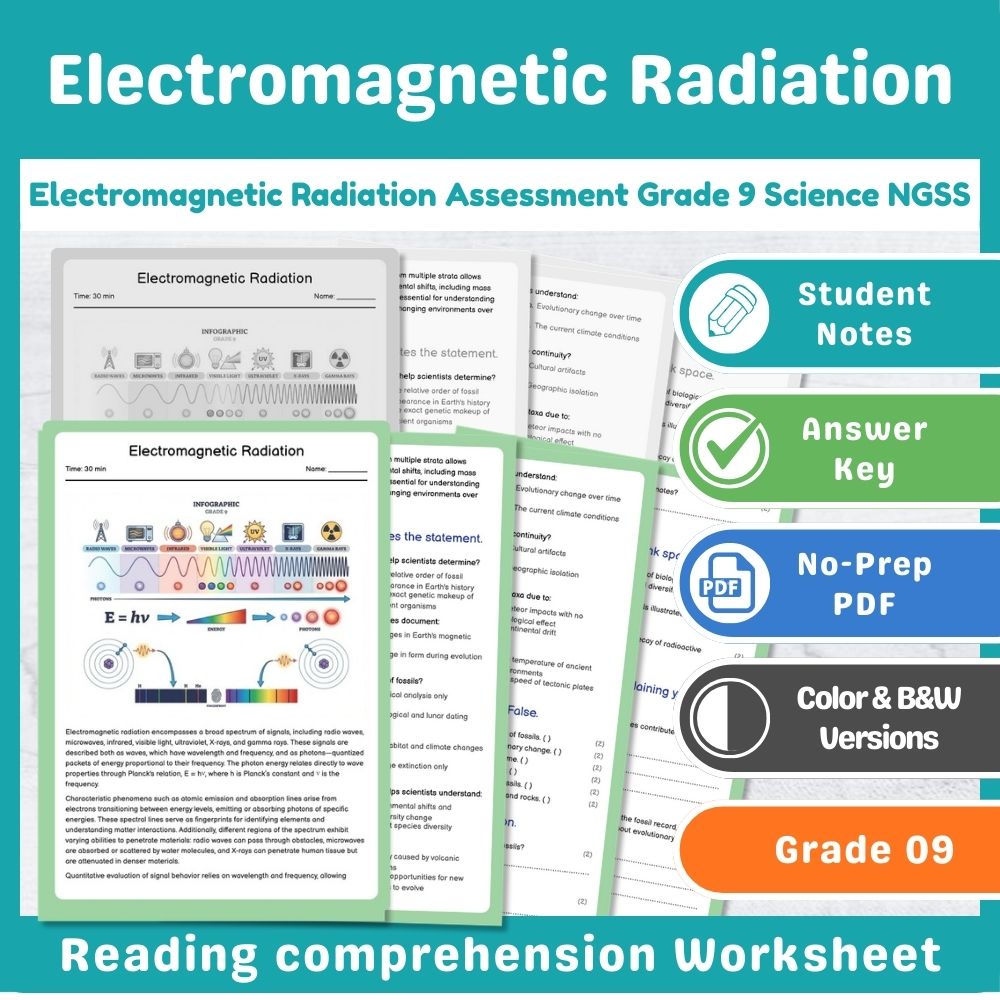
Electromagnetic Radiation Assessment Grade 9 Science NGSS
Created byPrism Point LearningLearning Objectives
- Explain the wave and photon descriptions of electromagnetic signals across the spectrum.
- Relate frequency to photon energy and their interactions with matter.
- Identify characteristic phenomena such as atomic emission and absorption lines, and spectral attenuation.
Instant download
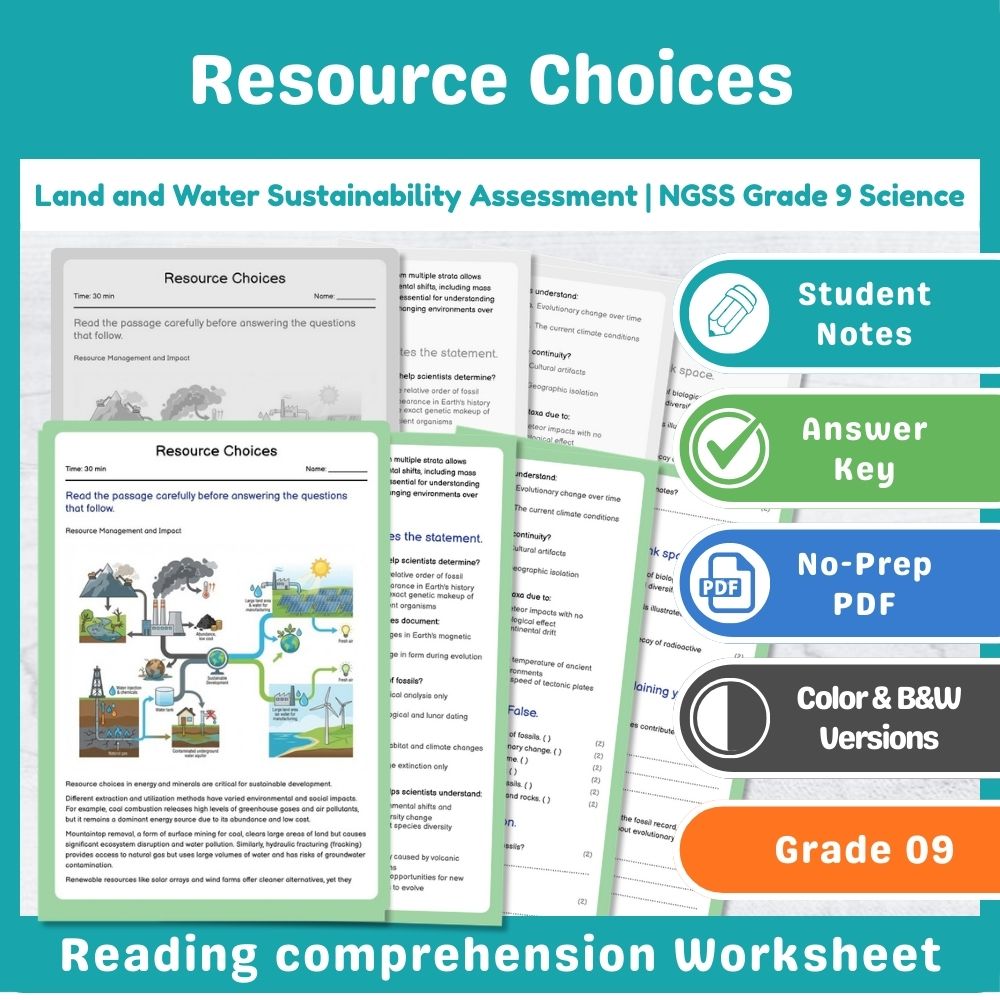
Resource Choices Assessment | NGSS Standards-Based Assessment for Grade 9 Science
Created byPrism Point LearningLearning Objectives
- Compare and evaluate different energy and mineral resource options.
- Analyze impacts of resource extraction methods on environment and society.
- Understand trade-offs related to resource management, sustainability, and lifecycle costs.
Instant download
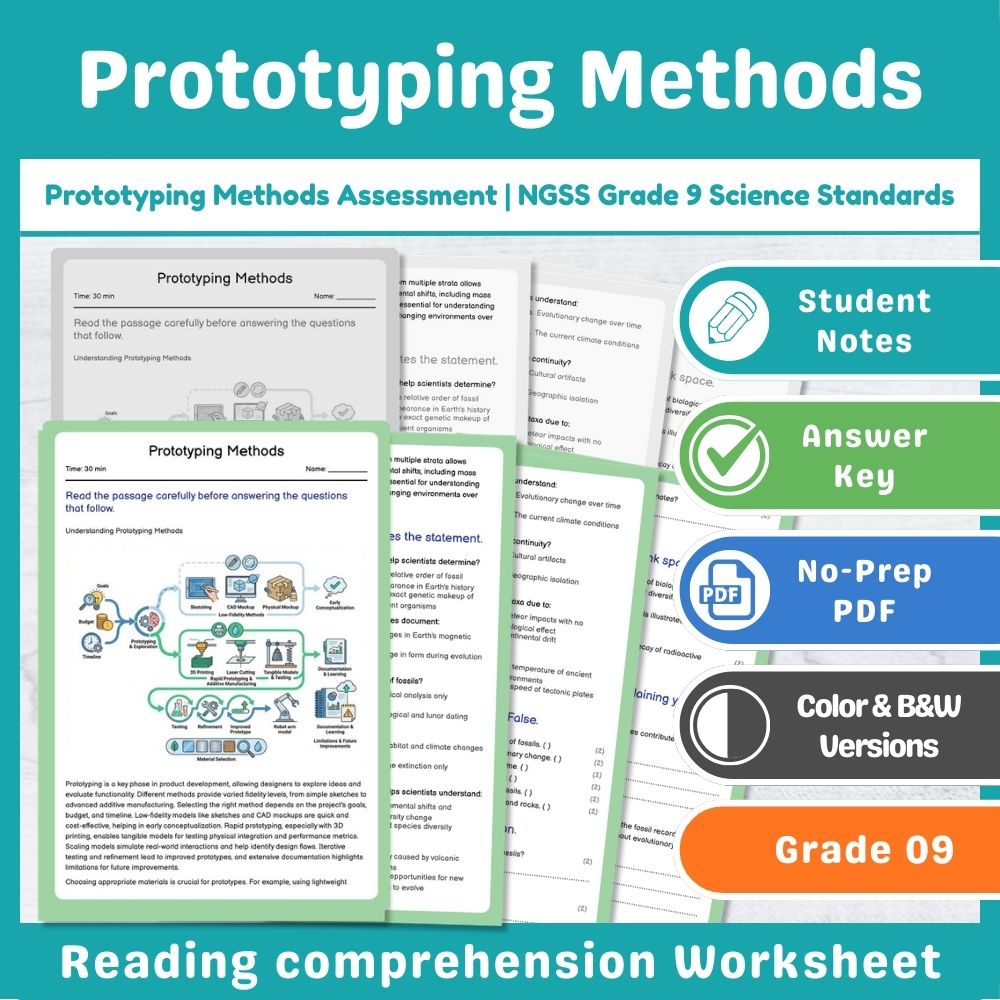
Prototyping Methods Assessment | NGSS Grade 9 Science Standards
Created byPrism Point LearningLearning Objectives
- Identify various prototyping methods and their applications.
- Understand how to select appropriate fidelity levels and materials for prototypes.
- Describe testing protocols and measures used during prototyping.
Instant download
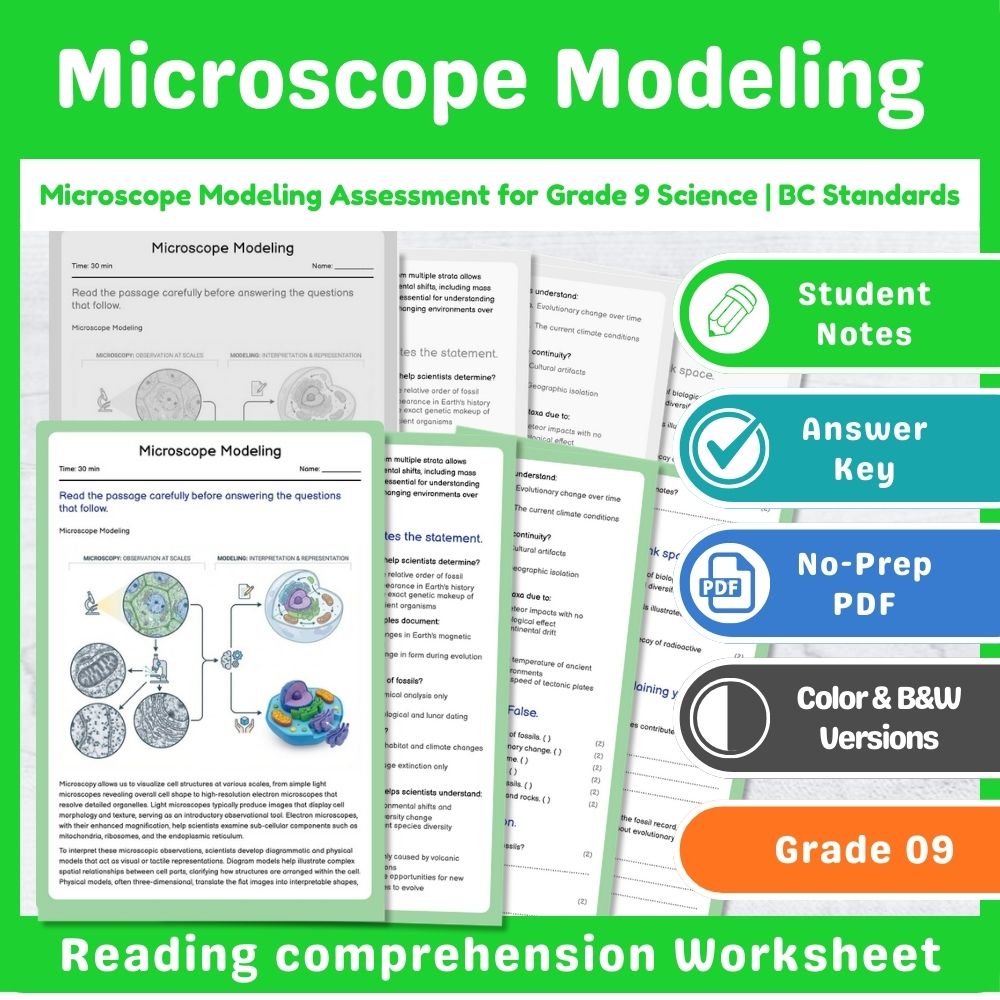
Microscope Modeling Assessment for Grade 9 Science | BC Standards
Created byPrism Point LearningLearning Objectives
- Understand how different microscope models reveal structural details of cells.
- Identify the role of diagrammatic and physical models in microscopy.
- Explain the importance of size, scale, and spatial relationships in cellular understanding.
Instant download

Eclipses Explained BC Assessment | Standard Grade 9 Science
Created byPrism Point LearningLearning Objectives
- Understand the conditions that produce solar and lunar eclipses
- Recognize the orbital relationships among Sun, Earth, and Moon during eclipses
- Explain how orbital inclinations limit eclipse occurrences
Also included in: Grade 9 Science Mini Bundle – Earth & Space Assessment & Activities
Instant download
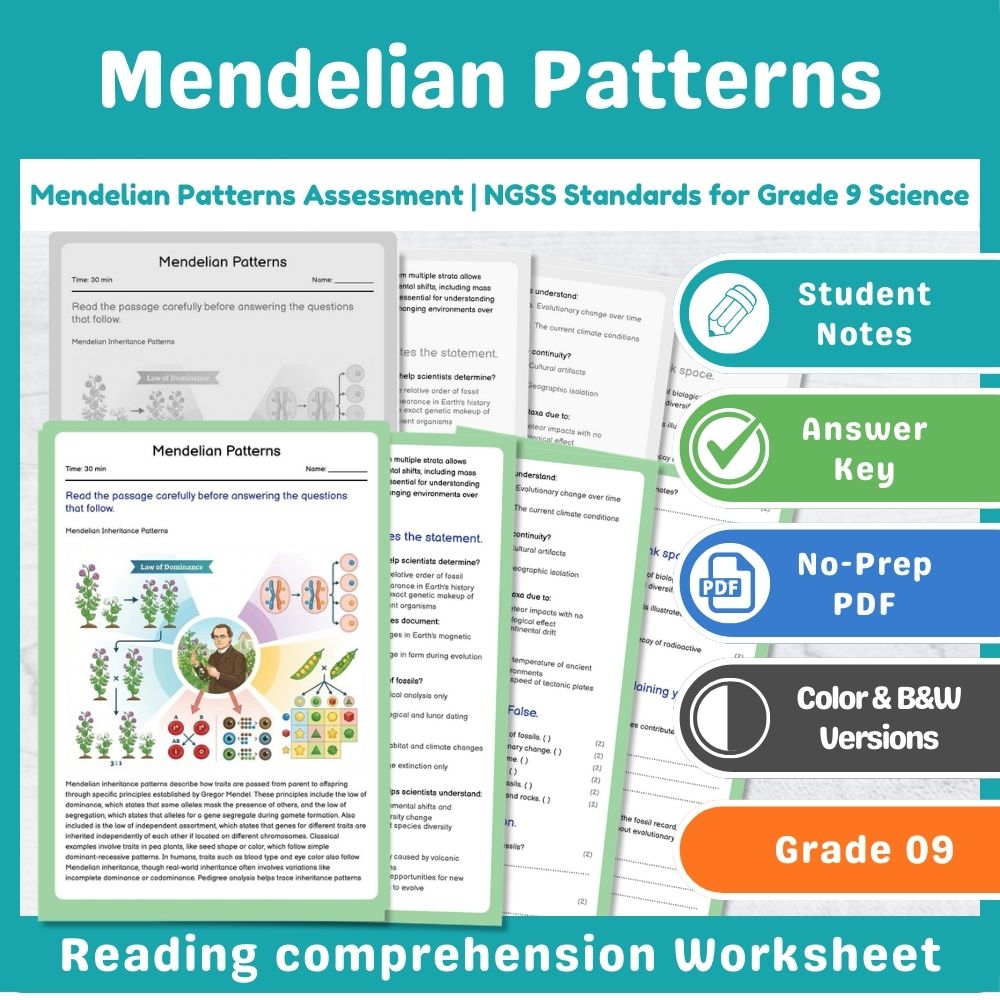
Mendelian Patterns Assessment | NGSS Standards for Grade 9 Science
Created byPrism Point LearningLearning Objectives
- Describe the basic principles of Mendelian inheritance, including dominance, segregation, and independent assortment.
- Use Punnett squares to predict genotype and phenotype ratios of monohybrid and dihybrid crosses.
- Interpret pedigree charts to analyze inheritance patterns.
Instant download
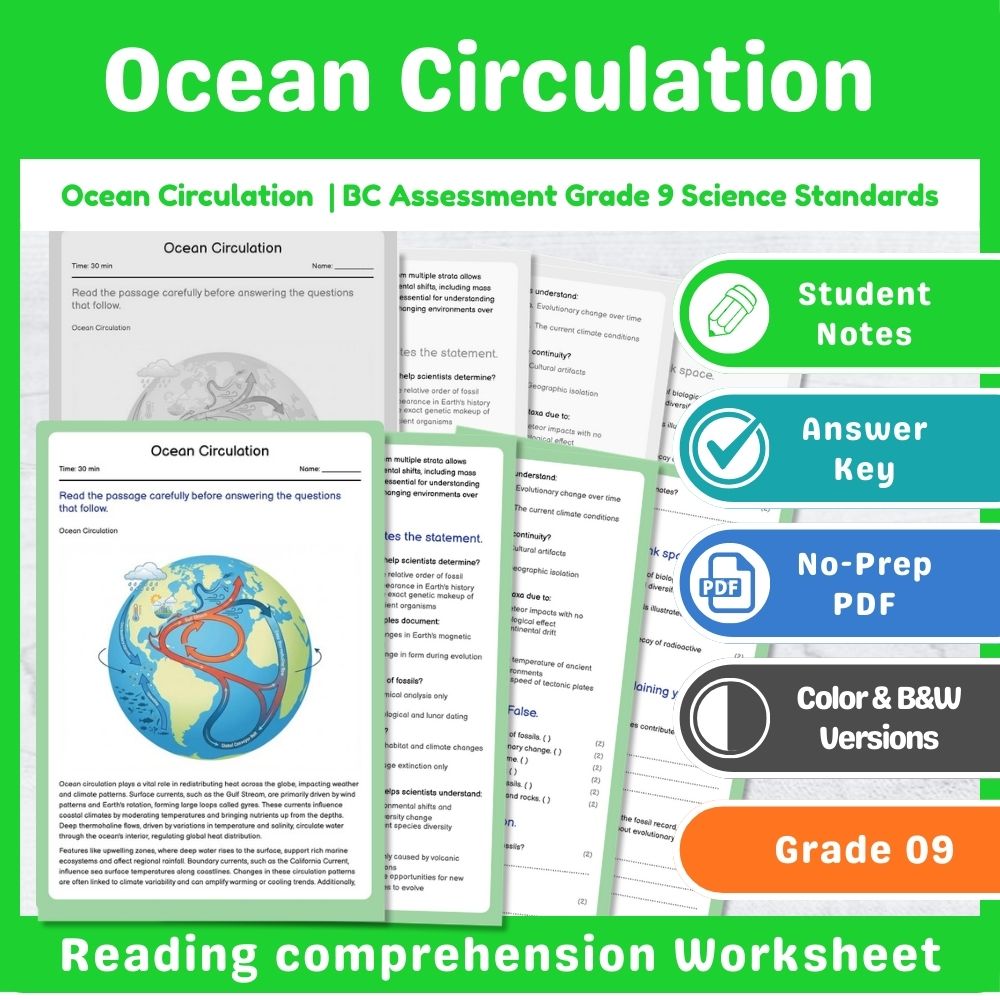
Ocean Circulation Quiz | BC Assessment Grade 9 Science Standards
Created byPrism Point LearningLearning Objectives
- Explain the mechanisms driving ocean surface and deep currents.
- Identify features like gyres, upwelling zones, and boundary currents.
- Assess the impact of ocean circulation on regional climates and weather patterns.
Also included in: Grade 9 Science Mini Bundle – Earth & Space Assessment & Activities
Instant download
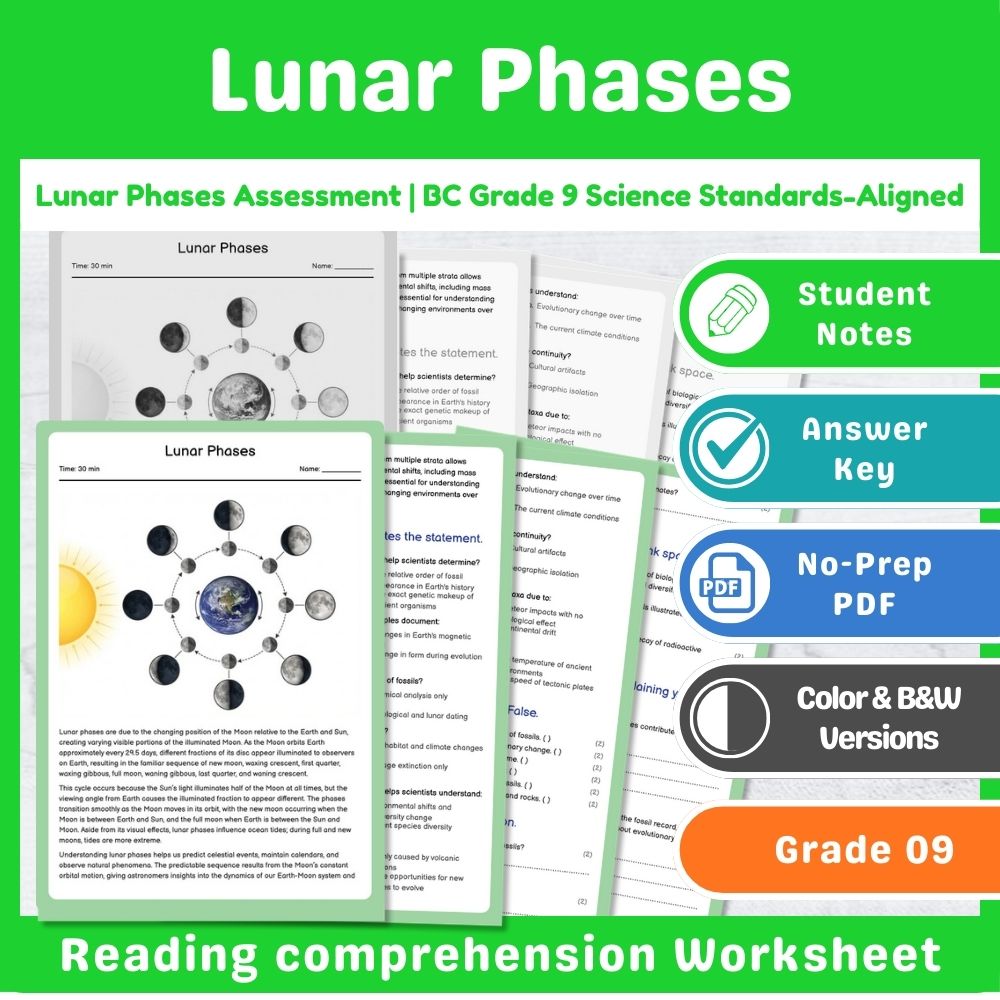
Lunar Phases Assessment | BC Grade 9 Science Standards-Aligned
Created byPrism Point LearningLearning Objectives
- Understand the sequence and causes of lunar phases.
- Identify the relationship between the Sun, Earth, and Moon in lunar cycles.
- Describe how lunar phases influence tides and nocturnal illumination.
Also included in: Grade 9 Science Mini Bundle – Earth & Space Assessment & Activities
Instant download
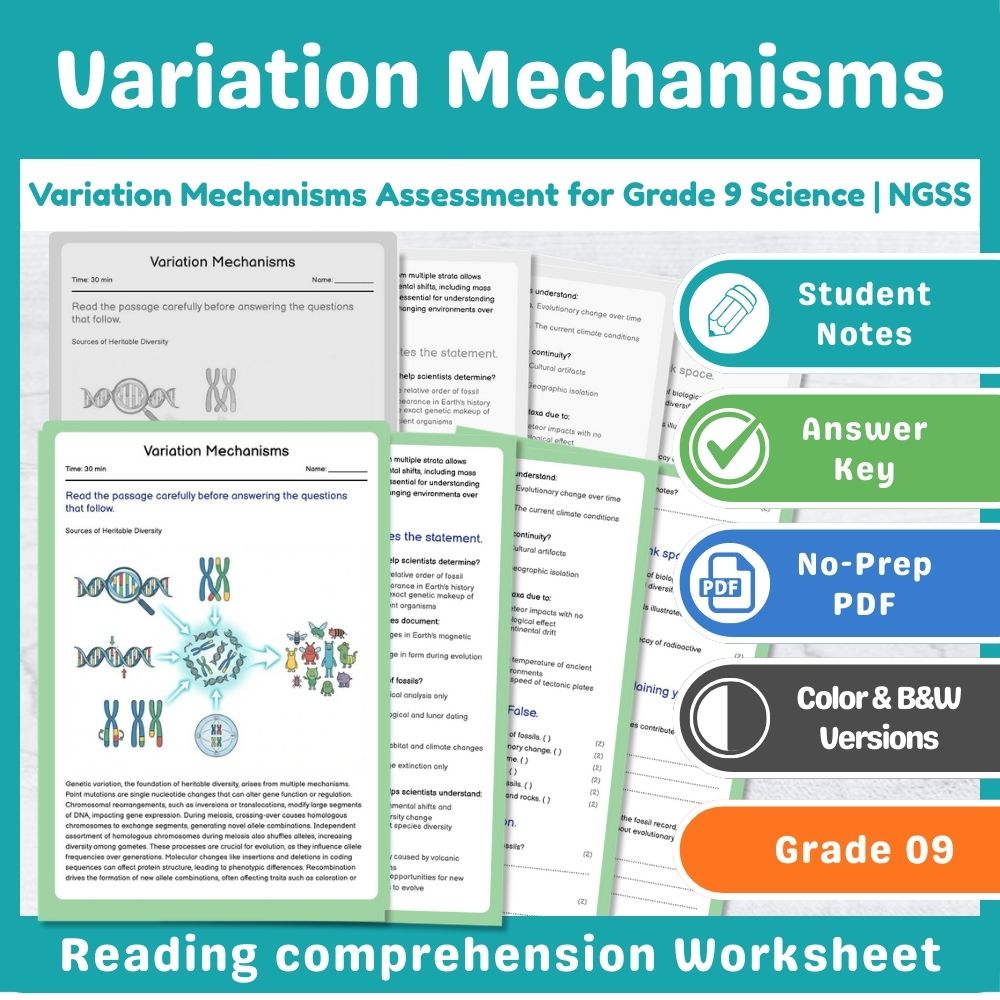
Variation Mechanisms Assessment for Grade 9 Science | NGSS
Created byPrism Point LearningLearning Objectives
- Describe the main sources of heritable genetic variation such as point mutations, chromosomal rearrangements, and recombination.
- Explain how mechanisms like crossing-over and independent assortment contribute to allelic and phenotypic diversity.
- Connect molecular changes to effects on gene expression, protein function, and trait variation at the population level.
Instant download
Browse more categories
About Grade 9 Worksheets
Browse 9,322 printable Grade 9 worksheets across algebra, biology, literature, and history — each a ready-to-print PDF with optional answer keys.
Every worksheet on MyTeachingSheets is created by independent teacher-authors and reviewed before publication. All resources download as printable PDFs for classroom, homework, or at-home practice, and many include answer keys. Preview any worksheet free before buying.