
Grade 9 Worksheets
9,322 grade resources
Cell Components Test Prep Printable | Grade 9 Science Assessment
 Created byPrism Point Learning
Learning Objectives
- Identify major organelles in eukaryotic cells and describe their key functions.
- Explain how membrane structure and compartmentalization affect transport and metabolic rates.
- Relate cytoskeleton structure to cell shape and internal transport.
Also included in: Grade 9 Body Systems and Cells Science Ontario Lesson Bundle Test Prep
Instant download

Endocrine Feedback Test Prep Worksheet | Grade 9 Science Ontario
Created byPrism Point LearningLearning Objectives
- Explain how endocrine hormones maintain internal stability using feedback loops
- Describe how insulin and glucagon regulate blood glucose levels through receptor-mediated cellular actions
- Compare negative and positive feedback in hormonal control, including how thyroid hormones influence metabolic rate
Also included in: Grade 9 Body Systems and Cells Science Ontario Lesson Bundle Test Prep
Instant download

Population Genetics Worksheet for Grade 9 AP Science Evolution Unit
Created byPrism Point LearningLearning Objectives
- Explain how selection, genetic drift, migration, and mutation can change allele frequencies over generations.
- Use Hardy-Weinberg equilibrium as a null model to predict expected genotype/allele frequencies in the absence of evolutionary forces.
- Describe how bottlenecks and founder effects can cause rapid allele-frequency shifts and affect genetic diversity.
Instant download

Coastal Dynamics Worksheet Grade 9 Science Activity | AP Aligned
Created byPrism Point LearningLearning Objectives
- Explain how waves, tides, and storm surge influence coastal erosion and deposition using cross-shore profiles and shoreline retreat rates.
- Use a simplified sediment budget idea to describe how sediment availability changes beach volume over time.
- Differentiate natural coastal signals from anthropogenic modifications such as seawalls, groins, and beach nourishment.
Also included in: Earth Systems & Climate Evidence Lesson Bundle | Grade 9 Science | AP
Instant download

Health Factors Test Prep Printables | Grade 9 Science
Created byPrism Point LearningLearning Objectives
- Evaluate how lifestyle and environmental factors influence human health at both cellular and system levels.
- Interpret evidence from correlations and propose plausible mechanisms that explain observed health outcomes.
- Explain how sleep, nutrition, physical activity, tobacco exposure, and pollutant inhalation can affect the body through pathways such as oxidative stress, chronic inflammation, and disrupted transport or signaling.
Also included in: Grade 9 Body Systems and Cells Science Ontario Lesson Bundle Test Prep
Instant download

Molecular Geometry Worksheet | Grade 9 Science Activities
Created byPrism Point LearningLearning Objectives
- Use VSEPR ideas to predict the 3D molecular shape from electron-pair arrangement and bond order.
- Relate molecular geometry to molecular polarity and expected intermolecular forces.
- Explain how molecular shape helps predict properties such as boiling point, solubility, and reactivity.
Also included in: Grade 9 Matter and Chemical Change Lesson Bundle | Science | BC +1 more
Instant download

Immune Barriers Practice Test | Grade 9 Science Assessment Ontario
Created byPrism Point LearningLearning Objectives
- Explain how physical and cellular innate immune defenses protect against pathogens and environmental insults.
- Describe how antigen recognition leads to adaptive immune responses, including antibody-mediated actions and memory formation.
- Evaluate how inflammation, nutritional status, stress, and environmental exposures can affect immune competence and organ system integrity.
Also included in: Grade 9 Body Systems and Cells Science Ontario Lesson Bundle Test Prep
Instant download

Membrane Transport Review and Practice Worksheet | Grade 9 Science
Created byPrism Point LearningLearning Objectives
- Explain how molecules move across cell membranes using simple diffusion, facilitated diffusion, and osmosis
- Compare active transport to passive transport and describe the role of pumps and electrochemical gradients
- Distinguish paracellular from transcellular transport pathways in epithelial tissues and relate them to physiological functions
Also included in: Grade 9 Body Systems and Cells Science Ontario Lesson Bundle Test Prep
Instant download

Neural Control Test Prep Worksheets | Grade 9 Science Ontario
Created byPrism Point LearningLearning Objectives
- Explain how neurons and synapses generate and transmit signals through action potentials and neurotransmitters.
- Describe how neural circuits and central integration coordinate information processing.
- Relate myelination and synaptic structure to changes in conduction velocity and processing capacity.
Also included in: Grade 9 Body Systems and Cells Science Ontario Lesson Bundle Test Prep
Instant download

Compound Machines Test Prep Worksheets | Grade 9 Science Ontario
Created byPrism Point LearningLearning Objectives
- Explain how compound machines combine multiple simple machines to change force and speed
- Calculate overall mechanical advantage using force and displacement relationships under ideal assumptions
- Compare ideal mechanical advantage to real performance by accounting for friction and deformation
Also included in: Grade 9 Work, Energy & Forces Science Lesson Bundle Ontario Curriculum
Instant download

Hydrologic Fluxes Worksheet Grade 9 Science Activity | AP Water Cycle
Created byPrism Point LearningLearning Objectives
- Use a water-budget framework to describe how precipitation, evapotranspiration, runoff, infiltration, and storage control streamflow variability.
- Interpret discharge hydrographs and groundwater level records to infer how changes in recharge and withdrawals affect aquifer sustainability.
- Connect altered hydrologic fluxes to geomorphic responses such as channel adjustment and sediment yield.
Also included in: Earth Systems & Climate Evidence Lesson Bundle | Grade 9 Science | AP
Instant download

Mountain Building Worksheet for Grade 9 AP Science | Plate Tectonics
Created byPrism Point LearningLearning Objectives
- Explain how plate convergence leads to crustal shortening, crustal thickening, and metamorphism during orogeny.
- Describe how isostatic adjustment and uplift change topography and influence erosion patterns.
- Use evidence from structural cross sections and thermochronology to link deep processes to surface landscape evolution.
Also included in: Earth Systems & Climate Evidence Lesson Bundle | Grade 9 Science | AP
Instant download

Free-Body Diagrams Practice Worksheet | Grade 9 Science Review Ontario
Created byPrism Point LearningLearning Objectives
- Draw a correct free-body diagram by identifying all external forces acting on an isolated object.
- Use consistent vector conventions (direction, arrow length not to scale, and proper labeling) and choose suitable coordinate axes.
- Calculate the net force and determine whether an object is in equilibrium or accelerating using Newton’s second law.
Also included in: Grade 9 Work, Energy & Forces Science Lesson Bundle Ontario Curriculum
Instant download

Grade 9 Adaptation Mechanisms Worksheet | Science Assessment NGSSS
Created byPrism Point LearningLearning Objectives
- Explain how inherited adaptations increase fitness in a specific environment.
- Describe how natural selection changes allele frequencies in a population over time.
- Differentiate between individual traits and population-level evolutionary change.
Also included in: Grade 9 Evolution, Genetics & Ecology Lesson Bundle | Florida NGSSS
Instant download

Ecological Niches Worksheet Grade 9 Science Activities | NGSSS
Created byPrism Point LearningLearning Objectives
- Explain what an ecological niche includes (resources, space, roles, and tolerance to conditions).
- Describe how competition occurs when two species need similar resources.
- Use niche concepts to predict how environmental change can reorganize communities.
Also included in: Grade 9 Evolution, Genetics & Ecology Lesson Bundle | Florida NGSSS
Instant download

Limiting Factors Worksheet Grade 9 Science Activity | Ecology NGSSS
Created byPrism Point LearningLearning Objectives
- Explain how limiting factors affect population growth in an ecosystem
- Identify examples of biotic and abiotic limiting factors and describe their effects
- Use carrying capacity to predict how populations change over time
Also included in: Grade 9 Evolution, Genetics & Ecology Lesson Bundle | Florida NGSSS
Instant download

Meiosis and Genetic Variation Worksheet Grade 9 Science | NGSSS
Created byPrism Point LearningLearning Objectives
- Explain how crossing over during meiosis increases genetic variation in gametes
- Describe how independent assortment can produce different combinations of chromosomes
- Connect fertilization to additional genetic variation among offspring
Also included in: Grade 9 Evolution, Genetics & Ecology Lesson Bundle | Florida NGSSS
Instant download

Earth Seasons Causes Worksheet Grade 9 Science Activity | NGSSS
Created byPrism Point LearningLearning Objectives
- Explain how Earth’s axial tilt and orbit around the Sun produce predictable seasonal changes.
- Describe how changes in sunlight angle and day length affect solar energy received and temperature patterns.
- Connect Earth–Sun geometry to seasonal weather and long-term environmental conditions.
Also included in: Grade 9 Earth, Weather & Climate Systems Lesson Bundle | Florida ngsss
Instant download

Predicting Products Worksheet Pack | Grade 9 Science Activities
Created byPrism Point LearningLearning Objectives
- Apply conservation of atoms to predict reaction products from balanced chemical reactions.
- Use reaction-type patterns (synthesis, decomposition, oxidation, neutralization) to make reasonable product predictions.
- Explain how reactant identities and typical bonding tendencies determine expected products.
Instant download

Greenhouse Effect Worksheet Grade 9 Science Activity | Climate NGSSS
Created byPrism Point LearningLearning Objectives
- Explain how greenhouse gases affect Earth’s energy flow by absorbing and re-emitting infrared radiation
- Describe why the altitude where radiation escapes to space influences Earth’s temperature
- Interpret how changing greenhouse gas concentrations can change the amount of energy retained by Earth
Also included in: Grade 9 Earth, Weather & Climate Systems Lesson Bundle | Florida ngsss
Instant download

Sex-Linked Traits Worksheet | Grade 9 Science Activities
Created byPrism Point LearningLearning Objectives
- Explain how sex chromosomes (X and Y) influence inheritance of certain traits.
- Distinguish X-linked recessive traits from other inheritance patterns using hemizygosity in males.
- Describe how dosage compensation affects gene expression across sexes.
Instant download
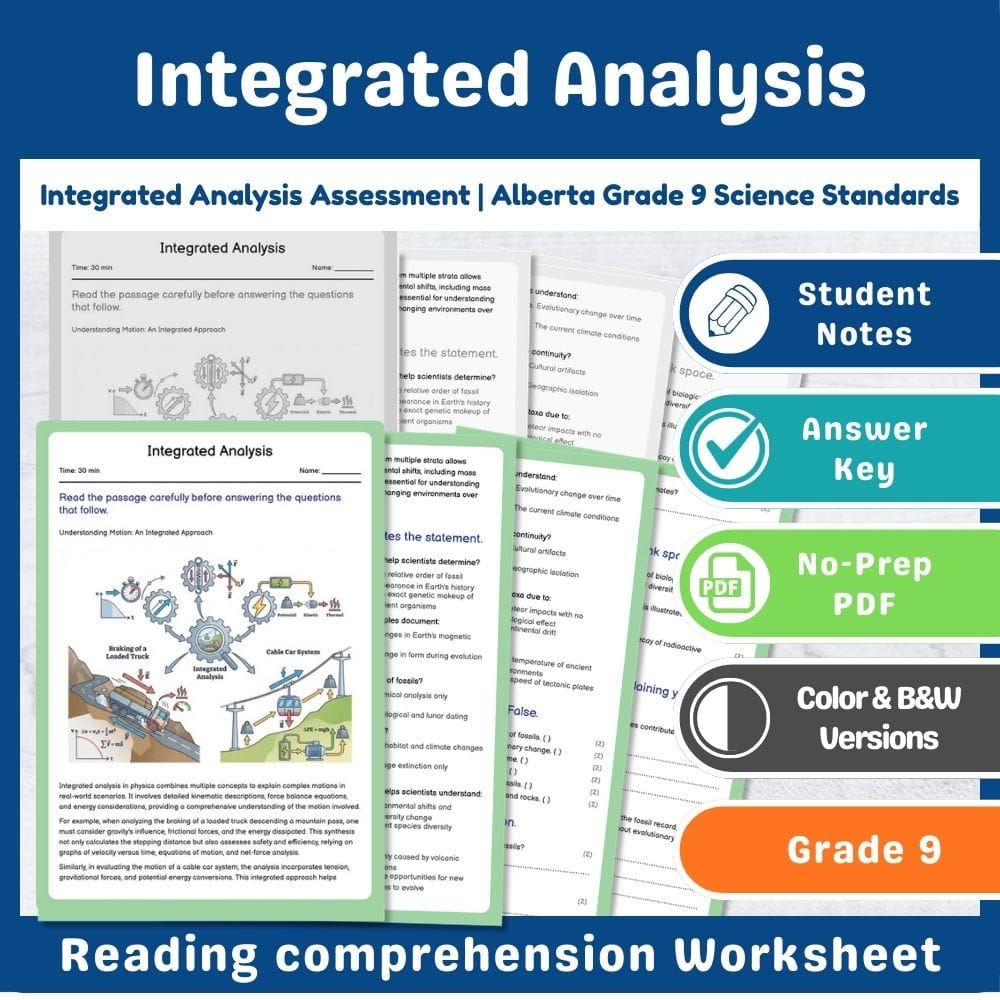
Integrated Analysis Assessment | Alberta Grade 9 Science Standards
Created byPrism Point LearningLearning Objectives
- Explain how kinematic descriptions, force balances, and energy considerations integrate to analyze complex motion scenarios.
- Apply graphs, equations, and net-force reasoning to predict motion outcomes in transport contexts.
- Interpret combined physical principles in real-world Alberta transportation and recreational situations.
Also included in: Grade 9 Forces and Motion Science Lesson Bundle Alberta Framework +1 more
Instant download

Evolution Evidence Assessment for Grade 9 Science Florida NGSSS | Classroom-Ready Materials
Created byPrism Point LearningLearning Objectives
- Explain how the fossil record supports gradual change over time.
- Use anatomical and genetic evidence to support the idea of common ancestry.
- Differentiate homologous traits from analogous traits and relate them to evolutionary processes.
Also included in: Grade 9 Evolution & Genetics Science Lesson Bundle – Florida NGSSS
Instant download

Ecological Niches Assessment for Grade 9 Science | NGSSS Standards
Created byPrism Point LearningLearning Objectives
- Explain the difference between an organism’s habitat and its ecological niche.
- Describe how resources, feeding relationships, and tolerance limits shape ecological niches.
- Analyze how competition and changing environmental conditions can reorganize communities.
Also included in: Grade 9 Evolution & Genetics Science Lesson Bundle – Florida NGSSS
Instant download

Trophic Transfers And Efficiency Assessment Grade 9 Science Printable
Created byPrism Point LearningLearning Objectives
- Explain how energy is transferred among organisms in a food chain.
- Describe the concept of energy transfer efficiency and its impact on biomass.
- Interpret evidence like population sizes, biomass trends, and nutrient concentrations to analyze trophic levels.
Also included in: Grade 9 Ecology, Genetics, and Cells Science Lesson Bundle – General
Instant download

Wave Property Links Assessment | General Grade 9 Science Standards-Aligned
Created byPrism Point LearningLearning Objectives
- Understand how changes in wave parameters affect wave signatures.
- Relate wave frequency, wavelength, and amplitude to energy and pattern spacing.
- Interpret different wave representations and how a single source can produce varied signatures.
Instant download

Nucleic Acid Structure Assessment for Grade 9 Science | TEKS
Created byPrism Point LearningLearning Objectives
- Describe the chemical structures of DNA and RNA and the role of nucleotides.
- Explain the significance of double helix formation, antiparallel strands, and base pairing in DNA.
- Differentiate between DNA and RNA in terms of structure and function.
Instant download
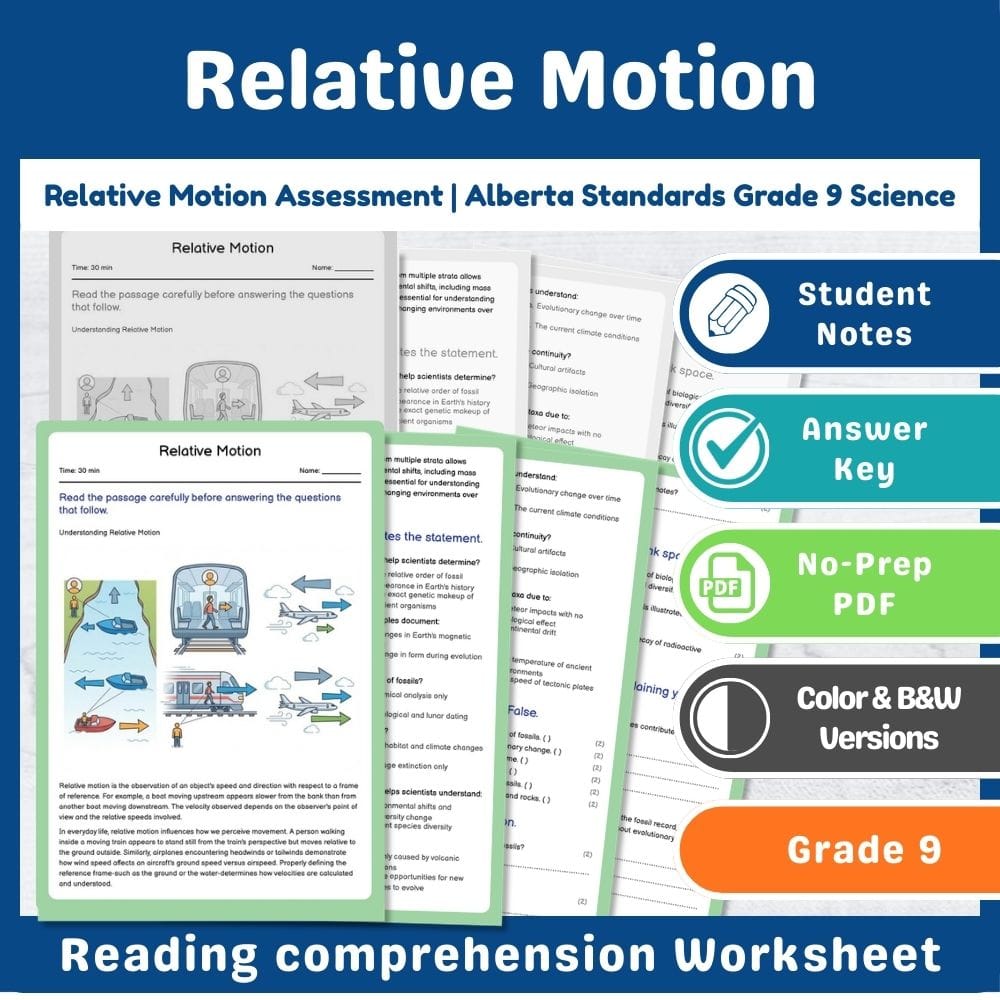
Relative Motion Assessment | Alberta Standards Grade 9 Science
Created byPrism Point LearningLearning Objectives
- Understand the concept of relative motion and how velocities combine in different reference frames.
- Describe how observed speed and direction depend on the observer's frame of reference.
- Apply vector addition principles to various motion scenarios involving boats, trucks, and aircraft.
Also included in: Grade 9 Forces and Motion Science Lesson Bundle Alberta Framework +1 more
Instant download
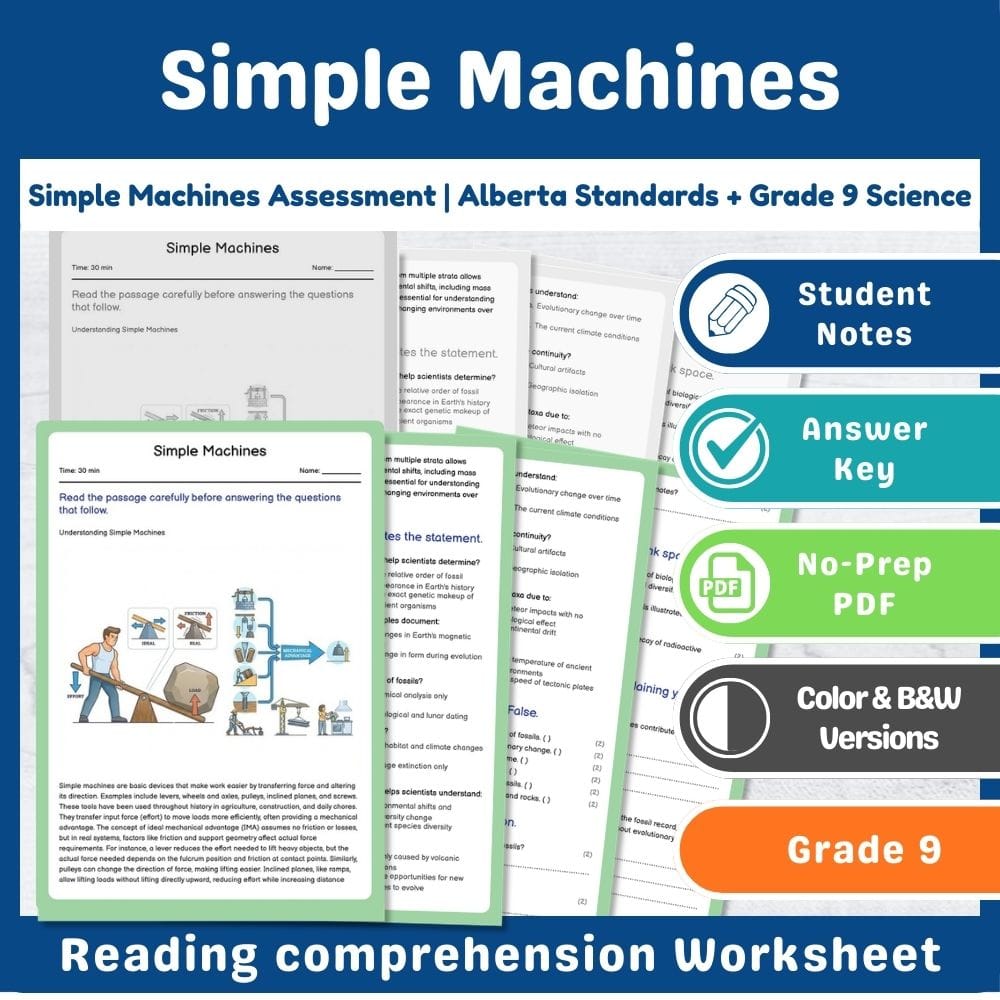
Simple Machines Assessment | Alberta Standards + Grade 9 Science
Created byPrism Point LearningLearning Objectives
- Describe the different types of simple machines and their functions.
- Explain how simple machines reduce effort and change the direction of force.
- Differentiate between ideal and actual mechanical advantage in systems involving simple machines.
Also included in: Grade 9 Forces and Motion Science Lesson Bundle Alberta Framework +1 more
Instant download

Net Force Analysis Assessment for Grade 9 Science | Alberta Standards
Created byPrism Point LearningLearning Objectives
- Understand the concept of net force as the vector sum of forces acting on an object.
- Apply principles of vector addition to analyze forces in practical scenarios.
- Evaluate the effects of opposing forces such as friction and air resistance on motion.
Also included in: Grade 9 Forces and Motion Science Lesson Bundle Alberta Framework +1 more
Instant download

Graphing Motion Assessment for Grade 9 Science | Alberta Standards
Created byPrism Point LearningLearning Objectives
- Understand how to interpret displacement–time, velocity–time, and acceleration–time graphs.
- Learn how to determine physical quantities such as speed, acceleration, and displacement from graph slopes and areas.
- Identify curved segments in graphs that indicate changing acceleration.
Also included in: Grade 9 Forces and Motion Science Lesson Bundle Alberta Framework +1 more
Instant download

Kinematic Concepts Assessment | Alberta Standards Grade 9 Science
Created byPrism Point LearningLearning Objectives
- Describe how objects move using scalar and vector measures such as speed, velocity, and acceleration.
- Explain the differences between speed, velocity, and acceleration with real-world examples.
- Apply unit conversions and sign conventions to analyze and compare motion in different regional contexts.
Also included in: Grade 9 Forces and Motion Science Lesson Bundle Alberta Framework +1 more
Instant download

Force Fundamentals Assessment for Grade 9 Science | Alberta Standards
Created byPrism Point LearningLearning Objectives
- Understand the basic concepts of forces, including contact and non-contact forces.
- Identify and describe real-world examples of forces in Alberta settings.
- Apply qualitative reasoning to analyze opposing forces before numerical calculation.
Also included in: Grade 9 Forces and Motion Science Lesson Bundle Alberta Framework +1 more
Instant download

Physical Changes Assessment Grade 9 | Alberta Science Standards-Aligned
Created byPrism Point LearningLearning Objectives
- Define and distinguish between physical and chemical changes.
- Identify everyday examples of physical changes in various environments.
- Explain the reversibility of physical changes and how they conserve the identity of substances.
Also included in: Grade 9 Matter and Chemical Change Science Lesson Bundle | Alberta +1 more
Instant download
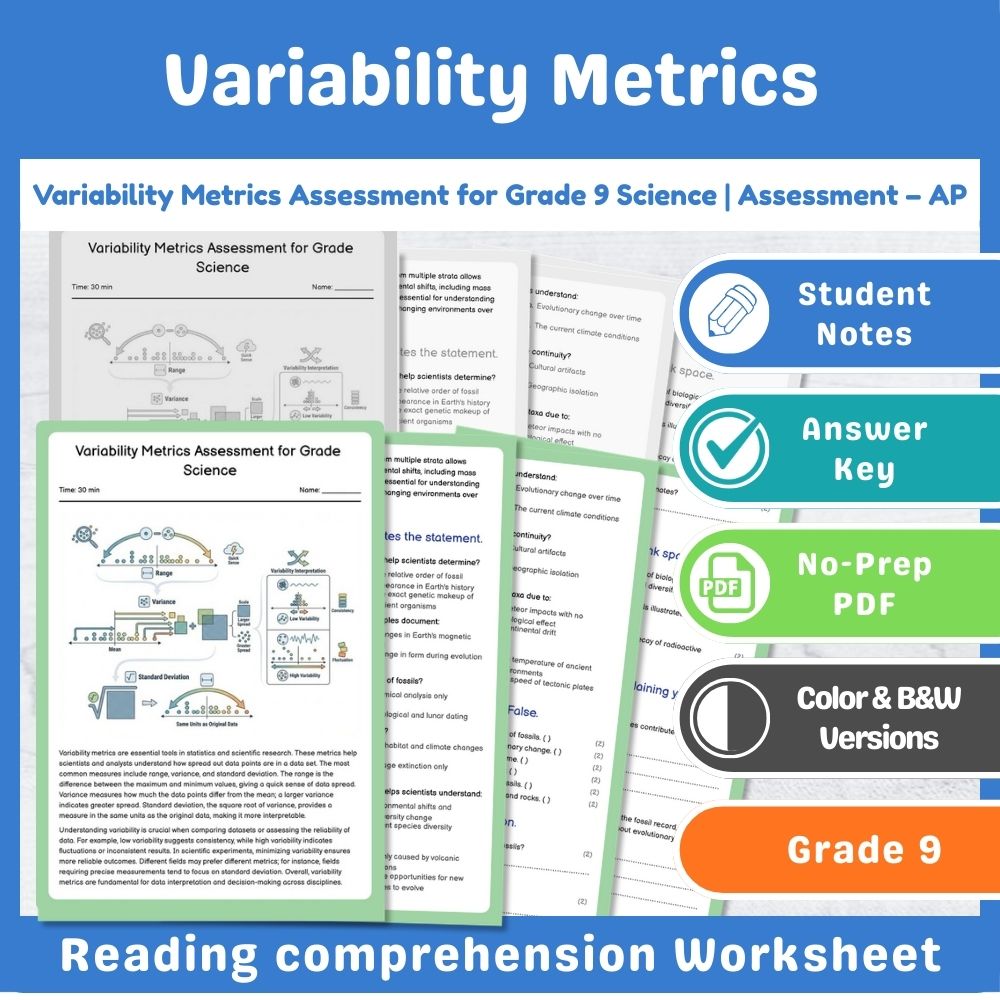
Variability Metrics Assessment for Grade 9 Science | Assessment – AP
Created byPrism Point LearningLearning Objectives
- Understand the concept of variability metrics and their application in data analysis.
- Identify various measures of variability such as range, variance, and standard deviation.
- Analyze data sets to calculate variability metrics and interpret their significance.
Instant download
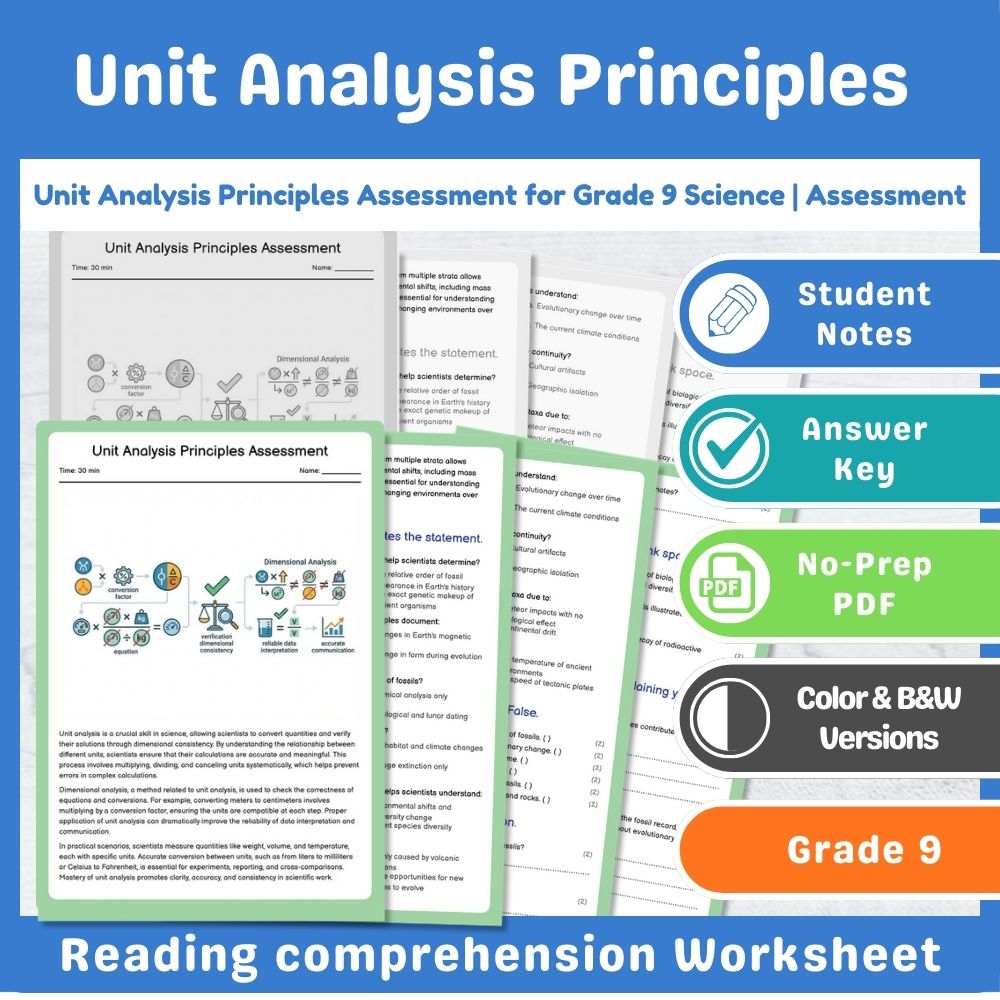
Unit Analysis Principles Assessment for Grade 9 Science | Assessment
Created byPrism Point LearningLearning Objectives
- Understand the fundamental principles of unit analysis in scientific measurements.
- Apply dimensional analysis to solve multi-step transformation problems.
- Evaluate the accuracy and precision of measurement results using unit conversions.
Instant download

Scale and Proportion Assessment | AP Science Standard Grade 9
Created byPrism Point LearningLearning Objectives
- Understand the principles of scaling laws and dimensional similarity.
- Apply proportional reasoning to construct models and interpret data across different scales.
- Analyze how nonlinearity and scale-dependent effects impact extrapolations in scientific contexts.
Instant download
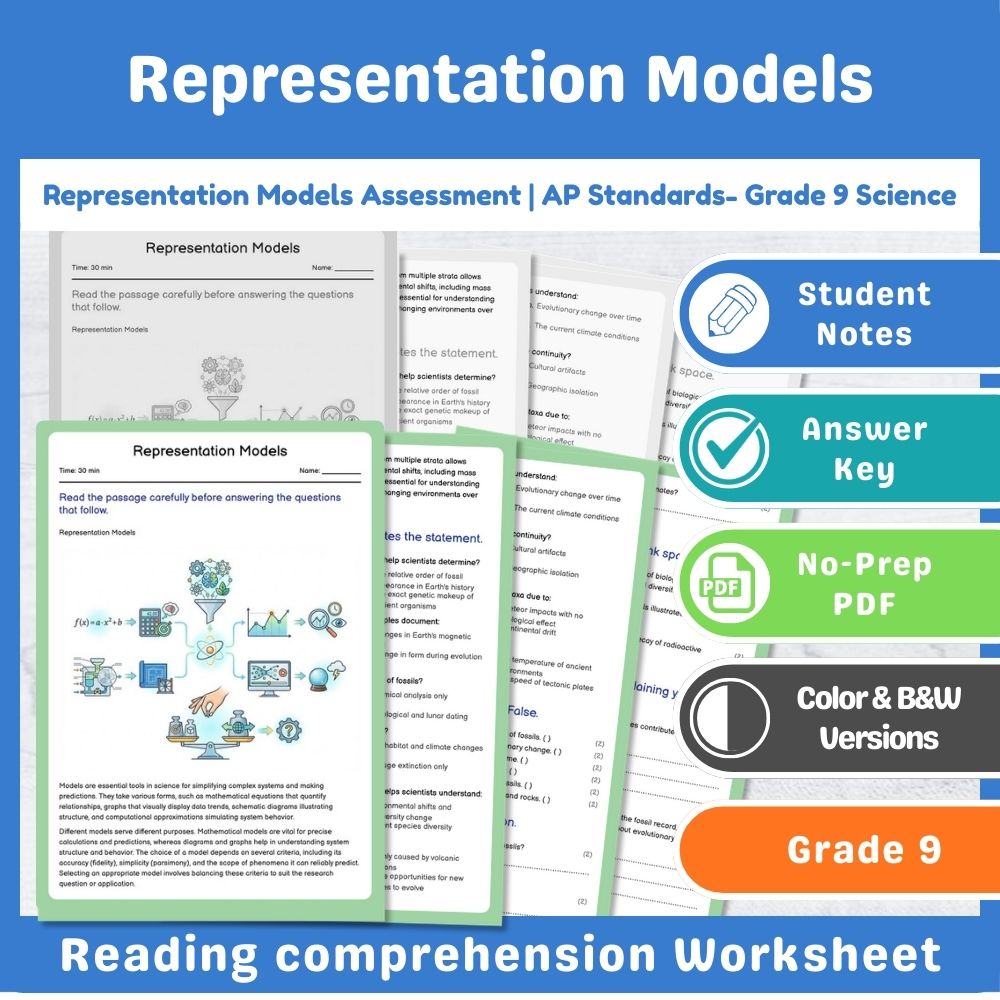
Representation Models Assessment | AP Standards-Aligned Assessment Grade 9 Science
Created byPrism Point LearningLearning Objectives
- Characterize different types of models such as mathematical formulae, graphs, schematic diagrams, and computational approximations.
- Explain the roles of various models in capturing system behavior and predicting outcomes.
- Evaluate criteria for selecting an appropriate model based on fidelity, parsimony, and scope.
Instant download

Inclined Planes Assessment | BC Standards Grade 9 Science
Created byPrism Point LearningLearning Objectives
- Explain how inclined planes decompose gravitational force into components parallel and perpendicular to the surface.
- Calculate the mechanical advantage of inclined planes and understand the trade-off between force and distance.
- Assess how friction and slope angle affect net acceleration and energy transfer during motion.
Instant download

Power and Efficiency Assessment | BC Standards Grade 9 Science
Created byPrism Point LearningLearning Objectives
- Define and explain the concepts of power and efficiency in mechanical systems.
- Describe how energy is transferred and how systems lose energy through heat, sound, or deformation.
- Analyze the significance of power and efficiency in real-world applications such as vehicles and lifting loads.
Instant download
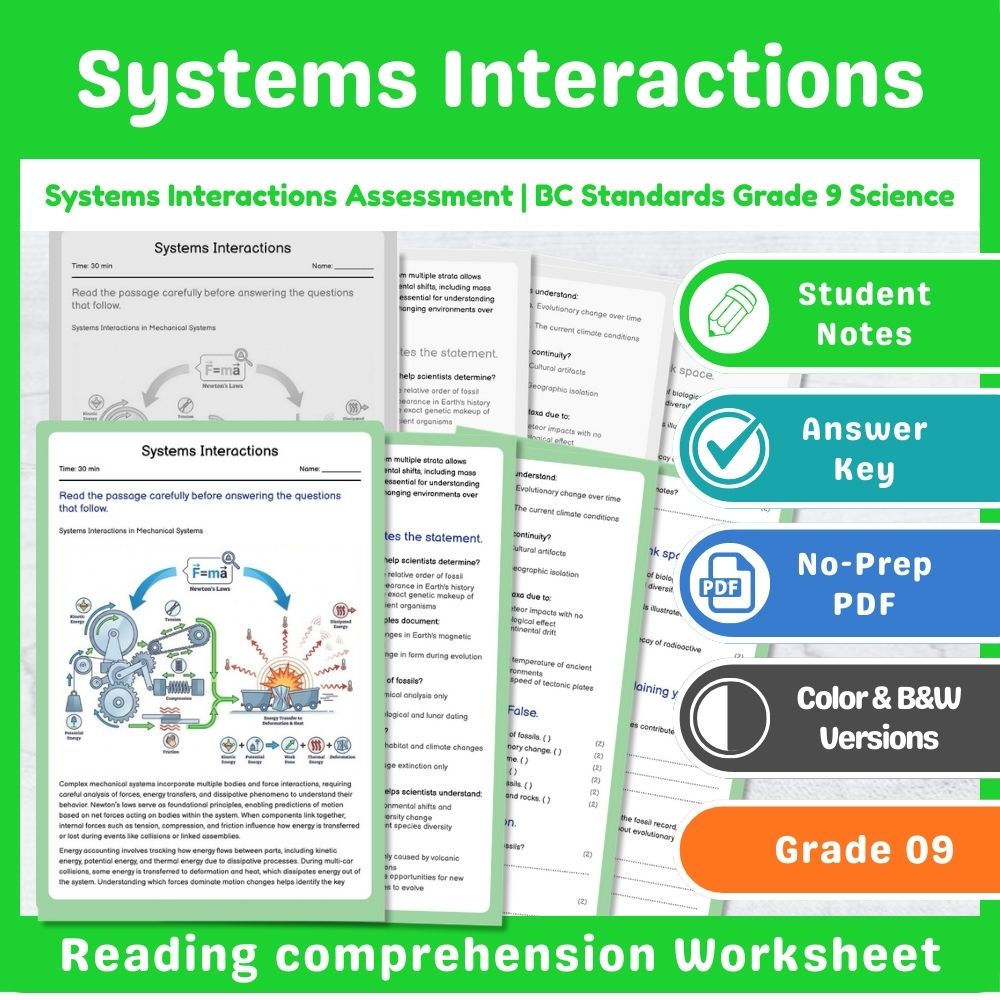
Systems Interactions Assessment | BC Standards Grade 9 Science
Created byPrism Point LearningLearning Objectives
- Understand how forces and energy interactions affect complex mechanical systems.
- Analyze net forces and predict system motion during collisions and assemblies.
- Evaluate energy transfers and dissipative forces within interconnected systems.
Instant download

Atomic Structure Assessment for Grade 9 Science NGSS Standards
Created byPrism Point LearningLearning Objectives
- Describe the subatomic particles involved in atomic structure including protons, neutrons, and electrons.
- Explain electron configurations and the concept of quantized energy levels.
- Understand how the periodic table arranges elements based on valence electrons and how this influences chemical behavior.
Instant download

Net Force Concept Assessment | BC Standards Grade 9 Science
Created byPrism Point LearningLearning Objectives
- Explain what net force is and how it affects motion.
- Differentiate between balanced and unbalanced forces.
- Resolve forces into components and calculate the net force.
Instant download
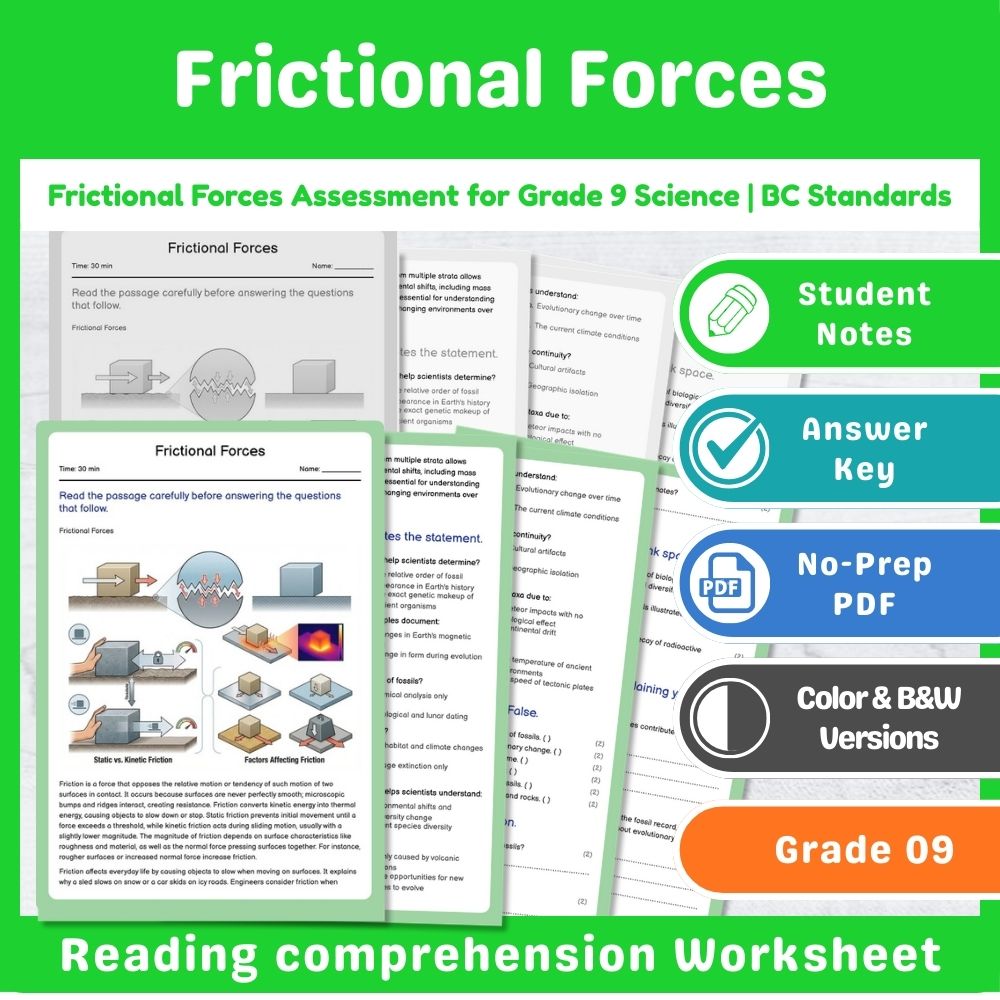
Frictional Forces Assessment for Grade 9 Science | BC Standards
Created byPrism Point LearningLearning Objectives
- Explain the concept of friction and how it opposes motion.
- Differentiate between static and kinetic friction.
- Describe factors influencing the magnitude of frictional force.
Instant download
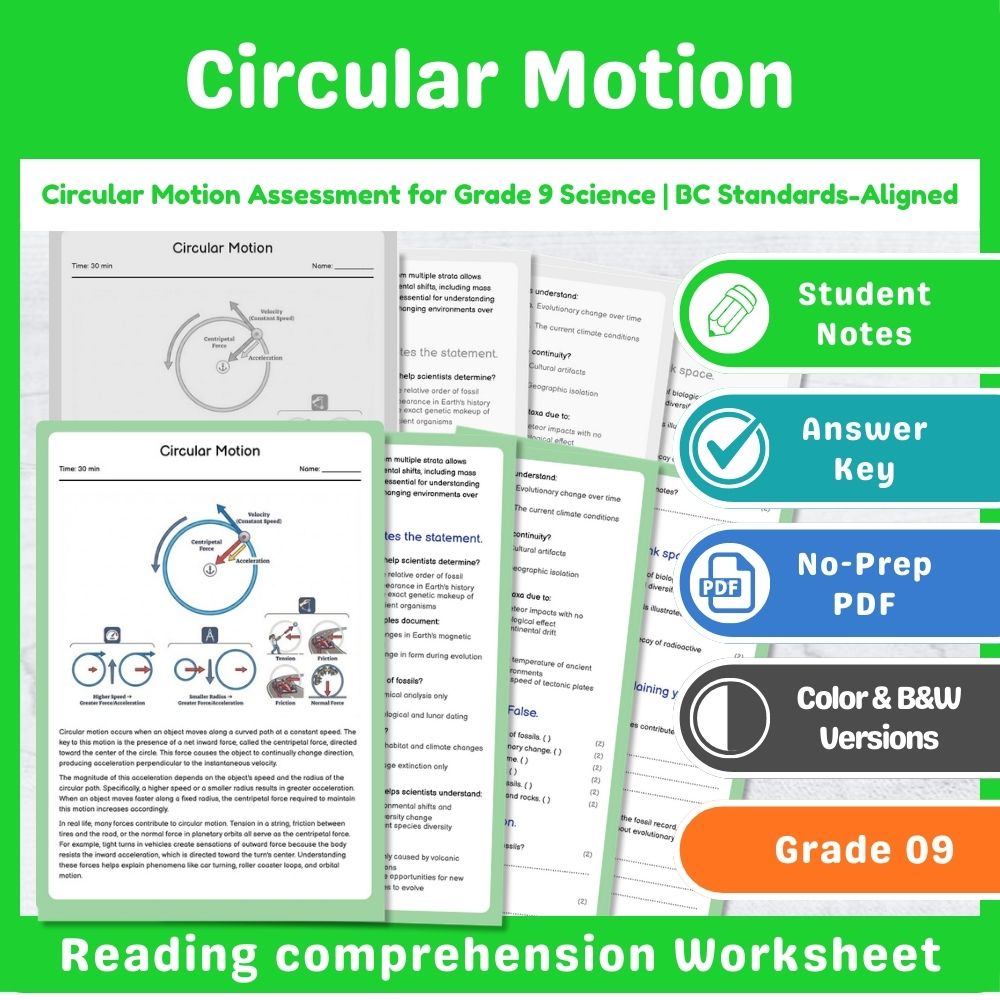
Circular Motion Assessment for Grade 9 Science | BC Standards-Aligned
Created byPrism Point LearningLearning Objectives
- Explain the concept of centripetal force and its role in circular motion.
- Describe how speed and radius affect the acceleration in circular motion.
- Analyze the forces, such as tension and friction, that keep objects moving in a circular path.
Instant download
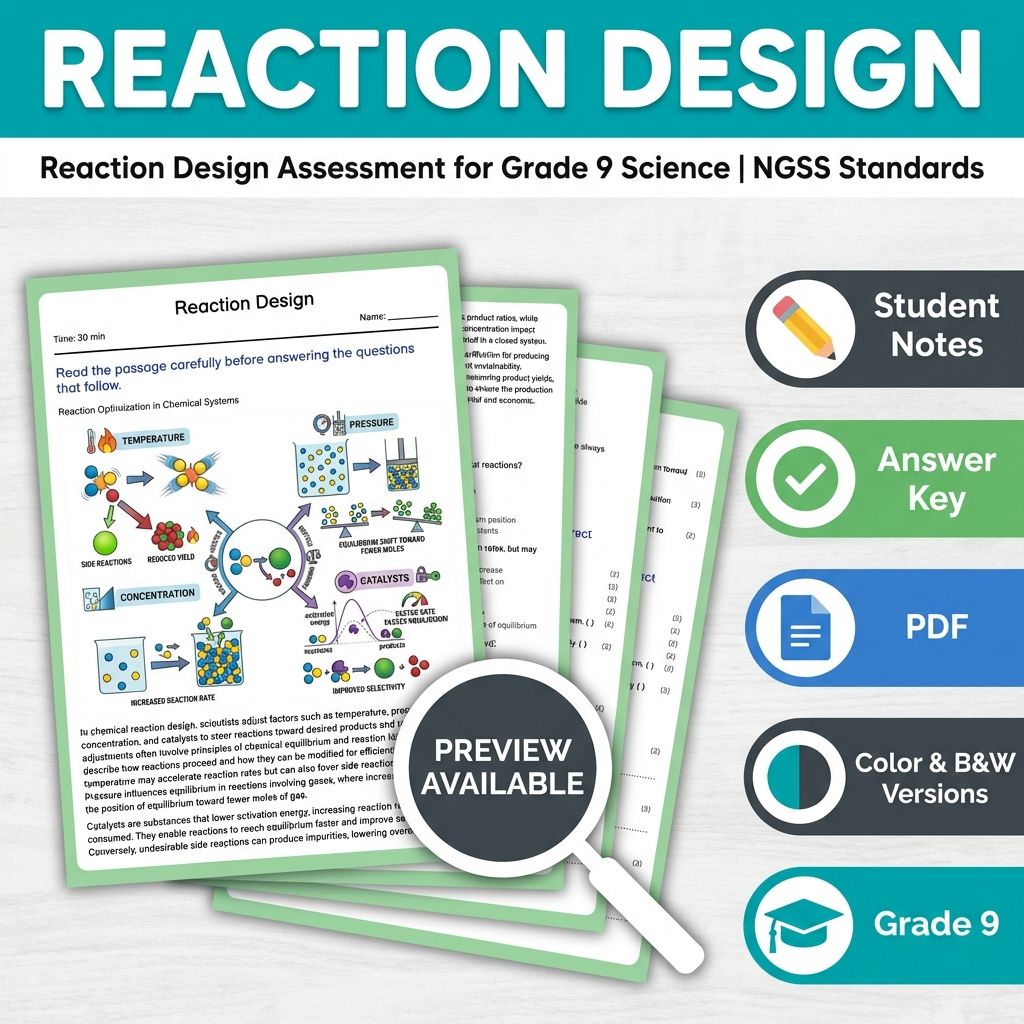
Reaction Design Assessment for Grade 9 Science | NGSS Standards
Created byPrism Point LearningLearning Objectives
- Understand how temperature, pressure, concentration, and catalysts influence chemical reactions.
- Apply principles of equilibrium and kinetics to optimize reaction conditions.
- Use quantitative tools like equilibrium constants and reaction-rate expressions to predict product distribution.
Instant download
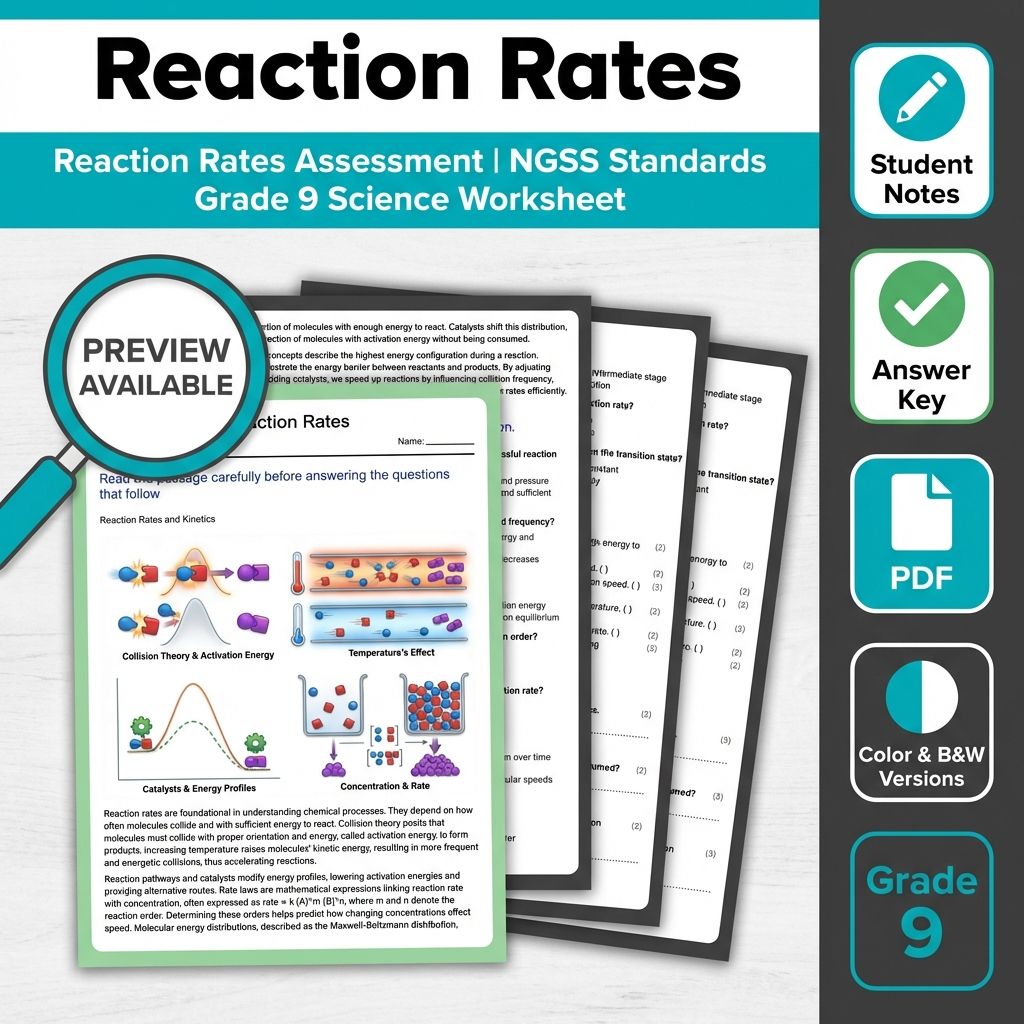
Reaction Rates Assessment | NGSS Standards Grade 9 Science Worksheet
Created byPrism Point LearningLearning Objectives
- Explain how collision frequency, activation energy, and reaction pathways influence reaction rates.
- Describe how temperature, concentration, and catalysts alter energy distributions and affect reaction speeds.
- Interpret rate laws and determine reaction order from experimental data.
Instant download
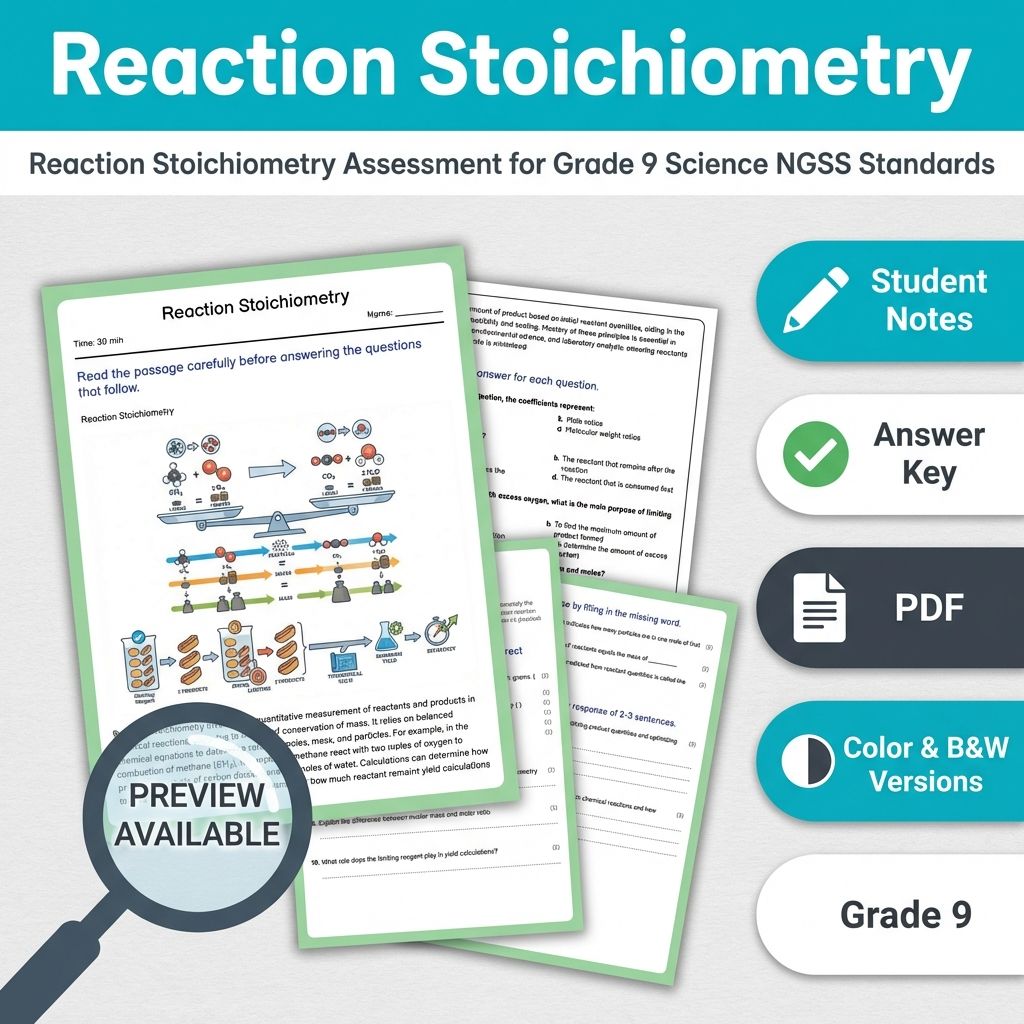
Reaction Stoichiometry Assessment for Grade 9 Science NGSS Standards
Created byPrism Point LearningLearning Objectives
- Understand the principles of mole ratios in balanced chemical equations.
- Apply molar mass conversions to relate mass and moles in reactions.
- Analyze limiting reagents and determine theoretical yields in chemical reactions.
Instant download
Browse more categories
About Grade 9 Worksheets
Browse 9,322 printable Grade 9 worksheets across algebra, biology, literature, and history — each a ready-to-print PDF with optional answer keys.
Every worksheet on MyTeachingSheets is created by independent teacher-authors and reviewed before publication. All resources download as printable PDFs for classroom, homework, or at-home practice, and many include answer keys. Preview any worksheet free before buying.