
Grade 9 Worksheets
9,322 grade resources
Sentence Variety Worksheet Pack | Grade 9 ELA Practice
 Created bySunny Desk Resources
Learning Objectives
- Identify and distinguish simple, compound, and complex sentence structures in a text.
- Revise writing to vary sentence openings and sentence length for clarity and emphasis.
- Use sentence variety intentionally to improve readability and support main ideas with precise details.
Also included in: Grade 9 Writing Lesson Bundle | BC Framework | ELA Skills +1 more
Instant download

Grade 9 ELA | Sentence Variety Worksheet Elena | Alberta Practice
 Created byLumora Learning
Learning Objectives
- Identify how simple, compound, and complex sentences differ in structure and purpose.
- Revise sentences by combining related ideas and separating details to improve clarity.
- Use sentence variety strategically to match syntax to meaning and maintain momentum in writing.
Instant download
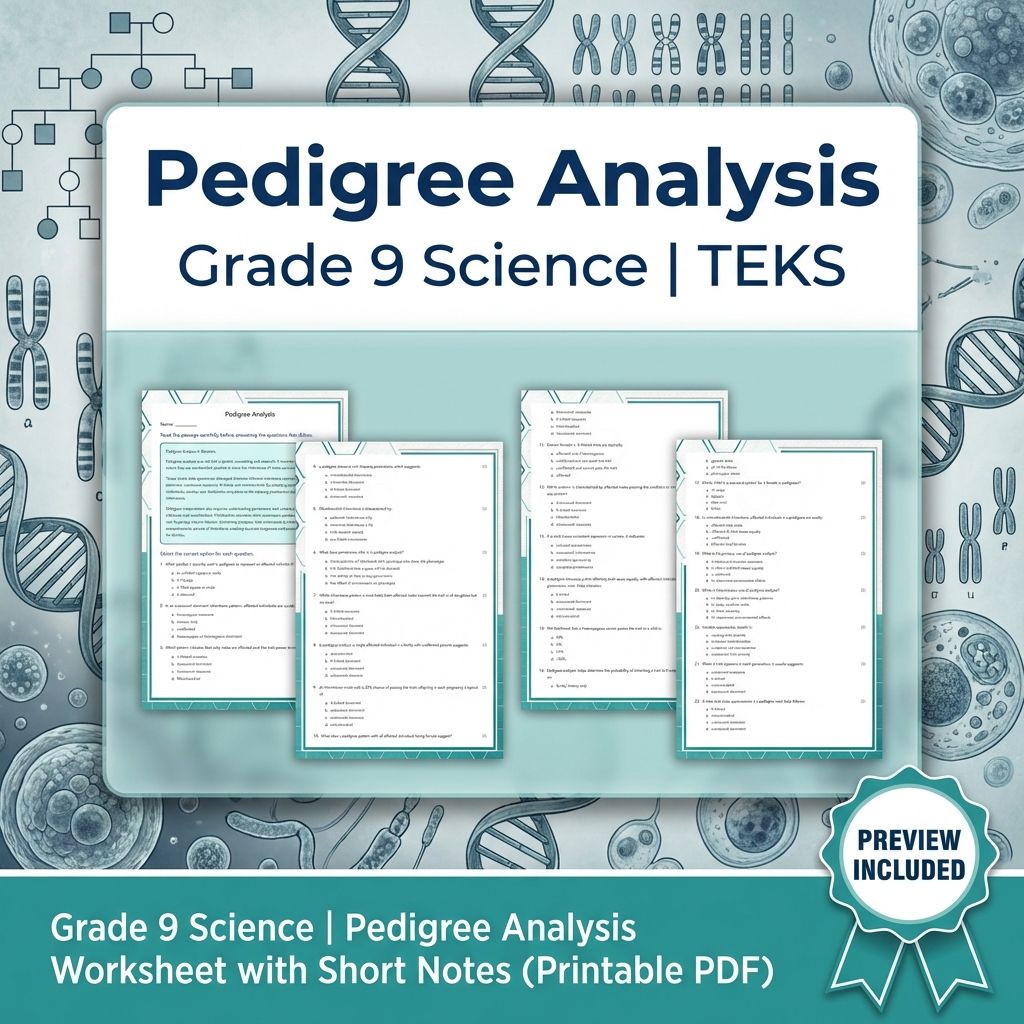
Grade 9 Science | Pedigree Analysis Worksheet with Short Notes (Printable PDF)
 Created byMeadowlark Worksheets
Learning Objectives
- Understand how to interpret family charts and pedigree symbols to trace inheritance patterns.
- Identify differences among autosomal dominant, autosomal recessive, X-linked, and mitochondrial inheritance modes.
- Analyze pedigree patterns to distinguish between different inheritance types.
Instant download

Atomic Structure Worksheet Grade 9 NGSS | Protons, Neutrons & Electrons
 Created byAmber Owl Education
Learning Objectives
- Explain the roles of protons, neutrons, and electrons in atomic structure.
- Use valence electrons to predict common ion charges and basic trends in chemical behavior.
- Relate quantized energy levels to electron transitions in atoms.
Also included in: Grade 9 Science Chemical Reactions Lesson Bundle | NGSS +1 more
Instant download

Grade 9 Reaction Stoichiometry Worksheet | Mass, Moles & Limiting Reagent
Created byAmber Owl EducationLearning Objectives
- Use balanced chemical equations and conservation of mass to relate reactant and product amounts.
- Convert between moles, mass, and particle counts using molar mass.
- Determine the limiting reactant and predict product yield from stoichiometric ratios.
Also included in: Grade 9 Science Chemical Reactions Lesson Bundle | NGSS +1 more
Instant download

Growth Management Worksheet | Standards-Aligned Social Studies Grade 9
JCreated byJ.S SheetsLearning Objectives
- Explain how density targets, mixed-use development, greenbelt policies, and infill help manage urban growth.
- Analyze how population increase and market incentives can create both benefits and pressures for cities.
- Evaluate how compact city models can be designed to support social equity and Indigenous land-use considerations.
Instant download

Grade 9 Science | Central Tendencies in Data - Daily Reading Comprehension
 Created byCoral Reef Learning
Learning Objectives
- Define and distinguish among mean, median, and mode.
- Calculate the mean, median, and mode of different data sets.
- Interpret when each measure of central tendency is most appropriate.
Also included in: Science Practices Lesson Bundle – Grade 9 Science, Advanced Placement Reading +1 more
Instant download

Grade 9 Science – Simulated Predictions & Models | Daily Reading Worksheet
 Created byBright Mind Resources
Learning Objectives
- Identify the components of simple computational simulations.
- Explain how models generate predictions from hypotheses.
- Describe how uncertainty and variability are visualized in simulations.
Also included in: Grade 9 Science Data Analysis Daily Reading Worksheets Lesson Bundle | AP +2 more
Instant download

Grade 9 Science – Classification Overview & Properties | Daily Reading Worksheet
Created byBright Mind ResourcesLearning Objectives
- Understand the definitions of elements, compounds, and mixtures.
- Identify key features that distinguish pure substances from mixtures.
- Use symbols and formulas to represent elements and compounds.
Also included in: Grade 9 Chemistry Science Lesson Bundle Daily Reading Worksheets | Ontario +1 more
Instant download

Grade 9 Science – Chemical Properties & Reactions | Daily Reading Worksheet
Created byBright Mind ResourcesLearning Objectives
- Understand the concept of chemical properties and how they differ from physical properties.
- Identify common chemical properties such as flammability, reactivity, oxidation, and stability.
- Observe and recognize signs of chemical changes like color change, gas evolution, precipitate formation, and formation of new substances.
Also included in: Grade 9 Chemistry Science Lesson Bundle Daily Reading Worksheets | Ontario +1 more
Instant download

Grade 9 Science – Balancing Equations & Conservation of Atoms | Worksheet
Created byBright Mind ResourcesLearning Objectives
- Understand the concept of chemical symbols and their significance.
- Identify reactants and products in chemical equations.
- Comprehend the importance of balancing chemical equations to reflect the conservation of atoms and mass.
Also included in: Grade 9 Chemistry Science Lesson Bundle Daily Reading Worksheets | Ontario +1 more
Instant download

Grade 9 Science – Conservation of Mass in Reactions | Daily Reading Worksheet
Created byBright Mind ResourcesLearning Objectives
- Understand the principle of conservation of mass in closed systems
- Recognize how mass remains constant during chemical reactions
- Differentiate between apparent and actual mass changes
Also included in: Grade 9 Chemistry Science Lesson Bundle Daily Reading Worksheets | Ontario +1 more
Instant download

Grade 9 Science – Mixtures & Separation | Daily Reading Worksheet
Created byBright Mind ResourcesLearning Objectives
- Understand the difference between homogeneous and heterogeneous mixtures
- Learn about various physical methods used to separate mixtures
- Identify examples of mixtures in everyday life
Also included in: Grade 9 Chemistry Science Lesson Bundle Daily Reading Worksheets | Ontario +1 more
Instant download

Grade 9 Science – Physical Changes & Melting | Daily Reading Worksheet
Created byBright Mind ResourcesLearning Objectives
- Define physical change and identify its characteristics.
- Explain melting as a physical change, including energy transfer involved.
- Differentiate between reversible and irreversible physical changes.
Also included in: Grade 9 Chemistry Science Lesson Bundle Daily Reading Worksheets | Ontario +1 more
Instant download

Grade 9 Science | Redox Concepts Worksheet | BC Standards
Created byLumora LearningLearning Objectives
- Explain the fundamental principles of oxidation and reduction in chemical reactions.
- Identify electron transfer events and changes in oxidation states during redox reactions.
- Track oxidation state changes to determine oxidizing and reducing agents in chemical equations.
Instant download

Grade 9 Science | Bond Types Worksheet | BC Standard
Created byLumora LearningLearning Objectives
- Understand the differences between ionic, covalent, and metallic bonds.
- Describe how electron arrangements influence material properties.
- Identify characteristics associated with each bond type.
Instant download

Grade 9 Science | Crystal Lattices Worksheet | BC Aligned
Created byLumora LearningLearning Objectives
- Understand the three-dimensional arrangements of ions and atoms in crystal lattices.
- Identify different lattice types and their properties such as hardness, conductivity, and melting points.
- Describe the role of unit cells in the structure of solids.
Instant download

Argument Thesis Worksheet Pack | Grade 9 ELA Practice
Created bySunny Desk ResourcesLearning Objectives
- Identify the difference between a claim and a thesis in argument writing
- Write a thesis statement that addresses a debatable issue and previews key reasons
- Select and explain evidence that matches the purpose of persuading an audience
Also included in: Grade 9 Writing Lesson Bundle | ELA | Common Core (CCSS) +1 more
Instant download

Grade 9 Social Studies – Hazard Causes Worksheet (Ontario Standards PDF)
Created bySunny Desk ResourcesLearning Objectives
- Explain how atmospheric, hydrological, and tectonic processes can trigger different natural hazards
- Analyze cause-and-consequence relationships between hazard events, human systems, and infrastructure
- Evaluate how land-use change and climate variability can shift hazard frequency and intensity over time
Also included in: Grade 9 Climate and Landscapes Social Studies Lesson Bundle for Ontario +1 more
Instant download

Sex-Linked Inheritance Worksheets | Grade 9 Heredity Science
Created bySunny Desk ResourcesLearning Objectives
- Explain how sex chromosomes determine sex in mammals and how sex-linked genes are inherited
- Describe X-linked recessive inheritance and hemizygosity in males
- Use dosage compensation ideas to predict why traits can differ in frequency between males and females
Also included in: Genetics & Heredity Lesson Bundle | Grade 9 Science | Alberta Framework +1 more
Instant download

Allele Frequencies and Population Genetics Worksheets | Grade 9
Created bySunny Desk ResourcesLearning Objectives
- Explain how allele frequency changes under selection, drift, gene flow, and population bottlenecks.
- Describe Hardy-Weinberg equilibrium and the conditions needed to maintain it.
- Interpret how small population size and isolation affect genetic diversity and conservation decisions.
Also included in: Genetics & Heredity Lesson Bundle | Grade 9 Science | Alberta Framework +1 more
Instant download

DNA, Chromosomes, and Genome Packaging Worksheets | Grade 9
Created bySunny Desk ResourcesLearning Objectives
- Describe the structure of DNA and how base pairing supports heredity.
- Explain how chromosomes organize DNA and enable genetic information to be copied and inherited.
- Compare nuclear DNA with organelle DNA in terms of genome location and inheritance context.
Also included in: Genetics & Heredity Lesson Bundle | Grade 9 Science | Alberta Framework +1 more
Instant download
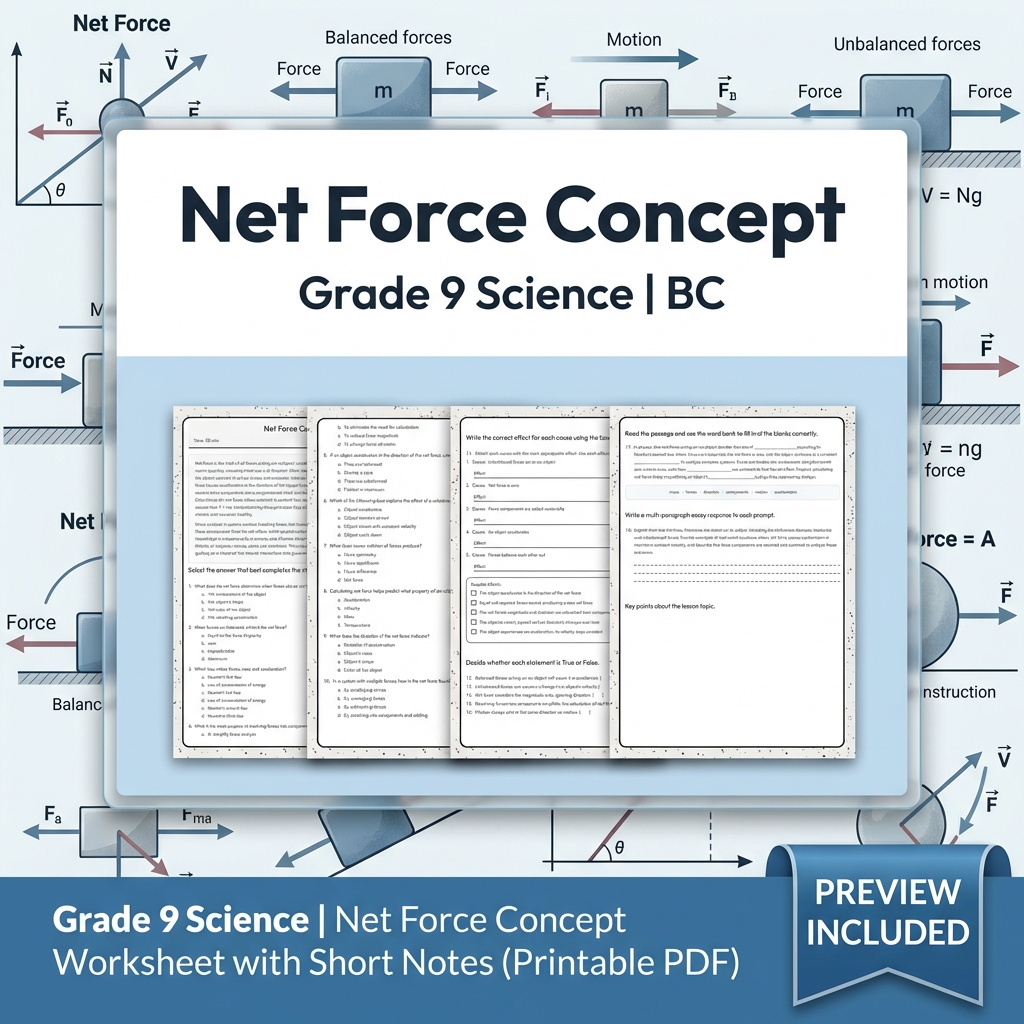
Grade 9 Science | Net Force Concept Worksheet with Short Notes (Printable PDF)
Created byMeadowlark WorksheetsLearning Objectives
- Understand the definition of net force and how it affects motion.
- Learn how forces balance and unbalance influence acceleration.
- Develop skills to resolve forces into components and calculate net effect.
Also included in: Grade 9 Science Lesson Bundle | Energy, Forces & Motion Worksheets +1 more
Instant download

Genetic Technologies Risks and Benefits Worksheets Grade 9 Science
Created bySunny Desk ResourcesLearning Objectives
- Describe how gene flow, resistance development, and market impacts can create risks and benefits in genetic technologies.
- Explain how risk assessment, mitigation, and long-term monitoring reduce uncertainty in real-world decisions.
- Use examples such as canola introgression and cattle genetics to support evidence-based trade-off evaluations.
Also included in: Genetics & Heredity Lesson Bundle | Grade 9 Science | Alberta Framework +1 more
Instant download

Mendelian Inheritance and Probability Worksheet | Grade 9 Science
Created bySunny Desk ResourcesLearning Objectives
- Distinguish genotype from phenotype in single-gene inheritance patterns
- Predict offspring outcomes using dominant and recessive allele interactions
- Interpret Punnett squares and calculate simple probabilities from them
Also included in: Genetics & Heredity Lesson Bundle | Grade 9 Science | Alberta Framework +1 more
Instant download

Grade 9 Environmental Challenges Worksheet | TEKS Social Studies
 Created byThe Resource Hub
Learning Objectives
- Explain how geographic location and human activities contribute to regional environmental challenges.
- Identify causes and effects of pollution, deforestation, and climate change in different environments.
- Evaluate strategies for sustainable management and mitigation at the community and regional level.
Also included in: Grade 9 Regional Geography & Urbanization Lesson Bundle | TEKS Social Studies +1 more
Instant download

Grade 9 Science | Integrated Metabolism Reading Worksheet (PDF + Rubric)
JCreated byJ.S SheetsLearning Objectives
- Understand the connection between catabolic and anabolic pathways in metabolism.
- Describe how hormonal signals and nutrient availability influence metabolic processes.
- Explain the systemic coordination of energy flow during high demand or scarcity in organisms.
Instant download

Grade 9 Science | Particle Theory - Grade Science - Daily Reading Comprehension
Created byCoral Reef LearningLearning Objectives
- Understand the basic principles of the particle model of matter.
- Identify the arrangement and behavior of particles in solids, liquids, and gases.
- Relate particle motion to temperature and energy.
Instant download

Orbital Motion Worksheet | NGSS Grade 9 Science assessment printable PDF
Learning Objectives
- Explain the basic principles of orbital motion and gravitational interactions.
- Describe Kepler's laws of planetary motion and Newton's law of universal gravitation.
- Analyze the relationship between orbital period and semi-major axis in planetary and satellite orbits.
Also included in: Grade 9 Science Earth's Place in the Universe Lesson Bundle NGSS +1 more
Instant download

Grade 9 Social Studies | Indigenous Rights Worksheet (Ontario)
Created bySunny Desk ResourcesLearning Objectives
- Explain how treaties, Indigenous legal traditions, and co-management agreements influence resource governance in Canada.
- Analyze relationships among Indigenous jurisdiction, provincial and federal policies, and ecological stewardship.
- Evaluate how negotiated rights can shape community wellbeing, economic partnerships, and conflicts.
Also included in: Grade 9 Sustainable Resource Policies Social Studies Lesson Bundle (Ontario) +1 more
Instant download
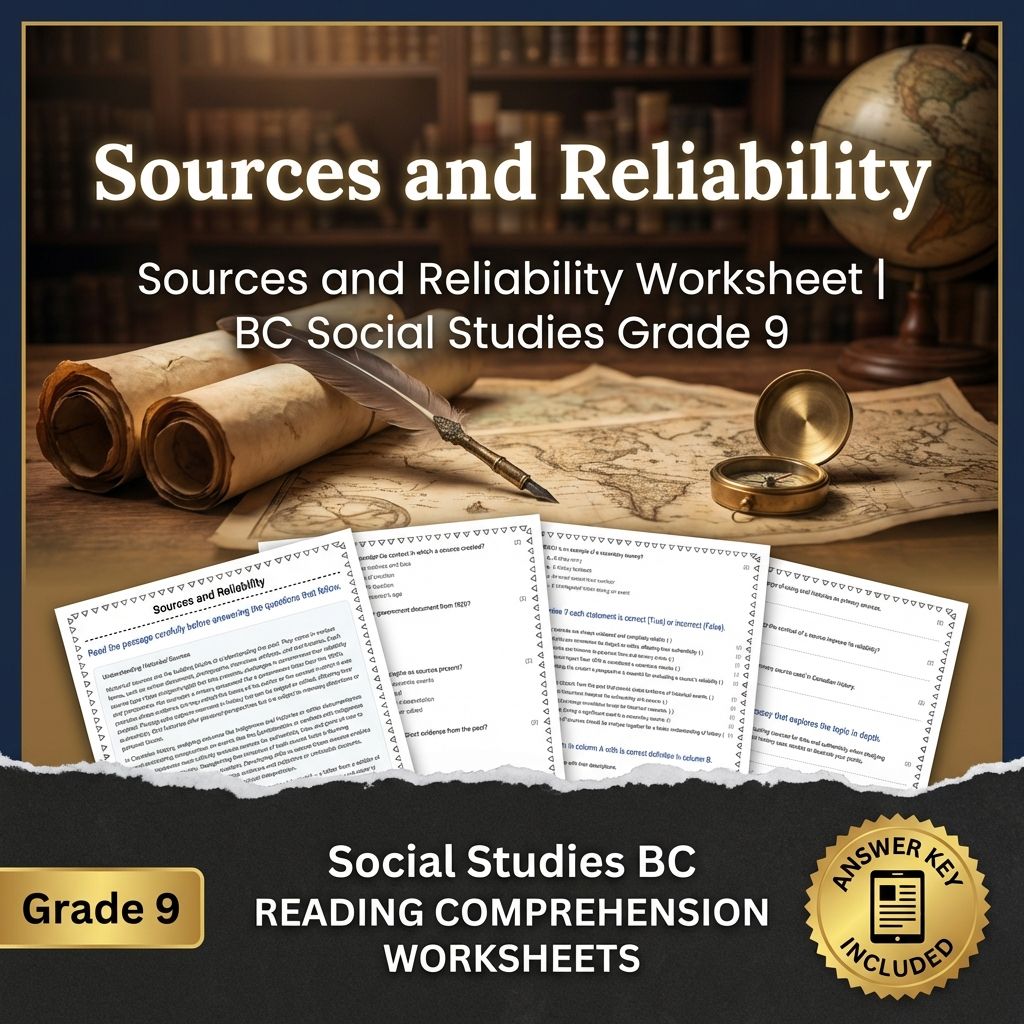
Sources and Reliability Worksheet | BC Social Studies Grade 9
JCreated byJ.S SheetsLearning Objectives
- Identify different types of historical sources including primary documents, images, and oral histories.
- Evaluate the reliability, perspective, and usefulness of various sources.
- Analyze case studies from Canadian history to understand source credibility.
Also included in: Grade 9 Social Studies Bundle | Constructing Historical Narratives +1 more
Instant download

Grade 9 Social Studies Sources and Reliability Worksheet (PDF) | BC Standard
Created bySunny Desk ResourcesLearning Objectives
- Identify different types of historical sources (primary documents, images, and oral histories) and explain what each can reveal.
- Evaluate source reliability by considering bias, context, and authenticity.
- Explain how perspective and limitations in sources can shape historical interpretations.
Also included in: Grade 9 Sources and Evidence Social Studies Lesson Bundle: BC +1 more
Instant download

Grade 9 Social Studies – Urbanization Worksheet (TEKS) (PDF)
Created bySunny Desk ResourcesLearning Objectives
- Explain what urbanization is and describe major spatial characteristics of growing cities.
- Analyze factors that contribute to urban expansion, including economic opportunities and transportation networks.
- Interpret how density, land use, and infrastructure influence patterns of development and resource management.
Also included in: Grade 9 Regional Geography Social Studies Lesson Bundle Worksheets for TEKS +1 more
Instant download
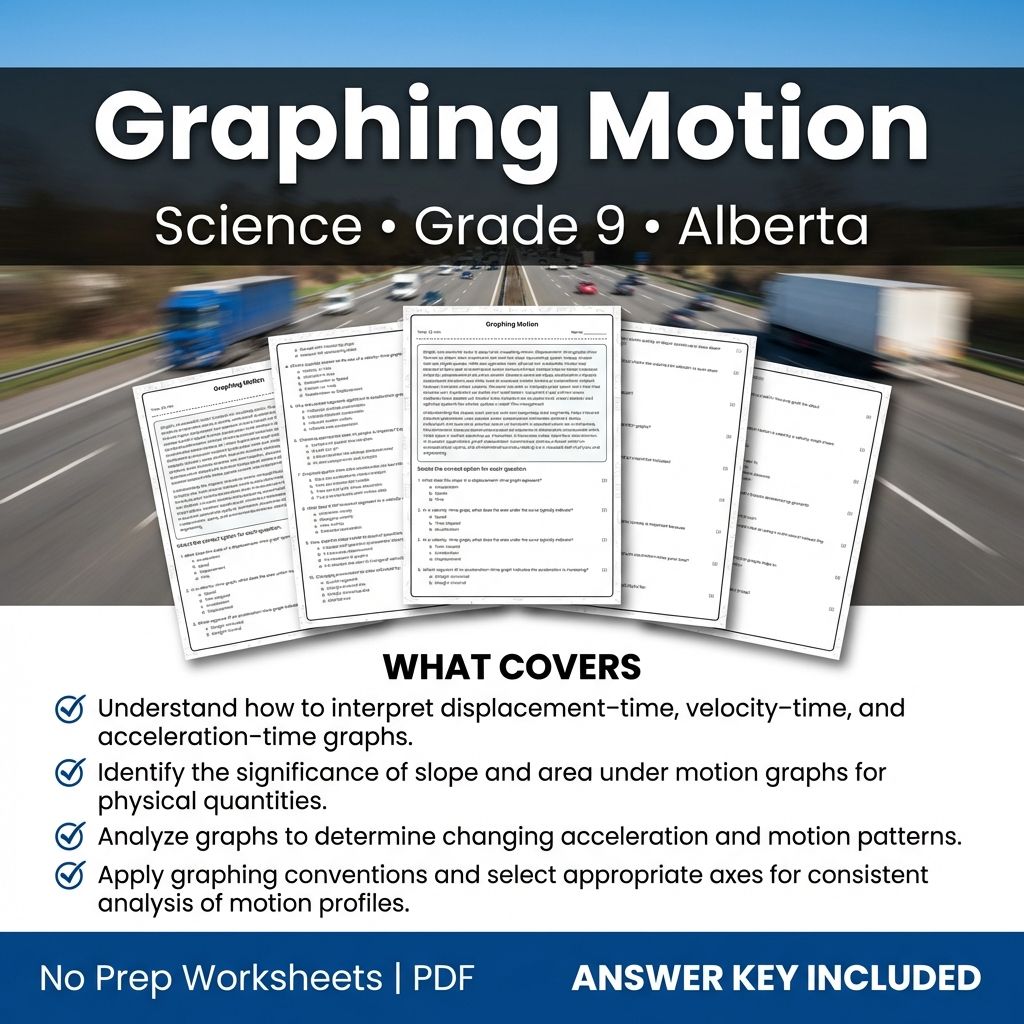
Graphing Motion Worksheet for Grade 9 Science | Alberta Standards
Created byCoral Reef LearningLearning Objectives
- Understand how to interpret displacement–time, velocity–time, and acceleration–time graphs.
- Identify the significance of slope and area under motion graphs for physical quantities.
- Analyze graphs to determine changing acceleration and motion patterns.
Instant download
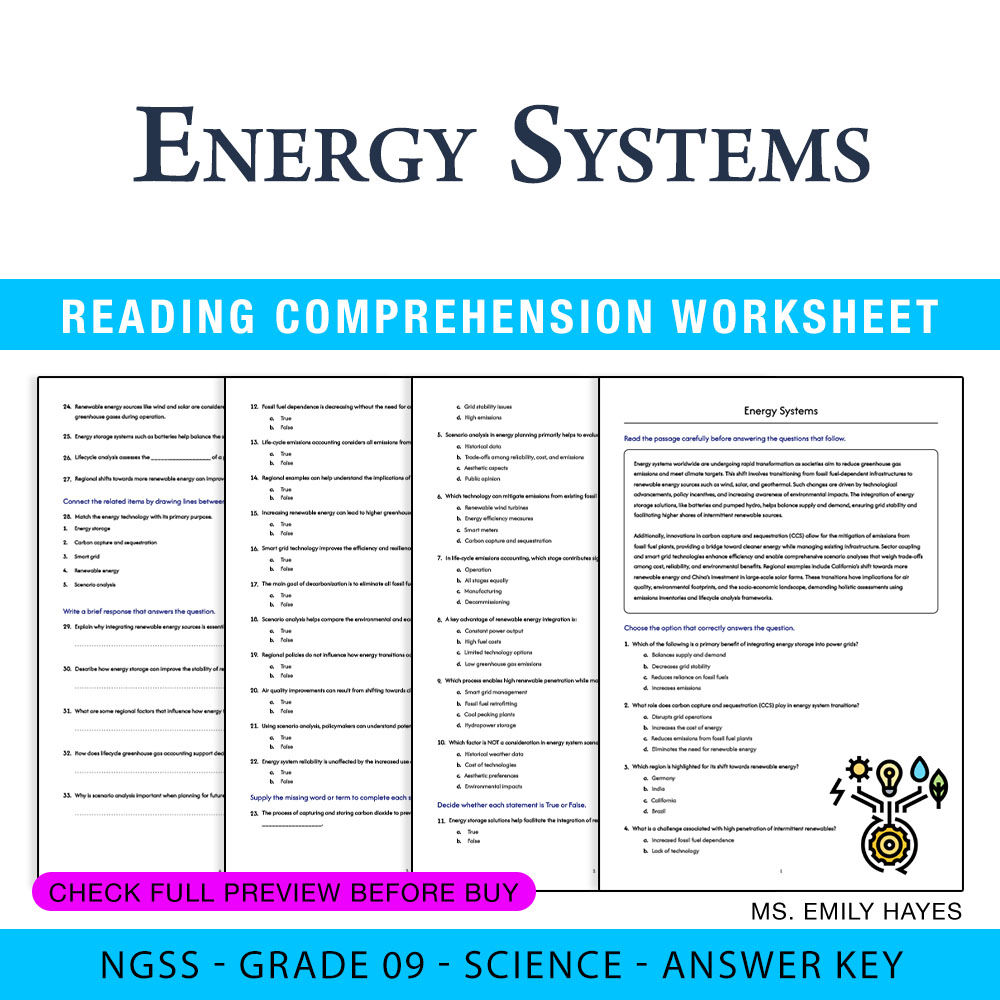
Grade 9 Science | Energy Systems Worksheet (PDF+ Answer Key)
 Created byCopper Leaf Classroom
Learning Objectives
- Understand the concept of energy system transitions and decarbonization pathways.
- Analyze the trade-offs between reliability, affordability, and greenhouse gas reduction in energy scenarios.
- Evaluate the role of renewable energy, storage, and carbon capture in reducing emissions.
Instant download

Cosmic Timescales Worksheet | NGSS Grade 9 Science Assessment
 Created byCedar Grove Learning
Learning Objectives
- Understand the observational evidence used to determine the age and expansion of the universe.
- Identify key concepts such as redshift, cosmic microwave background, and primordial abundances.
- Explain how different measurements constrain the universe's timeline from seconds to billions of years.
Instant download

Formatting Presentation Worksheet | Alberta Grade 9 ELA Standards
Created byLumora LearningLearning Objectives
- Identify how font, spacing, margins, and paragraph indentation improve readability in a grade level presentation.
- Select appropriate ways to use headings, titles, and paragraph structure to help readers locate claims and sections.
- Apply correct placement and formatting of citations and source lists in a presentation.
Instant download

Grade 9 Social Studies — MCQ Paper for Mastering Historical Perspectives
Created byThe Resource HubLearning Objectives
- Analyze Indigenous and settler narratives to understand contact, treaties, and colonization.
- Evaluate how differing historical perspectives influence perceptions of change and conflict.
- Recognize the importance of Indigenous voices in interpreting Canada's colonial history.
Also included in: Grade 9 Contact-Cooperation-Conflict in Canada Social Studies Lesson Bundle BC +1 more
Instant download
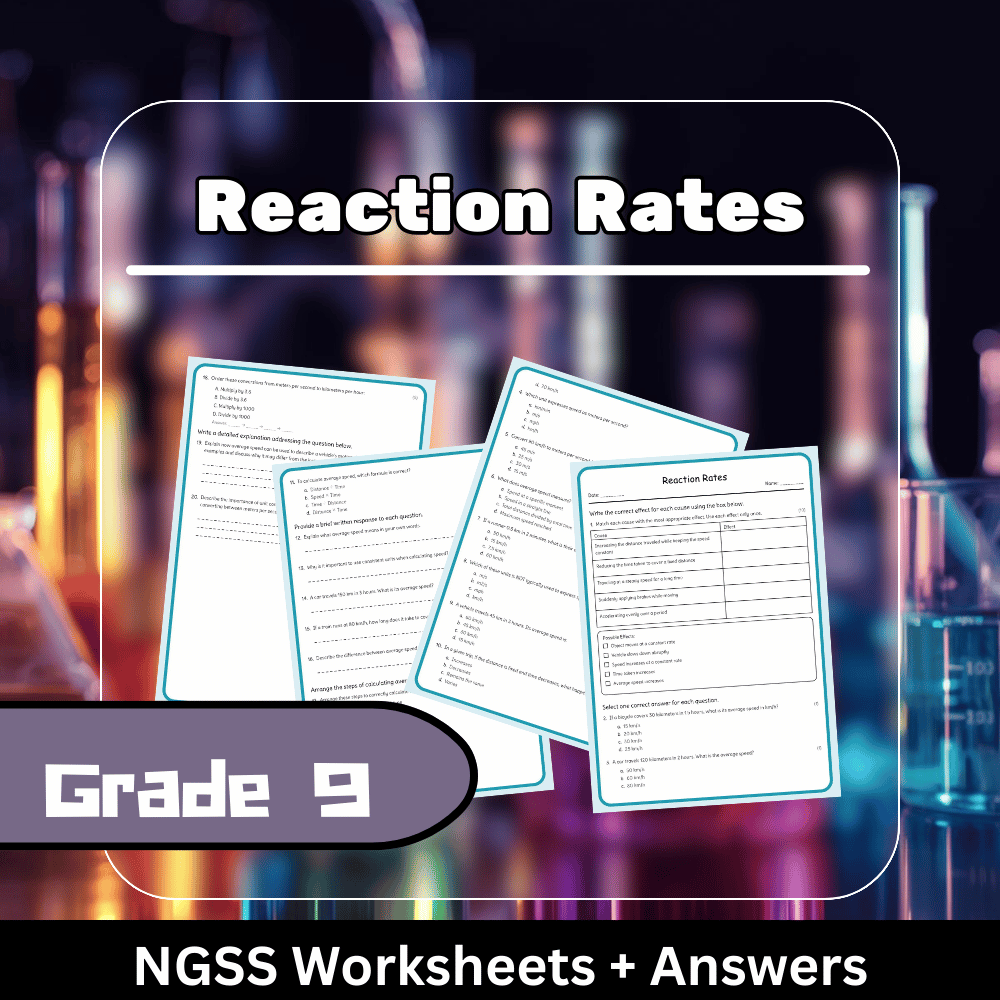
Grade 9 Science | Reaction Rates Worksheet + Answer Key (NGSS Aligned)
Created byBright Mind ResourcesLearning Objectives
- Understand how collision frequency, activation energy, and reaction pathways influence reaction rates.
- Explain how temperature, concentration, and catalysts modify energy distributions and affect reaction speed.
- Describe rate laws, reaction order, and how these relate quantitatively to reaction mechanisms.
Instant download

Purposeful Language Worksheet | Grade 9 ELA Practice Aligned to BC Standards
JCreated byJ.S SheetsLearning Objectives
- Explain how writer’s choices of language structures (such as parallelism and strategic subordination) shape meaning and tone.
- Identify purposeful patterns in sentences and revise sentences to better meet a stated communication goal.
- Analyze how repetition, contrast, and imagery reinforce a central message in nonfiction and argumentative writing.
Instant download

Sentence Variety Worksheet Pack | Grade 9 ELA Activities
Created bySunny Desk ResourcesLearning Objectives
- Identify how simple, compound, and complex sentences differ in structure and purpose.
- Use conjunctions and subordinating markers to combine ideas with clarity and emphasis.
- Revise sentences by separating or combining details to improve readability and momentum.
Also included in: Grade 9 ELA Grammar & Cohesion Writing Lesson Bundle | Alberta +1 more
Instant download
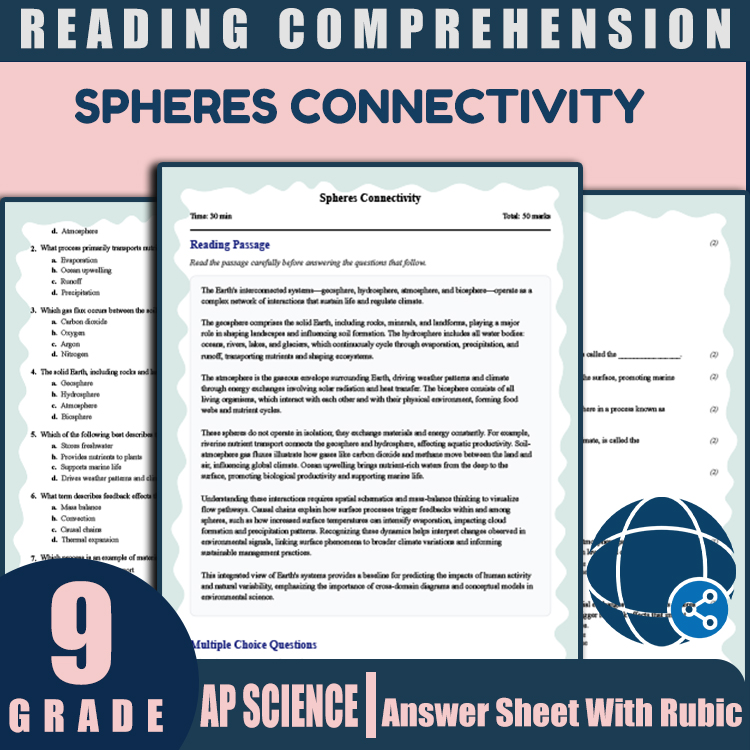
Grade 9 Science | Spheres Connectivity Reading Worksheet & Answer Key (PDF)
JCreated byJ.S SheetsLearning Objectives
- Describe the interactions among the geosphere, hydrosphere, atmosphere, and biosphere using conceptual models.
- Explain material and energy exchanges such as riverine nutrient transport, soil-atmosphere gas fluxes, and ocean upwelling effects.
- Use spatial schematics, mass-balance thinking, and causal chains to interpret coupled environmental phenomena.
Instant download

Grade 9 Health Worksheet | Substance Effects (Ontario Standards) (PDF)
Created bySunny Desk ResourcesLearning Objectives
- Explain short-term and long-term effects of substance use on the brain, body, and behaviour.
- Identify risk factors and early signs of addiction in realistic scenarios.
- Describe prevention and harm-reduction strategies that reduce negative outcomes.
Also included in: Grade 9 Healthy Living Health Lesson Bundle: Ontario Health Framework +1 more
Instant download
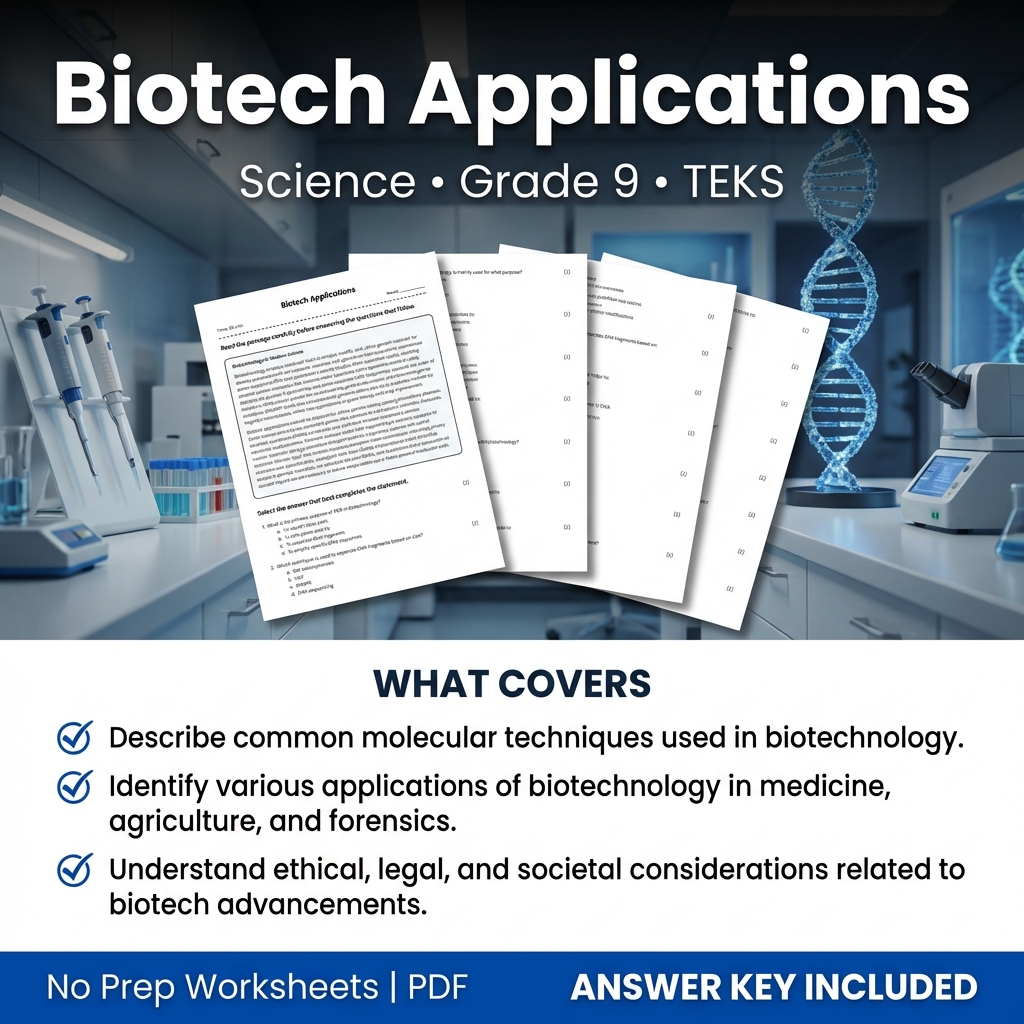
Biotech Applications Science Worksheet for Grade 9 | TEKS Aligned
Created byCoral Reef LearningLearning Objectives
- Describe common molecular techniques used in biotechnology.
- Identify various applications of biotechnology in medicine, agriculture, and forensics.
- Understand ethical, legal, and societal considerations related to biotech advancements.
Instant download

Grade 9 Science – Phylogenetic Trees & Evolutionary Relationships | Worksheet
Created byBright Mind ResourcesLearning Objectives
- Identify basic components of phylogenetic trees
- Understand the significance of shared derived characters
- Learn methods of tree construction such as parsimony and molecular distance
Also included in: Grade 9 Speciation Science Daily Reading Worksheets Lesson Bundle | NGSS +2 more
Instant download

Grade 9 Science — Worksheet MCQ Paper for Mastering One-Dimensional Motion
Created byThe Resource HubLearning Objectives
- Understand the core relationships among displacement, velocity, and acceleration along a straight line.
- Interpret position–time and velocity–time graphs to analyze motion.
- Apply constant-acceleration equations to solve kinematic problems.
Also included in: Grade 9 Physics Principles Bundle | AP Science Worksheets for Motion & Force +1 more
Instant download
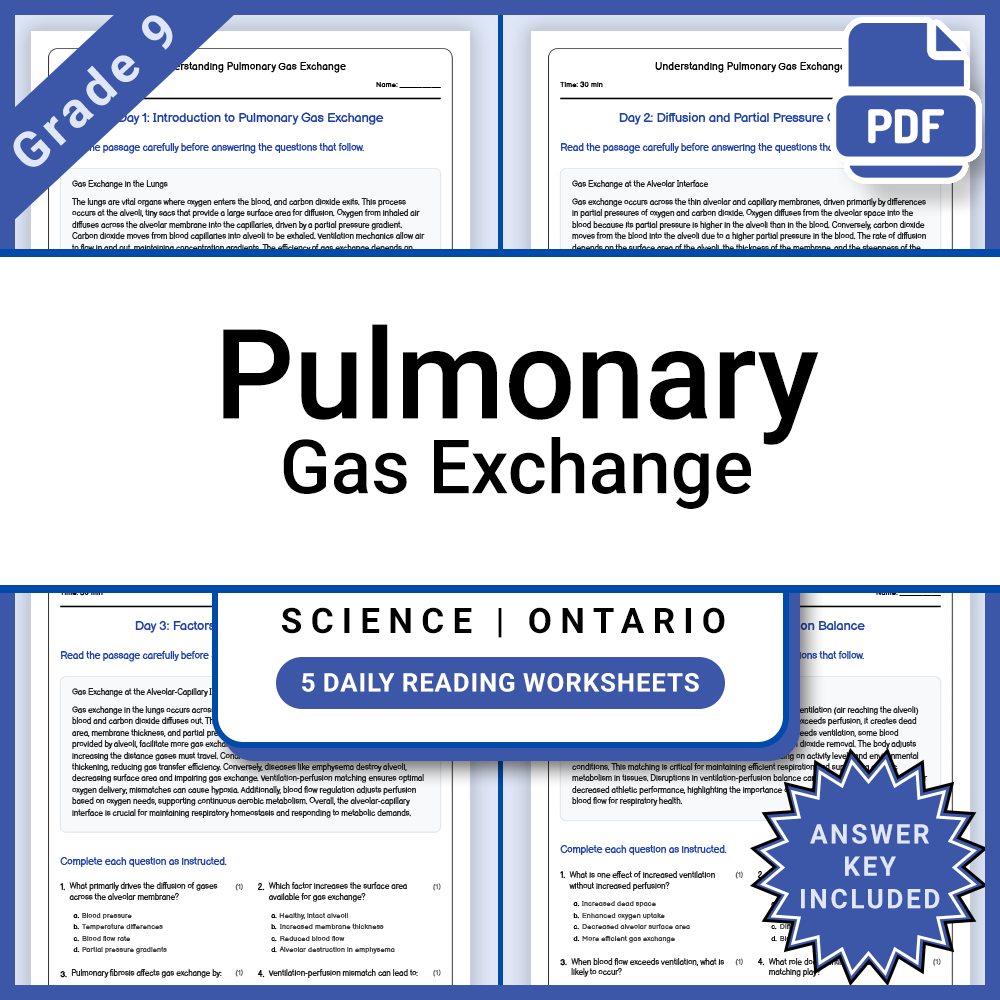
Grade 9 Science – Pulmonary Gas Exchange Daily Reading Worksheet + Answer Key
JCreated byJ.S SheetsLearning Objectives
- Describe the process of gas exchange at the alveolar–capillary interface.
- Identify factors affecting oxygen and carbon dioxide movement in the lungs.
- Explain the mechanics of ventilation and the role of alveoli in respiration.
Also included in: Grade 9 Science Lesson Group | Human Body Systems, Environment & Energy +1 more
Instant download

Grade 9 ELA Worksheet Engaging Presentations | Standards-Aligned Practice
JCreated byJ.S SheetsLearning Objectives
- Identify and apply a clear presentation structure that includes an introduction, main points in sequence, and a concluding summary.
- Use purposeful emphasis and smooth transitions to make relationships among ideas clear to an audience.
- Support main points with relevant examples and connect ideas to a central purpose.
Instant download
Browse more categories
About Grade 9 Worksheets
Browse 9,322 printable Grade 9 worksheets across algebra, biology, literature, and history — each a ready-to-print PDF with optional answer keys.
Every worksheet on MyTeachingSheets is created by independent teacher-authors and reviewed before publication. All resources download as printable PDFs for classroom, homework, or at-home practice, and many include answer keys. Preview any worksheet free before buying.