
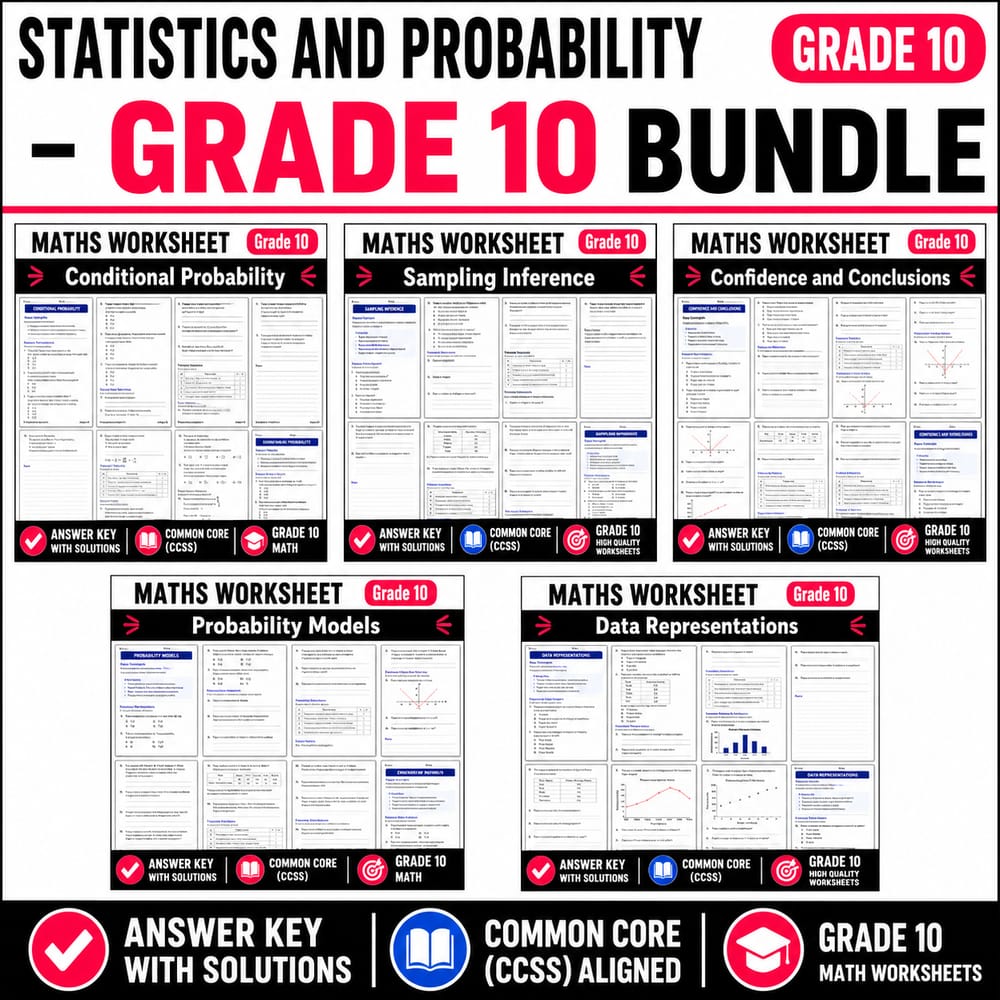
Grade 10 Statistics and Probability Lesson Bundle | Common Core Maths
$20.00$25.00Save $5.00
BRIGHT PATH RESOURCES
·3 followers·23 sales
SubjectMathsGradeGrade 10Pages46 Pages
What’s included
5 worksheets · 46 pages · Save $5.00 (20%) · prices shown inside the bundle
 Grade 10 Conditional Probability Worksheet | Statistics & CCSS Math
- Compute conditional probabilities using P(A|B) = P(A ∩ B) / P(B).
- Translate situations into conditional-probability calculations from counts and tables.
- Interpret what conditional probability means and how it differs from P(B|A).
$4.00$5.00 Grade 10 Sampling Inference Worksheet | Statistics & Data Analysis CCSS
- Explain how sampling variability affects sample statistics and uncertainty in conclusions
- Interpret confidence intervals and explain what they mean (and do not mean)
- Use sample size and estimates (e.g., p̂) to compute standard error and confidence intervals
$4.00$5.00 Grade 10 Confidence and Conclusions Worksheet | Statistics Practice CCSS
- Interpret confidence levels as evidence from repeated sampling and avoid common misinterpretations.
- Use confidence intervals (and estimated margins of error) to justify conclusions about population parameters.
- Explain how sampling variability can produce different sample statistics while still being consistent with the same population.
$4.00$5.00 Grade 10 Probability Models Worksheet | Statistics & Probability CCSS
- Translate real situations into probability models using clear assumptions about the sample space and equally likely outcomes
- Use probability models to compute likelihoods, including complements
- Compare scenarios by using the probability model outcomes rather than intuition
$4.00$5.00 Grade 10 Data Representations Worksheet | Statistics & Data Analysis CCSS
- Read dot plots, histograms, and box plots to identify key features such as shape, center, and spread
- Interpret one-to-one scales by connecting visual features (median, quartiles, bar heights) to quantitative meaning
- Distinguish typical values from extreme values (outliers) using graphical information and the 1.5×IQR rule
$4.00$5.00
Reviews & Feedback
Loading reviews...
Questions & Answers
Loading questions…
About this bundle
Related categories
Frequently asked questions
Who is Grade 10 Statistics and Probability Lesson Bundle | Common Core Maths designed for?
Grade 10 Statistics and Probability Lesson Bundle | Common Core Maths is designed for Grade 10 students and Maths learners and can be used in classrooms, homeschool, or independent practice.
How do I download Grade 10 Statistics and Probability Lesson Bundle | Common Core Maths?
Add it to your cart and complete checkout. After payment, you can download immediately from your account, and you'll also receive a download link by email.
Similar Products

Grade 8 Statistics and Probability Lesson Bundle | Common Core Maths
$20.00$25.00

Grade 9 Statistics and Probability Lesson Bundle | Maths CCSS
$20.00$25.00

Grade 12 Math Lessons Bundle | Ontario Standards and Statistical Analysis
$20.00$25.00

Grade 11 Statistics and Probability Lesson Bundle | CCSS Maths
$20.00$25.00

Grade 6 Statistics & Data Analysis Math Worksheet Lesson Bundle for CCSS
$24.00$30.00