
Daily Reading Worksheets Worksheets
8,400 type resources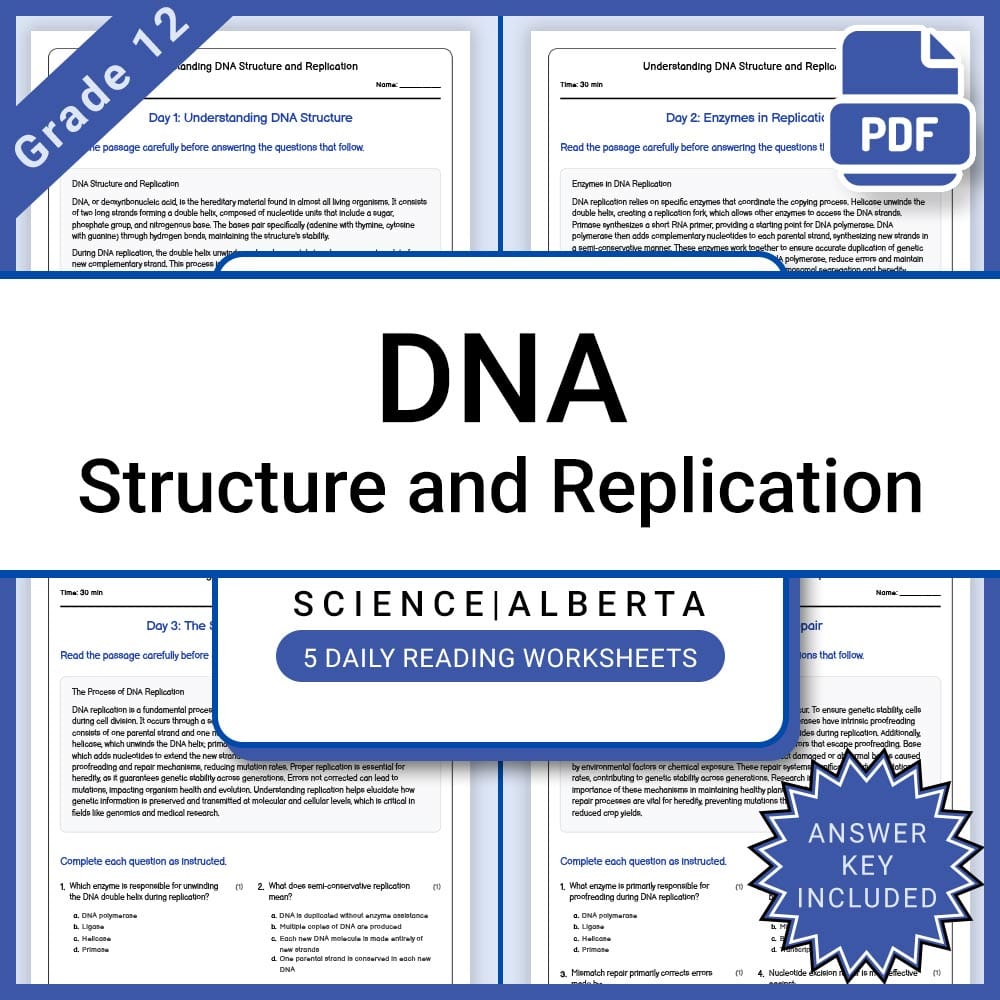
Grade 12 Science – DNA Structure Replication Daily Worksheet + Answer Key
JCreated byJ.S SheetsLearning Objectives
- Identify the basic components of DNA, including nucleotides and strands.
- Explain the semi-conservative model of DNA replication.
- Describe the roles of enzymes such as helicase, primase, and DNA polymerase in DNA replication.
Also included in: Grade 12 Science Lesson Bundle | Daily Reading Worksheets +1 more
Instant download

Grade 7 Calorimetry Variables & Heat Transfer Science Worksheet Alberta
 Created byBRIGHT PATH RESOURCES
Learning Objectives
- Identify key variables in a calorimetry situation (mass, temperature change, and specific heat) and explain what each one means
- Relate rising or falling temperature to heat absorbed or released in a calorimetry setup
Also included in: Grade 7 Alberta Science Energy Heat and Thermal Processes Worksheet Bundle +1 more
Instant download

Grade 7 ELA – Text Evidence Skills & Reading Comprehension | Daily Worksheet
 Created byQuiet Forest Education
Learning Objectives
- Identify key details in a text that support main ideas
- Analyze how evidence supports claims about themes, characters, or meaning
- Distinguish between main ideas and supporting details
Also included in: Grade 7 Writing ELA Lesson Bundle for Daily Reading | Common Core (CCSS) +1 more
Instant download

Grade 7 ELA – Source Evaluation Skills Daily Reading Worksheet | Common Core
Created byQuiet Forest EducationLearning Objectives
- Learn how to identify credible sources through author expertise and publication reliability.
- Understand how to evaluate evidence for accuracy and usefulness.
- Practice organizing notes and details to support claims and topics.
Also included in: Grade 7 Writing ELA Lesson Bundle for Daily Reading | Common Core (CCSS) +1 more
Instant download
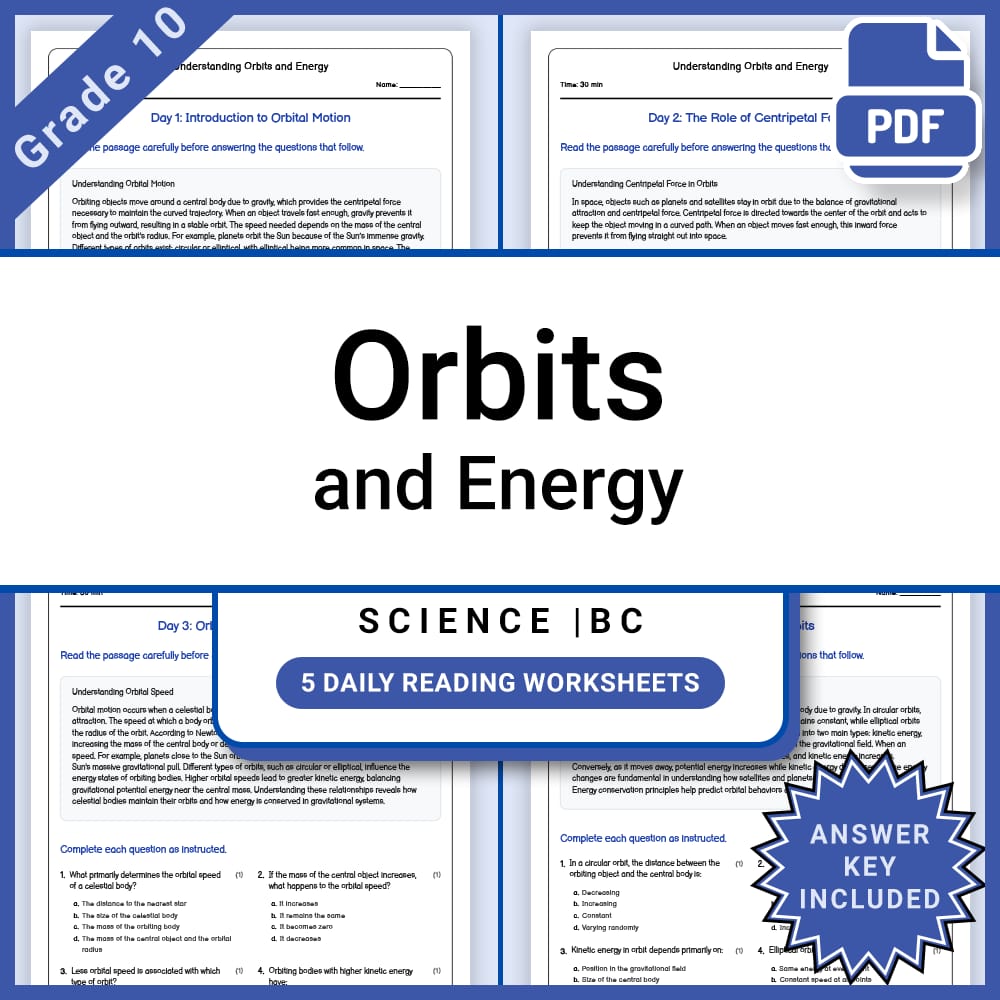
Grade 10 Science – Orbits and Energy Daily Reading Worksheet + Answer Key
JCreated byJ.S SheetsLearning Objectives
- Explain how gravitational attraction causes objects to orbit
- Describe the relationship between orbital speed, central mass, and radius
- Differentiate between circular and elliptical orbits
Also included in: Grade 10 Science Lesson Group Bundle – Physics and Fields +1 more
Instant download

Grade 12 Science – Planetary Geology Daily Reading Worksheet with Answer Key
JCreated byJ.S SheetsLearning Objectives
- Understand surface features such as craters, volcanoes, and tectonic signs on planetary bodies.
- Analyze how surface processes reveal planetary thermal and geological history.
- Learn how remote sensing, sample analysis, and in situ measurements contribute to planetary geology.
Also included in: Grade 12 Science Lesson Group Bundle with TEKS Framework +1 more
Instant download

Grade 12 Science – Astronomy Overview Daily Reading Worksheet with Answer Key
JCreated byJ.S SheetsLearning Objectives
- Understand the processes involved in the formation of the Solar System
- Identify the stages of planetary accretion and differentiation
- Relate observational data to solar nebula models and planetary diversity
Also included in: Grade 12 Science Lesson Group Bundle with TEKS Framework +1 more
Instant download

Grade 12 Science – Climate Modeling Daily Reading Worksheet + Answer Key
JCreated byJ.S SheetsLearning Objectives
- Understand the basic components of climate models.
- Identify different approaches used in climate modeling.
- Recognize the importance of model validation and the methods used.
Also included in: Grade 12 Science Lesson Group Bundle with TEKS Framework +1 more
Instant download
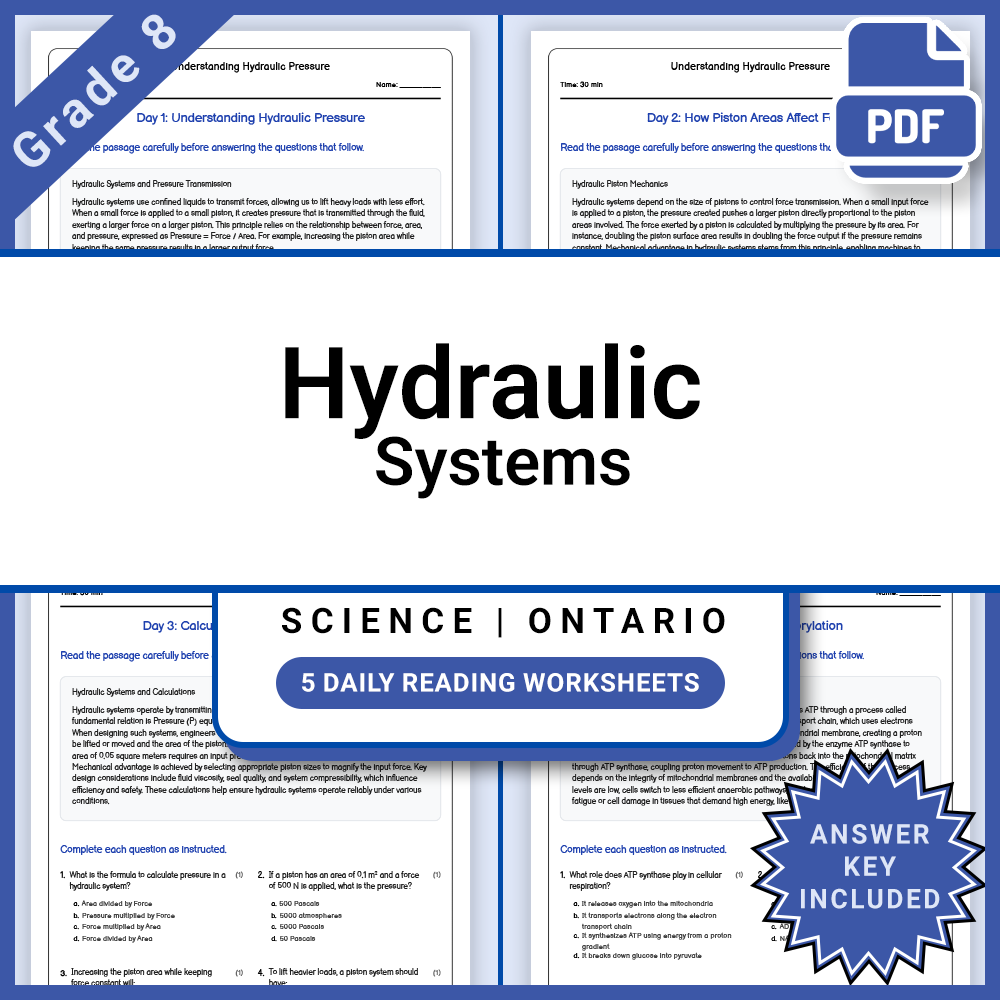
Grade 8 Science – Hydrostatic Pressure Daily Reading Worksheet + Answer Key
JCreated byJ.S SheetsLearning Objectives
- Understand key concepts related to Science
- Apply knowledge through practice questions
- Demonstrate comprehension of the material
Also included in: Grade 8 Science Lesson Bundle: Fluids, Pressure, and Density Topics +1 more
Instant download

Science Grade 7: Solution Comparison Worksheet | NGSS Assessment
 Created bySkylark Worksheets
Learning Objectives
- Compare competing design solutions by using consistent metrics and model-based reasoning.
- Identify and quantify trade-offs among performance, cost, durability, and manufacturability.
- Use predicted vs. observed behavior from simple prototypes to rank options and document limitations.
Also included in: Grade 7 Engineering Design Science Lesson Bundle: NGSS +1 more
Instant download
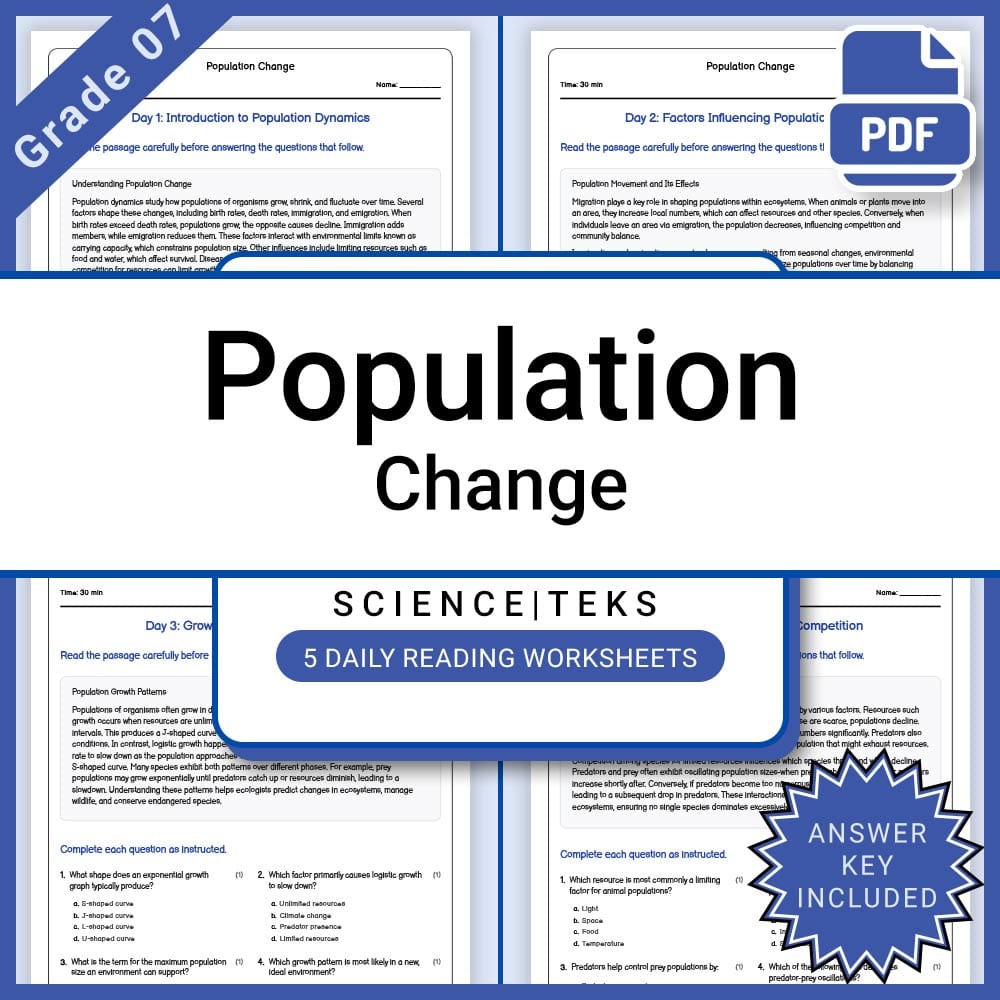
Grade 7 Science – Population Change Daily Reading Worksheet with Answer Key
JCreated byJ.S SheetsLearning Objectives
- Understand the key factors that influence population size and distribution.
- Differentiate between exponential and logistic growth patterns.
- Identify how predator-prey relationships affect population oscillations.
Also included in: Grade 7 Science Lesson Bundle | Ecosystems, Cell Structure & Adaptations +1 more
Instant download
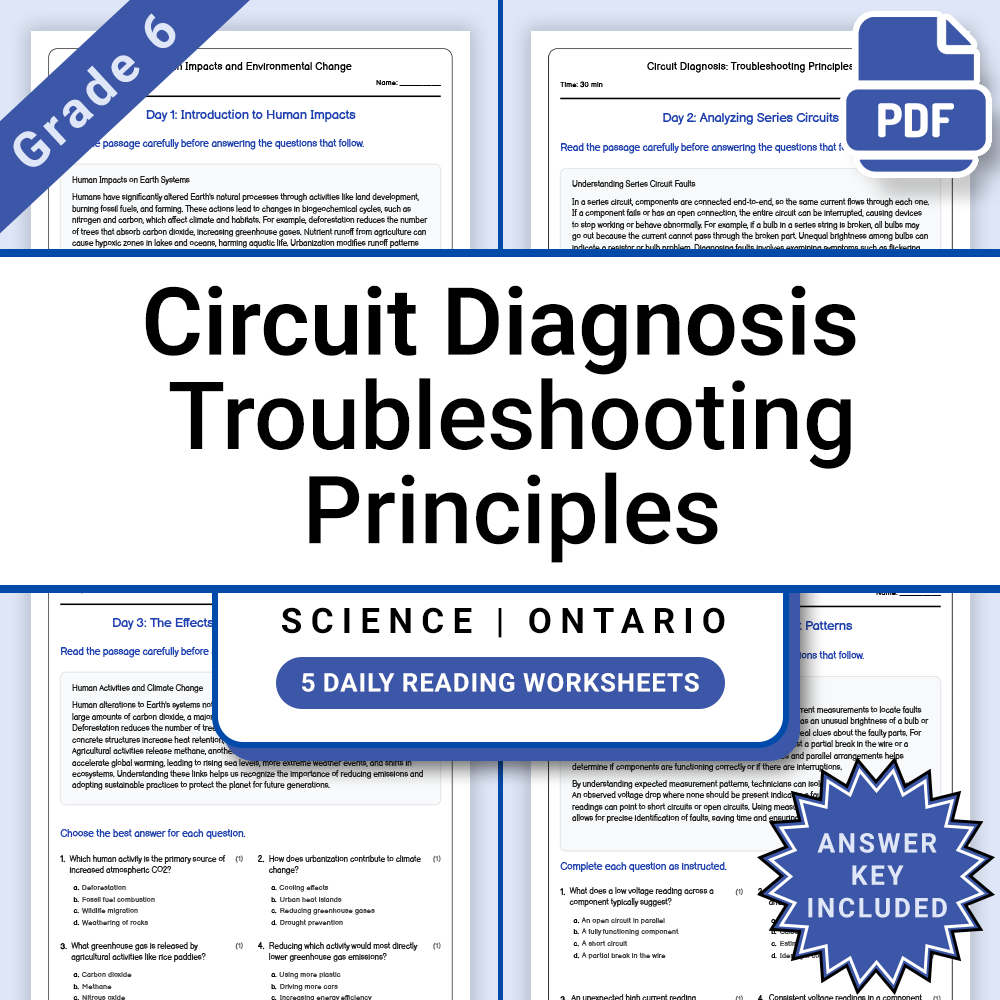
Grade 6 Science – Circuit Diagnosis Troubleshooting Daily Worksheet + Answer Key
JCreated byJ.S SheetsLearning Objectives
- Understand how to observe and interpret symptoms in electrical circuits.
- Apply reasoning to identify faults based on circuit behaviour.
- Differentiate between series and parallel circuit issues.
Also included in: Grade 6 Science Lesson Group – Circuits and Energy Ontario Framework +1 more
Instant download

Grade 9 Volcanic Processes Worksheet | NGSS Practice PDF
 Created byClear Sky Classroom
Learning Objectives
- Explain how magma viscosity and volatile (gas) content influence eruptive style and energy
- Compare effusive shield volcanism and explosive stratovolcano behavior using tectonic setting and magma composition
- Use petrologic indicators and eruption chronologies to interpret past volcanic activity and landscape change
Also included in: Grade 9 Earth and Space Sciences Science lesson bundle (AP framework) +1 more
Instant download

Grade 9 Organelle Function Worksheet | Practice & Assessment PDF
Created byClear Sky ClassroomLearning Objectives
- Explain how mitochondria, chloroplasts, endoplasmic reticulum, and lysosomes contribute to cellular maintenance and metabolism
- Connect organelle structure (cristae, thylakoid stacks, folded membranes) to specific functional outcomes such as ATP synthesis and light capture
- Use compartmentation and energy-flow ideas to describe how pathways are organized to optimize reaction rates and coordination of anabolic and catabolic processes
Also included in: Grade 9 Biology and Ecosystems Science Lesson Bundle for Advanced Placement (AP) +1 more
Instant download

Grade 9 Developmental Variation Worksheet | Practice & Assessment PDF
Created byClear Sky ClassroomLearning Objectives
- Explain how variation in developmental timing and gene regulation can produce different phenotypes from the same basic genetic toolkit
- Describe how regulatory networks and epigenetic modulation influence trait expression during development
- Use comparative developmental evidence to link genetic variation to morphological and physiological differences
Also included in: Grade 9 Biology and Ecosystems Science Lesson Bundle for Advanced Placement (AP) +1 more
Instant download

Grade 9 Control Criteria Worksheet | AP Practice & PDF
Created byClear Sky ClassroomLearning Objectives
- Define control criteria in causal inference and explain why comparability matters
- Identify how variable isolation, replication, baseline characterization, and reference conditions strengthen causal claims
- Analyze how residual confounding and uncontrolled variation weaken causal interpretation
Also included in: Grade 9 Science Practices Science Lesson Bundle | Advanced Placement (AP) +1 more
Instant download

Grade 9 Genetic Transmission Worksheet | Practice & Assessment PDF
Created byClear Sky ClassroomLearning Objectives
- Explain how chromosomal behavior during meiosis leads to Mendelian inheritance patterns.
- Use Punnett frameworks and probability to predict genotypic and phenotypic ratios.
- Analyze inheritance deviations such as incomplete dominance, codominance, linkage, and penetrance.
Also included in: Grade 9 Biology and Ecosystems Science Lesson Bundle for Advanced Placement (AP) +1 more
Instant download

Grade 9 Model-Data Fit Worksheet | Practice & Assessment PDF
Created byClear Sky ClassroomLearning Objectives
- Use residuals and graphical comparisons to judge whether a model is consistent with experimental data.
- Explain diagnostic patterns (such as systematic residual trends and unequal spread) that suggest model problems or missing variables.
- Apply goodness-of-fit ideas to decide when to accept, modify, or reject a model based on predictive performance and independent benchmarks.
Also included in: Grade 9 Science Practices Science Lesson Bundle | Advanced Placement (AP) +1 more
Instant download

Grade 10 Science – Seismic Tomography Daily Reading Worksheet with Answer Key
JCreated byJ.S SheetsLearning Objectives
- Identify and distinguish between primary (P) and secondary (S) seismic waves.
- Understand how seismic wave travel times are measured and interpreted.
- Explain the concepts of seismic wave attenuation and velocity variations.
Also included in: Grade 10 Science Lesson Bundle | Earth and Resource Management +1 more
Instant download

Grade 10 Uncertainty Ranges Worksheet | General Use Practice PDF
Created byClear Sky ClassroomLearning Objectives
- Explain how uncertainty ranges help interpret measurement results from repeated or independent trials.
- Distinguish central tendency from variability and describe how each affects conclusions.
- Use ranges to judge whether differences are likely meaningful or could be caused by random variation.
Instant download

Grade 10 Spheres Overview Worksheet | Practice & Assessment PDF
Created byClear Sky ClassroomLearning Objectives
- Describe the geosphere, hydrosphere, atmosphere, and biosphere and identify what each sphere includes.
- Explain how matter and energy move among Earth’s spheres through pathways such as weathering, water transport, and biological cycling.
- Use examples from Alberta landscapes (mountains, prairies, and boreal forests) to predict observable regional patterns in climate and landforms.
Instant download
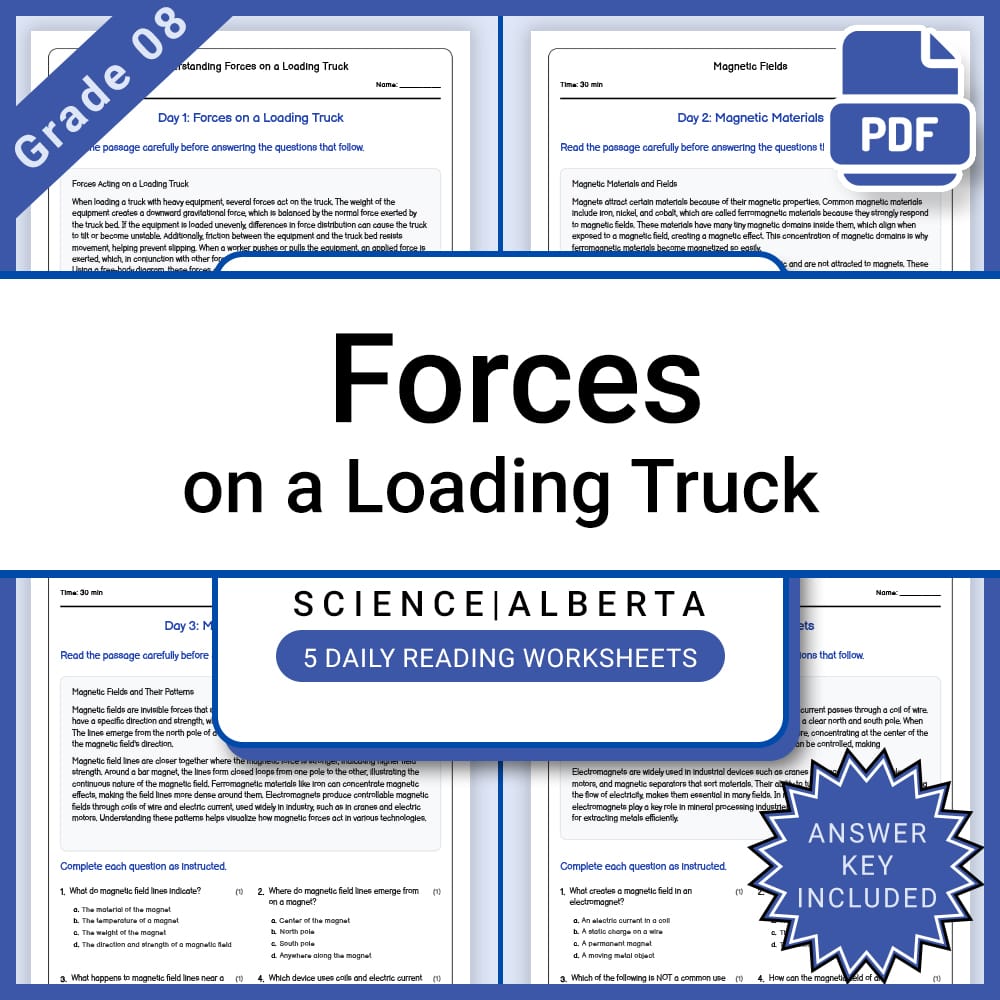
Grade 8 Science – Forces on a Loading Truck Daily Reading Worksheet + Answer Key
JCreated byJ.S SheetsLearning Objectives
- Explain the concept of a free body diagram.
- Identify different forces acting on an object.
- Represent forces visually using vectors.
Also included in: Grade 8 Science Lesson Bundle | Forces, Motion, and Energy +1 more
Instant download

Grade 9 Wave Boundary Behavior Worksheet | Practice & Standard PDF
Created byClear Sky ClassroomLearning Objectives
- Explain how reflection, refraction, transmission, and absorption affect wave direction and energy at boundaries
- Use wave models to predict changes in wavelength when waves enter a new medium
- Describe how diffraction and interference patterns form when waves pass through openings or overlap
Instant download

Grade 12 Erosion Dynamics Worksheet | BC Use Practice PDF
Created byClear Sky ClassroomLearning Objectives
- Explain how detachment, transport, and deposition work together in erosion dynamics.
- Compare how water, ice, wind, and gravity drive landscape change.
- Analyze how climate, vegetation, and tectonic uplift influence erosion rates and sediment records.
Instant download
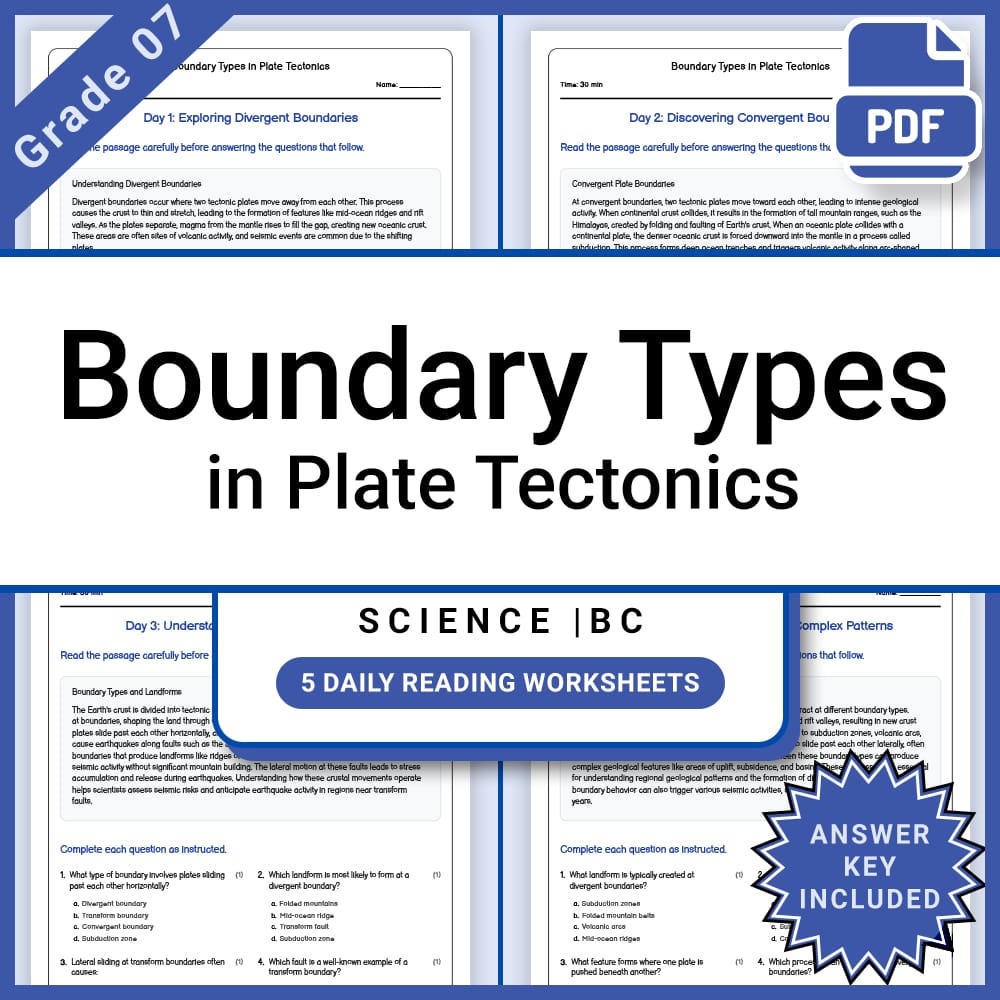
Grade 7 Science – Plate Tectonics Daily Reading Worksheet + Answer Key
JCreated byJ.S SheetsLearning Objectives
- Describe the structure of Earth's outer shell and its division into plates.
- Identify and explain the three main types of plate boundaries: divergent, convergent, and transform.
- Understand how plate movements influence geological features like earthquakes, volcanoes, and mountain ranges.
Also included in: Grade 7 Science Lesson Group: Earth Processes & Landforms Bundle +1 more
Instant download
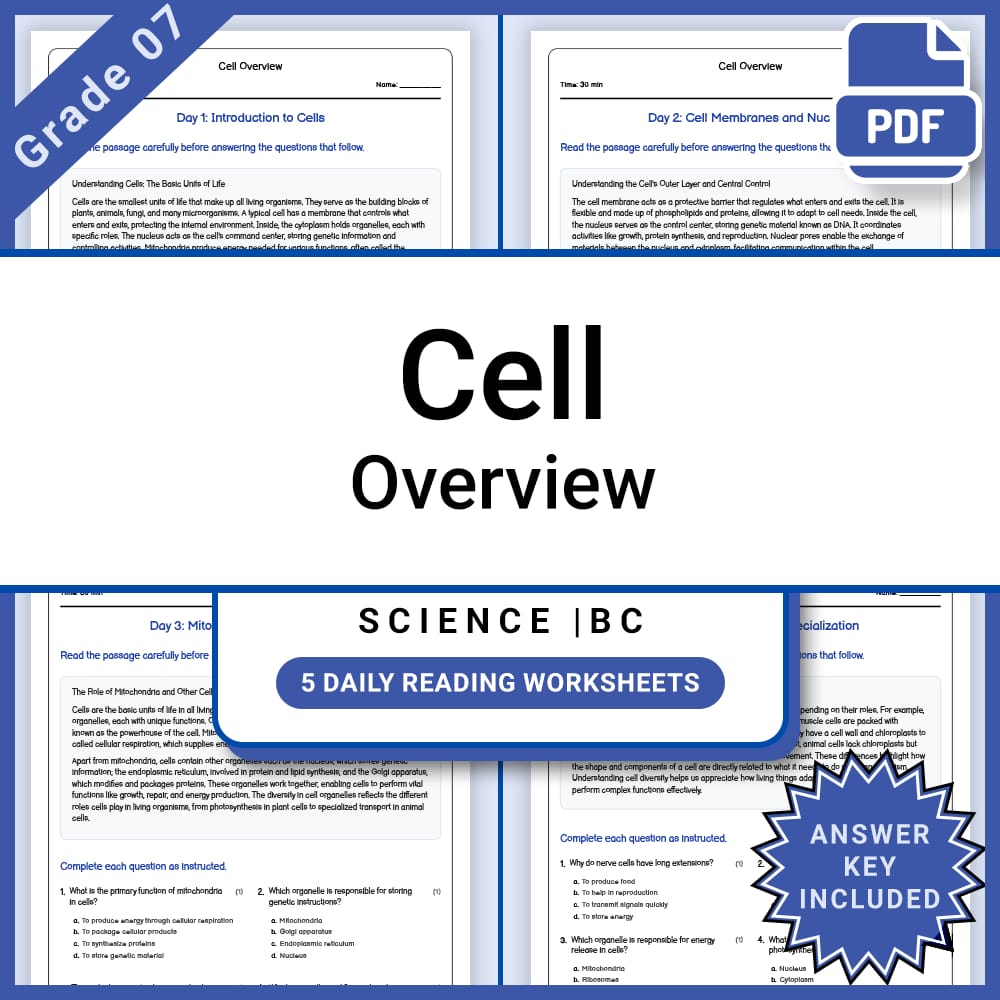
Grade 7 Science – Cell Overview Daily Reading Worksheet with Answer Key
JCreated byJ.S SheetsLearning Objectives
- Identify the main parts of a cell
- Describe the functions of cell components
- Understand the diversity of cell structures in living organisms
Also included in: Grade 7 Science Lesson Group Bundle | Cell Structures and Processes +1 more
Instant download
Grade 7 Science – Sedimentary Processes Daily Reading Worksheet + Answer Key
JCreated byJ.S SheetsLearning Objectives
- Understand the processes of weathering, transport, and deposition of sediments
- Identify different depositional environments such as deltas, beaches, and floodplains
- Explain how sediments are transformed into rocks through lithification
Also included in: Grade 7 Science Lesson Group: Earth Processes & Landforms Bundle +1 more
Instant download
Grade 7 Science – Rock Types Daily Reading Worksheet with Answer Key
JCreated byJ.S SheetsLearning Objectives
- Identify different types of rocks based on their features
- Understand how igneous, sedimentary, and metamorphic rocks form
- Recognize key characteristics of each rock type
Also included in: Grade 7 Science Lesson Group: Earth Processes & Landforms Bundle +1 more
Instant download
Grade 7 – Membrane Transport Passive Diffusion Daily Worksheet + Answer Key
JCreated byJ.S SheetsLearning Objectives
- Understand the process of passive diffusion across the cell membrane.
- Identify the role of concentration gradients in diffusion.
- Differentiate between passive and active transport mechanisms.
Also included in: Grade 7 Science Lesson Group Bundle | Cell Structures and Processes +1 more
Instant download
Grade 7 – Conservation Strategies in Ecosystems Daily Worksheet + Answer Key
JCreated byJ.S SheetsLearning Objectives
- Understand basic concepts of ecosystems and biodiversity
- Identify various conservation strategies and their purposes
- Recognize the importance of habitat protection and restoration
Also included in: Grade 7 Science Lesson Group: Ecosystems and Population Framework +1 more
Instant download
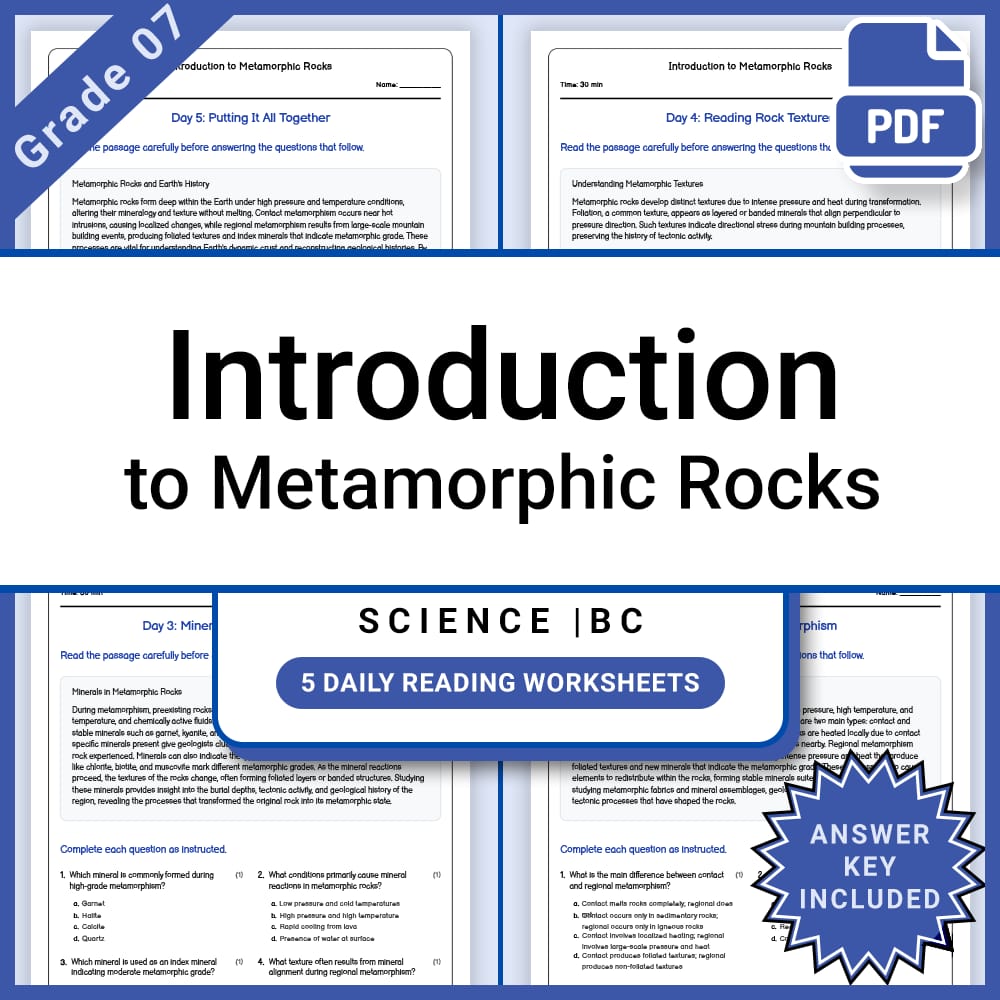
Grade 7 Science – Mountain Building Daily Reading Worksheet with Answer Key
JCreated byJ.S SheetsLearning Objectives
- Understand the geological processes involved in mountain formation
- Identify different types of tectonic plate movements
- Analyze the role of erosion and uplift in shaping mountains
Also included in: Grade 7 Science Lesson Group: Earth Processes & Landforms Bundle +1 more
Instant download
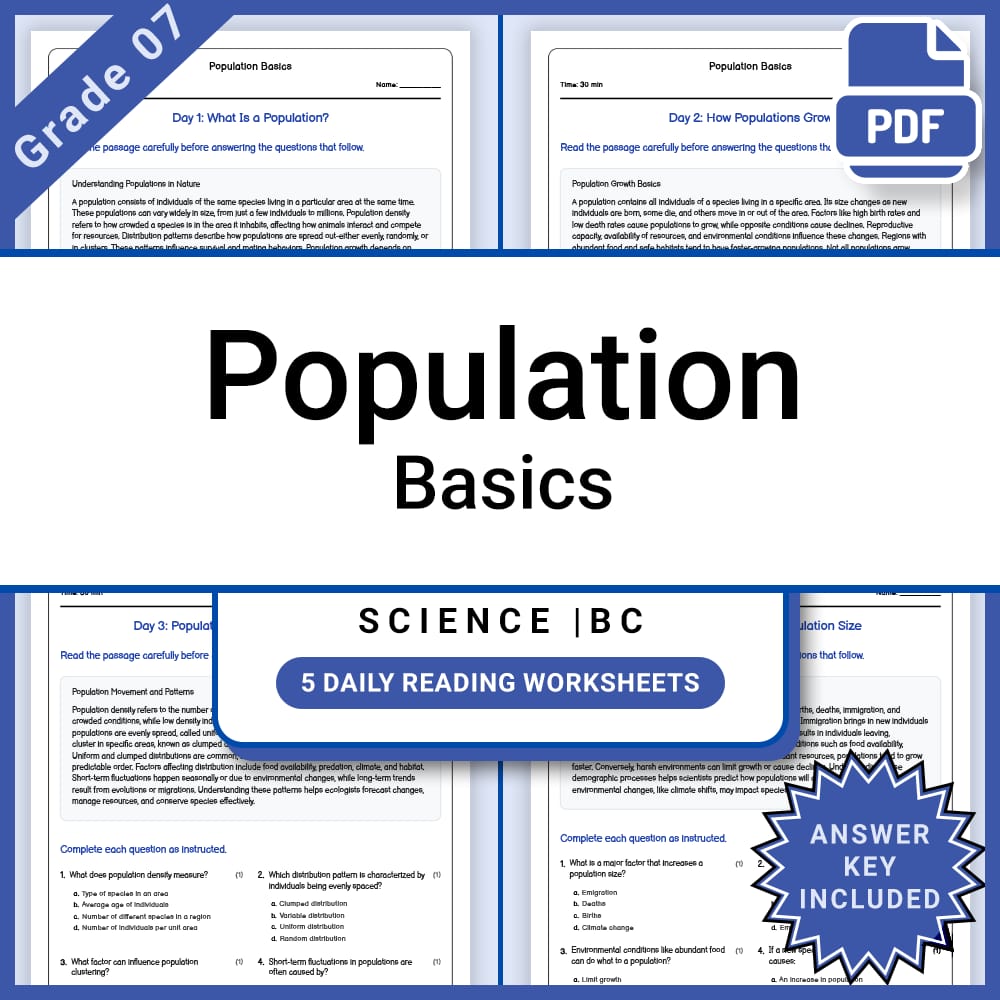
Grade 7 Science – Population Basics Daily Reading Worksheet with Answer Key
JCreated byJ.S SheetsLearning Objectives
- Understand key concepts related to Science
- Apply knowledge through practice questions
- Demonstrate comprehension of the material
Also included in: Grade 7 Science Lesson Group: Ecosystems and Population Framework +1 more
Instant download
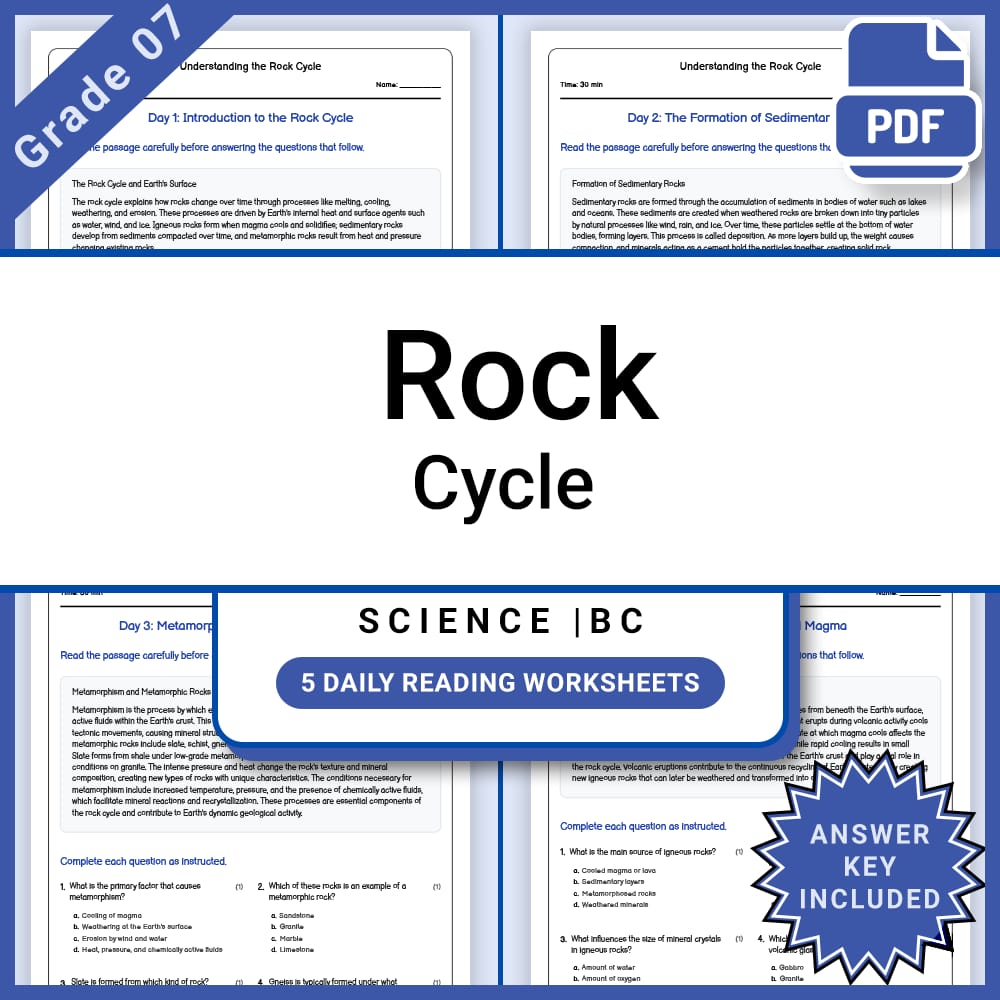
Grade 7 Science – Rock Cycle Daily Reading Worksheet with Answer Key
JCreated byJ.S SheetsLearning Objectives
- Describe the process of the rock cycle
- Identify different types of rocks: igneous, sedimentary, and metamorphic
- Explain how Earth's surface processes contribute to rock transformation
Also included in: Grade 7 Science Lesson Group: Earth Processes & Landforms Bundle +1 more
Instant download
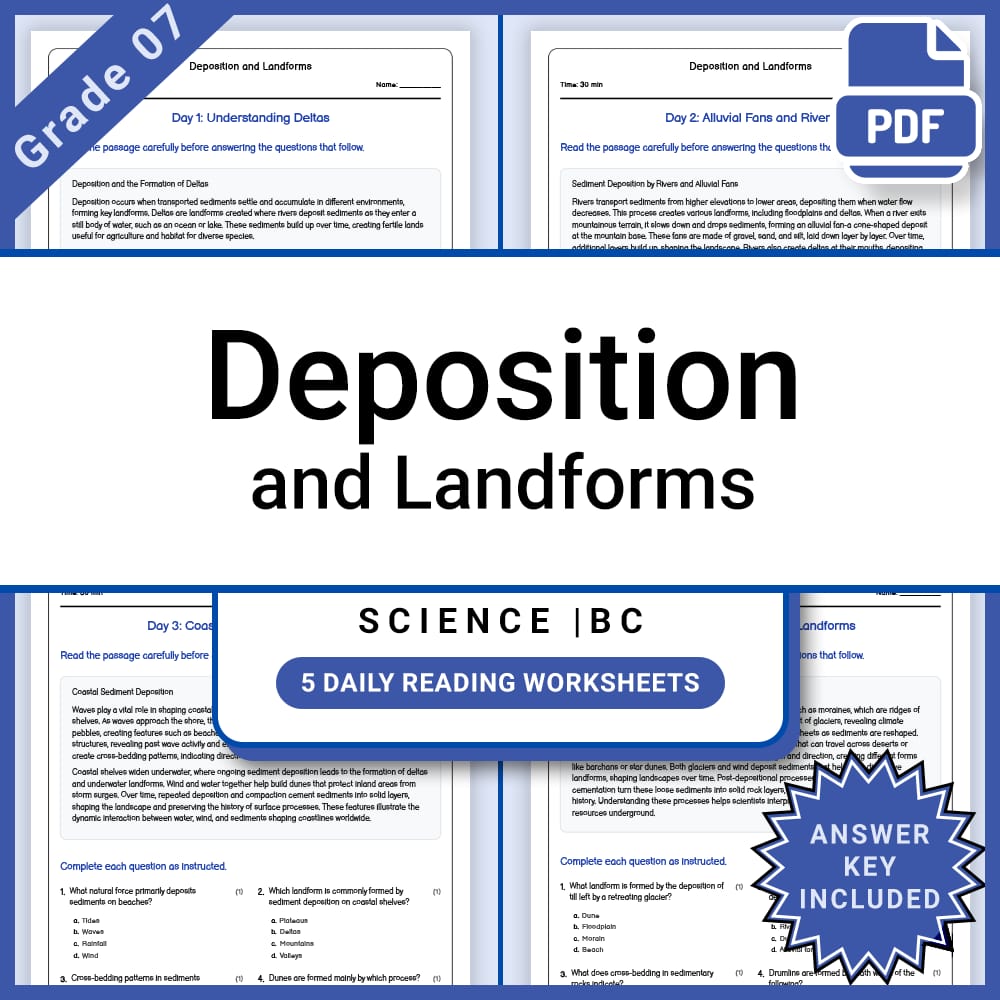
Grade 7 Science – Deposition and Landforms Daily Worksheet with Answer Key
JCreated byJ.S SheetsLearning Objectives
- Understand how deposition contributes to landform development.
- Identify features of a delta and explain the deposition process.
- Recognize different depositional environments and sediment characteristics.
Also included in: Grade 7 Science Lesson Group: Earth Processes & Landforms Bundle +1 more
Instant download

Human Impacts on Biodiversity and Ecosystems Worksheet | Grade 9 NGSS
Created byBRIGHT PATH RESOURCESLearning Objectives
- Understand how deforestation affects biodiversity.
- Analyze case studies of human impacts on ecosystems.
- Interpret empirical data related to land-use change and habitat loss.
Also included in: Ecosystems Grade 9 Science Daily Reading Worksheets Lesson Bundle | NGSS +1 more
Instant download

Grade 12 Maths | Vector Concepts Worksheet (PDF) – Ontario Standards
Created byClear Sky ClassroomLearning Objectives
- Understand the definition and notation of vectors in two and three dimensions.
- Calculate the magnitude and direction of vectors in real-world contexts.
- Interpret vectors as directed line segments and analyze their properties.
Also included in: Grade 12 Maths Vector and Geometry Worksheets | Ontario Lesson Group +1 more
Instant download

Grade 12 Math | Probability in Decision Making Worksheet (Ontario)
Created byClear Sky ClassroomLearning Objectives
- Understand basic probability concepts and how to calculate simple probabilities in real-world scenarios.
- Apply probabilistic reasoning to evaluate risks and support informed decision-making.
- Interpret likelihood and compare different probabilistic outcomes in everyday contexts.
Also included in: Grade 12 Math Ontario Lesson Group Bundle with Data and Probability Worksheets +1 more
Instant download

Grade 6 Filtration And Sieving Worksheet | BC Practice & PDF
Created byClear Sky ClassroomLearning Objectives
- Explain how filtration and sieving separate mixtures using particle size and barriers.
- Identify the parts of a filtration process (porous barrier, trapped solids, and filtrate).
- Compare sieving and filtration and predict which method fits a described mixture.
Instant download

Grade 8 Water Cycle Worksheet | NGSS Practice & PDF
Created byClear Sky ClassroomLearning Objectives
- Describe the processes involved in the water cycle, including evaporation, condensation, precipitation, infiltration, runoff, and groundwater flow.
- Explain how the water cycle connects to weathering processes such as river incision, karst formation, and coastal erosion.
- Analyze the fluxes, residence times, and observable effects of water movement on land and in basins.
Also included in: Grade 8 Earth Systems Science Lesson Bundle for NGSS Worksheet B Practice +1 more
Instant download
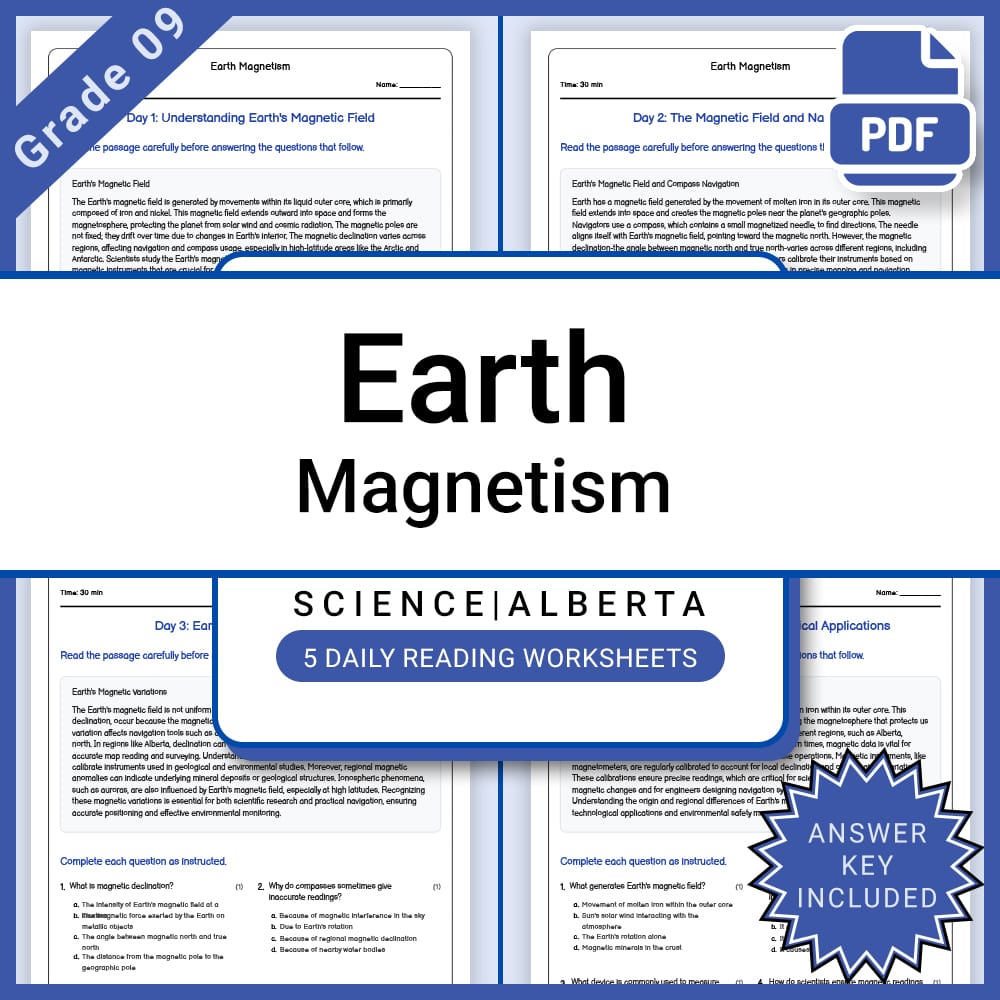
Grade 9 Science – Earth Magnetism Daily Reading Worksheet with Answer Key
JCreated byJ.S SheetsLearning Objectives
- Understand the fundamental concepts of Earth's magnetic field.
- Identify the magnetic poles and how they influence navigation.
- Recognize regional variations in magnetic declination and their implications.
Also included in: Grade 9 Science Lesson Bundle: Electrical Systems and Energy Concepts +1 more
Instant download

Grade 11 Nutrients And Energy Flow Worksheet | General Practice PDF
Created byClear Sky ClassroomLearning Objectives
- Explain how energy flows through trophic levels while decreasing due to metabolic processes and heat loss.
- Describe how matter cycles between living biomass and nonliving reservoirs (air, water, soil) using carbon, nitrogen, and phosphorus examples.
- Evaluate the roles of decomposers and nutrient forms in regulating nutrient availability for producers.
Instant download

Grade 8 Forces Overview Worksheet | Practice & Assessment PDF
Created byClear Sky ClassroomLearning Objectives
- Explain what a force is and how forces can change an object's motion (speed or direction)
- Identify force types (contact and non-contact) and describe examples from everyday situations
- Use qualitative reasoning to compare how larger vs. smaller net forces can affect motion and explain how opposing forces can cancel
Instant download
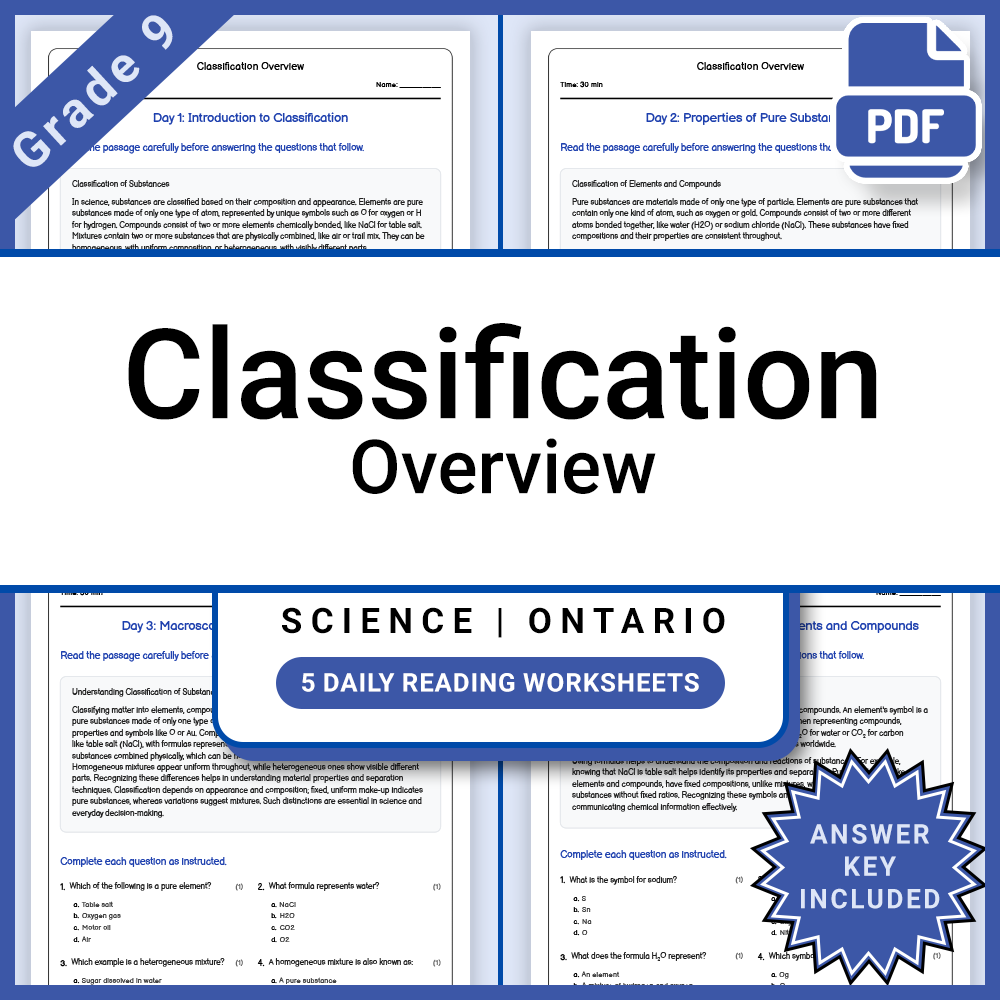
Grade 9 Science Classification Overview Daily Reading Worksheet with Answer Key
JCreated byJ.S SheetsLearning Objectives
- Define and distinguish between elements, compounds, and mixtures.
- Understand the criteria for classifying substances as pure or impure.
- Identify examples of elements, compounds, and mixtures.
Also included in: Grade 9 Science Lesson Group: Ontario Curriculum Daily Reading Worksheets +1 more
Instant download

Grade 12 Math Data Analysis Applications Worksheet (Ontario Standards) PDF
Created byClear Sky ClassroomLearning Objectives
- Apply measures of central tendency and variability to analyze real-world data.
- Interpret data summaries to draw meaningful conclusions.
- Evaluate sampling methods and their impact on data reliability.
Also included in: Grade 12 Maths Lesson Group: Data Analysis and Variability Worksheets +1 more
Instant download
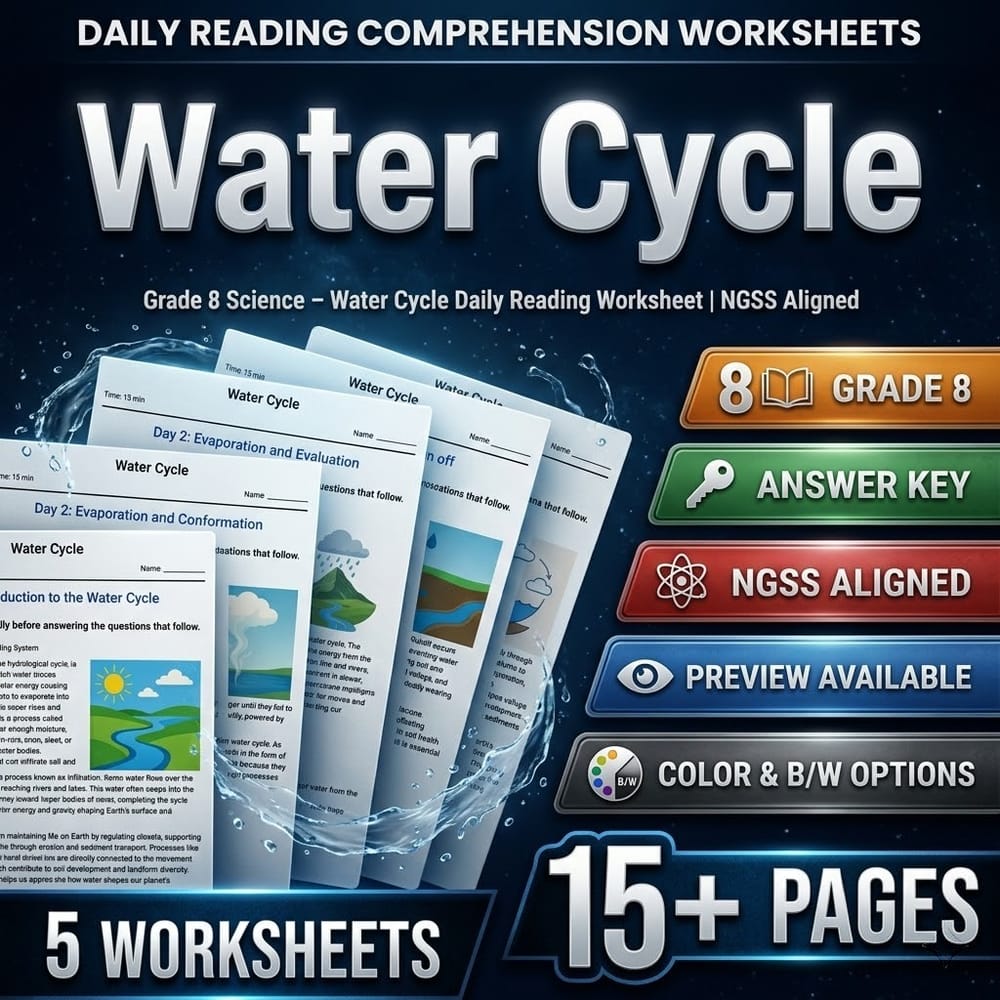
Grade 8 Science – Water Cycle Daily Reading Worksheet | NGSS Aligned
 Created byElena Brooks
Learning Objectives
- Understand the basic processes of the water cycle, including evaporation, condensation, precipitation, infiltration, runoff, and groundwater flow.
- Recognize the role of sunlight and gravity in driving the water cycle.
- Identify how water cycle processes influence landforms and weathering.
Instant download

Grade 8 Organ Formation Worksheet | BC Practice & PDF
Created byClear Sky ClassroomLearning Objectives
- Explain how different tissue types work together to form an organ with specialized functions.
- Describe how an organ’s structure supports its role in transport, mechanical work, or chemistry.
- Use text evidence to identify main ideas and evaluate statements about tissue interactions.
Instant download

Grade 8 Science – Ecosystem Structure Daily Reading Worksheet with Answer Key
JCreated byJ.S SheetsLearning Objectives
- Identify key components of an ecosystem
- Explain abiotic factors influencing ecosystems
- Describe the roles of producers, consumers, and decomposers
Also included in: Grade 8 Science Lesson Bundle – TEKS-aligned Reading Worksheets +1 more
Instant download
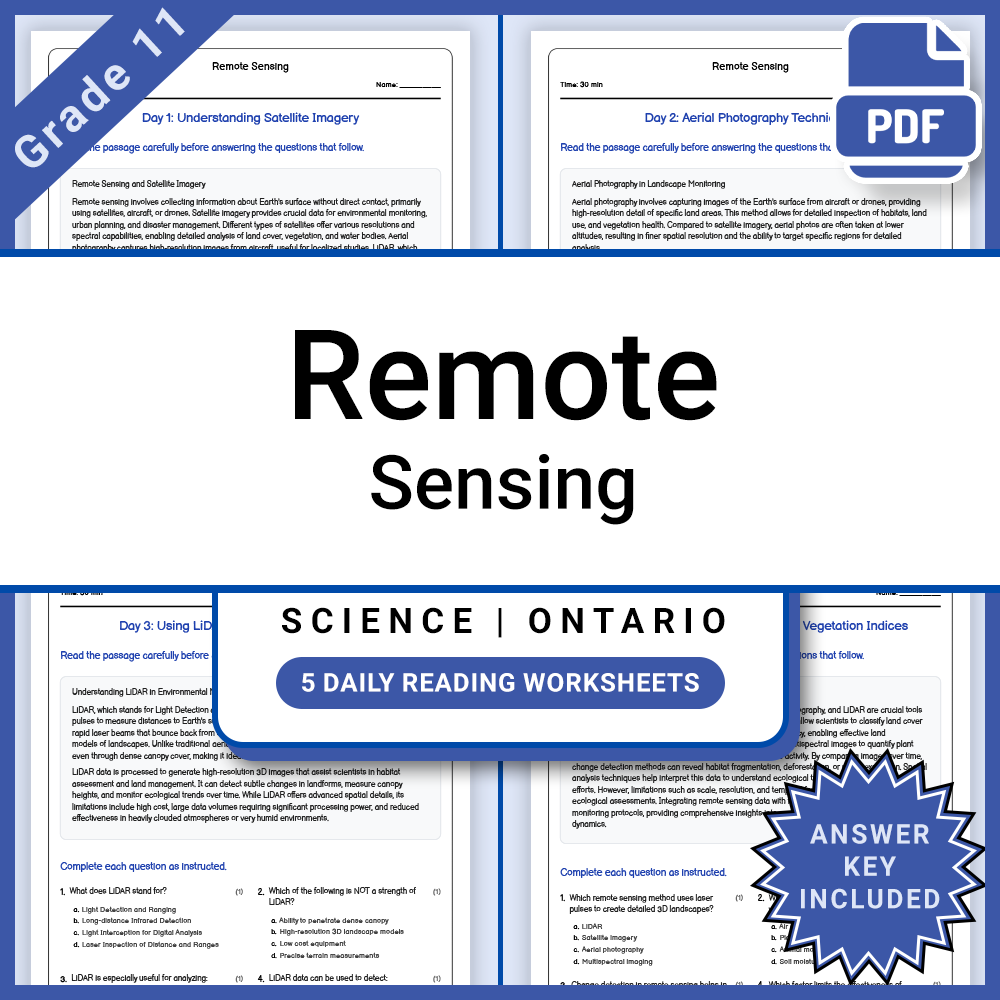
Grade 11 Science – Remote Sensing Daily Reading Worksheet with Answer Key
JCreated byJ.S SheetsLearning Objectives
- Understand different types of remote sensing methods such as satellite imagery, aerial photography, and LiDAR.
- Identify how remote sensing can be used for landscape-scale monitoring of habitats and ecosystems.
- Learn about land cover classification, vegetation indices, and change detection techniques.
Also included in: Grade 11 Science Lesson Bundle | Ecosystem Dynamics and Sustainability +1 more
Instant download
Browse more categories
About Daily Reading Worksheets Worksheets
Explore daily reading worksheets activities across subjects and grades. Our 8,400 daily reading worksheets printables are ready to print, with answer keys where available.
Every worksheet on MyTeachingSheets is created by independent teacher-authors and reviewed before publication. All resources download as printable PDFs for classroom, homework, or at-home practice, and many include answer keys. Preview any worksheet free before buying.