
Reading comprehension Worksheets
40,284 type resources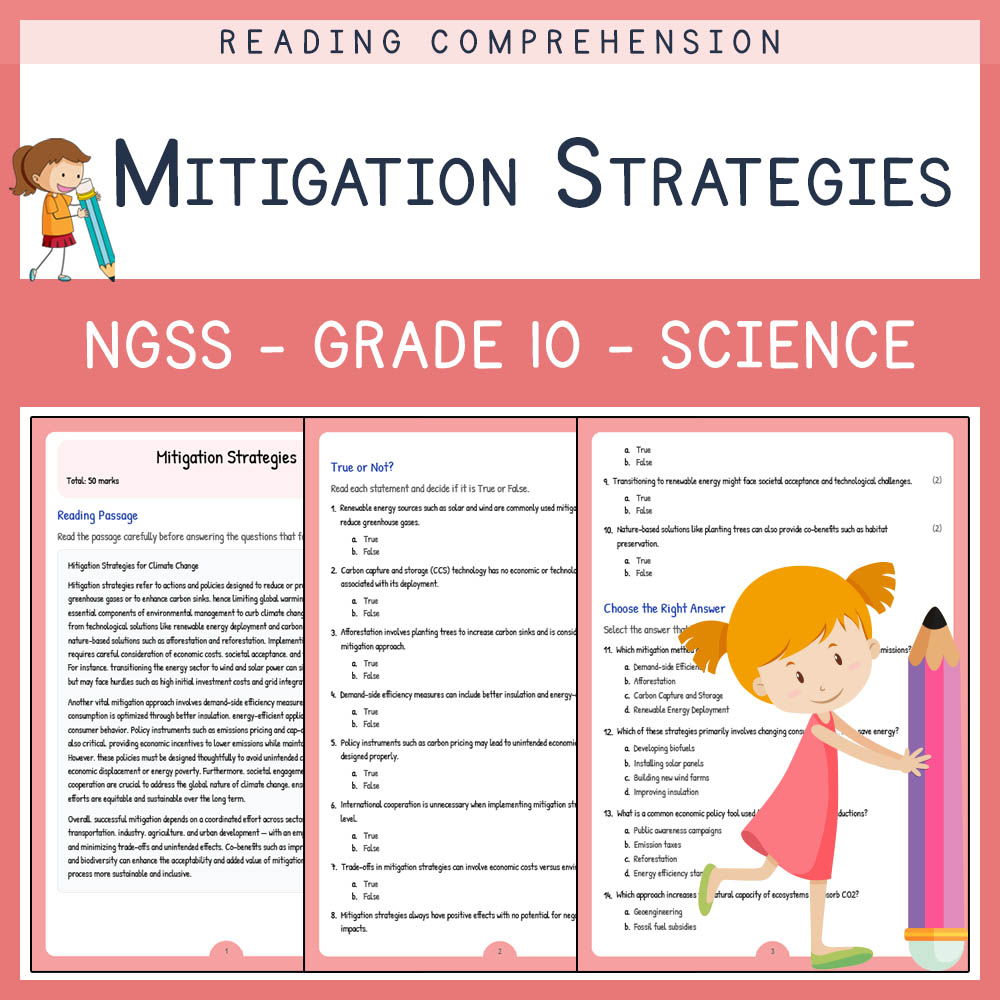
Grade 10 Science | Mitigation Strategies Worksheet (Answer Key) | NGSS Alignment
 Created byLumora Learning
Learning Objectives
- Understand different mitigation approaches used to reduce environmental impacts and greenhouse gas emissions.
- Evaluate the effectiveness, benefits, and potential trade-offs of various mitigation options across different sectors and scales.
- Analyze societal, economic, and technological constraints associated with mitigation strategies.
Instant download
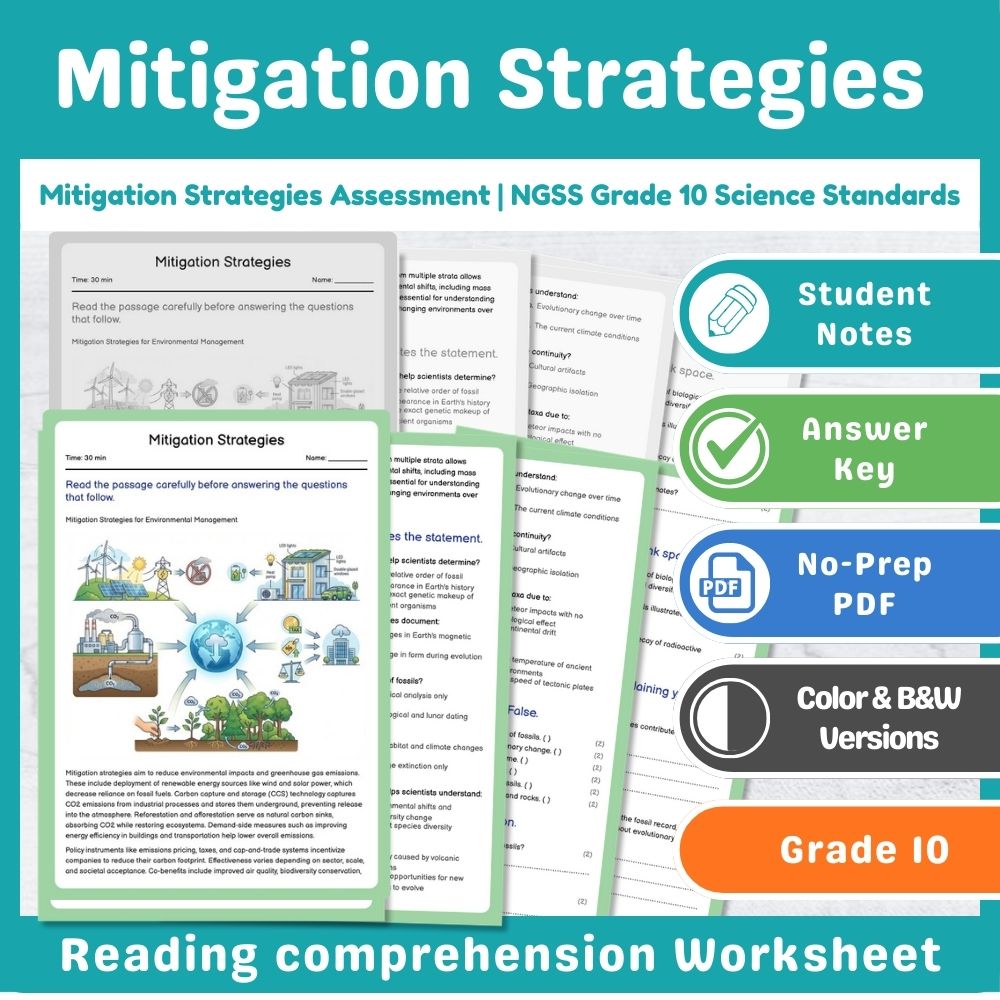
Mitigation Strategies Assessment | NGSS Grade 10 Science Standards
 Created byPrism Point Learning
Learning Objectives
- Explain various mitigation strategies used to reduce environmental impact and greenhouse gas emissions.
- Evaluate the effectiveness and potential trade-offs of different mitigation options.
- Identify societal, economic, and technological constraints influencing mitigation approaches.
Also included in: Grade 10 Science Resource Tradeoffs Assessment | NGSS Standards-Aligned
Instant download
Grade 3 Science | Landform Processes Worksheet with Short Notes (Printable PDF)
 Created byMeadowlark Worksheets
Learning Objectives
- Identify different surface processes such as weathering, erosion, and deposition.
- Describe how water, wind, and ice shape local landforms like valleys, deltas, and hills.
- Understand the impact of surface processes on landscape change over time.
Also included in: Grade 3 Science | Earth's Systems Unit Bundle (NGSS-Aligned Worksheets) +1 more
Instant download

Grade 12 Measurement Concepts Worksheet | Alberta Science Skills
 Created byEvergreen Desk Education
Learning Objectives
- Explain SI measurement units and why consistent unit choice matters for comparing scientific data.
- Differentiate accuracy, precision, systematic error, random error, and instrument calibration.
- Interpret significant figures and measurement documentation for reliable long-term monitoring in field contexts.
Instant download
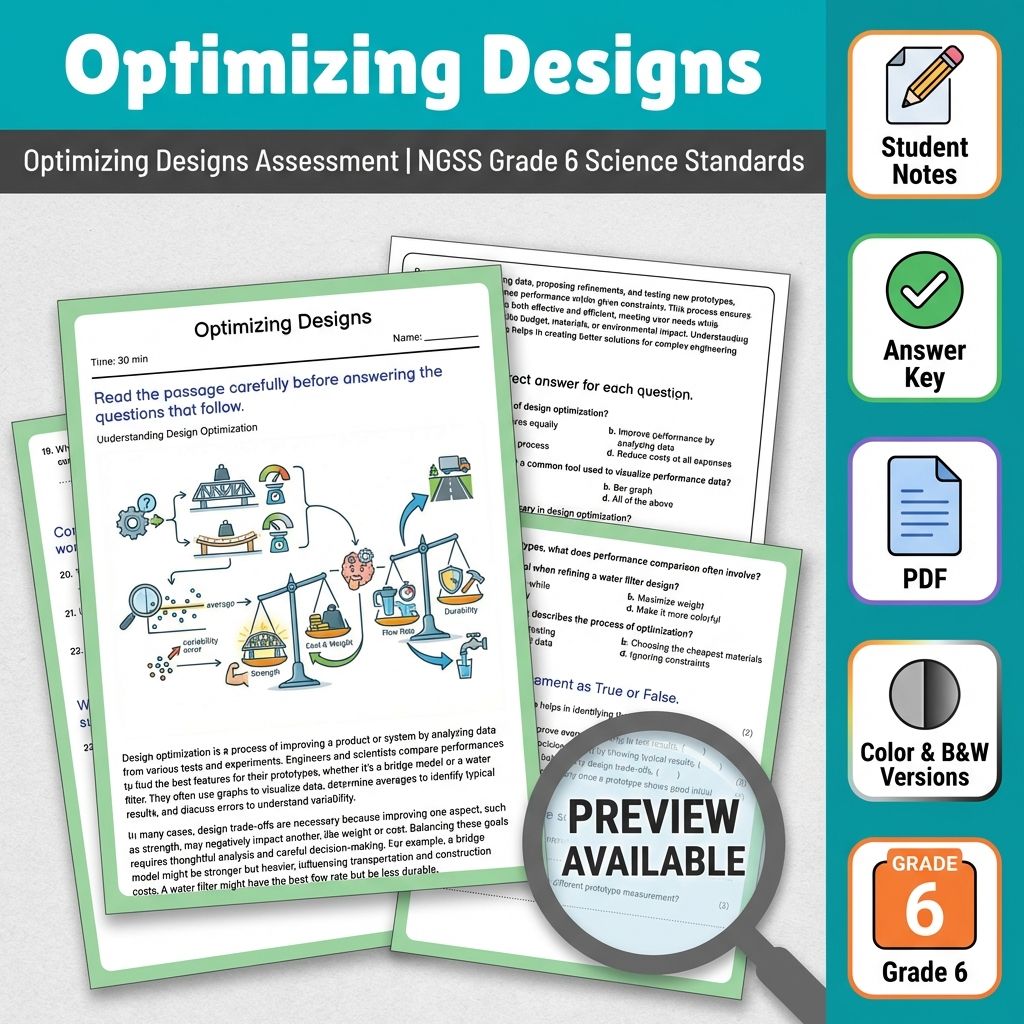
Optimizing Designs Assessment | NGSS Grade 6 Science Standards
Created byPrism Point LearningLearning Objectives
- Analyze data from comparative tests to evaluate performance characteristics of different designs.
- Use graphs, averages, and error discussions to support decision-making in design optimization.
- Understand trade-offs involved in balancing competing goals such as strength versus weight, or cost versus durability.
Also included in: Lesson Grade 6 Science | Engineering Design Standards-Aligned Not Specified +1 more
Instant download
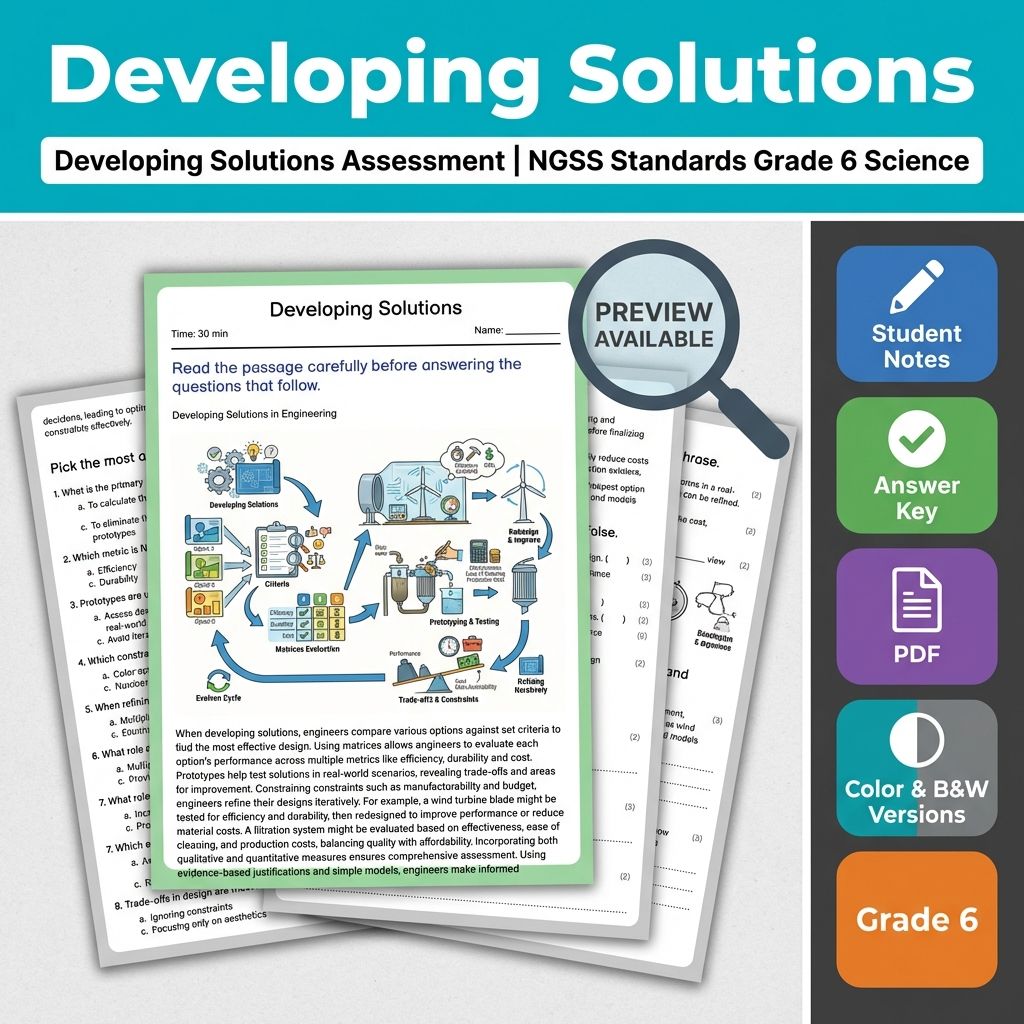
Developing Solutions Assessment | NGSS Standards Grade 6 Science
Created byPrism Point LearningLearning Objectives
- Compare multiple design solutions using matrices, rubrics, and prototypes.
- Evaluate solutions based on quantitative and qualitative metrics such as efficiency, durability, and cost.
- Analyze trade-offs between different configurations and understand their influence on solution selection.
Also included in: Lesson Grade 6 Science | Engineering Design Standards-Aligned Not Specified +1 more
Instant download
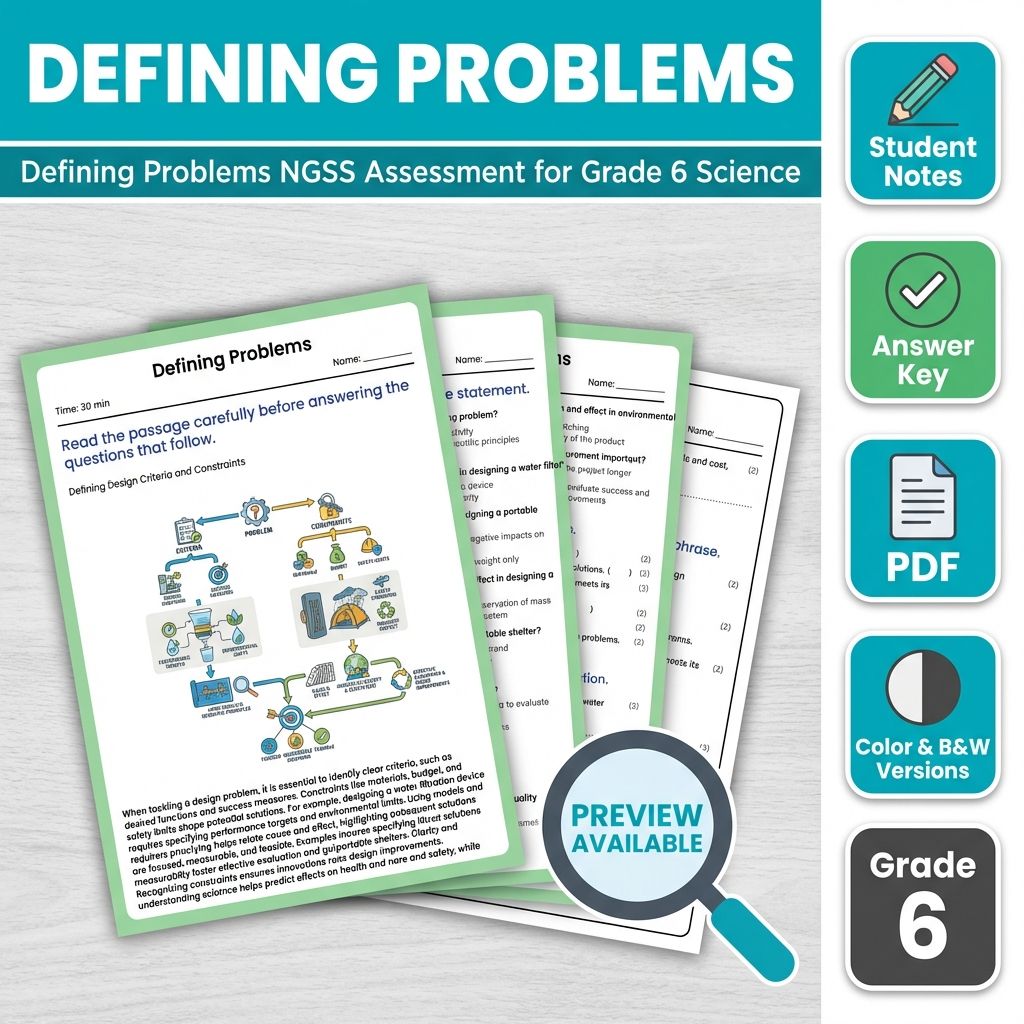
Defining Problems NGSS Assessment for Grade 6 Science
Created byPrism Point LearningLearning Objectives
- Understand how to define criteria and constraints for a design problem.
- Identify measurable outcomes such as functions, success measures, and limits.
- Apply scientific principles to relate cause and effect in problem-solving.
Also included in: Lesson Grade 6 Science | Engineering Design Standards-Aligned Not Specified +1 more
Instant download

Grade 11 Science Energy Conservation Worksheet – Ontario Standards (PDF)
Created byEvergreen Desk EducationLearning Objectives
- Explain how total energy can remain constant in closed systems when non-conservative forces are absent.
- Use energy bar and potential/kinetic diagrams to describe energy conversions in gravitational and elastic fields.
- Account for energy transferred to internal/thermal reservoirs by non-conservative forces and relate it to work done.
Also included in: Grade 11 Motion, Forces, and Electricity Science Lesson Bundle: Ontario +1 more
Instant download

Grade 11 Science | Wave Superposition Worksheet (Ontario) (PDF)
Created byEvergreen Desk EducationLearning Objectives
- Explain how the superposition principle produces interference and standing-wave patterns.
- Use boundary conditions to predict node/antinode locations and resonant (harmonic) frequencies in strings and air columns.
- Interpret how damping and quality factor (Q) affect resonance amplitude and frequency selectivity.
Also included in: Grade 11 Motion, Forces, and Electricity Science Lesson Bundle: Ontario +1 more
Instant download

Grade 11 Science – Newtonian Forces Worksheet (Ontario) PDF
Created byEvergreen Desk EducationLearning Objectives
- Apply Newton’s three laws to determine relationships among net force, mass, and acceleration in one dimension.
- Construct and interpret free-body diagrams that correctly distinguish contact forces, normal force, friction, tension, and weight.
- Determine conditions for static versus kinetic friction and use the correct limiting relationships for impending motion.
Also included in: Grade 11 Motion, Forces, and Electricity Science Lesson Bundle: Ontario +1 more
Instant download

Grade 11 Science – Work and Energy Worksheet (Ontario) PDF
Created byEvergreen Desk EducationLearning Objectives
- Explain how work is related to force and displacement and use it to calculate changes in mechanical energy.
- Differentiate kinetic energy, gravitational potential energy, and elastic potential energy, including their units and meanings.
- Apply the work–energy theorem to solve problems and interpret how conservative and non-conservative forces affect energy.
Also included in: Grade 11 Motion, Forces, and Electricity Science Lesson Bundle: Ontario +1 more
Instant download

Grade 11 Science – Electric Circuits Worksheet (Ontario Standards) (PDF)
Created byEvergreen Desk EducationLearning Objectives
- Define charge, current, potential difference, and resistance as macroscopic quantities in DC circuits.
- Use Ohm’s law to relate voltage, current, and resistance, including interpreting equivalent resistance in series and parallel combinations.
- Apply Kirchhoff’s rules to analyze circuit constraints in loops and at junctions.
Also included in: Grade 11 Motion, Forces, and Electricity Science Lesson Bundle: Ontario +1 more
Instant download
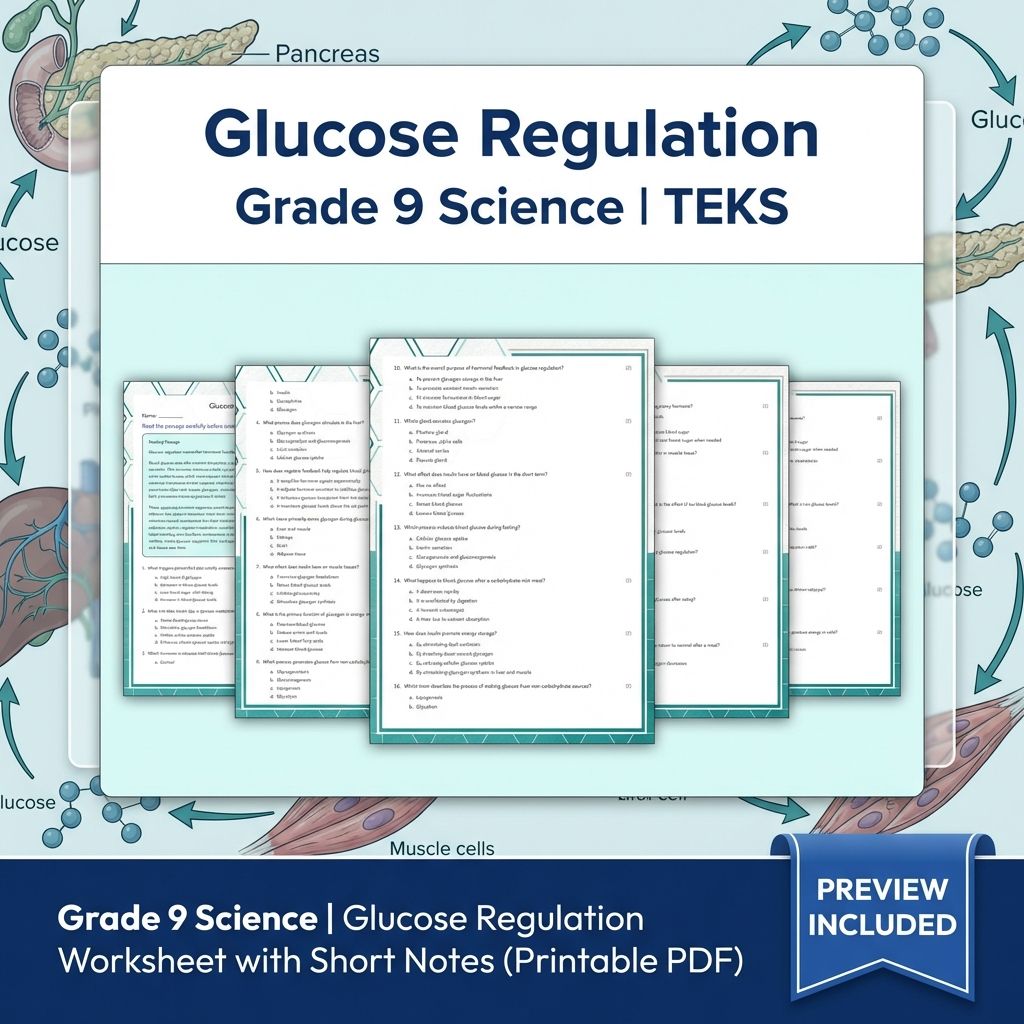
Grade 9 Science | Glucose Regulation Worksheet with Short Notes (Printable PDF)
Created byMeadowlark WorksheetsLearning Objectives
- Understand how hormonal feedback maintains energy balance through glucose regulation.
- Describe the roles of insulin and glucagon in blood glucose control.
- Explain how negative feedback loops help maintain set points in metabolic processes.
Instant download
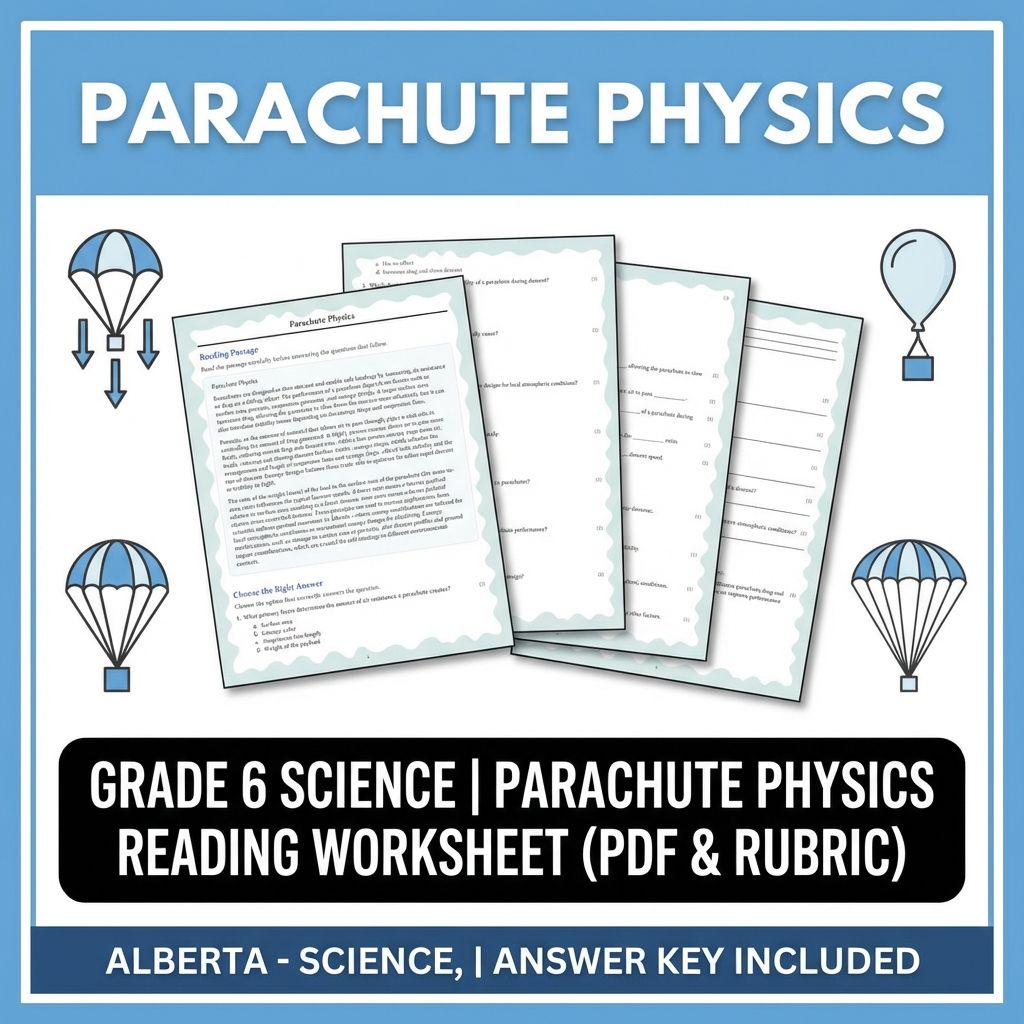
Grade 6 Science | Parachute Physics Reading Worksheet (PDF & Rubric)
JCreated byJ.S SheetsLearning Objectives
- Understand how surface area, porosity, and suspension geometry affect parachute drag and descent.
- Explain the concepts of terminal velocity in relation to canopy design.
- Describe how modifications to parachutes influence descent profiles and impact in different atmospheric conditions.
Also included in: Grade 6 Science | Flight Physics & Aerodynamics UNIT Pack (Answer Keys Included) +1 more
Instant download
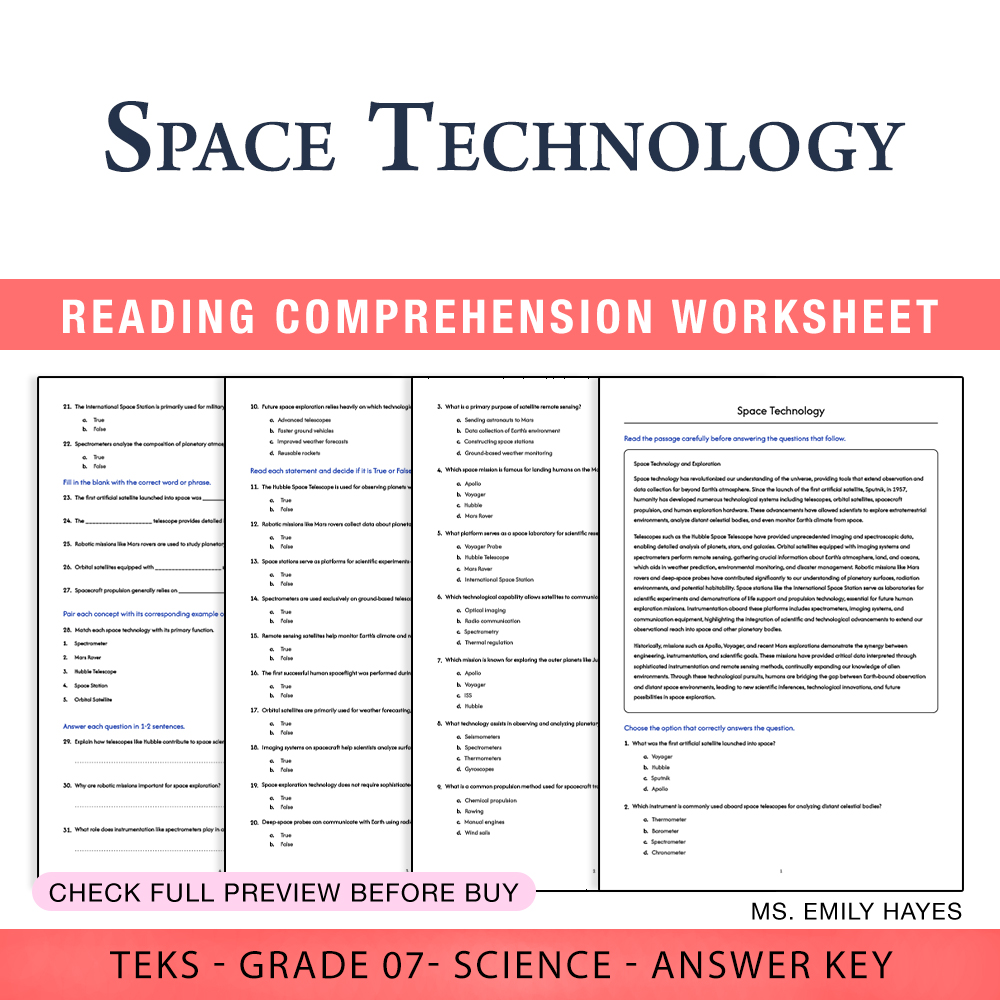
7th Grade Science | Space Technology Worksheet (PDF+ Answer Key)
 Created byCopper Leaf Classroom
Learning Objectives
- Understand the various technologies used in space exploration, including telescopes, satellites, and spacecraft.
- Describe the roles of robotic missions and space stations in data collection and analysis.
- Identify key instruments such as spectrometers and imaging systems used in space missions.
Instant download
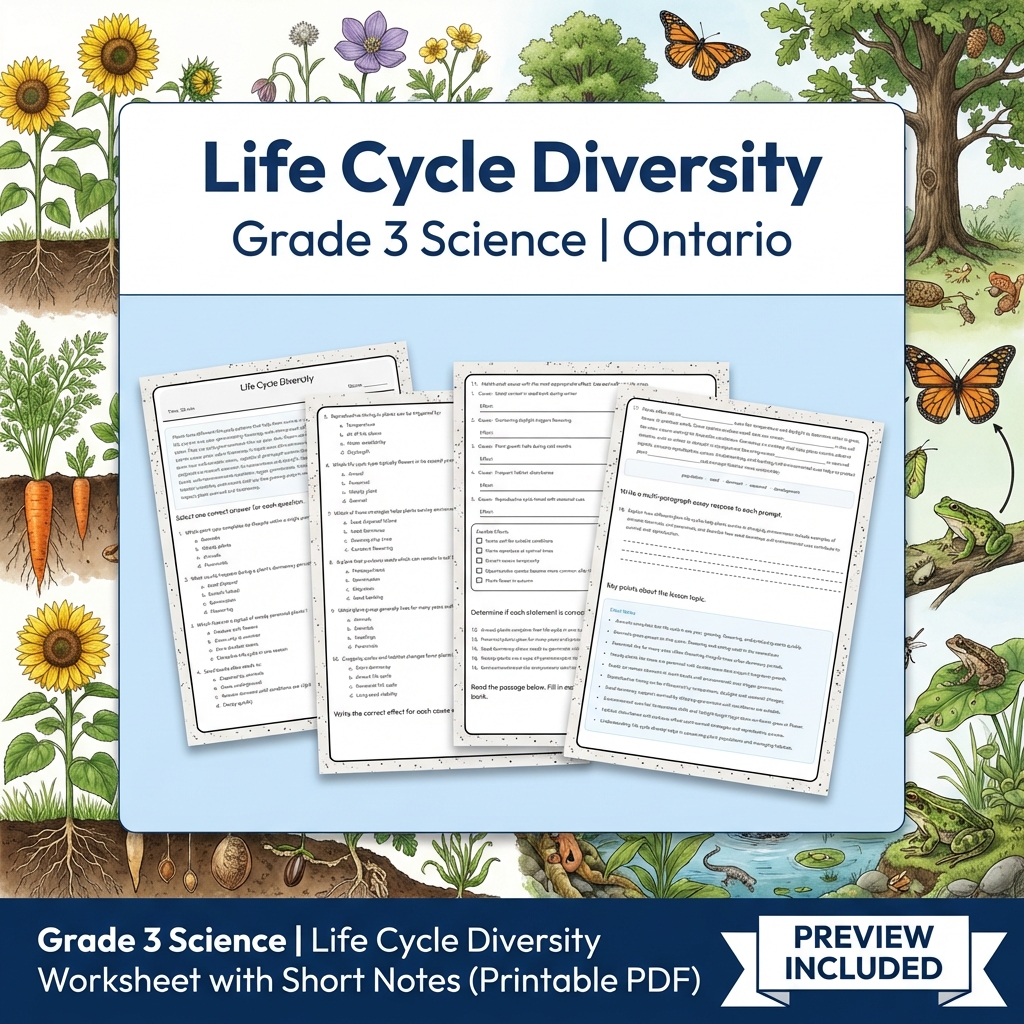
Grade 3 Science | Life Cycle Diversity Worksheet with Short Notes(Printable PDF)
Created byMeadowlark WorksheetsLearning Objectives
- Compare and describe life cycle patterns of annuals, biennials, perennials, and woody plants.
- Identify key stages such as germination, flowering, seed set, and dormancy strategies.
- Explain seed banking and environmental cues that trigger plant development.
Also included in: Grade 3 Science Lesson Group | Ontario STEM Worksheets Bundle Transport & Plants +1 more
Instant download

Grades 11 & 12 Holiday Worksheet | Historical Roots | Assessment
Learning Objectives
- Explain the historical context of the Battle of Puebla (1862) and why it mattered to Mexican sovereignty.
- Analyze how Cinco de Mayo became a symbol of resilience and civic identity for Mexican and Mexican-American communities.
- Use grade-level history vocabulary to interpret how public celebrations can connect the past to present memory.
Also included in: Grade 11 - 12 Holiday ELA Lesson Bundle: Stories, Culture & Resilience (CCSS) +2 more
Instant download
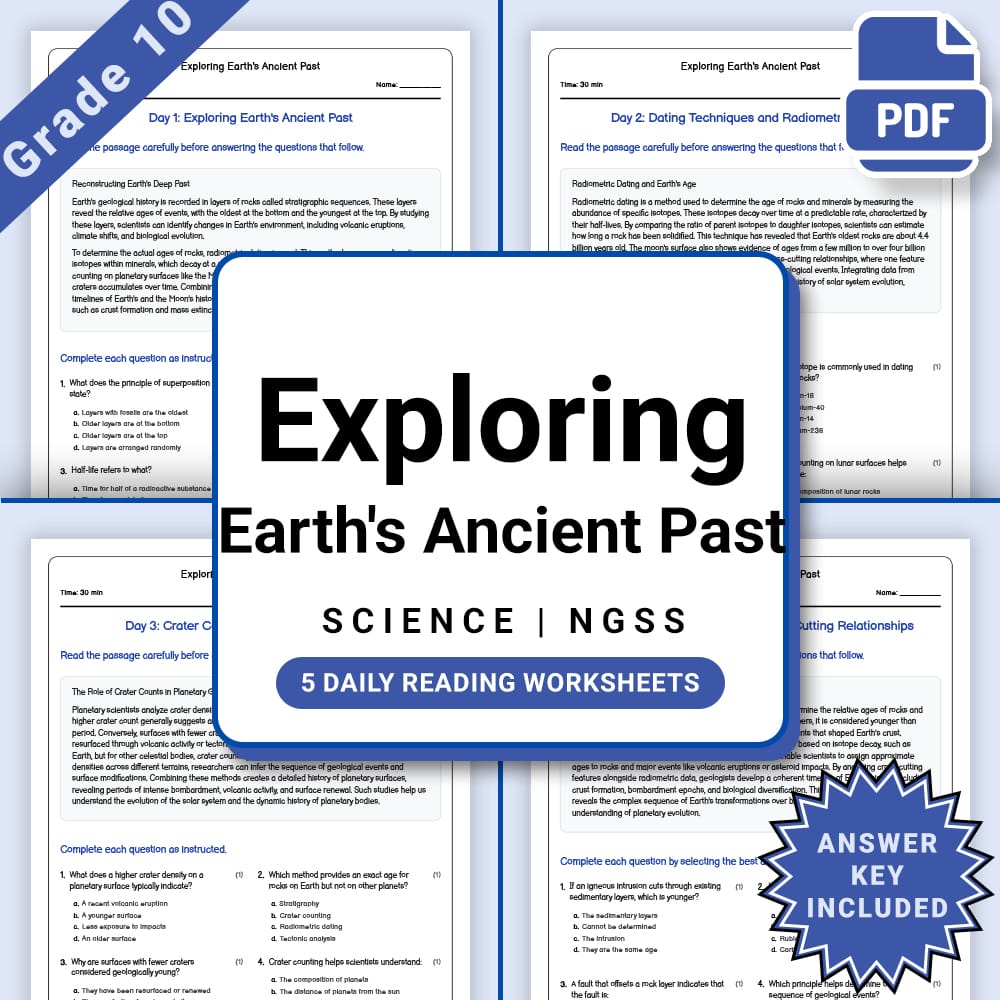
Grade 10 Science – Exploring Earth's Ancient Past Worksheet (PDF +Answer Key)
Created byCopper Leaf ClassroomLearning Objectives
- Understand how stratigraphic sequences reveal Earth's history.
- Explain the principles of relative and absolute dating methods.
- Describe how radiometric decay and crater counting help determine ages of planetary surfaces.
Instant download
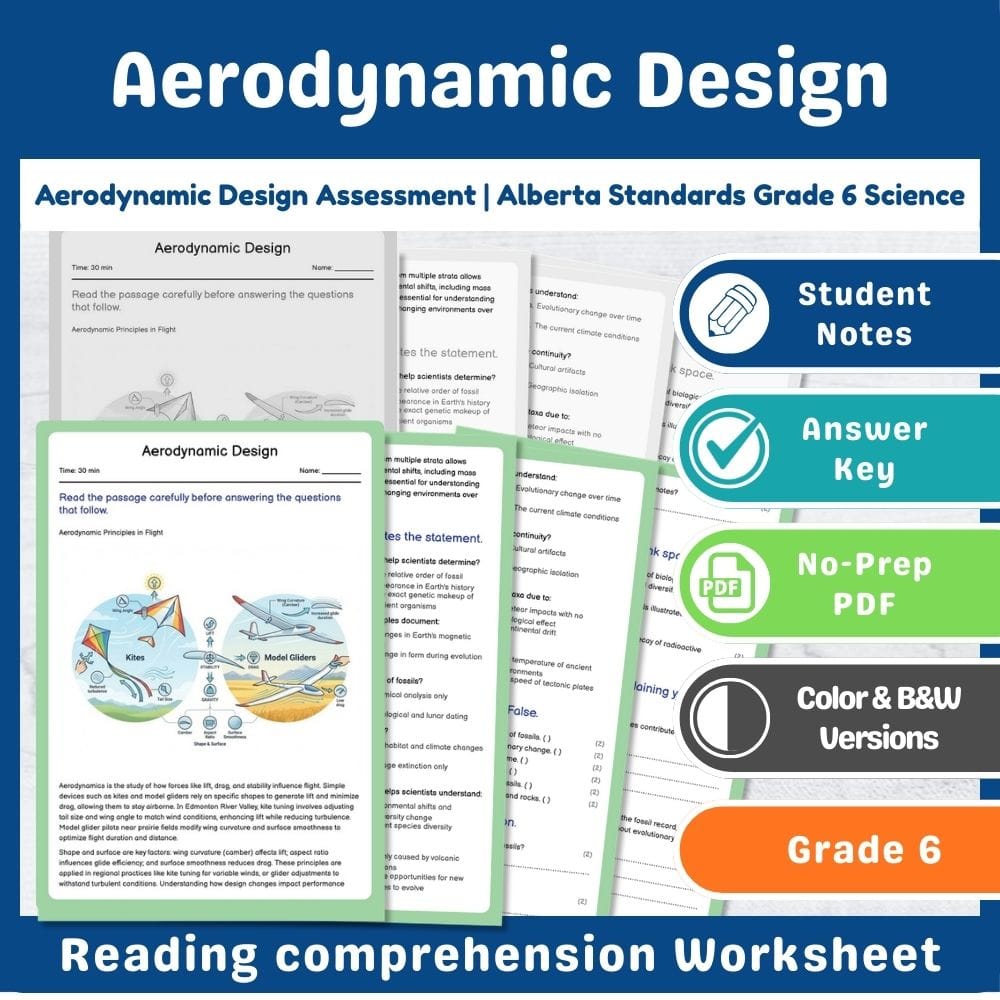
Aerodynamic Design Assessment | Alberta Grade 6 Science Standards
Created byPrism Point LearningLearning Objectives
- Understand how shape and surface features influence flight performance.
- Identify the principles of lift, drag, and stability in flight.
- Apply aerodynamic concepts to practical devices like kites and gliders.
Also included in: Lesson Grade 6 Science Assessment | Alberta Standards and Topics
Instant download
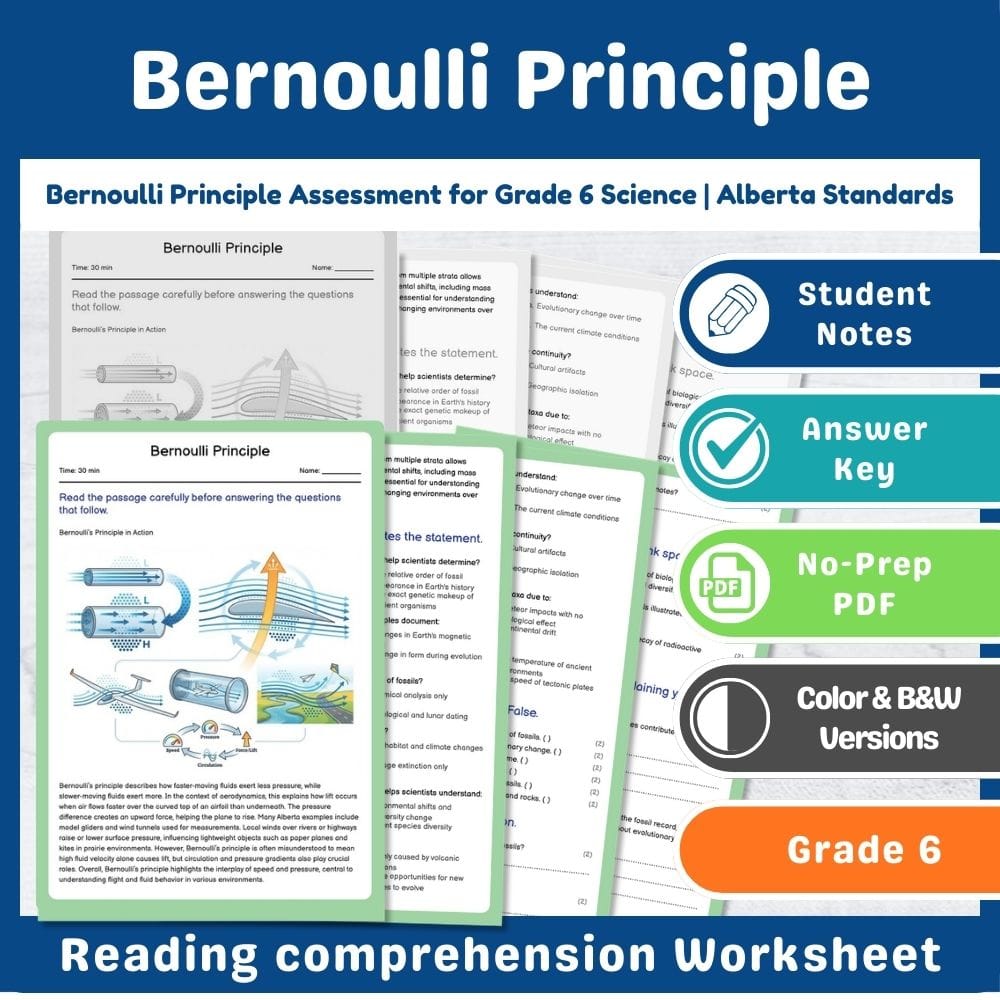
Bernoulli Principle Assessment for Grade 6 Science | Alberta Standards
Created byPrism Point LearningLearning Objectives
- Understand how fluid speed relates to pressure changes as explained by Bernoulli’s principle.
- Identify real-world examples of Bernoulli’s principle such as weather phenomena and aircraft lift.
- Explain the scientific contributions of Bernoulli’s principle to fluid dynamics and aerodynamics.
Also included in: Lesson Grade 6 Science Assessment | Alberta Standards and Topics
Instant download
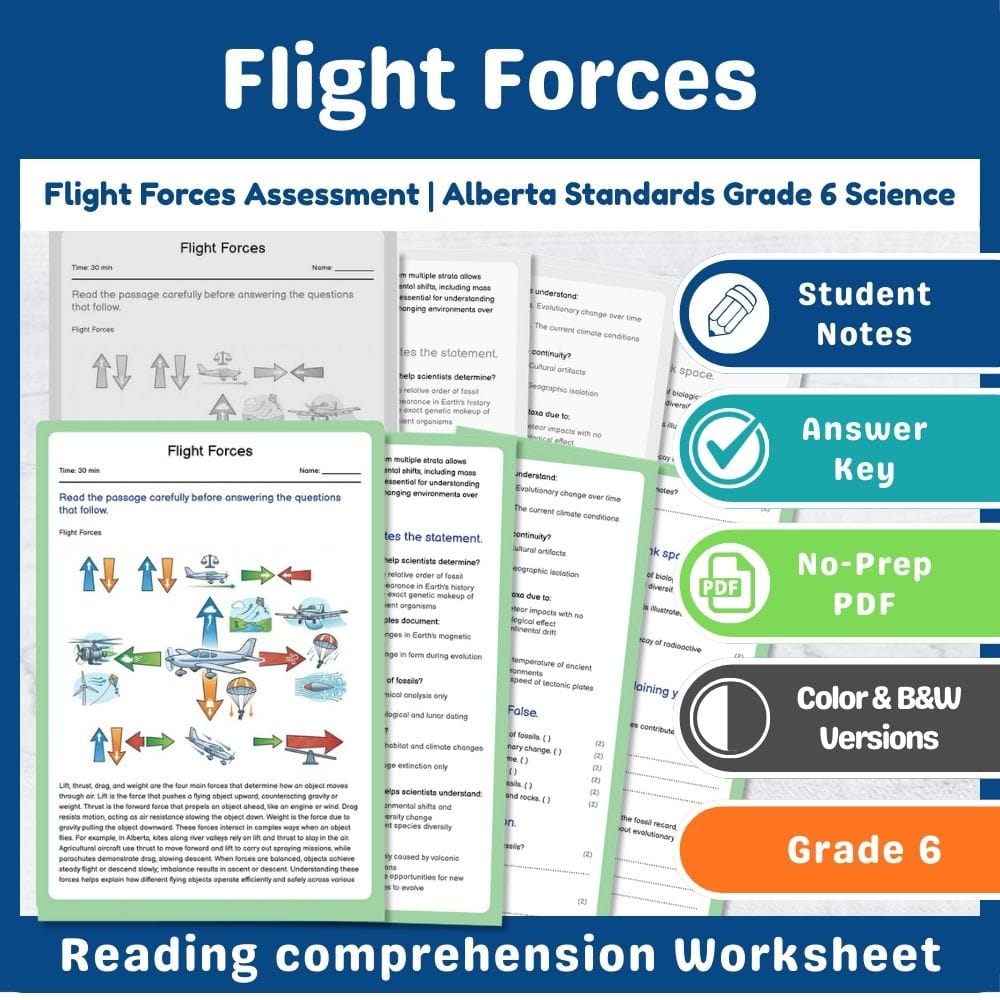
Flight Forces Assessment | Alberta Standards Grade 6 Science
Created byPrism Point LearningLearning Objectives
- Understand the four primary forces involved in flight: lift, thrust, drag, and weight.
- Describe how these forces interact to produce steady flight or descent.
- Identify examples of flight forces in real-world Alberta situations, such as kites, aircraft, and parachutes.
Also included in: Lesson Grade 6 Science Assessment | Alberta Standards and Topics
Instant download
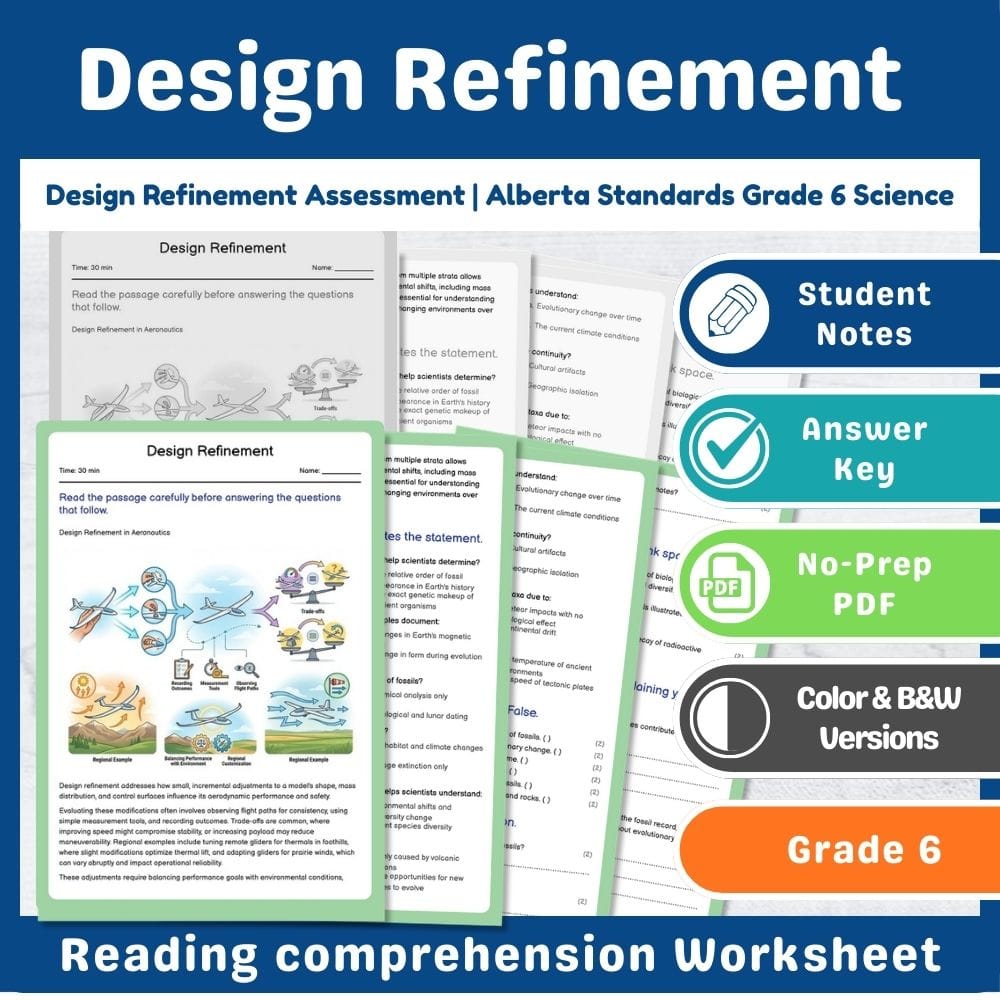
Design Refinement Assessment | Alberta Standards Grade 6 Science
Created byPrism Point LearningLearning Objectives
- Understand how incremental modifications affect aerodynamic performance.
- Identify criteria for evaluating design modifications in flight safety and efficiency.
- Describe measurement concepts used to observe flight path consistency and instrumentation.
Also included in: Lesson Grade 6 Science Assessment | Alberta Standards and Topics
Instant download
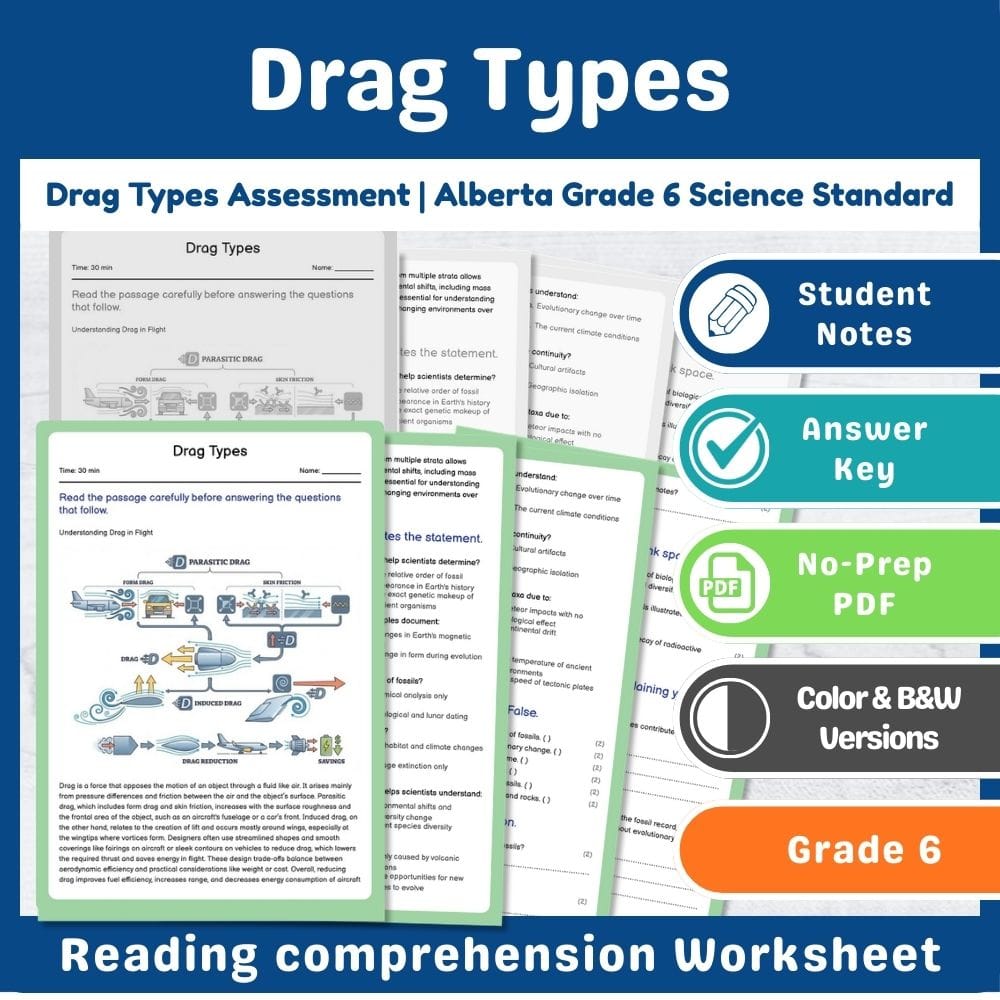
Drag Types Assessment | Alberta Grade 6 Science Standard
Created byPrism Point LearningLearning Objectives
- Explain how drag arises from friction and pressure differences during flight.
- Differentiate between parasitic and induced drag in aircraft and vehicles.
- Describe design features that reduce drag, such as streamlined shapes and smooth surfaces.
Also included in: Lesson Grade 6 Science Assessment | Alberta Standards and Topics
Instant download
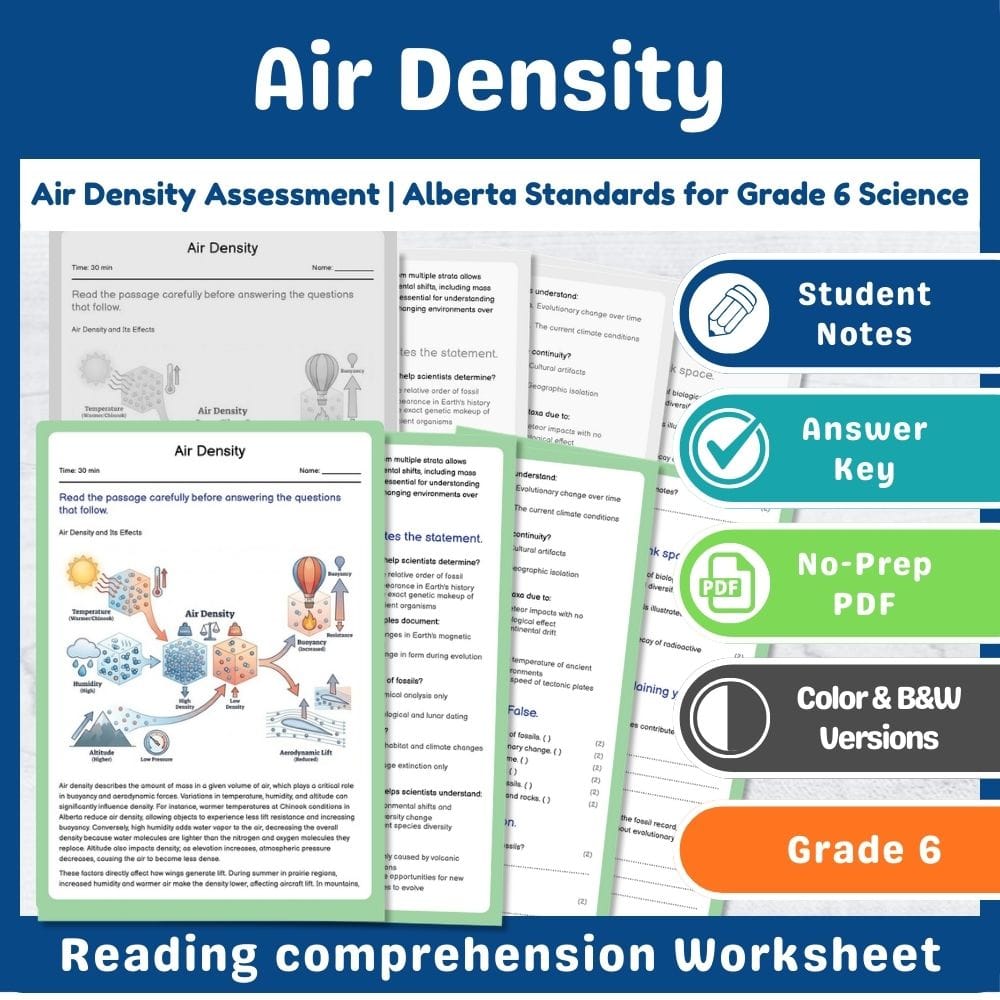
Air Density Assessment | Alberta Standards for Grade 6 Science
Created byPrism Point LearningLearning Objectives
- Understand how temperature, humidity, and altitude affect air density.
- Explain the relationship between air density and buoyancy / lift.
- Describe how atmospheric conditions influence aerodynamic forces in different environments.
Also included in: Lesson Grade 6 Science Assessment | Alberta Standards and Topics
Instant download
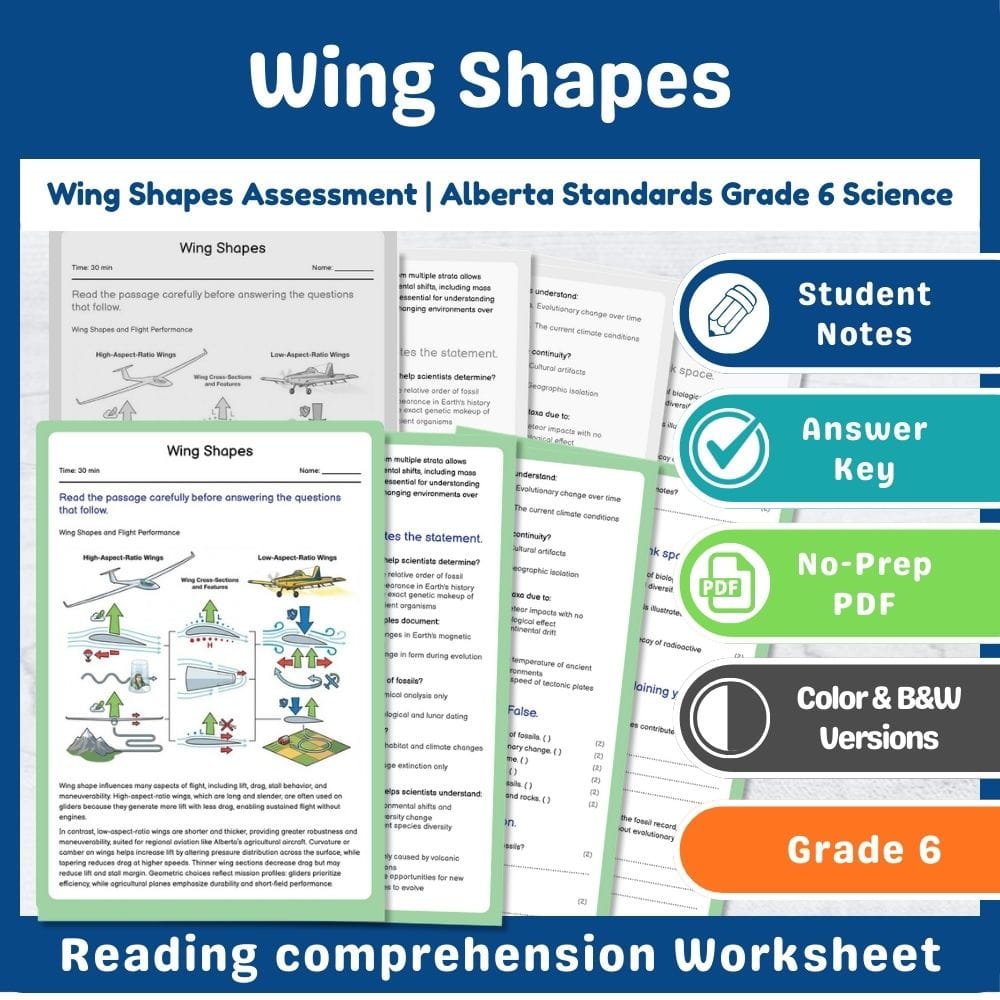
Wing Shapes Assessment | Alberta Standards Grade 6 Science
Created byPrism Point LearningLearning Objectives
- Understand how wing shape influences lift, stall behavior, and maneuverability.
- Identify features such as camber, thickness, and aspect ratio that affect flight performance.
- Compare high-aspect-ratio wings used on gliders with low-aspect wings on agricultural aircraft.
Also included in: Lesson Grade 6 Science Assessment | Alberta Standards and Topics
Instant download
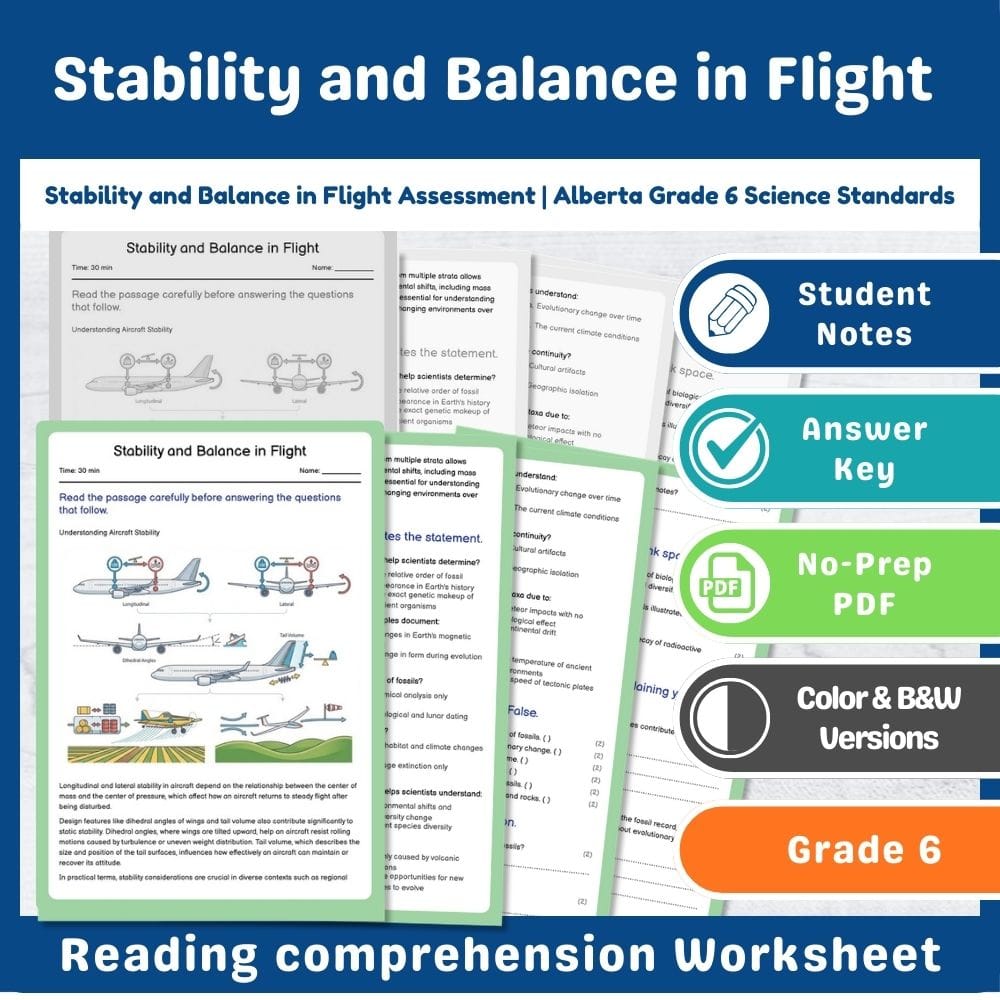
Stability and Balance in Flight Assessment | Alberta Grade 6 Science Standards
Created byPrism Point LearningLearning Objectives
- Understand how center of mass and center of pressure affect aircraft stability.
- Explain how design features like dihedral angles and tail volume influence static stability.
- Describe how balance impacts aircraft behavior under different payloads and wind conditions.
Also included in: Lesson Grade 6 Science Assessment | Alberta Standards and Topics
Instant download
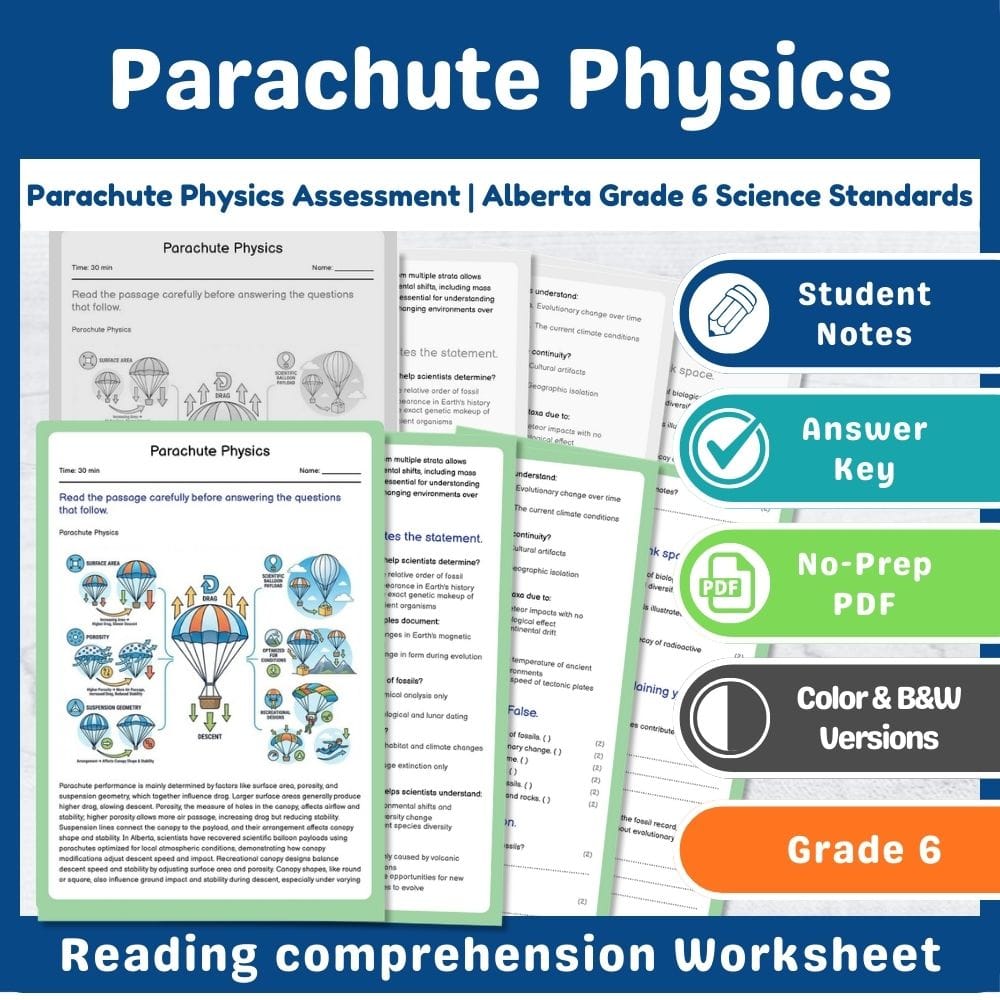
Parachute Physics Assessment | Alberta Grade 6 Science Standards
Created byPrism Point LearningLearning Objectives
- Understand how surface area, porosity, and suspension geometry affect parachute drag and descent rate.
- Explain how mass-to-area ratio influences terminal velocity during parachute descent.
- Analyze how canopy design trade-offs impact descent stability and ground impact in different atmospheric conditions.
Also included in: Lesson Grade 6 Science Assessment | Alberta Standards and Topics
Instant download
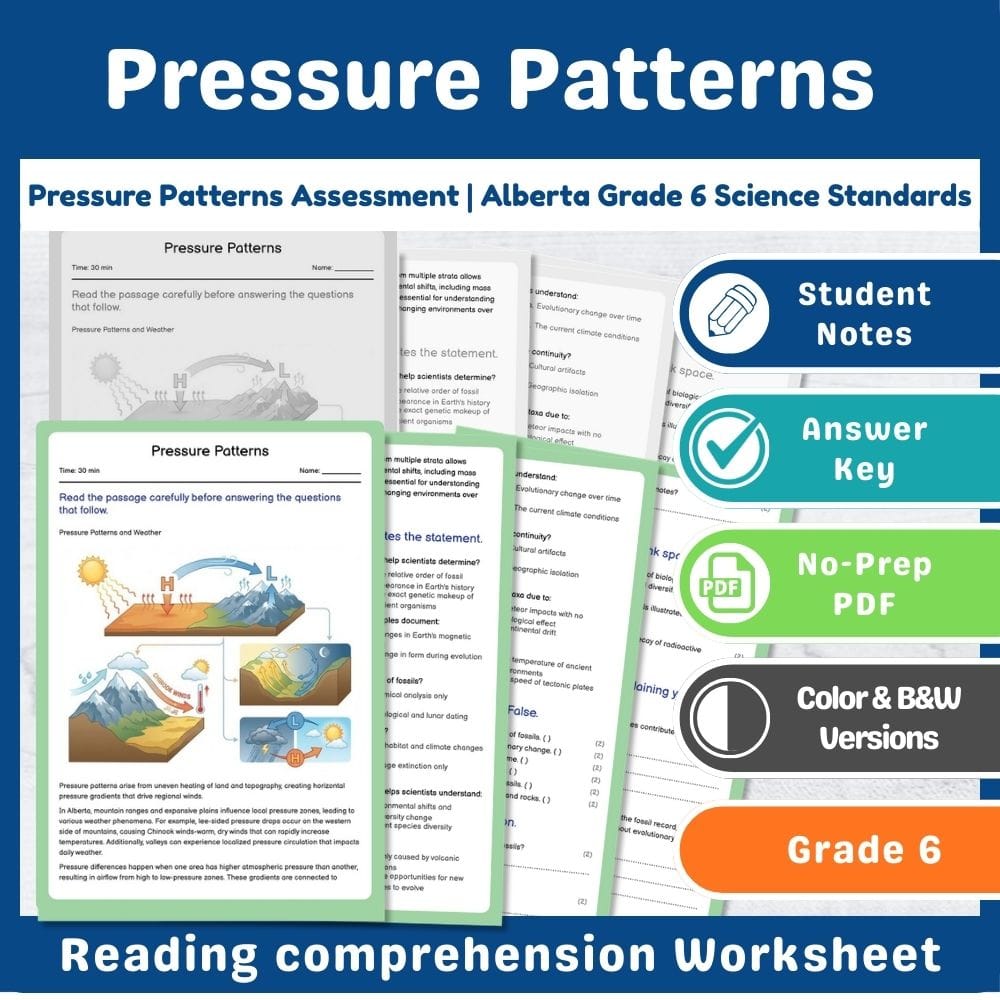
Pressure Patterns Assessment | Alberta Grade 6 Science Standards
Created byPrism Point LearningLearning Objectives
- Understand how pressure differences from uneven heating and topography influence wind patterns.
- Identify examples of pressure zones and their effects on regional weather in Alberta.
- Connect pressure gradients to everyday weather changes and forces experienced by moving bodies.
Also included in: Lesson Grade 6 Science Assessment | Alberta Standards and Topics
Instant download
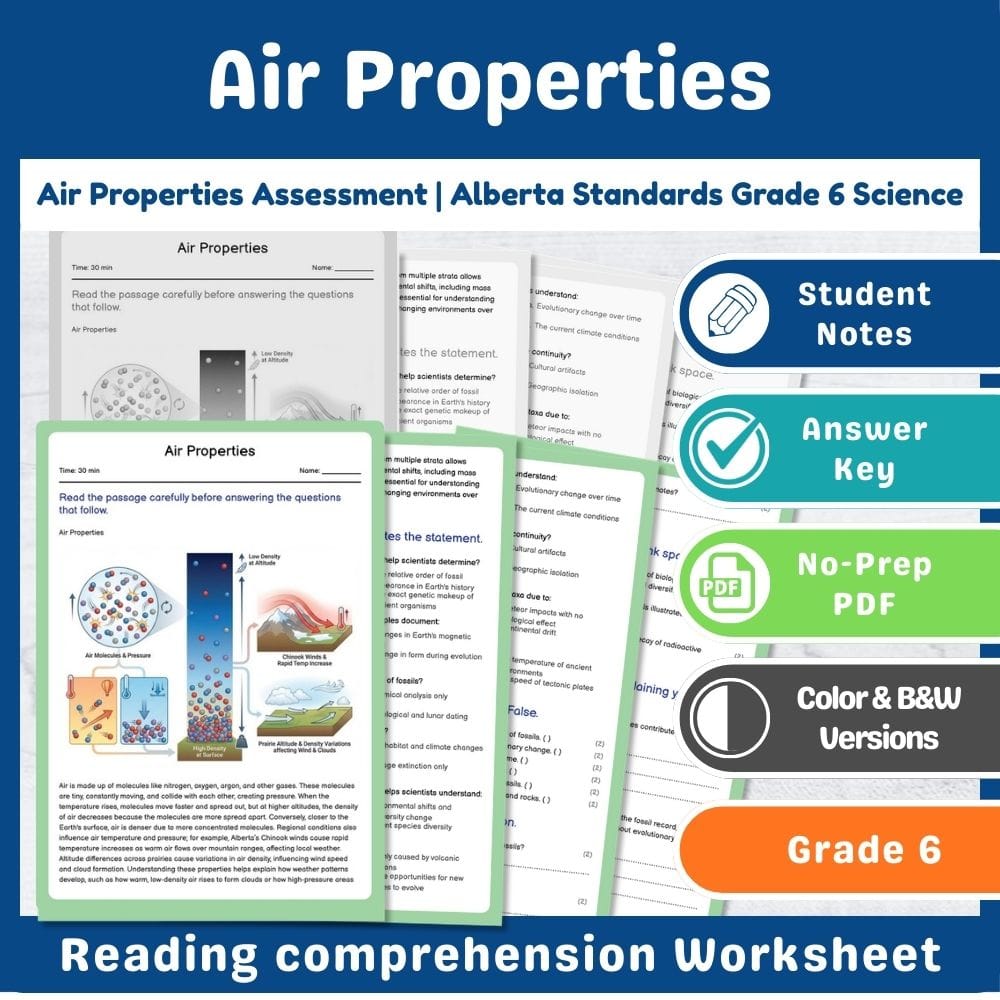
Air Properties Assessment | Alberta Standards Grade 6 Science
Created byPrism Point LearningLearning Objectives
- Understand the molecular composition of air and how it influences its properties.
- Explain how air density and pressure change with altitude and temperature.
- Describe regional examples, such as the Chinook wind, illustrating variations in air properties.
Also included in: Lesson Grade 6 Science Assessment | Alberta Standards and Topics
Instant download
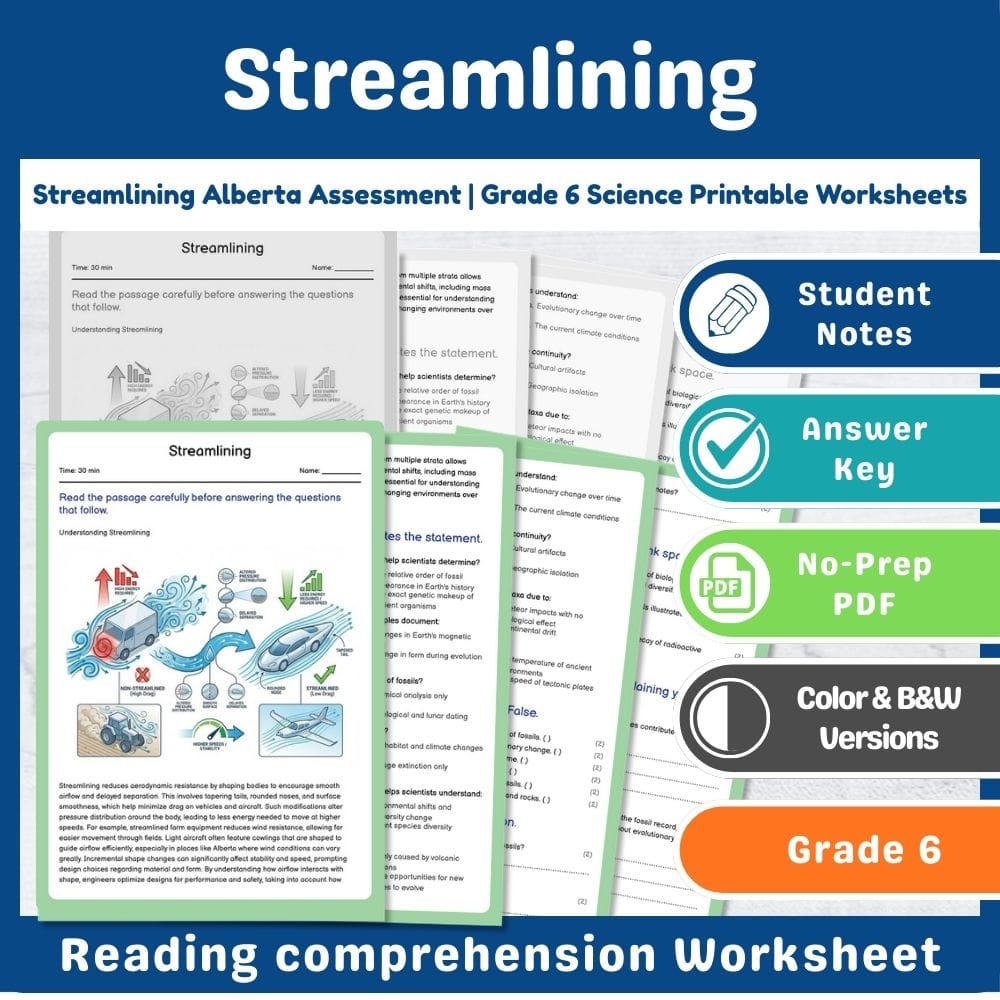
Streamlining Alberta Assessment | Grade 6 Science Printable Worksheets
Created byPrism Point LearningLearning Objectives
- Understand how the shape of objects affects their airflow and resistance.
- Identify key features like tapered tails and rounded noses that improve aerodynamics.
- Explain how shape changes influence pressure distribution and energy use in flight and machinery.
Also included in: Lesson Grade 6 Science Assessment | Alberta Standards and Topics
Instant download

Grade 12 Science – Circular Motion & AP Standards | Daily Reading Worksheet
 Created byBright Mind Resources
Learning Objectives
- Define uniform circular motion and identify its key features
- Explain the concept of centripetal acceleration and net radial force
- Derive the relation between speed, radius, and acceleration in circular motion
Also included in: AP Science Grade 12 Daily Reading Worksheets Lesson Bundle | AP +2 more
Instant download

Grade 12 Science – Mole & Molar Mass Daily Reading Worksheet | AP Standards
Created byBright Mind ResourcesLearning Objectives
- Explain the concept of a mole in chemistry.
- Calculate molar mass of chemical compounds.
- Determine the number of particles in a sample using molar relationships.
Also included in: Grade 12 Chemistry Daily Reading Science Lesson Bundle | AP Standards +2 more
Instant download

Grade 12 Science – Scaling Models & Scientific Modeling | Reading Worksheet
Created byBright Mind ResourcesLearning Objectives
- Understand the fundamental principles of scaling and dimensional analysis.
- Identify key phenomena involving scaling, such as diffusion and metabolic rates.
- Explain the importance of nondimensional parameters in model transitions.
Also included in: Grade 12 Science Data Analysis Daily Reading Worksheets Lesson Bundle | AP +2 more
Instant download
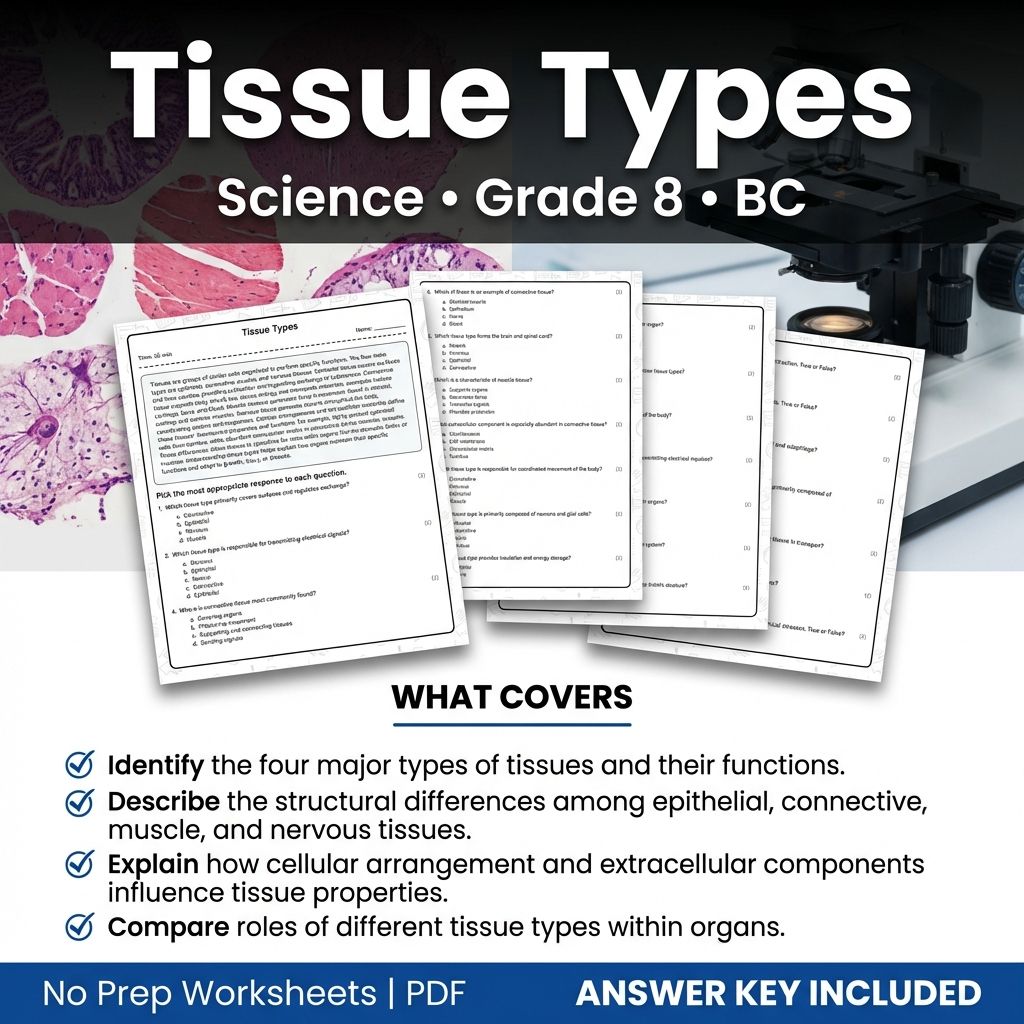
8th Grade Science | Tissue Types Worksheet & Answer Key (Printable PDF)
 Created byCoral Reef Learning
Learning Objectives
- Identify the four major types of tissues and their functions.
- Describe the structural differences among epithelial, connective, muscle, and nervous tissues.
- Explain how cellular arrangement and extracellular components influence tissue properties.
Instant download
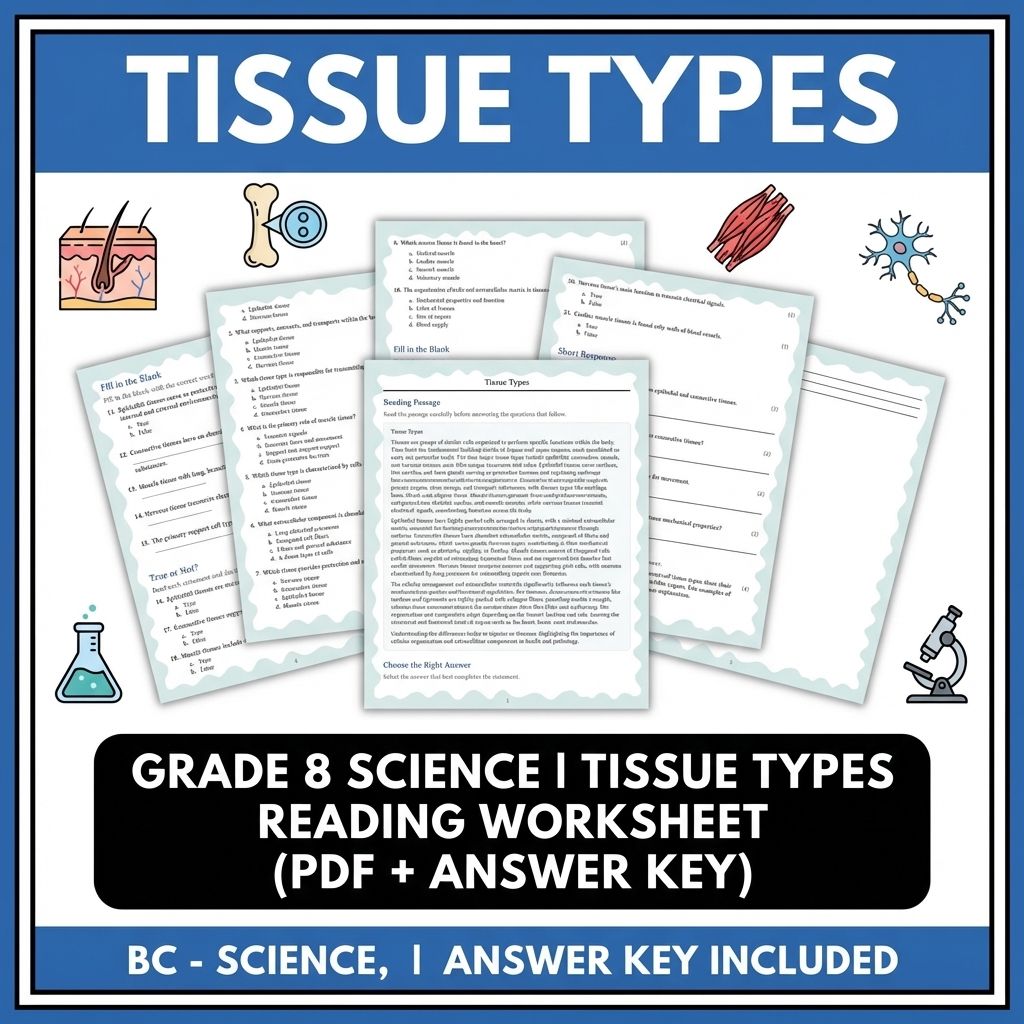
Grade 8 Science | Tissue Types Reading Worksheet (PDF + Answer Key)
JCreated byJ.S SheetsLearning Objectives
- Identify and describe the major types of tissues: epithelial, connective, muscle, and nervous.
- Compare the structure and function of different tissue types.
- Explain how cellular organization and extracellular components influence tissue properties.
Instant download

9th Grade Social Studies | Housing Infrastructure Practice (PDF + Answer Key)
JCreated byJ.S SheetsLearning Objectives
- Understand the role of housing supply and infrastructure capacity in community resilience.
- Identify causes and consequences of infrastructure strain and affordability issues.
- Analyze the interrelationships between housing, transit, health services, and environmental risks.
Also included in: Grade 9 Social Studies Bundle – Community Planning & Infrastructure +1 more
Instant download

Grade 7 Science | Mixtures and Purity Worksheet | BC Standards
Created byLumora LearningLearning Objectives
- Understand the differences between mixtures and pure substances.
- Identify the observable traits of heterogeneous and homogeneous mixtures.
- Learn methods of separation based on physical properties such as filtration, evaporation, and distillation.
Also included in: Grade 7 Science | Matter & Chemical Change Unit Bundle | BC Aligned
Instant download
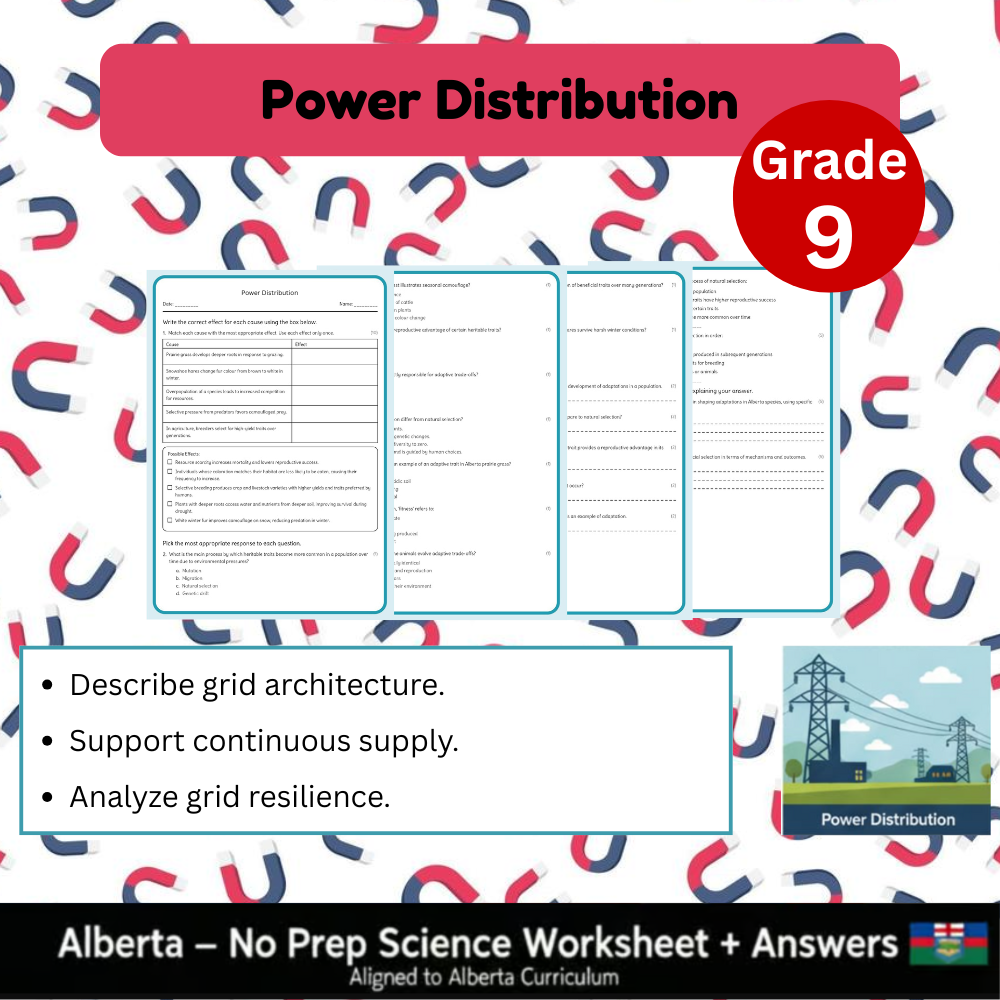
Grade 9 Science – Power Distribution Worksheet (PDF) | Alberta Standard
Created byBright Mind ResourcesLearning Objectives
- Understand the components and architecture of power distribution systems.
- Identify how system design supports continuous electricity supply.
- Analyze the effects of faults and regional constraints on power grid resilience.
Instant download
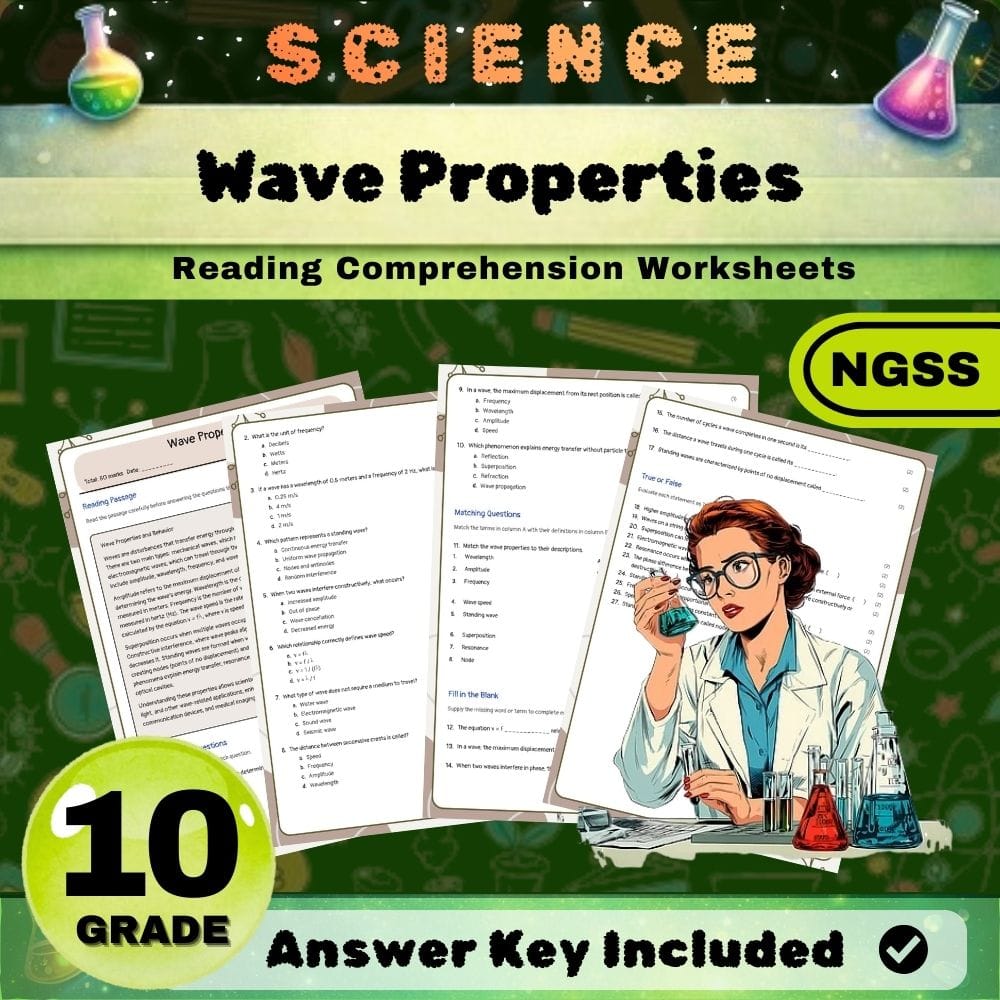
Grade 10 Science – Wave Properties Worksheet (NGSS) (PDF)
 Created byMaple Path Learning
Learning Objectives
- Understand the fundamental properties of waves, including amplitude, wavelength, frequency, and propagation speed.
- Apply the relationship v = fλ to calculate wave speed in various contexts.
- Interpret sinusoidal wave models and understand superposition and interference patterns.
Also included in: Grade 10 Science Waves and Their Applications in Technologies Bundle +1 more
Instant download

Grade 8 Science | Cratered vs Resurfaced Worlds Worksheet | General Aligned
Created byLumora LearningLearning Objectives
- Explain how crater density and the presence of smoother plains can indicate relative surface ages on solar system bodies.
- Compare geologic resurfacing processes such as lava flows and impact-related modification of the landscape.
- Use evidence from crater size, spacing, and surrounding materials to infer which surfaces are older or more recently altered.
Instant download

Grade 5 Health – Media Impact Worksheet (NHES Standards) (PDF)
 Created bySunny Desk Resources
Learning Objectives
- Explain how media can influence health choices related to nutrition, physical activity, and substance use.
- Identify differences between helpful and misleading health information in advertisements and social media posts.
- Use credibility strategies to evaluate health messages before acting on them.
Also included in: Grade 5 Analyze Influences on Health Lesson Bundle NHES +1 more
Instant download

Grade 10 Science – Uncertainty Ranges Worksheet (PDF) | General Standards
Created byEvergreen Desk EducationLearning Objectives
- Explain how uncertainty ranges reflect measurement spread and uncertainty in repeated or independent data.
- Distinguish central tendency from variability and describe how each affects interpretation of results.
- Use overlap (or lack of overlap) between uncertainty ranges to judge whether an apparent difference is likely meaningful.
Also included in: Grade 10 Uncertainty & Evidence Data Science Lesson Bundle (General) +1 more
Instant download

Grade 5 Health – Healthy Behaviors Worksheet (NHES) | PDF
Created bySunny Desk ResourcesLearning Objectives
- Identify healthy behaviors that support personal well-being, including nutrition, exercise, and hygiene
- Explain how daily choices can prevent illness and help the body grow and develop
- Practice making informed health decisions using simple reasoning and evidence
Also included in: Grade 5 Functional Health Concepts Information: Health Lesson Bundle (NHES) +1 more
Instant download

Grade 5 Health Growth & Changes Worksheet (NHES) | Standard-Aligned PDF
Created bySunny Desk ResourcesLearning Objectives
- Describe common physical, emotional, and social changes during middle childhood.
- Explain how body systems mature and how that supports healthy growth.
- Identify typical milestones and recognize when to talk to a trusted adult about concerns.
Also included in: Grade 5 Functional Health Concepts Information: Health Lesson Bundle (NHES) +1 more
Instant download
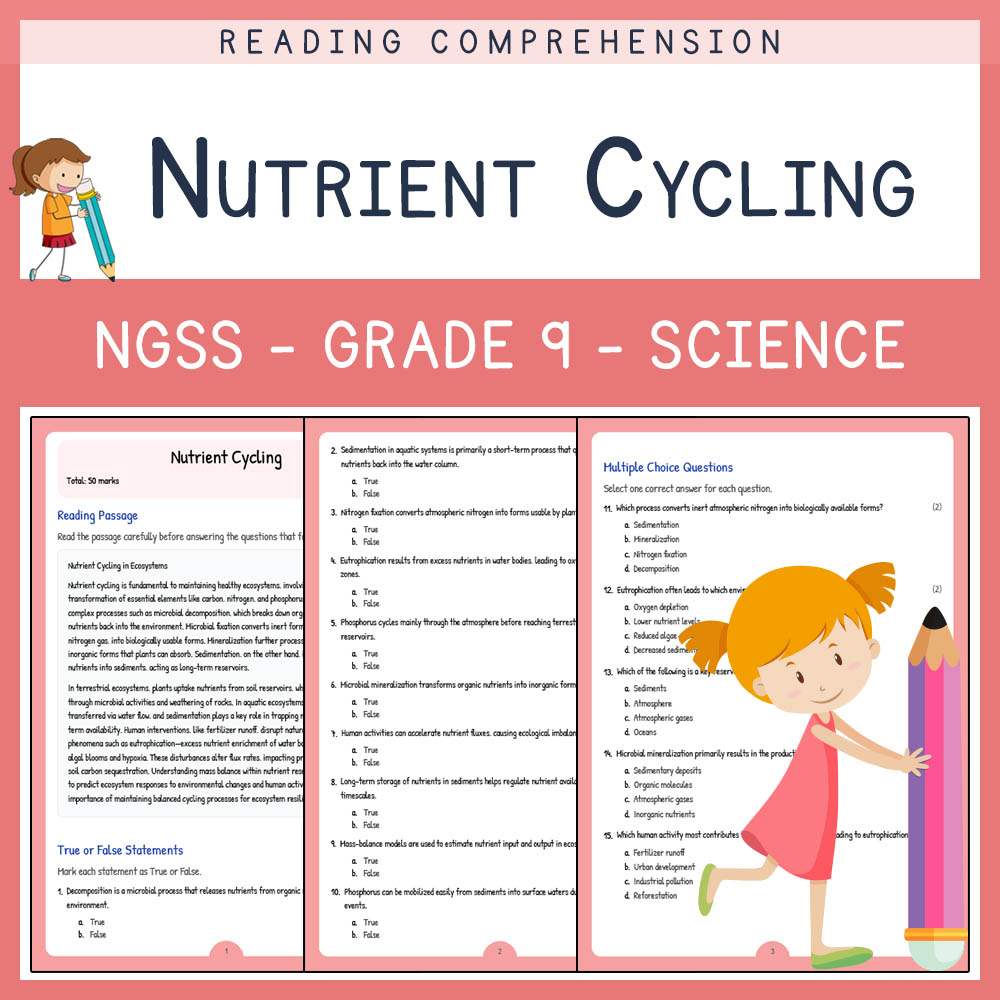
Grade 9 Science | Nutrient Cycling Worksheet (Answer Key & Rubric) NGSS Aligned
Created byLumora LearningLearning Objectives
- Describe the processes involved in the cycling of carbon, nitrogen, and phosphorus within ecosystems.
- Explain microbial roles such as fixation, mineralization, and decomposition in nutrient cycles.
- Analyze human impacts like fertilizer runoff on nutrient fluxes and ecosystem health.
Instant download
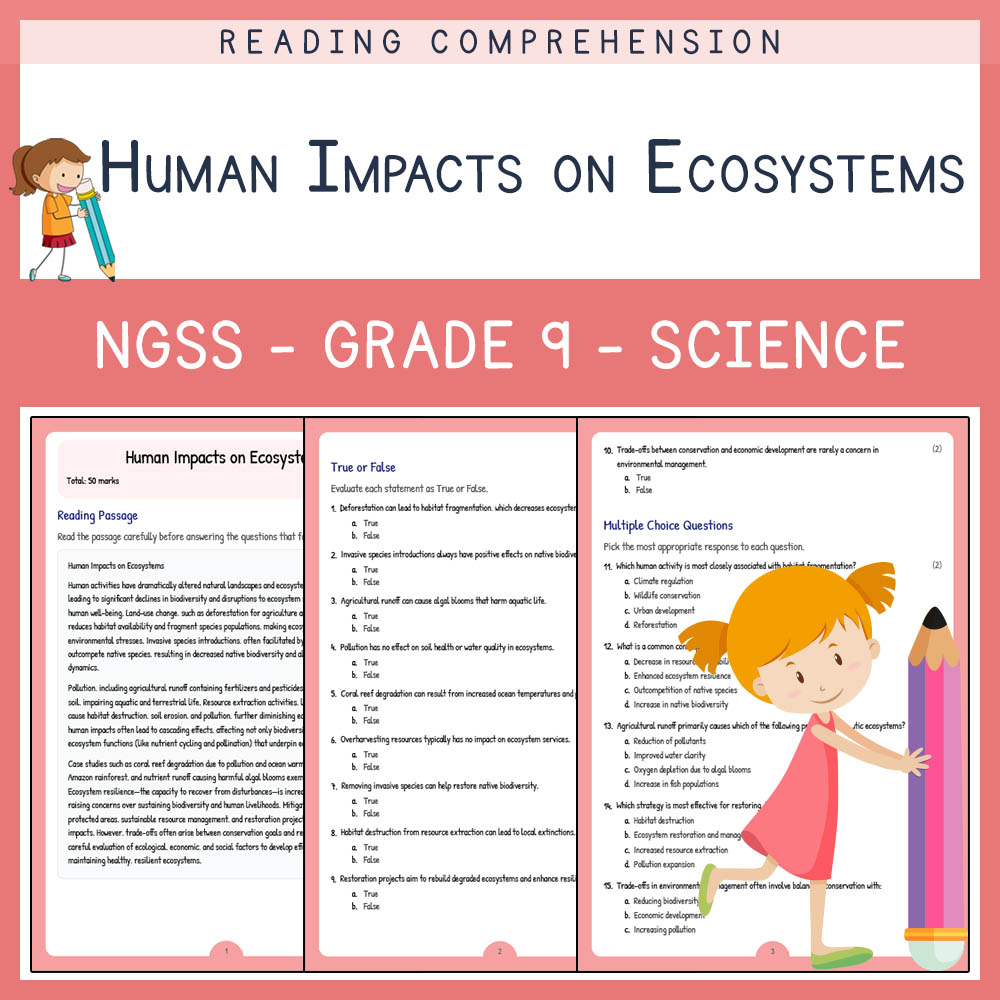
Grade 9 Science | Human Impacts on Ecosystems Worksheet (Answer Key) NGSS-Aligned
Created byLumora LearningLearning Objectives
- Analyze how land-use change, invasive species, pollution, and resource extraction affect biodiversity and ecosystem functioning.
- Interpret empirical data from case studies to evaluate conservation approaches and trade-offs.
- Assess the socioecological implications of environmental impacts and mitigation strategies.
Instant download
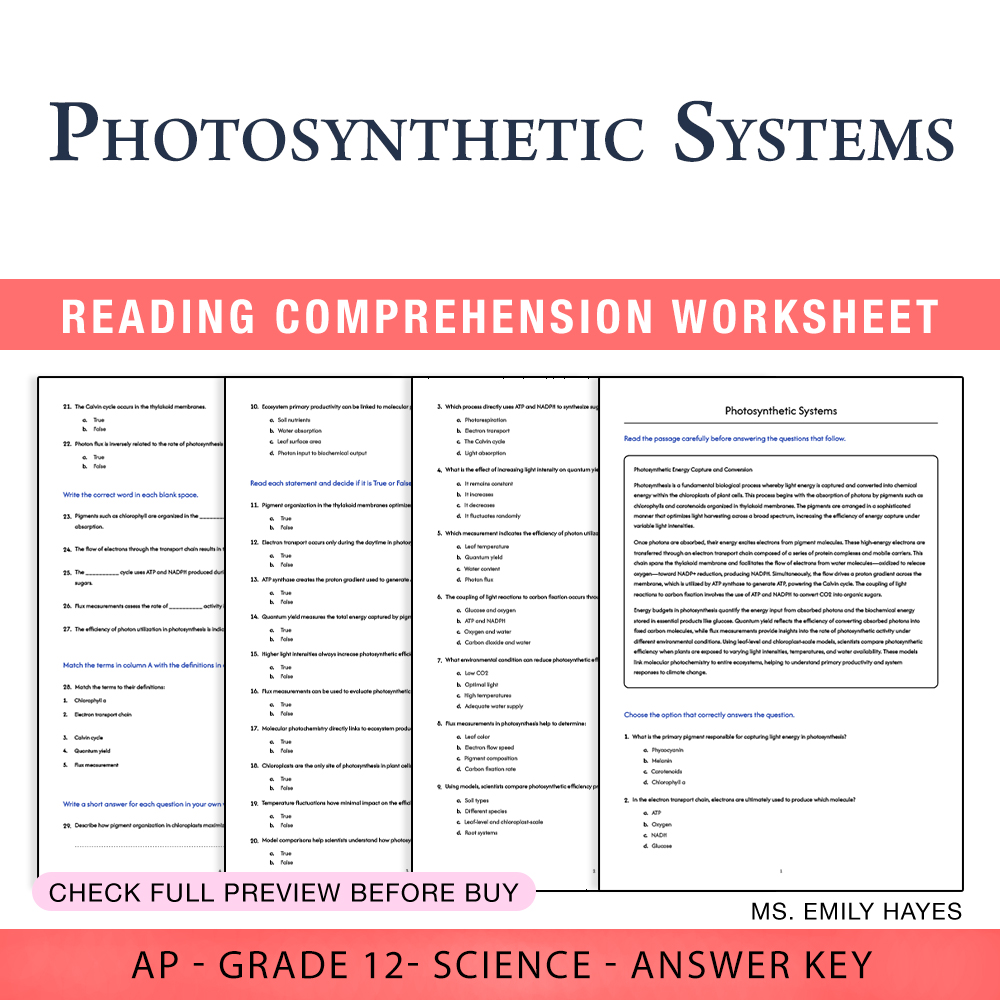
12th Grade Science | Photosynthetic Systems Assessment Worksheet (PDF+ Answers)
Created byCopper Leaf ClassroomLearning Objectives
- Understand the organization of pigments, electron transport chains, and their roles in photosynthesis.
- Explain the mechanisms of energy capture and conversion within chloroplasts.
- Analyze the relationship between photon input, quantum yield, and biochemical output in photosynthesis.
Also included in: Grade 12 Science | AP Biology & Ecology Worksheet Bundle (PDF+ Answer Keys) +1 more
Instant download

Structural Traits Assessment | Florida NGSSS Grade 6 Science Worksheet
Created byPrism Point LearningLearning Objectives
- Explain how structural traits help organisms obtain food, move efficiently, and avoid predation
- Identify examples of structural adaptations (e.g., shells, webbed feet, long roots, camouflage) and match them to functions
- Use evidence from observations to describe how traits relate to specific habitats
Also included in: Grade 6 Ecosystems Science Lesson Bundle | Florida NGSSS Assessment
Instant download
Browse more categories
About Reading comprehension Worksheets
Find reading comprehension worksheets for class practice, homework, or self-study. All 40,284 are instant PDF downloads.
Each resource here is built by an independent educator and reviewed for quality. Worksheets print straight from PDF and suit classroom use, homework, or extra practice; most come with answer keys, and you can preview before purchasing.