
Reading comprehension Worksheets
40,284 type resources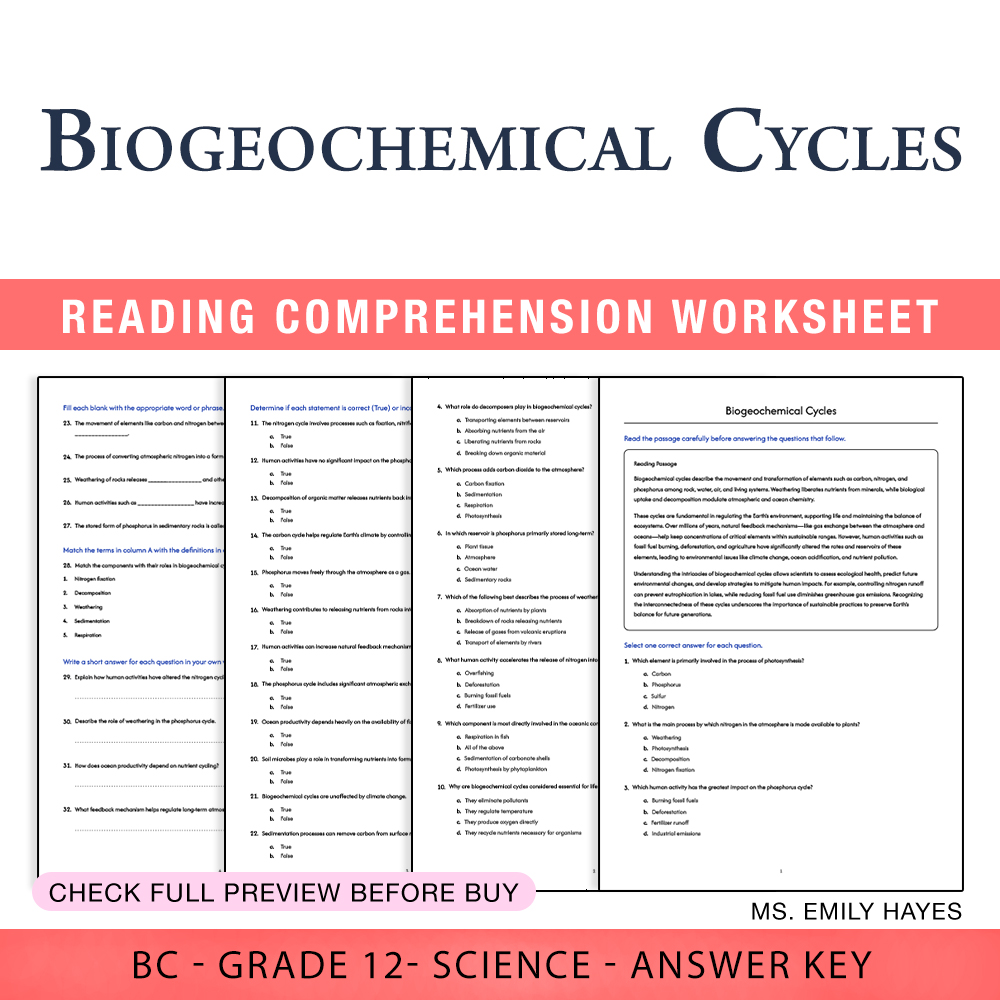
Grade 12 Science | Biogeochemical Cycles Worksheet (PDF + Answer Key)
 Created byCopper Leaf Classroom
Learning Objectives
- Describe the components and importance of biogeochemical cycles.
- Explain how elements like carbon, nitrogen, and phosphorus move through Earth's systems.
- Analyze human impacts on biogeochemical cycles and their long-term effects.
Also included in: Grade 12 Science BC | Earth Structures & Geology Bundle (PDF+ Answer Keys) +1 more
Instant download

12th Grade Science | Sea-Floor Spreading Worksheet (PDF + Answer Key)
Created byCopper Leaf ClassroomLearning Objectives
- Understand the process of sea-floor spreading and its evidence through magnetic stripes.
- Interpret magnetic anomaly patterns in relation to geological features.
- Explain how radiometric dating contributes to understanding seafloor age and plate movement.
Also included in: Grade 12 Science BC | Earth Structures & Geology Bundle (PDF+ Answer Keys) +1 more
Instant download
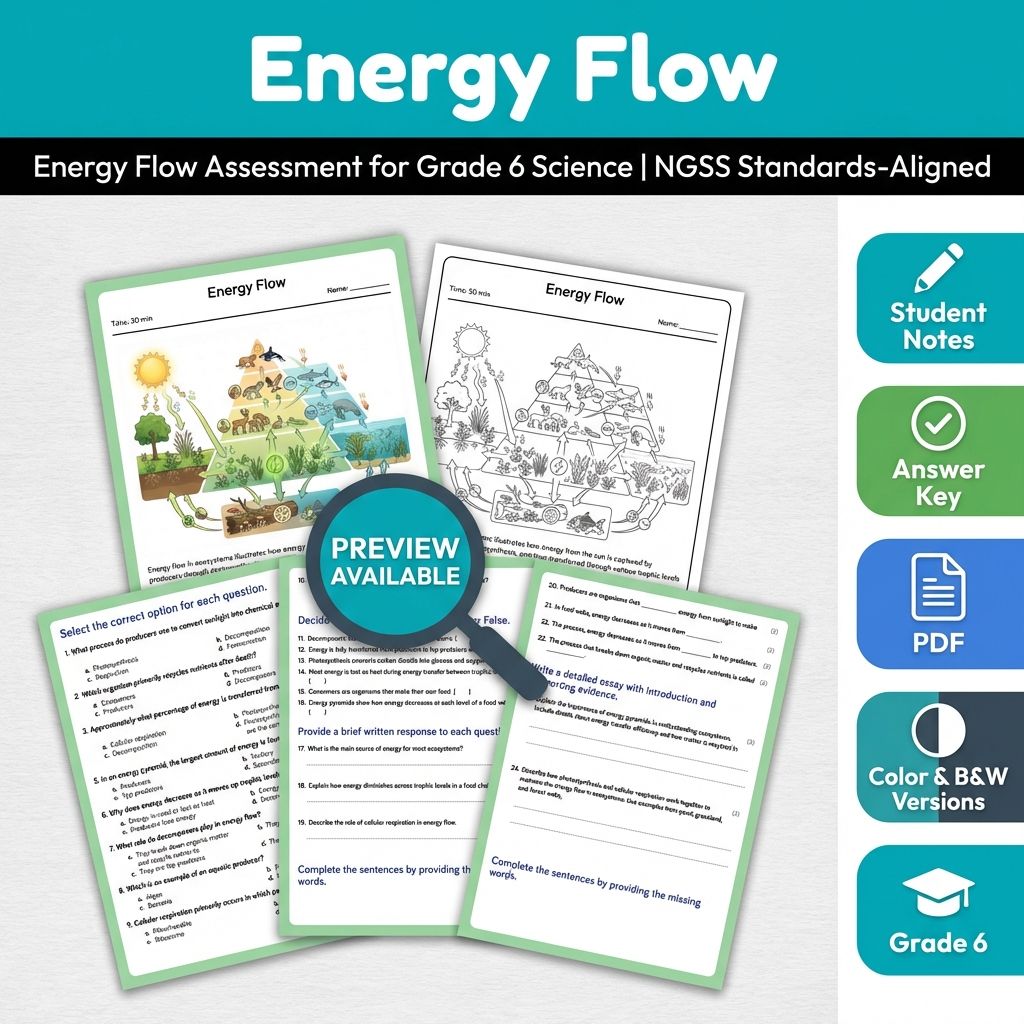
Energy Flow Assessment for Grade 6 Science | NGSS Standards-Aligned
 Created byPrism Point Learning
Learning Objectives
- Describe the components of food webs including producers, consumers, and decomposers.
- Explain the concept of energy pyramids and trophic transfer efficiency.
- Understand how photosynthesis and cellular respiration contribute to energy budgets.
Also included in: Grade 6 Science Mini Bundle | Ecosystems: Interactions, Energy, and Dynamics +1 more
Instant download

Grade 12 Science | Force Interactions Reading Worksheet (PDF + Rubric)
JCreated byJ.S SheetsLearning Objectives
- Explain the difference between contact and long-range forces.
- Apply Newton's laws to analyze motion in systems involving inclined planes, pulleys, and friction.
- Interpret free-body diagrams to determine net forces and predict acceleration.
Also included in: Grade 12 Science Unit Bundle | Mechanics & Energy Worksheets (PDF + Answer Key) +1 more
Instant download
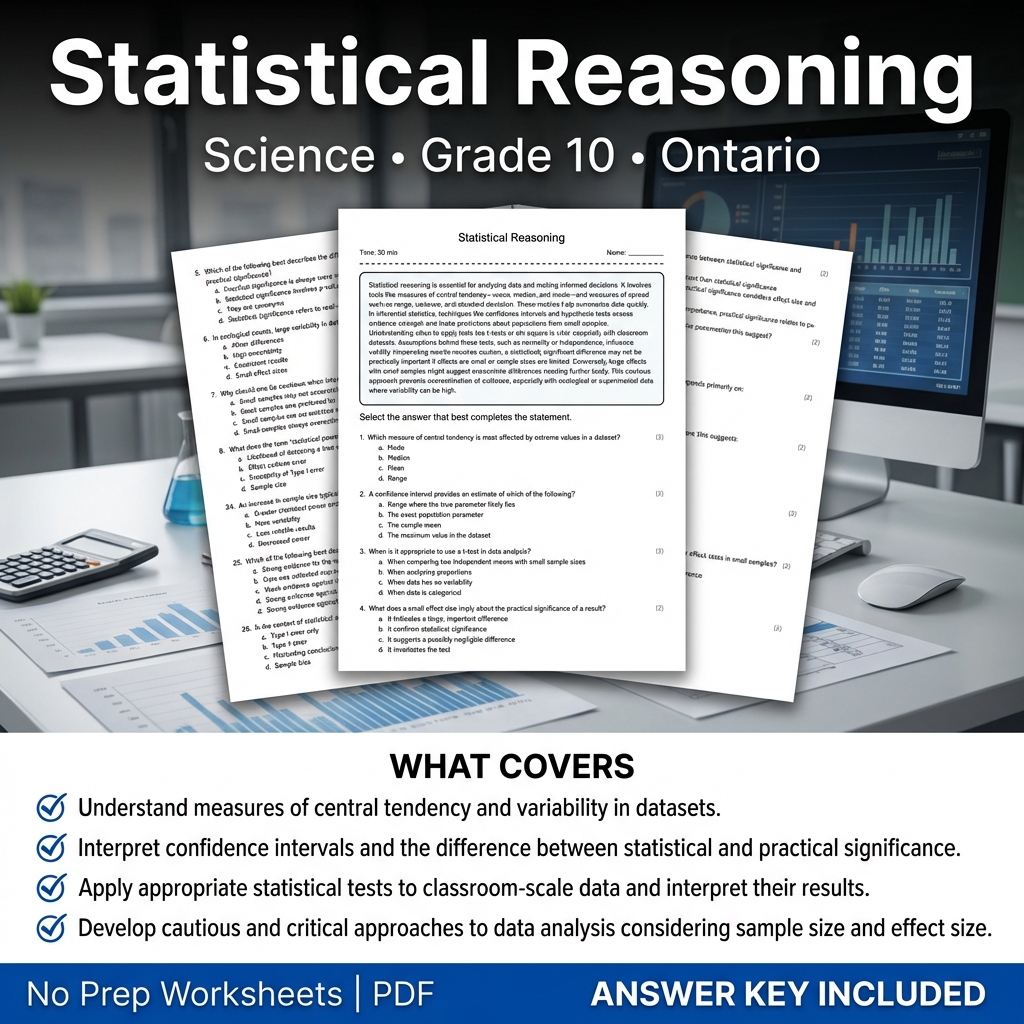
Statistical Reasoning Worksheet for Grade 10 Science | Ontario Standards
 Created byCoral Reef Learning
Learning Objectives
- Understand measures of central tendency and variability in datasets.
- Interpret confidence intervals and the difference between statistical and practical significance.
- Apply appropriate statistical tests to classroom-scale data and interpret their results.
Instant download
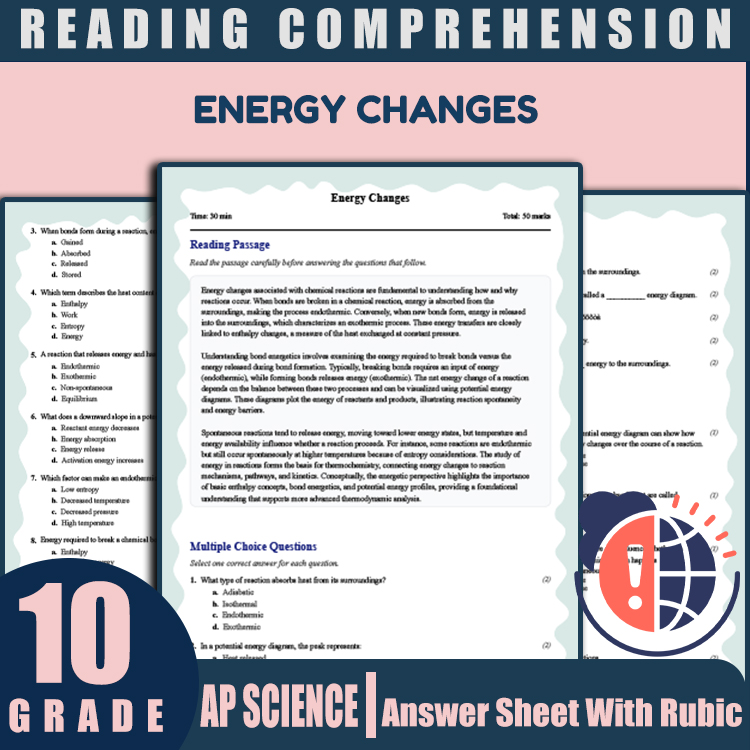
Grade 10 Science | Energy Changes Reading Worksheet (PDF + Answer Key)
JCreated byJ.S SheetsLearning Objectives
- Describe the differences between endothermic and exothermic processes.
- Explain basic concepts of enthalpy and how bond breaking and formation influence reaction heat.
- Relate energy changes to potential energy diagrams and reaction pathways.
Also included in: Grade 10 Science Unit Worksheet Bundle | Chemical Reactions & Atomic Structure +1 more
Instant download
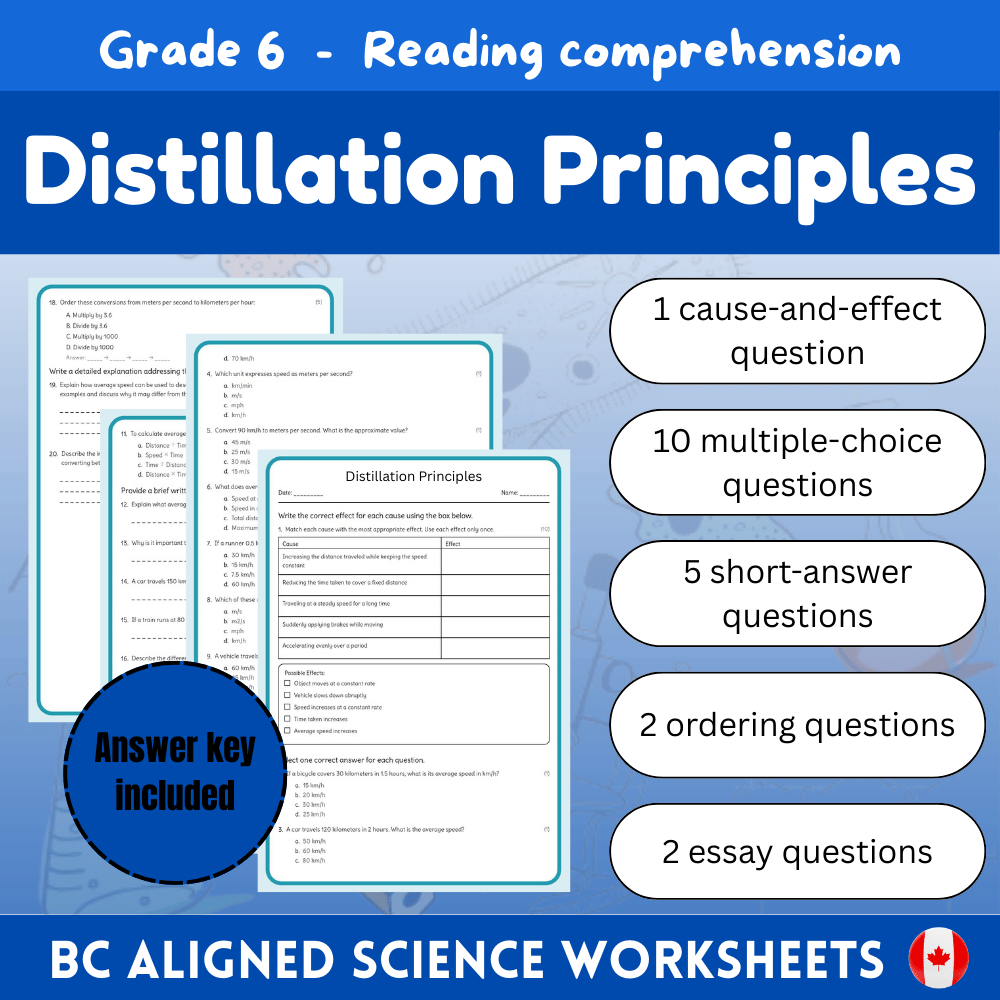
6th Grade Science| Distillation Principles Worksheet + Answer Key - BC Standards
 Created byBright Mind Resources
Learning Objectives
- Explain the basic principles of distillation based on boiling points and phase changes.
- Differentiate between simple distillation and fractional distillation methods.
- Understand how vapor pressure and thermal input aid in separating liquid mixtures.
Instant download

Colonial Legacies Grade 7 Social Studies Worksheet BC Curriculum
 Created byQuiet Forest Education
Learning Objectives
- Understand the concept of colonialism and its historical context.
- Identify impacts of colonial policies on Indigenous communities.
- Recognize ways Indigenous peoples have preserved and revitalized their cultures.
Also included in: Grade 7 Social Studies Full-Year Bundle | BC Daily Reading
Instant download
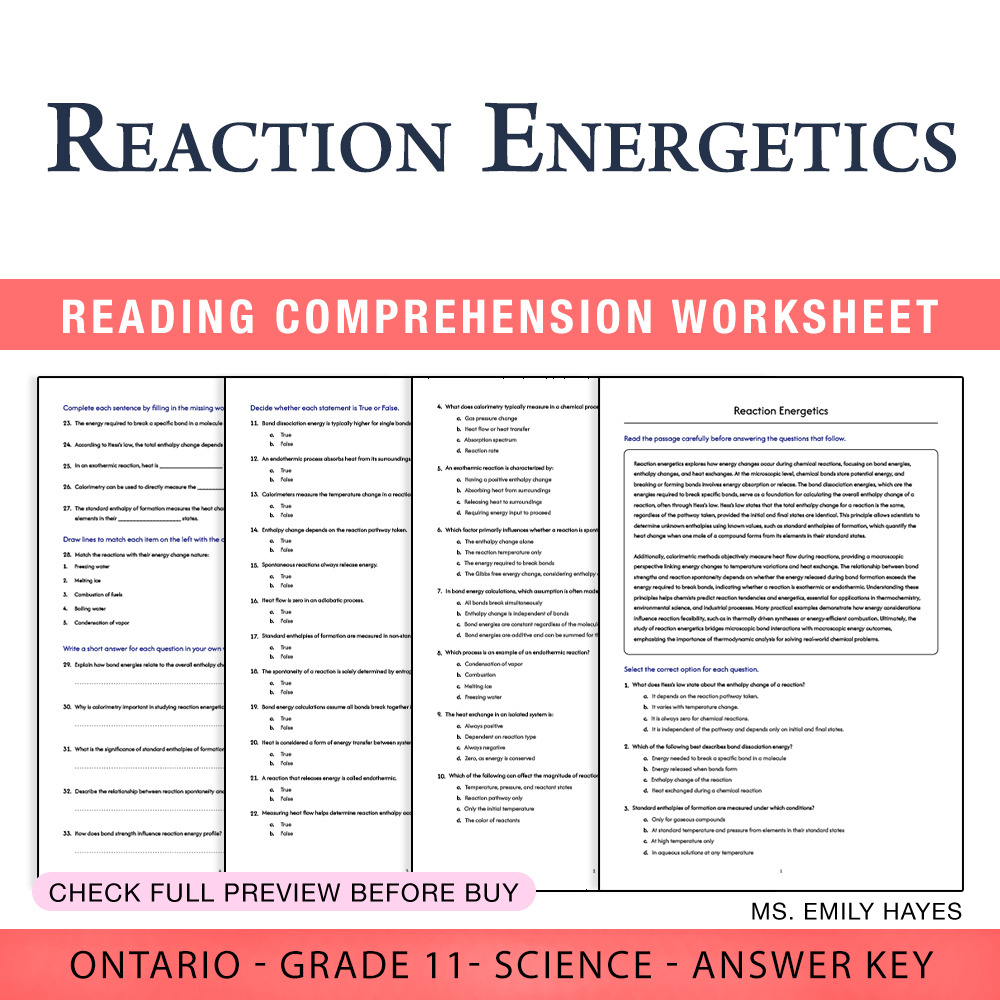
11th Grade Science | Reaction Energetics Worksheet (PDF + Answer Key)
Created byCopper Leaf ClassroomLearning Objectives
- Understand the relationship between bond energies, enthalpy changes, and heat exchange in reactions.
- Apply Hess’s law and standard enthalpies of formation to calculate reaction enthalpies.
- Explain calorimetric principles for measuring heat flow during chemical processes.
Instant download

Limiting Reagent Worksheet Pack | Grade 12 Science Activities
Created byPrism Point LearningLearning Objectives
- Identify the limiting reagent from a balanced chemical equation and given reactant quantities.
- Calculate theoretical yield and percent yield using stoichiometric ratios.
- Explain how excess reagents and incomplete conversion affect product formation in real processes.
Instant download
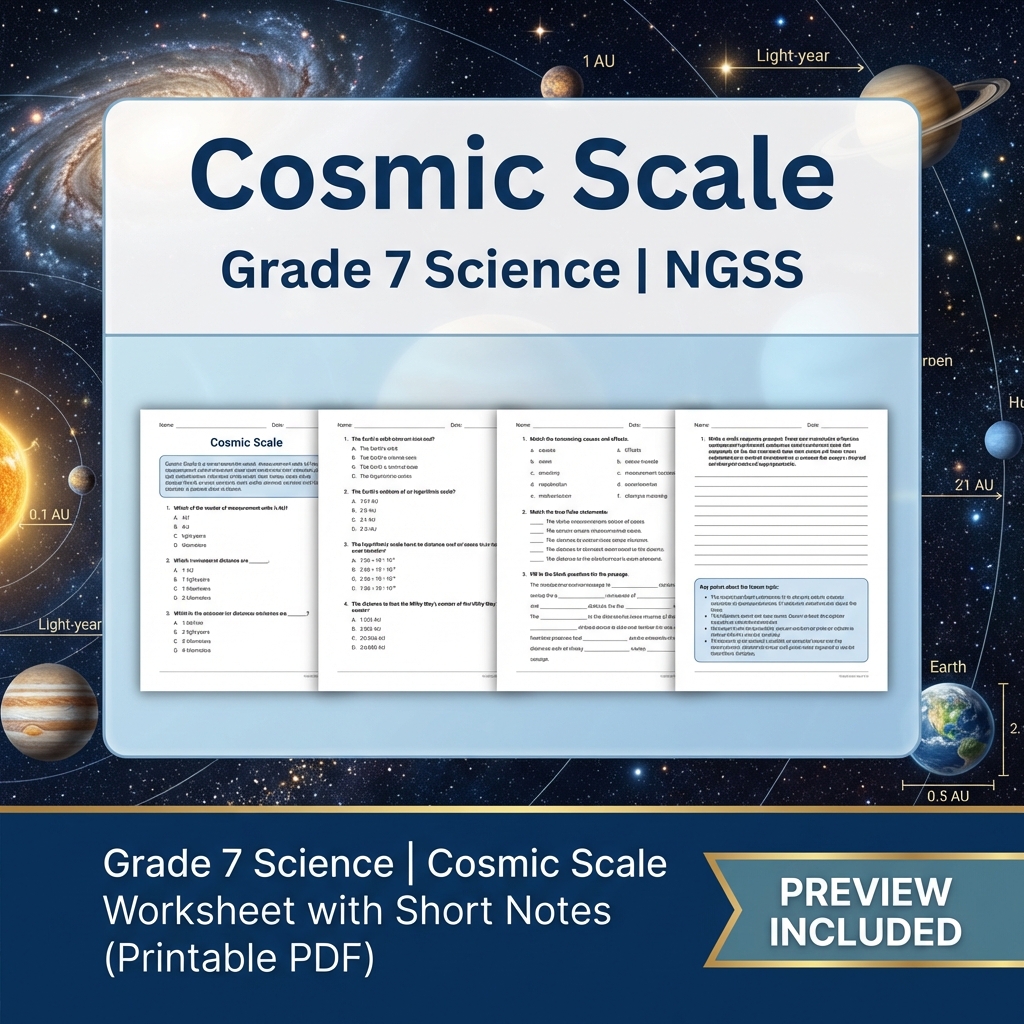
Grade 7 Science | Cosmic Scale Worksheet with Short Notes (Printable PDF)
 Created byMeadowlark Worksheets
Learning Objectives
- Understand and compare sizes and distances within the solar system and beyond using various units of measurement.
- Interpret scaled diagrams and logarithmic representations of astronomical data.
- Analyze how scale influences observed motion and observational limits in astronomy.
Also included in: Grade 7 Science | Earth's Place in the Universe Bundle(NGSS Aligned Worksheets) +1 more
Instant download

Grade 11 Social Studies | Perspectives and Causes Worksheet (PDF)
 Created bySunny Desk Resources
Learning Objectives
- Identify multiple perspectives on a historical or contemporary issue and explain what each perspective emphasizes.
- Analyze causal chains by distinguishing motivations, immediate causes, and short- and long-term consequences.
- Evaluate ethical dimensions of decisions by considering stakeholders, fairness, and accountability.
Also included in: Grade 11 Civic Inquiry Global Issues Social Studies Full-Year Bundle BC +1 more
Instant download
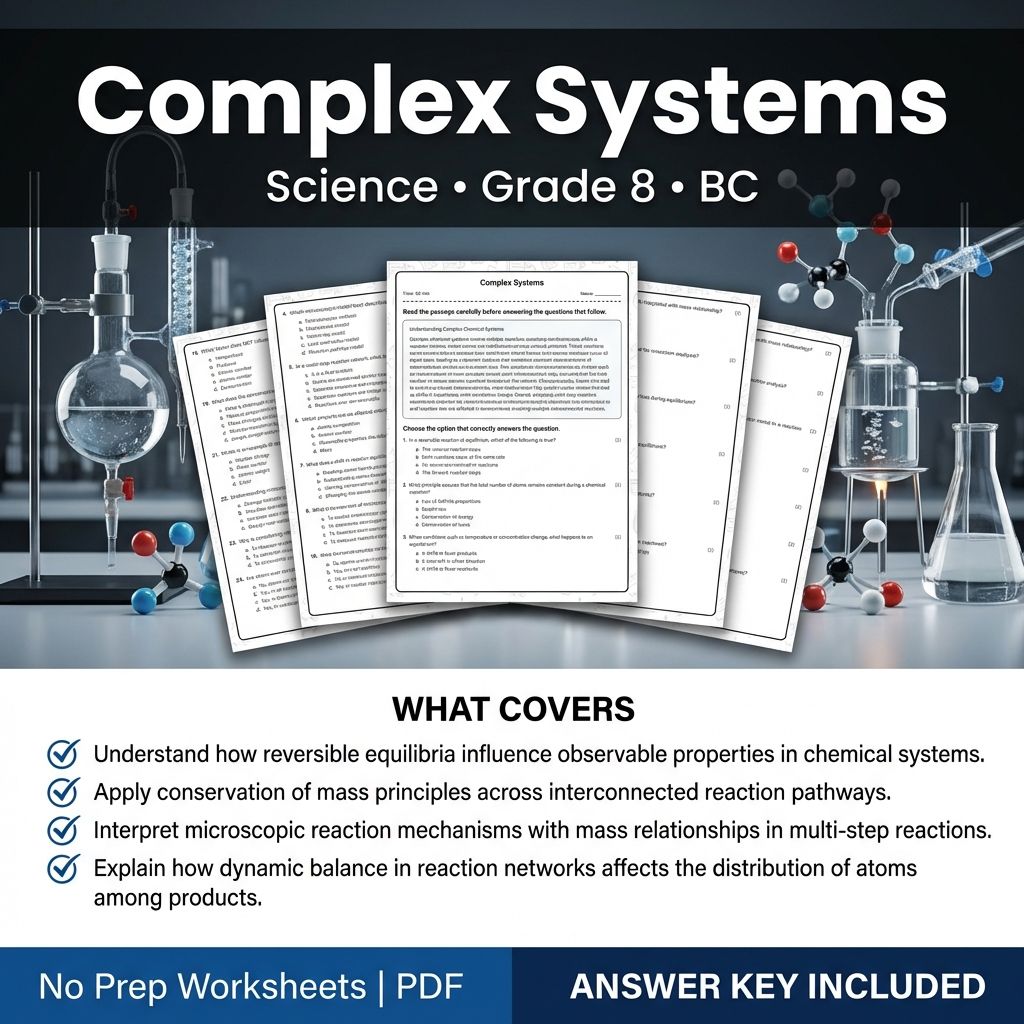
Grade 8 Science | Complex Systems Worksheet & Answer Key (PDF Printable)
Created byCoral Reef LearningLearning Objectives
- Understand how reversible equilibria influence observable properties in chemical systems.
- Apply conservation of mass principles across interconnected reaction pathways.
- Interpret microscopic reaction mechanisms with mass relationships in multi-step reactions.
Instant download
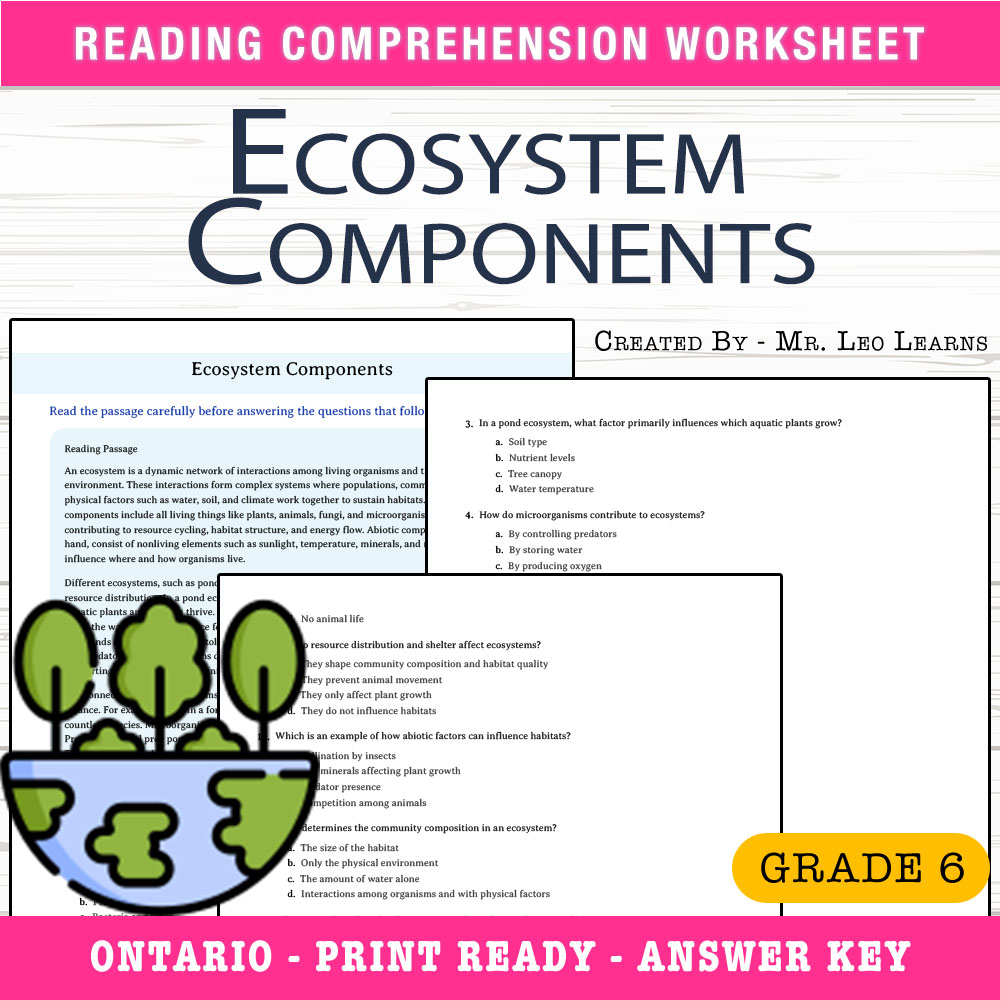
Grade 6 Science – Ecosystem Components Worksheet for Mastery
 Created byThe Resource Hub
Learning Objectives
- Define ecosystems as interacting systems of populations, communities, and physical factors.
- Identify biotic and abiotic components of ecosystems and their roles in habitat structure.
- Describe examples of ecosystems such as ponds, prairies, and forests to illustrate resource distribution and interdependence.
Also included in: Grade 6 Science Unit Bundle | Ecosystems & Environmental Relationships
Instant download
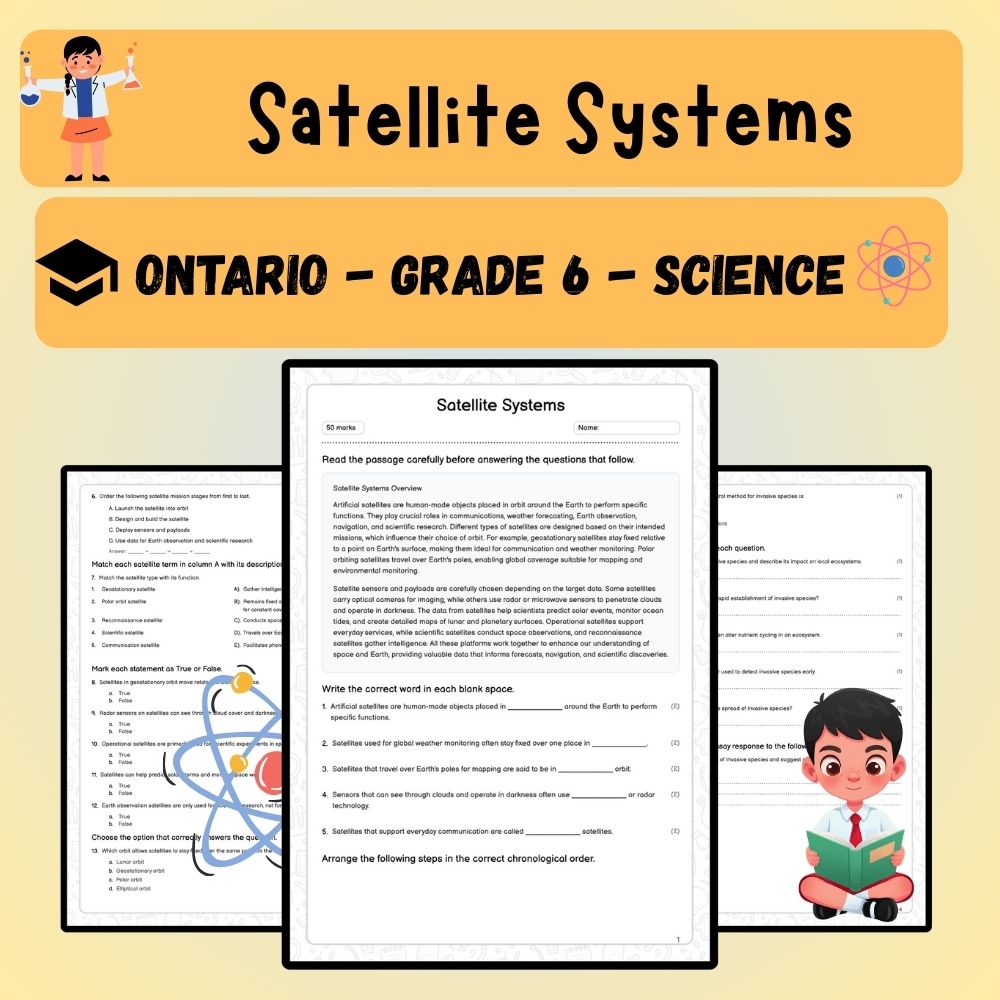
6th Grade Science | Satellite Systems Worksheet (PDF ) - Ontario Standards
Created byPrism Point LearningLearning Objectives
- Understand the functions and categories of artificial satellites.
- Describe orbital choices such as geostationary and polar orbits.
- Explain how satellite data contributes to Earth observation and science.
Instant download
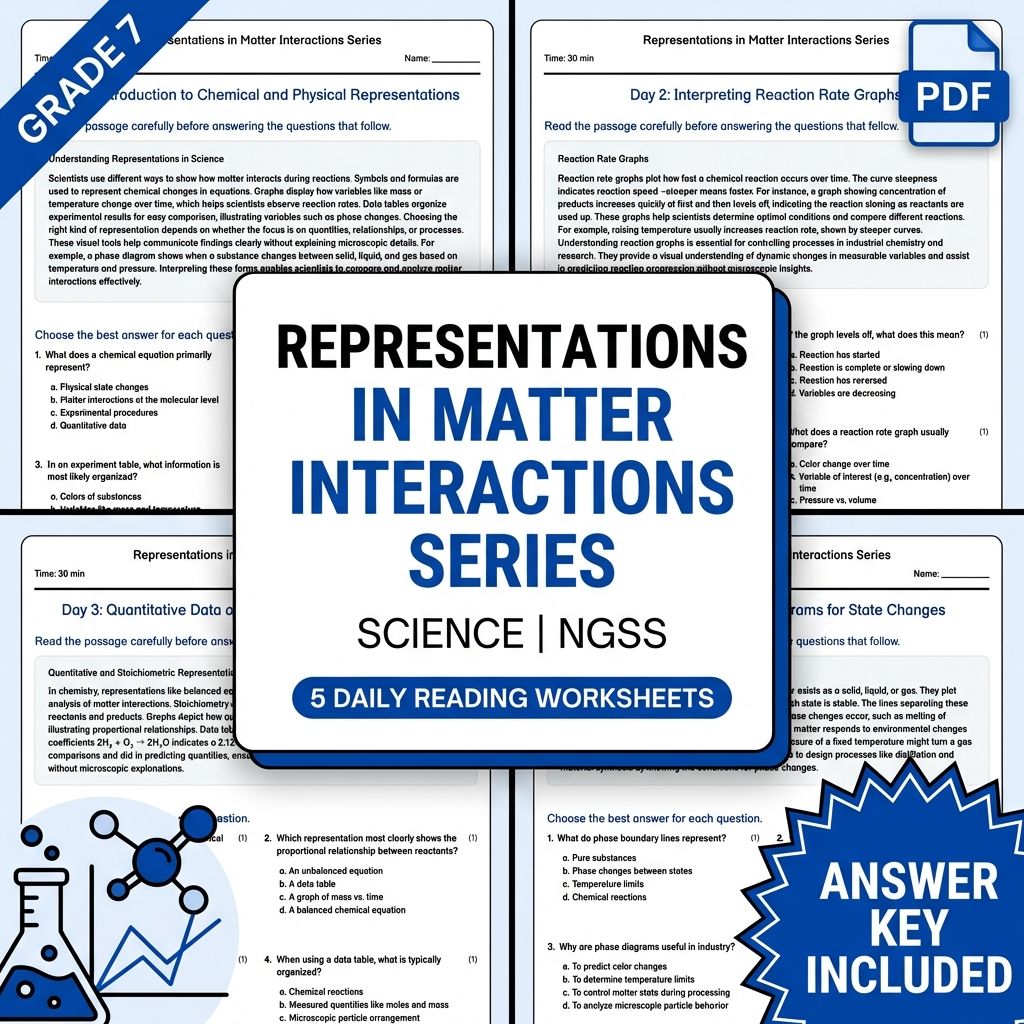
7th Grade Science | Representations in Matter Interactions (PDF + Answer Key)
Created byCopper Leaf ClassroomLearning Objectives
- Understand how various representations convey matter interactions, including symbolic equations, graphs, and data tables.
- Interpret reaction rate graphs, stoichiometric ratios, and phase diagrams.
- Select appropriate representations for quantitative comparison and communicate relationships among measurable variables.
Instant download

Grade 7 Science | Relative Geologic Time - Daily Reading Comprehension
Created byCoral Reef LearningLearning Objectives
- Understand the principles of relative dating in geology.
- Identify and interpret geological layers and their sequence.
- Explain the concept of superposition and how it relates to relative age.
Instant download

6th Grade Science – Societal Impacts Worksheet (TEKS) PDF
 Created byEvergreen Desk Education
Learning Objectives
- Explain how scientific findings lead to societal changes through evidence-based public health, environmental, and resource decisions.
- Use data and indicators to evaluate whether interventions achieve intended short-term and long-term outcomes.
- Describe trade-offs between economic priorities and environmental or health goals using real examples.
Instant download

Grade 11 Social Studies Worksheet on Colonial Legacies (BC Standard) (PDF)
Created bySunny Desk ResourcesLearning Objectives
- Analyze how colonial processes created long-term political, social, and economic legacies.
- Assess causes and consequences of land dispossession, governance shifts, and cultural change.
- Interpret diverse perspectives by comparing Indigenous experiences with colonial records and modern interpretations.
Also included in: Grade 11 Civic Inquiry Global Issues Social Studies Full-Year Bundle BC +1 more
Instant download
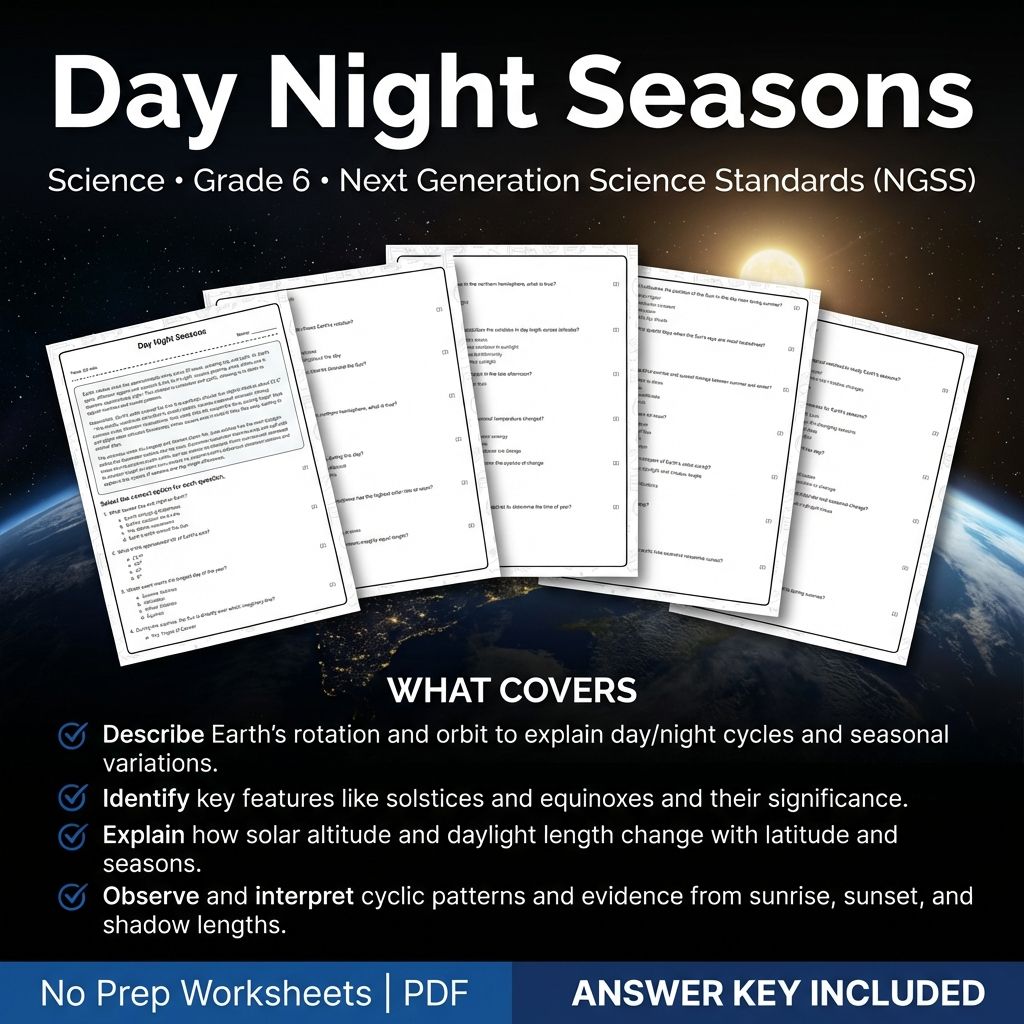
6th Grade Science Worksheet | Day, Night & Seasons NGSS Practice (Printable PDF)
Created byCoral Reef LearningLearning Objectives
- Describe Earth's rotation and orbit to explain day/night cycles and seasonal variations.
- Identify key features like solstices and equinoxes and their significance.
- Explain how solar altitude and daylight length change with latitude and seasons.
Instant download

Wave Property Links Worksheet | Grade 9 Science Practice
Created byPrism Point LearningLearning Objectives
- Explain how frequency, wavelength, and amplitude describe different features of a wave
- Predict how changing one wave parameter changes a wave’s observable pattern or signal description
- Relate wave properties to energy and to different representations of the same wave
Instant download

6th Grade Rearrangement Explanation Worksheet | Chemical Reactions PDF
Created byEvergreen Desk EducationLearning Objectives
- Explain how atoms rearrange during a chemical reaction and how this leads to new substances
- Identify which parts of a reaction description indicate particle rearrangement (not just mixing)
- Use atomic-level reasoning to predict how product properties relate to new combinations
Instant download

Grade 9 Science | Wave Property Links Worksheet | General Standards
 Created byLumora Learning
Learning Objectives
- Explain how frequency, wavelength, and amplitude affect a wave’s observable characteristics
- Use the relationship between wave speed, frequency, and wavelength to predict how one parameter changes when another changes
- Interpret wave “signatures” by connecting amplitude, frequency, and wavelength to different features of a signal
Instant download
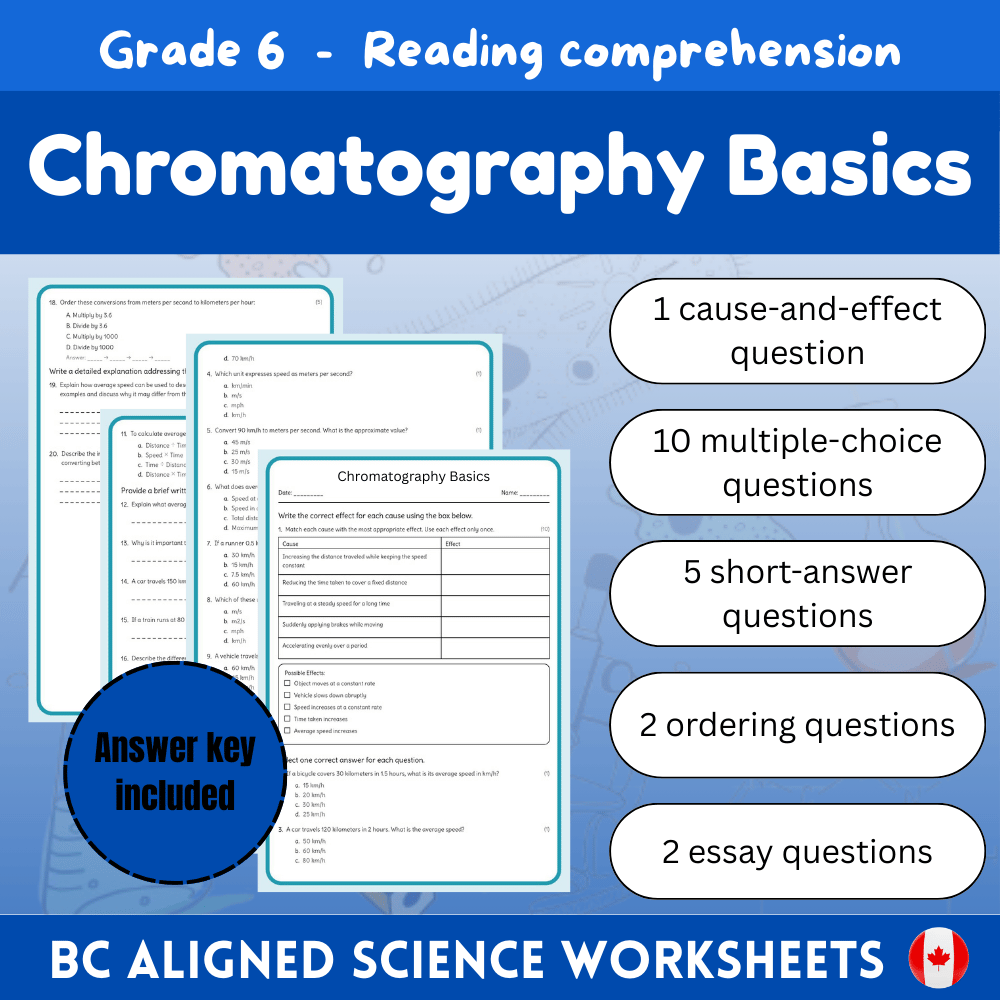
6th Grade Science | Chromatography Basics Worksheet (PDF) – BC Standards
Created byBright Mind ResourcesLearning Objectives
- Understand the fundamental principles of paper chromatography.
- Identify components that influence the movement of substances in chromatography.
- Describe how solubility and affinity affect separation outcomes.
Instant download

6th Grade Science | Adaptation Overview Worksheet (PDF) - BC Standards
Created byEvergreen Desk EducationLearning Objectives
- Explain the difference between structural and physiological adaptations.
- Describe how natural selection can favor traits that improve survival and reproduction.
- Connect specific organism features to the advantages they provide in a habitat.
Instant download

10th Grade Science | Orbital Forcing Reading Worksheet (PDF + Answer Key)
JCreated byJ.S SheetsLearning Objectives
- Describe how variations in Earth's orbit influence insolation and climate cycles.
- Explain the mechanisms by which orbital parameters impact seasonal contrast and glacial rhythms.
- Distinguish between orbital drivers of climate and shorter-term atmospheric or human influences.
Also included in: Grade 10 Science Unit Bundle – Earth Systems, Climate & Remote Sensing Worksheets +1 more
Instant download

Grade 11 Science — Worksheet MCQ Paper for Mastering Measurement Uncertainty
Created byThe Resource HubLearning Objectives
- Understand the principles of precision and accuracy in measurements.
- Identify sources of measurement uncertainty in scientific experiments.
- Apply concepts of significant figures, calibration, and error propagation.
Also included in: Grade 11 Science AP Bundle: Mastering Key Concepts with MCQ Practice +1 more
Instant download

Effects of Acceleration Grade 10 Assessment | General Standards
Created byPrism Point LearningLearning Objectives
- Understand how acceleration affects velocity over time.
- Interpret graph features such as curvature and slope changes to analyze motion.
- Differentiate between positive and negative acceleration and their effects on speed and direction.
Also included in: Grade 10 Physical Science Science Lesson Bundle: General Framework
Instant download

Conservation of Energy Assessment | General Grade 10 Science Standards
Created byPrism Point LearningLearning Objectives
- Understand the principle that energy is neither created nor destroyed but transferred and transformed.
- Describe qualitative energy accounting and how energy forms shift within a closed system.
- Explain how nonconservative forces, such as friction, affect mechanical energy in a system.
Also included in: Grade 10 Physical Science Science Lesson Bundle: General Framework
Instant download

Energy Transfer Assessment for Grade 10 Science | Standards-Aligned
Created byPrism Point LearningLearning Objectives
- Explain how energy moves between systems and changes form during various processes.
- Identify different types of energy transfer pathways such as heating, work, and radiation.
- Describe the relationship between energy transfer and observable changes like temperature, speed, and height.
Also included in: Grade 10 Physical Science Science Lesson Bundle: General Framework
Instant download

Matter Conservation Assessment for Grade 10 Science | Standards-Aligned
Created byPrism Point LearningLearning Objectives
- Understand that matter is neither created nor destroyed in physical and chemical changes.
- Explain how particle and atom models demonstrate matter conservation.
- Identify phase changes as examples of matter conservation through particle count.
Also included in: Grade 10 Physical Science Science Lesson Bundle: General Framework
Instant download

Kinematics Graphs Assessment | Standards-Aligned Grade 10 Science Worksheet
Created byPrism Point LearningLearning Objectives
- Understand how displacement, velocity, and acceleration are represented on different types of graphs.
- Interpret the slopes of displacement-time and velocity-time graphs to determine motion characteristics.
- Analyze acceleration-time patterns to identify constant, changing, or reversing acceleration.
Also included in: Grade 10 Physical Science Science Lesson Bundle: General Framework
Instant download

Net Force Outcomes Assessment for Grade 10 Science – Standards-Aligned
Created byPrism Point LearningLearning Objectives
- Understand how multiple forces interact to produce net force and acceleration.
- Predict motion changes when forces oppose or align with each other.
- Connect concepts of force, opposition, and acceleration to everyday situations like pushing and sliding.
Also included in: Grade 10 Physical Science Science Lesson Bundle: General Framework
Instant download

Reaction Particles Assessment | NGSS-aligned Grade 10 Science Worksheet
Created byPrism Point LearningLearning Objectives
- Explain how particle collisions influence reaction rates.
- Describe energy barriers and how they affect chemical reactions.
- Analyze how temperature, concentration, and catalysts alter reaction behavior.
Also included in: Grade 10 Physical Science Science Lesson Bundle: General Framework
Instant download

Grade 9 Science | Cell Components - Daily Reading Comprehension
Created byCoral Reef LearningLearning Objectives
- Identify the structure of the cell membrane
- Explain the function of various organelles
- Understand how membranes control what enters and exits cells
Also included in: Biology and Ecosystems Lesson Bundle – Grade 9 Science AP Daily Reading +1 more
Instant download
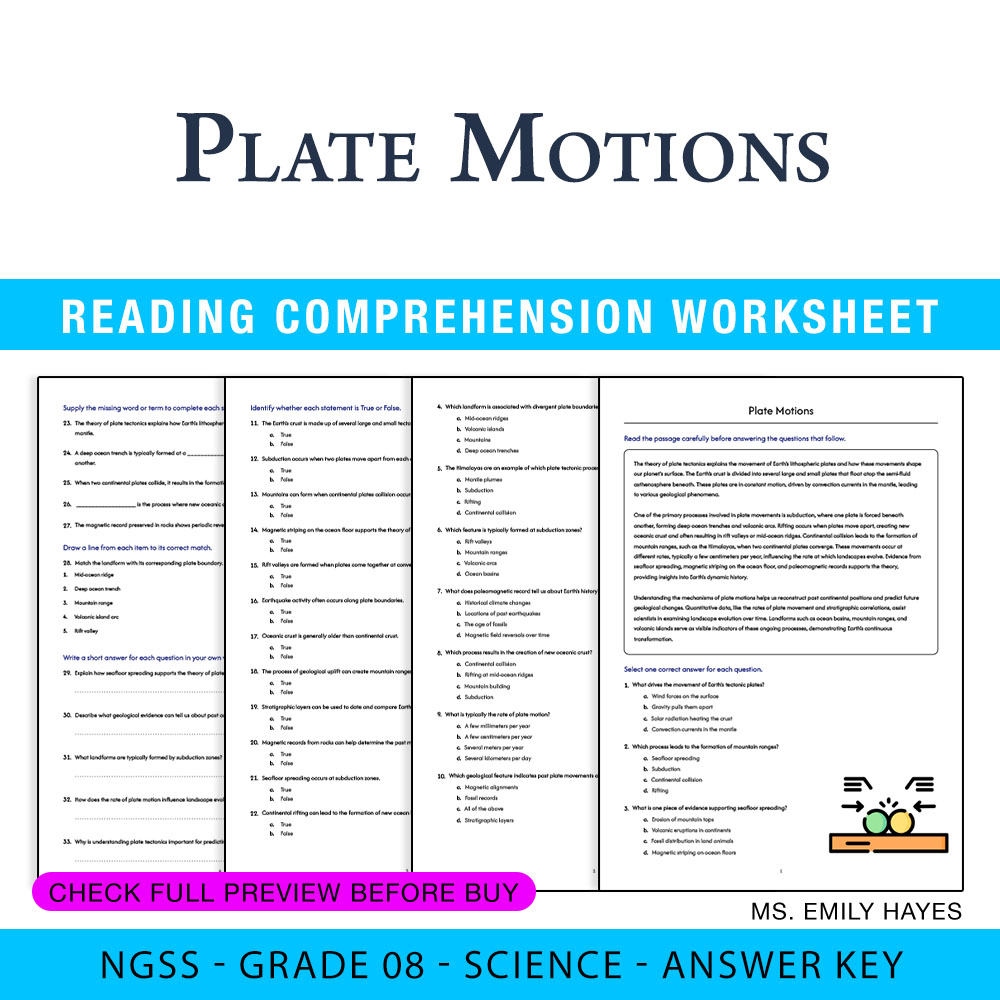
8th Grade Science | Plate Motions Worksheet (PDF + Answer Key)
Created byCopper Leaf ClassroomLearning Objectives
- Describe the mechanisms involved in plate tectonics, including processes like subduction, rifting, and continental collision.
- Identify landforms and geological features resulting from plate movements such as mountains, ocean basins, and volcanic arcs.
- Explain the evidence supporting plate tectonics, including seafloor spreading, magnetic striping, and paleomagnetic records.
Instant download
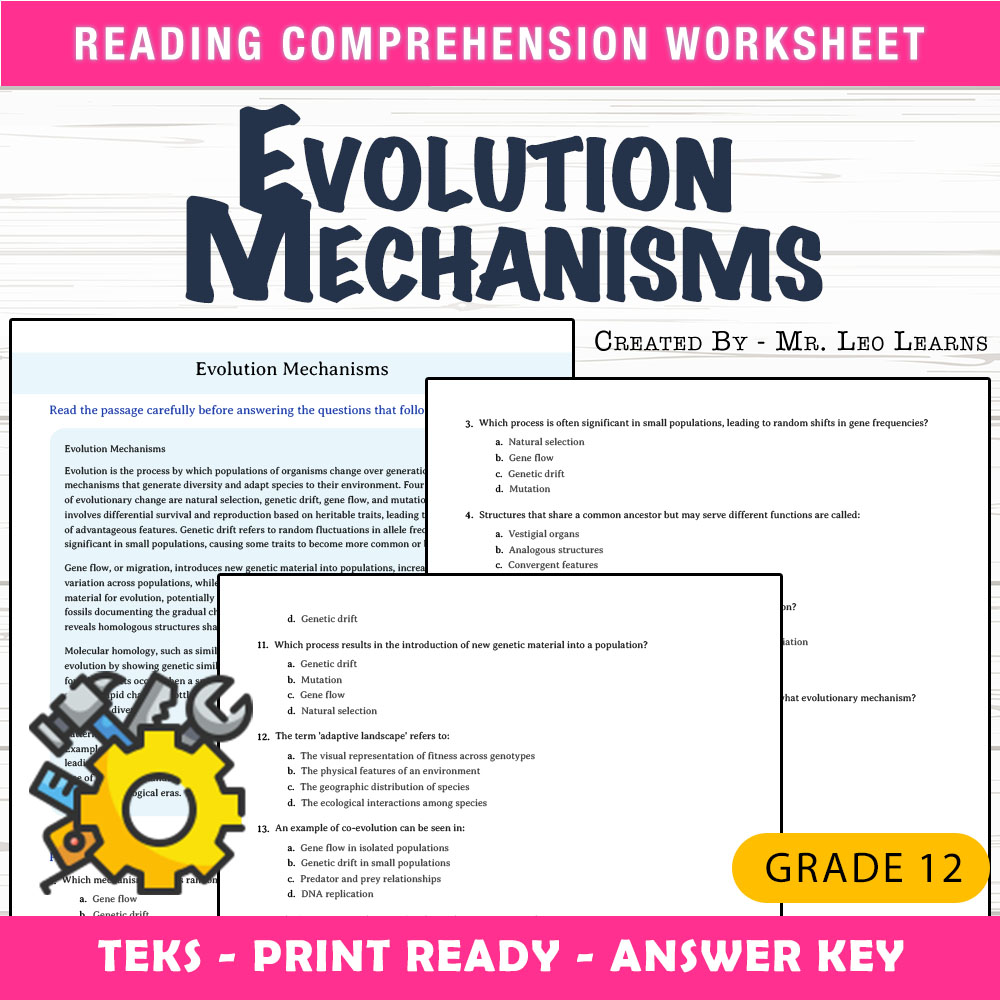
Grade 12 Science – Evolution Mechanisms Worksheet for Mastery
Created byThe Resource HubLearning Objectives
- Describe the key mechanisms driving biological diversity such as natural selection, genetic drift, gene flow, and mutation.
- Identify evidence supporting evolution from paleontology, comparative anatomy, and molecular homology.
- Explain how population processes like founder and bottleneck effects influence genetic variation.
Also included in: Grade 12 Science Worksheet Bundle – Genetics, Evolution & Biodiversity Mastery +1 more
Instant download
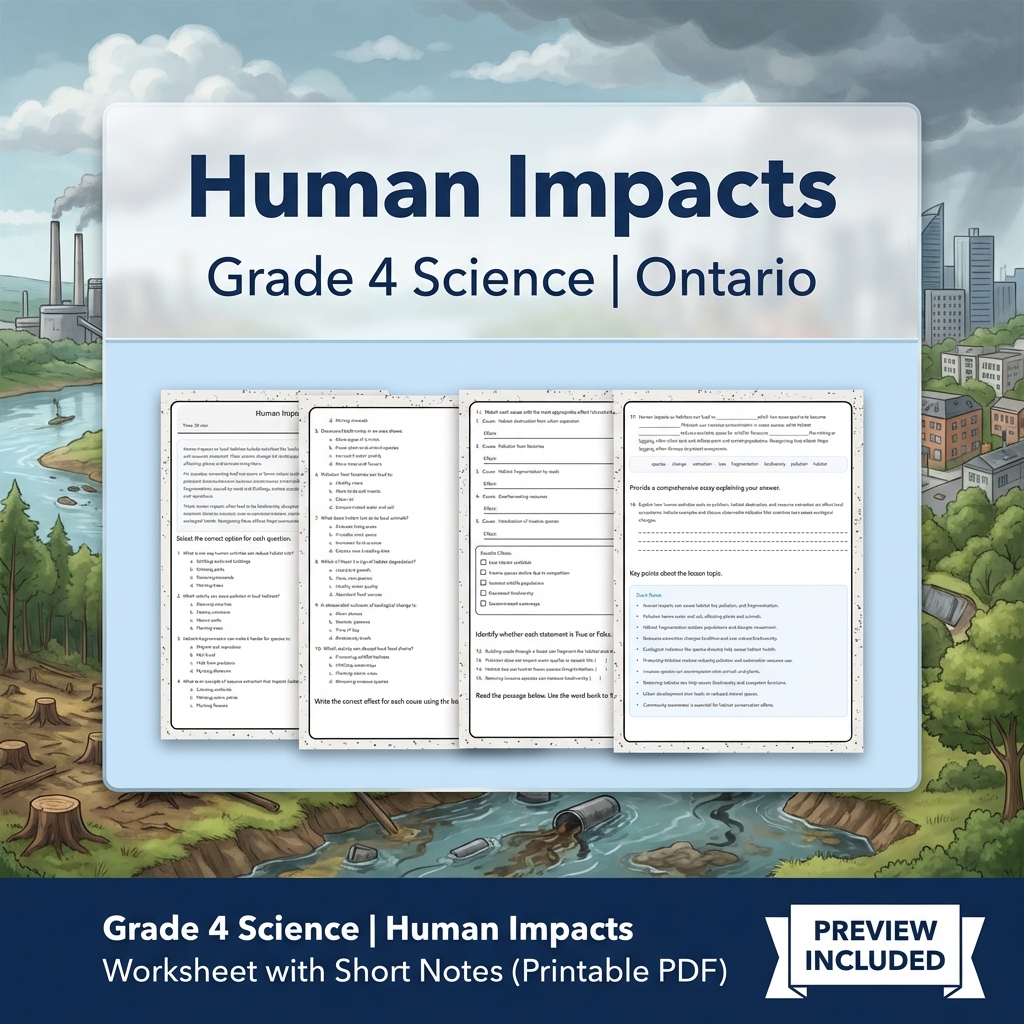
Grade 4 Science | Human Impacts Worksheet with Short Notes (Printable PDF)
Created byMeadowlark WorksheetsLearning Objectives
- Understand how human activities affect local habitats and ecosystems.
- Identify examples of human impacts such as pollution, habitat loss, and resource extraction.
- Describe observable ecological indicators of habitat change.
Also included in: Grade 4 Science Lesson Group Bundle – Ontario Framework Units +1 more
Instant download

Grade 11 Science – Reaction Rates & Factors | Daily Reading Worksheet
Created byBright Mind ResourcesLearning Objectives
- Understand the factors influencing the speed of chemical reactions.
- Identify how temperature, concentration, surface area, and catalysts affect reaction rates.
- Recognize the principles of collision theory and activation energy.
Also included in: Grade 11 Reaction Stoichiometry Science Daily Reading Lesson Bundle | NGSS +2 more
Instant download
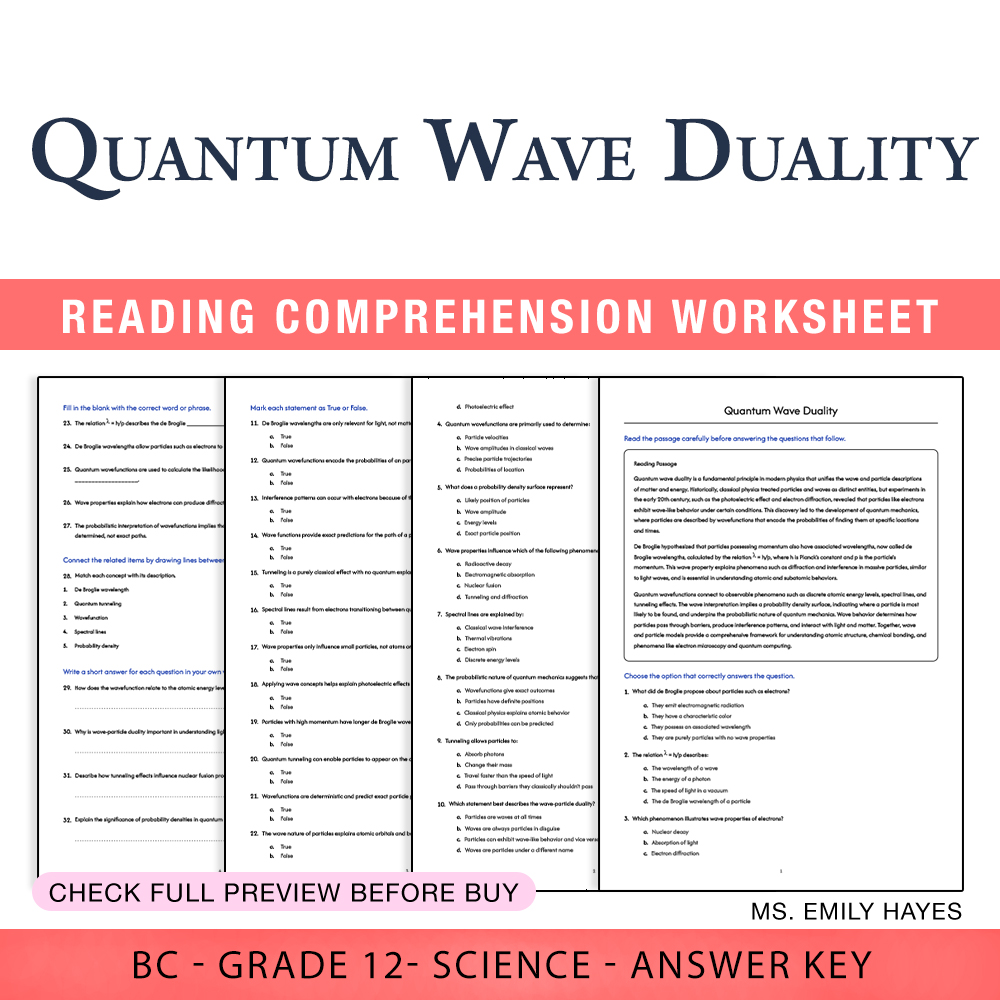
Grade 12 Science | Quantum Wave Duality Worksheet (PDF+ Answer Key)
Created byCopper Leaf ClassroomLearning Objectives
- Understand the concept of matter-wave duality and how it combines wave and particle models.
- Explain de Broglie wavelengths and their significance in quantum physics.
- Describe how wave properties influence diffraction, interference, and tunneling phenomena.
Also included in: Grade 12 Science BC– Physics, Quantum, and Energy Concepts (PDF+ Answer Keys) +1 more
Instant download
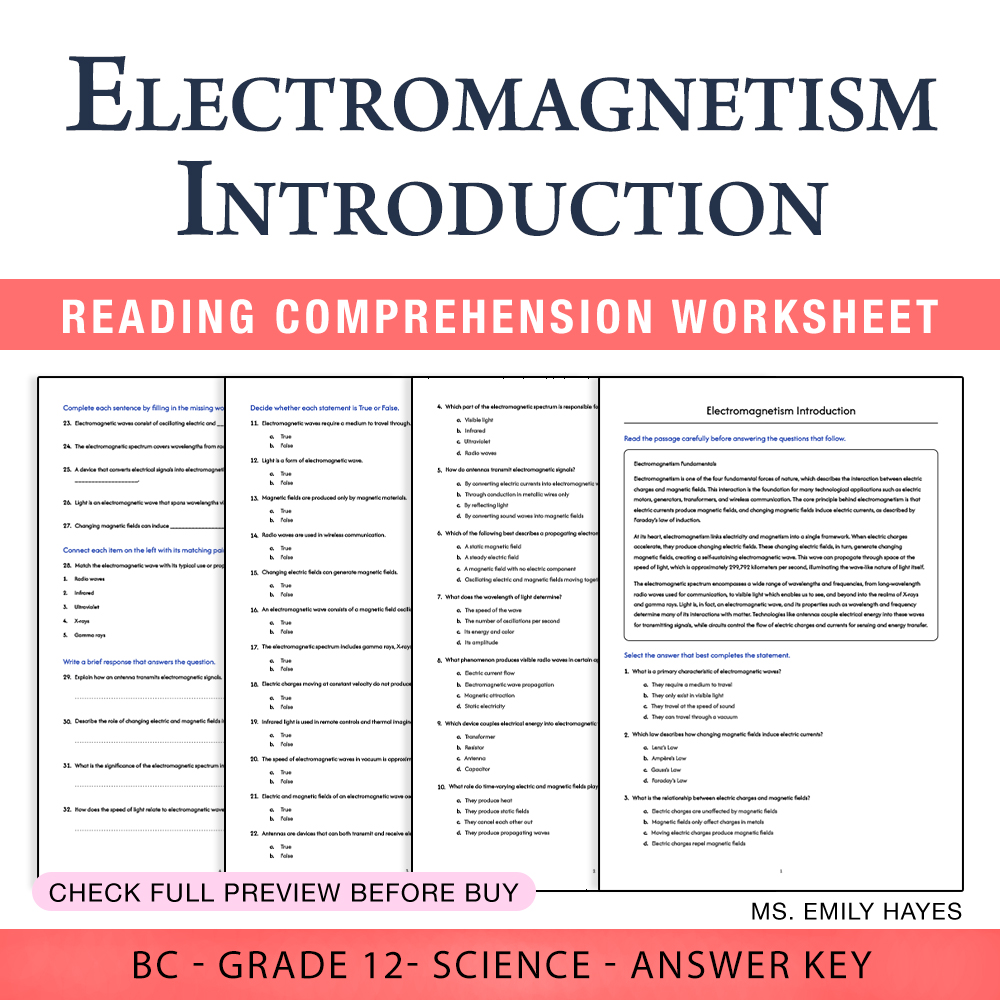
12th Grade Science | Electromagnetism Introduction Worksheet (PDF + Answer Key)
Created byCopper Leaf ClassroomLearning Objectives
- Understand the fundamental principles linking electric charges, currents, and magnetic fields.
- Explain how time-varying fields produce electromagnetic waves.
- Identify key technological applications of electromagnetism such as antennas and circuits.
Also included in: Grade 12 Science BC– Physics, Quantum, and Energy Concepts (PDF+ Answer Keys) +1 more
Instant download
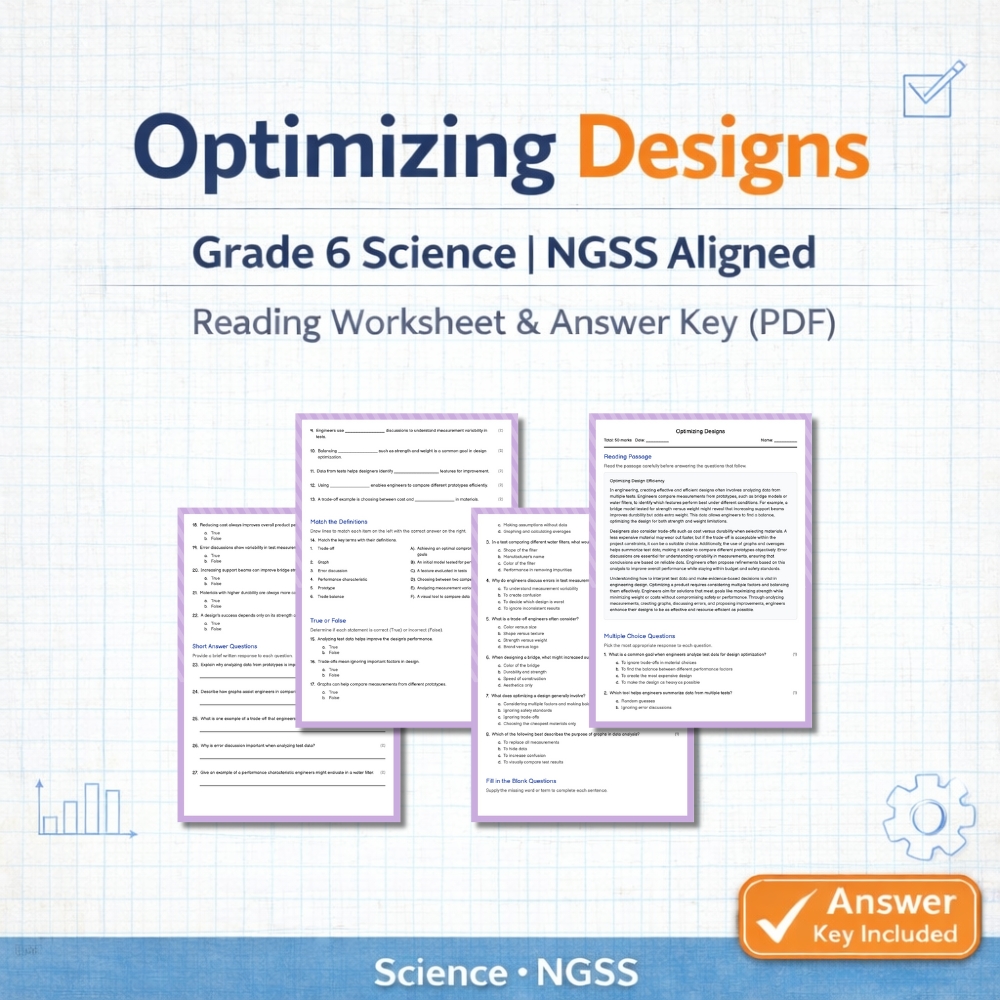
6th Grade Science | Optimizing Designs | Worksheet – NGSS Aligned
 Created byCedar Grove Learning
Learning Objectives
- Analyze data from tests to compare performance of different design options.
- Use graphs, averages, and error discussion to support decisions in design optimization.
- Evaluate trade-offs in design performance criteria such as strength versus weight, cost versus durability.
Also included in: Grade 6 Science Unit Bundle | Engineering Design & Problem Solving Worksheets +1 more
Instant download
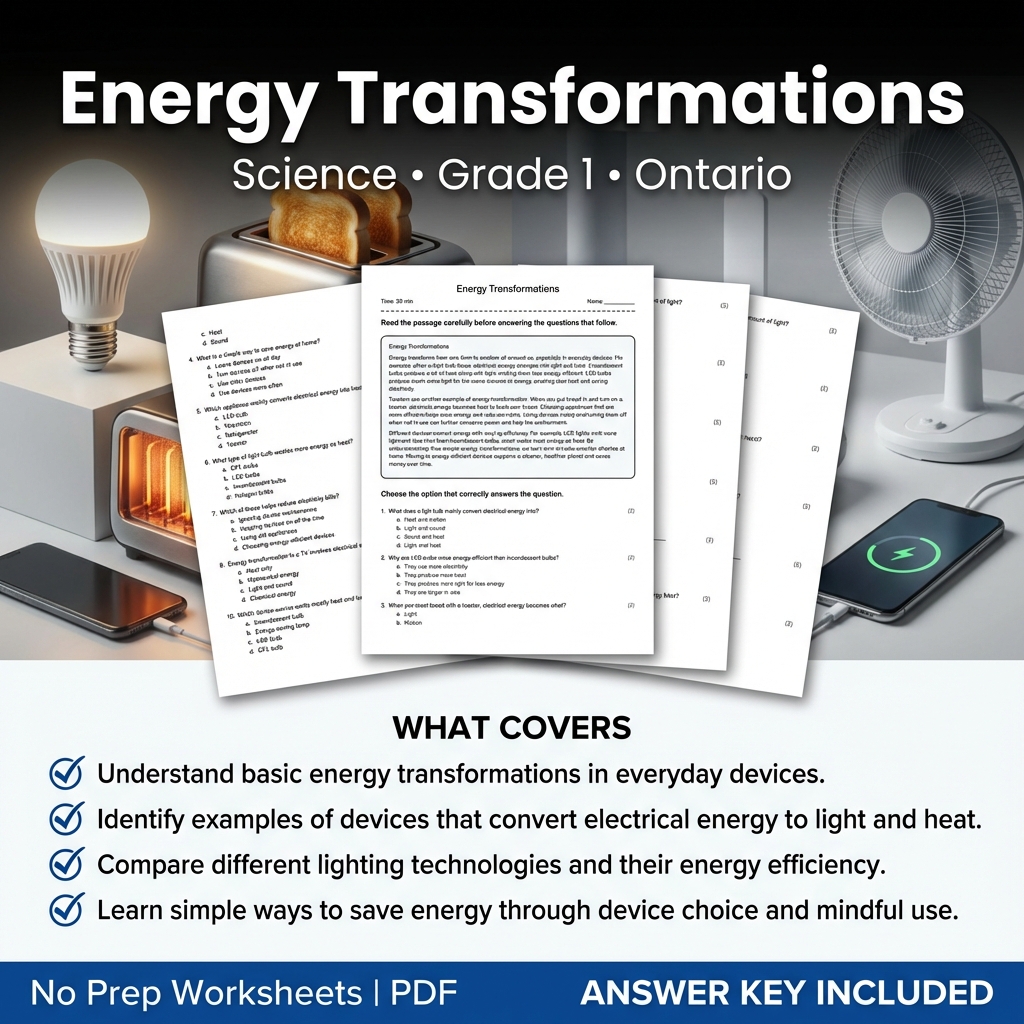
Grade 1 Science Worksheet on Energy Transformations | Ontario Standards
Created byCoral Reef LearningLearning Objectives
- Understand basic energy transformations in everyday devices.
- Identify examples of devices that convert electrical energy to light and heat.
- Compare different lighting technologies and their energy efficiency.
Instant download
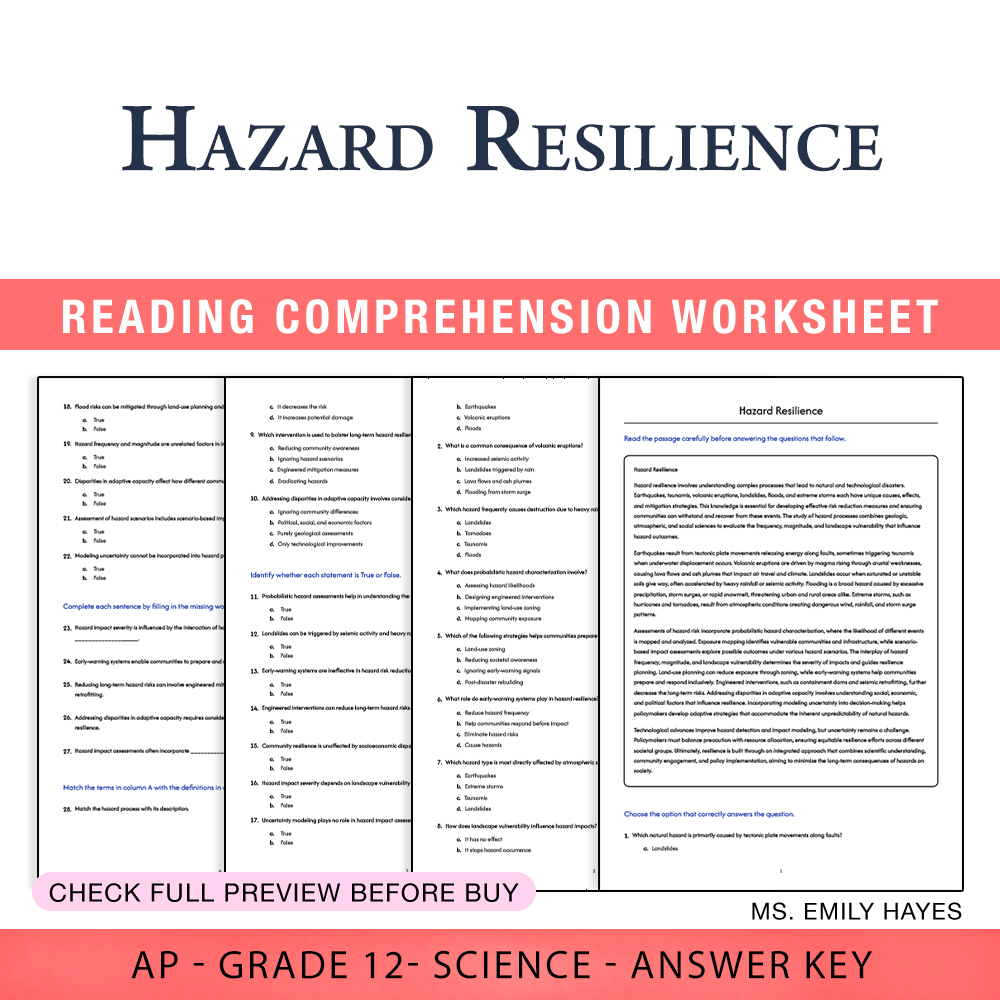
12th Grade Science | Hazard Resilience Assessment Worksheet (PDF+ Answer Key)
Created byCopper Leaf ClassroomLearning Objectives
- Analyze the interplay of geologic and atmospheric hazard processes and their impact on communities.
- Evaluate hazard risk and resilience concepts through probabilistic and scenario-based assessments.
- Identify strategies for reducing long-term hazard consequences via land-use planning and early-warning systems.
Also included in: Grade 12 Science | Earth Systems & Climate AP Worksheet (PDF + Answer Key) +1 more
Instant download

Grade 10 Social Studies | Rise of Totalitarianism Worksheet (PDF)
Created bySunny Desk ResourcesLearning Objectives
- Explain the major features of totalitarian regimes that developed after World War I.
- Analyze how propaganda, censorship, and political violence helped totalitarian governments maintain control.
- Evaluate how aggressive expansion by Nazi Germany and Stalinist Russia contributed to international instability.
Also included in: Grade 10 World Wars to Cold War Social Studies Lesson Bundle: California +1 more
Instant download

Reaction Evidence Worksheet | Grade 7 Science Activities
Created byPrism Point LearningLearning Objectives
- Identify observable evidence that a chemical reaction has occurred, including gas evolution, precipitate formation, color change, and temperature change
- Explain how qualitative observations connect to reactant-to-product changes described by symbolic formulas
- Use particle- and energy-based reasoning to interpret reaction evidence during common classroom reactions
Also included in: Grade 7 Matter, States, and Reactions in Science Lesson Bundle TEKS
Instant download
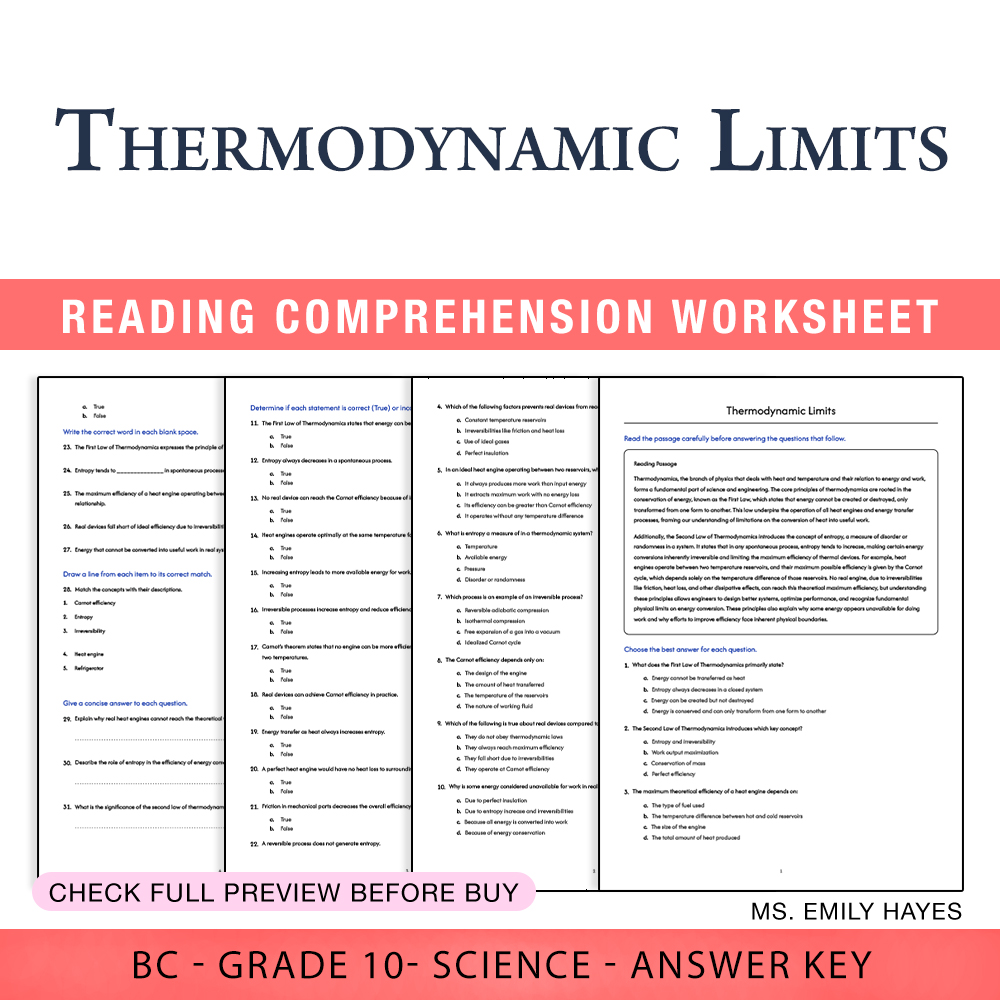
10th Grade Science | Thermodynamic Limits Worksheet (PDF + Answer Key)
Created byCopper Leaf ClassroomLearning Objectives
- Explain the principles of energy conservation and entropy in thermodynamics.
- Describe how heat engines and refrigerators operate between temperature reservoirs.
- Calculate theoretical maximum efficiencies using Carnot relationships.
Also included in: Grade 10 Science BC – Energy, Thermodynamics & Ecosystems (PDF + Answer Key) +1 more
Instant download

Grade 9 Science | Glycolysis Overview - Daily Reading Comprehension
Created byCoral Reef LearningLearning Objectives
- Understand the basic process of glycolysis and its significance in energy production.
- Identify key intermediates and steps involved in glycolysis.
- Explain the differences between aerobic and anaerobic conditions in cellular respiration.
Instant download
Browse more categories
About Reading comprehension Worksheets
Find reading comprehension worksheets for class practice, homework, or self-study. All 40,284 are instant PDF downloads.
Each resource here is built by an independent educator and reviewed for quality. Worksheets print straight from PDF and suit classroom use, homework, or extra practice; most come with answer keys, and you can preview before purchasing.