
Reading comprehension Worksheets
40,284 type resources
Grade 9 Science – Classification Overview & Properties | Daily Reading Worksheet
 Created byBright Mind Resources
Learning Objectives
- Understand the definitions of elements, compounds, and mixtures.
- Identify key features that distinguish pure substances from mixtures.
- Use symbols and formulas to represent elements and compounds.
Also included in: Grade 9 Chemistry Science Lesson Bundle Daily Reading Worksheets | Ontario +1 more
Instant download

Grade 9 Science – Chemical Properties & Reactions | Daily Reading Worksheet
Created byBright Mind ResourcesLearning Objectives
- Understand the concept of chemical properties and how they differ from physical properties.
- Identify common chemical properties such as flammability, reactivity, oxidation, and stability.
- Observe and recognize signs of chemical changes like color change, gas evolution, precipitate formation, and formation of new substances.
Also included in: Grade 9 Chemistry Science Lesson Bundle Daily Reading Worksheets | Ontario +1 more
Instant download

Grade 9 Science – Balancing Equations & Conservation of Atoms | Worksheet
Created byBright Mind ResourcesLearning Objectives
- Understand the concept of chemical symbols and their significance.
- Identify reactants and products in chemical equations.
- Comprehend the importance of balancing chemical equations to reflect the conservation of atoms and mass.
Also included in: Grade 9 Chemistry Science Lesson Bundle Daily Reading Worksheets | Ontario +1 more
Instant download

Grade 9 Science – Conservation of Mass in Reactions | Daily Reading Worksheet
Created byBright Mind ResourcesLearning Objectives
- Understand the principle of conservation of mass in closed systems
- Recognize how mass remains constant during chemical reactions
- Differentiate between apparent and actual mass changes
Also included in: Grade 9 Chemistry Science Lesson Bundle Daily Reading Worksheets | Ontario +1 more
Instant download

Grade 9 Science – Mixtures & Separation | Daily Reading Worksheet
Created byBright Mind ResourcesLearning Objectives
- Understand the difference between homogeneous and heterogeneous mixtures
- Learn about various physical methods used to separate mixtures
- Identify examples of mixtures in everyday life
Also included in: Grade 9 Chemistry Science Lesson Bundle Daily Reading Worksheets | Ontario +1 more
Instant download

Grade 9 Science – Physical Changes & Melting | Daily Reading Worksheet
Created byBright Mind ResourcesLearning Objectives
- Define physical change and identify its characteristics.
- Explain melting as a physical change, including energy transfer involved.
- Differentiate between reversible and irreversible physical changes.
Also included in: Grade 9 Chemistry Science Lesson Bundle Daily Reading Worksheets | Ontario +1 more
Instant download
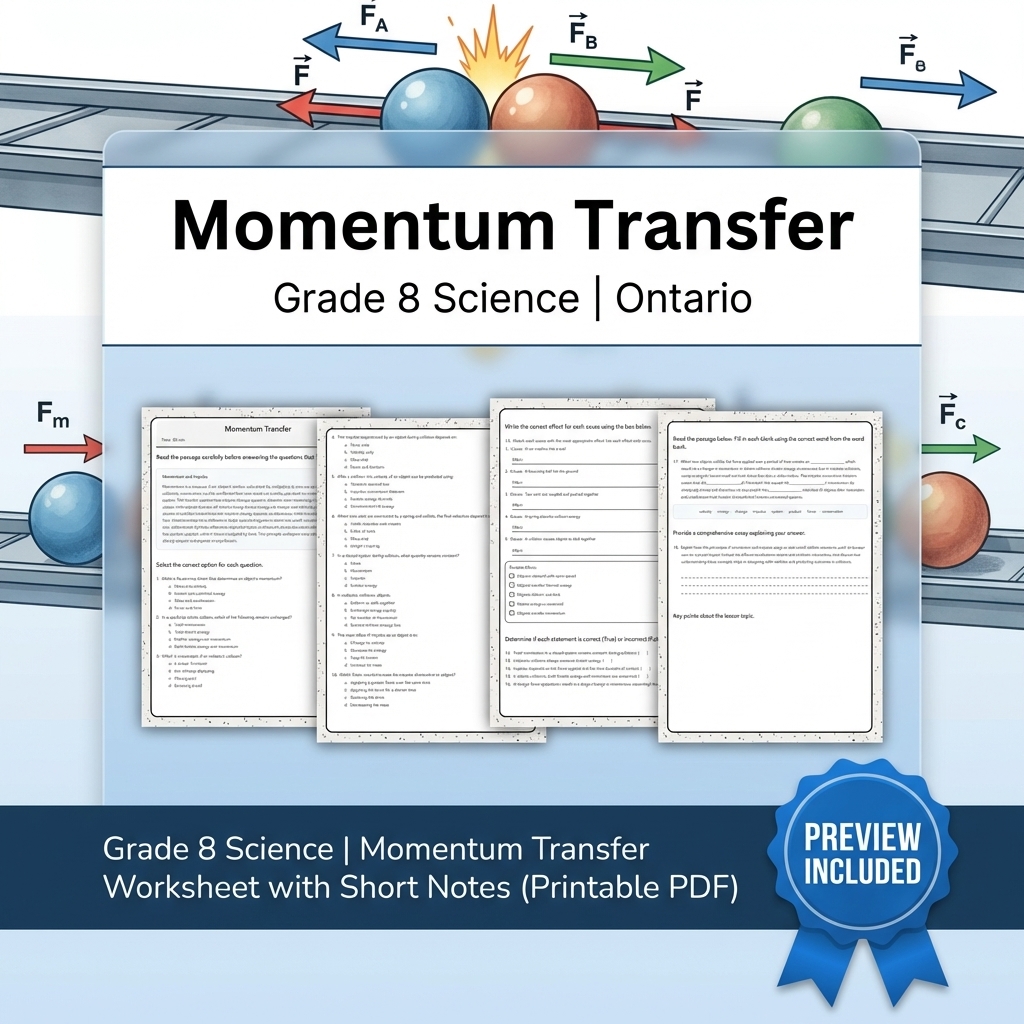
Grade 8 Science | Momentum Transfer Worksheet with Short Notes (Printable PDF)
 Created byMeadowlark Worksheets
Learning Objectives
- Explain the concept of linear momentum and how it is conserved in collisions.
- Describe the difference between elastic and inelastic collisions at classroom scales.
- Apply the impulse-momentum theorem to predict velocity changes after collisions.
Also included in: Grade 8 Science Lesson Group Bundle for Ontario Curriculum +1 more
Instant download

Grade 7 Social Studies — Métis Emergence Worksheet MCQ Paper for Mastery
 Created byThe Resource Hub
Learning Objectives
- Explain how Métis communities emerged from commerce and kinship connections across the fur trade frontier
- Analyze how westward trade expansion affected Métis identity formation and community life
- Describe continuity and change in Métis social customs and governance during the fur trade era
Also included in: Grade 7 Canadian History Social Studies Lesson Bundle: Ontario MCQ +1 more
Instant download

Attentive Listening Worksheet Grade 3 ELA TEKS Speaking and Listening
 Created byGolden Apple Studio
Learning Objectives
- Identify the purpose and key details in a short spoken message.
- Use confirmation, clarification, and respectful turn-taking when responding to others.
- Recognize how intonation and emphasis help interpret what matters most.
Also included in: Grade 3 ELA Media Literacy & Speaking Skills Lesson Bundle | TEKS +1 more
Instant download

Grade 8 ELA Worksheet | Comma Clarity Practice (PDF) – CCSS
Created byGolden Apple StudioLearning Objectives
- Use commas to distinguish independent clauses from subordinate clauses to reduce ambiguity.
- Apply comma rules for introductory elements and for separating items in lists.
- Use commas to manage contrasts and transitions in complex sentences.
Also included in: Grade 8 ELA Language & Grammar Conventions Lesson Bundle | Common Core +1 more
Instant download

Grade 9 Science | Redox Concepts Worksheet | BC Standards
 Created byLumora Learning
Learning Objectives
- Explain the fundamental principles of oxidation and reduction in chemical reactions.
- Identify electron transfer events and changes in oxidation states during redox reactions.
- Track oxidation state changes to determine oxidizing and reducing agents in chemical equations.
Instant download

Grade 9 Science | Bond Types Worksheet | BC Standard
Created byLumora LearningLearning Objectives
- Understand the differences between ionic, covalent, and metallic bonds.
- Describe how electron arrangements influence material properties.
- Identify characteristics associated with each bond type.
Instant download

Grade 9 Science | Crystal Lattices Worksheet | BC Aligned
Created byLumora LearningLearning Objectives
- Understand the three-dimensional arrangements of ions and atoms in crystal lattices.
- Identify different lattice types and their properties such as hardness, conductivity, and melting points.
- Describe the role of unit cells in the structure of solids.
Instant download

Grade 8 Social Studies Causes of War Worksheet (PDF) | BC Standards
 Created bySunny Desk Resources
Learning Objectives
- Identify key social, political, and economic causes that influenced Canada’s involvement in World War I.
- Explain how imperial loyalties, national security concerns, and economic interests shaped public opinion and mobilization.
- Describe how alliances and global tensions contributed to the outbreak of war and Canada’s participation.
Also included in: Grade 8 Wartime Economy & Postwar Change Social Studies Lesson Bundle BC +1 more
Instant download

Recombinant Methods Worksheet | Grade 12 Science Activities
 Created byPrism Point Learning
Learning Objectives
- Explain how vectors, restriction enzymes, and DNA ligase work together to build recombinant DNA constructs
- Identify key steps in plasmid cloning, restriction mapping, and genome editing for targeted genetic modification
- Analyze how recombinant DNA methods support canola trait development and molecular diagnostics while considering ethics and regulation
Also included in: Grade 12 Evolution & Genetics Lesson Bundle | Alberta Science Framework
Instant download

Density Particle View Assessment Grade 7 Science | California Standards
Created byPrism Point LearningLearning Objectives
- Explain density using the particle view of matter (mass and how particles are spaced).
- Predict how sinking, floating, and heating relate to changes in volume and average particle spacing.
- Use evidence from particle spacing to compare the densities of different substances.
Also included in: Grade 7 Forces and Matter Science Lesson Bundle: California Standards +1 more
Instant download
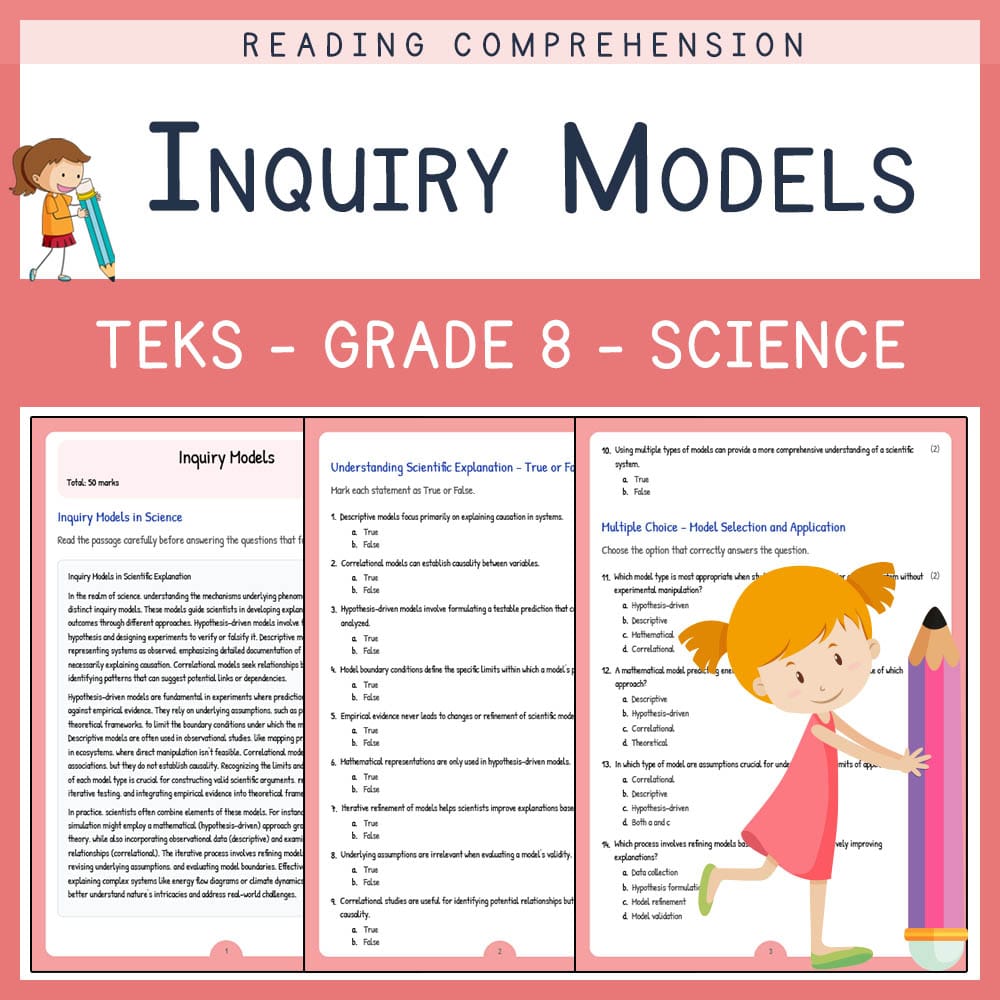
Grade 8 Science | Inquiry Models Worksheet Elena | TEKS-Aligned
Created byLumora LearningLearning Objectives
- Compare hypothesis-driven, descriptive, and correlational inquiry models in scientific explanations.
- Identify boundary conditions, assumptions, and testable predictions in different models.
- Understand how empirical evidence, conceptual and mathematical representations refine scientific models.
Also included in: Grade 8 Science | Science Concepts/Skills Lesson Bundle | TEKS Aligned
Instant download

Argument Thesis Worksheet Pack | Grade 9 ELA Practice
Created bySunny Desk ResourcesLearning Objectives
- Identify the difference between a claim and a thesis in argument writing
- Write a thesis statement that addresses a debatable issue and previews key reasons
- Select and explain evidence that matches the purpose of persuading an audience
Also included in: Grade 9 Writing Lesson Bundle | ELA | Common Core (CCSS) +1 more
Instant download

Grade 9 Social Studies – Hazard Causes Worksheet (Ontario Standards PDF)
Created bySunny Desk ResourcesLearning Objectives
- Explain how atmospheric, hydrological, and tectonic processes can trigger different natural hazards
- Analyze cause-and-consequence relationships between hazard events, human systems, and infrastructure
- Evaluate how land-use change and climate variability can shift hazard frequency and intensity over time
Also included in: Grade 9 Climate and Landscapes Social Studies Lesson Bundle for Ontario +1 more
Instant download
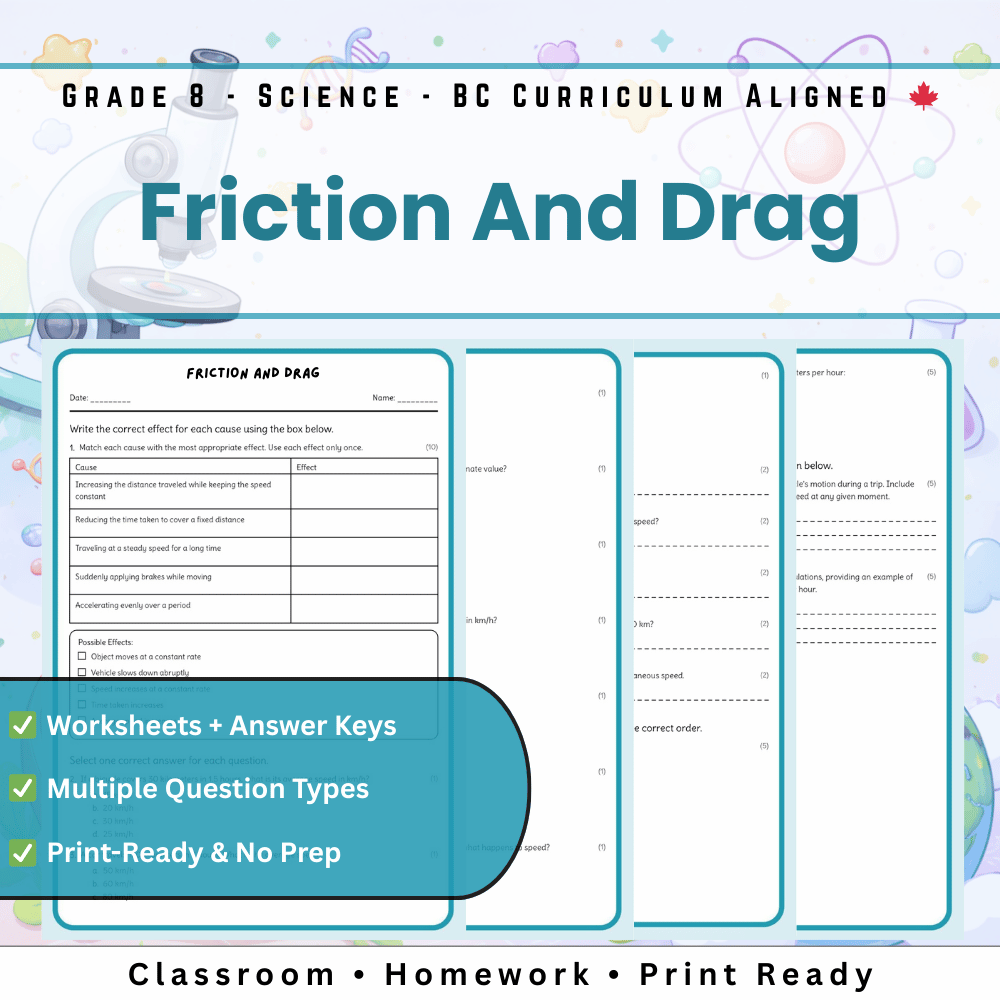
Grade 8 Science | Friction & Drag Concepts Worksheet (Worksheet + Answer Key)
Created byBright Mind ResourcesLearning Objectives
- Understand the forces of friction and fluid drag and how they oppose motion.
- Identify factors affecting resistive forces such as surface types, shape, and speed.
- Explain how resistive forces convert mechanical energy into thermal energy.
Instant download

Grade 11 Science | Balancing Reactions Worksheet | BC Aligned
Created byLumora LearningLearning Objectives
- Understand the principles of conservation of mass and atoms in chemical reactions
- Learn how to balance chemical equations correctly
- Identify and apply mole ratios in stoichiometric calculations
Also included in: Grade 11 Science | Chemistry Lesson Bundle Worksheet | BC-Aligned
Instant download

Grade 6 Social Studies — Types of Governance Worksheet for Practice
Created byThe Resource HubLearning Objectives
- Identify key features of different types of governance in historical societies
- Compare how authority was maintained in monarchies, city-states, and tribal councils
- Explain how laws and leadership roles can support social cohesion
Also included in: Grade 6 Social Studies Lesson Bundle — Types of Governance +1 more
Instant download

Grade 6 Social Studies — Leadership and Power Worksheet MCQ Paper
Created byThe Resource HubLearning Objectives
- Explain how different civilizations selected leaders (hereditary monarchy, merit-based appointments, and democratic participation).
- Analyze how leadership selection methods affect stability, distribution of authority, and citizen involvement.
- Compare strengths and weaknesses of each governance model in managing resources, laws, and social order.
Also included in: Grade 6 Social Studies Lesson Bundle — Types of Governance +1 more
Instant download

Grade 10 Science | Sustainability Assessment - Daily Reading Comprehension
 Created byCoral Reef Learning
Learning Objectives
- Understand the concept of water renewal rates
- Identify key pollutants associated with water resources
- Analyze how environmental indicators influence sustainability decisions
Also included in: Earth and Space Systems Lesson Bundle – Grade 10 Science Alberta +1 more
Instant download

Grade 8 Social Studies | War Experiences Worksheet (PDF)
Created bySunny Desk ResourcesLearning Objectives
- Describe key trench, battle, and home-front conditions experienced during World War I in Canada.
- Analyze how personal and collective narratives shaped understanding of social effects, including mental and physical health.
- Evaluate how Indigenous perspectives and wartime experiences influenced Canadian national identity after the war.
Also included in: Grade 8 Wartime Economy & Postwar Change Social Studies Lesson Bundle BC +1 more
Instant download

Grade 11 — Worksheet MCQ Paper for Mastering Territorial Expansion
Created byThe Resource HubLearning Objectives
- Explain how the Louisiana Purchase, westward exploration, and treaties contributed to U.S. territorial expansion.
- Analyze the idea of Manifest Destiny and how it influenced public support for expansion.
- Evaluate the impacts of territorial growth on Indigenous peoples and local economies.
Instant download
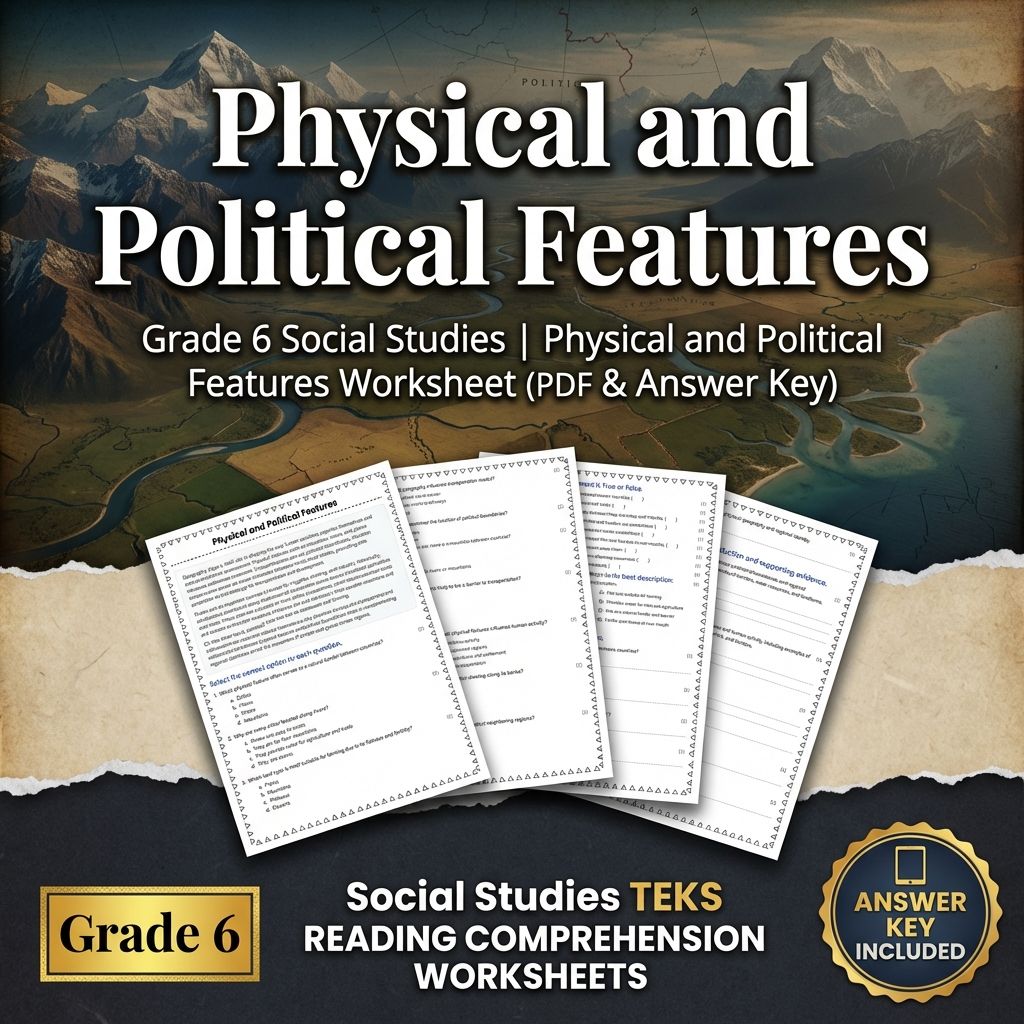
Grade 6 Social Studies | Physical and Political Features (PDF & Answer Key)
JCreated byJ.S SheetsLearning Objectives
- Identify key physical geographical features such as mountain ranges, rivers, and plains.
- Understand how physical geography influences political boundaries like countries, states, and cities.
- Compare physical features and political boundaries to see their interactions and impacts on regional identities.
Also included in: Grade 6 Social Studies Unit Bundle – Maps, Resources & Environmental Impact +1 more
Instant download
World War II Impact Worksheet | TEKS-Aligned Grade 8 Social Studies
JCreated byJ.S SheetsLearning Objectives
- Understand how World War II influenced economic, technological, and social changes in the United States.
- Identify key social transformations resulting from the war, including women's roles and postwar policies.
- Evaluate the global significance of the U.S. emergence as a superpower following World War II.
Instant download

Grade 12 Social Studies | Intercultural Ethics Worksheet (PDF)
Created bySunny Desk ResourcesLearning Objectives
- Explain how ethical principles such as respect, reciprocity, and justice apply to intercultural policy debates.
- Evaluate a cultural policy case by comparing ethical duties with legal and international norms.
- Distinguish between cultural appreciation and appropriation using intercultural reasoning and evidence.
Also included in: Grade 12 Comparative Cultures Social Studies Unit Lesson Bundle (BC) +1 more
Instant download
Grade 3 Science | Magnetic Interactions Worksheet with Short Notes (PDF)
Created byMeadowlark WorksheetsLearning Objectives
- Describe the difference between magnetic and contact forces.
- Identify examples of magnetic attraction and repulsion.
- Explain how distance and pole orientation affect magnetic forces.
Also included in: Grade 3 Science NGSS Unit | Motion and Stability: Forces & Interactions +1 more
Instant download
Intercultural Ethics Worksheet | Social Studies Grade 12 BC Standards
JCreated byJ.S SheetsLearning Objectives
- Analyze contemporary cultural issues using ethical frameworks such as respect, reciprocity, and justice.
- Evaluate contested cases like cultural appropriation, religious accommodation, and Indigenous rights through cross-cultural perspectives.
- Interpret evidence from legal decisions, community statements, and international norms to assess ethical dimensions of cultural policies.
Instant download

Progressive Movements Worksheet Grade 8 Social Studies TEKS + Key
Created byThe Resource HubLearning Objectives
- Explain the major goals of Progressive reformers in the early 1900s.
- Identify strategies Progressives used to address corruption, economic inequality, and unsafe working conditions.
- Analyze how Progressives changed expectations about the role of government.
Also included in: World War I to Cold War Lesson Bundle | Grade 8 Social Studies | teks +2 more
Instant download

World War II Impact Worksheet Grade 8 Social Studies TEKS + Key
Created byThe Resource HubLearning Objectives
- Explain how the United States mobilized its economy and military during World War II.
- Identify key technological and industrial changes made during World War II.
- Describe social changes in the United States, including shifts in women’s workforce roles.
Also included in: World War I to Cold War Lesson Bundle | Grade 8 Social Studies | teks +2 more
Instant download

Grade 7 Social Studies – Economic Systems Worksheet (PDF) – BC Standards
Created bySunny Desk ResourcesLearning Objectives
- Compare traditional, command, and market economic systems and describe how each affects labor opportunities.
- Explain how economic demands can change employment patterns in communities.
- Use examples to connect economic structure with community development and social impacts.
Also included in: Grade 7 Technology and Change Social Studies Lesson Bundle for BC +1 more
Instant download

Grade 7 Social Studies | Technology and Change Worksheet (PDF) for BC Standards
Created bySunny Desk ResourcesLearning Objectives
- Explain how technological innovations can change economic activities over time.
- Analyze how technology affects employment opportunities and community relationships.
- Use cause-and-effect reasoning to describe positive and negative consequences of technological change.
Also included in: Grade 7 Technology and Change Social Studies Lesson Bundle for BC +1 more
Instant download

7th Grade Social Studies Worksheet | Technological Growth (PDF)
Created bySunny Desk ResourcesLearning Objectives
- Explain how technological innovations change economic activities and resource management in communities.
- Describe how technology can reshape social organization and access to information.
- Compare older and newer technologies to predict their effects on community growth.
Also included in: Grade 7 Technology and Change Social Studies Lesson Bundle for BC +1 more
Instant download

Semantic HTML Structure Worksheet Grade 11 Computer Science Web Design
Created byPrism Point LearningLearning Objectives
- Identify how semantic HTML tags map to common page sections like headings, navigation, articles, and footers.
- Explain how semantic structure improves readability, searchability, and maintainability.
- Choose appropriate semantic elements for given descriptions of content.
Instant download

Grade 8 Science – Indicator Properties Worksheet (PDF) with Answer Key
 Created byEvergreen Desk Education
Learning Objectives
- Describe how indicator properties (pH, electrical conductivity, density, and refractive index) can change during chemical reactions.
- Explain why changes in indicator properties provide evidence for formation of new substances.
- Distinguish chemical change from physical mixing using measured indicator property shifts.
Instant download

Grade 10 Gene Regulation Switches Worksheet | California Science Standards
Created byEvergreen Desk EducationLearning Objectives
- Explain how gene regulation determines when and where genes are expressed.
- Identify DNA regulatory elements and molecular signals involved in transcription control.
- Compare different gene regulatory mechanisms and predict how expression changes affect protein production.
Instant download

Grade 7 Science | Levels Of Organization in Ecology - Reading Comprehension
Created byCoral Reef LearningLearning Objectives
- Understand the concept of an individual organism and its characteristics
- Recognize examples of individual organisms in ecological contexts
- Identify how individual traits contribute to higher levels of ecological organization
Also included in: Interactions and Ecosystems Lesson Bundle Grade 7 Science – Alberta +1 more
Instant download
Innovations and Society Worksheet | TEKS-Aligned Social Studies Grade 8
JCreated byJ.S SheetsLearning Objectives
- Understand how technological innovations have historically impacted society.
- Identify key inventions that contributed to societal transformation.
- Analyze the relationship between technological advances and economic or social change.
Instant download

Insulation Principles Practice Worksheet | Grade 7 Science | Review
Created byPrism Point LearningLearning Objectives
- Explain how insulation reduces heat transfer through conduction, convection, and radiation.
- Compare common insulating materials (fibreglass, foam, reflective foils) using ideas like trapped air and thermal resistance.
- Describe how air leakage, thermal bridging, and continuous insulation affect overall heat loss in buildings.
Instant download
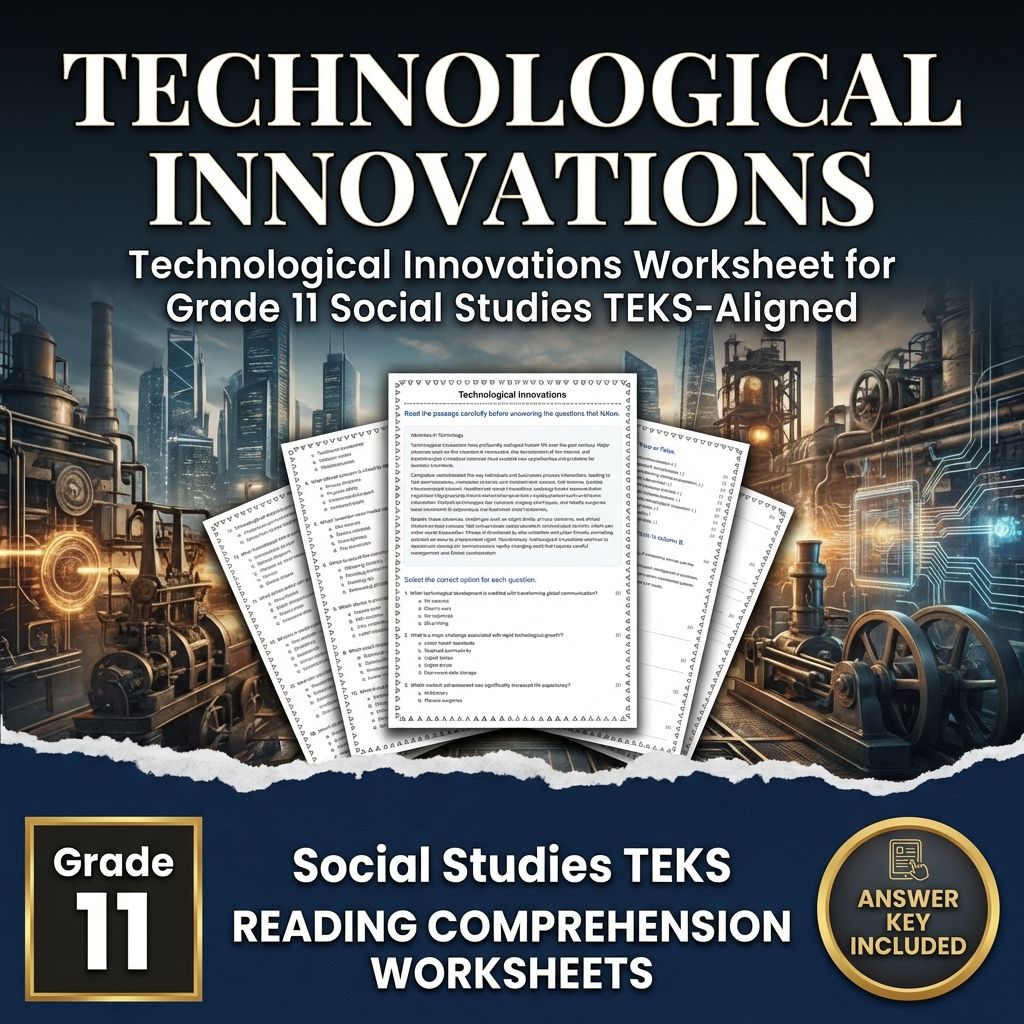
Technological Innovations Worksheet for Grade 11 Social Studies TEKS-Aligned
JCreated byJ.S SheetsLearning Objectives
- Understand the key technological advancements that have transformed society.
- Analyze the social, economic, and global impacts of innovations like computers, the internet, and medical sciences.
- Evaluate opportunities and challenges introduced by technological progress.
Instant download

Grade 10 Social Studies – Human Rights Genesis Worksheet (Standard BC)
Created bySunny Desk ResourcesLearning Objectives
- Explain how international human rights norms developed after 1945, beginning with the Universal Declaration of Human Rights (UDHR).
- Compare the UDHR’s moral claims with later treaty-based conventions and assess continuity and change in those claims.
- Analyze enforcement and implementation challenges using evidence from legal texts, diplomatic debates, and case studies.
Also included in: Grade 10 Conflict, Justice & Rights Social Studies Lesson Bundle (BC) +1 more
Instant download

Grade 10 Social Studies – Global Conflict Worksheet (PDF) | BC Standards
Created bySunny Desk ResourcesLearning Objectives
- Compare how Nazi Germany, Imperial Japan, and the Allied powers shaped strategies through political ideology and expansionist goals.
- Analyze major WWII theatres (Europe, North Africa, and the Pacific) and explain how campaigns affected civilians and colonial subjects.
- Evaluate how economic pressures and wartime decision-making influenced major turning points by 1945.
Also included in: Grade 10 Conflict, Justice & Rights Social Studies Lesson Bundle (BC) +1 more
Instant download

Grade 10 Social Studies – Origins Of War Worksheet (BC Standards) (PDF)
Created bySunny Desk ResourcesLearning Objectives
- Explain long-term and short-term causes of the First World War using evidence from primary and secondary sources.
- Analyze how alliances, imperial competition, and militarism affected decision-making and escalation in 1914.
- Interpret how diplomatic networks and mobilization timetables increased the speed and unintended outcomes of war.
Also included in: Grade 10 Conflict, Justice & Rights Social Studies Lesson Bundle (BC) +1 more
Instant download

Historical Context Worksheet | Grade 12 Science Practice
Created byPrism Point LearningLearning Objectives
- Explain how empirical evidence and institutional structures influence whether scientific innovations are adopted by society
- Analyze how economic forces and public perception affect the diffusion of scientific and technological developments
- Evaluate how unintended consequences and policy responses shape long-term outcomes of scientific change
Instant download
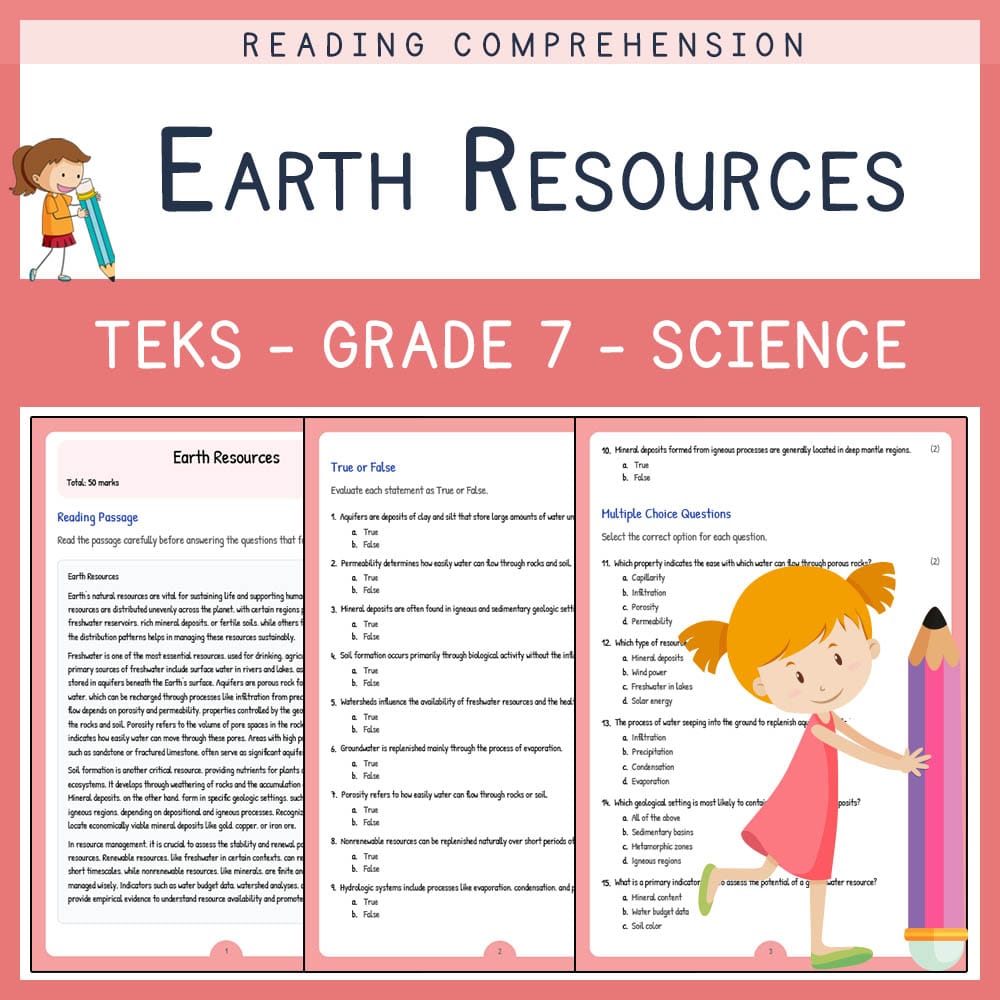
Grade 7 Science | Earth Resources Worksheet Elena | TEKS Aligned
Created byLumora LearningLearning Objectives
- Understand the role of natural resources such as groundwater, soil, and minerals.
- Explain processes of aquifer recharge, porosity, and permeability.
- Differentiate between renewable and nonrenewable resources based on geologic settings.
Also included in: Grade 7 Science | Earth and Space Systems Unit Bundle | TEKS Standard
Instant download
Browse more categories
About Reading comprehension Worksheets
Find reading comprehension worksheets for class practice, homework, or self-study. All 40,284 are instant PDF downloads.
Each resource here is built by an independent educator and reviewed for quality. Worksheets print straight from PDF and suit classroom use, homework, or extra practice; most come with answer keys, and you can preview before purchasing.