
Reading comprehension Worksheets
40,289 type resources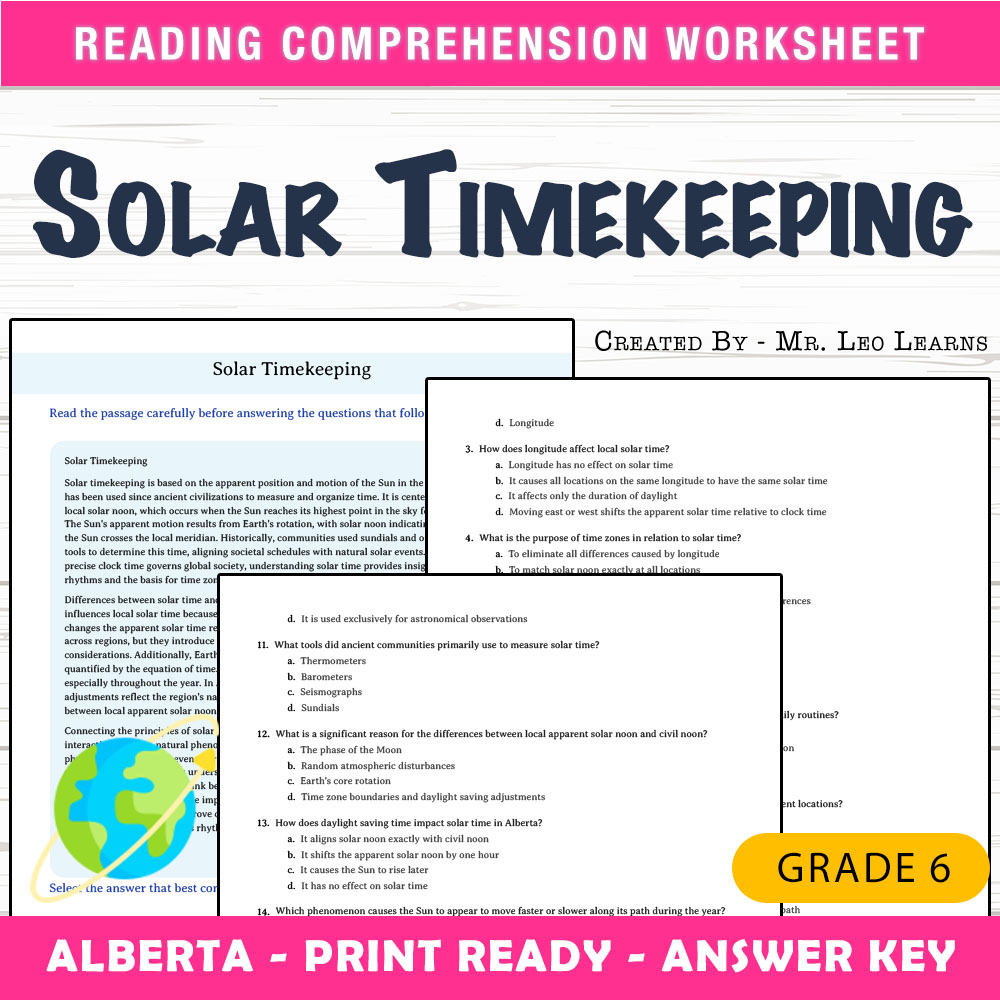
Grade 6 Science — Solar Timekeeping Worksheet MCQ Paper for Mastery
 Created byThe Resource Hub
Learning Objectives
- Explain the principles of solar timekeeping and its connection to apparent solar motion.
- Identify factors that cause differences between solar time and clock time, such as longitude, time zones, and Earth's orbital eccentricity.
- Describe how historical and contemporary communities in Alberta use solar time for scheduling and calendar calculations.
Also included in: Grade 6 Science Sky Science Unit Bundle – Celestial Motion & Earth-Sun Relations +1 more
Instant download
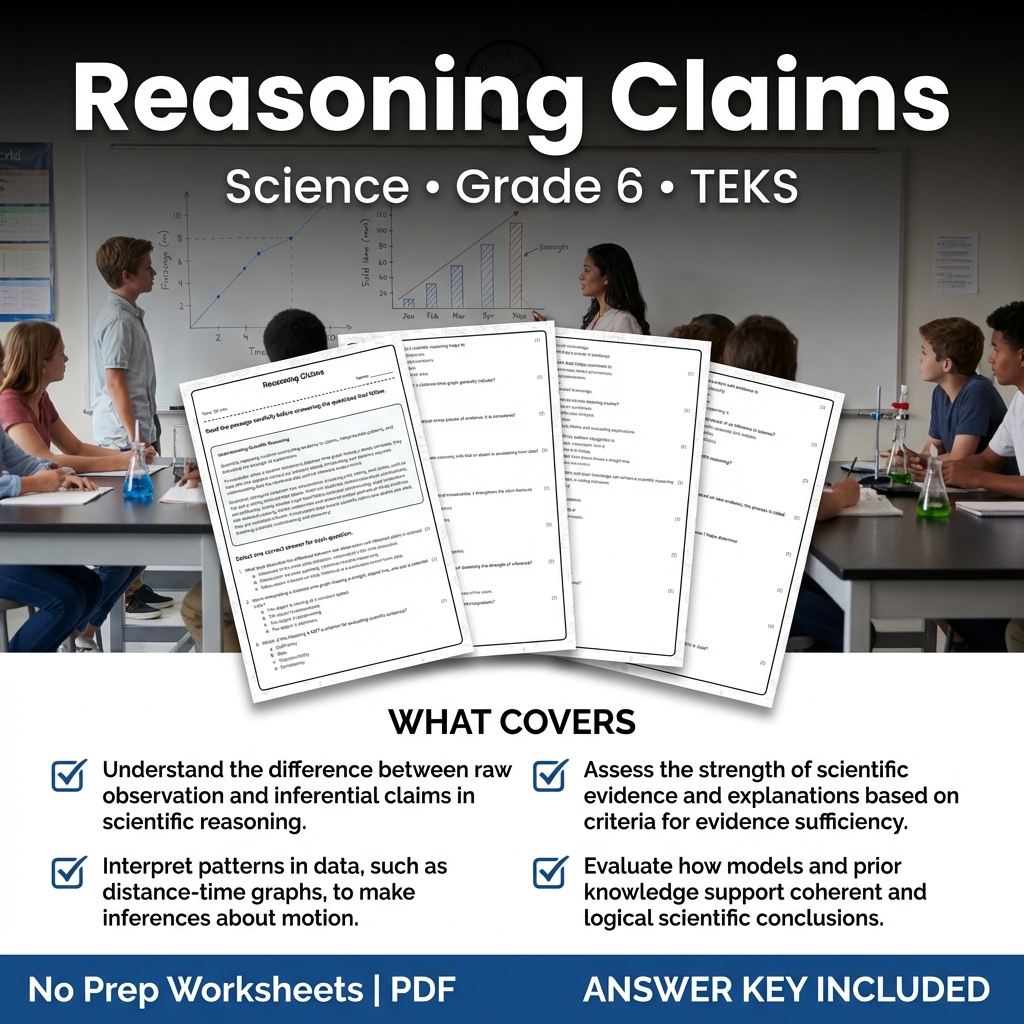
Grade 6 Science Worksheet on Reasoning Claims | TEKS Aligned
 Created byCoral Reef Learning
Learning Objectives
- Understand the difference between raw observation and inferential claims in scientific reasoning.
- Interpret patterns in data, such as distance-time graphs, to make inferences about motion.
- Assess the strength of scientific evidence and explanations based on criteria for evidence sufficiency.
Instant download
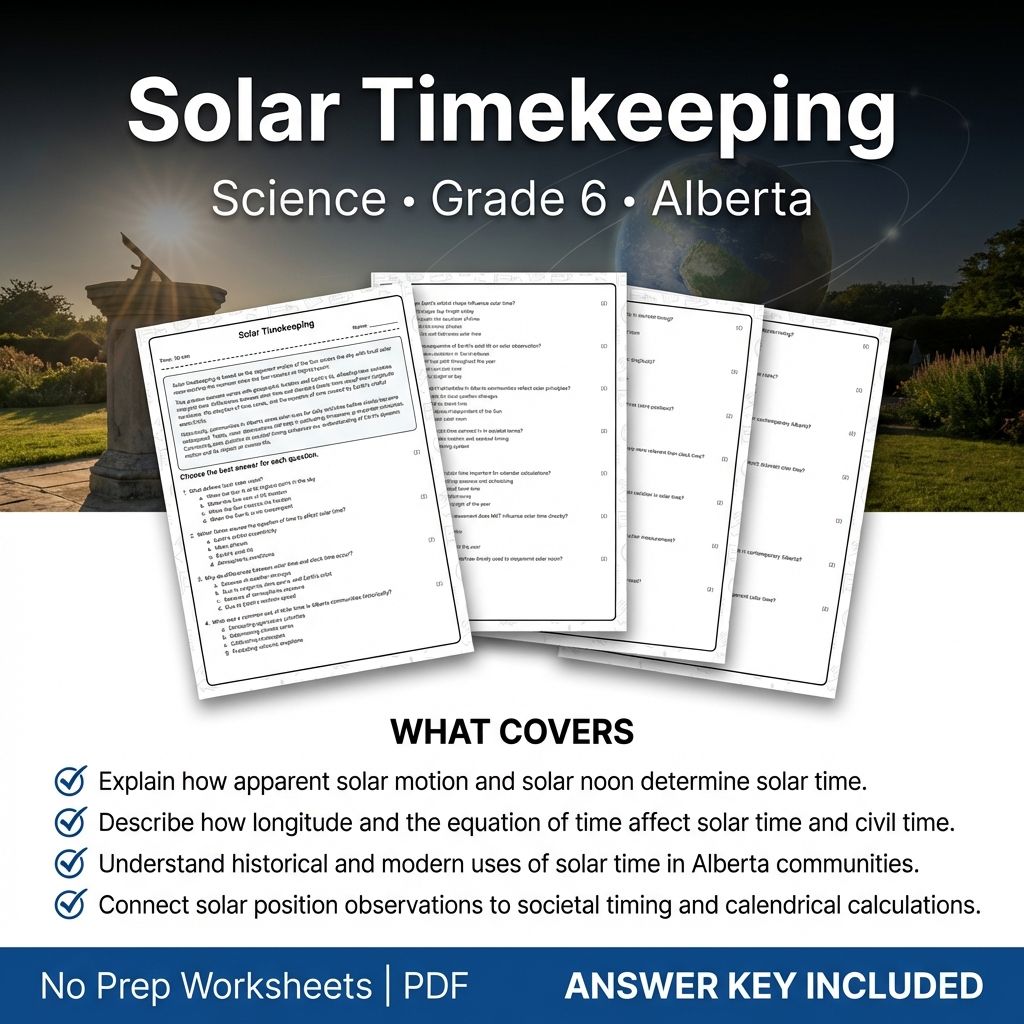
Grade 6 Science Worksheet on Solar Timekeeping | Alberta Standards
Created byCoral Reef LearningLearning Objectives
- Explain how apparent solar motion and solar noon determine solar time.
- Describe how longitude and the equation of time affect solar time and civil time.
- Understand historical and modern uses of solar time in Alberta communities.
Instant download

Grade 4 ELA | Text Evidence Inference Worksheet (PDF) Aligned with CCSS
 Created byGolden Apple Studio
Learning Objectives
- Explain the difference between explicit statements and inferences using text evidence
- Make inferences about characters’ feelings or motives by citing specific details from a text
- Draw conclusions about causes of events using logical connections and referenced moments
Also included in: Theme, Plot, & Character Development Lesson Bundle | Grade 4 ELA | Common Core +1 more
Instant download
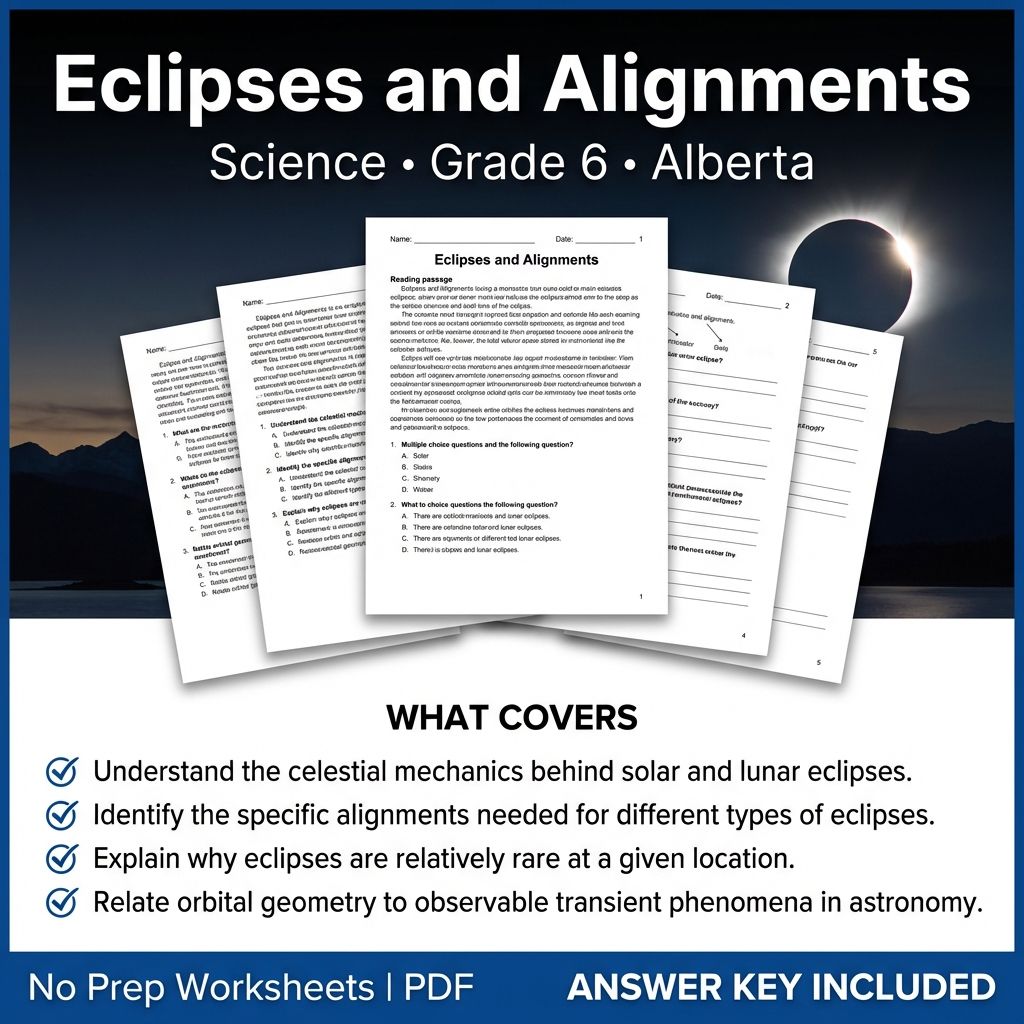
Grade 6 Science Worksheet on Eclipses and Alignments | Alberta Standards
Created byCoral Reef LearningLearning Objectives
- Understand the celestial mechanics behind solar and lunar eclipses.
- Identify the specific alignments needed for different types of eclipses.
- Explain why eclipses are relatively rare at a given location.
Instant download

Energy in Cells Assessment | Florida NGSSS Standard Grade 10 Science
 Created byPrism Point Learning
Learning Objectives
- Explain how cells obtain and use energy to perform work such as building molecules and maintaining organization
- Describe how cellular respiration converts chemical energy from carbohydrates into ATP
- Compare energy transformation in cellular respiration with energy capture in photosynthesis
Also included in: Grade 10 Cells, Genetics & Evolution Science Lesson Bundle | Florida NGSSS +1 more
Instant download

Cell Structure Assessment | Florida NGSSS Grade 10 Science Standard
Created byPrism Point LearningLearning Objectives
- Explain how eukaryotic and prokaryotic cell structures differ and how those differences support life processes
- Identify major cell components (cell membrane, cytoplasm, nucleus, genetic material) and describe their functions
- Analyze how cell specialization relates to the presence or activity of specific structures
Also included in: Grade 10 Cells, Genetics & Evolution Science Lesson Bundle | Florida NGSSS +1 more
Instant download

Grade 10 Science | Heritable Variation Worksheet Elena | California Standards
 Created byLumora Learning
Learning Objectives
- Explain how genetic differences among individuals create heritable variation that natural selection can act on
- Describe multiple sources of heritable variation (mutation, recombination, and migration) and distinguish heritable from environmental variation
- Use cause-and-effect reasoning to connect trait differences, survival/reproduction, and changes in allele frequencies over generations
Instant download

Rock Cycle Processes Assessment | Florida NGSSS Grade 10 Science
Created byPrism Point LearningLearning Objectives
- Explain how weathering, erosion, deposition, and lithification connect surface processes to the rock cycle.
- Describe how heat and pressure can cause metamorphism without melting and how this changes rock properties.
- Relate magma formation and cooling to the creation of igneous rocks within Earth’s energy and mass transfer system.
Also included in: Grade 10 Earth and Space Systems Science Lesson Bundle – Florida NGSSS +1 more
Instant download

Grade 10 Science | Work and Energy Change Worksheet | California Standards
Created byLumora LearningLearning Objectives
- Explain how forces acting through displacement transfer energy to a system
- Use the work-energy relationship to predict changes in kinetic, elastic, and gravitational potential energy
- Interpret energy–position or energy graphs to connect slope/trends with net work and energy transfer
Instant download

Physical Benefits Worksheet | Ontario Grade 6 Health Assessment
 Created bySkylark Worksheets
Learning Objectives
- Identify the physical health benefits of regular activity.
- Understand how movement improves cardiovascular health, muscle strength, and flexibility.
- Recognize the mental health advantages of consistent physical activity.
Also included in: Grade 6 Health Lesson Bundle | Ontario Standards and Worksheets
Instant download
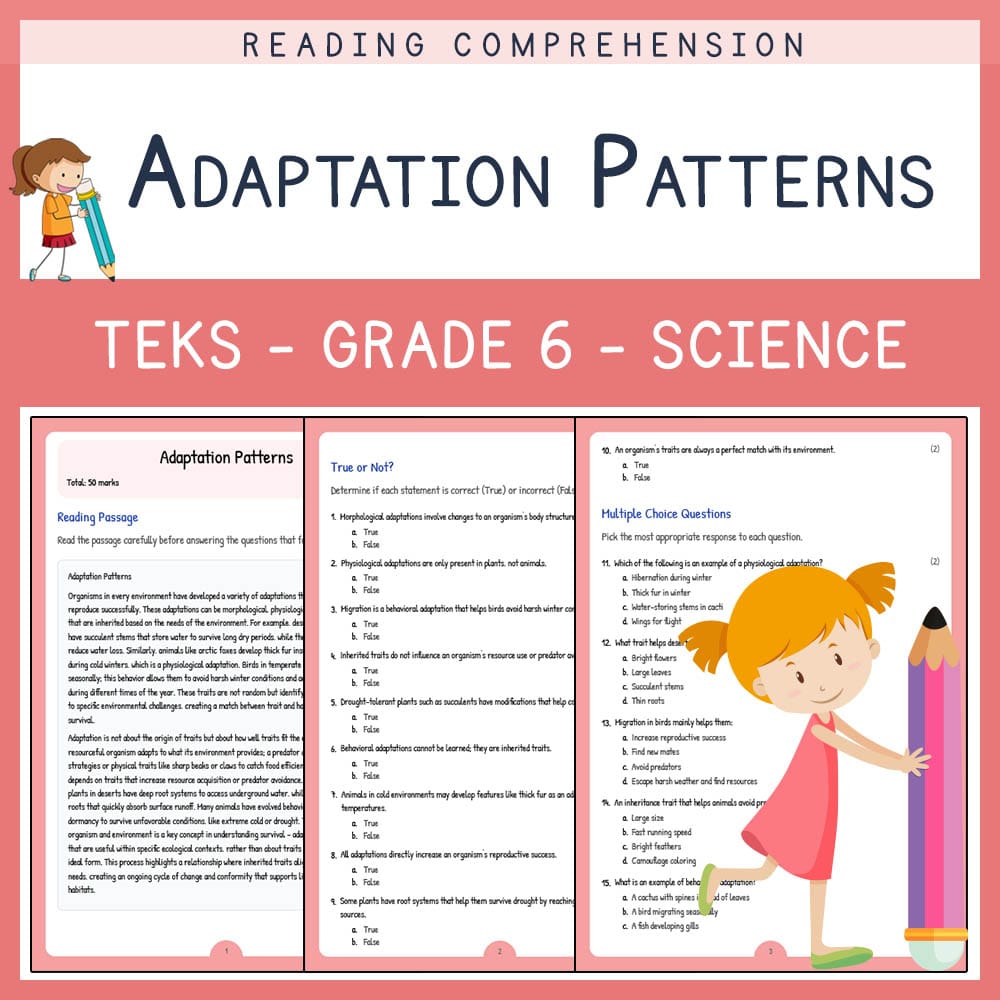
Grade 6 Science | Adaptation Patterns Worksheet | TEKS Standards
Created byLumora LearningLearning Objectives
- Understand the different types of adaptation patterns such as morphological, physiological, and behavioral traits.
- Identify examples of adaptations that enhance survival in various environments.
- Explain how inherited traits influence resource use, predator avoidance, and reproductive success.
Instant download
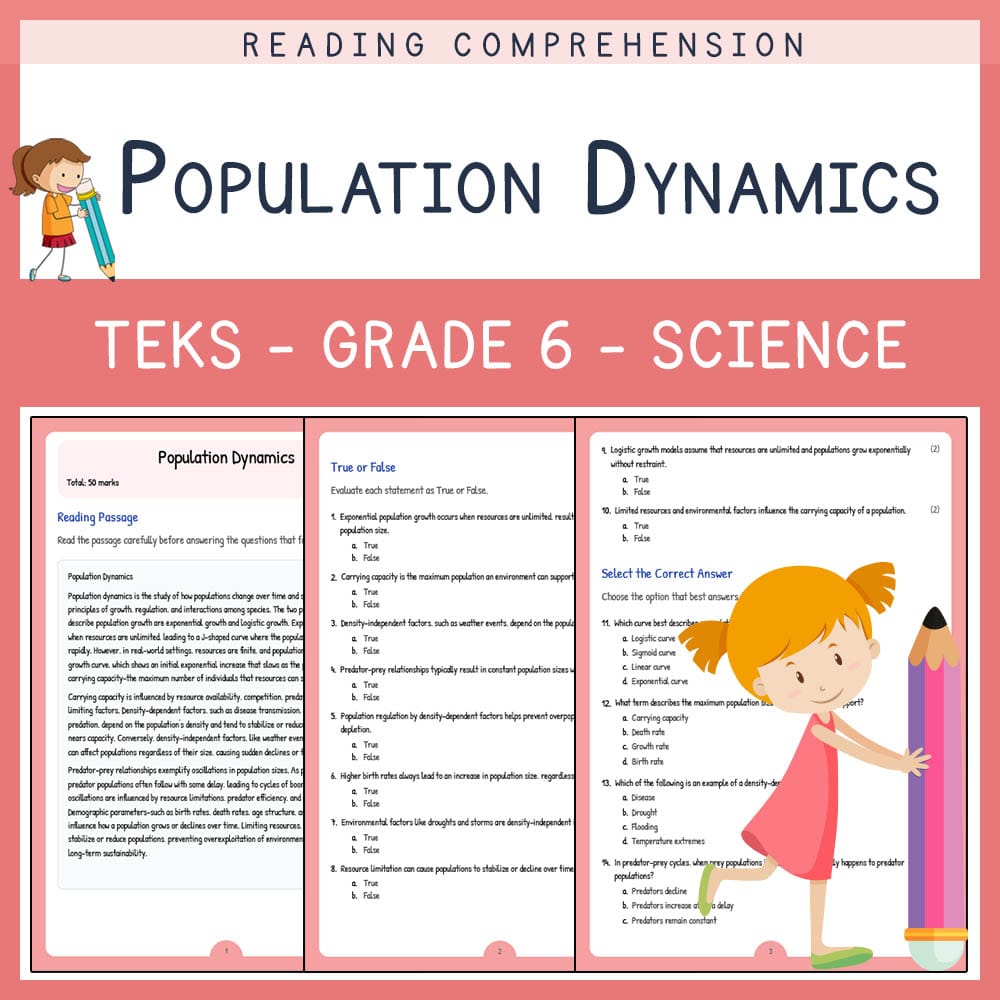
Grade 6 Science | Population Dynamics Worksheet | TEKS Aligned
Created byLumora LearningLearning Objectives
- Understand the principles of population size and how it changes over time.
- Differentiate between exponential and logistic growth curves in populations.
- Define carrying capacity and identify factors influencing population size.
Instant download
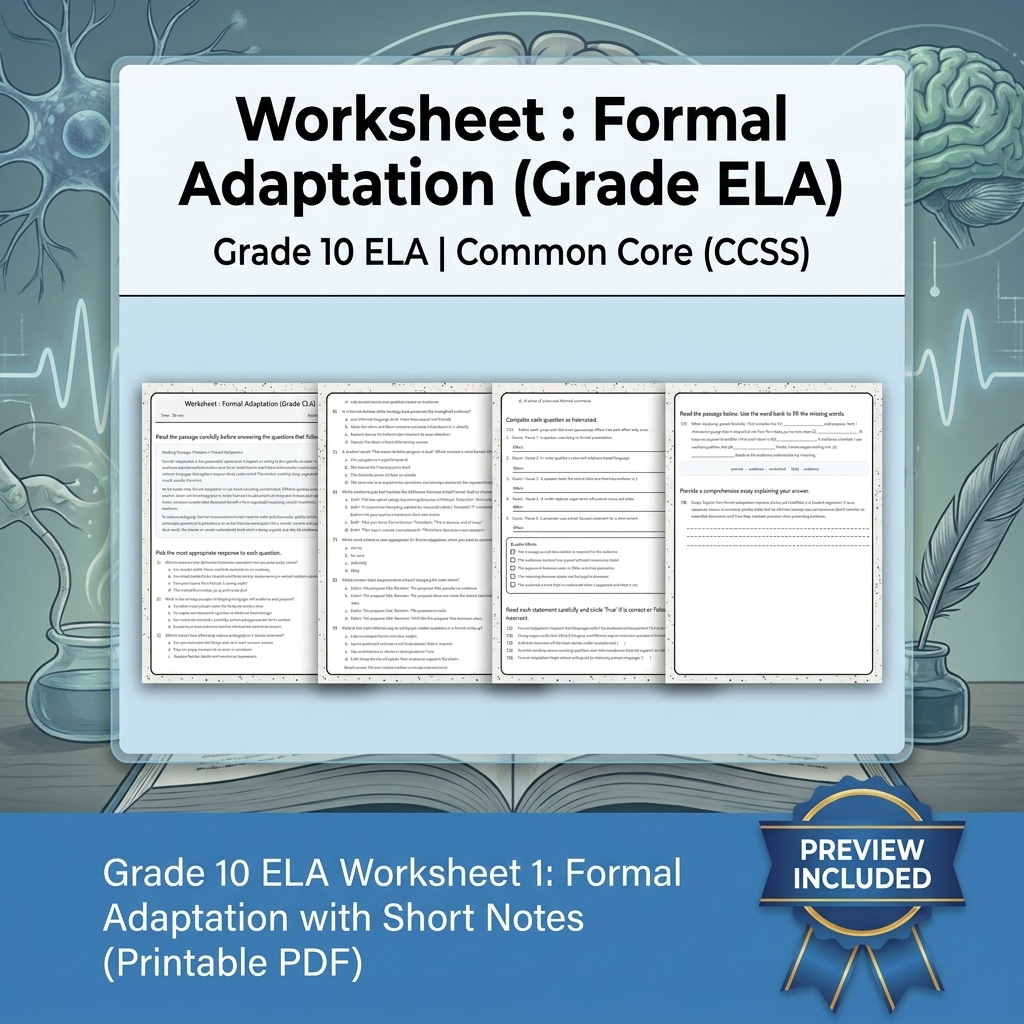
Grade 10 ELA Formal Adaptation worksheet with Short Notes (Printable PDF)
 Created byMeadowlark Worksheets
Learning Objectives
- Explain how formal adaptation aligns language with audience, purpose, and context.
- Identify effective formal wording choices that maintain precision and reduce ambiguity.
- Revise sentences to improve tone and control for different communication situations.
Also included in: Grade 10 Source Integration & Presentation Skills ELA Lesson Bundle: (CCSS) +1 more
Instant download
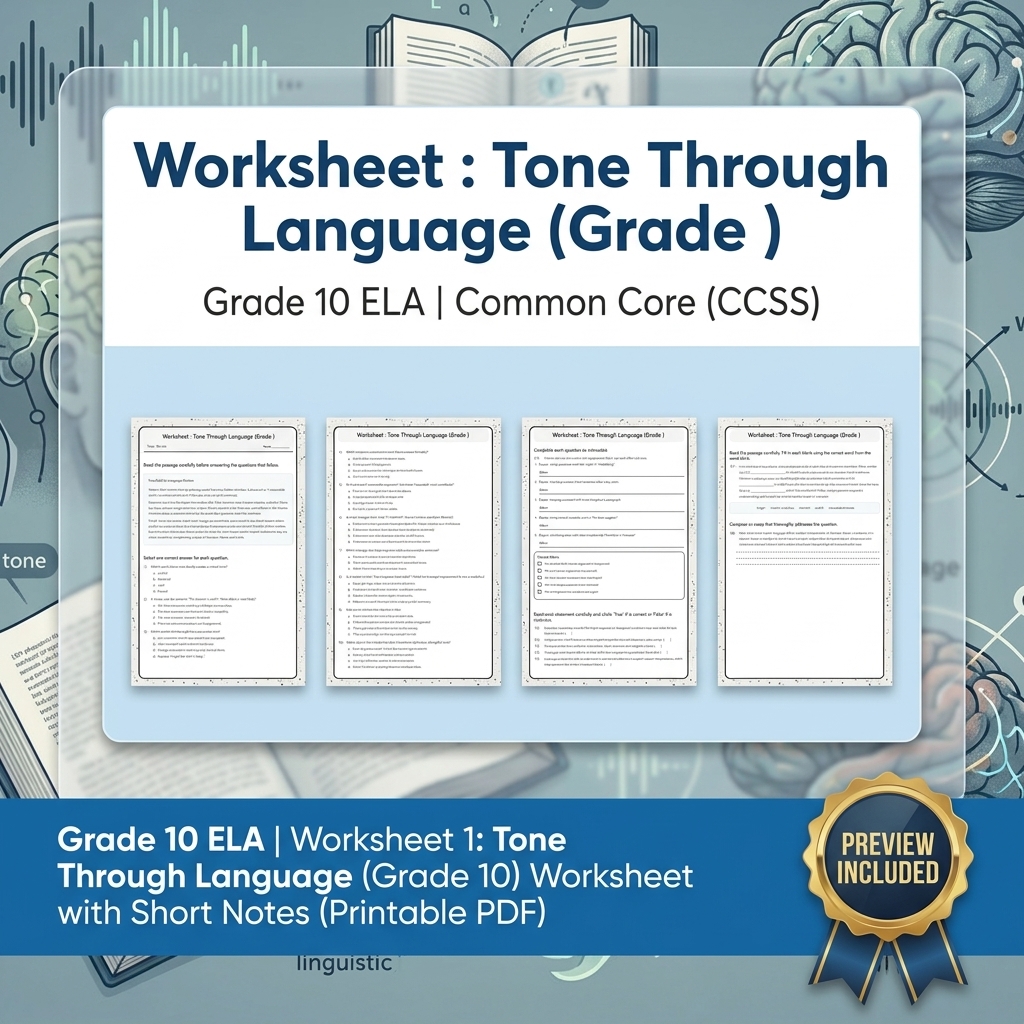
Grade 10 ELA Tone Through Language Worksheet with Short Notes (Printable PDF)
Created byMeadowlark WorksheetsLearning Objectives
- Identify how word choice and sentence construction create tone in analytical writing.
- Explain how evaluative vocabulary and formality support a writer’s purpose.
- Analyze how consistency in grammar and language conventions helps maintain tone across a passage.
Also included in: Grade 10 Tone and Language Usage ELA Lesson Bundle, Common Core (CCSS) +1 more
Instant download

Grade 10 Science | Metabolic Regulation Worksheet (TEKS) PDF
 Created byEvergreen Desk Education
Learning Objectives
- Explain how allosteric regulation and feedback inhibition control metabolic pathway flux.
- Describe how covalent modification and cellular signaling can rapidly change enzyme activity.
- Compare hormonal regulation (insulin vs. glucagon) in regulating carbohydrate metabolism at the organism level.
Instant download

Grade 10 Science | Energy Flow Worksheet (TEKS) with Answer Key (PDF)
Created byEvergreen Desk EducationLearning Objectives
- Explain how energy enters ecosystems through sunlight and moves through trophic levels.
- Describe how energy transfer losses limit biomass and population sizes at higher trophic levels.
- Use food chains and food webs to interpret energy flow and ecosystem constraints.
Instant download

Grade 10 Science | Signal Transmission in Science - Daily Reading Comprehension
Created byCoral Reef LearningLearning Objectives
- Understand the basic concepts of signals and modulation techniques.
- Identify how amplitude, frequency, and phase modulation differ.
- Recognize the impact of channel constraints like bandwidth and noise.
Instant download

Grade 10 Science | Electromagnetic Behavior - Daily Reading Comprehension
Created byCoral Reef LearningLearning Objectives
- Understand the properties of electromagnetic emission and absorption
- Learn about photon energy relations and spectral signatures
- Interpret continuous and line spectra from thermal sources
Instant download

Grade 10 Science | Endocrine Coordination Worksheet (TEKS) (PDF)
Created byEvergreen Desk EducationLearning Objectives
- Explain how endocrine glands release hormones that regulate body functions
- Describe how hormone receptors and signaling pathways produce effects in target tissues
- Interpret feedback loops involving the hypothalamus and pituitary in hormone control
Instant download

Adaptation Patterns Assessment | TEKS Grade 6 Science Standards-Aligned
Created byPrism Point LearningLearning Objectives
- Identify different types of adaptation (morphological, physiological, behavioral).
- Explain how specific traits help organisms survive in their environments.
- Recognize examples of adaptations such as leaf modifications, fur insulation, migration, and dormancy.
Instant download

Population Dynamics Assessment for Grade 6 Science TEKS | Printable Worksheet
Created byPrism Point LearningLearning Objectives
- Explain the principles of population size changes, including exponential and logistic growth.
- Define carrying capacity and limiting factors affecting populations.
- Differentiate between density-dependent and density-independent influences.
Instant download

Grade 6 Science – Solar Time & Earth Rotation | Daily Reading Worksheet
 Created byBright Mind Resources
Learning Objectives
- Define solar time and local solar noon
- Explain how Earth's position affects solar time
- Identify differences between solar time and clock time
Also included in: Grade 6 Solar System & Seasons Science Daily Reading Lesson Bundle | Alberta +2 more
Instant download

Grade 10 Science | Protein Synthesis Worksheet (TEKS) PDF
Created byEvergreen Desk EducationLearning Objectives
- Trace the flow of genetic information from DNA to mRNA to a polypeptide during protein synthesis.
- Describe the roles of transcription, mRNA processing, and translation in building a protein.
- Explain how initiation, elongation, and termination contribute to producing a polypeptide with a specific sequence.
Instant download

Grade 10 Science | RNA Variants Worksheet (TEKS) with Answer Key (PDF)
Created byEvergreen Desk EducationLearning Objectives
- Explain how mRNA, tRNA, and rRNA each contribute to translating genetic information into proteins
- Describe how complementary base pairing and uracil (U) replace thymine (T) during transcription
- Distinguish the specific functions of RNA variants in the ribosome and during codon–anticodon matching
Instant download
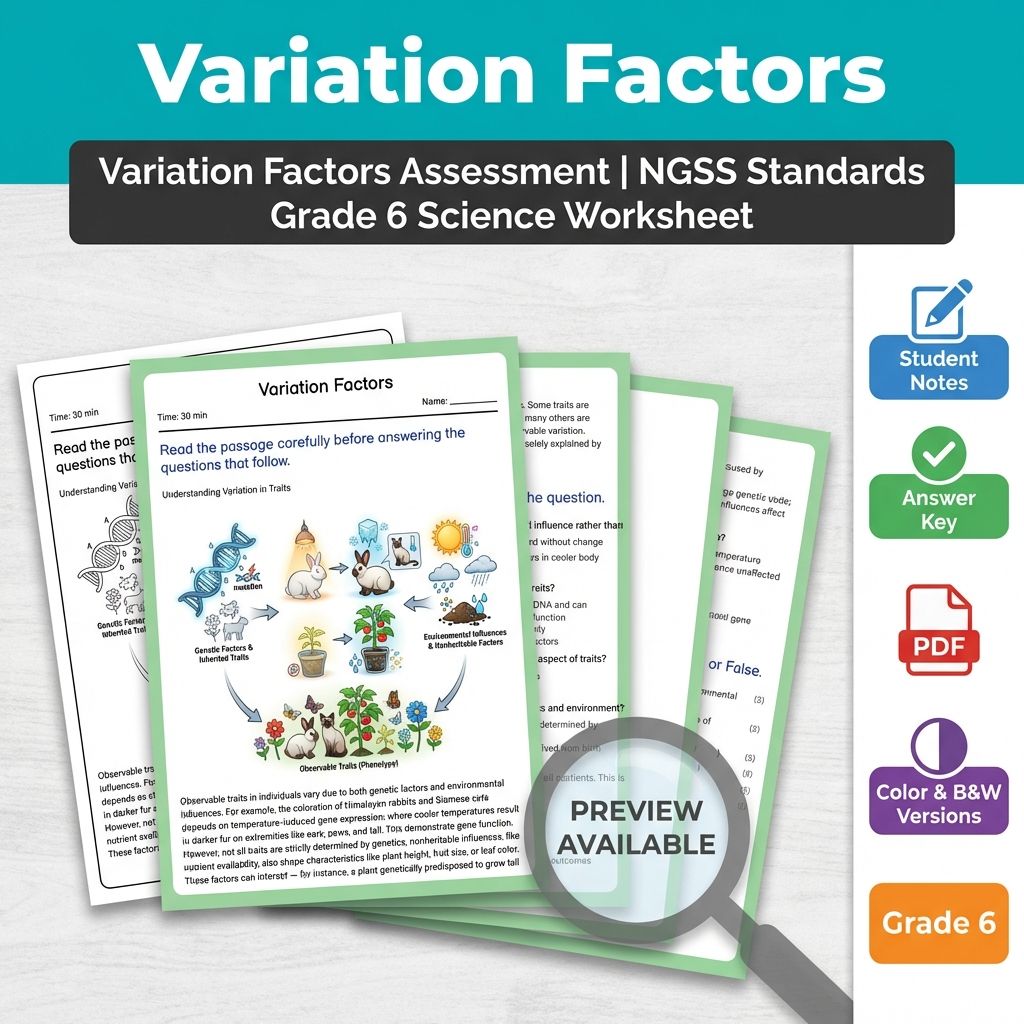
Variation Factors Assessment | NGSS Standards Grade 6 Science Worksheet
Created byPrism Point LearningLearning Objectives
- Understand how genetic differences and environmental factors contribute to observable traits.
- Explain models of allele combinations, mutations, and environmental influences on phenotype.
- Identify the limits of genetic explanations for traits affected by environmental conditions.
Also included in: Grade 6 Science Mini Bundle | Heredity, Inheritance & Traits NGSS +1 more
Instant download

Grade 6 Science – Interpreting Distance-Time Graphs | Daily Reading Worksheet
Created byBright Mind ResourcesLearning Objectives
- Explain the purpose of distance-time graphs in studying motion.
- Interpret patterns and data points on distance-time graphs.
- Differentiate between raw observations and inferred information from graphs.
Also included in: Grade 6 Science Inquiry & Modeling Daily Reading Lesson Bundle | TEKS +2 more
Instant download

Grade 10 Science | Stoichiometric Analysis Worksheet | AP Aligned
Created byLumora LearningLearning Objectives
- Develop algebraic and unit-based strategies for complex stoichiometric relationships.
- Apply mole ratios, limiting reagent identification, and percent yield calculations in chemical problems.
- Utilize gas law approximations and concentration representations to extend stoichiometric reasoning.
Instant download

Grade 10 Science | Electron Configuration Worksheet | AP Aligned
Created byLumora LearningLearning Objectives
- Describe the role of quantum numbers in defining electron positions within atoms.
- Explain how orbital shapes and energies influence electron distribution and chemical properties.
- Interpret orbital diagrams and shorthand configurations to understand atomic structure.
Instant download

Grade 10 Science | Quantitative Uncertainty Worksheet | AP Aligned
Created byLumora LearningLearning Objectives
- Understand measurement uncertainty and its sources.
- Learn methods for propagating uncertainties in calculations.
- Apply significant figures and dimensional analysis to report results accurately.
Instant download

Grade 10 Science | Quantitative Uncertainty in Science - Reading Comprehension
Created byCoral Reef LearningLearning Objectives
- Understand the concept of measurement uncertainty and its significance in scientific experiments.
- Identify common sources of error in measurements and how they impact results.
- Learn propagation methods for combining uncertainties in calculations.
Also included in: Science Practices Reading Comprehension Lesson Bundle: Grade 10 Science AP +1 more
Instant download
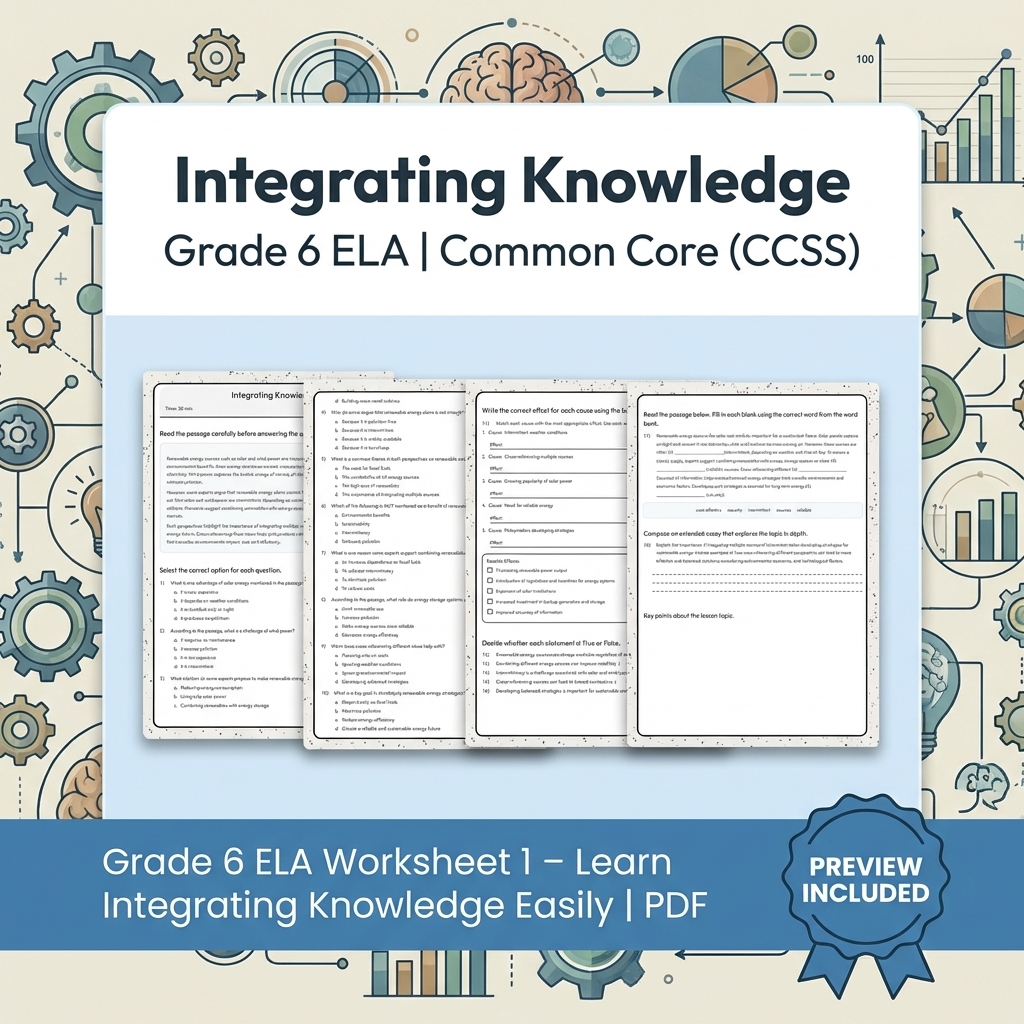
Grade 6 ELA Worksheet 1 – Learn Integrating Knowledge Easily | PDF
Created byMeadowlark WorksheetsLearning Objectives
- Understand how to compare information from multiple texts on similar topics.
- Develop skills to synthesize key insights from different sources.
- Learn the importance of cross-referencing information to build a comprehensive understanding.
Also included in: Grade 6 ELA Text Evidence Comprehension Worksheets Lesson Bundle (CCSS) +1 more
Instant download
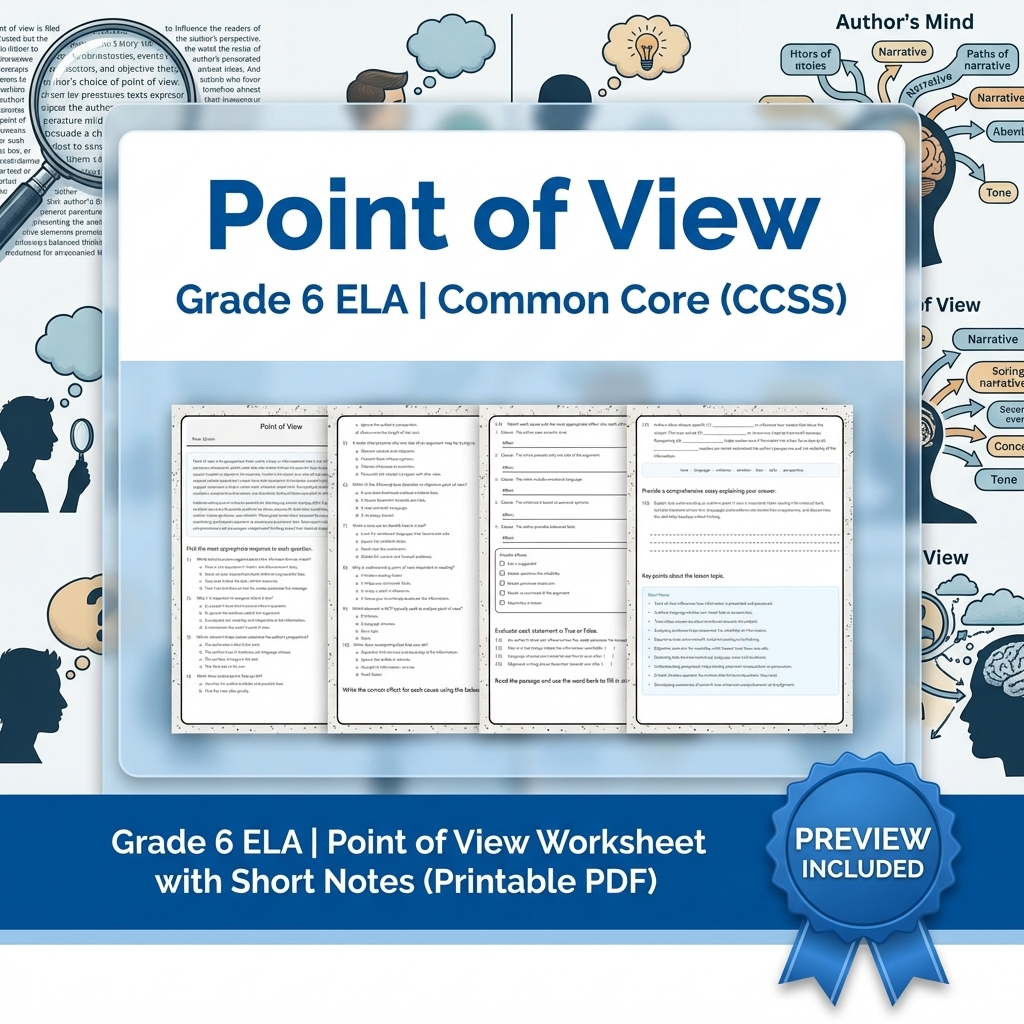
Grade 6 ELA | Point of View Worksheet with Short Notes (Printable PDF)
Created byMeadowlark WorksheetsLearning Objectives
- Understand how an author's point of view influences the presentation of information.
- Identify bias, perspective, and language choices in texts.
- Analyze tone and evidence used to support arguments.
Also included in: Grade 6 ELA Text Evidence Comprehension Worksheets Lesson Bundle (CCSS) +1 more
Instant download

Grade 10 Science | Electron Configuration & Atomic Orbitals - Daily Reading
Created byCoral Reef LearningLearning Objectives
- Understand the shape and significance of s, p, d, and f orbitals.
- Identify the four quantum numbers and their roles in electron configuration.
- Relate orbital shapes and quantum numbers to spectral lines and chemical behavior.
Also included in: Chemistry Foundations Lesson Bundle: Grade 10 Science Advanced Placement (AP) +1 more
Instant download

Transition And Flow Worksheet Pack | Grade 4 ELA Practice
 Created bySunny Desk Resources
Learning Objectives
- Use transition words to show relationships among ideas (addition, contrast, and cause and effect).
- Choose appropriate transitions to improve paragraph flow and coherence.
- Explain how transitions help readers understand reasons and examples.
Also included in: Transitions, Purpose & Evidence Paragraph Writing Lesson Bundle – Grade 4 ELA Alberta +1 more
Instant download

Grade 6 Science – Material Cycling & Earth's Systems | Daily Reading Worksheet
Created byBright Mind ResourcesLearning Objectives
- Understand how rocks break down through physical weathering.
- Identify the process of sediment formation and transportation.
- Explain how biological processes contribute to soil formation.
Also included in: Water Cycle Grade 6 Science Lesson Bundle Daily Reading | California Standards +1 more
Instant download

Grade 10 Science | Stoichiometric Analysis - Reading Comprehension Practice
Created byCoral Reef LearningLearning Objectives
- Understand key concepts related to Science
- Apply knowledge through practice questions
- Demonstrate comprehension of the material
Also included in: Chemistry Foundations Lesson Bundle: Grade 10 Science Advanced Placement (AP) +1 more
Instant download

Grade 10 Science – Energy Flow in Ecosystems | Daily Reading Worksheet
Created byBright Mind ResourcesLearning Objectives
- Understand how sunlight is the primary energy source for ecosystems
- Identify the role of photosynthetic organisms in energy transfer
- Describe how energy moves through trophic levels
Also included in: Grade 10 Ecosystems Science Lesson Bundle Daily Reading | TEKS +2 more
Instant download

Grade 10 Science – Metabolic Regulation & Enzyme Control | Reading Worksheet
Created byBright Mind ResourcesLearning Objectives
- Understand key concepts related to Science
- Apply knowledge through practice questions
- Demonstrate comprehension of the material
Also included in: Grade 10 Energy in Biological Systems Science Daily Reading Lesson Bundle | TEKS +2 more
Instant download
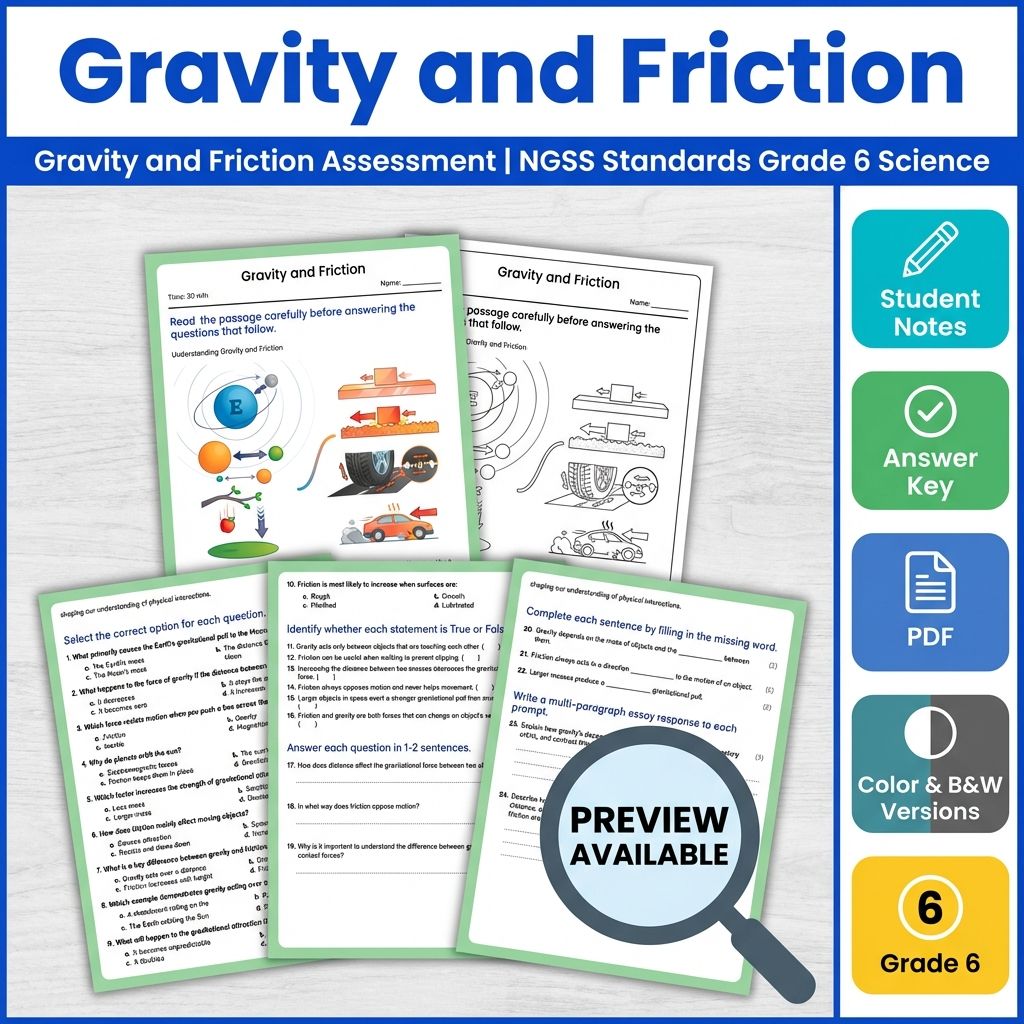
Gravity and Friction Assessment | NGSS Standards Grade 6 Science
Created byPrism Point LearningLearning Objectives
- Explain how gravity depends on mass and distance, using examples like Earth-Moon interactions and planetary orbits.
- Describe how contact forces like friction resist motion and differ from gravitational forces.
- Analyze quantitative patterns showing stronger attraction with larger masses and weaker attraction with increased distance.
Also included in: Grade 6 Science Mini Bundle | Forces and Interactions NGSS Standards +1 more
Instant download

Science Assessment: Energy From Sun (Grade 6) – Florida NGSSS Assessment
Created byPrism Point LearningLearning Objectives
- Explain how the angle of incoming solar energy affects heating on Earth
- Describe how unequal heating drives air movement and influences weather
- Connect energy transfers in the atmosphere and oceans to seasonal climate patterns
Instant download

Grade 6 Science | Reasoning Claims - Daily Reading Comprehension
Created byCoral Reef LearningLearning Objectives
- Understand the concept of scientific reasoning and how evidence is used to support or refute claims.
- Interpret patterns in data, such as distance-time graphs, to make inferences about motion.
- Differentiate between raw observations and inferential claims.
Instant download

RNA Variants Assessment for Grade 10 Science | TEKS Standards-Aligned Assessment
Created byPrism Point LearningLearning Objectives
- Understand key concepts related to Science
- Apply knowledge through practice questions
- Demonstrate comprehension of the material
Also included in: Lesson Grade 10 Genetics: DNA, RNA, Protein Science Lesson Bundle TEKS
Instant download

Protein Synthesis Assessment | TEKS Standards Grade 10 Science Worksheet
Created byPrism Point LearningLearning Objectives
- Describe the process of transcription and translation in protein synthesis.
- Identify the roles of DNA, RNA, ribosomes, and tRNA during protein synthesis.
- Explain the stages of transcription and translation, including initiation, elongation, and termination.
Also included in: Lesson Grade 10 Genetics: DNA, RNA, Protein Science Lesson Bundle TEKS
Instant download

Grade 10 ELA – Punctuation Effects in Writing | Daily Reading Worksheet
 Created byQuiet Forest Education
Learning Objectives
- Understand how commas create pauses and clarify meaning
- Identify correct punctuation usage in sentences
- Analyze how punctuation influences tone and emphasis
Also included in: Grade 10 ELA Language Lesson Bundle | TEKS Daily Reading & Writing Skills +1 more
Instant download
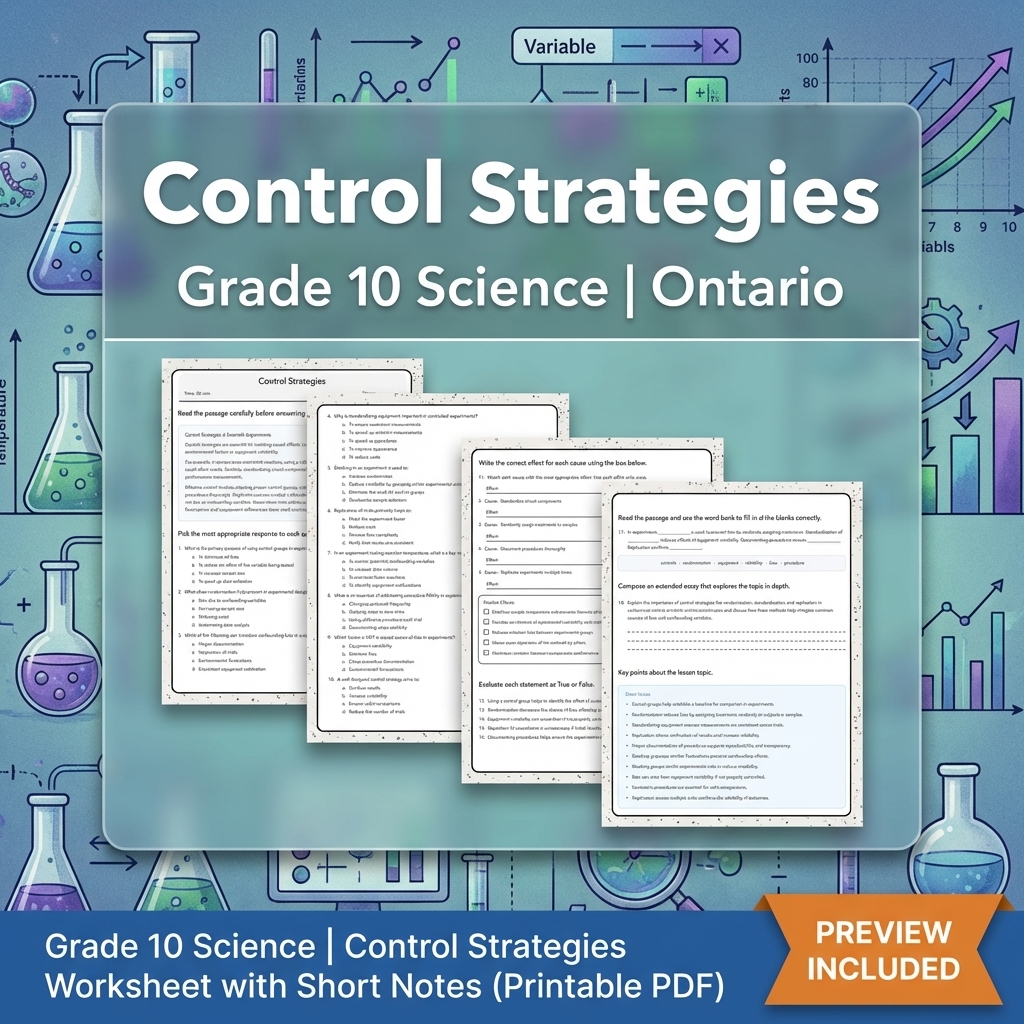
Grade 10 Science | Control Strategies Worksheet with Short Notes (Printable PDF)
Created byMeadowlark WorksheetsLearning Objectives
- Understand the purpose of control groups and randomization in experiments.
- Identify common sources of bias and confounding factors such as equipment variability and environmental fluctuations.
- Explain different levels of control and methods to document procedure fidelity for valid experimental comparisons.
Also included in: Grade 10 Science Lesson Group Bundle | Ontario Curriculum Worksheets +1 more
Instant download
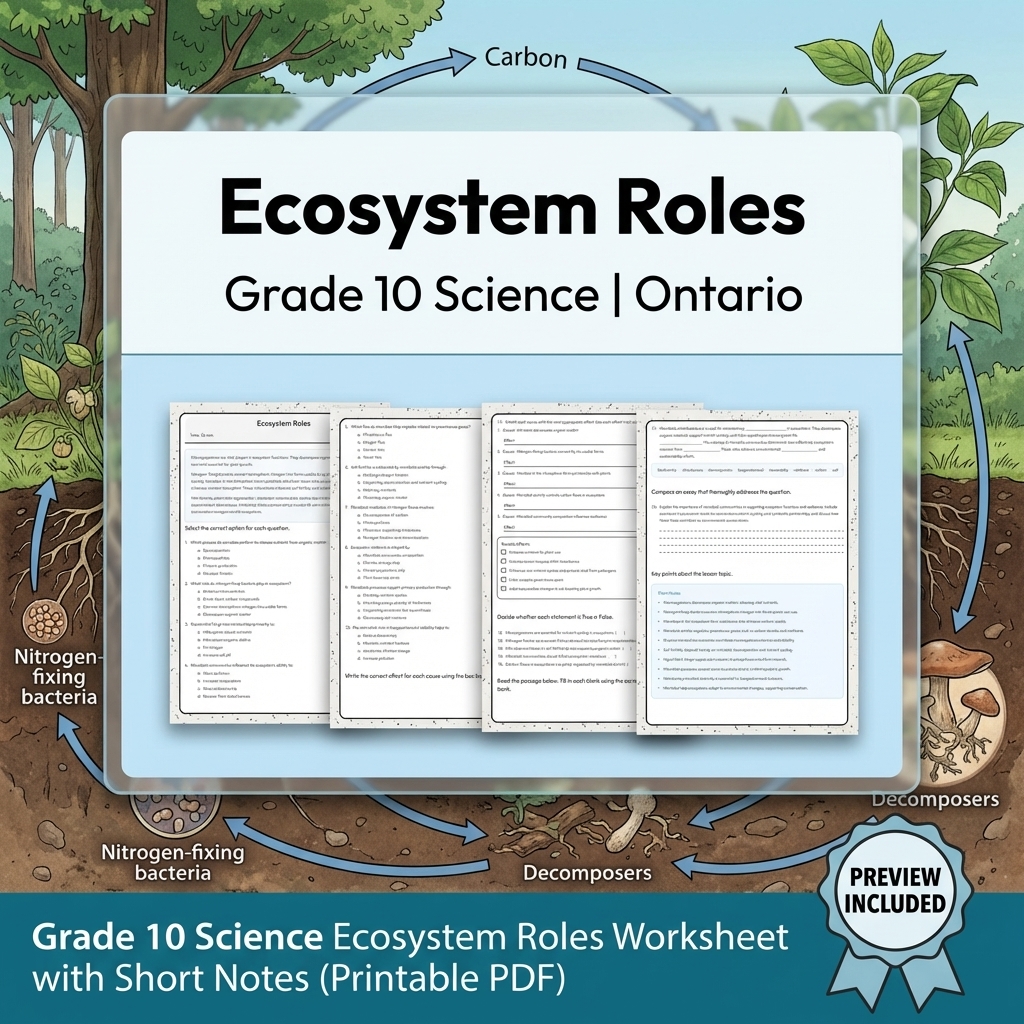
Grade 10 Science Ecosystem Roles Worksheet with Short Notes (Printable PDF)
Created byMeadowlark WorksheetsLearning Objectives
- Understand the contribution of microorganisms to decomposition, nutrient cycling, nitrogen fixation, and primary production.
- Explain how microbial interactions affect soil fertility and ecosystem resilience.
- Analyze microbial mediation of carbon and nitrogen fluxes in ecosystems.
Also included in: Grade 10 Science Lesson Group Bundle | Ontario Curriculum +1 more
Instant download

Grade 10 Science — Worksheet MCQ Paper for Mastering Electron Configuration
Created byThe Resource HubLearning Objectives
- Understand the quantum numbers and their significance in electron arrangements.
- Identify orbital shapes and their influence on atomic properties.
- Interpret orbital diagrams and shorthand configurations linking atomic structure to spectral and chemical behavior.
Also included in: Grade 10 Science Chemistry Foundations Lesson Bundle for AP Curriculum +1 more
Instant download
Browse more categories
About Reading comprehension Worksheets
Find reading comprehension worksheets for class practice, homework, or self-study. All 40,289 are instant PDF downloads.
Each resource here is built by an independent educator and reviewed for quality. Worksheets print straight from PDF and suit classroom use, homework, or extra practice; most come with answer keys, and you can preview before purchasing.