
Reading comprehension Worksheets
40,289 type resources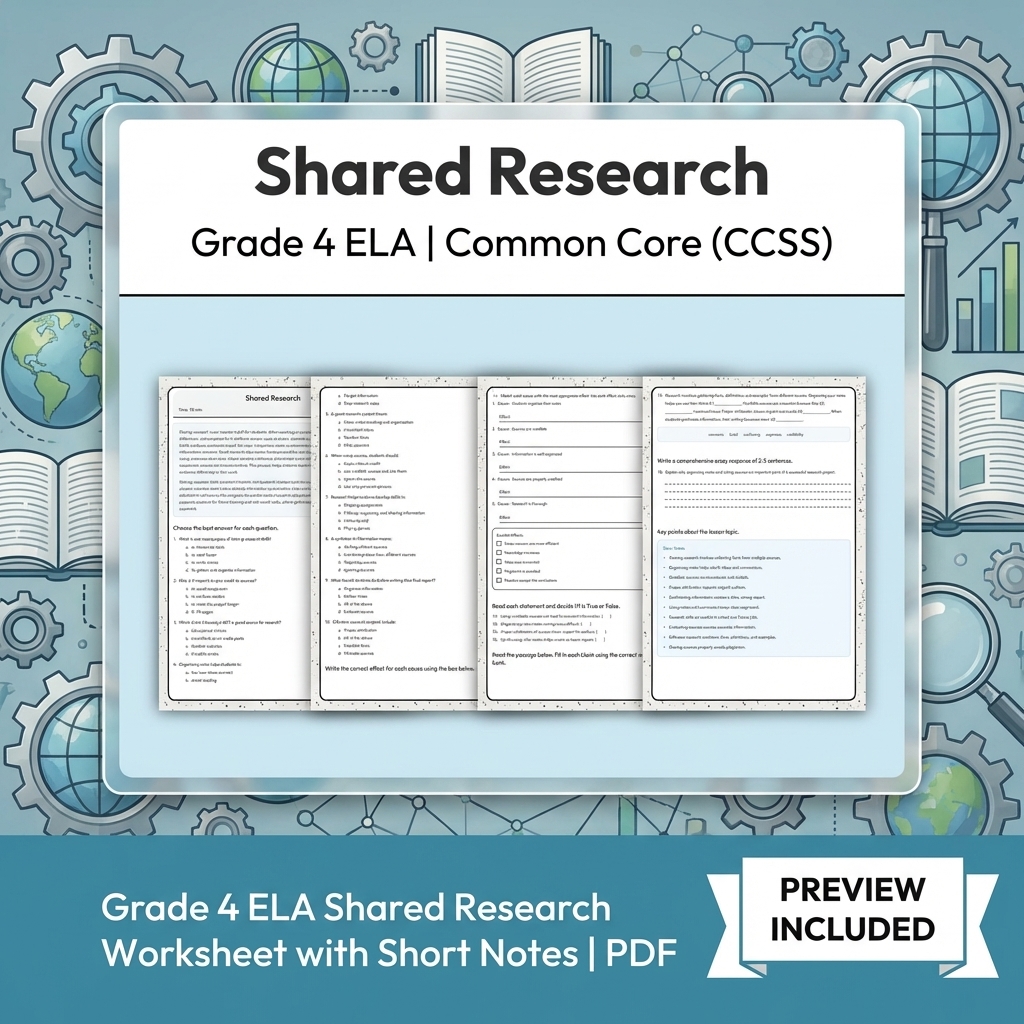
Grade 4 ELA Shared Research Worksheet with Short Notes | PDF
 Created byMeadowlark Worksheets
Learning Objectives
- Understand how to gather information from shared sources for research projects.
- Learn to organize notes and summaries to build knowledge about a topic.
- Identify credible sources and give appropriate attribution in writing.
Also included in: Grade 4 Evidence-Based ELA Lesson Bundle (Common Core CCSS): Writing +1 more
Instant download
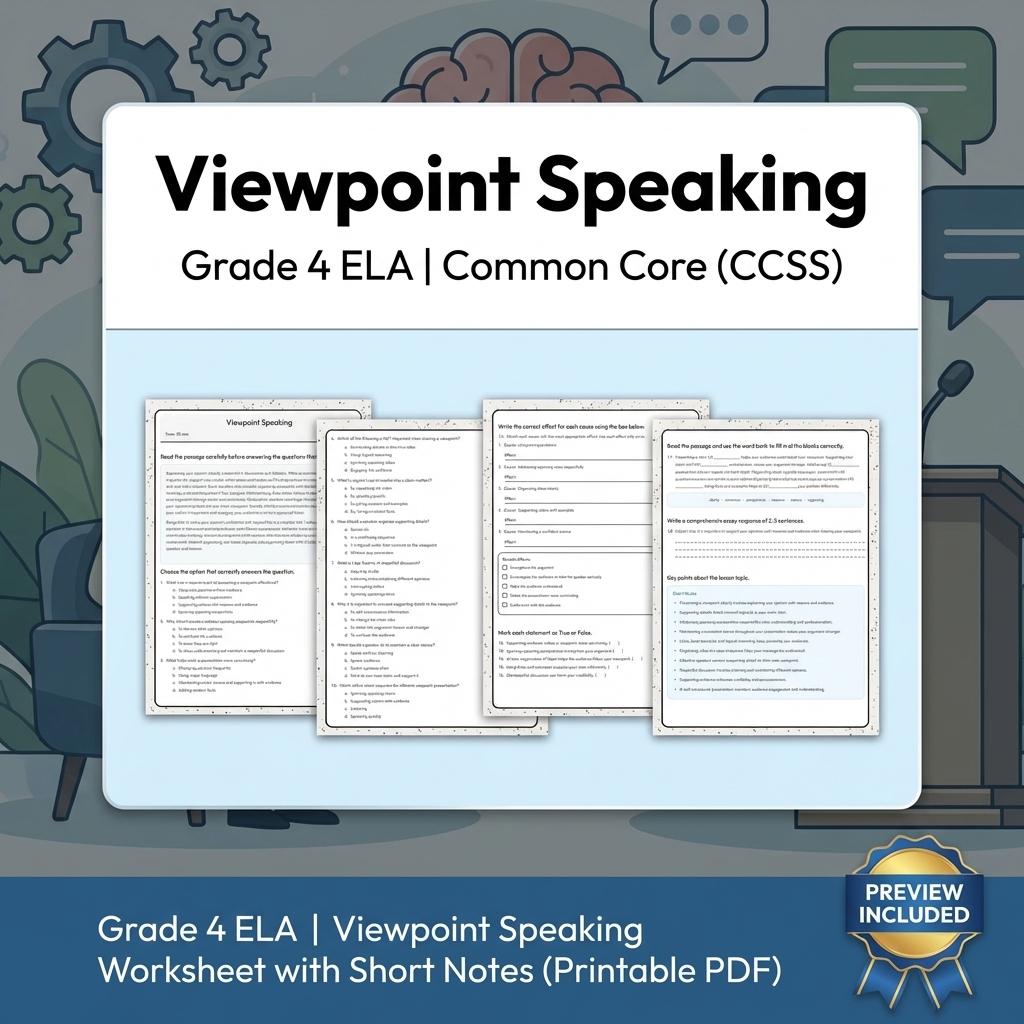
Grade 4 ELA | Viewpoint Speaking Worksheet with Short Notes (Printable PDF)
Created byMeadowlark WorksheetsLearning Objectives
- Understand how to present opinions or viewpoints with supporting reasons and evidence.
- Learn to connect supporting details to a central viewpoint clearly.
- Recognize how to address opposing perspectives respectfully during a discussion.
Also included in: Grade 4 Multimedia Paraphrasing & Discussion ELA Lesson Bundle CCSS +1 more
Instant download
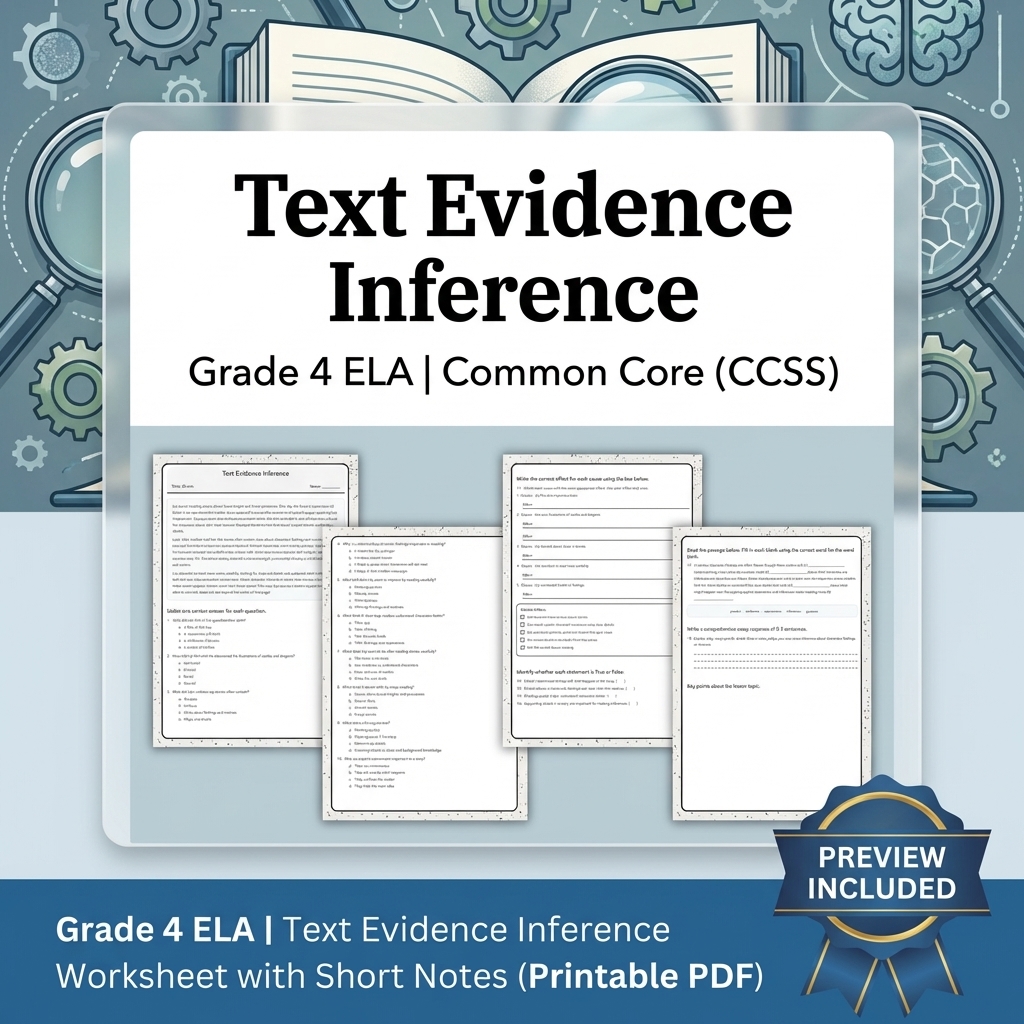
Grade 4 ELA | Text Evidence Inference Worksheet with Short Notes (Printable PDF)
Created byMeadowlark WorksheetsLearning Objectives
- Understand the difference between explicit statements and inferences in a text.
- Identify specific details and examples that support inferences.
- Apply reasoning skills to draw logical conclusions from a story.
Also included in: Grade 4 Text Evidence & Theme ELA Lesson Bundle | Common Core (CCSS) +1 more
Instant download
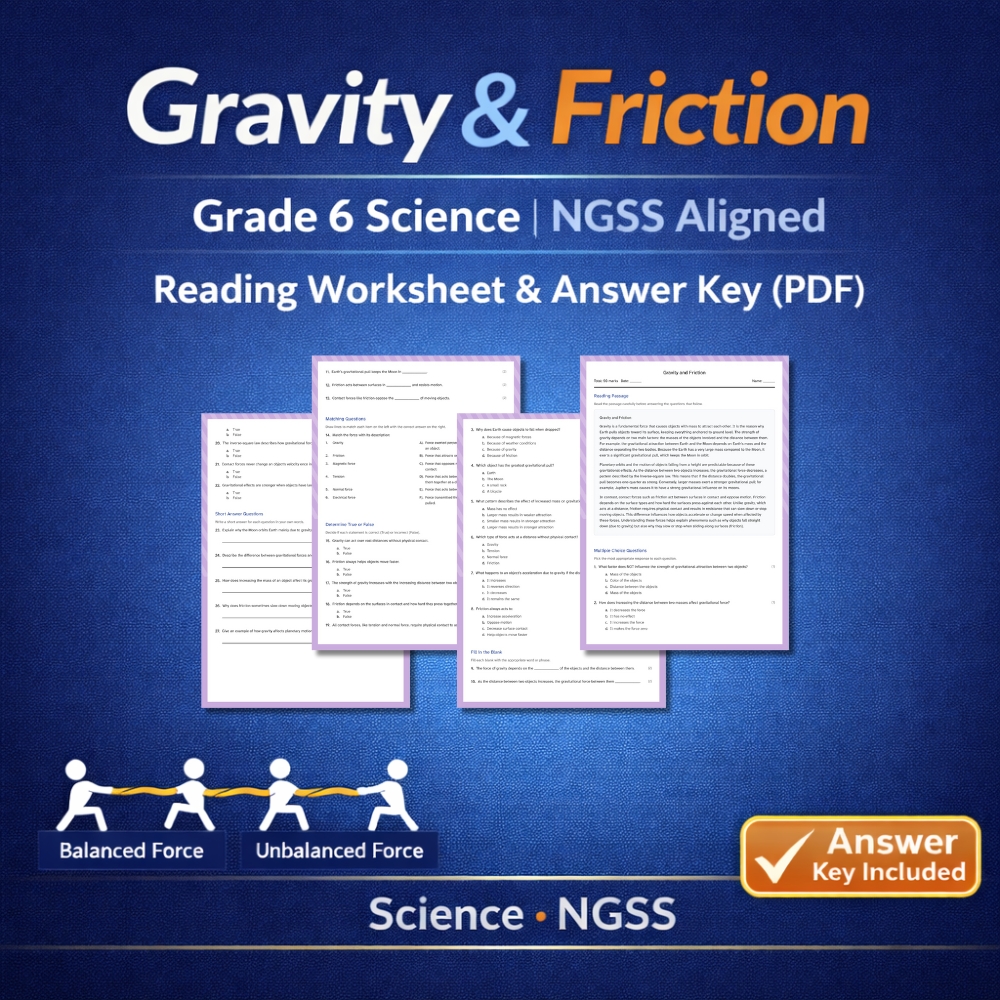
6th Grade Science | Gravity and Friction | NGSS ( Worksheet + Answer Key )
 Created byCedar Grove Learning
Learning Objectives
- Explain how gravitational attraction depends on mass and distance between objects.
- Compare and contrast gravitational forces with contact forces like friction.
- Use examples to argumentatively evaluate how gravity influences planetary orbits and falling objects.
Also included in: Grade 6 Science Unit Bundle | Forces, Motion & Interactions Worksheets (NGSS) +1 more
Instant download
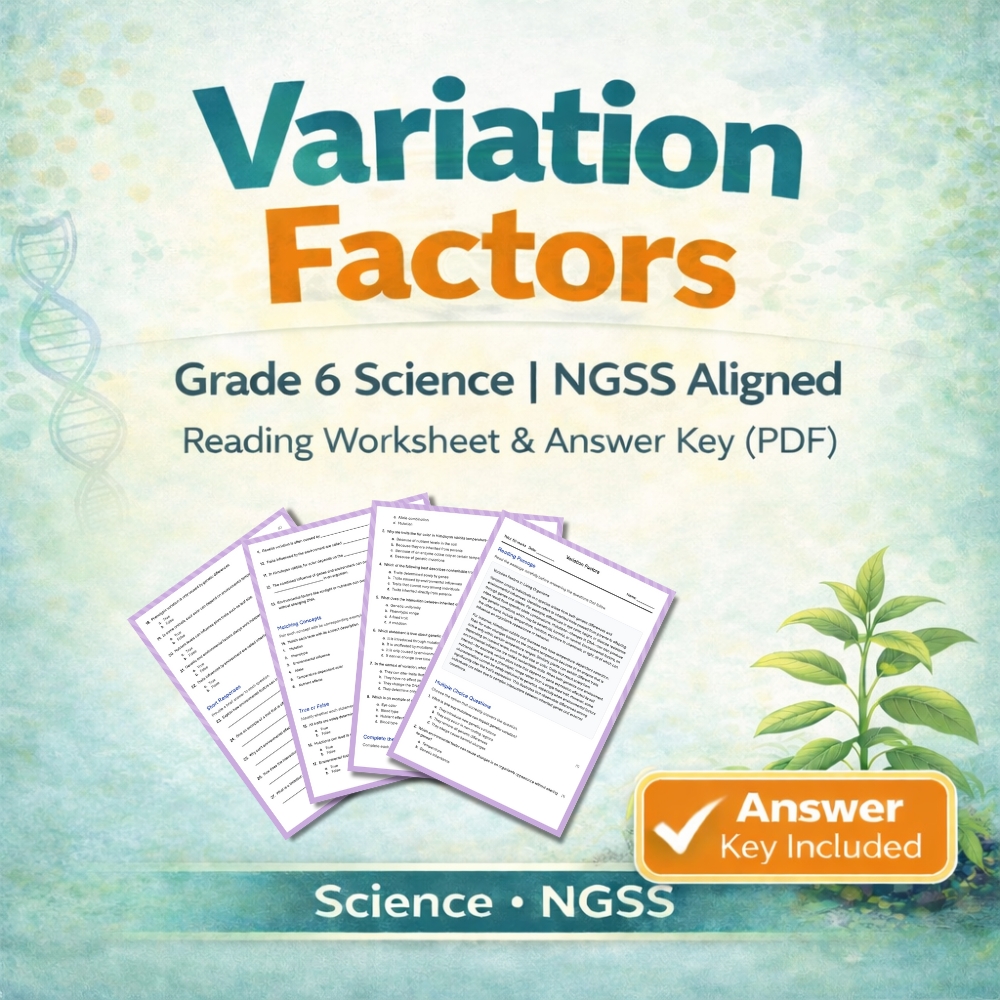
6th Grade Science | Variation Factors | NGSS Aligned ( Worksheet + Answer Key )
Created byCedar Grove LearningLearning Objectives
- Explain how genetic differences contribute to observable variation among individuals.
- Describe how environmental factors influence phenotypic traits in organisms.
- Analyze models of allele combinations, mutation impact, and environmental effects on traits.
Also included in: Grade 6 Science Unit Bundle | Variation Factors & Inheritance NGSS Worksheets +1 more
Instant download
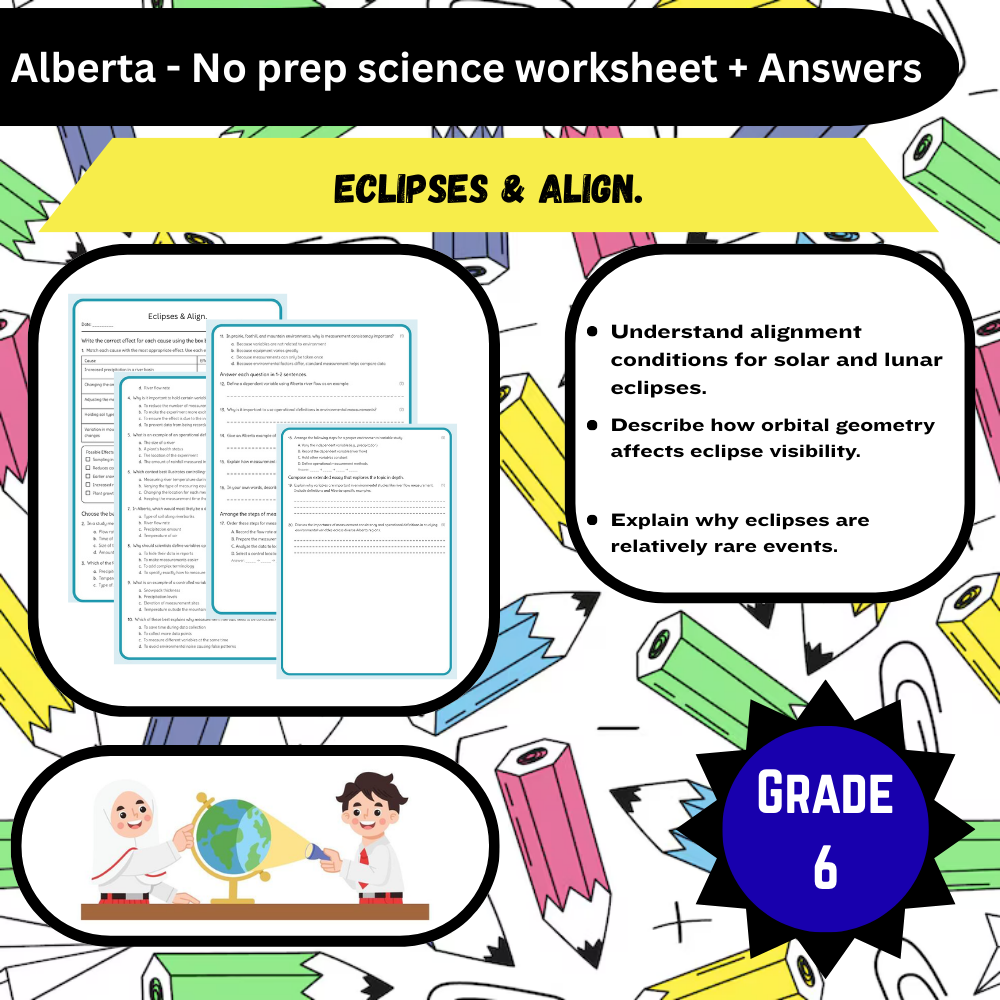
6th Grade Science | Eclipses & Alignments Worksheet (PDF)
 Created byBright Mind Resources
Learning Objectives
- Understand the celestial alignment conditions that lead to solar and lunar eclipses.
- Describe how orbital geometry affects the occurrence and visibility of different types of eclipses.
- Explain why eclipses are relatively rare events at a given location.
Instant download
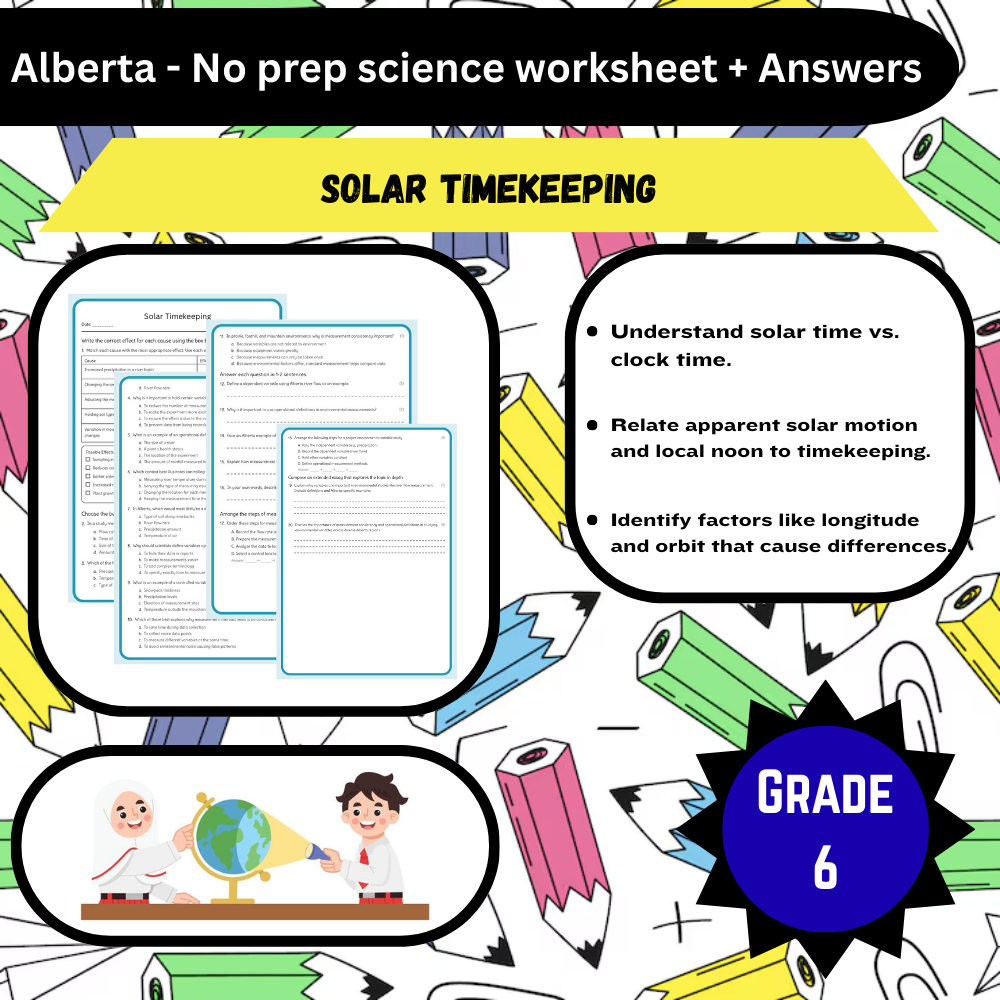
6th Grade Science | Solar Timekeeping (Worksheet + Answer Key) for Alberta Standards
Created byBright Mind ResourcesLearning Objectives
- Understand the principles of solar time and how it differs from clock time
- Explain how Earth's apparent solar motion and local noon relate to societal and calendrical timekeeping
- Identify factors that cause differences between solar time and clock time, such as longitude and Earth's orbit
Instant download
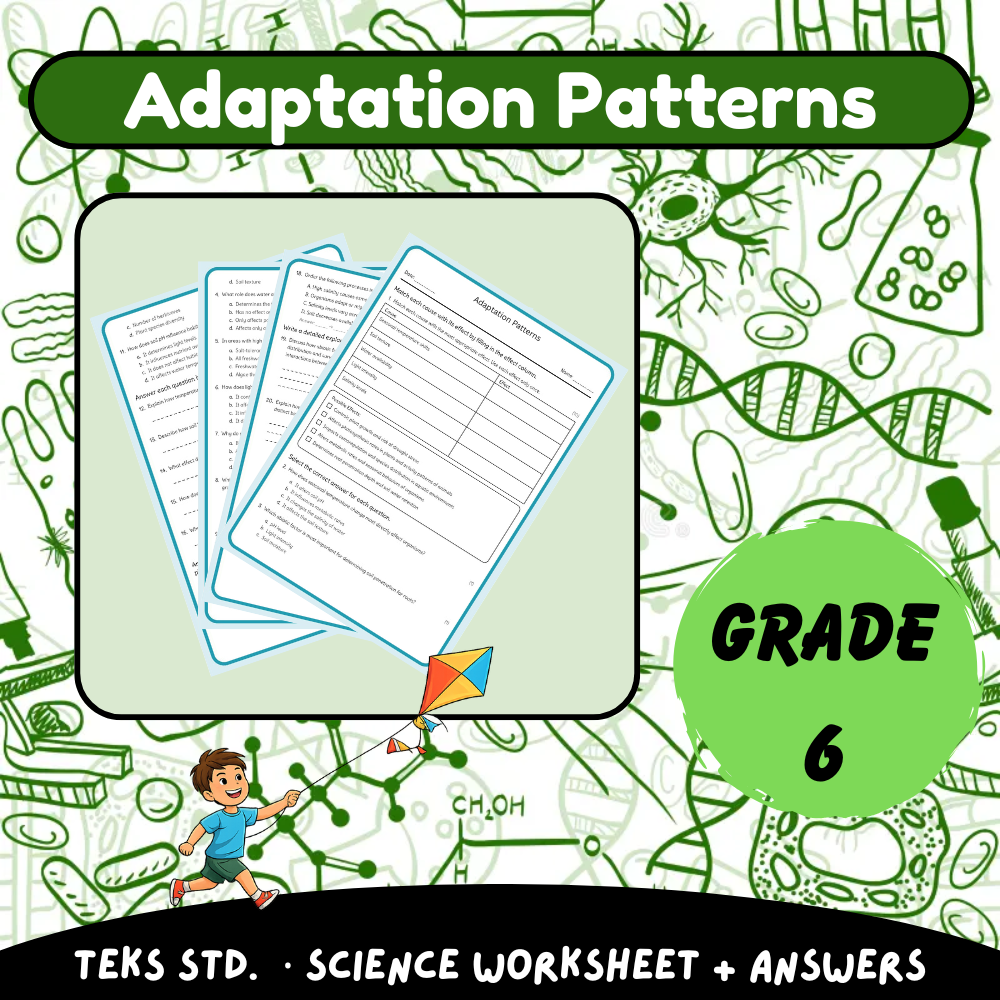
6th Grade Science | Adaptation Patterns Worksheet (PDF) — TEKS Aligned
Created byBright Mind ResourcesLearning Objectives
- Identify different types of adaptations such as morphological, physiological, and behavioral.
- Understand how adaptations help organisms survive in specific environments.
- Explain examples of traits like succulent stems, leaf modifications, fur insulation, and beak variation.
Instant download
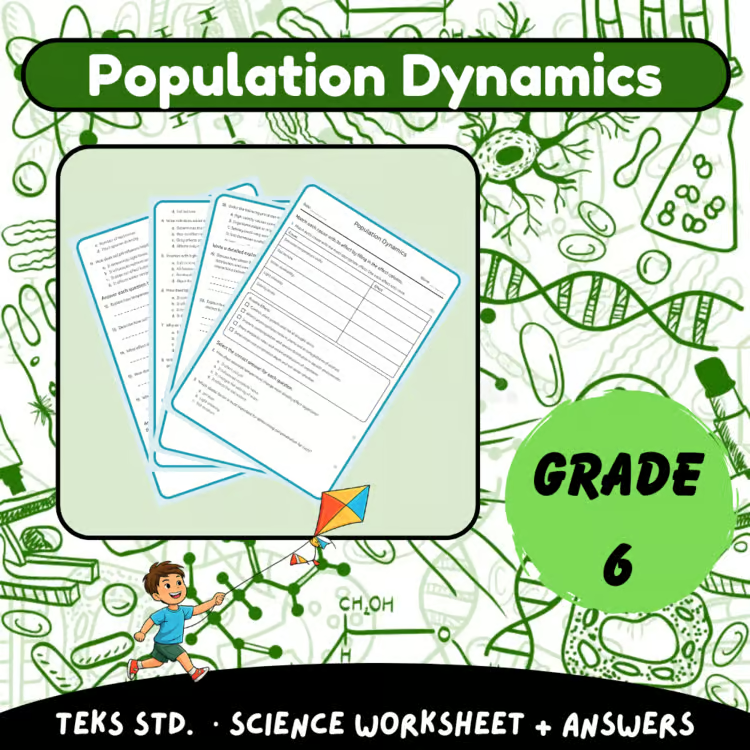
6th Grade Science | Population Dynamics Worksheet + Answer Key (PDF)
Created byBright Mind ResourcesLearning Objectives
- Understand the principles of exponential and logistic growth curves in populations.
- Define carrying capacity and factors influencing population size.
- Differentiate between density-dependent and density-independent factors affecting populations.
Instant download
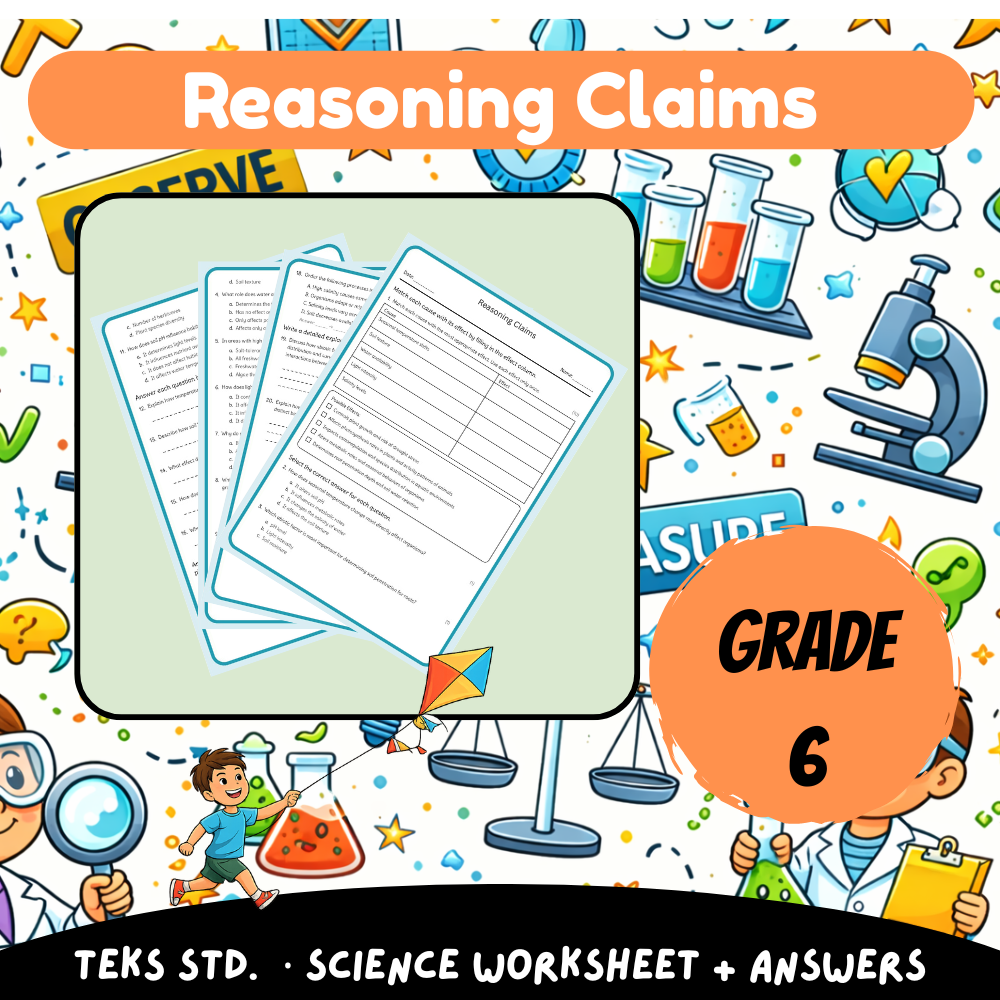
6th Grade Science | Reasoning Claims (Worksheet + Answer Key) – TEKS Aligned
Created byBright Mind ResourcesLearning Objectives
- Understand the process of connecting evidence to explanatory claims in scientific reasoning.
- Interpret patterns in data such as distance-time graphs for motion analysis.
- Evaluate the strength of inferences based on evidence and models.
Instant download
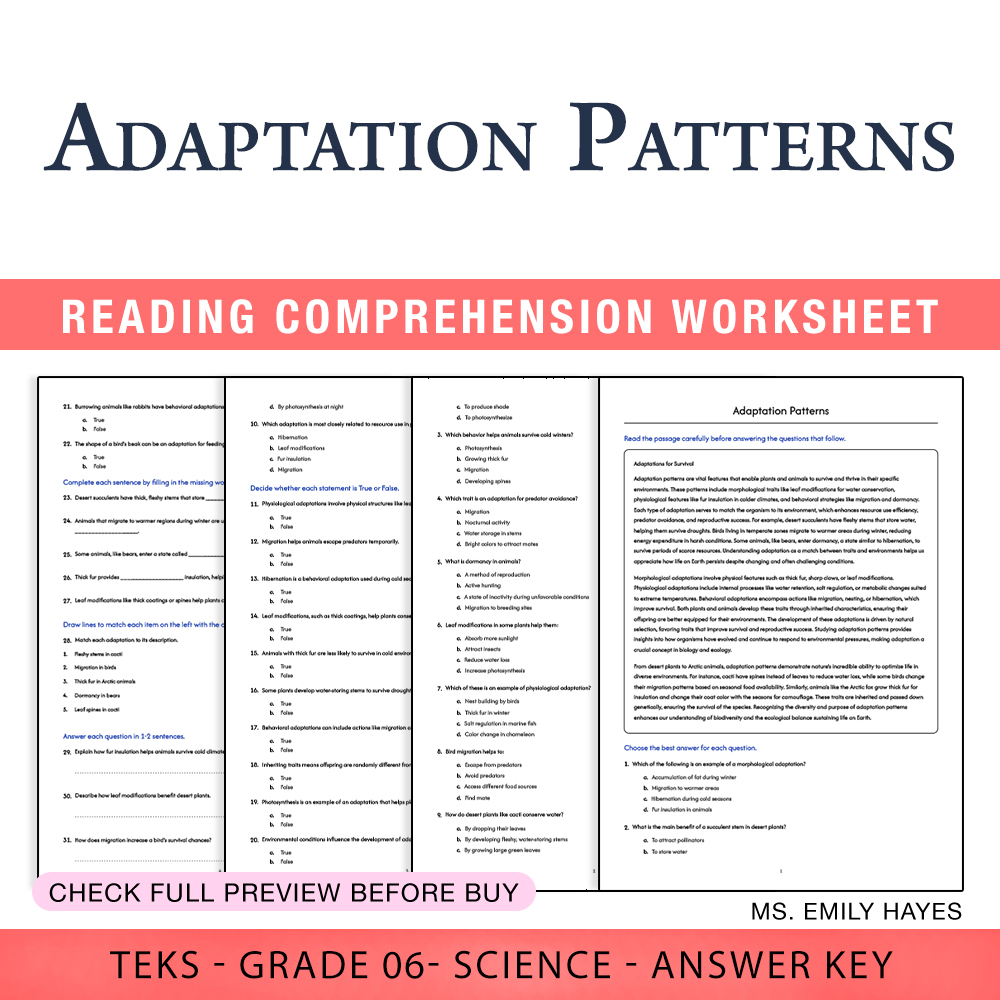
6th Grade Science | Adaptation Patterns Worksheet (PDF+ Answer Key)
 Created byCopper Leaf Classroom
Learning Objectives
- Understand different types of adaptation patterns in plants and animals.
- Identify morphological, physiological, and behavioral adaptations and their functions.
- Explain how adaptations help organisms survive in specific environments.
Instant download
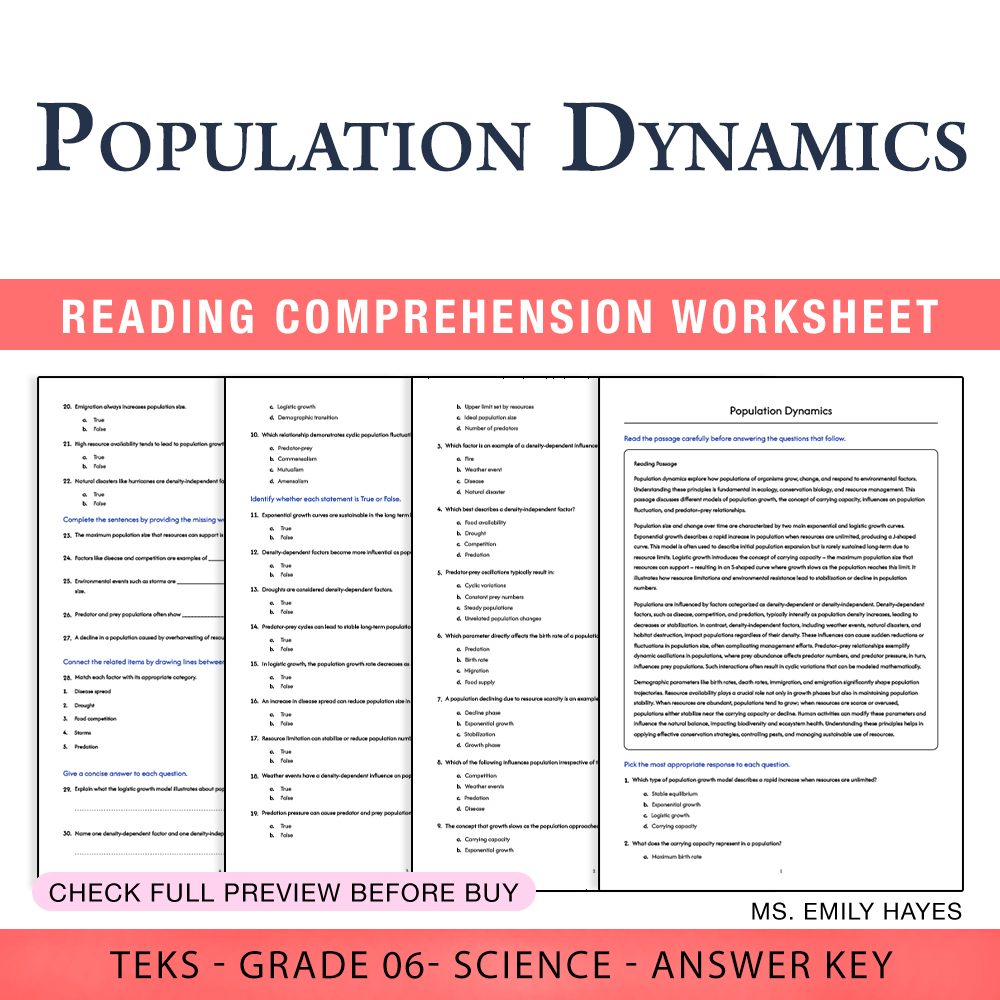
6th Grade Science | Population Dynamics Worksheet (PDF+ Answer Key)
Created byCopper Leaf ClassroomLearning Objectives
- Explain the principles of population size and growth curves, including exponential and logistic models.
- Define carrying capacity and identify factors influencing population change.
- Distinguish between density-dependent and density-independent influences on populations.
Instant download
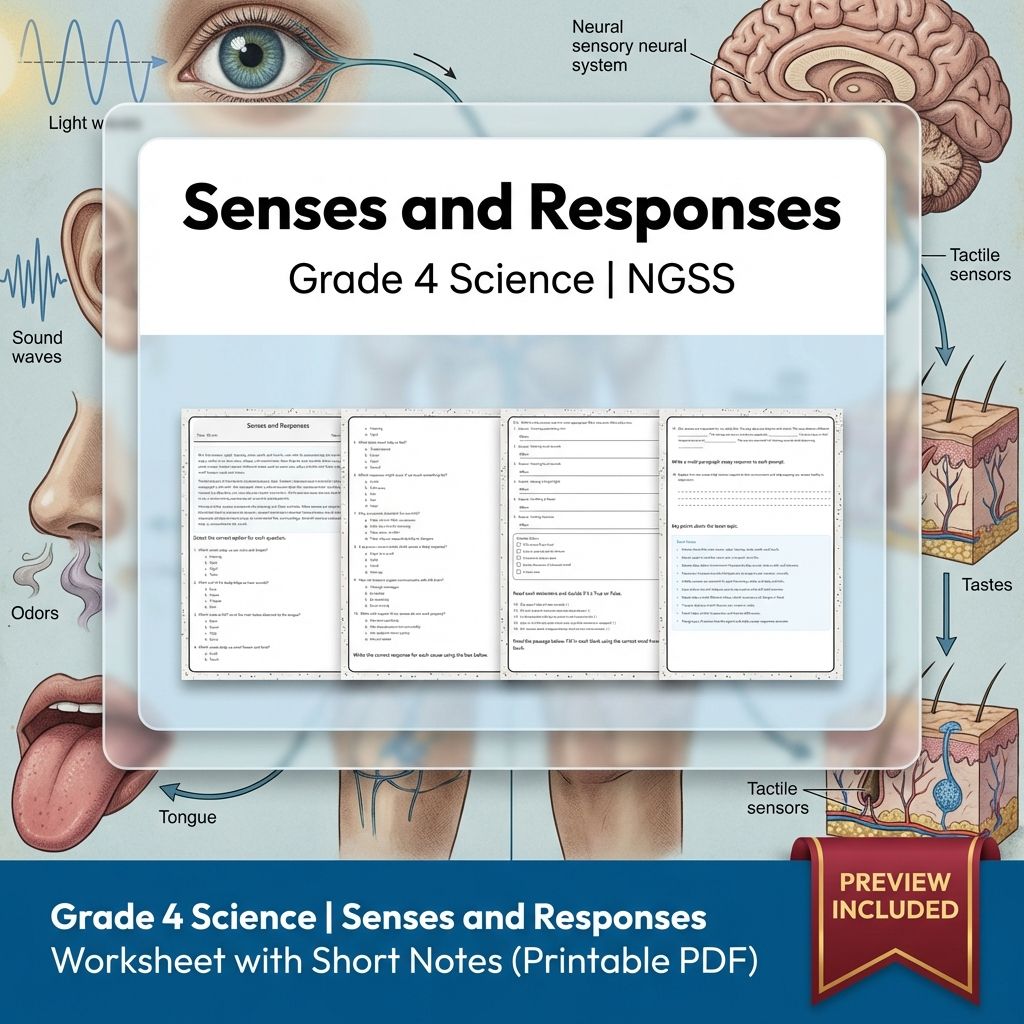
Grade 4 Science | Senses and Responses Worksheet with Short Notes (PDF)
Created byMeadowlark WorksheetsLearning Objectives
- Identify the five senses and their functions.
- Describe how the senses help humans respond to their environment.
- Understand the importance of sensory organs.
Also included in: Grade 4 Science Structures and Processes (NGSS) Molecules to Organisms Bundle +1 more
Instant download
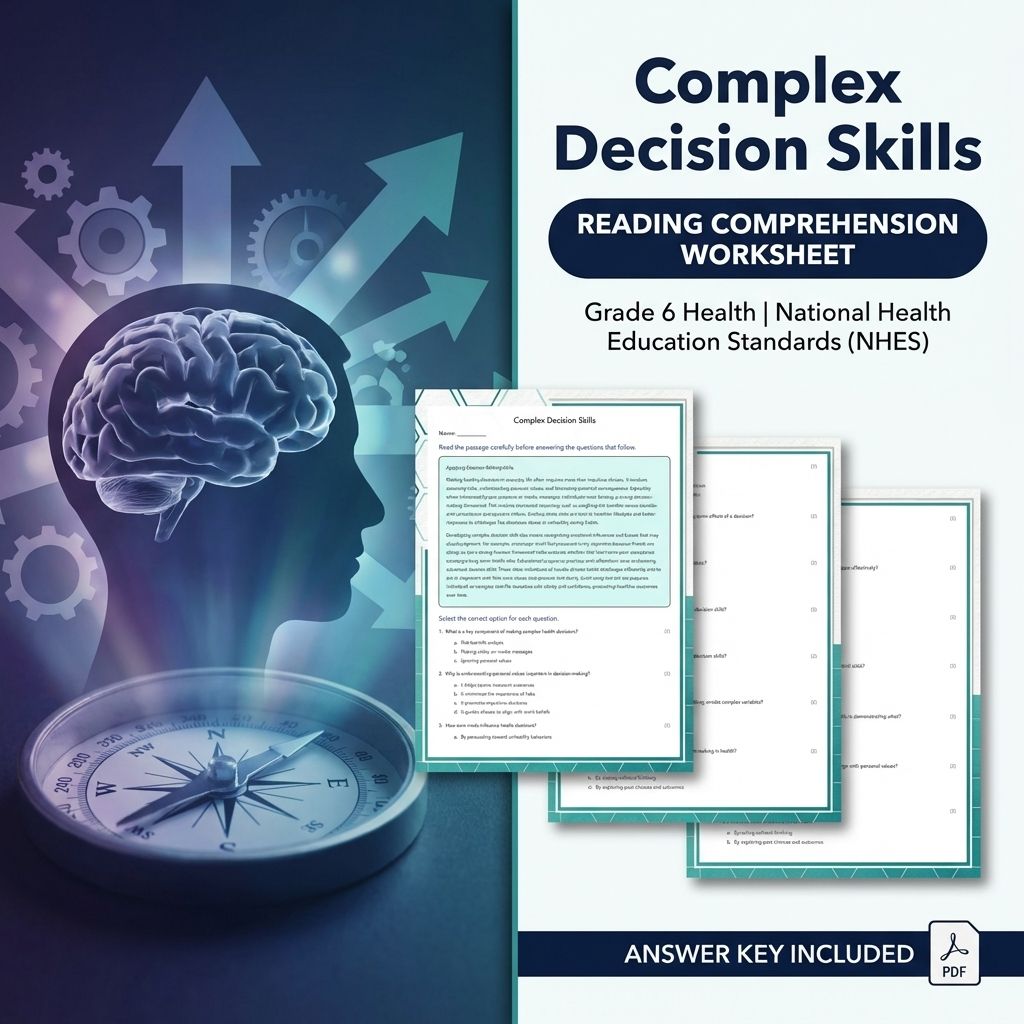
6th Grade Health | Complex Decision Skills Worksheet for NHES Standards
 Created bySkylark Worksheets
Learning Objectives
- Develop an understanding of structured decision-making processes.
- Analyze risks and benefits associated with health choices.
- Evaluate consequences of various options in real-life scenarios.
Also included in: Grade 6 Health Unit Bundle – Decision Making & Risk Assessment Worksheets +1 more
Instant download

Author's Purpose Worksheet Grade 6 TEKS ELA Evidence and Craft Analysis
 Created bySunny Desk Resources
Learning Objectives
- Determine an author’s likely purpose by analyzing patterns in the text.
- Identify how evidence selection and transitions support a purpose (to inform, explain, persuade, or entertain).
- Explain how an author’s language choices and organization shape the reader’s understanding.
Instant download

Grade 6 Health Benefits of Physical Activity Worksheet Ontario
 Created byPrism Point Learning
Learning Objectives
- Explain how regular physical activity improves cardiovascular endurance, muscular strength, and flexibility.
- Describe how consistent movement can support mental health by reducing stress and anxiety.
- Apply health knowledge by sorting activities into categories and answering questions about benefits of staying active.
Instant download

Complex Decision Making Skills Health Worksheet Grade 6 NHES Activities
Created byPrism Point LearningLearning Objectives
- Use a step-by-step process to make healthier decisions when choices feel complicated.
- Analyze risks and benefits and predict possible consequences for personal health.
- Apply personal values and media/peer influence awareness to support informed decisions.
Instant download
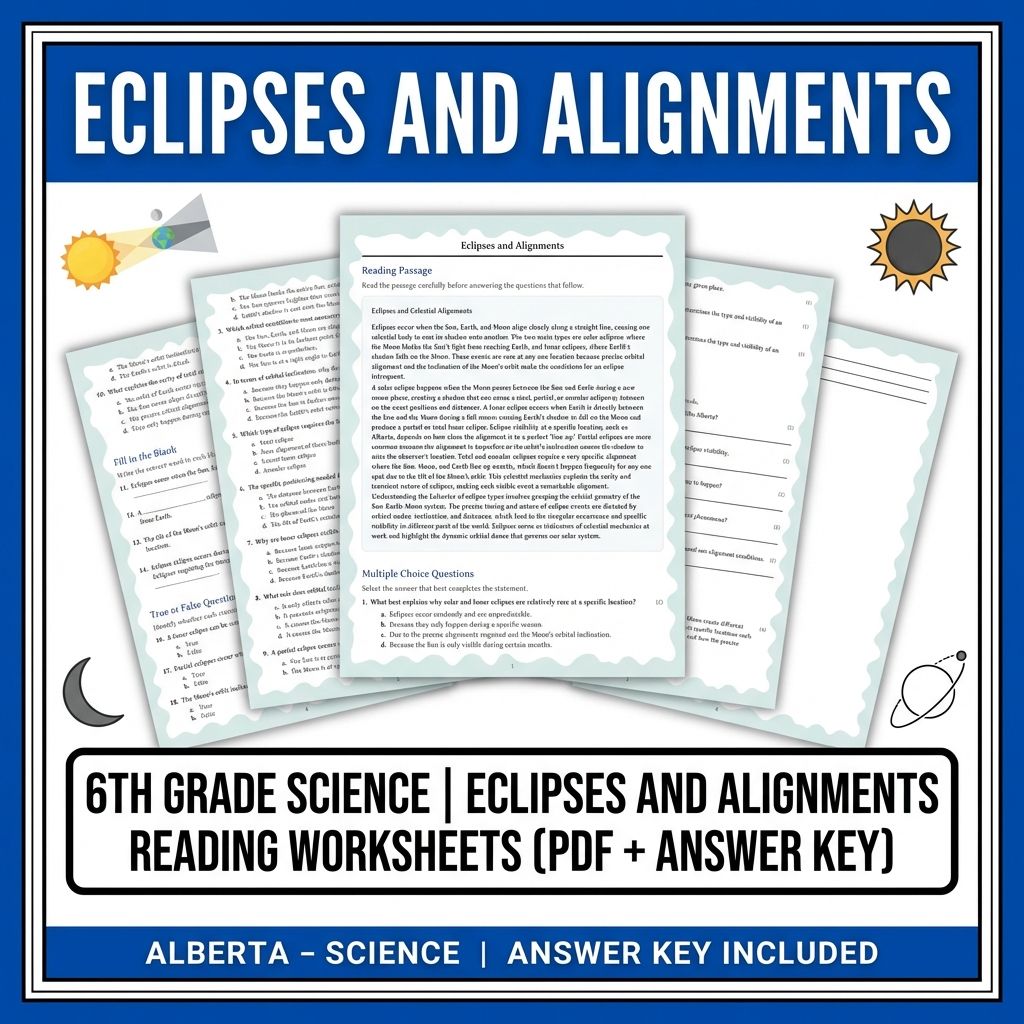
6th Grade Science | Eclipses and Alignments Worksheets (PDF + Answer Key)
JCreated byJ.S SheetsLearning Objectives
- Describe the celestial conditions necessary for solar and lunar eclipses.
- Explain how the orbit and alignment of the Sun, Earth, and Moon influence eclipse types and visibility.
- Understand why eclipses are rare at specific locations like Alberta.
Also included in: Grade 6 Science | Celestial Motion & Sky Observation Worksheets Bundle +1 more
Instant download
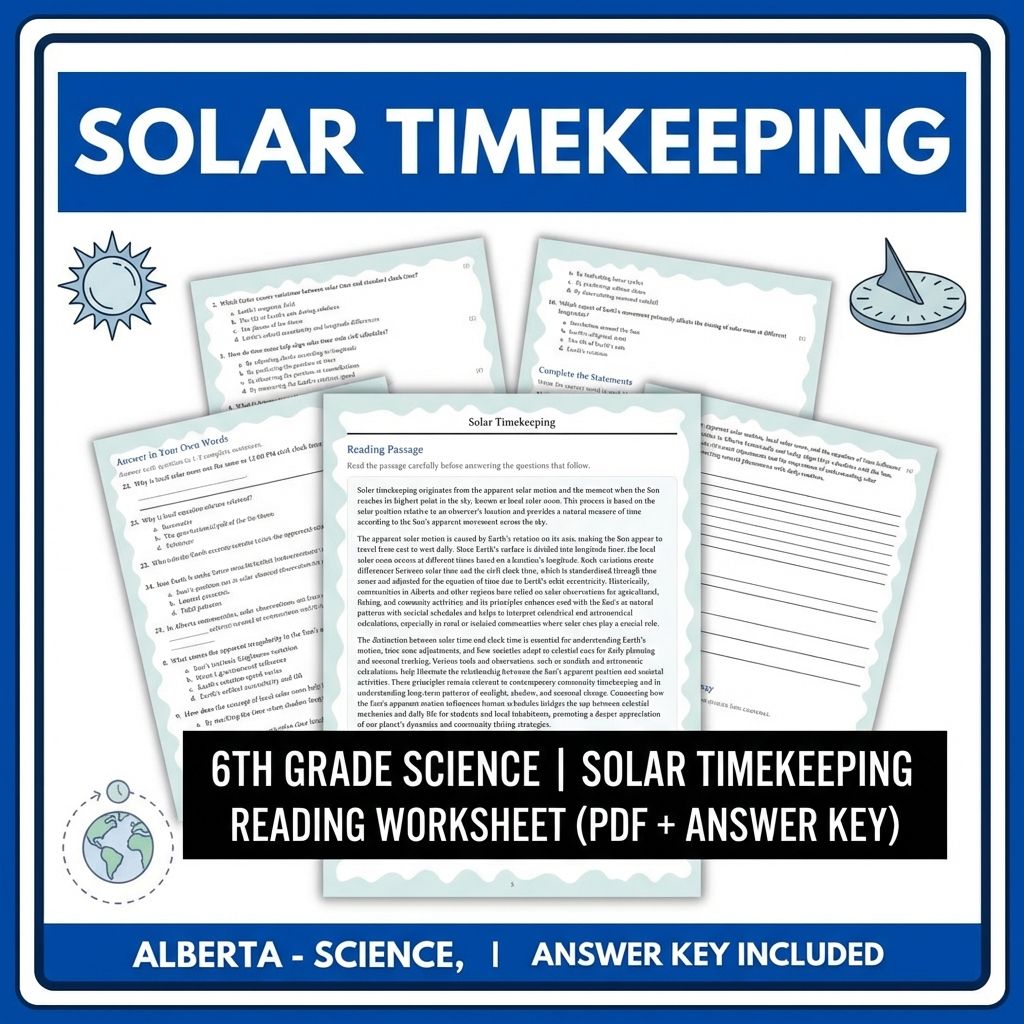
6th Grade Science | Solar Timekeeping Reading Worksheet (PDF + Answer Key)
JCreated byJ.S SheetsLearning Objectives
- Explain the concept of apparent solar motion and local solar noon.
- Identify the factors that cause differences between solar time and clock time.
- Describe how historical and modern communities in Alberta use solar time for daily schedules.
Also included in: Grade 6 Science | Celestial Motion & Sky Observation Worksheets Bundle +1 more
Instant download
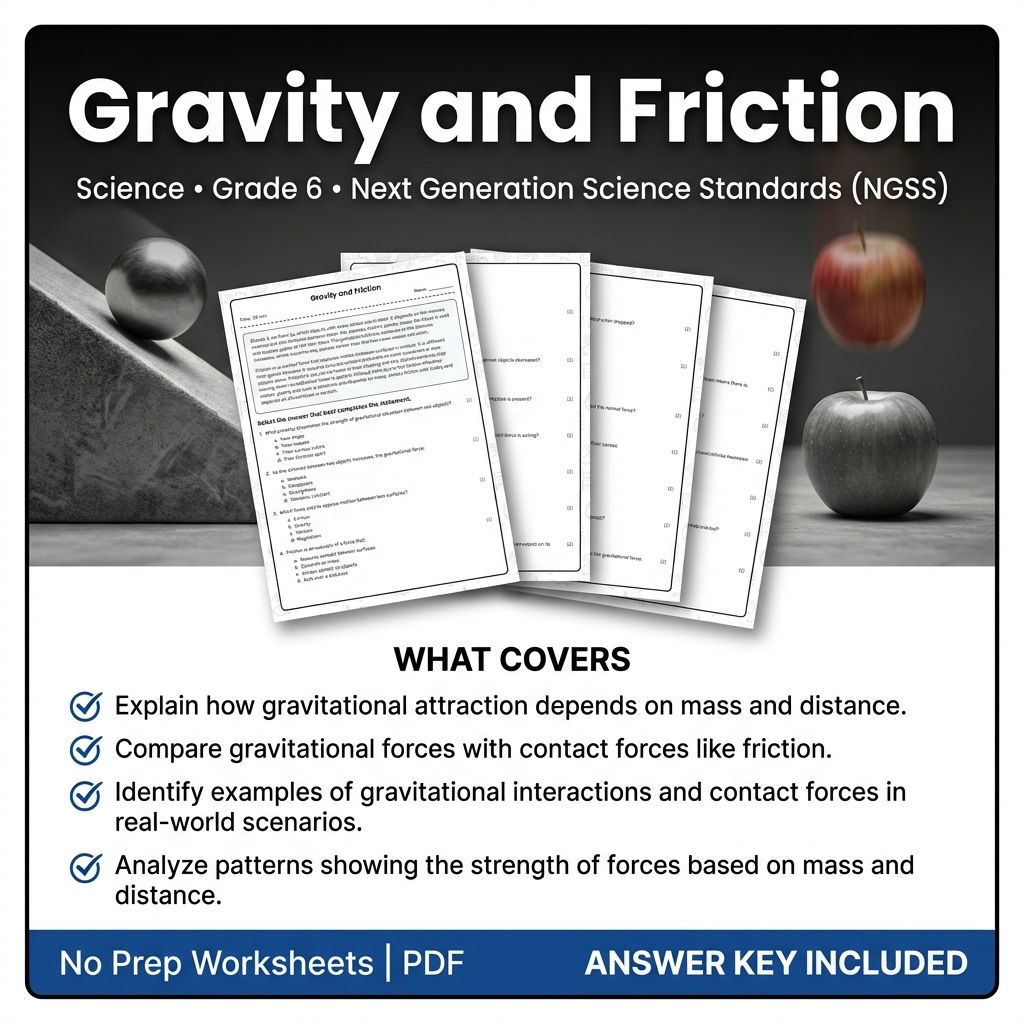
Grade 6 Science | Gravity and Friction Worksheet with Answer Key (Printable PDF)
 Created byCoral Reef Learning
Learning Objectives
- Explain how gravitational attraction depends on mass and distance.
- Compare gravitational forces with contact forces like friction.
- Identify examples of gravitational interactions and contact forces in real-world scenarios.
Instant download

Author's Purpose Worksheet Grade 6 ELA TEKS Reading Comprehension
 Created byGolden Apple Studio
Learning Objectives
- Determine an author’s likely purpose (to inform, explain, persuade, or entertain) by using evidence from the text.
- Identify which details, examples, and transitions the author uses to support that purpose.
- Explain how word choice and organization reveal an intended message for the reader.
Also included in: Grade 6 ELA Text Analysis & Author Craft Lesson Bundle | TEKS +1 more
Instant download
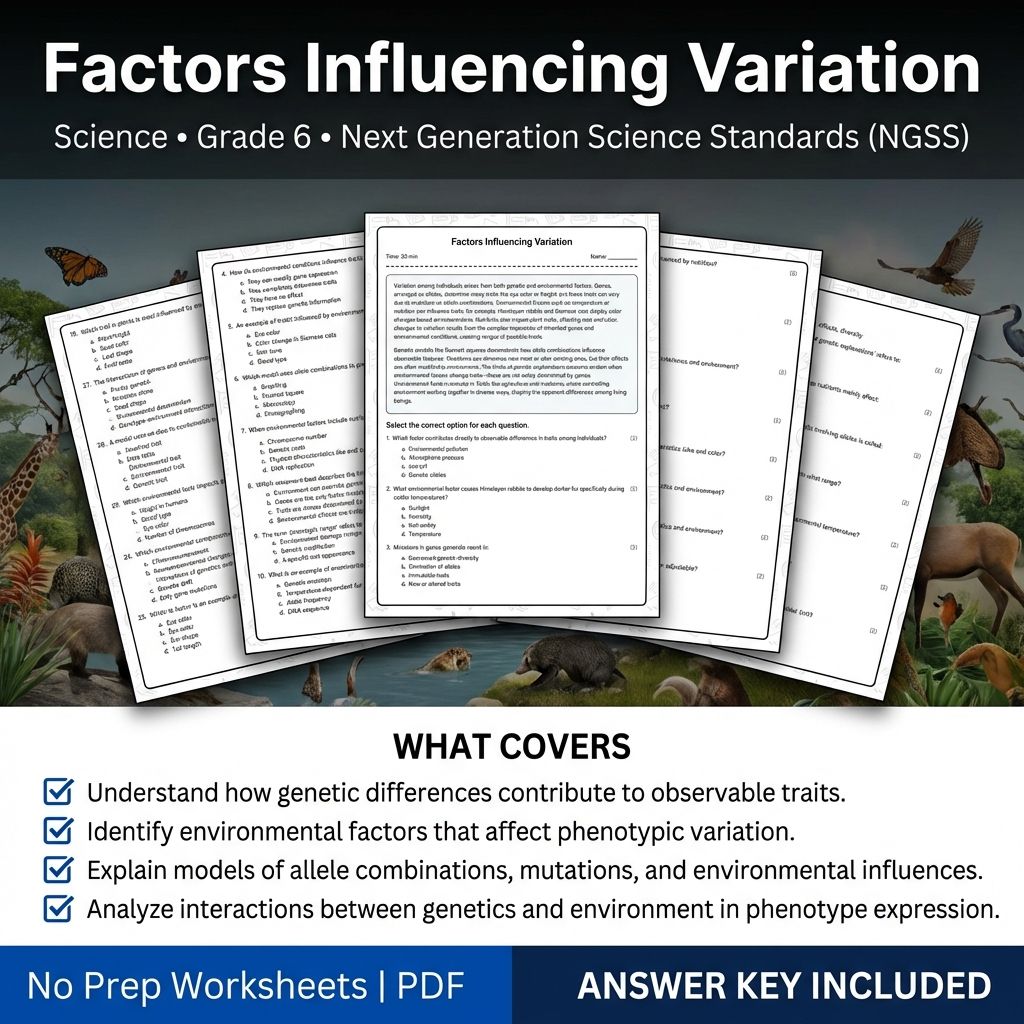
6th Grade Science | Factors Influencing Variation Worksheet & Answer Key
Created byCoral Reef LearningLearning Objectives
- Understand how genetic differences contribute to observable traits.
- Identify environmental factors that affect phenotypic variation.
- Explain models of allele combinations, mutations, and environmental influences.
Instant download

Grade 6 Behavioral Strategies Worksheet with Answer Key | Florida NGSSS Science Skills
 Created byEvergreen Desk Education
Learning Objectives
- Explain how behavioral adaptations help organisms survive in changing environments.
- Compare different behavioral strategies such as migration, hibernation, and daily timing.
- Describe how behaviors work alongside structural and physiological traits.
Instant download

Energy From the Sun Science Worksheet Grade 6 | Florida NGSSS Activity
Created byEvergreen Desk EducationLearning Objectives
- Explain how the angle of incoming solar energy changes heating on Earth’s surface.
- Describe how unequal heating drives differences in temperature, air movement, and ocean circulation.
- Connect energy transfers in the atmosphere and oceans to daily weather and seasonal climate patterns.
Instant download
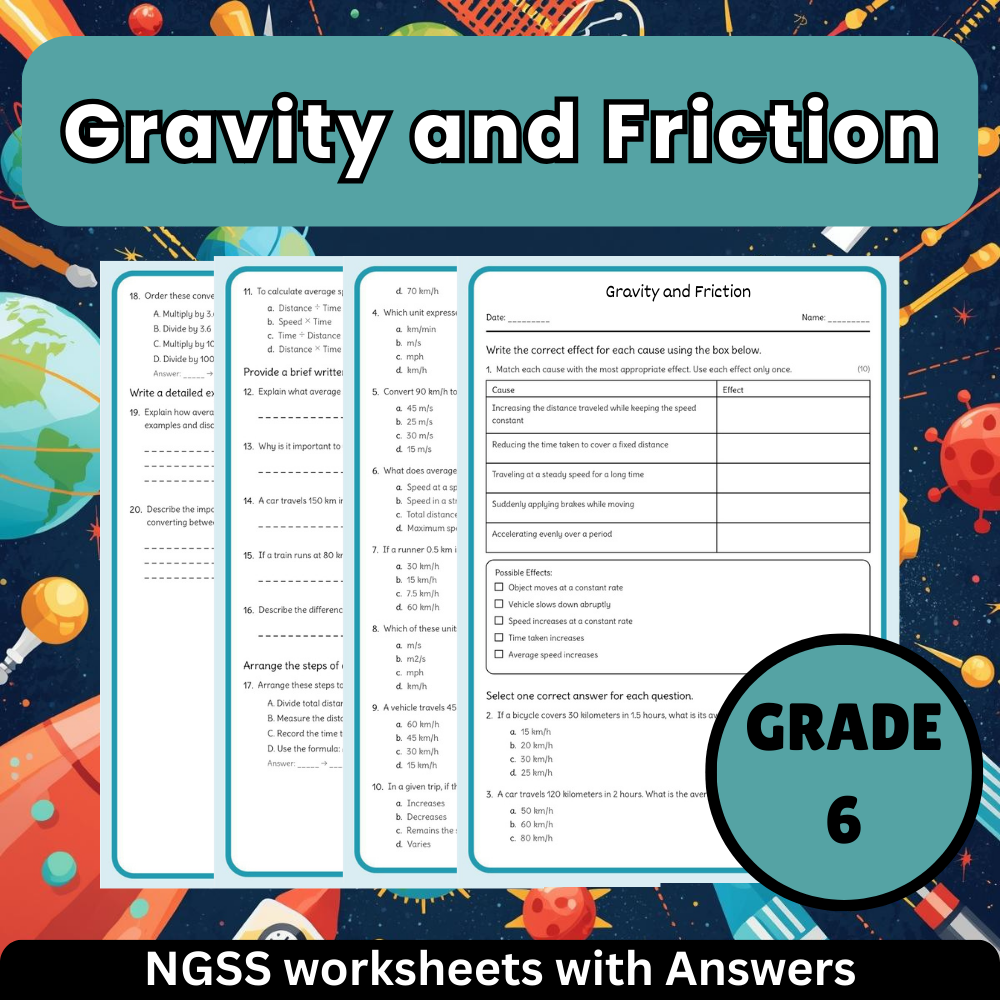
6th Grade Science | Gravity and Friction Worksheet + Answer Key (NGSS)
Created byBright Mind ResourcesLearning Objectives
- Understand how gravitational force depends on mass and distance.
- Differentiate between contact forces like friction and action-at-a-distance forces like gravity.
- Explain examples of gravitational interactions in the solar system and everyday life.
Also included in: Grade 6 Science Unit Bundle – Forces, Motion & Magnetism Worksheets (NGSS) +2 more
Instant download

Grade 6 Motives and Choices Worksheet | Character Analysis Activity
Created bySunny Desk ResourcesLearning Objectives
- Identify a character’s motive by using details from the text and context
- Explain how a character’s choice leads to consequences later in the story
- Connect evidence from moments in the text to inferences about goals, fears, or loyalties
Also included in: Reading Literature Lesson Bundle | Grade 6 ELA | General ELA +1 more
Instant download
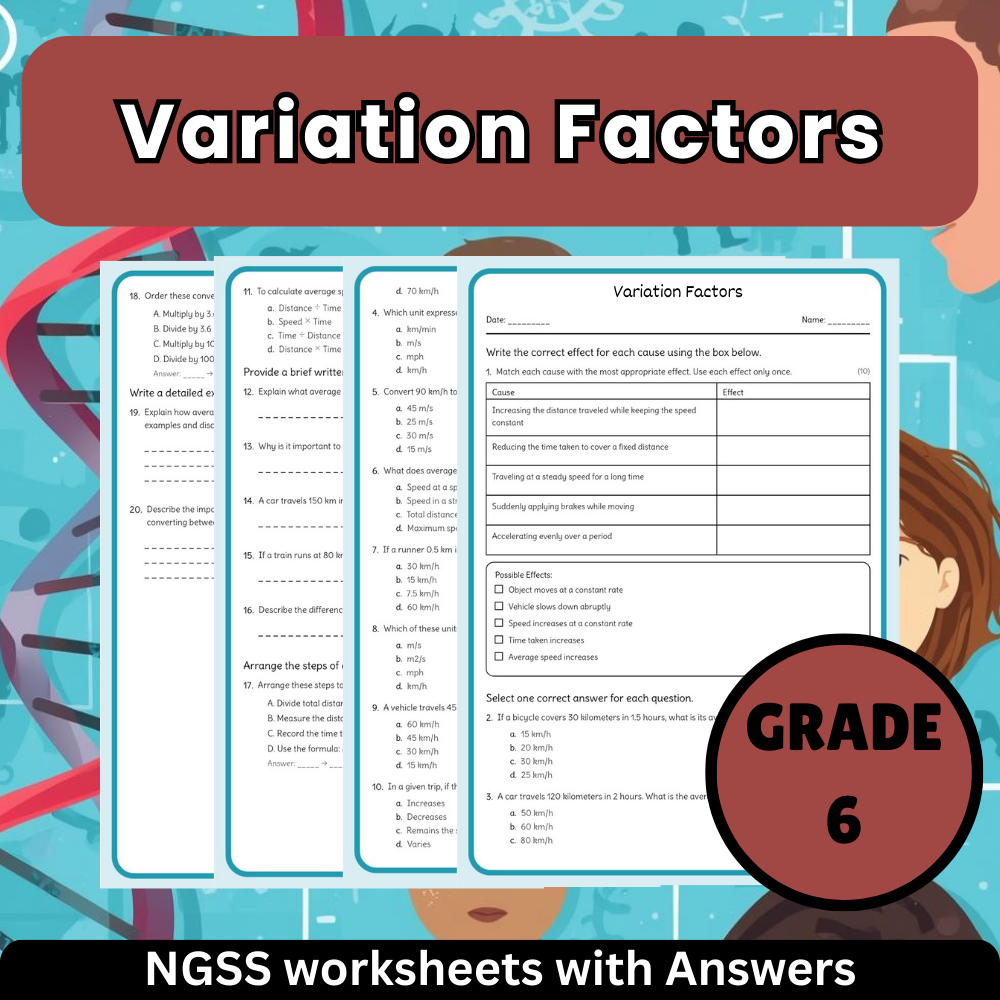
Grade 6 Science | Variation Factors Worksheet (Answer Key) aligned with NGSS
Created byBright Mind ResourcesLearning Objectives
- Understand how genetic factors contribute to observable variation among individuals.
- Explain how environmental factors influence phenotypic traits.
- Recognize models of allele combinations and mutation impacts on traits.
Also included in: Grade 6 Science Unit Bundle | Variation & Inheritance Worksheets (NGSS Aligned) +2 more
Instant download
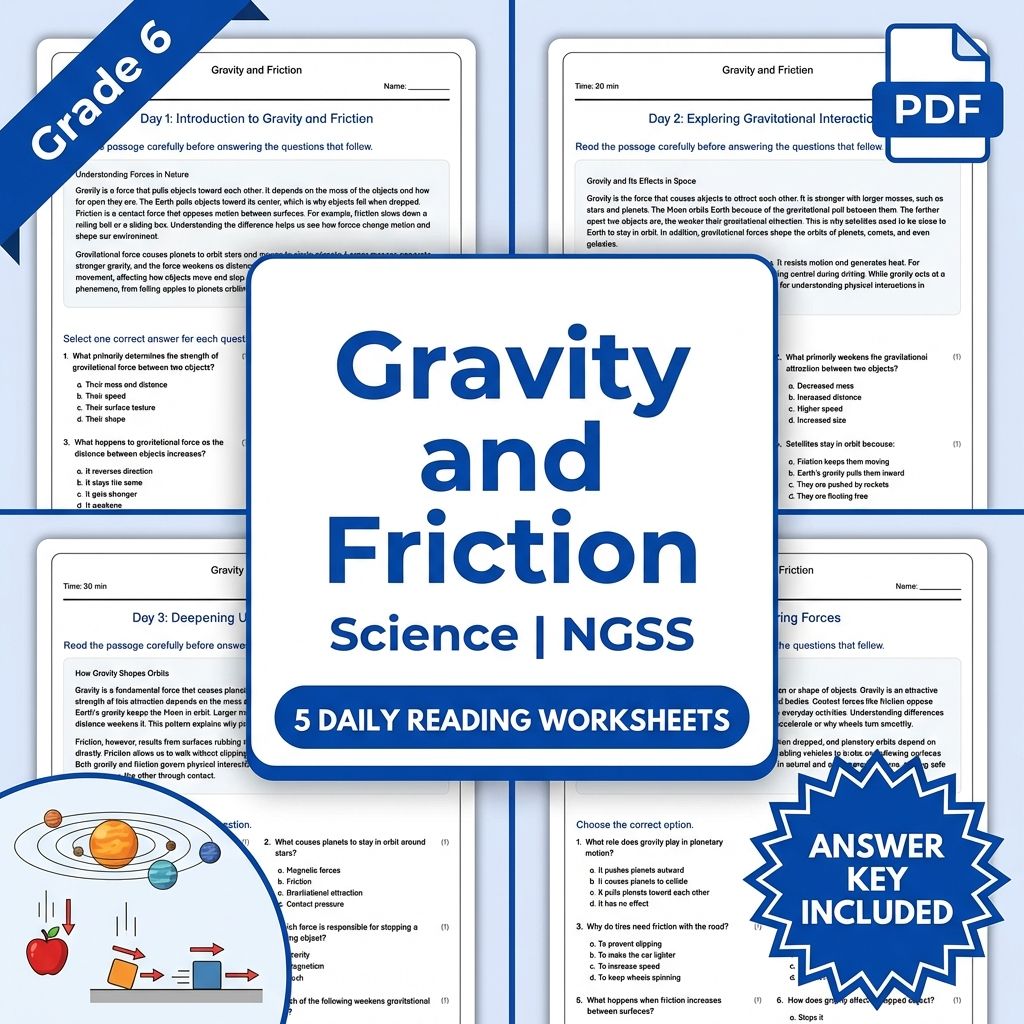
6th Grade Science | Gravity and Friction Worksheet (PDF+ Answer Key)
Created byCopper Leaf ClassroomLearning Objectives
- Understand how gravitational force depends on mass and distance.
- Identify examples of gravitational interactions such as planetary orbits and falling objects.
- Distinguish between attractive (gravitational) and contact (friction) forces.
Instant download
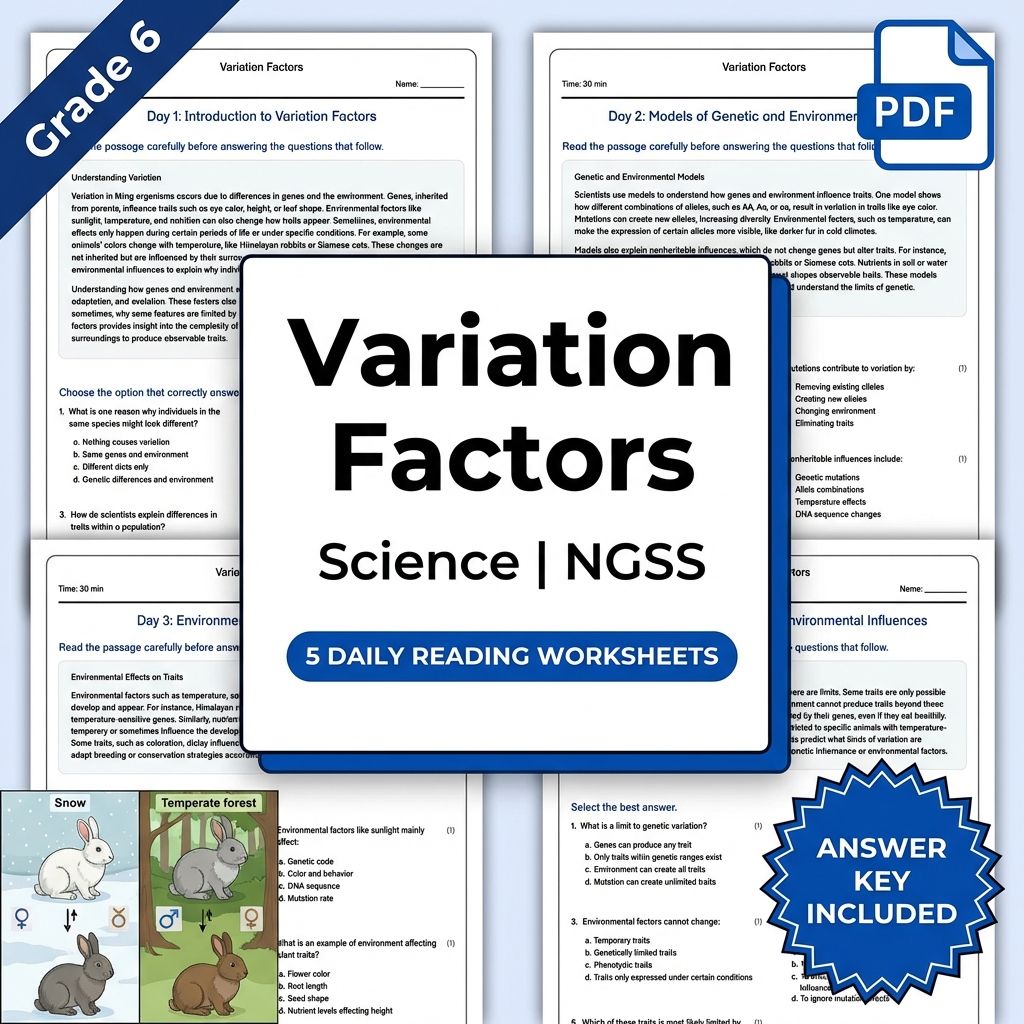
6th Grade Science | Variation Factors Daily Reading Worksheet (PDF+ Answer Key)
Created byCopper Leaf ClassroomLearning Objectives
- Understand how genetic differences and environmental factors contribute to observable variation among individuals.
- Identify models of allele combinations and mutation impacts on traits.
- Explain how environmental influences like temperature and nutrients affect phenotypic traits.
Instant download

6th Grade Science Material Cycling Worksheet | California Standards PDF
Created byEvergreen Desk EducationLearning Objectives
- Explain how rocks break down and form sediments through physical and chemical weathering.
- Describe how sediments move, deposit, and build up layers over time.
- Connect biological processes to the formation of soil and the cycling of water.
Instant download

6th Grade Science Evaporation & Transpiration Worksheet | California PDF
Created byEvergreen Desk EducationLearning Objectives
- Explain how evaporation and transpiration release water vapor into the atmosphere.
- Describe how temperature and the availability of liquid water affect the amount of water vapor.
- Connect phase changes to the water cycle, including condensation and precipitation.
Instant download

Grade 6 Understanding Limiting Resources Worksheet | California Science PDF
Created byEvergreen Desk EducationLearning Objectives
- Explain how limiting resources affect population growth in an ecosystem
- Identify examples of limiting factors such as nutrients, water, space, and sunlight
- Describe how organisms may respond to scarcity through competition or changing behavior
Instant download

Effective Listening Worksheet Pack | Grade 6 ELA Practice
Created bySunny Desk ResourcesLearning Objectives
- Identify and practice active listening behaviors during group discussions
- Summarize oral information accurately and use details to support understanding
- Recognize how perspective-taking improves comprehension of others’ ideas
Also included in: Presenting Ideas, Discussions & Effective Listening Lesson Bundle | Grade 6 ELA | Common Core +1 more
Instant download

Point of View Worksheet Pack | Grade 6 ELA Practice
Created bySunny Desk ResourcesLearning Objectives
- Explain how an author’s point of view affects the way information is presented in a text.
- Identify bias or perspective by analyzing language choices, tone, and evidence.
- Compare statements to determine whether they reflect a neutral perspective or a specific viewpoint.
Also included in: Grade 6 Reading Comprehension Strategies Lesson Bundle | ELA | CCSS +1 more
Instant download

Integrating Knowledge Worksheet Pack | Grade 6 ELA Practice
Created bySunny Desk ResourcesLearning Objectives
- Integrate information from multiple informational texts on the same topic to build a clearer understanding
- Compare perspectives across sources and explain how they support or differ
- Synthesize key insights by cross-referencing details and using evidence from texts
Also included in: Grade 6 Reading Comprehension Strategies Lesson Bundle | ELA | CCSS +1 more
Instant download

6th Grade ELA | Effective Listening Worksheet (PDF) Aligned to CCSS
Created byGolden Apple StudioLearning Objectives
- Use active listening strategies (attention, paraphrasing, and clarifying) during group discussions.
- Interpret spoken ideas accurately by identifying claims and supporting reasons.
- Explain how different perspectives can lead to different interpretations or solutions.
Also included in: Grade 6 ELA Bundle – Presenting Ideas, Persuasive Techniques & Listening +1 more
Instant download

Grade 6 ELA | Cause and Effect Worksheet Elena | Alberta Standard
 Created byLumora Learning
Learning Objectives
- Identify causes and effects in a text, including direct, indirect, and cumulative relationships.
- Distinguish between stated reasons and implied effects when analyzing narrative and informational writing.
- Use cause-and-effect transition words (because, therefore, as a result) to explain how one event leads to another.
Instant download

Grade 6 ELA | Caption Meanings Worksheet | Alberta Standard
Created byLumora LearningLearning Objectives
- Explain how captions help readers interpret images, diagrams, and photographs accurately.
- Identify the purpose of caption details such as definitions, context, limitations, and sources.
- Use caption meanings to avoid misreading and connect visuals to an author’s main point.
Instant download
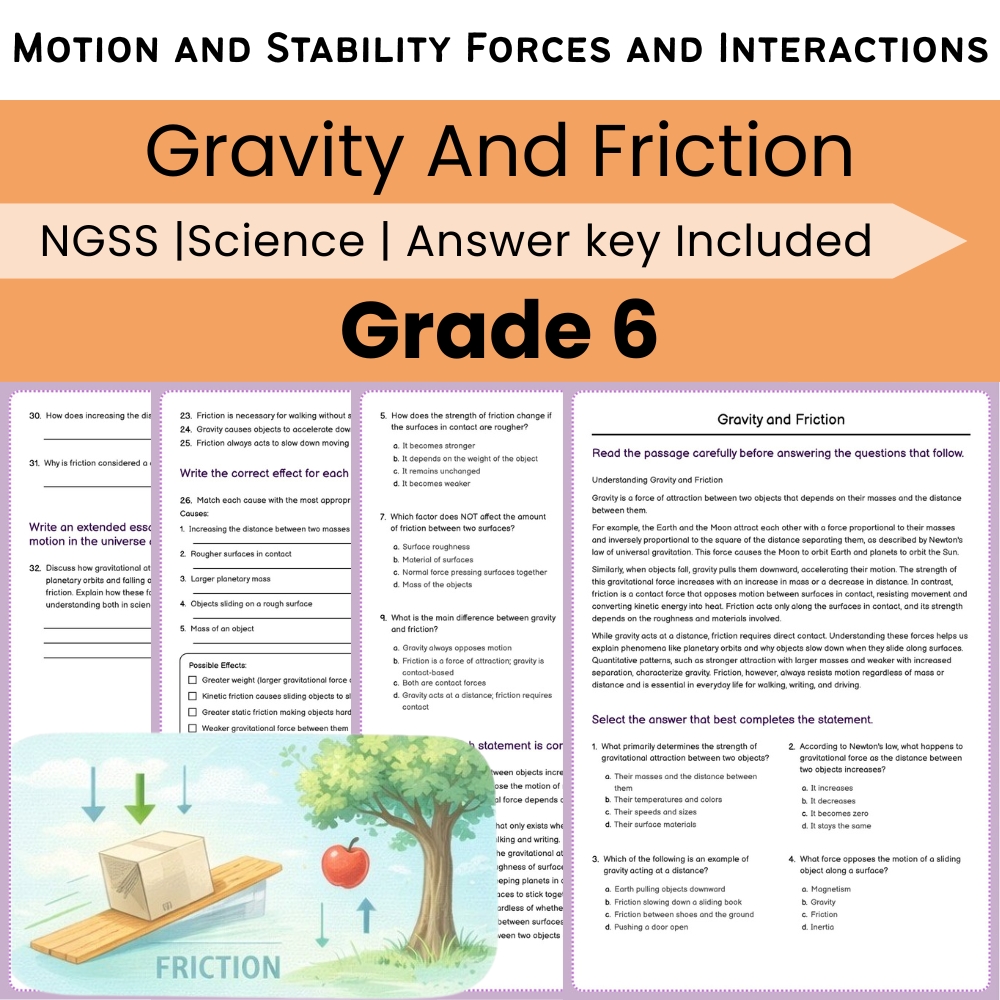
Gravity and Friction Science Worksheet | Grade 6 NGSS Printable PDF
Learning Objectives
- Explain how gravitational attraction depends on mass and distance between objects.
- Differentiate between gravitational forces and contact forces like friction.
- Use examples such as planetary orbits, Earth-Moon interactions, and falling objects to illustrate gravity.
Also included in: Grade 6 Science | Forces and Motion NGSS Unit Bundle (4 Worksheets Included) +1 more
Instant download
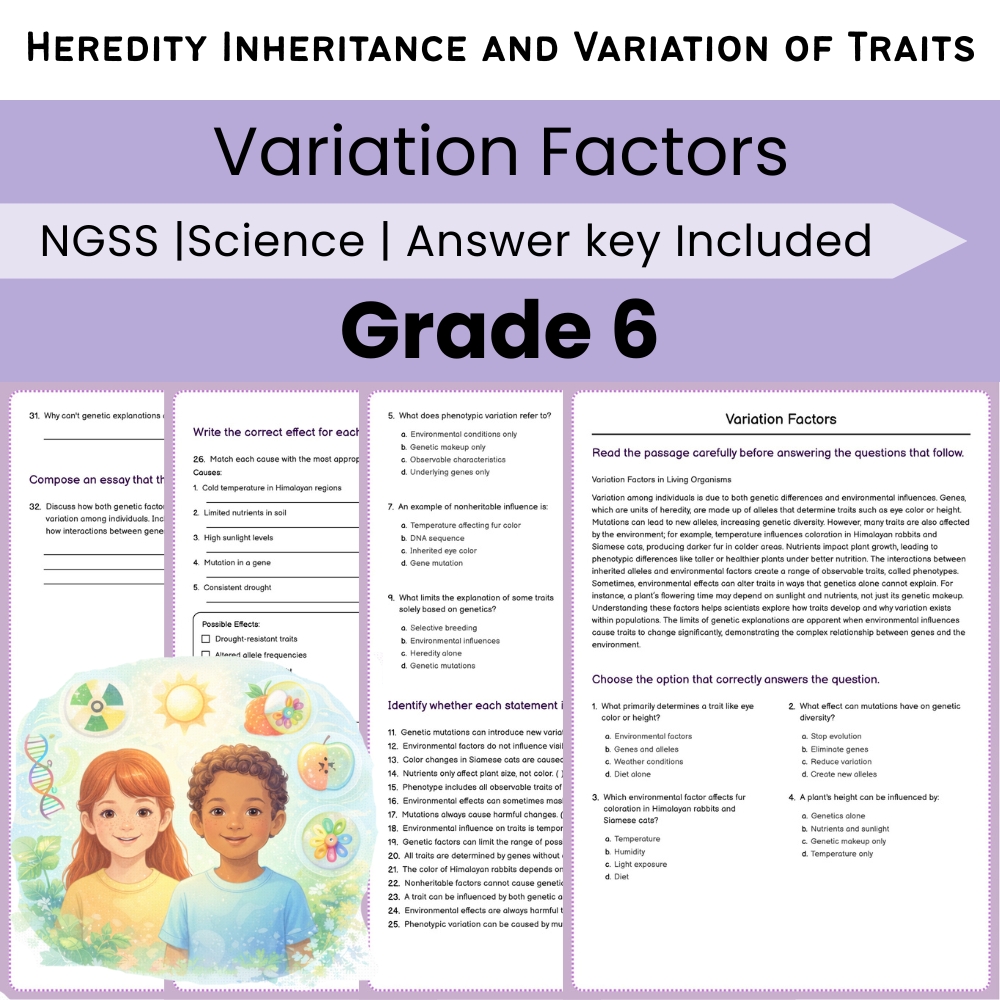
Variation Factors Worksheet | Grade 6 Science Printable PDF | NGSS
Learning Objectives
- Explain how genetic differences and environmental factors contribute to observable variations among individuals.
- Identify models of allele combinations and mutation impacts on traits.
- Describe nonheritable influences such as temperature-dependent coloration and nutrient effects on plants.
Also included in: Grade 6 Science INHERITANCE & VARIATION UNIT | Heredity NGSS Worksheet Bundle (2 Worksheets) +1 more
Instant download
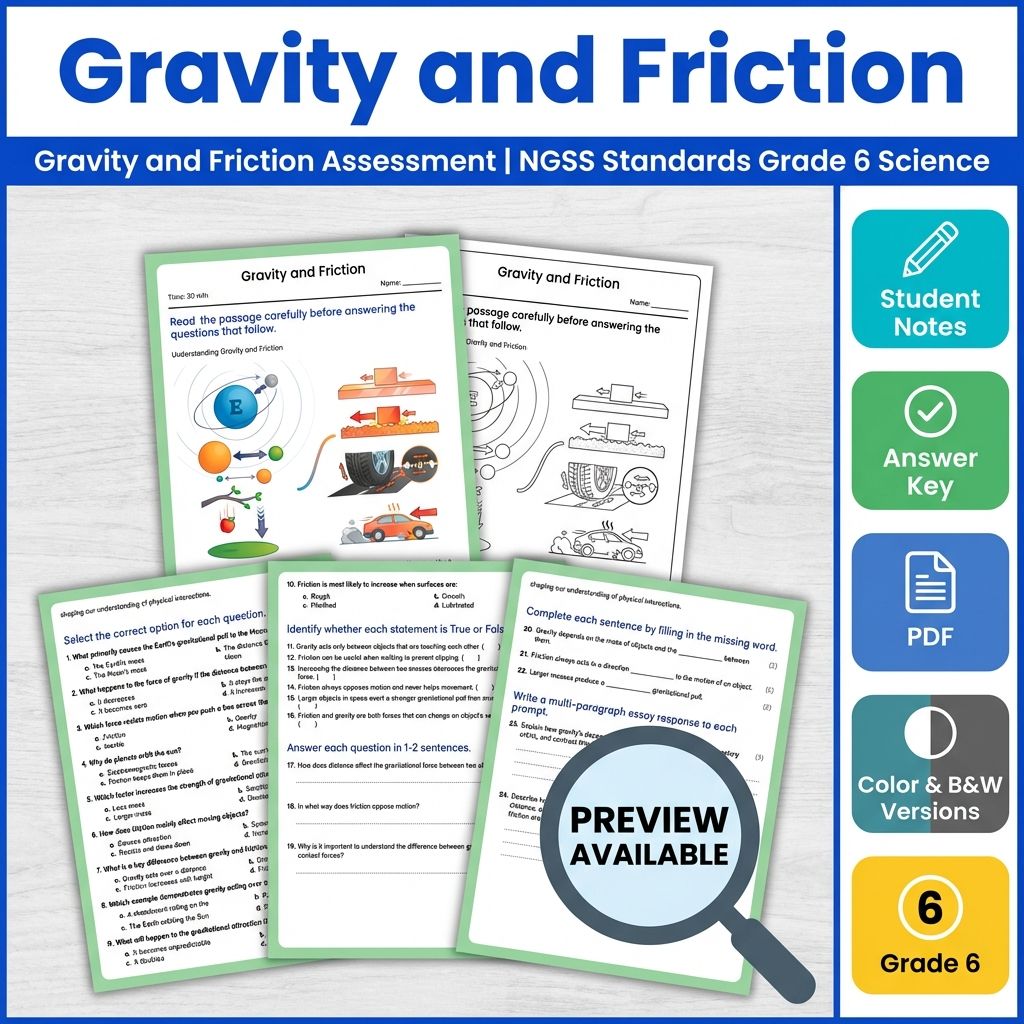
Gravity and Friction Assessment | NGSS Standards Grade 6 Science
Created byPrism Point LearningLearning Objectives
- Explain how gravity depends on mass and distance, using examples like Earth-Moon interactions and planetary orbits.
- Describe how contact forces like friction resist motion and differ from gravitational forces.
- Analyze quantitative patterns showing stronger attraction with larger masses and weaker attraction with increased distance.
Also included in: Grade 6 Science Mini Bundle | Forces and Interactions NGSS Standards +1 more
Instant download
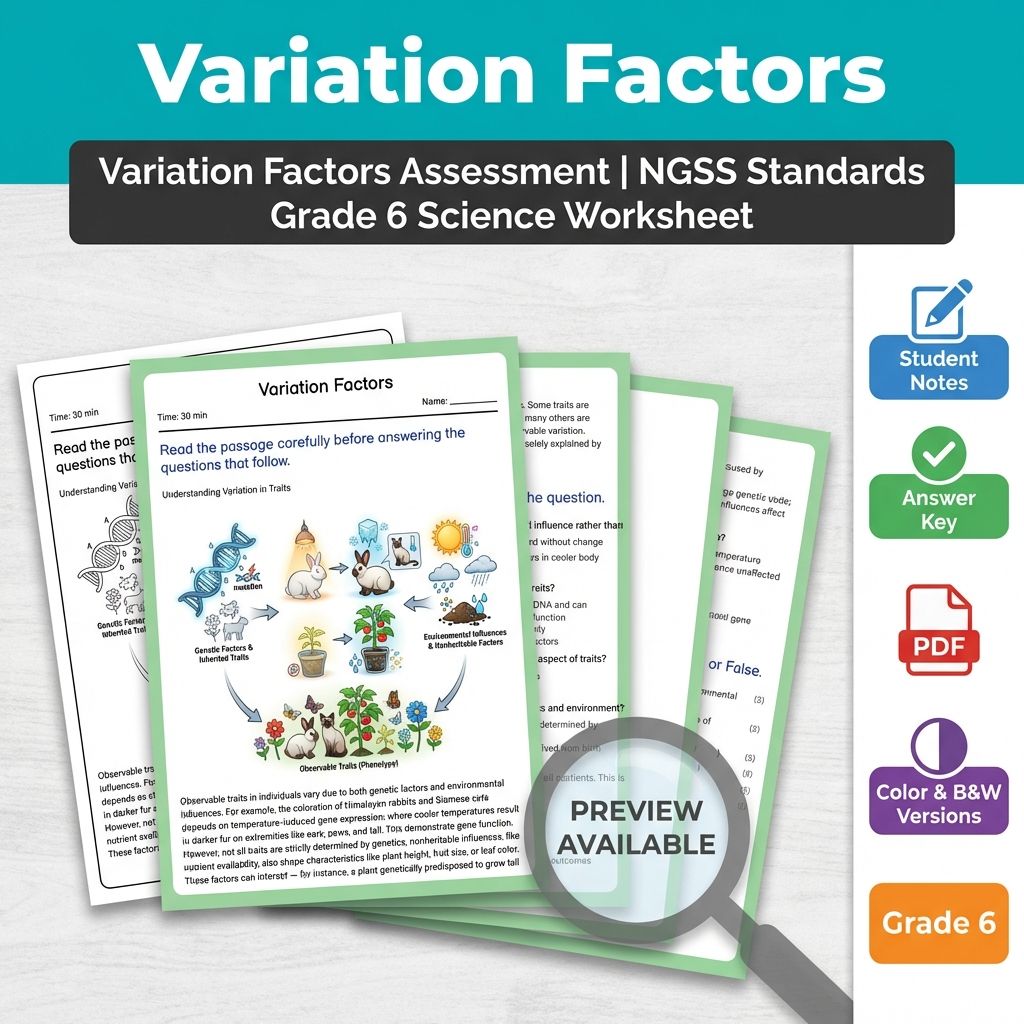
Variation Factors Assessment | NGSS Standards Grade 6 Science Worksheet
Created byPrism Point LearningLearning Objectives
- Understand how genetic differences and environmental factors contribute to observable traits.
- Explain models of allele combinations, mutations, and environmental influences on phenotype.
- Identify the limits of genetic explanations for traits affected by environmental conditions.
Also included in: Grade 6 Science Mini Bundle | Heredity, Inheritance & Traits NGSS +1 more
Instant download

Grade 6 Science Worksheet | Understanding Solar Timekeeping (PDF)
Created byEvergreen Desk EducationLearning Objectives
- Explain how apparent solar motion and local solar noon are used to measure solar time.
- Compare solar time and clock time and identify why they can differ.
- Describe how longitude, time zones, and the equation of time affect timekeeping.
Instant download

6th Grade Science | Eclipses and Alignments Worksheet (PDF)
Created byEvergreen Desk EducationLearning Objectives
- Explain how the alignment of the Sun, Earth, and Moon determines whether an eclipse is solar or lunar and whether it is partial or total.
- Describe how orbital inclination and the Moon’s tilted orbit affect where eclipses are visible on Earth.
- Use eclipse vocabulary (umbra, penumbra, antumbra) to interpret predictions and observations.
Instant download

Material Cycling Worksheet Grade 6 Science Cycles of Matter Practice
Created byPrism Point LearningLearning Objectives
- Explain how physical and chemical weathering break rocks into sediments
- Describe how sediments move and deposit to form layered materials over time
- Connect biological processes to the formation of soil and nutrient availability
Also included in: Grade 6 Water Cycle Systems Lesson Bundle | California Standards
Instant download

Evaporation and Transpiration Worksheet Grade 6 Water Cycle Science
Created byPrism Point LearningLearning Objectives
- Explain how evaporation adds water vapor to the atmosphere when temperatures increase.
- Describe how transpiration from plants contributes water vapor to the air.
- Connect phase changes to the hydrosphere and atmosphere and the start of precipitation.
Also included in: Grade 6 Water Cycle Systems Lesson Bundle | California Standards
Instant download

Limiting Resources Worksheet | Grade 6 Ecosystems Science Practice
Created byPrism Point LearningLearning Objectives
- Explain how limiting resources affect population size in an ecosystem.
- Identify examples of limiting resources such as nutrients, water, and space.
- Describe how organisms may respond when resources become scarce.
Also included in: Animals Matter Lesson Bundle | Grade 6 Science | California Standards
Instant download

6th Grade ELA Point of View Worksheet – Common Core (PDF)
Created byGolden Apple StudioLearning Objectives
- Explain how an author’s point of view affects what information is included and how it is presented.
- Identify bias or perspective by analyzing word choice, tone, and supporting evidence.
- Compare how different viewpoints can lead to different interpretations of the same situation.
Also included in: Grade 6 ELA Reading & Text Analysis Lesson Bundle | CCSS +1 more
Instant download
Browse more categories
About Reading comprehension Worksheets
Find reading comprehension worksheets for class practice, homework, or self-study. All 40,289 are instant PDF downloads.
Each resource here is built by an independent educator and reviewed for quality. Worksheets print straight from PDF and suit classroom use, homework, or extra practice; most come with answer keys, and you can preview before purchasing.