
Reading comprehension Worksheets
40,289 type resources
Evaporation and Transpiration Worksheet Grade 6 Water Cycle Science
 Created byPrism Point Learning
Learning Objectives
- Explain how evaporation adds water vapor to the atmosphere when temperatures increase.
- Describe how transpiration from plants contributes water vapor to the air.
- Connect phase changes to the hydrosphere and atmosphere and the start of precipitation.
Also included in: Grade 6 Water Cycle Systems Lesson Bundle | California Standards
Instant download

Limiting Resources Worksheet | Grade 6 Ecosystems Science Practice
Created byPrism Point LearningLearning Objectives
- Explain how limiting resources affect population size in an ecosystem.
- Identify examples of limiting resources such as nutrients, water, and space.
- Describe how organisms may respond when resources become scarce.
Also included in: Animals Matter Lesson Bundle | Grade 6 Science | California Standards
Instant download

6th Grade ELA Point of View Worksheet – Common Core (PDF)
 Created byGolden Apple Studio
Learning Objectives
- Explain how an author’s point of view affects what information is included and how it is presented.
- Identify bias or perspective by analyzing word choice, tone, and supporting evidence.
- Compare how different viewpoints can lead to different interpretations of the same situation.
Also included in: Grade 6 ELA Reading & Text Analysis Lesson Bundle | CCSS +1 more
Instant download

6th Grade ELA – Integrating Knowledge Worksheet (PDF) – CCSS Aligned
Created byGolden Apple StudioLearning Objectives
- Integrate and compare information from two informational texts about related topics.
- Explain how different perspectives shape what each author emphasizes and how evidence is used.
- Synthesize key insights by combining ideas without confusing the sources.
Also included in: Grade 6 ELA Reading & Text Analysis Lesson Bundle | CCSS +1 more
Instant download

Behavioral Adaptations Worksheet Grade 6 Science | Animal Survival
Created byPrism Point LearningLearning Objectives
- Explain how behavioral adaptations help organisms survive by reducing risk from predators and harsh environmental conditions.
- Compare examples of behavioral adaptations such as migration, hibernation, nesting, and burrowing.
- Describe how behavioral adaptations can work together with structural and physiological traits.
Instant download

Energy From the Sun Worksheet | Grade 6 Weather & Climate Science
Created byPrism Point LearningLearning Objectives
- Explain how the angle of incoming solar energy affects Earth’s temperature patterns.
- Describe how unequal heating drives air movement and influences ocean circulation.
- Connect energy transfers in the atmosphere and oceans to daily weather and seasonal climate changes.
Also included in: Grade 6 Weather & Climate Science Lesson Bundle | Florida NGSSS
Instant download
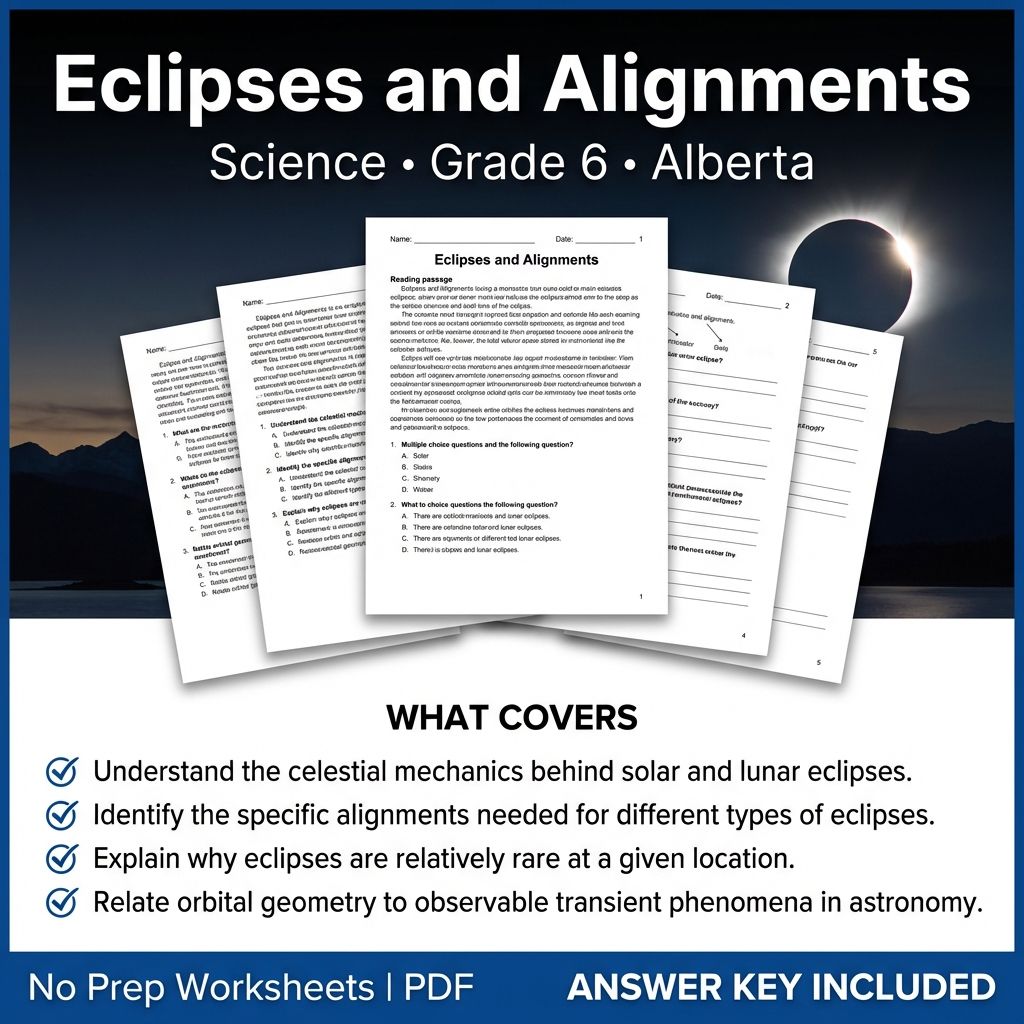
Grade 6 Science Worksheet on Eclipses and Alignments | Alberta Standards
 Created byCoral Reef Learning
Learning Objectives
- Understand the celestial mechanics behind solar and lunar eclipses.
- Identify the specific alignments needed for different types of eclipses.
- Explain why eclipses are relatively rare at a given location.
Instant download
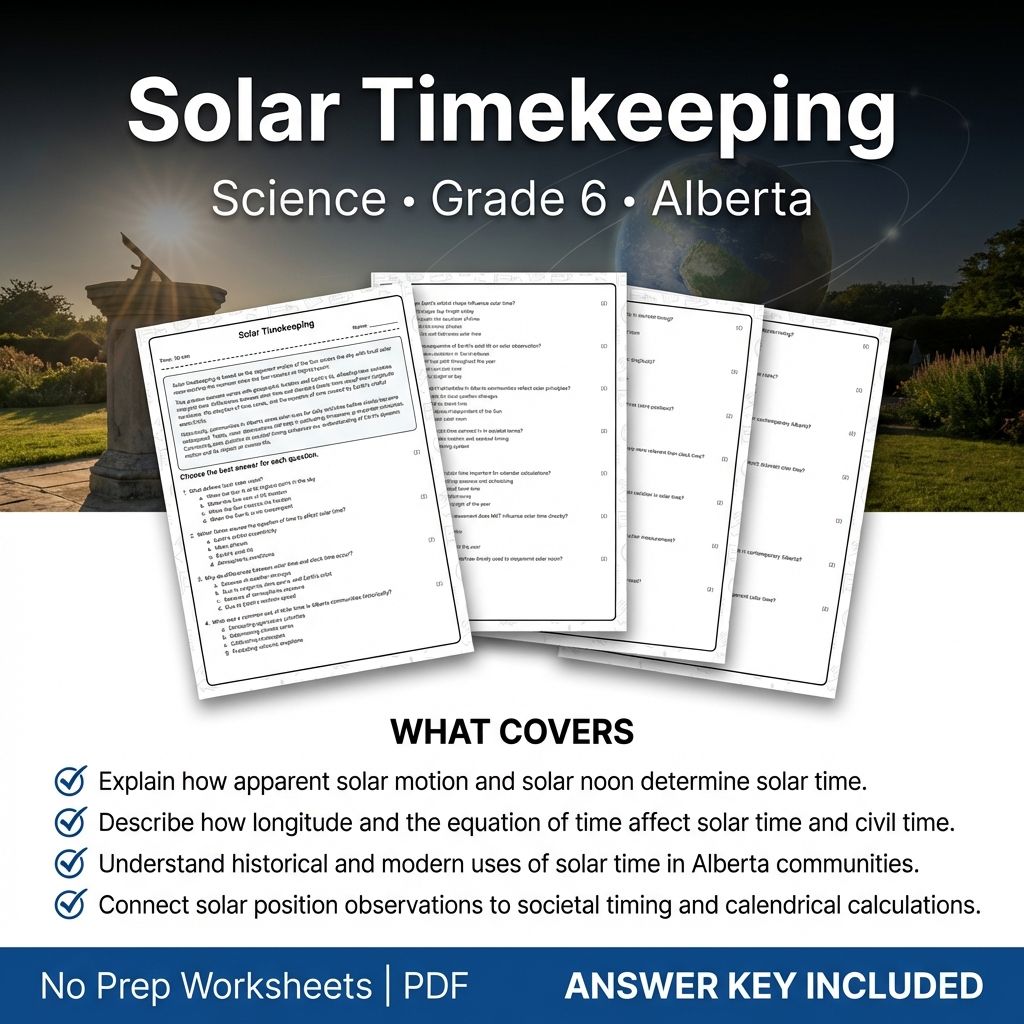
Grade 6 Science Worksheet on Solar Timekeeping | Alberta Standards
Created byCoral Reef LearningLearning Objectives
- Explain how apparent solar motion and solar noon determine solar time.
- Describe how longitude and the equation of time affect solar time and civil time.
- Understand historical and modern uses of solar time in Alberta communities.
Instant download
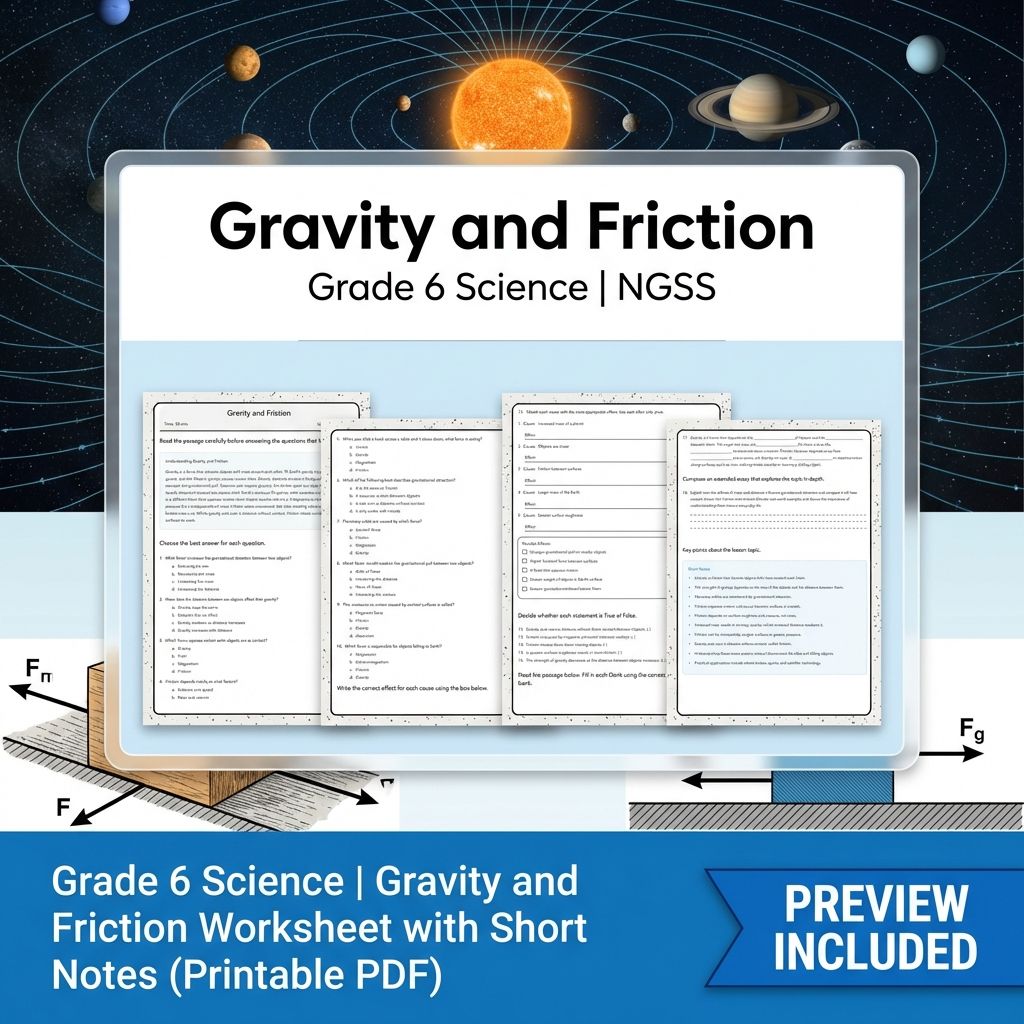
Grade 6 Science | Gravity and Friction Worksheet with Short Notes (PDF)
 Created byMeadowlark Worksheets
Learning Objectives
- Explain how gravitational attraction depends on mass and distance.
- Identify examples of gravitational interactions such as planetary motion and falling objects.
- Differentiate between contact forces like friction and non-contact forces like gravity.
Also included in: Grade 6 Science | Forces & Motion Unit Bundle NGSS Aligned Worksheets +1 more
Instant download
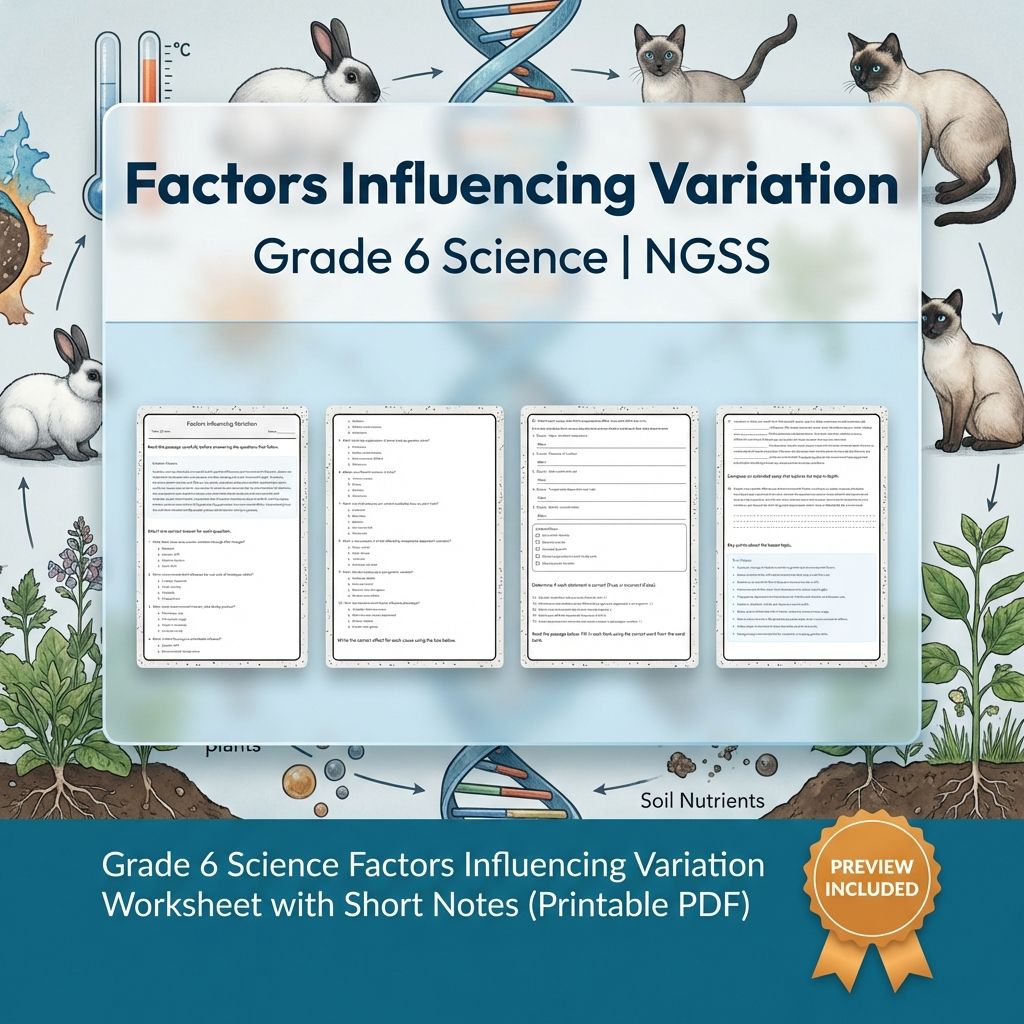
Grade 6 Science Factors Influencing Variation Worksheet with Short Notes (PDF)
Created byMeadowlark WorksheetsLearning Objectives
- Understand how genetic and environmental factors contribute to observable traits.
- Explain examples like allele combinations, mutations, and nonheritable influences.
- Analyze interactions between inherited genes and environmental conditions.
Also included in: Grade 6 Science | Heredity: Inheritance & Variation NGSS Unit | Worksheets +1 more
Instant download

Cause and Effect Worksheet Pack Grade 6 ELA Practice
 Created bySunny Desk Resources
Learning Objectives
- Identify causes and effects in narrative and informational text.
- Distinguish between stated reasons and implied effects.
- Use cause-and-effect transition words (because, therefore, as a result) to connect ideas clearly.
Also included in: Grade 6 Reading and Viewing Lesson Bundle | Alberta ELA Framework +1 more
Instant download

Caption Meanings Worksheet Pack | Grade 6 ELA Activities
Created bySunny Desk ResourcesLearning Objectives
- Explain how captions help readers interpret images and diagrams accurately
- Identify the purpose of caption details such as definitions, context, sources, and limitations
- Use caption information to make correct inferences about what the author wants the reader to notice
Also included in: Grade 6 Reading and Viewing Lesson Bundle | Alberta ELA Framework +1 more
Instant download

6th Grade Science | Reasoning Claims Worksheet (TEKS) PDF
 Created byEvergreen Desk Education
Learning Objectives
- Explain the difference between raw observations and explanatory science claims.
- Use evidence to decide whether a scientific claim is strongly supported or weakly supported.
- Interpret patterns in data to strengthen (or question) an inference.
Instant download

6th Grade Science Worksheet | Population Dynamics TEKS (PDF)
Created byEvergreen Desk EducationLearning Objectives
- Explain how population size changes over time using exponential and logistic growth ideas
- Define carrying capacity and identify limiting factors that reduce population growth
- Differentiate density-dependent and density-independent influences on populations
Instant download

6th Grade Science Worksheet – Adaptation Patterns TEKS Alignment (PDF)
Created byEvergreen Desk EducationLearning Objectives
- Identify morphological, physiological, and behavioral adaptations that help organisms survive in specific environments.
- Explain how inherited traits can improve survival, predator avoidance, and reproductive success.
- Compare how different environments (desert vs. temperate regions) favor different adaptation patterns.
Instant download
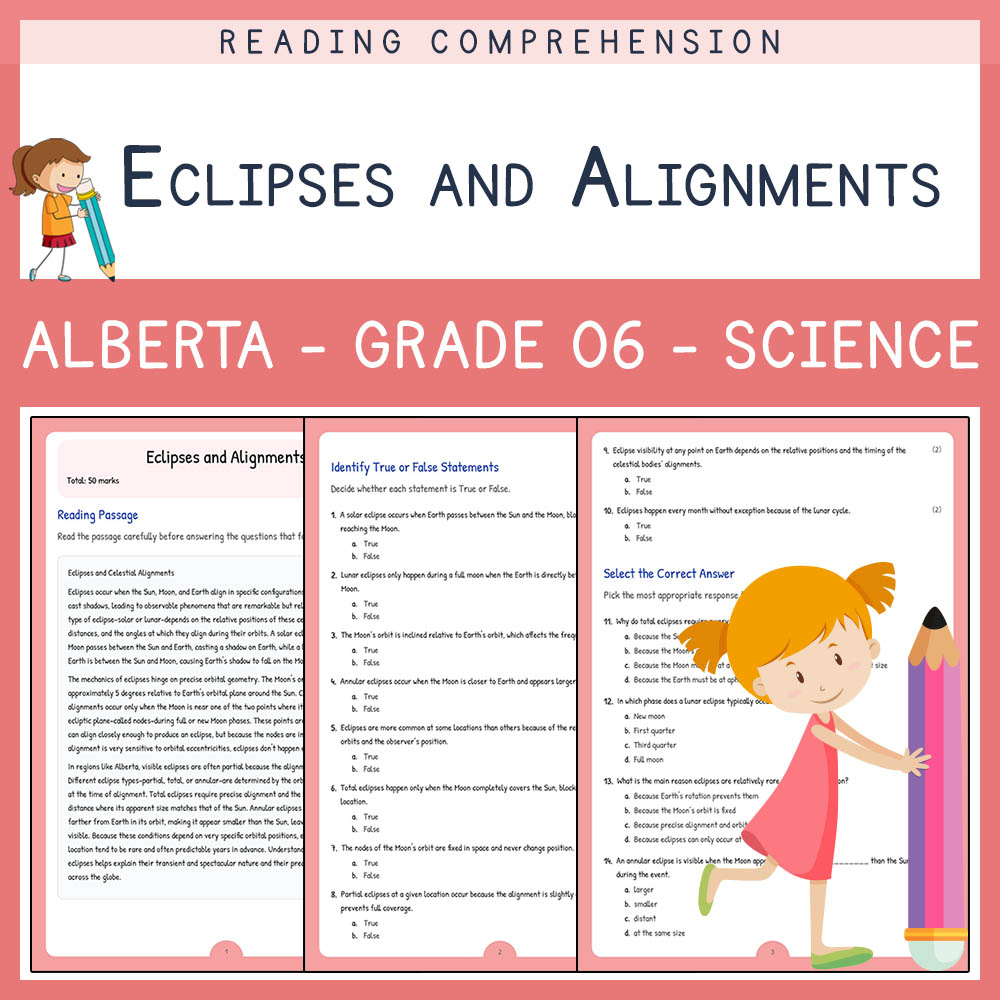
Grade 6 Science Assessment | Eclipses and Alignments Worksheet | Alberta
 Created byLumora Learning
Learning Objectives
- Understand the celestial mechanics behind solar and lunar eclipses.
- Describe the conditions necessary for partial, total, and annular eclipses.
- Explain why eclipses are relatively rare at specific locations like Alberta.
Instant download
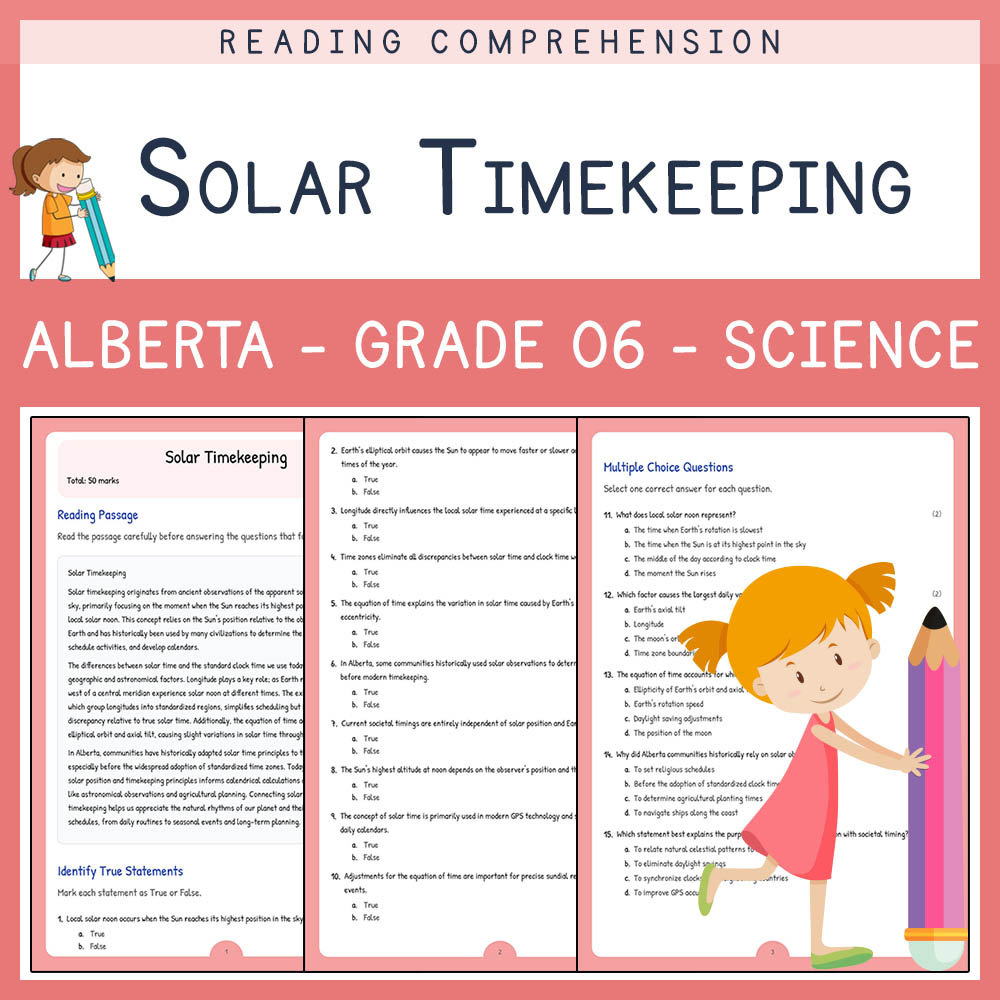
Grade 6 Science Worksheet | Solar Timekeeping | Alberta Standards Aligned
Created byLumora LearningLearning Objectives
- Understand the principles of solar time and how it differs from clock time.
- Identify the factors affecting solar time, including longitude, time zones, and Earth's orbit.
- Explore historical and contemporary applications of solar time in Alberta communities.
Instant download

Grade 6 Science | Solar Timekeeping - Daily Reading Comprehension
Created byCoral Reef LearningLearning Objectives
- Understand the concept of solar time and how it is based on the Sun's position.
- Learn about the differences between solar time and clock time.
- Recognize the factors that influence solar time, such as longitude and Earth's orbit.
Also included in: Sky Science Lesson Bundle | Grade 6 Science Daily Reading | Alberta +1 more
Instant download

Grade 6 Science | Eclipses & Alignments - Daily Reading Comprehension
Created byCoral Reef LearningLearning Objectives
- Understand the basic types of eclipses: solar, lunar, partial, total, and annular.
- Learn how the positions of the Sun, Earth, and Moon determine the type of eclipse observed.
- Recognize why eclipses are relatively rare at specific locations due to orbital inclinations.
Also included in: Sky Science Lesson Bundle | Grade 6 Science Daily Reading | Alberta +1 more
Instant download
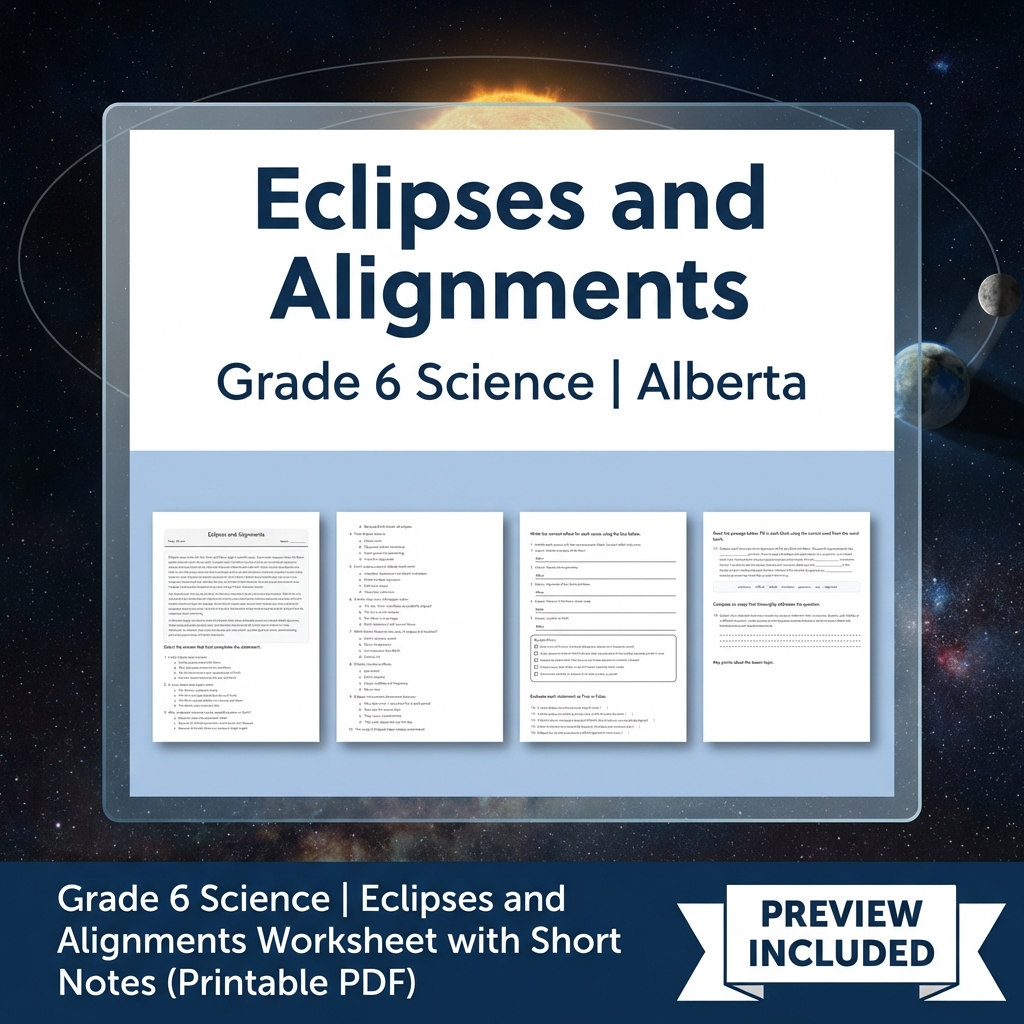
Grade 6 Science | Eclipses and Alignments Worksheet with Short Notes (PDF)
Created byMeadowlark WorksheetsLearning Objectives
- Explain how the Sun, Earth, and Moon align during solar and lunar eclipses.
- Describe why eclipses are relatively rare at specific locations.
- Identify conditions necessary for partial, total, and annular eclipses.
Also included in: Grade 6 Science Sky Science Unit Bundle | Alberta Curriculum Worksheets +1 more
Instant download
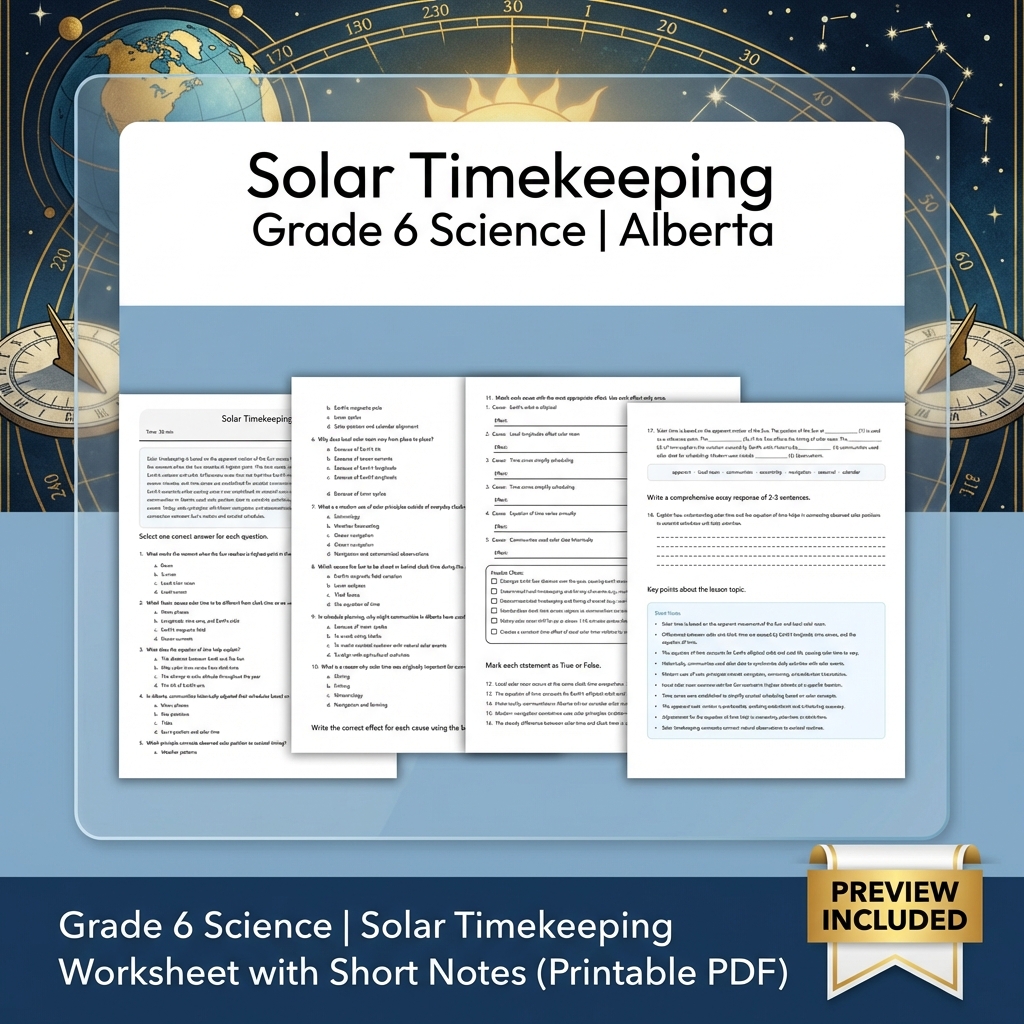
Grade 6 Science | Solar Timekeeping Worksheet with Short Notes (Printable PDF)
Created byMeadowlark WorksheetsLearning Objectives
- Understand how apparent solar motion and local solar noon relate to solar timekeeping.
- Identify factors such as longitude, time zones, and the equation of time that cause differences between solar and clock time.
- Explore the historical and modern applications of solar time in Alberta communities.
Also included in: Grade 6 Science Sky Science Unit Bundle | Alberta Curriculum Worksheets +1 more
Instant download

Solar Timekeeping Worksheet | Grade 6 Science Activities
Created byPrism Point LearningLearning Objectives
- Explain how apparent solar motion relates to solar noon and local solar time.
- Describe why solar time and clock time differ (longitude, time zones, and the equation of time).
- Connect Alberta examples of solar timekeeping to adjustments for civil schedules.
Also included in: Celestial Patterns & Seasons Lesson Bundle | Grade 6 Science | Alberta
Instant download

Eclipses and Alignments Worksheet | Grade 6 Science Activities
Created byPrism Point LearningLearning Objectives
- Explain how near-linear alignment of the Sun, Earth, and Moon leads to solar and lunar eclipses.
- Describe how orbital inclination and imperfect alignment determine whether an eclipse appears partial, total, or annular.
- Connect orbital geometry to why eclipses are relatively rare at a specific location.
Also included in: Celestial Patterns & Seasons Lesson Bundle | Grade 6 Science | Alberta
Instant download

Grade 6 Health Worksheet | Physical Benefits & Fitness (PDF) – Ontario Standards
Created bySunny Desk ResourcesLearning Objectives
- Explain how regular physical activity improves cardiovascular endurance, muscle strength, and flexibility.
- Describe at least two mental health benefits of consistent movement (such as reduced stress and anxiety).
- Identify safe ways to start and maintain a physical activity routine.
Also included in: Grade 6 Active Living Health Lesson Bundle: Ontario Health Skills Framework +1 more
Instant download

Reasoning Claims Worksheet | Grade 6 Science Activities
Created byPrism Point LearningLearning Objectives
- Explain the difference between raw observations and explanatory scientific claims.
- Connect evidence to a claim by describing how data supports reasoning.
- Evaluate whether evidence is strong enough to justify an inference.
Also included in: Grade 6 Scientific Investigation Practices Science Lesson Bundle TEKS +1 more
Instant download

Population Dynamics Worksheet | Grade 6 Science Activities
Created byPrism Point LearningLearning Objectives
- Explain how population size can change over time and distinguish exponential growth from logistic growth.
- Define carrying capacity and describe how limited resources can stabilize or reduce population growth.
- Identify density-dependent and density-independent factors that affect populations, including predator–prey interactions.
Also included in: Grade 6 Ecosystem Interactions Science Lesson Bundle Worksheets | TEKS +1 more
Instant download
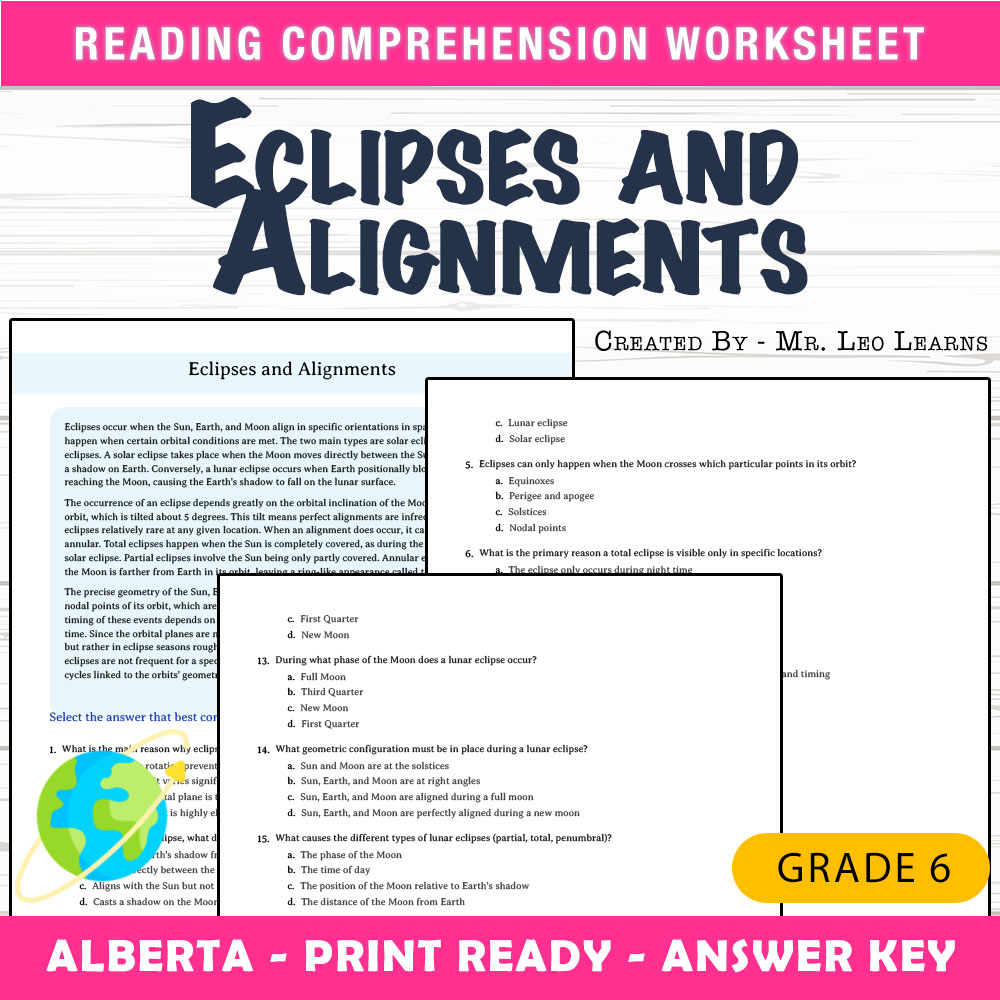
Grade 6 Science — Eclipses and Alignments Worksheet for Mastery
 Created byThe Resource Hub
Learning Objectives
- Understand the conditions leading to solar and lunar eclipses.
- Identify the key celestial alignments necessary for different types of eclipses.
- Explain why eclipses are relatively rare at a specific location and how orbital geometry affects visibility.
Also included in: Grade 6 Science Sky Science Unit Bundle – Celestial Motion & Earth-Sun Relations +1 more
Instant download

6th Grade Health Worksheet – Developing Complex Decision Skills (PDF)
Created bySunny Desk ResourcesLearning Objectives
- Use a step-by-step decision process to evaluate options in health-related situations.
- Apply risk-benefit analysis to compare short-term and long-term outcomes.
- Evaluate how personal values and consequences affect healthier decisions.
Also included in: Grade 6 Decision-Making Skills in Health Lesson Bundle for NHES Framework +1 more
Instant download
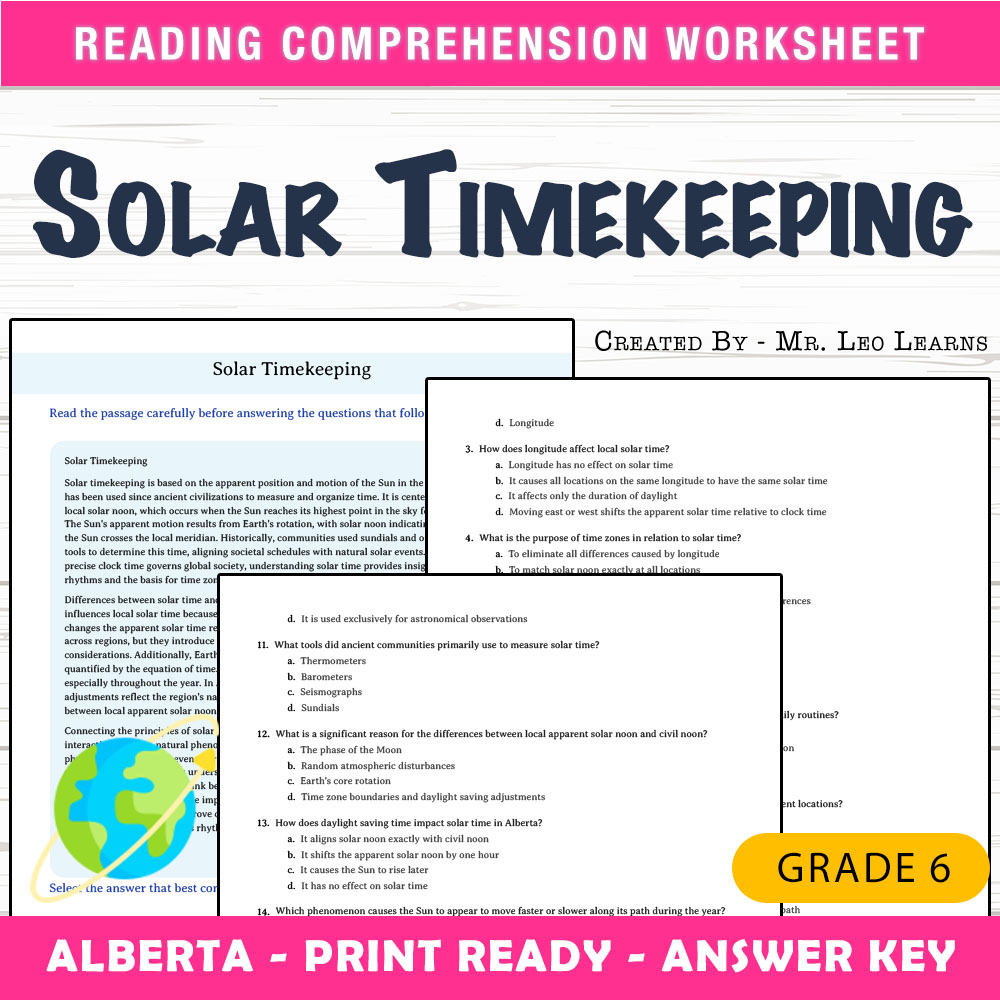
Grade 6 Science — Solar Timekeeping Worksheet MCQ Paper for Mastery
Created byThe Resource HubLearning Objectives
- Explain the principles of solar timekeeping and its connection to apparent solar motion.
- Identify factors that cause differences between solar time and clock time, such as longitude, time zones, and Earth's orbital eccentricity.
- Describe how historical and contemporary communities in Alberta use solar time for scheduling and calendar calculations.
Also included in: Grade 6 Science Sky Science Unit Bundle – Celestial Motion & Earth-Sun Relations +1 more
Instant download
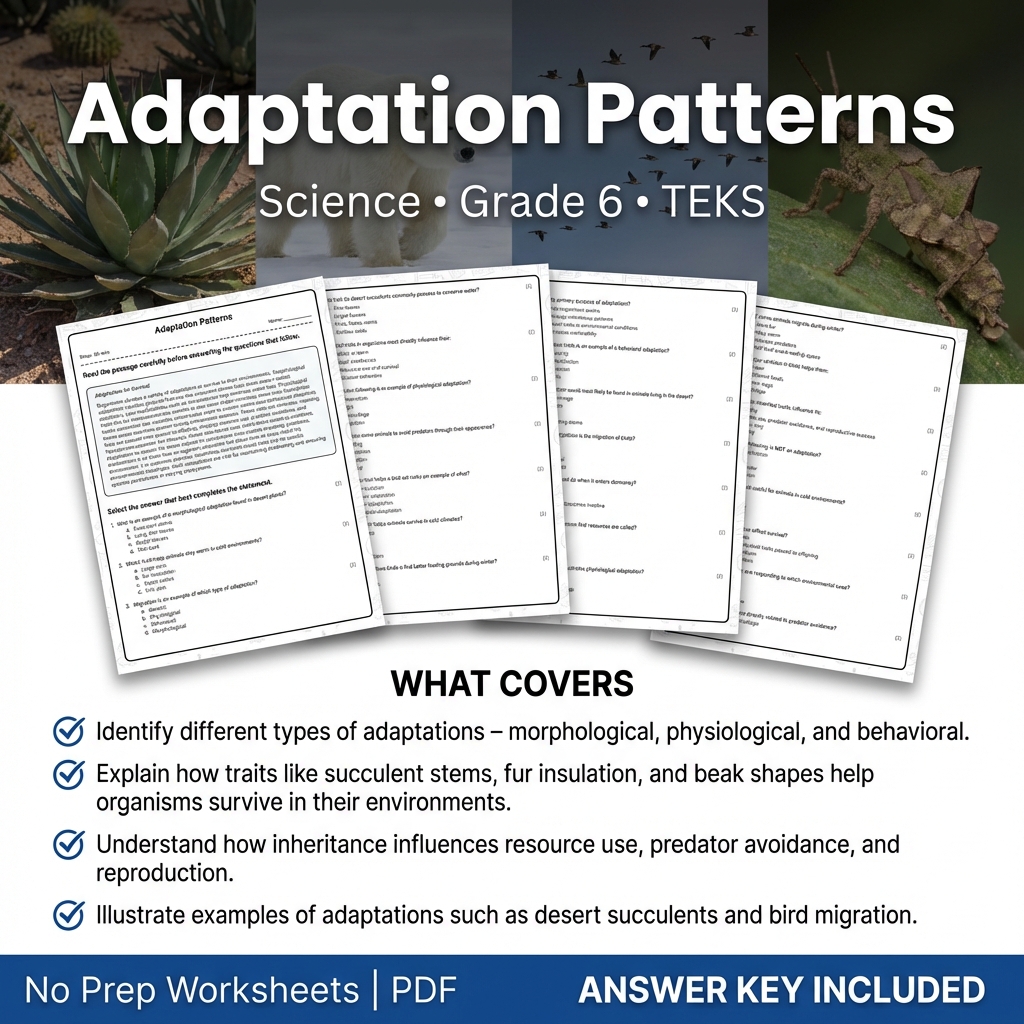
Grade 6 Science Worksheet on Adaptation Patterns | TEKS Standards
Created byCoral Reef LearningLearning Objectives
- Identify different types of adaptations – morphological, physiological, and behavioral.
- Explain how traits like succulent stems, fur insulation, and beak shapes help organisms survive in their environments.
- Understand how inheritance influences resource use, predator avoidance, and reproduction.
Instant download
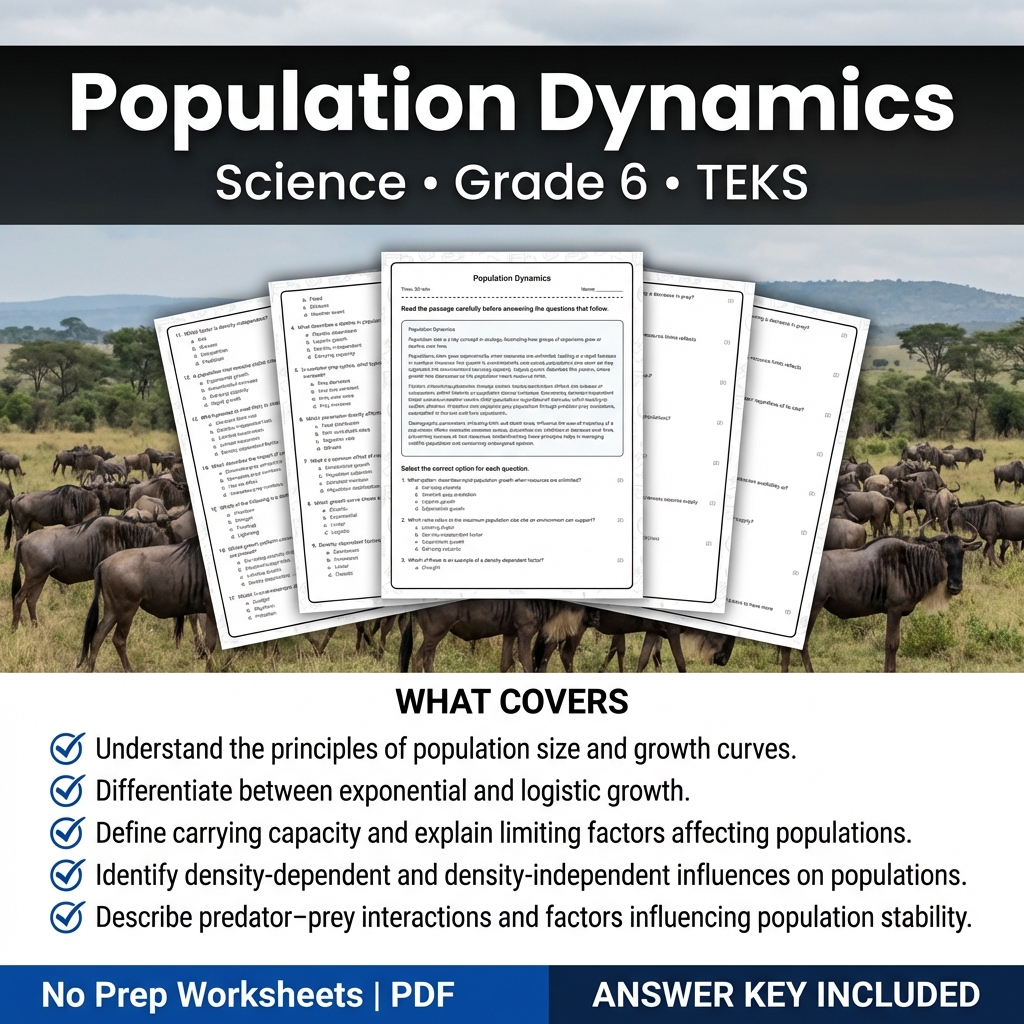
Grade 6 Science Worksheet on Population Dynamics | TEKS Standards
Created byCoral Reef LearningLearning Objectives
- Understand the principles of population size and growth curves.
- Differentiate between exponential and logistic growth.
- Define carrying capacity and explain limiting factors affecting populations.
Instant download
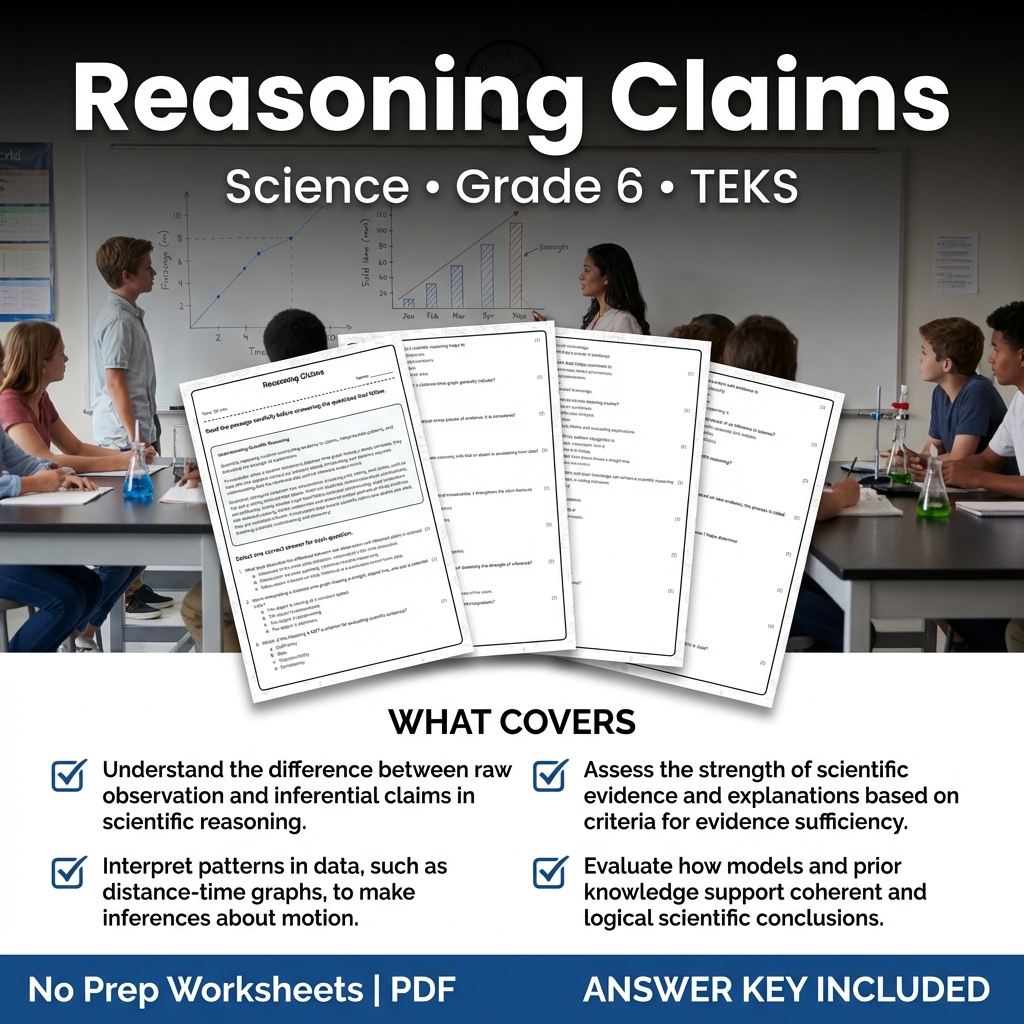
Grade 6 Science Worksheet on Reasoning Claims | TEKS Aligned
Created byCoral Reef LearningLearning Objectives
- Understand the difference between raw observation and inferential claims in scientific reasoning.
- Interpret patterns in data, such as distance-time graphs, to make inferences about motion.
- Assess the strength of scientific evidence and explanations based on criteria for evidence sufficiency.
Instant download

Physical Benefits Worksheet | Ontario Grade 6 Health Assessment
 Created bySkylark Worksheets
Learning Objectives
- Identify the physical health benefits of regular activity.
- Understand how movement improves cardiovascular health, muscle strength, and flexibility.
- Recognize the mental health advantages of consistent physical activity.
Also included in: Grade 6 Health Lesson Bundle | Ontario Standards and Worksheets
Instant download
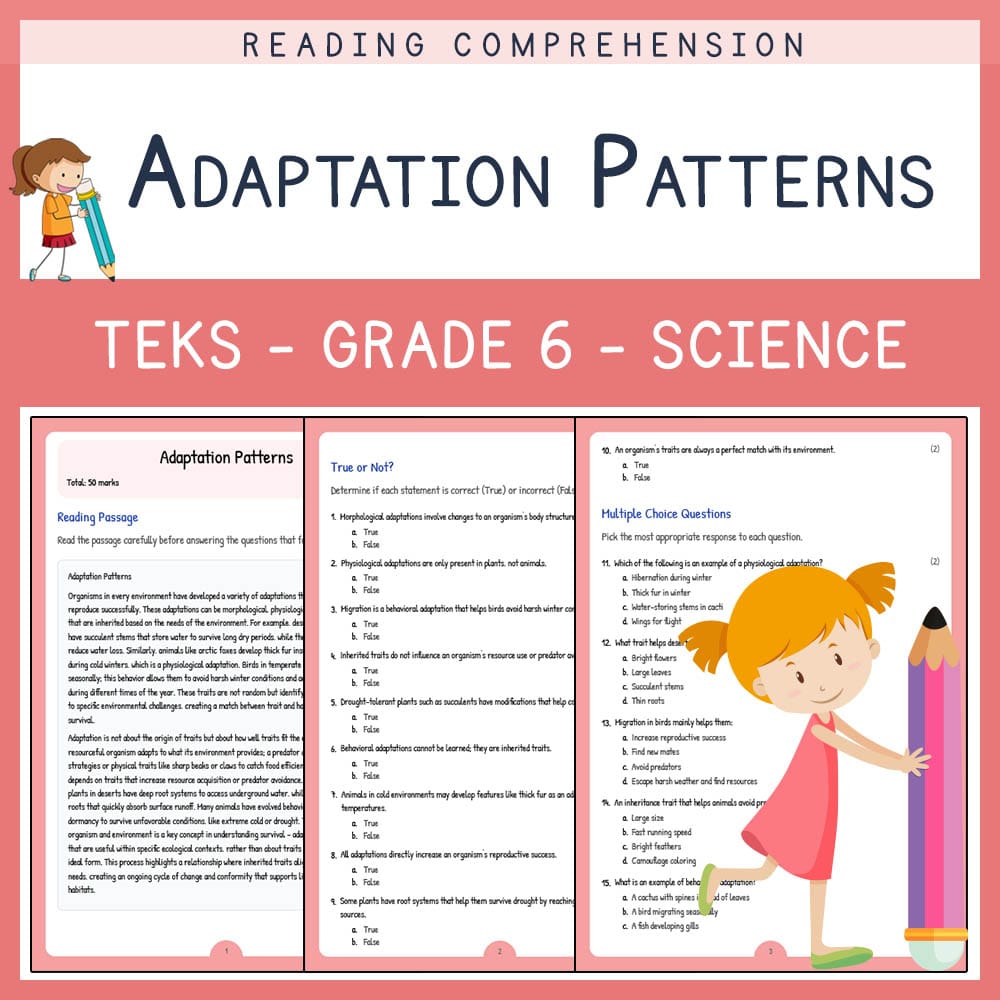
Grade 6 Science | Adaptation Patterns Worksheet | TEKS Standards
Created byLumora LearningLearning Objectives
- Understand the different types of adaptation patterns such as morphological, physiological, and behavioral traits.
- Identify examples of adaptations that enhance survival in various environments.
- Explain how inherited traits influence resource use, predator avoidance, and reproductive success.
Instant download
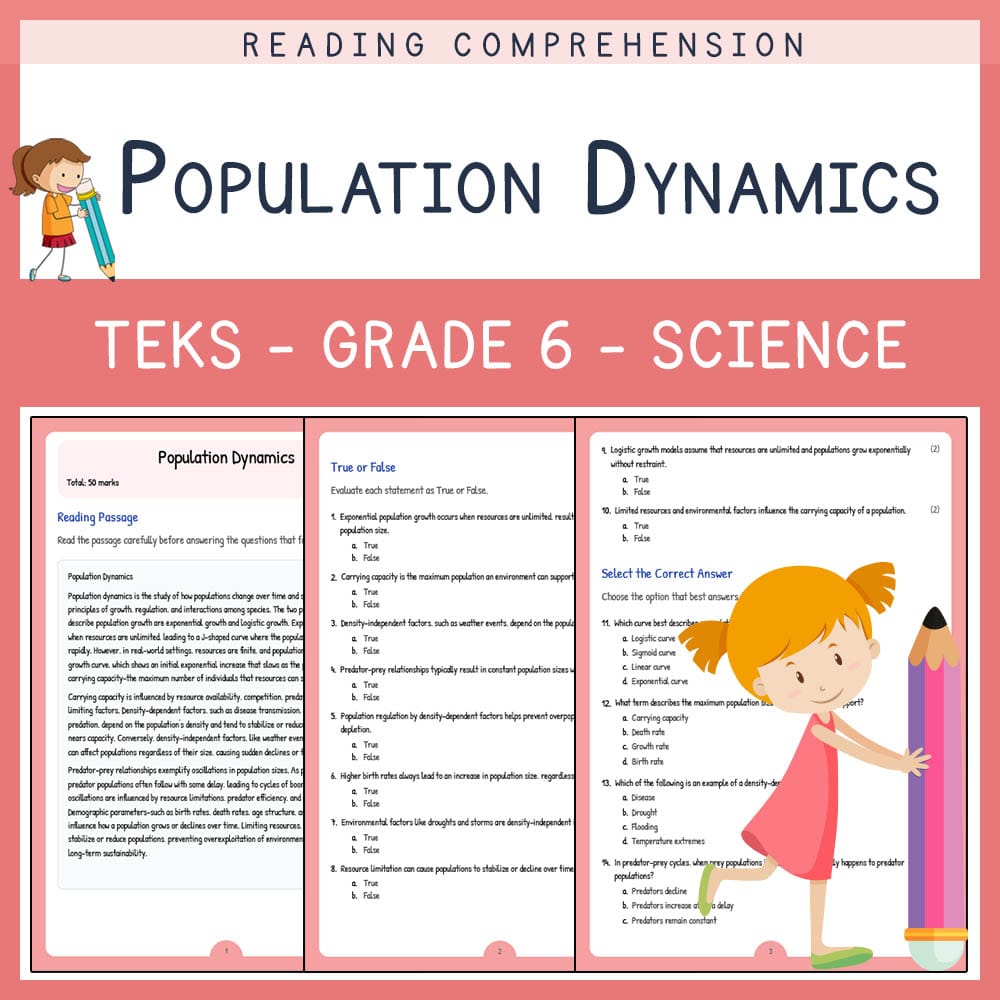
Grade 6 Science | Population Dynamics Worksheet | TEKS Aligned
Created byLumora LearningLearning Objectives
- Understand the principles of population size and how it changes over time.
- Differentiate between exponential and logistic growth curves in populations.
- Define carrying capacity and identify factors influencing population size.
Instant download
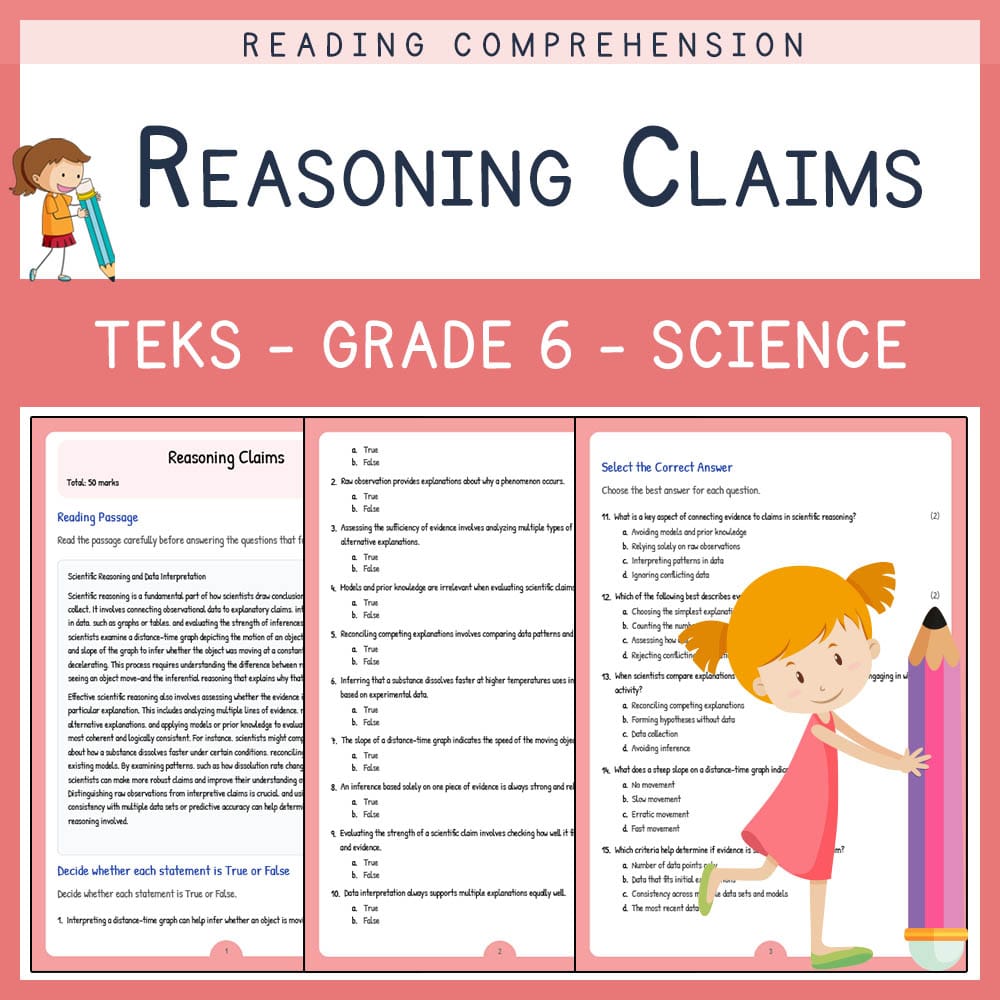
Grade 6 Science | Reasoning Claims Worksheet | TEKS Aligned
Created byLumora LearningLearning Objectives
- Understand how evidence connects to scientific claims through reasoning.
- Interpret patterns in data such as graphs to make inferences about motion.
- Evaluate the strength of scientific explanations based on data and models.
Instant download
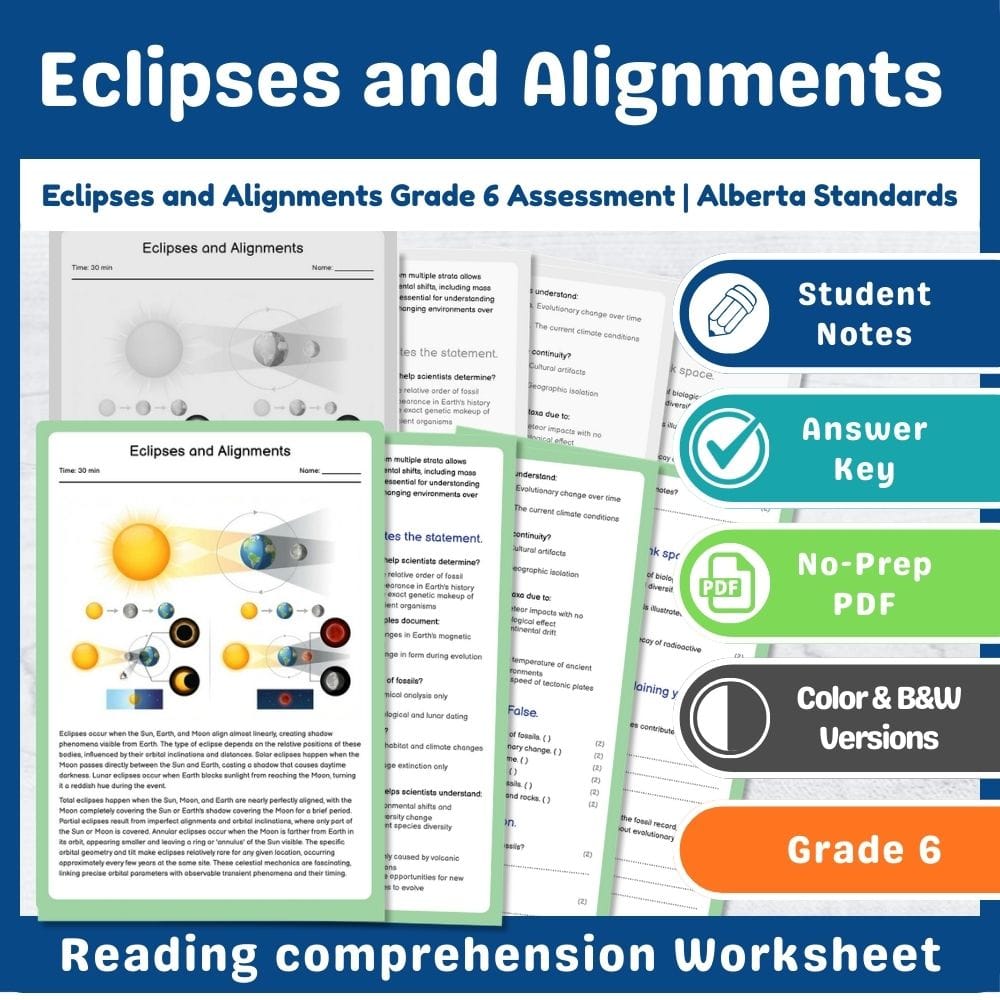
Eclipses and Alignments Grade 6 Assessment | Alberta Standards
Created byPrism Point LearningLearning Objectives
- Explain the celestial alignment conditions that lead to solar and lunar eclipses.
- Describe why eclipses are relatively rare at specific locations.
- Identify the differences between partial, total, and annular eclipses based on orbital geometry.
Also included in: Lesson Grade 6 Science Assessment | Celestial & Earth Movements
Instant download

Cause And Effect Worksheet | Grade 6 ELA Review & Assessment
Created byMeadowlark WorksheetsLearning Objectives
- Identify direct, indirect, and cumulative causes in narrative and informational texts.
- Distinguish between stated reasons and implied effects using context clues.
- Explain cause-and-effect relationships using transition words such as because, therefore, and as a result.
Also included in: Grade 6 Text Evidence and Inference ELA Lesson Bundle for Alberta +1 more
Instant download

Caption Meanings Practice Worksheet | Grade 6 ELA Review and Assessment
Created byMeadowlark WorksheetsLearning Objectives
- Explain how captions help readers interpret images, diagrams, and photos.
- Identify the purpose of caption features such as sidebars, callouts, and footnotes.
- Use caption details to avoid misreading and support a central idea.
Also included in: Grade 6 Text Evidence and Inference ELA Lesson Bundle for Alberta +1 more
Instant download
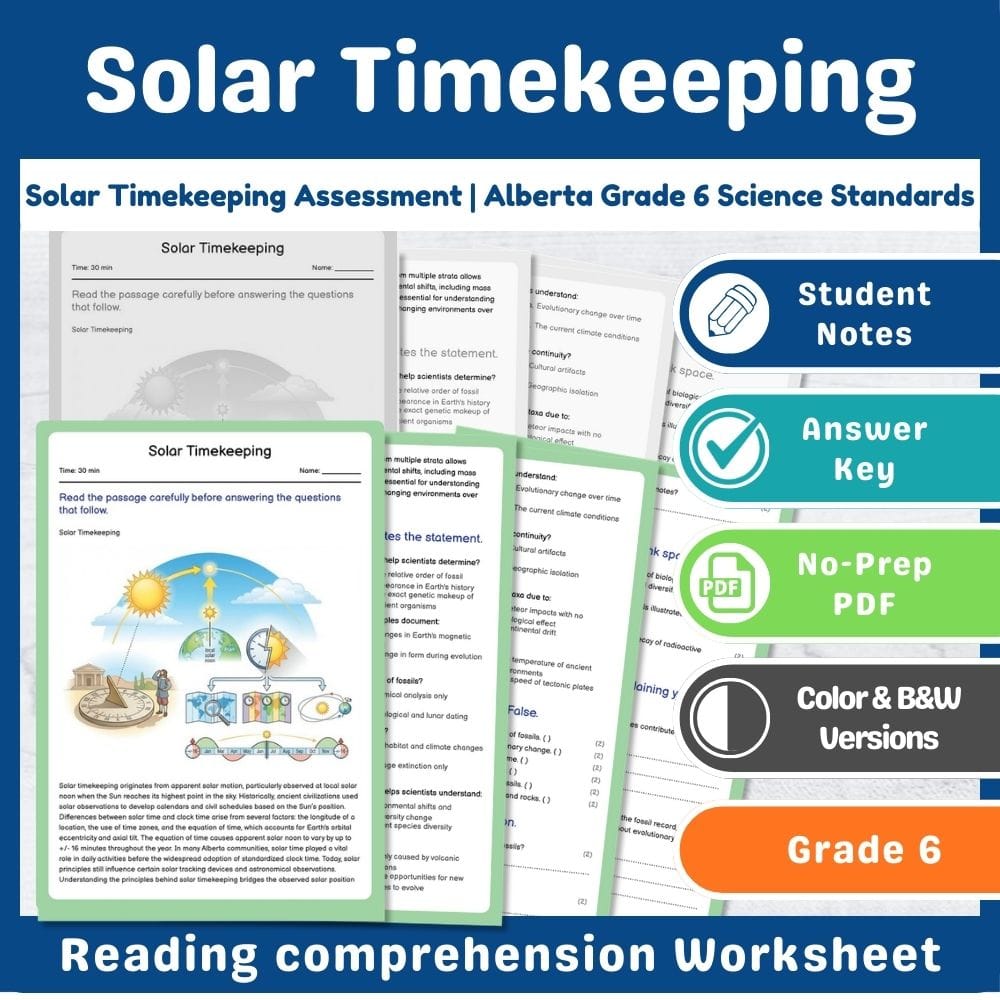
Solar Timekeeping Assessment | Alberta Grade 6 Science Standards
Created byPrism Point LearningLearning Objectives
- Explain the principles of solar timekeeping based on apparent solar motion and local noon.
- Identify factors such as longitude, time zones, and the equation of time that cause differences between solar time and clock time.
- Describe historical and modern uses of solar time in Alberta communities and how it connects solar position to societal timing.
Also included in: Lesson Grade 6 Science Assessment | Celestial & Earth Movements
Instant download

Adaptation Patterns Assessment | TEKS Grade 6 Science Standards-Aligned
Created byPrism Point LearningLearning Objectives
- Identify different types of adaptation (morphological, physiological, behavioral).
- Explain how specific traits help organisms survive in their environments.
- Recognize examples of adaptations such as leaf modifications, fur insulation, migration, and dormancy.
Instant download

Population Dynamics Assessment for Grade 6 Science TEKS | Printable Worksheet
Created byPrism Point LearningLearning Objectives
- Explain the principles of population size changes, including exponential and logistic growth.
- Define carrying capacity and limiting factors affecting populations.
- Differentiate between density-dependent and density-independent influences.
Instant download

Reasoning Claims Assessment for Grade 6 Science TEKS – Printable PDF
Created byPrism Point LearningLearning Objectives
- Understand the process of connecting evidence to explanatory claims in scientific reasoning.
- Interpret data patterns such as distance-time graphs for motion analysis.
- Assess the strength of inferences based on available evidence.
Also included in: Scientific Inquiry and Processes Grade 6 Science Lesson Bundle | TEKS
Instant download

Grade 6 Science | Material Cycling - Daily Reading Comprehension
Created byCoral Reef LearningLearning Objectives
- Understand the processes of physical and chemical weathering of rocks
- Identify how sediments are transported and deposited
- Explain the role of biological processes in soil formation
Instant download

Grade 6 Science | Evaporation and Transpiration - Daily Reading Comprehension
Created byCoral Reef LearningLearning Objectives
- Understand the process of evaporation in the water cycle.
- Identify the role of transpiration in atmospheric moisture.
- Explain how temperature influences evaporation rates.
Instant download

Grade 6 Science – Eclipses & Celestial Mechanics | Daily Reading Worksheet
 Created byBright Mind Resources
Learning Objectives
- Understand the basic concepts of solar and lunar eclipses
- Identify the three main types of eclipses: total, partial, and annular
- Explain the celestial mechanics and alignment conditions that cause eclipses
Also included in: Grade 6 Solar System & Seasons Science Daily Reading Lesson Bundle | Alberta +2 more
Instant download

Grade 6 Science – Solar Time & Earth Rotation | Daily Reading Worksheet
Created byBright Mind ResourcesLearning Objectives
- Define solar time and local solar noon
- Explain how Earth's position affects solar time
- Identify differences between solar time and clock time
Also included in: Grade 6 Solar System & Seasons Science Daily Reading Lesson Bundle | Alberta +2 more
Instant download

Grade 6 Science | Gravity & Friction - Daily Reading Comprehension
Created byCoral Reef LearningLearning Objectives
- Understand the concept of gravity as a force of attraction between objects with mass.
- Identify how mass and distance affect the strength of gravitational pull.
- Differentiate between gravitational forces and contact forces such as friction.
Instant download
Browse more categories
About Reading comprehension Worksheets
Find reading comprehension worksheets for class practice, homework, or self-study. All 40,289 are instant PDF downloads.
Each resource here is built by an independent educator and reviewed for quality. Worksheets print straight from PDF and suit classroom use, homework, or extra practice; most come with answer keys, and you can preview before purchasing.