
Reading comprehension Worksheets
40,289 type resources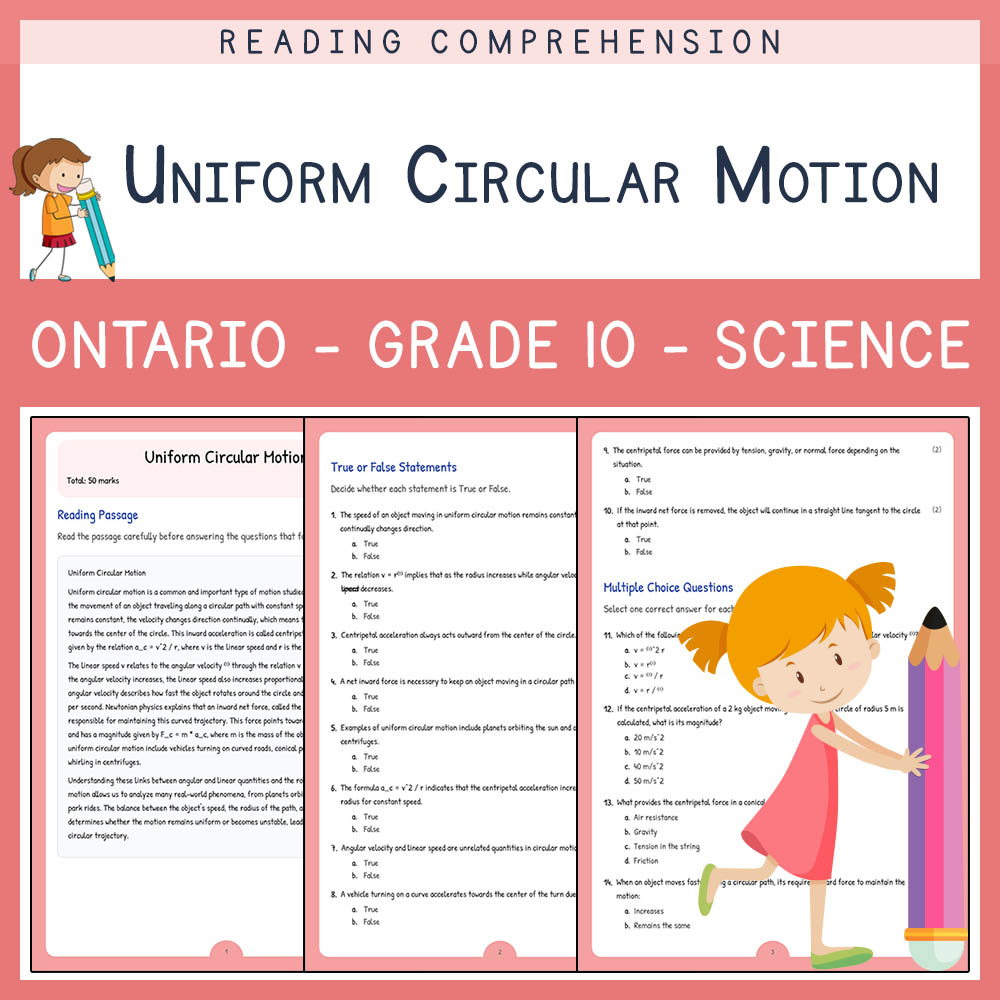
Grade 10 Science | Uniform Circular Motion Worksheet Elena | Ontario Standard
 Created byLumora Learning
Learning Objectives
- Describe the kinematic and dynamic aspects of uniform circular motion.
- Explain the relationships v = rω and a_c = v^2/r and how they connect linear and angular measures.
- Understand the role of a net inward force in maintaining circular motion.
Also included in: Grade 10 Science | Motion & Forces Lesson Bundle | Ontario Standards
Instant download
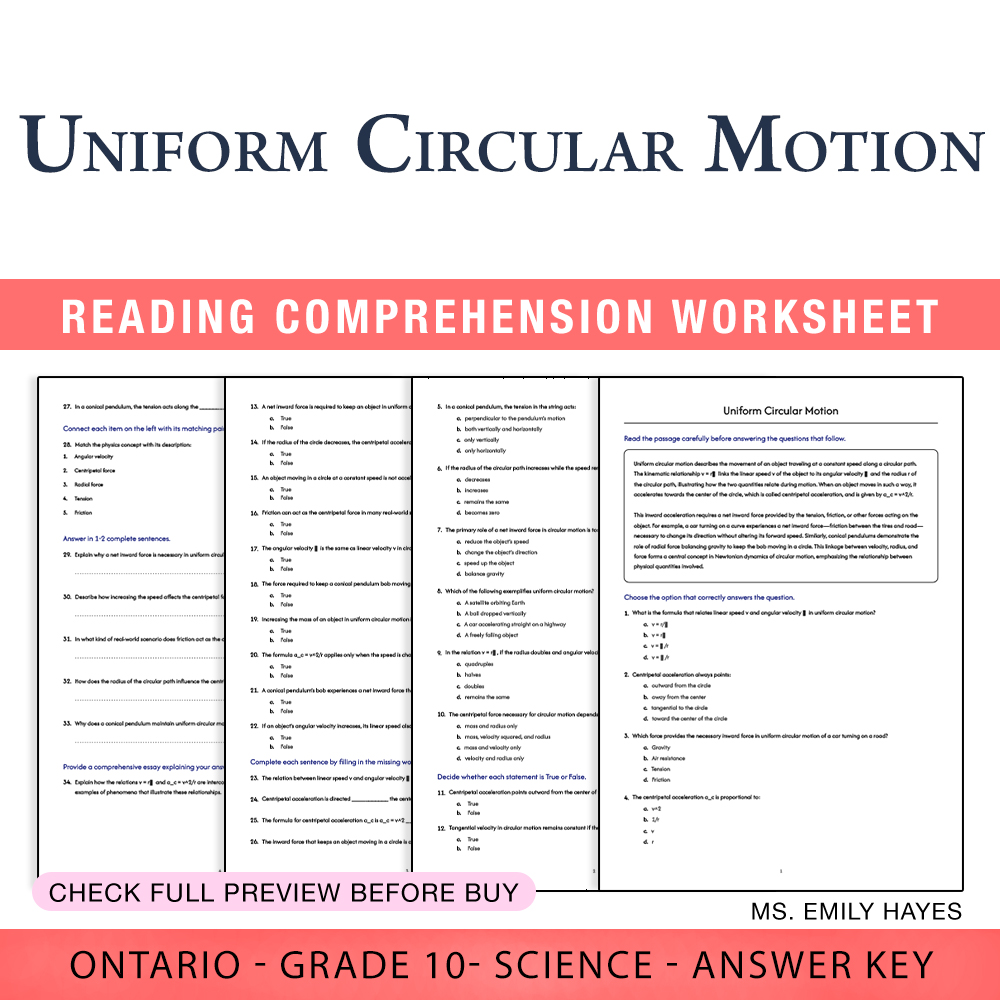
10th Grade Science | Uniform Circular Motion Worksheet (PDF + Answer Key)
 Created byCopper Leaf Classroom
Learning Objectives
- Explain the kinematic relationships v = rω and a_c = v^2/r for objects moving in a circle.
- Describe how centripetal force acts towards the center of a circular path to maintain curved motion.
- Apply mathematical relations to real-world phenomena such as vehicle turning and conical pendulums.
Instant download

Grade 10 Science – Uniform Circular Motion Worksheet (Ontario) PDF
 Created byEvergreen Desk Education
Learning Objectives
- Explain how angular measures relate to linear speed in uniform circular motion using v = rω
- Connect net inward (centripetal) force to centripetal acceleration a_c = v^2/r and Newton’s second law
- Interpret and predict motion outcomes for real systems such as car turns and a conical pendulum
Also included in: Grade 10 Kinematics Forces & Mechanics Science Lesson Bundle Ontario Worksheets +1 more
Instant download

Grade 10 Science | Uniform Circular Motion - Daily Reading Comprehension
 Created byCoral Reef Learning
Learning Objectives
- Define uniform circular motion and identify its key features.
- Explain the relationship between angular speed, linear speed, and radius.
- Describe the concept of centripetal acceleration and the role of inward force.
Instant download
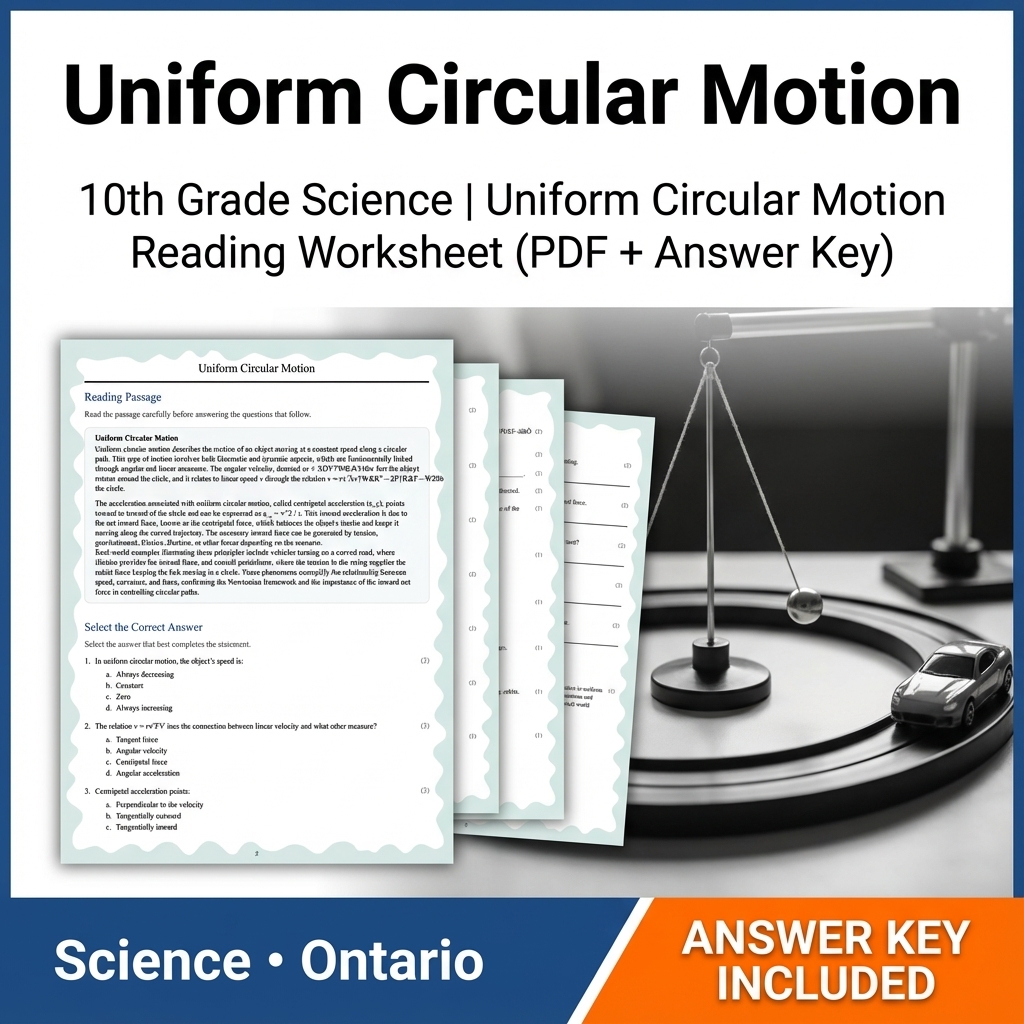
10th Grade Science | Uniform Circular Motion (PDF + Answer Key)
JCreated byJ.S SheetsLearning Objectives
- Understand the kinematic and dynamic principles of motion on a circular path.
- Relate angular velocity to linear speed and comprehend centripetal acceleration.
- Explain the role of inward net force in maintaining uniform circular motion.
Also included in: Grade 10 Science Unit Bundle – Motion, Forces & Mechanics (Answer Keys Included) +1 more
Instant download
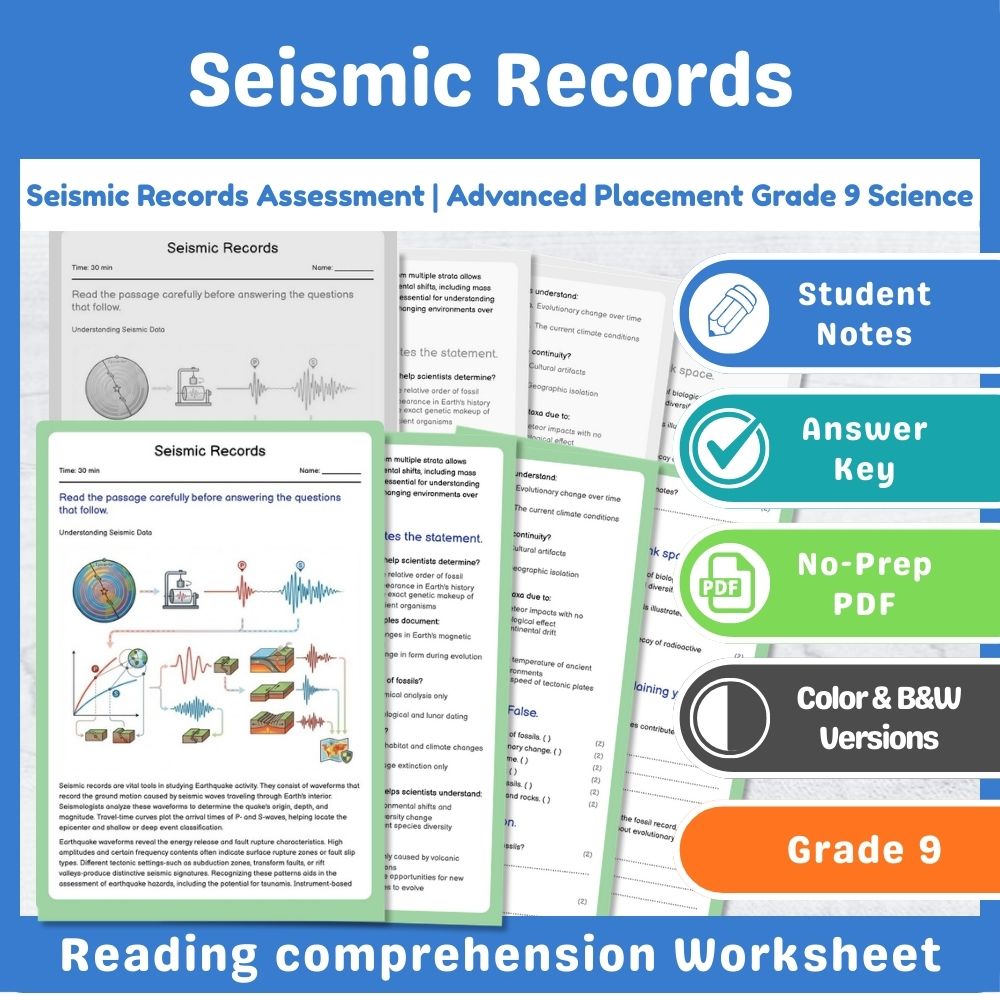
Seismic Records Assessment | Advanced Placement Grade 9 Science
 Created byPrism Point Learning
Learning Objectives
- Interpret earthquake waveforms and travel-time curves to infer subsurface structures.
- Compare P- and S-wave arrivals, waveform amplitudes, and frequency content to distinguish earthquake depths and locations.
- Connect seismic activity patterns to tectonic environments and surface hazard phenomena such as tsunamis.
Also included in: Grade 9 Science Mini Bundle | Earth and Space Sciences AP Standards
Instant download

Grade 9 Science | Seismic Records Worksheet with Short Notes (Printable PDF)
 Created byMeadowlark Worksheets
Learning Objectives
- Interpret earthquake waveforms and distinguish P- and S-wave arrivals.
- Analyze travel-time curves and epicenter maps to understand subsurface structures.
- Compare waveform amplitude and frequency content to identify earthquake depth.
Also included in: Grade 9 Science | Earth Systems & Geology Unit Worksheet Bundle (Printable PDFs) +1 more
Instant download

Grade 9 Science – Seismic Records & Earthquake Data | Daily Reading Worksheet
 Created byBright Mind Resources
Learning Objectives
- Identify different types of seismic waves from waveform data
- Interpret travel-time curves and epicenter maps to infer subsurface structures
- Compare P- and S-wave arrivals to determine earthquake depth
Also included in: Grade 9 Earth Systems Science Daily Reading Worksheets Lesson Bundle | AP +2 more
Instant download

Grade 9 Science — Seismic Records Worksheet MCQ Paper for Mastery
 Created byThe Resource Hub
Learning Objectives
- Interpret earthquake waveforms, travel-time curves, and epicenter maps to understand subsurface structures.
- Differentiate between P- and S-wave arrivals, waveform amplitudes, and frequency content.
- Locate rupture zones and connect seismicity patterns to tectonic environments and surface hazard phenomena.
Also included in: Grade 9 Earth and Space Sciences AP Bundle | Science Worksheets and Activities +1 more
Instant download
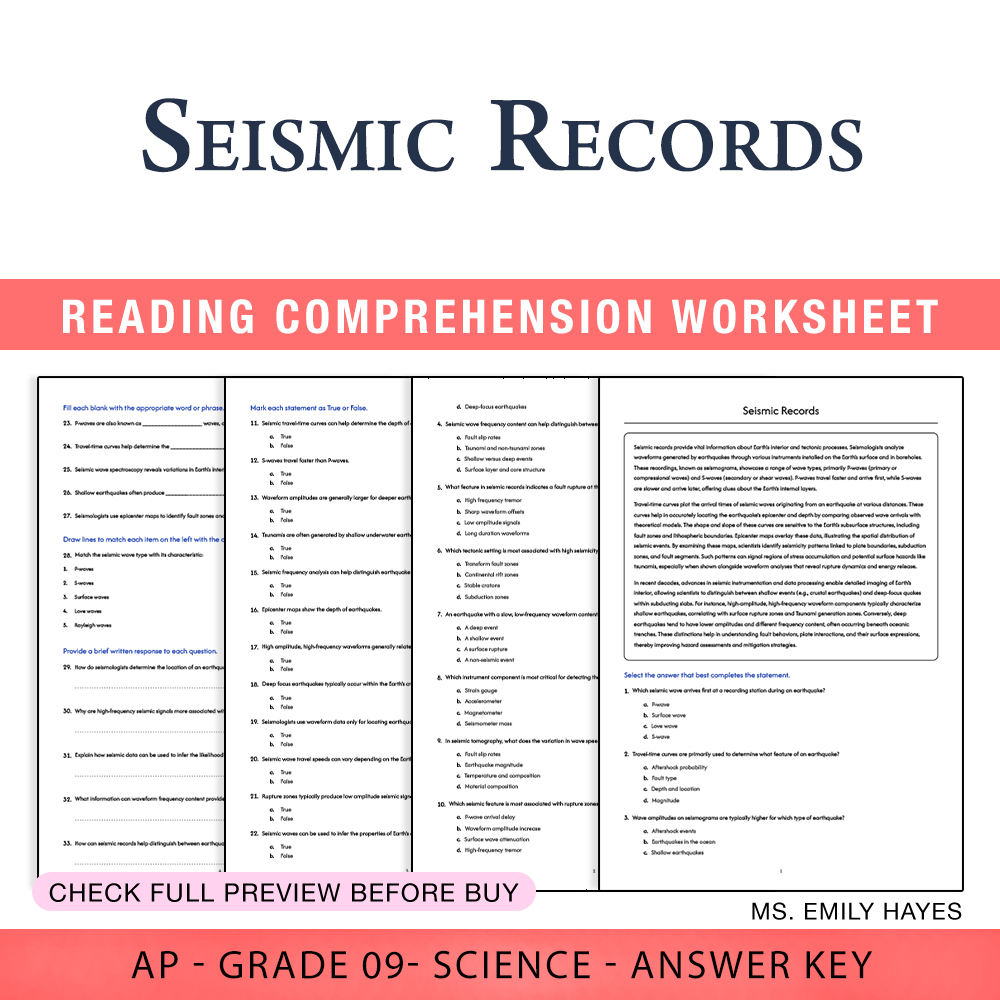
Grade 9 Science | Seismic Records Worksheet (PDF+ Answer Key)
Created byCopper Leaf ClassroomLearning Objectives
- Interpret earthquake waveforms, travel-time curves, and epicenter maps to understand Earth's subsurface structures.
- Compare P- and S-wave arrivals, waveform amplitudes, and frequency content to distinguish shallow versus deep earthquakes.
- Locate rupture zones and relate seismic activity patterns to tectonic plate interactions.
Also included in: Grade 9 Science | Earth and Space Sciences AP Worksheet (PDF + Answer Key) +1 more
Instant download
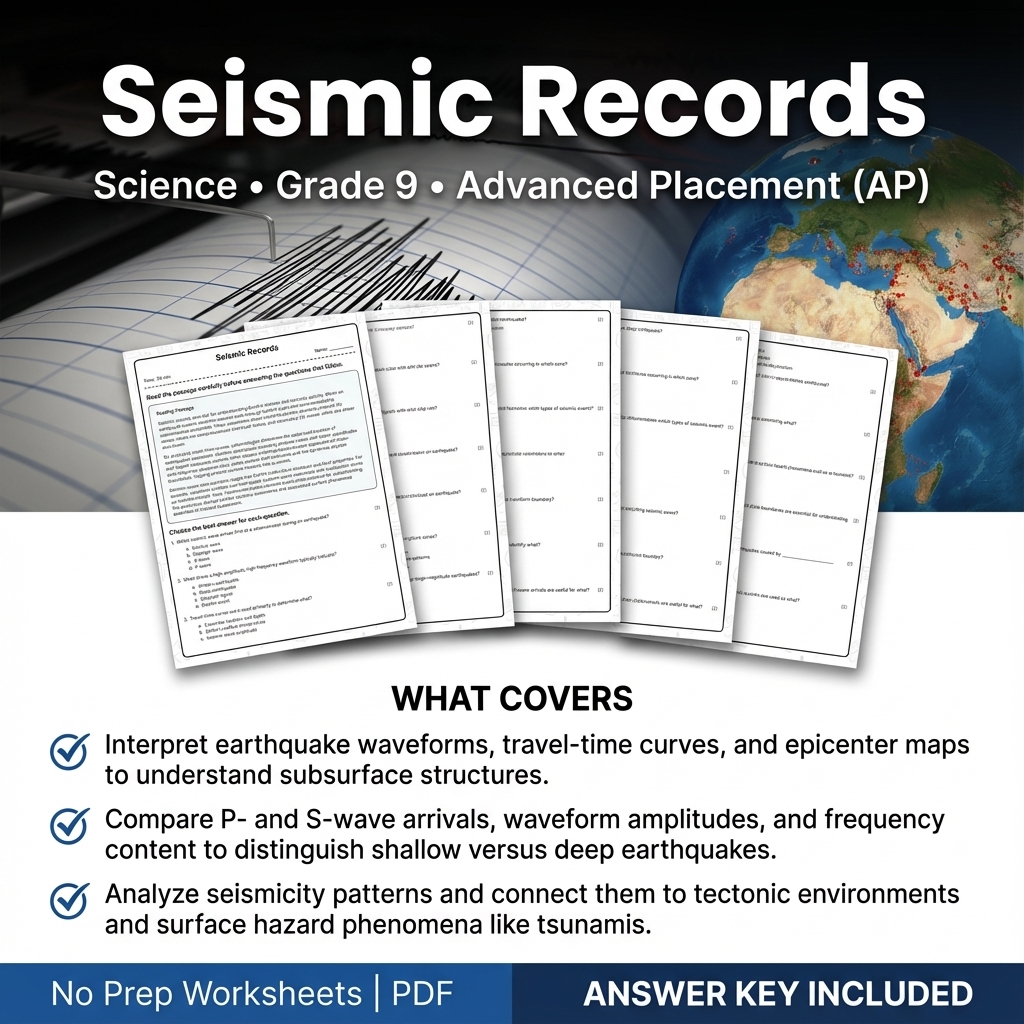
9th Grade Science | Seismic Records Worksheet (Printable PDF + Answer Key)
Created byCoral Reef LearningLearning Objectives
- Interpret earthquake waveforms, travel-time curves, and epicenter maps to understand subsurface structures.
- Compare P- and S-wave arrivals, waveform amplitudes, and frequency content to distinguish shallow versus deep earthquakes.
- Analyze seismicity patterns and connect them to tectonic environments and surface hazard phenomena like tsunamis.
Also included in: Grade 9 Science Unit | Earth Processes & Climate Worksheets Pack (PDF & Answer Keys) +2 more
Instant download
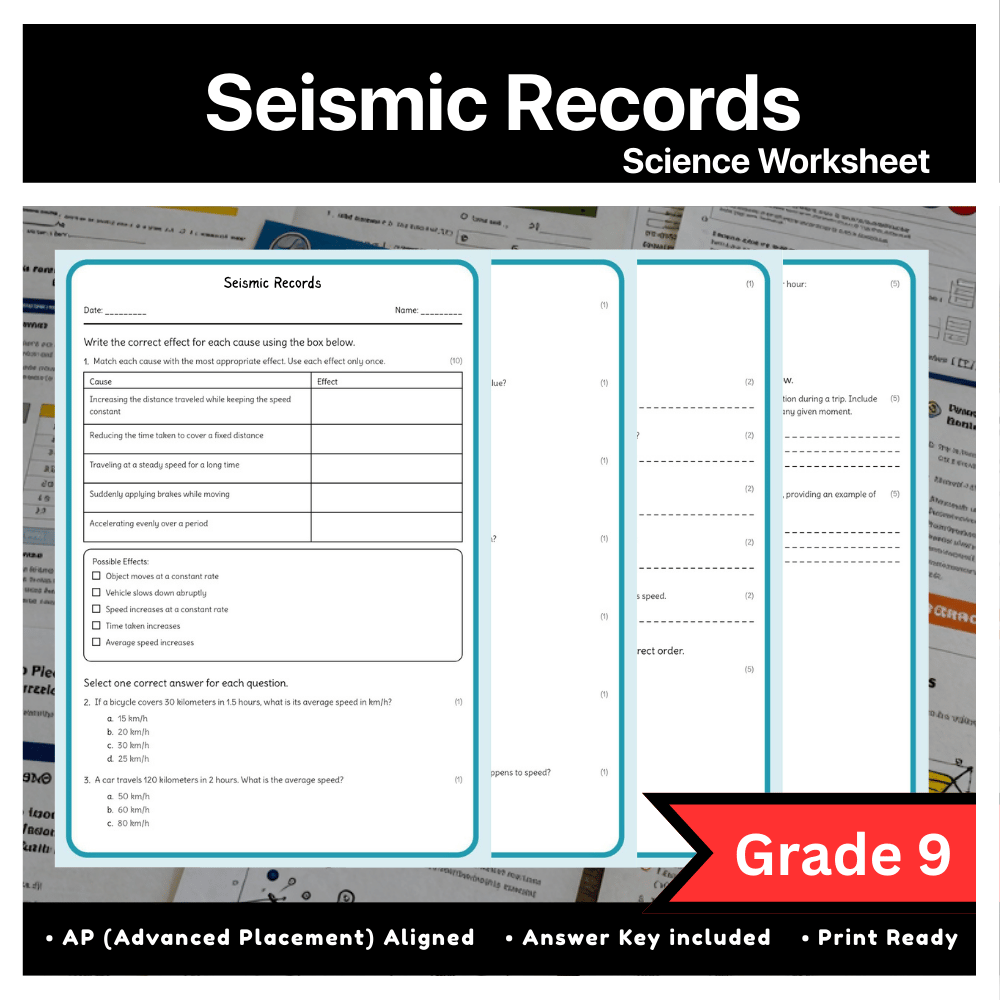
Grade 9 Science – Seismic Records Worksheet (AP Standards + Answer Key)
Created byBright Mind ResourcesLearning Objectives
- Interpret earthquake waveforms, travel-time curves, and epicenter maps to analyze subsurface structures.
- Distinguish between shallow and deep seismic events using waveform characteristics.
- Compare P- and S-wave arrivals to locate earthquake epicenters and understand fault behavior.
Instant download

9th Grade Science | Seismic Records Reading Worksheet (PDF + Rubric)
JCreated byJ.S SheetsLearning Objectives
- Understand how seismic waveforms are used to interpret Earth's subsurface structures.
- Compare P- and S-wave arrivals, waveform amplitudes, and frequency content to identify earthquake characteristics.
- Analyze travel-time curves and epicenter maps to determine earthquake depth and fault behavior.
Instant download

Seismic Records Worksheet for Grade 9 Science | AP Earth Science Activity
Created byPrism Point LearningLearning Objectives
- Interpret P-wave and S-wave arrival times to determine relative event characteristics and estimate travel-time patterns.
- Use earthquake waveforms and frequency/amplitude features to infer differences between shallow and deep events.
- Connect epicenter maps and seismicity patterns to tectonic environments and surface hazard risks.
Also included in: Earth Systems & Climate Evidence Lesson Bundle | Grade 9 Science | AP
Instant download

Seismic Records Worksheet | Grade 9 AP Science Practice
 Created byBright Quill Resources
Learning Objectives
- Interpret seismic waveforms and identify likely P-wave and S-wave arrivals
- Use travel-time ideas to connect arrival-time differences to earthquake distance and epicenter location
- Compare waveform amplitude and frequency patterns to infer differences between shallow and deep earthquakes
Instant download

Grade 9 Science | Seismic Records Worksheet (AP Standard) (Practice Set)
Created byEvergreen Desk EducationLearning Objectives
- Interpret P-wave and S-wave arrival times to infer distance from an earthquake source.
- Use travel-time curves and waveform features (amplitude and frequency) to compare shallow vs. deep events.
- Connect epicenter maps and seismicity patterns to plate interactions and likely rupture behavior.
Also included in: Earth Systems & Climate Grade 9 Science Lesson Bundle AP Worksheets +1 more
Instant download

Grade 9 Science | Seismic Records & Earthquake Waves - Daily Reading Practice
Created byCoral Reef LearningLearning Objectives
- Interpret seismic waveforms to identify different wave types.
- Distinguish between P-waves and S-waves in seismic data.
- Understand how travel-time curves help locate earthquake epicenters.
Also included in: Earth and Space Sciences Daily Reading Lesson Bundle – Grade 9 Science AP +1 more
Instant download

Grade 9 Science | Seismic Records Worksheet | AP Aligned
Created byLumora LearningLearning Objectives
- Interpret earthquake waveforms, travel-time curves, and epicenter maps to analyze subsurface structures.
- Distinguish between P- and S-wave arrivals, waveform amplitudes, and frequency content to identify shallow versus deep seismic events.
- Connect seismicity patterns to tectonic environments and surface hazard phenomena such as tsunamis using instrument-based records.
Also included in: Grade 9 Science | Earth and Space Science Custom Bundle | AP Aligned
Instant download

Grade 10 Science | DNA & Genes - Daily Reading Comprehension
Created byCoral Reef LearningLearning Objectives
- Understand the structure of DNA and its role in storing genetic information.
- Learn how genes are expressed to produce proteins and functional molecules.
- Recognize how DNA is organized in chromosomes.
Instant download

DNA and Genes Worksheet Grade 10 Science Genetics Activity Practice
Created byPrism Point LearningLearning Objectives
- Explain how genetic information in DNA can be organized into chromosomes and carried by genes
- Describe how genes direct the production of proteins or functional RNA products
- Connect inheritance and genetic variation to observable traits
Instant download

Grade 10 Science – DNA & Genes Daily Reading Worksheet | Florida NGSSS
Created byBright Mind ResourcesLearning Objectives
- Understand the basic components of DNA.
- Identify the structure and function of genes.
- Explain how genetic information is stored and expressed.
Also included in: Life Science Grade 10 Science Daily Reading Worksheets Lesson Bundle | FL NGSSS +1 more
Instant download

DNA and Genes Assessment for Grade 10 Science NGSSS Standards
Created byPrism Point LearningLearning Objectives
- Explain how genetic information stored in DNA is organized into chromosomes and genes
- Describe how gene expression depends on reading DNA information to produce proteins or functional RNA
- Connect inherited traits to the transmission of similar DNA and the role of genetic variation
Also included in: Grade 10 Cells, Genetics & Evolution Science Lesson Bundle | Florida NGSSS +1 more
Instant download

DNA and Genes Worksheet Grade 10 Biology Genetics NGSSS Science Activity
Created byEvergreen Desk EducationLearning Objectives
- Explain how genetic information stored in DNA is organized into chromosomes and expressed through genes
- Describe how gene information is converted into functional proteins or RNA products
- Interpret how DNA variation and inheritance lead to observable traits
Instant download

Grade 10 Science | DNA and Genes Worksheet Elena | Florida NGSSS
Created byLumora LearningLearning Objectives
- Explain how DNA stores genetic information and how genes use that information to produce proteins or functional RNA products
- Describe the organization of DNA in chromosomes and how gene activity depends on how information is read and converted
- Connect inherited traits and genetic variation to differences in DNA sequence and gene expression
Instant download

Grade 6 Science | Elements in Compounds Worksheet | California Standards
Created byLumora LearningLearning Objectives
- Explain how compounds are made from atoms of multiple elements joined in definite proportions.
- Describe how particle models represent compounds using correct atom counts and bonding patterns.
- Use atomic composition to predict qualitative outcomes such as density trends and reaction behavior.
Instant download

Grade 6 Science – Elements & Compounds | Daily Reading Worksheet
Created byBright Mind ResourcesLearning Objectives
- Define what elements and compounds are.
- Identify the differences between elements and compounds.
- Understand how atoms bond together to form compounds.
Also included in: Grade 6 Matter Science Daily Reading Worksheets Lesson Bundle | CA Standards +1 more
Instant download

Elements in Compounds Worksheet Grade 6 Science Atoms Compounds
Created byPrism Point LearningLearning Objectives
- Explain that compounds form when atoms of different elements combine in fixed, definite proportions.
- Use particle models to describe how atoms connect in a compound.
- Relate atomic composition to observable properties such as density and chemical behavior.
Instant download

Grade 6 Science | Elements in Compounds - Daily Reading Comprehension
Created byCoral Reef LearningLearning Objectives
- Understand what compounds are and how they are formed from elements.
- Identify atoms within chemical compounds based on atomic composition.
- Learn how the atomic arrangement relates to the properties of compounds.
Instant download

6th Grade Science Elements in Compounds Worksheet | CA Standards PDF
Created byEvergreen Desk EducationLearning Objectives
- Explain what a compound is and why compounds contain atoms of more than one element.
- Use particle models to describe how atoms of different elements are arranged in a compound.
- Describe how definite proportions in compounds help explain consistent properties and measurable outcomes.
Instant download

Elements in Compounds Grade 6 Science Assessment | California Standards
Created byPrism Point LearningLearning Objectives
- Explain what compounds are and how they form from atoms of different elements.
- Describe how particle models show compounds with definite bonding arrangements.
- Use element ratios in compounds to predict properties and understand macroscopic differences.
Also included in: Grade 6 Atoms and Chemical Change Science lesson bundle | California Standards +1 more
Instant download

Grade 12 Science – Evolution Evidence & Fossil Records | Daily Reading Worksheet
Created byBright Mind ResourcesLearning Objectives
- Understand how fossils provide evidence for evolution over time
- Identify key features of fossil records and what they reveal about past life
- Learn how fossil patterns support the theory of evolution
Also included in: Life Science Grade 12 Daily Reading Worksheets Lesson Bundle | Florida NGSSS +1 more
Instant download

Evolution Evidence Worksheet Grade 12 Biology Activity NGSSS Review
Created byPrism Point LearningLearning Objectives
- Explain how multiple lines of evidence support common descent and evolutionary change
- Describe how fossil records, comparative anatomy, biogeographical patterns, and genetic data inform evolutionary relationships
- Use evidence-based reasoning to connect patterns in data to the process of evolution
Also included in: Grade 12 Genetics and Evolution Lesson Bundle | Florida NGSSS Science
Instant download

Grade 12 Science | Evidence of Evolution - Daily Reading Comprehension
Created byCoral Reef LearningLearning Objectives
- Understand how fossil records provide evidence for evolutionary change.
- Identify similarities and differences in comparative anatomy among species.
- Explain the role of biogeographical patterns in understanding species evolution.
Instant download

Evolution Evidence Worksheet Grade 12 NGSSS Science Biology Activity
Created byEvergreen Desk EducationLearning Objectives
- Explain how fossil, comparative anatomy, biogeography, and genetic evidence support common descent and evolutionary change
- Analyze how patterns across different evidence sources strengthen scientific explanations of evolution
- Use vocabulary such as homologous structures, analogous structures, and phylogenetic trees to describe evolutionary relationships
Instant download

Evolution Evidence Assessment for Grade 12 Science | NGSSS Standards
Created byPrism Point LearningLearning Objectives
- Explain how fossils, comparative anatomy, biogeography, and genetics provide evidence for evolution and common descent
- Distinguish homologous structures from analogous structures and interpret what each implies
- Use multiple evidence sources to justify why species change over time
Also included in: Lesson Bundle Grade 12 Genetics and Evolution Science: Florida NGSSS +1 more
Instant download

Grade 12 Science | Evolution Evidence Worksheet | NGSSS Assessment
Created byLumora LearningLearning Objectives
- Explain how multiple lines of evidence (fossils, comparative anatomy, biogeography, and genetics) support common descent and evolutionary change
- Differentiate homologous and analogous structures and relate them to shared ancestry or convergent evolution
- Interpret how species distributions and genetic relatedness can reflect historical migration, isolation, and divergence
Instant download

Grade 3 Health Goals Worksheet – NHES Standards (PDF)
 Created bySunny Desk Resources
Learning Objectives
- Identify what a health goal is and why clear goals help people make healthy choices
- Write short-term health goals that are specific and achievable
- Explain how to check progress and adjust goals to stay motivated
Also included in: Grade 3 Goal-Setting Skills in Health Lesson Bundle – National NHES +1 more
Instant download
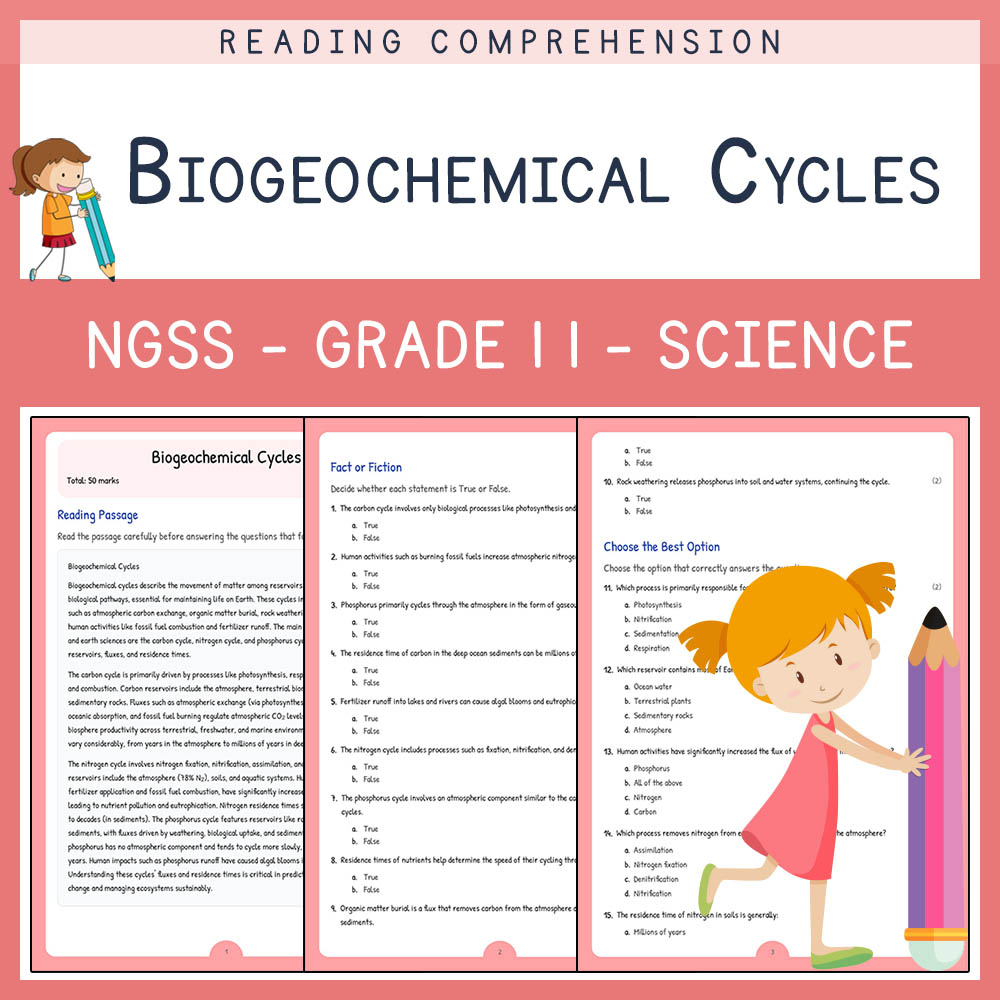
Grade 11 Science | Biogeochemical Cycles Worksheet (NP + Answer Key)
Created byLumora LearningLearning Objectives
- Explain the processes involved in carbon, nitrogen, and phosphorus cycles.
- Identify reservoirs and fluxes within biogeochemical cycles.
- Evaluate human impacts on nutrient cycling and their ecological consequences.
Instant download
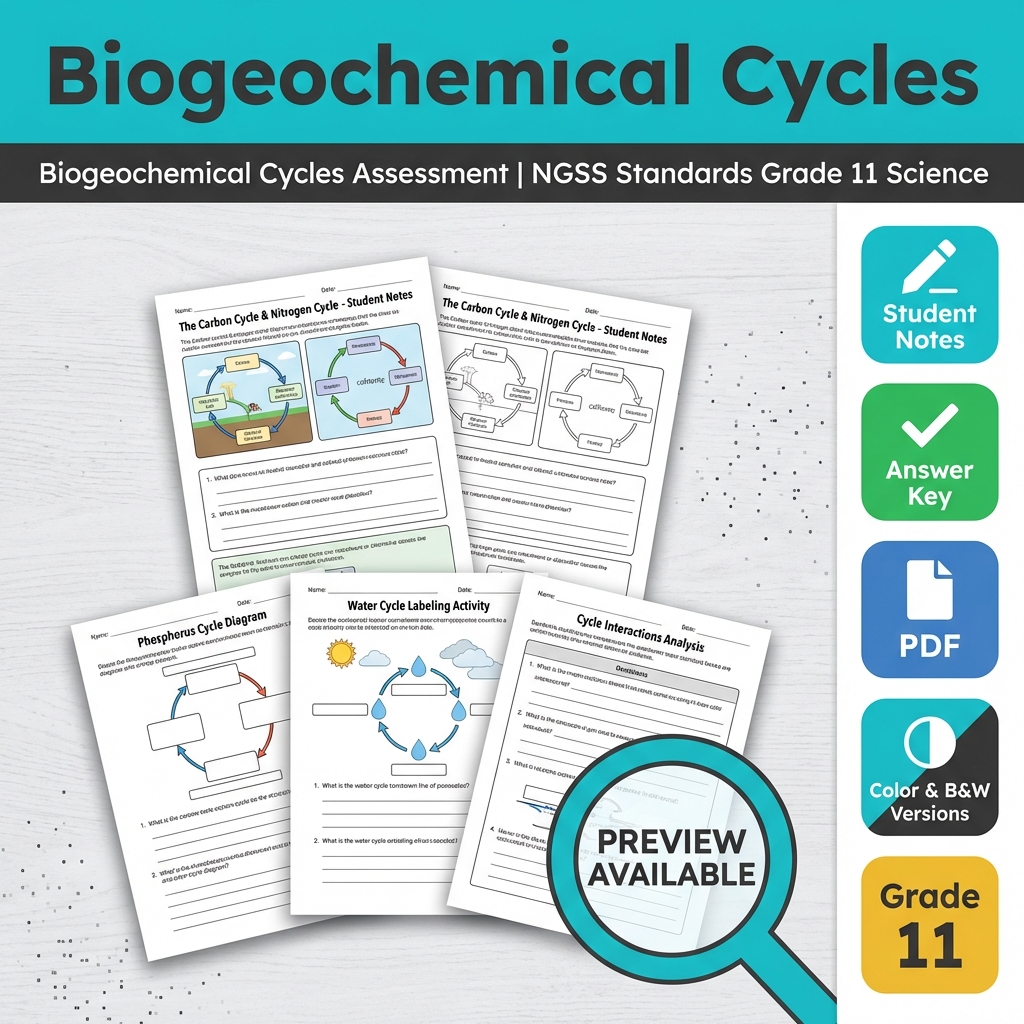
Biogeochemical Cycles Assessment | NGSS Standards Grade 11 Science
Created byPrism Point LearningLearning Objectives
- Understand the components and processes of carbon, nitrogen, and phosphorus cycles.
- Identify reservoirs and fluxes involved in biogeochemical cycles.
- Analyze the impact of human activities on nutrient cycling and reservoir balances.
Instant download
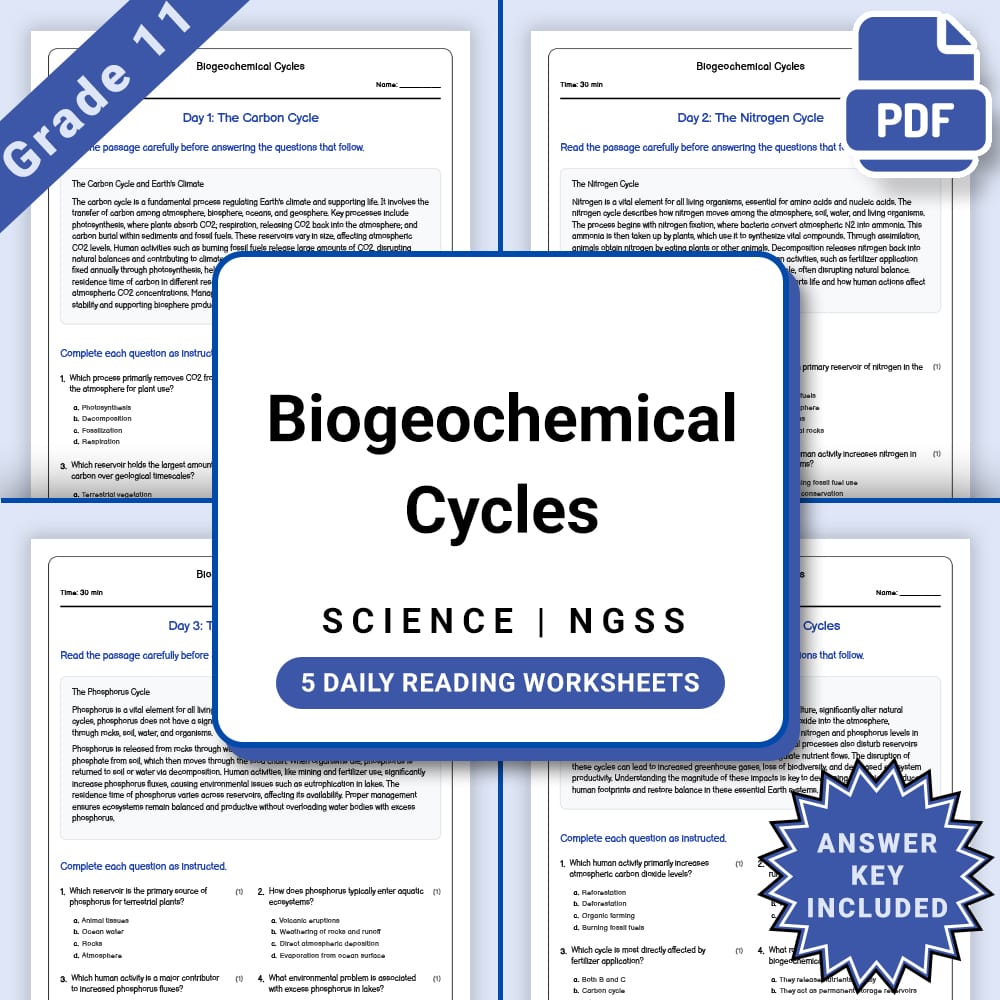
Grade 11 Science – Biogeochemical Cycles Worksheet(PDF +Answer Key)
Created byCopper Leaf ClassroomLearning Objectives
- Understand the main processes of the carbon cycle
- Identify reservoirs and fluxes involved in biogeochemical cycles
- Explain how human activities influence nutrient cycling
Instant download
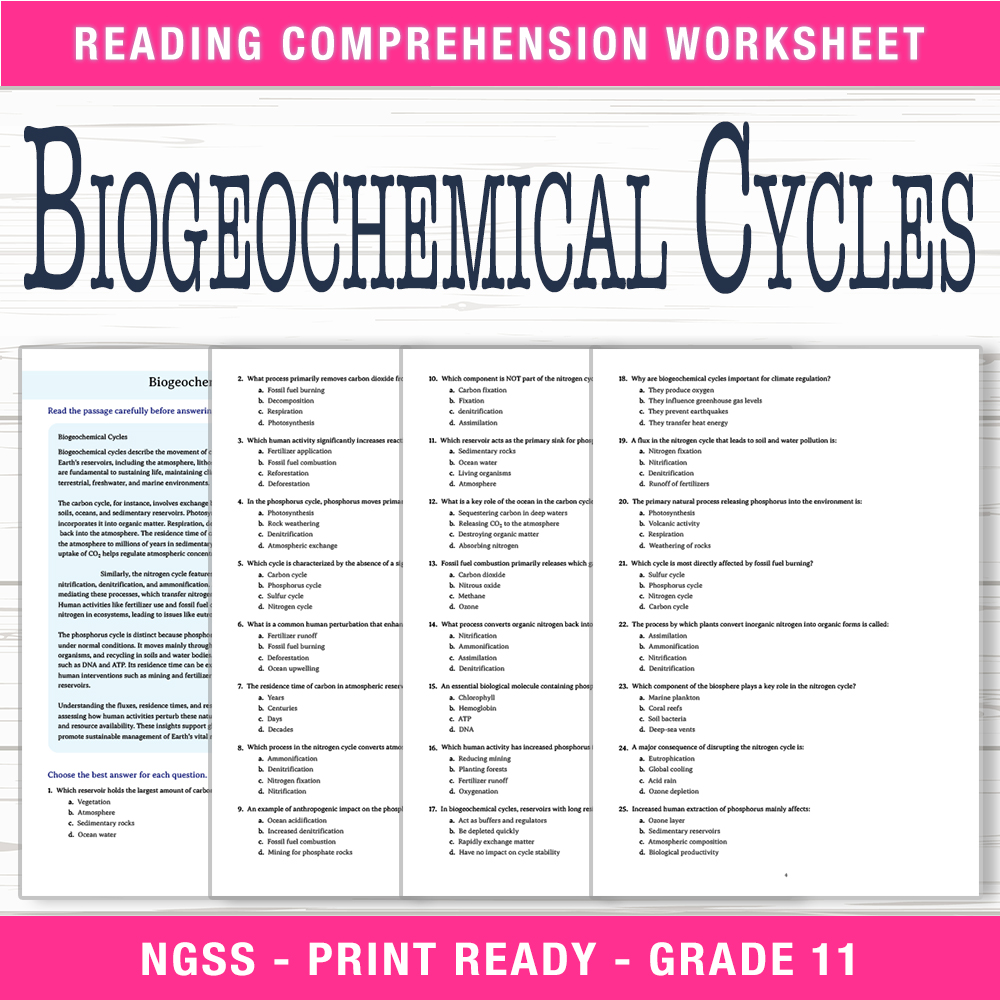
Grade 11 Science | Biogeochemical Cycles Worksheet (PDF + Answer Key)
 Created byRiverstone Classroom
Learning Objectives
- Describe the main reservoirs involved in the carbon, nitrogen, and phosphorus cycles.
- Explain the pathways and fluxes that transfer matter among reservoirs in biogeochemical cycles.
- Analyze the impact of human activities on biogeochemical cycles and their fluxes.
Instant download
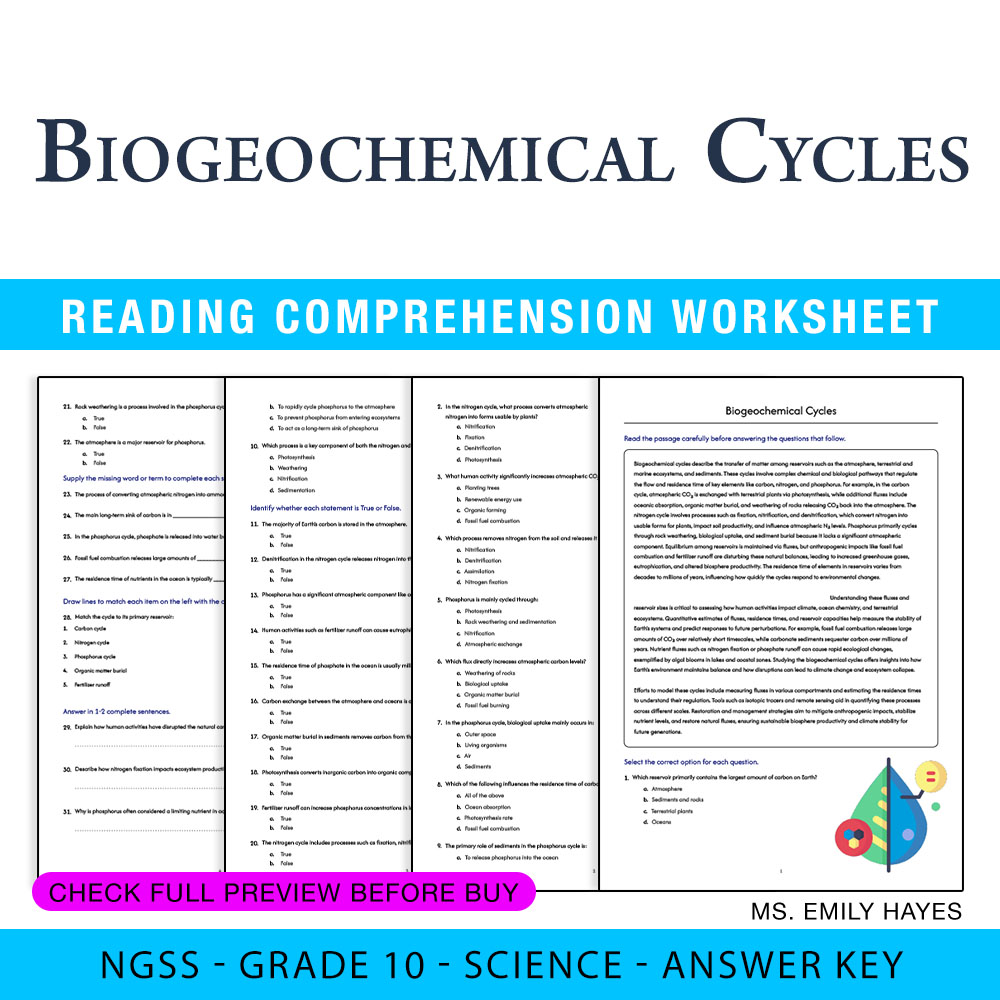
Grade 11 Science | Biogeochemical Cycles Worksheet (PDF+ Answer Key)
Created byCopper Leaf ClassroomLearning Objectives
- Describe the main reservoirs and fluxes involved in the carbon, nitrogen, and phosphorus cycles.
- Explain how human activities perturb natural biogeochemical cycles.
- Calculate residence times of key reservoirs in biogeochemical cycles.
Instant download
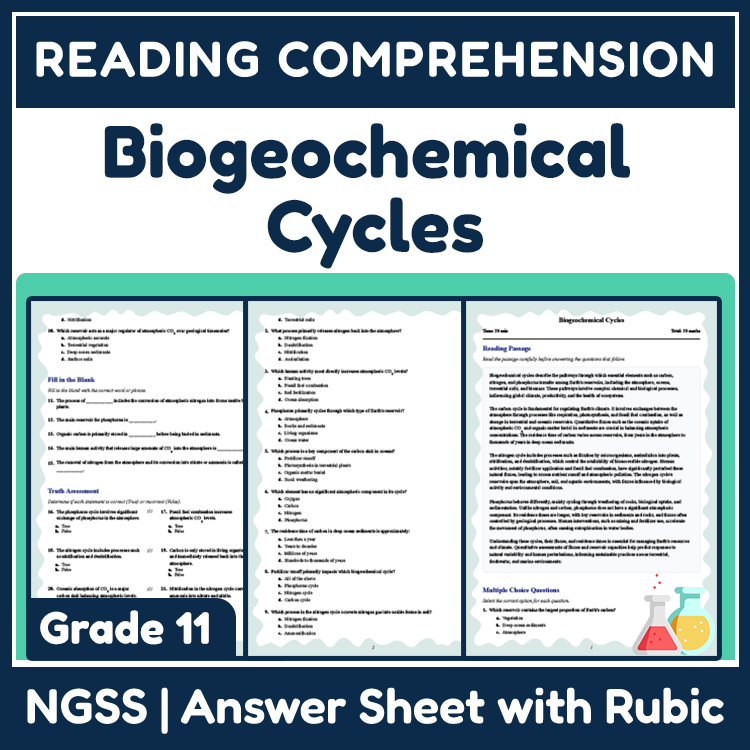
Grade 11 Science | Biogeochemical Cycles Reading Worksheet & Answer Key (PDF)
JCreated byJ.S SheetsLearning Objectives
- Understand the major biogeochemical cycles (carbon, nitrogen, phosphorus) and their reservoirs.
- Analyze the fluxes and residence times of key elements within different reservoirs.
- Evaluate the impact of natural processes and human activities on these cycles.
Also included in: Grade 11 Science | Ecosystems & Earth Systems Worksheet Bundle
Instant download

Grade 11 Science – Understanding the Carbon Cycle | Daily Reading Worksheet
Created byBright Mind ResourcesLearning Objectives
- Identify major reservoirs of carbon in the Earth's system.
- Describe fluxes of carbon between reservoirs.
- Explain human impacts on the carbon cycle.
Also included in: Earth Systems Grade 11 Science Daily Reading Worksheets Bundle | NGSS +2 more
Instant download

Biogeochemical Cycles Practice Test | Grade 11 Science
Created byPrism Point LearningLearning Objectives
- Explain how matter moves through reservoirs in the carbon, nitrogen, and phosphorus cycles using chemical and biological pathways.
- Compare major reservoirs and fluxes for terrestrial, freshwater, and marine settings, including how residence time affects atmospheric composition and productivity.
- Analyze how human activities perturb biogeochemical cycles and predict likely environmental consequences.
Instant download
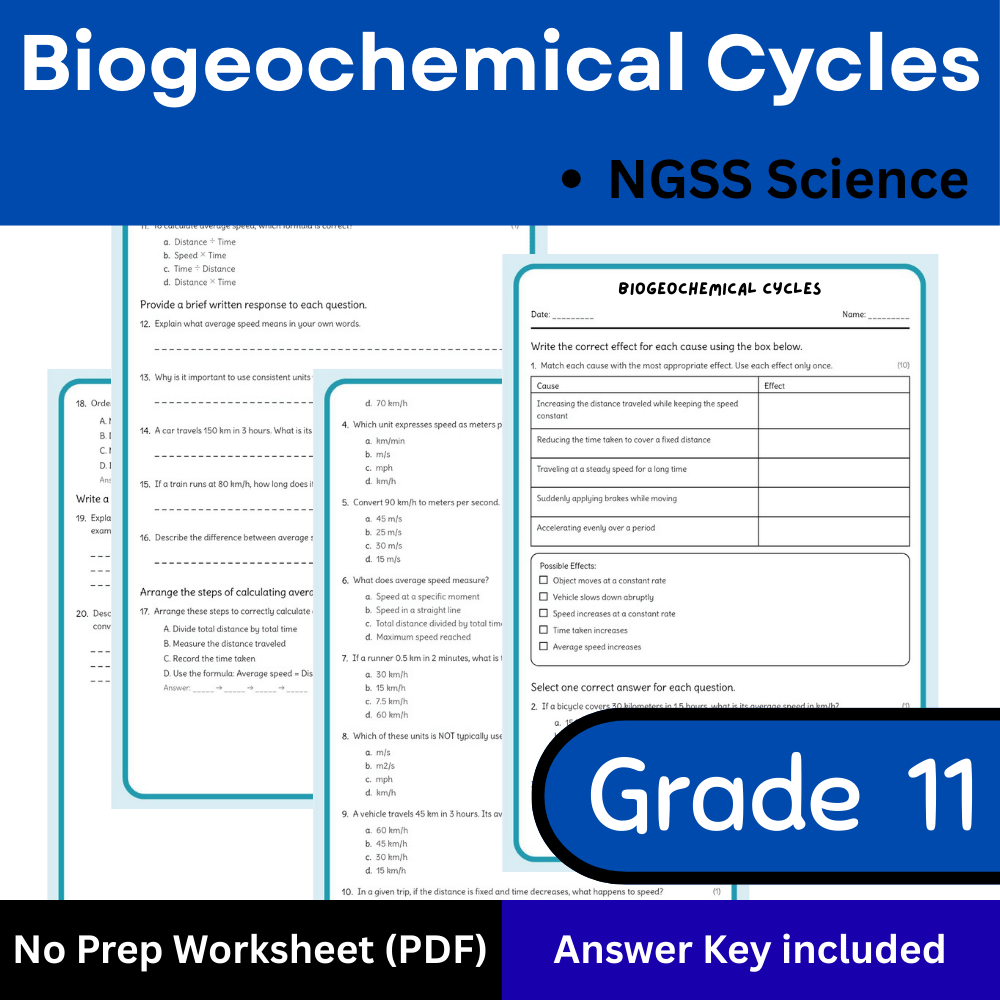
Grade 11 Science | Biogeochemical Cycles Worksheet (Answer Key) – NGSS Aligned
Created byBright Mind ResourcesLearning Objectives
- Understand the pathways and reservoirs involved in carbon, nitrogen, and phosphorus cycles.
- Identify various fluxes and residence times within biogeochemical cycles.
- Explain the impact of natural and anthropogenic perturbations on nutrient cycles and atmospheric composition.
Instant download
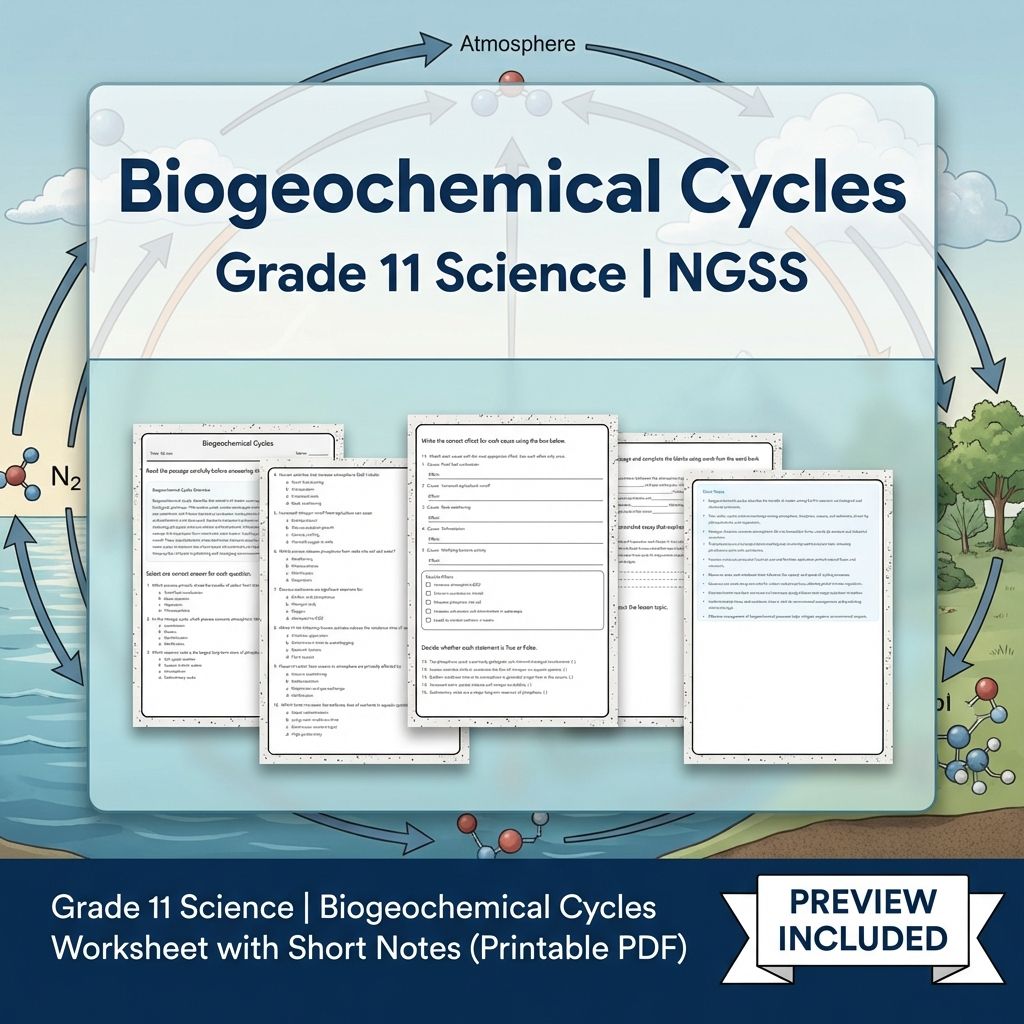
Grade 11 Science | Biogeochemical Cycles Worksheet with Short Notes (PDF)
Created byMeadowlark WorksheetsLearning Objectives
- Describe the main reservoirs and fluxes involved in the carbon, nitrogen, and phosphorus cycles.
- Explain the importance of biogeochemical cycles in regulating atmospheric composition and biosphere productivity.
- Analyze human impacts such as fossil fuel combustion and fertilizer runoff on nutrient fluxes and reservoir balance.
Also included in: Grade 11 Science | Earth’s Systems NGSS Unit Bundle – Classroom-Ready Worksheets +1 more
Instant download
Grade 11 Science - Biogeochemical Cycles NGSS (Worksheet + Answer Key)
 Created byMaple Path Learning
Learning Objectives
- Describe the main reservoirs and fluxes involved in carbon, nitrogen, and phosphorus cycles.
- Explain how biological and chemical pathways transfer matter among reservoirs.
- Analyze the impact of human activities on biogeochemical cycles and climate regulation.
Also included in: Grade 11 Earth Systems Science Lesson Bundle – NGSS Modeling Worksheets +1 more
Instant download
Browse more categories
About Reading comprehension Worksheets
Find reading comprehension worksheets for class practice, homework, or self-study. All 40,289 are instant PDF downloads.
Each resource here is built by an independent educator and reviewed for quality. Worksheets print straight from PDF and suit classroom use, homework, or extra practice; most come with answer keys, and you can preview before purchasing.