
Reading comprehension Worksheets
40,289 type resources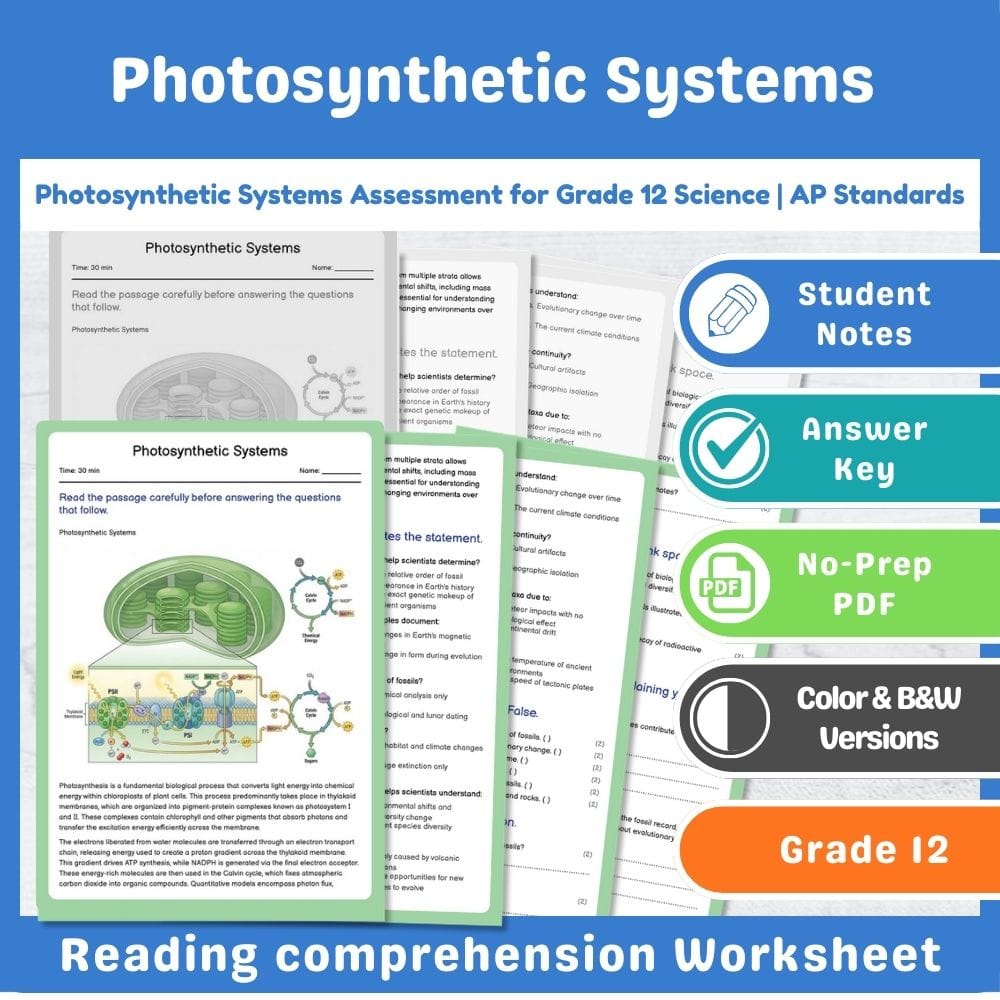
Photosynthetic Systems Assessment for Grade 12 Science | AP Standards
 Created byPrism Point Learning
Learning Objectives
- Describe the organization of pigments and electron transport chains in photosynthesis.
- Explain the coupling of light energy capture to the Calvin cycle and carbon fixation.
- Analyze energy budgets, quantum yield, and flux measurements in photosynthesis.
Also included in: Grade 12 Science Mini Bundle | Biology and Ecosystems AP Standards
Instant download
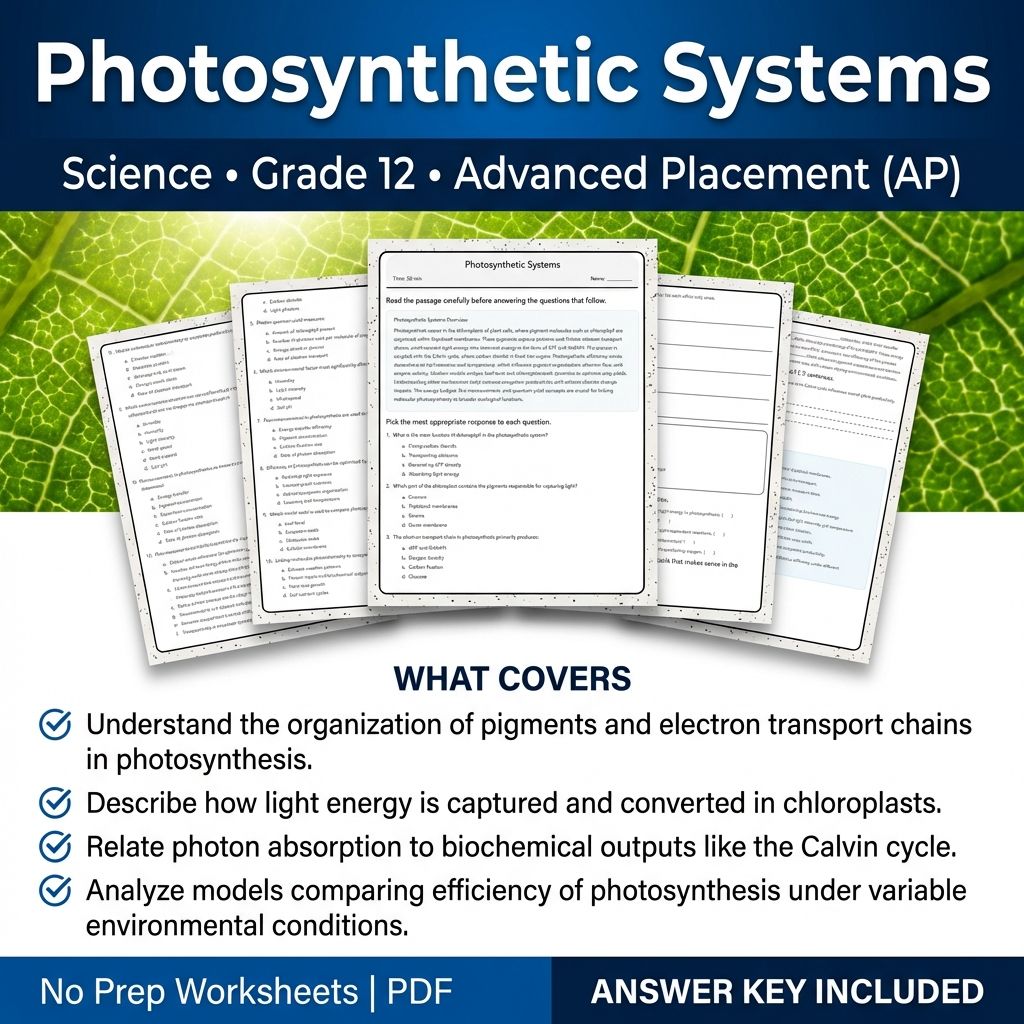
Grade 12 Science | Photosynthetic Systems Worksheet & Answer Key (Printable PDF)
 Created byCoral Reef Learning
Learning Objectives
- Understand the organization of pigments and electron transport chains in photosynthesis.
- Describe how light energy is captured and converted in chloroplasts.
- Relate photon absorption to biochemical outputs like the Calvin cycle.
Also included in: Grade 12 Science Unit Worksheet Bundle – Cell Biology, Genetics & Ecology +1 more
Instant download

Grade 12 Science — Worksheet MCQ Paper for Mastering Photosynthesis
 Created byThe Resource Hub
Learning Objectives
- Explain how light energy is captured and converted in photosynthetic membranes.
- Identify the roles of pigments and electron transport chains in photosynthesis.
- Describe how photon flux relates to biochemical outputs in photosynthesis.
Also included in: Grade 12 Science AP Bundle: Biology, Genetics, and Ecosystems Worksheets +2 more
Instant download

Abiotic Influences Assessment Grade 7 Science | TEKS Standards
Created byPrism Point LearningLearning Objectives
- Understand how nonliving factors like temperature, light, water, soil, and salinity affect ecosystems.
- Explain how abiotic gradients and microclimates influence species distribution and community structure.
- Identify examples of abiotic factors from terrestrial and aquatic environments that impact biodiversity.
Instant download
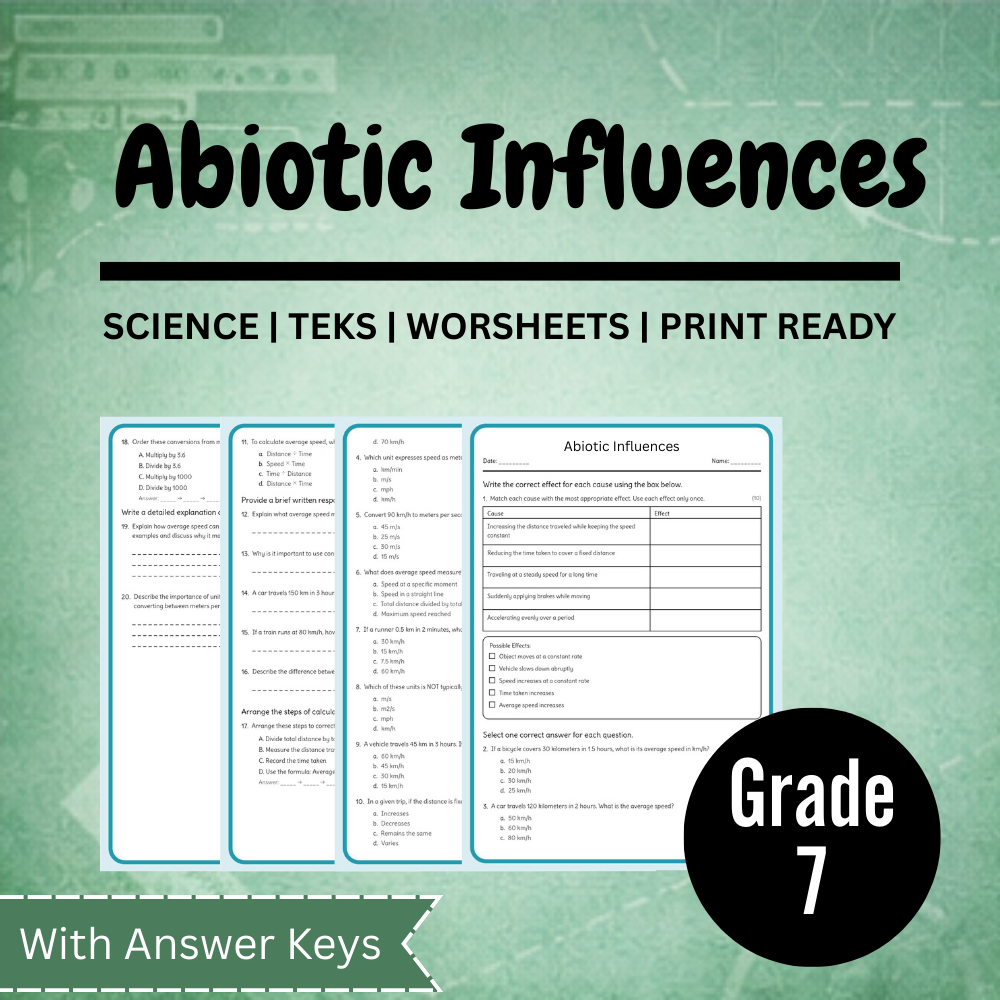
Grade 7 Science – Abiotic Influences Worksheet (Worksheet + Answer Key) – TEKS Aligned
 Created byBright Mind Resources
Learning Objectives
- Understand how nonliving factors like temperature, water, light, soil, and salinity affect species distribution and ecosystems.
- Describe how gradients and microclimates influence organism tolerances and seasonal patterns.
- Explain the interactions between abiotic factors and biotic relationships in shaping biodiversity and ecosystem function.
Also included in: Grade 7 Science Unit Bundle – Ecosystems, Adaptation & Environmental Impact +2 more
Instant download

Grade 7 Science | Abiotic Influences in Ecosystems - Daily Reading Comprehension
Created byCoral Reef LearningLearning Objectives
- Understand how temperature impacts species distribution and habitat conditions.
- Identify various abiotic factors influencing ecosystems.
- Explain the concept of microclimates and their effects on organisms.
Instant download

Abiotic Influences Worksheet | Grade 7 Science Practice Activities
Created byPrism Point LearningLearning Objectives
- Explain how abiotic factors (nonliving conditions) such as temperature, light, and water availability affect where organisms can live.
- Describe how gradients and microclimates create variation in habitat suitability across an ecosystem.
- Use terrestrial and aquatic examples to link abiotic constraints to species distribution and ecosystem productivity.
Also included in: Ecosystems & Adaptations Grade 7 Science Lesson Bundle TEKS Worksheets
Instant download

Grade 7 Science – Abiotic Influences in Ecology | Daily Reading Worksheet
Created byBright Mind ResourcesLearning Objectives
- Understand how temperature influences species distribution.
- Describe the impact of abiotic factors like water, soil, and light on ecosystems.
- Analyze how temperature gradients affect organism survival and adaptations.
Also included in: Grade 7 Ecosystems & Adaptations Science Daily Reading Lesson Bundle | TEKS +2 more
Instant download
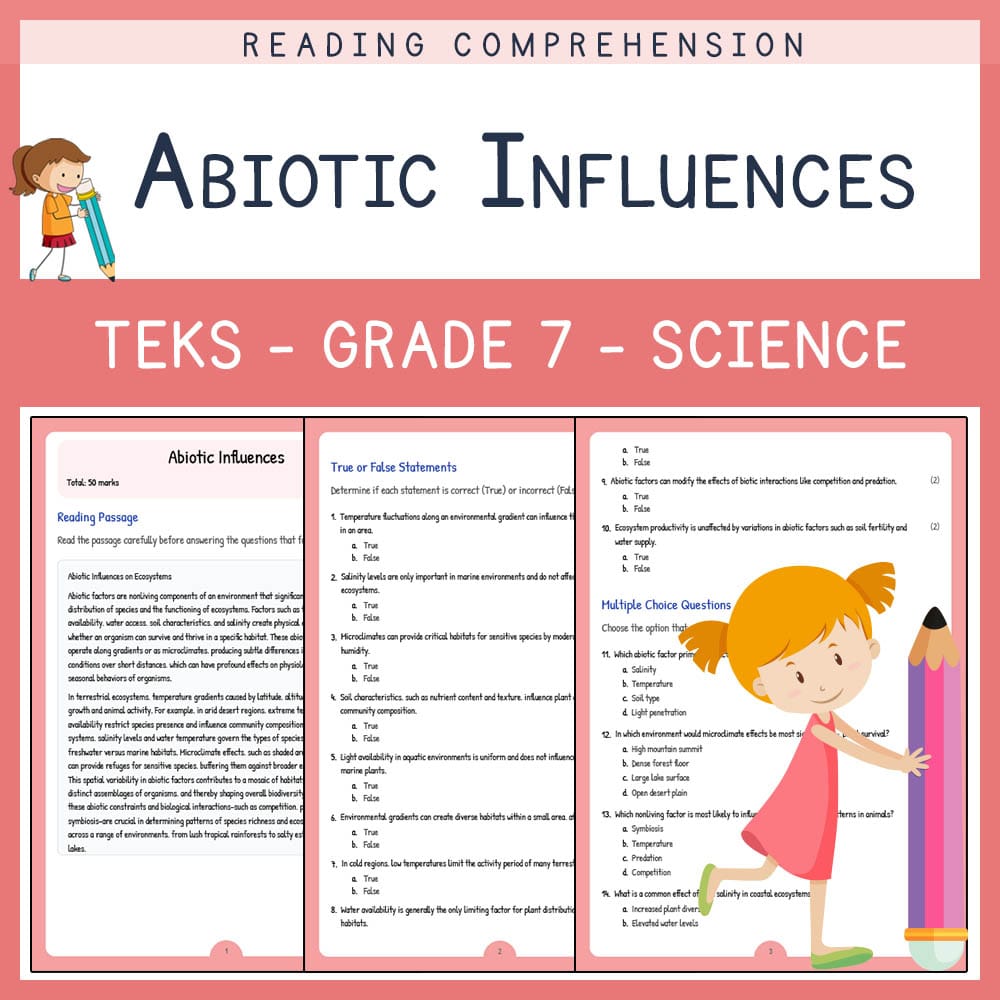
Grade 7 Science | Abiotic Influences Worksheet | TEKS Alligned
 Created byLumora Learning
Learning Objectives
- Understand how nonliving factors such as temperature, light, water, soil, and salinity influence species distributions and ecosystems.
- Explain the concept of environmental gradients and microclimate effects on organism tolerances.
- Describe how abiotic factors interact with biotic relationships to shape biodiversity and community structure.
Instant download
Grade 7 Science — Abiotic Influences Worksheet for Mastering Ecosystem Factors
Created byThe Resource HubLearning Objectives
- Understand how temperature, light, water, soil, and salinity affect species distributions.
- Explain the concepts of gradients, microclimates, and their effects on ecosystems.
- Analyze how abiotic factors interact with biological relationships to shape biodiversity and ecosystem functions.
Also included in: Grade 7 Science Unit Bundle – Ecosystems, Cells & Adaptations Worksheet Pack +1 more
Instant download

Grade 7 Science – Abiotic Influences Worksheet (TEKS) (PDF)
 Created byEvergreen Desk Education
Learning Objectives
- Explain how nonliving factors (temperature, light, water availability, soil characteristics, and salinity) limit which species can survive in an area
- Describe how gradients and microclimates affect organisms’ physiological tolerances and seasonal patterns
- Use terrestrial and aquatic examples to connect abiotic variability to habitat suitability and community composition
Instant download
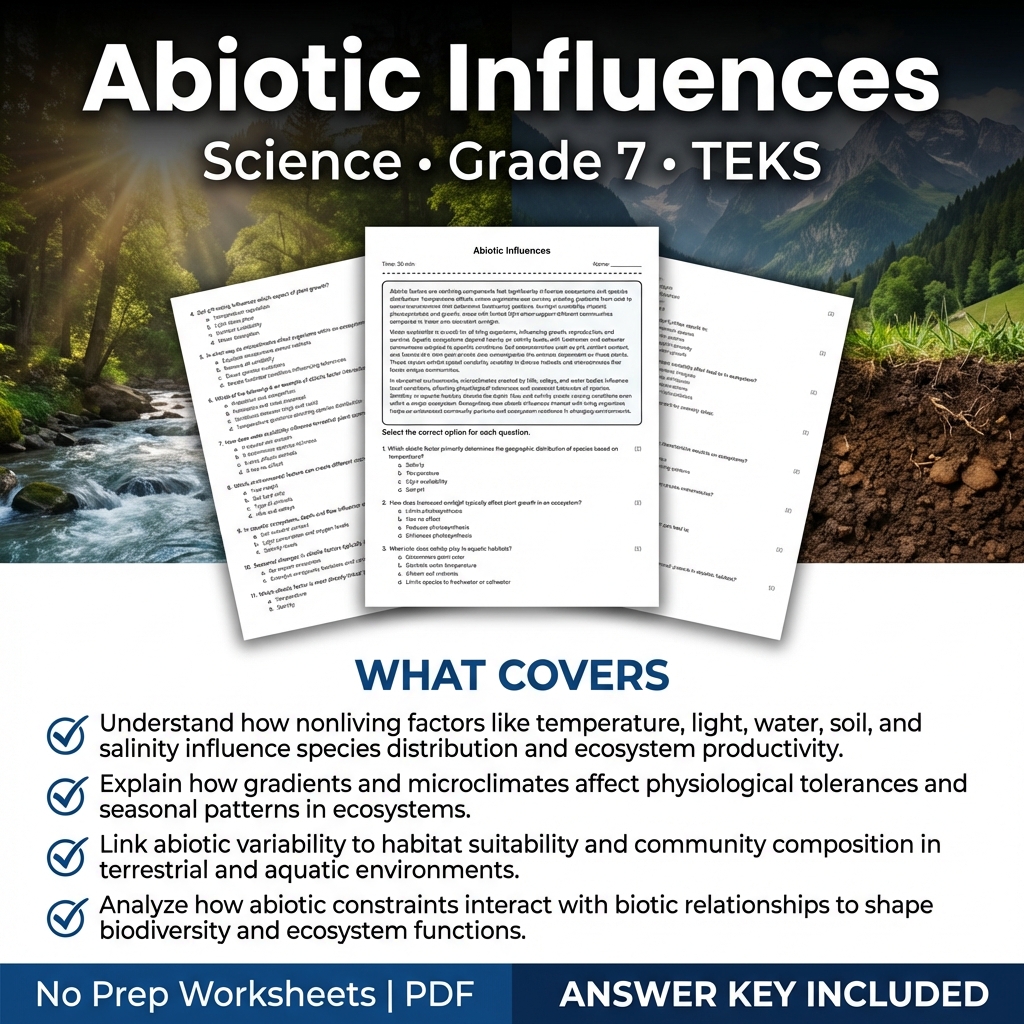
Grade 7 Science Worksheet on Abiotic Influences | TEKS Standards Practice
Created byCoral Reef LearningLearning Objectives
- Understand how nonliving factors like temperature, light, water, soil, and salinity influence species distribution and ecosystem productivity.
- Explain how gradients and microclimates affect physiological tolerances and seasonal patterns in ecosystems.
- Link abiotic variability to habitat suitability and community composition in terrestrial and aquatic environments.
Instant download
7th Grade Science | Abiotic Influences Reading Worksheet + Answer Key (PDF)
JCreated byJ.S SheetsLearning Objectives
- Understand how nonliving factors such as temperature, light, water, soil, and salinity influence species distribution and ecosystem productivity.
- Explain gradients and microclimates and their effects on organisms' physiological tolerances and seasonal behaviors.
- Describe how abiotic variability interacts with biotic relationships to shape biodiversity and community composition in different habitats.
Instant download
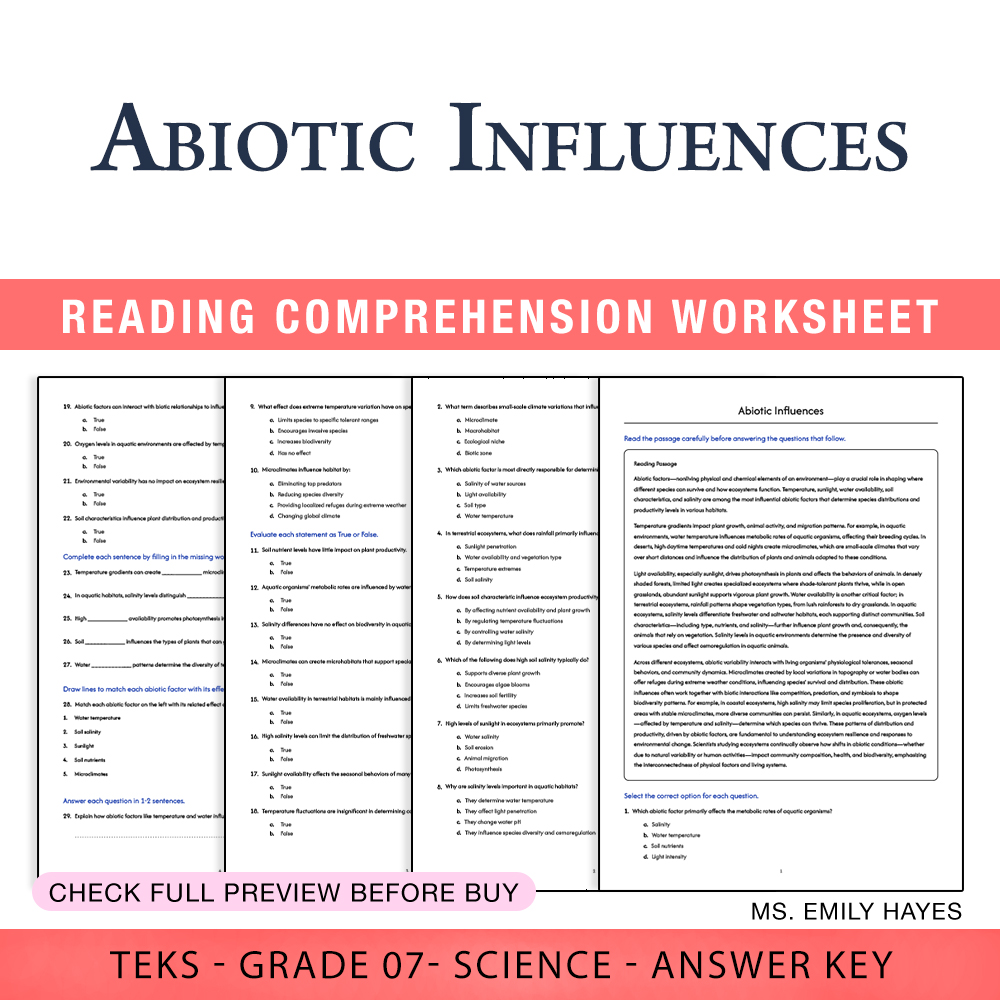
7th Grade Science | Abiotic Influences Worksheet (PDF+ Answer Key)
 Created byCopper Leaf Classroom
Learning Objectives
- Understand how nonliving factors such as temperature, light, water, soil, and salinity influence species distribution and ecosystem productivity.
- Describe how gradients and microclimates affect organism adaptations and seasonal patterns.
- Analyze the interaction between abiotic factors and biotic relationships in shaping biodiversity and ecosystem functions.
Instant download

7th Grade Science | Abiotic Influences Worksheet with Short Notes(Printable PDF)
 Created byMeadowlark Worksheets
Learning Objectives
- Understand how nonliving factors like temperature, light, water, soil, and salinity influence species distributions and ecosystems.
- Explain how gradients and microclimate affect organisms' physiological tolerances and seasonal behaviors.
- Relate abiotic variability to habitat suitability and community composition in terrestrial and aquatic environments.
Instant download

Grade 9 Science | Climate Modeling - Daily Reading Comprehension
Created byCoral Reef LearningLearning Objectives
- Understand the basic concepts of climate models.
- Identify the physical processes represented in climate projections.
- Recognize the role of feedback mechanisms in climate models.
Instant download

Grade 9 Science | Climate Modeling Worksheet | California Standards
Created byLumora LearningLearning Objectives
- Explain how climate models represent physical processes that control Earth’s energy balance and atmospheric circulation
- Interpret how greenhouse-gas emission scenarios produce different projected temperature and precipitation trajectories
- Describe how climate feedbacks (water vapor, ice cover, and clouds) can amplify or dampen warming
Instant download

Grade 9 Climate Modeling Worksheet | California Science Earth Science + Answer Key
Created byEvergreen Desk EducationLearning Objectives
- Explain how climate models represent Earth’s energy balance and atmospheric circulation.
- Describe how greenhouse gas scenarios influence temperature and precipitation projections.
- Evaluate the role of feedbacks and uncertainty when interpreting model results.
Instant download

Grade 9 Science – Climate Modeling & Earth System | Daily Reading Worksheet
Created byBright Mind ResourcesLearning Objectives
- Understand the purpose and importance of climate models.
- Identify key components and feedback mechanisms in climate models.
- Develop skills to comprehend scientific passages related to climate science.
Also included in: Grade 9 Science Worksheets: Space-to-Climate Lesson Bundle | Calif. Standards +1 more
Instant download

Climate Modeling Worksheet | Grade 9 Climate Science Activities
Created byPrism Point LearningLearning Objectives
- Explain how climate models represent Earth’s energy balance and atmospheric circulation
- Describe how different greenhouse gas emission scenarios lead to different climate projections
- Evaluate feedbacks and uncertainty when comparing model results with evidence
Instant download
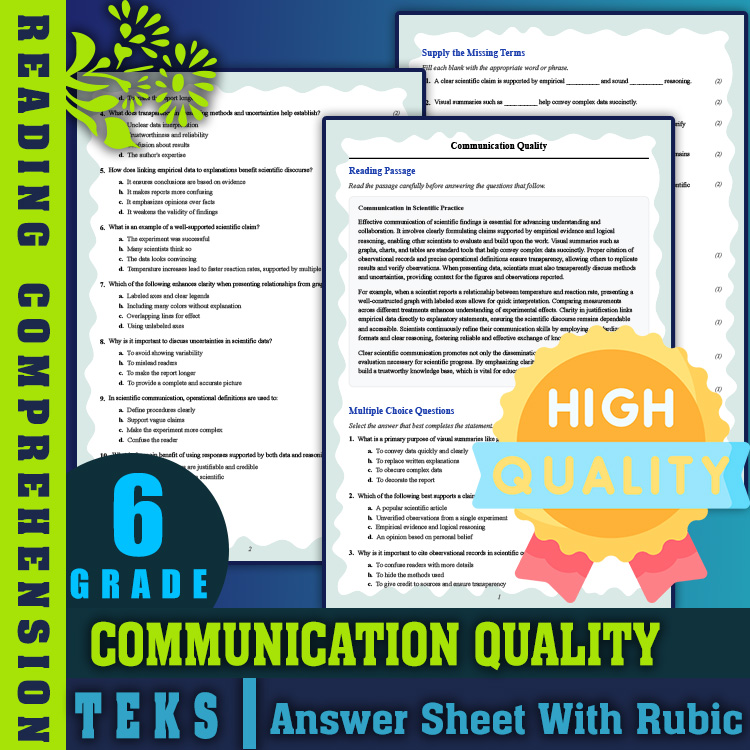
6th Grade Science | Communication Quality Reading Worksheet (PDF + Rubric)
JCreated byJ.S SheetsLearning Objectives
- Understand the standards for effectively communicating scientific findings, including clear claims supported by evidence.
- Learn to utilize visual summaries and proper citation of observational records to enhance scientific discourse.
- Apply principles of clarity and transparency in presenting methods, uncertainties, and justifications in scientific reporting.
Instant download

Grade 6 Science | Communication Quality in Science - Daily Reading Comprehension
Created byCoral Reef LearningLearning Objectives
- Understand how to formulate clear scientific claims supported by evidence.
- Learn to interpret and create visual summaries such as graphs.
- Recognize the importance of citing observational records accurately.
Instant download

Grade 6 Science – Communication & Reporting in Science | Daily Reading Worksheet
Created byBright Mind ResourcesLearning Objectives
- Understand the importance of clear communication in scientific work
- Learn how to formulate claims supported by evidence and reasoning
- Identify and interpret visual summaries like graphs
Also included in: Grade 6 Science Inquiry & Modeling Daily Reading Lesson Bundle | TEKS +2 more
Instant download

Grade 6 Science | Communication Quality Worksheet | TEKS Aligned
Created byLumora LearningLearning Objectives
- Understand the standards and best practices for communicating scientific findings.
- Formulate clear claims supported by empirical evidence and logical reasoning.
- Utilize visual summaries and proper citations to enhance scientific communication.
Instant download
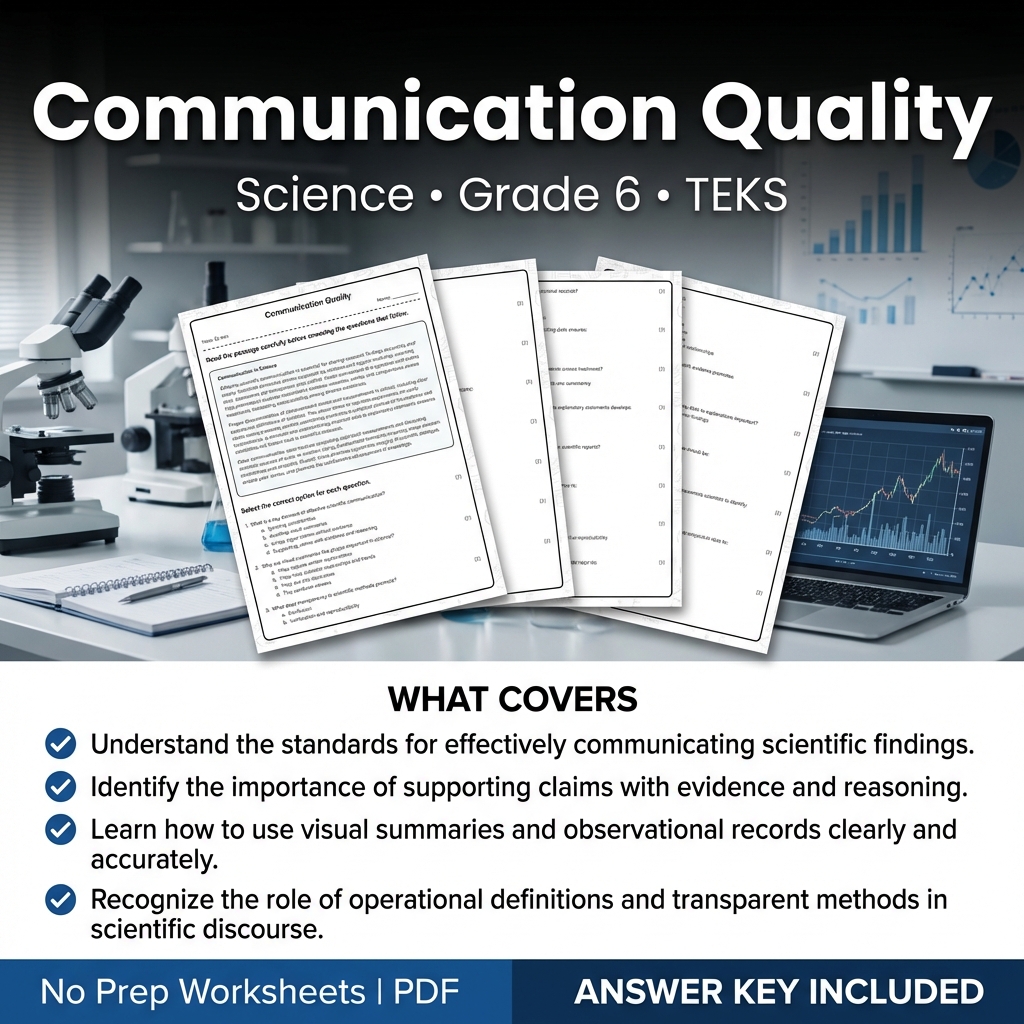
Grade 6 Science Worksheet on Communication Quality — Classroom Printable PDF
Created byCoral Reef LearningLearning Objectives
- Understand the standards for effectively communicating scientific findings.
- Identify the importance of supporting claims with evidence and reasoning.
- Learn how to use visual summaries and observational records clearly and accurately.
Instant download
6th Grade Science | Effective Communication in Science Worksheet (PDF)
Created byBright Mind ResourcesLearning Objectives
- Understand the standards for clearly communicating scientific findings.
- Learn how to formulate claims supported by evidence and reasoning.
- Recognize the importance of visual summaries, operational definitions, and citations in scientific discourse.
Instant download
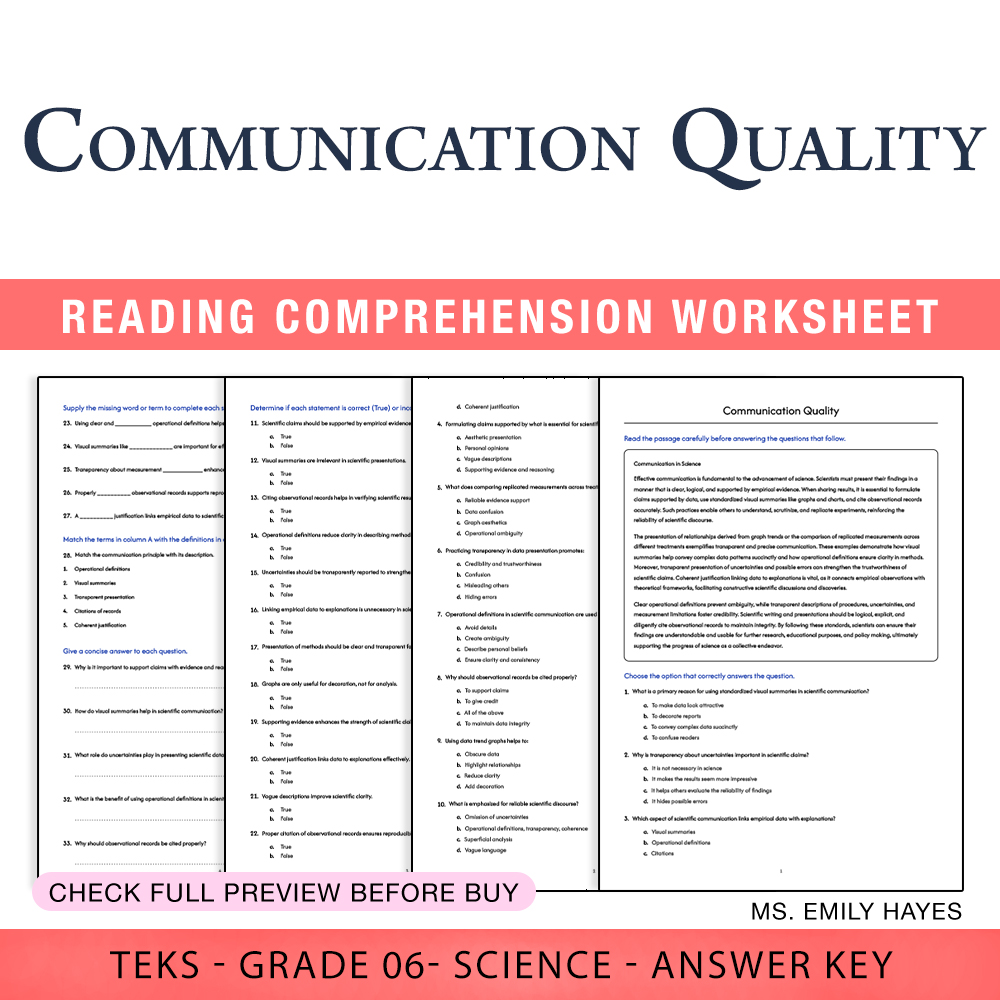
6th Grade Science | Communication Quality Worksheet (PDF+ Answer Key)
Created byCopper Leaf ClassroomLearning Objectives
- Understand the standards for communicating scientific findings clearly and accurately.
- Identify effective methods for presenting evidence and supporting claims.
- Learn how to use visual summaries and proper citation of observational records.
Instant download
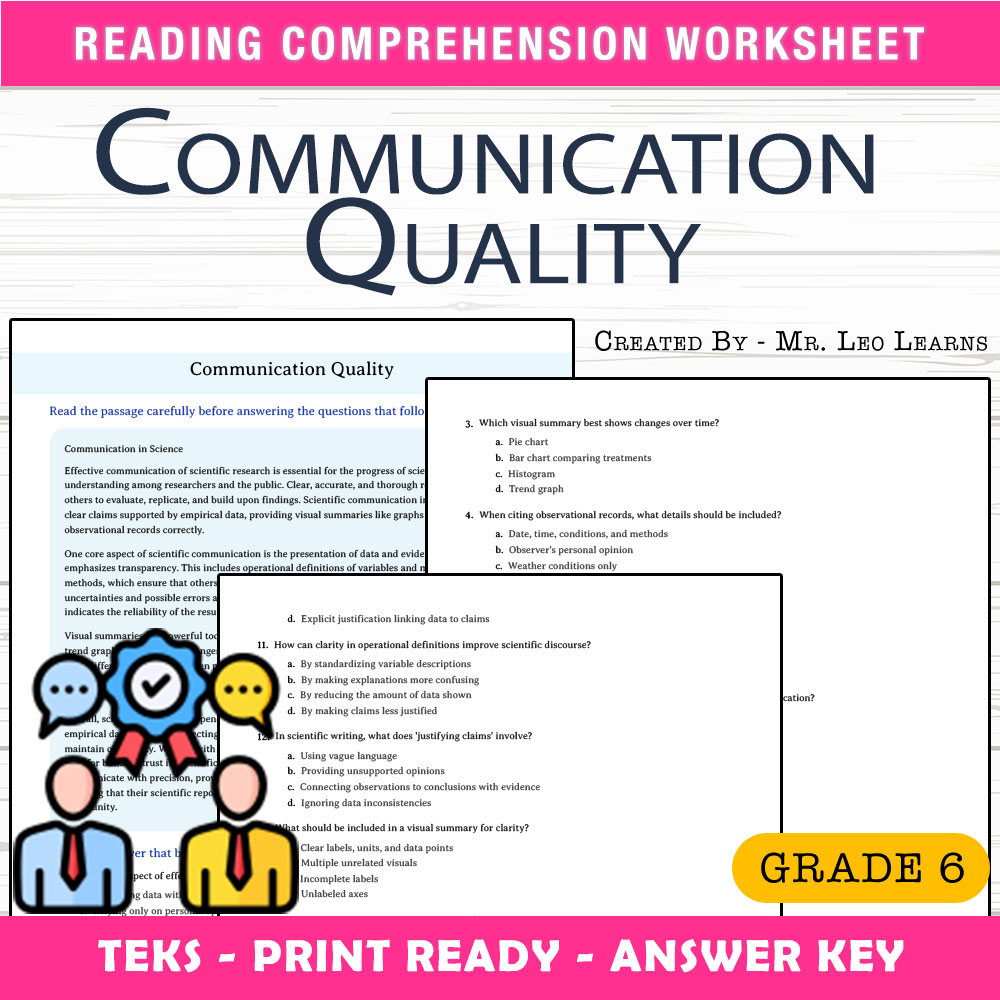
Grade 6 Science – Communication Quality Worksheet for Mastery
Created byThe Resource HubLearning Objectives
- Understand the standards for accurately communicating scientific findings including claims, evidence, and reasoning.
- Learn to create clear visual summaries, cite observational records, and justify conclusions linking data and explanations.
- Develop skills to present relationships from data trends and compare measurements across different treatments.
Instant download

Communication Quality Worksheet | Grade 6 Science Practice
Created byPrism Point LearningLearning Objectives
- Write clear scientific claims supported by evidence and scientific reasoning
- Use standardized visual summaries (like graphs) to explain patterns and relationships
- Document observational records and methods clearly, including uncertainties
Also included in: Grade 6 Scientific Investigation Practices Science Lesson Bundle TEKS +1 more
Instant download

Communication Quality Assessment for Grade 6 Science | TEKS
Created byPrism Point LearningLearning Objectives
- Understand standards for communicating scientific findings clearly and effectively.
- Learn how to formulate claims supported by empirical evidence and scientific reasoning.
- Identify the use of visual summaries, such as graphs, to present data relationships.
Also included in: Scientific Inquiry and Processes Grade 6 Science Lesson Bundle | TEKS
Instant download

6th Grade Science Worksheet – Communication Quality (PDF) TEKS aligned
Created byEvergreen Desk EducationLearning Objectives
- Write clear science claims that are supported by evidence and logical reasoning.
- Use standardized visual summaries (graphs, data tables) to communicate relationships and comparisons.
- Present methods and uncertainties transparently and cite observational records accurately.
Instant download

Grade 11 Science | Seasons and Orbits Worksheet | NGSSS Aligned
Created byLumora LearningLearning Objectives
- Explain how Earth’s axial tilt and revolution around the Sun affect seasonal temperature patterns at different latitudes
- Describe how Earth’s rotation controls day length and how orbit geometry changes solar radiation intensity through the year
- Connect the Moon’s orbital motion and gravitational interaction with observable effects such as tides
Instant download

Seasons and Orbits Worksheet Grade 11 Science | NGSSS Earth Science
Created byEvergreen Desk EducationLearning Objectives
- Explain how Earth’s rotation and axial tilt affect day length and seasonal patterns
- Describe how Earth’s revolution changes the angle and intensity of solar radiation across latitudes
- Connect the Earth–Moon system to observable effects such as tides and their timing
Instant download

Seasons and Orbits Worksheet Grade 11 Science NGSSS Space Science
Created byPrism Point LearningLearning Objectives
- Explain how Earth’s axial tilt and its orbit around the Sun determine seasonal changes and day length across latitudes.
- Describe how orbital geometry affects the intensity and angle of solar radiation reaching Earth’s surface.
- Connect the Moon’s orbit and gravity to observable tides on Earth.
Also included in: Grade 11 Earth & Space Science Systems Lesson Bundle | Florida NGSSS
Instant download

Grade 11 Science – Seasons & Orbits Daily Reading Worksheet | NGSSS
Created byBright Mind ResourcesLearning Objectives
- Understand how Earth's rotation causes day and night.
- Learn the relationship between Earth's orbit and seasonal changes.
- Identify the factors influencing the intensity and angle of sunlight on Earth.
Also included in: Earth and Space Science Grade 11 Science Lesson Bundle | Florida NGSSS +1 more
Instant download

Seasons and Orbits Assessment | Florida NGSSS Grade 11 Science
Created byPrism Point LearningLearning Objectives
- Explain how Earth’s tilt and orbital motion affect the angle and intensity of solar radiation at different latitudes.
- Connect Earth’s rotation and revolution to day length and seasonal temperature patterns.
- Describe how the Moon’s orbit and gravity produce observable effects such as tides.
Also included in: Lesson Bundle: Grade 11 Earth and Space Science Assessments | Florida NGSSS +1 more
Instant download

Grade 11 Science | Seasons & Orbits - Daily Reading Comprehension
Created byCoral Reef LearningLearning Objectives
- Understand how Earth's axial tilt affects seasonal changes
- Describe the relationship between Earth's orbit and variations in sunlight
- Explain how the tilt influences temperature differences across the globe
Instant download

Ecosystem Shifts Grade 8 Assessment | NGSSS Standards Classroom-Ready
Created byPrism Point LearningLearning Objectives
- Explain how natural disturbances and long-term environmental shifts can change ecosystems over time
- Describe how ecological succession affects species composition after a disturbance
- Evaluate how human activities can influence ecosystem stability and biodiversity
Also included in: Grade 8 Evolution and Genetics Science Lesson Bundle | Florida NGSSS
Instant download

Ecosystem Shifts Worksheet Grade 8 Science Review | Ecosystem Changes
Created byPrism Point LearningLearning Objectives
- Explain how natural disturbances and long-term environmental changes can alter habitats and food availability.
- Describe how ecosystem change can lead to changes in species composition and succession over time.
- Evaluate how human actions can influence ecosystems and affect interconnected organisms.
Also included in: Grade 8 Genetics, Evolution & Ecosystems Lesson Bundle | Florida NGSSS
Instant download

Grade 8 Science | Ecosystem Shifts - Daily Reading Comprehension
Created byCoral Reef LearningLearning Objectives
- Identify components of an ecosystem and their functions
- Understand how natural events cause changes in ecosystems
- Recognize the impact of human activities on ecosystems
Instant download

Grade 8 Science | Ecosystem Shifts Worksheet | NGSSS Aligned
Created byLumora LearningLearning Objectives
- Explain how natural disturbances and long-term environmental changes can shift an ecosystem over time
- Describe how succession leads to changes in species composition and dominant organisms
- Evaluate how human activities can influence ecosystem change and habitat availability
Instant download

Ecosystem Shifts Worksheet | Grade 8 Science NGSSS Ecology + Key + Notes
Created byEvergreen Desk EducationLearning Objectives
- Explain how natural disturbances and long-term environmental changes can alter ecosystem conditions.
- Describe how species interactions and available resources influence ecosystem change and succession.
- Identify how human activities can accelerate or redirect ecosystem shifts.
Instant download

Grade 8 Science – Ecosystem Shifts & Environmental Changes | Reading Worksheet
Created byBright Mind ResourcesLearning Objectives
- Understand how natural disturbances like storms impact ecosystems
- Identify the effects of storms on plant and animal habitats
- Recognize the process of ecological succession following disturbances
Also included in: Genetics Grade 8 Science Daily Reading Worksheets lesson bundle | Florida NGSSS +1 more
Instant download

Grade 10 Science — Model-Data Fit Worksheet MCQ Paper for Mastery
Created byThe Resource HubLearning Objectives
- Understand how to compare model predictions with observed data using residual analysis.
- Identify criteria for evaluating the goodness-of-fit of a model.
- Interpret discrepancies between models with and without air resistance in projectile motion.
Also included in: Grade 10 Science Bundle: Master Scientific Modeling & Data Analysis +1 more
Instant download

Grade 10 Science | Model-Data Fit Worksheet | AP-aligned
Created byLumora LearningLearning Objectives
- Understand how to compare model predictions with observed data using residual analysis.
- Evaluate the goodness-of-fit of different models in data analysis.
- Interpret discrepancies between models and data to inform model adequacy.
Instant download
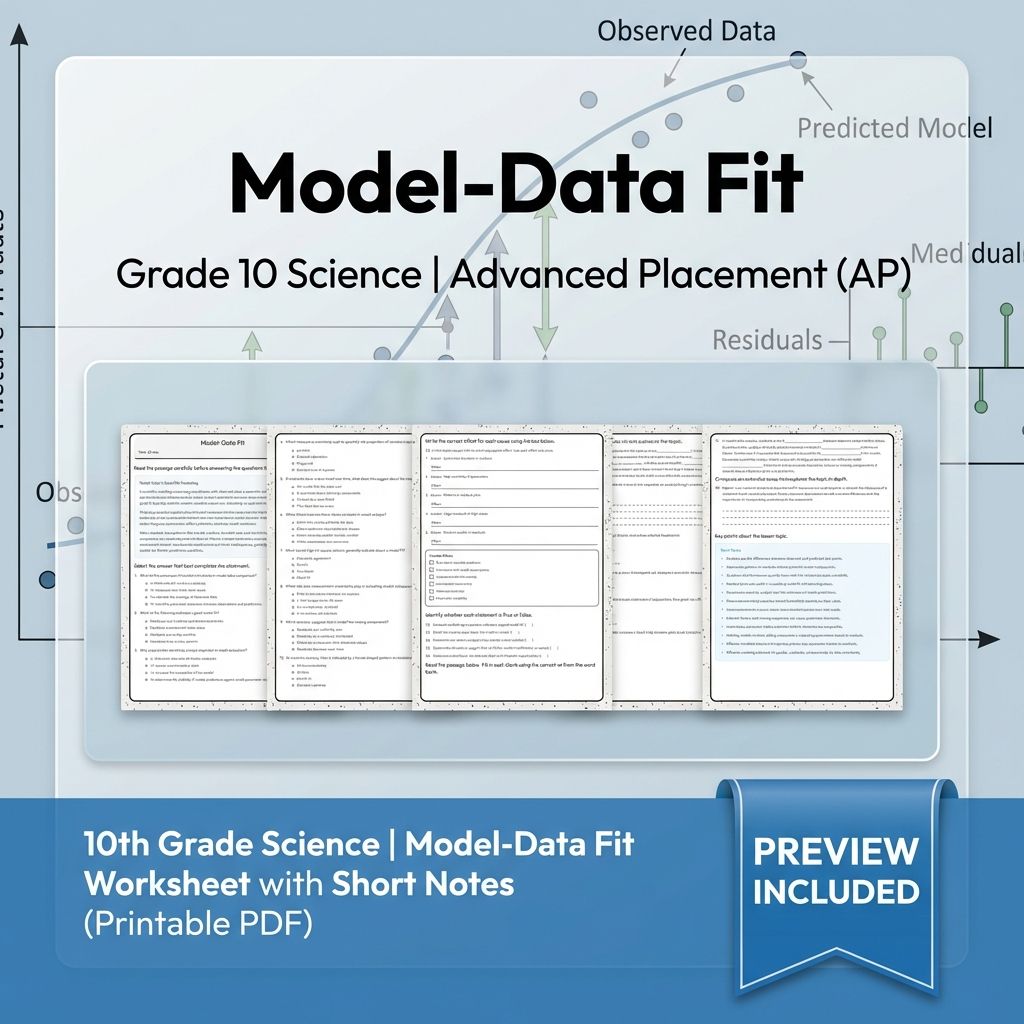
10th Grade Science | Model-Data Fit Worksheet with Short Notes (Printable PDF)
Created byMeadowlark WorksheetsLearning Objectives
- Understand how to compare model predictions with observed data using residual analysis.
- Interpret goodness-of-fit measures to evaluate model adequacy.
- Assess the impact of model parameter sensitivity on predictive accuracy.
Also included in: Grade 10 Science Unit | Data Analysis, Modelling Worksheet Pack
Instant download

Grade 10 Science Worksheet | Model-Data Fit (AP Standard) PDF
Created byEvergreen Desk EducationLearning Objectives
- Use residuals to compare model predictions with observed data and interpret patterns in discrepancies.
- Apply goodness-of-fit ideas to judge whether a model component is adequate for a given dataset.
- Explain how parameter sensitivity and uncertainty affect the confidence in model selection.
Also included in: Grade 10 Scientific Modeling & Quantitative Reasoning Science Lesson Bundle (AP) +1 more
Instant download
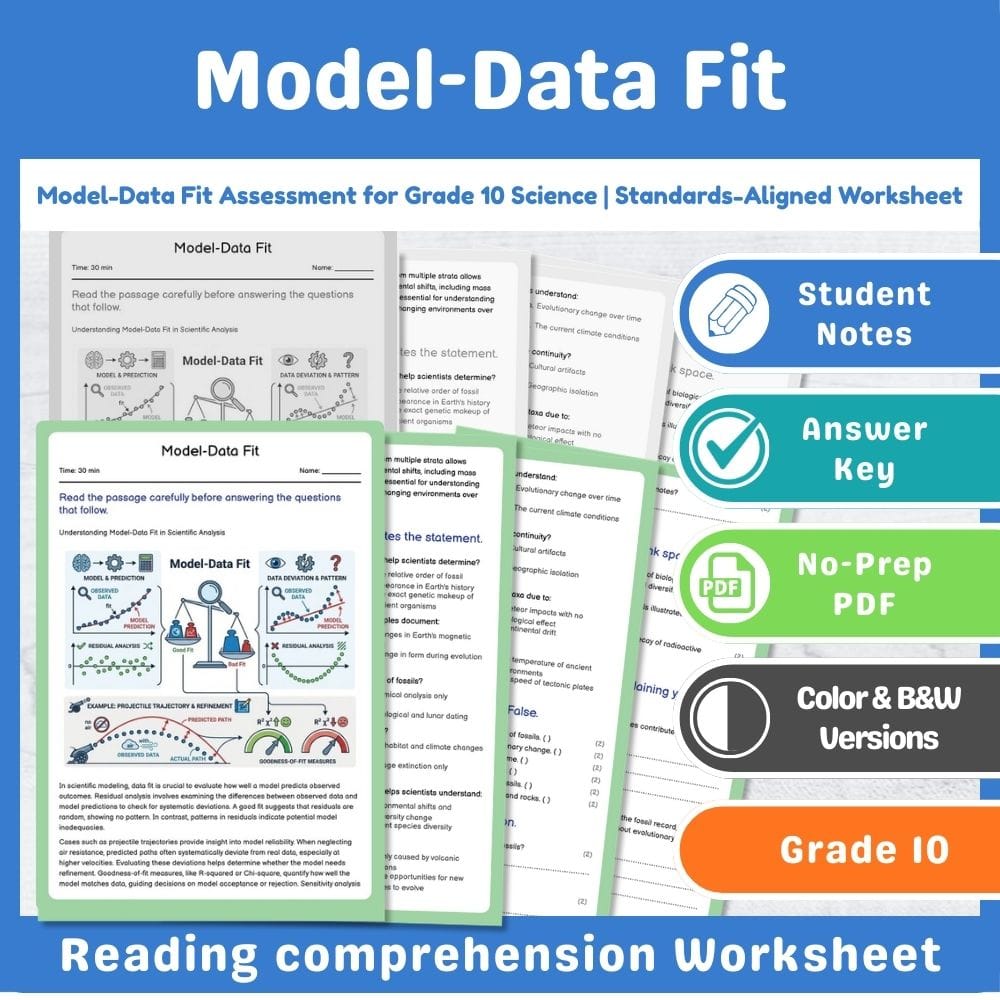
Model-Data Fit Assessment for Grade 10 Science | Standards-Aligned Worksheet
Created byPrism Point LearningLearning Objectives
- Interpret residuals and assess model adequacy using residual analysis.
- Apply goodness-of-fit concepts to evaluate the accuracy of model predictions.
- Analyze cases like projectile motion with and without air resistance to understand systematic deviations.
Instant download
Browse more categories
About Reading comprehension Worksheets
Find reading comprehension worksheets for class practice, homework, or self-study. All 40,289 are instant PDF downloads.
Each resource here is built by an independent educator and reviewed for quality. Worksheets print straight from PDF and suit classroom use, homework, or extra practice; most come with answer keys, and you can preview before purchasing.