
Reading comprehension Worksheets
40,289 type resources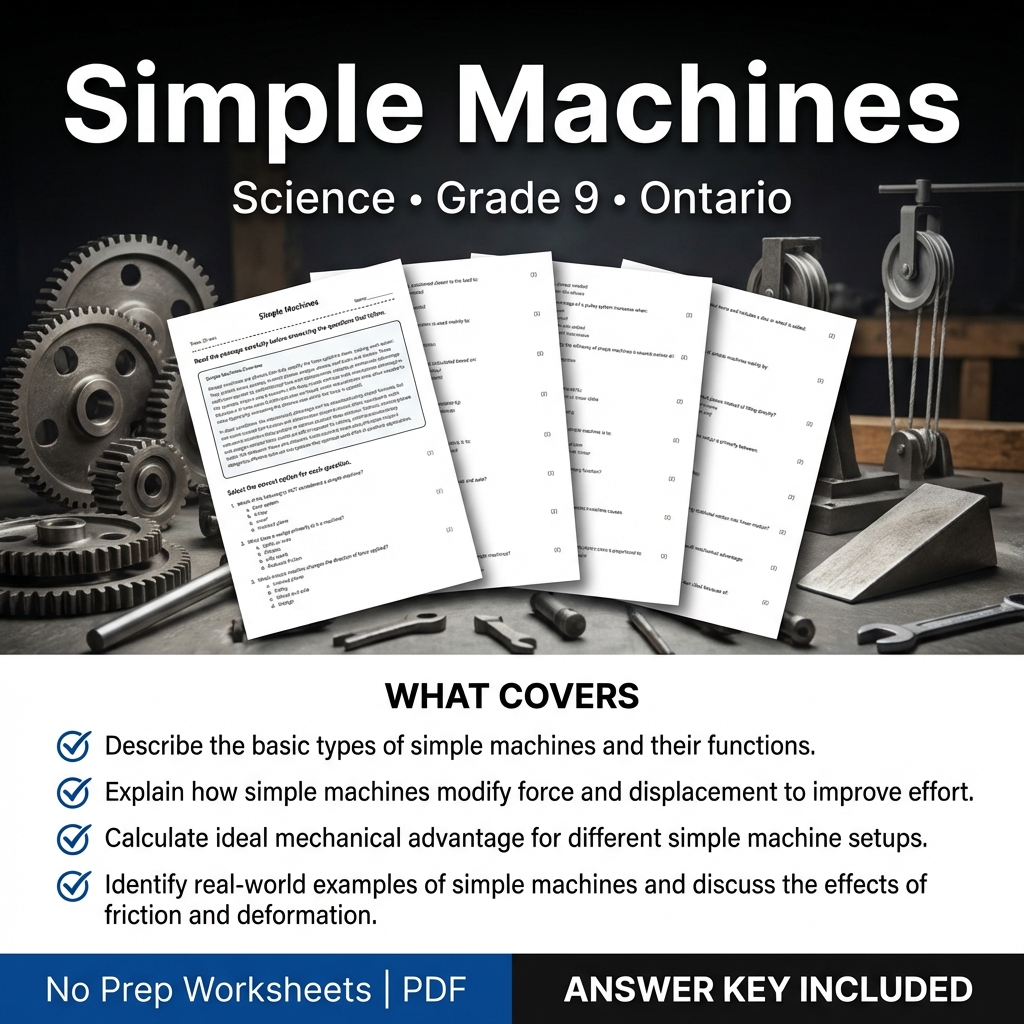
Grade 9 Science Worksheet on Simple Machines | Ontario Standards Practice
 Created byCoral Reef Learning
Learning Objectives
- Describe the basic types of simple machines and their functions.
- Explain how simple machines modify force and displacement to improve effort.
- Calculate ideal mechanical advantage for different simple machine setups.
Instant download

Grade 11 Science – Covalent Bonding & Concepts | Daily Reading Worksheet
 Created byBright Mind Resources
Learning Objectives
- Understand the concept of covalent bonds and shared electron pairs
- Identify covalent bonds in molecules
- Differentiate bond polarity and its effects
Also included in: Grade 11 Chemistry Science Lesson Bundle Worksheets: Daily Reading | BC +1 more
Instant download
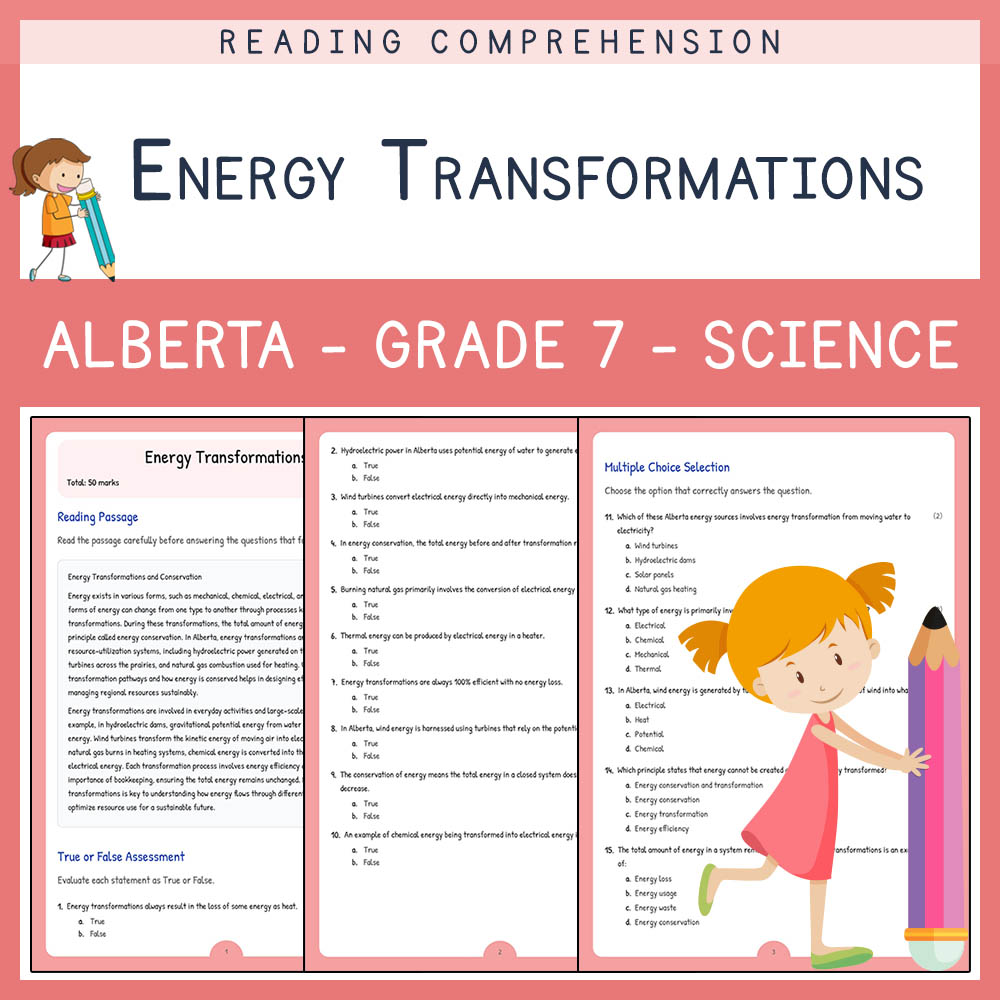
Grade 7 Science | Energy Transformations Worksheet | Alberta Standard
 Created byLumora Learning
Learning Objectives
- Understand the different forms of energy and how they interconvert.
- Explain the concept of energy conservation during transformations.
- Identify examples of energy transformations in Alberta's regional systems.
Instant download
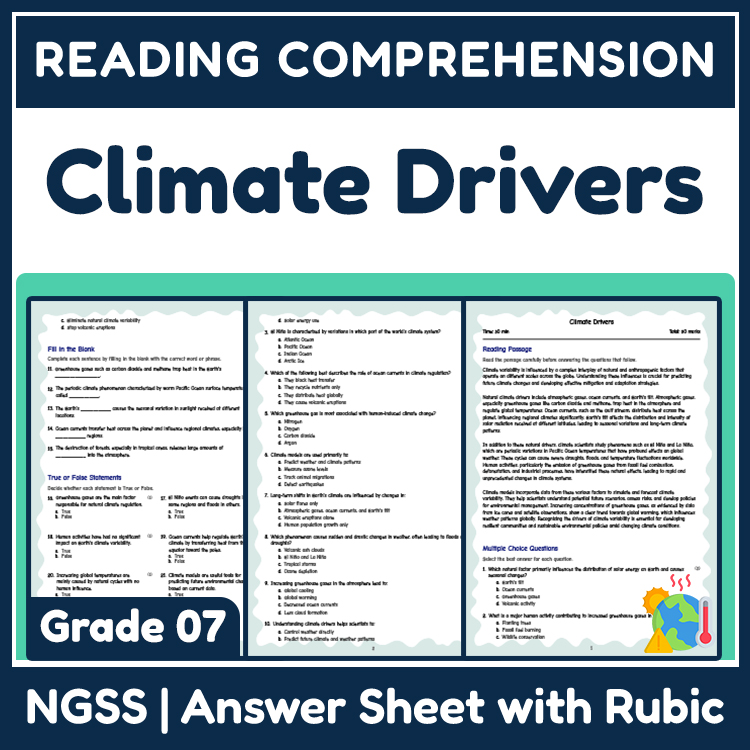
7th Grade Science | Climate Drivers Reading Worksheets NGSS-Aligned + Answer Key
JCreated byJ.S SheetsLearning Objectives
- Understand the natural and human influences on Earth's climate
- Identify major factors that affect climate variability such as atmospheric gases and ocean currents
- Explain how climate models predict weather patterns and global temperatures
Instant download
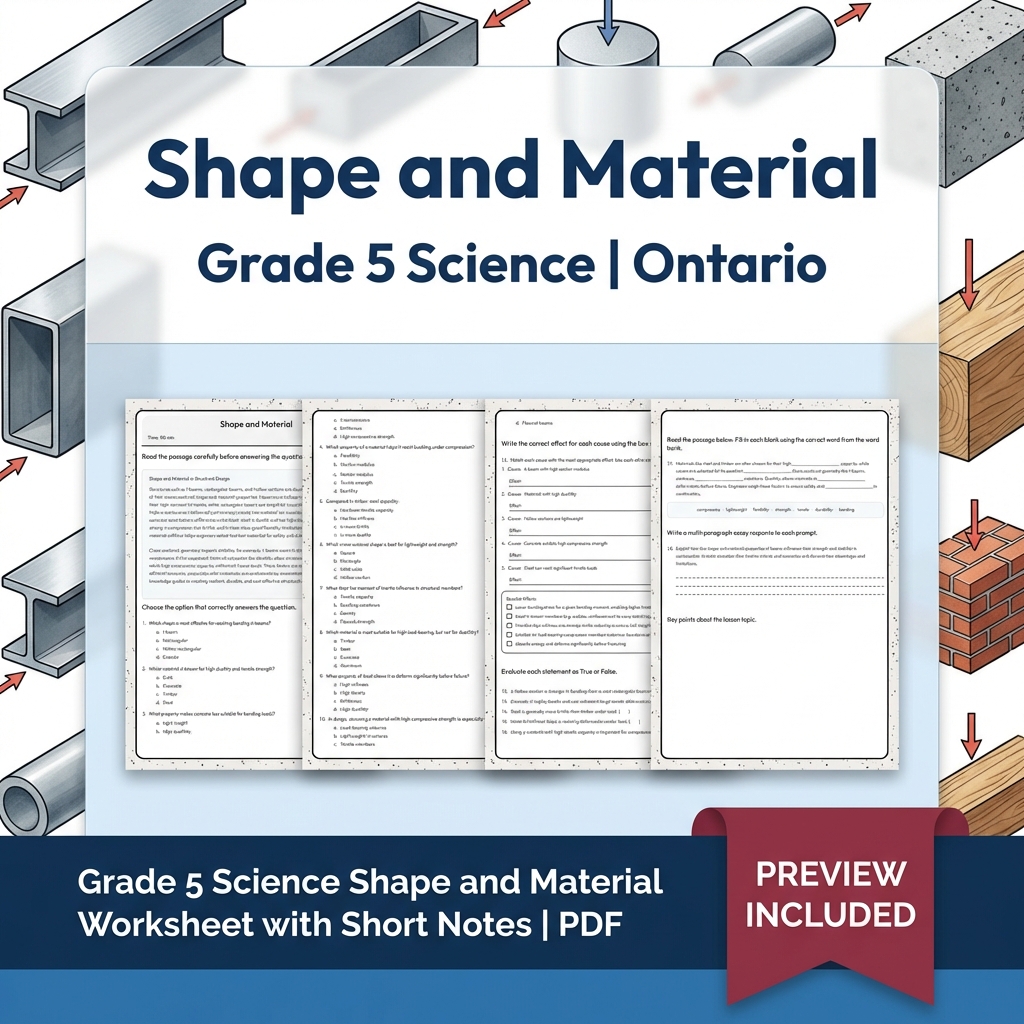
Grade 5 Science Shape and Material Worksheet with Short Notes | PDF
 Created byMeadowlark Worksheets
Learning Objectives
- Understand how cross-sectional geometry influences strength and stability of beams and sections.
- Compare the properties of timber, steel, and concrete under load conditions.
- Explain the roles of moment of inertia, section modulus, and material stiffness in resisting bending and buckling.
Also included in: Grade 5 Science Lesson Group Bundle | Ontario Mechanical Structures & Forces +1 more
Instant download

8th Grade Science | Kinematics Distinctions Reading Worksheet (PDF & Answer Key)
JCreated byJ.S SheetsLearning Objectives
- Define speed, velocity, and acceleration with precise scientific distinctions.
- Differentiate scalar and vector quantities in the context of motion.
- Interpret regional examples of vehicle travel to understand directional motion and changes in speed and acceleration.
Also included in: Grade 8 Science Bundle – Forces, Motion & Energy Worksheets (PDF & Answer Key) +1 more
Instant download

Grade 12 Science Worksheet – Intermolecular Forces (PDF) | BC Standards
 Created byEvergreen Desk Education
Learning Objectives
- Distinguish between London dispersion forces, dipole-dipole interactions, and hydrogen bonding
- Predict how intermolecular forces influence boiling point, melting point, surface tension, and solubility
- Connect molecular structure (polarity and hydrogen-bonding ability) to observed condensed-phase behavior
Instant download
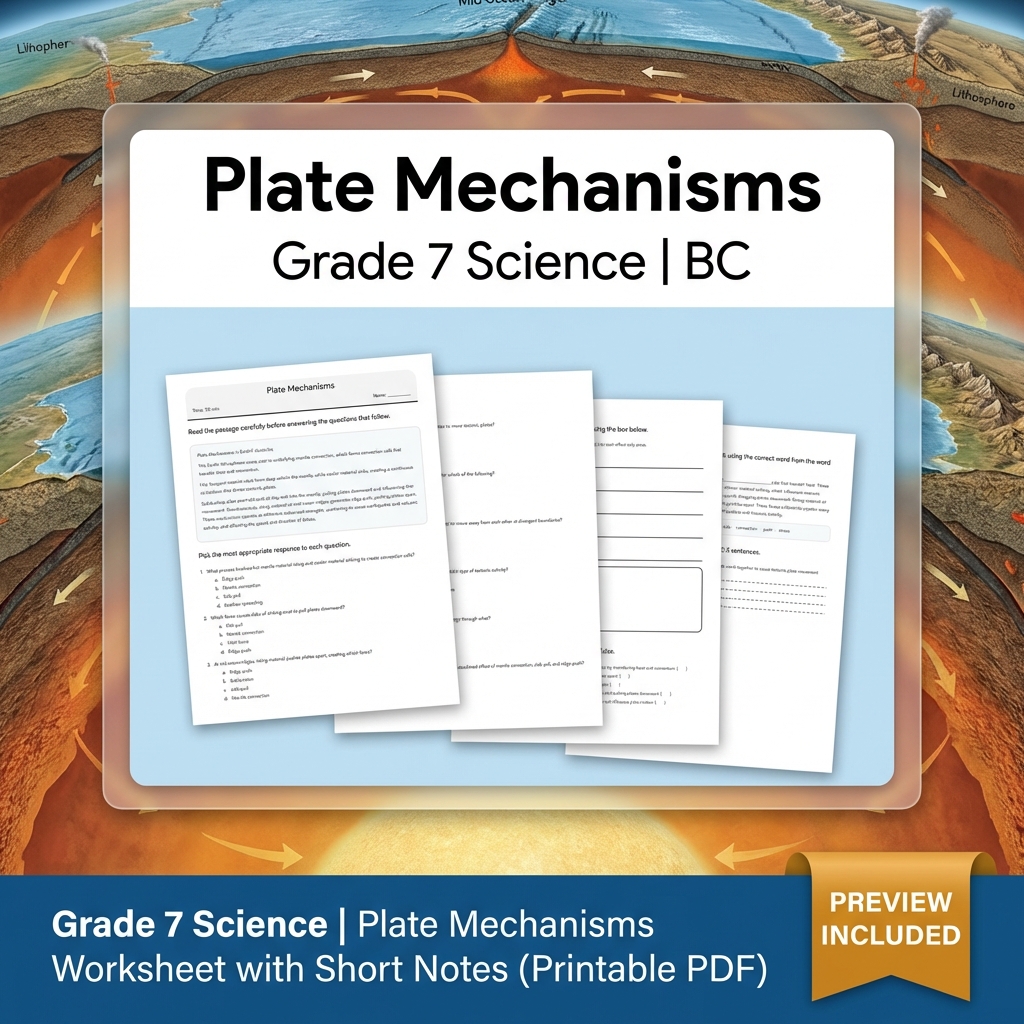
Grade 7 Science | Plate Mechanisms Worksheet with Short Notes (Printable PDF)
Created byMeadowlark WorksheetsLearning Objectives
- Understand how mantle convection, slab pull, and ridge push influence plate motion.
- Describe the processes of mantle convection and their role in tectonic activity.
- Explain how slab pull and ridge push contribute to plate movement.
Also included in: Grade 7 Science Lesson Bundle | Earth Processes Worksheets Group +1 more
Instant download
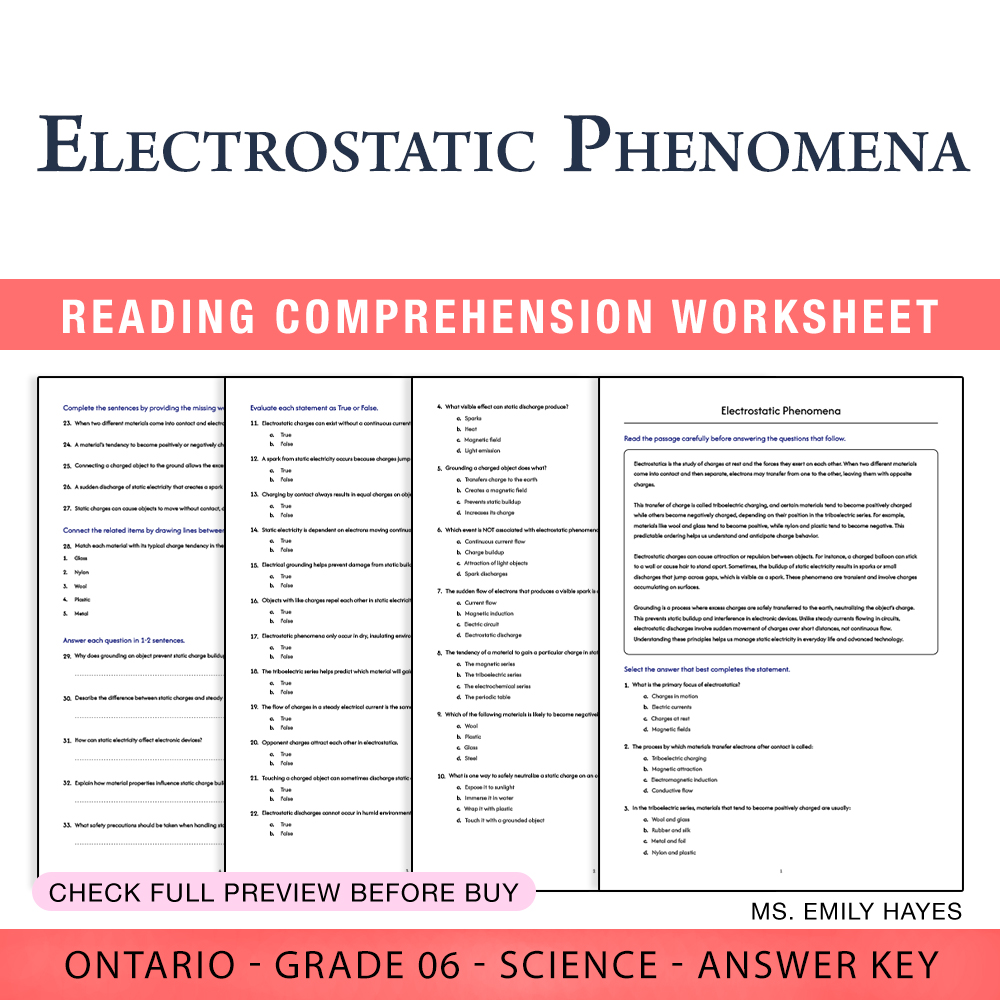
6th Grade Science | Electrostatic Phenomena Worksheet (PDF + Answer Key)
 Created byCopper Leaf Classroom
Learning Objectives
- Explain the concept of static electricity and how charge transfer occurs between materials.
- Describe the triboelectric series and its use in predicting charge tendencies of materials.
- Identify common phenomena related to electrostatics such as attraction, repulsion, and sparks.
Instant download
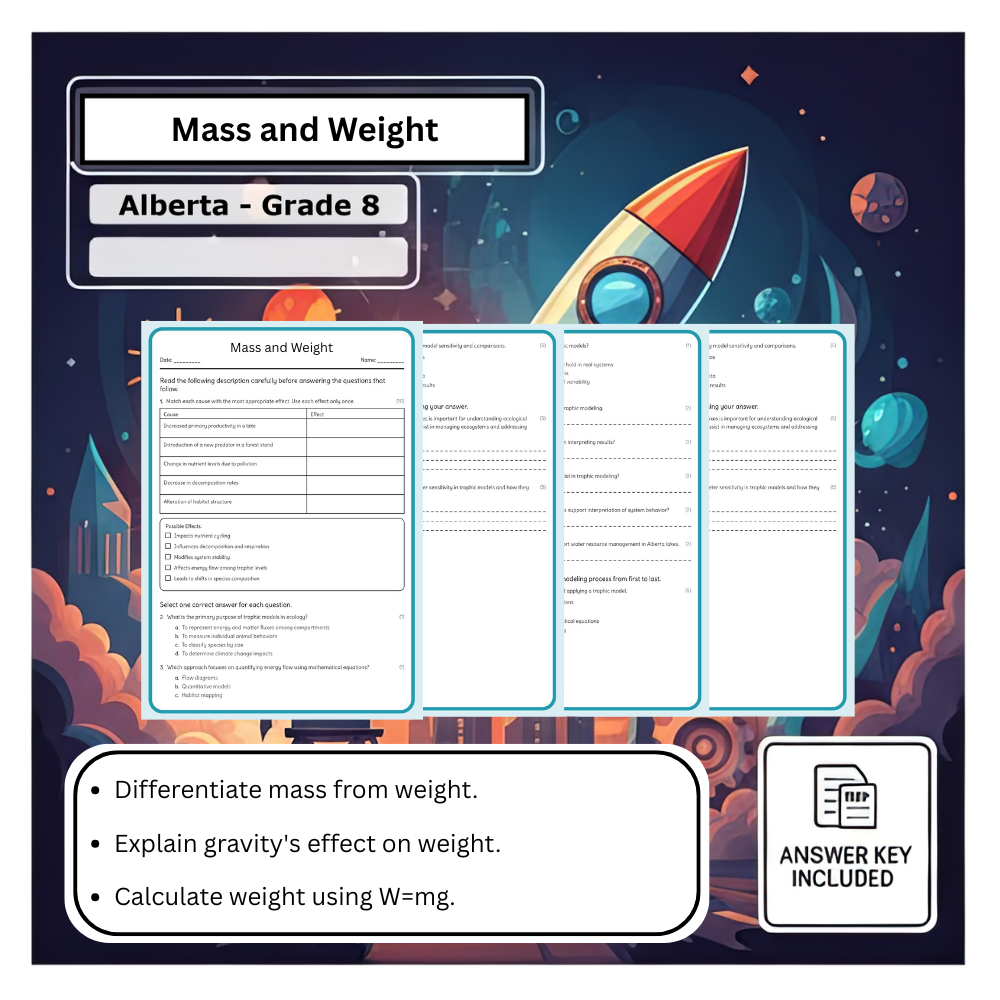
Grade 8 Science | Mass and Weight Concept Worksheet (PDF)
Created byBright Mind ResourcesLearning Objectives
- Differentiate between mass and weight and understand their intrinsic properties and external influences.
- Explain how gravitational acceleration affects weight and why identical masses experience the same gravitational force.
Instant download
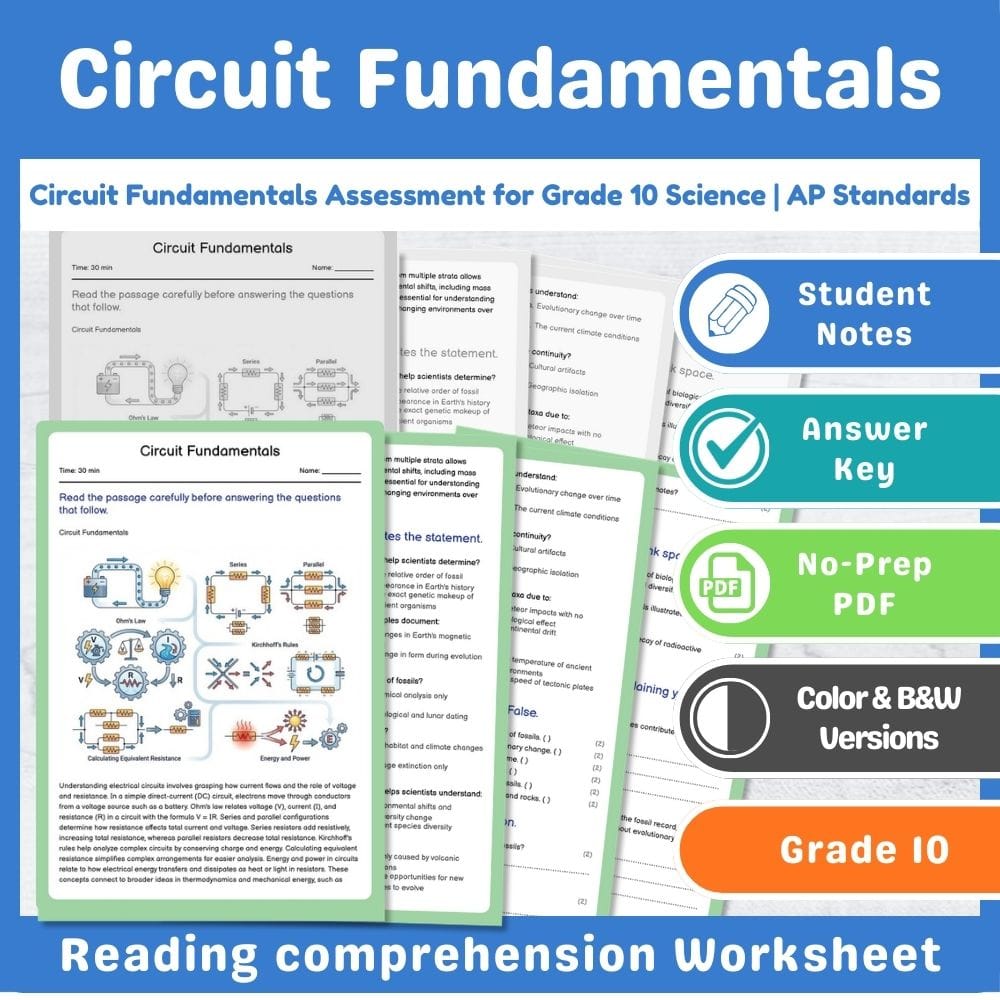
Circuit Fundamentals Assessment for Grade 10 Science | AP Standards
 Created byPrism Point Learning
Learning Objectives
- Understand the basic principles of direct-current circuits and the use of Ohm’s law.
- Apply Kirchhoff's rules to analyze series and parallel resistor networks.
- Calculate equivalent resistance and power dissipation in simple circuits.
Also included in: Lesson Grade 10 Science Assessment Bundle | AP Standards-Aligned
Instant download
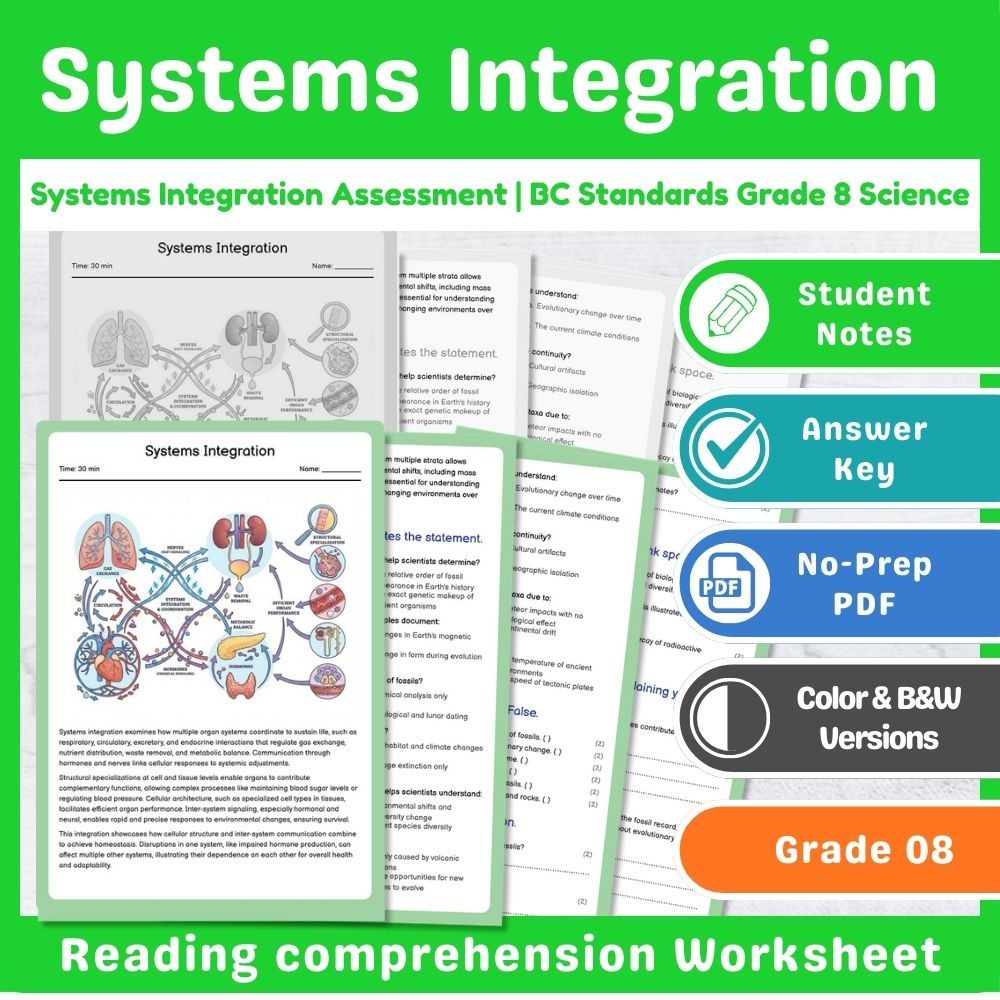
Systems Integration Assessment | BC Standards Grade 8 Science
Created byPrism Point LearningLearning Objectives
- Understand how multiple organ systems coordinate to maintain homeostasis.
- Identify key functions of respiratory, circulatory, excretory, and endocrine systems.
- Explain how cellular structures support systemic functions.
Instant download

Transport Systems Assessment | BC Standards Grade 8 Science
Created byPrism Point LearningLearning Objectives
- Understand the structure and function of vascular networks and circulatory systems in animals.
- Identify key structural features like vessels, valves, and capillary beds that enable directional flow.
- Explain the roles of cellular components such as blood cells, xylem, and phloem in transport.
Instant download
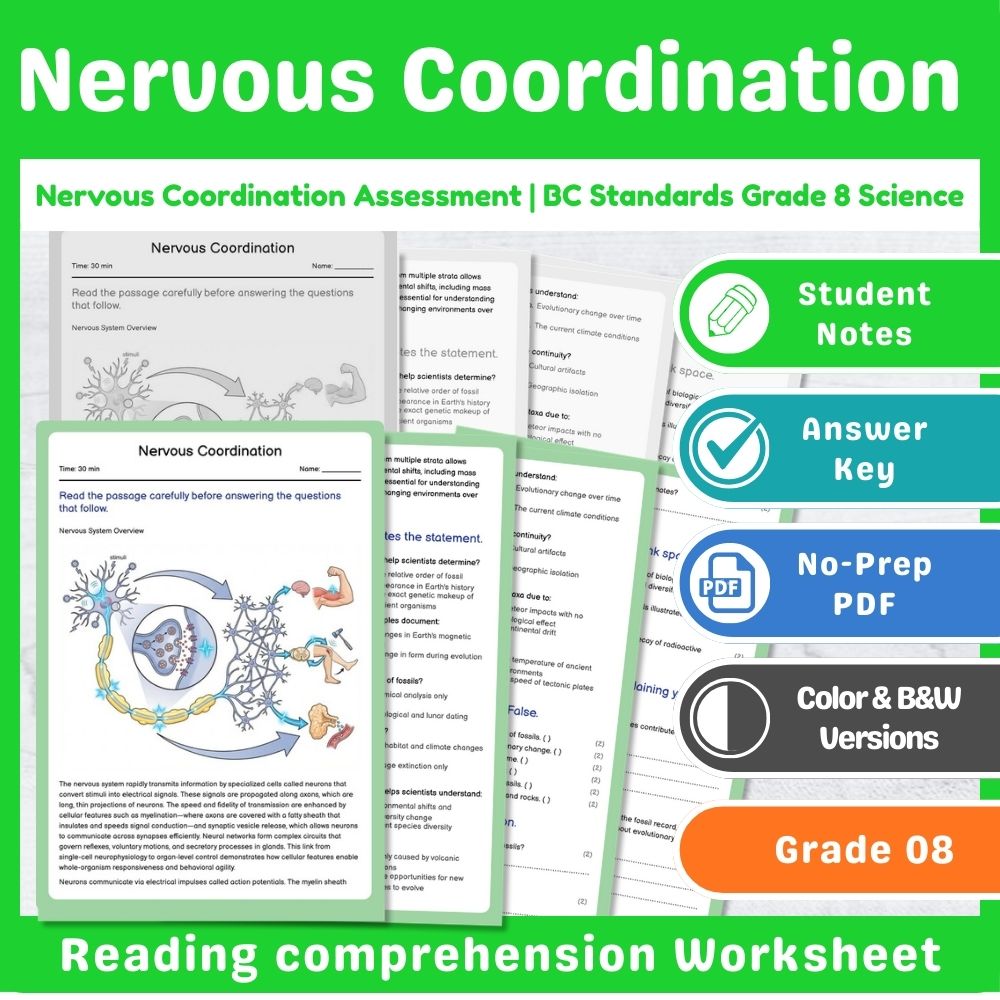
Nervous Coordination Assessment | BC Standards Grade 8 Science
Created byPrism Point LearningLearning Objectives
- Understand how neurons transmit electrical signals for nervous communication.
- Identify cellular features that enhance the speed and fidelity of nerve signaling.
- Explain the neural circuits involved in reflexes, voluntary movements, and gland secretion.
Instant download

Muscle Contraction Assessment | BC Standards Grade 8 Science Worksheet
Created byPrism Point LearningLearning Objectives
- Explain how actin and myosin filaments interact during muscle contraction.
- Describe the role of ATP and calcium in muscle contraction regulation.
- Identify how sarcomere organization influences contraction strength and speed.
Instant download
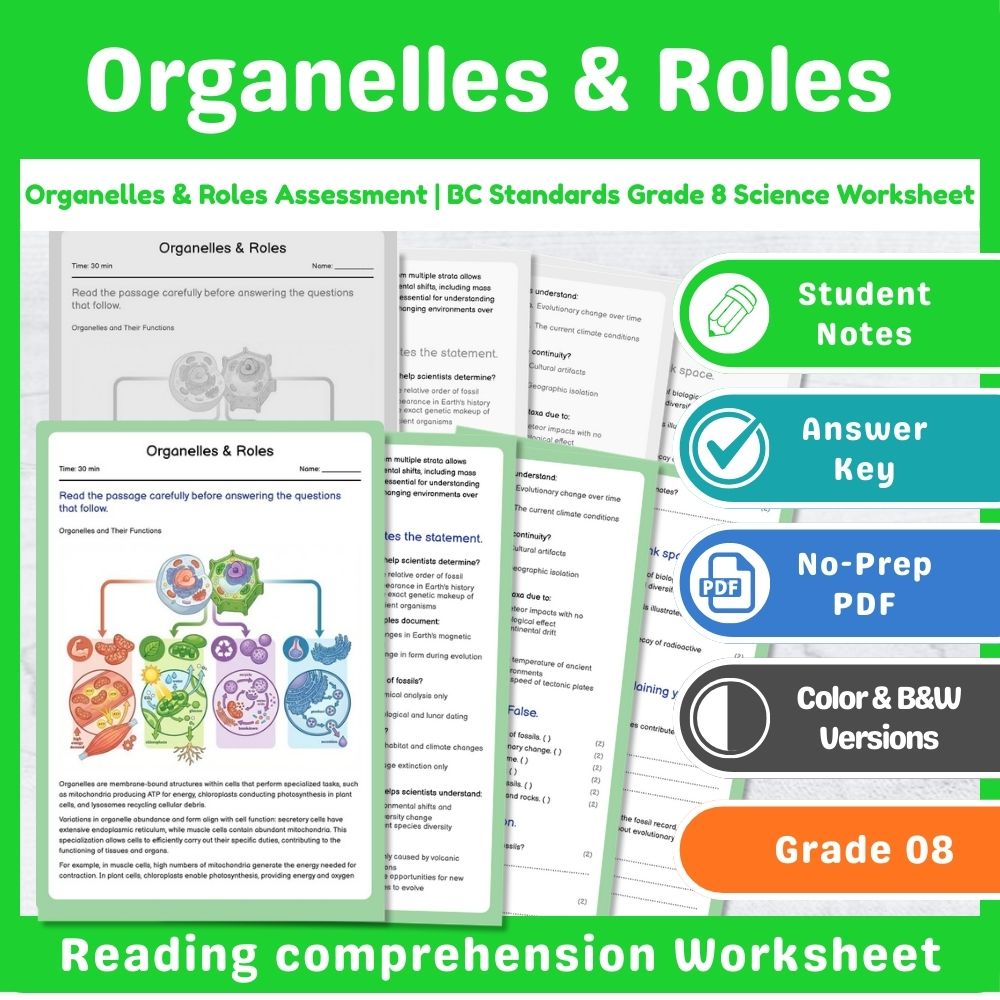
Organelles & Roles Assessment | BC Standards Grade 8 Science Worksheet
Created byPrism Point LearningLearning Objectives
- Describe the function of different cell organelles and how their structure supports their role.
- Explain how organelle specialization varies with cell function and tissue type.
- Identify the roles of mitochondria, chloroplasts, and lysosomes in cellular processes.
Instant download

Immune Defense Assessment for Grade 8 Science | BC Standards
Created byPrism Point LearningLearning Objectives
- Describe the components and functions of the innate and adaptive immune systems.
- Identify the roles of different immune cells such as phagocytes, lymphocytes, and antigen-presenting cells.
- Explain how tissues and organs coordinate immune responses to maintain internal balance during infection.
Instant download
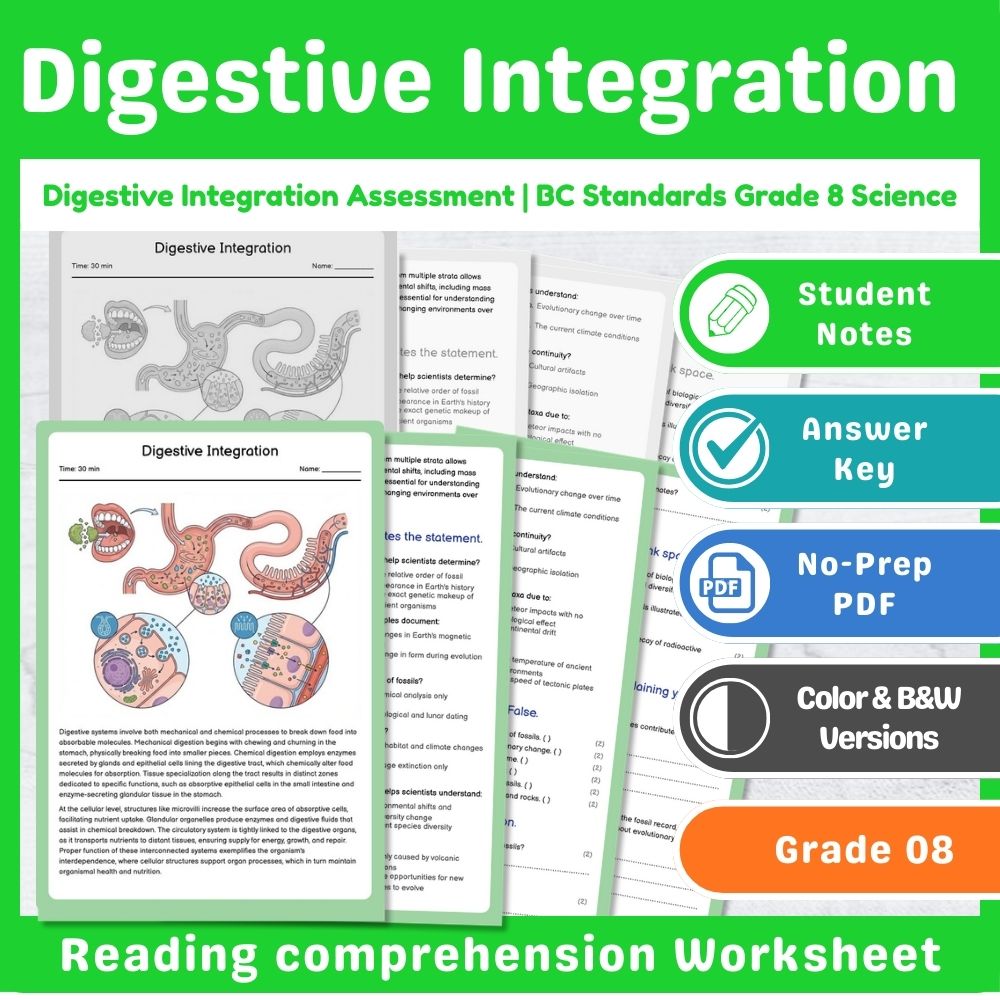
Digestive Integration Assessment | BC Standards Grade 8 Science
Created byPrism Point LearningLearning Objectives
- Describe how the digestive system combines mechanical and chemical processes to break down food.
- Explain the role of tissue specialization in different zones of the digestive tract.
- Understand how the circulatory system transports nutrients from the digestive organs to cells.
Instant download
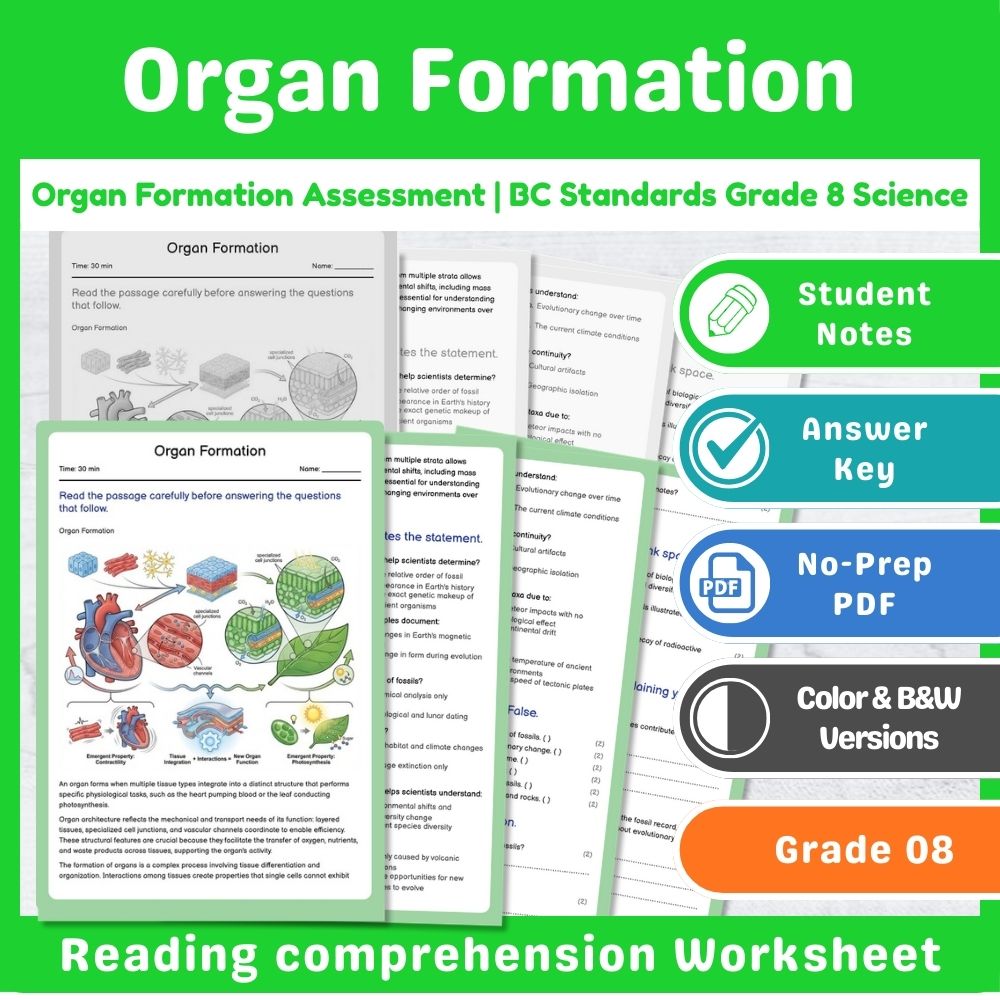
Organ Formation Assessment | BC Standards Grade 8 Science
Created byPrism Point LearningLearning Objectives
- Understand how tissues interact to form functional organs.
- Identify structural features of tissues that support organ function.
- Explain the relationship between tissue organization and organ efficiency.
Instant download
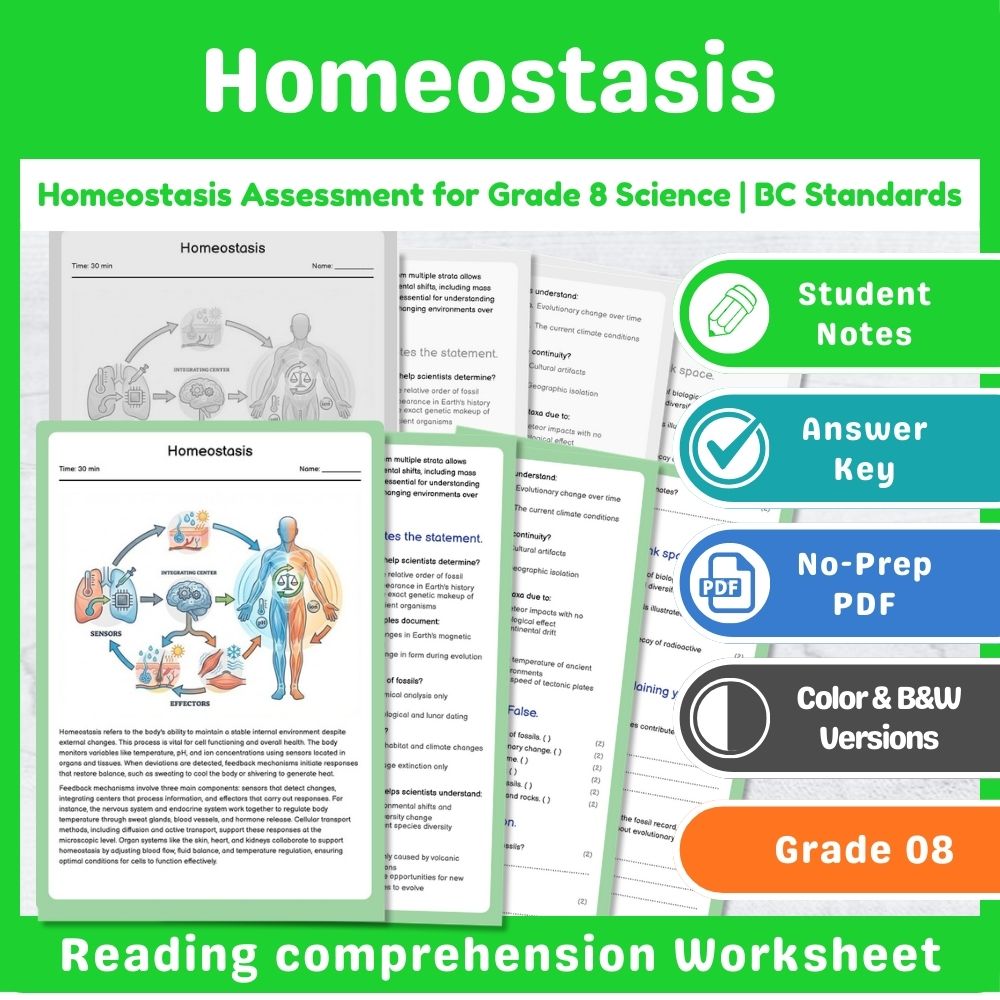
Homeostasis Assessment for Grade 8 Science | BC Standards
Created byPrism Point LearningLearning Objectives
- Understand the concept of homeostasis and its importance in maintaining internal conditions.
- Identify feedback mechanisms involved in physiological regulation.
- Describe how cellular processes and organ systems work together to sustain stability.
Instant download
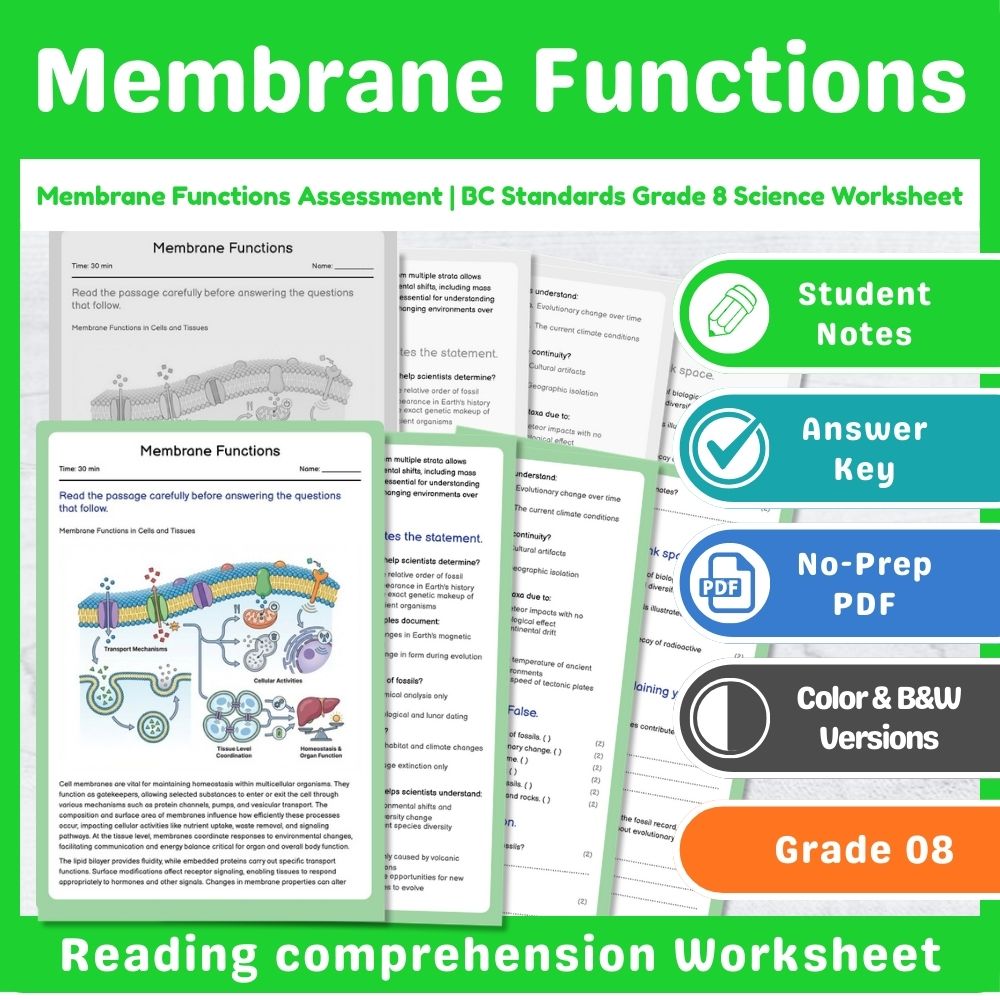
Membrane Functions Assessment | BC Standards Grade 8 Science Worksheet
Created byPrism Point LearningLearning Objectives
- Explain the role of cell membranes in regulating exchange between intracellular and extracellular environments.
- Identify various transport mechanisms such as protein channels, pumps, and vesicular transport.
- Describe how membrane composition and surface area influence diffusion and signaling.
Instant download

Cell Organization Assessment for Grade 8 Science BC Standards
Created byPrism Point LearningLearning Objectives
- Define the levels of cell organization in multicellular organisms.
- Explain how similar cells form tissues and how tissues form organs.
- Describe the hierarchical arrangement from cells to organ systems that support life.
Instant download
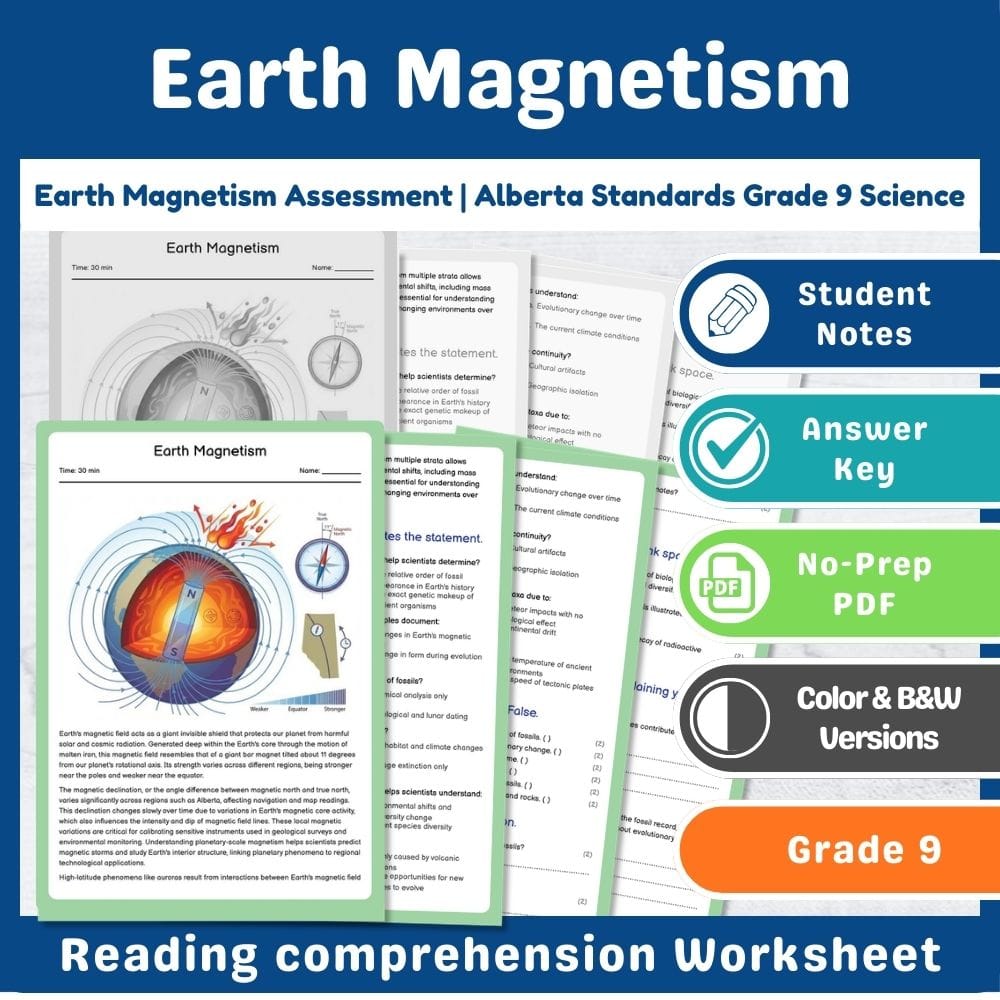
Earth Magnetism Assessment | Alberta Standards Grade 9 Science
Created byPrism Point LearningLearning Objectives
- Describe the origin and nature of Earth's magnetic field.
- Explain how declination varies regionally and affects navigation.
- Identify the technological applications of Earth's magnetism in surveying and environment monitoring.
Also included in: Grade 9 Electricity and Magnetism Science Lesson Bundle | Alberta Framework +1 more
Instant download

Grade 6 Science – Understanding Circuit Symbols | Daily Reading Worksheet
Created byBright Mind ResourcesLearning Objectives
- Identify and describe standard circuit symbols used in schematics.
- Understand the purpose of symbols for components like cells, batteries, resistors, lamps, and switches.
- Interpret schematic diagrams to predict how circuits will behave.
Also included in: Grade 6 Electricity Science Daily Reading Lesson Bundle | Ontario +1 more
Instant download
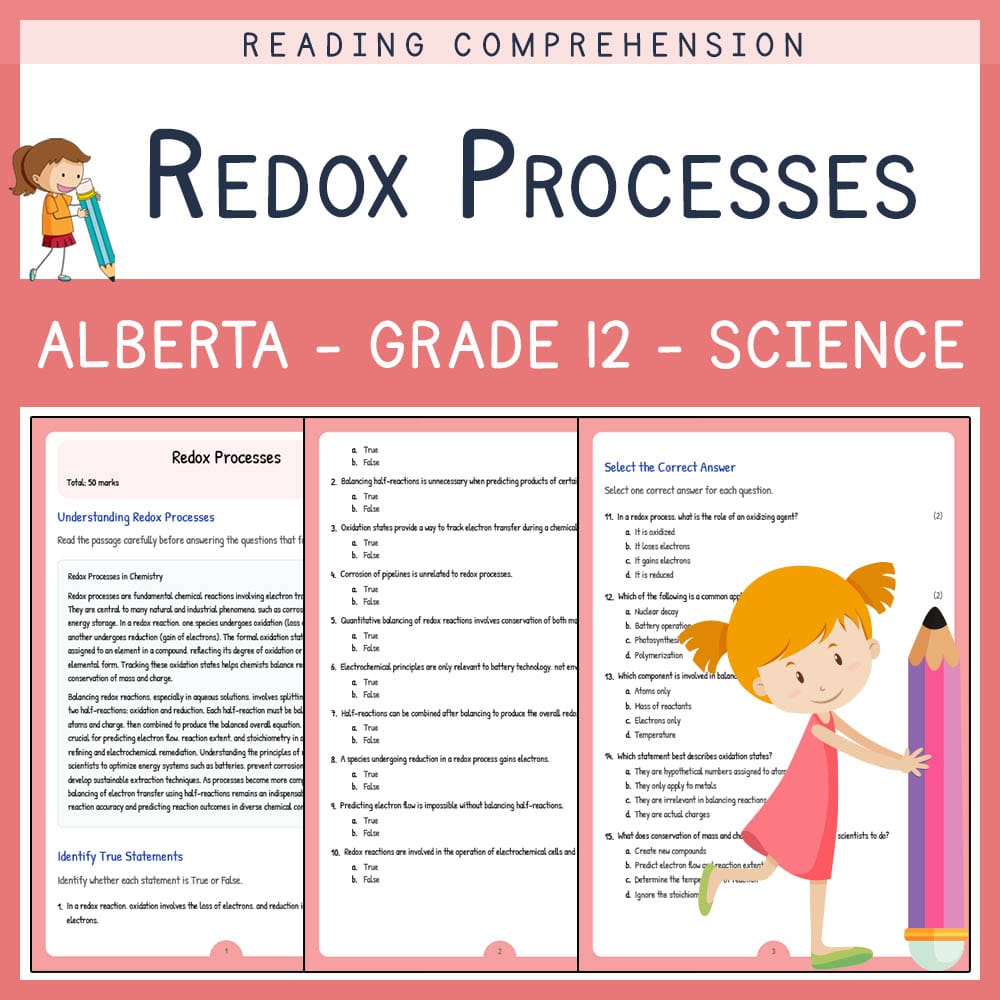
Grade 12 Science | Redox Processes Worksheet | Alberta Standards
Created byLumora LearningLearning Objectives
- Explain the fundamentals of oxidation-reduction (redox) reactions, including electron transfer and oxidation states.
- Balance redox half-reactions accurately using conservation of mass and charge.
- Apply electrochemical principles to real-world scenarios such as corrosion, battery operation, and metal refining.
Instant download

Grade 9 Character Depth Worksheet | Ontario ELA Character Analysis
 Created bySunny Desk Resources
Learning Objectives
- Identify direct and indirect characterization in a narrative.
- Explain how dialogue and actions reveal a character’s motivations.
- Analyze cause-and-effect connections between events and character growth or change.
Instant download

Grade 9 Science | Organelles Specialization - Daily Reading Comprehension
Created byCoral Reef LearningLearning Objectives
- Understand the basic functions of different cell organelles.
- Explain how organelles work together within eukaryotic cells.
- Identify the structure and role of mitochondria, ribosomes, endoplasmic reticulum, Golgi apparatus, lysosomes, and peroxisomes.
Instant download

Grade 11 Science | Structure & Function of Organelles - Daily Reading
Created byCoral Reef LearningLearning Objectives
- Identify key organelles involved in cellular energy processes
- Understand how organelle structure relates to function
- Describe the roles of thylakoid membranes and mitochondrial cristae
Instant download

Grade 11 Science | Immune Responses Worksheet | TEKS-Aligned
Created byLumora LearningLearning Objectives
- Describe the components and functions of innate and adaptive immune responses.
- Explain how inflammation, phagocytosis, and complement activation provide immediate defenses.
- Identify the roles of B and T lymphocytes in targeted immune responses and memory formation.
Instant download

Grade 10 Science – Force Concepts Worksheet (AP Standards) (PDF)
Created byEvergreen Desk EducationLearning Objectives
- Describe forces as vectors and determine the direction of acceleration using net force
- Apply Newton’s three laws to predict motion, equilibrium, and changes during interactions
- Construct and interpret free-body diagrams for contact and field-mediated forces
Also included in: Grade 10 Motion & Forces Science Lesson Bundle (AP) Worksheet Set +1 more
Instant download
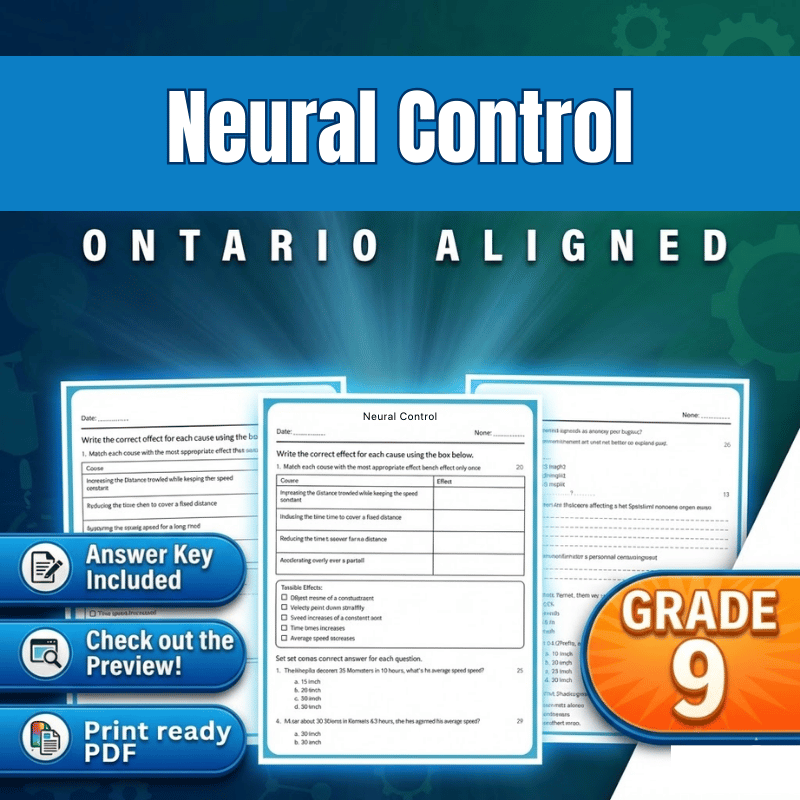
Grade 9 Science | Neural Control Worksheet (Ontario Standards) (PDF)
Created byBright Mind ResourcesLearning Objectives
- Understand the organization of the nervous system from neurons and synapses to neural circuits.
- Explain how action potentials and synaptic transmission propagate signals in neural pathways.
- Relate cellular features such as myelination and synaptic architecture to conduction velocity and processing capacity.
Instant download

Cell Biochemistry Assessment | General Grade 10 Science Standards-Aligned
Created byPrism Point LearningLearning Objectives
- Understand the role of membranes and organelles in cellular processes.
- Explain how enzymes speed up chemical reactions in cells.
- Describe the function of ATP in energy transfer within cells.
Also included in: Grade 10 Evolution and Genetics Science Lesson Bundle: General Unit
Instant download

Contemporary Social Movements Worksheet | Social Studies Grade 11 TEKS
JCreated byJ.S SheetsLearning Objectives
- Understand the key issues addressed by recent social movements.
- Analyze how social movements influence societal norms and policy debates.
- Identify the methods and strategies used in modern social protests.
Instant download

Grade 12 Ontario ELA Language Style Meaning Analysis Worksheet
Created bySunny Desk ResourcesLearning Objectives
- Analyze how wording, syntax, and stylistic choices affect meaning, emphasis, clarity, and implication in a text.
- Evaluate how repetition, sentence length, and word choice shape tone, pace, and implied attitudes.
- Explain how context and language features work together to influence a reader’s understanding and response.
Instant download
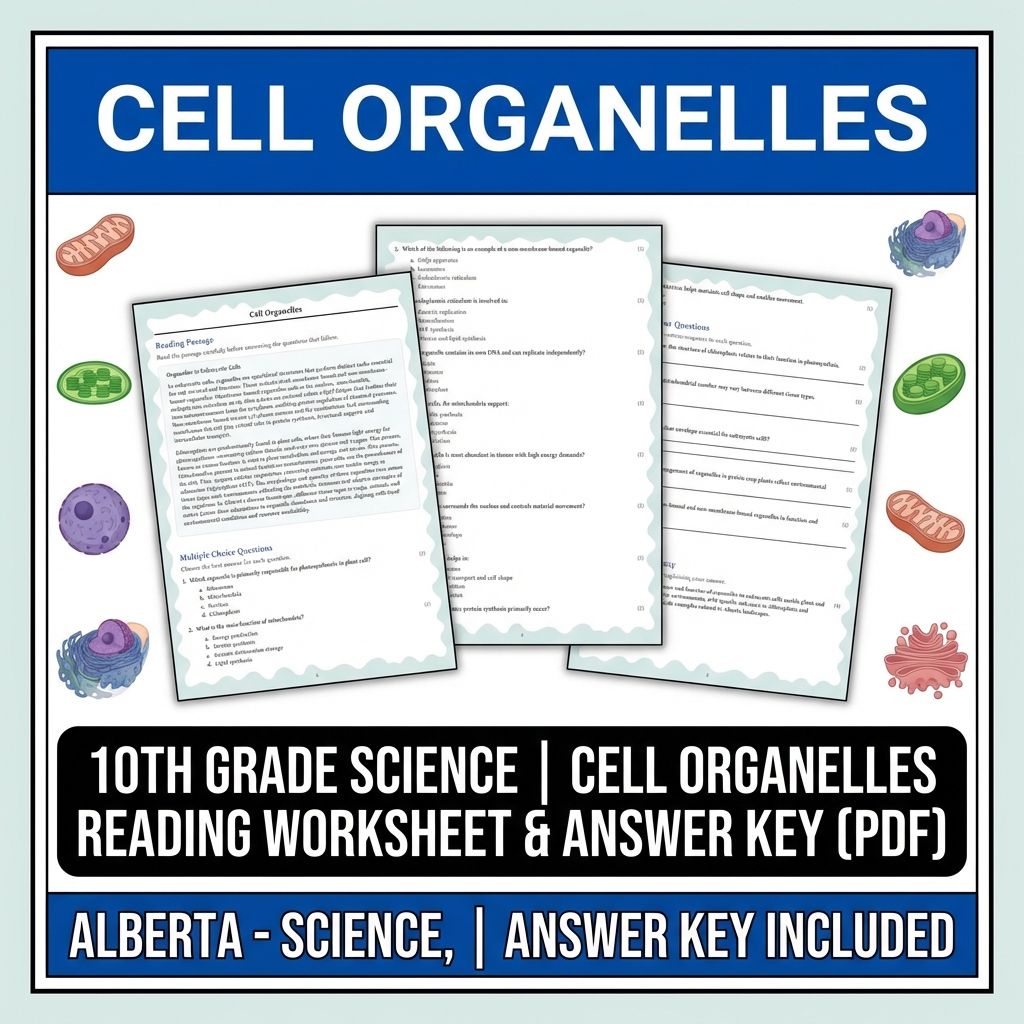
10th Grade Science | Cell Organelles Reading Worksheet & Answer Key (PDF)
JCreated byJ.S SheetsLearning Objectives
- Identify the different types of membrane-bound and non-membrane-bound organelles in eukaryotic cells.
- Explain how organelle structure relates to its function within the cell.
- Describe the roles of chloroplasts and mitochondria in plant and animal cells.
Also included in: Grade 10 Science | Cell Systems, Energy, & Homeostasis (Standards-Aligned) +1 more
Instant download

Migration Patterns Worksheet for Grade 9 Social Studies | Standards-Aligned
JCreated byJ.S SheetsLearning Objectives
- Understand the routes and settlement trends during colonization in Canada.
- Analyze the motivations behind migration, including economic and political factors.
- Examine the impact of migration on Indigenous and settler relations.
Also included in: Grade 9 Social Studies | Contact, Cooperation & Conflict Bundle +1 more
Instant download
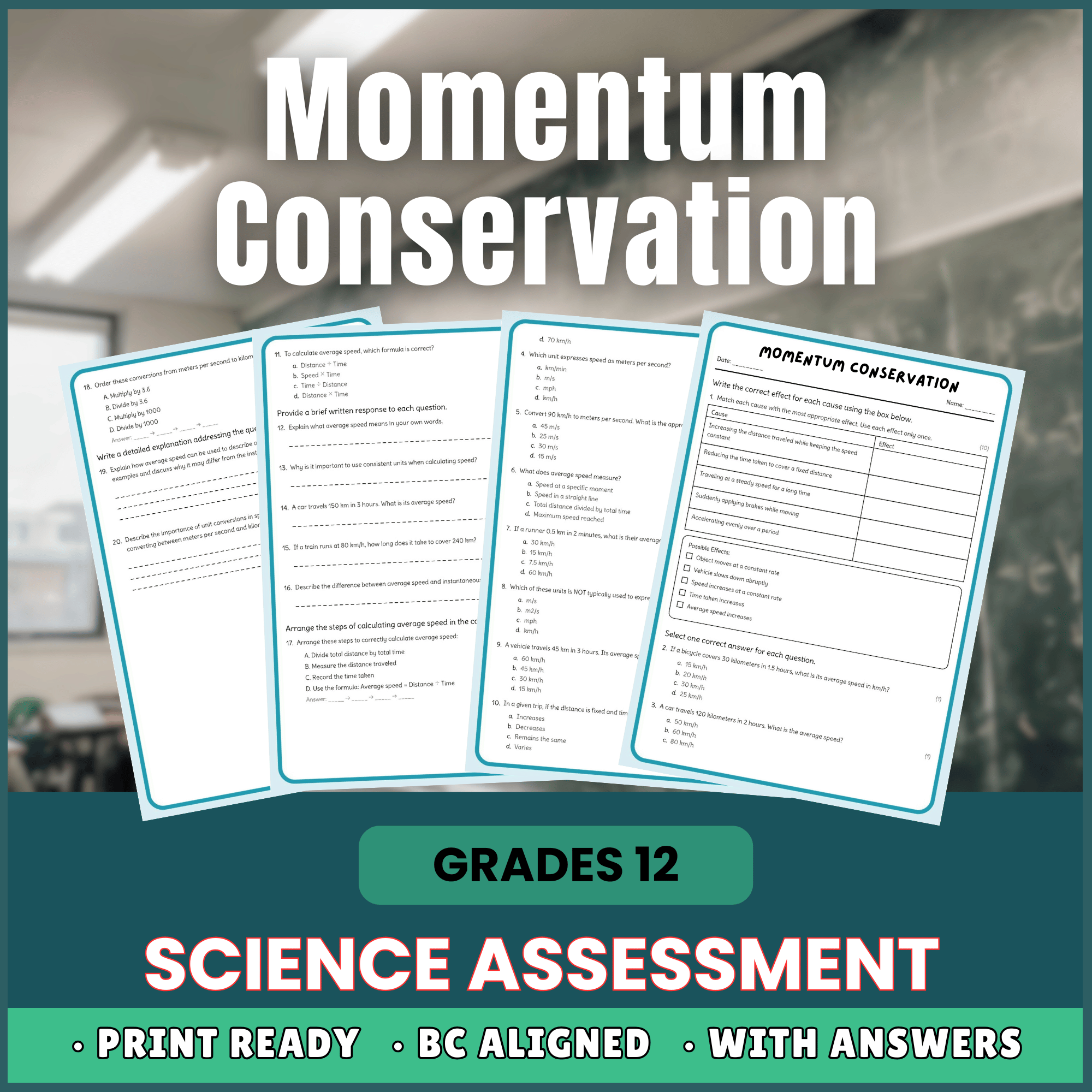
Grade 12 Science – Conservation of Momentum Worksheet (PDF) | BC Standards
Created byBright Mind ResourcesLearning Objectives
- Explain the principle of conservation of linear momentum in isolated systems.
- Define momentum and impulse, and describe their relationship.
- Analyze the differences between elastic and inelastic collisions using momentum and kinetic energy.
Instant download
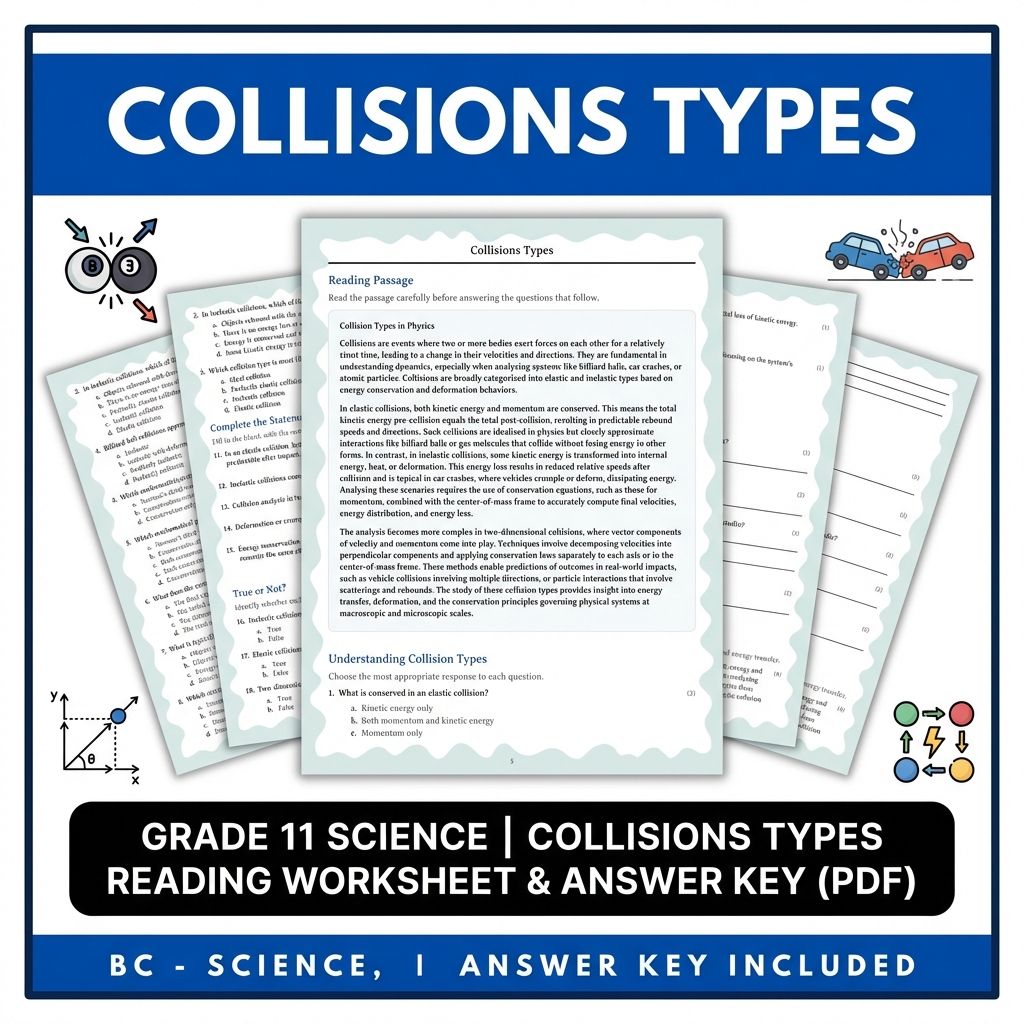
Grade 11 Science | Collisions Types Reading Worksheet & Answer Key (PDF)
JCreated byJ.S SheetsLearning Objectives
- Understand the different types of collisions and their defining features.
- Learn how momentum and energy are conserved in elastic and inelastic collisions.
- Apply conservation laws to analyze one- and two-dimensional collision scenarios.
Instant download
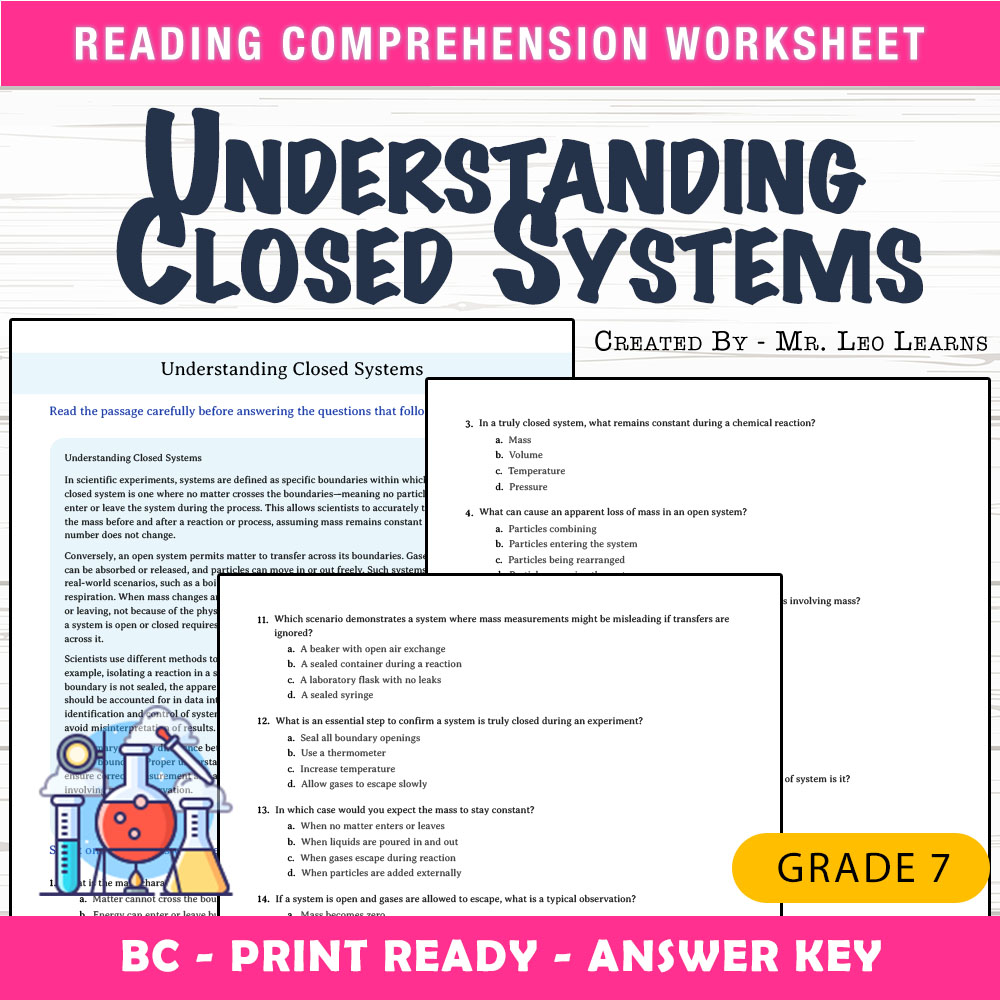
Grade 7 Science — Understanding Closed Systems Worksheet for Mastery
 Created byThe Resource Hub
Learning Objectives
- Explain the difference between closed and open systems in terms of matter transfer.
- Identify the effects of system boundaries on mass conservation.
- Analyze real-world examples of closed and open systems in scientific processes.
Also included in: Grade 7 Science | Matter & Chemical Change Worksheet Bundle – BC Framework +1 more
Instant download
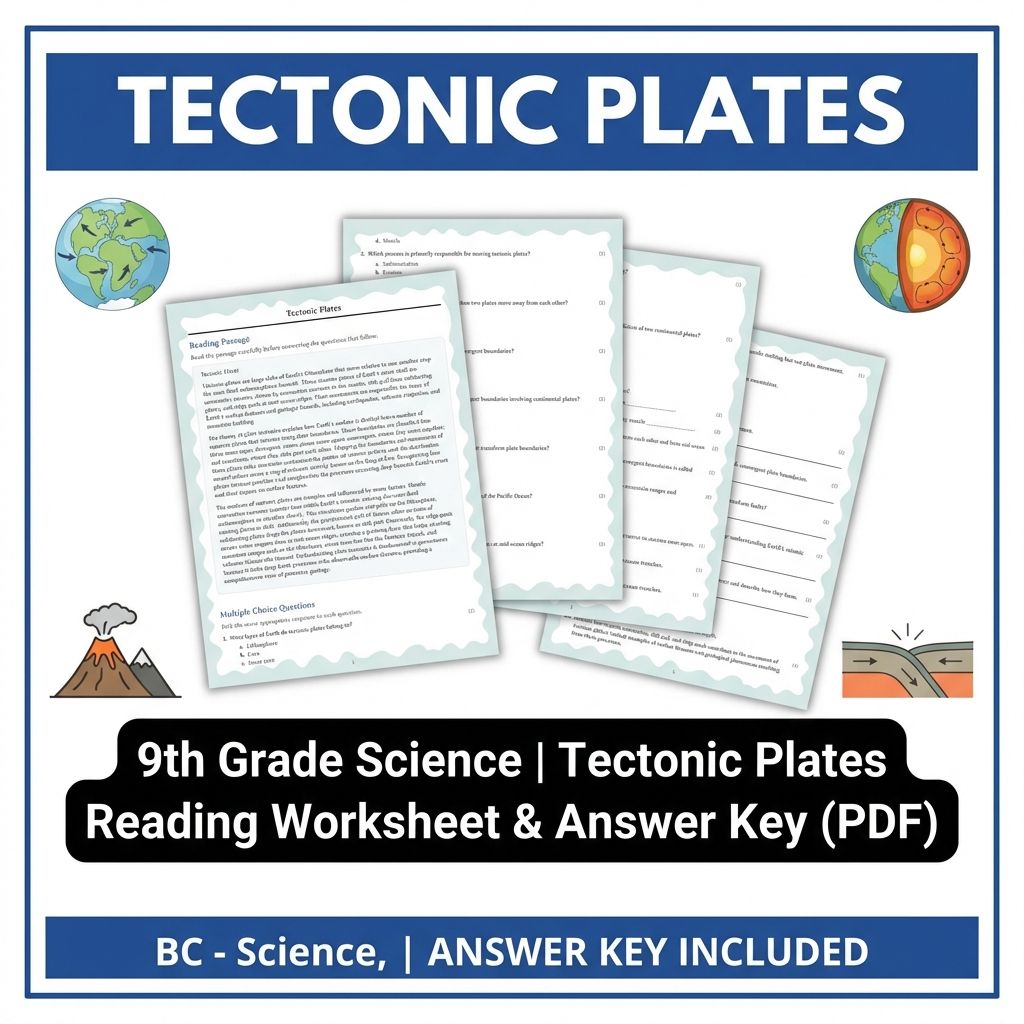
9th Grade Science | Tectonic Plates Reading Worksheet & Answer Key (PDF)
JCreated byJ.S SheetsLearning Objectives
- Understand the concept of tectonic plates and their role in Earth's geology.
- Identify the different types of plate boundaries and their associated landforms and phenomena.
- Explain how mantle convection, slab pull, and ridge push drive plate movements.
Instant download
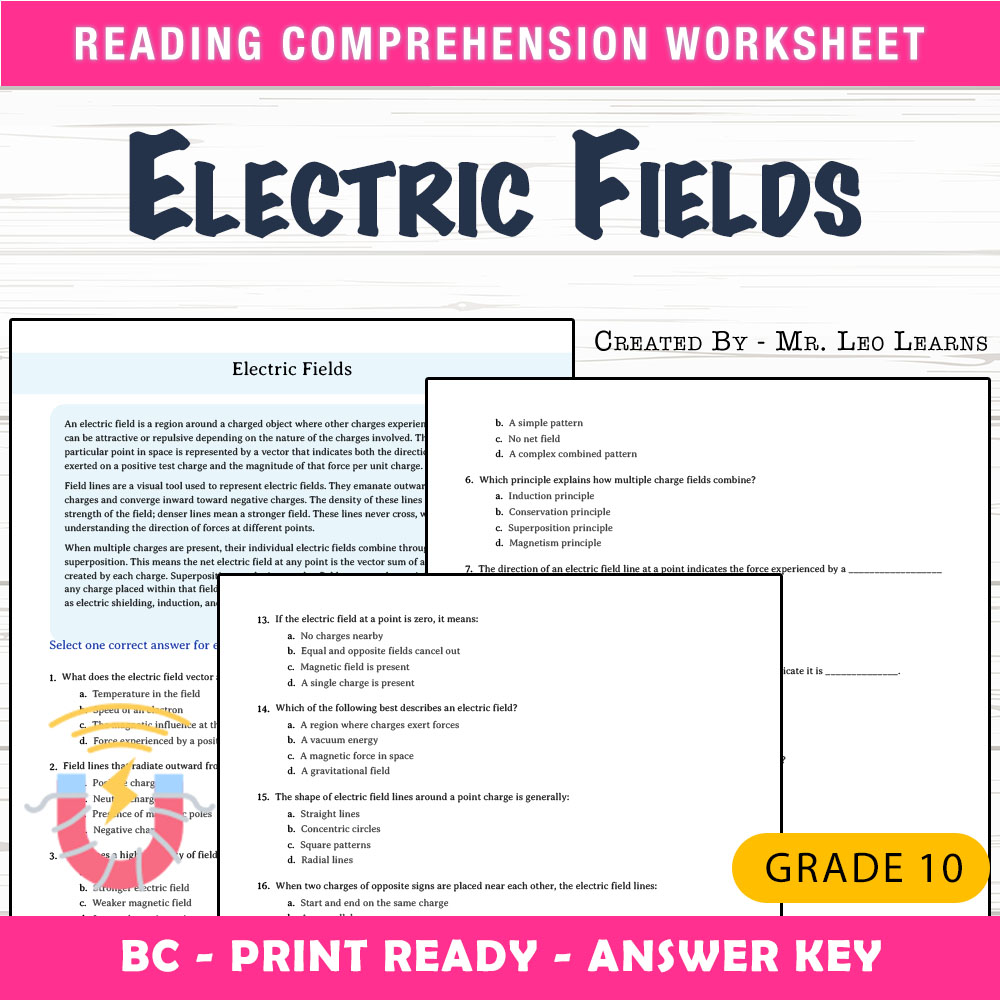
Grade 10 Science — Worksheet MCQ Paper for Mastering Electric Fields
Created byThe Resource HubLearning Objectives
- Understand the concept of electric fields and how they influence space around charges.
- Identify how field vectors indicate force and direction in electric fields.
- Explain the significance of field lines in visualizing electric forces.
Also included in: Grade 10 Science | Forces, Motion & Fields UNIT Worksheet Bundle +1 more
Instant download
Energy Release Worksheet | Science | Grade 10 | Alberta Standards
Created byCoral Reef LearningLearning Objectives
- Describe the pathways of aerobic and anaerobic respiration and their processes.
- Explain how oxygen availability affects metabolic pathway utilization in different environments.
- Identify the stages of glycolysis, the citric acid cycle, and electron transport in cellular respiration.
Instant download

Grade 9 Science | Fluid Balance in the Kidneys - Daily Reading Comprehension
Created byCoral Reef LearningLearning Objectives
- Identify the parts of the nephron involved in fluid regulation
- Understand the functions of filtration, reabsorption, secretion, and concentration
- Explain how hormonal signals influence kidney functions
Instant download

Grade 9 Science – Design Communication & Structural Engineering | Worksheet
Created byBright Mind ResourcesLearning Objectives
- Interpret diagrams to explain design choices
- Analyze data summaries to evaluate design performance
- Provide reasoning connecting test outcomes to design decisions
Also included in: Engineering & Technology Lesson Bundle | Grade 9 Science | General +1 more
Instant download
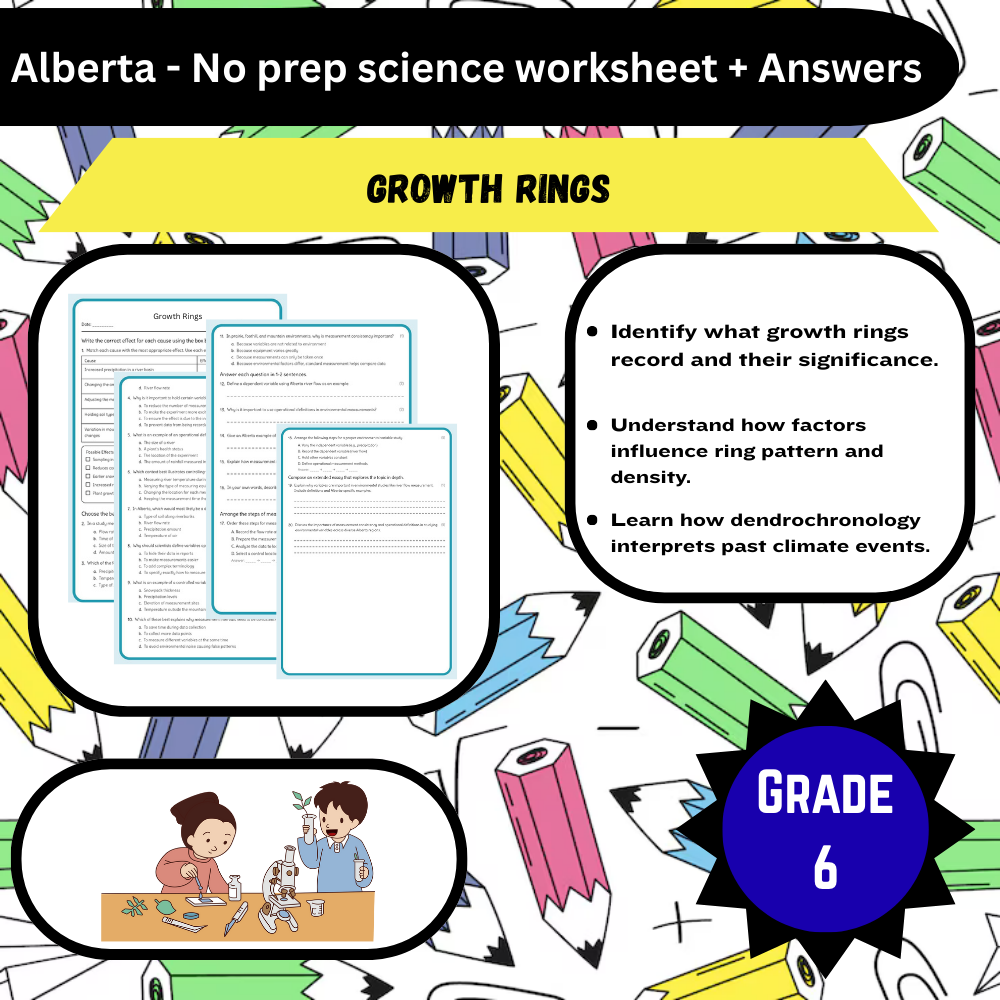
Grade 6 Science – Growth Rings Worksheet (PDF) | Alberta Standards
Created byBright Mind ResourcesLearning Objectives
- Identify what growth rings record in trees and their significance.
- Understand how environmental factors influence growth ring patterns and density.
- Learn how dendrochronology is used to interpret past climate and environmental events.
Instant download

Grade 12 Science | Enthalpy Change in Chemical Reactions - Reading Comprehension
Created byCoral Reef LearningLearning Objectives
- Define enthalpy change and explain its significance in chemical reactions
- Distinguish between exothermic and endothermic processes
- Describe how Hess’s law is used to calculate reaction enthalpies
Also included in: Chemistry 30 Reading Comprehension Lesson Bundle – Grade 12 Science Alberta +1 more
Instant download
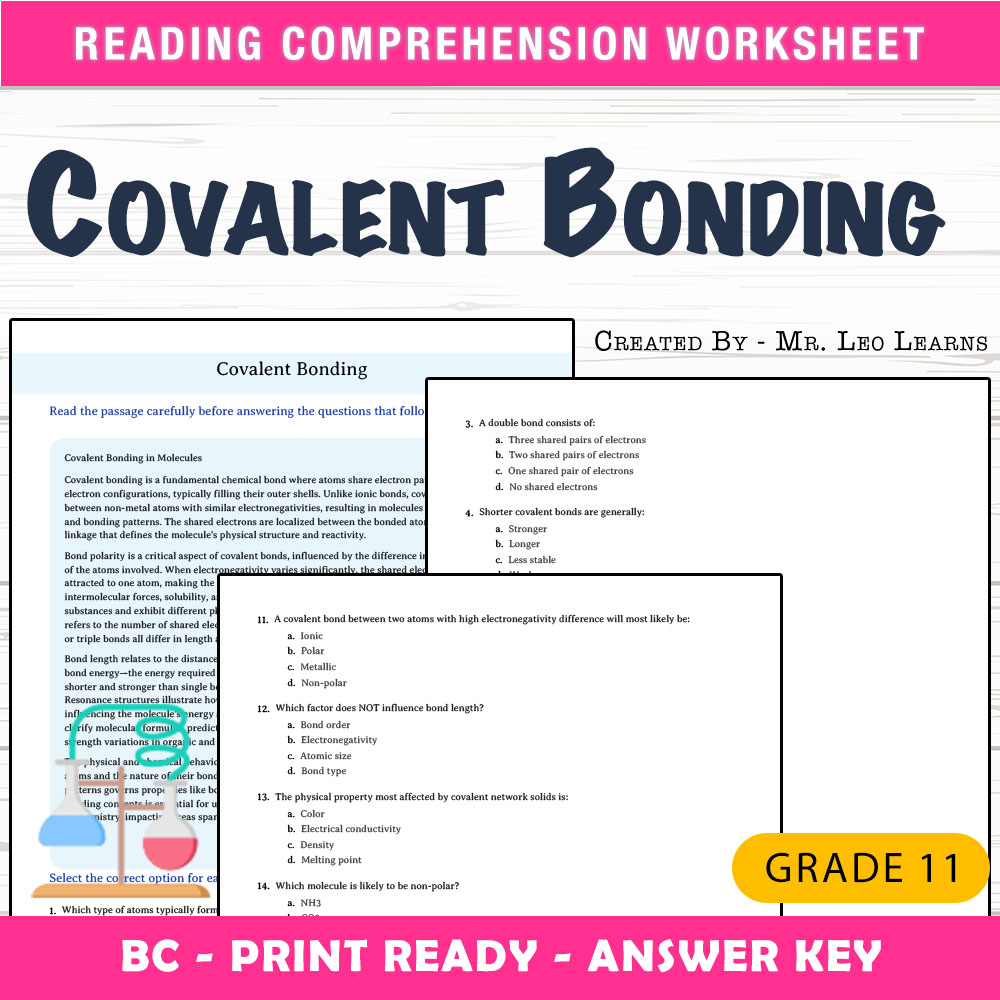
Grade 11 Science — Worksheet MCQ Paper for Mastering Covalent Bonding
Created byThe Resource HubLearning Objectives
- Explain the concept of covalent bonding and how electron sharing stabilizes molecules.
- Identify the factors affecting bond polarity, bond order, bond length, and bond energy.
- Describe how resonance and multiple bonds influence molecular structure and properties.
Also included in: Grade 11 Science – Chemistry Unit Worksheet Bundle (BC) +1 more
Instant download
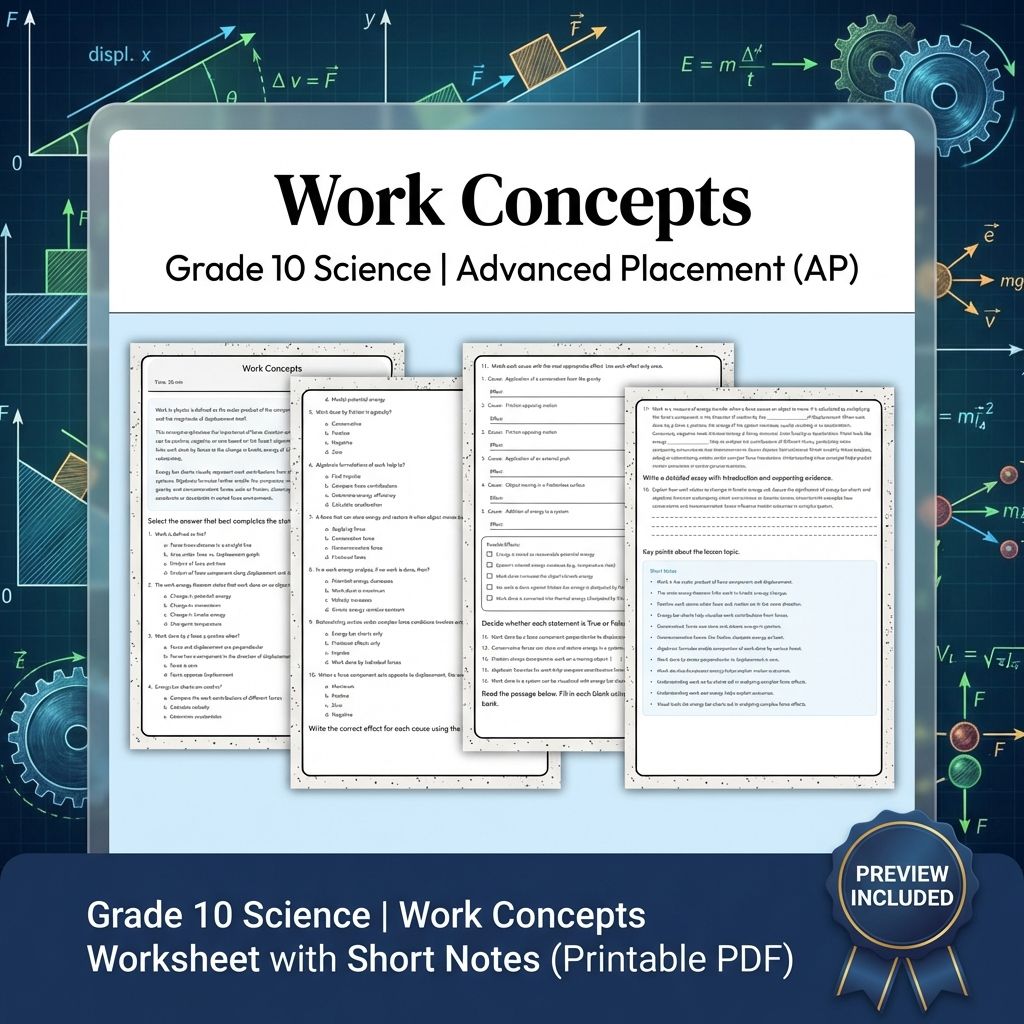
Grade 10 Science | Work Concepts Worksheet with Short Notes (Printable PDF)
Created byMeadowlark WorksheetsLearning Objectives
- Define work as the scalar product of force components along displacement in various contexts.
- Explain the relationship between work and changes in kinetic energy through the work-energy theorem.
- Differentiate work done by conservative and nonconservative forces using energy bar charts and algebraic formulas.
Instant download
Browse more categories
About Reading comprehension Worksheets
Find reading comprehension worksheets for class practice, homework, or self-study. All 40,289 are instant PDF downloads.
Each resource here is built by an independent educator and reviewed for quality. Worksheets print straight from PDF and suit classroom use, homework, or extra practice; most come with answer keys, and you can preview before purchasing.