
Reading comprehension Worksheets
40,289 type resources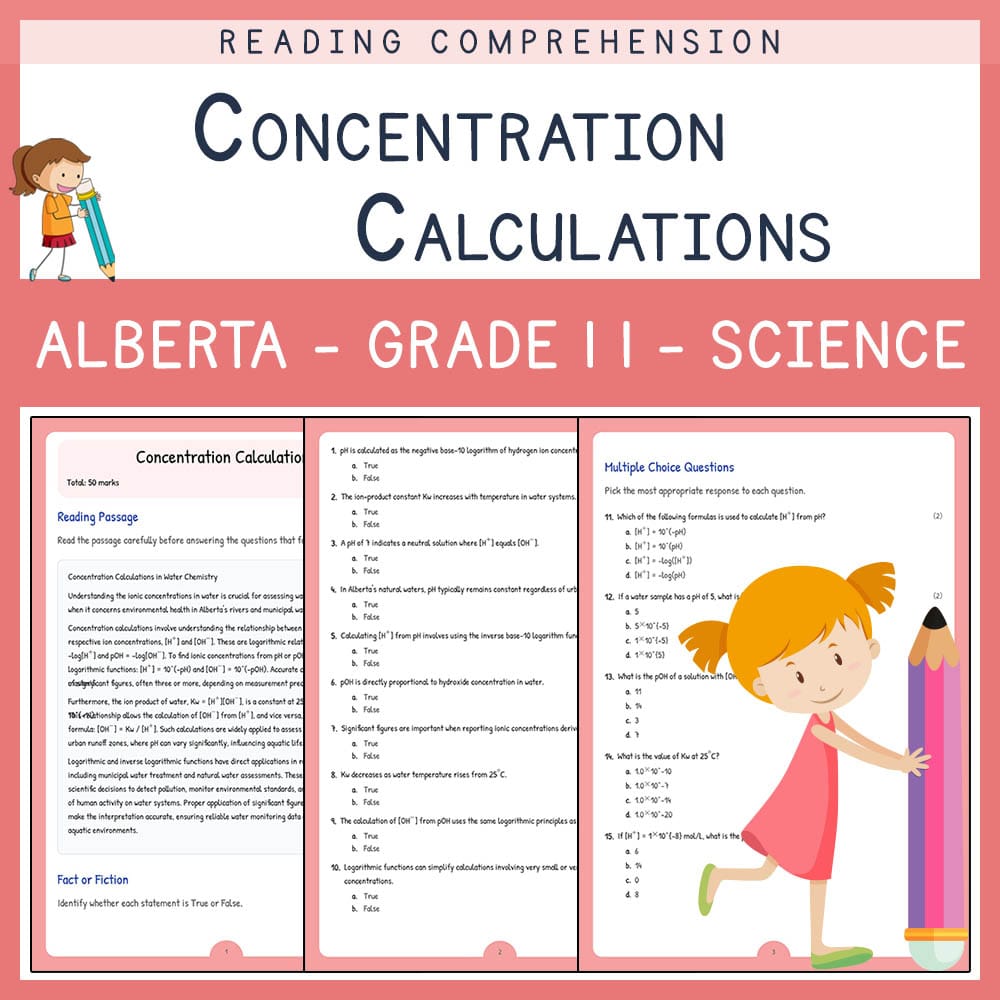
Grade 11 Science | Concentration Calculations Worksheet | Alberta Standards
 Created byLumora Learning
Learning Objectives
- Understand how to determine [H⁺] from pH and [OH⁻] from pOH using logarithmic relationships.
- Apply the ion-product constant Kw to interrelate [H⁺], [OH⁻], pH, and pOH in water samples.
- Calculate ionic concentrations in municipal and natural waters using logarithmic formulas and relevant significant figures.
Instant download
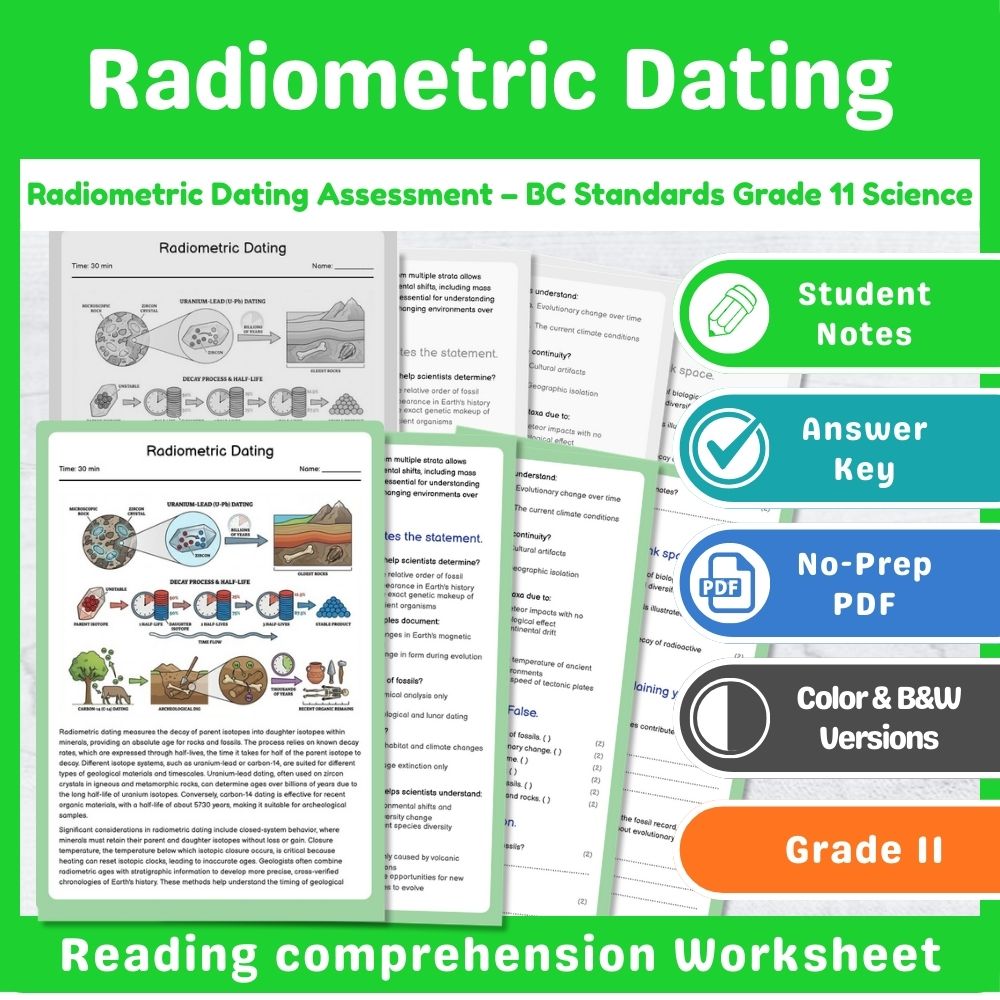
Radiometric Dating Assessment – BC Standards Grade 11 Science
 Created byPrism Point Learning
Learning Objectives
- Understand the principles of radiometric dating and how isotopic decay is used to determine geological ages.
- Identify different parent-daughter isotope systems suitable for various timescales and rock types.
- Explain the significance of closure temperature and how it affects isotopic retention in rocks.
Also included in: Grade 11 Science Assessment | Plate Tectonics BC Standards Mini Bundle
Instant download

Grade 8 Science Systems Analysis Worksheet with Short Notes (Printable PDF)
 Created byMeadowlark Worksheets
Learning Objectives
- Understand how to identify components of complex systems involving multiple forces.
- Learn to decompose system forces into components and analyze their effects.
- Distinguish between internal and external forces within systems.
Also included in: Grade 8 Science Forces & Motion UNIT Bundle – Alberta Curriculum +1 more
Instant download
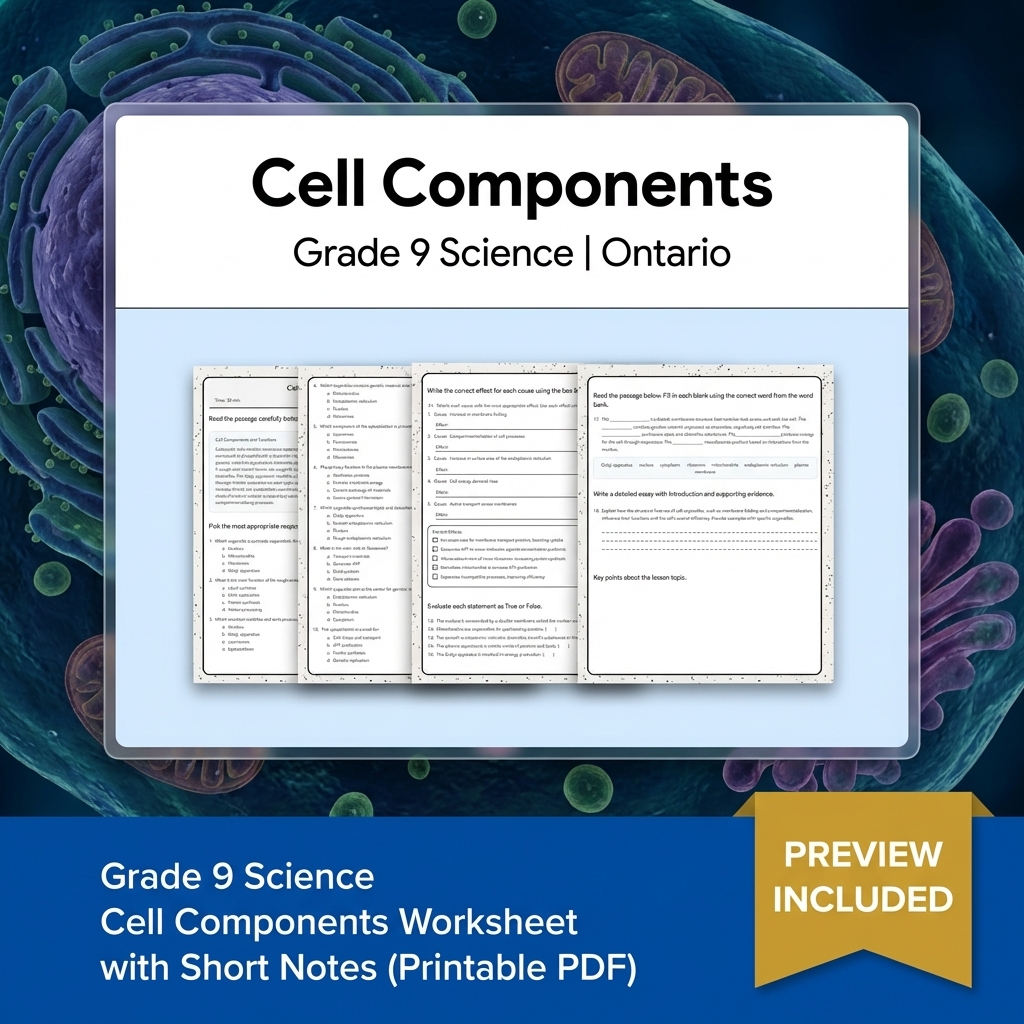
Grade 9 Science Cell Components Worksheet with Short Notes (Printable PDF)
Created byMeadowlark WorksheetsLearning Objectives
- Identify major organelles of eukaryotic cells and their functions.
- Understand how membrane structures influence metabolic rates and exchange.
- Relate cell structure features to their specific roles in the cell.
Instant download

Grade 9 Science – Energy Profiles & Chemical Reactions | Daily Reading Worksheet
 Created byBright Mind Resources
Learning Objectives
- Understand the concept of energy profiles for chemical reactions.
- Identify exothermic and endothermic reactions from energy diagrams.
- Describe the significance of activation energy and transition states.
Also included in: Grade 9 Chemical Reactions Science Lesson Bundle: Daily Reading (BC) +1 more
Instant download

Grade 9 Science – Limiting Reactants & Reactions | Daily Reading Worksheet
Created byBright Mind ResourcesLearning Objectives
- Define limiting reactant in a chemical reaction
- Identify the limiting reactant from initial quantities
- Differentiate between theoretical and actual yields
Also included in: Grade 9 Chemical Reactions Science Lesson Bundle: Daily Reading (BC) +1 more
Instant download

Grade 9 Science – Atomic Particles & Structure | Daily Reading Worksheet
Created byBright Mind ResourcesLearning Objectives
- Identify the main subatomic particles within an atom (protons, neutrons, electrons).
- Understand the location of protons, neutrons, and electrons inside an atom.
- Explain how the number of protons determines an element.
Also included in: Grade 9 Chemical Reactions Science Lesson Bundle: Daily Reading (BC) +1 more
Instant download

Grade 10 Science | Gas Behavior Worksheet Elena | Alberta Standards
Created byLumora LearningLearning Objectives
- Explain how kinetic theory models gas particle motion and relates to gas laws.
- Describe the impact of regional factors like altitude and temperature on gas pressure and volume.
- Analyze deviations from ideal gas behavior in real-world scenarios such as mountain valleys and pipeline storage.
Instant download
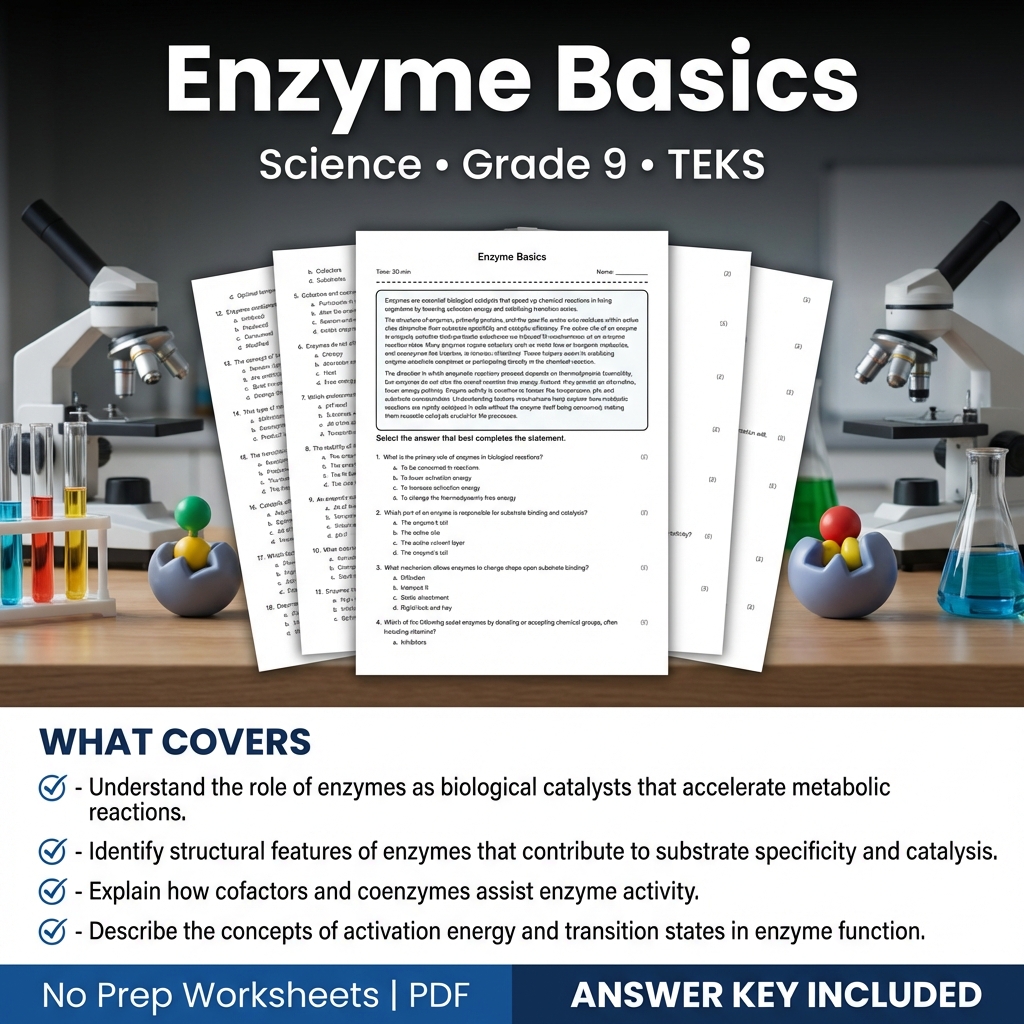
Grade 9 Science Worksheet on Enzyme Basics | TEKS Aligned Practice
 Created byCoral Reef Learning
Learning Objectives
- Understand the role of enzymes as biological catalysts that accelerate metabolic reactions.
- Identify structural features of enzymes that contribute to substrate specificity and catalysis.
- Explain how cofactors and coenzymes assist enzyme activity.
Instant download

Grade 8 Science – Introduction to Immune System Daily Reading Worksheet
Created byBright Mind ResourcesLearning Objectives
- Identify key components of the immune system
- Understand the roles of innate and adaptive immunity
- Recognize different immune cells and their functions
Also included in: Grade 8 Body Systems & Cell Structure Science Daily Reading Lesson Bundle | BC +1 more
Instant download
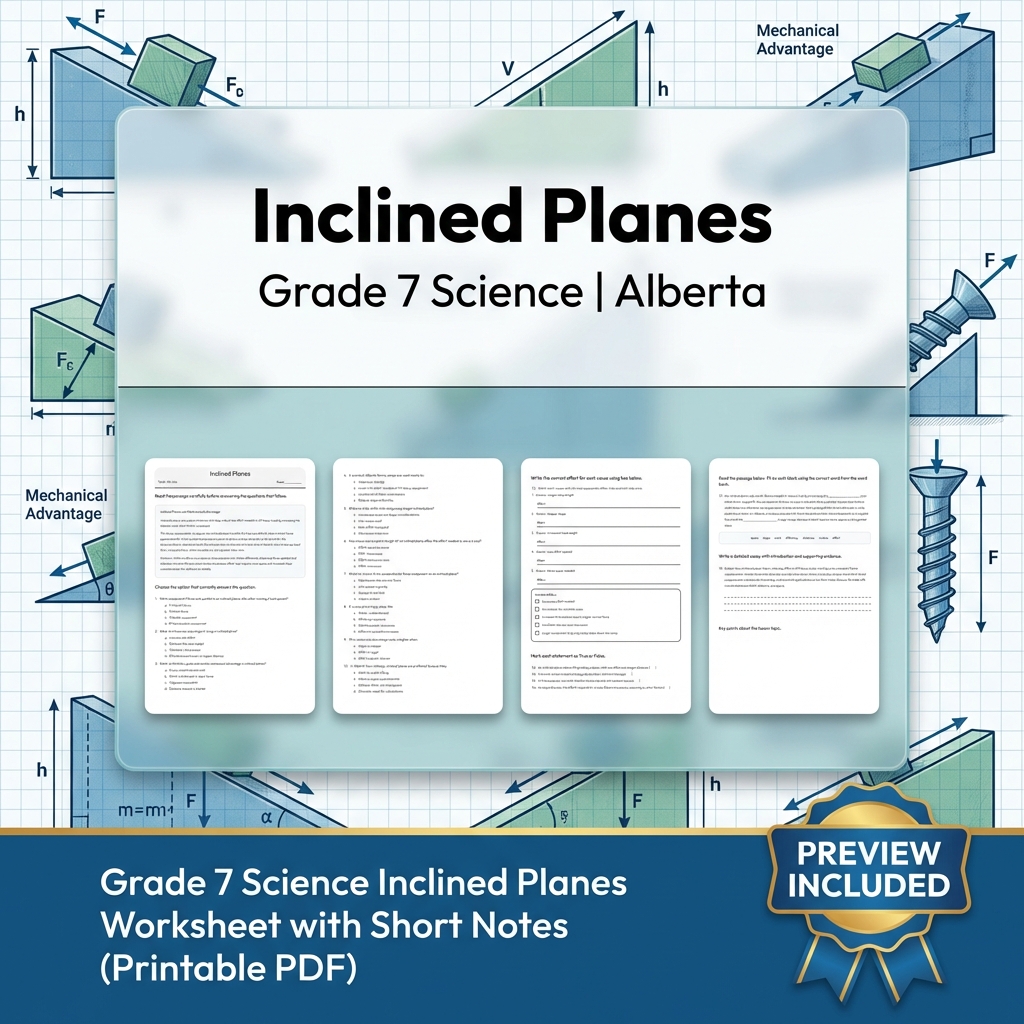
Grade 7 Science Inclined Planes Worksheet with Short Notes (Printable PDF)
Created byMeadowlark WorksheetsLearning Objectives
- Understand how inclined planes distribute applied force and work over distance.
- Identify the force components parallel and perpendicular to a slope.
- Calculate the mechanical advantage of inclined planes in practical contexts.
Also included in: Grade 7 Science | Forces, Structures & Motion UNIT Worksheet Bundle
Instant download

Geologic Resources Worksheet Grade 11 Earth Science Activities
Created byPrism Point LearningLearning Objectives
- Explain how geologic processes concentrate or disperse minerals, fuels, and groundwater resources over time.
- Analyze how weathering rate and rock permeability influence soil formation and groundwater movement.
- Describe how fossil fuels form from biological production and burial under low-oxygen conditions.
Instant download
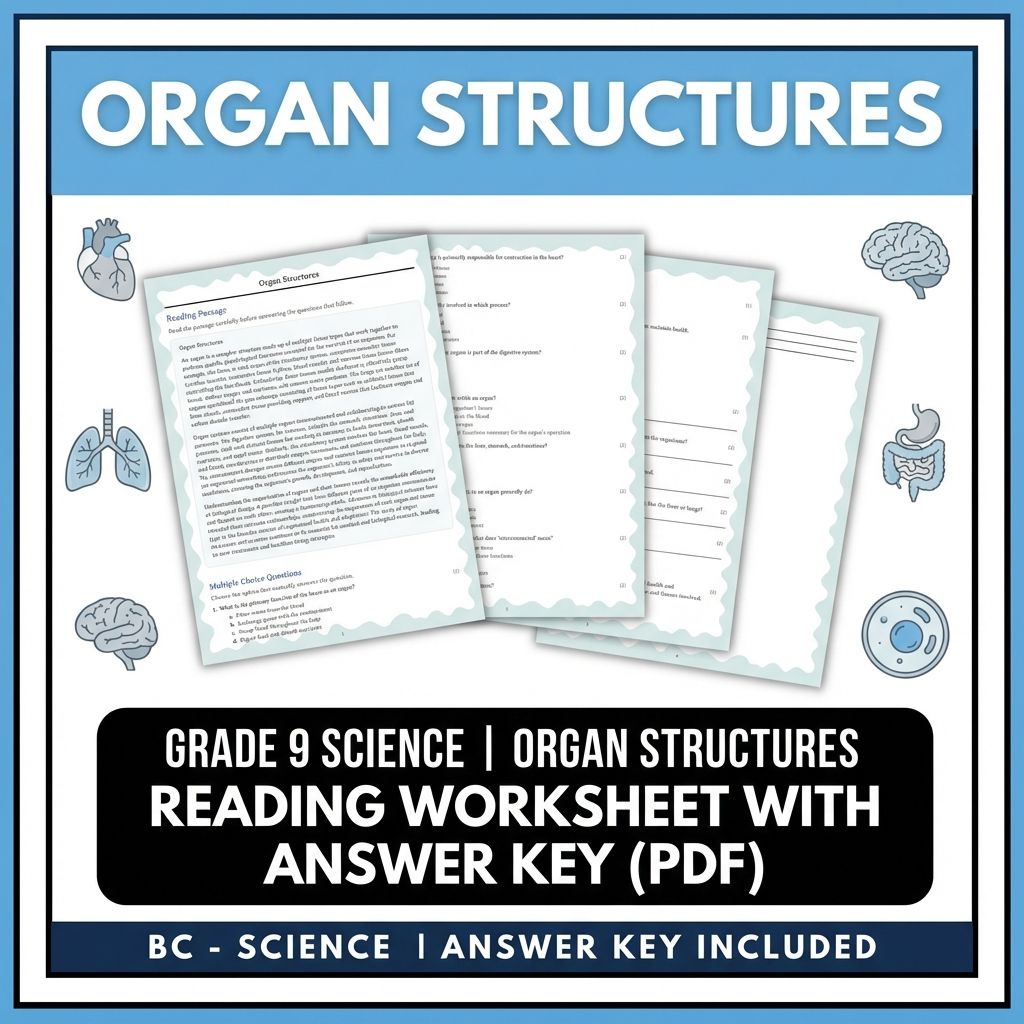
Grade 9 Science | Organ Structures Reading Worksheet with Answer Key (PDF)
JCreated byJ.S SheetsLearning Objectives
- Understand the composition and functions of different organs in the human body.
- Identify the types of tissues that make up organs.
- Explain how organs work together within organ systems to sustain life.
Instant download
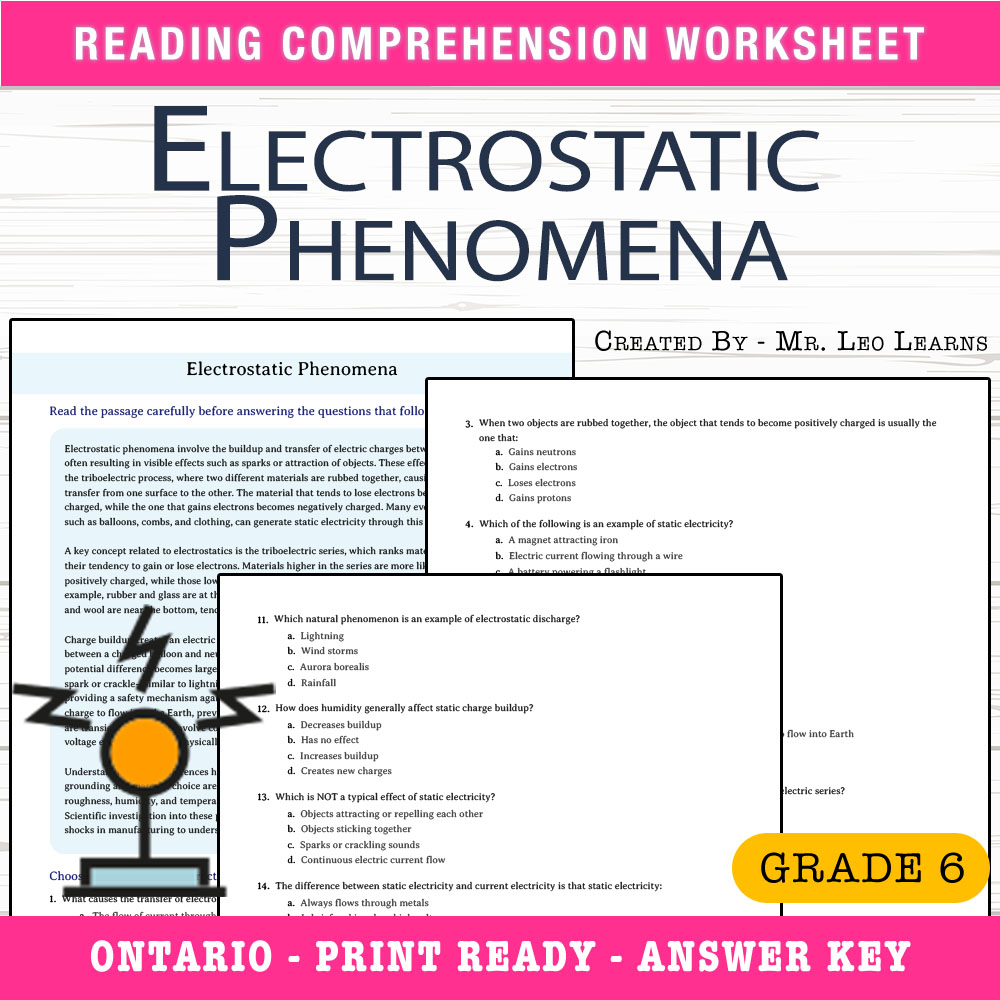
Grade 6 Science — Electrostatic Phenomena Worksheet for Mastery
 Created byThe Resource Hub
Learning Objectives
- Explain how charge transfer occurs between materials during triboelectric effects.
- Describe the concept of electrostatic discharge and how it differs from current flow.
- Identify the materials in the triboelectric series and predict their charge tendencies.
Also included in: Grade 6 Science Unit Bundle – Circuits, Electricity & Energy Worksheets +1 more
Instant download
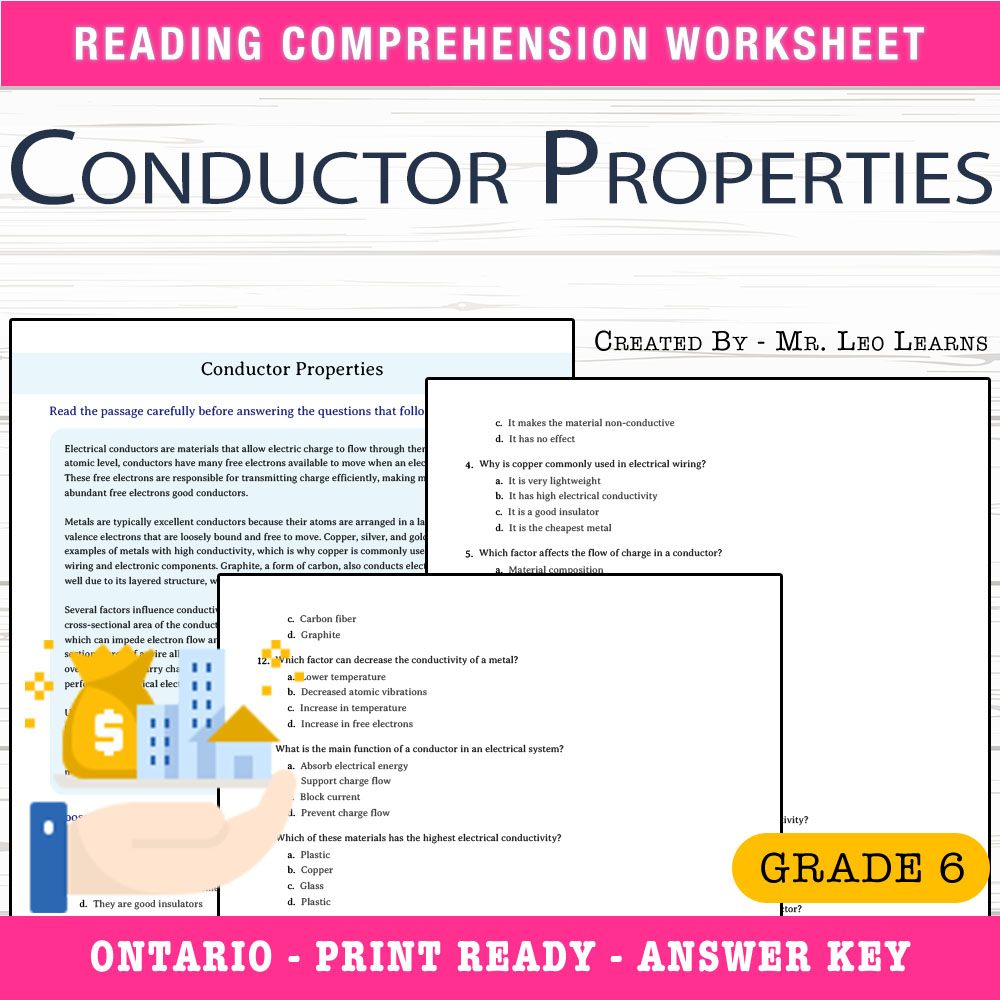
Grade 6 Science – Conductors Properties Worksheet for Mastery
Created byThe Resource HubLearning Objectives
- Explain the concept of electrical conductivity and the role of free electrons in conductors.
- Identify common materials that are good conductors and describe how their physical properties influence conductivity.
- Analyze factors such as material composition, temperature, and cross-sectional area that affect the electrical conductivity of materials.
Also included in: Grade 6 Science Unit Bundle – Circuits, Electricity & Energy Worksheets +1 more
Instant download
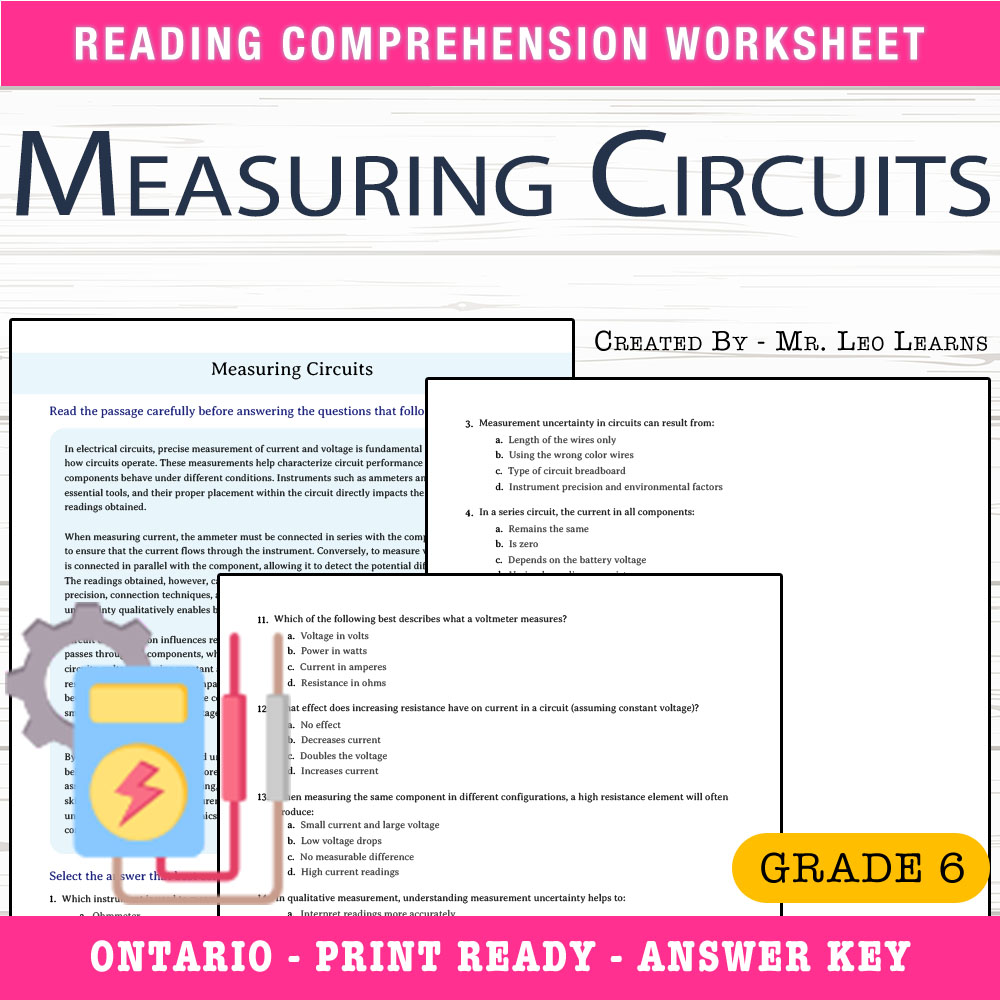
Grade 6 Science – Measuring Circuits Worksheet for Mastery
Created byThe Resource HubLearning Objectives
- Understand how current and voltage measurements characterize circuit performance.
- Identify proper instrument placement and reading patterns in various circuit configurations.
- Explain measurement uncertainty qualitatively and interpret readings in context.
Also included in: Grade 6 Science Unit Bundle – Circuits, Electricity & Energy Worksheets +1 more
Instant download
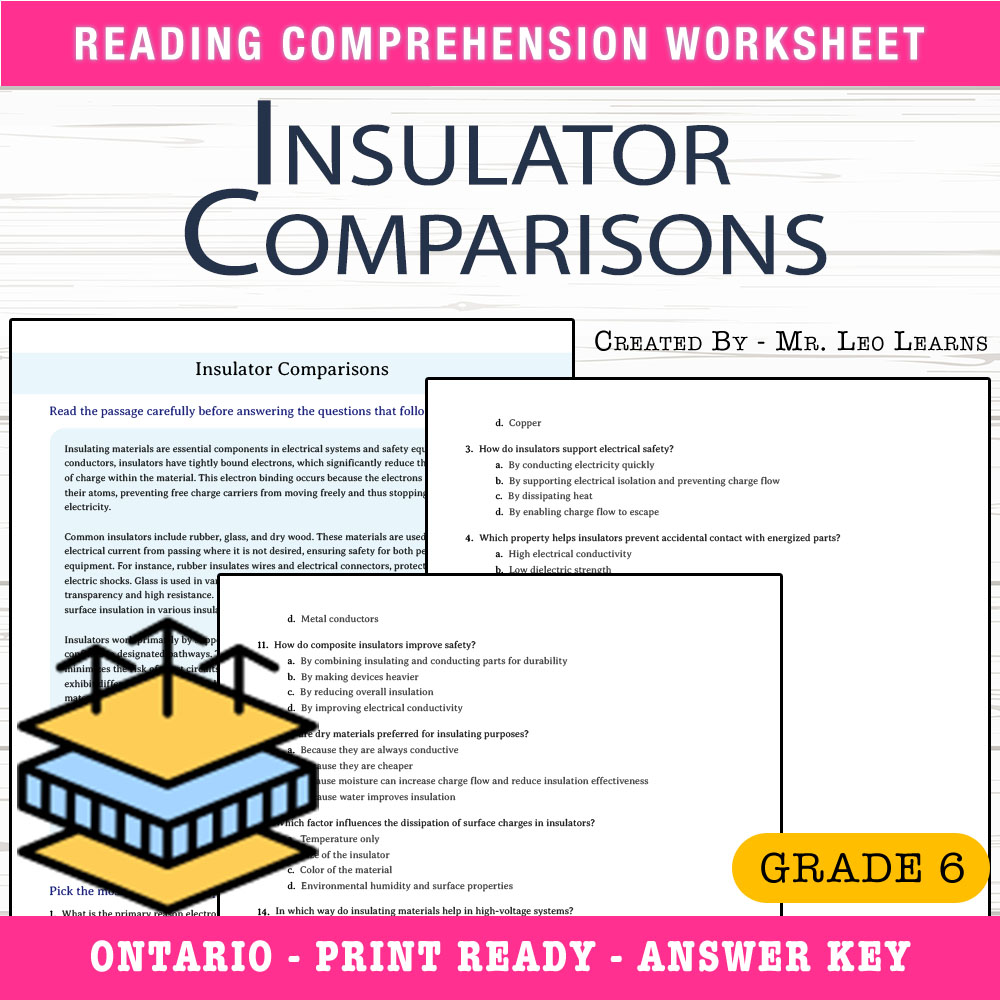
Grade 6 Science — Insulator Comparisons Worksheet for Mastery
Created byThe Resource HubLearning Objectives
- Describe the properties of insulating materials and how they prevent electrical charge flow.
- Identify common insulating materials such as rubber, glass, and dry wood.
- Explain how insulators support electrical safety through isolation.
Also included in: Grade 6 Science Unit Bundle – Circuits, Electricity & Energy Worksheets +1 more
Instant download

Grade 6 Science — Charge Concepts Worksheet for Mastery
Created byThe Resource HubLearning Objectives
- Explain the difference between static and current electricity.
- Define electric charge, charge separation, and flow.
- Describe phenomena such as hair attraction and sparks in terms of electric charge.
Also included in: Grade 6 Science Unit Bundle – Circuits, Electricity & Energy Worksheets +1 more
Instant download
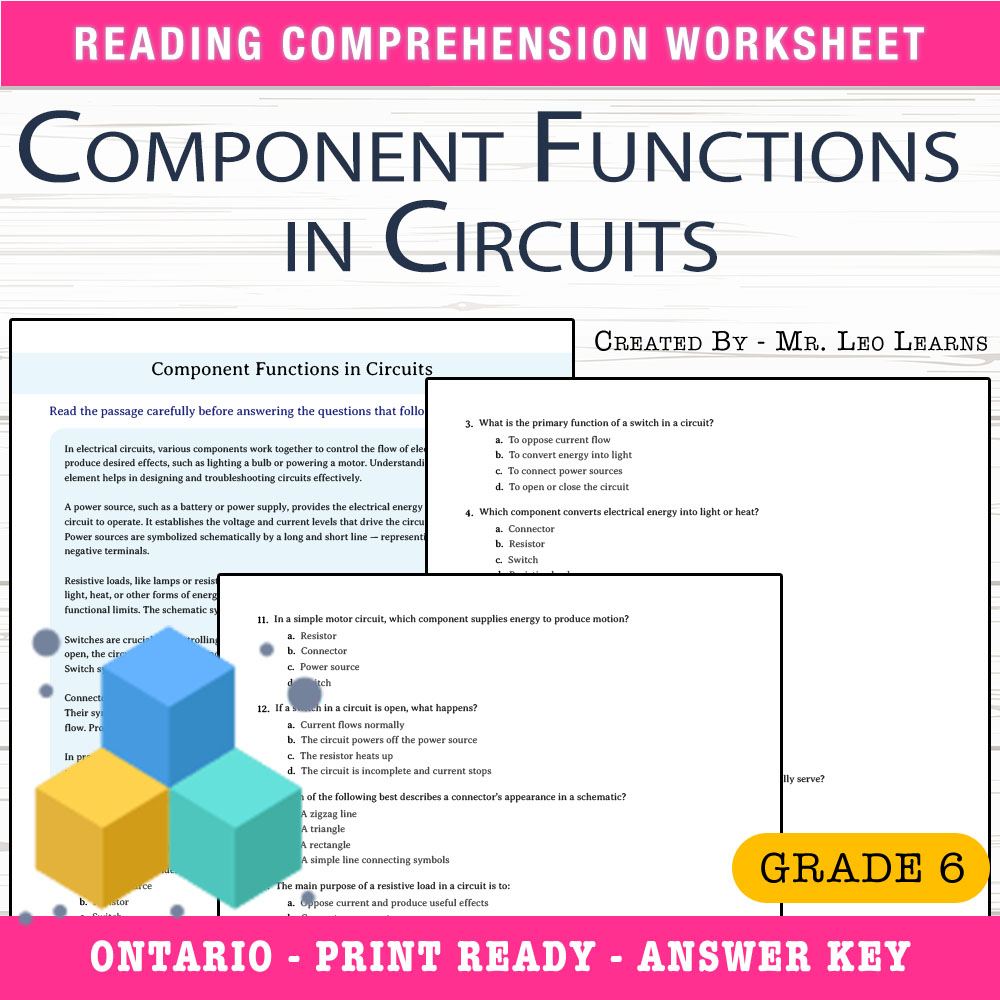
Grade 6 Science — Component Functions in Circuits Worksheet for Mastery
Created byThe Resource HubLearning Objectives
- Identify common circuit components such as power sources, resistive loads, switches, and connectors.
- Describe how each component influences the behaviour of an electric circuit.
- Interpret schematic symbols and relate them to physical components.
Also included in: Grade 6 Science Unit Bundle – Circuits, Electricity & Energy Worksheets +1 more
Instant download

Grade 6 Science — Parallel Characteristics Worksheet for Practice
Created byThe Resource HubLearning Objectives
- Understand the concept of parallel circuits and their fundamental characteristics.
- Explain how current divides among parallel branches and how voltage remains consistent.
- Identify practical advantages of parallel wiring in household applications.
Also included in: Grade 6 Science Unit Bundle – Circuits, Electricity & Energy Worksheets +1 more
Instant download
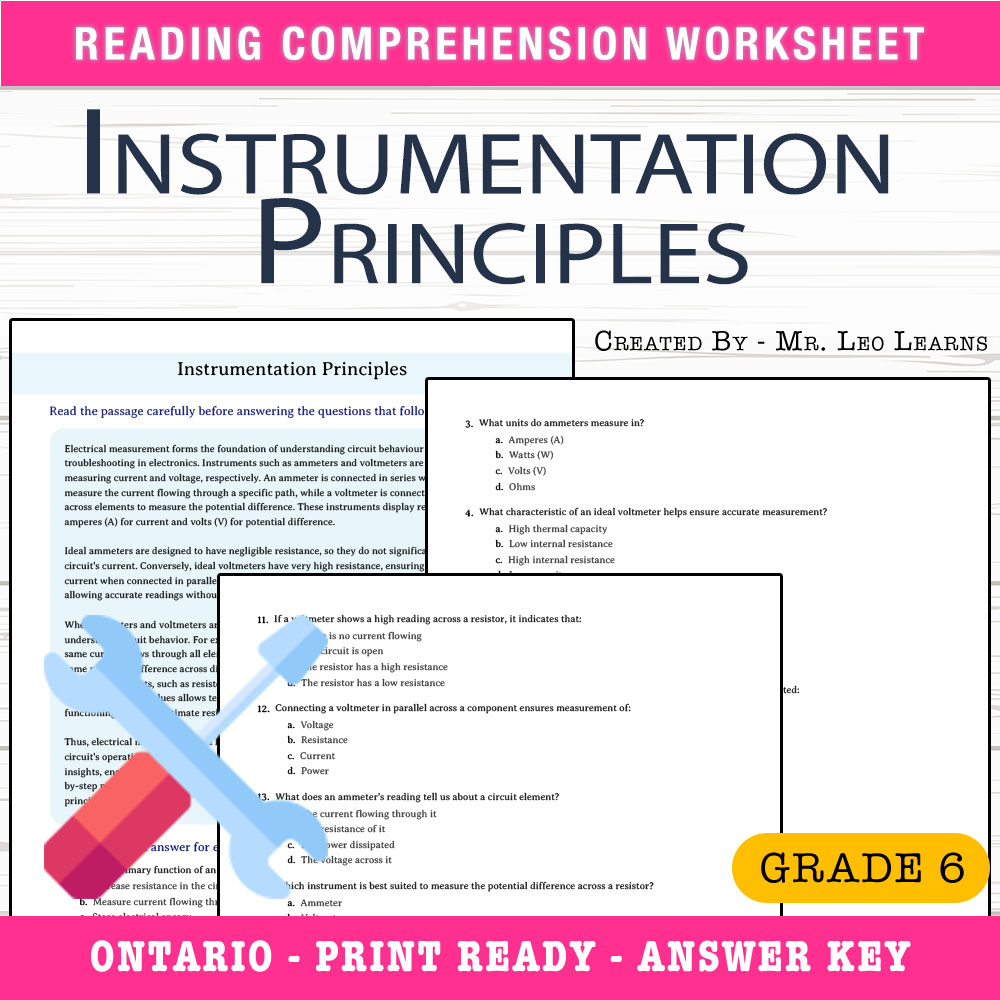
Grade 6 Science – Instrumentation Principles Worksheet for Mastery
Created byThe Resource HubLearning Objectives
- Understand the roles of ammeters and voltmeters in electrical circuits.
- Identify measurement units of amperes and volts and interpret their readings.
- Describe the placement of instruments in series and parallel circuits and what their readings indicate about circuit behavior.
Also included in: Grade 6 Science Unit Bundle – Circuits, Electricity & Energy Worksheets +1 more
Instant download
Grade 6 Science — Quantitative Circuits Worksheet for Mastery
Created byThe Resource HubLearning Objectives
- Understand the relationship between voltage, current, and resistance in electrical circuits.
- Apply proportional reasoning to predict how changes in resistance affect current in a circuit.
- Calculate unknown circuit parameters using measured values and basic formulas.
Also included in: Grade 6 Science Unit Bundle – Circuits, Electricity & Energy Worksheets +1 more
Instant download
Grade 6 Science — Circuit Symbols Worksheet for Mastering Electrical Diagrams
Created byThe Resource HubLearning Objectives
- Identify and interpret standard circuit symbols such as cells, batteries, resistors, lamps, switches, ammeters, and voltmeters.
- Understand how to read and interpret schematic diagrams to predict circuit behavior and configuration.
- Distinguish between series, parallel, and mixed circuit arrangements through circuit symbols and diagrams.
Also included in: Grade 6 Science Unit Bundle – Circuits, Electricity & Energy Worksheets +1 more
Instant download
Grade 6 Science — Energy and Power Worksheet for Mastery
Created byThe Resource HubLearning Objectives
- Explain the relationship between electrical energy transfer and power dissipation in circuit elements.
- Define power as the rate of energy transfer and connect it to current and voltage.
- Identify everyday examples of electrical power usage such as lighting and heating.
Also included in: Grade 6 Science Unit Bundle – Circuits, Electricity & Energy Worksheets +1 more
Instant download

Grade 6 Science – Series Circuit Characteristics Worksheet for Mastery
Created byThe Resource HubLearning Objectives
- Explain the single-path configuration of series circuits and how current remains consistent through all components.
- Describe how voltage divides among series-connected components and relate this to brightness in incandescent bulbs.
- Analyze how adding resistances in series impacts overall circuit resistance and device operation.
Also included in: Grade 6 Science Unit Bundle – Circuits, Electricity & Energy Worksheets +1 more
Instant download

Grade 6 Science – Combined Circuits Worksheet for Mastery
Created byThe Resource HubLearning Objectives
- Understand the principles of mixed series-parallel electrical networks and how to decompose them into simpler subcircuits.
- Analyze current and voltage distribution in combined circuit configurations and predict the effects of element changes.
- Identify diagnostic signs in combined circuits, such as brightness variations, to determine component status.
Also included in: Grade 6 Science Unit Bundle – Circuits, Electricity & Energy Worksheets +1 more
Instant download
Grade 6 Science – Electric Current Worksheet for Mastering Fundamentals
Created byThe Resource HubLearning Objectives
- Explain how electric current is an organized movement of charges through a conductor.
- Differentiate between conventional current direction and electron flow.
- Describe potential difference as the driving force behind current.
Also included in: Grade 6 Science Unit Bundle – Circuits, Electricity & Energy Worksheets +1 more
Instant download

Grade 12 Science | Biogeochemical Cycles Worksheet | BC-Aligned
Created byLumora LearningLearning Objectives
- Describe the main pathways and components of biogeochemical cycles such as carbon, nitrogen, and phosphorus.
- Explain how weathering, biological activity, and human impacts influence element cycling.
- Analyze the interconnectedness of biosphere productivity, oceans, atmosphere, and lithosphere in cycle regulation.
Also included in: Grade 12 Science | Earth Science Custom Bundle | BC Aligned
Instant download
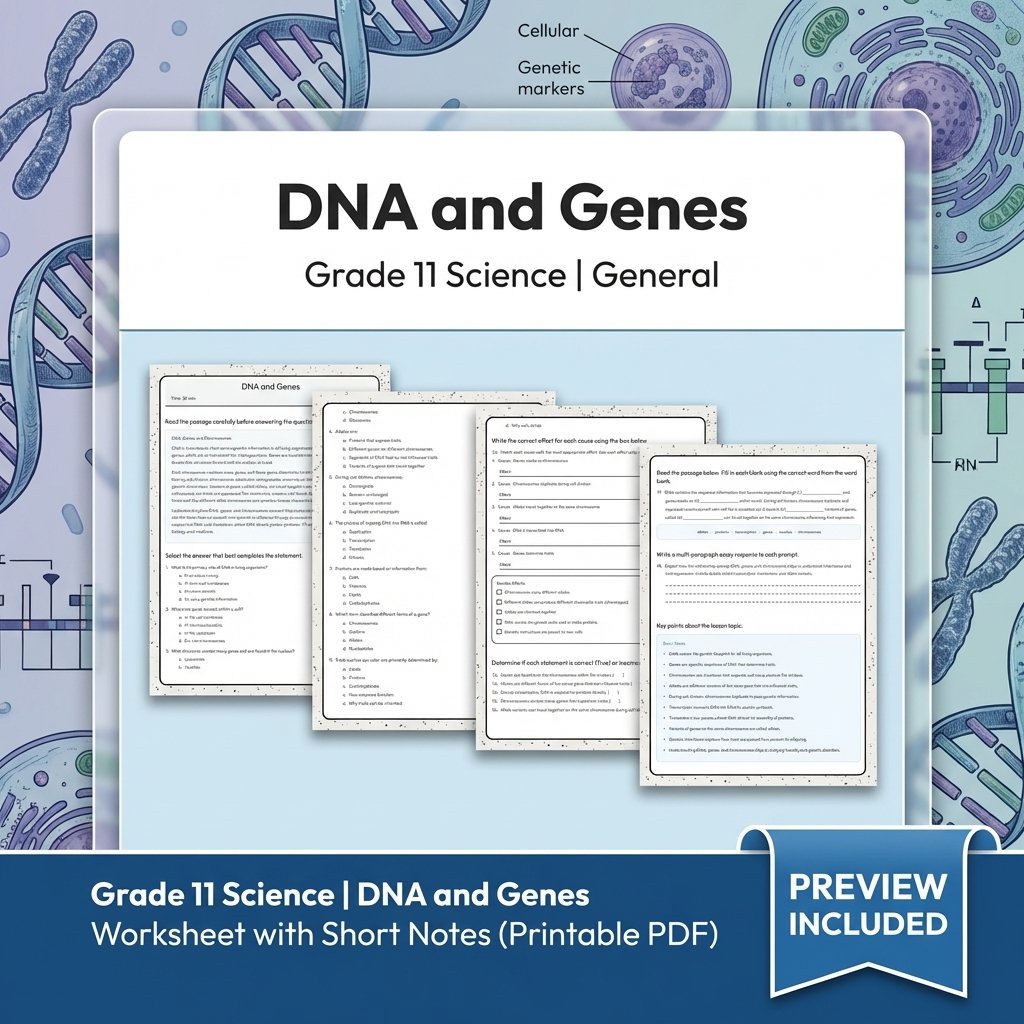
Grade 11 Science | DNA and Genes Worksheet with Short Notes (Printable PDF)
Created byMeadowlark WorksheetsLearning Objectives
- Understand the relationship between DNA, genes, and chromosomes.
- Explain how genetic information is expressed through transcription and translation.
- Identify how alleles travel together during cell division and affect trait expression.
Also included in: Grade 11 Biology Foundations Science Lesson Bundle: General Worksheets +1 more
Instant download

Grade 11 Science – Percent Yield & Reaction Efficiency | Daily Reading Worksheet
Created byBright Mind ResourcesLearning Objectives
- Define theoretical yield and actual yield in a chemical reaction.
- Explain how limiting reagents affect the calculation of percent yield.
- Calculate percent yield using given experimental data and stoichiometry.
Also included in: Reaction Analysis Grade 11 Science Daily Reading Worksheets Bundle | Alberta +1 more
Instant download
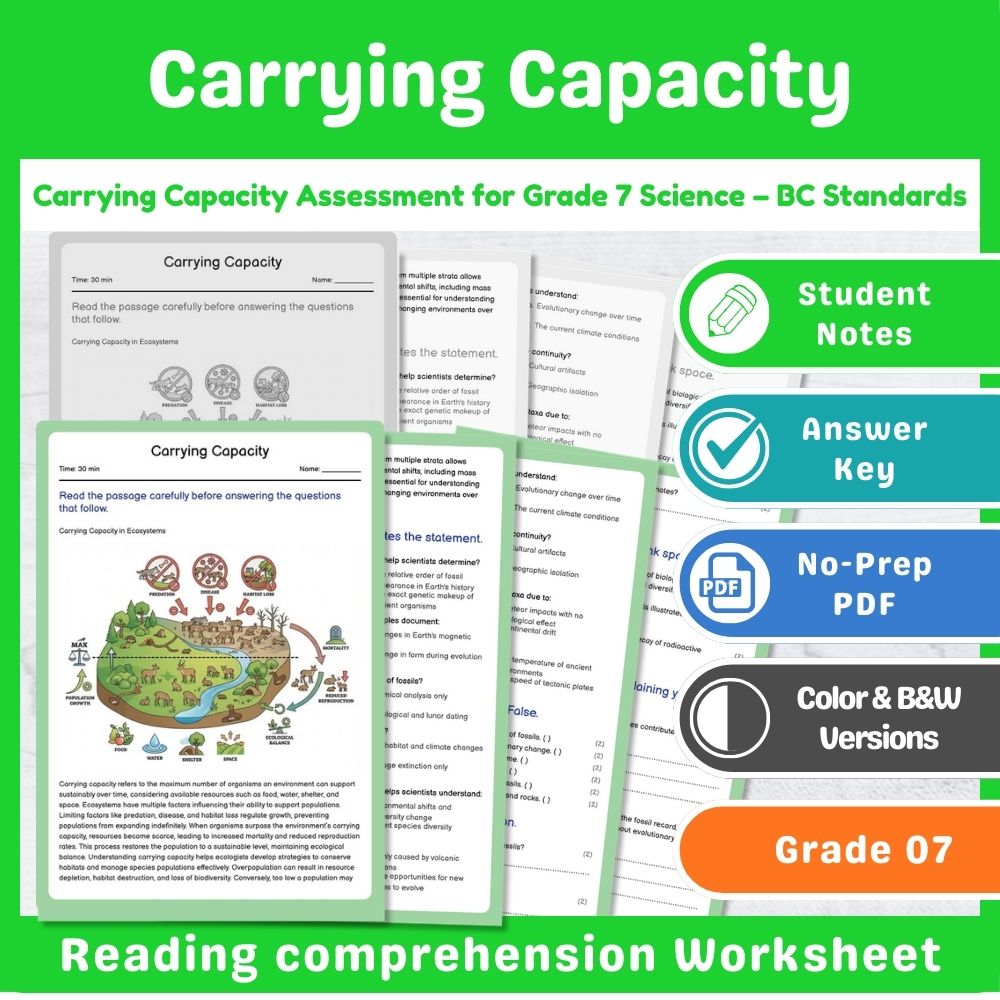
Carrying Capacity Assessment for Grade 7 Science – BC Standards
Created byPrism Point LearningLearning Objectives
- Define carrying capacity and explain its significance in ecosystems.
- Identify limiting factors that influence population growth.
- Describe the effects of exceeding carrying capacity in natural environments.
Instant download

Grade 10 Science | Friction & Drag Concepts Worksheet (PDF) – BC Standards
Created byBright Mind ResourcesLearning Objectives
- Explain the mechanisms of friction and drag as resistance forces.
- Identify factors that affect the strength of friction and drag.
- Describe how friction and drag influence energy dissipation and motion.
Instant download

Watershed Patterns Science Worksheet for Grade 2 | Ontario Standards
Created byCoral Reef LearningLearning Objectives
- Understand how watershed and groundwater systems distribute water in the environment.
- Identify how topography influences water flow toward rivers and lakes.
- Explain how soil and rock affect water infiltration and storage.
Instant download

Grade 8 Science | Systems Analysis in Structural Mechanics - Reading Comp.
Created byCoral Reef LearningLearning Objectives
- Understand the components of static systems and how forces are decomposed.
- Identify external versus internal forces in physical systems.
- Calculate net forces and assess system equilibrium or acceleration.
Also included in: Forces and Motion Lesson Bundle | Grade 8 Science Alberta +1 more
Instant download

Grade 7 Science – Solubility & Factors Reading Worksheet | Alberta Standards
Created byBright Mind ResourcesLearning Objectives
- Define solubility and identify factors that influence it
- Explain the role of solutes and solvents in dissolving processes
- Describe how temperature, surface area, and pressure affect solubility
Also included in: Grade 7 Solutions Science Daily Reading Worksheets Lesson Bundle | Alberta +2 more
Instant download
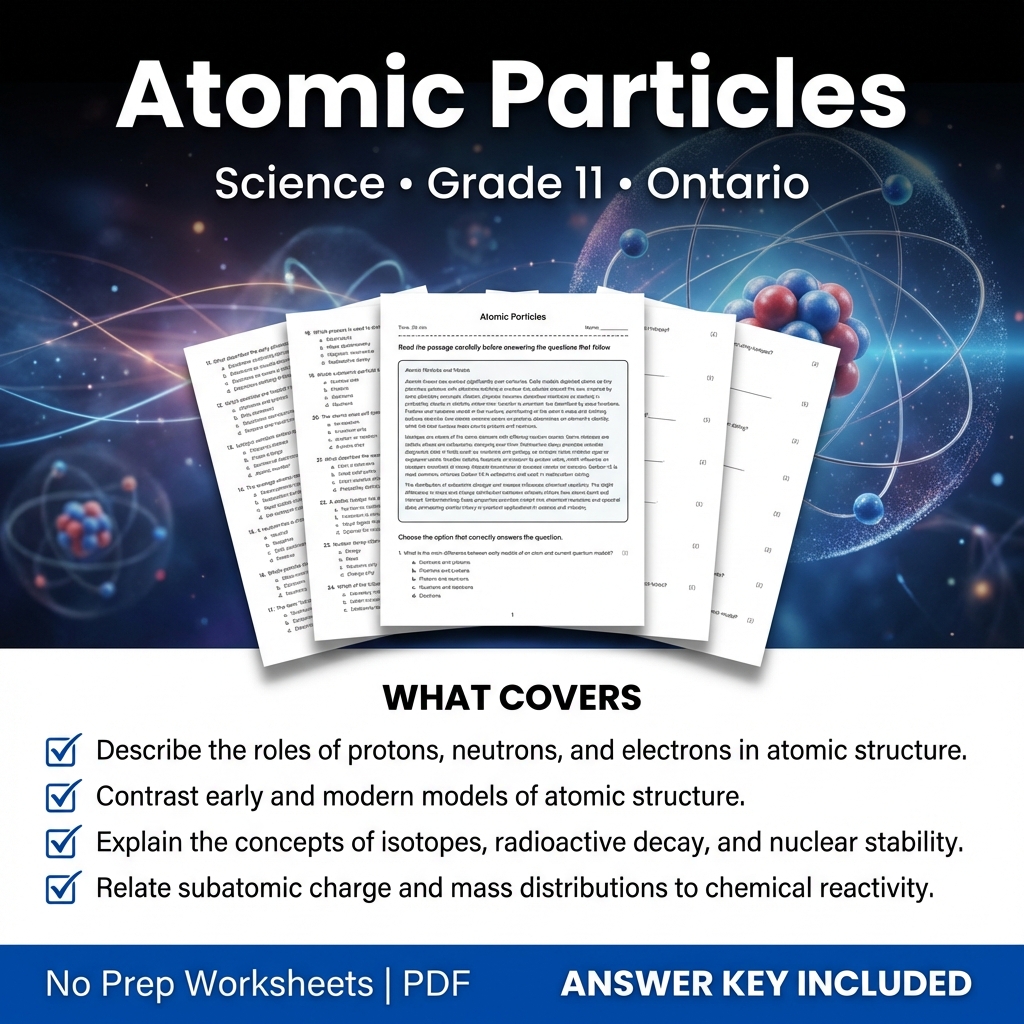
Atomic Particles Worksheet for Grade 11 Science – Ontario Standards
Created byCoral Reef LearningLearning Objectives
- Describe the roles of protons, neutrons, and electrons in atomic structure.
- Contrast early and modern models of atomic structure.
- Explain the concepts of isotopes, radioactive decay, and nuclear stability.
Instant download

Grade 10 Science | Orbits and Energy Worksheet | BC Standards
Created byLumora LearningLearning Objectives
- Explain how gravitational attraction provides the centripetal force for orbital motion.
- Describe how orbital speed depends on central mass and orbital radius.
- Differentiate between circular and elliptical orbits and their energy characteristics.
Instant download

Erosion And Transport Test Prep Worksheet | Grade 7 Science BC Standards
Created byPrism Point LearningLearning Objectives
- Explain how erosion by different agents (running water, glaciers, wind, and gravity) leads to distinctive sediment results.
- Describe how transport energy and distance affect grain size and sorting.
- Use sediment clues to infer past environments and landscape evolution.
Also included in: Earth's Systems & Processes Lesson Bundle | Grade 7 Science | BC +1 more
Instant download
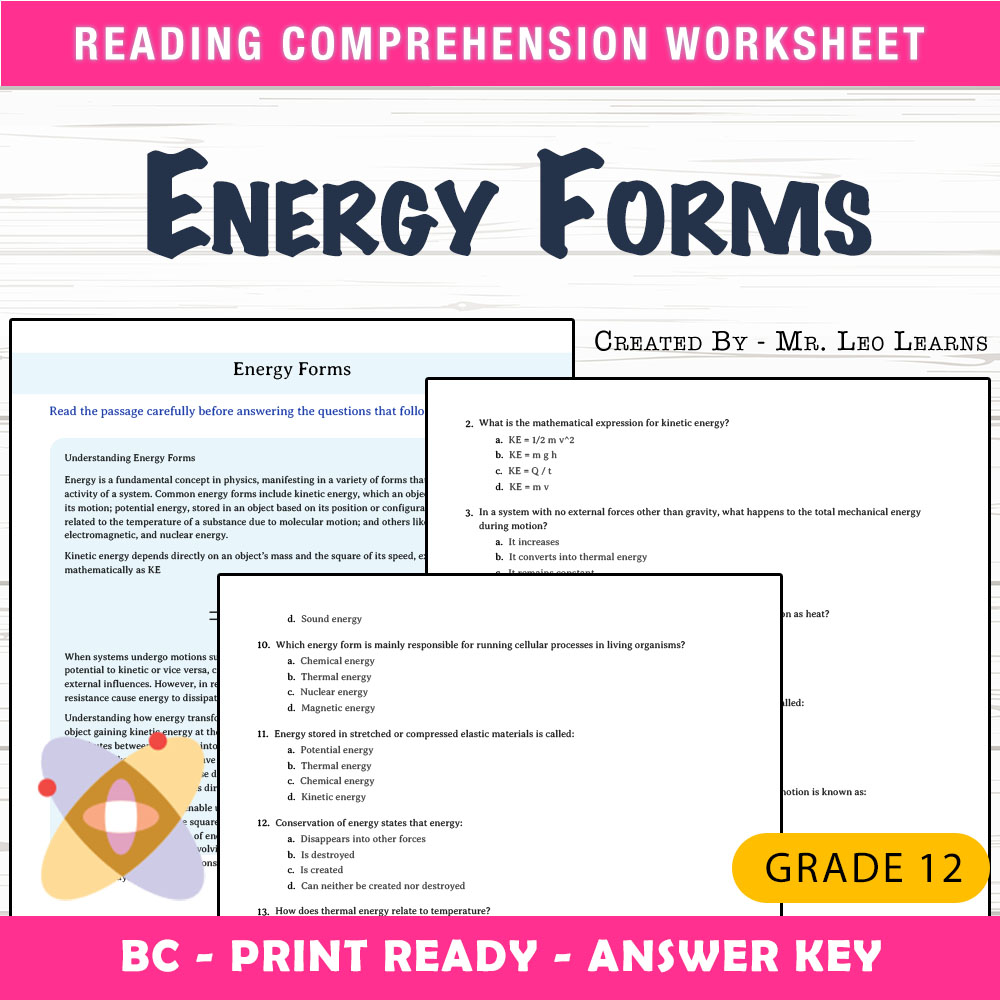
Grade 12 Science — Worksheet MCQ Paper for Mastering Energy Forms
Created byThe Resource HubLearning Objectives
- Define different forms of energy such as kinetic, potential, and thermal energy.
- Explain how total mechanical energy varies in systems with non-conservative forces.
- Describe energy transfer processes during motion, collisions, and deformation.
Also included in: Grade 12 Science | Physics 12 Wave & Quantum Concepts Worksheet Bundle +1 more
Instant download

Grade 11 Science Energy Concepts Worksheet (AP Standard) PDF
 Created byEvergreen Desk Education
Learning Objectives
- Define work, kinetic energy, and potential energy and use energy relationships to solve mechanical energy problems
- Apply the principle of energy conservation in closed systems using energy bar-chart representations
- Distinguish conservative and nonconservative forces using examples and potential energy concepts
Also included in: Grade 11 Physics Principles Science Lesson Bundle | Advanced Placement (AP) +1 more
Instant download

Grade 11 Science | Electromagnetic Waves Worksheet (AP Standards) (PDF)
Created byEvergreen Desk EducationLearning Objectives
- Explain how oscillating electric and magnetic fields produce electromagnetic wave propagation.
- Describe the orthogonal field structure of electromagnetic waves and how polarization is defined.
- Use the idea of wave speed in vacuum to relate frequency, wavelength, and propagation.
Also included in: Grade 11 Physics Principles Science Lesson Bundle | Advanced Placement (AP) +1 more
Instant download
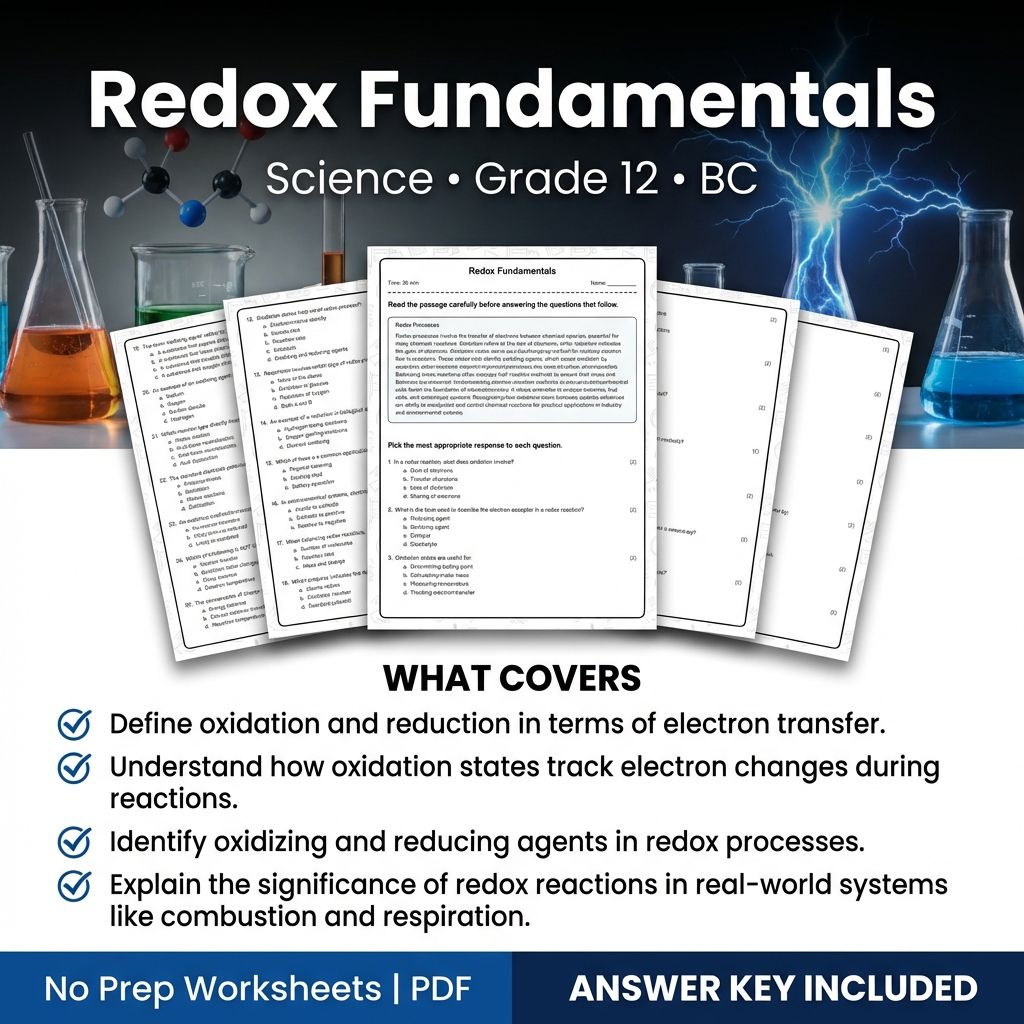
Redox Fundamentals Science Worksheet for Grade 12 | BC Standards
Created byCoral Reef LearningLearning Objectives
- Define oxidation and reduction in terms of electron transfer.
- Understand how oxidation states track electron changes during reactions.
- Identify oxidizing and reducing agents in redox processes.
Instant download

Grade 12 Social Studies | Housing Policy Analysis Worksheet (PDF + Answer Key)
JCreated byJ.S SheetsLearning Objectives
- Understand the various tools and strategies used in housing policy to address affordability and neighborhood change.
- Analyze cause-and-effect relationships related to homelessness and urban development.
- Trace the evolution of urban housing markets and examine policy trade-offs concerning scalability, equity, and governance.
Instant download
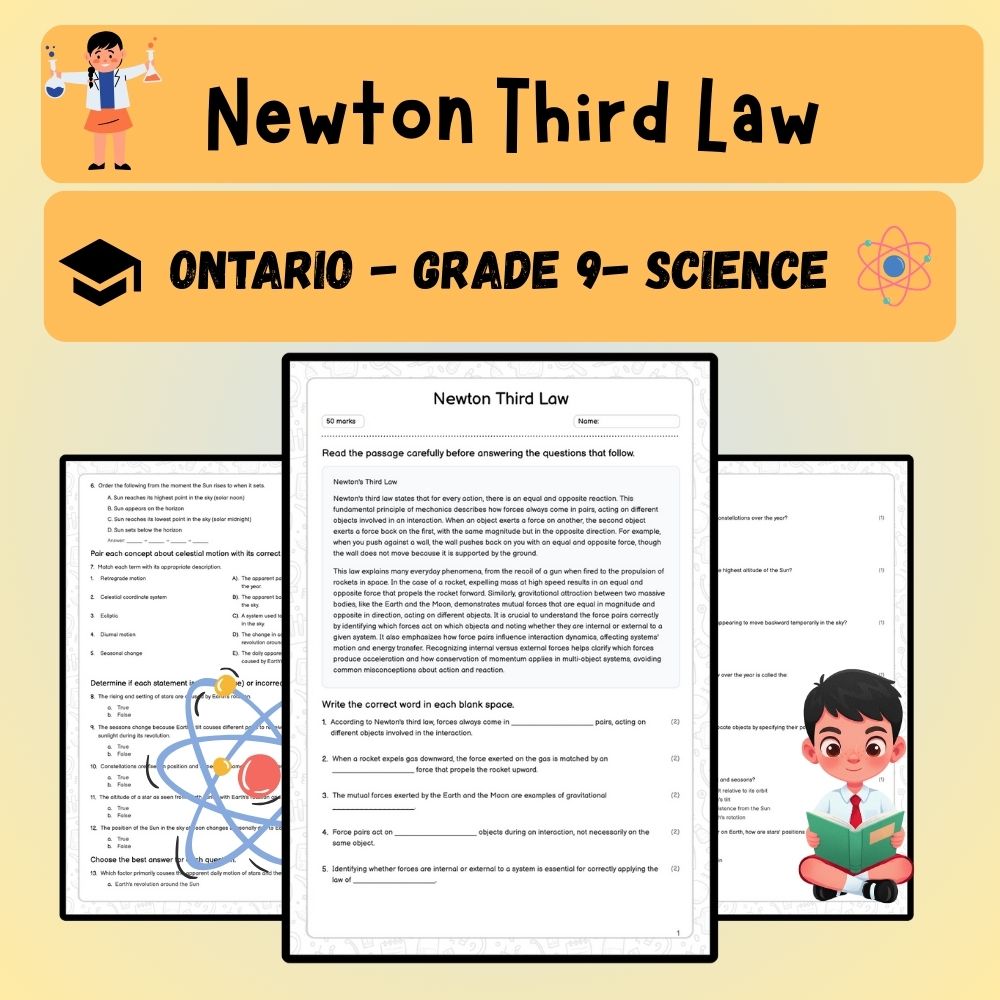
Grade 9 Science | Newton Third Law Worksheet (Worksheet + Answer Key) – Ontario Standards
Created byPrism Point LearningLearning Objectives
- Explain the principle of Newton's third law and identify action–reaction force pairs in various scenarios.
- Analyze common phenomena involving equal and opposite forces applied to different objects.
- Differentiate between internal and external forces when applying Newtonian mechanics to systems.
Also included in: Grade 9 Science Unit | Forces, Motion & Energy Worksheets (Ontario Standards) +1 more
Instant download
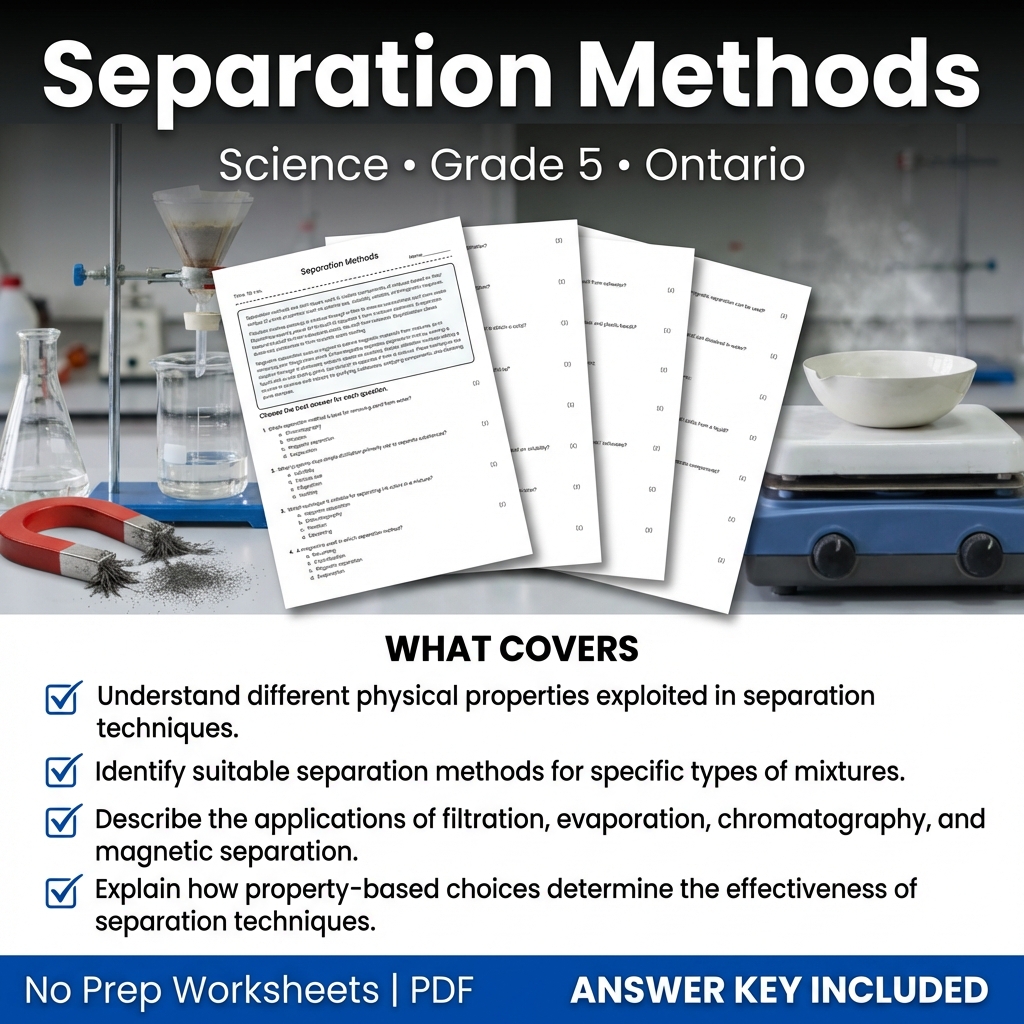
Grade 5 Science Worksheet on Separation Methods | Ontario Standards
Created byCoral Reef LearningLearning Objectives
- Understand different physical properties exploited in separation techniques.
- Identify suitable separation methods for specific types of mixtures.
- Describe the applications of filtration, evaporation, chromatography, and magnetic separation.
Instant download

Grade 12 Science – Energy Transfers & Oscillations Daily Reading Worksheet
Created byBright Mind ResourcesLearning Objectives
- Understand the basic concepts of energy transfer and dissipation in oscillatory systems
- Define simple harmonic motion, resonance, and damping
- Explain how conservation laws apply in non-conservative force scenarios
Also included in: Grade 12 Physics Energy & Fields Science Lesson Bundle: Daily Reading | BC +1 more
Instant download

Grade 10 Science | Fossil Record - Daily Reading Comprehension
Created byCoral Reef LearningLearning Objectives
- Identify different types of fossils and describe how they form.
- Understand how fossils are used to interpret Earth's biological history.
- Analyze the significance of stratigraphic context and radiometric dating in fossil interpretation.
Instant download
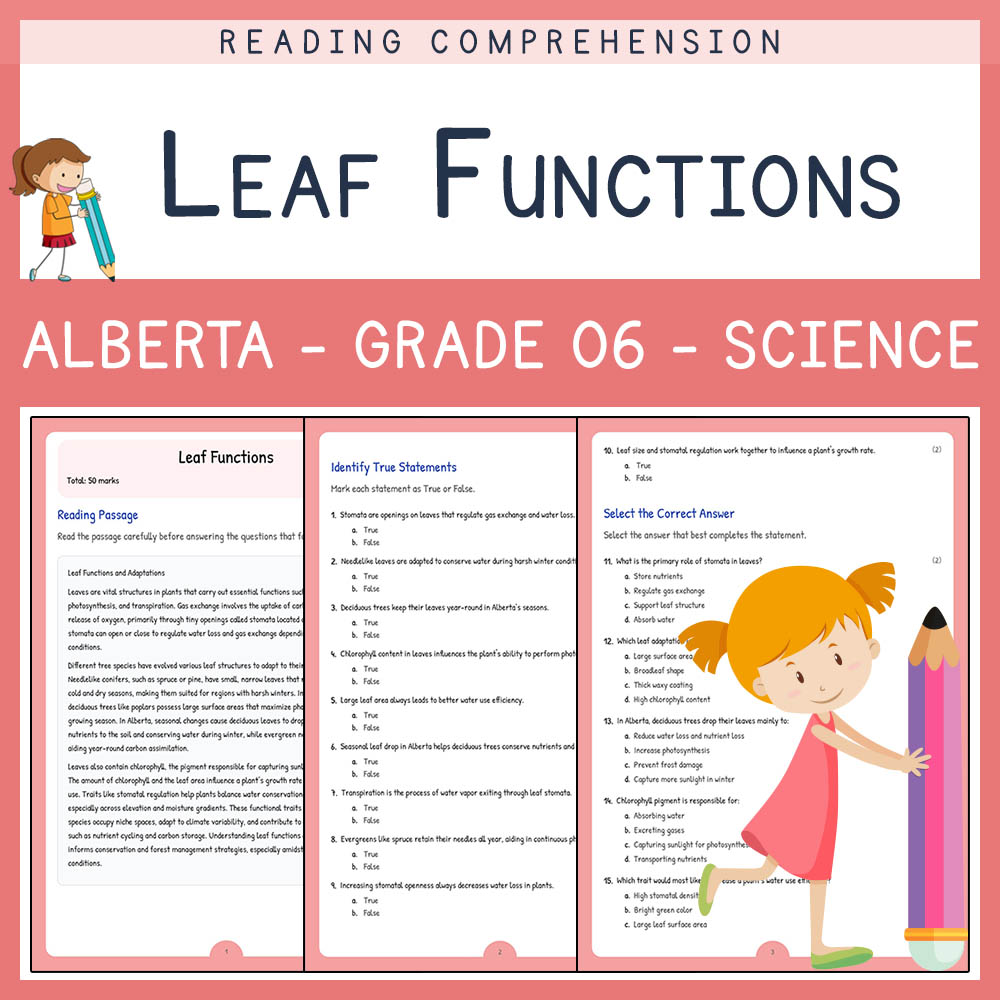
Grade 6 Science Assessment | Leaf Functions Worksheet | Alberta Standard
Created byLumora LearningLearning Objectives
- Understand the roles of leaf structures in gas exchange, photosynthesis, and transpiration.
- Compare leaf adaptations between needlelike conifers and broadleaf deciduous trees.
- Explain how seasonal differences influence leaf retention and drop in Alberta species.
Instant download
Browse more categories
About Reading comprehension Worksheets
Find reading comprehension worksheets for class practice, homework, or self-study. All 40,289 are instant PDF downloads.
Each resource here is built by an independent educator and reviewed for quality. Worksheets print straight from PDF and suit classroom use, homework, or extra practice; most come with answer keys, and you can preview before purchasing.