
Grade 7 Worksheets
8,459 grade resources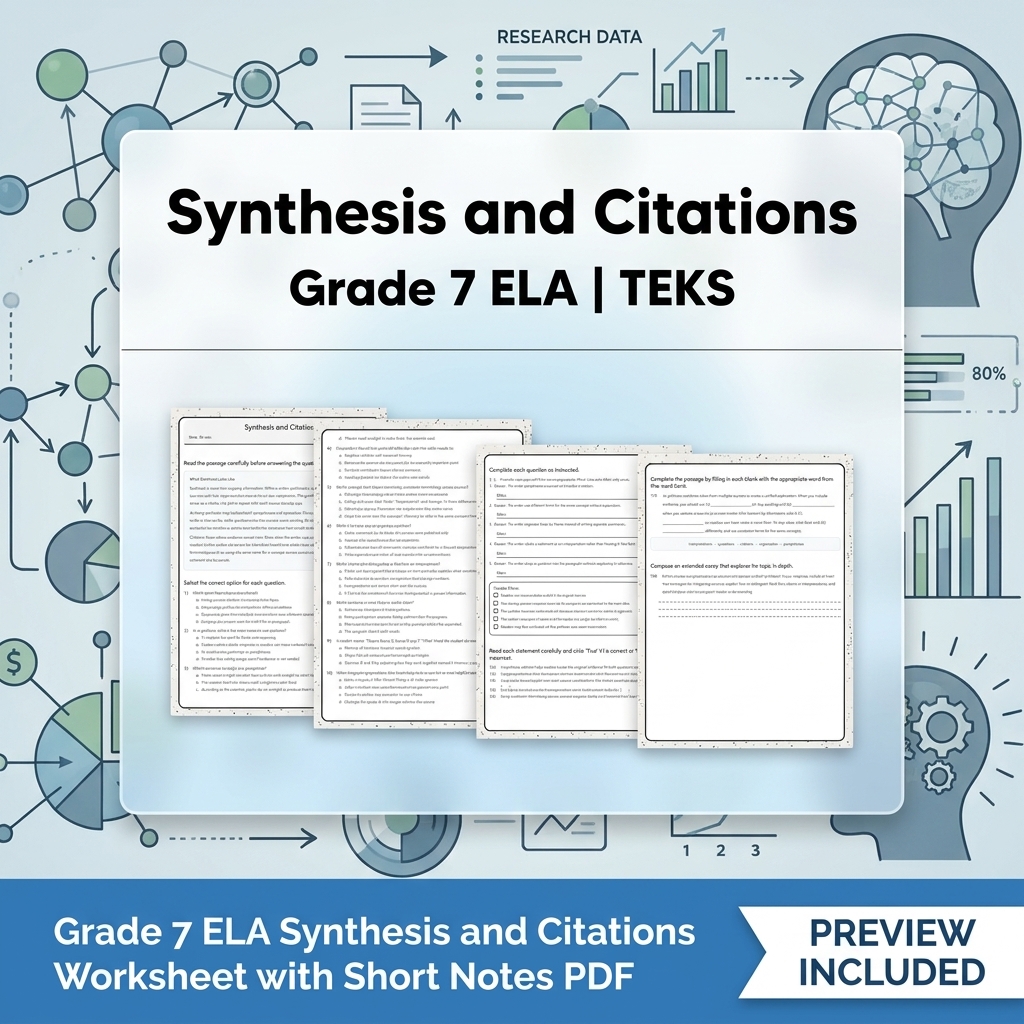
Grade 7 ELA Synthesis and Citations Worksheet with Short Notes PDF
 Created byMeadowlark Worksheets
Learning Objectives
- Explain how synthesis combines information from multiple sources into a coherent, original explanation.
- Distinguish between facts, interpretations, and author claims when integrating sources.
- Use quotations and paraphrases appropriately while maintaining consistent terminology.
Also included in: Grade 7 Evidence Synthesis, Source Credibility ELA Lesson Bundle: TEKS +1 more
Instant download
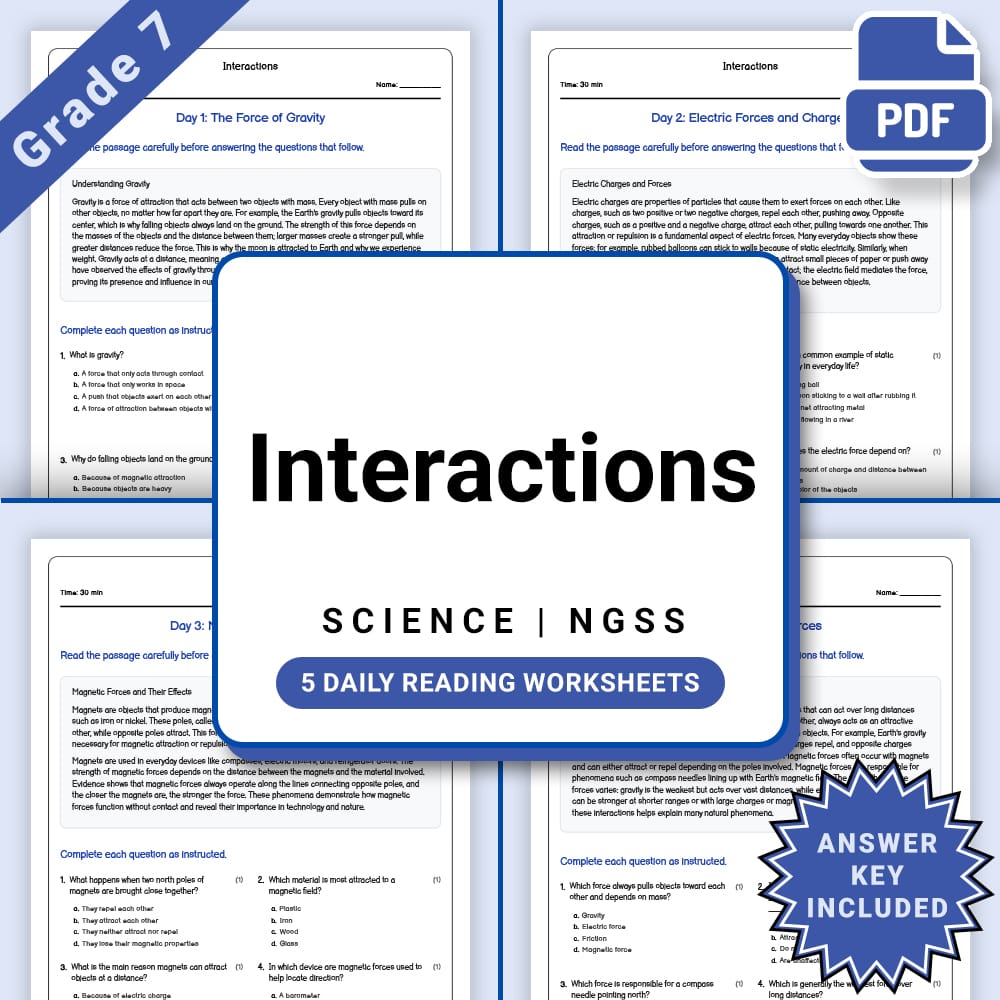
Grade 7 Science – Interactions Daily Reading Worksheet(PDF + Answer Key)
 Created byCopper Leaf Classroom
Learning Objectives
- Understand the concept of gravity as a long-range force that acts without contact.
- Identify examples of gravitational, electric, and magnetic interactions in everyday life.
- Describe how mass and distance influence gravitational attraction.
Instant download

Grade 7 Science Worksheet on Acceleration Meaning | Standards-Aligned Practice
JCreated byJ.S SheetsLearning Objectives
- Explain what acceleration means in terms of changes in velocity over time and the direction (positive or negative).
- Identify whether acceleration is constant or changing by analyzing patterns of velocity over equal time intervals.
- Connect acceleration to net force and mass to describe inertia and predict motion outcomes.
Also included in: Grade 7 Energy Transfer and Change Science Lesson Bundle – General Framework +1 more
Instant download

Tradeoff Mapping Assessment | California Standards Grade 7 Science
 Created byPrism Point Learning
Learning Objectives
- Explain how tradeoffs occur when improving one design criterion can worsen another due to constraints
- Map competing design options to criteria and constraints to decide which tradeoffs are acceptable
- Use intended function and acceptable limits (such as safety and feasibility) to justify design choices
Also included in: Grade 7 Science Engineering Assessment Lesson Bundle: California Standards +1 more
Instant download

Grade 7 Material Properties Worksheet | NGSS Practice PDF
 Created byClear Sky Classroom
Learning Objectives
- Distinguish between physical and chemical properties of materials.
- Identify measurable descriptors such as density, melting point, and solubility.
- Analyze data to classify materials and predict responses to temperature and chemical contact.
Also included in: Grade 7 Matter and Its Interactions Science Lesson Bundle NGSS Worksheets +1 more
Instant download

Source Evaluation Worksheet | CCSS ELA Practice for Grade 7
JCreated byJ.S SheetsLearning Objectives
- Use search strategies to locate credible print and digital sources.
- Evaluate sources for reliability and usefulness using author, evidence quality, and publication context.
- Organize notes so evidence can be matched to claims and topics.
Instant download

Grade 7 Science | Erosion and Transport Worksheet | BC Aligned
 Created byLumora Learning
Learning Objectives
- Understand how agents like water, glaciers, wind, and gravity detach and move Sediment.
- Identify the distinctive sedimentary signatures produced by different agents of erosion.
- Describe how transport distance and energy influence grain size and sorting of sediments.
Instant download

Grade 7 Holiday Worksheet | Honoring Educators with Comprehension & Activities (PDF)
 Created bySilver Birch Teaching
Learning Objectives
- Explain the history and purpose of Teacher Appreciation Day and why it matters to communities.
- Describe how teachers influence students’ learning, character, and sense of belonging.
- Identify the different roles educators play and connect those roles to students’ growth.
Also included in: Grade 7 Holiday Lesson Bundle for May Standards: Reading & Gratitude +1 more
Instant download

Building Wellness Habits Worksheet Grades 6 & 7 Holiday Printable PDF
Learning Objectives
- Identify practical wellness habits that promote mental, physical, and emotional health.
- Examine diverse cultural approaches to healthy living, including nutrition, exercise, and stress management.
- Develop critical thinking about personal wellness choices and their community impact.
Instant download

Grade 7 Math Sampling Techniques Worksheet (Ontario) – Practice Set (PDF)
Created byClear Sky ClassroomLearning Objectives
- Understand different sampling methods used in data collection.
- Apply mathematical reasoning to interpret sampling data scenarios.
- Calculate sample statistics and evaluate sampling effectiveness.
Also included in: Grade 7 Data and Probability Math Bundle – Ontario Standards +1 more
Instant download

Interactions Worksheet | Grade 7 Science | Review & Practice
Created byPrism Point LearningLearning Objectives
- Explain gravitational, electric, and magnetic interactions as long-range forces that act without contact.
- Relate gravitational attraction to mass and distance in qualitative terms.
- Use evidence-based reasoning to describe how force direction depends on charges or magnetic poles.
Also included in: Grade 7 Forces & Interactions Science Lesson Bundle for NGSS Review
Instant download

Grade 7 Health Healthy Eating Worksheet | Ontario Nutrition Activity
Created byPrism Point LearningLearning Objectives
- Explain why balanced nutrition supports growth and daily energy.
- Identify food groups and describe how portion control helps maintain healthy eating habits.
- Use food labels to make informed choices about nutrients.
Instant download

Islamic and West African Empires Social Studies Worksheet | Grade 7 TEKS
JCreated byJ.S SheetsLearning Objectives
- Identify major Islamic empires (Ottoman and Safavid) and describe key contributions they made to learning, architecture, and medicine.
- Explain how West African kingdoms such as Mali and Songhai built wealth through gold and salt trade.
- Describe how trade routes and cultural exchange helped spread ideas and religious beliefs across regions.
Instant download

Grade 7 ELA – Daily Reading Worksheet & Comprehension Practice | Ontario
 Created byQuiet Forest Education
Learning Objectives
- Identify main ideas in informational texts.
- Distinguish supporting details such as definitions, reasons, and examples.
- Summarize information accurately.
Also included in: Grade 7 Reading and Literature ELA lesson bundle | Ontario +1 more
Instant download
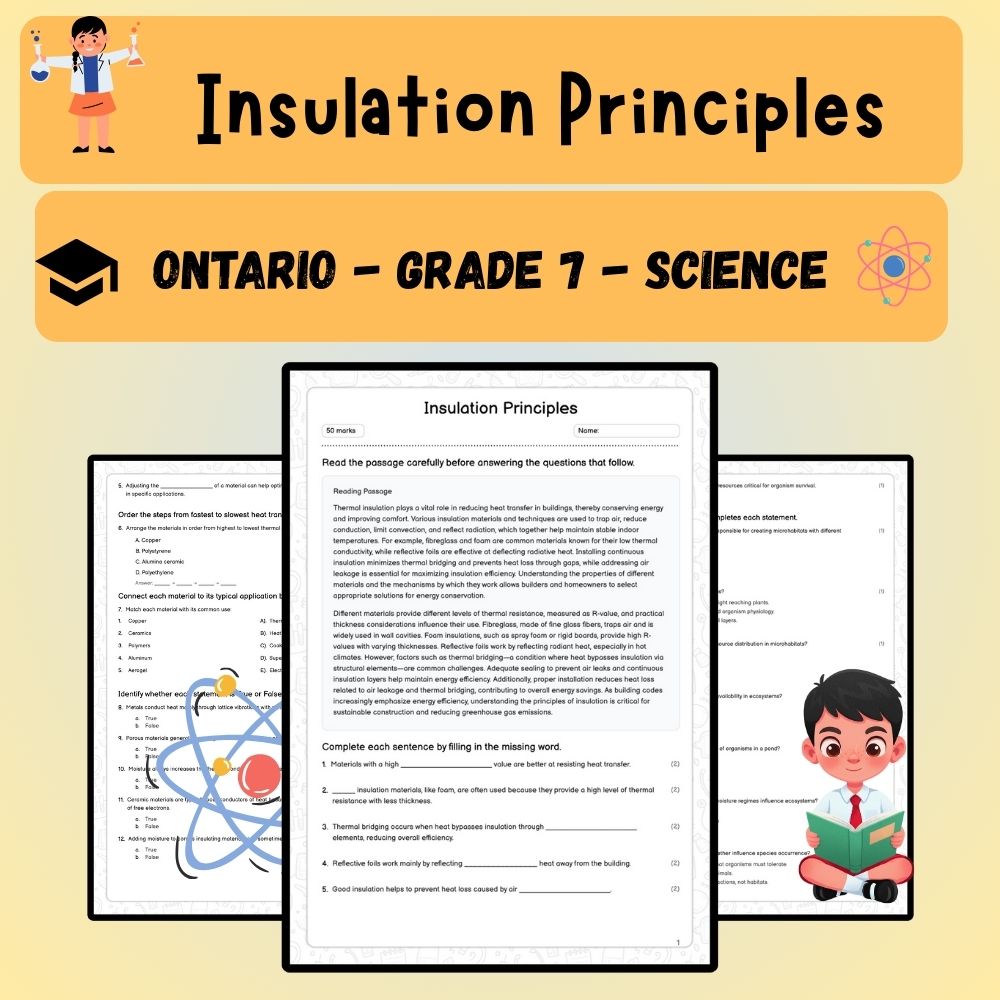
Grade 7 Science – Insulation Principles Worksheet (PDF ) – Ontario Standards
Created byPrism Point LearningLearning Objectives
- Understand the mechanisms by which insulation materials reduce heat transfer
- Compare different insulating materials based on thermal resistance and practical use
- Explain concepts such as thermal bridging, air leakage, and continuous insulation in building envelopes
Also included in: Grade 7 Science – Heat Transfer & Insulation Unit Worksheet Bundle +1 more
Instant download

Grade 7 Science | Digital Data Tools in Science - Daily Reading Comprehension
 Created byCoral Reef Learning
Learning Objectives
- Understand how sensors collect data
- Learn about data formats like CSV and timestamps
- Identify the advantages and limitations of automated data logging
Instant download
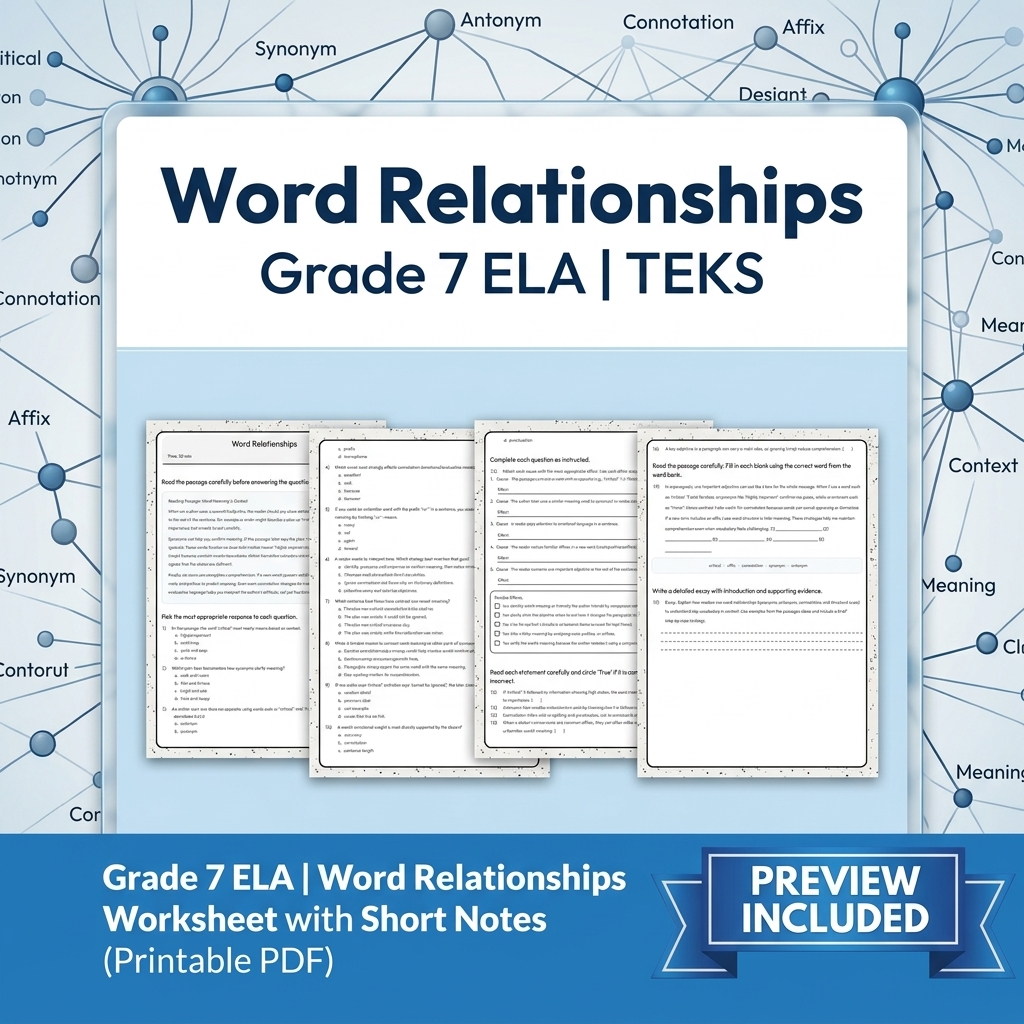
Grade 7 ELA | Word Relationships Worksheet with Short Notes (Printable PDF)
Created byMeadowlark WorksheetsLearning Objectives
- Analyze how synonyms and antonyms clarify shades of meaning in grade-level text.
- Interpret connotation and choose words that match an intended tone or evaluation.
- Use structural cues (roots and common affixes) to infer meaning of unfamiliar words.
Also included in: Grade 7 Text Structure & Comprehension ELA Lesson Bundle with Short Notes TEKS +1 more
Instant download
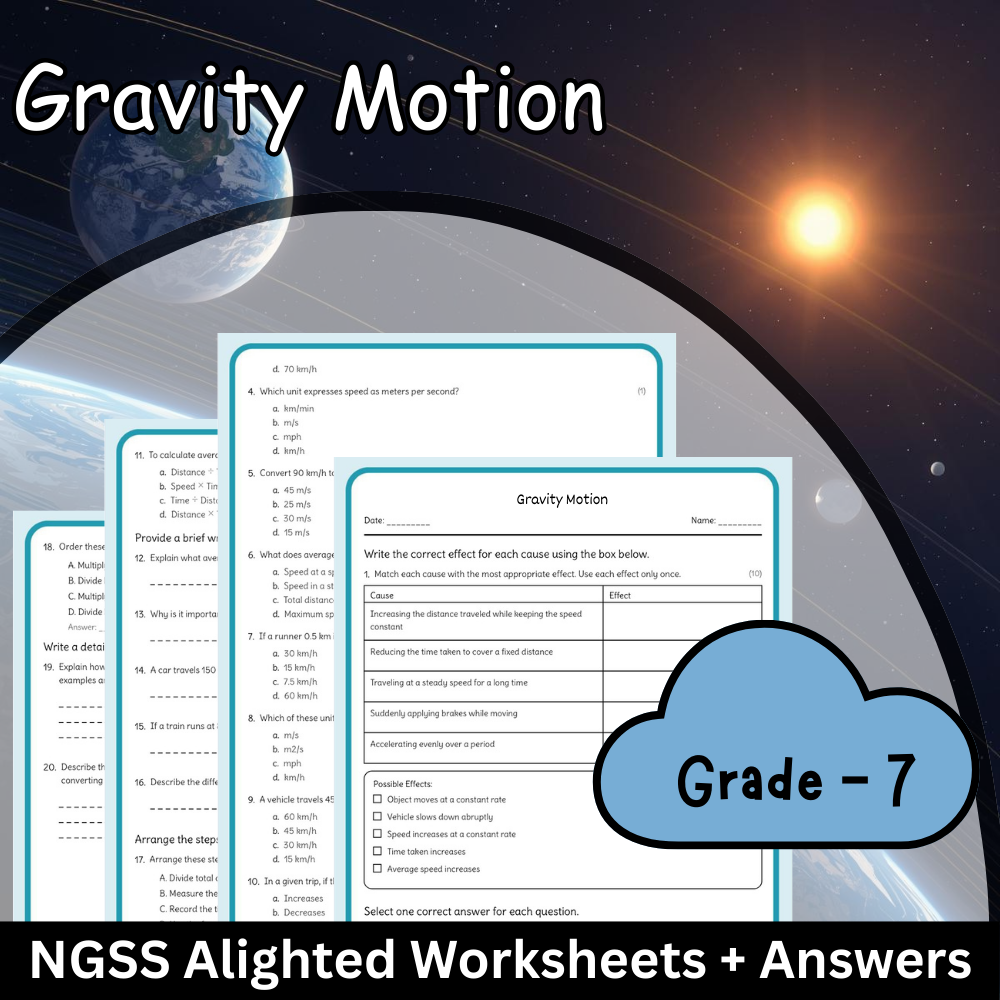
Grade 7 Science | Gravity and Orbital Motion Worksheet(Answer Key)– NGSS Aligned
 Created byBright Mind Resources
Learning Objectives
- Understand how gravity influences orbital motion within the solar system and across galaxies.
- Describe elliptical orbits and how they are affected by mass and distance.
- Apply mathematical relationships to explain orbital velocity and centripetal effects in planetary systems.
Instant download

Climate Patterns Worksheet Grade 7 NGSS | Ocean Currents & Weather
 Created byAmber Owl Education
Learning Objectives
- Explain how uneven solar heating and surface conditions influence atmospheric and ocean circulation
- Use temperature gradients, sea-surface temperature patterns, wind vectors, and precipitation records to interpret climate phenomena
- Describe how topography and ocean currents can cause regional climate differences
Also included in: Earth's Systems Lesson Bundle | Grade 7 Science | Next-Gen Science Standards +1 more
Instant download

Grade 7 Mixtures and Solutions Worksheet | NGSS Practice PDF
Created byClear Sky ClassroomLearning Objectives
- Differentiate between homogeneous and heterogeneous mixtures
- Identify examples of solutions, colloids, and suspensions
- Understand solubility, saturation, and concentration concepts
Also included in: Grade 7 Matter and Its Interactions Science Lesson Bundle NGSS Worksheets +1 more
Instant download

Science Grade 7: Gravity Motion Worksheet | NGSS Aligned Grade 7 Science
 Created bySkylark Worksheets
Learning Objectives
- Explain how gravitational attraction creates and shapes orbital motion in the solar system and beyond
- Use centripetal-force ideas to describe why orbiting objects move in curved paths without falling straight down
- Relate orbital speed and orbital period to mass and distance using qualitative mathematical relationships
Also included in: Grade 7 Space, Gravity & Earth Processes Science Lesson Bundle (NGSS) +1 more
Instant download

Gravity and Weight Worksheet for Grade 7 Science Activities & Review
Created byPrism Point LearningLearning Objectives
- Explain how gravity affects the motion of objects near Earth.
- Distinguish mass from weight using the role of gravitational force.
- Describe how falling objects gain speed over time due to a net downward force.
Also included in: Physical Science Lesson Bundle | Grade 7 Science | Florida NGSSS
Instant download
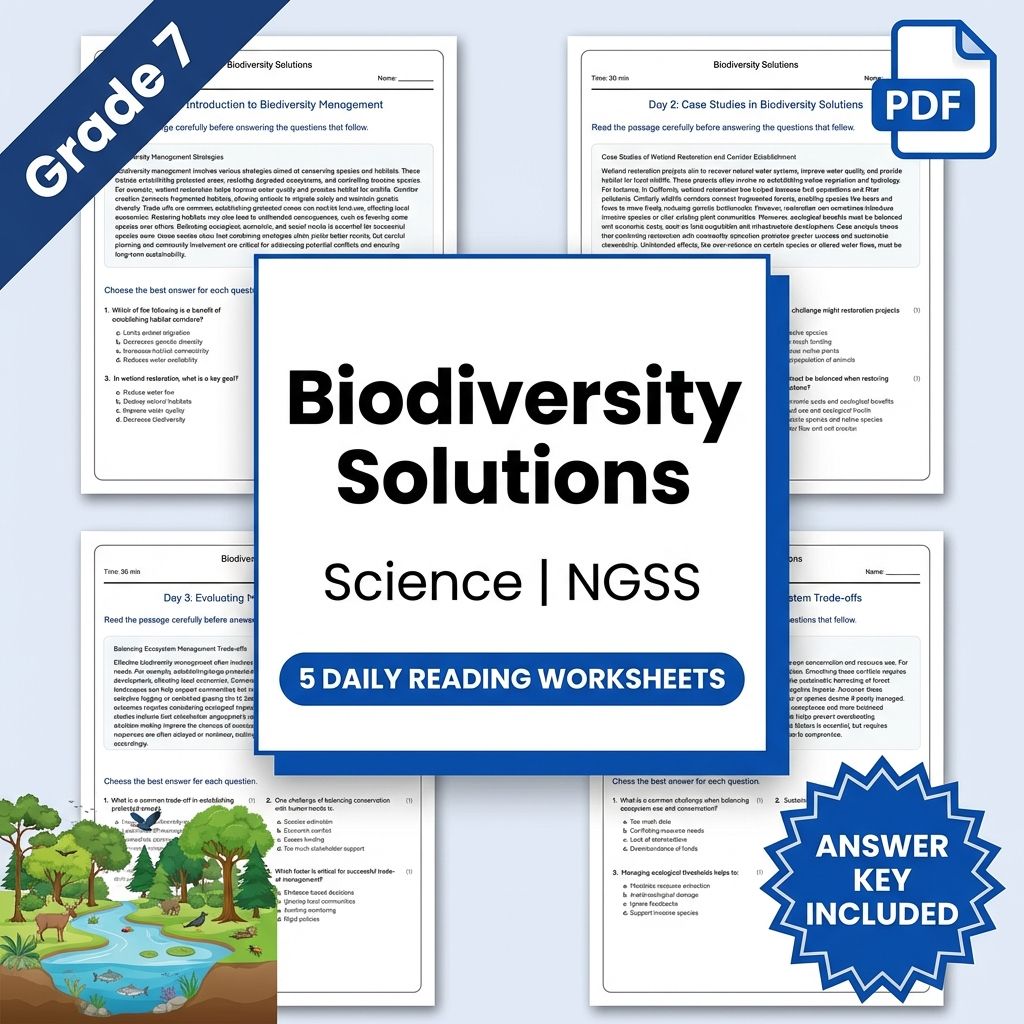
Grade 7 Science – Biodiversity Solutions Worksheet(PDF + Answer Key)
Created byCopper Leaf ClassroomLearning Objectives
- Understand management strategies for maintaining biodiversity and ecosystem health.
- Compare trade-offs and consequences of different biodiversity management approaches.
- Evaluate case examples such as wetland restoration and corridor creation.
Instant download

Grade 7 Holiday Care & Empathy Worksheet – May Standards (PDF)
Created bySilver Birch TeachingLearning Objectives
- Identify how acts of caregiving and kindness strengthen relationships in a community.
- Use grade-appropriate vocabulary related to empathy, service, and inclusion when discussing care.
- Explain how caring roles (nurses, mothers, and community helpers) share common qualities.
Also included in: Grade 7 Community Helpers Holiday Lesson Bundle: May Reading & Care Worksheets +1 more
Instant download
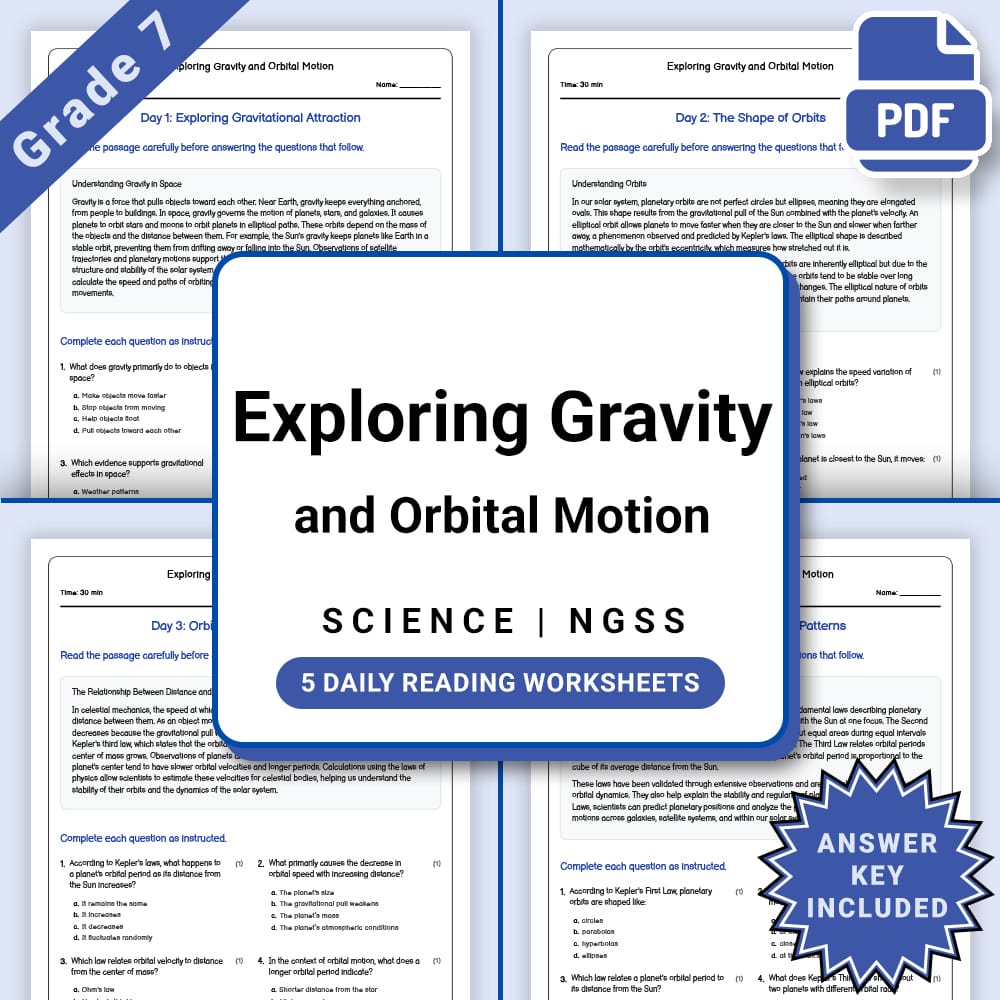
Grade 7 Science – Exploring Gravity and Orbital Motion (PDF + Answer Key)
Created byCopper Leaf ClassroomLearning Objectives
- Understand the concept of gravitational attraction.
- Explain how gravity influences the motion of planets and moons.
- Identify observational evidence supporting gravitational theories.
Instant download
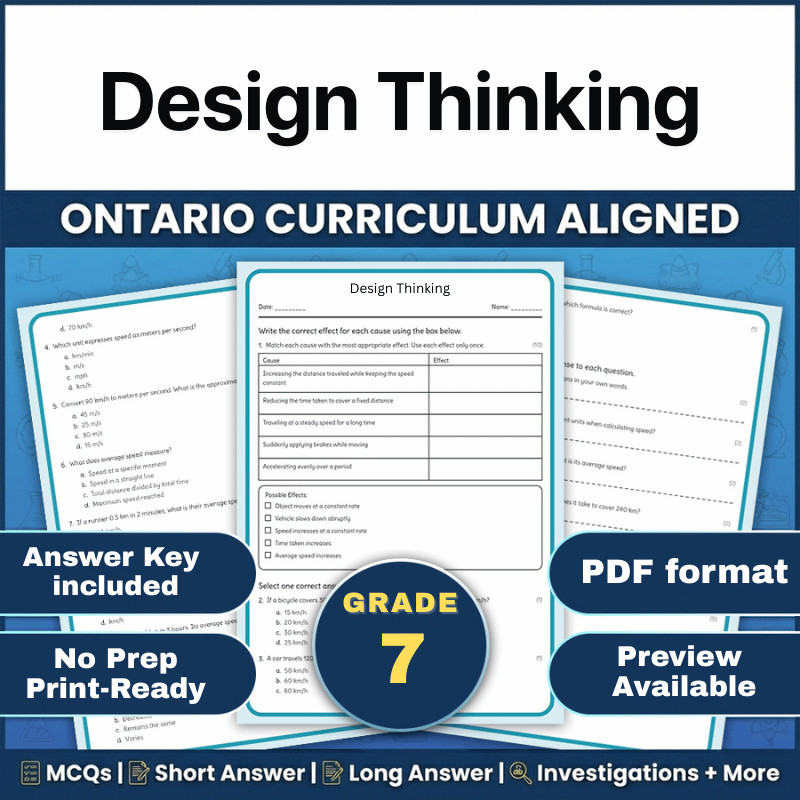
Grade 7 Science | Design Thinking Worksheet (Ontario, PDF)
Created byBright Mind ResourcesLearning Objectives
- Understand the fundamentals of engineering design, including problem definition and criteria setting.
- Learn how to create specification documents, trade-off matrices, and evaluate feasibility based on materials, cost, and environmental factors.
- Recognize the importance of iterative refinement to improve design solutions aligned with objectives and available resources.
Instant download
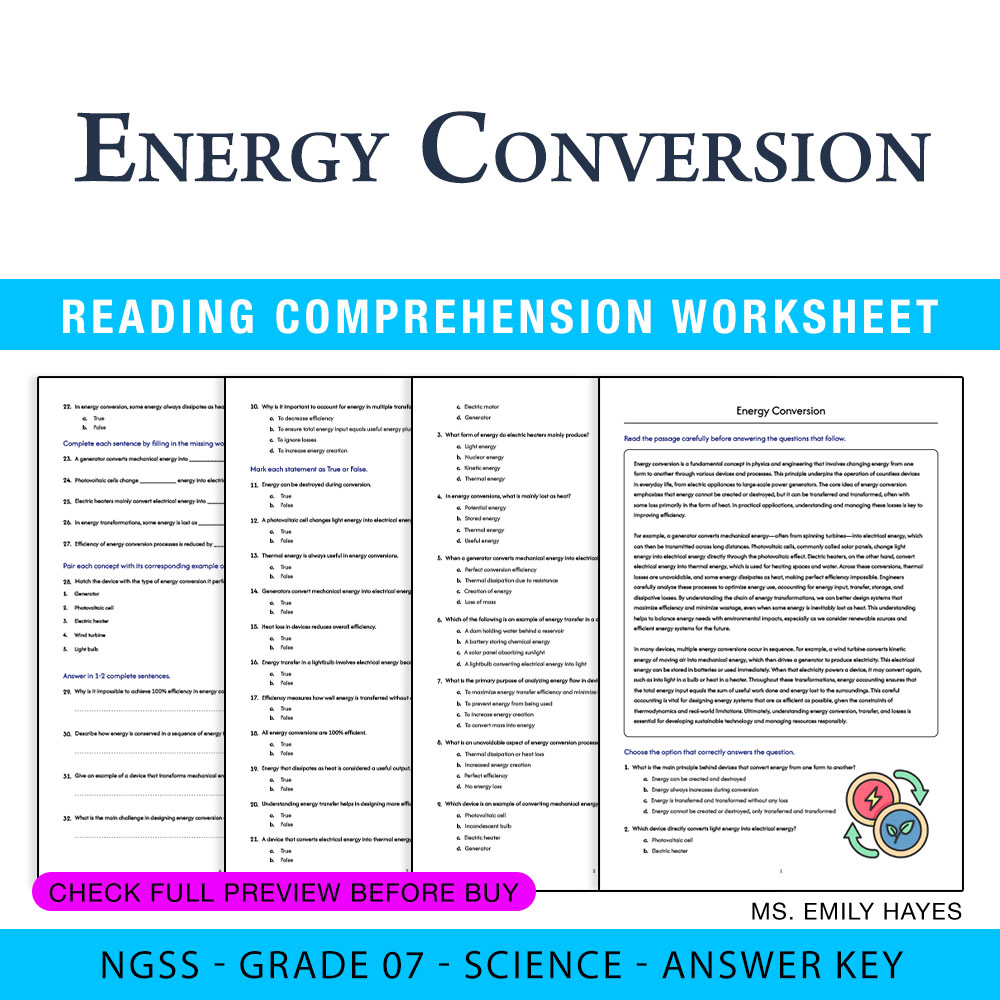
7th Grade Science | Energy Conversion Worksheet (PDF+ Answer Key)
Created byCopper Leaf ClassroomLearning Objectives
- Explain the principles of energy conversion and transfer in different devices.
- Identify examples of devices that transform energy from one form to another.
- Understand the concept of energy conservation and the effects of thermal losses.
Instant download
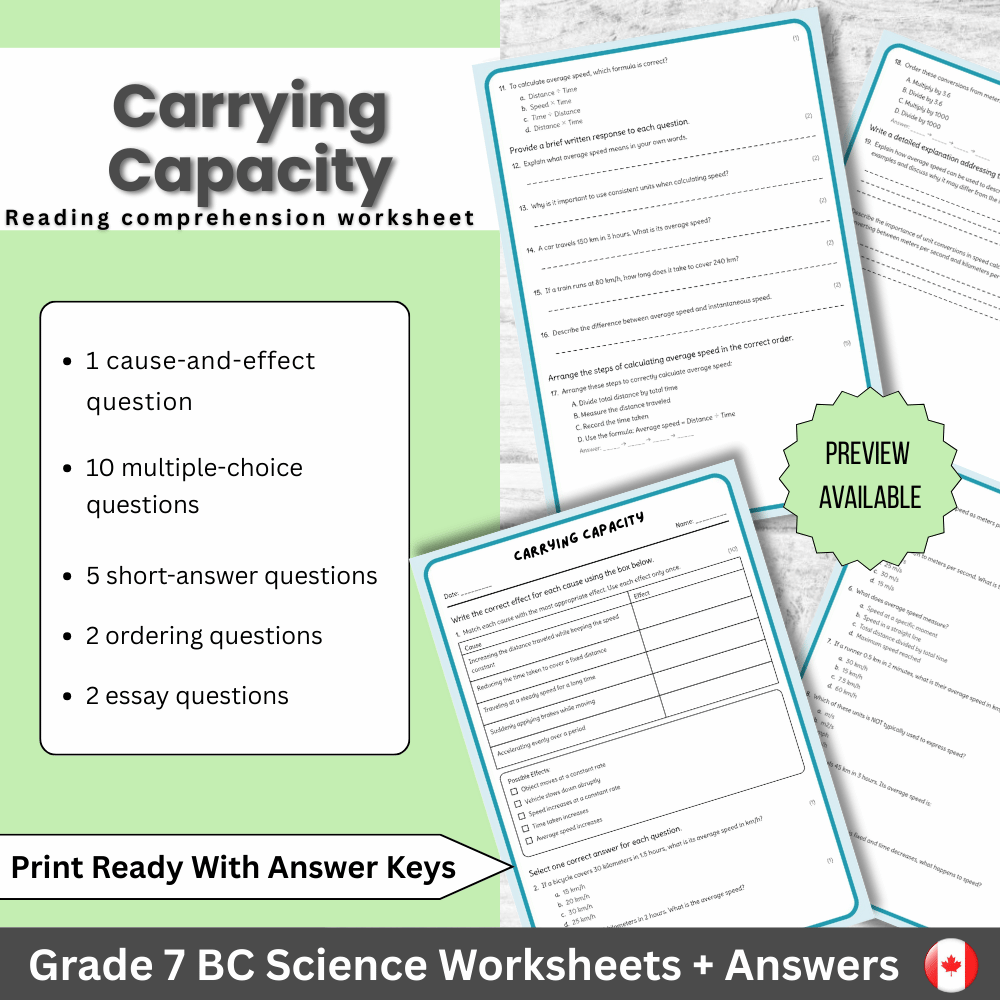
Grade 7 Science | Carrying Capacity Worksheet (PDF) for BC Standards
Created byBright Mind ResourcesLearning Objectives
- Define carrying capacity and explain its significance in ecosystems.
- Identify limiting factors that influence population sizes.
- Understand how populations stabilize at carrying capacity through resource regulation.
Instant download

Grade 7 | Environmental Day for Building Sustainable Futures | PDF + Answer Key
 Created byShaNova Worksheets
Learning Objectives
- Explain key ideas behind sustainable development, including renewable energy and green technology, in everyday terms.
- Analyze how cultural values and environmental policies can influence community sustainability projects.
- Evaluate a real-world sustainability approach using simple criteria such as impact, fairness, and feasibility.
Instant download

Science Speciation Processes Biodiversity Worksheet | NGSS Grade 7 Science
Created bySkylark WorksheetsLearning Objectives
- Explain how reproductive isolation and geographic separation can lead to speciation.
- Describe how founder effects, polyploidy, and adaptive radiation increase biodiversity.
- Use biogeographic and time-based patterns to interpret how new species form.
Also included in: Grade 7 Speciation and Evolution Evidence Science Lesson Bundle NGSS +1 more
Instant download
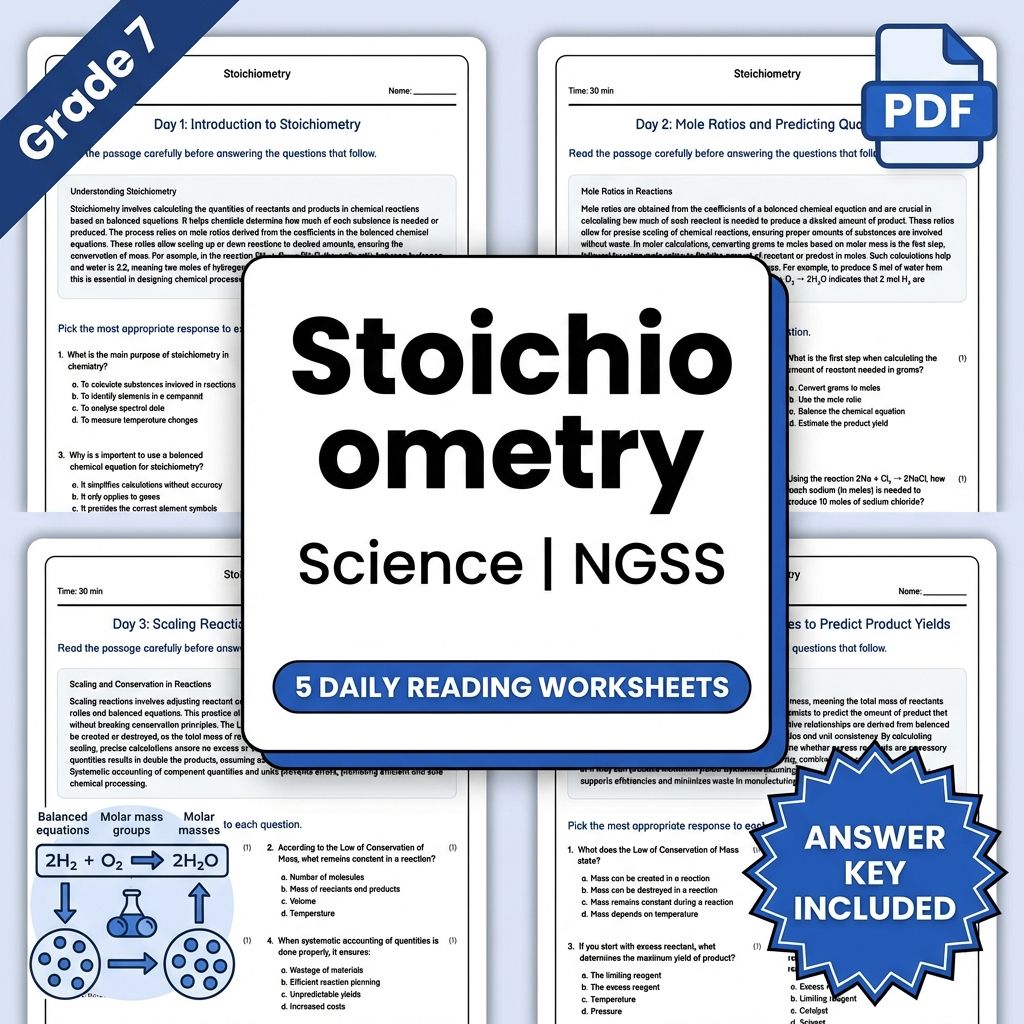
Grade 7 Science – Stoichiometry Daily Reading Worksheet(PDF + Answer Key)
Created byCopper Leaf ClassroomLearning Objectives
- Describe the concept of stoichiometry and its role in chemical reactions.
- Use balanced chemical equations to determine mole ratios of reactants and products.
- Apply ratio reasoning to predict quantities of substances involved in reactions.
Instant download
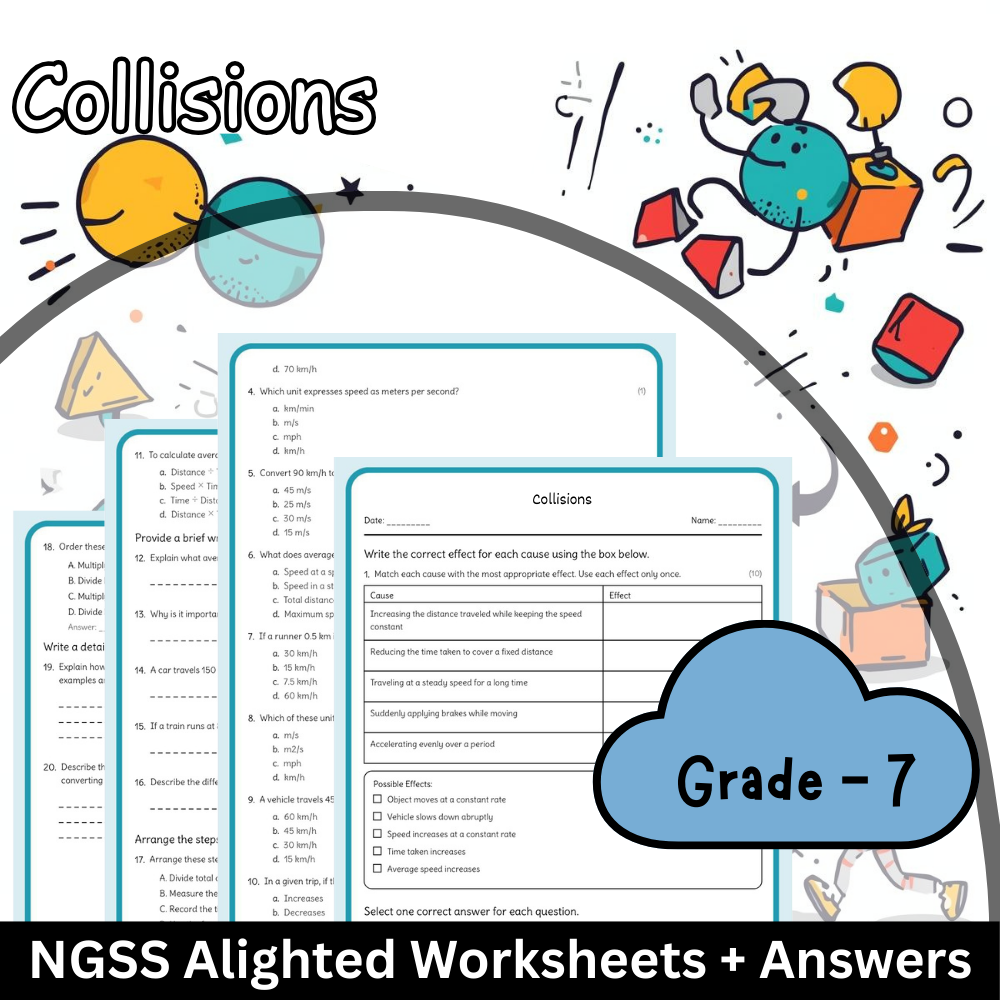
Grade 7 Science | Collisions Worksheet (Worksheet + Answer Key) NGSS
Created byBright Mind ResourcesLearning Objectives
- Understand the principles of momentum conservation during collisions.
- Differentiate between elastic and inelastic collisions.
- Calculate post-collision velocities using mass, velocity, and momentum concepts.
Instant download

Grade 7 Science | Understanding Meiosis & Genetic Variation - Reading Practice
Created byCoral Reef LearningLearning Objectives
- Define meiosis and understand its role in producing reproductive cells.
- Explain how genetic variation arises during meiosis.
- Recognize why siblings are genetically different despite having the same parents.
Instant download

Grade 7 Material Properties Worksheet | Practice & Assessment PDF
Created byClear Sky ClassroomLearning Objectives
- Explain how thermal conductivity, specific heat capacity, density, and phase change affect heat transfer in materials.
- Compare common Alberta construction materials using their thermal and moisture-related properties.
- Describe how porosity and moisture content change effective thermal conductivity in building assemblies.
Instant download

Grade 7 Science – Changes in Matter & Chemical Changes | Daily Reading Worksheet
Created byBright Mind ResourcesLearning Objectives
- Understand the differences between physical changes and chemical changes in matter
- Identify examples of physical changes in everyday life
- Recognize indicators of chemical changes such as color change, gas production, precipitates, and temperature change
Also included in: Grade 7 Daily Reading Science Worksheets Lesson Bundle | Florida NGSSS +1 more
Instant download
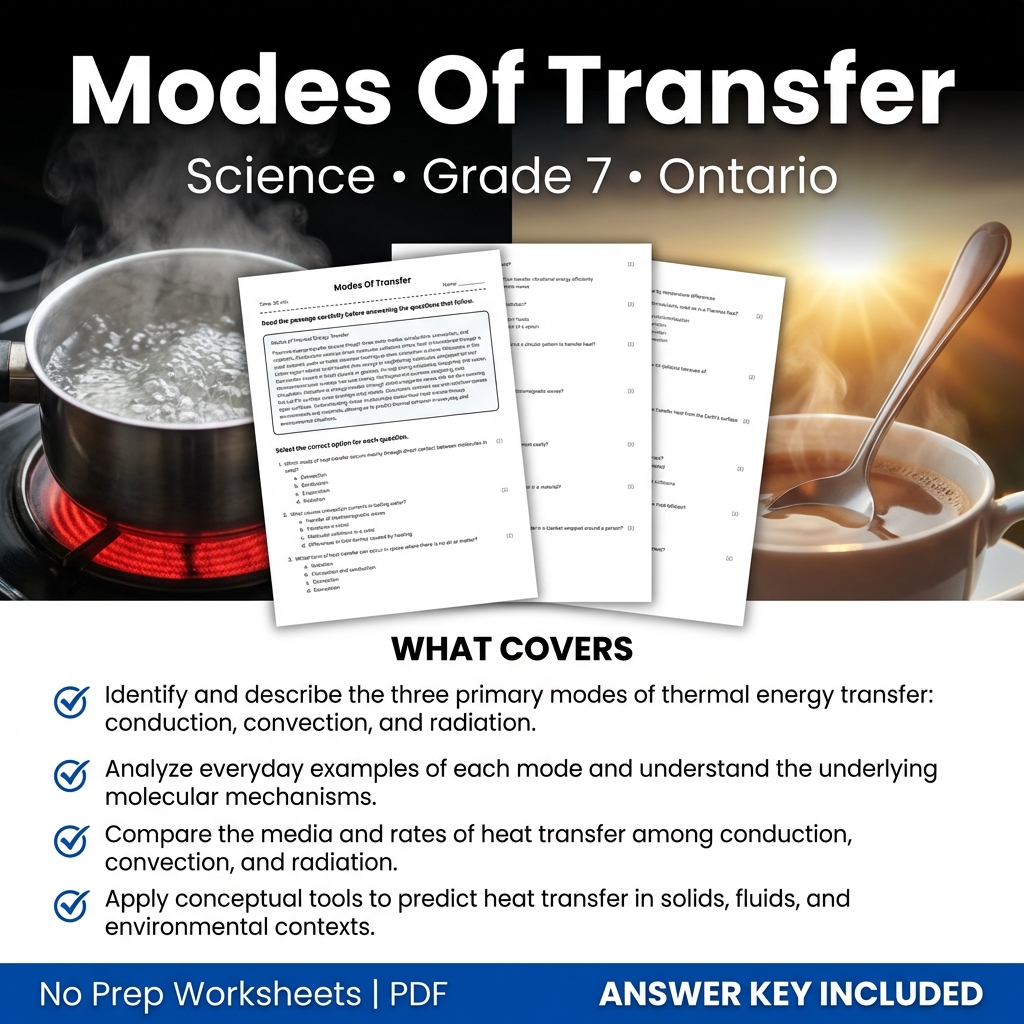
Modes Of Transfer Grade 7 Science Worksheet | Ontario | Printable PDF
Created byCoral Reef LearningLearning Objectives
- Identify and describe the three primary modes of thermal energy transfer: conduction, convection, and radiation.
- Analyze everyday examples of each mode and understand the underlying molecular mechanisms.
- Compare the media and rates of heat transfer among conduction, convection, and radiation.
Instant download
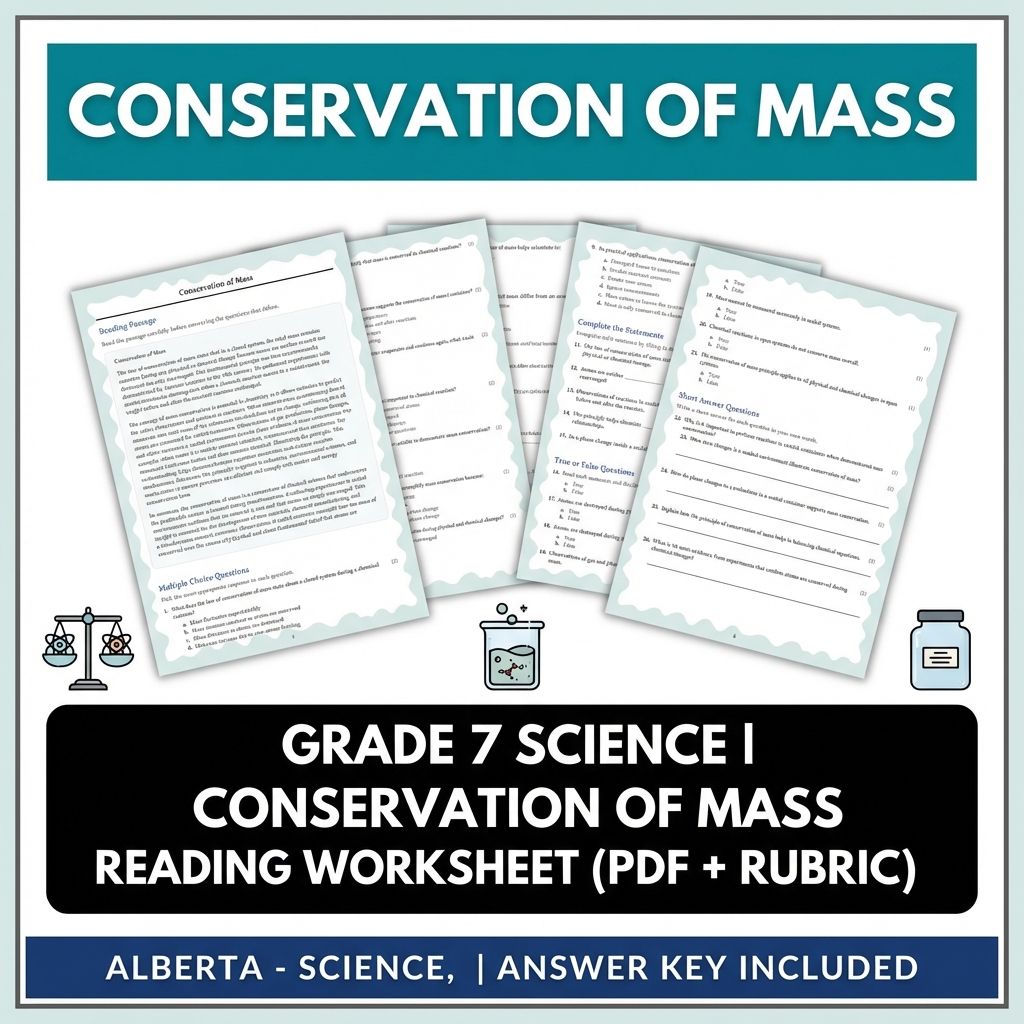
Grade 7 Science | Conservation of Mass Reading Worksheet (PDF + Rubric)
JCreated byJ.S SheetsLearning Objectives
- Understand the principle of conservation of mass in physical and chemical changes.
- Explain why mass remains constant in a closed system during reactions.
- Interpret observations of sealed-container reactions to demonstrate mass conservation.
Also included in: Grade 7 Science UNIT Worksheet Bundle | Matter, Solutions & Physical Changes +1 more
Instant download
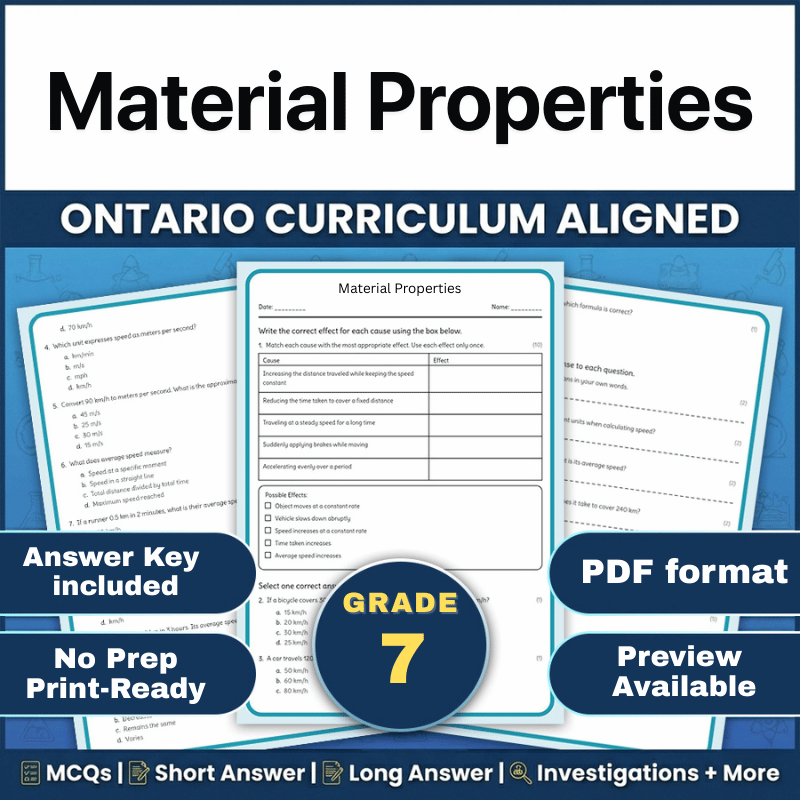
Grade 7 Science | Material Properties Worksheet (Ontario, PDF)
Created byBright Mind ResourcesLearning Objectives
- Define key material properties such as density, tensile and compressive strength, stiffness, ductility, toughness, and thermal expansion.
- Explain how these properties influence structural performance and failure modes.
- Contrast common construction materials—wood, steel, and reinforced concrete—in terms of strength-to-weight ratio, deformation, and failure.
Instant download

Action-Reaction Forces Worksheet | Standards-Based Practice for Grade 7 Science
JCreated byJ.S SheetsLearning Objectives
- Understand the principle of action-reaction forces and how they occur in interactions.
- Identify examples of action-reaction pairs in everyday situations.
- Explain how force pairs are equal in magnitude and opposite in direction.
Also included in: Grade 7 Forces and Matter Science lesson bundle – California Standards +1 more
Instant download

Scientific Modeling, Assumptions & Validation Worksheets Grade 7
Created byPrism Point LearningLearning Objectives
- Describe how abstraction represents essential features of real-world systems
- Identify parameters, units, and scaling choices in numerical models
- Explain how assumptions affect the usefulness of scientific models
Also included in: Scientific Inquiry & Data Practices Lesson Bundle | Grade 7 Science | Ontario +1 more
Instant download

Grade 7 Science | Conservation of Matter Worksheet | California Standards
Created byLumora LearningLearning Objectives
- Explain conservation of matter in a closed system using the atomic model
- Distinguish between physical changes and chemical changes in terms of atoms and mass
- Use mass measurements of reactants and products to support the law of conservation of matter
Instant download

Forces and Change Assessment | General Standards Grade 7 Science
Created byPrism Point LearningLearning Objectives
- Understand how forces act as causes of motion changes.
- Differentiate between balanced and unbalanced forces.
- Explain how friction, air resistance, and gravity influence motion.
Also included in: Grade 7 Physical Science Science Lesson Bundle: General Framework
Instant download

Symbiosis Types Worksheet | Grade 7 Science | Alberta Standards
JCreated byJ.S SheetsLearning Objectives
- Define and distinguish among mutualism, commensalism, and parasitism.
- Identify regional examples of different symbiosis types in Alberta ecosystems.
- Explain ecological consequences of inter-species relationships on population dynamics and resource distribution.
Instant download

Grade 7 Science | Material Testing Methods in Science - Reading Comprehension
Created byCoral Reef LearningLearning Objectives
- Identify different methods used to test materials' properties.
- Understand the purpose of tensile, compression, and bending tests.
- Recognize non-destructive testing techniques such as ultrasonic and hardness measurements.
Instant download

Pattern Recognition and Generalization Worksheets | Grade 7 Computer Science
Created byBright Mind ResourcesLearning Objectives
- Identify a pattern in a sequence or set of examples and describe the relationship it shows
- Use pattern recognition to make a reasonable prediction for a new case
- Explain how generalizations can help solve similar problems more efficiently
Instant download
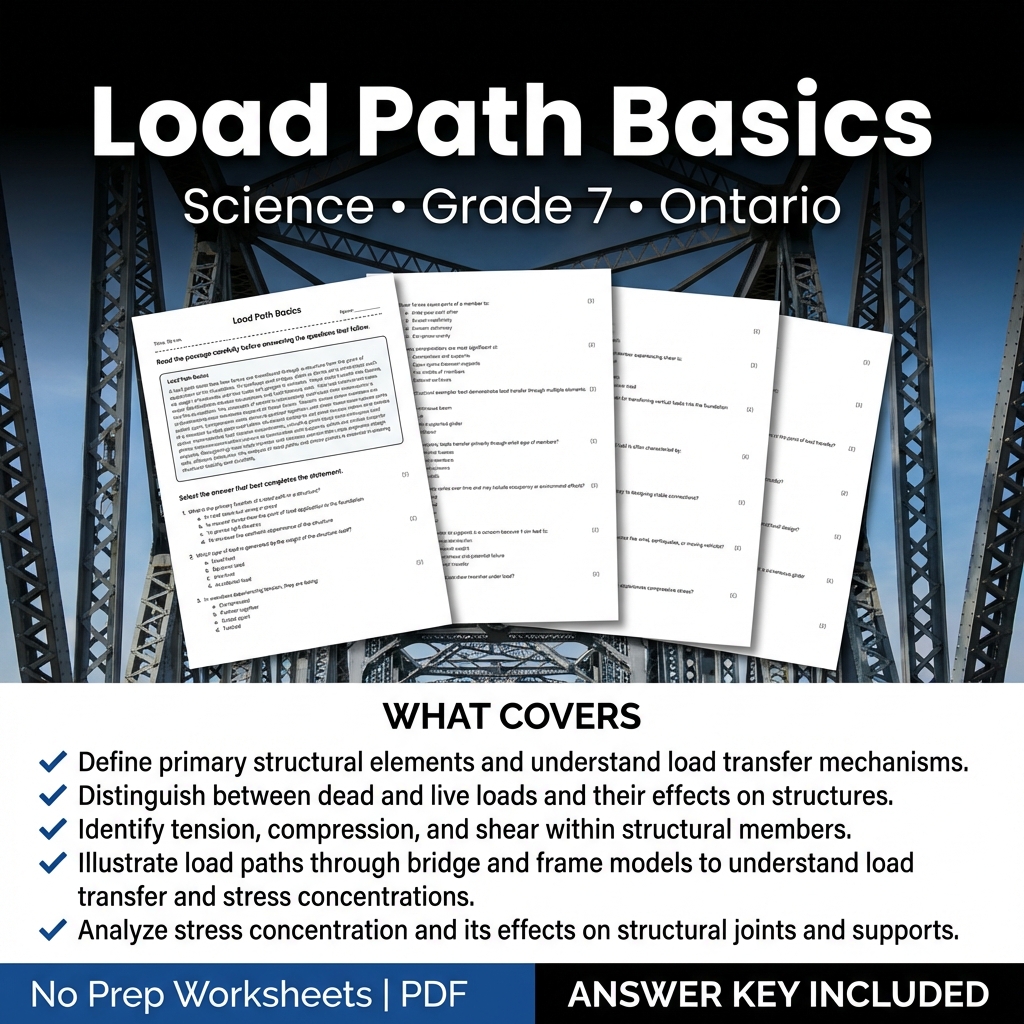
Grade 7 Science Worksheet Load Path Basics | Ontario Standards
Created byCoral Reef LearningLearning Objectives
- Define primary structural elements and understand load transfer mechanisms.
- Distinguish between dead and live loads and their effects on structures.
- Identify tension, compression, and shear within structural members.
Instant download

Heritage and Freedom Worksheet Grade 7 | September Holiday Activity
Created byShaNova WorksheetsLearning Objectives
- Explain the historical context of Mexican Independence Day and key events from 1810 onward.
- Use and define grade-appropriate vocabulary related to independence movements (e.g., rebellion, sovereignty).
- Identify how traditions such as music, dance, and parades connect history to cultural identity.
Instant download

Grade 7 Science | DNA & Chromosomes - Daily Reading Comprehension
Created byCoral Reef LearningLearning Objectives
- Identify the basic structures of DNA and chromosomes.
- Understand how genes are organized within chromosomes.
- Explain how chromosomes segregate during cell division.
Instant download
Browse more categories
About Grade 7 Worksheets
Find Grade 7 worksheets covering math, ELA, science, and social studies. All 8,459 resources download instantly as PDFs for classwork, homework, or review.
MyTeachingSheets worksheets are made by real teacher-authors and checked before they go live. Download any as a print-ready PDF for lessons, homework, or independent practice — most include answer keys, and previews are always free.