
Grade 7 Worksheets
8,459 grade resources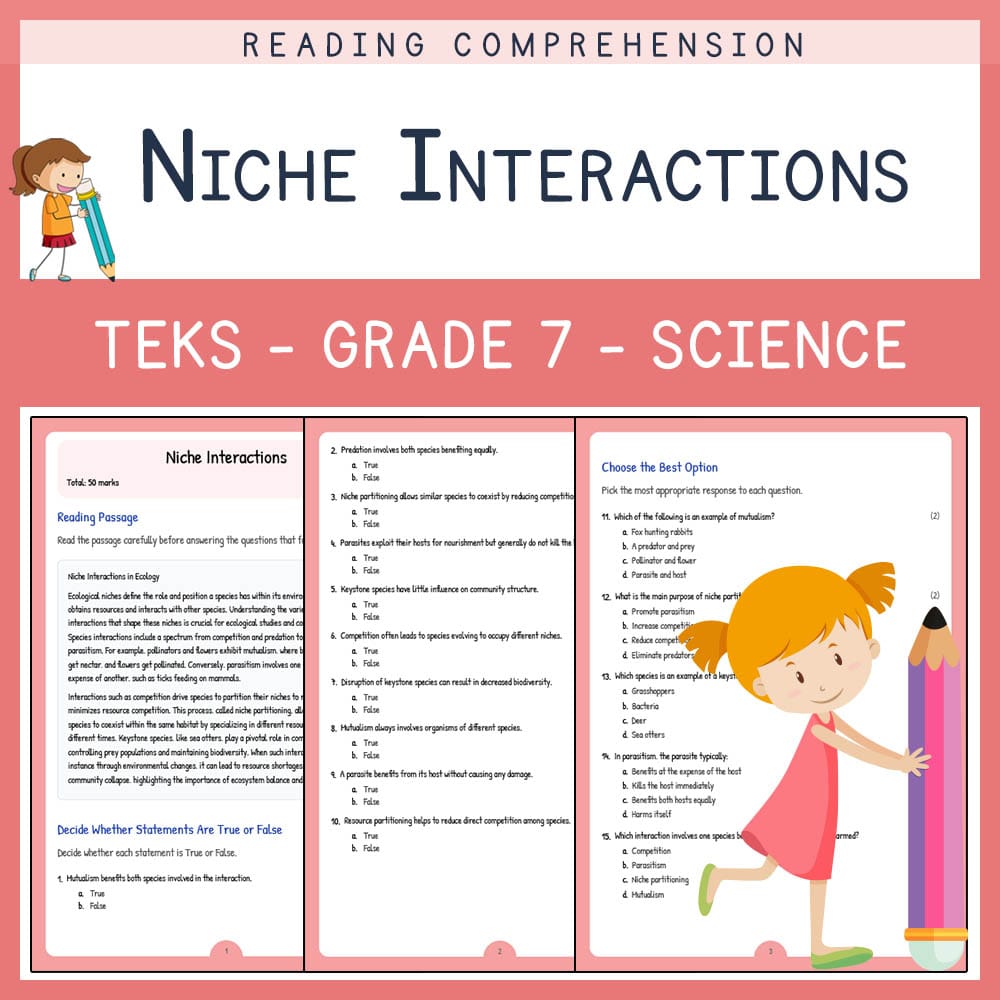
Grade 7 Science | Niche Interactions Worksheet Elena | TEKS-Aligned
 Created byLumora Learning
Learning Objectives
- Describe different species interactions that influence ecological niches.
- Identify examples of mutualism, predation, competition, and parasitism in ecosystems.
- Explain how niche partitioning reduces competition among species.
Instant download

Grade 7 Science | Explanatory Models Worksheet | NGSSS Aligned
Created byLumora LearningLearning Objectives
- Define explanatory models and explain why they are simplified rather than exact replicas of real systems.
- Describe how cause-and-effect mechanisms and energy transfers can be used in explanations based on a model.
- Evaluate a model’s usefulness by comparing how well it matches observations and how accurately it predicts new evidence.
Instant download
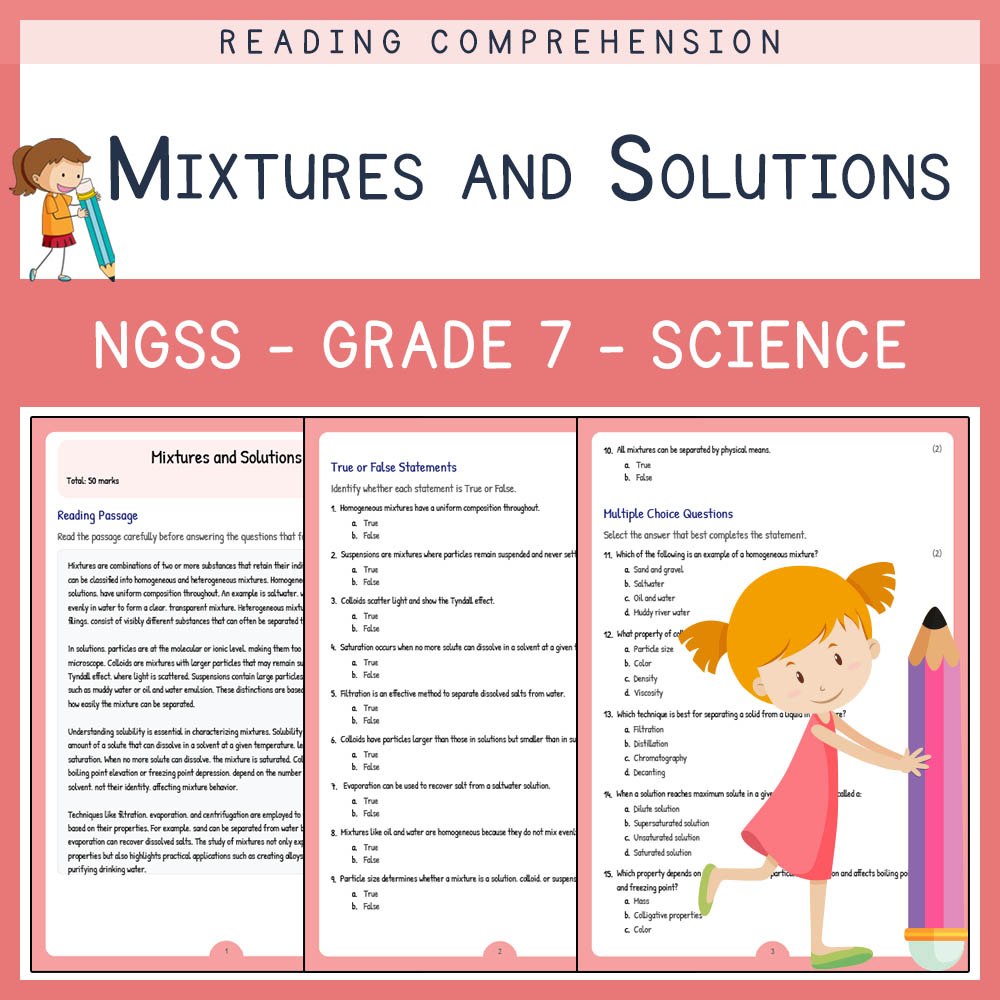
Grade 7 Science |Mixtures and Solutions Worksheet (NGSS Aligned with Answer Key)
Created byLumora LearningLearning Objectives
- Describe the differences between homogeneous and heterogeneous mixtures.
- Identify examples of solutions, colloids, and suspensions based on particle size and separation behavior.
- Explain concepts like solubility, saturation, and colligative effects in mixtures.
Instant download
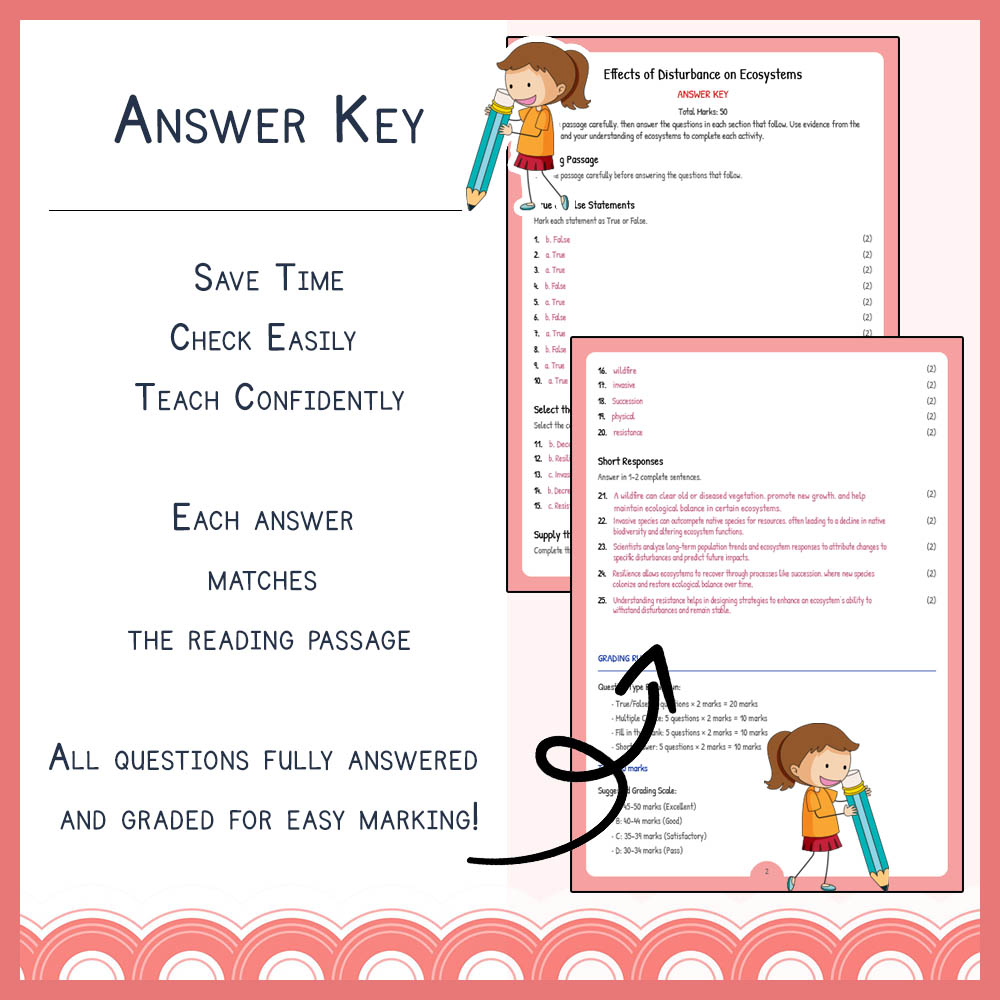
Grade 7 Science | Effects of Disturbance on Ecosystems Worksheet & Answer Key
Created byLumora LearningLearning Objectives
- Understand how physical and biological disturbances influence ecosystem dynamics.
- Interpret empirical data to determine causes of population changes in ecosystems.
- Describe mechanisms of ecosystem resilience, resistance, and succession.
Instant download

Grade 7 Science | Friction and Resistance Worksheet | Florida NGSSS Aligned
Created byLumora LearningLearning Objectives
- Explain how friction and other resistive forces oppose motion
- Describe how surface texture and air resistance affect how quickly objects slow down
- Connect resistive forces to changes in motion and energy during real-world examples
Instant download
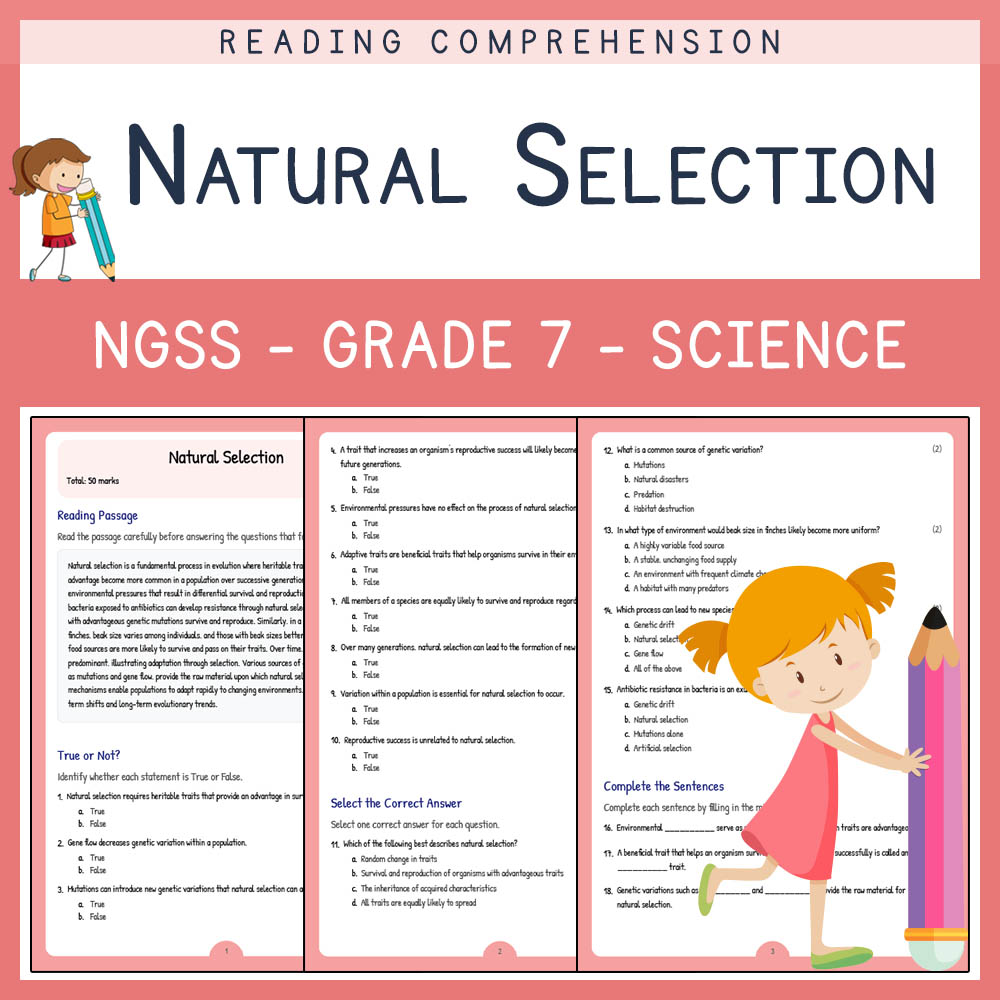
Grade 7 Science | Natural Selection Worksheet with Answer Key | NGSS Aligned
Created byLumora LearningLearning Objectives
- Understand the mechanisms of natural selection and how they lead to adaptation in populations.
- Identify examples of natural selection in real-world scenarios such as antibiotic resistance and beak size variation.
- Analyze how environmental pressures influence evolutionary changes over generations.
Instant download

Grade 7 Science | Empirical Knowledge Worksheet | NGSSS Aligned
Created byLumora LearningLearning Objectives
- Explain how empirical investigations and evidence support scientific explanations
- Evaluate how new data can refine, adjust, or replace scientific models
- Describe uncertainty as a normal part of scientific reasoning and communicate methods transparently
Instant download

Grade 7 Science | Inclined Planes Worksheet (Alberta Standard) (PDF)
 Created byEvergreen Desk Education
Learning Objectives
- Explain how inclined planes change the effective force needed to move a load.
- Identify and describe force components parallel and perpendicular to a ramp.
- Calculate mechanical advantage using load and input force.
Instant download

Grade 7 Inherited Traits Science Worksheet | Florida NGSSS + Answer Key
Created byEvergreen Desk EducationLearning Objectives
- Explain how inherited traits are passed from parents to offspring using genetic information in reproductive cells
- Distinguish between inherited traits and environmental causes of differences among individuals
- Use predictable patterns to interpret offspring trait outcomes based on parental variation
Instant download

Grade 7 Science – Bitumen Separation Worksheet (Alberta Standards) (PDF)
Created byEvergreen Desk EducationLearning Objectives
- Classify bitumen separation steps as physical or chemical processes based on how substances change.
- Explain how density, particle size, temperature, and additives affect emulsions and dissolved organics.
- Use evidence from a process description to describe mixture behavior and expected product outcomes.
Instant download

Mass Wasting and Coasts Worksheet Grade 7 NGSSS Earth Science
Created byEvergreen Desk EducationLearning Objectives
- Explain how tectonic activity, weathering, erosion, and deposition shape Earth’s surface.
- Distinguish between weathering and erosion using examples from real landscapes.
- Describe how deposition can change the location of sediments over time.
Instant download

7th Grade Science | Solar System Worksheet (TEKS) with Answer Key (PDF)
Created byEvergreen Desk EducationLearning Objectives
- Explain how planetesimals and accretion can lead to planets forming in the early solar system.
- Compare terrestrial planets and gas giants using properties such as size, surface or atmospheric characteristics, and moons.
- Describe how orbital eccentricity and phases relate to how we observe planets from Earth.
Instant download

Grade 7 Science Worksheet | Particle Model of Matter (TEKS) PDF
Created byEvergreen Desk EducationLearning Objectives
- Explain the kinetic particle model using particle spacing, particle motion, and intermolecular forces.
- Predict how changes in temperature or applied force can affect diffusion, thermal expansion, density, pressure response, and compressibility.
- Connect micro-scale particle behavior to measurable macro-scale trends in experiments.
Instant download

Grade 7 Science Properties & Classification Worksheet (PDF) | TEKS
Created byEvergreen Desk EducationLearning Objectives
- Define physical and chemical properties and explain how they help classify substances.
- Use quantitative observable criteria (e.g., density, solubility, hardness, conductivity, magnetism, flammability) to distinguish among elements, compounds, and mixtures.
- Apply property-based tests to identify practical examples of metals, dissolving substances, magnetic materials, and combustibility.
Instant download

Grade 7 Science Worksheet – Volcanic Landforms (PDF) | BC Standards
Created byEvergreen Desk EducationLearning Objectives
- Explain how magma composition influences volcanic landforms (shield volcanoes vs. stratovolcanoes and deposits).
- Describe how eruption style affects what materials volcanoes produce (lava flows vs. pyroclastic deposits).
- Compare volcanic features formed at different tectonic settings, including subduction zones and hotspots.
Instant download

Grade 7 Science – States of Matter Worksheet (TEKS) (PDF)
Created byEvergreen Desk EducationLearning Objectives
- Define states of matter in terms of particle arrangement and particle motion (energy).
- Describe and distinguish phase changes: melting, freezing, vaporization, condensation, and sublimation.
- Explain how temperature and pressure affect phase transitions, including boiling point changes with atmospheric pressure.
Instant download

Grade 7 Science | Symbiosis Types Worksheet (Alberta Standards) (PDF)
Created byEvergreen Desk EducationLearning Objectives
- Compare mutualism, commensalism, and parasitism based on how both species are affected.
- Use ecological examples to explain how symbiosis influences population sizes and community structure.
- Describe how adaptations and coevolution can develop in species that interact over time.
Instant download

Grade 7 Science Diffusion & Mixing Worksheet | CA Standards PDF
Created byEvergreen Desk EducationLearning Objectives
- Explain how diffusion occurs due to the continual motion of particles moving from higher concentration to lower concentration
- Distinguish mixing from diffusion and describe how mixing can occur without particles stopping or changing into new substances
- Predict how temperature affects the rate of diffusion using the particle model
Instant download

Grade 7 Science Worksheet | Pollution Effects - Alberta Standards (PDF)
Created byEvergreen Desk EducationLearning Objectives
- Explain how anthropogenic pollutants enter aquatic and terrestrial ecosystems through different exposure pathways.
- Describe how pollution can affect organism health and disrupt food web integrity.
- Connect pollutant sources (nutrient runoff, hydrocarbons, airborne deposition) to measurable ecological changes.
Instant download

Grade 7 Science Worksheet – Human Impacts TEKS (PDF)
Created byEvergreen Desk EducationLearning Objectives
- Explain how human activities can alter ecosystems through habitat fragmentation, pollution, and invasive species.
- Describe how these changes can shift biodiversity, food-web structure (trophic structure), and ecosystem services over time.
- Evaluate mitigation and restoration strategies and predict how they may affect ecosystem recovery.
Instant download

Grade 7 Science – Forces Introduction Worksheet (PDF) | Alberta Standards
Created byEvergreen Desk EducationLearning Objectives
- Explain how push and pull forces can change an object’s state of motion.
- Distinguish between contact forces and non-contact forces with real-life examples.
- Describe the relationship between net force and resulting acceleration in qualitative terms.
Instant download

Grade 7 Science | Energy Transformations Worksheet (Alberta Standards) (PDF)
Created byEvergreen Desk EducationLearning Objectives
- Explain that energy can change forms through energy transformations while total energy is conserved.
- Identify common energy forms (mechanical, chemical, electrical, thermal) and trace how they transform in real systems.
- Use energy transformation ideas to interpret examples such as hydroelectric power, wind turbines, and fuel combustion.
Instant download

Grade 7 Science | Boundary Types Worksheet (PDF) Aligned to BC Standards
Created byEvergreen Desk EducationLearning Objectives
- Identify the three main tectonic boundary types and describe the motion between tectonic plates at each one
- Explain how boundary types create characteristic landforms, volcanic activity, and earthquake patterns
- Use evidence from descriptions to determine which boundary type is most likely occurring
Instant download

Grade 7 Science Worksheet | Earthquakes and Faults BC Standards (PDF)
Created byEvergreen Desk EducationLearning Objectives
- Explain how tectonic stress and rock strength lead to sudden slip along faults during earthquakes.
- Compare normal, reverse, and strike-slip fault motion and connect each type to local stress regimes.
- Describe how earthquake waves travel through Earth and how depth, magnitude, and local geology affect intensity.
Instant download

Grade 7 Science Worksheet – Simple Machines Overview (PDF) – Alberta Standards
Created byEvergreen Desk EducationLearning Objectives
- Describe how simple machines change the size and/or direction of a force to make work easier.
- Explain mechanical advantage and connect it to the geometry of a machine.
- Identify and compare lever, pulley, wedge, screw, inclined plane, and wheel-and-axle in everyday contexts.
Instant download

Grade 7 Science Worksheet – Conservation of Mass | Alberta Standards (PDF)
Created byEvergreen Desk EducationLearning Objectives
- Explain conservation of mass in a closed system using the idea that atoms are conserved during physical and chemical changes
- Predict whether measured mass before and after a reaction will be equal in a sealed container and justify the prediction
- Describe how reactants and products relate to mass in observable sealed-container situations
Instant download

Grade 7 Science Worksheet | Cell Structure & Organelles (TEKS)
Created byEvergreen Desk EducationLearning Objectives
- Identify major eukaryotic cell organelles (nucleus, mitochondria, chloroplasts, and cell membrane) and describe their primary functions.
- Explain how organelle specialization supports cell survival and contributes to tissue and organ performance in multicellular organisms.
- Connect cellular energy capture in producers (photosynthesis) versus consumers (cellular respiration) to larger-scale ecological interactions.
Instant download

Grade 7 Science – Load Path Basics Worksheet (Ontario) PDF
Created byEvergreen Desk EducationLearning Objectives
- Describe how loads transfer through structural members using the idea of a load path.
- Differentiate dead loads and live loads and identify common examples of each.
- Recognize where tension, compression, and shear occur in beams, columns, trusses, and connections.
Also included in: Grade 7 Engineering Design & Materials Science Lesson Bundle Ontario +1 more
Instant download

Grade 7 Interpreting Data Science Worksheet | NGSSS Aligned Practice
Created byEvergreen Desk EducationLearning Objectives
- Analyze graphs (scatter plots, histograms, and line graphs) to describe patterns and relationships in data.
- Evaluate the strength of evidence by considering outliers and possible measurement uncertainty.
- Use summary statistics such as range and averages to compare data sets and support a claim.
Instant download

Grade 7 Science Worksheet – Solution Concentration (PDF) | Alberta Standards
Created byEvergreen Desk EducationLearning Objectives
- Define solution concentration in terms of solute and solvent and explain what dilution means.
- Compare common concentration measures (mass percent and grams per litre) and identify units.
- Explain how concentration can affect physical properties such as freezing point and boiling point.
Instant download

Grade 7 Science Worksheet Solar Patterns NGSS Standard Assessment
 Created bySkylark Worksheets
Learning Objectives
- Explain how Earth’s rotation and axial tilt create day-night cycles and seasonal changes.
- Model lunar phases using the Moon’s relative position to Earth and the Sun.
- Describe how alignment determines when solar and lunar eclipses occur.
Also included in: Grade 7 Space, Gravity & Earth Processes Science Lesson Bundle (NGSS) +1 more
Instant download

Water Cycle Worksheet | Science Assessment Grade 7 NGSS
Created bySkylark WorksheetsLearning Objectives
- Describe the main processes of the water cycle: evaporation, condensation, precipitation, infiltration, runoff, and groundwater flow.
- Explain how solar energy and gravity drive water movement among the atmosphere, hydrosphere, and geosphere.
- Trace how water can travel through river basins, aquifers, springs, and oceans, including seasonal snowpack changes.
Also included in: Grade 7 Earth Systems Science Worksheet Lesson Bundle for NGSS Assessment +1 more
Instant download

Cell Structures Plant and Animal Cell Models Worksheet | Grade 7 Science NGSS
Created bySkylark WorksheetsLearning Objectives
- Identify major eukaryotic cell organelles and describe their main functions in transport, synthesis, and compartmentalization.
- Use models (2D diagrams and 3D representations) to explain how organelle structure supports cell processes.
- Compare features of plant and animal cells and relate differences to examples such as leaf mesophyll and muscle cells.
Also included in: Grade 7 Cell Interactions and Energy Science Lesson Bundle | NGSS +1 more
Instant download

Mixtures and Solutions Worksheet | NGSS Grade 7 Science Assessment
Created bySkylark WorksheetsLearning Objectives
- Distinguish homogeneous and heterogeneous mixtures and identify examples from daily life
- Classify solutions, colloids, and suspensions based on particle size and visibility
- Explain saturation, concentration, and solubility using solute–solvent interactions
Also included in: Grade 7 Matter, Reactions & Atomic Models Science Lesson Bundle (NGSS) +1 more
Instant download

Science Worksheet: Energy Conversion and Conservation | NGSS Grade 7 Science
Created bySkylark WorksheetsLearning Objectives
- Explain how energy can be converted from one form to another in common devices.
- Use energy transfer and conservation ideas to track energy in a conversion sequence.
- Describe why thermal energy losses occur and how efficiency is affected.
Also included in: Grade 7 Energy Transformations Science Lesson Bundle for Worksheets (NGSS) +1 more
Instant download

Grade 7 Science Worksheet – Material Testing & Material Properties (PDF)
Created byEvergreen Desk EducationLearning Objectives
- Describe how tensile, compression, and bending tests reveal key material properties used in design.
- Explain how non-destructive testing (ultrasonic testing and hardness measurements) helps evaluate materials without damaging them.
- Relate material variability, anisotropy (especially in timber and composites), and strain localization to safety factors and design codes.
Also included in: Grade 7 Engineering Design & Materials Science Lesson Bundle Ontario +1 more
Instant download

Weather vs Climate Worksheet Grade 7 Science NGSSS Lesson Resource
Created byEvergreen Desk EducationLearning Objectives
- Differentiate weather and climate using examples involving temperature, precipitation, humidity, and wind.
- Explain how averages and variability over time help describe climate.
- Use evidence from observations to classify a scenario as weather or climate.
Instant download

Science Worksheet: Reaction Evidence Grade 7 | NGSS | Worksheet
Created bySkylark WorksheetsLearning Objectives
- Identify observable indicators that a chemical reaction has occurred, including gas production, precipitate formation, color change, and temperature change.
- Explain irreversibility and how it differs from reversible physical changes.
- Use mass measurements from sealed systems to connect reaction evidence to the conservation of matter.
Also included in: Grade 7 Matter, Reactions & Atomic Models Science Lesson Bundle (NGSS) +1 more
Instant download

Grade 7 Science | Motion Quantities Worksheet (PDF) Alberta Standards
Created byEvergreen Desk EducationLearning Objectives
- Explain how distance, time, and speed are related and identify appropriate units.
- Calculate average speed using distance and time and interpret results in context.
- Recognize common sources of measurement error and describe how they affect motion data.
Instant download

Recoil and Thrust Worksheet | Newton’s Laws Motion | Grade 7 Science
Created byEvergreen Desk EducationLearning Objectives
- Explain recoil and thrust using action-reaction (Newton’s third law) forces.
- Compare how interaction forces are equal and opposite while accelerations can differ because of mass.
- Predict motion changes by reasoning about momentum and force pairs during interactions.
Instant download

Grade 7 Science Monitoring Methods Worksheet (Alberta | PDF)
Created byEvergreen Desk EducationLearning Objectives
- Explain how standardized long-term ecological monitoring helps detect directional change in species and habitats.
- Identify and compare common monitoring methods used in Alberta (fixed-site surveys, point counts, remote sensing, and water quality sampling).
- Describe how sampling design, temporal replication, and data quality improve the reliability of conclusions.
Instant download

Grade 7 Science Worksheet – Scientific Inquiry Basics (PDF) | Ontario Standards
Created byEvergreen Desk EducationLearning Objectives
- Identify the criteria that make a scientific question testable and measurable
- Form a clear hypothesis and define variables with operational definitions
- Explain how measurement precision, reproducibility, and documentation improve reliability
Also included in: Grade 7 Science Inquiry & Data Lesson Bundle: Ontario Worksheet Set +1 more
Instant download

Grade 7 Social Studies: Trade and Commerce Worksheet (Ontario Standards) (PDF)
 Created bySunny Desk Resources
Learning Objectives
- Explain how ports, inland trading posts, and Atlantic markets were connected between 1713 and 1850.
- Describe how merchant networks supported credit, supply, and regional specialization.
- Analyze how tariff and navigation policies affected local economies and trade patterns.
Also included in: Grade 7 War of 1812 to Atlantic Colonies Social Studies lesson bundle (Ontario) +1 more
Instant download

Grade 7 Ecosystems and Energy Transfer Worksheet | Florida NGSSS Science
Created byEvergreen Desk EducationLearning Objectives
- Explain how energy moves through an ecosystem using producers, consumers, and decomposers
- Describe how matter cycles while energy flows one-way through trophic levels
- Identify factors that can change ecosystem populations and balance
Instant download

Grade 7 Science – Scaling Effects Worksheet (TEKS) (PDF)
Created byEvergreen Desk EducationLearning Objectives
- Explain how square-cube relationships affect forces, weight, and support when objects scale up or down.
- Describe how surface-to-volume ratio changes heat transfer and resistance with scale.
- Use the idea of Reynolds number to predict how fluid-flow behavior can differ between scale models and full-size systems.
Instant download

Conservation of Matter Worksheet Grade 7 Science NGSSS Practice
Created byEvergreen Desk EducationLearning Objectives
- Explain the law of conservation of matter using the idea that mass is not created or destroyed in chemical reactions.
- Use balanced-mass reasoning to predict whether the total mass of reactants equals the total mass of products.
- Identify everyday examples (such as sealed containers) that support conservation of matter.
Instant download

Grade 7 Science System Structure Worksheet | CA Standards PDF
Created byEvergreen Desk EducationLearning Objectives
- Explain how organisms function as systems with parts that work together to support life processes.
- Describe how internal structures process inputs such as food, oxygen, and water.
- Match body structures to the specific roles they play in digestion, respiration, and circulation.
Instant download

Grade 7 Science Worksheet – Phase Energy | Particle Views & Latent Heat (Alberta) (PDF)
Created byEvergreen Desk EducationLearning Objectives
- Explain how phase changes relate to changes in particle kinetic energy and potential energy.
- Describe latent heat as energy transferred during a phase change without changing chemical identity.
- Interpret energy absorption versus energy release for melting, freezing, evaporation, and condensation.
Instant download
Browse more categories
About Grade 7 Worksheets
Find Grade 7 worksheets covering math, ELA, science, and social studies. All 8,459 resources download instantly as PDFs for classwork, homework, or review.
MyTeachingSheets worksheets are made by real teacher-authors and checked before they go live. Download any as a print-ready PDF for lessons, homework, or independent practice — most include answer keys, and previews are always free.