
Grade 8 Worksheets
8,326 grade resources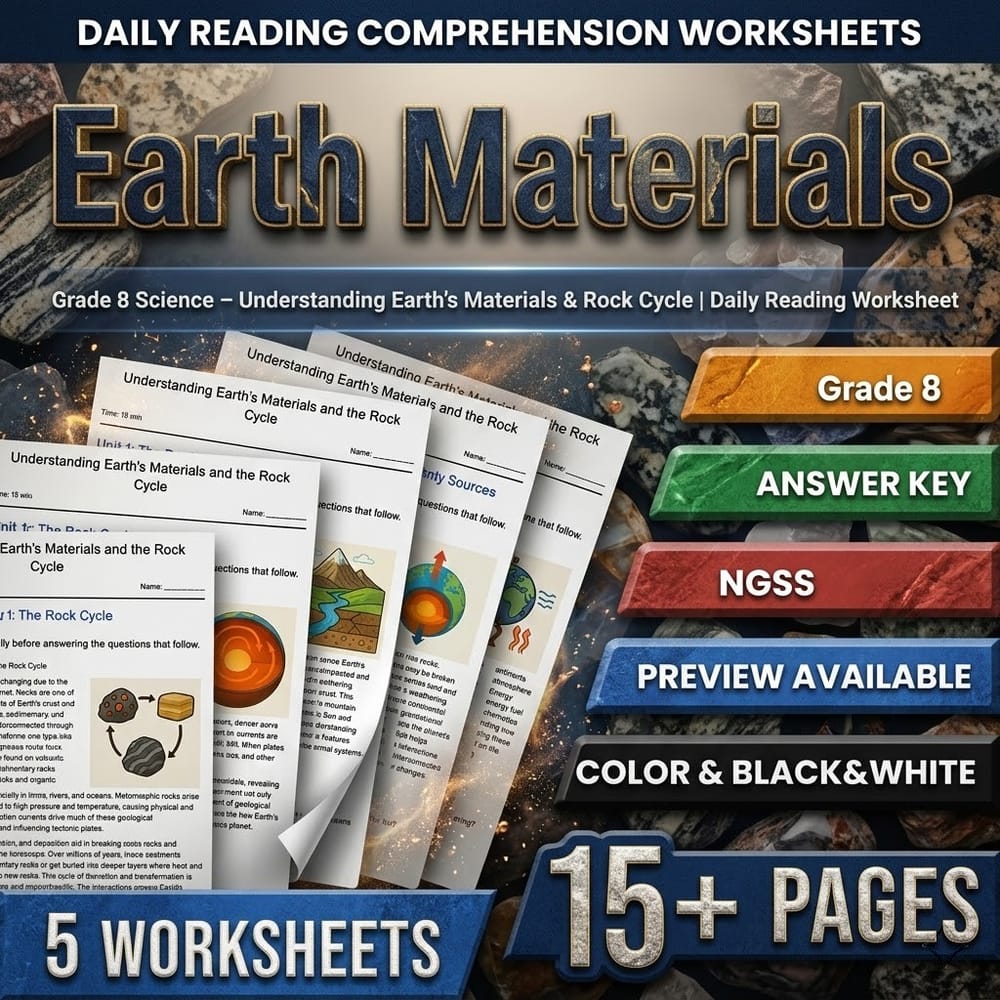
Grade 8 Science – Earth's Materials & Rock Cycle | Daily Reading Worksheet
 Created byElena Brooks
Learning Objectives
- Describe the processes involved in the formation and transformation of rocks within the Earth's rock cycle.
- Explain the roles of mantle convection, weathering, erosion, and deposition in shaping Earth's surface features.
- Identify different types of rocks and their formation processes.
Instant download
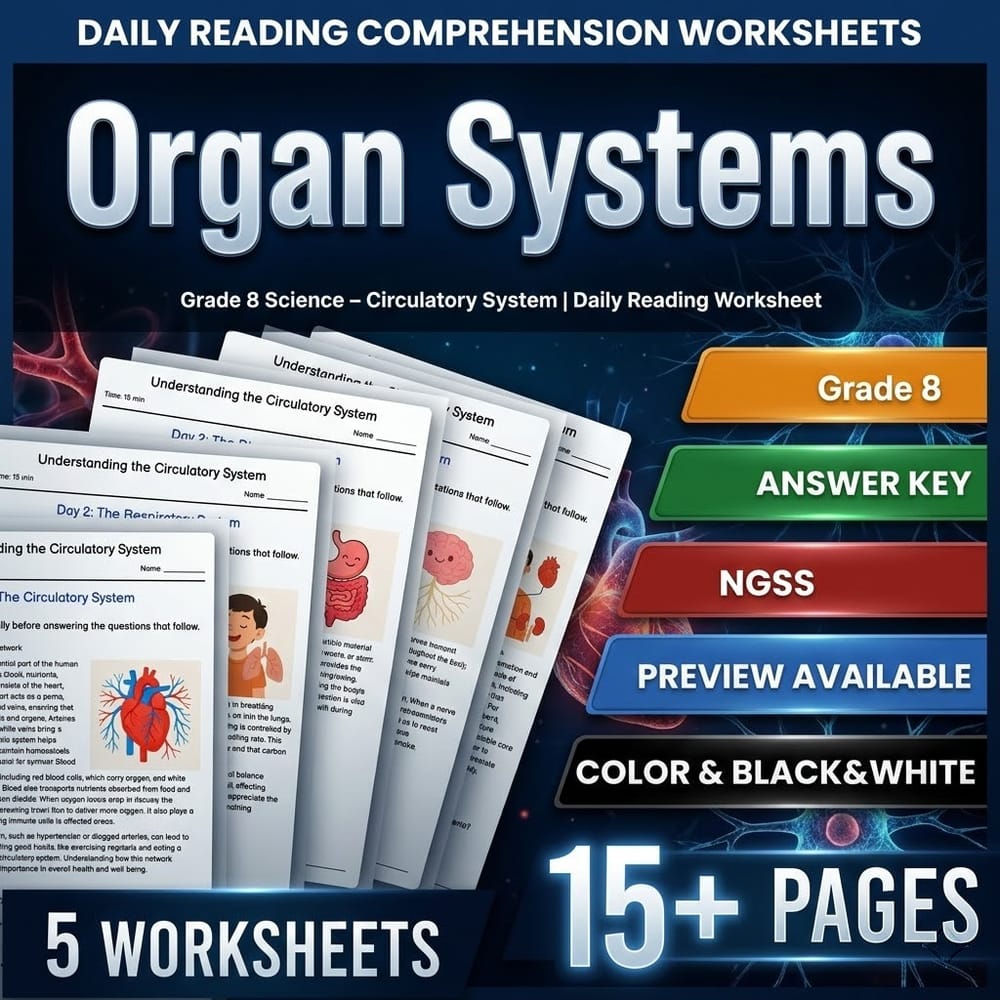
Grade 8 Science – Circulatory System | Daily Reading Worksheet
Created byElena BrooksLearning Objectives
- Explain the main functions of the circulatory system.
- Identify key organs involved in blood circulation.
- Describe how the circulatory system maintains homeostasis.
Instant download

Grade 8 Science – Water Cycle & Processes | Daily Reading Worksheet
 Created byBright Mind Resources
Learning Objectives
- Identify the different stages of the water cycle.
- Understand how water moves through Earth's systems.
- Explain the roles of evaporation, condensation, precipitation, runoff, and infiltration.
Also included in: Earth Grade 8 Science Daily Reading Worksheets Bundle | California Standards +1 more
Instant download

Grade 8 Science – Design Modeling & Representations | Daily Reading Worksheet
Created byBright Mind ResourcesLearning Objectives
- Define what a model is in the context of science and engineering.
- Differentiate between physical, graphical, and computational models.
- Describe the purposes of using models before final design implementation.
Also included in: Design Grade 8 Science Daily Reading Worksheets Bundle | CA Standards +1 more
Instant download

Grade 8 Science – Transport Systems & Circulatory System | Reading Worksheet
Created byBright Mind ResourcesLearning Objectives
- Understand the structure of the circulatory system
- Identify the roles of blood vessels, valves, and capillaries
- Explain how nutrients, gases, and waste products are transported
Also included in: Grade 8 Body Systems & Cell Structure Science Daily Reading Lesson Bundle | BC +1 more
Instant download
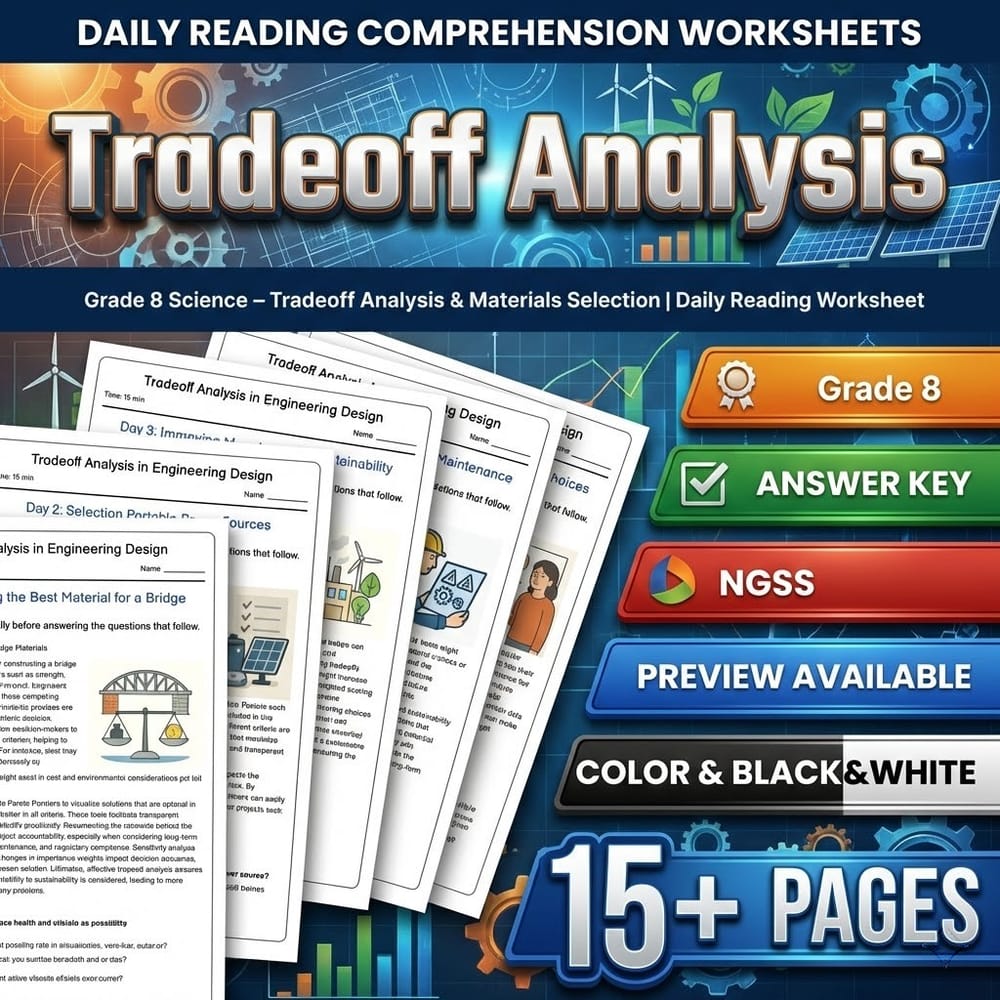
Grade 8 Science – Tradeoff Analysis & Materials Selection | Daily Worksheet
Created byElena BrooksLearning Objectives
- Understand the concept of tradeoff analysis in project management.
- Learn how to prioritize constraints using multi-criteria decision methods.
- Apply basic tools like weighted scoring and Pareto comparisons to evaluate design options.
Instant download
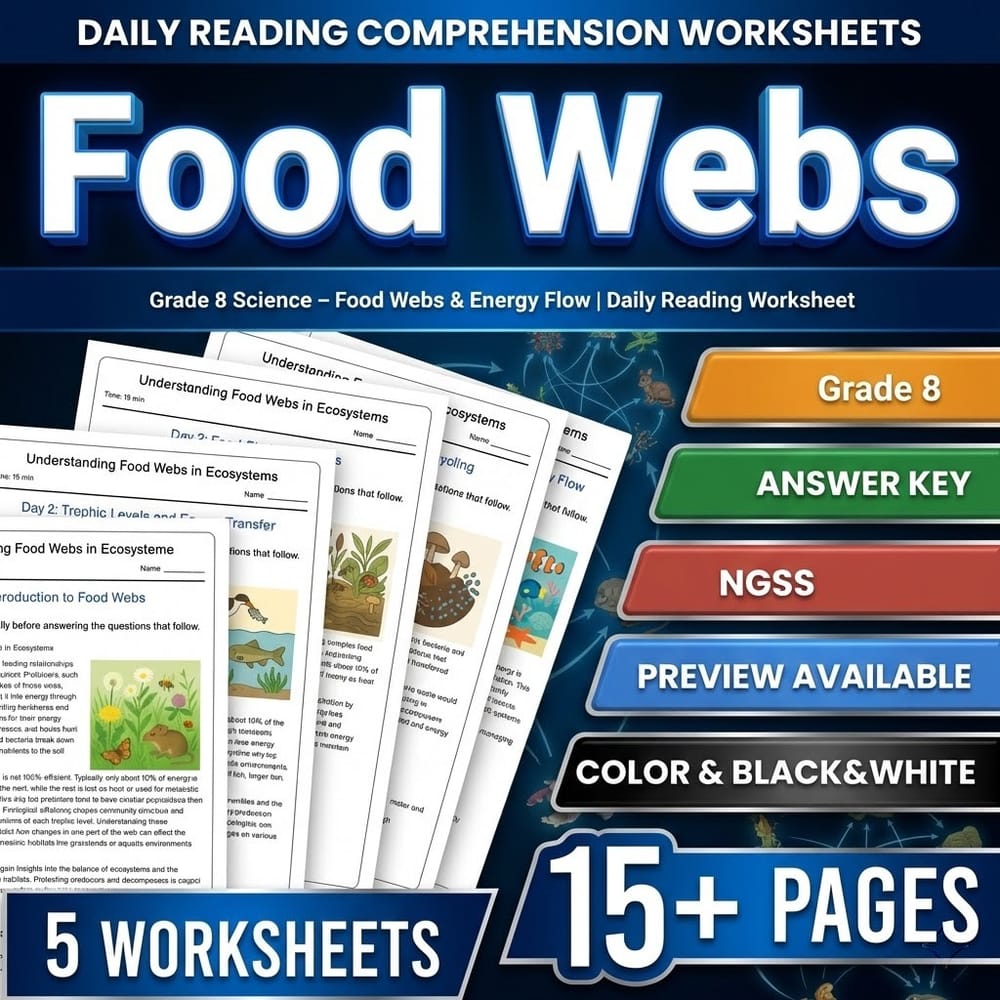
Grade 8 Science – Food Webs & Energy Flow | Daily Reading Worksheet
Created byElena BrooksLearning Objectives
- Identify the roles of producers, consumers, and decomposers in an ecosystem.
- Describe the flow of energy through food webs and trophic levels.
- Explain the concept of ecological efficiency and energy loss between trophic levels.
Instant download
Grade 8 Science – Atomic & Molecular Structure | Daily Reading Worksheet
Created byElena BrooksLearning Objectives
- Identify atoms and molecules using particle models and symbols.
- Understand how atoms combine to form molecules.
- Interpret molecular formulas and structural representations.
Instant download

Grade 8 ELA – Understanding Themes & Evidence | Daily Reading Worksheet
 Created byQuiet Forest Education
Learning Objectives
- Identify recurring themes in a short story.
- Connect evidence from the text to the theme.
- Explain how characters' conflicts and authors' framing support the theme.
Also included in: Grade 8 Reading & Viewing ELA Lesson Bundle | Alberta +1 more
Instant download

Grade 8 Science – Energy Conservation & Mechanical Systems | Reading Worksheet
Created byBright Mind ResourcesLearning Objectives
- Understand the concepts of gravitational potential energy and kinetic energy.
- Identify how energy transforms between potential and kinetic forms in ideal systems.
- Analyze real-world factors that cause energy dissipation and affect conservation assumptions.
Also included in: Grade 8 Energy & Motion Science Daily Reading Worksheets Lesson Bundle | TEKS +2 more
Instant download

Grade 8 Science – Efficiency Losses in Mechanical Systems | Daily Worksheet
Created byQuiet Forest EducationLearning Objectives
- Understand energy dissipation mechanisms such as frictional heating, sound emission, and hysteresis.
- Explain how these losses reduce the overall efficiency of mechanical systems.
- Identify factors that cause efficiency reductions in gears, bearings, and belt drives.
Also included in: Energy Grade 8 Science Daily Reading Worksheets Bundle | Ontario Framework +1 more
Instant download

Grade 8 Science – Layered Fluids & Stratification | Daily Reading Worksheet
Created byQuiet Forest EducationLearning Objectives
- Understand the concept of fluid stratification
- Identify how temperature and salinity influence fluid density
- Explain the stability regimes of layered fluids
Also included in: Fluid Dynamics Grade 8 Science Daily Reading Worksheets Bundle | Ontario +1 more
Instant download
Grade 8 Science – Force & Motion Daily Reading Worksheet | NGSS
Created byElena BrooksLearning Objectives
- Understand the concept of force and how it affects objects.
- Explain the relationship between net force, mass, and acceleration using simple models.
- Identify real-life examples demonstrating force effects on motion.
Instant download
Grade 8 Science – Bernoulli Principle Worksheet for Mastery
 Created byThe Resource Hub
Learning Objectives
- Understand the derivation of the Bernoulli equation for incompressible flow
- Explain how fluid velocity influences pressure in streamlined flow
- Apply Bernoulli's principle to real-world scenarios such as airfoil lift and pipe constriction
Also included in: Grade 8 Science – Fluids & Buoyancy Mastery Unit Bundle (Worksheet Pack) +1 more
Instant download
Grade 8 Science | Organ Systems Worksheet (Ontario, Science 1) (PDF)
Created byBright Mind ResourcesLearning Objectives
- Describe how tissue composition relates to organ system function in circulatory, respiratory, and digestive systems.
- Explain how specialized tissues form organs that enable processes like gas exchange, nutrient transport, and waste removal.
- Analyze the role of blood and epithelial interfaces in optimizing surface area and transport mechanisms for system efficiency.
Instant download
Grade 8 Science – Surface Forces Worksheet (Ontario | Science 1 PDF)
Created byBright Mind ResourcesLearning Objectives
- Understand how pressure distributions affect submerged surfaces.
- Apply integrative methods to calculate net force and center of pressure.
- Analyze pressure on planar and curved surfaces in fluid mechanics.
Instant download
Grade 8 Science – Flotation Stability Worksheet (Ontario) (PDF)
Created byBright Mind ResourcesLearning Objectives
- Explain how relative positions of the centre of gravity and centre of buoyancy affect stability of floating bodies.
- Identify factors such as weight distribution, hull shape, and loading that influence righting moments and tipping safety.
- Calculate stability margins and buoyancy shifts during loading changes.
Instant download
Grade 8 Science Worksheet | Tissue Organization – Ontario Standards (PDF)
Created byBright Mind ResourcesLearning Objectives
- Describe the major tissue types: epithelial, connective, muscle, and nervous tissues.
- Identify cellular and extracellular components characteristic of each tissue type.
- Explain the functional relationships between tissue structure and physiological functions.
Instant download
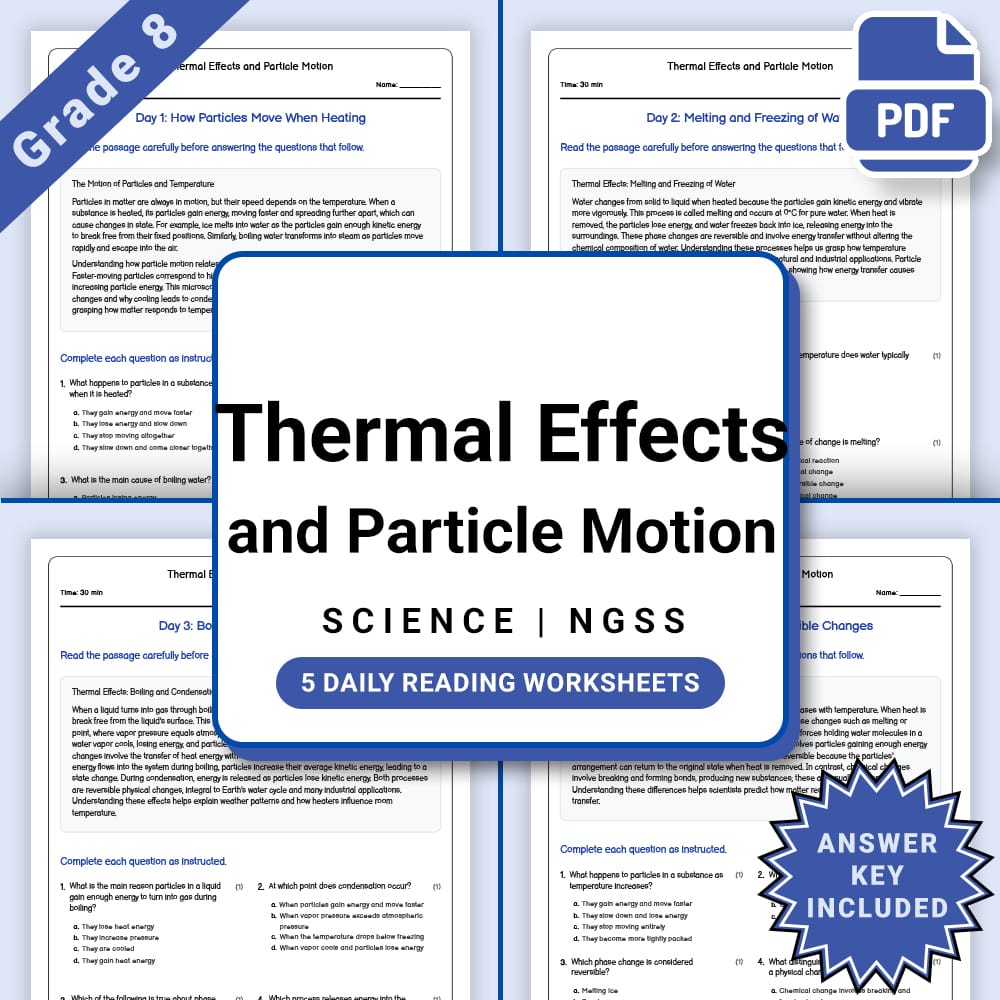
Grade 8 Science –Thermal Effects and Particle Motion Worksheet(PDF + Answer Key)
 Created byCopper Leaf Classroom
Learning Objectives
- Understand key concepts related to Science
- Apply knowledge through practice questions
- Demonstrate comprehension of the material
Instant download
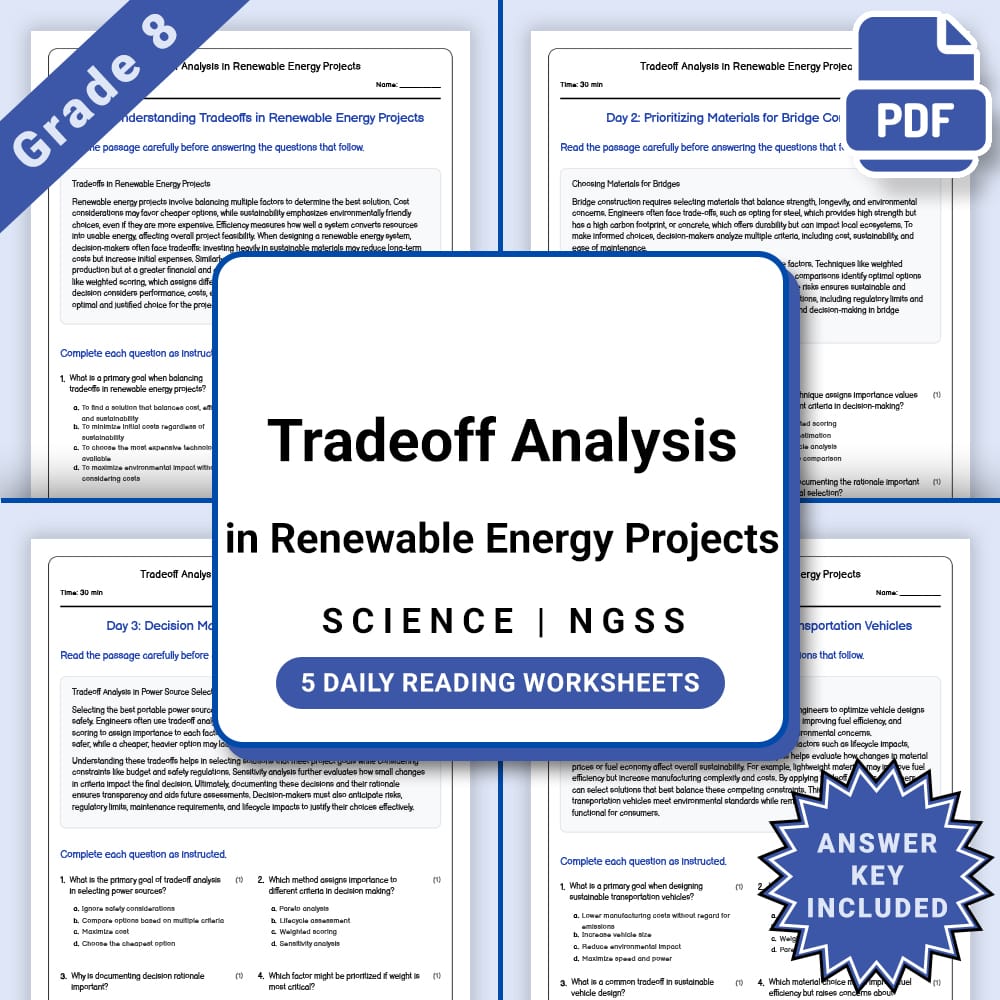
Grade 8 Science – Tradeoff Analysis in Renewable Energy Projects(PDF +Answers)
Created byCopper Leaf ClassroomLearning Objectives
- Understand the concept of tradeoffs in project decision-making.
- Analyze the impact of cost, sustainability, and efficiency in renewable energy.
- Apply decision tools such as weighted scoring and pareto comparisons.
Instant download
Grade 8 Science – Sources of Pollution Worksheet (Ontario Standards) (PDF)
Created byBright Mind ResourcesLearning Objectives
- Differentiate between point and nonpoint sources of pollution with examples.
- Understand processes like nutrient enrichment, eutrophication, and oxygen depletion.
- Connect landscape practices and land-use patterns to pollutant transport pathways and vulnerability.
Instant download
Grade 8 Science | Comparative Cells Worksheet (Ontario) – Science 1 (PDF)
Created byBright Mind ResourcesLearning Objectives
- Identify the distinguishing features of plant and animal cells.
- Describe the functions of cellular components such as cell walls, chloroplasts, vacuoles, centrioles, and lysosomes.
- Compare prokaryotic and eukaryotic cell organization.
Instant download
Grade 8 Science – Hydrostatic Variation Worksheet (Ontario) (PDF)
Created byBright Mind ResourcesLearning Objectives
- Understand the relationship between pressure, fluid density, and depth as described by p = ρgh.
- Explain how pressure differences occur in communicating vessels and the hydrostatic paradox.
- Calculate pressure at various depths in different fluid scenarios and analyze the forces involved.
Instant download
Grade 8 Science – Pascal's Principle Worksheet (Ontario | PDF)
Created byBright Mind ResourcesLearning Objectives
- Explain the concept of pressure transmission in confined fluids according to Pascal's principle.
- Calculate the relationship between input and output forces and areas in hydraulic systems.
- Identify real-world devices that utilize Pascal's principle, such as hydraulic presses and braking systems.
Instant download
Grade 8 Science | Integrated Management Worksheet (Ontario) (PDF)
Created byBright Mind ResourcesLearning Objectives
- Understand the concept of integrated water resources management and its components.
- Identify governance instruments and strategies used in water management.
- Explain how scientific understanding informs policy decisions in water resource management.
Instant download
Grade 8 Science | Density Concept Worksheet (Ontario – Science 1) (PDF)
Created byBright Mind ResourcesLearning Objectives
- Understand the definition of density and its units in the SI system.
- Relate mass, volume, and density through numerical examples.
- Differentiate between density, relative density, and specific gravity.
Instant download
Grade 8 Science Worksheet | Cell Cycle – Ontario Standards (PDF)
Created byBright Mind ResourcesLearning Objectives
- Describe the main phases of the cell cycle, including interphase, mitosis, and cytokinesis.
- Explain the roles of cyclins, kinases, and checkpoint mechanisms in regulating cell division.
- Identify examples of tissue growth, wound repair, and consequences of cell cycle dysregulation.
Instant download
Grade 8 Science – Force Diagrams Worksheet (Ontario Standards PDF)
Created byBright Mind ResourcesLearning Objectives
- Understand the components and purpose of free-body diagrams for contact and non-contact forces.
- Identify and interpret vectors such as normal force, tension, friction, and gravity in force diagrams.
- Differentiate between balanced and unbalanced net forces and their effects on motion.
Instant download
Grade 8 Science | Energy Pathways Worksheet (Ontario Science 1) (PDF)
Created byBright Mind ResourcesLearning Objectives
- Map energy transfer through mechanical systems including gears, pulleys, and hydraulics.
- Identify points of energy conversion and analyze energy losses at each interface.
- Calculate net useful energy transfer in coupled systems.
Instant download
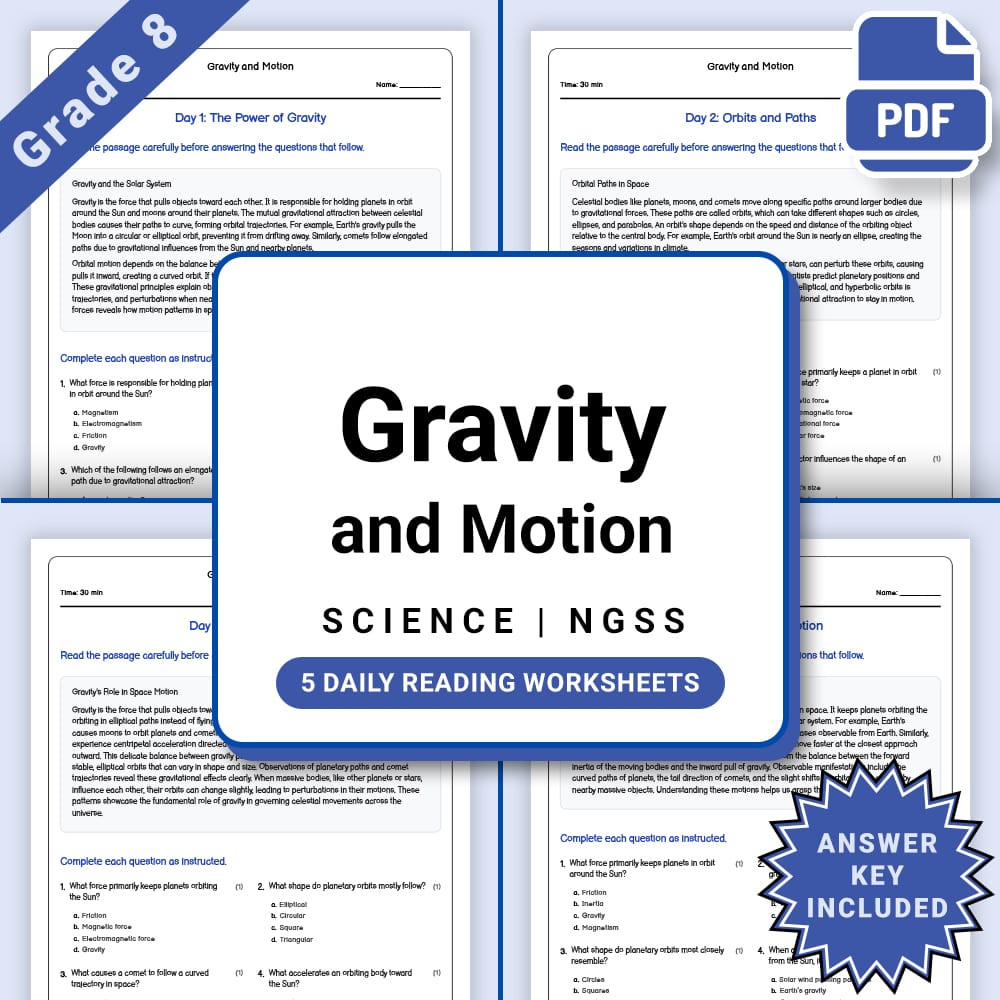
Grade 8 Science – Gravity and Motion Worksheet(PDF + Answer Key)
Created byCopper Leaf ClassroomLearning Objectives
- Understand how gravity influences the motion of objects in space.
- Identify orbital paths of planets, moons, comets, and asteroids.
- Explain the mutual gravitational attraction between celestial bodies.
Instant download
Grade 8 Science | Biomedical Flow Worksheet (Ontario Standards) (PDF)
Created byBright Mind ResourcesLearning Objectives
- Explain how fluid mechanics principles apply to blood transport in the circulatory system.
- Describe the effects of non-Newtonian blood properties on perfusion and flow resistance.
- Relate systolic and diastolic pressures to arterial function and health.
Instant download
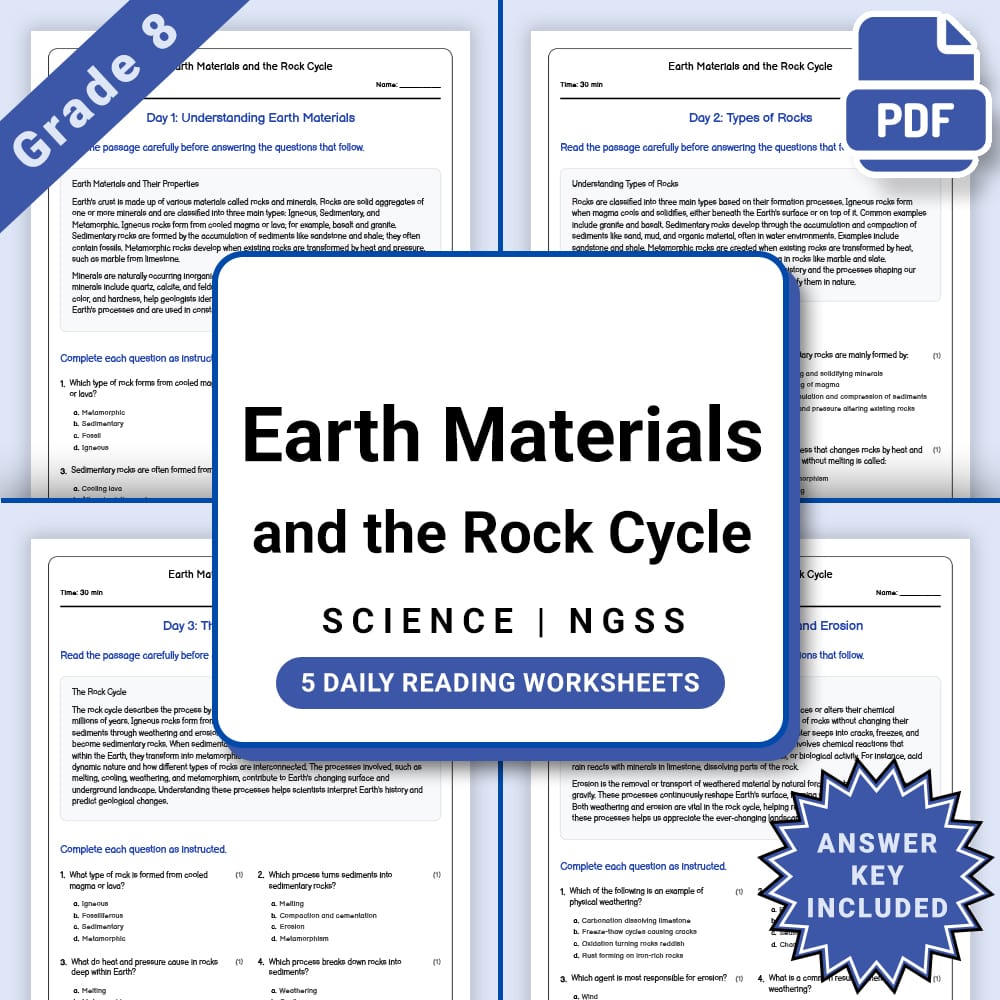
Grade 8 Science – Earth Materials and the Rock Cycle Worksheet(PDF + Answer Key)
Created byCopper Leaf ClassroomLearning Objectives
- Identify different types of Earth materials
- Understand properties of rocks and minerals
- Describe the processes of the rock cycle
Instant download
Grade 8 Science – Membrane Structure Worksheet (Ontario) (PDF)
Created byBright Mind ResourcesLearning Objectives
- Describe the components and architecture of cell membranes, including the phospholipid bilayer, proteins, cholesterol, and carbohydrates.
- Explain the functions of membrane proteins in transport, signaling, and structural support.
- Compare structural variations in membranes among different cell types, such as plant cells and specialized animal cells, and how these influence permeability and interactions with the environment.
Instant download
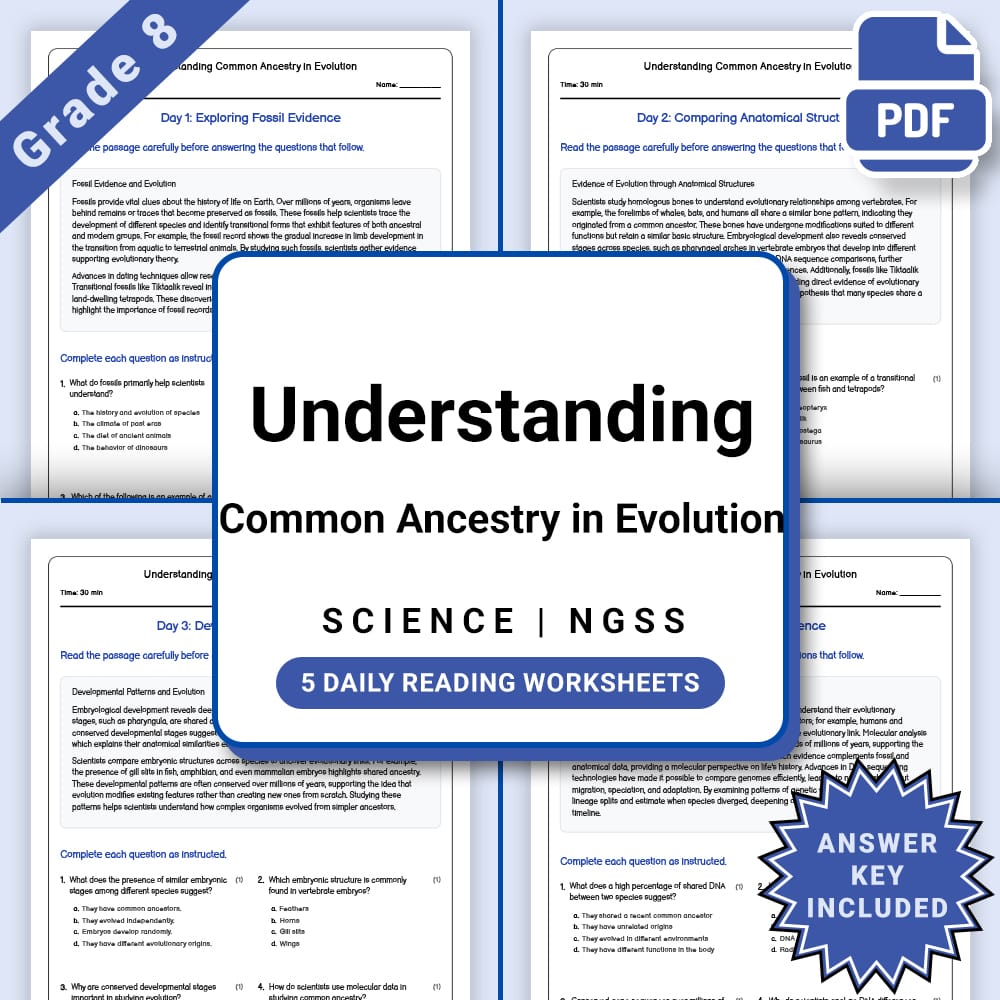
Grade 8 Science – Understanding Common Ancestry in Evolution (PDF + Answer Key)
Created byCopper Leaf ClassroomLearning Objectives
- Analyze fossil records to identify transitional species
- Recognize homologous structures across different vertebrates
- Interpret molecular data to infer shared ancestry
Instant download
Grade 8 Science | Global Distribution Worksheet (Ontario Standards) (PDF)
Created byBright Mind ResourcesLearning Objectives
- Understand the proportions and distribution of freshwater and saline reservoirs around the world.
- Identify spatial patterns related to climate, topography, and geology in water storage.
- Analyze the limitations of accessible freshwater sources and their implications for human use.
Instant download
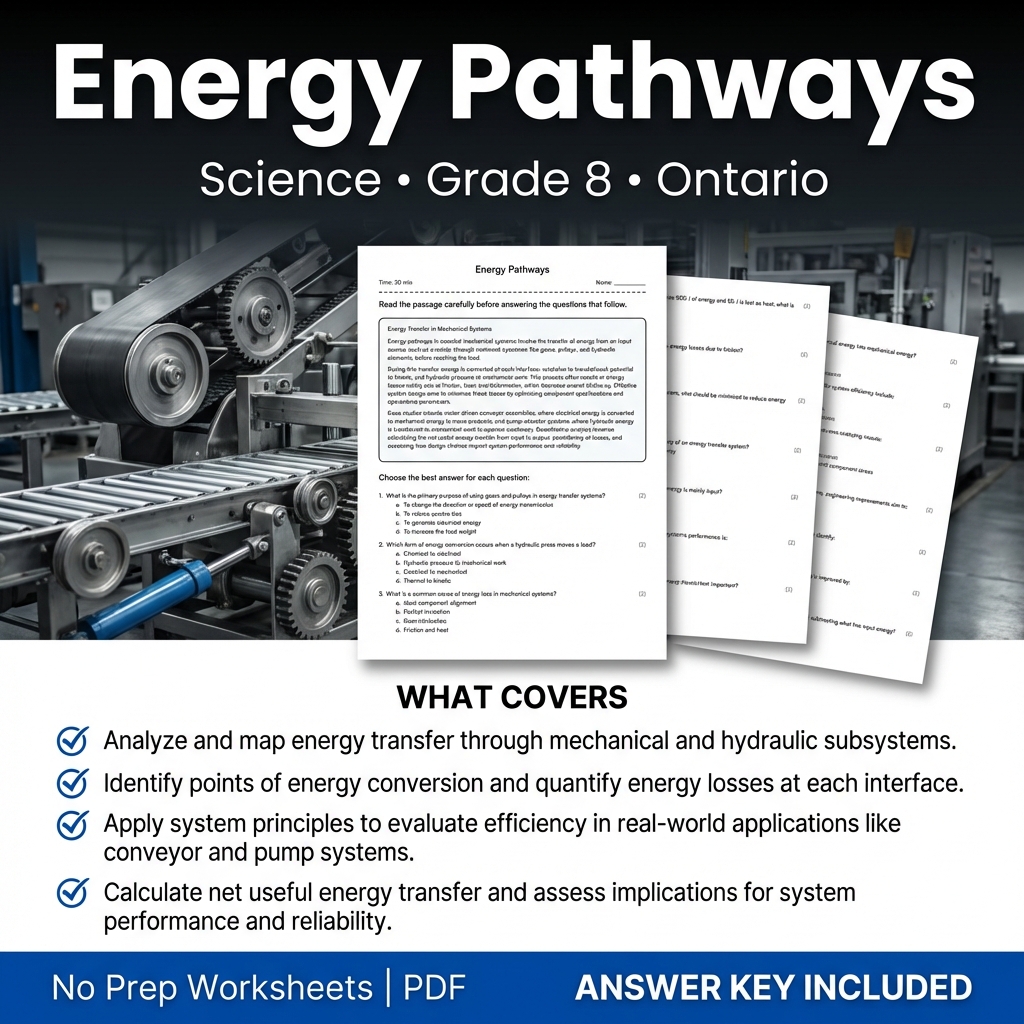
Energy Pathways Worksheet for Grade 8 Science – Ontario Standards
 Created byCoral Reef Learning
Learning Objectives
- Analyze and map energy transfer through mechanical and hydraulic subsystems.
- Identify points of energy conversion and quantify energy losses at each interface.
- Apply system principles to evaluate efficiency in real-world applications like conveyor and pump systems.
Instant download
Grade 8 Science Worksheet – Measuring Density (PDF) Ontario Standards
Created byBright Mind ResourcesLearning Objectives
- Understand various methods to measure the density of solids and liquids.
- Learn to apply formulas for calculating density and interpret measurement discrepancies.
- Identify sources of errors affecting density measurements, such as trapped air and temperature effects.
Instant download
Grade 8 Science – Surface Exchanges Worksheet (Ontario) - Science 1 (PDF)
Created byBright Mind ResourcesLearning Objectives
- Explain the mechanisms of surface water and groundwater interactions.
- Identify factors influencing exchange rates such as permeability, hydraulic gradients, and recharge zones.
- Describe how river stage and seasonal variability affect surface and groundwater exchanges.
Instant download
Grade 8 Science – Aquifer Dynamics Worksheet (Ontario) (PDF)
Created byBright Mind ResourcesLearning Objectives
- Understand the structure and functions of aquifers and groundwater flow systems.
- Identify key factors such as porosity, permeability, and hydraulic head that influence groundwater movement.
- Explain the concepts of confined and unconfined aquifers, recharge and discharge zones.
Instant download
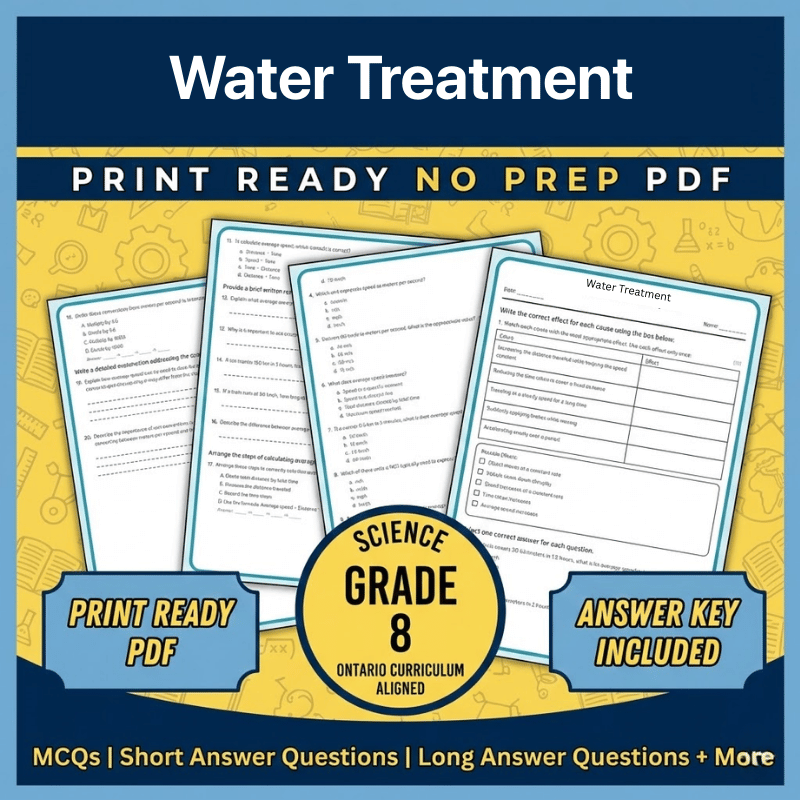
Grade 8 Science – Water Treatment Worksheet (Ontario, Science 1) (PDF)
Created byBright Mind ResourcesLearning Objectives
- Describe the principles and stages involved in drinking-water and wastewater treatment.
- Explain the mechanisms for removing suspended solids, pathogens, and dissolved contaminants.
- Identify tertiary water treatment processes such as biological nutrient removal and engineered wetlands.
Instant download
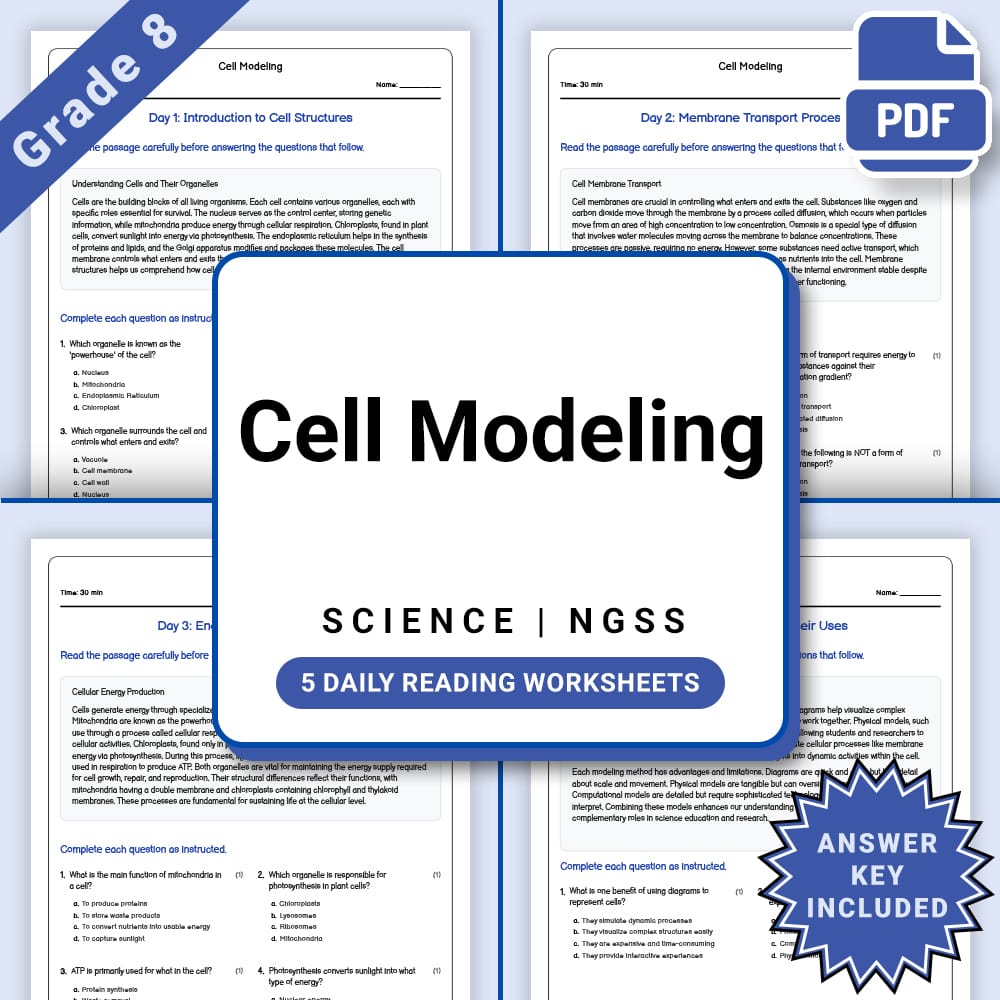
Grade 8 Science – Cell Modeling Daily Reading Worksheet(PDF + Answer Key)
Created byCopper Leaf ClassroomLearning Objectives
- Identify the main organelles in a cell
- Describe the functions of key cellular structures
- Understand how model representations illustrate cellular processes
Instant download
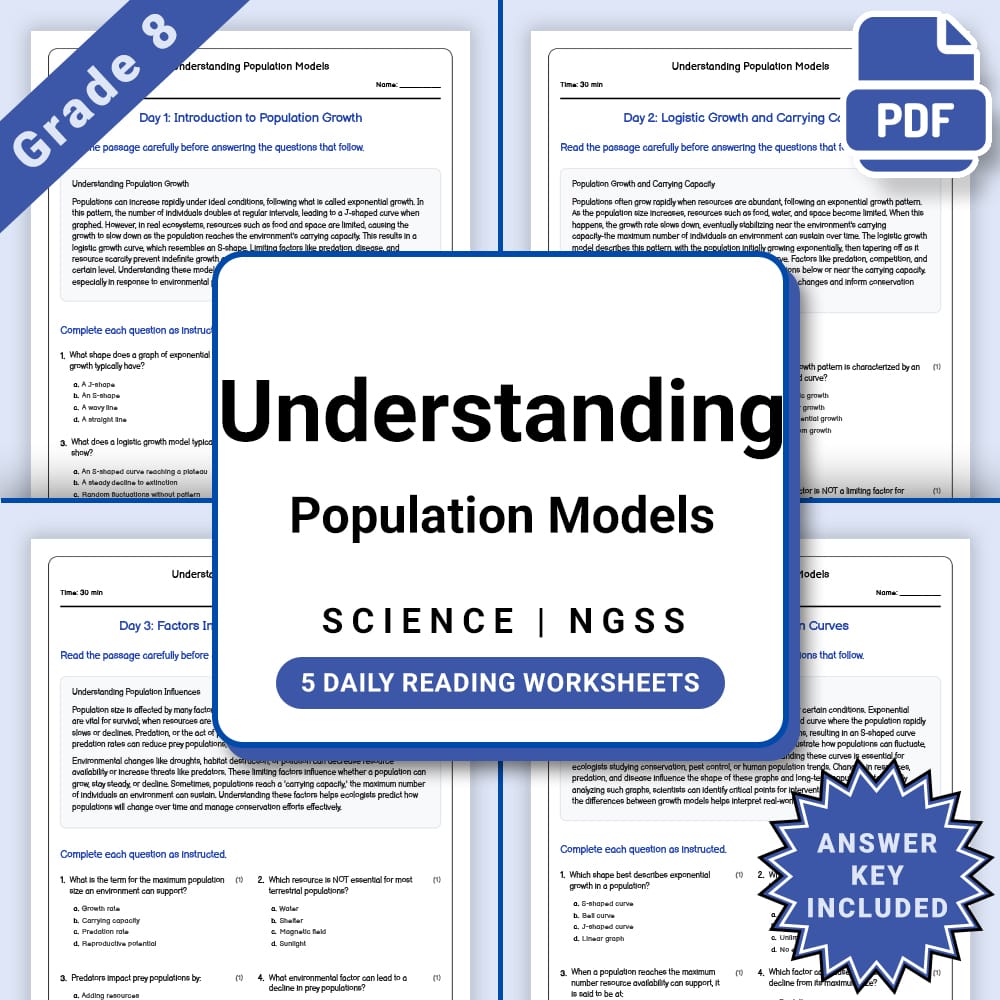
Grade 8 Science – Understanding Population Models Worksheet(PDF + Answer Key)
Created byCopper Leaf ClassroomLearning Objectives
- Recognize the basic concepts of exponential and logistic population growth
- Interpret simple graphical representations of population changes
- Identify factors that influence population size and growth limits
Instant download
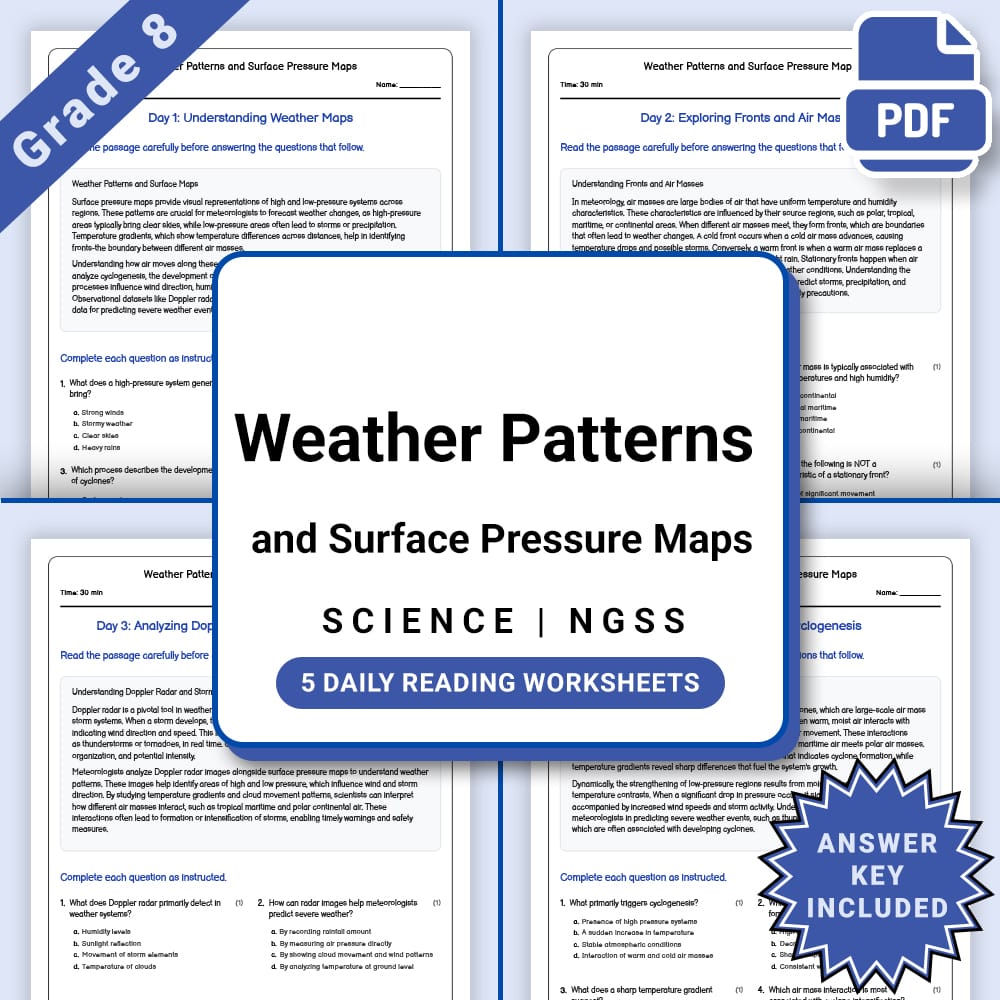
Grade 8 Science – Weather Maps and Surface Pressure Worksheet(PDF + Answer Key)
Created byCopper Leaf ClassroomLearning Objectives
- Understand how to interpret surface pressure maps and temperature gradients.
- Identify the relationship between air masses and weather changes.
- Explore the processes of frontogenesis and cyclogenesis.
Instant download

Population Effects Worksheet | NGSS Grade 8 Science Assessment
 Created byCedar Grove Learning
Learning Objectives
- Analyze how population growth influences resource consumption and Earth system changes.
- Evaluate evidence linking demographic patterns to climate change, water availability, and biodiversity.
- Interpret data trends and cause-effect relationships related to resource use and environmental impact.
Instant download
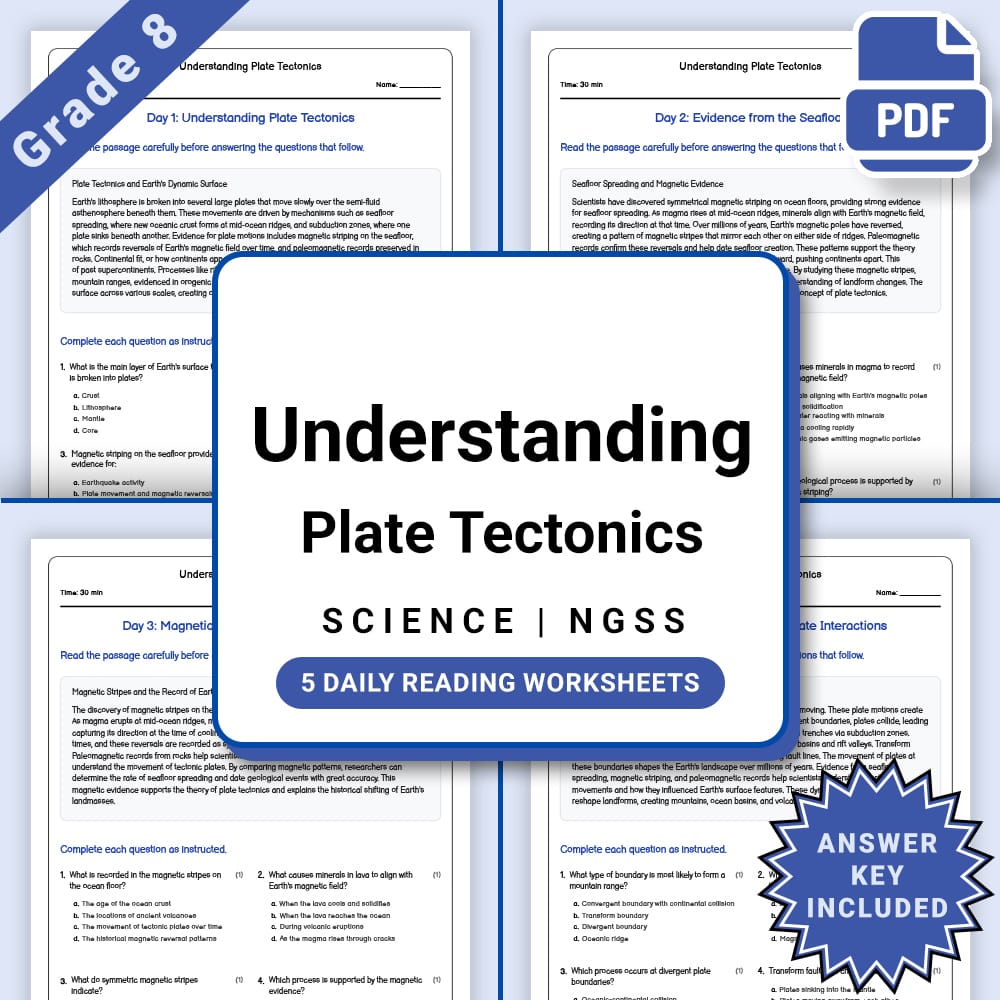
Grade 8 Science – Plate Tectonics Daily Reading Worksheet(PDF + Answer Key)
Created byCopper Leaf ClassroomLearning Objectives
- Explain the basic mechanisms of plate movements and tectonic activity.
- Identify key evidence supporting plate tectonics, such as seafloor spreading and magnetic striping.
- Describe processes like subduction, rifting, and continental collision that shape Earth's surface.
Instant download
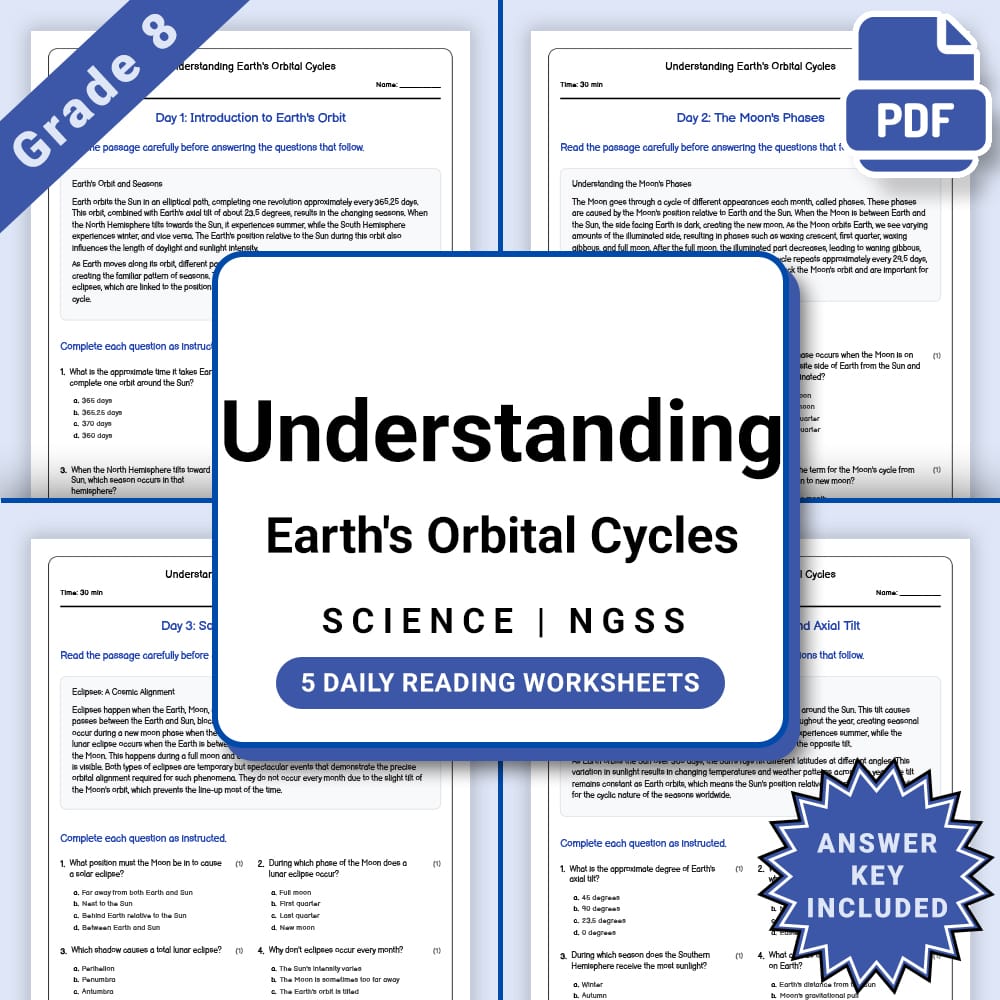
Grade 8 Science – Understanding Earth's Orbital Cycles Worksheet(PDF + Answers)
Created byCopper Leaf ClassroomLearning Objectives
- Explain the motion of Earth around the Sun and how it influences seasons.
- Identify and describe key lunar phases and related phenomena such as eclipses.
- Understand the significance of axial tilt and orbital geometry in cyclic phenomena.
Instant download
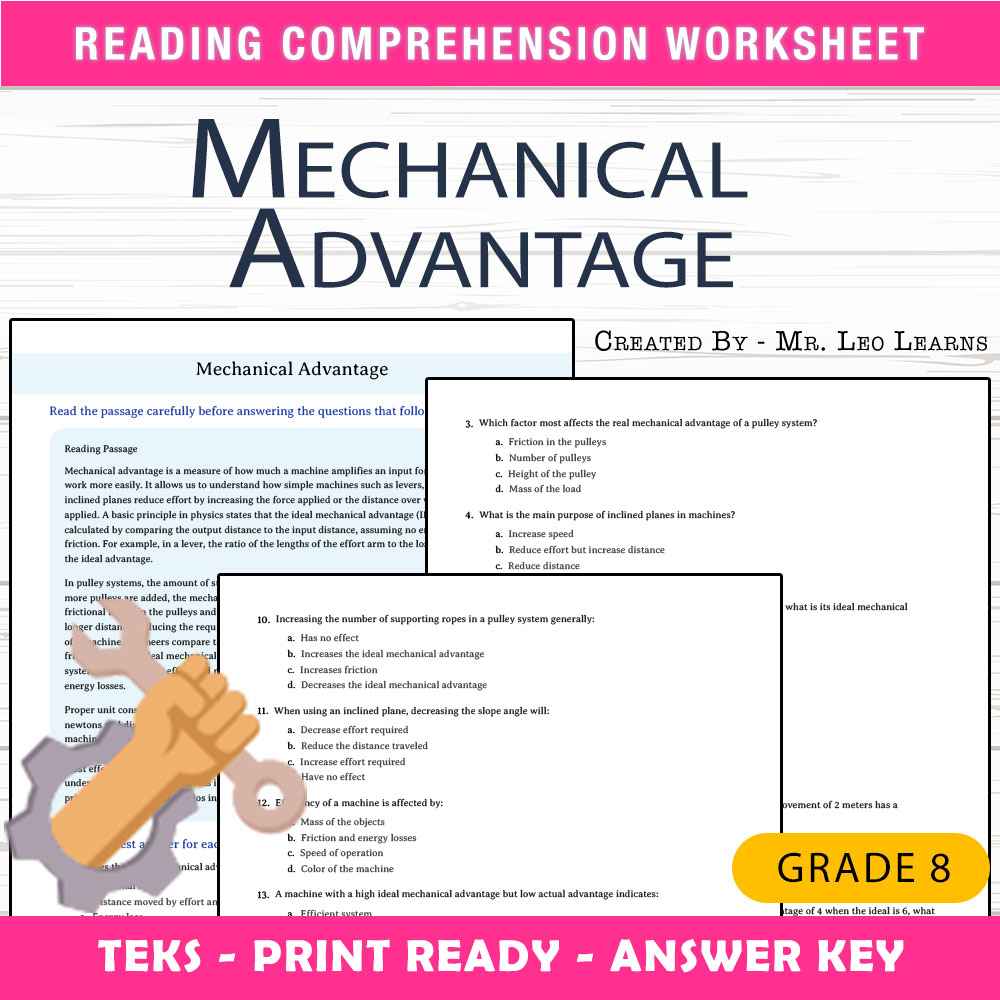
Grade 8 Science — Mechanical Advantage Worksheet for Mastery
Created byThe Resource HubLearning Objectives
- Understand the concept of mechanical advantage in simple machine systems.
- Apply algebraic formulas to calculate ideal and actual mechanical advantage.
- Analyze how forces, distances, and efficiencies relate in different machine configurations.
Also included in: Grade 8 Science Unit Bundle | Motion, Forces & Energy Mastery Worksheets +1 more
Instant download
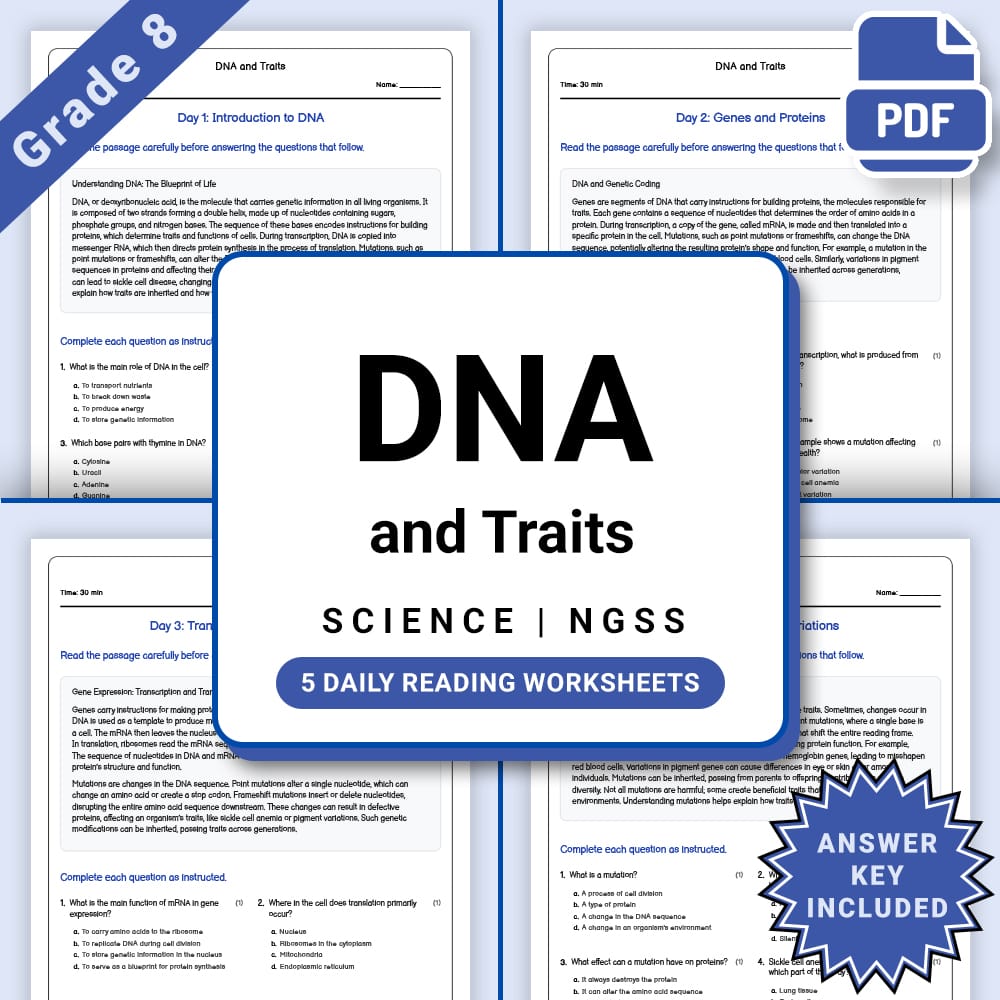
Grade 8 Science – DNA and Traits Daily Reading Worksheet(PDF + Answer Key)
Created byCopper Leaf ClassroomLearning Objectives
- Understand the basic structure and function of DNA
- Explain how DNA sequences determine traits
- Describe the processes of transcription and translation
Instant download
Browse more categories
About Grade 8 Worksheets
Explore Grade 8 worksheets in math, ELA, science, and social studies. Our 8,326 Grade 8 printables print straight from PDF, answer keys included.
Each resource here is built by an independent educator and reviewed for quality. Worksheets print straight from PDF and suit classroom use, homework, or extra practice; most come with answer keys, and you can preview before purchasing.