
Grade 8 Worksheets
8,326 grade resources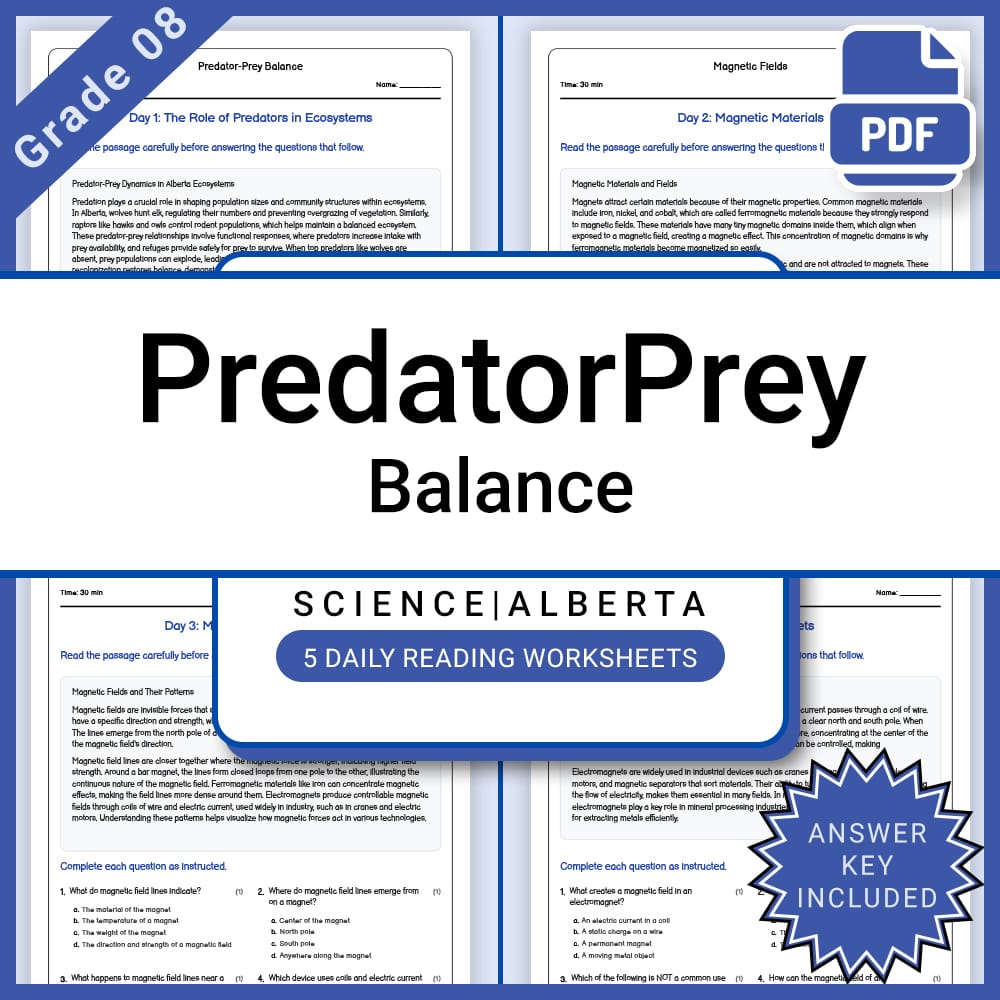
Grade 8 Science – Predator–Prey Balance Daily Reading Worksheet + Answer Key
JCreated byJ.S SheetsLearning Objectives
- Understand predator-prey relationships in ecosystems.
- Identify the roles of predators and prey through reading comprehension.
- Analyze how predator presence or absence affects community structure.
Also included in: Grade 8 Science Lesson Bundle | Ecosystems, Energy, and Environmental Impact +1 more
Instant download
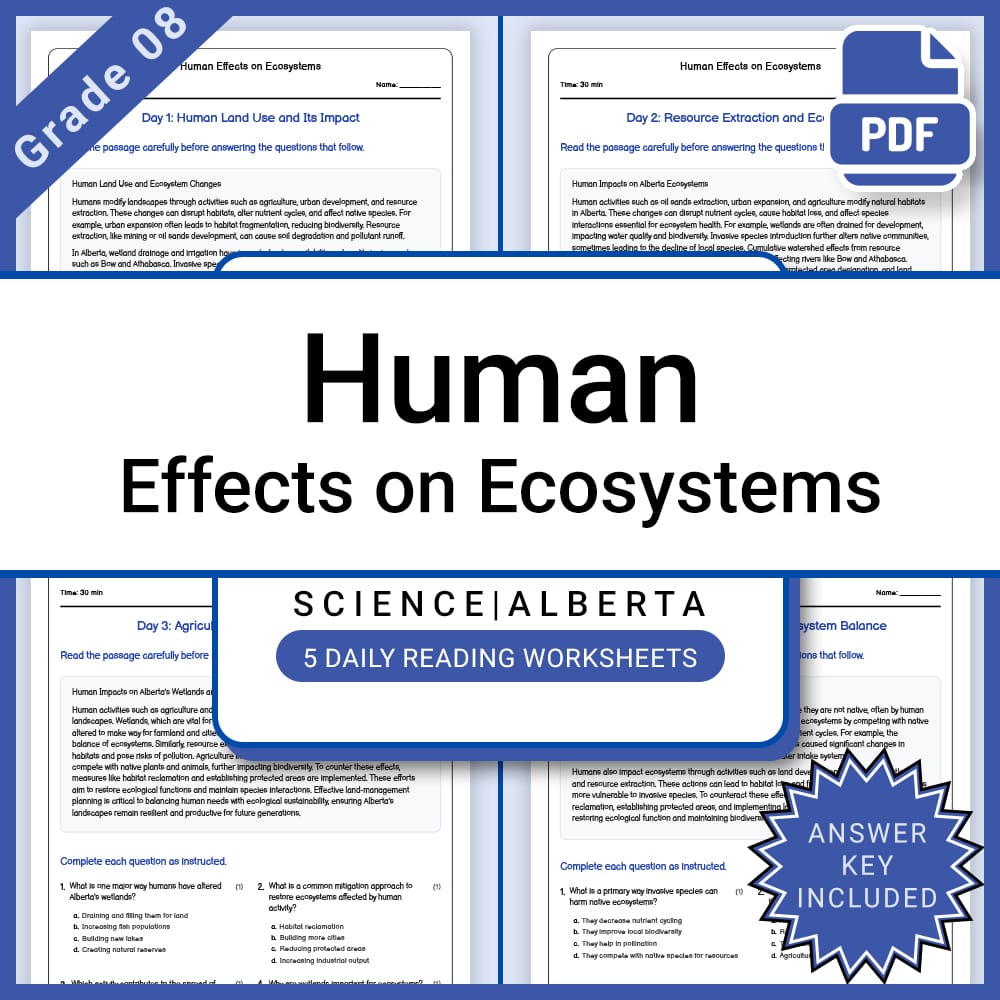
Grade 8 Science – Human Effects on Ecosystems Daily Worksheet + Answer Key
JCreated byJ.S SheetsLearning Objectives
- Understand how human land use impacts habitats and ecosystems.
- Identify various human activities that affect water systems and species interactions.
- Evaluate mitigation strategies used to restore ecological balance.
Also included in: Grade 8 Science Lesson Bundle | Ecosystems, Energy, and Environmental Impact +1 more
Instant download
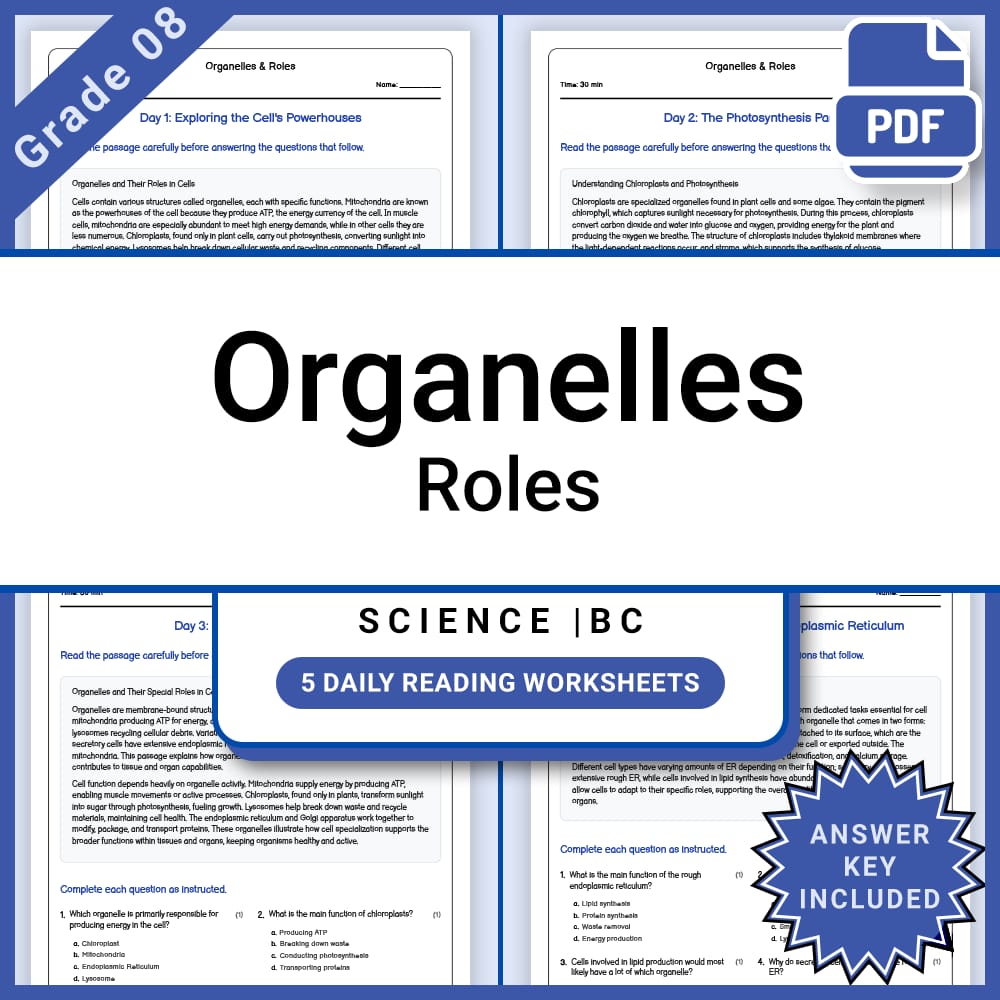
Grade 8 Science – Organelles & Roles Daily Reading Worksheet with Answer Key
JCreated byJ.S SheetsLearning Objectives
- Understand the structure and function of key cellular organelles.
- Explain how mitochondria produce energy for the cell.
- Identify variations in organelle abundance based on cell type.
Also included in: Grade 8 Science Lesson Group BC Framework | Daily Reading Worksheets +1 more
Instant download
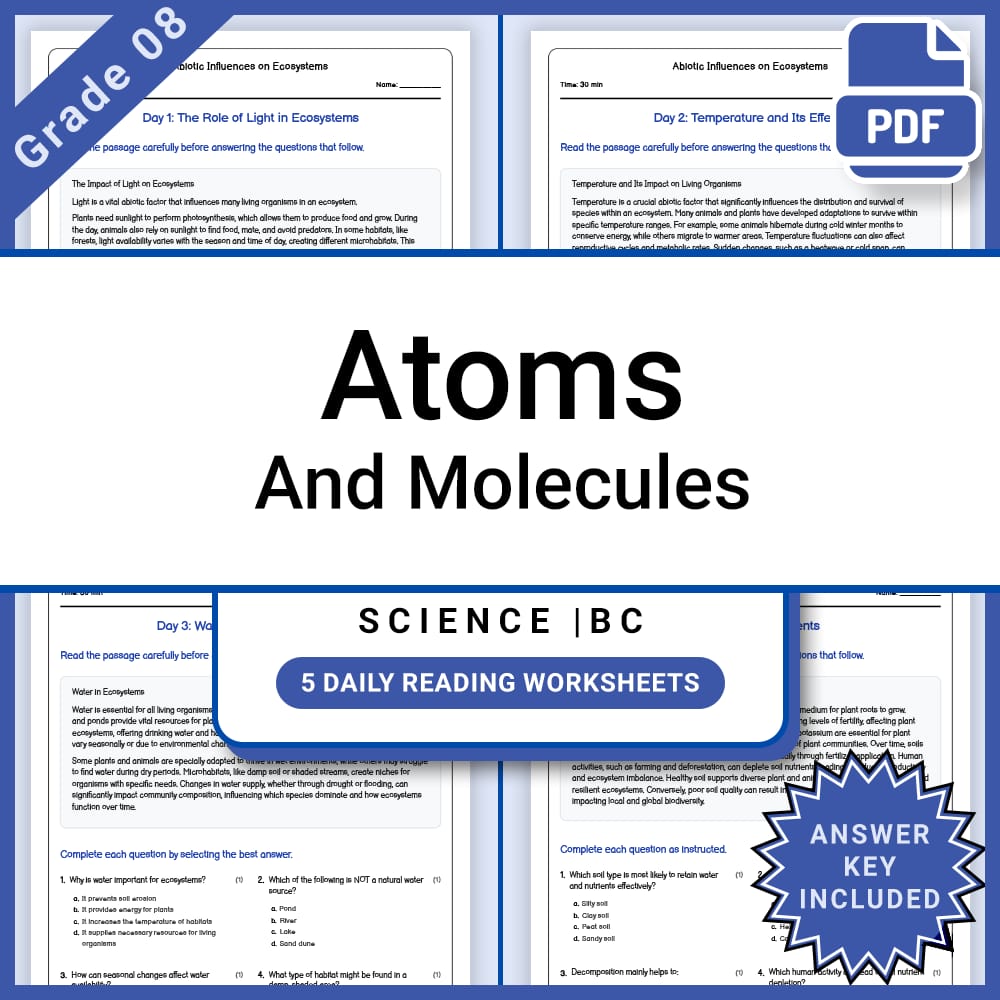
Grade 8 Science – Atoms and Molecules Daily Reading Worksheet with Answer Key
JCreated byJ.S SheetsLearning Objectives
- Understand key concepts related to Science
- Apply knowledge through practice questions
- Demonstrate comprehension of the material
Also included in: Grade 8 Science Lesson Group | Physical Changes and Chemical Reactions +1 more
Instant download

Grade 8 Science – Migratory Fish Ecosystem Interactions Daily Reading Worksheet + Answer Key
JCreated byJ.S SheetsLearning Objectives
- Understand the migration patterns of keystone species like migratory fish.
- Recognize the impact of abiotic factors and human activities on freshwater and marine ecosystems.
- Analyze the effects of environmental changes on fish populations and food web connections.
Also included in: Grade 8 Science Lesson Bundle: Ecosystems, Biodiversity & Environmental Impacts +1 more
Instant download

Grade 8 Science – Introduction to Simple Machines | Worksheet + Answer Key
JCreated byJ.S SheetsLearning Objectives
- Identify different types of simple machines such as lever, pulley, inclined plane, wheel and axle, wedge, and screw.
- Describe the basic function and purpose of each simple machine.
- Understand how simple machines modify force and direction to make work easier.
Also included in: Grade 8 Science Lesson Group – TEKS-Aligned Daily Reading Worksheets Bundle +1 more
Instant download

Grade 8 Science – Force Diagrams Daily Reading Worksheet + Answer Key
JCreated byJ.S SheetsLearning Objectives
- Understand how to identify forces acting on objects in two dimensions.
- Learn to draw free-body diagrams representing normal, gravitational, frictional, and tension forces.
- Analyze forces on inclined planes and decompose vectors into components.
Also included in: Grade 8 Science Lesson Group – TEKS-Aligned Daily Reading Worksheets Bundle +1 more
Instant download

Grade 8 Science – Introduction to Newton's Laws Worksheet + Answer Key
JCreated byJ.S SheetsLearning Objectives
- Understand the concept of inertia as described by Newton's First Law.
- Identify examples illustrating Newton's first law.
- Differentiate between objects in motion and at rest when no net force acts upon them.
Also included in: Grade 8 Science Lesson Group – TEKS-Aligned Daily Reading Worksheets Bundle +1 more
Instant download

Grade 8 Science – Properties of Matter Daily Reading Worksheet + Answer Key
JCreated byJ.S SheetsLearning Objectives
- Identify and describe key measurable physical properties of matter
- Compare density, solubility, melting point, boiling point, conductivity
- Understand how these properties are used to classify and separate materials
Also included in: Grade 8 Science Lesson Bundle | TEKS Standards for Classroom Success +1 more
Instant download

Grade 8 Science – Energy Conservation Daily Reading Worksheet + Answer Key
JCreated byJ.S SheetsLearning Objectives
- Identify potential and kinetic energy in various systems
- Describe the relationship between height, speed, and energy
- Understand how energy is conserved and dissipated in real-world systems
Also included in: Grade 8 Science Lesson Group – TEKS-Aligned Daily Reading Worksheets Bundle +1 more
Instant download

Grade 8 Science – Exploring the Solar System Daily Worksheet with Answer Key
JCreated byJ.S SheetsLearning Objectives
- Identify the main components of the solar system.
- Describe the characteristics of the Sun, planets, and other celestial bodies.
- Understand the relative scale and composition of different planets.
Also included in: Grade 8 Science Lesson Bundle | TEKS Standards Worksheets for Earth & Space +1 more
Instant download

Grade 8 Science – Rock Evidence and Classification Worksheet + Answer Key
JCreated byJ.S SheetsLearning Objectives
- Identify and classify different types of rocks: igneous, sedimentary, and metamorphic.
- Understand the processes involved in the rock cycle, such as melting, cooling, sedimentation, compaction, and metamorphism.
- Recognize how geological features like strata, fossils, and radiometric dating serve as evidence of Earth's history.
Also included in: Grade 8 Science Lesson Bundle | TEKS Standards Worksheets for Earth & Space +1 more
Instant download
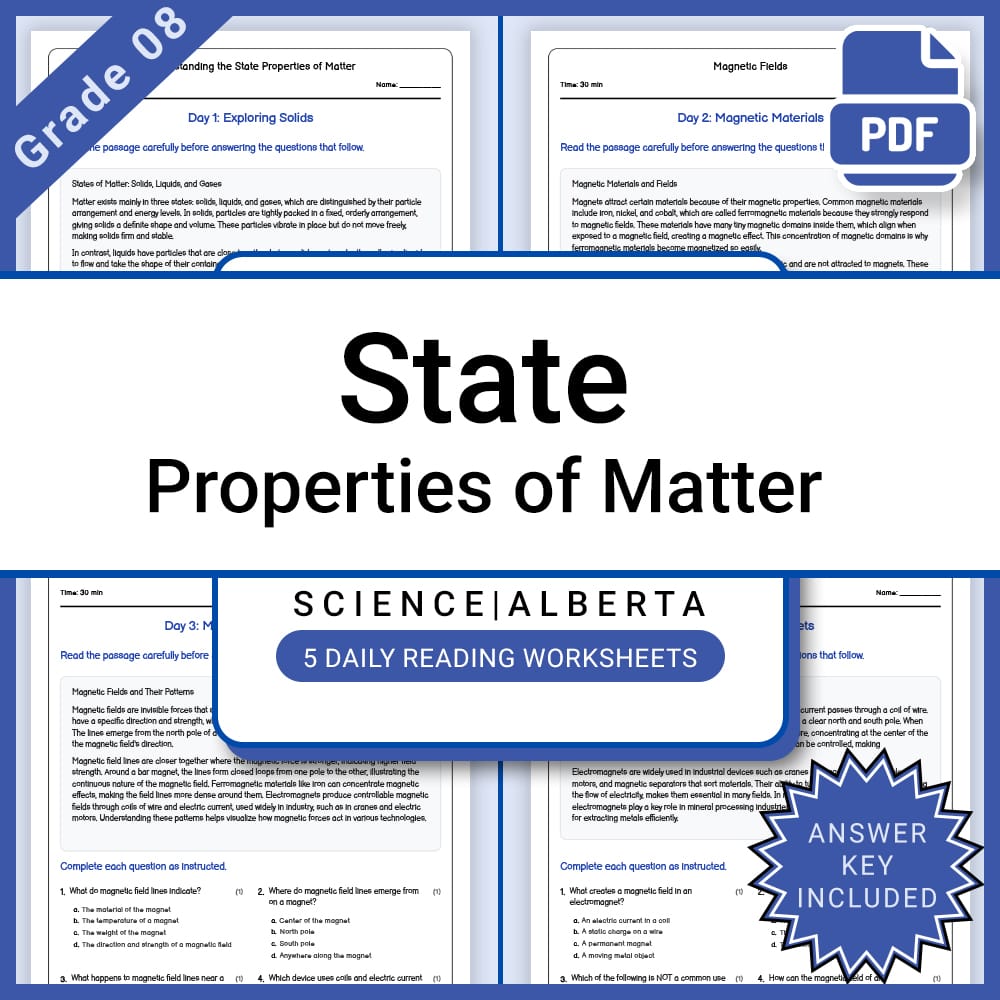
Grade 8 Science – State Properties of Matter Daily Worksheet + Answer Key
JCreated byJ.S SheetsLearning Objectives
- Describe particle arrangements in solids, liquids, and gases
- Identify the characteristics that differentiate each state
- Explain how particle energy affects the state of matter
Also included in: Grade 8 Science Lesson Group Bundle | Alberta Framework +1 more
Instant download
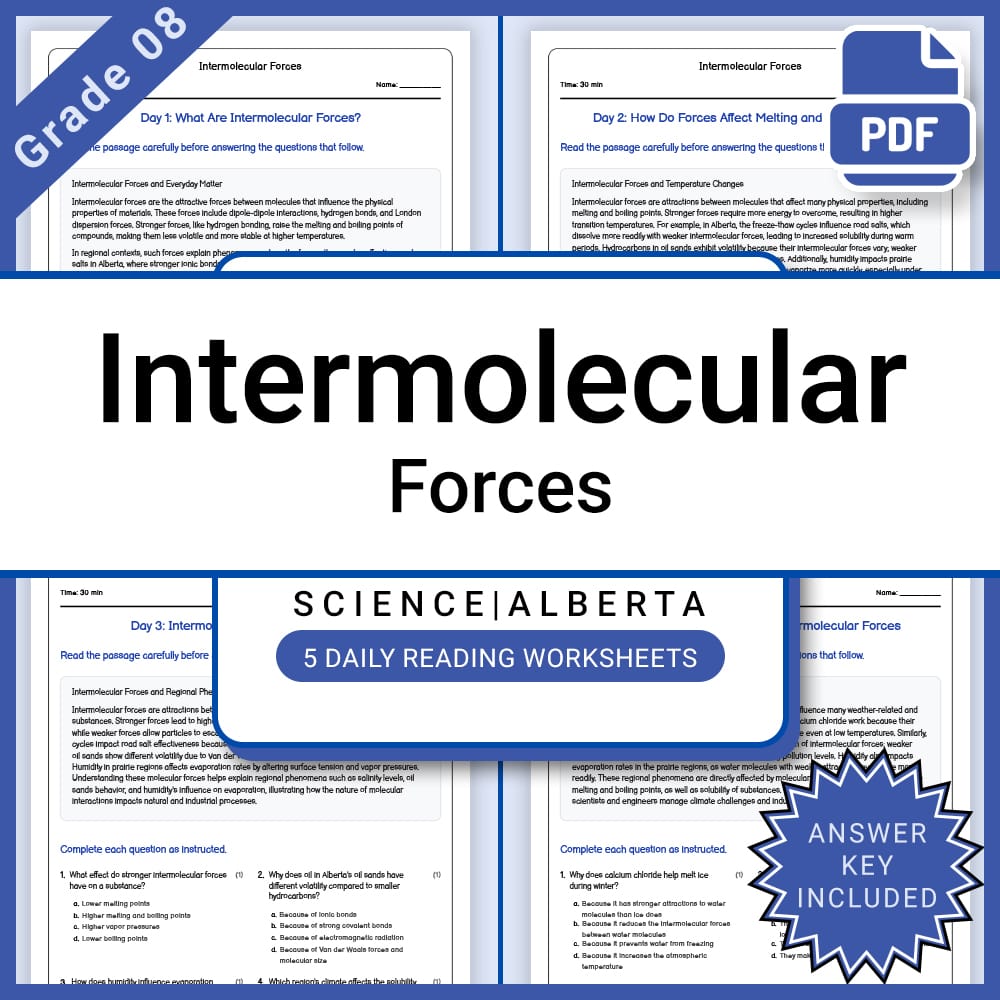
Grade 8 Science – Intermolecular Forces Daily Reading Worksheet + Answer Key
JCreated byJ.S SheetsLearning Objectives
- Understand key concepts related to Science
- Apply knowledge through practice questions
- Demonstrate comprehension of the material
Also included in: Grade 8 Science Lesson Group Bundle | Alberta Framework +1 more
Instant download
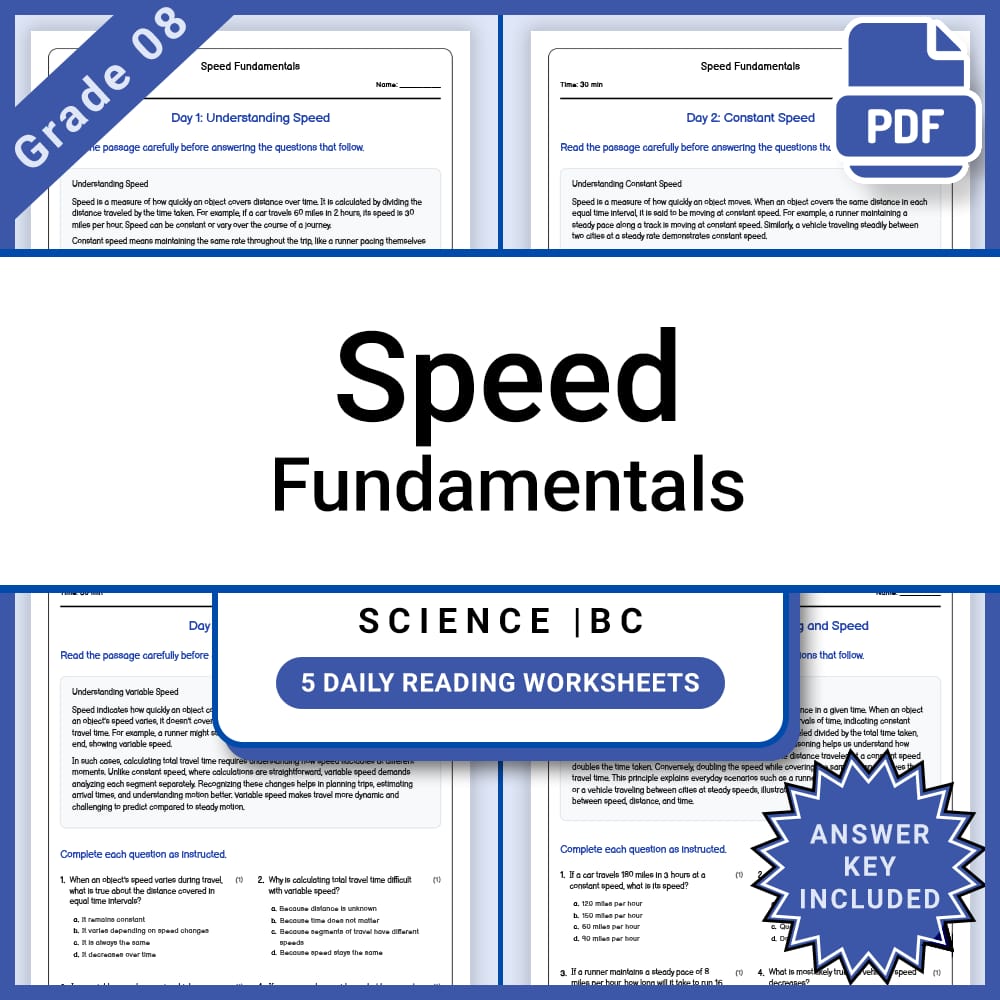
Grade 8 Science – Speed Fundamentals Daily Reading Worksheet + Answer Key
JCreated byJ.S SheetsLearning Objectives
- Define speed and understand its importance in science.
- Differentiate between constant speed and average speed.
- Apply the concept of proportional reasoning to speed, distance, and time.
Also included in: Grade 8 Science Lesson Group | Forces, Motion, Energy & More – Bundle +1 more
Instant download
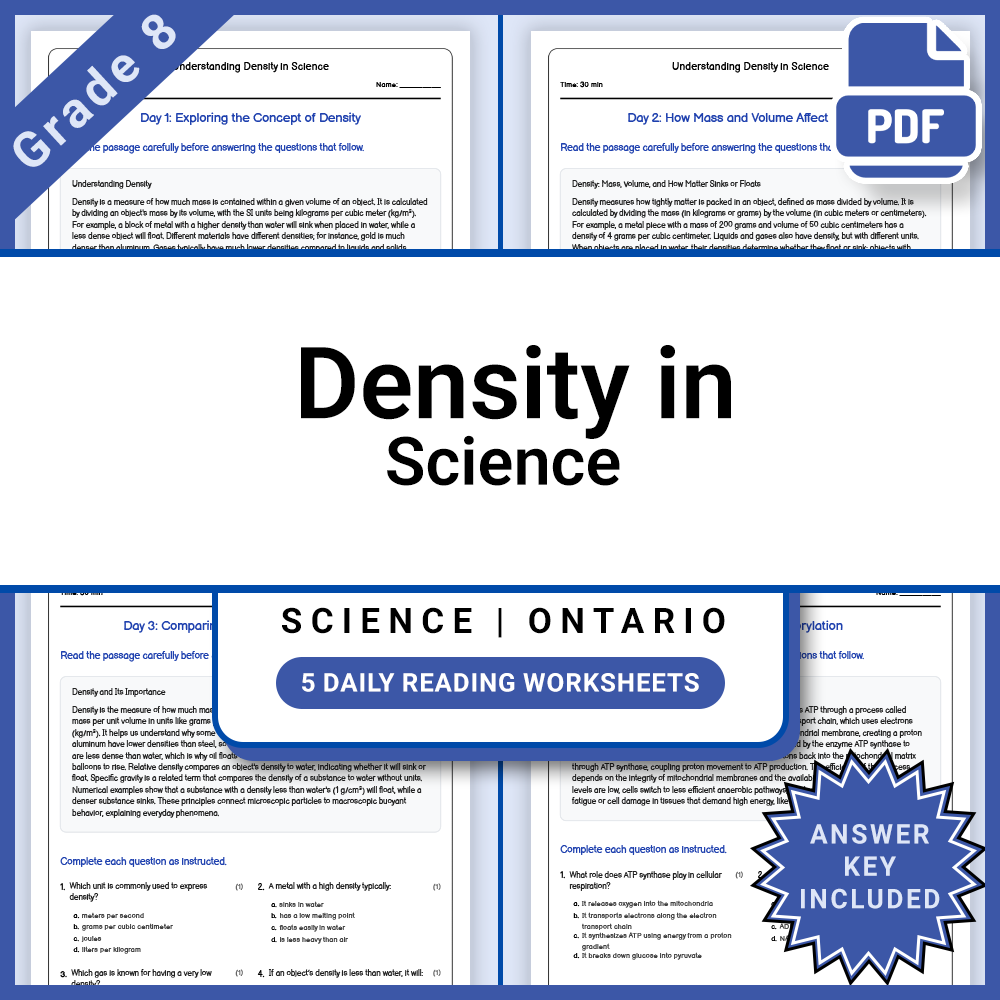
Grade 8 Science – Understanding Density Daily Reading Worksheet + Answer Key
JCreated byJ.S SheetsLearning Objectives
- Define density and understand its importance in science.
- Relate mass, volume, and density through numerical examples.
- Differentiate between density, relative density, and specific gravity.
Also included in: Grade 8 Science Lesson Bundle: Fluids, Pressure, and Density Topics +1 more
Instant download

Weather Patterns Worksheet | Grade 8 Science Printable PDF for Assessment
Learning Objectives
- Analyze relationships between air mass motions and weather changes using observational data.
- Understand the processes of frontogenesis and cyclogenesis in weather systems.
- Identify how polar, tropical, and maritime air masses influence wind, temperature, humidity, and precipitation.
Also included in: Grade 8 Earth's Systems Science Lesson Bundle NGSS | Climate, Water & Land +1 more
Instant download

Speciation Patterns Worksheet | Grade 8 Science printable PDF NGSS Assessment
Learning Objectives
- Understand processes that generate new species through genetic divergence and reproductive barriers.
- Describe how geographic isolation leads to allopatric speciation and adaptive radiation.
- Analyze fossil and genetic evidence of diversification and mass extinctions.
Also included in: Grade 8 Biological Evolution Lesson Bundle: Unity and Diversity +1 more
Instant download

Natural Selection Worksheet | Grade 8 Science Assessment & Student Practice PDF
Learning Objectives
- Understand the mechanisms of variation and selection that drive evolution.
- Identify examples of natural selection in real-world scenarios.
- Describe how heritable variation and environmental pressures influence trait frequencies.
Also included in: Grade 8 Biological Evolution Lesson Bundle: Unity and Diversity +1 more
Instant download

Plate Motions worksheet | NGSS Grade 8 Science printable PDF assessment
Learning Objectives
- Understand the mechanisms of plate tectonics, including subduction, rifting, continental collision, and uplift.
- Identify evidence supporting plate movements such as seafloor spreading, magnetic striping, and paleomagnetic records.
- Explain how plate motions influence landform changes like mountains, ocean basins, and volcanic arcs.
Also included in: Grade 8 Earth's Systems Science Lesson Bundle NGSS | Climate, Water & Land +1 more
Instant download

Modeling Data Science Worksheet Grade 8 NGSS Printable PDF Assessment
Learning Objectives
- Understand the role of physical and computational models in data collection and analysis.
- Identify different types of models such as scale models and simple simulations, and their limitations.
- Recognize sources of measurement uncertainty and methods to minimize them.
Also included in: Grade 8 Science Engineering Design Lesson Bundle | NGSS +1 more
Instant download

Climate Circulation Worksheet | Assessment Grade 8 Science Printable PDF
Learning Objectives
- Understand the models of atmospheric and oceanic circulation such as Hadley, Ferrel, and polar cells.
- Explain how planetary rotation and solar heating influence wind patterns and ocean currents.
- Describe the link between circulation patterns and regional climates, including monsoons and ocean gyres.
Also included in: Grade 8 Earth's Systems Science Lesson Bundle NGSS | Climate, Water & Land +1 more
Instant download

Tradeoff Analysis Worksheet | Grade 8 Science Printable PDF NGSS Assessment
Learning Objectives
- Understand how to prioritize competing constraints using multi-criteria decision methods.
- Apply cost-benefit estimation and sensitivity analysis to project decisions.
- Use tools like weighted scoring and pareto comparisons to evaluate project options.
Also included in: Grade 8 Science Engineering Design Lesson Bundle | NGSS +1 more
Instant download

Matter Cycles Worksheet for Grade 8 Science | NGSS Printable PDF
Learning Objectives
- Describe the cycling of matter between living organisms and the environment.
- Explain the processes of photosynthesis, respiration, decomposition, and nutrient transformations.
- Trace atoms such as carbon and water through various biological and environmental reservoirs.
Also included in: Grade 8 Science Ecosystems Lesson Bundle: Interactions, Energy & Dynamics +1 more
Instant download

Population Change Worksheet Assessment for Grade 8 Science NGSS Printable PDF
Learning Objectives
- Understand factors influencing population growth and decline.
- Analyze how biotic and abiotic factors affect population dynamics.
- Interpret population graphs, birth/death rate trends, and resource limitations.
Also included in: Grade 8 Science Ecosystems Lesson Bundle: Interactions, Energy & Dynamics +1 more
Instant download

Electric Magnetism Worksheet | Grade 8 Science Assessment & Practice PDF
Learning Objectives
- Understand the basic principles of electric and magnetic forces and how they depend on charges, poles, and distance.
- Describe real-world examples of electric and magnetic interactions including charged objects and magnets.
- Analyze factors affecting the strength and direction of electric and magnetic forces.
Also included in: Grade 8 Science Motion and Stability: Forces and Interactions Lesson Bundle +1 more
Instant download

Orbital Cycles Worksheet | NGSS Grade 8 Science Printable PDF Assessment
Learning Objectives
- Explain the relative positions and motions of the Earth, Moon, and Sun that cause lunar phases, eclipses, and seasonal changes.
- Describe how Earth's axial tilt and orbital geometry influence observable sky patterns and calendar cycles.
- Understand the timing and sequence of lunar phases, eclipses, and seasons based on celestial motions.
Also included in: Grade 8 Science Earth's Place in the Universe Lesson Bundle NGSS +1 more
Instant download

Design Optimization Worksheet | NGSS Grade 8 Science printable PDF assessment
Learning Objectives
- Analyze test data to identify performance trends in design modifications.
- Interpret graphical and statistical results to evaluate design effectiveness.
- Quantify trade-offs among multiple performance metrics like strength, durability, and efficiency.
Also included in: Grade 8 Science Engineering Design Lesson Bundle | NGSS +1 more
Instant download

Grade 8 Science | Energy Foundations Worksheet (Alberta Standard) (PDF)
 Created bySilver Birch Teaching
Learning Objectives
- Explain how energy from primary sources moves through producers, consumers, and decomposers in ecosystems.
- Describe how energy is lost between trophic levels and why this limits population sizes.
- Model how detritivores (decomposers) return matter and energy to the ecosystem through decomposition.
Also included in: Grade 8 Trophic Modeling & Ecosystems Science Lesson Bundle for Alberta Standards +1 more
Instant download

Grade 8 Science | Energy Transfer Worksheet (Alberta Standards) (PDF)
Created bySilver Birch TeachingLearning Objectives
- Explain how forces can change mechanical energy through work done on a system
- Describe qualitative relationships between applied force, displacement, and changes in kinetic and potential energy
- Identify energy transfers and transformations during motion, such as lifting, downhill motion, and braking
Also included in: Grade 8 Forces, Motion, and Energy Science Lesson Bundle for Alberta +1 more
Instant download

Grade 8 Science | Model Frameworks Worksheet – Alberta Standards (PDF)
Created bySilver Birch TeachingLearning Objectives
- Describe how ecosystem models represent matter and energy using stocks, pools, fluxes, and trophic-level connections
- Interpret model outputs by relating assumptions and limitations to observable ecosystem features such as biomass and decomposition rates
- Apply conservation ideas when reasoning about changes in nutrients and energy in ecosystem model frameworks
Also included in: Grade 8 Trophic Modeling & Ecosystems Science Lesson Bundle for Alberta Standards +1 more
Instant download

Grade 8 Science – Circular Motion Worksheet (Alberta Standards) (PDF)
Created bySilver Birch TeachingLearning Objectives
- Explain why velocity changes in circular motion even when speed is constant
- Use centripetal force ideas to predict how mass, speed, and radius affect the needed inward force
- Identify real-world examples of centripetal force and consequences when inward force is insufficient
Also included in: Grade 8 Forces, Motion, and Energy Science Lesson Bundle for Alberta +1 more
Instant download

Grade 8 Science | Mass and Weight Worksheet (Alberta Standards) (PDF)
Created bySilver Birch TeachingLearning Objectives
- Distinguish mass as an intrinsic measure of matter from weight as the gravitational force on that mass
- Use the relationship between mass, gravitational acceleration, and weight to explain how weight changes with location
- Apply mass-based and gravity-influenced ideas to real-world contexts such as vehicle load specifications and agricultural dosing
Also included in: Grade 8 Forces, Motion, and Energy Science Lesson Bundle for Alberta +1 more
Instant download

Grade 8 Science | Force Balance Worksheet (Alberta Standards) (PDF)
Created bySilver Birch TeachingLearning Objectives
- Explain balanced and unbalanced force systems using net force and the motion of objects
- Use force symmetry and vector reasoning to predict whether an object remains at rest or accelerates
- Identify real-world examples (bridges, pipelines, tractors) where equilibrium or changing motion occurs
Also included in: Grade 8 Forces, Motion, and Energy Science Lesson Bundle for Alberta +1 more
Instant download

Grade 8 Science | Population Patterns Worksheet (PDF) – Alberta Standards
Created bySilver Birch TeachingLearning Objectives
- Explain how exponential growth, logistic regulation, and cyclical fluctuations differ in population dynamics
- Use carrying capacity and time lags to interpret real-world population trajectories
- Describe how predation, food supply, and spatial heterogeneity create source–sink dynamics
Also included in: Grade 8 Trophic Modeling & Ecosystems Science Lesson Bundle for Alberta Standards +1 more
Instant download

Cell Cycle Worksheet | Grade 8 Science PDF | Ontario Standards
 Created byCedar Grove Learning
Learning Objectives
- Describe the main stages of the cell cycle, including interphase, mitosis, and cytokinesis.
- Explain how DNA is replicated and how chromosomes are separated during mitosis.
- Identify the roles of cyclins, kinases, and checkpoint mechanisms in preventing genomic instability.
Instant download

Energy Forms Worksheet | Ontario Grade 8 Science Practice PDF
Created byCedar Grove LearningLearning Objectives
- Differentiate kinetic and potential energy and identify where each occurs in mechanical systems.
- Describe how energy can convert between potential and kinetic forms during motion.
- Recognize thermal and acoustic energy as common energy sinks in real mechanical systems.
Instant download

Design Optimization Worksheet | NGSS G8 Science Assessment Practice
Created byCedar Grove LearningLearning Objectives
- Analyze test data to identify performance trends in design modifications.
- Interpret graphical and statistical outputs to determine effective design characteristics.
- Evaluate trade-offs among various metrics such as efficiency, strength, and durability.
Instant download

Speciation Patterns Worksheet | NGSS Grade 8 Science Assessment
Created byCedar Grove LearningLearning Objectives
- Explain how geographic isolation can lead to allopatric speciation.
- Describe the role of environmental change in driving extinction and diversification.
- Identify types of evidence such as fossils and genetics that support models of speciation.
Instant download

Water Cycle Worksheet | NGSS G8 Science Practice & Assessment PDF
Created byCedar Grove LearningLearning Objectives
- Describe the processes involved in the water cycle, including evaporation, condensation, precipitation, infiltration, runoff, and groundwater flow.
- Explain how energy from the Sun and gravity drive the water cycle processes.
- Connect the water cycle to weathering processes such as river incision, karst formation, and coastal erosion.
Instant download

Plate Movements Worksheet | NGSS Grade 8 Science Assessment
Created byCedar Grove LearningLearning Objectives
- Understand the mechanisms of plate tectonics including subduction, rifting, collision, and uplift.
- Identify evidence supporting plate movements such as seafloor spreading and magnetic striping.
- Describe the processes that produce landforms like mountains, ocean basins, and volcanic arcs.
Instant download

Cell Structure Worksheet | NGSS Grade 8 Science Assessment
Created byCedar Grove LearningLearning Objectives
- Describe the key organelles of prokaryotic and eukaryotic cells and their functions.
- Compare single-celled and multicellular organisms in terms of cellular organization and specialization.
- Explain how microscopy and imaging techniques help to identify cell features and link structures to functions.
Instant download

Rotational Forces Worksheet | Grade 8 Science – Ontario
Created byCedar Grove LearningLearning Objectives
- Explain torque using lever arm and moment of force, and determine when rotational equilibrium occurs
- Use the relationship between net torque, rotational inertia, and angular acceleration to predict rotational changes
- Apply rotational analogies of linear motion to gears, wheels, and levers in real situations
Instant download

Homeostatic Control Worksheet | Ontario Grade 8 Science Assessment
Created byCedar Grove LearningLearning Objectives
- Explain how negative and positive feedback help maintain internal stability (homeostasis).
- Describe how cells and organs use sensors, control centers, and effectors to regulate variables.
- Use examples such as blood glucose and thermoregulation to identify set points and feedback responses.
Instant download

Natural Selection Worksheet | NGSS Grade 8 Science Assessment
Created byCedar Grove LearningLearning Objectives
- Explain how heritable variation and environmental pressures influence natural selection.
- Identify examples of adaptive change such as industrial melanism, antibiotic resistance, and beak variation.
- Describe how trait frequencies shift over generations within populations.
Instant download

Newtonian Motion Worksheet | Ontario Grade 8 Science Assessment
Created byCedar Grove LearningLearning Objectives
- Explain Newton’s three laws using cause-and-effect relationships between forces and motion
- Use F = ma to calculate acceleration or interpret how changing mass affects acceleration
- Describe action–reaction pairs and inertia in everyday mechanical situations
Instant download

Ecosystem Models Worksheet | NGSS Grade 8 Science Assessment
Created byCedar Grove LearningLearning Objectives
- Understand how to construct and interpret ecosystem models representing biotic and abiotic components.
- Identify key variables, flows, and feedbacks in ecosystem diagrams.
- Analyze how changes in one component affect the entire ecosystem over time.
Instant download

Gravitational Interactions Worksheet | NGSS Grade 8 Science Assessment
Created byCedar Grove LearningLearning Objectives
- Describe how gravitational force depends on mass and distance between objects.
- Explain the inverse-square relationship governing gravitational attraction.
- Predict orbital characteristics based on mass and distance parameters.
Instant download
Browse more categories
About Grade 8 Worksheets
Explore Grade 8 worksheets in math, ELA, science, and social studies. Our 8,326 Grade 8 printables print straight from PDF, answer keys included.
Each resource here is built by an independent educator and reviewed for quality. Worksheets print straight from PDF and suit classroom use, homework, or extra practice; most come with answer keys, and you can preview before purchasing.