
Grade 9 Worksheets
9,322 grade resources
Grade 9 Science – Nutrient Cycling & Ecosystem Balance | Daily Reading Worksheet
 Created byBright Mind Resources
Learning Objectives
- Understand the key processes involved in the nitrogen cycle.
- Identify how nitrogen moves through ecosystems.
- Recognize human impacts on nutrient cycling and their consequences.
Also included in: Ecosystem Ecology Grade 9 Science Daily Reading Worksheets Bundle | TEKS +2 more
Instant download

Grade 9 Science – Tides & Gravity | Daily Reading Worksheet
Created byBright Mind ResourcesLearning Objectives
- Explain how the Moon's gravitational pull affects Earth's ocean tides.
- Describe the role of the Sun in influencing tidal amplitudes.
- Identify the relative positions of Earth, Moon, and Sun during different tidal cycles.
Also included in: Earth Systems Grade 9 Science Daily Reading Worksheets Bundle | Florida NGSSS +1 more
Instant download

Grade 9 Science – Resources & Landforms | Daily Reading Worksheet
Created byBright Mind ResourcesLearning Objectives
- Understand the basic concepts of landforms and natural resources
- Describe Earth's processes that create and modify landforms
- Identify how resources are concentrated through geological processes
Also included in: Grade 9 Science Worksheets: Space-to-Climate Lesson Bundle | Calif. Standards +1 more
Instant download

Grade 9 Science – Work & Kinetic Energy Daily Reading Worksheet | Florida NGSSS
Created byBright Mind ResourcesLearning Objectives
- Understand the concept of work as energy transfer by a force over a distance.
- Recognize how work affects kinetic energy and speed of an object.
- Identify how the direction of force determines energy transfer into potential or kinetic energy.
Also included in: Grade 9 Forces, Energy & Matter Science lesson bundle Florida NGSSS +1 more
Instant download

Grade 9 Science – Conservation of Matter & Atomic Counts | Reading Worksheet
Created byBright Mind ResourcesLearning Objectives
- Understand that atoms are conserved during chemical reactions
- Recognize how the rearrangement of atoms explains mass conservation
- Identify examples of matter conservation in various reactions
Also included in: Grade 9 Forces, Energy & Matter Science lesson bundle Florida NGSSS +1 more
Instant download

Grade 9 Science – Population Trait Variation & Natural Selection | Worksheet
Created byBright Mind ResourcesLearning Objectives
- Understand how genetic variation occurs within populations
- Learn about factors influencing allele frequencies and trait distributions
- Explore how natural selection impacts genetic traits in populations
Also included in: Evolution Grade 9 Science Daily Reading Worksheets Lesson Bundle | CA Standards +1 more
Instant download

Grade 9 Science – Understanding Circuit Types & Daily Reading Worksheet
Created byBright Mind ResourcesLearning Objectives
- Define series and parallel circuits
- Identify the behaviour of current and voltage in series circuits
- Recognize examples of series circuits and their applications
Also included in: Grade 9 Electrical Circuits & Electromagnetism Science Lesson Bundle | Alberta +1 more
Instant download

Grade 9 Science – Seismic Signals & Earth’s Inner Waves | Reading Worksheet
Created byBright Mind ResourcesLearning Objectives
- Identify and describe different types of seismic waves
- Understand seismic wave propagation and their characteristics
- Relate seismic wave travel times to Earth's interior structure
Also included in: Grade 9 Earth & Space Science Daily Reading Worksheets Lesson Bundle | Ontario +1 more
Instant download

Grade 9 Science – Resource Impacts Daily Reading Worksheet | Ontario Standards
Created byBright Mind ResourcesLearning Objectives
- Understand key concepts related to Science
- Apply knowledge through practice questions
- Demonstrate comprehension of the material
Also included in: Grade 9 Earth & Space Science Daily Reading Worksheets Lesson Bundle | Ontario +1 more
Instant download

Grade 9 Science – Chemical Reactions & Types | Daily Reading Worksheet
Created byBright Mind ResourcesLearning Objectives
- Define what a chemical reaction is and describe the basic process.
- Identify common types of chemical reactions such as combustion, synthesis, and decomposition.
- Read and interpret symbolic chemical equations representing reactions.
Also included in: States of Matter Grade 9 Science Daily Reading Worksheets lesson bundle |Alberta +1 more
Instant download

Grade 9 Science – Cell Organelles & Interactions | Daily Reading Worksheet
Created byBright Mind ResourcesLearning Objectives
- Identify the roles of the nucleus and rough endoplasmic reticulum in protein production.
- Explain how organelles like the nucleus and ER work together during cellular processes.
- Describe the pathway of genetic information flow within a cell related to protein synthesis.
Also included in: Grade 9 Cell Structure Science Daily Reading Lesson Bundle | TEKS +2 more
Instant download

Grade 9 Science – Glucose Regulation & Hormonal Feedback | Reading Worksheet
Created byBright Mind ResourcesLearning Objectives
- Understand how blood glucose levels fluctuate after eating.
- Identify hormones involved in glucose regulation.
- Describe the negative feedback mechanism maintaining energy balance.
Also included in: Grade 9 Homeostasis & Body Systems Science Lesson Bundle Daily Reading | TEKS +2 more
Instant download

Grade 9 Science – Neuroendocrine Control Daily Reading Worksheet | TEKS Aligned
Created byBright Mind ResourcesLearning Objectives
- Understand the function of the hypothalamus in hormone regulation
- Describe how the pituitary gland responds to hypothalamic signals
- Identify key anatomical features involved in neuroendocrine control
Also included in: Grade 9 Homeostasis & Body Systems Science Lesson Bundle Daily Reading | TEKS +2 more
Instant download

Grade 9 Science – Molecular Evidence & Evolution | Daily Reading Worksheet
Created byBright Mind ResourcesLearning Objectives
- Understand the role of DNA, RNA, and proteins in evolutionary studies.
- Learn how sequence similarities and divergences inform common ancestry.
- Explore how molecular clocks estimate divergence times between species.
Also included in: Grade 9 Evolution Science Daily Reading Worksheets Lesson Bundle | TEKS +2 more
Instant download

Grade 9 Science – Understanding Adaptive Radiation | Daily Reading Worksheet
Created byBright Mind ResourcesLearning Objectives
- Define adaptive radiation and explain its significance in evolution.
- Identify key features and processes involved in adaptive radiation.
- Analyze examples of adaptive radiation in nature.
Also included in: Grade 9 Evolution Science Daily Reading Worksheets Lesson Bundle | TEKS +2 more
Instant download

Grade 9 Science – Orbital Interactions & Climate Effects | Daily Worksheet
 Created byQuiet Forest Education
Learning Objectives
- Explain how Earth's eccentricity influences seasonal insolation.
- Identify the effects of axial tilt and precession on long-term climate variability.
- Describe tidal forcing mechanisms driven by the Moon and Sun.
Also included in: Earth and Space Systems Grade 9 Science Daily Worksheets Bundle | Ontario +1 more
Instant download

Grade 9 Science – Integrated Case & Daily Reading Worksheet | Alberta Standards
Created byBright Mind ResourcesLearning Objectives
- Compare sexual and asexual reproductive strategies and their impacts on genetic diversity.
- Understand how traits are inherited through chromosomes following Mendelian principles.
- Analyze the adaptive advantages of different selection methods in regional breeding programs.
Also included in: Grade 9 Genetics & Inheritance Science Daily Reading Lesson Bundle | Alberta +1 more
Instant download

Grade 9 Science – Genetic Variation Sources & Effects | Daily Reading Worksheet
Created byBright Mind ResourcesLearning Objectives
- Identify different sources of genetic variation in populations
- Explain how mutation, recombination, gene flow, and chromosomal rearrangements contribute to diversity
- Recognize regional examples illustrating the impact of genetic variation
Also included in: Grade 9 Genetics & Inheritance Science Daily Reading Lesson Bundle | Alberta +1 more
Instant download

Grade 9 Science – Hydrologic Change & River Systems | Daily Reading Worksheet
Created byBright Mind ResourcesLearning Objectives
- Understand how rivers shape Earth's surface through erosion, transport, and deposition.
- Analyze river discharge and sediment data to interpret landscape evolution.
- Identify examples of river-related landscape features such as valleys and fjords.
Also included in: Grade 9 Earth Processes Science Daily Reading Worksheets lesson bundle | NGSS +2 more
Instant download

Grade 9 Science – Nutritional Impact & Health Risks | Daily Reading Worksheet
Created byBright Mind ResourcesLearning Objectives
- Understand how dietary choices influence cellular functions and overall health.
- Identify key nutrients that affect physiological processes.
- Analyze evidence linking nutrition to chronic diseases and health outcomes.
Also included in: Grade 9 Science Daily Reading Worksheets: Body Systems Lesson Bundle | Ontario +1 more
Instant download

Grade 9 Science – Tissue Types & Function | Daily Reading Worksheet
Created byBright Mind ResourcesLearning Objectives
- Understand key concepts related to Science
- Apply knowledge through practice questions
- Demonstrate comprehension of the material
Also included in: Grade 9 Science Daily Reading Worksheets: Body Systems Lesson Bundle | Ontario +1 more
Instant download

Grade 9 Science – Particle Conservation & Reactions Daily Reading Worksheet
Created byBright Mind ResourcesLearning Objectives
- Understand the principle that matter is neither created nor destroyed during chemical reactions.
- Recognize that atoms are rearranged during reactions, but their total number remains constant.
- Explain the importance of conserving atoms in understanding chemical processes.
Also included in: Waves & Forces Grade 9 Science Daily Reading Worksheets Lesson Bundle | General +1 more
Instant download

Grade 9 Science – Prokaryote & Eukaryote Comparison | Daily Reading Worksheet
Created byBright Mind ResourcesLearning Objectives
- Identify key differences between prokaryotic and eukaryotic cells
- Understand cell structure and function in bacteria, archaea, and eukaryotes
- Describe how cell components relate to their roles in the organism
Also included in: Grade 9 Cell Structure Science Daily Reading Lesson Bundle | TEKS +2 more
Instant download

Grade 9 Science – Power & Rates | Daily Reading Worksheet
Created byBright Mind ResourcesLearning Objectives
- Understand the concept of power in energy transfer.
- Differentiate between total energy and power as a rate of transfer.
- Apply understanding of power to real-world examples involving appliances and motors.
Also included in: Grade 9 Forces, Energy & Matter Science lesson bundle Florida NGSSS +1 more
Instant download

Grade 9 ELA – Textual Evidence in Shakespeare's Soliloquy | Daily Worksheet
Created byQuiet Forest EducationLearning Objectives
- Understand key concepts related to ELA
- Apply knowledge through practice questions
- Demonstrate comprehension of the material
Also included in: Reading Literature Grade 9 ELA Daily Reading Worksheets Bundle | CCSS +1 more
Instant download

Grade 9 Science – Energy Flow & Ecosystems | Daily Reading Worksheet
Created byBright Mind ResourcesLearning Objectives
- Understand the roles of producers and consumers in energy transfer
- Describe how energy decreases at higher trophic levels
- Explain the flow of energy from the environment through living organisms
Also included in: Evolution Grade 9 Science Daily Reading Worksheets Lesson Bundle | CA Standards +1 more
Instant download

Grade 9 Science – Systems Thinking & Interconnected Parts | Reading Worksheet
Created byBright Mind ResourcesLearning Objectives
- Understand the concept of systems thinking and how components within a system interact
- Identify examples of systems in nature and engineered solutions
- Describe how changes in one part of a system can affect other parts and overall system behavior
Also included in: Systems Thinking Grade 9 Science Daily Reading Worksheets Bundle | CA Standards +1 more
Instant download

Grade 9 Science – Integrated Metabolism & Hormonal Regulation | Worksheet
Created byBright Mind ResourcesLearning Objectives
- Understand the basic concepts of metabolism
- Distinguish between catabolic and anabolic pathways
- Comprehend how hormonal signals and nutrient availability influence metabolic priorities
Also included in: Photosynthesis Grade 9 Science Daily Reading Worksheets Lesson Bundle | TEKS +2 more
Instant download

Grade 9 Science – Cell Architecture & Genetic Coding | Daily Reading Worksheet
Created byBright Mind ResourcesLearning Objectives
- Understand how nucleic acid sequences determine amino acid chains
- Describe how protein folding influences cellular components
- Connect molecular codes to the structure and function of organelles
Also included in: Grade 9 Cell Systems Science Daily Reading Lesson Bundle | NGSS +2 more
Instant download

Grade 9 Science – Resource Choices & Environmental Impact | Reading Worksheet
Created byBright Mind ResourcesLearning Objectives
- Understand the environmental effects of coal mining and other resource extraction methods
- Evaluate the sustainability and ecological trade-offs of different energy resources
- Analyze the long-term impacts of resource management practices
Also included in: Grade 9 Environmental Impact Science Daily Reading Worksheets Lesson Bundle | NGSS +2 more
Instant download

Grade 9 Science – Land Sustainability & Water Management | Reading Worksheet
Created byBright Mind ResourcesLearning Objectives
- Understand soil conservation methods and their importance.
- Learn water management practices to prevent land degradation.
- Identify challenges such as salinization and groundwater depletion.
Also included in: Grade 9 Environmental Impact Science Daily Reading Worksheets Lesson Bundle | NGSS +2 more
Instant download

Grade 9 Science – Atomic Structure & Models | Daily Reading Worksheet
Created byBright Mind ResourcesLearning Objectives
- Identify the basic parts of an atom: protons, neutrons, electrons
- Understand electron configurations and energy levels
- Explain how the periodic table organizes elements based on valence electrons
Also included in: Grade 9 Chemical Reactions Science Daily Reading Worksheets Lesson Bundle | NGSS +2 more
Instant download

Grade 9 Science – Stellar Evolution & Star Life Cycle | Daily Reading Worksheet
Created byBright Mind ResourcesLearning Objectives
- Understand key concepts related to Science
- Apply knowledge through practice questions
- Demonstrate comprehension of the material
Also included in: Astronomy Grade 9 Science Daily Reading Worksheets Bundle | NGSS +2 more
Instant download

Grade 9 Science – Orbital Motion & Kepler's Laws | Daily Reading Worksheet
Created byBright Mind ResourcesLearning Objectives
- Explain the basic concepts of orbital motion and gravitational forces.
- Describe Kepler's laws and their significance in planetary motion.
- Understand the relationship between orbital period, semi-major axis, and escape velocity.
Also included in: Astronomy Grade 9 Science Daily Reading Worksheets Bundle | NGSS +2 more
Instant download

Grade 9 Science – Landslides & Natural Hazards Daily Reading Worksheet
Created byBright Mind ResourcesLearning Objectives
- Understand geological factors that contribute to landslide occurrences.
- Analyze indicators used to identify potential landslide zones.
- Evaluate how slope stability influences landslide risk.
Also included in: Grade 9 Earth Processes Science Daily Reading Worksheets lesson bundle | NGSS +2 more
Instant download

Grade 9 Science – Molecules & Lattices in Matter | Daily Reading Worksheet
Created byBright Mind ResourcesLearning Objectives
- Understand the different types of particle arrangements in solids
- Differentiate between ionic, covalent, and molecular structures
- Explain how lattice organization affects material properties such as melting point and conductivity
Also included in: Grade 9 Chemical Reactions Science Daily Reading Worksheets Lesson Bundle | NGSS +2 more
Instant download

Grade 9 Science – Reaction Design & Chemical Equilibrium Daily Reading Worksheet
Created byBright Mind ResourcesLearning Objectives
- Understand the concept of chemical equilibrium and its role in chemical reactions.
- Identify factors that influence the position and rate of equilibrium.
- Analyze how temperature, pressure, concentration, and catalysts affect reaction outcomes.
Also included in: Grade 9 Chemical Reactions Science Daily Reading Worksheets Lesson Bundle | NGSS +2 more
Instant download

Grade 9 Science – Inheritance & DNA | Daily Reading Worksheet
Created byBright Mind ResourcesLearning Objectives
- Understand the structure and function of chromosomes and DNA
- Describe how genetic information is transmitted through replication and meiosis
- Identify observable hereditary phenomena such as karyotype patterns
Also included in: Grade 9 Genetics Science Daily Reading Worksheets Lesson Bundle | NGSS +2 more
Instant download

Grade 9 Science – Transmission & Communication Systems | Daily Reading Worksheet
Created byBright Mind ResourcesLearning Objectives
- Understand the difference between digital and analog communication methods.
- Identify key performance metrics such as bandwidth, signal-to-noise ratio, and channel capacity.
- Analyze tradeoffs involved in designing reliable transmission systems under noise and interference.
Also included in: Grade 9 Wave and Signal Science Daily Reading Lesson Bundle | NGSS +2 more
Instant download

Grade 9 Science – Wave Properties & Concepts | Daily Reading Worksheet
Created byBright Mind ResourcesLearning Objectives
- Identify and describe the basic parts and types of waves
- Explain wave behavior through amplitude, frequency, wavelength, and phase
- Understand the relationship between wave speed, frequency, and wavelength
Also included in: Grade 9 Wave and Signal Science Daily Reading Lesson Bundle | NGSS +2 more
Instant download

Grade 9 Science – Evolutionary Evidence & NGSS Daily Reading Worksheet
Created byBright Mind ResourcesLearning Objectives
- Understand the role of fossil evidence in understanding evolution
- Identify transitional fossils and their significance
- Compare anatomical features across species to infer common ancestry
Also included in: Grade 9 Speciation Science Daily Reading Worksheets Lesson Bundle | NGSS +2 more
Instant download
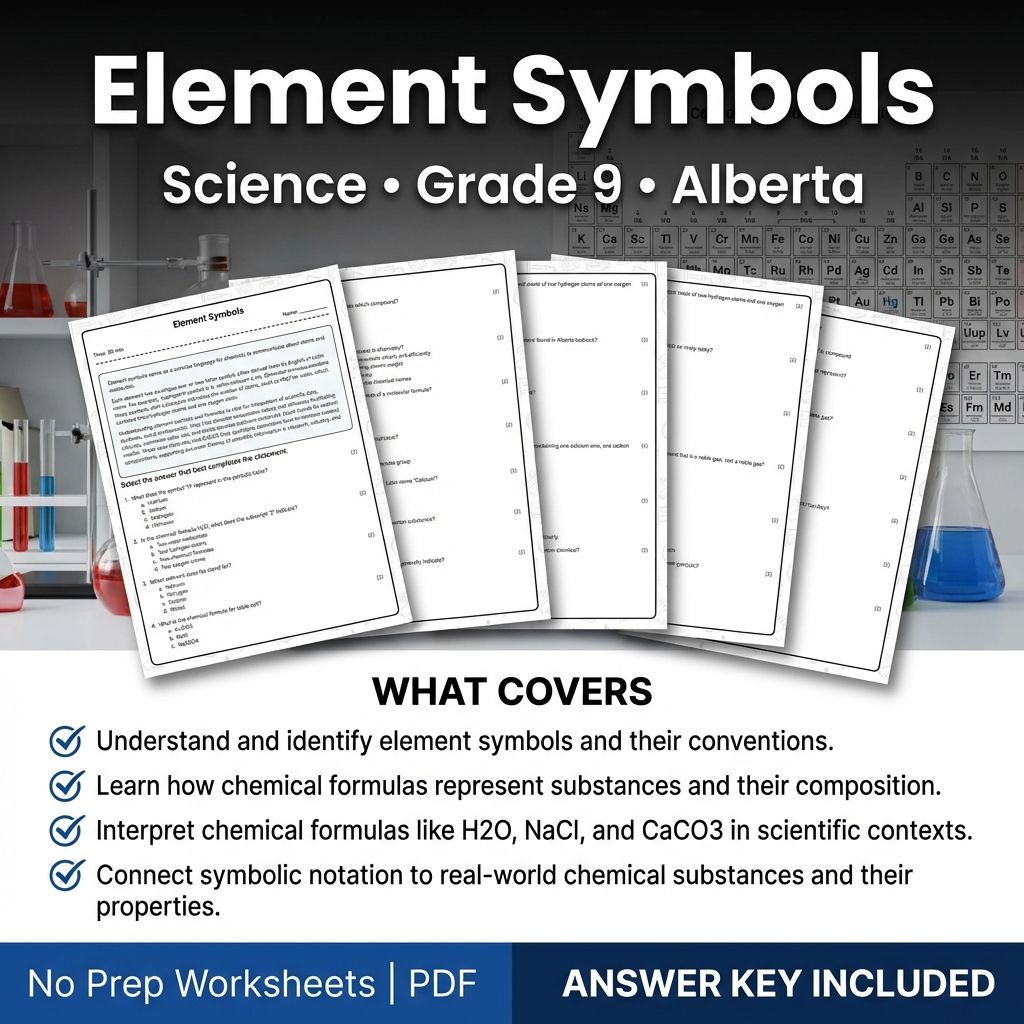
Element Symbols Worksheet Grade 9 Science | Alberta Standards
 Created byCoral Reef Learning
Learning Objectives
- Understand and identify element symbols and their conventions.
- Learn how chemical formulas represent substances and their composition.
- Interpret chemical formulas like H2O, NaCl, and CaCO3 in scientific contexts.
Instant download
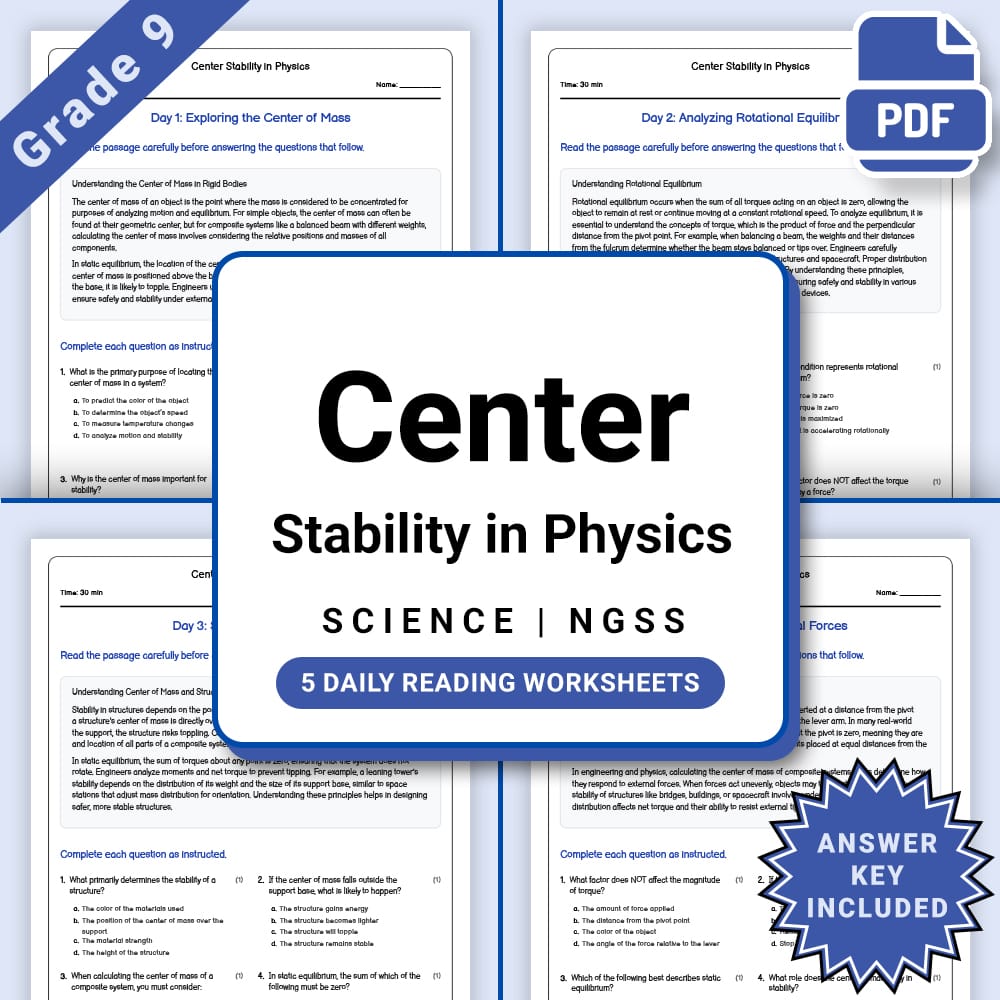
Grade 9 Science – Center Stability in Physics Worksheet(PDF + Answer Key)
 Created byCopper Leaf Classroom
Learning Objectives
- Understand key concepts related to Science
- Apply knowledge through practice questions
- Demonstrate comprehension of the material
Instant download
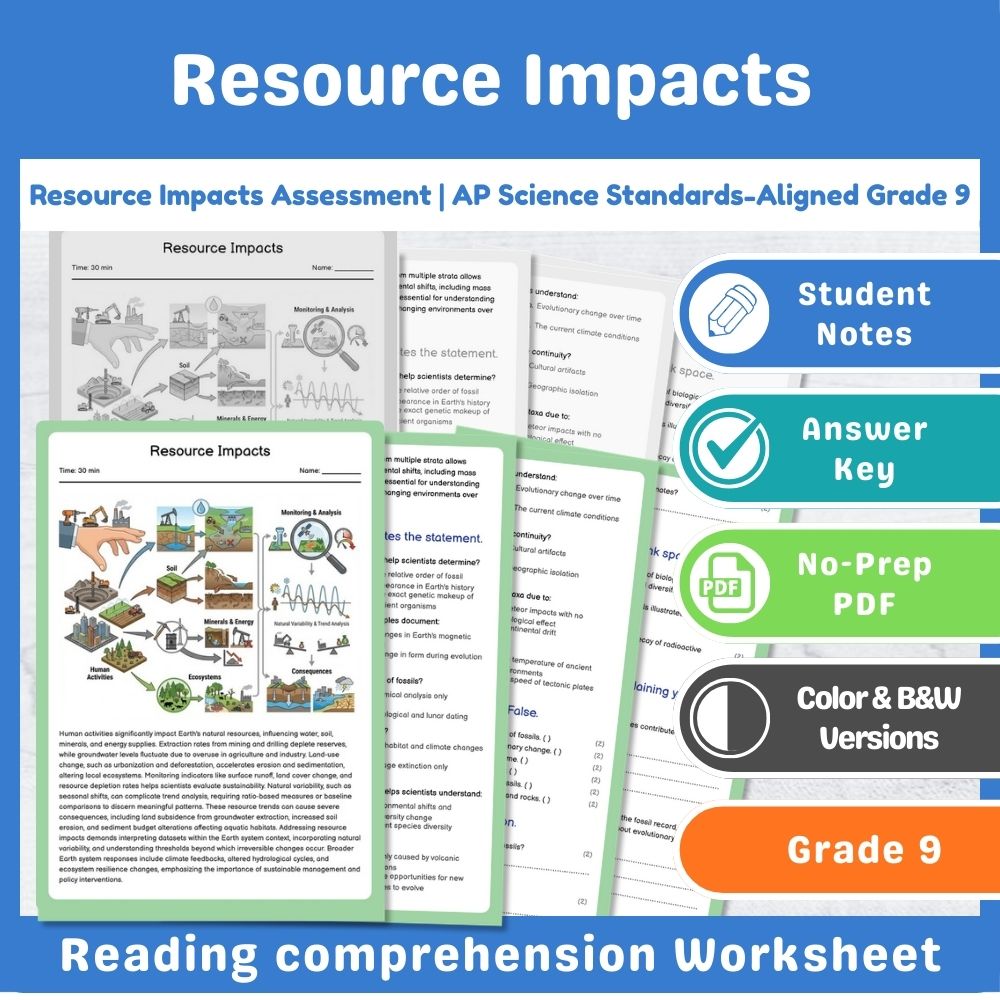
Resource Impacts Assessment | AP Science Standards-Aligned Grade 9
 Created byPrism Point Learning
Learning Objectives
- Evaluate how human activities affect Earth's water, soil, mineral, and energy resources using quantifiable indicators.
- Interpret resource trend data considering natural variability and system thresholds.
- Assess sustainability implications by comparing datasets and ratio measures.
Also included in: Grade 9 Science Mini Bundle | Earth and Space Sciences AP Standards
Instant download
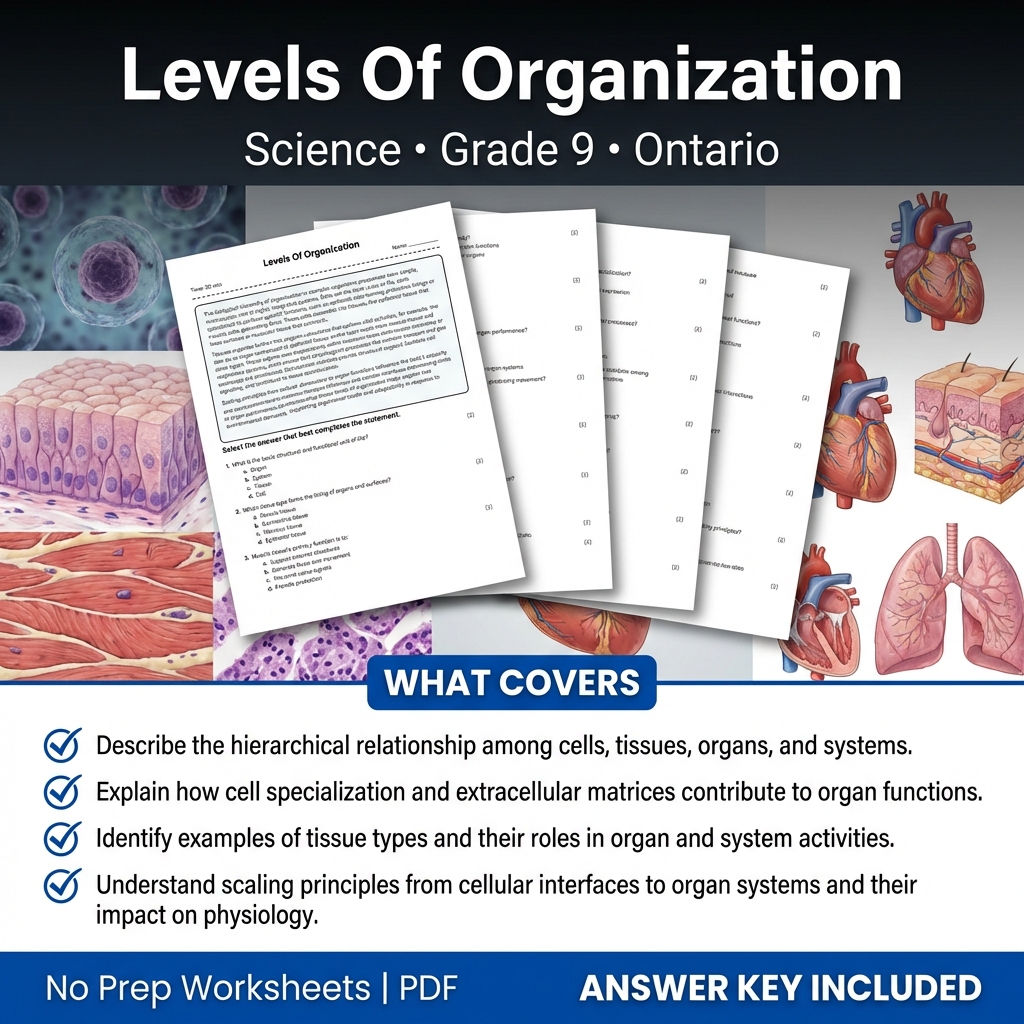
Levels Of Organization Worksheet for Grade 9 Science | Ontario Standards
Created byCoral Reef LearningLearning Objectives
- Describe the hierarchical relationship among cells, tissues, organs, and systems.
- Explain how cell specialization and extracellular matrices contribute to organ functions.
- Identify examples of tissue types and their roles in organ and system activities.
Instant download
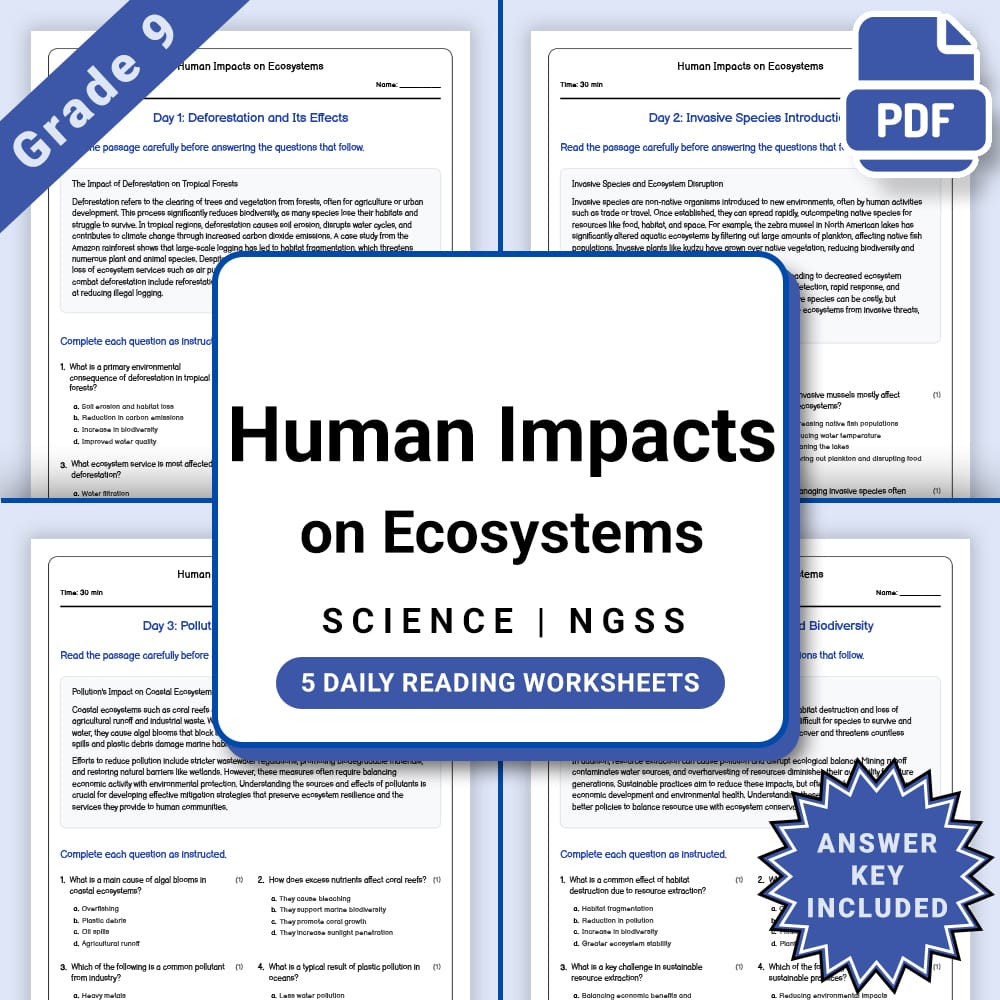
Grade 9 Science – Human Impacts on Ecosystems Worksheet(PDF + Answer Key)
Created byCopper Leaf ClassroomLearning Objectives
- Understand how land-use changes like deforestation impact biodiversity.
- Analyze case studies related to ecosystem degradation.
- Interpret empirical data from environmental case studies.
Instant download
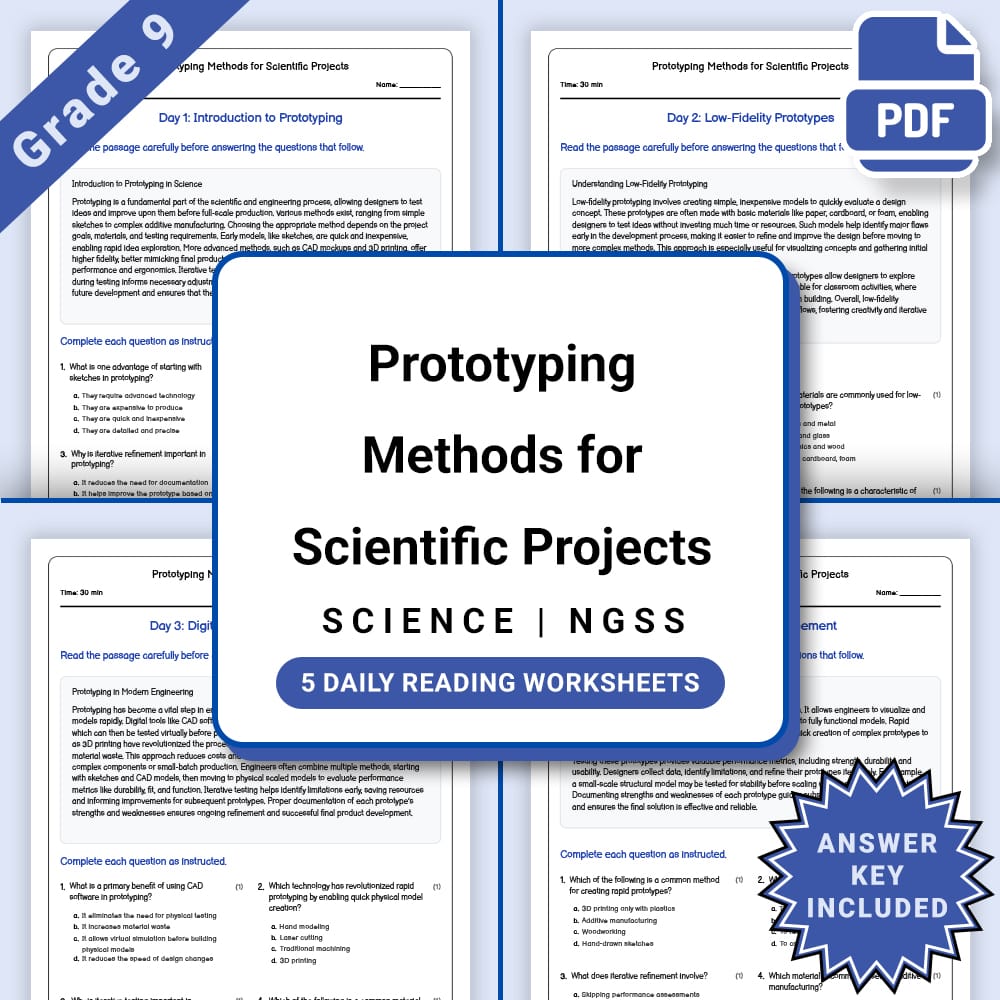
Grade 9 Science – Prototyping Methods Worksheet(PDF + Answer Key)
Created byCopper Leaf ClassroomLearning Objectives
- Understand different prototyping methods and their applications.
- Learn how to select appropriate fidelity levels and materials for prototypes.
- Recognize the importance of iterative testing and documentation in prototyping processes.
Instant download

Atomic Structure Worksheet | NGSS Grade 9 Science Assessment
 Created byCedar Grove Learning
Learning Objectives
- Describe the fundamental particles that make up atoms, including protons, neutrons, and electrons.
- Explain electron configurations and how they relate to atomic properties and periodic table organization.
- Analyze models of atomic structure to predict properties such as metallic character and electronegativity.
Instant download
Browse more categories
About Grade 9 Worksheets
Browse 9,322 printable Grade 9 worksheets across algebra, biology, literature, and history — each a ready-to-print PDF with optional answer keys.
Every worksheet on MyTeachingSheets is created by independent teacher-authors and reviewed before publication. All resources download as printable PDFs for classroom, homework, or at-home practice, and many include answer keys. Preview any worksheet free before buying.