
Grade 9 Worksheets
9,323 grade resources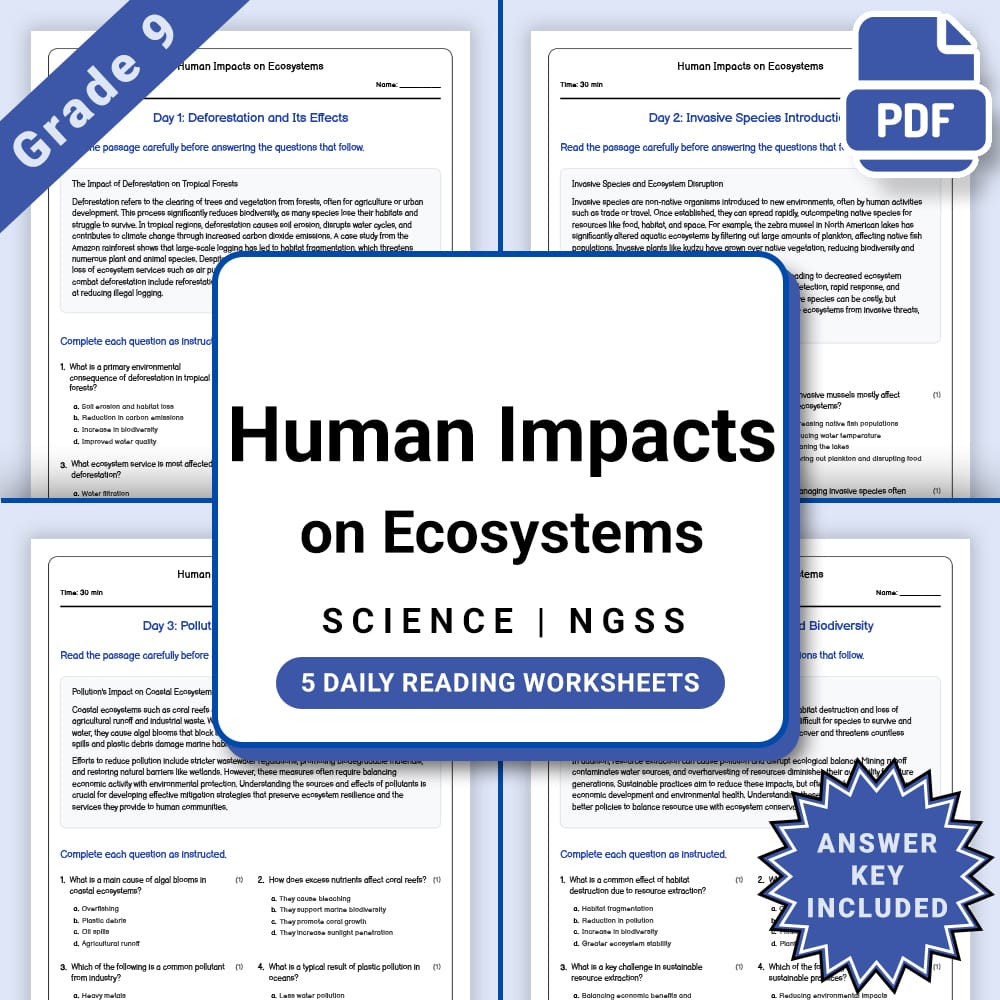
Grade 9 Science – Human Impacts on Ecosystems Worksheet(PDF + Answer Key)
 Created byCopper Leaf Classroom
Learning Objectives
- Understand how land-use changes like deforestation impact biodiversity.
- Analyze case studies related to ecosystem degradation.
- Interpret empirical data from environmental case studies.
Instant download
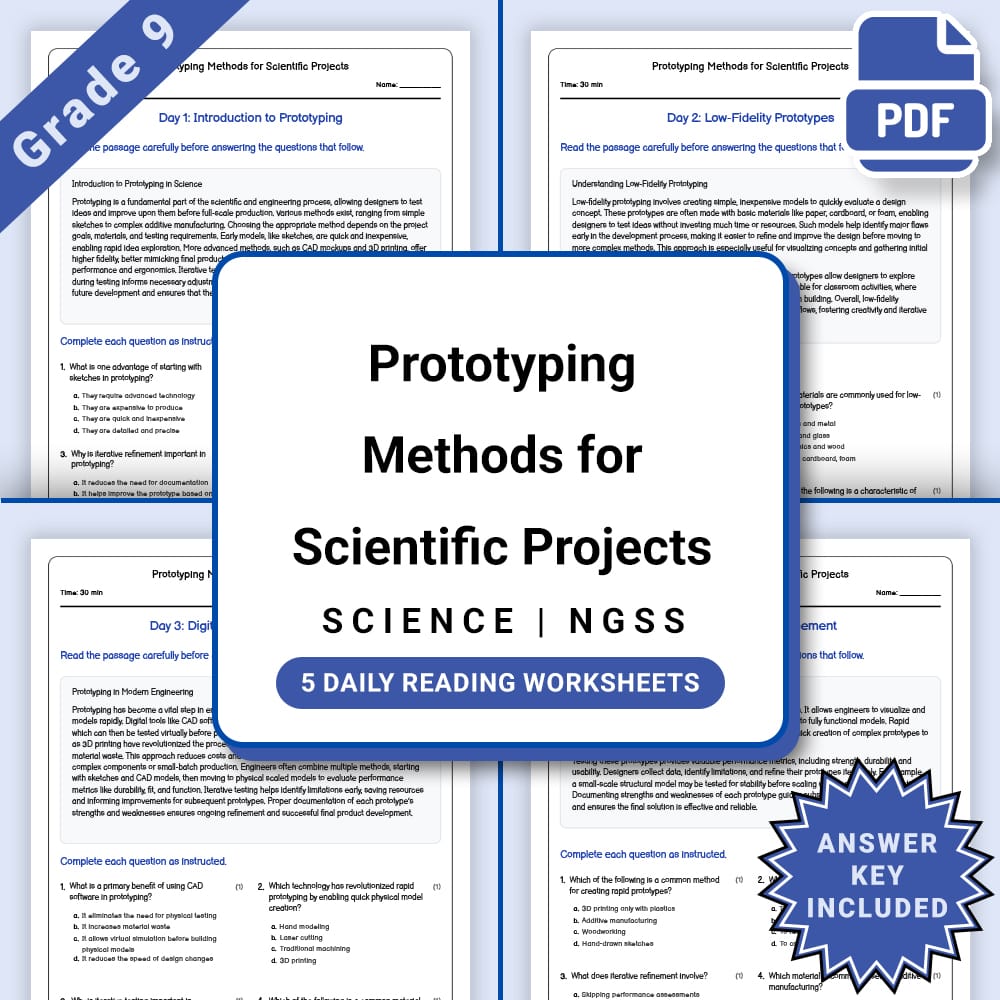
Grade 9 Science – Prototyping Methods Worksheet(PDF + Answer Key)
Created byCopper Leaf ClassroomLearning Objectives
- Understand different prototyping methods and their applications.
- Learn how to select appropriate fidelity levels and materials for prototypes.
- Recognize the importance of iterative testing and documentation in prototyping processes.
Instant download

Atomic Structure Worksheet | NGSS Grade 9 Science Assessment
 Created byCedar Grove Learning
Learning Objectives
- Describe the fundamental particles that make up atoms, including protons, neutrons, and electrons.
- Explain electron configurations and how they relate to atomic properties and periodic table organization.
- Analyze models of atomic structure to predict properties such as metallic character and electronegativity.
Instant download
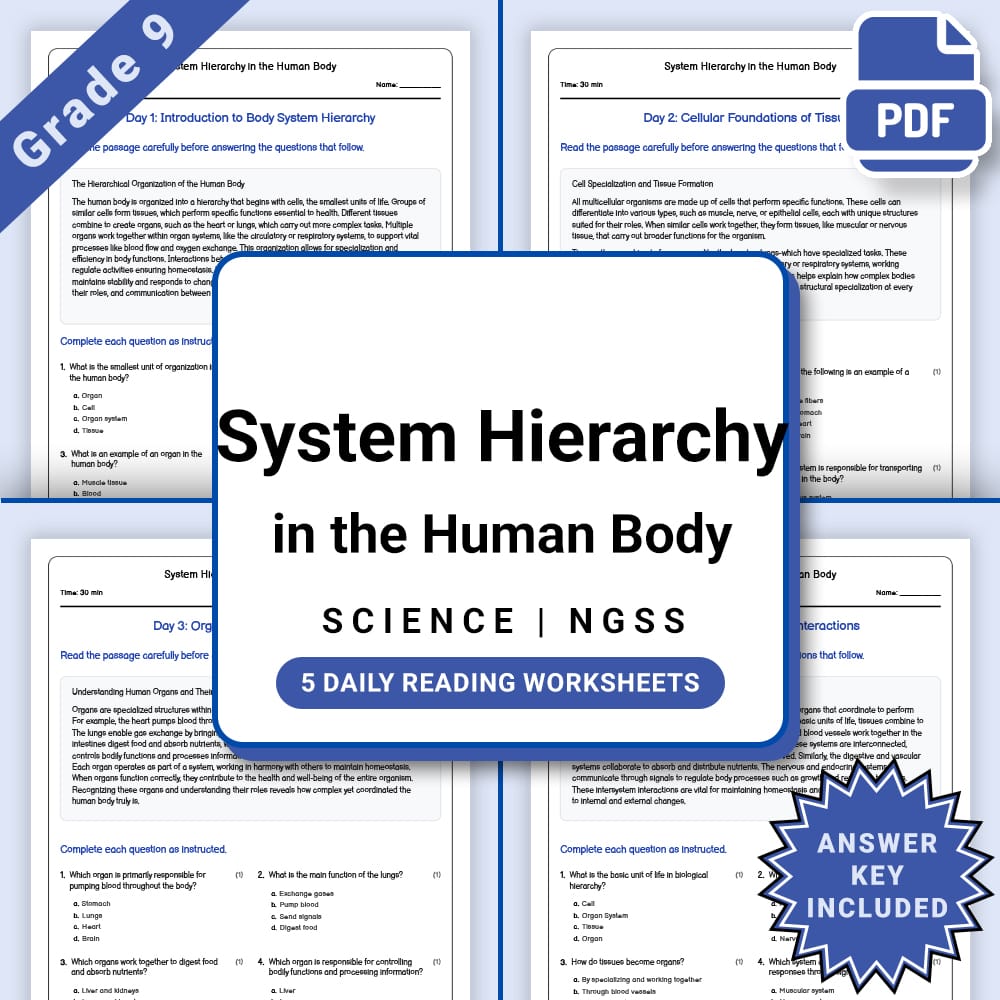
Grade 9 Science – Human Body System Hierarchy Worksheet(PDF + Answer Key)
Created byCopper Leaf ClassroomLearning Objectives
- Understand key concepts related to Science
- Apply knowledge through practice questions
- Demonstrate comprehension of the material
Instant download
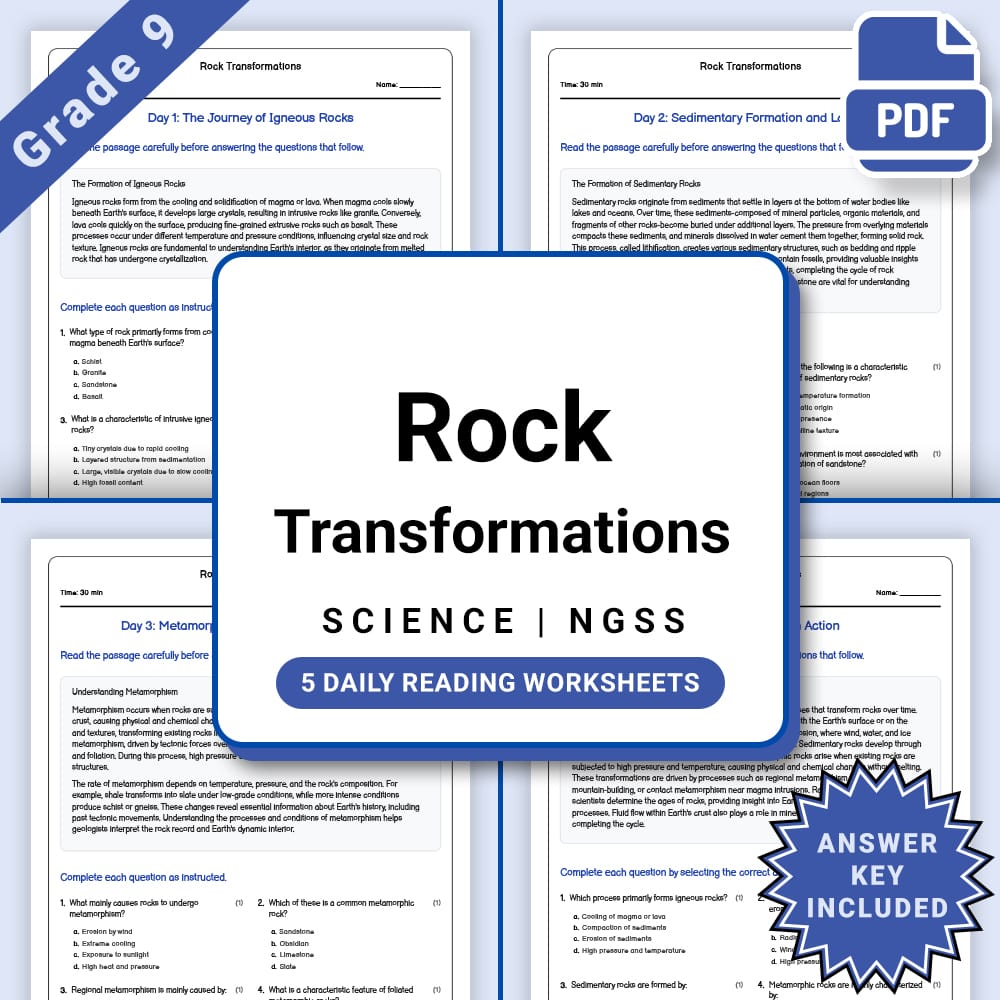
Grade 9 Science Rock Transformations Worksheet(PDF + Answer Key)
Created byCopper Leaf ClassroomLearning Objectives
- Describe the processes involved in the formation of igneous, sedimentary, and metamorphic rocks.
- Explain how different rock types transition from one to another in the rock cycle.
- Identify examples of rocks generated through melting, erosion, compaction, and metamorphism.
Instant download

Energy Systems Worksheet | NGSS Grade 9 Science Assessment
 Created bySkylark Worksheets
Learning Objectives
- Evaluate energy system transition pathways by comparing reliability, affordability, and greenhouse gas (GHG) reduction goals.
- Apply life-cycle greenhouse gas accounting to compare energy sources beyond tailpipe or stack emissions.
- Analyze how renewables integration, energy storage, grid capacity, and carbon capture affect emissions and environmental impacts.
Also included in: Grade 9 Science Full-Year Bundle | NGSS Worksheets & Assessments
Instant download
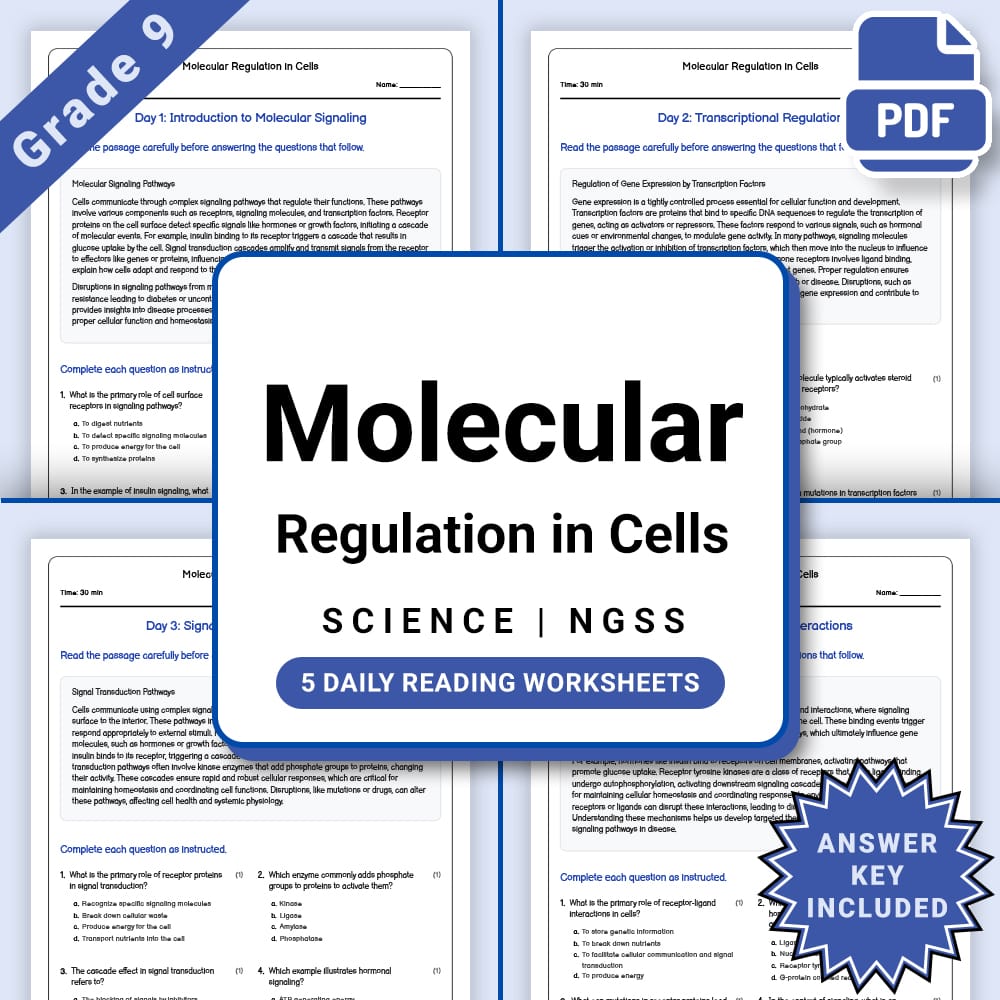
Grade 9 Science – Molecular Regulation in Cells Worksheet(PDF + Answer Key)
Created byCopper Leaf ClassroomLearning Objectives
- Identify key components involved in molecular signaling pathways.
- Understand how signal transduction cascades influence gene expression.
- Explain mechanisms of hormonal and receptor-ligand signaling.
Instant download
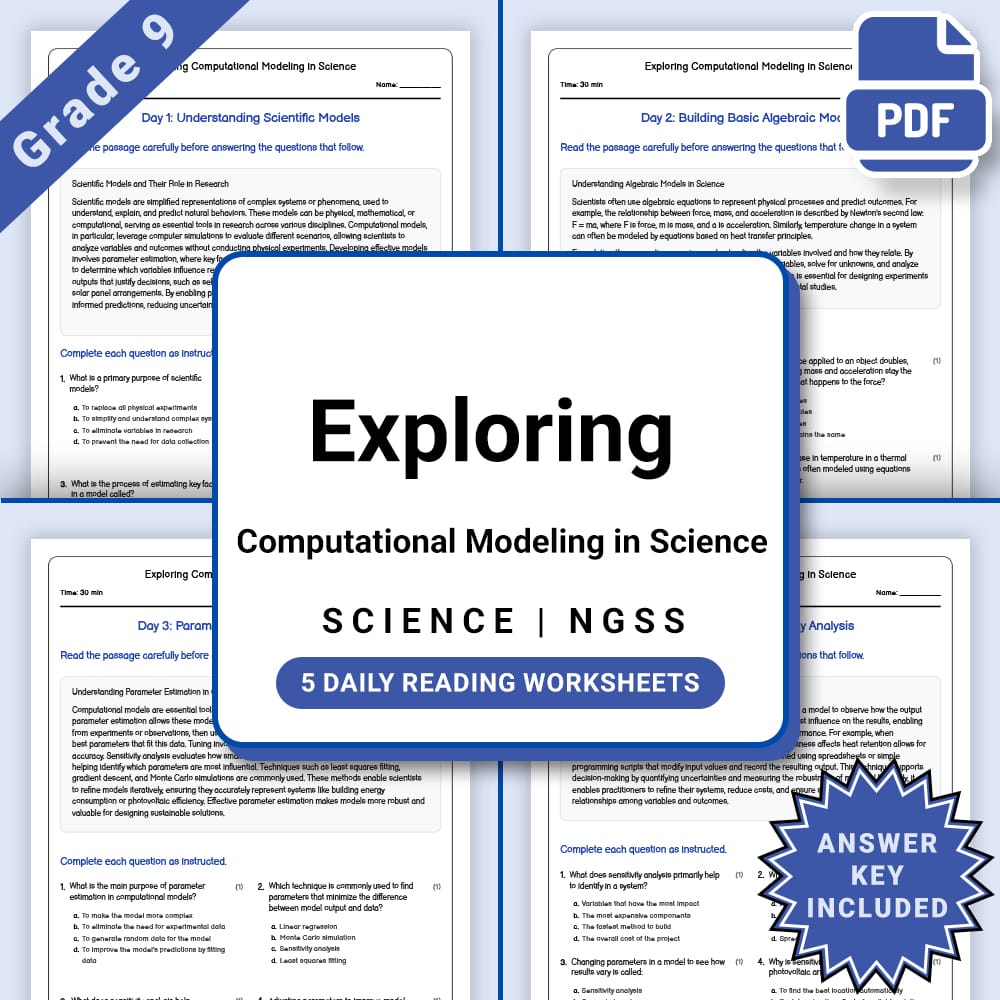
Grade 9 Science – Exploring Computational Modeling Worksheet(PDF + Answer Key)
Created byCopper Leaf ClassroomLearning Objectives
- Understand the concept of scientific models and their purpose.
- Identify how mathematical and computational methods are used in scientific modeling.
- Recognize the components involved in developing performance objective functions and sensitivity analysis.
Instant download
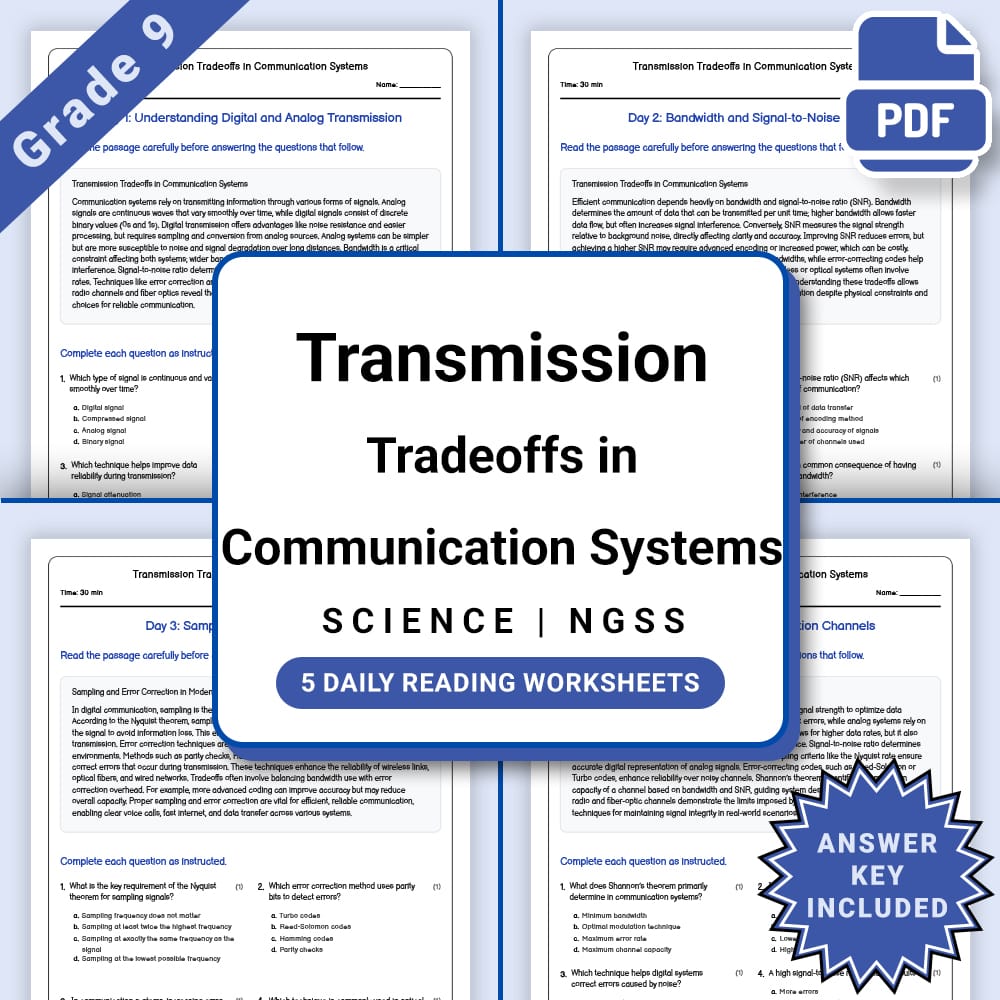
Grade 9 Science Transmission Tradeoffs in Communication Systems(PDF + Answers)
Created byCopper Leaf ClassroomLearning Objectives
- Understand the differences between digital and analog signals.
- Learn how bandwidth and signal-to-noise ratio affect data transmission.
- Explore sampling criteria and error-correcting techniques used in communication.
Instant download
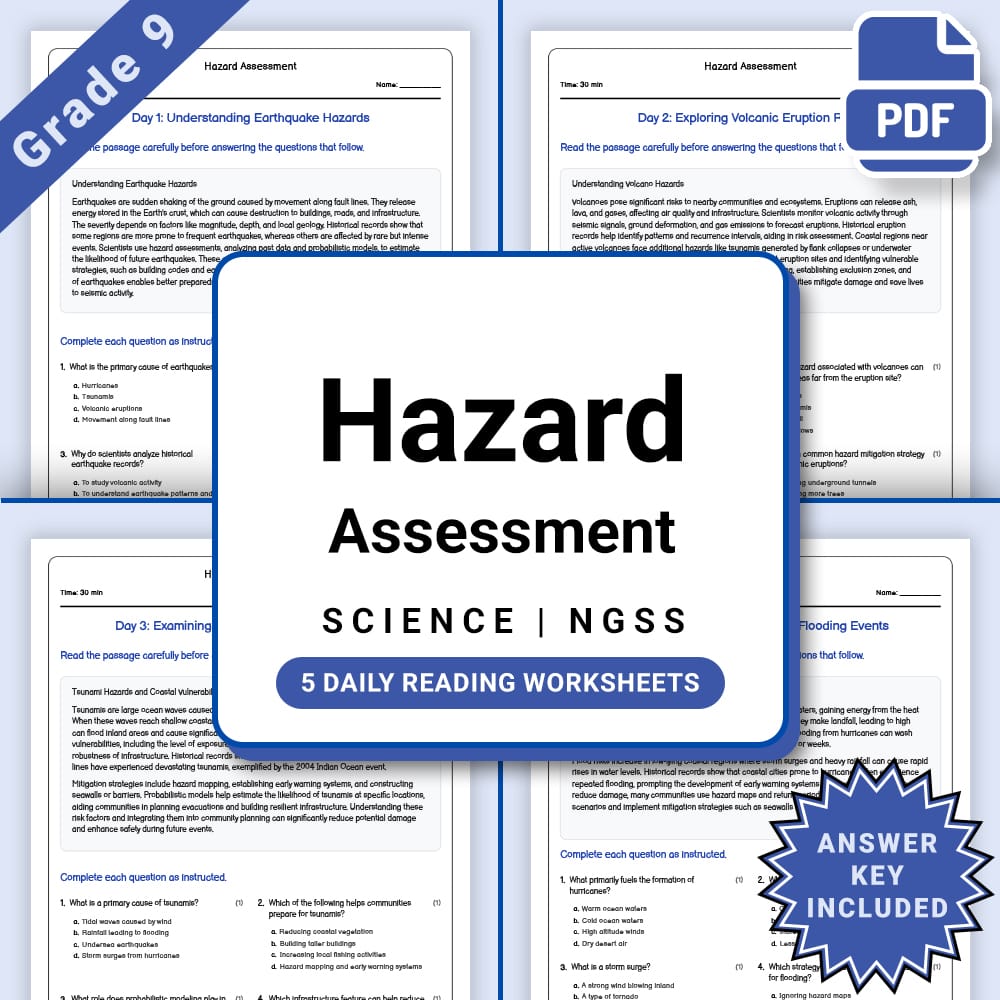
Grade 9 Science – Hazard Assessment Daily Worksheet(PDF + Answer Key)
Created byCopper Leaf ClassroomLearning Objectives
- Understand the causes and effects of earthquakes and related hazards.
- Learn to evaluate hazard risks through data analysis and modeling.
- Explore case studies involving natural hazard impacts on communities.
Instant download
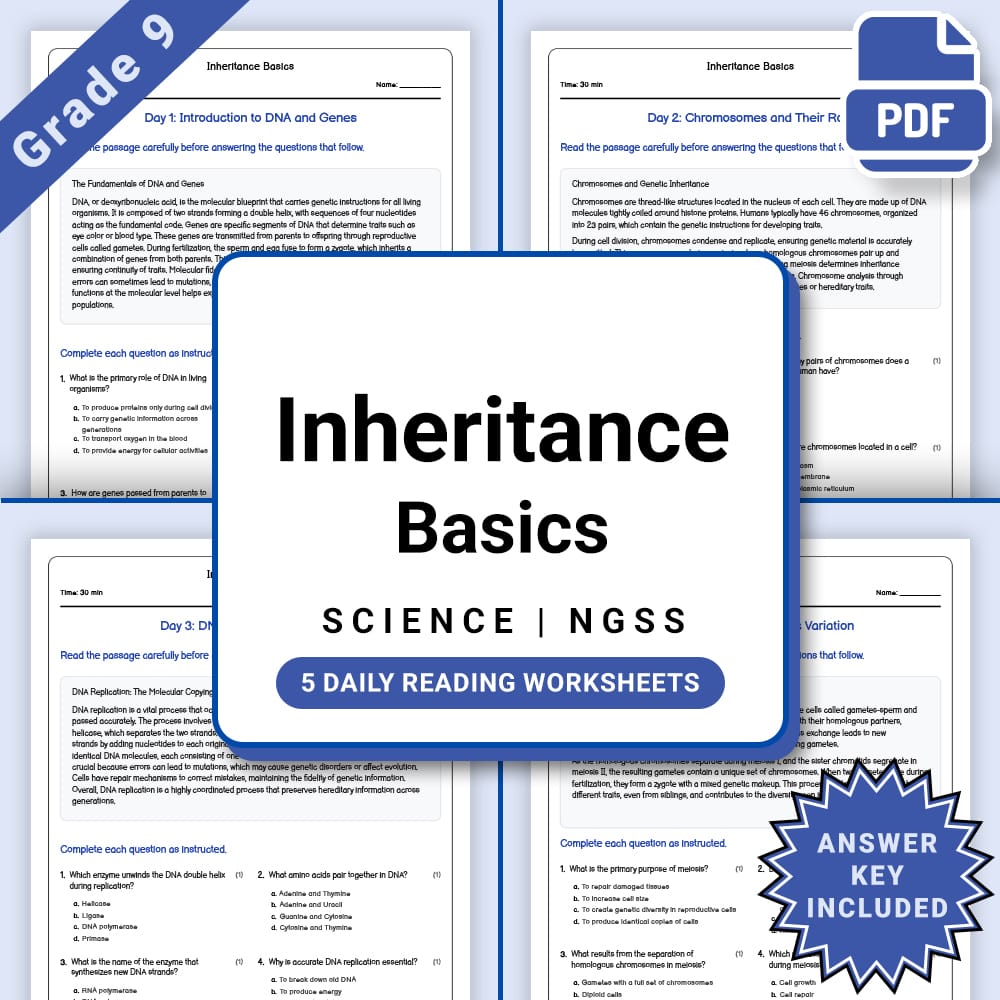
Grade 9 Science – Inheritance Basics Worksheet(PDF + Answer Key)
Created byCopper Leaf ClassroomLearning Objectives
- Understand the structure and function of DNA
- Learn how genes are transmitted through reproduction
- Explore the processes of DNA replication and chromosomal segregation
Instant download
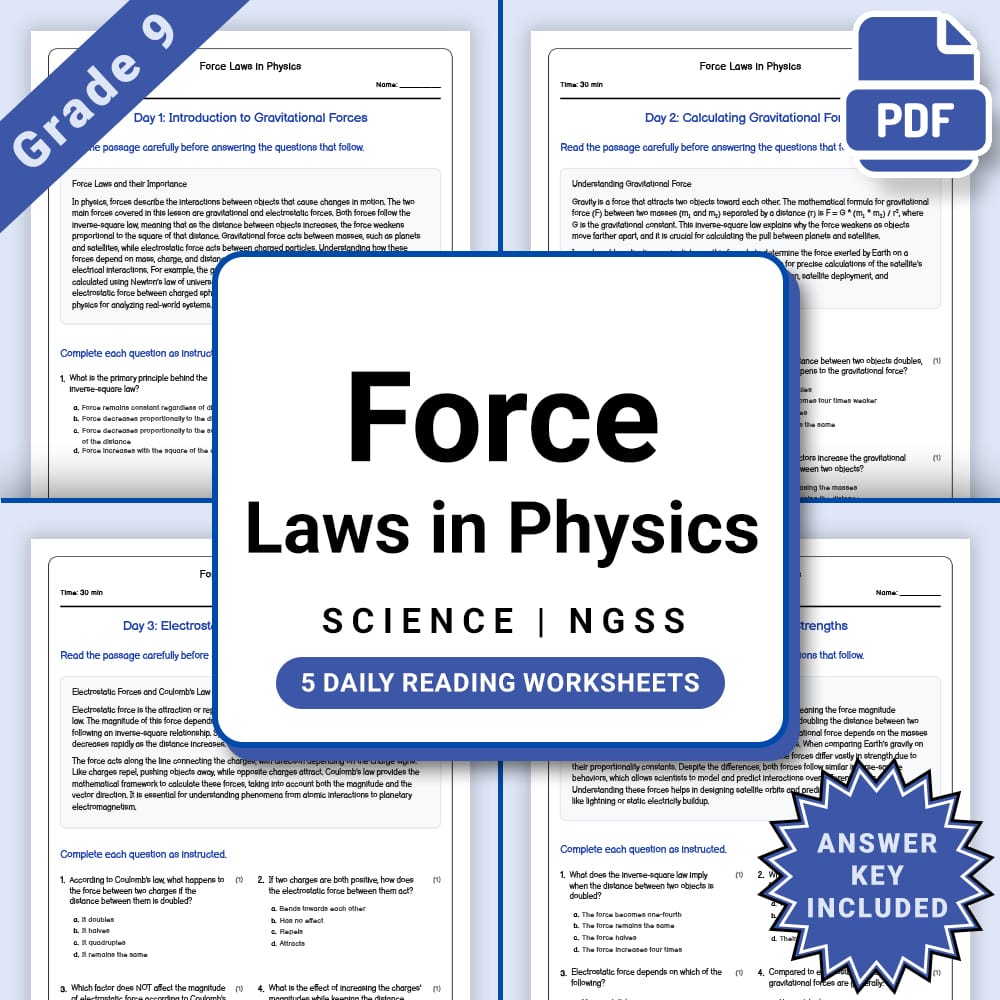
Grade 9 Science – Force Laws Daily Reading Worksheet(PDF + Answer Key)
Created byCopper Leaf ClassroomLearning Objectives
- Understand the concept of gravitational and electrostatic forces.
- Learn the inverse-square law and its impact on force magnitude.
- Apply mathematical formulas to calculate forces between objects.
Instant download
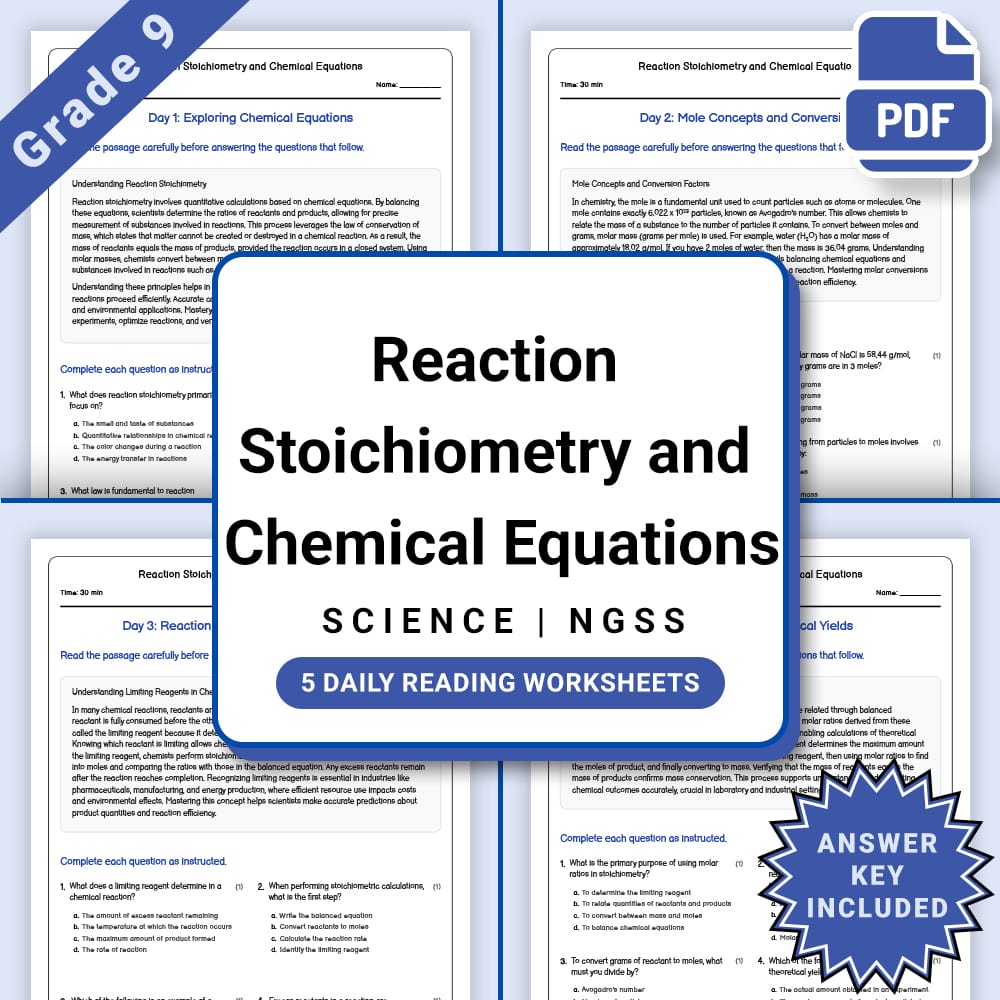
Grade 9 Science – Reaction Stoichiometry Worksheet(PDF + Answer Key)
Created byCopper Leaf ClassroomLearning Objectives
- Understand key concepts related to Science
- Apply knowledge through practice questions
- Demonstrate comprehension of the material
Instant download
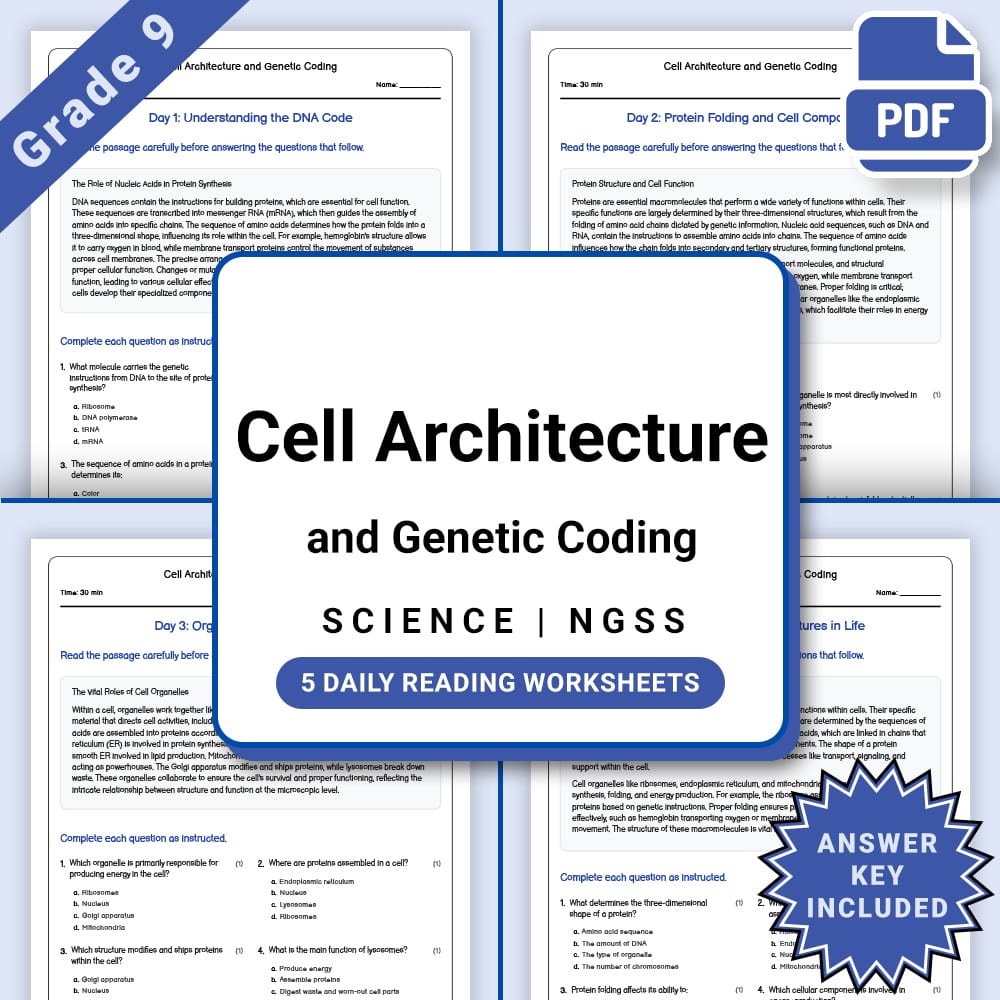
Grade 9 Science – Cell Architecture and Genetic Coding Worksheet(PDF + Answers)
Created byCopper Leaf ClassroomLearning Objectives
- Understand how nucleic acid sequences determine amino acid chains
- Learn how protein folding influences cell structures
- Explore the relationship between molecular coding and organelle architecture
Instant download
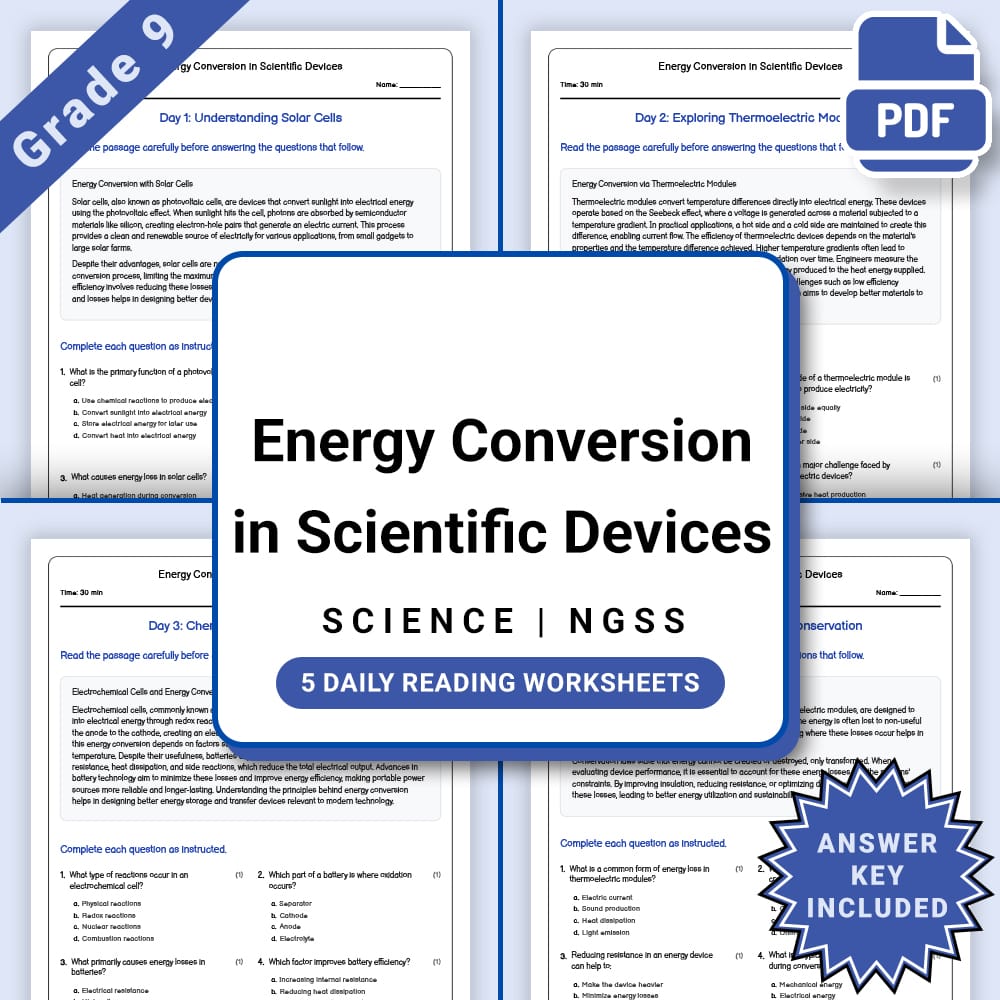
Grade 9 Science – Energy Conversion Devices Worksheet(PDF + Answer Key)
Created byCopper Leaf ClassroomLearning Objectives
- Understand how photovoltaic cells convert solar energy into electrical energy.
- Identify the process and limitations of energy conversion devices.
- Analyze the concept of energy efficiency and losses during energy transformation.
Instant download
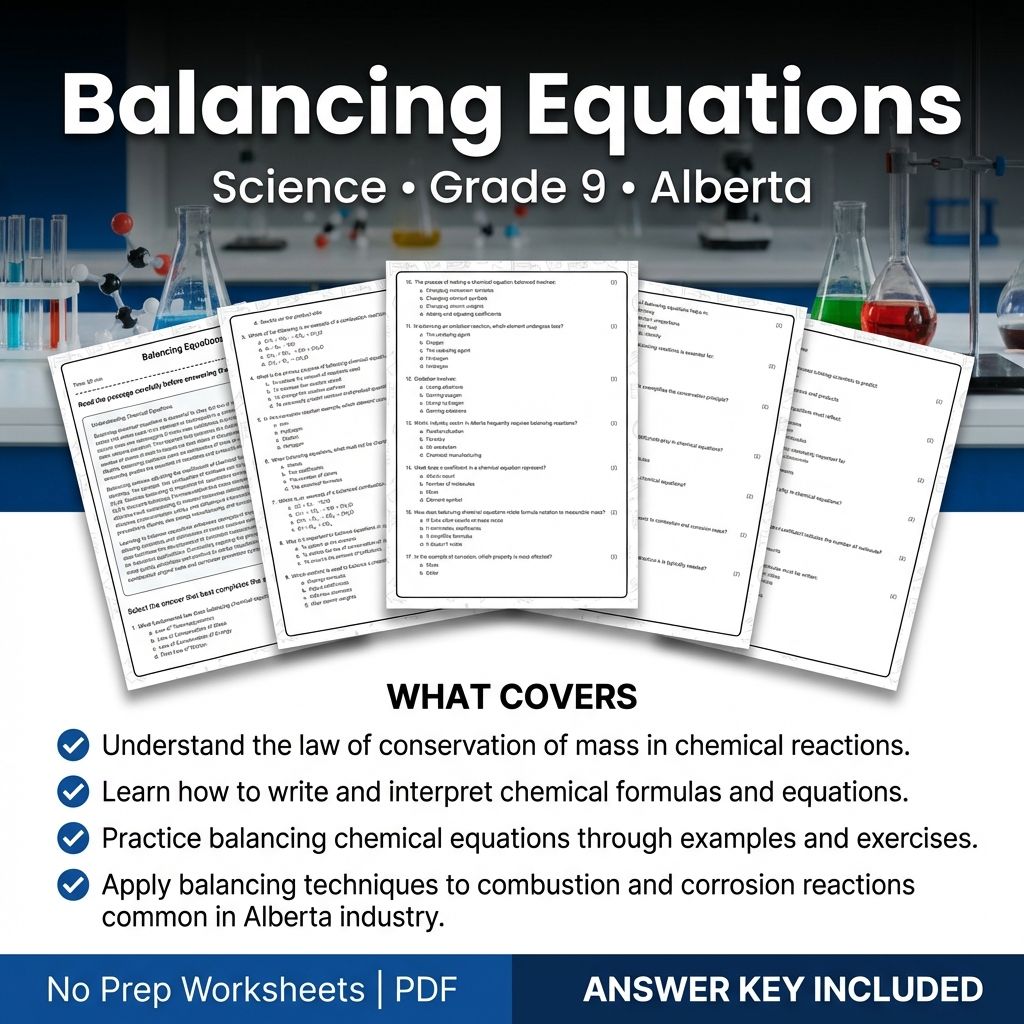
Grade 9 Science Worksheet on Balancing Equations | Alberta Standards
 Created byCoral Reef Learning
Learning Objectives
- Understand the law of conservation of mass in chemical reactions.
- Learn how to write and interpret chemical formulas and equations.
- Practice balancing chemical equations through examples and exercises.
Instant download
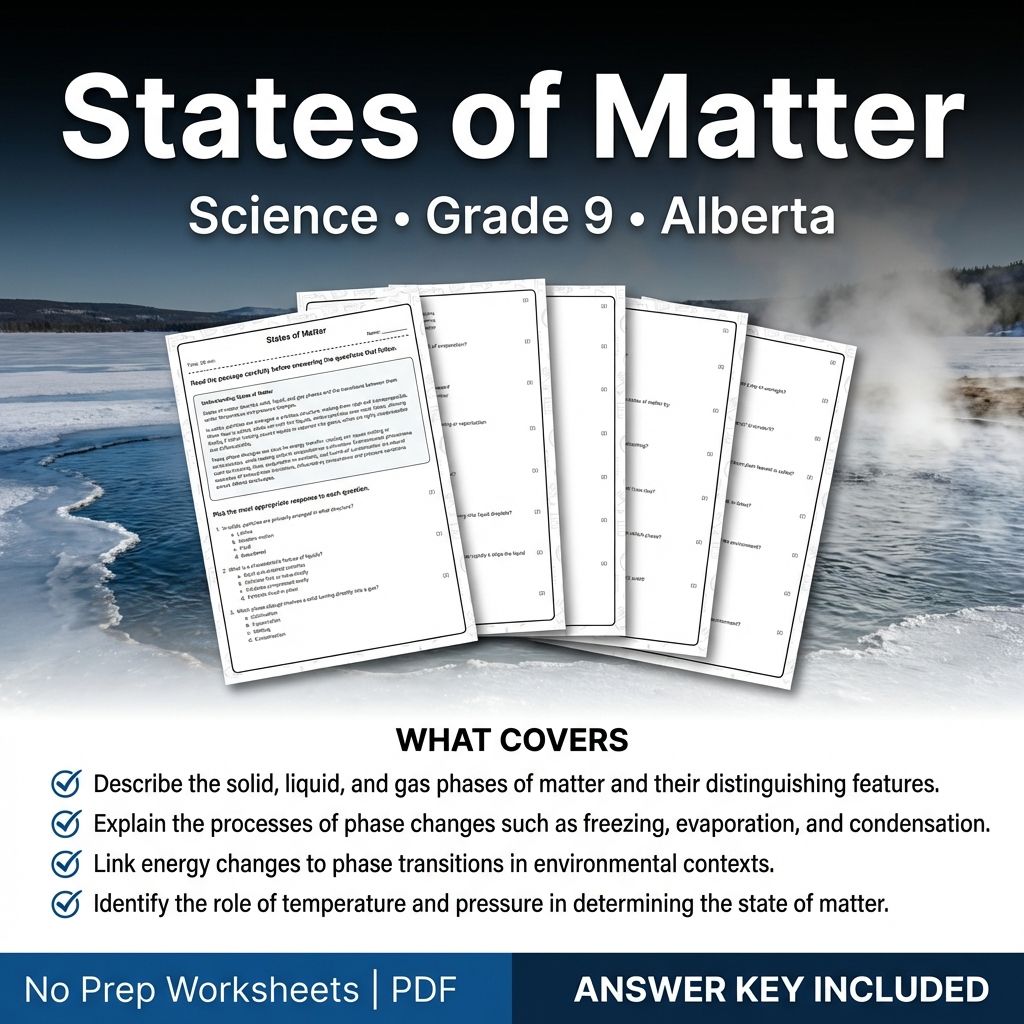
States of Matter Worksheet for Grade 9 Science | Alberta Standards
Created byCoral Reef LearningLearning Objectives
- Describe the solid, liquid, and gas phases of matter and their distinguishing features.
- Explain the processes of phase changes such as freezing, evaporation, and condensation.
- Link energy changes to phase transitions in environmental contexts.
Instant download
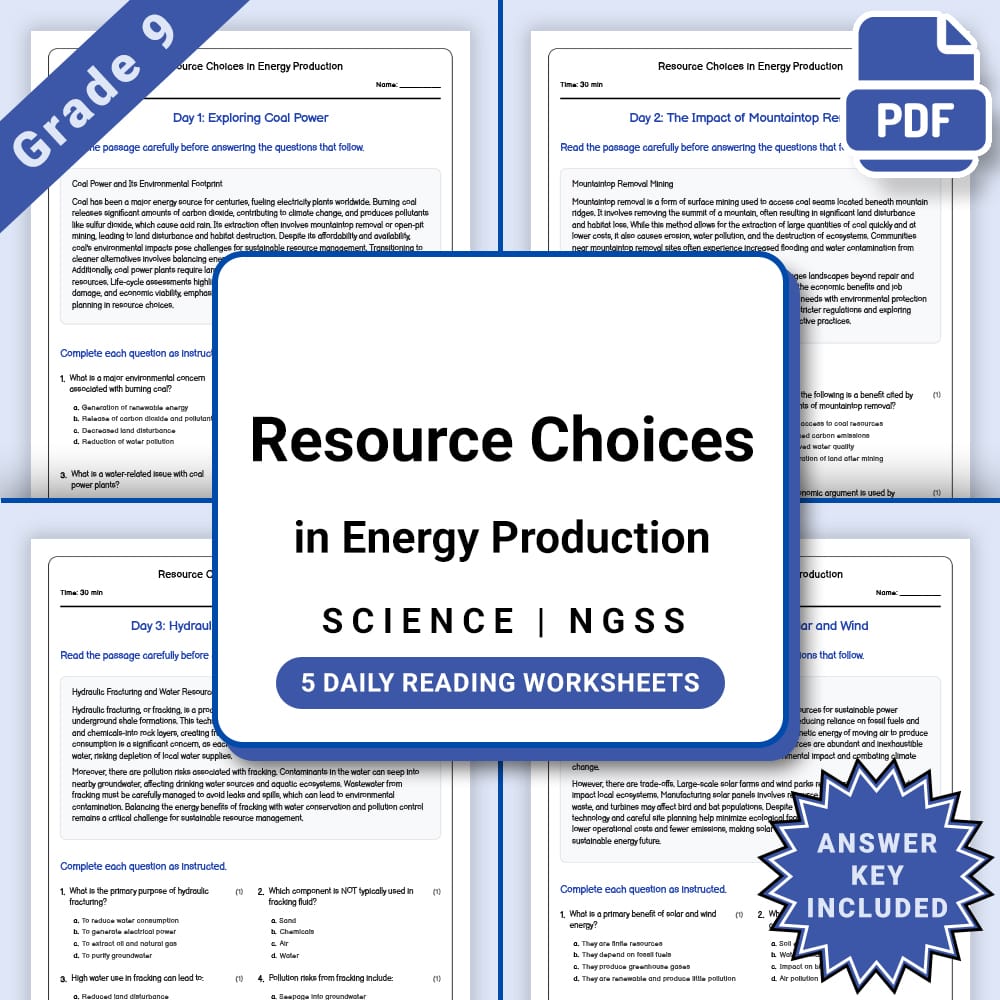
Grade 9 Science - Resource Choices in Energy Production Worksheet(PDF + Answers)
Created byCopper Leaf ClassroomLearning Objectives
- Understand the environmental impacts of different resource extraction and energy production methods.
- Compare the trade-offs between renewable and non-renewable energy sources.
- Analyze the life-cycle and sustainability considerations of resource management decisions.
Instant download
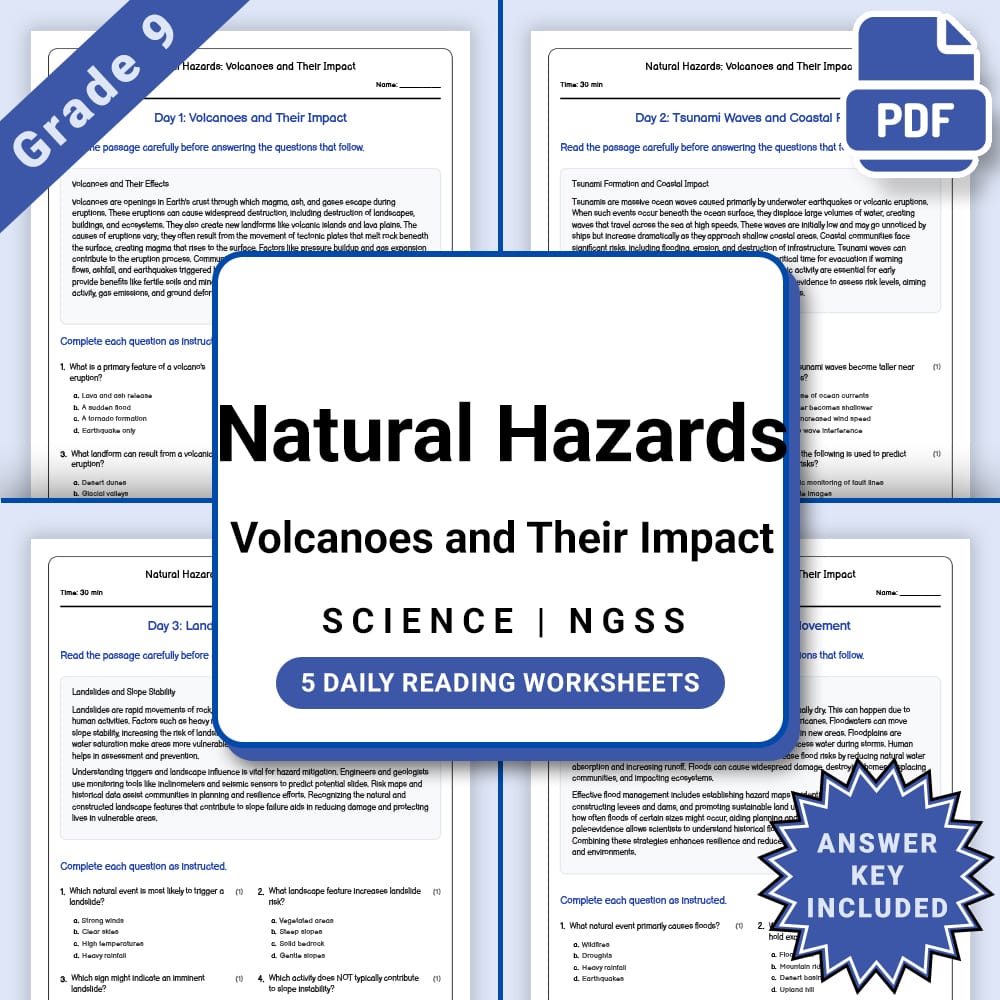
Grade 9 Science – Natural Hazards Volcanoes Worksheet(PDF + Answer Key)
Created byCopper Leaf ClassroomLearning Objectives
- Identify key volcanic hazards and their effects.
- Understand the causes of volcanic eruptions.
- Analyze how volcanoes influence landscapes and communities.
Instant download

Family Foundations | Grade 9 Holiday Worksheet | Reading & Comprehension
Created byCedar Grove LearningLearning Objectives
- Compare diverse family structures (extended, nuclear, single-parent) and explain how they function in communities
- Describe how families shape identity through cultural values, stories, and everyday responsibilities
- Practice empathy and respect by recognizing common values across different family experiences
Instant download
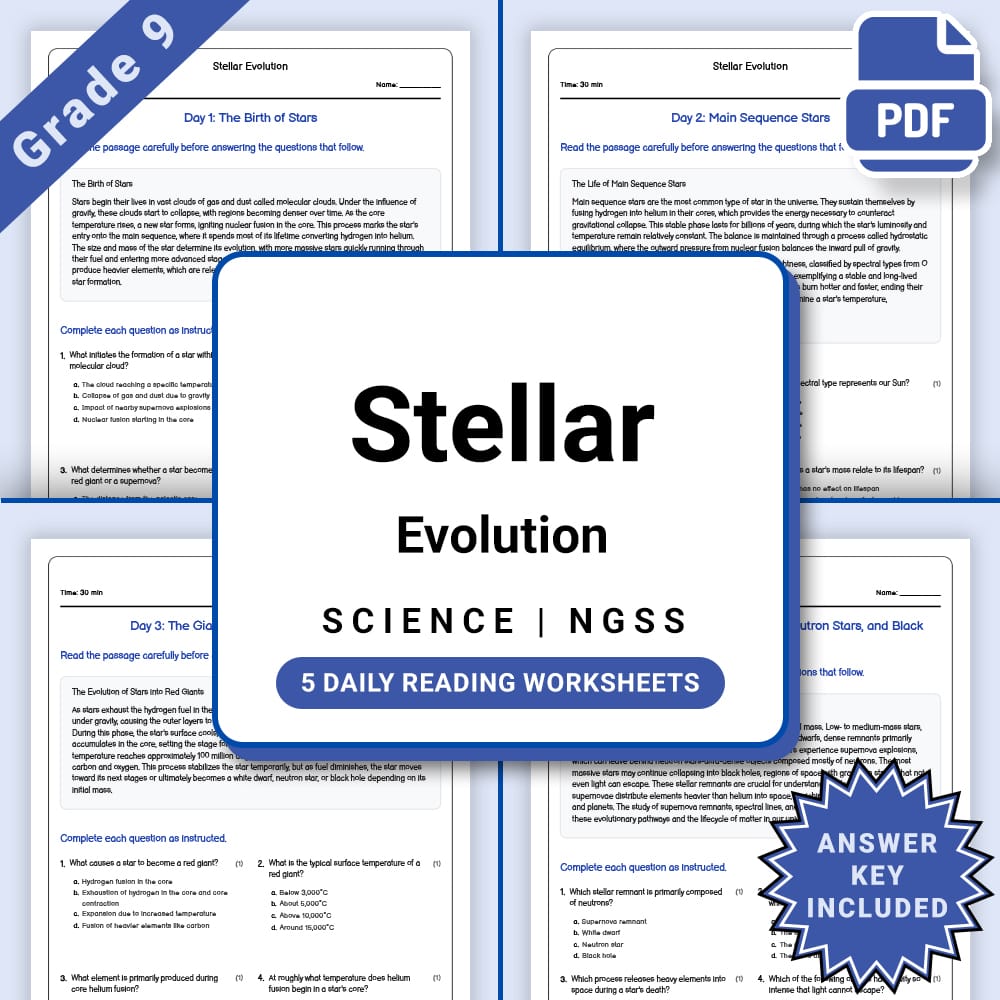
Grade 9 Science – Stellar Evolution Worksheet(PDF + Answer Key)
Created byCopper Leaf ClassroomLearning Objectives
- Understand the stages of star formation and evolution
- Identify key features of stellar life cycles from gas clouds to final remnants
- Interpret Hertzsprung-Russell diagrams and spectral classifications
Instant download
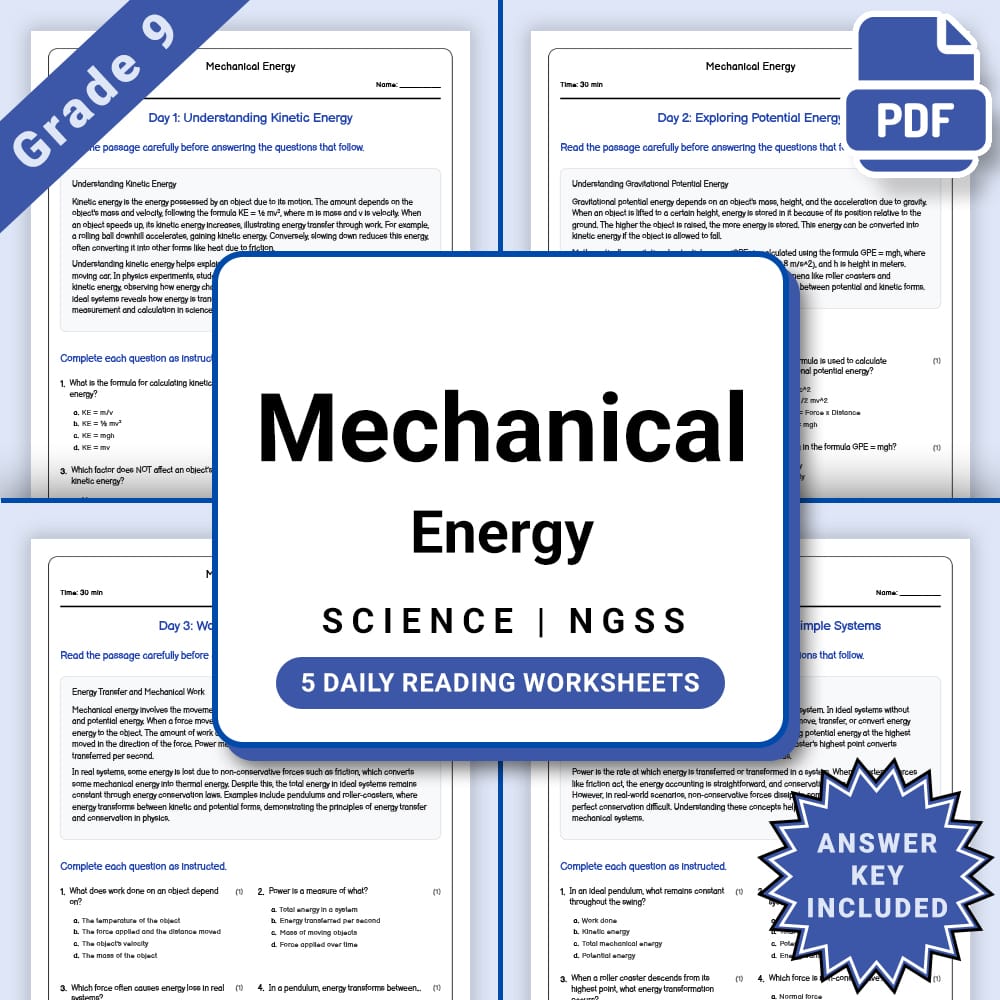
Grade 9 Science – Mechanical Energy Worksheet(PDF + Answer Key)
Created byCopper Leaf ClassroomLearning Objectives
- Understand the concepts of kinetic and potential energy
- Calculate kinetic energy of moving objects
- Recognize the relationship between height, mass, and gravitational potential energy
Instant download
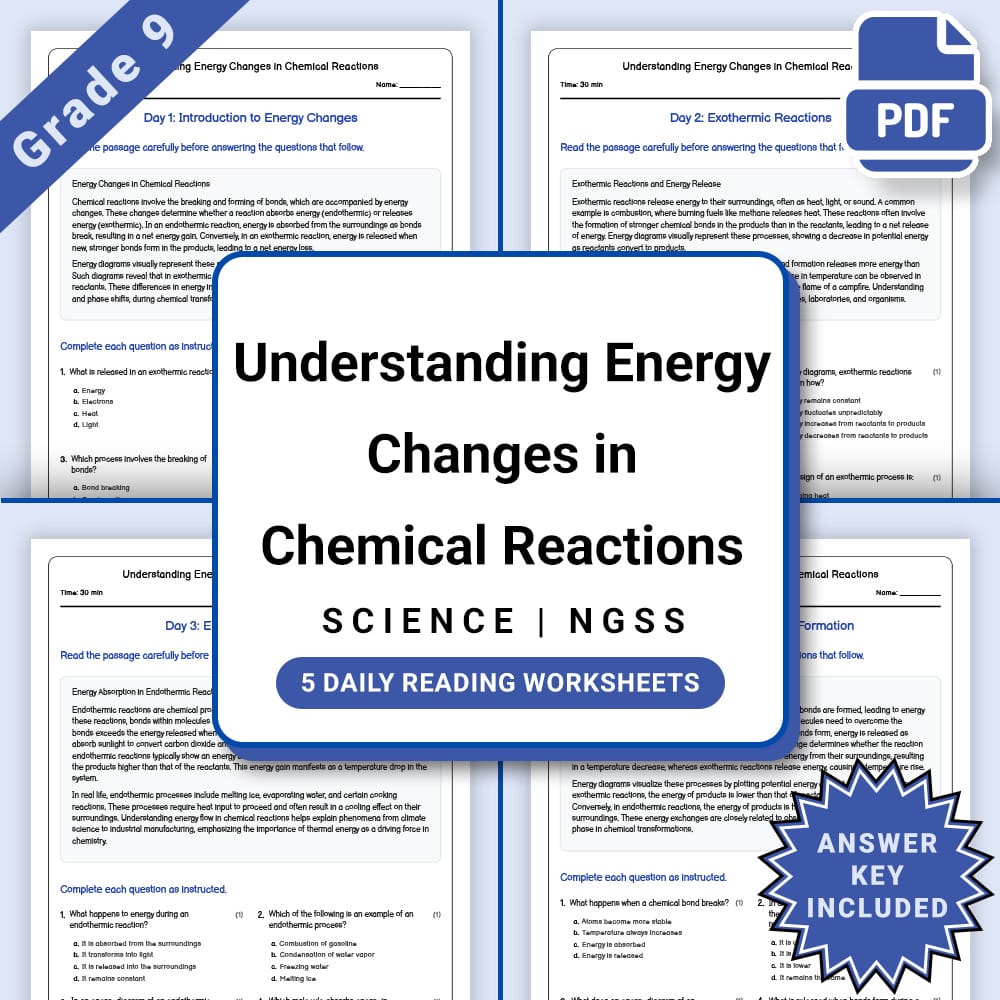
Grade 9 Science – Understanding Energy Changes Worksheet(PDF + Answer Key)
Created byCopper Leaf ClassroomLearning Objectives
- Define endothermic and exothermic reactions based on energy flow.
- Describe how bond breaking and formation influence energy changes.
- Interpret energy diagrams to connect molecular interactions with observable phenomena.
Instant download
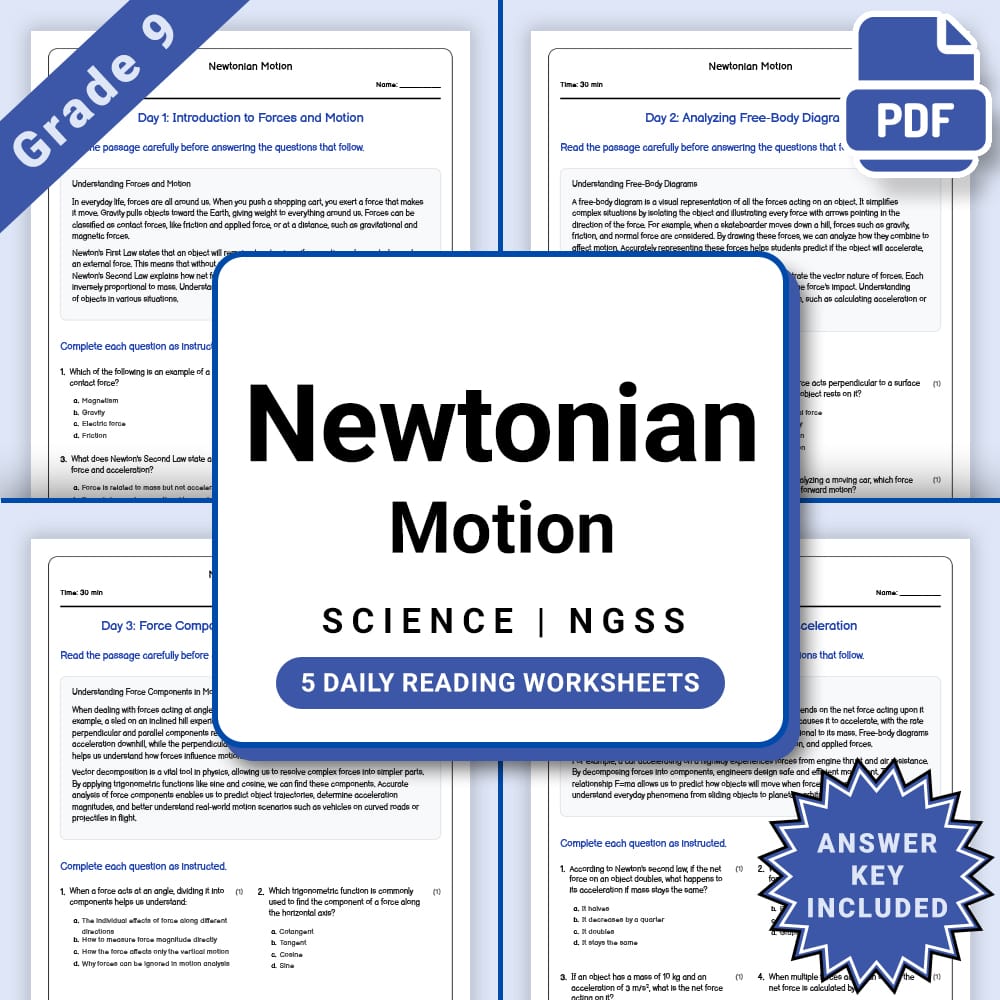
Grade 9 Science – Newtonian Motion Worksheet(PDF + Answer Key)
Created byCopper Leaf ClassroomLearning Objectives
- Understand the basic forces involved in motion, such as gravity and applied force.
- Describe how forces affect the movement of objects using free-body diagrams.
- Analyze the relationship between net force and acceleration based on Newton's laws.
Instant download
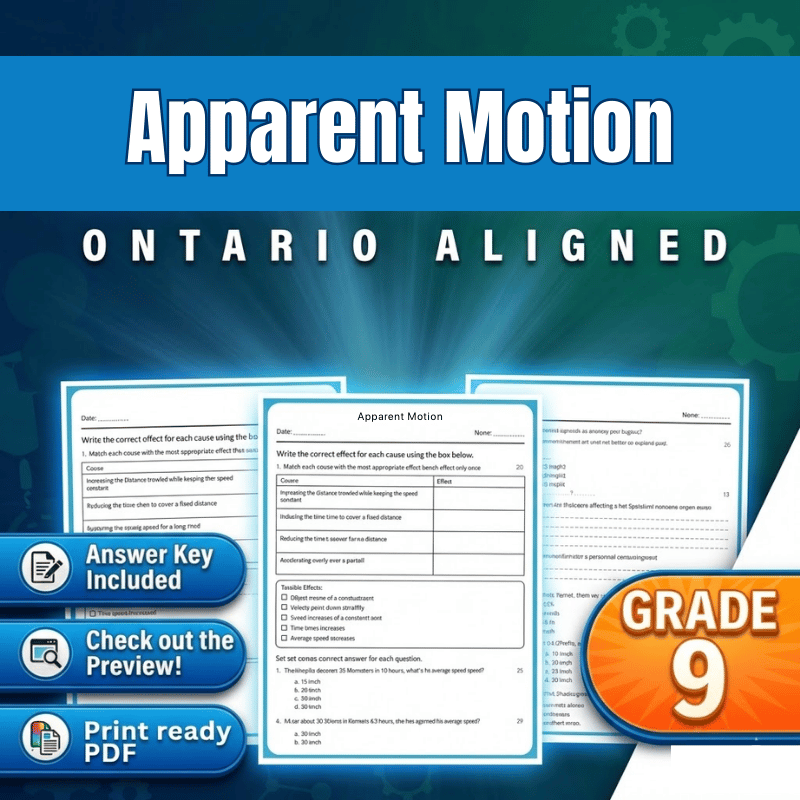
Grade 9 Science – Apparent Motion Worksheet (Ontario) (PDF)
 Created byBright Mind Resources
Learning Objectives
- Explain the causes of apparent diurnal and annual motion of celestial objects as viewed from Earth.
- Describe how Earth's rotation and revolution create observable patterns in the sky over nights and seasons.
- Relate celestial coordinate concepts such as rising, setting, altitude, and azimuth to observational sky patterns.
Instant download
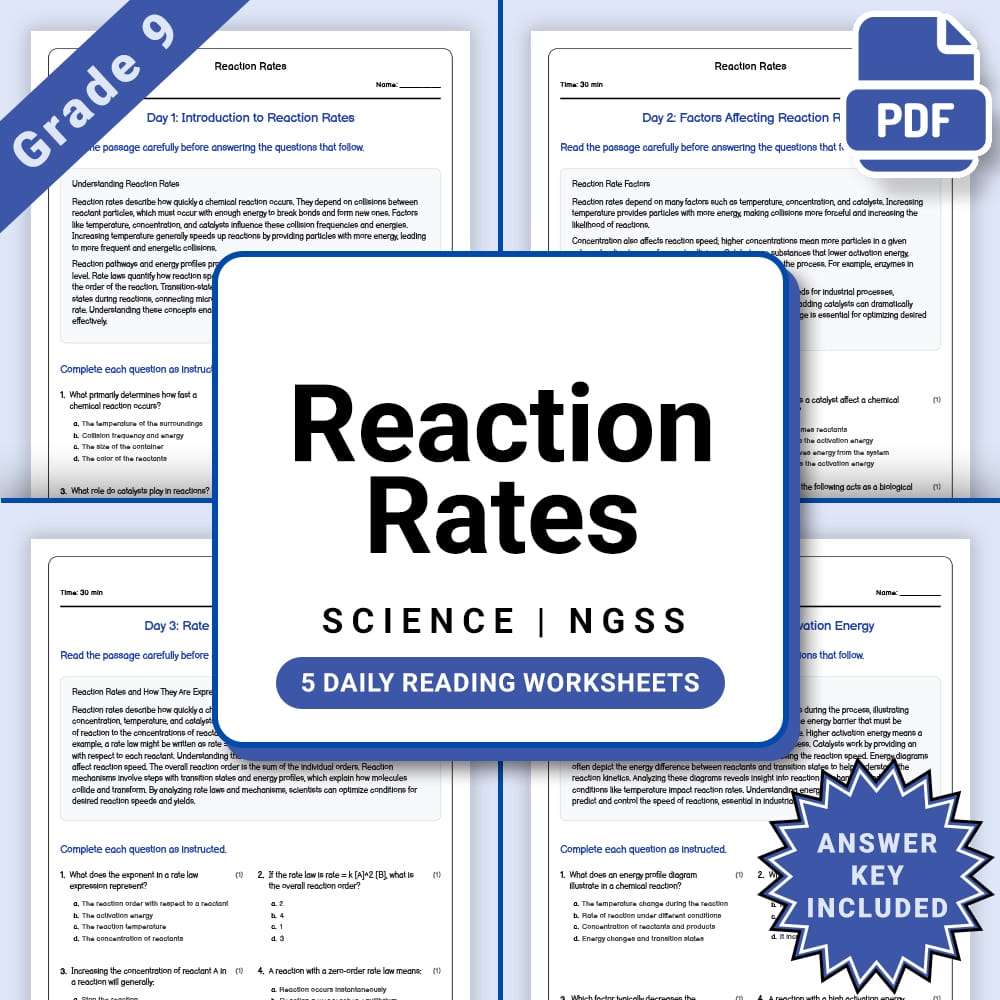
Grade 9 Science – Reaction Rates Daily Worksheet(PDF + Answer Key)
Created byCopper Leaf ClassroomLearning Objectives
- Understand key concepts related to Science
- Apply knowledge through practice questions
- Demonstrate comprehension of the material
Instant download
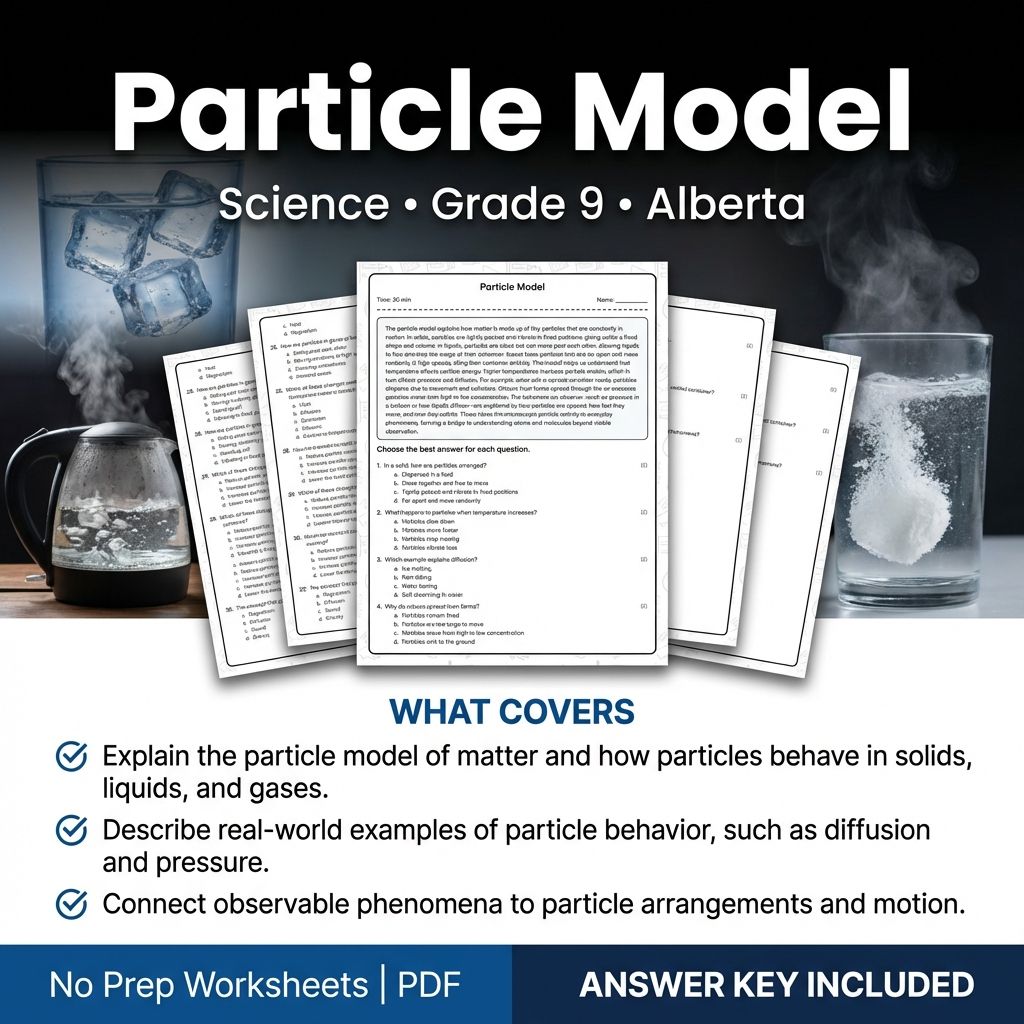
Particle Model Worksheet for Grade 9 Science | Alberta Standards
Created byCoral Reef LearningLearning Objectives
- Explain the particle model of matter and how particles behave in solids, liquids, and gases.
- Describe real-world examples of particle behavior, such as diffusion and pressure.
- Connect observable phenomena to particle arrangements and motion.
Instant download
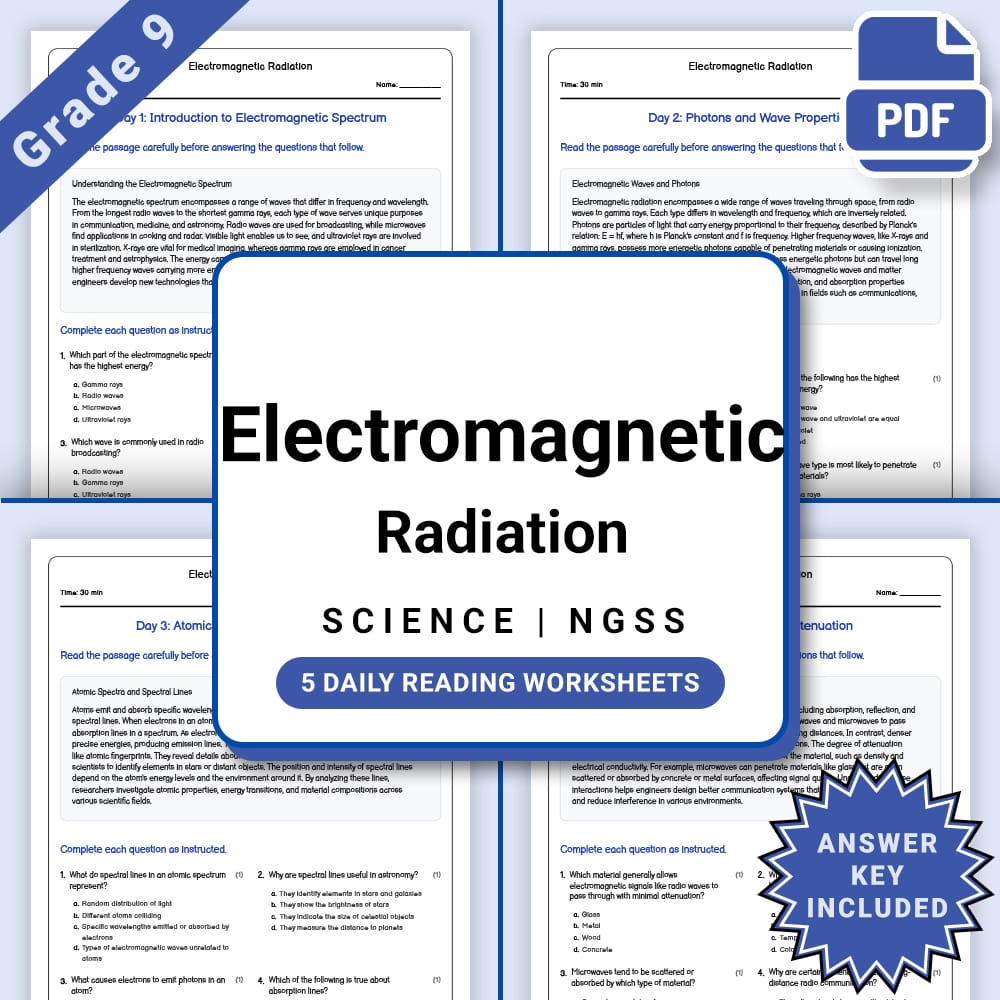
Grade 9 Science – Electromagnetic Spectrum Worksheet(PDF + Answers)
Created byCopper Leaf ClassroomLearning Objectives
- Identify parts of the electromagnetic spectrum and understand their relative frequencies.
- Explain how photon energy relates to wave frequency.
- Understand phenomena such as atomic emission and absorption lines.
Instant download
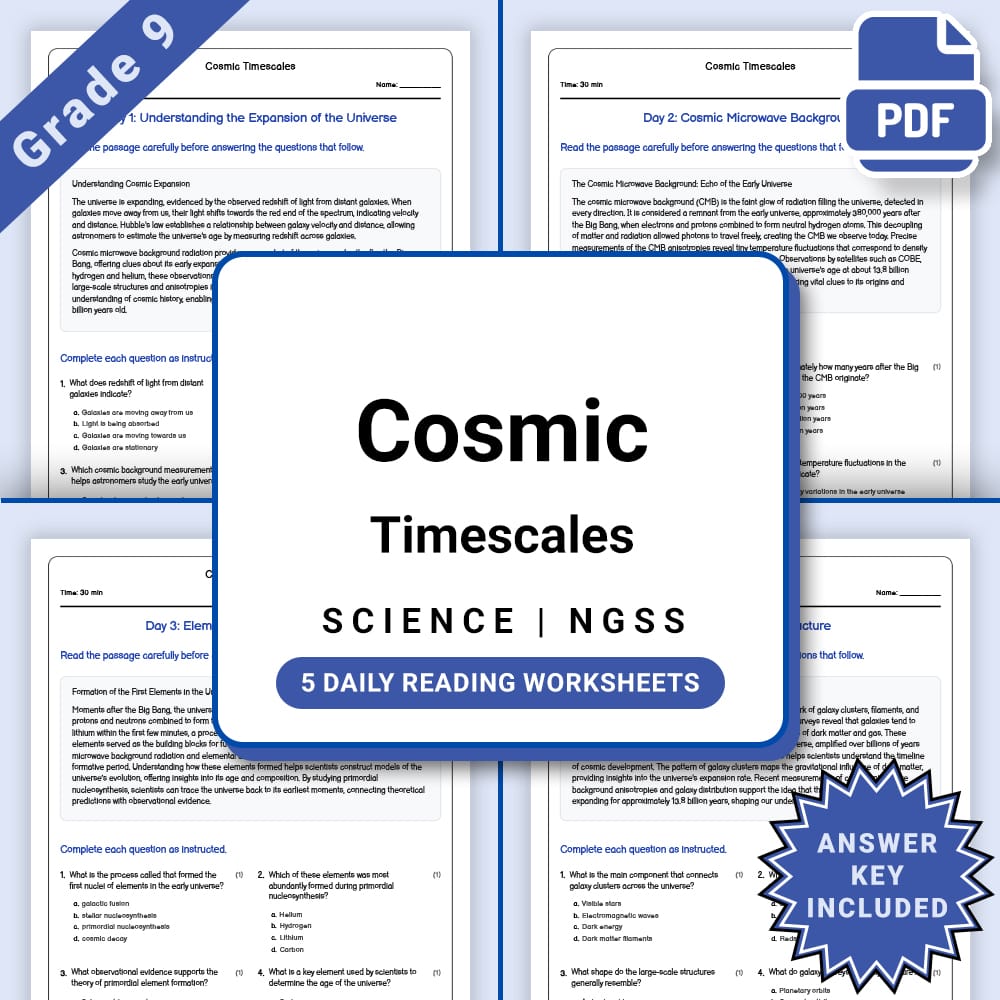
Grade 9 Science – Cosmic Timescales Daily Worksheet(PDF + Answer Key)
Created byCopper Leaf ClassroomLearning Objectives
- Understand the concept of cosmic expansion and how it is measured.
- Interpret observational evidence such as redshift and cosmic microwave background.
- Learn how astronomers determine the age of the universe using various measurements.
Instant download
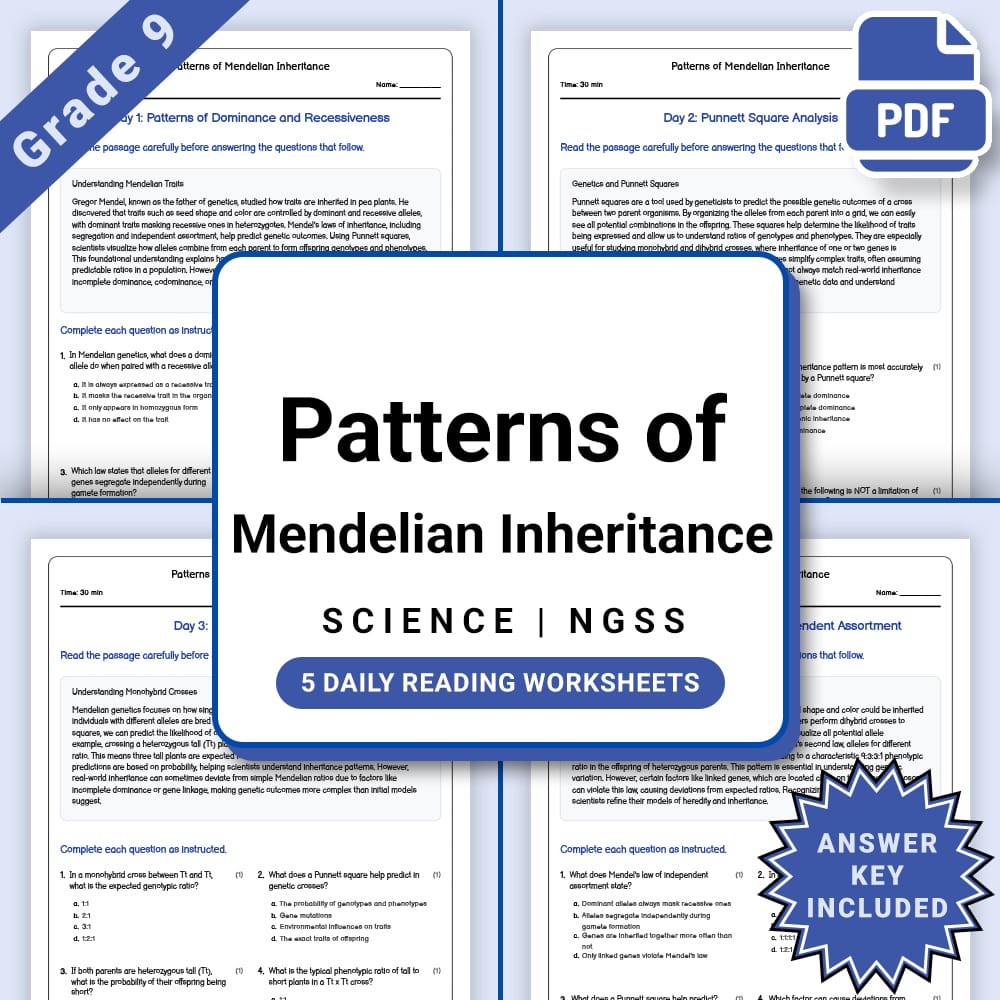
Grade 9 Science – Patterns of Mendelian Inheritance Worksheet(PDF + Answer Key)
Created byCopper Leaf ClassroomLearning Objectives
- Identify dominant and recessive traits in Punnett squares
- Understand Mendel's laws of segregation and independent assortment
- Analyze genetic crosses to predict genotype and phenotype ratios
Instant download
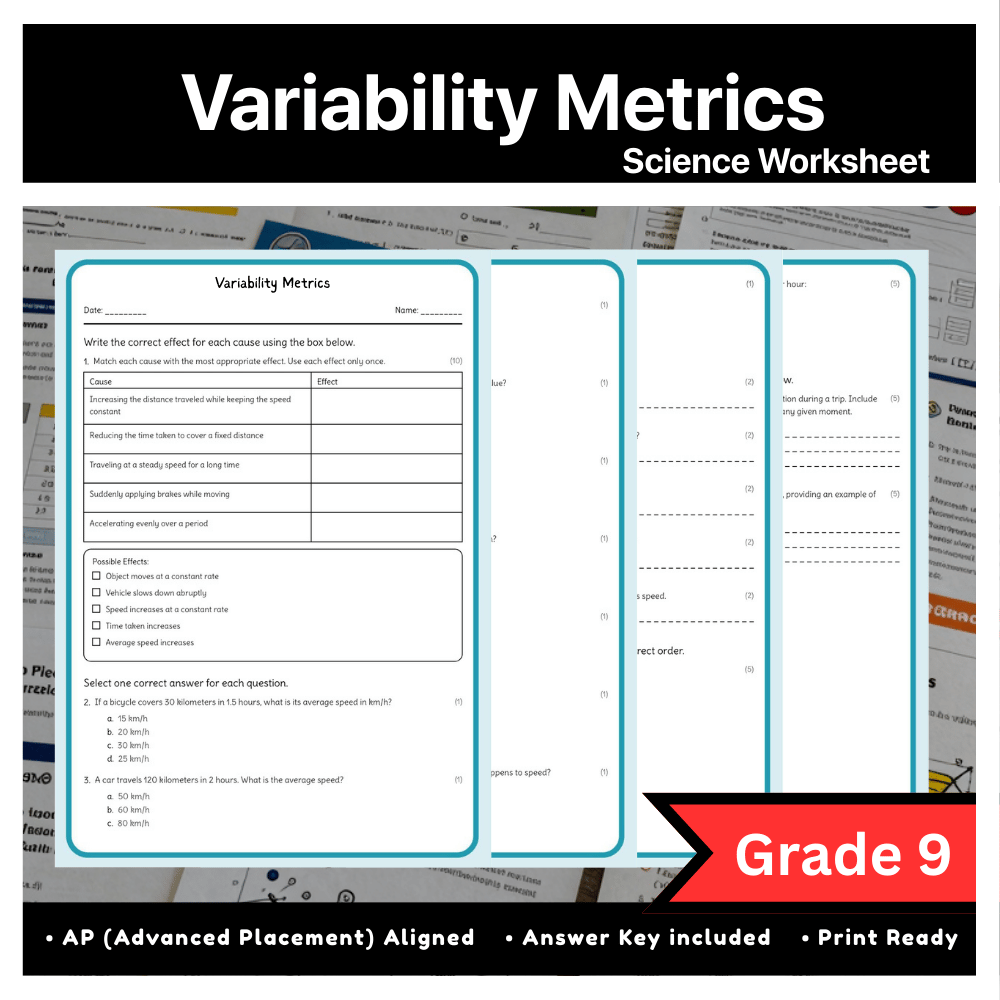
Grade 9 Science – Variability Metrics Worksheet (Answer Key) – AP Standards
Created byBright Mind ResourcesLearning Objectives
- Understand measures of dispersion such as variance, interquartile range, range, and coefficient of variation.
- Interpret how each variability measure informs confidence in estimates and decision-making.
- Relate variability to sampling design, heterogeneity across groups, and model expectations.
Instant download
Grade 9 Science | Cell Signaling Worksheet (Answer Key) – TEKS Aligned
Created byBright Mind ResourcesLearning Objectives
- Describe how receptor proteins bind ligands to initiate cell signaling.
- Identify different types of cell signaling pathways and their functions.
- Explain how signal transduction pathways alter cellular responses like gene expression and metabolism.
Also included in: Grade 9 Science Unit | Human Body Systems Worksheets & TEKS Aligned Bundle +3 more
Instant download
Grade 9 Science – Molecular Evidence Worksheet (Worksheet + Answer Key) | TEKS Aligned
Created byBright Mind ResourcesLearning Objectives
- Understand how molecular data is used to infer evolutionary relationships.
- Identify key concepts such as homologous genes, sequence divergence, and molecular clocks.
- Analyze patterns of genetic similarities and differences among species.
Also included in: Grade 9 Science Unit | Evolution, Speciation & Genetics Worksheet Pack - TEKS +3 more
Instant download
Grade 9 Science | Free Body Diagrams Worksheet (PDF) – BC Standards
Created byBright Mind ResourcesLearning Objectives
- Understand what a free body diagram represents and its purpose in physics.
- Identify and sketch all external forces acting on a single object in a free body diagram.
- Calculate net force and determine the resulting acceleration from force vectors.
Instant download
Grade 9 Science | Seafloor Spreading Worksheet (Answer Key) – BC Standards
Created byBright Mind ResourcesLearning Objectives
- Understand the process of seafloor spreading at mid-ocean ridges.
- Identify evidence supporting the theory of plate tectonics, including magnetic striping and age progression.
- Explain how oceanic crust is created and recycled in earth's lithosphere.
Instant download
Grade 9 Science | Glucose Regulation Worksheet (Worksheet + Answer Key) – TEKS Aligned
Created byBright Mind ResourcesLearning Objectives
- Describe how hormonal feedback regulates blood glucose levels.
- Explain the roles of insulin and glucagon in maintaining energy balance.
- Identify the effects of insulin and glucagon on liver and muscle tissues.
Also included in: Grade 9 Science Unit | Human Body Systems Worksheets & TEKS Aligned Bundle +3 more
Instant download
Grade 9 Science | Tectonic Forces Worksheet (Answer Key) – NGSS Standards
Created byBright Mind ResourcesLearning Objectives
- Understand the processes involved in plate tectonics such as seafloor spreading, subduction zones, and mountain uplift.
- Identify the surface features and geological evidence associated with tectonic activity.
- Explain how mantle convection influences lithospheric deformation and faulting patterns.
Instant download
Grade 9 Science – Force Basics Worksheet (Ontario) (PDF)
Created byBright Mind ResourcesLearning Objectives
- Distinguish between contact and non-contact forces with examples and descriptions.
- Identify the direction, point of application, and relative magnitude of different forces.
- Recognize action–reaction pairs and understand their roles in interactions.
Instant download
Grade 9 Science | Membrane Transport Worksheet (Ontario Standard) (PDF)
Created byBright Mind ResourcesLearning Objectives
- Describe mechanisms of molecular movement across cellular membranes such as diffusion, osmosis, and active transport.
- Explain the role of electrochemical gradients and membrane potential in facilitating transport.
- Differentiate between paracellular and transcellular pathways in epithelial layers.
Instant download
Grade 9 Science | Glycolysis Overview Worksheet (Answer Key) – TEKS Aligned
Created byBright Mind ResourcesLearning Objectives
- Describe the stepwise process of glycolysis and its key intermediates.
- Explain how ATP and NADH are produced during glycolysis.
- Identify the different fates of pyruvate under aerobic and anaerobic conditions.
Also included in: Grade 9 Science | Photosynthesis & Metabolic Pathways Unit Bundle (TEKS Aligned) +3 more
Instant download
Grade 9 Science | Heat Quantification Worksheet (NGSS-Aligned, PDF)
Created byBright Mind ResourcesLearning Objectives
- Understand the concepts of heat transfer via conduction, convection, and radiation.
- Apply mathematical formulas involving specific heat capacity, mass, and temperature change to calculate thermal energy transfer.
- Identify sign conventions and their significance in heat flow and energy changes within closed systems.
Instant download
Grade 9 Science | Signal Integration Worksheet (Answer Key) – BC Standards
Created byBright Mind ResourcesLearning Objectives
- Describe how the nervous and endocrine systems coordinate responses to stimuli.
- Explain the roles of nerve impulses and hormones in maintaining homeostasis.
- Identify examples of rapid neural responses and longer-term hormonal effects.
Instant download
Grade 9 Science | Metabolic Pathways Worksheet (Answer Key) Aligned with TEKS
Created byBright Mind ResourcesLearning Objectives
- Describe the differences between catabolic and anabolic pathways.
- Explain how energy is harvested or stored during metabolic reactions.
- Identify mechanisms regulating pathway activity such as feedback inhibition and substrate availability.
Also included in: Grade 9 Science | Photosynthesis & Metabolic Pathways Unit Bundle (TEKS Aligned) +3 more
Instant download
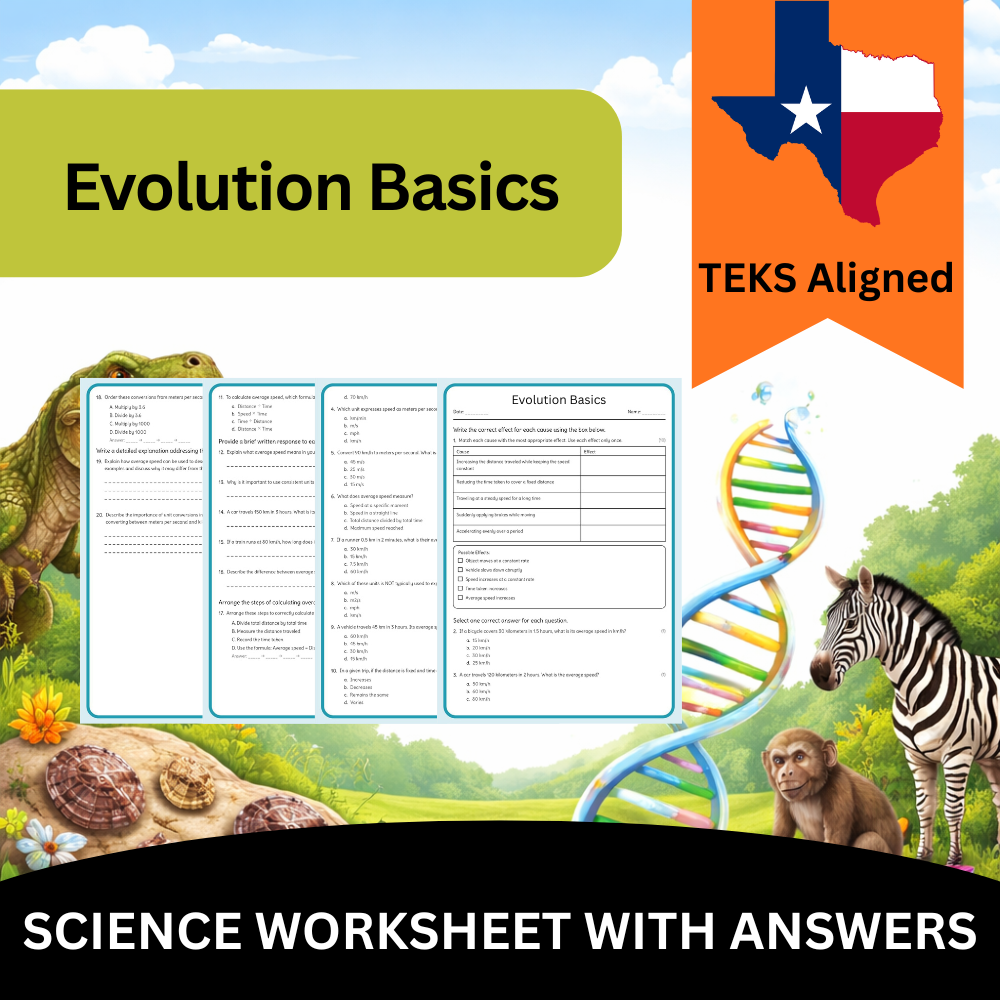
Grade 9 Science | Evolution Basics Worksheet (Worksheet + Answer Key, PDF)
Created byBright Mind ResourcesLearning Objectives
- Define evolution and identify its main mechanisms.
- Explain how natural selection, genetic drift, mutation, and gene flow influence genetic change over time.
- Analyze examples of how populations adapt and diverge through evolutionary processes.
Also included in: Grade 9 Science Unit | Evolution, Speciation & Genetics Worksheet Pack - TEKS +3 more
Instant download

Grade 9 Science – Decision Modeling in Sustainability(Answer Key) | NGSS-Aligned
Created byBright Mind ResourcesLearning Objectives
- Understand how decision models incorporate economic, environmental, and social variables.
- Analyze trade-offs involved in mitigation and adaptation strategies for climate resilience.
- Evaluate policy instruments and their impacts across multiple scales using scenario analysis.
Instant download
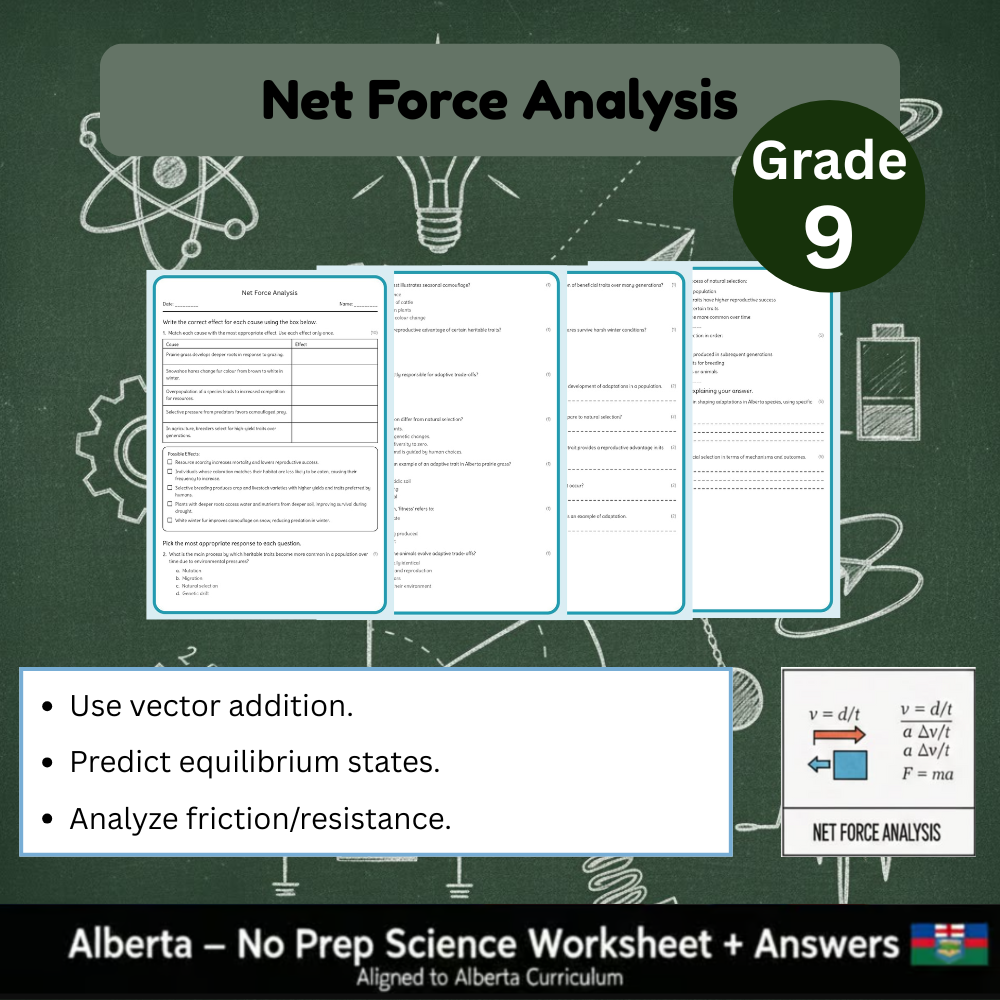
Grade 9 Science – Net Force Analysis Worksheet (PDF) for Alberta Standards
Created byBright Mind ResourcesLearning Objectives
- Understand how net force results from vector addition of forces acting on an object
- Predict motion changes and equilibrium conditions using net force concepts
- Analyze practical scenarios involving opposing forces such as friction and air resistance
Instant download
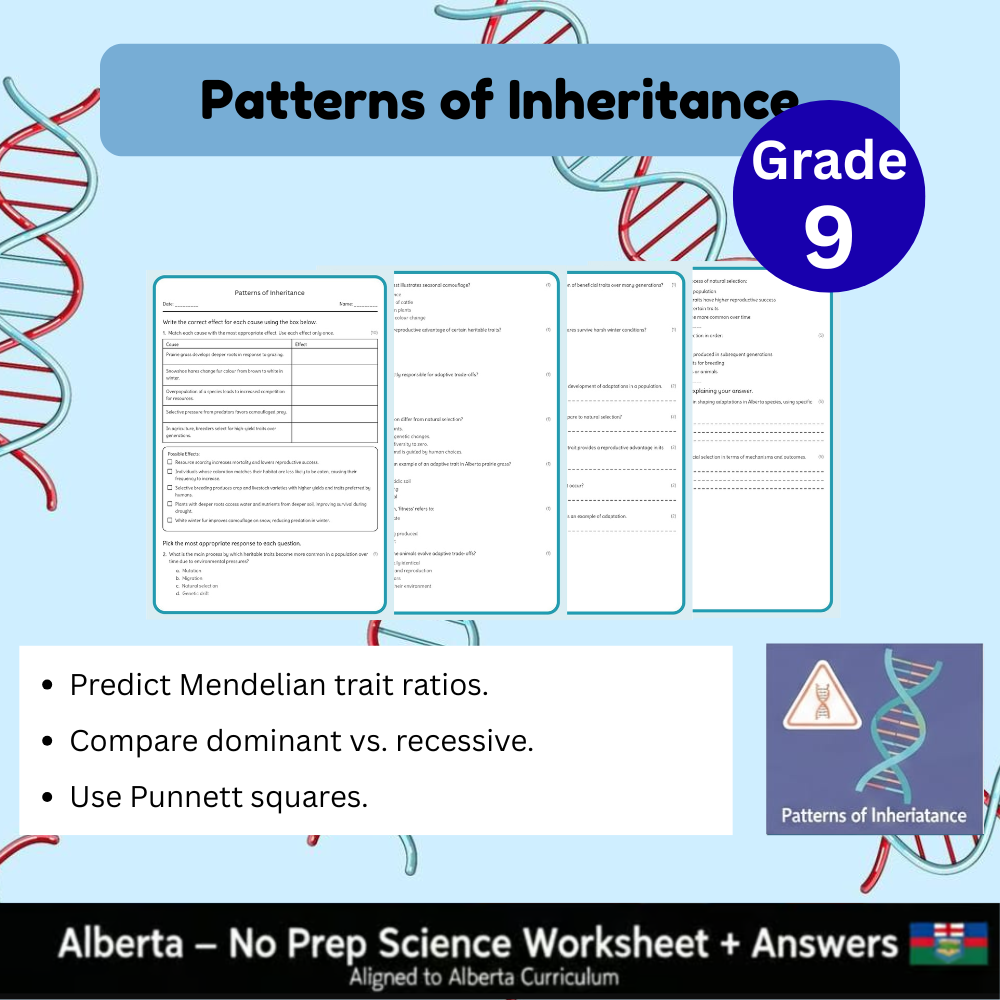
Grade 9 Science | Patterns of Inheritance Worksheet (PDF)
Created byBright Mind ResourcesLearning Objectives
- Understand how basic Mendelian inheritance patterns predict trait ratios in offspring.
- Distinguish between dominant and recessive alleles and their effects on phenotype.
- Use Punnett squares to predict probabilities of inherited traits.
Instant download
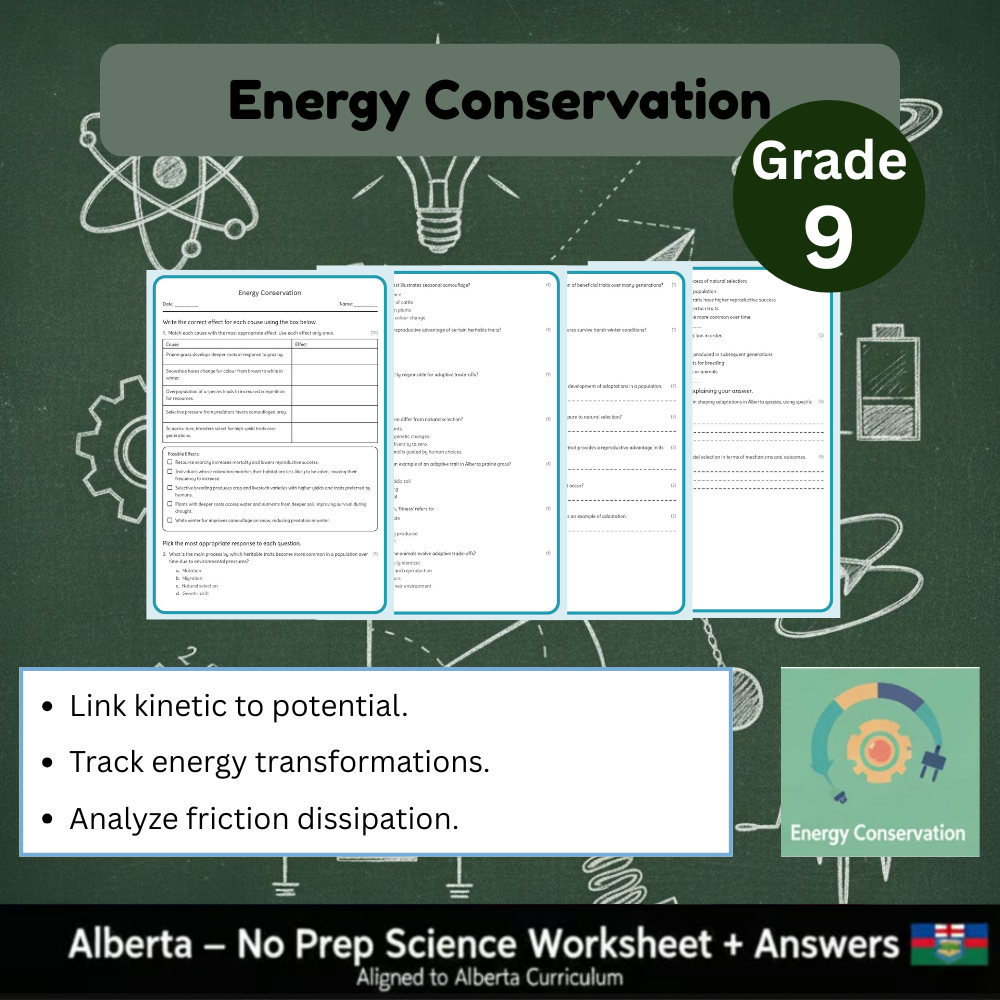
Grade 9 Science – Energy Conservation Worksheet (PDF) - Alberta Standards
Created byBright Mind ResourcesLearning Objectives
- Understand the principles of mechanical energy conservation involving kinetic and potential energy.
- Identify examples of energy transfer and transformation in real-world scenarios.
- Analyze how energy transfer and dissipation by friction influence motion and speeds.
Instant download
Browse more categories
About Grade 9 Worksheets
Browse 9,323 printable Grade 9 worksheets across algebra, biology, literature, and history — each a ready-to-print PDF with optional answer keys.
Every worksheet on MyTeachingSheets is created by independent teacher-authors and reviewed before publication. All resources download as printable PDFs for classroom, homework, or at-home practice, and many include answer keys. Preview any worksheet free before buying.