
Reading comprehension Worksheets
40,284 type resources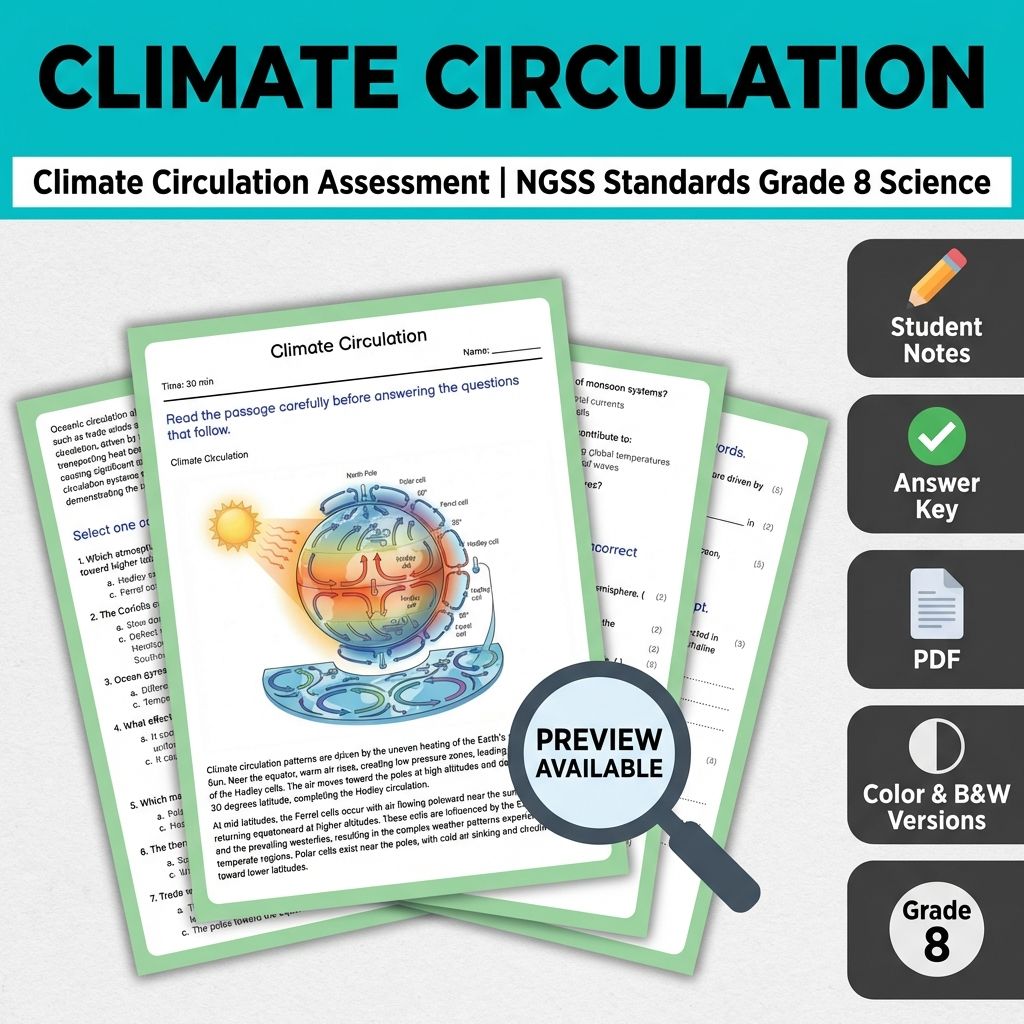
Climate Circulation Assessment | NGSS Standards Grade 8 Science
 Created byPrism Point Learning
Learning Objectives
- Describe the models of Hadley, Ferrel, and polar cells and their role in atmospheric circulation.
- Explain how planetary rotation affects wind patterns via the Coriolis effect.
- Analyze how oceanic circulation, including gyres and thermohaline circulation, influences regional climates.
Also included in: Grade 8 Science Mini Bundle – Earth's Systems & NGSS Standards-Aligned +1 more
Instant download
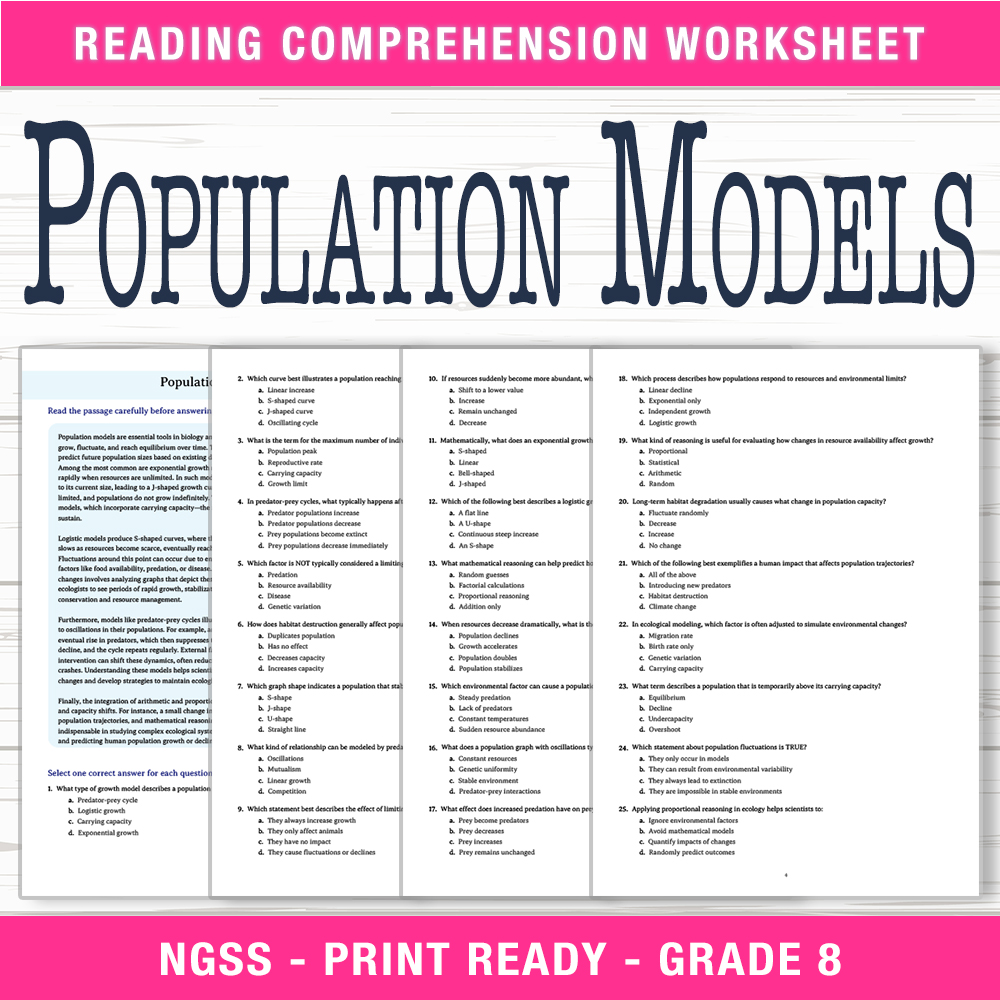
Grade 8 Science | Population Models Worksheet (PDF + Answer Key)
 Created byRiverstone Classroom
Learning Objectives
- Describe different types of population growth models, including exponential and logistic growth.
- Interpret graphs of population dynamics to identify steady states, oscillations, and overshoot scenarios.
- Explain how limiting factors such as resources and predation influence long-term population trajectories.
Instant download
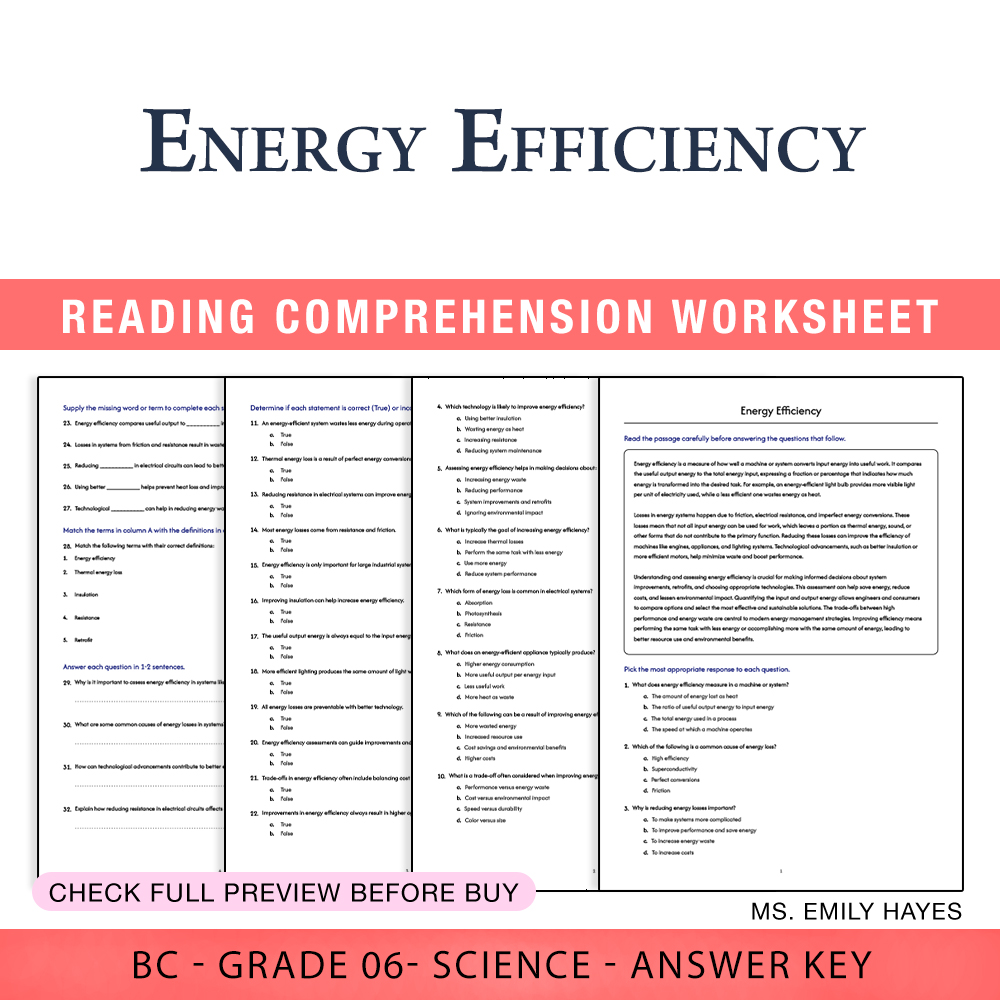
Grade 6 Science | Energy Efficiency Worksheet (PDF+ Answer Key)
 Created byCopper Leaf Classroom
Learning Objectives
- Define energy efficiency and explain its importance in systems like machines and lighting.
- Identify common energy losses and understand their causes.
- Calculate the efficiency of a system by comparing useful output to total input energy.
Also included in: Grade 6 Science BC | Waves, Sound, Light & Energy Worksheets (PDF + Answer Key) +1 more
Instant download
Grade 11 Science | Ecosystem Basics Worksheet (Worksheet + Answer Key) – TEKS-Aligned
 Created byBright Mind Resources
Learning Objectives
- Define the fundamental components of an ecosystem and their interactions.
- Explain how energy flows through food chains and food webs.
- Describe nutrient cycling processes such as carbon and nitrogen cycles.
Also included in: Grade 11 Science - Ecosystem & Biogeochemical Cycles Unit Worksheet Pack - TEKS +2 more
Instant download
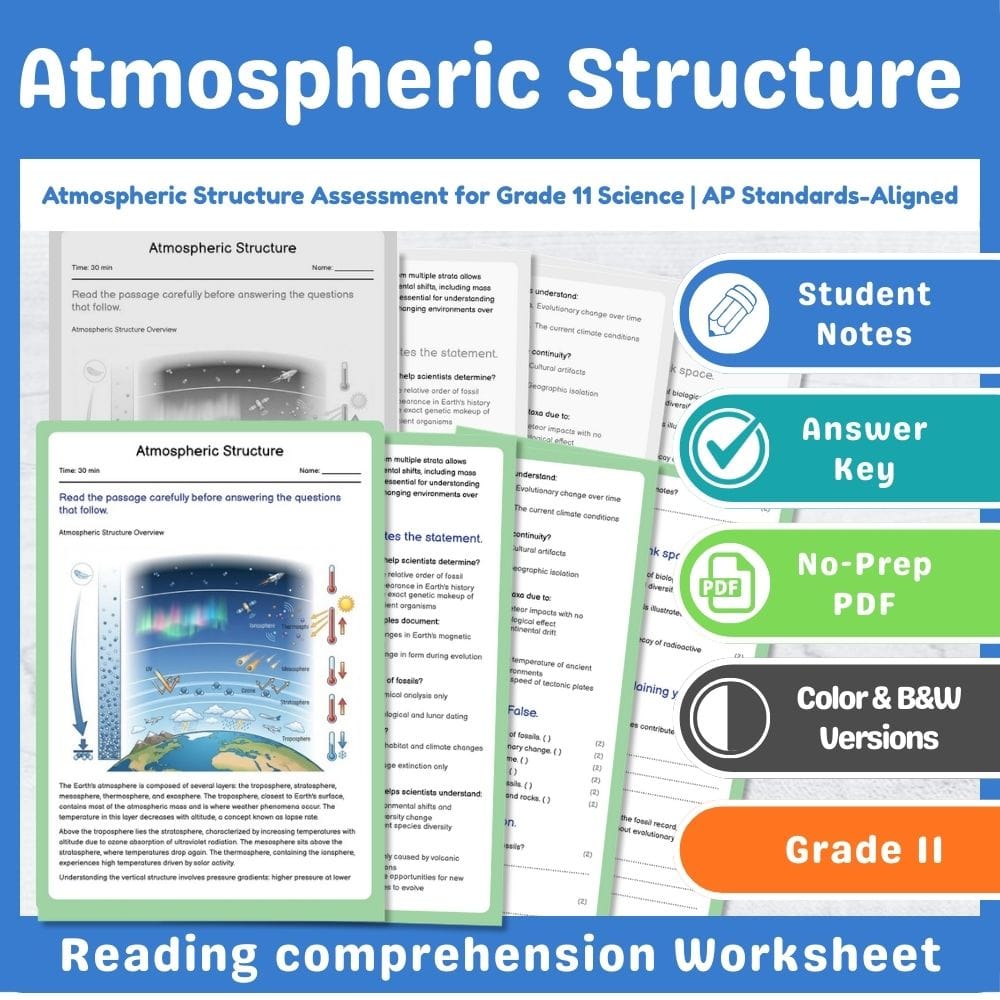
Atmospheric Structure Assessment for Grade 11 Science | AP Standards-Aligned
Created byPrism Point LearningLearning Objectives
- Describe the vertical and horizontal layers of the atmosphere and their characteristics.
- Explain pressure gradients, temperature profiles, and their role in atmospheric circulation.
- Interpret sounding profiles, pressure maps, and radiative diagrams to understand weather patterns.
Also included in: Lesson Grade 11 Science Assessment Bundle | Earth Systems & Climate
Instant download
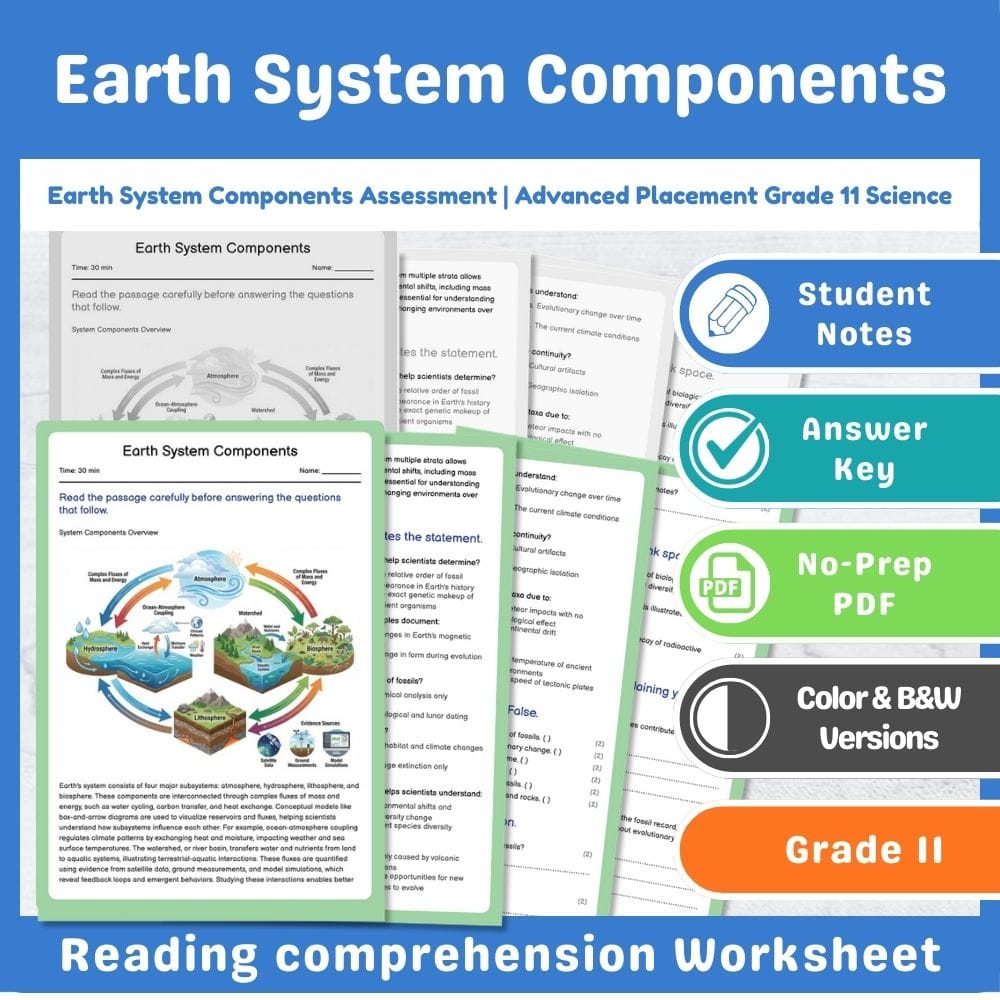
Earth System Components Assessment | Advanced Placement Grade 11 Science
Created byPrism Point LearningLearning Objectives
- Identify the major Earth subsystems and explain their roles and interactions.
- Understand mass and energy fluxes among atmosphere, hydrosphere, lithosphere, and biosphere.
- Use conceptual models to analyze subsystem exchanges and feedback mechanisms.
Also included in: Lesson Grade 11 Science Assessment Bundle | Earth Systems & Climate
Instant download
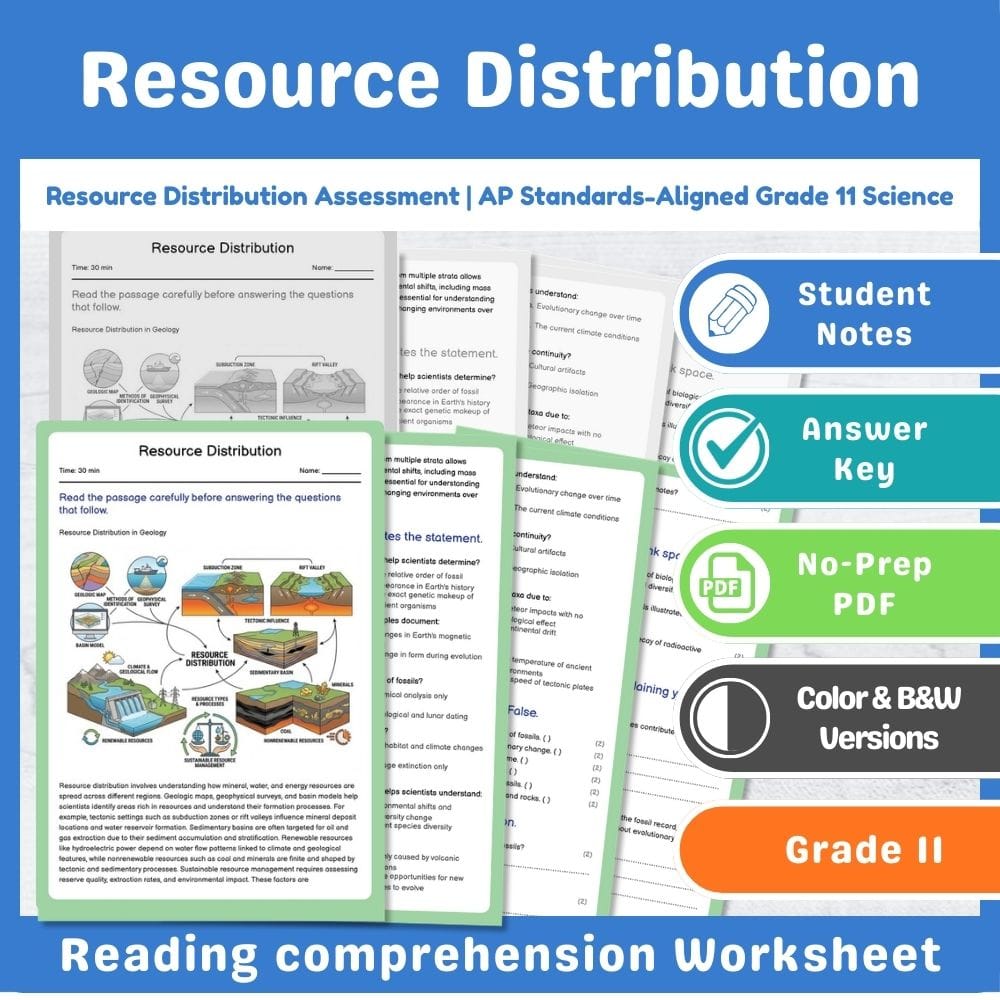
Resource Distribution Assessment | AP Standards-Aligned Grade 11 Science
Created byPrism Point LearningLearning Objectives
- Map and analyze the spatial patterns of mineral, water, and energy resources using various geologic tools.
- Distinguish between renewable and nonrenewable reservoirs and evaluate their sustainability.
- Assess resource occurrence in relation to tectonic setting and sedimentary processes using geologic information.
Also included in: Lesson Grade 11 Science Assessment Bundle | Earth Systems & Climate
Instant download
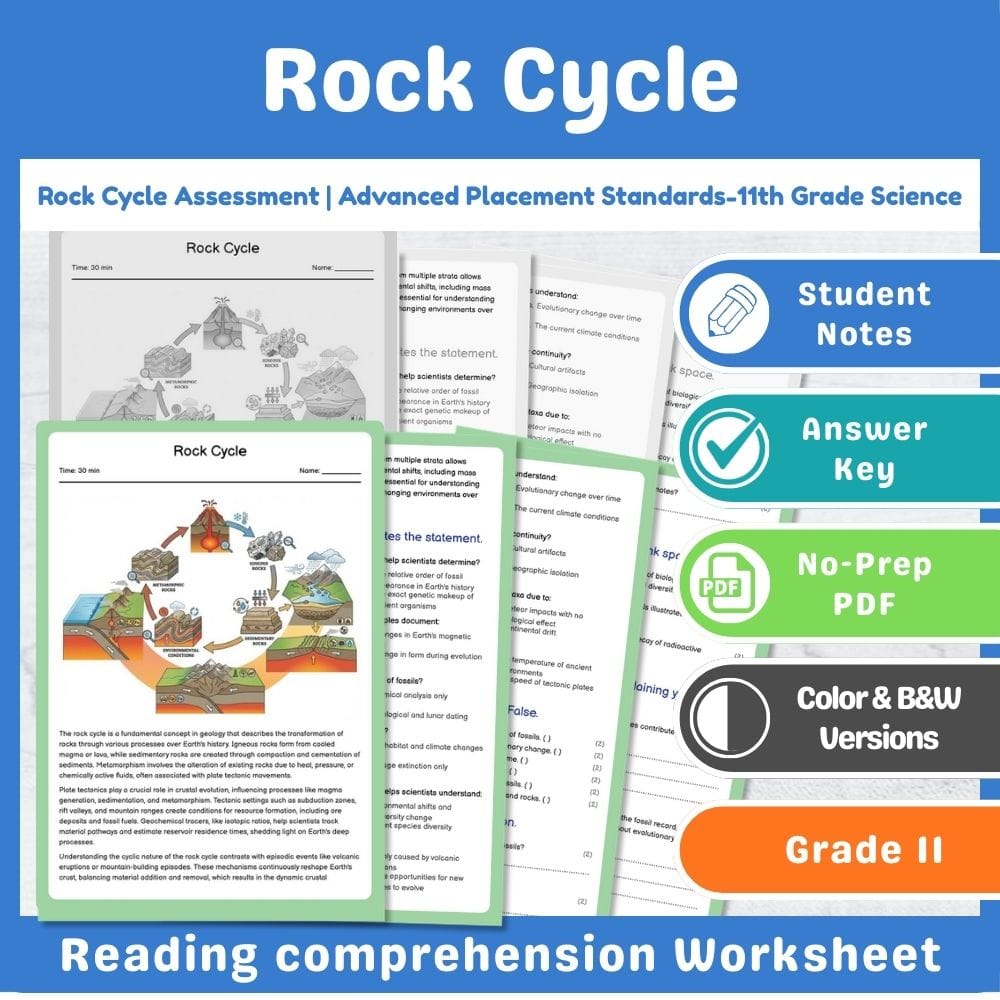
Rock Cycle Assessment | Advanced Placement Standards-Aligned 11th Grade Science
Created byPrism Point LearningLearning Objectives
- Explain the processes of rock formation, metamorphism, and destruction over geologic time.
- Identify the role of plate tectonics in shaping crustal evolution.
- Analyze geochemical tracers and stratigraphic data related to resource formation.
Also included in: Lesson Grade 11 Science Assessment Bundle | Earth Systems & Climate
Instant download
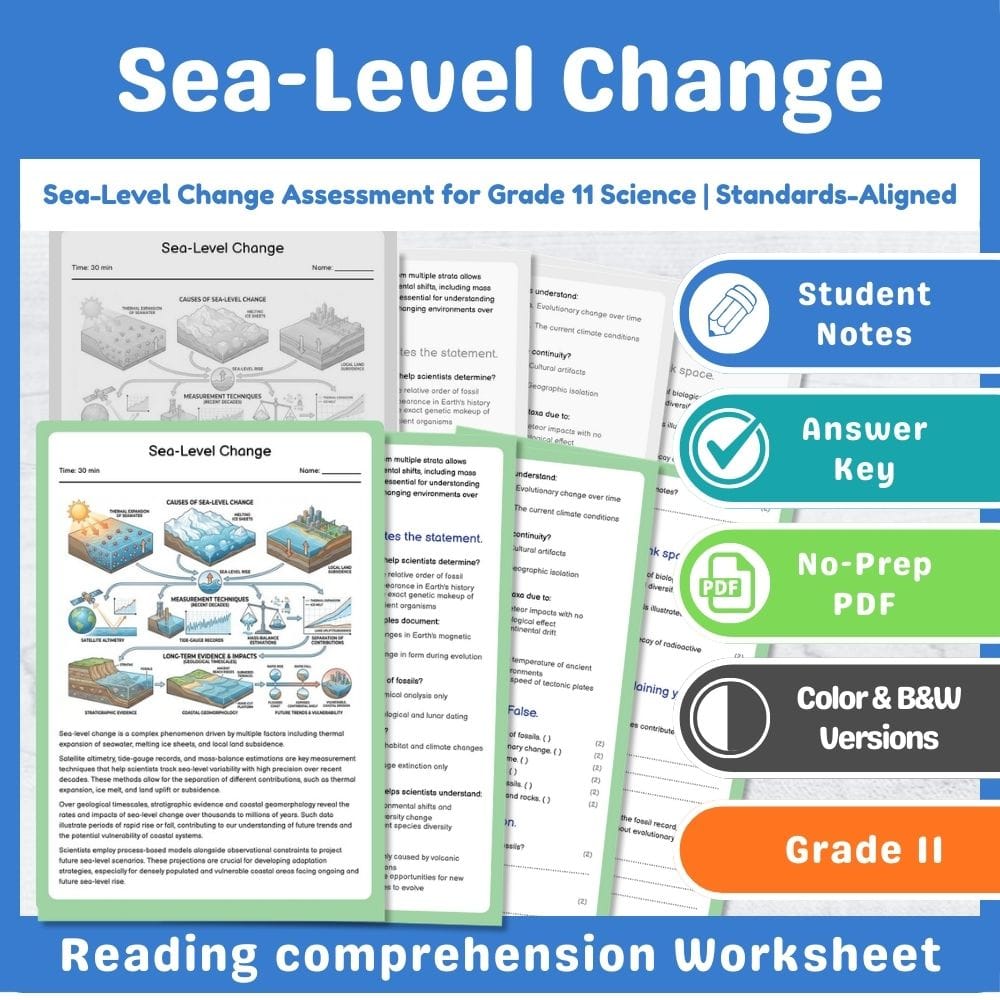
Sea-Level Change Assessment for Grade 11 Science | Standards-Aligned
Created byPrism Point LearningLearning Objectives
- Understand the causes of sea-level variability, including thermal expansion and ice-sheet mass loss.
- Analyze methods used to measure sea-level changes, such as satellite altimetry and tide-gauge records.
- Evaluate the impacts of sea-level change over different timescales using stratigraphic and geomorphological evidence.
Also included in: Lesson Grade 11 Science Assessment Bundle | Earth Systems & Climate
Instant download
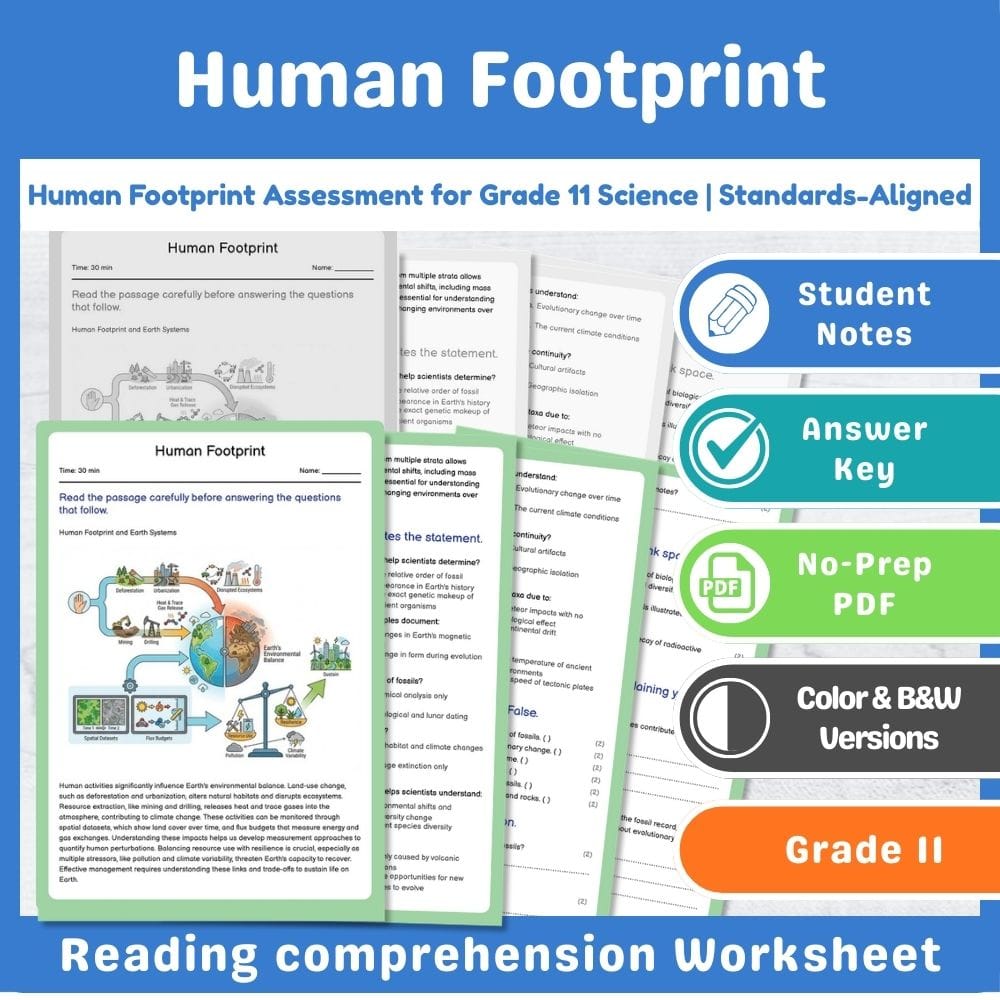
Human Footprint Assessment for Grade 11 Science | Standards-Aligned
Created byPrism Point LearningLearning Objectives
- Understand how human activities alter Earth's systems through land-use change, resource extraction, and emission of gases.
- Analyze spatial datasets and time-series data to identify environmental impacts of human actions.
- Evaluate measurement approaches for quantifying anthropogenic perturbations.
Also included in: Lesson Grade 11 Science Assessment Bundle | Earth Systems & Climate
Instant download

Grade 11 Science – Scientific Methods & Inquiry | Daily Reading Worksheet
Created byBright Mind ResourcesLearning Objectives
- Identify the key steps involved in the scientific method
- Understand the role of measurement technologies in scientific research
- Recognize the importance of hypothesis formulation and variable control
Also included in: Grade 11 Daily Reading & Graphs Science lesson bundle Worksheets | Ontario +1 more
Instant download
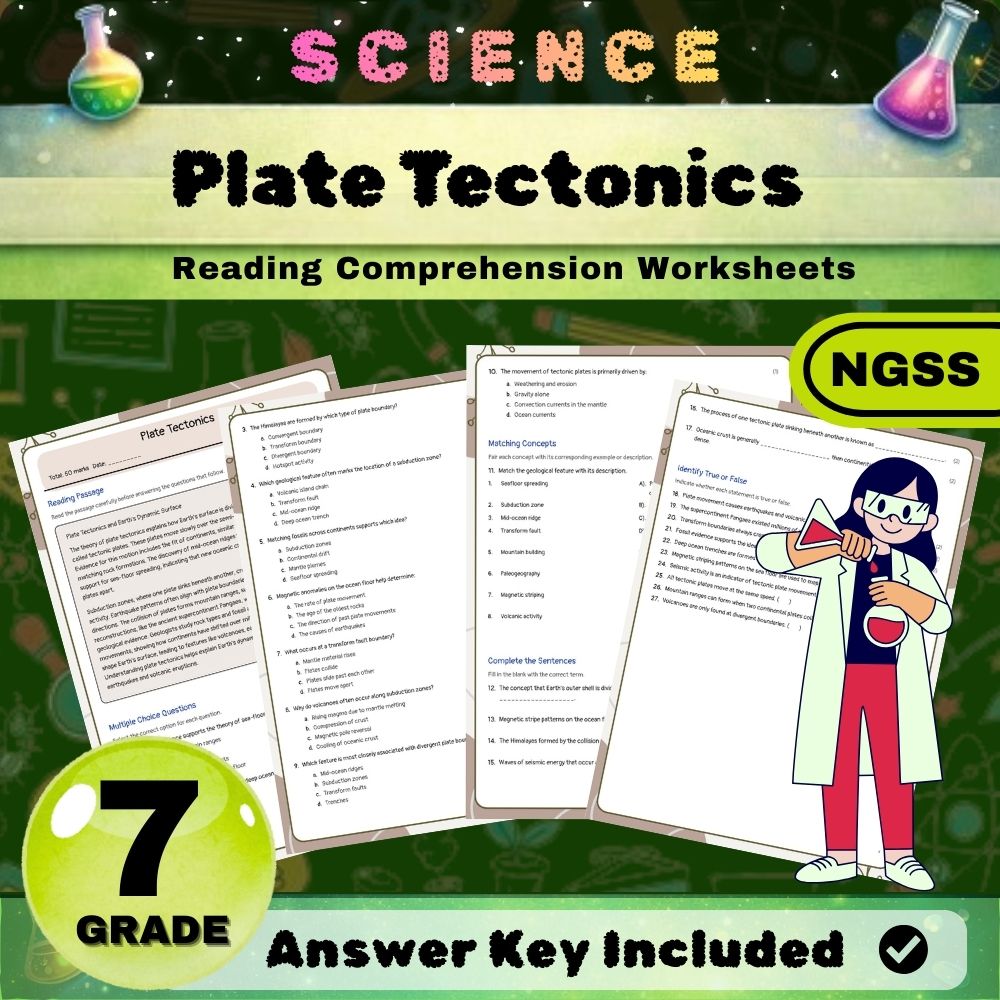
7th Grade Science | Plate Tectonics NGSS Worksheet (Answer Key)
 Created byMaple Path Learning
Learning Objectives
- Explain the evidence supporting the theory of plate tectonics and continental drift.
- Describe geological features such as mid-ocean ridges, trenches, and mountain ranges related to plate movements.
- Interpret patterns of fossils, rock types, and magnetic striping to understand historical continental positions.
Instant download
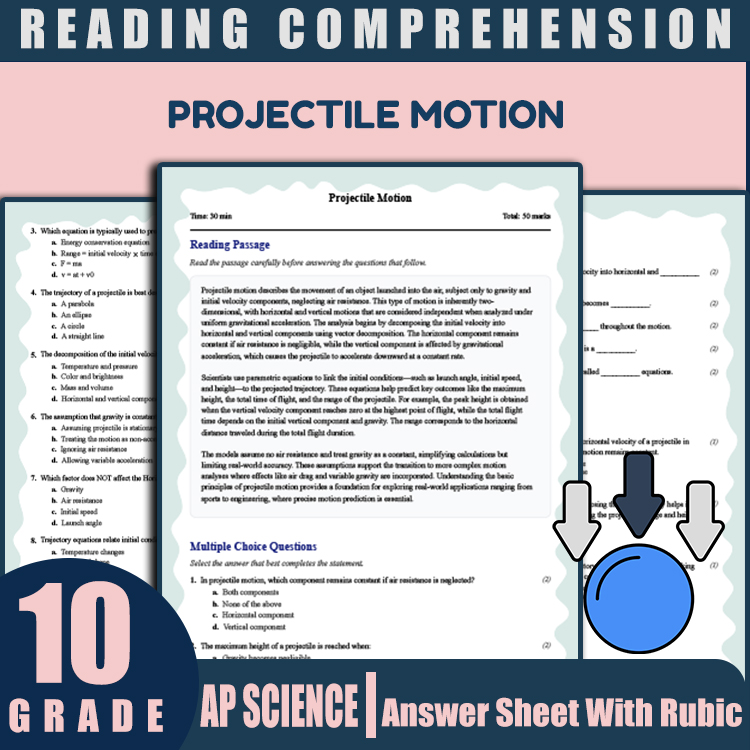
10th Grade Science | Projectile Motion Reading Worksheet with Answer Key (PDF)
JCreated byJ.S SheetsLearning Objectives
- Understand the two-dimensional kinematic description of projectile motion.
- Apply vector decomposition to predict range, time of flight, and peak height of projectiles.
- Explain the assumptions and approximations used in projectile motion models.
Also included in: Grade 10 Science Unit Bundle | Motion, Forces & Energy Worksheets (PDF) +1 more
Instant download

Grade 10 Science | Conservation of Energy Worksheet (PDF)
 Created byEvergreen Desk Education
Learning Objectives
- Explain energy conservation using the idea that energy is transferred and transformed but not created or destroyed
- Use qualitative energy accounting to track changes in a system’s energy forms across an initial and final state
- Describe how nonconservative forces (like friction and air resistance) can reduce mechanical energy while conserving total energy
Also included in: Grade 10 Conservation Laws in Science Lesson Bundle – General Framework +1 more
Instant download

Grade 8 Total Energy Balance Worksheet | Energy Conservation | CA Standards
Created byEvergreen Desk EducationLearning Objectives
- Explain conservation of energy using energy accounting for a chosen system and its surroundings
- Identify how energy transfers and converts between kinetic, potential, thermal, and other forms
- Use an energy balance model to predict how changes in motion and temperature can occur over time
Instant download

ANZAC Day Cultural Respect Grades 3 ,4 & 5 Worksheet | Holiday Assessment
Learning Objectives
- Identify how different communities remember ANZAC Day through traditions, symbols, and stories.
- Explain why respecting diverse perspectives helps create unity and reconciliation.
- Describe how shared values of peace, respect, and remembrance connect people across cultures.
Instant download

Grade 9 Science – Chemical Changes & Observable Signs | Daily Reading Worksheet
Created byBright Mind ResourcesLearning Objectives
- Identify key indicators of chemical reactions such as gas production, temperature change, precipitate formation, and color change.
- Distinguish between physical and chemical changes based on observable evidence.
- Understand microscopic processes involved in chemical transformations.
Also included in: Grade 9 Chemistry Science Lesson Bundle Daily Reading Worksheets | Ontario +1 more
Instant download

Grade 9 Science – States & Energy Daily Reading Worksheet | Ontario Standards
Created byBright Mind ResourcesLearning Objectives
- Understand the particle arrangements in solids, liquids, and gases.
- Describe how energy transfer causes phase changes such as melting, vaporization, sublimation, and condensation.
- Explain latent heat and how phase transitions occur without changing chemical identity.
Also included in: Grade 9 Chemistry Science Lesson Bundle Daily Reading Worksheets | Ontario +1 more
Instant download

Grade 9 Science – Gas Behaviour & Properties | Daily Reading Worksheet
Created byBright Mind ResourcesLearning Objectives
- Describe the properties of gas particles using the particle model.
- Explain how pressure, volume, and temperature relate to particle motion.
- Connect microscopic particle behavior to macroscopic gas phenomena.
Also included in: Grade 9 Chemistry Science Lesson Bundle Daily Reading Worksheets | Ontario +1 more
Instant download

Grade 9 Science – States of Matter & Particle Theory | Daily Reading Worksheet
Created byBright Mind ResourcesLearning Objectives
- Describe the particle arrangements in solids, liquids, and gases.
- Explain how particle motion varies with temperature and state.
- Relate microscopic particle behavior to observable properties like pressure and diffusion.
Also included in: Grade 9 Chemistry Science Lesson Bundle Daily Reading Worksheets | Ontario +1 more
Instant download

Grade 9 Science – Societal Impacts of Chemicals | Daily Reading Worksheet
Created byBright Mind ResourcesLearning Objectives
- Understand the benefits and risks of common household chemicals
- Analyze how chemical properties affect their environmental and health impacts
- Evaluate the importance of safe handling, disposal, and regulation of chemicals
Also included in: Grade 9 Chemistry Science Lesson Bundle Daily Reading Worksheets | Ontario +1 more
Instant download
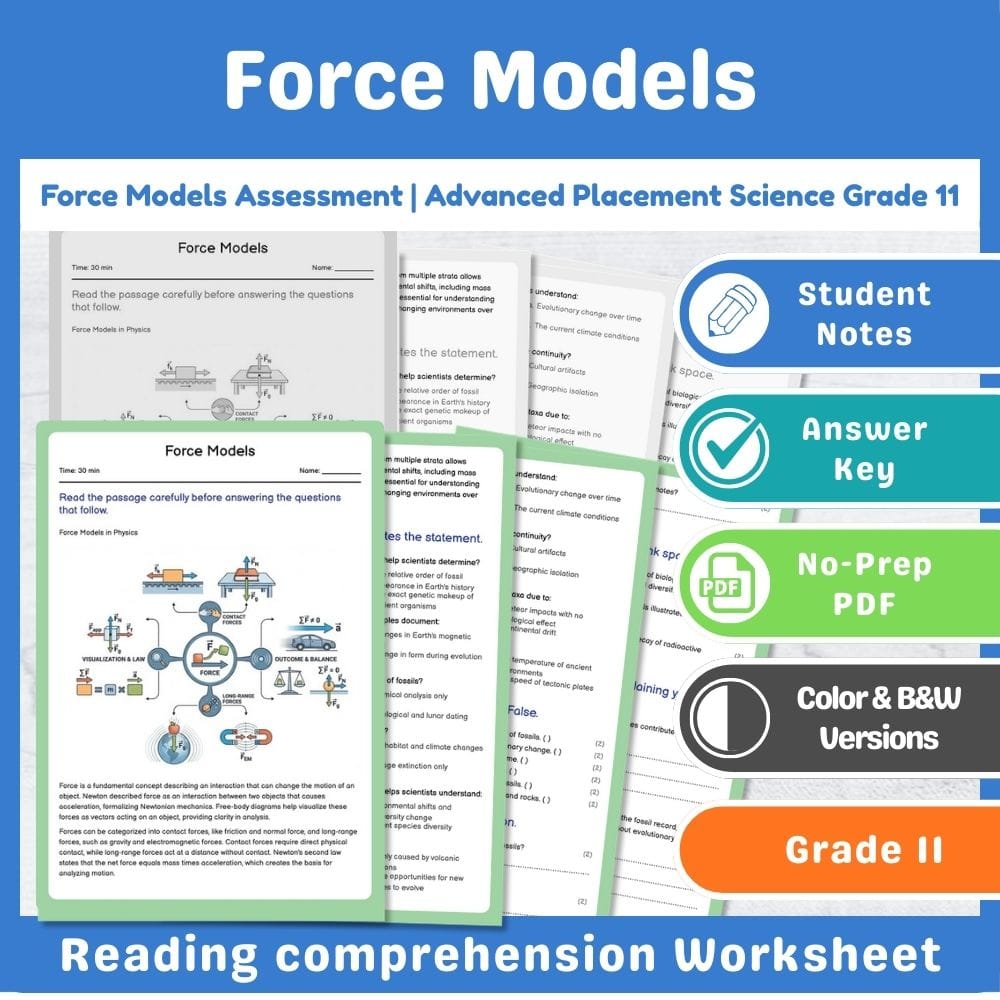
Force Models Assessment | Advanced Placement Science Grade 11
Created byPrism Point LearningLearning Objectives
- Explain the concept of force as an interaction between objects.
- Understand and apply Newton's laws of motion using free-body diagrams.
- Distinguish between contact and long-range forces such as gravity and electromagnetic forces.
Instant download

6th Grade Science | System Interactions Worksheet (PDF + Answer Key)
Created byCopper Leaf ClassroomLearning Objectives
- Describe how Earth's systems interact through transfers of matter and energy.
- Identify feedback mechanisms such as albedo changes, sediment transport, and nutrient movement.
- Explain energy sources and sinks within Earth's systems.
Also included in: Grade 6 Science | Weather and Climate System Bundle (PDF+ Answer Key)
Instant download
6th Grade Science | Weather Patterns Worksheet (PDF + Answer Key)
Created byCopper Leaf ClassroomLearning Objectives
- Explain how atmospheric processes produce local and regional weather phenomena.
- Interpret surface maps, temperature and pressure measurements, and radar data to identify weather conditions.
- Describe the formation and movement of air masses, fronts, and pressure systems.
Also included in: Grade 6 Science | Weather and Climate System Bundle (PDF+ Answer Key)
Instant download
6th Grade Science | Natural Hazards Worksheet (PDF + Answer Key)
Created byCopper Leaf ClassroomLearning Objectives
- Understand how observational and instrumental data are used to analyze natural hazards.
- Identify patterns and recurrence intervals in natural hazard data.
- Learn methods for estimating the probable locations and magnitudes of hazards.
Also included in: Grade 6 Science | Weather and Climate System Bundle (PDF+ Answer Key)
Instant download
6th Grade Science | Water Cycle Worksheet (PDF + Answer Key)
Created byCopper Leaf ClassroomLearning Objectives
- Describe the main processes of the water cycle, including evaporation, condensation, precipitation, runoff, infiltration, and groundwater storage.
- Explain how solar energy and gravity drive the movement of water through different reservoirs like oceans, ice, and groundwater.
- Identify examples of water transport, phase changes, and storage timescales across the hydrosphere.
Also included in: Grade 6 Science | Weather and Climate System Bundle (PDF+ Answer Key)
Instant download
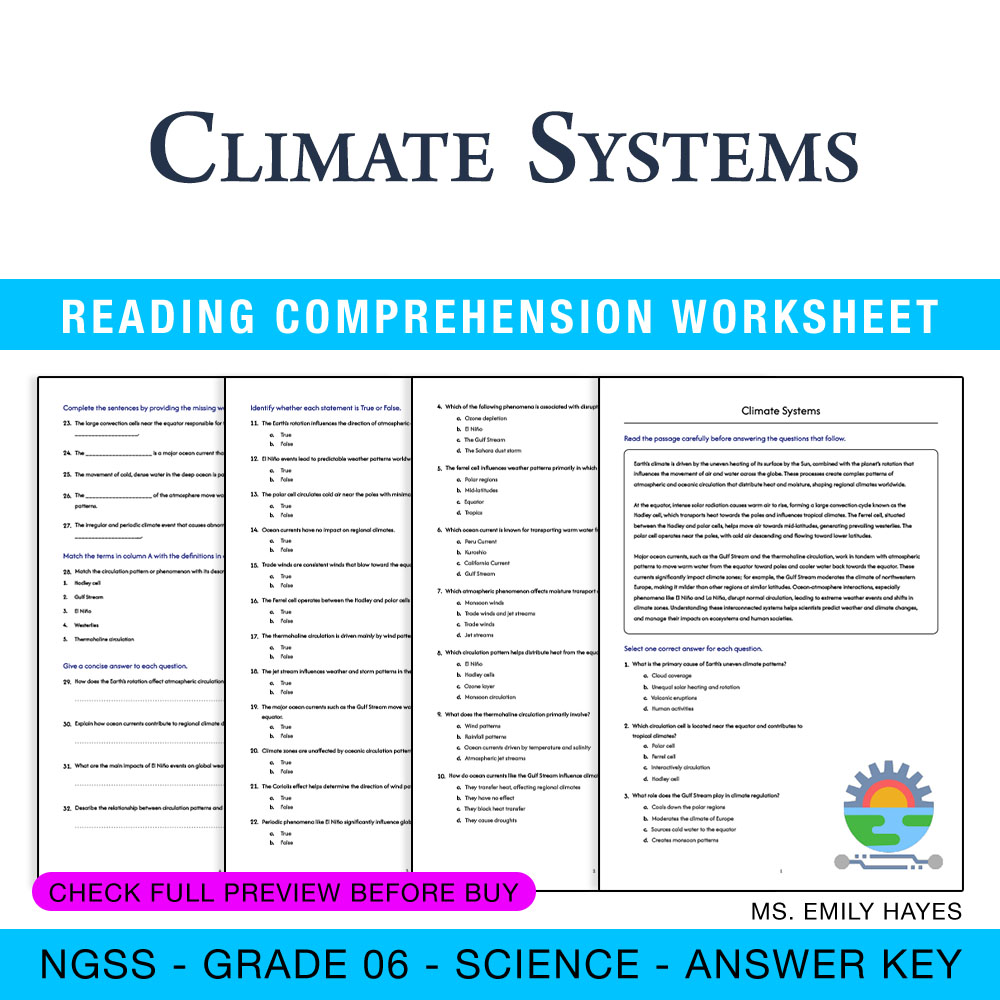
6th Grade Science | Climate Systems Worksheet + Answer Key – NGSS Standards
Created byCopper Leaf ClassroomLearning Objectives
- Explain how unequal solar heating and planetary rotation create global circulation patterns.
- Identify key models and phenomena related to atmospheric and oceanic circulation, such as Hadley cells, trade winds, and thermohaline circulation.
- Describe the influence of circulation patterns on regional climate zones and weather phenomena like El Niño.
Also included in: Grade 6 Science | Weather and Climate System Bundle (PDF+ Answer Key)
Instant download
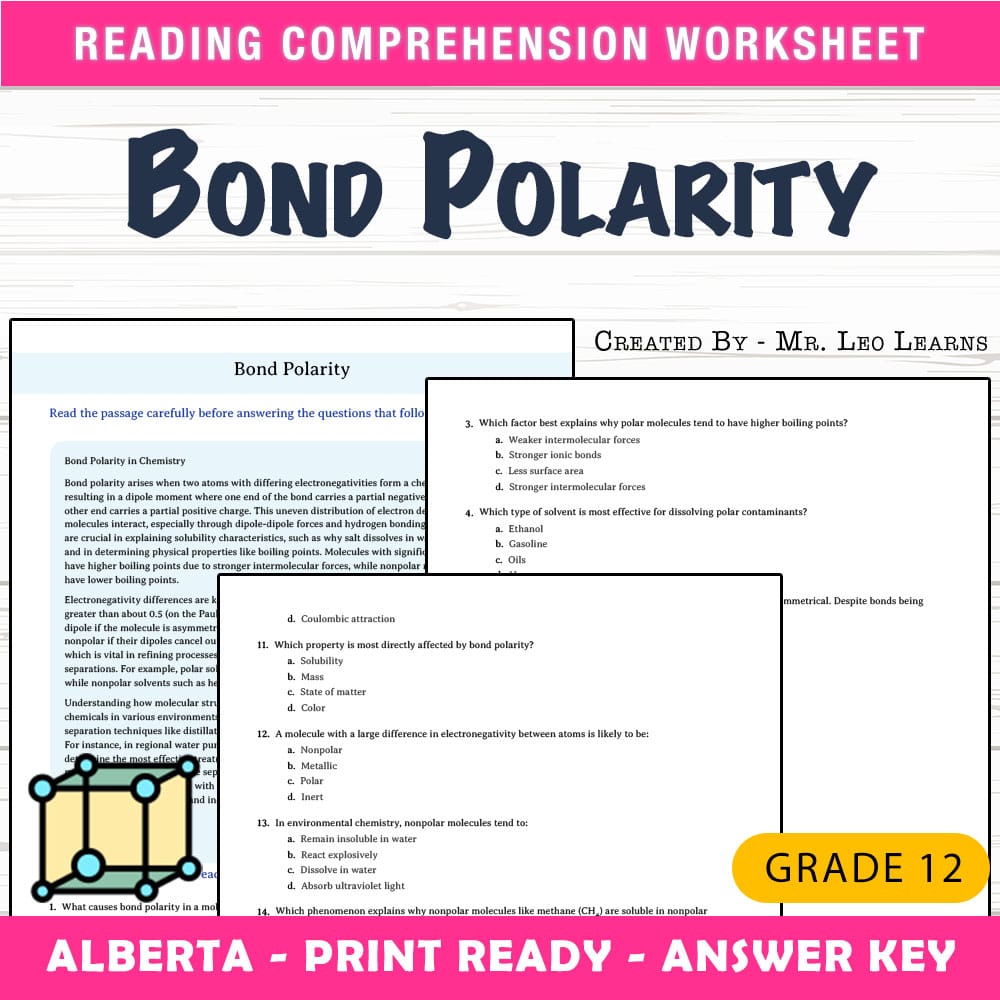
Grade 12 Science — Worksheet MCQ Paper for Mastering Bond Polarity
 Created byThe Resource Hub
Learning Objectives
- Understand how differences in electronegativity lead to bond polarity.
- Identify the effects of bond polarity on molecular interactions and properties.
- Relate molecular structure and polarity to solubility, boiling point, and separation techniques.
Also included in: Grade 12 Chemistry Worksheets Bundle | Alberta Science Mastery +1 more
Instant download
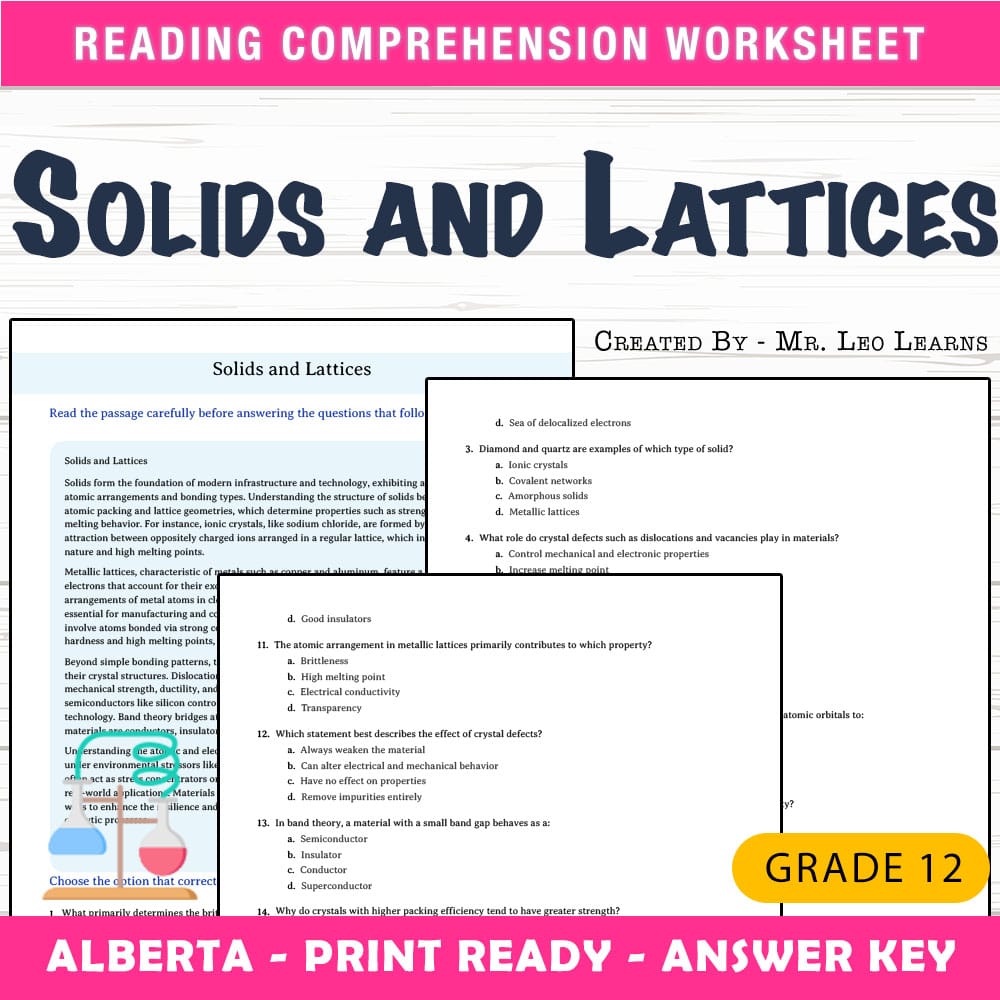
Grade 12 Science — Worksheet MCQ Paper for Mastering Solids and Lattices
Created byThe Resource HubLearning Objectives
- Understand the atomic packing and unit cell geometries in different types of crystalline solids.
- Explain the bonding types—ionic, metallic, covalent—and their influence on material properties.
- Connect band theory concepts to electronic properties of materials like semiconductors.
Also included in: Grade 12 Chemistry Worksheets Bundle | Alberta Science Mastery +1 more
Instant download
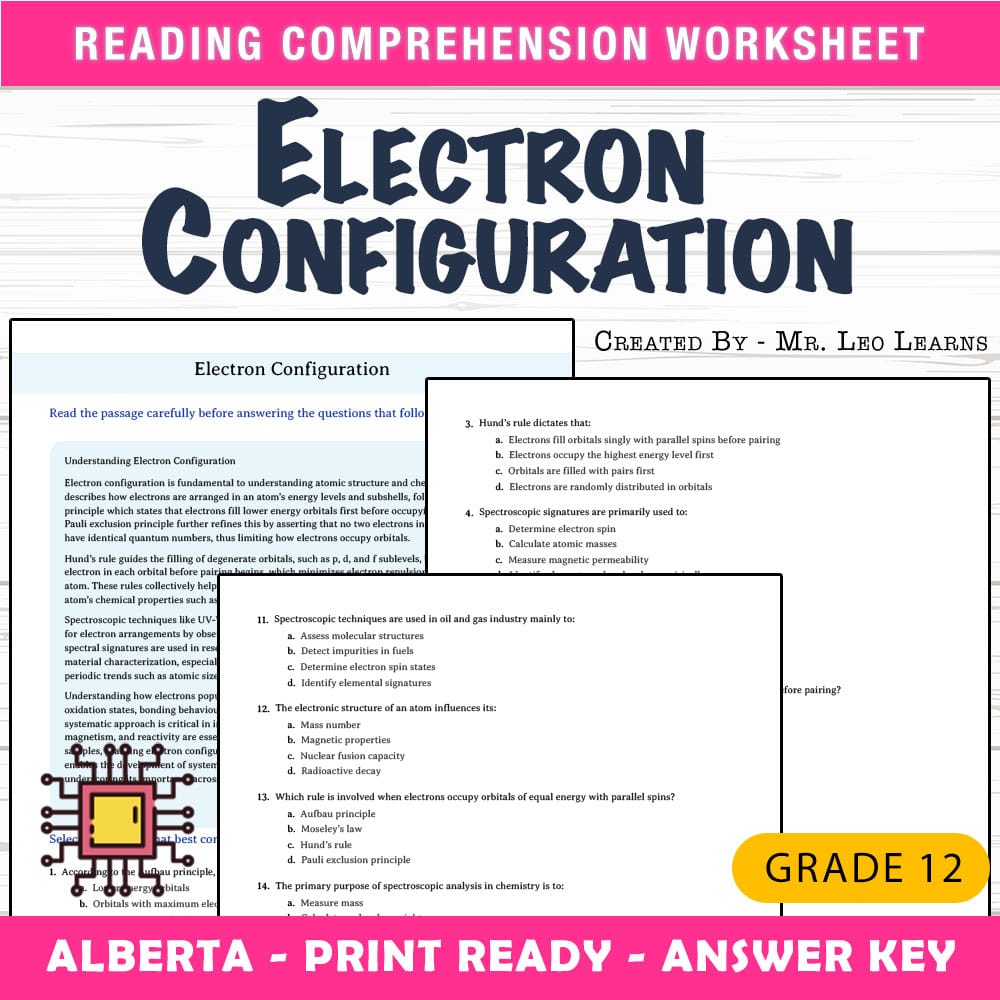
Grade 12 Science — Worksheet MCQ Paper for Mastering Electron Configuration
Created byThe Resource HubLearning Objectives
- Understand the principles of electron configuration, including Aufbau, Pauli exclusion, and Hund’s rules.
- Predict valence electrons and chemical properties based on electron arrangements.
- Explore spectroscopic signatures and their relevance to empirical analysis in industrial contexts.
Also included in: Grade 12 Chemistry Worksheets Bundle | Alberta Science Mastery +1 more
Instant download
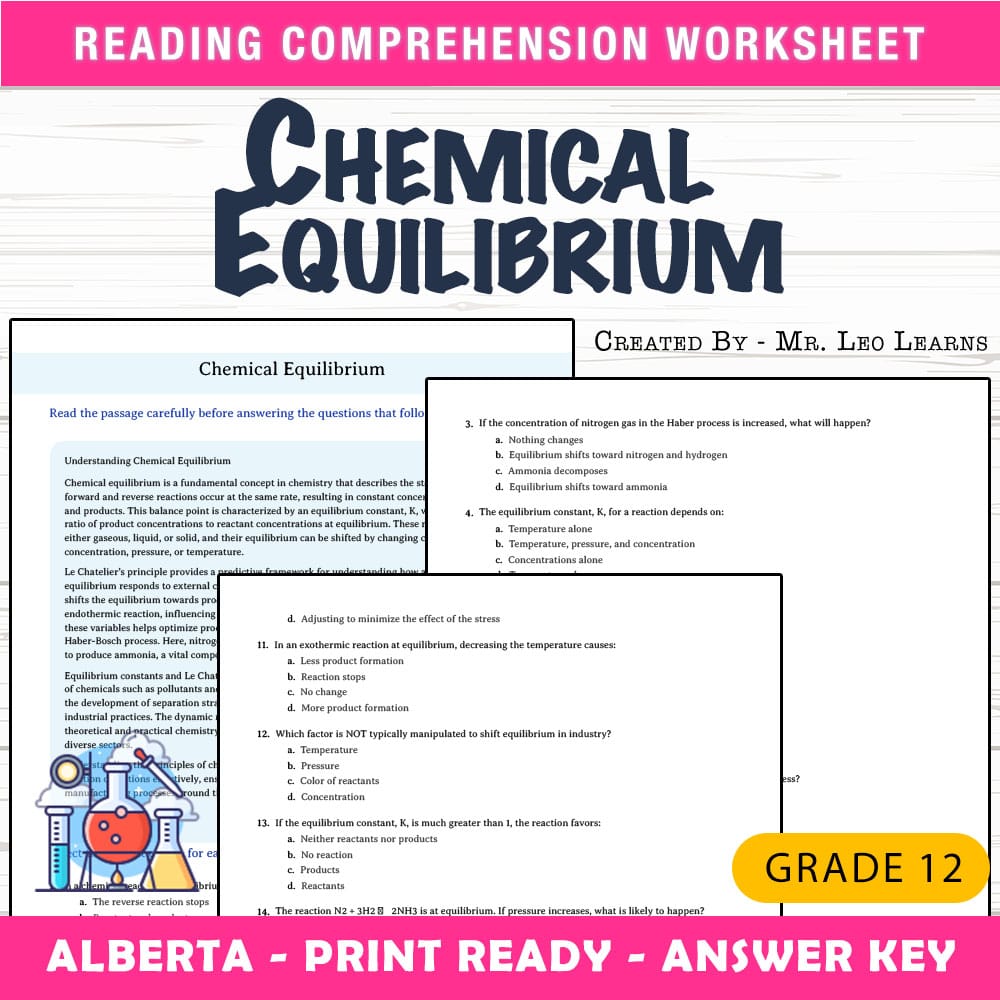
Grade 12 Science — Worksheet MCQ Paper for Mastering Chemical Equilibrium
Created byThe Resource HubLearning Objectives
- Understand the concept of chemical equilibrium and the conditions under which it occurs.
- Predict the effect of changing concentration, pressure, and temperature on equilibrium position using Le Chatelier’s principle.
- Use equilibrium constants to determine the extent of reactions and optimize yields in industrial processes.
Also included in: Grade 12 Chemistry Worksheets Bundle | Alberta Science Mastery +1 more
Instant download
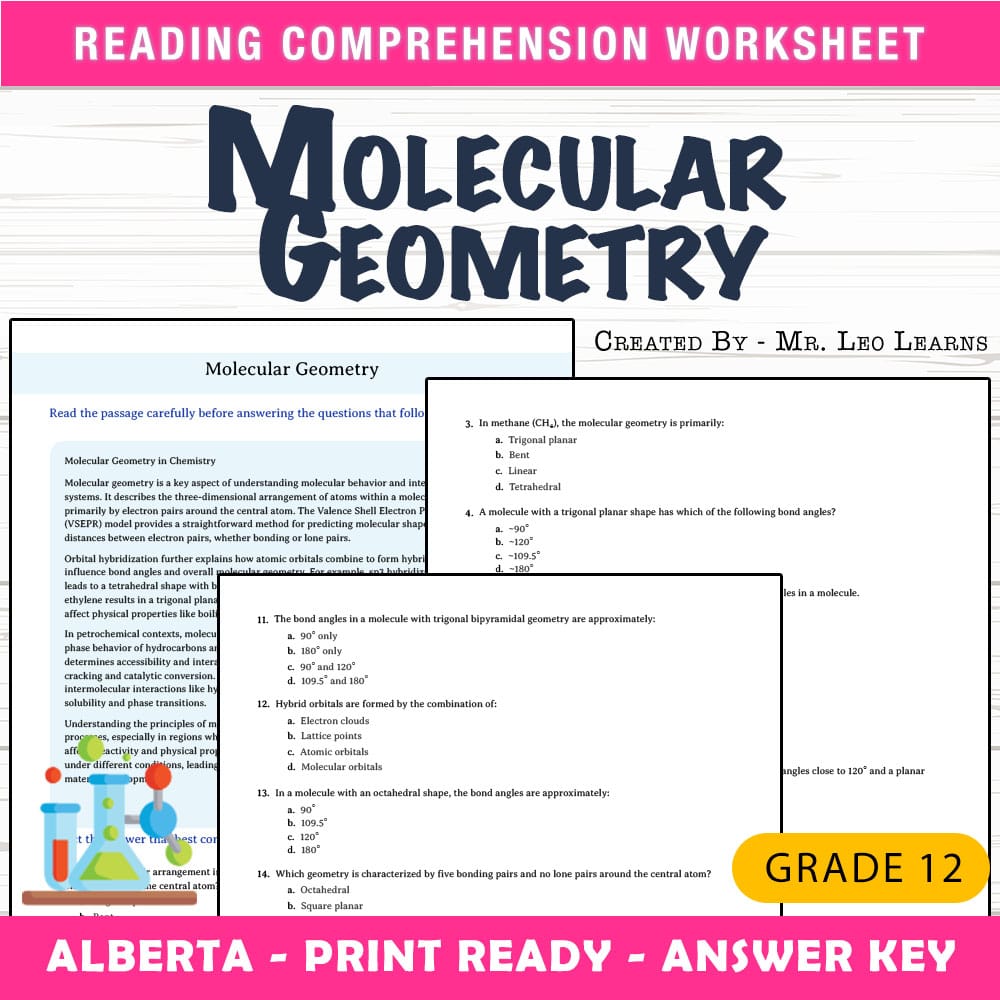
Grade 12 Science — Worksheet MCQ Paper for Mastering Molecular Geometry
Created byThe Resource HubLearning Objectives
- Understand the principles of VSEPR theory and orbital hybridization in predicting molecular shapes.
- Identify the influence of molecular geometry on physical and chemical properties.
- Interpret the relationship between molecular structure, polarity, and reactivity in petrochemical compounds.
Also included in: Grade 12 Chemistry Worksheets Bundle | Alberta Science Mastery +1 more
Instant download
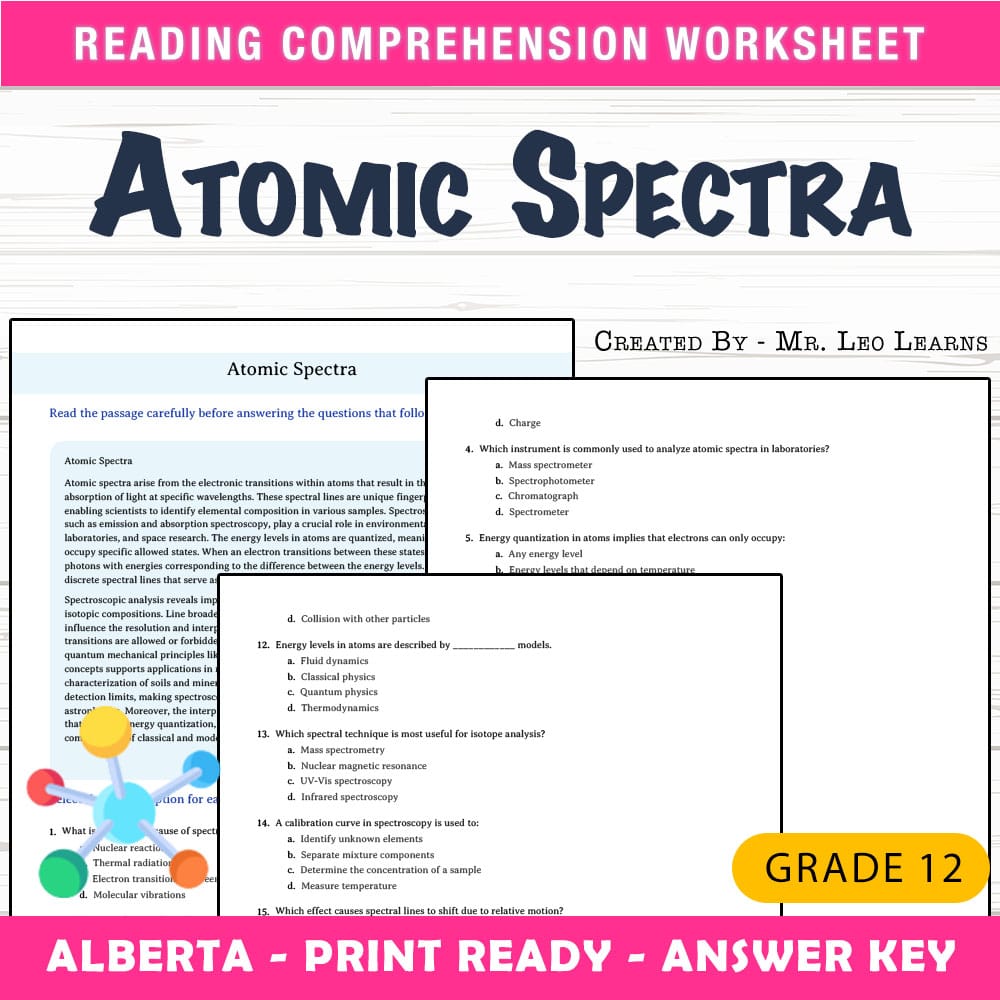
Grade 12 Science — Worksheet MCQ Paper for Mastering Atomic Spectra
Created byThe Resource HubLearning Objectives
- Understand the formation of atomic emission and absorption lines.
- Identify how spectral patterns support element and isotopic identification.
- Explain the significance of selection rules, line broadening, and energy quantization in spectroscopy.
Also included in: Grade 12 Chemistry Worksheets Bundle | Alberta Science Mastery +1 more
Instant download
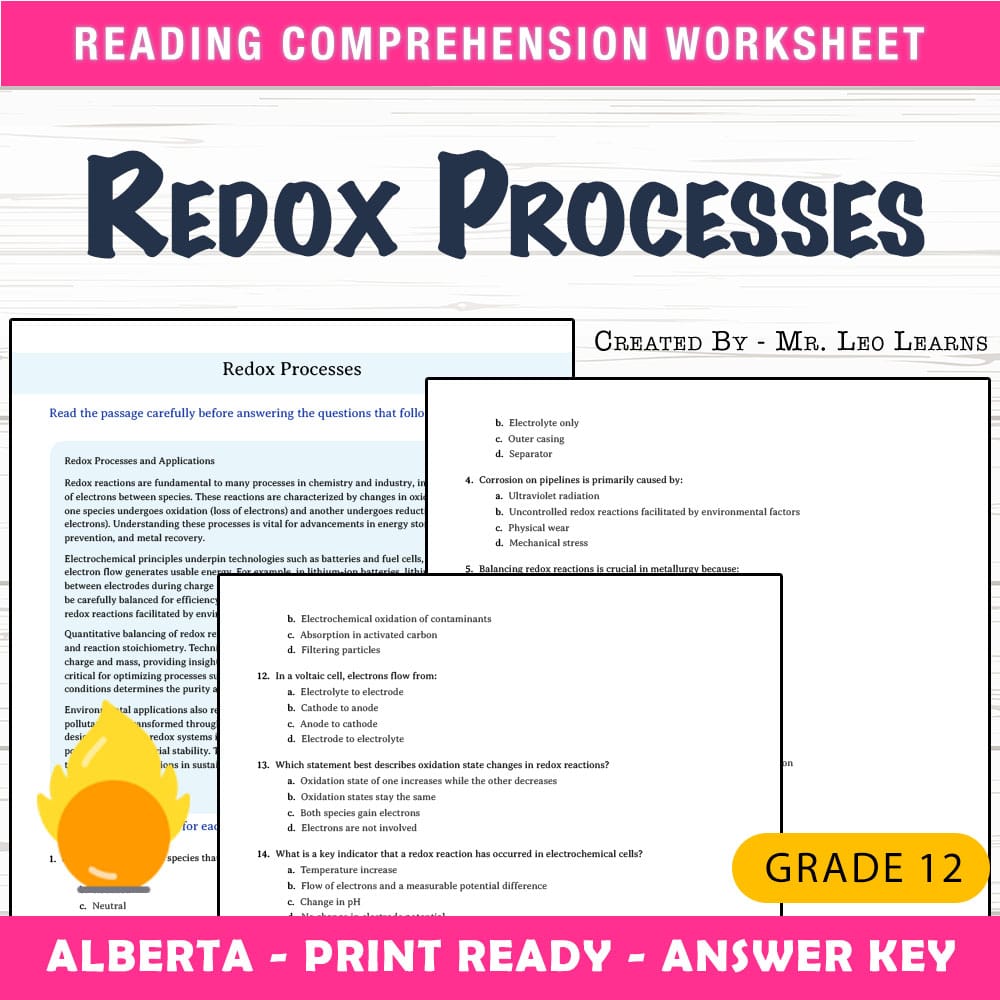
Grade 12 Science — Redox Processes Worksheet MCQ Paper for Mastery
Created byThe Resource HubLearning Objectives
- Explain the concept of redox reactions, including electron transfer, oxidation states, and balancing half-reactions.
- Apply electrochemical principles to real-world contexts such as corrosion, metal extraction, and battery technology.
- Perform quantitative balancing of redox reactions based on conservation of charge and mass.
Also included in: Grade 12 Chemistry Worksheets Bundle | Alberta Science Mastery +1 more
Instant download

Grade 11 Science | Electron Configuration Worksheet (PDF) BC Standards
Created byEvergreen Desk EducationLearning Objectives
- Explain how quantum numbers describe electron orbitals and how electron spin affects configurations.
- Apply the Aufbau principle, Pauli exclusion principle, and Hund’s rule to write electron configurations.
- Use valence electrons and electron arrangements to predict ion charges and periodic reactivity trends.
Instant download

Transport Mechanisms Grade 10 Assessment | TEKS Science Standards
Created byPrism Point LearningLearning Objectives
- Describe passive and active transport processes across cell membranes.
- Distinguish between diffusion, osmosis, facilitated diffusion, and active transport.
- Explain the role of pumps like the sodium–potassium pump in maintaining cell function.
Also included in: Grade 10 Cell Structure and Function Unit Science Lesson Bundle TEKS
Instant download

Intercellular Communication Assessment for Grade 10 Science TEKS
Created byPrism Point LearningLearning Objectives
- Explain different modes of intercellular communication including autocrine, paracrine, endocrine, and synaptic signaling.
- Identify key components of signal transduction pathways and receptor–ligand specificity.
- Describe mechanisms of direct cytoplasmic connections like gap junctions and plasmodesmata.
Also included in: Grade 10 Cell Structure and Function Unit Science Lesson Bundle TEKS
Instant download

Cytoskeleton Roles Grade 10 Science Assessment | TEKS Standards
Created byPrism Point LearningLearning Objectives
- Describe the structure and functions of microfilaments, intermediate filaments, and microtubules in the cytoskeleton.
- Explain how motor proteins facilitate intracellular transport along microtubules.
- Identify the roles of actin filaments in cell movement and cytokinesis.
Also included in: Grade 10 Cell Structure and Function Unit Science Lesson Bundle TEKS
Instant download

Membrane Structure Assessment | TEKS Grade 10 Science Standards
Created byPrism Point LearningLearning Objectives
- Explain the fluid mosaic model and the dynamic nature of the plasma membrane.
- Identify the roles of phospholipid bilayer asymmetry and cholesterol in membrane fluidity.
- Describe different membrane protein types and their functions such as receptors and transporters.
Also included in: Grade 10 Cell Structure and Function Unit Science Lesson Bundle TEKS
Instant download
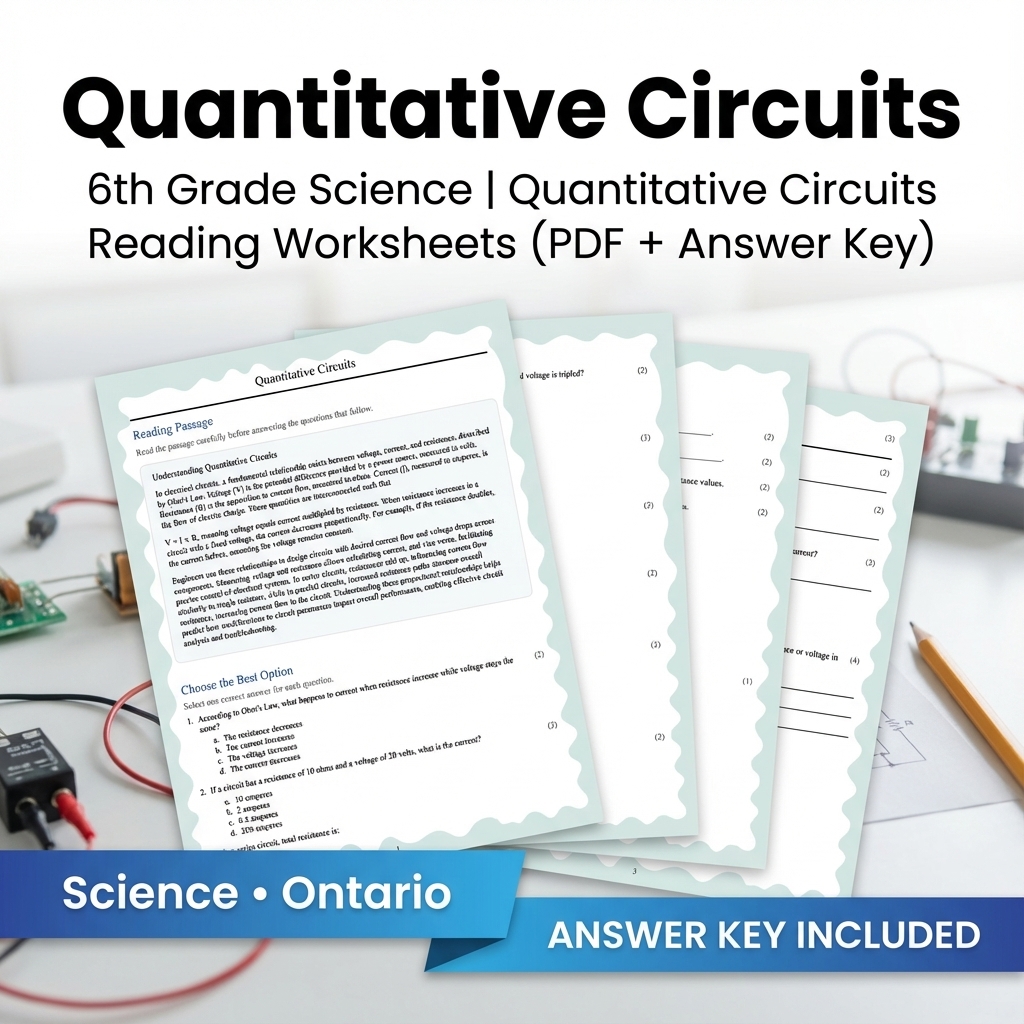
6th Grade Science | Quantitative Circuits Reading Worksheets (PDF + Answer Key)
JCreated byJ.S SheetsLearning Objectives
- Understand the relationship between voltage, current, and resistance in electrical circuits.
- Apply proportional reasoning to determine how changes in resistance affect current at a fixed voltage.
- Calculate circuit element characteristics using measured values.
Also included in: Grade 6 Science Circuit & Electricity Unit Bundle – Worksheets & Answer Keys +1 more
Instant download
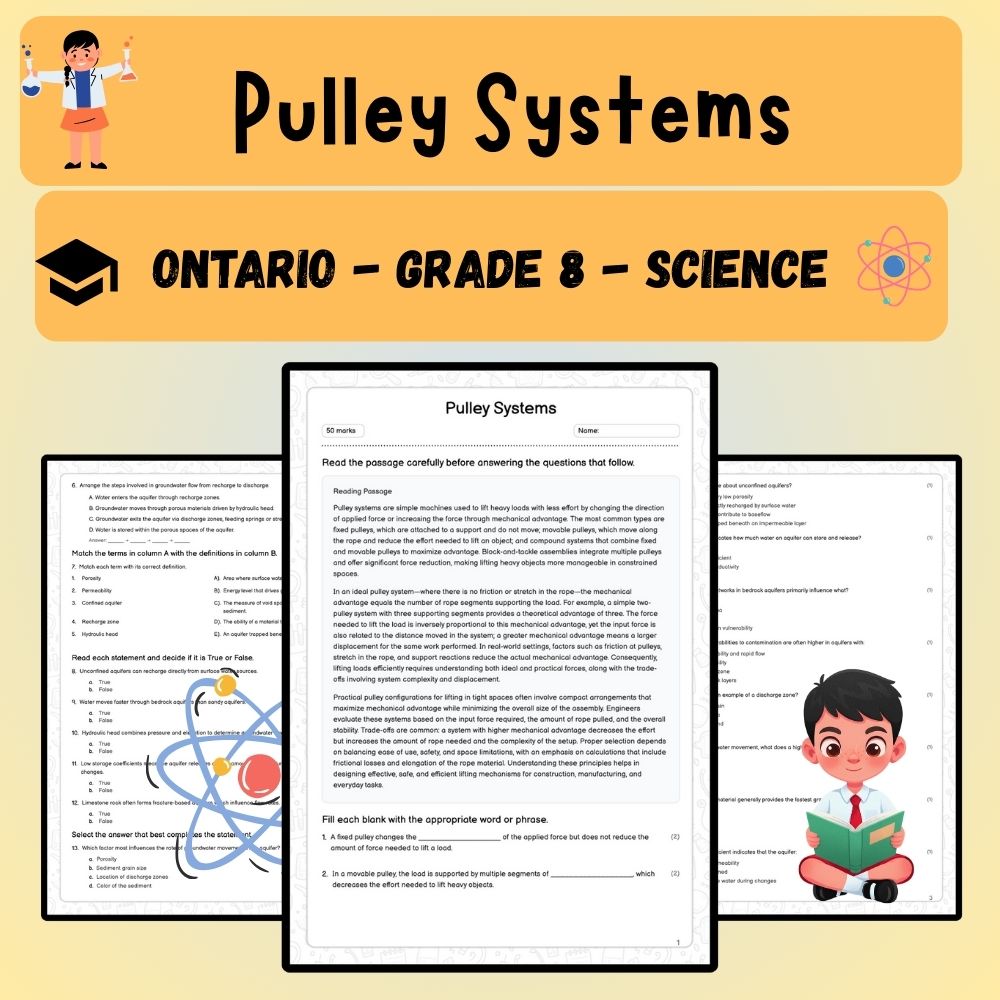
Grade 8 Science | Pulley Systems Worksheet (PDF) – Ontario Standards
Created byPrism Point LearningLearning Objectives
- Understand the difference between fixed, movable, and compound pulley arrangements.
- Explain how mechanical advantage is achieved and calculated in pulley systems.
- Analyze real-world factors such as friction and rope stretch that affect pulley performance.
Also included in: Grade 8 Science Unit Bundle | Forces, Energy & Motion Worksheets +1 more
Instant download
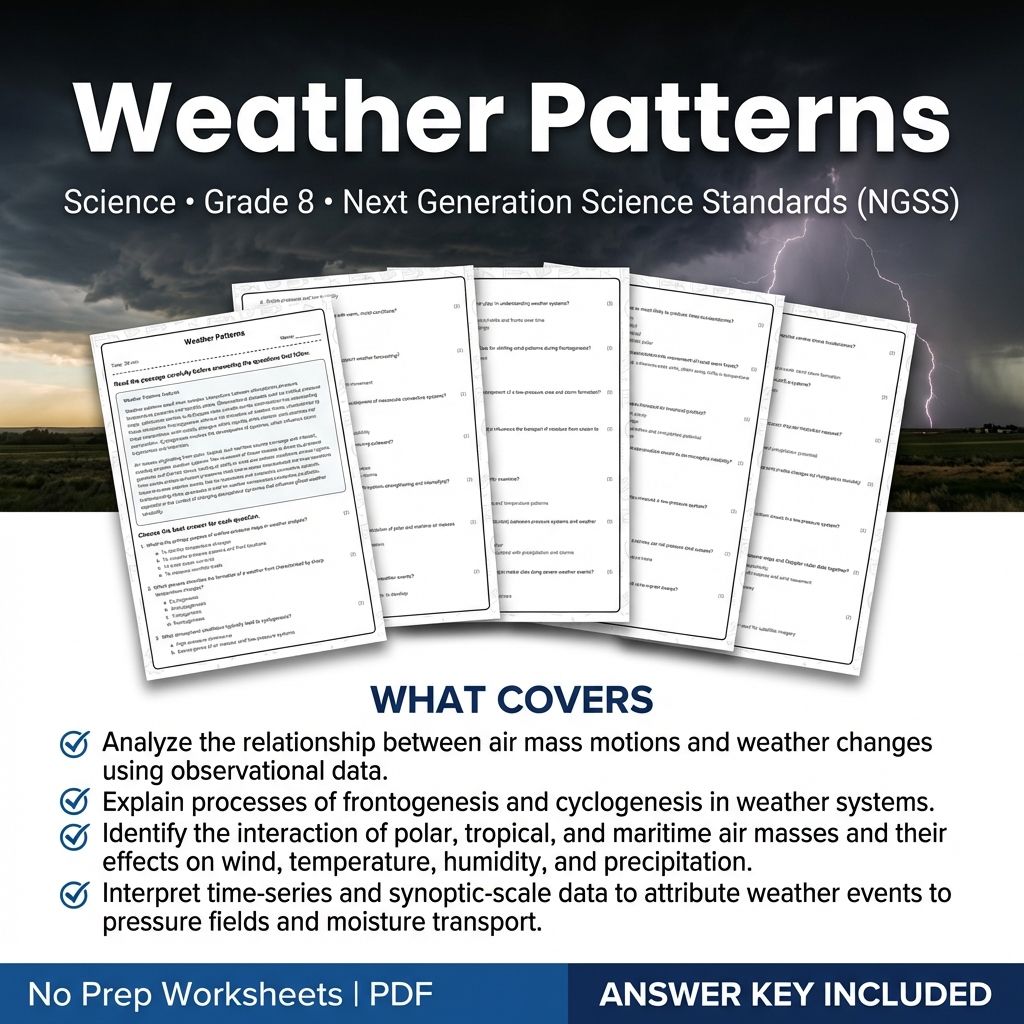
8th Grade Science | Weather Patterns Worksheet & Answer Key (Printable PDF)
 Created byCoral Reef Learning
Learning Objectives
- Analyze the relationship between air mass motions and weather changes using observational data.
- Explain processes of frontogenesis and cyclogenesis in weather systems.
- Identify the interaction of polar, tropical, and maritime air masses and their effects on wind, temperature, humidity, and precipitation.
Instant download
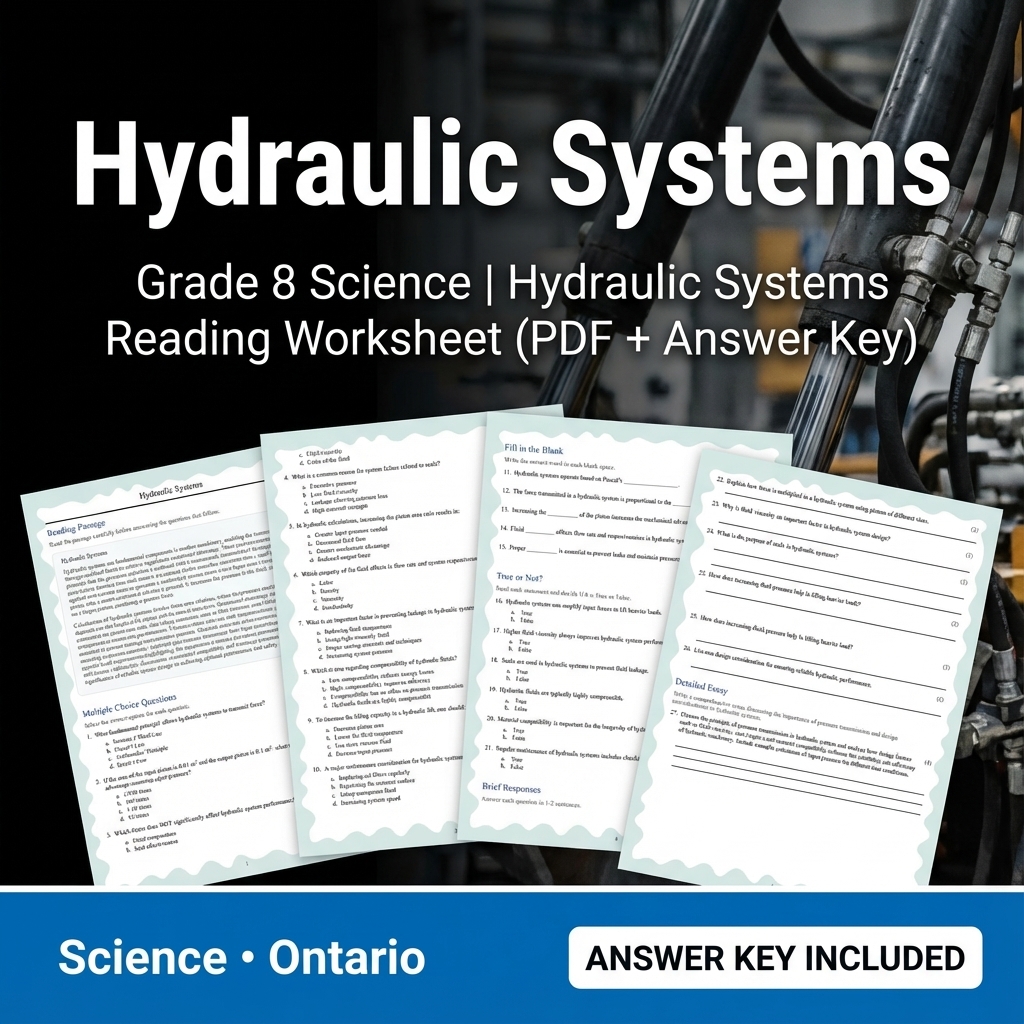
Grade 8 Science | Hydraulic Systems Reading Worksheet (PDF + Answer Key)
JCreated byJ.S SheetsLearning Objectives
- Understand how hydraulic systems convert small forces into larger outputs through pressure transmission.
- Evaluate the force-area relationship in piston assemblies within hydraulic machinery.
- Apply pressure calculations to real-world hydraulic system examples.
Also included in: Grade 8 Science Unit Bundle – Density, Pressure & Fluid Mechanics Worksheets +1 more
Instant download
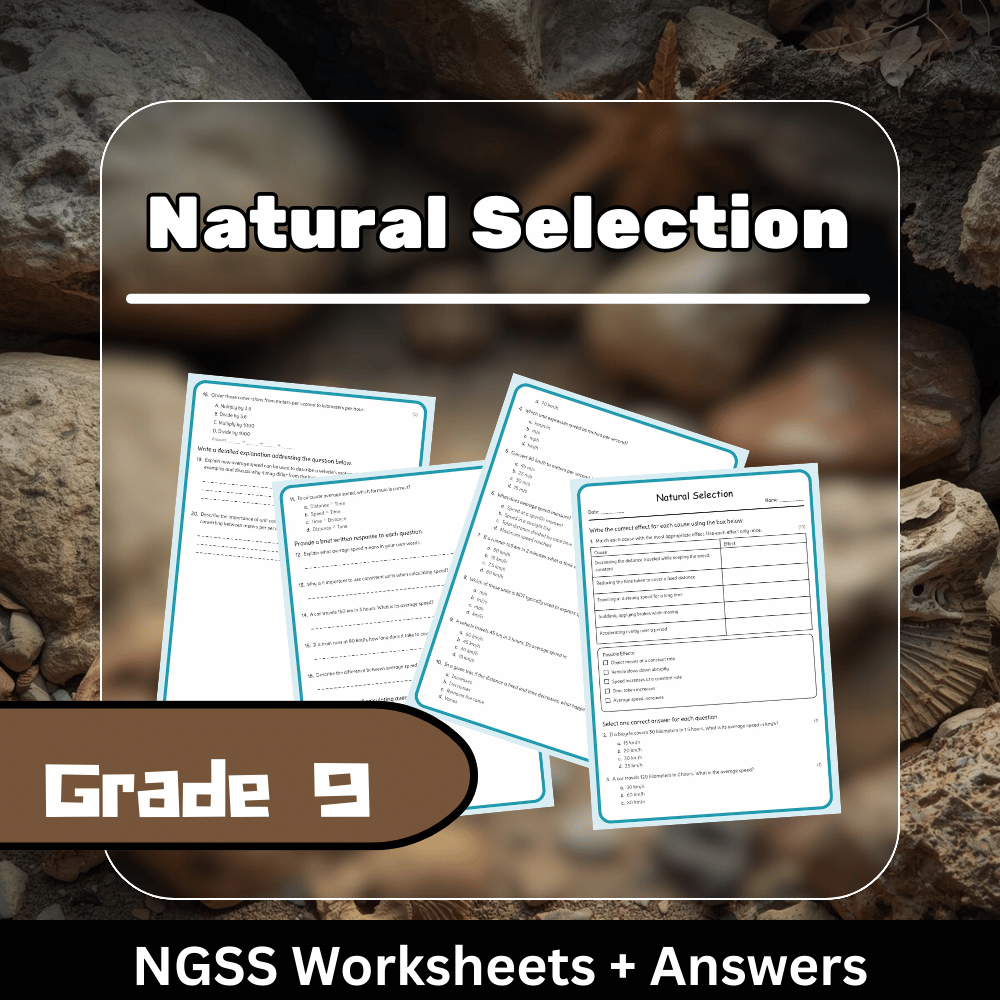
Grade 9 Science | Natural Selection Worksheet (Answer Key) - NGSS Aligned
Created byBright Mind ResourcesLearning Objectives
- Explain how heritable variation leads to differential survival and reproduction.
- Identify examples of natural selection such as beak morphology shifts and antibiotic resistance.
- Understand and interpret models of fitness and allele frequency changes in populations.
Instant download

Grade 12 Science – Equilibrium & Reversible Reactions | Daily Reading Worksheet
Created byBright Mind ResourcesLearning Objectives
- Define chemical equilibrium and explain its characteristics.
- Describe how the rates of forward and reverse reactions relate at equilibrium.
- Identify factors that affect the position of equilibrium and equilibrium constants.
Also included in: Grade 12 Chemistry Science Lesson Bundle | BC Daily Reading Worksheets +1 more
Instant download
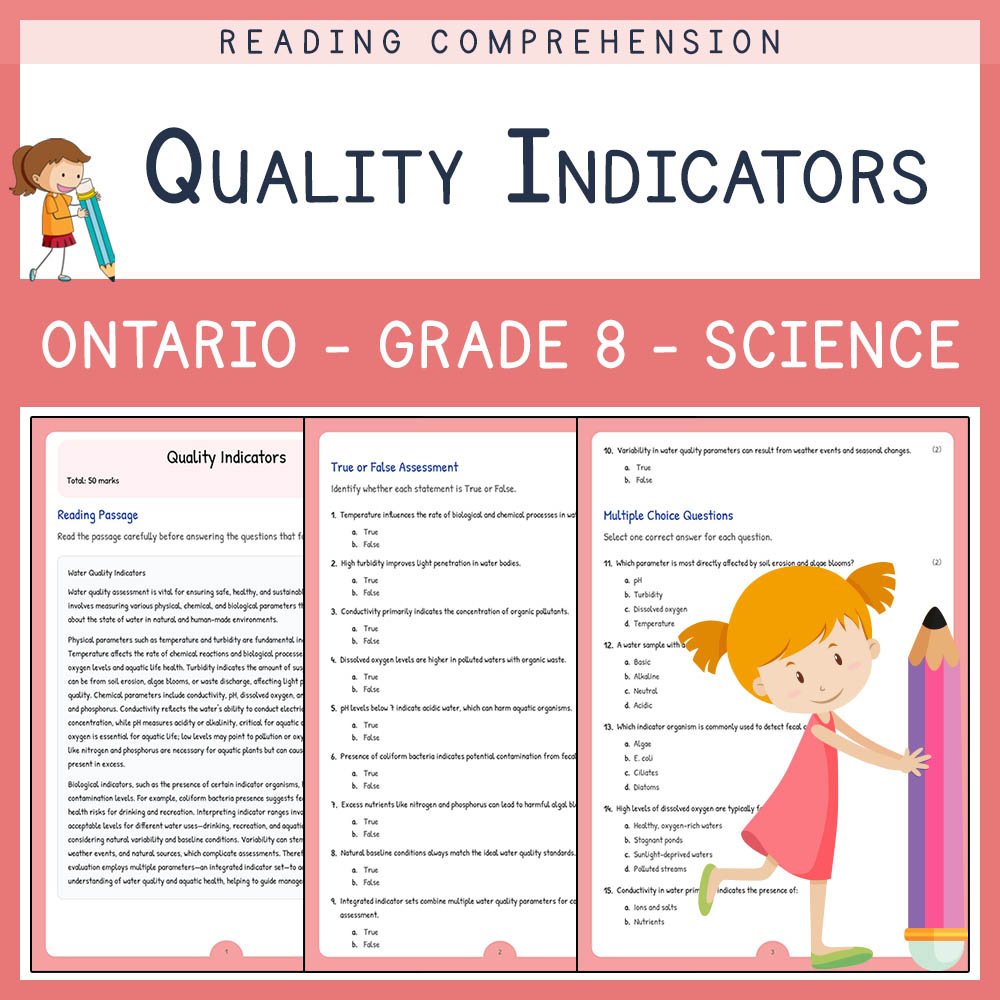
Grade 8 Science Worksheet Elena | Water Quality Indicators | Ontario
 Created byLumora Learning
Learning Objectives
- Understand the physical, chemical, and biological indicators of water quality.
- Interpret indicator ranges for aquatic health and their uses.
- Recognize sources of variability and natural baseline conditions in water assessments.
Instant download

Independence Day Reading Comprehension | Origins of Independence | Grades 6–8
Learning Objectives
- Explain how colonial protests and revolutionary ideas led to the Declaration of Independence.
- Identify key figures and summarize major claims made in the Declaration.
- Describe how the Declaration connects rights, government, and self-governance.
Instant download
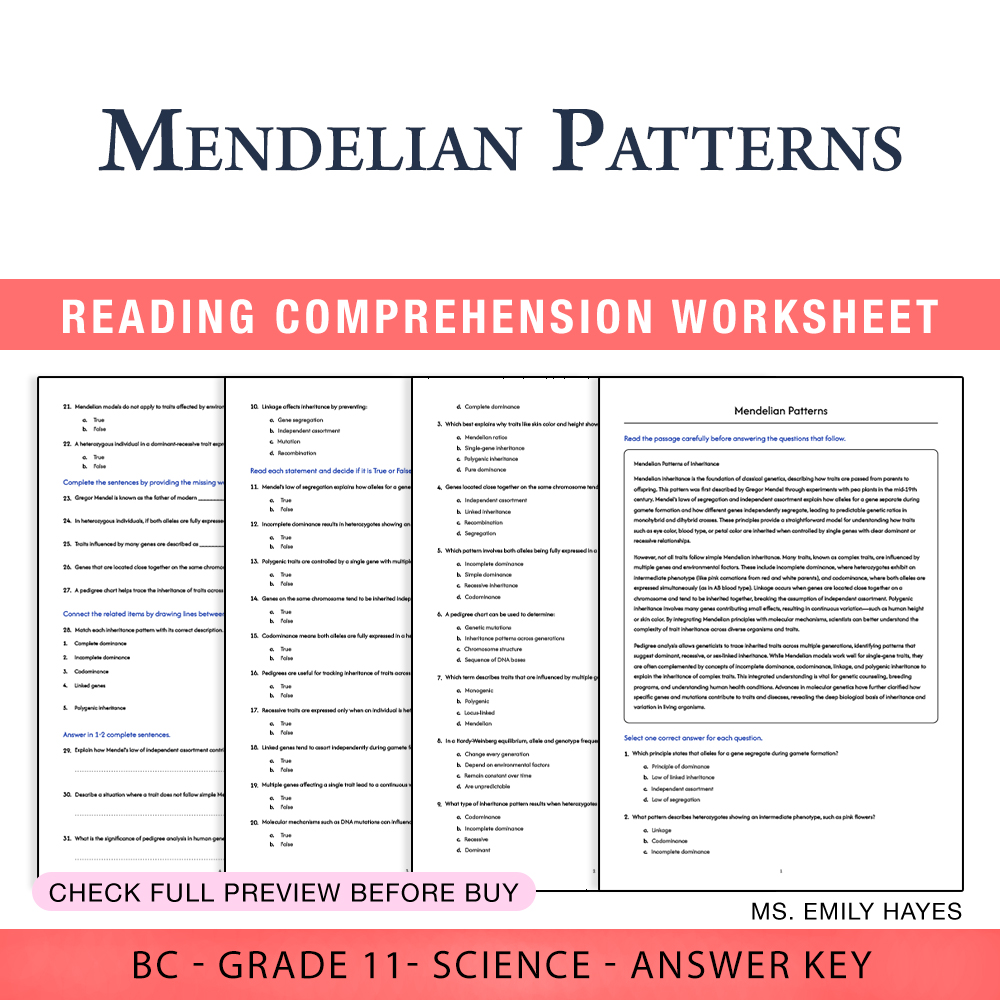
11th Grade Science | Mendelian Patterns Worksheet (PDF + Answer Key)
Created byCopper Leaf ClassroomLearning Objectives
- Understand how Mendelian inheritance explains trait segregation and patterns in offspring.
- Identify the concepts of dominant and recessive alleles and predict genotypic and phenotypic ratios.
- Describe how pedigrees trace inheritance across generations.
Also included in: Grade 11 Science BC | Genetics, Evolution & Cell Biology (PDF + Answer Keys) +1 more
Instant download
Browse more categories
About Reading comprehension Worksheets
Find reading comprehension worksheets for class practice, homework, or self-study. All 40,284 are instant PDF downloads.
Each resource here is built by an independent educator and reviewed for quality. Worksheets print straight from PDF and suit classroom use, homework, or extra practice; most come with answer keys, and you can preview before purchasing.