
Reading comprehension Worksheets
40,289 type resources
Grade 10 Science – Genomic Technologies & DNA Applications | Reading Worksheet
 Created byBright Mind Resources
Learning Objectives
- Understand the basic structure of DNA and how it functions as the blueprint of life.
- Learn about key genomic technologies such as PCR, DNA sequencing, and CRISPR.
- Explore how recombinant DNA methods are used in biotechnology.
Also included in: DNA & Genetics Grade 10 Science Daily Reading Worksheets Lesson Bundle | TEKS +2 more
Instant download

Grade 10 Science – Membrane Structure & Function | Daily Reading Worksheet
Created byBright Mind ResourcesLearning Objectives
- Understand the fluid mosaic model of the plasma membrane
- Identify the roles of lipids and proteins in membrane structure
- Describe the functions of membrane components such as cholesterol and microdomains
Also included in: Grade 10 Cell Structure & Function Science Daily Reading Lesson Bundle | TEKS +2 more
Instant download

Grade 6 Science | Flight Forces - Daily Reading Comprehension Practice
 Created byCoral Reef Learning
Learning Objectives
- Understand the four primary forces of flight: lift, thrust, drag, and weight.
- Explain how these forces interact to allow objects to fly or descend.
- Identify examples of flight forces in real-life scenarios such as kites, airplanes, and parachutes.
Also included in: Air and Aerodynamics Lesson Bundle – Grade 6 Science Alberta Reading Comp. +1 more
Instant download

Grade 6 Science | Stability & Balance - Daily Reading Comprehension
Created byCoral Reef LearningLearning Objectives
- Understand how center of mass and center of pressure influence stability.
- Identify design features that enhance aircraft stability, such as dihedral angles and tail volume.
- Explain how weight placement affects the static stability of flying objects.
Also included in: Air and Aerodynamics Lesson Bundle – Grade 6 Science Alberta Reading Comp. +1 more
Instant download

Membrane Structure Assessment | TEKS Grade 10 Science Standards
 Created byPrism Point Learning
Learning Objectives
- Explain the fluid mosaic model and the dynamic nature of the plasma membrane.
- Identify the roles of phospholipid bilayer asymmetry and cholesterol in membrane fluidity.
- Describe different membrane protein types and their functions such as receptors and transporters.
Also included in: Grade 10 Cell Structure and Function Unit Science Lesson Bundle TEKS
Instant download

Negative Feedback Assessment | TEKS Grade 10 Science Standards
Created byPrism Point LearningLearning Objectives
- Define negative feedback as a regulatory process that maintains internal stability.
- Explain how sensors, control centers, and effectors work together in negative feedback mechanisms.
- Identify physiological variables regulated by negative feedback, such as temperature, blood glucose, and blood pressure.
Also included in: Grade 10 Homeostasis and Feedback Science Lesson Bundle | TEKS
Instant download

Trophic Efficiency Assessment for Grade 10 Science TEKS | Science Worksheet
Created byPrism Point LearningLearning Objectives
- Understand the concept of trophic efficiency and its significance in ecosystems.
- Analyze how energy transfer affects biomass pyramids and food web structures.
- Evaluate factors influencing variations in trophic efficiency among different ecosystems.
Also included in: Grade 10 Ecosystems Science Lesson Bundle for TEKS Assessment Worksheets
Instant download

Molecular Evidence Assessment | TEKS Grade 10 Science Standards
Created byPrism Point LearningLearning Objectives
- Understand how DNA, RNA, and protein sequences are used to infer evolutionary relationships.
- Identify methods like sequence similarity, conserved genes, and molecular clocks in molecular analysis.
- Explain challenges like horizontal gene transfer and convergent evolution in interpreting molecular data.
Also included in: Grade 10 Evolution and Heredity Science Lesson Bundle for TEKS Standards
Instant download

Grade 10 Science – Climate Drivers & Factors | Daily Reading Worksheet
Created byBright Mind ResourcesLearning Objectives
- Understand key factors influencing Earth's climate such as radiative forcing, greenhouse gases, and albedo.
- Recognize how ocean-atmosphere interactions affect climate patterns.
- Interpret energy-balance models and paleoclimate proxies to analyze climate change.
Also included in: Grade 10 Earth Science Daily Reading Worksheets Lesson Bundle | AP +2 more
Instant download
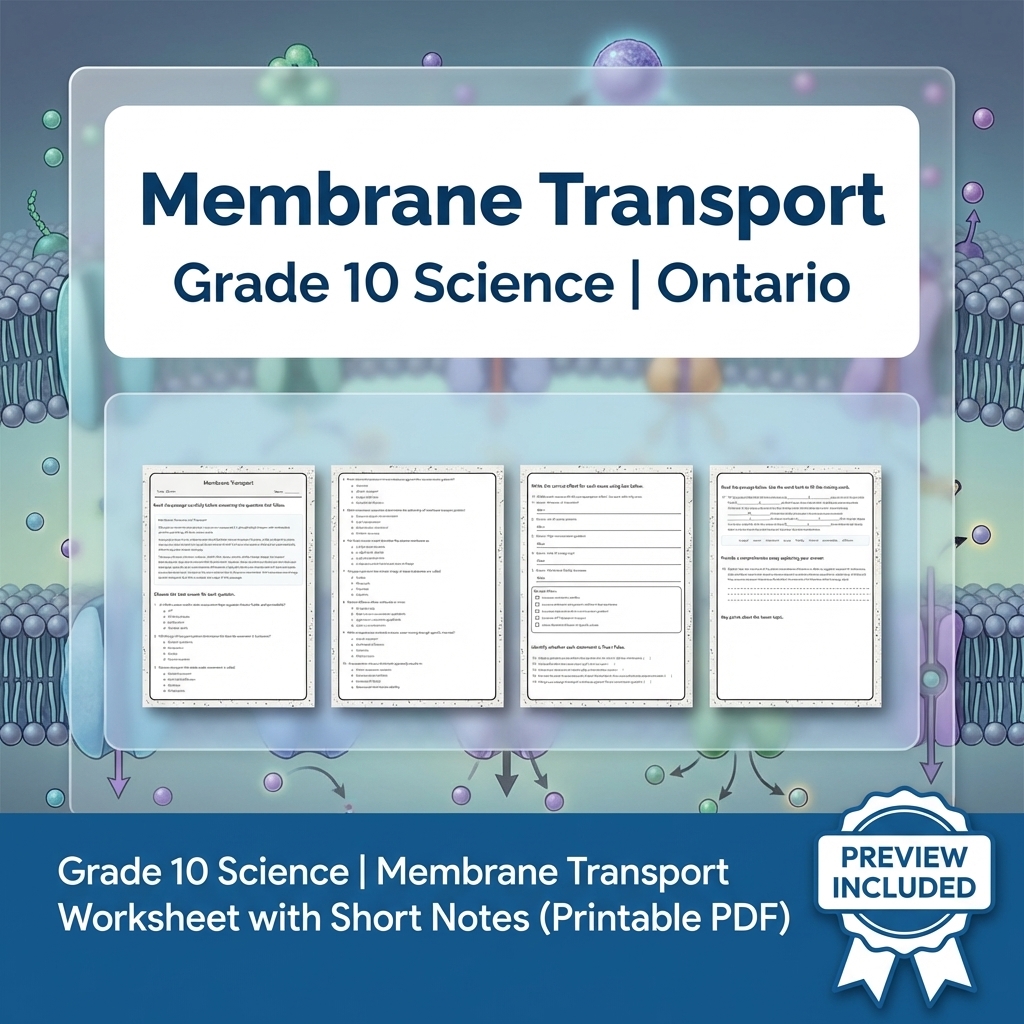
Grade 10 Science | Membrane Transport Worksheet with Short Notes (Printable PDF)
 Created byMeadowlark Worksheets
Learning Objectives
- Describe the structural features of the plasma membrane according to the fluid mosaic model.
- Differentiate between types of transport proteins such as channels, carriers, and pumps.
- Explain passive transport mechanisms like diffusion, facilitated diffusion, and osmosis.
Also included in: Grade 10 Science Lesson Group Bundle | Ontario Curriculum +1 more
Instant download

Grade 10 Science — Worksheet MCQ Paper for Mastering Constraint-Based Design
 Created byThe Resource Hub
Learning Objectives
- Understand the role of constraints in observational and comparative research.
- Identify trade-offs among replication, measurement precision, and scope under practical limitations.
- Evaluate scenarios involving rapid assessments or limited instrumentation to determine prioritized design choices.
Also included in: Grade 10 Science Bundle: Master Scientific Modeling & Data Analysis +1 more
Instant download

Grade 10 Science — Worksheet MCQ Paper for Mastering Causal Complexity
Created byThe Resource HubLearning Objectives
- Understand how to disentangle multivariable causal relationships using frameworks like control matrices and causal graphs.
- Identify confounding factors and interaction effects in complex systems such as ecosystems.
- Evaluate the impact of study design, measurement limitations, and model assumptions on causal inference.
Also included in: Grade 10 Science Bundle: Master Scientific Modeling & Data Analysis +1 more
Instant download

Grade 10 Science — Worksheet MCQ Paper for Mastering Plate Tectonics
Created byThe Resource HubLearning Objectives
- Understand the mechanisms of plate motion, mantle convection, and subduction.
- Interpret tectonic settings through maps, cross-sections, and seismic evidence.
- Connect plate interactions to geological phenomena such as mountain building, volcanism, and earthquakes.
Also included in: Grade 10 Earth and Space Sciences Lesson Bundle | AP Curriculum +1 more
Instant download

Grade 10 Science — Worksheet MCQ Paper for Climate Drivers
Created byThe Resource HubLearning Objectives
- Understand the main factors that influence Earth's climate, including radiative forcing and greenhouse gases.
- Analyze how albedo variations and ocean-atmosphere coupling affect regional and long-term climate change.
- Interpret data from energy-balance models and proxy records to assess climate trends.
Also included in: Grade 10 Earth and Space Sciences Lesson Bundle | AP Curriculum +1 more
Instant download

Grade 10 Science – Geologic Time & Dating Methods | Daily Reading Worksheet
Created byBright Mind ResourcesLearning Objectives
- Describe the methods used to determine Earth's age and history.
- Explain relative and absolute dating techniques including radiometric methods.
- Identify key events in Earth's history using stratigraphic records and crater counts.
Also included in: Grade 10 Space & Geologic Time Science Lesson Bundle | NGSS Daily Reading +2 more
Instant download

Grade 10 Science | Genomic Technologies Worksheet | TEKS Aligned
 Created byLumora Learning
Learning Objectives
- Understand fundamental principles of various genomic techniques such as PCR, DNA sequencing, and CRISPR.
- Identify applications of recombinant DNA and genome editing in biotechnology and medicine.
- Recognize societal and ecological implications associated with genomic technologies.
Also included in: Grade 10 Science | Genetics & Molecular Biology Lesson Bundle | TEKS Aligned +1 more
Instant download

Grade 10 Science – Molecular Coding & Protein Synthesis | Reading Worksheet
Created byBright Mind ResourcesLearning Objectives
- Understand the process of transcription and translation
- Identify how DNA sequences determine amino acid chains
- Recognize the effects of mutations on protein structure
Also included in: Homeostasis Grade 10 Science Daily Reading Worksheets Lesson Bundle | NGSS +2 more
Instant download

Grade 10 Science – Cell Division & Cell Cycle | Daily Reading Worksheet
Created byBright Mind ResourcesLearning Objectives
- Understand the basic processes of mitosis and its role in cell division
- Learn about the cell cycle and checkpoints that regulate division
- Identify the significance of cell division for growth, repair, and reproduction
Also included in: Homeostasis Grade 10 Science Daily Reading Worksheets Lesson Bundle | NGSS +2 more
Instant download

Grade 10 Science – Evolutionary Evidence & NGSS | Daily Reading Worksheet
Created byBright Mind ResourcesLearning Objectives
- Understand different types of fossil evidence supporting evolution
- Identify transitional forms and their significance
- Comprehend the role of comparative anatomy and embryology in evolutionary studies
Also included in: Evolution Grade 10 Science Daily Reading Worksheets Lesson Bundle | NGSS +2 more
Instant download
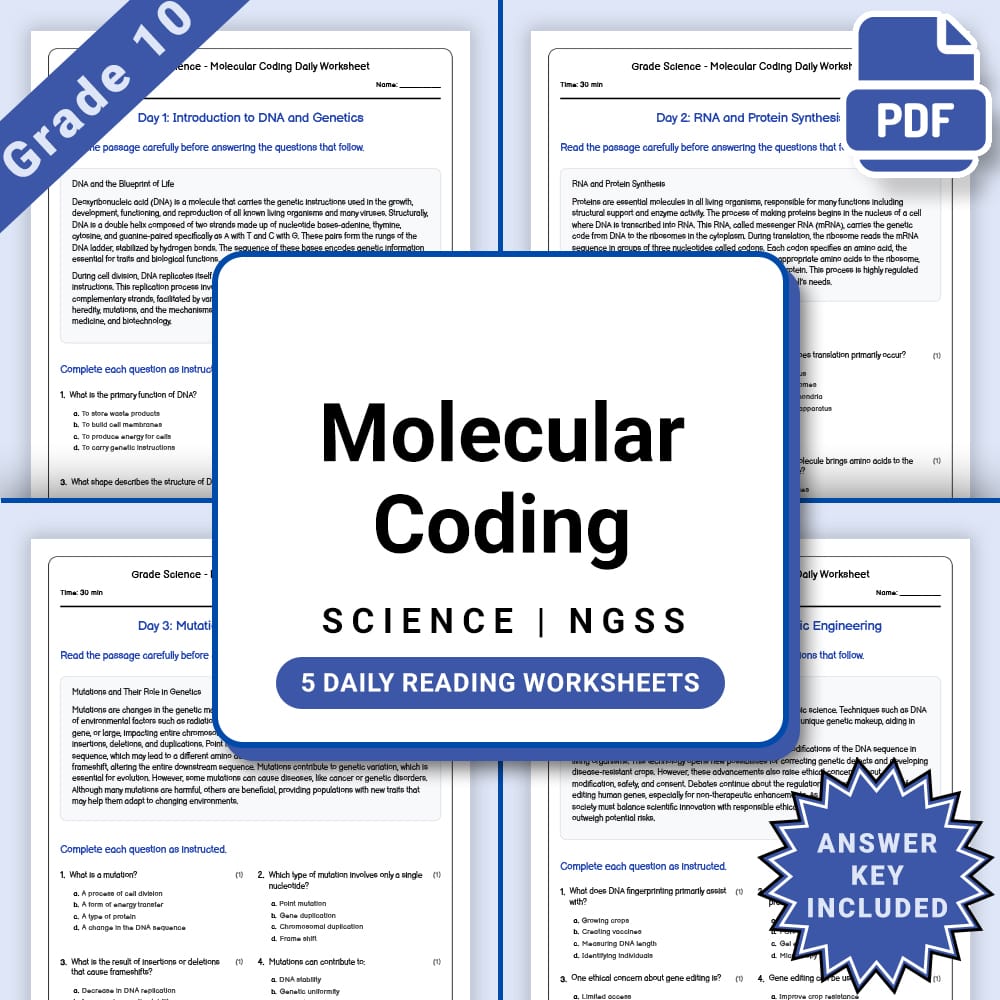
Grade 10 Science – Molecular Coding Daily Worksheet (PDF +Answer Key)
 Created byCopper Leaf Classroom
Learning Objectives
- Understand key concepts related to Science
- Apply knowledge through practice questions
- Demonstrate comprehension of the material
Instant download
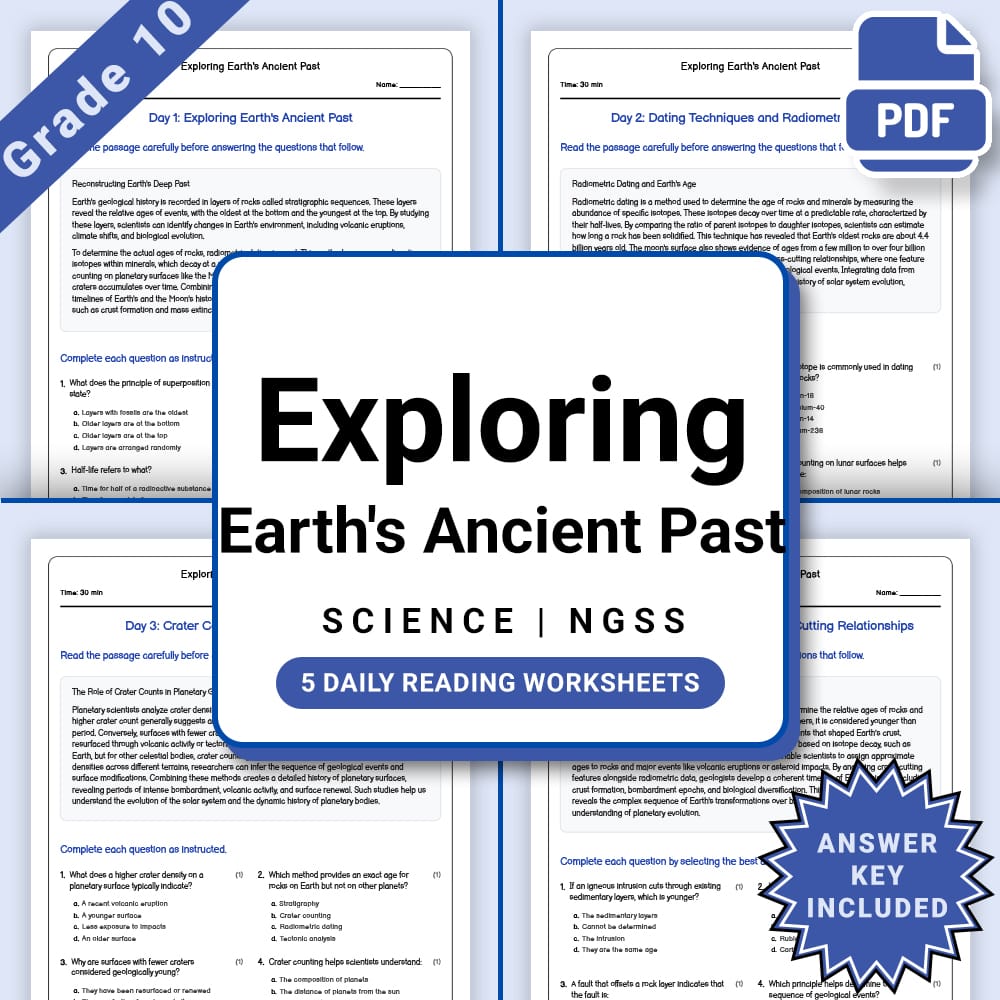
Grade 10 Science – Exploring Earth's Ancient Past Worksheet (PDF +Answer Key)
Created byCopper Leaf ClassroomLearning Objectives
- Understand how stratigraphic sequences reveal Earth's history.
- Explain the principles of relative and absolute dating methods.
- Describe how radiometric decay and crater counting help determine ages of planetary surfaces.
Instant download
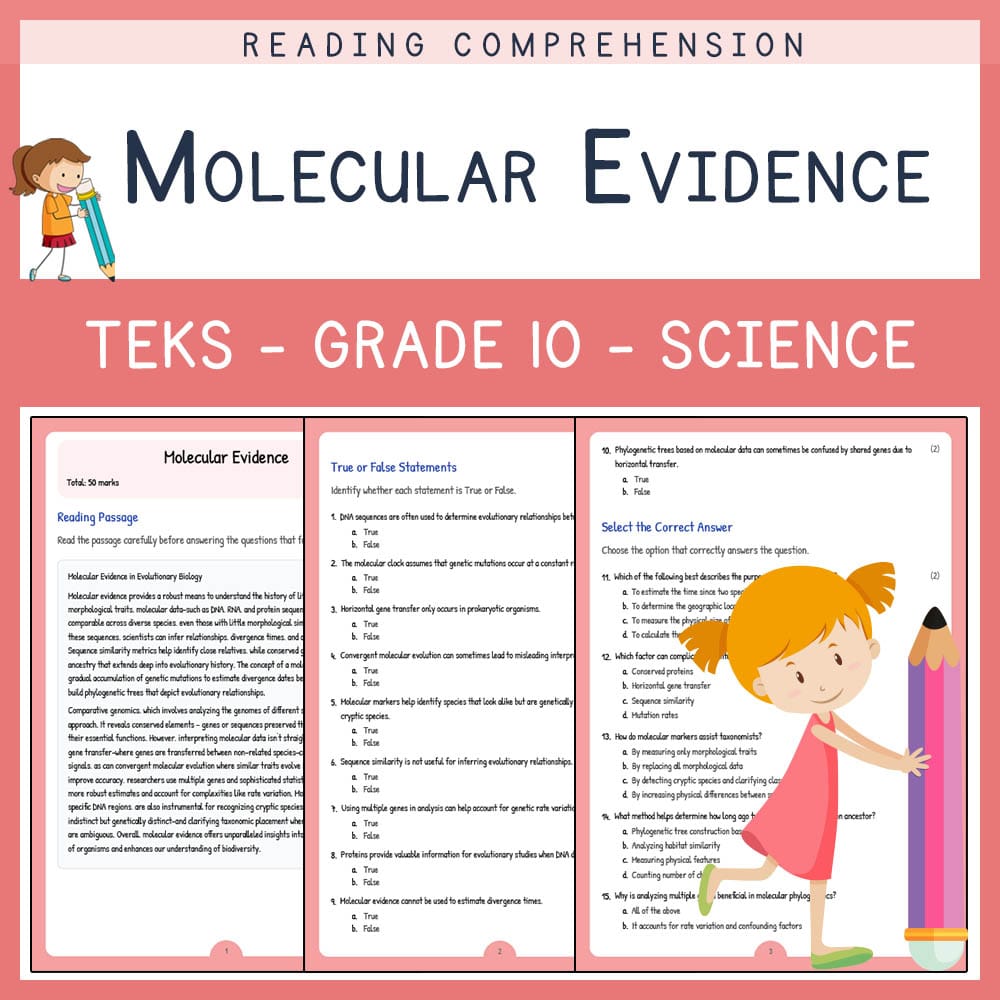
Grade 10 Science | Molecular Evidence Worksheet | TEKS Aligned
Created byLumora LearningLearning Objectives
- Understand how DNA, RNA, and protein sequences are used to infer evolutionary relationships.
- Identify key concepts such as sequence similarity, conserved genes, and molecular clocks.
- Recognize factors that can complicate molecular data interpretation, like horizontal gene transfer.
Also included in: Grade 10 Science | Evolution & Classification Lesson Bundle | TEKS Aligned +1 more
Instant download
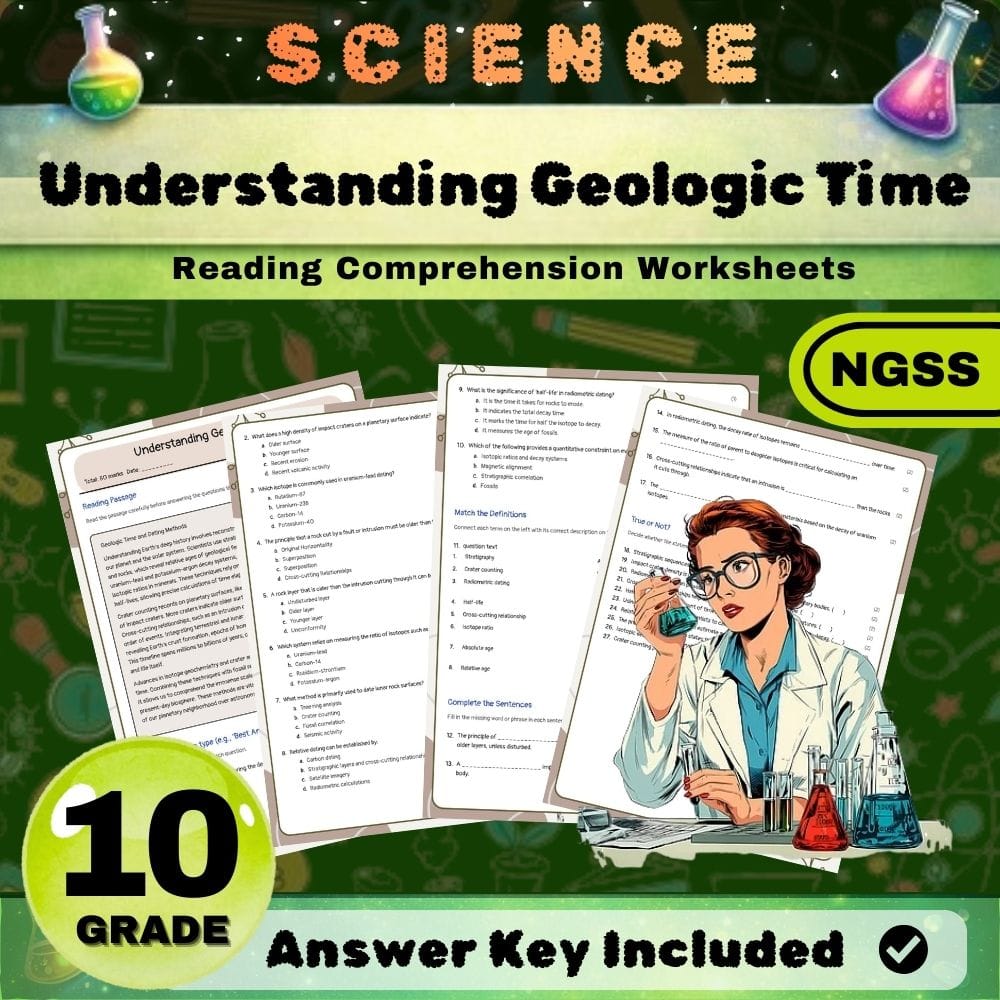
Grade 10 Science – Understanding Geologic Time Worksheet (PDF) NGSS
 Created byMaple Path Learning
Learning Objectives
- Explain the methods used to establish Earth's geologic history, including stratigraphy, radiometric dating, and crater counting.
- Describe how isotopic ratios and half-life decay systems help determine the age of rocks and planetary surfaces.
- Analyze the significance of cross-cutting relationships and relative dating techniques in constructing geologic timelines.
Also included in: Grade 10 Science Earth’s Place in the Universe NGSS Lesson Bundle | Framework +1 more
Instant download
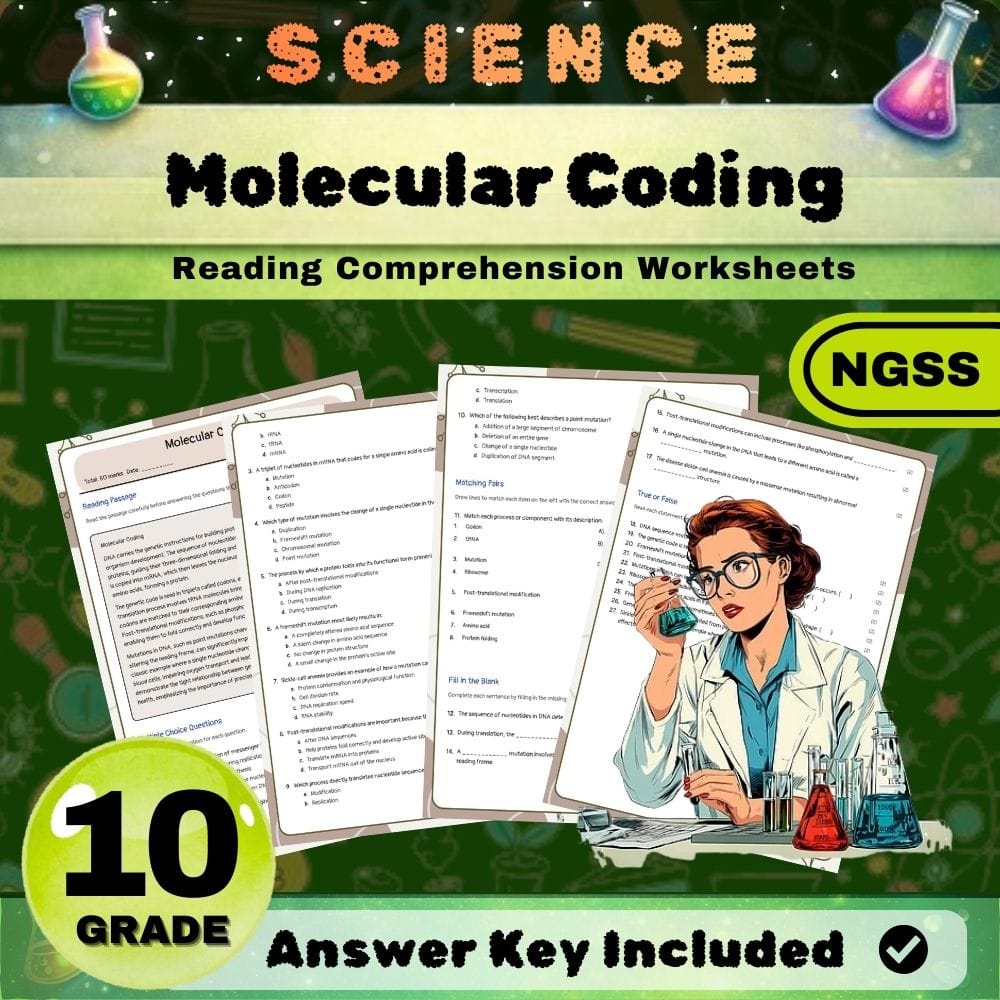
Grade 10 Science | Molecular Coding Worksheet (NGSS) (PDF)
Created byMaple Path LearningLearning Objectives
- Explain how DNA sequences determine protein structure through transcription and translation.
- Identify the roles of codons, ribosomes, and post-translational modifications in protein synthesis.
- Analyze how point mutations and frameshift mutations alter protein conformation and function.
Also included in: Grade 10 Science From Molecules to Organisms Lesson Bundle | NGSS +1 more
Instant download

Listening Strategies Worksheet for Grade 6 ELA Practice and Review
 Created bySunny Desk Resources
Learning Objectives
- Identify the main point and supporting details in a spoken or video text
- Track ideas by noticing transitions that signal cause, contrast, or sequence
- Use nonverbal cues (pacing and emphasis) to interpret a speaker’s purpose
Also included in: Speaking and Listening Lesson Bundle | Grade 6 ELA | Alberta Framework +1 more
Instant download
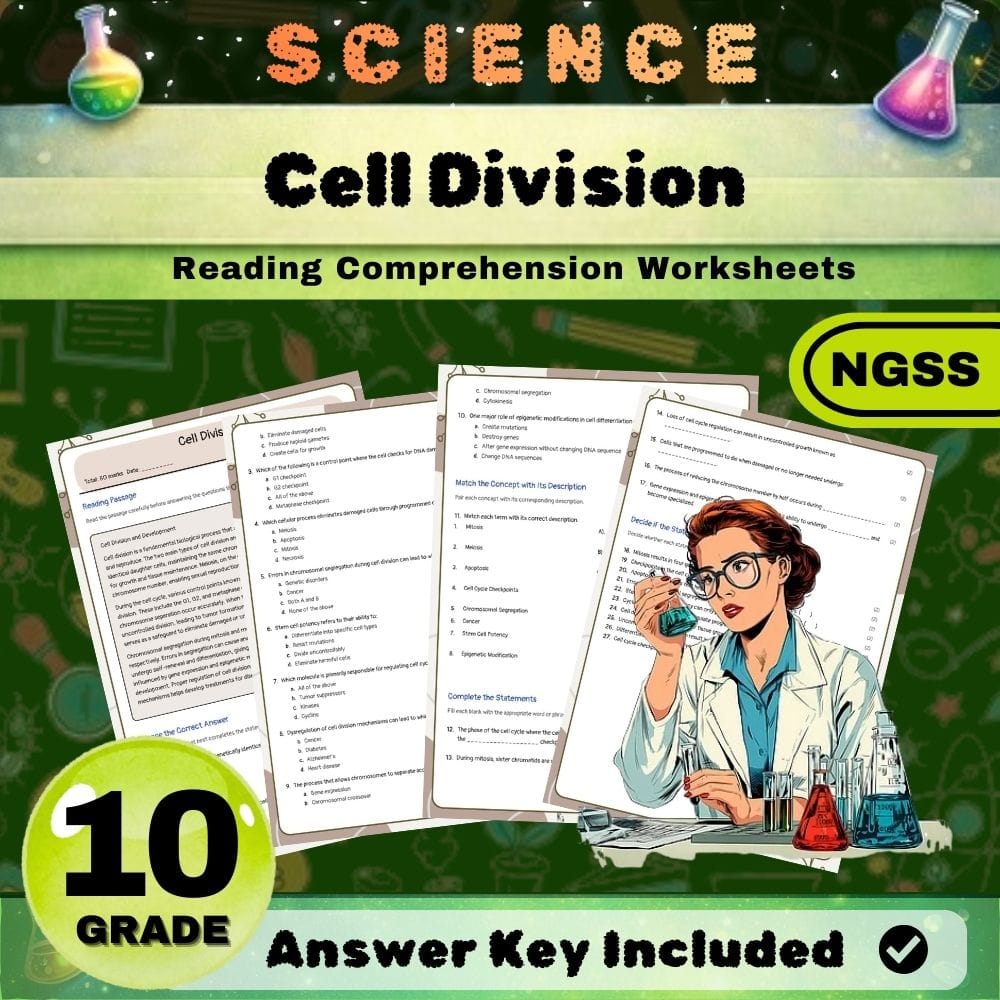
Grade 10 Science | Cell Division Worksheet (NGSS) (PDF)
Created byMaple Path LearningLearning Objectives
- Describe the processes of mitosis and meiosis involved in cellular reproduction.
- Explain the role of the cell cycle checkpoints, apoptosis, and chromosomal segregation in maintaining healthy cell function.
- Analyze how dysregulation of cell division can lead to diseases such as cancer.
Also included in: Grade 10 Science From Molecules to Organisms Lesson Bundle | NGSS +1 more
Instant download
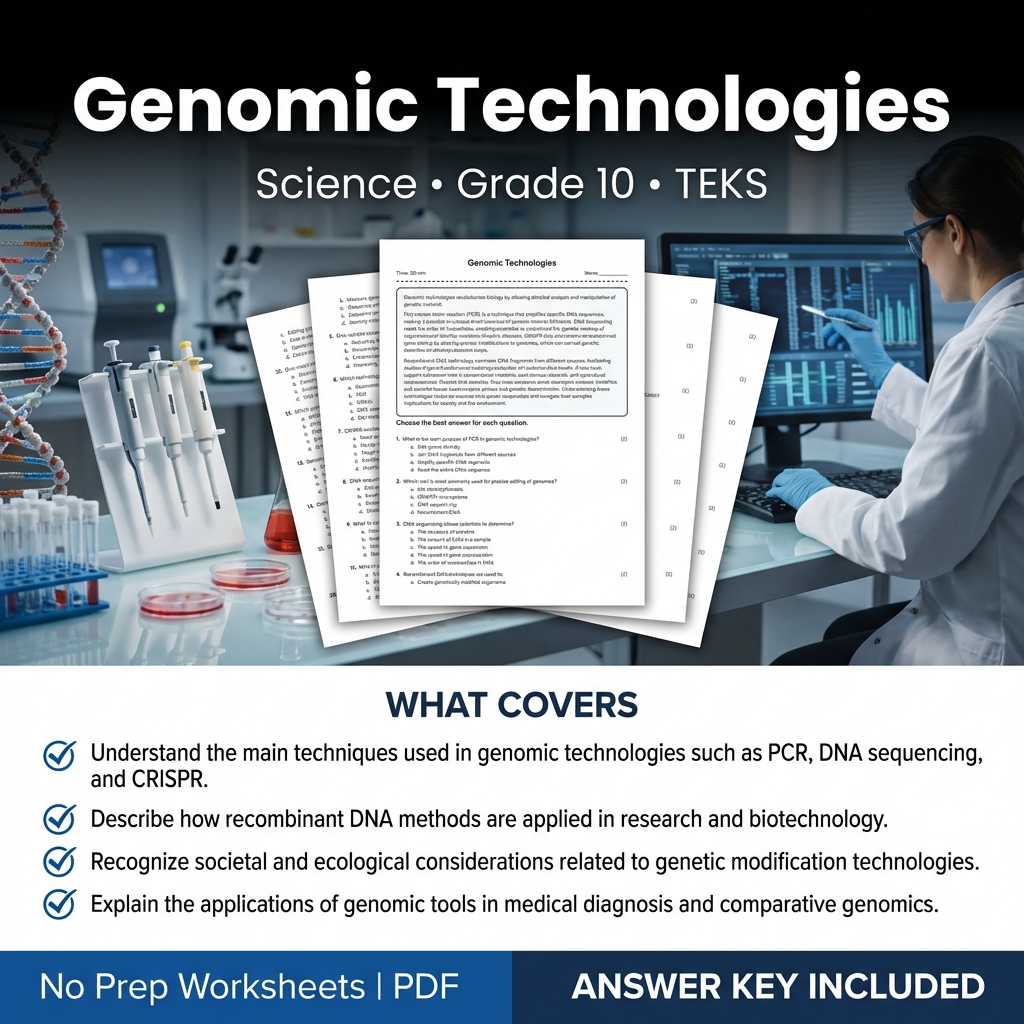
Genomic Technologies Science Worksheet for Grade 10 | TEKS Aligned Practice
Created byCoral Reef LearningLearning Objectives
- Understand the main techniques used in genomic technologies such as PCR, DNA sequencing, and CRISPR.
- Describe how recombinant DNA methods are applied in research and biotechnology.
- Recognize societal and ecological considerations related to genetic modification technologies.
Instant download
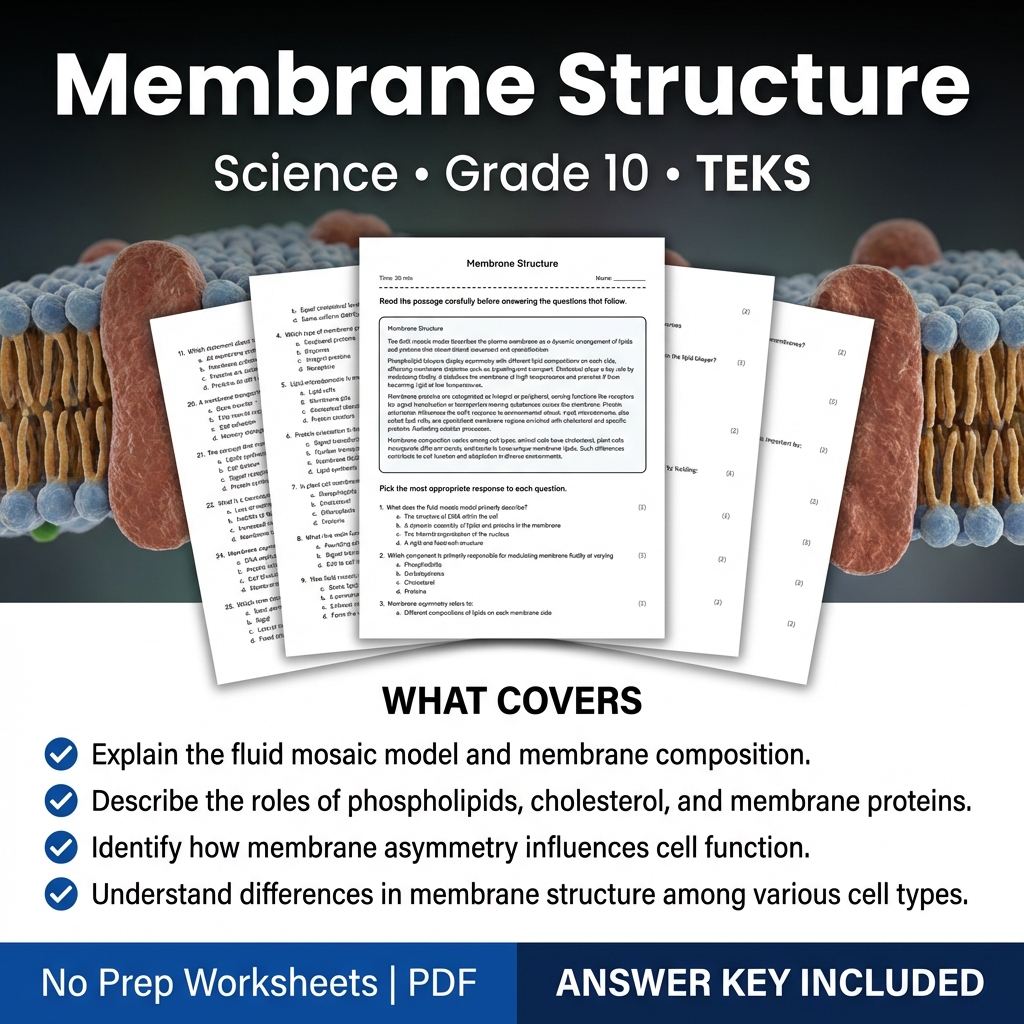
Membrane Structure Worksheet for Science Grade 10 | TEKS Standard Practice
Created byCoral Reef LearningLearning Objectives
- Explain the fluid mosaic model and membrane composition.
- Describe the roles of phospholipids, cholesterol, and membrane proteins.
- Identify how membrane asymmetry influences cell function.
Instant download
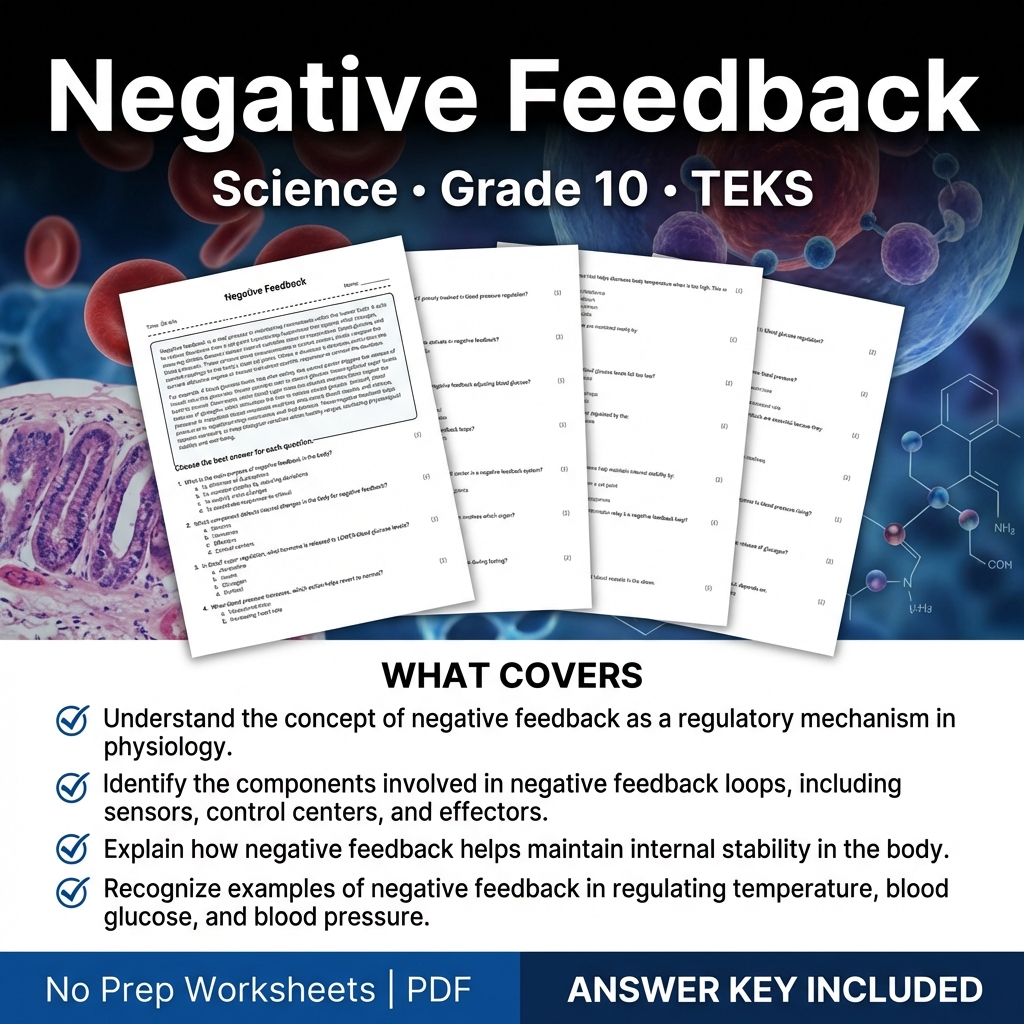
Negative Feedback Worksheet for Grade 10 Science | TEKS aligned
Created byCoral Reef LearningLearning Objectives
- Understand the concept of negative feedback as a regulatory mechanism in physiology.
- Identify the components involved in negative feedback loops, including sensors, control centers, and effectors.
- Explain how negative feedback helps maintain internal stability in the body.
Instant download
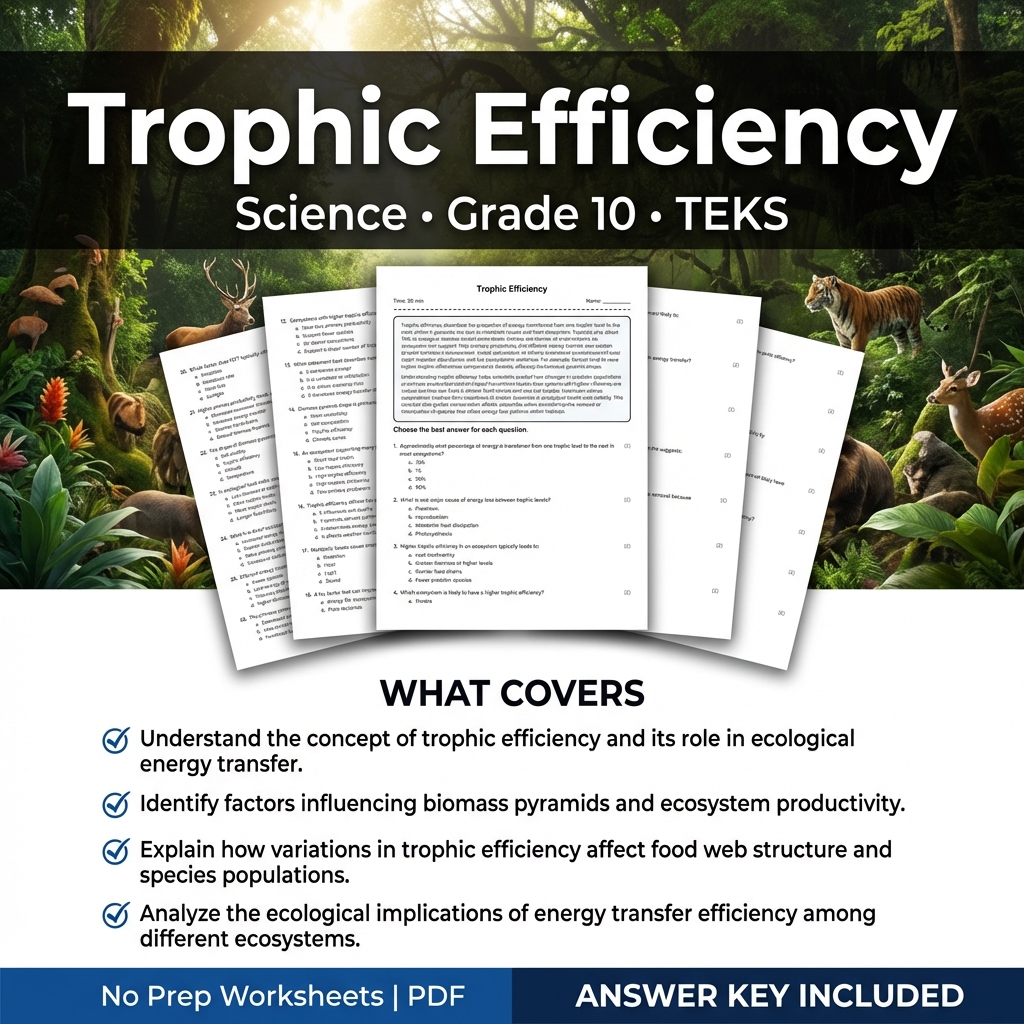
Grade 10 Science Worksheet on Trophic Efficiency | TEKS Aligned
Created byCoral Reef LearningLearning Objectives
- Understand the concept of trophic efficiency and its role in ecological energy transfer.
- Identify factors influencing biomass pyramids and ecosystem productivity.
- Explain how variations in trophic efficiency affect food web structure and species populations.
Instant download
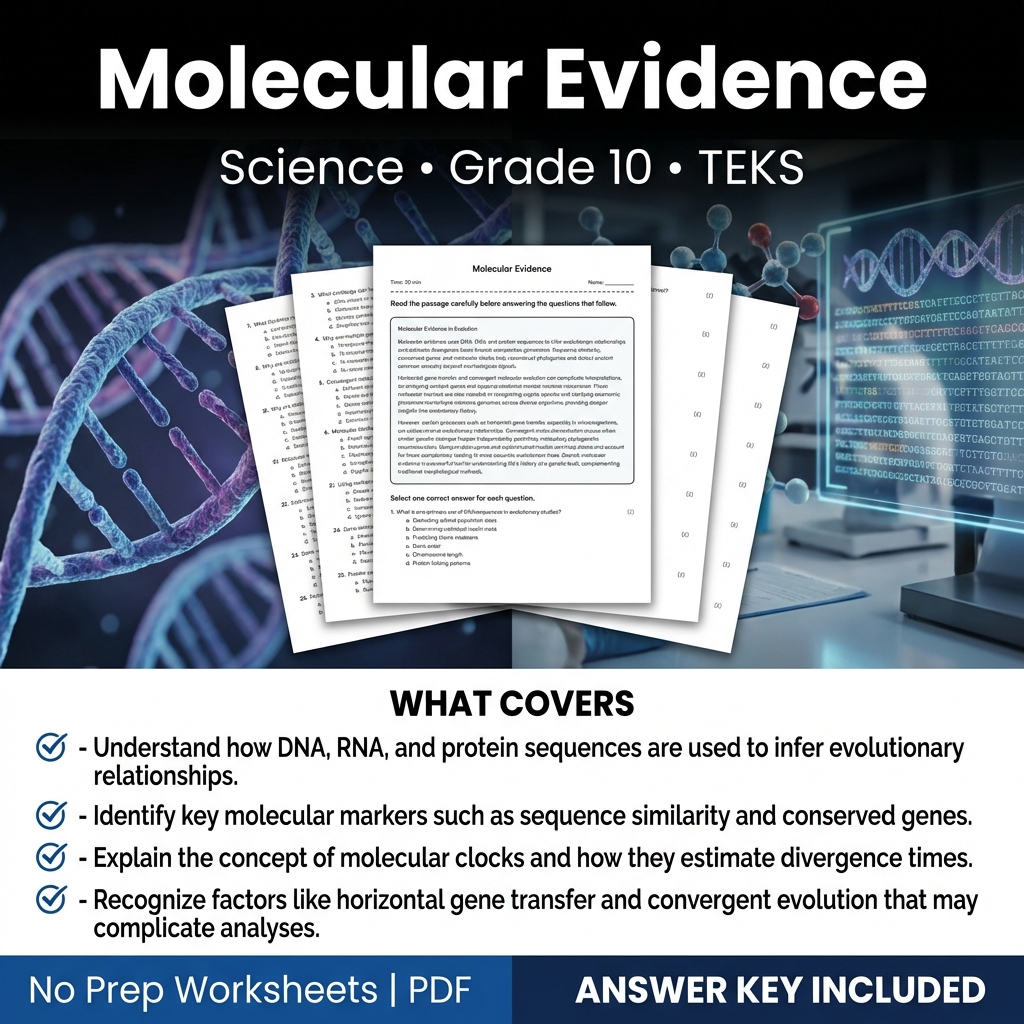
Molecular Evidence Worksheet for Grade 10 Science | TEKS
Created byCoral Reef LearningLearning Objectives
- Understand how DNA, RNA, and protein sequences are used to infer evolutionary relationships.
- Identify key molecular markers such as sequence similarity and conserved genes.
- Explain the concept of molecular clocks and how they estimate divergence times.
Instant download
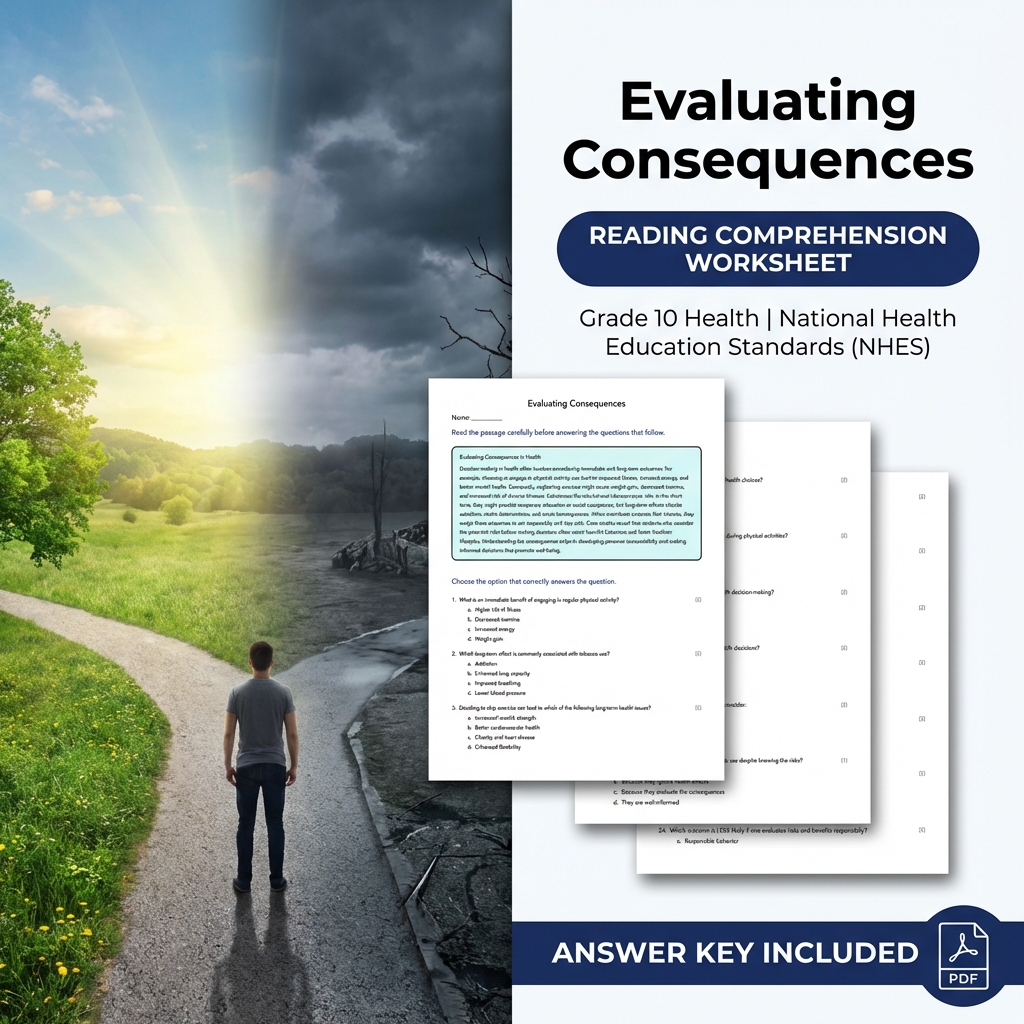
Evaluating Consequences Health Worksheet | NHES Grade 10 Assessment
 Created bySkylark Worksheets
Learning Objectives
- Analyze the immediate and long-term effects of health-related decisions.
- Identify consequences of substance use and physical activity choices.
- Evaluate potential outcomes of different health behaviors to make responsible decisions.
Also included in: Grade 10 Health | Decision-Making Skills Unit Bundle +1 more
Instant download
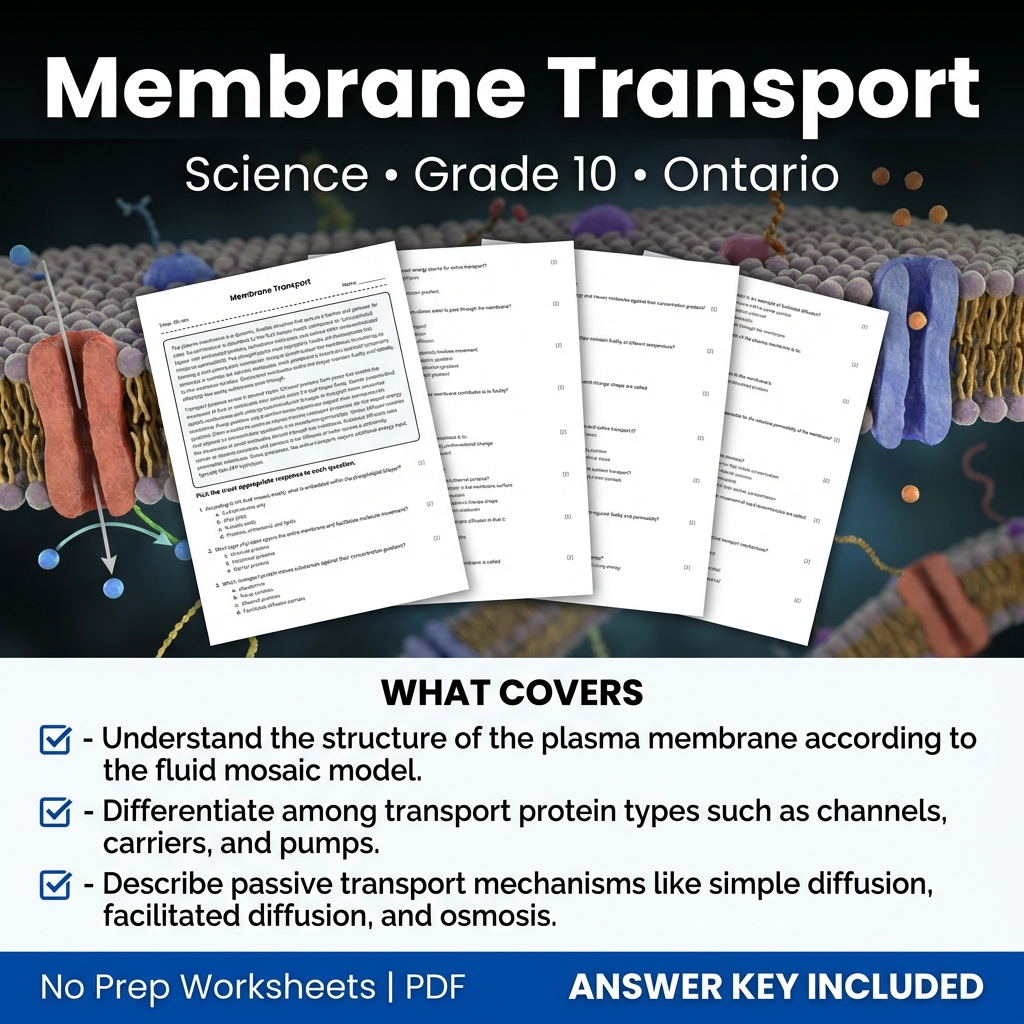
Membrane Transport Worksheet | Science Grade 10 | Ontario Standards
Created byCoral Reef LearningLearning Objectives
- Understand the structure of the plasma membrane according to the fluid mosaic model.
- Differentiate among transport protein types such as channels, carriers, and pumps.
- Describe passive transport mechanisms like simple diffusion, facilitated diffusion, and osmosis.
Instant download
Grade 10 Science | Membrane Transport Worksheet – Ontario (PDF)
Created byBright Mind ResourcesLearning Objectives
- Describe plasma membrane structure according to the fluid mosaic model, including phospholipids, proteins, and cholesterol.
- Differentiate between transport protein types: channels, carriers, and pumps, based on their structure and selectivity.
- Explain passive transport mechanisms—simple diffusion, facilitated diffusion, and osmosis—in terms of concentration gradients and membrane permeability.
Instant download
Grade 10 Science | Membrane Transport Worksheet Elena | Ontario Standard
Created byLumora LearningLearning Objectives
- Describe the structure of the plasma membrane using the fluid mosaic model.
- Differentiate between different types of transport proteins and their structural features.
- Explain passive transport mechanisms such as diffusion, facilitated diffusion, and osmosis.
Instant download
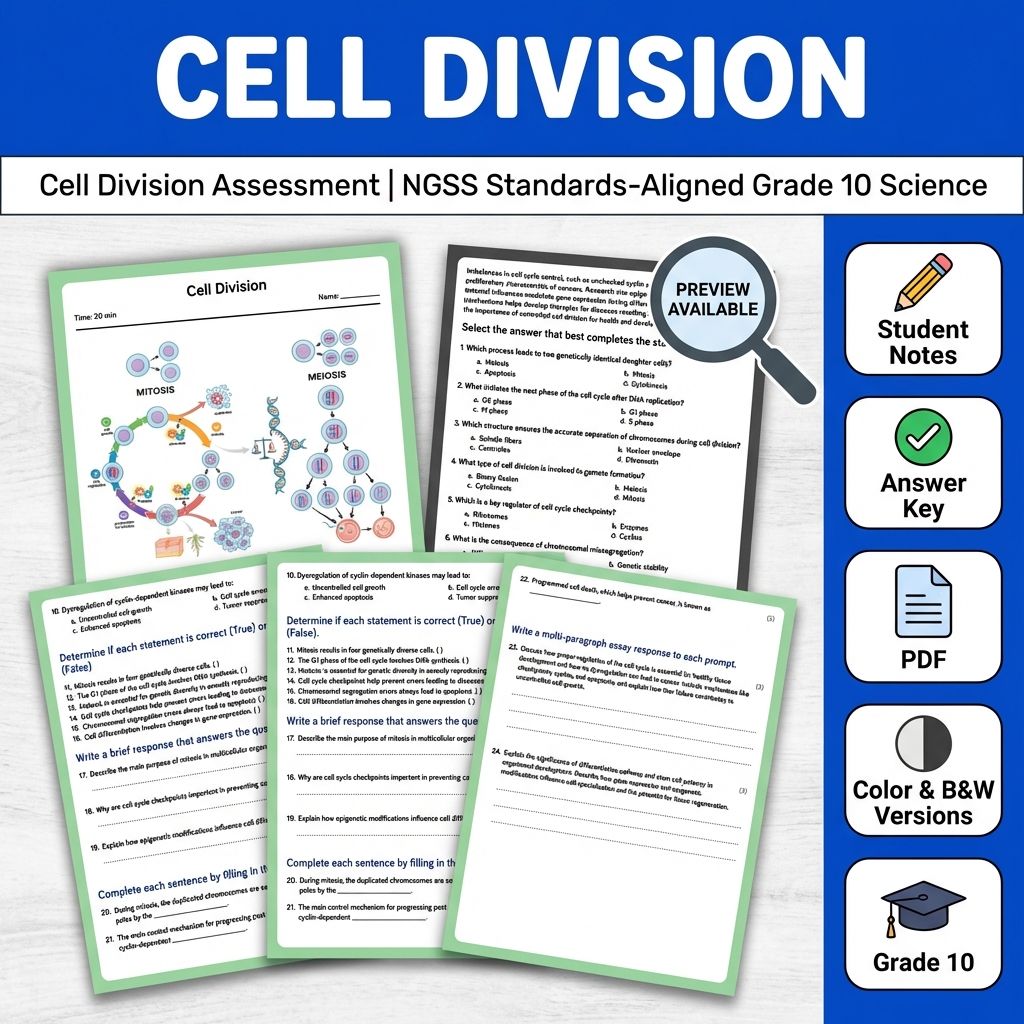
Cell Division Assessment | NGSS Standards-Aligned Grade 10 Science
Created byPrism Point LearningLearning Objectives
- Understand the processes of mitosis and meiosis and their roles in cell division.
- Identify the phases of the cell cycle and checkpoints that control cell division.
- Explain the significance of chromosomal segregation, apoptosis, and cellular differentiation.
Also included in: Grade 10 Science | Cell Signaling & Physiology NGSS Assessment Bundle
Instant download
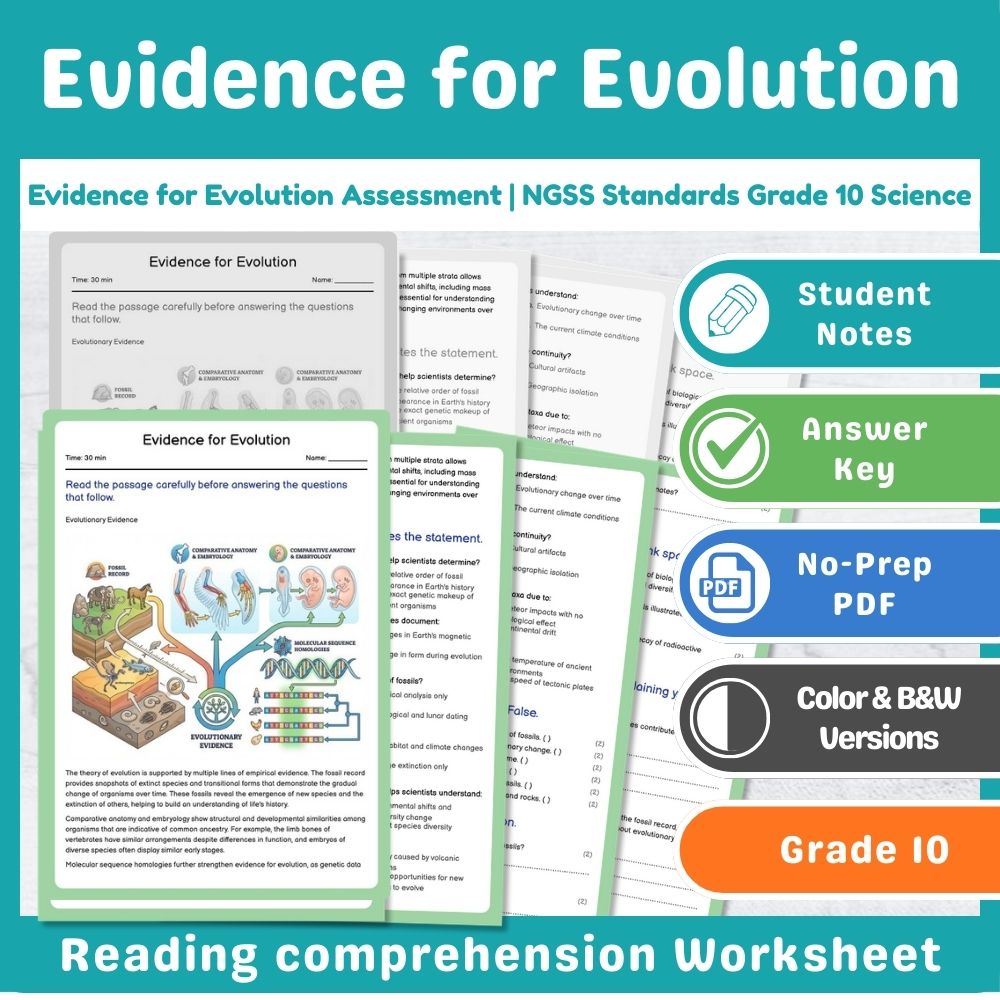
Evidence for Evolution Assessment | NGSS Standards Grade 10 Science
Created byPrism Point LearningLearning Objectives
- Understand the key lines of scientific evidence supporting common ancestry and evolution.
- Identify how fossil records, comparative anatomy, embryology, and molecular data corroborate evolutionary theory.
- Analyze the role of radiometric dating and biogeography in establishing evolutionary timelines.
Instant download
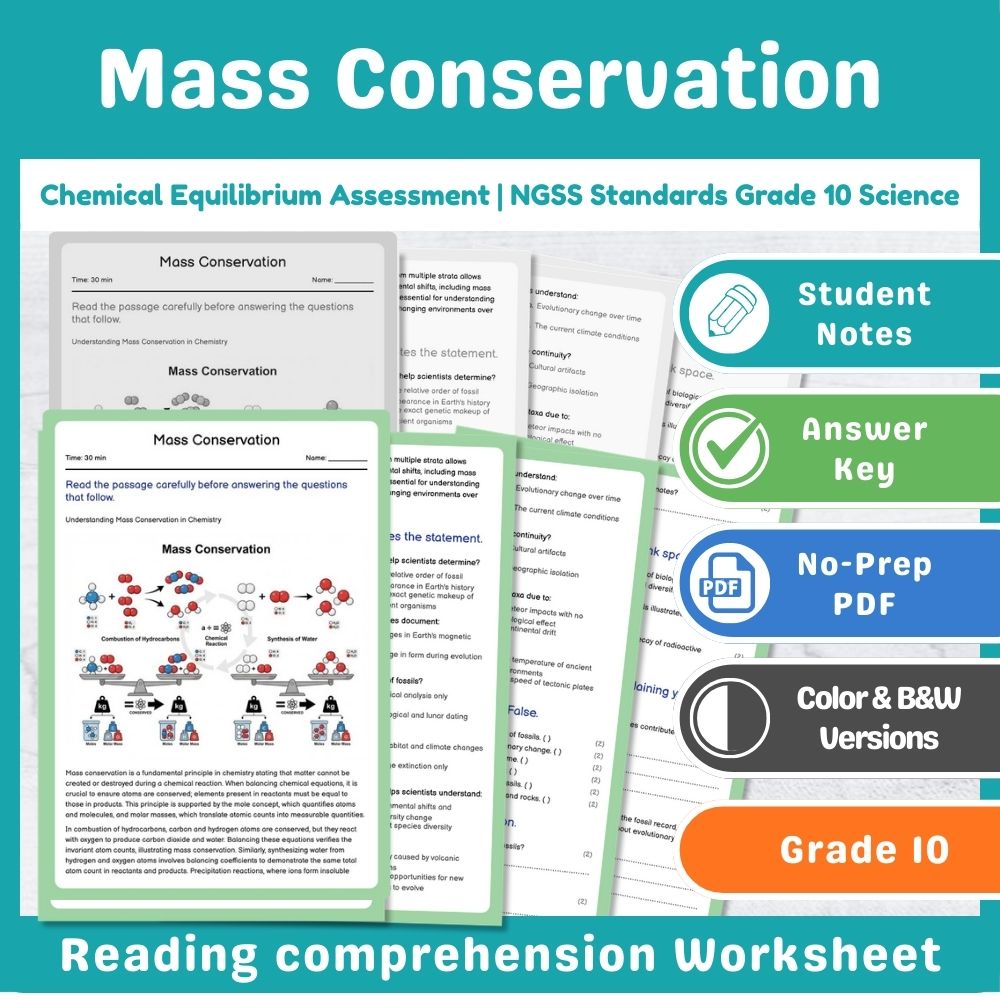
Mass Conservation Assessment for Grade 10 Science NGSS Standards
Created byPrism Point LearningLearning Objectives
- Understand the concept of atomic and mass conservation during chemical reactions.
- Apply balancing techniques to demonstrate atom count invariance across reactions.
- Utilize quantitative representations like mole concepts and molar masses to verify mass invariance.
Instant download

Decomposer Matter Return Worksheet Grade 6 Science Ecosystems Pack
Created byPrism Point LearningLearning Objectives
- Explain how decomposers break down dead organisms and waste to recycle matter in ecosystems.
- Describe how atoms and molecules are returned to soil and water in forms that producers can use again.
- Connect decomposition to nutrient availability and continued ecosystem functioning.
Also included in: Animals Matter Lesson Bundle | Grade 6 Science | California Standards
Instant download
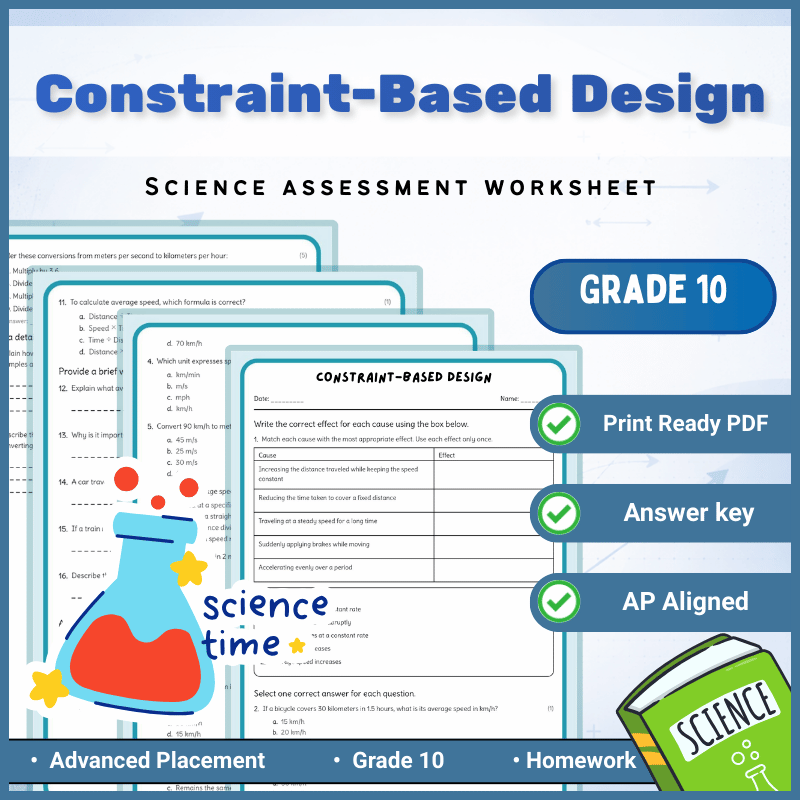
Grade 10 Science | Constraint-Based Design Worksheet (AP Standards) PDF
Created byBright Mind ResourcesLearning Objectives
- Understand the implications of constraints in designing scientific studies.
- Identify trade-offs among replication, measurement precision, and scope.
- Evaluate the use of proxy measures and sensitivity analysis under constraints.
Instant download
Grade 10 Science – Causal Complexity Worksheet (AP Standards | PDF)
Created byBright Mind ResourcesLearning Objectives
- Understand strategies for disentangling multivariable causal relationships
- Learn how to interpret control matrices, causal graphs, and stratified comparisons
- Identify confounding factors and interaction effects in complex systems
Instant download
10th Grade Science | Plate Tectonics Worksheet (AP Standards + Answer Key) (PDF)
Created byBright Mind ResourcesLearning Objectives
- Explain mechanisms of plate motion including mantle convection and subduction.
- Interpret tectonic settings using maps, cross-sections, and seismic evidence.
- Connect plate interactions to mountain formation, volcanism, and earthquake distribution.
Instant download
Grade 10 Science | Climate Drivers Worksheet (AP Standards + Answer Key)
Created byBright Mind ResourcesLearning Objectives
- Identify key factors influencing Earth's climate, including radiative forcing and greenhouse gases.
- Interpret feedback loops and their effects on climate variability.
- Evaluate model outputs and proxy records to assess long-term climate trends.
Instant download
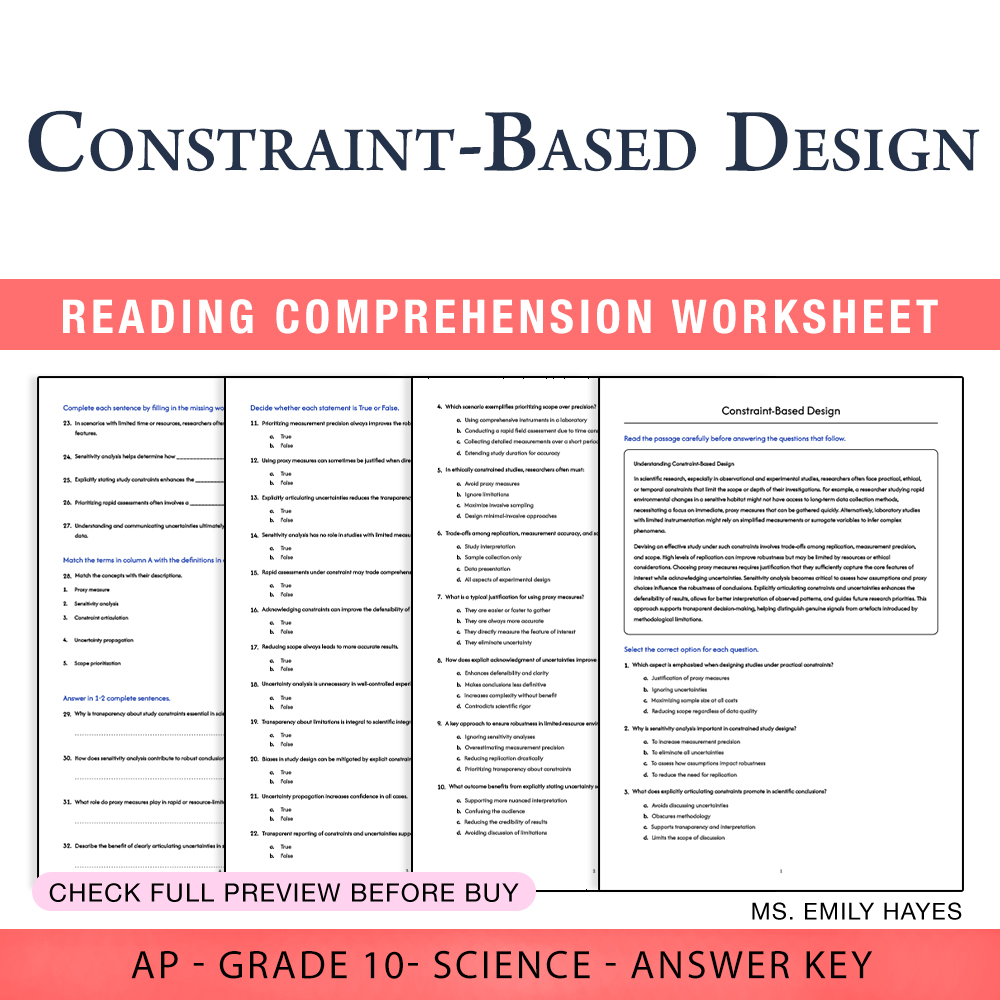
Grade 10 Science | Constraint-Based Design Worksheet (PDF+ Answer Key)
Created byCopper Leaf ClassroomLearning Objectives
- Understand the challenges and trade-offs involved in constraint-based experimental design.
- Identify strategies for prioritizing observational and experimental constraints.
- Evaluate the role of proxy measures and sensitivity analyses in robust conclusions.
Also included in: Grade 10 Science AP | Data Analysis & Modeling Skills (PDF + Answer Key) +1 more
Instant download
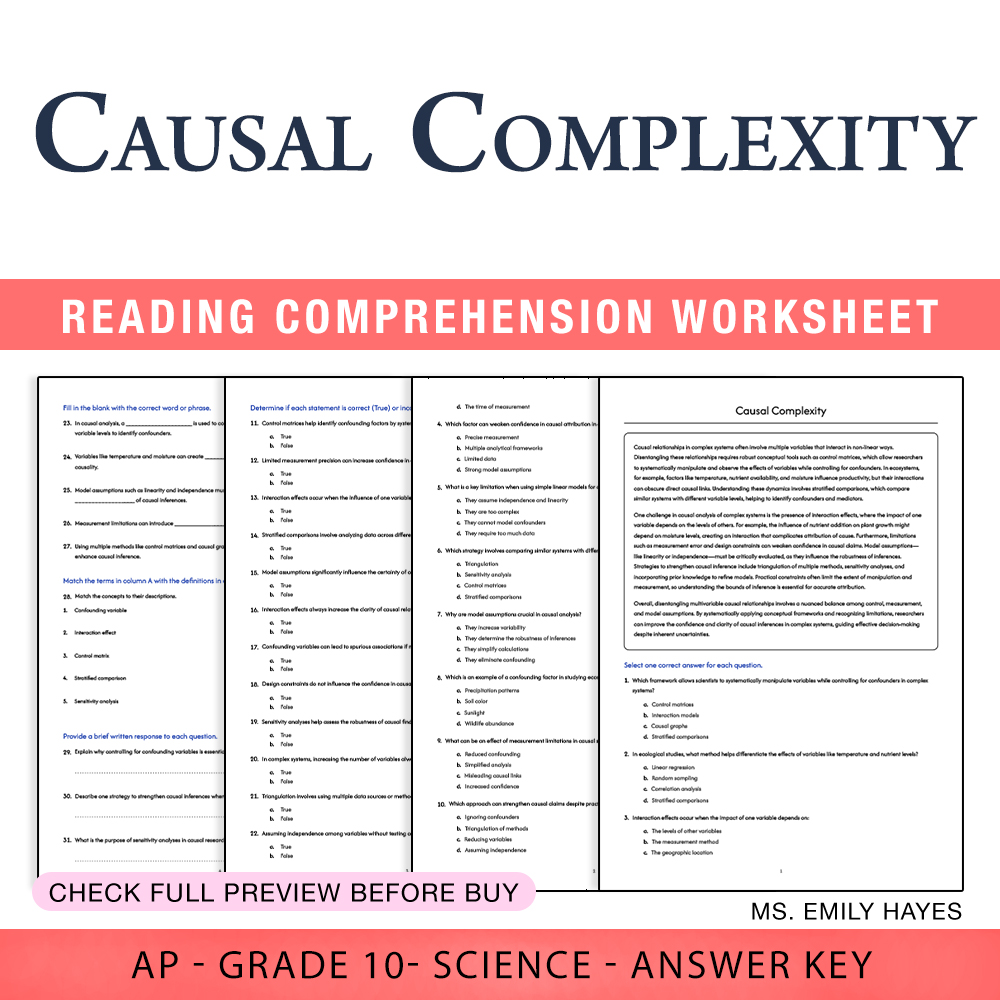
10th Grade Science | Causal Complexity Worksheet (PDF+ Answer Key)
Created byCopper Leaf ClassroomLearning Objectives
- Understand different frameworks used to analyze multivariable causal relationships.
- Identify confounding factors and interaction effects in complex systems.
- Evaluate the influence of design constraints and model assumptions on causal inference.
Also included in: Grade 10 Science AP | Data Analysis & Modeling Skills (PDF + Answer Key) +1 more
Instant download
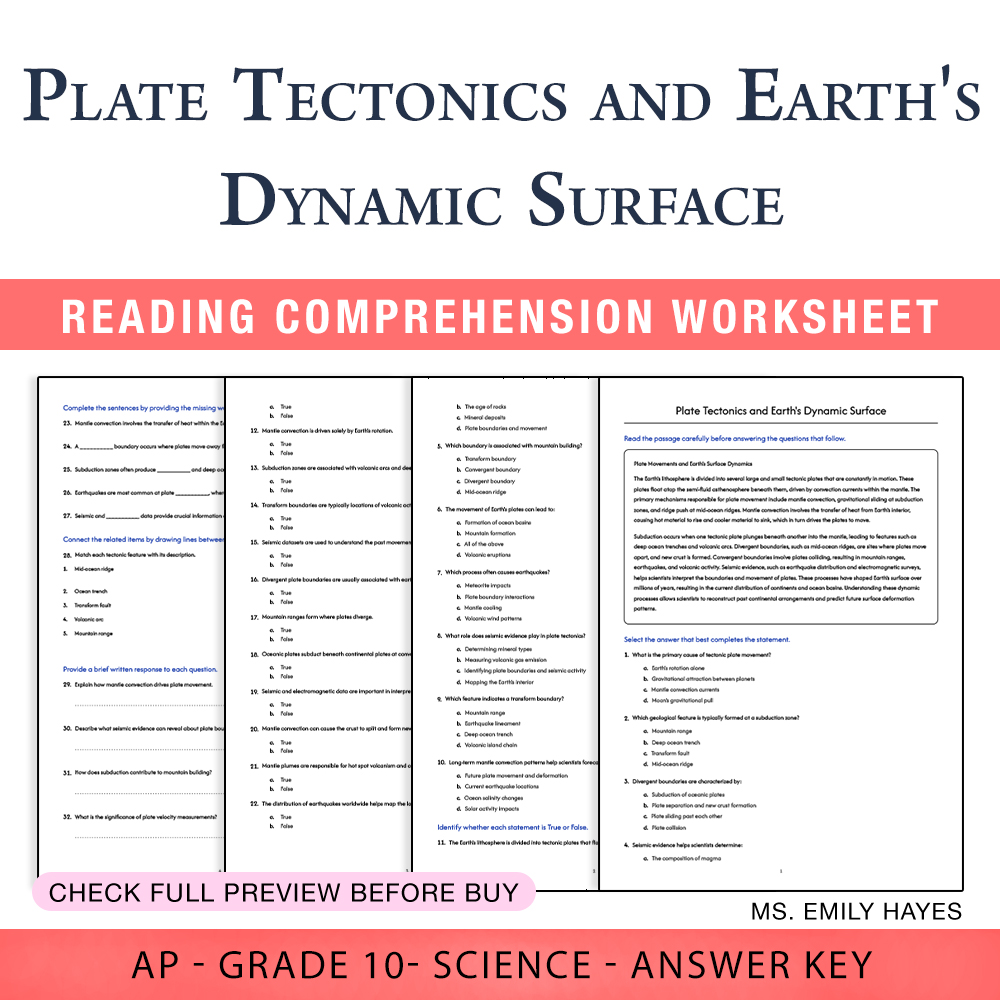
Grade 10 Science |Plate Tectonics & Earth's Surface Worksheet (PDF + Answer Key)
Created byCopper Leaf ClassroomLearning Objectives
- Describe the mechanisms of plate motion, including mantle convection and subduction.
- Interpret tectonic settings using maps, cross-sections, and seismic evidence.
- Explain how plate interactions influence mountain building, volcanism, and earthquakes.
Also included in: Grade 10 Science AP – Surface Processes & Earth Systems (PDF + Answer Key) +1 more
Instant download
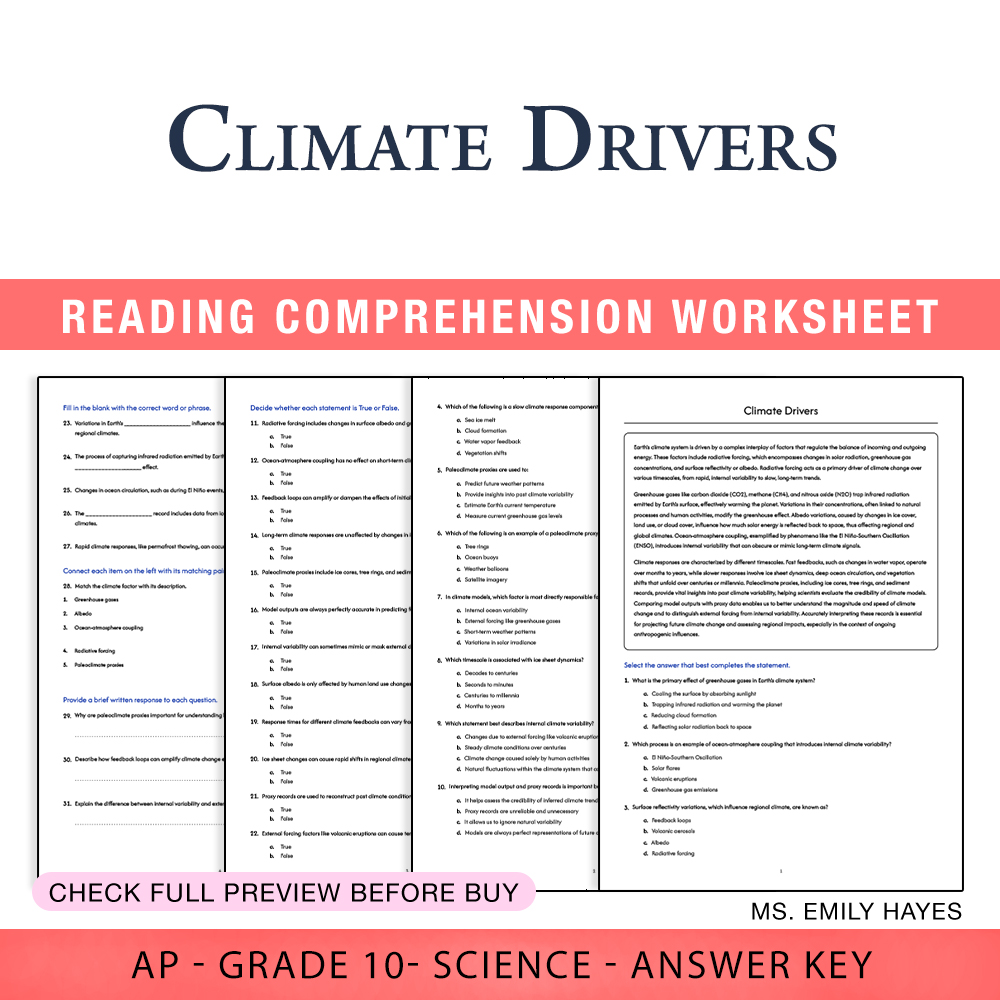
10th Grade Science | Climate Drivers Worksheet (PDF+ Answer Key)
Created byCopper Leaf ClassroomLearning Objectives
- Analyze the factors influencing Earth's climate, including radiative forcing, greenhouse gases, and albedo variations.
- Interpret energy-balance models, feedback loop diagrams, and paleoclimate proxies to understand climate changes.
- Evaluate the timescales of climate response and distinguish between internal variability and external forcing.
Also included in: Grade 10 Science AP – Surface Processes & Earth Systems (PDF + Answer Key) +1 more
Instant download
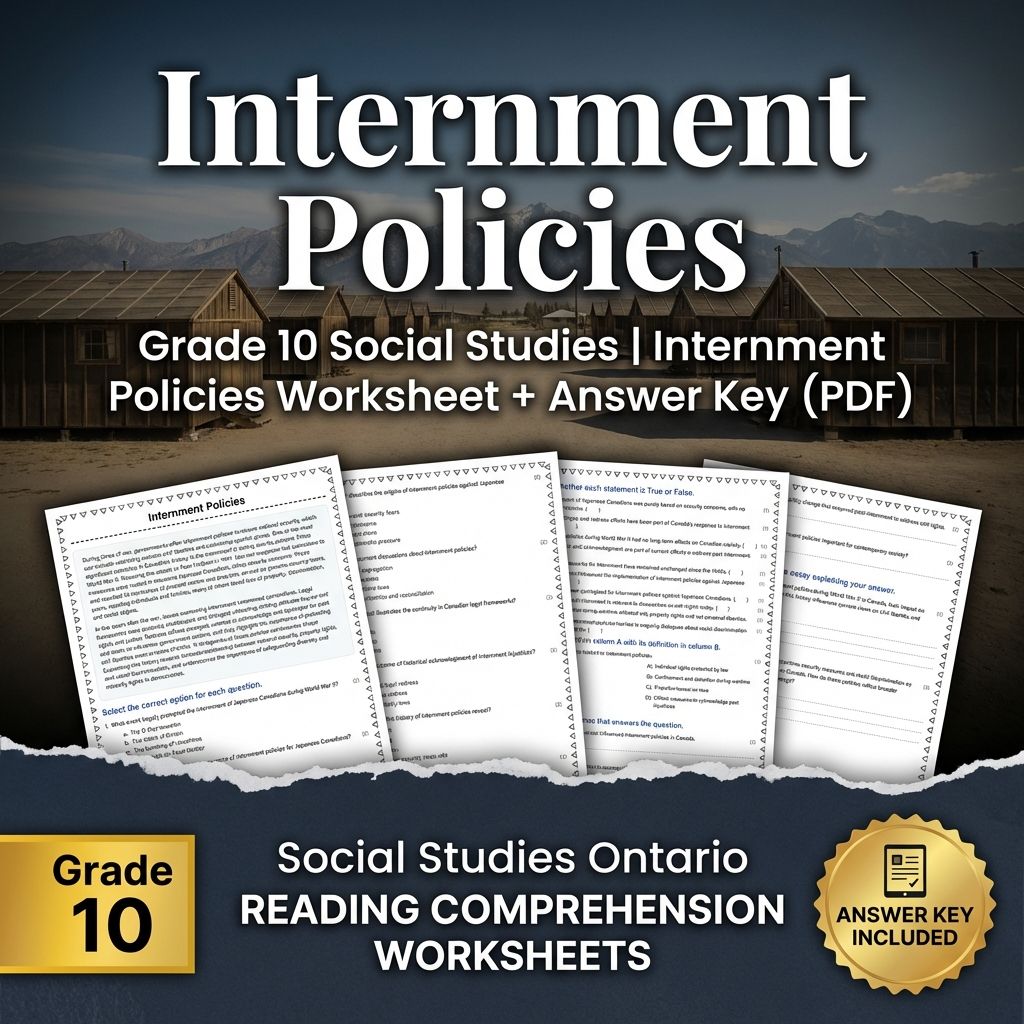
Grade 10 Social Studies | Internment Policies Worksheet + Answer Key (PDF)
JCreated byJ.S SheetsLearning Objectives
- Analyze the causes and consequences of internment policies during wartime.
- Examine the experiences of Japanese Canadians and other groups affected by government restrictions.
- Assess the impact of wartime policies on civil liberties and social trust.
Instant download
Browse more categories
About Reading comprehension Worksheets
Find reading comprehension worksheets for class practice, homework, or self-study. All 40,289 are instant PDF downloads.
Each resource here is built by an independent educator and reviewed for quality. Worksheets print straight from PDF and suit classroom use, homework, or extra practice; most come with answer keys, and you can preview before purchasing.