
Reading comprehension Worksheets
40,241 type resources
Grade 11 Science | Resources and Hazards Worksheet | BC-Aligned
 Created byLumora Learning
Learning Objectives
- Understand the types and significance of natural resources such as minerals, groundwater, and fossil fuels.
- Recognize major geohazards like earthquakes, volcanoes, landslides, and tsunamis and assess their risks.
- Evaluate the spatial distribution, access, environmental, and societal impacts of resources and hazards.
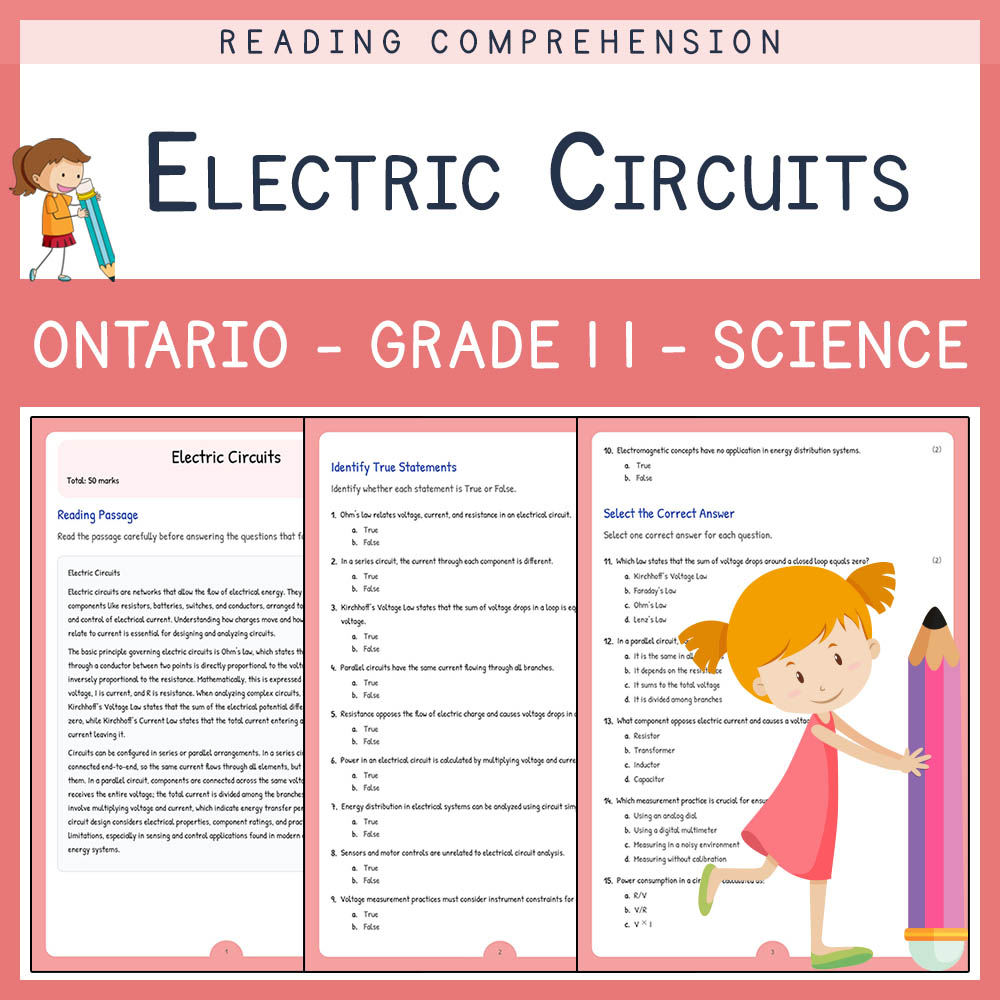
Grade 11 Science Standard | Electric Circuits Worksheet Elena | Ontario
Created byLumora LearningLearning Objectives
- Understand the fundamental principles of electric charge, current, voltage, and resistance.
- Apply Ohm's law and Kirchhoff's rules to analyze simple circuit configurations.
- Differentiate between series and parallel circuits in terms of voltage, current, and resistance.
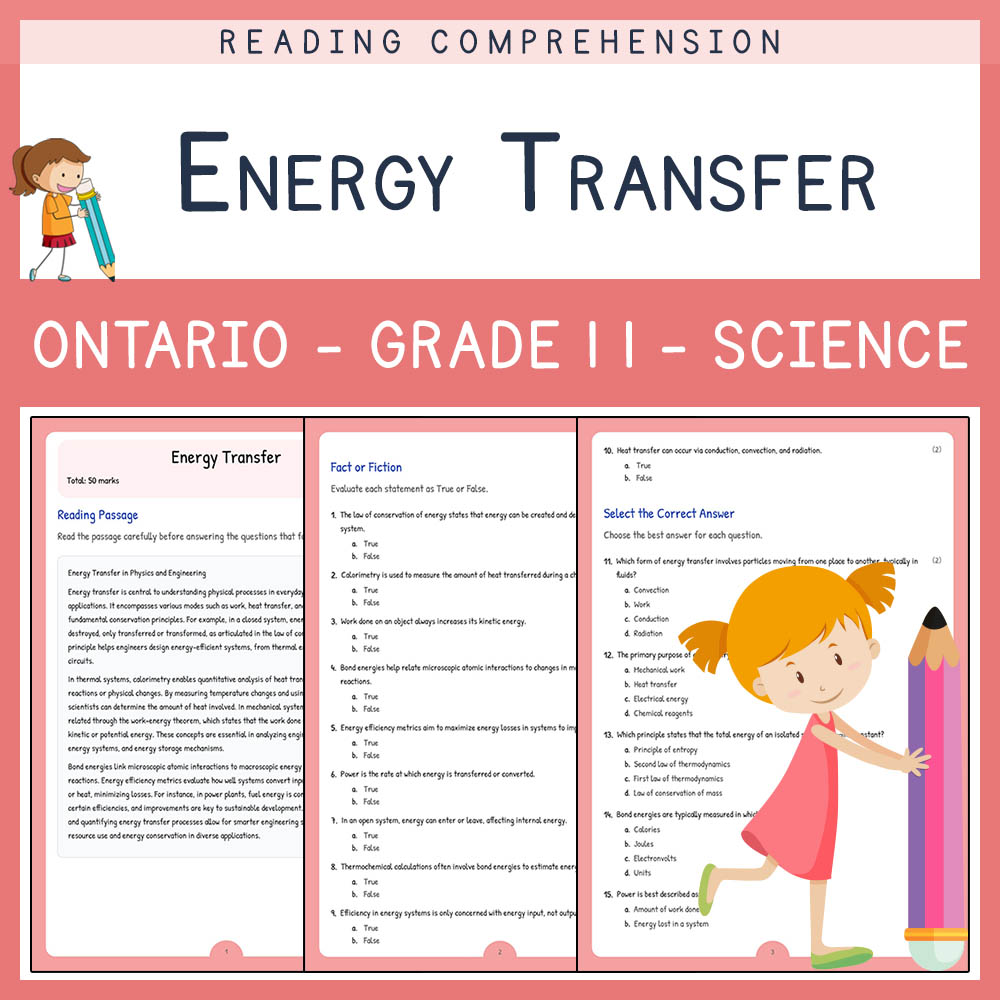
Grade 11 Science Assessment | Energy Transfer Worksheet | Ontario
Created byLumora LearningLearning Objectives
- Understand different forms of energy and modes of transfer, including work, heat, power, and internal energy.
- Explain principles of energy conservation and energy budgeting in closed and open systems.
- Apply quantitative methods such as calorimetry and work–energy analyses to real-world scenarios.
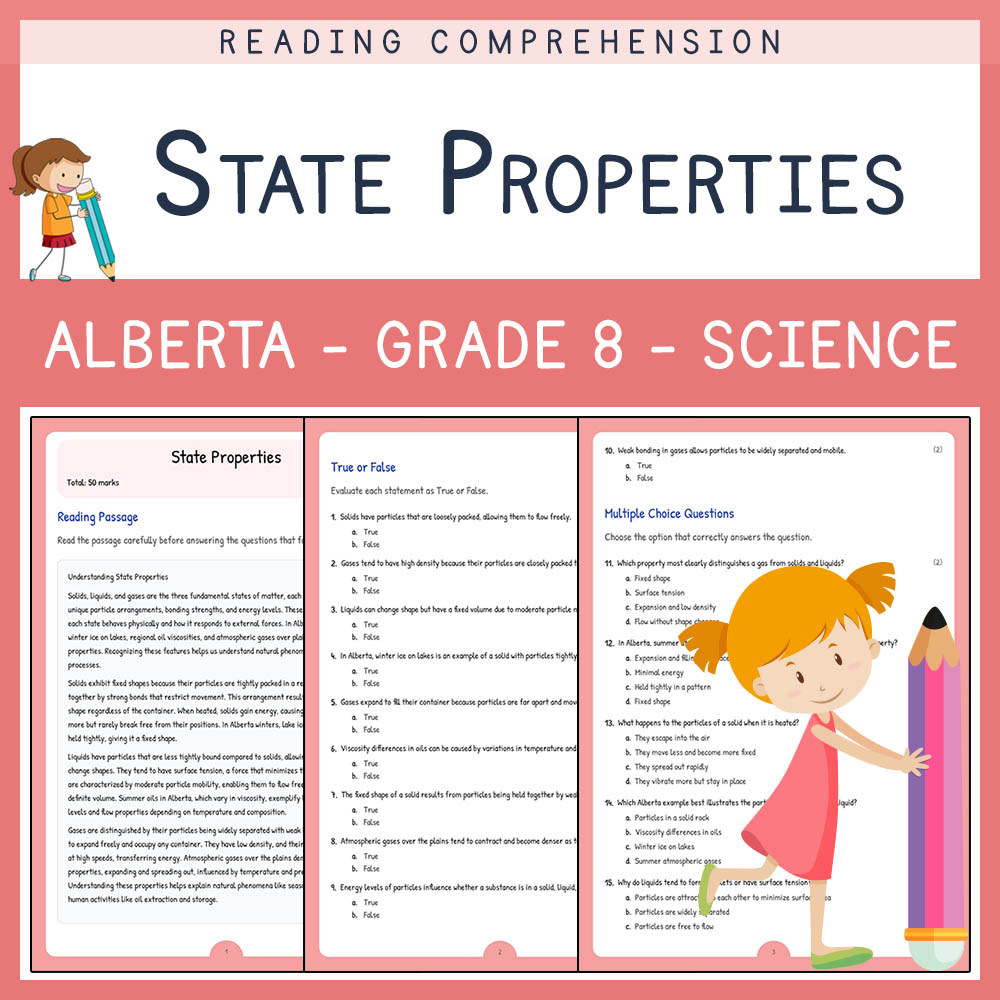
Grade 8 Science | State Properties Worksheet Elena | Alberta Standard
Created byLumora LearningLearning Objectives
- Describe the particle arrangements of solids, liquids, and gases.
- Explain how particle bonding strength and energy influence state properties.
- Identify examples of different states of matter in Alberta environments.
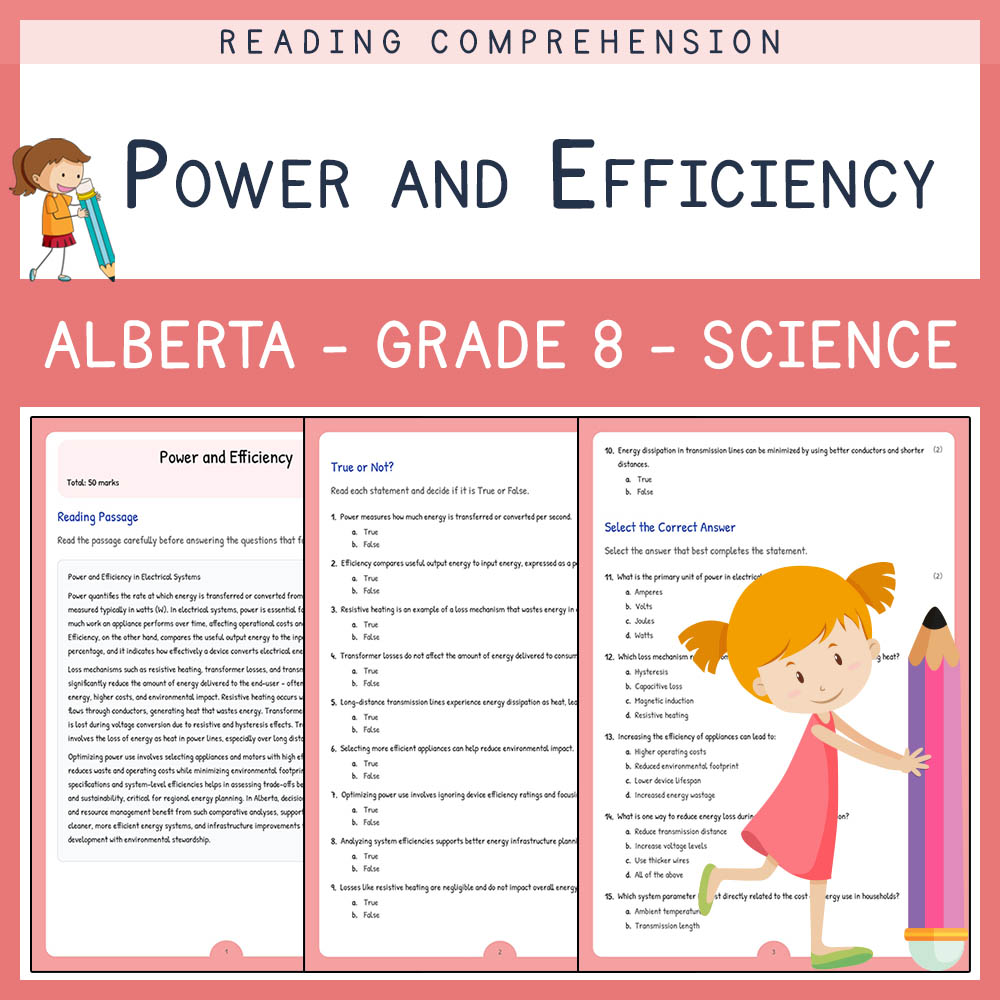
Grade 8 Science | Power and Efficiency Worksheet | Alberta Standards
Created byLumora LearningLearning Objectives
- Define power as energy transfer per unit time and explain its significance in electrical systems.
- Describe the concept of efficiency and identify common loss mechanisms in electrical devices.
- Analyze how optimization and selection of appliances influence energy consumption, cost, and environmental impact.

Grade 8 Science | Food Web Complexity Worksheet | Alberta Standards
Created byLumora LearningLearning Objectives
- Understand the interconnectedness of species within food webs in aquatic and terrestrial ecosystems.
- Identify how indirect interactions and redundancy contribute to food web stability.
- Analyze the effects of species loss, seasonal migrations, and life-cycle stages on energy pathways.
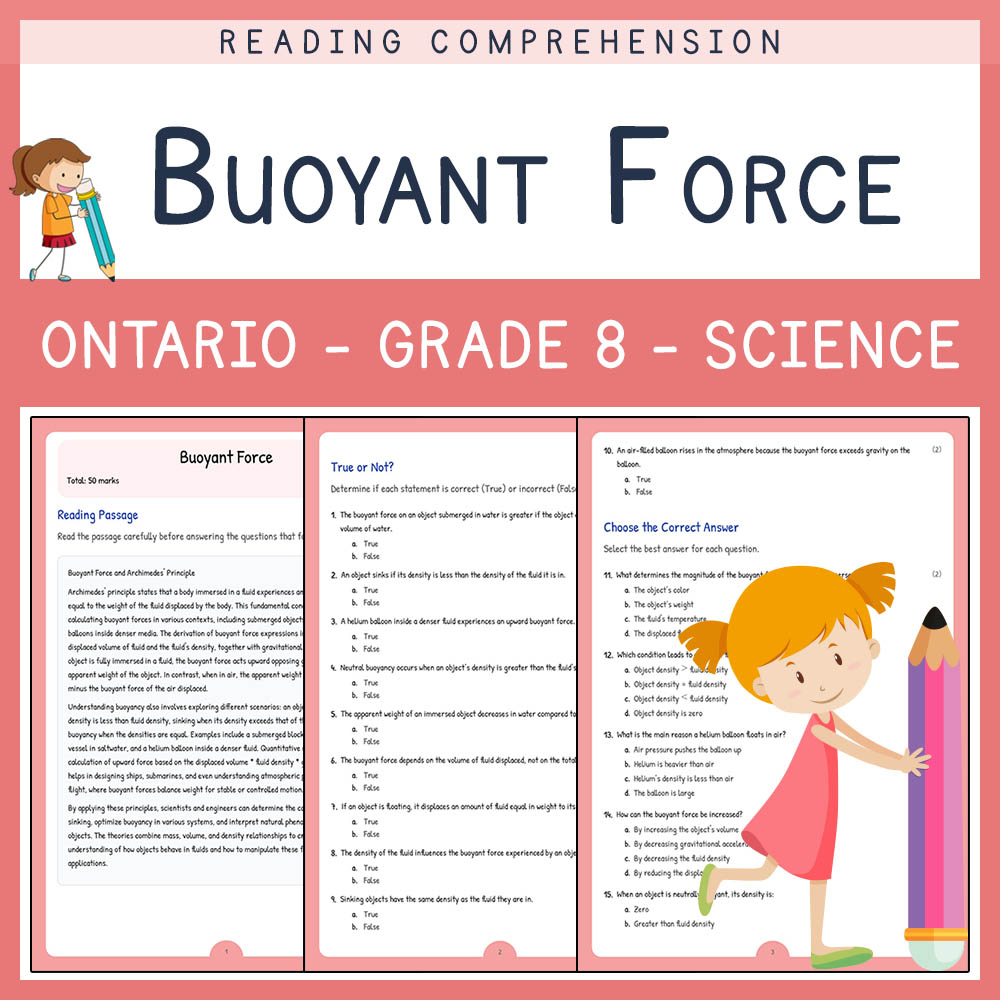
Grade 8 Science Assessment | Buoyant Force Worksheet Elena | Ontario
Created byLumora LearningLearning Objectives
- Understand Archimedes' principle and how buoyant force relates to displaced fluid weight.
- Differentiate between apparent weight in air and when submerged.
- Apply density and volume relationships to analyze floating, sinking, and neutral buoyancy scenarios.
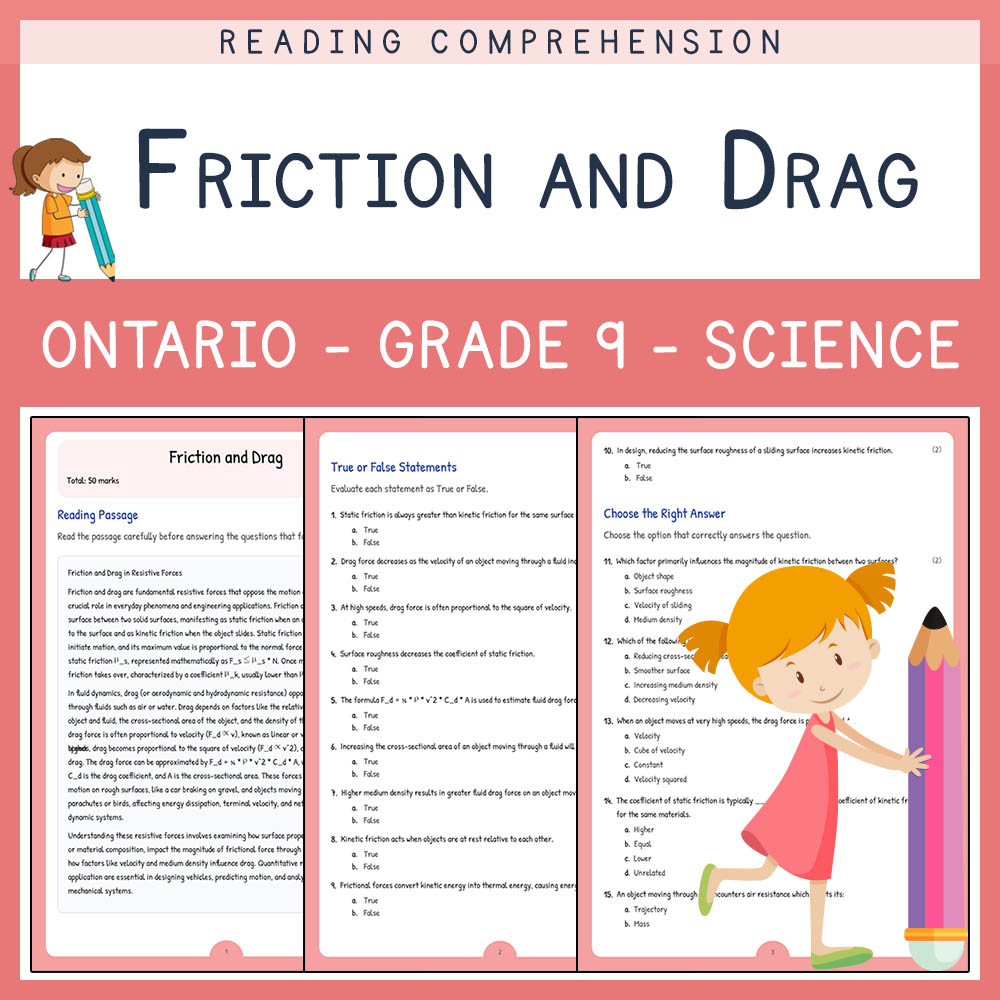
Grade 9 Science | Friction and Drag Worksheet Elena | Ontario Standard
Created byLumora LearningLearning Objectives
- Explain the differences between static and kinetic friction and how surface properties affect them.
- Describe the role of fluid drag and how it depends on velocity, surface area, and medium density.
- Apply quantitative relations involving μ coefficients and drag dependencies to real-world motion scenarios.
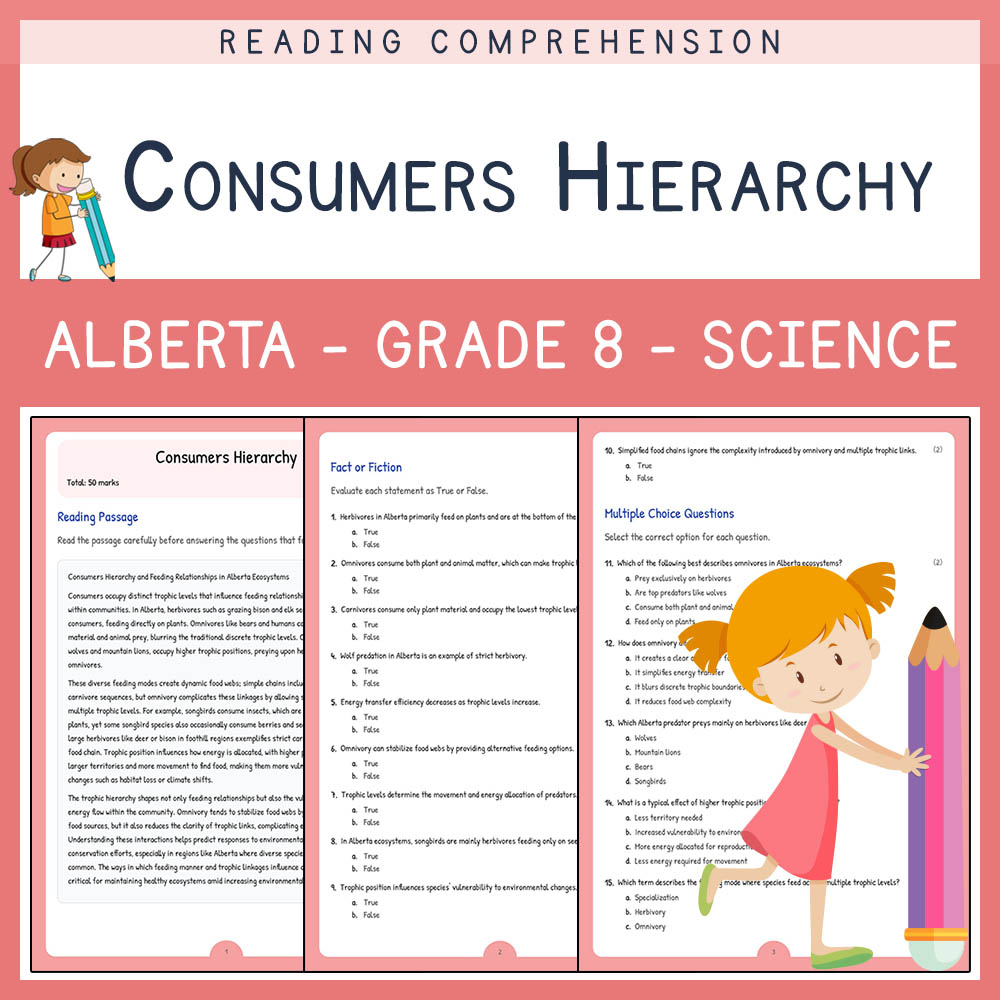
Grade 8 Science | Consumers Hierarchy Worksheet | Alberta Standards
Created byLumora LearningLearning Objectives
- Describe the roles of herbivores, omnivores, and carnivores in Alberta ecosystems.
- Explain how feeding modes influence trophic relationships and energy transfer.
- Analyze how omnivory blurs discrete trophic levels and affects food chain complexity.
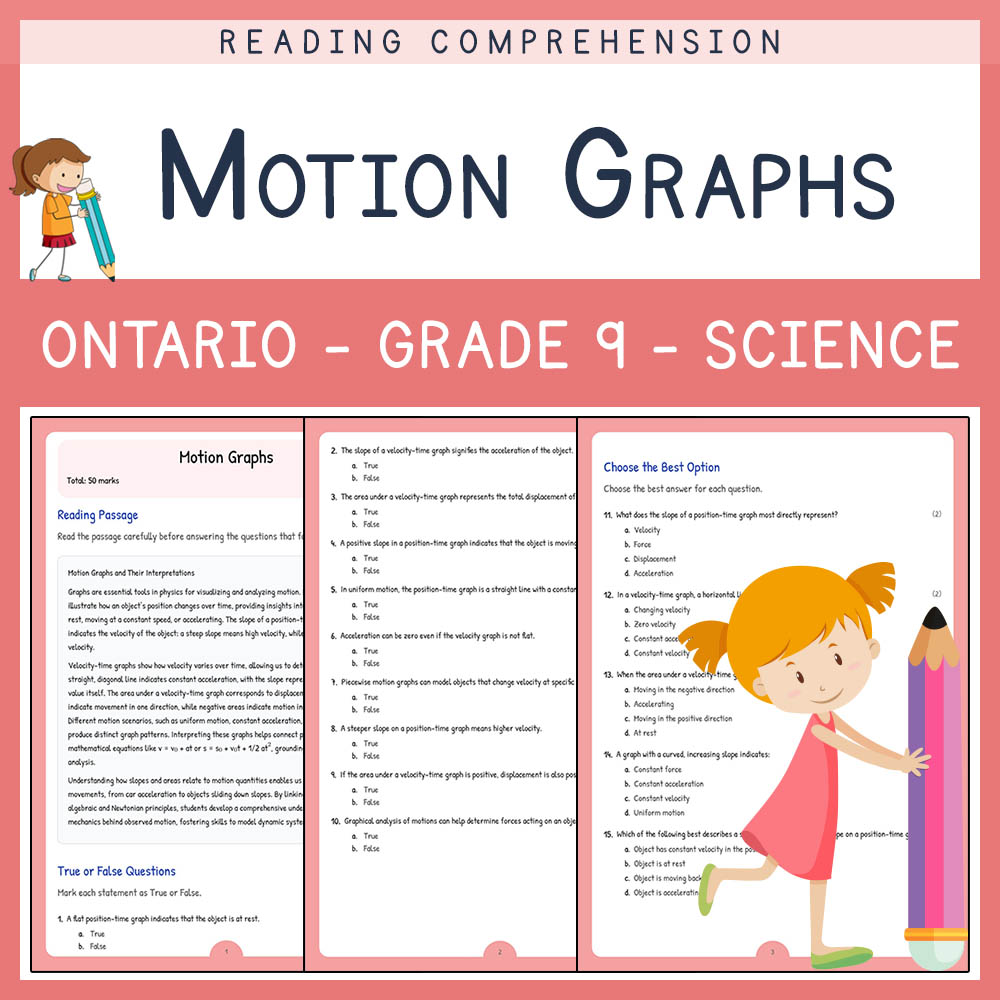
Grade 9 Science Assessment | Motion Graphs Worksheet Elena | Ontario Standard
Created byLumora LearningLearning Objectives
- Interpret position–time and velocity–time graphs in various motion scenarios.
- Understand how slopes of graphs relate to physical quantities like velocity and acceleration.
- Calculate displacement from areas under velocity–time graphs.
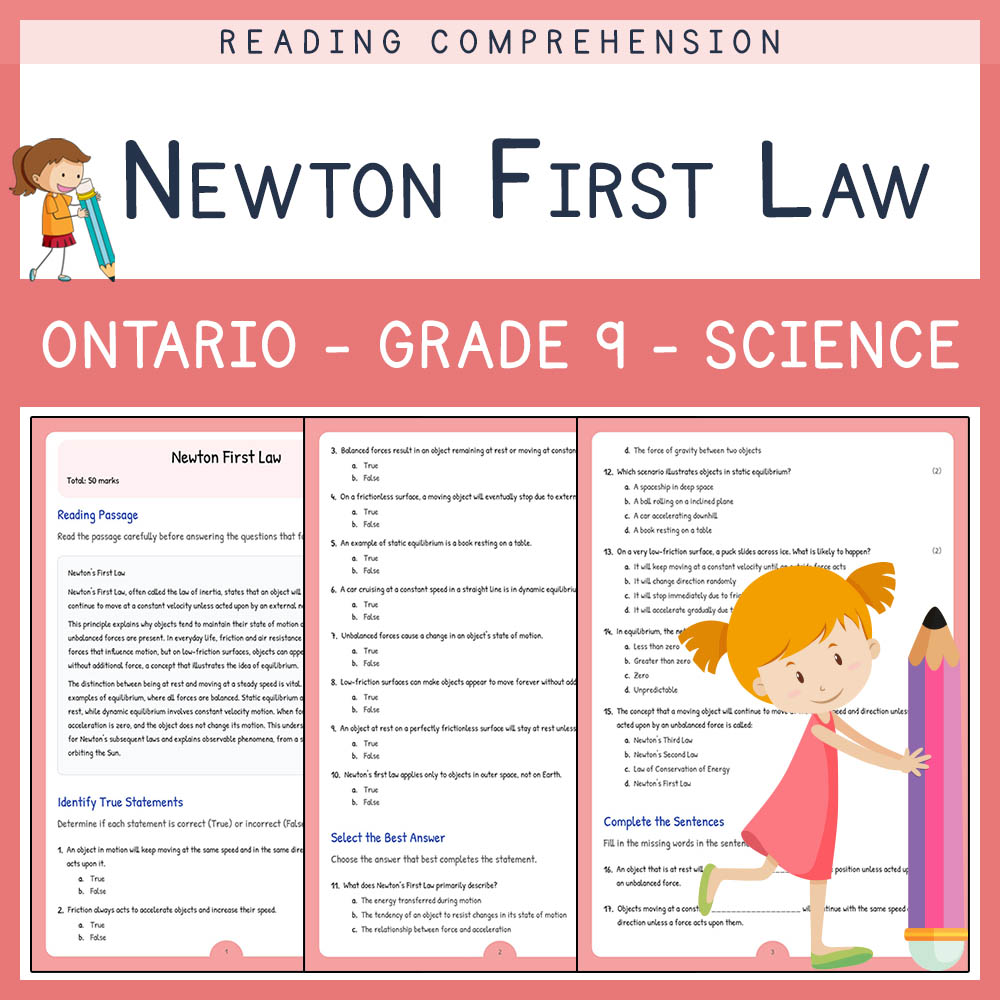
Grade 9 Science | Newton First Law Worksheet Elena | Ontario Standard
Created byLumora LearningLearning Objectives
- Explain Newton's First Law as a statement about inertia and the relationship between net external force and motion.
- Differentiate between objects at rest and those moving at constant velocity.
- Describe the role of balanced forces in static and dynamic equilibrium.
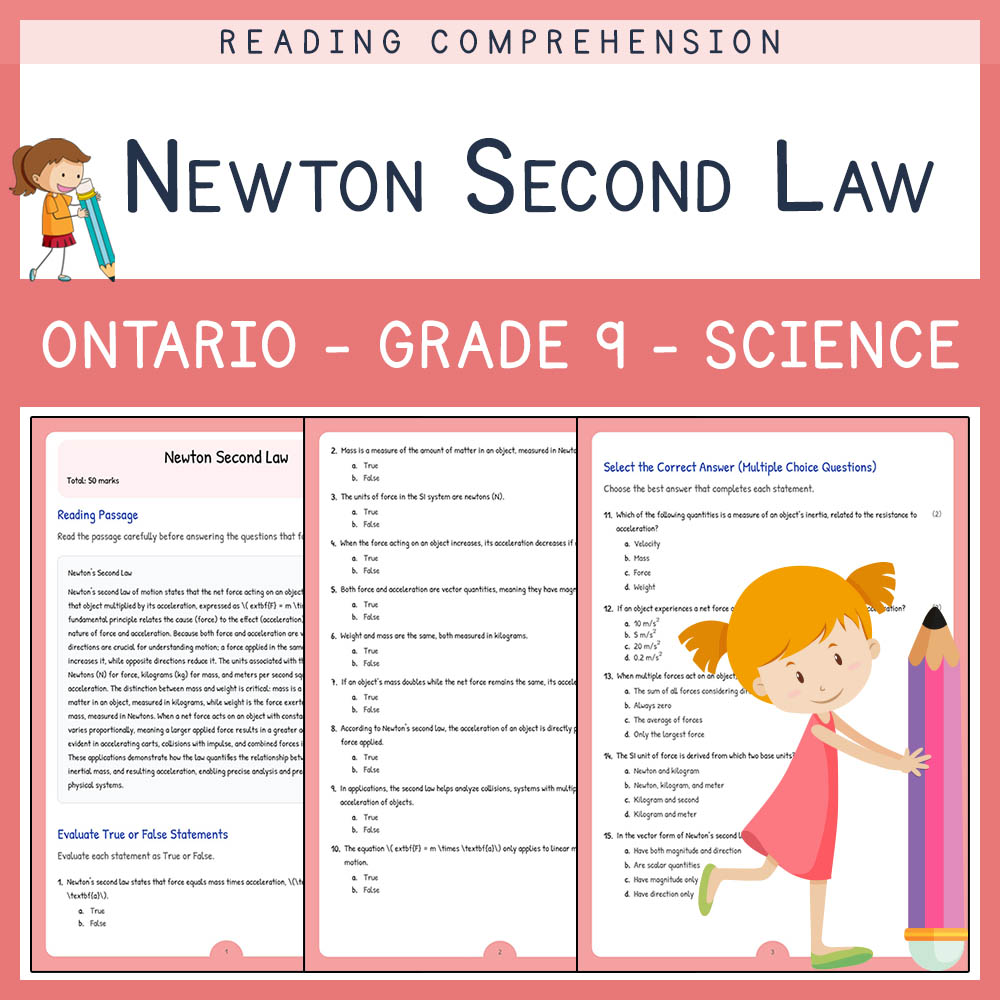
Grade 9 Science Assessment | Newton Second Law Worksheet | Ontario
Created byLumora LearningLearning Objectives
- Explain Newton's second law and its formula relating force, mass, and acceleration.
- Differentiate between mass and weight and understand their units.
- Apply the principle of vector quantities in force and acceleration analysis.
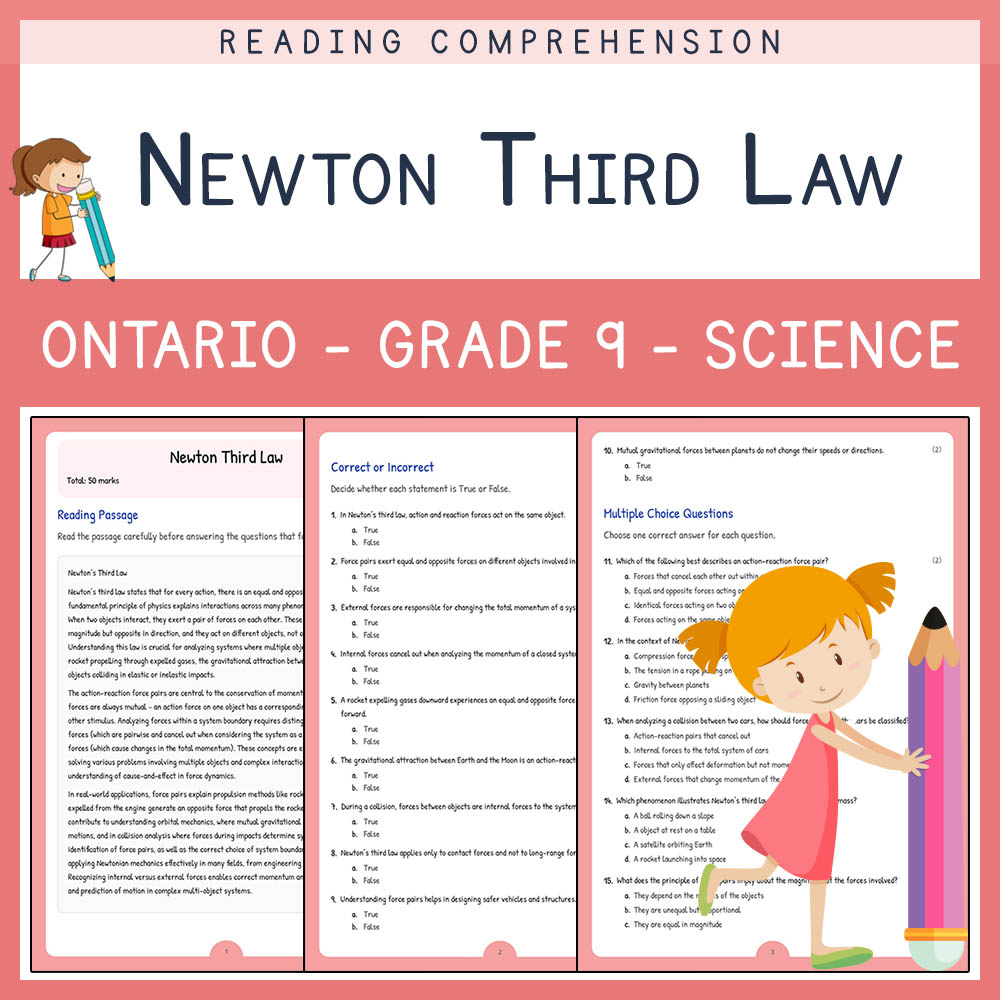
Grade 9 Science Assessment | Newton Third Law Worksheet Elena | Ontario
Created byLumora LearningLearning Objectives
- Understand the concept of action–reaction force pairs in Newton's third law.
- Identify equal magnitude and opposite direction forces in various interactions.
- Analyze phenomena such as propulsion, gravitational attraction, and collisions through force pairs.
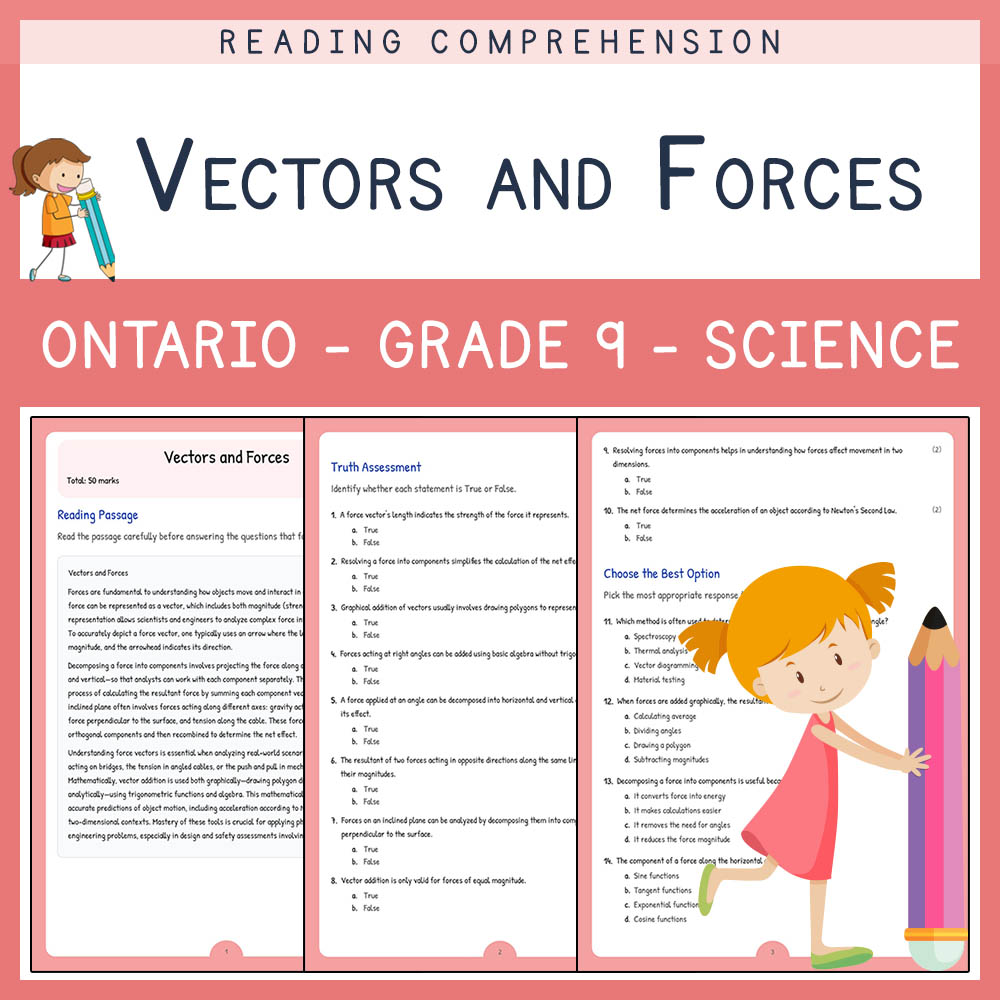
Grade 9 Science | Vectors and Forces Worksheet Elena | Ontario Standard
Created byLumora LearningLearning Objectives
- Understand the representation of forces as vectors including magnitude and direction.
- Learn to decompose forces into components and compute resultant forces graphically and analytically.
- Apply vector addition to force interactions in two-dimensional contexts such as inclined planes and angled cables.
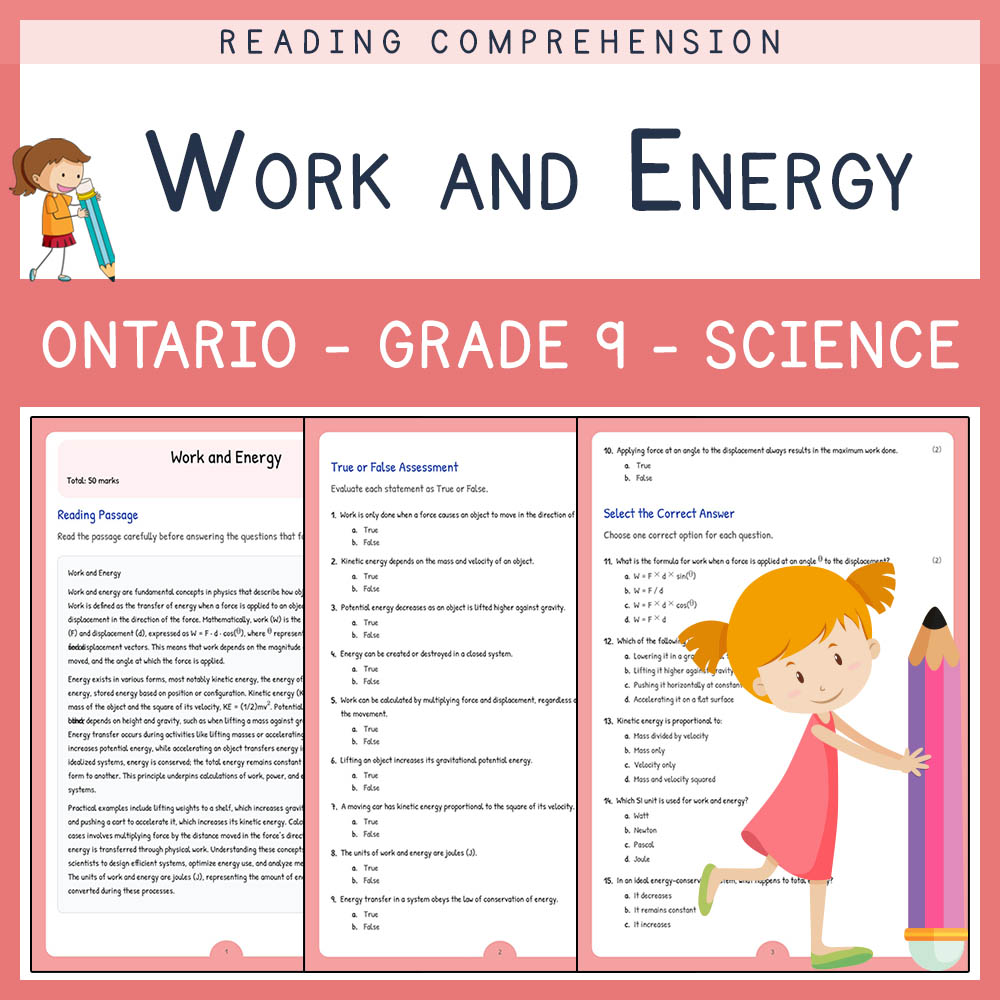
Grade 9 Science Assessment | Work and Energy Worksheet Elena | Ontario Standard
Created byLumora LearningLearning Objectives
- Define and distinguish between work, kinetic energy, and potential energy
- Understand the calculation of work for constant forces
- Explain energy transfer in mechanical systems such as lifting and accelerating objects
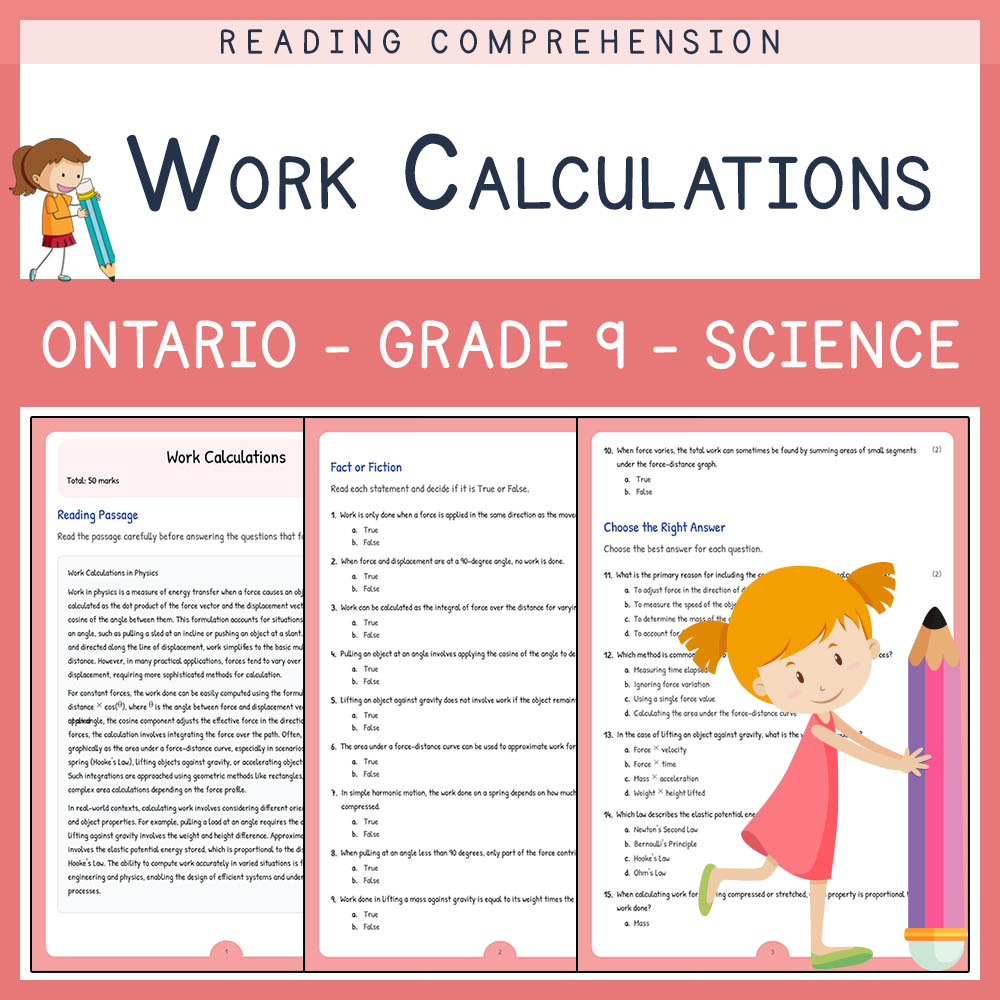
Grade 9 Science Assessment | Work Calculations Worksheet | Ontario Standard
Created byLumora LearningLearning Objectives
- Understand the concept of work as the dot product of force and displacement, including the role of the cosine of the angle between them.
- Calculate work done by constant forces at an angle, including lifting against gravity and pulling objects.
- Compare methods for calculating work when forces vary, including using the area under force–distance curves in common approximations.
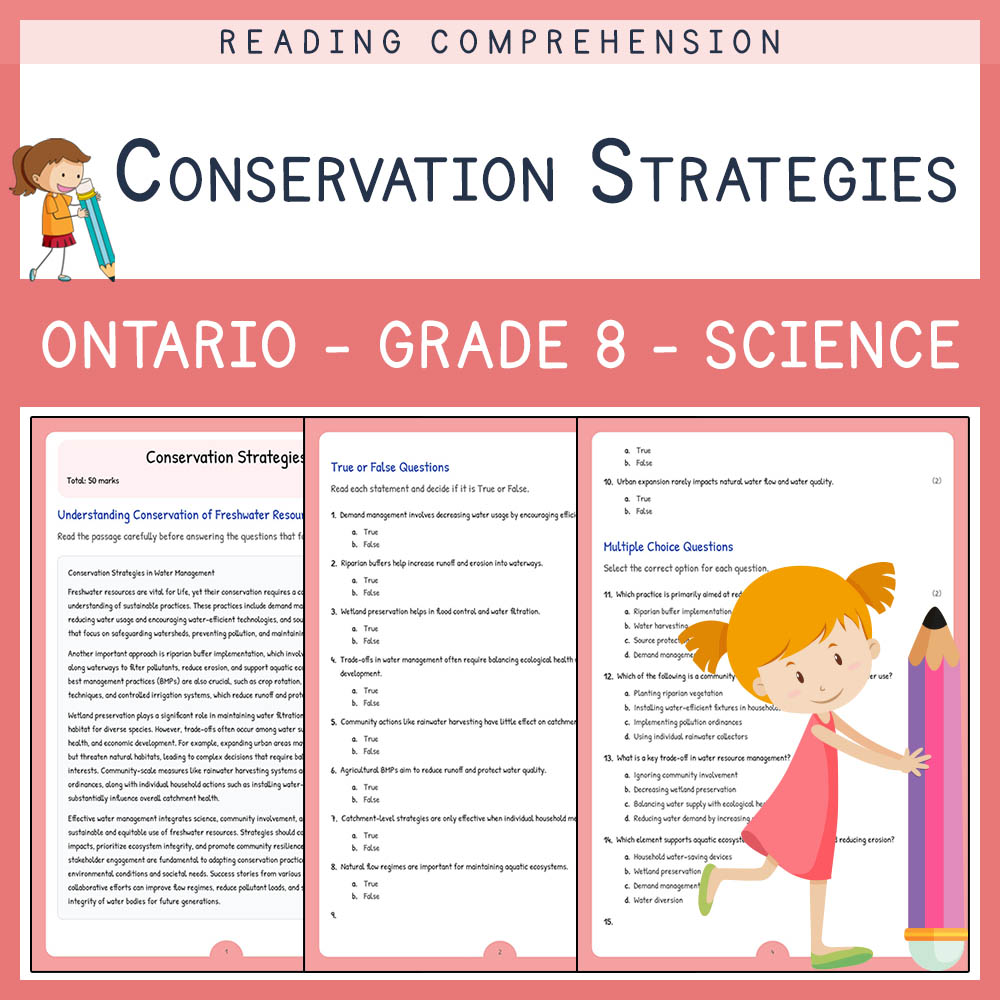
Grade 8 Science Assessment | Conservation Strategies Worksheet | Ontario
Created byLumora LearningLearning Objectives
- Describe the principles and methods used for the stewardship of freshwater resources.
- Analyze trade-offs among water supply, ecological integrity, and economic uses.
- Identify community and individual measures to promote sustainable water management.
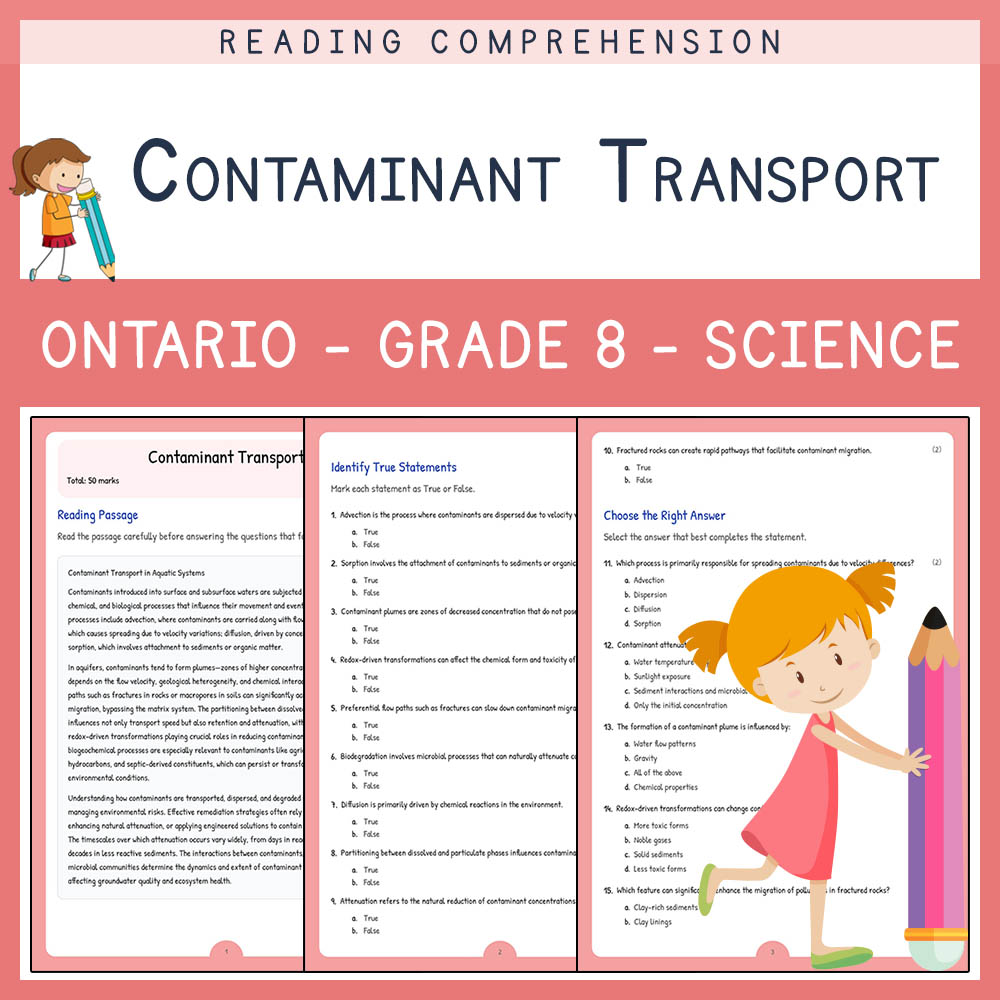
Grade 8 Science Assessment | Contaminant Transport Worksheet | Ontario
Created byLumora LearningLearning Objectives
- Understand the processes governing movement and fate of contaminants in surface and subsurface waters.
- Describe key mechanisms such as advection, dispersion, diffusion, sorption, and biodegradation.
- Explain the formation and migration of contaminant plumes in aquifers and flow paths in fractured rocks.
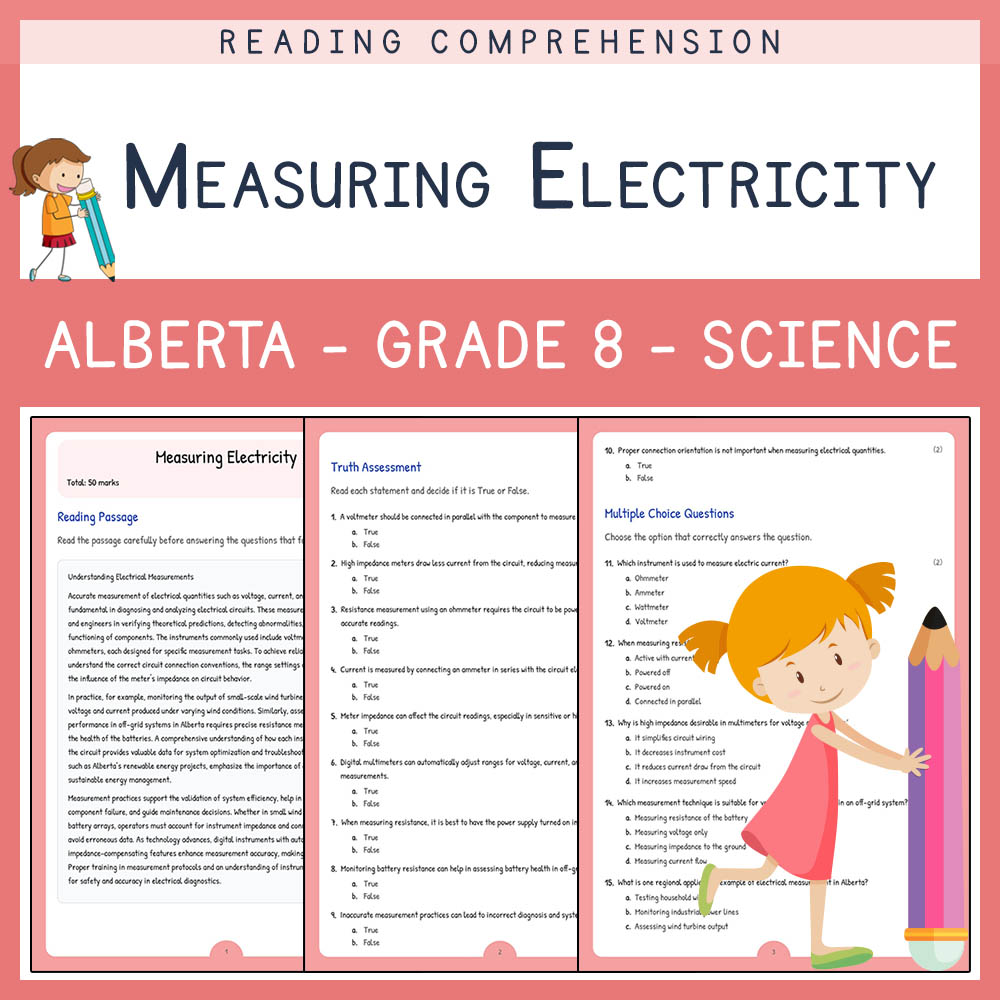
Grade 8 Science | Measuring Electricity Worksheet | Alberta Standards
Created byLumora LearningLearning Objectives
- Understand the principles of measuring voltage, current, and resistance in electrical circuits.
- Identify proper instrument use and reading techniques for accurate diagnostics.
- Explain how instrument impedance affects circuit measurements.
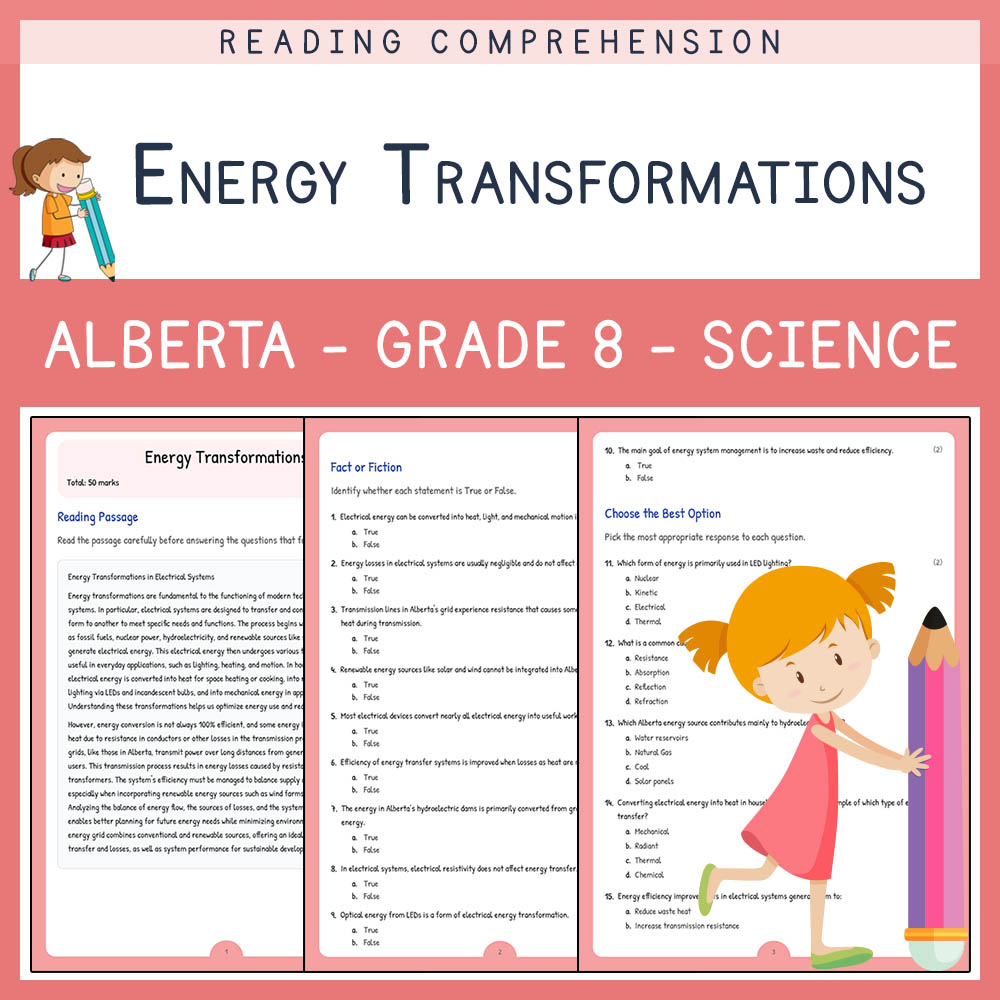
Grade 8 Science | Energy Transformations Worksheet | Alberta Standards
Created byLumora LearningLearning Objectives
- Understand how energy transforms between electrical, thermal, radiant, and mechanical forms.
- Identify real-world examples of energy conversions and their efficiencies.
- Explain the sources of energy loss in electrical systems and transmission.
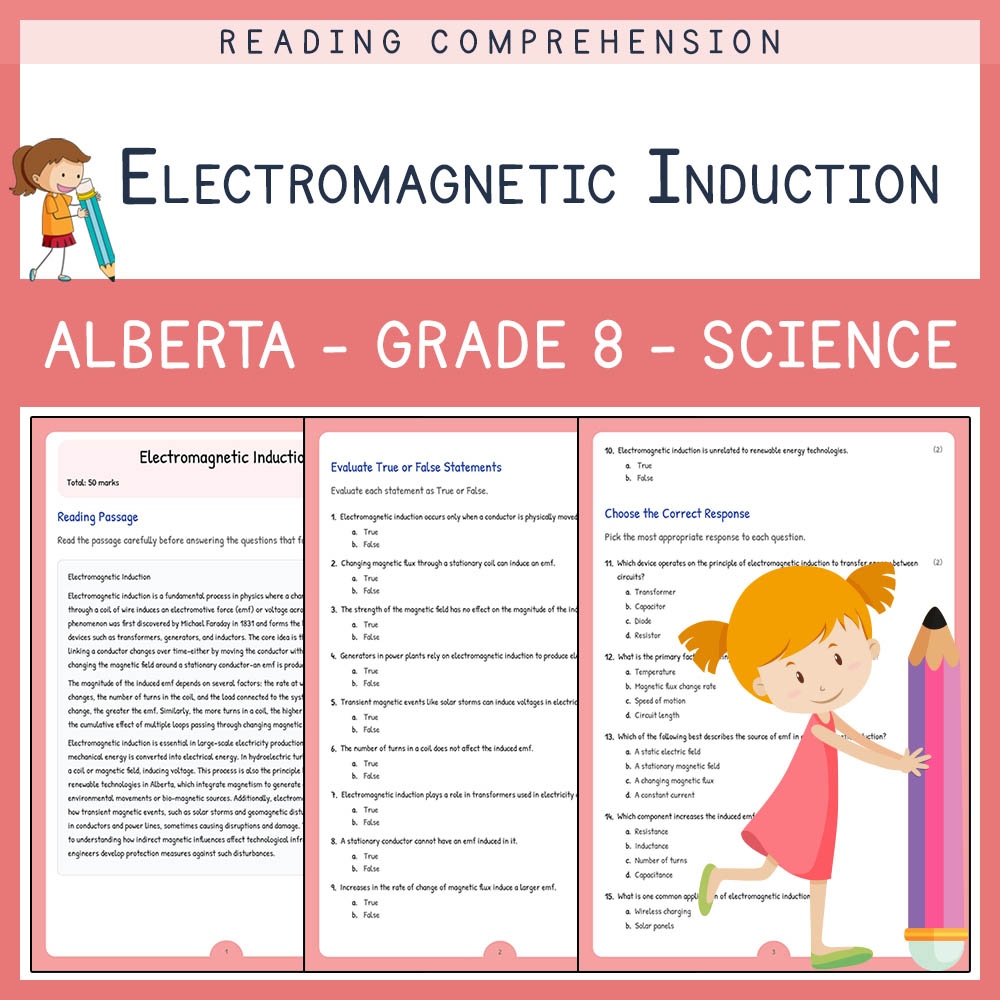
Grade 8 Science | Electromagnetic Induction Worksheet | Alberta Standards
Created byLumora LearningLearning Objectives
- Understand the fundamental principles of electromagnetic induction.
- Describe how changing magnetic flux induces voltage in conductors.
- Explain the applications of electromagnetic induction in generators and transformers.
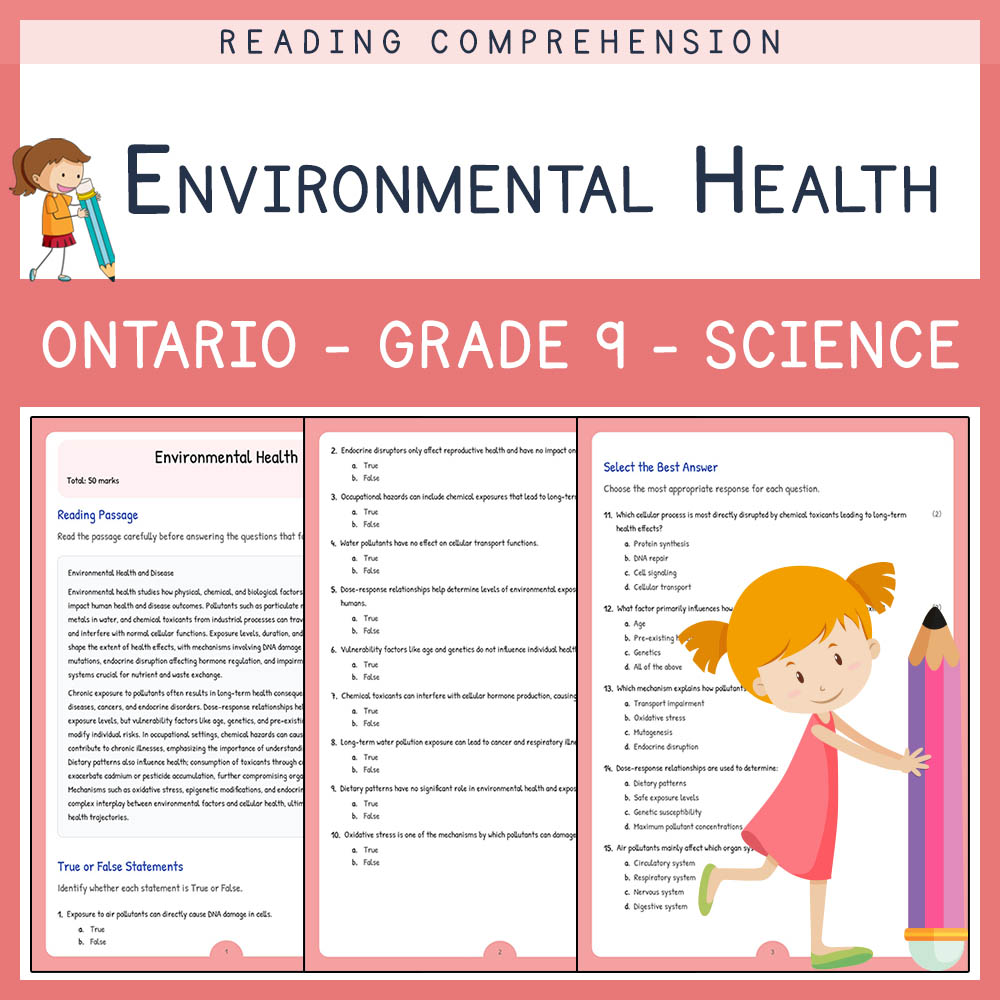
Grade 9 Science | Environmental Health Worksheet Elena | Ontario Standards
Created byLumora LearningLearning Objectives
- Understand how environmental exposures influence cellular processes and long-term health.
- Identify types of pollutants and hazards affecting human health.
- Describe mechanisms by which pollutants cause DNA damage, endocrine disruption, and transport impairment.
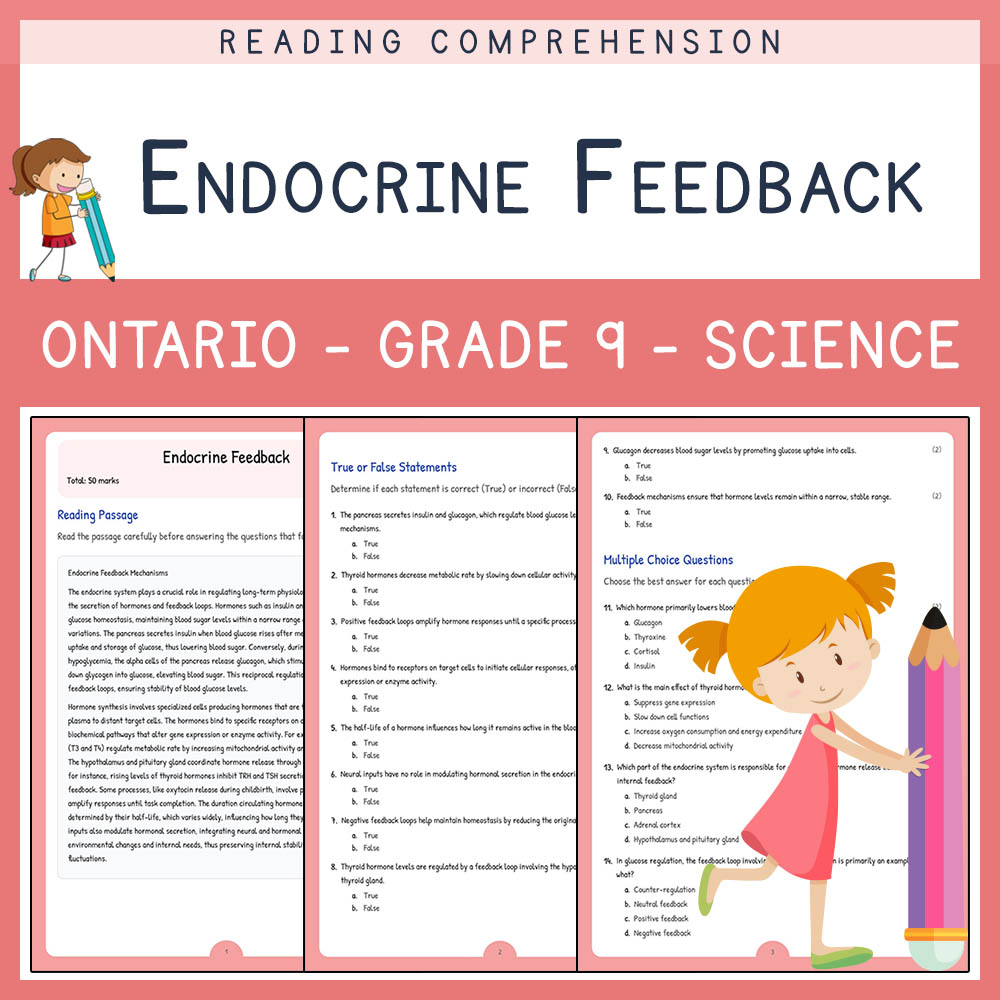
Grade 9 Science | Endocrine Feedback Worksheet | Ontario Standard
Created byLumora LearningLearning Objectives
- Understand the role of hormonal feedback mechanisms in maintaining homeostasis.
- Explain how insulin and glucagon regulate blood glucose levels via negative feedback loops.
- Describe the thyroid gland's control of metabolic rate through hormonal regulation.
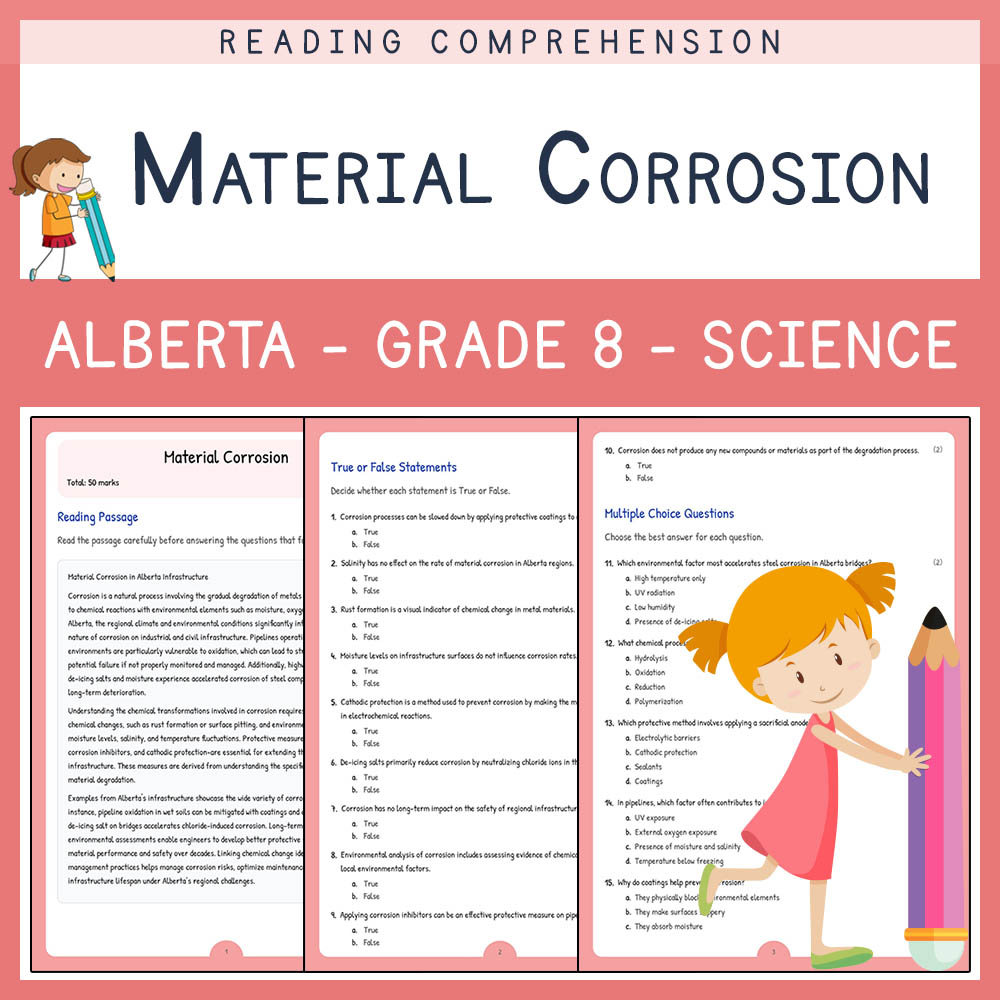
Grade 8 Science | Material Corrosion Worksheet Elena | Alberta Standard
Created byLumora LearningLearning Objectives
- Understand the chemical and environmental factors contributing to material corrosion.
- Identify signs of corrosion and analyze environmental influences on infrastructure degradation.
- Evaluate protective measures and materials used to prevent or reduce corrosion in regional structures.
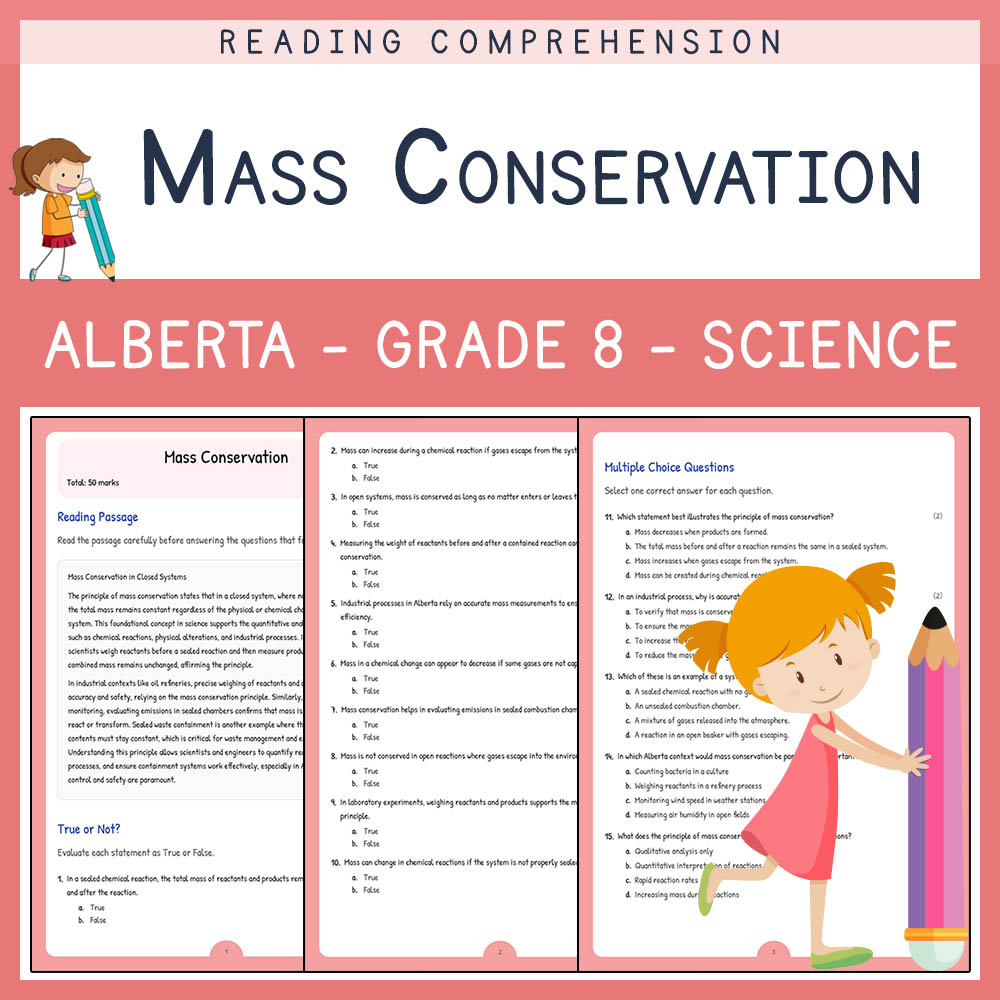
Grade 8 Science | Mass Conservation Worksheet Elena | Alberta Standard
Created byLumora LearningLearning Objectives
- Understand the principle of conservation of mass in physical and chemical changes.
- Identify real-world examples of mass conservation in industrial and environmental contexts.
- Explain how mass is accounted for in sealed systems during transformations.
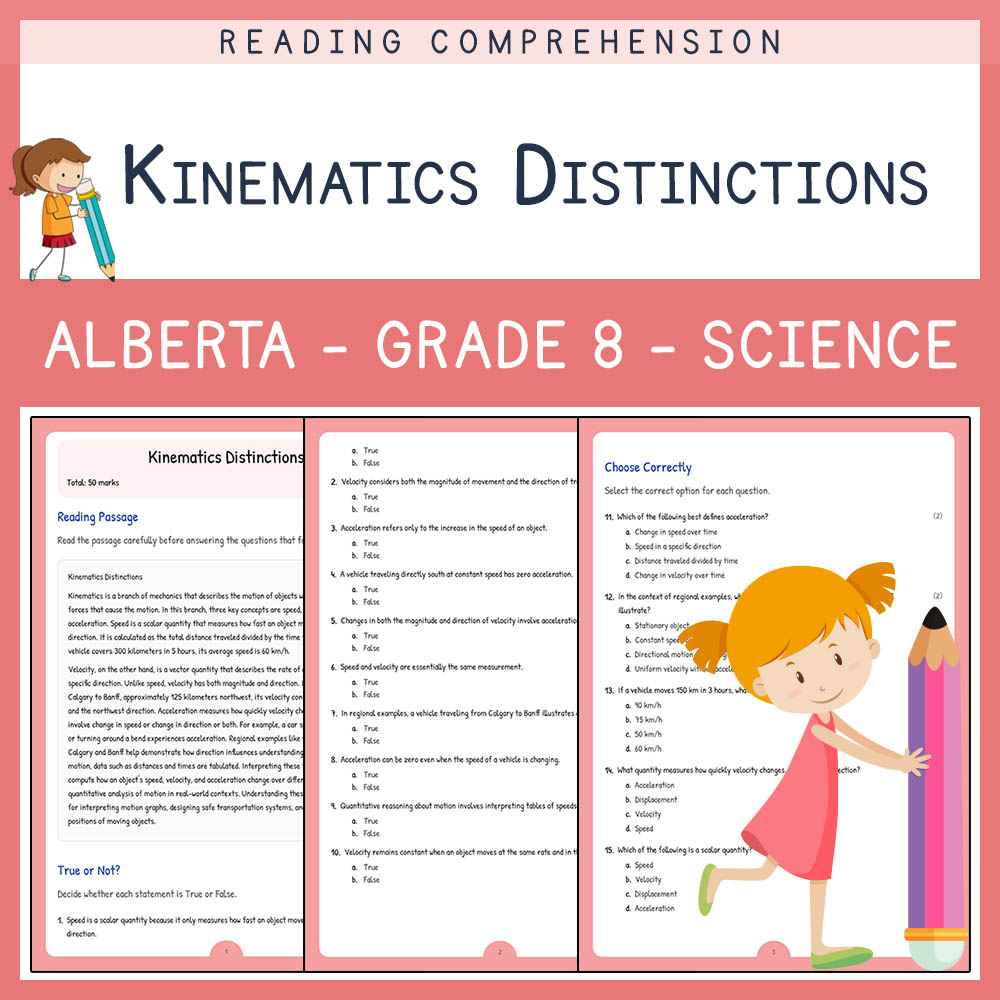
Grade 8 Science | Kinematics Distinctions Worksheet | Alberta Standard
Created byLumora LearningLearning Objectives
- Define speed, velocity, and acceleration with precision and differentiate their characteristics.
- Illustrate examples of motion, such as vehicle travel between regions, to understand directional and non-directional movement.
- Interpret data from tables of distances and times to analyze changing magnitudes and directions of motion.
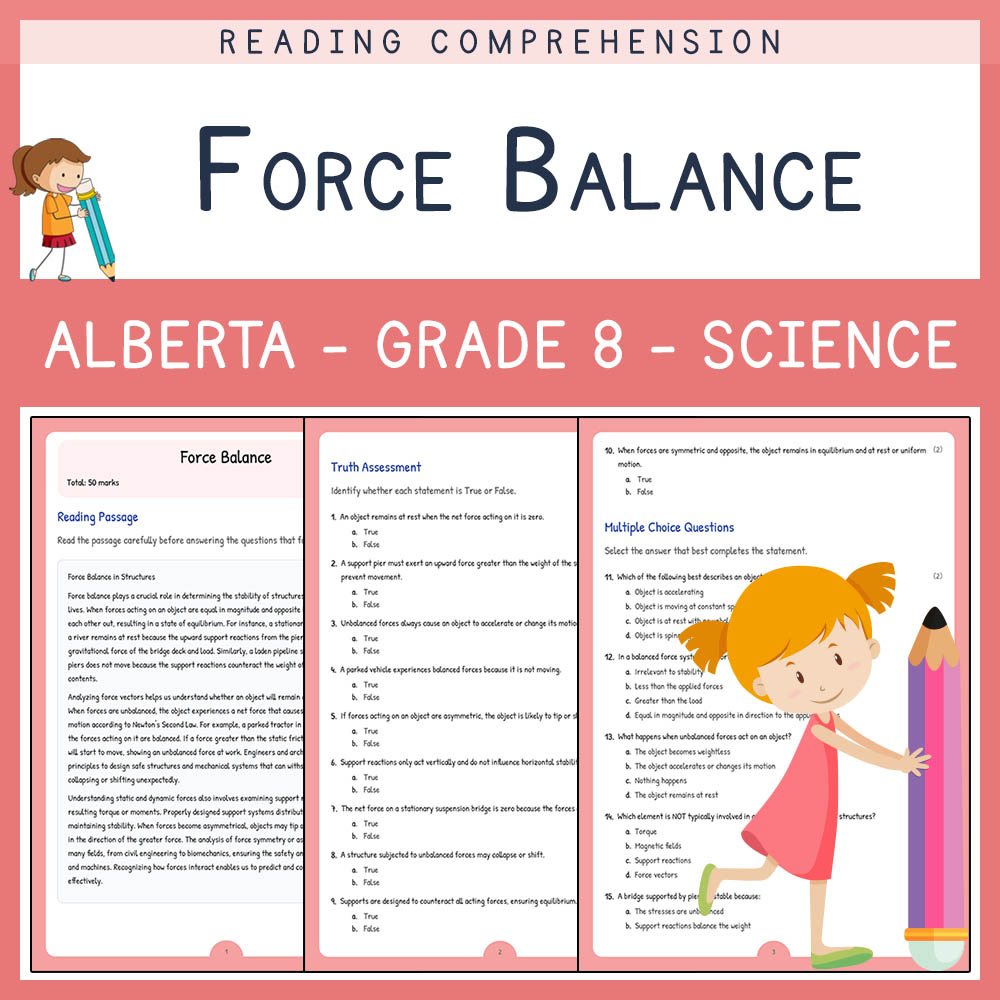
Grade 8 Science | Force Balance Worksheet Elena | Alberta Standard
Created byLumora LearningLearning Objectives
- Understand the concept of balanced and unbalanced forces and their effects on objects.
- Analyze force vectors, support reactions, and resulting motion or equilibrium.
- Identify examples of static and dynamic force systems in real-world scenarios.
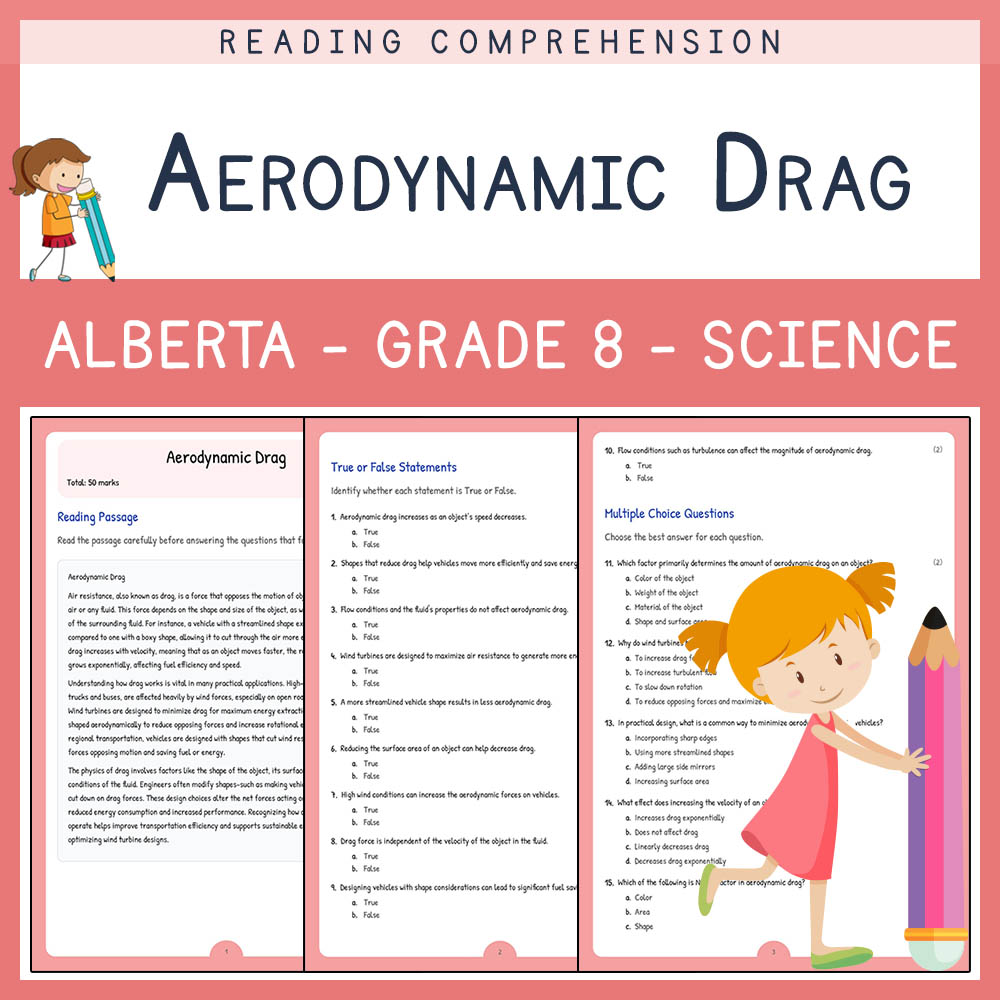
Grade 8 Science Worksheet | Aerodynamic Drag | Alberta-Aligned Practice
Created byLumora LearningLearning Objectives
- Understand the concept of aerodynamic drag and how it opposes motion through a fluid.
- Identify factors influencing air resistance such as shape, area, and flow conditions.
- Recognize practical applications where drag affects vehicle design, wind turbines, and transportation.
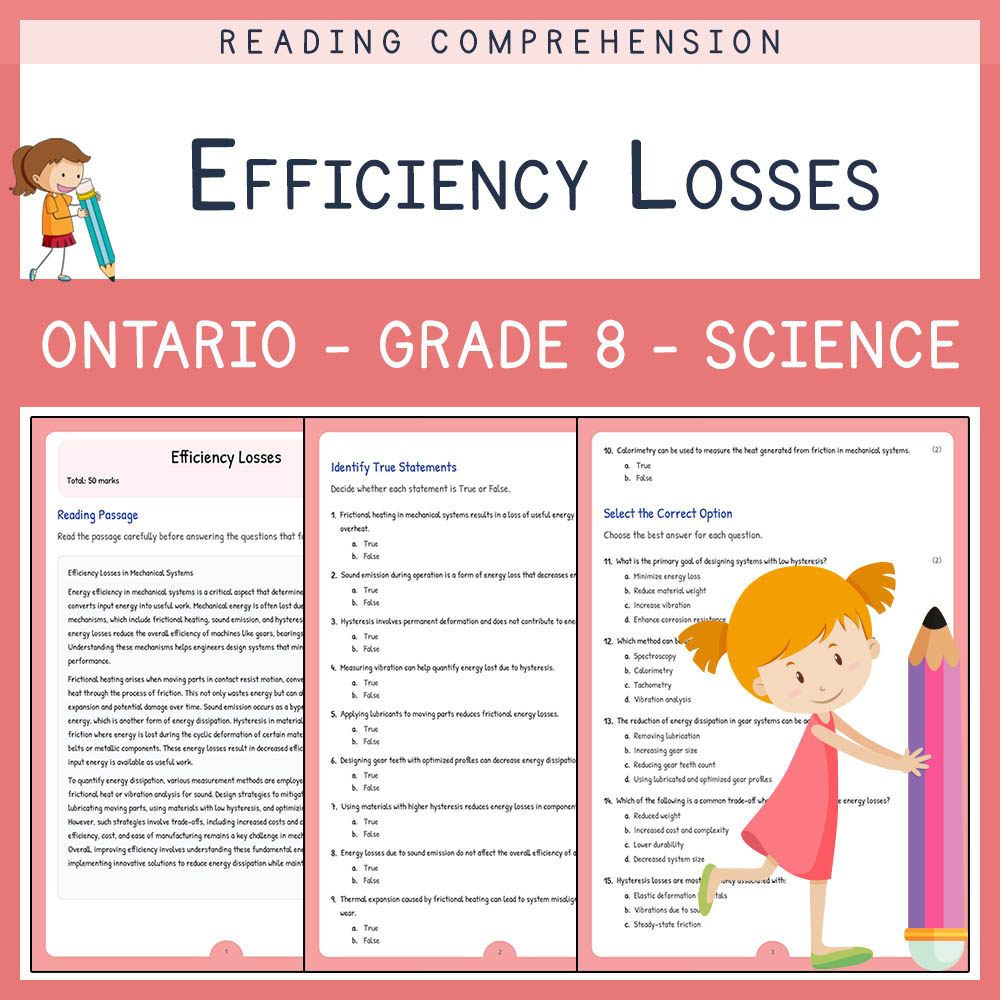
Grade 8 Science | Efficiency Losses Worksheet | Ontario Standards
Created byLumora LearningLearning Objectives
- Understand energy dissipation mechanisms such as frictional heating, sound emission, and hysteresis in mechanical systems.
- Define and calculate mechanical efficiency as useful output energy divided by input energy.
- Identify common causes of reduced efficiency in gears, bearings, and belt drives.
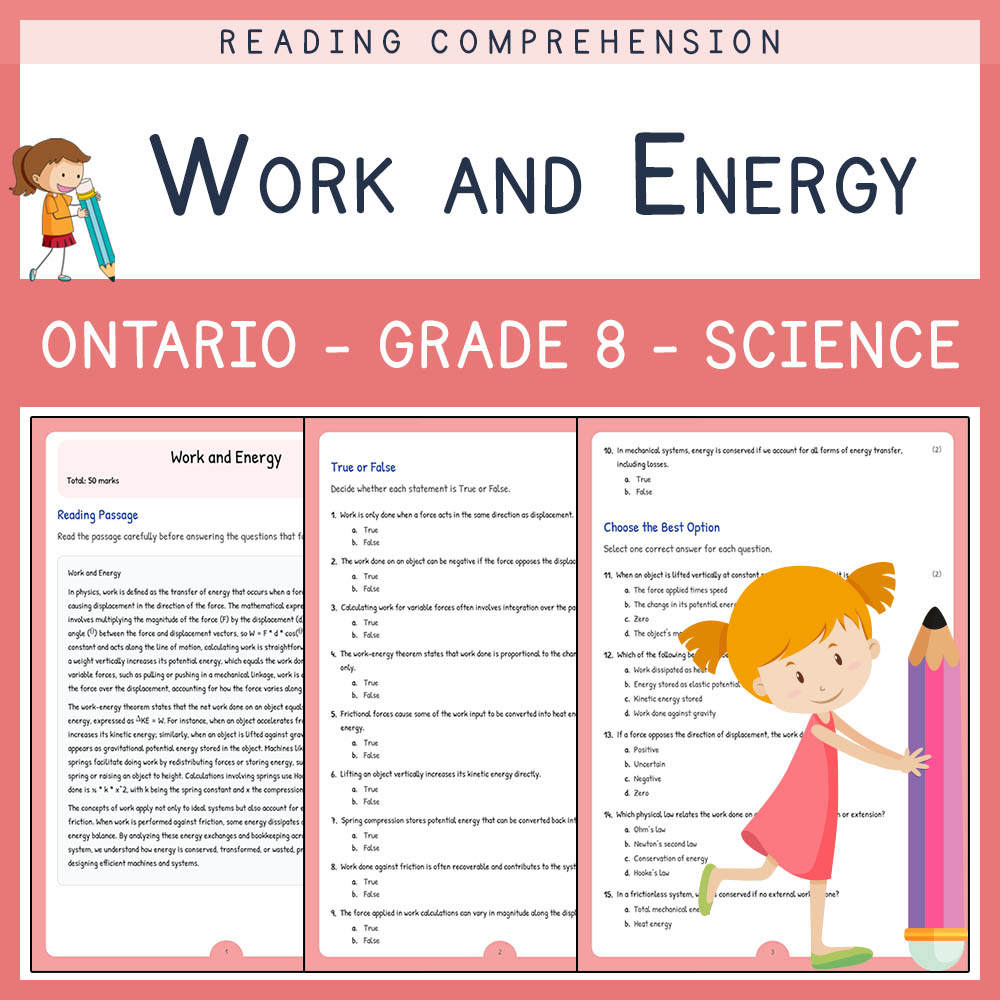
Grade 8 Science | Work and Energy Worksheet Elena | Ontario Standards
Created byLumora LearningLearning Objectives
- Understand the concept of work as force applied over a distance and its calculation.
- Connect work to changes in kinetic and potential energy through the work–energy theorem.
- Apply formulas to compute work in scenarios involving constant and variable forces such as lifting, spring compression, and friction.
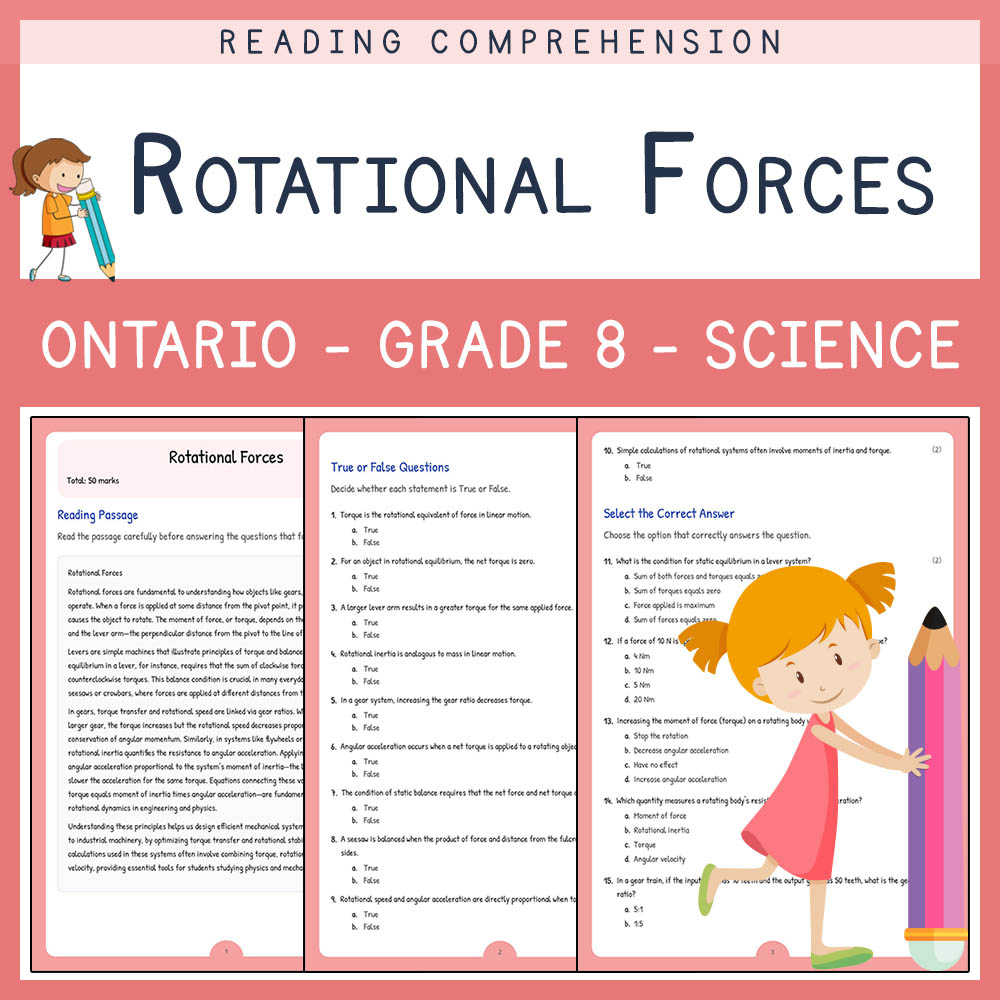
Grade 8 Science | Rotational Forces Worksheet Elena | Ontario Standard
Created byLumora LearningLearning Objectives
- Understand the concept of torque and how it affects rotational motion.
- Explain the conditions for rotational equilibrium in levers, gears, and rotating bodies.
- Analyze the relationship between net torque, angular acceleration, and rotational inertia.
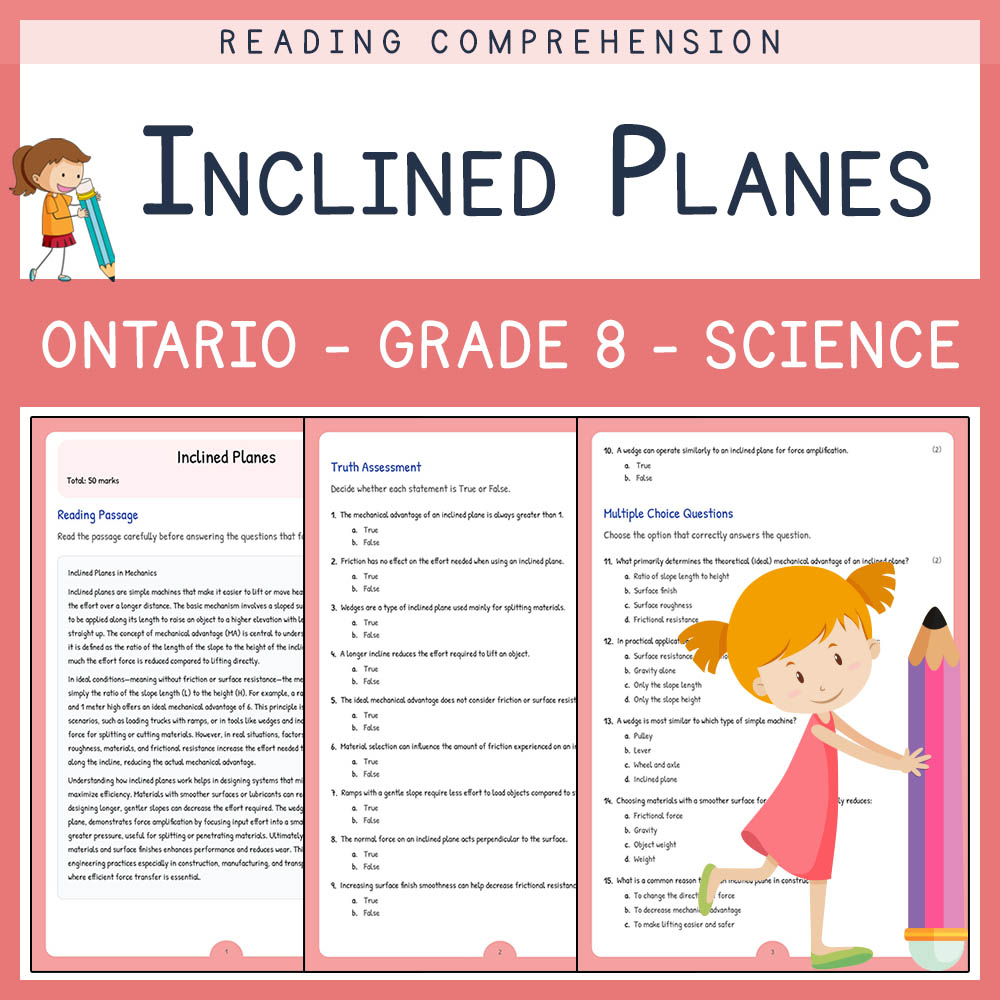
Grade 8 Science Assessment | Inclined Planes Worksheet Elena | Ontario
Created byLumora LearningLearning Objectives
- Explain the mechanical principle of inclined planes and how they reduce input force.
- Calculate mechanical advantage for ramps and wedges in ideal and real-world conditions.
- Analyze the effects of friction and surface texture on the effort needed to move objects using inclined planes.

Grade 9 Science | Biotech Applications Worksheet | TEKS Aligned
Created byLumora LearningLearning Objectives
- Explain key molecular techniques used in biotechnology such as PCR, gel electrophoresis, DNA sequencing, and CRISPR genome editing.
- Identify various applications of biotechnology in research, medicine, agriculture, and forensics.
- Discuss ethical, legal, and societal considerations associated with biotechnological advancements.

Grade 9 Science | Biotech Ethics Worksheet | TEKS Aligned
Created byLumora LearningLearning Objectives
- Understand key ethical considerations in biotechnology, including privacy, consent, and ecological impact.
- Analyze societal implications and regulatory frameworks related to genetic manipulation.
- Evaluate risks and benefits associated with biotechnological advancements.
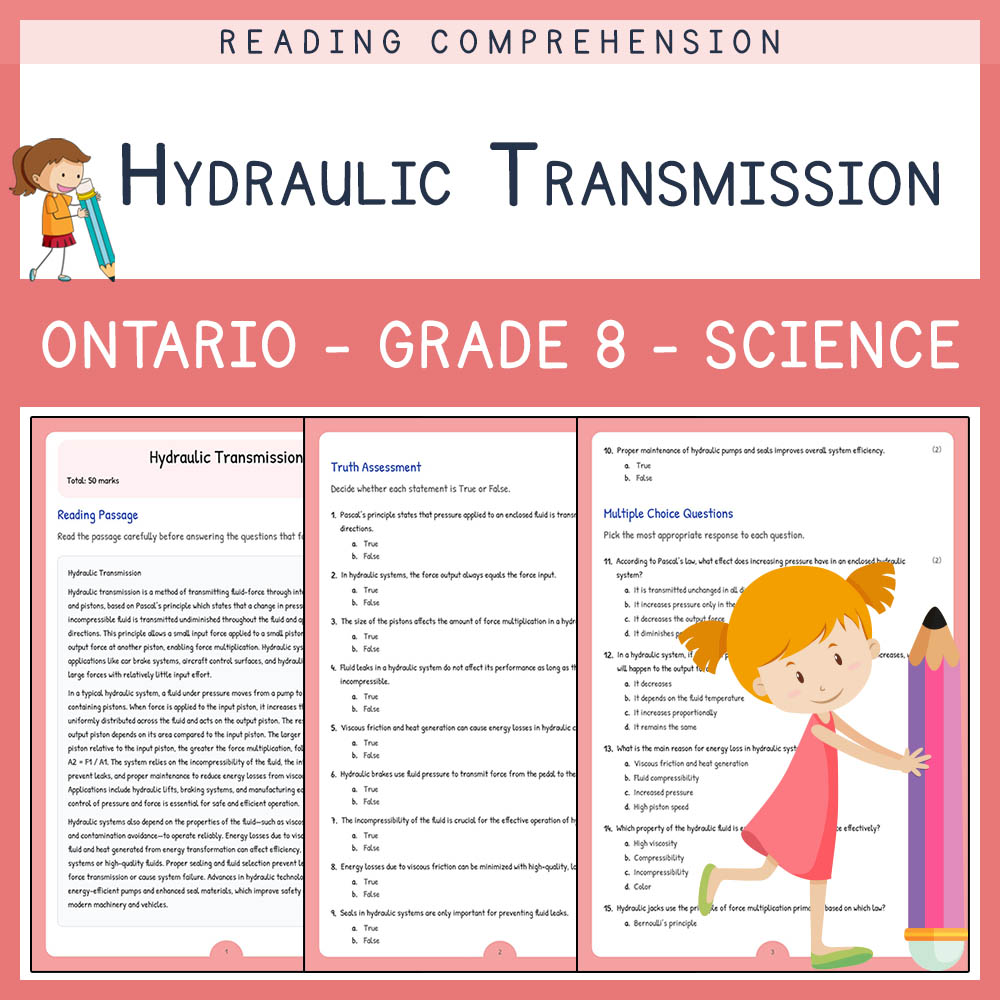
Grade 8 Science Assessment | Hydraulic Transmission Worksheet Elena | Ontario
Created byLumora LearningLearning Objectives
- Explain the basic principle of Pascal's law and how it relates to hydraulic systems.
- Describe how input force and piston area affect output force in hydraulics.
- Identify applications of hydraulic systems like jacks and brakes.
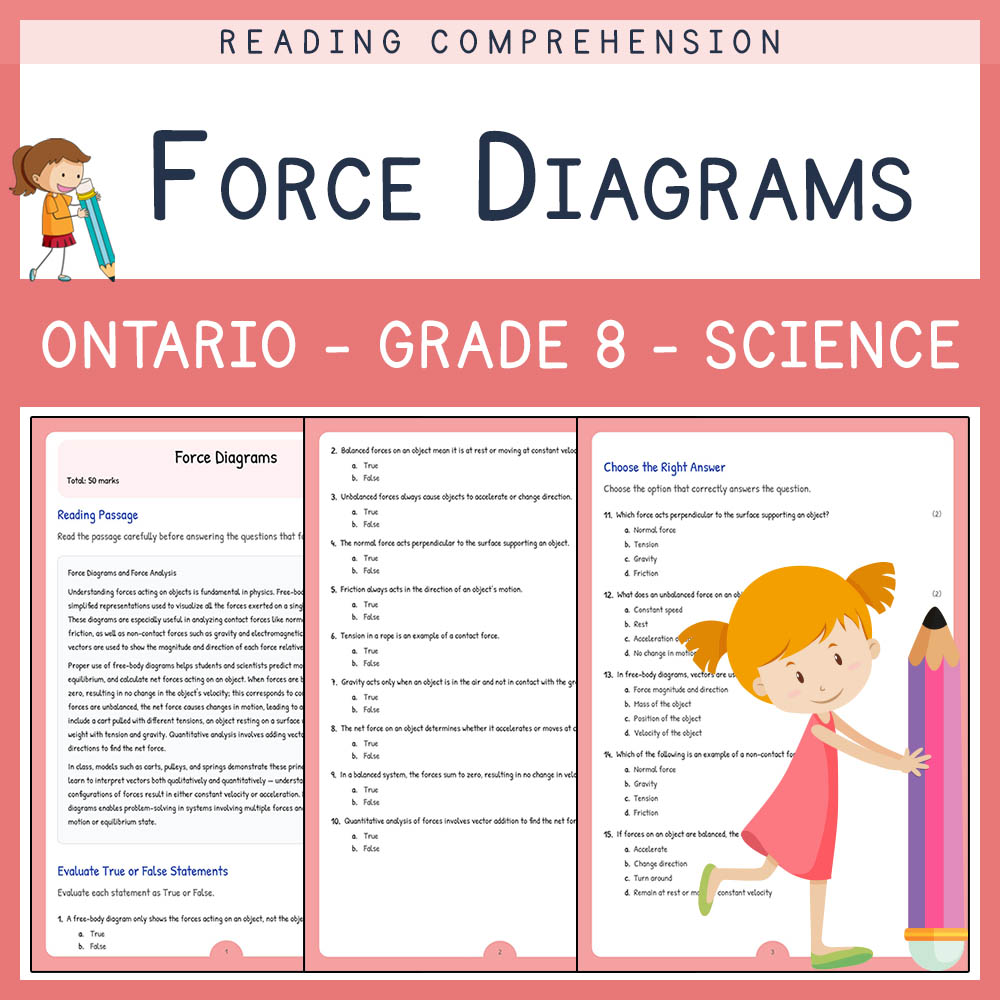
Grade 8 Science | Force Diagrams Worksheet | Ontario Standards
Created byLumora LearningLearning Objectives
- Understand the components and uses of free-body diagrams in representing forces.
- Identify contact and non-contact forces such as normal force, tension, friction, and gravity.
- Differentiate between balanced and unbalanced forces and relate this to motion in systems.
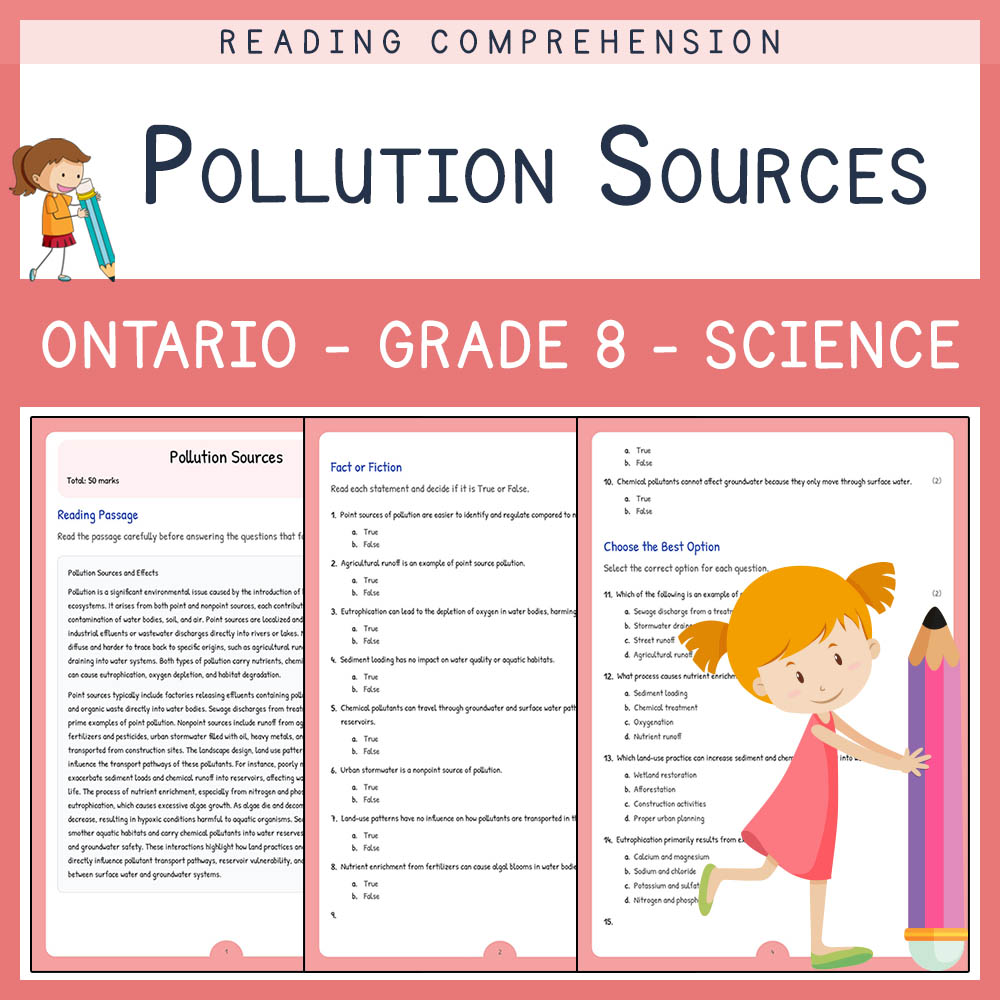
Grade 8 Science Assessment | Pollution Sources Worksheet Elena | Ontario
Created byLumora LearningLearning Objectives
- Differentiate between point and nonpoint sources of pollution with relevant examples.
- Explain processes such as nutrient enrichment, eutrophication, and oxygen depletion.
- Identify the pathways of pollutant transport and their impacts on surface and groundwater.
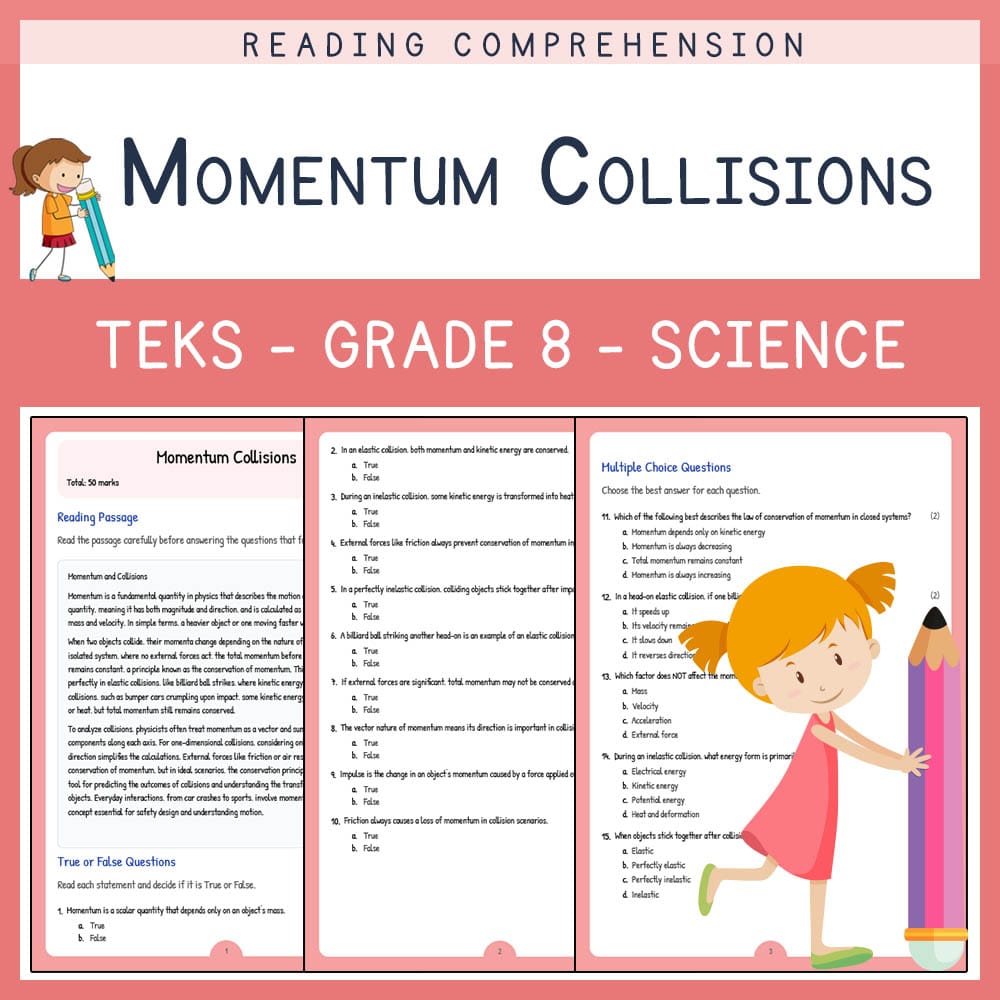
Grade 8 Science | Momentum Collisions Worksheet | TEKS-Aligned
Created byLumora LearningLearning Objectives
- Explain the concept of linear momentum and its conservation in isolated systems.
- Distinguish between elastic and inelastic collisions using real-world examples.
- Apply vector treatment to analyze momentum in one-dimensional collisions.
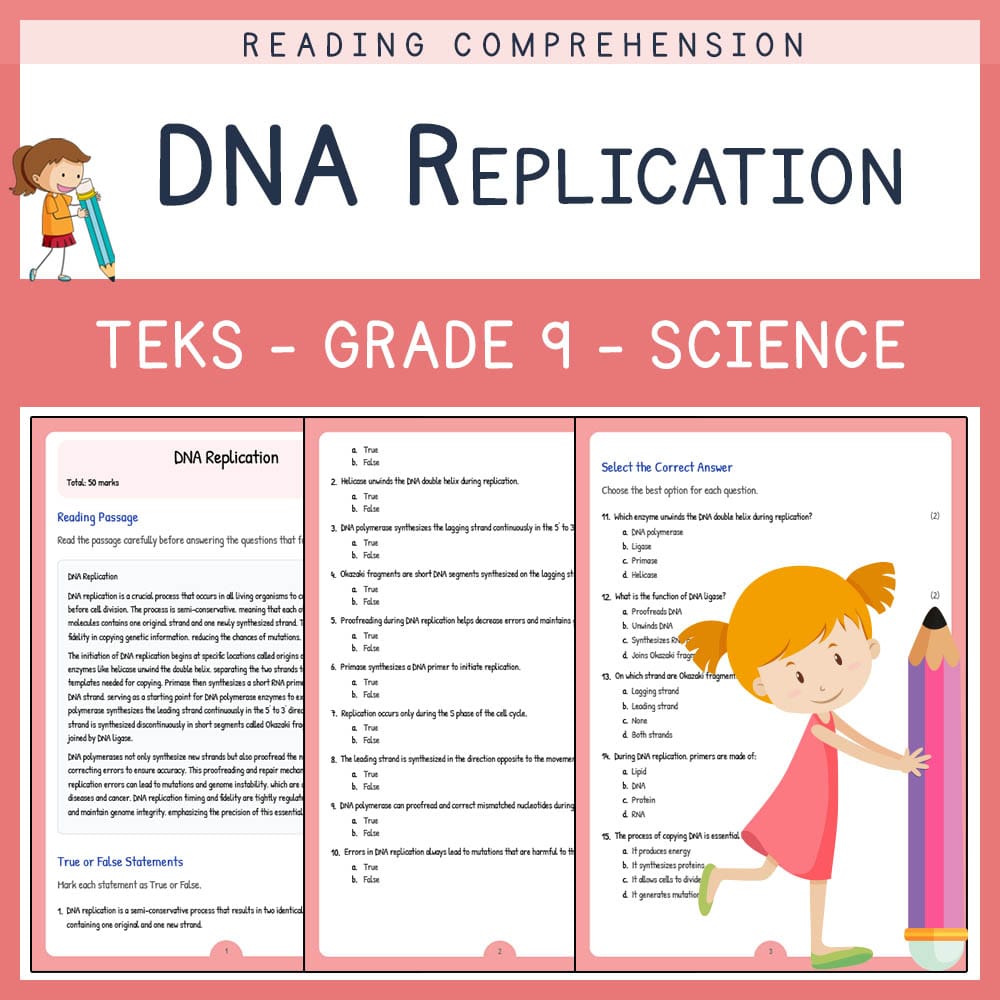
Grade 9 Science | DNA Replication Worksheet | TEKS Aligned
Created byLumora LearningLearning Objectives
- Explain the semi-conservative nature of DNA replication.
- Identify the roles of enzymes such as helicase, primase, and DNA polymerase during replication.
- Describe the processes of leading and lagging strand synthesis, including Okazaki fragments.
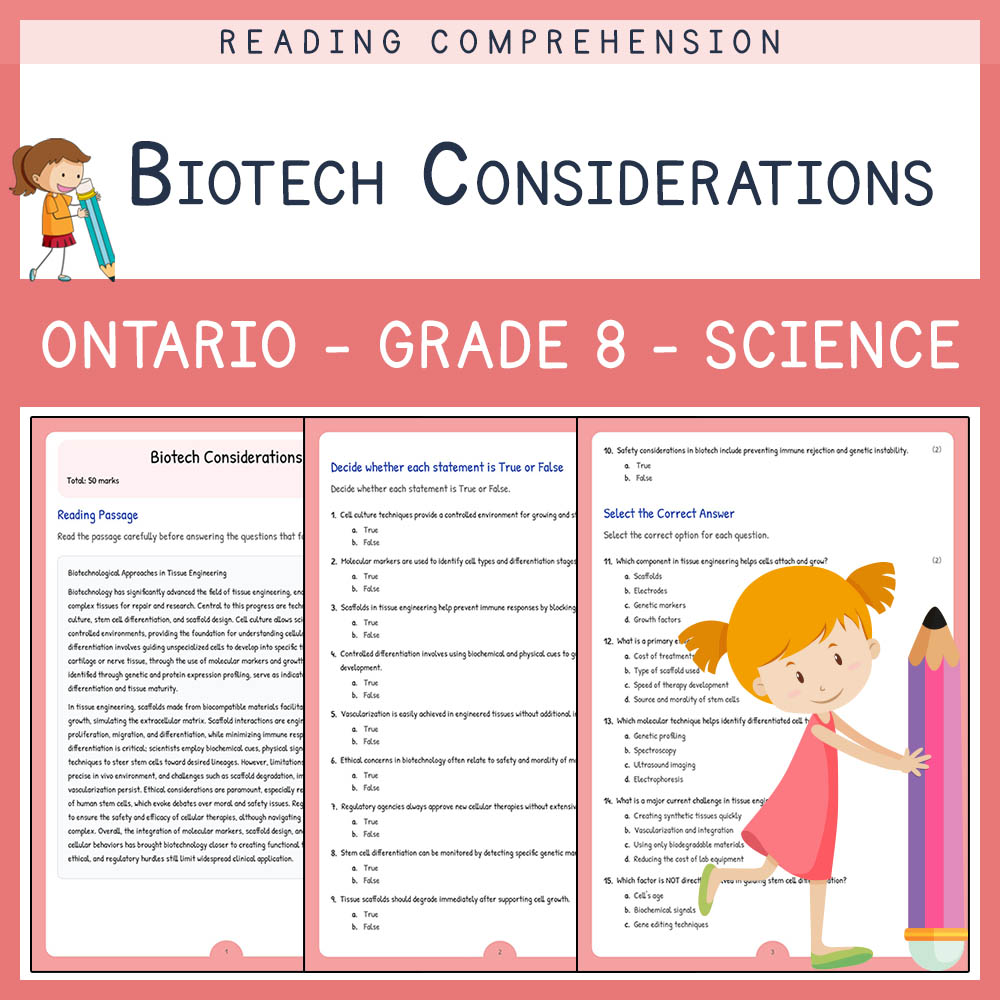
Grade 8 Science Guide | Biotech Considerations Worksheet Elena | Ontario
Created byLumora LearningLearning Objectives
- Understand the key biotechnological methods such as cell culture, stem cell differentiation, and tissue engineering.
- Identify molecular markers and scaffold interactions used in tissue development.
- Discuss ethical, safety, and regulatory considerations in cellular manipulation.
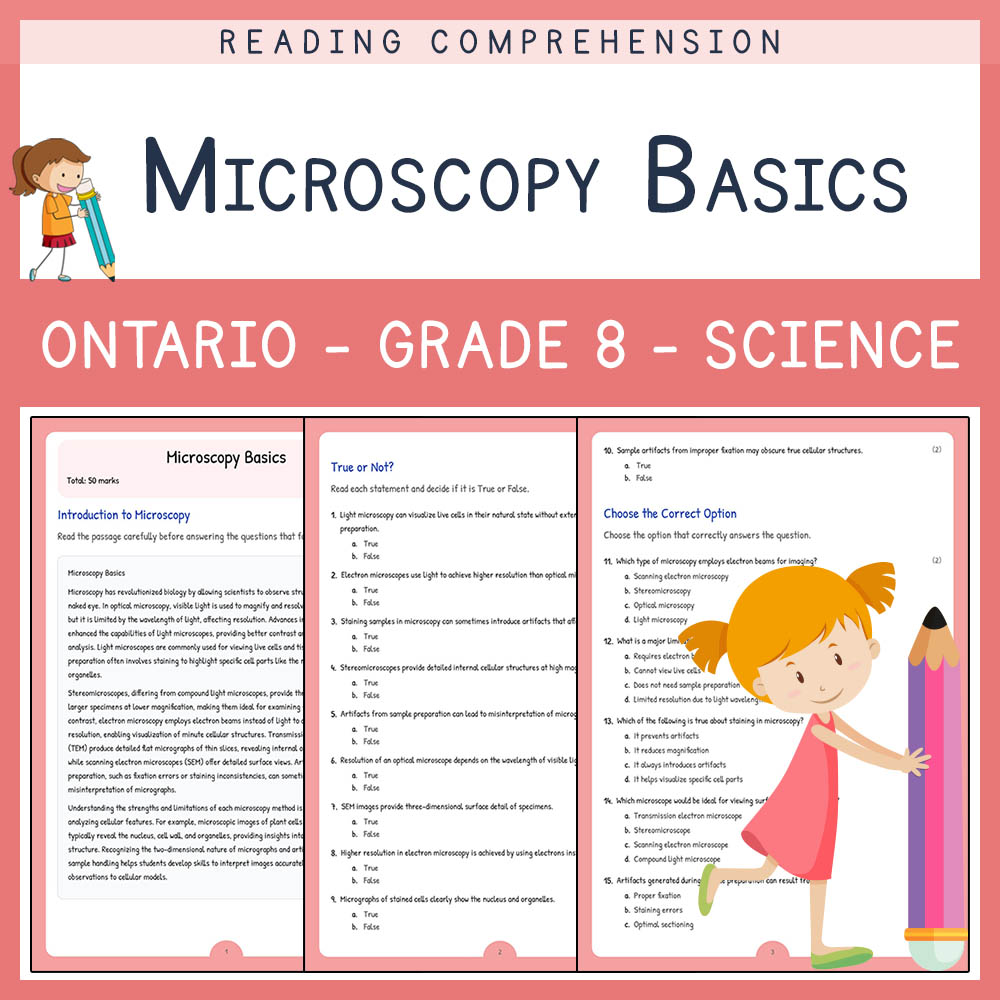
Grade 8 Science | Microscopy Basics Worksheet Elena | Ontario
Created byLumora LearningLearning Objectives
- Understand the fundamental principles of light, digital, stereomicroscopy, and electron imaging techniques.
- Distinguish between types of microscopes and their applications in cellular visualization.
- Identify how sample preparation, artifacts, and interpretation influence micrograph analysis.
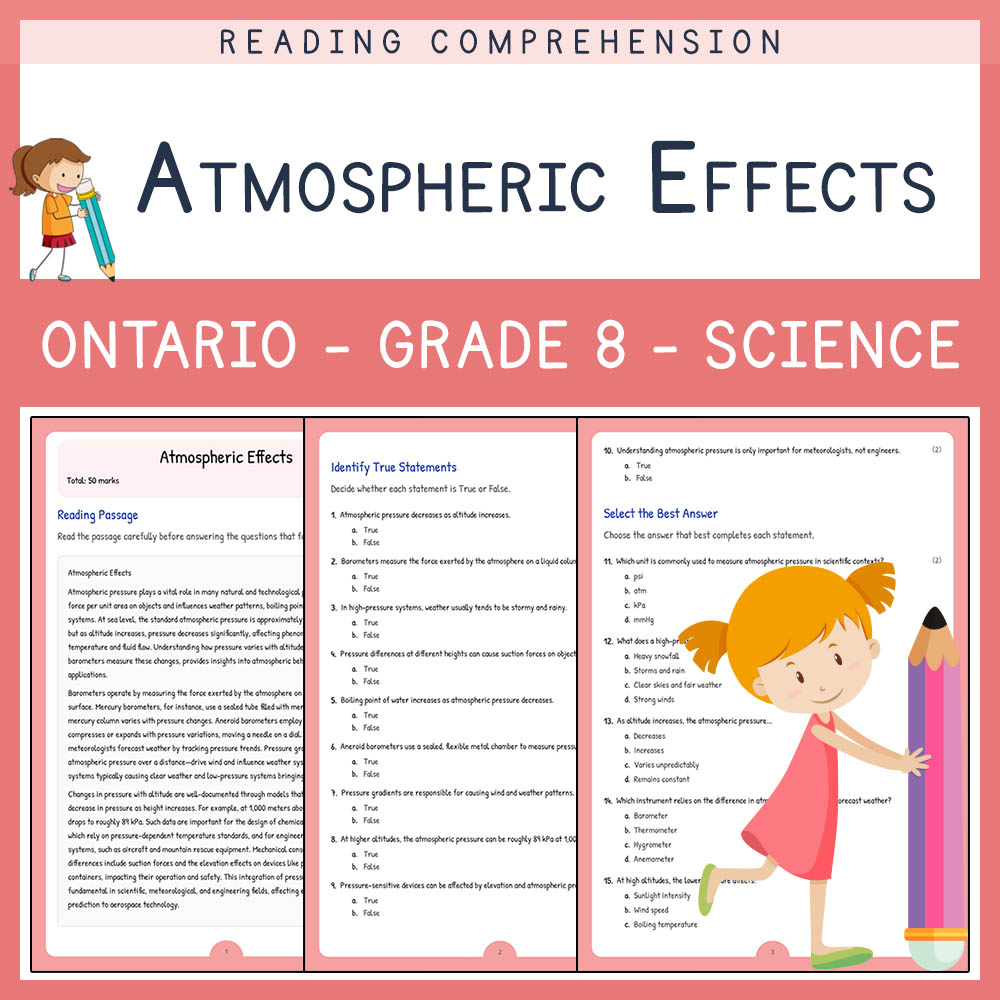
Grade 8 Science Assessment | Atmospheric Effects Worksheet Elena | Ontario
Created byLumora LearningLearning Objectives
- Explain how atmospheric pressure influences boiling points and weather instruments.
- Describe the operation of a barometer and pressure measurement methods.
- Understand pressure gradients and their role in driving wind and weather patterns.
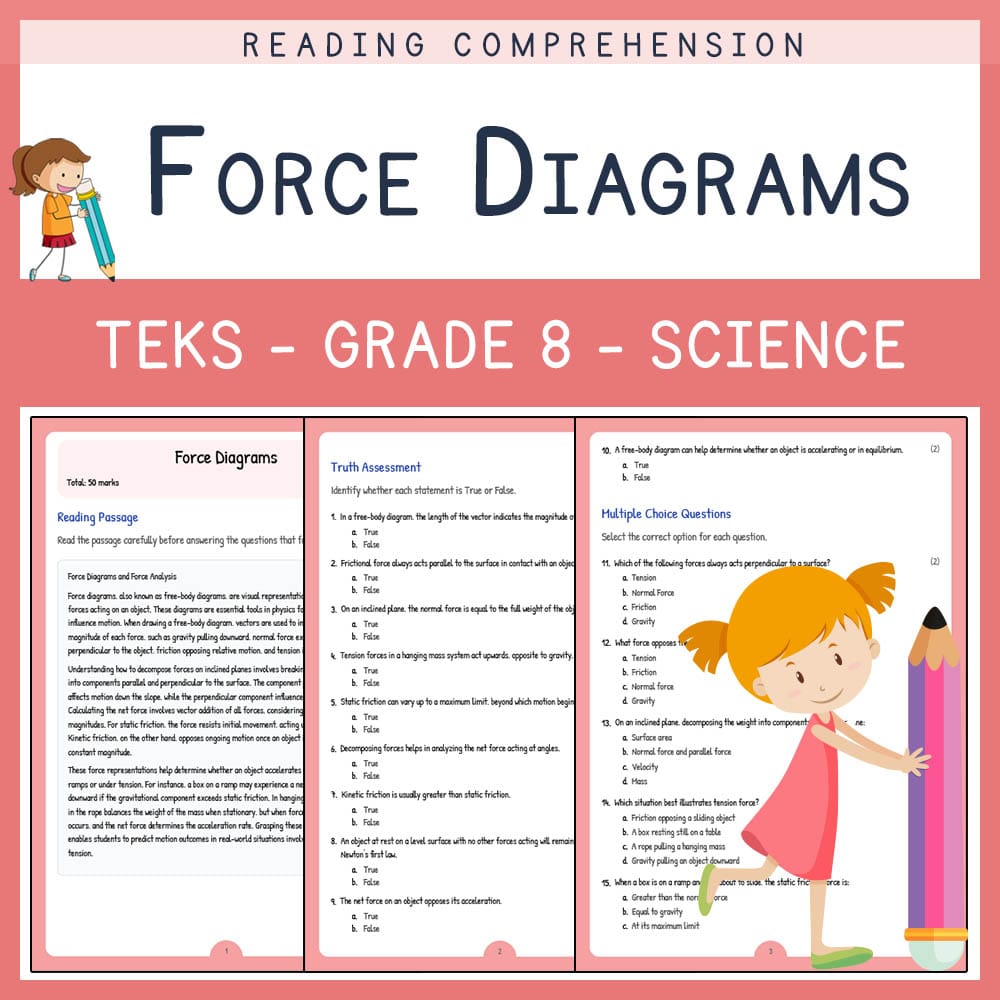
Grade 8 Science | Force Diagrams Worksheet | TEKS-Aligned
Created byLumora LearningLearning Objectives
- Identify and interpret force vectors in free-body diagrams.
- Distinguish between normal, gravitational, frictional, and tension forces in various scenarios.
- Decompose forces on inclined planes into components and calculate net force.

Grade 8 Science Assessment | Surface Forces Worksheet Elena | Ontario
Created byLumora LearningLearning Objectives
- Understand how pressure varies on submerged surfaces and affects force and torque.
- Analyze pressure distribution on planar and curved surfaces in hydrostatic conditions.
- Apply integrative methods to calculate net hydrostatic forces and centers of pressure.
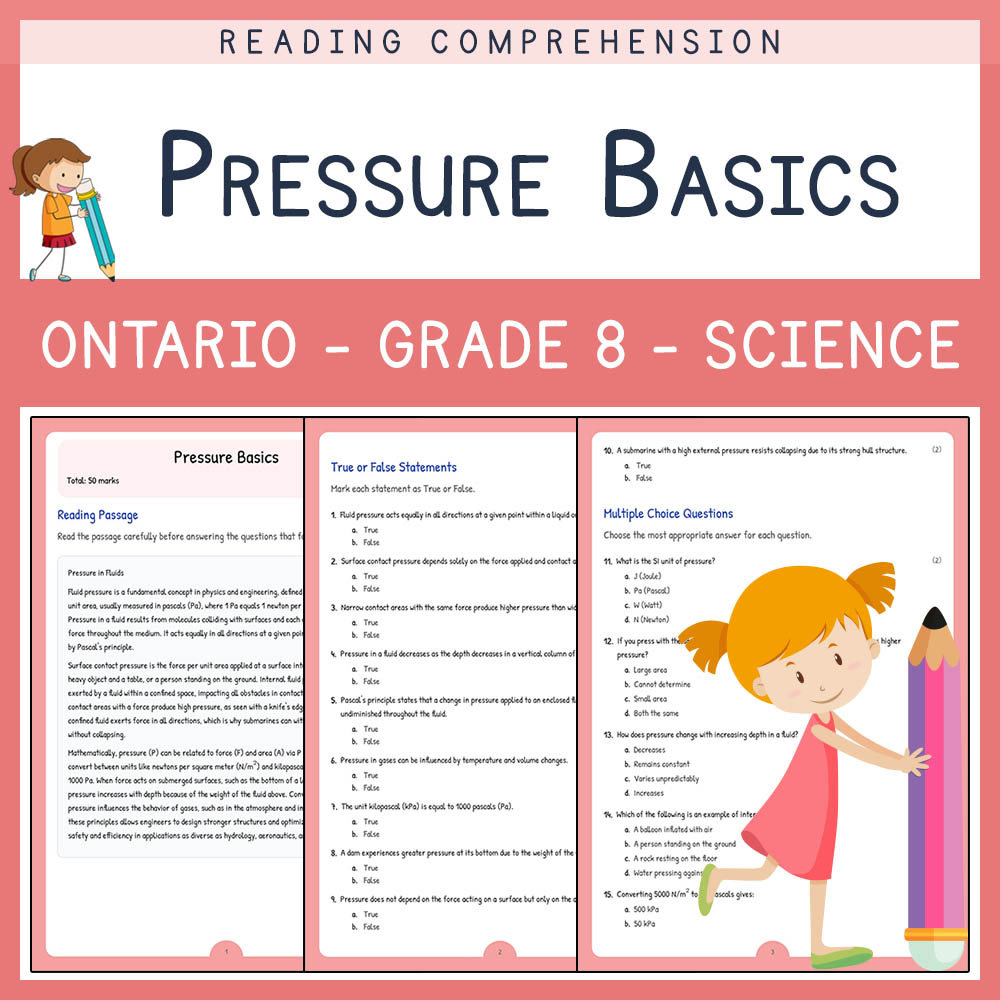
Grade 8 Science Assessment | Pressure Basics Worksheet Elena | Ontario
Created byLumora LearningLearning Objectives
- Define fluid pressure and understand its SI units.
- Distinguish between surface contact pressure and internal fluid pressure.
- Explain how pressure depends on contact area, force, and fluid confinement.
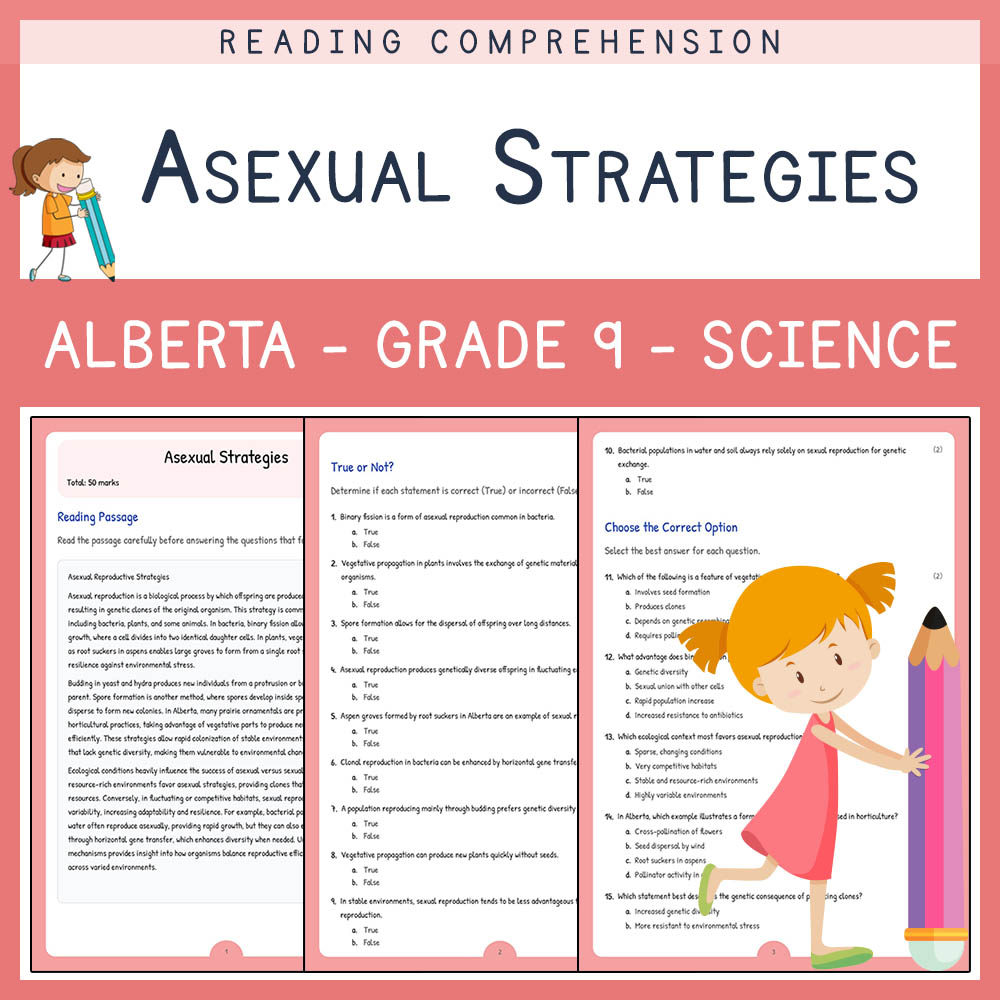
Grade 9 Science | Asexual Strategies Worksheet | Alberta Standards
Created byLumora LearningLearning Objectives
- Describe different mechanisms of asexual reproduction such as binary fission, budding, spore formation, and vegetative propagation.
- Explain the ecological and genetic consequences of producing clones through asexual strategies.
- Identify Alberta-specific examples of asexual reproduction like aspen groves, bacteria in soil, and horticultural practices.
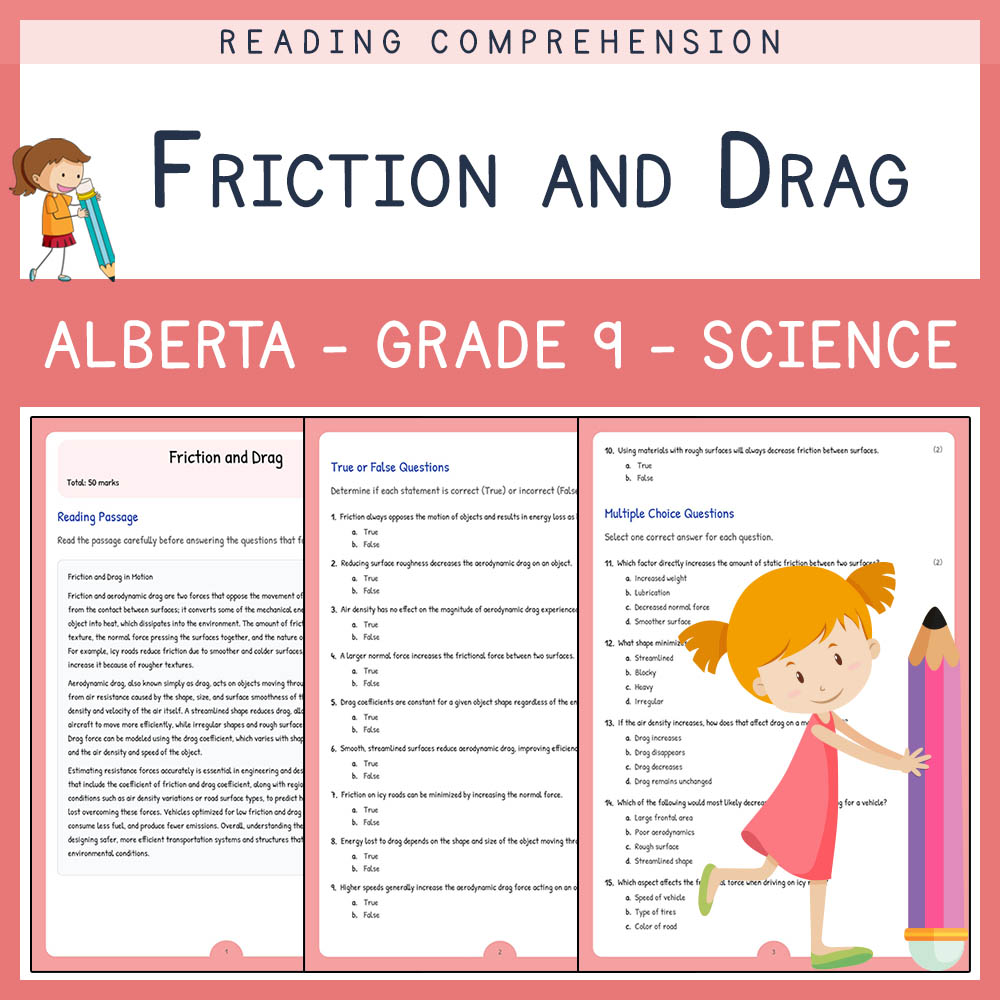
Grade 9 Science | Friction and Drag Worksheet | Alberta Standards
Created byLumora LearningLearning Objectives
- Understand how friction and aerodynamic drag oppose motion and convert mechanical energy into thermal energy.
- Identify factors that influence friction and drag in various scenarios.
- Apply quantitative models using coefficients of friction and drag coefficients to estimate resistance forces.
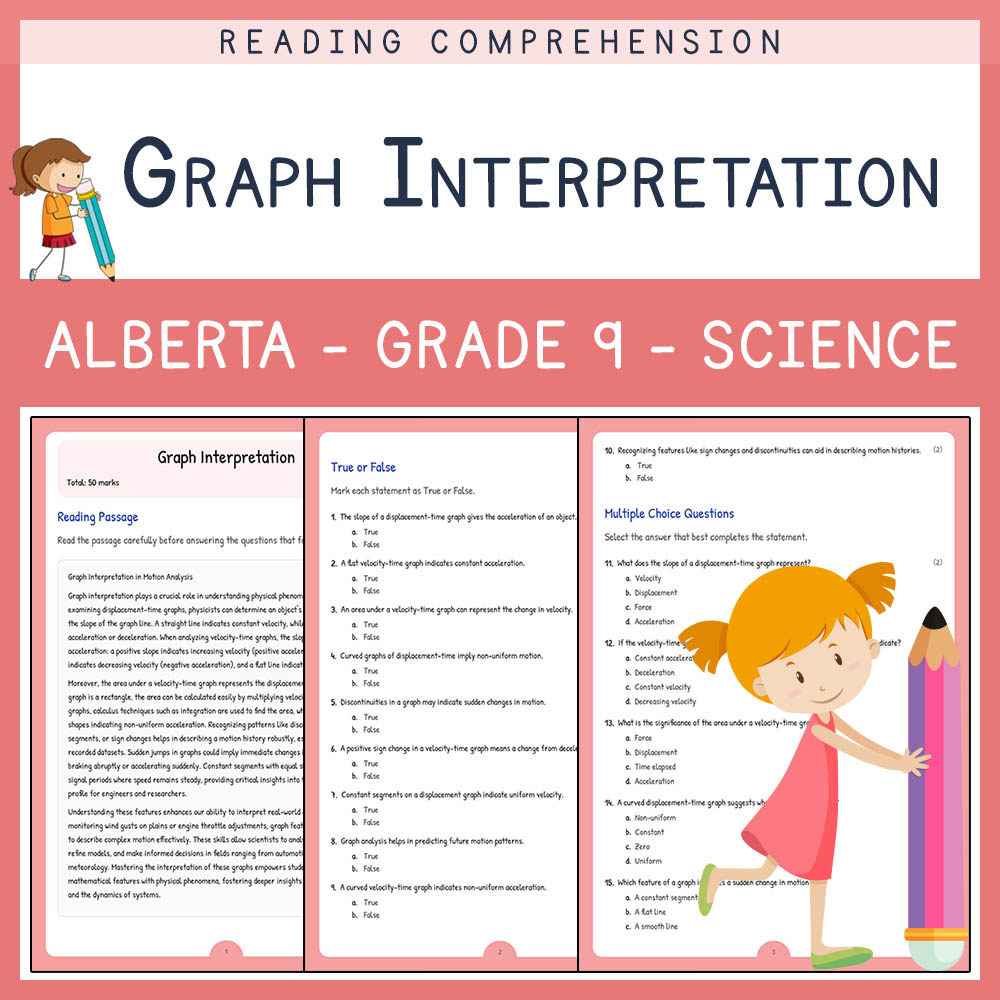
Grade 9 Science | Graph Interpretation Worksheet | Alberta Standards
Created byLumora LearningLearning Objectives
- Understand how the slope of displacement-time graphs relates to velocity.
- Interpret areas under velocity-time graphs to determine displacement.
- Identify non-uniform acceleration from curved graphs and discontinuities.
Browse more categories
About Reading comprehension Worksheets
Find reading comprehension worksheets for class practice, homework, or self-study. All 40,241 are instant PDF downloads.
Each resource here is built by an independent educator and reviewed for quality. Worksheets print straight from PDF and suit classroom use, homework, or extra practice; most come with answer keys, and you can preview before purchasing.