
Reading comprehension Worksheets
40,289 type resources
Grade 12 Science — Worksheet MCQ Paper for Mastering Stoichiometry
 Created byThe Resource Hub
Learning Objectives
- Understand the mole concept and its applications in quantitative chemical analysis.
- Apply balanced equations to determine molar relationships between reactants and products.
- Calculate limiting reactants, theoretical yields, and percent yields from mass and mole data.
Also included in: Grade 12 Science AP Practice Worksheets Bundle for Mastering Core Concepts +2 more
Instant download

Grade 12 Science Worksheet | Stoichiometric Concepts AP Standard (PDF)
 Created byEvergreen Desk Education
Learning Objectives
- Use mole concepts and molar mass to convert between mass, moles, and particle counts.
- Apply balanced chemical equations to determine mole ratios and predict product amounts.
- Determine the limiting reactant, theoretical yield, and percent yield from given data.
Also included in: Grade 12 Chemistry Foundations Science Lesson Bundle for Advanced Placement (AP) +1 more
Instant download
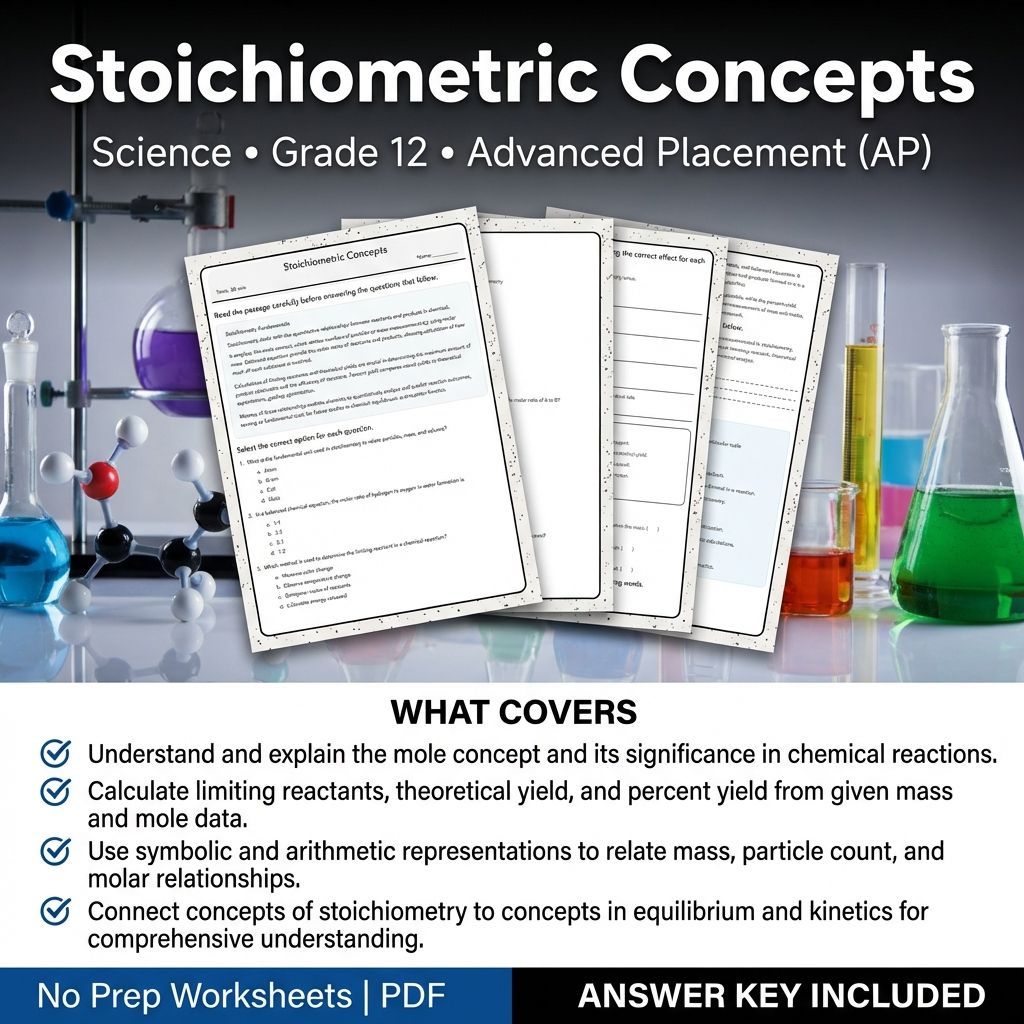
Grade 12 Science | Stoichiometric Concepts Worksheet & Answer Key (Printable PDF)
 Created byCoral Reef Learning
Learning Objectives
- Understand and explain the mole concept and its significance in chemical reactions.
- Calculate limiting reactants, theoretical yield, and percent yield from given mass and mole data.
- Use symbolic and arithmetic representations to relate mass, particle count, and molar relationships.
Also included in: Grade 12 Science Unit Worksheet Bundle – Advanced Chemistry Concepts & Topics +1 more
Instant download

Grade 9 Health Personal Responsibility Worksheet | NHES Life Skills
 Created byPrism Point Learning
Learning Objectives
- Explain how personal choices and daily habits affect physical and mental health.
- Describe how peer influence and social expectations can affect health decisions.
- Use decision-making and ethical reasoning to choose health-promoting behaviors consistently.
Instant download

Grade 9 Health Worksheet | Personal Responsibility & NHES Standards (PDF)
 Created bySunny Desk Resources
Learning Objectives
- Explain how individual choices and daily habits influence physical and mental health.
- Identify how peer pressure and societal expectations can affect health-related decisions.
- Use decision-making and ethical reasoning to choose actions that support long-term well-being.
Also included in: Grade 9 Decision-Making Skills Health Lesson Bundle NHES Framework +1 more
Instant download

9th Grade Health | Personal Responsibility Worksheet (Answer Key Included)
 Created bySkylark Worksheets
Learning Objectives
- Understand the role of individual choices in maintaining health.
- Recognize habits, peer influence, and societal expectations affecting health.
- Develop decision-making skills and ethical reasoning for health-promoting behaviors.
Also included in: Grade 9 Health Unit | Ethical Decisions & Media Influence Worksheets Bundle +1 more
Instant download

Signal Encoding Practice Worksheet | Grade 9 Science NGSS Review
Created byPrism Point LearningLearning Objectives
- Explain how modulation and multiplexing map source information onto carrier signals in different communication channels.
- Compare pulse-code modulation (PCM) and analog amplitude modulation by bandwidth, fidelity, and noise susceptibility.
- Identify how different multiplexing schemes (TDM, FDM, WDM) affect channel capacity and signal integrity.
Also included in: Grade 9 Electromagnetic Waves Science Lesson Bundle NGSS Practice
Instant download
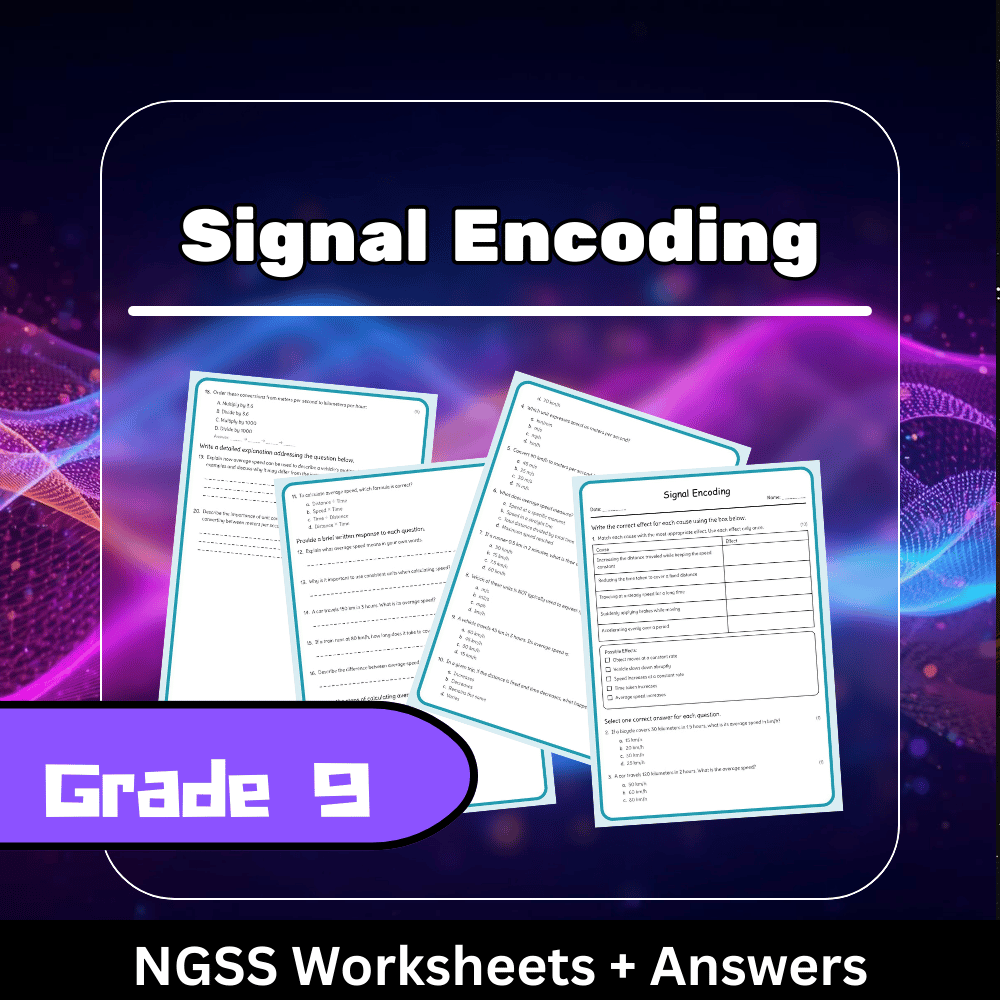
Grade 9 Science | Signal Encoding Worksheet + Answer Key | NGSS Aligned
 Created byBright Mind Resources
Learning Objectives
- Understand the principles of modulation and multiplexing in signal encoding.
- Identify different schemes such as pulse-code modulation and amplitude modulation.
- Compare encoding techniques based on bandwidth, fidelity, and noise susceptibility.
Instant download
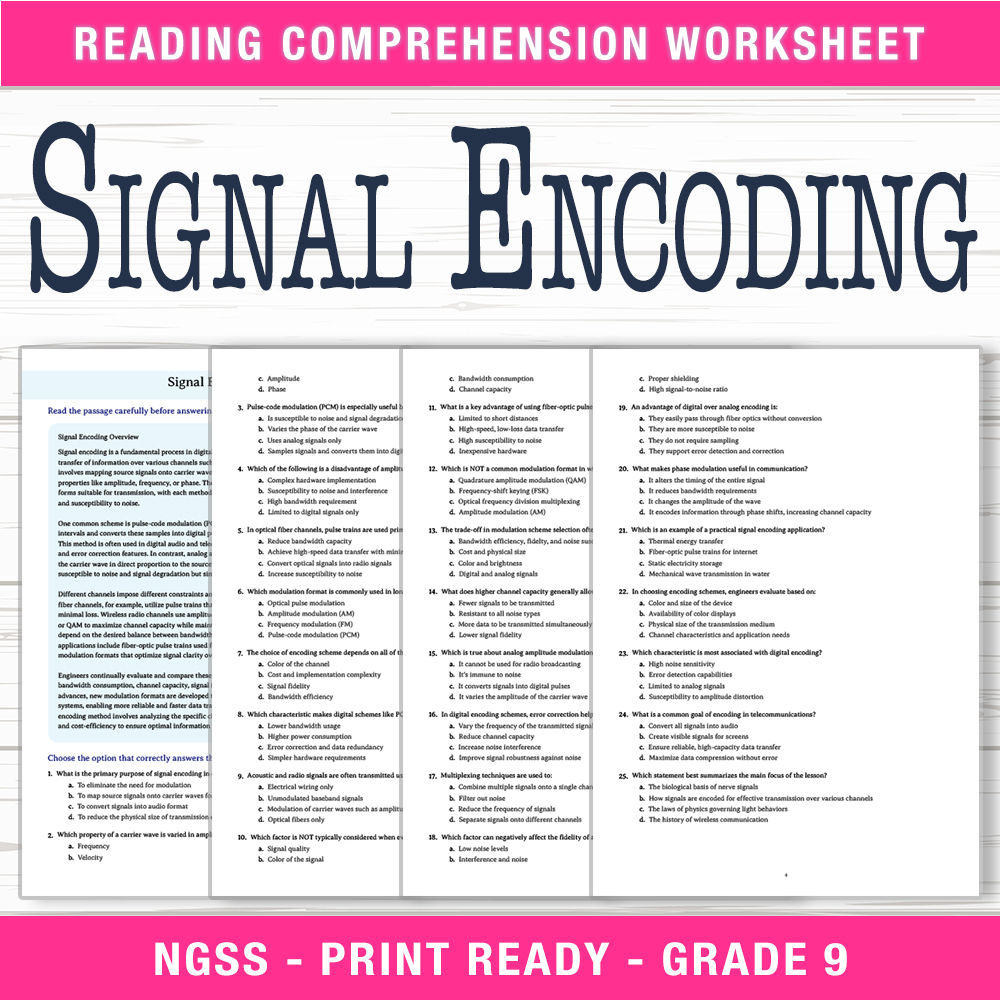
Grade 9 Science | Signal Encoding Worksheet (PDF + Answer Key)
 Created byRiverstone Classroom
Learning Objectives
- Understand the principles of signal encoding through modulation and multiplexing.
- Compare different encoding schemes such as pulse-code modulation and amplitude modulation.
- Evaluate the impact of encoding choices on bandwidth, fidelity, and noise susceptibility.
Instant download
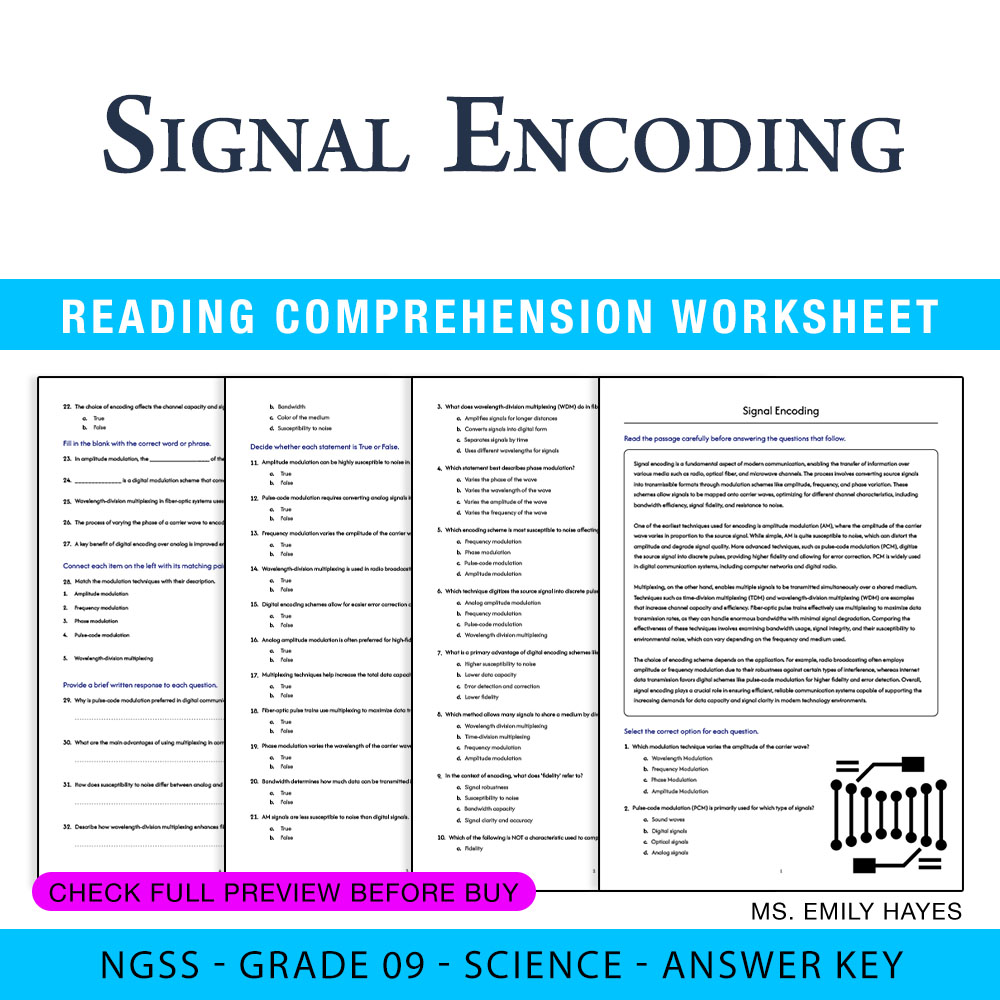
Grade 9 Science | Signal Encoding Worksheet (PDF+ Answer Key)
 Created byCopper Leaf Classroom
Learning Objectives
- Explain how signals are encoded using modulation and multiplexing techniques.
- Compare different encoding schemes such as amplitude modulation, frequency modulation, and pulse-code modulation.
- Identify practical applications of signal encoding in communication channels.
Instant download

Signal Encoding Worksheet | NGSS Grade 9 Science Practice Assessment
Created bySkylark WorksheetsLearning Objectives
- Compare how analog and digital signal encoding map information onto carrier waves using amplitude, frequency, and phase variation.
- Explain how modulation and multiplexing affect bandwidth, fidelity, and noise susceptibility in radio, microwave, and optical-fiber channels.
- Evaluate common encoding schemes (e.g., amplitude modulation and pulse-code modulation) using signal integrity and channel capacity criteria.
Also included in: Grade 9 Science Full-Year Bundle | NGSS Worksheets & Assessments
Instant download
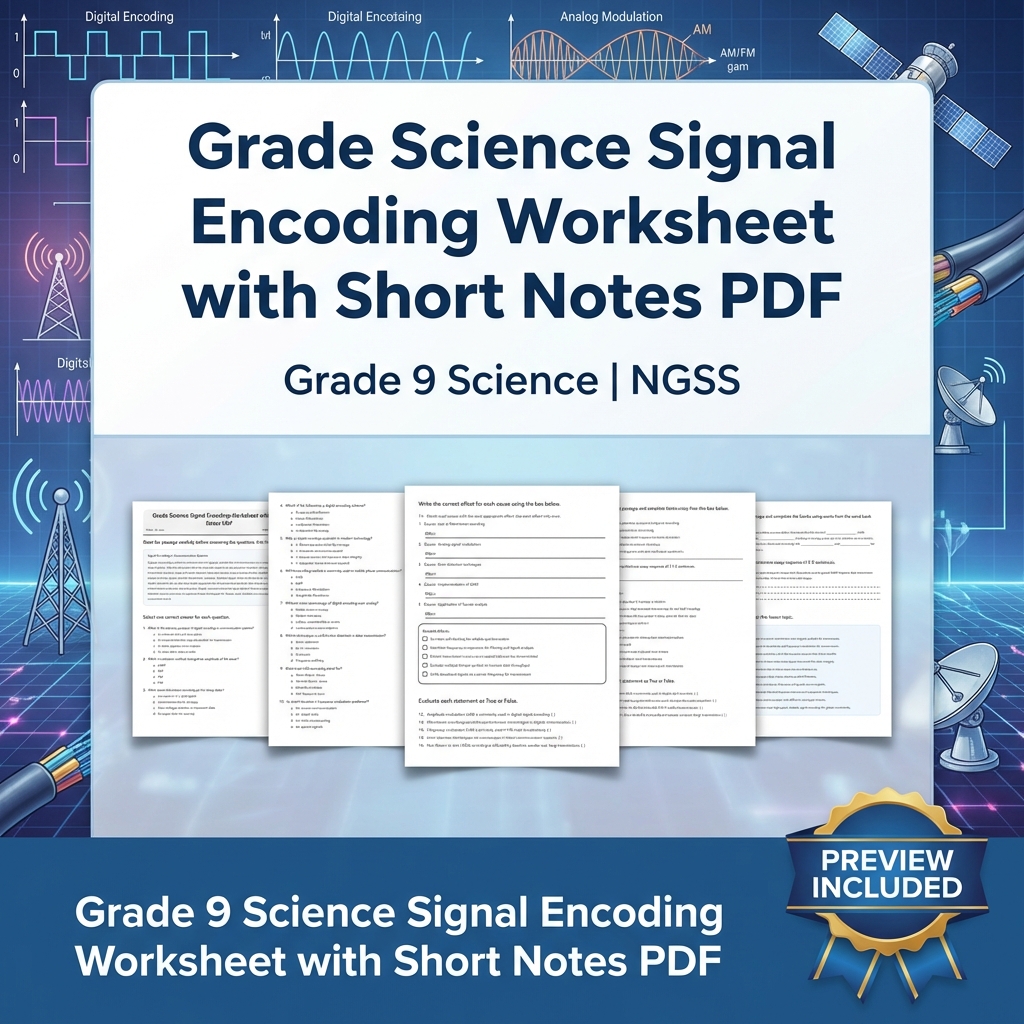
Grade 9 Science Signal Encoding Worksheet with Short Notes PDF
 Created byMeadowlark Worksheets
Learning Objectives
- Understand the fundamentals of signal encoding in communication systems.
- Identify different types of signal encoding methods used in digital and analog communication.
- Explain the importance of encoding techniques in reducing errors and increasing efficiency.
Also included in: Grade 9 Science | Waves and Their Applications Unit Bundle (NGSS Aligned) +1 more
Instant download

Grade 9 Science | Signal Encoding in Modern Communications - Comprehension
Created byCoral Reef LearningLearning Objectives
- Understand different types of signal modulation such as amplitude, frequency, and phase modulation.
- Compare schemes like pulse-code modulation and analog amplitude modulation.
- Analyze the impact of modulation schemes on bandwidth, fidelity, and noise susceptibility.
Instant download
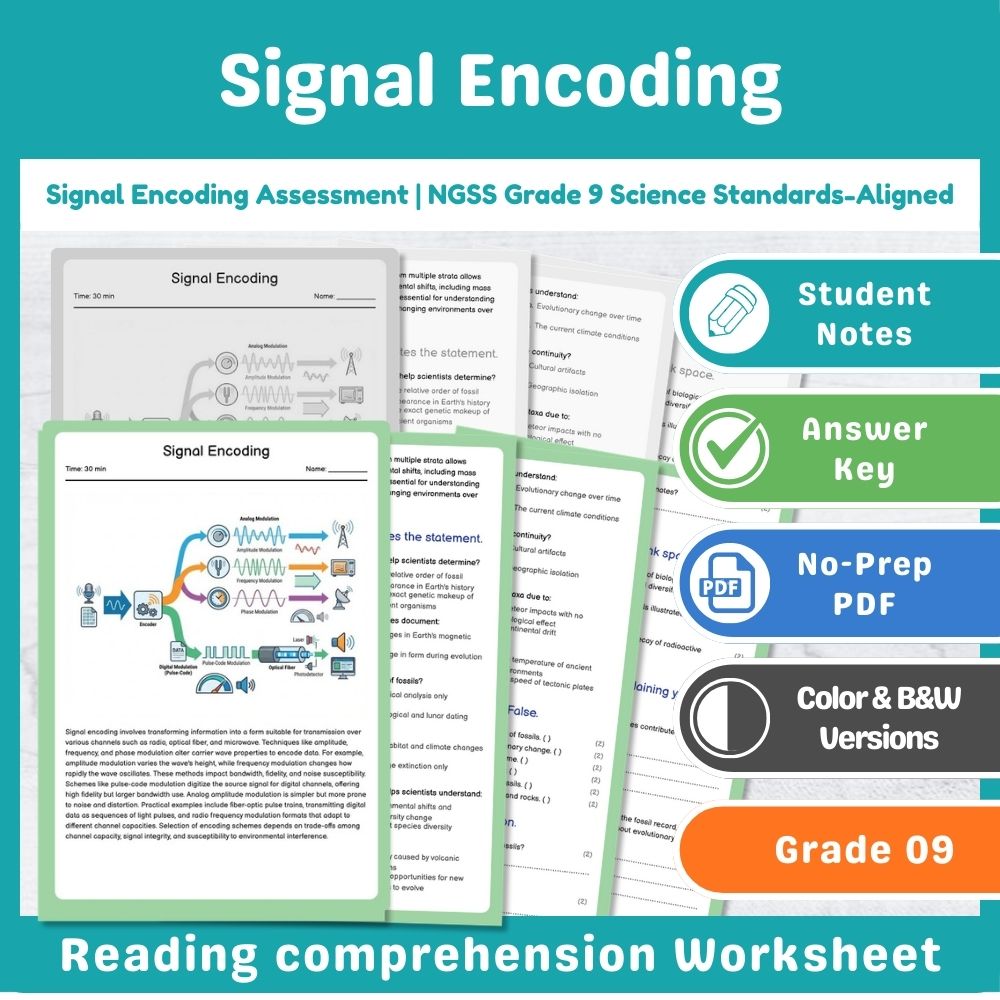
Signal Encoding Assessment | NGSS Grade 9 Science Standards-Aligned
Created byPrism Point LearningLearning Objectives
- Describe different methods of encoding information onto carrier waves, including amplitude, frequency, and phase modulation.
- Compare modulation and multiplexing schemes such as pulse-code modulation and amplitude modulation in terms of bandwidth and fidelity.
- Analyze practical examples of encoding techniques used in fiber-optic, radio, and microwave communications.
Instant download
Grade 9 Science | Signal Encoding Worksheet & Answer Key for NGSS Alignment
 Created byLumora Learning
Learning Objectives
- Explain how modulation techniques encode information onto carrier waves.
- Compare pulse-code modulation and amplitude modulation in terms of bandwidth, fidelity, and noise susceptibility.
- Identify practical applications of different encoding schemes in communication channels.
Instant download
Grade 9 Science | Signal Encoding Worksheet (NGSS) Practice Set (PDF)
 Created byMaple Path Learning
Learning Objectives
- Understand how source signals are mapped onto carrier waves using amplitude, frequency, and phase modulation.
- Compare different encoding schemes such as pulse-code modulation and amplitude modulation in terms of bandwidth, fidelity, and noise susceptibility.
- Analyze practical examples like fiber-optic pulse trains and radio modulation formats to evaluate encoding choices.
Also included in: Grade 9 Science | Waves and Their Applications Unit Bundle (NGSS-Aligned) +1 more
Instant download
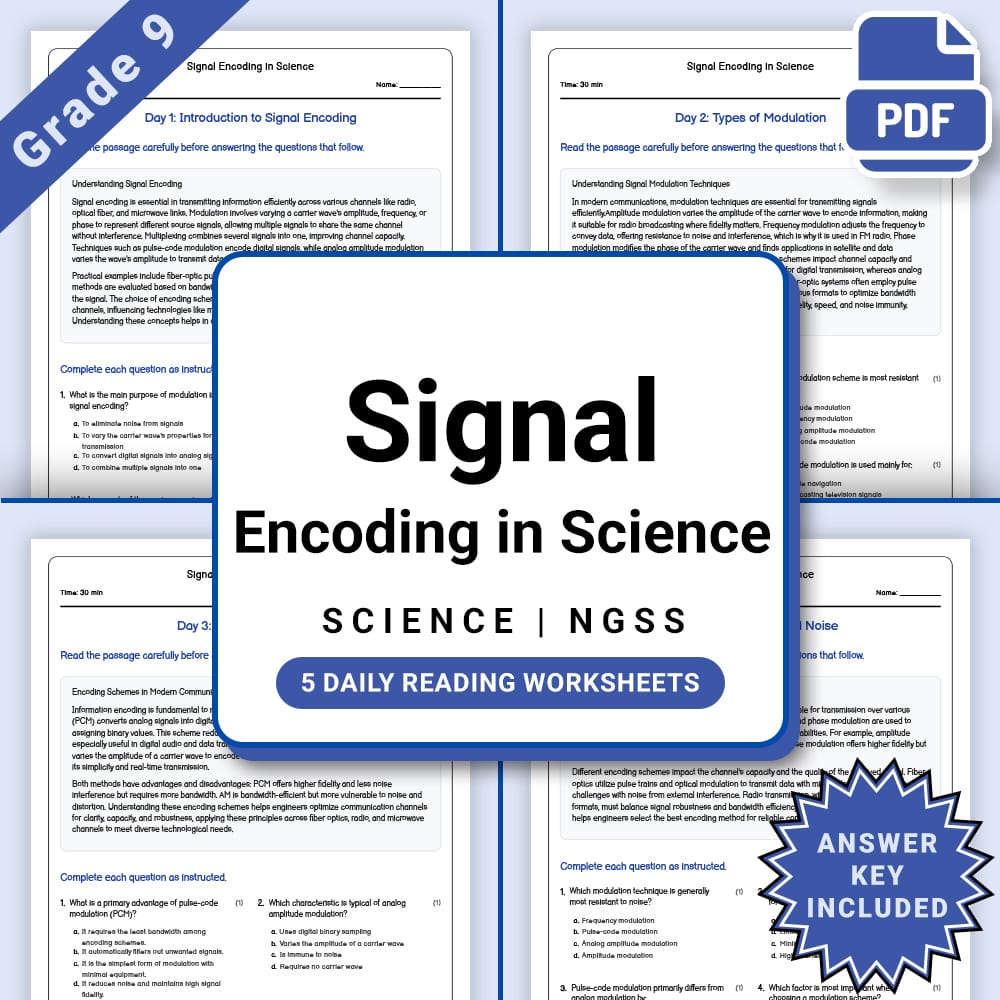
Grade 9 Science – Signal Encoding Daily Reading Worksheet(PDF + Answer Key)
Created byCopper Leaf ClassroomLearning Objectives
- Understand the basic concepts of modulation and multiplexing.
- Recognize different schemes used for signal encoding.
- Compare encoding techniques based on bandwidth, fidelity, and noise susceptibility.
Instant download

Signal Encoding Worksheet | Grade 9 Science printable PDF | Assessment
Learning Objectives
- Explain how source signals are mapped onto carrier waves using amplitude, frequency, and phase modulation.
- Compare various encoding schemes such as pulse-code modulation and amplitude modulation in terms of bandwidth, fidelity, and noise susceptibility.
- Identify practical examples of signal encoding in fiber-optic, radio, and microwave channels.
Also included in: Grade 9 Waves and Their Applications in Technologies for Information Transfer Lesson Bundle +1 more
Instant download
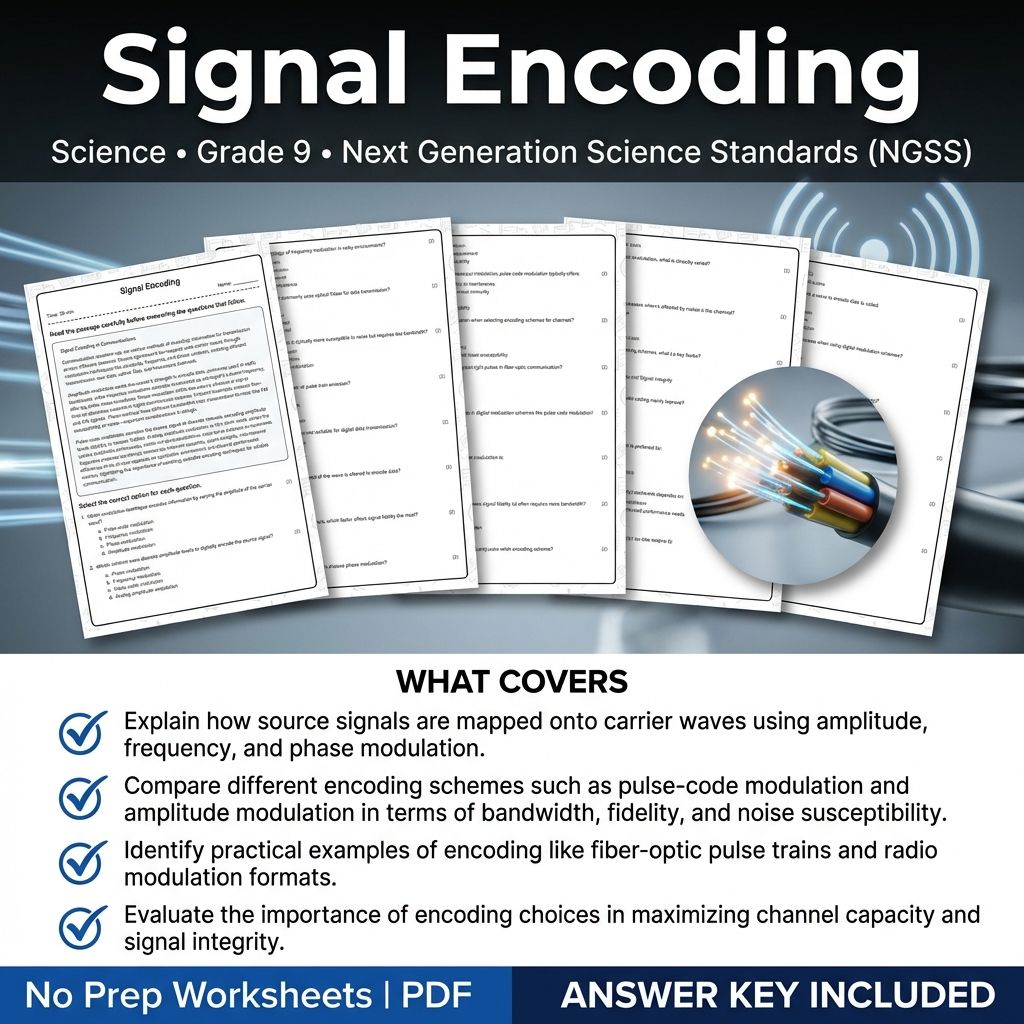
Grade 9 Science | Signal Encoding Worksheet & Answer Key (Printable PDF)
Created byCoral Reef LearningLearning Objectives
- Explain how source signals are mapped onto carrier waves using amplitude, frequency, and phase modulation.
- Compare different encoding schemes such as pulse-code modulation and amplitude modulation in terms of bandwidth, fidelity, and noise susceptibility.
- Identify practical examples of encoding like fiber-optic pulse trains and radio modulation formats.
Also included in: Grade 9 Science | Wave Properties & Electromagnetic Radiation Worksheet Bundle +1 more
Instant download

Grade 9 Science – Signal Encoding & Data Transmission | Daily Reading Worksheet
Created byBright Mind ResourcesLearning Objectives
- Understand the concept of signal encoding using modulation and multiplexing
- Identify different methods of encoding signals such as amplitude, frequency, and phase modulation
- Compare different encoding schemes like pulse-code modulation and analog amplitude modulation
Also included in: Grade 9 Wave and Signal Science Daily Reading Lesson Bundle | NGSS +2 more
Instant download
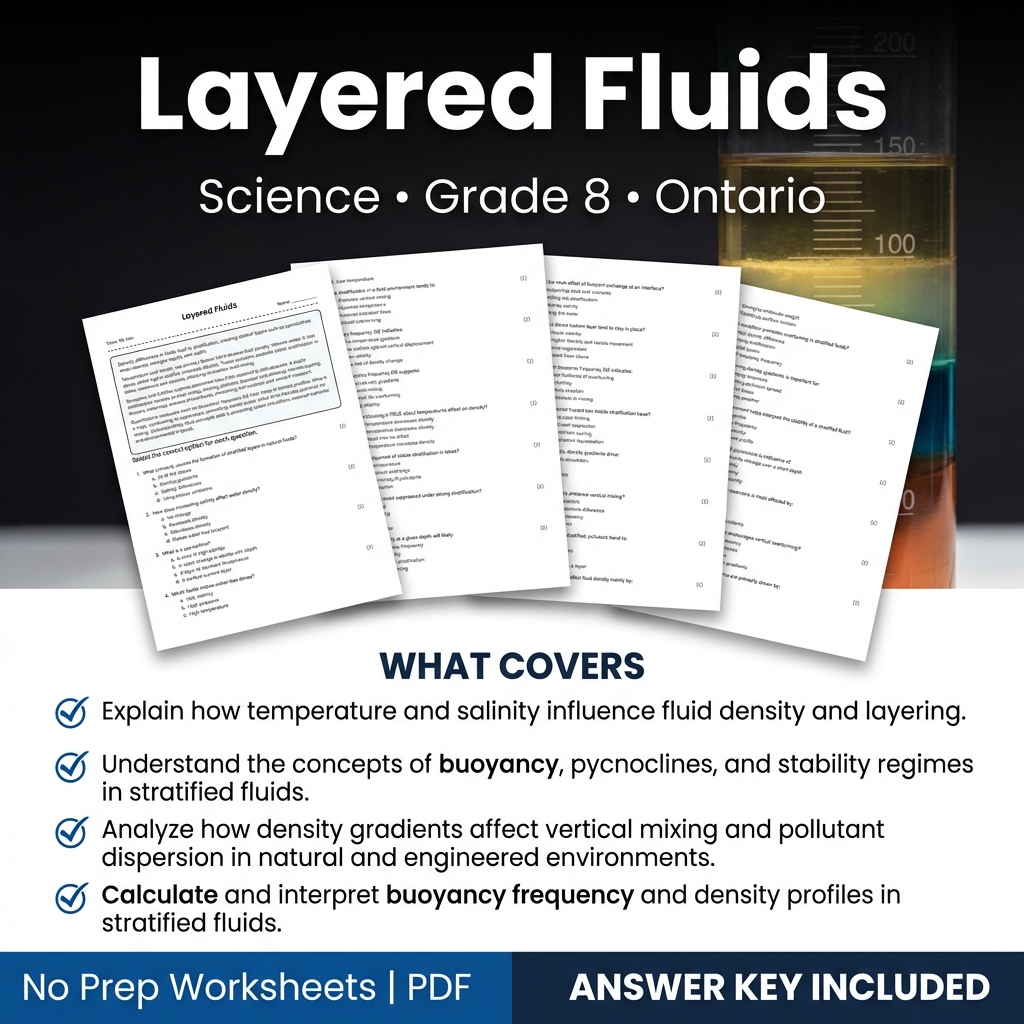
Layered Fluids Worksheet Grade 8 Science | Ontario Standards
Created byCoral Reef LearningLearning Objectives
- Explain how temperature and salinity influence fluid density and layering.
- Understand the concepts of buoyancy, pycnoclines, and stability regimes in stratified fluids.
- Analyze how density gradients affect vertical mixing and pollutant dispersion in natural and engineered environments.
Instant download
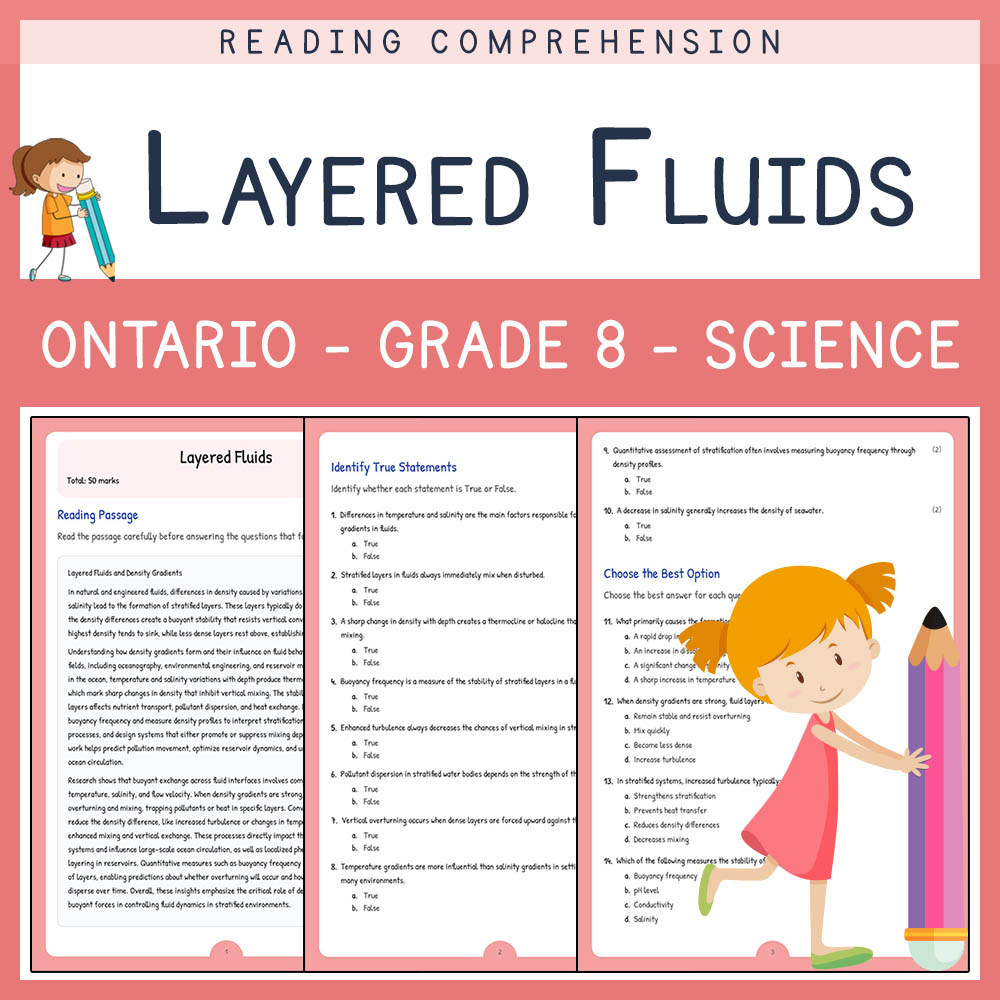
Grade 8 Science Assessment | Layered Fluids Worksheet | Ontario Standard
Created byLumora LearningLearning Objectives
- Explain how density differences in fluids create stratified layers in natural and engineered systems.
- Describe how temperature and salinity influence fluid density gradients and buoyancy.
- Understand how density gradients affect vertical mixing, pollutant dispersion, and ocean circulation.
Also included in: Grade 8 Science | Fluids Lesson Bundle | Ontario Framework
Instant download
Grade 8 Science | Understanding Layered Fluids Worksheet (PDF )
Created byPrism Point LearningLearning Objectives
- Understand how temperature and salinity create density gradients in fluids.
- Explain the concepts of pycnoclines and stratification in natural and engineered systems.
- Analyze the effects of density differences on vertical mixing and pollutant dispersion.
Also included in: Grade 8 Science | Fluid Mechanics & Pressure Unit Worksheet Bundle +1 more
Instant download
Grade 8 Science — Layered Fluids Worksheet for Mastering Fluid Stratification
Created byThe Resource HubLearning Objectives
- Understand how temperature and salinity influence fluid density and create stratification in natural and engineered environments.
- Analyze the stability regimes resulting from density differences and their effects on vertical mixing and pollutant dispersion.
- Interpret density profiles and buoyancy frequency to evaluate conditions promoting or suppressing overturning in stratified fluids.
Also included in: Grade 8 Science – Fluids & Buoyancy Mastery Unit Bundle (Worksheet Pack) +1 more
Instant download
Grade 8 Science | Layered Fluids Reading Worksheet (PDF + Answer Key)
JCreated byJ.S SheetsLearning Objectives
- Understand how temperature and salinity influence fluid density and stratification
- Explain the concept of buoyant exchange across fluid interfaces
- Analyze the consequences of density gradients for pollutant dispersion and ocean circulation
Also included in: Grade 8 Science Unit Bundle – Density, Pressure & Fluid Mechanics Worksheets +1 more
Instant download
Grade 8 Science | Layered Fluids Worksheets (Ontario) (PDF)
Created byBright Mind ResourcesLearning Objectives
- Understand how density differences create stratified layers in fluids.
- Explain the effects of temperature and salinity on fluid density and stability.
- Interpret buoyancy frequency and density profiles in natural bodies of water.
Instant download

Grade 8 Science | Layered Fluids Worksheet with Short Notes (Printable PDF)
Created byMeadowlark WorksheetsLearning Objectives
- Understand how temperature and salinity influence fluid density and stratification.
- Interpret density profiles and identify pycnoclines in natural and engineered systems.
- Explain buoyant exchange across fluid interfaces and its effects on mixing and pollutant dispersion.
Also included in: Grade 8 Science Lesson Group Bundle | Hydrostatics & Fluid Mechanics +1 more
Instant download

Grade 8 Science – Layered Fluids Worksheet (Ontario) (PDF)
Created byEvergreen Desk EducationLearning Objectives
- Explain how temperature and salinity differences change fluid density and create layered (stratified) systems.
- Describe how buoyancy and density gradients limit vertical mixing and can form a pycnocline.
- Predict how conditions that promote or suppress overturning affect pollutant or heat dispersion.
Also included in: Grade 8 Fluid Pressure & Forces Science Lesson Bundle: Ontario Worksheet Set +1 more
Instant download

Grade 8 Science – Layered Fluids Density & Stability | Daily Reading Worksheet
Created byBright Mind ResourcesLearning Objectives
- Understand how temperature and salinity affect fluid density
- Identify different fluid layers based on their density differences
- Explain the concepts of buoyancy, pycnoclines, and stability regimes in fluids
Also included in: Grade 8 Fluid Mechanics & Pressure Science Lesson Bundle | Ontario +1 more
Instant download

Grade 8 Science | Layered Fluids - Daily Reading Comprehension
Created byCoral Reef LearningLearning Objectives
- Understand how temperature and salinity influence fluid density
- Identify different fluid layers based on density differences
- Explain buoyant exchange and stability in stratified fluids
Instant download

Layered Fluids Worksheet Practice | Grade 8 Science Assessment
Created byPrism Point LearningLearning Objectives
- Explain how temperature and salinity affect fluid density and create stratified layers.
- Describe buoyant exchange across interfaces and why mixing can be suppressed in pycnoclines.
- Interpret how density profiles relate to stability and pollutant or thermal dispersion.
Instant download

Grade 8 Science | Layered Fluids Worksheet (PDF+ Answer Key)
Created byCopper Leaf ClassroomLearning Objectives
- Explain how temperature and salinity influence fluid density gradients and stratification.
- Analyze the impact of density differences on buoyant exchange and stability regimes in layered fluids.
- Interpret buoyancy frequency and density profiles to assess mixing and overturning conditions.
Instant download
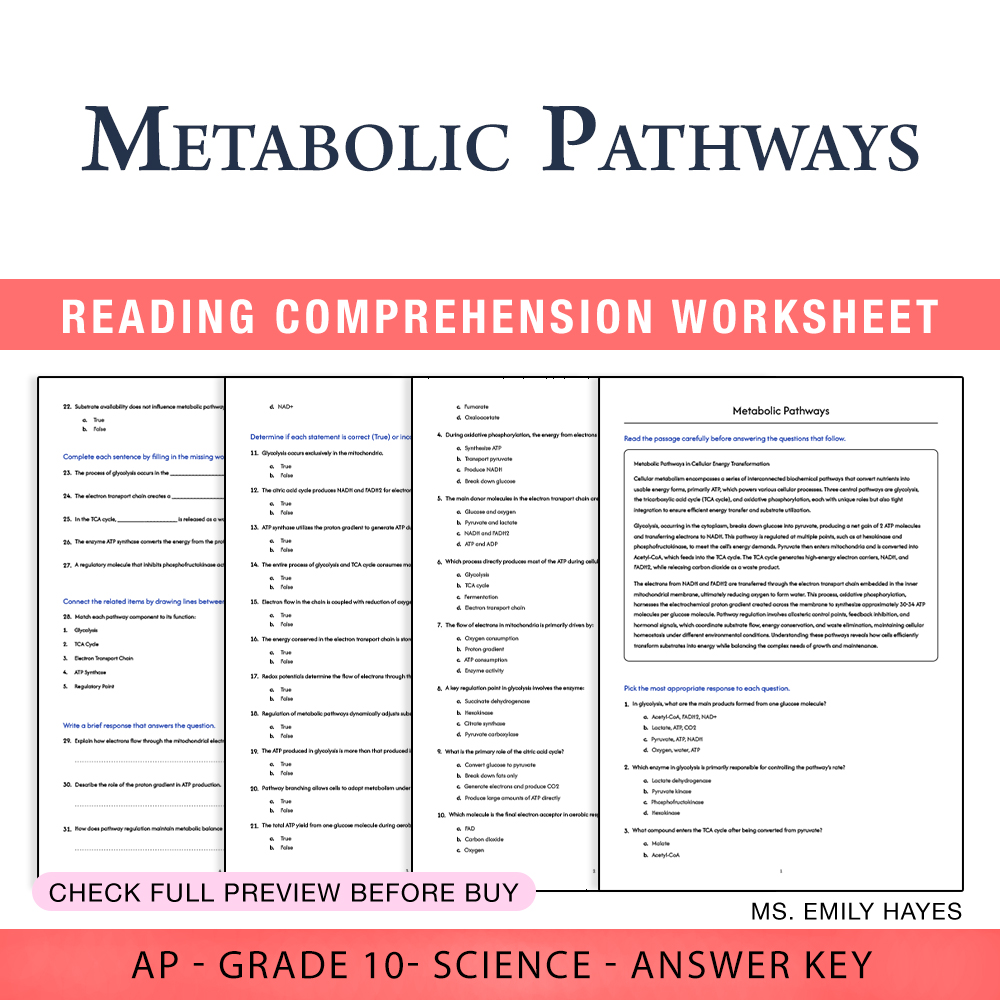
10th Grade Science | Metabolic Pathways Worksheet (PDF+ Answer Key)
Created byCopper Leaf ClassroomLearning Objectives
- Map and explain the core metabolic pathways including glycolysis, the TCA cycle, and oxidative phosphorylation.
- Identify key energy yields, electron flows, and fates of intermediates in these pathways.
- Understand the regulation and branching points that maintain cellular homeostasis under varying conditions.
Also included in: Grade 10 Science | Key Concepts in Biology & Ecosystems (PDF+ Answer Key) +1 more
Instant download
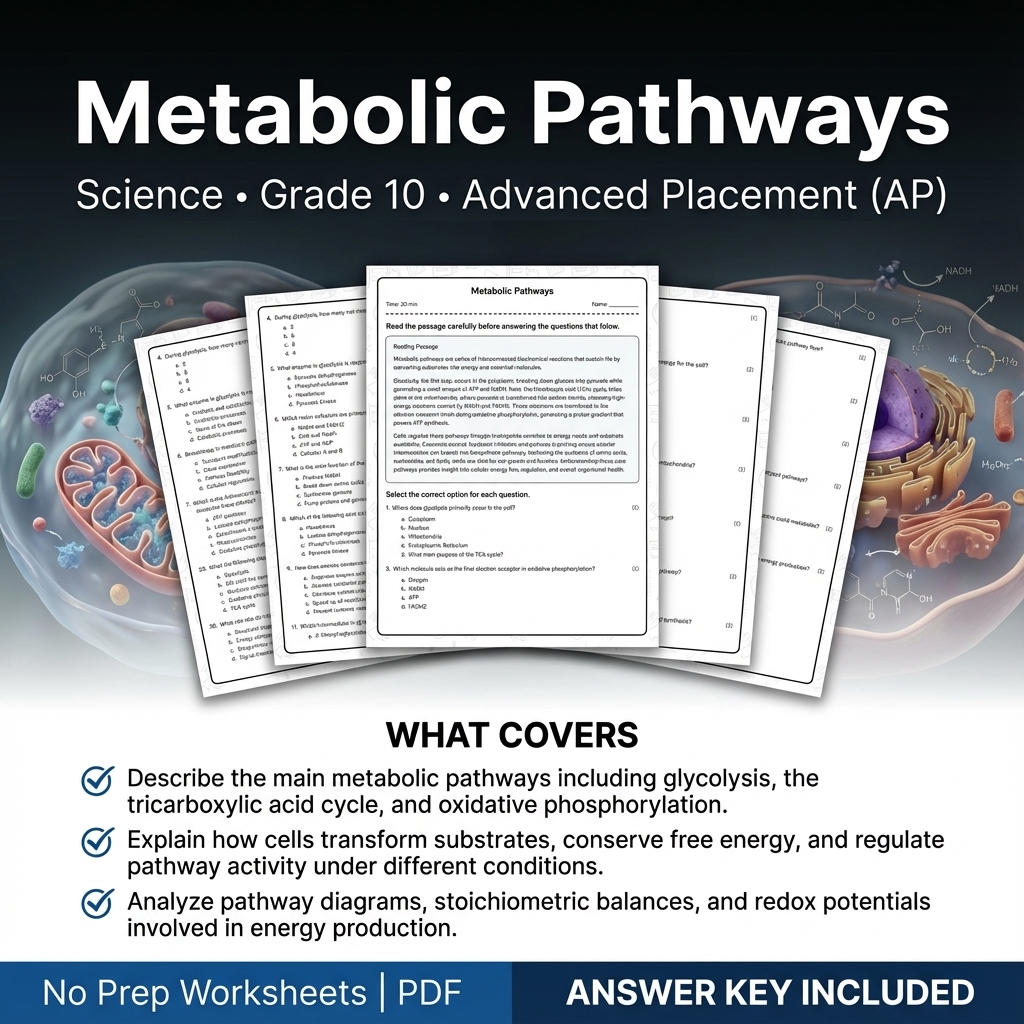
Grade 10 Science | Metabolic Pathways Worksheet (Printable PDF + Answer Key)
Created byCoral Reef LearningLearning Objectives
- Describe the main metabolic pathways including glycolysis, the tricarboxylic acid cycle, and oxidative phosphorylation.
- Explain how cells transform substrates, conserve free energy, and regulate pathway activity under different conditions.
- Analyze pathway diagrams, stoichiometric balances, and redox potentials involved in energy production.
Also included in: Grade 10 Science UNIT Worksheet Bundle – Genetics, Ecosystems & Cell Biology +1 more
Instant download
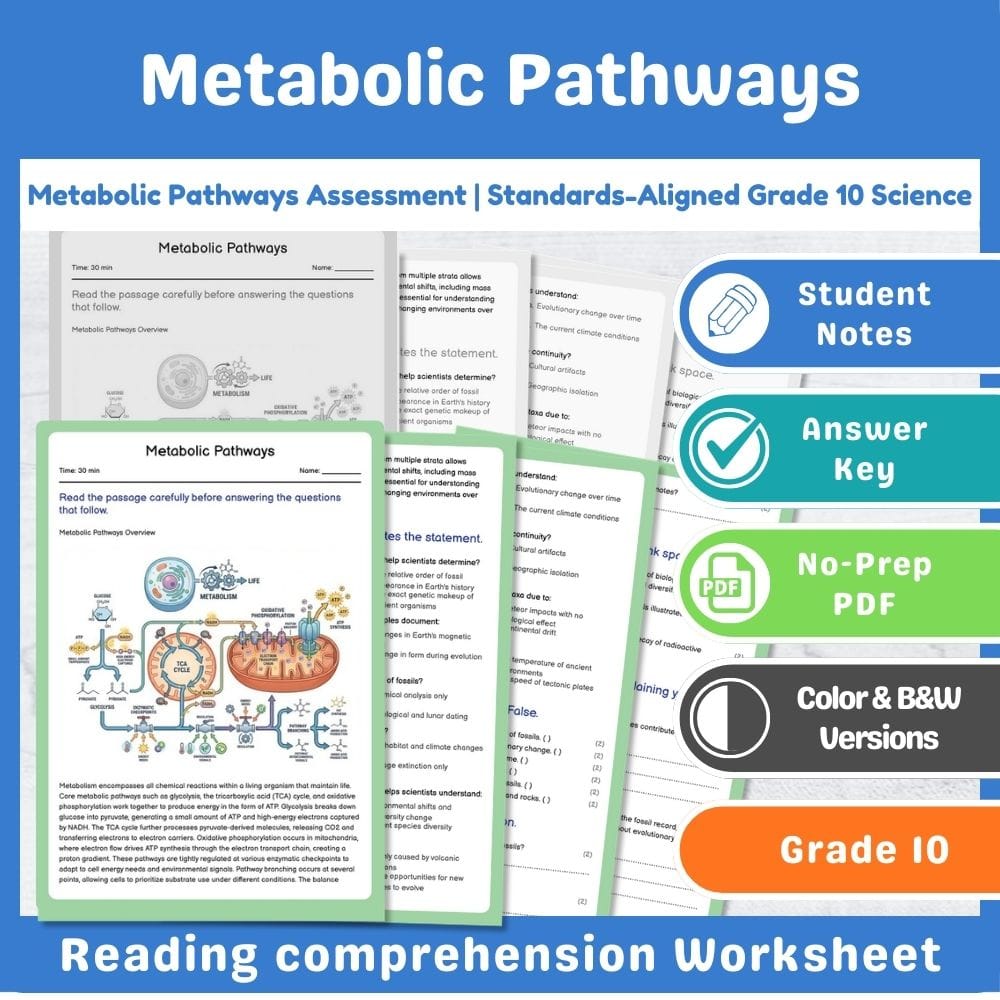
Metabolic Pathways Assessment | Standards-Aligned Grade 10 Science
Created byPrism Point LearningLearning Objectives
- Describe the main metabolic pathways including glycolysis, the tricarboxylic acid cycle, and oxidative phosphorylation.
- Explain how cells generate ATP and conserve energy through electron flow and intermediate transformations.
- Identify regulatory checkpoints and pathway branching points that control cellular metabolism.
Also included in: Lesson Grade 10 Science Assessment Bundle | AP Standards-Aligned
Instant download

Grade 10 Science | Metabolic Pathways Worksheet | AP Aligned
Created byLumora LearningLearning Objectives
- Describe the core metabolic pathways including glycolysis, the tricarboxylic acid cycle, and oxidative phosphorylation.
- Explain how cells transform substrates and conserve free energy in ATP and electrochemical gradients.
- Identify regulatory checkpoints and pathway branching that maintain cellular organization under varying conditions.
Also included in: Grade 10 Science | Biology and Ecosystems Custom Bundle | AP
Instant download

Grade 10 Science Worksheet – Metabolic Pathways (AP) (PDF)
Created byEvergreen Desk EducationLearning Objectives
- Explain how glycolysis, the citric acid (TCA) cycle, and oxidative phosphorylation work together to conserve free energy in ATP.
- Trace electron flow from NADH and FADH2 through the electron transport chain and describe how it generates an electrochemical proton gradient.
- Identify regulatory checkpoints and pathway branching that adjust flux under changing oxygen, energy, and substrate conditions.
Also included in: Grade 10 Genetics & Cell Systems Science Lesson Bundle – Advanced Placement (AP) +1 more
Instant download

Grade 10 AP Science Metabolic Pathways Worksheet | Practice Pack
Created byPrism Point LearningLearning Objectives
- Explain how glycolysis, the TCA cycle, and oxidative phosphorylation connect to transform substrates into ATP and electron carriers.
- Describe electron flow through the electron transport chain and how proton gradients enable ATP synthesis.
- Use redox concepts and regulatory checkpoints to predict how cells respond to changing oxygen and energy availability.
Also included in: Grade 10 AP Science Life Systems Lesson Bundle | Worksheet Pack
Instant download

Grade 10 Science | Metabolic Pathways - Daily Reading Comprehension
Created byCoral Reef LearningLearning Objectives
- Understand the key steps of glycolysis
- Identify the main enzymes involved in glycolysis
- Recognize the energy yield from glycolysis
Also included in: Biology and Ecosystems Lesson Bundle – Grade 10 Science Advanced Placement +1 more
Instant download
Grade 10 Science | Metabolic Pathways Reading Worksheet & Answer Key (PDF)
JCreated byJ.S SheetsLearning Objectives
- Understand the key steps and components of glycolysis, the tricarboxylic acid cycle, and oxidative phosphorylation.
- Identify where energy is conserved and released in metabolic pathways.
- Explain how electrons flow through redox reactions during cellular respiration.
Also included in: Grade 10 Science Unit | Cell Biology, Genetics, & Ecosystems Worksheet Pack +1 more
Instant download

Grade 10 Science — Worksheet MCQ Paper for Mastering Metabolic Pathways
Created byThe Resource HubLearning Objectives
- Understand the key stages of glycolysis, the tricarboxylic acid cycle, and oxidative phosphorylation.
- Identify the flow of electrons and energy transfer during cellular respiration.
- Recognize the regulation points and pathway branching that adapt to cellular needs.
Also included in: Grade 10 Biology and Ecosystems Lesson Bundle | AP Science +1 more
Instant download

Grade 10 Science – Glycolysis & Metabolic Pathways | Daily Reading Worksheet
Created byBright Mind ResourcesLearning Objectives
- Describe the main steps of glycolysis.
- Explain how glycolysis contributes to cellular energy production.
- Identify key enzymes and intermediates in glycolysis.
Also included in: Grade 10 AP Science Daily Reading Lesson Bundle: Ecology, Genetics & Cells +2 more
Instant download
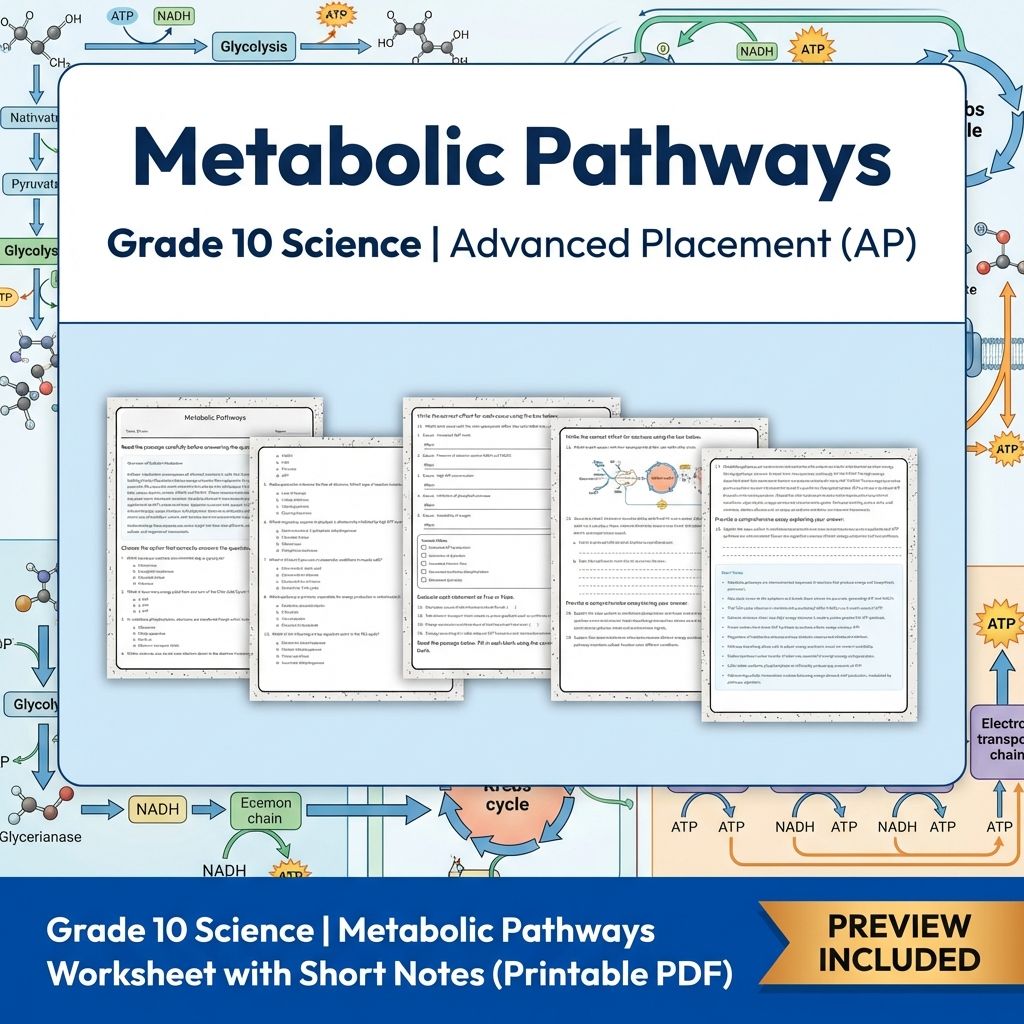
Grade 10 Science | Metabolic Pathways Worksheet with Short Notes (Printable PDF)
Created byMeadowlark WorksheetsLearning Objectives
- Map and describe the core metabolic pathways including glycolysis, the TCA cycle, and oxidative phosphorylation.
- Explain how cells generate and conserve energy through these pathways.
- Identify key intermediates, enzymes, and energy carriers involved in cellular respiration.
Instant download
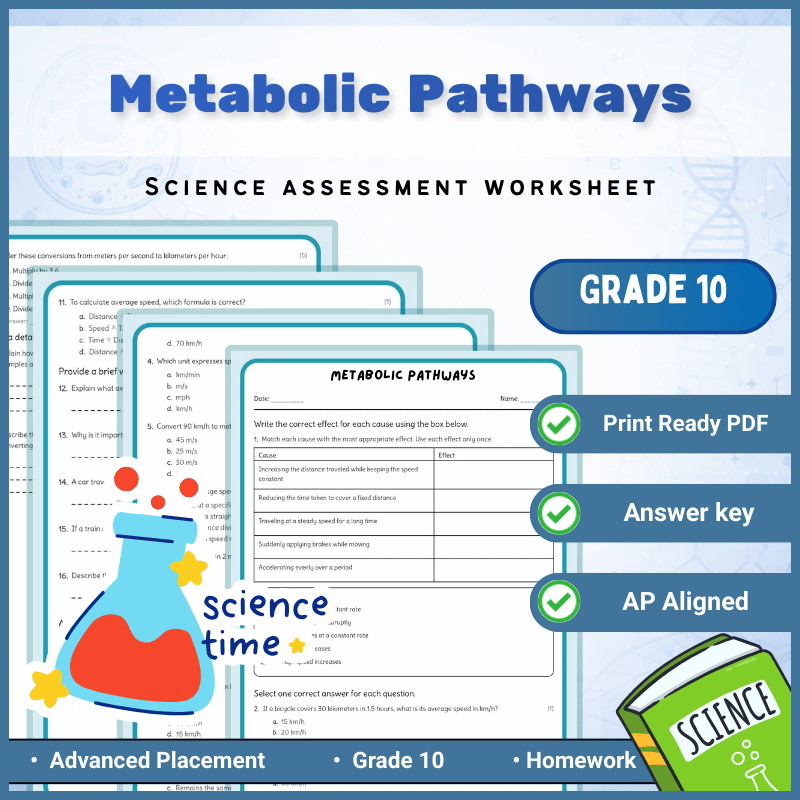
Grade 10 Science | Metabolic Pathways Worksheet (AP Standard) PDF
Created byBright Mind ResourcesLearning Objectives
- Map and describe the core metabolic pathways including glycolysis, the TCA cycle, and oxidative phosphorylation.
- Explain how cells conserve energy through ATP generation and electron flow in these pathways.
- Identify regulatory checkpoints and pathway branch points that maintain cellular function under different conditions.
Instant download
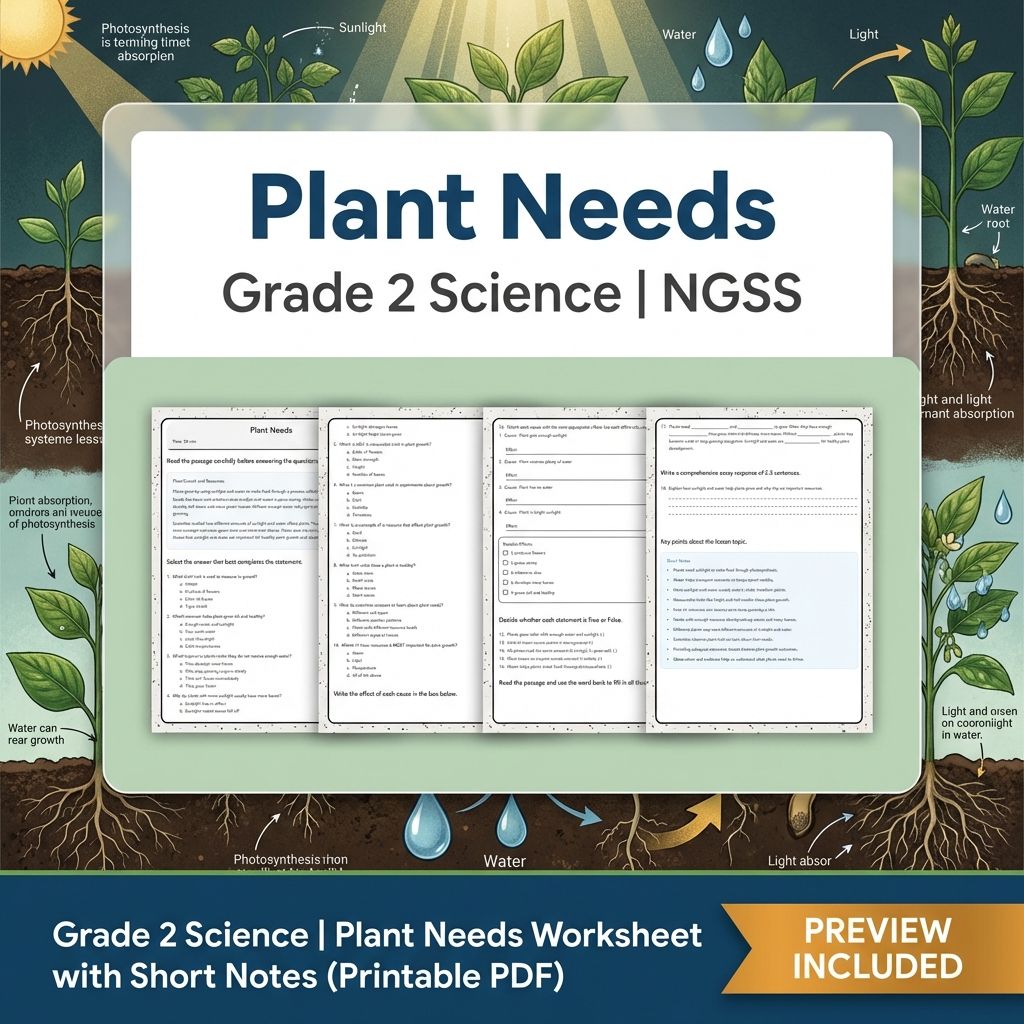
Grade 2 Science | Plant Needs Worksheet with Short Notes (Printable PDF)
Created byMeadowlark WorksheetsLearning Objectives
- Understand how sunlight and water influence plant growth.
- Identify measurable traits such as height, leaf number, and stem vigor.
- Observe and compare plant growth under different resource conditions.
Also included in: Grade 2 Science | Ecosystems & Diversity of Life NGSS Unit Bundle +1 more
Instant download

Grade 12 Science — Equilibrium Foundations Worksheet MCQ Paper
Created byThe Resource HubLearning Objectives
- Understand the concept of chemical equilibrium as a dynamic balance between forward and reverse reactions.
- Interpret the equilibrium constant as a measure of reaction position and extent.
- Relate concentration- and pressure-based expressions to reaction direction and shifts.
Also included in: Grade 12 Science AP Practice Worksheets Bundle for Mastering Core Concepts +2 more
Instant download

Grade 12 Science – Chemical Equilibrium & AP Standard | Daily Reading Worksheet
Created byBright Mind ResourcesLearning Objectives
- Define chemical equilibrium as a dynamic balance between forward and reverse reactions.
- Explain the concept of the equilibrium constant and how it quantifies reaction position.
- Understand how changes in concentration and pressure affect the equilibrium state.
Also included in: Grade 12 Chemistry Daily Reading Science Lesson Bundle | AP Standards +2 more
Instant download
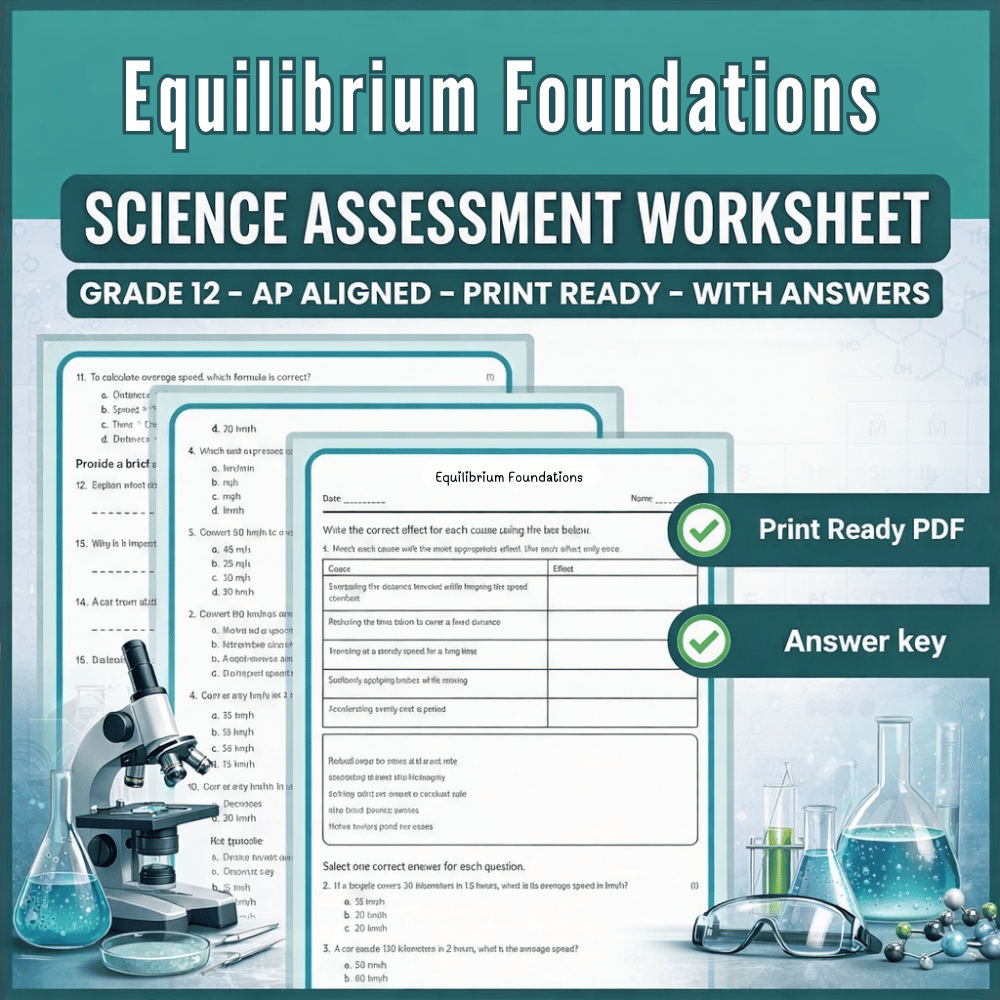
Grade 12 Science | Equilibrium Foundations Worksheet (AP) (PDF)
Created byBright Mind ResourcesLearning Objectives
- Explain the concept of chemical equilibrium as a dynamic balance between forward and reverse reactions.
- Describe the equilibrium constant as a quantitative measure of the position of equilibrium.
- Analyze how changes in concentration and pressure affect the direction of a chemical reaction.
Instant download
Browse more categories
About Reading comprehension Worksheets
Find reading comprehension worksheets for class practice, homework, or self-study. All 40,289 are instant PDF downloads.
Each resource here is built by an independent educator and reviewed for quality. Worksheets print straight from PDF and suit classroom use, homework, or extra practice; most come with answer keys, and you can preview before purchasing.