
Grade 10 Worksheets
9,385 grade resources
Grade 10 Science | Stoichiometric Analysis - Reading Comprehension Practice
 Created byCoral Reef Learning
Learning Objectives
- Understand key concepts related to Science
- Apply knowledge through practice questions
- Demonstrate comprehension of the material
Also included in: Chemistry Foundations Lesson Bundle: Grade 10 Science Advanced Placement (AP) +1 more
Instant download

Grade 10 Science | Model Revision Evidence - Daily Reading Comprehension
Created byCoral Reef LearningLearning Objectives
- Understand the concept of scientific models and their role in explaining phenomena.
- Recognize the importance of evidence in revising scientific models.
- Identify key features that indicate when a model should be revised.
Instant download

Grade 10 Science | Stoichiometric Ratios Worksheet (PDF) BC Standards
 Created byEvergreen Desk Education
Learning Objectives
- Explain how balanced chemical equations and mole ratios determine quantitative relationships between reactants and products.
- Use molar mass to convert between grams and moles in stoichiometric problems.
- Calculate expected product mass from given reactant mass (and vice versa) using stoichiometric ratios.
Instant download

Coordination of Physiological Systems Worksheet | Grade 10 NGSS Science
 Created byAmber Owl Education
Learning Objectives
- Compare how organ systems work together to move materials through the body
- Connect structural features of organs to their functions using examples from multiple systems
- Explain how transport processes depend on surface area, flow, and transport kinetics
Instant download

Grade 10 Science | Impacts of Technology Society Worksheet (PDF)
Created byEvergreen Desk EducationLearning Objectives
- Explain how technology and engineering can reshape communication, work, travel, and access to services.
- Analyze how design choices create different benefits and risks in specific social contexts.
- Connect environmental impacts of technology to resource use, emissions, waste, and ecosystem effects.
Also included in: Grade 10 Engineering Design Trade-Offs Science Lesson Bundle: General +1 more
Instant download

Grade 10 Meiosis and Variation Worksheet | NGSS Practice PDF
 Created byClear Sky Classroom
Learning Objectives
- Explain how meiosis reduces chromosome number to form gametes.
- Describe how homologous chromosome separation and genetic recombination create variation.
- Connect inherited genetic variation to differences among offspring and to natural selection.
Instant download

Engineering Design Process Worksheet | NGSS Grade 10 Engineering Design
Created byAmber Owl EducationLearning Objectives
- Explain how engineering teams define criteria and constraints when solving a complex problem
- Use qualitative criteria and quantitative performance metrics to set measurable design targets
- Describe how models and benchmark comparisons support feasible solution decisions
Instant download

Grade 10 | World Chocolate Day for Mastering Cacao History | PDF + Answer Key
 Created byShaNova Worksheets
Learning Objectives
- Explain how cacao was used by ancient Mesoamerican civilizations and why it was culturally important.
- Describe how chocolate spread through global trade and how that affected economies and societies.
- Connect historical traditions of chocolate to modern cultural meanings.
Instant download

Grade 10 Holiday | World Refugees Day Mastery Worksheet | PDF + Answer Key
Created byShaNova WorksheetsLearning Objectives
- Explain key human-rights principles that protect refugees and people seeking asylum.
- Describe how international organizations and laws support refugee dignity and safety.
- Apply ethical reasoning to dilemmas involving inclusion, fairness, and social responsibility.
Instant download

Grade 10 Cell Types Worksheet | Practice & Assessment PDF
Created byClear Sky ClassroomLearning Objectives
- Distinguish prokaryotic and eukaryotic cells using key structural and genetic features
- Explain how genome organization and organelles affect replication and genetic control
- Apply cell-type criteria to predict function in different ecological contexts
Instant download

Valence Patterns Worksheet | Grade 10 Chemistry Science CA Standards
Created byEvergreen Desk EducationLearning Objectives
- Explain how valence electron patterns relate to an element’s typical bonding and ion formation.
- Use periodic trends to predict whether an element is more likely to form cations or anions.
- Identify recurring electron-configuration structures and connect them to metallic or nonmetallic character.
Instant download

RNA Variants Worksheet | Grade 10 Science Practice and Review
 Created byPrism Point Learning
Learning Objectives
- Describe how mRNA, tRNA, and rRNA differ in structure and function during protein synthesis.
- Explain how uracil in RNA allows complementary base pairing during transcription.
- Connect codons, anticodons, and amino acids to the translation of genetic information into polypeptides.
Also included in: Genetics & Molecular Biology Lesson Bundle | Grade 10 Science | TEKS
Instant download
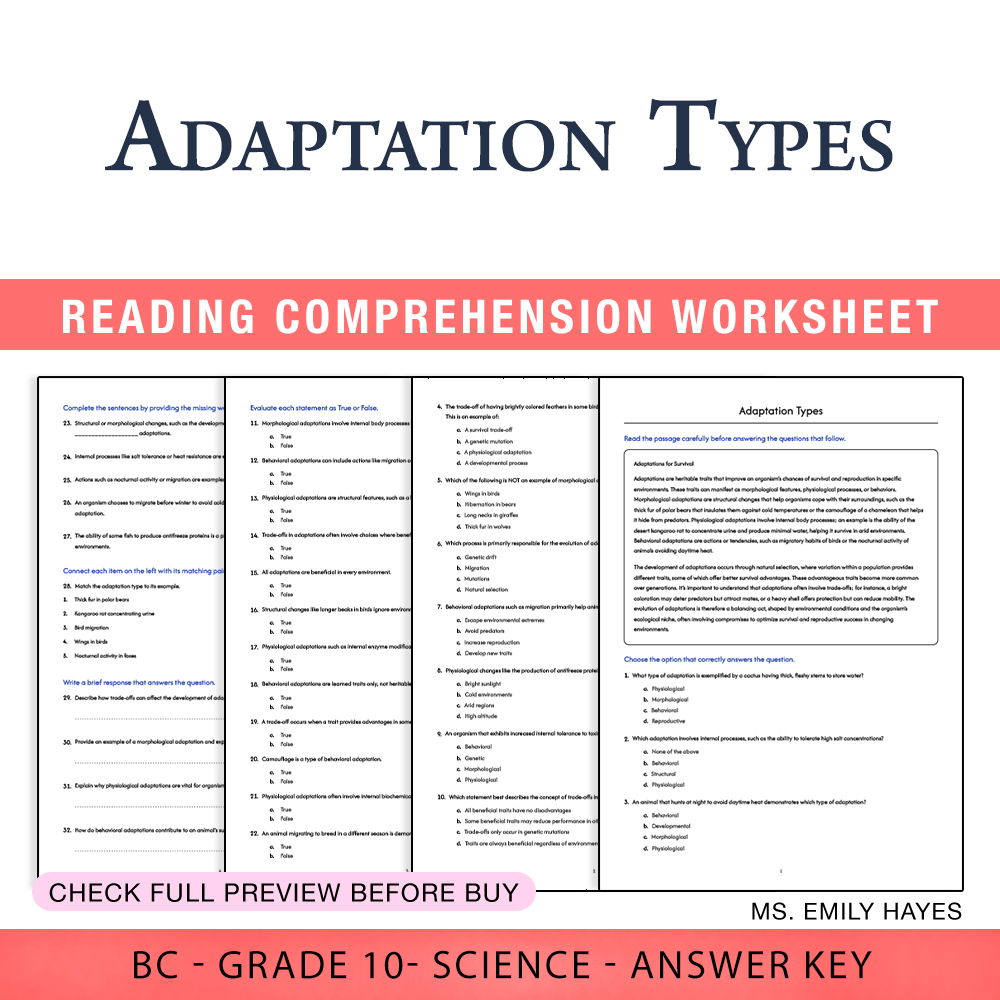
Grade 10 Science | Adaptation Types Worksheet (PDF+ Answer Key)
 Created byCopper Leaf Classroom
Learning Objectives
- Define morphological, physiological, and behavioral adaptations.
- Explain how adaptations enhance survival and reproduction.
- Identify examples of different adaptation types in animals and plants.
Also included in: Grade 10 Science BC | Evolution, Biodiversity & Ecology (PDF + Answer Key) +1 more
Instant download

Climate Feedbacks Worksheet | Science Assessment for Grade 10
 Created byLumora Learning
Learning Objectives
- Explain how changes in greenhouse gases can trigger warming through radiation and then cause climate feedbacks.
- Distinguish between positive and negative climate feedbacks using real examples such as water vapor, ice-albedo, and clouds.
- Analyze how surface, cloud, and aerosol processes can influence temperature and precipitation patterns.
Instant download

Grade 10 Science | Plate Narratives The Movement of Earth's Plates
Created byCoral Reef LearningLearning Objectives
- Understand key concepts related to Science
- Apply knowledge through practice questions
- Demonstrate comprehension of the material
Also included in: Earth and Space Sciences Lesson Bundle: Grade 10 Science Advanced Placement +1 more
Instant download

Grade 10 Science – Constraint-Based Design & Measurement Practices | Worksheet
 Created byBright Mind Resources
Learning Objectives
- Understand the concept of constraints in observational and experimental studies
- Identify different types of constraints such as practical, ethical, and temporal
- Evaluate trade-offs involved in designing scientific studies under constraints
Also included in: Grade 10 Scientific Reasoning Science Lesson Bundle | AP Daily Reading +2 more
Instant download

Grade 10 Science | Constraint-Based Design Worksheet (AP Standards) (PDF)
Created byEvergreen Desk EducationLearning Objectives
- Explain how practical, ethical, and temporal constraints influence the design of observational and comparative science studies
- Justify proxy measures when ideal variables cannot be measured directly and explain how that affects conclusions
- Evaluate trade-offs among replication, measurement precision, and scope using sensitivity ideas
Also included in: Grade 10 Scientific Modeling & Quantitative Reasoning Science Lesson Bundle (AP) +1 more
Instant download

Grade 10 Science – Pathogens & Disease | Daily Reading Worksheet
Created byBright Mind ResourcesLearning Objectives
- Understand the basic types of microorganisms that cause diseases.
- Describe how bacteria, viruses, and fungi transmit from one host to another.
- Explain the immune system's response to different pathogens.
Also included in: Grade 10 Cell Processes & Energy Science Daily Reading Lesson Bundle | Ontario +1 more
Instant download

Ocean Atmosphere Coupling Assessment | General Grade 10 Science
Created byPrism Point LearningLearning Objectives
- Explain how ocean and atmosphere interactions transfer heat and moisture.
- Describe the impact of sea-surface temperature changes on weather patterns.
- Identify the roles of El Niño and La Niña in regional climate variability.
Also included in: Grade 10 Climate Systems Science Lesson Bundle Assessments – General
Instant download

Grade 10 Science – Vectors and Components Worksheet (PDF) BC Standards
Created byEvergreen Desk EducationLearning Objectives
- Explain how vector decomposition separates a vector into orthogonal components along perpendicular axes.
- Use trigonometric relationships to relate component magnitudes to a vector’s magnitude and direction.
- Resolve velocity and acceleration into horizontal and vertical components for 2D motion analysis.
Instant download

Grade 10 Science – Projectile Motion Worksheet (AP) Practice Set (PDF)
Created byEvergreen Desk EducationLearning Objectives
- Decompose projectile motion into independent horizontal and vertical components and apply kinematics equations under uniform gravity.
- Predict time of flight, range, and maximum height from initial conditions using trajectory equations for two-dimensional motion.
- Identify and justify the assumptions (e.g., negligible air resistance) that make projectile models accurate for idealized problems.
Also included in: Grade 10 Motion & Forces Science Lesson Bundle (AP) Worksheet Set +1 more
Instant download

Grade 10 Science | Homeostasis Basics - Daily Reading Comprehension
Created byCoral Reef LearningLearning Objectives
- Understand the concept of homeostasis and its importance in human physiology.
- Identify key components involved in maintaining homeostasis, including set points, sensors, and effectors.
- Recognize examples of homeostasis such as temperature regulation and blood glucose control.
Instant download

Grade 10 Science | Paleoclimate Evidence Worksheet (NGSS10 PDF)
 Created bySilver Birch Teaching
Learning Objectives
- Understand the types of proxy records used to reconstruct past climates.
- Identify how isotopic ratios and microfossil assemblages inform about historical climate conditions.
- Compare paleoclimate data with recent instrumental records to assess climate change patterns.
Also included in: Grade 10 Earth Systems Science Lesson Bundle for NGSS ngss10 Worksheets +1 more
Instant download

Grade 10 Science – Health Impacts of Microorganisms & Disease | Daily Worksheet
 Created byQuiet Forest Education
Learning Objectives
- Identify and categorize different types of microorganisms: bacteria, viruses, and fungi.
- Explain how pathogens transmit from one host to another.
- Describe the mechanisms by which microorganisms cause disease.
Also included in: Cell Biology Grade 10 Science Daily Reading Worksheets Bundle | Ontario +1 more
Instant download

Grade 10 Science – One-Dimensional Motion | Daily Reading Worksheet
Created byBright Mind ResourcesLearning Objectives
- Define displacement, speed, velocity, and acceleration.
- Differentiate between average and instantaneous quantities.
- Apply constant-acceleration equations to real-world motion scenarios.
Also included in: Grade 10 Force & Motion Science Daily Reading Lesson Bundle – Ontario +1 more
Instant download

Grade 10 Science – Understanding Ohm's Law & Circuits | Daily Reading Worksheet
Created byBright Mind ResourcesLearning Objectives
- Describe the fundamental principle of Ohm's Law
- Identify the relationships between voltage, current, and resistance
- Calculate resistance in simple circuits
Also included in: Energy & Systems Interactions Grade 10 Science lesson bundle | Alberta +1 more
Instant download

Science Worksheet Evidence-Based Communication Grade 10 | Standard Practice
JCreated byJ.S SheetsLearning Objectives
- Explain how scientific claims are supported by evidence using logical reasoning.
- Use appropriate scientific language to describe observations, patterns, and conclusions.
- Interpret how representations (graphs or models) help connect data to conclusions.
Also included in: Grade 10 Data Uncertainty & Evidence-Based Science Lesson Bundle | General +1 more
Instant download

Grade 10 Models And Explanations Worksheet | Florida NGSS Practice PDF
Created byClear Sky ClassroomLearning Objectives
- Explain how scientific models represent important features of complex systems to predict behavior.
- Describe how evidence connects observations to mechanisms in strong scientific explanations.
- Evaluate where a model works and where it fails, including identifying limitations.
Instant download

Grade 10 Science – Matter Conservation & Changes | Daily Reading Worksheet
Created byBright Mind ResourcesLearning Objectives
- Understand the concept of matter conservation in physical and chemical processes
- Recognize how particles rearrange during phase changes without changing total matter
- Differentiate between particle and atom models in matter reactions
Also included in: Stoichiometry Forces and Energy Lesson Bundle Grade 10 Science | General +1 more
Instant download

Uncertainty Interpretation Worksheet for Grade 10 Science Data Analysis
Created byPrism Point LearningLearning Objectives
- Explain what measurement uncertainty means and why measurements should be interpreted as ranges
- Use uncertainty ranges to judge whether two measurements show a meaningful difference
- Apply uncertainty reasoning to draw more confident or less confident scientific conclusions
Instant download

Grade 10 Science | Membrane Structure Worksheet | Science | TEKS-Aligned
Created byLumora LearningLearning Objectives
- Understand the fluid mosaic model of the plasma membrane and its components.
- Explain the role of phospholipid bilayer asymmetry and cholesterol in membrane fluidity.
- Identify different membrane proteins and their functions, including receptors and transporters.
Also included in: Grade 10 Science | Cell Structure, Transport & Communication Bundle | TEKS +1 more
Instant download

Grade 10 Science | Rock Transformations & the Rock Cycle - Daily Reading
Created byCoral Reef LearningLearning Objectives
- Understand the main processes involved in rock transformations, including crystallization, lithification, metamorphism, and weathering.
- Identify different types of rocks and their formation processes.
- Learn how mineral assemblages, textures, and geochemical signatures indicate geological histories.
Instant download

Microbe Diversity: Bacteria, Archaea, Fungi, Protists Worksheet | Grade 10
JCreated byJ.S SheetsLearning Objectives
- Compare major microorganism groups by cellular organization and genetic material (DNA/RNA, prokaryotic vs. eukaryotic).
- Explain how viruses depend on host cellular machinery to reproduce.
- Describe how reproduction strategies and ecological roles differ among bacteria, archaea, viruses, fungi, and protists.
Instant download

Grade 10 Science | Model Revision Evidence Worksheet | NGSSS Aligned
Created byLumora LearningLearning Objectives
- Explain how scientific models remain open to revision when new evidence conflicts with expectations
- Evaluate the quality of evidence by considering consistency, explanatory power, and predictive accuracy
- Describe how scientists identify mismatches and adjust assumptions without adding unsupported claims
Instant download

Charge and Fields Worksheet | Grade 10 Science Assessments
Created byPrism Point LearningLearning Objectives
- Explain how electric charge sign and magnitude determine whether forces are attractive or repulsive.
- Describe how electric field lines represent the direction of the electric force on a positive test charge.
- Use Coulomb’s law and the superposition principle to reason about electrostatic interactions in real contexts.
Also included in: Grade 10 Work, Energy & Electricity Lesson Bundle | Alberta Science
Instant download

Trophic Relationships Practice Worksheet | Grade 10 Science NGSS
Created byPrism Point LearningLearning Objectives
- Explain how energy moves through trophic levels and why efficiency is limited
- Interpret biomass and energy pyramids and what they imply about ecosystem productivity
- Use food webs to predict how top-down and bottom-up forces can change populations
Also included in: Grade 10 Ecosystems & Biodiversity Science Lesson Bundle Practice: NGSS
Instant download

Negative Feedback Worksheet for Grade 10 Science | TEKS-Aligned Practice
JCreated byJ.S SheetsLearning Objectives
- Explain how negative feedback uses sensors, control centers, and effectors to reduce deviations from a set point
- Identify the role of an error signal in regulating internal body conditions
- Apply negative feedback ideas to examples involving temperature, blood glucose, and blood pressure
Instant download
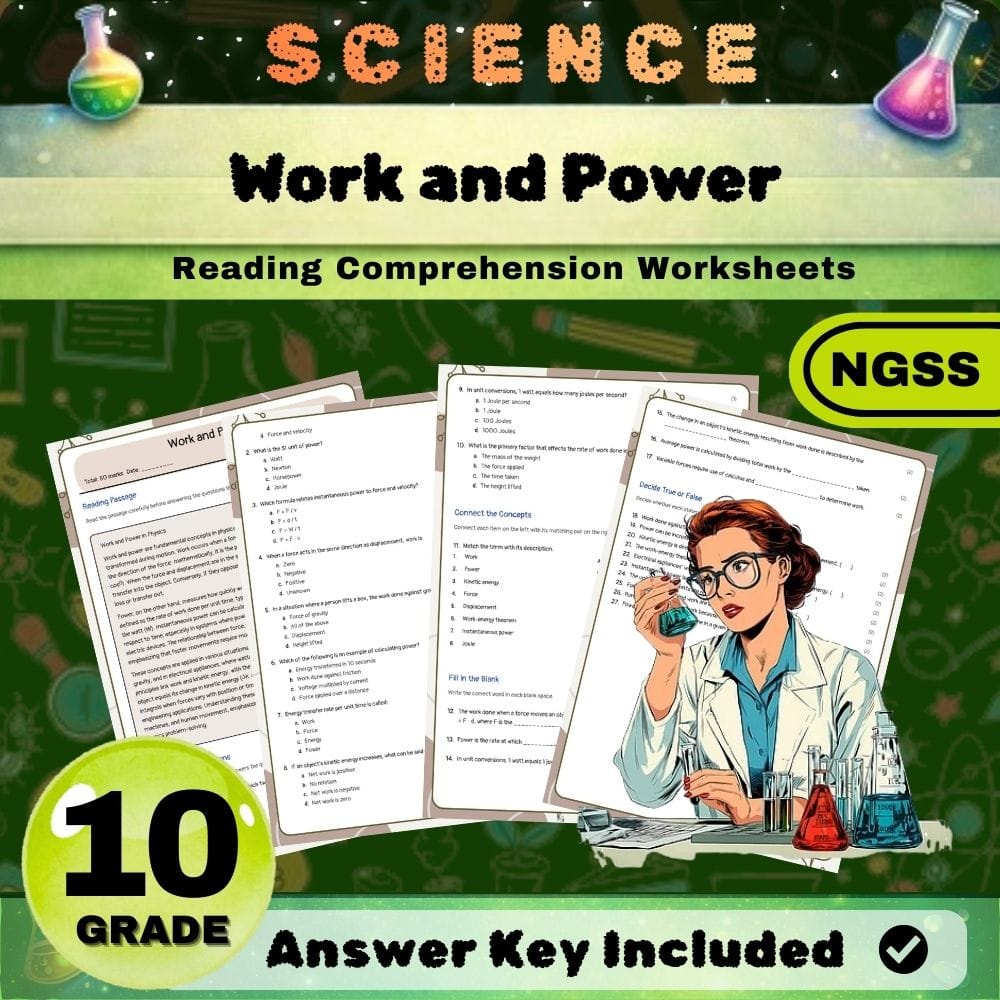
Grade 10 Science | Work and Power Worksheet (NGSS) (PDF)
 Created byMaple Path Learning
Learning Objectives
- Understand the relationship between force, displacement, and work
- Apply the work-energy theorem to calculate changes in kinetic energy
- Interpret average and instantaneous power in real-world contexts
Also included in: Grade 10 Energy Science Worksheets Bundle | NGSS Lesson Resources +1 more
Instant download

Microscopic Thermal Model Worksheet | Grade 10 Science CA Standards
Created byEvergreen Desk EducationLearning Objectives
- Explain temperature using the microscopic model of average particle kinetic energy.
- Describe heat transfer as energy moving due to particle-level differences, not as “substance” flowing.
- Use microscopic reasoning to predict temperature changes in different materials under similar heating conditions.
Instant download

Galactic Structure Worksheet for Grade 10 Science | Florida NGSSS PDF
Created byEvergreen Desk EducationLearning Objectives
- Identify how galaxy shape and components (bulge, disk, arms, bar) relate to gravitational dynamics on a large scale
- Explain how redshift and spectral lines provide evidence about galaxy motion and distance
- Apply the ideas of brightness, distance, and intrinsic luminosity to interpret observational differences
Instant download

Fluid Balance Worksheet | Grade 10 Science Activities TEKS Aligned
Created byPrism Point LearningLearning Objectives
- Explain how glomerular filtration, tubular reabsorption, and secretion in nephrons help regulate blood volume and osmolarity
- Describe how antidiuretic hormone (ADH) and aldosterone adjust urine volume and solute concentration
- Connect kidney feedback control to maintaining blood pressure and internal fluid composition
Instant download

Grade 10 Science – Circuit Fundamentals & Daily Reading Worksheet
Created byBright Mind ResourcesLearning Objectives
- Understand the basic components of simple direct-current circuits
- Explain how current flows through circuit elements
- Apply Ohm's law to calculate voltage, current, and resistance
Also included in: Motion, Energy & Electricity Grade 10 Science Reading Worksheets Bundle | AP +2 more
Instant download

Energy Conservation Worksheet | NGSS-Aligned Science Practice for Grade 10
JCreated byJ.S SheetsLearning Objectives
- Understand the principles of energy conservation in closed and isolated systems.
- Identify and describe energy conversions between kinetic, potential, and thermal stores.
- Apply energy bookkeeping concepts using diagrams and algebraic sums.
Also included in: Grade 10 Energy Conservation and Conversion Science Lesson Bundle: NGSS
Instant download

Chemical Equations Worksheet Grade 10 Science Practice
Created byPrism Point LearningLearning Objectives
- Explain how chemical equations represent reactants, products, and conserved atoms
- Interpret the meaning of coefficients and state symbols in chemical equations
- Use balanced equations to make qualitative predictions about reactants and products
Also included in: Grade 10 Science Chemical Reactions & Atomic Structure Lesson Bundle | Bc +1 more
Instant download

Grade 10 Science – Mixture & Separation Techniques | Daily Reading Worksheet
Created byQuiet Forest EducationLearning Objectives
- Understand different types of mixtures: homogeneous, colloids, suspensions
- Learn basic separation techniques: filtration, distillation, chromatography, centrifugation
- Compare separation methods based on particle size, solubility, boiling point
Also included in: Matter and Chemical Change Grade 10 Science Daily Reading Bundle | Ontario +1 more
Instant download

Grade 10 Science | Energy Pathways - Daily Reading Comprehension
Created byCoral Reef LearningLearning Objectives
- Understand how Earth's surface absorbs solar energy
- Identify different energy transfer mechanisms within Earth's systems
- Analyze energy-budget diagrams and quantitative balances
Also included in: Earth and Space Sciences Lesson Bundle: Grade 10 Science Advanced Placement +1 more
Instant download

Science Worksheet Galactic Structure and Cosmic Scale | NGSSS Grade 10
JCreated byJ.S SheetsLearning Objectives
- Explain how galaxy structure (e.g., spiral arms and a bar) relates to gravitational dynamics
- Interpret how redshift and spectral lines provide evidence about galaxy motion and distance
- Use scale-aware reasoning to connect observed brightness with intrinsic luminosity
Also included in: Grade 10 Earth and Space Systems Science Lesson Bundle – Florida NGSSS +1 more
Instant download

Grade 10 Science – Static Equilibrium & Forces | Daily Reading Worksheet
Created byBright Mind ResourcesLearning Objectives
- Understand the conditions for static equilibrium
- Identify forces and moments acting on objects
- Apply vector summation principles to static systems
Also included in: Grade 10 Force & Motion Science Daily Reading Lesson Bundle – Ontario +1 more
Instant download
Browse more categories
About Grade 10 Worksheets
Find Grade 10 worksheets covering algebra, biology, literature, and history. All 9,385 resources download instantly as PDFs for classwork, homework, or review.
MyTeachingSheets worksheets are made by real teacher-authors and checked before they go live. Download any as a print-ready PDF for lessons, homework, or independent practice — most include answer keys, and previews are always free.