
Grade 10 Science Worksheets
7,069 worksheets
Bonding Types Assessment for Grade 10 Science | Alberta Standards
 Created byPrism Point Learning
Learning Objectives
- Describe the particle-level explanations for ionic, covalent, and metallic bonding.
- Relate bonding types to their observable physical properties such as conductivity and melting point.
- Compare lattice structures and electron sharing in different types of bonds.
Also included in: Grade 10 Matter and Chemical Change Science Lesson Bundle: Alberta +1 more
Instant download
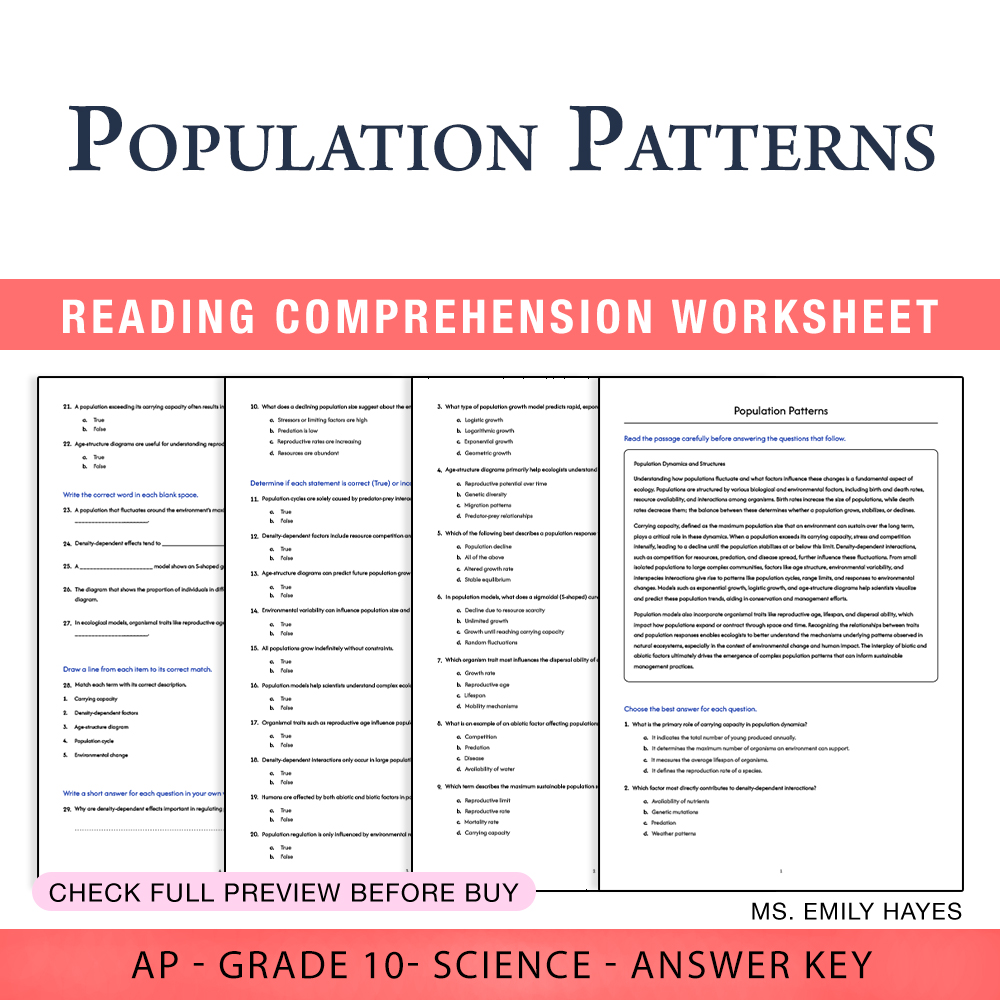
10th Grade Science | Population Patterns Worksheet (PDF+ Answer Key)
 Created byCopper Leaf Classroom
Learning Objectives
- Understand factors that influence population structures such as birth and death rates.
- Describe the role of carrying capacity and density-dependent interactions in populations.
- Interpret population models and age-structure diagrams to analyze population dynamics.
Also included in: Grade 10 Science | Key Concepts in Biology & Ecosystems (PDF+ Answer Key) +1 more
Instant download
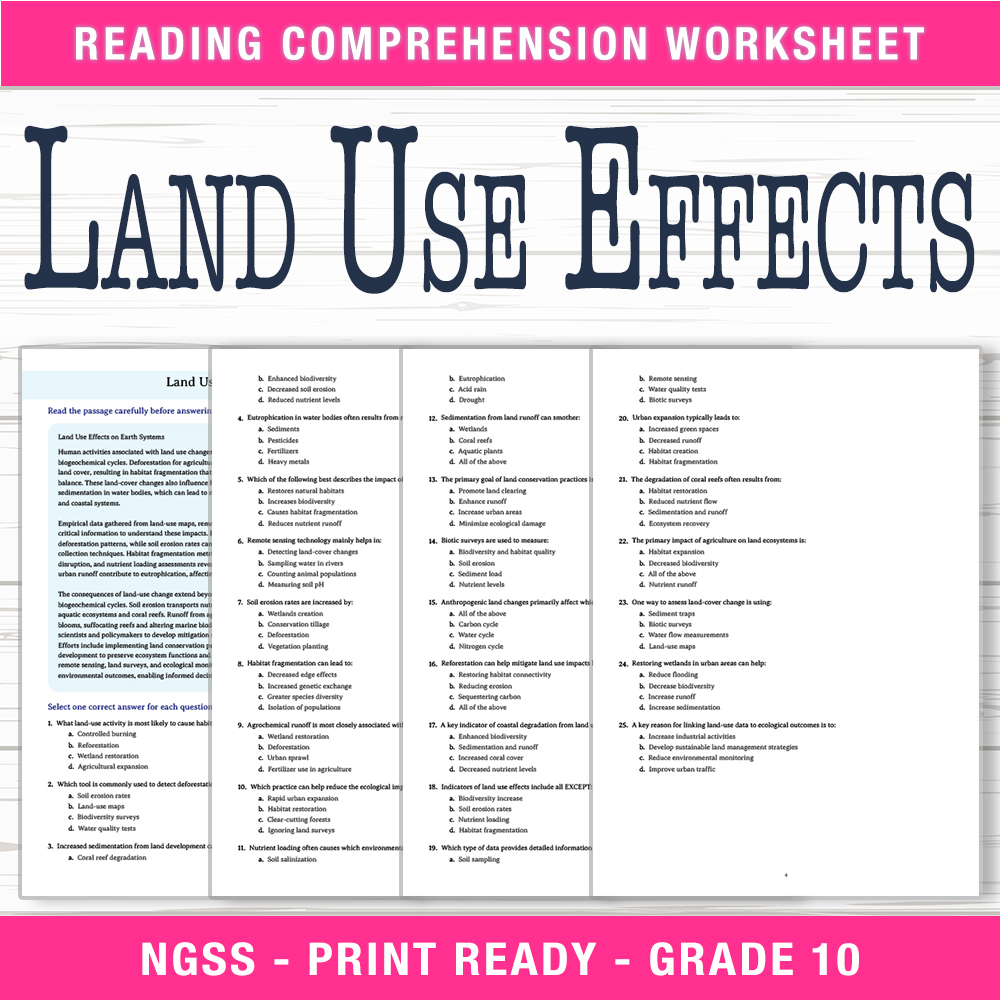
Grade 10 Science – Land Use Effects Worksheet (PDF + Answer Key)
 Created byRiverstone Classroom
Learning Objectives
- Describe how human land-use changes impact ecosystems and earth systems.
- Identify indicators of land-use change such as habitat fragmentation and soil erosion.
- Interpret empirical data from land-cover maps, remote sensing, and biological surveys.
Instant download

Grade 10 Science | Causal Complexity Worksheet (AP Standards) (PDF)
 Created byEvergreen Desk Education
Learning Objectives
- Explain why multivariable causal relationships are difficult to identify in complex systems
- Use conceptual tools (control matrices, causal graphs, and stratified comparisons) to reason about confounding and interactions
- Evaluate how design constraints, measurement limitations, and model assumptions affect confidence in causal claims
Also included in: Grade 10 Scientific Modeling & Quantitative Reasoning Science Lesson Bundle (AP) +1 more
Instant download

Grade 10 Science Model Evaluation Worksheet with Short Notes (Printable PDF)
 Created byMeadowlark Worksheets
Learning Objectives
- Understand the role of quantitative modeling in engineering.
- Evaluate prototype data through statistical comparison of simulation and measurements.
- Apply uncertainty quantification techniques to assess model reliability.
Also included in: Grade 10 Science | Engineering Design Unit Bundle – NGSS Classroom Worksheets +1 more
Instant download
Grade 10 Science | Statistical Reasoning Worksheet (Ontario, PDF)
 Created byBright Mind Resources
Learning Objectives
- Understand basic measures of central tendency and spread in data sets.
- Interpret confidence intervals and results of comparative statistical tests.
- Differentiate between statistical significance and practical significance in experiments.
Instant download
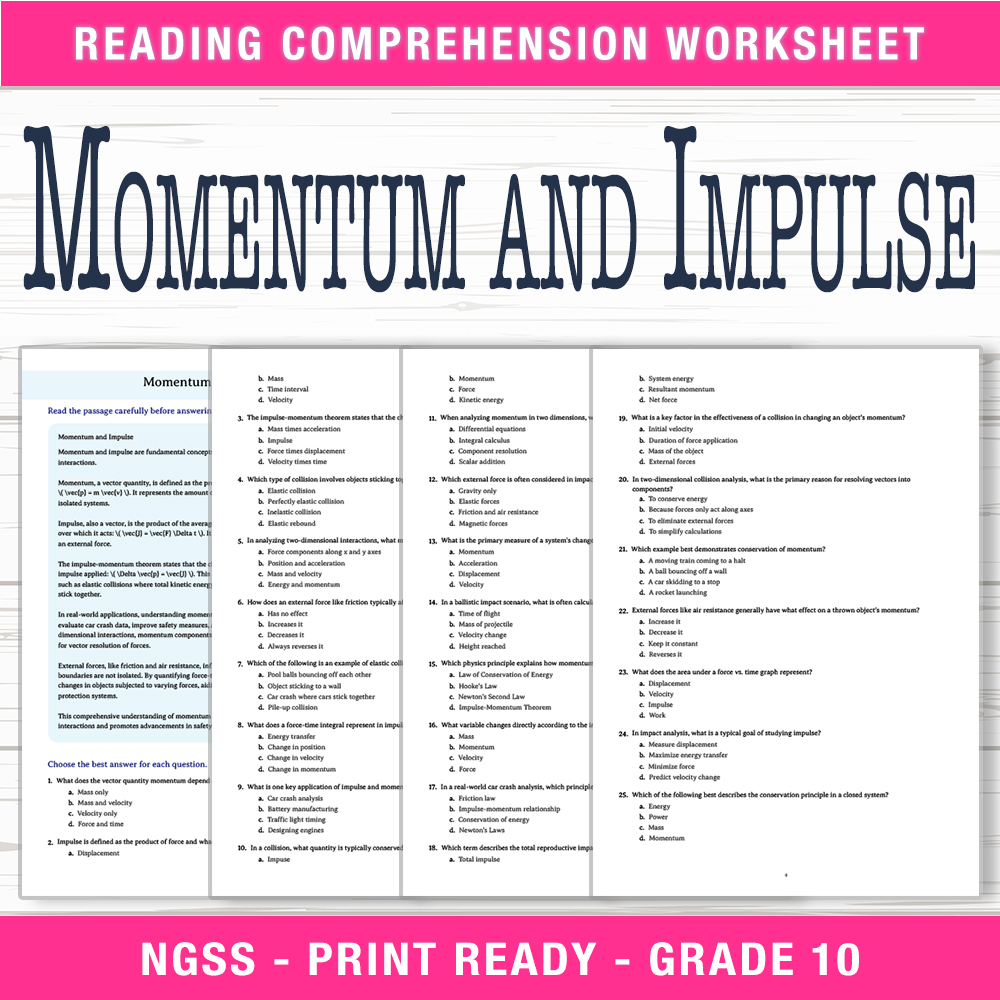
Grade 10 Science | Momentum and Impulse Worksheet (PDF + Answer Key)
Created byRiverstone ClassroomLearning Objectives
- Explain the relationship between impulse and momentum and derive the impulse-momentum theorem.
- Analyze elastic and inelastic collisions using the concepts of momentum and impulse.
- Describe the effects of external forces on a system's momentum in two-dimensional interactions.
Instant download
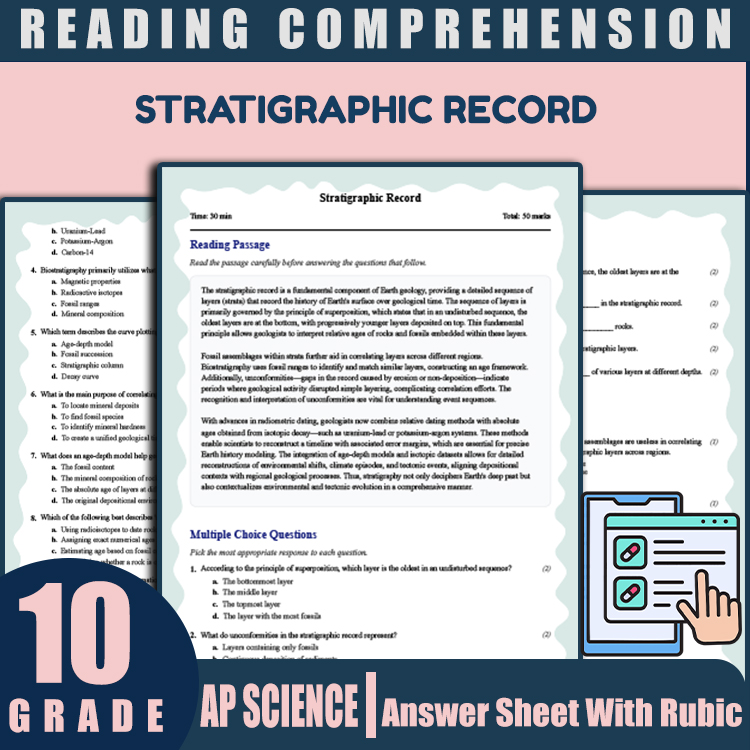
10th Grade Science | Stratigraphic Record Reading Worksheet (PDF + Answer Key)
JCreated byJ.S SheetsLearning Objectives
- Understand the principles of stratigraphy such as superposition, correlation, and unconformities.
- Interpret fossil assemblages and stratigraphic sequences to infer the Relative and absolute timing of Earth events.
- Apply radiometric decay methods and age-depth models to determine timing and error considerations.
Also included in: Grade 10 Science Unit | Earth Processes & Climate Worksheets (PDF + Answer Key) +1 more
Instant download
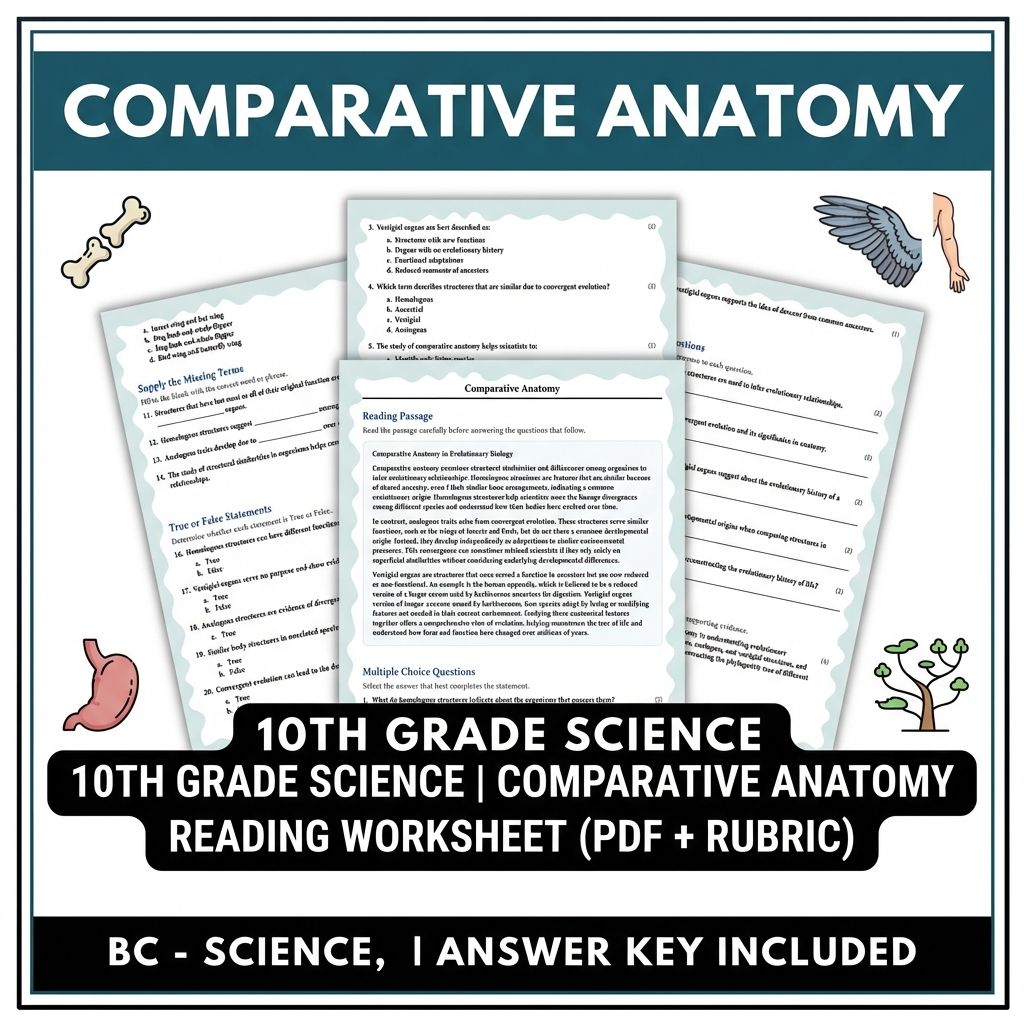
10th Grade Science | Comparative Anatomy Reading Worksheet (PDF + Rubric)
JCreated byJ.S SheetsLearning Objectives
- Understand the key concepts of homologous, analogous, and vestigial structures.
- Identify examples of anatomical features that support evolutionary relationships.
- Explain how comparative anatomy helps reconstruct phylogenetic trees.
Instant download
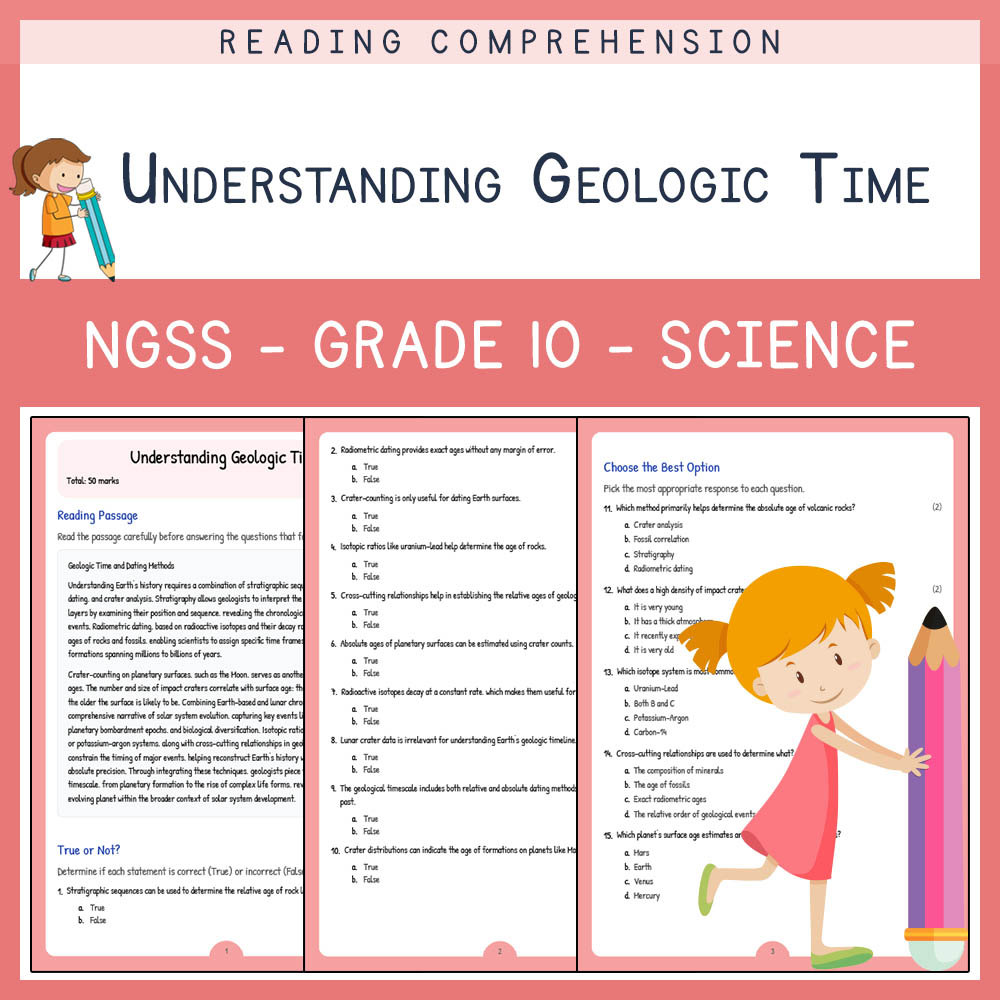
Grade 10 Science | Understanding Geologic Time Worksheet & Answer Key (PDF)
 Created byLumora Learning
Learning Objectives
- Explain how relative and absolute dating methods are used to establish Earth's geologic history.
- Describe the significance of isotopic ratios and half-life decay systems in dating rocks and planetary surfaces.
- Evaluate how crater-counting records contribute to the understanding of planetary ages and events.
Instant download

Grade 10 Motion Graphs Worksheet with Answer Key | Florida NGSSS Science
Created byEvergreen Desk EducationLearning Objectives
- Interpret position-time graphs by relating slope to velocity and identifying when velocity is zero or changing.
- Interpret velocity-time graphs by relating slope to acceleration and identifying where acceleration is constant or changes.
- Use graph features (sign changes, curvature/changes in slope, and flat segments) to reason about an object’s motion and direction over time.
Instant download

Grade 10 Heritable Variation Worksheet | California Science Standards
Created byEvergreen Desk EducationLearning Objectives
- Explain how genetic differences among individuals create variation in traits that can be passed to offspring.
- Describe how heritable traits influence survival and reproduction in different environments.
- Distinguish between sources of variation (genetic and environmental) and their roles in natural selection.
Instant download
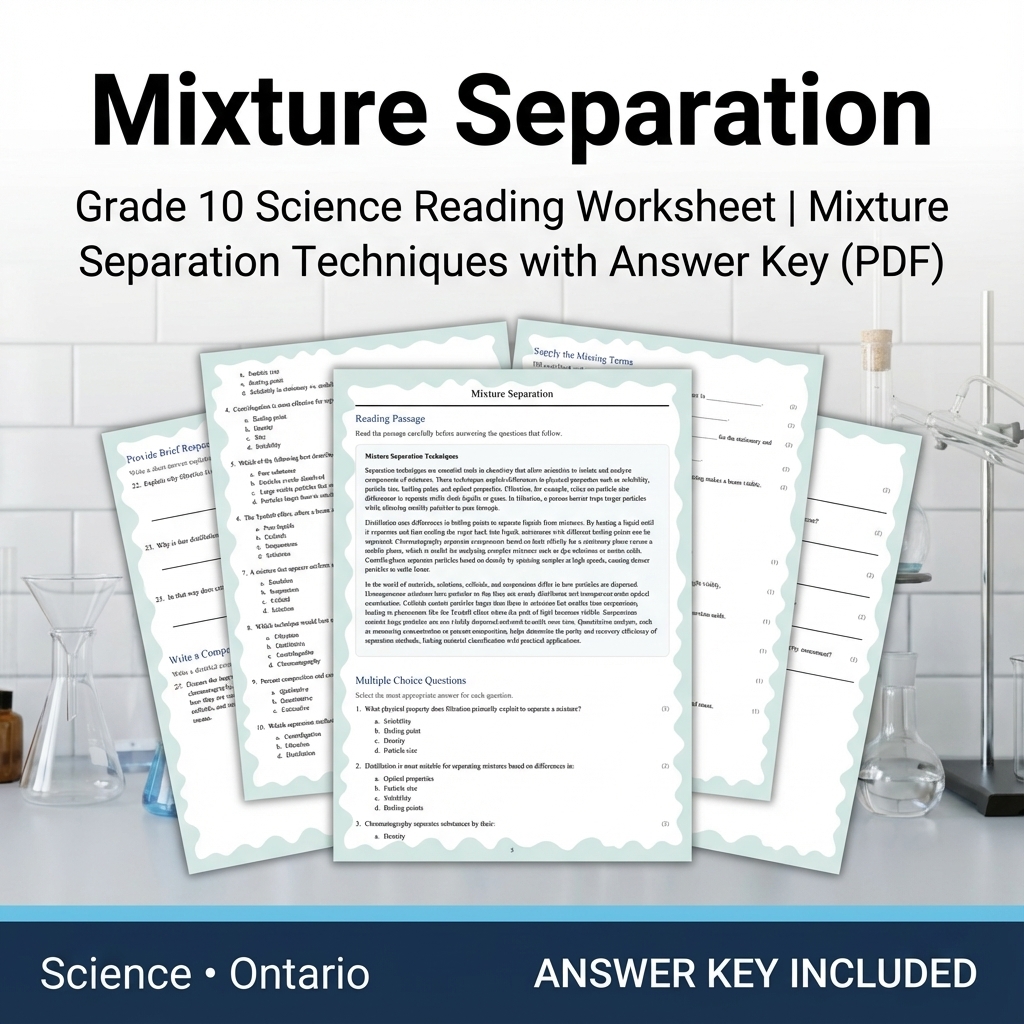
Grade 10 Science Reading | Mixture Separation Techniques with Answer Key
JCreated byJ.S SheetsLearning Objectives
- Understand the principles of different separation techniques such as filtration, distillation, chromatography, and centrifugation.
- Compare and contrast homogeneous solutions, colloids, and suspensions based on particle dispersion and optical properties.
- Explain how qualitative and quantitative measures assess the purity and composition of materials.
Also included in: Grade 10 Science Unit Bundle | Chemistry, Atomic Structure & Reactions +1 more
Instant download
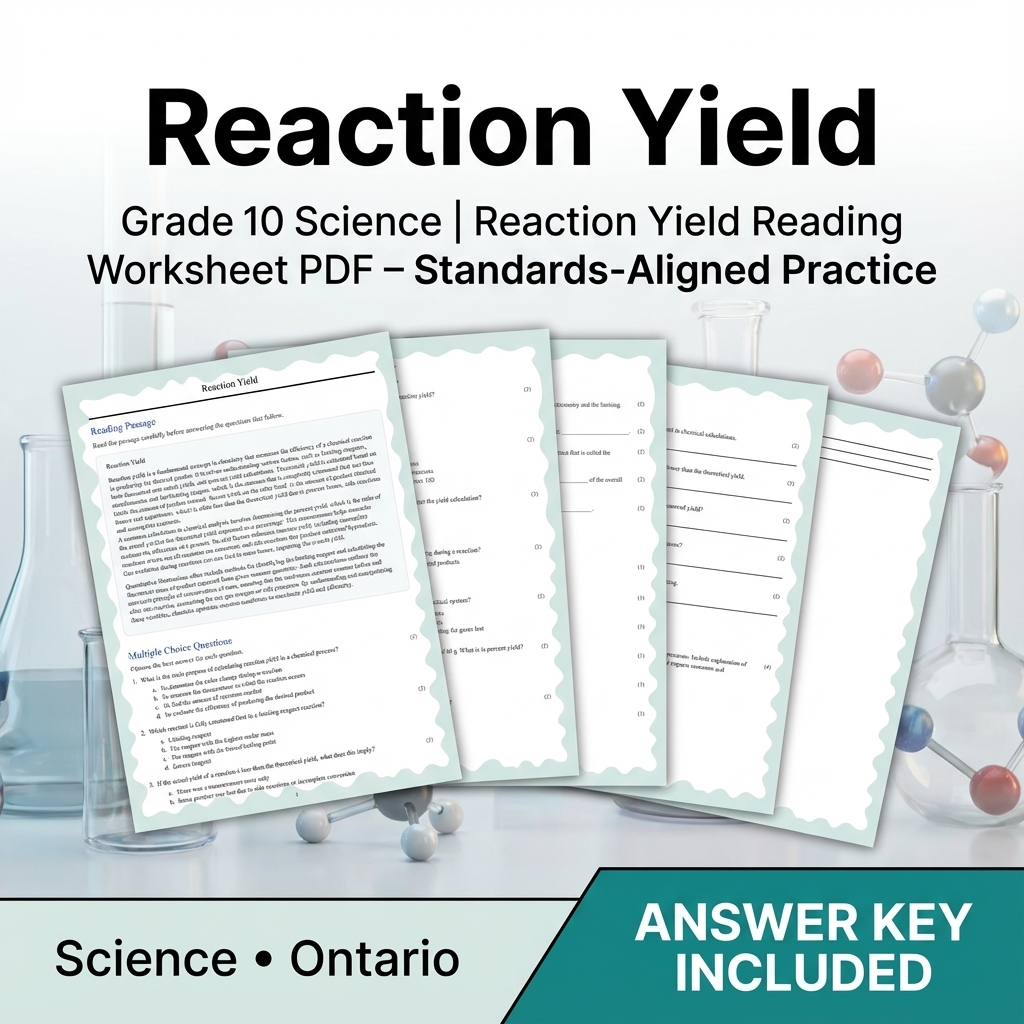
Grade 10 Science | Reaction Yield Reading PDF – Standards-Aligned Practice
JCreated byJ.S SheetsLearning Objectives
- Understand the concepts of theoretical and actual yield and how to calculate percent yield.
- Identify limiting reagents in chemical reactions and understand their effect on overall yield.
- Explain factors that affect reaction yield, including incomplete reactions and side reactions.
Also included in: Grade 10 Science Unit Bundle | Chemistry, Atomic Structure & Reactions +1 more
Instant download
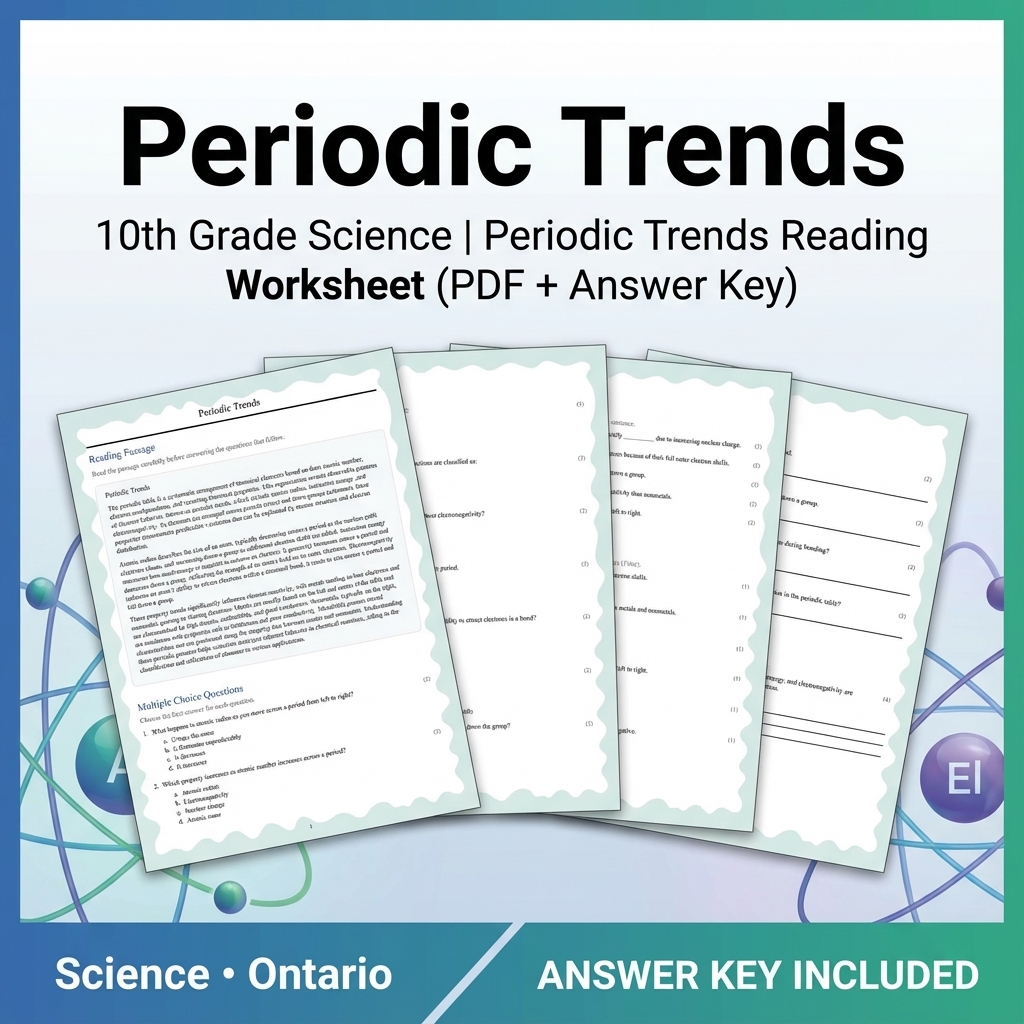
10th Grade Science | Periodic Trends Reading Worksheet (PDF + Answer Key)
JCreated byJ.S SheetsLearning Objectives
- Understand the patterns of atomic radius, ionization energy, and electronegativity across the periodic table.
- Analyze how group and period relationships explain periodicity and element reactivity.
- Classify elements into metals, nonmetals, and metalloids based on shared properties.
Also included in: Grade 10 Science Unit Bundle | Chemistry, Atomic Structure & Reactions +1 more
Instant download
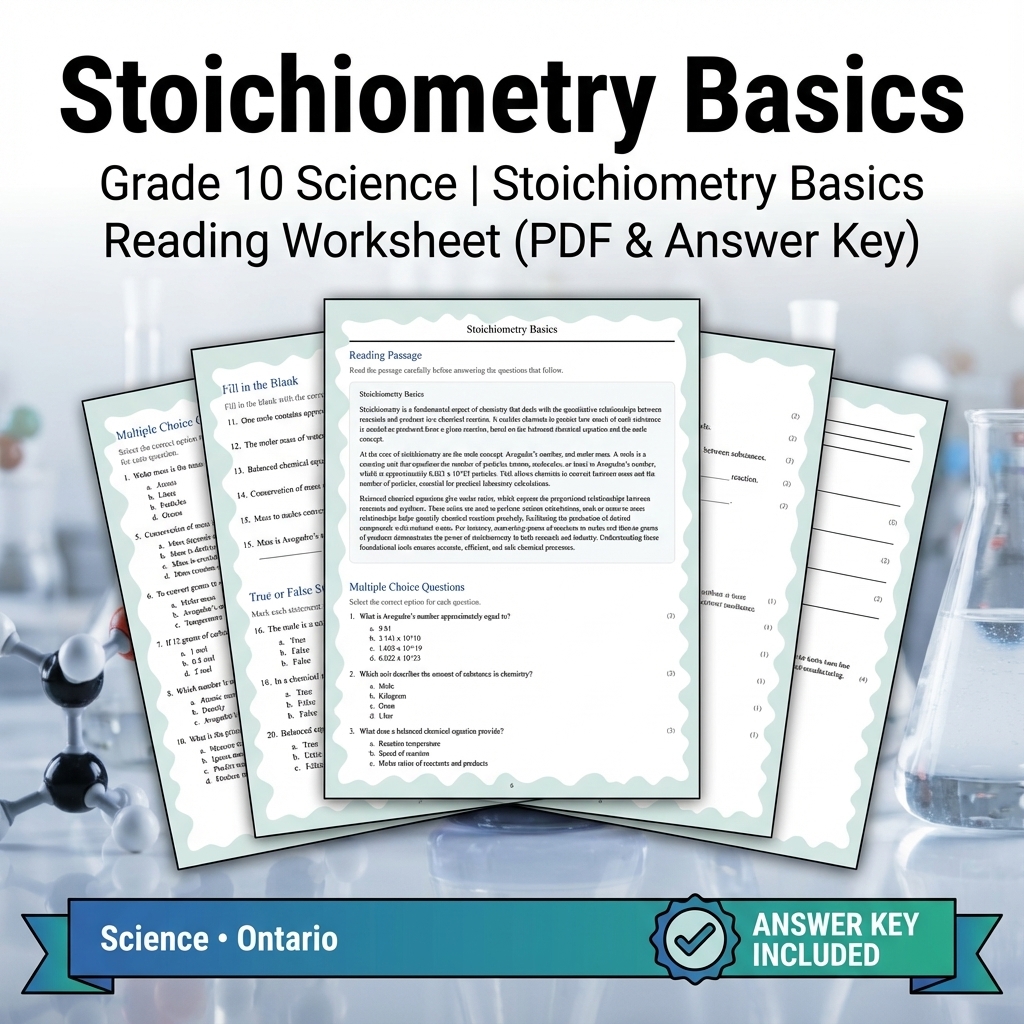
Grade 10 Science | Stoichiometry Basics Reading Worksheet (PDF & Answer Key)
JCreated byJ.S SheetsLearning Objectives
- Understand the mole concept and Avogadro's number as tools for converting between mass and amount of substance.
- Explain how balanced chemical equations are used to derive molar ratios.
- Perform mass-to-mass conversions in chemical reactions using molar relationships.
Also included in: Grade 10 Science Unit Bundle | Chemistry, Atomic Structure & Reactions +1 more
Instant download
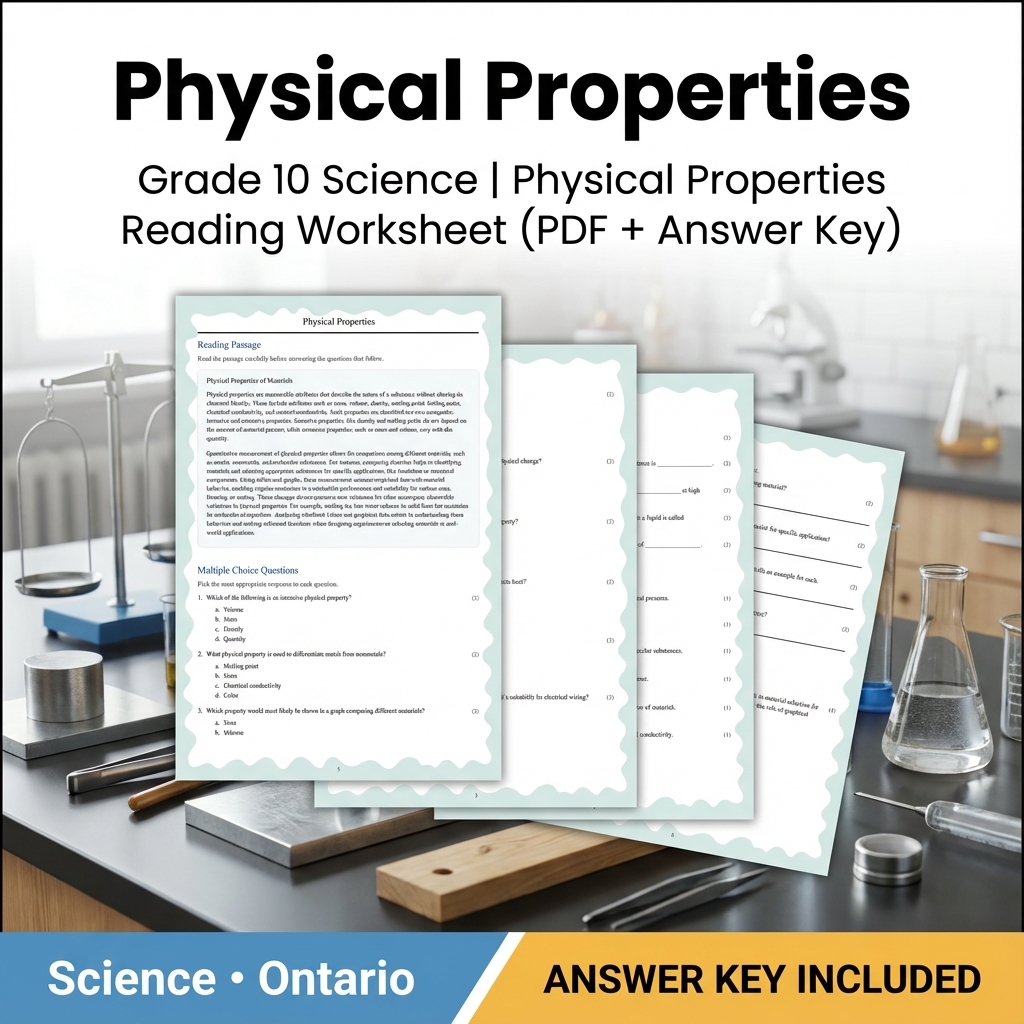
Grade 10 Science | Physical Properties Reading Worksheet (PDF + Answer Key)
JCreated byJ.S SheetsLearning Objectives
- Understand measurable physical attributes such as mass, density, melting point, and conductivity.
- Differentiate between intensive and extensive properties of materials.
- Interpret tabulated and graphical data related to physical properties.
Also included in: Grade 10 Science Unit Bundle | Chemistry, Atomic Structure & Reactions +1 more
Instant download
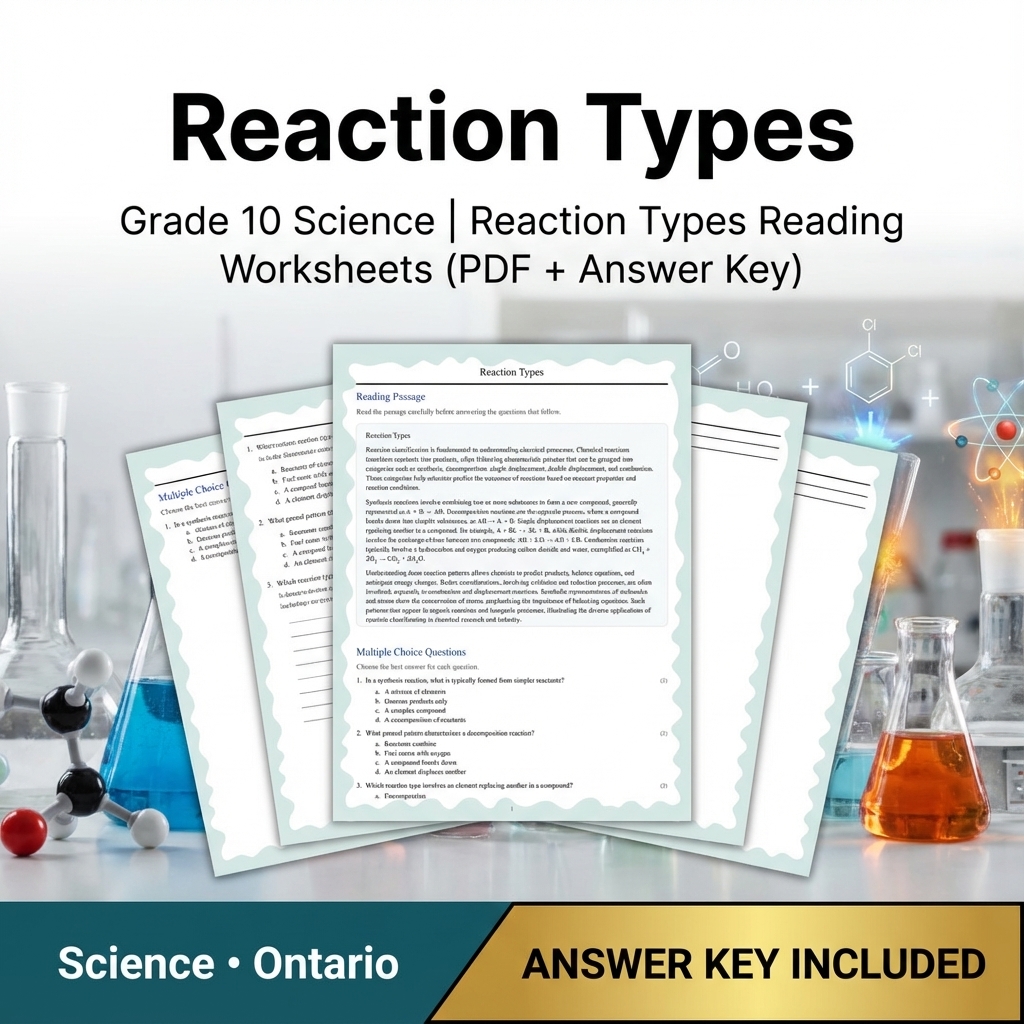
Grade 10 Science | Reaction Types Reading Worksheets (PDF + Answer Key)
JCreated byJ.S SheetsLearning Objectives
- Classify chemical reactions into synthesis, decomposition, single displacement, double displacement, and combustion categories.
- Recognize characteristic reactant-product patterns in different reaction types.
- Understand redox considerations and predict possible product classes.
Also included in: Grade 10 Science Unit Bundle | Chemistry, Atomic Structure & Reactions +1 more
Instant download
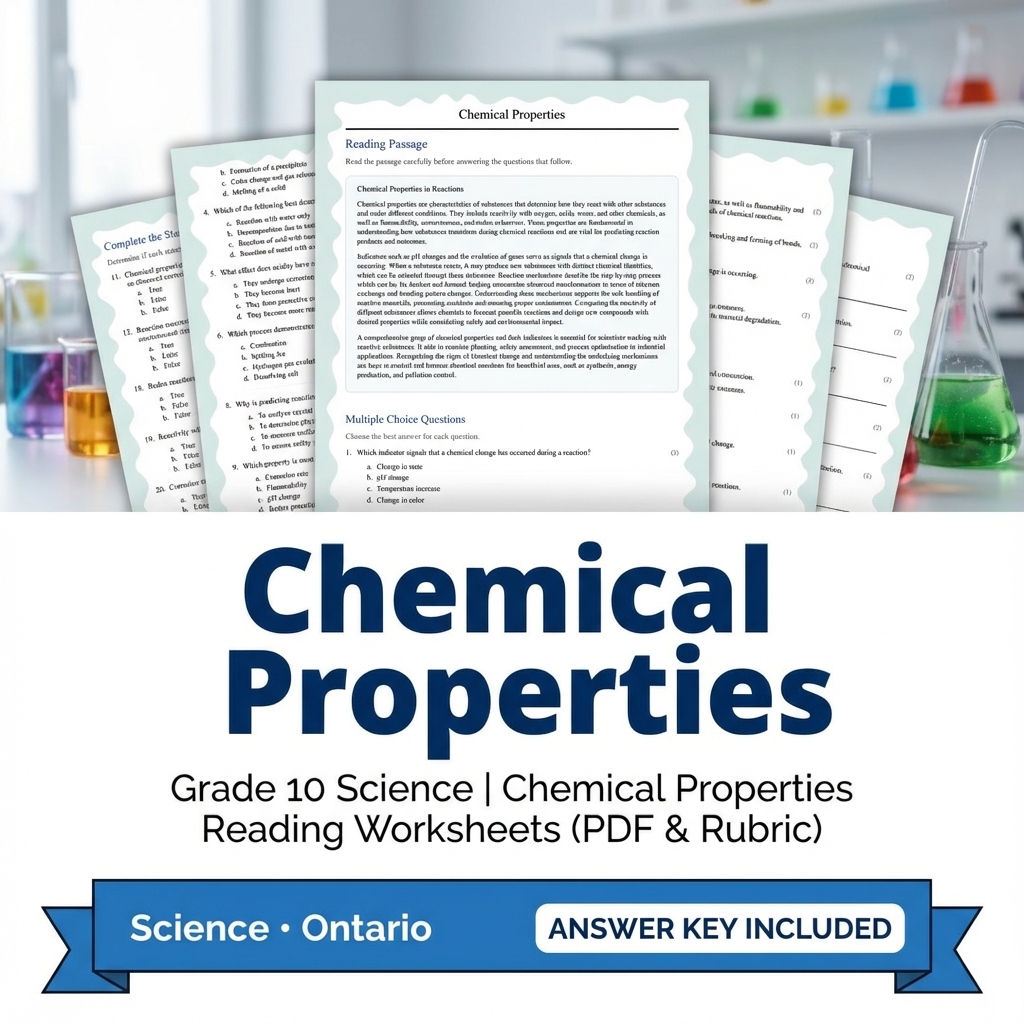
Grade 10 Science | Chemical Properties Reading Worksheets (PDF & Rubric)
JCreated byJ.S SheetsLearning Objectives
- Understand the concept of chemical properties and how they differ from physical properties.
- Identify indicators of chemical changes such as gas evolution and pH changes.
- Explain reaction mechanisms and how bonding patterns change during reactions.
Also included in: Grade 10 Science Unit Bundle | Chemistry, Atomic Structure & Reactions +1 more
Instant download
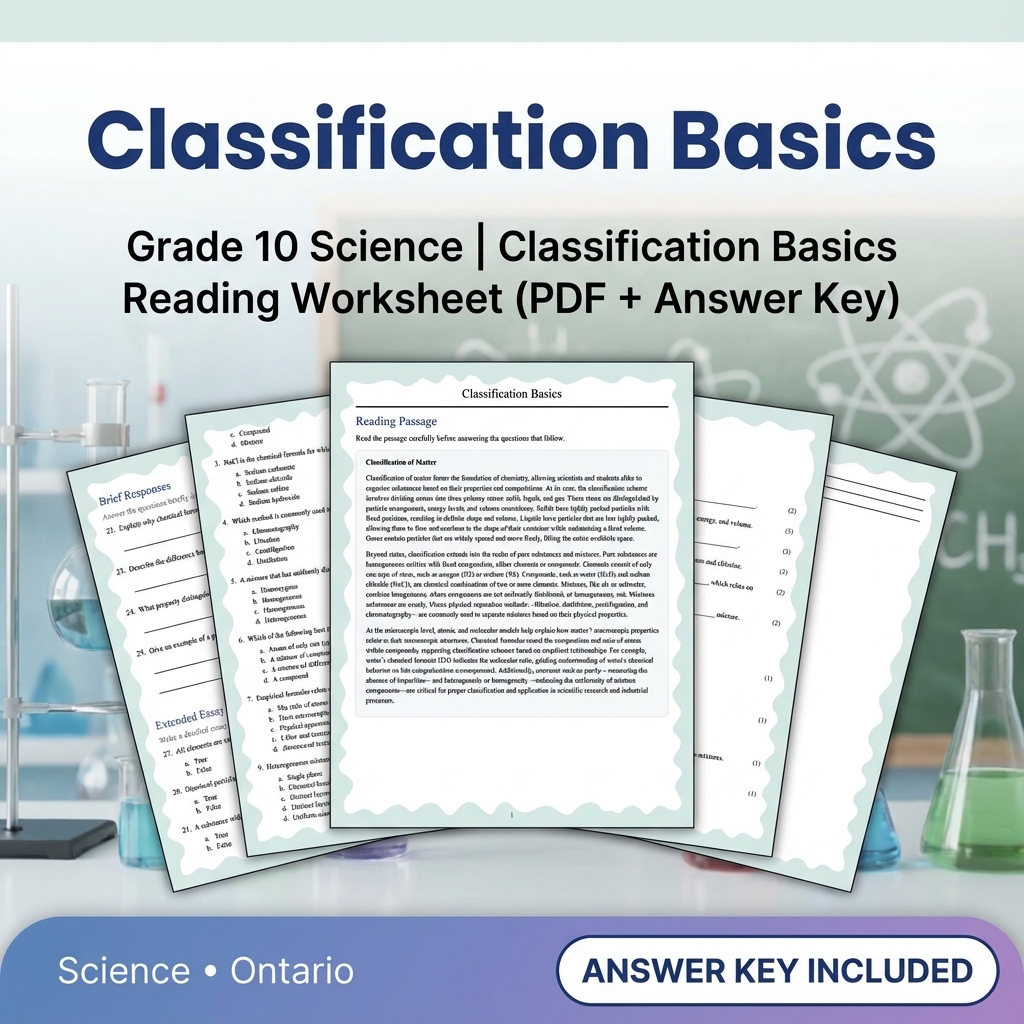
Grade 10 Science | Classification Basics Reading Worksheet (PDF + Answer Key)
JCreated byJ.S SheetsLearning Objectives
- Understand the fundamental schemes for classifying matter such as states, pure substances, and mixtures.
- Identify the differences between elements and compounds with examples like oxygen, water, and sodium chloride.
- Learn how atomic composition, chemical formulas, and empirical relationships support classification.
Also included in: Grade 10 Science Unit Bundle | Chemistry, Atomic Structure & Reactions +1 more
Instant download
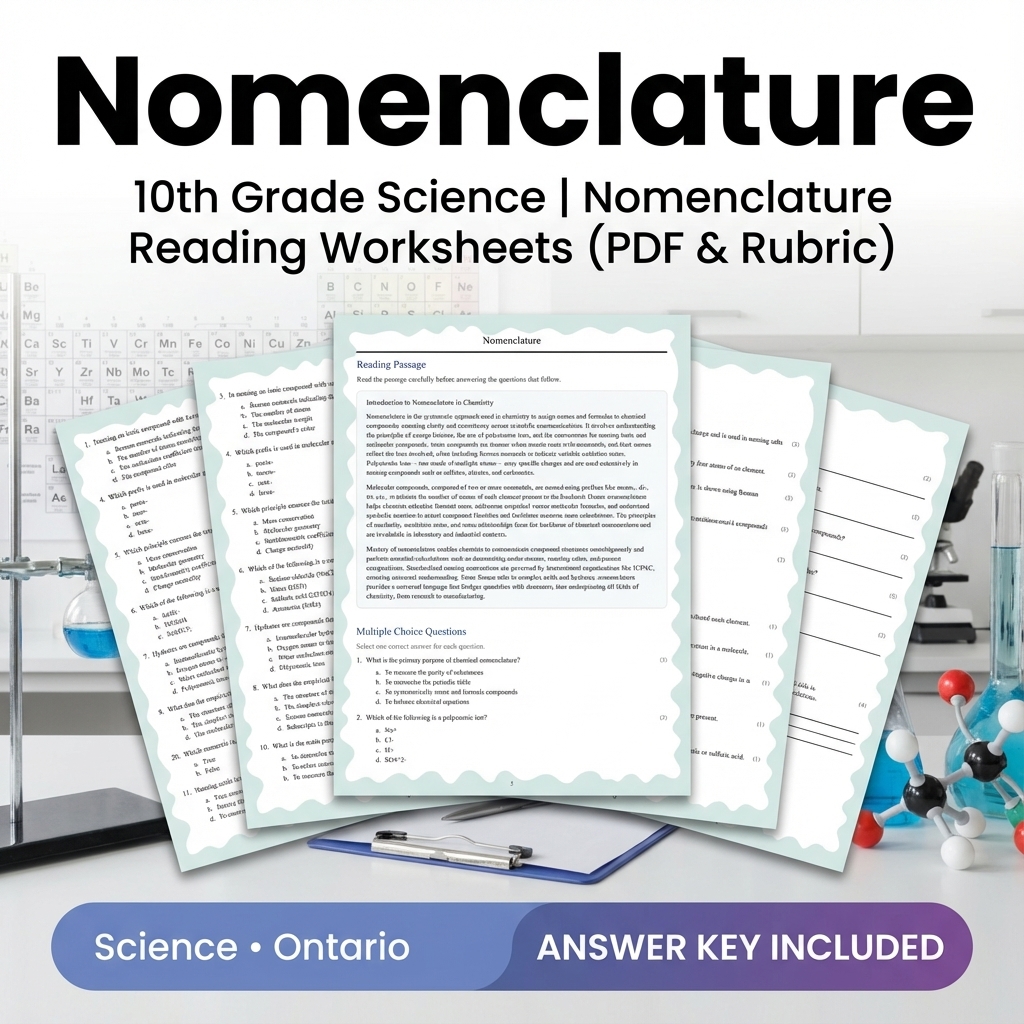
10th Grade Science | Nomenclature Reading Worksheets (PDF & Rubric)
JCreated byJ.S SheetsLearning Objectives
- Understand the systematic naming conventions for ionic and molecular compounds.
- Identify polyatomic ions and their use in chemical formulas.
- Apply charge balance principles to construct and interpret chemical formulas.
Also included in: Grade 10 Science Unit Bundle | Chemistry, Atomic Structure & Reactions +1 more
Instant download
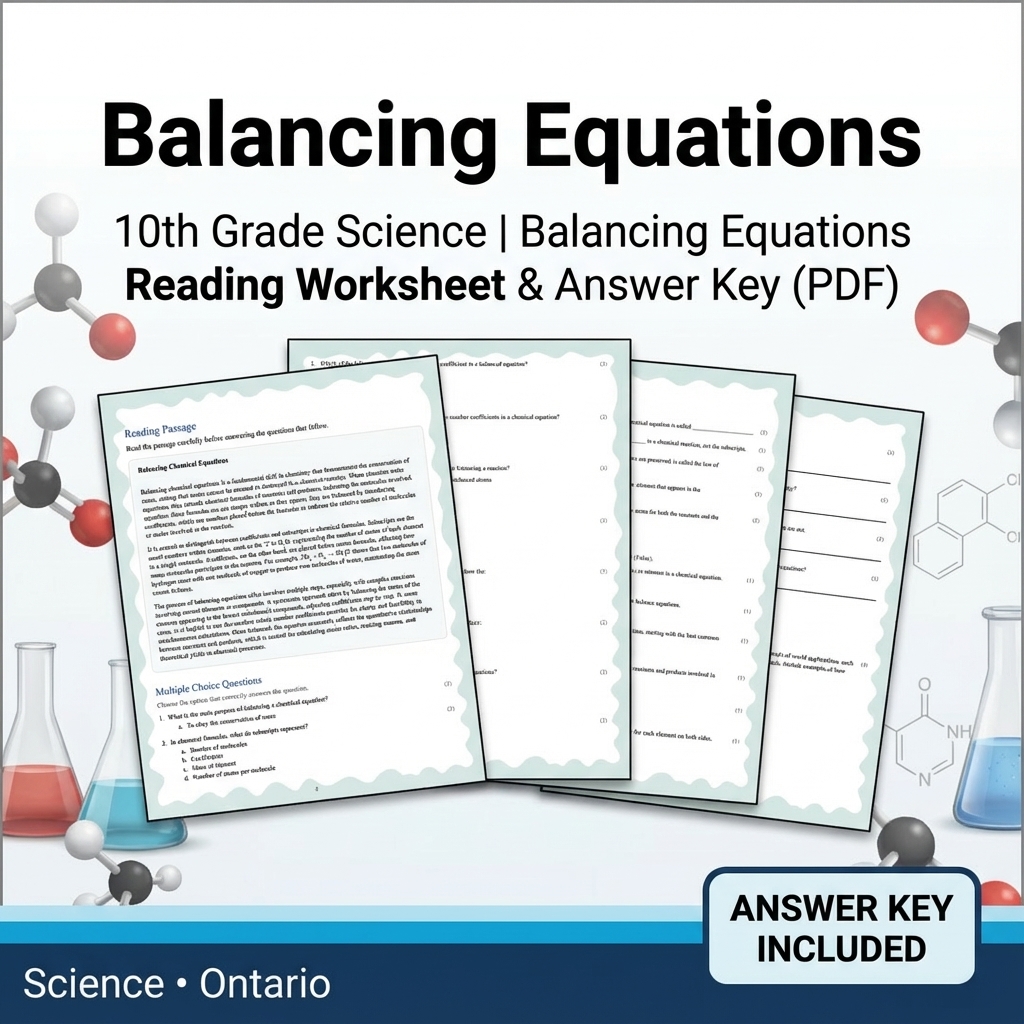
10th Grade Science | Balancing Equations Reading Worksheet & Answer Key (PDF)
JCreated byJ.S SheetsLearning Objectives
- Understand the concept of balancing chemical equations using coefficients.
- Differentiate between coefficients and subscripts in chemical formulas.
- Learn systematic strategies for balancing complex, multi-step chemical equations.
Also included in: Grade 10 Science Unit Bundle | Chemistry, Atomic Structure & Reactions +1 more
Instant download
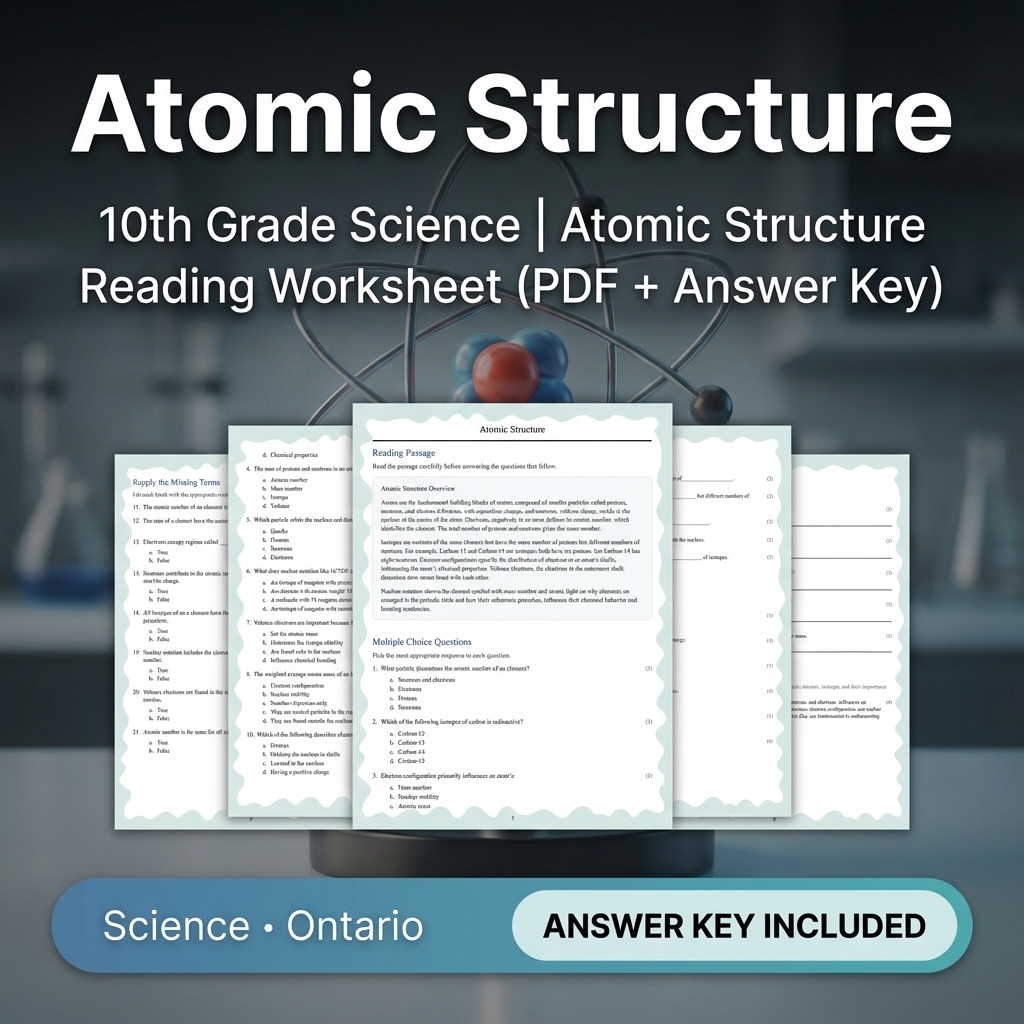
10th Grade Science | Atomic Structure Reading Worksheet (PDF + Answer Key)
JCreated byJ.S SheetsLearning Objectives
- Describe the basic components of atomic structure: protons, neutrons, and electrons.
- Explain the significance of atomic number and mass number, including isotopes.
- Understand electron configuration and valence electrons related to chemical behavior.
Also included in: Grade 10 Science Unit Bundle | Chemistry, Atomic Structure & Reactions +1 more
Instant download

Grade 10 Atomic Structure Worksheet | Practice & Assessment PDF
 Created byClear Sky Classroom
Learning Objectives
- Explain the roles of protons, neutrons, and electrons in determining atomic structure and identity.
- Use evidence from emission spectra and scattering experiments to support models of electron distribution.
- Connect quantum numbers and shell/subshell ideas to observable atomic properties.
Also included in: Grade 10 Chemistry Foundations Science Lesson Bundle: AP Worksheet Set +1 more
Instant download
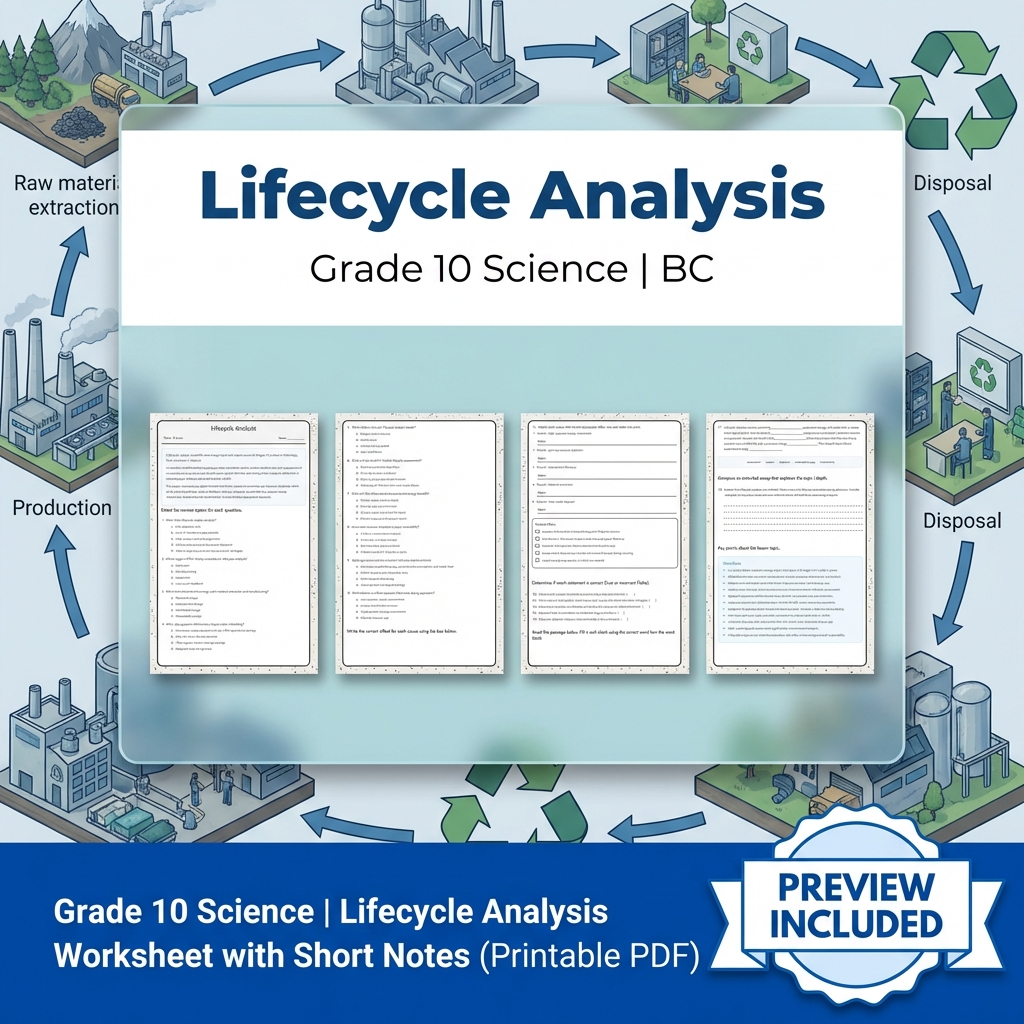
Grade 10 Science | Lifecycle Analysis Worksheet with Short Notes (Printable PDF)
Created byMeadowlark WorksheetsLearning Objectives
- Understand the concept of lifecycle analysis and its significance in evaluating energy consumption.
- Identify the stages involved in the lifecycle of a technology from cradle to grave.
- Apply conservation principles to calculate net energy benefits or deficits.
Also included in: Grade 10 Science Lesson Bundle | Energy & Thermodynamics Worksheets +1 more
Instant download

Radiation Budgets and Climate Balance Worksheet | Grade 10 Science
 Created bythe curious pencil
Learning Objectives
- Explain how incoming sunlight and outgoing radiation affect Earth's energy budget.
- Calculate reflected and unreflected energy percentages in simplified radiation models.
- Interpret how greenhouse gases influence infrared energy transfer and climate.
Instant download

Membrane Transport Worksheets | Diffusion and Osmosis Grade 10 Science
Created bythe curious pencilLearning Objectives
- Explain how concentration gradients influence diffusion across membranes.
- Distinguish osmosis from the diffusion of dissolved substances.
- Compare facilitated diffusion, active transport, and vesicle transport.
Instant download

Biomes and Climatographs Worksheets | Grade 10 Climate Science
Created bythe curious pencilLearning Objectives
- Identify temperature and precipitation patterns associated with major biomes.
- Interpret climatographs to compare monthly climate conditions.
- Explain how topography influences temperature, precipitation, and habitats.
Instant download

Uneven Solar Heating and Global Circulation Science Worksheets Grade 10
Created bythe curious pencilLearning Objectives
- Explain how latitude and seasonal daylight affect solar heating.
- Describe how albedo influences the absorption of solar energy.
- Explain how air and ocean currents redistribute thermal energy.
Instant download

Chemical Reaction Types and Balancing Equations Worksheet Grade 10
Created bythe curious pencilLearning Objectives
- Identify synthesis, decomposition, and replacement reaction patterns
- Predict products for common chemical reaction types
- Balance chemical equations using coefficients to conserve atoms
Instant download

Chemical Bonding, Formulas and Naming Compounds Worksheet Grade 10
Created bythe curious pencilLearning Objectives
- Predict ionic compound formulas using common ion charges.
- Explain how charge balance determines ionic compound formulas.
- Interpret subscripts in molecular formulas such as CO₂.
Instant download

Plant Responses and Experimental Evidence Worksheet Grade 10 Science
Created bythe curious pencilLearning Objectives
- Differentiate phototropism from gravitropism using plant growth examples.
- Explain how directional light influences the growth of young shoots.
- Compare controlled investigations of plant responses using experimental evidence.
Instant download

Plant Responses to Light and Gravity Worksheet | Grade 10 Science
Created bythe curious pencilLearning Objectives
- Explain how shoots respond to directional light.
- Compare historical experiments investigating plant growth responses.
- Identify controlled variables in plant-growth investigations.
Instant download

Plant Responses and Experimental Evidence Worksheet Grade 10 Science
Created bythe curious pencilLearning Objectives
- Differentiate phototropism from gravitropism using plant growth examples.
- Explain how directional light influences the growth of young shoots.
- Compare controlled investigations of plant responses using experimental evidence.
Instant download

Plant Transport and Gas Exchange Worksheet | Grade 10 Science
Created bythe curious pencilLearning Objectives
- Compare the transport roles of xylem and phloem.
- Explain how cohesion, adhesion, and transpiration contribute to water movement.
- Describe how stomata and guard cells regulate gas exchange.
Instant download

Atomic Models and Atomic Structure Worksheet | Grade 10 Science
Created bythe curious pencilLearning Objectives
- Explain how experimental evidence leads scientists to revise atomic models
- Identify the locations and electrical charges of subatomic particles
- Compare protons, neutrons, and electrons by charge and location
Instant download

Chemical Change and Energy Transfer Worksheets | Grade 10 Science
Created bythe curious pencilLearning Objectives
- Distinguish chemical changes from physical changes using observable evidence
- Explain energy transfer during endothermic and exothermic processes
- Interpret temperature observations while recognizing measurement uncertainty
Instant download

Energy Transformations and Technology Design Worksheet Grade 10 Science
Created bythe curious pencilLearning Objectives
- Identify useful energy outputs and other transfers in operating devices.
- Compare energy transformations in historical and modern technologies.
- Explain how engineers use evidence to improve device designs.
Instant download

Solubility and Chemical Properties Worksheet Grade 10 Science
Created bythe curious pencilLearning Objectives
- Compare substances using conductivity, pH, solubility, and physical state data
- Interpret solubility charts to predict dissolving behaviour under stated conditions
- Explain how water's molecular structure influences its solvent properties
Instant download

Moles and Conservation of Mass Worksheets | Grade 10 Chemistry
Created bythe curious pencilLearning Objectives
- Explain how the mole represents a specified number of chemical entities
- Calculate the number of entities represented by an amount in moles
- Use molar mass to calculate the mass of a substance
Instant download

Microscopy and Cell Theory Worksheet | Grade 10 Science
Created bythe curious pencilLearning Objectives
- Explain how microscopy contributed to the development of cell theory
- Distinguish magnification from resolution in microscope images
- Identify factors that limit the quality of microscope observations
Instant download

Surface Area to Volume Ratio Worksheet | Grade 10 Cell Biology
Created bythe curious pencilLearning Objectives
- Calculate the surface area of cube-shaped cell models.
- Determine the volume of cubes using their side lengths.
- Compare surface-area-to-volume ratios across different model sizes.
Instant download

Chemical Investigation and Evidence-Based Decisions Worksheet Grade 10
Created bythe curious pencilLearning Objectives
- Identify testable questions and predictions for chemical investigations.
- Distinguish independent variables, dependent variables, and controlled conditions.
- Explain how repeated measurements reveal variation and uncertainty.
Instant download

Thermal Efficiency and Heat Engines Worksheet | Grade 10 Science
Created bythe curious pencilLearning Objectives
- Define useful output energy for a specified device task.
- Calculate thermal device efficiency using consistent energy units.
- Interpret efficiency percentages when comparing thermal device designs.
Instant download

Climate Change Evidence and Human Impacts Worksheet | Grade 10 Science
Created bythe curious pencilLearning Objectives
- Identify direct and indirect evidence used to investigate past climate conditions.
- Interpret climate records to distinguish weather variability from long-term patterns.
- Explain how fossil fuels and deforestation influence Earth's energy balance.
Instant download

Uneven Heating and Global Circulation Worksheet | Grade 10 Science
Created bythe curious pencilLearning Objectives
- Explain how latitude and seasonal daylight affect solar heating.
- Compare how surface reflectivity influences the absorption of solar energy.
- Describe how atmospheric and ocean circulation redistribute thermal energy.
Instant download

Thermal Energy Efficiency and Heat Engines Worksheet Grade 10 Science
Created bythe curious pencilLearning Objectives
- Calculate device efficiency from useful output and total input energy
- Compare useful output energy with energy supplied to a device
- Explain why heat engines cannot convert all thermal input into useful work
Instant download

Work, Gravitational Potential and Kinetic Energy Worksheet Grade 10
Created bythe curious pencilLearning Objectives
- Calculate mechanical work using force and displacement.
- Interpret force–distance graphs to determine work.
- Calculate gravitational potential energy using mass, height, and gravity.
Instant download
About Grade 10 Science Worksheets
Find Science worksheets built for Grade 10. All 7,069 cover core skills, practice, and review, each an instant PDF download.
Every worksheet on MyTeachingSheets is created by independent teacher-authors and reviewed before publication. All resources download as printable PDFs for classroom, homework, or at-home practice, and many include answer keys. Preview any worksheet free before buying.