
Grade 11 Science Worksheets
6,616 worksheets
Grade 11 Science – Introduction to Molecular Phylogeny Worksheet + Answer Key
JCreated byJ.S SheetsLearning Objectives
- Understand the role of DNA, RNA, and protein sequences in studying evolutionary relationships.
- Learn how sequence alignment helps identify homologous positions across different species.
- Familiarize with models of molecular evolution and their importance in phylogenetic analysis.
Also included in: Grade 11 Science Lesson Group Bundle TEKS | Evolution & Classification +1 more
Instant download
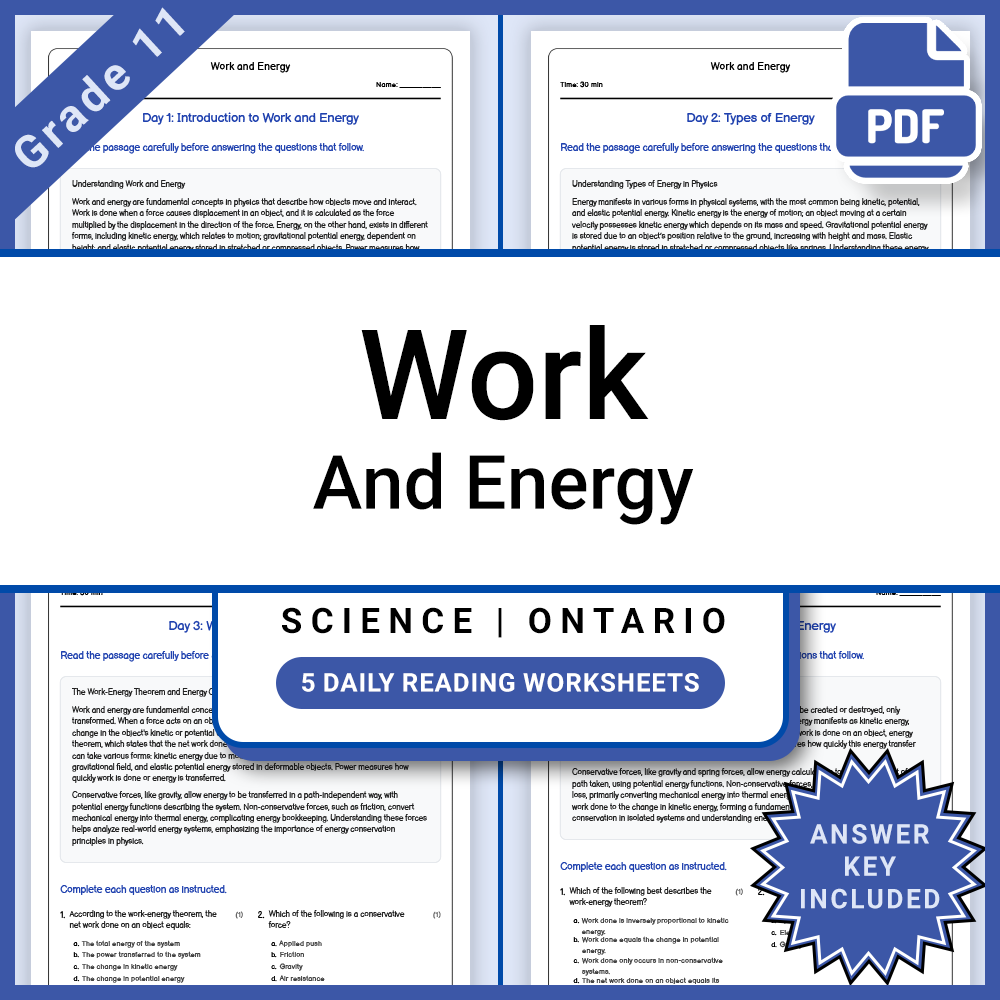
Grade 11 Science – Work and Energy Daily Reading Worksheet with Answer Key
JCreated byJ.S SheetsLearning Objectives
- Understand the formalism of work and energy in mechanical systems.
- Differentiate between kinetic, gravitational potential, and elastic potential energies.
- Explain the concept of power as the rate of energy transfer.
Also included in: Grade 11 Science Lesson Bundle for Ontario Curriculum +1 more
Instant download
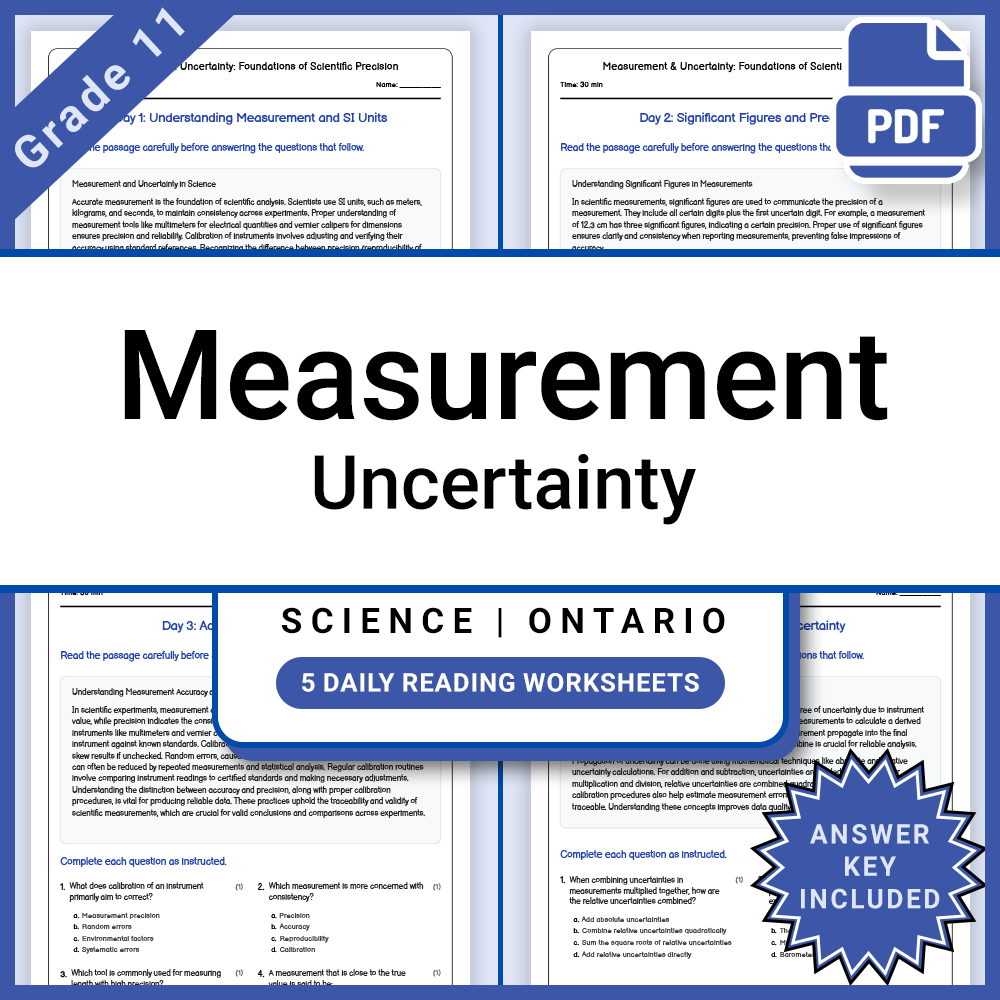
Grade 11 Science – Measurement & Uncertainty Daily Worksheet + Answer Key
JCreated byJ.S SheetsLearning Objectives
- Understand key SI units and their conversions commonly used in science experiments
- Identify different measurement tools such as multimeters and vernier calipers and their proper usage
- Explain the importance of calibration, precision, accuracy, and their effects on data quality
Also included in: Grade 11 Science Lesson Bundle: Comprehensive Ontario Curriculum Resources +1 more
Instant download
Grade 11 – Mechanics Principles Motion and Vectors Worksheet + Answer Key
JCreated byJ.S SheetsLearning Objectives
- Understand the concept of vectors in describing motion
- Identify and analyze different types of motion using vector quantities
- Apply vector addition and subtraction to real-world scenarios
Also included in: Grade 11 Science Lesson Bundle: Comprehensive Ontario Curriculum Resources +1 more
Instant download
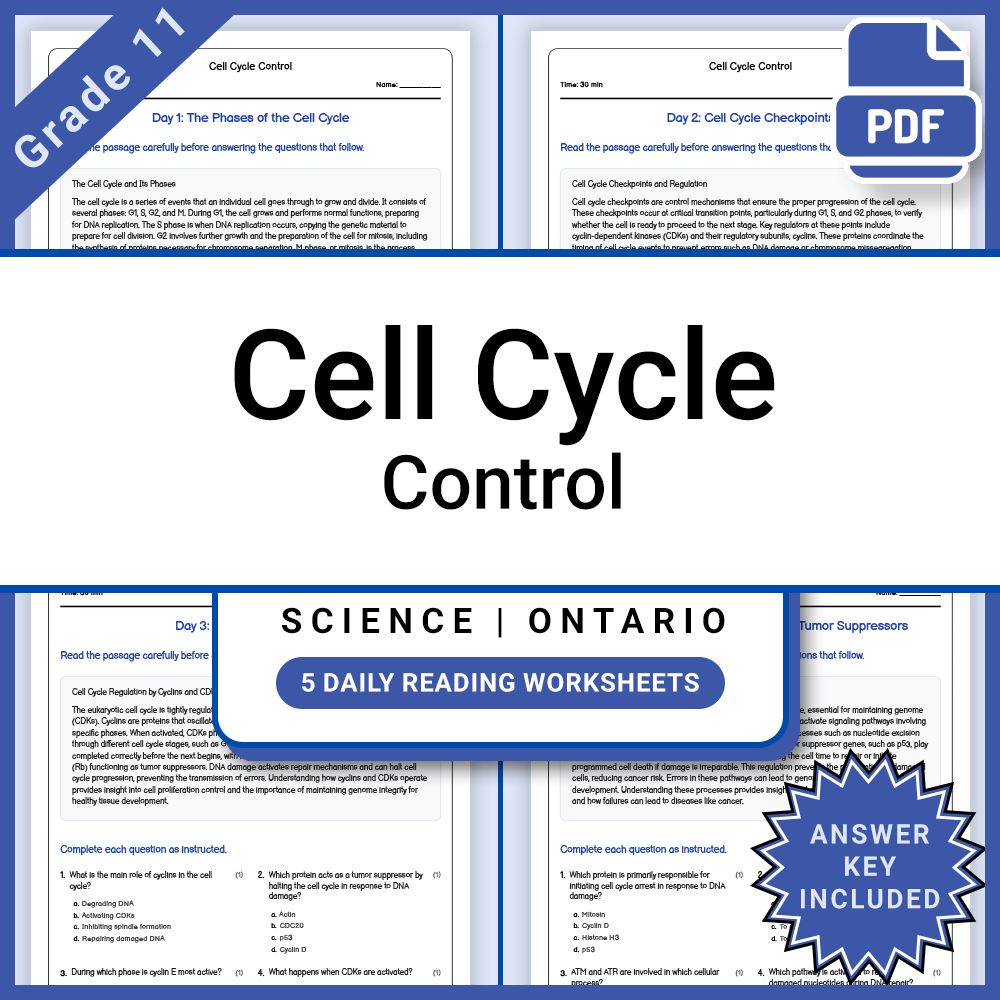
Grade 11 Science – Cell Cycle Control Daily Reading Worksheet + Answer Key
JCreated byJ.S SheetsLearning Objectives
- Understand key concepts related to Science
- Apply knowledge through practice questions
- Demonstrate comprehension of the material
Also included in: Grade 11 Science Lesson Bundle | Ontario Standards for Biology and Chemistry +1 more
Instant download
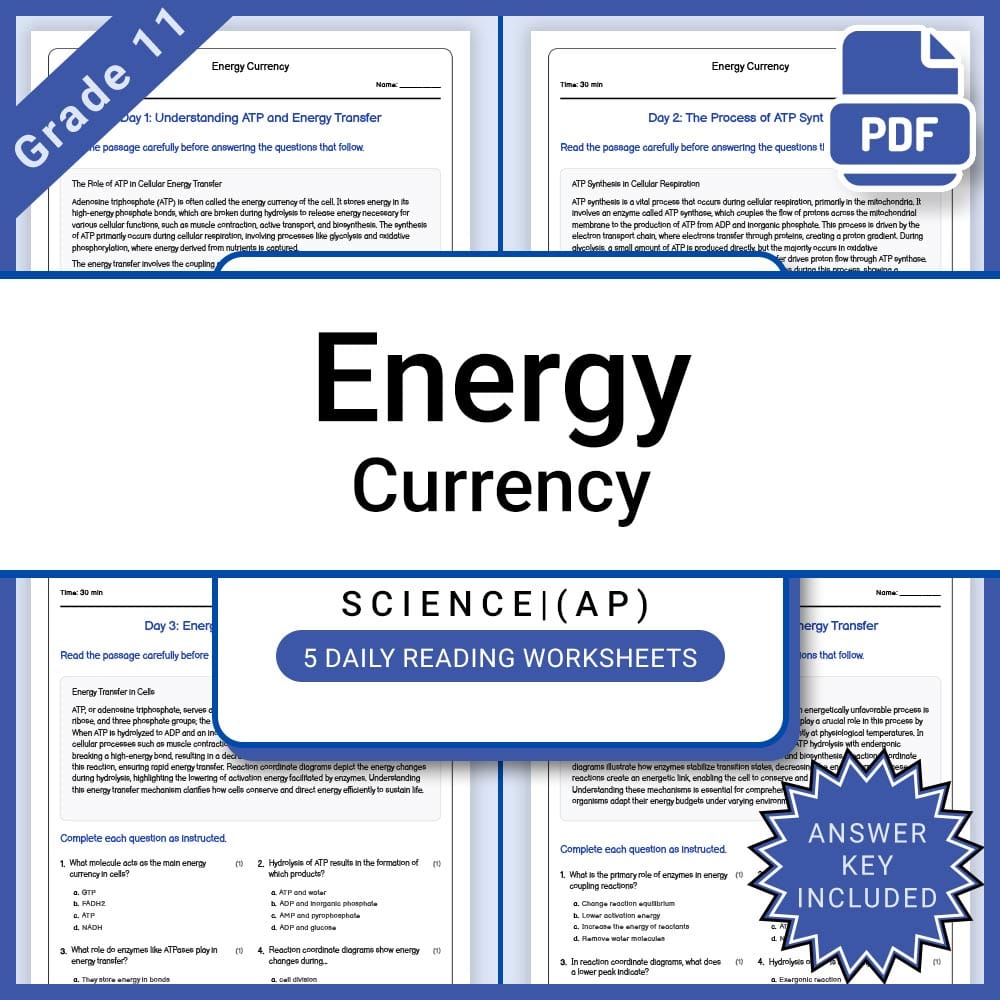
Grade 11 Science – Energy Currency Daily Reading Worksheet with Answer Key
JCreated byJ.S SheetsLearning Objectives
- Understand the role of ATP as the primary energy currency in cells.
- Learn how energy is transferred and transformed during biochemical reactions.
- Explore concepts of free energy, reaction coordinate, and enzyme kinetics in energy transfer.
Also included in: Grade 11 Science Biology and Ecosystems AP Lesson Bundle +1 more
Instant download
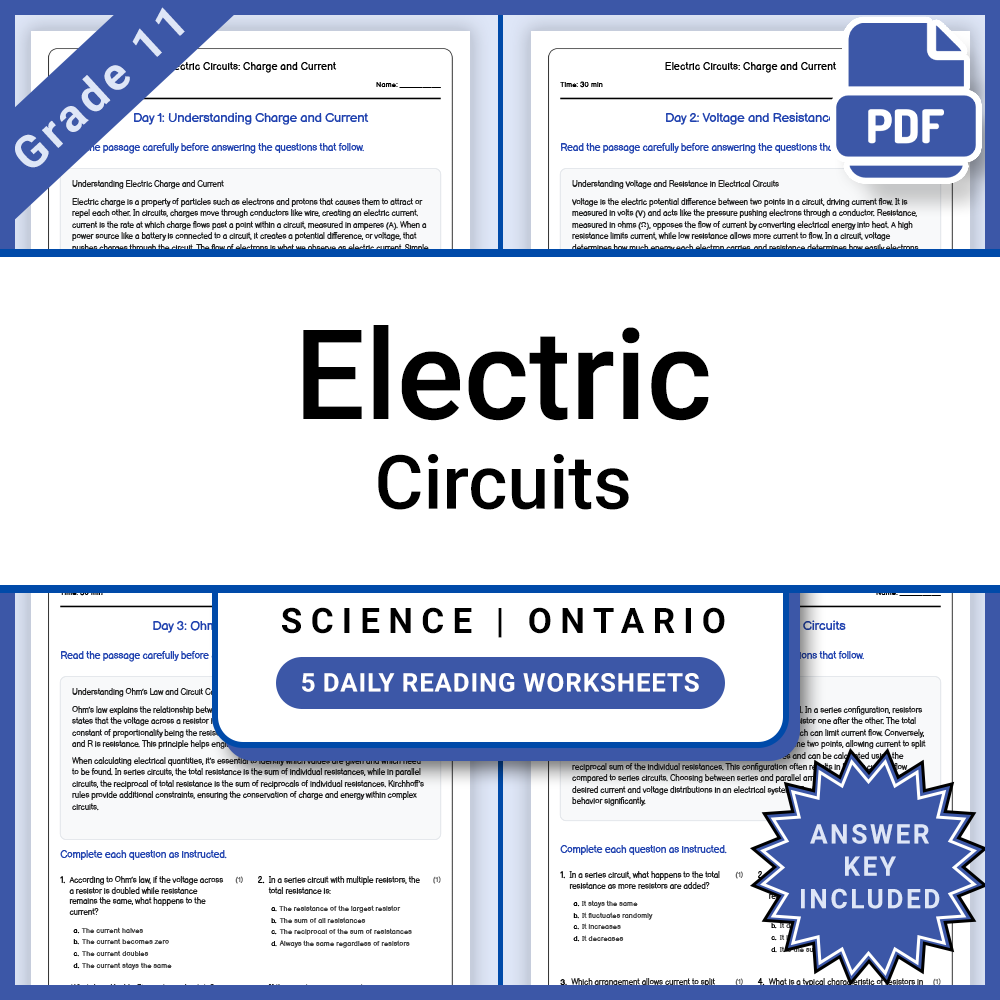
Grade 11 Science Electric Circuits Daily Reading Worksheet with Answer Key
JCreated byJ.S SheetsLearning Objectives
- Understand the concept of electric charge and how it causes attraction and repulsion.
- Explain what electric current is and how it is measured in amperes.
- Describe how voltage pushes charges through a circuit.
Also included in: Grade 11 Science Lesson Bundle for Ontario Curriculum +1 more
Instant download
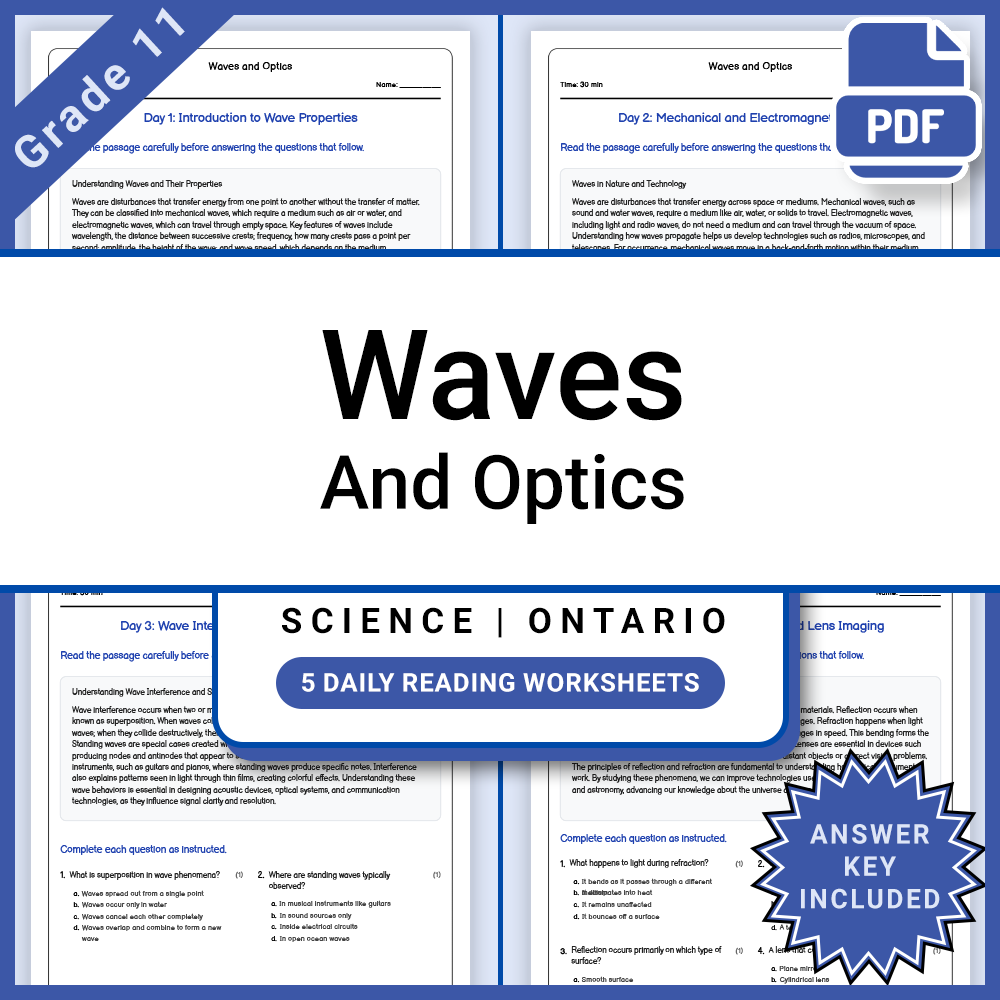
Grade 11 Science – Waves and Optics Daily Reading Worksheet with Answer Key
JCreated byJ.S SheetsLearning Objectives
- Identify and describe basic wave features such as wavelength, frequency, amplitude, and speed.
- Explain the principles of wave superposition and interference.
- Understand basic optics principles including reflection, refraction, and lens imaging.
Also included in: Grade 11 Science Lesson Bundle: Comprehensive Ontario Curriculum Resources +1 more
Instant download
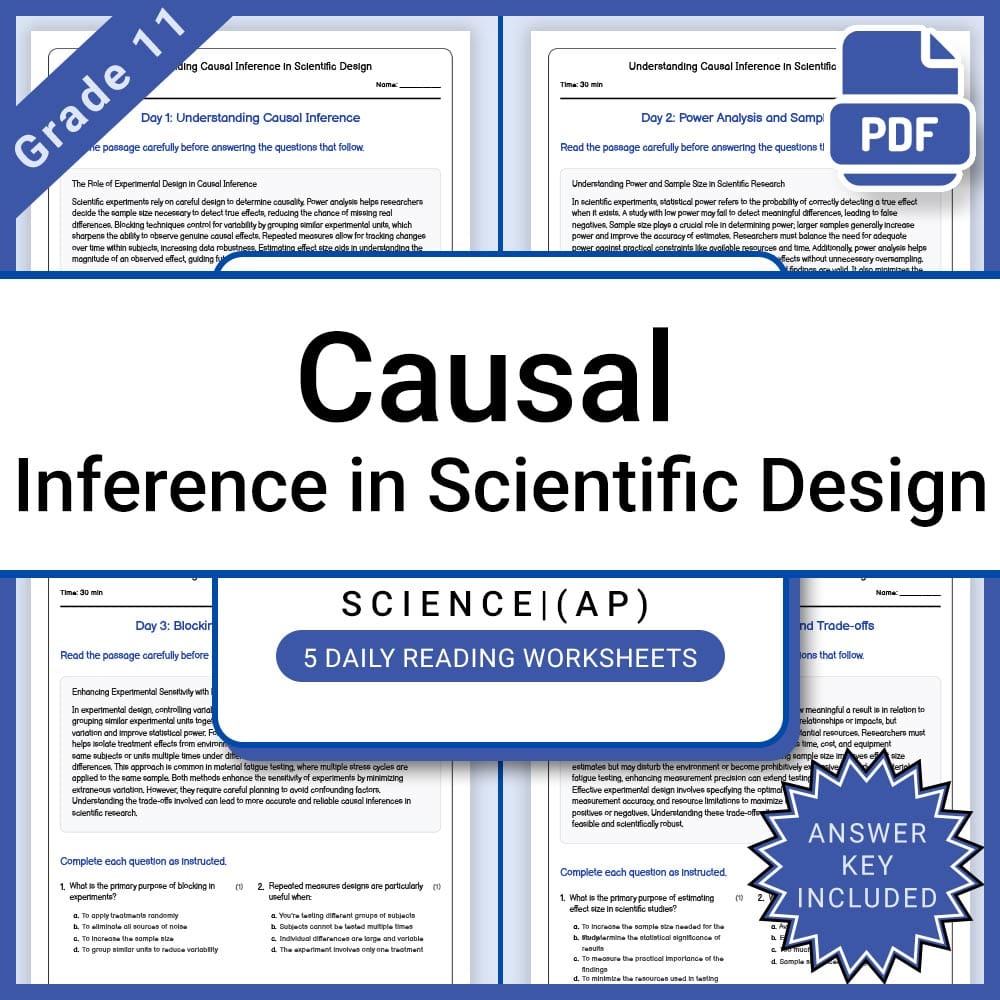
Grade 11 Science – Causal Inference Daily Reading Worksheet with Answer Key
JCreated byJ.S SheetsLearning Objectives
- Identify key concepts of causal inference, including power analysis, blocking, and effect size.
- Interpret how experimental design supports robust causal conclusions.
- Apply knowledge of design trade-offs related to sample size, measurement precision, and practical constraints.
Also included in: AP Biology Cell Structure and Function Activities | Grade 11 Advanced Placement +1 more
Instant download
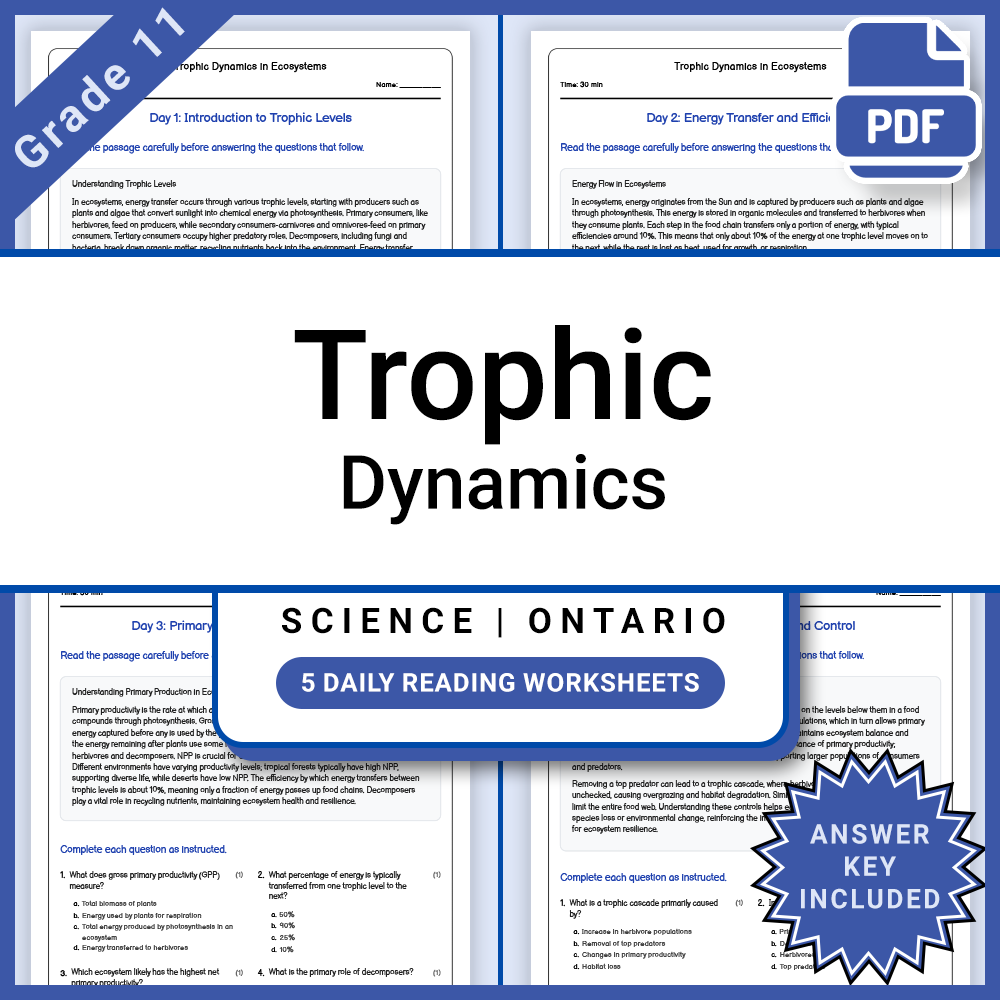
Grade 11 Science – Trophic Dynamics in Ecosystems | Daily Worksheet + Answer Key
JCreated byJ.S SheetsLearning Objectives
- Identify the different trophic levels in a food chain
- Explain the flow of energy across trophic levels
- Understand concepts of primary production, gross and net productivity
Also included in: Grade 11 Science Lesson Bundle | Ecosystem Dynamics and Sustainability +1 more
Instant download
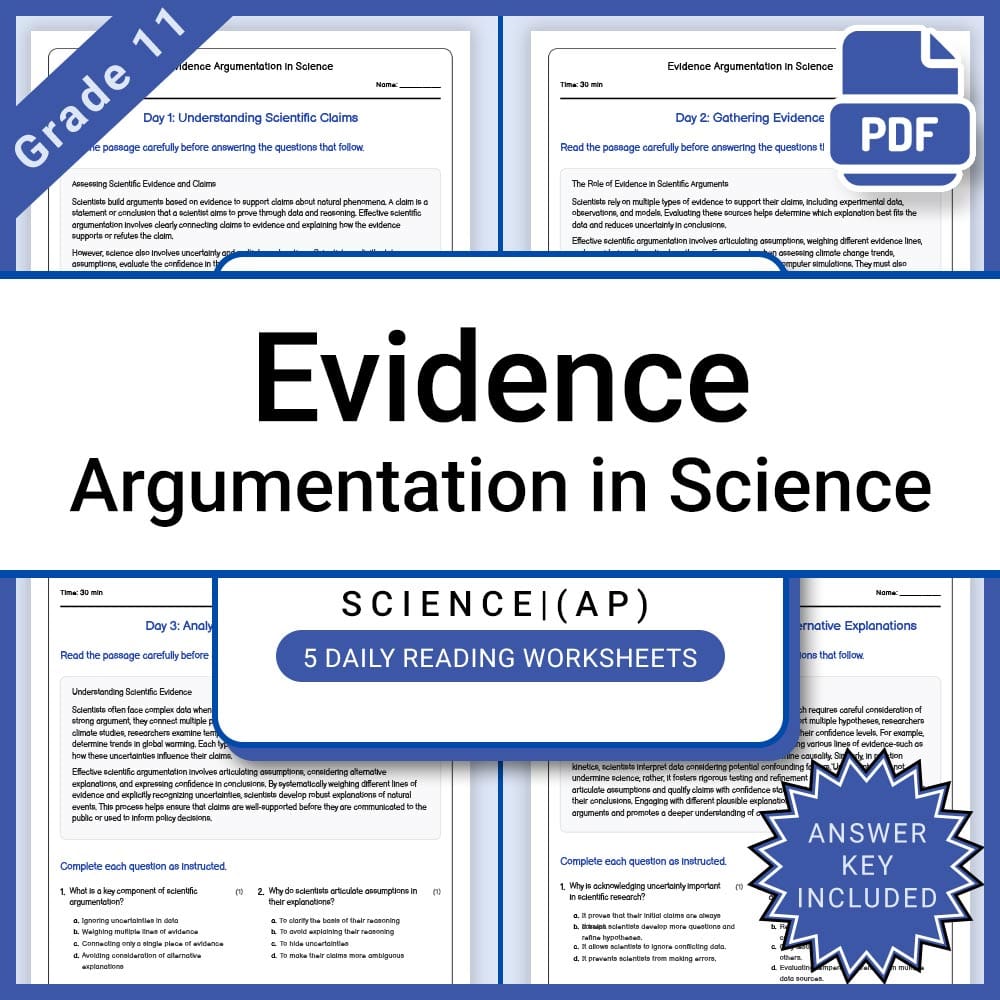
Grade 11 Science – Evidence Argumentation Daily Reading Worksheet + Answer Key
JCreated byJ.S SheetsLearning Objectives
- Identify main claims within scientific arguments
- Understand how evidence supports claims
- Recognize uncertainty and alternative explanations in science
Also included in: AP Biology Cell Structure and Function Activities | Grade 11 Advanced Placement +1 more
Instant download
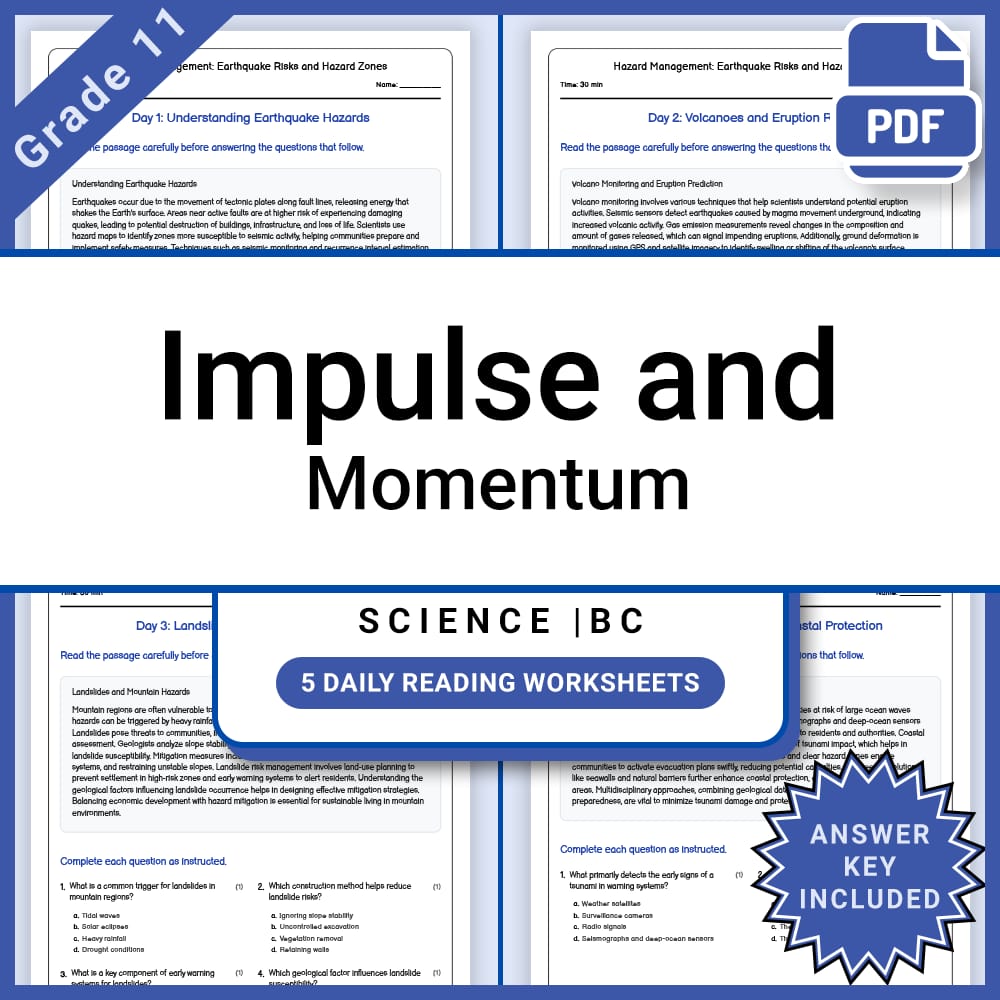
Grade 11 Science – Impulse and Momentum Daily Reading Worksheet + Answer Key
JCreated byJ.S SheetsLearning Objectives
- Understand the concept of linear momentum
- Explain how impulse affects changes in momentum
- Analyze force and time interactions during collisions
Also included in: Grade 11 Science Lesson Bundle BC Framework | Physics and Energy Concepts +1 more
Instant download
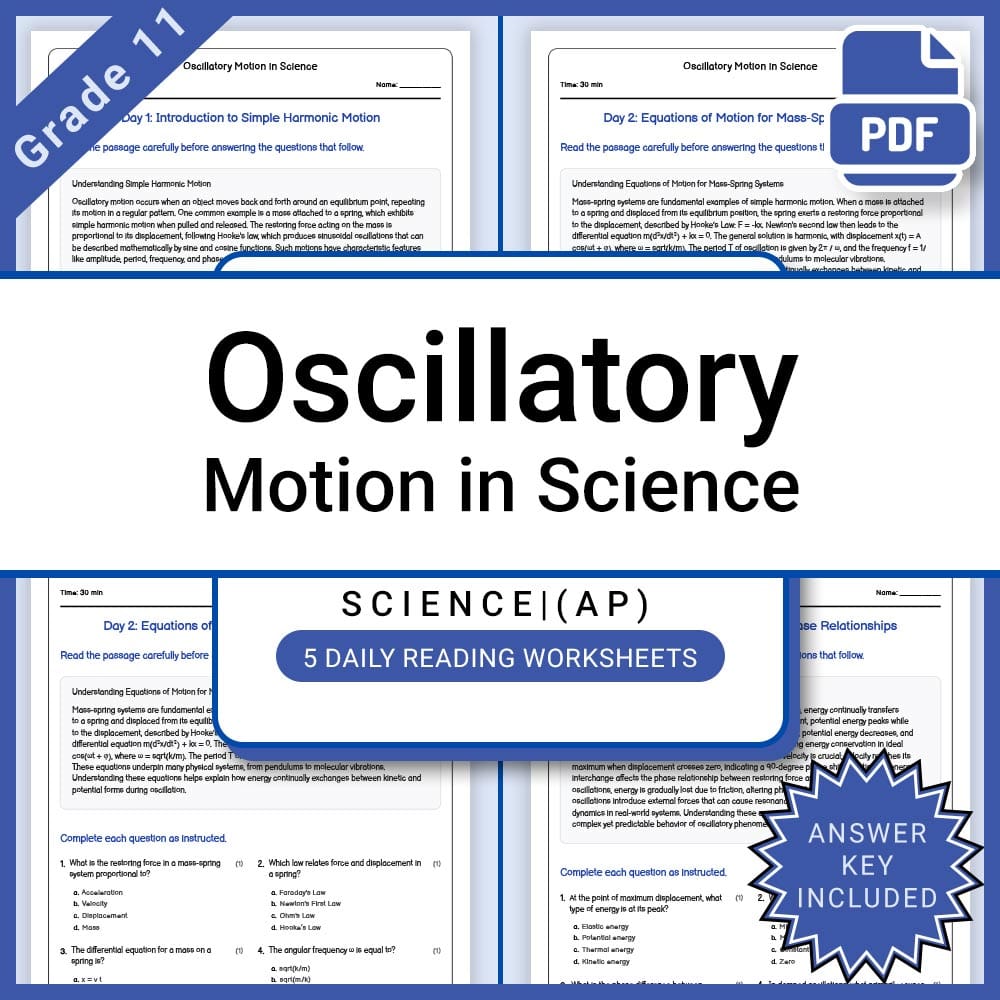
Grade 11 Science – Oscillatory Motion Daily Reading Worksheet + Answer Key
JCreated byJ.S SheetsLearning Objectives
- Understand key concepts related to Science
- Apply knowledge through practice questions
- Demonstrate comprehension of the material
Also included in: AP Physics Principles Activities & Worksheets | Grade 11 Advanced Placement +1 more
Instant download
Grade 11 Science – Biodiversity Metrics | Daily Reading Worksheet + Answer Key
JCreated byJ.S SheetsLearning Objectives
- Identify different measures used to assess biodiversity.
- Understand the concepts of species richness, evenness, and diversity indices.
- Differentiate between alpha, beta, and gamma diversity across spatial scales.
Also included in: Grade 11 Science Lesson Bundle | Ecosystem Dynamics and Sustainability +1 more
Instant download
Grade 11 Science – Systems in Ecology Daily Reading Worksheet + Answer Key
JCreated byJ.S SheetsLearning Objectives
- Understand the basic components and definitions of ecological systems.
- Describe the roles of populations and communities within ecosystems.
- Explain key processes such as biogeochemical cycling and energy flow.
Also included in: Grade 11 Science Lesson Bundle: Comprehensive Ontario Curriculum Resources +1 more
Instant download
Grade 11 Science – Synthesizing Climate Models Worksheet + Answer Key
JCreated byJ.S SheetsLearning Objectives
- Understand how to interpret and evaluate climate models using quantitative data.
- Develop skills in model-based inference to formulate and test scientific hypotheses.
- Analyze the limitations and constraints of scientific models in complex systems.
Also included in: AP Biology Cell Structure and Function Activities | Grade 11 Advanced Placement +1 more
Instant download

Grade 11 Science – Mechanisms of Evolution Daily Reading Worksheet + Answer Key
JCreated byJ.S SheetsLearning Objectives
- Understand the role of mutation in creating genetic variation.
- Explain how natural selection influences allele frequencies.
- Describe genetic drift and its effects in small populations.
Also included in: Grade 11 Science Lesson Group Bundle TEKS | Evolution & Classification +1 more
Instant download
Grade 11 Science – Genetic Code Daily Reading Worksheet + Answer Key
JCreated byJ.S SheetsLearning Objectives
- Understand the structure and function of DNA in heredity
- Explain the processes of transcription and translation
- Identify different types of genetic mutations and their effects
Also included in: Grade 11 Science Biology and Ecosystems AP Lesson Bundle +1 more
Instant download
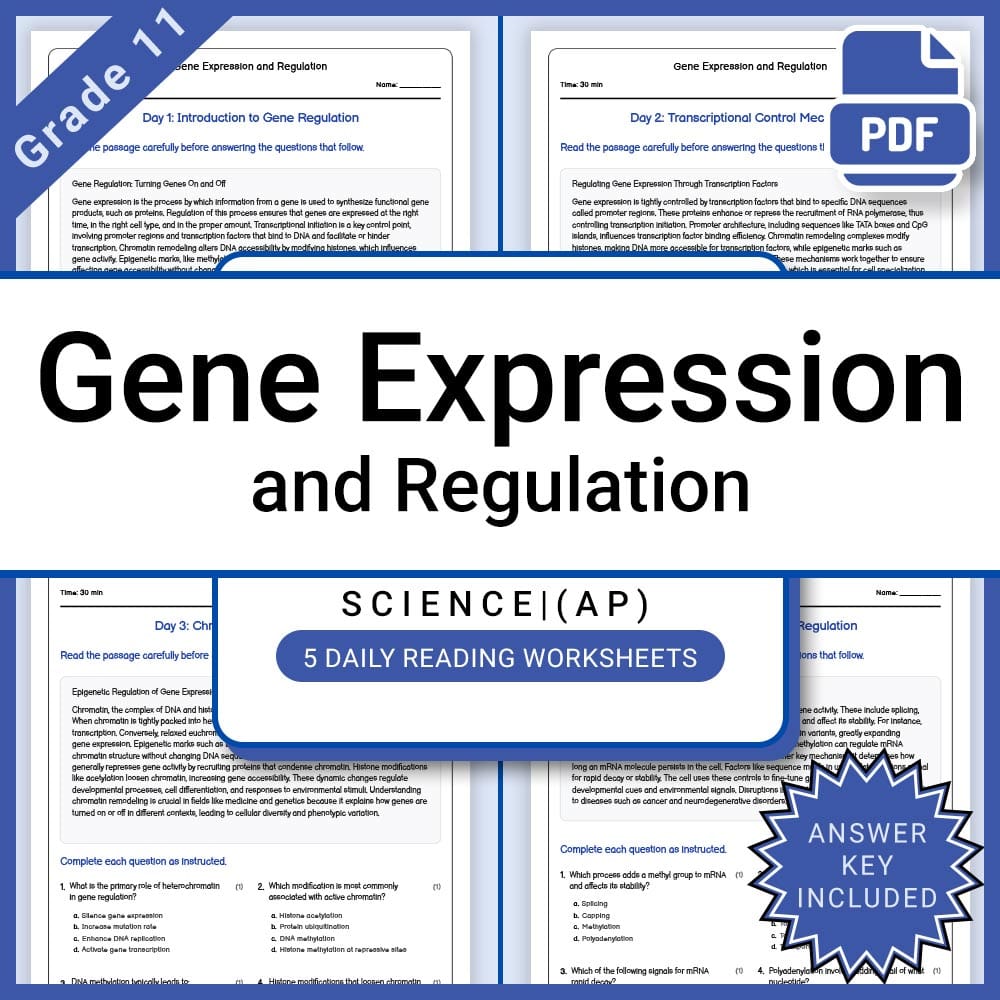
Grade 11 Science – Gene Expression Regulation Daily Worksheet + Answer Key
JCreated byJ.S SheetsLearning Objectives
- Understand the basic components involved in gene regulation
- Identify how transcription initiation, chromatin remodeling, and epigenetics influence gene expression
- Recognize the roles of regulatory sequences, transcription factors, and post-transcriptional modifications
Also included in: Grade 11 Science Biology and Ecosystems AP Lesson Bundle +1 more
Instant download
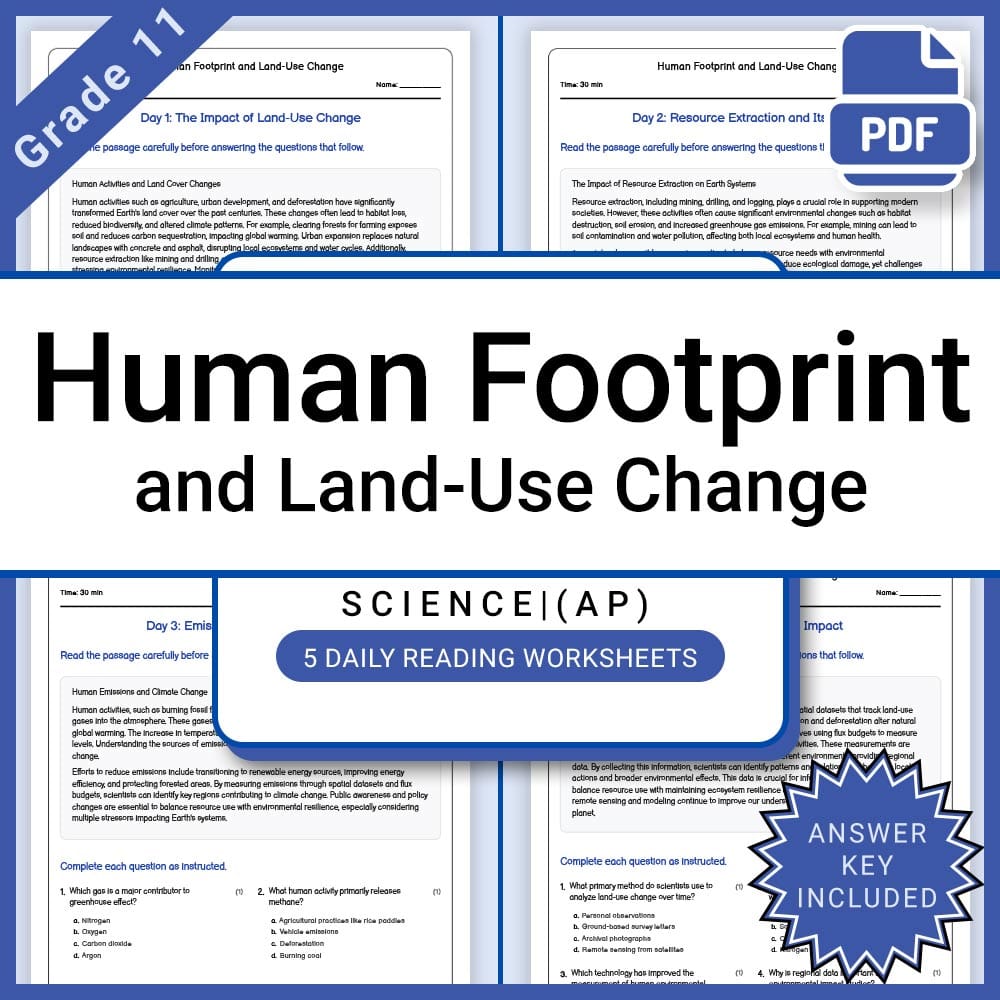
Grade 11 Science – Human Footprint and Land-Use Daily Worksheet with Answer Key
JCreated byJ.S SheetsLearning Objectives
- Understand how land-use change affects Earth's ecosystems.
- Identify human activities that alter land cover.
- Recognize the environmental trade-offs of resource extraction and development.
Also included in: Grade 11 Earth and Space Sciences Lesson Bundle | AP Science Curriculum +1 more
Instant download
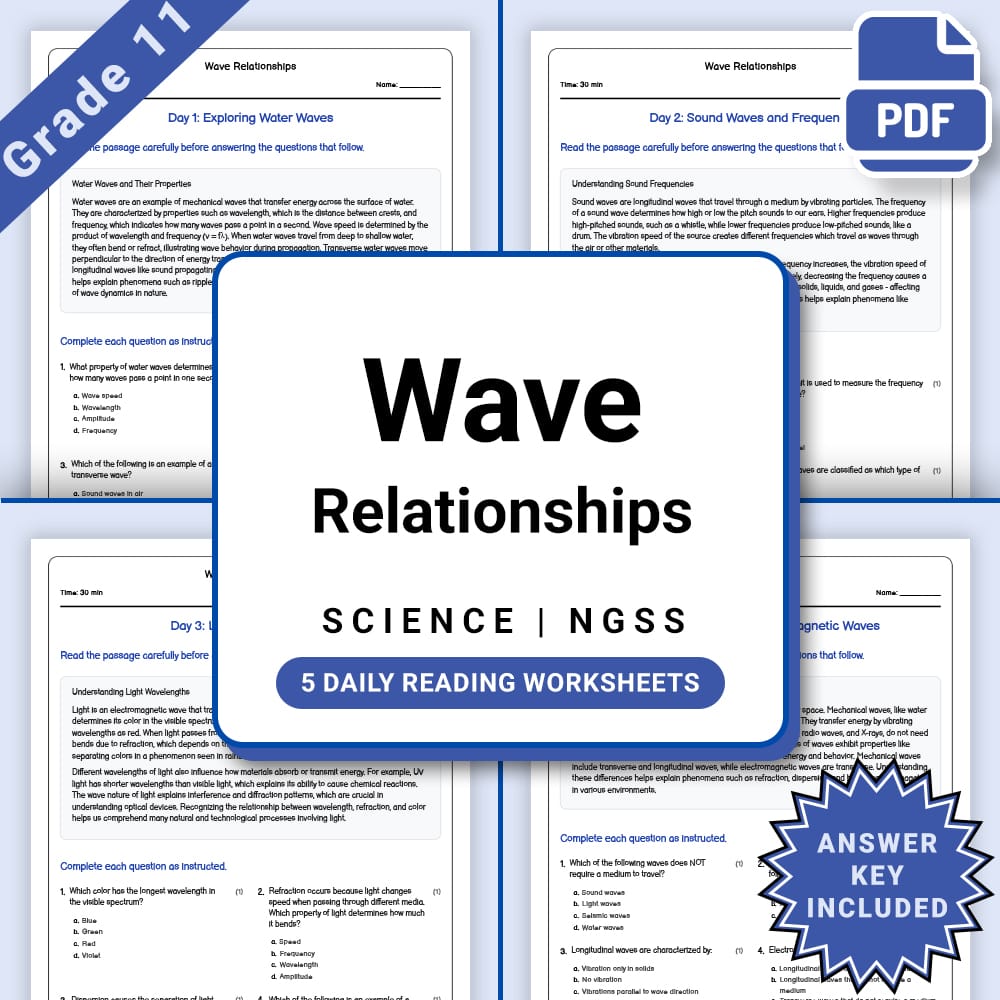
Grade 11 Science – Wave Relationships Worksheet (PDF +Answer Key)
 Created byCopper Leaf Classroom
Learning Objectives
- Identify and describe key wave properties such as wavelength, frequency, and wave speed.
- Calculate wave speed using the formula v = fλ.
- Differentiate between transverse and longitudinal waves with examples.
Instant download
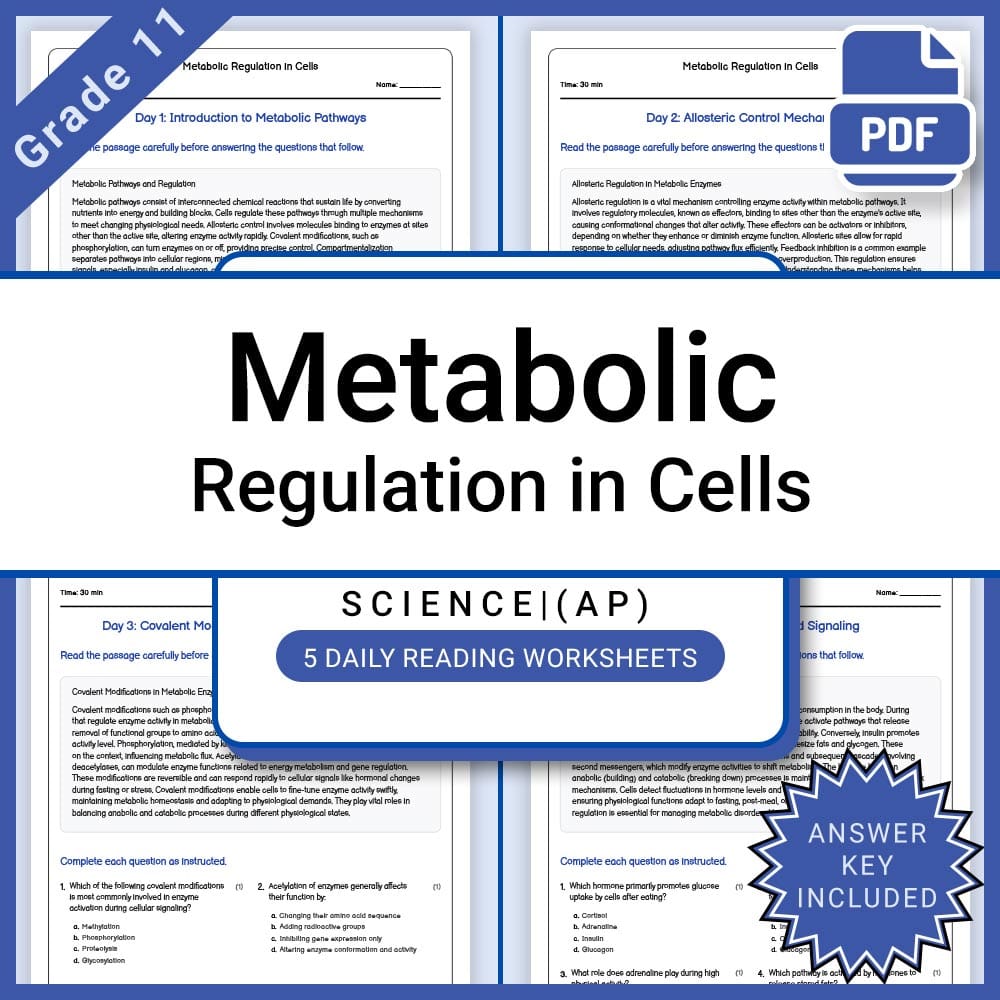
Grade 11 – Metabolic Regulation in Cells Daily Reading Worksheet + Answer Key
JCreated byJ.S SheetsLearning Objectives
- Understand how cells regulate metabolic pathway flux through various mechanisms.
- Identify the roles of allosteric control, covalent modification, compartmentalization, and hormonal signaling.
- Describe feedback inhibition, branch-point regulation, and metabolic prioritization during fasting or high activity.
Also included in: Grade 11 Science Biology and Ecosystems AP Lesson Bundle +1 more
Instant download
Grade 11 Science – Bond Polarity Daily Reading Worksheet with Answer Key
JCreated byJ.S SheetsLearning Objectives
- Understand key concepts related to Science
- Apply knowledge through practice questions
- Demonstrate comprehension of the material
Also included in: Grade 11 Science Lesson Bundle | Molecular Structure and Bonding +1 more
Instant download

Grade 11 Science – Genetic Drift in Evolution Daily Worksheet + Answer Key
JCreated byJ.S SheetsLearning Objectives
- Understand the concept of genetic drift and how it differs from natural selection.
- Identify the effects of bottleneck and founder events on genetic variation.
- Recognize how the randomness of genetic drift influences evolutionary potential.
Also included in: Grade 11 Science Lesson Group Bundle TEKS | Evolution & Classification +1 more
Instant download
Grade 11 Science – Rock Cycle Daily Reading Worksheet with Answer Key
JCreated byJ.S SheetsLearning Objectives
- Understand the main types of rocks and their formation processes.
- Describe the processes involved in the rock cycle.
- Recognize geological features and resources related to rocks.
Also included in: Grade 11 Earth and Space Sciences Lesson Bundle | AP Science Curriculum +1 more
Instant download

Grade 11 Science – Ecosystem Resilience Daily Reading Worksheet + Answer Key
JCreated byJ.S SheetsLearning Objectives
- Define ecosystem resilience and understand its importance.
- Identify mechanisms that contribute to ecosystem resilience.
- Explain how disturbances affect ecosystems and their recovery pathways.
Also included in: Grade 11 Science Lesson Bundle TEKS Ecosystems and Ecology Worksheets +1 more
Instant download
Grade 11 Science Circulation Dynamics Daily Reading Worksheet with Answer Key
JCreated byJ.S SheetsLearning Objectives
- Interpret streamfunction plots to identify dominant wind patterns
- Understand atmospheric and oceanic circulation mechanisms
- Relate circulation patterns to climate phenomena such as jet streams, trade winds, and thermohaline circulation
Also included in: Grade 11 Earth and Space Sciences Lesson Bundle | AP Science Curriculum +1 more
Instant download
Grade 11 Science – Acid and Base Dissociation Daily Worksheet + Answer Key
JCreated byJ.S SheetsLearning Objectives
- Define the acid dissociation constant (Ka) and base dissociation constant (Kb).
- Explain how Ka and Kb relate to the strength of acids and bases.
- Describe the significance of the relationship Kw = Ka · Kb.
Also included in: Grade 11 Science Lesson Bundle on Acids, Bases, and Titration | Alberta Framework +1 more
Instant download
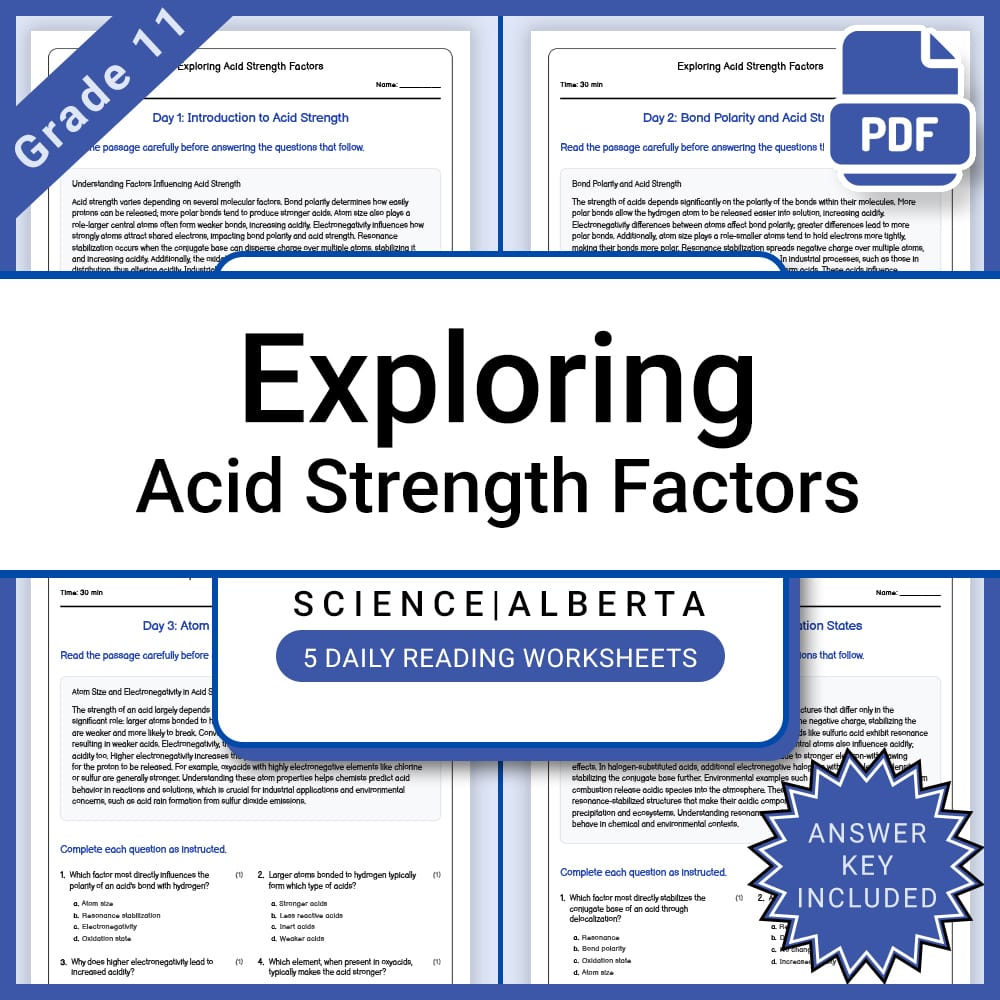
Grade 11 Science – Exploring Acid Daily Reading Worksheet + Answer Key
JCreated byJ.S SheetsLearning Objectives
- Identify the various factors that influence acid strength.
- Understand how molecular structure affects acidity.
- Apply concepts to real-world environmental and industrial examples.
Also included in: Grade 11 Science Lesson Bundle on Acids, Bases, and Titration | Alberta Framework +1 more
Instant download

Grade 11 Science – Metabolic Regulation Daily Reading Worksheet + Answer Key
JCreated byJ.S SheetsLearning Objectives
- Understand how enzyme activity is regulated through different mechanisms.
- Identify the effects of allosteric modulation, covalent modification, and compartmentalization on metabolism.
- Explain feedback inhibition and phosphorylation in controlling metabolic pathways.
Also included in: Grade 11 Science Lesson Group | Metabolic Regulation and Photosynthesis Bundle +1 more
Instant download
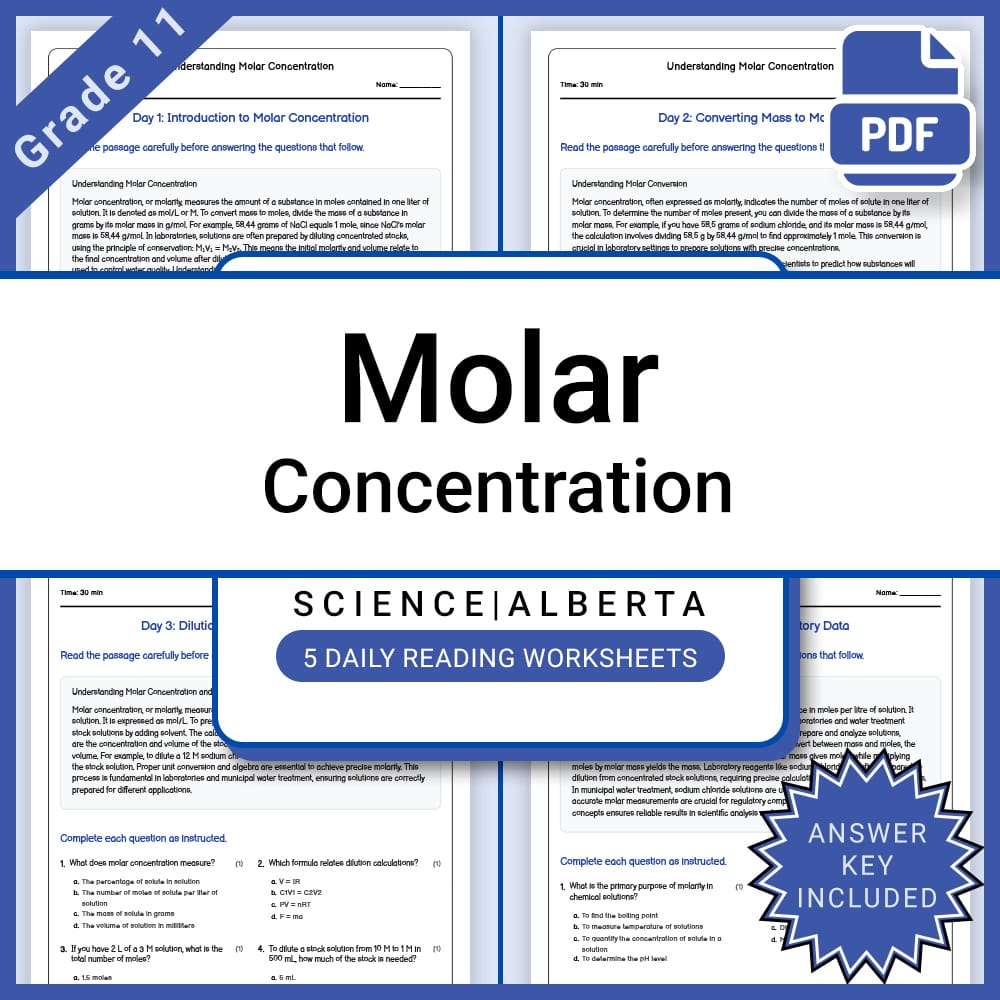
Grade 11 Science – Molar Concentration Daily Reading Worksheet + Answer Key
JCreated byJ.S SheetsLearning Objectives
- Define molar concentration and understand its notation.
- Convert between mass and moles in solution preparation.
- Use dilution calculations to prepare solutions from concentrated stocks.
Also included in: Grade 11 Science Lesson Bundle | STEM Concepts and Alberta Framework +1 more
Instant download
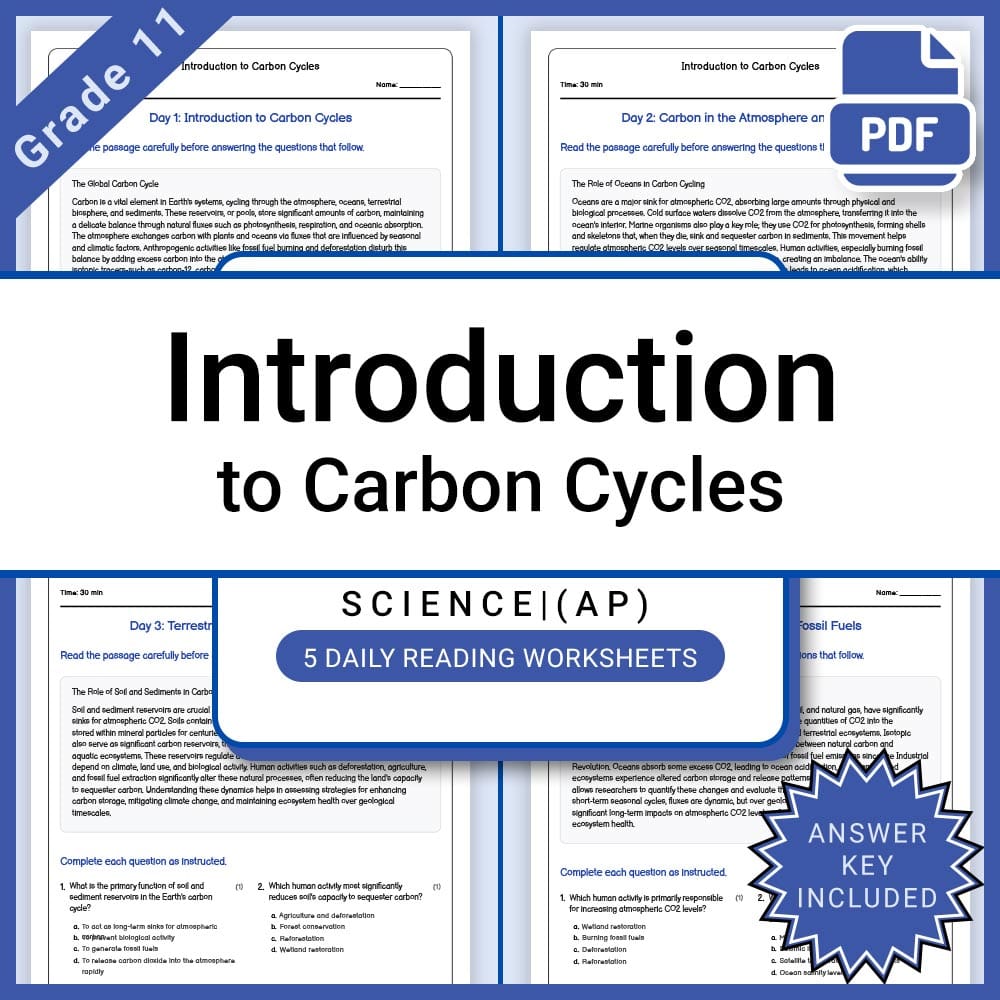
Grade 11 Science – Introduction to Carbon Cycles Worksheet + Answer Key
JCreated byJ.S SheetsLearning Objectives
- Understand the major reservoirs of carbon in Earth's system
- Identify the pathways of carbon transfer among air, ocean, land, and sediments
- Differentiate natural carbon fluxes from human-induced changes
Also included in: Grade 11 Earth and Space Sciences Lesson Bundle | AP Science Curriculum +1 more
Instant download
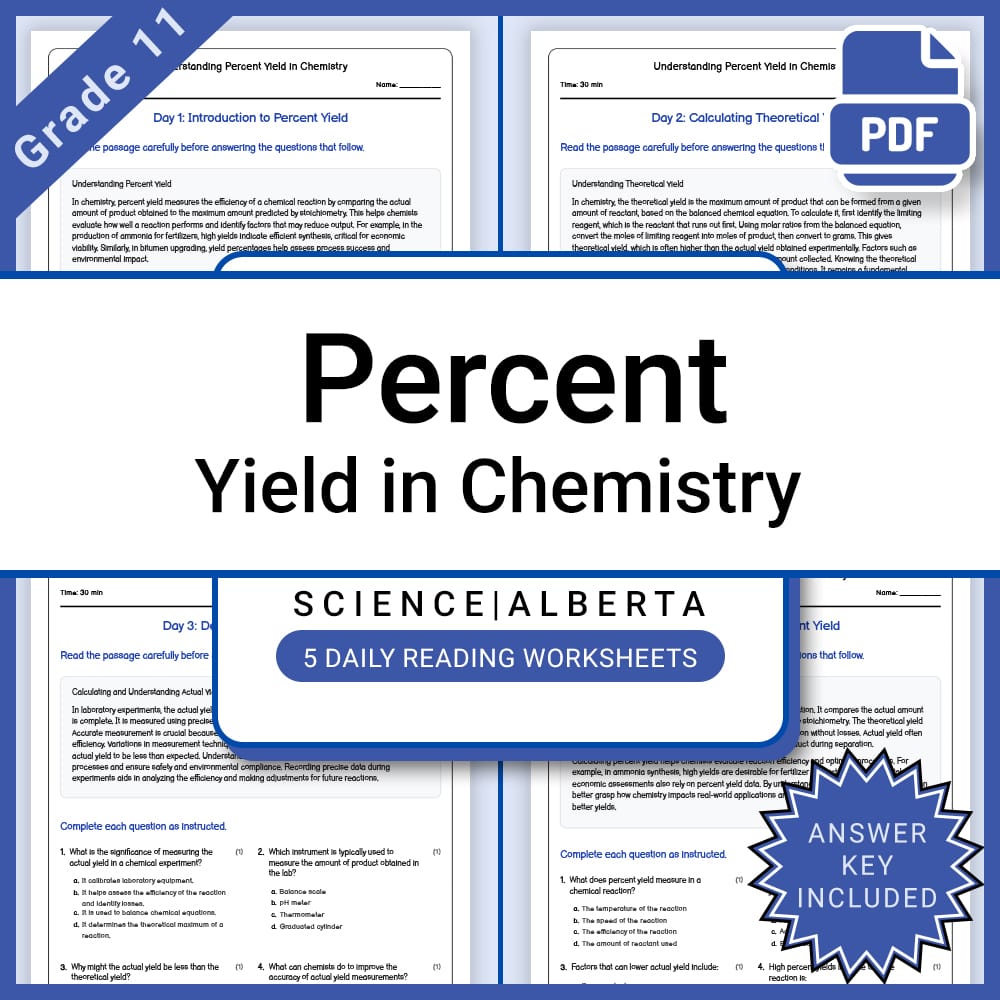
Grade 11 Science – Percent Yield | Daily Reading Worksheet + Answer Key
JCreated byJ.S SheetsLearning Objectives
- Define percent yield and explain its significance.
- Calculate theoretical yield from balanced chemical equations.
- Identify factors that affect actual yield.
Also included in: Grade 11 Science Lesson Bundle | Core Concepts & Theories in Chemistry & Physics +1 more
Instant download
Grade 11 Science – pH Fundamentals in Environmental Worksheet + Answer Key
JCreated byJ.S SheetsLearning Objectives
- Understand the definition of pH and its significance in chemistry and environmental science.
- Identify pH levels of solutions as acidic, neutral, or basic.
- Explain how pH influences chemical speciation, mineral solubility, and biological conditions in aquatic systems.
Also included in: Grade 11 Science Lesson Bundle on Acids, Bases, and Titration | Alberta Framework +1 more
Instant download

Grade 11 Science – Light Reactions in Photosynthesis Worksheet + Answer Key
JCreated byJ.S SheetsLearning Objectives
- Identify the key components involved in light-dependent reactions
- Describe the sequence of events in the light reactions
- Explain how light energy is converted into chemical energy
Also included in: Grade 11 Science Lesson Group | Metabolic Regulation and Photosynthesis Bundle +1 more
Instant download

Grade 11 Science – Classification Methods Daily Reading Worksheet + Answer Key
JCreated byJ.S SheetsLearning Objectives
- Understand various morphological features used to classify living organisms
- Familiarize with basic principles of cladistic and phenetic classification
- Learn how phylogenomics integrates genetic data for evolutionary analysis
Also included in: Grade 11 Science Lesson Group Bundle TEKS | Evolution & Classification +1 more
Instant download
Grade 11 Science – Periodic Trends | Daily Reading Worksheet + Answer Key
JCreated byJ.S SheetsLearning Objectives
- Understand key concepts related to Science
- Apply knowledge through practice questions
- Demonstrate comprehension of the material
Also included in: Grade 11 Science Lesson Bundle | Molecular Structure and Bonding +1 more
Instant download
Grade 11 Science – Degree Dissociation Daily Reading Worksheet with Answer Key
JCreated byJ.S SheetsLearning Objectives
- Explain the concept of degree of dissociation in weak acids and bases.
- Identify factors affecting dissociation, including concentration and ion effects.
- Apply knowledge of dissociation to soil chemistry and environmental contexts.
Also included in: Grade 11 Science Lesson Bundle on Acids, Bases, and Titration | Alberta Framework +1 more
Instant download

Grade 11 Science – Introduction to the Immune System Worksheet + Answer Key
JCreated byJ.S SheetsLearning Objectives
- Understand the basic components and functions of the immune system.
- Identify different types of immune responses and their roles.
- Recognize environmental factors that influence immunity.
Also included in: Grade 11 Science Lesson Bundle: Human Physiology and Body Systems TEKS +1 more
Instant download
Grade 11 Science – Phase Behaviour Intermolecular Worksheet + Answer Key
JCreated byJ.S SheetsLearning Objectives
- Identify different types of intermolecular forces and their effects on phase changes
- Understand how bonding influences vapor pressure and boiling points
- Explain the role of molecular size, polarity, and temperature in phase diagrams
Also included in: Grade 11 Science Lesson Bundle | Molecular Structure and Bonding +1 more
Instant download
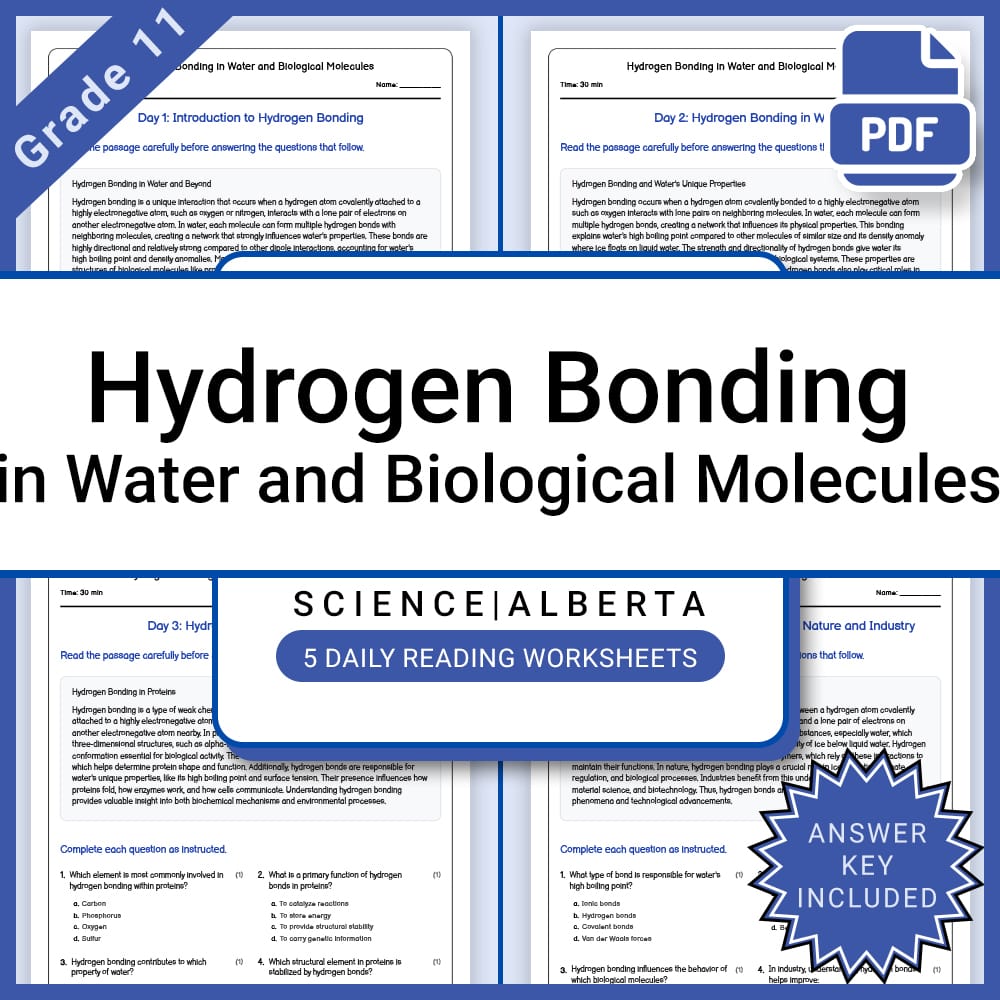
Grade 11 Science – Hydrogen Bonding Daily Reading Worksheet + Answer Key
JCreated byJ.S SheetsLearning Objectives
- Understand what hydrogen bonding is and how it occurs in water molecules.
- Recognize the effects of hydrogen bonding on water's properties such as boiling point and density.
- Explain the role of hydrogen bonds in the structure of proteins and polymers.
Also included in: Grade 11 Science Lesson Bundle | Molecular Structure and Bonding +1 more
Instant download

Grade 11 Science – Fermentation Pathways Daily Reading Worksheet + Answer Key
JCreated byJ.S SheetsLearning Objectives
- Describe the process of fermentation and its purpose in cells.
- Identify the two main types of fermentation: lactic acid and alcoholic fermentation.
- Explain how NAD+ is regenerated during fermentation.
Also included in: Grade 11 Science Lesson Group | Metabolic Regulation and Photosynthesis Bundle +1 more
Instant download
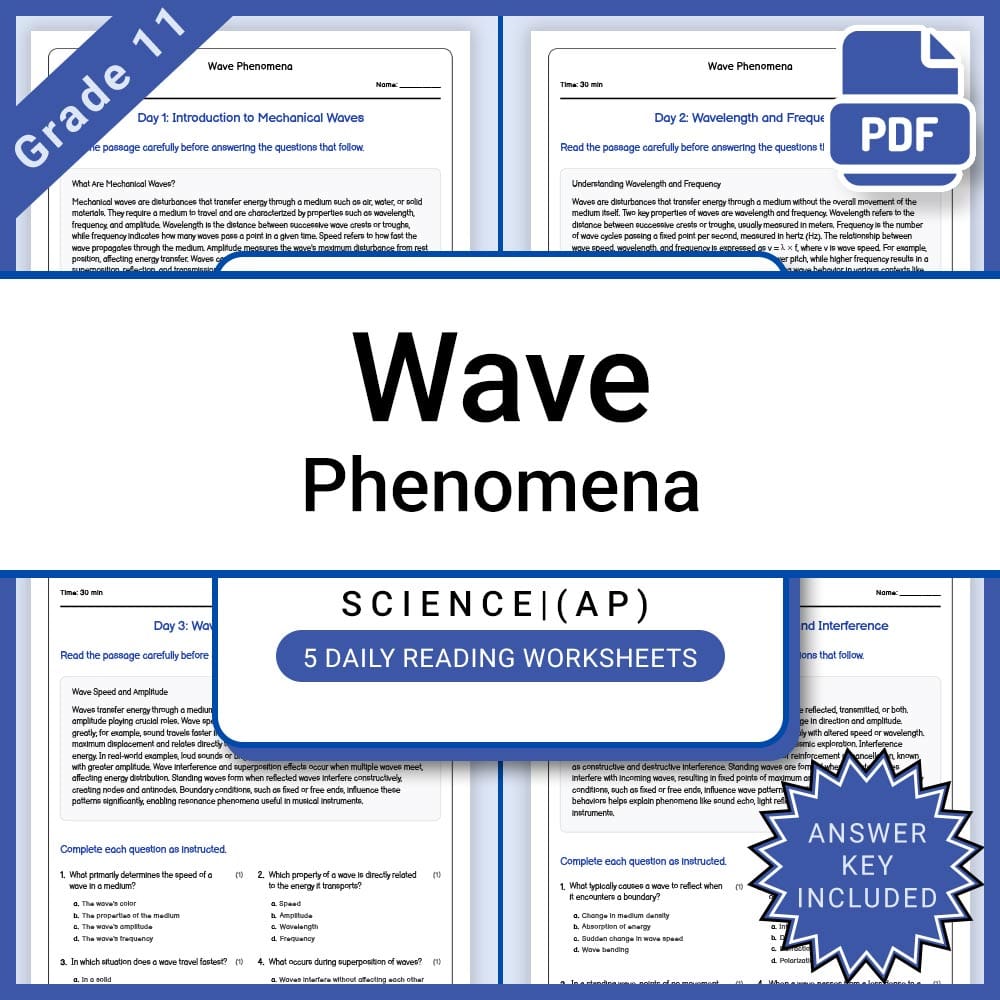
Grade 11 Science – Wave Phenomena Daily Reading Worksheet + Answer Key
JCreated byJ.S SheetsLearning Objectives
- Understand and identify key properties of mechanical waves, including wavelength, frequency, speed, amplitude, and superposition.
- Describe wave behaviors such as reflection, transmission, interference, and standing waves on strings and air columns.
- Interpret graphical and sinusoidal models to understand wave energy transport and modal patterns.
Also included in: AP Physics Principles Activities & Worksheets | Grade 11 Advanced Placement +1 more
Instant download

Grade 11 Science – Introduction to Molecular Techniques Worksheet + Answer Key
JCreated byJ.S SheetsLearning Objectives
- Understand the purpose and basic mechanism of PCR in DNA analysis
- Identify key molecular techniques such as sequencing, gel electrophoresis, and SNP genotyping
- Recognize how these methods contribute to genetic research and diagnostics
Also included in: Grade 11 Science Lesson Bundle TEKS | Molecular Genetics & Inheritance +1 more
Instant download

Grade 11 Science – System Interactions Daily Reading Worksheet + Answer Key
JCreated byJ.S SheetsLearning Objectives
- Understand how respiratory processes support other body systems
- Identify the roles of the respiratory, circulatory, renal, endocrine, and nervous systems
- Explain how these systems communicate to maintain internal balance
Also included in: Grade 11 Science Lesson Bundle: Human Physiology and Body Systems TEKS +1 more
Instant download

Grade 11 Science – Physiological Regulation Daily Worksheet with Answer Key
JCreated byJ.S SheetsLearning Objectives
- Understand the mechanisms of temperature regulation
- Identify the roles of sensors, control centers, and effectors
- Differentiate between negative and positive feedback processes
Also included in: Grade 11 Science Lesson Bundle: Human Physiology and Body Systems TEKS +1 more
Instant download
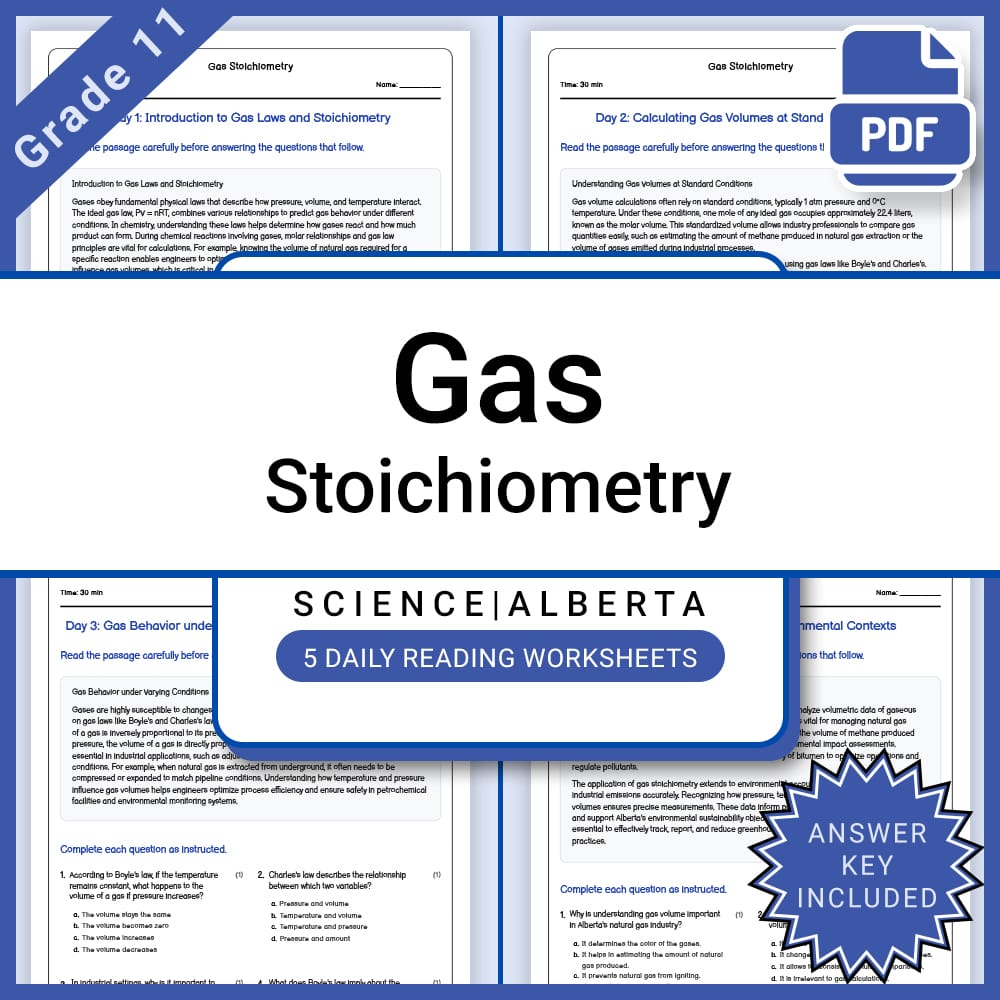
Grade 11 Science – Gas Stoichiometry Daily Reading Worksheet with Answer Key
JCreated byJ.S SheetsLearning Objectives
- Understand how gas laws relate to chemical reactions involving gases
- Apply the ideal gas law and related relationships to solve stoichiometric problems
- Analyze the impact of standard and nonstandard conditions on gas volume calculations
Also included in: Grade 11 Science Lesson Bundle | Core Concepts & Theories in Chemistry & Physics +1 more
Instant download
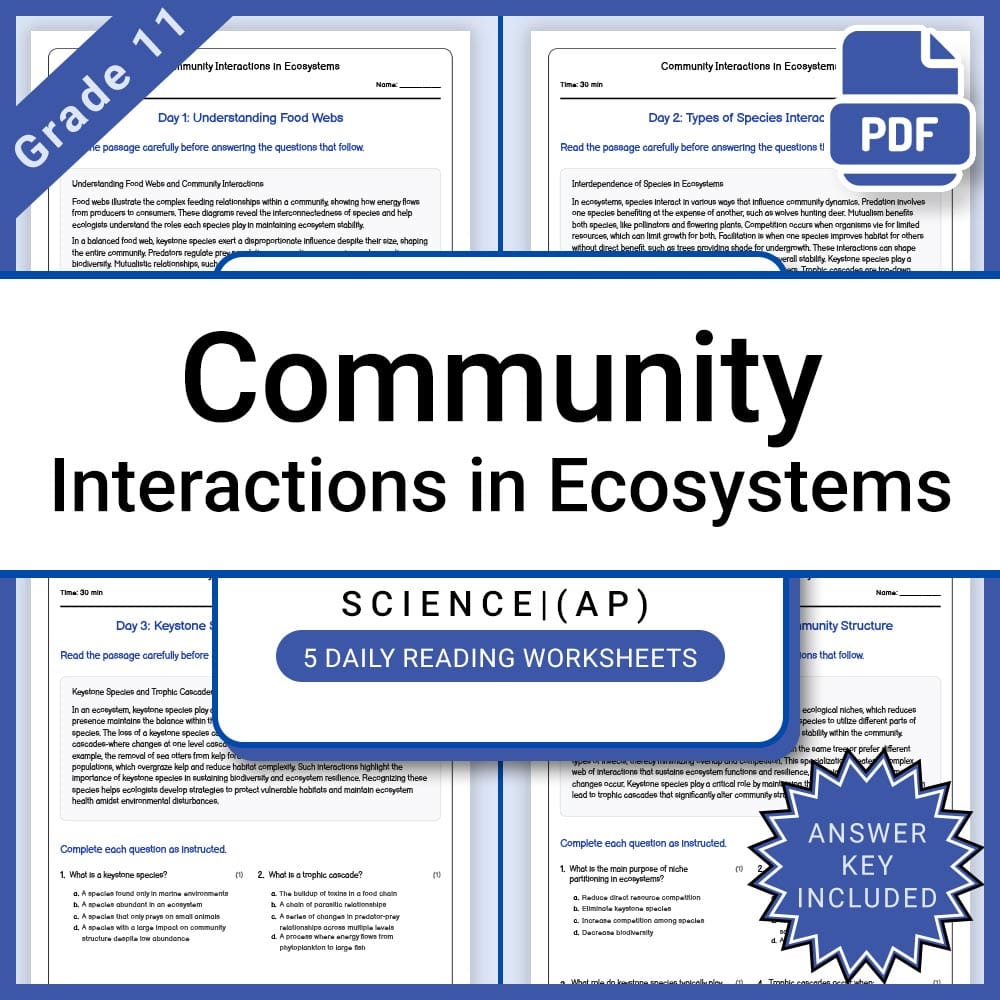
Grade 11 Science – Community Interactions Ecosystems Daily Reading Worksheet & Answer Key
JCreated byJ.S SheetsLearning Objectives
- Understand different types of interspecific interactions such as competition, predation, mutualism, and facilitation.
- Interpret food web diagrams and interaction matrices to analyze energy flow and interaction strength.
- Identify keystone species, trophic cascades, and niche partitioning as mechanisms influencing community structure.
Also included in: Grade 11 Science Biology and Ecosystems AP Lesson Bundle +1 more
Instant download
About Grade 11 Science Worksheets
Browse 6,616 printable Grade 11 Science worksheets — ready-to-print PDFs with answer keys where available.
Each resource here is built by an independent educator and reviewed for quality. Worksheets print straight from PDF and suit classroom use, homework, or extra practice; most come with answer keys, and you can preview before purchasing.