
Grade 12 Science Worksheets
4,124 worksheets
Grade 12 Science | Electromagnetic Signals Worksheet | California Standards

Learning Objectives
- Understand how electromagnetic radiation transmits information through digitized signals.
- Identify the properties of signals that encode information, such as frequency and amplitude.
- Explain how electromagnetic waves carry energy and facilitate communication across distances.

Grade 12 Science | Quantum Wave Duality Worksheet | BC-Aligned
Learning Objectives
- Explain the concept of wave-particle duality in quantum mechanics.
- Describe how matter exhibits wave properties such as wavelength and interference.
- Relate de Broglie wavelengths to the behavior of particles and atomic phenomena.

Grade 12 Science | Complex Problem Decomposition | California Standards
Learning Objectives
- Understand the concept of problem decomposition in engineering design.
- Identify how relationships among subsystems are preserved during decomposition.
- Analyze the role of criteria and constraints in guiding problem decomposition.

Grade 12 Science | Photosynthetic Systems Worksheet Elena | AP Aligned
Learning Objectives
- Explain the organization of pigments within photosynthetic membranes and their role in capturing light energy.
- Describe the electron transport chain and how it converts light energy into chemical energy.
- Analyze the coupling between light reactions and the Calvin cycle in carbon fixation.

Grade 12 Science | Atomic Models Worksheet | TEKS Aligned
Learning Objectives
- Trace the development of atomic models from Dalton to Rutherford and Bohr.
- Describe empirical evidence supporting atomic theory, such as cathode ray experiments and gold foil scattering.
- Explain concepts of nuclear charge, mass number, and isotopic abundance.

Grade 12 Science | Solar Fusion Cycle Worksheet Elena | CA Standards
Learning Objectives
- Explain the process of nuclear fusion occurring in the sun's core.
- Describe how changes in fusion rates influence the sun's energy output.
- Connect stellar fusion processes to element formation and the evolution of stars.

Grade 12 Science | Projectile Motion Worksheet Elena | AP Aligned
Learning Objectives
- Analyze two-dimensional projectile motion using vector components.
- Understand the independence of horizontal and vertical motions in projectile trajectories.
- Apply equations of range, time-of-flight, and parametric equations to solve projectile problems.

Grade 12 Science | Energy and Matter Flow Worksheet Elena | California Standards
Learning Objectives
- Explain how energy flows through ecosystems and decreases at higher trophic levels.
- Describe the cycling of chemical elements among producers, consumers, and decomposers.
- Analyze the role of food webs in transferring energy and nutrients.

Grade 12 Science | Hierarchical Cell Systems Worksheet | California Standards
Learning Objectives
- Understand the levels of organization in multicellular organisms from cells to organ systems.
- Explain how structures at each level perform specialized functions and coordinate with other levels.
- Describe how complex traits emerge from simpler components and how disruptions can affect system stability.

Grade 12 Science | Resource Management Worksheet | TEKS Aligned
Learning Objectives
- Evaluate renewable and nonrenewable resource allocation strategies.
- Analyze water budgeting, energy portfolios, and waste handling methods.
- Understand lifecycle assessments and sustainability trade-offs in resource management.

Grade 12 Science | Dynamics of Systems Worksheet Elena | AP Aligned
Learning Objectives
- Analyze multi-body systems with constraints using equation relations.
- Apply free-body diagrams to component analysis in pulley and connected-mass systems.
- Understand the propagation of tension and normal forces in idealized systems.

Grade 12 Science | Reaction Quantification Worksheet | AP Aligned
Learning Objectives
- Understand advanced stoichiometric calculations involving concentration units and molarity.
- Apply dilution principles and gas-phase relationships under standard and nonstandard conditions.
- Integrate limiting reagent analysis with titration and volumetric measurements to quantify reaction extent.

Grade 12 Science | Kinematic Foundations Worksheet Elena | AP Aligned
Learning Objectives
- Understand the fundamental concepts of displacement, velocity, and acceleration as vector quantities.
- Interpret position–time and velocity–time graphs to analyze motion.
- Apply symbolic kinematic equations for motion with constant acceleration.

Grade 12 Science | Genomic Applications Worksheet | BC-Aligned
Learning Objectives
- Understand key genomic applications such as population sequencing and personalized medicine.
- Identify potential risks and ethical concerns associated with genomic technologies.
- Evaluate the benefits and challenges of interventions like gene drives.

Grade 12 Science | Statistical Inference Worksheet | AP Aligned
Learning Objectives
- Understand and interpret p-values, confidence intervals, and effect sizes in statistical inference.
- Apply hypothesis testing techniques to real-world datasets, including dose-response and temperature anomalies.
- Perform residual analysis and regression diagnostics to assess model assumptions.

Grade 12 Science | Kepler Orbit Evidence Worksheet | California Standards
Learning Objectives
- Understand how orbital motion patterns relate to gravitational interactions.
- Recognize the significance of Kepler’s laws in planetary systems.
- Analyze evidence supporting the universality of gravitational physics.

Grade 12 Science | Data Visuals Worksheet | TEKS-Aligned
Learning Objectives
- Understand the principles of selecting appropriate graph types for different data sets.
- Identify key elements of constructing accurate and informative data visualizations, including labels, scales, and annotations.
- Interpret various types of data visuals such as scatter plots, histograms, boxplots, and time-series charts.

Grade 12 Science | Systems Overview Worksheet | AP Aligned
Learning Objectives
- Describe the major components of Earth's systems and their interactions.
- Explain energy and mass fluxes across atmosphere, hydrosphere, biosphere, and geosphere.
- Use conceptual models to analyze steady-state and transient responses in Earth systems.

Grade 12 Science | Energy Transfers Worksheet | BC-Aligned
Learning Objectives
- Understand the principles of energy transfer and dissipation in oscillatory systems.
- Define and identify simple harmonic motion, resonance, and damping effects.
- Explain how non-conservative forces alter energy flow and amplitude in oscillators.

Grade 12 Science | Hazard Resilience Worksheet | AP Aligned
Learning Objectives
- Understand the interplay between geologic and atmospheric hazards and their impact on communities.
- Evaluate probabilistic hazard characterization and risk assessment methods.
- Analyze strategies for enhancing resilience through land-use planning and early-warning systems.

Grade 12 Science | Periodic Table Predictions | AP Aligned
Learning Objectives
- Analyze how variations in effective nuclear charge, electron shielding, and subshell filling produce periodic trends and anomalies.
- Apply quantitative and graphical comparisons to understand trends in ionization energy, electron affinity, and atomic radius.
- Evaluate implications of periodic patterns for element classification, reactivity, and modeling chemical behavior.

Grade12 Science | Uncertainty Concepts Worksheet | AP Aligned
Learning Objectives
- Identify different sources and types of uncertainty in scientific measurements and models.
- Distinguish between systematic bias, random error, and conceptual model uncertainty.
- Understand exemplars such as instrument drift and sampling variability to illustrate uncertainty propagation.

Grade 12 Science | Ecosystem Networks Worksheet | AP Aligned
Learning Objectives
- Understand the flow of energy and cycling of matter within ecosystems.
- Identify the roles of producers, consumers, and decomposers in ecological networks.
- Analyze biogeochemical cycles and how human activities influence fluxes.

Grade 12 Science | Membrane Dynamics Worksheet | AP Aligned
Learning Objectives
- Explain how lipid bilayer organization and membrane proteins create selective permeability and maintain concentration gradients.
- Compare passive transport mechanisms (diffusion, osmosis, facilitated diffusion) with active transport and how they relate to energy input.
- Use quantitative relationships involving concentration differences and electrochemical forces to interpret membrane potential.

Grade 12 Science | Resource Impacts Worksheet | BC-Aligned
Learning Objectives
- Analyze how human resource use affects Earth's systems such as soil, water, and air.
- Evaluate environmental trade-offs associated with resource extraction and land modification.
- Identify strategies for sustainable resource management and environmental restoration.

Grade 12 Science | Astronomy Overview Worksheet | TEKS Aligned
Learning Objectives
- Summarize the key processes involved in the formation and evolution of the Solar System.
- Identify observational evidence used in studying planetary characteristics and formation theories.
- Explain the concepts of accretion, planetary differentiation, and protoplanetary disks.
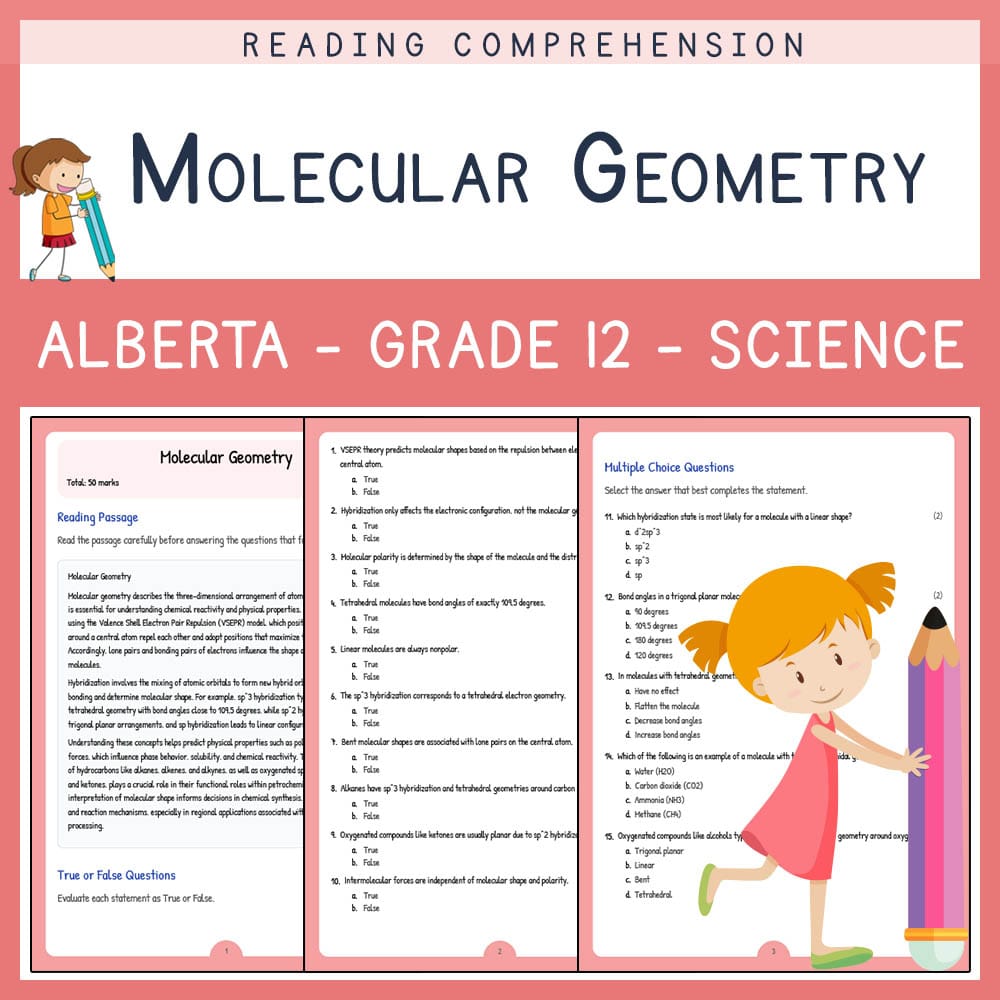
Grade 12 Science | Molecular Geometry Worksheet | Alberta Standards
Learning Objectives
- Understand the principles of VSEPR theory and how electron-pair repulsion determines molecular shape.
- Apply hybridization concepts to predict molecular geometry and bond angles.
- Analyze how molecular geometry influences physical properties, polarity, and reactivity.
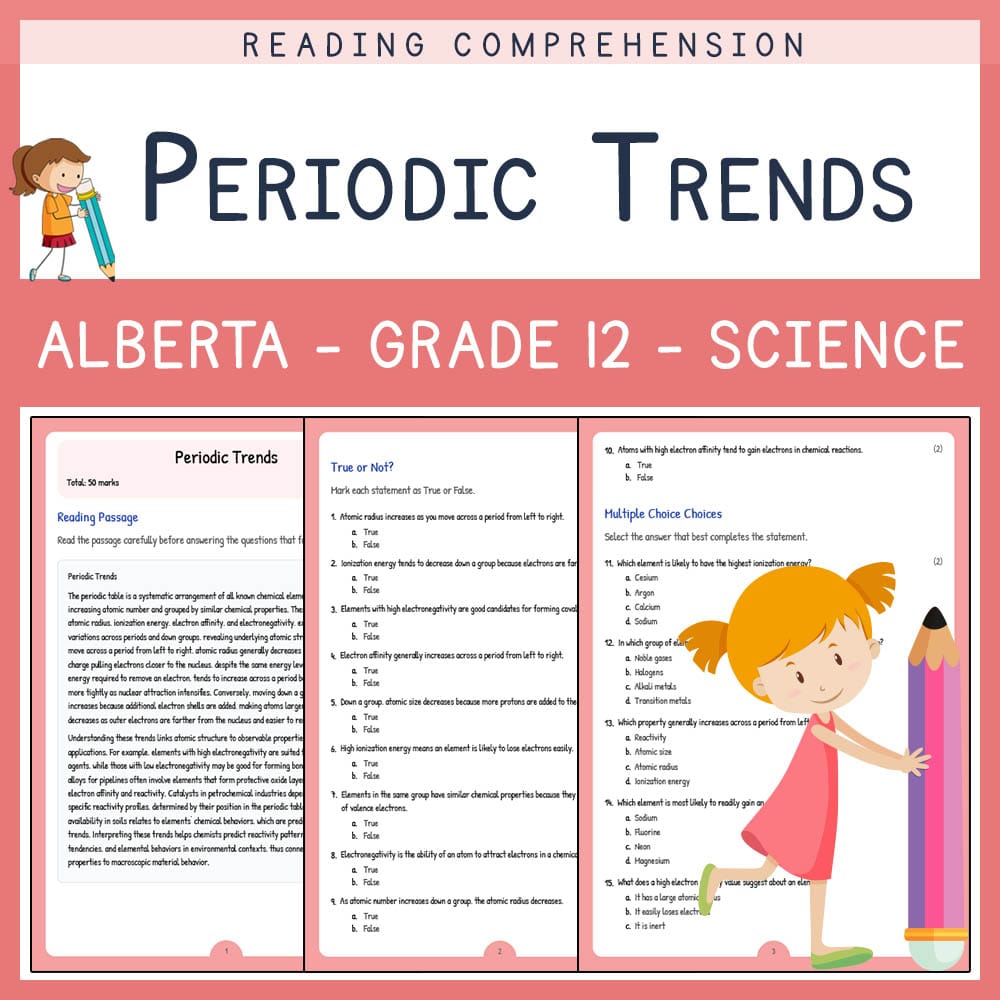
Grade 12 Science | Periodic Trends Worksheet | Alberta Standards
Learning Objectives
- Understand the concept of periodic trends and their significance in chemistry.
- Analyze patterns of atomic radius, ionization energy, electron affinity, and electronegativity across periods and down groups.
- Interpret how atomic structure influences macroscopic properties and applications of elements.
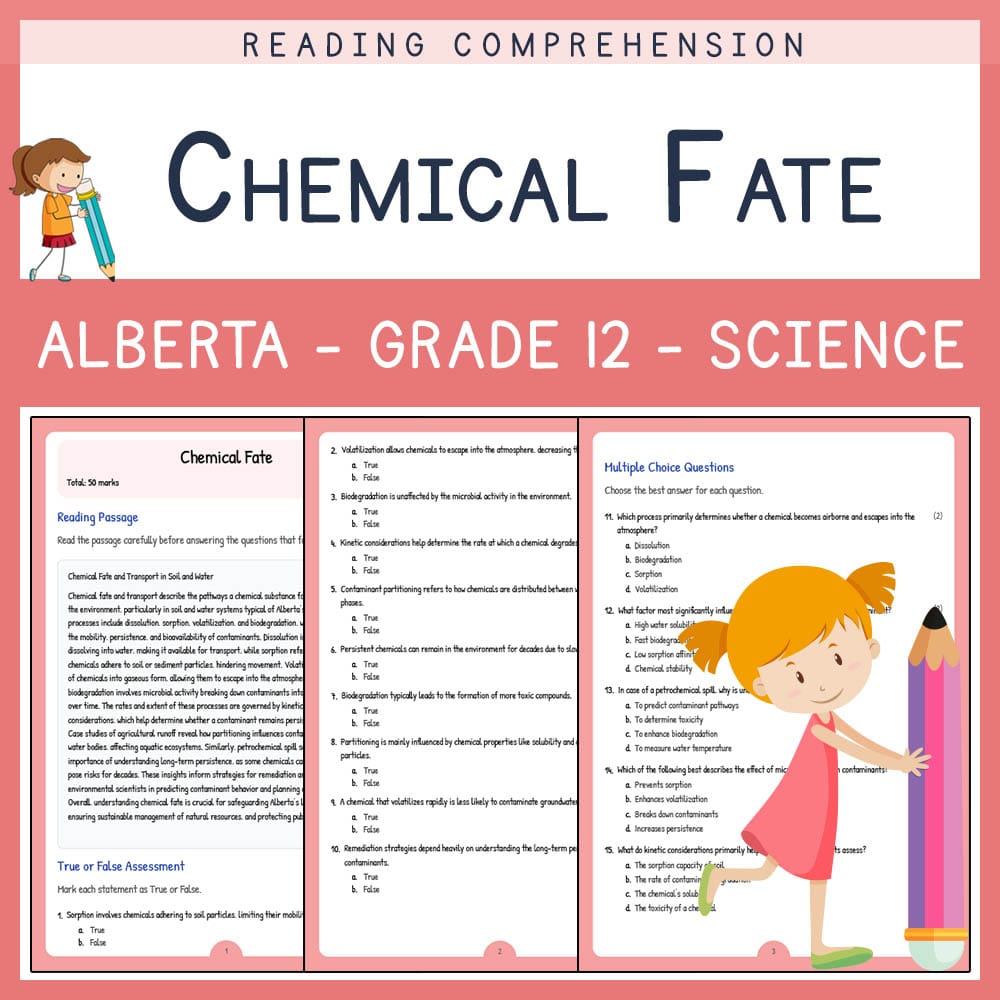
Grade 12 Science | Chemical Fate Worksheet | Alberta Standards
Learning Objectives
- Understand the processes involved in the transport and transformation of chemicals in soil and water systems.
- Identify factors influencing contaminant partitioning, degradation rates, and long-term persistence.
- Analyze case studies related to agricultural runoff and petrochemical spills to understand contaminant pathways.
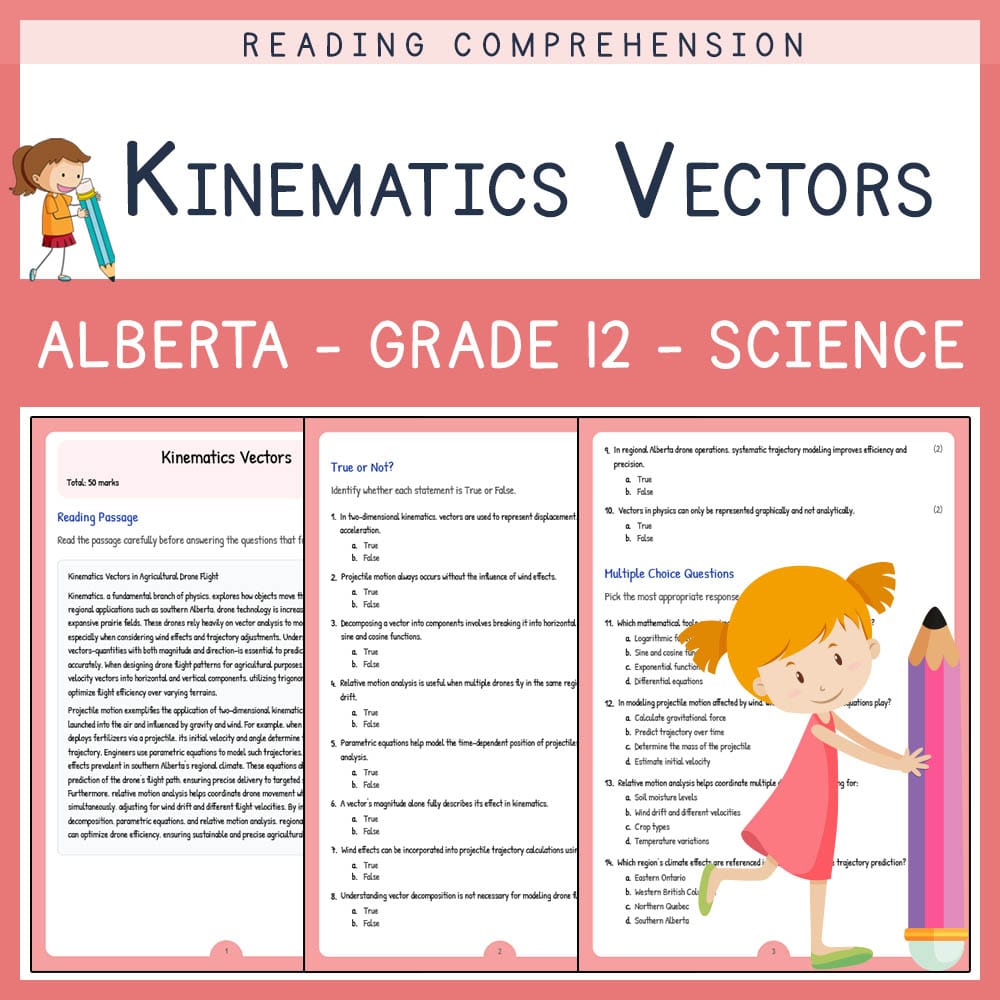
Grade 12 Science | Kinematics Vectors Worksheet | Alberta Standards
Learning Objectives
- Understand vector representation of displacement, velocity, and acceleration in one and two dimensions.
- Apply component analysis to model projectile motion and interpret motion parameters.
- Decompose vectors and analyze relative motion in regional agricultural contexts.
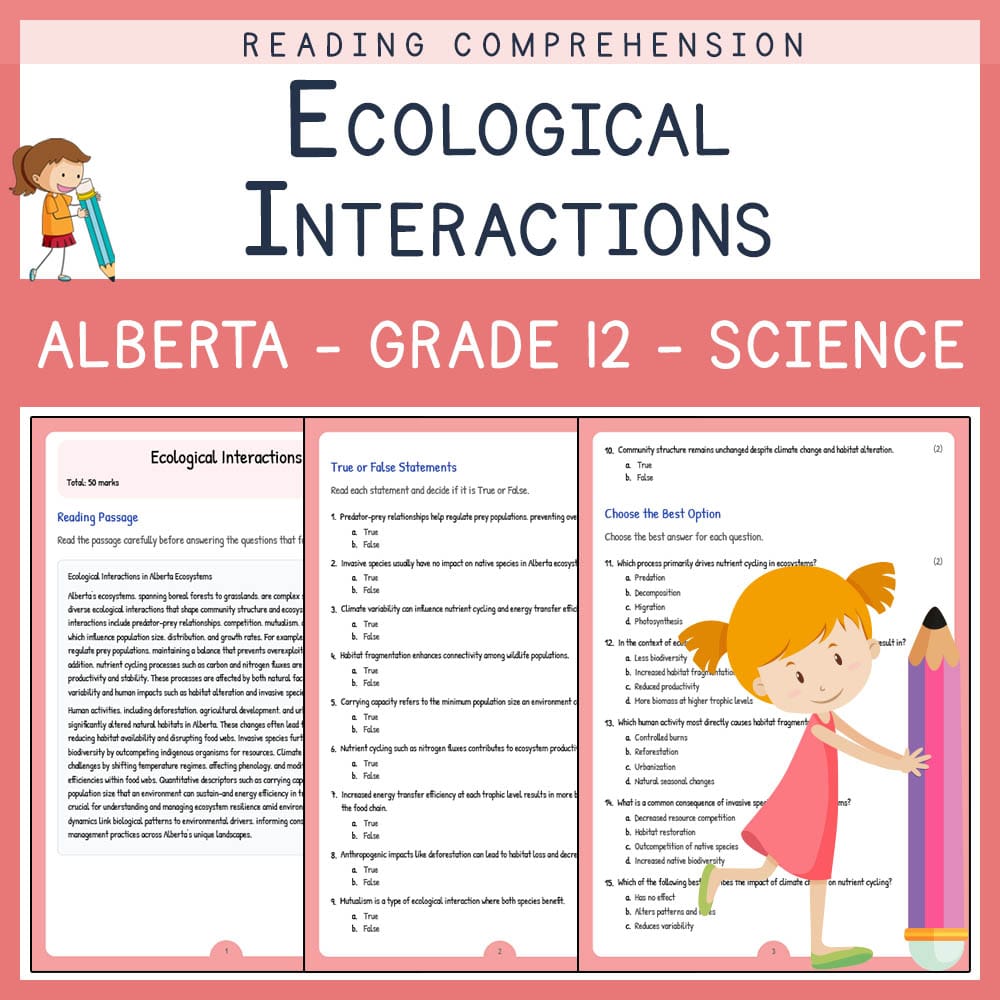
Grade 12 Science | Ecological Interactions Worksheet | Alberta Standards
Learning Objectives
- Understand the various types of ecological interactions and their effects on population dynamics.
- Analyze trophic relationships and nutrient cycling within Alberta ecosystems.
- Evaluate how human activities and climate variability influence community structure and ecosystem services.
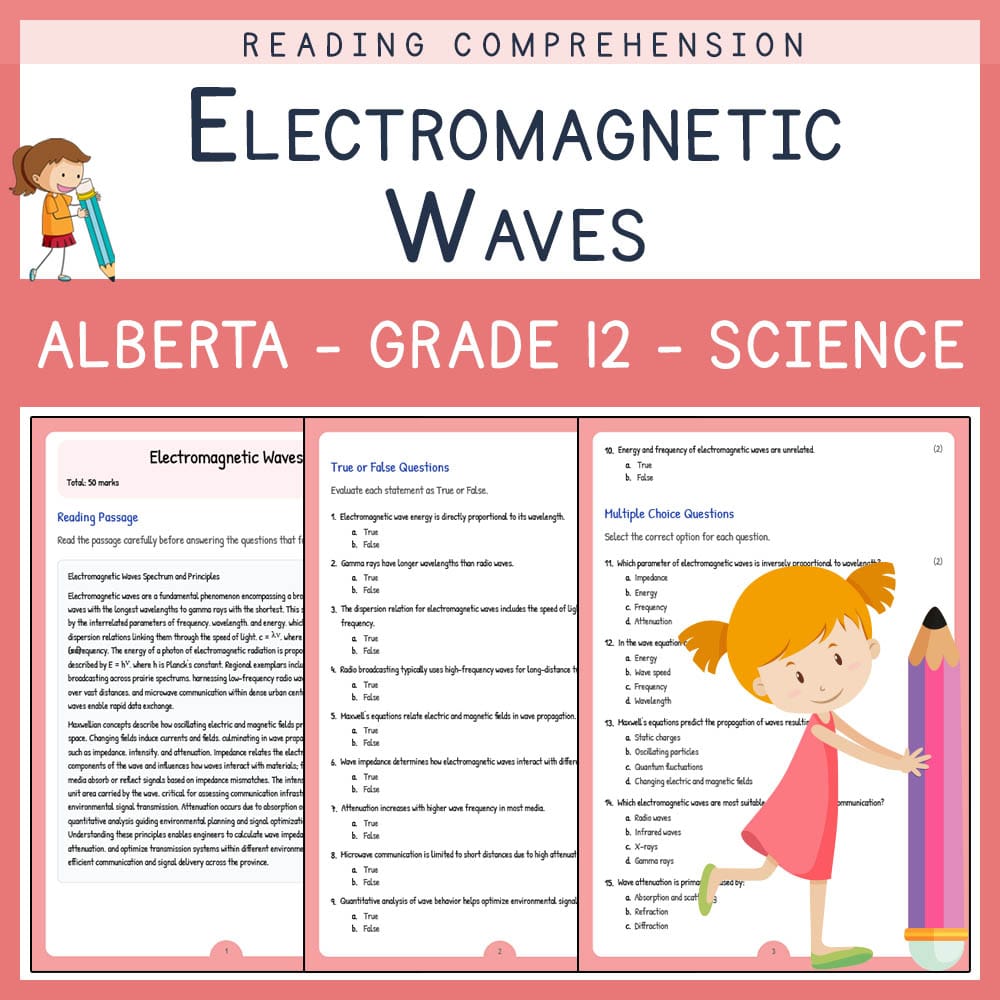
Grade 12 Science | Electromagnetic Waves Worksheet | Alberta Standards
Learning Objectives
- Explain the spectrum of electromagnetic waves and their properties such as frequency, wavelength, and energy.
- Describe regional exemplars of electromagnetic wave applications, like radio broadcasting and microwave communication.
- Understand Maxwellian concepts linking changing fields to wave propagation, impedance, intensity, and attenuation.
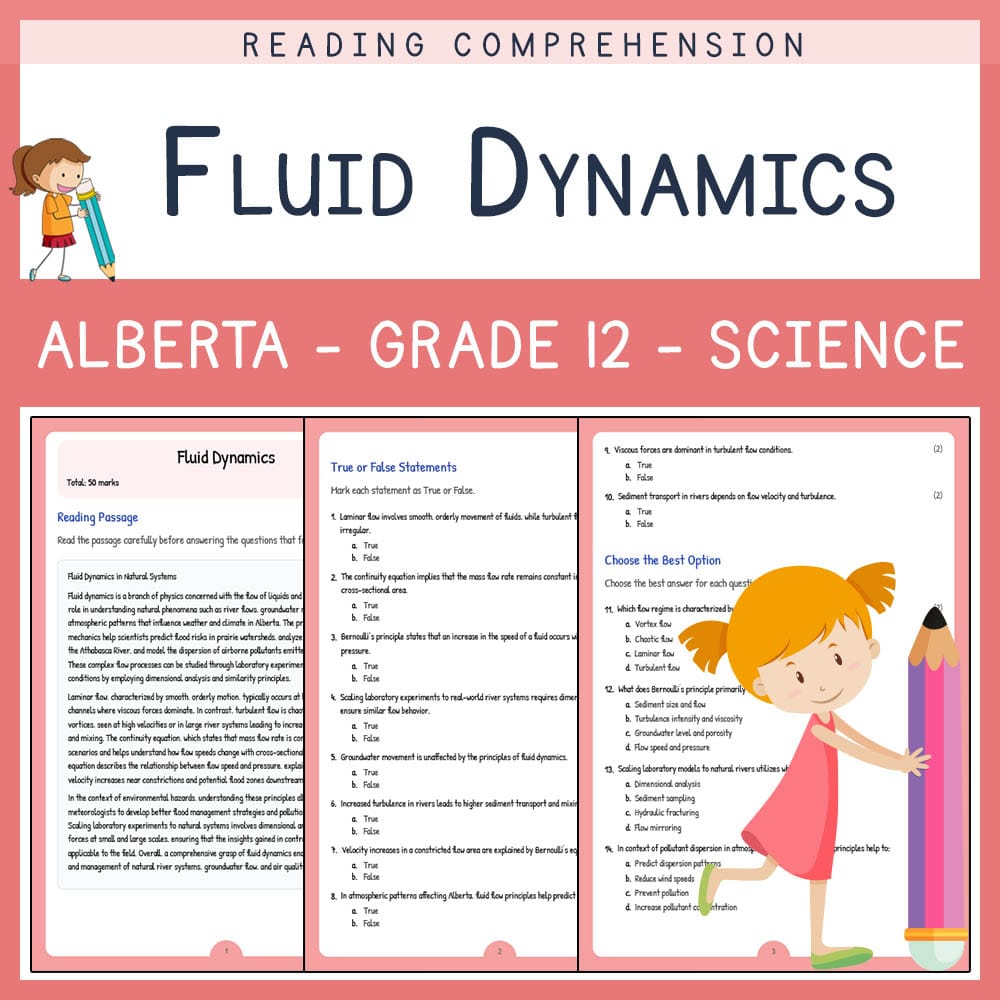
Grade 12 Science | Fluid Dynamics Worksheet | Alberta Standards
Learning Objectives
- Explain the principles of laminar and turbulent flow in fluids.
- Apply the continuity equation to real-world scenarios like river flow and groundwater movement.
- Describe Bernoulli's principle and its relevance to atmospheric patterns and flood risks.

Grade 12 Science | Wave Behavior Worksheet | AP Aligned
Learning Objectives
- Describe wave phenomena using mathematical descriptions such as wavelength, frequency, phase velocity, and amplitude.
- Explain the principles of superposition, interference, and standing waves in strings and air columns.
- Apply sinusoidal representations, phasor reasoning, and energy transport concepts to analyze wave patterns.
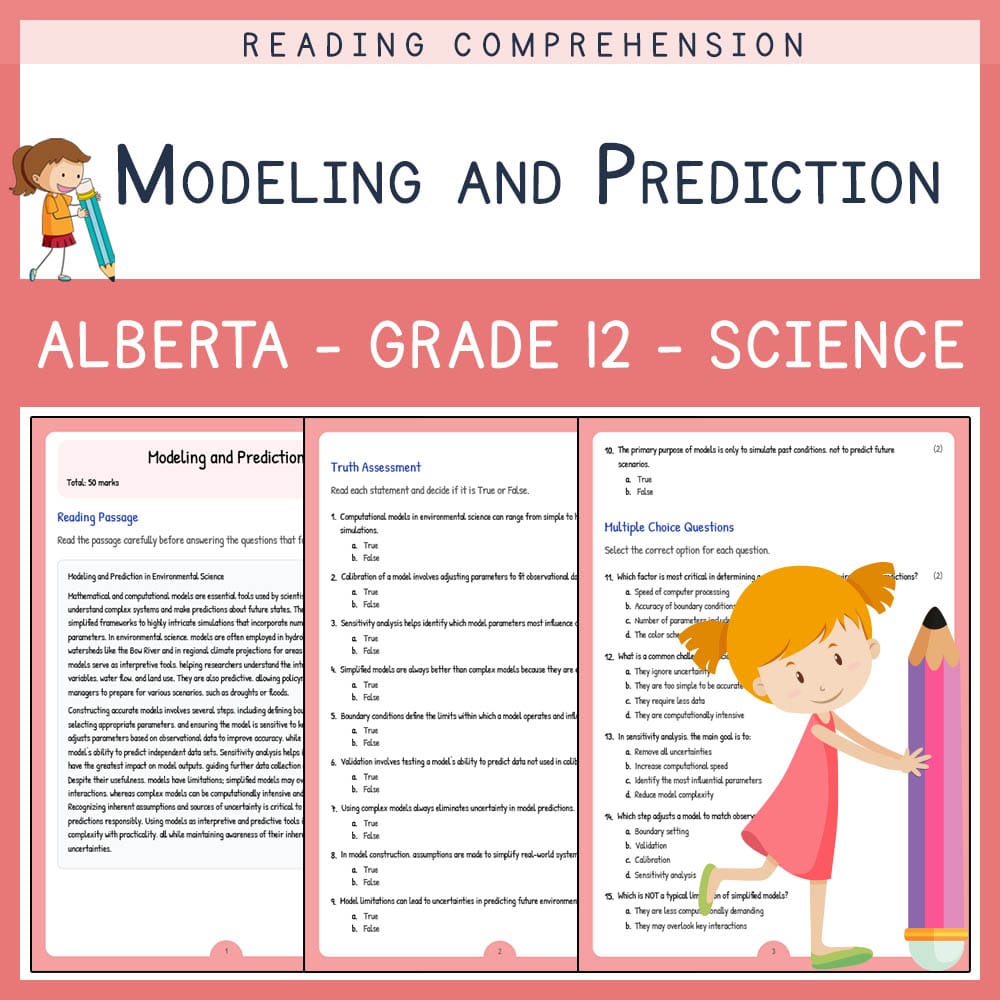
Grade 12 Science | Modeling and Prediction Worksheet | Alberta Standards
Learning Objectives
- Understand key concepts of mathematical and computational modeling in environmental science.
- Describe the processes of model construction, calibration, and validation.
- Explain the role of sensitivity analysis and boundary conditions in modeling.
Grade 12 Science | Atomic Spectra Worksheet | Alberta Standards
Learning Objectives
- Understand the process of electronic transitions that produce atomic spectra.
- Identify the importance of spectral patterns in element and isotope identification.
- Explain concepts such as selection rules, line broadening, and energy quantization in spectroscopy.
Grade 12 Science | Senior Design Worksheet | Alberta Standards
Learning Objectives
- Understand methods for framing rigorous scientific research questions.
- Evaluate instrumentation choices for air and water monitoring applications.
- Apply statistical treatments for significance and error analysis in environmental studies.
Grade 12 Science | Reaction Rates Worksheet | Alberta Standards
Learning Objectives
- Explain how concentration, temperature, surface area, and catalysts influence reaction rates.
- Interpret collision theory and activated complex concepts to assess reaction behaviour.
- Determine rate laws, reaction order, and activation energy relevant to industrial processes.
Grade 12 Science | Chemical Equilibrium Worksheet | Alberta Standards
Learning Objectives
- Understand the concept of reversible reactions and equilibrium states.
- Explain Le Chatelier’s principle and how it predicts the shifts in chemical equilibria.
- Apply equilibrium expressions to real-world chemical processes such as ammonia synthesis and fertilizer production.
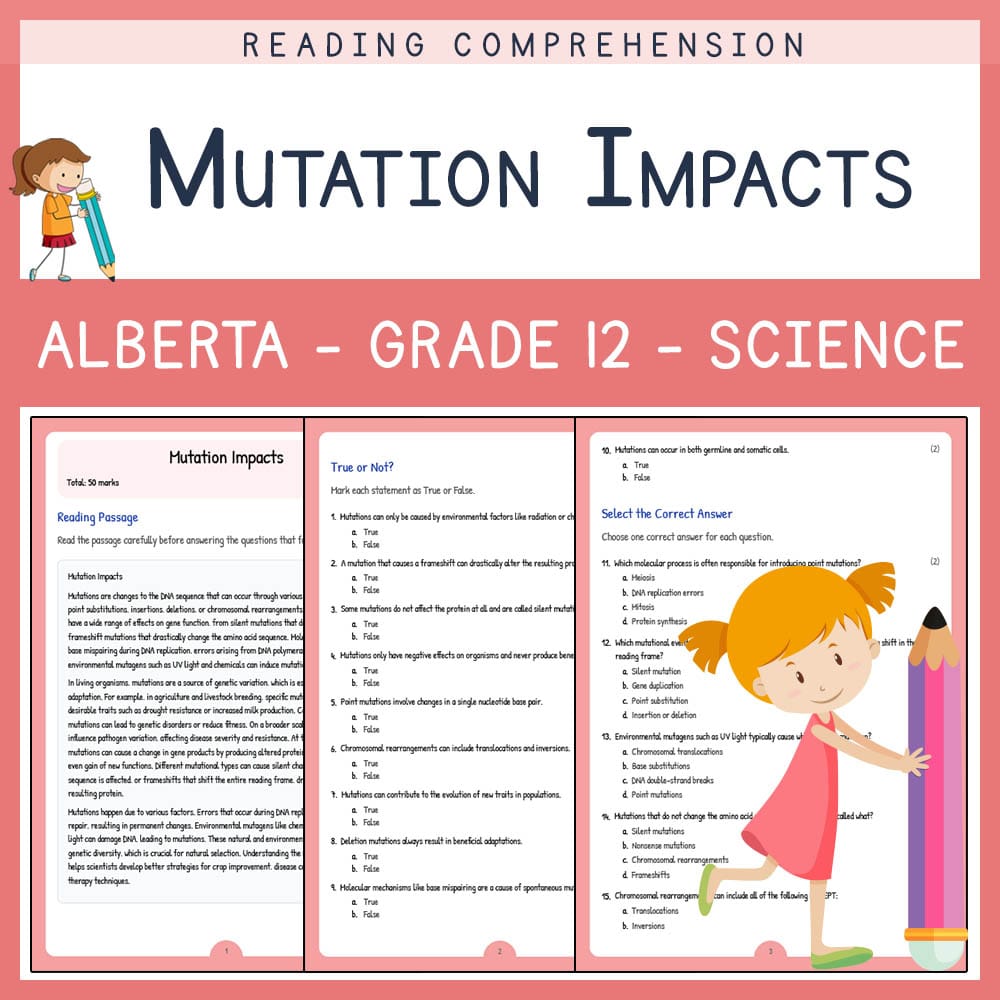
Grade 12 Science | Mutation Impacts Worksheets | Alberta Standards
Learning Objectives
- Understand the different types of genetic mutations and their molecular mechanisms.
- Identify the potential effects of mutations on gene products and organism traits.
- Describe the influence of mutational outcomes on agriculture, livestock, and pathogens.
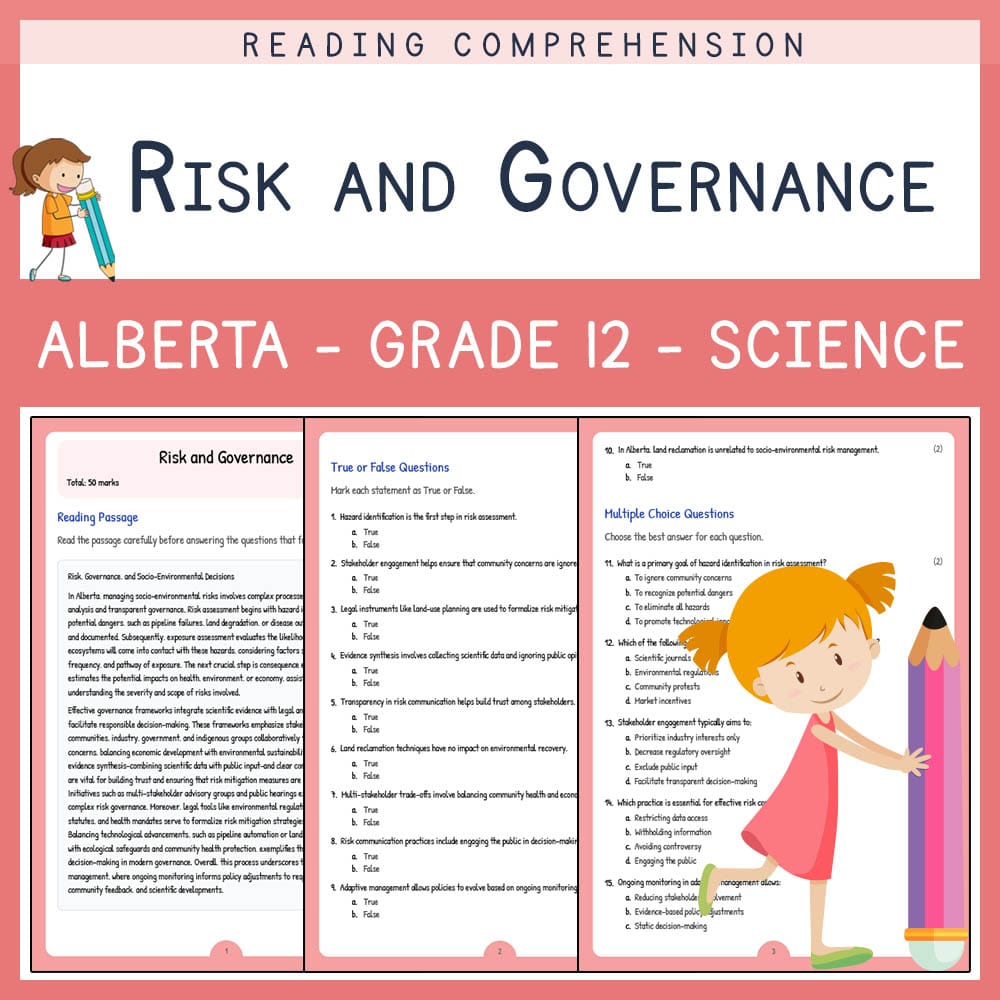
Grade 12 Science | Risk and Governance Worksheet | Alberta Standards
Learning Objectives
- Understand the components of risk assessment including hazard identification, exposure assessment, and consequence evaluation.
- Explain the role of governance frameworks in managing socio-environmental decisions.
- Identify the importance of stakeholder engagement, legal tools, and evidence synthesis in balancing technological benefits with environmental protection.
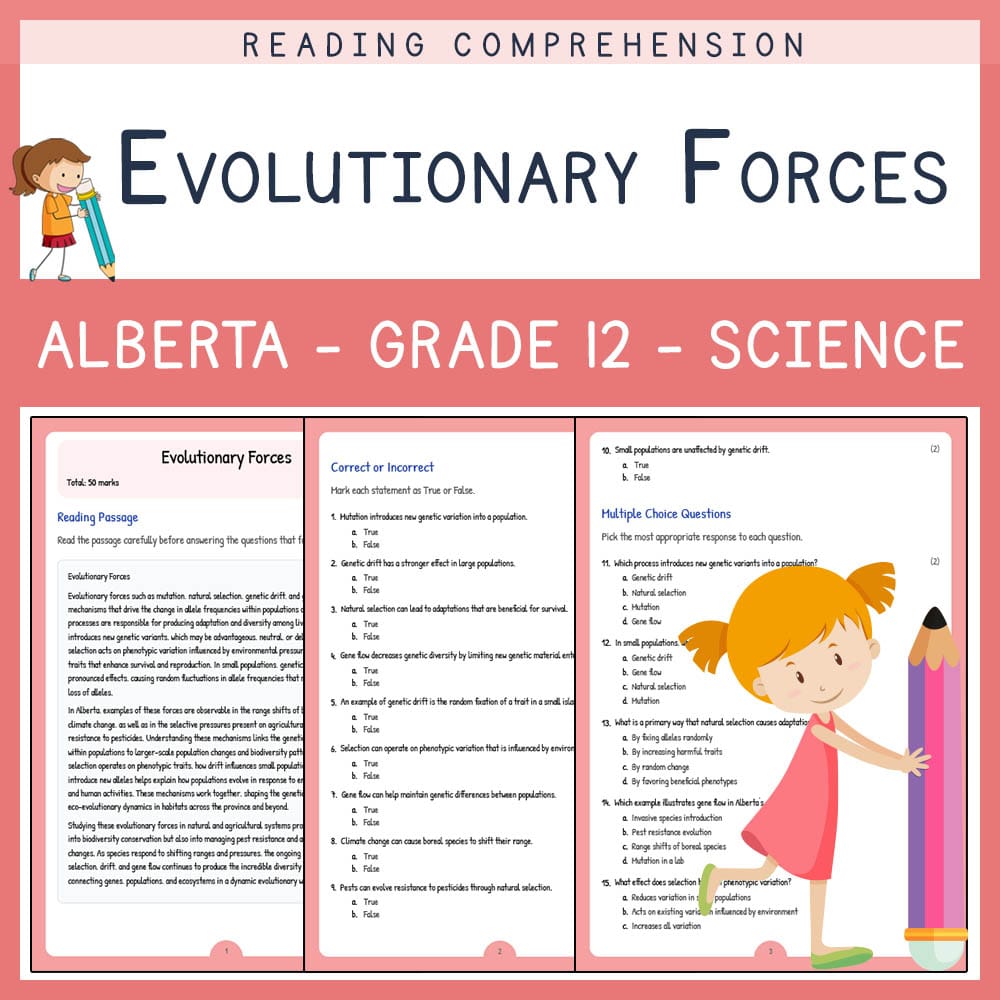
Grade 12 Science | Evolutionary Forces Worksheet | Alberta Standards
Learning Objectives
- Describe how mutation, natural selection, genetic drift, and gene flow influence allele frequencies over time.
- Explain how environmental pressures drive phenotypic variation and adaptation.
- Analyze cases such as boreal range shifts and pest selection in Alberta to understand real-world applications of evolution.
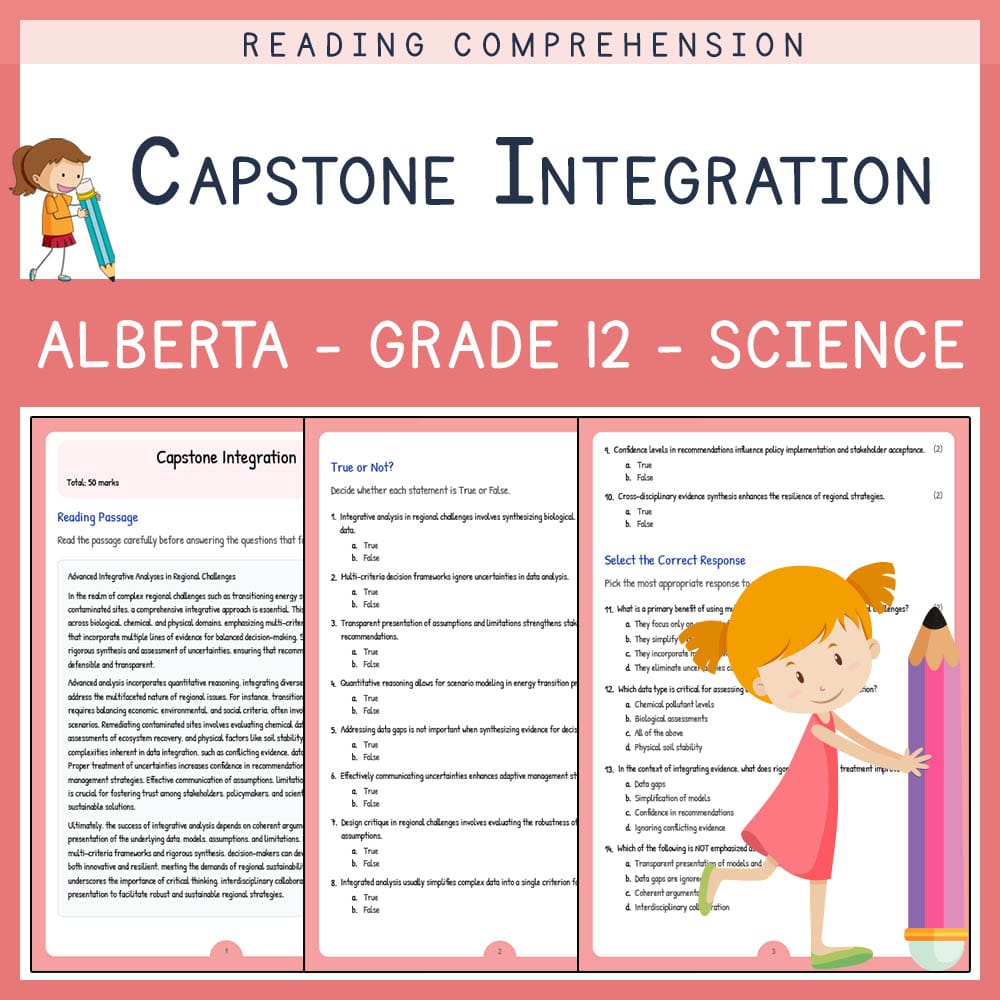
Grade 12 Science | Capstone Integration Worksheet | Alberta Standards
Learning Objectives
- Understand how cross-disciplinary data synthesis can inform complex regional decision-making.
- Apply quantitative reasoning frameworks to evaluate multifaceted environmental and social challenges.
- Critique and develop coherent arguments considering uncertainties, assumptions, and limitations in integrated analyses.
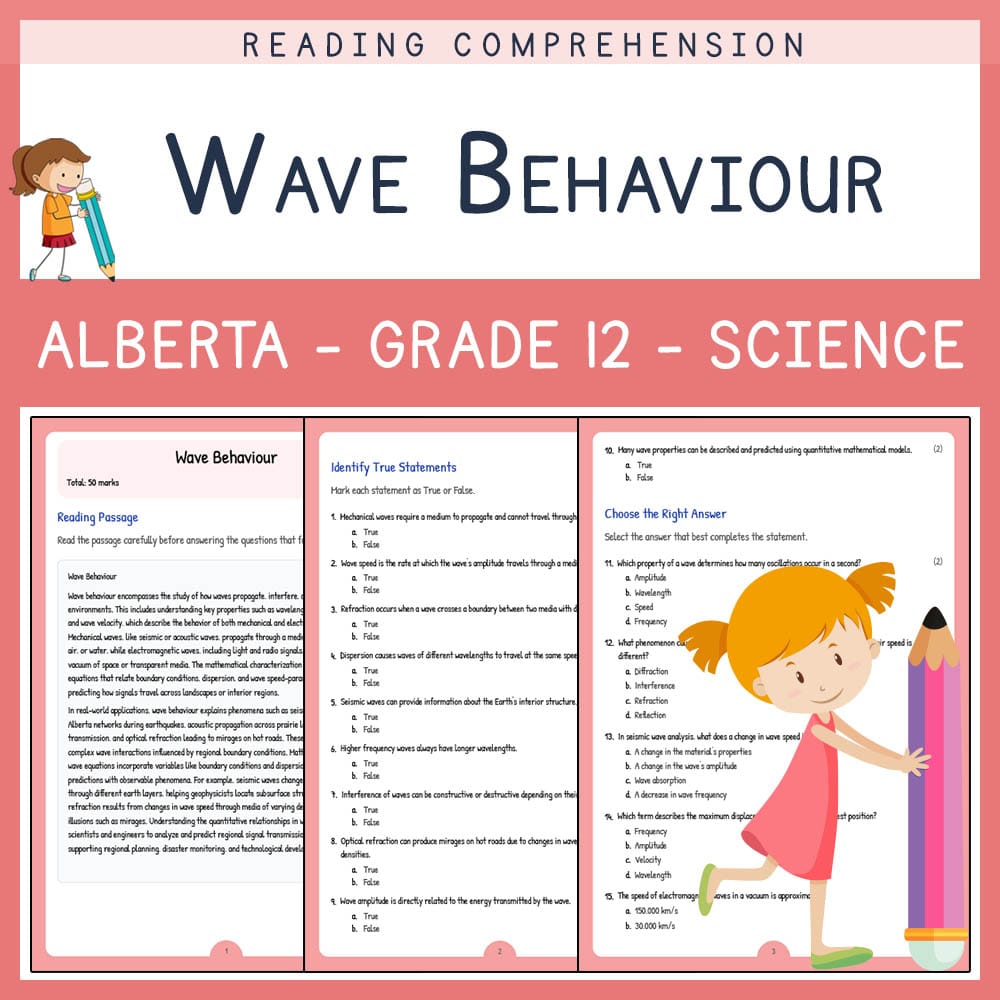
Grade 12 Science | Wave Behaviour Worksheet | Alberta Standards
Learning Objectives
- Understand the fundamental properties of wave characteristics such as wavelength, frequency, amplitude, and wave speed.
- Apply quantitative models to predict wave propagation across different media.
- Describe real-world examples of wave behaviour, including seismic waves and optical refraction phenomena.
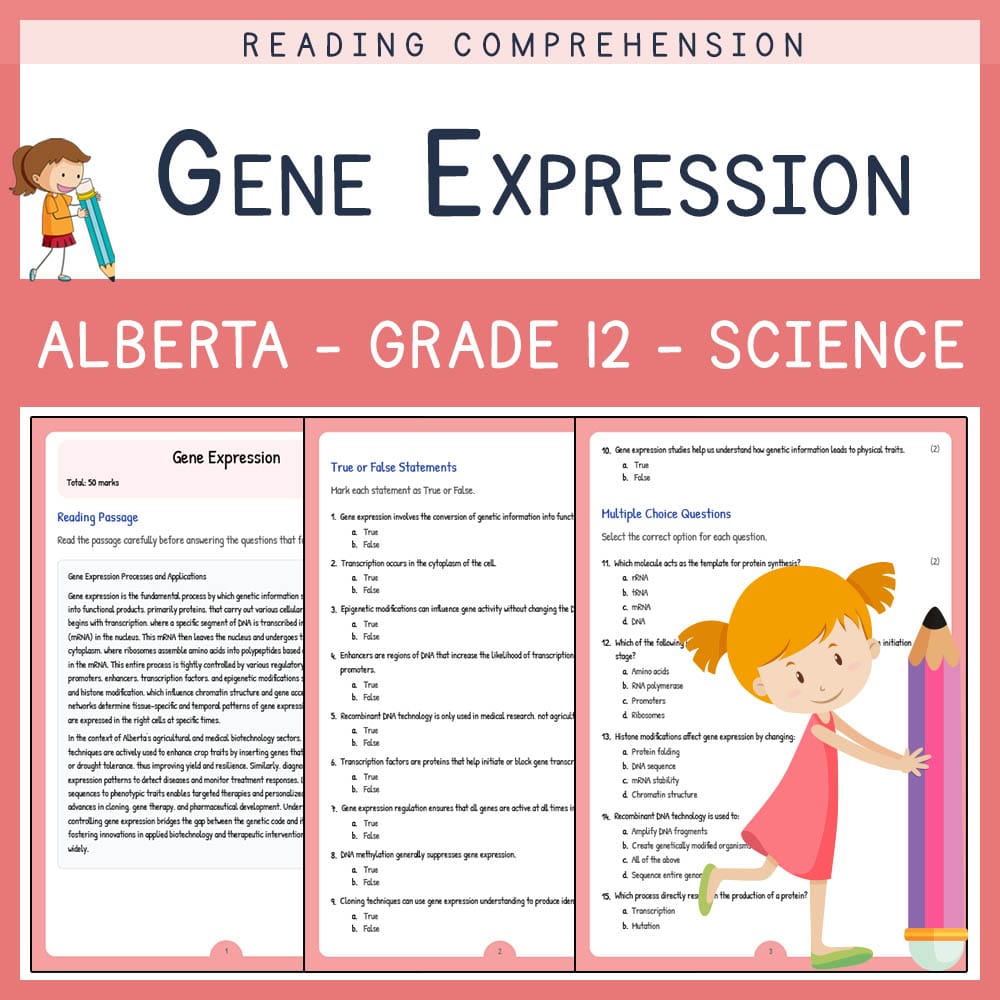
Grade 12 Science | Gene Expression Worksheet Elena | Alberta Standards
Learning Objectives
- Explain the process of gene transcription and translation.
- Identify the roles of promoters, enhancers, and transcription factors in gene regulation.
- Describe how epigenetic modifications influence gene expression patterns.
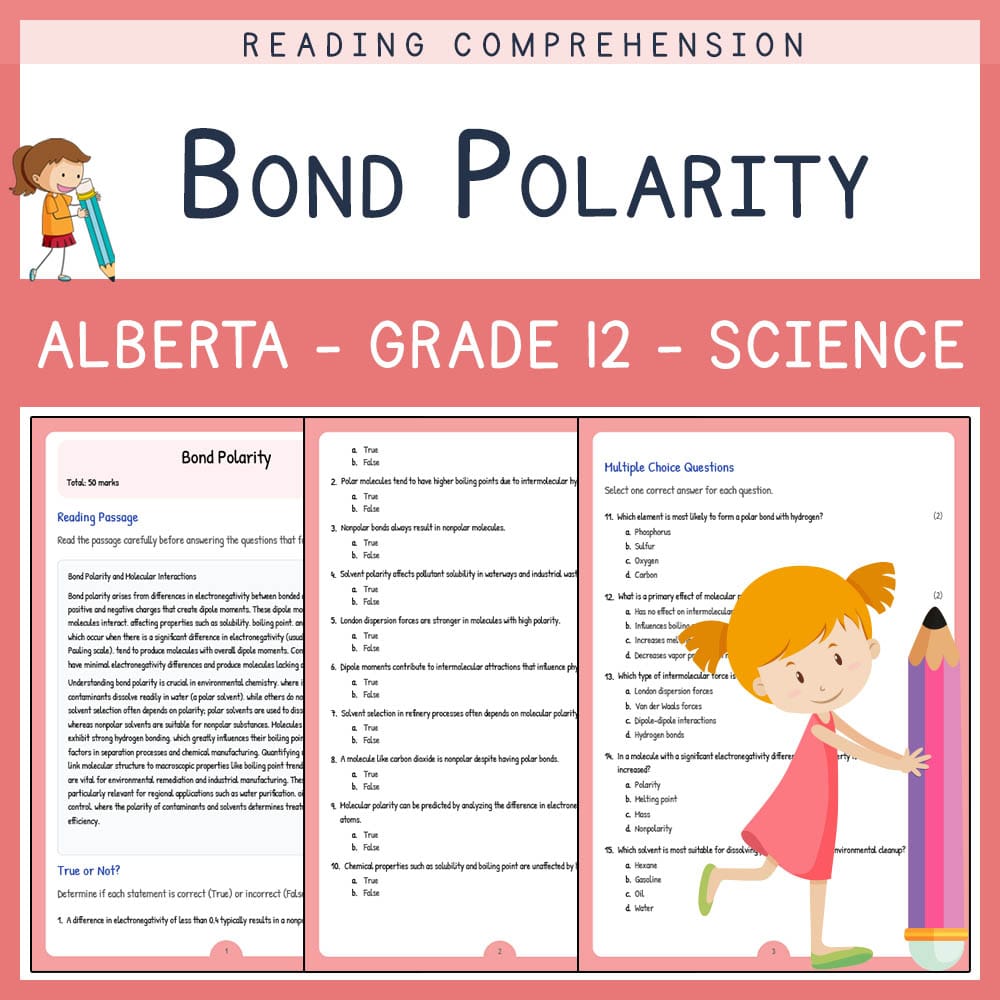
Grade 12 Science Worksheet | Bond Polarity | Alberta Standards
Learning Objectives
- Explain the concept of bond polarity and how differences in electronegativity create dipole moments.
- Identify and classify bonds as polar or nonpolar based on molecular structure and electronegativity differences.
- Apply understanding of bond polarity to predict solvent behaviors, molecular interactions, and industrial applications.
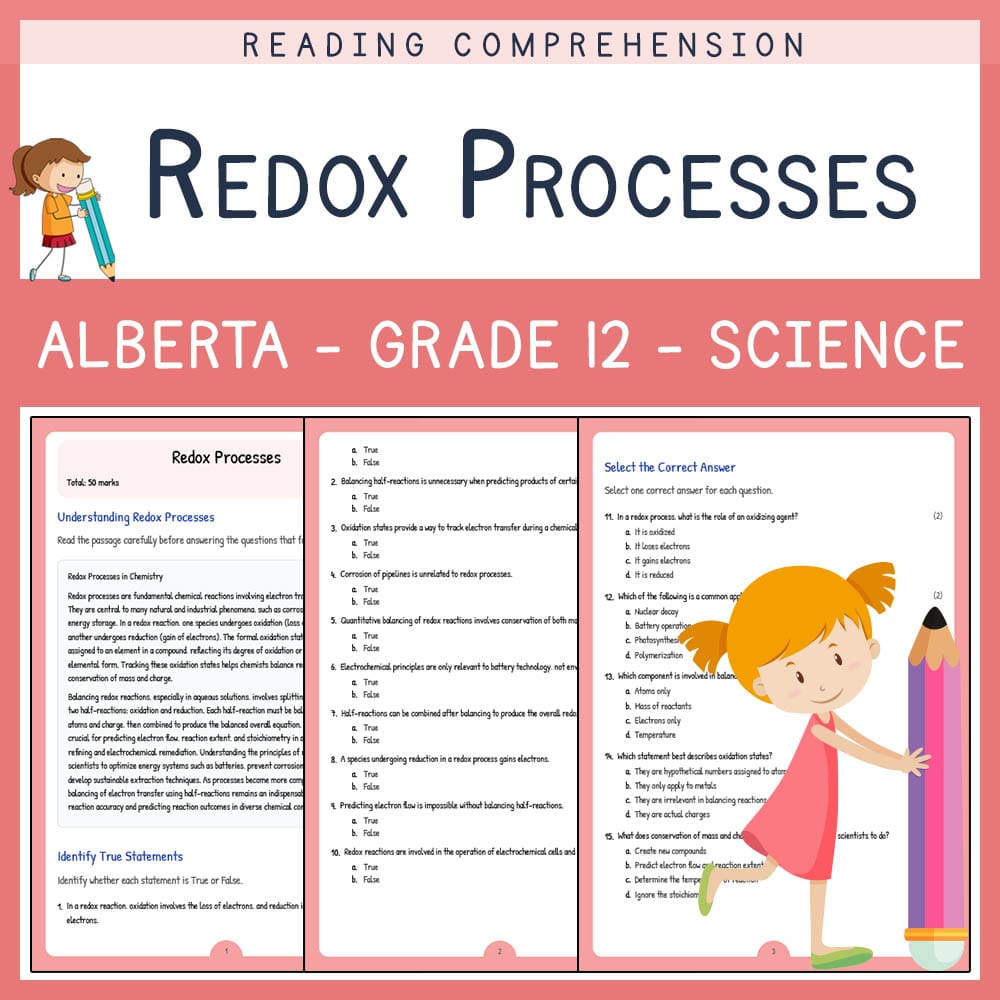
Grade 12 Science | Redox Processes Worksheet | Alberta Standards
Learning Objectives
- Explain the fundamentals of oxidation-reduction (redox) reactions, including electron transfer and oxidation states.
- Balance redox half-reactions accurately using conservation of mass and charge.
- Apply electrochemical principles to real-world scenarios such as corrosion, battery operation, and metal refining.
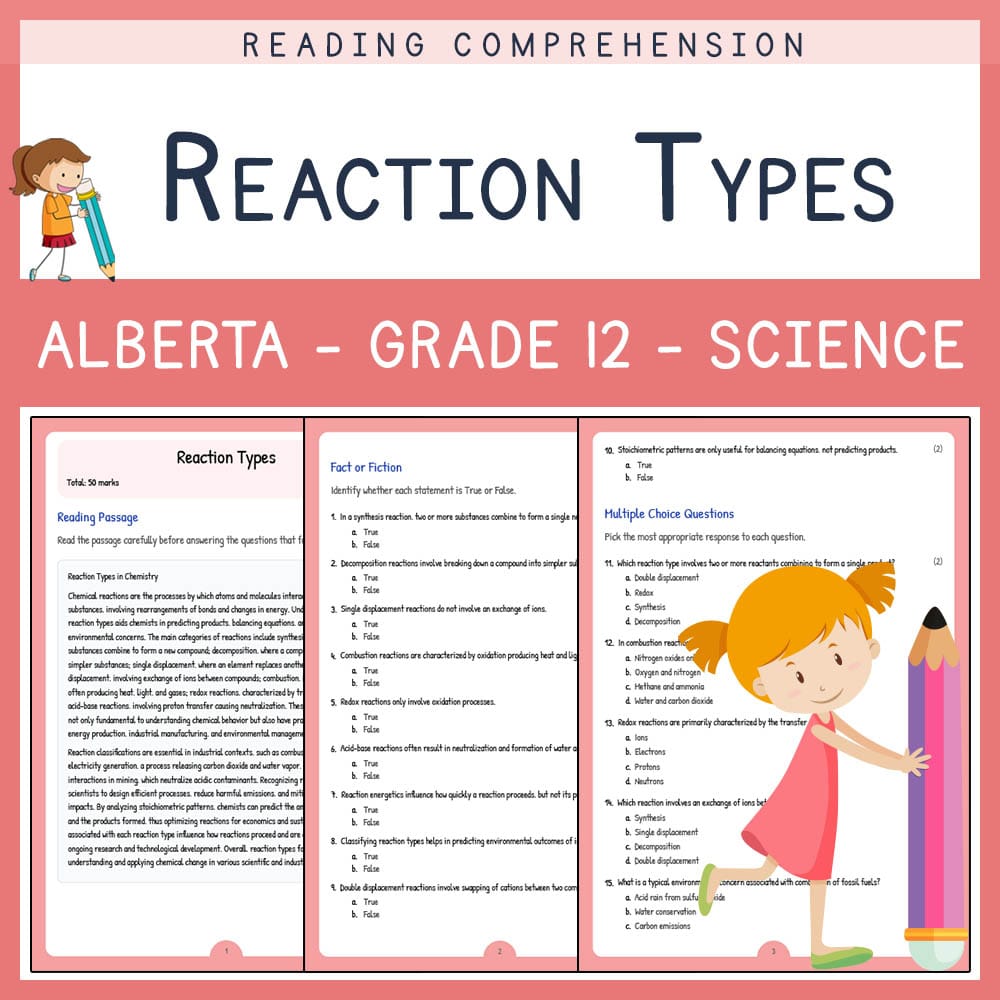
Grade 12 Science | Reaction Types Worksheet | Alberta Standard
Learning Objectives
- Classify various chemical reactions into types such as synthesis, decomposition, displacement, combustion, redox, and acid–base.
- Predict products of different reaction pathways based on stoichiometric patterns and energetics.
- Balance chemical equations involving diverse reaction types.
About Grade 12 Science Worksheets
Explore Grade 12 Science worksheets for classwork, homework, or review. Our 4,124 printables download instantly as PDFs.
MyTeachingSheets worksheets are made by real teacher-authors and checked before they go live. Download any as a print-ready PDF for lessons, homework, or independent practice — most include answer keys, and previews are always free.