
Grade 12 Science Worksheets
4,240 worksheets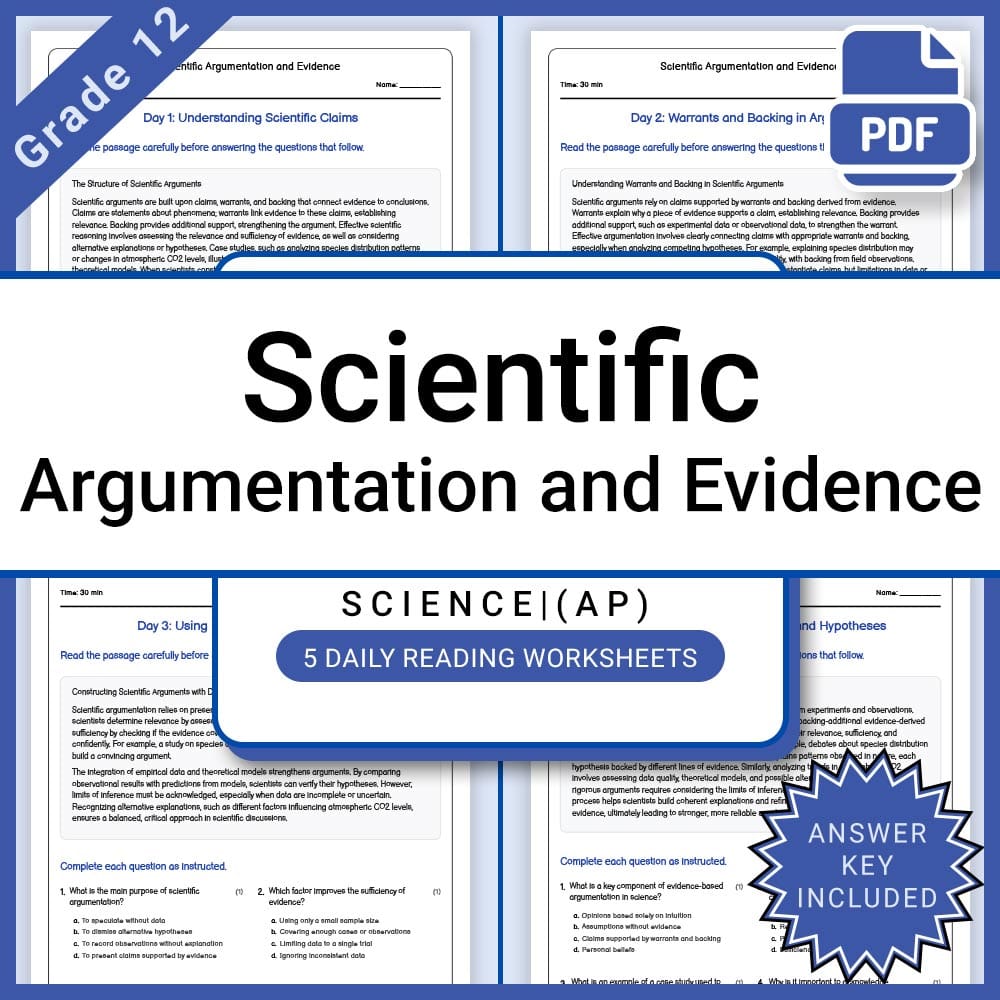
Grade 12 Science – Scientific Argumentation Daily Reading Worksheet + Answer Key
JCreated byJ.S SheetsLearning Objectives
- Understand the structure of evidence-based scientific arguments.
- Identify claims, warrants, and backing in scientific reasoning.
- Evaluate the relevance and sufficiency of evidence in case studies.
Also included in: Grade 12 Science Practices Lesson Bundle | AP Framework and Skills +1 more
Instant download
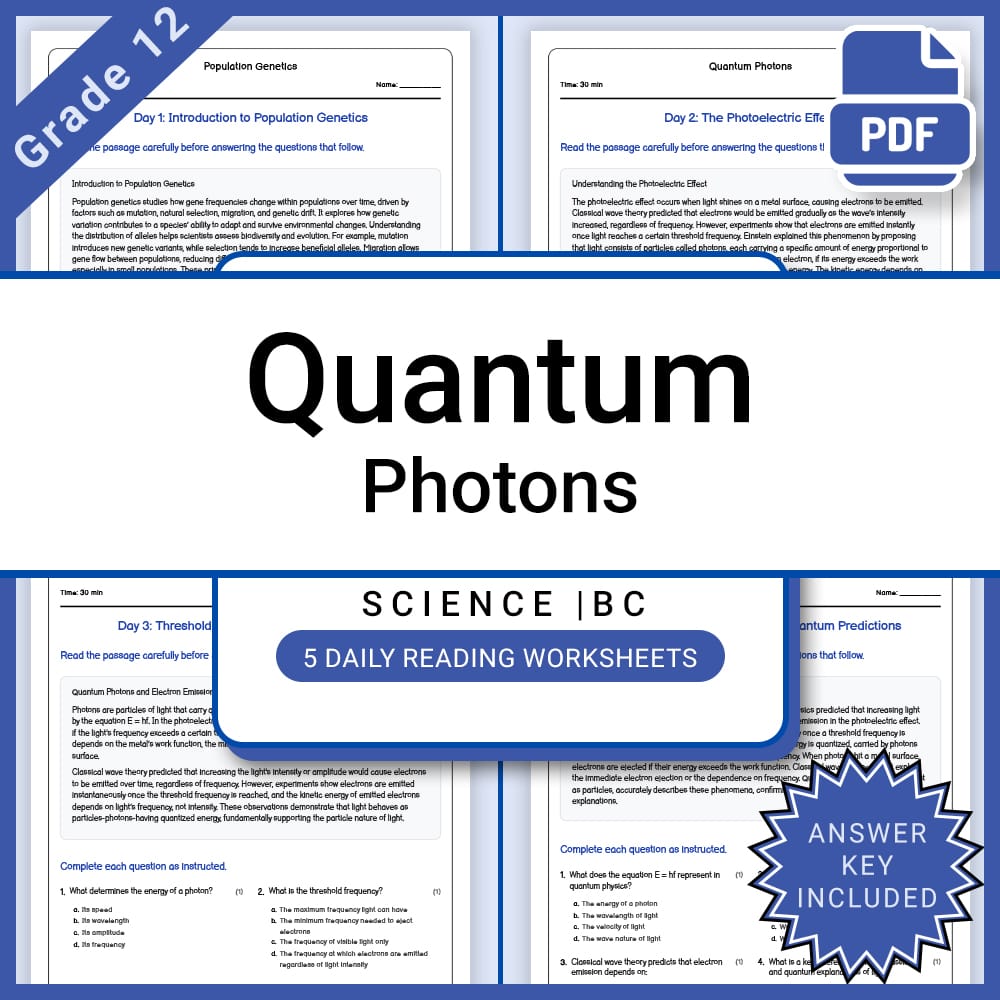
Grade 12 Science – Quantum Photons Daily Reading Worksheet with Answer Key
JCreated byJ.S SheetsLearning Objectives
- Understand the concept of photon energy and its relation to frequency
- Explain the photoelectric effect and the idea of quantized energy exchange
- Distinguish between classical wave predictions and quantum observations related to photons
Also included in: Grade 12 Science Lesson Group | Physics, Energy, Waves & Electromagnetism +1 more
Instant download
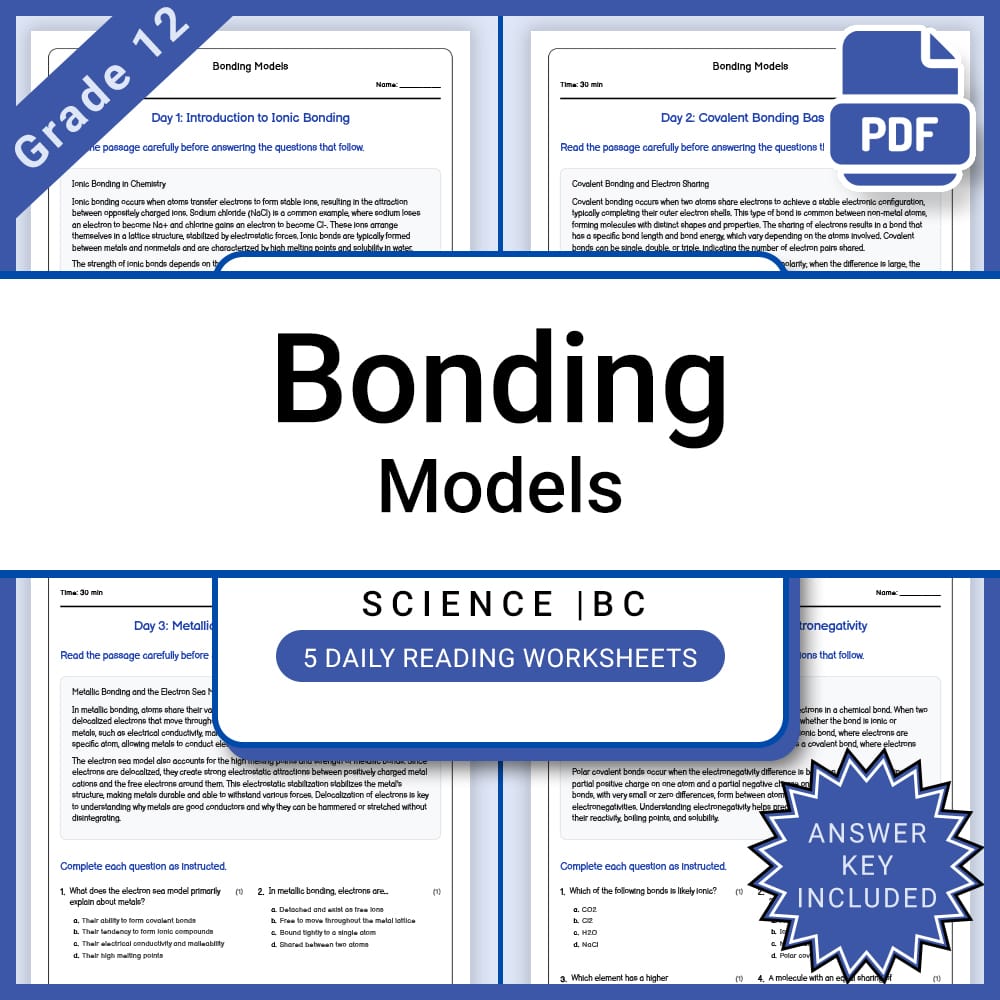
Grade 12 Science – Bonding Models Daily Reading Worksheet with Answer Key
JCreated byJ.S SheetsLearning Objectives
- Identify ionic bonding and electron transfer
- Describe how atoms share electrons in covalent bonds
- Understand metallic bonding and delocalized electrons
Also included in: Grade 12 Science Lesson Bundle BC Framework | Daily Reading Worksheets +1 more
Instant download
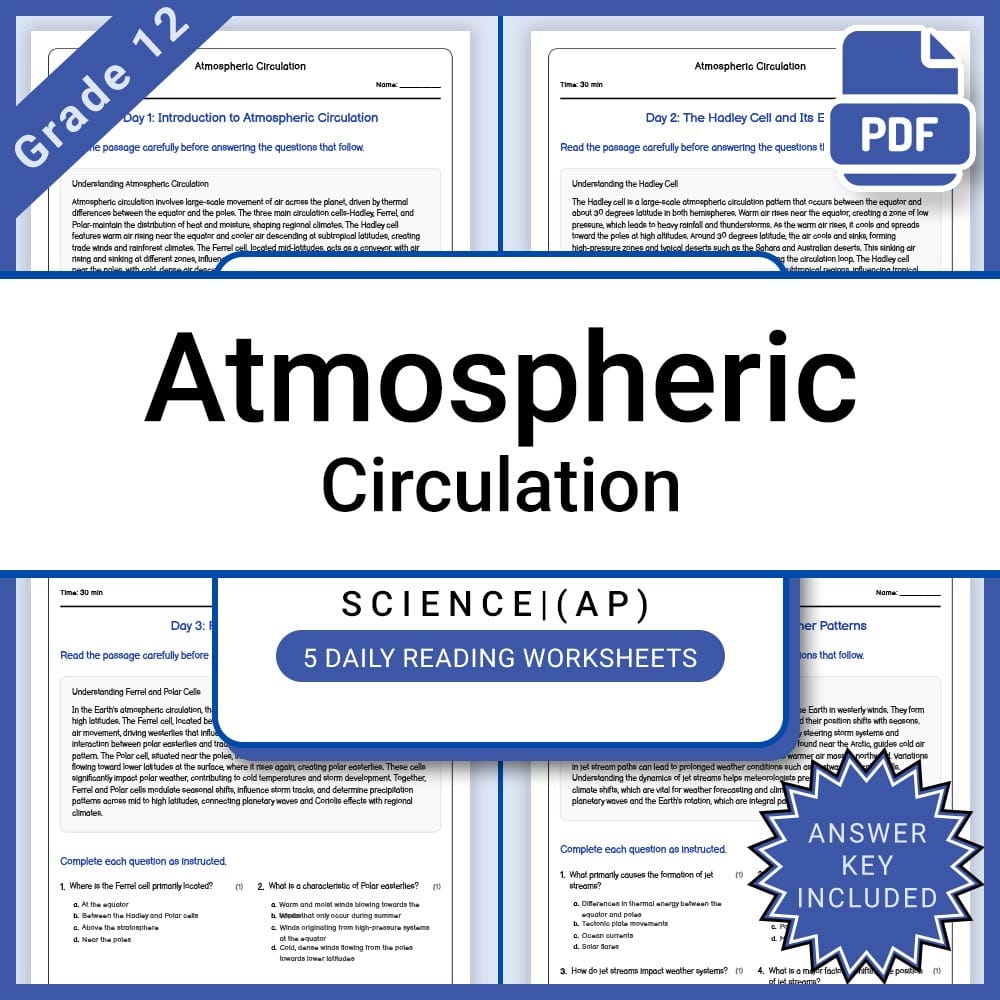
Grade 12 Science – Atmospheric Circulation Daily Reading Worksheet + Answer Key
JCreated byJ.S SheetsLearning Objectives
- Understand the structure and function of large-scale atmospheric circulation patterns
- Identify the main circulation cells and their roles in climate
- Explain how thermal gradients and Coriolis effects influence weather systems
Also included in: Grade 12 Earth and Space Sciences Lesson Bundle for AP Curriculum +1 more
Instant download
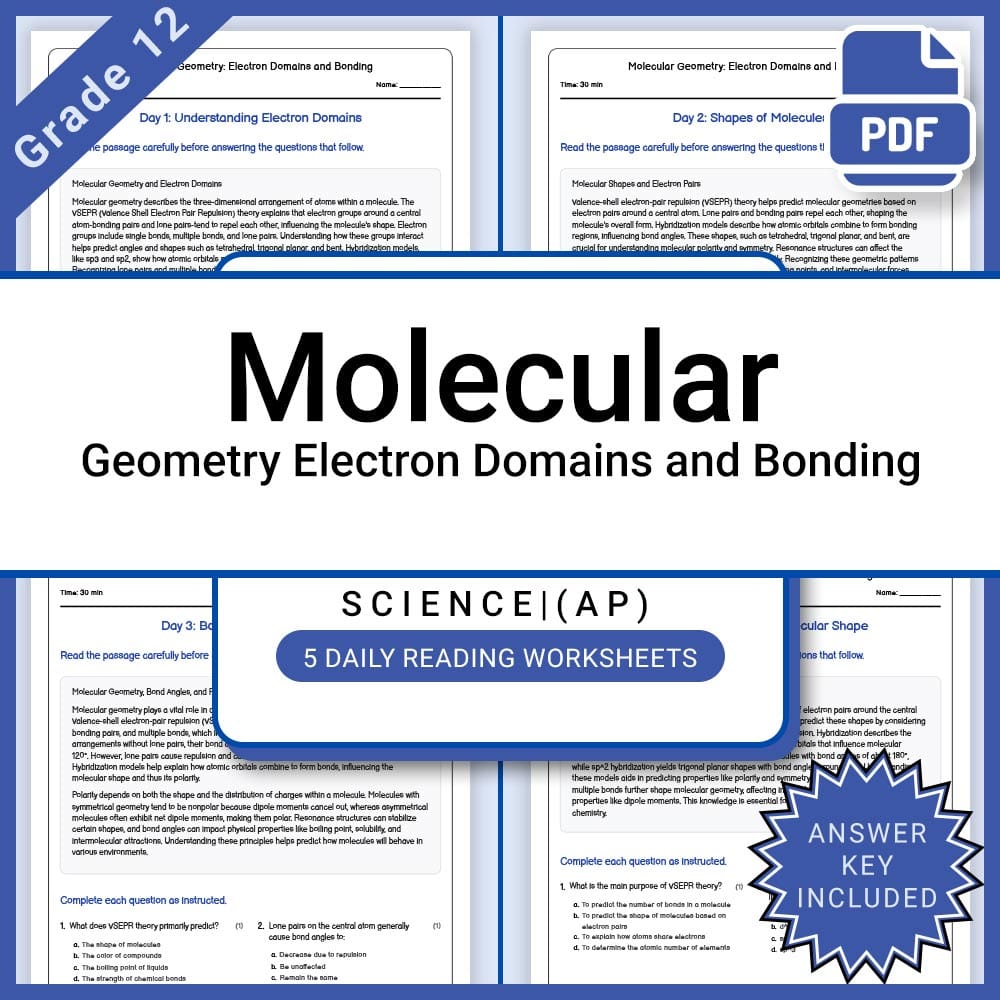
Grade 12 Science – Molecular Geometry and Bonding Daily Worksheet + Answer Key
JCreated byJ.S SheetsLearning Objectives
- Understand key concepts related to Science
- Apply knowledge through practice questions
- Demonstrate comprehension of the material
Also included in: Grade 12 Chemistry Foundations Lesson Bundle – AP Science Activities +1 more
Instant download
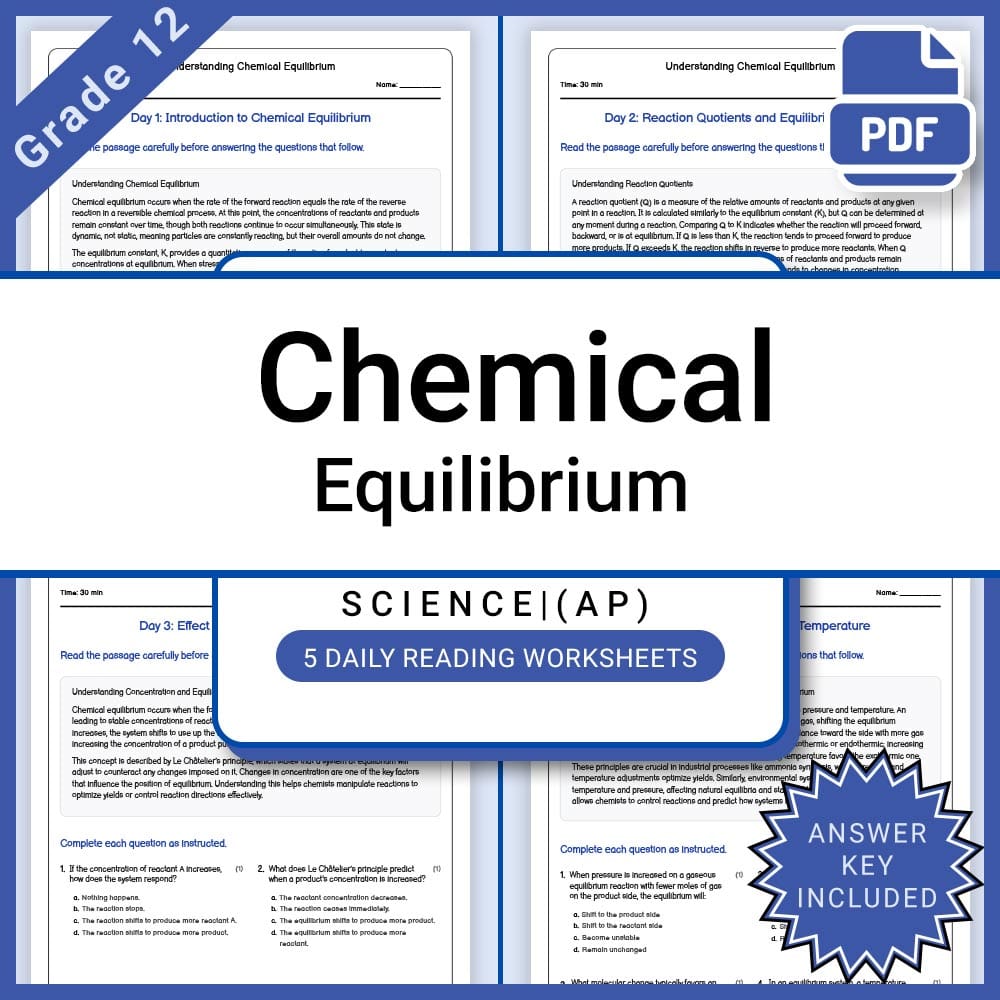
Grade 12 Science – Chemical Equilibrium Daily Reading Worksheet + Answer Key
JCreated byJ.S SheetsLearning Objectives
- Define chemical equilibrium and understand its dynamic nature.
- Identify forward and reverse reactions in a chemical process.
- Interpret the meaning of the equilibrium constant K.
Also included in: Grade 12 Chemistry Foundations Lesson Bundle – AP Science Activities +1 more
Instant download
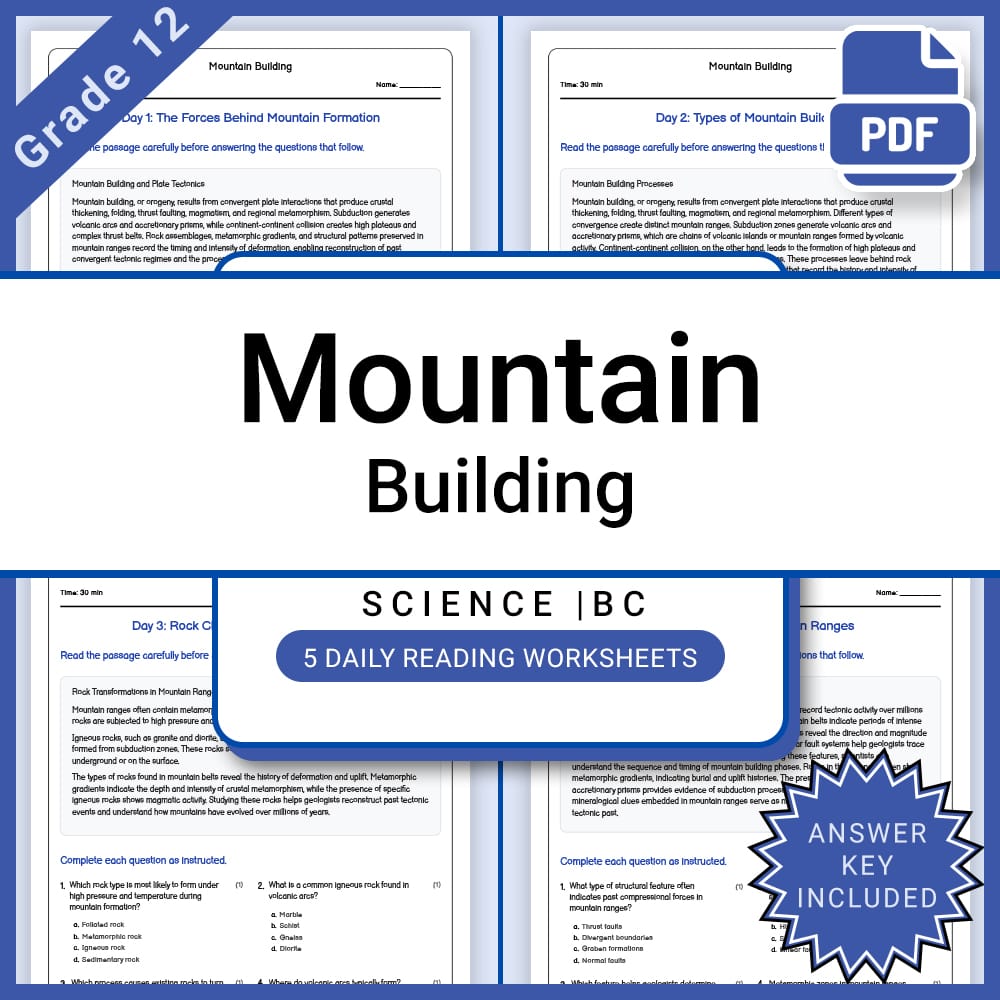
Grade 12 Science – Mountain Building Daily Reading Worksheet + Answer Key
JCreated byJ.S SheetsLearning Objectives
- Understand the tectonic processes involved in mountain formation
- Identify different types of plate interactions that create mountain ranges
- Describe geological evidence recorded in mountain ranges
Also included in: Grade 12 Science Lesson Group: Earth Systems and Geology BC Framework +1 more
Instant download
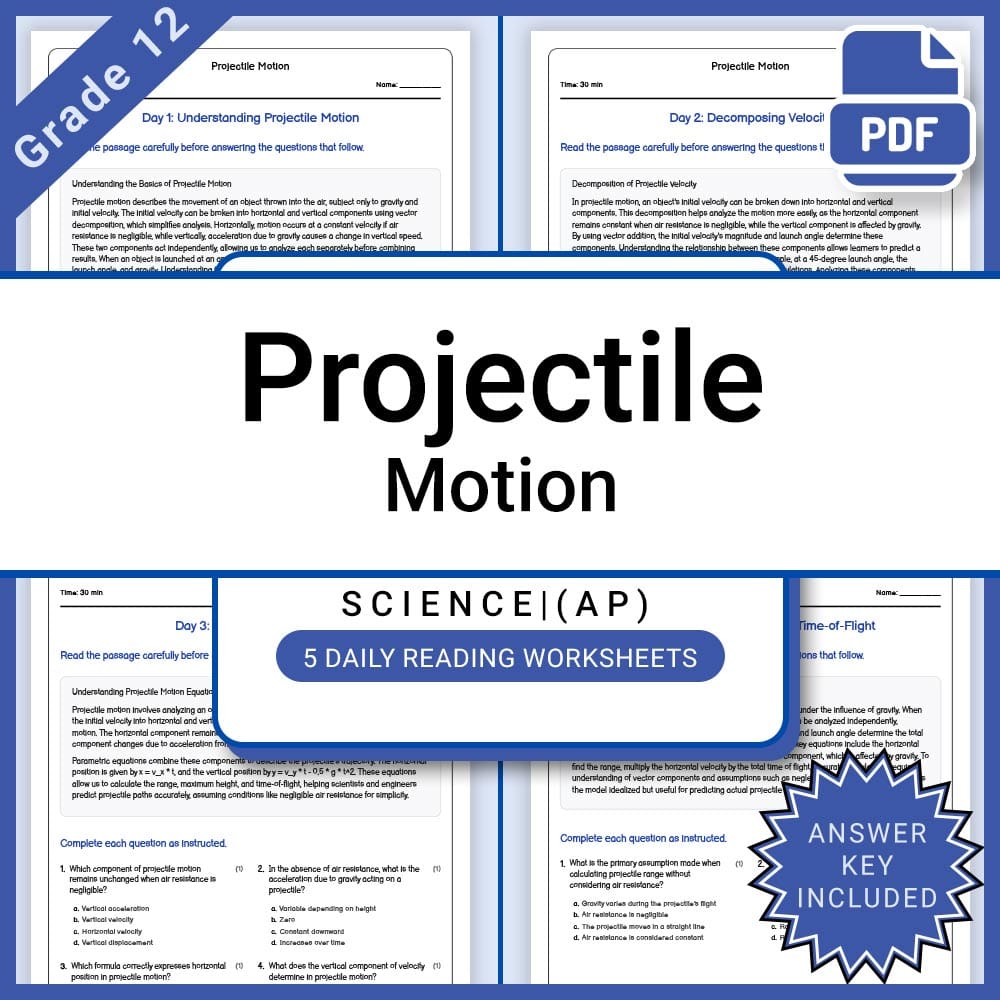
Grade 12 Science – Projectile Motion Daily Reading Worksheet + Answer Key
JCreated byJ.S SheetsLearning Objectives
- Understand the components of projectile velocity and how they influence motion
- Analyze the independence of horizontal and vertical motion in projectile trajectories
- Apply vector decomposition to initial velocity in projectile problems
Also included in: Grade 12 Physics Principles Lesson Bundle – AP Science Curriculum +1 more
Instant download
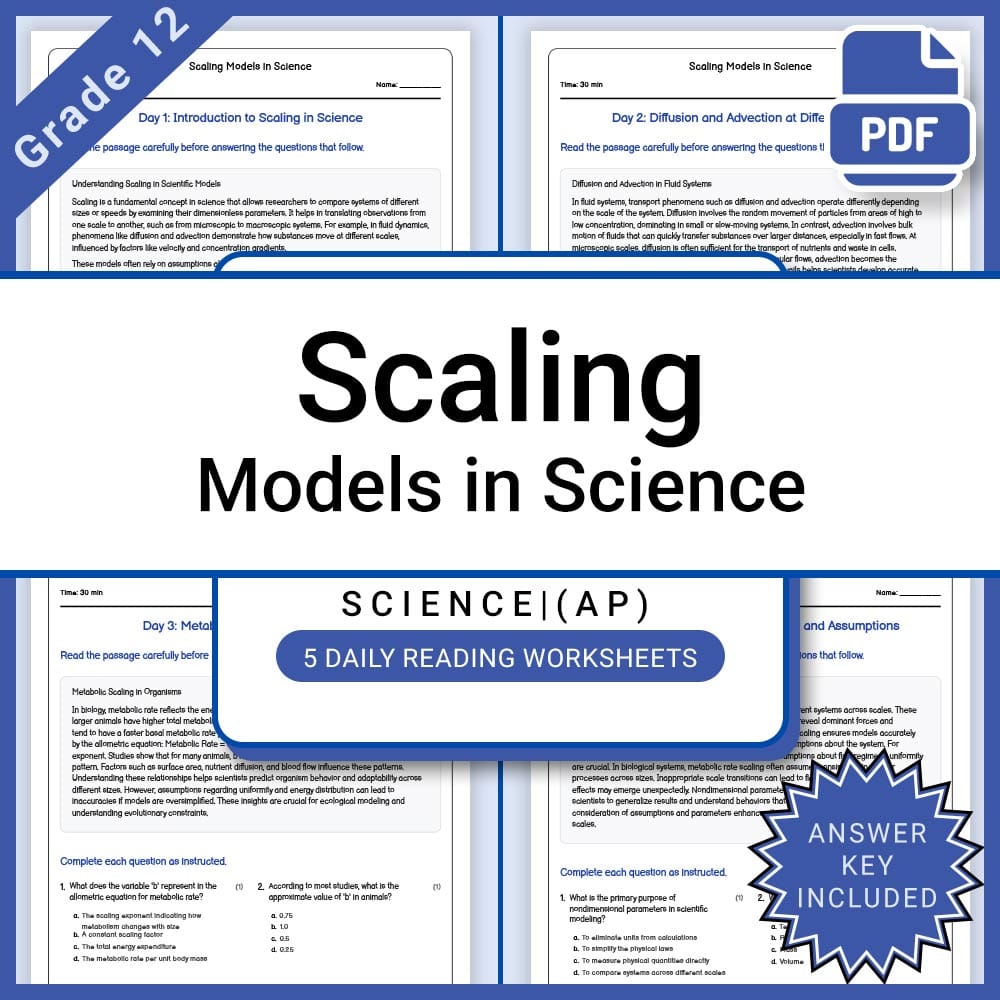
Grade 12 Science – Scaling Models Daily Reading Worksheet with Answer Key
JCreated byJ.S SheetsLearning Objectives
- Understand the concept of scaling and its relevance in scientific modeling.
- Learn how dimensional analysis assists in connecting models across different scales.
- Explore phenomena such as diffusion and advection as examples of scale effects in fluids.
Also included in: Grade 12 Science Practices Lesson Bundle | AP Framework and Skills +1 more
Instant download
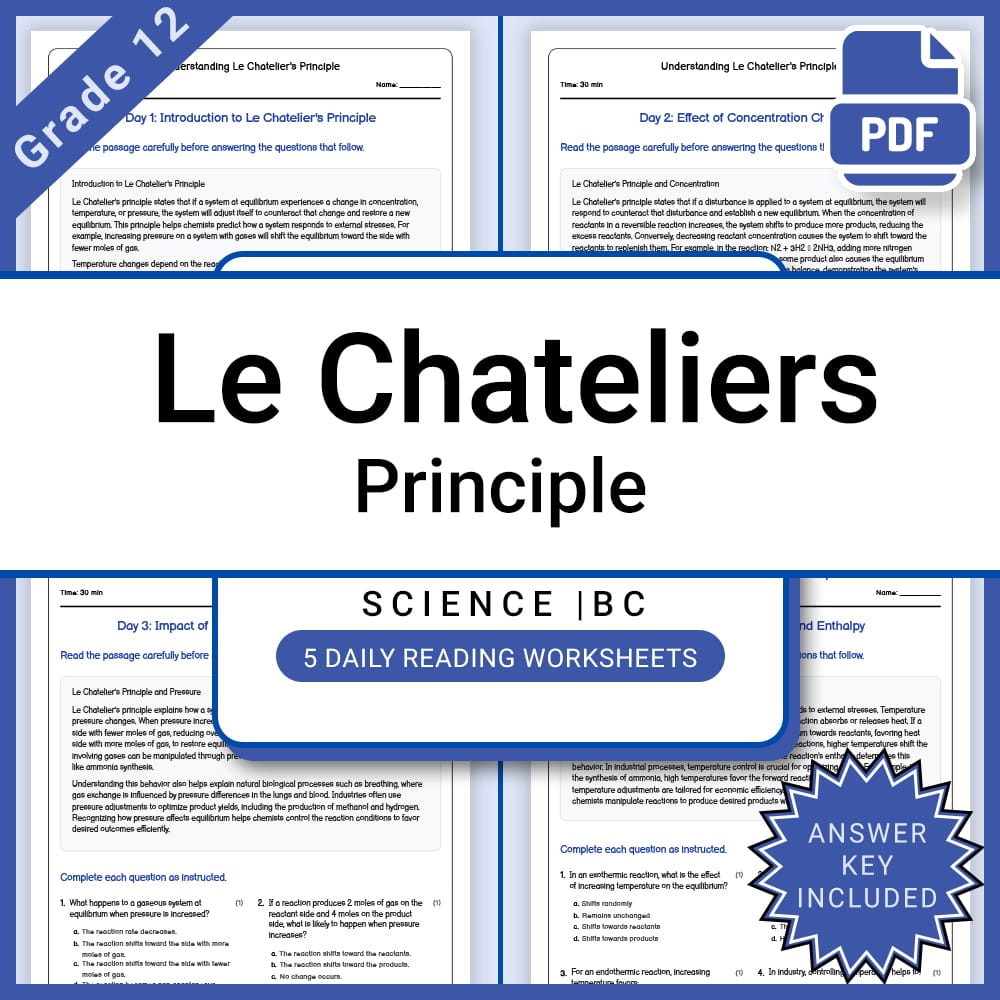
Grade 12 Science – Le Chatelier's Principle Daily Reading Worksheet + Answer Key
JCreated byJ.S SheetsLearning Objectives
- Define Le Chatelier's principle and explain its significance in chemical equilibrium.
- Describe how changes in concentration, pressure, and temperature affect equilibrium systems.
- Understand the effect of catalysts on reaction rates without shifting equilibrium.
Also included in: Grade 12 Science Lesson Bundle BC Framework | Daily Reading Worksheets +1 more
Instant download
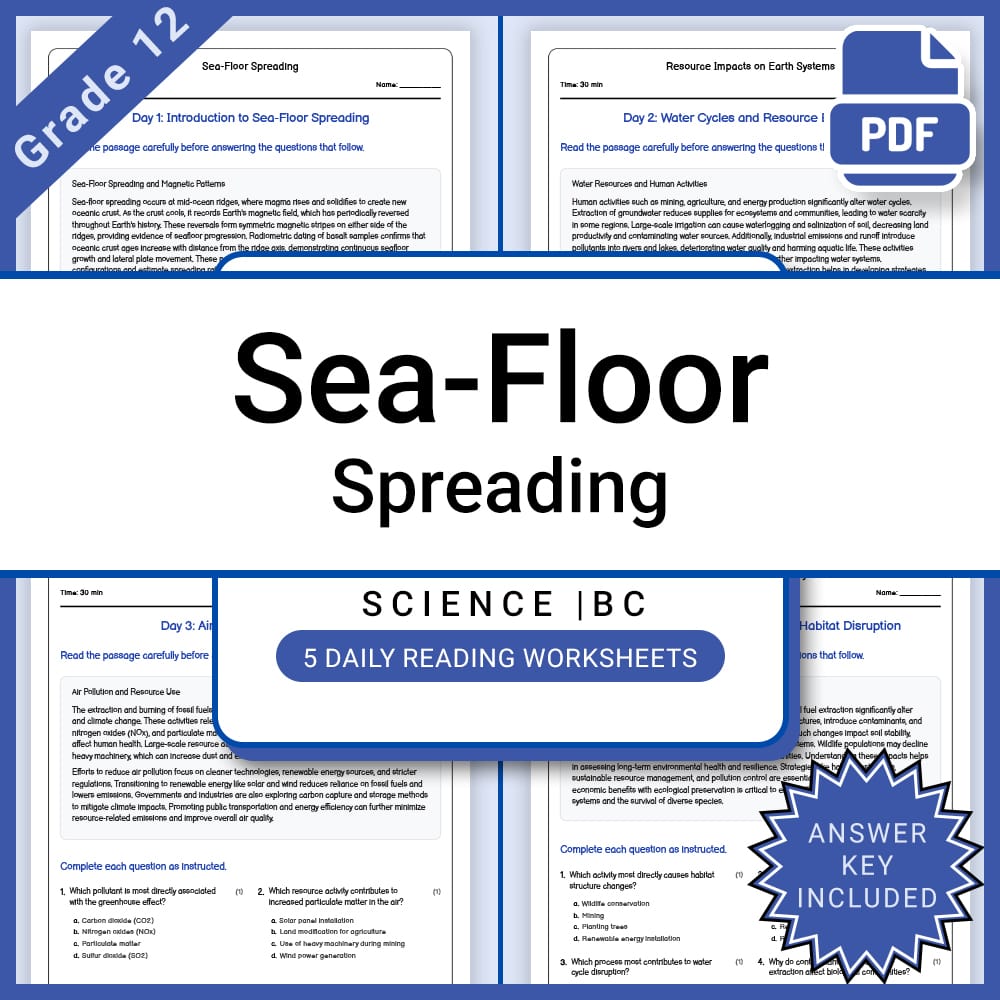
Grade 12 Science – Sea-Floor Spreading Daily Reading Worksheet + Answer Key
JCreated byJ.S SheetsLearning Objectives
- Understand the basic concept of sea-floor spreading
- Identify how magnetic stripe patterns are formed on the ocean floor
- Recognize the significance of magnetic anomalies and radiometric dating in plate tectonics
Also included in: Grade 12 Science Lesson Group: Earth Systems and Geology BC Framework +1 more
Instant download
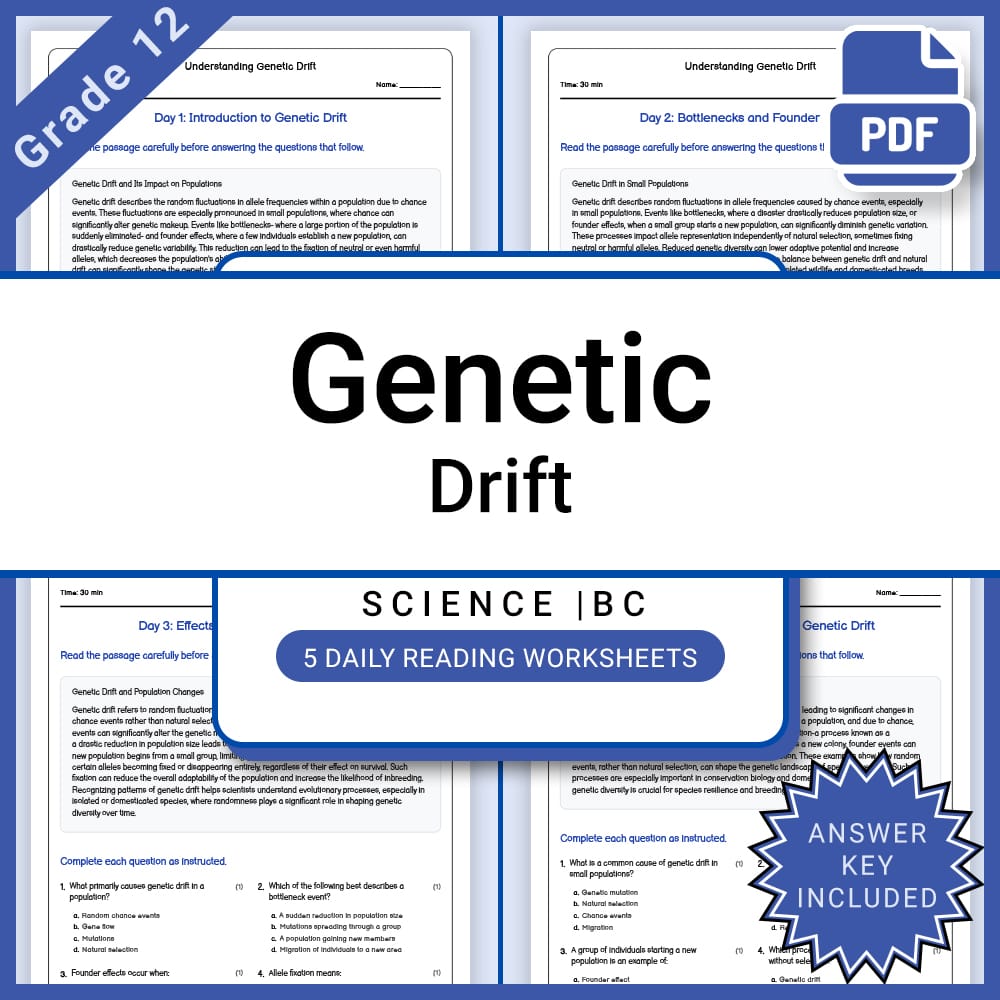
Grade 12 Science – Genetic Drift Daily Reading Worksheet + Answer Key
JCreated byJ.S SheetsLearning Objectives
- Define genetic drift and explain its significance.
- Identify factors that influence the strength of genetic drift.
- Differentiate between genetic drift, natural selection, and other evolutionary mechanisms.
Also included in: Grade 12 Science Lesson Group with BC Framework – Readings & Activities +1 more
Instant download
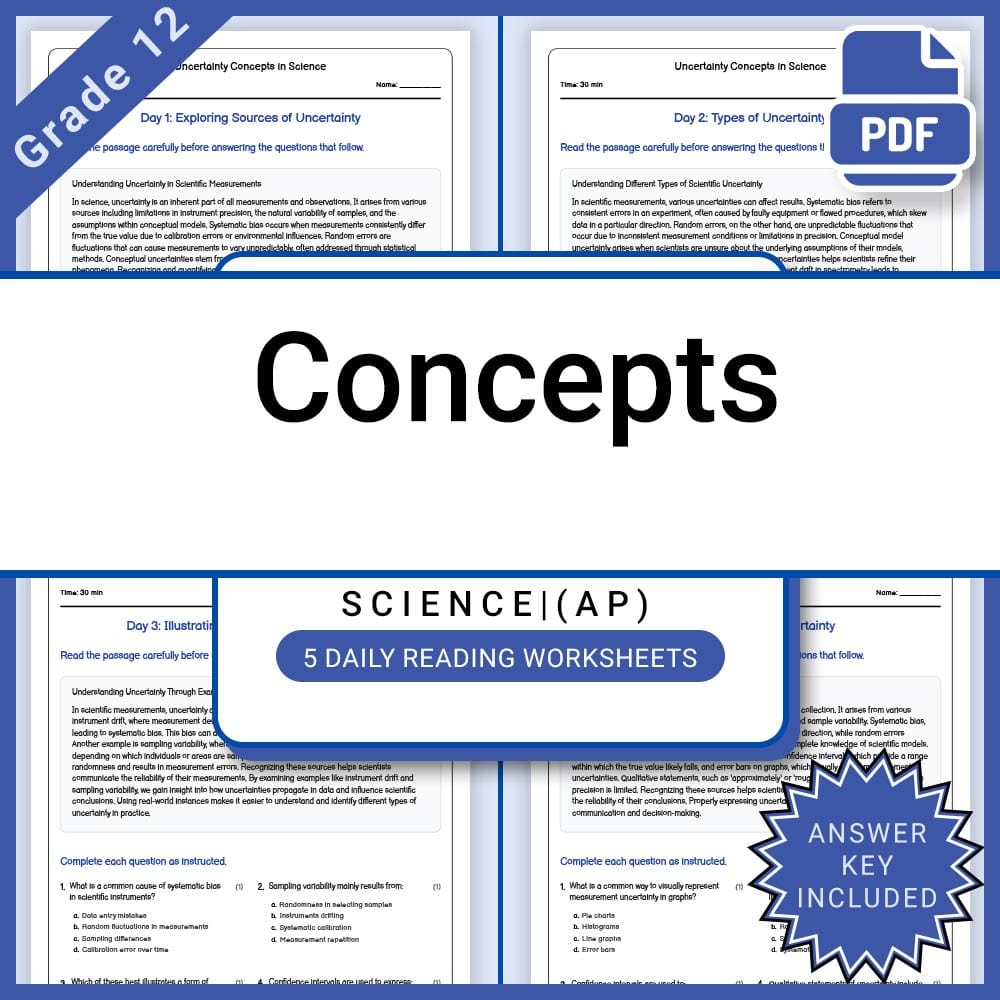
Grade 12 Science – Concepts Daily Reading Worksheet + Answer Key
JCreated byJ.S SheetsLearning Objectives
- Identify different sources of uncertainty in scientific measurements
- Distinguish among systematic bias, random error, and conceptual model uncertainty
- Understand exemplars such as instrument drift and sampling variability
Also included in: Grade 12 Science Practices Lesson Bundle | AP Framework and Skills +1 more
Instant download
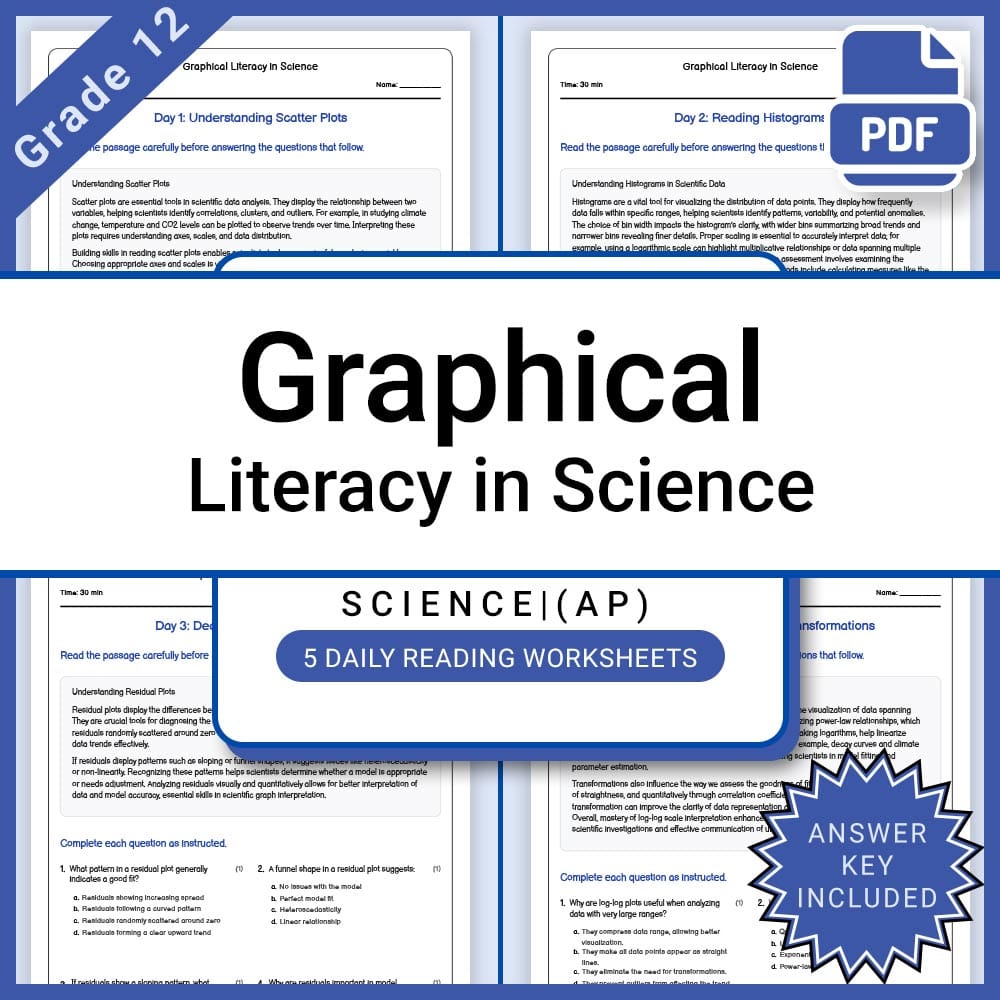
Grade 12 Science – Graphical Literacy Daily Reading Worksheet with Answer Key
JCreated byJ.S SheetsLearning Objectives
- Understand the conventions of scatter plots and residual plots
- Interpret patterns and trends in various graphical representations
- Apply strategies to analyze decay curves and climate data
Also included in: Grade 12 Science Practices Lesson Bundle | AP Framework and Skills +1 more
Instant download
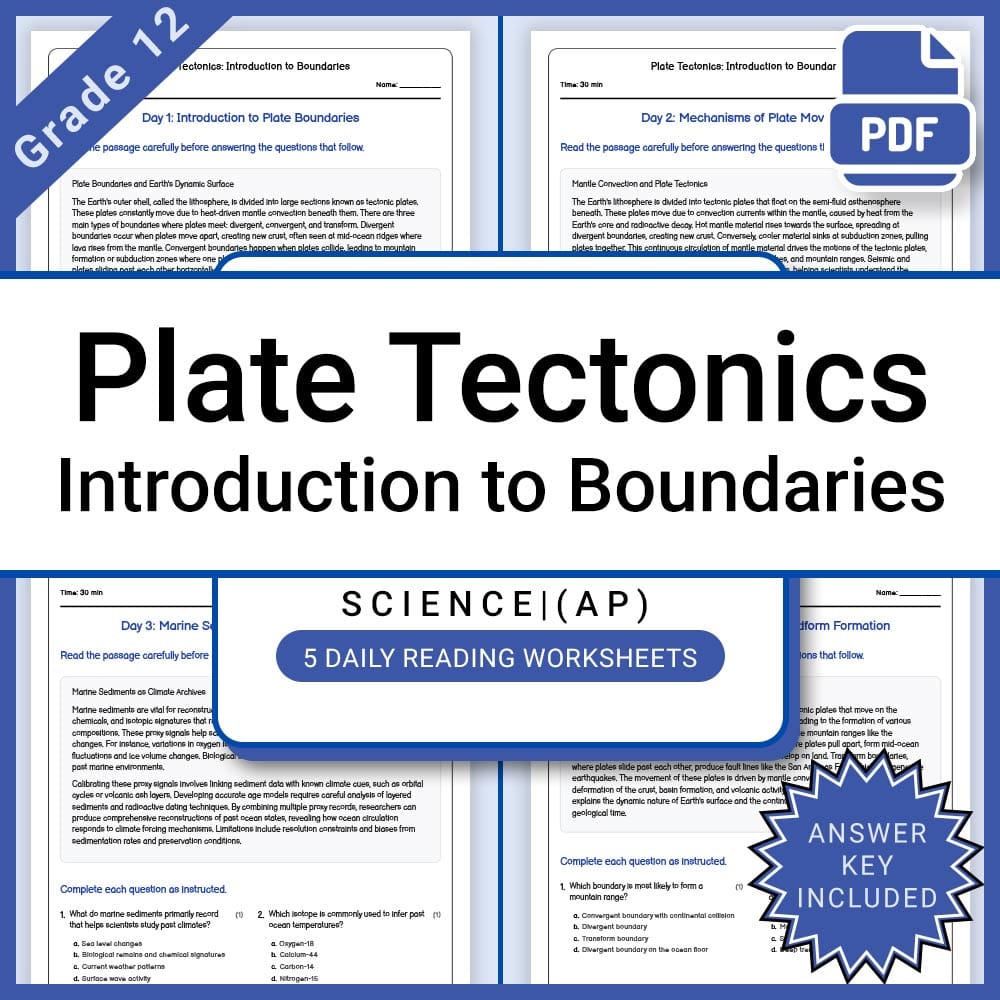
Grade 12 Science – Plate Tectonics Daily Reading Worksheet + Answer Key
JCreated byJ.S SheetsLearning Objectives
- Identify different types of plate boundaries and their characteristics.
- Understand the mechanisms underlying plate motions at divergent, convergent, and transform boundaries.
- Relate seismicity, volcanic activity, and mantle convection to plate boundary dynamics.
Also included in: Grade 12 Earth and Space Sciences Lesson Bundle for AP Curriculum +1 more
Instant download
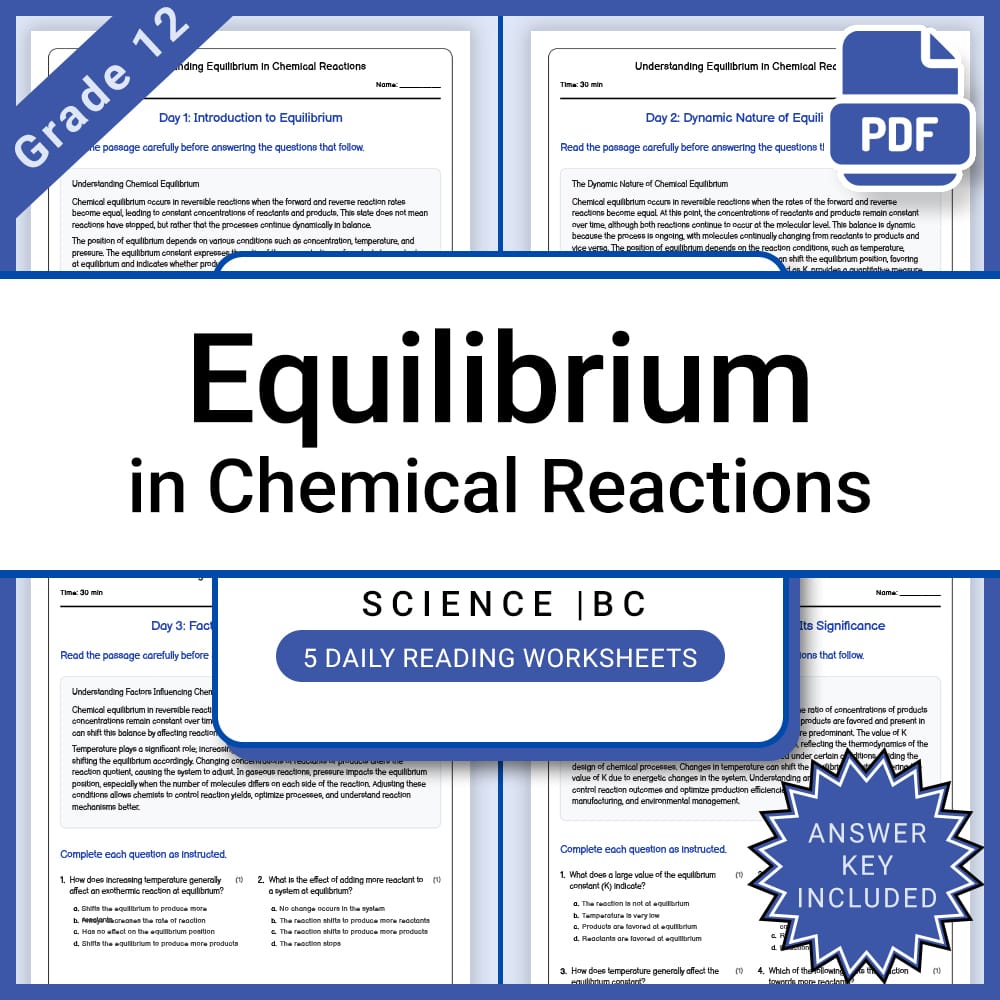
Grade 12 Science – Equilibrium Constants Daily Reading Worksheet + Answer Key
JCreated byJ.S SheetsLearning Objectives
- Define equilibrium constants Kc and Kp and understand their significance.
- Explain how the reaction quotient Q compares to equilibrium and guides reaction direction.
- Describe how temperature affects equilibrium constants through enthalpic effects.
Also included in: Grade 12 Science Lesson Bundle BC Framework | Daily Reading Worksheets +1 more
Instant download
Grade 12 – Variable Mass and Momentum Daily Reading Worksheet + Answer Key
JCreated byJ.S SheetsLearning Objectives
- Understand the concept of momentum conservation in systems with changing mass.
- Explain how mass ejection or accretion affects momentum and produces thrust.
- Derive the qualitative basis for the rocket equation by analyzing momentum exchange.
Also included in: Grade 12 Science Lesson Group | Physics, Energy, Waves & Electromagnetism +1 more
Instant download
Grade 12 Science – Sediment Records Daily Reading Worksheet + Answer Key
JCreated byJ.S SheetsLearning Objectives
- Understand different types of sedimentary deposits and their origins.
- Learn how sediments record environmental and climatic information.
- Interpret how sediment composition reveals Earth's past conditions.
Also included in: Grade 12 Science Lesson Group: Earth Systems and Geology BC Framework +1 more
Instant download
Grade 12 Science – Earth's Geological Timeline Daily Worksheet + Answer Key
JCreated byJ.S SheetsLearning Objectives
- Understand key concepts related to Science
- Apply knowledge through practice questions
- Demonstrate comprehension of the material
Also included in: Grade 12 Science Lesson Group: Earth Systems and Geology BC Framework +1 more
Instant download
Grade 12 Science – Work and Energy Daily Reading Worksheet with Answer Key
JCreated byJ.S SheetsLearning Objectives
- Understand the concepts of work, energy, and power in physics
- Analyze how force and displacement relate to work done on a system
- Explore the distinction between conservative and nonconservative forces
Also included in: Grade 12 Physics Principles Lesson Bundle – AP Science Curriculum +1 more
Instant download
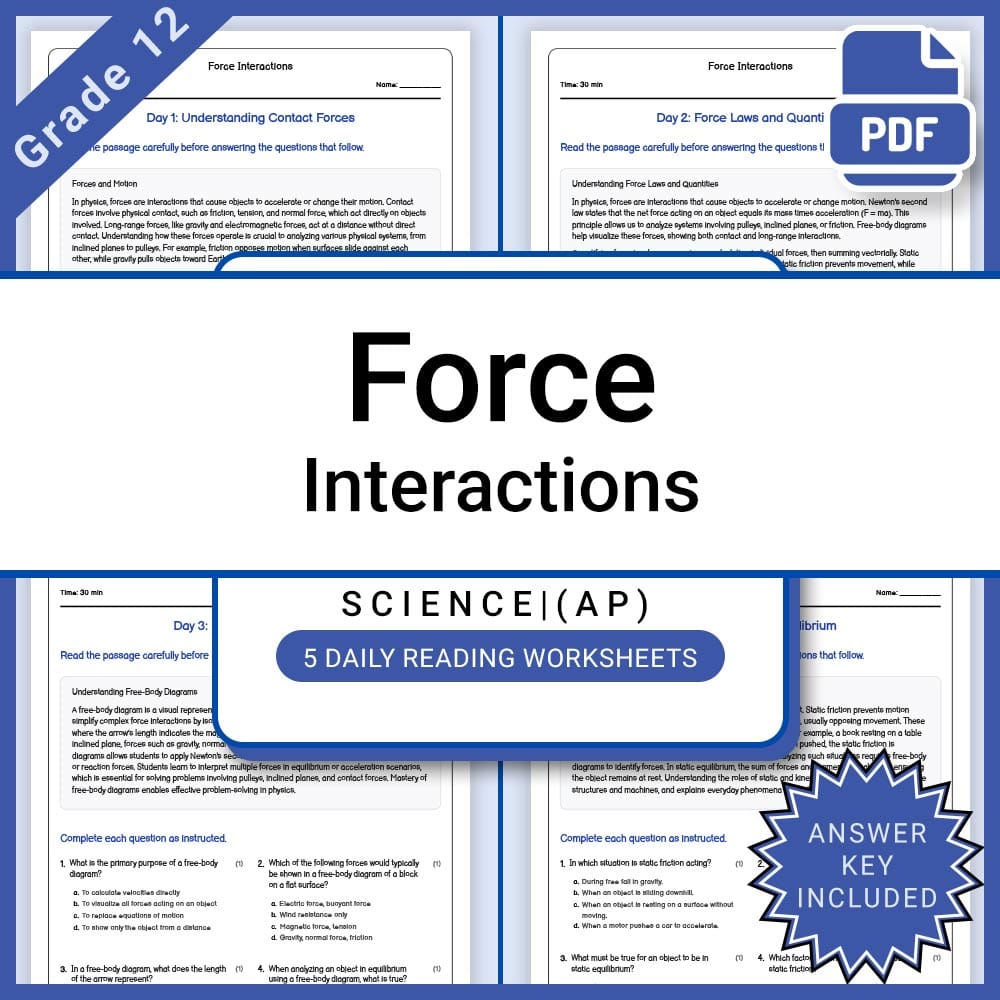
Grade 12 Science – Force Interactions Daily Reading Worksheet + Answer Key
JCreated byJ.S SheetsLearning Objectives
- Understand key concepts related to Science
- Apply knowledge through practice questions
- Demonstrate comprehension of the material
Also included in: Grade 12 Physics Principles Lesson Bundle – AP Science Curriculum +1 more
Instant download
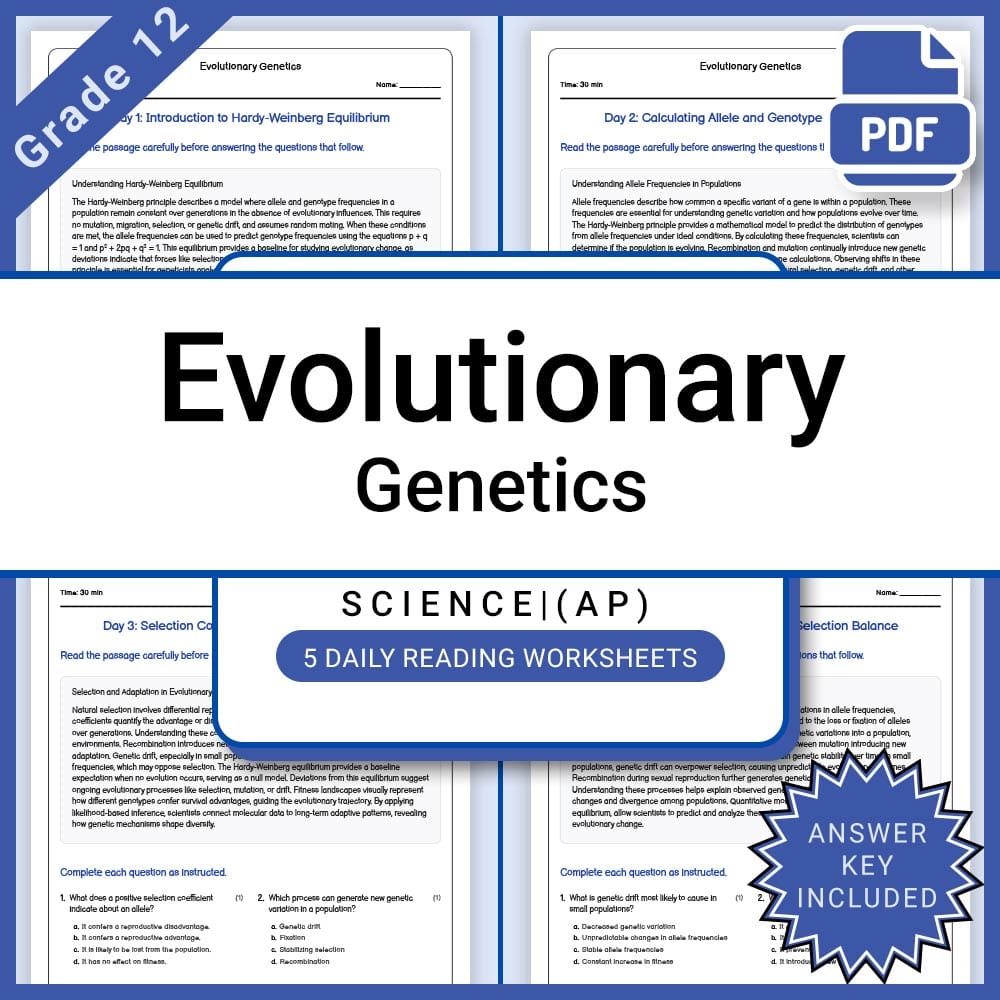
Grade 12 Science – Evolutionary Genetics Daily Reading Worksheet + Answer Key
JCreated byJ.S SheetsLearning Objectives
- Understand the principles of Hardy–Weinberg equilibrium
- Identify factors affecting allele frequencies in populations
- Apply models of genetic variation and selection
Also included in: Grade 12 Science Biology and Ecosystems Lesson Bundle | AP Framework +1 more
Instant download
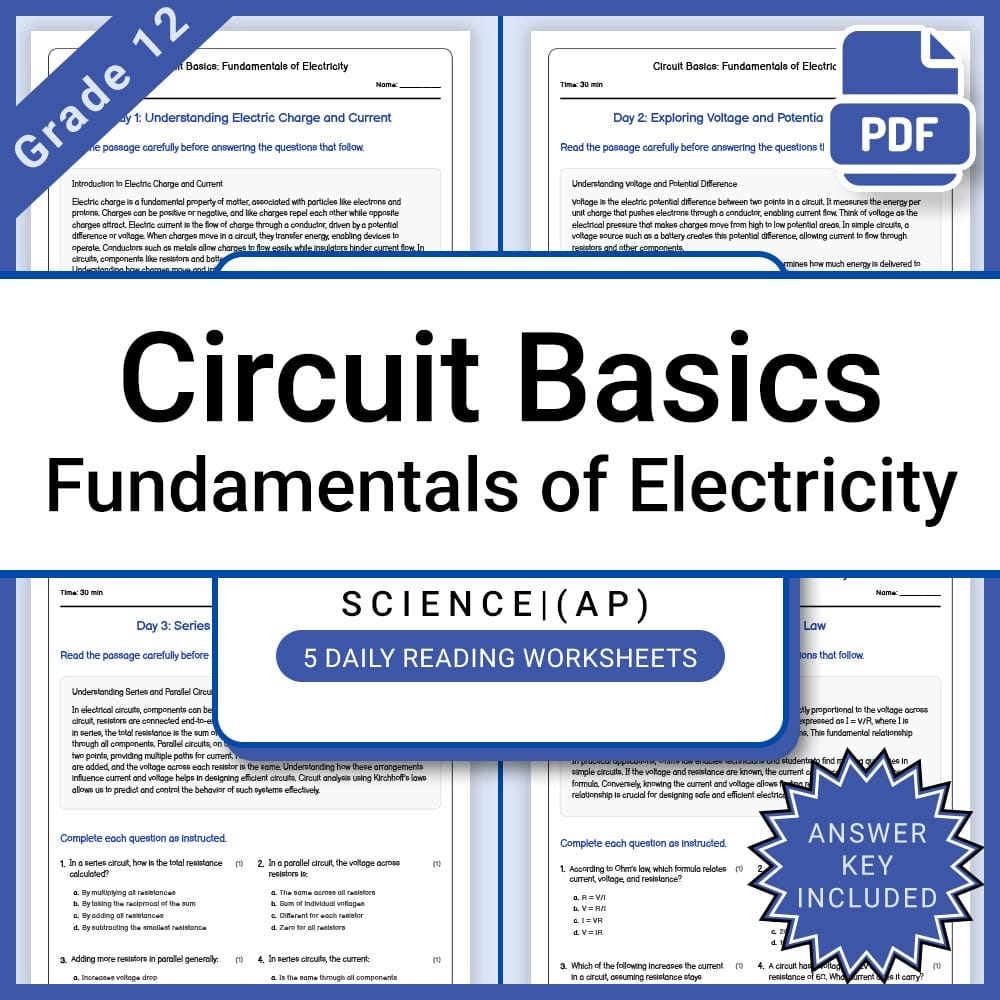
Grade 12 Science – Electricity and Power Daily Reading Worksheet + Answer Key
JCreated byJ.S SheetsLearning Objectives
- Understand the concept of electrical power and how it relates to voltage, current, and resistance.
- Calculate power dissipation in resistive elements of circuits.
- Analyze how power is delivered by sources with internal resistance.
Also included in: Grade 12 Physics Principles Lesson Bundle – AP Science Curriculum +1 more
Instant download
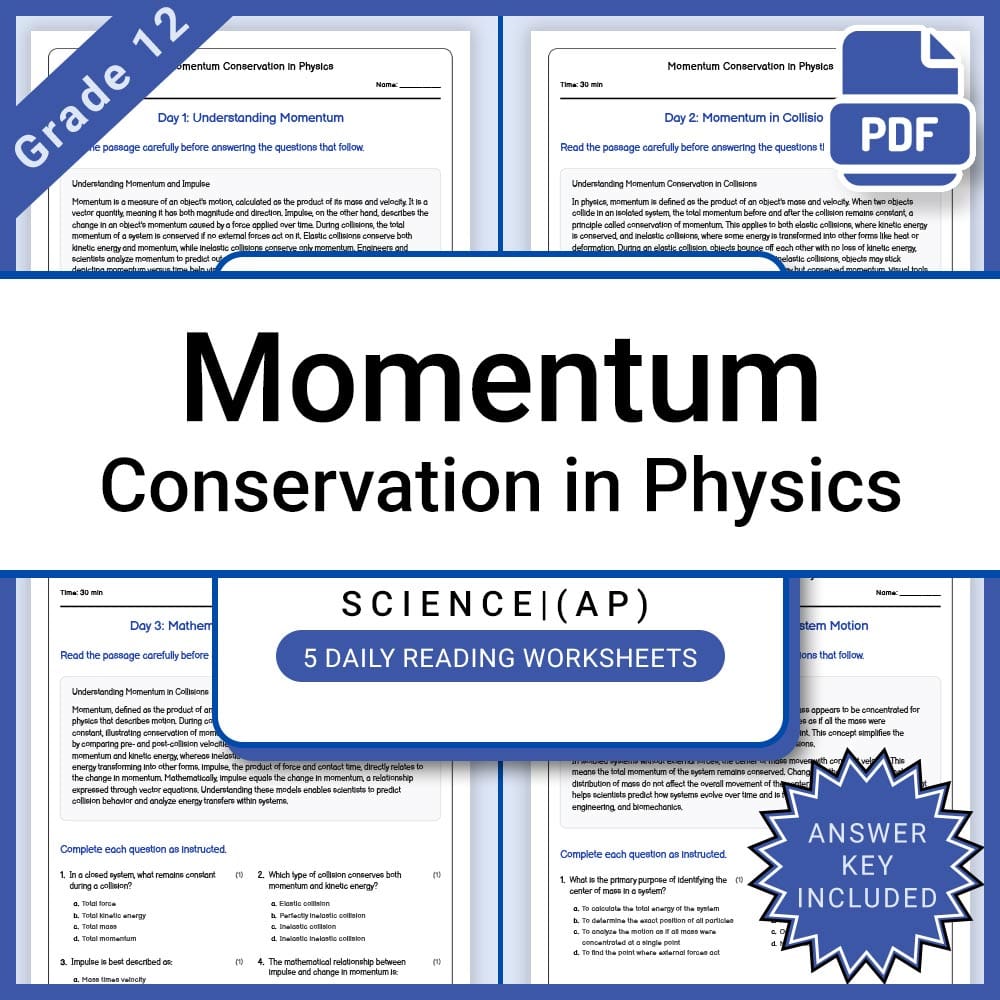
Grade 12 Science – Momentum Conservation Daily Reading Worksheet + Answer Key
JCreated byJ.S SheetsLearning Objectives
- Define linear momentum and impulse as physical quantities.
- Explain the conservation of momentum in isolated systems during collisions.
- Use algebraic and vector models to relate pre- and post-collision velocities.
Also included in: Grade 12 Physics Principles Lesson Bundle – AP Science Curriculum +1 more
Instant download
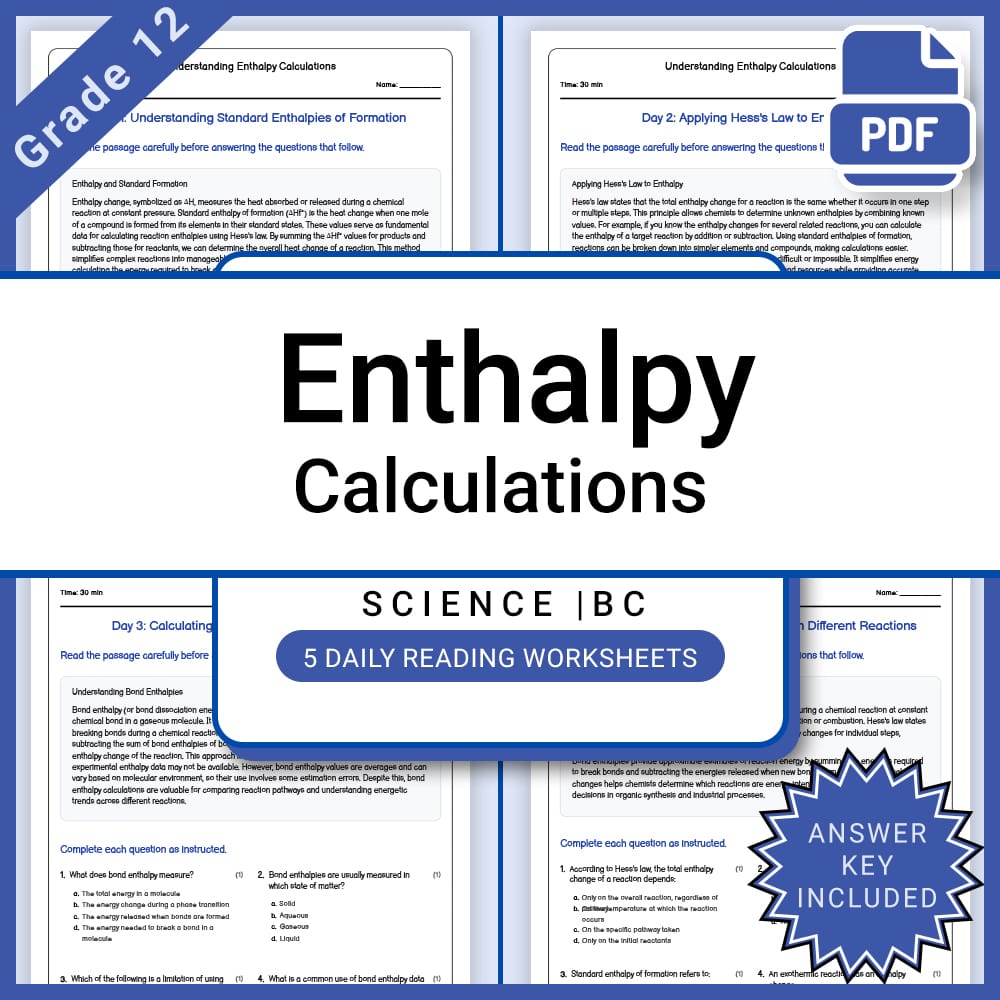
Grade 12 Science – Enthalpy Calculations Daily Reading Worksheet + Answer Key
JCreated byJ.S SheetsLearning Objectives
- Interpret standard enthalpy of formation data
- Calculate reaction enthalpy using tabulated formation values
- Understand Hess's law and its application in enthalpy calculations
Also included in: Grade 12 Science Lesson Bundle BC Framework | Daily Reading Worksheets +1 more
Instant download
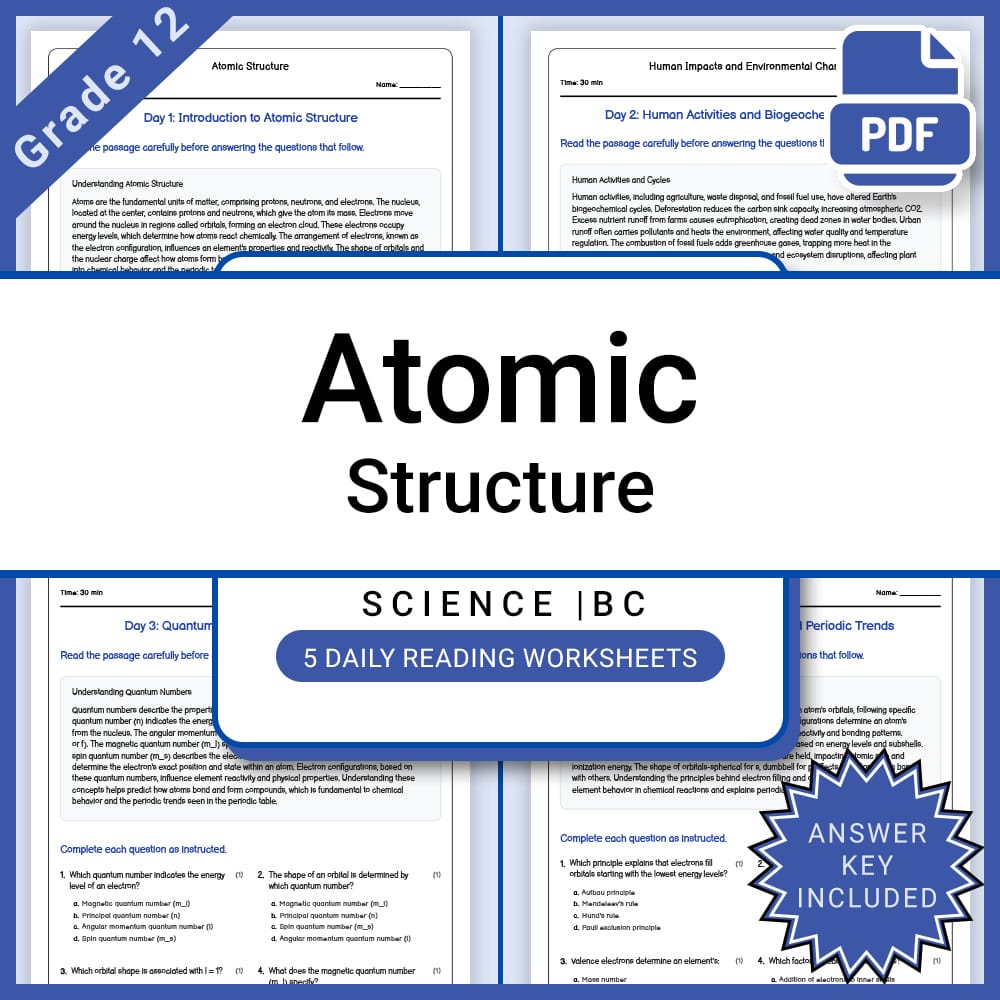
Grade 12 Science – Atomic Structure Daily Reading Worksheet with Answer Key
JCreated byJ.S SheetsLearning Objectives
- Identify the basic components of an atom: protons, neutrons, and electrons.
- Understand the arrangement of particles in an atom, including the nucleus and electron cloud.
- Explain the concept of energy levels and orbitals in atomic structure.
Also included in: Grade 12 Science Lesson Bundle BC Framework | Daily Reading Worksheets +1 more
Instant download
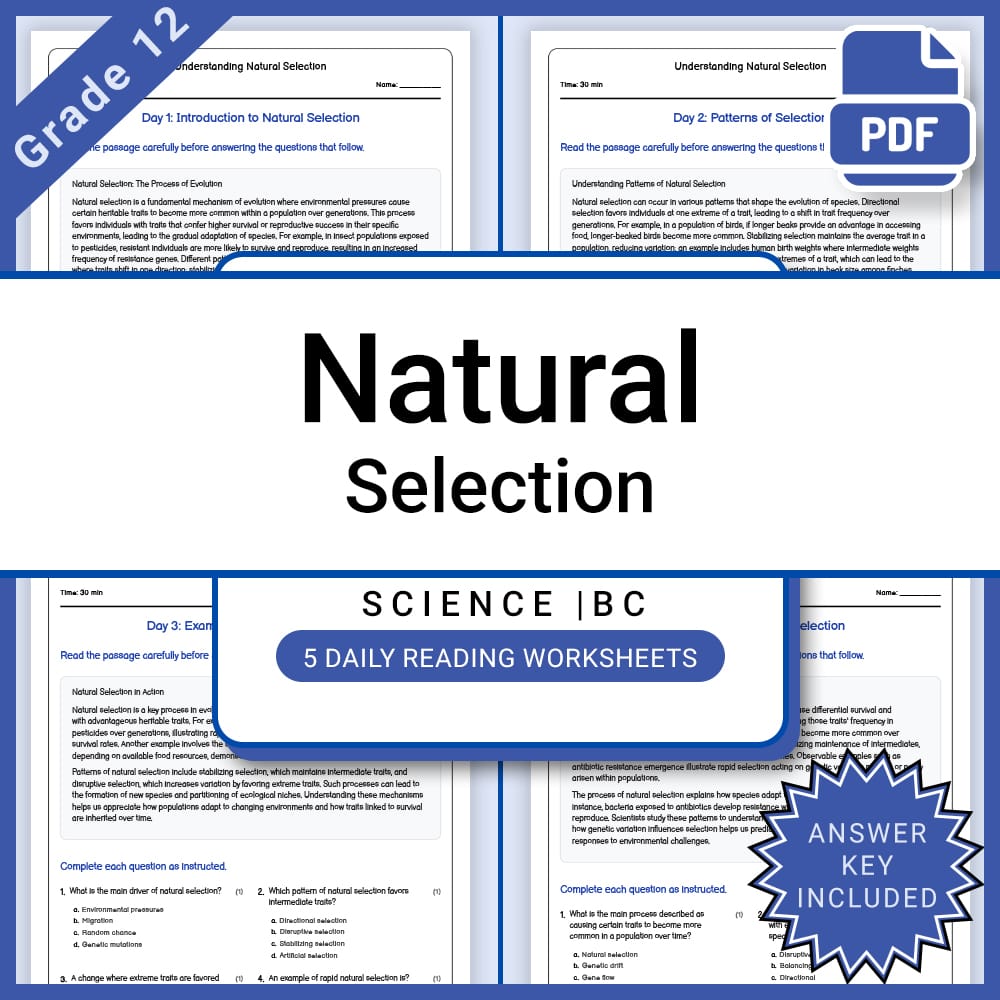
Grade 12 Science – Natural Selection Daily Reading Worksheet + Answer Key
JCreated byJ.S SheetsLearning Objectives
- Define natural selection and explain how it contributes to evolution.
- Identify different patterns of selection such as directional, stabilizing, and disruptive selection.
- Analyze real-world examples of natural selection, such as antibiotic resistance.
Also included in: Grade 12 Science Lesson Group with BC Framework – Readings & Activities +1 more
Instant download
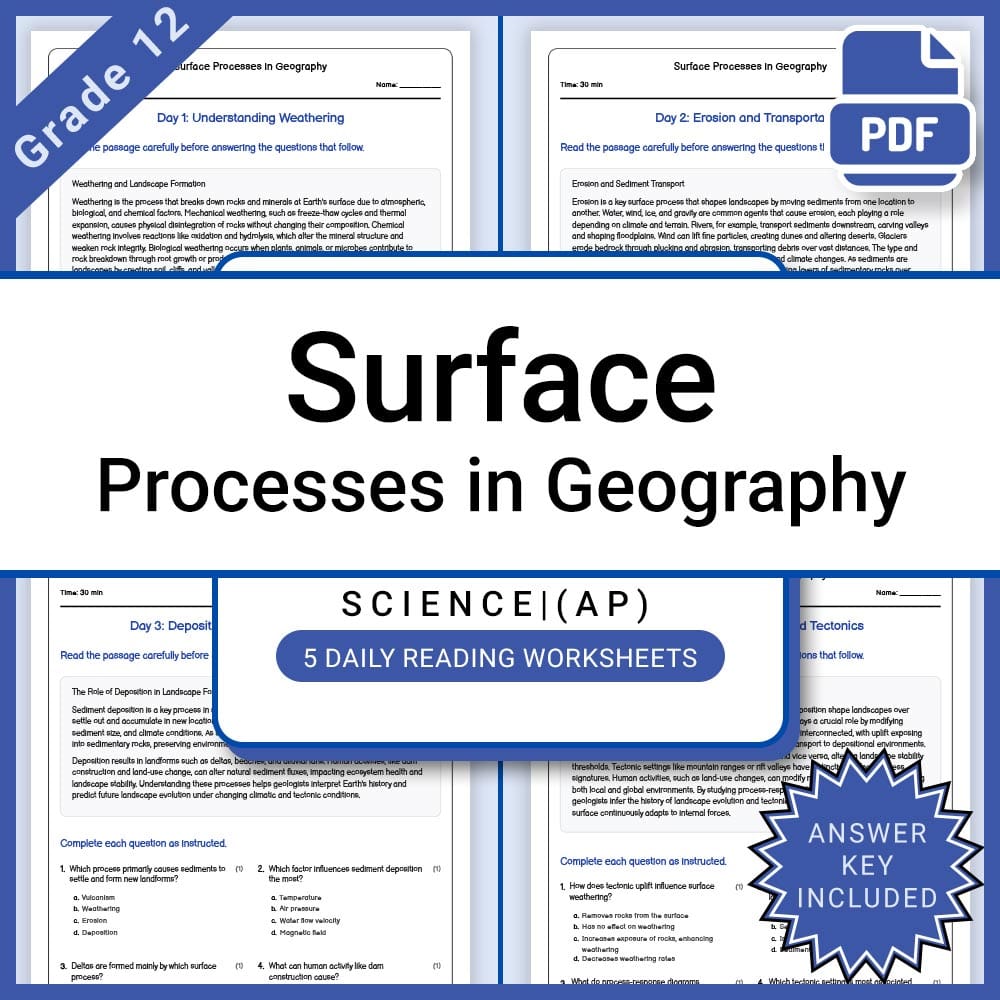
Grade 12 Science – Surface Processes Daily Reading Worksheet with Answer Key
JCreated byJ.S SheetsLearning Objectives
- Understand and describe the different types of weathering processes
- Explain how weathering contributes to landscape formation
- Recognize the relationship between climate, vegetation, and weathering
Also included in: Grade 12 Earth and Space Sciences Lesson Bundle for AP Curriculum +1 more
Instant download
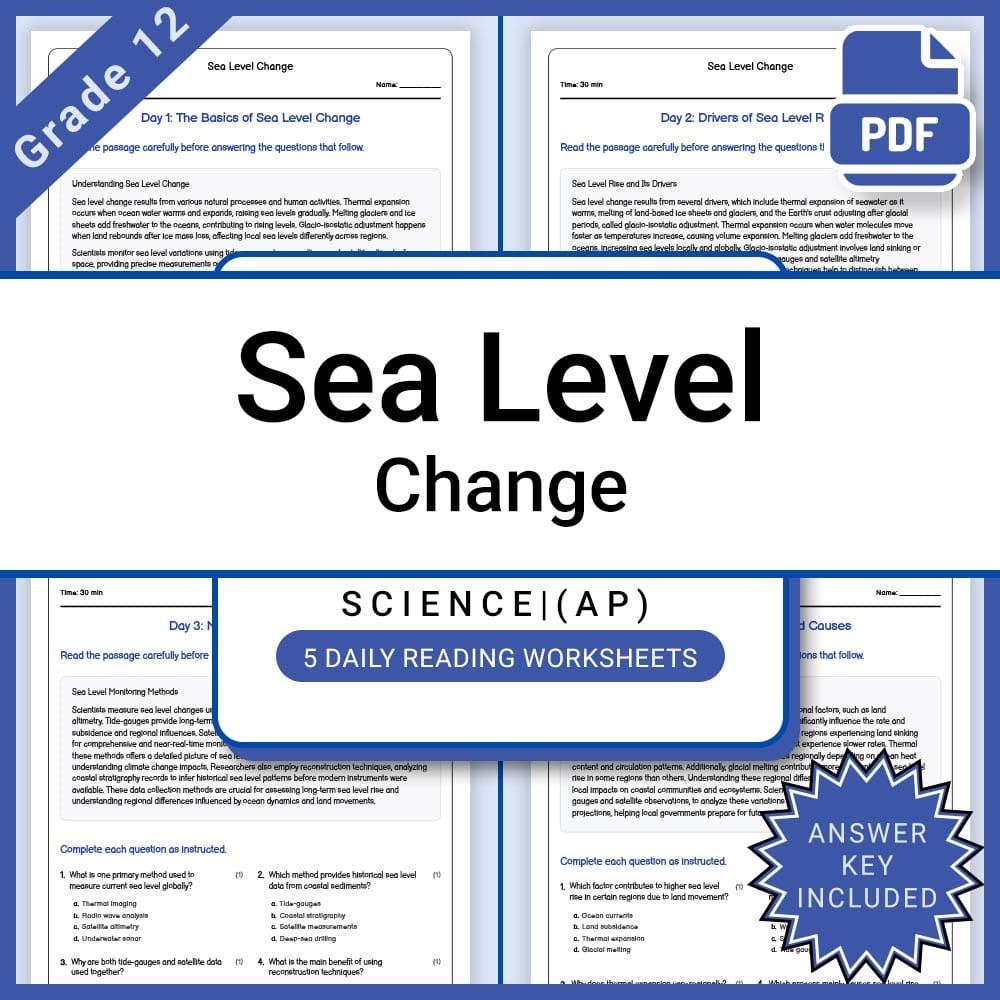
Grade 12 Science – Sea Level Change Daily Reading Worksheet with Answer Key
JCreated byJ.S SheetsLearning Objectives
- Identify the main drivers of sea level variability, including thermal expansion, land-ice mass loss, and glacio-isostatic adjustment.
- Understand how tide-gauge and satellite altimetry data are used to monitor sea level changes.
- Describe the methods used to attribute observed sea level patterns to specific causes.
Also included in: Grade 12 Earth and Space Sciences Lesson Bundle for AP Curriculum +1 more
Instant download
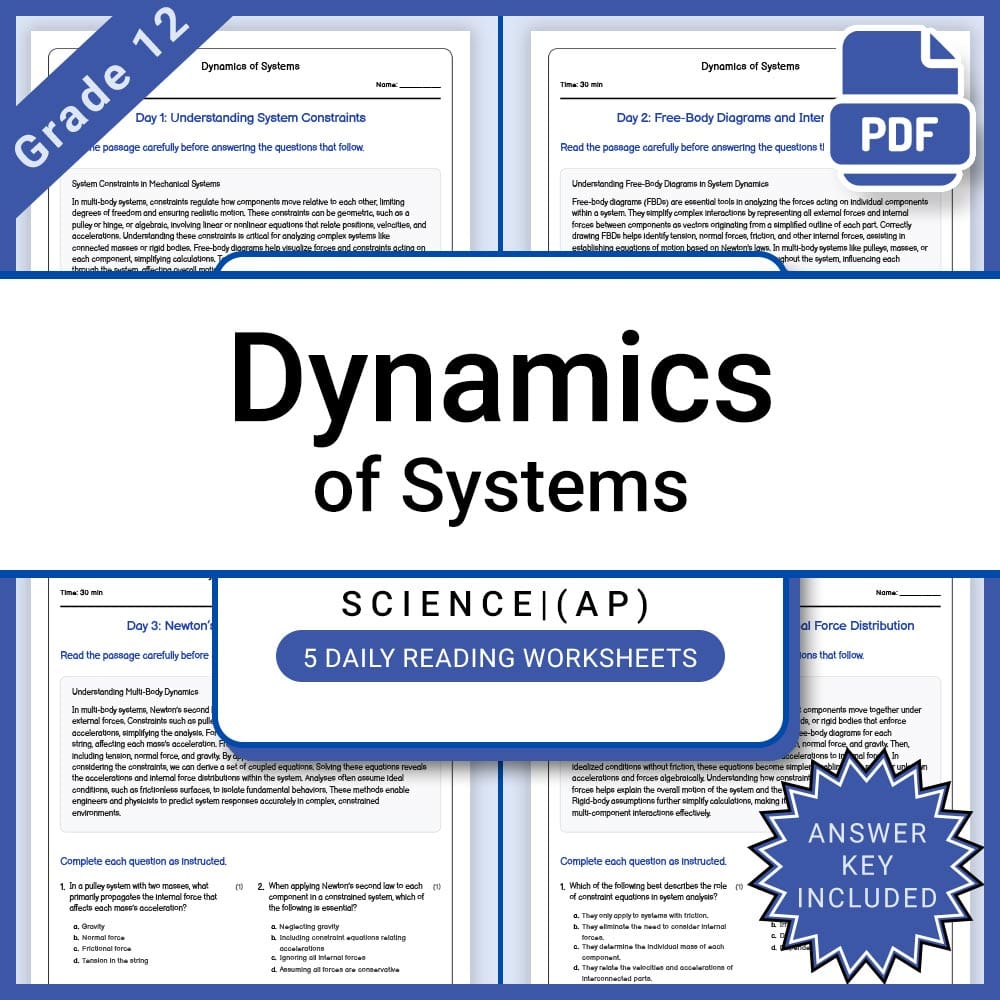
Grade 12 Science – Dynamics of Systems Daily Reading Worksheet + Answer Key
JCreated byJ.S SheetsLearning Objectives
- Understand the role of constraints in multi-body system motion
- Formulate system constraints using geometric and algebraic methods
- Analyze pulley and connected-mass configurations
Also included in: Grade 12 Physics Principles Lesson Bundle – AP Science Curriculum +1 more
Instant download

Grade 12 Science – Molecular Genetics Daily Reading Worksheet + Answer Key
JCreated byJ.S SheetsLearning Objectives
- Understand the structure of DNA and its nucleotide components.
- Describe the double helix model of DNA.
- Explain the process of DNA replication and its fidelity.
Also included in: Grade 12 Science Lesson Group Bundle – TEKS Standards-Based Worksheets +1 more
Instant download
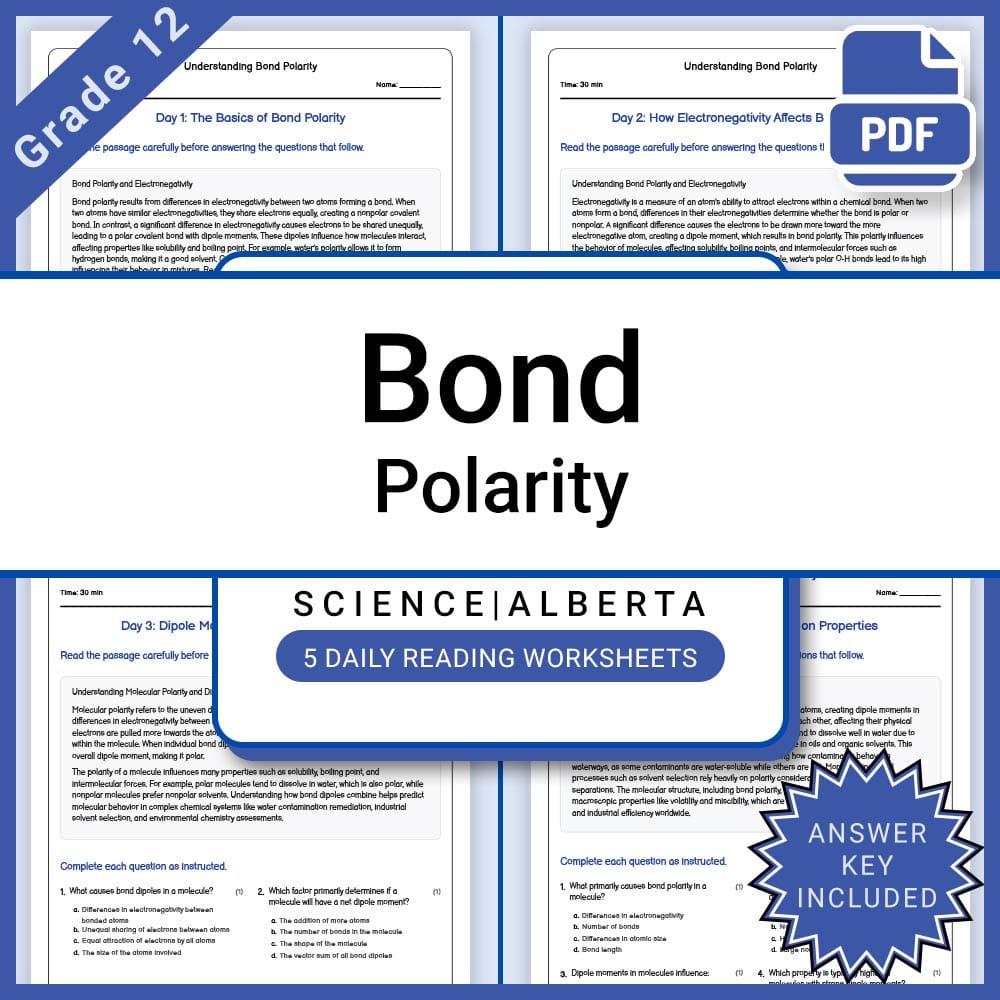
Grade 12 Science – Bond Polarity Daily Reading Worksheet with Answer Key
JCreated byJ.S SheetsLearning Objectives
- Define bond polarity and explain its origin in terms of electronegativity differences.
- Identify polar and nonpolar bonds based on electronegativity values.
- Understand how bond polarity influences molecular interactions and properties.
Also included in: Grade 12 Science Lesson Bundle | Alberta Framework and Daily Reading Worksheets +1 more
Instant download

Grade 12 Science – Biodiversity Conservation Worksheet + Answer Key
JCreated byJ.S SheetsLearning Objectives
- Understand the patterns and causes of biodiversity loss.
- Identify different measures of biodiversity, including species richness and genetic diversity.
- Learn about conservation strategies such as protected areas and restoration ecology.
Also included in: Grade 12 Science Lesson Group Bundle – TEKS Standards-Based Worksheets +1 more
Instant download
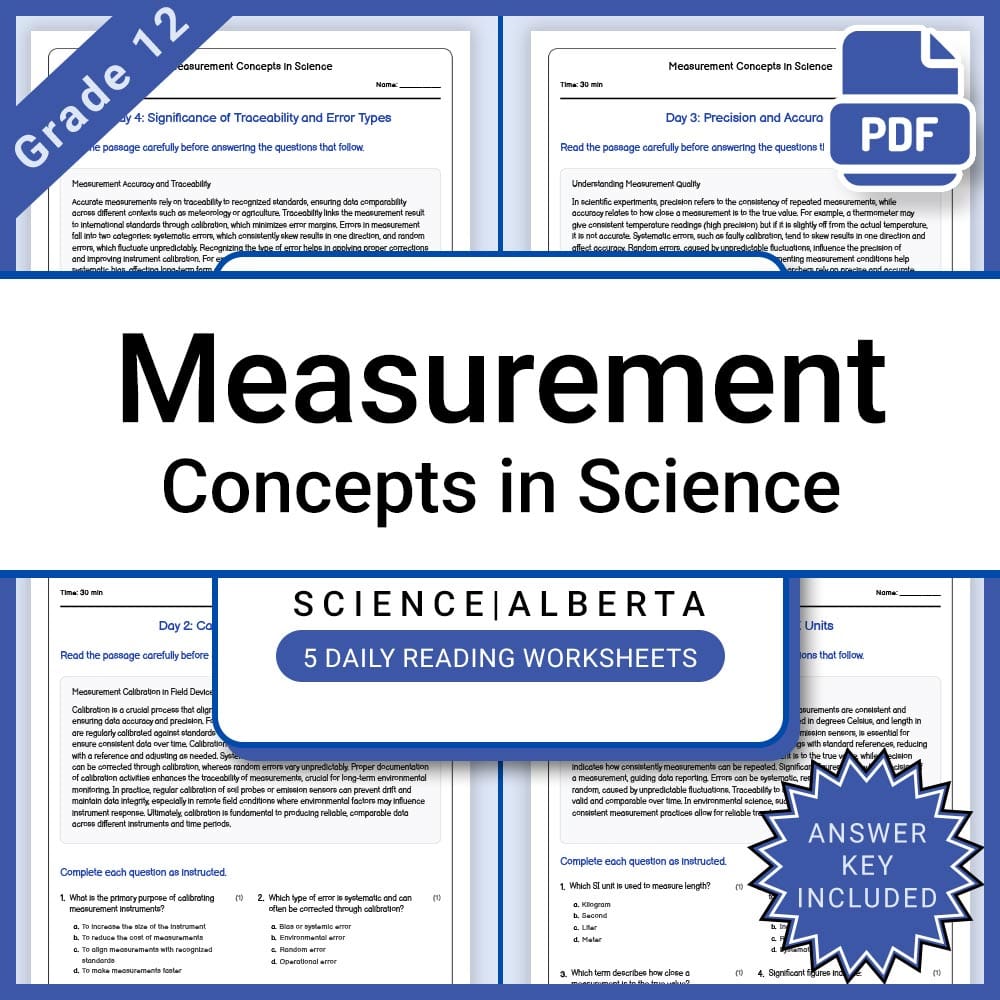
Grade 12 Science – Measurement Concepts Daily Reading Worksheet + Answer Key
JCreated byJ.S SheetsLearning Objectives
- Understand and identify SI units used in scientific measurements
- Explain the importance of calibration and instrument response
- Differentiate between accuracy, precision, and significant figures
Also included in: Grade 12 Science Lesson Bundle | Alberta Framework and Real-World Applications +1 more
Instant download
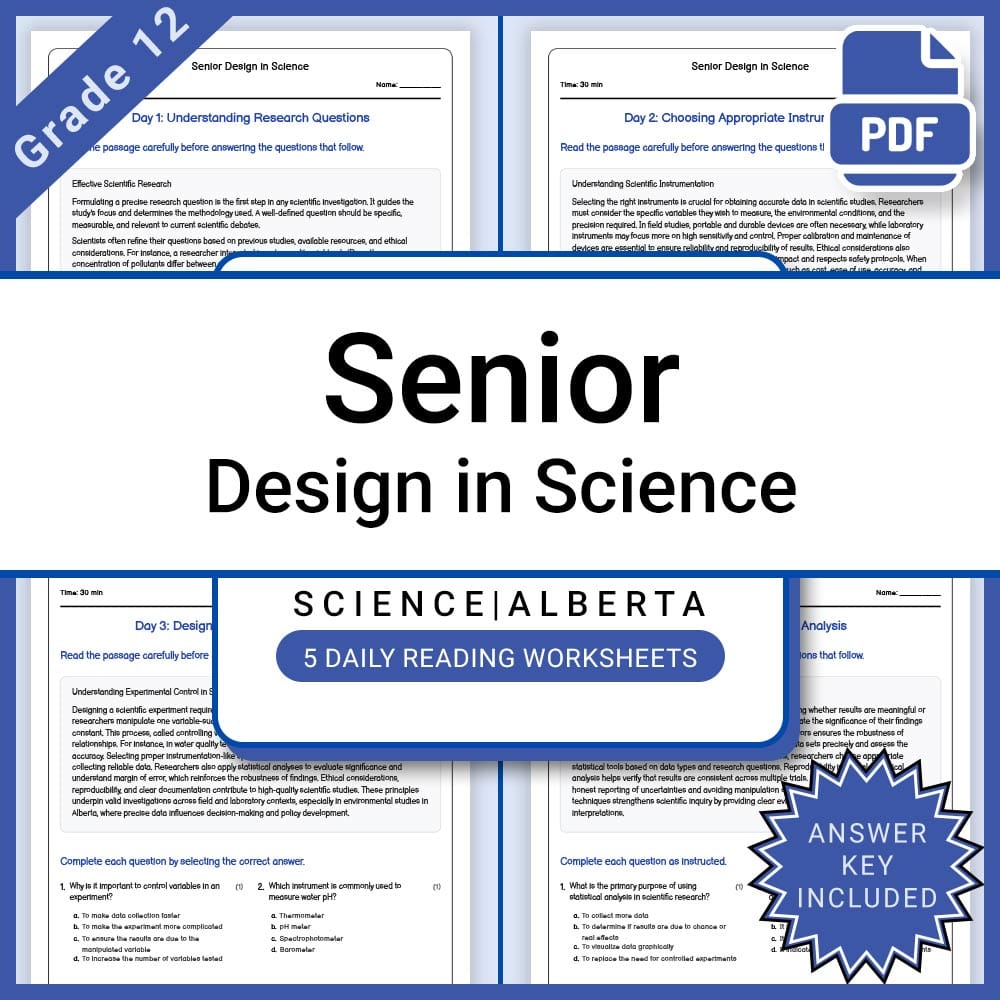
Grade 12 Science – Senior Design Daily Reading Worksheet with Answer Key
JCreated byJ.S SheetsLearning Objectives
- Understand the importance of formulating clear research questions in scientific studies.
- Identify key components of designing a robust scientific investigation.
- Recognize the role of appropriate instrumentation in environmental monitoring.
Also included in: Grade 12 Science Lesson Bundle | Alberta Framework and Real-World Applications +1 more
Instant download
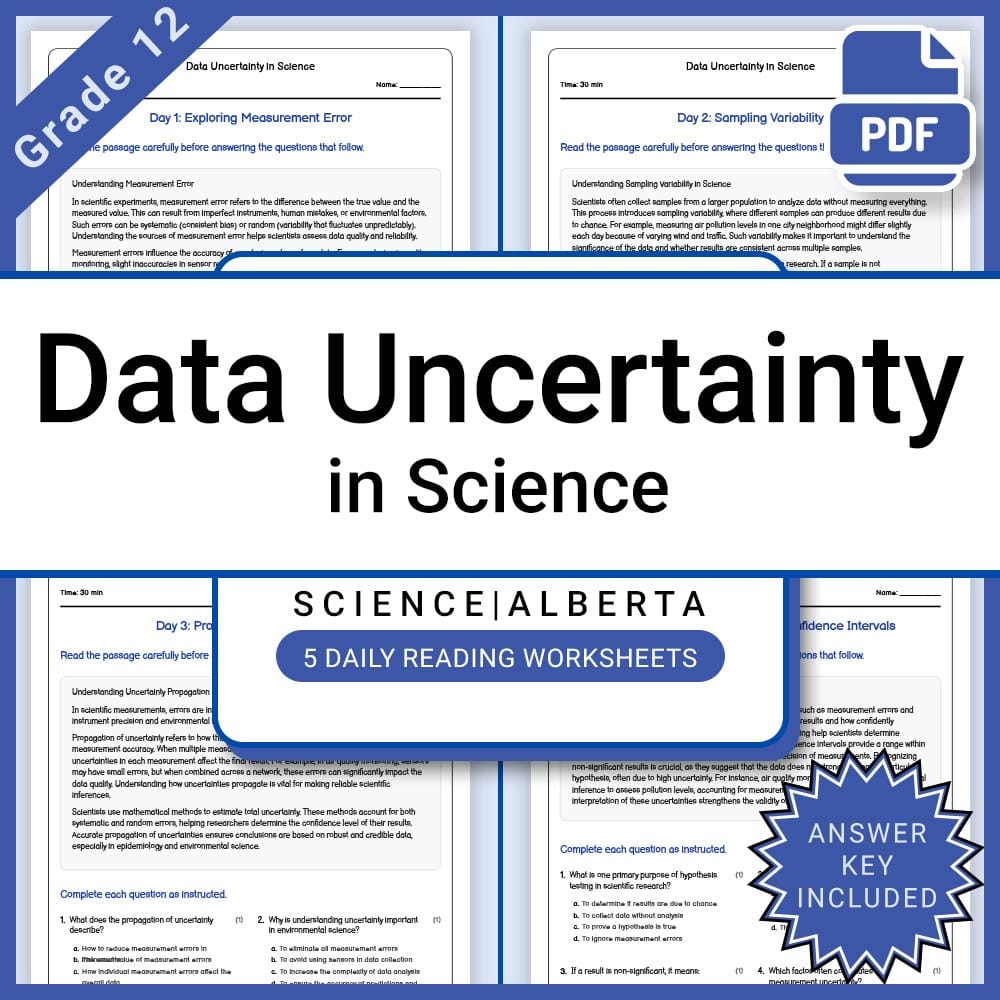
Grade 12 Science – Data Uncertainty Daily Reading Worksheet + Answer Key
JCreated byJ.S SheetsLearning Objectives
- Understand sources of measurement error in scientific data
- Recognize the impact of uncertainty on data analysis and conclusions
- Learn about propagation of measurement uncertainty and hypothesis testing
Also included in: Grade 12 Science Lesson Bundle | Alberta Framework and Real-World Applications +1 more
Instant download
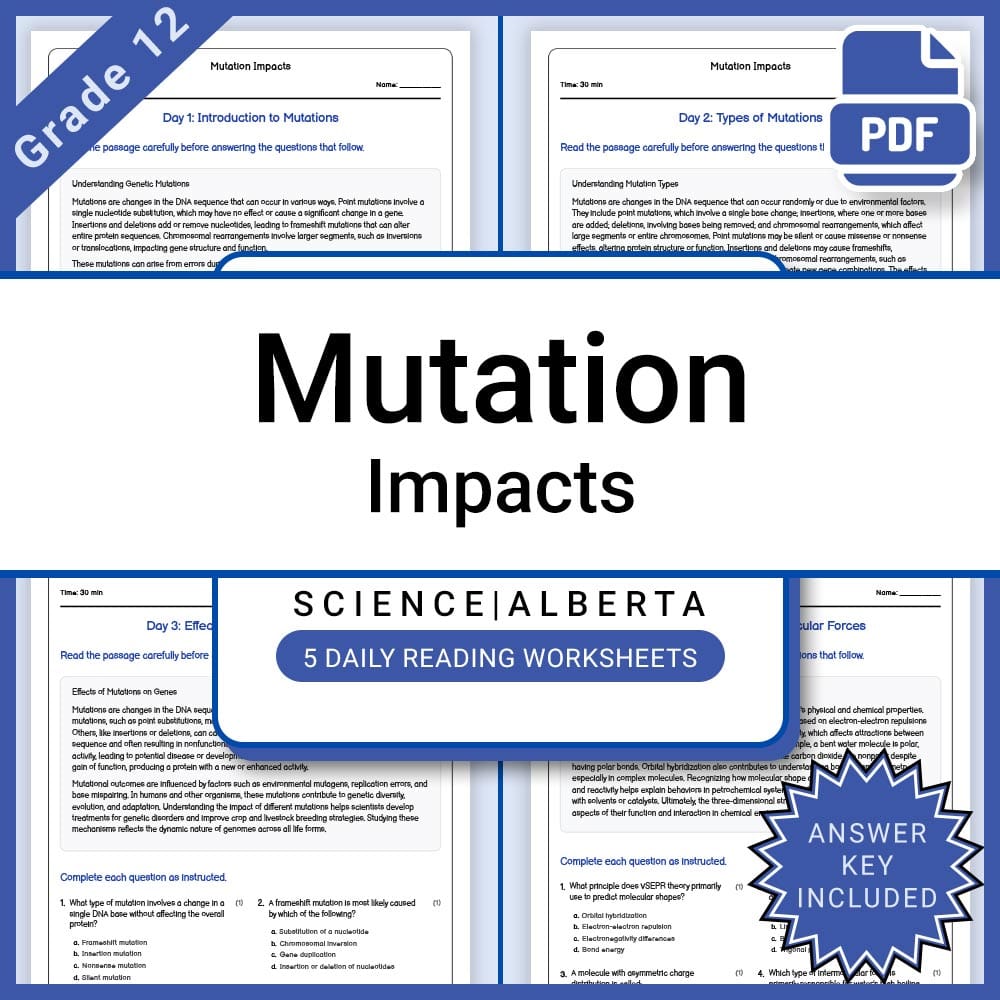
Grade 12 Science – Mutation Impacts Daily Reading Worksheet + Answer Key
JCreated byJ.S SheetsLearning Objectives
- Identify different types of genetic mutations
- Understand the molecular mechanisms causing mutations
- Recognize the effects of mutations on gene function
Also included in: Grade 12 Science Lesson Bundle | Daily Reading Worksheets +1 more
Instant download
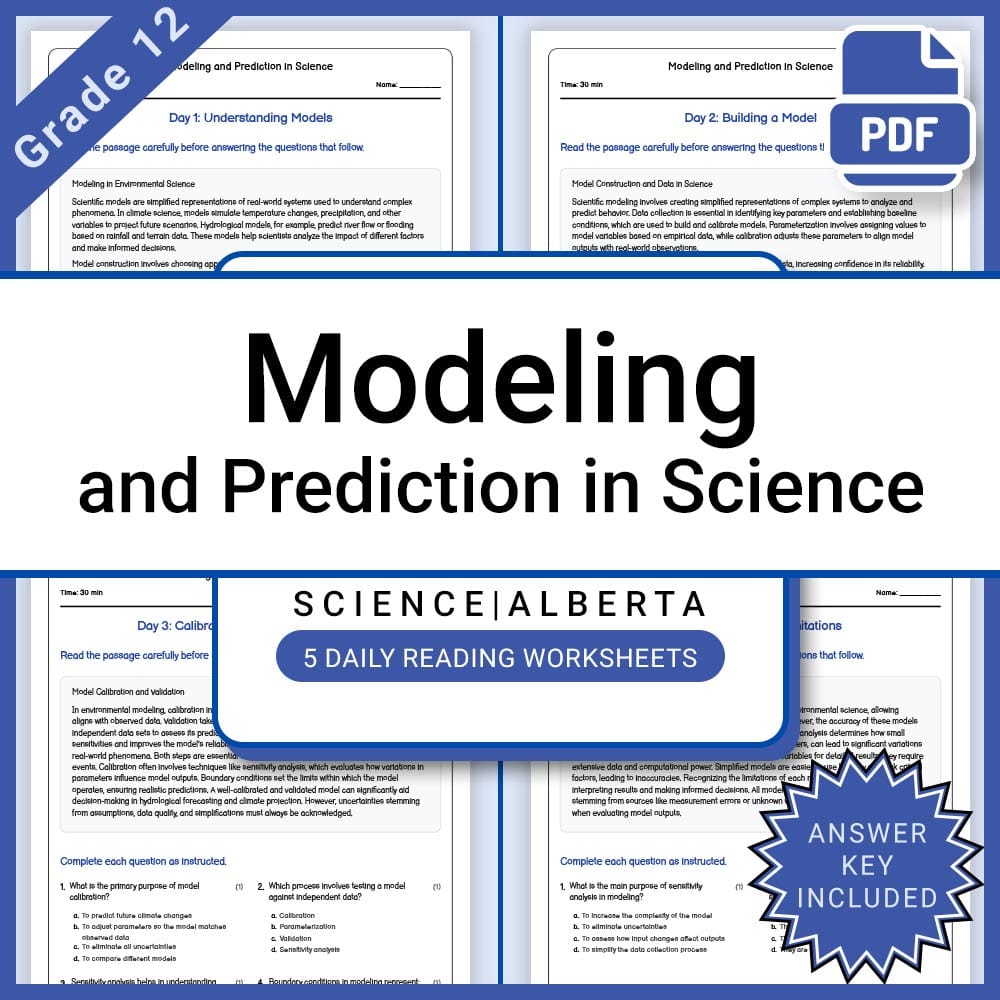
Grade 12 Science – Modeling and Prediction Daily Reading Worksheet + Answer Key
JCreated byJ.S SheetsLearning Objectives
- Understand the purpose of scientific models in environmental and climate studies
- Identify different types of models used in hydrology and climate science
- Recognize the importance of assumptions, boundary conditions, and limitations in modeling
Also included in: Grade 12 Science Lesson Bundle | Alberta Framework and Real-World Applications +1 more
Instant download
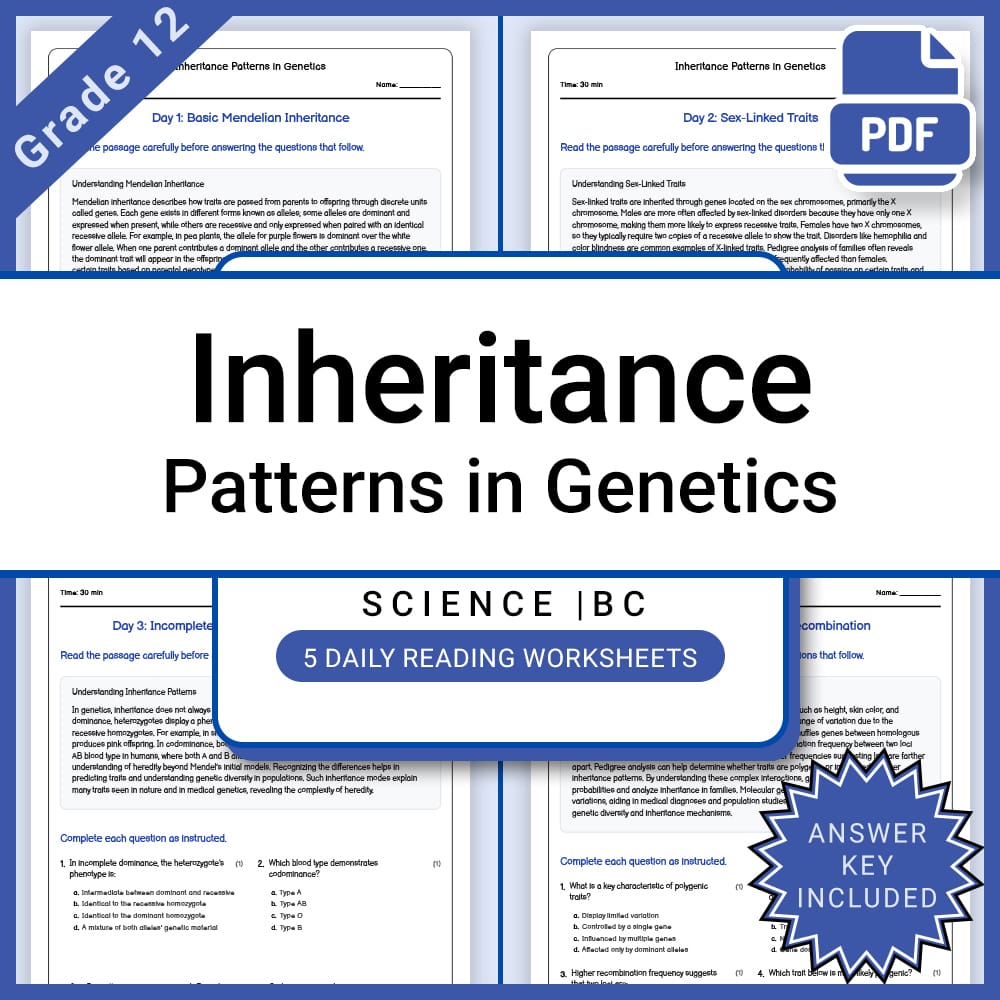
Grade 12 Science – Inheritance Patterns in Genetics Daily Worksheet + Answer Key
JCreated byJ.S SheetsLearning Objectives
- Understand basic Mendelian inheritance and dominant versus recessive traits
- Predict trait outcomes based on genotypes
- Identify inheritance patterns in pedigrees
Also included in: Grade 12 Science Lesson Group with BC Framework – Readings & Activities +1 more
Instant download
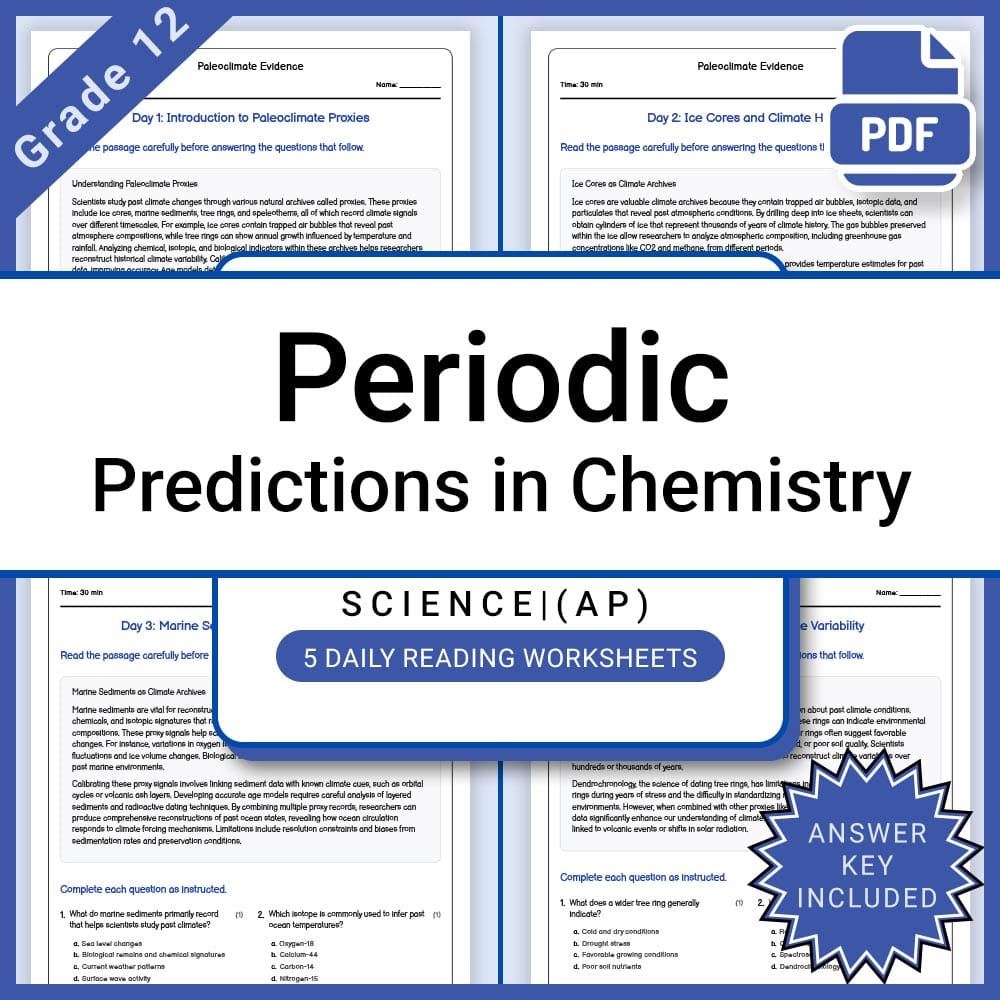
Grade 12 Science – Periodic Trends Daily Reading Worksheet with Answer Key
JCreated byJ.S SheetsLearning Objectives
- Understand how effective nuclear charge influences atomic properties
- Analyze periodic trends and anomalies related to nuclear charge
- Apply graphical and quantitative comparisons to element behaviors
Also included in: Grade 12 Chemistry Foundations Lesson Bundle – AP Science Activities +1 more
Instant download
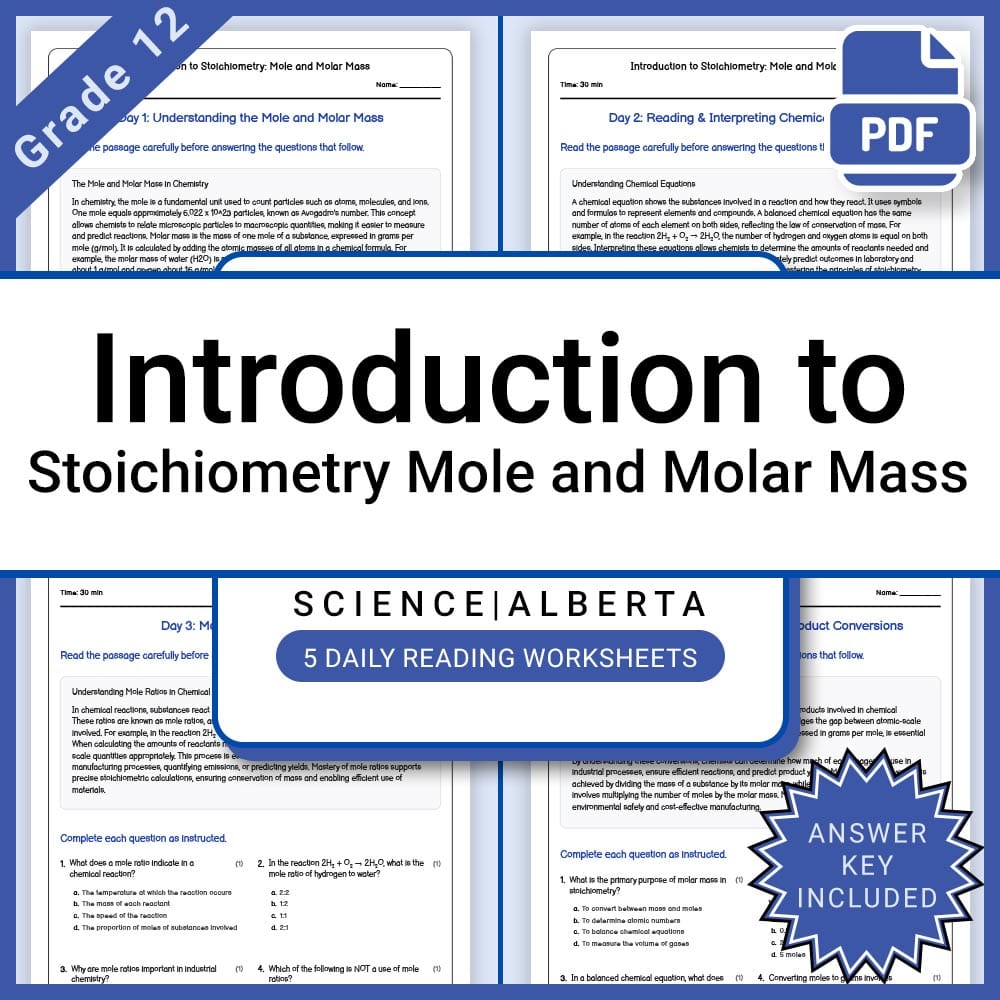
Grade 12 Science – Mole and Molar Mass Daily Reading Worksheet + Answer Key
JCreated byJ.S SheetsLearning Objectives
- Understand key concepts related to Science
- Apply knowledge through practice questions
- Demonstrate comprehension of the material
Also included in: Grade 12 Science Lesson Bundle | Alberta Framework and Daily Reading Worksheets +1 more
Instant download
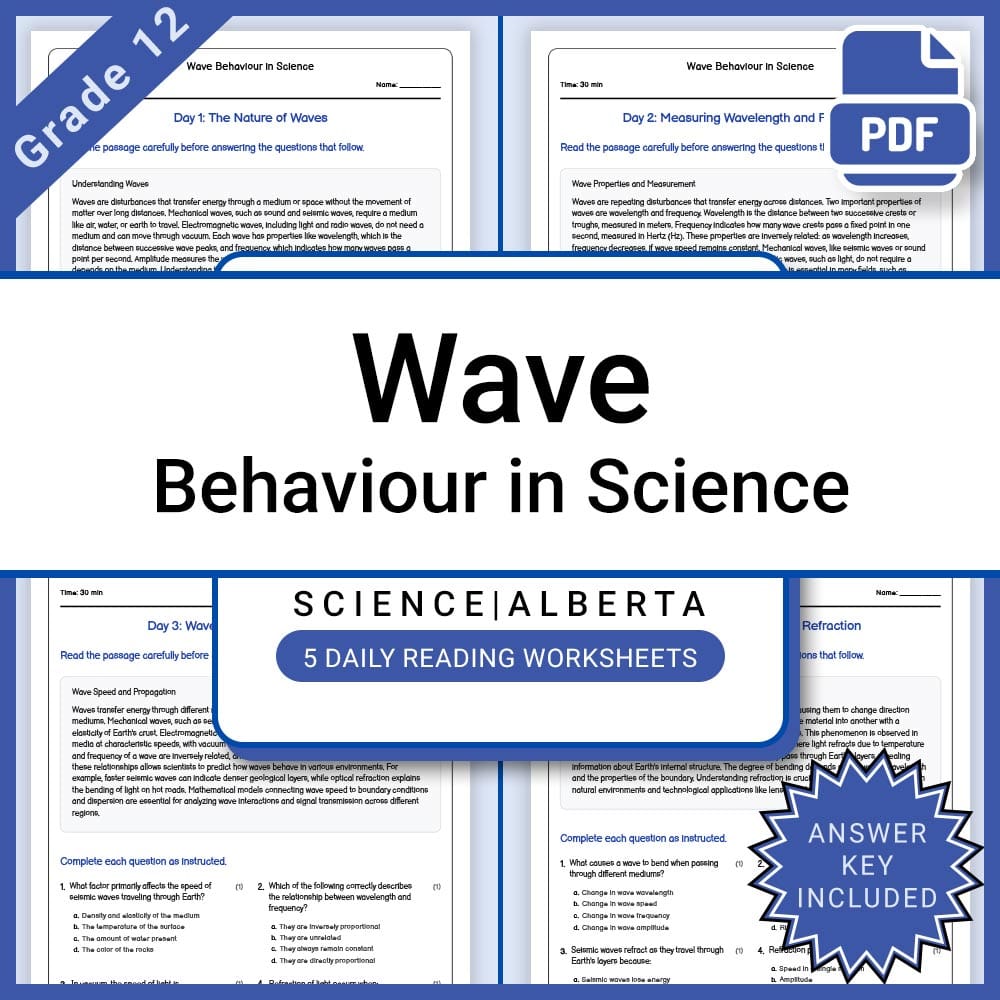
Grade 12 Science – Wave Behaviour Daily Reading Worksheet with Answer Key
JCreated byJ.S SheetsLearning Objectives
- Understand basic wave characteristics such as wavelength, frequency, amplitude, and speed.
- Identify different types of waves and their properties.
- Learn how waves propagate in different environments, including mechanical and electromagnetic waves.
Also included in: Grade 12 Science Lesson Bundle | Physics, Nuclear, Waves & Circuits +1 more
Instant download

Grade 12 Science – Methods Overview in Scientific Inquiry
JCreated byJ.S SheetsLearning Objectives
- Understand the stages involved in scientific investigation from observation to conclusion.
- Identify the roles of hypothesis formulation, variable control, and operational definitions.
- Differentiate between qualitative and quantitative approaches in scientific research.
Also included in: Grade 12 Science Lesson Group Bundle – TEKS Standards-Based Worksheets +1 more
Instant download
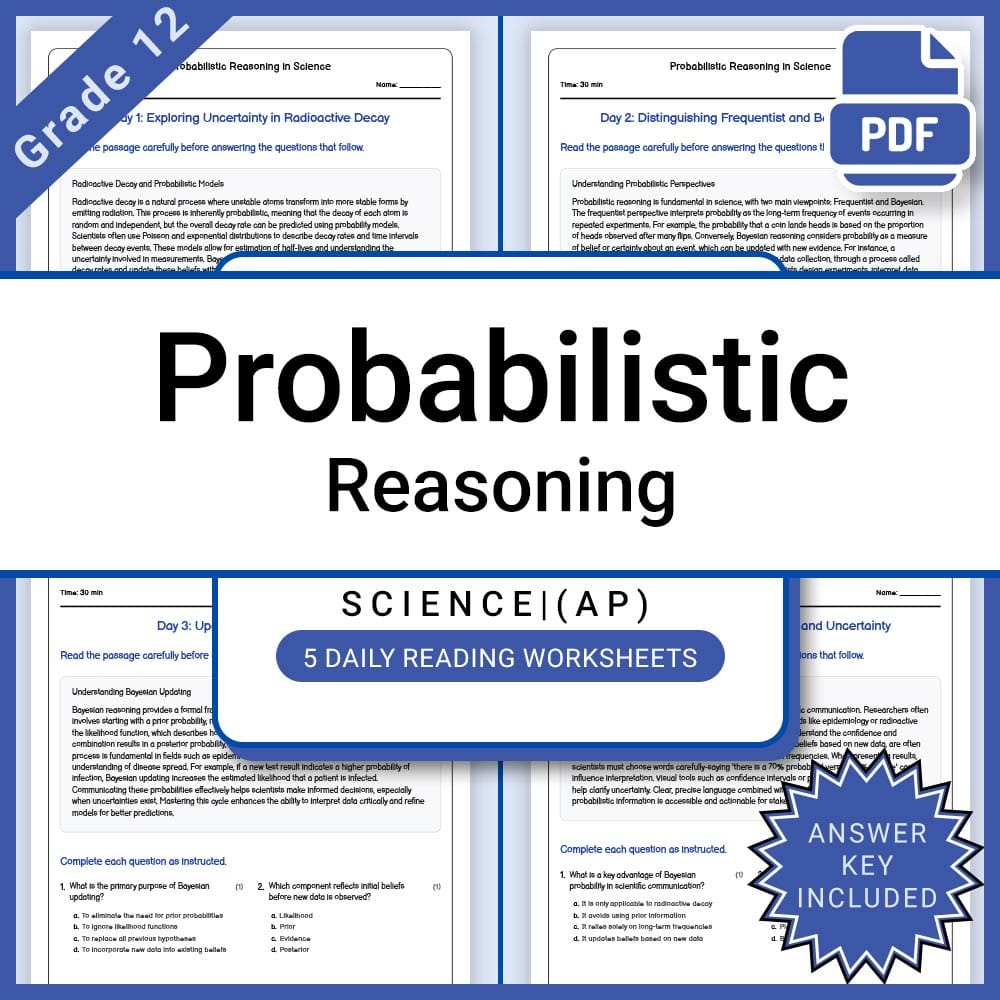
Grade 12 Science – Probabilistic Reasoning Daily Reading Worksheet + Answer Key
JCreated byJ.S SheetsLearning Objectives
- Understand the principles of probabilistic frameworks used to quantify uncertainty.
- Compare and contrast frequentist and Bayesian perspectives in scientific contexts.
- Learn how prior information and likelihood are integrated to update beliefs.
Also included in: Grade 12 Science Practices Lesson Bundle | AP Framework and Skills +1 more
Instant download
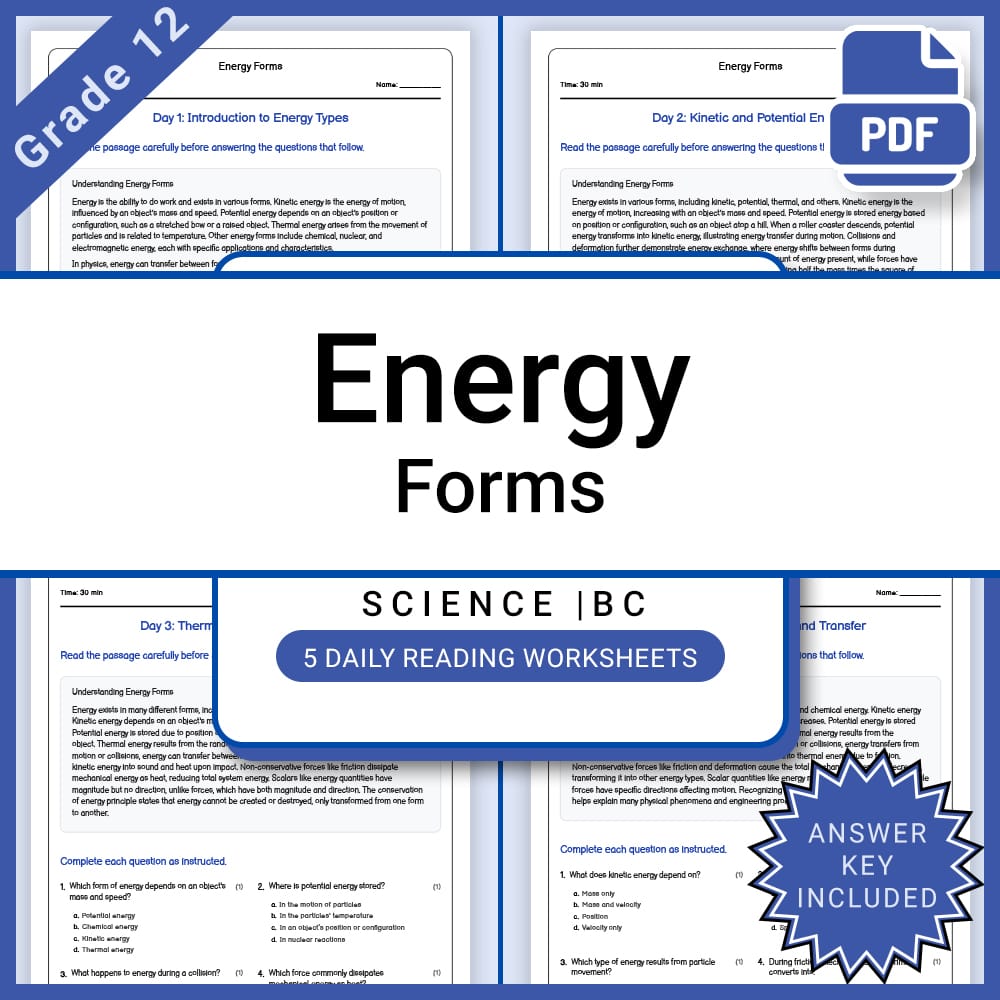
Grade 12 Science Energy Forms Daily Reading Worksheet with Answer Key
JCreated byJ.S SheetsLearning Objectives
- Define different energy forms such as kinetic, potential, and thermal energy
- Explain how energy transfers between different forms during physical processes
- Understand how total mechanical energy changes in systems influenced by non-conservative forces
Also included in: Grade 12 Science Lesson Group | Physics, Energy, Waves & Electromagnetism +1 more
Instant download
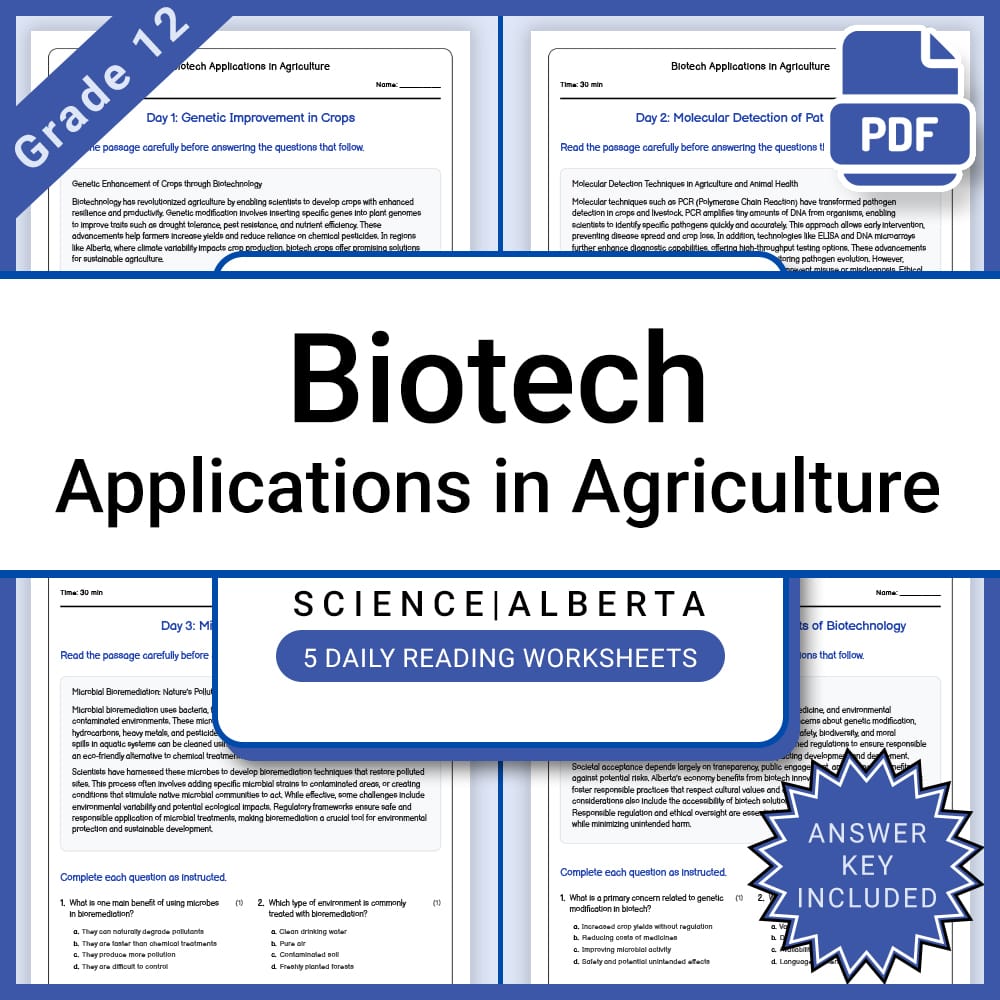
Grade 12 – Biotech Applications in Agriculture Daily Worksheet with Answer Key
JCreated byJ.S SheetsLearning Objectives
- Understand genetic improvement strategies for crops
- Learn molecular detection techniques for plant and animal pathogens
- Explore microbial methods for hydrocarbon degradation
Also included in: Grade 12 Science Lesson Bundle | Alberta Framework and Real-World Applications +1 more
Instant download
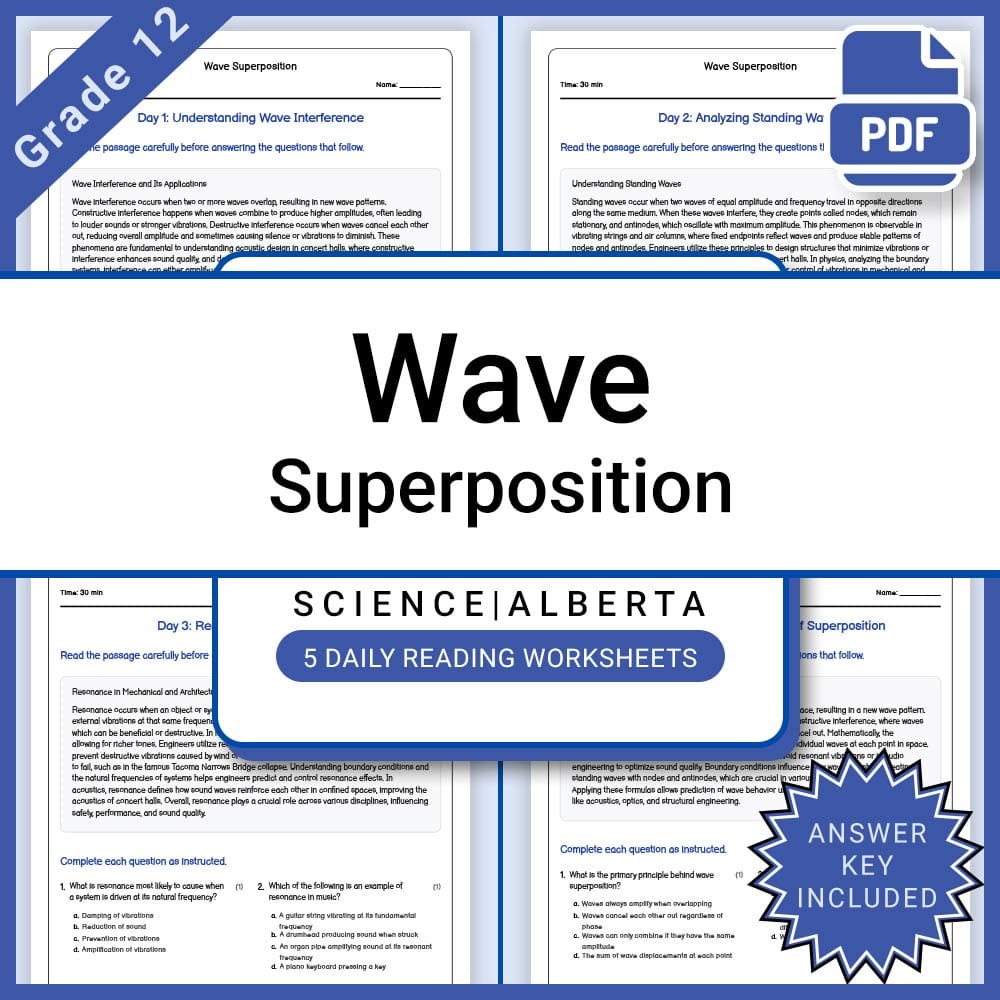
Grade 12 Science – Wave Superposition Daily Reading Worksheet + Answer Key
JCreated byJ.S SheetsLearning Objectives
- Understand and identify constructive and destructive interference patterns.
- Explain how wave superposition influences sound and structural vibrations.
- Analyze standing waves and resonance phenomena using phase and amplitude relationships.
Also included in: Grade 12 Science Lesson Bundle | Physics, Nuclear, Waves & Circuits +1 more
Instant download

Grade 12 Science – Atomic Radius Trends Daily Reading Worksheet with Answer Key
JCreated byJ.S SheetsLearning Objectives
- Understand the concept of atomic radius and how it varies across the periodic table.
- Analyze the effect of atomic structure, nuclear charge, and electron shielding on atomic size.
- Compare atomic radii of alkali metals, transition metals, and halogens.
Also included in: Grade 12 Science Lesson Group Bundle | TEKS Standards +1 more
Instant download
About Grade 12 Science Worksheets
Explore Grade 12 Science worksheets for classwork, homework, or review. Our 4,240 printables download instantly as PDFs.
MyTeachingSheets worksheets are made by real teacher-authors and checked before they go live. Download any as a print-ready PDF for lessons, homework, or independent practice — most include answer keys, and previews are always free.