
Grade 6 Worksheets
8,149 grade resources
Grade 6 Science – Reproductive Structures in Plants Daily Worksheet + Answer Key
JCreated byJ.S SheetsLearning Objectives
- Identify the parts of flowers related to reproduction
- Understand seed dispersal mechanisms
- Recognize examples of plant regeneration strategies
Grade 6 – Species Classification in Ecosystems Daily Worksheet + Answer Key
JCreated byJ.S SheetsLearning Objectives
- Understand the different roles of organisms within an ecosystem.
- Identify native versus invasive or pest species.
- Learn how species classification helps predict energy flow and ecosystem health.
Grade 6 Science – Digital Sources in Environmental Daily Worksheet + Answer Key
JCreated byJ.S SheetsLearning Objectives
- Understand different types of digital sources used in environmental data collection.
- Learn to verify metadata, temporal, and spatial coverage of datasets.
- Recognize challenges and considerations for integrating digital environmental data.
Grade 6 – Experimental Design in Environmental Daily Worksheet + Answer Key
JCreated byJ.S SheetsLearning Objectives
- Identify independent, dependent, and controlled variables in environmental experiments.
- Define suitable control conditions for testing environmental factors.
- Develop testable questions related to snowpack depth and soil moisture.
Grade 6 Science – Graph Selection Daily Reading Worksheet + Answer Key
JCreated byJ.S SheetsLearning Objectives
- Understand situations where different types of graphs are appropriate
- Learn to identify when to use line graphs, bar charts, and scatter plots
- Recognize key features of graphs such as axes labels, scales, and annotations
Grade 6 – River Monitoring Integrated Synthesis Daily Worksheet + Answer Key
JCreated byJ.S SheetsLearning Objectives
- Understand how various stages of scientific monitoring contribute to understanding river health.
- Analyze the importance of data documentation and comparability in environmental studies.
- Develop the ability to interpret scientific reports on river monitoring projects.
Grade 6 Science – Measurement Tools Daily Reading Worksheet with Answer Key
JCreated byJ.S SheetsLearning Objectives
- Identify different types of thermometers used in science.
- Understand how to select appropriate measurement tools for different data collection needs.
- Recognize the importance of calibration and unit selection in measurements.
Grade 6 Science – Operational Definitions Daily Reading Worksheet + Answer Key
JCreated byJ.S SheetsLearning Objectives
- Understand the purpose and importance of operational definitions in scientific measures.
- Learn how to convert qualitative observations into quantitative data.
- Identify examples of measurement methods such as water clarity and snowpack depth.
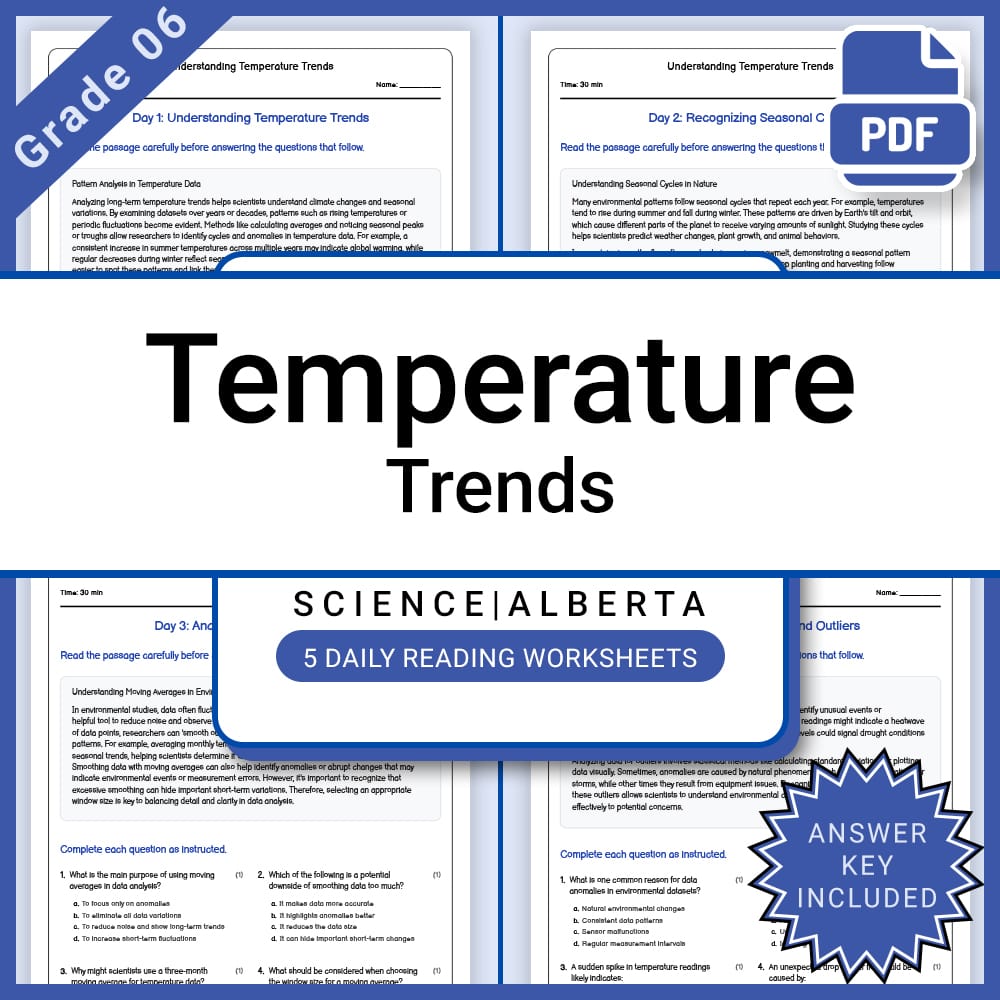
Grade 6 Science – Temperature Trends Daily Reading Worksheet + Answer Key
JCreated byJ.S SheetsLearning Objectives
- Learn how to identify long-term temperature patterns in datasets.
- Understand the concepts of seasonal cycles and anomalies in temperature data.
- Explore methods like descriptive statistics and moving averages used in pattern analysis.
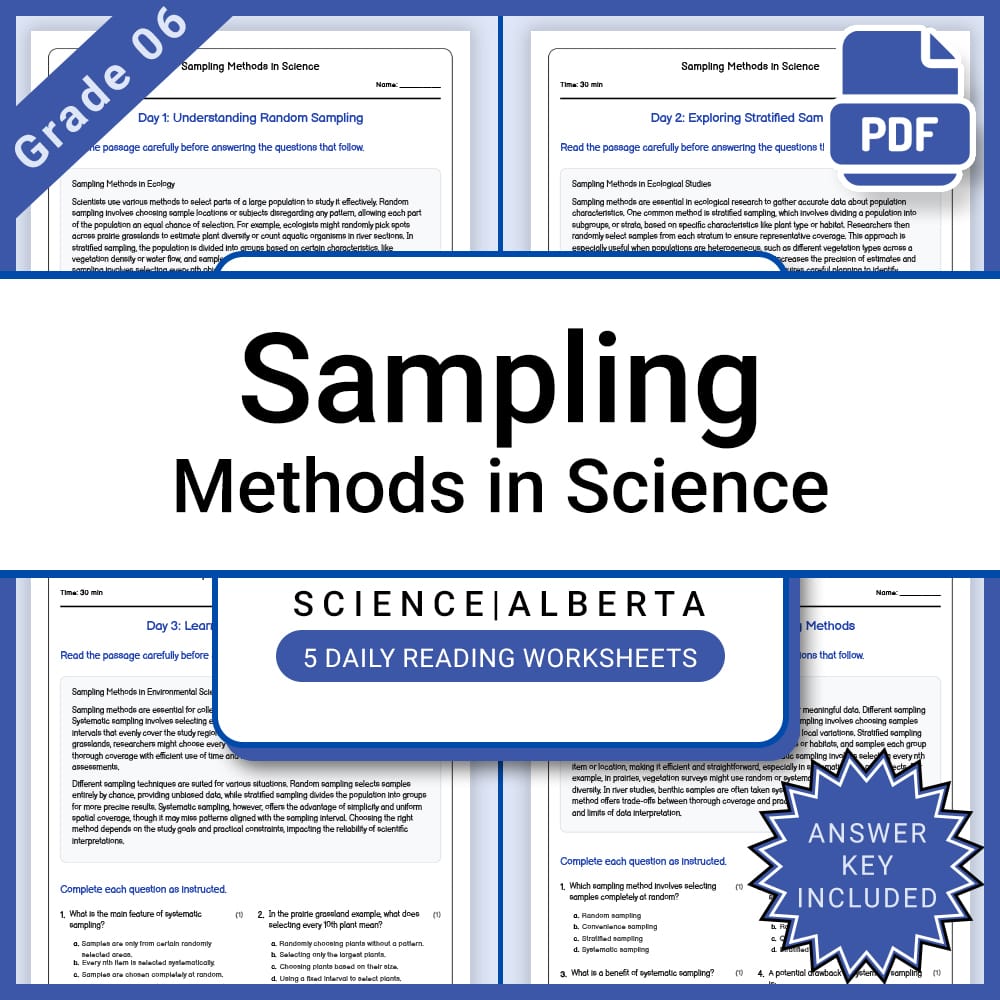
Grade 6 Science – Sampling Methods Daily Reading Worksheet + Answer Key
JCreated byJ.S SheetsLearning Objectives
- Understand the concept of random sampling.
- Identify different sampling methods used in ecological studies.
- Recognize the advantages and limitations of various sampling techniques.
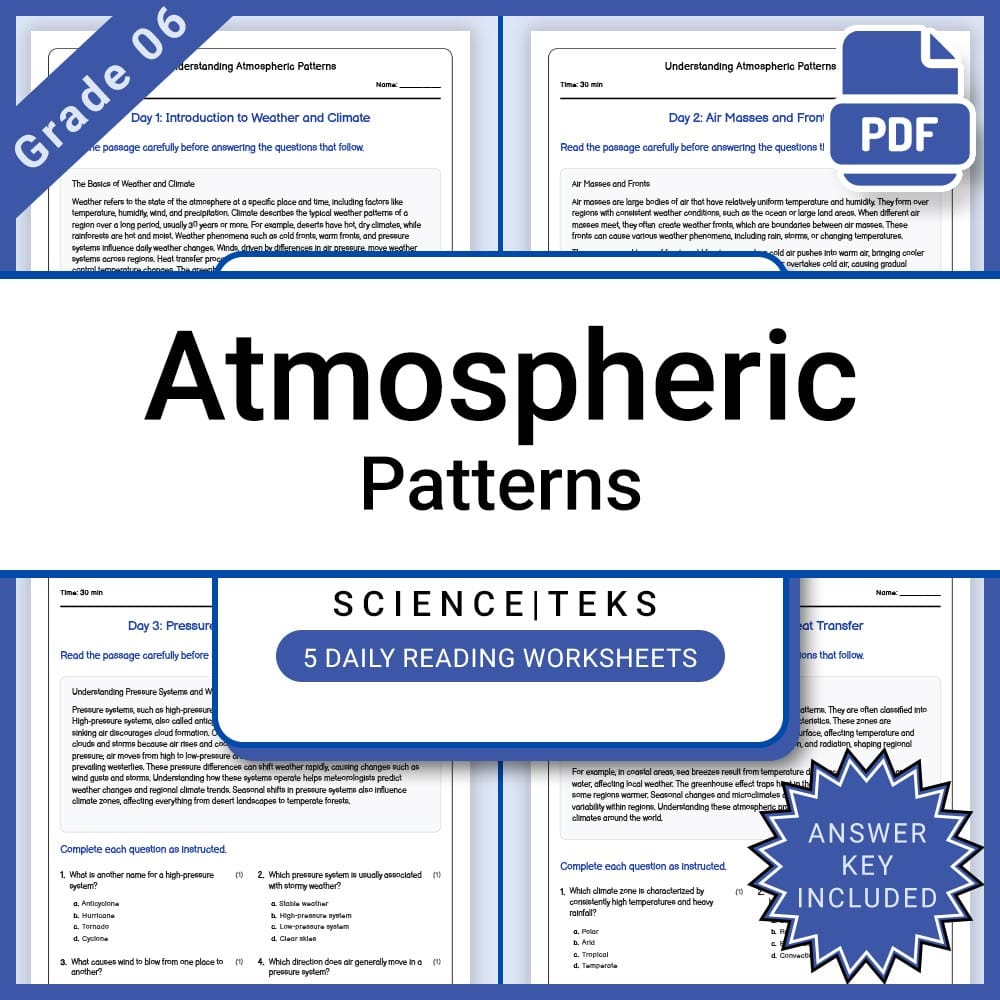
Grade 6 Science – Atmospheric Patterns Daily Reading Worksheet + Answer Key
JCreated byJ.S SheetsLearning Objectives
- Identify basic weather phenomena such as fronts, pressure systems, and winds.
- Describe the key components of the atmosphere and how they influence weather and climate.
- Explain how heat transfer and the greenhouse effect contribute to regional climate variability.
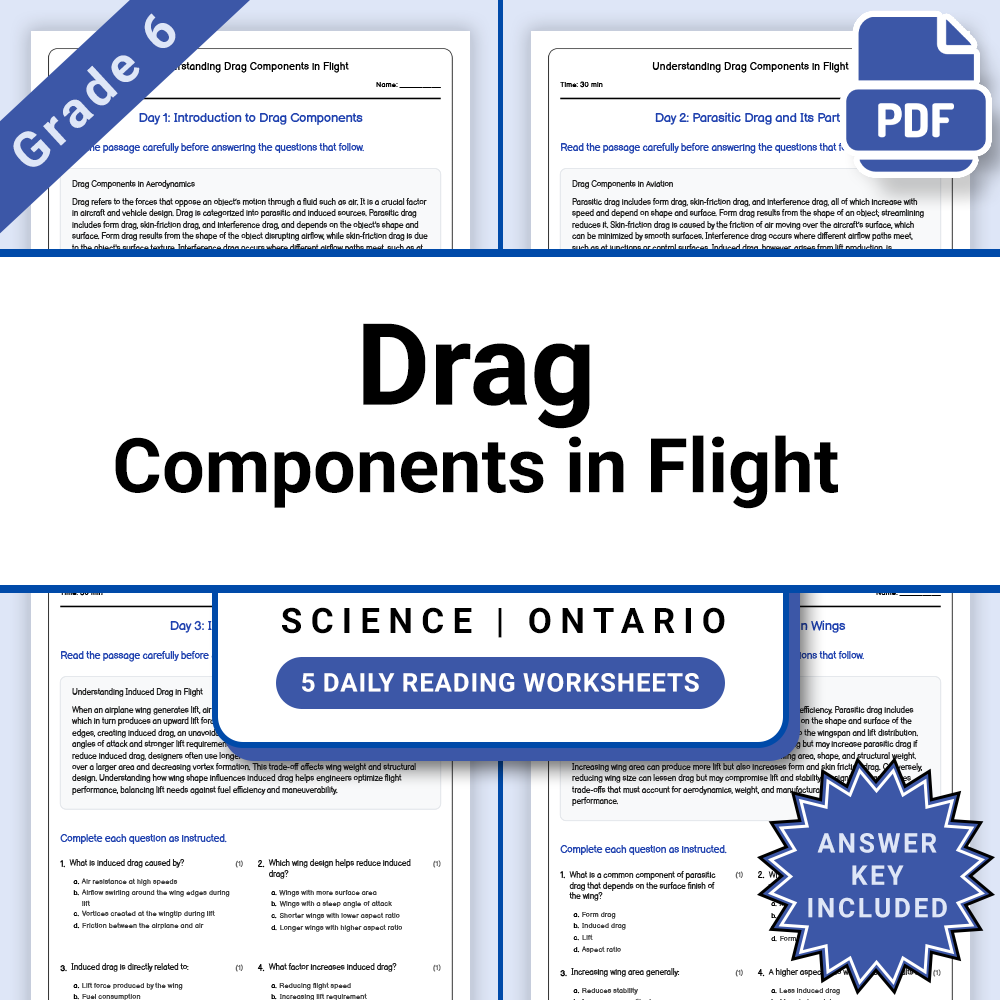
Grade 6 Science – Drag Components in Flight Daily Reading Worksheet + Answer Key
JCreated byJ.S SheetsLearning Objectives
- Understand key concepts related to Science
- Apply knowledge through practice questions
- Demonstrate comprehension of the material
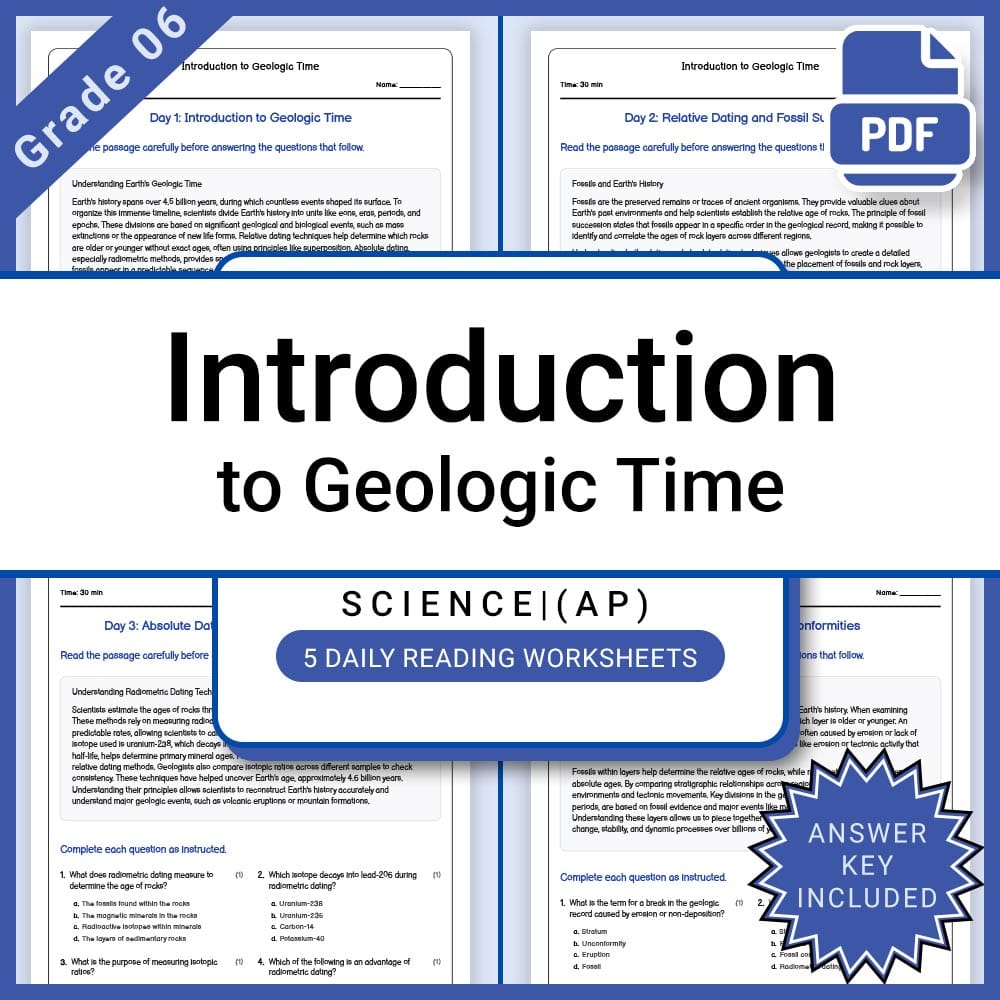
Grade 6 Science – Introduction to Geologic Time Daily Worksheet + Answer Key
JCreated byJ.S SheetsLearning Objectives
- Understand key concepts related to Science
- Apply knowledge through practice questions
- Demonstrate comprehension of the material
Grade 6 Science – Water Cycle Daily Reading Worksheet with Answer Key
JCreated byJ.S SheetsLearning Objectives
- Identify the main components of the hydrologic cycle
- Describe processes like evaporation, condensation, and precipitation
- Understand how surface and groundwater interact
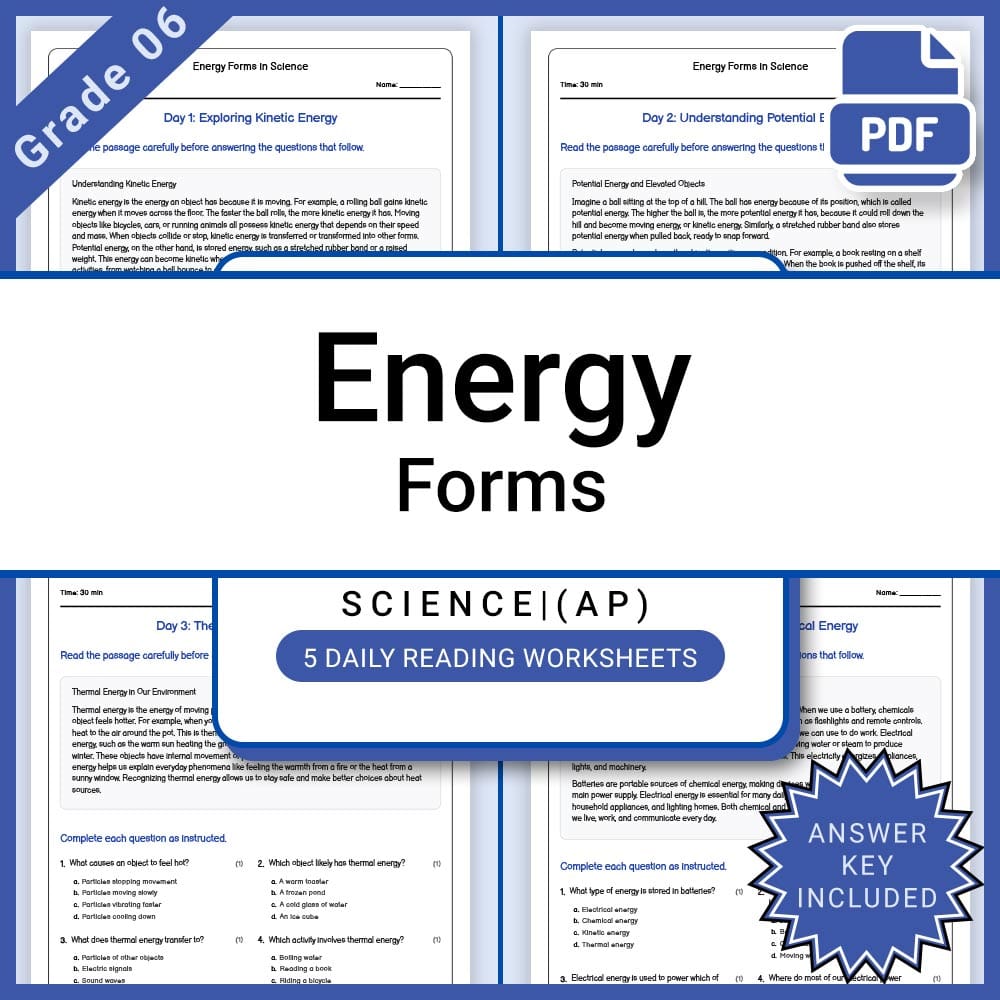
Grade 6 Science – Energy Forms Daily Reading Worksheet + Answer Key
JCreated byJ.S SheetsLearning Objectives
- Identify different forms of energy including kinetic, potential, thermal, chemical, and electrical.
- Relate each energy form to familiar phenomena such as moving objects, stretched springs, warm objects, and batteries.
- Describe how energy is associated with motion, position, and internal molecular activity.
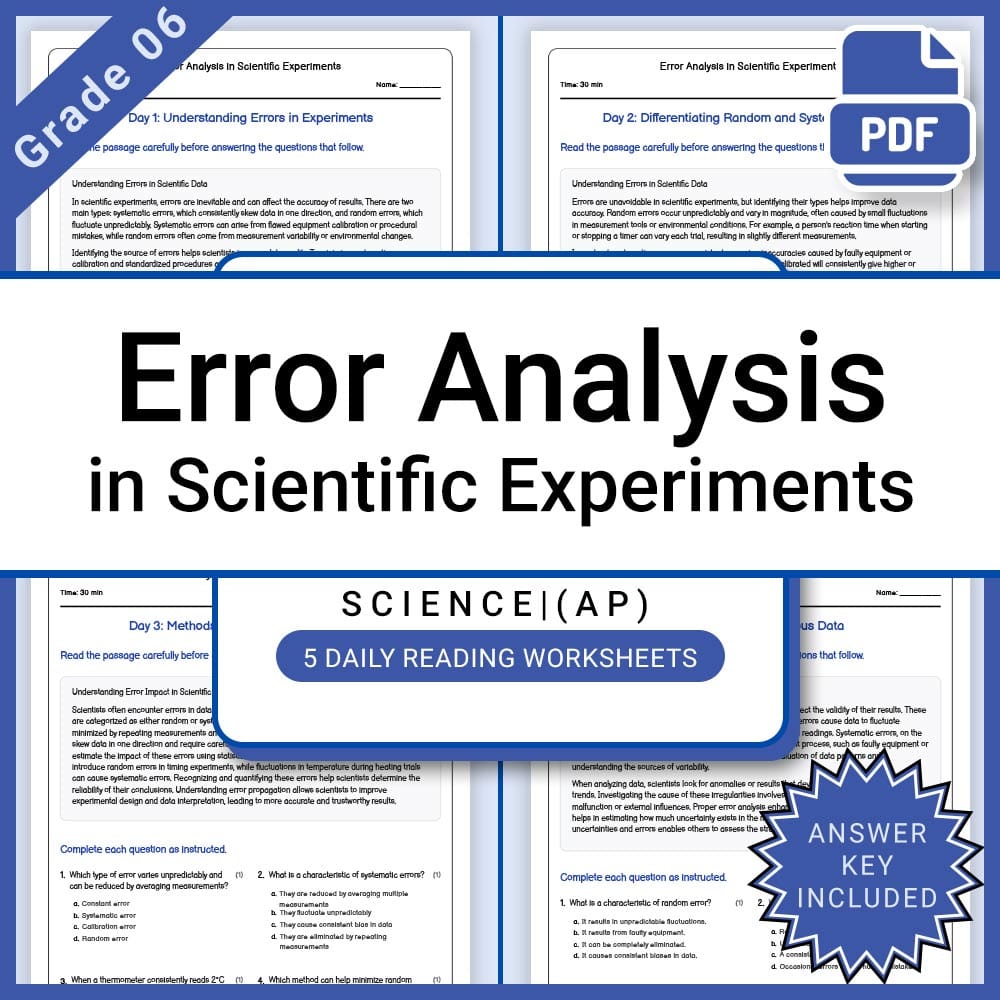
Grade 6 – Error Analysis in Scientific Experiments Worksheet with Answer Key
JCreated byJ.S SheetsLearning Objectives
- Understand the distinction between systematic and random errors.
- Identify common sources of error in experimental data.
- Learn methods to estimate and account for errors in measurements.
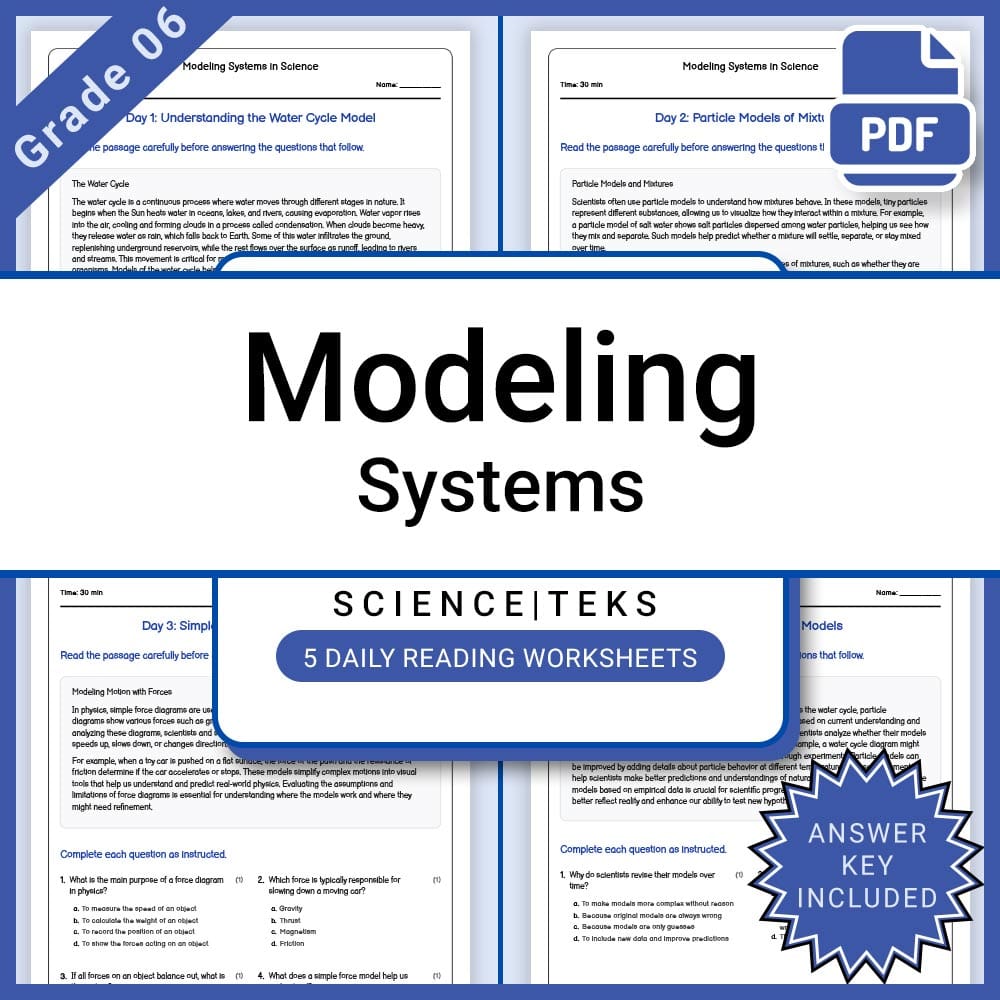
Grade 6 Science – Modeling Systems Daily Reading Worksheet + Answer Key
JCreated byJ.S SheetsLearning Objectives
- Understand how the water cycle model illustrates natural processes
- Interpret diagrams and models used in science to represent systems
- Identify the assumptions and limitations of different scientific models
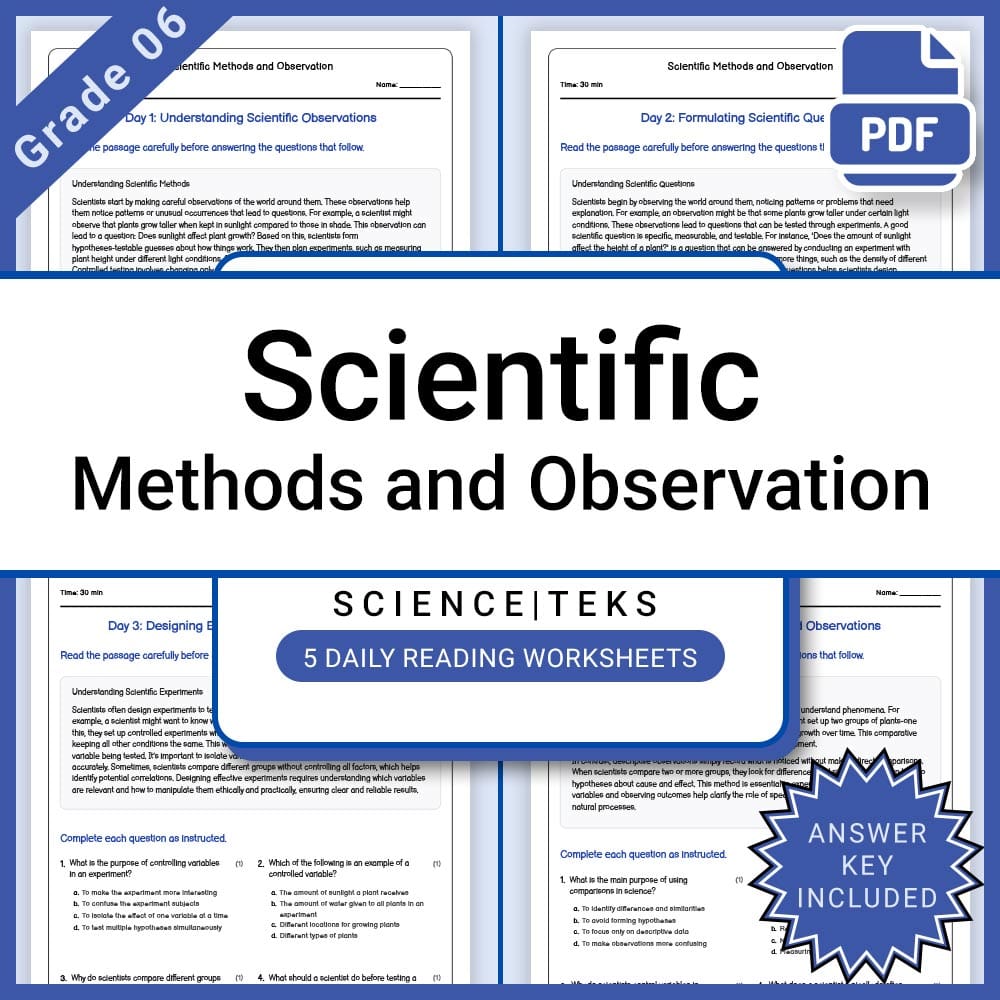
Grade 6 Science – Scientific Methods and Observation Worksheet + Answer Key
JCreated byJ.S SheetsLearning Objectives
- Differentiate between observation and hypothesis in scientific investigations.
- Understand the role of prior observation in forming testable questions.
- Learn how to select appropriate methods like controlled testing and comparative observation based on phenomena.
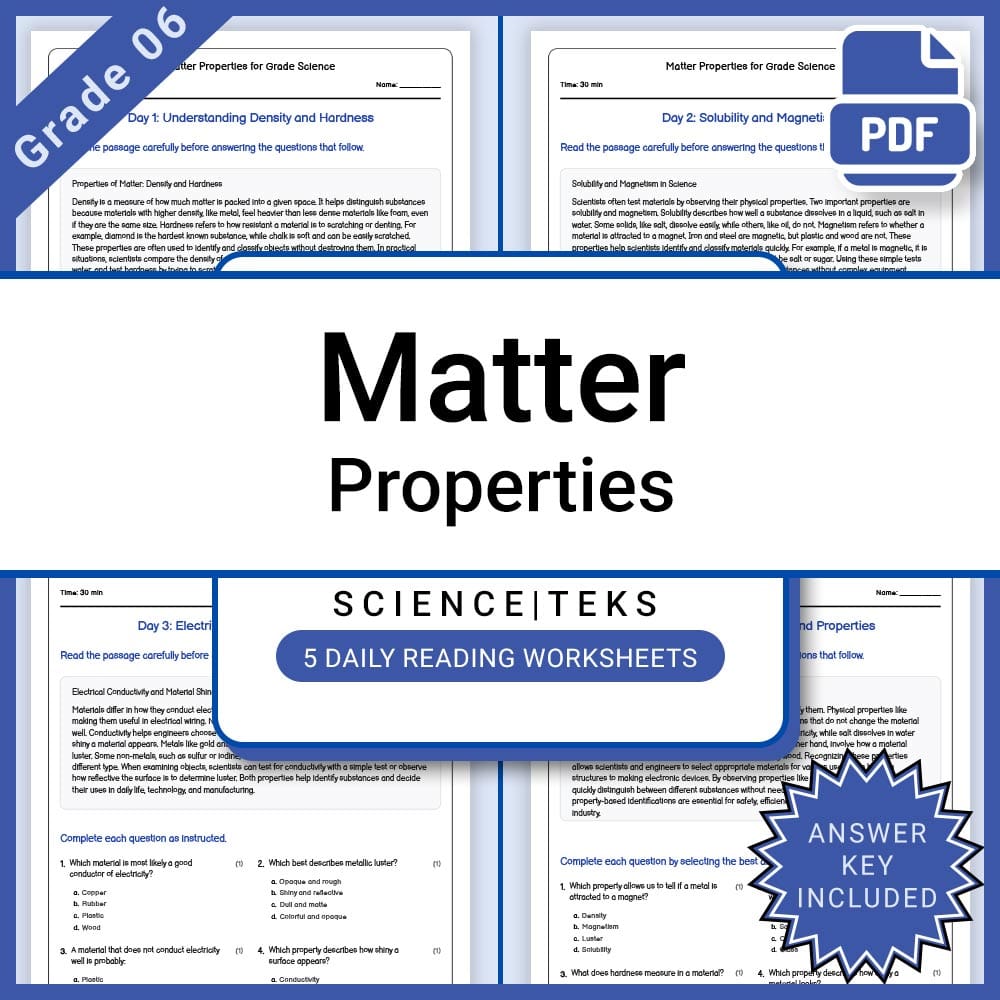
Grade 6 Science – Matter Properties Daily Reading Worksheet + Answer Key
JCreated byJ.S SheetsLearning Objectives
- Understand the concept of density and how it helps distinguish substances.
- Learn about hardness and how it can be used to identify materials.
- Explore simple qualitative and quantitative methods to compare substances.
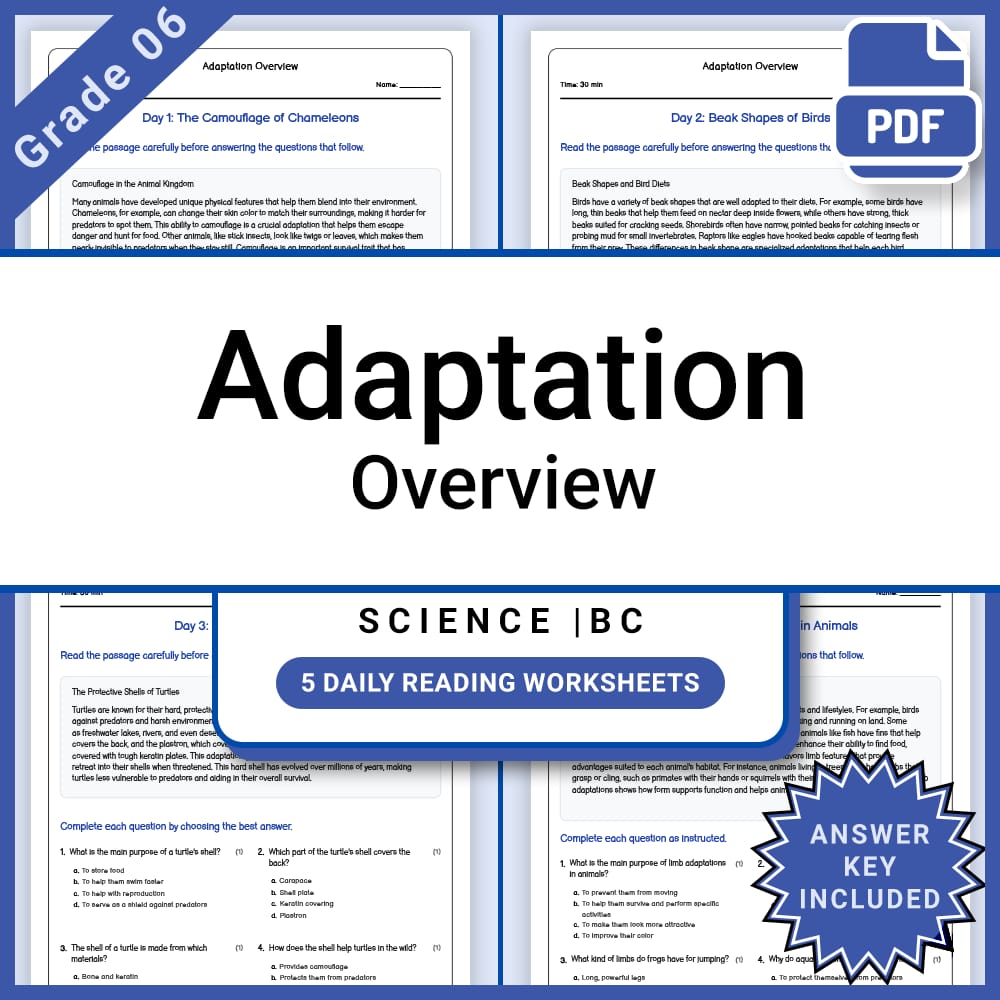
Grade 6 Science – Adaptation Overview Daily Reading Worksheet with Answer Key
JCreated byJ.S SheetsLearning Objectives
- Understand what structural adaptations are and how they help animals survive.
- Identify examples of camouflage and other physical features that animals use for protection.
- Explain the benefits of different adaptations in various environments.
Grade 6 Science – Adaptation Tradeoffs Daily Reading Worksheet + Answer Key
JCreated byJ.S SheetsLearning Objectives
- Understand how structural and physiological features help animals survive in cold environments.
- Analyze the trade-offs of various adaptations, such as heavy armor versus mobility.
- Evaluate the costs and benefits of adaptations and their impact on survival and evolution.
Grade 6 Science – Cell Specialization Daily Reading Worksheet + Answer Key
JCreated byJ.S SheetsLearning Objectives
- Understand what cell specialization is and why it occurs
- Identify different types of specialized cells and their functions
- Explain how specialized cells work together to form tissues and organs
Grade 6 Science – Digestive System Daily Reading Worksheet with Answer Key
JCreated byJ.S SheetsLearning Objectives
- Understand key concepts related to Science
- Apply knowledge through practice questions
- Demonstrate comprehension of the material
Grade 6 Science – Levels Of Life Daily Reading Worksheet with Answer Key
JCreated byJ.S SheetsLearning Objectives
- Understand the hierarchy of biological levels from cells to organisms.
- Identify the characteristics of cells, tissues, organs, and organ systems.
- Explain how these levels work together to support life.
Grade 6 Science – Nervous System Daily Reading Worksheet with Answer Key
JCreated byJ.S SheetsLearning Objectives
- Identify parts of the nervous system
- Understand functions of neurons
- Describe how the nervous system communicates and coordinates responses
Grade 6 Science – Synthetic Materials Daily Reading Worksheet (PDF+ Answer Key)
 Created byCopper Leaf Classroom
Learning Objectives
- Understand the origins of synthetic materials from natural resources.
- Compare properties of substances used for specific purposes, such as durability and biodegradability.
- Describe processes involved in resource extraction and product manufacturing.
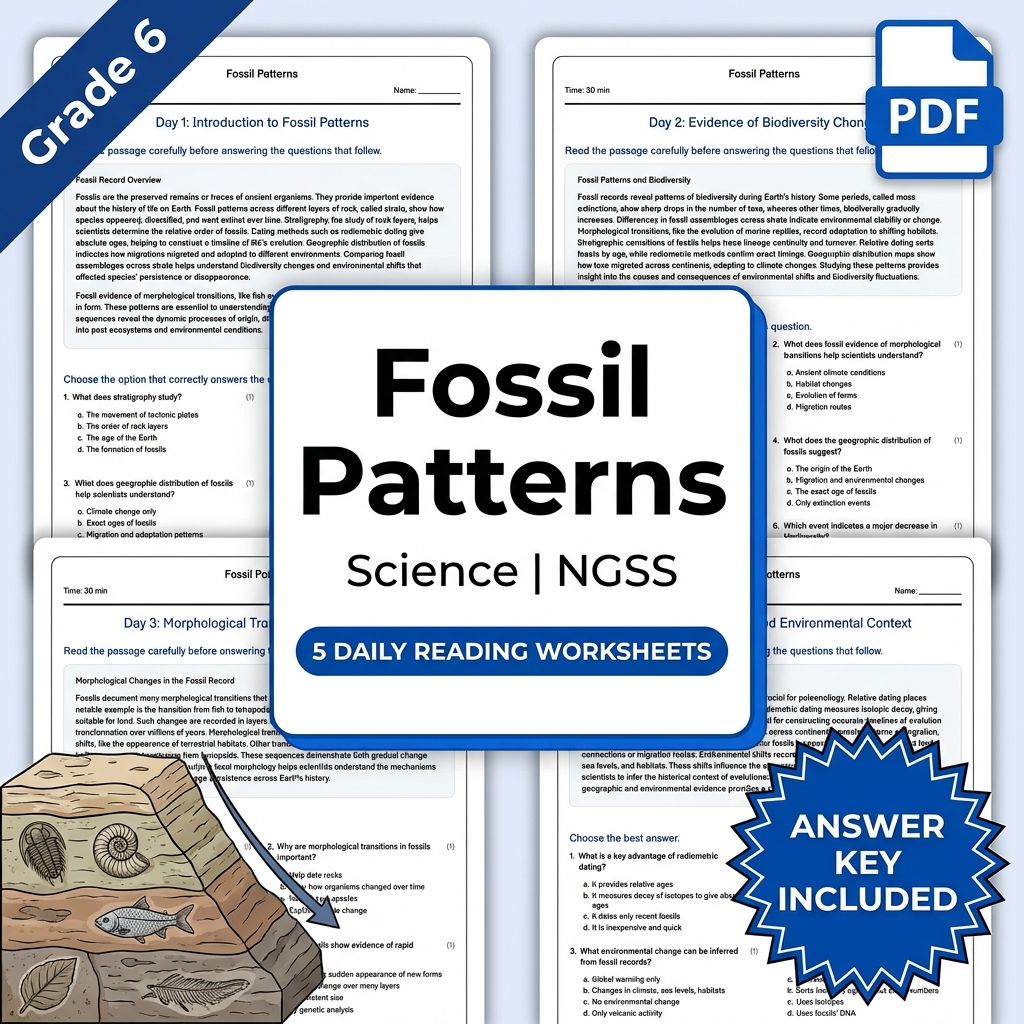
6th Grade Science | Fossil Patterns Reading Worksheet (PDF+ Answer Key)
Created byCopper Leaf ClassroomLearning Objectives
- Identify patterns of fossil occurrence across different geological layers.
- Understand how stratigraphy reveals the sequence of organism development and extinction.
- Analyze morphological transitions in fossils, such as fish to tetrapods.
6th Grade Science | Tree Evidence Daily Reading Worksheet (PDF+ Answer Key)
Created byCopper Leaf ClassroomLearning Objectives
- Understand different types of evidence (anatomical and molecular) supporting common ancestry among organisms.
- Identify homologous structures, vestigial organs, and conserved DNA sequences in evolutionary analysis.
- Analyze phylogenetic trees to interpret lineage relationships and trait inheritance.
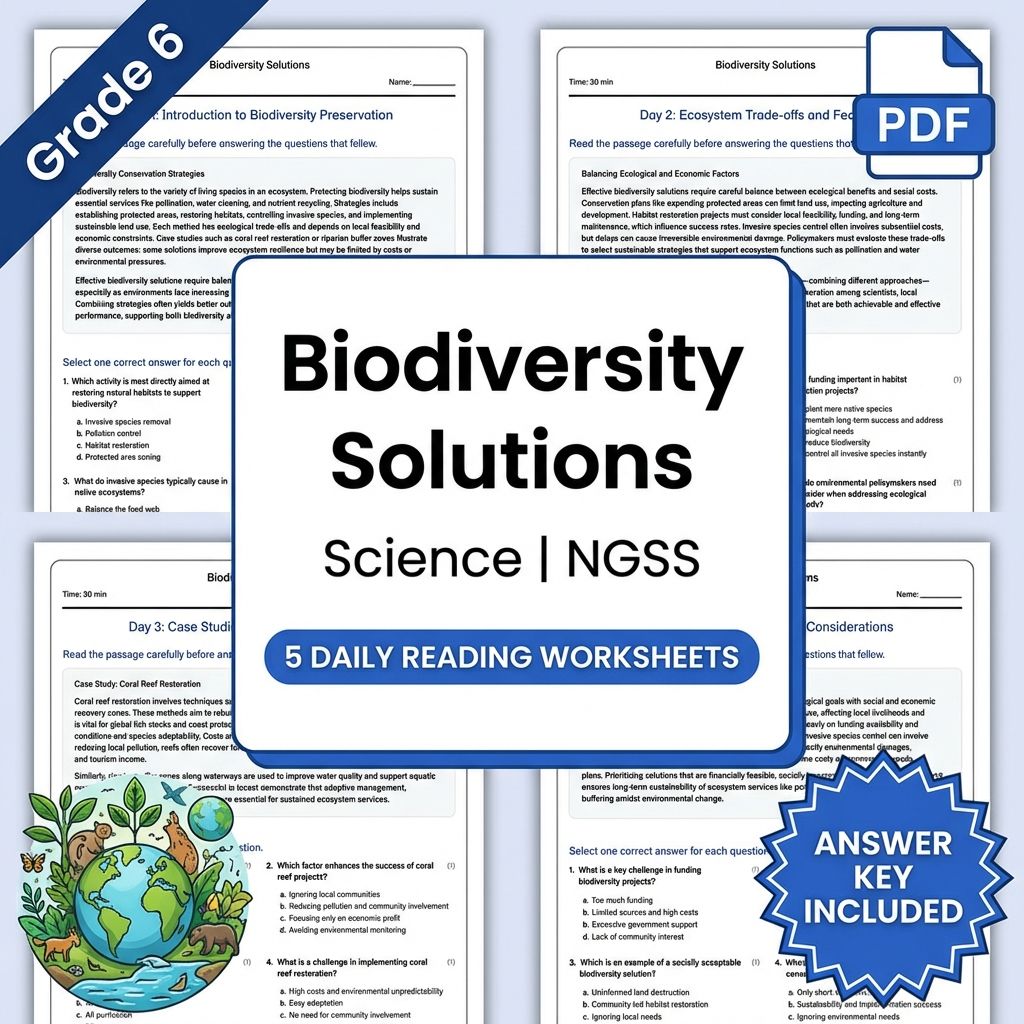
6th Grade Science | Biodiversity Solutions Worksheet (PDF + Answer Key)
Created byCopper Leaf ClassroomLearning Objectives
- Understand various strategies used to maintain biodiversity and ecosystem services.
- Compare conservation, habitat restoration, and invasive species management techniques.
- Evaluate ecological trade-offs, feasibility, and effectiveness of different biodiversity solutions.
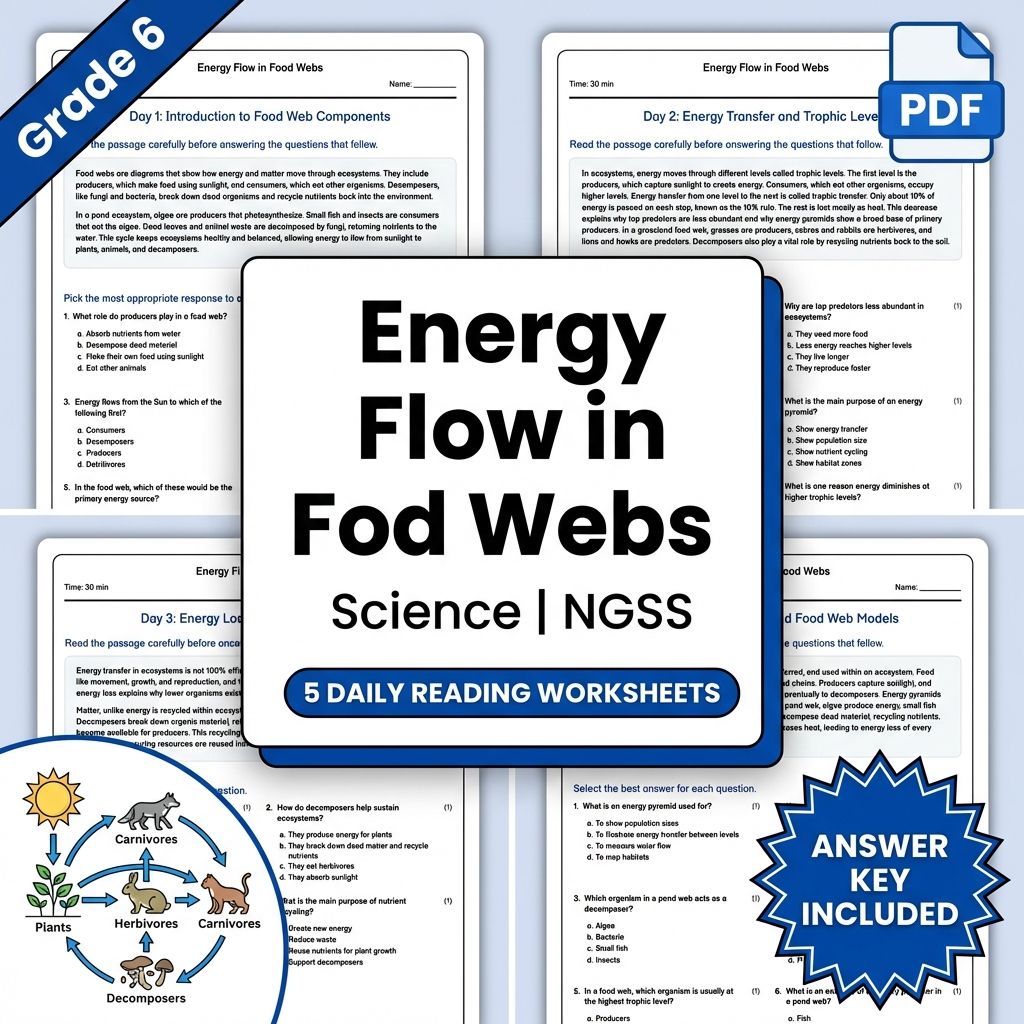
6th Grade Science | Energy Flow in Food Webs Worksheet (PDF+ Answer Key)
Created byCopper Leaf ClassroomLearning Objectives
- Understand the components and functions of food webs in ecosystems.
- Describe how energy flows through producers, consumers, and decomposers.
- Explain the concept of energy pyramids and trophic transfer efficiency.
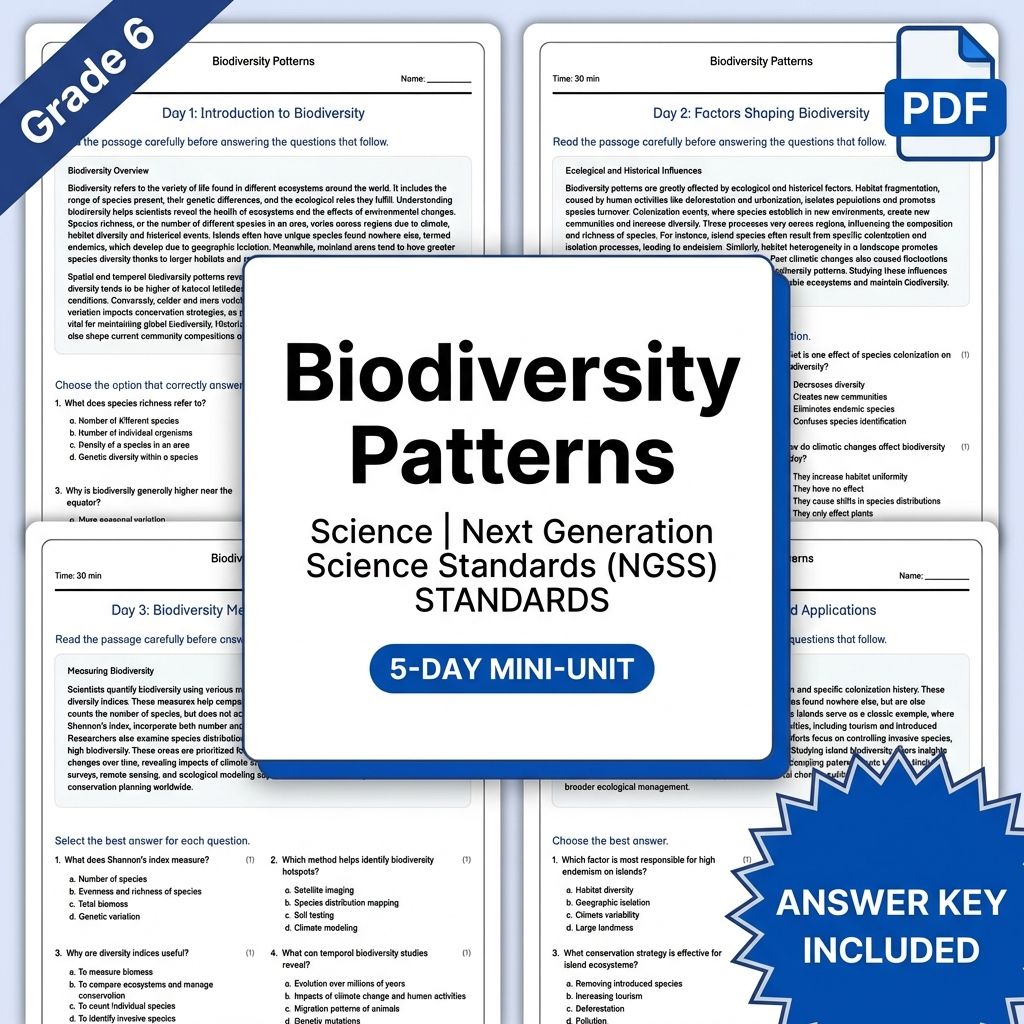
6th Grade Science | Biodiversity Patterns Reading Worksheet (PDF + Answer Key)
Created byCopper Leaf ClassroomLearning Objectives
- Understand the concept of biodiversity and its spatial patterns.
- Identify factors influencing species distribution across ecosystems.
- Compare biodiversity variations on islands, across latitudes, and due to habitats.
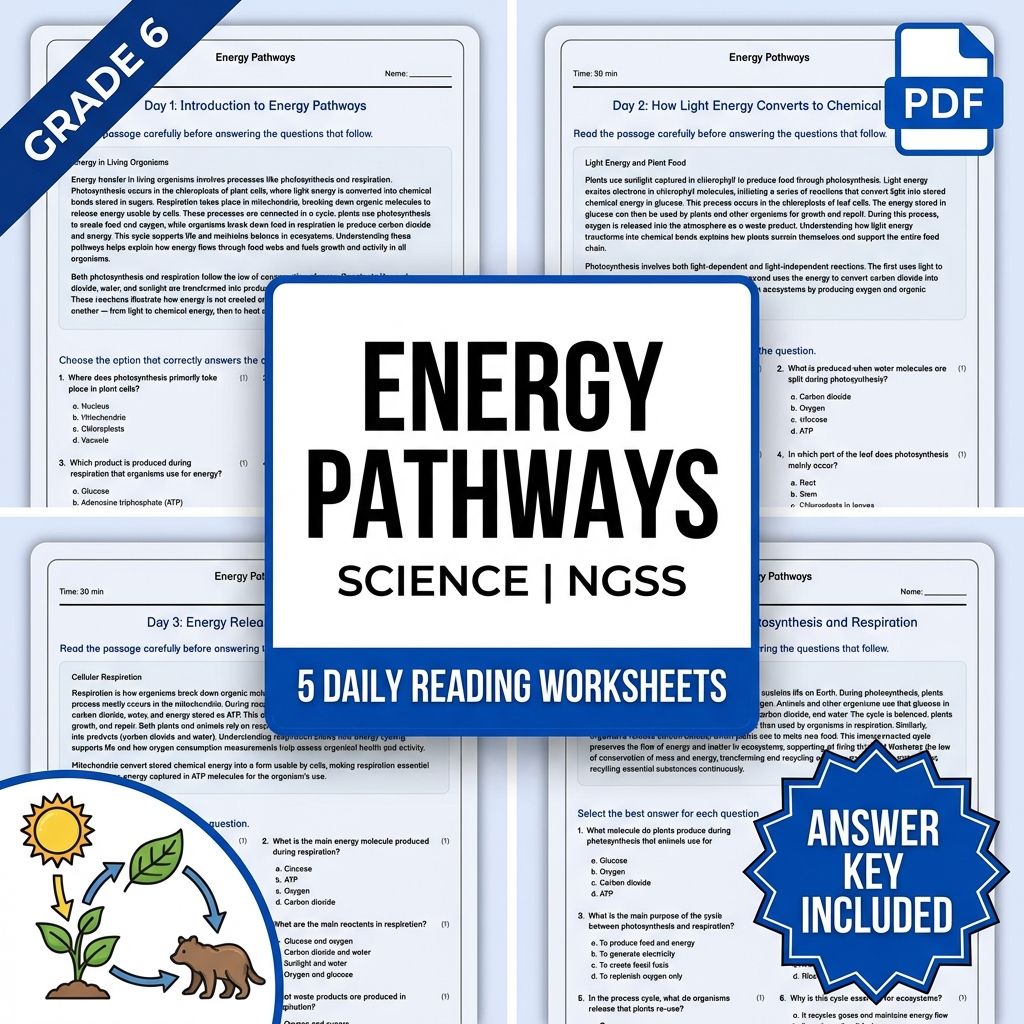
Grade 6 Science | Energy Pathways Daily Reading Worksheet (PDF+ Answer Key)
Created byCopper Leaf ClassroomLearning Objectives
- Understand how energy is transferred and cycled through biological processes like photosynthesis and respiration.
- Describe the roles of chloroplasts and mitochondria in energy transformation.
- Connect reactants and products in energy reactions such as photosynthesis and respiration.
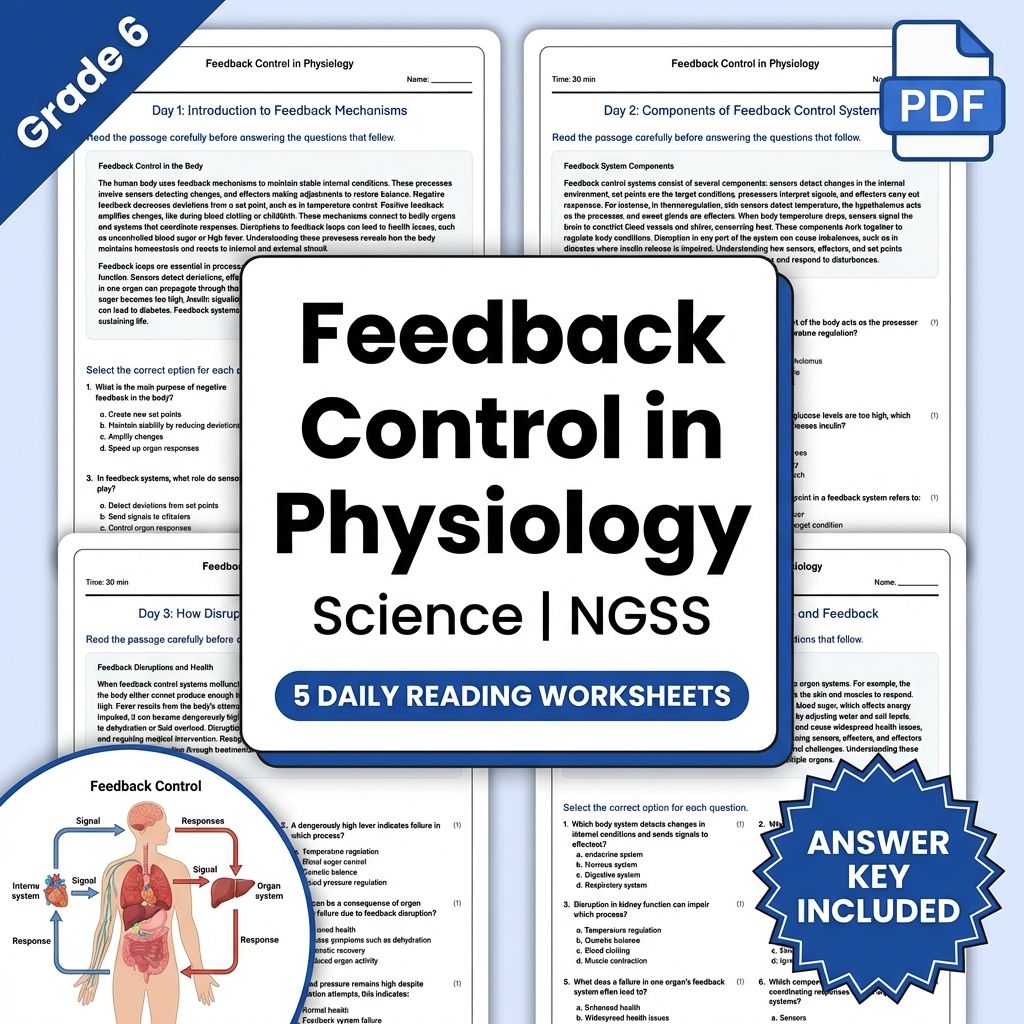
6th Grade Science | Feedback Control in Physiology Worksheet (PDF+ Answer Key)
Created byCopper Leaf ClassroomLearning Objectives
- Understand the role of feedback mechanisms in maintaining internal stability.
- Differentiate between negative and positive feedback processes with examples.
- Explain how disturbances propagate through organ systems and how responses restore balance.
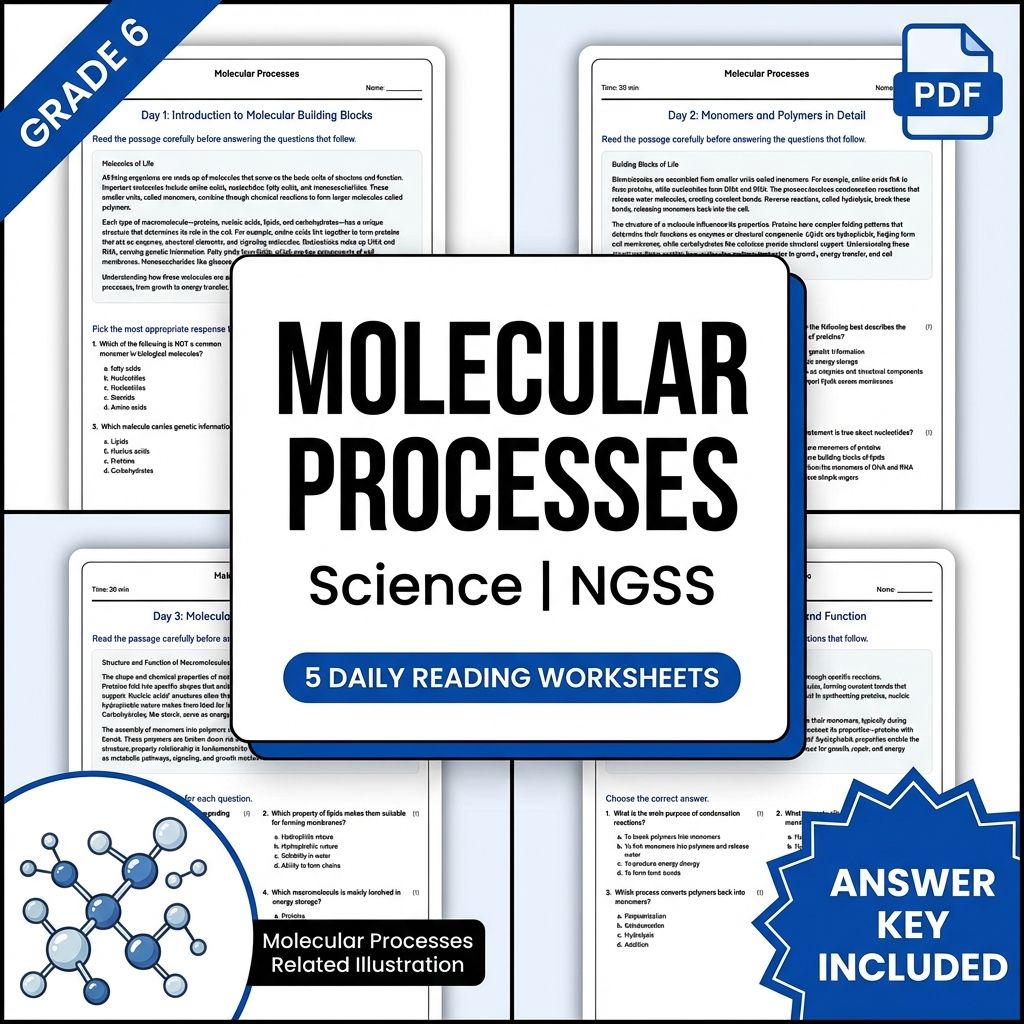
6th Grade Science |Molecular Processes Worksheet (PDF+ Answer Key)
Created byCopper Leaf ClassroomLearning Objectives
- Understand the basic building blocks of life, including amino acids, nucleotides, fatty acids, and monosaccharides.
- Explain how monomers assemble into polymers through condensation reactions.
- Describe how biochemical structures determine functions such as enzyme activity, membrane transport, and growth.
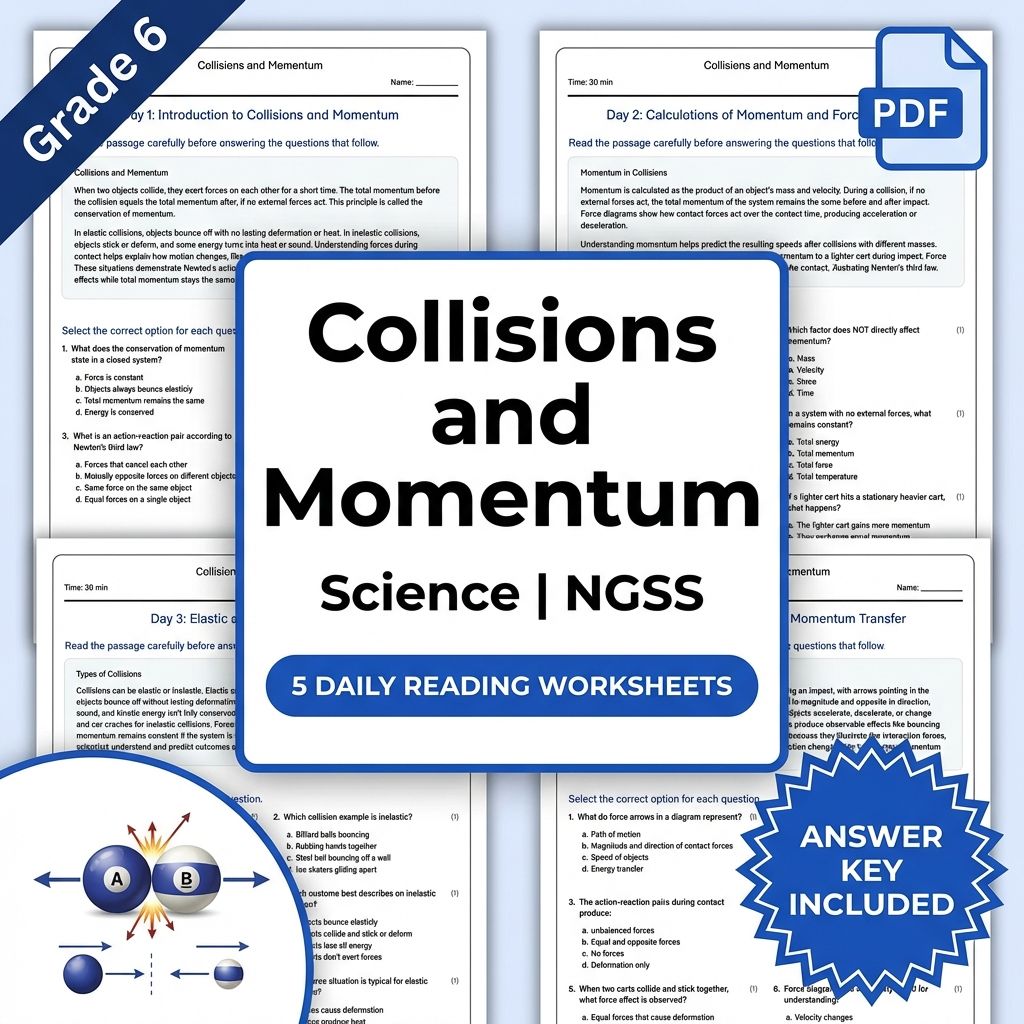
6th Grade Science | Collisions & Momentum Reading Worksheet (PDF + Answer Key)
Created byCopper Leaf ClassroomLearning Objectives
- Understand the basic principles of momentum and how it is conserved in collisions.
- Analyze how forces during contact influence motion changes in colliding objects.
- Distinguish between elastic and inelastic collisions through examples and calculations.
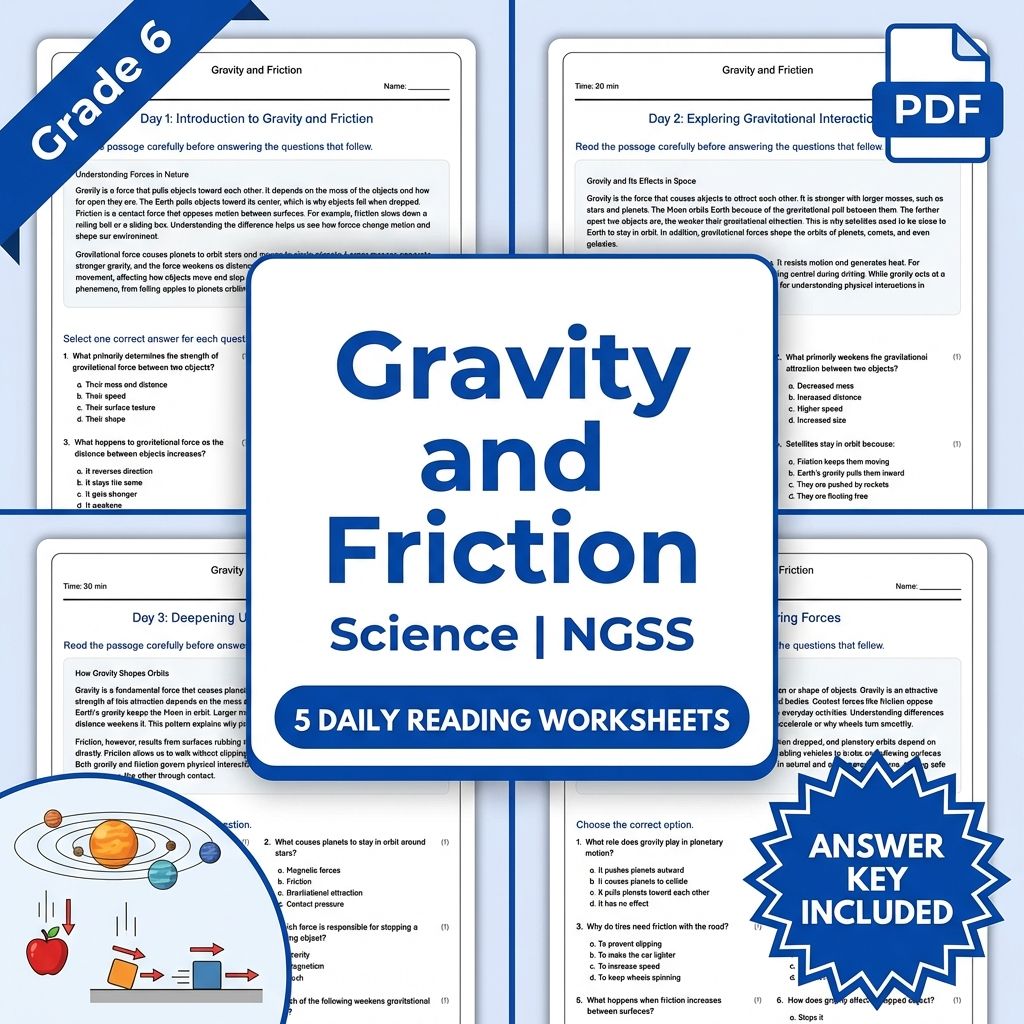
6th Grade Science | Gravity and Friction Worksheet (PDF+ Answer Key)
Created byCopper Leaf ClassroomLearning Objectives
- Understand how gravitational force depends on mass and distance.
- Identify examples of gravitational interactions such as planetary orbits and falling objects.
- Distinguish between attractive (gravitational) and contact (friction) forces.
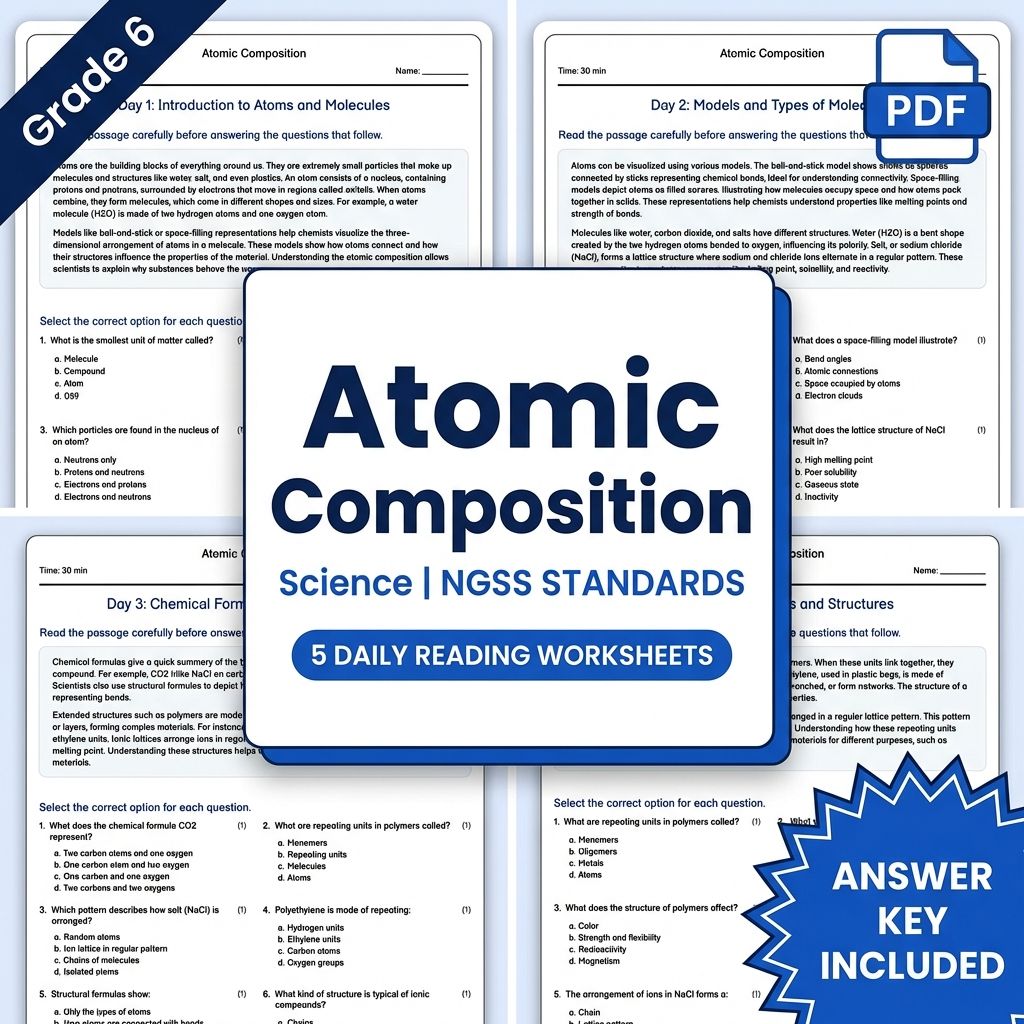
6th Grade Science | Atomic Composition Daily Reading Worksheet(PDF + Answer Key)
Created byCopper Leaf ClassroomLearning Objectives
- Understand the basic structure and components of atoms.
- Describe how atoms combine to form molecules like H2O and NaCl.
- Identify different models used to represent molecules and atomic structures.
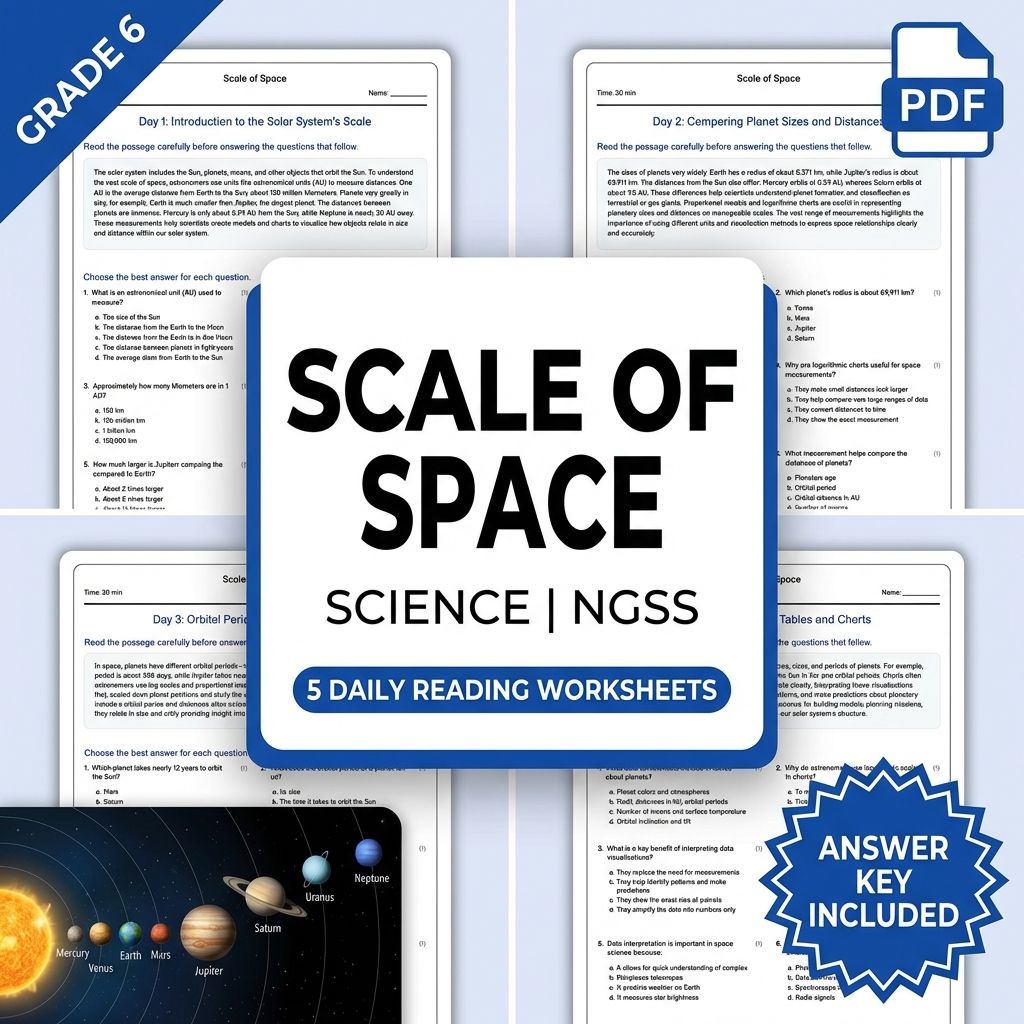
6th Grade Science | Scale of Space Daily Reading Worksheet (PDF+ Answer Key)
Created byCopper Leaf ClassroomLearning Objectives
- Understand the relative sizes and distances of objects within the solar system.
- Learn about astronomical units, planetary radii, and orbital periods.
- Compare terrestrial planets and gas giants using data and models.
6th Grade Science | Defining Problems Worksheet (PDF+ Answer Key)
Created byCopper Leaf ClassroomLearning Objectives
- Understand the criteria and constraints involved in defining a design problem.
- Identify required functions, success measures, and limits such as materials, cost, and safety.
- Apply scientific principles to relate cause and effect in problem definition.
6th Grade Science | Developing Solutions Daily Worksheet (PDF+ Answer Key)
Created byCopper Leaf ClassroomLearning Objectives
- Understand how to compare multiple design solutions using criteria and constraints.
- Learn to evaluate solutions through matrices, scoring rubrics, and prototypes.
- Identify trade-offs in design options and use evidence to justify selections.
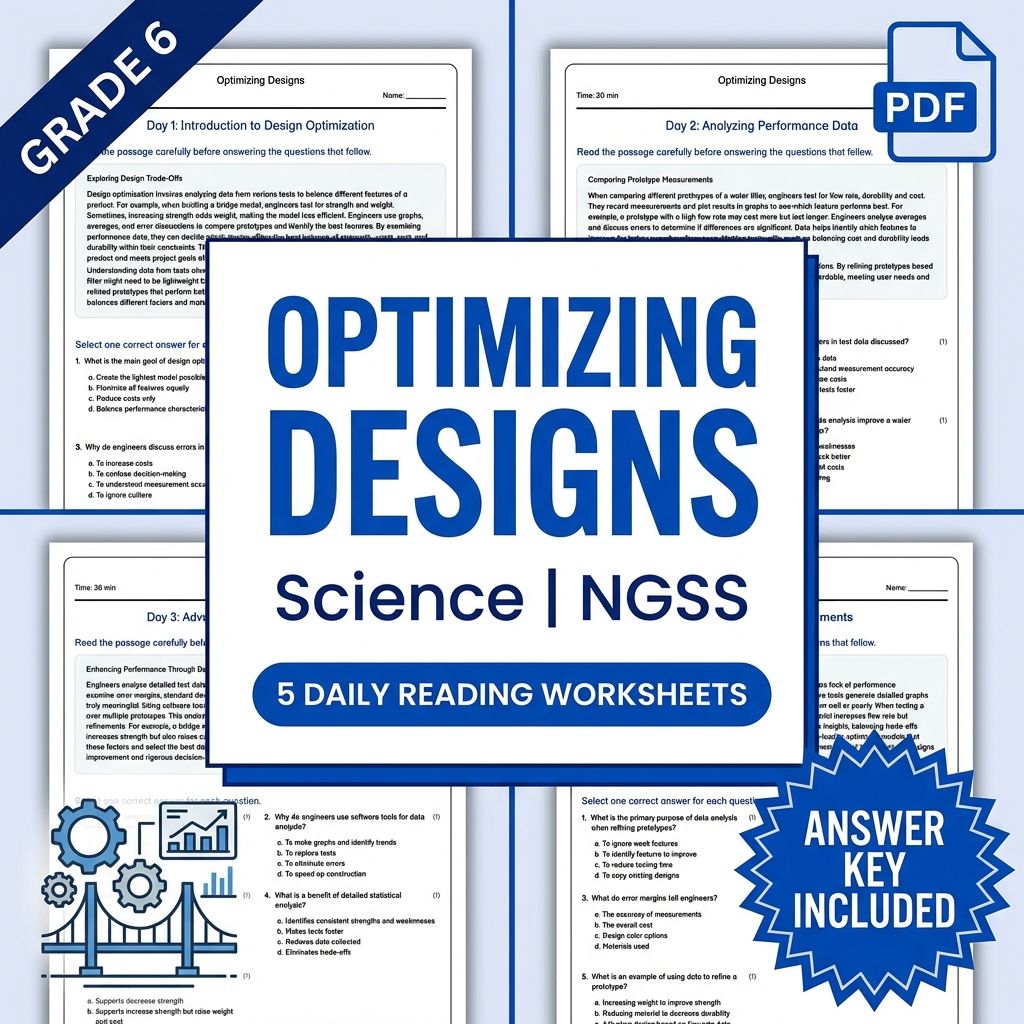
6th Grade Science | Optimizing Designs Worksheet (PDF+ Answer Key)
Created byCopper Leaf ClassroomLearning Objectives
- Understand how data from different tests can inform design improvements.
- Analyze trade-offs and performance characteristics in prototypes.
- Use graphs, averages, and error discussions to evaluate design options.
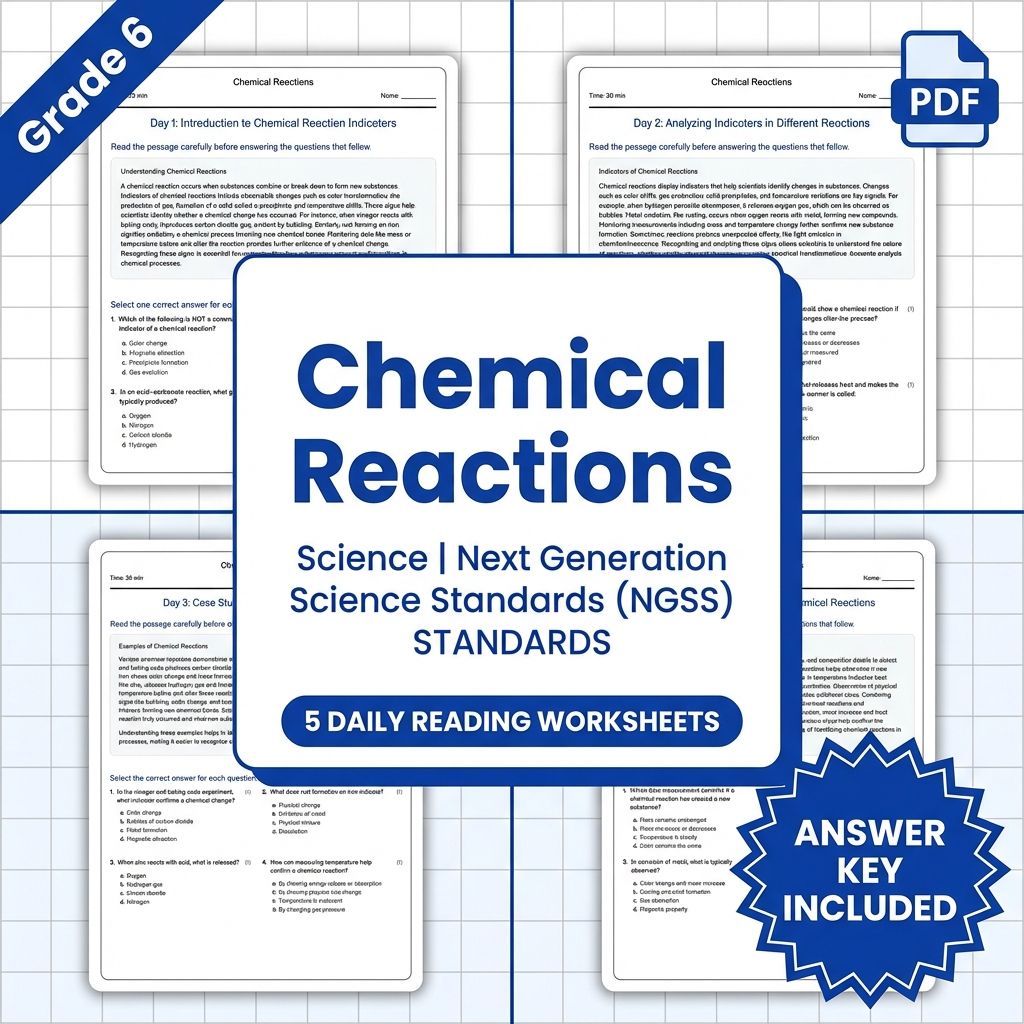
Grade 6 Science –Chemical Reaction Indicators Worksheet (PDF+ Answer Key)
Created byCopper Leaf ClassroomLearning Objectives
- Identify key indicators that suggest a chemical reaction is occurring.
- Analyze qualitative and quantitative data to determine if a new substance has formed.
- Understand classic examples such as acid–carbonate reactions and metal oxidation.
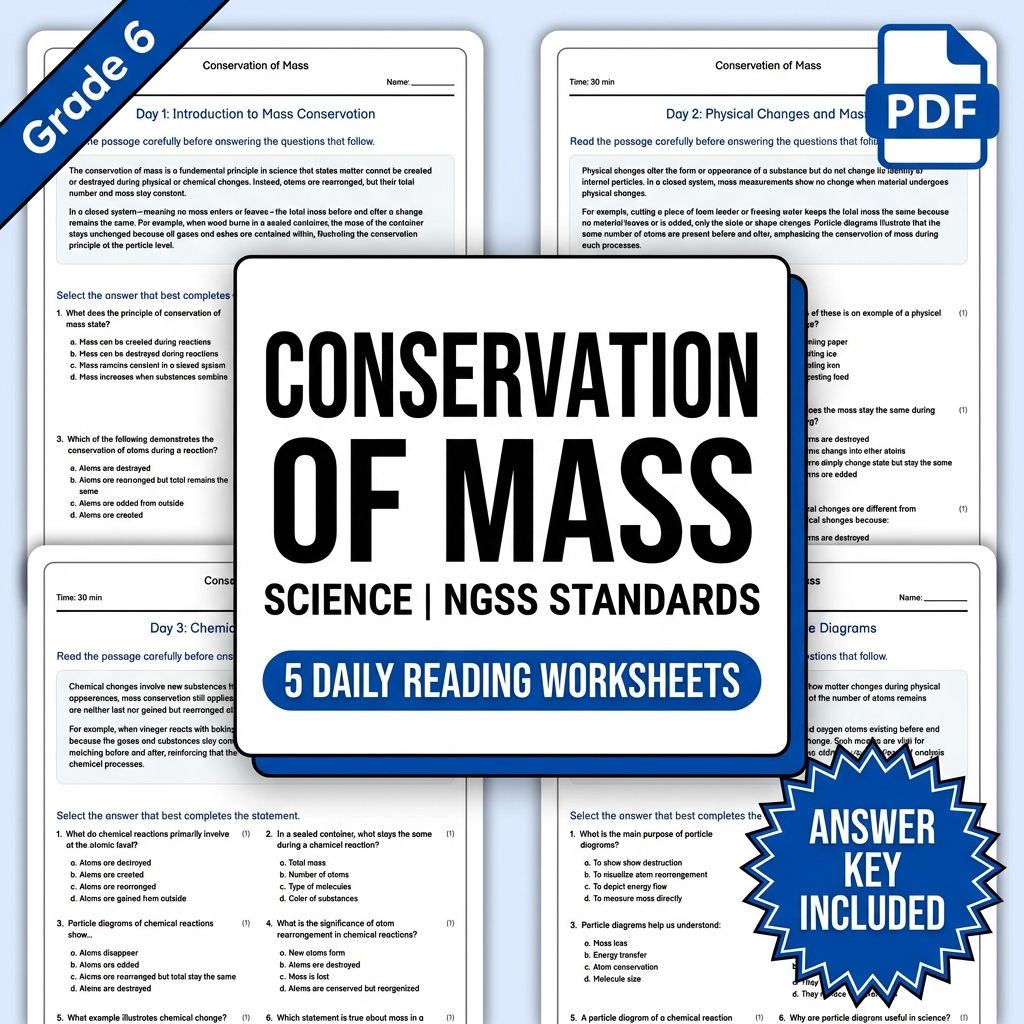
6th Grade Science|Conservation of Mass Daily Reading Worksheet (PDF+ Answer Key)
Created byCopper Leaf ClassroomLearning Objectives
- Understand the principle of conservation of mass and how atoms are conserved during physical and chemical changes.
- Develop models using particle diagrams to represent matter and mass during various processes.
- Trace atoms and total mass in closed systems before and after physical and chemical transformations.
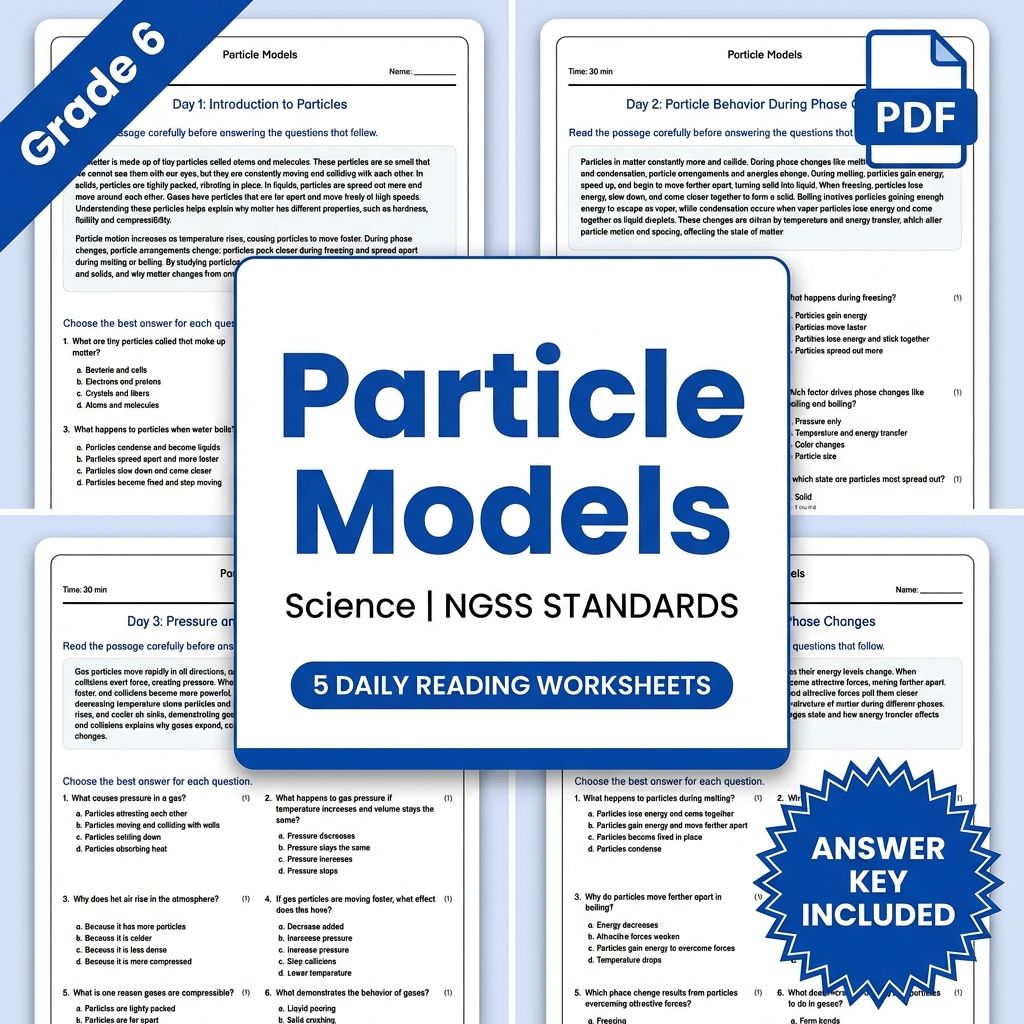
6th Grade Science | Particle Models Reading Worksheet (PDF+ Answer Key )
Created byCopper Leaf ClassroomLearning Objectives
- Understand that matter is made of tiny particles too small to see.
- Explain how particle motion relates to temperature and phase changes.
- Describe particle collisions, spacing, and behavior during melting, freezing, boiling, and condensation.
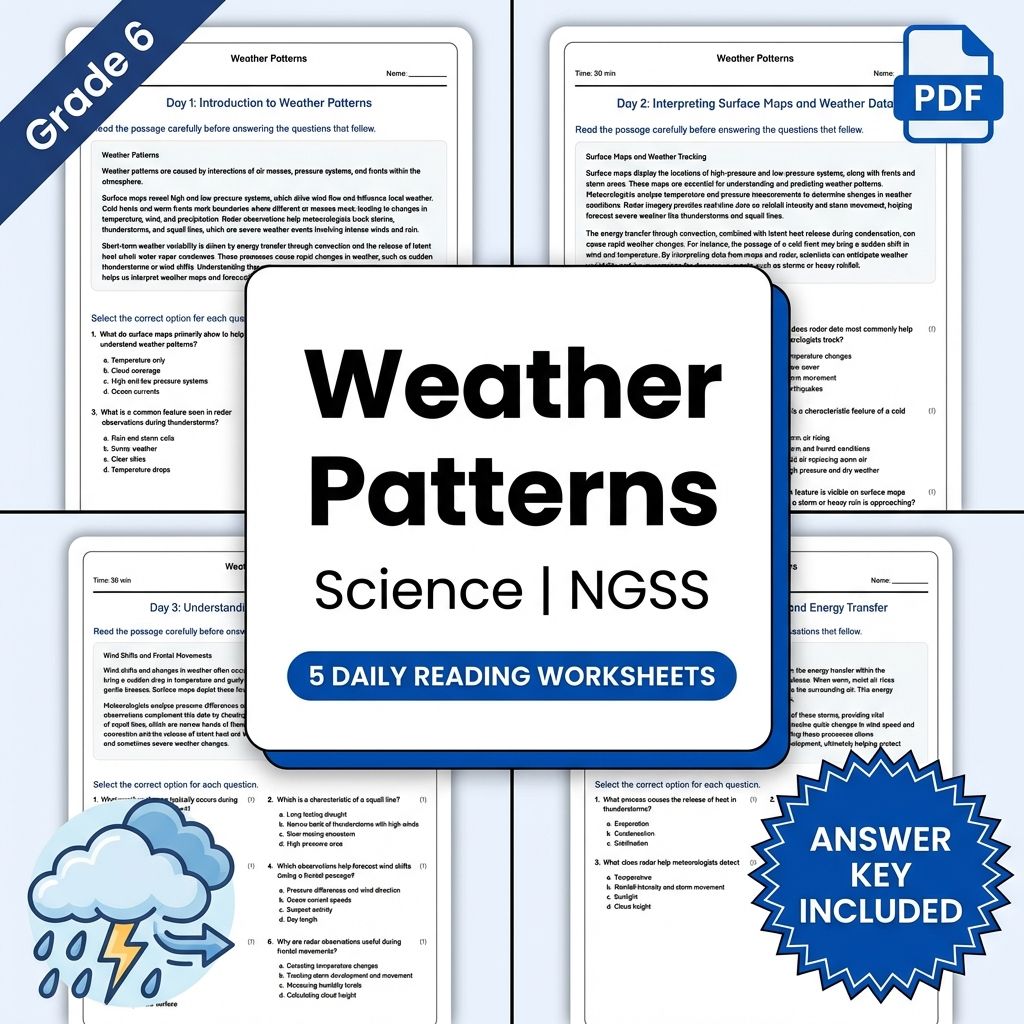
6th Grade Science | Weather Patterns Daily Reading Worksheet (PDF + Answer Key)
Created byCopper Leaf ClassroomLearning Objectives
- Understand how air masses, pressure systems, and fronts interact to produce local and regional weather.
- Interpret surface maps, temperature, and pressure measurements to identify weather features.
- Recognize how convection and latent heat contribute to short-term weather variability.
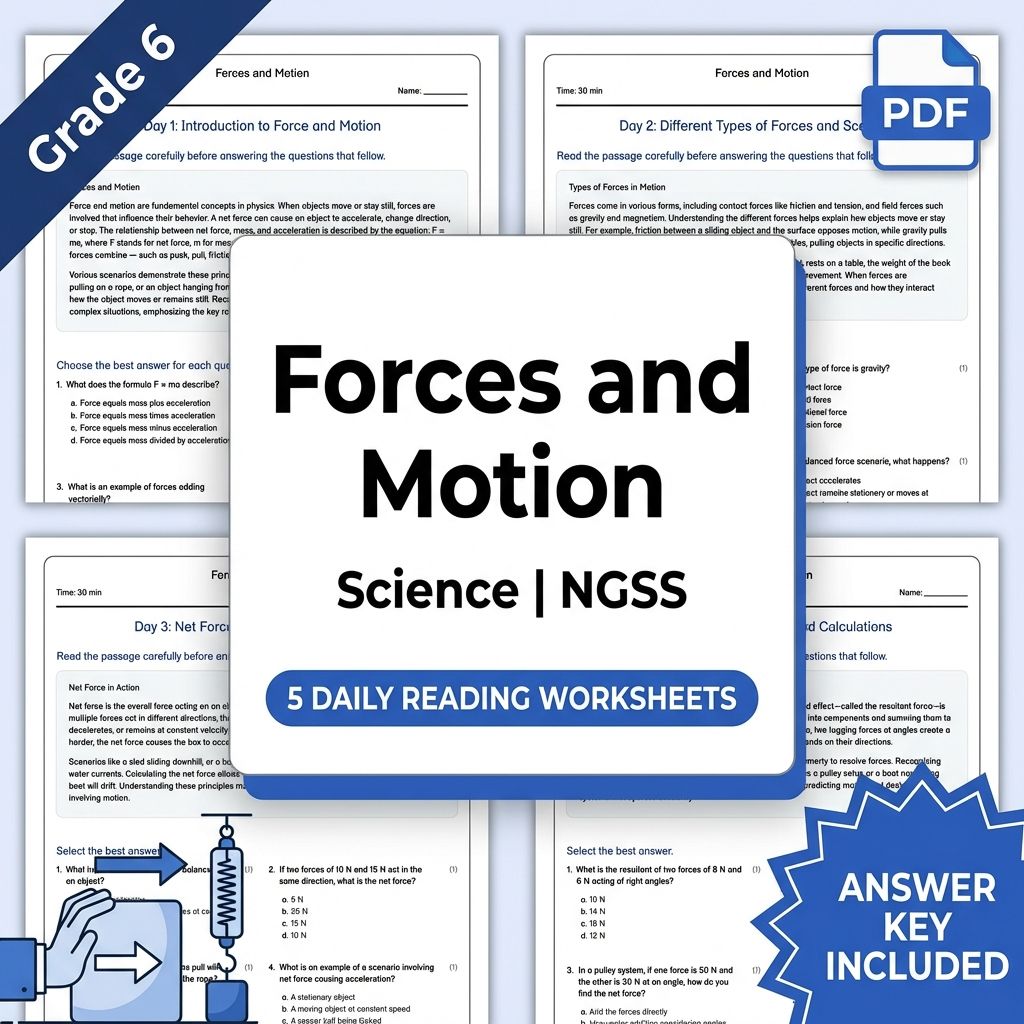
6th Grade Science | Forces and Motion Daily Reading Worksheet (PDF + Answer Key)
Created byCopper Leaf ClassroomLearning Objectives
- Understand the relationship between net force, mass, and acceleration.
- Identify different scenarios where forces act on objects.
- Apply the equation net force equals mass times acceleration to real-world problems.
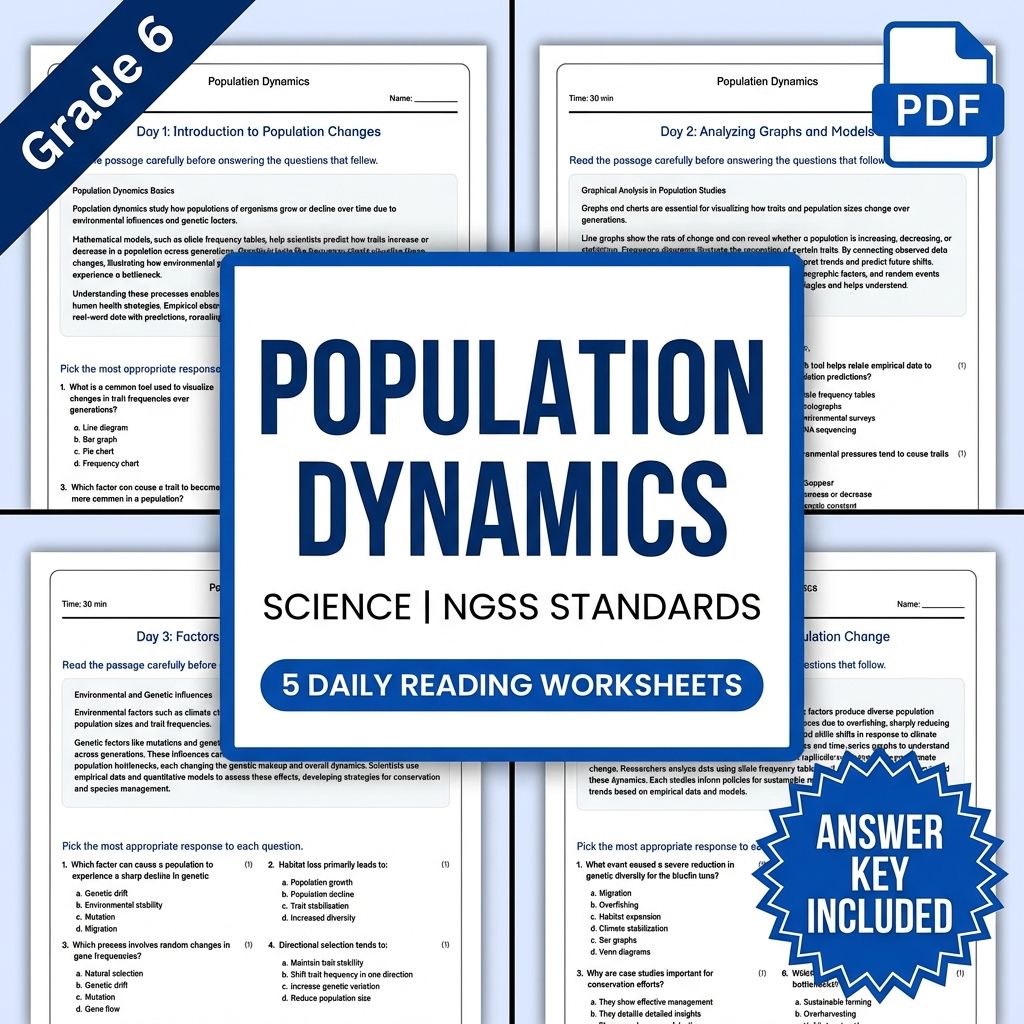
Grade 6 Science – Population Dynamics Daily Reading Worksheet (PDF + Answer Key)
Created byCopper Leaf ClassroomLearning Objectives
- Understand how trait frequencies and population sizes change over generations in response to environmental factors.
- Interpret graphical data such as frequency charts and time-series graphs to analyze population trends.
- Apply proportional reasoning and simple models to predict and compare scenarios like shifts, stability, and bottlenecks.
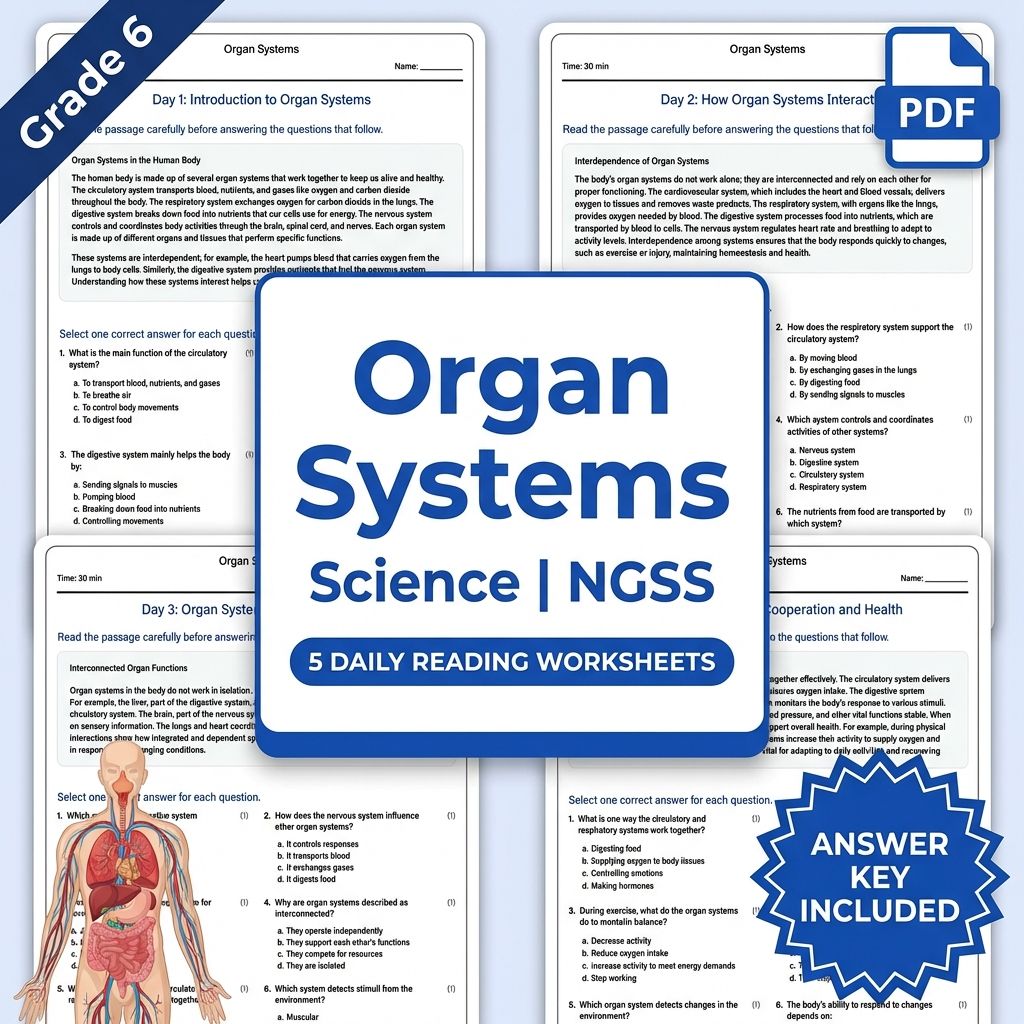
6th Grade Science | Organ Systems Daily Reading Worksheet (PDF & Answer Key)
Created byCopper Leaf ClassroomLearning Objectives
- Understand the organization of body systems and their functions.
- Identify the roles of tissues and organs in circulatory, respiratory, digestive, and nervous systems.
- Describe how organs work together within each system and how cellular functions relate to overall body processes.
Browse more categories
About Grade 6 Worksheets
Browse 8,149 printable Grade 6 worksheets across math, ELA, science, and social studies — each a ready-to-print PDF with optional answer keys.
MyTeachingSheets worksheets are made by real teacher-authors and checked before they go live. Download any as a print-ready PDF for lessons, homework, or independent practice — most include answer keys, and previews are always free.