
Grade 8 Worksheets
8,326 grade resources
Grade 8 Science | Technology and Impacts Worksheet | General Standard
 Created byLumora Learning
Learning Objectives
- Explain how technology choices can affect people and the environment across a product’s life cycle.
- Identify trade-offs between benefits and harms when evaluating technological solutions.
- Use evidence to justify whether a technology decision is responsible and sustainable.
Instant download
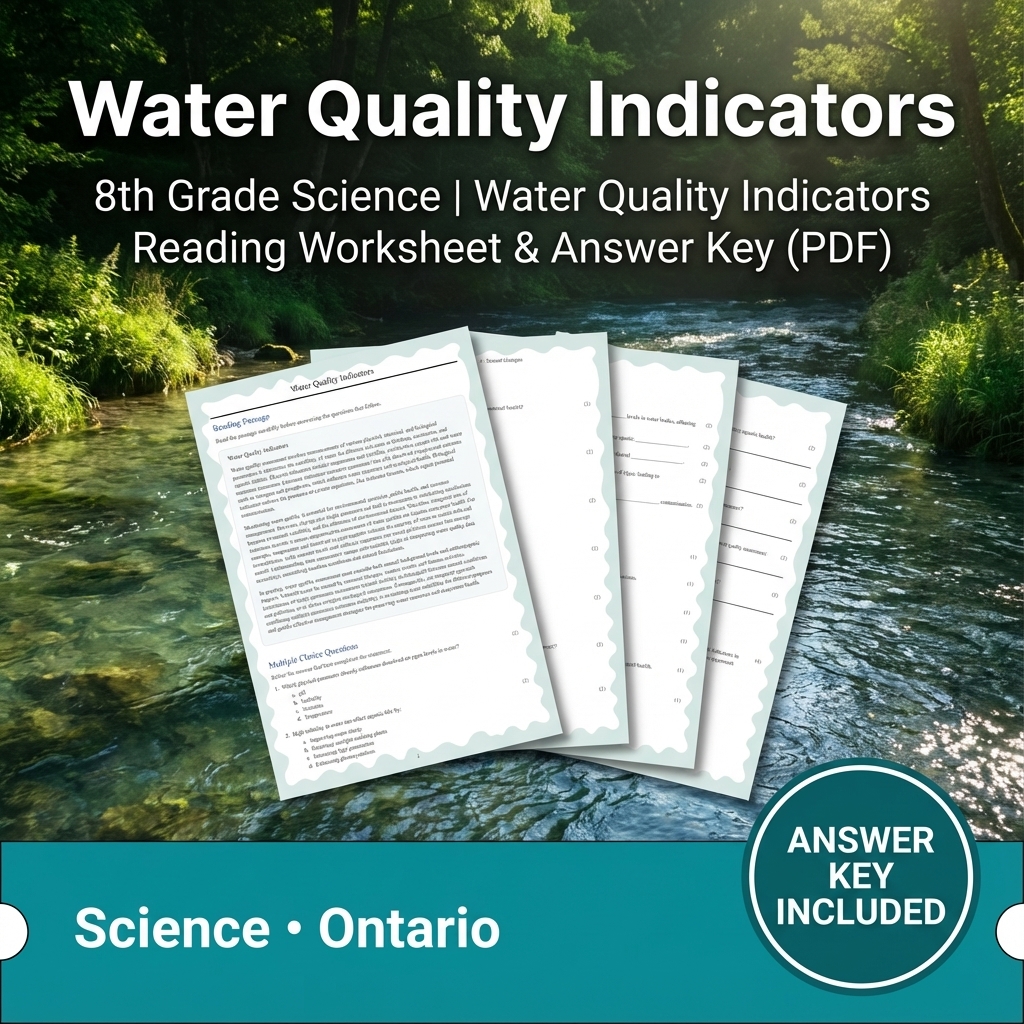
8th Grade Science | Water Quality Indicators Reading Worksheet & Answer Key
JCreated byJ.S SheetsLearning Objectives
- Identify physical, chemical, and biological water quality indicators.
- Interpret ranges of indicator parameters for aquatic health and water uses.
- Understand sources of variability and the importance of integrated assessments.
Also included in: Grade 8 Science Bundle | Water Systems Hydrology Concepts (Answer Key Included) +1 more
Instant download

Grade 8 Measurement Uncertainty Science Daily Reading Worksheet | TEKS
 Created byBRIGHT PATH RESOURCES
Learning Objectives
- Explain what measurement uncertainty means and why it happens
- Identify how instrument resolution affects readings
- Describe how to report uncertainty using correct significant figures
Also included in: Grade 8 Science Skills Daily Reading Worksheets Bundle | TEKS +1 more
Instant download

Grade 8 Physical and Chemical Changes Worksheet | Alberta Science
Created byBRIGHT PATH RESOURCESLearning Objectives
- Identify clues that show whether a change is physical or chemical.
- Classify described evidence from a text using the properties of matter.
- Explain how physical and chemical changes differ using evidence such as state, new substances, and observable energy or gas effects.
Also included in: Grade 8 Alberta Science Matter and Chemical Change Worksheet Bundle +1 more
Instant download

Grade 8 Kinetic and Potential Worksheet | NGSS Practice PDF
 Created byClear Sky Classroom
Learning Objectives
- Distinguish kinetic energy from potential energy and identify which one changes with motion or position.
- Explain how gravitational potential energy and kinetic energy shift during roller-coaster-like motion.
- Apply the idea of energy conservation (or near conservation) to predict what happens to total mechanical energy.
Instant download

Grade 8 Science – Organelles Roles | Daily Reading Worksheet
 Created byBright Mind Resources
Learning Objectives
- Identify major organelles within a cell
- Describe the primary functions of the nucleus, mitochondria, ribosomes, endoplasmic reticulum, Golgi apparatus, lysosomes, and vacuoles
- Understand how these organelles work together in energy conversion, protein synthesis, and intracellular transport
Also included in: Grade 8 Life Systems Science Daily Reading Worksheets Lesson Bundle | Ontario +1 more
Instant download

Grade 8 Magnetic Materials Worksheet | Magnetism Alberta Science
Created byBRIGHT PATH RESOURCESLearning Objectives
- Identify the main idea of a passage about how materials respond to magnetic fields
- Use key vocabulary terms related to diamagnetic, paramagnetic, and ferromagnetic materials
- Explain, using evidence from a passage, how domain alignment affects remanence and coercivity
Also included in: Grade 8 Alberta Science Electricity and Magnetism Worksheet Bundle +1 more
Instant download

Grade 8 Quality Indicators Worksheet | Ontario Science Activity & Answer Key
Created byClear Sky ClassroomLearning Objectives
- Identify physical, chemical, and biological indicators used to assess water quality.
- Interpret indicator values by connecting them to aquatic health and water-use needs.
- Explain how natural variability and baseline conditions affect indicator readings.
Instant download
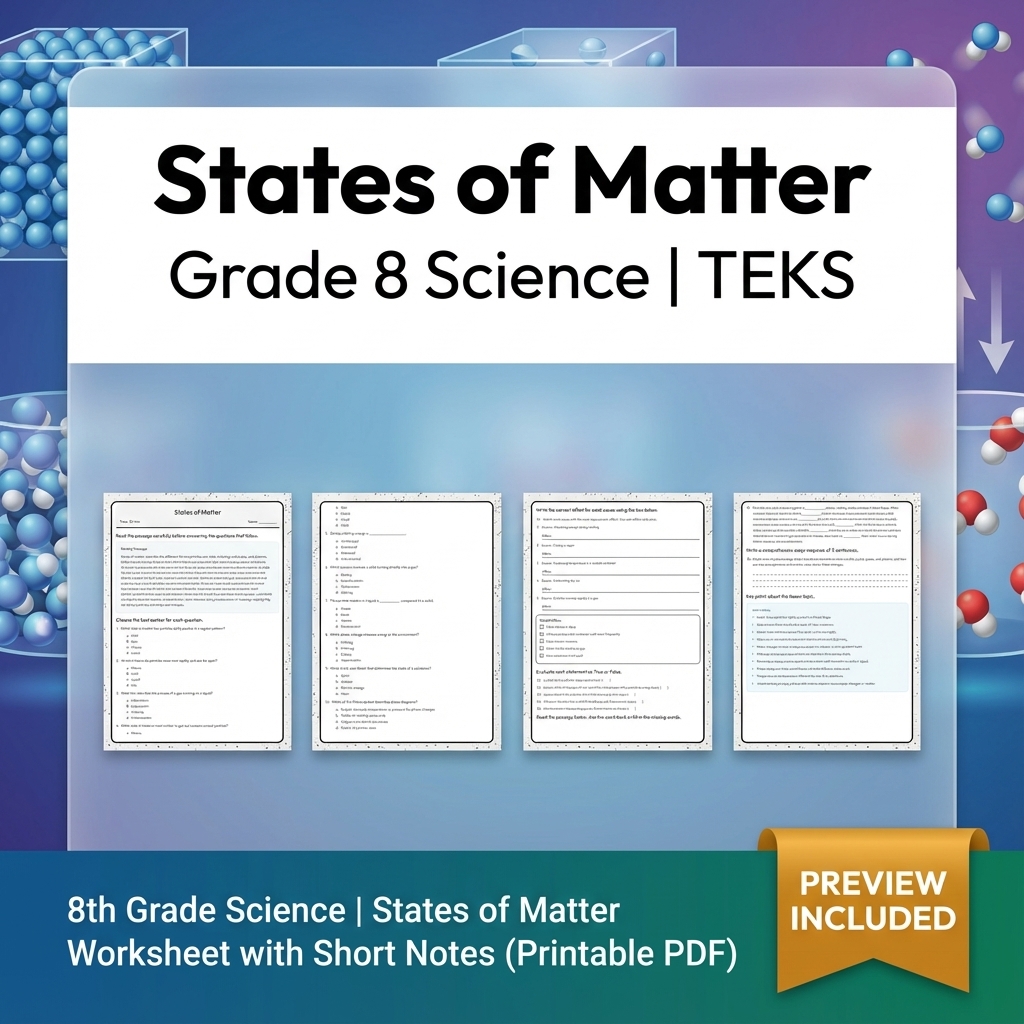
8th Grade Science | States of Matter Worksheet with Short Notes (Printable PDF)
 Created byMeadowlark Worksheets
Learning Objectives
- Understand the four main states of matter: solid, liquid, gas, and plasma.
- Explain the kinetic molecular theory as it relates to particle motion in different states.
- Describe energy changes associated with phase transitions such as melting, boiling, condensation, and sublimation.
Instant download
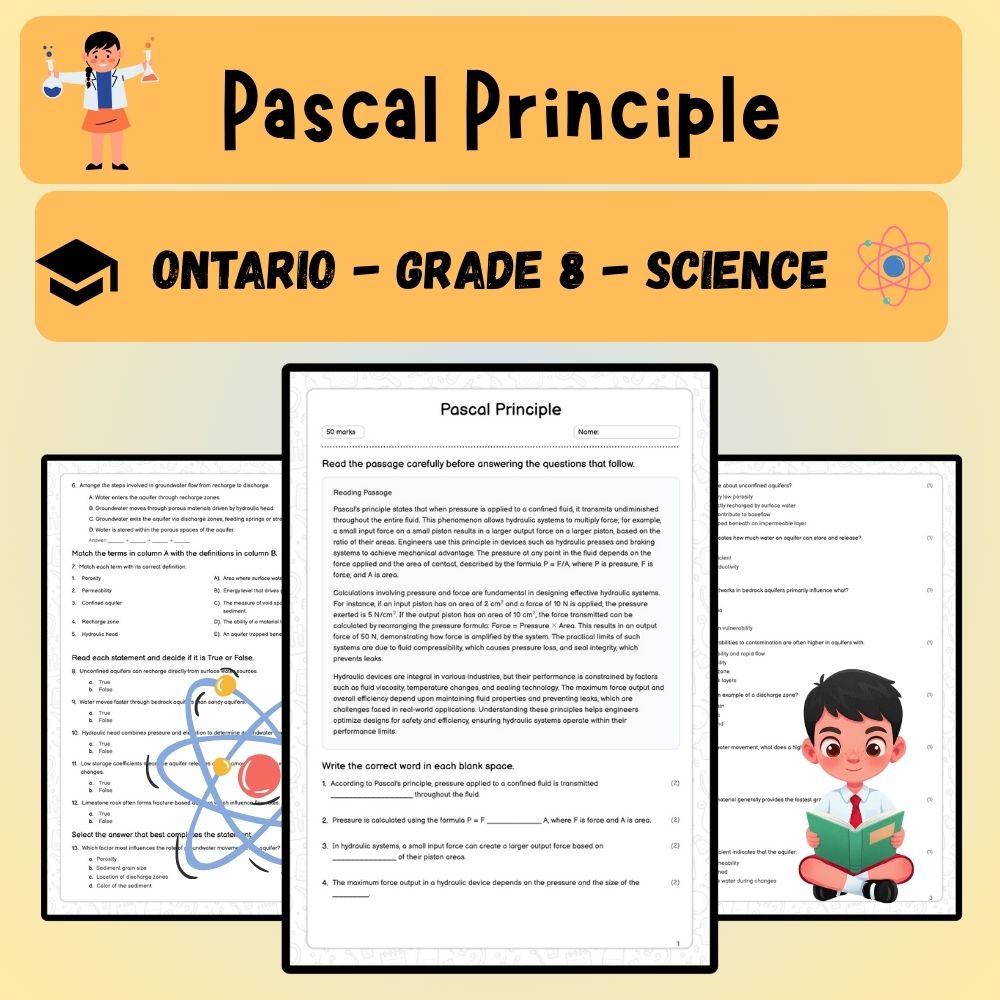
Grade 8 Science | Pascal's Principle Worksheet (PDF )
 Created byPrism Point Learning
Learning Objectives
- Explain the concept of Pascal's principle and its significance in hydraulic systems.
- Perform calculations involving forces, areas, and pressure in hydraulic devices.
- Identify real-world applications of Pascal's principle such as hydraulic presses and brakes.
Also included in: Grade 8 Science | Fluid Mechanics & Pressure Unit Worksheet Bundle +1 more
Instant download

Grade 8 Conservation Strategies Worksheet | Ontario Science Activity
Created byClear Sky ClassroomLearning Objectives
- Explain how catchment-level actions can affect freshwater flow regimes and pollutant loads.
- Describe key conservation strategies for freshwater stewardship (demand management, source protection, riparian buffers, agricultural best management measures, and wetland preservation).
- Analyze trade-offs among water supply, ecological integrity, and economic uses.
Instant download

Grade 8 Energy Relationships Worksheet | NGSS Kinetic & Potential Energy
 Created byAmber Owl Education
Learning Objectives
- Explain how kinetic energy depends on mass and speed and how potential energy depends on position.
- Interpret graphs that show relationships between kinetic energy and mass or kinetic energy and the square of speed.
- Apply conservation of mechanical energy to analyze energy transfer between kinetic and potential forms, including the effects of friction.
Also included in: Grade 8 Science Thermal Transfer & Energy Conservation Lesson Bundle | NGSS +1 more
Instant download

Safe Downloads & Malware Warning Signs Worksheet for Grade 8 Computer Science
Created byBright Mind ResourcesLearning Objectives
- Define malware and identify viruses, spyware, and ransomware
- Recognize warning signs in downloads, links, and attachments
- Apply safe download habits to reduce malware risks
Instant download

Kinematics Graphs Worksheet | Grade 8 Science Activities
Created byPrism Point LearningLearning Objectives
- Interpret distance–time and velocity–time graphs using slope and area
- Determine speed and acceleration from graph features for uniform and uniformly accelerated motion
- Compare motion scenarios qualitatively using graph shapes and direction
Also included in: Grade 8 Force, Motion & Energy Science Lesson Bundle for TEKS Practice +1 more
Instant download

Grade 8 Forms of Energy Worksheet | NGSS Practice PDF
Created byClear Sky ClassroomLearning Objectives
- Identify and describe different forms of energy, including kinetic, potential, thermal, light, and electrical energy
- Use evidence from everyday situations to explain how energy is transferred and transformed
- Distinguish between statements that correctly and incorrectly describe energy changes
Instant download

Grade 8 Cell Organization Worksheet | Practice BC PDF
Created byClear Sky ClassroomLearning Objectives
- Describe the hierarchy of cell organization from cells to organ systems
- Explain how similar cells form tissues with shared functions
- Connect how tissues combine to form organs and how organs work within systems
Instant download

Grade 8 Science | Simple Machines: The Lever - Daily Reading Comprehension
 Created byCoral Reef Learning
Learning Objectives
- Understand key concepts related to Science
- Apply knowledge through practice questions
- Demonstrate comprehension of the material
Instant download

Point of View Grade 8 ELA Worksheet | Standards-Aligned Practice
JCreated byJ.S SheetsLearning Objectives
- Explain how point of view shapes what characters and readers believe about events and people.
- Identify bias, missing information, and gaps in knowledge that come from a specific perspective.
- Analyze how contrasting what one character knows with what another character experiences can develop theme and emotional impact.
Instant download

Grade 8 Science Worksheet | Fossil Record Clues & Evidence of Evolution
 Created byEvergreen Desk Education
Learning Objectives
- Explain how fossils in sedimentary layers can provide evidence for Earth’s past environments and geologic time.
- Describe how matching fossil types and rock layers across distant regions supports ideas about plate tectonics.
- Use principles such as superposition and radiometric dating to interpret the ages of fossil-bearing layers.
Instant download

State Properties Worksheet Pack | Grade 8 Science Activities
Created byPrism Point LearningLearning Objectives
- Explain how particle arrangement affects the properties of solids, liquids, and gases
- Use evidence from bonding strength and energy to describe why states behave differently
- Relate state properties to everyday Alberta examples (ice on lakes, oil viscosity, and atmospheric gas behavior)
Also included in: Grade 8 Matter & Chemical Change Lesson Bundle | Alberta Science
Instant download

Grade 8 Ecosystem Shifts Worksheet | NGSS Practice PDF
Created byClear Sky ClassroomLearning Objectives
- Explain how natural disturbances and long-term environmental changes can alter habitats and food availability in ecosystems
- Describe how succession can change species composition over time after a disturbance
- Evaluate how human actions can influence ecosystem change and interdependent organisms
Instant download
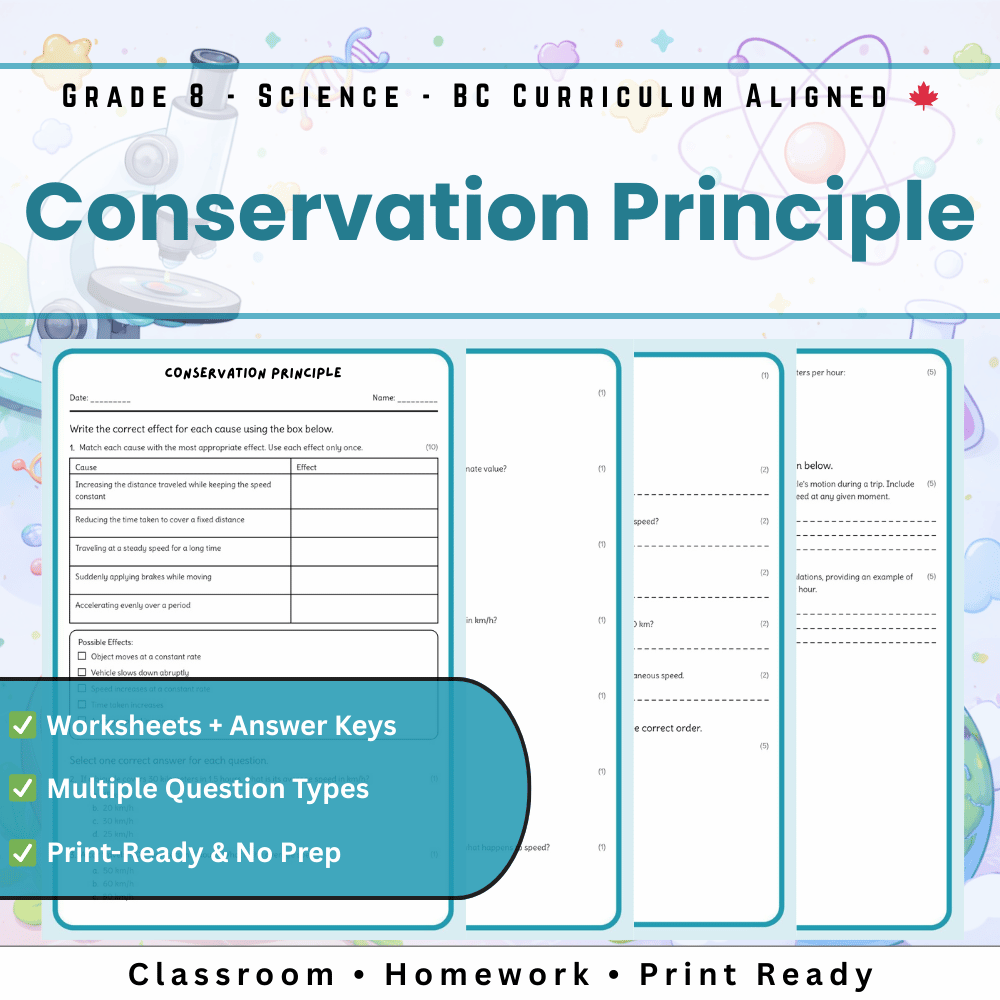
Grade 8 Science | Conservation Principle Worksheet (PDF) for BC Standards
Created byBright Mind ResourcesLearning Objectives
- Understand the Law of Conservation of Mass and its significance in chemical reactions.
- Be able to interpret balanced chemical equations reflecting mass conservation.
- Link mass relationships with mole concepts for predicting reaction outcomes.
Instant download

Grade 8 Science | Speciation & Change - Daily Reading Comprehension
Created byCoral Reef LearningLearning Objectives
- Understand the concept of reproductive isolation and how it contributes to the formation of new species.
- Identify geographic and behavioral factors that lead to speciation.
- Explain how genetic variation and natural selection influence divergence among populations.
Instant download

Grade 8 Total Energy Balance Worksheet | Practice & Assessment PDF
Created byClear Sky ClassroomLearning Objectives
- Explain conservation of energy using energy transfer and energy conversion within a system
- Differentiate between kinetic energy, potential energy, and thermal energy during motion and collisions
- Use energy accounting to predict how speed and temperature change when energy stays in the system or leaves it
Instant download

Grade 8 ELA – Understanding Evidence & Text Analysis | Daily Reading Worksheet
 Created byQuiet Forest Education
Learning Objectives
- Identify key details in short passages
- Connect evidence to central ideas
- Practice selecting relevant information from texts
Also included in: Daily Reading & Text Analysis Grade 8 ELA Daily Worksheets Lesson Bundle | TEKS +1 more
Instant download
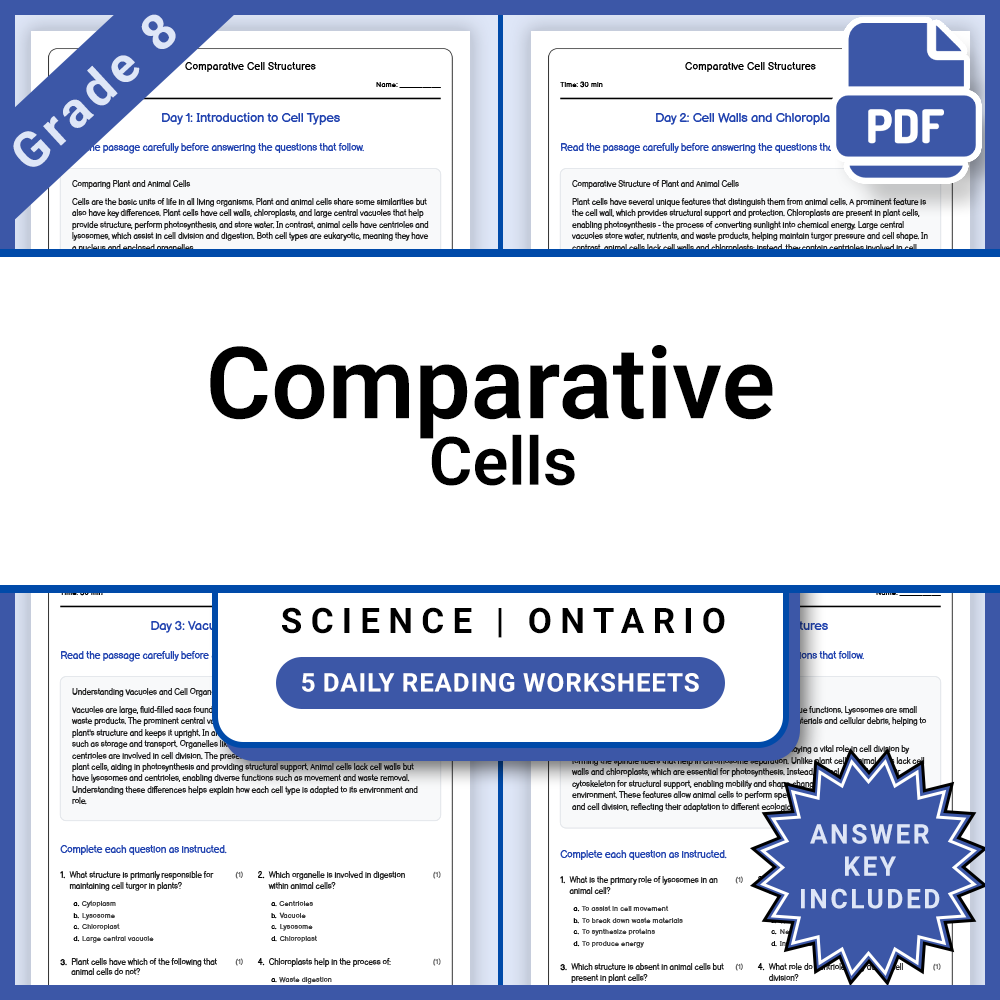
Grade 8 Science – Cell Structures Daily Reading Worksheet + Answer Key
JCreated byJ.S SheetsLearning Objectives
- Understand key concepts related to Science
- Apply knowledge through practice questions
- Demonstrate comprehension of the material
Also included in: Grade 8 Science Lesson Group: Ontario Curriculum Reading Worksheets Bundle +1 more
Instant download
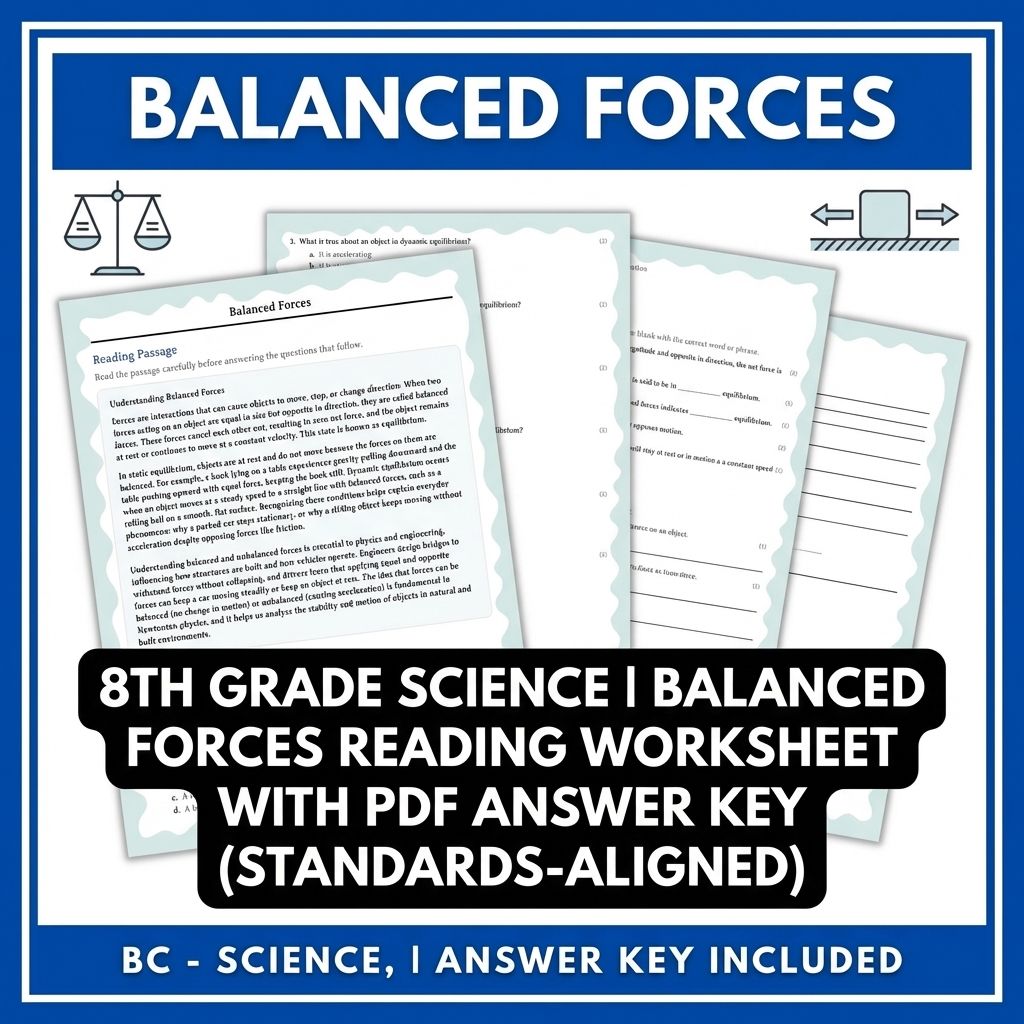
8th Grade Science | Balanced Forces Reading Worksheet with PDF Answer Key
JCreated byJ.S SheetsLearning Objectives
- Understand the concept of balanced and unbalanced forces.
- Identify examples of static and dynamic equilibrium.
- Explain how balanced forces result in no change in motion.
Instant download

Water Routing and Landform Change Worksheets Grade 8 Science
Created byBRIGHT PATH RESOURCESLearning Objectives
- Explain how runoff, erosion, transport, and deposition reshape Earth’s surface.
- Describe how groundwater affects springs and contributes to weathering.
- Relate slope (gradient) and drainage patterns to where sediment accumulates.
Also included in: Grade 8 Earth & Space Science Worksheets Bundle | Weather & Climate +2 more
Instant download

Ecological Restoration Worksheets | Grade 8 Science Ecosystems
 Created bySunny Desk Resources
Learning Objectives
- Explain how habitat reclamation, riparian buffer creation, and species reintroductions restore ecological function and connectivity.
- Describe how soil amendment and recontouring support revegetation after land disturbance.
- Interpret monitoring metrics to evaluate restoration progress over time.
Also included in: Interactions & Ecosystems Grade 8 Science Worksheets Alberta Bundle +1 more
Instant download

Mechanical Energy Transfer Worksheets | Grade 8 Forces and Motion
Created bySunny Desk ResourcesLearning Objectives
- Describe how a force doing work can change a system’s mechanical energy during motion.
- Identify when energy changes form between gravitational potential energy and kinetic energy.
- Explain how braking increases internal energy when mechanical energy decreases.
Also included in: Forces and Motion Grade 8 Alberta Science Worksheets Bundle +1 more
Instant download

Human Impacts on Alberta River Ecosystems Worksheets Grade 8
Created bySunny Desk ResourcesLearning Objectives
- Describe how human land use can change habitat structure and ecosystem interactions
- Explain how water diversion and wetland drainage can affect nutrient cycles and species
- Identify evidence of cumulative effects in a watershed and suggest mitigation actions
Also included in: Interactions & Ecosystems Grade 8 Science Worksheets Alberta Bundle +1 more
Instant download

Elastic Forces Worksheets: Spring Behavior | Grade 8 Science
Created bySunny Desk ResourcesLearning Objectives
- Explain how elastic forces relate to displacement in many springs within the linear region
- Describe the direction of a spring’s restorative force when it is stretched or compressed
- Use elastic behavior to reason about force balance in simple mechanical systems
Also included in: Forces and Motion Grade 8 Alberta Science Worksheets Bundle +1 more
Instant download
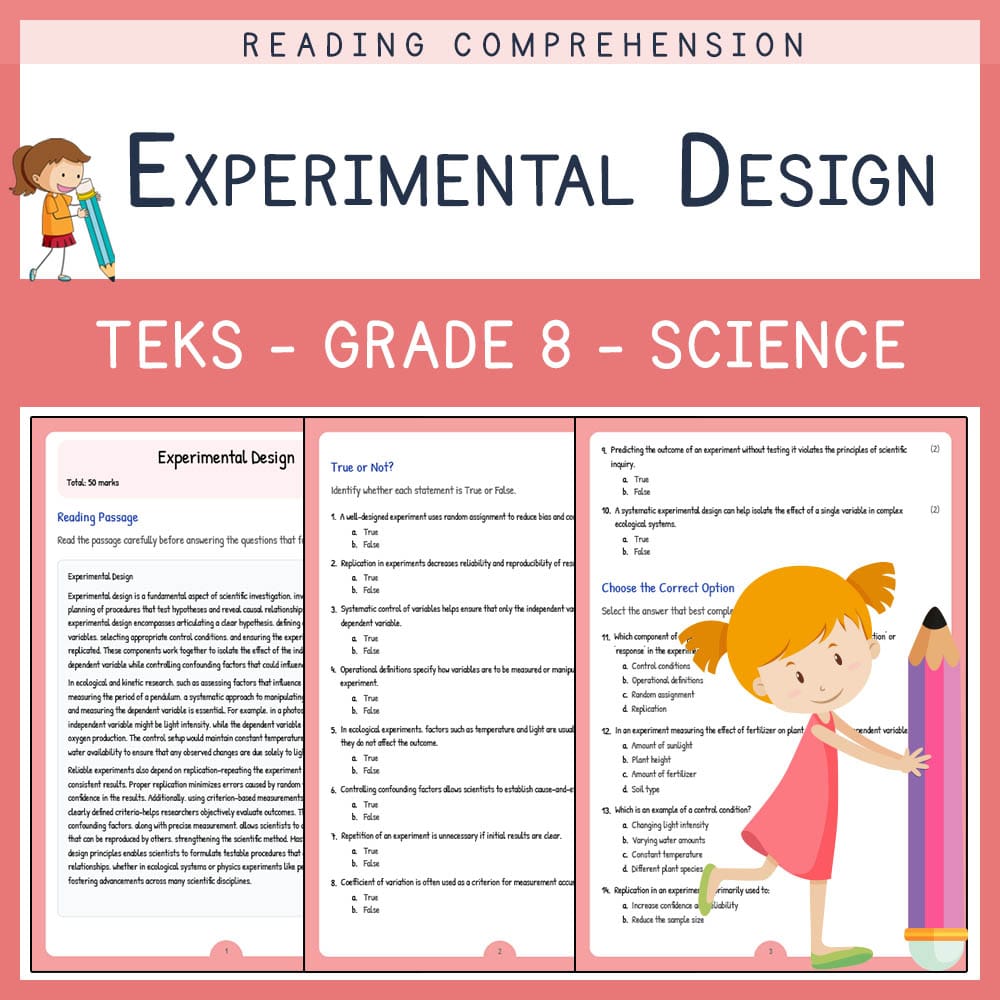
Grade 8 Science | Experimental Design Worksheet | TEKS Aligned
Created byLumora LearningLearning Objectives
- Understand the key components of experimental design, including hypotheses, control conditions, and operations.
- Identify variables and how to manipulate or measure them in experiments.
- Explain the importance of replication and systematic control in reliable experiments.
Also included in: Grade 8 Science | Science Concepts/Skills Lesson Bundle | TEKS Aligned
Instant download
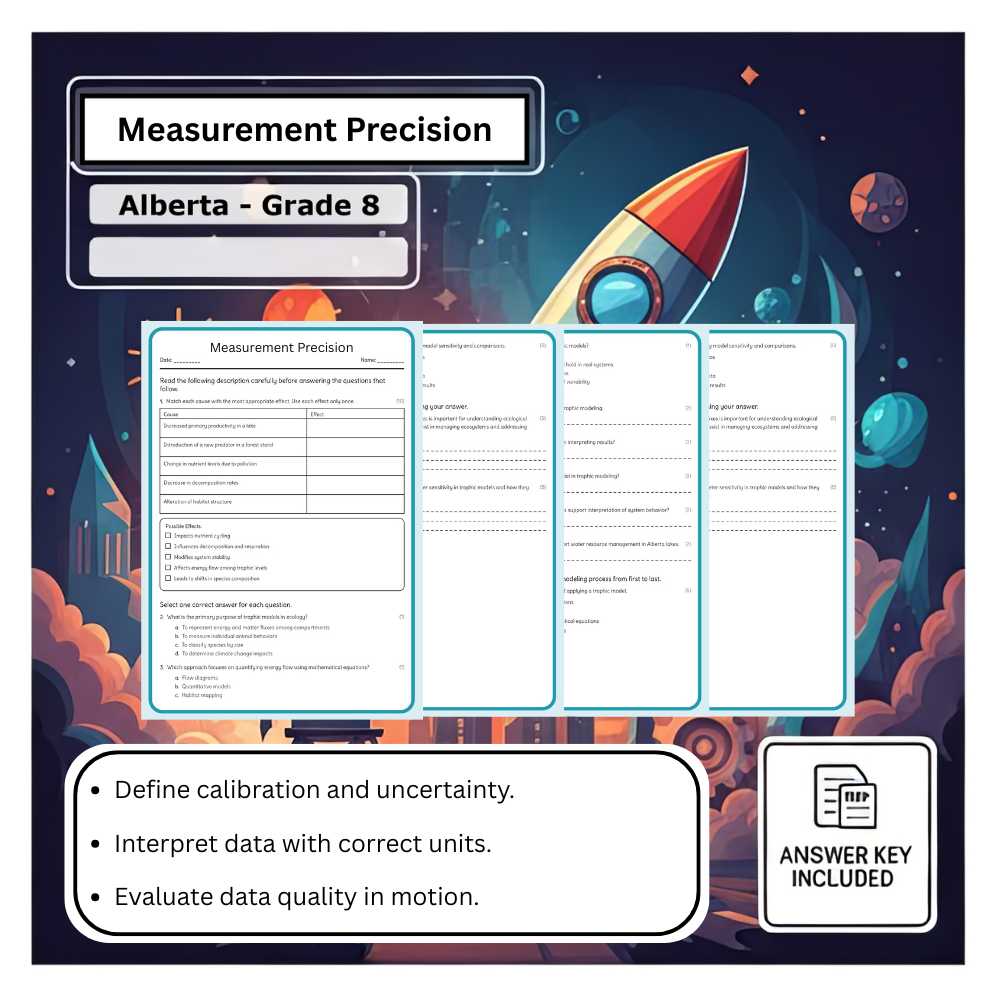
Grade 8 Science | Measurement Precision Worksheet (PDF)
Created byBright Mind ResourcesLearning Objectives
- Understand the principles of instrument calibration and measurement uncertainty.
- Interpret data involving timed intervals, distances, and force sensor outputs with accuracy and appropriate units.
- Evaluate the importance of data quality and careful interpretation in motion and force measurements.
Instant download
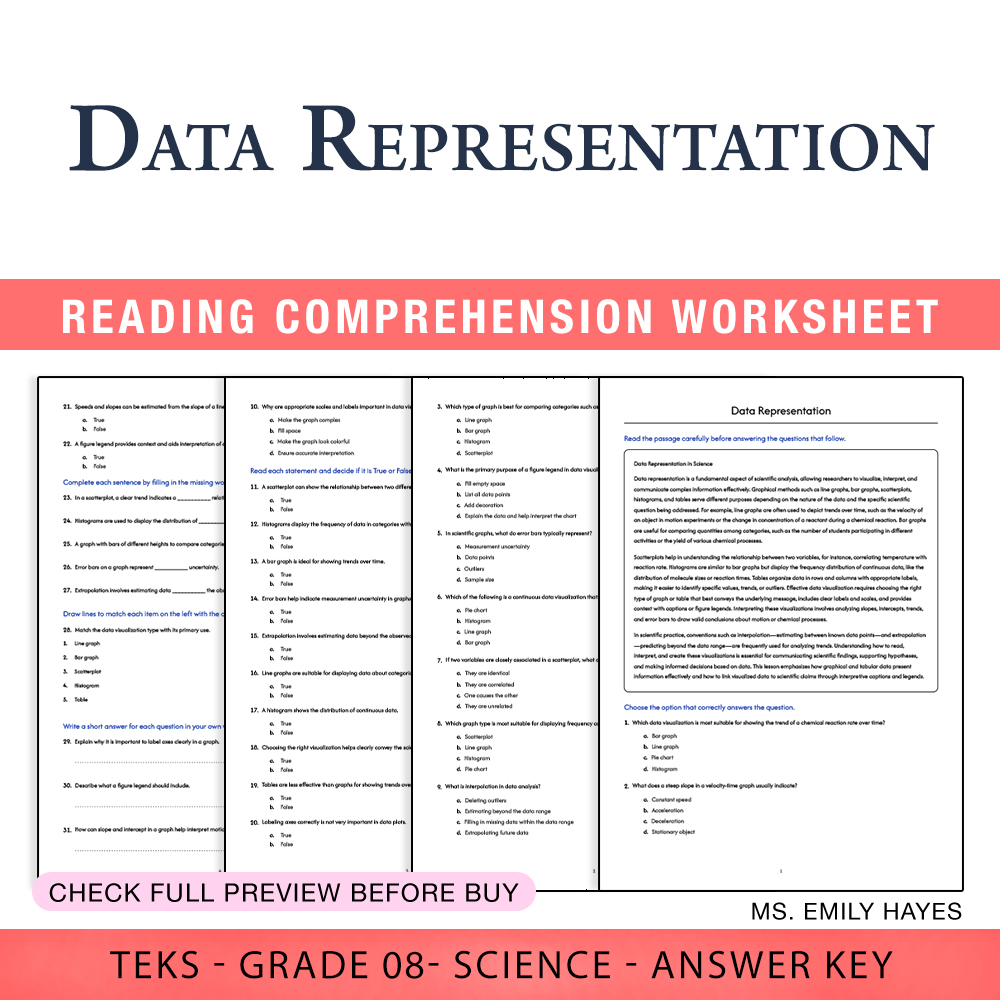
Grade 8 Science | Data Representation Worksheet (PDF+ Answer Key)
 Created byCopper Leaf Classroom
Learning Objectives
- Understand different graphical and tabular data representations such as line graphs, bar graphs, scatterplots, histograms, and tables.
- Interpret trends, slopes, and intercepts in data visualizations related to motion or chemical rates.
- Create accurate data visualizations with proper labels, scales, and legends.
Instant download

Grade 8 Science | Rock and Mineral Formation - Daily Reading Comprehension
Created byCoral Reef LearningLearning Objectives
- Understand how igneous rocks form from cooling magma.
- Identify the characteristics of igneous, sedimentary, and metamorphic rocks.
- Learn how physical properties of minerals reflect their composition.
Instant download

Measuring Biodiversity Worksheet | Grade 8 Science Practice
Created byPrism Point LearningLearning Objectives
- Explain what biodiversity means at the genetic, species, and ecosystem levels and why it matters for ecosystem health.
- Describe how scientists use species richness, evenness, and diversity indices to measure biodiversity.
- Evaluate how sampling methods, habitat differences, and time can affect biodiversity estimates and comparisons.
Also included in: Ecosystems & Biodiversity Lesson Bundle | Grade 8 Science | BC +1 more
Instant download

Grade 8 Efficiency Losses Worksheet | Ontario Science Energy Systems
Created byClear Sky ClassroomLearning Objectives
- Define mechanical efficiency and explain why real systems often use more input energy than predicted.
- Identify common mechanisms that cause efficiency losses, including frictional heating, sound emission, and material hysteresis.
- Describe practical ways to measure or estimate energy losses and explain design strategies that reduce them.
Instant download

Earth's Resources Worksheet | Grade 8 Science Practice
Created byPrism Point LearningLearning Objectives
- Classify Earth’s resources as renewable or nonrenewable and give examples of each
- Explain how extracting resources can affect landforms, water quality, and ecosystems
- Describe how mapping and resource inventories help people assess where resources are located
Also included in: Grade 8 Earth and Space Science Lesson Bundle for TEKS Worksheets +1 more
Instant download

Grade 8 Science | Natural Selection - Daily Reading Comprehension
Created byCoral Reef LearningLearning Objectives
- Understand key concepts related to Science
- Apply knowledge through practice questions
- Demonstrate comprehension of the material
Instant download

Inquiry Models Assessment | TEKS Grade 8 Science Standards-Aligned Assessment
Created byPrism Point LearningLearning Objectives
- Understand different types of inquiry models: hypothesis-driven, descriptive, and correlational.
- Evaluate the strengths and limitations of various scientific modeling approaches.
- Apply criteria such as boundary conditions, assumptions, and testable predictions to select appropriate models.
Also included in: Grade 8 Scientific Inquiry & Data Analysis Science Lesson Bundle TEKS
Instant download

Grade 8 Science | Forms of Energy Worksheet | NGSSS Aligned
Created byLumora LearningLearning Objectives
- Identify major forms of energy (kinetic, potential, thermal, light, and electrical) in everyday situations
- Explain how energy can transfer and transform while following the law of conservation of energy
- Distinguish between energy forms and energy transfer processes such as conduction, convection, and radiation
Instant download

Grade 8 Science Energy Changes Worksheet (BC Standards) (PDF)
Created byEvergreen Desk EducationLearning Objectives
- Explain how chemical reactions involve energy changes when bonds break and new bonds form
- Differentiate endothermic and exothermic reactions using the direction of heat flow and energy profiles
- Use ideas of bond enthalpy and net energy change to predict temperature changes during reactions
Instant download

Grade 8 Science – Green Infrastructure & Urban Environments | Reading Worksheet
Created byBright Mind ResourcesLearning Objectives
- Identify different types of green infrastructure used for stormwater management
- Explain the functions and benefits of green infrastructure features
- Understand design factors that influence the effectiveness of green infrastructure
Also included in: Grade 8 Water Systems Science Daily Reading Worksheets Lesson Bundle | Ontario +1 more
Instant download

Grade 8 Science | Energy Temperature Link - Daily Reading Comprehension
Created byCoral Reef LearningLearning Objectives
- Understand how energy transfer affects temperature.
- Recognize the connection between thermal effects and energy flow.
- Explain why different materials change temperature differently under similar conditions.
Instant download

Climate Drivers Assessment | Florida NGSSS Grade 8 Science
Created byPrism Point LearningLearning Objectives
- Explain how latitude, solar energy, and surface reflectivity influence Earth’s energy balance
- Describe how atmospheric circulation and ocean currents redistribute heat to shape regional climates
- Use the greenhouse-gas effect to explain how outgoing radiation is influenced
Also included in: Grade 8 Earth Systems Science Lesson Bundle: Florida NGSSS Assessment
Instant download

Earthquakes And Volcanoes Assessment | NGSSS-Aligned Grade 8 Science
Created byPrism Point LearningLearning Objectives
- Explain how tectonic processes release energy during earthquakes and describe resulting hazards
- Describe how magma movement leads to volcanic activity and connect volcano locations to plate boundaries
- Use evidence from seismic events and volcanic features to infer hazard patterns
Also included in: Grade 8 Earth Systems Science Lesson Bundle: Florida NGSSS Assessment
Instant download

Ecosystem Structure Worksheet | TEKS-Aligned Grade 8 Science Practice
JCreated byJ.S SheetsLearning Objectives
- Identify ecosystem components, including abiotic factors and biotic roles (producers, consumers, and decomposers).
- Explain how energy flows through trophic levels and how matter cycles through decomposition and nutrient recycling.
- Describe how climate influences biome structure and the types of organisms found in grasslands, deserts, and temperate forests.
Instant download
Browse more categories
About Grade 8 Worksheets
Explore Grade 8 worksheets in math, ELA, science, and social studies. Our 8,326 Grade 8 printables print straight from PDF, answer keys included.
Each resource here is built by an independent educator and reviewed for quality. Worksheets print straight from PDF and suit classroom use, homework, or extra practice; most come with answer keys, and you can preview before purchasing.