
Grade 8 Worksheets
8,326 grade resources
Trophic Energy Transfer Worksheet | California Standards Grade 8 Science
JCreated byJ.S SheetsLearning Objectives
- Understand the flow of energy through ecosystems from producers to consumers.
- Explain how energy is transferred and lost at each trophic level.
- Describe the roles of food chains and energy pyramids in illustrating energy transfer.
Also included in: Grade 8 Adaptation and Ecosystem Change Science Lesson Bundle +1 more
Instant download

Grade 8 Science | Conservation in Systems - Daily Reading Comprehension
 Created byCoral Reef Learning
Learning Objectives
- Understand different forms of energy and their transfer within a system
- Explain how total energy remains constant during energy transfers
- Identify real-world examples of energy conservation, such as roller coasters
Instant download

Grade 8 Science – Understanding Voltage & Circuits | Daily Reading Worksheet
 Created byBright Mind Resources
Learning Objectives
- Understand key concepts related to Science
- Apply knowledge through practice questions
- Demonstrate comprehension of the material
Also included in: Grade 8 Electricity Science Daily Reading Worksheets Lesson Bundle | Alberta +2 more
Instant download

Grade 8 Science | Water Cycle Systems - Daily Reading Comprehension
Created byCoral Reef LearningLearning Objectives
- Identify the main stages of the water cycle
- Understand how water moves through different Earth systems
- Recognize the processes of evaporation, condensation, and precipitation
Instant download

Grade 8 Science Worksheet | Homeostasis Feedback (PDF) – General Standards
 Created byEvergreen Desk Education
Learning Objectives
- Explain how feedback helps organisms maintain stable internal conditions (homeostasis).
- Identify the roles of receptors, control centers, and effectors in a homeostasis system.
- Describe how negative feedback works using examples such as temperature and blood sugar regulation.
Also included in: Grade 8 Ecosystems & Genetics Science Lesson Bundle - General Framework +1 more
Instant download

Grade 8 Science – Cellular Processes Photosynthesis Worksheet with Answer Key
JCreated byJ.S SheetsLearning Objectives
- Understand the process of photosynthesis and its components.
- Identify the inputs and outputs of photosynthesis.
- Explain how photosynthesis supports cellular activities.
Also included in: Grade 8 Science Lesson Bundle – TEKS-aligned Reading Worksheets +1 more
Instant download

Energy Pathways Test Prep Worksheet | Grade 8 Science Ontario
 Created byPrism Point Learning
Learning Objectives
- Trace energy flow from an input source through coupled mechanical components and identify where energy is converted.
- Calculate net useful energy transfer using power/energy ideas and estimate losses across interfaces.
- Explain how system design choices (gear ratios, pulley layout, and fluid components) affect efficiency and reliability.
Also included in: Grade 8 Work, Energy & Forces Science Lesson Bundle – Ontario Test Prep
Instant download

Grade 8 Science – Density Principles Daily Reading Worksheet + Answer Key
JCreated byJ.S SheetsLearning Objectives
- Define density and explain its significance in science.
- Describe how density affects the behavior of objects in fluids.
- Calculate the density of various materials using mass and volume measurements.
Also included in: Grade 8 Science Lesson Bundle | TEKS Standards for Classroom Success +1 more
Instant download

Grade 8 Understanding Ecosystem Models Worksheet | NGSS Science Activity
 Created byBRIGHT PATH RESOURCES
Learning Objectives
- Identify biotic components of ecosystems
- Recognize abiotic components in environmental systems
- Understand how different parts of an ecosystem interact
Also included in: Ecosystems Models, Population Change & Matter Cycles Bundle | Grade 8 Science +2 more
Instant download

Evidence From Testing Assessment | General Grade 8 Science Standards
Created byPrism Point LearningLearning Objectives
- Understand how evidence from observations and measurements is used to develop solutions.
- Identify different types of evidence, including qualitative and quantitative data.
- Compare data against criteria to judge the effectiveness of solutions.
Instant download

Grade 8 Biogeochemical Cycling Worksheet | California Standards Practice PDF
 Created byClear Sky Classroom
Learning Objectives
- Explain how matter cycles through ecosystems rather than being used up once
- Describe key pathways in the water, carbon, and nitrogen cycles
- Connect decomposition to the return of nutrients that producers need
Instant download

Adaptation and Population Change Assessment | General Grade 8 Science
Created byPrism Point LearningLearning Objectives
- Understand how inherited traits influence adaptation and survival.
- Identify examples of adaptation responding to environmental pressures.
- Explain how population traits change over generations due to natural selection.
Also included in: Grade 8 Life Science Science Lesson Bundle – General Framework Resources
Instant download

Grade 8 Science | Data Representation in Science - Daily Reading Comprehension
Created byCoral Reef LearningLearning Objectives
- Identify different types of graphs and their purposes.
- Understand how to interpret data from various visual representations.
- Learn to select appropriate graph types for different datasets.
Instant download

Grade 8 Science | Understanding Homogeneous Mixtures - Reading Comprehension
Created byCoral Reef LearningLearning Objectives
- Define homogeneous mixtures and distinguish them from heterogeneous mixtures.
- Explain the concept of solubility and factors affecting it.
- Identify examples of homogeneous mixtures in daily life and environmental contexts.
Also included in: Matter and Chemical Change Lesson Bundle – Alberta Grade 8 Science +1 more
Instant download

Grade 8 Science – Population & Ecosystem Dynamics | Daily Reading Worksheet
Created byBright Mind ResourcesLearning Objectives
- Identify factors that influence population size and distribution
- Understand concepts of carrying capacity and limiting resources
- Analyze reproductive rates and mortality patterns
Also included in: Grade 8 Ecosystems & Cells Science Daily Reading Lesson Bundle | TEKS +2 more
Instant download

Grade 8 Science – Momentum Transfer Worksheet (Ontario) (PDF)
Created byEvergreen Desk EducationLearning Objectives
- Explain linear momentum and conservation of momentum for closed systems
- Describe impulse and connect impulse to change in momentum using force–time ideas
- Distinguish elastic vs. inelastic collisions and predict post-interaction velocities at classroom scales
Also included in: Grade 8 Work, Energy & Forces Science lesson bundle Ontario worksheet set +1 more
Instant download

Grade 8 Science | Net Force Effects Worksheet | General Standards
 Created byLumora Learning
Learning Objectives
- Explain how net force is determined by combining forces acting in different directions
- Predict how the direction and magnitude of net force affect acceleration
- Differentiate balanced and unbalanced forces using real-world examples involving weight and friction
Instant download

Atoms and Molecules Worksheet Pack | Grade 8 Science Activities
Created byPrism Point LearningLearning Objectives
- Explain how atoms and molecules make up matter and how bonding relates to chemical properties.
- Describe how chemical reactions rearrange which atoms are bonded while conserving atoms overall.
- Interpret simple diagrams or formulas showing reactants and products in a reaction.
Also included in: Matter & Chemical Change Lesson Bundle | Grade 8 Science | BC +1 more
Instant download

Grade 8 Science Integrated Case Study Worksheet (BC) | Standards-Aligned PDF
Created byEvergreen Desk EducationLearning Objectives
- Explain how keystone species connect freshwater and marine food webs.
- Describe how abiotic changes and human activities can interact to affect population size and genetics.
- Evaluate trade-offs in conservation decisions using evidence from an integrated case study.
Instant download

Grade 8 Science – Rock & Mineral Formation | Daily Reading Worksheet
Created byBright Mind ResourcesLearning Objectives
- Understand how igneous rocks form from cooling magma
- Identify the properties of igneous rocks
- Describe the process of rock formation under Earth's crust
Also included in: Earth & Space Grade 8 Science Daily Reading Worksheets Lesson Bundle | General +1 more
Instant download

Grade 8 Science – Net Force & Acceleration | Daily Reading Worksheet
Created byBright Mind ResourcesLearning Objectives
- Define net force and understand its role in motion.
- Identify the effects of forces acting in opposite directions.
- Differentiate between balanced and unbalanced forces.
Also included in: Grade 8 States of Matter Science Daily Reading Lesson Bundle | FL-NGSSS +1 more
Instant download

Grade 8 Science – Photosynthesis & Chloroplast Function | Reading Worksheet
Created byBright Mind ResourcesLearning Objectives
- Identify the main parts of a chloroplast
- Understand the process of light-dependent reactions
- Explain the Calvin cycle in photosynthesis
Also included in: Grade 8 Life Systems Science Daily Reading Worksheets Lesson Bundle | Ontario +1 more
Instant download

Grade 8 Science | Weathering & Erosion - Daily Reading Comprehension
Created byCoral Reef LearningLearning Objectives
- Understand the processes of physical weathering
- Identify different types of physical weathering
- Recognize how physical forces break rocks apart
Instant download

Adaptation Mechanisms Worksheet | TEKS Grade 8 Science Practice PDF
JCreated byJ.S SheetsLearning Objectives
- Differentiate among structural, behavioral, and physiological adaptations and explain how each can improve survival and reproduction.
- Explain how natural selection changes trait frequencies across generations using the ideas of variation, heritability, and selective pressures.
- Distinguish adaptation from acclimation and identify examples of each.
Instant download

Grade 8 Science | Predictive Models Worksheet | Standard Aligned
Created byLumora LearningLearning Objectives
- Explain how scientific models link ideas to observed phenomena through stated assumptions and predicted outcomes
- Identify variables and outcomes in a predictive model and describe what evidence would test the model
- Use a model to make qualitative predictions about patterns in data and justify whether data supports the model
Instant download
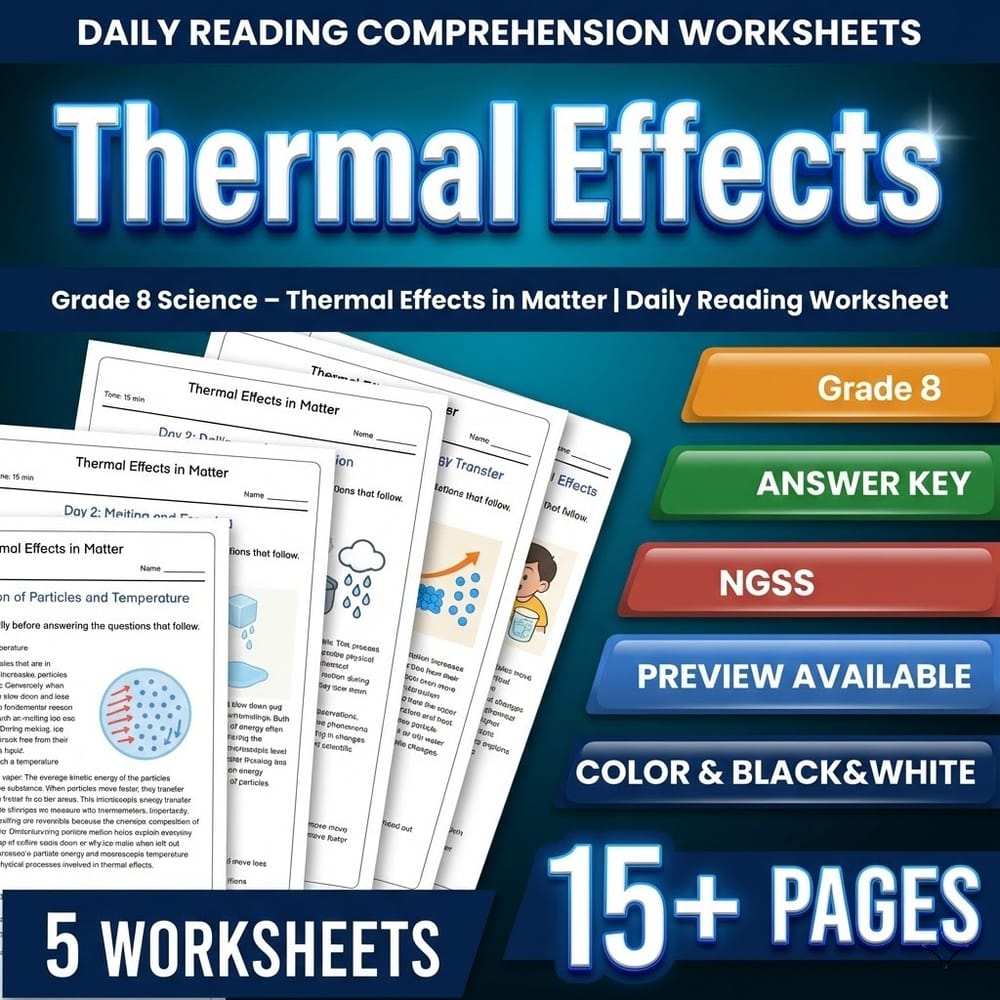
Grade 8 Science – Thermal Effects in Matter | Daily Reading Worksheet
 Created byElena Brooks
Learning Objectives
- Understand how particle motion relates to temperature and phase changes.
- Explain the processes of melting, boiling, and condensation from a microscopic perspective.
- Relate macroscopic temperature changes to microscopic particle energy and motion.
Instant download

Grade 8 Science – Cell Modeling & Functions | Daily Reading Worksheet
Created byBright Mind ResourcesLearning Objectives
- Identify and describe basic cell structures such as the nucleus, mitochondria, chloroplasts, and membrane systems.
- Explain the functions of different organelles within a cell.
- Understand how models can demonstrate the relationships between cell structure and function.
Also included in: Grade 8 Circulatory & Cell Function Science Daily Reading Lesson Bundle | NGSS +1 more
Instant download

Grade 8 Science – Mass Conservation & Reactions | Daily Reading Worksheet
Created byBright Mind ResourcesLearning Objectives
- Explain the principle of mass conservation in chemical reactions
- Identify how atoms are conserved in reactants and products
- Describe how chemical equations relate to mass balance
Also included in: Particle Motion Grade 8 Science Daily Reading Worksheets Lesson Bundle | NGSS +1 more
Instant download

Grade 8 Science | Natural Selection Worksheet Elena | NGSSS Aligned
Created byLumora LearningLearning Objectives
- Explain how variation and heritability allow natural selection to change a population over generations
- Describe how environmental conditions influence which traits are advantageous
- Use examples (such as antibiotic resistance) to illustrate changes in trait frequencies over time
Instant download

Grade 8 Science Worksheet | Substance Sorting & Materials (PDF)
Created byEvergreen Desk EducationLearning Objectives
- Classify materials as pure substances (elements or compounds) or mixtures based on composition and bonding.
- Describe how physical separation methods apply to mixtures versus pure substances.
- Use classification to select appropriate analysis approaches for environmental and industrial samples.
Instant download

Grade 8 Science – Organelles & Roles | Daily Reading Worksheet
Created byBright Mind ResourcesLearning Objectives
- Identify the functions of different cell organelles
- Understand how organelle specialization supports cell functions
- Describe the roles of mitochondria, chloroplasts, and lysosomes in cells
Also included in: Grade 8 Body Systems & Cell Structure Science Daily Reading Lesson Bundle | BC +1 more
Instant download

Conservation of Energy Assessment for Grade 8 Science | Florida NGSSS
Created byPrism Point LearningLearning Objectives
- Explain conservation of energy as an accounting framework for energy transfers and transformations in a system.
- Identify how mechanical energy can decrease while thermal and other energy forms increase due to friction.
- Use energy-form descriptions to predict energy changes for real-world situations such as sliding objects or slowing vehicles.
Instant download

Grade 8 Science – Endothermic & Exothermic Reactions | Daily Reading Worksheet
Created byBright Mind ResourcesLearning Objectives
- Define endothermic and exothermic reactions.
- Identify examples of each reaction type.
- Explain energy changes in particle motion and bonding.
Also included in: Reaction Evidence & Matter Grade 8 Science Lesson Bundle | General Framework +1 more
Instant download

Electric Magnetism Worksheet | NGSS Grade 8 Science Practice Assessment
 Created byCedar Grove Learning
Learning Objectives
- Explain how electric and magnetic forces depend on properties and separation distance.
- Describe Coulomb-like relationships for electric forces and factors affecting magnetic interactions.
- Identify real-world examples of electric and magnetic forces, including charged objects, magnets, and compass deflections.
Instant download

Grade 8 Particle Model Worksheet | NGSS Practice PDF
Created byClear Sky ClassroomLearning Objectives
- Explain how the particle model describes matter using constant motion and forces between particles.
- Relate particle spacing and particle motion to solids, liquids, and gases.
- Predict how temperature affects diffusion and compressibility using the particle model.
Instant download

Buoyant Force Practice Assessment | Grade 8 Science Worksheet Ontario
Created byPrism Point LearningLearning Objectives
- Explain Archimedes’ principle and how buoyant force depends on the weight of displaced fluid
- Compare apparent weight in air versus apparent weight when submerged
- Use density relationships to predict whether objects float, sink, or remain neutrally buoyant
Instant download

Science Grade 8 Worksheet on Bernoulli Principle and Flow Effects
JCreated byJ.S SheetsLearning Objectives
- Explain Bernoulli’s principle for incompressible, streamline flow and relate fluid speed to pressure
- Use the continuity idea to reason about how speed changes in constricted pipes
- Apply Bernoulli’s principle to lift on airfoils and to Venturi-style pressure changes
Instant download

Green Infrastructure for Stormwater Management Worksheet | Ontario Grade 8
JCreated byJ.S SheetsLearning Objectives
- Explain how green infrastructure helps manage stormwater using nature-based and engineered systems.
- Describe key functions of green infrastructure, including infiltration, reduced runoff, sediment/nutrient capture, and evapotranspiration.
- Identify design parameters (soil media, slope, vegetation type, storage volume) and predict how they affect downstream impacts.
Instant download

Grade 8 Science | Energy Transformations - Daily Reading Comprehension
Created byCoral Reef LearningLearning Objectives
- Understand the concepts of potential and kinetic energy.
- Identify different types of energy transformations in everyday objects.
- Explain how energy changes from one form to another during motion.
Instant download

Plate Motions Worksheet | NGSS-Aligned Grade 8 Science Practice
JCreated byJ.S SheetsLearning Objectives
- Understand the mechanisms of plate tectonics including subduction, rifting, collision, and uplift.
- Identify evidence supporting plate movements such as seafloor spreading, magnetic striping, and paleomagnetic records.
- Explain how landforms like mountains, ocean basins, and volcanic arcs are created through plate interactions.
Also included in: Grade 8 Earth Systems Science Lesson Bundle | NGSS-Aligned Worksheets +1 more
Instant download

Grade 8 Science Worksheet | Invasive Species & Ecosystem Impact (PDF)
Created byEvergreen Desk EducationLearning Objectives
- Explain how invasive species can disrupt native biodiversity, competition, and energy/nutrient pathways
- Describe how invasive species can change hydrology and food-web structure
- Identify common pathways and ecological consequences of invasive plants and aquatic organisms
Instant download

Grade 8 Science – Molecules & States of Matter | Daily Reading Worksheet
Created byBright Mind ResourcesLearning Objectives
- Understand the different states of matter: solids, liquids, and gases.
- Describe how particles are arranged and move in each state.
- Explain how temperature affects particle motion and state changes.
Also included in: Reaction Evidence & Matter Grade 8 Science Lesson Bundle | General Framework +1 more
Instant download

Grade 8 Science – Membrane Structure & Function | Daily Reading Worksheet
 Created byQuiet Forest Education
Learning Objectives
- Identify the main components of cell membranes.
- Understand the functions of phospholipids, proteins, cholesterol, and carbohydrates in membranes.
- Explain how membrane components affect permeability and resilience.
Also included in: Cell Biology Grade 8 Science Daily Reading Worksheets Bundle | Ontario +1 more
Instant download

Gravity and Motion in Space Worksheet | Grade 8 NGSS Physical Science
Created byBRIGHT PATH RESOURCESLearning Objectives
- Understand how gravity influences the motion of planets, moons, comets, and asteroids
- Identify the role of gravitational attraction in orbital paths
- Explain centripetal acceleration and its relation to orbital motion
Also included in: Solar System Scale Patterns Grade 8 Science Daily Reading Worksheets Bundle|NGSS +2 more
Instant download

Grade 8 Science – Water Cycle & Models | Daily Reading Worksheet
Created byBright Mind ResourcesLearning Objectives
- Identify the key parts of the water cycle.
- Understand how water moves between air, land, and subsurface resources.
- Explain the processes that transfer water in Earth's systems.
Also included in: Earth & Space Grade 8 Science Daily Reading Worksheets Lesson Bundle | General +1 more
Instant download

Science Momentum Transfer Worksheet | Grade 8 Science | Ontario Standards
JCreated byJ.S SheetsLearning Objectives
- Explain linear momentum and identify when momentum is transferred during interactions.
- Use conservation of momentum to predict outcomes for collisions in closed systems.
- Relate impulse to change in momentum using force–time reasoning.
Instant download

Grade 8 Science: Applications Design Worksheet (TEKS) PDF
Created byEvergreen Desk EducationLearning Objectives
- Explain how material properties (density, conductivity, and reactivity) influence engineering design choices for matter-and-energy systems.
- Compare how energy is stored or delivered in real-world applications such as batteries and thermal insulation.
- Evaluate engineering trade-offs using conceptual criteria and environmental implications.
Instant download

Grade 8 Science | Exploring Common Ancestry - Daily Reading Comprehension
Created byCoral Reef LearningLearning Objectives
- Understand how fossil records reveal evolutionary changes over time.
- Identify homologous structures across different vertebrate species.
- Interpret molecular data to determine lineage relationships.
Instant download
Browse more categories
About Grade 8 Worksheets
Explore Grade 8 worksheets in math, ELA, science, and social studies. Our 8,326 Grade 8 printables print straight from PDF, answer keys included.
Each resource here is built by an independent educator and reviewed for quality. Worksheets print straight from PDF and suit classroom use, homework, or extra practice; most come with answer keys, and you can preview before purchasing.