
Grade 8 Science Worksheets
5,999 worksheets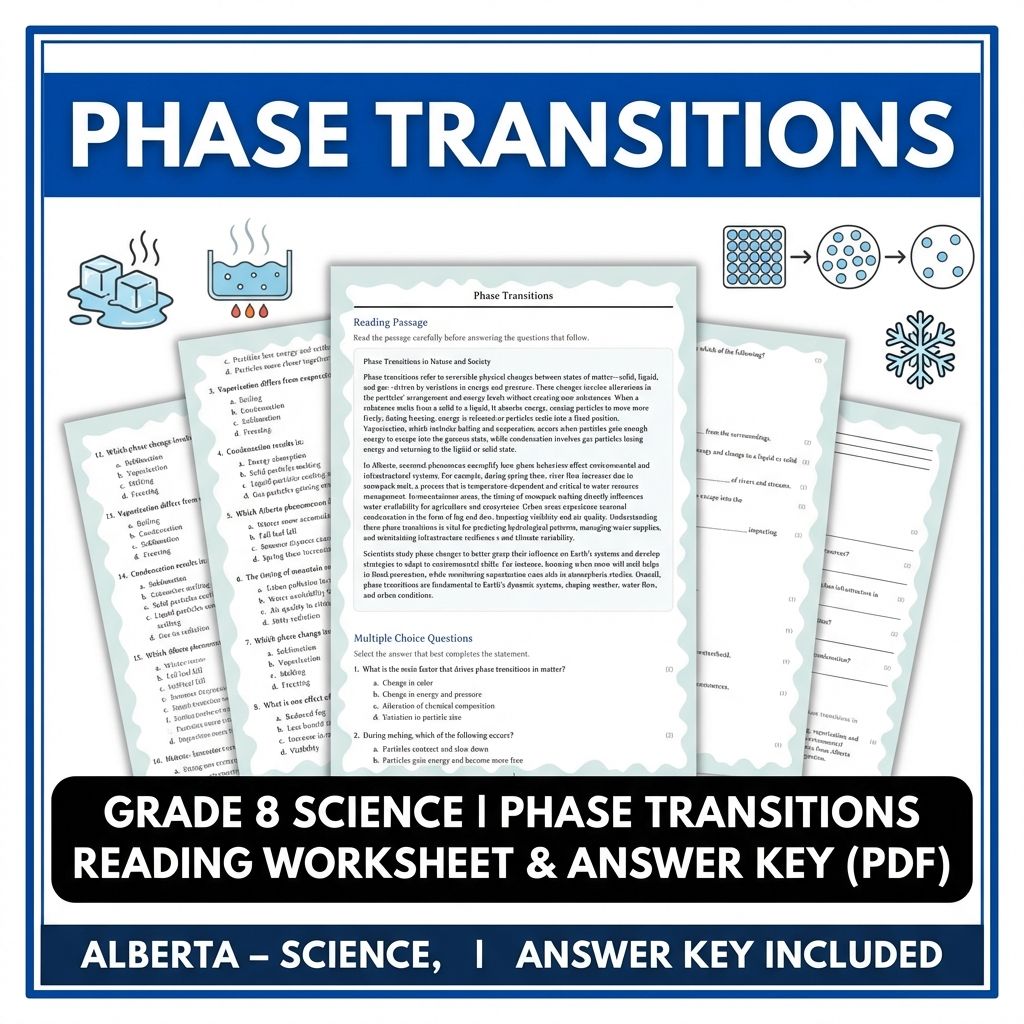
Grade 8 Science | Phase Transitions Reading Worksheet & Answer Key (PDF)
JCreated byJ.S SheetsLearning Objectives
- Understand the different types of phase transitions and the particles' behavior during these changes.
- Identify real-world phenomena influenced by phase changes in water and other substances.
- Explain how energy exchange drives phase transitions such as melting, freezing, vaporization, and condensation.
Also included in: Grade 8 Science | Essential Concepts & Processes Pack (Answer Key Included) +1 more
Instant download
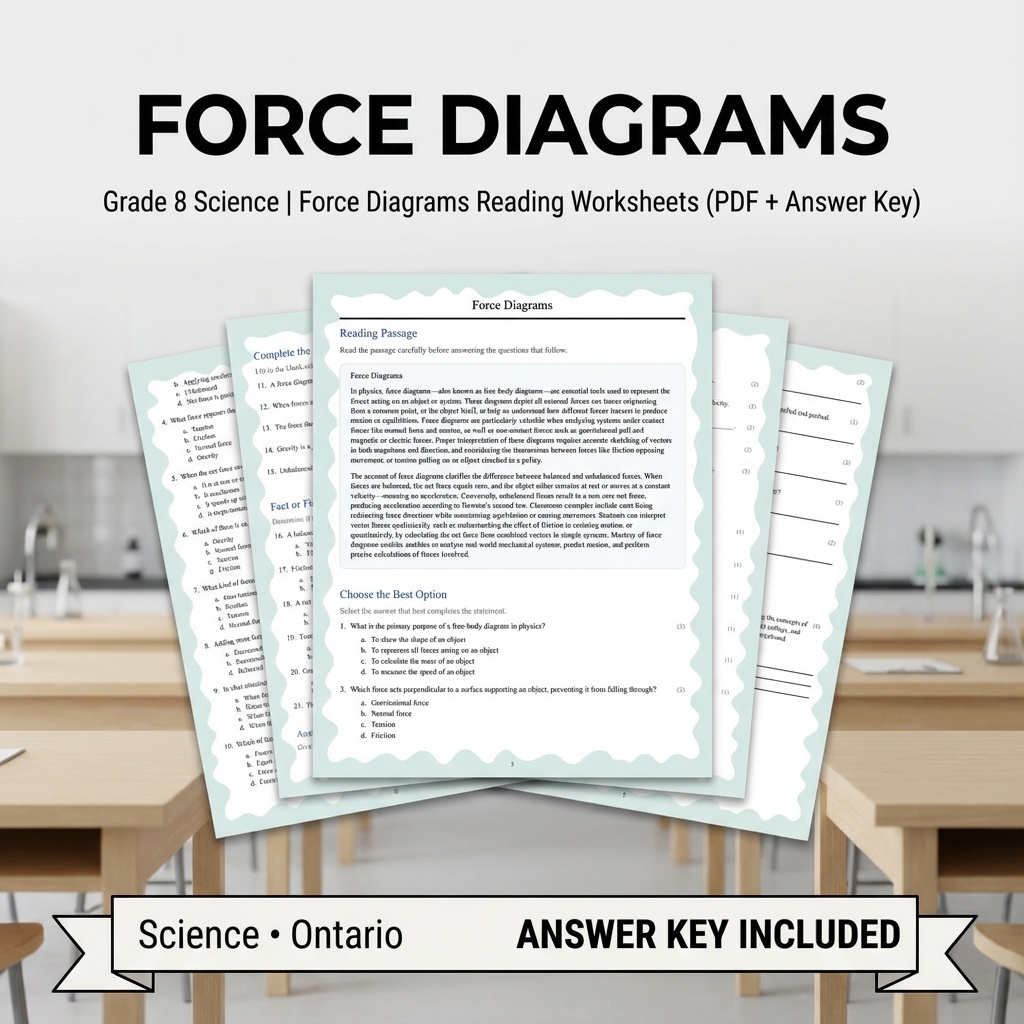
Grade 8 Science | Force Diagrams Reading Worksheets (PDF + Answer Key)
JCreated byJ.S SheetsLearning Objectives
- Understand the purpose and components of free-body diagrams for systems under contact and non-contact forces.
- Identify and interpret basic force vectors such as normal force, tension, friction, and gravity.
- Distinguish between balanced and unbalanced forces and relate them to motion, including constant velocity and acceleration.
Also included in: Grade 8 Science | Energy & Forces Unit Worksheet Pack (Answer Keys Included) +1 more
Instant download
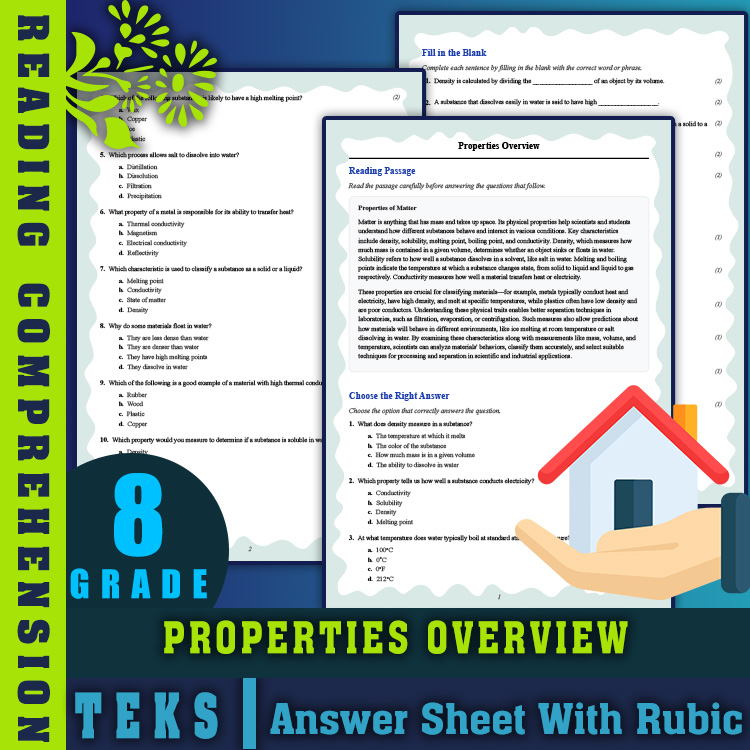
8th Grade Science | Properties Overview Reading Worksheet (PDF + Rubric)
JCreated byJ.S SheetsLearning Objectives
- Identify and describe physical properties of matter such as density, solubility, melting and boiling points.
- Compare the measurable characteristics of different materials and understand how these properties inform classification and separation techniques.
- Relate quantitative measurements like mass, volume, and temperature to physical behaviors in classroom-relevant phenomena.
Instant download
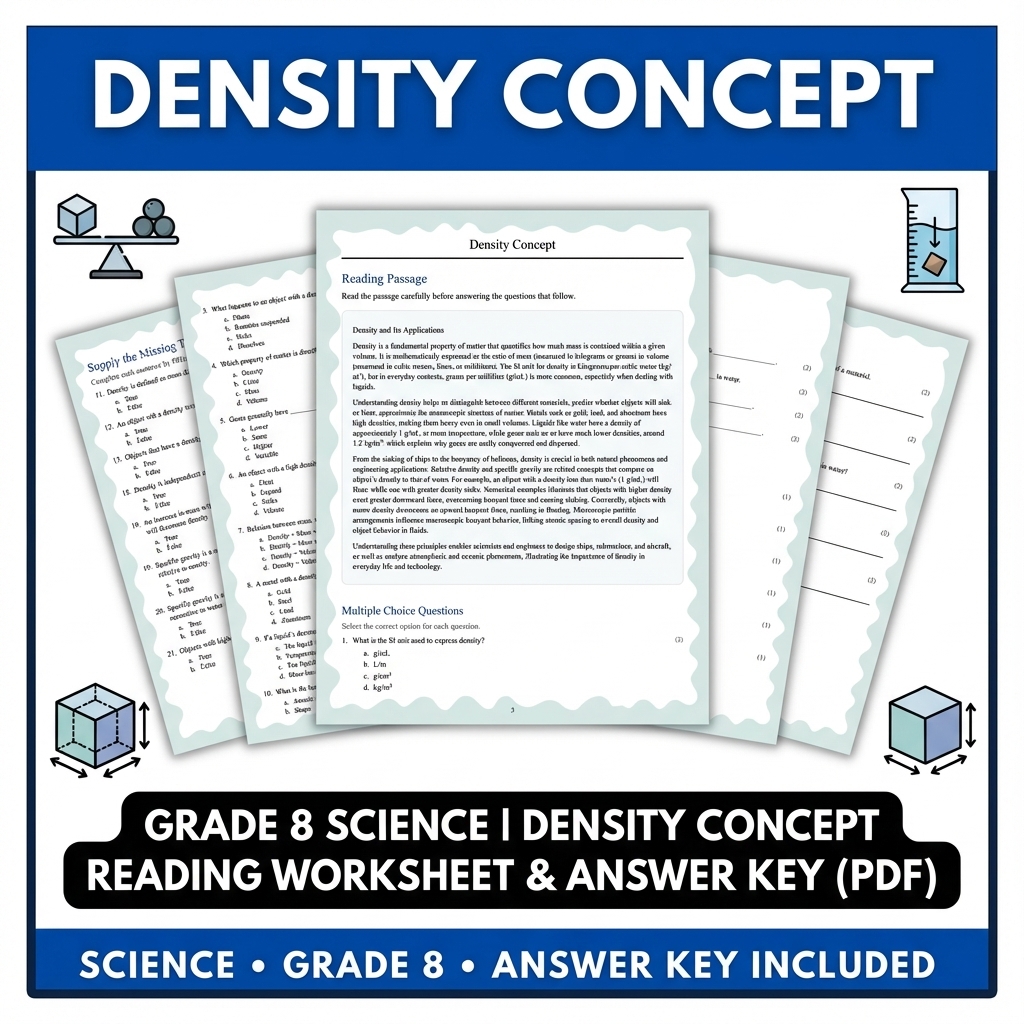
Grade 8 Science | Density Concept Reading Worksheet & Answer Key (PDF)
JCreated byJ.S SheetsLearning Objectives
- Define and explain the concept of density as mass per unit volume.
- Use SI units to express density, such as kilograms per cubic meter (kg/m³) and grams per milliliter (g/mL).
- Compare the densities of different materials, including metals, liquids, and gases.
Also included in: Grade 8 Science Unit Bundle – Density, Pressure & Fluid Mechanics Worksheets +1 more
Instant download
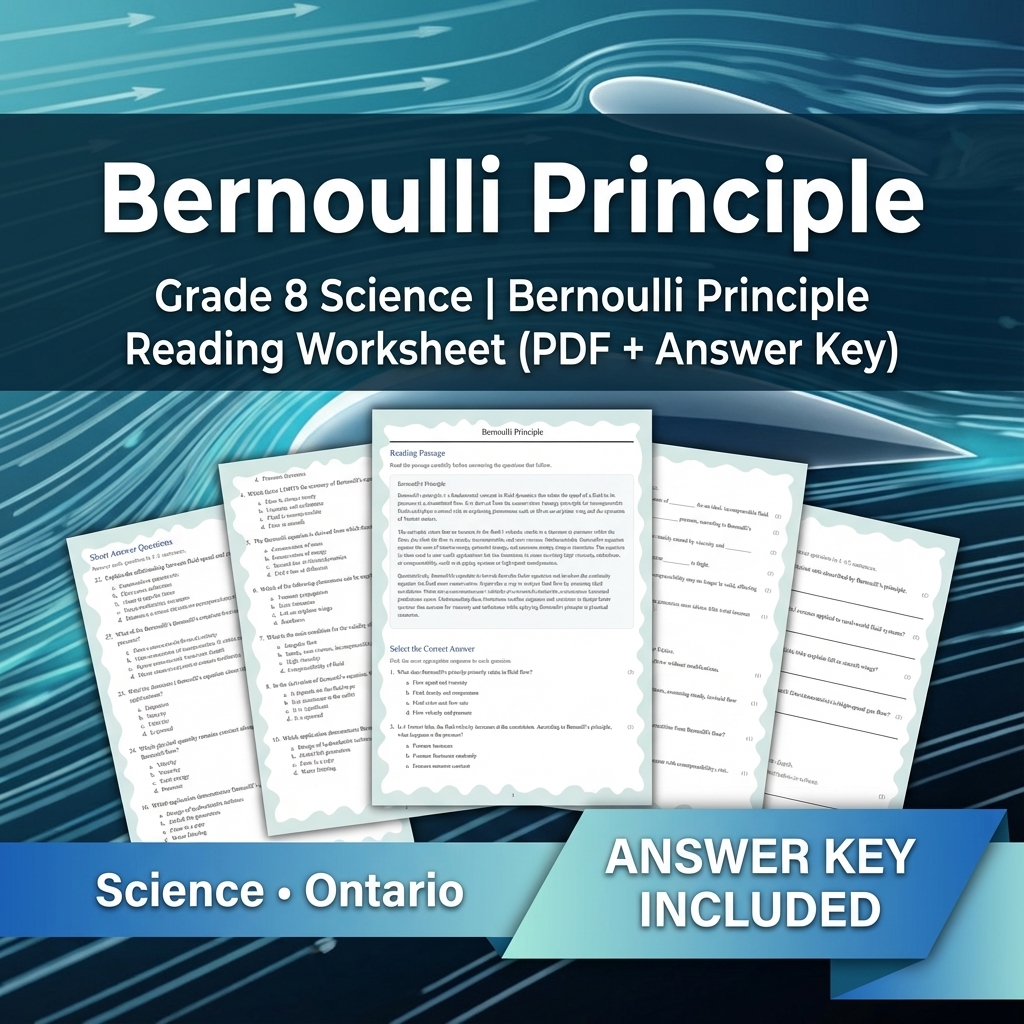
Grade 8 Science | Bernoulli Principle Reading Worksheet (PDF + Answer Key)
JCreated byJ.S SheetsLearning Objectives
- Understand the derivation of the energy conservation relation for incompressible flow.
- Explain how velocity changes in streamlines affect pressure according to Bernoulli's principle.
- Apply Bernoulli's equation to real-world phenomena such as airflow over an airfoil and fluid flow in pipes.
Also included in: Grade 8 Science Unit Bundle – Density, Pressure & Fluid Mechanics Worksheets +1 more
Instant download
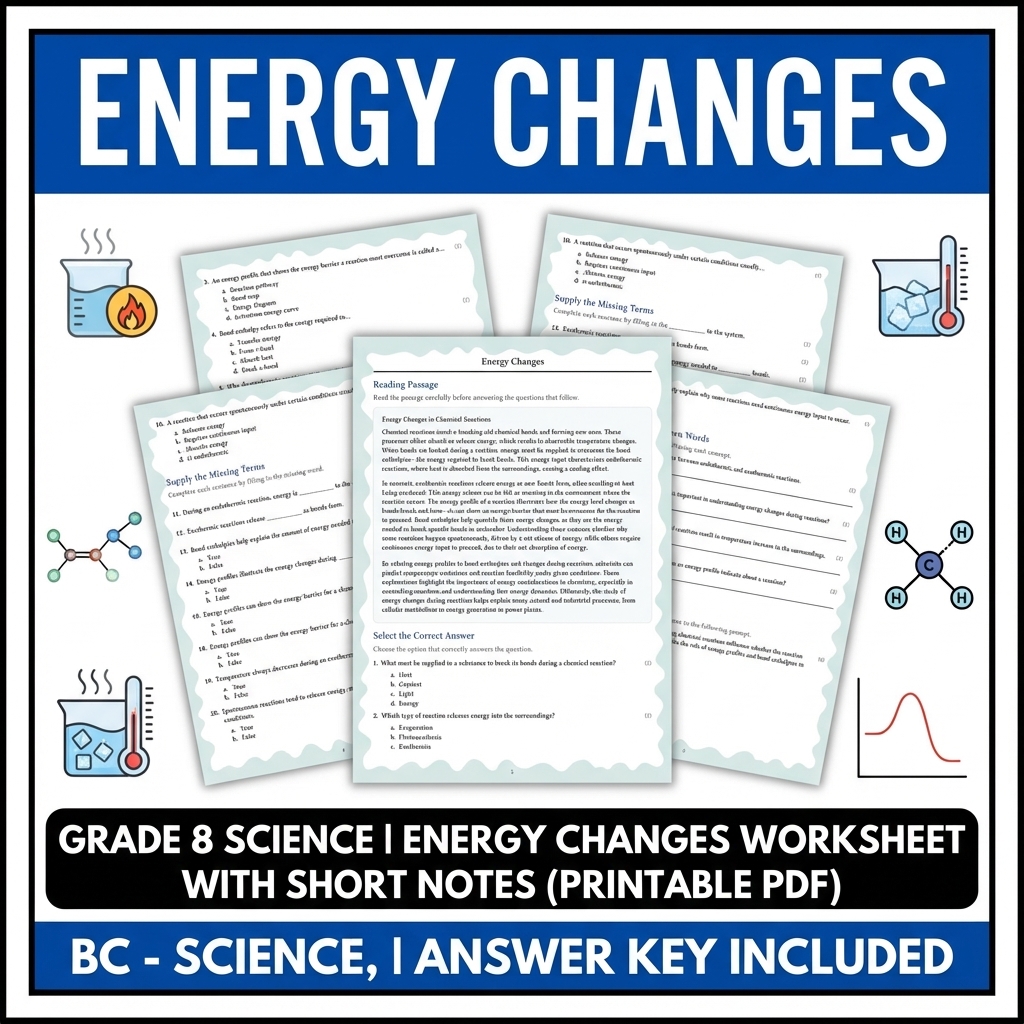
Grade 8 Science | Energy Changes Reading Worksheet (PDF + Answer Key)
JCreated byJ.S SheetsLearning Objectives
- Understand how energy changes occur during chemical reactions.
- Identify the differences between endothermic and exothermic reactions.
- Explain how energy profiles and bond enthalpies relate to temperature changes.
Instant download

Grade 8 Science | Measuring Biodiversity Reading Worksheets (PDF + Answer Key)
JCreated byJ.S SheetsLearning Objectives
- Understand the concept of biodiversity at genetic, species, and ecosystem levels.
- Identify common metrics used to measure biodiversity, such as species richness and evenness.
- Explain how habitat heterogeneity, sampling techniques, and temporal variation affect biodiversity assessment.
Instant download
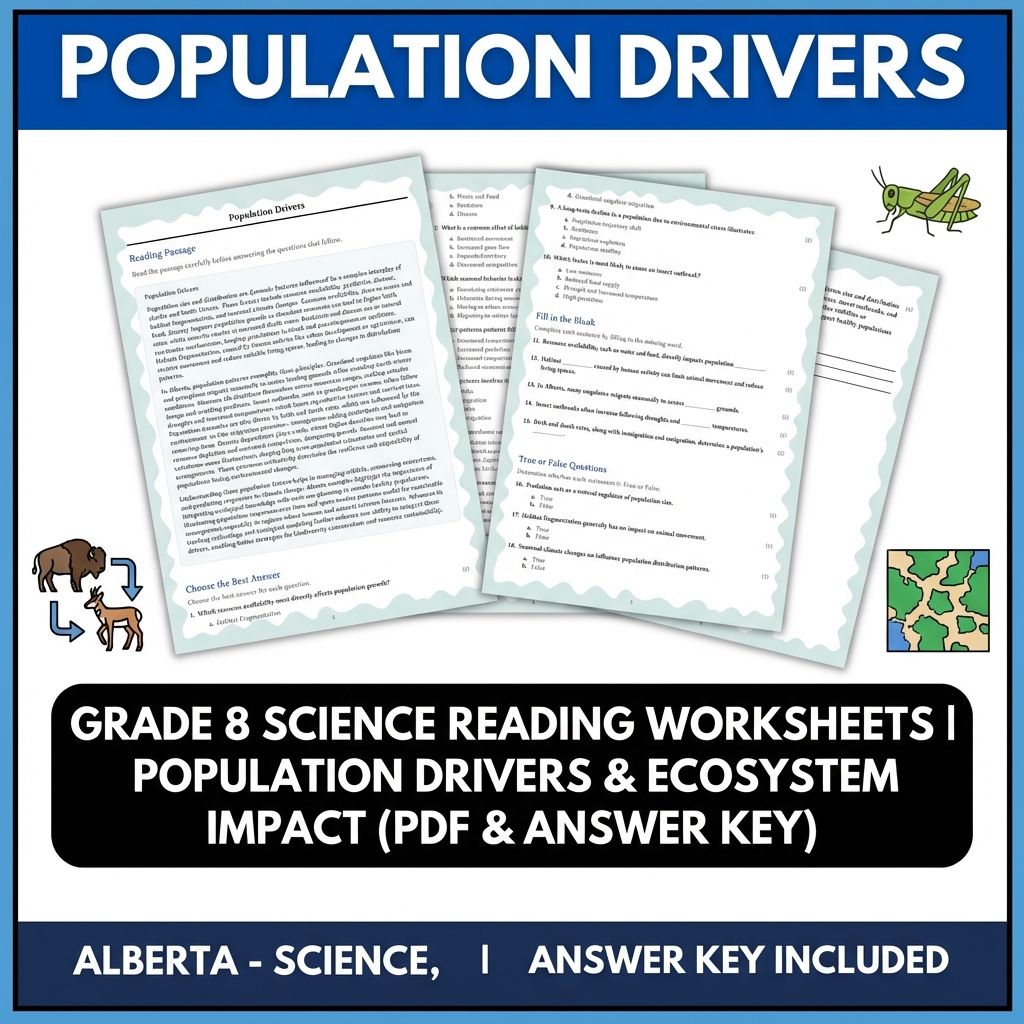
Grade 8 Science | Population Drivers & Ecosystem Impact (PDF & Answer Key)
JCreated byJ.S SheetsLearning Objectives
- Understand the key factors influencing population size and distribution.
- Identify examples of population dynamics in Alberta ecosystems.
- Analyze how abiotic and biotic factors interact to shape populations.
Also included in: Grade 8 Science Bundle | Ecosystem Dynamics & Environmental Impact Worksheets +1 more
Instant download
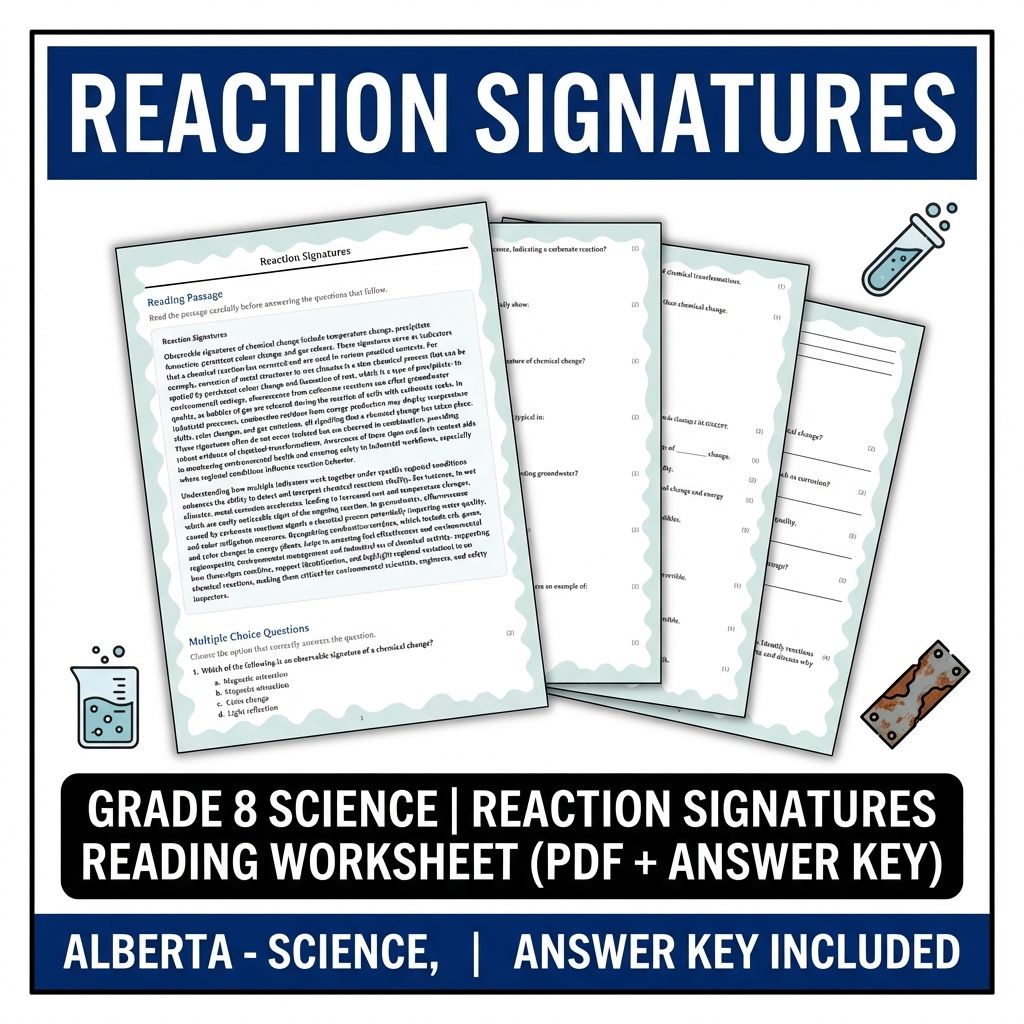
Grade 8 Science | Reaction Signatures Reading Worksheet (PDF + Answer Key)
JCreated byJ.S SheetsLearning Objectives
- Identify observable signatures of chemical change such as temperature change, precipitate formation, color change, and gas release.
- Understand environmental and industrial examples of chemical reactions demonstrating these signatures.
- Describe how multiple indicators support the identification of chemical transformations under different regional conditions.
Also included in: Grade 8 Science | Essential Concepts & Processes Pack (Answer Key Included) +1 more
Instant download
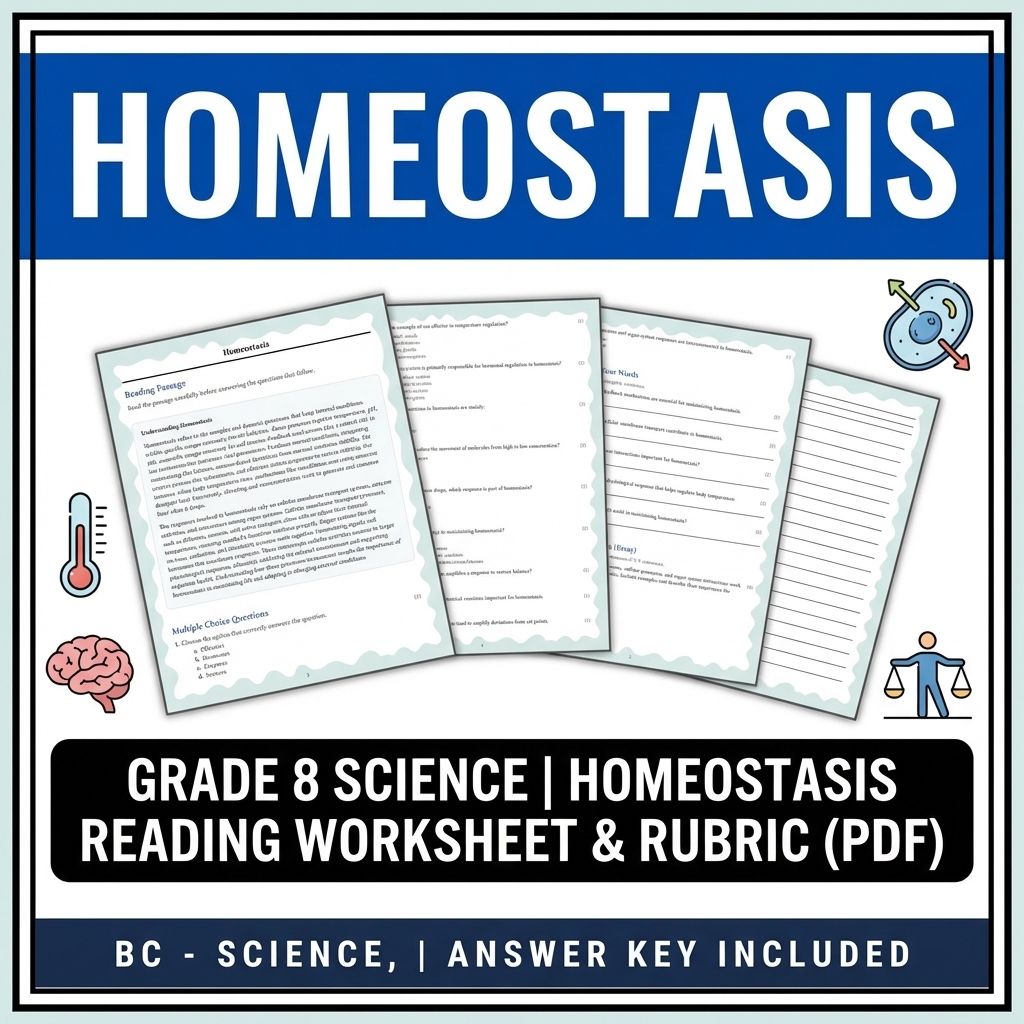
Grade 8 Science | Homeostasis Reading Worksheet & Rubric (PDF)
JCreated byJ.S SheetsLearning Objectives
- Understand the concept of homeostasis and its role in maintaining internal stability.
- Identify the feedback mechanisms involved in homeostasis.
- Explain how cellular and organ system responses contribute to homeostasis.
Instant download
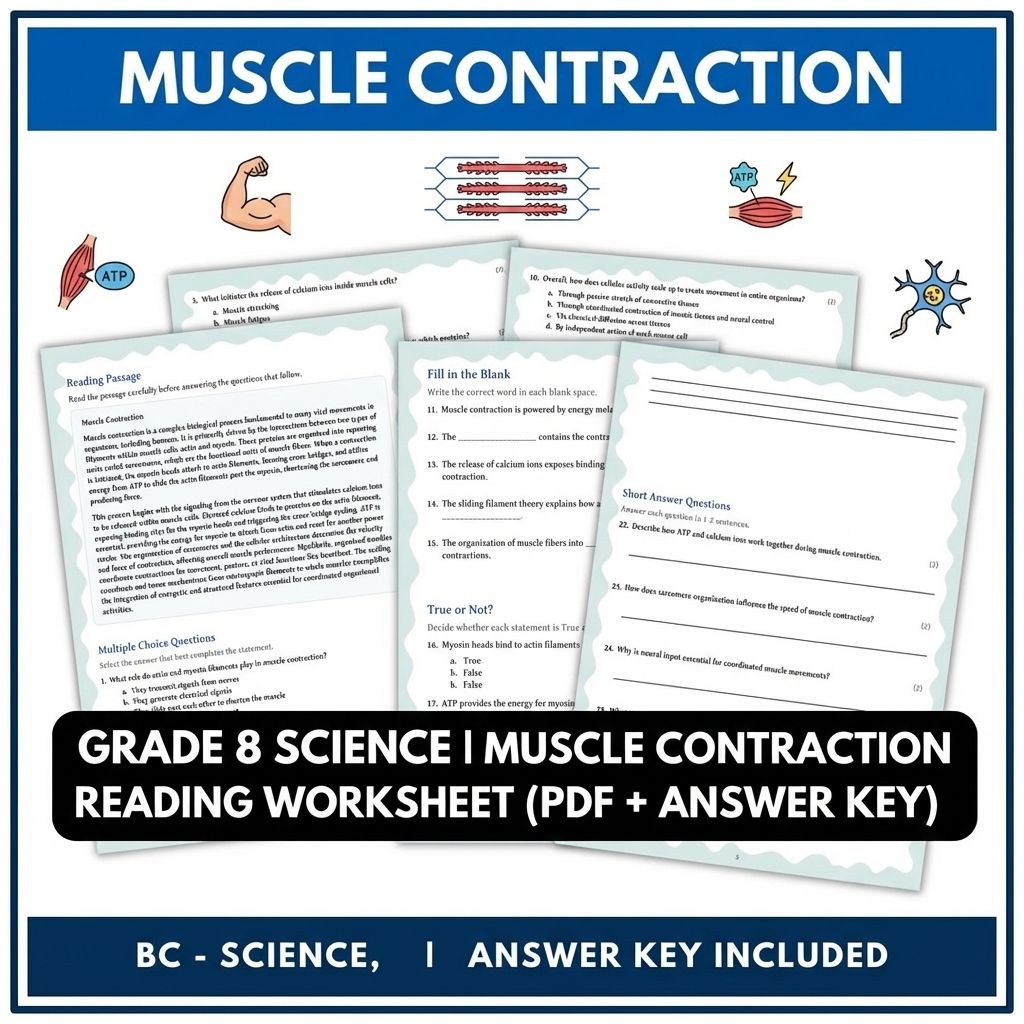
Grade 8 Science | Muscle Contraction Reading Worksheet (PDF + Answer Key)
JCreated byJ.S SheetsLearning Objectives
- Describe the process by which actin and myosin filaments produce muscle contraction.
- Explain the role of ATP and calcium signaling in muscle contraction.
- Understand how sarcomere structure influences contraction strength and speed.
Instant download
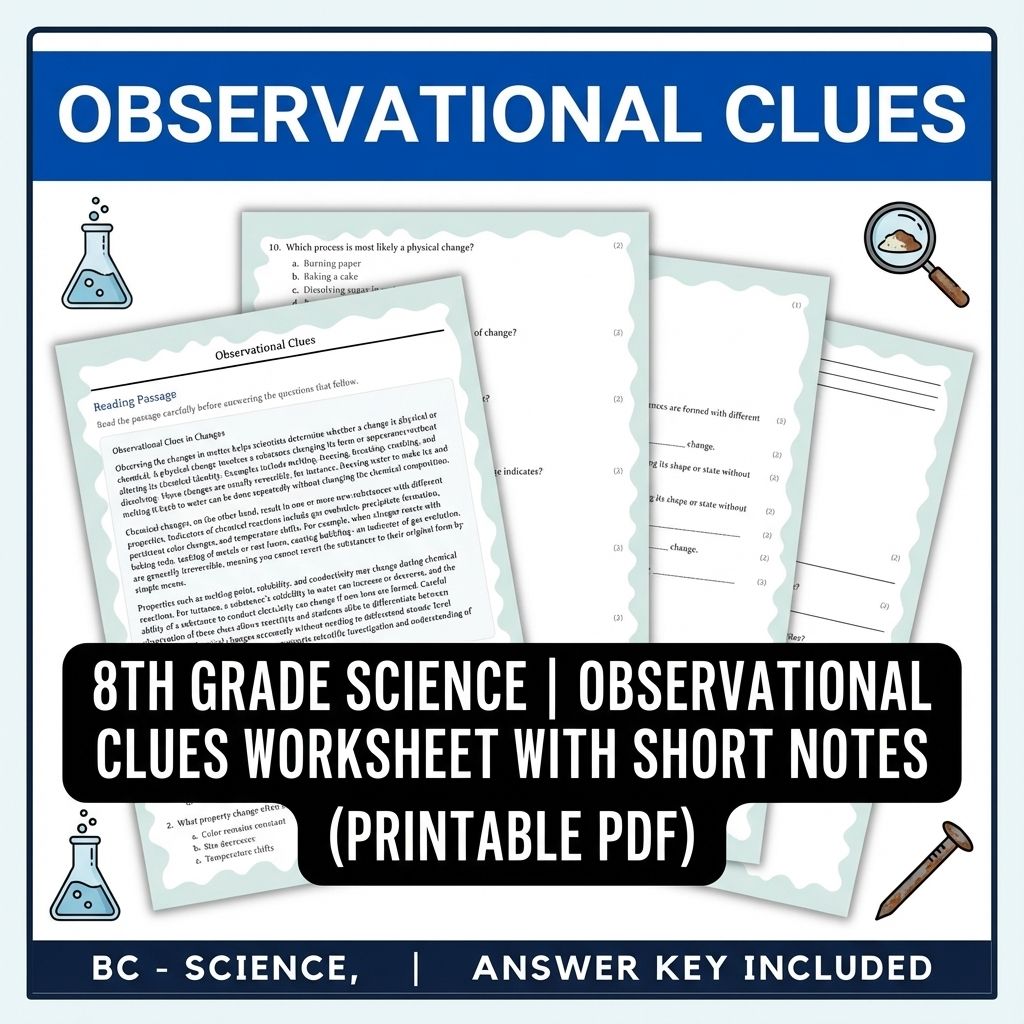
Grade 8 Science | Observational Clues Reading Worksheet (PDF + Answer Key)
JCreated byJ.S SheetsLearning Objectives
- Identify observable clues that differentiate between physical and chemical changes.
- Understand how properties like gas evolution, precipitate formation, and color change indicate chemical reactions.
- Distinguish reversible and irreversible changes based on observation.
Instant download
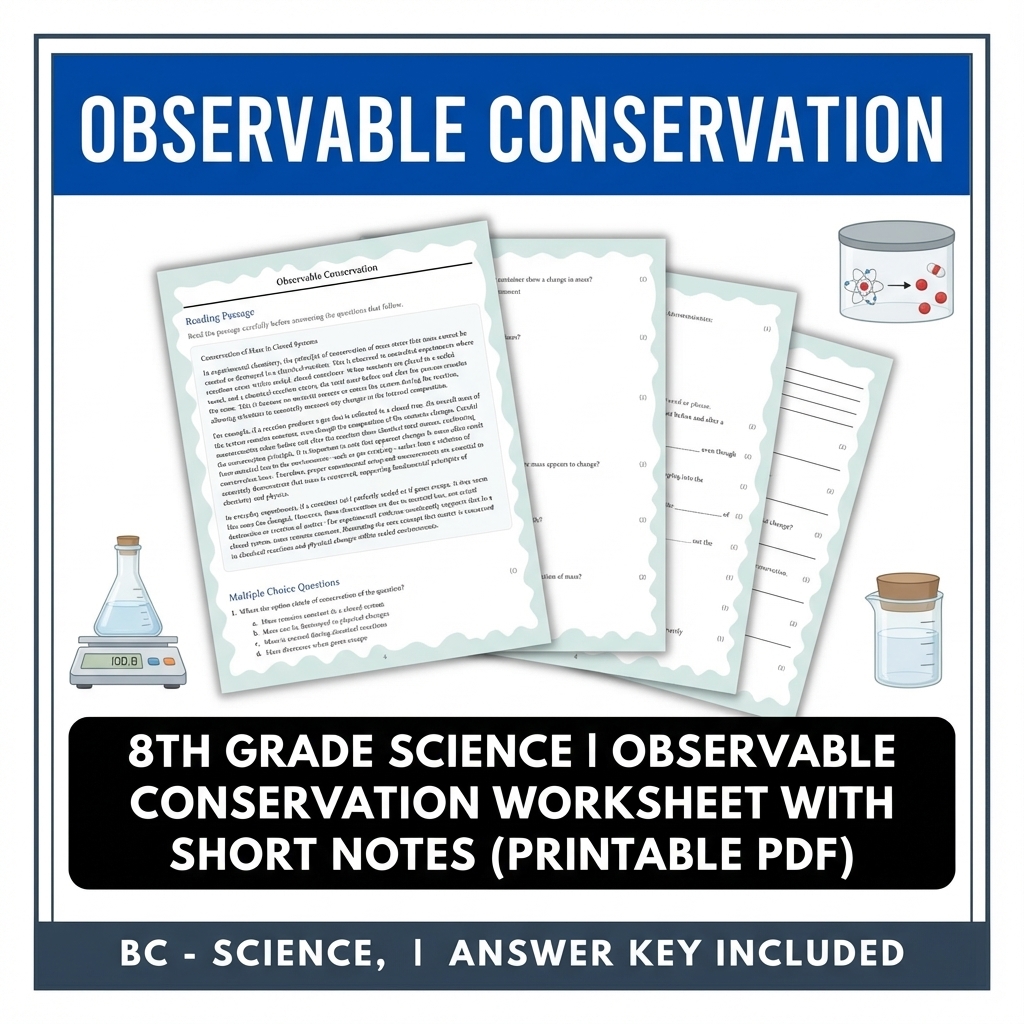
Grade 8 Science | Observable Conservation Reading Worksheet & Answer Key PDF
JCreated byJ.S SheetsLearning Objectives
- Explain the principle of conservation of mass as demonstrated in closed systems.
- Describe how internal reactions can change composition without changing total mass.
- Understand how measurements before and after reactions support conservation laws.
Instant download
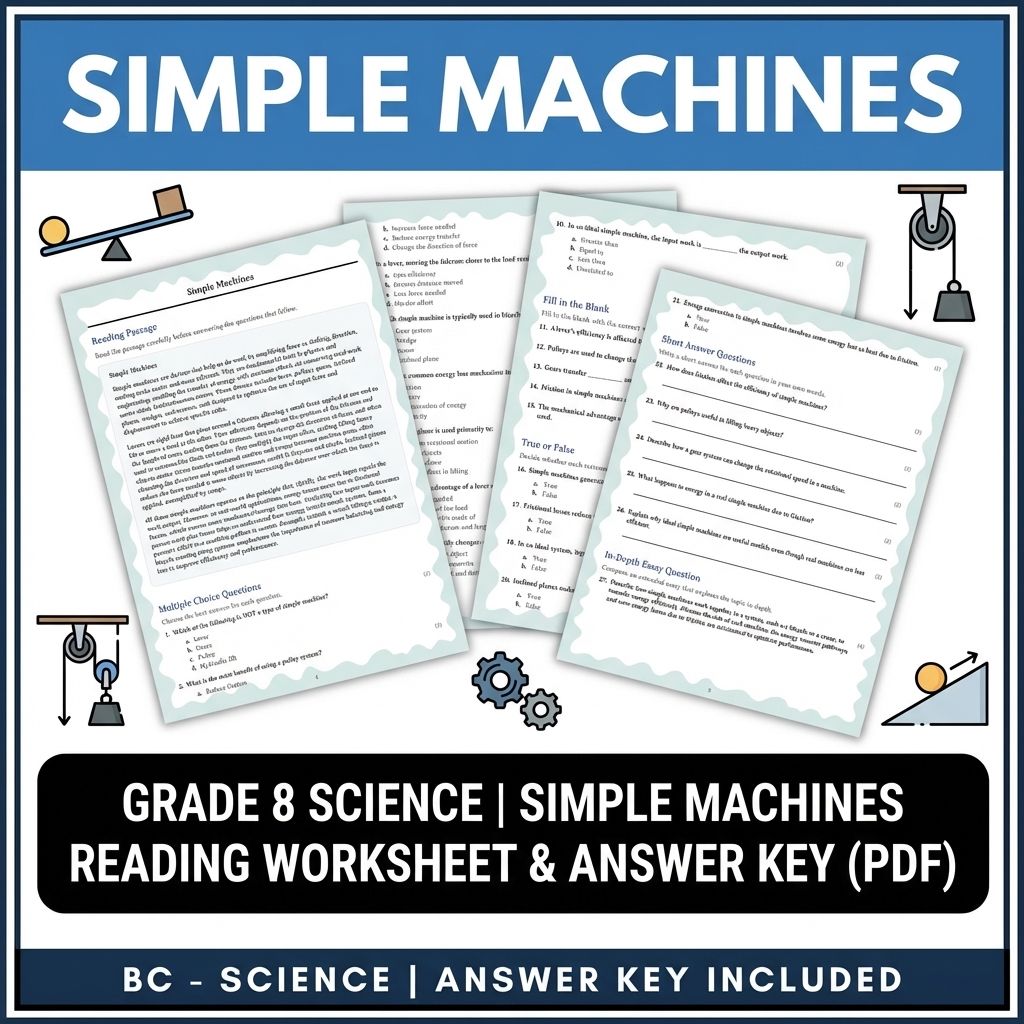
Grade 8 Science | Simple Machines Reading Worksheet & Answer Key (PDF)
JCreated byJ.S SheetsLearning Objectives
- Understand how simple machines redirect forces and trade force magnitude for distance.
- Identify the types of simple machines and their mechanical advantage.
- Explain energy transfer and losses due to friction in mechanical systems.
Instant download
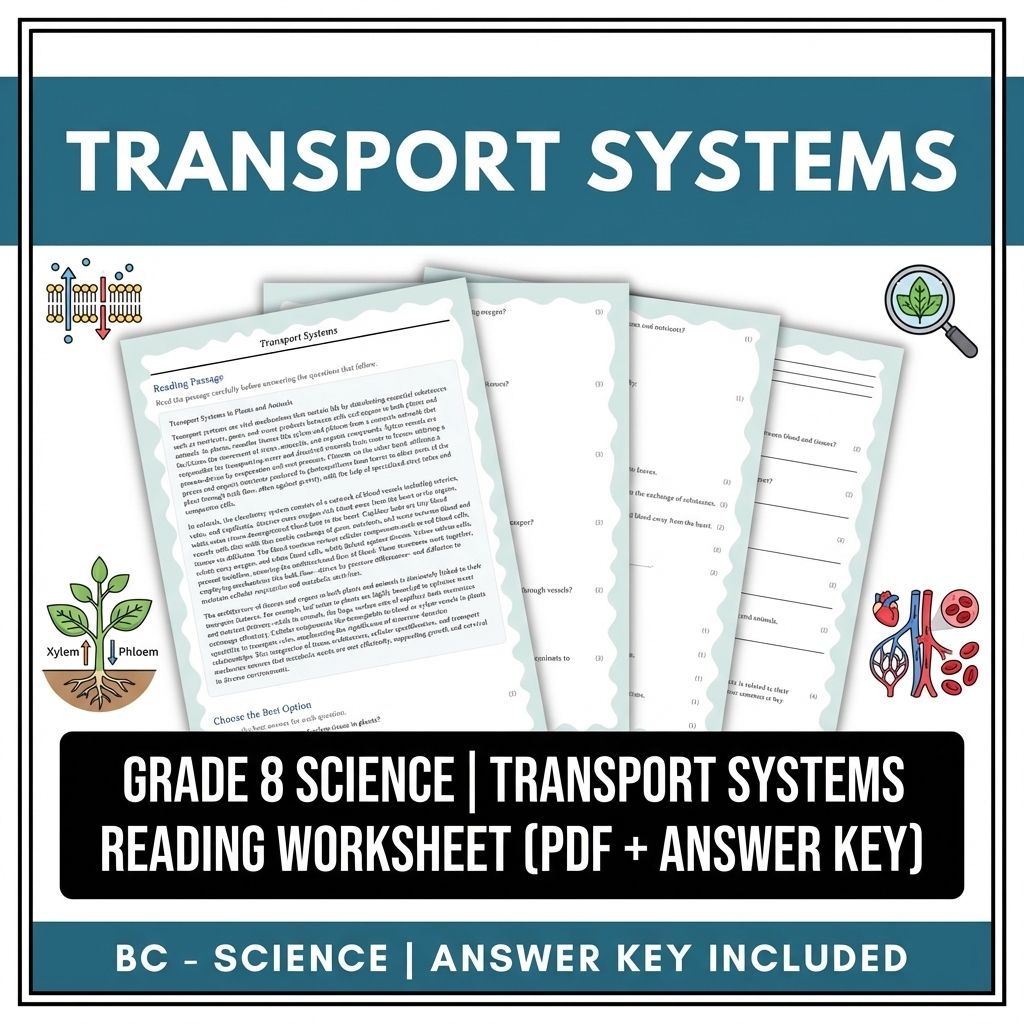
Grade 8 Science | Transport Systems Reading Worksheet (PDF + Answer Key)
JCreated byJ.S SheetsLearning Objectives
- Understand the structure and function of vascular networks in plants and circulatory systems in animals.
- Identify key components such as vessels, valves, capillary beds, blood cells, xylem, and phloem.
- Explain how bulk flow and diffusion contribute to nutrient, gas, and waste transport in organisms.
Instant download
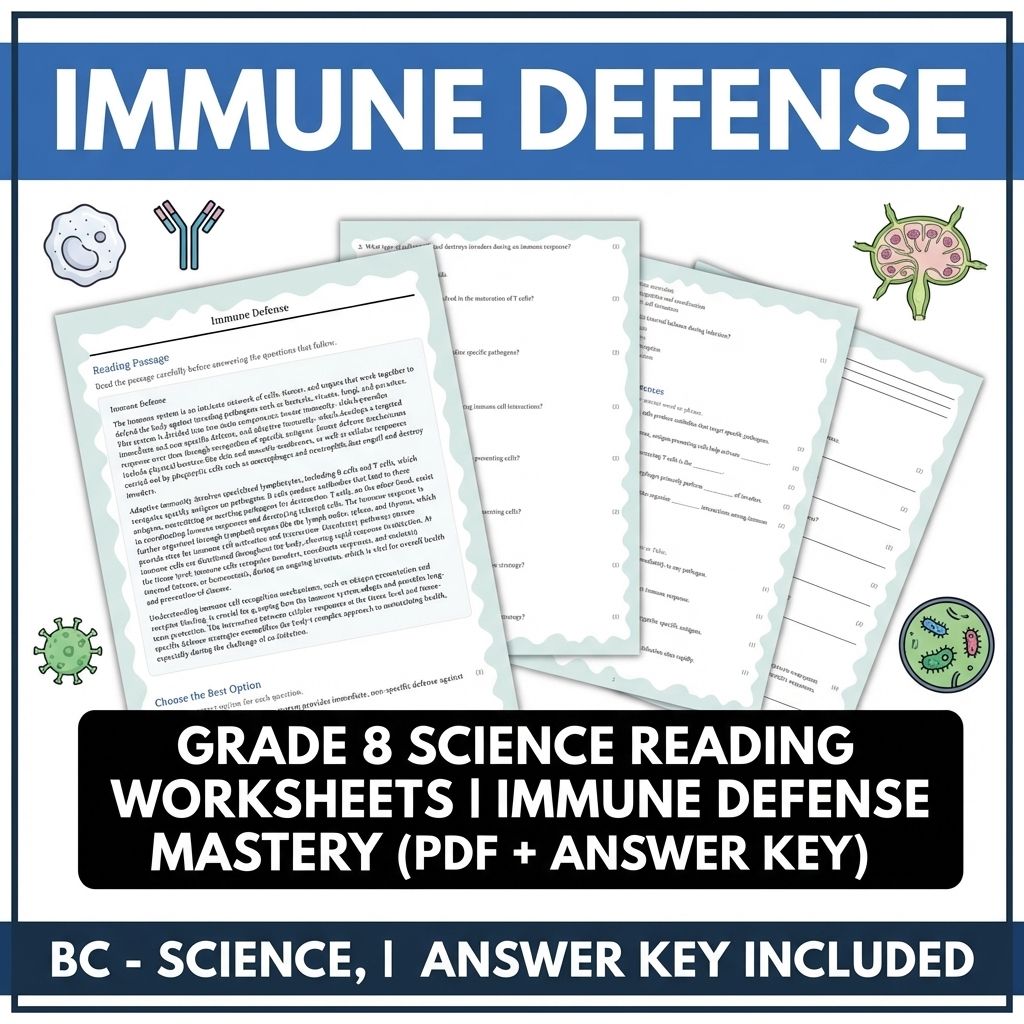
Grade 8 Science Reading Worksheets | Immune Defense Mastery (PDF + Answer Key)
JCreated byJ.S SheetsLearning Objectives
- Understand the components and functions of the immune system, including innate and adaptive immunity.
- Identify different cell types involved in immune responses, such as phagocytic cells, lymphocytes, and antigen-presenting cells.
- Explain how tissues and organs coordinate to defend the body against pathogens.
Instant download
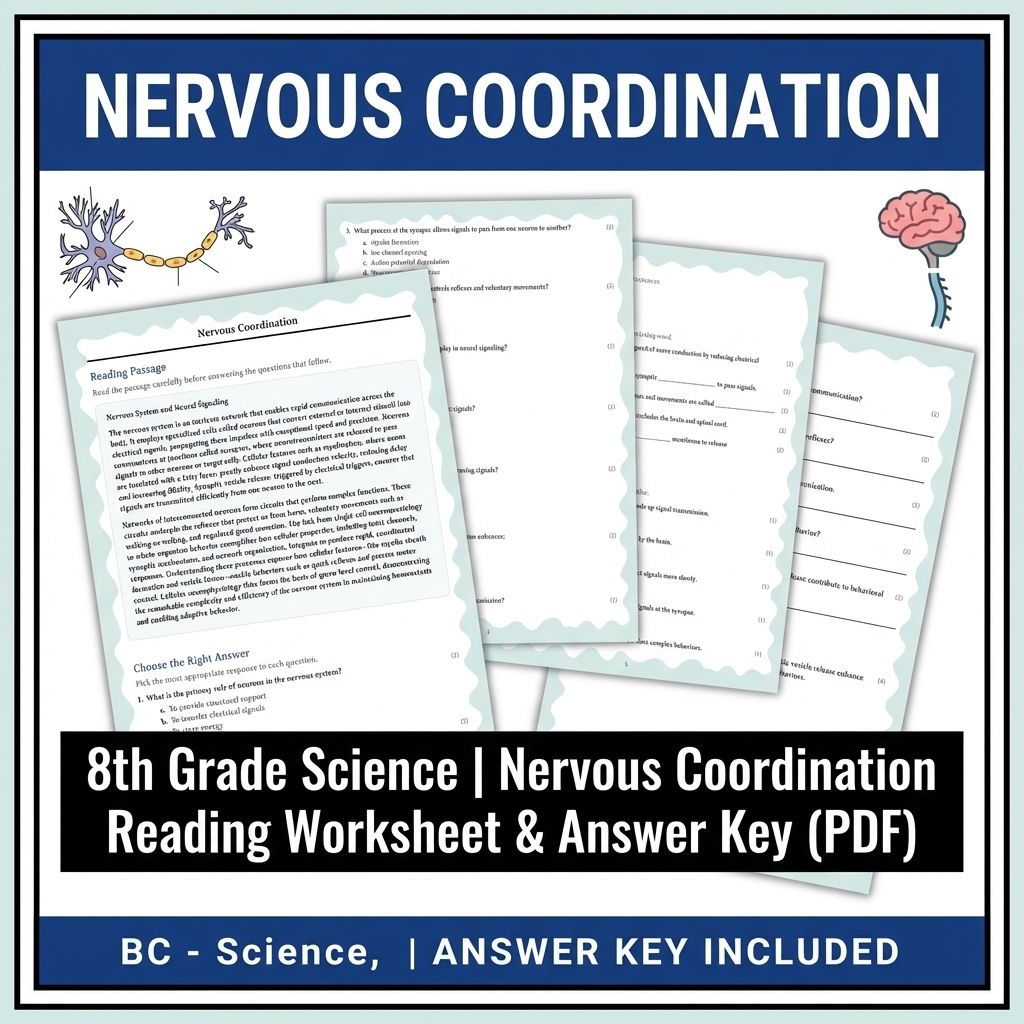
8th Grade Science | Nervous Coordination Reading Worksheet & Answer Key (PDF)
JCreated byJ.S SheetsLearning Objectives
- Understand how the nervous system transfers information using neurons.
- Identify cellular features that enhance the speed and accuracy of nerve signals.
- Explain the organization of neural networks that control reflexes and movements.
Instant download
Grade 8 Science | Membrane Functions Reading Worksheet (PDF + Answer Key)
JCreated byJ.S SheetsLearning Objectives
- Explain how cell membranes control exchange between the inside and outside of the cell through selective permeability.
- Identify the roles of proteins, channels, pumps, and vesicular transport in membrane function.
- Understand how membrane composition and surface area influence diffusion and signaling.
Instant download
Grade 8 Science Reading Worksheets | Organelles & Roles (PDF + Answer Key)
JCreated byJ.S SheetsLearning Objectives
- Understand the functions of different cell organelles and how they support cell activities.
- Identify variations in organelle presence related to specific cell functions.
- Explain how organelle specialization contributes to tissue and organ capabilities.
Instant download
Grade 8 Science | Land Use Effects Reading Worksheet (PDF + Answer Key)
JCreated byJ.S SheetsLearning Objectives
- Understand how human land use alters habitat structures and resource availability.
- Identify the effects of land fragmentation on species populations.
- Evaluate the impact of urban development, agriculture, and infrastructure on ecosystems.
Instant download
Grade 8 Science | Mass and Motion Reading Worksheet with PDF Answer Key
JCreated byJ.S SheetsLearning Objectives
- Explain how mass influences the effect of net force on motion.
- Describe the relationship between mass and acceleration under a given force.
- Compare the responses of objects with different masses when pushed with the same force.
Instant download
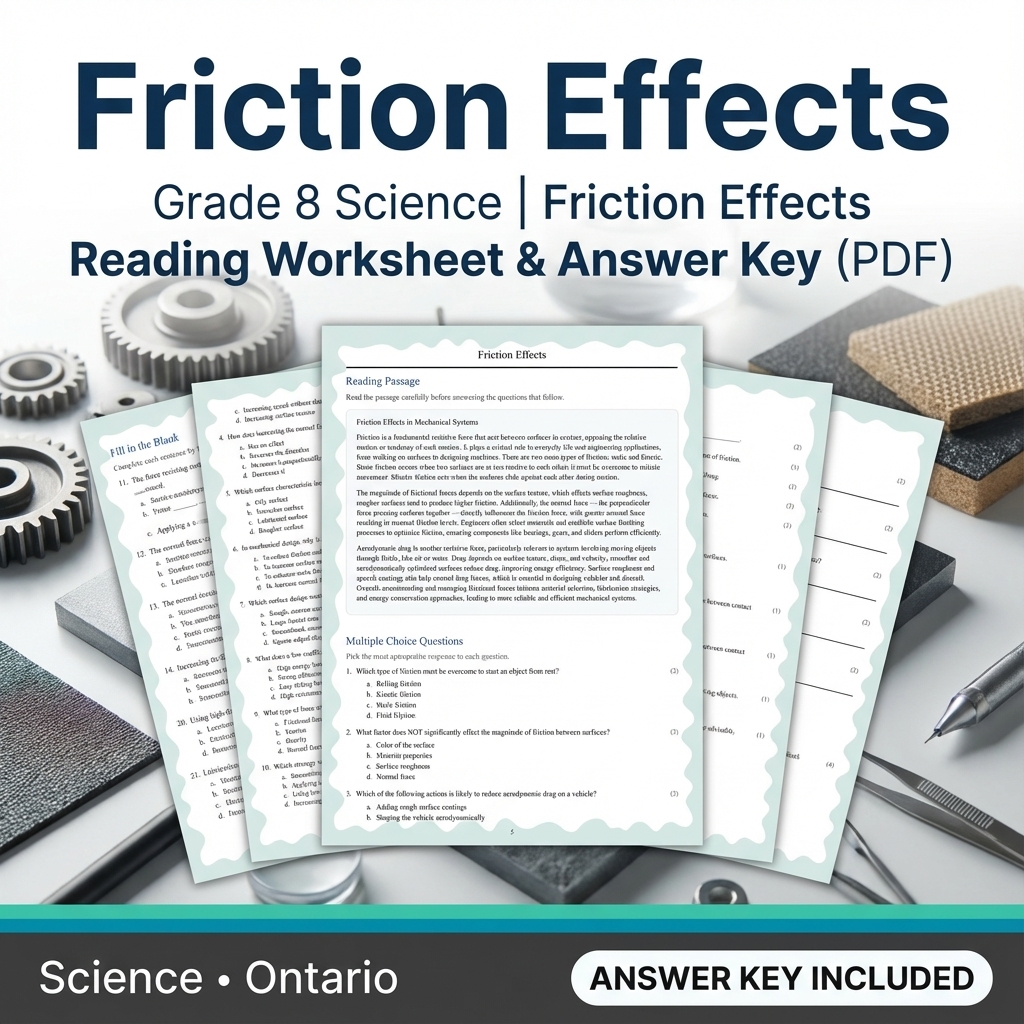
Grade 8 Science | Friction Effects Reading Worksheet & Answer Key (PDF)
JCreated byJ.S SheetsLearning Objectives
- Understand the different types of friction and how they resist motion.
- Analyze the factors affecting static and kinetic friction.
- Evaluate how surface texture, normal force, and material choices influence frictional forces.
Also included in: Grade 8 Science | Energy & Forces Unit Worksheet Pack (Answer Keys Included) +1 more
Instant download
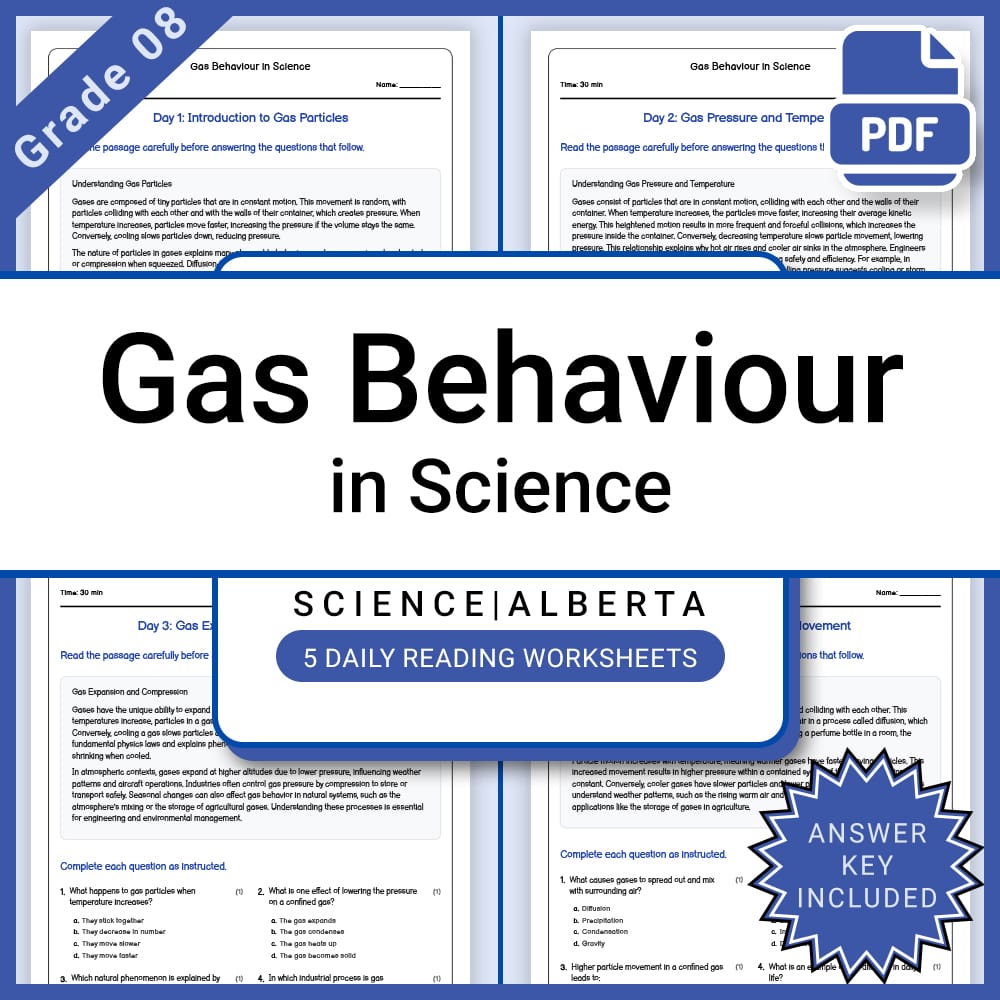
Grade 8 Science – Gas Behaviour Daily Reading Worksheet with Answer Key
JCreated byJ.S SheetsLearning Objectives
- Understand how particle motion relates to gas properties such as pressure and temperature.
- Describe how gases expand, compress, and diffuse through observable particle behavior.
- Explain the effects of temperature changes on the kinetic energy and pressure of gases in confined systems.
Also included in: Grade 8 Science Lesson Group Bundle | Alberta Framework +1 more
Instant download
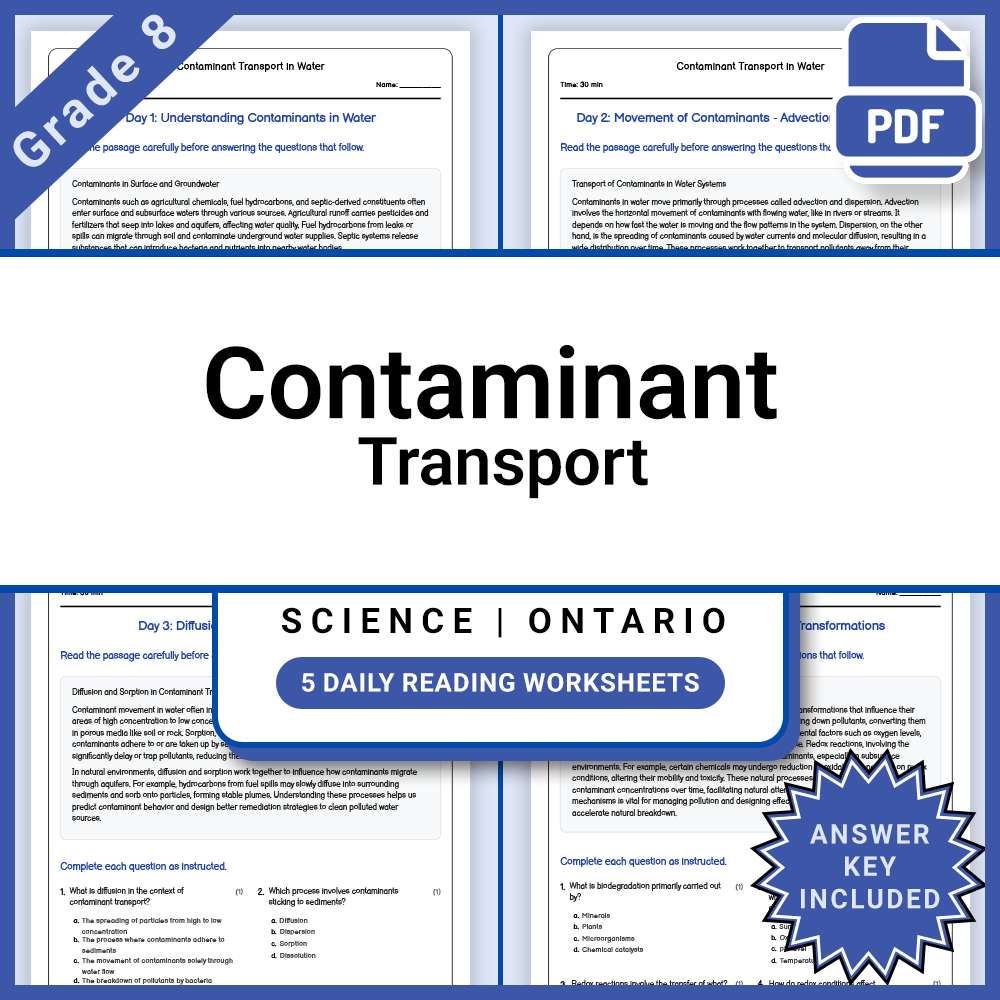
Grade 8 Science – Contaminant Transport in Water Reading Worksheet + Answer Key
JCreated byJ.S SheetsLearning Objectives
- Identify different sources of water contaminants
- Understand processes affecting contaminant movement
- Recognize the impact of contaminants on environments
Also included in: Grade 8 Science Lesson Group: Water Systems and Water Quality Framework +1 more
Instant download
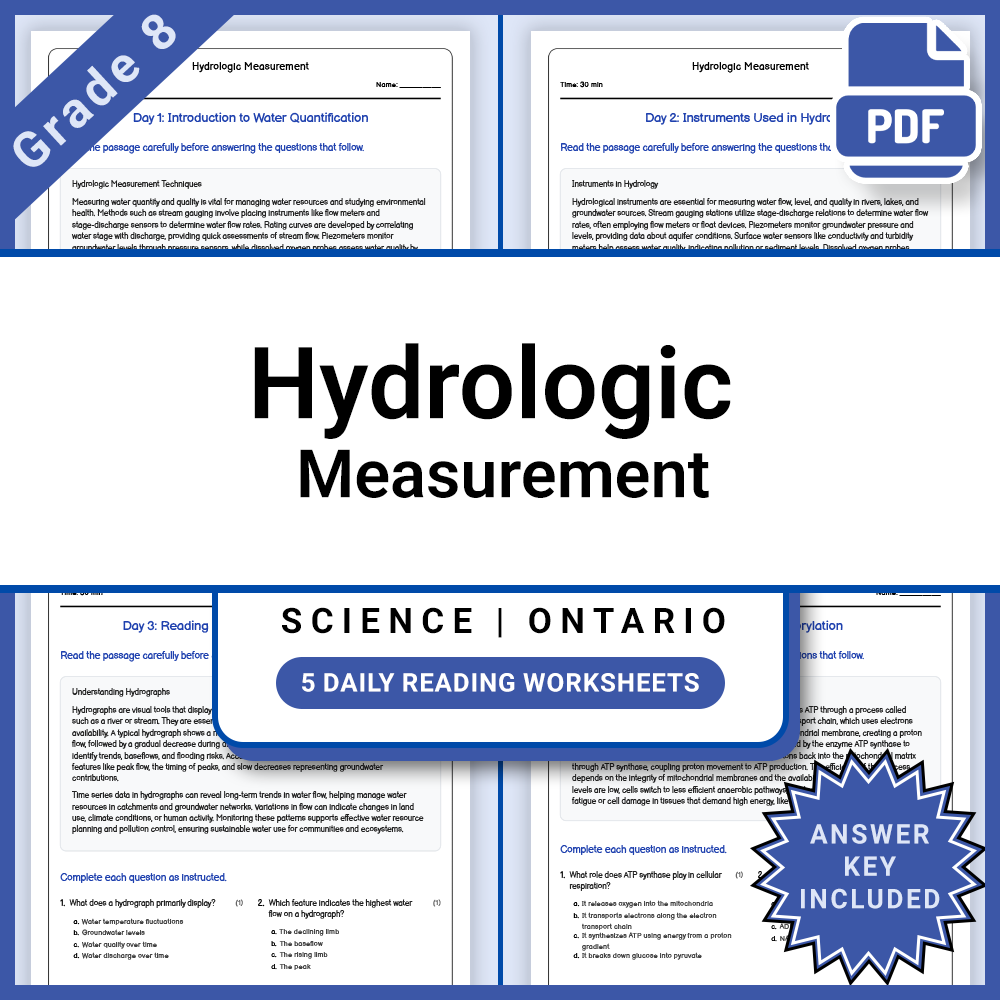
Grade 8 Science Hydrologic Measurement Daily Reading Worksheet with Answer Key
JCreated byJ.S SheetsLearning Objectives
- Understand various methods and instruments used for measuring water quantity and quality.
- Recognize the importance of precision and sampling frequency in hydrologic data collection.
- Interpret hydrographs, baseflow separation, and water quality trends from time series data.
Also included in: Grade 8 Science Lesson Group: Water Systems and Water Quality Framework +1 more
Instant download
Grade 8 Science – Energy Flow in Ecosystems Daily Reading Worksheet + Answer Key
JCreated byJ.S SheetsLearning Objectives
- Understand how plants use photosynthesis to capture sunlight and produce food.
- Identify the flow of energy through food chains and webs.
- Explain why energy dissipates at each trophic level and how this affects ecosystem populations.
Also included in: Grade 8 Science Lesson Bundle: Ecosystems, Biodiversity & Environmental Impacts +1 more
Instant download
Grade 8 Science – Material Corrosion Daily Reading Worksheet + Answer Key
JCreated byJ.S SheetsLearning Objectives
- Understand the chemical processes involved in material corrosion.
- Identify environmental factors that influence corrosion rates.
- Analyze evidence of corrosion in different materials and structures.
Also included in: Grade 8 Science Lesson Group Bundle | Alberta Framework +1 more
Instant download
Grade 8 Conservation Strategies for Freshwater | Worksheet + Answer Key
JCreated byJ.S SheetsLearning Objectives
- Understand different conservation strategies for freshwater resources.
- Analyze ways households can reduce water demand.
- Recognize the importance of community and individual actions in water conservation.
Also included in: Grade 8 Science Lesson Group: Water Systems and Water Quality Framework +1 more
Instant download

Grade 8 Science – Momentum and Collisions Daily Reading Worksheet + Answer Key
JCreated byJ.S SheetsLearning Objectives
- Define and understand the concept of linear momentum
- Explain the principle of conservation of momentum in isolated systems
- Distinguish between elastic and inelastic collisions
Also included in: Grade 8 Science Lesson Group – TEKS-Aligned Daily Reading Worksheets Bundle +1 more
Instant download
Grade 8 Science – Pulley Systems Daily Reading Worksheet + Answer Key
JCreated byJ.S SheetsLearning Objectives
- Identify and describe fixed pulley systems.
- Understand the mechanical advantage provided by fixed pulleys.
- Explain how pulleys can be used to lift objects more easily.
Also included in: Grade 8 Science Lesson Group Bundle – Mechanical Systems and Energy +1 more
Instant download
Grade 8 Science – Biomedical Flow Daily Reading Worksheet with Answer Key
JCreated byJ.S SheetsLearning Objectives
- Understand how blood flow is affected by vessel properties and pressure gradients.
- Explain non-Newtonian properties of blood and their effects on perfusion.
- Relate systolic and diastolic pressures to arterial function.
Also included in: Grade 8 Science Lesson Bundle: Fluids, Pressure, and Density Topics +1 more
Instant download
Grade 8 Science – Conservation Approaches Daily Reading Worksheet + Answer Key
JCreated byJ.S SheetsLearning Objectives
- Understand different strategies used in species and habitat conservation
- Recognize the importance of targeted protection for endangered animals
- Learn about habitat connectivity and ecological processes in conservation efforts
Also included in: Grade 8 Science Lesson Bundle: Ecosystems, Biodiversity & Environmental Impacts +1 more
Instant download
Grade 8 Science – Climate Impacts on Water Systems Daily Worksheet Answer Key
JCreated byJ.S SheetsLearning Objectives
- Understand how climate change influences precipitation patterns and snowpack.
- Analyze the effects of changing weather on water availability.
- Evaluate the broader environmental and infrastructural consequences of climate variability.
Also included in: Grade 8 Science Lesson Group: Water Systems and Water Quality Framework +1 more
Instant download
Grade 8 – Factors That Affect Reaction Rates Daily Worksheet + Answer Key
JCreated byJ.S SheetsLearning Objectives
- Identify key factors influencing the speed of chemical reactions.
- Explain how temperature, concentration, surface area, and catalysts affect reaction rates.
- Link microscopic particle interactions to macroscopic reaction speed.
Also included in: Grade 8 Science Lesson Group | Physical Changes and Chemical Reactions +1 more
Instant download
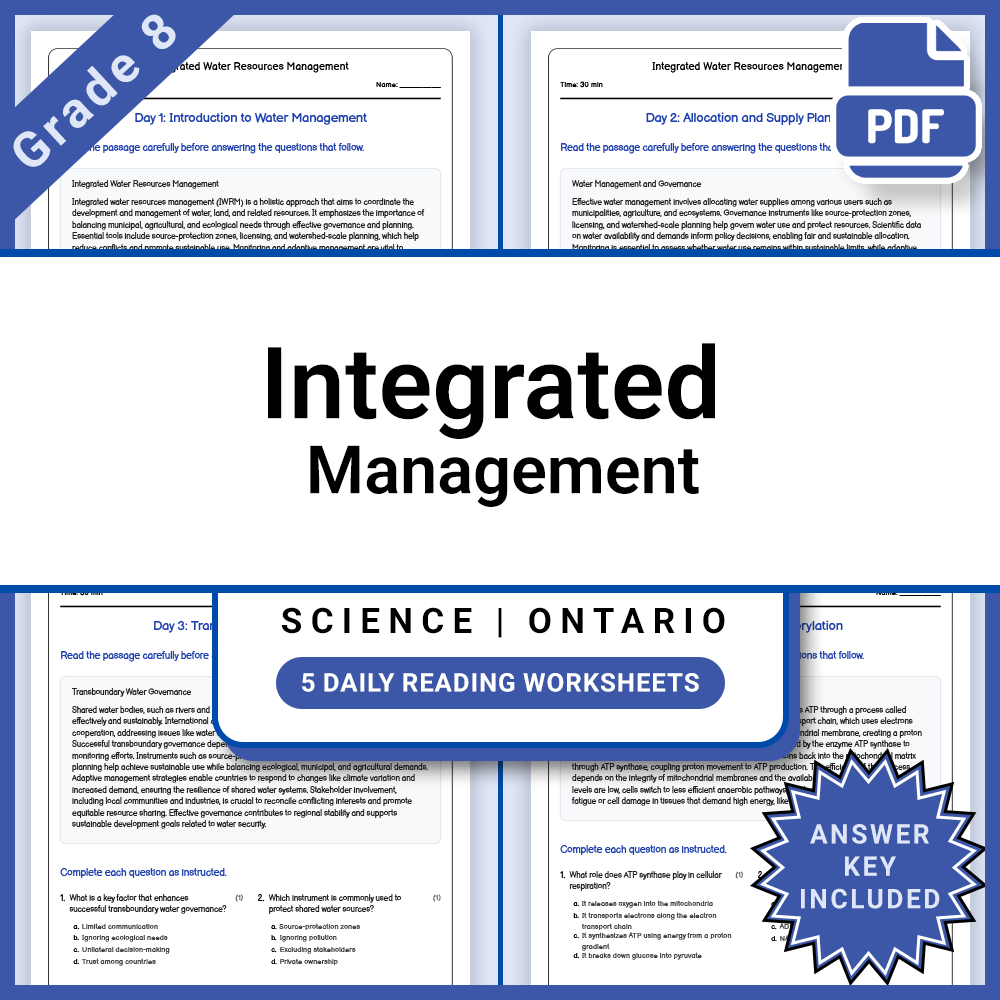
Grade 8 Science – Integrated Water Resources Management Worksheet + Answer Key
JCreated byJ.S SheetsLearning Objectives
- Understand the concepts of integrated water resources management.
- Identify key governance instruments used in water management.
- Explain how scientific understanding influences policy decisions.
Also included in: Grade 8 Science Lesson Group: Water Systems and Water Quality Framework +1 more
Instant download
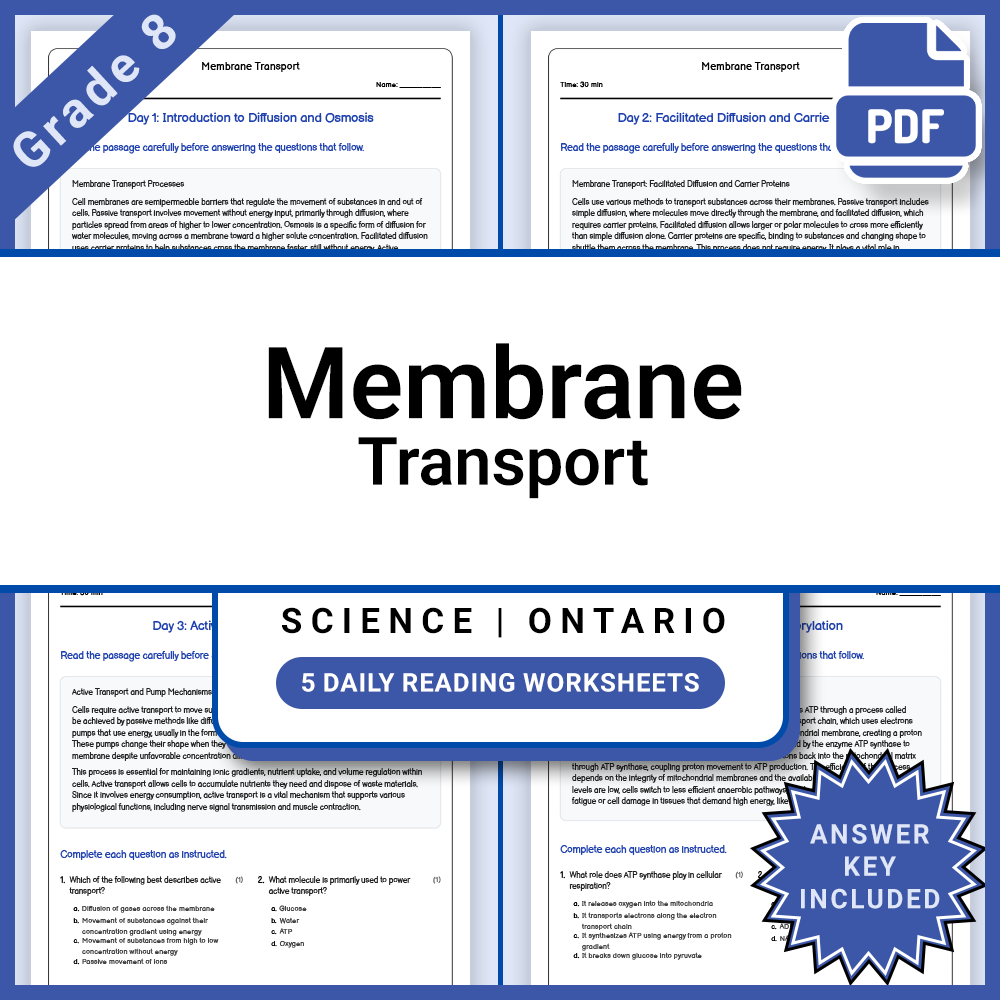
Grade 8 Science – Membrane Transport Daily Reading Worksheet + Answer Key
JCreated byJ.S SheetsLearning Objectives
- Understand the basic processes of passive transport including diffusion and osmosis
- Identify and explain the roles of facilitated diffusion and active transport
- Describe vesicular processes like endocytosis and exocytosis
Also included in: Grade 8 Science Lesson Group: Ontario Curriculum Reading Worksheets Bundle +1 more
Instant download
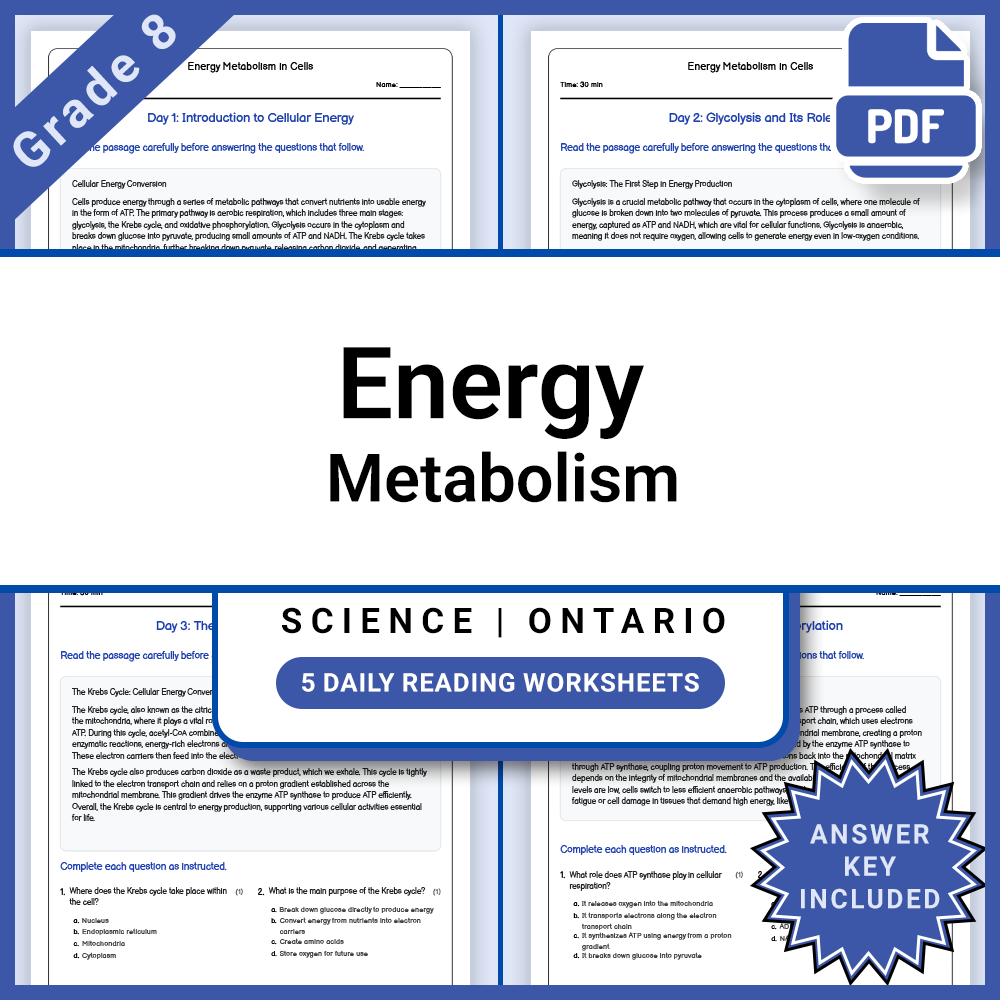
Grade 8 Science – Energy Metabolism in Cells Daily Worksheet + Answer Key
JCreated byJ.S SheetsLearning Objectives
- Identify the stages of aerobic respiration: glycolysis, Krebs cycle, and oxidative phosphorylation.
- Understand the role of mitochondria in ATP production.
- Differentiate between aerobic respiration and anaerobic fermentation.
Also included in: Grade 8 Science Lesson Group: Ontario Curriculum Reading Worksheets Bundle +1 more
Instant download
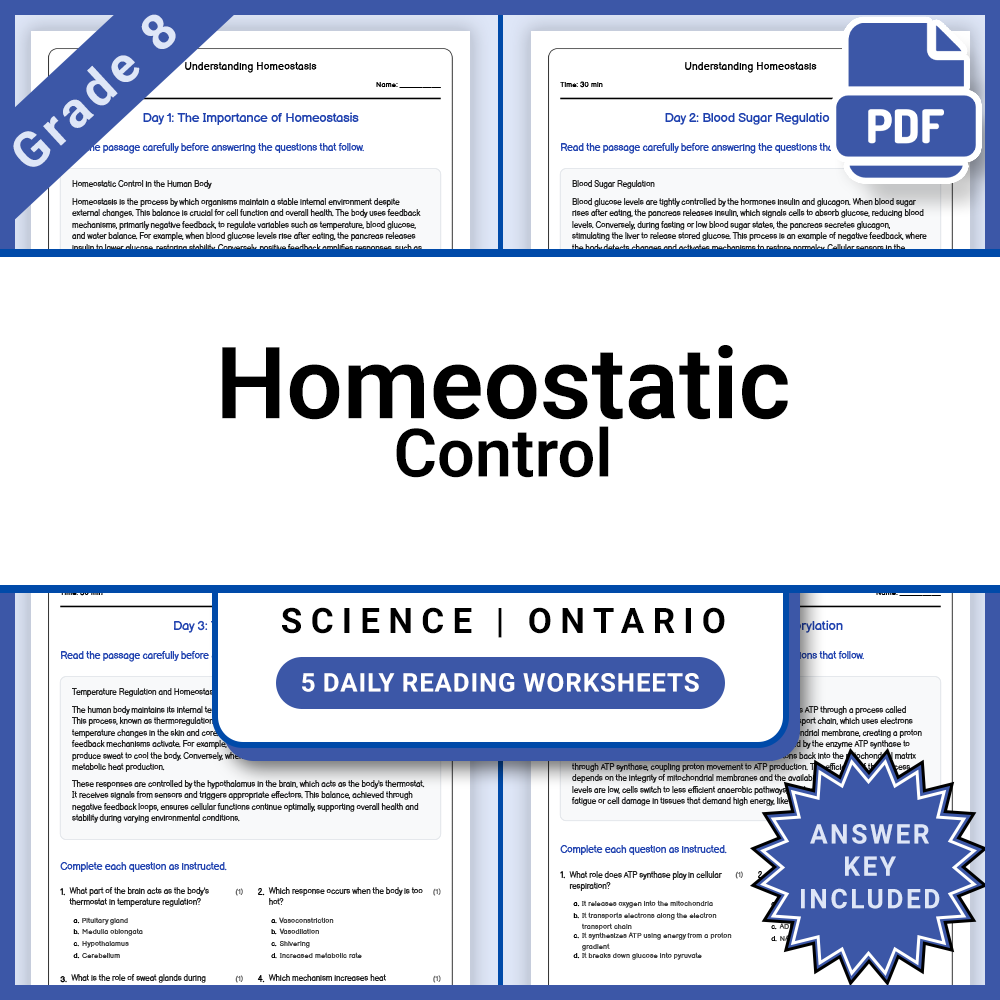
Grade 8 Science – Understanding Homeostasis Daily Reading Worksheet + Answer Key
JCreated byJ.S SheetsLearning Objectives
- Define homeostasis and explain its significance in living organisms.
- Identify key feedback mechanisms involved in maintaining internal stability.
- Describe examples of homeostatic control systems in the human body.
Also included in: Grade 8 Science Lesson Group: Ontario Curriculum Reading Worksheets Bundle +1 more
Instant download
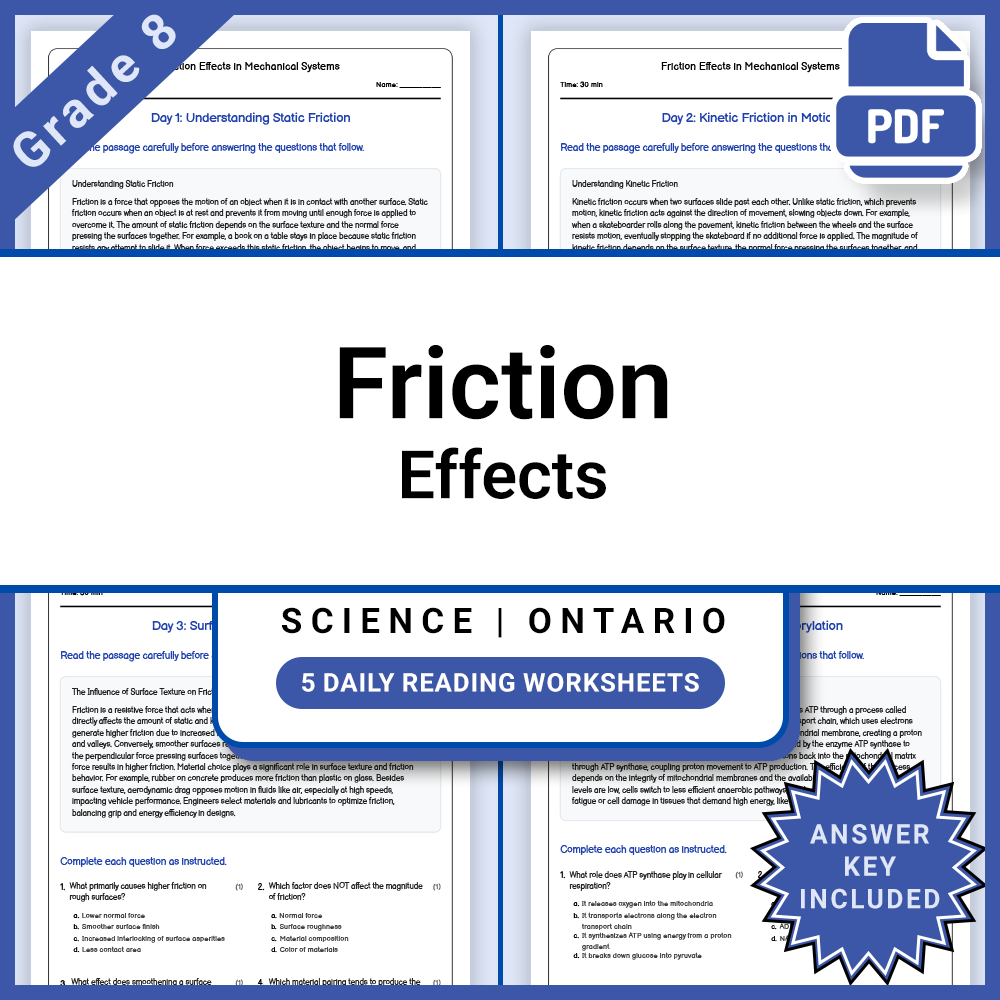
Grade 8 Science – Friction Effects in Mechanical Systems Worksheet + Answer Key
JCreated byJ.S SheetsLearning Objectives
- Understand the concept of static friction and how it resists move- ment.
- Identify the factors affecting static friction, including surface texture and normal force.
- Explain the differences between static and kinetic friction.
Also included in: Grade 8 Science Lesson Group Bundle – Mechanical Systems and Energy +1 more
Instant download
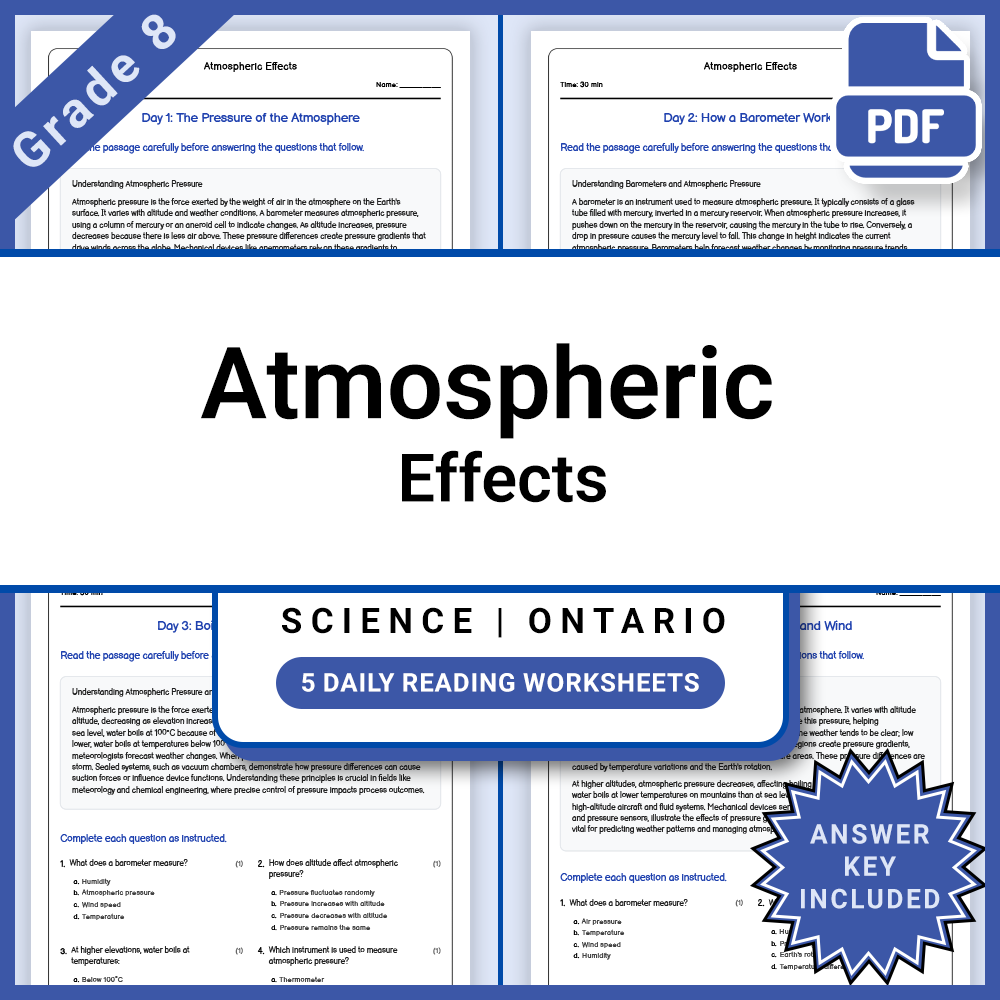
Grade 8 Science – Atmospheric Effects Daily Reading Worksheet + Answer Key
JCreated byJ.S SheetsLearning Objectives
- Understand how atmospheric pressure influences weather patterns and fluid systems.
- Describe the operation of barometers and how they measure pressure.
- Explain the relationship between altitude and atmospheric pressure.
Also included in: Grade 8 Science Lesson Bundle: Fluids, Pressure, and Density Topics +1 more
Instant download
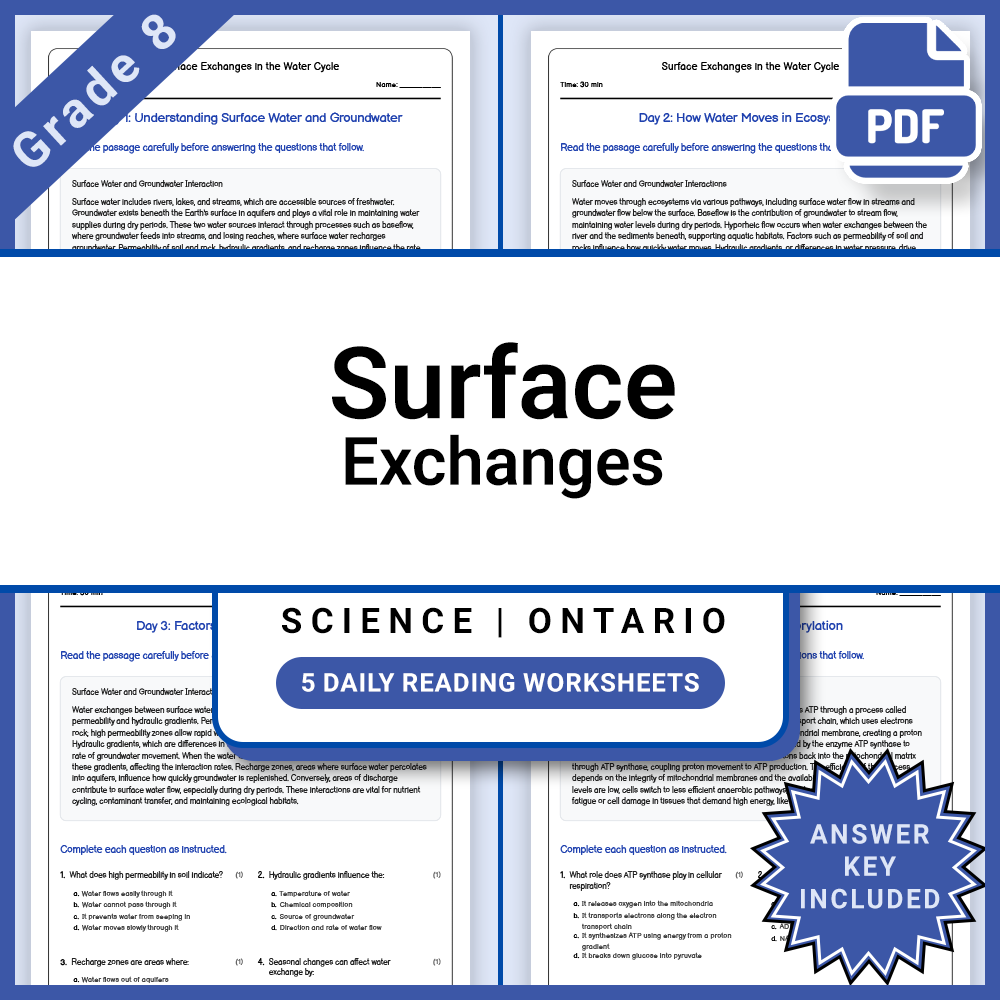
Grade 8 Science – Surface Water and Groundwater Worksheet + Answer Key
JCreated byJ.S SheetsLearning Objectives
- Understand how surface water and groundwater interact.
- Identify mechanisms that influence water exchange rates.
- Explain how seasonal changes affect surface and groundwater interactions.
Also included in: Grade 8 Science Lesson Group: Water Systems and Water Quality Framework +1 more
Instant download
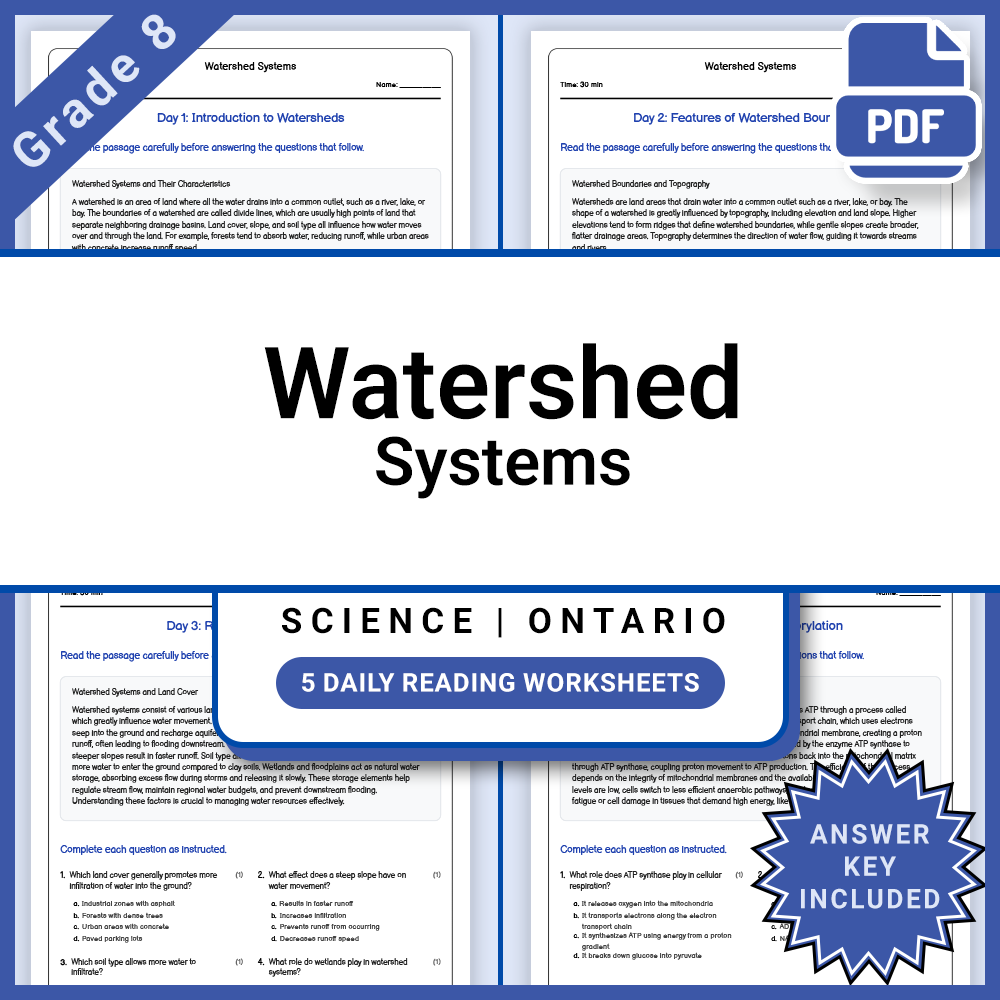
Grade 8 Science – Watershed Systems Daily Reading Worksheet + Answer Key
JCreated byJ.S SheetsLearning Objectives
- Understand the characteristics of drainage basins and watershed boundaries.
- Identify factors influencing runoff and stream network formation.
- Describe how land cover, slope, and soil type affect infiltration and overland flow.
Also included in: Grade 8 Science Lesson Group: Water Systems and Water Quality Framework +1 more
Instant download
Grade 8 Science – Understanding Water Treatment Worksheet with Answer Key
JCreated byJ.S SheetsLearning Objectives
- Learn the main stages involved in water purification and wastewater treatment.
- Understand the processes of coagulation, flocculation, sedimentation, filtration, and disinfection.
- Recognize the importance of removing pathogens, suspended solids, and dissolved contaminants.
Also included in: Grade 8 Science Lesson Group: Water Systems and Water Quality Framework +1 more
Instant download

Grade 8 Science – Biodiversity Conservation Daily Reading Worksheet + Answer Key
JCreated byJ.S SheetsLearning Objectives
- Understand the different levels of biodiversity: genetic, species, and ecosystem.
- Recognize the importance of biodiversity for ecosystem function and services.
- Identify conservation strategies and their roles in maintaining biodiversity.
Also included in: Grade 8 Science Lesson Bundle – TEKS-aligned Reading Worksheets +1 more
Instant download
Grade 8 Science – Voltage Concepts Daily Reading Practice with Answer Key
JCreated byJ.S SheetsLearning Objectives
- Understand the definition of voltage and its role in electrical circuits
- Identify different sources of voltage such as batteries and generators
- Explain how voltage influences current flow and circuit behavior
Also included in: Grade 8 Science Lesson Bundle — Electricity, Circuits & Energy +1 more
Instant download
Grade 8 Science – Predator–Prey Balance Daily Reading Worksheet + Answer Key
JCreated byJ.S SheetsLearning Objectives
- Understand predator-prey relationships in ecosystems.
- Identify the roles of predators and prey through reading comprehension.
- Analyze how predator presence or absence affects community structure.
Also included in: Grade 8 Science Lesson Bundle | Ecosystems, Energy, and Environmental Impact +1 more
Instant download
Grade 8 Science – Cell Organization Daily Reading Worksheet + Answer Key
JCreated byJ.S SheetsLearning Objectives
- Understand the hierarchical levels of cell organization: cells, tissues, organs, organ systems.
- Identify different structures within a cell and their functions.
- Describe how similar cells form tissues with shared roles.
Also included in: Grade 8 Science Lesson Group BC Framework | Daily Reading Worksheets +1 more
Instant download
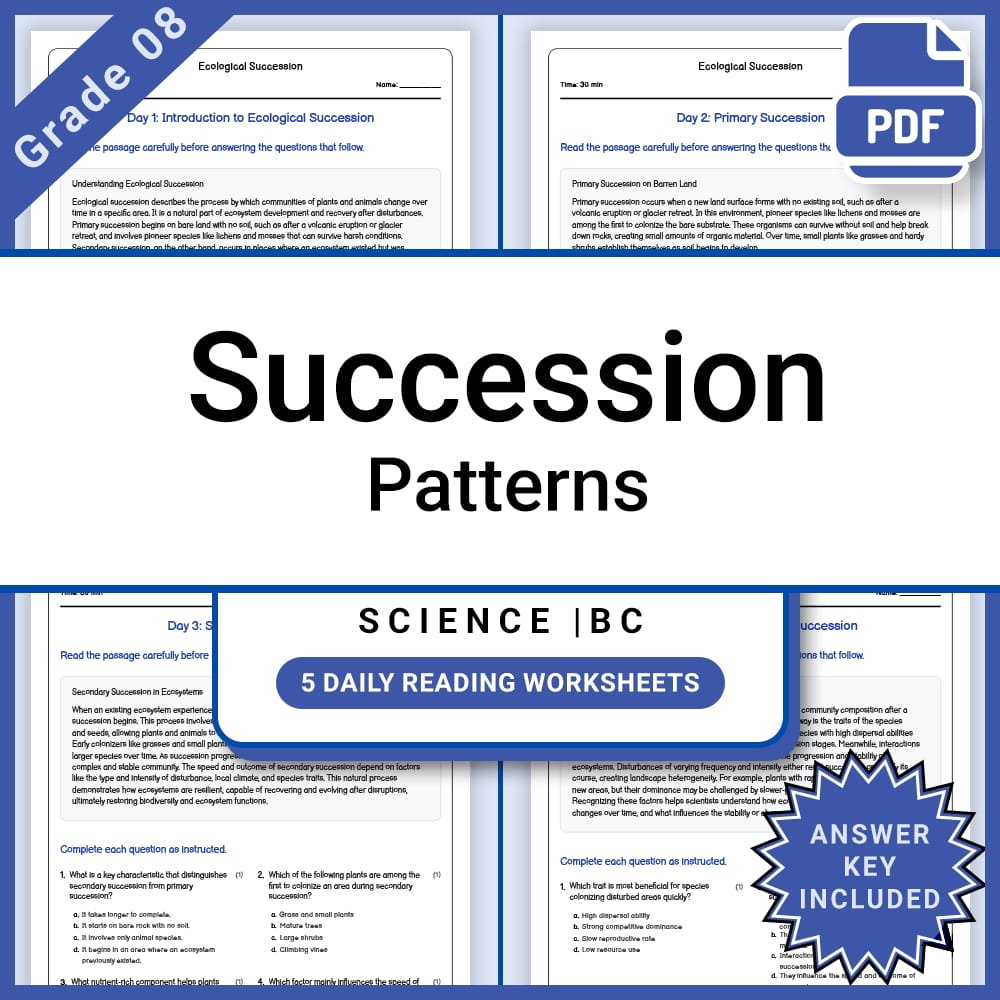
Grade 8 Science – Ecological Succession Daily Reading Worksheet + Answer Key
JCreated byJ.S SheetsLearning Objectives
- Understand the basic concepts of ecological succession
- Identify pioneer species and their roles
- Differentiate between primary and secondary succession
Also included in: Grade 8 Science Lesson Bundle: Ecosystems, Biodiversity & Environmental Impacts +1 more
Instant download
About Grade 8 Science Worksheets
Explore Grade 8 Science worksheets for classwork, homework, or review. Our 5,999 printables download instantly as PDFs.
Each resource here is built by an independent educator and reviewed for quality. Worksheets print straight from PDF and suit classroom use, homework, or extra practice; most come with answer keys, and you can preview before purchasing.