
Grade 8 Science Worksheets
5,999 worksheets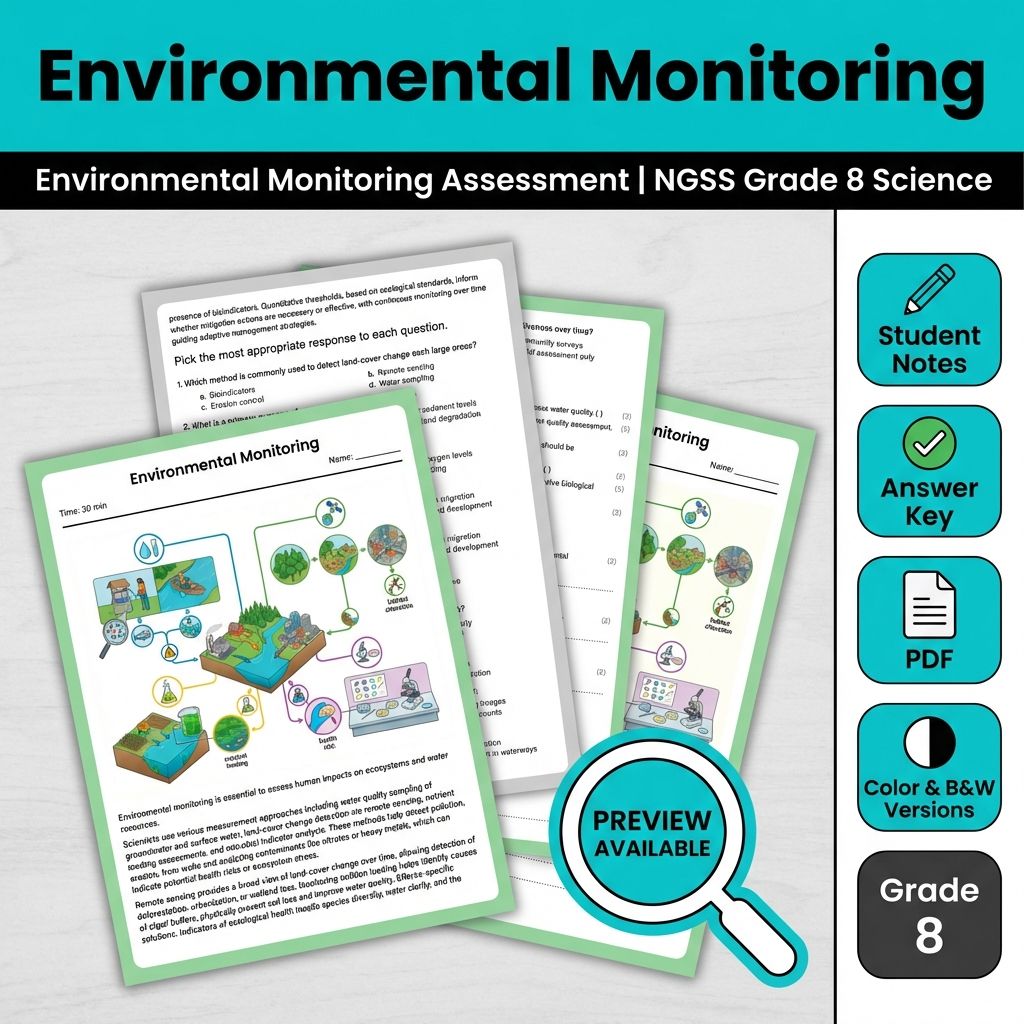
Environmental Monitoring Assessment | NGSS Grade 8 Science
 Created byPrism Point Learning
Learning Objectives
- Understand scientific principles used in monitoring ecosystems and water resources.
- Identify measurement approaches and indicators of ecological health.
- Evaluate mitigation options and intervention effectiveness over time.
Also included in: Lesson Grade 8 Science Mini Bundle – Earth & Human Activity Standards-Aligned +1 more
Instant download

Balancing Equations Assessment | BC Standards Grade 8 Science
Created byPrism Point LearningLearning Objectives
- Understand the purpose of coefficients in balanced chemical equations and their role in atom conservation.
- Identify how coefficients reflect molar proportions, not formulas, in chemical reactions.
- Interpret how balancing equations reflects the law of conservation of mass and aids in stoichiometry calculations.
Also included in: Grade 8 Science Lesson – Reaction Types & Evidence Assessment Bundle
Instant download
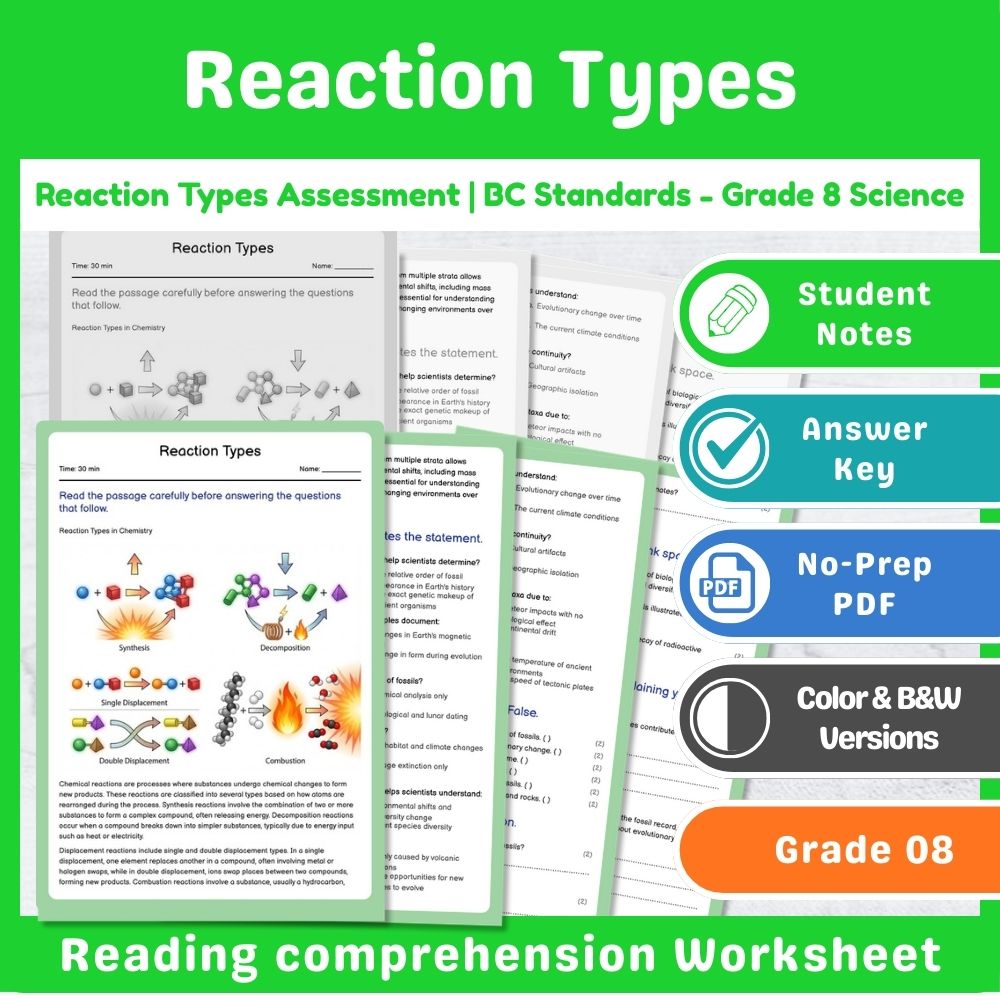
Reaction Types Assessment | BC Standards - Grade 8 Science
Created byPrism Point LearningLearning Objectives
- Identify the various types of chemical reactions and their characteristic patterns.
- Explain how atoms rearrange during synthesis, decomposition, displacement, and combustion reactions.
- Predict possible products based on reaction type.
Also included in: Grade 8 Science Lesson – Reaction Types & Evidence Assessment Bundle
Instant download
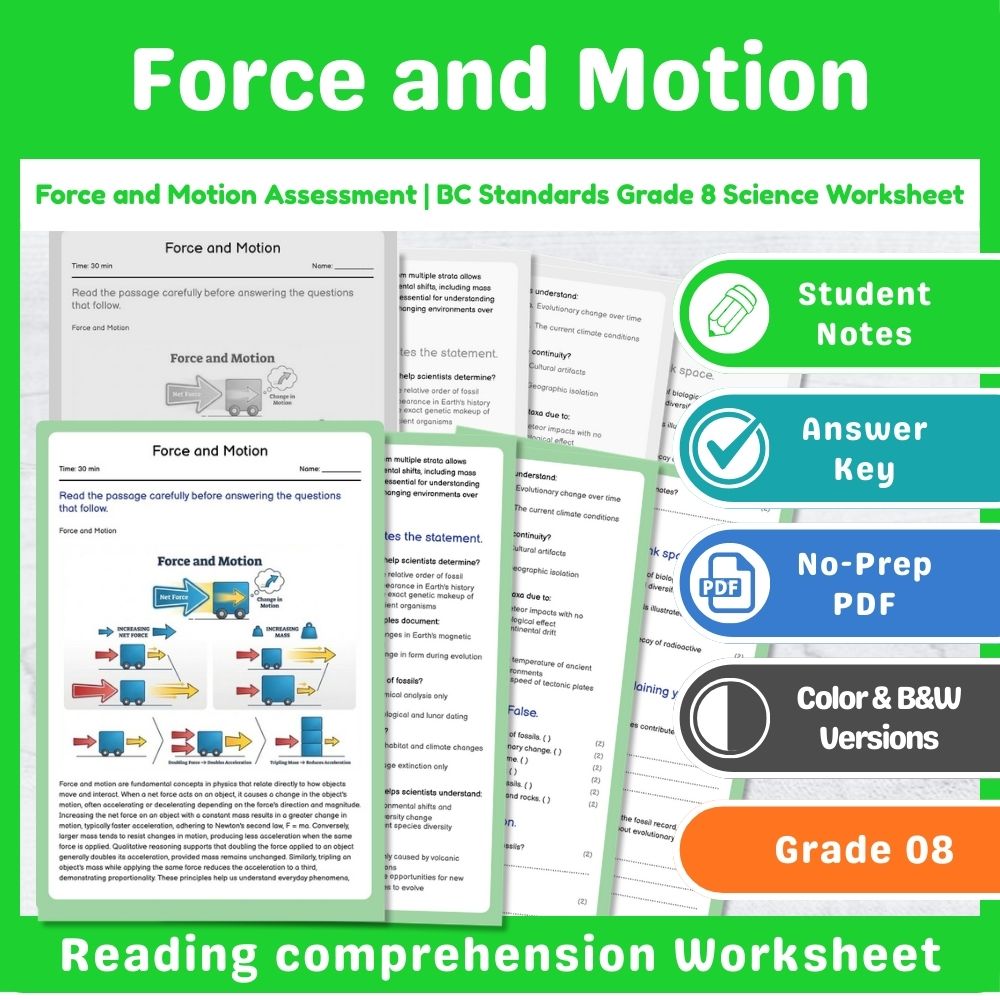
Force and Motion Assessment | BC Standards Grade 8 Science Worksheet
Created byPrism Point LearningLearning Objectives
- Understand the relationship between net force, mass, and acceleration.
- Explain qualitatively how increasing net force affects motion.
- Describe the effect of increased mass on acceleration under the same force.
Instant download

Population Growth Assessment for Grade 8 Science – BC Standards
Created byPrism Point LearningLearning Objectives
- Understand the key factors influencing population change, including birth rates, death rates, immigration, and emigration.
- Identify patterns of population increase, stability, or decline based on various biological and environmental factors.
- Analyze how reproductive strategies, resource availability, and environmental pressures affect population dynamics.
Instant download

Particles Meet Energy Assessment | General Grade 8 Science
Created byPrism Point LearningLearning Objectives
- Explain how particle interactions relate to energy changes during reactions.
- Identify observable changes indicating particle rearrangements and energy shifts.
- Connect temperature changes to energy transfer in chemical reactions.
Also included in: Grade 8 Physical Science Science Lesson Bundle – General Framework
Instant download
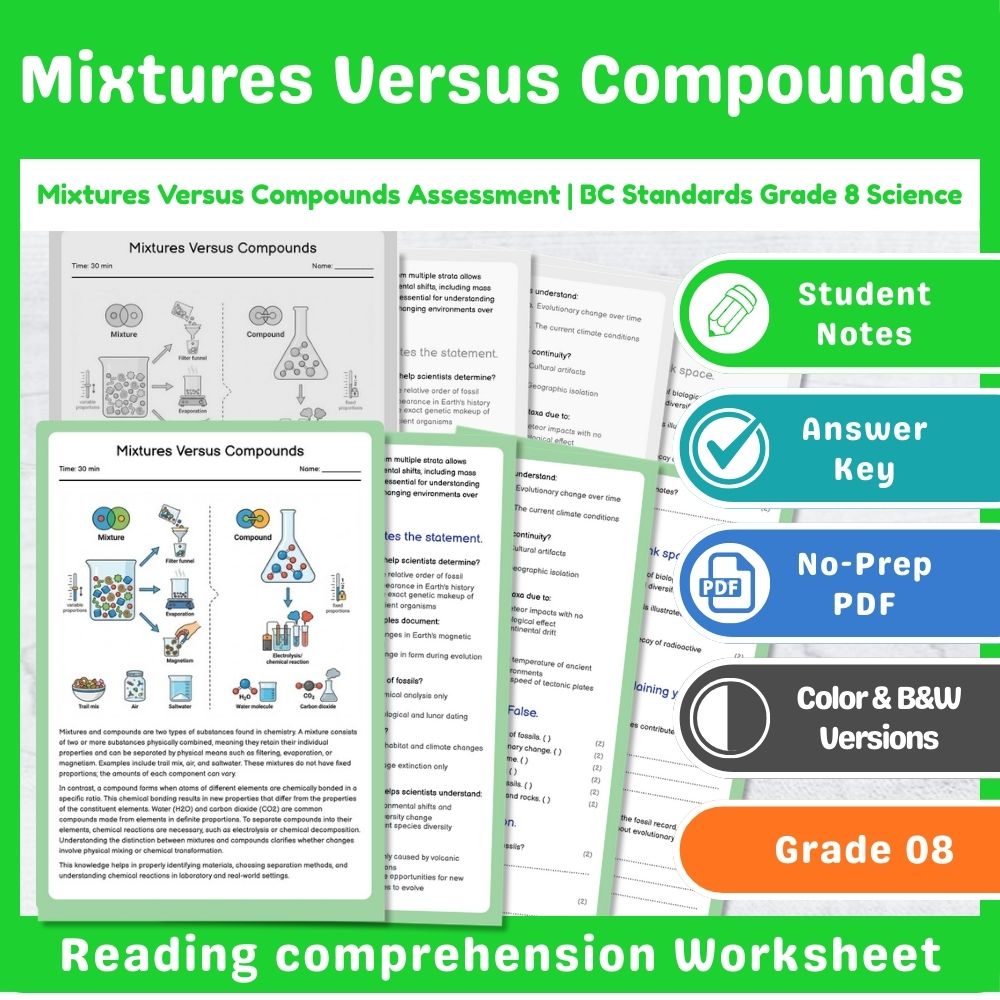
Mixtures Versus Compounds Assessment | BC Standards Grade 8 Science
Created byPrism Point LearningLearning Objectives
- Understand the differences between mixtures and compounds.
- Identify examples of mixtures and compounds in everyday life.
- Explain how mixtures can be separated physically and compounds require chemical change.
Also included in: Grade 8 Science Lesson – Reaction Types & Evidence Assessment Bundle
Instant download
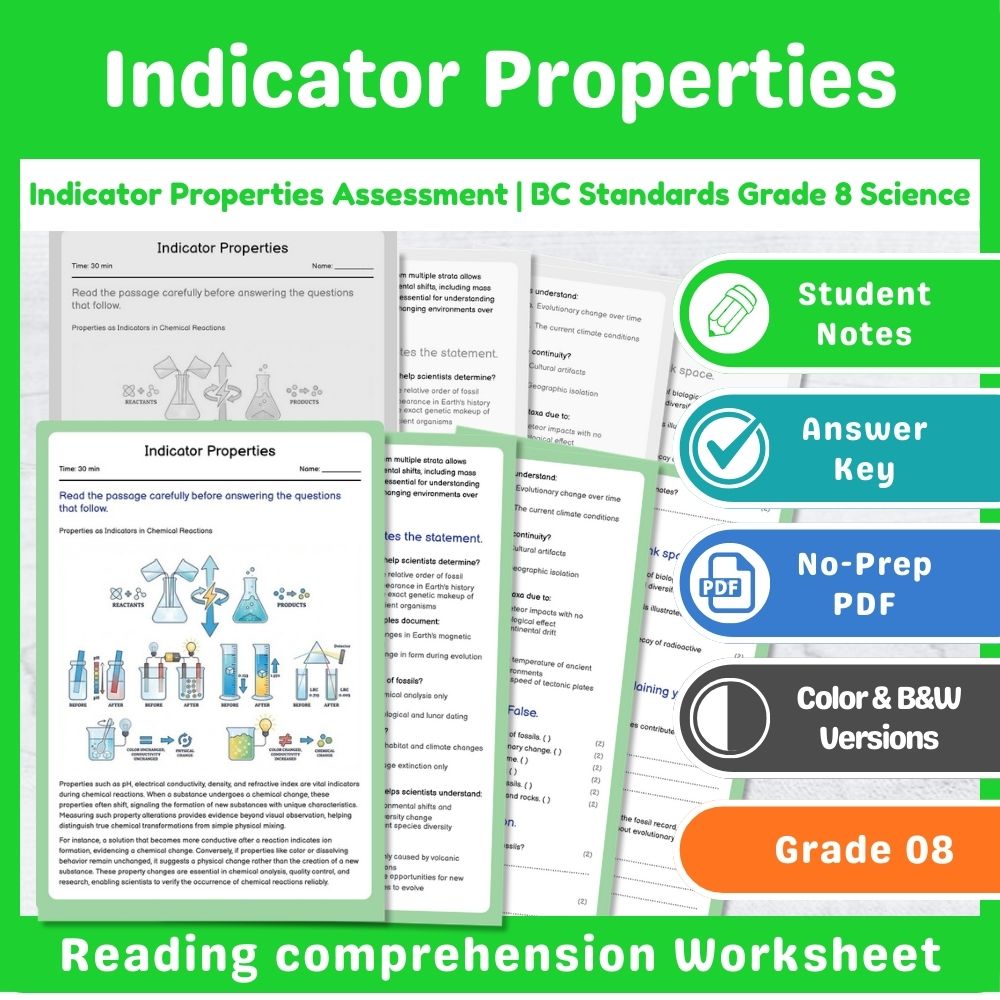
Indicator Properties Assessment | BC Standards Grade 8 Science
Created byPrism Point LearningLearning Objectives
- Understand how properties such as pH, conductivity, density, and refractive index change during chemical reactions.
- Identify property shifts indicating formation of new substances with distinct traits.
- Differentiate between physical and chemical changes using property measurements.
Also included in: Grade 8 Science Lesson – Reaction Types & Evidence Assessment Bundle
Instant download

Factors Influencing Reaction Rate Assessment for Grade 8 Science – BC
Created byPrism Point LearningLearning Objectives
- Identify key factors that affect the rate of chemical reactions.
- Explain how temperature, concentration, surface area, and catalysts influence particle collisions.
- Relate microscopic collision dynamics to macroscopic reaction speed.
Also included in: Grade 8 Science Lesson – Reaction Types & Evidence Assessment Bundle
Instant download

Net Force Acceleration Assessment | NGSSS Standards Grade 8 Science
Created byPrism Point LearningLearning Objectives
- Define net force and determine its direction when forces act in opposite directions
- Explain how a nonzero net force causes changes in velocity (speed and/or direction)
- Use force values to predict acceleration for a cart moving on a track
Instant download
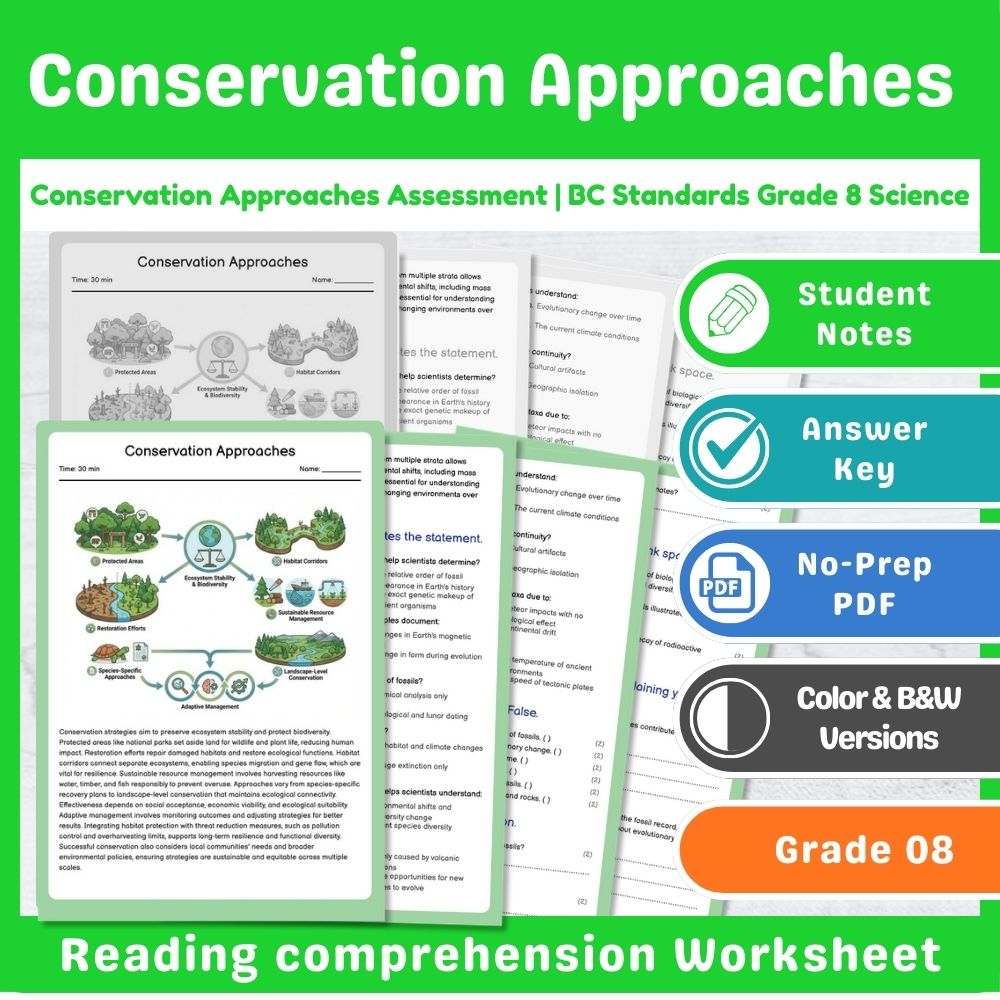
Conservation Approaches Assessment | BC Standards Grade 8 Science
Created byPrism Point LearningLearning Objectives
- Understand various conservation strategies such as protected areas, habitat corridors, and sustainable resource management.
- Identify factors that influence the effectiveness of conservation efforts.
- Explain the role of social, economic, and ecological contexts in conservation planning.
Instant download
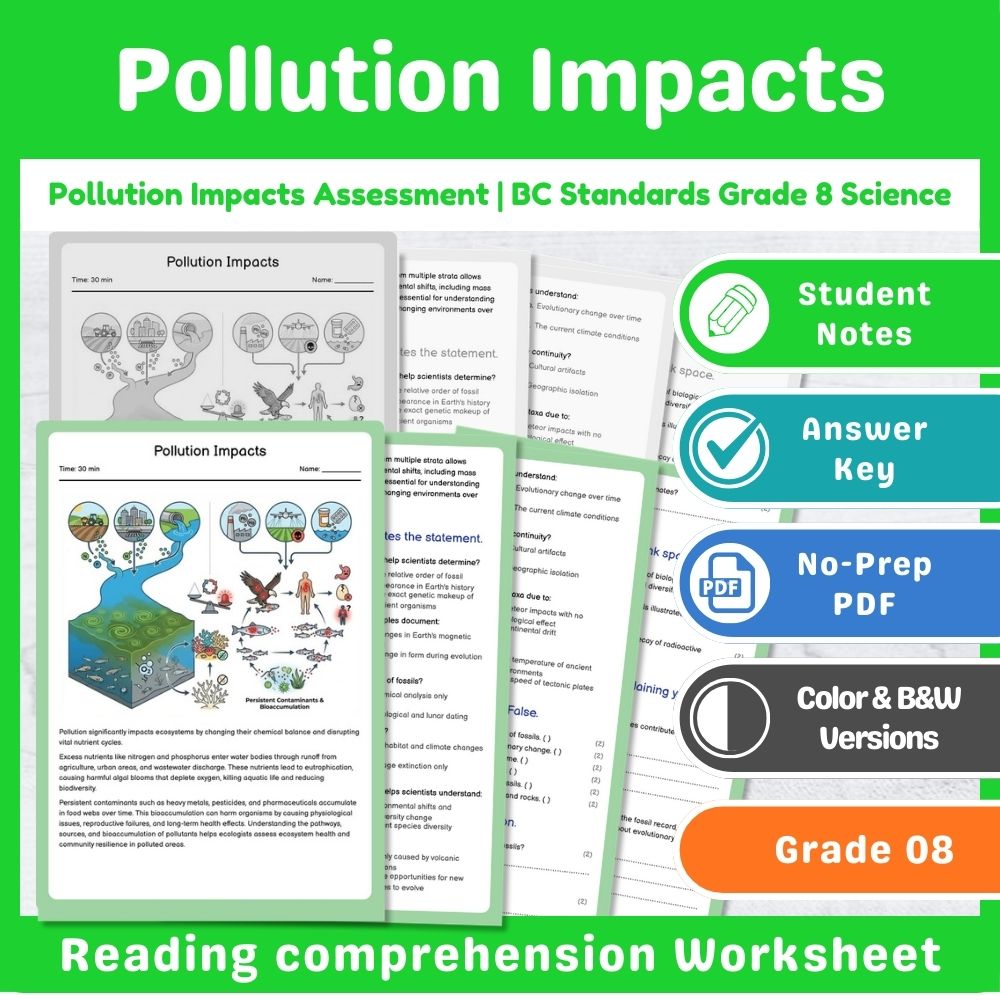
Pollution Impacts Assessment | BC Standards Grade 8 Science
Created byPrism Point LearningLearning Objectives
- Understand how pollution alters ecosystem chemistry and nutrient cycles.
- Identify the effects of excess nutrients and persistent contaminants on water, soil, and organisms.
- Explain the processes of eutrophication, bioaccumulation, and ecological resilience in polluted environments.
Instant download
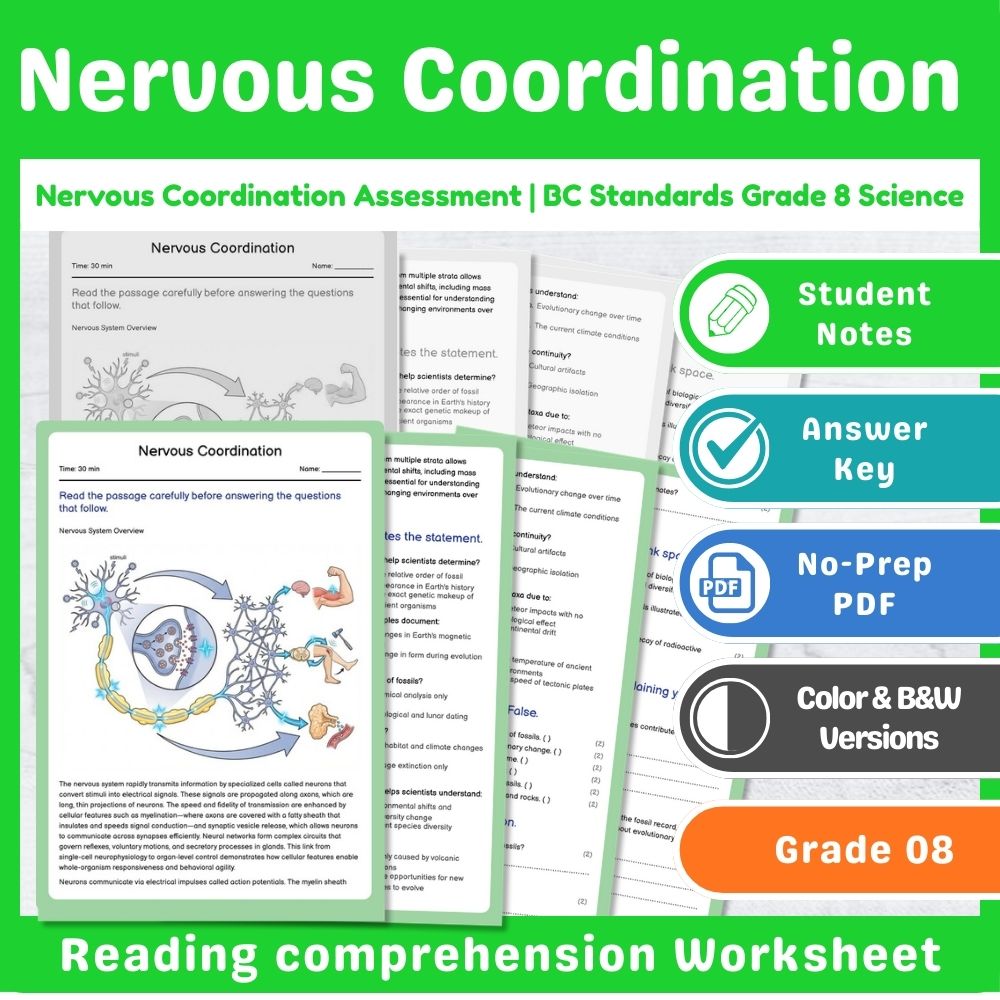
Nervous Coordination Assessment | BC Standards Grade 8 Science
Created byPrism Point LearningLearning Objectives
- Understand how neurons transmit electrical signals for nervous communication.
- Identify cellular features that enhance the speed and fidelity of nerve signaling.
- Explain the neural circuits involved in reflexes, voluntary movements, and gland secretion.
Instant download

Ecosystem Matter Cycling Assessment | Standards-Aligned Grade 8 Science
Created byPrism Point LearningLearning Objectives
- Understand how matter cycles through ecosystems involving living and nonliving components.
- Identify processes such as decomposition, gas exchange, and nutrient transformation that return elements to the environment.
- Explain how producers and consumers transfer matter within ecosystems over time.
Also included in: Grade 8 Life Science Science Lesson Bundle – General Framework Resources
Instant download
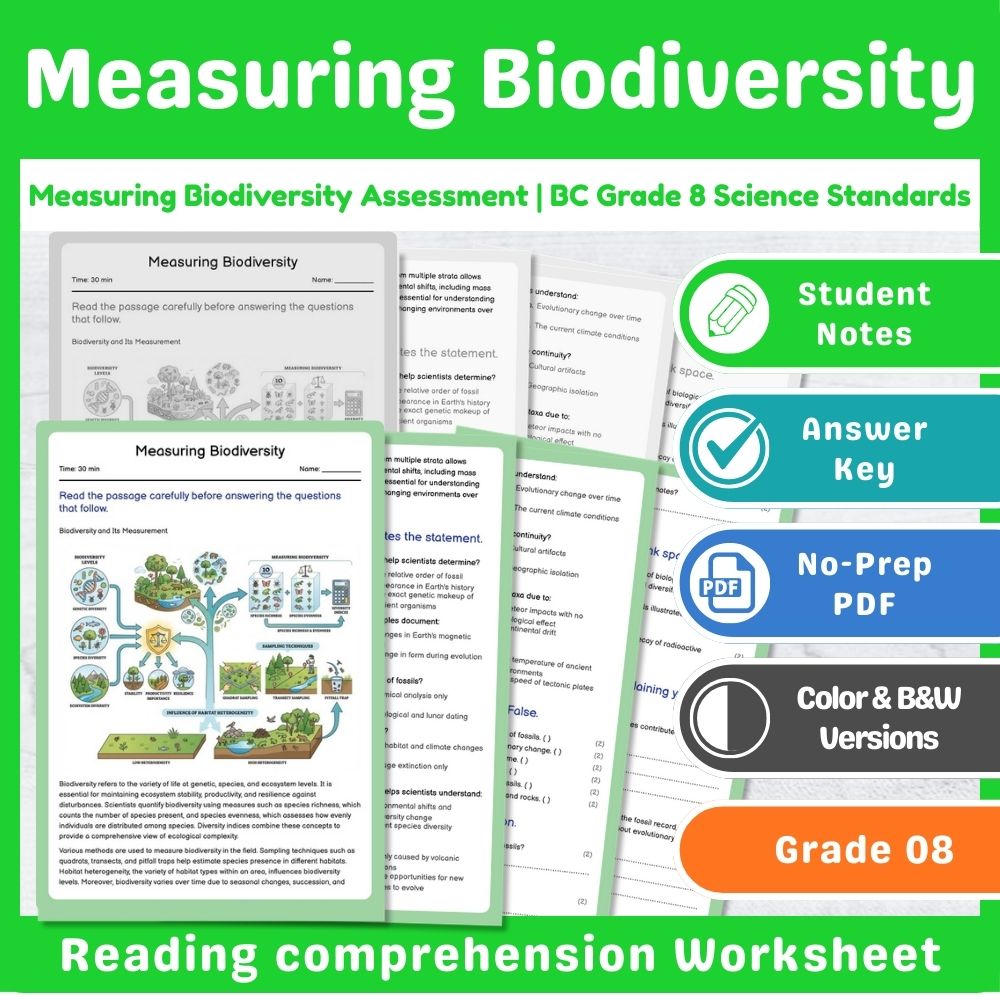
Measuring Biodiversity Assessment | BC Grade 8 Science Standards
Created byPrism Point LearningLearning Objectives
- Understand the concepts of biodiversity, species richness, evenness, and diversity indices.
- Identify methods used to measure biodiversity in different ecosystems.
- Analyze how sampling techniques, habitat heterogeneity, and temporal variation influence biodiversity measurements.
Instant download

Producers & Energy Assessment | Alberta Standards Grade 8 Science
Created byPrism Point LearningLearning Objectives
- Explain the role of primary producers in ecological energy pathways.
- Compare photosynthetic efficiency among grasses, shrubs, and boreal trees in Alberta.
- Identify factors influencing primary productivity such as soil nutrients and light.
Also included in: Grade 8 Science Mini Bundle | Interactions and Ecosystems Curriculum
Instant download
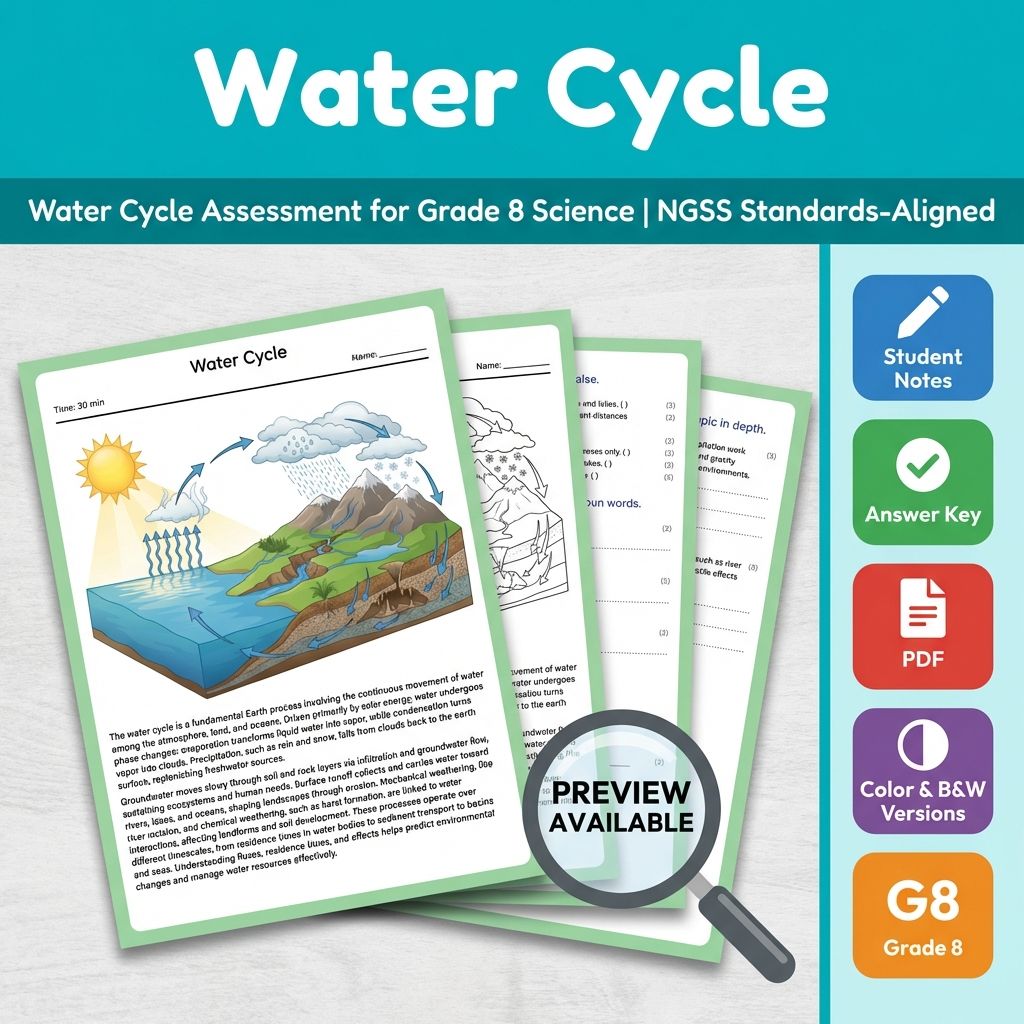
Water Cycle Assessment for Grade 8 Science | NGSS Standards-Aligned
Created byPrism Point LearningLearning Objectives
- Describe the processes involved in the global and local water cycle, including phase changes, evaporation, condensation, and precipitation.
- Explain the roles of sunlight and gravity in driving hydrologic processes such as infiltration, runoff, and groundwater flow.
- Connect processes of the water cycle to mechanical and chemical weathering phenomena like river incision, karst formation, and coastal erosion.
Also included in: Grade 8 Science Mini Bundle – Earth's Systems & NGSS Standards-Aligned +1 more
Instant download
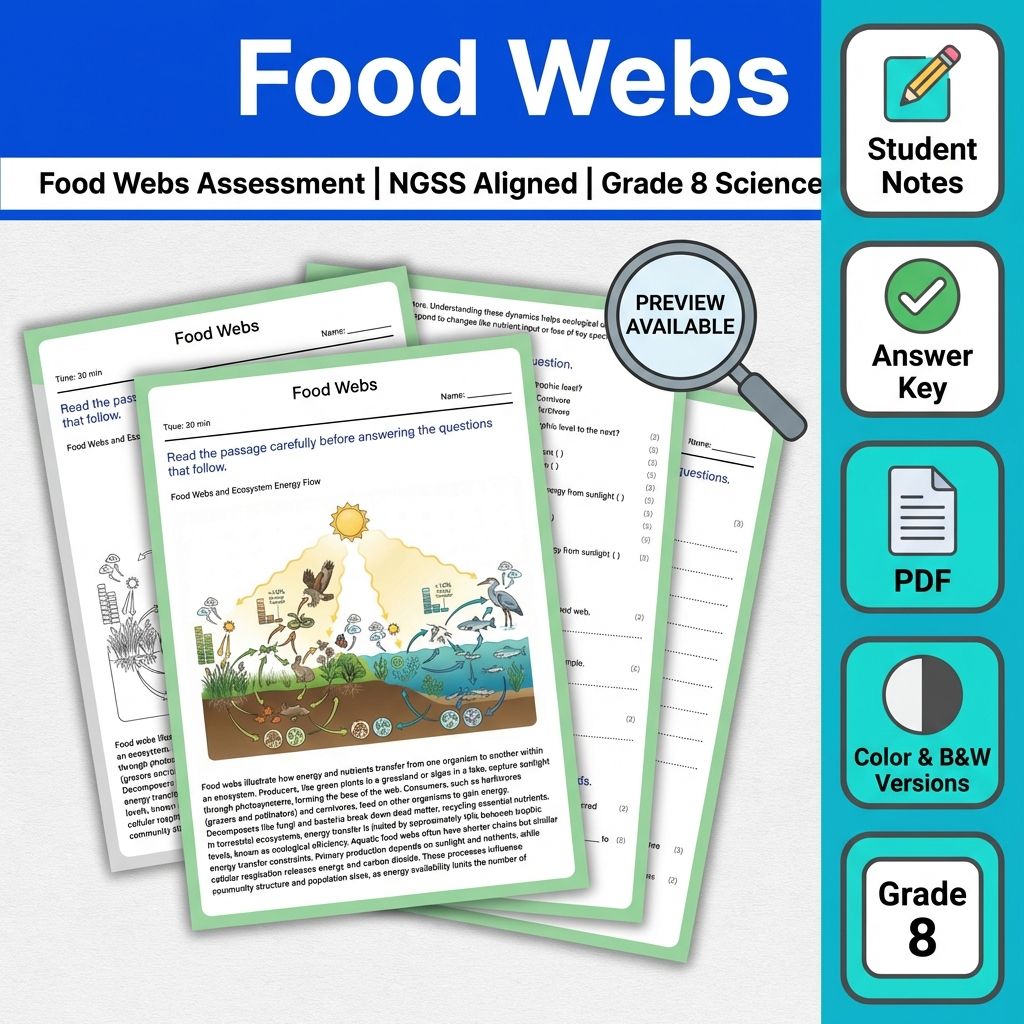
Food Webs Assessment | NGSS Aligned | Grade 8 Science Worksheet
Created byPrism Point LearningLearning Objectives
- Understand the components of food webs including producers, consumers, and decomposers.
- Explain the flow of energy through different trophic levels in terrestrial and aquatic ecosystems.
- Analyze how energy loss affects population sizes and community structure.
Also included in: Grade 8 Science Mini Bundle | Ecosystems: Interactions, Energy, and Dynamics – NGSS +1 more
Instant download
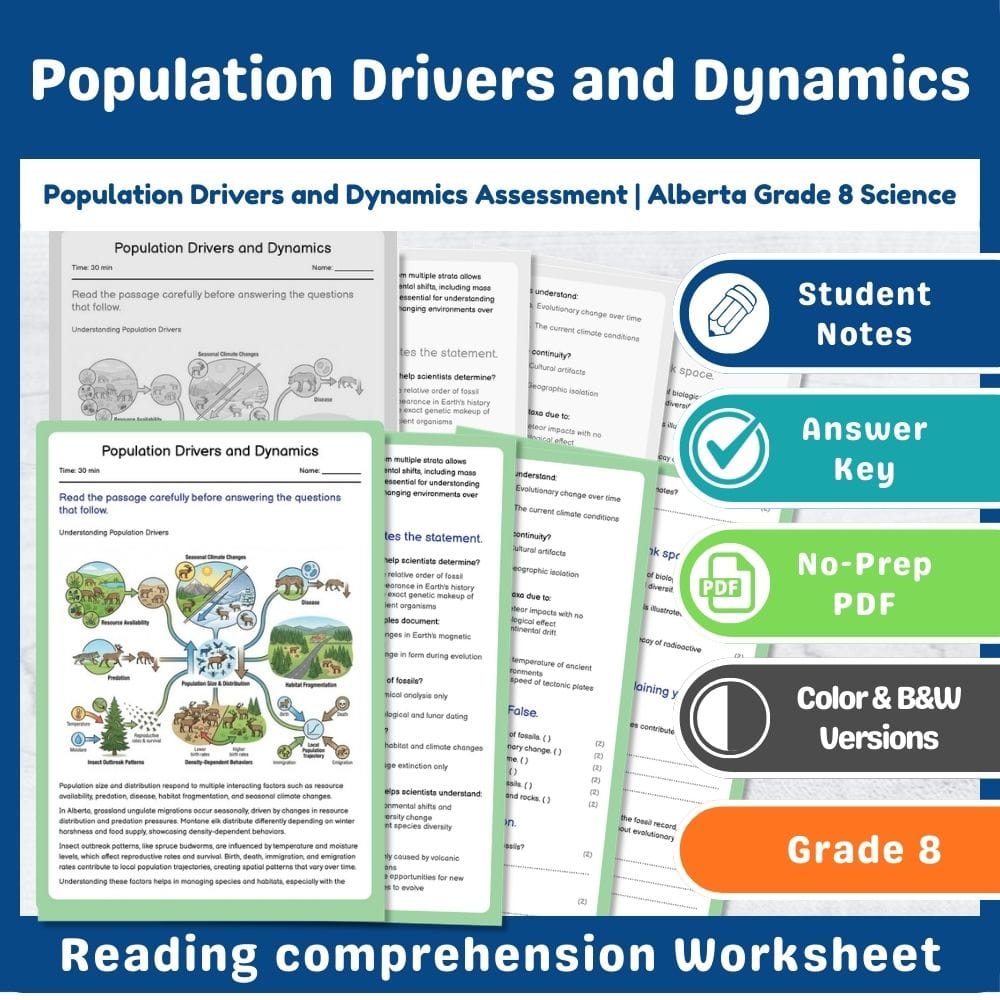
Population Drivers and Dynamics Assessment | Alberta Grade 8 Science
Created byPrism Point LearningLearning Objectives
- Understand the factors influencing population size and distribution in different environments.
- Recognize how abiotic and biotic factors interact to influence population changes.
- Analyze examples of population responses in Alberta ecosystems such as migrations and outbreaks.
Also included in: Grade 8 Science Mini Bundle | Interactions and Ecosystems Curriculum
Instant download
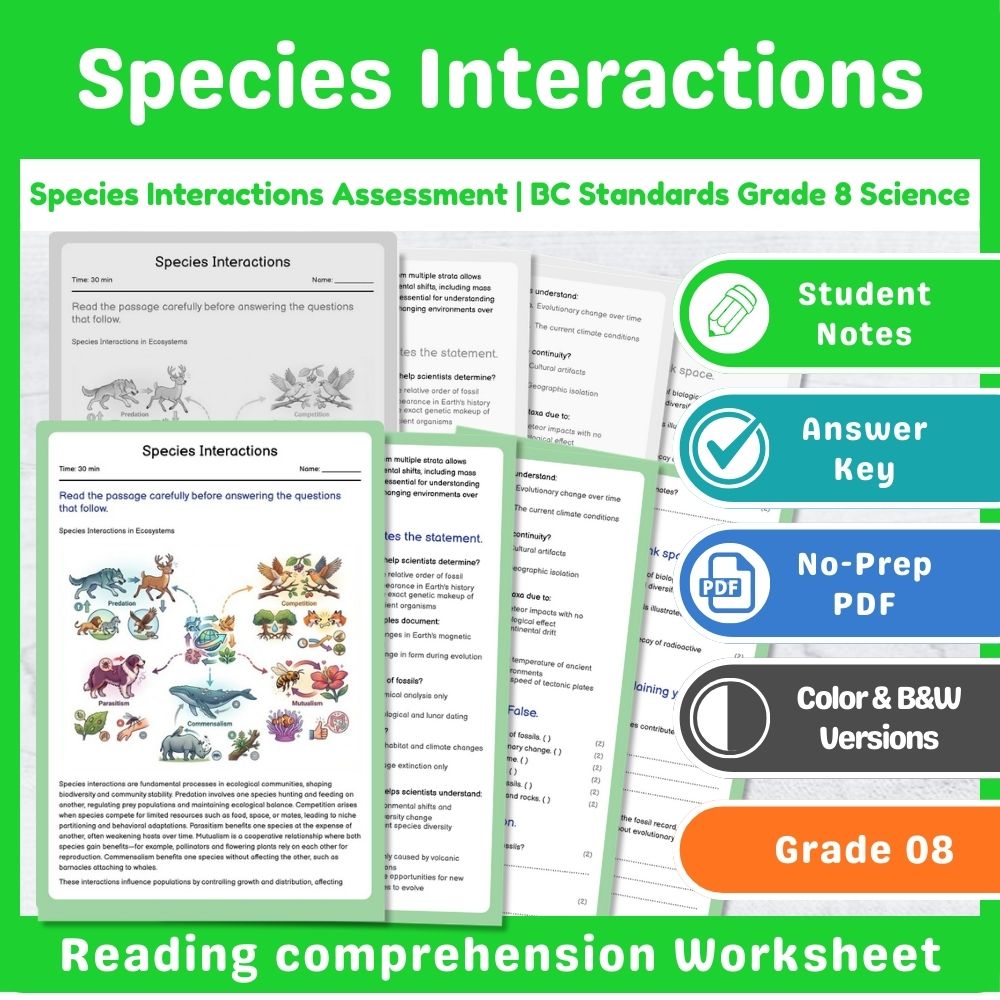
Species Interactions Assessment | BC Standards Grade 8 Science
Created byPrism Point LearningLearning Objectives
- Describe different types of species interactions such as predation, competition, parasitism, mutualism, and commensalism.
- Explain how species interactions influence population dynamics and community structure.
- Analyze the role of predation and mutualism in ecosystem regulation and species survival.
Instant download
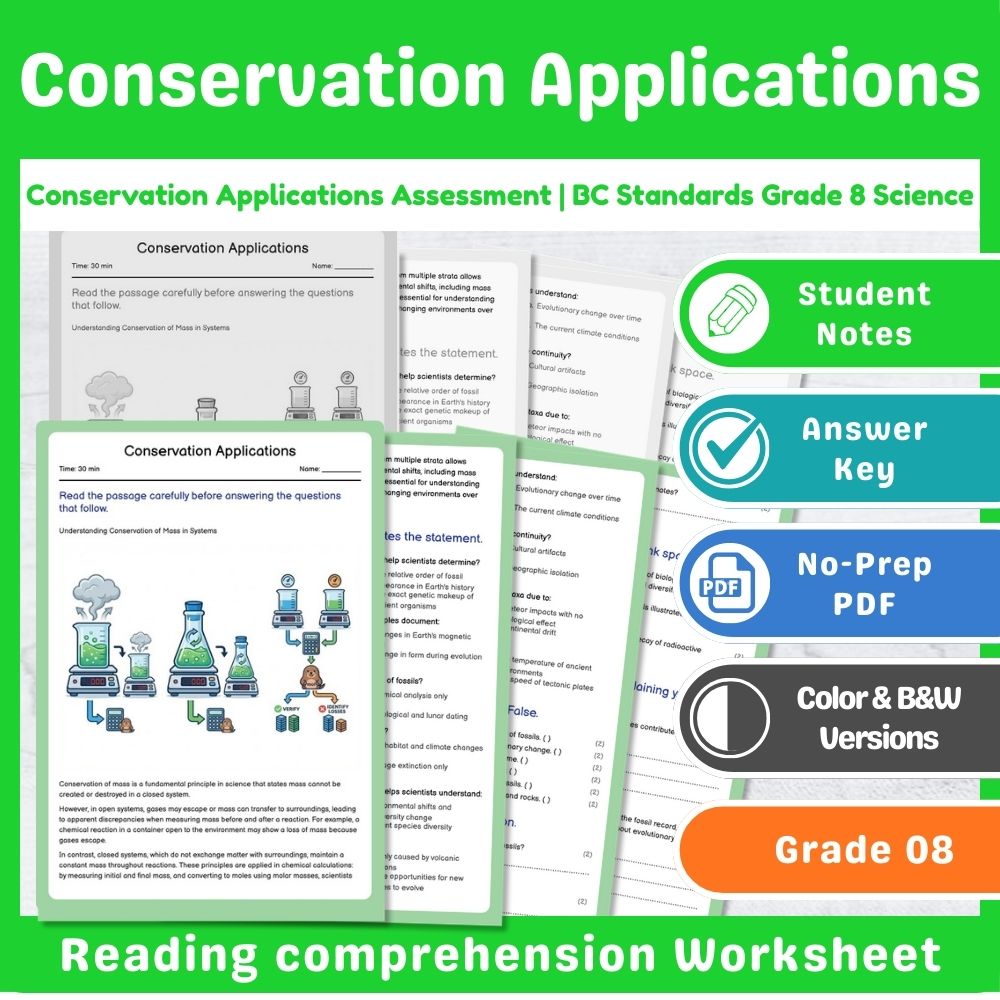
Conservation Principle Assessment | BC Standards Grade 8 Science
Created byPrism Point LearningLearning Objectives
- Understand the law of conservation of mass and its implications in chemical reactions.
- Explain how balanced chemical equations reflect mass conservation.
- Link mass measurements with mole concepts for predicting reaction outcomes.
Also included in: Grade 8 Science Lesson – Reaction Types & Evidence Assessment Bundle
Instant download

Organ Systems Assessment | BC Standards Grade 8 Science
Created byPrism Point LearningLearning Objectives
- Describe the structure and function of major human organ systems.
- Explain how organs coordinate within systems to maintain internal stability.
- Identify key features that enable cellular specialization to support organ functions.
Instant download

Newtonian Laws Assessment Worksheet for Grade 8 Science TEKS Standards
Created byPrism Point LearningLearning Objectives
- Understand the three fundamental principles of Newton's laws of motion.
- Analyze how forces affect the motion of objects in various contexts.
- Apply proportional reasoning to relate force, mass, and acceleration.
Also included in: Grade 8 Force, Motion, and Energy Science Lesson Bundle TEKS Standards
Instant download
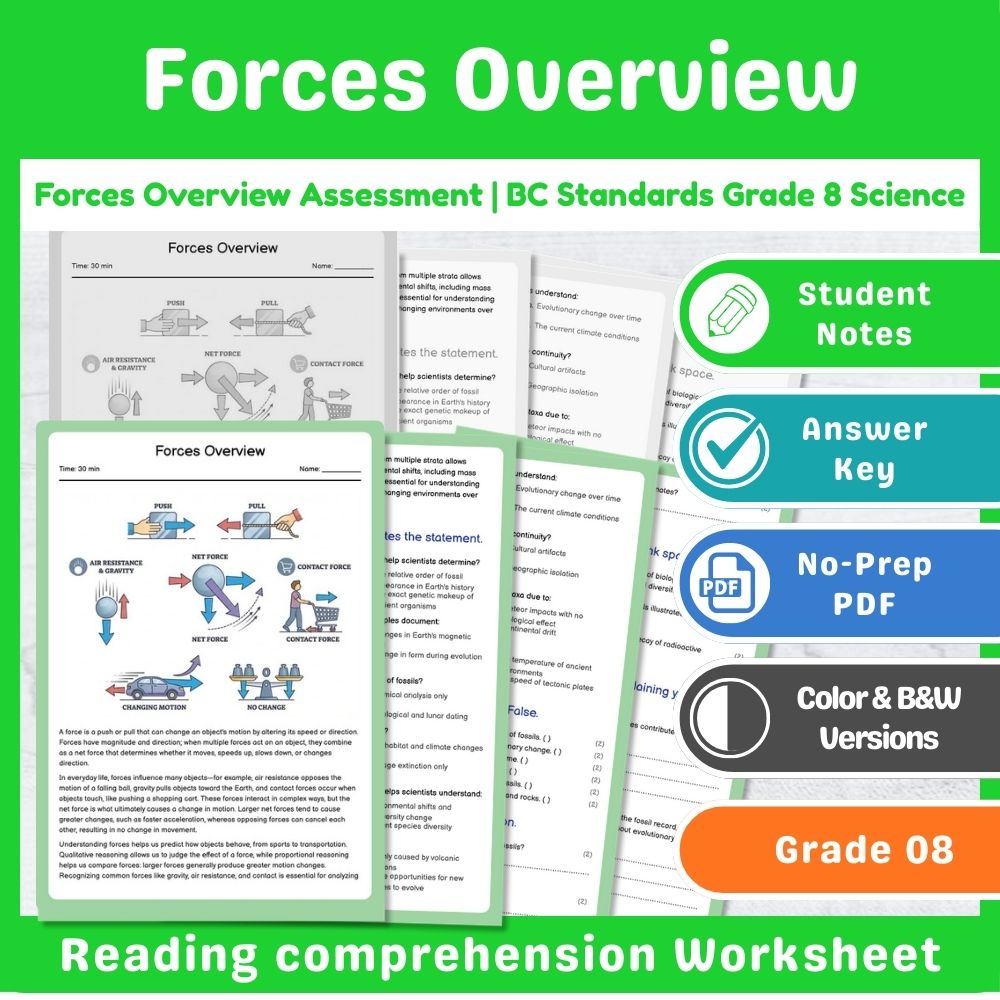
Forces Overview Assessment | BC Standards Grade 8 Science
Created byPrism Point LearningLearning Objectives
- Define what a force is and identify different types of forces
- Explain how net force affects an object's motion
- Describe everyday forces like gravity and air resistance
Instant download
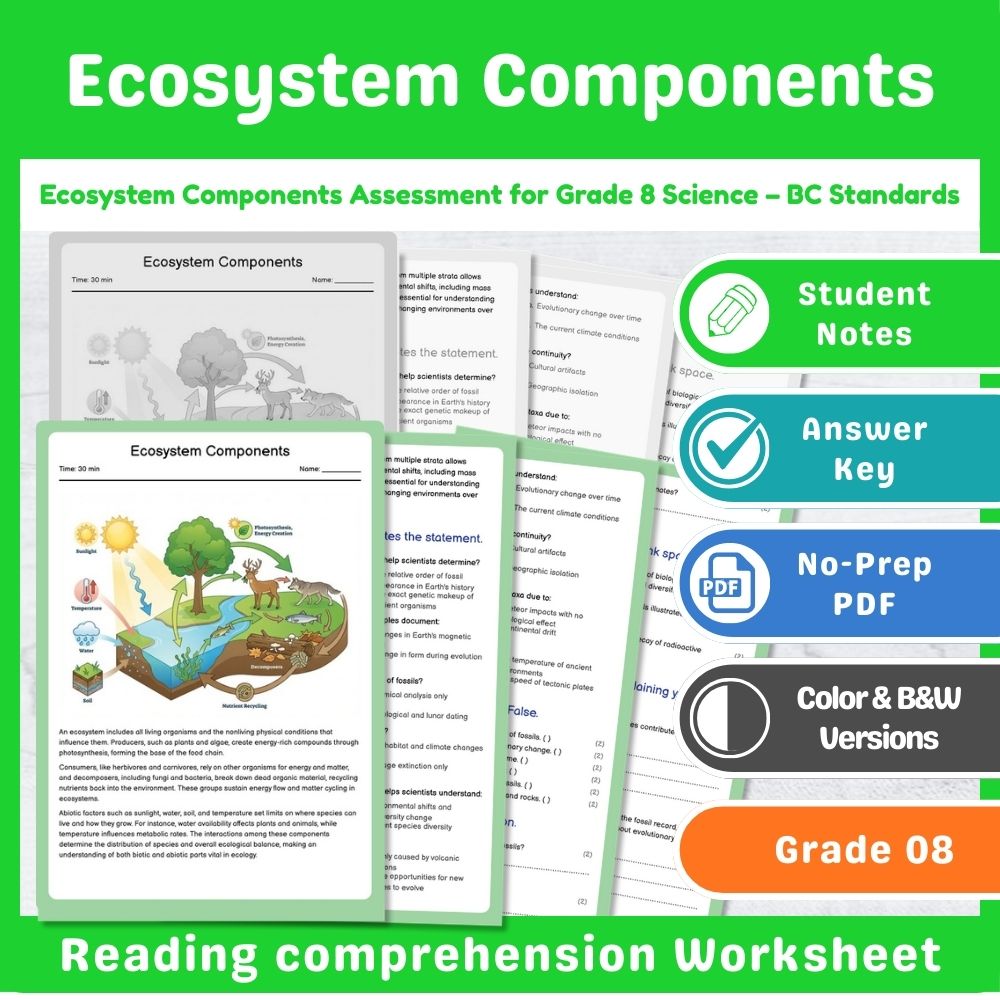
Ecosystem Components Assessment for Grade 8 Science – BC Standards
Created byPrism Point LearningLearning Objectives
- Identify the key parts of an ecosystem, including both living and nonliving elements.
- Explain the roles of producers, consumers, and decomposers in energy cycling.
- Describe how abiotic factors such as sunlight, water, soil, and temperature influence ecosystems.
Instant download
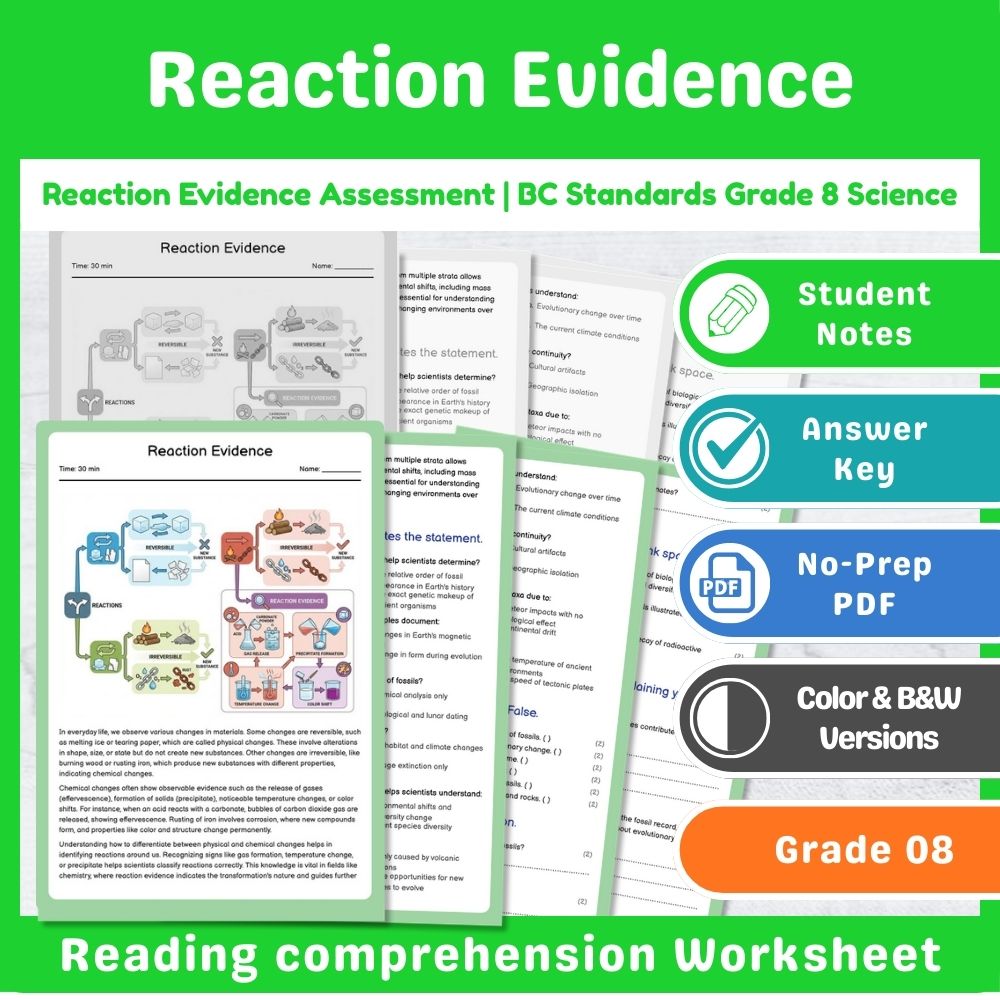
Reaction Evidence Assessment | BC Standards Grade 8 Science
Created byPrism Point LearningLearning Objectives
- Distinguish between physical and chemical changes using observable evidence.
- Identify examples of physical and chemical transformations based on reaction evidence.
- Understand how properties such as gas formation, precipitate, temperature change, and color shift indicate chemical or physical changes.
Also included in: Grade 8 Science Lesson – Reaction Types & Evidence Assessment Bundle
Instant download
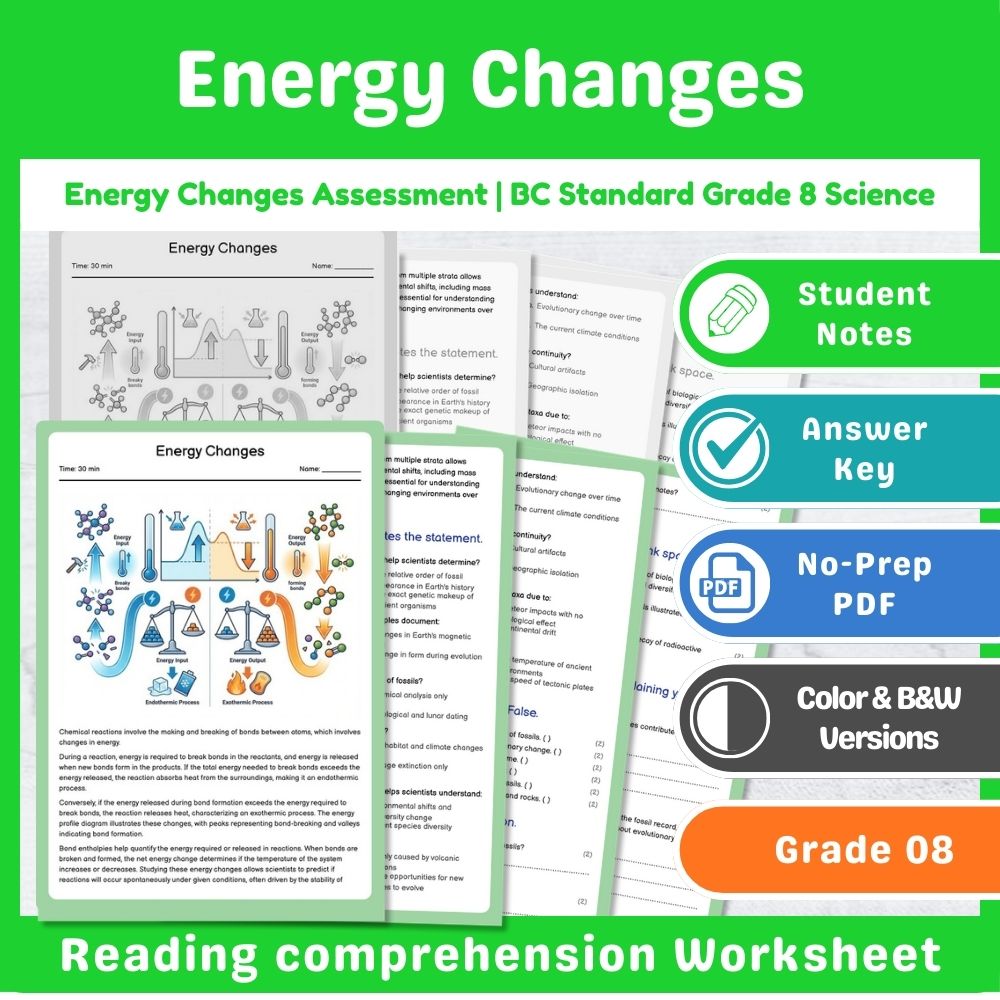
Energy Changes Assessment | BC Standard Grade 8 Science
Created byPrism Point LearningLearning Objectives
- Understand how chemical bonds involve energy changes during reactions.
- Differentiate between endothermic and exothermic reactions based on energy transfer.
- Interpret energy profiles and bond enthalpy diagrams to explain temperature changes.
Also included in: Grade 8 Science Lesson – Reaction Types & Evidence Assessment Bundle
Instant download

Energy Basics Assessment | BC Standards Grade 8 Science
Created byPrism Point LearningLearning Objectives
- Understand the forms of mechanical energy, including kinetic and potential energy.
- Explain how energy transfers occur through work and force interactions.
- Describe how friction and air resistance transform mechanical energy into thermal energy.
Instant download
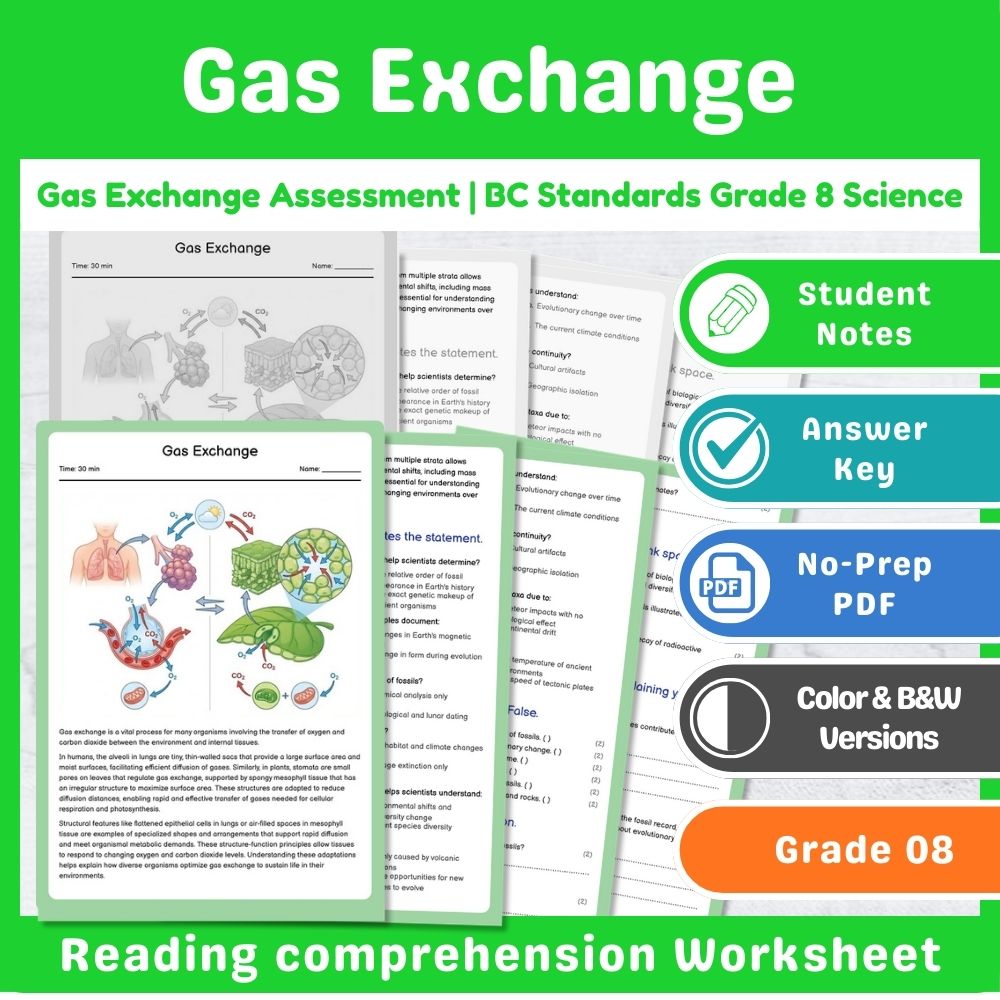
Gas Exchange Assessment | BC Standards Grade 8 Science
Created byPrism Point LearningLearning Objectives
- Understand how thin, moist surfaces facilitate gas exchange in organisms.
- Identify different structures involved in gas exchange, such as alveoli and stomata.
- Explain structural adaptations that support efficient diffusion of gases.
Instant download

Species Interactions Assessment for Grade 8 Science | Florida NGSSS
Created byPrism Point LearningLearning Objectives
- Explain how competition, predation, mutualism, commensalism, and parasitism affect survival and reproduction
- Describe how species interactions can change population sizes over time
- Use evidence from examples to identify the type of species interaction and its ecosystem impact
Also included in: Grade 8 Evolution and Genetics Science Lesson Bundle | Florida NGSSS
Instant download

Muscle Contraction Assessment | BC Standards Grade 8 Science Worksheet
Created byPrism Point LearningLearning Objectives
- Explain how actin and myosin filaments interact during muscle contraction.
- Describe the role of ATP and calcium in muscle contraction regulation.
- Identify how sarcomere organization influences contraction strength and speed.
Instant download

Distance-Time Graphs Assessment | BC Grade 8 Science Standards
Created byPrism Point LearningLearning Objectives
- Understand how to interpret distance-time graphs and what the slope indicates about speed.
- Calculate average speed between two points on a distance-time graph.
- Identify segments of graphs representing constant, increasing, or decreasing speed.
Instant download

Speciation And Change Assessment for Grade 8 Science | NGSSS Standards
Created byPrism Point LearningLearning Objectives
- Explain how reproductive isolation can lead to speciation over many generations
- Describe how geographic barriers, habitat changes, or behavioral differences reduce gene flow
- Use natural selection and genetic variation to predict how traits may diverge in separated populations
Also included in: Grade 8 Evolution and Genetics Science Lesson Bundle | Florida NGSSS
Instant download

Pendulum Energy Assessment | BC Standards Grade 8 Science
Created byPrism Point LearningLearning Objectives
- Explain how a pendulum demonstrates energy transformation between potential and kinetic energy.
- Identify factors that influence the period of a pendulum.
- Describe how energy dissipation occurs due to air resistance and friction.
Instant download

Grade 8 Science | Microscopy Basics - Daily Reading Comprehension
 Created byCoral Reef Learning
Learning Objectives
- Identify the main parts of a light microscope
- Understand the concepts of magnification, resolution, and contrast
- Compare light microscopy with stereomicroscopy and electron imaging
Instant download

Grade 8 Science | Criteria & Constraints in Scientific Design - Reading Practice
Created byCoral Reef LearningLearning Objectives
- Understand the difference between criteria and constraints in scientific projects
- Identify various criteria that define success in a design
- Recognize limitations and constraints such as materials, time, and safety
Instant download

Grade 8 Science | Gas Exchange - Daily Reading Comprehension
Created byCoral Reef LearningLearning Objectives
- Understand the processes involved in gas exchange in organisms.
- Identify key structures involved in respiration and photosynthesis.
- Explain how structure relates to function in gas exchange surfaces.
Instant download

Grade 8 Science | Energy Metabolism - Daily Reading Comprehension
Created byCoral Reef LearningLearning Objectives
- Understand the stages of cellular energy production.
- Identify the roles of mitochondria in ATP synthesis.
- Differentiate between aerobic and anaerobic energy pathways.
Instant download

Grade 8 Science | Pulley Systems - Daily Reading Comprehension
Created byCoral Reef LearningLearning Objectives
- Identify the different types of pulleys: fixed, movable, and compound
- Understand how pulley arrangements reduce effort in lifting objects
- Calculate the mechanical advantage of different pulley systems
Instant download

Grade 8 Science | Flotation Stability - Daily Reading Comprehension
Created byCoral Reef LearningLearning Objectives
- Understand the principles of buoyancy and stability in floating bodies
- Identify the roles of center of gravity and center of buoyancy
- Learn how hull shape and loading affect a vessel's stability
Instant download

Grade 8 Science | Predictive Models in Science - Daily Reading Comprehension
Created byCoral Reef LearningLearning Objectives
- Define what a scientific model is and its purpose.
- Identify different types of scientific models used in science.
- Explain how models help scientists make predictions about natural phenomena.
Instant download

Grade 8 Science | Plate Motion Evidence - Daily Reading Comprehension
Created byCoral Reef LearningLearning Objectives
- Understand how geological features provide evidence for plate movement.
- Identify patterns of rock types and ages across different regions.
- Recognize the significance of mountain belts, trenches, and mid-ocean ridges.
Instant download

Grade 8 Science | Understanding Braking Distance - Daily Reading Comprehension
Created byCoral Reef LearningLearning Objectives
- Identify the factors that influence braking distance.
- Explain how tire-road friction affects stopping times.
- Discuss the impact of weather conditions on braking performance.
Also included in: Forces and Motion Lesson Bundle | Grade 8 Science Alberta +1 more
Instant download

Grade 8 Science | Simple Machines Daily Reading Comprehension Worksheets
Created byCoral Reef LearningLearning Objectives
- Identify parts of a lever and describe their functions.
- Understand the concept of mechanical advantage in simple machines.
- Explain how levers help lift heavy objects with less force.
Instant download

Grade 8 Science | Decomposer Recycling - Daily Reading Comprehension
Created byCoral Reef LearningLearning Objectives
- Understand the role of decomposers in ecosystems
- Identify types of decomposers such as fungi and bacteria
- Describe the process of decomposition and its importance
Instant download

Grade 8 Science | Natural Selection - Daily Reading Comprehension
Created byCoral Reef LearningLearning Objectives
- Understand the concept of variation within populations.
- Identify mechanisms that lead to different traits among individuals.
- Recognize how environmental pressures influence trait selection.
Instant download

Grade 8 Science | Abiotic Influences in Ecosystems - Daily Reading Comprehension
Created byCoral Reef LearningLearning Objectives
- Understand how light availability influences plant and animal life
- Analyze the effects of light changes on growth and behavior
- Evaluate the importance of abiotic factors in ecosystem dynamics
Instant download

Grade 8 Science | Tissue Types - Daily Reading Comprehension Practice
Created byCoral Reef LearningLearning Objectives
- Understand key concepts related to Science
- Apply knowledge through practice questions
- Demonstrate comprehension of the material
Instant download
About Grade 8 Science Worksheets
Explore Grade 8 Science worksheets for classwork, homework, or review. Our 5,999 printables download instantly as PDFs.
Each resource here is built by an independent educator and reviewed for quality. Worksheets print straight from PDF and suit classroom use, homework, or extra practice; most come with answer keys, and you can preview before purchasing.