
Grade 9 Worksheets
9,323 grade resources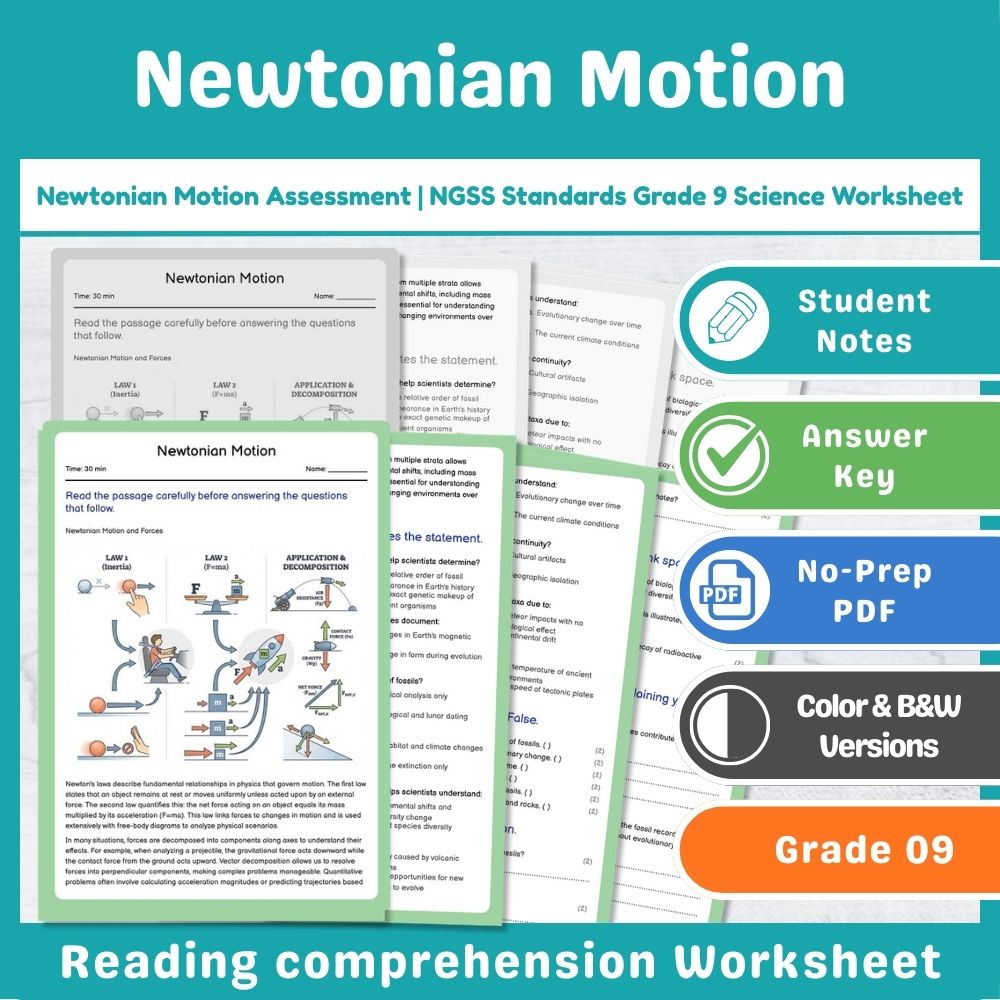
Newtonian Motion Assessment | NGSS Standards Grade 9 Science Worksheet
 Created byPrism Point Learning
Learning Objectives
- Explain the relationship between force, mass, and acceleration as described by Newton's second law.
- Analyze free-body diagrams to identify forces acting on objects in motion.
- Apply vector decomposition to determine forces and predict trajectories.
Instant download

Science Grade 9 Worksheet: Heat Transfer Modes Conduction Convection Radiation
JCreated byJ.S SheetsLearning Objectives
- Explain how conduction, convection, and radiation transfer thermal energy in everyday situations.
- Use particle ideas and fluid motion to describe conduction and convection, respectively.
- Describe why radiation can transfer heat through space and does not require a medium.
Also included in: Grade 9 Forces, Energy, and Matter Transformations Science lesson bundle +1 more
Instant download
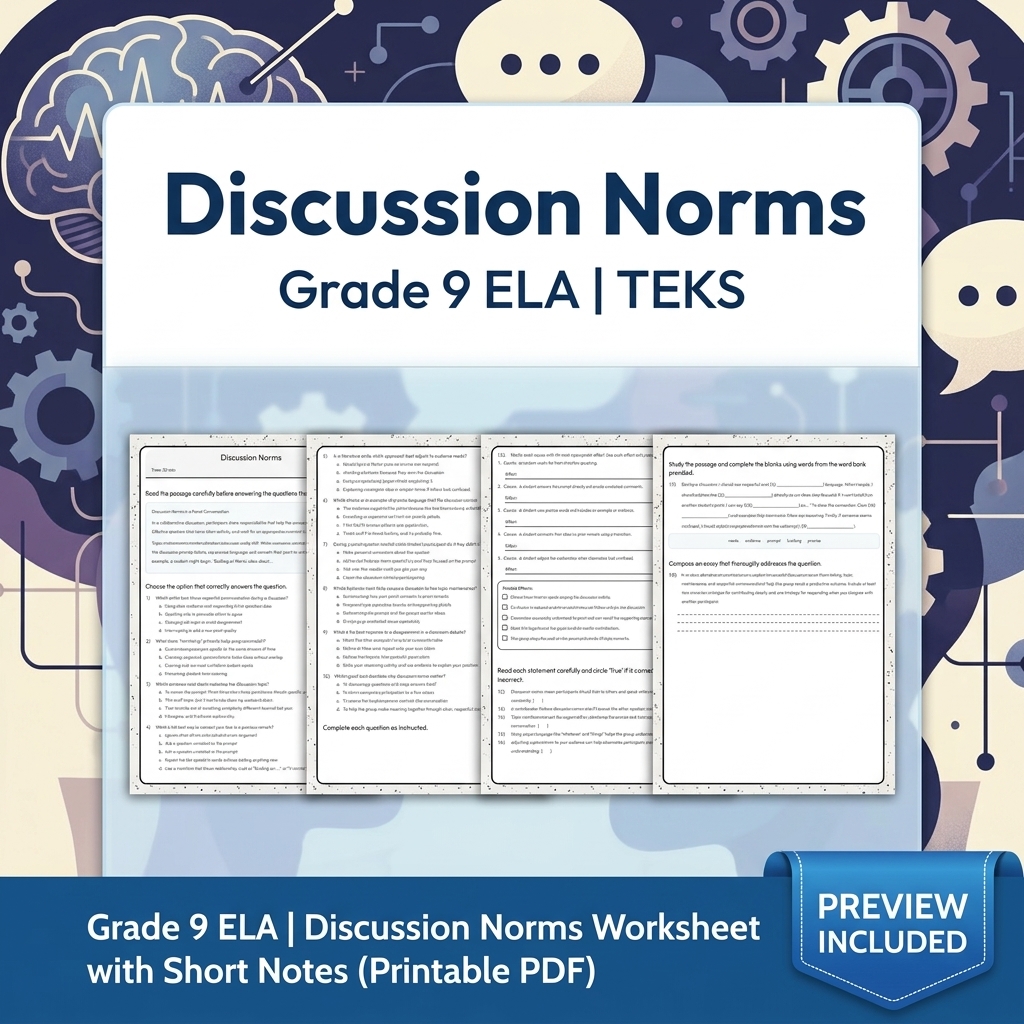
Grade 9 ELA | Discussion Norms Worksheet with Short Notes (Printable PDF)
 Created byMeadowlark Worksheets
Learning Objectives
- Identify key discussion norms for turn-taking, topic maintenance, and respectful communication.
- Use precise, prompt-relevant language to make clear contributions and connect ideas to prior remarks.
- Evaluate statements and scenarios to determine whether they follow discussion norms.
Also included in: Grade 9 Spoken Language Evaluation & Discussion ELA Lesson Bundle TEKS +1 more
Instant download

Science Grade 9 Worksheet | Simple Machines—Forces Displacement & Advantage
JCreated byJ.S SheetsLearning Objectives
- Identify the six classical simple machines and describe how each can change force and/or direction.
- Explain the idea of mechanical advantage using input force and output force, including the role of ideal versus real conditions.
- Analyze trade-offs between force reduction and distance or direction changes, especially when friction is present.
Instant download

Grade 9 Circuit Diagrams Worksheet | Alberta Electricity and Physics
 Created byBRIGHT PATH RESOURCES
Learning Objectives
- Identify common standardized circuit symbols and what they represent.
- Use diagram conventions (nodes, wires, and polarity) to predict how current can flow.
- Explain how connection types in a circuit diagram affect the paths between components.
Instant download

Grade 9 Rock Transformations Worksheet | NGSS Rock Cycle Earth Science
Created byBRIGHT PATH RESOURCESLearning Objectives
- Understand the process of igneous rock formation from cooling magma
- Identify the different pathways of rock transformation in the rock cycle
- Explain how pressure and temperature influence metamorphic rocks
Also included in: Plate Tectonics & Earth Systems Grade 9 Science Lesson Bundle | NGSS +1 more
Instant download
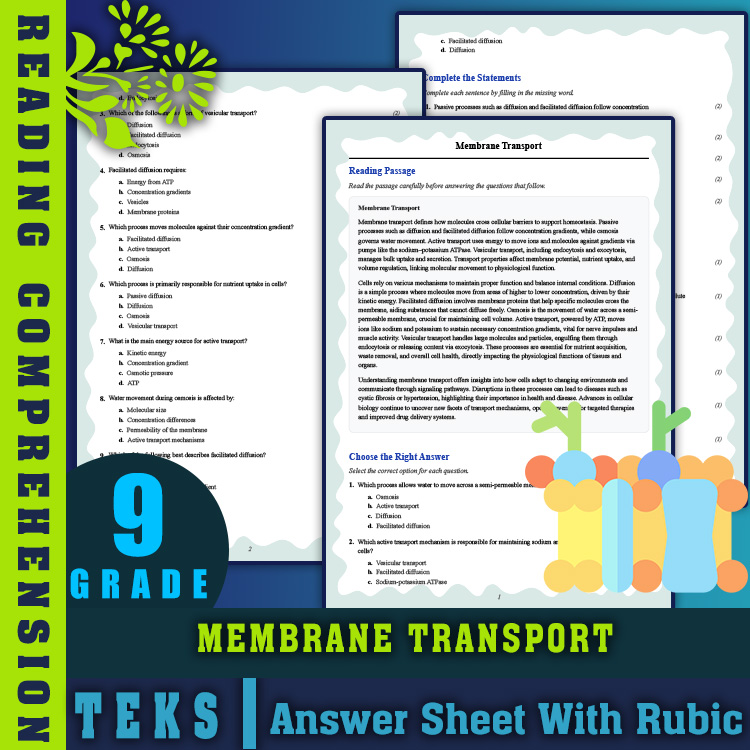
Grade 9 Science | Membrane Transport Reading Worksheet (PDF + Rubric)
JCreated byJ.S SheetsLearning Objectives
- Describe the different types of passive and active membrane transport processes.
- Explain how membrane transport affects cellular functions such as homeostasis, nutrient uptake, and volume regulation.
- Identify mechanisms such as diffusion, facilitated diffusion, osmosis, active transport, and vesicular transport.
Instant download

Grade 9 Immigration Impact on Canadian Communities Worksheet | BC
 Created byQuiet Forest Education
Learning Objectives
- Understand how immigrants contribute to labor forces in Canada.
- Analyze the social and cultural diversity brought by migration.
- Recognize the demographic shifts resulting from immigration policies.
Also included in: Urban Growth & Industrial Change Canada Grade 9 Social Studies Daily Bundle | BC +1 more
Instant download

Grade 9 Natural Selection Daily Reading Worksheet | TEKS Biology Science
Created byBRIGHT PATH RESOURCESLearning Objectives
- Identify key ideas about how traits, heredity, and environment relate to natural selection
- Define science vocabulary in context, including population, trait, heritable variation, and allele
Also included in: Grade 9 Evolution and Classification Biology Reading Worksheets Bundle | TEKS +1 more
Instant download

Grade 9 Social Studies — Community Impacts Worksheet MCQ Paper
 Created byThe Resource Hub
Learning Objectives
- Explain how population growth or decline can change the provision and distribution of community services
- Analyze causes of demographic change, including migration and economic restructuring
- Evaluate how demographic shifts affect fiscal pressures, transportation, and equity in communities
Also included in: Grade 9 Migration & Demographics Social Studies Custom Bundle: Ontario
Instant download

Liveable Characteristics Worksheet for Grade 9 Social Studies
JCreated byJ.S SheetsLearning Objectives
- Identify key indicators of liveable communities, including services, green space, health outcomes, and social inclusion
- Explain how economic structure, zoning, and demographic change can affect liveability
- Analyze the relationships among housing, employment, transit, and environmental health using comparative metrics
Instant download

Grade 9 Science | Human Impacts Worksheet | TEKS Aligned
 Created byLumora Learning
Learning Objectives
- Understand how human activities affect biodiversity and ecosystem services.
- Identify different types of human impacts on habitats and species.
- Evaluate the consequences of habitat fragmentation, pollution, and resource extraction.
Instant download

Ionic Lattices, Covalent Networks & Molecular Solids Worksheets Grade 9
 Created bythe curious pencil
Learning Objectives
- Explain how particle arrangement affects bulk material properties
- Distinguish ionic lattices, covalent networks, and molecular solids
- Relate electrical conductivity to particle movement and structure
Also included in: Grade 9 Chemistry Lesson Bundle | NGSS: Stoichiometry, Reactions & Bonding +2 more
Instant download

Chemical Reaction Energy Changes Worksheets | Grade 9 Science
Created bythe curious pencilLearning Objectives
- Explain how bond breaking and formation involve energy changes
- Distinguish between endothermic and exothermic chemical reactions
- Interpret energy diagrams showing reactant and product energy
Also included in: Grade 9 Chemistry Lesson Bundle | NGSS: Stoichiometry, Reactions & Bonding +2 more
Instant download

Molecular Regulation and Cell Signaling Worksheets | Grade 9 Science
Created bythe curious pencilLearning Objectives
- Explain how transcription factors regulate gene expression and protein production
- Describe how ligand-receptor binding initiates signal transduction pathways
- Analyze how insulin signaling promotes cellular glucose uptake
Also included in: Cells to Organ Systems Lesson Bundle | Grade 9 Science | Next-Generation Science Standards +2 more
Instant download

Stoichiometry and Chemical Calculations Worksheets | Grade 9 Science
Created bythe curious pencilLearning Objectives
- Interpret balanced equations to determine stoichiometric mole ratios
- Calculate molar mass and reaction quantities from chemical formulas
- Identify limiting reagents in quantitative chemical reactions
Also included in: Grade 9 Chemistry Lesson Bundle | NGSS: Stoichiometry, Reactions & Bonding +2 more
Instant download

Center of Mass and Rotational Stability Worksheets | Grade 9 Science
Created bythe curious pencilLearning Objectives
- Calculate the center of mass of simple composite systems
- Calculate torque using force and perpendicular lever-arm distance
- Explain how balanced torques produce rotational equilibrium
Also included in: Newton's Laws, Forces & Motion Lesson Bundle | Grade 9 Science NGSS +2 more
Instant download

Chemical Reaction Design and Optimization Worksheets | Grade 9 Science
Created bythe curious pencilLearning Objectives
- Explain how reaction conditions influence rate, yield, and selectivity
- Analyze how temperature, pressure, and concentration shift equilibrium
- Describe how catalysts affect reaction rates and activation energy
Also included in: Grade 9 Chemistry Lesson Bundle | NGSS: Stoichiometry, Reactions & Bonding +2 more
Instant download

Cell Architecture and Protein Structure: Grade 9 Science Worksheets
Created bythe curious pencilLearning Objectives
- Explain how nucleic acid sequences influence amino acid sequences
- Describe how protein folding connects molecular structure to function
- Connect protein structure to cellular architecture and function
Also included in: Cells to Organ Systems Lesson Bundle | Grade 9 Science | Next-Generation Science Standards +2 more
Instant download

Integrated Physiology: Cells to Organ Systems Worksheets Grade 9
Created bythe curious pencilLearning Objectives
- Explain how molecular changes can influence cellular and organ function
- Describe how genetic variation can affect organ system performance
- Analyze how CFTR dysfunction contributes to respiratory difficulties
Also included in: Cells to Organ Systems Lesson Bundle | Grade 9 Science | Next-Generation Science Standards +2 more
Instant download

Chemical Bonding Models and Properties: Grade 9 Worksheets
Created bythe curious pencilLearning Objectives
- Distinguish ionic, covalent, and metallic bonding using electron models
- Explain how bond energy and structure relate to substance properties
- Interpret Lewis structures and connect electron sharing with polarity
Also included in: Grade 9 Chemistry Lesson Bundle | NGSS: Stoichiometry, Reactions & Bonding +2 more
Instant download

Cellular Metabolism and ATP Production: Grade 9 Worksheets
Created bythe curious pencilLearning Objectives
- Explain how glycolysis contributes to ATP production during cellular respiration.
- Describe how the citric acid cycle transfers energy to electron carriers.
- Explain how electron transport and proton gradients drive ATP production.
Also included in: Cells to Organ Systems Lesson Bundle | Grade 9 Science | Next-Generation Science Standards +2 more
Instant download

Atomic Structure and Electron Arrangement: Grade 9 Worksheets
Created bythe curious pencilLearning Objectives
- Identify the charges and roles of protons, neutrons, and electrons.
- Explain how electron configurations describe electron arrangements in atoms.
- Relate valence electrons to chemical behavior and reactivity.
Also included in: Grade 9 Chemistry Lesson Bundle | NGSS: Stoichiometry, Reactions & Bonding +2 more
Instant download

Homeostasis and Feedback Mechanisms Worksheets | Grade 9 Science
Created bythe curious pencilLearning Objectives
- Explain how negative feedback maintains stable internal conditions
- Describe the roles of sensors, control centers, and effectors
- Analyze thermoregulation, blood glucose, and water balance
Also included in: Cells to Organ Systems Lesson Bundle | Grade 9 Science | Next-Generation Science Standards +2 more
Instant download

Biological Organization Worksheets: Cells to Organ Systems | Grade 9
Created bythe curious pencilLearning Objectives
- Identify levels of biological organization from cells to organ systems.
- Explain how specialized cells contribute to tissue structure and function.
- Describe how tissues combine to form functional organs.
Also included in: Cells to Organ Systems Lesson Bundle | Grade 9 Science | Next-Generation Science Standards +2 more
Instant download

Reaction Rate Worksheets: Factors Affecting Reaction Speed | Grade 9
Created bythe curious pencilLearning Objectives
- Explain reaction rates using collision frequency and activation energy.
- Describe how temperature affects successful particle collisions.
- Explain how catalysts change reaction pathways and activation energy.
Also included in: Grade 9 Chemistry Lesson Bundle | NGSS: Stoichiometry, Reactions & Bonding +2 more
Instant download
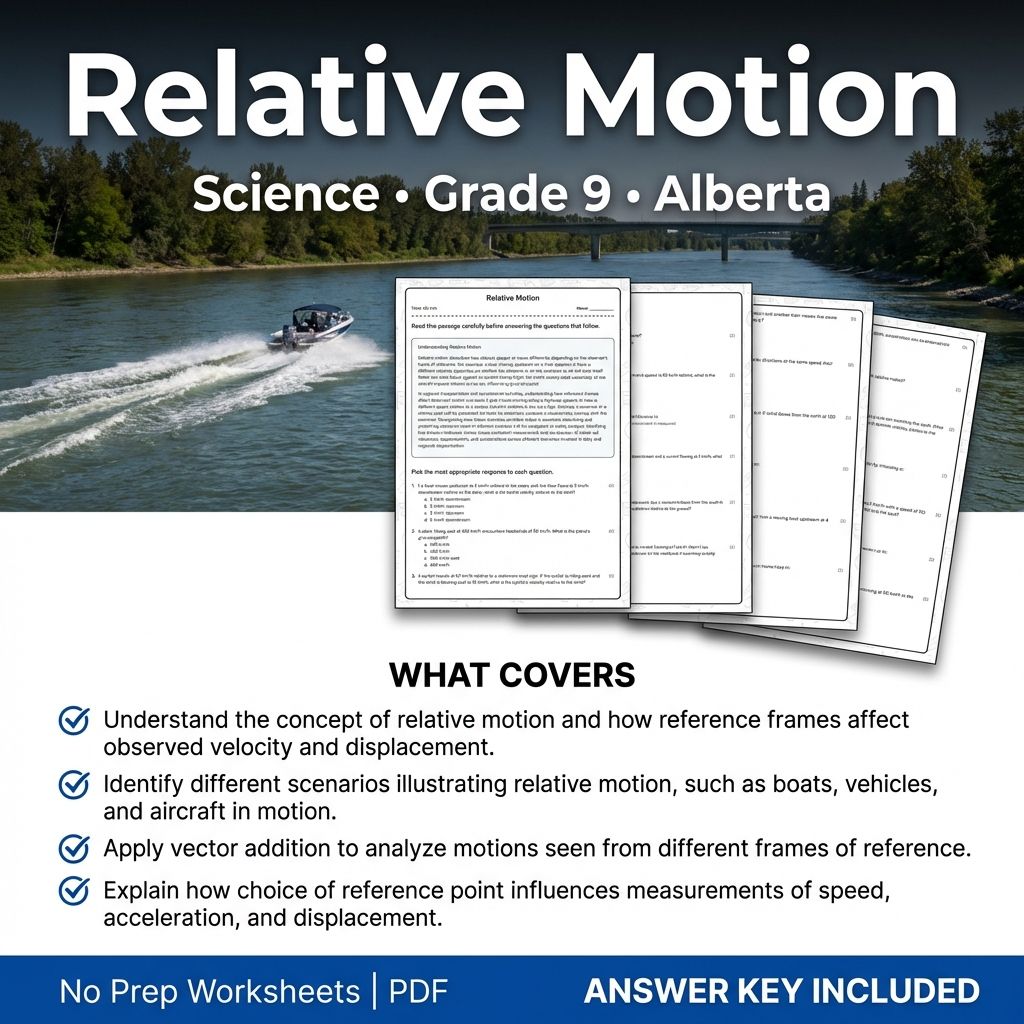
Grade 9 Science Worksheet on Relative Motion | Alberta Standards
 Created byCoral Reef Learning
Learning Objectives
- Understand the concept of relative motion and how reference frames affect observed velocity and displacement.
- Identify different scenarios illustrating relative motion, such as boats, vehicles, and aircraft in motion.
- Apply vector addition to analyze motions seen from different frames of reference.
Instant download

Biotechnology Tools and Genetic Modification Worksheets Grade 9 Science
 Created bySunny Desk Resources
Learning Objectives
- Explain how biotechnology methods can change traits at the molecular level and how that can affect populations over generations.
- Compare selective breeding, hybridization, genetic modification, and gene editing by describing their main goal and how they introduce traits.
- Evaluate how uncertainty and risk–benefit trade-offs influence monitoring and regulation of agricultural biotechnology.
Also included in: Genetics & Heredity Lesson Bundle | Grade 9 Science | Alberta Framework +1 more
Instant download

Grade 9 Social Studies – Japan Feudal Age Worksheet (PDF) – California Standard
Created bySunny Desk ResourcesLearning Objectives
- Explain the feudal hierarchy of medieval Japan and how power was organized among emperors, shoguns, daimyo, and samurai.
- Analyze how values like loyalty, martial skill, and Confucian ideas influenced governance and daily life.
- Describe how regional rule shaped economic organization and cultural practices during the feudal age.
Also included in: World Civilizations Grade 9 Social Studies Full-Year Worksheet Bundle | California +1 more
Instant download

Japan's Feudal Age Social Studies Worksheet | Standards-Aligned Grade 9
JCreated byJ.S SheetsLearning Objectives
- Understand the hierarchical structure of medieval Japanese society, including emperors, shoguns, daimyo, and samurai.
- Identify the cultural values such as loyalty, martial skill, and Confucian principles that influenced feudal Japan.
- Analyze how the social and governance structures impacted economic practices and regional stability.
Instant download

Grade 9 Evolution Evidence Worksheet | Practice & Assessment PDF
 Created byClear Sky Classroom
Learning Objectives
- Use fossil sequences, comparative anatomy, biogeographic patterns, and molecular phylogenies to interpret descent with modification.
- Explain how mutation, natural selection, genetic drift, and gene flow can change allele frequencies and traits over short and long timescales.
- Apply evolutionary models to predict how populations respond to selective pressures in changing environments.
Also included in: Grade 9 Biology and Ecosystems Science Lesson Bundle for Advanced Placement (AP) +1 more
Instant download

Grade 9 — Worksheet MCQ Paper for Mastering Transportation Systems
Created byThe Resource HubLearning Objectives
- Explain how transportation networks (public transit, roads, active transportation, and freight corridors) shape mobility and economic activity.
- Describe how accessibility connects to employment opportunities and how congestion or gaps can result from investment and land-use decisions.
- Evaluate common impacts of transportation systems, including emissions and social inclusion/exclusion.
Instant download

Grade 9 Social Studies | Demographic Analysis Worksheet (PDF) – Ontario Standards
Created bySunny Desk ResourcesLearning Objectives
- Interpret demographic tools such as age–sex population pyramids, fertility and mortality rates, and cohort analysis to describe population trends.
- Explain how demographic structure influences economic dependency and future labour and social planning needs.
- Evaluate causes of changing birth rates and life expectancy and predict likely impacts of migration and public policy on demographic scenarios.
Also included in: Grade 9 Population Demographic Trends Social Studies Lesson Bundle | Ontario +1 more
Instant download
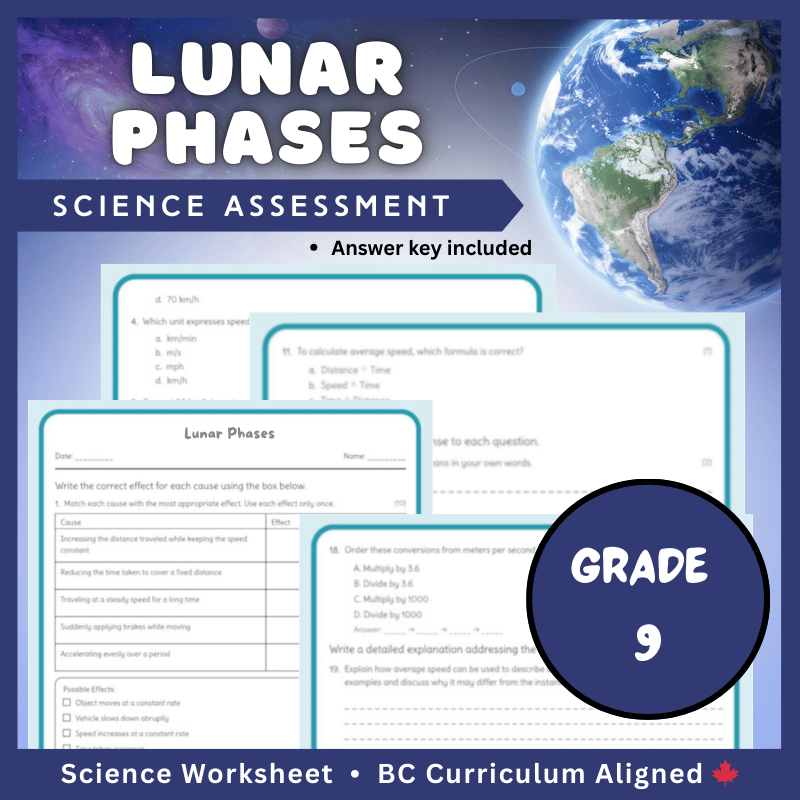
Grade 9 Science | Lunar Phases Worksheet (PDF) – BC Standards & Concepts
 Created byBright Mind Resources
Learning Objectives
- Explain the causes of different lunar phases based on the positions of the Sun, Earth, and Moon.
- Identify and sequence the lunar phases in their proper order.
- Describe how lunar phases influence ocean tides and nocturnal illumination.
Instant download

Cell Architecture Worksheet | NGSS Scientific Practices Grade 9 Science
JCreated byJ.S SheetsLearning Objectives
- Describe how nucleic acid sequences determine amino acid chains and three-dimensional protein structures.
- Connect molecular coding and folding to organelle architecture such as ribosomes, endoplasmic reticulum, and mitochondria.
- Explain how macromolecular structures influence cellular functions like protein synthesis and membrane transport.
Also included in: Grade 9 Cellular Regulation and Metabolism Science Lesson Bundle: NGSS +1 more
Instant download

Grade 9 Social Studies Worksheet | Population Futures & Demographic Trends (PDF)
Created bySunny Desk ResourcesLearning Objectives
- Explain how fertility, mortality, migration, and life expectancy shape population change over time.
- Compare population futures by evaluating demographic transition and age-structure effects.
- Analyze how policy choices and global trends can influence sustainable population outcomes.
Also included in: Grade 9 Population Demographic Trends Social Studies Lesson Bundle | Ontario +1 more
Instant download

Grade 9 Design Criteria Worksheet | California Science Engineering Activity
 Created byEvergreen Desk Education
Learning Objectives
- Explain how engineers define a problem using success criteria and constraints (resources, materials, time, and safety).
- Identify how scientific principles and evidence connect to measurable performance in an engineering solution.
- Use models to link design features to expected outcomes under real-world limitations.
Instant download
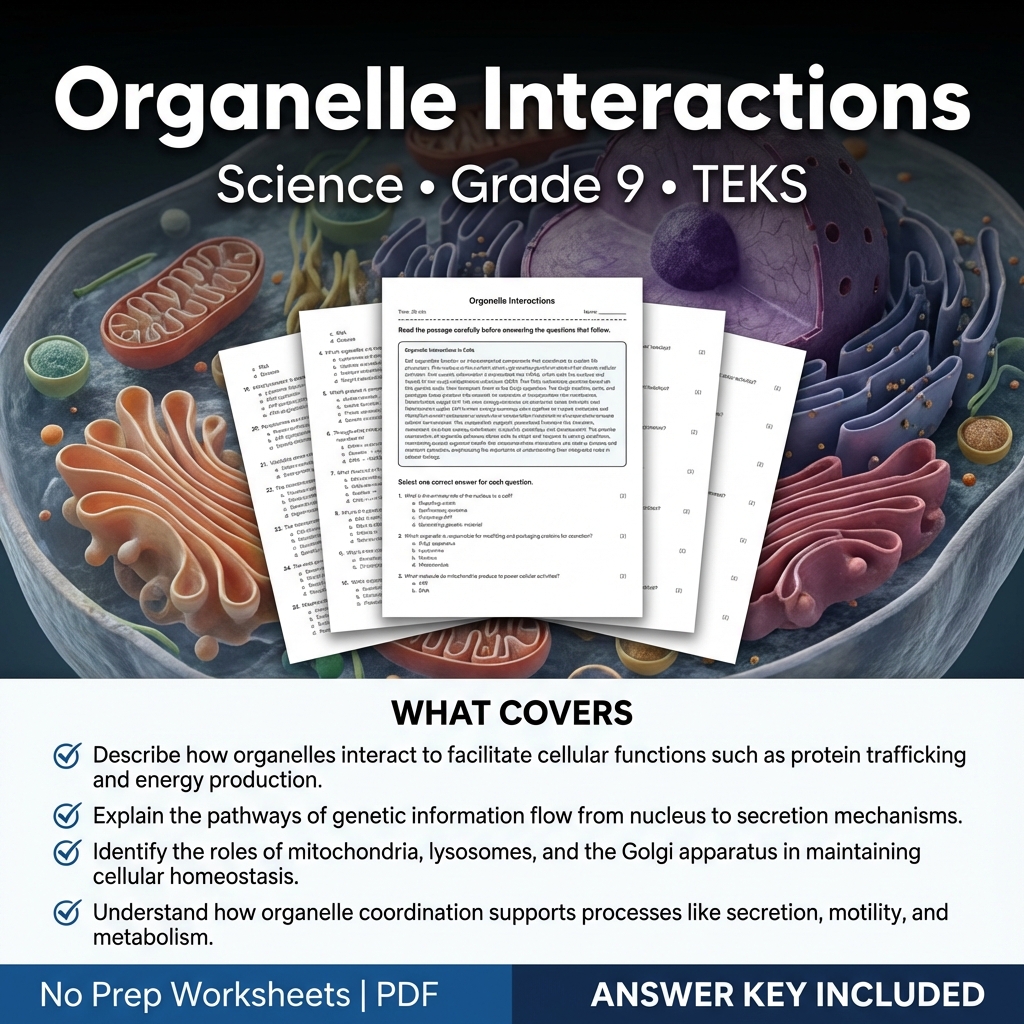
Grade 9 Science Worksheet on Organelle Interactions | TEKS-Aligned PDF
Created byCoral Reef LearningLearning Objectives
- Describe how organelles interact to facilitate cellular functions such as protein trafficking and energy production.
- Explain the pathways of genetic information flow from nucleus to secretion mechanisms.
- Identify the roles of mitochondria, lysosomes, and the Golgi apparatus in maintaining cellular homeostasis.
Instant download

Grade 9 ELA | Coherence Impact Worksheet | Alberta Standard
Created byLumora LearningLearning Objectives
- Revise a draft to improve coherence by strengthening connections between claims, evidence, and explanation.
- Use purposeful linking words and logical paragraph ordering to guide a reader through ideas.
- Condense repeated ideas and refine emphasis so the most important claims stand out.
Instant download
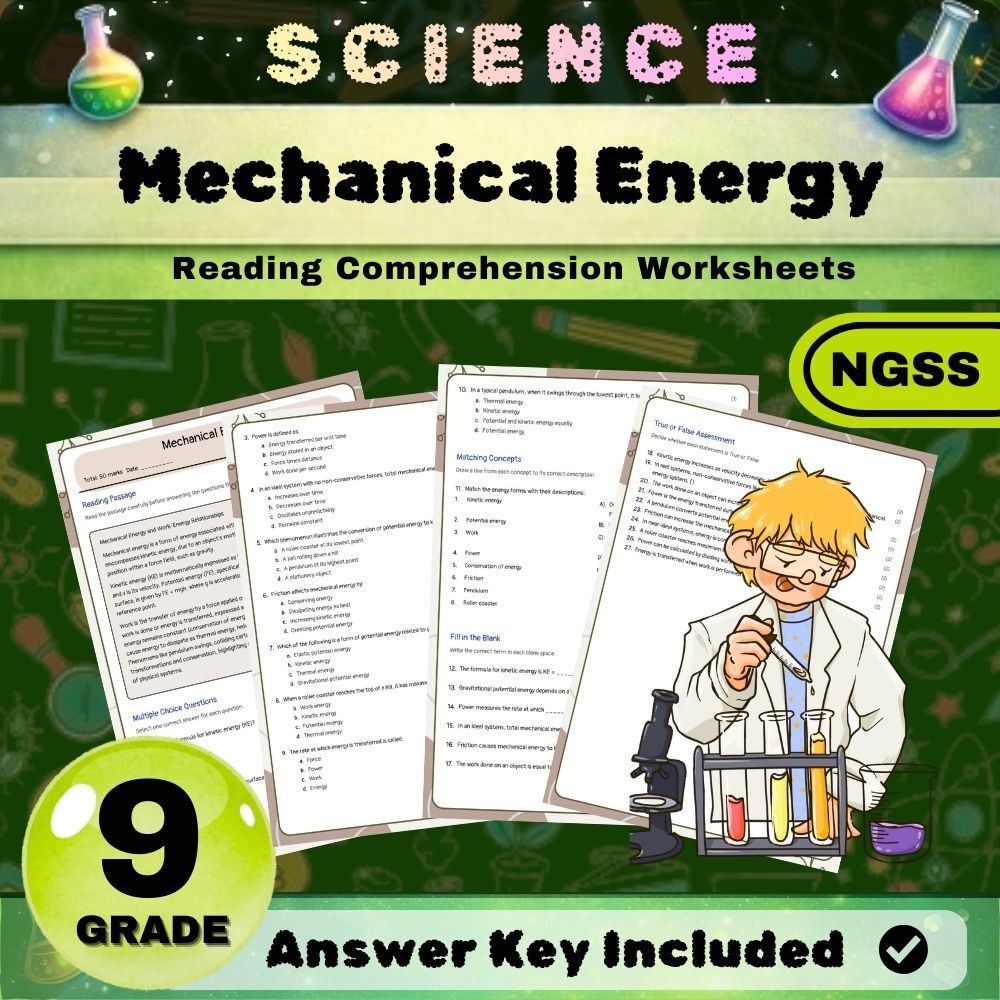
Grade 9 Science – Mechanical Energy Worksheet (NGSS) (PDF)
 Created byMaple Path Learning
Learning Objectives
- Understand the concepts of kinetic and potential energy and their mathematical relationships.
- Analyze work and power in the context of mechanical energy transfer.
- Apply conservation of energy principles to canonical phenomena such as pendulum motion and roller-coaster height-speed relationships.
Also included in: Grade 9 Science Energy Unit Bundle | NGSS-Aligned Worksheets & assessments +1 more
Instant download

Grade 9 Social Studies — Worksheet MCQ Paper for Source Reliability
Created byThe Resource HubLearning Objectives
- Evaluate the reliability of geographic sources by examining provenance, currency, scale, and methodological transparency.
- Explain how bias and error can affect the conclusions drawn from maps, imagery, and datasets.
- Choose appropriate sources for specific spatial questions by considering how source type and purpose relate to credibility.
Also included in: Grade 9 Geospatial Inquiry in Social Studies lesson bundle: Ontario
Instant download

Grade 9 ELA Evidence Synthesis Worksheet (CCSS) – Reading & Writing (PDF)
 Created byGolden Apple Studio
Learning Objectives
- Explain how evidence synthesis connects sources to a controlling idea through clear reasoning.
- Select and frame quotations, paraphrases, and data to support, complicate, or qualify a claim.
- Use accurate attribution to maintain scholarly integrity and a consistent line of thought.
Also included in: Grade 9 Writing Argument & Narrative Lesson Bundle | ELA Common Core +1 more
Instant download

Grade 9 Science – The Carbon Cycle & Ecosystem Processes | Reading Worksheet
Created byBright Mind ResourcesLearning Objectives
- Understand the processes involved in the carbon cycle
- Identify the roles of different organisms and environmental factors in carbon movement
- Explain how carbon cycles through air, water, soil, and living organisms
Also included in: Selection Grade 9 Science Daily Reading Worksheets Lesson Bundle | FL NGSSS +1 more
Instant download
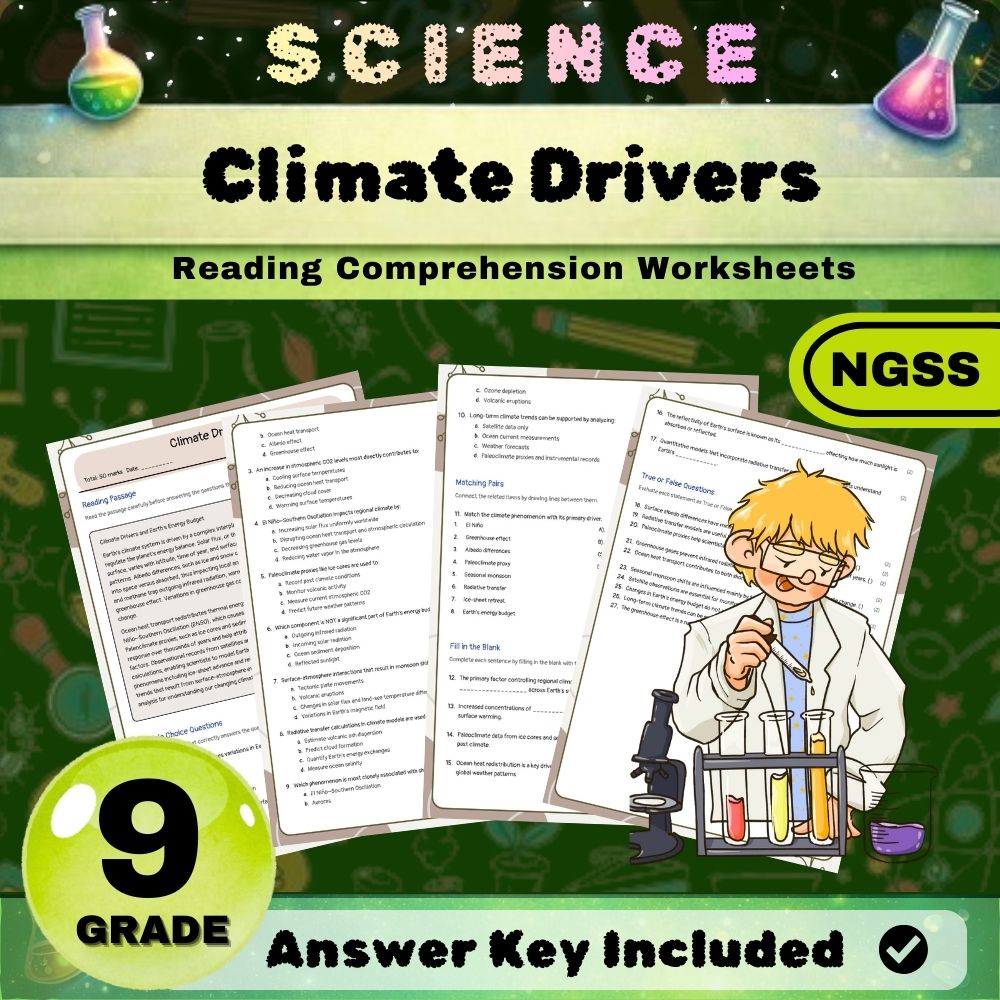
Grade 9 Science | Climate Drivers Worksheet – NGSS (PDF)
Created byMaple Path LearningLearning Objectives
- Explain how solar flux, albedo, greenhouse gases, and ocean heat transport influence Earth's climate patterns.
- Interpret observational records and climate proxies to understand short-term variability and long-term trends.
- Analyze the interactions between surface and atmospheric energy exchanges that cause phenomena such as ice-sheet changes and El Niño.
Also included in: Grade 9 Science | Earth's Systems NGSS Unit Bundle (NGSS-Aligned Instruction) +1 more
Instant download

Grade 9 Social Studies — Worksheet MCQ Paper for Mastering Resource Types
Created byThe Resource HubLearning Objectives
- Identify major natural resource categories: minerals, forests, freshwater, agricultural resources, and energy supplies.
- Describe how geology, climate, and geography influence the locations of resource types across Canada.
- Explain key economic and environmental consequences of resource development.
Also included in: Grade 9 Resource Governance Social Studies Custom Bundle for Ontario
Instant download

Scientific Models: Refining Explanations Grade 9 Science Worksheet
Created byBRIGHT PATH RESOURCESLearning Objectives
- Explain how a scientific model links evidence to causal mechanisms within limits
- Identify how new evidence can lead to refining a model by changing assumptions or relationships
- Compare predicted outcomes from a model with observations and describe how mismatches guide refinement
Also included in: Grade 9 Science Worksheets Bundle | Models, Evidence & Uncertainty +1 more
Instant download

Grade 9 Mental Health Day Origins and Advocacy Worksheet PDF Key
 Created byShaNova Worksheets
Learning Objectives
- Explain key ideas about the origins of Mental Health Day and why it matters.
- Use evidence from a passage to judge whether statements are true or false.
- Identify strategies for advocacy that support mental well-being in school and the community.
Instant download

Investigation Design Controls Worksheet | Grade 9 Science Practice
Created byPrism Point LearningLearning Objectives
- Explain how controls and variable identification improve cause-and-effect reasoning in scientific investigations
- Describe measurement and safety practices that support reliable, usable data
- Apply rules for designing procedures that allow clear interpretation of results
Instant download
Browse more categories
About Grade 9 Worksheets
Browse 9,323 printable Grade 9 worksheets across algebra, biology, literature, and history — each a ready-to-print PDF with optional answer keys.
Every worksheet on MyTeachingSheets is created by independent teacher-authors and reviewed before publication. All resources download as printable PDFs for classroom, homework, or at-home practice, and many include answer keys. Preview any worksheet free before buying.