
Grade 9 Worksheets
9,323 grade resources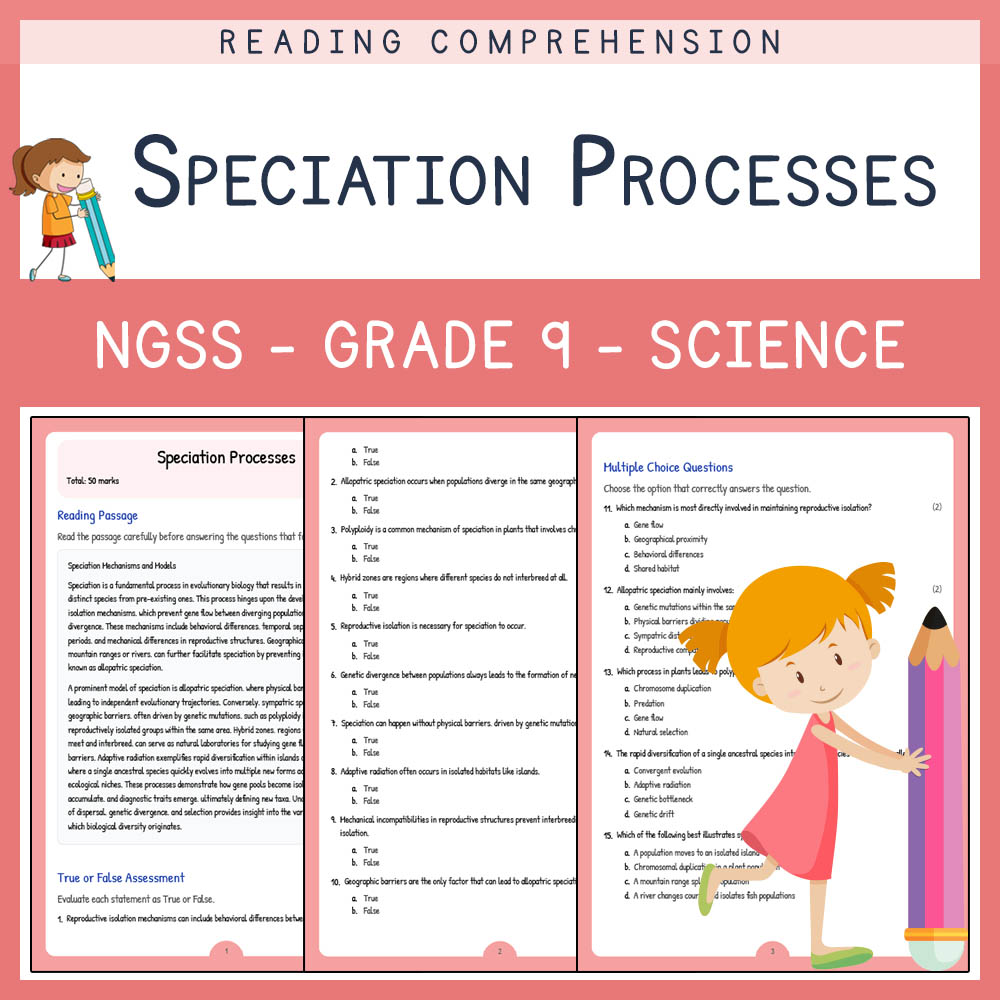
Grade 9 Science | Speciation Processes Worksheet & Answer Key (NGSS Aligned)
 Created byLumora Learning
Learning Objectives
- Understand the mechanisms that lead to the formation of new species.
- Explain different models of speciation such as allopatric and sympatric.
- Identify examples of speciation in natural populations, including hybrid zones and polyploidy.
Instant download

Grade 9 ELA Word Meaning Worksheet (PDF) | General ELA Standards
 Created byGolden Apple Studio
Learning Objectives
- Infer the meaning of unfamiliar words or phrases using surrounding context in Grade 9-level texts.
- Distinguish denotation (literal meaning) from connotation (implied/emotional meaning) in context.
- Determine whether a word’s meaning is technical, literal, or figurative based on how the author uses it.
Also included in: Grade 9 Text Evidence & Argument Reasoning ELA Lesson Bundle (General ELA) +1 more
Instant download

Grade 9 Social Studies — Integrating Perspectives Worksheet MCQ Paper
 Created byThe Resource Hub
Learning Objectives
- Analyze multiple sources and viewpoints to develop comprehensive historical narratives.
- Evaluate biases and recognize diverse cultural and social perspectives in Canada's history.
- Develop nuanced interpretations that reflect interconnected causes, effects, and cultural contexts.
Also included in: Grade 9 Historical Narratives Perspectives Sources Social Studies Custom BC +1 more
Instant download

Grade 9 ELA | Proofreading Conventions Worksheet | Alberta Standards
Created byLumora LearningLearning Objectives
- Apply proofreading conventions to correct grammar errors, including subject-verb agreement and consistent verb tense.
- Use punctuation rules to improve clarity, including commas in compound sentences and correct end punctuation.
- Identify and correct common spelling errors and visually similar word mistakes without changing meaning.
Instant download

Grade 9 | International Families Day for Family Foundations | PDF + Answer Key
 Created byShaNova Worksheets
Learning Objectives
- Explain how family structures differ across cultures while sharing common values.
- Analyze how families influence identity, social roles, and community connection.
- Demonstrate respect and empathy toward diverse family experiences.
Instant download

Grade 9 ELA - Evidence Selection Worksheet (Alberta Standard PDF)
Created byGolden Apple StudioLearning Objectives
- Select evidence that is relevant to a specific claim and purpose.
- Evaluate whether sources are credible by checking author, publication, and accuracy signals.
- Use evidence efficiently by avoiding redundancy and ensuring sources fit the scope and length of a text.
Also included in: Grade 9 Evidence-Based Writing Revision ELA Lesson Bundle (Alberta) +1 more
Instant download

Grade 9 ELA | Theme Development Worksheet (Alberta Standard) (PDF)
Created byGolden Apple StudioLearning Objectives
- Identify how recurring ideas form a theme in a text
- Explain how characters’ attitudes and repeated imagery/language support a theme statement
- Use evidence from multiple parts of a text to justify a claim about theme
Also included in: Grade 9 Theme Development & Text Evidence ELA Lesson Bundle – Alberta +1 more
Instant download

Newtonian Motion Test Prep Printable | Grade 9 Science
 Created byPrism Point Learning
Learning Objectives
- Explain Newton’s second law using the relationship between net force, mass, and acceleration for constant mass systems
- Interpret free-body diagrams and determine the net force from force vectors and their components
- Use proportional reasoning to predict how changes in force affect acceleration
Also included in: Grade 9 Newtonian Motion & Collisions Science Lesson Bundle NGSS
Instant download

Grade 9 Holiday World Population Day for Mastering Demography | PDF + Answer Key
Created byShaNova WorksheetsLearning Objectives
- Explain the basics of demography and how birth rate, death rate, and migration affect population change
- Describe how population data is collected and why accurate measurements matter for planning and sustainability
- Use demographic concepts to interpret statements about trends in population growth and age structure
Instant download
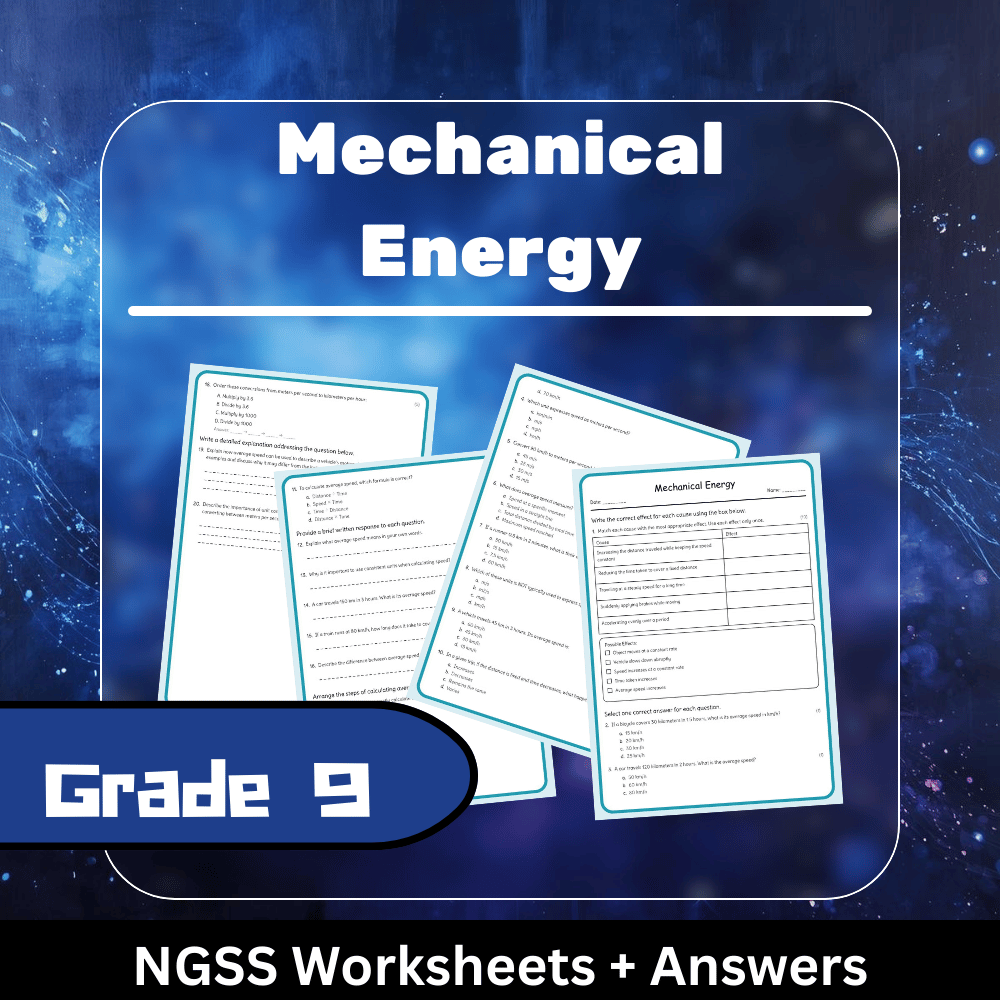
Grade 9 Science – Mechanical Energy Worksheet (NGSS Aligned) | PDF
 Created byBright Mind Resources
Learning Objectives
- Understand the concepts of kinetic and potential energy and their mathematical relationships.
- Analyze work, power, and energy transfer in mechanical systems.
- Explore real-world phenomena such as pendulum motion, colliding carts, and roller-coaster height-to-speed dynamics.
Instant download

Grade 9 Science — Organelle Function Worksheet MCQ Paper
Created byThe Resource HubLearning Objectives
- Understand the roles of major organelles such as mitochondria, chloroplasts, endoplasmic reticulum, and lysosomes in cellular processes.
- Describe how organelle structures like cristae, thylakoids, and folded membranes influence their functions.
- Explain how cellular compartmentation optimizes metabolic pathways and energy flow.
Also included in: Grade 9 Science Biology and Ecosystems Lesson Bundle for AP Curriculum +1 more
Instant download

Grade 9 Integrated Physiology Cellular Function Worksheet | NGSS Science
 Created byBRIGHT PATH RESOURCES
Learning Objectives
- Understand the basic functions of cells in the human body.
- Identify how molecular and cellular interactions contribute to organ system functions.
- Analyze clinical examples to connect molecular defects with physiological dysfunction.
Also included in: Cell Signaling Grade 9 Science Daily Reading Worksheets Lesson Bundle | NGSS +1 more
Instant download
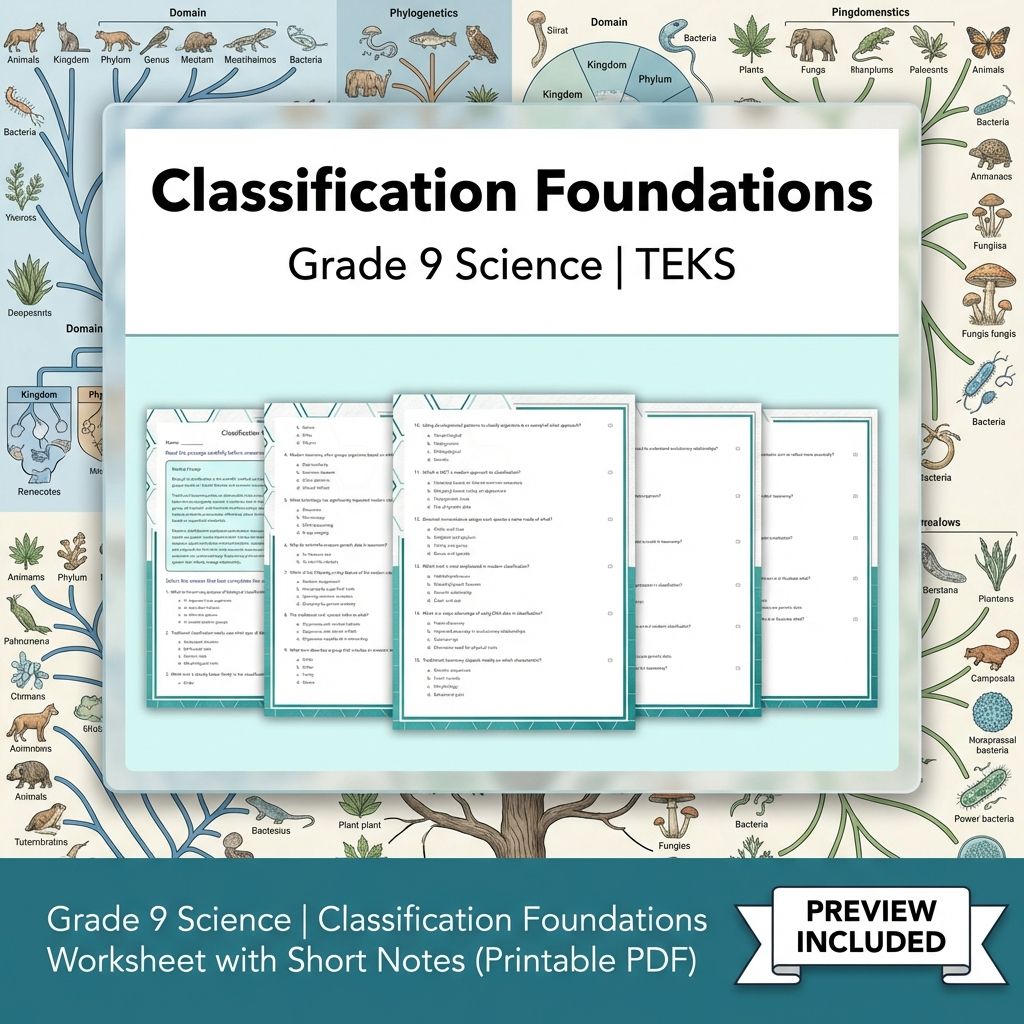
Grade 9 Science | Classification Foundations Worksheet with Short Notes (PDF)
 Created byMeadowlark Worksheets
Learning Objectives
- Understand the hierarchical structure of biological classification systems.
- Identify and differentiate traditional and modern classification approaches.
- Compare various characteristics used to classify living organisms.
Instant download

Structural Patterns Worksheet for Grade 9 ELA | Common Core Aligned
JCreated byJ.S SheetsLearning Objectives
- Identify how an author’s structural choices (order of events, chapter breaks, and recurring patterns) shape meaning and impact.
- Explain how suspense and delayed information function through narrative structure.
- Analyze how specific story elements connect to the overall pacing and theme.
Instant download

Grade 9 Science – Greenhouse Effect & Climate | Daily Reading Worksheet
Created byBright Mind ResourcesLearning Objectives
- Define the greenhouse effect and identify the gases involved.
- Explain how greenhouse gases trap heat in the atmosphere.
- Recognize natural vs. human contributions to greenhouse gas levels.
Also included in: Grade 9 Earth Systems Science Daily Reading Worksheets Lesson Bundle | BC +1 more
Instant download

Grade 9 Science | Ecosystem Cycling - Daily Reading Comprehension
 Created byCoral Reef Learning
Learning Objectives
- Understand the process of carbon transfer within forest ecosystems.
- Identify key components of the carbon cycle.
- Analyze how abiotic and biotic factors influence carbon cycling.
Also included in: Biology and Ecosystems Lesson Bundle – Grade 9 Science AP Daily Reading +1 more
Instant download

Grade 9 Science | Magnetic Fields Worksheet (PDF) Aligned to Alberta Standards
 Created byEvergreen Desk Education
Learning Objectives
- Explain how magnetic fields are produced by magnets and moving electric charges
- Use field-line ideas to predict the direction of magnetic forces on different materials
- Relate current direction to magnetic field orientation around a wire
Instant download

Grade 9 Asexual Reproduction Binary Fission & Budding Worksheet Alberta
Created byBRIGHT PATH RESOURCESLearning Objectives
- Identify the main steps of binary fission and budding in asexual reproduction.
- Explain how asexual reproduction affects genetic similarity among offspring.
- Describe why asexual strategies can spread well in stable environments.
Instant download

Grade 9 Genetic Variation Sources Worksheet | Practice & PDF
 Created byClear Sky Classroom
Learning Objectives
- Explain major sources of genetic variation, including mutation, recombination, gene flow, and chromosomal rearrangements
- Describe how each variation source can increase or decrease genetic diversity within a population
- Use examples of introduced species and managed fisheries to predict changes in gene pools
Instant download

Grade 9 ELA | Thesis Explanation Worksheet (PDF) – General ELA Standards
Created byGolden Apple StudioLearning Objectives
- Write a focused thesis that previews the main ideas an informative essay will explain
- Develop body paragraphs with relevant facts, definitions, and examples that clarify concepts
- Use evidence and transitions to explain relationships (cause and effect, compare and contrast, or steps in a process) in an objective tone
Also included in: Grade 9 Argument Writing ELA Lesson Bundle: General ELA Worksheets +1 more
Instant download

Grade 9 Energy Transfer Worksheet | Ontario Science with Answer Key
Created byClear Sky ClassroomLearning Objectives
- Explain how energy from the Sun and Earth’s interior is transferred through Earth systems using radiation, conduction, and convection
- Describe how energy gradients drive atmospheric and ocean circulation and influence weather and climate patterns
- Connect radioactive heat production in Earth’s mantle to long-term mantle convection and volcanic activity
Instant download

Grade 9 TEKS ELA Discussion Norms Worksheet with Answer Key & Guide
 Created bySunny Desk Resources
Learning Objectives
- Identify and explain key discussion norms for collaborative academic conversations.
- Use precise language to address a discussion prompt and connect ideas to others’ remarks.
- Demonstrate respectful communication by maintaining topic focus and responding to audience needs.
Instant download

Punctuation Marks Worksheet for Grade 9 ELA | Common Core Standards Practice
JCreated byJ.S SheetsLearning Objectives
- Use end punctuation correctly to distinguish statements, questions, and exclamations.
- Use commas to separate items in a series, introductory phrases, and nonessential descriptions.
- Apply apostrophes for possession and contractions.
Instant download

Grade 9 ELA – Logical Presentation Worksheet (CCSS) PDF
Created byGolden Apple StudioLearning Objectives
- Organize an oral presentation with clear claims, supporting details, and evidence that matches purpose and audience.
- Use effective transitions to guide listeners and maintain coherence from introduction to conclusion.
- Present sufficient detail while maintaining brevity so conclusions follow the information shared.
Also included in: Grade 9 ELA Full-Year Worksheet Bundle | CCSS Common Core
Instant download

Energy Conservation Worksheet Grade 9 Science Ontario with Answer Key
Created byClear Sky ClassroomLearning Objectives
- Explain when total mechanical energy is conserved in a system (kinetic + potential) under negligible non-conservative forces
- Describe how kinetic and gravitational potential energies interconvert using height–speed relationships
- Account for energy dissipation when non-conservative forces (such as friction) do work on a system
Instant download

Kinematics: Speed, Velocity & Acceleration Worksheets Grade 9
Created bySunny Desk ResourcesLearning Objectives
- Define speed, velocity, and acceleration using distance, displacement, time, and direction
- Distinguish scalar and vector quantities in motion problems
- Apply sign conventions and unit conversions to compare motions
Also included in: Energy Transfer & Mechanical Advantage Lesson Bundle | Grade 9 Science | Alberta +1 more
Instant download

Grade 9 Holiday | April Fools Day for Mastering Media Literacy| PDF + Answer Key
Created byShaNova WorksheetsLearning Objectives
- Understand how April Fools' jokes are presented across different media platforms.
- Learn to distinguish between humorous satire and misinformation in news and social media.
- Analyze real examples of satirical headlines and stories for media literacy.
Also included in: Grade 9 April Fools Day Media Literacy Holiday Lesson Bundle Framework
Instant download

Grade 9 ELA Worksheet | Audience Focus with Reading & Essays (Alberta)
Created byGolden Apple StudioLearning Objectives
- Plan drafts by aligning purpose and audience to determine tone, detail, and emphasized ideas.
- Revise writing to meet genre expectations and reader needs using appropriate terminology and context.
- Evaluate how examples, evidence, and phrasing shift for different audiences while keeping the controlling purpose consistent.
Also included in: Grade 9 Evidence-Based Writing Revision ELA Lesson Bundle (Alberta) +1 more
Instant download

Evolution Evidence Worksheet Grade 9 Science Activity | NGSSS
Created byPrism Point LearningLearning Objectives
- Explain how multiple lines of evidence (fossils, anatomy, and genetics) support the theory of evolution.
- Use homologous structures and genetic similarity to infer shared ancestry.
- Distinguish evidence for gradual change from patterns caused by convergent evolution.
Also included in: Grade 9 Evolution, Genetics & Ecology Lesson Bundle | Florida NGSSS
Instant download

Grade 9 Science | Cellular Metabolism - Daily Reading Comprehension
Created byCoral Reef LearningLearning Objectives
- Understand the basic biochemical pathways involved in cellular energy production.
- Identify the processes of glycolysis, the citric acid cycle, and electron transport.
- Explain how ATP is produced and used in cells.
Instant download

Grade 9 ELA - Academic Presentation Worksheet (PDF) – General ELA Standards
Created byGolden Apple StudioLearning Objectives
- Organize an academic presentation with a clear purpose, logical sequence, and appropriate transitions.
- Select information that matches the task and aligns claims with evidence from sources.
- Use precise language to explain complex ideas and incorporate references (visual or textual) to support reasoning.
Also included in: Grade 9 Evidence and Rhetoric ELA Reading Lesson Bundle for General ELA +1 more
Instant download

Explanatory Organization Worksheet for Grade 9 ELA | Common Core Practice
JCreated byJ.S SheetsLearning Objectives
- Identify how explanatory writing uses deliberate structure to clarify complex ideas
- Distinguish common organizational patterns such as cause-and-effect, comparison, and problem-to-solution
- Use transitions and headings to connect ideas and support reader understanding
Instant download

Grade 9 | World Ocean Day for Mastering Marine Ecosystems | PDF + Answer Key
Created byShaNova WorksheetsLearning Objectives
- Describe how different marine habitats (coral reefs, kelp forests, and deep-sea ecosystems) support biodiversity
- Explain how interconnected species and food webs help marine ecosystems function
- Identify major threats to marine ecosystems, including pollution and climate change
Also included in: Grade 9 World Ocean Day Holiday Conservation Actions Custom Bundle NGSS
Instant download

Grade 9 Science | Design Communication in Science - Daily Reading Comprehension
Created byCoral Reef LearningLearning Objectives
- Understand key concepts related to Science
- Apply knowledge through practice questions
- Demonstrate comprehension of the material
Instant download

Interactive Questioning for Clear Discussion | Grade 9 ELA
Created byGolden Apple StudioLearning Objectives
- Explain how rephrasing improves accuracy during clarification
- Construct purposeful questions that request evidence or reasoning
- Identify evidence and reasoning in discussion responses
Also included in: Oral Communication Skills Lesson Bundle | Grade 9 ELA | Ontario +1 more
Instant download
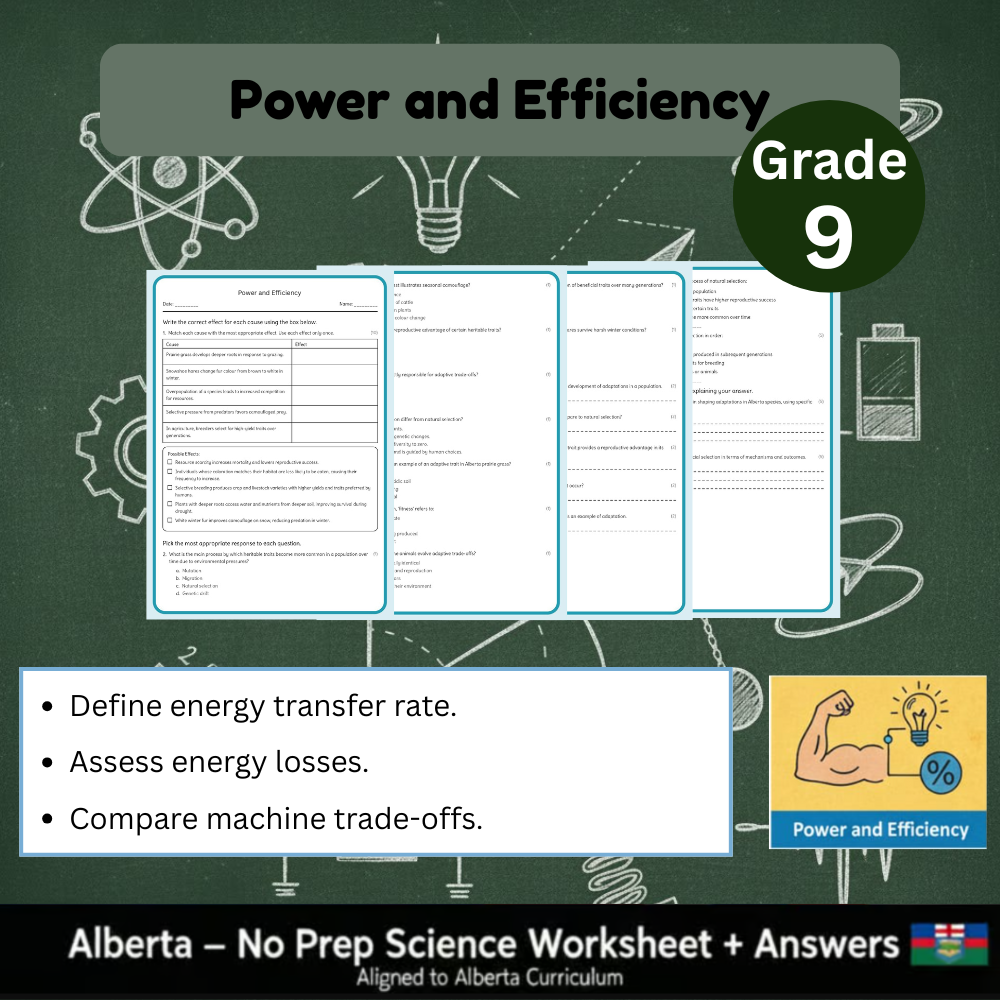
Grade 9 Science – Power and Efficiency Worksheet (PDF) | Alberta Standards
Created byBright Mind ResourcesLearning Objectives
- Understand the concepts of power, energy transfer rate, and efficiency in machines and systems.
- Analyze regional engineering examples to assess power output and energy losses.
- Compare theoretical and practical efficiencies of machines to identify operational trade-offs.
Instant download

Energy Changes Worksheet | Grade 9 Science Printable PDF Assessment
Learning Objectives
- Understand the concepts of endothermic and exothermic reactions and how energy is transferred during chemical processes.
- Interpret energy diagrams and relate molecular interactions to observable temperature and phase changes.
- Analyze real-world examples, such as combustion, to comprehend energy release and absorption in chemical bonds.
Also included in: Grade 9 Science Lesson Bundle on Matter and Its Interactions +1 more
Instant download

Complex Inheritance Assessment | TEKS Grade 9 Science Worksheet
Created byPrism Point LearningLearning Objectives
- Understand the differences between simple and complex inheritance patterns such as polygenic traits, epistasis, and pleiotropy.
- Explain how variable penetrance and expressivity affect phenotype manifestation.
- Describe how linkage influences independent assortment, and how environmental factors modulate traits.
Instant download

Policy Evaluation Worksheet for Grade 9 Social Studies | Standards-Aligned PDF
JCreated byJ.S SheetsLearning Objectives
- Analyze how policy evaluation examines the goals, impacts, and outcomes of regulations and agreements affecting resource-based industries
- Evaluate continuity and change in policy approaches since Confederation, including environmental assessment and economic incentives
- Assess interrelationships among governance, corporate responsibility, and Indigenous rights (First Nations, Métis, and Inuit) when policies affect land and livelihoods
Instant download

Grade 9 Science – Variation Mechanisms & Genetics | Daily Reading Worksheet
Created byBright Mind ResourcesLearning Objectives
- Understand different sources of heritable genetic variation
- Describe how point mutations, chromosomal rearrangements, and recombination contribute to allelic diversity
- Connect molecular changes to phenotypic variability and evolution
Also included in: Grade 9 Genetics Science Daily Reading Worksheets Lesson Bundle | NGSS +2 more
Instant download

Grade 9 ELA – Understanding Context & Urban Development | Daily Worksheet
 Created byQuiet Forest Education
Learning Objectives
- Identify differences and similarities between historical account and contemporary opinion piece.
- Understand how cultural and personal contexts influence interpretation of texts.
- Analyze how perspectives on a common issue evolve over time.
Also included in: Reading and Viewing Lesson Bundle | Grade 9 ELA | BC Standards +1 more
Instant download

Grade 9 ELA – Understanding Audience & Communication Skills | Daily Worksheet
Created byQuiet Forest EducationLearning Objectives
- Identify different types of audiences and their needs
- Adjust language and tone for specific audiences
- Understand how purpose influences message presentation
Also included in: Speaking and Listening Grade 9 ELA Lesson Bundle | BC +1 more
Instant download

Grade 9 Science – Mixtures and Solutions Worksheet (PDF) | Alberta Standards
 Created bySilver Birch Teaching
Learning Objectives
- Differentiate heterogeneous mixtures from homogeneous solutions using the concepts of uniformity and separability.
- Identify solute, solvent, and explain how concentration relates to the amount of solute in a solution.
- Describe common separation methods based on physical properties (e.g., filtration, evaporation, distillation).
Also included in: Grade 9 Chemical Reactions Science Lesson Bundle: Alberta Framework +1 more
Instant download

Grade 9 | First day of spring Worksheet for Earth's Seasons | PDF + Answer Key
Created byShaNova WorksheetsLearning Objectives
- Understand the scientific principles behind the Earth's tilt and orbit that cause the seasons.
- Describe the significance of the Spring Equinox in global day and night balance.
- Explain how seasonal changes influence ecosystems, plant growth, and animal behavior.
Instant download

Community Resilience Worksheet for Grade 9 Social Studies | Standards-Aligned
JCreated byJ.S SheetsLearning Objectives
- Explain how green infrastructure, emergency preparedness, and adaptive land use reduce community risk.
- Analyze how governance, funding, and social networks work together to strengthen long-term resilience.
- Describe how climate change, aging infrastructure, and socio-economic disparities can increase vulnerability and shape outcomes.
Instant download

Seismic Signals Practice Worksheet | Grade 9 Science Ontario
Created byPrism Point LearningLearning Objectives
- Explain the main types of seismic waves and how their paths and speeds reveal Earth structure.
- Use seismic wave timing to estimate epicentres and relate earthquake size to magnitude.
- Describe how focal mechanisms reveal fault types and the orientation of stress during earthquakes.
Also included in: Grade 9 Earth and Space Science Lesson Bundle Worksheets | Ontario
Instant download

Grade 9 Mechanisms of Natural Selection Worksheet | NGSS Practice PDF
Created byClear Sky ClassroomLearning Objectives
- Explain how heritable variation influences survival and reproduction.
- Identify examples of natural selection in nature, such as finch beak changes and bacterial resistance.
- Describe different types of selection: directional, stabilizing, and disruptive.
Also included in: Grade 9 Speciation and Evolution Science Lesson Bundle (NGSS) Worksheet B +1 more
Instant download

Circuit Diagrams and Symbols Worksheets | Grade 9 Electricity
Created bySunny Desk ResourcesLearning Objectives
- Identify common circuit diagram symbols and connection types used to represent circuit topology.
- Trace current paths and determine likely voltage relationships at nodes in a diagram.
- Use standardized notation (nodes, series/parallel connections) to communicate and predict behavior of simple circuits.
Also included in: Grade 9 Electricity & Magnetism Lesson Bundle | Alberta Science +1 more
Instant download
Browse more categories
About Grade 9 Worksheets
Browse 9,323 printable Grade 9 worksheets across algebra, biology, literature, and history — each a ready-to-print PDF with optional answer keys.
Every worksheet on MyTeachingSheets is created by independent teacher-authors and reviewed before publication. All resources download as printable PDFs for classroom, homework, or at-home practice, and many include answer keys. Preview any worksheet free before buying.