
Reading comprehension Worksheets
40,284 type resources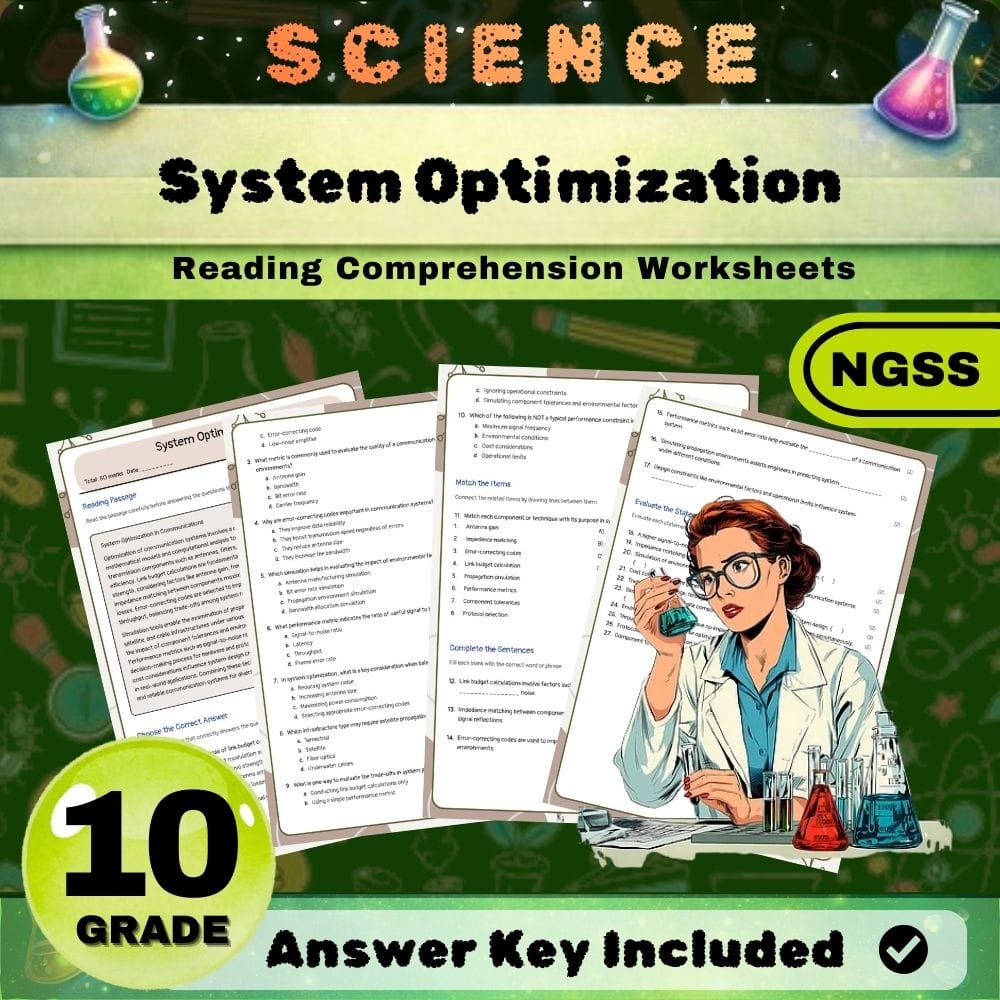
Grade 10 Science – System Optimization Worksheet (NGSS) (PDF)
 Created byMaple Path Learning
Learning Objectives
- Understand how mathematical models and computational analysis are used to optimize communication systems.
- Identify key system components such as antennas, impedance matching, and error-correcting codes.
- Analyze trade-offs among range, throughput, and reliability in system design.
Also included in: Grade 10 Science Waves and Their Applications in Technologies Bundle +1 more
Instant download
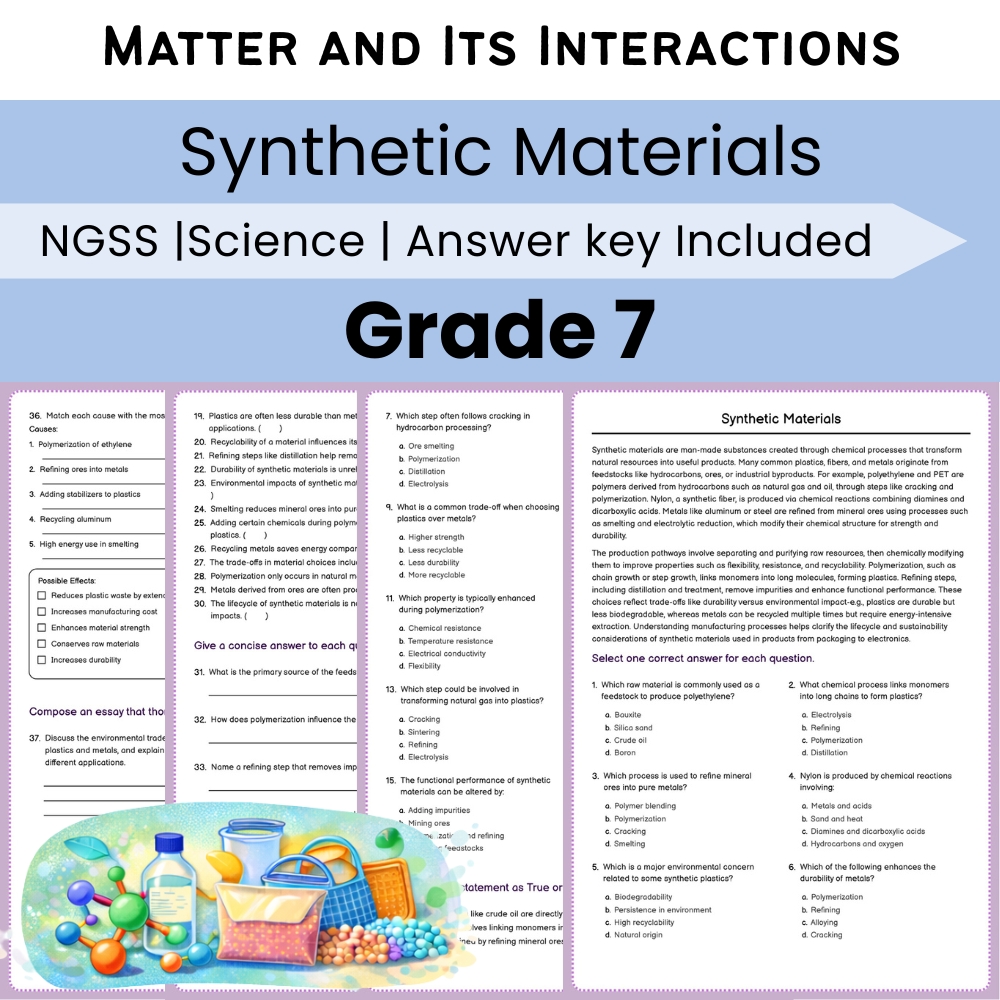
Synthetic Materials Worksheet | Grade 7 Science Printable PDF Assessment
Learning Objectives
- Describe the production pathways of common synthetic materials from natural resources.
- Explain processes such as polymerization and refining steps that alter chemical composition.
- Identify examples like polyethylene, PET, nylon, and how materials are derived from feedstocks.
Also included in: Grade 7 Science Lesson Bundle – Matter and Its Interactions NGSS-Aligned +1 more
Instant download

Electricity and Power Worksheet Pack AP Physics Grade 12 Practice
 Created byPrism Point Learning
Learning Objectives
- Explain how power relates to current and voltage in resistive circuits, including energy dissipation over time.
- Analyze source power delivered to a load while accounting for internal resistance effects.
- Model charging and discharging in simple RC circuits using exponential time dependence and the time constant.
Also included in: AP Physics Grade 12 Science Mechanics & Electricity Lesson Bundle | AP
Instant download
Grade 10 Science – Food Chains & Energy Flow Worksheet (Answer Key) | TEKS Aligned
 Created byBright Mind Resources
Learning Objectives
- Understand the roles of producers, consumers, and decomposers in food chains and food webs.
- Identify the flow of energy and matter through different organisms in an ecosystem.
- Analyze the effects of disruptions in food chains and how they propagate through ecosystems.
Also included in: Grade 10 Science | Ecosystems & Biodiversity Unit Worksheet Bundle(TEKS-Aligned) +5 more
Instant download

Grade 6 Science – Adaptation Basics & Reading Worksheet | Ontario Standards
Created byBright Mind ResourcesLearning Objectives
- Understand what structural adaptations are in animals
- Identify different examples of adaptations in nature
- Explain how adaptations help animals survive in their environments
Also included in: Grade 6 Ecology & Biodiversity Science Lesson Bundle | Ontario Daily Reading +1 more
Instant download
Grade 6 Science | Effects of Angle of Attack Worksheet (Ontario, PDF)
Created byBright Mind ResourcesLearning Objectives
- Understand how the angle of attack influences airflow and lift generation.
- Identify the effects of changing wing incidence and pilot input on effective angle.
- Explain how factors like airfoil shape, flap settings, and Reynolds number affect critical angle.
Instant download
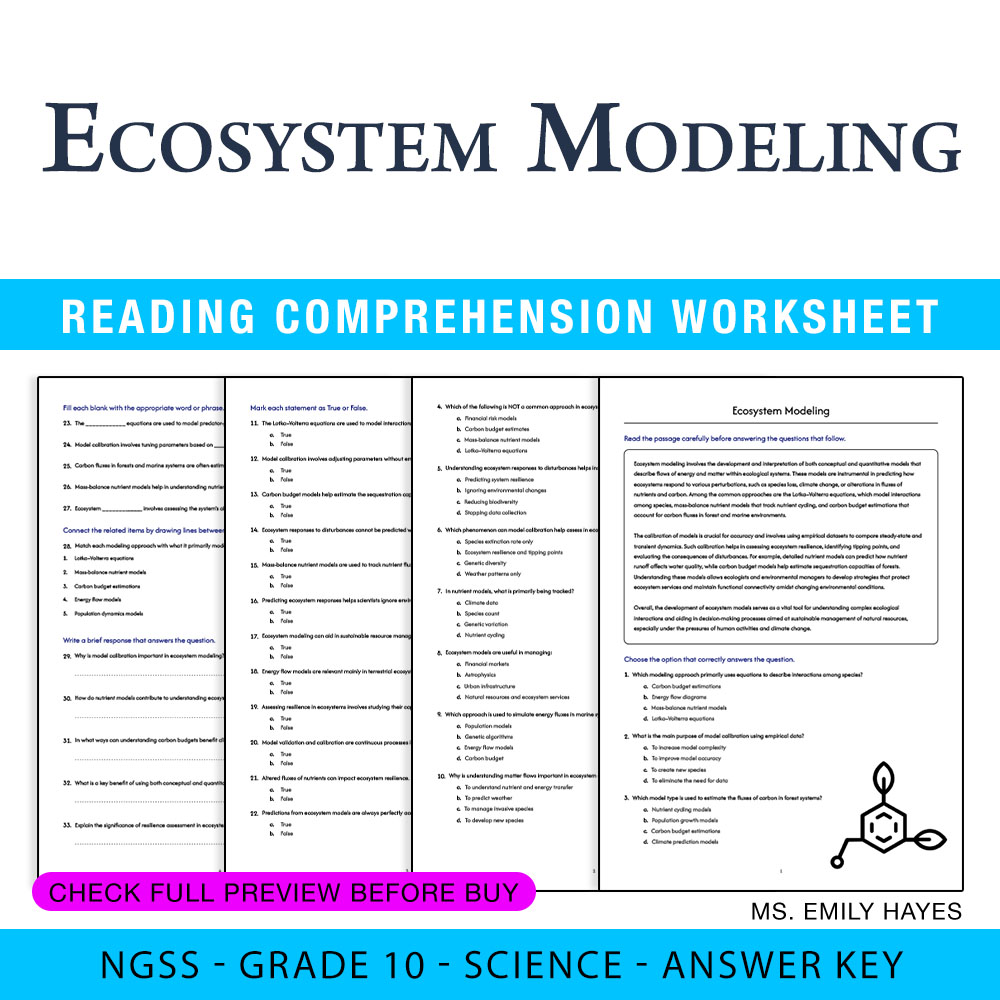
10th Grade Science | Ecosystem Modeling Worksheet (PDF + Answer Key)
 Created byCopper Leaf Classroom
Learning Objectives
- Understand the principles of ecosystem modeling including energy and matter flows
- Interpret both conceptual and quantitative models such as Lotka–Volterra equations and nutrient models
- Analyze the responses of ecosystems to perturbations using modeling approaches
Instant download

Grade 9 Science – Redox Concepts & Equations | Daily Reading Worksheet
Created byBright Mind ResourcesLearning Objectives
- Define oxidation and reduction in chemical reactions.
- Identify oxidation states and track electron transfer.
- Differentiate between oxidizing and reducing agents.
Also included in: Grade 9 Chemical Reactions Science Lesson Bundle: Daily Reading (BC) +1 more
Instant download
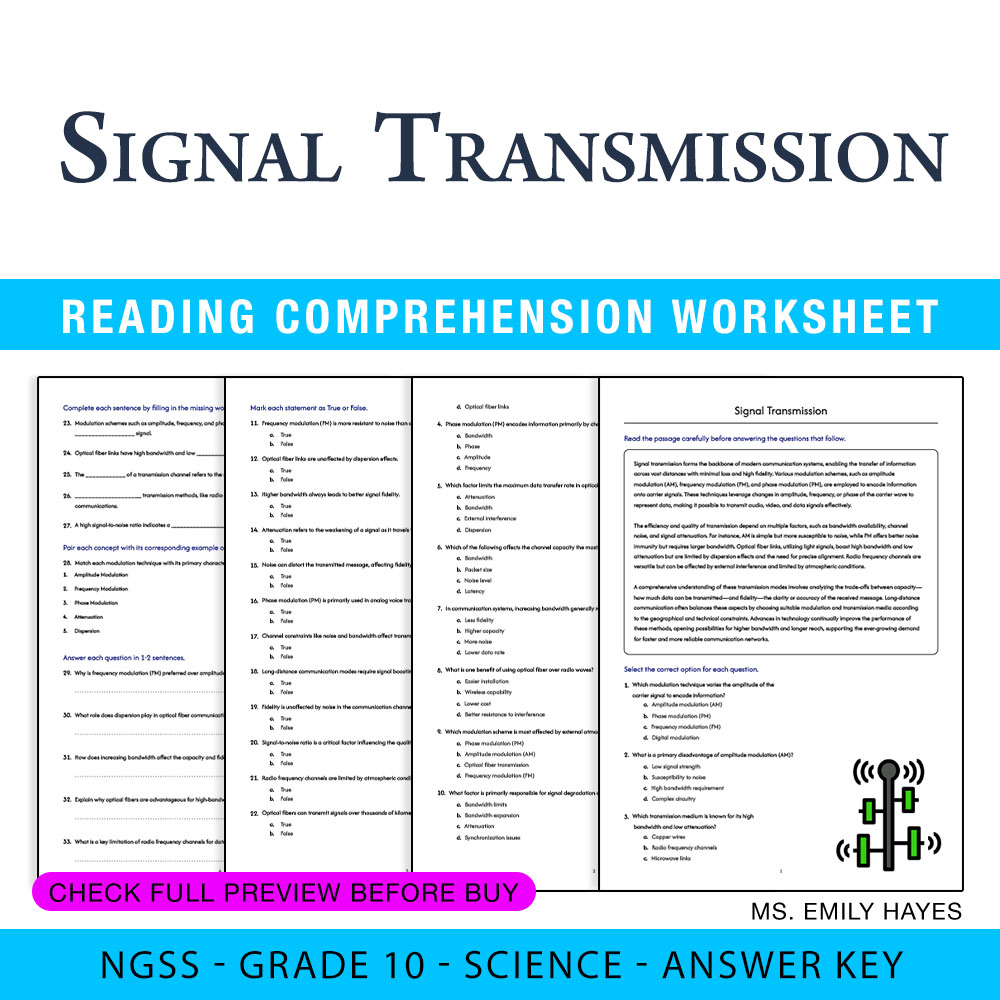
Grade 10 Science | Signal Transmission Worksheet (PDF+ Answer Key)
Created byCopper Leaf ClassroomLearning Objectives
- Explain the principles of amplitude, frequency, and phase modulation techniques.
- Describe the factors affecting the capacity and fidelity of transmission channels.
- Compare different transmission modes such as radio frequency channels and optical fibers.
Instant download
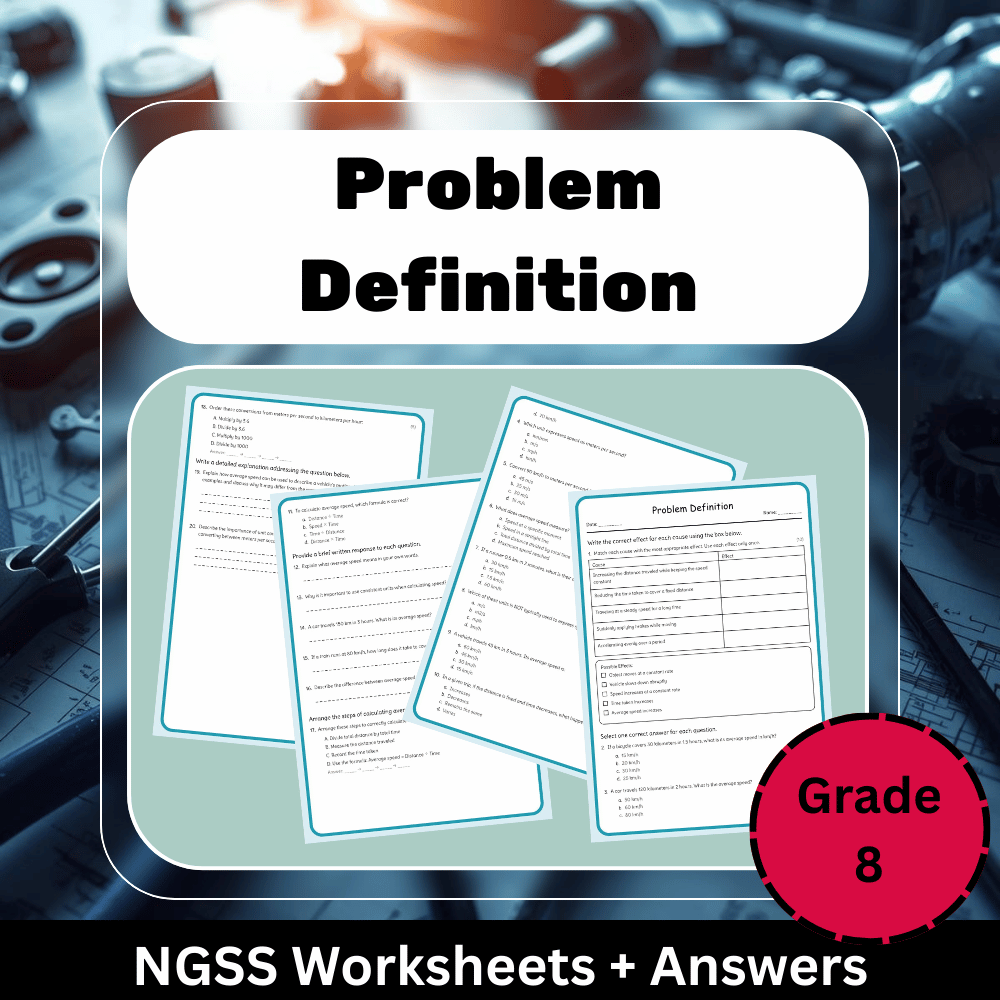
Grade 8 Science | Problem Definition Worksheet (NGSS & STEM) - PDF
Created byBright Mind ResourcesLearning Objectives
- Understand the criteria and constraints involved in defining engineering problems.
- Identify measurable performance goals, safety, and environmental considerations.
- Analyze trade-offs between time, cost, and durability in problem scenarios.
Also included in: Grade 8 Science | Data Analysis & Engineering Design Unit Worksheet Bundle +2 more
Instant download
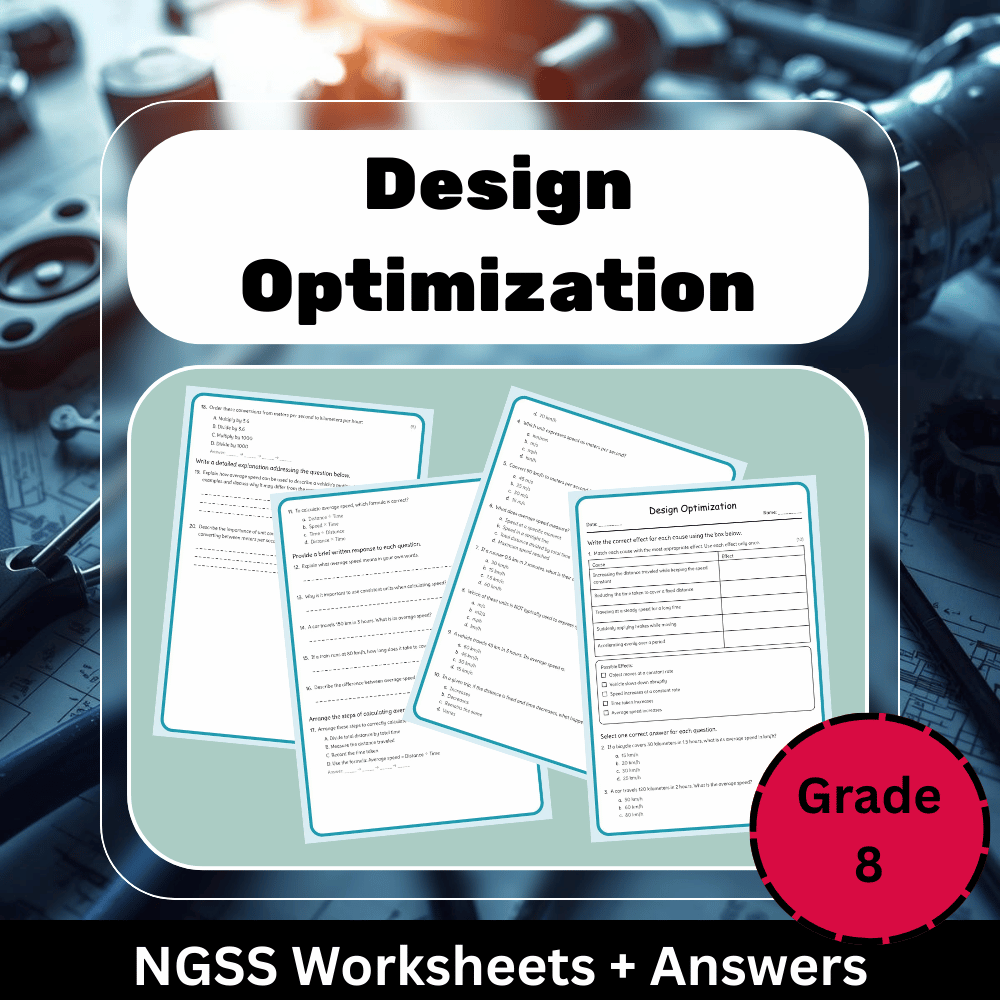
Grade 8 Science – Design Optimization Worksheet (Answer Key) | NGSS Alignment
Created byBright Mind ResourcesLearning Objectives
- Analyze test data to identify performance trends in design modifications.
- Use graphical and statistical summaries to evaluate design improvements.
- Quantify trade-offs among efficiency, strength, and durability in iterative design processes.
Also included in: Grade 8 Science | Data Analysis & Engineering Design Unit Worksheet Bundle +2 more
Instant download
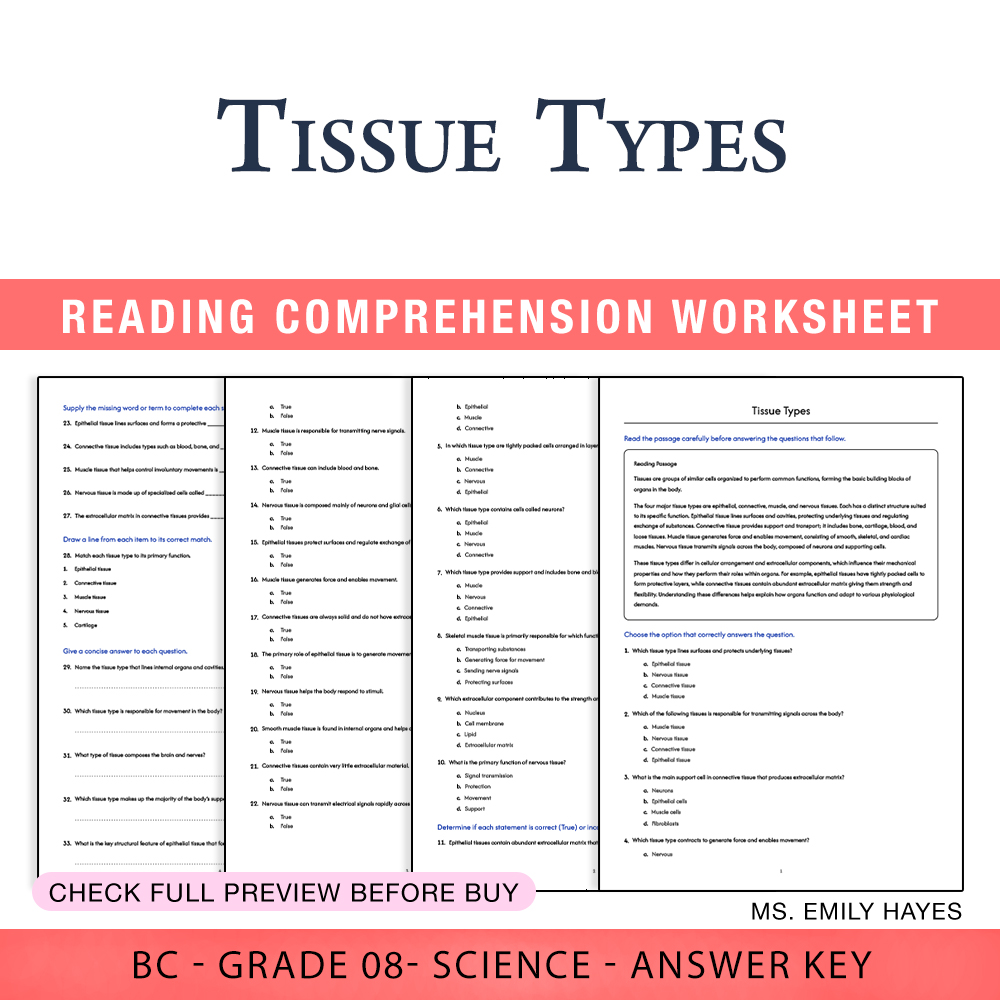
8th Grade Science | Tissue Types Worksheet (PDF+ Answer Key)
Created byCopper Leaf ClassroomLearning Objectives
- Identify and describe the four main tissue types: epithelial, connective, muscle, and nervous.
- Compare the structure and functions of different tissue types in organs.
- Explain how cellular arrangement and extracellular components influence tissue properties.
Also included in: Grade 8 Science Bundle – Cell Structure, Systems & Organisms (PDF + Answer Key) +1 more
Instant download

Grade 11 Science – Wave Relationships Worksheet (NGSS) (PDF)
Created byMaple Path LearningLearning Objectives
- Understand the mathematical relationship among wave speed, frequency, and wavelength using v = fλ.
- Describe differences between transverse and longitudinal waves, and their examples such as water waves, sound, and light.
- Interpret graphs and algebraic representations to analyze wave propagation, refraction, and dispersion across media.
Also included in: Grade 11 Electromagnetic Waves & Signal Transmission Science Lesson Bundle NGSS +1 more
Instant download
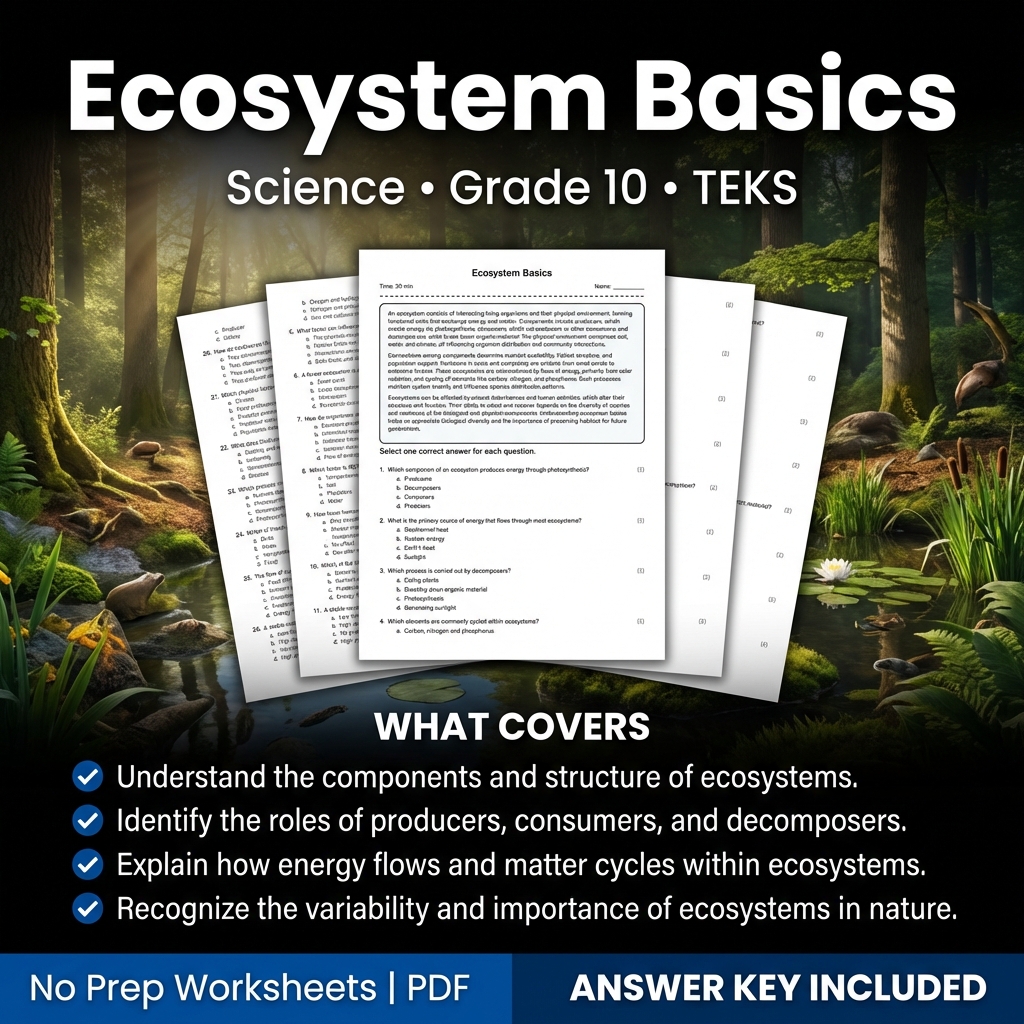
Ecosystem Basics Grade 10 Science Worksheet & Answer Key TEKS
 Created byCoral Reef Learning
Learning Objectives
- Understand the components and structure of ecosystems.
- Identify the roles of producers, consumers, and decomposers.
- Explain how energy flows and matter cycles within ecosystems.
Instant download

LGBTQ+ Pride and the Stonewall Legacy Voices of Activism | | Grades 11–12
Learning Objectives
- Analyze how personal narratives, speeches, and protest actions contributed to LGBTQ+ activism during the Stonewall era.
- Evaluate how language choices and community organizing influenced public opinion and social change.
- Connect themes of resilience and advocacy to contemporary conversations about diverse identities.
Instant download

Energy Transformations Worksheet | Grade 8 Science Activities
Created byPrism Point LearningLearning Objectives
- Describe how electrical energy can transform into thermal, radiant, and mechanical energy in everyday devices
- Explain why energy losses occur and how efficiency affects how much useful energy we get
- Relate Alberta’s electricity generation and the power grid to real-world supply, demand, and performance
Also included in: Grade 8 Science Electricity & Electromagnetism Lesson Bundle | Alberta
Instant download
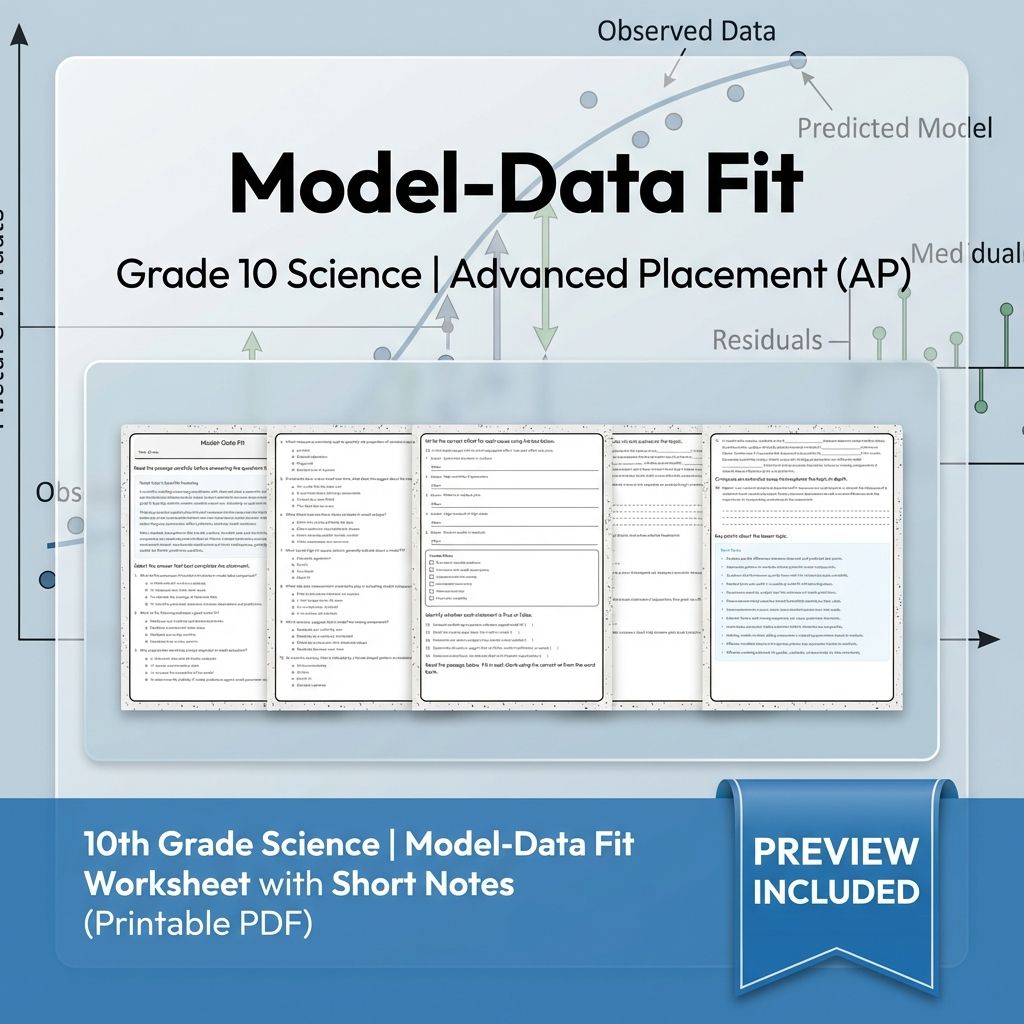
10th Grade Science | Model-Data Fit Worksheet with Short Notes (Printable PDF)
 Created byMeadowlark Worksheets
Learning Objectives
- Understand how to compare model predictions with observed data using residual analysis.
- Interpret goodness-of-fit measures to evaluate model adequacy.
- Assess the impact of model parameter sensitivity on predictive accuracy.
Also included in: Grade 10 Science Unit | Data Analysis, Modelling Worksheet Pack
Instant download
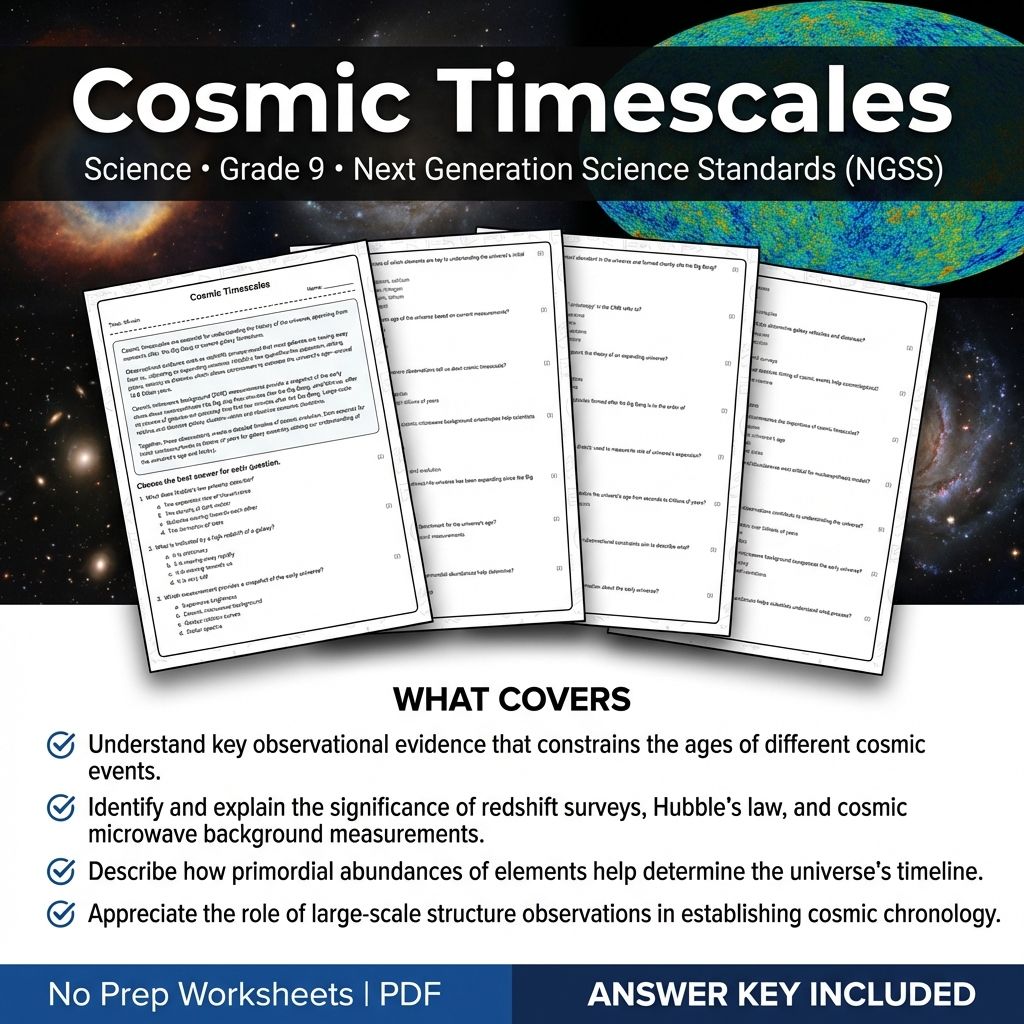
Grade 9 Science Worksheet | Cosmic Timescales – NGSS Printable PDF & Answer Key
Created byCoral Reef LearningLearning Objectives
- Understand key observational evidence that constrains the ages of different cosmic events.
- Identify and explain the significance of redshift surveys, Hubble's law, and cosmic microwave background measurements.
- Describe how primordial abundances of elements help determine the universe's timeline.
Also included in: Grade 9 Science Unit Bundle | Stellar Evolution & Cosmic Timescales Worksheets +1 more
Instant download
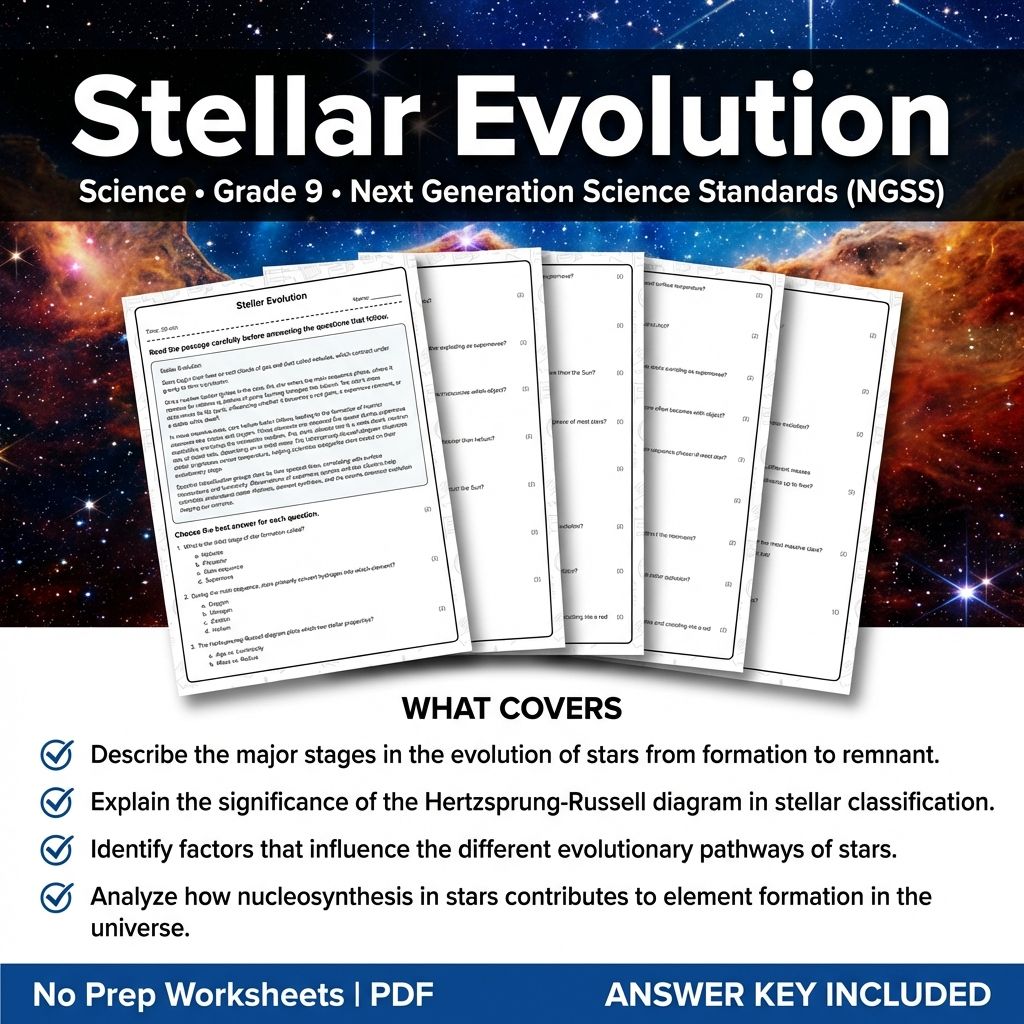
9th Grade Science Worksheet | Stellar Evolution Practice & Answer Key PDF
Created byCoral Reef LearningLearning Objectives
- Describe the major stages in the evolution of stars from formation to remnant.
- Explain the significance of the Hertzsprung-Russell diagram in stellar classification.
- Identify factors that influence the different evolutionary pathways of stars.
Also included in: Grade 9 Science Unit Bundle | Stellar Evolution & Cosmic Timescales Worksheets +1 more
Instant download
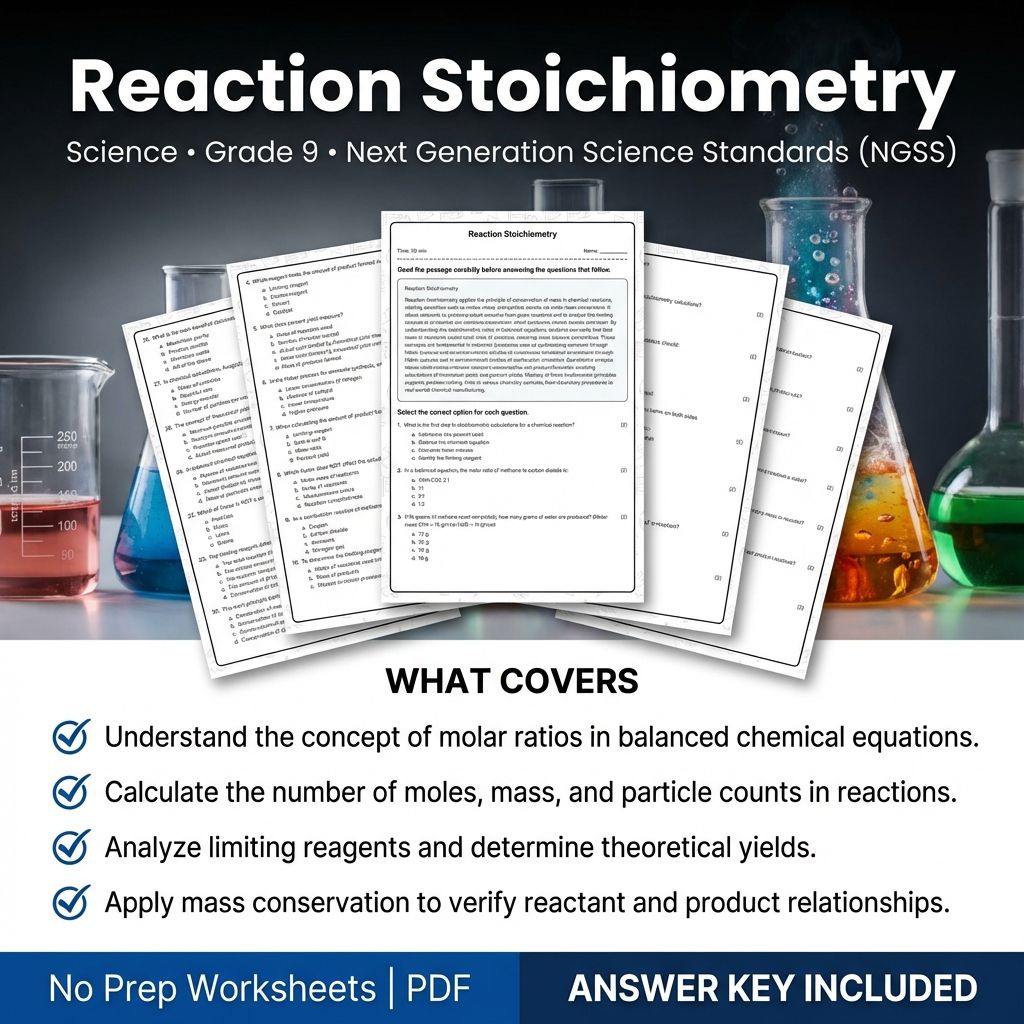
9th Grade Science Worksheet | Reaction Stoichiometry Practice & Answer Key (PDF)
Created byCoral Reef LearningLearning Objectives
- Understand the concept of molar ratios in balanced chemical equations.
- Calculate the number of moles, mass, and particle counts in reactions.
- Analyze limiting reagents and determine theoretical yields.
Also included in: Grade 9 Science Worksheet Bundle | Reaction, Molecules & Energy Topics +1 more
Instant download
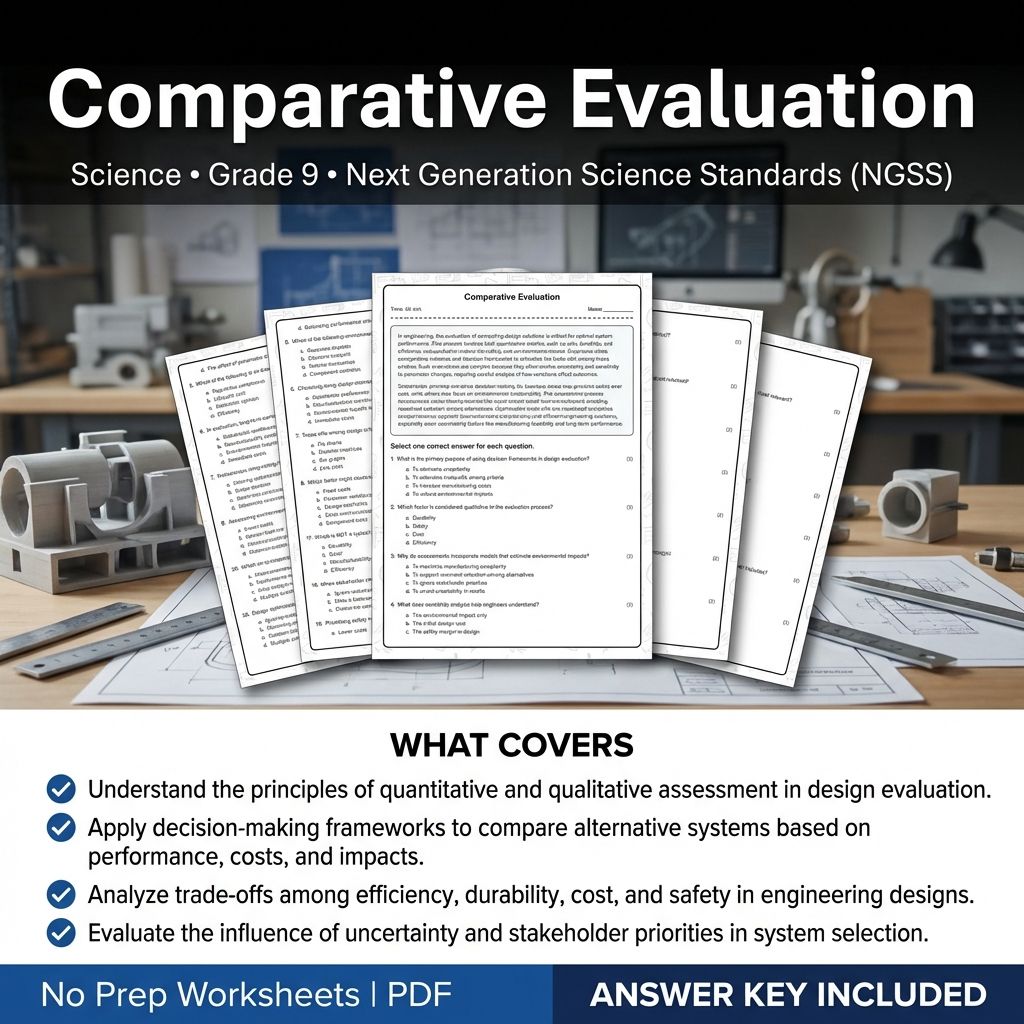
Grade 9 Science Worksheet | Comparative Evaluation with Answer Key (PDF)
Created byCoral Reef LearningLearning Objectives
- Understand the principles of quantitative and qualitative assessment in design evaluation.
- Apply decision-making frameworks to compare alternative systems based on performance, costs, and impacts.
- Analyze trade-offs among efficiency, durability, cost, and safety in engineering designs.
Also included in: Grade 9 Science Unit Bundle | Prototyping, Constraints & Modeling Worksheets +1 more
Instant download
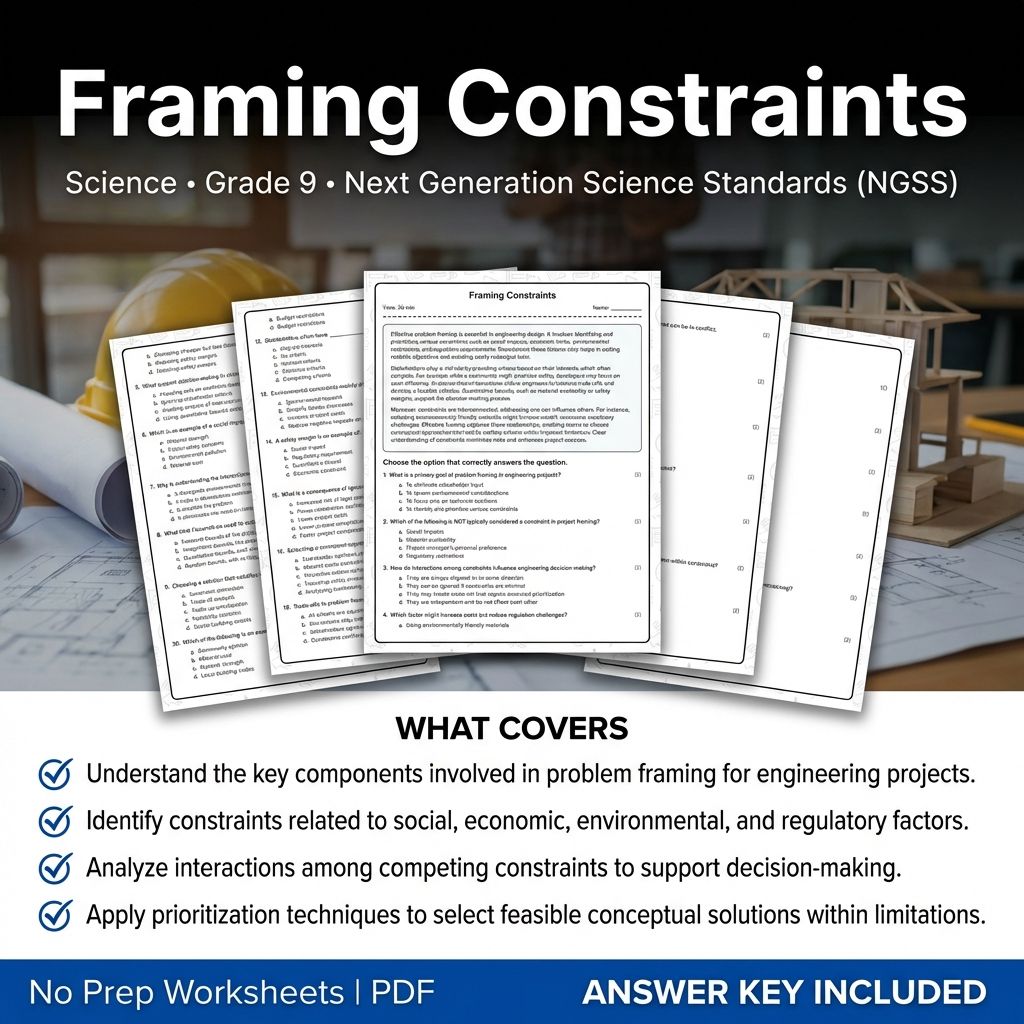
Grade 9 Science | Framing Constraints Worksheet & Answer Key (Printable PDF)
Created byCoral Reef LearningLearning Objectives
- Understand the key components involved in problem framing for engineering projects.
- Identify constraints related to social, economic, environmental, and regulatory factors.
- Analyze interactions among competing constraints to support decision-making.
Also included in: Grade 9 Science Unit Bundle | Prototyping, Constraints & Modeling Worksheets +1 more
Instant download
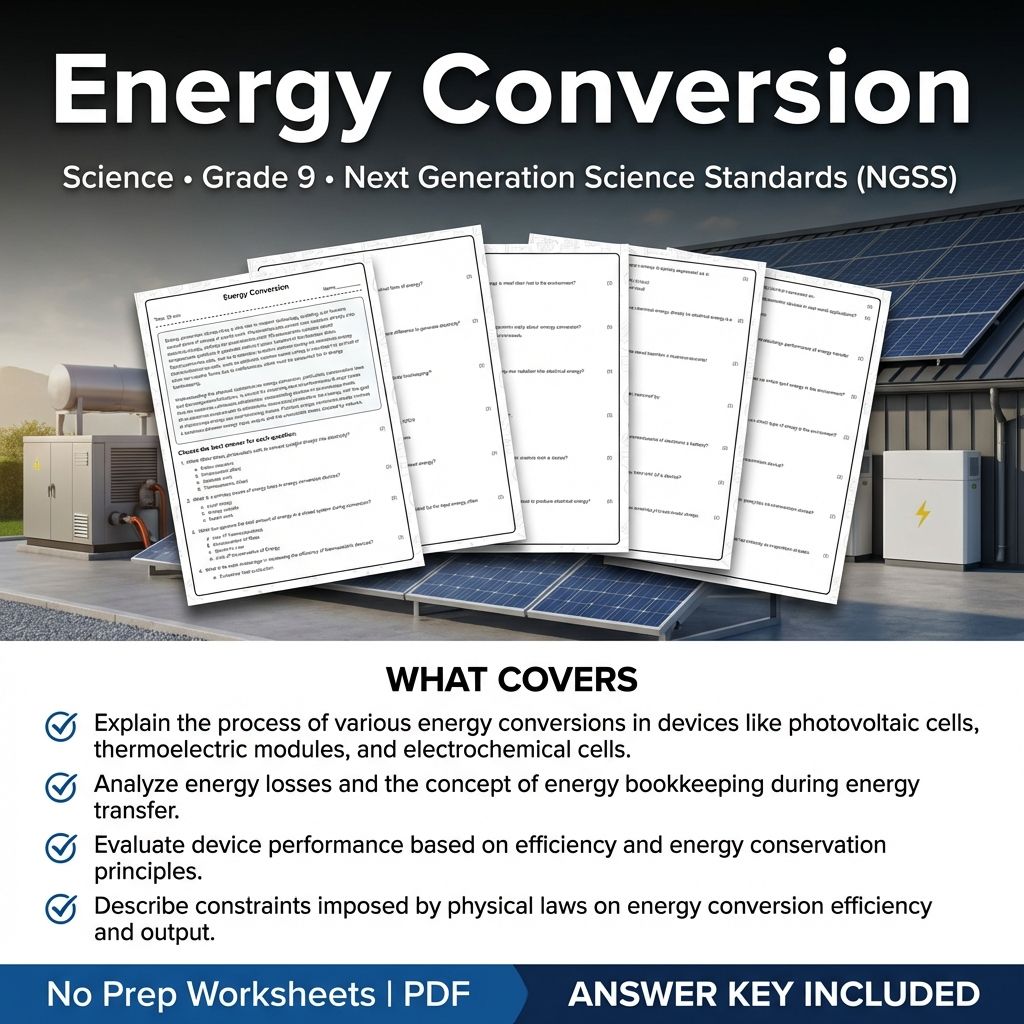
9th Grade Science | Energy Conversion Worksheet & Answer Key (Printable PDF)
Created byCoral Reef LearningLearning Objectives
- Explain the process of various energy conversions in devices like photovoltaic cells, thermoelectric modules, and electrochemical cells.
- Analyze energy losses and the concept of energy bookkeeping during energy transfer.
- Evaluate device performance based on efficiency and energy conservation principles.
Also included in: Grade 9 Science UNIT Bundle | Energy, Power, Heat & Conservation Worksheets +1 more
Instant download
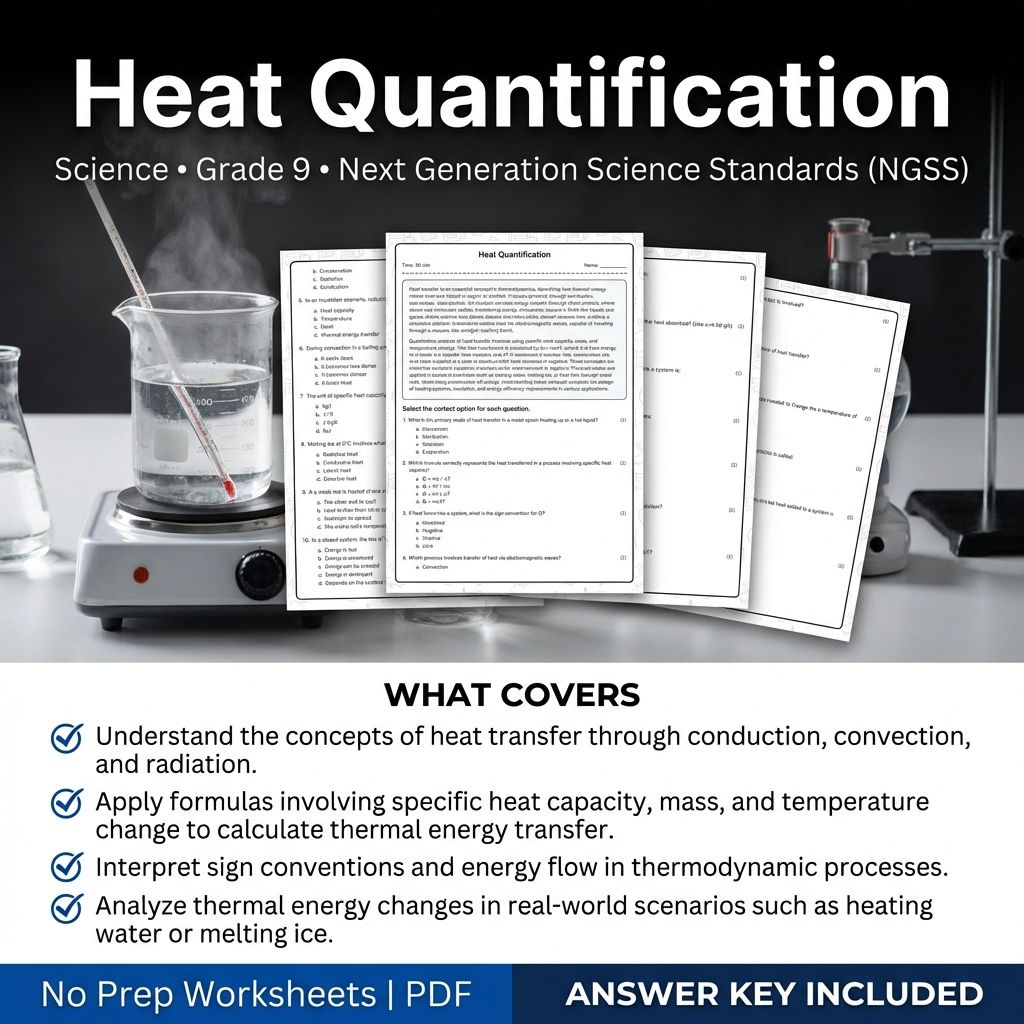
Grade 9 Science | Heat Quantification Worksheet & Answer Key (PDF Practice)
Created byCoral Reef LearningLearning Objectives
- Understand the concepts of heat transfer through conduction, convection, and radiation.
- Apply formulas involving specific heat capacity, mass, and temperature change to calculate thermal energy transfer.
- Interpret sign conventions and energy flow in thermodynamic processes.
Also included in: Grade 9 Science UNIT Bundle | Energy, Power, Heat & Conservation Worksheets +1 more
Instant download
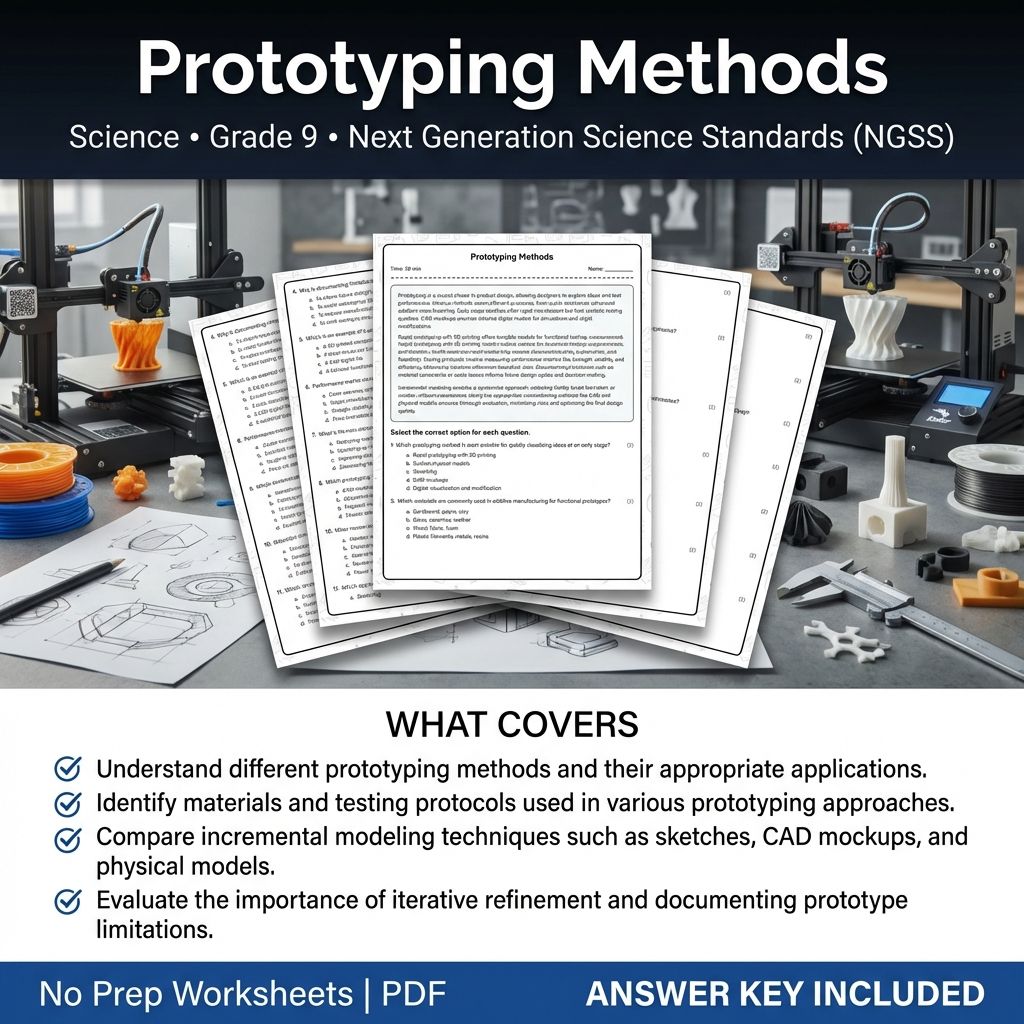
Grade 9 Science | Prototyping Methods Worksheet & Answer Key (Printable PDF)
Created byCoral Reef LearningLearning Objectives
- Understand different prototyping methods and their appropriate applications.
- Identify materials and testing protocols used in various prototyping approaches.
- Compare incremental modeling techniques such as sketches, CAD mockups, and physical models.
Also included in: Grade 9 Science Unit Bundle | Prototyping, Constraints & Modeling Worksheets +1 more
Instant download
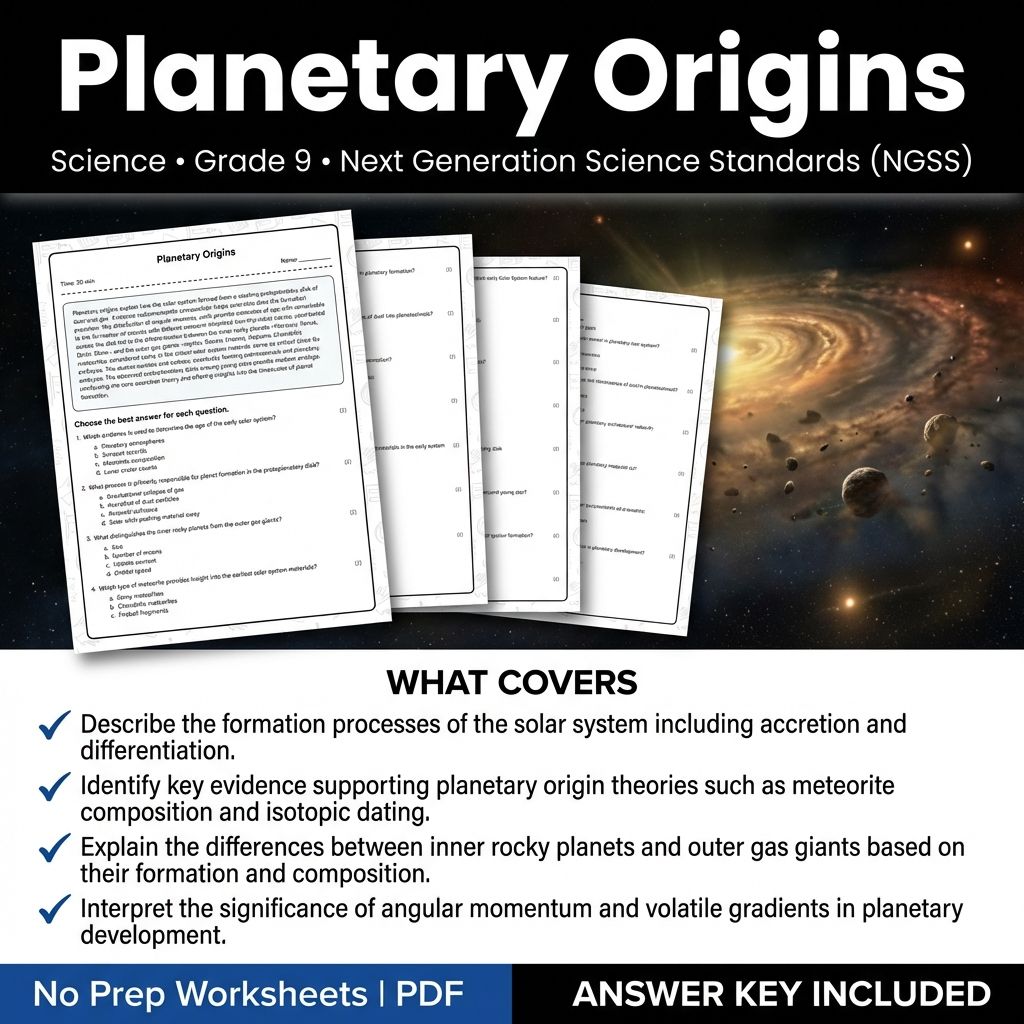
Grade 9 Science | Planetary Origins Worksheet & Answer Key PDF
Created byCoral Reef LearningLearning Objectives
- Describe the formation processes of the solar system including accretion and differentiation.
- Identify key evidence supporting planetary origin theories such as meteorite composition and isotopic dating.
- Explain the differences between inner rocky planets and outer gas giants based on their formation and composition.
Also included in: Grade 9 Science Unit Bundle | Stellar Evolution & Cosmic Timescales Worksheets +1 more
Instant download
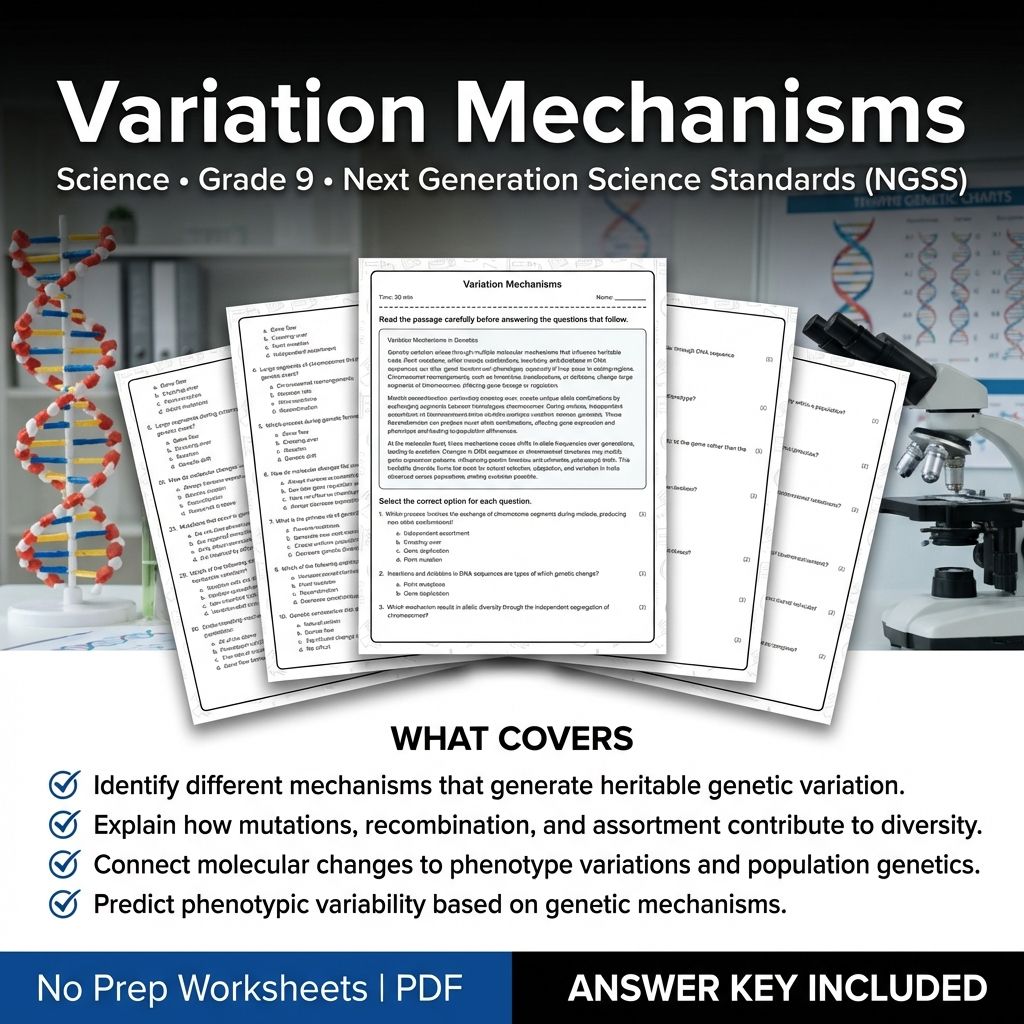
9th Grade Science | Variation Mechanisms Worksheet & Answer Key (Printable PDF)
Created byCoral Reef LearningLearning Objectives
- Identify different mechanisms that generate heritable genetic variation.
- Explain how mutations, recombination, and assortment contribute to diversity.
- Connect molecular changes to phenotype variations and population genetics.
Also included in: Grade 9 Science Unit Bundle | Genetics & Variation Worksheets (PDF Answer Keys) +1 more
Instant download
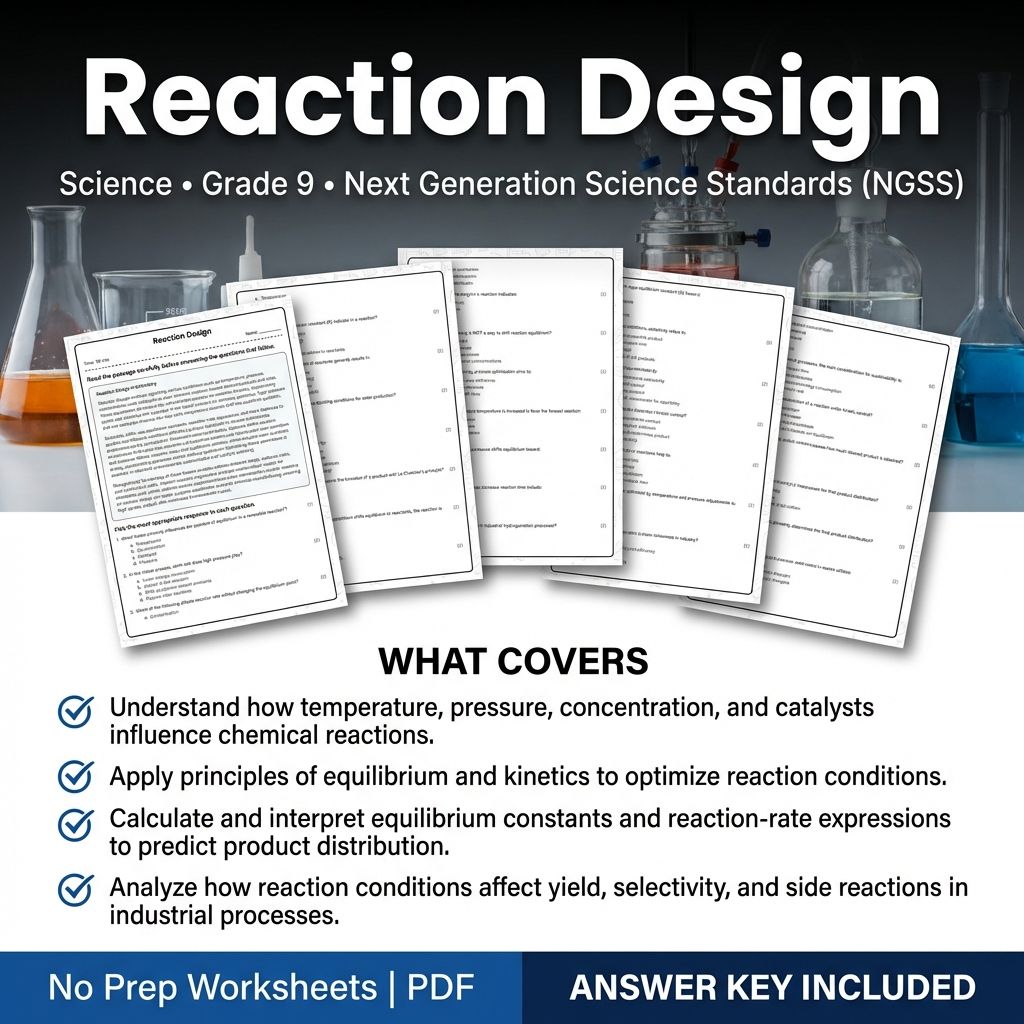
9th Grade Science | Reaction Design Worksheet & Answer Key (Printable PDF)
Created byCoral Reef LearningLearning Objectives
- Understand how temperature, pressure, concentration, and catalysts influence chemical reactions.
- Apply principles of equilibrium and kinetics to optimize reaction conditions.
- Calculate and interpret equilibrium constants and reaction-rate expressions to predict product distribution.
Also included in: Grade 9 Science Worksheet Bundle | Reaction, Molecules & Energy Topics +1 more
Instant download
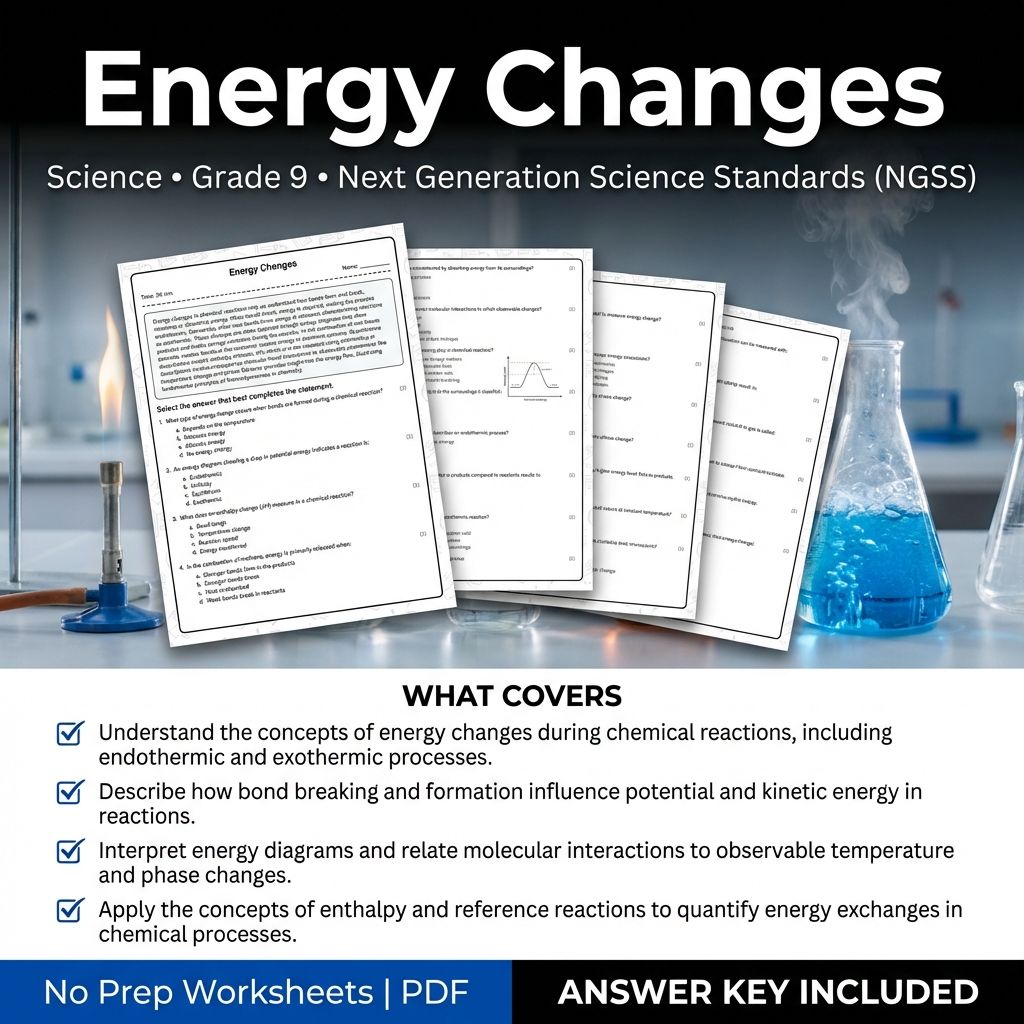
9th Grade Science | Energy Changes Worksheet & Answer Key (Printable PDF)
Created byCoral Reef LearningLearning Objectives
- Understand the concepts of energy changes during chemical reactions, including endothermic and exothermic processes.
- Describe how bond breaking and formation influence potential and kinetic energy in reactions.
- Interpret energy diagrams and relate molecular interactions to observable temperature and phase changes.
Also included in: Grade 9 Science Worksheet Bundle | Reaction, Molecules & Energy Topics +1 more
Instant download

Grade 9 Science | Reaction Rates Worksheet & Answer Key (Printable PDF)
Created byCoral Reef LearningLearning Objectives
- Understand the kinetic factors affecting reaction rates such as temperature, concentration, and catalysts.
- Explain the relationship between rate laws, reaction order, and molecular collision theory.
- Analyze energy profiles and transition states to connect molecular events with macroscopic reaction speed.
Also included in: Grade 9 Science Worksheet Bundle | Reaction, Molecules & Energy Topics +1 more
Instant download
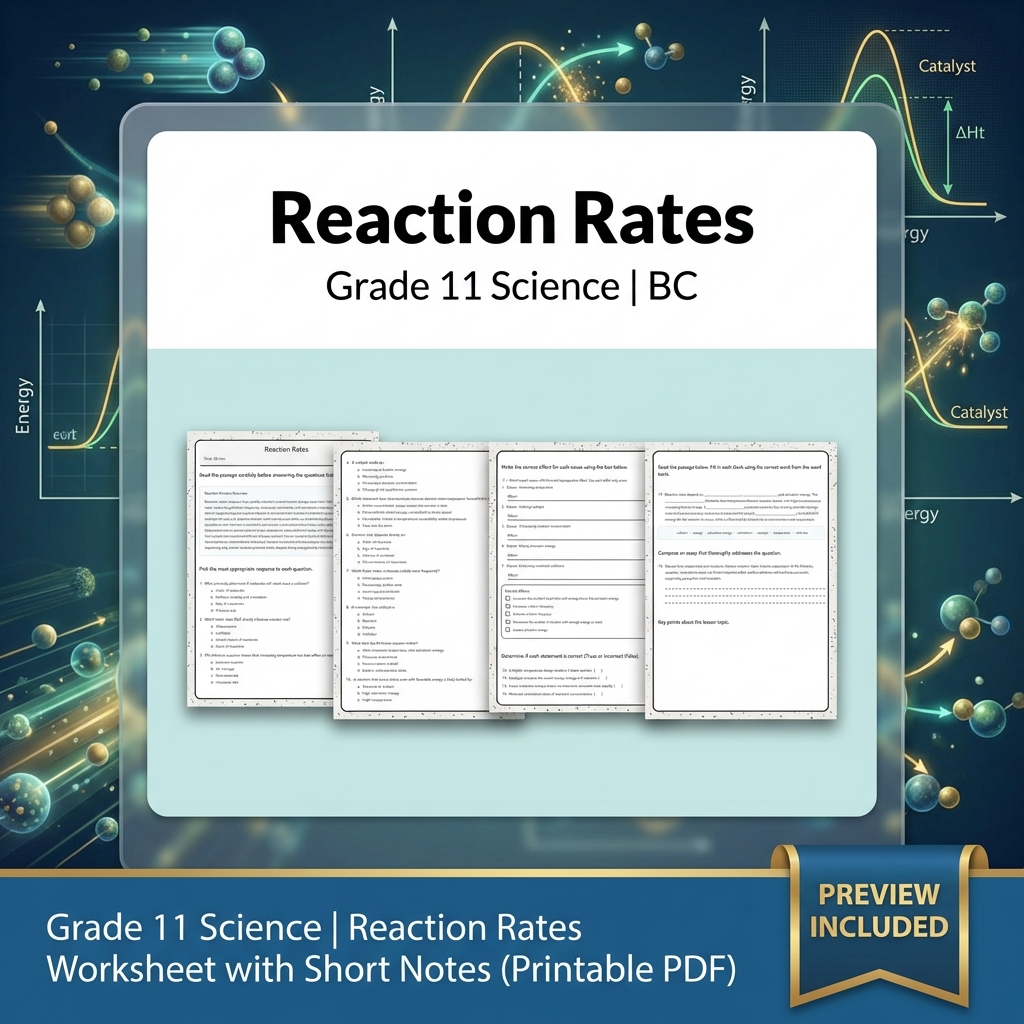
Grade 11 Science | Reaction Rates Worksheet with Short Notes (Printable PDF)
Created byMeadowlark WorksheetsLearning Objectives
- Understand the factors that influence reaction rates such as collision frequency, molecular orientation, and activation energy.
- Explain how rate laws relate reactant concentrations to reaction speed.
- Describe the Arrhenius equation and its significance in kinetic theory.
Also included in: Grade 11 Science Worksheet Bundle | BC Framework | Reaction & Atomic Theory +1 more
Instant download
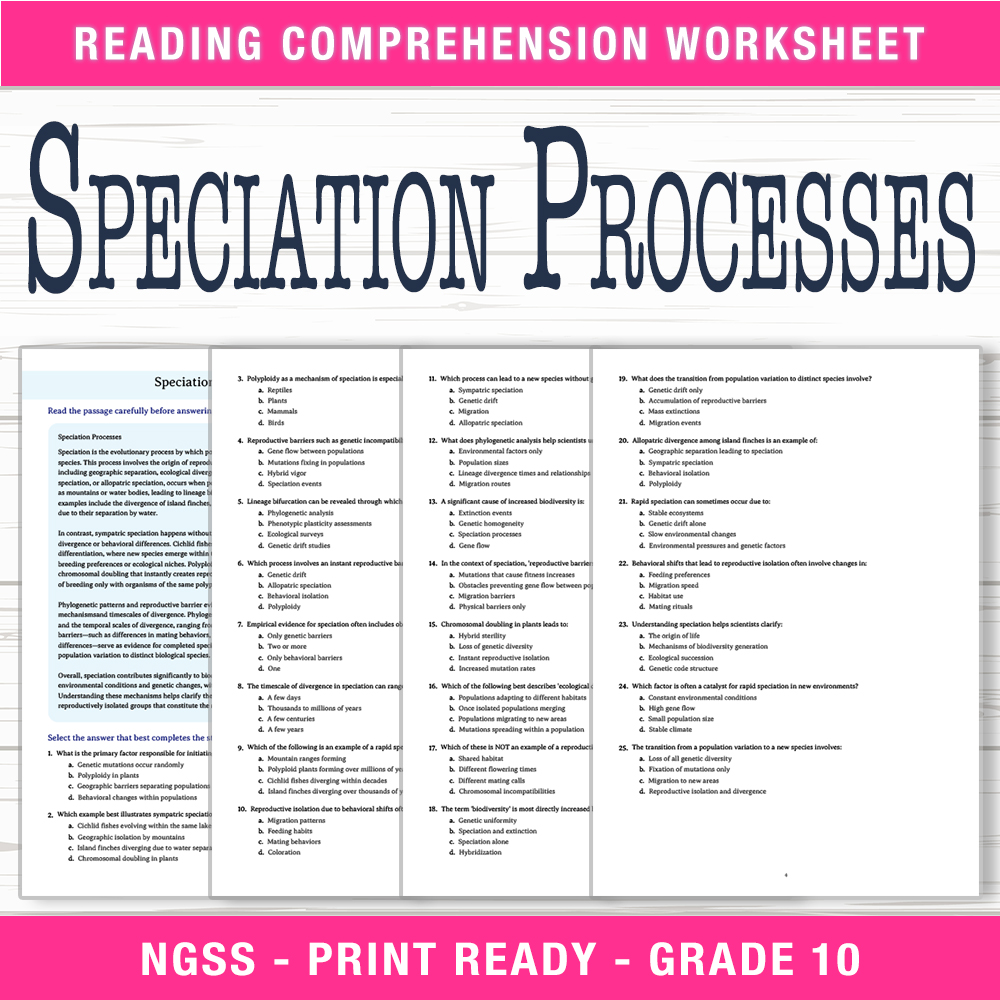
Grade 10 Science – Speciation Processes Worksheet (PDF + Answer Key)
 Created byRiverstone Classroom
Learning Objectives
- Explain the mechanisms underlying different modes of speciation such as allopatric, sympatric, and polyploidy.
- Identify empirical examples of speciation in natural populations and understand their significance.
- Describe how phylogenetic patterns and reproductive barriers provide evidence for speciation events.
Also included in: Grade 10 Science | Evolution & Biodiversity Unit Worksheet Bundle
Instant download
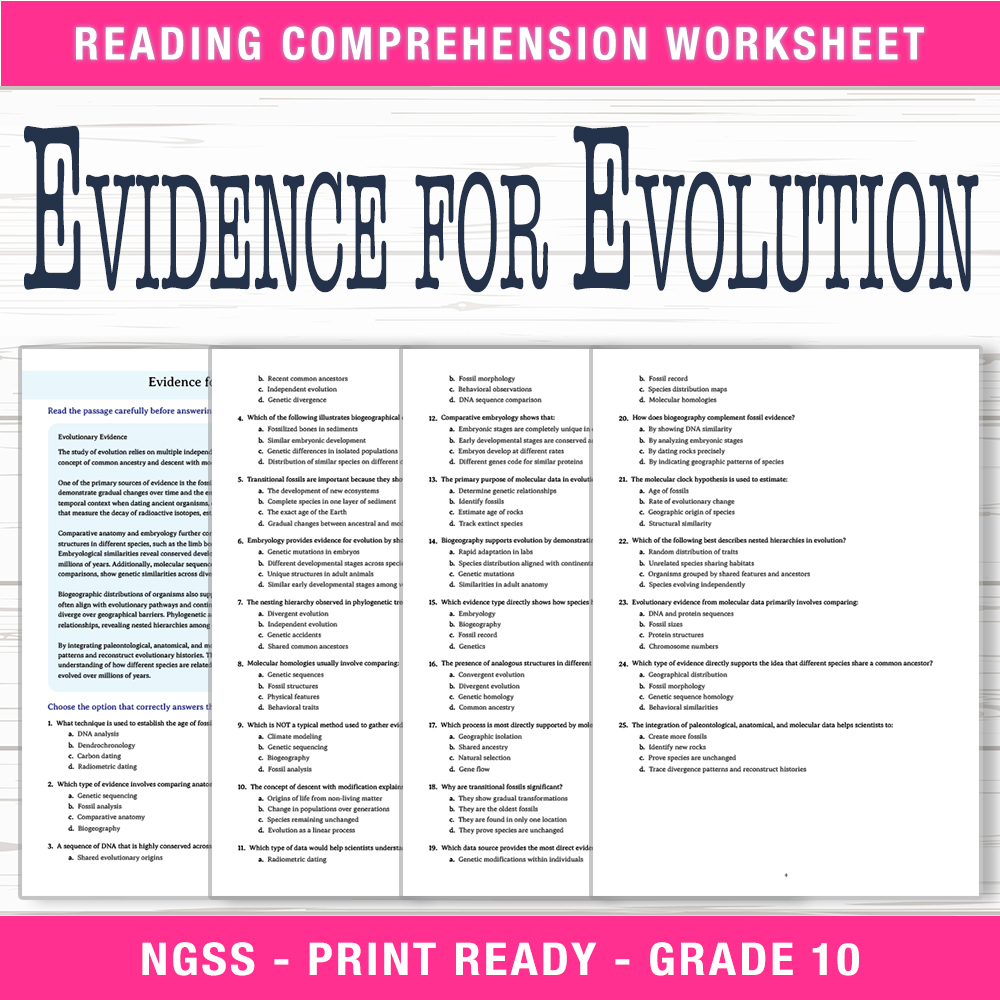
Grade 10 Science | Evidence for Evolution Worksheet (PDF + Answer Key)
Created byRiverstone ClassroomLearning Objectives
- Understand the multiple lines of evidence supporting common ancestry and descent with modification.
- Identify and explain the significance of fossil records, comparative anatomy, embryology, molecular data, and biogeography in evolutionary studies.
- Interpret phylogenetic trees and DNA sequence homologies to trace evolutionary relationships.
Also included in: Grade 10 Science | Evolution & Biodiversity Unit Worksheet Bundle
Instant download
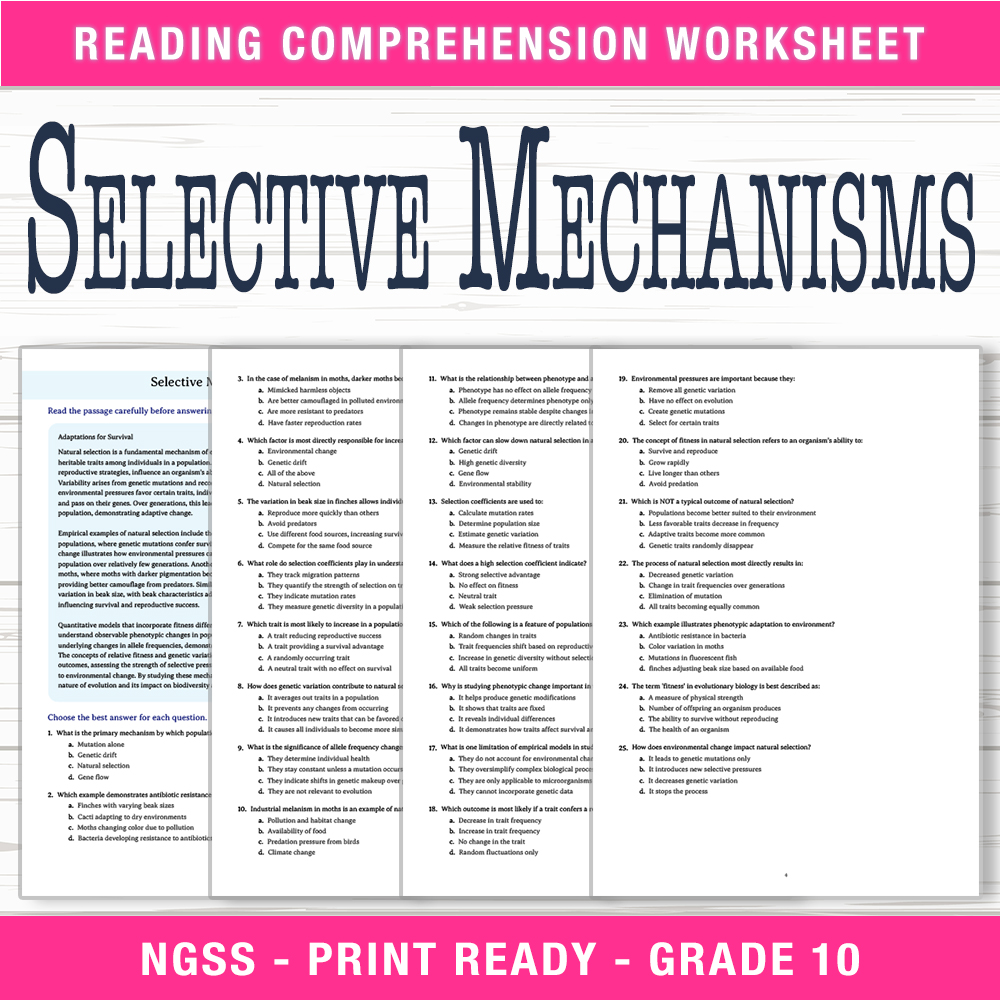
Grade 10 Science | Selective Mechanisms Worksheet (PDF + Answer Key)
Created byRiverstone ClassroomLearning Objectives
- Understand the principles of natural selection and how it drives evolution
- Identify examples of selective mechanisms such as antibiotic resistance, industrial melanism, and beak variation
- Analyze how environmental pressures influence trait frequencies in populations
Also included in: Grade 10 Science | Evolution & Biodiversity Unit Worksheet Bundle
Instant download
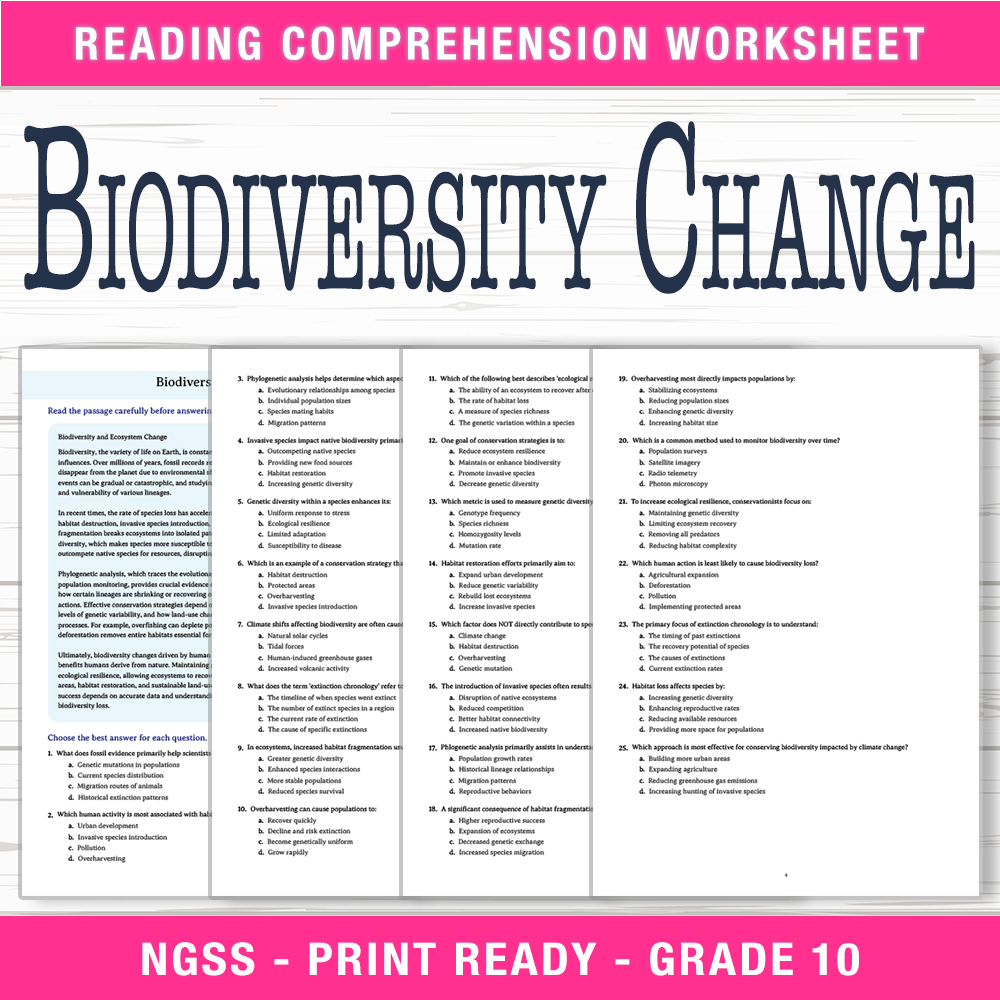
Grade 10 Science – Biodiversity Change Worksheet (PDF + Answer Key)
Created byRiverstone ClassroomLearning Objectives
- Understand the factors contributing to changes in biological diversity, including fossil extinction records and habitat fragmentation.
- Analyze evidence from phylogenetic analysis and population monitoring to assess biodiversity trends.
- Evaluate the impact of human activities on genetic diversity and ecological resilience.
Also included in: Grade 10 Science | Evolution & Biodiversity Unit Worksheet Bundle
Instant download
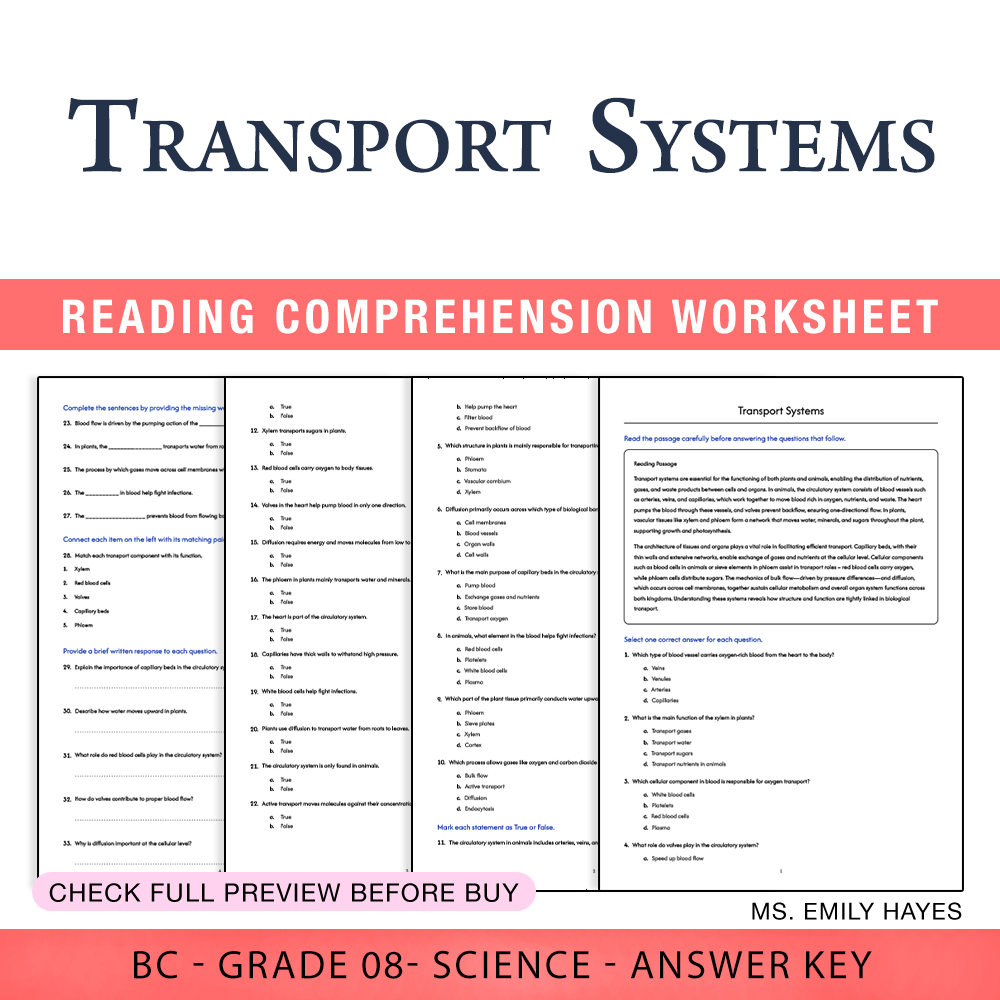
Grade 8 Science | Transport Systems Worksheet (PDF+ Answer Key)
Created byCopper Leaf ClassroomLearning Objectives
- Understand the structure and function of vascular networks in plants and circulatory systems in animals.
- Identify key structural features such as vessels, valves, capillary beds, and their roles in transport.
- Explain how transport components like blood cells, xylem, and phloem facilitate nutrient, gas, and waste exchange.
Also included in: Grade 8 Science Bundle – Cell Structure, Systems & Organisms (PDF + Answer Key) +1 more
Instant download
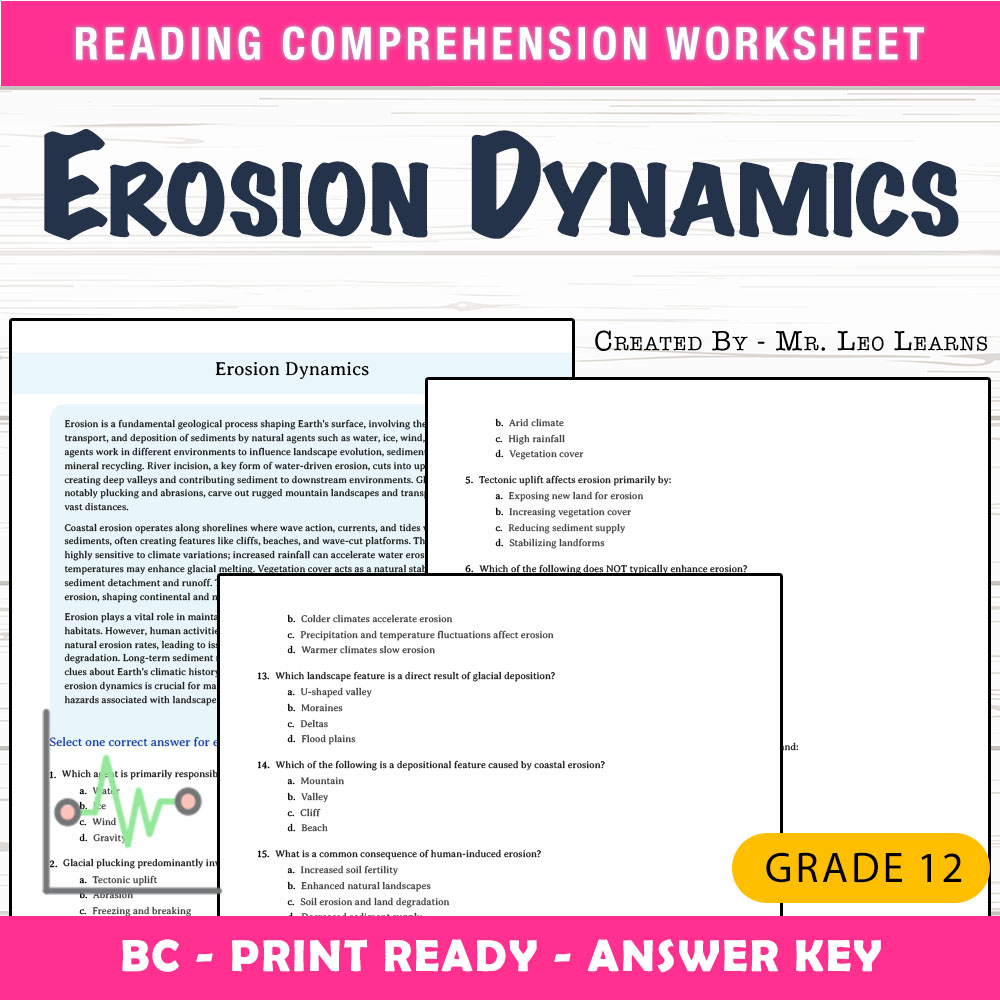
Grade 12 Science — Erosion Dynamics Worksheet MCQ Paper
 Created byThe Resource Hub
Learning Objectives
- Understand the processes involved in erosion and sediment transport.
- Identify the factors influencing erosion rates and landscapes.
- Connect erosion mechanisms to Earth's systems and environmental impacts.
Also included in: Grade 12 Science | Earth Science BC Worksheet Bundle (15-Worksheet MCQ Pack) +1 more
Instant download
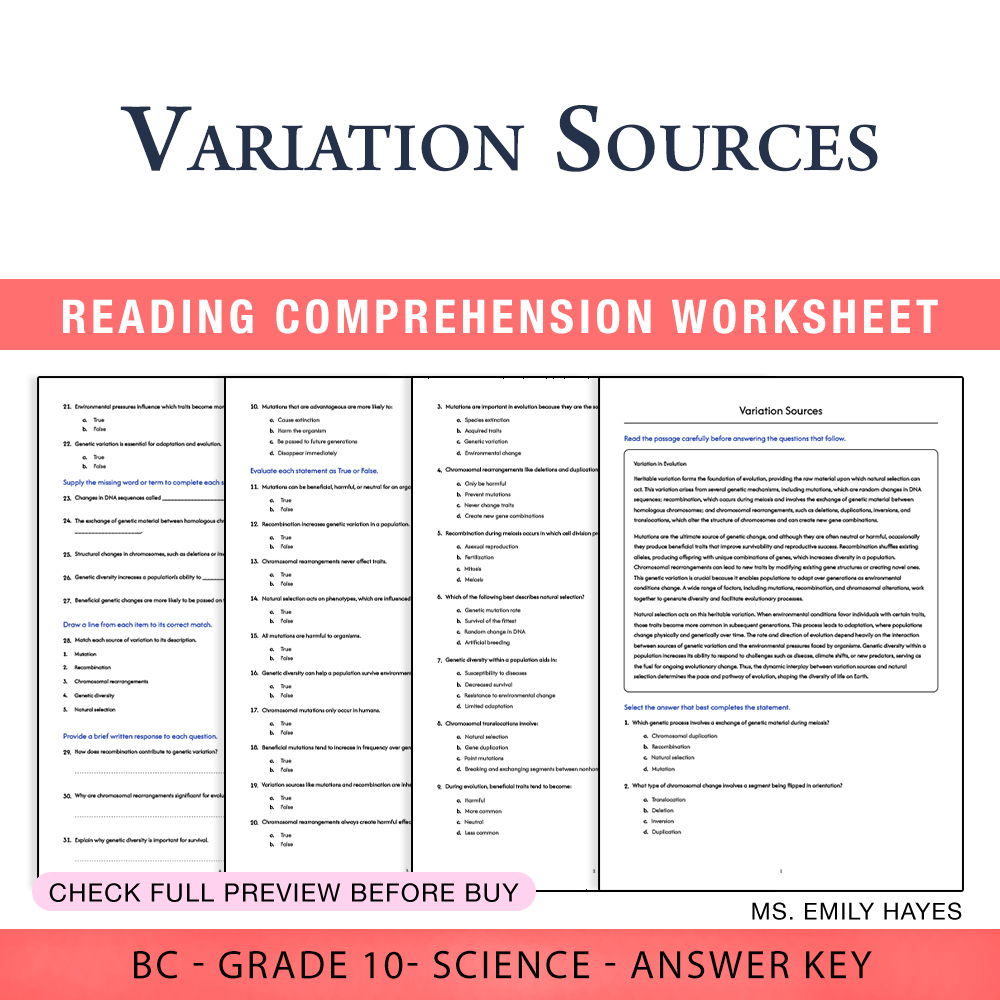
10th Grade Science | Variation Sources Worksheet (PDF + Answer Key)
Created byCopper Leaf ClassroomLearning Objectives
- Identify sources of heritable variation such as mutations, recombination, and chromosomal rearrangements.
- Explain how natural selection acts on genetic variation to influence traits in populations.
- Describe the role of genetic diversity in adaptation and evolution.
Also included in: Grade 10 Science BC | Evolution, Biodiversity & Ecology (PDF + Answer Key) +1 more
Instant download

Stability Balance Worksheet Grade 6 Science Practice and Review
Created byPrism Point LearningLearning Objectives
- Explain how the position of the center of mass relative to the center of pressure affects static stability.
- Describe how design features like dihedral angles and tail volume influence longitudinal and lateral balance.
- Predict how changing payload and wind disturbances can alter an aircraft or glider’s tendency to return to steady flight.
Also included in: Aerodynamics and Flight Design Lesson Bundle – Grade 6 Science Alberta
Instant download

Angle Effects Worksheet | Grade 6 Science Activities
Created byPrism Point LearningLearning Objectives
- Explain how changing the angle of attack affects lift and drag.
- Describe what happens at the critical point when airflow separates and a stall occurs.
- Use real-world examples (kites or small gliders) to predict how adjusting angle changes performance.
Also included in: Aerodynamics and Flight Design Lesson Bundle – Grade 6 Science Alberta
Instant download

Air Properties Worksheet | Grade 6 Science Practice and Assessment
Created byPrism Point LearningLearning Objectives
- Explain how air composition, density, pressure, and temperature help describe how air behaves.
- Predict how changes in altitude and temperature can affect air density and pressure.
- Describe how collisions between gas molecules create pressure and relate this to everyday weather.
Also included in: Aerodynamics and Flight Design Lesson Bundle – Grade 6 Science Alberta
Instant download

Streamlining Worksheet | Grade 6 Science Activities
Created byPrism Point LearningLearning Objectives
- Explain how streamlined shapes reduce aerodynamic resistance by changing airflow behavior.
- Describe how smooth surfaces and gradual shape changes can delay flow separation.
- Connect streamlining to real-world examples such as farm equipment and aircraft parts.
Also included in: Aerodynamics and Flight Design Lesson Bundle – Grade 6 Science Alberta
Instant download

Healthcare Heritage Worksheet | Grades 11 - 12 Holiday Printable PDF
Learning Objectives
- Describe key milestones in the history of nursing and healthcare and explain why they mattered.
- Identify major contributions of influential healthcare figures, including Florence Nightingale.
- Analyze how patient care evolved through public health practices, technology, and professional training.
Also included in: Grades 11 - 12 Healthcare Careers & History Holiday Custom Bundle +2 more
Instant download

Future of Nursing Worksheet | Grades 11 - 12 Holiday Printable PDF Assessment
Learning Objectives
- Explain how modern nursing roles are changing to meet new healthcare needs.
- Describe how technology can support nursing care while raising ethical concerns.
- Identify key qualities—ethics, cultural competence, and leadership—that will shape the future of nursing.
Also included in: Grades 11 - 12 Healthcare Careers & History Holiday Custom Bundle +2 more
Instant download
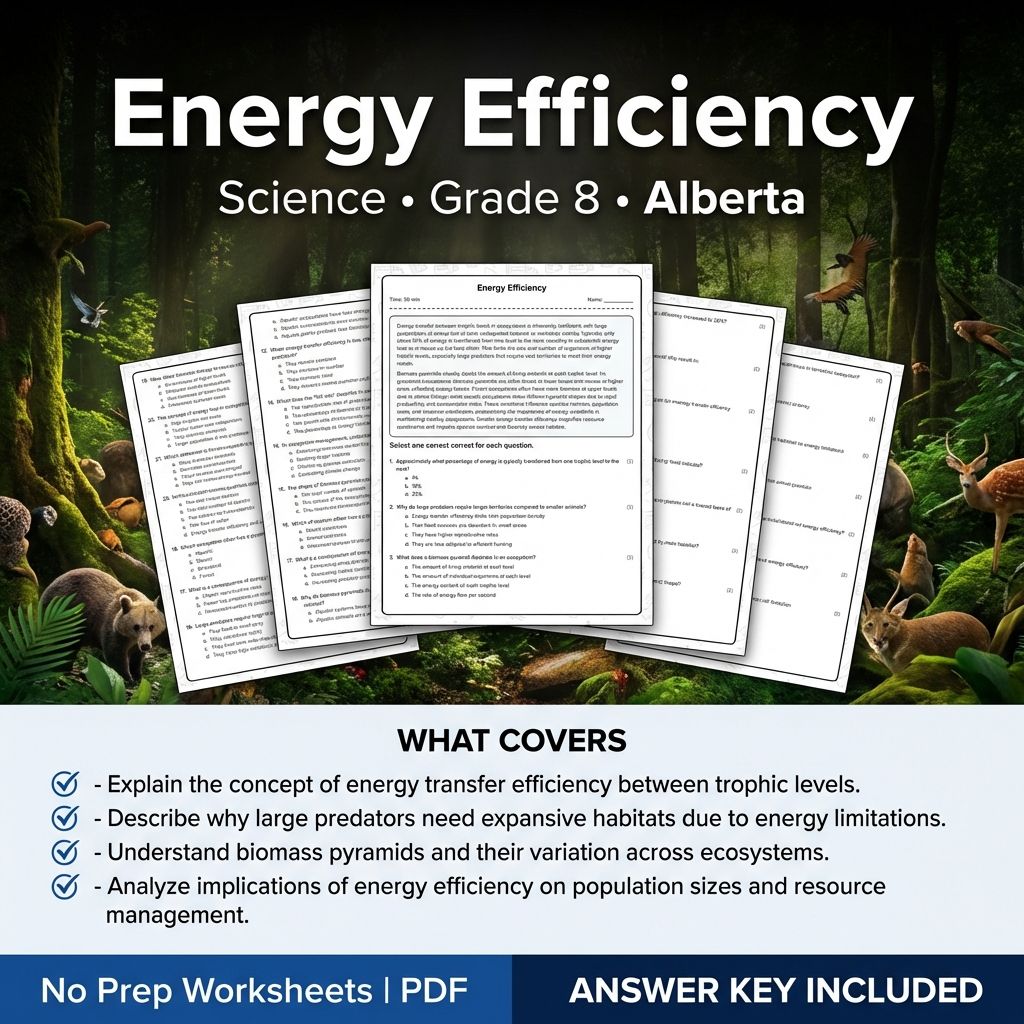
Energy Efficiency Worksheet | Grade 8 Science Standard Alberta
Created byCoral Reef LearningLearning Objectives
- Explain the concept of energy transfer efficiency between trophic levels.
- Describe why large predators need expansive habitats due to energy limitations.
- Understand biomass pyramids and their variation across ecosystems.
Instant download
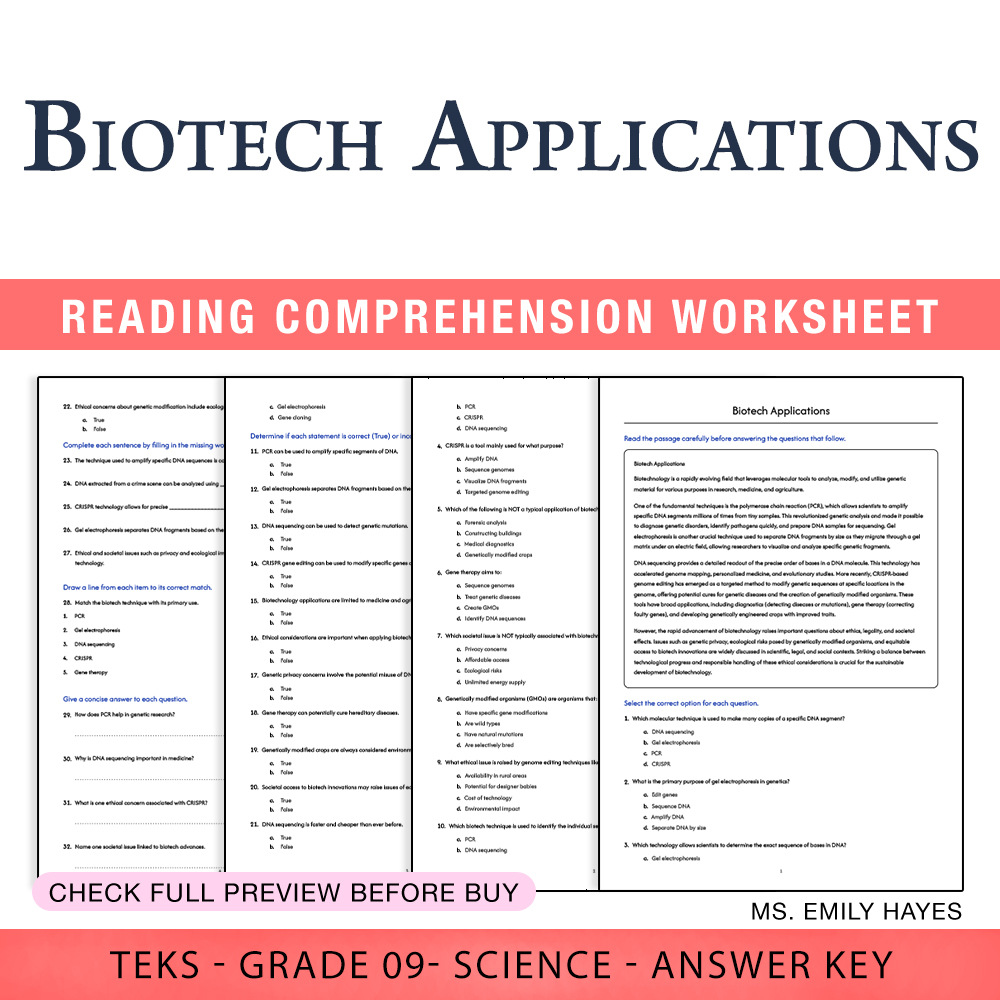
9th Grade Science | Biotech Applications Worksheet (PDF+ Answer Key)
Created byCopper Leaf ClassroomLearning Objectives
- Understand key molecular techniques used in biotechnology such as PCR, gel electrophoresis, DNA sequencing, and CRISPR.
- Identify various applications of biotechnology including diagnostic, therapeutic, agricultural, and forensic uses.
- Discuss ethical, legal, and societal considerations related to biotech advances such as privacy, ecological risks, and access issues.
Instant download
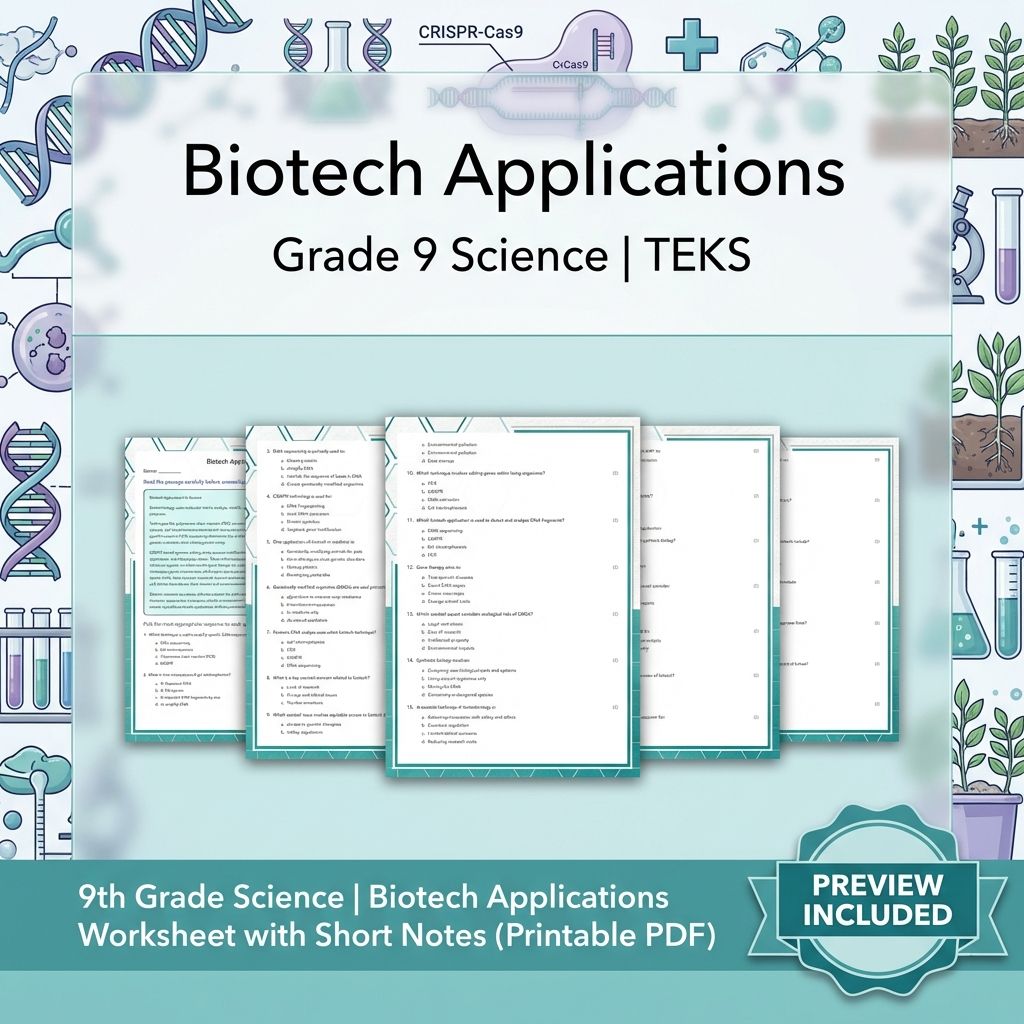
9th Grade Science | Biotech Applications Worksheet with Short Notes (PDF)
Created byMeadowlark WorksheetsLearning Objectives
- Understand common genetic techniques used in biotechnology.
- Identify various applications of biotechnology in medicine, agriculture, and forensics.
- Recognize ethical and societal considerations related to biotech advancements.
Instant download

6th Grade Social Studies Worksheet | Environmental Interactions (PDF)
 Created bySunny Desk Resources
Learning Objectives
- Describe how human activities such as agriculture, infrastructure, and resource extraction can change environmental conditions
- Analyze cause-and-effect relationships between human behavior and ecological change in a community
- Explain how indigenous perspectives can support environmental stewardship and sustainable community development
Also included in: Grade 6 Sustainable Development Social Studies Lesson Bundle (BC) +1 more
Instant download
Browse more categories
About Reading comprehension Worksheets
Find reading comprehension worksheets for class practice, homework, or self-study. All 40,284 are instant PDF downloads.
Each resource here is built by an independent educator and reviewed for quality. Worksheets print straight from PDF and suit classroom use, homework, or extra practice; most come with answer keys, and you can preview before purchasing.