
Reading comprehension Worksheets
40,289 type resources
Grade 12 Science | Atomic Models - Daily Reading Comprehension
 Created byCoral Reef Learning
Learning Objectives
- Understand the development of atomic models from Dalton to Bohr.
- Recognize empirical evidence such as cathode rays and gold foil scattering.
- Explain concepts like nuclear charge, mass number, and isotopic abundance.
Also included in: Grade 12 Science Daily Reading Worksheets Full-Year Bundle | TEKS
Instant download

Grade 12 Science | Atomic Models Worksheet | TEKS Aligned
 Created byLumora Learning
Learning Objectives
- Trace the development of atomic models from Dalton to Rutherford and Bohr.
- Describe empirical evidence supporting atomic theory, such as cathode ray experiments and gold foil scattering.
- Explain concepts of nuclear charge, mass number, and isotopic abundance.
Also included in: Grade 12 Science | Matter and Energy Lesson Bundle | TEKS Aligned
Instant download

Atomic Models Worksheet for Grade 12 Science | TEKS Aligned Practice
Created byCoral Reef LearningLearning Objectives
- Understand the historical development of atomic models from Dalton to Bohr.
- Identify empirical evidence supporting atomic theories, such as cathode ray experiments and gold foil scattering.
- Explain concepts of nuclear charge, mass number, and isotopic abundance using spectrometry data.
Instant download

Grade 12 Science – Atomic Models & Theories | Daily Reading Worksheet
 Created byBright Mind Resources
Learning Objectives
- Understand the development of atomic models from Dalton to Bohr.
- Identify key experiments that supported different atomic theories.
- Explain concepts such as nuclear charge, mass number, and isotopes.
Also included in: Grade 12 Chemistry Science Lesson Bundle, Daily Reading Worksheets | TEKS +2 more
Instant download

Grade 12 Science | Atomic Models Worksheet (PDF) TEKS-Aligned
 Created byEvergreen Desk Education
Learning Objectives
- Describe how Dalton, Thomson, Rutherford, and Bohr proposed atomic models and what evidence supported each model.
- Connect atomic number, mass number, isotopic abundance, and nuclear charge to measurable properties of atoms.
- Explain how cathode rays, gold foil scattering, and emission spectra provide empirical support for atomic structure.
Instant download

Atomic Models Worksheet | Grade 12 Science Practice
 Created byPrism Point Learning
Learning Objectives
- Explain how experimental evidence led to changes in atomic models from Dalton to Rutherford to Bohr.
- Relate cathode ray observations and gold foil scattering to the existence and location of subatomic particles.
- Connect discrete spectral lines to quantized energy levels and infer implications for electron structure.
Instant download
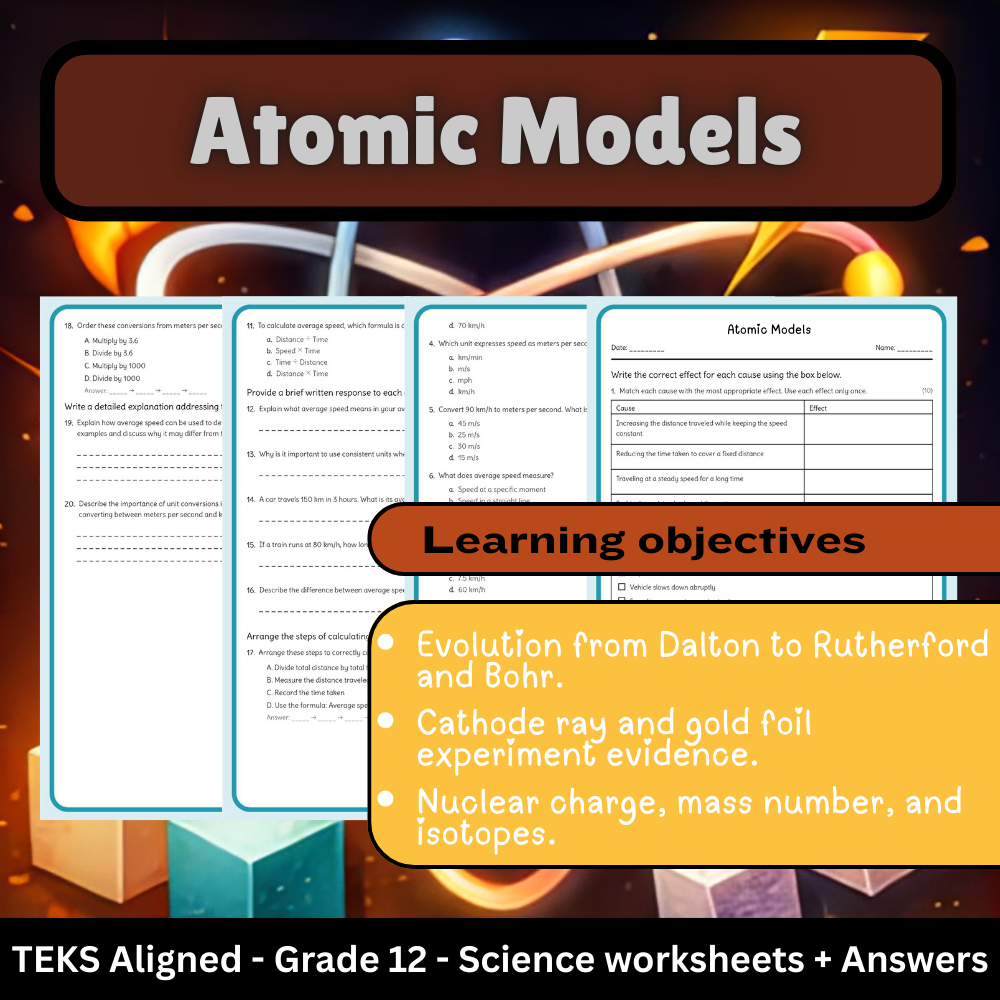
Grade 12 Science – Atomic Models Worksheet (PDF) | Teachable Atomic Theory
Created byBright Mind ResourcesLearning Objectives
- Describe the development of atomic models from Dalton to Rutherford and Bohr.
- Explain empirical evidence such as cathode ray experiments and gold foil scattering.
- Understand concepts of nuclear charge, mass number, and isotopic abundance.
Instant download
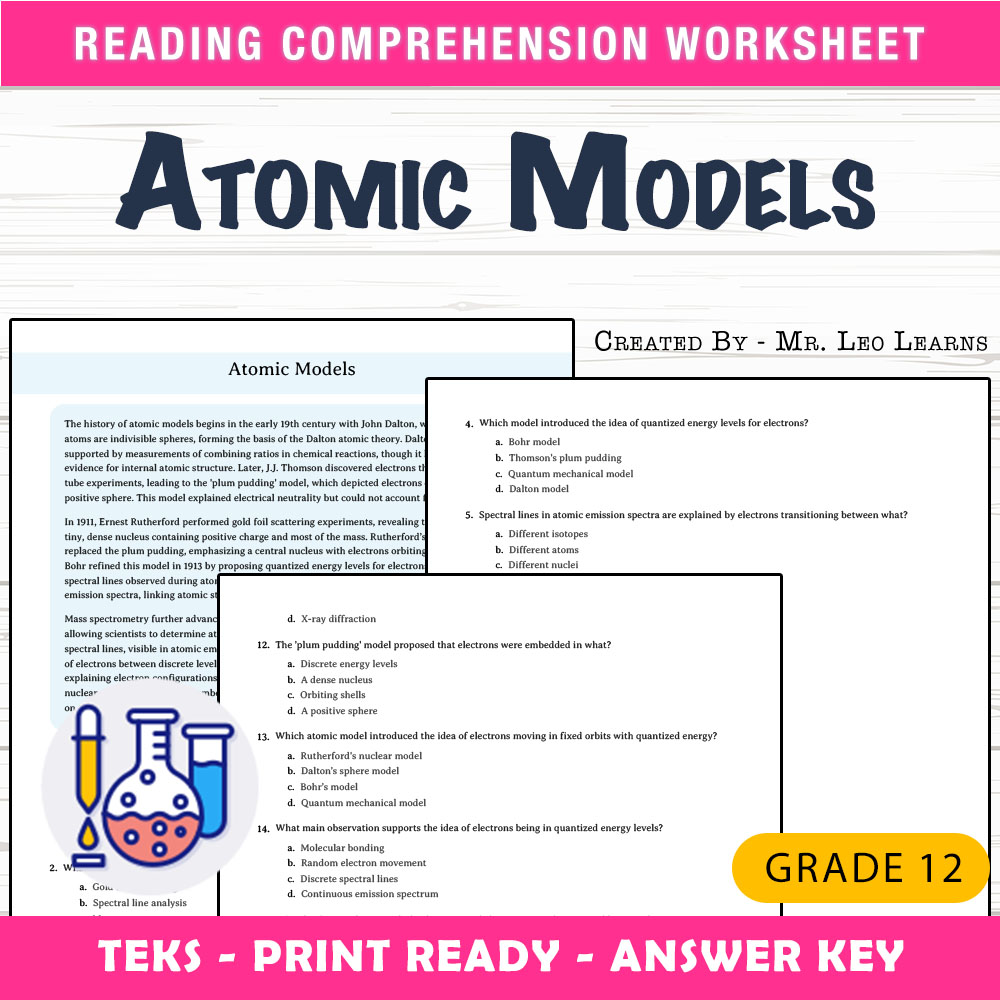
Grade 12 Science | Atomic Models Worksheet for Mastery
 Created byThe Resource Hub
Learning Objectives
- Understand the development and evolution of atomic models from Dalton to Rutherford and Bohr.
- Identify the empirical evidence supporting each atomic model, such as cathode ray experiments and gold foil scattering.
- Explain the concepts of nuclear charge, mass number, and isotopic abundance using mass spectrometry as an example.
Also included in: Grade 12 Science Worksheet Bundle | Chemistry & Chemical Reactions Mastery +1 more
Instant download

Grade 9 Process Connections Worksheet | Reading Skills & Critical Thinking
 Created bySunny Desk Resources
Learning Objectives
- Explain how informational texts use ordered steps and transitions to show phases of a process.
- Identify cause-and-effect relationships that clarify how outcomes occur.
- Analyze how descriptive and technical details support the purpose and constraints of an explanation.
Also included in: Reading Informational Lesson Bundle | Grade 9 ELA | General ELA +1 more
Instant download

Population Growth Practice Worksheet | Grade 10 Science NGSS
Created byPrism Point LearningLearning Objectives
- Explain how birth rate and death rate shape population change over time using quantitative reasoning
- Compare exponential growth with logistic growth and describe the role of carrying capacity
- Identify density-dependent and density-independent limiting factors and connect them to real data patterns
Also included in: Grade 10 Ecosystems & Biodiversity Science Lesson Bundle Practice: NGSS
Instant download

Grade 10 Science | Population Growth Worksheet (NGSS) Practice PDF
 Created byMaple Path Learning
Learning Objectives
- Understand the principles of exponential and logistic growth models in populations.
- Identify and analyze density-dependent and density-independent limiting factors.
- Examine how reproductive strategies, competition, and resource dispersal influence population dynamics.
Also included in: Grade 10 Science Ecosystems Interactions Energy and Dynamics Lesson Bundle | NGSS +1 more
Instant download

Grade 10 Science | Population Growth Worksheet with Short Notes PDF
 Created byMeadowlark Worksheets
Learning Objectives
- Understand the principles of exponential and logistic population models.
- Analyze the impact of density-dependent and density-independent factors on population dynamics.
- Interpret data related to birth rates, death rates, and carrying capacity.
Also included in: Grade 10 Science Ecosystems Interactions & Energy NGSS Unit Bundle +1 more
Instant download

Grade 10 Science – Population Growth & Ecology | Daily Reading Worksheet
Created byBright Mind ResourcesLearning Objectives
- Understand basic concepts of population dynamics including birth rates, death rates, and growth patterns.
- Differentiate between exponential and logistic population growth models.
- Identify factors that limit population growth, including density-dependent and density-independent factors.
Also included in: Ecosystems Grade 10 Science Daily Reading Worksheets Bundle | NGSS +2 more
Instant download

10th Grade Science | Population Growth Worksheet (PDF + Answer Key)
 Created byCopper Leaf Classroom
Learning Objectives
- Describe the principles of exponential and logistic population growth models.
- Analyze the impact of density-dependent and density-independent limiting factors on populations.
- Interpret fisheries harvest data and algal bloom records related to population dynamics.
Instant download
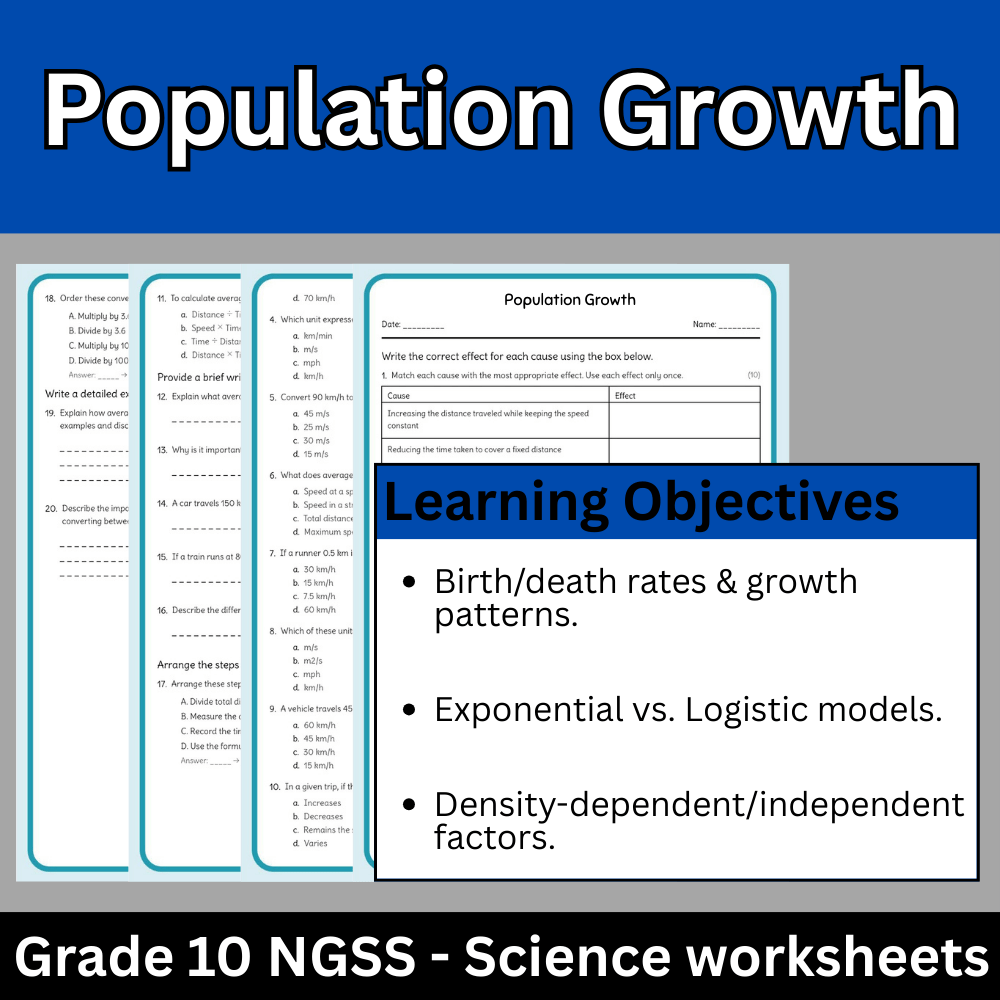
Grade 10 Science | Population Growth NGSS Worksheet (Answer Key, PDF)
Created byBright Mind ResourcesLearning Objectives
- Analyze birth rates, death rates, and growth patterns in populations.
- Differentiate between exponential and logistic population models.
- Identify factors affecting population dynamics, including density-dependent and density-independent factors.
Instant download
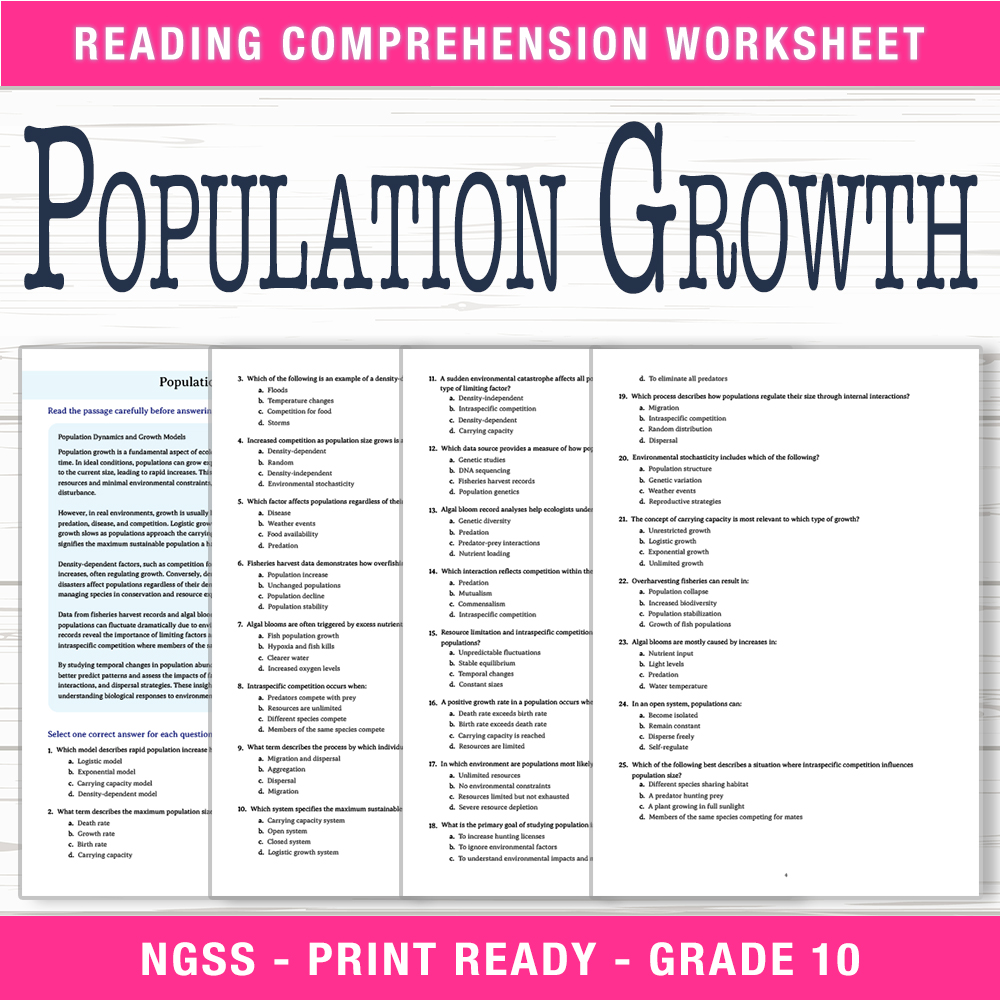
Grade 10 Science | Population Growth Worksheet (PDF + Answer Key)
 Created byRiverstone Classroom
Learning Objectives
- Understand the principles of exponential and logistic population growth models.
- Identify density-dependent and density-independent limiting factors affecting populations.
- Analyze how reproductive strategies, competition, and resource availability influence population dynamics.
Also included in: Grade 10 Science Ecosystems & Biodiversity UNIT Worksheet Bundle
Instant download
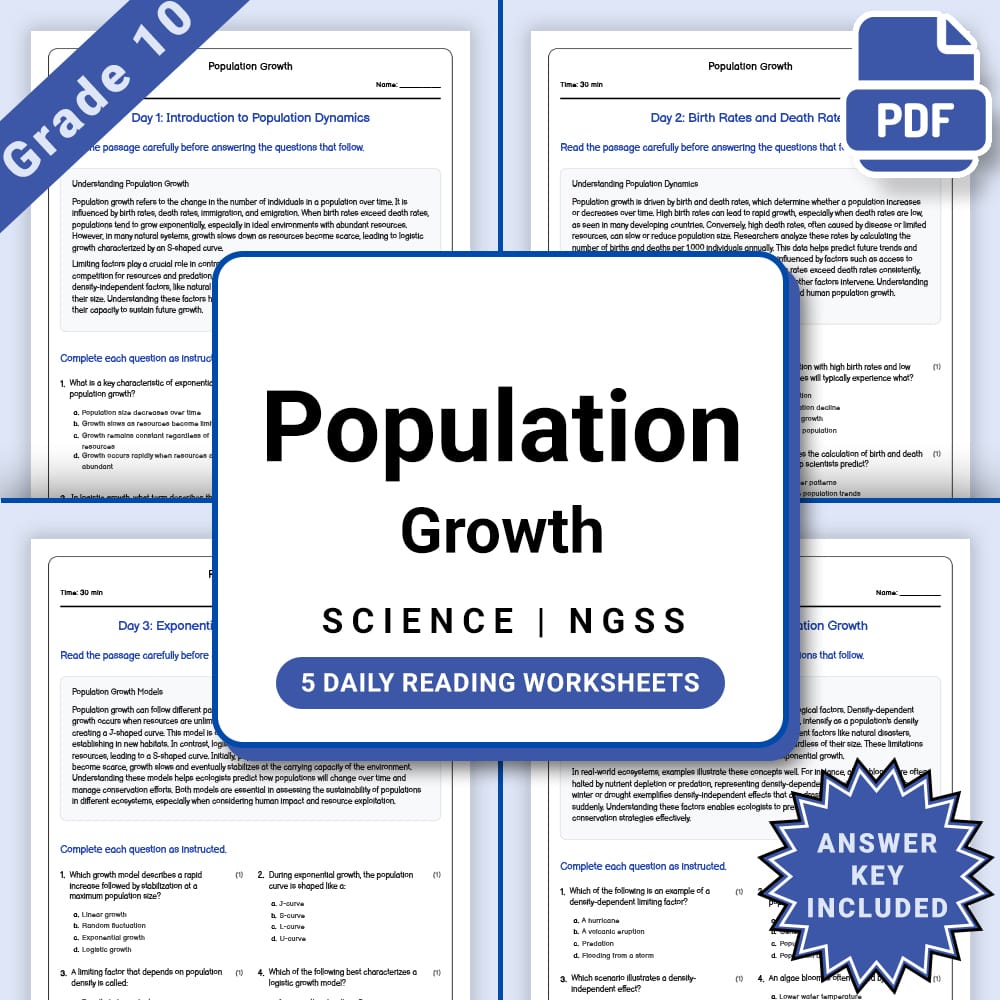
Grade 10 Science – Population Growth Worksheet (PDF +Answer Key)
Created byCopper Leaf ClassroomLearning Objectives
- Explain factors affecting population size and growth patterns
- Differentiate between exponential and logistic growth models
- Identify density-dependent and density-independent limiting factors
Instant download
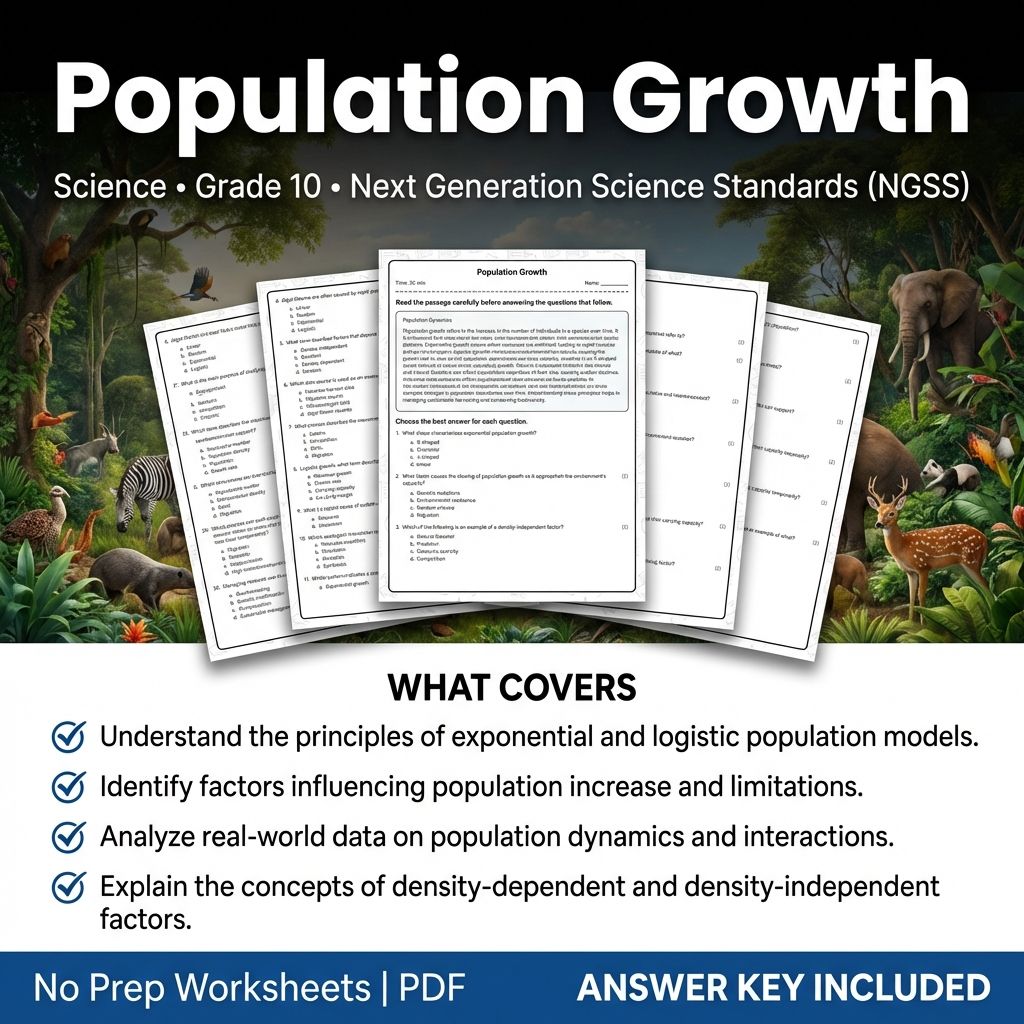
Grade 10 Science Worksheet | Population Growth Practice with Answer Key
Created byCoral Reef LearningLearning Objectives
- Understand the principles of exponential and logistic population models.
- Identify factors influencing population increase and limitations.
- Analyze real-world data on population dynamics and interactions.
Also included in: Grade 10 Science Worksheets Bundle| Ecosystems & Population Dynamics(Answer Key) +1 more
Instant download
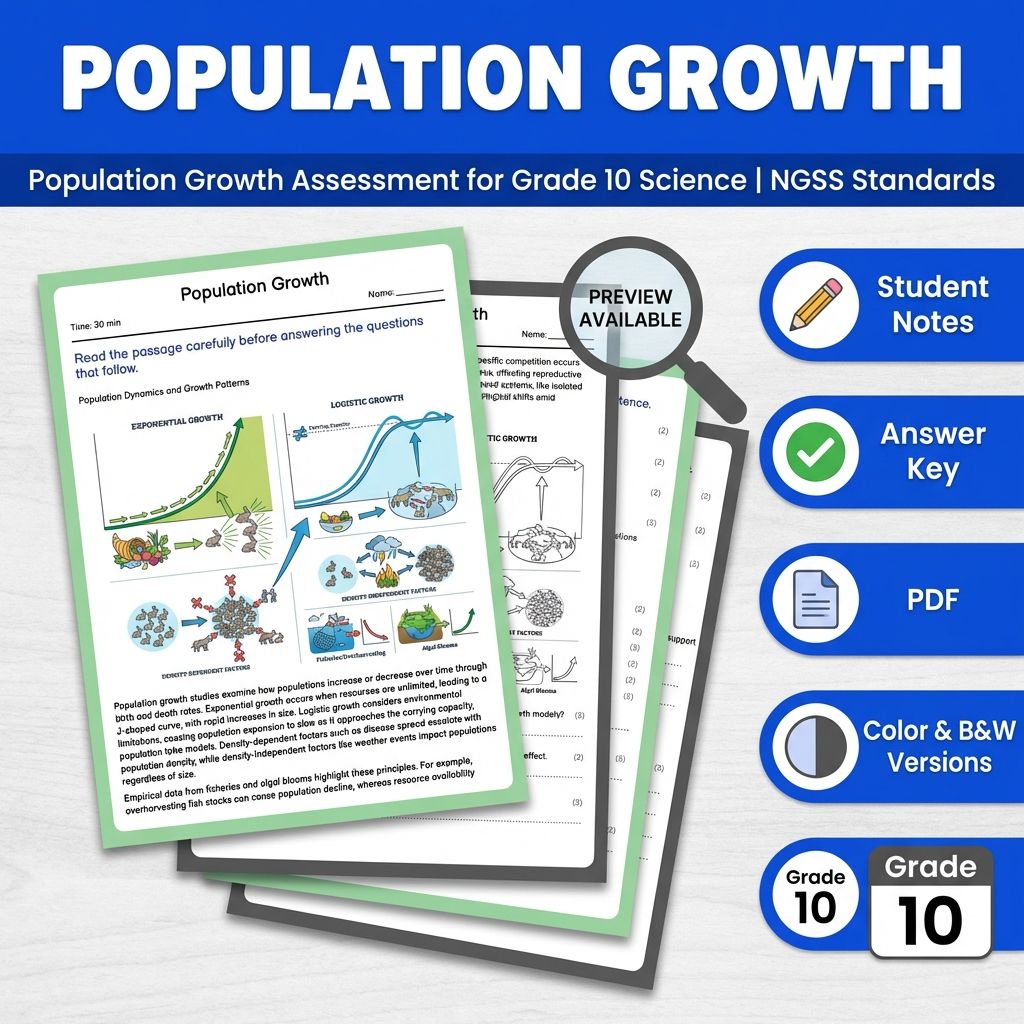
Population Growth Assessment for Grade 10 Science | NGSS Standards
Created byPrism Point LearningLearning Objectives
- Understand the principles of exponential and logistic population growth models.
- Analyze factors affecting population dynamics, including limiting factors and carrying capacity.
- Evaluate biological and environmental data to interpret population patterns and interactions.
Instant download

Grade 10 Science | Population Growth in Science - Daily Reading Comprehension
Created byCoral Reef LearningLearning Objectives
- Understand the basic concepts of population change and growth patterns.
- Identify factors influencing population growth such as birth rates and death rates.
- Differentiate between exponential and logistic growth models.
Instant download
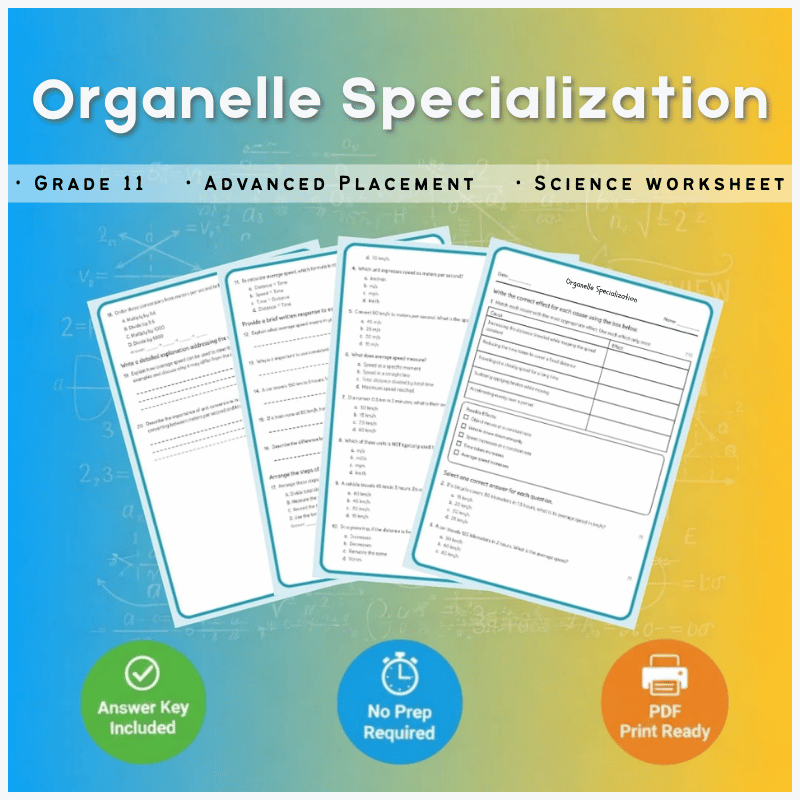
Grade 11 Science – Organelles Specialization Worksheet (AP Standards) – PDF
Created byBright Mind ResourcesLearning Objectives
- Understand the structural differences among mitochondria, chloroplasts, endoplasmic reticulum, and lysosomes.
- Explain how organelle compartmentalization enhances metabolic efficiency.
- Compare the origins, membrane composition, and functions of different organelles.
Instant download

Grade 11 Science | Organelle Specialization - Daily Reading Comprehension
Created byCoral Reef LearningLearning Objectives
- Compare the structure and function of mitochondria, chloroplasts, endoplasmic reticulum, and lysosomes.
- Analyze how organelle compartmentalization enhances metabolic processes.
- Understand the origins and membrane composition differences of organelles.
Also included in: Biology and Ecosystems Lesson Bundle | Grade 11 Science AP +1 more
Instant download
11th Grade Science |Organelle Specialization Assessment Worksheet (PDF+ Answers)
Created byCopper Leaf ClassroomLearning Objectives
- Analyze the structural and functional differences among cellular organelles such as mitochondria, chloroplasts, endoplasmic reticulum, and lysosomes.
- Explain how compartmentalization within cells optimizes metabolic pathways, protein trafficking, and signal transduction.
- Assess the origins of organelles and how membrane composition influences organelle function.
Also included in: Grade 11 Science | Biology & Ecosystems AP Worksheet Bundle (PDF+ Answer Keys) +1 more
Instant download

Organelle Specialization Worksheet | Grade 11 AP Biology Practice
Created byPrism Point LearningLearning Objectives
- Explain how organelles’ structures relate to their specific functions in metabolism, protein trafficking, and signaling.
- Compare mitochondria, chloroplasts, endoplasmic reticulum, and lysosomes using membrane features and biochemical roles.
- Describe how compartmentalization and selective permeability affect reaction rates and metabolic integration.
Also included in: AP Biology Systems Integration Lesson Bundle: Grade 11 Science | AP
Instant download

Grade 11 Science | Organelle Specialization Worksheet | AP Aligned
Created byLumora LearningLearning Objectives
- Understand the structural and functional differences among organelles such as mitochondria, chloroplasts, endoplasmic reticulum, and lysosomes.
- Explain how compartmentalization enhances metabolic efficiency and signal transduction.
- Evaluate the origins and membrane composition differences of various organelles.
Also included in: Grade 11 Science | Biology and Ecosystems Custom Bundle | AP Framework
Instant download
Grade 11 Science | Organelle Specialization Worksheet (Printable PDF + Answer Key)
Created byCoral Reef LearningLearning Objectives
- Describe the functional differences and structural features of mitochondria, chloroplasts, endoplasmic reticulum, and lysosomes.
- Explain how compartmentalization enhances metabolic efficiency and protein trafficking within cells.
- Analyze the endosymbiotic theory regarding organelle origins and discuss implications of organelle dysfunction.
Also included in: Grade 11 Science Unit Worksheet Bundle – Biological Systems & Molecular Concepts +1 more
Instant download

Grade 11 Science – Organelle Specialization & Function | Daily Reading Worksheet
Created byBright Mind ResourcesLearning Objectives
- Understand the structural differences between key organelles like mitochondria, chloroplasts, endoplasmic reticulum, and lysosomes.
- Explain how organelle specialization impacts metabolic pathways and cellular efficiency.
- Describe the endosymbiotic origin of mitochondria and chloroplasts.
Also included in: Grade 11 Cell Organelle Science Daily Reading Worksheets Lesson Bundle | AP +2 more
Instant download
11th Grade Science | Organelle Specialization Reading Worksheet & Answer Key
JCreated byJ.S SheetsLearning Objectives
- Understand the structural differences between mitochondria, chloroplasts, endoplasmic reticulum, and lysosomes.
- Explain how organelle compartmentalization contributes to metabolic efficiency and cellular function.
- Describe the origin, membrane composition, and biochemical signatures of various organelles.
Also included in: Grade 11 Science Unit Bundle – Cellular Systems, Genetics Ecosystems Worksheets +1 more
Instant download
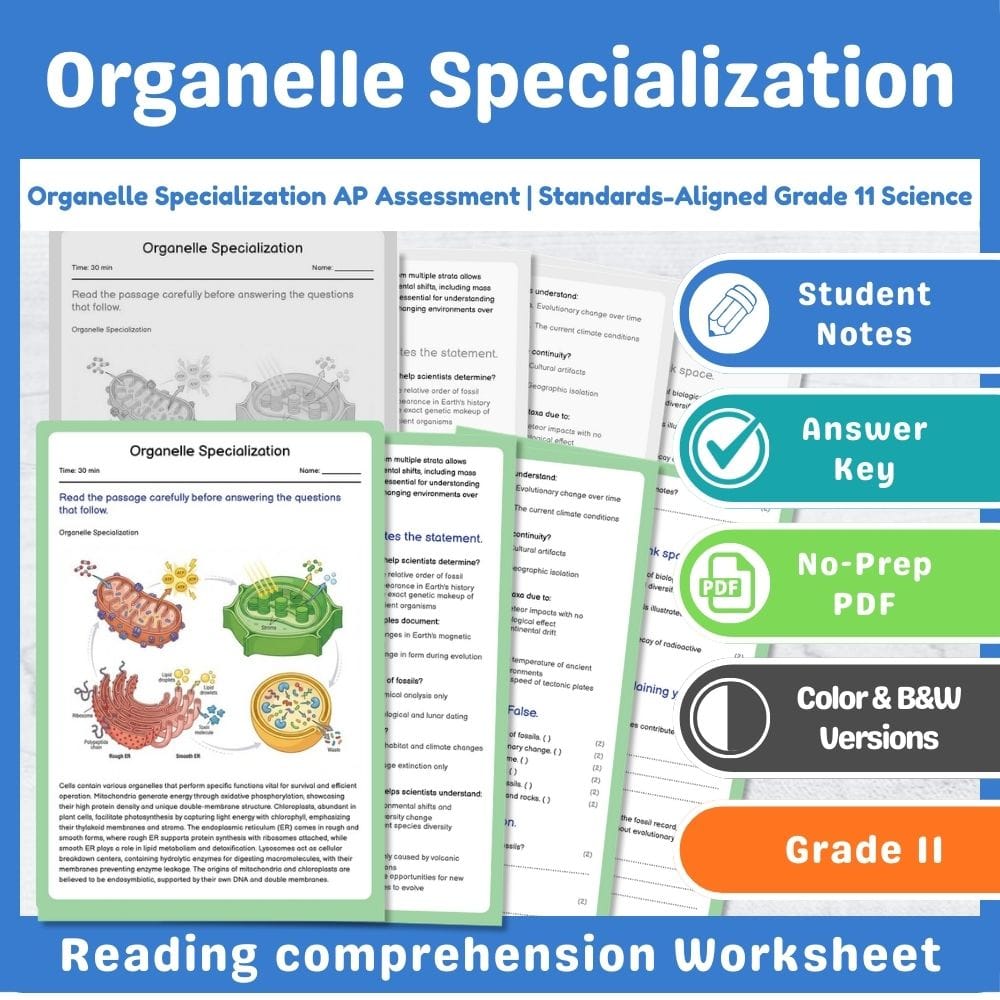
Organelle Specialization AP Assessment | Standards-Aligned Grade 11 Science
Created byPrism Point LearningLearning Objectives
- Compare structural and biochemical features of mitochondria, chloroplasts, endoplasmic reticulum, and lysosomes.
- Explain how organelle compartmentalization enhances cellular functions such as metabolism, protein trafficking, and signal transduction.
- Analyze the origins, membrane composition, and dysfunction consequences of key organelles.
Instant download
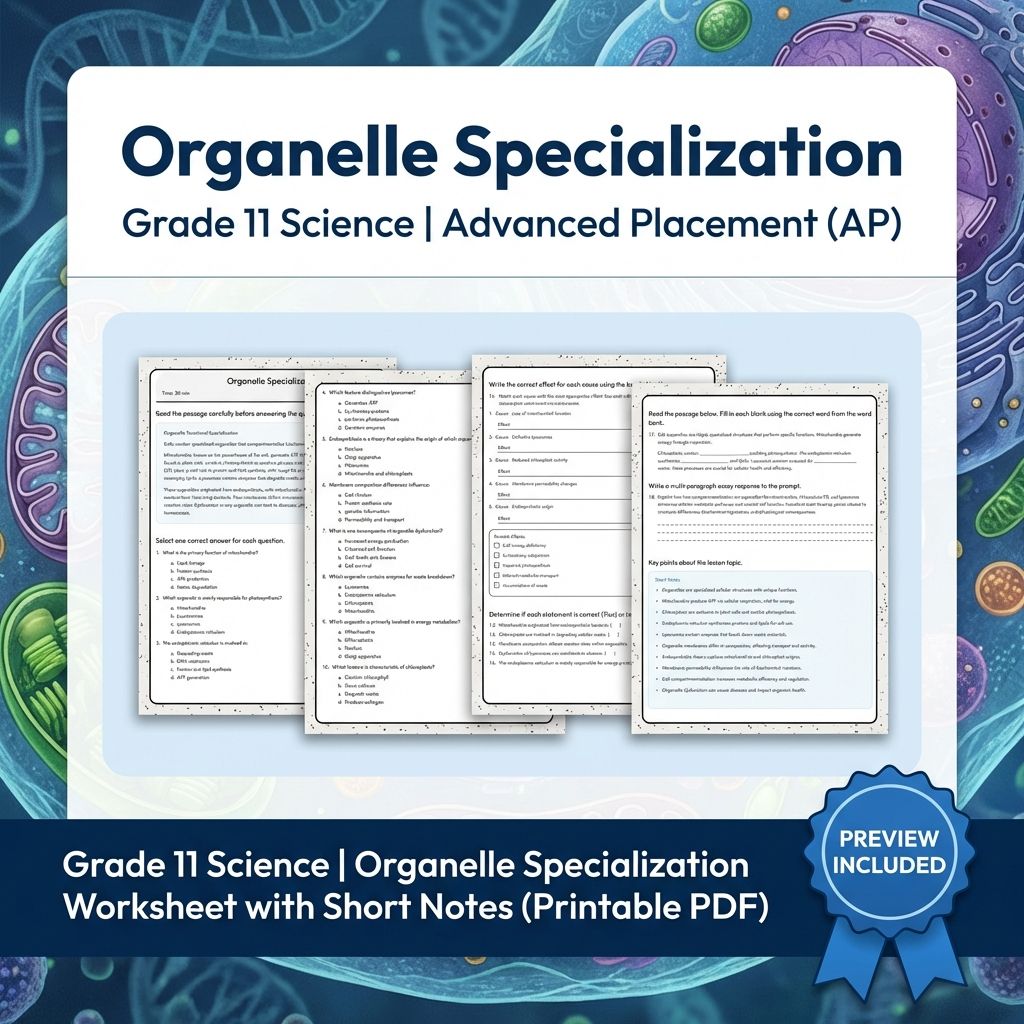
Grade 11 Science | Organelle Specialization Worksheet with Short Notes (PDF)
Created byMeadowlark WorksheetsLearning Objectives
- Describe the structural differences among organelles such as mitochondria, chloroplasts, ER, and lysosomes.
- Explain how organelle compartmentalization enhances metabolic efficiency.
- Analyze the endosymbiotic origins of mitochondria and chloroplasts.
Also included in: Grade 11 Science | Biological Systems & Genetics Unit Worksheet Pack (PDF) +1 more
Instant download

Grade 11 Science — Worksheet MCQ Paper for Mastering Organelle Specialization
Created byThe Resource HubLearning Objectives
- Understand the structural differences between key organelles like mitochondria, chloroplasts, endoplasmic reticulum, and lysosomes.
- Explain how organelle compartmentalization enhances cellular metabolic efficiency and regulation.
- Analyze the biochemical signatures and membrane compositions that distinguish organelles.
Also included in: Grade 11 Science AP Mastery Bundle – Systems, Genetics, and Ecosystems +1 more
Instant download

Grade 11 Science | Organelle Specialization Worksheet (AP Standards) (PDF)
Created byEvergreen Desk EducationLearning Objectives
- Explain how structural specialization of mitochondria, chloroplasts, ER, and lysosomes supports distinct cellular functions and biochemical pathways.
- Use ideas of membrane permeability, local concentration, and protein trafficking to predict how compartmentalization affects reaction rates and metabolic integration.
- Relate organelle dysfunction to loss of cellular homeostasis and downstream organismal consequences.
Also included in: Grade 11 Biology and Ecosystems Science Lesson Bundle (AP) +1 more
Instant download

Grade 7 Science | Species Adaptations Worksheet with Short Notes (Printable PDF)
Created byMeadowlark WorksheetsLearning Objectives
- Understand the different types of adaptations organisms develop for survival in specific environments.
- Identify structural, physiological, and behavioral traits that aid survival.
- Explain how adaptations are influenced by environmental factors like temperature, moisture, and predation.
Also included in: Grade 7 Science Lesson Bundle with Ontario Framework | Ecosystems & Biodiversity +1 more
Instant download
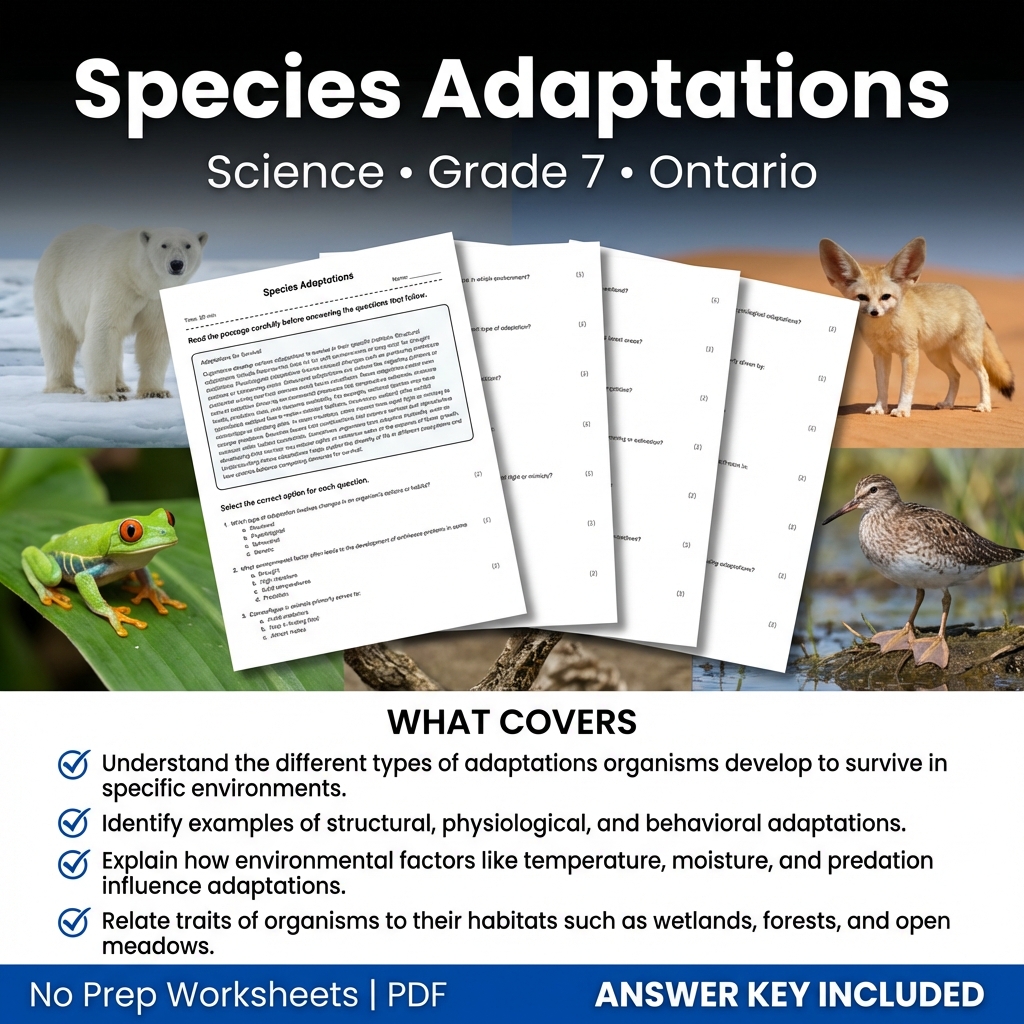
Species Adaptations Science Worksheet Grade 7 Ontario Naplan
Created byCoral Reef LearningLearning Objectives
- Understand the different types of adaptations organisms develop to survive in specific environments.
- Identify examples of structural, physiological, and behavioral adaptations.
- Explain how environmental factors like temperature, moisture, and predation influence adaptations.
Instant download

Grade 7 Science | Species Adaptations Worksheet (PDF+ Answer Key)
Created byCopper Leaf ClassroomLearning Objectives
- Describe different types of adaptations that organisms develop to survive in specific environments.
- Explain how structural, physiological, and behavioral traits help organisms cope with environmental pressures.
- Identify examples of adaptations in various habitats such as wetlands, forests, and meadows.
Instant download
Grade 7 Science – Species Adaptations Worksheet (Ontario) PDF
Created byBright Mind ResourcesLearning Objectives
- Identify structural, physiological, and behavioral adaptations of organisms.
- Explain how environmental pressures influence evolution and trait development.
- Describe adaptation strategies in different habitats such as wetlands, forests, and meadows.
Instant download
Grade 7 Science | Species Adaptations Worksheet (PDF ) – Ontario Standards
Created byPrism Point LearningLearning Objectives
- Understand the different types of adaptations organisms use to survive in their environments.
- Identify examples of structural, physiological, and behavioral adaptations in various habitats.
- Explain how environmental pressures influence the development of specific adaptations.
Also included in: Grade 7 Science UNIT Bundle | Ecosystems & Biodiversity Worksheets +1 more
Instant download
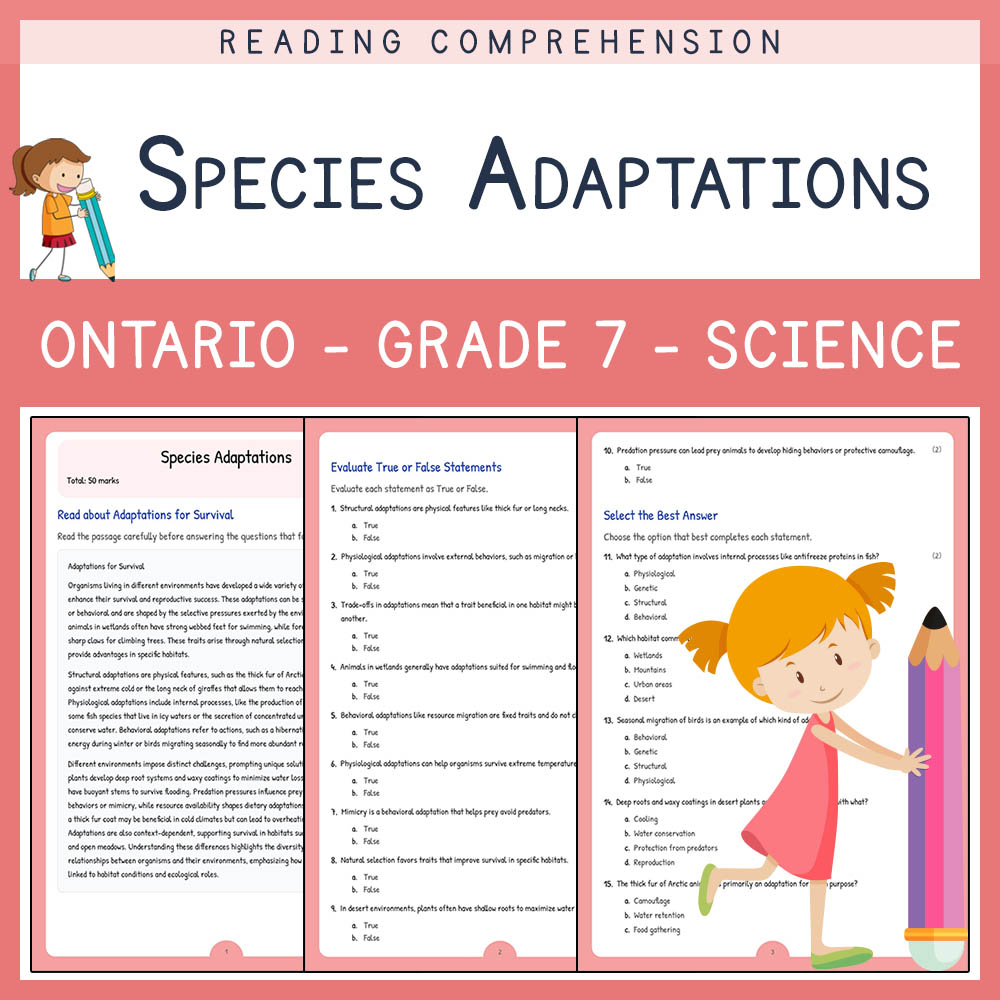
Grade 7 Science | Species Adaptations Worksheet (PDF + Answer Key) for Ontario
Created byLumora LearningLearning Objectives
- Understand the different types of adaptations organisms have for survival.
- Identify environmental factors that influence adaptations.
- Explain how structural, physiological, and behavioral traits help organisms thrive in specific habitats.
Instant download
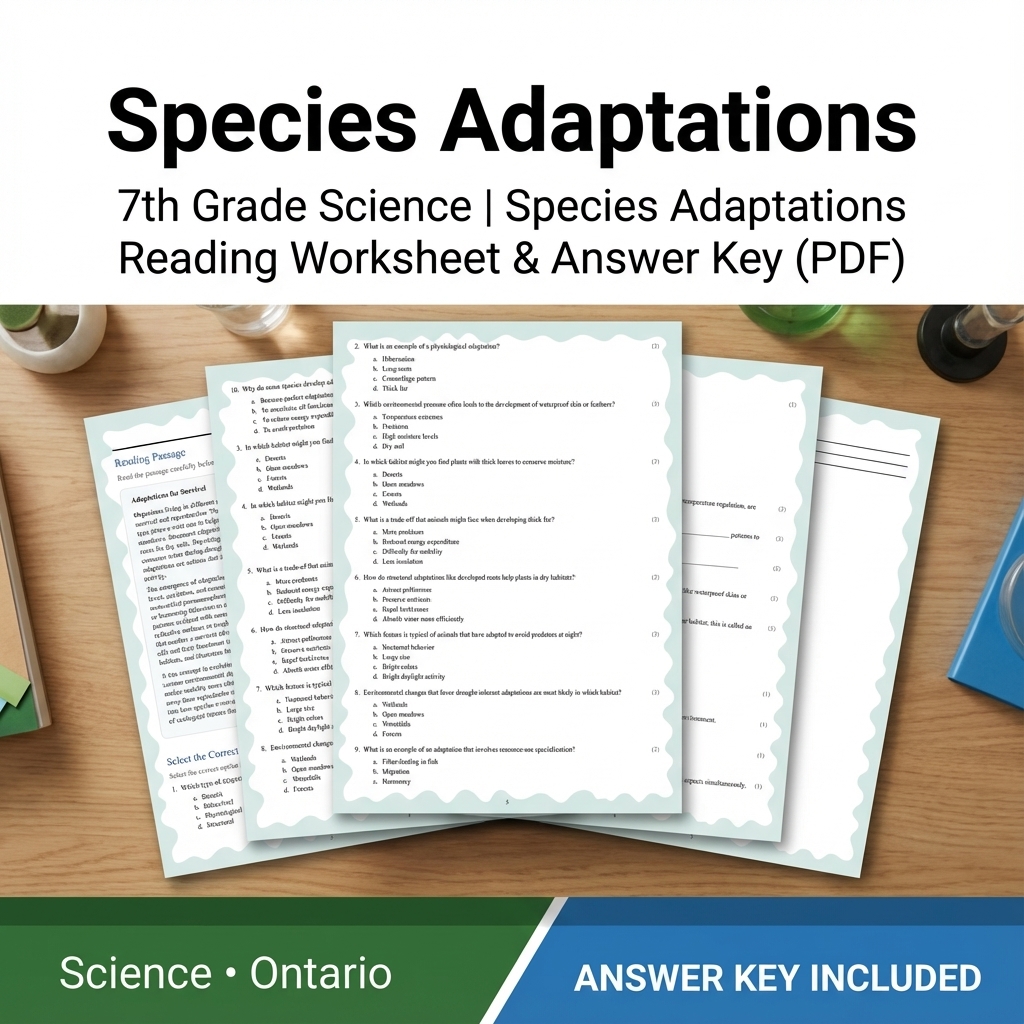
7th Grade Science | Species Adaptations Reading Worksheet & Answer Key (PDF)
JCreated byJ.S SheetsLearning Objectives
- Identify different types of adaptations: structural, physiological, and behavioral.
- Understand how environmental pressures influence adaptation traits.
- Relate adaptation traits to specific habitats such as wetlands, forests, and open meadows.
Also included in: Grade 7 Science | Ecosystems, Biodiversity & Environmental Stewardship +1 more
Instant download

Grade 7 Science | Species Adaptations - Daily Reading Comprehension
Created byCoral Reef LearningLearning Objectives
- Explain how structural, physiological, and behavioral adaptations help organisms survive in specific environments.
- Identify examples of adaptations in different habitats such as deserts, wetlands, forests, and meadows.
- Describe how environmental factors like temperature, moisture, predation, and resource availability influence adaptation development.
Instant download

Grade 7 Science | Species Adaptations Worksheet (Ontario Standards) (PDF)
Created byEvergreen Desk EducationLearning Objectives
- Explain how structural, physiological, and behavioral adaptations help organisms survive in specific environments
- Describe how selective pressures such as temperature, moisture, predation, and resource availability can shape adaptations over time
- Identify adaptation trade-offs and predict how traits may vary across habitats such as wetlands, forests, and open meadows
Also included in: Grade 7 Ecosystem Dynamics Science Lesson Bundle (Ontario) Worksheets +1 more
Instant download

Grade 7 Science – Species Adaptations Reading Worksheet | Ontario Standards
Created byBright Mind ResourcesLearning Objectives
- Identify key structural features of organisms that aid in survival
- Describe how physical traits are adapted to specific habitats
- Explain how natural selection influences adaptations
Also included in: Grade 7 Ecosystem Stewardship Science Daily Reading lesson bundle | Ontario +1 more
Instant download

Species Adaptations Test Prep Worksheet | Grade 7 Science Ontario
Created byPrism Point LearningLearning Objectives
- Explain how structural, physiological, and behavioral adaptations help organisms survive in specific habitats.
- Describe how selective pressures (temperature, moisture, predation, and resource availability) can shape adaptations.
- Use examples to identify adaptive trade-offs and how different habitats can favor different traits.
Also included in: Grade 7 Ecosystem Science Lesson Bundle | Ontario Test Prep Worksheets
Instant download
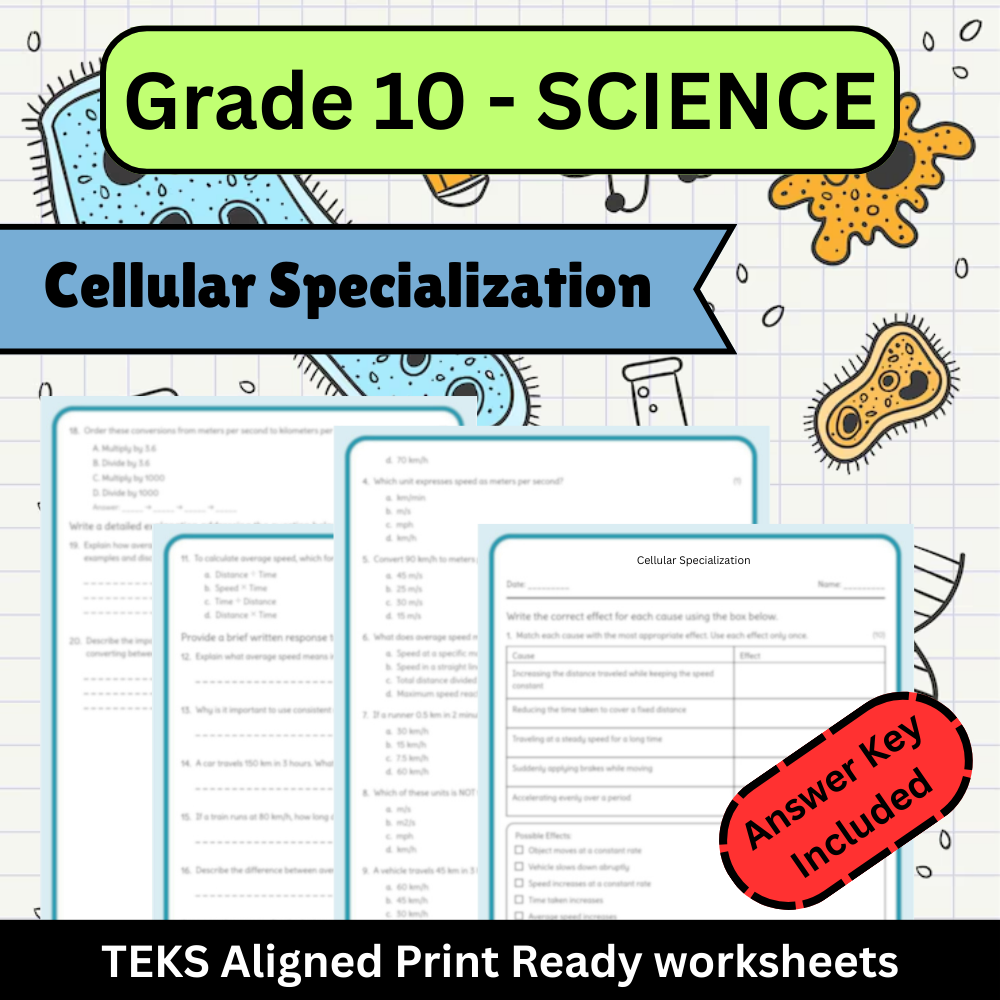
Grade 10 Science – Cellular Specialization Worksheet (Worksheet + Answer Key) | TEKS Alignment
Created byBright Mind ResourcesLearning Objectives
- Understand how organelles are specialized for specific cellular functions.
- Identify relationships between organelle abundance and cell function.
- Explain how cells form tissues and organ systems in multicellular organisms.
Also included in: Grade 10 Science | Cell Structure & Function Unit Worksheet Bundle(TEKS-Aligned) +5 more
Instant download

Cellular Specialization Assessment | TEKS Grade 10 Science Worksheet
Created byPrism Point LearningLearning Objectives
- Understand how cells develop distinct structures and organelle compositions for specific functions.
- Identify relationships between organelle abundance and cell function, such as mitochondria in muscle cells.
- Explain how specialized cells form tissues and organ systems in multicellular organisms.
Also included in: Grade 10 Cell Structure and Function Unit Science Lesson Bundle TEKS
Instant download
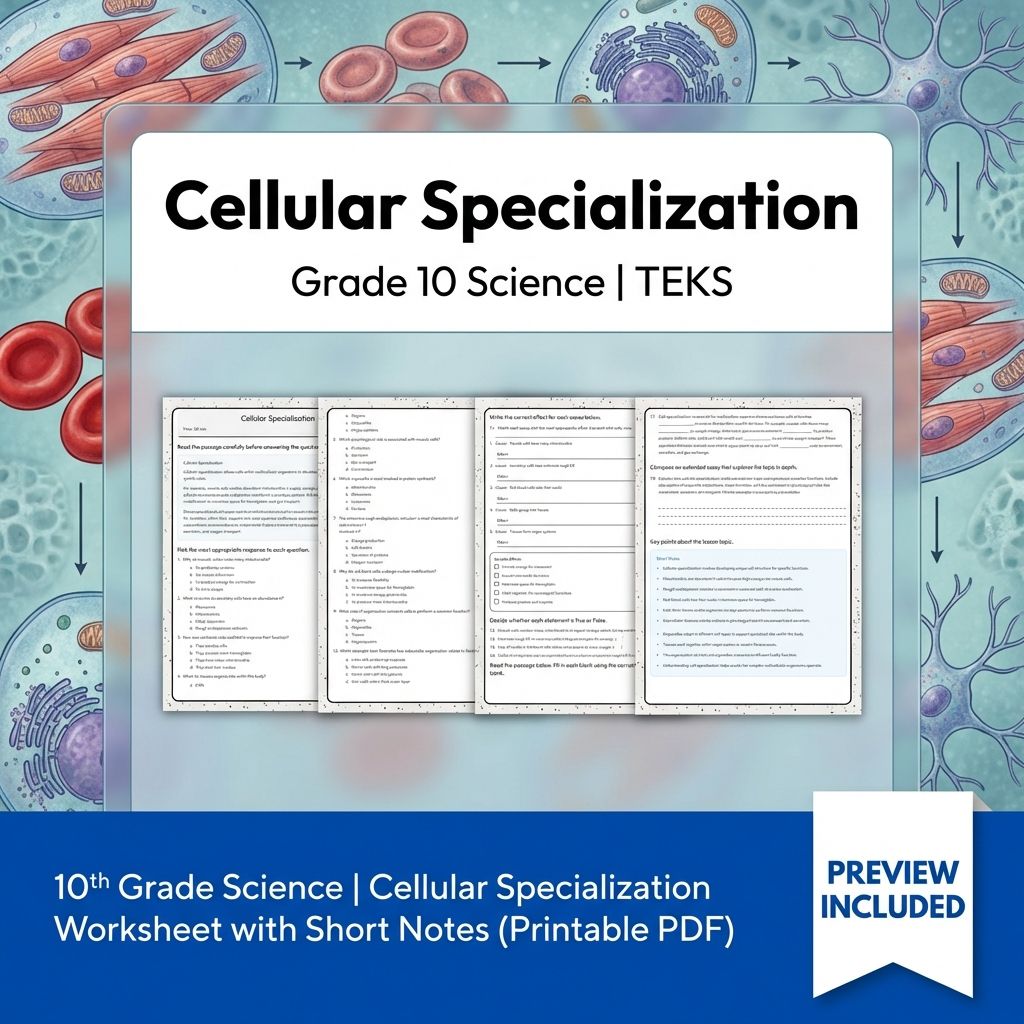
10th Grade Science | Cellular Specialization Worksheet with Short Notes (PDF)
Created byMeadowlark WorksheetsLearning Objectives
- Explain how cellular organelles adapt in different cell types to perform specific functions.
- Describe how specialized cells form tissues and organ systems in multicellular organisms.
- Connect subcellular structures with their physiological roles like contraction, secretion, and gas transport.
Instant download

Grade 10 Science – Cellular Specialization & Organ Systems | Reading Worksheet
Created byBright Mind ResourcesLearning Objectives
- Understand how different cells develop specialized structures.
- Identify functions of various organelles in specialized cells.
- Explain how cellular specialization contributes to tissue and organ functions.
Also included in: Grade 10 Cell Structure & Function Science Daily Reading Lesson Bundle | TEKS +2 more
Instant download
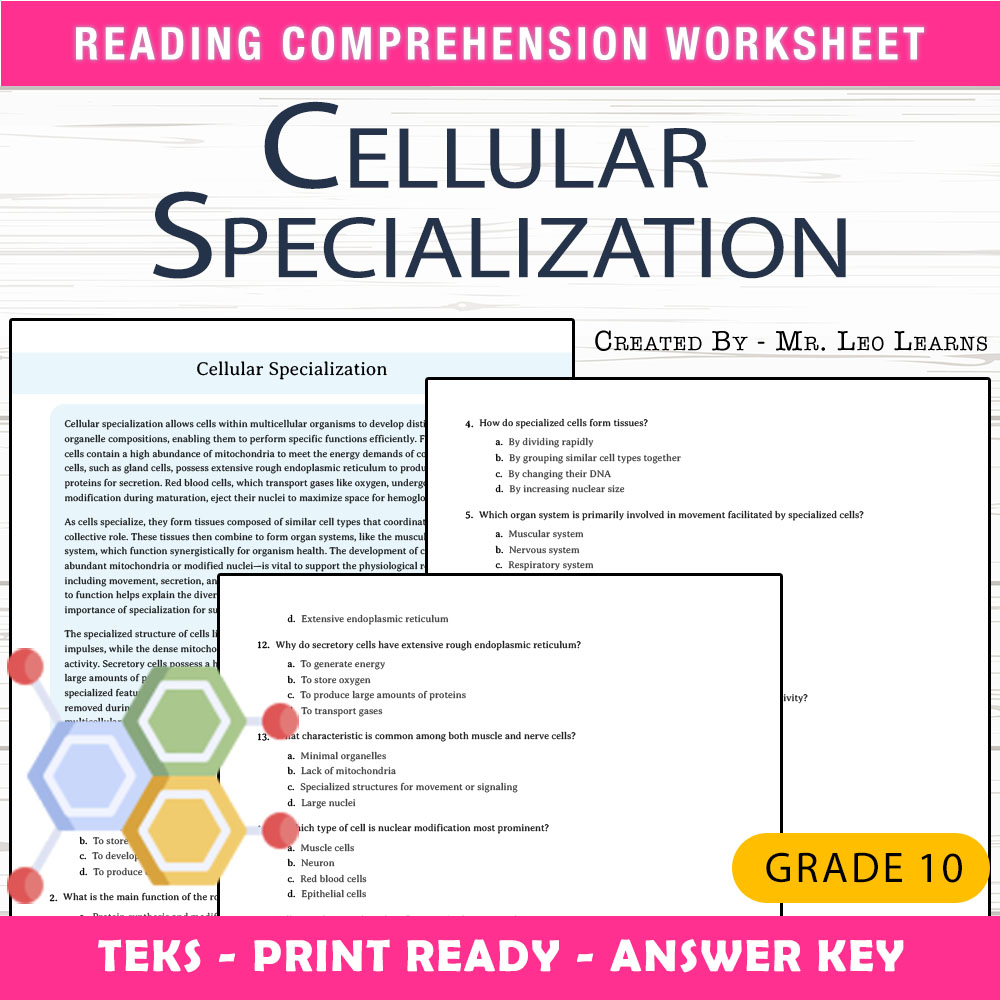
Grade 10 Science – Cellular Specialization Worksheet for Mastering Cell Functions
Created byThe Resource HubLearning Objectives
- Understand how organelle abundance relates to cell function in specialized cells.
- Explain the process by which cells develop distinct structures to perform specific roles.
- Connect subcellular features to physiological activities like contraction, secretion, and gas transport.
Also included in: Grade 10 Science Cell Biology Unit | Cell Structures & Functions Worksheet Pack +1 more
Instant download
Browse more categories
About Reading comprehension Worksheets
Find reading comprehension worksheets for class practice, homework, or self-study. All 40,289 are instant PDF downloads.
Each resource here is built by an independent educator and reviewed for quality. Worksheets print straight from PDF and suit classroom use, homework, or extra practice; most come with answer keys, and you can preview before purchasing.