
Reading comprehension Worksheets
40,284 type resources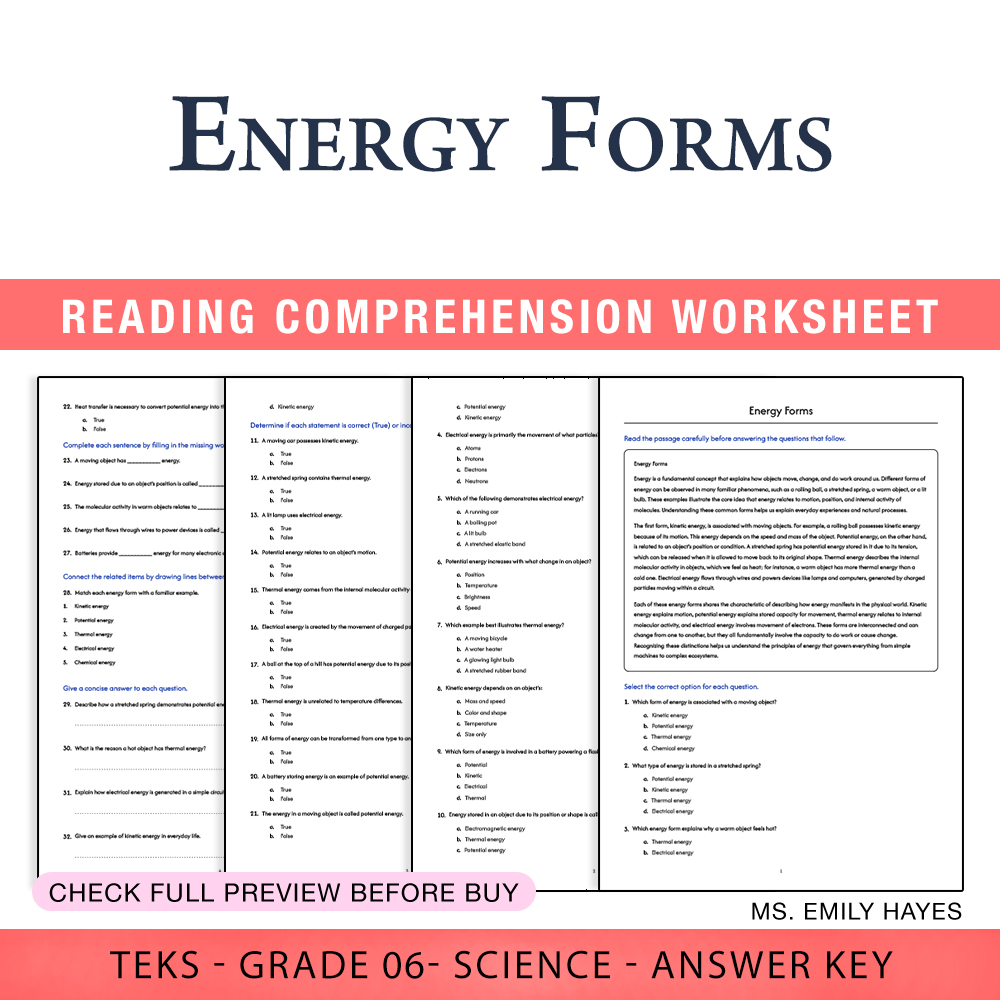
6th Grade Science | Energy Forms Worksheet (PDF+ Answer Key)
 Created byCopper Leaf Classroom
Learning Objectives
- Identify and describe common forms of energy including kinetic, potential, thermal, chemical, and electrical.
- Relate each form of energy to familiar phenomena such as moving objects, stretched springs, warm objects, and batteries.
- Distinguish between energy types based on their characteristics like motion, position, and internal molecular activity.
Instant download
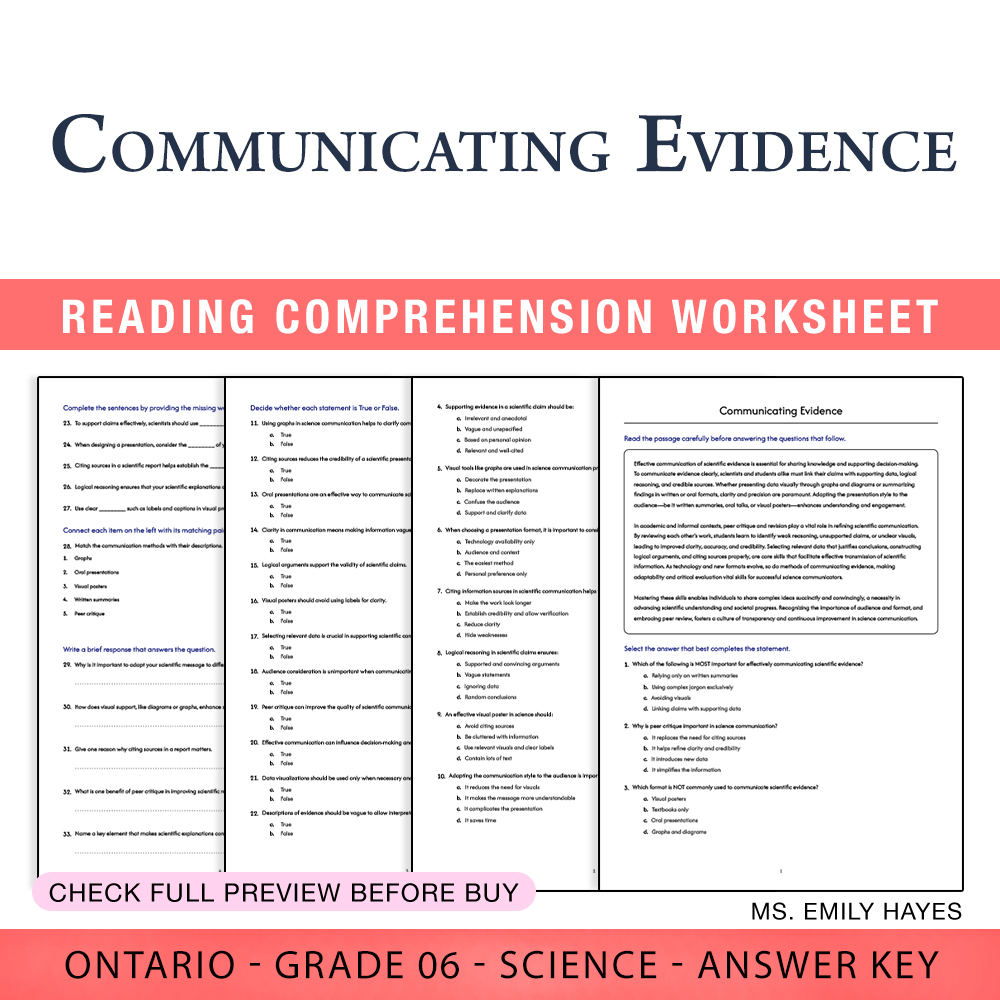
6th Grade Science | Communicating Evidence Worksheet (PDF+ Answer Key)
Created byCopper Leaf ClassroomLearning Objectives
- Describe key methods for effectively communicating scientific evidence, including visual and textual formats.
- Identify the elements that make scientific arguments logical, supported by relevant data and sources.
- Construct clear, supported scientific explanations suitable for different audiences.
Instant download
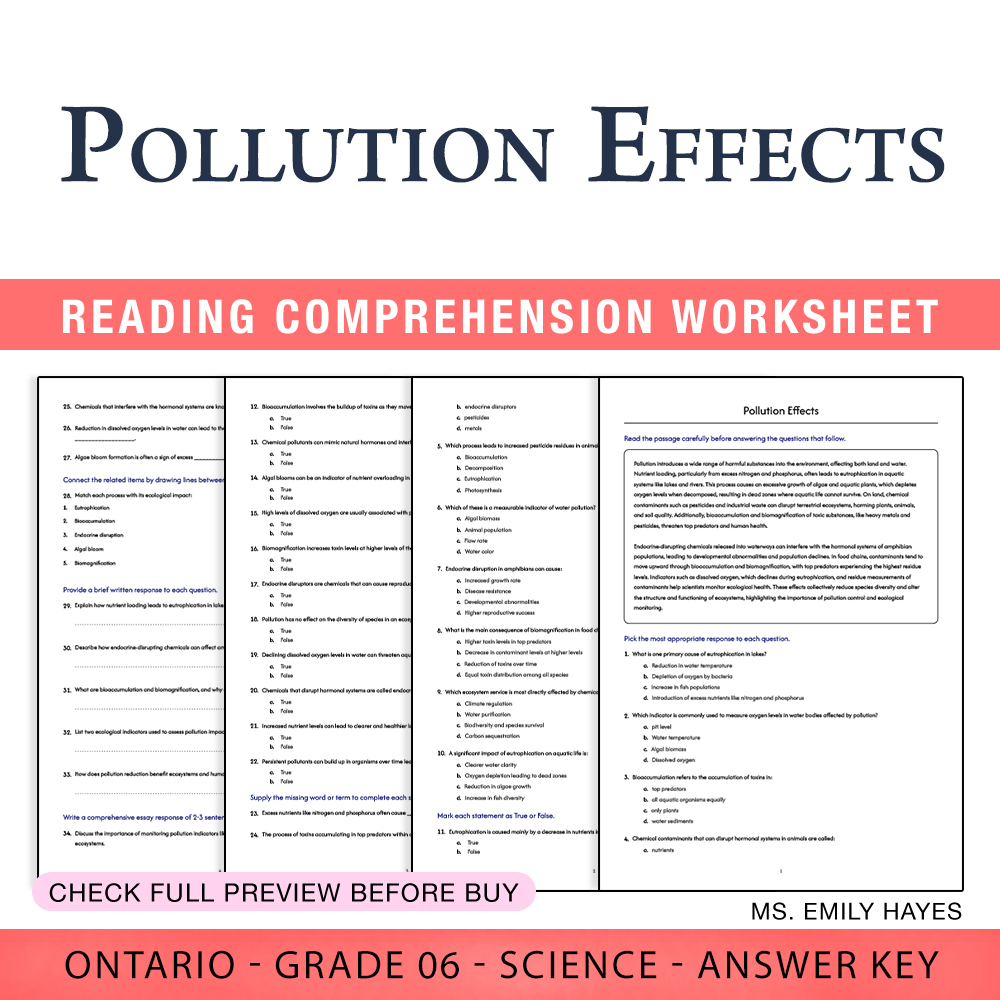
Grade 6 Science | Pollution Effects Worksheet (PDF+ Answer Key)
Created byCopper Leaf ClassroomLearning Objectives
- Understand the ecological impacts of pollution on terrestrial and aquatic ecosystems.
- Identify measurable indicators of pollution such as dissolved oxygen and contaminant residues.
- Explain processes like eutrophication, bioaccumulation, and endocrine disruption in environmental contexts.
Instant download
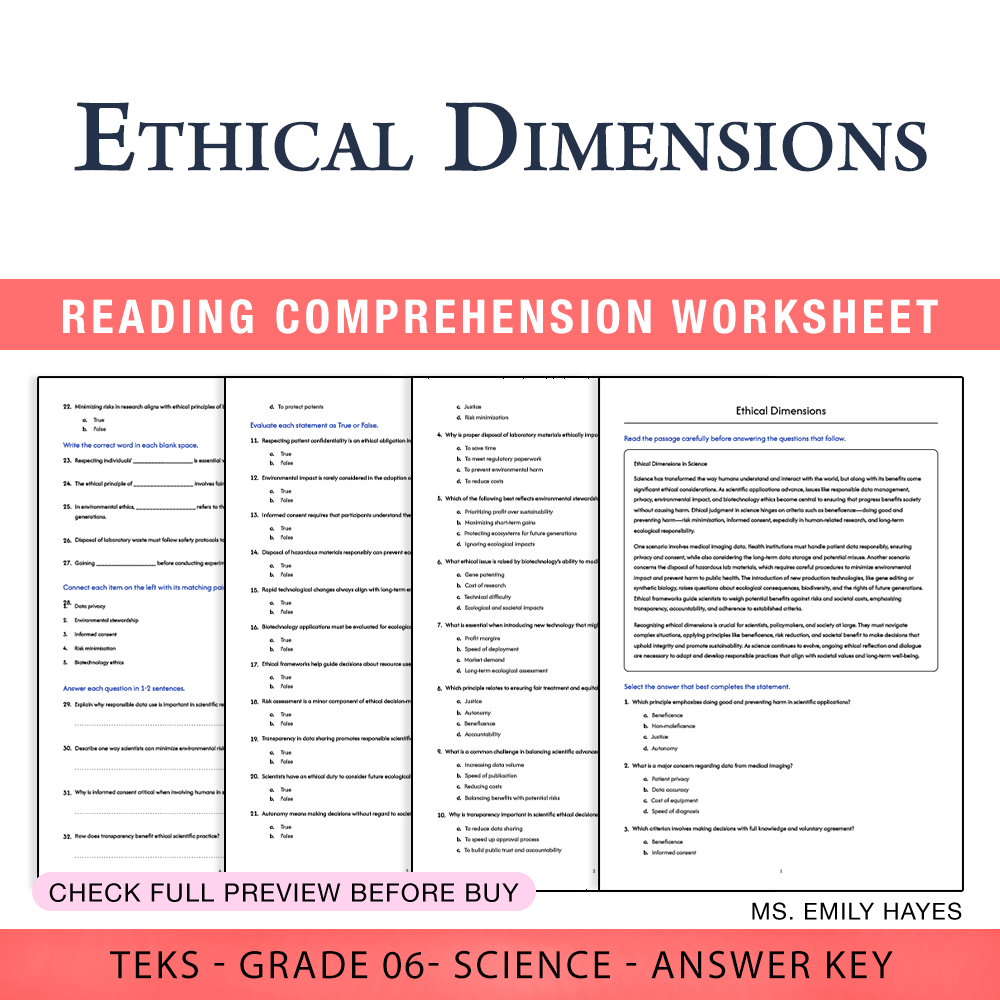
6th Grade Science | Ethical Dimensions Worksheet (PDF+ Answer Key)
Created byCopper Leaf ClassroomLearning Objectives
- Understand key ethical principles such as beneficence, risk minimization, and informed consent in scientific contexts.
- Identify responsible practices in data management, environmental stewardship, and biotechnology.
- Analyze scenarios involving ethical decision-making in scientific applications.
Instant download
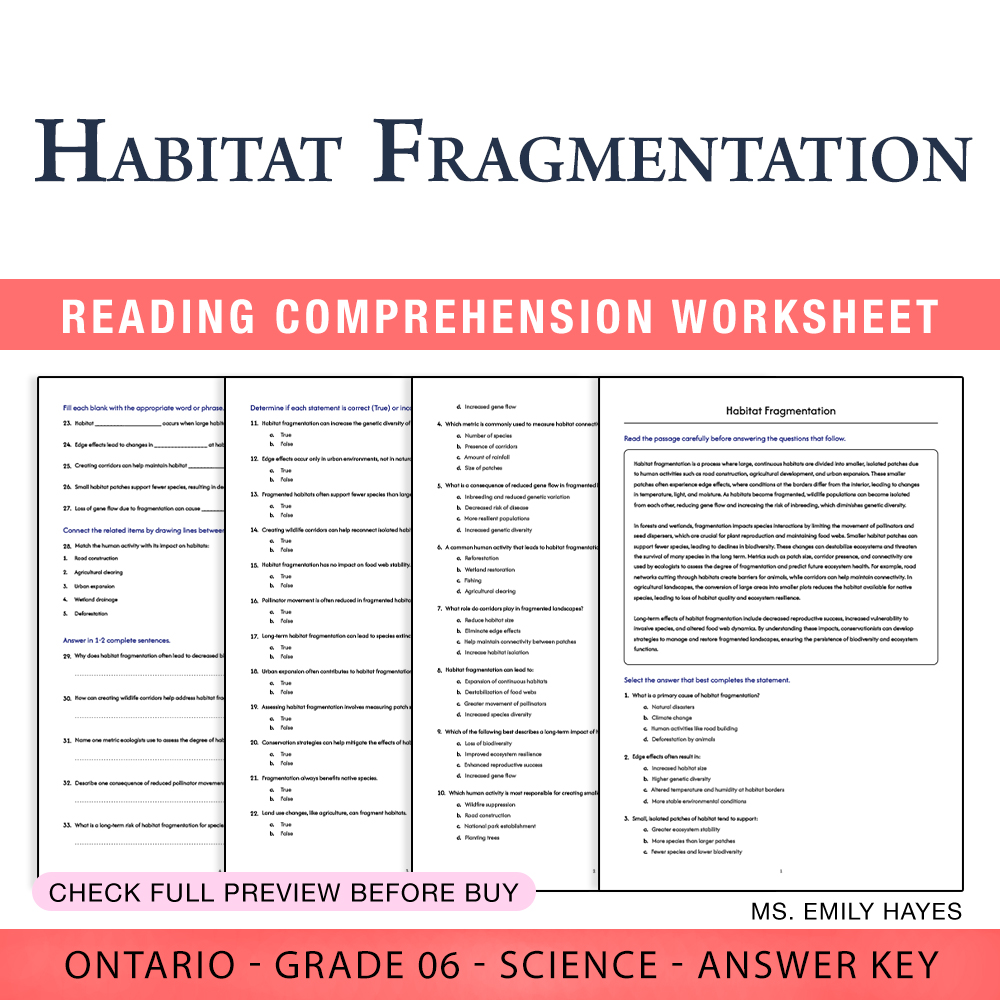
6th Grade Science | Habitat Fragmentation Worksheet (PDF+ Answer Key)
Created byCopper Leaf ClassroomLearning Objectives
- Understand the concept of habitat fragmentation and its impacts on ecosystems.
- Identify human activities that cause habitat fragmentation and analyze their effects on biodiversity.
- Learn about methods used to assess habitat fragmentation and its long-term consequences for species survival.
Instant download
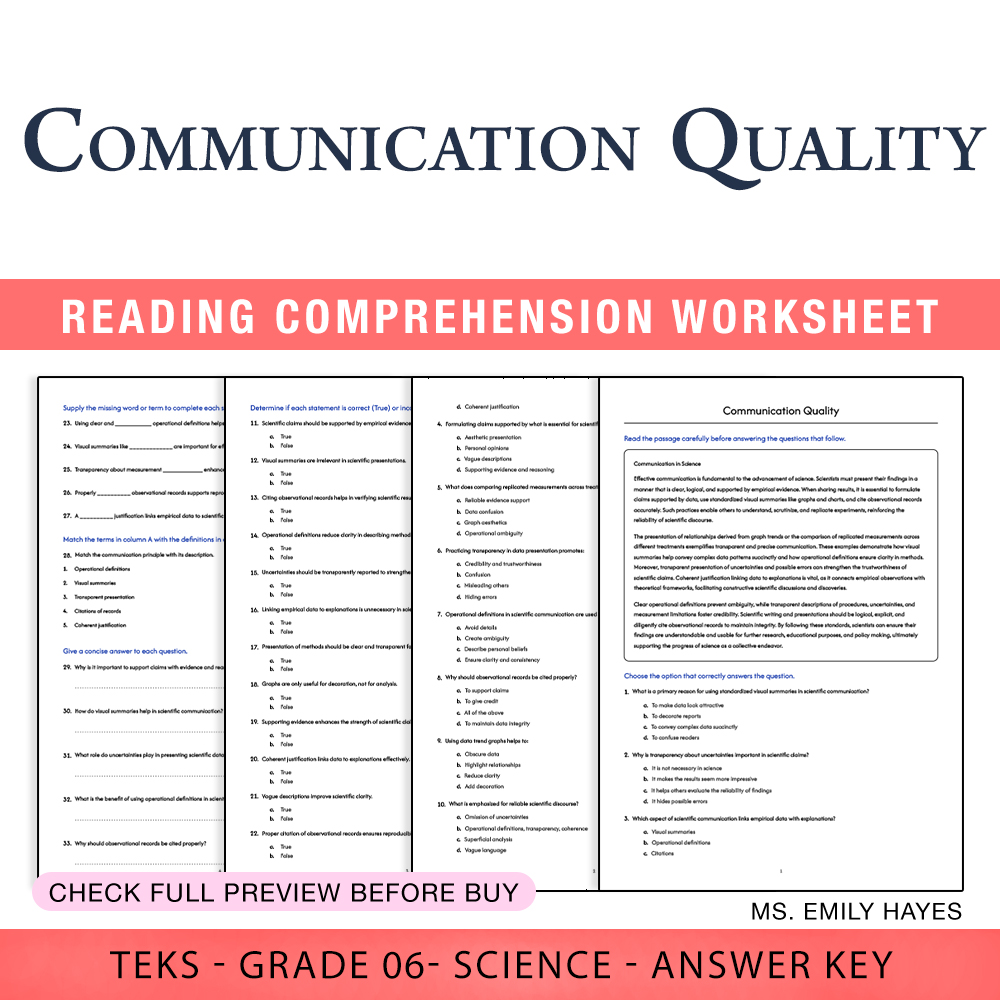
6th Grade Science | Communication Quality Worksheet (PDF+ Answer Key)
Created byCopper Leaf ClassroomLearning Objectives
- Understand the standards for communicating scientific findings clearly and accurately.
- Identify effective methods for presenting evidence and supporting claims.
- Learn how to use visual summaries and proper citation of observational records.
Instant download
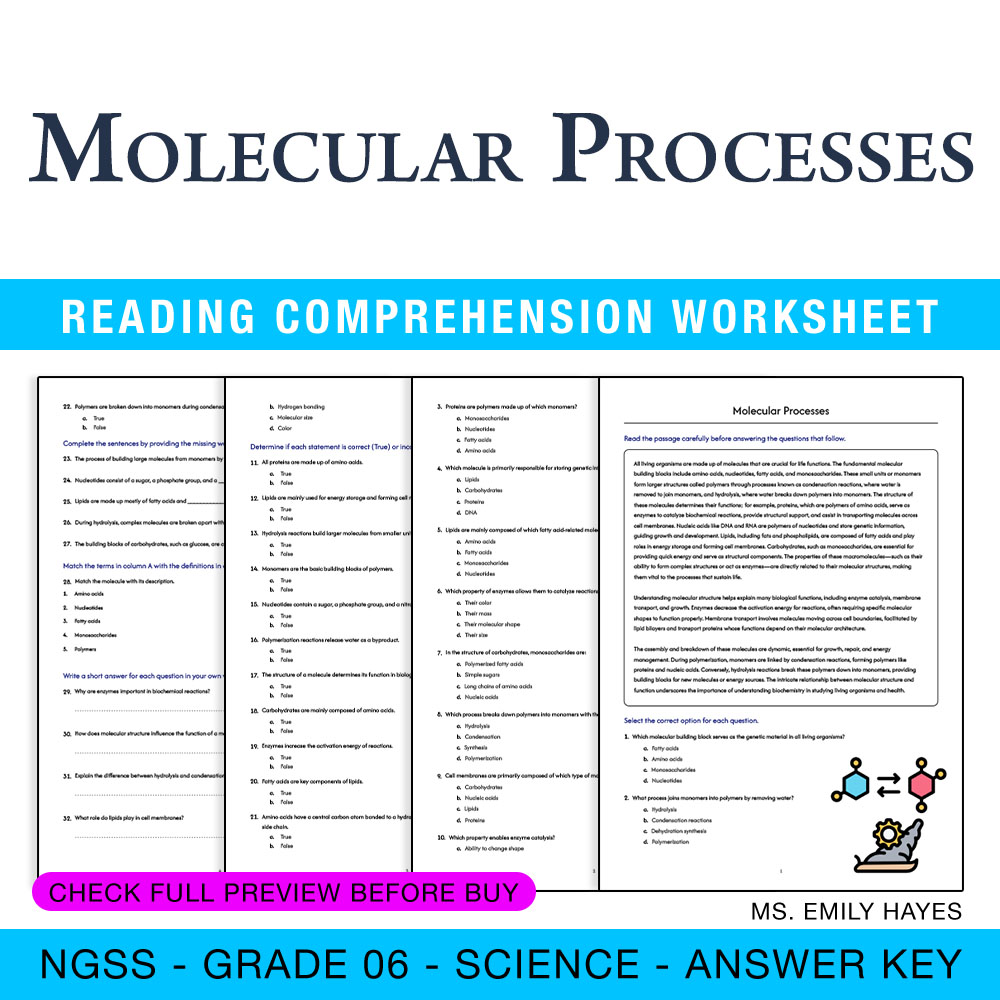
6th Grade Science | Molecular Processes Worksheet (PDF + Answer Key)
Created byCopper Leaf ClassroomLearning Objectives
- Understand the basic molecular building blocks such as amino acids, nucleotides, fatty acids, and monosaccharides.
- Explain how monomers assemble into polymers through condensation reactions and break down via hydrolysis.
- Relate molecular structure to properties like enzyme activity, membrane transport, and polymerization.
Instant download
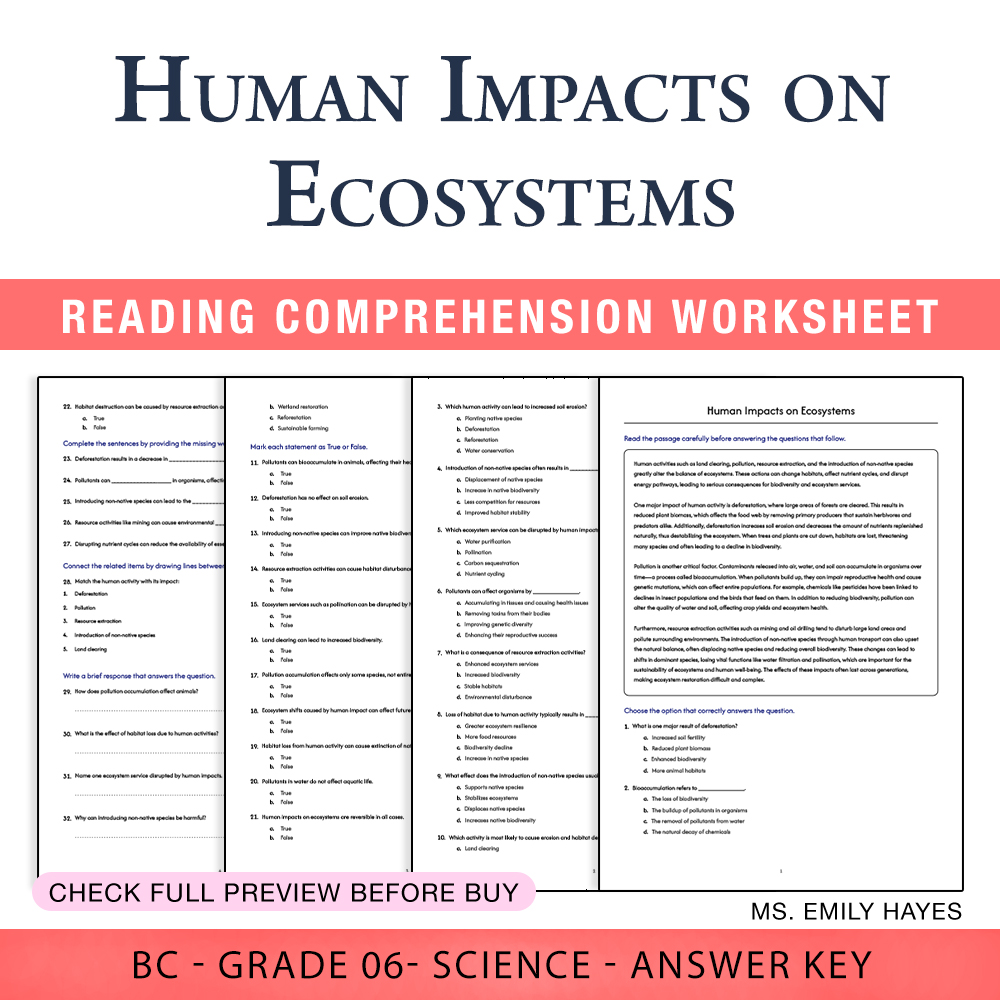
6th Grade Science | Human Impacts on Ecosystems Worksheet (PDF + Answer Key)
Created byCopper Leaf ClassroomLearning Objectives
- Understand how human activities such as land clearing and pollution affect ecosystems.
- Identify specific impacts of deforestation and resource extraction on biodiversity.
- Describe how pollutants can accumulate in organisms and affect health.
Also included in: Grade 6 Science BC | Ecosystems and Human Impact Unit (PDF + Answer Keys) +1 more
Instant download
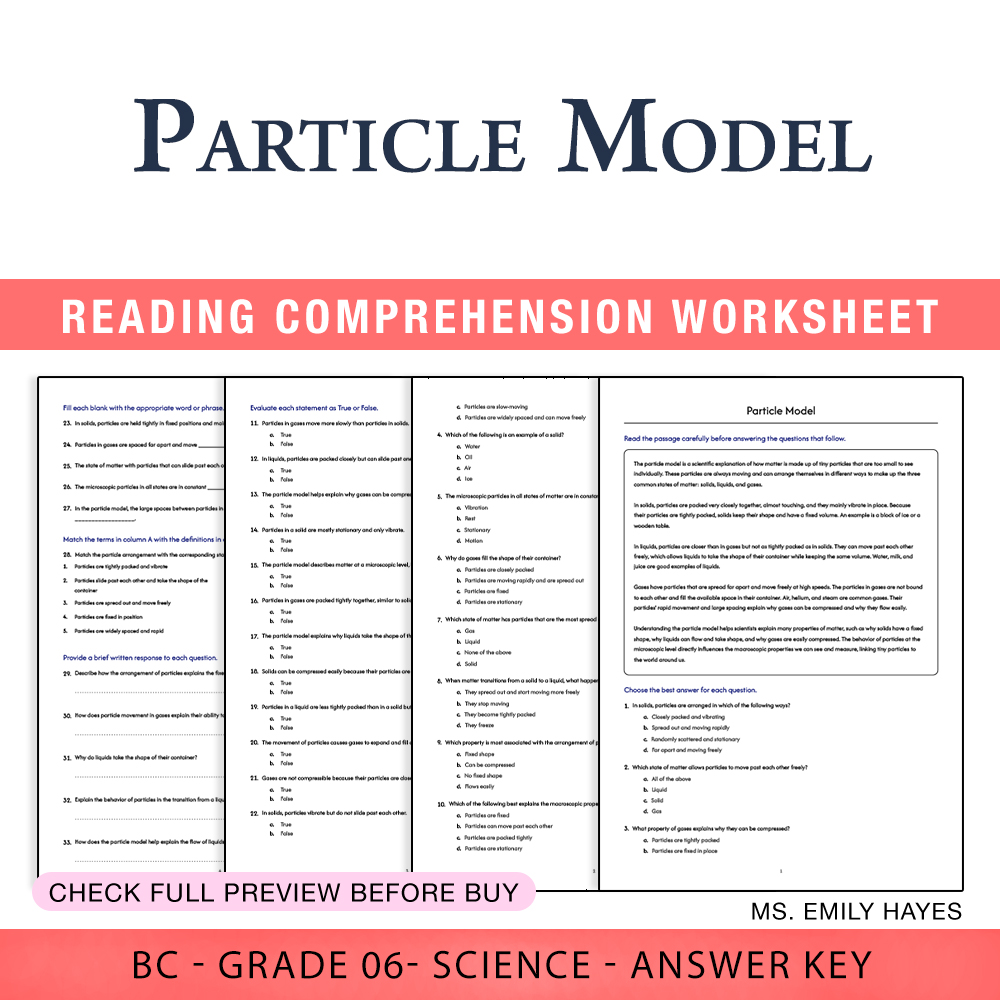
Grade 6 Science | Particle Model Worksheet (PDF+ Answer Key)
Created byCopper Leaf ClassroomLearning Objectives
- Explain the basic concepts of the particle model and how it describes matter.
- Distinguish between solids, liquids, and gases based on particle arrangements and movement.
- Connect microscopic particle behavior to macroscopic properties of matter such as shape, volume, and flow.
Also included in: Grade 6 Science BC| Reaction Rates & Chemical Properties (PDF+ Answer Keys) +1 more
Instant download
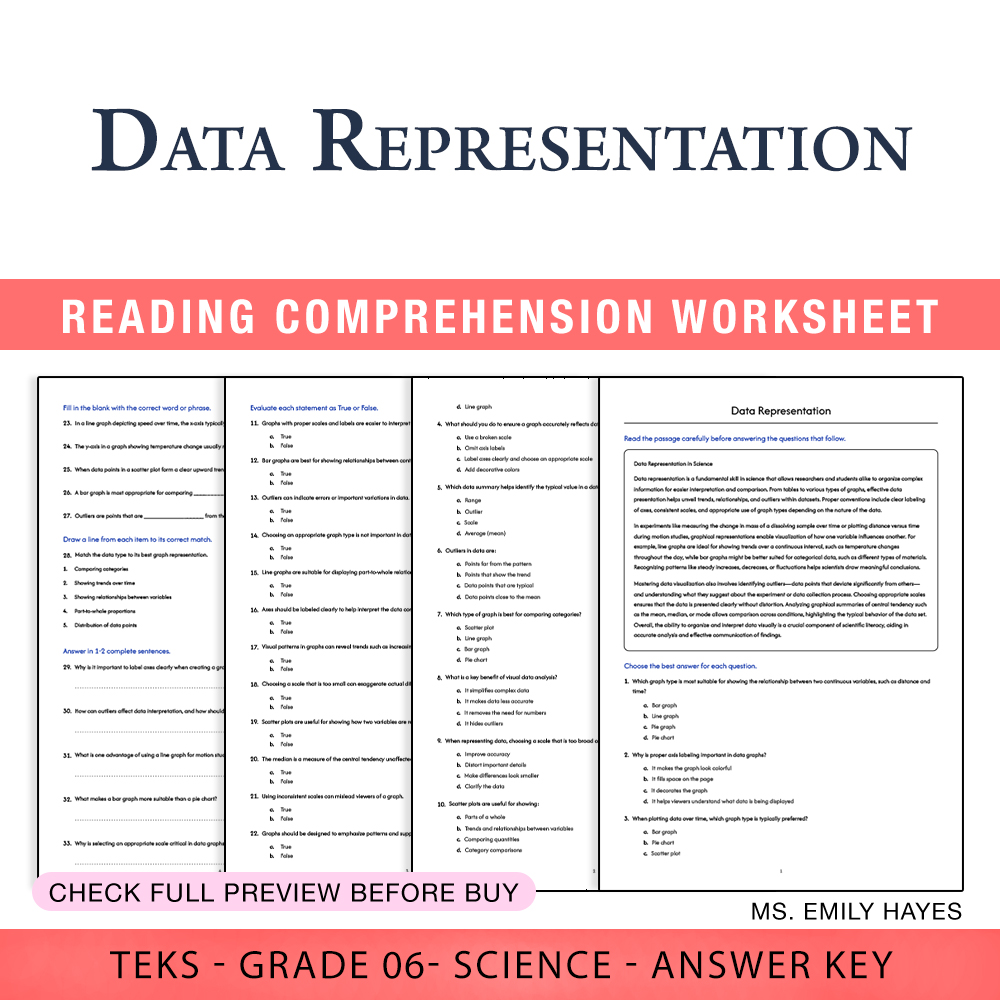
6th Grade Science | Data Representation Worksheet (PDF+ Answer Key)
Created byCopper Leaf ClassroomLearning Objectives
- Understand the conventions for organizing data in tables and graphs.
- Identify proper axes labeling and scale selection in data charts.
- Interpret graphical summaries to identify trends, patterns, and outliers.
Instant download
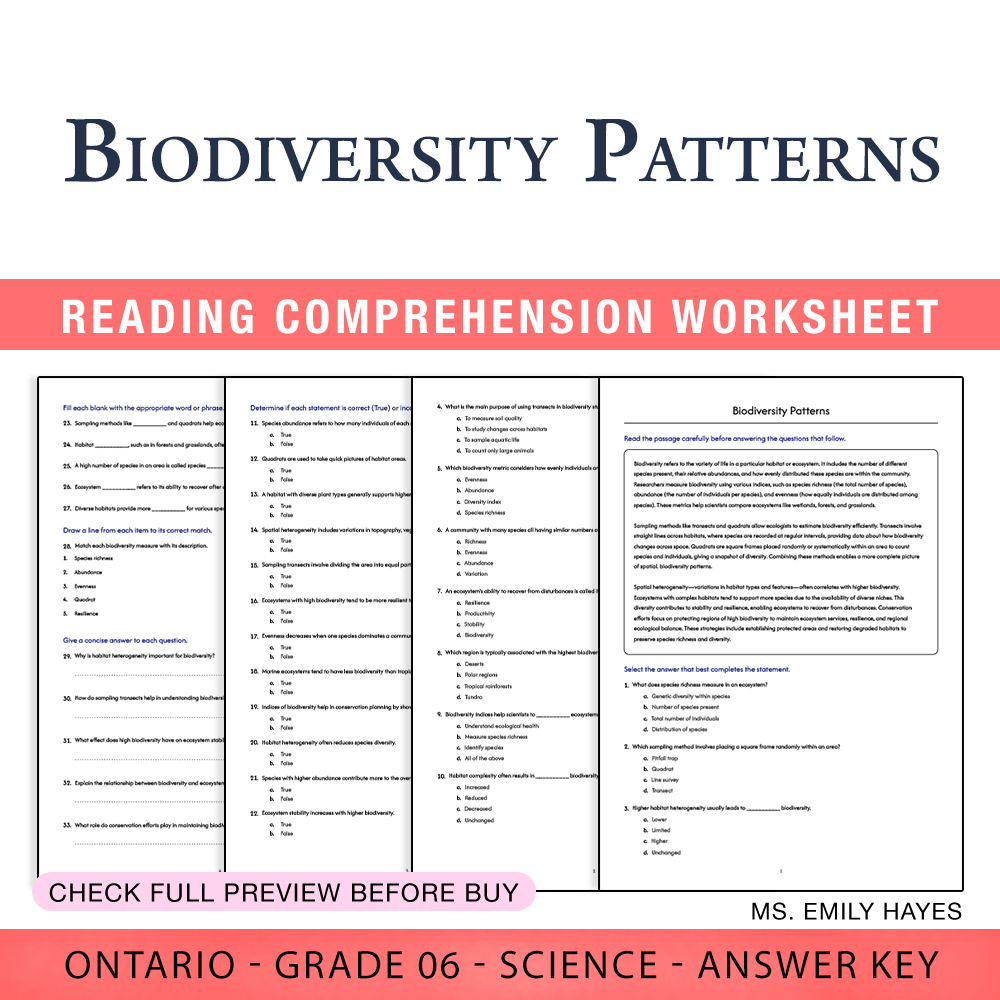
6th Grade Science | Biodiversity Patterns Worksheet (PDF+ Answer Key)
Created byCopper Leaf ClassroomLearning Objectives
- Describe measures of biodiversity such as species richness, abundance, and evenness across different ecosystems.
- Explain sampling concepts like transects and quadrats used to quantify biodiversity.
- Interpret spatial patterns in biodiversity related to habitat heterogeneity.
Instant download
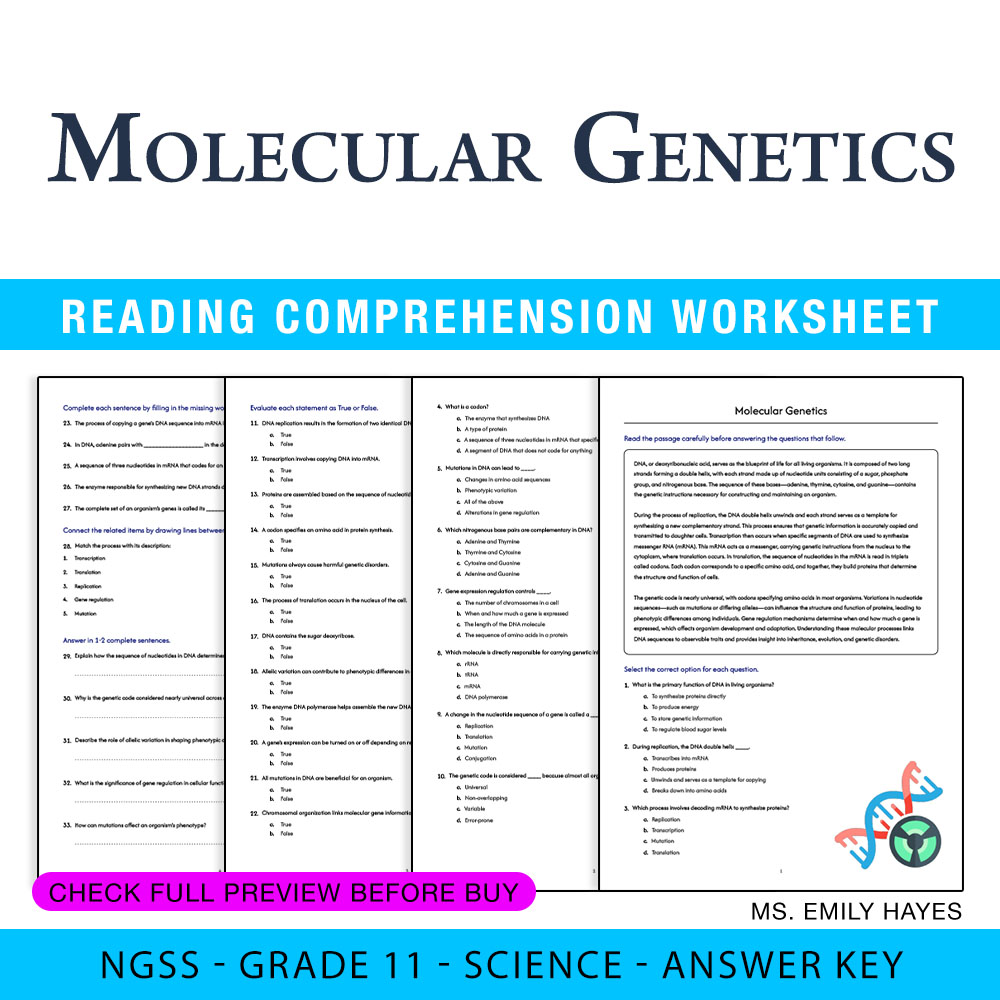
Grade 11 Science | Molecular Genetics Worksheet (PDF+ Answer Key)
Created byCopper Leaf ClassroomLearning Objectives
- Describe the structure of DNA and its role in genetic information storage.
- Explain the processes of replication, transcription, and translation.
- Understand the genetic code and how nucleotide sequences determine amino acid sequences.
Instant download
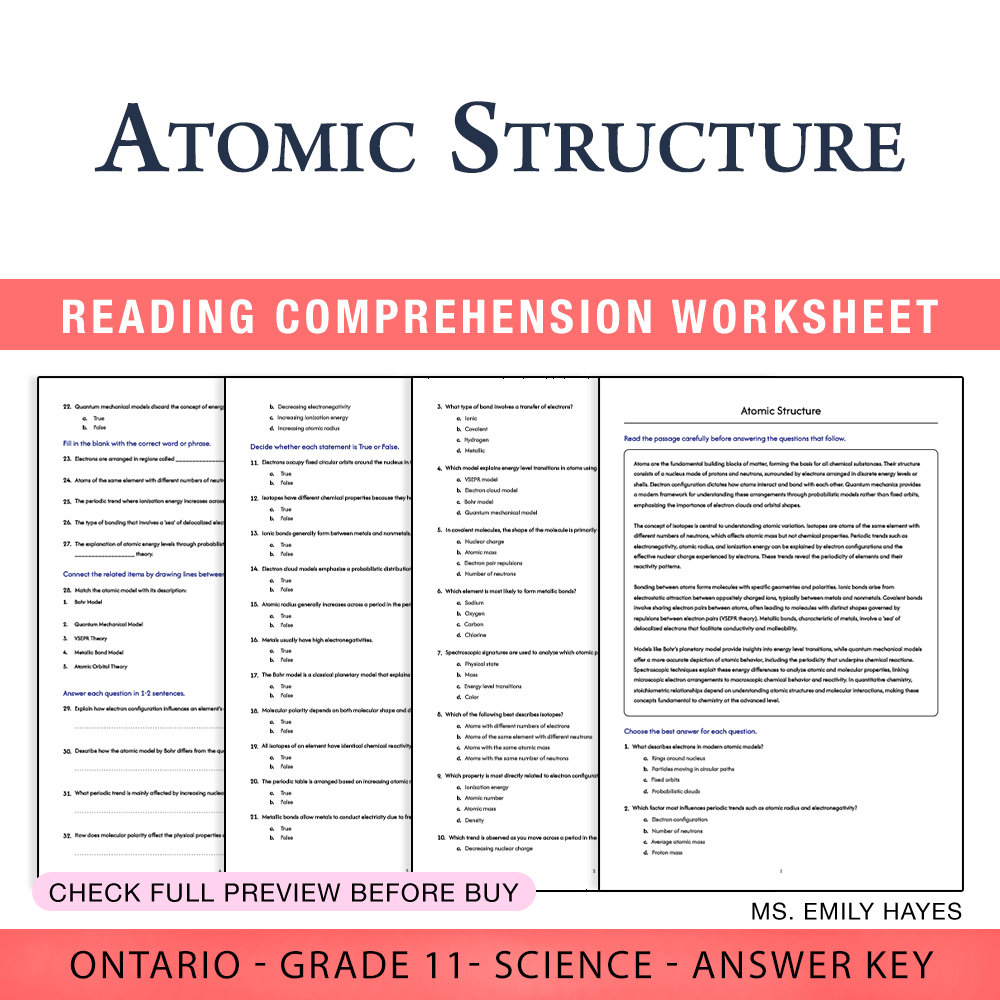
11th Grade Science | Atomic Structure Worksheet (PDF + Answer Key)
Created byCopper Leaf ClassroomLearning Objectives
- Describe atomic and molecular structures including electron configurations and quantum shells.
- Explain isotopic variation and periodic trends that influence chemical behavior.
- Identify different bonding types such as ionic, covalent, and metallic bonds.
Instant download
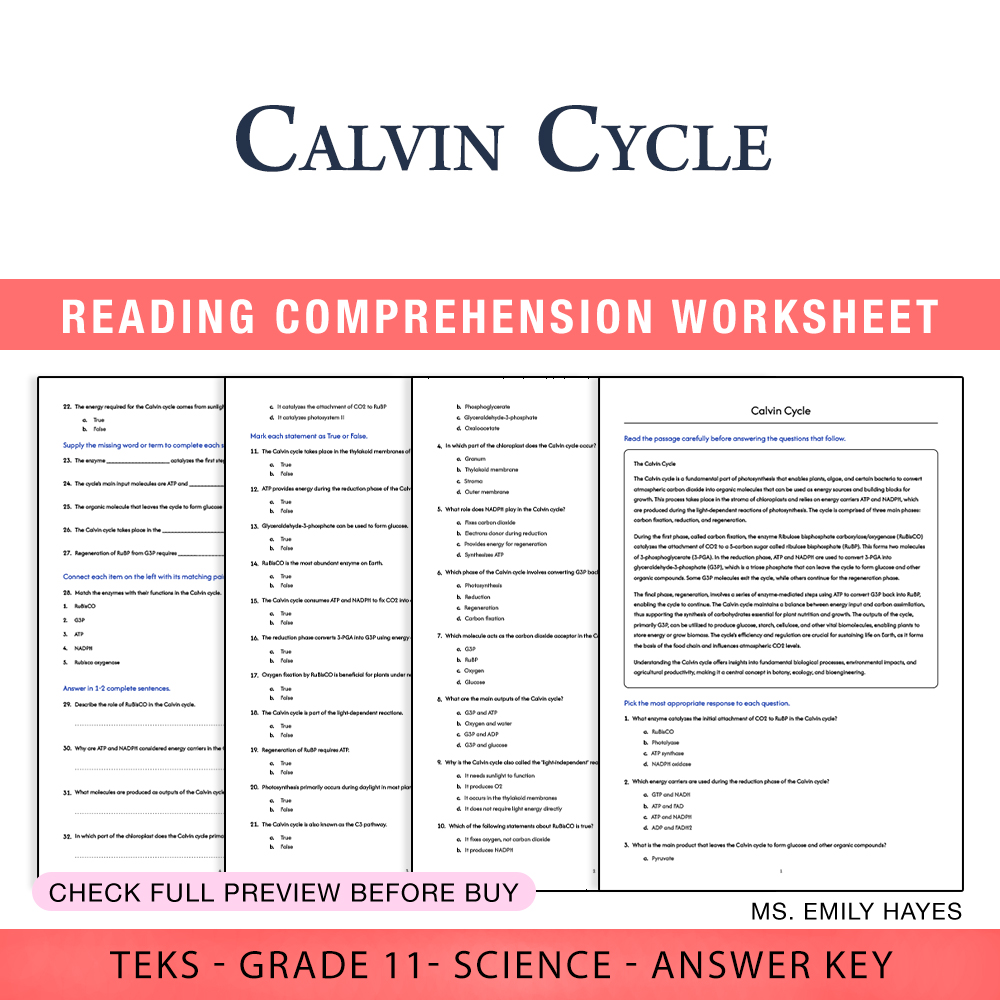
Grade 11 Science | Calvin Cycle Worksheet (PDF+ Answer Key)
Created byCopper Leaf ClassroomLearning Objectives
- Describe the main steps and phases of the Calvin cycle in photosynthesis.
- Explain the role of key enzymes such as RuBisCO in carbon fixation.
- Identify the outputs and significance of the Calvin cycle in plant metabolism.
Instant download
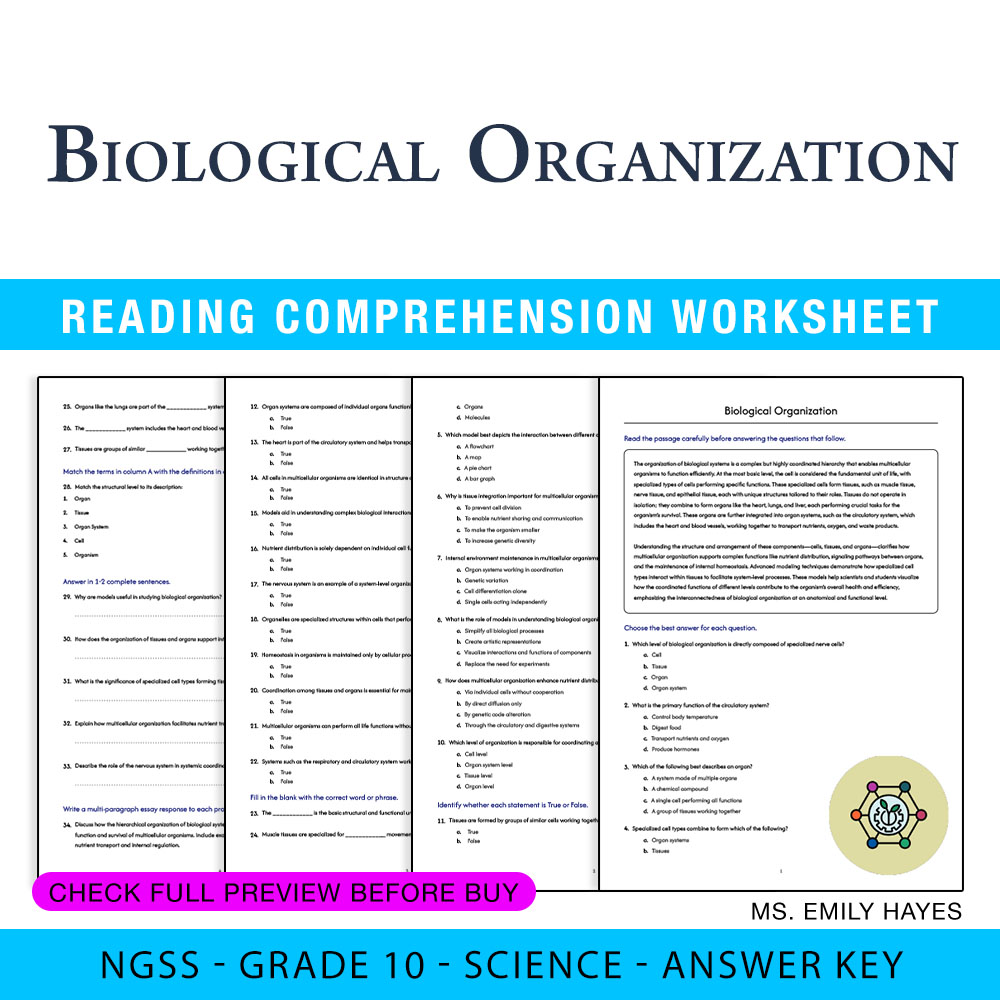
Grade 11 Biology | Biological Organization Worksheet (PDF+ Answer Key)
Created byCopper Leaf ClassroomLearning Objectives
- Explain the hierarchical levels of biological organization from organelles to organ systems.
- Describe models that depict specialized cell types and how they integrate into tissues and systems.
- Analyze how multicellular organization supports nutrient distribution, signaling pathways, and internal environment maintenance.
Instant download
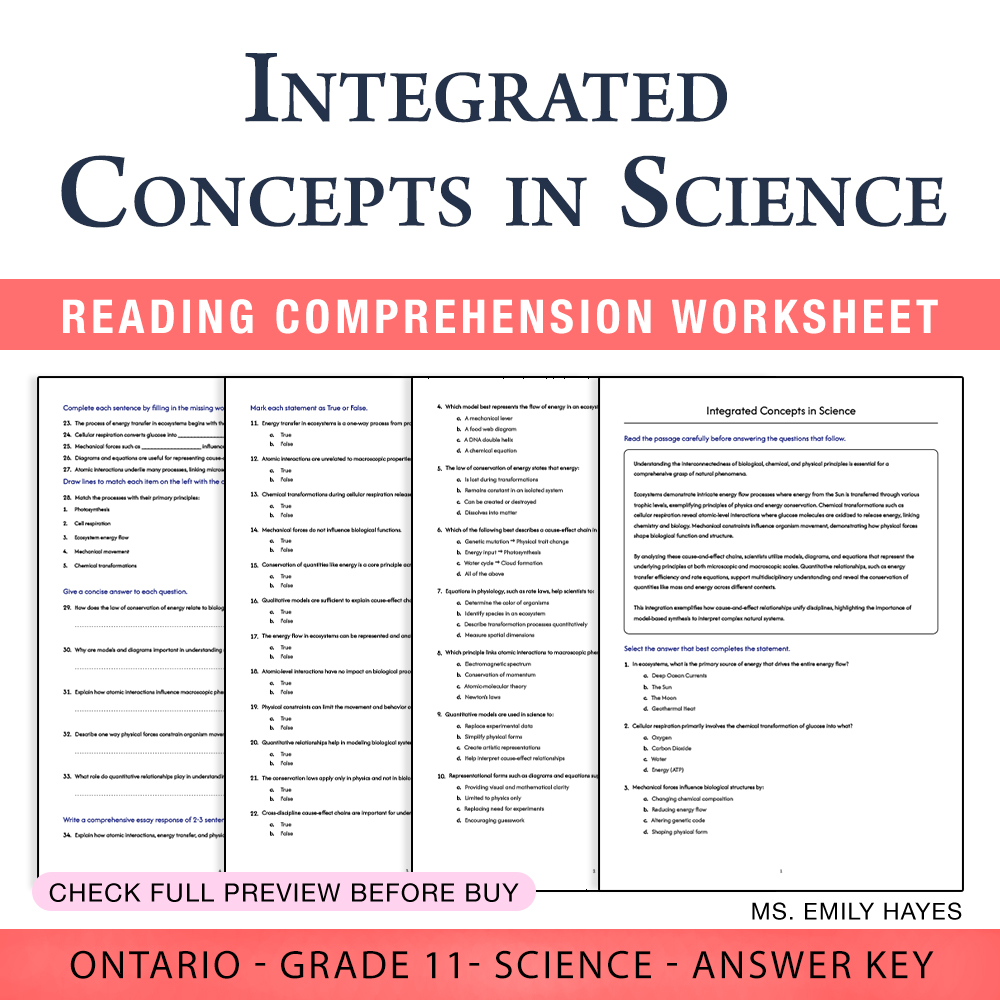
11th Grade Science | Integrated Concepts in Science Worksheet (PDF + Answer Key)
Created byCopper Leaf ClassroomLearning Objectives
- Explain the interdependence of biological, chemical, and physical principles in ecosystems.
- Analyze cause-effect relationships across disciplines using models, diagrams, and equations.
- Apply quantitative relationships to describe energy flow, chemical transformations, and mechanical constraints in biological systems.
Instant download
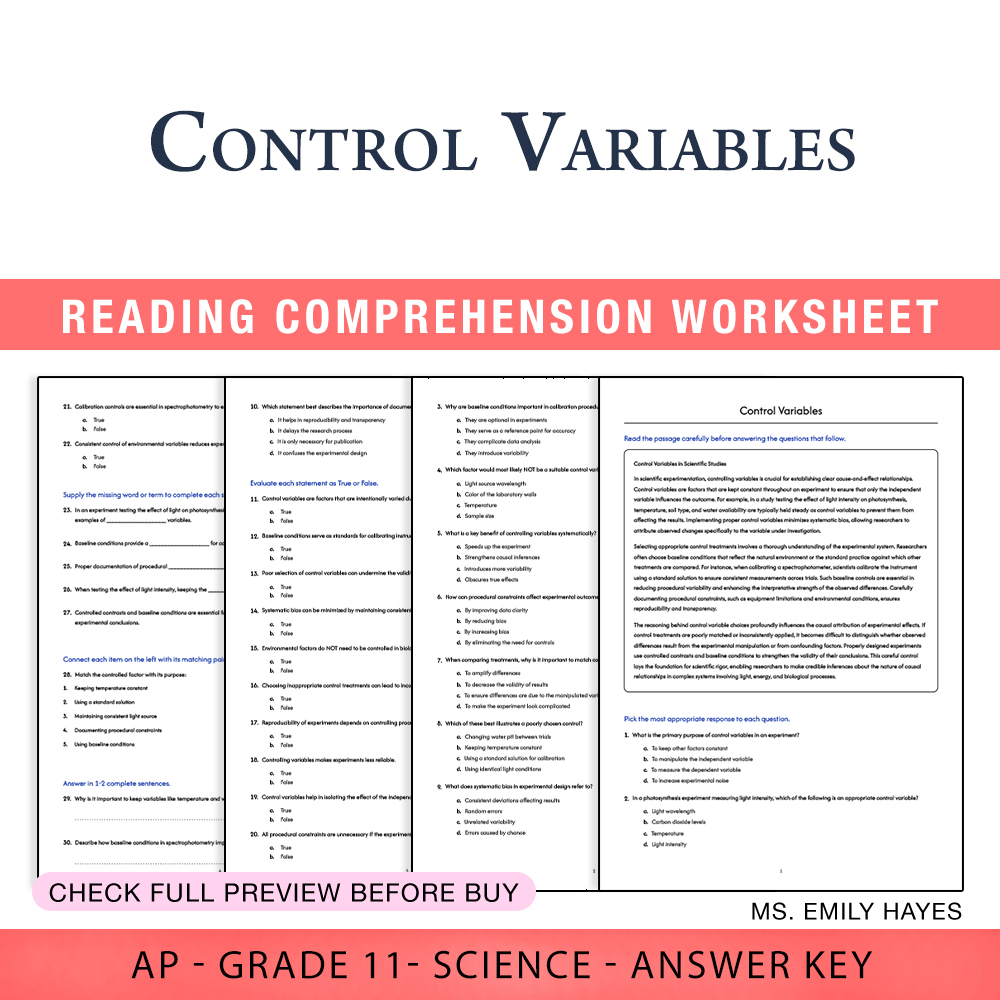
Grade 11 Science | Control Variables Worksheet (PDF+ Answer Key)
Created byCopper Leaf ClassroomLearning Objectives
- Understand the role of control variables in experimental design.
- Identify strategies for selecting and implementing control treatments.
- Analyze how control variables influence the interpretation of experimental results.
Also included in: Grade 11 Science AP | Science Practices & Inquiry Skills(PDF+ Answer Key) +1 more
Instant download
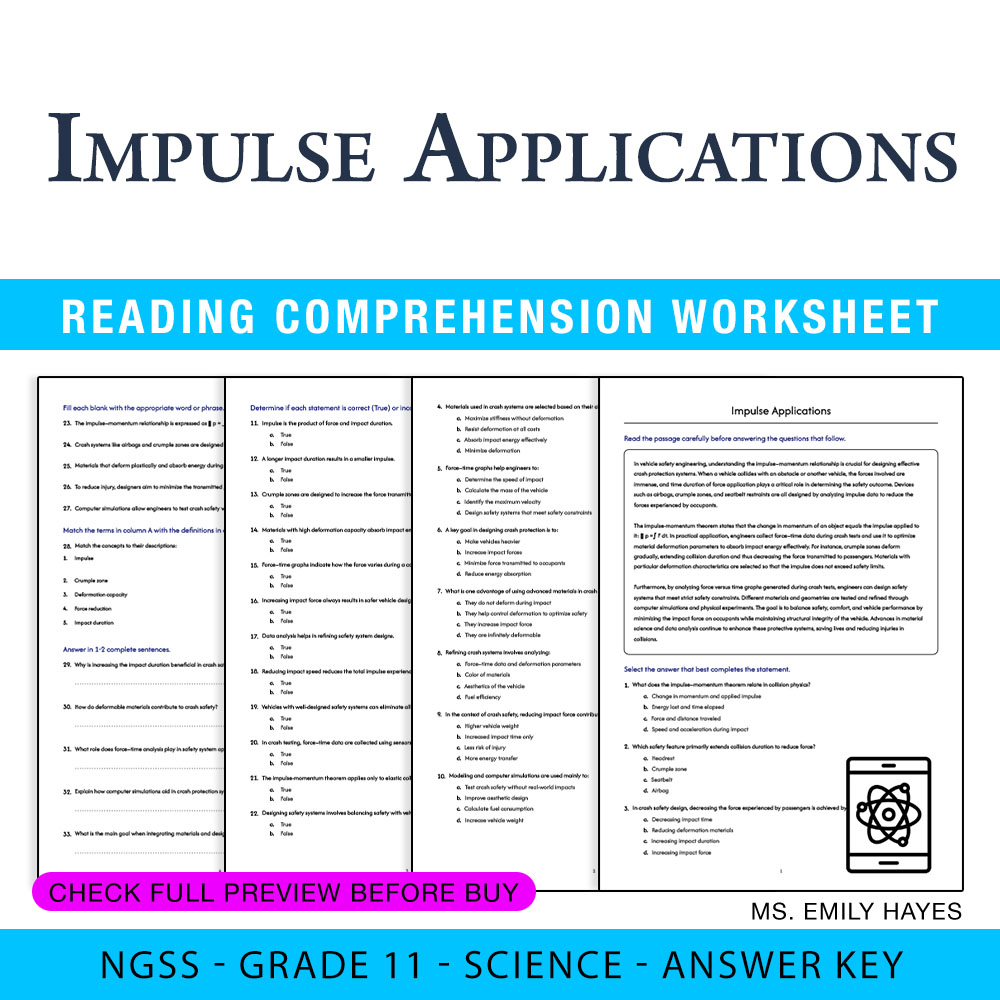
Grade 11 Science | Impulse Applications Worksheet (PDF+ Answer Key)
Created byCopper Leaf ClassroomLearning Objectives
- Explain the impulse–momentum relationship and how it applies to crash-avoidance systems.
- Design and evaluate crash-protection devices that minimize force during collisions.
- Analyze force–time data and material deformation parameters to meet safety constraints.
Instant download
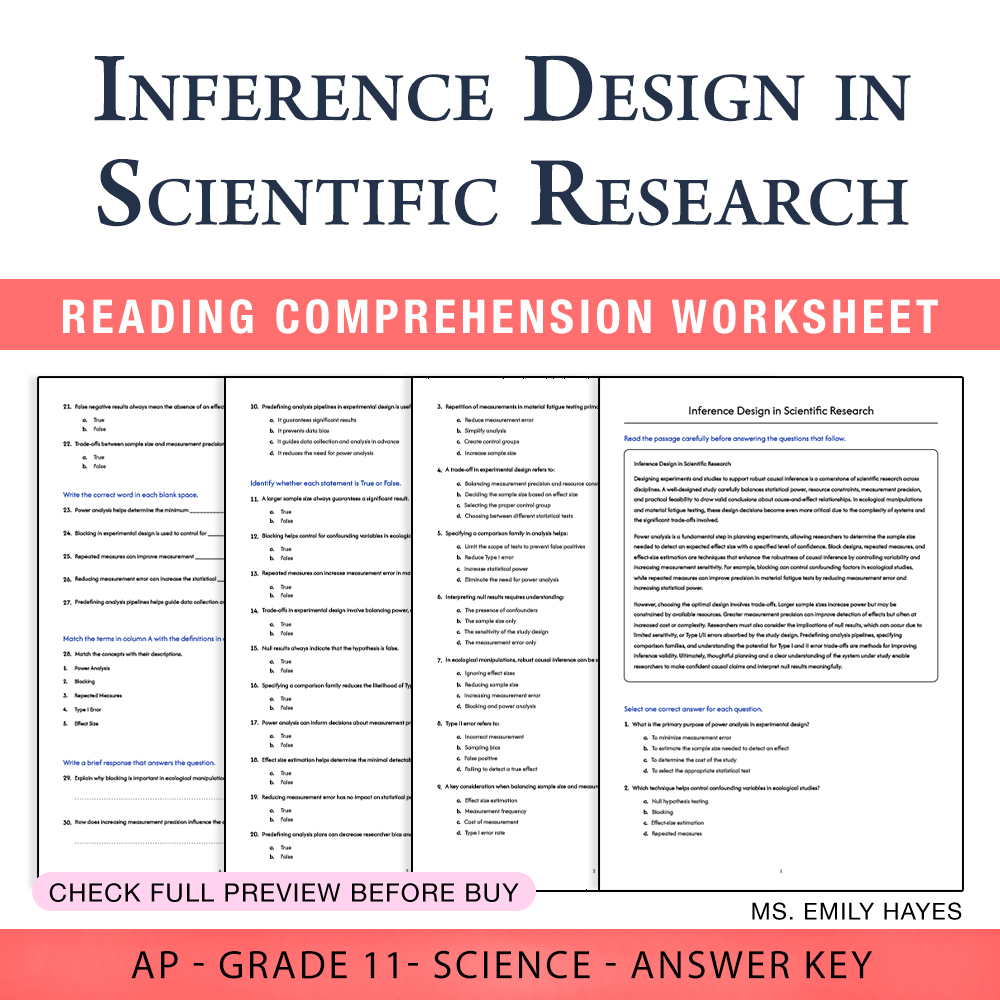
Grade 11 Science | Inference Design Worksheet (PDF+ Answer Key)
Created byCopper Leaf ClassroomLearning Objectives
- Understand how to design studies that support robust causal inference, including power analysis and effect sizes.
- Identify and apply techniques such as blocking, repeated measures, and sample size trade-offs to improve experimental robustness.
- Evaluate how design choices affect the interpretation of null results and trade-offs between measurement precision and practical constraints.
Also included in: Grade 11 Science AP | Science Practices & Inquiry Skills(PDF+ Answer Key) +1 more
Instant download
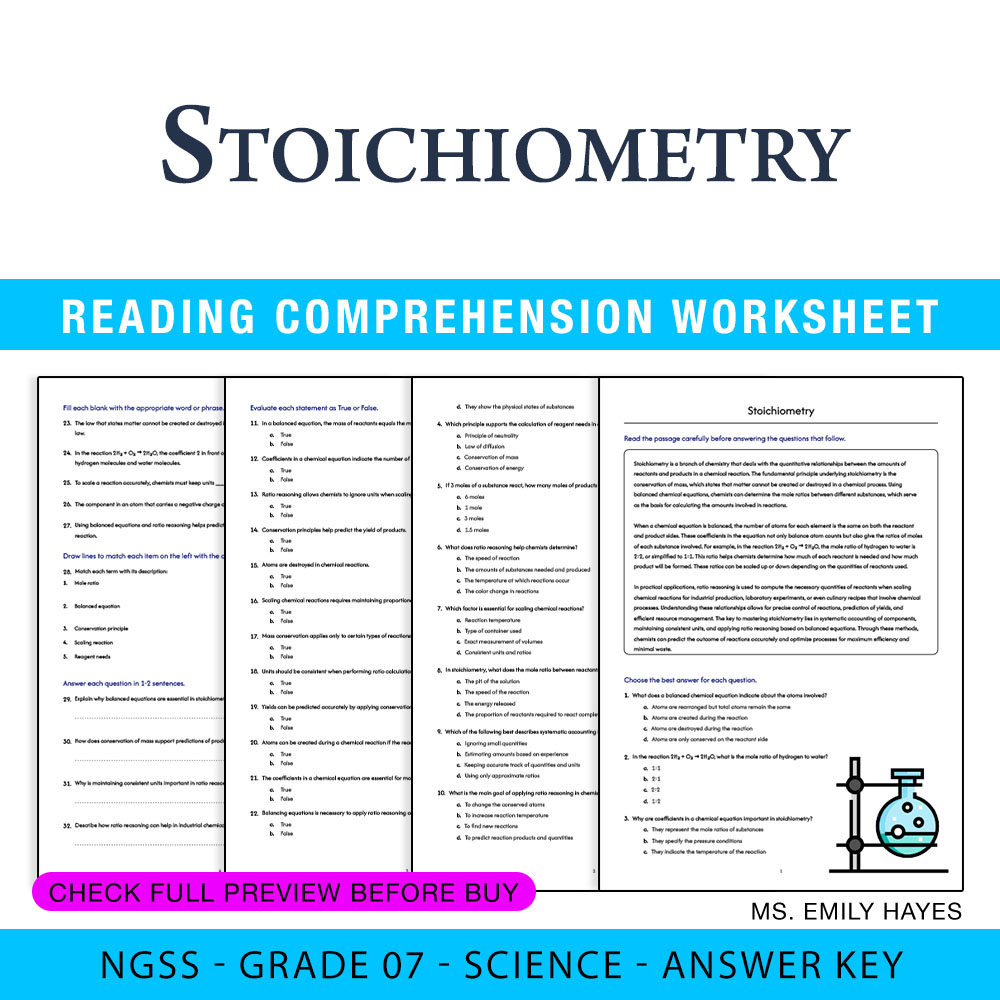
7th Grade Science | Mastering Stoichiometry Worksheet (PDF +Answer Key)
Created byCopper Leaf ClassroomLearning Objectives
- Understand the concept of mole ratios and their use in chemical equations.
- Apply balanced symbolic equations to determine the relationships between reactants and products.
- Use ratio reasoning to calculate amounts of substances involved in chemical reactions.
Instant download
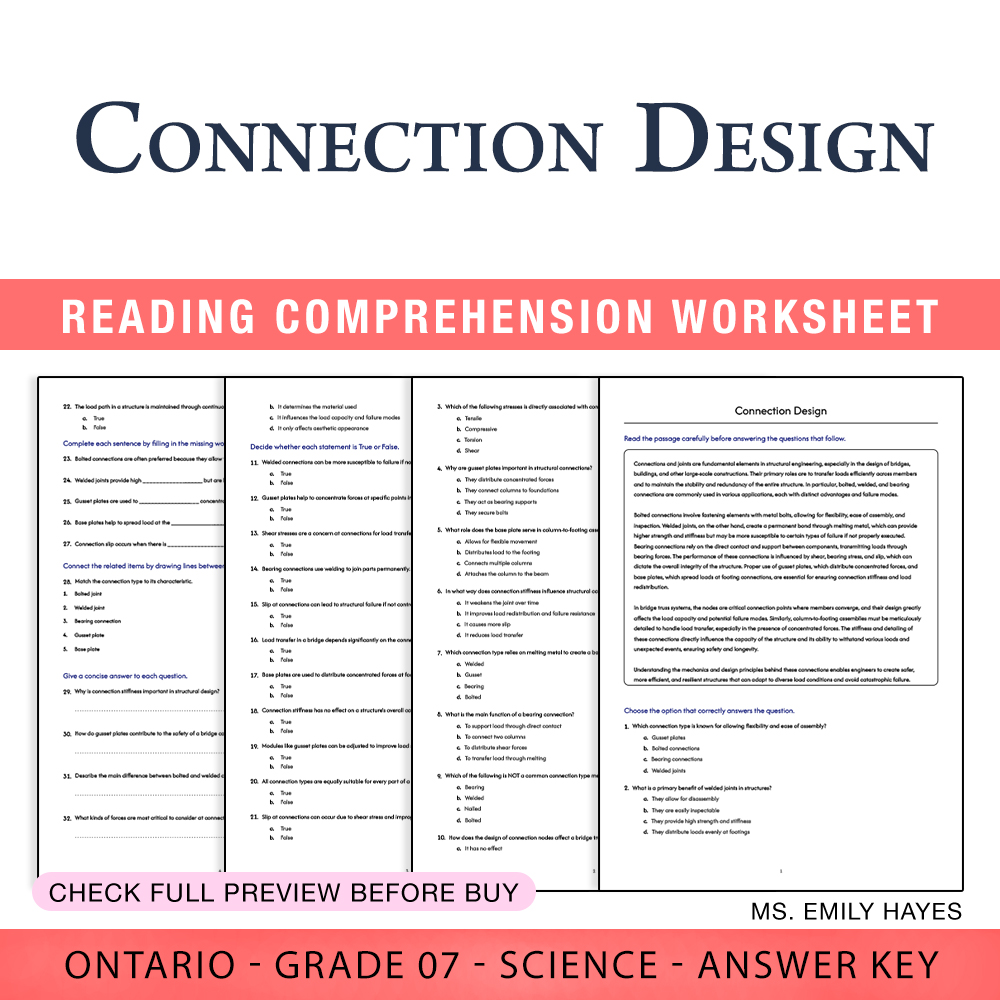
7th Grade Science | Connection Design Worksheet (PDF+ Answer Key)
Created byCopper Leaf ClassroomLearning Objectives
- Explain the significance of different connection types in structural systems.
- Identify how joints influence load transfer and redundancy in bridges and columns.
- Describe shear, bearing, and slip at connections and their effects on stability.
Instant download
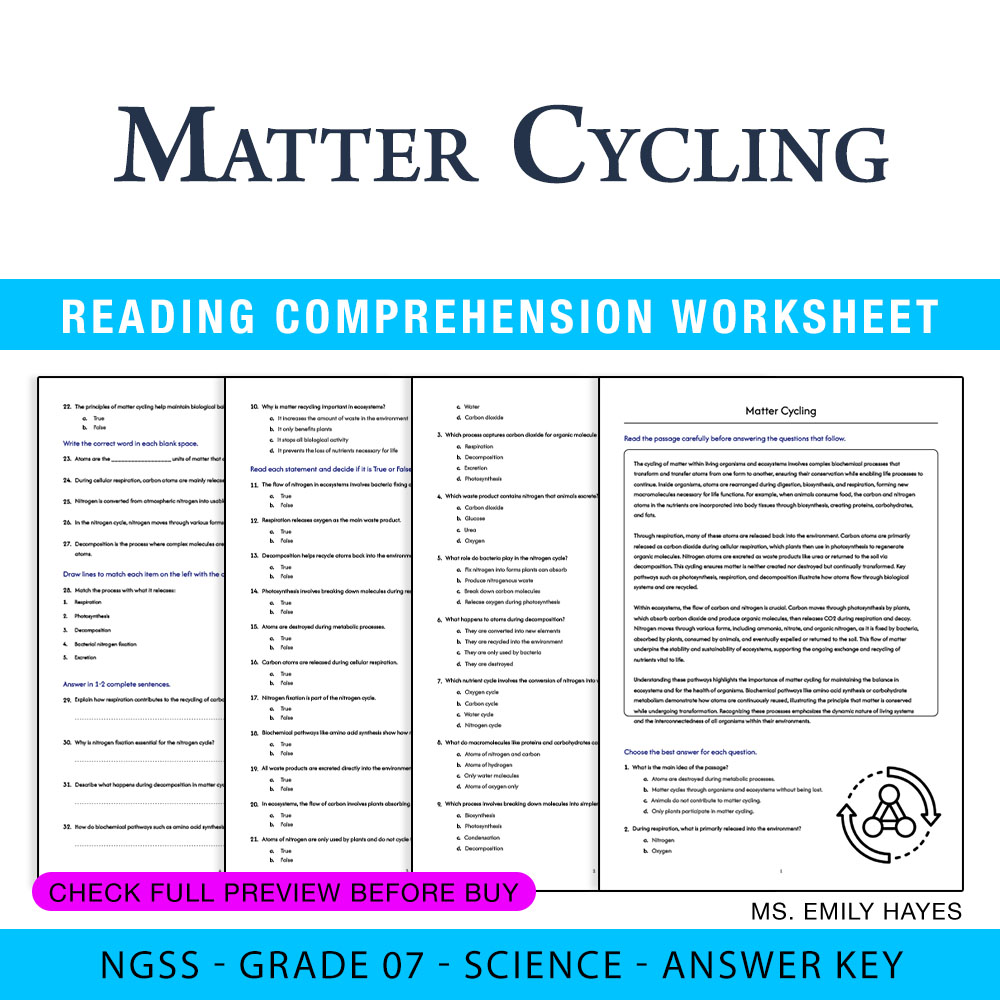
7th Grade Science | Matter Cycling Worksheet (PDF + Answer Key)
Created byCopper Leaf ClassroomLearning Objectives
- Describe the processes involved in matter cycling within organisms, including digestion, biosynthesis, and respiration.
- Explain how atoms are conserved and transformed during biochemical pathways such as macromolecule synthesis and decomposition.
- Illustrate the flow of carbon and nitrogen through different pathways in ecosystems and within organisms.
Instant download
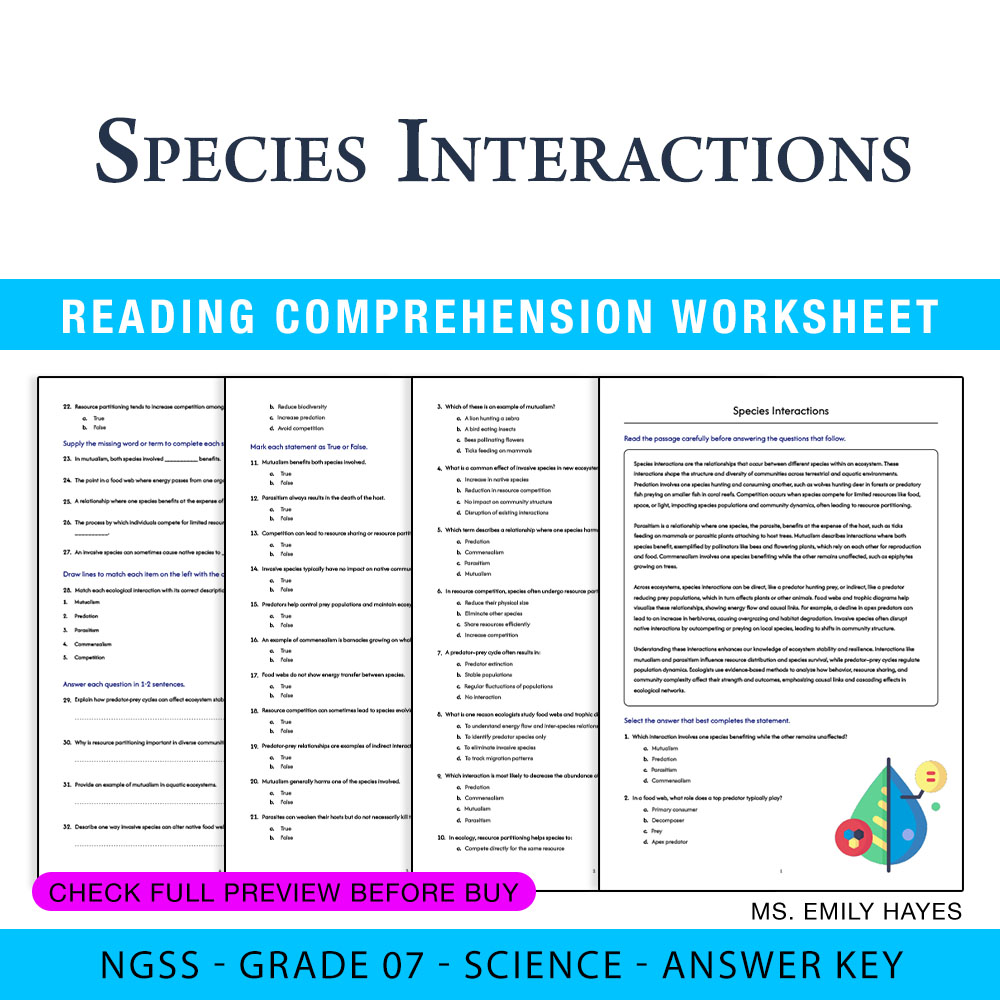
7th Grade Science | Species Interactions Worksheet (PDF +Answer Key)
Created byCopper Leaf ClassroomLearning Objectives
- Explain different types of species interactions such as predation, competition, parasitism, mutualism, and commensalism across various ecosystems.
- Analyze food web diagrams to identify direct and indirect effects among species.
- Describe how species behavior and resource partitioning influence community structure and interaction strength.
Instant download
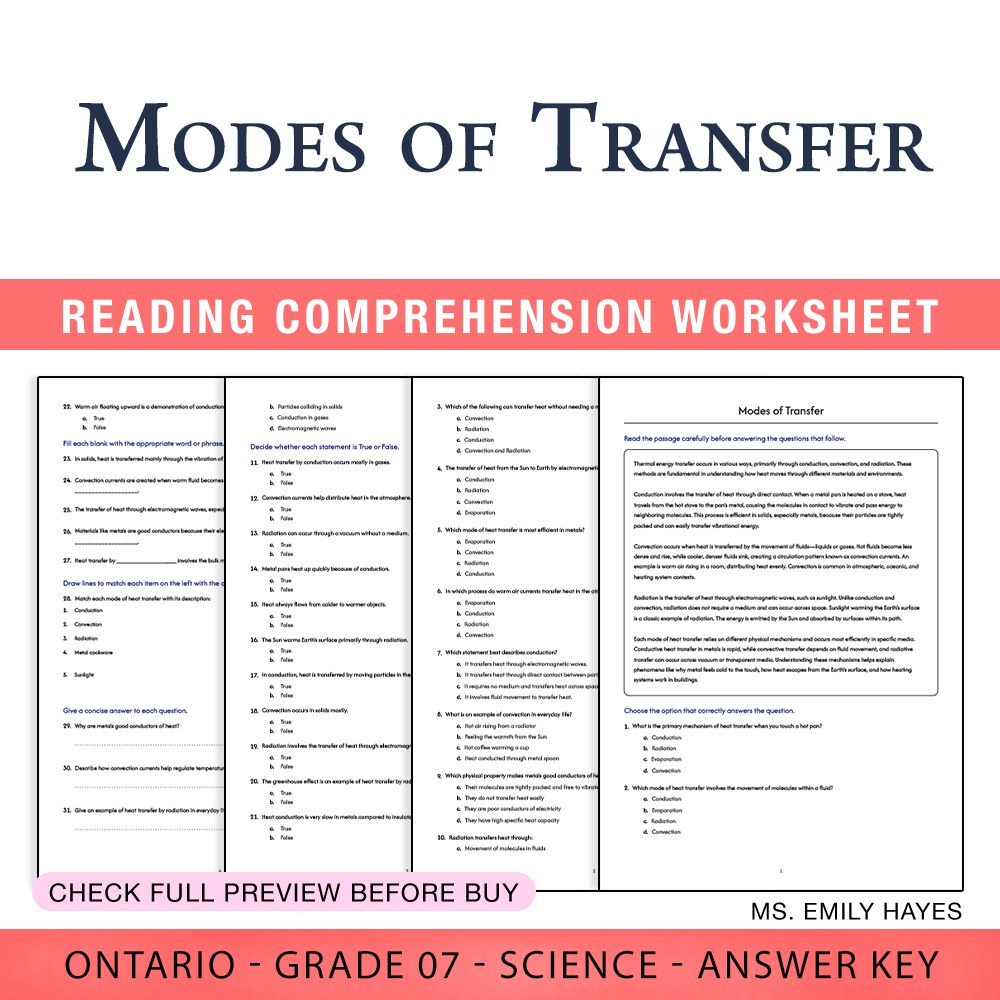
7th Grade Science | Modes of Transfer Worksheet (PDF+ Answer Key)
Created byCopper Leaf ClassroomLearning Objectives
- Identify and describe the three primary modes of heat transfer: conduction, convection, and radiation.
- Explain the molecular mechanisms underlying each mode of thermal energy transfer.
- Compare how conduction, convection, and radiation differ in media, rate, and environmental applications.
Instant download
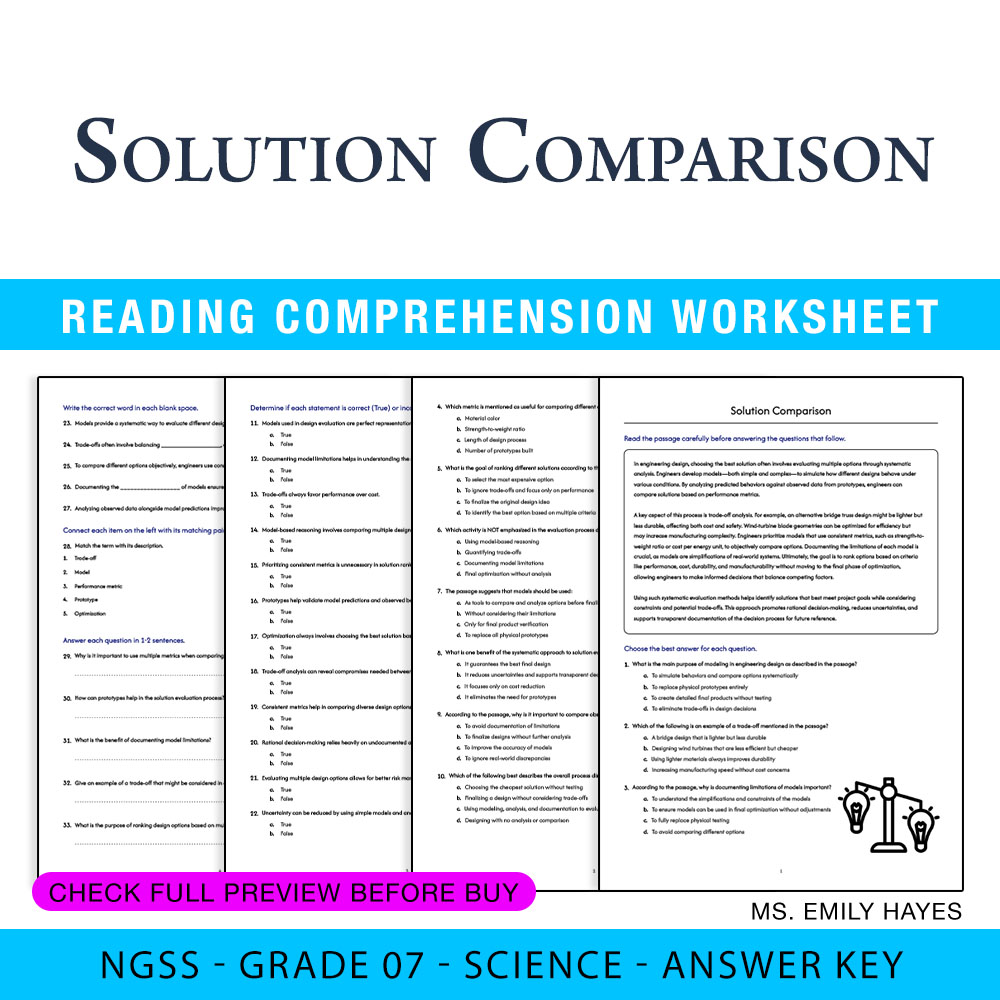
Grade 7 Science | Solution Comparison Worksheet (PDF+ Answer Key)
Created byCopper Leaf ClassroomLearning Objectives
- Understand how to systematically evaluate different design solutions using modeling and analysis.
- Learn to identify and quantify trade-offs among performance, cost, durability, and manufacturability.
- Apply concepts of metrics and model-based reasoning to compare engineering options.
Instant download
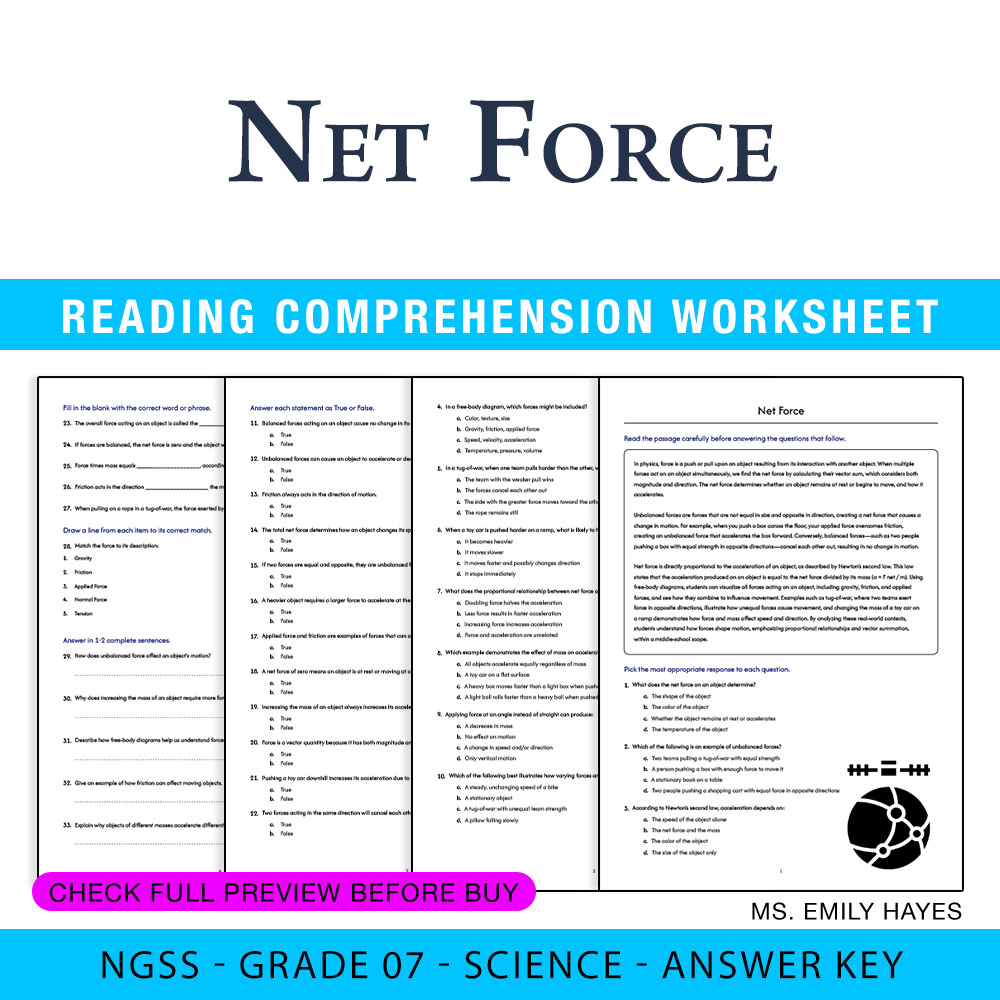
7th Grade Science | Net Force Worksheet (PDF+ Answer Key)
Created byCopper Leaf ClassroomLearning Objectives
- Define net force as the vector sum of all forces acting on an object.
- Describe how unbalanced forces produce changes in motion.
- Explain the relationship among net force, mass, and acceleration using diagrams and reasoning.
Instant download
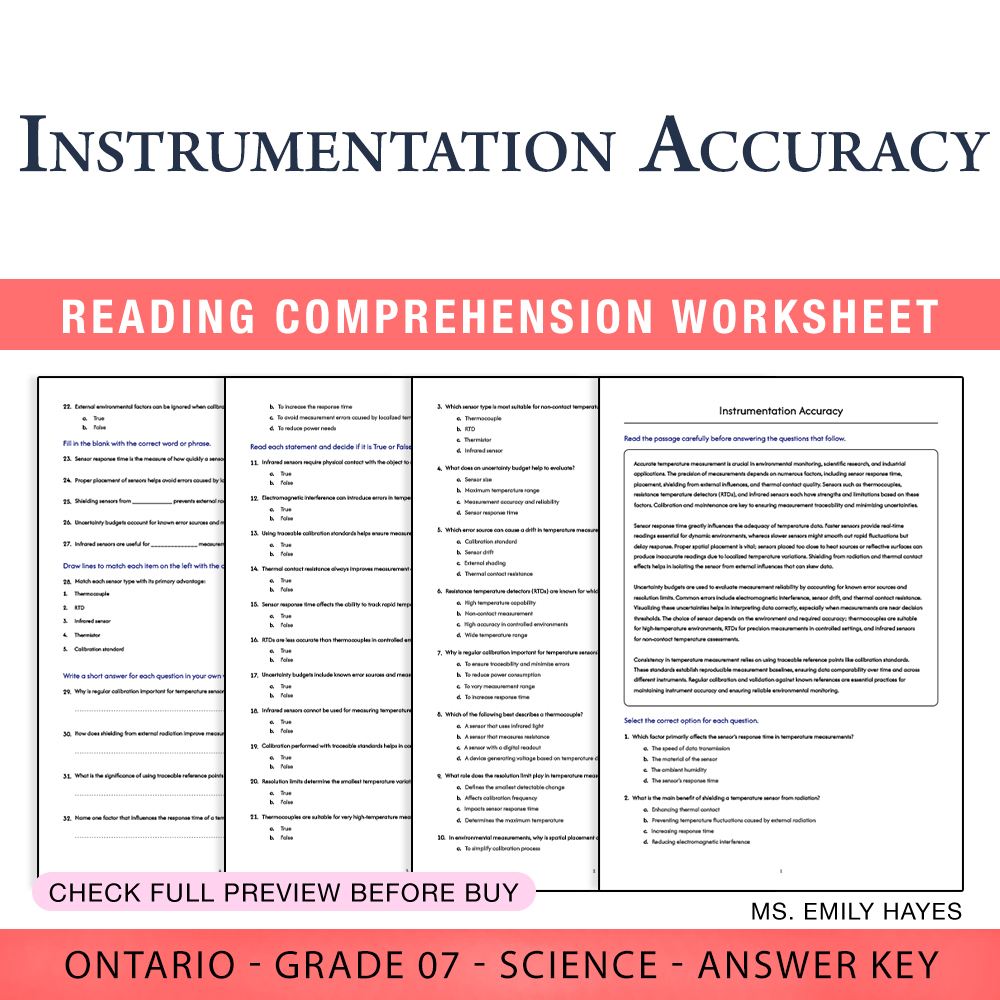
Grade 7 Science | Instrumentation Accuracy Worksheet (PDF+ Answer Key)
Created byCopper Leaf ClassroomLearning Objectives
- Understand the principles of sensor response time and how it affects temperature measurements in environmental contexts.
- Evaluate the impact of spatial placement, shielding, and thermal contact effects on instrument accuracy.
- Describe how uncertainty budgets, resolution limits, and common error sources influence temperature measurement reliability.
Instant download
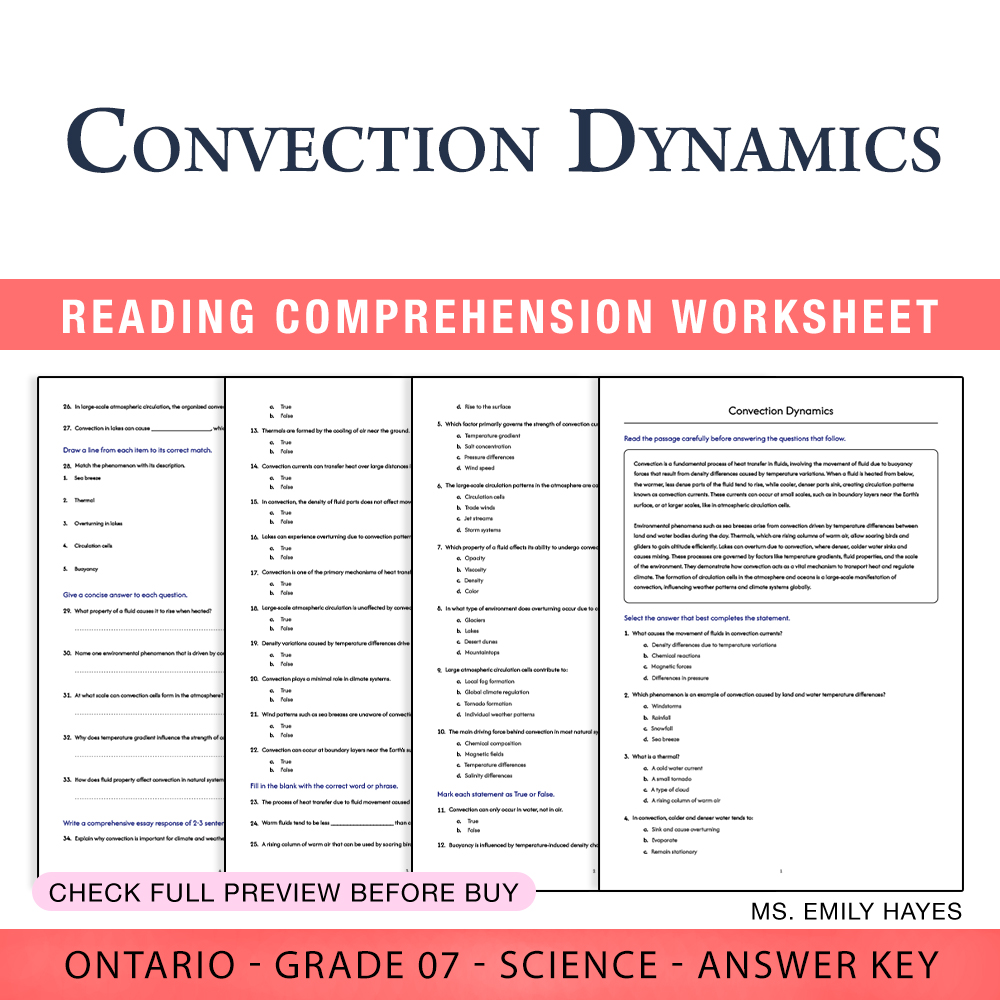
7th Grade Science | Convection Dynamics Worksheet (PDF+ Answer Key)
Created byCopper Leaf ClassroomLearning Objectives
- Explain the process of convective heat transfer in fluids.
- Describe how buoyancy and density variations drive convection in air and water.
- Identify environmental phenomena influenced by convection, such as sea breezes and thermals.
Instant download
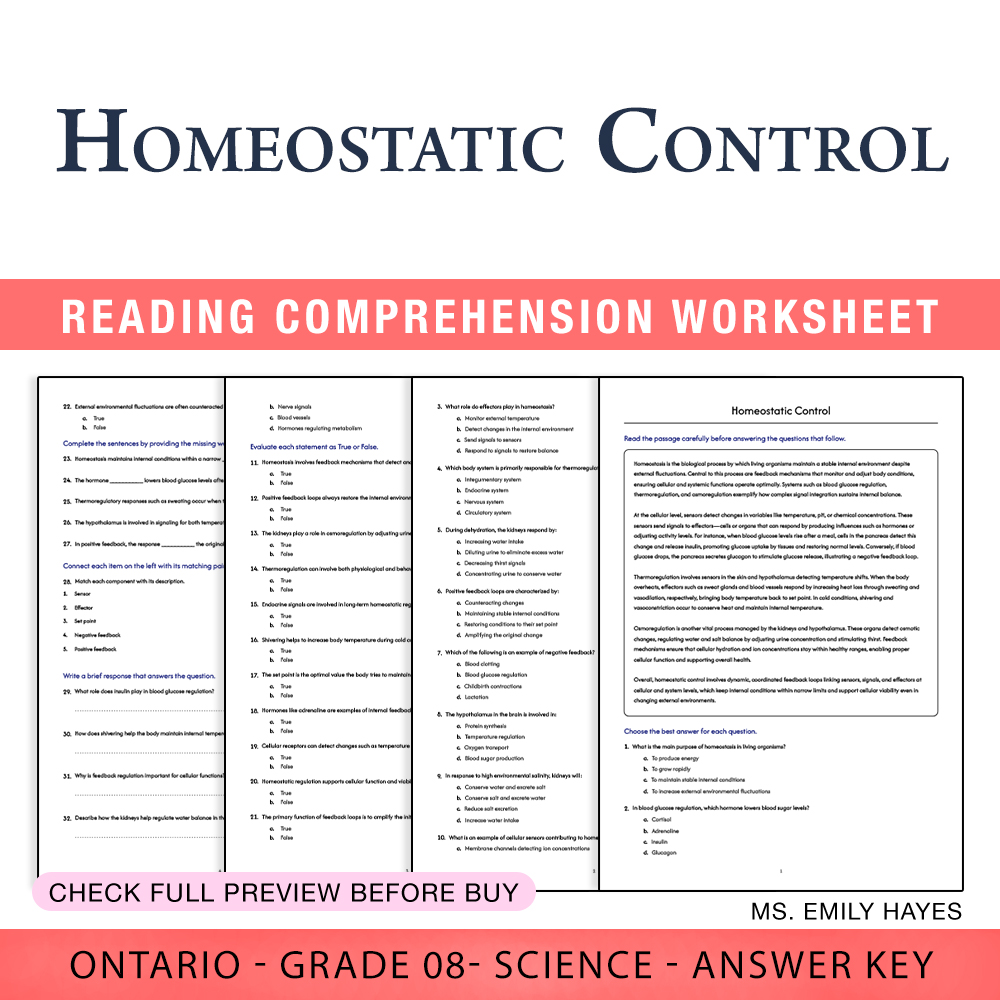
Grade 8 Science | Homeostatic Control Worksheet (PDF+ Answer Key)
Created byCopper Leaf ClassroomLearning Objectives
- Describe the mechanisms of negative and positive feedback in homeostasis.
- Explain how cellular sensors and effectors work together to maintain internal stability.
- Identify examples of homeostatic regulation such as blood glucose levels and thermoregulation.
Instant download
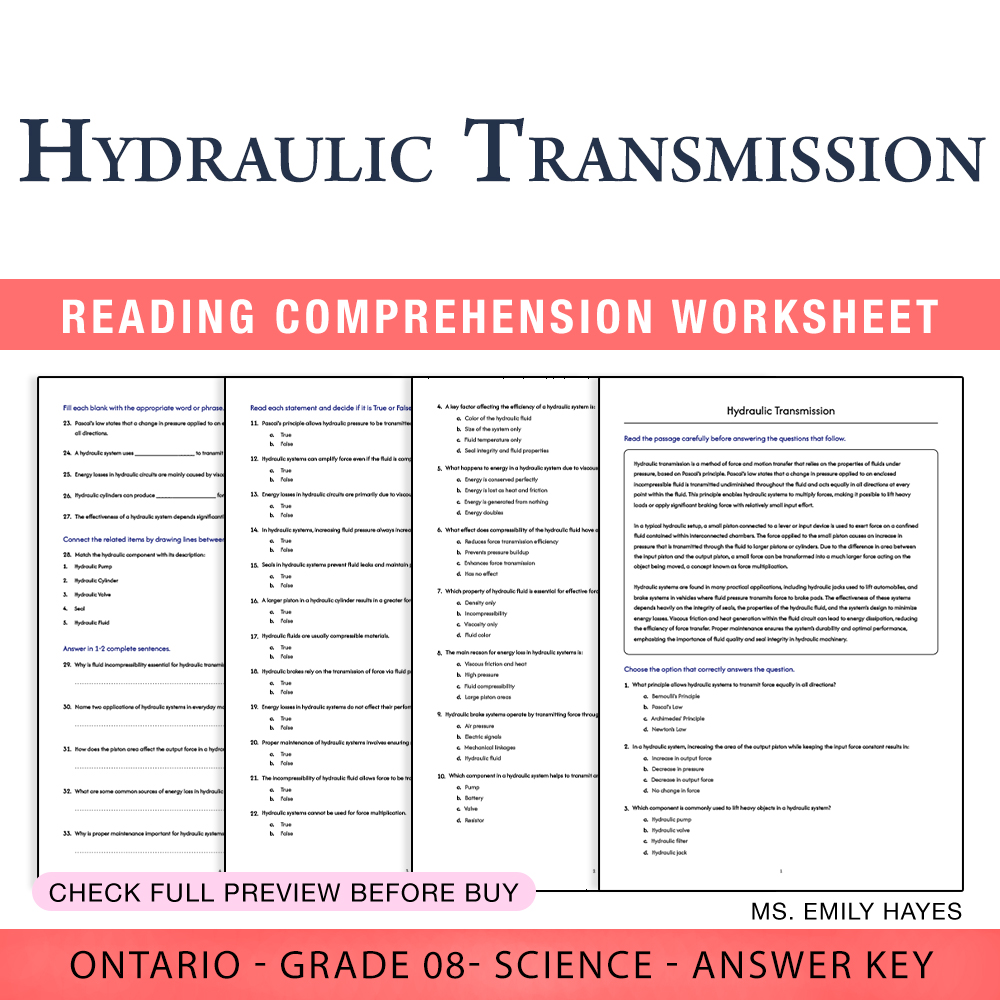
8th Grade Science | Hydraulic Transmission Worksheet (PDF+ Answer Key)
Created byCopper Leaf ClassroomLearning Objectives
- Explain the principles of hydraulic force transmission based on Pascal's law.
- Identify applications and components of hydraulic systems such as jacks and brakes.
- Describe how force multiplication occurs in hydraulic cylinders and the importance of pressure distribution.
Instant download
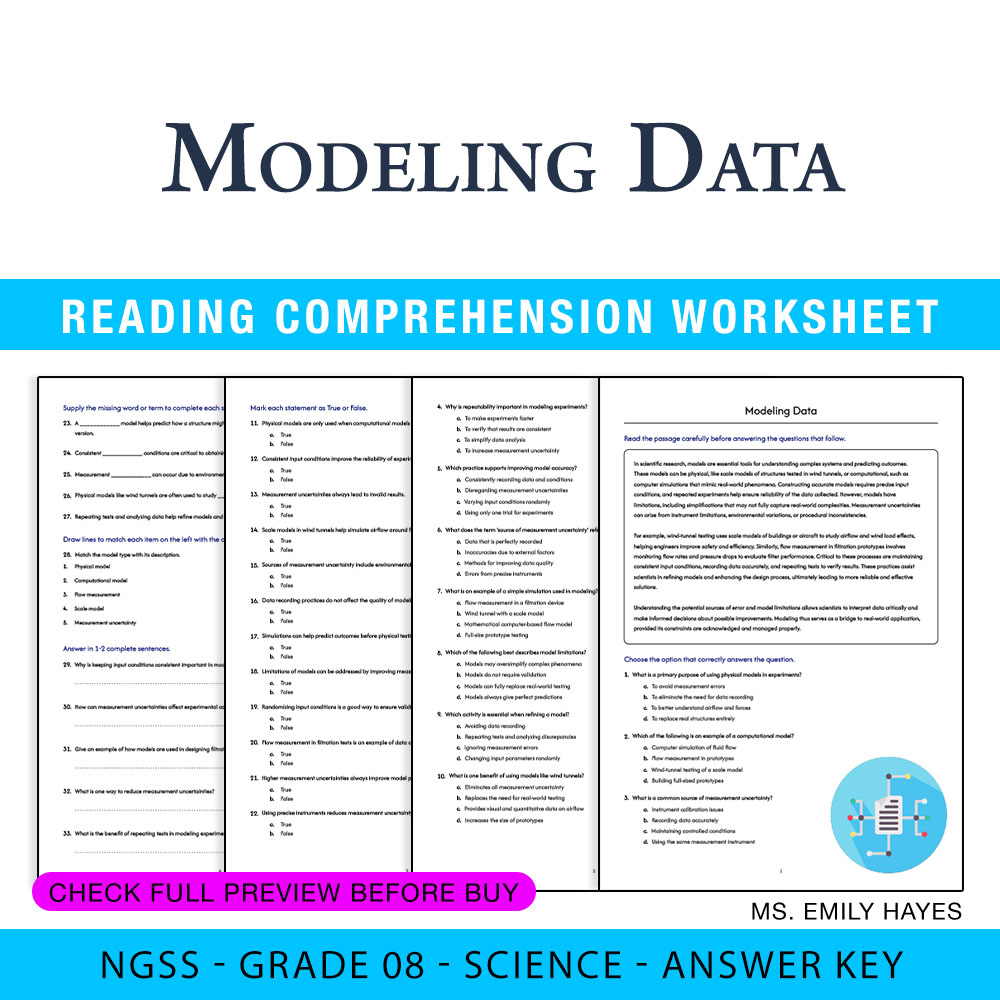
8th Grade Science | Modeling Data Worksheet (PDF+ Answer Key)
Created byCopper Leaf ClassroomLearning Objectives
- Understand the construction and purpose of physical and computational models for data generation.
- Identify sources of measurement uncertainty and limitations in models.
- Apply best practices for data recording, consistency, and repeatability in modeling experiments.
Instant download
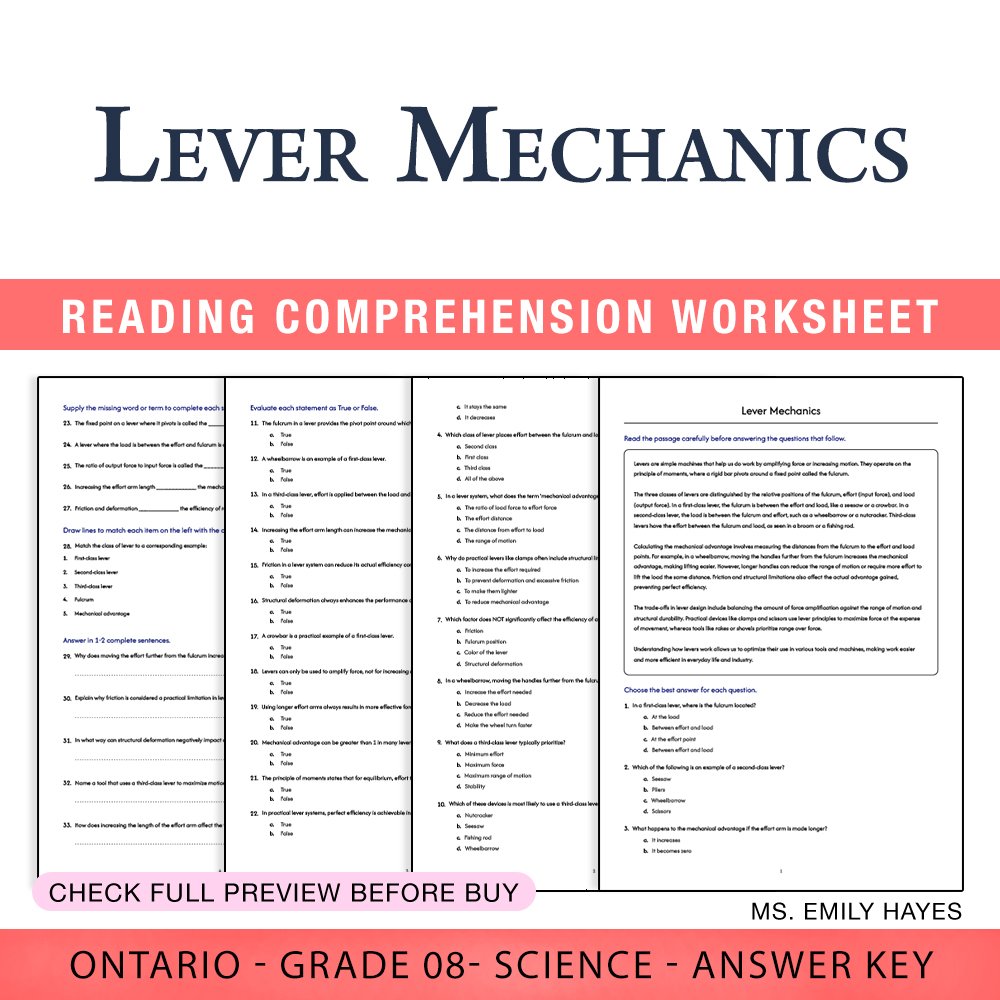
Grade 8 Science | Lever Mechanics Worksheet (PDF+ Answer Key)
Created byCopper Leaf ClassroomLearning Objectives
- Explain the three classes of levers and identify their fulcrum, input, and output forces.
- Calculate the mechanical advantage of first-, second-, and third-class levers using distances from the fulcrum.
- Describe the trade-offs between force amplification and range of motion in lever systems.
Instant download
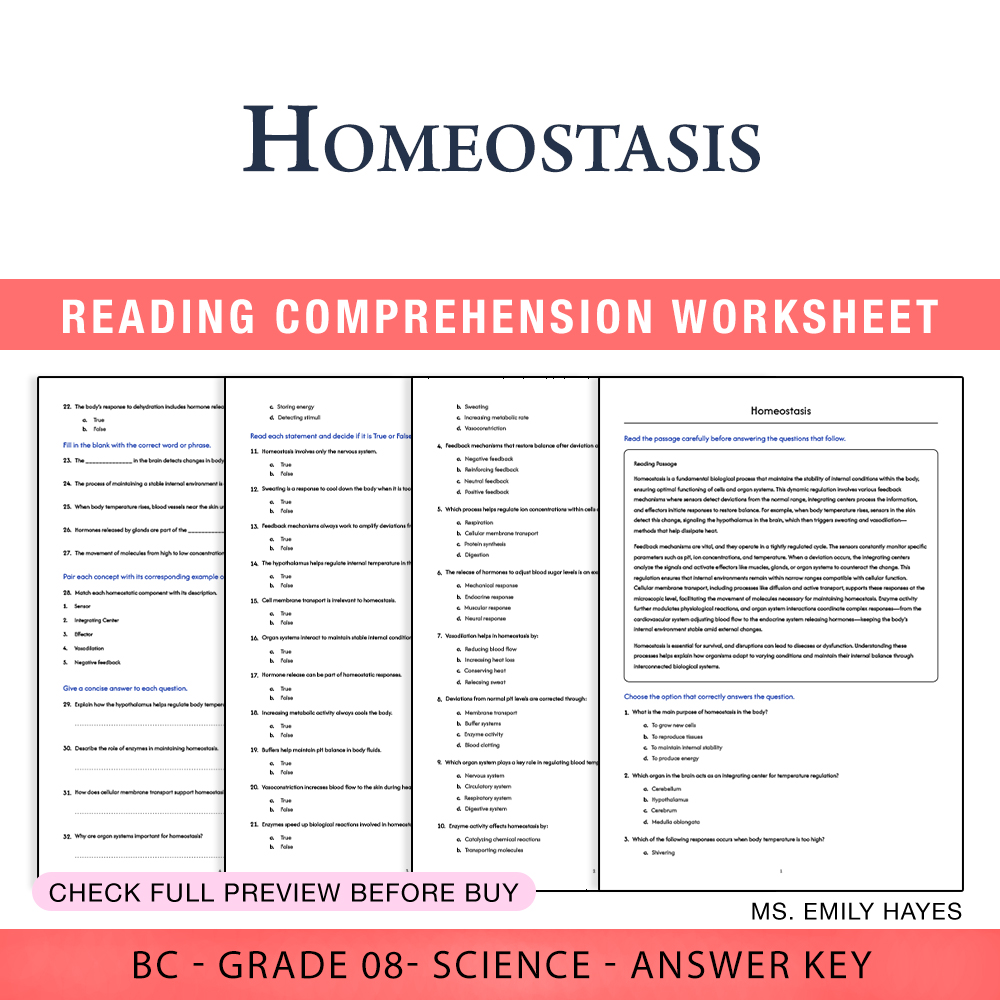
Grade 8 Science | Homeostasis Worksheet (PDF+ Answer Key)
Created byCopper Leaf ClassroomLearning Objectives
- Explain the concept of homeostasis and its importance in maintaining internal stability.
- Identify the feedback mechanisms involved in homeostatic processes and describe their functions.
- Describe how organ systems contribute to homeostasis through physiological responses.
Also included in: Grade 8 Science Bundle – Cell Structure, Systems & Organisms (PDF + Answer Key) +1 more
Instant download
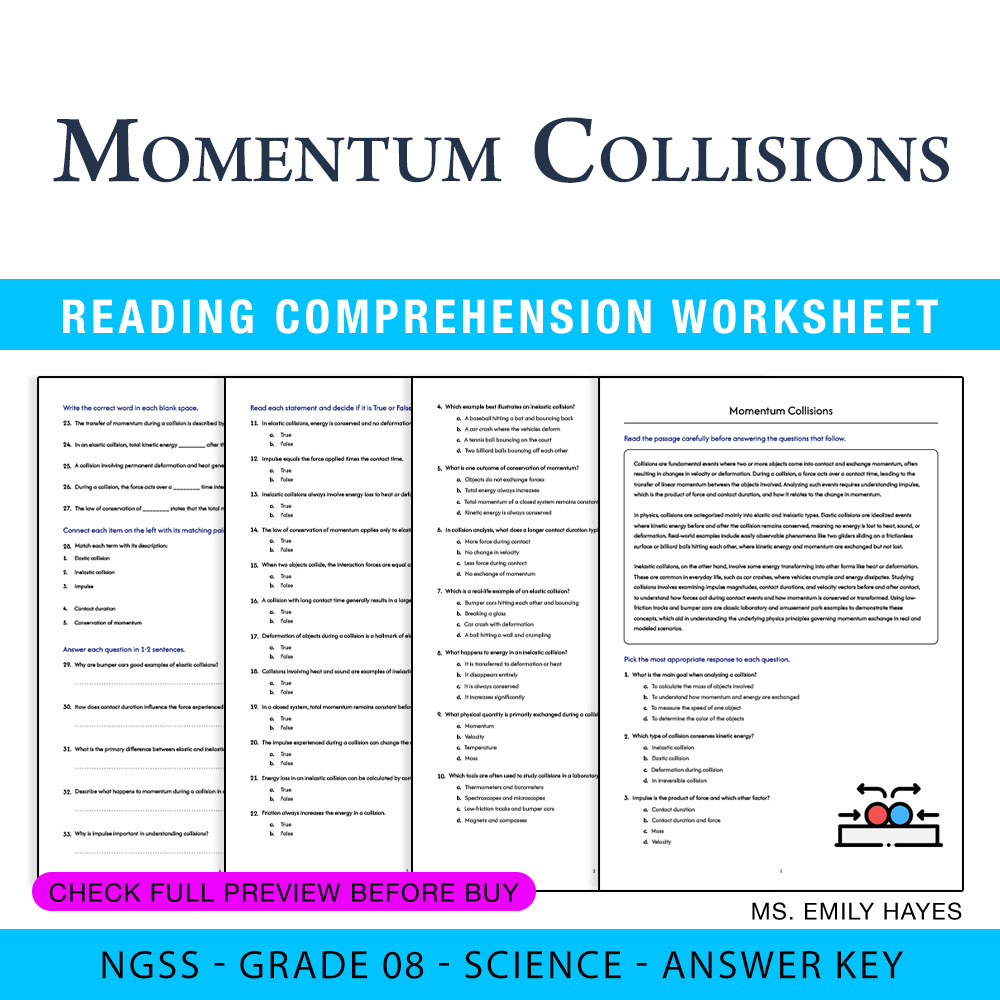
8th Grade Science | Momentum Collisions Worksheet (PDF+ Answer Key)
Created byCopper Leaf ClassroomLearning Objectives
- Understand the principles of momentum and how it is exchanged during collisions.
- Differentiate between elastic and inelastic collisions based on energy conservation.
- Apply the concepts of impulse, contact duration, and velocity change in analyzing collision scenarios.
Instant download
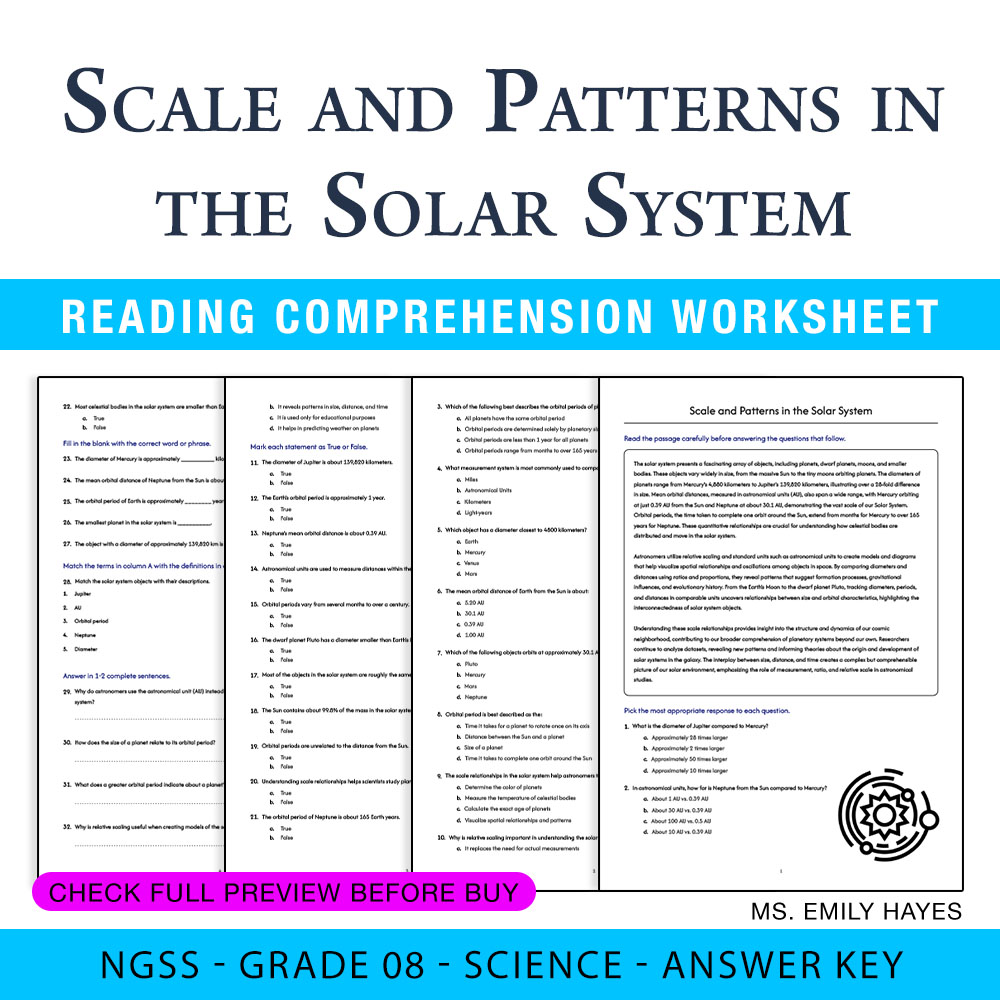
Grade 8 Science | Scale & Patterns in the Solar System Worksheet (PDF+ Answers)
Created byCopper Leaf ClassroomLearning Objectives
- Understand and interpret scale relationships among celestial objects in the solar system.
- Compare the sizes, distances, and orbital periods of planets, dwarf planets, and major moons using quantitative data.
- Apply concepts of astronomical units and relative scaling to analyze spatial and temporal patterns.
Instant download
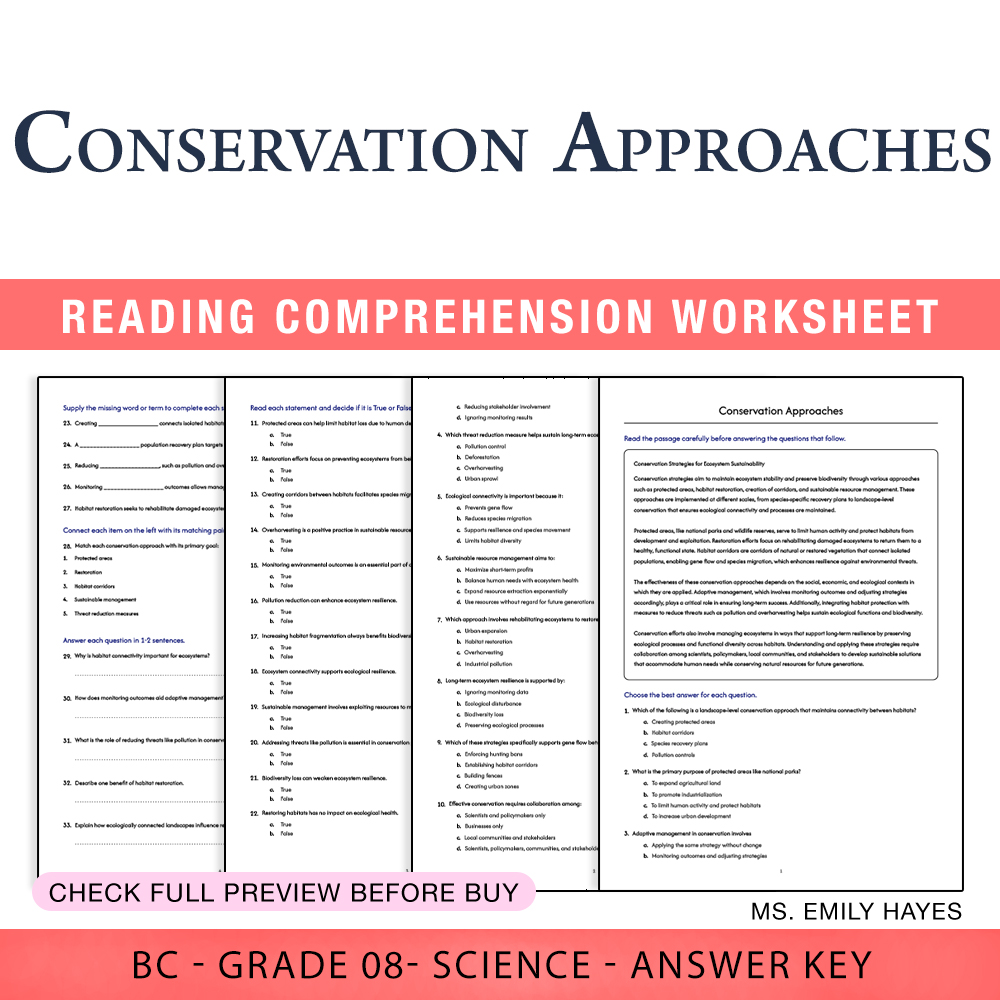
Grade 8 Science | Conservation Approaches Worksheet (PDF+ Answer Key)
Created byCopper Leaf ClassroomLearning Objectives
- Understand different strategies used in conservation and their ecological purposes.
- Explain how social, economic, and ecological factors influence conservation efforts.
- Identify key components of effective ecosystem management.
Also included in: Grade 8 Science– Ecology, Biodiversity & Environmental Impact (PDF + Answer Key) +1 more
Instant download
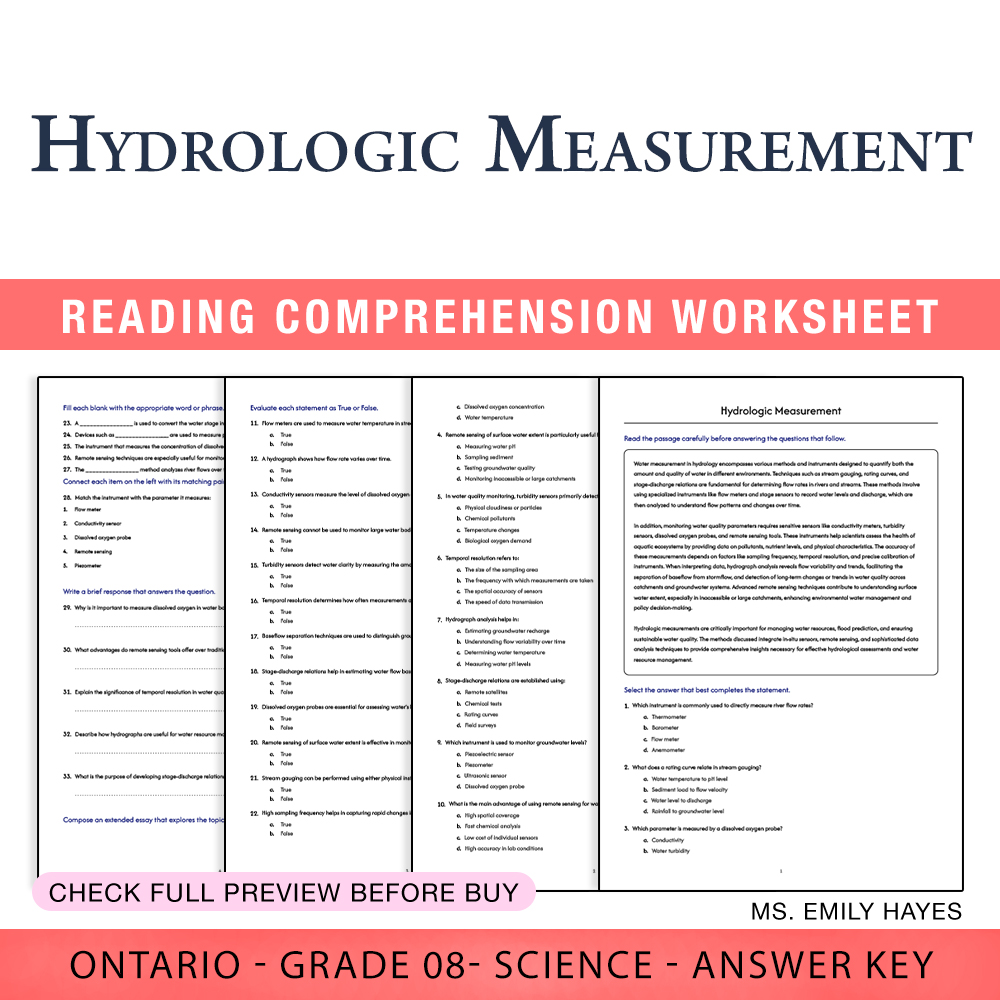
8th Grade Science | Hydrologic Measurement Worksheet (PDF+ Answer Key)
Created byCopper Leaf ClassroomLearning Objectives
- Describe various methods and instruments used to measure water quantity and quality in hydrology.
- Explain how to interpret hydrographs, time series, and water quality data for environmental assessment.
- Identify the role of remote sensing tools and sensor technologies in monitoring surface water and groundwater.
Instant download

Grade 8 Science | Cell Structure Worksheet (PDF+ Answer Key)
Created byCopper Leaf ClassroomLearning Objectives
- Describe the organization and function of cellular membranes and cytoplasm.
- Identify and explain the roles of key organelles such as the nucleus, mitochondria, and chloroplasts.
- Understand the relationship between membrane transport, compartmentalization, and cellular activity.
Instant download
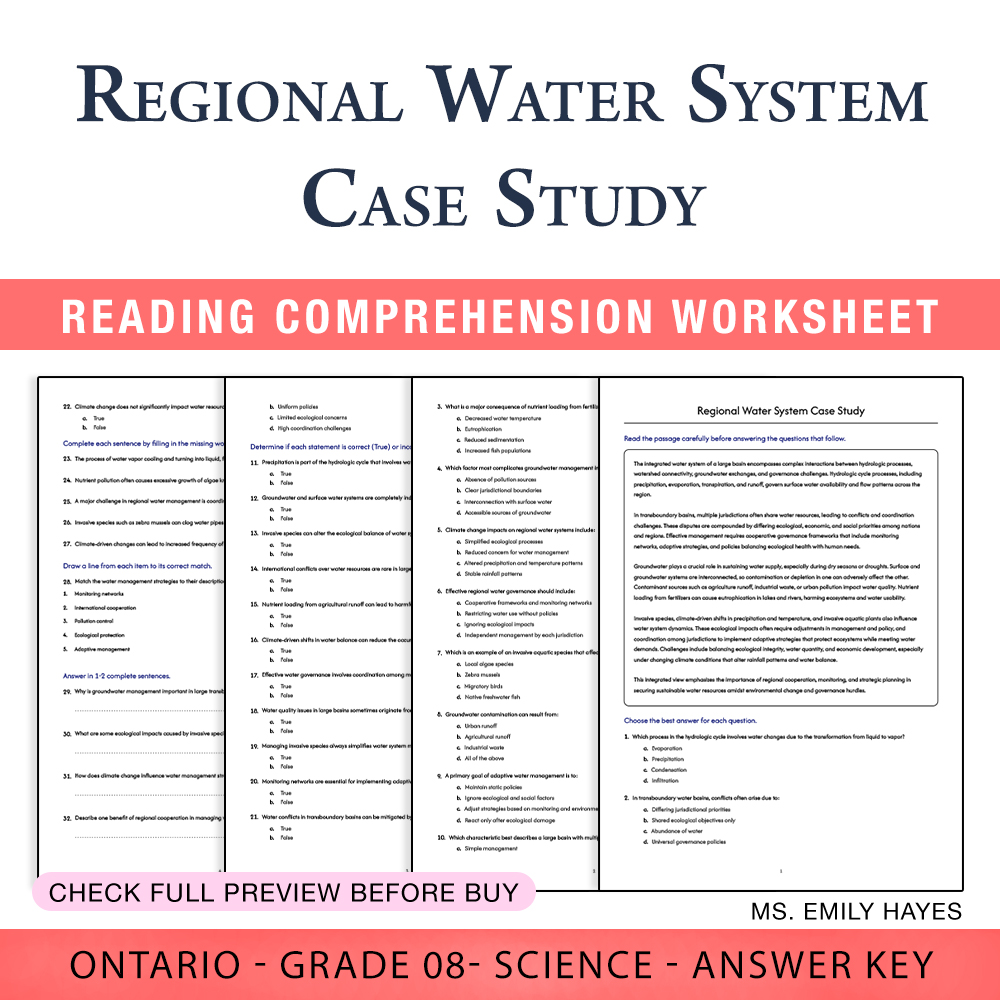
Grade 8 Science | Regional Water System Case Study Worksheet (PDF+ Answer Key)
Created byCopper Leaf ClassroomLearning Objectives
- Understand the key components and dynamics of a regional water system, including hydrologic cycle, groundwater-surface interactions, and watershed connectivity.
- Analyze governance challenges and management strategies in large transboundary water basins.
- Evaluate environmental and economic factors influencing water resource management in regional contexts.
Instant download
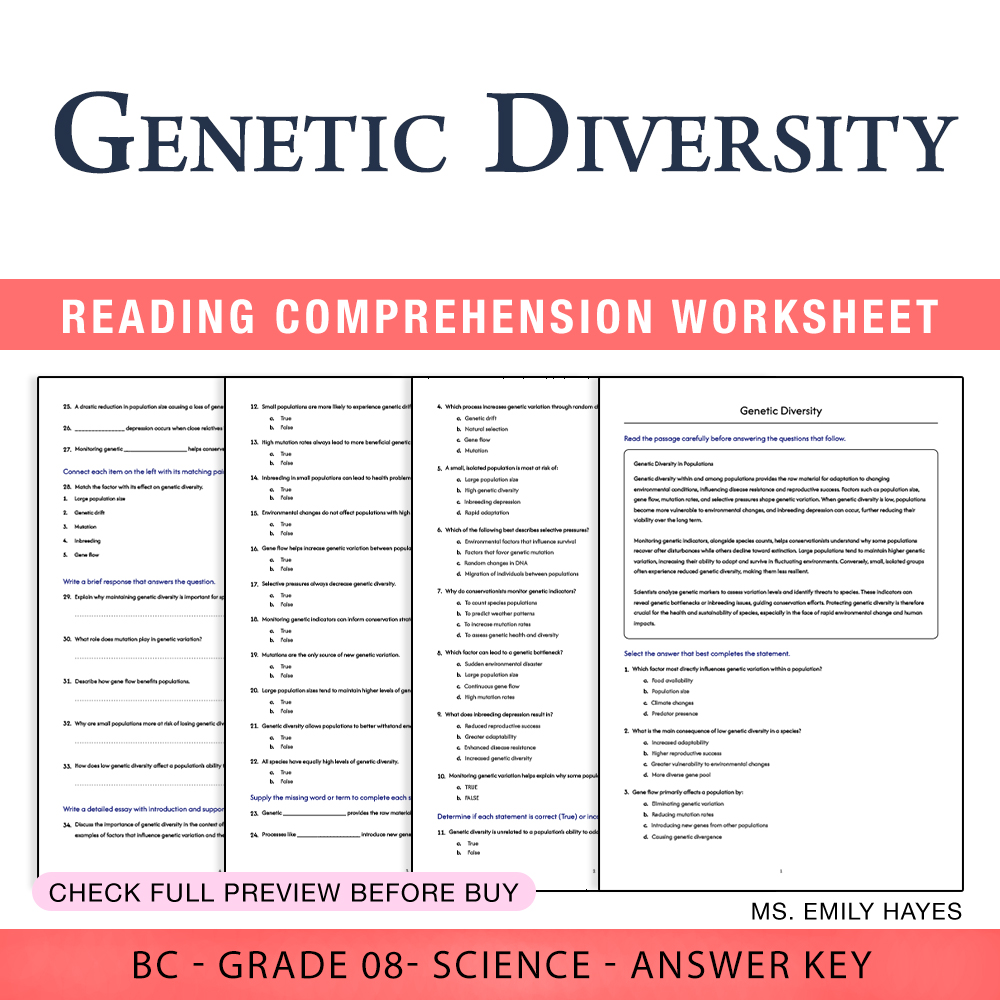
8th Grade Science | Genetic Diversity Worksheet (PDF+ Answer Key)
Created byCopper Leaf ClassroomLearning Objectives
- Understand the concept of genetic diversity within and among populations.
- Identify factors that influence genetic variation in populations.
- Explain the importance of monitoring genetic indicators for species conservation.
Also included in: Grade 8 Science– Ecology, Biodiversity & Environmental Impact (PDF + Answer Key) +1 more
Instant download
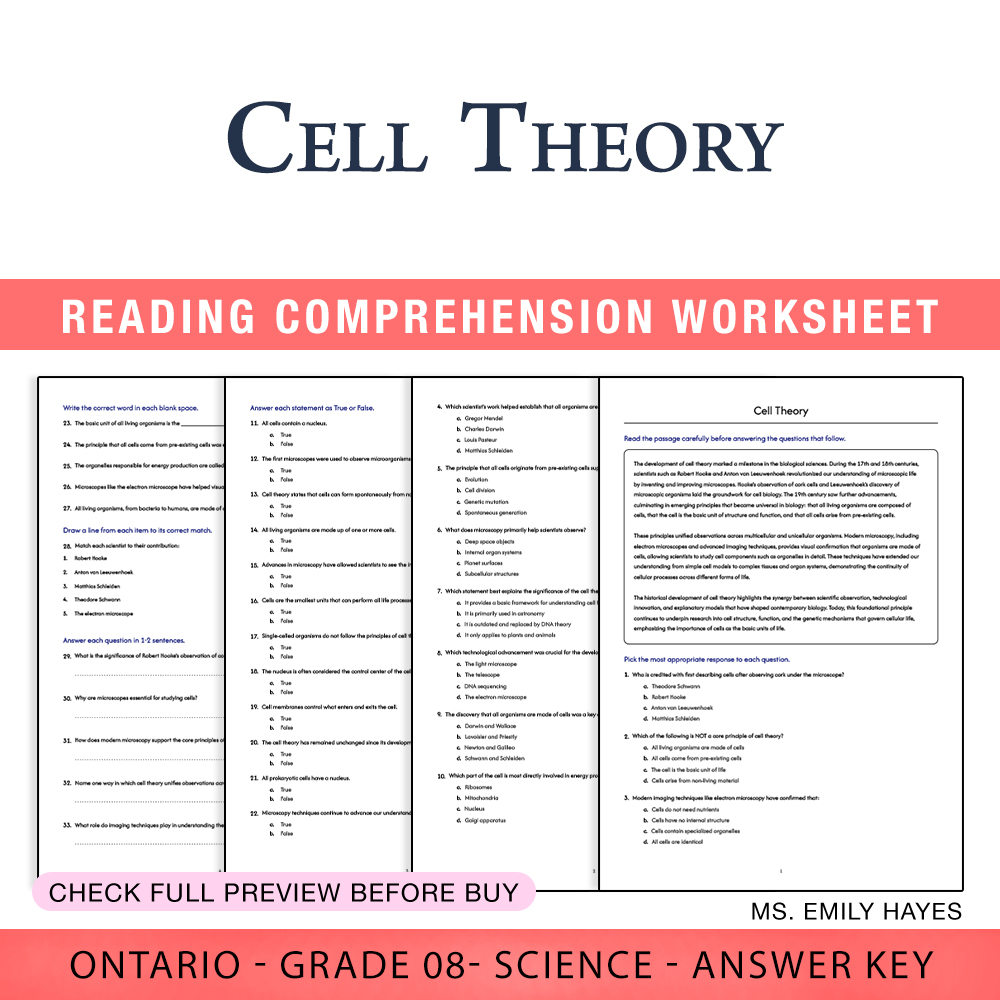
8th Grade Science | Cell Theory Worksheet (PDF+ Answer Key)
Created byCopper Leaf ClassroomLearning Objectives
- Understand the historical development of cell theory and its significance in biology.
- Identify the core principles of cell theory and how they apply to different organisms.
- Explain how modern microscopy and imaging techniques support cell theory.
Instant download
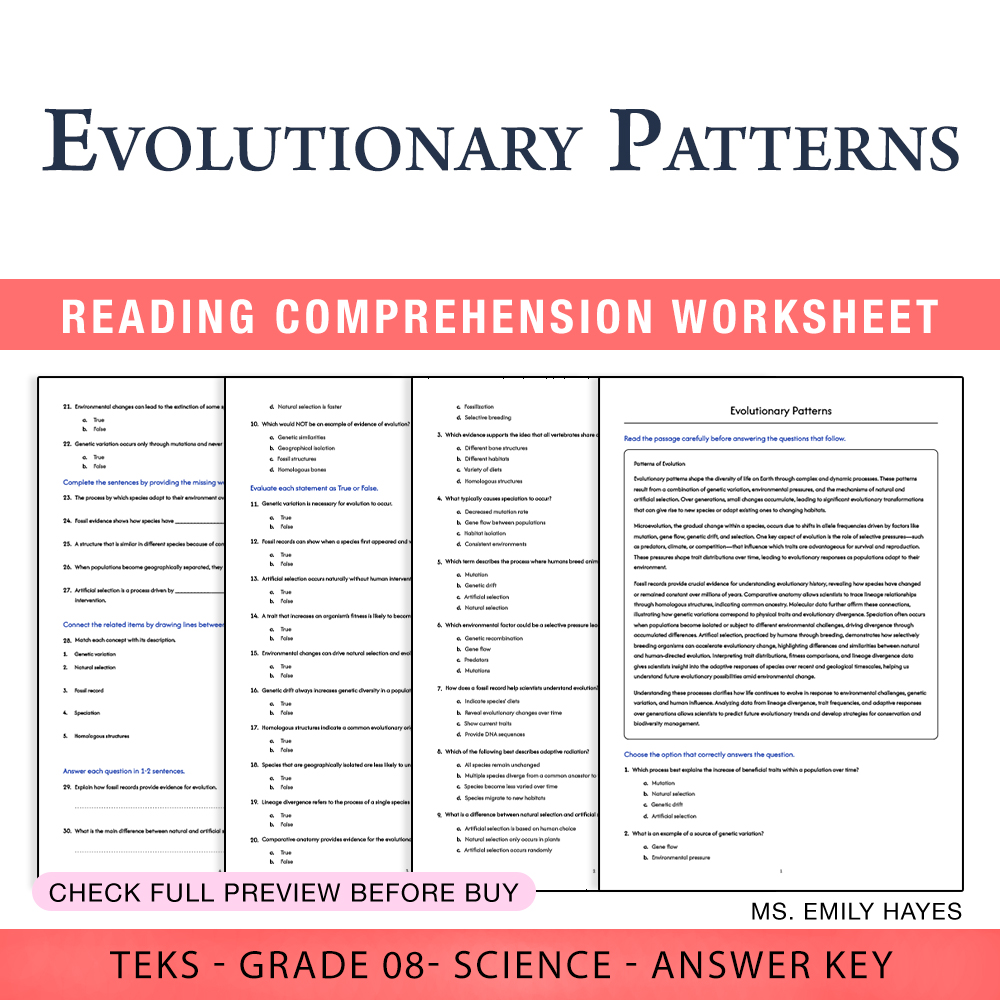
Grade 8 Science | Evolutionary Patterns Worksheet (PDF+ Answer Key)
Created byCopper Leaf ClassroomLearning Objectives
- Understand the mechanisms driving microevolutionary change, including natural and artificial selection.
- Identify sources of genetic variation and how environmental pressures influence trait distribution.
- Interpret evolutionary data such as fossil records, trait comparisons, and lineage divergence.
Instant download
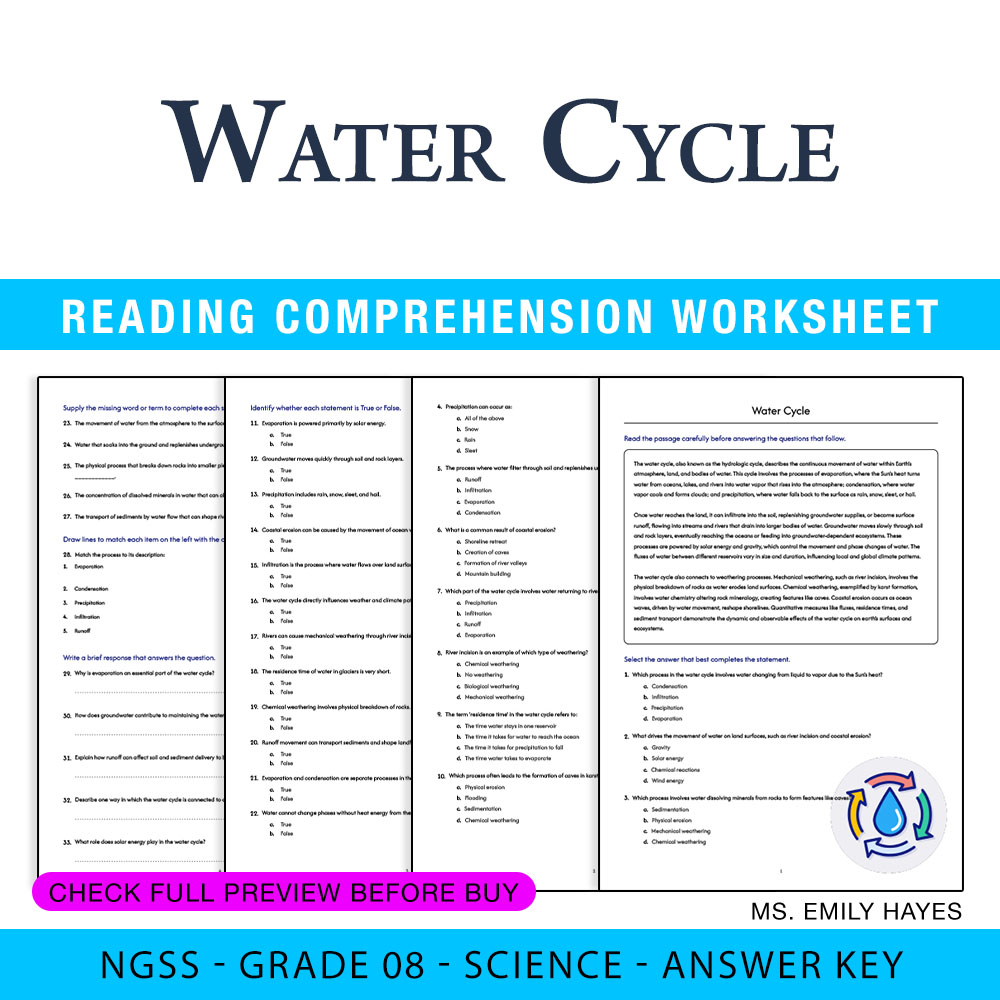
Grade 8 Science | Water Cycle Worksheet (PDF + Answer Key)
Created byCopper Leaf ClassroomLearning Objectives
- Explain the processes involved in the water cycle, including evaporation, condensation, precipitation, infiltration, runoff, and groundwater flow.
- Describe how energy from the Sun and gravity drive the processes of the water cycle.
- Connect the water cycle to chemical and mechanical weathering processes such as river incision, karst formation, and coastal erosion.
Instant download
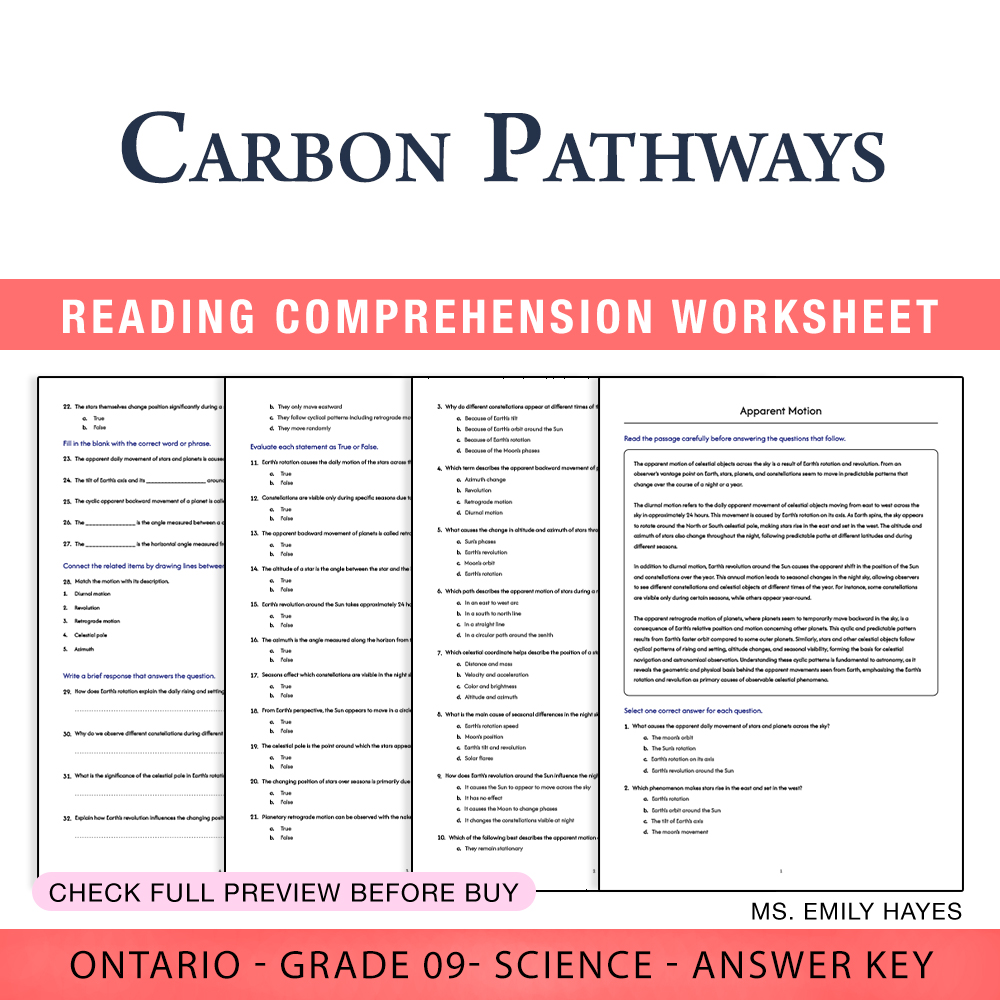
Grade 9 Science | Carbon Pathways Worksheet (PDF + Answer Key)
Created byCopper Leaf ClassroomLearning Objectives
- Describe major carbon reservoirs and their characteristics.
- Explain the fluxes that move carbon among atmosphere, biosphere, oceans, and geosphere.
- Quantify basic carbon exchanges and residence times in different reservoirs.
Instant download
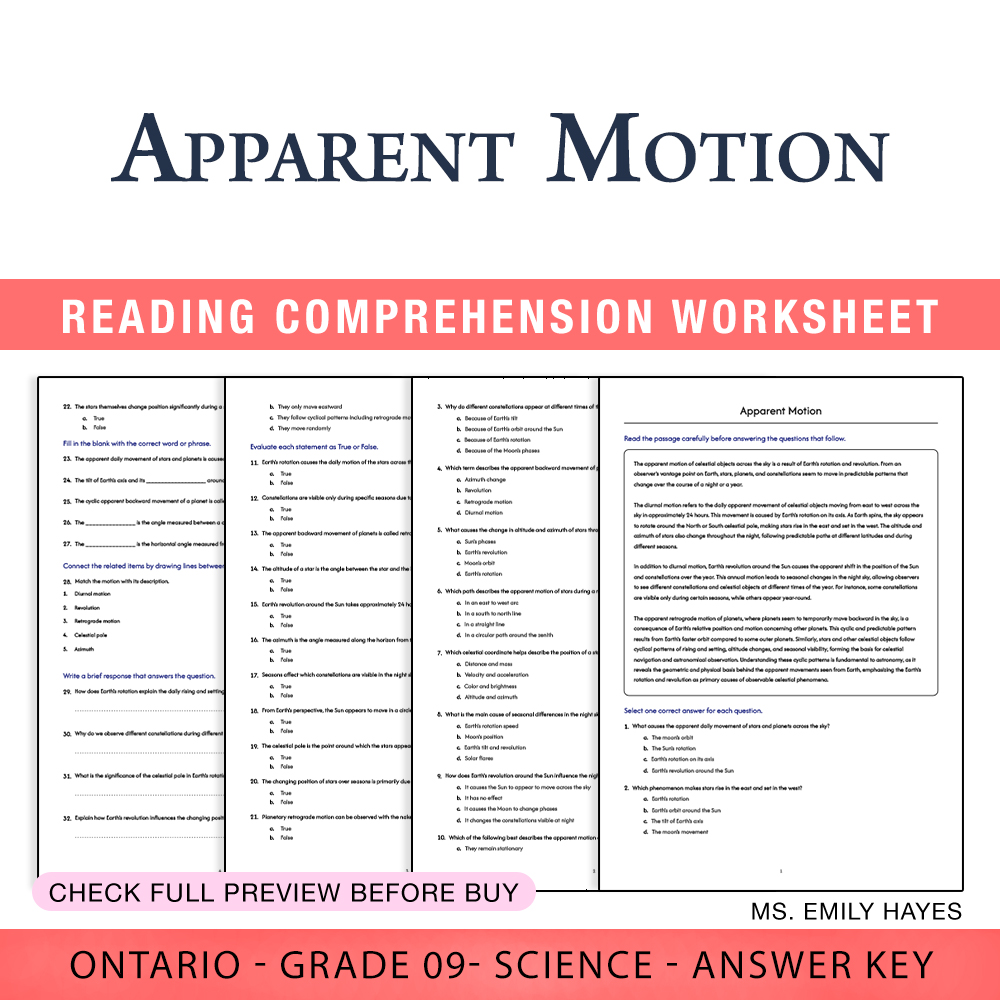
9th Grade Science | Apparent Motion Worksheet (PDF + Answer Key)
Created byCopper Leaf ClassroomLearning Objectives
- Explain the concepts of diurnal and annual motion of celestial objects as observed from Earth.
- Describe how Earth's rotation and revolution cause the apparent movement of the sky.
- Use celestial coordinate concepts such as rising, setting, altitude, and azimuth to explain observational patterns.
Instant download
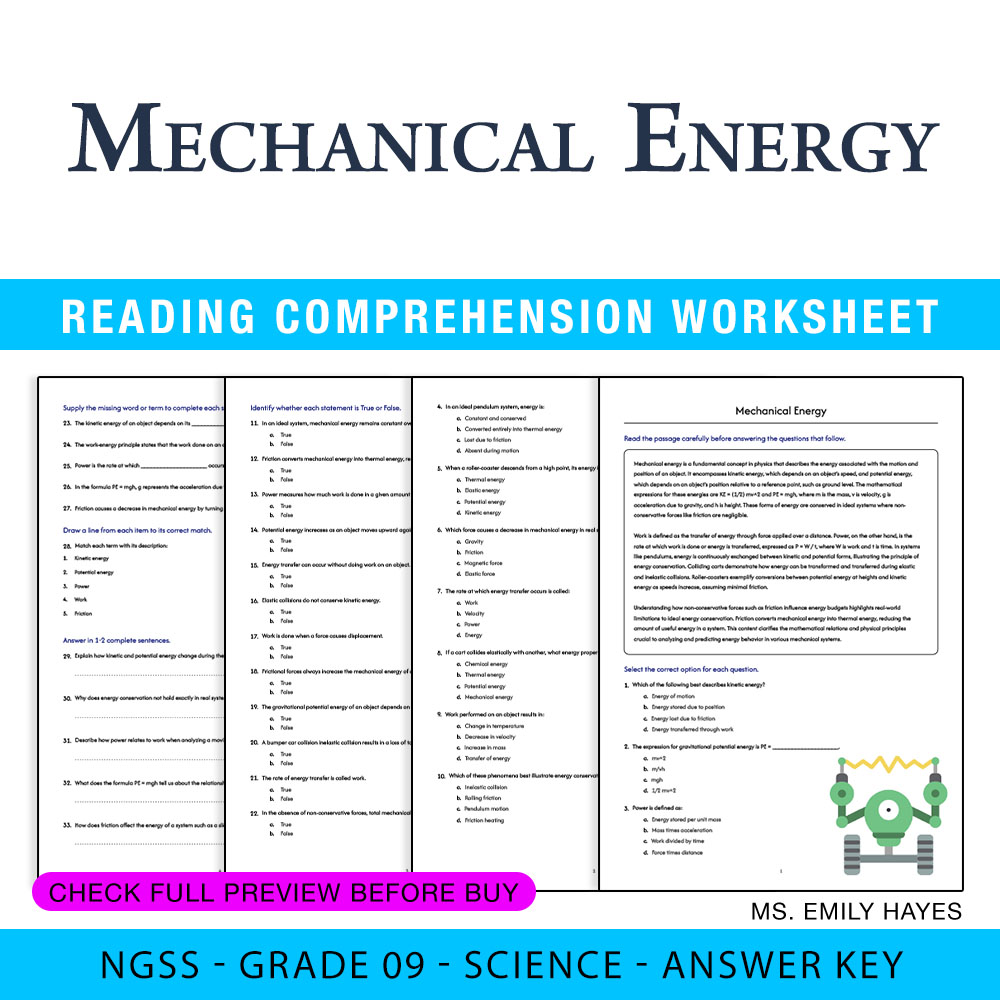
9th Grade Science | Mechanical Energy Worksheet (PDF + Answer Key)
Created byCopper Leaf ClassroomLearning Objectives
- Explain the concepts of kinetic and potential energy and their mathematical relationships.
- Describe how work and power relate to changes in mechanical energy.
- Analyze energy conservation in ideal systems such as pendulums and roller-coasters.
Instant download
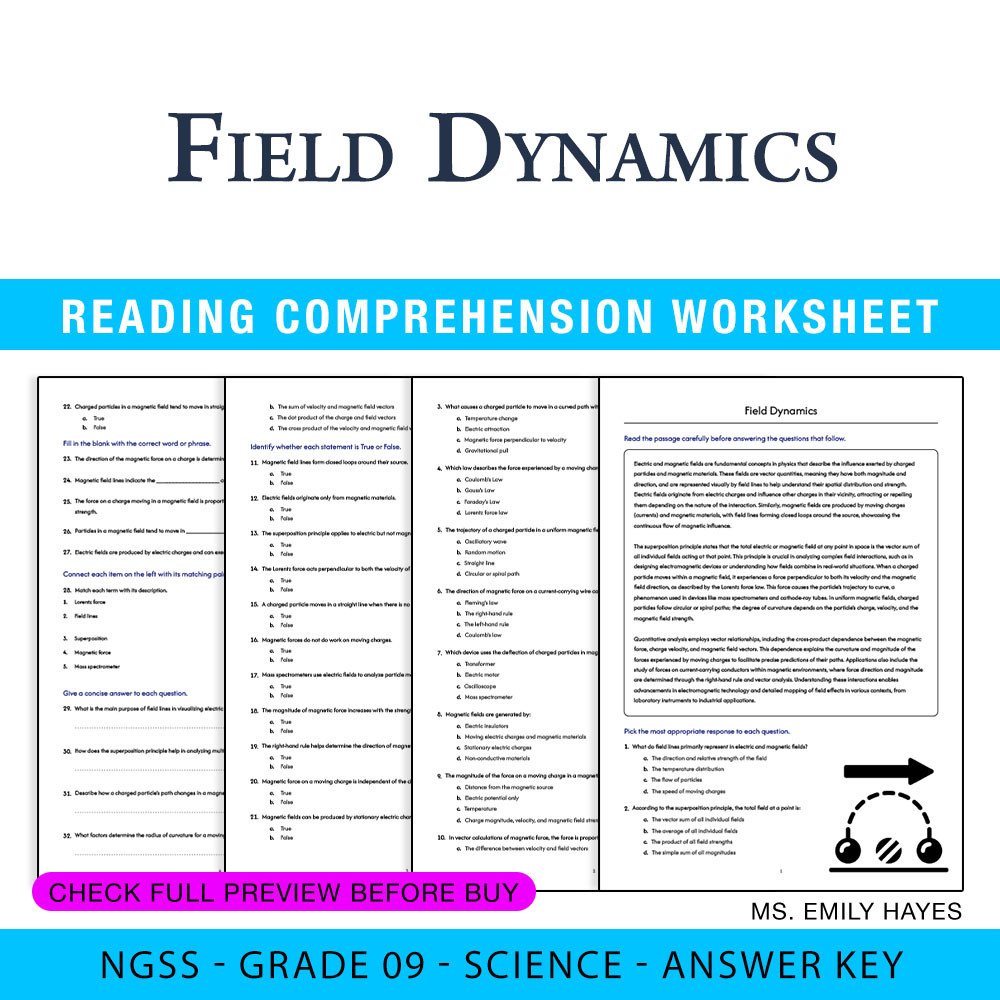
Grade 9 Science | Field Dynamics Worksheet (PDF+ Answer Key)
Created byCopper Leaf ClassroomLearning Objectives
- Understand the concepts of electric and magnetic fields and their vectors.
- Describe the superposition principle in field interactions.
- Analyze the forces on moving charges within magnetic and electric fields.
Instant download
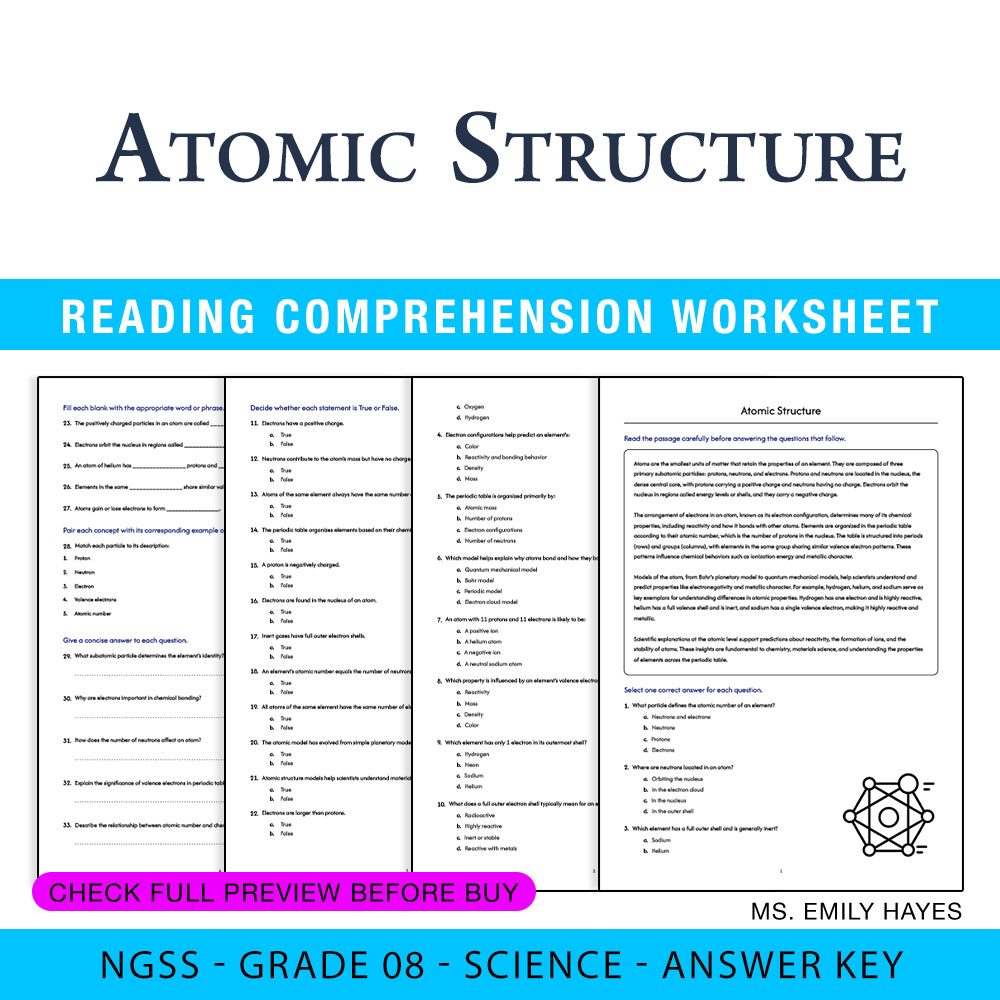
9th Grade Science | Atomic Structure Worksheet (PDF+ Answer Key)
Created byCopper Leaf ClassroomLearning Objectives
- Describe the fundamental particles that make up atoms, including protons, neutrons, and electrons.
- Explain electron configurations and how they relate to element properties.
- Interpret the periodic table in terms of valence electrons and chemical behavior.
Instant download
Browse more categories
About Reading comprehension Worksheets
Find reading comprehension worksheets for class practice, homework, or self-study. All 40,284 are instant PDF downloads.
Each resource here is built by an independent educator and reviewed for quality. Worksheets print straight from PDF and suit classroom use, homework, or extra practice; most come with answer keys, and you can preview before purchasing.