
Grade 10 Worksheets
9,388 grade resources
Energy Flow in Ecosystems Worksheet for Grade 10 Science – Standards-Aligned
JCreated byJ.S SheetsLearning Objectives
- Explain how energy is transferred through trophic levels in an ecosystem
- Differentiate energy flow from matter recycling and describe why energy is directional
- Analyze how decomposers contribute to nutrient availability and energy movement
Also included in: Grade 10 Life Science Evolution, Genetics & Cells Lesson Bundle – Florida NGSSS +1 more
Instant download

Grade 10 ELA – Daily Worksheet & Ontario Standards Alignment
 Created byQuiet Forest Education
Learning Objectives
- Understand key concepts related to ELA
- Apply knowledge through practice questions
- Demonstrate comprehension of the material
Also included in: Grade 10 Writing ELA Daily Reading Worksheets lesson bundle | Ontario +1 more
Instant download

Final Mechanics Check Worksheet | Standards-Aligned Grade 10 ELA Practice
JCreated byJ.S SheetsLearning Objectives
- Apply correct end punctuation (periods and commas) in sentences that include quoted material
- Use semicolons and colons appropriately based on sentence and document structure
- Maintain correct capitalization across edits, including beginnings of sentences and proper names
Instant download

Organelles Worksheet for Grade 10 Science | Alberta Standards Practice
JCreated byJ.S SheetsLearning Objectives
- Identify and describe the functions of membrane-bound and non-membrane-bound organelles within eukaryotic cells.
- Explain how organelle structure relates to its specific function in cellular processes.
- Analyze how variations in organelle abundance and form are adaptations to different tissue types and environments across Alberta landscapes.
Also included in: Grade 10 Cell Systems & Homeostasis Science Lesson Bundle | Alberta +1 more
Instant download

Coherent Organization Worksheet for Grade 10 ELA | Common Core Practice
JCreated byJ.S SheetsLearning Objectives
- Identify how development, organization, and style work together to support a writer’s purpose and audience.
- Evaluate whether paragraphing and transitions strengthen coherence by connecting claims and evidence.
- Revise short writing to improve clarity and logical flow using topic sentences, reasoning, and consistent tone.
Instant download

Grade 10 Variable Isolation Science Worksheet | Multifactor Investigations
 Created byChalk and Compass
Learning Objectives
- Explain how variable isolation supports causal claims in multifactor experiments and how factorial designs help compare multiple factors efficiently.
- Identify interaction effects and blocking strategies that reduce nuisance-variable bias in nutrient studies and mechanical testing.
- Evaluate experimental designs using replication, sample size, and ethical constraints to distinguish causation from correlation.
Also included in: Grade 10 Science Variables & Control Data Analysis Lesson Bundle | Ontario +1 more
Instant download

Grade 10 Science – Electromagnetic Behavior & Radiation | Reading Worksheet
 Created byBright Mind Resources
Learning Objectives
- Understand the concept of photons and their energy.
- Learn the relationship between energy and frequency via Planck’s relation E = hf.
- Identify spectral signatures from different electromagnetic sources.
Also included in: Signal Modulation Grade 10 Science Daily Reading Worksheets Bundle | NGSS +2 more
Instant download

Grade 10 Science | Orbital Geometry Worksheet (PDF) – General Standards
 Created byEvergreen Desk Education
Learning Objectives
- Explain how Earth’s axial tilt and yearly revolution produce seasons and changes in day length at different latitudes.
- Describe how the Moon’s orbital position relative to the Sun accounts for phases.
- Interpret how Earth’s rotation and orbital geometry create apparent motions of stars and planets.
Also included in: Grade 10 Weather & Climate Science Lesson Bundle - General Framework +1 more
Instant download

Fluid Balance Assessment for Grade 10 Science – Standards-Aligned Worksheet
 Created byPrism Point Learning
Learning Objectives
- Understand the processes of glomerular filtration, tubular reabsorption, and secretion in the kidneys.
- Describe the role of hormones such as antidiuretic hormone and aldosterone in fluid regulation.
- Explain how kidneys regulate urine volume and solute concentration to maintain blood osmolarity and pressure.
Also included in: Grade 10 Homeostasis and Feedback Science Lesson Bundle | TEKS
Instant download

Grade 10 Science | Model Foundations Worksheet | AP Aligned
 Created byLumora Learning
Learning Objectives
- Understand the purpose and types of scientific models used in science.
- Compare strengths and limitations of different model representations.
- Learn how to map model components to observable features and calibrate parameters.
Instant download

Grade 10 Science | Plate Tectonics Worksheet | NGSSS Aligned
Created byLumora LearningLearning Objectives
- Explain how plate tectonics describes the movement of Earth’s lithosphere
- Differentiate divergent, convergent, and transform plate boundaries
- Use evidence (coastal matches, seafloor magnetic patterns, and earthquake distribution) to support the plate tectonics theory
Instant download

Science Worksheet Acceleration Effects Grade 10 | Standards Practice
JCreated byJ.S SheetsLearning Objectives
- Explain how acceleration affects velocity, including how the sign of acceleration relates to speeding up or slowing down under a sign convention.
- Interpret acceleration and velocity trends from graphs (e.g., changes in slope or curvature) to make qualitative predictions.
- Use consistent reasoning to determine when motion speeds up, slows down, or reverses based on acceleration direction.
Also included in: Grade 10 Conservation Laws and Stoichiometry Science Lesson Bundle | General +1 more
Instant download
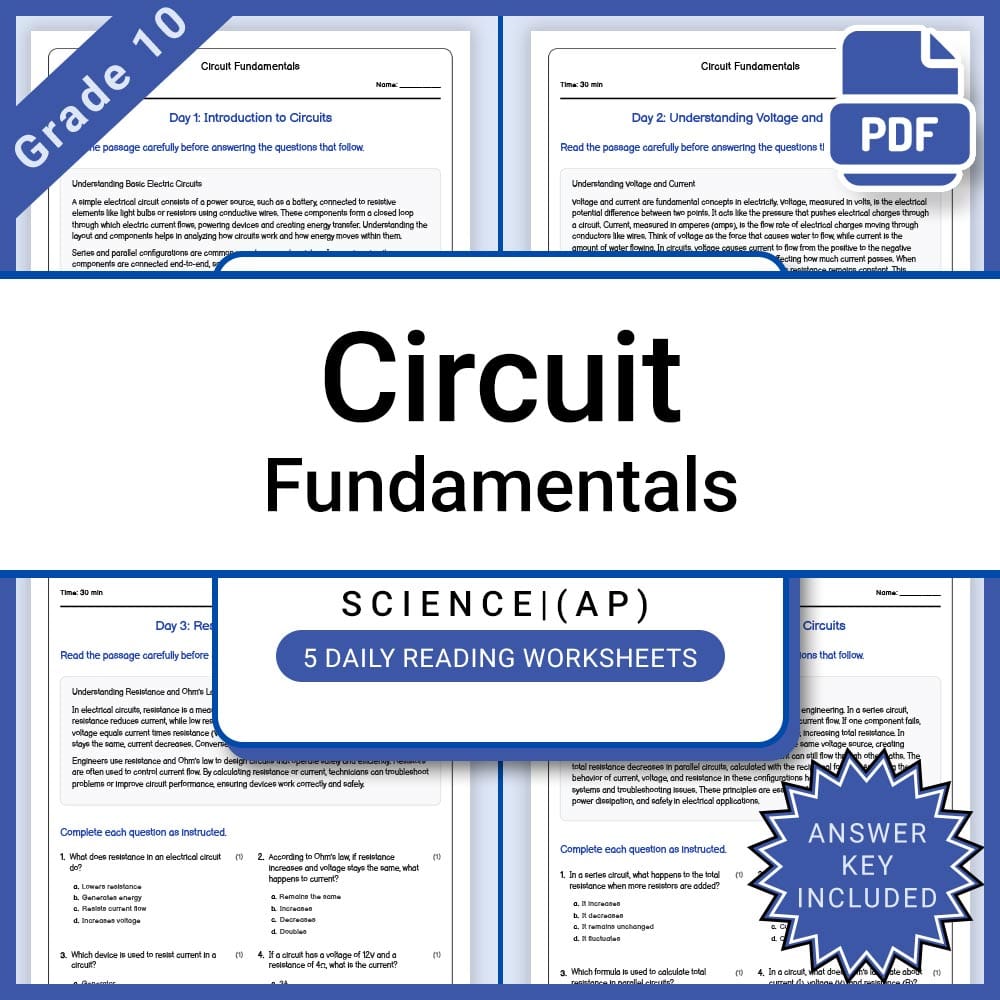
Grade 10 Science Circuit Fundamentals Daily Reading Worksheet with Answer Key
JCreated byJ.S SheetsLearning Objectives
- Identify basic components of electrical circuits such as sources, resistors, and connections.
- Understand the layout of simple direct-current circuits.
- Apply Ohm’s law to calculate voltage, current, and resistance in series and parallel configurations.
Instant download

Message Synthesis Worksheet Pack | Grade 10 ELA Practice
 Created bySunny Desk Resources
Learning Objectives
- Explain how framing, persuasive design, credibility, and audience goals work together to shape meaning across media formats.
- Compare evidence selection, tone, and context when the same topic appears in different sources or platforms.
- Synthesize information from multiple formats to predict likely audience reactions and influence.
Also included in: Media Literacy Purpose, Audience & Bias Lesson Bundle | Grade 10 ELA | BC +1 more
Instant download

Grade 10 Science – Mole Concept Daily Reading Worksheet + Answer Key
JCreated byJ.S SheetsLearning Objectives
- Understand the concept of the mole and its importance in chemistry
- Learn about Avogadro's number and how it relates to counting atoms and molecules
- Introduce molar mass as a conversion tool between mass and moles
Also included in: Grade 10 Science Lesson Group Bundle | Ontario Framework +1 more
Instant download

Grade 10 Science | Friction and Drag Worksheet | NGSSS Assessment
Created byLumora LearningLearning Objectives
- Explain how nonconservative forces like friction and drag oppose motion and reduce kinetic energy over time.
- Describe how drag depends on motion through a fluid and how it can change acceleration as speed changes.
- Use the idea of net force to predict how velocity can approach new values under opposing forces.
Instant download

Grade 10 Science – Graphical Kinematics & Motion | Daily Reading Worksheet
Created byBright Mind ResourcesLearning Objectives
- Understand the basic shape and interpretation of displacement–time graphs.
- Identify how the slope of a displacement–time graph relates to velocity.
- Explain how different graph shapes indicate different types of motion.
Also included in: Grade 10 Force & Motion Science Daily Reading Lesson Bundle – Ontario +1 more
Instant download

Grade 10 Purposeful Media Worksheet | Media Literacy & Ethical Communication
Created byLumora LearningLearning Objectives
- Explain how message, medium, and evidence work together to serve a specific audience and purpose.
- Identify ethical media practices, including proper attribution and avoiding misleading edits.
- Apply purposeful-media strategies when drafting a message for a real community context.
Instant download

Grade 10 ELA Worksheet | Spelling & Word Forms Practice (CCSS PDF)
 Created byGolden Apple Studio
Learning Objectives
- Use correct spelling patterns when forming common endings, prefixes, and base changes.
- Select the correct word form (tense and part of speech) so sentences match their meaning and grammar.
- Distinguish frequently confused word pairs and homophones to maintain clarity in writing.
Also included in: Grade 10 ELA Language & Conventions Lesson Bundle | Common Core +1 more
Instant download

Grade 10 Science | Enzymes and Transport Worksheet | General Standard
Created byLumora LearningLearning Objectives
- Explain how enzymes increase reaction rates by lowering activation energy and providing specificity through the active site
- Describe how membrane structure affects permeability, including diffusion, osmosis, and selective transport by channels and pumps
- Connect cell signaling to changes in enzyme activity and gene expression that regulate cell responses
Instant download

Carbon Balance Among Earth Systems Worksheets | Grade 10 Science
Created bySunny Desk ResourcesLearning Objectives
- Explain how carbon moves between the atmosphere, vegetation, soil, and oceans through major flux pathways.
- Identify controls that increase or decrease carbon uptake and carbon release in ecosystems.
- Describe how regional changes in carbon fluxes can affect long-term carbon storage and climate feedbacks.
Also included in: Earth Systems, Climate, and Sustainability Lesson Bundle | Grade 10 Science | Alberta +1 more
Instant download

Astronomical Climate Cycles Worksheet | Grade 10 Science | California Standards
Created byEvergreen Desk EducationLearning Objectives
- Explain how Earth’s tilt, orbital eccentricity, and precession can change incoming solar energy and seasonal intensity
- Describe how paleoclimate evidence (ice cores and sediment layers) can reveal repeating climate rhythms
- Evaluate how climate models connect astronomical cycles to long-term insulation patterns
Instant download

Grade 10 Science – Mutations & Traits | Daily Reading Worksheet
Created byBright Mind ResourcesLearning Objectives
- Understand what genetic mutations are and how they occur.
- Identify different types of mutations.
- Explain how mutations can influence traits and evolution.
Also included in: Life Science Grade 10 Science Daily Reading Worksheets Lesson Bundle | FL NGSSS +1 more
Instant download

Grade 10 Science Worksheet on Kinematics Graphs | Standards-Aligned Practice PDF
JCreated byJ.S SheetsLearning Objectives
- Interpret displacement–time graphs to determine velocity from slope and identify zero-velocity intervals
- Interpret velocity–time graphs to determine acceleration from slope and recognize direction changes
- Use acceleration–time graph patterns to determine whether acceleration is constant, changing, or reversing
Also included in: Grade 10 Conservation Laws and Stoichiometry Science Lesson Bundle | General +1 more
Instant download

Mutations and Traits Worksheet | Grade 10 Biology NGSSS | Genetics Practice + Key
Created byEvergreen Desk EducationLearning Objectives
- Explain how mutations can arise and how they may change gene function or gene regulation.
- Describe how mutations can influence traits through effects on proteins, expression levels, and cellular pathways.
- Evaluate how environmental conditions affect whether a mutation increases or decreases fitness.
Instant download

Grade 10 Science | Hydrologic Cycle Exploration - Daily Reading Comprehension
 Created byCoral Reef Learning
Learning Objectives
- Understand the processes of evaporation and transpiration.
- Identify how water moves from land surfaces to the atmosphere.
- Explain the importance of the hydrologic cycle in maintaining freshwater resources.
Also included in: Earth and Space Systems Lesson Bundle – Grade 10 Science Alberta +1 more
Instant download
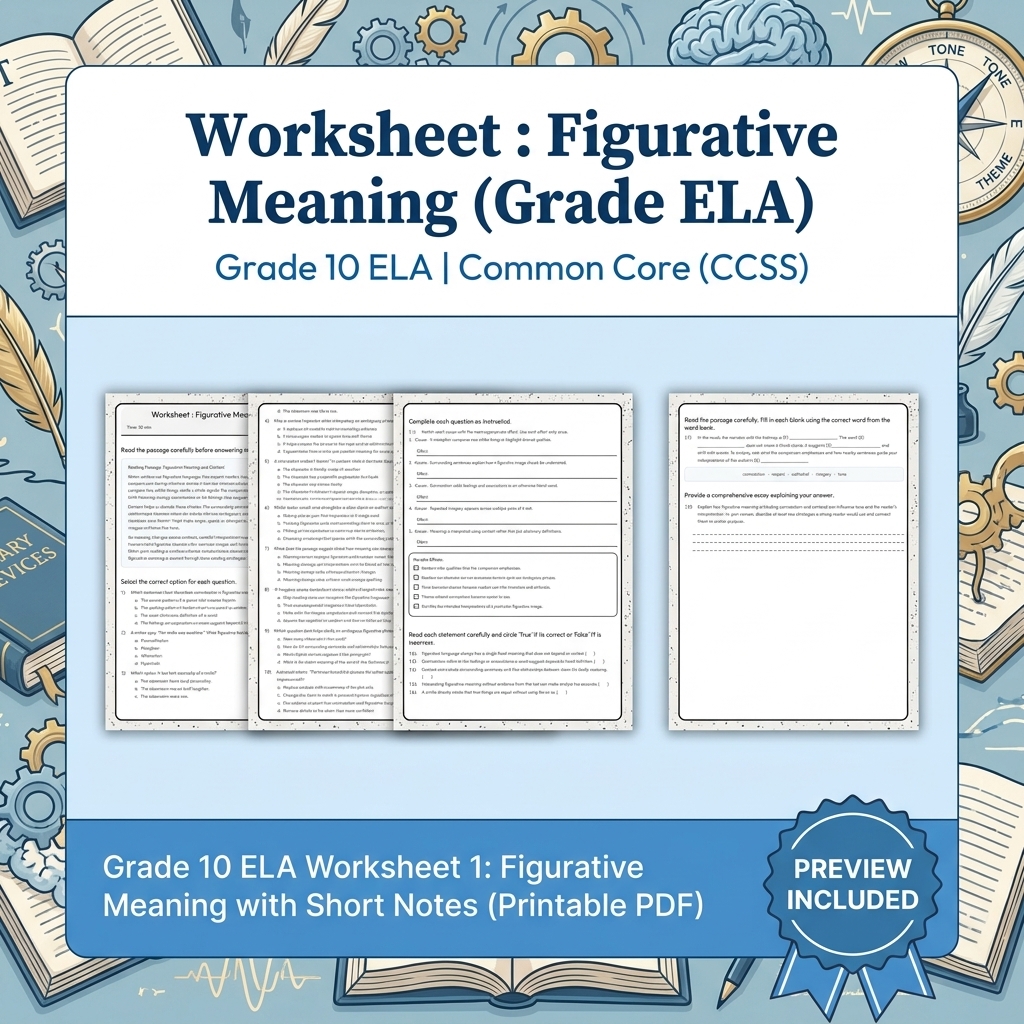
Grade 10 ELA Figurative Meaning worksheet with Short Notes (Printable PDF)
 Created byMeadowlark Worksheets
Learning Objectives
- Explain how figurative language (metaphor, simile) and connotation shape meaning beyond literal definitions.
- Analyze how context clues (surrounding sentences and idea relationships) clarify ambiguous phrases.
- Use evidence from a text to support claims about tone and author purpose.
Also included in: Grade 10 Tone and Language Usage ELA Lesson Bundle, Common Core (CCSS) +1 more
Instant download

Grade 10 Science | Hazard Risk Reduction Worksheet | California Standards
Created byLumora LearningLearning Objectives
- Explain how natural Earth processes (e.g., floods, droughts, landslides) create hazards and how risk depends on exposure and vulnerability.
- Compare multiple hazard risk reduction strategies (early warning, land-use planning, engineered barriers, drought/flood management) and describe tradeoffs.
- Justify which solutions are most effective when matched to hazard type, exposure patterns, and vulnerable populations.
Instant download

Grade 10 Science – Ecosystem Networks & Interactions | Daily Reading Worksheet
Created byBright Mind ResourcesLearning Objectives
- Understand the basic components of ecosystems, including producers, consumers, and decomposers.
- Describe how energy flows through food chains and food webs.
- Recognize the principles of matter cycling within ecosystems.
Also included in: Grade 10 AP Science Daily Reading Lesson Bundle: Ecology, Genetics & Cells +2 more
Instant download

Grade 10 Dilations Properties Worksheet | Geometry Transformations CCSS
 Created byBRIGHT PATH RESOURCES
Learning Objectives
- Use the scale factor of a dilation to find image lengths and distances from the center of dilation
- Find coordinates of a point after a dilation using the scale factor
- Explain which geometric properties are preserved by dilations (angles and parallel lines) and which are scaled (lengths)
Also included in: Grade 10 Geometry Math Lesson Bundle: CCSS Trig & Similarity +1 more
Instant download

Grade 10 Science | Gene Regulation Worksheet | TEKS Aligned
Created byLumora LearningLearning Objectives
- Understand mechanisms of gene regulation at transcriptional and post-transcriptional levels.
- Identify roles of promoters, enhancers, and transcription factors in gene expression.
- Explain how epigenetic modifications influence chromatin accessibility and gene activity.
Also included in: Grade 10 Science | Genetics & Molecular Biology Lesson Bundle | TEKS Aligned +1 more
Instant download
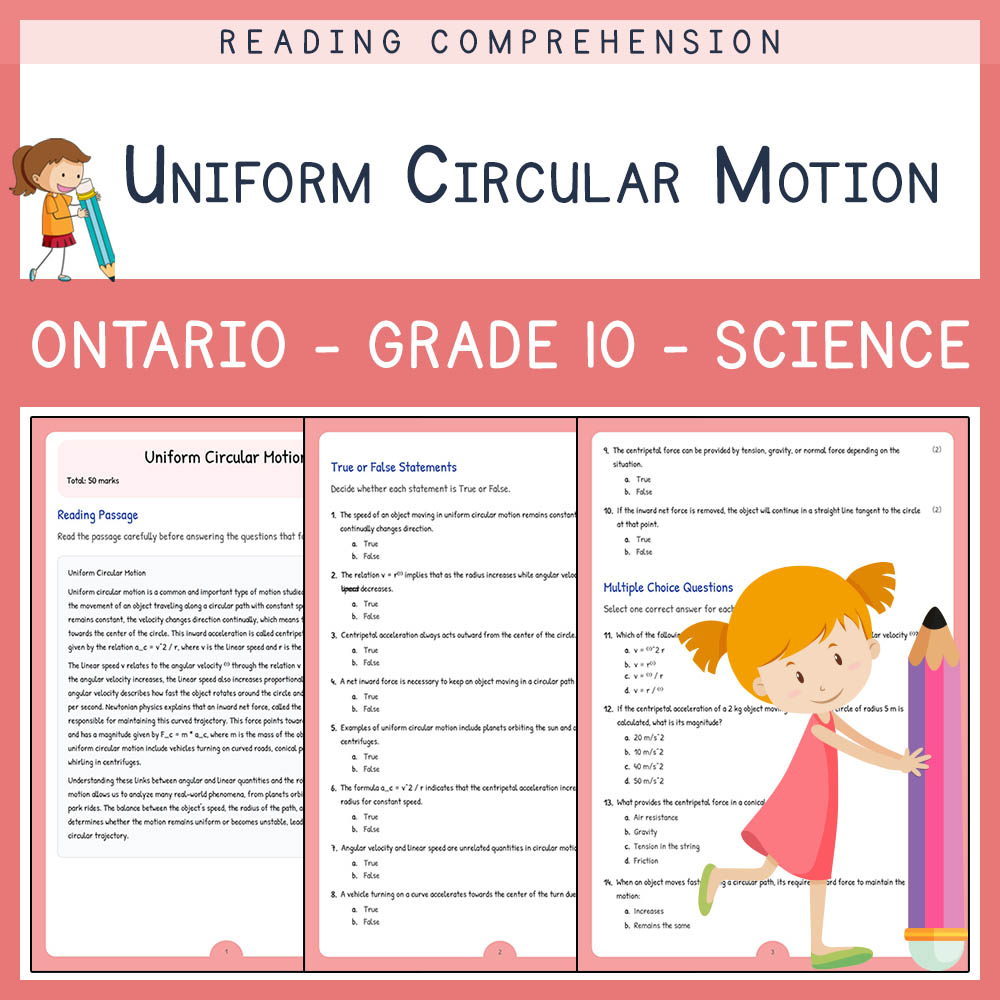
Grade 10 Science | Uniform Circular Motion Worksheet Elena | Ontario Standard
Created byLumora LearningLearning Objectives
- Describe the kinematic and dynamic aspects of uniform circular motion.
- Explain the relationships v = rω and a_c = v^2/r and how they connect linear and angular measures.
- Understand the role of a net inward force in maintaining circular motion.
Also included in: Grade 10 Science | Motion & Forces Lesson Bundle | Ontario Standards
Instant download

Grade 10 Science | DNA Structure Worksheet (TEKS) PDF
Created byEvergreen Desk EducationLearning Objectives
- Describe the components of DNA (nucleotide subunits, sugar-phosphate backbone, and nitrogenous bases).
- Explain how complementary base pairing (A–T and C–G) supports genetic information storage.
- Connect DNA structure to replication and RNA formation through base pairing.
Instant download

10th Grade Social Studies – Impact of Imperialism Worksheet (TEKS)
Created bySunny Desk ResourcesLearning Objectives
- Explain key causes that drove imperialism in the 19th and early 20th centuries.
- Analyze how imperial rule affected economies, political boundaries, and social structures.
- Evaluate how resistance movements and cultural change shaped outcomes of imperial dominance.
Also included in: Grade 10 Global Conflicts Social Studies Full-Year Worksheet Bundle – TEKS +1 more
Instant download

Inference With Citations Worksheet | General ELA Grade 10 Standard Practice
JCreated byJ.S SheetsLearning Objectives
- Explain how inferences become stronger when they are supported with specific textual evidence.
- Identify which details in a passage best support an inference (meaning-revealing evidence, not just topic mention).
- Write or revise an inference statement that clearly connects the claim to a cited quote or precise wording from the text.
Instant download

Grade 10 Science | Protein Synthesis Worksheet | TEKS-Aligned
Created byLumora LearningLearning Objectives
- Describe the process of transcription and translation in protein synthesis.
- Explain the roles of DNA, mRNA, tRNA, and ribosomes during protein synthesis.
- Identify the different stages of transcription and translation.
Also included in: Grade 10 Science | Genetics & Molecular Biology Lesson Bundle | TEKS Aligned +1 more
Instant download

Grade 10 Science | Genetic Variation Worksheet (PDF) – General Standards
Created byEvergreen Desk EducationLearning Objectives
- Explain how meiosis (random assortment and independent segregation) and crossing over create genetic variation within populations
- Describe how mutations and gene flow can introduce new alleles and change allele frequencies over time
- Use genetic variation concepts to predict how population traits may shift in response to selection
Also included in: Grade 10 Evolution & Genetics Science Lesson Bundle: General Framework +1 more
Instant download

Grade 10 Science | Mechanical Systems - Daily Reading Comprehension
Created byCoral Reef LearningLearning Objectives
- Understand the role of gears in mechanical systems
- Identify how gears provide mechanical advantage
- Analyze the energy transfer in gear systems
Instant download

Origins of War Worksheet Grade 10 Social Studies | BC Curriculum
Created byQuiet Forest EducationLearning Objectives
- Understand key concepts related to Social Studies
- Apply knowledge through practice questions
- Demonstrate comprehension of the material
Instant download

Perspective Language Worksheet | Standards-Aligned Grade 10 ELA Practice
JCreated byJ.S SheetsLearning Objectives
- Analyze how diction, tone, and stance markers shape a writer’s or speaker’s perspective
- Identify how connotation, hedging, modality, and pronoun choices include or exclude audiences
- Differentiate factual description from evaluative statements to uncover viewpoint and intended emotional effect
Instant download

Grade 10 Quote Integration Worksheet | ELA Text Evidence & Writing Skills
Created bySunny Desk ResourcesLearning Objectives
- Introduce quotations in context so they connect clearly to the claim or inference being made
- Explain how specific wording in a quote supports a theme or interpretation
- Revise evidence sentences to avoid dropped-in quotations and strengthen textual evidence
Also included in: Grade 10 Literary Analysis & Text Evidence Lesson Bundle | General ELA +1 more
Instant download

Light and Carbon Worksheet Pack | Grade 10 Science Activities
Created byPrism Point LearningLearning Objectives
- Explain how the light-dependent reactions use light energy to drive electron flow, producing ATP and NADPH.
- Describe how the Calvin cycle uses ATP and NADPH to fix carbon dioxide into three-carbon sugars via RuBisCO.
- Compare how pigments and reaction location affect the efficiency of photosynthesis in different organisms.
Also included in: Metabolism & Energy Processes Lesson Bundle — Grade 10 Science TEKS
Instant download

Community Roots Worksheet Grade 10 | Holiday SEL & Character Activity
 Created byShaNova Worksheets
Learning Objectives
- Analyze how community traditions and shared goals support student belonging at the start of the school year
- Use evidence from a text to explain the impact of community building on learning environments
- Apply key vocabulary related to community leadership, traditions, and social cohesion
Instant download

Literary And Informational Comprehension Worksheet Pack Grade 10 ELA Practice
Created bySunny Desk ResourcesLearning Objectives
- Monitor understanding by tracking key ideas and relationships while reading literary and informational texts.
- Distinguish narrative elements (character, conflict, development) from informational elements (topic, definitions, explanatory structure).
- Use context clues, references, and cohesion markers to interpret complex sentences and unfamiliar vocabulary.
Also included in: Reading and Viewing Lesson Bundle | Grade 10 ELA Alberta +1 more
Instant download

Reaction Rate Worksheets: Collisions, Energy Barriers & Catalysts
Created byBRIGHT PATH RESOURCESLearning Objectives
- Explain reaction rate using a particle-collision model
- Explain reaction rate using an energy barrier model
- Predict how temperature affects collision frequency and energy
Also included in: Grade 10 Physical Science Worksheets Bundle | Forces, Energy & More +1 more
Instant download

Grade 10 Back To School Worksheet | Celebrating Growth PDF + Answer Key
Created byShaNova WorksheetsLearning Objectives
- Identify how reflection and gratitude contribute to celebrating personal and collective milestones
- Use evidence from a text to explain why celebrations foster motivation and a sense of belonging
- Apply key vocabulary related to growth, motivation, and recognition in written responses
Instant download

Grade 10 Science – Variation & Heredity | Daily Reading Worksheet
Created byBright Mind ResourcesLearning Objectives
- Identify sources of genetic variation such as mutation, recombination, and gene flow.
- Understand how genetic variation affects species' survival and reproduction.
- Describe how natural selection acts on existing variation to change populations over time.
Also included in: Grade 10 Evolution Science Daily Reading Worksheets Lesson Bundle | TEKS +2 more
Instant download

Economic Inequality in Historical Perspective Worksheet | Grade 10 BC
Created byQuiet Forest EducationLearning Objectives
- Understand the historical developments that contributed to income disparity across different regions.
- Analyze data related to income distribution, labor markets, and global economic policies.
- Evaluate various viewpoints on responsibility for economic inequality and potential solutions.
Instant download
Browse more categories
About Grade 10 Worksheets
Find Grade 10 worksheets covering algebra, biology, literature, and history. All 9,388 resources download instantly as PDFs for classwork, homework, or review.
MyTeachingSheets worksheets are made by real teacher-authors and checked before they go live. Download any as a print-ready PDF for lessons, homework, or independent practice — most include answer keys, and previews are always free.