
Grade 10 Worksheets
9,388 grade resources
Grade 10 ELA – Organized Presentation in Writing | Daily Reading Worksheet
 Created byQuiet Forest Education
Learning Objectives
- Understand the importance of clear and organized writing
- Identify key components of an organized presentation
- Apply logical sequencing and transition techniques in writing
Also included in: Grade 10 Speaking & Listening ELA Daily Worksheets Lesson Bundle | General ELA +2 more
Instant download

Credibility and Relevance Worksheet | Grade 10 ELA Standards-Aligned
JCreated byJ.S SheetsLearning Objectives
- Identify how credibility is evaluated using evidence quality, sourcing, bias, timeliness, and transparency.
- Determine whether information is relevant to a specific question, theme, or argument.
- Justify judgments with explicit textual support from a source.
Instant download

Symbol and Imagery Worksheet Grade 10 ELA Ontario Literary Analysis
 Created bySunny Desk Resources
Learning Objectives
- Identify recurring motifs and explain how they function as symbols in a text.
- Analyze how imagery and sensory details shape mood and emotional intensity.
- Describe how a symbol’s meaning develops over time rather than staying fixed.
Instant download

Oscillations Basics Worksheet | AP Physics Science Activity & Key
 Created byBright Quill Resources
Learning Objectives
- Explain simple harmonic motion using the restoring-force idea and linear approximations for small displacements
- Define and relate period, frequency, amplitude, and phase in sinusoidal motion
- Describe how kinetic and potential energy alternate during an oscillation using time-domain and energy-domain reasoning
Instant download

Tissue Organization Worksheet | Grade 10 Science | Alberta Standards
JCreated byJ.S SheetsLearning Objectives
- Understand how cells of similar structure and function assemble into tissues.
- Identify different types of plant and animal tissues and their roles.
- Explain how tissue properties influence organ performance across biomes and agricultural systems.
Also included in: Grade 10 Cell Systems & Homeostasis Science Lesson Bundle | Alberta +1 more
Instant download

Grade 10 Forces And Acceleration Worksheet | BC Practice & PDF
 Created byClear Sky Classroom
Learning Objectives
- Use Newton’s second law to relate net force, mass, and acceleration
- Interpret free-body diagrams to identify individual forces and determine the net force
- Apply vector components to find acceleration in the horizontal and vertical directions
Instant download

Grade 10 ELA – Daily Reading Worksheet & CCSS | Transitions & Style in Writing
Created byQuiet Forest EducationLearning Objectives
- Understand key concepts related to ELA
- Apply knowledge through practice questions
- Demonstrate comprehension of the material
Also included in: Writing Grade 10 ELA Daily Reading Worksheets Lesson Bundle | CCSS +1 more
Instant download

Grade 10 Science | Redox Reactions Worksheet | BC Aligned
 Created byLumora Learning
Learning Objectives
- Understand the concept of oxidation and reduction in chemical reactions.
- Learn how to assign oxidation numbers to atoms in compounds.
- Identify electron transfer processes in redox reactions.
Instant download

Grade 10 Selection and Adaptation Worksheet | California Science Standards
 Created byEvergreen Desk Education
Learning Objectives
- Explain how natural selection changes the frequency of traits in a population over generations.
- Distinguish individual survival traits from population-level adaptation outcomes.
- Use evidence and examples to describe selective pressures and differential reproductive success.
Instant download

Counterclaim Rebuttal Worksheet Grade 10 ELA | CCSS Argument Writing
Created bySunny Desk ResourcesLearning Objectives
- Define counterclaims and rebuttals using accurate, grade-appropriate academic language.
- Write counterclaims that reflect real opposing viewpoints rather than straw positions.
- Develop rebuttals with valid reasoning and relevant evidence that connect to a specific purpose and audience.
Also included in: Grade 10 Transitions, Research & Argument Writing Lesson Bundle | CCSS ELA +1 more
Instant download

Grade 10 | Independence Day Worksheet for Mastering US Civics | PDF + Answer Key
 Created byShaNova Worksheets
Learning Objectives
- Explain how the Declaration of Independence, the Constitution, and the Bill of Rights support democratic principles.
- Identify how key constitutional ideas protect individual freedoms and promote justice.
- Evaluate how civic participation helps sustain democracy over time.
Also included in: Grade 10 Independence Day Civics Holiday Lesson Bundle | 5E Framework
Instant download

Dominant and Recessive Inheritance Patterns Worksheet | Grade 10 TEKS
 Created byBRIGHT PATH RESOURCES
Learning Objectives
- Define dominant and recessive alleles using scientific vocabulary.
- Identify genotypes that produce specific phenotypes.
- Explain how segregation leads to predictable inheritance outcomes.
Also included in: Grade 10 Genetics & Molecular Biology Science Worksheets Bundle | TEKS +1 more
Instant download

Particle Interactions Practice Worksheet | Grade 10 Science NGSS Review
 Created byPrism Point Learning
Learning Objectives
- Explain how particle arrangement and intermolecular or lattice forces determine macroscopic properties such as melting point and solubility.
- Compare electrical conductivity in metals and electrolytes using particle interactions and charge movement.
- Use ideas such as lattice energy, dispersion forces, and hydrogen bonding to predict phase behavior.
Also included in: Grade 10 Reaction Rates and Equilibrium Science Lesson Bundle NGSS
Instant download

Collision Conservation Worksheet | NGSS Physics Activity + Answer Key
Learning Objectives
- Apply conservation of linear momentum using 2D vector components in multi-body collisions.
- Use center-of-mass motion to analyze how internal forces redistribute momentum and kinetic energy.
- Distinguish elastic from inelastic collisions using post-collision speed and energy partition.
Instant download

Grade 10 ELA – Quotation Punctuation & Usage | Daily Reading Worksheet
Created byQuiet Forest EducationLearning Objectives
- Understand key concepts related to ELA
- Apply knowledge through practice questions
- Demonstrate comprehension of the material
Also included in: Grade 10 Punctuation & Editing ELA Lesson Bundle | General ELA Daily Reading +2 more
Instant download

Grades 9 & 10 Holiday Worksheet on Labor Origins: International Workers' Day
Learning Objectives
- Explain how International Workers' Day grew from labor movements that demanded fair wages, reasonable hours, and safer working conditions.
- Identify key events and figures associated with the late-1800s labor struggle, including the eight-hour workday and the Haymarket incident.
- Analyze how collective action contributed to social and legal change for workers.
Also included in: Grade 9 - 10 May Day Holiday Lesson Bundle for Framework +1 more
Instant download

Energy Currency Worksheet | TEKS-Aligned 10th Grade Science Practice
JCreated byJ.S SheetsLearning Objectives
- Explain how ATP stores and releases energy through hydrolysis of high-energy phosphate bonds
- Describe how ATP couples exergonic and endergonic reactions using phosphorylation
- Compare how ATP is regenerated through oxidative phosphorylation and photophosphorylation
Instant download

Grade 10 Science – Measurement & Prototyping Worksheet | Standards-Aligned
 Created byBright Mind Resources
Learning Objectives
- Understand the importance of measurement in evaluating prototypes
- Identify key types of measurements used in prototyping
- Recognize how measurements influence design improvements
Also included in: Grade 10 Science Trade-Off Design Daily Reading Worksheet Lesson Bundle-General +1 more
Instant download

Cell Membrane Transport Worksheet Grade 10 Biology NGSSS Resource
Created byEvergreen Desk EducationLearning Objectives
- Explain how selective permeability controls what enters and leaves a cell
- Compare passive transport (diffusion and osmosis) with active transport and vesicle transport
- Use concentration gradients and tonicity to predict the direction of solute and water movement
Instant download

Grade 10 Health Worksheet – Evaluating Consequences (NHES) (PDF)
Created bySunny Desk ResourcesLearning Objectives
- Analyze immediate and long-term consequences of health-related decisions
- Evaluate health choices by predicting outcomes, considering safety, and weighing risks versus benefits
- Use case-study evidence to support responsible decision-making and personal accountability
Also included in: Grade 10 Health Risk Management and Informed Decisions Lesson Bundle (NHES) +1 more
Instant download

Grade 10 Science | Nutrient Cycling Worksheet (NGSS10 PDFs)
 Created bySilver Birch Teaching
Learning Objectives
- Explain the major biogeochemical cycles, including carbon and nitrogen fluxes.
- Describe processes such as photosynthesis, respiration, nitrification, denitrification, and decomposition.
- Analyze how human activities like fossil fuel combustion and agriculture affect nutrient reservoirs and flux rates.
Also included in: Grade 10 Ecosystem Stability and Biodiversity Science Lesson Bundle NGSS +1 more
Instant download

Idea Interaction Worksheet for Grade 10 ELA | Common Core Standards Practice
JCreated byJ.S SheetsLearning Objectives
- Analyze how multiple, interrelated ideas (such as definition, contrast, and refinement) work together to build meaning in a passage
- Identify how an idea changes or limits another through evidence, cause-and-effect, and conditional language
- Evaluate how authors shift between broad claims and supporting explanations to strengthen their overall argument or explanation
Instant download

Grade 10 |Hiroshima Peace Day for Mastering Ethics in Science | PDF + Answer Key
Created byShaNova WorksheetsLearning Objectives
- Explain ethical responsibilities of scientists when research can affect civilian safety.
- Analyze how humanitarian principles guide scientific and political decision-making during crises.
- Evaluate how transparency and accountability support peace and human rights.
Instant download

Nationalism & Ideologies Worksheet | Social Studies Practice Grade 10
JCreated byJ.S SheetsLearning Objectives
- Explain how nationalism and competing ideologies shaped political change in the 19th and 20th centuries
- Compare how fascism, communism, and totalitarianism used power to control society
- Analyze the consequences of ideological conflict for global stability and ethnic tensions
Instant download

Grade 10 Research Foundations Worksheet | TEKS ELA Research Skills
 Created byGolden Apple Studio
Learning Objectives
- Explain how credible sources support research-based writing by providing evidence, context, and background information.
- Distinguish the writer’s ideas from source wording by practicing accurate summarizing and quoting.
- Apply ethical research practices by connecting evidence to a clear purpose and avoiding meaningless source “dropping.”
Also included in: TEKS Writing & Argument Research Skills Lesson Bundle | Grade 10 ELA | TEKS +1 more
Instant download

Inheritance Patterns Worksheet | Standards-Aligned Grade 10 Science Practice
JCreated byJ.S SheetsLearning Objectives
- Explain how segregation and independent assortment affect allele transmission during meiosis
- Use dominant and recessive relationships to predict phenotype outcomes from genotypes
- Apply monohybrid and dihybrid ratios to determine inheritance probabilities
Instant download

Grade 10 Social Studies – Trench Warfare Worksheet (BC Standards PDF)
Created bySunny Desk ResourcesLearning Objectives
- Explain how technology and logistics (machine guns, artillery, gas, supply) contributed to stalemate and casualty patterns on the Western Front (1914–1918).
- Compare trench systems across different sectors of the Western Front and interpret what those differences meant for battle outcomes.
- Analyze primary evidence (maps and photographs) to evaluate the relationship between military innovation and human cost.
Also included in: Grade 10 Conflict, Justice & Rights Social Studies Lesson Bundle (BC) +1 more
Instant download

Art and Identity Worksheet | May Grade 10 | Holiday
 Created byCedar Grove Learning
Learning Objectives
- Analyze how Cinco de Mayo themes and Mexican symbols appear in visual art and crafts
- Explain how artistic choices (color, imagery, style) can influence identity and community expression
- Use evidence from artwork and discussion to support claims about cultural pride and historical memory
Also included in: Grade 10 Cinco de Mayo Holiday Lesson Bundle – May Reading & Comprehension +1 more
Instant download

Grade 10 Science – Electric Circuits & Components | Daily Reading Worksheet
Created byBright Mind ResourcesLearning Objectives
- Identify basic components in electric circuits
- Understand the functions of circuit elements
- Develop foundational knowledge of how electric energy is transmitted
Also included in: Grade 10 Energy Science Daily Reading Worksheets Lesson Bundle | BC +1 more
Instant download

Grade 10 Science – Representing Data & Data Visualization | Daily Worksheet
Created byQuiet Forest EducationLearning Objectives
- Understand key concepts related to Science
- Apply knowledge through practice questions
- Demonstrate comprehension of the material
Also included in: Scientific Investigation Grade 10 Science Daily Worksheets Bundle | Ontario +1 more
Instant download
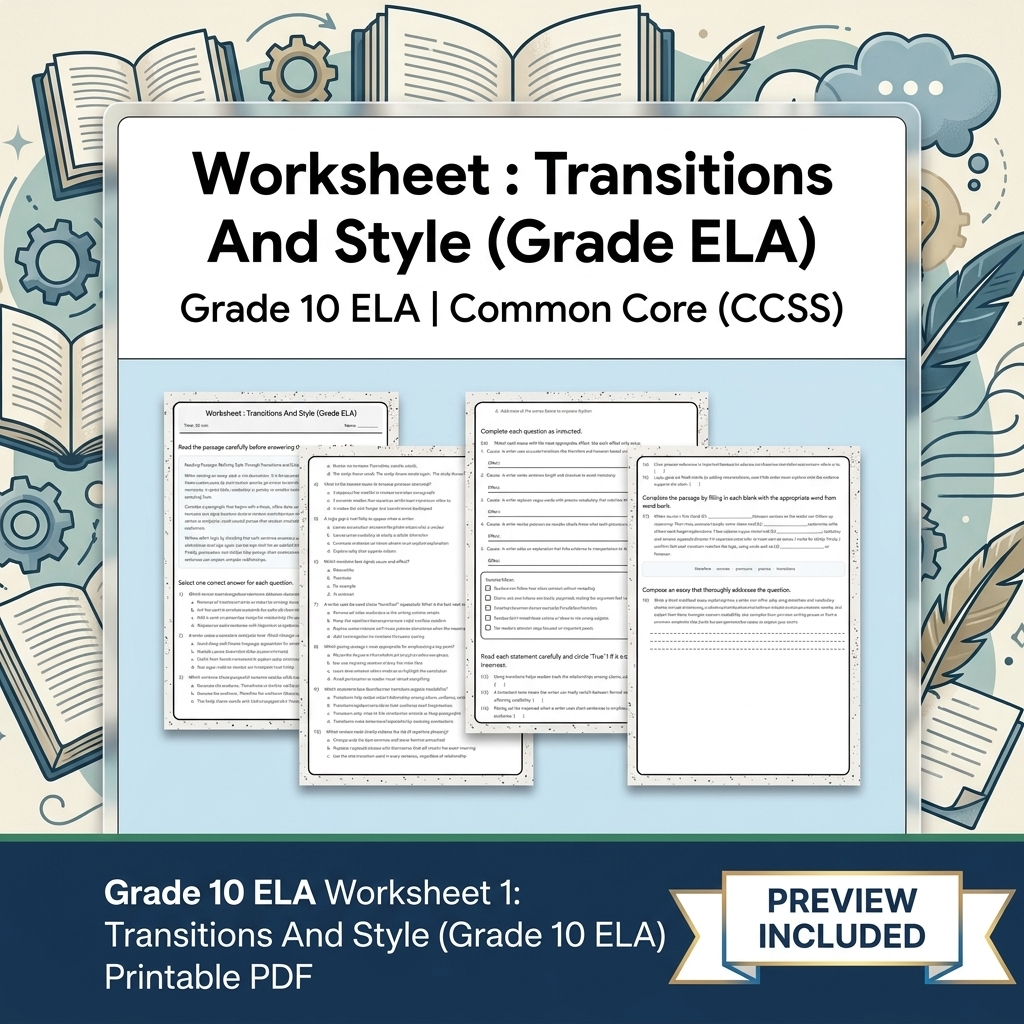
Grade 10 ELA Transitions And Style worksheet with short notes
 Created byMeadowlark Worksheets
Learning Objectives
- Analyze how transitions and sentence variety improve the clarity and flow of academic writing
- Revise writing for precise vocabulary, consistent tone, and logical connections between claims and evidence
- Evaluate statements about pacing, pronoun clarity, and style to distinguish correct revision strategies from ineffective ones
Also included in: Grade 10 Transitions & Style ELA Lesson Bundle | Common Core (CCSS) +1 more
Instant download

Evidence Relevance Worksheet | Grade 10 ELA | Standards-Aligned Practice
JCreated byJ.S SheetsLearning Objectives
- Explain how evidence relevance depends on matching evidence to the specific reasoning behind a claim.
- Evaluate whether a text’s evidence supports the targeted claim rather than a related but different idea.
- Assess how context and counterevidence affect the credibility and impact of an argument.
Instant download

Model Evaluation Worksheet | NGSS-Aligned Science Practice for Grade 10
JCreated byJ.S SheetsLearning Objectives
- Understand the role of quantitative data analysis in model validation.
- Analyze prototype data to assess model accuracy and reliability.
- Compare simulation results with empirical measurements to identify discrepancies.
Also included in: Grade 10 Engineering Design Science Lesson Bundle worksheets – NGSS
Instant download

Creative Pumpkin Projects Worksheet Grade 10 Fall Art Activity
Created byShaNova WorksheetsLearning Objectives
- Design and explain a unique pumpkin-based STEM or art project using clear reasoning.
- Identify scientific ideas related to decomposition and sustainable harvest practices.
- Analyze how pumpkin symbolism and community traditions can inspire original storytelling.
Instant download

Grade 10 Holiday | National Pet Day Worksheet for Mastery | PDF + Answer Key
Created byShaNova WorksheetsLearning Objectives
- Understand the importance of pet advocacy and awareness campaigns.
- Analyze how community initiatives influence attitudes towards animal rights.
- Identify responsible pet ownership practices and their social impact.
Instant download

Periodic Trends Worksheet for Grade 10 Science | Standards-Aligned Practice
JCreated byJ.S SheetsLearning Objectives
- Understand the concepts of atomic radius, ionization energy, and electronegativity.
- Analyze how nuclear charge and electron shielding influence periodic trends.
- Interpret how these trends affect element behavior and chemical properties.
Instant download

Source Credibility Worksheet | 10th Grade ELA Standards-Aligned PDF
JCreated byJ.S SheetsLearning Objectives
- Identify how authority, evidence quality, and transparency affect source credibility
- Evaluate whether claims are supported by firsthand reporting and verifiable data
- Distinguish observation from interpretation when analyzing news and research
Instant download
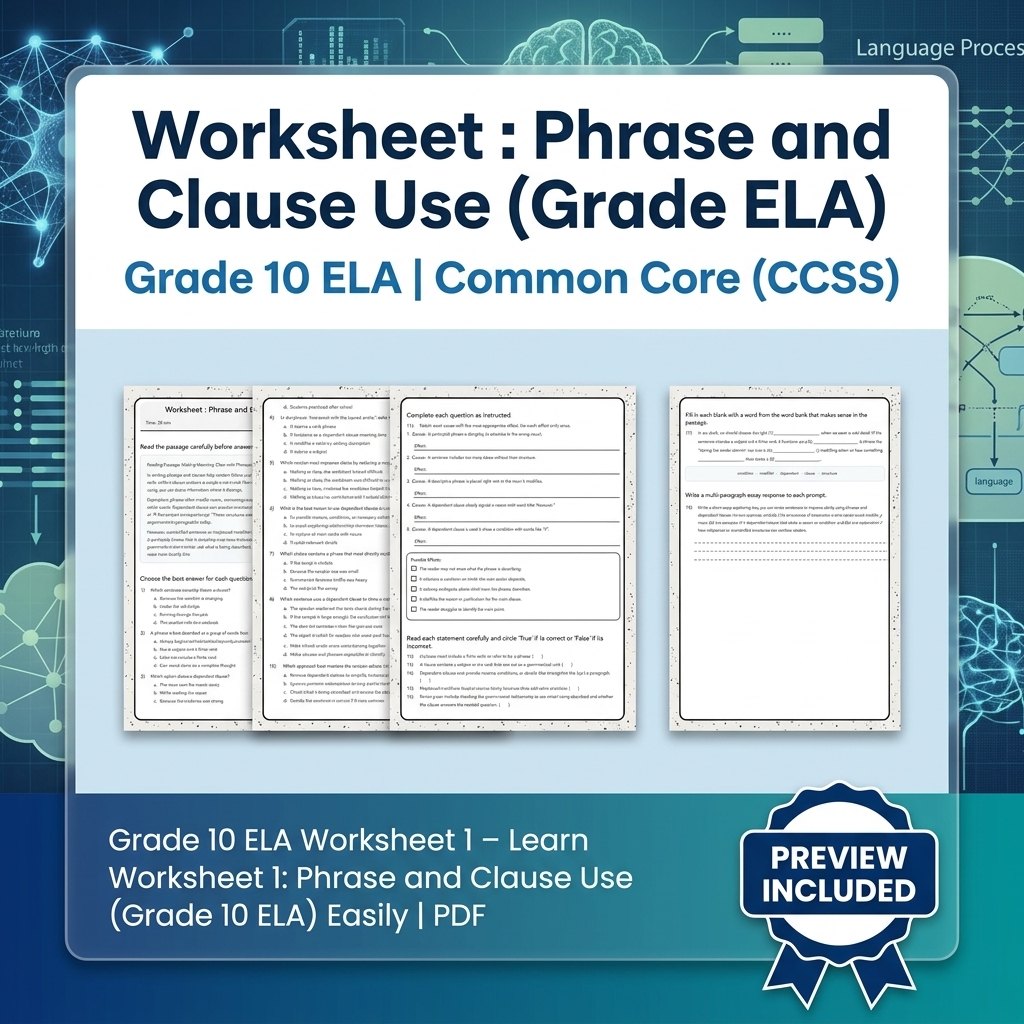
Grade 10 ELA Phrase and Clause Use worksheet | PDF
Created byMeadowlark WorksheetsLearning Objectives
- Distinguish between phrases and clauses by identifying whether a finite verb is present.
- Use phrases to modify nouns and clarify meaning in informative and argumentative writing.
- Use dependent clauses to provide reasons, conditions, or additional details without creating confusion.
Also included in: Grade 10 Tone and Language Usage ELA Lesson Bundle, Common Core (CCSS) +1 more
Instant download

Analytical Techniques Worksheet | Standards-Aligned Science
JCreated byJ.S SheetsLearning Objectives
- Understand different analytical chemistry methods used for qualitative and quantitative analysis.
- Interpret data from spectroscopic, chromatographic, and titrimetric techniques.
- Apply knowledge of detection limits and mass calculations to real-world environmental and industrial contexts.
Also included in: Grade 10 Science Practice Worksheets: Alberta Science Full-Year Bundle
Instant download

Grade 10 Science | Gene Regulation Switches - Daily Reading Comprehension
 Created byCoral Reef Learning
Learning Objectives
- Understand the basic concept of gene regulation
- Identify how gene regulation affects protein production
- Learn about the mechanisms controlling gene expression
Instant download

Grade 10 Science | Understanding Measurement Uncertainty - Daily Reading
Created byCoral Reef LearningLearning Objectives
- Define and explain the concept of uncertainty in scientific measurements.
- Describe how data variability impacts the interpretation of experimental results.
- Differentiate between central tendency and measurement spread.
Instant download

Atomic Structure Worksheet | AP Science Practice for Grade 10
JCreated byJ.S SheetsLearning Objectives
- Describe the subatomic components of atoms and their roles.
- Explain how emission spectra and scattering experiments provide evidence for atomic models.
- Connect shell models and quantum numbers to observable atomic properties.
Also included in: Grade 10 Chemistry Lesson Bundle – AP Chemistry Concepts & Practice
Instant download
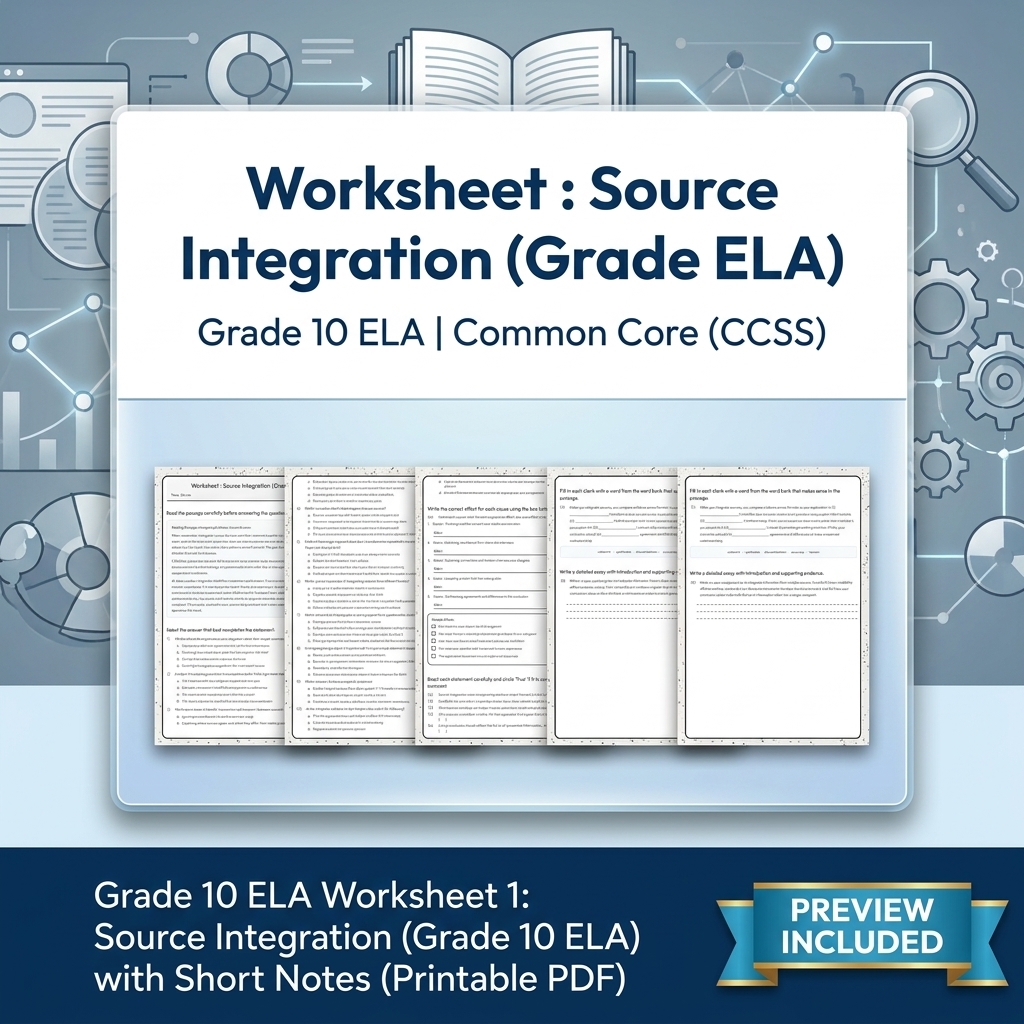
Grade 10 ELA Source Integration worksheet with Short Notes
Created byMeadowlark WorksheetsLearning Objectives
- Integrate evidence from multiple sources (texts, audio/video, and visuals) to form a coherent, accurate explanation.
- Evaluate the credibility of sources and distinguish strong support from questionable claims.
- Identify connections and tensions across sources and synthesize information without relying on a single viewpoint.
Also included in: Grade 10 Source Integration & Presentation Skills ELA Lesson Bundle: (CCSS) +1 more
Instant download

Grade 10 Maths – Law of Cosines Worksheet (Ontario Standards) (PDF)
Created byClear Sky ClassroomLearning Objectives
- Understand and apply the Law of Cosines to find missing sides or angles in non-right triangles.
- Solve multi-step problems involving oblique triangles using cosine law formulas.
- Interpret real-world contexts where non-right triangle calculations are essential, such as navigation and construction.
Also included in: Grade 10 Maths Lesson Bundle | Trigonometry and Geometry Ontario Standards +1 more
Instant download

Grade 10 |World Bees Day Worksheet for Mastering Conservation | PDF + Answer Key
Created byShaNova WorksheetsLearning Objectives
- Analyze how conservation actions protect bee populations and support biodiversity.
- Evaluate challenges that threaten bees and propose realistic solutions.
- Connect stewardship to social responsibility and cultural traditions.
Instant download

Grade 10 ELA Tense Agreement Worksheet (PDF) – General ELA Standards
Created byGolden Apple StudioLearning Objectives
- Maintain consistent verb tenses within complex sentences so ideas stay in a stable timeline.
- Use correct subject–verb agreement, including when phrases intervene or when formal/inverted structures change the word order.
- Recognize and correct tense drift between evidence, commentary, and explanation.
Also included in: Grade 10 Grammar & Sentence Structure ELA Lesson Bundle: General ELA +1 more
Instant download

Grade 10 Science | Ion Formation Worksheet Elena | California Standards
Created byLumora LearningLearning Objectives
- Explain how incomplete outer energy levels lead atoms to form ions with more stable configurations
- Use electron-transfer ideas to predict whether an atom forms a cation or an anion
- Determine ion charge based on the number of valence electrons an atom gains or loses
Instant download

Reaction Outcomes Worksheet for Grade 10 Science | Standards-Aligned Practice
JCreated byJ.S SheetsLearning Objectives
- Explain how atoms rearrange during chemical reactions and how this relates to observed outcomes.
- Describe the conservation of atoms in reactions and how electron structures influence bonding changes.
- Construct accounts connecting atomic-level information to macroscopic reaction products.
Also included in: Grade 10 Energy, Forces, and Reactions Science Lesson Bundle +1 more
Instant download
Browse more categories
About Grade 10 Worksheets
Find Grade 10 worksheets covering algebra, biology, literature, and history. All 9,388 resources download instantly as PDFs for classwork, homework, or review.
MyTeachingSheets worksheets are made by real teacher-authors and checked before they go live. Download any as a print-ready PDF for lessons, homework, or independent practice — most include answer keys, and previews are always free.