
Grade 10 Worksheets
9,388 grade resources
Model Predictions and Limitations Science Worksheets for Grade 10
 Created byBRIGHT PATH RESOURCES
Learning Objectives
- Explain how models represent relationships among variables
- Describe how observed patterns affect predictive power
- Identify limitations caused by changing conditions
Also included in: Grade 10 Science Worksheets Bundle | Scientific Inquiry & Evidence +1 more
Instant download

Radiometric Dating Worksheet Grade 10 Science Activity | NGSSS Earth Science
 Created byPrism Point Learning
Learning Objectives
- Explain how radioactive decay and half-life are used to estimate absolute geologic time.
- Describe why assumptions like starting conditions and closed-system behavior affect the reliability of radiometric dates.
- Connect radiometric dating results to real geologic events such as igneous intrusion and metamorphism.
Also included in: Space & Earth Systems Lesson Bundle | Grade 10 Science | Florida NGSSS
Instant download

Comparative Models Worksheet for Grade 10 Social Studies | Ontario Standards
JCreated byJ.S SheetsLearning Objectives
- Compare how constitutional arrangements shape rights protection and public participation in Canada and other democratic systems
- Analyze how electoral systems and civic organizations influence policy innovation and democratic continuity
- Evaluate the causes and consequences of institutional differences, including adaptations that support FNMI rights and local governance
Instant download

Ore Formation Worksheet | Grade 10 Science | Ontario Standards
JCreated byJ.S SheetsLearning Objectives
- Explain how magmatic differentiation, hydrothermal circulation, sedimentary concentration, and metamorphic remobilization can form ore deposits
- Describe how spatial controls such as structural traps, permeability contrasts, and host-rock chemistry influence where ore minerals deposit
- Identify typical mineral assemblages and link them to likely deposit types and tectonic settings
Instant download

Grade 10 ELA – Reading & Narration Pacing & Literary Devices | Daily Worksheet
 Created byQuiet Forest Education
Learning Objectives
- Analyze how pacing contributes to narrative coherence
- Identify structural choices that influence reader perception
- Explain how pacing affects interpretation of themes and characters
Also included in: Literary Analysis Grade 10 ELA Daily Reading Worksheets Lesson Bundle | CCSS +1 more
Instant download

Grade 10 ELA – Reasoned Argument Worksheet (CCSS) PDF
 Created byGolden Apple Studio
Learning Objectives
- Identify an author’s claim and key positions in an informational text
- Analyze how evidence, explanations, and assumptions work together to support reasoning
- Evaluate how writers address counterpoints or constraints to strengthen credibility
Also included in: Grade 10 ELA Text Structure & Evidence Lesson Bundle | Common Core +1 more
Instant download

Grade 10 Science – Redox Reactions Worksheet (PDF) BC Standards
 Created byEvergreen Desk Education
Learning Objectives
- Explain redox reactions as electron transfer processes linked to changes in oxidation states.
- Assign oxidation numbers to atoms and use them to identify which species is oxidized and which is reduced.
- Connect redox behavior to periodic trends and real-life examples such as corrosion, combustion, and electrochemistry.
Instant download

Grade 10 Friction And Drag Worksheet | NGSS Practice PDF
 Created byClear Sky Classroom
Learning Objectives
- Explain how friction and drag are nonconservative forces that oppose motion and change velocity over time
- Use the idea of net force to predict how an object’s speed approaches a new value under opposing forces
- Differentiate friction from drag by identifying when each force acts and what affects its magnitude
Instant download
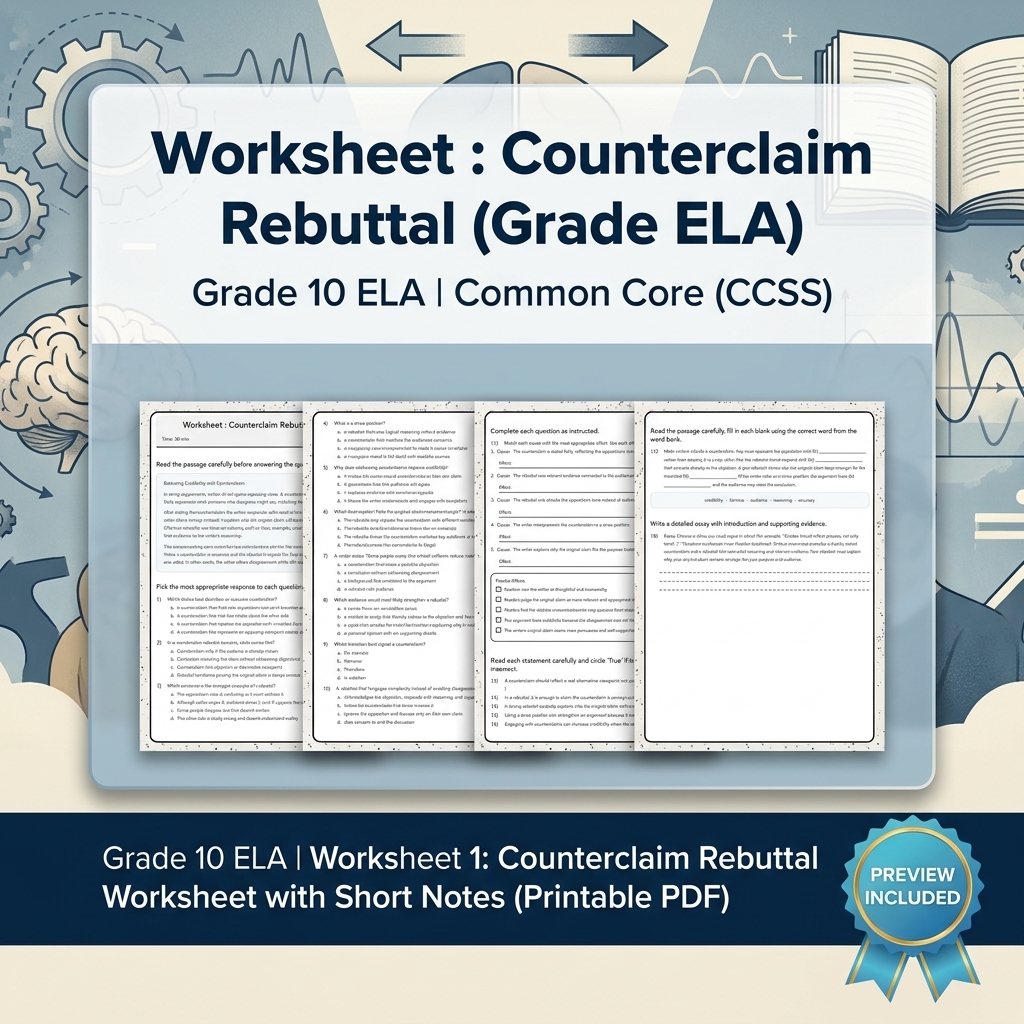
Grade 10 ELA Counterclaim Rebuttal Worksheet with Short Notes (Printable PDF)
 Created byMeadowlark Worksheets
Learning Objectives
- Identify what makes a counterclaim accurate and not a simplified straw position.
- Write a rebuttal that explains why the original claim remains stronger for the intended purpose and audience.
- Use evidence and reasoning to address objections with credibility and clarity.
Also included in: Grade 10 Transitions & Style ELA Lesson Bundle | Common Core (CCSS) +1 more
Instant download

Transport Mechanisms Worksheet for Grade 10 Science | TEKS-Aligned Practice
JCreated byJ.S SheetsLearning Objectives
- Explain how passive transport uses concentration or electrochemical gradients to move substances across cellular membranes
- Compare active transport and passive transport, including the role of ATP-driven pumps
- Describe facilitated diffusion and bulk transport (endocytosis and exocytosis) and give real-world examples
Instant download

Grade 10 Science | Force Concepts in Science - Daily Reading Comprehension
 Created byCoral Reef Learning
Learning Objectives
- Define interactions through force concepts.
- Explain Newton's three laws as core principles for motion and equilibrium.
- Describe the vector nature of forces and how to determine net force.
Also included in: Physics Principles Reading Lesson Bundle Grade 10 Science Advanced placement +1 more
Instant download

Grade 10 Science | Safe Data Collection Worksheet (PDF)
Created byEvergreen Desk EducationLearning Objectives
- Plan a scientific investigation by identifying variables, controls, and appropriate measurements to test a hypothesis safely.
- Apply safety practices that reduce contamination, injury risk, and measurement bias during data collection.
- Record data in a structured, consistent format so results are usable and comparable.
Also included in: Grade 10 Uncertainty & Evidence Data Science Lesson Bundle (General) +1 more
Instant download

Grade 10 | Principles of Sustainability Worksheet for Mastery | PDF + Answer Key
 Created byShaNova Worksheets
Learning Objectives
- Explain key principles of sustainability, including resource management and renewable energy.
- Analyze how ecological footprints relate to environmental impact and everyday choices.
- Describe how sustainable practices can support economic development and societal well-being.
Also included in: Grade 10 Holiday Sustainability Climate Action Custom Bundle (NGSS)
Instant download

Ecosystem Modeling Test Prep Worksheet | Grade 10 Science NGSS
Created byPrism Point LearningLearning Objectives
- Explain how conceptual and quantitative ecosystem models represent flows of energy and matter.
- Interpret model predictions for ecosystem responses to disturbances and species loss.
- Describe how calibration with data supports conclusions about steady-state and transient dynamics.
Also included in: Grade 10 Ecosystems & Biodiversity Science Lesson Bundle Practice: NGSS
Instant download

Grade 10 Science | Atmospheric Patterns - Daily Reading Comprehension
Created byCoral Reef LearningLearning Objectives
- Identify the different layers of the atmosphere
- Describe the characteristics of each atmospheric layer
- Understand how atmospheric layers influence weather and climate
Also included in: Earth and Space Sciences Lesson Bundle: Grade 10 Science Advanced Placement +1 more
Instant download

Grade 10 Science — Atomic Structure Worksheet MCQ Practice
 Created byThe Resource Hub
Learning Objectives
- Explain the subatomic composition of atoms, including proton, neutron, and electron roles and masses.
- Describe how emission spectra and scattering experiments provide evidence for atomic models.
- Connect shell models and quantum numbers to observable properties of atoms.
Also included in: Grade 10 Science Chemistry Foundations Lesson Bundle for AP Curriculum +1 more
Instant download

Grade 10 Science | Introduction to Energy & Thermodynamics - Daily Reading
Created byCoral Reef LearningLearning Objectives
- Understand basic concepts of energy, heat, and work in biological systems
- Explain the first and second laws of thermodynamics as they apply to metabolism
- Describe how organisms maintain energy efficiency through compartmentalization and enzymes
Instant download

Grade 10 Social Studies — Indigenous Rights Worksheet MCQ Paper
Created byThe Resource HubLearning Objectives
- Explain key issues affecting First Nations, Métis, and Inuit rights in the postwar era, including legal challenges and displacement.
- Analyze how assimilationist policies and resource disputes contributed to conflict and long-term consequences.
- Describe the significance of treaty obligations, sovereignty, and cultural survival for social justice and reconciliation.
Also included in: Grade 10 Canadian History Since World War I Social Studies Custom Bundle Ontario +1 more
Instant download

Coherence and Transitions Worksheet Pack | Grade 10 ELA Activities
 Created bySunny Desk Resources
Learning Objectives
- Explain how coherence helps readers follow an author’s ideas through logical flow and consistent reference.
- Use appropriate transition words and phrases to show relationships such as time, addition, contrast, and cause-and-effect.
- Strengthen paragraph cohesion by using pronouns and repeated key terms accurately.
Also included in: Grade 10 Writing Lesson Bundle – Alberta ELA Framework Practice +1 more
Instant download

Grade 10 Rock Cycle Worksheet | Igneous, Sedimentary & Metamorphic Rocks
 Created byChalk and Compass
Learning Objectives
- Explain how igneous, sedimentary, and metamorphic rocks connect through the rock cycle.
- Describe the physical and chemical processes that drive rock transformations, including melt generation, crystallization, weathering, transport, deposition, lithification, and metamorphism.
- Relate changes in rock type to timescales and plate tectonic settings.
Also included in: Grade 10 Science Earth Processes & Resource Use Lesson Bundle | Ontario +1 more
Instant download

Grade 10 Science | Climate Projections NGSS Worksheet (PDF)
 Created bySilver Birch Teaching
Learning Objectives
- Understand how instrumental records, proxy data, and climate models are used to analyze climate trends.
- Identify the sources and types of data used in climate projections.
- Interpret the uncertainty and variability in climate model outputs and projections.
Also included in: Grade 10 Climate Change & Land Use Science Lesson Bundle Worksheets – NGSS +1 more
Instant download

Grade 10 Science | Gravitation Fields Worksheet (NGSS10 PDF)
Created bySilver Birch TeachingLearning Objectives
- Understand the inverse-square behavior of gravitational fields around point sources.
- Describe how gravitational fields are represented with vectors and potential concepts.
- Apply Newtonian gravitational force to predict orbital trajectories and periods.
Also included in: Grade 10 Forces, Motion, and Fields Science Lesson Bundle for NGSS +1 more
Instant download

Grade 10 Science – Carbon Cycling Daily Reading Worksheet with Answer Key
JCreated byJ.S SheetsLearning Objectives
- Understand how plants transfer carbon from the atmosphere to organic matter during photosynthesis
- Identify the processes involved in moving carbon within the biosphere and atmosphere
- Recognize human impacts on the natural carbon cycle and their environmental consequences
Also included in: Grade 10 Science Lesson Bundle: Photosynthesis & Cellular Respiration TEKS +1 more
Instant download

Grade 10 Editing for Clarity Worksheet | Revision & Grammar Skills
 Created byLumora Learning
Learning Objectives
- Revise sentences to improve meaning before correcting surface errors.
- Edit for clarity by fixing capitalization, punctuation, spelling, and sentence boundaries (run-ons and fragments).
- Use commas, colons, and quotation marks accurately to match intended structure and meaning.
Instant download

Grade 10 Holiday | World Earth Day for Human Impact | PDF + Answer Key
Created byShaNova WorksheetsLearning Objectives
- Analyze how deforestation, pollution, and urbanization affect ecosystems.
- Evaluate social and ethical responsibilities related to environmental stewardship.
- Examine case studies illustrating both harms and benefits of industrial and technological advances.
Also included in: Grade 10 Holiday Science Bundle | Environmental and Earth Day Lessons
Instant download

Grade 10 Science | Orbits & Energy - Daily Reading Comprehension
Created byCoral Reef LearningLearning Objectives
- Understand the concept of orbital motion and the role of gravity.
- Learn how orbital speed depends on the central mass and orbital radius.
- Differentiate between circular and elliptical orbits.
Instant download

Grade 10 Equation Solutions with Complex Numbers Worksheet | CCSS
Created byBRIGHT PATH RESOURCESLearning Objectives
- Solve polynomial equations that have no real solutions by using complex numbers
- Use the facts i² = −1 and complex arithmetic to find and verify complex solutions
- Interpret solutions as roots of factored forms of polynomials involving i
Also included in: Grade 10 Number System Lesson Bundle | Complex Numbers | CCSS Math +1 more
Instant download

Stellar Lifecycles Test Prep Printable | Grade 10 Science
Created byPrism Point LearningLearning Objectives
- Explain how nuclear fusion in stellar cores powers stars and changes over time
- Describe how energy transport and stellar radius affect luminosity and surface temperature
- Interpret the Hertzsprung-Russell (H-R) diagram to track major stellar lifecycle stages
Also included in: Grade 10 Space & Earth Science NGSS Lesson Bundle: Test Prep Worksheets
Instant download

Grade 10 Math – Integrated Trigonometry Applications Worksheet (Ontario) (PDF)
Created byClear Sky ClassroomLearning Objectives
- Apply right-triangle ratios to solve measurement problems in real-world contexts.
- Use the sine law and cosine law to interpret and analyze complex measurement scenarios.
- Evaluate and justify the most appropriate trigonometric tools for solving practical problems.
Also included in: Grade 10 Math Lesson Group: Trigonometry Worksheets for Ontario Students +1 more
Instant download
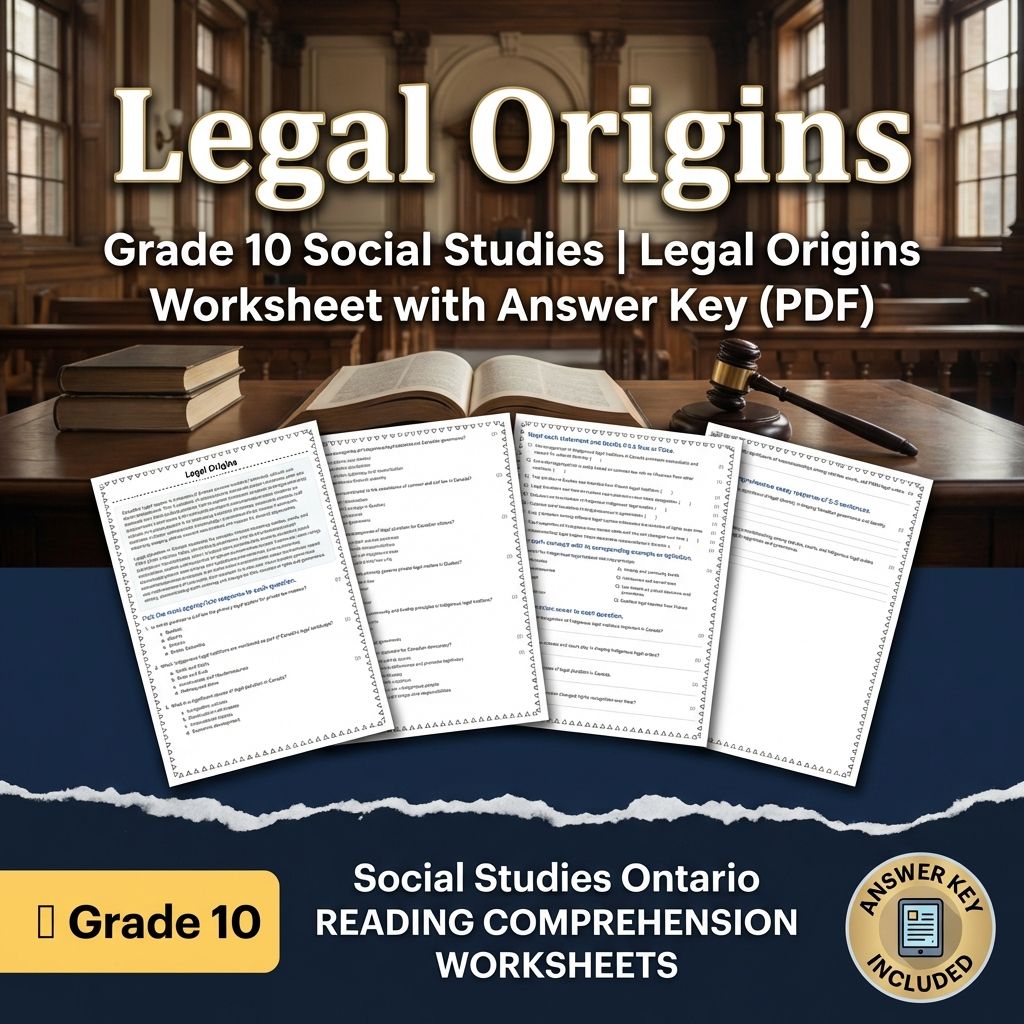
Grade 10 Social Studies | Legal Origins Worksheet with Answer Key (PDF)
JCreated byJ.S SheetsLearning Objectives
- Identify different sources of Canadian law, including common law, civil law in Quebec, and Indigenous legal traditions.
- Explain the significance of legal diversity in Canada and its impact on governance legitimacy.
- Analyze causes and consequences of legal pluralism and understand its influence on rights recognition over time.
Instant download

Hazard Risk Reduction Worksheet for Grade 10 Science | Standards-Aligned
JCreated byJ.S SheetsLearning Objectives
- Understand how natural Earth processes create hazards and how human choices can influence their impacts.
- Compare various hazard mitigation strategies such as early warning systems, land-use planning, engineered barriers, and management practices.
- Analyze the effectiveness of different approaches by examining historical disaster records and measurable outcomes.
Also included in: Grade 10 Climate and Earth Systems Science Lesson Bundle – California Standards +1 more
Instant download

Tissue Organization Worksheet Grade 10 Science Activities
Created byPrism Point LearningLearning Objectives
- Explain how similar cells work together to form tissues with shared functions (transport, support, secretion).
- Describe how plant vascular tissues (xylem and phloem) support long-distance movement of water and solutes.
- Compare epithelial and connective tissues in animals and relate their structure to barrier and support roles.
Also included in: Cell Organization & Homeostasis Grade 10 Science Lesson Bundle | Alberta
Instant download

Creative Expressions Worksheet | May Grade 10 Holiday Assessment
 Created byCedar Grove Learning
Learning Objectives
- Analyze how creative works (poetry, art, music) communicate feelings such as love, gratitude, and admiration.
- Explain how cultural and personal stories can shape creative expressions for mothers.
- Create and interpret messages that express complex emotions with clarity and empathy.
Also included in: Grade 10 Mother's Day Holiday Lesson Bundle for May +1 more
Instant download
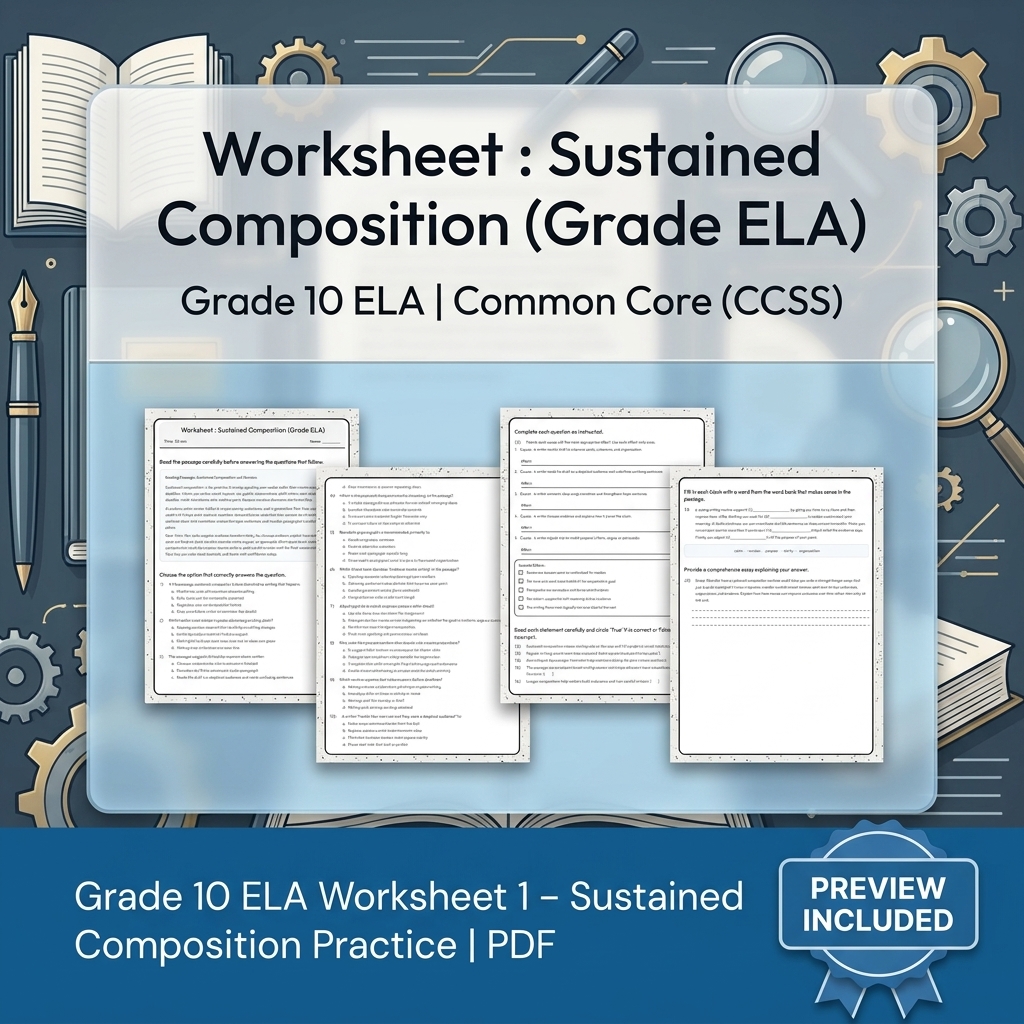
Grade 10 ELA Sustained Composition Practice Worksheet with short notes | PDF
Created byMeadowlark WorksheetsLearning Objectives
- Explain how sustained composition supports growth through drafting and revision over time.
- Identify strategies for improving clarity, coherence, and organization in a written draft.
- Use evidence and revise style to match purpose and audience needs.
Also included in: Grade 10 Transitions & Style ELA Lesson Bundle | Common Core (CCSS) +1 more
Instant download

Friction Dynamics Worksheet | AP Physics Forces Activity & Answer Key
 Created byBright Quill Resources
Learning Objectives
- Differentiate static friction and kinetic friction and relate each to the normal force and surface properties using coefficients.
- Analyze motion on an inclined plane by comparing the components of weight with frictional forces and determining when slipping occurs.
- Connect friction to energy dissipation and to how net force and acceleration change in dynamic situations.
Instant download

Grade 10 Science | Conservation Law - Daily Reading Comprehension
Created byCoral Reef LearningLearning Objectives
- Understand the law of conservation of energy
- Identify different forms of energy
- Explain how energy transfers occur in various systems
Instant download

Grade 10 ELA – Analyzing Theme Worksheet (PDF) | General ELA Standards
Created byGolden Apple StudioLearning Objectives
- Explain how theme develops from relationships among plot events, character choices, and conflicts
- Identify recurring motifs and describe how they contribute to a text’s implied message
- Use evidence to connect specific story elements to the author’s overall message about people and society
Also included in: Grade 10 Evidence-Based Text Analysis ELA Lesson Bundle for General ELA +1 more
Instant download

Decolonization Worksheet | Grade 10 Social Studies TEKS Activity
Created byThe Resource HubLearning Objectives
- Explain key causes and processes of decolonization in Africa, Asia, and the Caribbean after World War II
- Analyze how international pressure and institutions affected independence movements
- Evaluate the role of Cold War rivalry in shaping newly independent states
Also included in: Global Conflicts & Decolonization Lesson Bundle | Grade 10 Social Studies TEKS +1 more
Instant download

Grade 10 Science – Introduction to Earth's Spheres | Daily Reading Worksheet
 Created byBright Mind Resources
Learning Objectives
- Identify and describe the basic properties of the geosphere, hydrosphere, atmosphere, and biosphere.
- Explain how the Earth's spheres interconnect to influence regional landscapes and climate.
- Analyze regional examples from Alberta to illustrate sphere interactions.
Also included in: Grade 10 Sustainability Science Daily Reading Worksheets lesson bundle | Alberta +1 more
Instant download

Grade 10 ELA – Evidence Integration & Reading Comprehension | Daily Worksheet
Created byQuiet Forest EducationLearning Objectives
- Analyze character actions to understand underlying themes
- Integrate textual evidence into analysis with clear links
- Interpret nuanced language features to support claims
Also included in: Literary Analysis Grade 10 ELA Daily Reading Worksheets Lesson Bundle | CCSS +1 more
Instant download

Periodic Patterns Worksheet | Grade 10 AP Chemistry Practice Pack
Created byPrism Point LearningLearning Objectives
- Explain how effective nuclear charge and electron shielding influence trends in atomic radius, ionization energy, and electronegativity across periods and down groups.
- Use periodic trends to predict how elements’ properties and reactivity patterns change with position on the periodic table.
- Connect periodic patterns to underlying electron configurations and nuclear effects.
Instant download

Energy Currency Worksheet Pack Grade 10 AP Science Activities
Created byPrism Point LearningLearning Objectives
- Explain how ATP acts as an energy currency by coupling exergonic and endergonic reactions through phosphorylation.
- Use ideas of free energy, bond energy changes, and redox representation to judge whether a biochemical process is energetically feasible.
- Describe how ATP turnover helps maintain cellular organization and supports transient energy storage.
Also included in: Grade 10 AP Science Life Systems Lesson Bundle | Worksheet Pack
Instant download

Grade 10 Science | Population Patterns Worksheet | AP Aligned
Created byLumora LearningLearning Objectives
- Understand factors that influence population structure, including birth and death rates.
- Analyze population models and age-structure diagrams to interpret population dynamics.
- Relate organismal traits and environmental interactions to population cycles and range limits.
Also included in: Grade 10 Science | Biology and Ecosystems Custom Bundle | AP
Instant download

Grade 10 ELA – Purposeful Media Worksheet (Alberta) (PDF)
Created byGolden Apple StudioLearning Objectives
- Explain how purposeful media aligns message, medium, structure, tone, visuals, pacing, and evidence to a specific audience and purpose.
- Evaluate credibility by identifying and interpreting evidence, sourcing, and potential bias in media messages.
- Revise media drafts to strengthen clarity, accessibility, ethical representation, and a persuasive call to action.
Also included in: Grade 10 Media Literacy ELA Lesson Bundle Worksheets – Alberta Framework +1 more
Instant download

Grade 10 Holiday World Ocean Day Worksheet | Marine Ecosystems PDF + Answer Key
Created byShaNova WorksheetsLearning Objectives
- Explain how coral reefs, kelp forests, and deep-sea environments support marine biodiversity
- Describe key ecological functions of marine ecosystems, including food webs and habitat formation
- Connect marine ecosystem health to climate regulation and human livelihood
Also included in: Grade 10 World Ocean Day Holiday Custom Bundle NGSS Worksheet Set
Instant download

Grade 10 Science Ecosystem Management Daily Reading Worksheet with Answer Key
JCreated byJ.S SheetsLearning Objectives
- Identify components of ecosystems and their interactions
- Understand ecological principles in ecosystem management
- Recognize strategies used to preserve and restore ecosystems
Also included in: Grade 10 Science Lesson Group – Ecosystems and Environmental Impact Worksheets +1 more
Instant download

Grade 10 Science – Mutation & Evolution | Daily Reading Worksheet
Created byBright Mind ResourcesLearning Objectives
- Understand what DNA mutations are and how they occur.
- Identify different types of mutations and their effects on genes.
- Explain how mutations can lead to variation and influence evolution.
Also included in: Grade 10 Genetics & Evolution Science Lesson Bundle | California Standards +1 more
Instant download

Grade 10 Bonding Models Worksheet | Practice & Assessment PDF
Created byClear Sky ClassroomLearning Objectives
- Distinguish ionic, covalent, and metallic bonding using electron-transfer and electron-sharing models
- Use Lewis structures and basic bonding ideas to explain structure and observable properties (conductivity, melting point, solubility)
- Connect macroscopic material behaviors to microscopic bonding frameworks
Also included in: Grade 10 Chemistry Foundations Science Lesson Bundle: AP Worksheet Set +1 more
Instant download
Browse more categories
About Grade 10 Worksheets
Find Grade 10 worksheets covering algebra, biology, literature, and history. All 9,388 resources download instantly as PDFs for classwork, homework, or review.
MyTeachingSheets worksheets are made by real teacher-authors and checked before they go live. Download any as a print-ready PDF for lessons, homework, or independent practice — most include answer keys, and previews are always free.