
Grade 10 Worksheets
9,388 grade resources
Globalization Rise Worksheet | BC Standards Grade 10 Social Studies
JCreated byJ.S SheetsLearning Objectives
- Explain how trade liberalization and financial integration reshaped the global economy since the 1970s.
- Analyze how multinational corporations and policy changes (neoliberal reforms) influenced different regions and social groups.
- Evaluate consequences of globalization for labor, sovereignty, cultural exchange, and environmental challenges.
Instant download

Limiting Reagent Worksheet | Grade 10 Science Activities
 Created byPrism Point Learning
Learning Objectives
- Explain what a limiting reagent is and how it determines the maximum amount of product in a reaction.
- Use stoichiometric ratios and mole amounts to identify the limiting reactant.
- Connect limiting reagents to theoretical yield and the idea of conservation of mass in a closed system.
Also included in: Grade 10 Science Chemical Reactions & Atomic Structure Lesson Bundle | Bc +1 more
Instant download
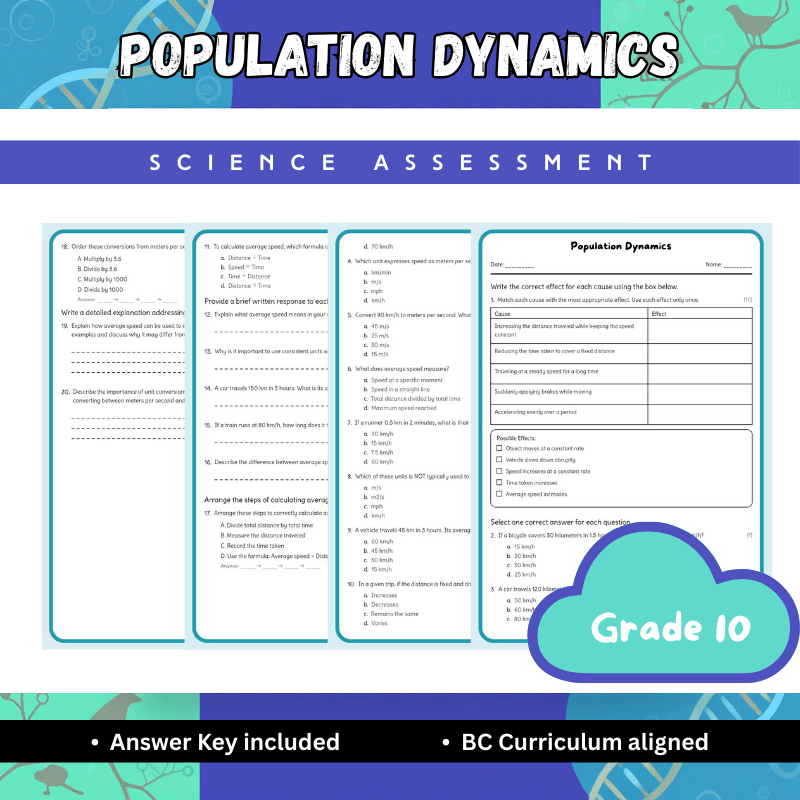
Grade 10 Science – Population Dynamics Worksheet (PDF) | BC Standards
 Created byBright Mind Resources
Learning Objectives
- Understand the basic concepts of population genetics and demographic change.
- Identify factors that cause deviations from Hardy-Weinberg equilibrium.
- Describe the roles of selection, mutation, migration, and drift in evolution.
Instant download

Grade 10 Science | Energy Transfer Worksheet | General Standards
 Created byLumora Learning
Learning Objectives
- Explain how energy transfers between systems and changes form during heating, work, and radiation.
- Connect kinetic, gravitational potential, and elastic energy to observable changes in motion, height, and deformation.
- Predict the direction of energy transfer based on evidence such as temperature rise, speed change, or height change.
Instant download

Grade 10 | National Pet Day for Mastering Pet Care Evolution | PDF + Answer Key
 Created byShaNova Worksheets
Learning Objectives
- Explore the history of pet care practices across different cultures.
- Understand how human-animal relationships have changed over centuries.
- Identify key developments in responsible pet ownership.
Instant download

Thermodynamics Worksheet for Grade 10 Science | Standards-Aligned Practice
JCreated byJ.S SheetsLearning Objectives
- Explain how the First Law of Thermodynamics applies to energy conservation in metabolism
- Describe how the Second Law relates to entropy increase and inefficiency in cellular processes
- Use Gibbs free energy (ΔG) to predict spontaneity and explain why ATP coupling is often necessary
Instant download
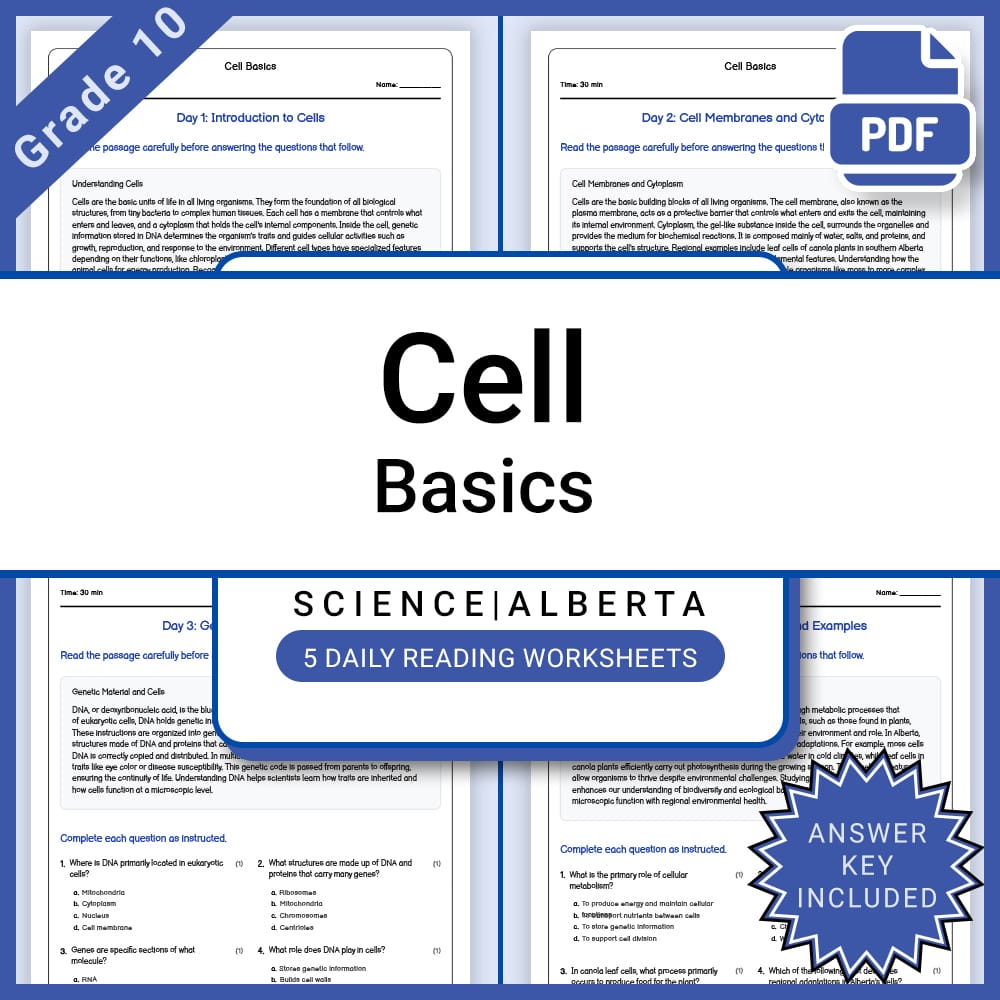
Grade 10 Science – Cell Basics Daily Reading Worksheet with Answer Key
JCreated byJ.S SheetsLearning Objectives
- Understand key concepts related to Science
- Apply knowledge through practice questions
- Demonstrate comprehension of the material
Also included in: Grade 10 Science Lesson Group: Alberta Curriculum — Daily Reading Worksheets +1 more
Instant download

Grade 10 Energy in Cells Worksheet | Practice & Assessment PDF
 Created byClear Sky Classroom
Learning Objectives
- Explain how cells obtain, convert, and use energy to maintain life processes
- Describe how cellular respiration converts energy in carbohydrates into ATP and powers cellular work
- Compare energy capture in photosynthesis with energy release in cellular respiration
Instant download

Grade 10 ELA | Credibility and Relevance Worksheet | Alberta Aligned
Created byLumora LearningLearning Objectives
- Explain how credibility and relevance help readers interpret ideas and arguments
- Identify evidence, sourcing, bias, timeliness, and transparency as credibility signals
- Evaluate whether information directly supports a question, theme, or claim
Instant download

Grade 10 Tension And Normal Worksheet | Practice & PDF
Created byClear Sky ClassroomLearning Objectives
- Explain what tension is and how it transmits force along a connector such as a rope or string.
- Describe the normal force as a contact force perpendicular to a surface and relate it to components of weight.
- Use free-body representations to predict how forces affect acceleration on inclines and in connected systems.
Instant download

Grade 10 | Senior Citizens Day Worksheet for Aging & Society | PDF + Answer Key
Created byShaNova WorksheetsLearning Objectives
- Explain how cultural attitudes toward aging can influence community values and inclusion.
- Use age-related vocabulary (such as empathy, intergenerational, and discrimination) in context.
- Analyze how societal perceptions of aging affect policies and opportunities for seniors.
Instant download

Nuclear Deterrence Worksheet | Standards-Aligned Grade 10 Social Studies
JCreated byJ.S SheetsLearning Objectives
- Explain the core logic of deterrence theory and why credibility mattered during the Cold War.
- Describe how arms races and second-strike capability influenced nuclear strategy.
- Evaluate how geography, technology, ideology, and politics shaped nuclear policymaking.
Instant download

Grade 10 Science – Force & Motion Daily Reading Worksheet | Alberta Standards
Created byBright Mind ResourcesLearning Objectives
- Understand the concept of net force and inertia.
- Explain how mass and applied forces influence acceleration.
- Apply Newton's First Law to real-world examples.
Also included in: Grade 10 Daily Reading Science Full-Year Bundle for Alberta
Instant download
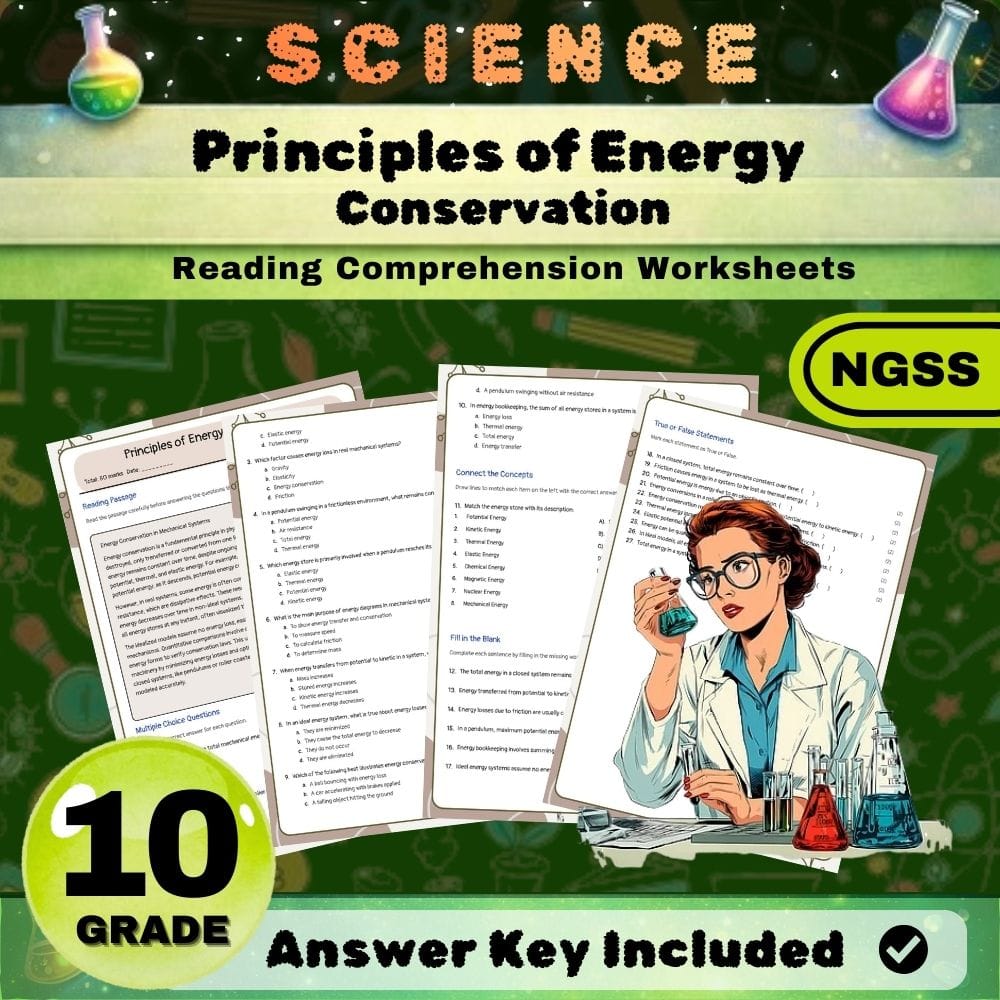
Grade 10 Science | Principles of Energy Conservation Worksheet (NGSS PDF)
 Created byMaple Path Learning
Learning Objectives
- Explain the concept of energy conservation in closed and isolated systems.
- Identify examples of energy conversions between kinetic and potential energy.
- Analyze how energy transfers and losses occur in mechanical examples like roller coasters and pendulums.
Also included in: Grade 10 Energy Science Worksheets Bundle | NGSS Lesson Resources +1 more
Instant download

Phrase and Clause Use Worksheet | Common Core ELA Practice for Grade 10
JCreated byJ.S SheetsLearning Objectives
- Distinguish phrases from clauses and identify how each contributes to sentence meaning.
- Use descriptive phrases and dependent clauses to clarify nouns and communicate conditions, reasons, or details.
- Revise sentences to correct misplaced or overstuffed phrase/clause structures for logical flow.
Instant download

Quotation and Dialogue Worksheet Grade 10 ELA Ontario Writing Skills
 Created bySunny Desk Resources
Learning Objectives
- Use quotation marks to correctly present spoken dialogue in writing.
- Apply standard punctuation conventions (commas and periods) inside or outside quotation marks.
- Handle interrupted dialogue with appropriate dialogue tags such as said or asked.
Instant download

Grade 10 Science | Motion Graphs - Daily Reading Comprehension
 Created byCoral Reef Learning
Learning Objectives
- Understand how to interpret position-time graphs
- Identify constant and changing motion from graphs
- Relate the slope of a graph to velocity and acceleration
Instant download

Grade 10 Science Worksheet | Rock Cycle & Earth's Processes (PDF)
 Created byEvergreen Desk Education
Learning Objectives
- Describe how igneous, sedimentary, and metamorphic rocks are transformed as Earth materials move through the rock cycle.
- Explain the roles of physical and chemical processes (melting, crystallization, weathering, transport, deposition, lithification, and metamorphism) in redistributing materials and elements.
- Compare how plate tectonics links to heat/pressure changes and how surface processes drive recycling over different timescales.
Also included in: Grade 10 Earth Systems Geology Science Lesson Bundle: Ontario Worksheets +1 more
Instant download

Grade 10 Science — Worksheet MCQ Paper for Mastering Effective Charge
 Created byThe Resource Hub
Learning Objectives
- Understand the concept of effective nuclear charge (Zeff) and how it influences atomic properties.
- Analyze periodic trends in atomic radius, ionization energy, and electron affinity based on Zeff adjustments.
- Compare isoelectronic series to explain variations in valence electron attraction and reactivity.
Also included in: Grade 10 Science Chemistry Foundations Lesson Bundle for AP Curriculum +1 more
Instant download

Grade 10 Rock Cycle Worksheet | Ontario Science Resource with Answer Key
Created byClear Sky ClassroomLearning Objectives
- Explain how igneous, sedimentary, and metamorphic processes connect in the rock cycle.
- Describe how physical and chemical drivers (heat, pressure, fluids, weathering chemistry) transform rocks.
- Relate the rock cycle to plate tectonics and surface processes, including timescales of rock-type turnover.
Instant download

Academic Vocabulary Worksheet Grade 10 ELA | CCSS Word Study & Context Clues Practice
Created bySunny Desk ResourcesLearning Objectives
- Use academic vocabulary (e.g., analyze, evaluate, characterize) to express precise meaning in writing.
- Select domain-specific terms and academic verbs to clarify claims, evidence, and explanations.
- Revise vague phrasing by replacing general words with more accurate academic vocabulary.
Also included in: Grade 10 ELA Mood, Tone & Grammar Worksheets Lesson Bundle | CCSS +1 more
Instant download

Disease Prevention Health Worksheet | NHES Grade 10 Assessment
 Created bySkylark Worksheets
Learning Objectives
- Understand strategies to prevent common diseases such as infections, cardiovascular diseases, and diabetes.
- Identify behaviors and environmental factors that influence disease development.
- Recognize early warning signs and screening procedures for disease detection.
Also included in: Grade 10 Health | Functional Health Concepts Unit & Worksheet Bundle +1 more
Instant download

DNA Replication Assessment for Grade 10 Science TEKS Standards
Created byPrism Point LearningLearning Objectives
- Describe the process of DNA replication and the role of key enzymes involved.
- Identify the difference between leading and lagging strands during replication.
- Explain the significance of proofreading activities in maintaining DNA sequence fidelity.
Also included in: Lesson Grade 10 Genetics: DNA, RNA, Protein Science Lesson Bundle TEKS
Instant download
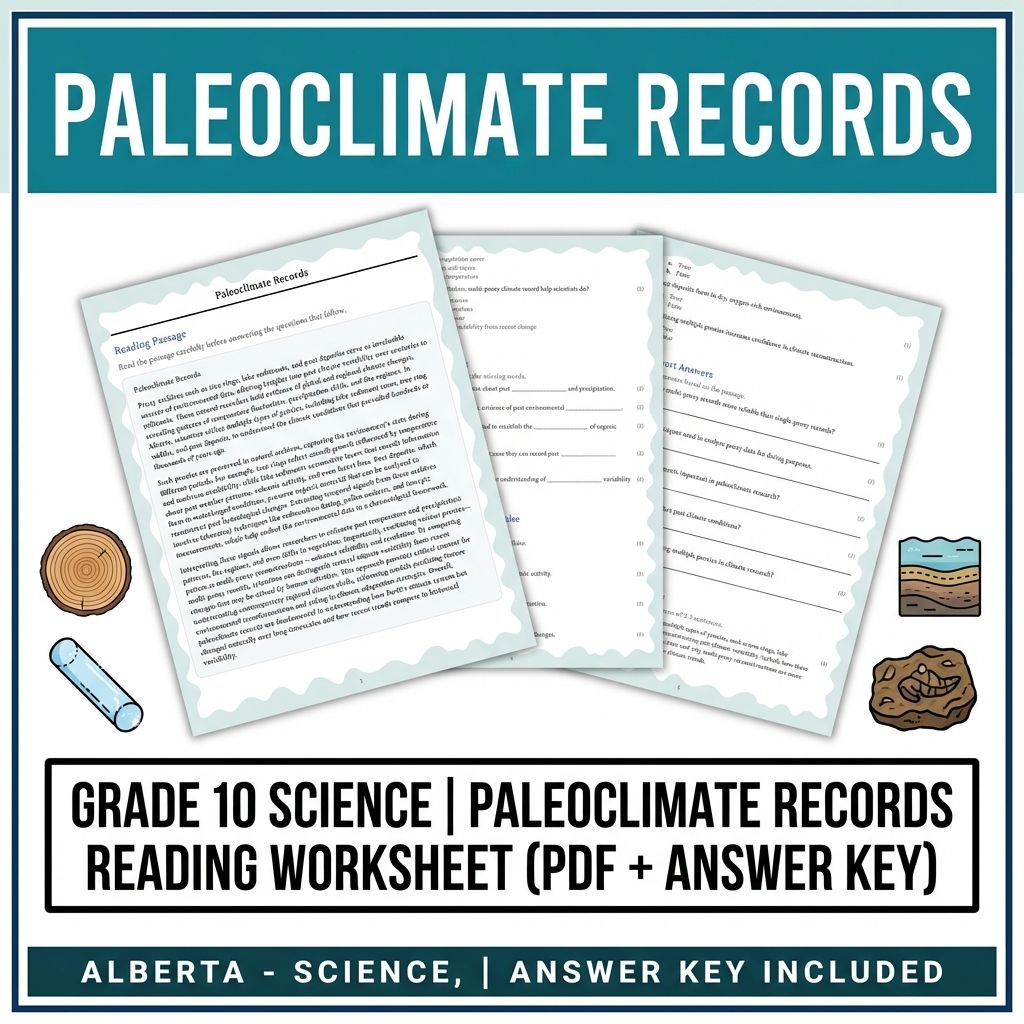
Grade 10 Science | Paleoclimate Records Reading Worksheet (PDF + Answer Key)
JCreated byJ.S SheetsLearning Objectives
- Understand what proxy archives are and their significance in reconstructing past climates.
- Identify different types of paleoclimate proxies found in Alberta.
- Explain the methods used to extract and interpret climate signals from proxy records.
Also included in: Grade 10 Science Unit Bundle – Earth Systems, Climate & Remote Sensing Worksheets +1 more
Instant download

Industrial Revolution Worksheet | Standards-Aligned Grade 10 Social Studies
JCreated byJ.S SheetsLearning Objectives
- Explain how the Industrial Revolution changed economies from agrarian production to industrial manufacturing.
- Identify key technological, transportation, and communication developments associated with the Industrial Revolution.
- Analyze social impacts of factory work, urbanization, and new labor systems on different groups.
Instant download

Work And Energy Worksheet | Grade 10 Science Activities
Created byPrism Point LearningLearning Objectives
- Explain how work transfers energy into or out of a system and how it relates to kinetic energy changes.
- Use the work–energy principle and conservation ideas to describe motion and energy changes in real situations.
- Distinguish between work, power, and energy stores (kinetic and potential) and apply them to sample problems.
Also included in: Grade 10 Energy, Efficiency & Conservation Science Lesson Bundle | BC +1 more
Instant download

Central Idea Development Worksheet Grade 10 ELA | CCSS Reading Analysis
Created bySunny Desk ResourcesLearning Objectives
- Identify how a central idea develops across an informational text through repeated references and key terms.
- Summarize an informational article by capturing the overall message and the most important supporting points.
- Track cause-and-effect explanations in an argument-driven informational text to strengthen central idea development.
Also included in: Grade 10 Text Analysis & Argument Writing Lesson Bundle | Common Core ELA +1 more
Instant download

Grade 10 Pronoun Reference Worksheet | Writing Clarity Practice | TEKS
Created bySunny Desk ResourcesLearning Objectives
- Identify the antecedent a pronoun refers to in complex sentences.
- Choose pronouns that match antecedents in person and number.
- Avoid unclear or shifting pronoun reference that weakens an argument.
Instant download

Trait Origins Worksheet | NGSS-Aligned Science Practice for Grade 10
JCreated byJ.S SheetsLearning Objectives
- Understand the molecular mechanisms that lead to heritable trait variation, including mutation, recombination, gene flow, and chromosomal changes.
- Identify examples of how genetic variation affects phenotypic traits such as enzyme variants and morphological features.
- Explain how population processes like genetic drift and nonrandom mating influence trait distribution and prevalence.
Also included in: Grade 10 Evolution and Speciation Science Lesson Bundle – NGSS Framework
Instant download

Ecosystem Stability, Disturbance & Succession Worksheet | NGSS Grade 10
 Created byAmber Owl Education
Learning Objectives
- Explain how feedbacks and functional redundancy influence ecosystem stability after disturbance.
- Describe resilience concepts using resistance, recovery time, and alternative stable states.
- Use successional dynamics to predict long-term ecosystem trajectories after repeated disturbances.
Instant download

Grade 10 ELA – Purposeful Organization Worksheet (Alberta Standards) (PDF)
 Created byGolden Apple Studio
Learning Objectives
- Identify how a speaker’s purpose (persuasive, informative, or explanatory) shapes organization
- Select and justify an order of ideas that reduces confusion and supports comprehension
- Use evidence of coherence (clear main points, connected supporting details, and signposting) to evaluate presentations
Also included in: Grade 10 Purposeful Communication ELA Lesson Bundle for Alberta Framework +1 more
Instant download

Grade 10 Credibility and Bias Worksheet | Ontario ELA Media Literacy
Created bySunny Desk ResourcesLearning Objectives
- Identify credibility signals such as accurate claims, strong evidence, and transparent sourcing in texts
- Analyze how bias and point of view can appear through loaded language, selective details, and omissions
- Compare two accounts of the same event to determine which is more reliable and why
Instant download

Grade 10 Reaction Classification Worksheet | BC Practice PDF
Created byClear Sky ClassroomLearning Objectives
- Classify common chemical reactions (synthesis, decomposition, displacement, combustion, acid–base neutralization, and precipitation) based on reactants and observable evidence.
- Predict likely products by identifying the reaction class and matching it to typical particle/ion rearrangements.
- Explain how reaction conditions and observable signs (gas, heat change, precipitate) support a reaction classification.
Instant download

Grade 10 Science – Comparative Anatomy & Evolution | Daily Reading Worksheet
Created byBright Mind ResourcesLearning Objectives
- Understand the concept of homologous structures and their significance in evolution
- Identify features that indicate shared ancestry among different organisms
- Differentiate between homologous and analogous structures
Also included in: Grade 10 Evolution & Genetics Science Daily Reading Lesson Bundle | BC +1 more
Instant download

Grade 10 Science | Reaction Types in Chemistry - Daily Reading Comprehension
Created byCoral Reef LearningLearning Objectives
- Identify synthesis reactions and their characteristics
- Differentiate between various reaction types such as decomposition, displacement, and combustion
- Predict reaction outcomes based on reactant properties
Also included in: Matter and Chemical Change Lesson Bundle: Grade 10 Science Alberta +1 more
Instant download

Author Choices Shape Meaning Grade 10 ELA Worksheet Practice
Created bySunny Desk ResourcesLearning Objectives
- Analyze how author choices in diction, syntax, figurative language, and tone shape meaning
- Explain how structure (e.g., pacing, framing, and transitions) guides a reader’s interpretation
- Compare how two texts about similar events can emphasize different values and character traits through craft decisions
Also included in: Reading and Viewing Lesson Bundle | Grade 10 ELA Alberta +1 more
Instant download

Purpose and Impact Worksheet Grade 10 ELA Ontario Text Analysis
Created bySunny Desk ResourcesLearning Objectives
- Analyze how a text’s purpose shapes its structure and the information it reveals over time
- Evaluate how style choices (diction, sentence rhythm, and dialogue conventions) create tone and pacing
- Explain how craft choices influence an audience’s emotional and intellectual response
Instant download

Reaction Types Worksheet | Alberta Grade 10 Science Practice
JCreated byJ.S SheetsLearning Objectives
- Identify and describe the main types of chemical reactions including synthesis, decomposition, single and double displacement, and combustion.
- Predict products of common reaction types based on species transformations and indicators.
- Interpret reaction equations and classify them according to reaction type under provincial environmental conditions.
Also included in: Grade 10 Science Practice Worksheets: Alberta Science Full-Year Bundle
Instant download

Grade 10 Constant Acceleration & Composite Motion Worksheet | Ontario
 Created byChalk and Compass
Learning Objectives
- Use kinematic equations to determine displacement and velocity for one-dimensional motion with constant acceleration.
- Apply boundary conditions with consistent sign conventions to interpret negative acceleration and reversed motion.
- Analyze multi-stage motion by matching the correct equation to each stage and connecting initial and final values.
Also included in: Grade 10 Science Motion, Forces & Momentum Lesson Bundle – Ontario Framework +1 more
Instant download

Grade 10 Science | Cell Types From Regulation Worksheet | California Standards
Created byLumora LearningLearning Objectives
- Explain how differential gene expression leads to specialized cell types in multicellular organisms.
- Describe how timing and intensity of gene regulation affect developmental pathways.
- Connect regulatory patterns over time to tissue maintenance and cellular adaptation.
Instant download

Grade 10 Molecular Coding Worksheet | DNA & Genetics NGSS Science
 Created byBRIGHT PATH RESOURCES
Learning Objectives
- Understand the structure of DNA and how its sequence encodes proteins.
- Explain the processes of transcription and translation within protein synthesis.
- Identify how mutations, such as point mutations and frameshifts, affect protein structure and function.
Also included in: Human Physiology Grade 10 Science Daily Reading Worksheets Lesson Bundle | Ngss +1 more
Instant download

Grade 10 Science | Population Genomics Worksheet (AP Standards) (PDF)
Created byEvergreen Desk EducationLearning Objectives
- Explain how allele frequency models connect molecular variation to population-level patterns in evolution.
- Describe how mutation, gene flow, selection, and genetic drift shape genomic diversity and allele frequencies.
- Interpret population structure and phylogenetic evidence from sequence data to infer evolutionary and demographic histories.
Also included in: Grade 10 Genetics & Cell Systems Science Lesson Bundle – Advanced Placement (AP) +1 more
Instant download

Grade 10 Work And Power Worksheet | Alberta Practice PDF
Created byClear Sky ClassroomLearning Objectives
- Explain the relationship between force, displacement, and work using W = Fd cos(θ) (and recognize when cos(θ) = 1).
- Calculate power as energy transfer per unit time and interpret what “high power” means in everyday contexts.
- Distinguish between work (energy transferred) and power (rate of energy transfer) using units such as joules and watts.
Instant download

Grade 10 | Left Handers Day Worksheet for Mastering Origins | PDF + Answer Key
Created byShaNova WorksheetsLearning Objectives
- Explain how culture and history have shaped perceptions of left-handedness
- Describe how genetics, the brain, and environment contribute to handedness
- Evaluate common myths and stereotypes about left-handers
Instant download

Grade 10 Clear Presenting Worksheet | Ontario ELA Presentation Skills
Created bySunny Desk ResourcesLearning Objectives
- Use logical sequencing and purposeful transitions to keep spoken ideas coherent.
- Choose precise, specific language that improves clarity and supports a main topic goal.
- Connect main points to relevant supporting details and use effective openings and closings.
Instant download

Grade 10 Speciation Processes Worksheet | NGSS Evolution Science Activity
Created byBRIGHT PATH RESOURCESLearning Objectives
- Understand the concept of speciation and its significance in biodiversity.
- Identify different mechanisms of speciation such as geographic, ecological, polyploidy, and behavioral.
- Analyze empirical examples illustrating various speciation processes.
Also included in: Genetics & Evolution Grade 10 Science Worksheets Lesson Bundle | NGSS +1 more
Instant download

Grade 10 ELA | Reasoning Evaluation Worksheet (PDF) aligned with CCSS
Created byGolden Apple StudioLearning Objectives
- Evaluate whether a claim logically follows from the evidence provided.
- Assess the quality and relevance of evidence supporting a speaker’s point of view.
- Identify common patterns of fallacious reasoning and misleading framing in arguments.
Also included in: Source Integration & Presentation Synthesis Lessons | Grade 10 ELA | Common Core +1 more
Instant download

Work Concepts Worksheet AP Physics Activity Grade 10 with Answer Key
 Created byBright Quill Resources
Learning Objectives
- Define work in terms of force component along displacement and explain why work is a scalar quantity.
- Use the work-energy relationship to connect net work with changes in kinetic energy.
- Differentiate conservative and nonconservative forces by how they affect mechanical energy during motion.
Instant download
Browse more categories
About Grade 10 Worksheets
Find Grade 10 worksheets covering algebra, biology, literature, and history. All 9,388 resources download instantly as PDFs for classwork, homework, or review.
MyTeachingSheets worksheets are made by real teacher-authors and checked before they go live. Download any as a print-ready PDF for lessons, homework, or independent practice — most include answer keys, and previews are always free.