
Grade 10 Worksheets
9,388 grade resources
Grade 10 ELA – Daily Reading Worksheet & Character Motivation & Evidence
 Created byQuiet Forest Education
Learning Objectives
- Identify textual evidence that reveals a character’s motivation.
- Make inferences about characters based on quotes and details.
- Connect textual evidence to inferences logically and clearly.
Also included in: Grade 10 Reading ELA Daily Reading Worksheets Lesson Bundle | General ELA +2 more
Instant download

Grade 10 Worksheet B: Molecular Coding (DNA → Protein) Practice | NGSS PDF
 Created byClear Sky Classroom
Learning Objectives
- Explain how DNA nucleotide order determines mRNA codons and the amino acid sequence of a protein.
- Describe how translation and ribosomes help build proteins and how proteins fold into functional 3D structures.
- Compare effects of point mutations and frameshifts on protein structure and function.
Also included in: Grade 10 Cellular Regulation and Energy Pathways Science Lesson Bundle | NGSS +1 more
Instant download

Bond Energetics Worksheet for Grade 10 Science | NGSS Aligned Practice
JCreated byJ.S SheetsLearning Objectives
- Explain how bond formation and breaking relate to energy changes in chemical reactions.
- Differentiate between exothermic and endothermic processes based on energy flow.
- Interpret potential energy diagrams and bond enthalpy values to understand reaction heat changes.
Also included in: Grade 10 Chemical Reactions and Equilibrium Science – Lesson Bundle NGSS
Instant download

Grade 10 Health – Preventing STIs & Transmission | Daily Reading Worksheet
Created byQuiet Forest EducationLearning Objectives
- Understand how STIs are transmitted through different modes.
- Identify behaviors that increase or decrease the risk of STI transmission.
- Gain awareness of prevention strategies like condom use, testing, and vaccination.
Also included in: Healthy Living Grade 10 Health Daily Reading Worksheets Bundle | Ontario +2 more
Instant download

Grade 10 Motors And Generators Worksheet | Alberta Use Practice PDF
Created byClear Sky ClassroomLearning Objectives
- Explain how motors and generators convert between electrical energy and mechanical energy using electromagnetic forces
- Describe how a magnetic field and current in a coil produce torque or electrical induction
- Use quantitative relationships between current, magnetic field strength, and mechanical output to predict design trade-offs
Instant download
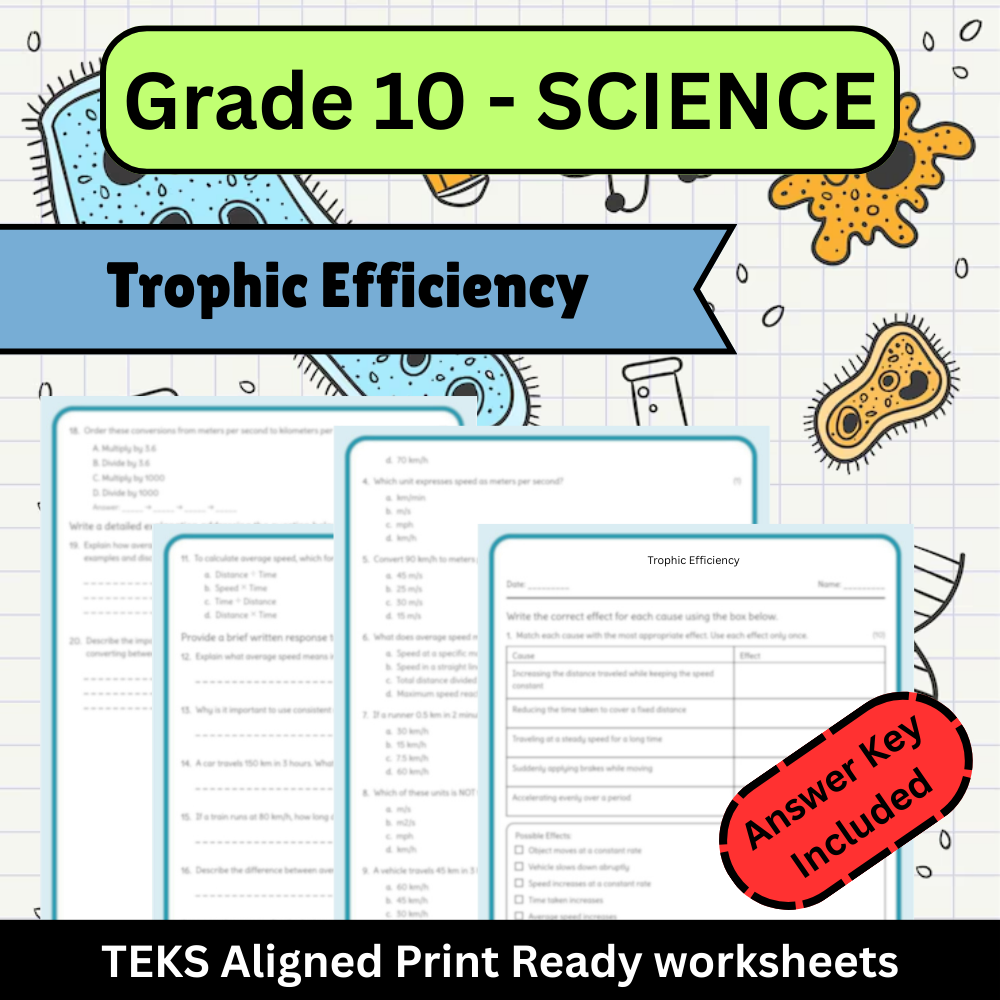
Grade 10 Science – Trophic Efficiency Worksheet (Worksheet + Answer Key) | TEKS Aligned
 Created byBright Mind Resources
Learning Objectives
- Define trophic efficiency and explain its significance in ecosystems.
- Identify factors that influence energy transfer between trophic levels.
- Analyze how variations in trophic efficiency affect food web structure and biomass pyramids.
Also included in: Grade 10 Science | Ecosystems & Biodiversity Unit Worksheet Bundle(TEKS-Aligned) +5 more
Instant download

Grade 10 Holiday Assessment | Public Demonstrations Worksheet May
 Created byCedar Grove Learning
Learning Objectives
- Explain why public demonstrations and strikes are used to advocate for workers’ rights.
- Analyze how peaceful civic engagement can influence social policies and democratic decision-making.
- Evaluate historical and contemporary examples of activism using evidence and respectful reasoning.
Also included in: Grade 10 May Day International Workers' Day Holiday Lesson Bundle: May +1 more
Instant download
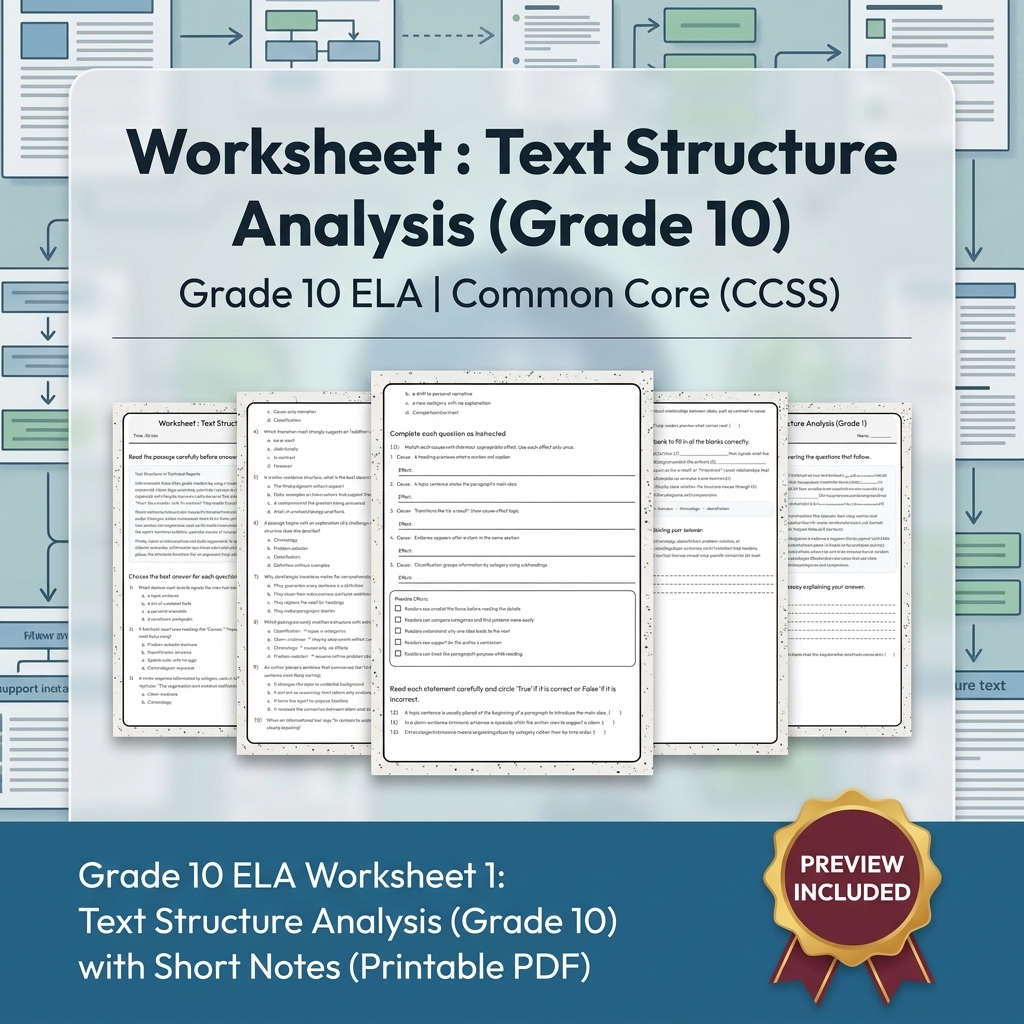
Grade 10 ELA Text Structure Analysis worksheet with Short Notes (Printable PDF)
 Created byMeadowlark Worksheets
Learning Objectives
- Identify common informational text structures (chronological, classification, problem–solution, and claim–evidence) in technical writing.
- Analyze how paragraphing, headings, topic sentences, and transitions organize ideas to shape comprehension.
- Evaluate how specific sentences function as parts of an argument map (claim, reasons, evidence, and conclusions).
Also included in: Grade 10 Text Structure Analysis ELA Lesson Bundle for Common Core (CCSS) +1 more
Instant download

Purpose Audience Context Worksheet | 10th Grade ELA BC Standards Practice
JCreated byJ.S SheetsLearning Objectives
- Analyze how purpose and audience shape the meaning of a text by influencing emphasis, detail, and rhetorical strategies.
- Identify how context (cultural norms and current events) can change interpretation of the same claim.
- Evaluate word choice, evidence, and structure to determine what a particular audience would likely expect as credible.
Instant download

Health Advocacy Skills Worksheet Grade 10 NHES Health Education Activity
 Created byPrism Point Learning
Learning Objectives
- Identify effective ways to communicate health concerns to healthcare providers and community groups.
- Use advocacy skills to support fair access to safe health products and accurate information.
- Evaluate whether health messages and statements support positive health policies.
Instant download

Grade 10 ELA Audience Aware Delivery Worksheet (PDF) – Alberta Standards
 Created byGolden Apple Studio
Learning Objectives
- Analyze how audience background knowledge changes speaking strategies during formal presentations.
- Apply audience-aware techniques such as pacing, emphasis, rephrasing, and example selection to improve clarity.
- Identify how to balance technical terms with plain language while maintaining accuracy.
Also included in: Grade 10 Purposeful Communication ELA Lesson Bundle for Alberta Framework +1 more
Instant download

Grade 10 Organizational Signals Worksheet | ELA Text Structure Analysis
 Created bySunny Desk Resources
Learning Objectives
- Explain how headings, topic sentences, transitions, and paragraph order help readers understand informational texts
- Identify organizational signals and describe what each one does for meaning
- Analyze how text structure shapes a reader’s interpretation of cause and effect or evidence
Also included in: Grade 10 Literary Analysis & Text Evidence Lesson Bundle | General ELA +1 more
Instant download

Grade 10 Science | Wave Properties NGSS Worksheet (PDF)
 Created bySilver Birch Teaching
Learning Objectives
- Understand the mathematical relationships between wave parameters such as amplitude, wavelength, frequency, and wave speed.
- Interpret sinusoidal and periodic wave models using trigonometric functions and phase relationships.
- Explain the phenomena of superposition, interference patterns, and standing waves in wave systems.
Also included in: Grade 10 Waves and Signals Science Lesson Bundle: NGSS System & EM Behavior +1 more
Instant download

Grade 10 Social Studies — Worksheet MCQ Paper for Mastering Homefront Changes
 Created byThe Resource Hub
Learning Objectives
- Explain how wartime labor demand and government regulation reshaped homefront life in 1939–1945
- Analyze the causes and consequences of rationing, workplace inclusion, and migration on gender and family patterns
- Evaluate continuity and change in social policy and cultural life from the war period into postwar society
Also included in: Grade 10 Canadian History Since World War I Social Studies Custom Bundle Ontario +1 more
Instant download

Grade 10 Similarity Scale Factor Worksheet | Geometry Practice CCSS
 Created byBRIGHT PATH RESOURCES
Learning Objectives
- Recognise when two figures are similar using corresponding angles and a constant scale factor.
- Calculate a corresponding length using multiplication (or division) with the scale factor from one figure to the similar figure.
- Interpret scale factor directions (from original to image, and image back to original) correctly.
Also included in: Grade 10 Geometry Math Lesson Bundle: CCSS Trig & Similarity +1 more
Instant download

Grade 10 Explanatory Organization Worksheet | ELA Informative Writing
Created bySunny Desk ResourcesLearning Objectives
- Identify how explanatory writing uses logical order to guide readers from main ideas to specific details.
- Apply transitions and linking phrases to clearly show relationships between ideas and paragraphs.
- Revise an explanatory draft by checking purpose, structure, and consistency of the idea sequence.
Also included in: Grade 10 Argument & Revision Writing Lesson Bundle | ELA, General ELA +1 more
Instant download

Purpose and Audience Worksheet | Standards-Aligned ELA Practice Grade 10
JCreated byJ.S SheetsLearning Objectives
- Analyze how purpose (inform, persuade, entertain) shapes the tone, organization, and word choice of a text.
- Determine how audience expectations affect the level of detail and complexity of language in writing.
- Revise a draft by adjusting evidence, tone, and structure to better match a specific audience and purpose.
Instant download

Grade 10 ELA Worksheet Comparing Formats | Standards-Aligned Practice
JCreated byJ.S SheetsLearning Objectives
- Analyze how different media formats (news article, podcast, video) organize information and emphasize different details.
- Identify what stays consistent across formats (core claim) and what changes (support, framing, interpretive guidance).
- Evaluate how timing, visuals, and narration influence audience interpretation.
Instant download
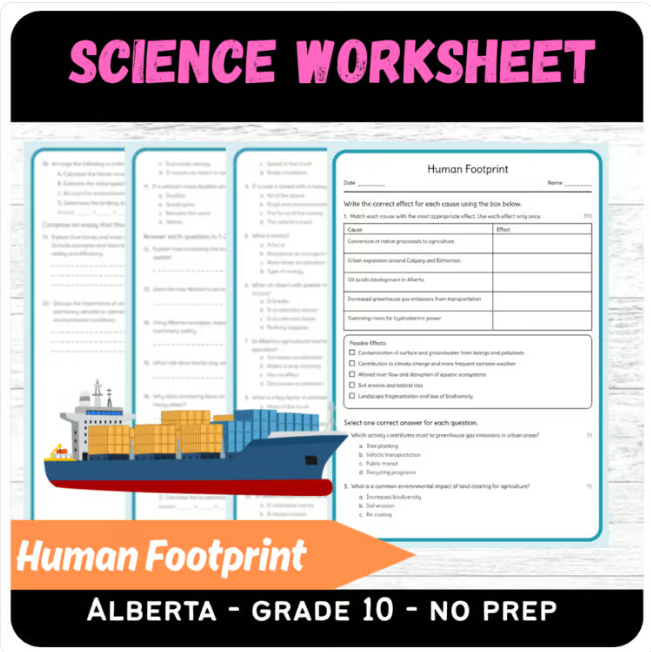
Grade 10 Science – Human Footprint Worksheet (PDF) | Alberta Standards
Created byBright Mind ResourcesLearning Objectives
- Understand how human activities impact Earth's land, water, and atmosphere.
- Identify regional examples of land-use change and their environmental effects.
- Analyze the long-term sustainability of resource management practices.
Instant download

Grade 10 Figurative Language Worksheet | Ontario ELA Literary Analysis Activity
 Created byLumora Learning
Learning Objectives
- Identify metaphor, simile, personification, hyperbole, and irony in Grade 10 texts
- Explain how figurative language shapes tone and clarifies relationships between ideas
- Determine how figurative patterns influence audience judgment and a text’s message
Instant download

Grade 10 Math – Modeling Applications Worksheet (Ontario) PDF
Created byClear Sky ClassroomLearning Objectives
- Understand how quadratic relations can model real-world situations.
- Formulate quadratic expressions from contextual problems.
- Apply vocabulary and concepts related to quadratic functions in practical scenarios.
Also included in: Grade 10 Math Quadratic Relations Applied Lesson Bundle for Ontario +1 more
Instant download

Design Tradeoffs Worksheet | Grade 10 Engineering Science Practice
Created byPrism Point LearningLearning Objectives
- Explain how improving one design criterion can worsen another when constraints are present
- Identify common engineering design criteria (stiffness, safety margin, fatigue resistance, mass, and cost) and how they trade off
- Use tradeoff reasoning to justify a best overall design choice for a given set of requirements
Instant download
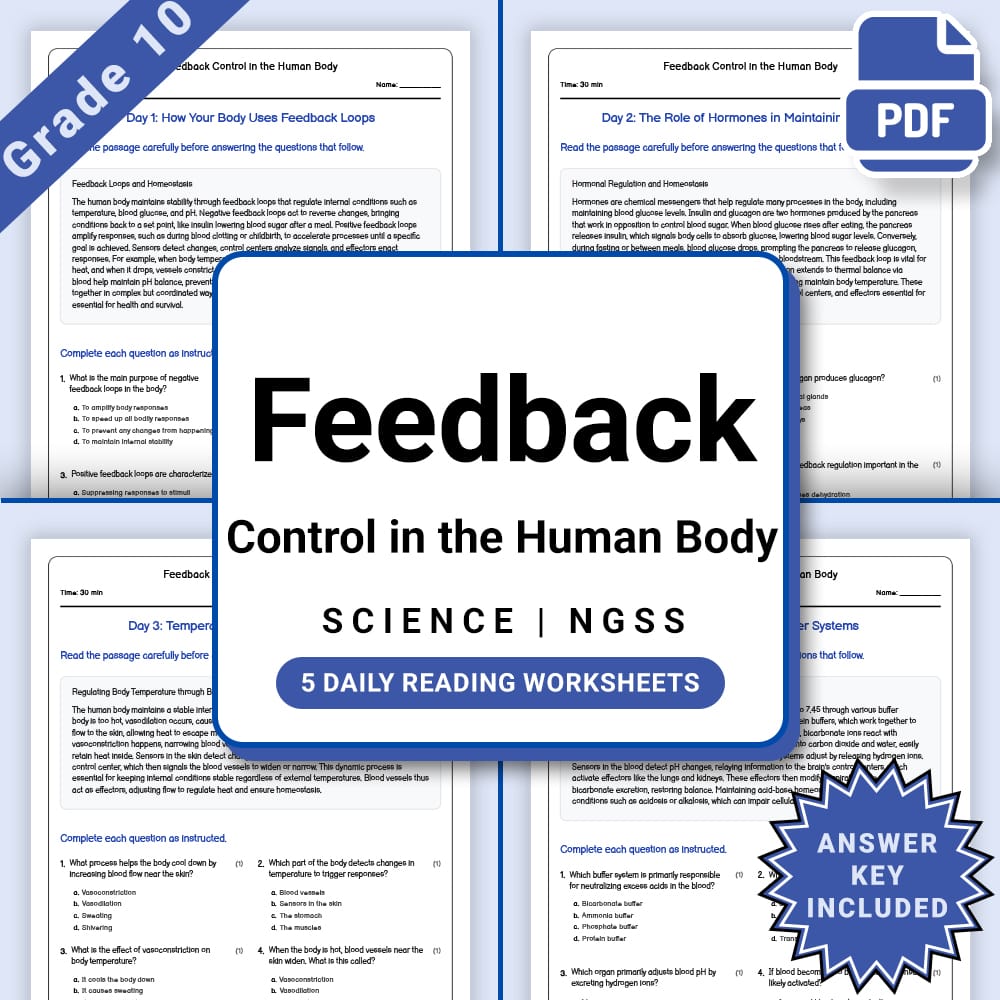
Grade 10 Science – Feedback Control in the Human Body Worksheet(PDF +Answer Key)
 Created byCopper Leaf Classroom
Learning Objectives
- Understand the concepts of negative and positive feedback loops
- Identify how feedback mechanisms regulate blood glucose, temperature, and pH
- Describe the roles of sensors, control centers, and effectors in homeostasis
Instant download

Grade 10 Rhetorical Devices in Persuasive Writing Worksheet | TEKS ELA
Created bySunny Desk ResourcesLearning Objectives
- Identify how rhetorical devices like contrast, analogy, repetition, rhetorical questions, parallelism, and imagery shape meaning in a text.
- Analyze how a writer’s placement and frequency of a device supports key claims and turning points.
- Explain how rhetorical choices guide logical and emotional responses in editorials and essays.
Instant download

Reaction Outcomes Worksheet | Grade 10 Chemistry Science CA Standards
 Created byEvergreen Desk Education
Learning Objectives
- Explain chemical reaction outcomes using an atomic-level model that focuses on rearrangement of atoms.
- Connect conservation of atoms to evidence for balanced chemical reactions.
- Use electron structure and bonding ideas to predict how reactants form new product combinations.
Instant download

Data Ethics and Privacy Worksheet | Grade 10 Computer Science Activity
Created byPrism Point LearningLearning Objectives
- Explain how privacy, consent, and data security connect to responsible data practices.
- Identify ethical and unethical uses of personal data in real-world scenarios.
- Describe how anonymization and access controls can reduce harm from data misuse.
Instant download

Grade 10 Science – Factors Influencing Reaction Speed | Daily Reading Worksheet
Created byBright Mind ResourcesLearning Objectives
- Identify variables that affect chemical reaction rates
- Understand how temperature, concentration, surface area, and catalysts influence reactions
- Analyze real-world examples of reaction rate changes
Also included in: Grade 10 Chemistry Science Lesson Bundle Daily Reading Worksheets | Alberta +1 more
Instant download

Grade 10 Adapting Genre Choices Worksheet | Ontario ELA Writing Activity
Created byLumora LearningLearning Objectives
- Identify how genre expectations shape writing choices such as structure, tone, and purpose
- Adapt a single topic into different genres by changing framing, organization, and evidence use
- Maintain a consistent core message while modifying length, style, and organization to fit a genre
Instant download

Grade 10 Writing in Forms Worksheet | Ontario ELA Writing Skills
Created bySunny Desk ResourcesLearning Objectives
- Identify how purpose and audience influence the structure and tone of different writing forms.
- Select genre-appropriate details, evidence, and transitions to improve coherence.
- Revise writing to balance voice and formality for an assigned genre.
Instant download

Grade 10 ELA | Audience Aware Delivery Worksheet | Alberta Assessment
Created byLumora LearningLearning Objectives
- Identify audience cues that indicate when a speaker should adjust pacing, emphasis, or terminology during a formal presentation.
- Choose delivery strategies that match audience needs, including rephrasing complex ideas and calibrating the amount of detail.
- Apply audience-aware speaking techniques to revise a presentation plan for listeners with different background knowledge.
Instant download

Grade 10 Tone and Connotation Worksheet | TEKS ELA Analysis Activity
Created byGolden Apple StudioLearning Objectives
- Explain how tone and connotation influence how a reader interprets a claim.
- Revise sentences by replacing neutral words with more precise words that match a writer’s intended attitude.
- Identify connotative meaning in words, including culturally and emotionally loaded terms.
Also included in: Grade 10 ELA Writing, Grammar & Figurative Language Lesson Bundle | TEKS +1 more
Instant download

Sentence Variety Worksheet for Grade 10 ELA | TEKS Writing Skills
Created byGolden Apple StudioLearning Objectives
- Explain how simple, compound, and complex sentences contribute to clarity and purpose in writing
- Use dependent clauses, transitions, and embedded phrases to add detail without confusing readers
- Combine sentences to reduce repetition while maintaining correct meaning and punctuation
Also included in: Grade 10 ELA Writing, Grammar & Figurative Language Lesson Bundle | TEKS +1 more
Instant download

Grade 10 Science | Cell Theory Basics - Daily Reading Comprehension
 Created byCoral Reef Learning
Learning Objectives
- Understand key concepts related to Science
- Apply knowledge through practice questions
- Demonstrate comprehension of the material
Instant download

Grade 10 Revision Strategies Worksheet | TEKS Clear Writing Skills
Created bySunny Desk ResourcesLearning Objectives
- Revise writing to improve clarity by replacing vague wording with specific phrases
- Strengthen coherence by maintaining consistent perspective and logical sequencing
- Use sentence variety and paragraph focus to refine emphasis and flow
Instant download

Cultural Movements Worksheet | TEKS-Aligned Social Studies Assessment Grade 10
JCreated byJ.S SheetsLearning Objectives
- Analyze how the Renaissance and Scientific Revolution changed social values and artistic expression.
- Explain how new methods of inquiry influenced scientific progress and public attitudes toward knowledge.
- Evaluate connections between cultural movements and long-term societal innovation.
Instant download
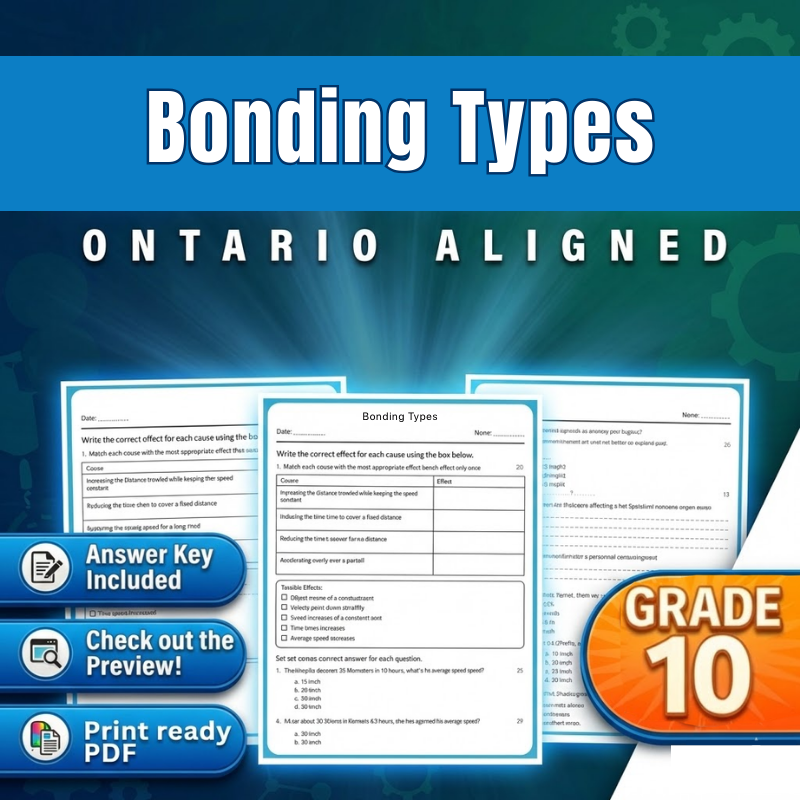
Grade 10 Science | Bonding Types Worksheet (Ontario) (PDF)
Created byBright Mind ResourcesLearning Objectives
- Understand the three main bonding types: ionic, covalent, and metallic.
- Explain how electron transfer and sharing influence bonding and structure.
- Identify properties associated with different bonding types, such as melting point and conductivity.
Instant download
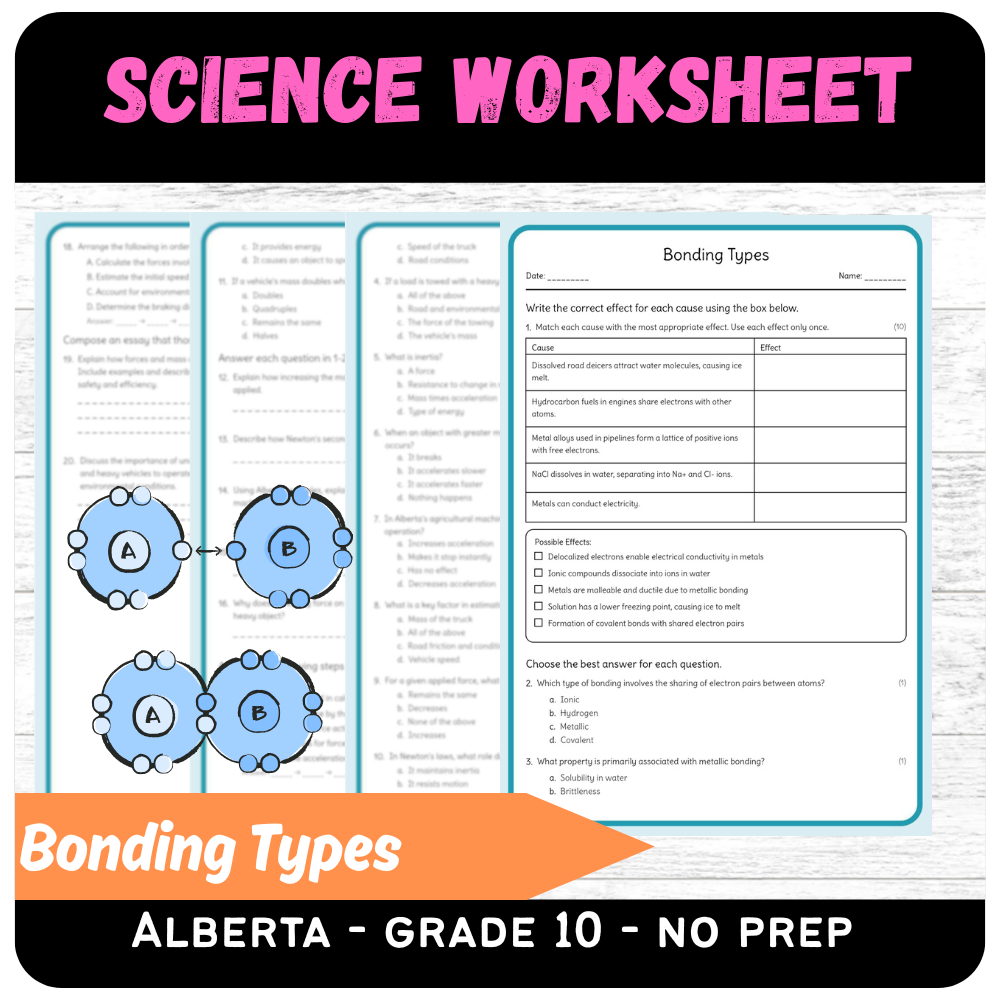
Grade 10 Science – Bonding Types Worksheet (PDF) – Alberta Standards
Created byBright Mind ResourcesLearning Objectives
- Identify the different types of bonding (ionic, covalent, metallic) at the particle level
- Explain how bonding types influence the physical properties of substances
- Predict physical properties based on atomic interactions and bonding types
Instant download

Grade 10 ELA Sentence Variety Worksheet | Alberta Writing Skills Practice
Created byLumora LearningLearning Objectives
- Identify and distinguish simple, compound, and complex sentences in order to improve sentence variety.
- Revise sentences to correct modifier placement, avoiding fragments and run-on sentences.
- Use appropriate transitions to strengthen clarity and logical connections between ideas.
Instant download

Grade 10 Science – Energy Pathways & Photosynthesis Daily Reading Worksheet
Created byBright Mind ResourcesLearning Objectives
- Describe the process of photosynthesis and its significance in energy capture
- Understand how light energy is converted into chemical energy within chloroplasts
- Identify the role of the Calvin cycle in carbon fixation
Also included in: Homeostasis Grade 10 Science Daily Reading Worksheets Lesson Bundle | NGSS +2 more
Instant download

Grade 10 ELA – Research & Reading Skills | Daily Reading Worksheet
Created byQuiet Forest EducationLearning Objectives
- Identify credible and relevant sources for research.
- Understand the importance of synthesizing information from multiple texts.
- Differentiate between summarizing sources and synthesizing ideas.
Also included in: Writing Grade 10 ELA Daily Reading Worksheets Lesson Bundle | CCSS +1 more
Instant download
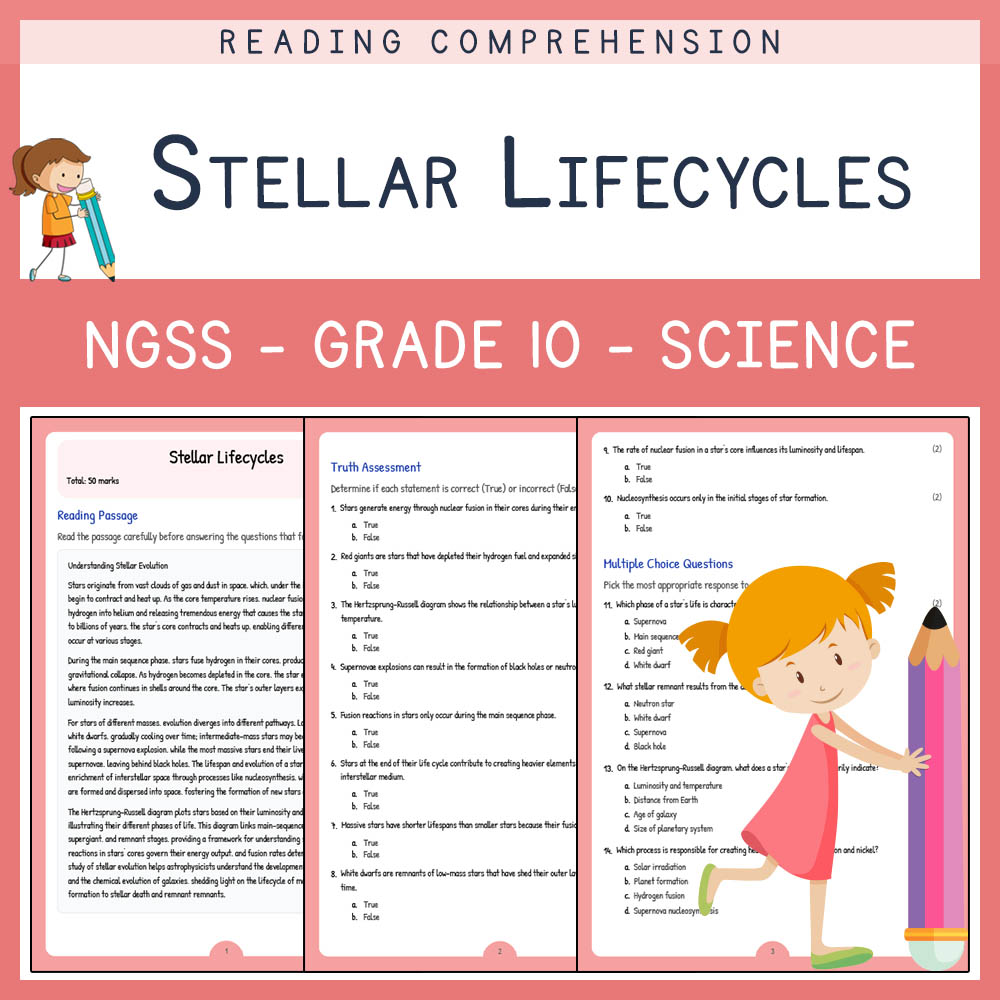
Grade 10 Science | Stellar Lifecycles Worksheet & Answer Key (NGSS Aligned)
Created byLumora LearningLearning Objectives
- Describe the key stages of stellar evolution and the processes involved.
- Interpret the Hertzsprung-Russell diagram and understand stellar nucleosynthesis pathways.
- Explain the different end-stage outcomes of stars and their significance in cosmic evolution.
Instant download

Grade 10 ELA – Daily Reading & Evidence Reasoning | Worksheets & Practice
Created byQuiet Forest EducationLearning Objectives
- Understand key concepts related to ELA
- Apply knowledge through practice questions
- Demonstrate comprehension of the material
Also included in: Writing Grade 10 ELA Daily Reading Worksheets Lesson Bundle | CCSS +1 more
Instant download

Text Structure Analysis Worksheet | CCSS Grade 10 ELA Practice
JCreated byJ.S SheetsLearning Objectives
- Identify common informational text structures (chronology, classification, problem–solution, and claim–evidence) and explain how they organize ideas.
- Use headings, topic sentences, and transitions to determine a writer’s purpose and the function of each paragraph.
- Analyze how evidence placement supports or limits a claim within a technical report or explanatory essay.
Instant download

Grade 10 Science | Kinematics Graphs - Daily Reading Comprehension
Created byCoral Reef LearningLearning Objectives
- Understand key concepts related to Science
- Apply knowledge through practice questions
- Demonstrate comprehension of the material
Instant download

Energy in Cells Worksheet | Cellular Respiration & Photosynthesis Grade 10
Created byPrism Point LearningLearning Objectives
- Explain how cells convert energy to power cellular processes.
- Compare cellular respiration and photosynthesis as energy-conversion pathways.
- Describe how ATP connects energy release to work inside cells.
Instant download

Grade 10 ELA Focused Paragraphs Worksheet – Standards Aligned (PDF)
Created byGolden Apple StudioLearning Objectives
- Identify how a topic sentence controls the purpose of a paragraph in an argumentative or explanatory piece.
- Revise paragraphs to remove unrelated ideas and maintain logical alignment between claims and supporting details.
- Use evidence and explanation that directly match the controlling claim to prevent contradictions and digressions.
Also included in: Grade 10 Evidence-Based Writing and Organization ELA Lesson Bundle – General ELA +1 more
Instant download

Grade 10 ELA – Implicit Meaning Evidence Worksheet (CCSS)
Created byGolden Apple StudioLearning Objectives
- Identify implicit meaning in an informational text by using wording signals such as modality, qualifiers, and emphasis.
- Select the best evidence that supports an inference grounded in textual clues rather than unstated assumptions.
- Distinguish between what the author explicitly says and what the reader can reasonably infer from context and language choices.
Also included in: Grade 10 ELA Text Structure & Evidence Lesson Bundle | Common Core +1 more
Instant download

Grade 10 ELA – Sentence Variety & Sentence Structure | Daily Reading Worksheet
Created byQuiet Forest EducationLearning Objectives
- Identify and construct simple and compound sentences.
- Recognize varied sentence structures to improve writing style.
- Differentiate between independent and dependent clauses.
Also included in: Grade 10 ELA Grammar Daily Reading Worksheets Lesson Bundle | General ELA +2 more
Instant download
Browse more categories
About Grade 10 Worksheets
Find Grade 10 worksheets covering algebra, biology, literature, and history. All 9,388 resources download instantly as PDFs for classwork, homework, or review.
MyTeachingSheets worksheets are made by real teacher-authors and checked before they go live. Download any as a print-ready PDF for lessons, homework, or independent practice — most include answer keys, and previews are always free.