
Grade 10 Worksheets
9,388 grade resources
Grade 10 ELA Worksheet | Master Spelling Conventions & Accuracy (Alberta )
 Created byGolden Apple Studio
Learning Objectives
- Apply common spelling rules involving prefixes, suffixes, and letter changes when forming new word forms
- Choose the correct spelling of frequently confused words and homophones using context and meaning
- Revise sentences by checking spelling changes that can appear after tense shifts and grammar changes
Also included in: Grade 10 ELA Word Choice, Tone & Punctuation Lesson Bundle: Alberta +1 more
Instant download

ELA Grade 10 Counterclaim Rebuttal Worksheet (CCSS) | Critical Thinking Practice
Created byGolden Apple StudioLearning Objectives
- Identify what makes a counterclaim credible, specific, and fairly represented.
- Write a rebuttal that uses logical reasoning and relevant evidence to strengthen the original claim.
- Evaluate whether a counterclaim is a straw position or a real alternative viewpoint.
Also included in: Grade 10 ELA Evidence-Based Argument & Synthesis Lesson Bundle | CCSS +1 more
Instant download

Grade 10 ELA – Collaborative Questioning in Literature | Daily Reading Worksheet
 Created byQuiet Forest Education
Learning Objectives
- Understand the purpose of targeted questions in discussions
- Differentiate between clarifying and probing questions
- Practice formulating effective questions to deepen comprehension
Also included in: Speaking Skills Grade 10 ELA Daily Reading Worksheets Lesson Bundle | Alberta +1 more
Instant download

Grade 10 Meiosis & Variation Worksheet | Practice & Assessment PDF
 Created byClear Sky Classroom
Learning Objectives
- Explain how prophase I processes (homologous pairing and crossing-over) create genetic variation
- Describe how independent assortment and meiotic chromosomal segregation affect genotype outcomes
- Analyze how nondisjunction can lead to altered genotypes and phenotypes (including aneuploidy)
Also included in: Grade 10 Population, Genetics, and Cellular Processes Science Lesson Bundle AP +1 more
Instant download

Grade 10 Theme and Message Worksheet | Ontario ELA Reading Comprehension
 Created byLumora Learning
Learning Objectives
- Identify the theme by analyzing recurring conflicts, choices, and reflections in a text.
- Distinguish theme from a plot summary by explaining how key moments build meaning.
- Support theme and message claims with specific textual evidence.
Instant download

Complex Modifiers Worksheet for Grade 10 ELA | TEKS Grammar Skills
Created byGolden Apple StudioLearning Objectives
- Identify complex modifiers (dependent phrases and clauses) and determine what noun or verb they modify
- Revise sentences to prevent misplaced and dangling modifiers by improving modifier placement and attachment
- Explain how complex modifiers add clarity when summarizing events or analyzing claims and character development
Also included in: Grade 10 ELA Writing, Grammar & Figurative Language Lesson Bundle | TEKS +1 more
Instant download

Punctuation Effects Worksheet for Grade 10 ELA | TEKS Writing Skills
Created byGolden Apple StudioLearning Objectives
- Analyze how punctuation (commas, periods, question marks, quotation punctuation, and ending punctuation) shapes meaning and coherence.
- Revise sentences to correct run-ons and fragments by using appropriate punctuation boundaries.
- Evaluate how punctuation choices affect tone, emphasis, and clarity in argument and explanatory writing.
Also included in: Grade 10 ELA Writing, Grammar & Figurative Language Lesson Bundle | TEKS +1 more
Instant download

Grade 10 Science – Adaptive Radiation Daily Reading Worksheet + Answer Key
JCreated byJ.S SheetsLearning Objectives
- Define adaptive radiation and explain its significance in evolution.
- Identify examples of adaptive radiation in nature.
- Describe the environmental factors that trigger adaptive radiation.
Also included in: Grade 10 Science Lesson Bundle: Evolution and Genetics TEKS Framework +1 more
Instant download

Grade 10 Social Studies — MCQ Worksheet on Global Conflicts
 Created byThe Resource Hub
Learning Objectives
- Explain major causes of the World Wars, including imperial rivalries, alliances, and nationalist fervor
- Analyze how the World Wars changed societies, borders, and empires through military and political outcomes
- Evaluate how the World Wars influenced international cooperation, diplomacy, and efforts to prevent future conflicts
Also included in: Grade 10 Modern World History Social Studies Custom Bundle California
Instant download

Grade 10 Science | Positive Feedback in Human Physiology - Reading Comprehension
 Created byCoral Reef Learning
Learning Objectives
- Define positive feedback and distinguish it from negative feedback.
- Identify examples of positive feedback mechanisms in the human body.
- Explain the physiological significance of positive feedback during critical processes.
Instant download

Grade 10 Science | Positive Feedback Worksheet (PDF) aligned to TEKS
 Created byEvergreen Desk Education
Learning Objectives
- Explain how positive feedback amplifies an initial change in a biological system.
- Identify real-world examples of positive feedback in human physiology and other processes.
- Compare positive feedback with negative feedback in terms of direction and outcome.
Instant download
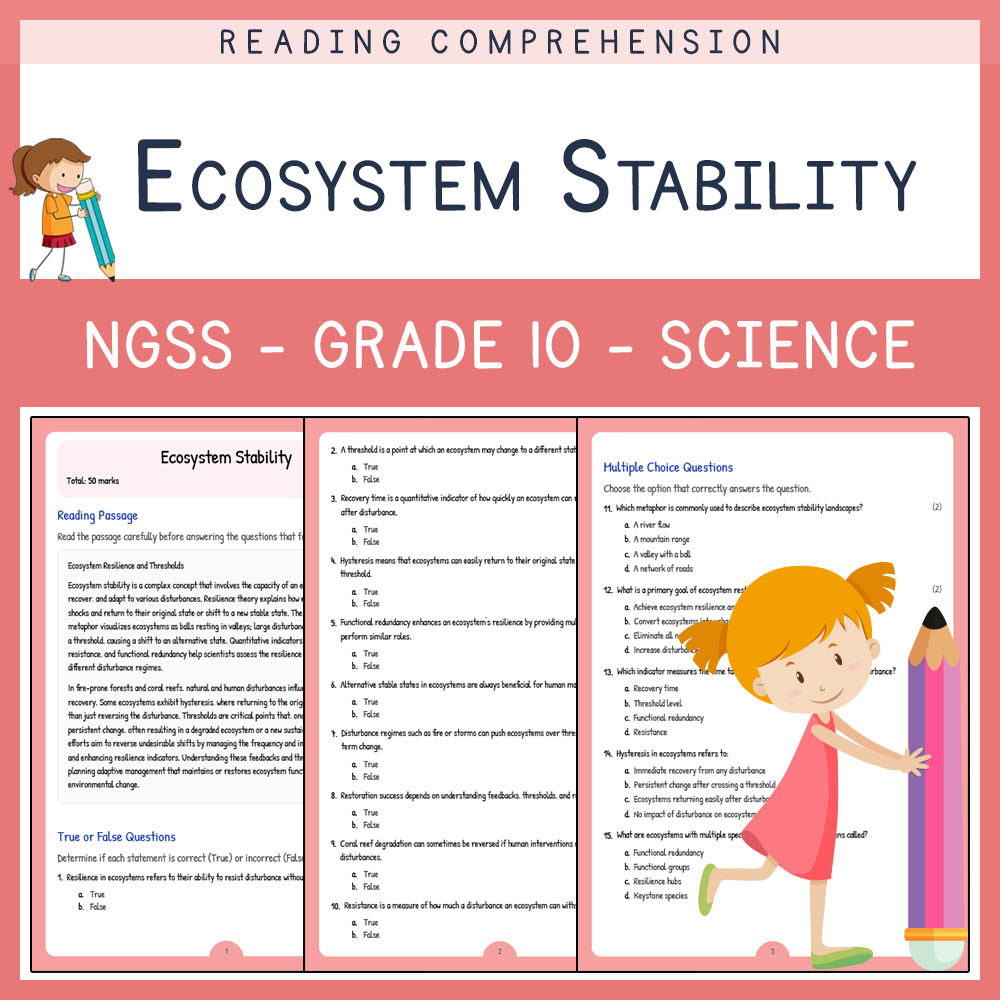
Grade 10 Science | Ecosystem Stability Worksheet and Answer Key (NGSS Aligned)
Created byLumora LearningLearning Objectives
- Understand the concept of resilience and thresholds in ecosystems.
- Analyze how disturbances impact ecosystem recovery pathways.
- Evaluate management scenarios for ecosystem restoration.
Instant download

Uncertainty And Error Assessment | Florida NGSSS Grade 10 Science Worksheet
 Created byPrism Point Learning
Learning Objectives
- Distinguish between random error and systematic error and explain how each affects measurement results.
- Use precision, accuracy, and margin of error to interpret and compare experimental data sets.
- Explain how uncertainty bounds and repeat trials influence the strength of scientific evidence.
Also included in: Grade 10 Scientific Reasoning Science Lesson Bundle – Florida NGSSS +1 more
Instant download

Spelling and Word Forms Worksheet Grade 10 ELA | CCSS Vocabulary Skills Practice
 Created bySunny Desk Resources
Learning Objectives
- Use correct spelling patterns and inflected word forms to improve clarity and professionalism in writing.
- Choose the correct word form for a sentence based on grammar and context (e.g., tense, part of speech, derivatives).
- Differentiate frequently confused words and homophones by meaning and appropriate usage.
Also included in: Grade 10 ELA Mood, Tone & Grammar Worksheets Lesson Bundle | CCSS +1 more
Instant download

Grade 10 Science | Circuit Fundamentals Worksheet (AP Standards) (PDF)
Created byEvergreen Desk EducationLearning Objectives
- Apply Ohm’s law and Kirchhoff-style reasoning to analyze simple DC circuits with series and parallel resistive elements.
- Use circuit algebra to determine current, voltage, resistance, and power dissipation in equivalent circuit representations.
- Connect energy transfer rates in circuits (electrical power) to broader mechanical and thermal energy ideas.
Also included in: Grade 10 Motion & Forces Science Lesson Bundle (AP) Worksheet Set +1 more
Instant download

Proofreading for Mechanics Worksheet Grade 10 ELA Ontario Writing Skills
Created bySunny Desk ResourcesLearning Objectives
- Identify common mechanical errors in capitalization, punctuation placement, spelling, and word duplication or omission
- Apply proofreading strategies to preserve meaning and improve clarity in revised writing
- Correct remaining agreement, tense, and pronoun-reference problems during a final edit pass
Instant download

Grade 10 Science – Evolutionary Predictions & Adaptation | Reading Worksheet
 Created byBright Mind Resources
Learning Objectives
- Explain how environmental changes influence genetic traits in populations.
- Identify the role of selection mechanisms in evolution.
- Analyze evidence supporting evolutionary models and predictions.
Also included in: Evolution Grade 10 Science Daily Reading Worksheets Lesson Bundle | General +1 more
Instant download

Grade 10 Photosynthesis Worksheet | Energy Capture Alberta Science PDF
Created byEvergreen Desk EducationLearning Objectives
- Explain how photosynthesis converts light energy into chemical energy stored in carbohydrates.
- Describe the role of chlorophyll and other pigments in capturing different wavelengths of light.
- Analyze how environmental factors (light intensity, seasons, water availability) affect energy capture and biomass production.
Instant download

Planning Futures Worksheet | May Grade 10 Holiday Assessment
 Created byCedar Grove Learning
Learning Objectives
- Identify key ideas about transitions and future planning in a narrative text
- Use planning-and-change vocabulary (e.g., goal, adapt, resilience) in context
- Create and explain short-term steps that support a long-term post-graduation goal
Also included in: Grade 10 End-of-Year Graduation Reflection Holiday Lesson Bundle: May +1 more
Instant download

Grade 10 ELA | Logical Structure Links Worksheet (CCSS) PDF
Created byGolden Apple StudioLearning Objectives
- Identify how transitions and scope words help readers follow an author’s logical reasoning in an informational text.
- Analyze how paragraph-level structure (definitions, evidence sequence, counterclaims, and conclusions) scaffolds an argument.
- Explain how writers clarify assumptions and narrow claims to strengthen logical flow.
Also included in: Grade 10 ELA Text Structure & Evidence Lesson Bundle | Common Core +1 more
Instant download
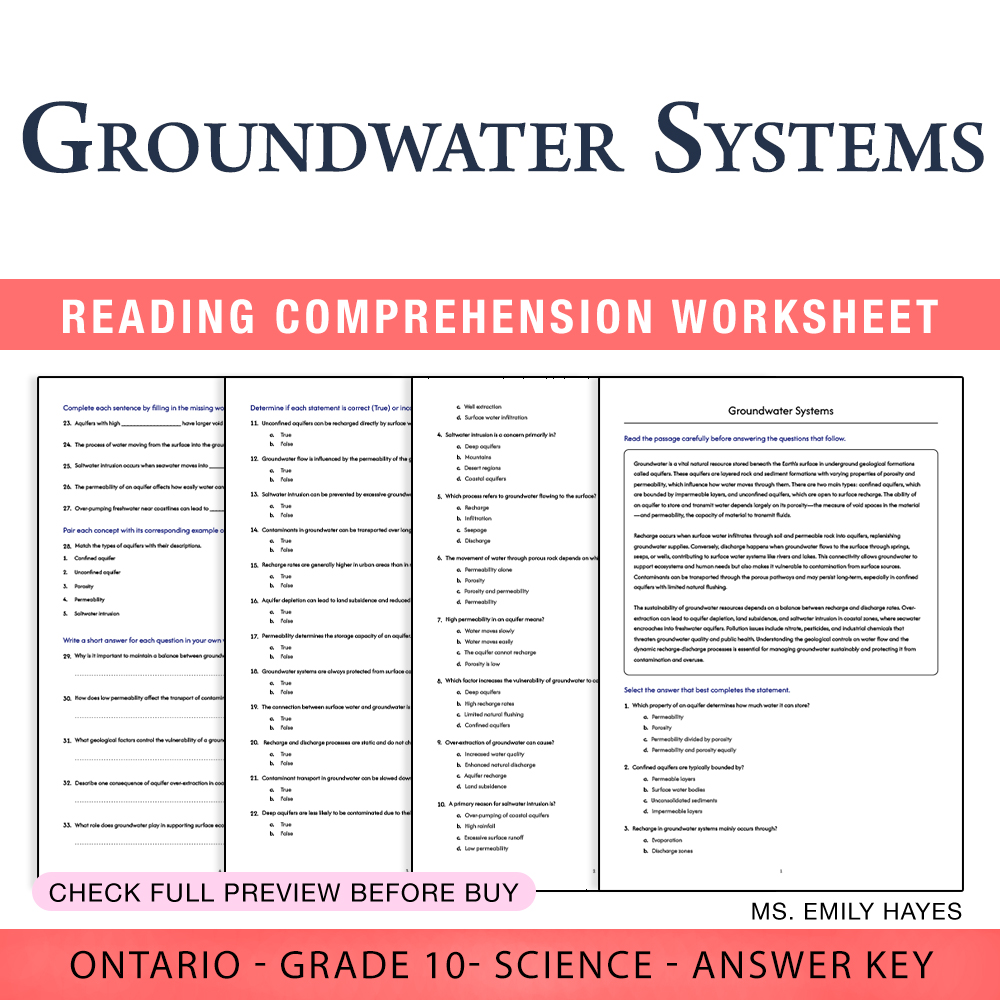
Grade 10 Science | Groundwater Systems Worksheet (PDF + Answer Key)
 Created byCopper Leaf Classroom
Learning Objectives
- Describe the types and properties of aquifers and their significance in groundwater flow.
- Explain the concepts of porosity and permeability and how they affect groundwater movement.
- Analyze the processes of recharge and discharge in groundwater systems and their environmental impacts.
Instant download

Grade 10 Transmission Losses Worksheet | Practice & Assessment PDF
Created byClear Sky ClassroomLearning Objectives
- Explain how transmission current and conductor resistance contribute to power loss in long-distance electrical lines.
- Describe how increasing transmission voltage reduces current and lowers resistive energy loss.
- Evaluate infrastructure choices (transformers, line voltage, insulation) that affect efficiency and reliability of regional grids.
Instant download

Grade 10 ELA – Syntax for Emphasis in Sentences | Daily Reading Worksheet
Created byQuiet Forest EducationLearning Objectives
- Understand how sentence structure can influence emphasis
- Identify different ways writers use syntax for effect
- Recognize how word order and sentence parts highlight ideas
Also included in: Grade 10 Language Grammar ELA Lesson Bundle: Daily Reading Worksheets | CCSS +1 more
Instant download

Grade 10 Science – Pedigree Analysis Daily Reading Worksheet + Answer Key
JCreated byJ.S SheetsLearning Objectives
- Understand what pedigrees are and how they are used to study inheritance.
- Identify different inheritance patterns such as autosomal dominant, autosomal recessive, and X-linked traits from pedigree diagrams.
- Interpret phenotypic data and predict genotypes and possible genetic risks.
Also included in: Grade 10 Science Lesson Group Bundle – TEKS | Genetics & Genomic Technologies +1 more
Instant download
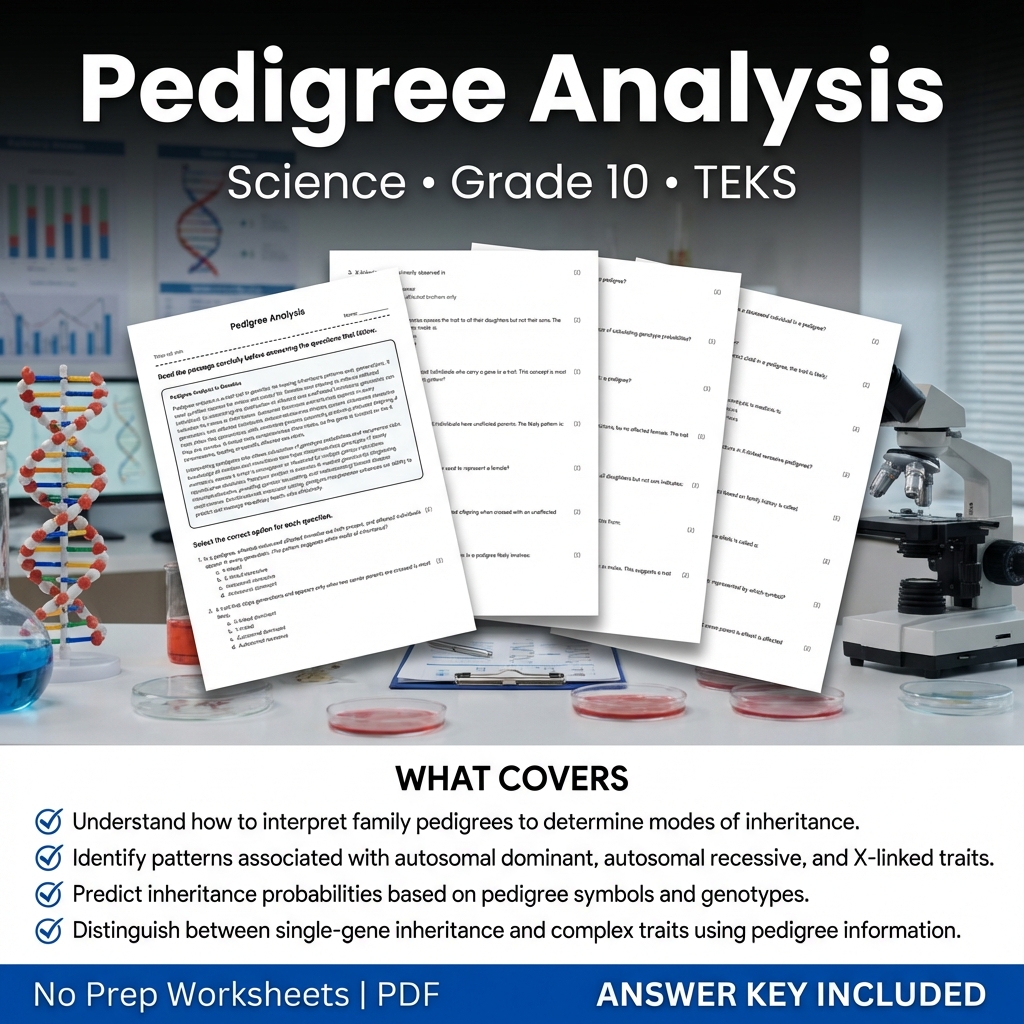
Grade 10 Science Pedigree Analysis Worksheet with Answer Key | TEKS
Created byCoral Reef LearningLearning Objectives
- Understand how to interpret family pedigrees to determine modes of inheritance.
- Identify patterns associated with autosomal dominant, autosomal recessive, and X-linked traits.
- Predict inheritance probabilities based on pedigree symbols and genotypes.
Instant download

Grade 10 Molar Relationships Worksheet | Practice & Assessment PDF
Created byClear Sky ClassroomLearning Objectives
- Use Avogadro’s number to relate moles to number of particles
- Convert between moles, mass, and molar mass using correct units
- Solve mole-to-mole and limiting reagent problems to estimate reactant consumption and product yield
Instant download

Grade 10 Science | Evolutionary Predictions - Daily Reading Comprehension
Created byCoral Reef LearningLearning Objectives
- Understand how traits influence survival and reproduction
- Recognize how environmental changes impact gene frequencies
- Learn the evidence supporting evolutionary models
Instant download

Grade 10 ELA – Register & Transfer Daily Reading Worksheet | Standards-Aligned
Created byQuiet Forest EducationLearning Objectives
- Understand key concepts related to ELA
- Apply knowledge through practice questions
- Demonstrate comprehension of the material
Also included in: Grade 10 Vocabulary in ELA Daily Reading Worksheets lesson bundle | General ELA +2 more
Instant download

Mole-to-Mass and Mole-to-Mole Relationships Chemistry Worksheets Grade 10
Created bySunny Desk ResourcesLearning Objectives
- Convert between moles and grams using molar mass and track units correctly
- Use mole ratios from a balanced chemical equation to convert between reactant and product amounts
- Identify the limiting reagent and predict expected yield using mole relationships
Also included in: Grade 10 Chemistry Lesson Bundle | Alberta Science Reaction & Analysis +1 more
Instant download

Grade 10 Word Parts Worksheet | ELA Vocabulary & Morphology Skills
Created bySunny Desk ResourcesLearning Objectives
- Analyze prefixes, roots, and suffixes to infer word meanings in academic texts
- Identify how word parts affect word class (noun, verb, adjective, adverb) within a sentence
- Evaluate whether an inferred meaning fits the context and improves comprehension
Also included in: Grade 10 Word Study, Tone & Vocabulary Lesson Bundle | General ELA +1 more
Instant download

Grade 10 Science | Electric Circuits Worksheet | BC Standard
Created byLumora LearningLearning Objectives
- Understand the basic components and functions of electric circuits.
- Identify the factors that affect the efficiency of electrical energy transmission.
- Compare centralized and distributed generation systems in terms of resource use and resilience.
Instant download

Grade 10 ELA Clarity and Effectiveness Worksheet (PDF) | General ELA Standards
Created byGolden Apple StudioLearning Objectives
- Revise drafts to replace vague language with precise word choices that improve clarity.
- Adjust sentence boundaries and structure so ideas are easier to follow and logically connected.
- Reduce redundancy and maintain consistent key terms to prevent reader confusion.
Also included in: Grade 10 Evidence-Based Writing and Organization ELA Lesson Bundle – General ELA +1 more
Instant download

Grade 10 Science – Understanding Constant Acceleration & Motion |Daily Worksheet
Created byQuiet Forest EducationLearning Objectives
- Define constant acceleration and its effects on motion.
- Identify key variables involved in uniformly accelerated motion.
- Apply basic kinematic formulas to simple acceleration problems.
Also included in: Motion and Forces Grade 10 Science Daily Reading Worksheets Bundle | Ontario +1 more
Instant download
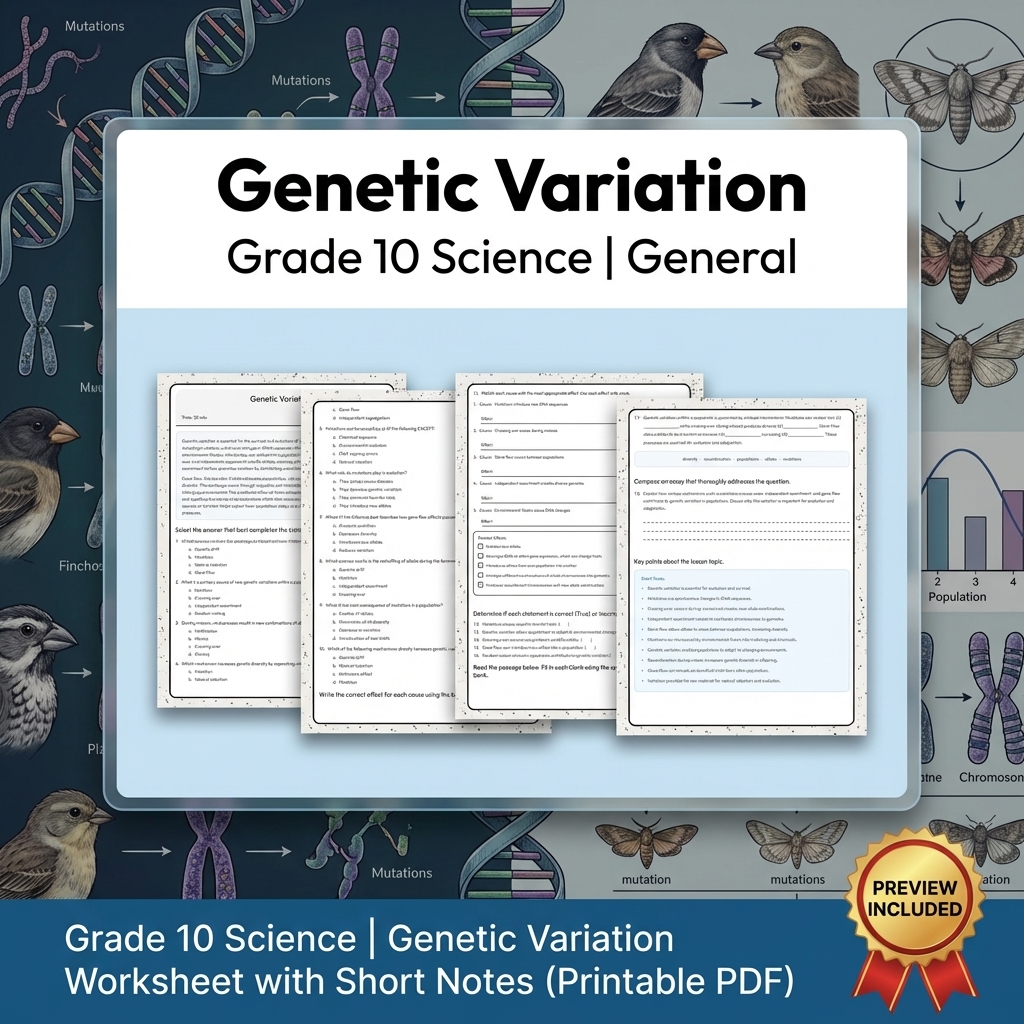
Grade 10 Science | Genetic Variation Worksheet with Short Notes (Printable PDF)
 Created byMeadowlark Worksheets
Learning Objectives
- Understand sources of genetic variation within populations.
- Identify mechanisms like meiosis, mutations, and gene flow that generate variation.
- Explain how genetic variation influences evolution and adaptation.
Also included in: Grade 10 Natural Selection & Heredity Science Lesson Bundle - General +1 more
Instant download

Grade 10 Energy Currency Worksheet | Practice & PDF
Created byClear Sky ClassroomLearning Objectives
- Explain why ATP is considered the primary energy currency of cells
- Describe how ATP hydrolysis and ATP synthesis are coupled to cellular processes
- Interpret how ATP turnover changes with tissue type and environmental conditions
Instant download

Grade 10 Message Techniques Worksheet | Ontario ELA Media & Literary Analysis
Created bySunny Desk ResourcesLearning Objectives
- Identify common media message techniques (framing, pacing, wording, sound, and visual emphasis).
- Explain how specific message features influence tone, attention, and interpretation.
- Support claims about message meaning using evidence from a media text.
Instant download

Sentence Variety Worksheet Pack | Grade 10 ELA Practice
Created bySunny Desk ResourcesLearning Objectives
- Identify how coordination and subordination change emphasis and clarify relationships in a paragraph.
- Revise sentences to improve variety by changing beginnings, complexity, and purposeful use of modifiers.
- Use parallel structure to create balance and readability in sentences within an analytical paragraph.
Also included in: Language Lesson Bundle, Grade 10 ELA Skills, BC Framework +1 more
Instant download

Structural Coherence Worksheet Grade 10 ELA | CCSS Writing Organization
Created bySunny Desk ResourcesLearning Objectives
- Define structural coherence and explain how a text’s arrangement of events and ideas supports meaning.
- Identify structural devices such as pacing, framing, transitions, recurring motifs, and time shifts.
- Analyze how structure clarifies relationships among themes and supports author intent and point of view.
Also included in: Narrative & Argument Analysis Lesson Bundle | Grade 10 ELA | Common Core +1 more
Instant download

Grade 10 | Back To School Worksheet for Building Community | PDF + Answer Key
 Created byShaNova Worksheets
Learning Objectives
- Explain how empathy, active listening, and collaboration strengthen a positive learning community.
- Apply community-building strategies to everyday classroom situations and conflicts.
- Identify examples of cooperation and collective achievement across different contexts.
Instant download

Grade 10 Style and Tone Analysis Worksheet | ELA Literary Analysis
Created bySunny Desk ResourcesLearning Objectives
- Analyze how diction, figurative language, and imagery shape a text’s mood.
- Explain how tone and repetition influence the author’s attitude and emphasis.
- Identify how sentence rhythm and syntax contribute to meaning beyond the literal message.
Also included in: Grade 10 Literary Analysis & Text Evidence Lesson Bundle | General ELA +1 more
Instant download

Grade 10 Science | Ocean Atmosphere Coupling Worksheet | General Standard
Created byLumora LearningLearning Objectives
- Explain how the ocean and atmosphere exchange heat and moisture to influence climate variability
- Describe why the ocean responds more slowly than the atmosphere due to its high heat capacity
- Interpret how sea-surface temperature changes can shift evaporation, storm development, and wind patterns
Instant download

Grade 10 Writing Coherence and Flow Worksheet | TEKS ELA Skills
Created bySunny Desk ResourcesLearning Objectives
- Identify how paragraphing and topic organization support coherence and clear thinking
- Use transitions to connect sentences, ideas, and sections logically
- Evaluate sentence-to-sentence relationships (claim to evidence, problem to solution) for logical flow
Instant download

Chemical Pathways and Reaction Rates Worksheets Grade 10 Science
Created bySunny Desk ResourcesLearning Objectives
- Explain how reaction types and rates influence air, water, and soil chemistry.
- Interpret chemical pathways that form and remove ozone and smog in urban air.
- Describe nutrient cycling and pollutant fate using mass-flow ideas over seasons.
Also included in: Grade 10 Chemistry Lesson Bundle | Alberta Science Reaction & Analysis +1 more
Instant download

Grade 10 Science – Bonding Models & Properties | Daily Reading Worksheet
Created byBright Mind ResourcesLearning Objectives
- Understand the basic types of chemical bonds: ionic, covalent, and metallic.
- Describe how electrons are transferred or shared in different bonding models.
- Relate molecular structures to observable material properties such as conductivity and melting points.
Also included in: Grade 10 Stoichiometry & Atomic Structure Science Reading Lesson Bundle | AP +2 more
Instant download
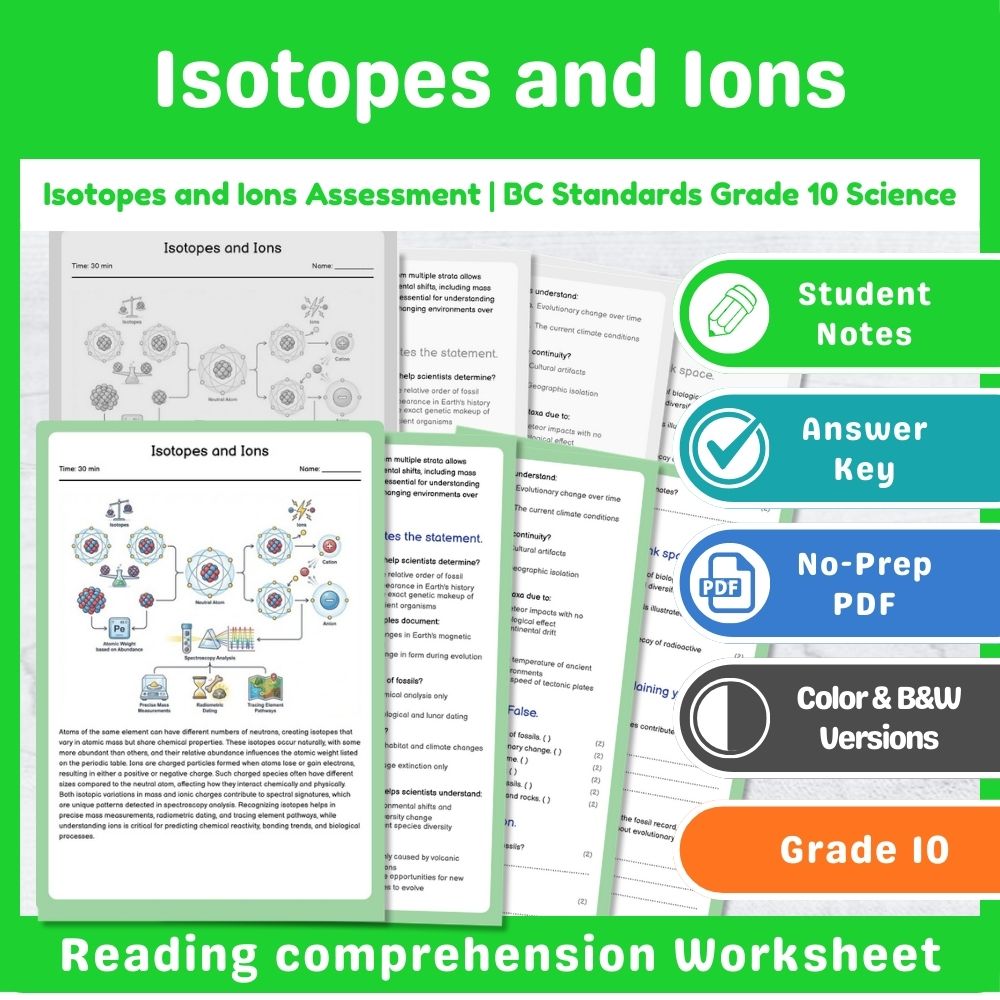
Isotopes and Ions Assessment | BC Standards Grade 10 Science
Created byPrism Point LearningLearning Objectives
- Define and differentiate between isotopes and ions, understanding their atomic structure and charge.
- Explain how isotopes affect atomic mass and spectral signatures.
- Describe the formation of ions through electron gain or loss and their chemical properties.
Instant download

Grade 10 Circuit Power Worksheet | Alberta Practice & PDF
Created byClear Sky ClassroomLearning Objectives
- Explain how electrical power relates to voltage and current using P = IV.
- Calculate electrical energy used over time using E = Pt and connect units to real-world consumption.
- Evaluate how efficiency and power losses affect operational cost and energy use in practical systems.
Instant download

Grade 10 Science | Cell Structure & Types - Daily Reading Comprehension
Created byCoral Reef LearningLearning Objectives
- Understand and differentiate between eukaryotic and prokaryotic cells
- Identify core structures of cells and their functions
- Recognize how cell structure relates to cell roles and specialization
Instant download

Grade 10 Homology and Commonality Worksheet | California Science Standards
Created byEvergreen Desk EducationLearning Objectives
- Explain how homologous structures provide evidence of shared ancestry between organisms
- Identify examples of homology in anatomy, development, and molecular features
- Distinguish homology from similarity due to convergent evolution
Instant download
Browse more categories
About Grade 10 Worksheets
Find Grade 10 worksheets covering algebra, biology, literature, and history. All 9,388 resources download instantly as PDFs for classwork, homework, or review.
MyTeachingSheets worksheets are made by real teacher-authors and checked before they go live. Download any as a print-ready PDF for lessons, homework, or independent practice — most include answer keys, and previews are always free.