
Grade 10 Worksheets
9,388 grade resources
Grade 10 Science | Biodiversity Overview Worksheet (BC Standards) (PDF)
 Created byEvergreen Desk Education
Learning Objectives
- Explain biodiversity at genetic, species, and ecosystem levels
- Describe how habitat availability, climate stability, and disturbance influence biodiversity
- Analyze how species richness and evenness are shaped by environmental gradients and evolutionary history
Instant download

Grade 10 ELA – Purpose & Audience in Writing | Daily Reading Worksheet
 Created byQuiet Forest Education
Learning Objectives
- Identify texts written to inform or explain
- Understand how purpose influences tone and detail
- Recognize audience cues in writing
Also included in: Grade 10 Writing Process ELA Lesson Bundle for Daily Reading | Alberta +1 more
Instant download

Grade 10 Purposeful Style Worksheet | ELA Writing Voice & Craft Skills
 Created bySunny Desk Resources
Learning Objectives
- Identify how an author’s tone, word choice, and sentence patterns match a specific audience and purpose
- Revise writing choices to improve clarity, persuasiveness, and objectivity based on genre
- Use precise academic diction and consistent perspective in formal argumentative writing
Also included in: Grade 10 Argument & Revision Writing Lesson Bundle | ELA, General ELA +1 more
Instant download

Grade 10 ELA – Daily Worksheet | Understanding Figurative Language & Metaphors
Created byQuiet Forest EducationLearning Objectives
- Identify metaphors in context
- Interpret the meaning and purpose of metaphors
- Analyze how metaphors affect tone and reader perception
Also included in: Grade 10 Language Grammar ELA Lesson Bundle: Daily Reading Worksheets | CCSS +1 more
Instant download

Grade 10 Science – Electron Configuration & Quantum Numbers | Reading Worksheet
 Created byBright Mind Resources
Learning Objectives
- Understand key concepts related to Science
- Apply knowledge through practice questions
- Demonstrate comprehension of the material
Also included in: Grade 10 Stoichiometry & Atomic Structure Science Reading Lesson Bundle | AP +2 more
Instant download

Grade 10 ELA – Reading & Audience Needs | Daily Reading Worksheet
Created byQuiet Forest EducationLearning Objectives
- Identify different types of audiences in speaking and listening scenarios
- Understand how to adapt language and tone according to audience type
- Analyze strategies for effective communication tailored to specific audiences
Also included in: Grade 10 Speaking & Listening ELA Daily Worksheets Lesson Bundle | General ELA +2 more
Instant download

Grade 10 ELA – Daily Reading & Revision for Effectiveness | BC Standards
Created byQuiet Forest EducationLearning Objectives
- Refine sentences for clarity and concision
- Identify unnecessary words and phrases
- Improve sentence structure for emphasis and flow
Also included in: Grade 10 ELA Daily Reading Worksheets: Tone & Style Lesson Bundle | BC +1 more
Instant download

Chemical Bonding Types Worksheets: Ionic, Covalent & Metallic Grade 10
Created bySunny Desk ResourcesLearning Objectives
- Compare ionic, covalent, and metallic bonding using particle-level descriptions.
- Predict macroscopic properties such as conductivity, melting point, and solubility from bonding type.
- Relate electron transfer, electron sharing, and electron delocalization to observed behaviours.
Also included in: Grade 10 Chemistry Lesson Bundle | Alberta Science Reaction & Analysis +1 more
Instant download

Grade 10 Word Choice and Connotation Worksheet | TEKS ELA with Answer Key
Created bySunny Desk ResourcesLearning Objectives
- Analyze how connotation and precise word choice shape a writer’s tone and implied attitude
- Identify how specific nouns, verbs, adjectives, and modifiers influence meaning in persuasive and informational texts
- Evaluate how repetition and figurative language affect credibility, urgency, and reader interpretation
Instant download
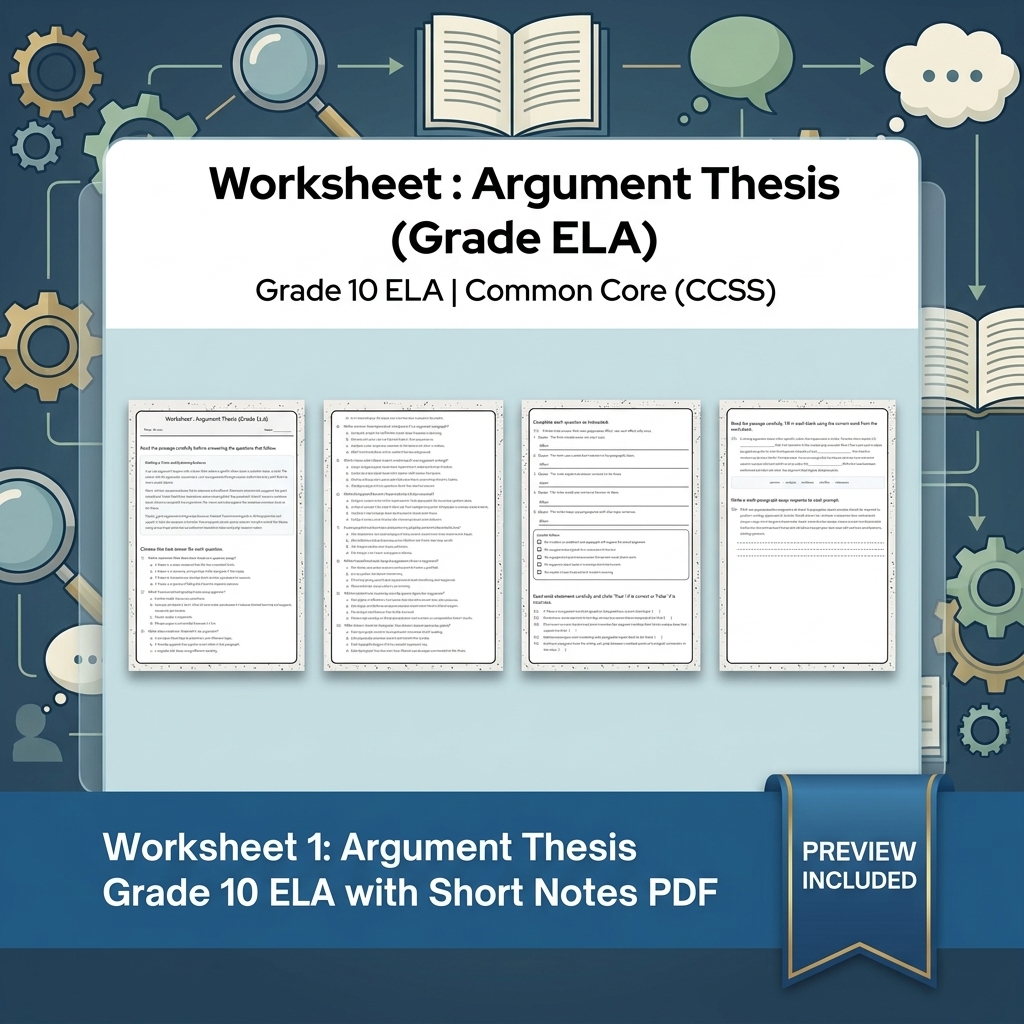
Grade 10 ELA Argument Thesis Worksheet with Short Notes
 Created byMeadowlark Worksheets
Learning Objectives
- Identify the elements of a strong argument thesis, including a clear claim and reasons.
- Select evidence that is relevant and sufficient, and explain how it connects to a claim.
- Differentiate analysis from plot summary or simple opinion in argumentative writing.
Also included in: Grade 10 Transitions & Style ELA Lesson Bundle | Common Core (CCSS) +1 more
Instant download

Grade 10 ELA – Daily Reading Worksheet & Parallel Structure | CCSS-Aligned
Created byQuiet Forest EducationLearning Objectives
- Identify parallel structure in sentences
- Recognize proper grammatical forms for clarity
- Analyze the role of parallelism in effective writing
Also included in: Grade 10 Language Grammar ELA Lesson Bundle: Daily Reading Worksheets | CCSS +1 more
Instant download

Grade 10 ELA – Organizational Structures in Writing | Daily Reading Worksheet
Created byQuiet Forest EducationLearning Objectives
- Identify main features of chronological order in texts
- Understand how time-related sequence helps organize writing
- Recognize signals and markers used to indicate chronological progression
Also included in: Grade 10 Writing Process ELA Lesson Bundle for Daily Reading | Alberta +1 more
Instant download

Grade 10 ELA – Understanding Commas & Semicolons | Daily Reading Worksheet
Created byQuiet Forest EducationLearning Objectives
- Understand key concepts related to ELA
- Apply knowledge through practice questions
- Demonstrate comprehension of the material
Also included in: Grade 10 Language ELA Daily Reading Worksheets Lesson Bundle | Ontario +1 more
Instant download

Grade 10 ELA – Daily Reading Worksheet | Revision for Impact in Writing
Created byQuiet Forest EducationLearning Objectives
- Identify strategies to strengthen persuasive and explanatory writing
- Enhance coherence and clarity through revision techniques
- Apply methods to improve the logical flow and impactful conclusion
Also included in: Grade 10 Writing Process ELA Lesson Bundle for Daily Reading | Alberta +1 more
Instant download

Battery Storage Worksheet | Standards-Aligned Science Practice for Grade 10
JCreated byJ.S SheetsLearning Objectives
- Explain how battery storage converts chemical energy to electrical energy and back.
- Describe factors affecting the efficiency and longevity of batteries.
- Analyze how charge–discharge cycles impact battery performance over time.
Instant download

Grade 10 Science – Wave Properties & Behavior | Daily Reading Worksheet
Created byBright Mind ResourcesLearning Objectives
- Identify basic wave features such as amplitude, wavelength, and frequency
- Understand the mathematical relationships between wave speed, frequency, and wavelength
- Describe phenomena like superposition and interference patterns
Also included in: Signal Modulation Grade 10 Science Daily Reading Worksheets Bundle | NGSS +2 more
Instant download

Grade 10 ELA – Daily Worksheet & Coherence Transitions | Alberta Standards
Created byQuiet Forest EducationLearning Objectives
- Identify transition words and phrases used to connect ideas in writing.
- Explain the purpose of different transition words in sentences and paragraphs.
- Recognize how transitions contribute to coherence and flow in a written piece.
Also included in: Grade 10 Writing Process ELA Lesson Bundle for Daily Reading | Alberta +1 more
Instant download

Grade 10 ELA Worksheet | Tense and Agreement Practice (PDF)
 Created byGolden Apple Studio
Learning Objectives
- Use consistent verb tense to keep events and explanations clear across sentences
- Apply correct subject-verb agreement within clauses, including tricky inserted phrases
- Choose appropriate pronoun persons and numbers by matching them to correct antecedents
Also included in: Grade 10 ELA Word Choice, Tone & Punctuation Lesson Bundle: Alberta +1 more
Instant download

Grade 10 ELA – Claim & Argument Writing Daily Reading Worksheet
Created byQuiet Forest EducationLearning Objectives
- Identify clear and specific main claims in texts
- Analyze how authors present their central argument
- Understand the importance of narrowing scope for effective claims
Also included in: Grade 10 Writing Coherence & Evidence ELA Daily Reading Worksheets Lesson Bundle | General ELA +2 more
Instant download

Plate Dynamics Worksheet | Grade 10 Science Activities
 Created byPrism Point Learning
Learning Objectives
- Explain how plate interactions drive uplift, faulting, and mountain building.
- Describe how crustal deformation can create sedimentary basins and influence resource distribution.
- Connect long-term erosion and drainage patterns to tectonic processes.
Instant download

Atomic Models and Particulate Matter Worksheets | Grade 10 Science
Created bySunny Desk ResourcesLearning Objectives
- Describe how particulate models explain macroscopic properties of matter.
- Use atomic-scale ideas to relate density, phase, and conductivity to particle arrangement and motion.
- Differentiate among atomic model features and the role of intermolecular forces.
Also included in: Grade 10 Chemistry Lesson Bundle | Alberta Science Reaction & Analysis +1 more
Instant download
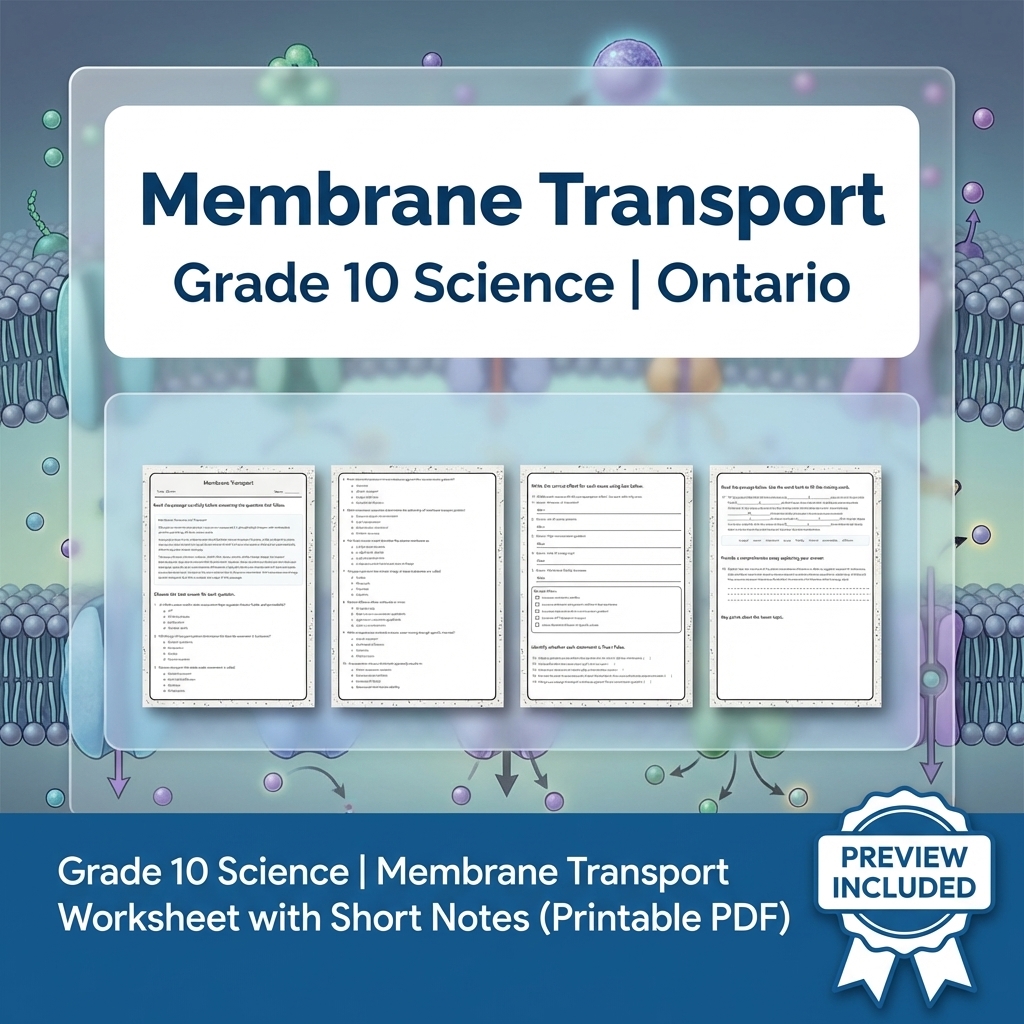
Grade 10 Science | Membrane Transport Worksheet with Short Notes (Printable PDF)
Created byMeadowlark WorksheetsLearning Objectives
- Describe the structural features of the plasma membrane according to the fluid mosaic model.
- Differentiate between types of transport proteins such as channels, carriers, and pumps.
- Explain passive transport mechanisms like diffusion, facilitated diffusion, and osmosis.
Also included in: Grade 10 Science Lesson Group Bundle | Ontario Curriculum +1 more
Instant download
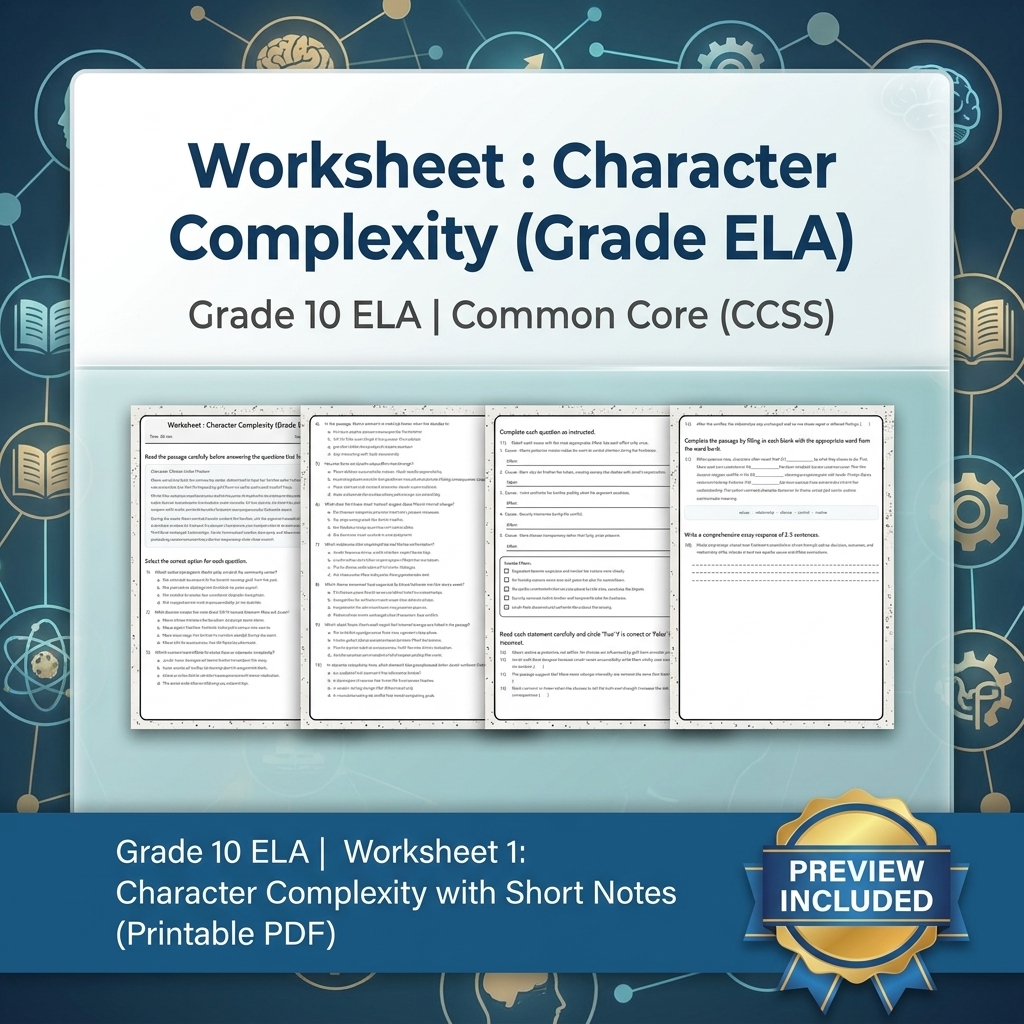
Grade 10 ELA Character Complexity worksheet with Short Notes (Printable PDF)
Created byMeadowlark WorksheetsLearning Objectives
- Analyze how a character’s motives, decisions, and outcomes shape internal change and external impact.
- Evaluate how relationships and shifting tension influence a character’s behavior and reveal values or competing goals.
- Connect character actions to theme by explaining how behavior creates meaning in a story.
Also included in: Grade 10 Theme, Evidence & Character: ELA Lesson Bundle, Common Core (CCSS) +1 more
Instant download

Grade 10 Science | Battery Storage Worksheet | BC Aligned
 Created byLumora Learning
Learning Objectives
- Understand how battery storage converts chemical energy to electrical energy and back.
- Explain the concepts of state of charge, storage capacity, and charge–discharge cycles.
- Analyze the factors affecting battery efficiency, including heat loss and internal resistance.
Instant download

Grade 10 Tone and Connotation Argument Worksheet | TEKS ELA Activity
Created bySunny Desk ResourcesLearning Objectives
- Identify a writer’s tone by analyzing word choice and connotation.
- Revise sentences to replace neutral wording with language that matches a intended attitude.
- Explain how connotative words affect an audience’s interpretation of claims.
Instant download

Grade 10 Paragraph Coherence Worksheet | Ontario ELA Writing Revision Activity
Created byLumora LearningLearning Objectives
- Identify how topic sentences, supporting details, and concluding sentences create coherence within a paragraph.
- Select effective transitions and evidence integration to maintain logical flow between sentences and paragraphs.
- Revise sentences to improve focus and paragraph unity in an academic paragraph.
Instant download

Grade 10 — Worksheet MCQ Paper for Mastering Constitutional Beginnings
 Created byThe Resource Hub
Learning Objectives
- Explain how debates over federalism shaped constitutional governance before 1982.
- Describe how courts and social movements contributed to the development of rights protections.
- Analyze continuity and change in constitutional discourse, including minority protections.
Also included in: Grade 10 Canadian History Since World War I Social Studies Custom Bundle Ontario +1 more
Instant download

Grade 10 Science – Electromagnetic Forces & Fields | Daily Reading Worksheet
Created byBright Mind ResourcesLearning Objectives
- Understand the concept of electric fields and how they are represented
- Identify how electric field lines indicate the direction and strength of electric fields
- Explain the interaction between charges within an electric field
Also included in: Forces & Motion Grade 10 Science Daily Reading Worksheets Lesson Bundle | NGSS +2 more
Instant download
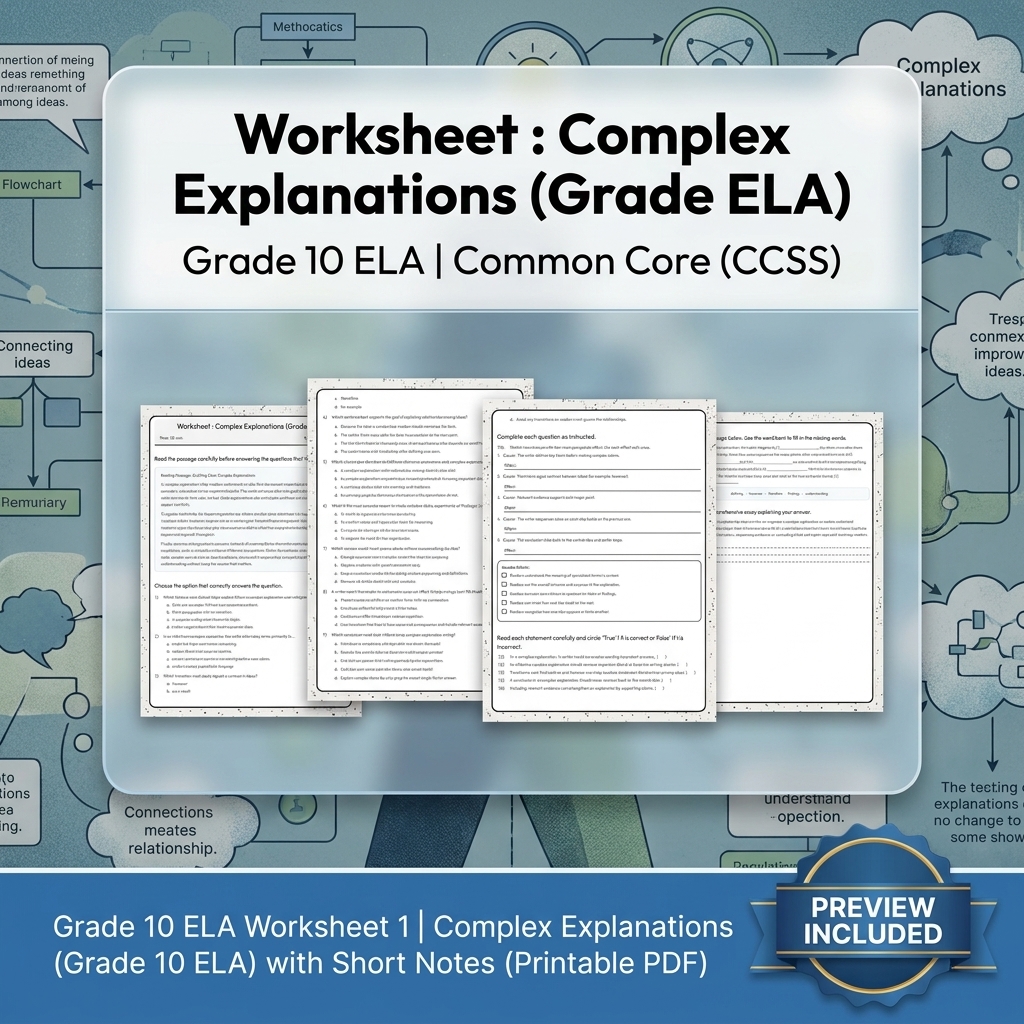
Grade 10 ELA Complex Explanations worksheet with Short Notes (Printable PDF)
Created byMeadowlark WorksheetsLearning Objectives
- Explain how writers organize information to help readers follow complex ideas
- Identify how definitions, transitions, and evidence support clarity in complex explanations
- Evaluate whether an explanation oversimplifies important complexity
Also included in: Grade 10 Transitions & Style ELA Lesson Bundle | Common Core (CCSS) +1 more
Instant download

Grade 10 Social Studies — Cold War Policies Worksheet MCQ Paper for Mastery
Created byThe Resource HubLearning Objectives
- Explain how Canadian Cold War policies connected security alliances to deterrence and defence commitments.
- Analyze how intelligence practices and domestic anti-communist measures affected civil liberties and public accountability.
- Evaluate continuity and change in Canada’s surveillance practices and diplomatic posture over the Cold War period.
Also included in: Grade 10 Canadian History Since World War I Social Studies Custom Bundle Ontario +1 more
Instant download

Grade 10 Science | Chemical Equations - Daily Reading Comprehension
 Created byCoral Reef Learning
Learning Objectives
- Identify the parts of a chemical equation, including reactants and products.
- Understand the significance of coefficients and state symbols.
- Interpret basic chemical equations and recognize reaction components.
Instant download

Grade 10 Introduction to Geologic Mapping Worksheet | NGSS Earth Science
 Created byBRIGHT PATH RESOURCES
Learning Objectives
- Understand the basic concepts of geologic mapping
- Identify types of geoscience data involved in mapping
- Describe methods used to interpret Earth's structural features
Also included in: Earth Systems Grade 10 Science Daily Reading Worksheets Lesson Bundle | NGSS +1 more
Instant download

Grade 10 ELA Paragraph Development Worksheet (Alberta) PDF
Created byGolden Apple StudioLearning Objectives
- Identify a paragraph’s controlling idea and explain how supporting details develop it.
- Revise sentence order so relationships among ideas are clear and transitions feel logical.
- Connect evidence to a claim by writing explanation sentences that show “why this matters.”
Also included in: Grade 10 Writing Process, Revision & Clarity ELA Lesson Bundle – Alberta +1 more
Instant download

Biotech Applications of Microorganisms Worksheet | Grade 10 Science Ontario
JCreated byJ.S SheetsLearning Objectives
- Explain how microorganisms are used in biotechnological processes such as fermentation, bioremediation, and industrial enzyme production.
- Describe how genetic manipulation in microbes can support product synthesis and the development of antimicrobial agents.
- Evaluate why antibiotic resistance can emerge and spread, including roles of horizontal gene transfer and ecological impacts.
Instant download
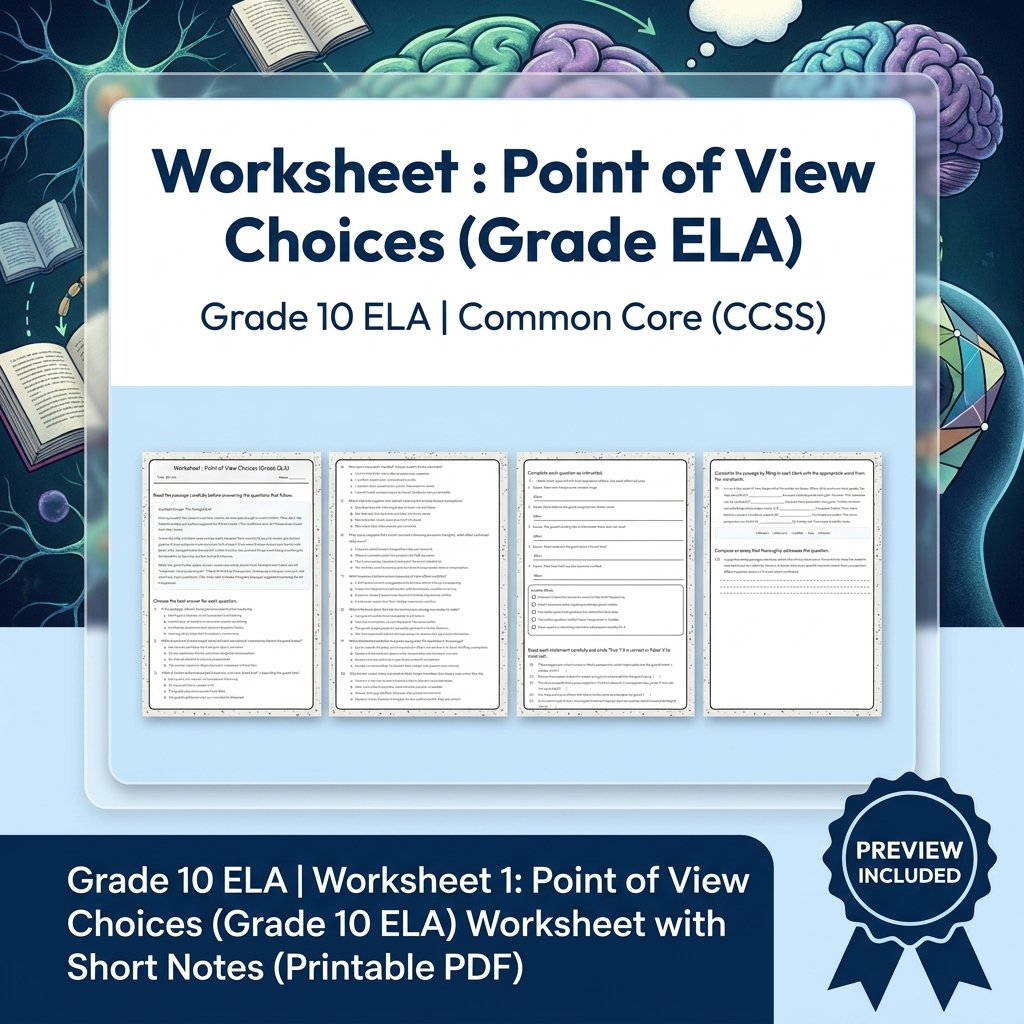
Grade 10 ELA Point of View Choices Worksheet with Short Notes (Printable PDF)
Created byMeadowlark WorksheetsLearning Objectives
- Analyze how point of view (first-person, third-person limited, third-person omniscient) shapes meaning and credibility in a narrative.
- Evaluate how an author’s choice to reveal or withhold information influences suspense, irony, and readers’ inferences about motives.
- Use point-of-view evidence to explain how narrative perspective supports coherence across scenes and cause-and-effect.
Also included in: Grade 10 Theme, Evidence & Character: ELA Lesson Bundle, Common Core (CCSS) +1 more
Instant download

Grade 10 ELA – Daily Reading & Spelling Patterns | Print Worksheet
Created byQuiet Forest EducationLearning Objectives
- Understand common prefixes and suffixes
- Identify how prefixes and suffixes change word meanings
- Apply spelling conventions for high-frequency words and word forms
Also included in: Grade 10 Language ELA Daily Reading Worksheets Lesson Bundle | Ontario +1 more
Instant download
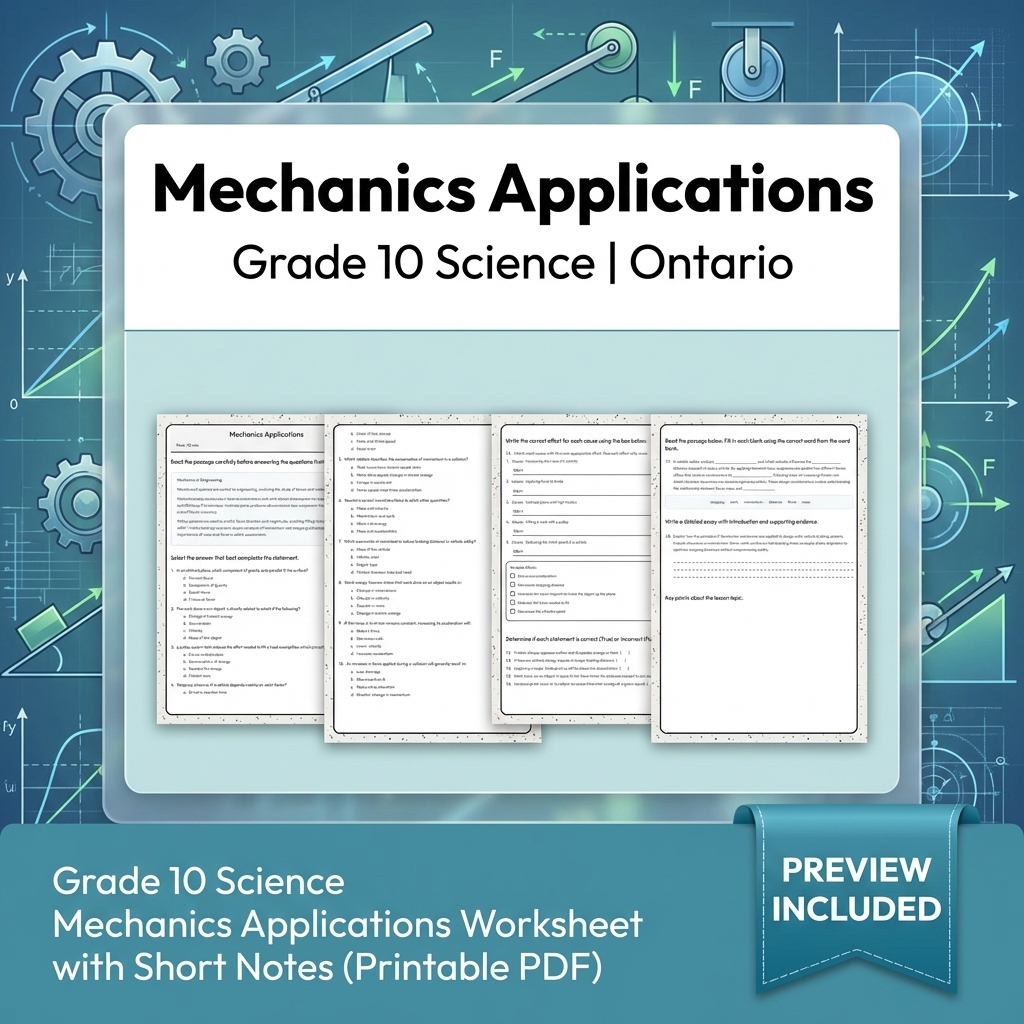
Grade 10 Science Mechanics Applications Worksheet with Short Notes
Created byMeadowlark WorksheetsLearning Objectives
- Understand how kinematic relations integrate with Newtonian dynamics in practical systems.
- Apply physics principles to analyze real-world mechanical scenarios such as inclined planes, pulleys, and braking systems.
- Relate forces, mass, acceleration, work, and momentum to system behavior and safety parameters.
Also included in: Grade 10 Science Lesson Group: Motion & Forces Ontario Curriculum Bundle +1 more
Instant download

Argument Thesis Worksheet Grade 10 ELA | CCSS Argument Writing Skills
Created bySunny Desk ResourcesLearning Objectives
- Identify what makes an argument thesis clear, specific, and arguable
- Explain how reasons and evidence connect to a claim using analysis rather than plot summary
- Evaluate whether statements maintain focus and logical coherence in argumentative writing
Also included in: Grade 10 Transitions, Research & Argument Writing Lesson Bundle | CCSS ELA +1 more
Instant download

Purpose Shifts and Tone Worksheet for Grade 10 ELA | TEKS Analysis
Created byGolden Apple StudioLearning Objectives
- Analyze how a writer’s purpose can shift in response to counterpoints and refined definitions.
- Explain how tone changes using evidence from diction, modality, and sentence rhythm.
- Connect structural moves in an argumentative or explanatory text to changes in language intensity and perspective.
Also included in: Grade 10 ELA Literary & Rhetorical Analysis Lesson Bundle | TEKS +1 more
Instant download

Grade 10 Science | Fossil Formation Worksheet (TEKS) (PDF)
Created byEvergreen Desk EducationLearning Objectives
- Explain the main processes that lead to fossil formation, including mineralization, compression, and imprint preservation.
- Describe how fossil distributions and stratigraphic succession provide evidence for environmental change and the relative sequence of life forms.
- Compare relative dating and radiometric (absolute) dating and interpret what each method contributes to geological time.
Instant download
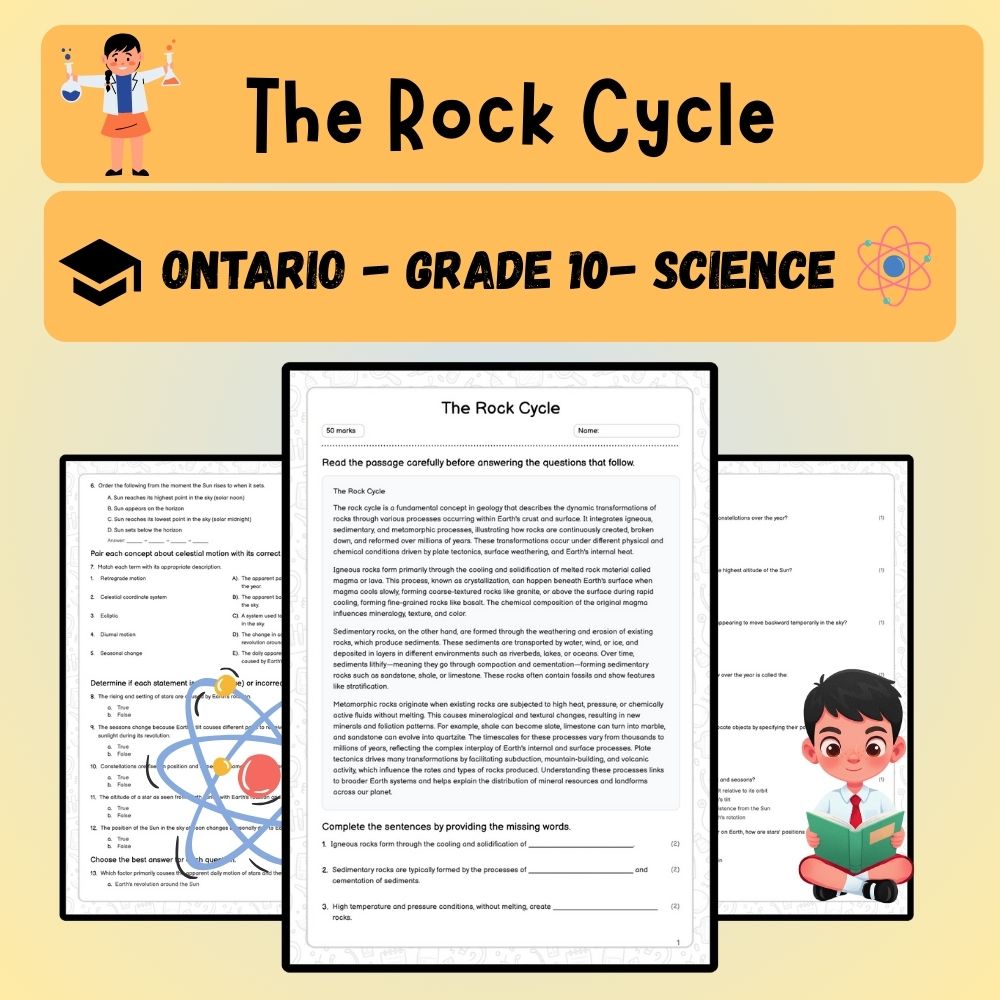
Grade 10 Science | The Rock Cycle Worksheet (PDF) – Ontario Standards
Created byPrism Point LearningLearning Objectives
- Explain the processes involved in the formation and transformation of rocks within the rock cycle.
- Describe the roles of heat, pressure, weathering, and chemical processes in changing rock types.
- Identify how plate tectonics and surface processes drive the rock cycle over geological timescales.
Also included in: Grade 10 Science UNIT Bundle | Earth Processes & Resources Ontario Standards +1 more
Instant download

Grade 10 Science | Stratigraphic Record Worksheet | AP Aligned
Created byLumora LearningLearning Objectives
- Interpret stratigraphic sequences and fossil assemblages to determine Earth's history.
- Explain principles such as superposition, correlation, and unconformities.
- Apply radiometric decay methods and error considerations in dating rocks.
Instant download
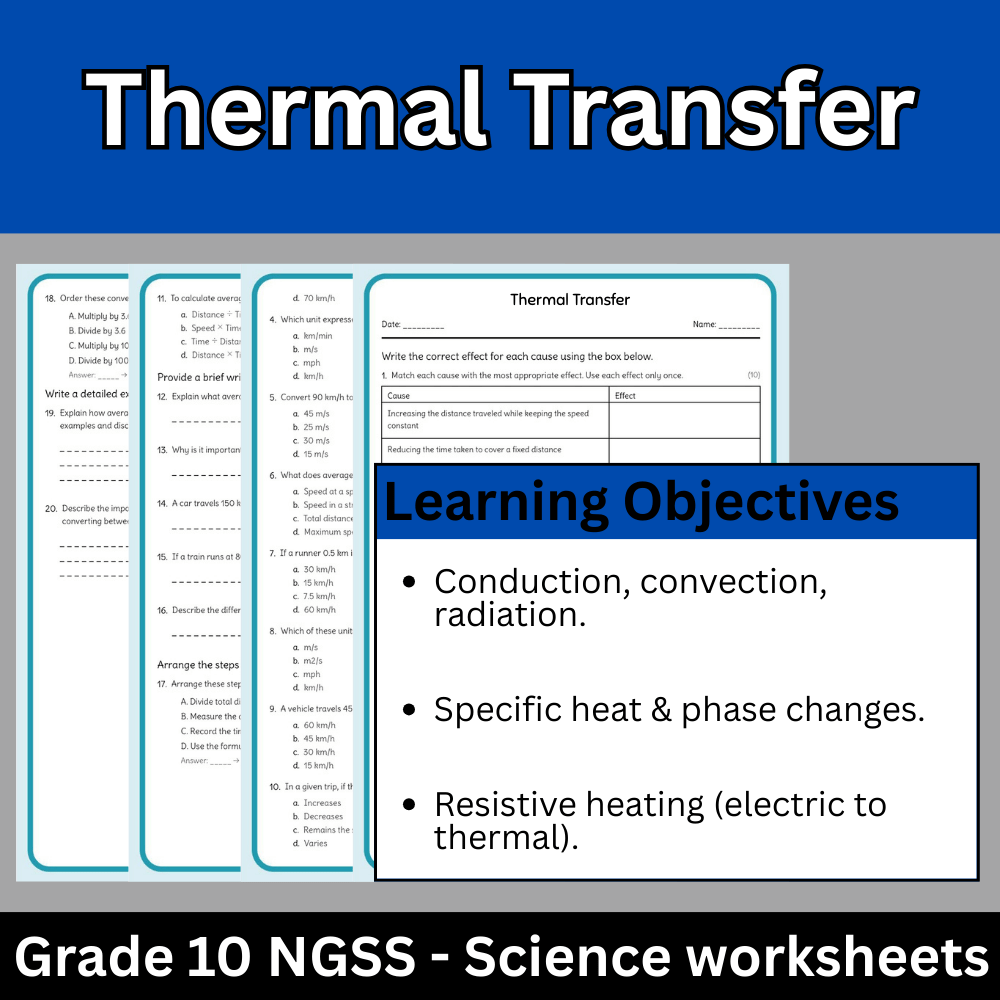
Grade 10 Science | Thermal Transfer Worksheet (Answer Key) – NGSS Aligned
Created byBright Mind ResourcesLearning Objectives
- Explain the mechanisms of heat transfer: conduction, convection, and radiation.
- Connect thermal energy changes to specific heat and phase changes.
- Analyze resistive heating and its conversion of electrical energy to thermal energy.
Instant download

Conservation of Mass Worksheets: Chemical Reactions Grade 10 Science
Created bySunny Desk ResourcesLearning Objectives
- Explain that atoms are rearranged but not created or destroyed during chemical reactions in a closed system
- Interpret balanced symbolic equations using mass relationships between reactants and products
- Use mass accounting to identify how and why measurement discrepancies can occur in real settings
Also included in: Grade 10 Chemistry Lesson Bundle | Alberta Science Reaction & Analysis +1 more
Instant download

Climate Drivers Worksheet for Grade 10 Science | AP Standard Practice
JCreated byJ.S SheetsLearning Objectives
- Identify key factors that influence Earth's climate, including radiative forcing, greenhouse gases, and albedo variations.
- Explain how ocean-atmosphere coupling affects climate patterns over different timescales.
- Analyze model outputs and proxy records to evaluate long-term climate trends and regional shifts.
Instant download

Grade 10 ELA – Purposeful Speaking & Communication | Daily Reading Worksheet
Created byQuiet Forest EducationLearning Objectives
- Understand different purposes of speech such as informing, persuading, and engaging
- Identify cues in messages that reveal the speaker's intention
- Analyze how tone, level of formality, and supporting evidence vary with purpose
Also included in: Grade 10 Speaking and Listening ELA Lesson Bundle | Ontario Daily Reading +1 more
Instant download

Grade 10 Science | Magnetic Fields Worksheet | BC Standards
Created byLumora LearningLearning Objectives
- Explain how magnetic fields arise from moving charges and electric currents.
- Describe the pattern and representation of magnetic field lines.
- Understand the effects of magnetic forces on moving charges and their trajectories.
Instant download

Free-Body Diagrams Worksheets: Resultant Force Grade 10 Science
Created byPrism Point LearningLearning Objectives
- Construct free-body diagrams for isolated objects
- Identify forces acting on an isolated object
- Resolve angled forces into coordinate components
Also included in: Grade 10 Science Worksheets Ontario Forces and Motion Bundle
Instant download
Browse more categories
About Grade 10 Worksheets
Find Grade 10 worksheets covering algebra, biology, literature, and history. All 9,388 resources download instantly as PDFs for classwork, homework, or review.
MyTeachingSheets worksheets are made by real teacher-authors and checked before they go live. Download any as a print-ready PDF for lessons, homework, or independent practice — most include answer keys, and previews are always free.